WO2018079707A1 - ポリイミドおよびそれを用いたフレキシブルデバイス - Google Patents
ポリイミドおよびそれを用いたフレキシブルデバイス Download PDFInfo
- Publication number
- WO2018079707A1 WO2018079707A1 PCT/JP2017/038882 JP2017038882W WO2018079707A1 WO 2018079707 A1 WO2018079707 A1 WO 2018079707A1 JP 2017038882 W JP2017038882 W JP 2017038882W WO 2018079707 A1 WO2018079707 A1 WO 2018079707A1
- Authority
- WO
- WIPO (PCT)
- Prior art keywords
- polyimide
- mol
- film
- dianhydride
- bis
- Prior art date
- Legal status (The legal status is an assumption and is not a legal conclusion. Google has not performed a legal analysis and makes no representation as to the accuracy of the status listed.)
- Ceased
Links
Classifications
-
- C—CHEMISTRY; METALLURGY
- C08—ORGANIC MACROMOLECULAR COMPOUNDS; THEIR PREPARATION OR CHEMICAL WORKING-UP; COMPOSITIONS BASED THEREON
- C08G—MACROMOLECULAR COMPOUNDS OBTAINED OTHERWISE THAN BY REACTIONS ONLY INVOLVING UNSATURATED CARBON-TO-CARBON BONDS
- C08G73/00—Macromolecular compounds obtained by reactions forming a linkage containing nitrogen with or without oxygen or carbon in the main chain of the macromolecule, not provided for in groups C08G12/00 - C08G71/00
- C08G73/06—Polycondensates having nitrogen-containing heterocyclic rings in the main chain of the macromolecule
- C08G73/10—Polyimides; Polyester-imides; Polyamide-imides; Polyamide acids or similar polyimide precursors
- C08G73/1075—Partially aromatic polyimides
-
- C—CHEMISTRY; METALLURGY
- C08—ORGANIC MACROMOLECULAR COMPOUNDS; THEIR PREPARATION OR CHEMICAL WORKING-UP; COMPOSITIONS BASED THEREON
- C08G—MACROMOLECULAR COMPOUNDS OBTAINED OTHERWISE THAN BY REACTIONS ONLY INVOLVING UNSATURATED CARBON-TO-CARBON BONDS
- C08G73/00—Macromolecular compounds obtained by reactions forming a linkage containing nitrogen with or without oxygen or carbon in the main chain of the macromolecule, not provided for in groups C08G12/00 - C08G71/00
- C08G73/06—Polycondensates having nitrogen-containing heterocyclic rings in the main chain of the macromolecule
- C08G73/10—Polyimides; Polyester-imides; Polyamide-imides; Polyamide acids or similar polyimide precursors
-
- C—CHEMISTRY; METALLURGY
- C08—ORGANIC MACROMOLECULAR COMPOUNDS; THEIR PREPARATION OR CHEMICAL WORKING-UP; COMPOSITIONS BASED THEREON
- C08G—MACROMOLECULAR COMPOUNDS OBTAINED OTHERWISE THAN BY REACTIONS ONLY INVOLVING UNSATURATED CARBON-TO-CARBON BONDS
- C08G73/00—Macromolecular compounds obtained by reactions forming a linkage containing nitrogen with or without oxygen or carbon in the main chain of the macromolecule, not provided for in groups C08G12/00 - C08G71/00
- C08G73/06—Polycondensates having nitrogen-containing heterocyclic rings in the main chain of the macromolecule
- C08G73/10—Polyimides; Polyester-imides; Polyamide-imides; Polyamide acids or similar polyimide precursors
- C08G73/1046—Polyimides containing oxygen in the form of ether bonds in the main chain
-
- C—CHEMISTRY; METALLURGY
- C08—ORGANIC MACROMOLECULAR COMPOUNDS; THEIR PREPARATION OR CHEMICAL WORKING-UP; COMPOSITIONS BASED THEREON
- C08J—WORKING-UP; GENERAL PROCESSES OF COMPOUNDING; AFTER-TREATMENT NOT COVERED BY SUBCLASSES C08B, C08C, C08F, C08G or C08H
- C08J5/00—Manufacture of articles or shaped materials containing macromolecular substances
- C08J5/18—Manufacture of films or sheets
-
- C—CHEMISTRY; METALLURGY
- C08—ORGANIC MACROMOLECULAR COMPOUNDS; THEIR PREPARATION OR CHEMICAL WORKING-UP; COMPOSITIONS BASED THEREON
- C08L—COMPOSITIONS OF MACROMOLECULAR COMPOUNDS
- C08L79/00—Compositions of macromolecular compounds obtained by reactions forming in the main chain of the macromolecule a linkage containing nitrogen with or without oxygen or carbon only, not provided for in groups C08L61/00 - C08L77/00
- C08L79/04—Polycondensates having nitrogen-containing heterocyclic rings in the main chain; Polyhydrazides; Polyamide acids or similar polyimide precursors
- C08L79/08—Polyimides; Polyester-imides; Polyamide-imides; Polyamide acids or similar polyimide precursors
-
- H—ELECTRICITY
- H05—ELECTRIC TECHNIQUES NOT OTHERWISE PROVIDED FOR
- H05K—PRINTED CIRCUITS; CASINGS OR CONSTRUCTIONAL DETAILS OF ELECTRIC APPARATUS; MANUFACTURE OF ASSEMBLAGES OF ELECTRICAL COMPONENTS
- H05K1/00—Printed circuits
- H05K1/02—Details
- H05K1/03—Use of materials for the substrate
-
- H—ELECTRICITY
- H05—ELECTRIC TECHNIQUES NOT OTHERWISE PROVIDED FOR
- H05K—PRINTED CIRCUITS; CASINGS OR CONSTRUCTIONAL DETAILS OF ELECTRIC APPARATUS; MANUFACTURE OF ASSEMBLAGES OF ELECTRICAL COMPONENTS
- H05K1/00—Printed circuits
- H05K1/02—Details
- H05K1/03—Use of materials for the substrate
- H05K1/0313—Organic insulating material
- H05K1/032—Organic insulating material consisting of one material
- H05K1/0346—Organic insulating material consisting of one material containing N
-
- C—CHEMISTRY; METALLURGY
- C08—ORGANIC MACROMOLECULAR COMPOUNDS; THEIR PREPARATION OR CHEMICAL WORKING-UP; COMPOSITIONS BASED THEREON
- C08J—WORKING-UP; GENERAL PROCESSES OF COMPOUNDING; AFTER-TREATMENT NOT COVERED BY SUBCLASSES C08B, C08C, C08F, C08G or C08H
- C08J2379/00—Characterised by the use of macromolecular compounds obtained by reactions forming in the main chain of the macromolecule a linkage containing nitrogen with or without oxygen, or carbon only, not provided for in groups C08J2361/00 - C08J2377/00
- C08J2379/04—Polycondensates having nitrogen-containing heterocyclic rings in the main chain; Polyhydrazides; Polyamide acids or similar polyimide precursors
- C08J2379/08—Polyimides; Polyester-imides; Polyamide-imides; Polyamide acids or similar polyimide precursors
Definitions
- the present invention relates to a polyimide having excellent transparency and a flexible device using the same.
- JP 2007-231224 A International Publication No. 2013/179727 International Publication No. 2014/162733
- the present invention is particularly suitably used as a substrate for a display device such as a liquid crystal display, an organic EL display, and electronic paper, and as a substrate for a light receiving device such as a light receiving element of a thin film solar cell, a touch sensor, or a touch panel. It is an object to provide a polyimide and a polyimide film that can be used.
- the present invention relates to the following items.
- Item 2 The polyimide according to Item 1, wherein 90 mol% or more of the tetracarboxylic acid component is a compound having an alicyclic structure. 3.
- the compound having the alicyclic structure is 1,2,3,4-cyclobutanetetracarboxylic dianhydride, dicyclohexyl-3,3 ′, 4,4′-tetracarboxylic dianhydride, 1,2,4. , 5-cyclohexanetetracarboxylic dianhydride, norbornane-2-spiro- ⁇ -cyclopentanone- ⁇ '-spiro-2 ′′ -norbornane-5,5 ′′, 6,6 ′′ -tetracarboxylic acid Anhydrides, decahydro-1,4: 5,8-dimethananaphthalene-2,3,6,7-tetracarboxylic dianhydride, and N, N ′-(1,4-phenylene) bis (1,3
- the polyimide according to Item 2 which is one or more compounds selected from the group consisting of -dioxooctahydroisobenzofuran-5-carboxamide). 4).
- Item 4 The
- A represents hydrogen, an alkyl group having 1 to 12 carbon atoms, an aryl group having 6 to 12 carbon atoms or an alkoxy group having 1 to 12 carbon atoms, and Ar represents a divalent group selected from the following group: is there.
- B represents hydrogen, an alkyl group having 1 to 12 carbon atoms, an aryl group having 6 to 12 carbon atoms, or an alkoxy group having 1 to 12 carbon atoms.
- 20 to 100 mol% of the diamine component is 4,4′-bis (4-aminophenoxy) biphenyl and 4,4 ′-([1,1 ′: 3 ′, 1 ′′: 3 ′′, 1 Item 5.
- the glass transition temperature (Tg) is 250 ° C. or higher, Item 6.
- a substrate of a display device such as a liquid crystal display, an organic EL display, and electronic paper
- a light receiving device such as a light receiving element of a thin film solar cell, a touch sensor, or a touch panel.
- the polyimide which can be used for and a polyimide film can be provided.
- the display device in order to observe an image displayed by the element through the polyimide substrate, it is necessary to use polyimide having a high light transmittance in the visible light region for the substrate.
- a method of manufacturing a display device on a carrier substrate such as glass
- ultraviolet rays directly or via other layers
- a cured resin layer may be formed, and the polyimide to be used is also required to have high light transmittance in the ultraviolet region.
- the polyimide to be used absorbs the laser light.
- the polyimide of the present invention has high light transmittance in the visible light region, and specifically, the yellowness (YI) in a film having a thickness of 10 ⁇ m is less than 3. If the yellowness (YI) is within this range, the transparency required for the substrate of the display device can be usually secured.
- the polyimide of the present invention has a linear expansion coefficient from 50 ° C. to 200 ° C. of 55 ppm / K or less.
- a polyimide film is used for a substrate of an electronic device such as a display device or a light receiving device, a necessary circuit is formed on the polyimide film. If the linear thermal expansion coefficient of the polyimide film is large, the warpage of the substrate is caused by this process. It can grow and be a problem. Therefore, in order to produce an electronic device having good characteristics without problems, it is usually necessary that the linear expansion coefficient from 50 ° C. to 200 ° C. is 55 ppm / K or less.
- the polyimide of the present invention transmits only ultraviolet rays in a specific wavelength region, and particularly has high light transmittance in a wavelength region of 365 nm or more and absorbs ultraviolet rays having a wavelength of 308 nm.
- the light transmittance at a wavelength of 365 nm in a film having a thickness of 10 ⁇ m is 70% or more, and the light transmittance at a wavelength of 308 nm is less than 0.1%. If the light transmittance of polyimide at a wavelength of 308 nm is less than 0.1%, the polyimide substrate can be separated from a carrier substrate such as glass by irradiation with laser light.
- the light transmittance at a wavelength of 365 nm in a film having a thickness of 10 ⁇ m is 70% or more, light having a longer wavelength (including ultraviolet light) passes through the polyimide from around the wavelength of 365 nm.
- a cured resin layer can be formed.
- this polyimide can be suitably used as a substrate for display devices such as liquid crystal displays, organic EL displays, and electronic paper. Furthermore, this polyimide can be suitably used as a substrate for a flexible device such as a substrate other than a display device, for example, a light receiving device such as a light receiving element of a thin film solar cell. Moreover, it can be suitably used as a substrate for touch sensors and touch panels.
- the polyimide of the present invention has high transparency, and when the film has a film thickness of 10 ⁇ m, the yellowness (YI) measured in accordance with ASTM E313 is less than 3, preferably 2.8 or less, more preferably 2 .6 or less, more preferably 2.4 or less. In an embodiment in which higher transparency is required, the yellowness (YI) of a film having a thickness of 10 ⁇ m is 2.3 or less, more preferably 2.2 or less, and even more preferably 2.0 or less. preferable.
- the polyimide of the present invention is controlled to have a relatively low linear expansion coefficient (CTE).
- CTE linear expansion coefficient
- the linear expansion coefficient at 50 to 200 ° C. is 55 ppm / K or less, preferably It is preferable that it is 50 ppm / K or less.
- the linear expansion coefficient at 50 to 200 ° C. may be 45 ppm / K or less, more preferably 40 ppm / K or less, and even more preferably 35 ppm / K or less.
- the light transmittance at a wavelength of 365 nm is 70% or more, preferably 72% or more, more preferably 75% or more.
- the transmittance of light having a wavelength of 365 nm in a film having a thickness of 10 ⁇ m may be 78% or more, more preferably 80% or more. If the light transmittance at a wavelength of 365 nm is low, it may be difficult to form an ultraviolet curable resin layer on the polyimide film (directly or via another layer), which may limit the manufacturing process of the flexible device. is there.
- the light transmittance at a wavelength of 308 nm is less than 0.1%, preferably 0.09% or less.
- the light transmittance at a wavelength of 308 nm in a film having a thickness of 10 ⁇ m is preferably less than 0.08%, more preferably less than 0.06%. If the light transmittance at a wavelength of 308 nm is high, that is, if the absorption of light at a wavelength of 308 nm by polyimide is insufficient, it may be difficult to separate the polyimide film from the carrier substrate using laser light of this wavelength.
- the polyimide of the present invention preferably has a small thickness direction retardation (Rth).
- the thickness direction retardation (Rth) is 500 nm or less, and further 300 nm or less. It is preferable that The thickness direction retardation (Rth) is defined below.
- Rth (nm) [(nx + ny) / 2 ⁇ nz] ⁇ d
- Nx, ny, and nz represent the refractive indexes of the X-axis, Y-axis, and Z-axis of the polyimide film, respectively, and d represents the thickness of the polyimide film.
- the X-axis represents the maximum refractive index in the plane.
- the Y axis is the direction perpendicular to the X axis in the plane, and the Z axis is the thickness direction perpendicular to these axes.
- the polyimide of the present invention preferably has a high glass transition temperature (Tg).
- Tg glass transition temperature
- the glass transition temperature (Tg) is preferably 250 ° C. or higher, more preferably 280 ° C. or higher. In some embodiments, it may be preferred that the glass transition temperature (Tg) be 300 ° C. or higher, further 320 ° C. or higher, and even 350 ° C. or higher.
- the polyimide of the present invention is obtained from a tetracarboxylic acid component (the tetracarboxylic acid component includes a tetracarboxylic acid derivative such as tetracarboxylic dianhydride) and a diamine component, and the tetracarboxylic acid component and the diamine component are
- the main component is preferably a compound selected from the group consisting of aromatic compounds and compounds having an alicyclic structure. Including a large amount of an aromatic compound may cause coloring, and in particular, the tetracarboxylic acid component is preferably composed mainly of a compound having an alicyclic structure. That is, 80 mol% or more, particularly preferably 90 mol% or more of the tetracarboxylic acid component is preferably a compound having an alicyclic structure.
- the polyimide of the present invention preferably has a ratio of the compound having an alicyclic structure of 110 to 190 mol% in a total of 200 mol% of the tetracarboxylic acid component and the diamine component. is there.
- Examples of the compound having an alicyclic structure that can be used as the tetracarboxylic acid component include 1,2,3,4-cyclobutanetetracarboxylic dianhydride and 1,2,3,4-cyclopentanetetracarboxylic acid.
- 1,2,3,4-cyclobutanetetracarboxylic dianhydride dicyclohexyl-3,3 ′, 4,4′-tetracarboxylic dianhydride, 1,2,4,5-cyclohexanetetra Carboxylic dianhydride, norbornane-2-spiro- ⁇ -cyclopentanone- ⁇ ′-spiro-2 ′′ -norbornane-5,5 ′′, 6,6 ′′ -tetracarboxylic dianhydride, decahydro- 1,4: 5,8-dimethanonaphthalene-2,3,6,7-tetracarboxylic dianhydride, N, N ′-(1,4-phenylene) bis (1,3-dioxooctahydroiso It is preferable to use a compound selected from (benzofuran-5-carboxamide).
- the polyimide of the present invention is, for example, preferably a tetracarboxylic acid component, which is a compound having an alicyclic structure, preferably 80 mol% or more, particularly preferably 90 mol% or more, and one compound represented by the following chemical formula (1) It can obtain from the diamine component containing the above. In this case, 20 to 100 mol% of the diamine component is preferably a compound represented by the following chemical formula (1).
- A represents hydrogen, an alkyl group having 1 to 12 carbon atoms, an aryl group having 6 to 12 carbon atoms or an alkoxy group having 1 to 12 carbon atoms, and Ar represents a divalent group selected from the following group: is there.
- B represents hydrogen, an alkyl group having 1 to 12 carbon atoms, an aryl group having 6 to 12 carbon atoms, or an alkoxy group having 1 to 12 carbon atoms.
- the aryl group having 6 to 12 carbon atoms is preferably a substituted or unsubstituted phenyl group, more preferably an unsubstituted phenyl group.
- A is preferably hydrogen
- Ar is preferably a divalent group represented by the following chemical formula (2).
- B represents hydrogen, an alkyl group having 1 to 12 carbon atoms, an aryl group having 6 to 12 carbon atoms, or an alkoxy group having 1 to 12 carbon atoms.
- B is preferably hydrogen or an aryl group having 6 to 12 carbon atoms, more preferably hydrogen or a substituted or unsubstituted phenyl group.
- the content of the compound in the diamine component is 20 to 90. It is preferable that it is mol%.
- the content of the compound represented by the chemical formula (1) in which B is hydrogen in the diamine component may be preferably 35 to 90 mol%. .
- the content of the compound in the diamine component is 20 to 100 mol%, more preferably The content of the compound represented by the chemical formula (1) in which B is an aryl group in the diamine component is usually 30 to 100 mol%, even when an aromatic diamine component is used in combination. This range is preferred.
- Examples of the compound represented by the chemical formula (1) include 4,4′-bis (4-aminophenoxy) biphenyl, 4,4 ′-([1,1′-biphenyl] -4,4′-diylbis (oxy )) Bis (2-phenoxyaniline), 4-((4 ′-(4-aminophenoxy)-[1,1′-biphenyl] -4-yl) oxy) -2-phenoxyaniline, 4,4′- ([1,1 ′: 3 ′, 1 ′′: 3 ′′, 1 ′ ′′-quarterphenyl] -4 ′′, 6′-diylbis (oxy)) dianiline, 4,4 ′-(naphthalene-1 , 5-diylbis (oxy)) dianiline, 4,4 ′-(naphthalene-1,6-diylbis (oxy)) dianiline, 4,4 ′-(naphthalene-1,4-diylbis (oxy))
- 4,4′-bis (4-aminophenoxy) biphenyl 4,4 ′-([1,1 ′: 3 ′, 1 ′′: 3 ′′, 1 ′ ′′-quarterphenyl] It is preferable to use a compound selected from -4 ′′, 6′-diylbis (oxy)) dianiline.
- 4,4′-bis (4-aminophenoxy) biphenyl and / or 4,4 ′-([1, The content of 1 ′: 3 ′, 1 ′′: 3 ′′, 1 ′ ′′-quarterphenyl] -4 ′′, 6′-diylbis (oxy)) dianiline is preferably 20 to 100 mol%.
- the content of 4,4′-bis (4-aminophenoxy) biphenyl in the diamine component may be preferably 20 to 90 mol%, and may preferably be 35 to 90 mol%. .
- Examples of other aromatic compounds that can be used as the diamine component include p-phenylenediamine, m-phenylenediamine, 2,4-diaminotoluene, 2,5-diaminotoluene, m-tolidine, and 4,4 ′.
- Examples of the compound having an alicyclic structure that can be used as the diamine component include 1,4-diaminocyclohexane, 1,3-diaminocyclohexane, 1,3-bis (aminomethyl) cyclohexane, 1,4-bis ( Aminomethyl) cyclohexane, 4,4′-methylenebis (cyclohexylamine), bis (aminomethyl) norbornane, 1,4-diamino-2-methylcyclohexane, 1,4-diamino-2-ethylcyclohexane, 1,4- Diamino-2-n-propylcyclohexane, 1,4-diamino-2-isopropylcyclohexane, 1,4-diamino-2-n-butylcyclohexane, 1,4-diamino-2-isobutylcyclohexane, 1,4-diamino- 2-sec-buty
- diamine components examples include 1,6-hexamethylene diamine, 1,10-decamethylene diamine, dimer diamine (a diamine obtained by reducing and aminating dimer acid, which is a dimer of a long-chain unsaturated fatty acid). ). These may be used alone or in combination with a plurality of compounds.
- polyimide of the present invention is not limited to those obtained from these tetracarboxylic acid components and diamine components.
- the polyimide of the present invention can be obtained by preparing a polyamic acid by reacting a tetracarboxylic acid component and a diamine component and imidizing this polyamic acid.
- a polyimide film is obtained by applying a polyamic acid solution composition containing at least a polyamic acid and a solvent to a substrate, removing the solvent by heat treatment, and imidizing (dehydrating ring closure).
- the polyamic acid used in the present invention can be obtained as a polyamic acid solution by reacting a tetracarboxylic acid component and a diamine component in a solvent.
- a tetracarboxylic acid component and a diamine component are used in approximately equimolar amounts.
- the molar ratio of the tetracarboxylic acid component to the diamine component [tetracarboxylic acid component / diamine component] is preferably about 0.90 to 1.10, more preferably about 0.95 to 1.05.
- the reaction is performed at a relatively low temperature of, for example, 100 ° C. or less, preferably 80 ° C. or less.
- the reaction temperature is usually 25 ° C. to 100 ° C., preferably 40 ° C. to 80 ° C., more preferably 50 ° C. to 80 ° C.
- the reaction time is about 0.1 to 24 hours, preferably It is preferably about 2 to 12 hours.
- the solvent used for preparing the polyamic acid is not particularly limited.
- Amide solvents such as dimethylpropionamide, N, N-dimethylisobutyramide, N-methyl-2-pyrrolidone, N-ethyl-2-pyrrolidone, N-vinyl-2-pyrrolidone, ⁇ -butyrolactone, ⁇ -valerolactone, ⁇ -Cyclic ester solvents such as valerolactone, ⁇ -caprolactone, ⁇ -caprolactone, ⁇ -methyl- ⁇ -butyrolactone, carbonate solvents such as ethylene carbonate and propylene carbonate, glycol solvents such as triethylene glycol, m-cresol, p- Cresol, 3-chloropheno Le, 4-phenol-based solvents chlorophenol such as aceto
- the logarithmic viscosity of the polyamic acid is not particularly limited, but the logarithmic viscosity in an N, N-dimethylacetamide solution having a concentration of 0.5 g / dL at 30 ° C. is 0.2 dL / g or more, preferably 0.4 dL. / G or more is preferable.
- the logarithmic viscosity is 0.2 dL / g or more, the molecular weight of the polyamic acid is high, and the resulting polyimide has excellent mechanical strength and heat resistance.
- the solid content concentration resulting from the polyamic acid is not particularly limited, but is preferably 5% by mass to 45% with respect to the total amount of the polyimide precursor and the solvent. It is suitable that the content is 7% by mass, more preferably 7% by mass to 40% by mass, and still more preferably 9% by mass to 30% by mass.
- the solid content concentration is lower than 5% by mass, productivity and handling during use may be deteriorated.
- the solid content concentration is higher than 45% by mass, the fluidity of the solution may be lost.
- the solution viscosity at 30 ° C. of the polyamic acid solution composition is not particularly limited, but is preferably 1000 Pa ⁇ sec or less, more preferably 0.1 to 500 Pa ⁇ sec, still more preferably 0.1 to 300 Pa ⁇ sec, particularly
- the handling is preferably 0.1 to 200 Pa ⁇ sec.
- the solution viscosity exceeds 1000 Pa ⁇ sec, fluidity is lost, and uniform application to a support such as metal or glass may be difficult.
- the solution viscosity is lower than 0.1 Pa ⁇ sec, dripping or repellency may occur when applied to a support such as metal or glass, and high-performance polyimide, polyimide film, polyimide flexible device substrate, etc. It may be difficult to get.
- the polyamic acid solution composition may contain silica.
- Silica preferably has a particle size measured by a dynamic light scattering method of 100 nm or less, more preferably 1 to 60 nm, particularly preferably 1 to 50 nm, and further 10 to 30 nm.
- the content of silica is, for example, 1 to 100 parts by mass, more preferably 5 to 90 parts by mass, and particularly preferably 10 to 90 parts by mass with respect to 100 parts by mass of the total amount of the tetracarboxylic acid component and the diamine component. is there.
- Silica is preferably added to and mixed with the polyamic acid solution as a colloidal solution in which colloidal silica is dispersed in an organic solvent.
- the solvent for colloidal silica is not particularly limited.
- the solvent of colloidal silica is preferably selected according to the solvent of the polyamic acid solution so that desired physical properties can be obtained, and is usually preferably a solvent having high compatibility with the polyamic acid solution.
- the organic solvent to be used may be one type or a mixture of two or more types.
- the polyamic acid solution composition may contain a dehydrating agent and an imidization catalyst.
- the dehydrating agent include acetic anhydride
- the imidization catalyst include imidazole compounds such as 1,2-dimethylimidazole, heterocyclic compounds containing nitrogen atoms such as isoquinoline, and basic compounds such as triethylamine and triethanolamine. Is mentioned.
- polyamic acid solution composition may contain additional components other than the above.
- a polyimide film is obtained by applying the above polyamic acid solution composition to a substrate, removing the solvent by heat treatment and imidizing (dehydrating ring closure).
- the heat treatment conditions are not particularly limited, but it is preferable that the heat treatment is performed at a maximum heating temperature of 300 ° C. to 500 ° C., preferably 350 ° C. to 450 ° C. after drying in a temperature range of 50 ° C. to 150 ° C.
- membrane of the obtained polyimide precursor composition is peeled from a base material, and the edge part of the film
- a polyimide film can also be obtained by imidization by heat treatment in a fixed state or without fixing the end of the membrane.
- the heat treatment can be performed in an air atmosphere, it is usually performed preferably in an inert gas atmosphere, preferably in a nitrogen gas atmosphere.
- the polyimide film of the present invention is mainly composed of the polyimide of the present invention as described above, and if necessary, inorganic particles (filler) such as silica, various additives generally used for other polyimide films, etc. Can be contained.
- the thickness of the polyimide film of this invention can be suitably selected according to a use etc.
- the flexible device of the present invention uses the polyimide film of the present invention as described above as a substrate, and can be manufactured as follows.
- a polyamic acid solution composition is cast on a carrier substrate and imidized by heat treatment to form a polyimide film.
- a carrier substrate Generally glass substrates, such as soda-lime glass, borosilicate glass, an alkali free glass, are used.
- the method for casting the polyamic acid solution composition onto the glass substrate is not particularly limited, and examples thereof include conventionally known methods such as spin coating, screen printing, bar coater, and electrodeposition.
- the heat treatment conditions are not particularly limited, but it is preferable to dry at a temperature range of 50 ° C. to 150 ° C. and then treat at a maximum heating temperature of 300 ° C. to 500 ° C., preferably 350 ° C. to 450 ° C.
- the thickness of the polyimide film to be formed is usually preferably 1 to 30 ⁇ m.
- the thickness is less than 1 ⁇ m, the polyimide film cannot maintain sufficient mechanical strength, and when used as a flexible device substrate or the like, the polyimide film cannot withstand stress and may be destroyed.
- the thickness of a polyimide film exceeds 30 micrometers, it will become difficult to thin a flexible device.
- the thickness of the polyimide resin film is more preferably 2 to 10 ⁇ m.
- a circuit necessary for a display device such as a liquid crystal display, an organic EL display, and electronic paper
- a light receiving device such as a solar cell, and CMOS is formed.
- This process varies depending on the type of device.
- a TFT liquid crystal display device is manufactured, an amorphous silicon TFT is formed on a polyimide film.
- the TFT includes a gate metal layer, a silicon nitride gate dielectric layer, and an ITI pixel electrode.
- a structure necessary for the liquid crystal display can be formed by a known method.
- the polyimide film having a circuit or the like formed on the surface is peeled off from the carrier substrate.
- it can peel by irradiating a laser etc. from the carrier substrate side.
- laser light irradiation it is preferable to irradiate laser light having a wavelength of 308 nm. Since the polyimide film of the present invention has a very low light transmittance at a wavelength of 308 nm, that is, excellent in light absorption, the polyimide film can be easily peeled off from the carrier substrate by irradiating a laser beam with a wavelength of 308 nm. it can. In this way, the flexible device of the present invention can be obtained.
- Examples of the flexible device in the present invention include a display device such as a liquid crystal display, an organic EL display, and electronic paper, a light receiving device such as a solar cell, and a CMOS. Moreover, a touch sensor and a touch panel can also be mentioned.
- the present invention is particularly suitable for application to a device that is desired to be thin and flexible.
- CpODA Norbornane-2-spiro- ⁇ -cyclopentanone- ⁇ ′-spiro-2 ′′ -norbornane-5,5 ′′, 6,6 ′′ -tetracarboxylic dianhydride
- DNDA Decahydro-1,4 : 5,8-dimethananaphthalene-2,3,6,7-tetracarboxylic dianhydride
- H-PMDA 1,2,4,5-cyclohexanetetracarboxylic dianhydride
- CBDA 1,2,3 4-Cyclobutanetetracarboxylic dianhydride
- HTAC PPD
- H-BPDA Dicyclohexyl-3,3 ′, 4,4′-tetracarboxylic dianhydride 6FDA: 4,
- the light transmittance of the polyimide film at a wavelength of 365 nm and a wavelength of 308 nm was measured using a spectrophotometer U-2910 (manufactured by Hitachi High-Technologies Corporation).
- the yellowness (YI) of the polyimide film was measured using a spectrophotometer U-2910 (manufactured by Hitachi High-Technologies Corporation) in accordance with ASTM E313.
- a laminate of glass and a polyimide film obtained by applying a polyamic acid solution composition onto a glass plate and imidizing was used as a test sample.
- a laser peeling tester IPEX-860, manufactured by Light Machinery
- laser was irradiated from the glass plate side of the test sample, and the energy of the laser was gradually increased from 100 mJ / cm 2 to measure the energy at which the film peeled.
- Linear expansion coefficient (CTE) and glass transition temperature (Tg) A polyimide film having a thickness of 10 ⁇ m is cut into a strip shape having a width of 4 mm to form a test piece, and TMA / SS6100 (manufactured by SII Nano Technology Co., Ltd.) is used. The temperature was raised to 400 ° C. The linear expansion coefficient from 50 ° C. to 200 ° C. was determined from the obtained TMA curve. Moreover, Tg was calculated from the inflection point of the TMA curve.
- CTE Linear expansion coefficient
- Tg glass transition temperature
- Thickness direction phase difference A phase difference (Rth) in the thickness direction was measured at a measurement wavelength of 590 nm and an incident angle of 40 ° using a phase difference measuring device KOBRA-WR (manufactured by Oji Scientific Instruments).
- Example 1 430 g of N-methyl-2-pyrrolidone was added as a solvent to a glass reaction vessel having an internal volume of 500 ml equipped with a stirrer and a nitrogen gas introduction / discharge pipe, and 1,4-CHDA 2.2773 g (0.0199 mol), BAPB29 3934 g (0.0798 mol) and CpODA 38.3293 g (0.0997 mol) were added and stirred at 30 ° C. to obtain a polyamic acid solution.
- This polyamic acid solution is applied onto a base glass plate by a bar coater, heated from 50 ° C. to 350 ° C. at a temperature rising rate of 10 ° C./min in a nitrogen atmosphere, and heated at 350 ° C. for 5 minutes.
- a polyimide film having a thickness of 10 ⁇ m was formed on the glass plate.
- the obtained polyimide film was peeled off from the glass plate and each characteristic was measured. The results are shown in Table 1.
- Example 2 Implemented except that 430 g of N-methyl-2-pyrrolidone, 4.9104 g (0.0430 mol) of BAPB, 23.7668 g (0.0645 mol) of BAPB, and 41.228 g (0.1075 mol) of CpODA were used as solvents.
- a polyimide film was obtained in the same manner as in Example 1. Table 1 shows the measurement results of each characteristic.
- Example 3 Implemented except that 430 g of N-methyl-2-pyrrolidone, 7.9896 g (0.0700 mol) of BAPB, 17.1868 g (0.0466 mol) of BAPB, and 44.8236 g (0.1166 mol) of CpODA were used as solvents.
- a polyimide film was obtained in the same manner as in Example 1. Table 1 shows the measurement results of each characteristic.
- Example 4 Implementation was performed except that 430 g of N-methyl-2-pyrrolidone, 11.6388 g (0.1019 mol) of BAPB, 9.3888 g (0.0255 mol) of BAPB, and 48.9724 g of CpODA (0.1274 mol) were used as solvents.
- a polyimide film was obtained in the same manner as in Example 1. Table 1 shows the measurement results of each characteristic.
- Example 5 As a solvent, N-methyl-2-pyrrolidone 430 g, 1,4-CHDA 4.9255 g (0.0431 mol), BAPB 19.8667 g (0.0539 mol), BAFL 3.7575 g (0.0108 mol), CpODA 41.4502 g (0 .1078 mol) was used in the same manner as in Example 1 to obtain a polyimide film. Table 1 shows the measurement results of each characteristic.
- Example 6 As a solvent, 440 g of N-methyl-2-pyrrolidone, 3.4576 g of 1,4-CHDA (0.0303 mol), 26.0326 g (0.0707 mol) of BAPB, and 30.5098 g of DNDA (0.1009 mol) were used at 370 ° C. A polyimide film was obtained in the same manner as in Example 1 except that the heat treatment was performed. Table 1 shows the measurement results of each characteristic.
- Example 7 As a solvent, 440 g of N-methyl-2-pyrrolidone, 3.9807 g (0.0349 mol) of 1,4-CHDA, 29.9707 g (0.0813 mol) of BAPB, and 26.0487 g (0.1162 mol) of H-PMDA A polyimide film was obtained in the same manner as in Example 1 except that it was used. Table 1 shows the measurement results of each characteristic.
- Example 8 N-methyl-2-pyrrolidone 450 g, 1,4-CHDA 2.6809 g (0.0235 mol), BAPB 20.0.1847 g (0.0548 mol), CpODA 24.0649 g (0.0626 mol), CBDA 3.0695 g (0 0.157 mol) was used in the same manner as in Example 1 to obtain a polyimide film. Table 1 shows the measurement results of each characteristic.
- Example 9 N-methyl-2-pyrrolidone 440 g, 1,4-CHDA 2.7022 g (0.0237 mol), BAPB 20.4352 g (0.0552 mol), HTAC (PPD) 36.9526 g (0.0789 mol) are used as solvents.
- a polyimide film was obtained in the same manner as in Example 1 except that. Table 1 shows the measurement results of each characteristic.
- Example 10 N-methyl-2-pyrrolidone 440 g, 1,4-CHDA 3.4343 g (0.0301 mol), BAPB 25.8573 g (0.0702 mol), and H-BPDA 30.7083 g (0.1003 mol) were used as the solvent. Obtained a polyimide film in the same manner as in Example 1. Table 1 shows the measurement results of each characteristic.
- Example 11 The same procedure as in Example 1 was performed except that 430 g of N-methyl-2-pyrrolidone, 40.3094 g (0.0774 mol) of 4-APBP-DP, and 29.6906 g (0.0774 mol) of CpODA were used and heat-treated at 390 ° C. Thus, a polyimide film was obtained. Table 2 shows the measurement results of each characteristic.
- Example 12 As a solvent, 430 g of N-methyl-2-pyrrolidone, 26.1108 g (0.0502 mol) of 4-APBP-DP, 5.4245 g (0.0502 mol) of PPD, and 38.4648 g (0.1003 mol) of CpODA were used at 370 ° C. A polyimide film was obtained in the same manner as in Example 1 except that the heat treatment was performed. Table 2 shows the measurement results of each characteristic.
- Example 13 As a solvent, 430 g of N-methyl-2-pyrrolidone, 20.27919 g (0.0389 mol) of 4-APBP-DP, 12.3990 g (0.0584 mol) of m-TD, and 37.3291 g of CpODA (0.0973 mol) were used. A polyimide film was obtained in the same manner as in Example 1 except that the heat treatment was performed at ° C. Table 2 shows the measurement results of each characteristic.
- Example 14 N-methyl-2-pyrrolidone 430 g, 4-APBP-DP 29.9264 g (0.0575 mol), BAFL 8.5837 g (0.0246 mol), and CpODA 31.4898 g (0.0821 mol) were used as solvents at 370 ° C.
- a polyimide film was obtained in the same manner as in Example 1 except that the heat treatment was performed. Table 2 shows the measurement results of each characteristic.
- Example 15 As a solvent, 410 g of N-methyl-2-pyrrolidone, 42.9053 g (0.0824 mol) of 4-APBP-DP, 7.5912 g (0.0206 mol) of BAPB, 39.5034 g (0.1030 mol) of CpODA, and 370 ° C. A polyimide film was obtained in the same manner as in Example 1 except that the heat treatment was performed. Table 2 shows the measurement results of each characteristic.
- Example 1 A polyimide film was prepared in the same manner as in Example 1 except that 410 g of N-methyl-2-pyrrolidone, 37.7002 g (0.1177 mol) of TFMB, 52.998 g of 6FDA (0.1177 mol) were used, and heat treatment was performed at 370 ° C. Obtained. Table 2 shows the measurement results of each characteristic.
- Example 2 A polyimide film was obtained in the same manner as in Example 1 except that 410 g of N-methyl-2-pyrrolidone, 42.4650 g (0.2120 mol) of ODA, and 47.5350 g (0.2120 mol) of H-PMDA were used. Table 2 shows the measurement results of each characteristic. This polyimide film could not be peeled even when the laser energy was increased to 300 mJ / cm 2 .
Landscapes
- Chemical & Material Sciences (AREA)
- Health & Medical Sciences (AREA)
- Chemical Kinetics & Catalysis (AREA)
- Medicinal Chemistry (AREA)
- Polymers & Plastics (AREA)
- Organic Chemistry (AREA)
- Engineering & Computer Science (AREA)
- Manufacturing & Machinery (AREA)
- Microelectronics & Electronic Packaging (AREA)
- Materials Engineering (AREA)
- Macromolecular Compounds Obtained By Forming Nitrogen-Containing Linkages In General (AREA)
Abstract
Description
1. テトラカルボン酸成分とジアミン成分とから得られるポリイミドであって、
厚み10μmのフィルムにおける黄色度が3未満であり、
50℃から200℃までの線膨張係数が55ppm/K以下であり、
厚み10μmのフィルムにおける波長365nmの光透過率が70%以上、かつ、波長308nmの光透過率が0.1%未満である、ポリイミド。
2. 前記テトラカルボン酸成分の90モル%以上が、脂環式構造を有する化合物である、前記項1に記載のポリイミド。
3. 前記脂環式構造を有する化合物が、1,2,3,4-シクロブタンテトラカルボン酸二無水物、ジシクロヘキシル-3,3’,4,4’-テトラカルボン酸二無水物、1,2,4,5-シクロヘキサンテトラカルボン酸二無水物、ノルボルナン-2-スピロ-α-シクロペンタノン-α’-スピロ-2’’-ノルボルナン-5,5’’,6,6’’-テトラカルボン酸二無水物、デカヒドロ-1,4:5,8-ジメタノナフタレン-2,3,6,7-テトラカルボン酸二無水物、及びN,N’-(1,4-フェニレン)ビス(1,3-ジオキソオクタヒドロイソベンゾフラン-5-カルボキシアミド)よりなる群から選ばれる1種以上の化合物である、前記項2に記載のポリイミド。
4. 前記ジアミン成分の20~100モル%が、下記化学式(1)で表される化合物である、前記項1~3のいずれかに記載のポリイミド。


5. 前記ジアミン成分の20~100モル%が、4,4’-ビス(4-アミノフェノキシ)ビフェニル、及び4,4’-([1,1’:3’,1’’:3’’,1’’’-クオーターフェニル]-4’’,6’-ジイルビス(オキシ))ジアニリンよりなる群から選ばれる1種以上の芳香族化合物である、前記項1~4のいずれかに記載のポリイミド。
6. ガラス転移温度(Tg)が250℃以上であり、
厚み10μmのフィルムにおける、厚さ方向の位相差(Rth)が500nm以下である、前記項1~5のいずれかに記載のポリイミド。
8. 前記項7に記載のポリイミドフィルムを基板として用いたフレキシブルデバイス。
9. 前記項7に記載のポリイミドフィルムをキャリア基板上に形成する工程、
前記ポリイミドフィルム上に回路を形成する工程、及び、
前記回路が表面に形成されたポリイミドフィルムを前記キャリア基板から剥離する工程
を含むことを特徴とするフレキシブルデバイスの製造方法。
(nx、ny、nzはそれぞれポリイミドフィルムのX軸、Y軸、Z軸の屈折率を表し、dはポリイミドフィルムの厚さを表す。ここで、X軸は面内で最大の屈折率を示す方向であり、Y軸は面内でX軸と直交する方向であり、Z軸はこれらの軸と直交する厚さ方向である。)


炭素数6~12のアリール基としては、置換または無置換のフェニル基、さらに好ましくは無置換のフェニル基が好ましい。

化学式(2)において、Bは水素、または炭素数6~12のアリール基であることが好ましく、水素、または置換または無置換のフェニル基であることがさらに好ましい。
CpODA:ノルボルナン-2-スピロ-α-シクロペンタノン-α’-スピロ-2’’-ノルボルナン-5,5’’,6,6’’-テトラカルボン酸二無水物
DNDA:デカヒドロ-1,4:5,8-ジメタノナフタレン-2,3,6,7-テトラカルボン酸二無水物
H-PMDA:1,2,4,5-シクロヘキサンテトラカルボン酸二無水物
CBDA:1,2,3,4-シクロブタンテトラカルボン酸二無水物
HTAC(PPD):N,N’-(1,4-フェニレン)ビス(1,3-ジオキソオクタヒドロイソベンゾフラン-5-カルボキシアミド)
H-BPDA:ジシクロヘキシル-3,3’,4,4’-テトラカルボン酸二無水物
6FDA:4,4’-(2,2-ヘキサフルオロイソプロピレン)ジフタル酸二無水物
1,4-CHDA:1,4-ジアミノシクロヘキサン
BAPB:4,4’-ビス(4-アミノフェノキシ)ビフェニル
BAFL:9,9-ビス(4-アミノフェニル)フルオレン
DABAN:4,4’-ジアミノベンズアニリド
4-APBP-DP:4,4’-([1,1’:3’,1’’:3’’,1’’’-クオーターフェニル]-4’’,6’-ジイルビス(オキシ))ジアニリン
PPD:p-フェニレンジアミン
m-TD:m-トリジン
ODA:4,4’-ジアミノジフェニルエーテル
TFMB:2,2’-ビス(トリフルオロメチル)-4,4’-ジアミノビフェニル
分光光度計U-2910(株式会社日立ハイテクノロジーズ製)を用いて、ポリイミドフィルムの波長365nm、および波長308nmにおける光透過率を測定した。
分光光度計U-2910(株式会社日立ハイテクノロジーズ製)を用いて、ASTM E313に準拠して、ポリイミドフィルムの黄色度(YI)を測定した。
ガラス板上にポリアミック酸溶液組成物を塗布してイミド化することにより得られた、ガラスとポリイミドフィルムの積層体を試験サンプルとした。レーザー剥離試験機(Light Machinery製 IPEX-860)を用いて試験サンプルのガラス板側からレーザーを照射し、レーザーのエネルギーを100mJ/cm2から徐々に増加させ、フィルムが剥離するエネルギーを測定した。
膜厚10μmのポリイミドフィルムを幅4mmの短冊状に切り取って試験片とし、TMA/SS6100(エスアイアイ・ナノテクノロジー株式会社製)を用い、チャック間長15mm、荷重2g、昇温速度20℃/minで400℃まで昇温した。得られたTMA曲線から、50℃から200℃までの線膨張係数を求めた。また、TMA曲線の変曲点より、Tgを算出した。
位相差測定装置KOBRA-WR(王子計測機器株式会社製)を用いて、測定波長590nm、入射角40°で厚さ方向の位相差(Rth)を測定した。
攪拌機、窒素ガス導入・排出管を備えた内容積500mlのガラス製の反応容器に、溶媒としてN-メチル-2-ピロリドン430gを加え、1,4-CHDA2.2773g(0.0199モル)、BAPB29.3934g(0.0798モル)、CpODA38.3293g(0.0997モル)を加え、30℃で撹拌して、ポリアミック酸溶液を得た。
溶媒としてN-メチル-2-ピロリドン430g、1,4-CHDA4.9104g(0.0430モル)、BAPB23.7668g(0.0645モル)、CpODA41.3228g(0.1075モル)を用いた以外は実施例1と同様にしてポリイミドフィルムを得た。各特性の測定結果を表1に示す。
溶媒としてN-メチル-2-ピロリドン430g、1,4-CHDA7.9896g(0.0700モル)、BAPB17.1868g(0.0466モル)、CpODA44.8236g(0.1166モル)を用いた以外は実施例1と同様にしてポリイミドフィルムを得た。各特性の測定結果を表1に示す。
溶媒としてN-メチル-2-ピロリドン430g、1,4-CHDA11.6388g(0.1019モル)、BAPB9.3888g(0.0255モル)、CpODA48.9724g(0.1274モル)を用いた以外は実施例1と同様にしてポリイミドフィルムを得た。各特性の測定結果を表1に示す。
溶媒としてN-メチル-2-ピロリドン430g、1,4-CHDA4.9255g(0.0431モル)、BAPB19.8667g(0.0539モル)、BAFL3.7575g(0.0108モル)、CpODA41.4502g(0.1078モル)を用いた以外は実施例1と同様にしてポリイミドフィルムを得た。各特性の測定結果を表1に示す。
溶媒としてN-メチル-2-ピロリドン440g、1,4-CHDA3.4576g(0.0303モル)、BAPB26.0326g(0.0707モル)、DNDA30.5098g(0.1009モル)を用い、370℃で熱処理した以外は実施例1と同様にしてポリイミドフィルムを得た。各特性の測定結果を表1に示す。
溶媒としてN-メチル-2-ピロリドン440g、1,4-CHDAを3.9807g(0.0349モル)と、BAPB29.9707g(0.0813モル)、H-PMDA26.0487g(0.1162モル)を用いた以外は実施例1と同様にしてポリイミドフィルムを得た。各特性の測定結果を表1に示す。
溶媒としてN-メチル-2-ピロリドン450g、1,4-CHDA2.6809g(0.0235モル)、BAPB20.1847g(0.0548モル)、CpODA24.0649g(0.0626モル)、CBDA3.0695g(0.0157モル)を用いた以外は実施例1と同様にしてポリイミドフィルムを得た。各特性の測定結果を表1に示す。
溶媒としてN-メチル-2-ピロリドン440g、1,4-CHDA2.7022g(0.0237モル)、BAPB20.3452g(0.0552モル)、HTAC(PPD)36.9526g(0.0789モル)を用いた以外は実施例1と同様にしてポリイミドフィルムを得た。各特性の測定結果を表1に示す。
溶媒としてN-メチル-2-ピロリドン440g、1,4-CHDA3.4343g(0.0301モル)、BAPB25.8573g(0.0702モル)、H-BPDA30.7083g(0.1003モル)を用いた以外は実施例1と同様にしてポリイミドフィルムを得た。各特性の測定結果を表1に示す。
溶媒としてN-メチル-2-ピロリドン430g、4-APBP-DP40.3094g(0.0774モル)、CpODA29.6906g(0.0774モル)を用い、390℃で熱処理した以外は実施例1と同様にしてポリイミドフィルムを得た。各特性の測定結果を表2に示す。
溶媒としてN-メチル-2-ピロリドン430g、4-APBP-DP26.1108g(0.0502モル)、PPD5.4245g(0.0502モル)、CpODA38.4648g(0.1003モル)を用い、370℃で熱処理した以外は実施例1と同様にしてポリイミドフィルムを得た。各特性の測定結果を表2に示す。
溶媒としてN-メチル-2-ピロリドン430g、4-APBP-DP20.2719g(0.0389モル)、m-TD12.3990g(0.0584モル)、CpODA37.3291g(0.0973モル)を用い、390℃で熱処理した以外は実施例1と同様にしてポリイミドフィルムを得た。各特性の測定結果を表2に示す。
溶媒としてN-メチル-2-ピロリドン430g、4-APBP-DP29.9264g(0.0575モル)、BAFL8.5837g(0.0246モル)、CpODA31.4898g(0.0821モル)を用い、370℃で熱処理した以外は実施例1と同様にしてポリイミドフィルムを得た。各特性の測定結果を表2に示す。
溶媒としてN-メチル-2-ピロリドン410g、4-APBP-DP42.9053g(0.0824モル)、BAPB7.5912g(0.0206モル)、CpODA39.5034g(0.1030モル)を用い、370℃で熱処理した以外は実施例1と同様にしてポリイミドフィルムを得た。各特性の測定結果を表2に示す。
溶媒としてN-メチル-2-ピロリドン410g、TFMB37.7002g(0.1177モル)、6FDA52.2998g(0.1177モル)を用い、370℃で熱処理した以外は実施例1と同様にしてポリイミドフィルムを得た。各特性の測定結果を表2に示す。
溶媒としてN-メチル-2-ピロリドン410g、ODA42.4650g(0.2120モル)、H-PMDA47.5350g(0.2120モル)を用いた以外は実施例1と同様にしてポリイミドフィルムを得た。各特性の測定結果を表2に示す。このポリイミドフィルムは、レーザーのエネルギーを300mJ/cm2まで増加しても、フィルムを剥離できなかった。

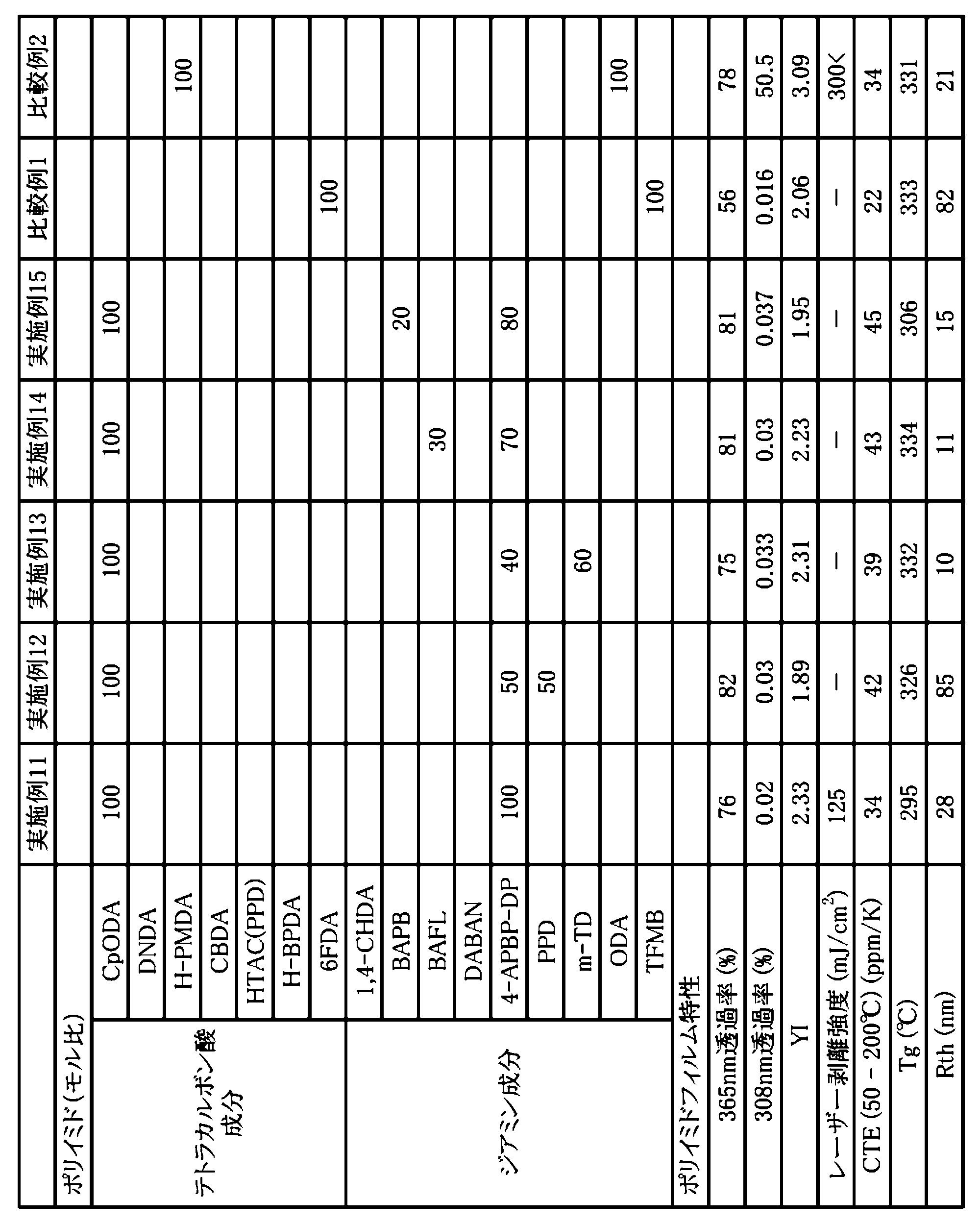
Claims (9)
- テトラカルボン酸成分とジアミン成分とから得られるポリイミドであって、
厚み10μmのフィルムにおける黄色度が3未満であり、
50℃から200℃までの線膨張係数が55ppm/K以下であり、
厚み10μmのフィルムにおける波長365nmの光透過率が70%以上、かつ、波長308nmの光透過率が0.1%未満である、ポリイミド。 - 前記テトラカルボン酸成分の90モル%以上が、脂環式構造を有する化合物である、請求項1に記載のポリイミド。
- 前記脂環式構造を有する化合物が、1,2,3,4-シクロブタンテトラカルボン酸二無水物、ジシクロヘキシル-3,3’,4,4’-テトラカルボン酸二無水物、1,2,4,5-シクロヘキサンテトラカルボン酸二無水物、ノルボルナン-2-スピロ-α-シクロペンタノン-α’-スピロ-2’’-ノルボルナン-5,5’’,6,6’’-テトラカルボン酸二無水物、デカヒドロ-1,4:5,8-ジメタノナフタレン-2,3,6,7-テトラカルボン酸二無水物、及びN,N’-(1,4-フェニレン)ビス(1,3-ジオキソオクタヒドロイソベンゾフラン-5-カルボキシアミド)よりなる群から選ばれる1種以上の化合物である、請求項2に記載のポリイミド。
- 前記ジアミン成分の20~100モル%が、下記化学式(1)で表される化合物である、請求項1~3のいずれか1項に記載のポリイミド。


- 前記ジアミン成分の20~100モル%が、4,4’-ビス(4-アミノフェノキシ)ビフェニル、及び4,4’-([1,1’:3’,1’’:3’’,1’’’-クオーターフェニル]-4’’,6’-ジイルビス(オキシ))ジアニリンよりなる群から選ばれる1種以上の芳香族化合物である、請求項1~4のいずれか1項に記載のポリイミド。
- ガラス転移温度(Tg)が250℃以上であり、
厚み10μmのフィルムにおける、厚さ方向の位相差(Rth)が500nm以下である、請求項1~5のいずれか1項に記載のポリイミド。 - 請求項1~6のいずれか1項に記載のポリイミドから主としてなるポリイミドフィルム。
- 請求項7に記載のポリイミドフィルムを基板として用いたフレキシブルデバイス。
- 請求項7に記載のポリイミドフィルムをキャリア基板上に形成する工程、
前記ポリイミドフィルム上に回路を形成する工程、及び、
前記回路が表面に形成されたポリイミドフィルムを前記キャリア基板から剥離する工程
を含むことを特徴とするフレキシブルデバイスの製造方法。
Priority Applications (3)
| Application Number | Priority Date | Filing Date | Title |
|---|---|---|---|
| KR1020197014948A KR20190077015A (ko) | 2016-10-27 | 2017-10-27 | 폴리이미드 및 그것을 사용한 플렉시블 디바이스 |
| JP2018547778A JP7215904B2 (ja) | 2016-10-27 | 2017-10-27 | ポリイミドおよびそれを用いたフレキシブルデバイス |
| CN201780066116.7A CN109923148A (zh) | 2016-10-27 | 2017-10-27 | 聚酰亚胺和使用了该聚酰亚胺的柔性器件 |
Applications Claiming Priority (2)
| Application Number | Priority Date | Filing Date | Title |
|---|---|---|---|
| JP2016-210986 | 2016-10-27 | ||
| JP2016210986 | 2016-10-27 |
Publications (1)
| Publication Number | Publication Date |
|---|---|
| WO2018079707A1 true WO2018079707A1 (ja) | 2018-05-03 |
Family
ID=62025047
Family Applications (1)
| Application Number | Title | Priority Date | Filing Date |
|---|---|---|---|
| PCT/JP2017/038882 Ceased WO2018079707A1 (ja) | 2016-10-27 | 2017-10-27 | ポリイミドおよびそれを用いたフレキシブルデバイス |
Country Status (5)
| Country | Link |
|---|---|
| JP (1) | JP7215904B2 (ja) |
| KR (1) | KR20190077015A (ja) |
| CN (1) | CN109923148A (ja) |
| TW (1) | TW201819471A (ja) |
| WO (1) | WO2018079707A1 (ja) |
Cited By (2)
| Publication number | Priority date | Publication date | Assignee | Title |
|---|---|---|---|---|
| JPWO2019244988A1 (ja) * | 2018-06-22 | 2021-03-11 | 三井化学株式会社 | ポリアミド酸およびこれを含むワニス、フィルム、タッチパネルディスプレイ、液晶ディスプレイ、ならびに有機elディスプレイ |
| JP2021138866A (ja) * | 2020-03-06 | 2021-09-16 | 日鉄ケミカル&マテリアル株式会社 | センサ用樹脂フィルム、それを備えたセンサ及びセンサの被膜形成用樹脂組成物 |
Families Citing this family (3)
| Publication number | Priority date | Publication date | Assignee | Title |
|---|---|---|---|---|
| KR20230095953A (ko) * | 2020-10-26 | 2023-06-29 | 미쯔비시 가스 케미칼 컴파니, 인코포레이티드 | 폴리이미드 수지, 폴리이미드 바니시 및 폴리이미드 필름 |
| KR102470358B1 (ko) * | 2021-04-08 | 2022-11-28 | (주)아이피아이테크 | 마이크로 엘이디 리프트 오프 전사용 열가소성 폴리이미드 필름 및 그 제조 방법과, 이를 이용한 마이크로 엘이디 전사 방법 |
| CN117050305B (zh) * | 2023-08-09 | 2025-07-11 | 中国地质大学(北京) | 一种聚酰亚胺、含其的薄膜及其制备方法和应用 |
Citations (4)
| Publication number | Priority date | Publication date | Assignee | Title |
|---|---|---|---|---|
| JP2009286877A (ja) * | 2008-05-28 | 2009-12-10 | Sekisui Chem Co Ltd | ポリイミドおよびその製造方法 |
| JP2016062965A (ja) * | 2014-09-16 | 2016-04-25 | 宇部興産株式会社 | フレキシブルデバイスの製造方法 |
| WO2016133019A1 (ja) * | 2015-02-18 | 2016-08-25 | Jx日鉱日石エネルギー株式会社 | ポリイミドフィルム、並びに、それを用いた有機エレクトロルミネッセンス素子及び有機エレクトロルミネッセンスディスプレイ |
| JP2017160360A (ja) * | 2016-03-10 | 2017-09-14 | Jxtgエネルギー株式会社 | レーザ剥離用樹脂フィルム、レーザ剥離用ワニス組成物、レーザ剥離用積層体及びレーザ剥離方法 |
Family Cites Families (14)
| Publication number | Priority date | Publication date | Assignee | Title |
|---|---|---|---|---|
| US7214475B2 (en) * | 2004-03-29 | 2007-05-08 | Christoph Georg Erben | Compound for optical materials and methods of fabrication |
| KR100727466B1 (ko) * | 2005-02-07 | 2007-06-13 | 주식회사 잉크테크 | 유기 은 착체 화합물, 이의 제조방법 및 이를 이용한박막형성방법 |
| CN101107257B (zh) * | 2005-02-07 | 2012-11-07 | 印可得株式会社 | 有机银络合物、其制造方法及其形成薄层的方法 |
| JP2007231224A (ja) | 2006-03-03 | 2007-09-13 | Sumitomo Chemical Co Ltd | ディスプレー用ポリイミドフィルム。 |
| JP2010225434A (ja) * | 2009-03-24 | 2010-10-07 | Teijin Dupont Films Japan Ltd | フレキシブルエレクトロニクスデバイス基板およびその製造方法 |
| JP2011074278A (ja) * | 2009-09-30 | 2011-04-14 | Sekisui Chem Co Ltd | ポリアミド酸溶液、それを用いたポリイミド、及びそれらの製造方法 |
| US8929085B2 (en) * | 2011-09-30 | 2015-01-06 | Apple Inc. | Flexible electronic devices |
| KR102125660B1 (ko) | 2012-05-28 | 2020-06-22 | 우베 고산 가부시키가이샤 | 폴리이미드 전구체 및 폴리이미드 |
| CN105189623B (zh) | 2013-04-04 | 2019-01-01 | 三井化学株式会社 | 聚酰胺酸、包含聚酰胺酸的清漆及聚酰亚胺膜 |
| ES2650112T3 (es) * | 2013-05-30 | 2018-01-17 | Rhodia Opérations S.A.S. | Poliamidas que comprenden Me-BHT, composiciones que comprenden tal poliamida, artículos conformados que comprenden tal poliamida o tal composición |
| CN109535423B (zh) * | 2013-11-27 | 2021-06-01 | 宇部兴产株式会社 | 聚酰亚胺前体组合物、聚酰亚胺的制造方法、聚酰亚胺、聚酰亚胺膜和基板 |
| CN107405907B (zh) * | 2015-03-26 | 2019-06-18 | 东丽株式会社 | 树脂层叠膜及含有其的层叠体、tft基板、有机el元件滤色片,以及它们的制造方法 |
| KR102576363B1 (ko) * | 2015-03-31 | 2023-09-08 | 닛산 가가쿠 가부시키가이샤 | 박리층 형성용 조성물 및 박리층 |
| WO2016167296A1 (ja) * | 2015-04-17 | 2016-10-20 | 旭化成株式会社 | 樹脂組成物、ポリイミド樹脂膜、及びその製造方法 |
-
2017
- 2017-10-27 CN CN201780066116.7A patent/CN109923148A/zh active Pending
- 2017-10-27 WO PCT/JP2017/038882 patent/WO2018079707A1/ja not_active Ceased
- 2017-10-27 KR KR1020197014948A patent/KR20190077015A/ko not_active Ceased
- 2017-10-27 TW TW106137182A patent/TW201819471A/zh unknown
- 2017-10-27 JP JP2018547778A patent/JP7215904B2/ja active Active
Patent Citations (4)
| Publication number | Priority date | Publication date | Assignee | Title |
|---|---|---|---|---|
| JP2009286877A (ja) * | 2008-05-28 | 2009-12-10 | Sekisui Chem Co Ltd | ポリイミドおよびその製造方法 |
| JP2016062965A (ja) * | 2014-09-16 | 2016-04-25 | 宇部興産株式会社 | フレキシブルデバイスの製造方法 |
| WO2016133019A1 (ja) * | 2015-02-18 | 2016-08-25 | Jx日鉱日石エネルギー株式会社 | ポリイミドフィルム、並びに、それを用いた有機エレクトロルミネッセンス素子及び有機エレクトロルミネッセンスディスプレイ |
| JP2017160360A (ja) * | 2016-03-10 | 2017-09-14 | Jxtgエネルギー株式会社 | レーザ剥離用樹脂フィルム、レーザ剥離用ワニス組成物、レーザ剥離用積層体及びレーザ剥離方法 |
Cited By (3)
| Publication number | Priority date | Publication date | Assignee | Title |
|---|---|---|---|---|
| JPWO2019244988A1 (ja) * | 2018-06-22 | 2021-03-11 | 三井化学株式会社 | ポリアミド酸およびこれを含むワニス、フィルム、タッチパネルディスプレイ、液晶ディスプレイ、ならびに有機elディスプレイ |
| JP2021138866A (ja) * | 2020-03-06 | 2021-09-16 | 日鉄ケミカル&マテリアル株式会社 | センサ用樹脂フィルム、それを備えたセンサ及びセンサの被膜形成用樹脂組成物 |
| JP7425631B2 (ja) | 2020-03-06 | 2024-01-31 | 日鉄ケミカル&マテリアル株式会社 | センサ用樹脂フィルム、それを備えたセンサ及びセンサの被膜形成用樹脂組成物 |
Also Published As
| Publication number | Publication date |
|---|---|
| CN109923148A (zh) | 2019-06-21 |
| JPWO2018079707A1 (ja) | 2019-09-19 |
| TW201819471A (zh) | 2018-06-01 |
| KR20190077015A (ko) | 2019-07-02 |
| JP7215904B2 (ja) | 2023-01-31 |
Similar Documents
| Publication | Publication Date | Title |
|---|---|---|
| JP7131651B2 (ja) | タッチパネルセンサーの製造方法 | |
| JP6492934B2 (ja) | ポリアミック酸溶液組成物およびポリイミドフィルム | |
| JP6760287B2 (ja) | ポリアミック酸溶液組成物およびポリイミドフィルム | |
| KR102730124B1 (ko) | 폴리이미드 수지, 폴리이미드 바니시 및 폴리이미드 필름 | |
| JP2016204569A (ja) | ポリアミック酸溶液組成物およびポリイミドフィルム | |
| JP6743807B2 (ja) | 剥離層形成用組成物及び剥離層 | |
| CN110684195A (zh) | 聚酰亚胺膜、聚酰亚胺前体和聚酰亚胺 | |
| CN107531996A (zh) | 树脂组合物、聚酰亚胺树脂膜及其制造方法 | |
| JP7215904B2 (ja) | ポリイミドおよびそれを用いたフレキシブルデバイス | |
| CN111757904B (zh) | 聚酰亚胺前体、聚酰亚胺、聚酰亚胺膜、清漆和基板 | |
| WO2013154141A1 (ja) | ポリアミック酸溶液組成物、及びポリイミド | |
| KR20150003355A (ko) | 폴리아믹산 용액 조성물, 및 폴리이미드 | |
| TWI791056B (zh) | 聚醯亞胺前體及聚醯亞胺、積層體、可撓性裝置 | |
| JP7069478B2 (ja) | ポリイミド、ポリイミド溶液組成物、ポリイミドフィルム、及び基板 | |
| JP7011230B2 (ja) | フレキシブルデバイス基板形成用組成物 | |
| JPWO2018025954A1 (ja) | 透明樹脂基板用剥離層形成用組成物 | |
| WO2024024901A1 (ja) | ポリイミド前駆体組成物、ポリイミドフィルムおよびポリイミドフィルム/基材積層体 | |
| JP2022007960A (ja) | ポリイミド前駆体組成物およびポリイミドフィルム/基材積層体 | |
| JP7400948B2 (ja) | ポリイミド前駆体組成物およびポリイミドフィルム/基材積層体 | |
| TWI884936B (zh) | 無色透明聚醯亞胺薄膜 | |
| CN110099974B (zh) | 基板保护层形成用组合物 | |
| WO2025197892A1 (ja) | ポリイミド前駆体組成物およびポリイミドフィルム |
Legal Events
| Date | Code | Title | Description |
|---|---|---|---|
| 121 | Ep: the epo has been informed by wipo that ep was designated in this application |
Ref document number: 17864155 Country of ref document: EP Kind code of ref document: A1 |
|
| ENP | Entry into the national phase |
Ref document number: 2018547778 Country of ref document: JP Kind code of ref document: A |
|
| NENP | Non-entry into the national phase |
Ref country code: DE |
|
| ENP | Entry into the national phase |
Ref document number: 20197014948 Country of ref document: KR Kind code of ref document: A |
|
| 122 | Ep: pct application non-entry in european phase |
Ref document number: 17864155 Country of ref document: EP Kind code of ref document: A1 |