WO2018047773A1 - イソブチレンの分離精製方法およびイソブチレンの製造方法 - Google Patents
イソブチレンの分離精製方法およびイソブチレンの製造方法 Download PDFInfo
- Publication number
- WO2018047773A1 WO2018047773A1 PCT/JP2017/031815 JP2017031815W WO2018047773A1 WO 2018047773 A1 WO2018047773 A1 WO 2018047773A1 JP 2017031815 W JP2017031815 W JP 2017031815W WO 2018047773 A1 WO2018047773 A1 WO 2018047773A1
- Authority
- WO
- WIPO (PCT)
- Prior art keywords
- isobutylene
- solvent
- isobutanol
- separating
- tert
- Prior art date
- Legal status (The legal status is an assumption and is not a legal conclusion. Google has not performed a legal analysis and makes no representation as to the accuracy of the status listed.)
- Ceased
Links
Images



Classifications
-
- C—CHEMISTRY; METALLURGY
- C07—ORGANIC CHEMISTRY
- C07C—ACYCLIC OR CARBOCYCLIC COMPOUNDS
- C07C7/00—Purification; Separation; Use of additives
- C07C7/11—Purification; Separation; Use of additives by absorption, i.e. purification or separation of gaseous hydrocarbons with the aid of liquids
-
- C—CHEMISTRY; METALLURGY
- C07—ORGANIC CHEMISTRY
- C07C—ACYCLIC OR CARBOCYCLIC COMPOUNDS
- C07C7/00—Purification; Separation; Use of additives
- C07C7/005—Processes comprising at least two steps in series
-
- C—CHEMISTRY; METALLURGY
- C07—ORGANIC CHEMISTRY
- C07C—ACYCLIC OR CARBOCYCLIC COMPOUNDS
- C07C1/00—Preparation of hydrocarbons from one or more compounds, none of them being a hydrocarbon
- C07C1/20—Preparation of hydrocarbons from one or more compounds, none of them being a hydrocarbon starting from organic compounds containing only oxygen atoms as heteroatoms
- C07C1/24—Preparation of hydrocarbons from one or more compounds, none of them being a hydrocarbon starting from organic compounds containing only oxygen atoms as heteroatoms by elimination of water
-
- C—CHEMISTRY; METALLURGY
- C07—ORGANIC CHEMISTRY
- C07C—ACYCLIC OR CARBOCYCLIC COMPOUNDS
- C07C11/00—Aliphatic unsaturated hydrocarbons
- C07C11/02—Alkenes
- C07C11/08—Alkenes with four carbon atoms
- C07C11/09—Isobutene
-
- C—CHEMISTRY; METALLURGY
- C07—ORGANIC CHEMISTRY
- C07C—ACYCLIC OR CARBOCYCLIC COMPOUNDS
- C07C29/00—Preparation of compounds having hydroxy or O-metal groups bound to a carbon atom not belonging to a six-membered aromatic ring
- C07C29/03—Preparation of compounds having hydroxy or O-metal groups bound to a carbon atom not belonging to a six-membered aromatic ring by addition of hydroxy groups to unsaturated carbon-to-carbon bonds, e.g. with the aid of H2O2
- C07C29/04—Preparation of compounds having hydroxy or O-metal groups bound to a carbon atom not belonging to a six-membered aromatic ring by addition of hydroxy groups to unsaturated carbon-to-carbon bonds, e.g. with the aid of H2O2 by hydration of carbon-to-carbon double bonds
-
- C—CHEMISTRY; METALLURGY
- C07—ORGANIC CHEMISTRY
- C07C—ACYCLIC OR CARBOCYCLIC COMPOUNDS
- C07C31/00—Saturated compounds having hydroxy or O-metal groups bound to acyclic carbon atoms
- C07C31/02—Monohydroxylic acyclic alcohols
- C07C31/12—Monohydroxylic acyclic alcohols containing four carbon atoms
-
- C—CHEMISTRY; METALLURGY
- C07—ORGANIC CHEMISTRY
- C07C—ACYCLIC OR CARBOCYCLIC COMPOUNDS
- C07C41/00—Preparation of ethers; Preparation of compounds having groups, groups or groups
- C07C41/01—Preparation of ethers
- C07C41/09—Preparation of ethers by dehydration of compounds containing hydroxy groups
-
- C—CHEMISTRY; METALLURGY
- C07—ORGANIC CHEMISTRY
- C07C—ACYCLIC OR CARBOCYCLIC COMPOUNDS
- C07C43/00—Ethers; Compounds having groups, groups or groups
- C07C43/02—Ethers
- C07C43/03—Ethers having all ether-oxygen atoms bound to acyclic carbon atoms
- C07C43/04—Saturated ethers
- C07C43/046—Alkyl tert-alkyl ether, e.g. CH3OC(CH3)3
-
- C—CHEMISTRY; METALLURGY
- C07—ORGANIC CHEMISTRY
- C07C—ACYCLIC OR CARBOCYCLIC COMPOUNDS
- C07C7/00—Purification; Separation; Use of additives
- C07C7/04—Purification; Separation; Use of additives by distillation
-
- C—CHEMISTRY; METALLURGY
- C07—ORGANIC CHEMISTRY
- C07C—ACYCLIC OR CARBOCYCLIC COMPOUNDS
- C07C7/00—Purification; Separation; Use of additives
- C07C7/148—Purification; Separation; Use of additives by treatment giving rise to a chemical modification of at least one compound
- C07C7/14875—Purification; Separation; Use of additives by treatment giving rise to a chemical modification of at least one compound with organic compounds
- C07C7/14891—Purification; Separation; Use of additives by treatment giving rise to a chemical modification of at least one compound with organic compounds alcohols
-
- C—CHEMISTRY; METALLURGY
- C07—ORGANIC CHEMISTRY
- C07C—ACYCLIC OR CARBOCYCLIC COMPOUNDS
- C07C2521/00—Catalysts comprising the elements, oxides or hydroxides of magnesium, boron, aluminium, carbon, silicon, titanium, zirconium or hafnium
- C07C2521/12—Silica and alumina
-
- Y—GENERAL TAGGING OF NEW TECHNOLOGICAL DEVELOPMENTS; GENERAL TAGGING OF CROSS-SECTIONAL TECHNOLOGIES SPANNING OVER SEVERAL SECTIONS OF THE IPC; TECHNICAL SUBJECTS COVERED BY FORMER USPC CROSS-REFERENCE ART COLLECTIONS [XRACs] AND DIGESTS
- Y02—TECHNOLOGIES OR APPLICATIONS FOR MITIGATION OR ADAPTATION AGAINST CLIMATE CHANGE
- Y02P—CLIMATE CHANGE MITIGATION TECHNOLOGIES IN THE PRODUCTION OR PROCESSING OF GOODS
- Y02P20/00—Technologies relating to chemical industry
- Y02P20/50—Improvements relating to the production of bulk chemicals
- Y02P20/582—Recycling of unreacted starting or intermediate materials
Definitions
- the present invention relates to a method for separating and purifying isobutylene produced from isobutanol, and a method for producing isobutylene using the method for separating and purifying.
- a methacrylic resin which is a kind of plastic is excellent in properties such as transparency and weather resistance, and is used in various applications.
- methyl methacrylate is used as a raw material for this methacrylic resin.
- the following methods are known as methods for producing methacrolein and methacrylic acid, which are raw materials for this methyl methacrylate. That is, there is a catalytic gas phase oxidation method using tert-butanol, methyl tert-butyl ether or isobutylene as a raw material.
- Patent Documents 1 to 4 and Non-Patent Document 1 describe methods for synthesizing isobutylene from isobutanol.
- the present invention provides an industrially advantageous isobutylene separation and purification method capable of efficiently obtaining high-purity isobutylene by a simple method, and a method for producing isobutylene using this separation and purification method. With the goal.
- a method for separating and purifying isobutylene by separating and purifying isobutylene from a reaction gas containing isobutylene and unreacted isobutanol A step (1) of obtaining a first gas containing isobutylene and a recovered liquid containing unreacted isobutanol by contacting a reaction gas containing isobutylene and unreacted isobutanol with a first solvent; , By contacting the first gas with a second solvent selected from tert-butanol, an aqueous tert-butanol solution and methyl tert-butyl ether, the second solvent absorbs isobutylene contained in the first gas. And (2) obtaining an absorption liquid containing the isobutylene, A step (3) of obtaining separated and purified isobutylene by distilling the absorbing solution; A method for separating and purifying isobutylene having
- step (3) By distilling the recovered liquid containing unreacted isobutanol obtained from the step (1), a distillate containing the unreacted isobutanol and a can which is substantially free of the unreacted isobutanol A step (4) of obtaining a liquid, In the step (1), the isobutylene separation and purification method according to the above [1], wherein at least a part of the bottoms is reused as at least a part of the first solvent.
- step (1) By distilling the recovered liquid containing unreacted isobutanol obtained from the step (1), a distillate containing the unreacted isobutanol and a take-out substantially free of the unreacted isobutanol A step (4) of obtaining a liquid,
- the isobutylene separation and purification method according to the above [2] wherein at least a part of the bottoms is reused as at least a part of the first solvent.
- the method includes the step (5) of obtaining tert-butanol by hydrating the separated and purified isobutylene obtained from the step (3).
- a process for producing isobutylene for producing isobutylene from isobutanol (B) a step of dehydrating isobutanol to obtain a reaction gas containing isobutylene and unreacted isobutanol; (B) separating and purifying the isobutylene from the reaction gas;
- an industrially advantageous isobutylene separation and purification method capable of efficiently obtaining high-purity isobutylene by a simple method, and a method for producing isobutylene using this separation and purification method are provided. Can do.
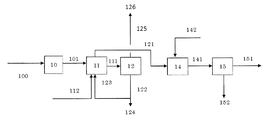
- FIG. 10 is a flowchart for explaining operations performed in Example 1 and Example 5.
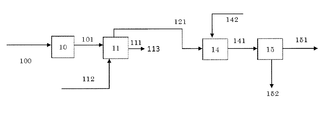
- FIG. 10 is a flowchart for explaining operations performed in the second embodiment.
- FIG. 10 is a flowchart for explaining operations performed in the third embodiment.
- FIG. 10 is a flowchart for explaining operations performed in the fourth embodiment.
- 10 is a flowchart for explaining an operation performed in Comparative Example 1.
- the isobutylene separation and purification method of the present invention can be suitably applied to a reaction gas containing isobutanol, particularly isobutylene produced from biomass-derived isobutanol. Further, by the separation and purification method of the present invention, isobutylene having high purity can be continuously and efficiently obtained from isobutanol.
- the isobutylene separation and purification method of the present invention is a method for separating and purifying isobutylene from a reaction gas containing isobutylene and unreacted isobutanol. Accordingly, the reaction gas used in this separation and purification method can be used without particular limitation as long as it contains isobutylene and unreacted isobutanol. Examples of the reaction gas include a reaction product (reaction gas) (including unreacted isobutanol) obtained from a reaction (dehydration reaction) for synthesizing isobutylene from isobutanol (described in the above-mentioned patent documents). Can be used.
- reaction gas reaction product (reaction gas) (including unreacted isobutanol) obtained from a reaction (dehydration reaction) for synthesizing isobutylene from isobutanol
- the isobutylene separation and purification method of the present invention includes the following steps.
- Step (1) A reaction gas containing isobutylene and unreacted isobutanol is brought into contact with a first solvent to obtain a first gas containing the isobutylene and a recovered liquid containing the unreacted isobutanol.
- Step (2) contacting the first gas with the first gas by contacting the first gas with a second solvent selected from tert-butanol, an aqueous tert-butanol solution, and methyl tert-butyl ether.
- a step of absorbing the contained isobutylene to obtain an absorbing liquid containing the isobutylene.
- Step (3) A step of obtaining separated and purified isobutylene by distilling the absorbing solution.
- the isobutylene separation and purification method of the present invention may have the following steps.
- Step (4) The distillate containing the unreacted isobutanol and the unreacted isobutanol are substantially free by distilling the recovered solution containing the unreacted isobutanol obtained from the step (1).
- Step (6) A step in which methyl tert-butyl ether is obtained by reacting the separated and purified isobutylene obtained in the step (3) with methanol.
- the distillate obtained from step (4) can be reused as isobutanol used in producing isobutylene. In that case, the distillate will be described later.
- a liquid-liquid separation process can be performed. That is, the separation and purification method of the present invention can have this liquid-liquid separation step.
- each of these steps may be performed sequentially, or a plurality of steps may be performed in parallel (simultaneously).
- each of these steps can be performed a plurality of times, and the separated and purified isobutylene can be continuously supplied by repeating these steps many times in succession. Below, each process is demonstrated in detail.
- reaction gas containing isobutylene and unreacted isobutanol is brought into contact with the first solvent.
- unreacted isobutanol is dissolved in the first solvent, unreacted isobutanol is separated from the reaction gas, and unreacted isobutanol is recovered.
- a first gas containing at least isobutylene and a recovery liquid containing unreacted isobutanol are obtained (isobutanol recovery step).
- a reaction product (including unreacted isobutanol) obtained by using a known method for synthesizing isobutylene from isobutanol can be appropriately used.
- the reaction gas contains at least isobutylene and (unreacted) isobutanol, and can also contain other components that can be generated when synthesizing isobutylene from isobutanol.
- examples of other components include isobutane, normal butane, normal butene, 1-butene, trans-2-butene, and cis-2-butene.
- isobutane normal butane, normal butene, 1-butene, trans-2-butene, and cis-2-butene.
- the higher the isobutylene content in the reaction gas the better.
- the first solvent used in step (1) is not particularly limited as long as it can dissolve (unreacted) isobutanol and does not dissolve isobutylene, and can be appropriately selected and used.
- Specific examples of the first solvent include a protic polar solvent, and examples of the protic polar solvent include methanol, ethanol, water, and the like.
- the first solvent one type of solvent may be used alone, or a plurality of types of solvents may be used in combination. Among these, since it is easy to handle, the first solvent preferably contains water, more preferably water. If the first solvent is water, wastewater treatment that occurs during the separation and purification of isobutylene becomes easy, and running costs and equipment costs can be easily suppressed.
- the first gas obtained from the step (1) contains at least isobutylene, and in addition, can contain other components described above that can be generated when synthesizing isobutylene from isobutanol.
- the content ratio of unreacted isobutanol in the first gas is 10 from the viewpoint of reducing the load on the recovery of isobutanol. 0 mass% or less is preferable and 5.0 mass% or less is more preferable.
- the recovered liquid obtained from the step (1) contains at least (unreacted) isobutanol and the solvent (for example, water) used for the first solvent. In addition to this, isobutylene is synthesized from isobutanol.
- isobutylene may be contained in the recovered liquid, the content of isobutylene in the recovered liquid is preferably 0.01% by mass or less and 0.001% by mass or less from the viewpoint of increasing the amount of isobutylene produced. More preferred.
- a recovery tower As an apparatus used when the reaction gas and the first solvent are brought into contact with each other, for example, a recovery tower can be used.
- a recovery tower for example, a plate tower, a packed tower (such as an irregular packed tower and an ordered packed tower) can be used.
- the shelf tower can have a plurality of horizontal trays (shelf plates) in the tower.
- gas-liquid equilibrium is established in the spaces (stages) separated by the trays.
- a component that is highly volatile or not dissolved in the first solvent here, a gas such as isobutylene
- the dissolved components here, unreacted isobutanol, etc.
- a turbo grid tray, a dual flow tray, and a sheave tray can be used.
- the packed column is filled with a packed product in a hollow tower, and gas-liquid contact is performed on the packed surface.
- irregular packing materials that can be used in the packed column include Raschig rings and pole rings.
- a brand name: Melapak (made by Sulzer) and a brand name: MC pack (made by Matsui Machine) can be mentioned, for example.
- the recovery tower may have a structure in which a gas (the reaction gas) supply line is arranged at the bottom of the tower and a solvent (the first solvent) supply line is arranged at the top of the tower.
- a gas the reaction gas
- a solvent the first solvent
- the first gas containing isobutylene moves to the upper part of the recovery tower
- the recovery liquid containing unreacted isobutanol moves to the lower part of the recovery tower.
- An exhaust line for recovering the gas can be provided at the top of the tower, and an exhaust line for recovering the recovered liquid can be provided at the bottom of the tower.
- the contact method between the reaction gas and the first solvent is not particularly limited.
- the contact method between the reaction gas and the first solvent is countercurrent contact because the concentration of isobutanol, which is a solute (unreacted), contained in the tower top gas in the recovery tower can be lowered. It is preferable.
- the tower top pressure when the reaction gas and the first solvent are brought into contact with each other in the apparatus (recovery tower) is not particularly limited.
- the tower top pressure (gauge pressure) at this time is preferably 0 MPaG or more and 0.10 MPaG or less, and more preferably 0 MPaG or more and 0.03 MPaG or less.
- the tower top pressure when the reaction gas and the first solvent are brought into contact is preferably 10 ° C. or more and 60 ° C. or less, and more preferably 20 ° C. or more and 50 ° C. or less.
- the recovery rate of isobutanol can be further raised by making the tower top temperature at the time of contact into 60 degrees C or less. Furthermore, by setting the tower top temperature at the time of contact to 20 ° C. or higher, condensation of isobutylene can be more easily suppressed, and mixing of isobutylene into the recovered liquid can be more easily suppressed. Moreover, the recovery rate of isobutanol can be further raised by making the tower top temperature at the time of contact into 50 degrees C or less. In this manner, the first gas containing at least isobutylene and the recovered liquid containing unreacted isobutanol can be obtained by the step (1).
- a solvent selected from tert-butanol, tert-butanol aqueous solution, and methyl tert-butyl ether, which are protic polar solvents is used as the second solvent.
- the second solvent may be distilled into the distillate (including separated and purified isobutylene) used in the step (3) described later. Therefore, in this invention, even if it mixes in a distillate, these solvents which have little influence when manufacturing methyl methacrylate are used.
- the second solvent one kind may be used alone, or a plurality of kinds may be used in combination, but it is more preferable to use one kind alone from the viewpoint of suppressing an increase in equipment.
- tert-butanol can be produced by a hydration reaction of isobutylene obtained (separated and purified) from step (3) in step (5) described later. Therefore, tert-butanol obtained from this step (5) can be used as at least a part of the second solvent (tert-butanol and tert-butanol aqueous solution).
- methyl tert-butyl ether can be produced by reacting isobutylene obtained (separated and purified) from step (3) with methanol in step (6) described later. Therefore, methyl tert-butyl ether obtained from this step (6) can be used as at least a part of the second solvent. As described above, these solvents can be obtained using the separated and purified isobutylene, and it is not necessary to prepare a new solvent. Also from this point, it is preferable to use a solvent selected from tert-butanol, a tert-butanol aqueous solution, and methyl tert-butyl ether as the second solvent.
- a solvent selected from an aqueous tert-butanol solution and methyl tert-butyl ether as the second solvent.
- the tert-butanol aqueous solution can be composed of tert-butanol and water.
- the tert-butanol concentration in the aqueous solution can be appropriately set in consideration of the operating conditions of the apparatus (absorption tower described later) used in step (2).
- the tert-butanol concentration in the aqueous tert-butanol solution is preferably 80% by mass or more and 90% by mass or less, and more preferably 85% by mass or more and 88% by mass or less.
- the concentration of isobutylene absorbed by the second solvent can be further increased. Further, by setting the tert-butanol concentration to 90% by mass or less, the freezing point of the tert-butanol aqueous solution can be easily set to an appropriate temperature, and the stable operation of the apparatus can be easily performed.
- the tert-butanol concentration in the aqueous tert-butanol solution is more preferably 85% by mass or more and 88% by mass or less.
- the absorbing liquid obtained from the step (2) contains at least isobutylene and a second solvent, and can contain other components described above that can be generated when synthesizing isobutylene from isobutanol.
- an absorption tower As an apparatus used when the first gas and the second solvent are brought into contact with each other, for example, an absorption tower can be used.
- the absorption tower for example, a plate tower, an irregular packed tower, and an ordered packed tower can be used.
- the apparatus used in the step (2) preferably uses a regular packed column because the apparatus can be made compact.
- the structure of these towers can be made into the structure similar to the collection
- the second solvent here, other gases other than isobutylene, etc.
- the absorption tower may have a structure in which a gas (the first gas) supply line is arranged at the bottom of the tower and a solvent (the second solvent) supply line is arranged at the top of the tower.
- Isobutylene may be contained in the other gas discharged from the top of the column, but naturally, the lower the content, the better.
- the other gas include other components described above that can be generated when isobutylene is synthesized from isobutanol.
- the contact method between the first gas and the second solvent is not particularly limited.
- the contact method between the first gas and the second solvent is preferably countercurrent contact because the concentration of isobutylene, which is a solute, contained in the tower top gas in the absorption tower can be further reduced.
- the top pressure when the first gas and the second solvent are brought into contact with each other in the apparatus is not particularly limited.
- the tower top pressure (gauge pressure) at the time of contact is preferably 0 MPaG or more and 0.05 MPaG or less. If the tower top pressure at the time of contact is 0 MPaG or more, it is not necessary to introduce decompression equipment, and if it is 0.05 MPaG or less, it is not necessary to introduce large equipment with high pressure resistance.
- the tower top temperature when the first gas and the second solvent are brought into contact is preferably 0 ° C. or higher and 40 ° C. or lower, and more preferably 5 ° C. or higher and 15 ° C. or lower.
- concentration of isobutylene with respect to a solvent can be made still higher by making the temperature at the time of contact into 40 degrees C or less. Furthermore, by setting the tower top temperature at the time of contact to 5 ° C. or higher, it becomes possible to use a normal cooler more easily, and the apparatus cost can be further reduced. Moreover, by making the tower top temperature at the time of contact 15 degrees C or less, the melt
- Process (3) The absorption liquid obtained from the step (2) is distilled to obtain separated and purified isobutylene (isobutylene concentration step).
- a plate tower, an irregular packed tower, and an ordered packed tower can be used as an apparatus used for the step (3).
- the apparatus used in step (3) is preferably a regular packed tower because the apparatus can be made compact.
- the structure of these towers can be made into the structure similar to the collection
- a highly volatile component here, isobutylene
- the apparatus used for the step (3) can have a supply line for supplying the above-mentioned absorption liquid, for example, in an intermediate part (middle stage part) of the tower, and this absorption liquid is in a state vaporized by, for example, a heater. It can be supplied into the tower from the supply line.
- the apparatus used in the step (3) can be provided with a reflux valve for returning (at least) a part of the distillate from the apparatus to the column in order to cause sufficient gas-liquid contact.
- the distillate discharged from the top of the column is liquefied by a condenser or the like, a part thereof is returned to the column as reflux, and the remainder can be extracted as separated and purified isobutylene (containing distillate).
- the liquid component present at the bottom of the tower can be heated with a reboiler or the like as necessary, and a highly volatile component such as isobutylene can be evaporated again. Thereby, a liquid component with higher purity (more free of isobutylene) (a bottomed liquid containing the second solvent and the like) can be obtained.
- the content of isobutylene in the liquid component discharged (recovered) from the bottom of the column is preferably 0.001% by mass or less from the viewpoint of increasing the amount of isobutylene produced.
- the tower top pressure is preferably 0.05 MPaG or more and 0.4 MPaG or less, and more preferably 0.10 MPaG or more and 0.25 MPaG or less.
- the tower top temperature is preferably 5 ° C. or higher and 30 ° C. or lower, and more preferably 10 ° C. or higher and 20 ° C. or lower.
- the condensation temperature of isobutylene can be further reduced.
- the cost for maintaining the tower top pressure can be further reduced by setting the tower top pressure to 0.4 MPaG or less.
- the condensation temperature of isobutylene can be further lowered, and the condensation operation using ordinary cooling water can be easily performed, thereby reducing the equipment cost. It can be made even lower.
- the cost for maintaining the tower top pressure can be further reduced by setting the tower top pressure to 0.25 MPaG or less.
- the column top temperature at the time of distillation By setting the column top temperature at the time of distillation to 5 ° C. or higher, a condensing operation using ordinary cooling water can be easily performed, and the apparatus cost can be further reduced. Moreover, the usage-amount of an absorption liquid can be reduced easily by making tower
- the reflux ratio (reflux / distillation) when distilling the absorbent is preferably 0.1 or more and 10.0 or less. 3.0 to 4.0 is more preferable.
- the reflux ratio By setting the reflux ratio to 0.1 or more, a high concentration of isobutylene can be easily obtained, and by setting the reflux ratio to 10.0 or less, the required amount of heat can be further suppressed. Further, by setting the reflux ratio to 3.0 or more, high-concentration isobutylene can be obtained more easily, and by setting the reflux ratio to 4.0 or less, the necessary amount of heat can be further suppressed.
- the reflux amount means the amount of the distillate discharged from the top of the column and returned to the tower, and the distillate does not return to the tower, It means the amount of separated and purified isobutylene (containing distillate) recovered from the top.
- the distillate containing isobutylene may contain other components (for example, the above-mentioned other components that may be generated when synthesizing isobutylene from the second solvent and isobutanol).
- the reflux ratio when distilling the absorbing solution is preferably 0.1 or more and 20.0 or less, more preferably 8.0 or more and 12.0 or less.
- the reflux ratio is preferably 0.1 or more and 20.0 or less, more preferably 8.0 or more and 12.0 or less.
- Process (4) By distilling the recovered liquid containing unreacted isobutanol obtained from the step (1), a distillate containing the unreacted isobutanol and a bottom liquid substantially free of the unreacted isobutanol are obtained.
- the bottoms substantially free of unreacted isobutanol means that when this bottoms is used as at least part of the first solvent in the step (1), the recovery of the step (1) It means that the recovery rate of unreacted isobutanol in the liquid is in an acceptable range and that it contains or does not contain isobutanol.
- the acceptable recovery rate of unreacted isobutanol in the recovered liquid of step (1) can be, for example, 80% or more.
- the content rate of the unreacted isobutanol in the said bottoms is 1 mass% or less, and it is more preferable that it is 0.1 mass% or less.
- the content ratio of the first solvent used in the resulting bottoms is preferably 95% by mass or more from the viewpoint of an acceptable concentration of wastewater treatment, and 99% by mass from the viewpoint of increasing the recovery rate of unreacted isobutanol. % Or more is more preferable.
- the bottoms obtained from step (4) can be reused as at least part of the first solvent in step (1).
- this bottomed liquid as a 1st solvent
- you may utilize only the recovered bottomed liquid as a 1st solvent You may use together with another solvent (for example, water) as a 1st solvent.
- the distillate obtained from step (4) can be reused (recycled) as isobutanol (raw material for dehydration reaction) to be used in step (a) described later. it can.
- the distillate When the distillate is reused as a raw material in the dehydration reaction, only the recovered distillate may be used as the raw material in step (a), or the recovered distillate and new In combination with other raw materials (isobutanol), they may be used as raw materials for the dehydration reaction. Therefore, in the present invention, the amount of the first solvent and the raw material for the dehydration reaction can be easily suppressed, and it can be seen that the present invention is an excellent method from the viewpoint of environment and cost.
- the apparatus (distillation tower) used in the step (4) for example, a plate tower, an irregular packed tower, and an ordered packed tower can be used.
- the apparatus used in step (4) is preferably a regular packed tower because the apparatus can be made compact.
- the structure of these distillation towers can be made into the structure similar to the collection
- the apparatus used in the step (4) can have a supply line for supplying the recovered liquid, for example, in an intermediate part (middle part) of the tower, and the recovered liquid is vaporized by, for example, a heater. It can be supplied into the tower from the supply line.
- the apparatus used in the step (4) can be provided with a reflux valve for returning (at least) a part of the distillate from the apparatus to the column in order to cause sufficient gas-liquid contact.
- the distillate discharged from the top of the column is liquefied by a condenser or the like, part of which is returned to the column as reflux, and the remainder can be extracted as distillate.
- the liquid component which exists in the tower bottom part can be heated with a reboiler etc. as needed, and highly volatile components, such as isobutanol, can be evaporated again. As a result, it is possible to obtain a bottomed liquid having a higher purity (more free of isobutanol).
- the column top pressure (gauge pressure) at the time of distillation is 0 MPaG or more from the viewpoint of suppressing the equipment cost for introducing the decompression equipment, and 0.1 MPaG or less from the viewpoint of suppressing the equipment cost by introducing a large pressurizing equipment.
- the reflux ratio (reflux / distillation) during distillation is preferably 0.1 or more and 10.0 or less, and more preferably 1.0 or more and 2.0 or less.
- the reflux amount means the amount of the distillate discharged from the top of the column and returned to the tower, and the distillate does not return to the tower, It means the amount of distillate containing unreacted isobutanol recovered from the top.
- water when water is used as the first solvent, water may be present in the distillate, and by separating the distillate by standing, an organic phase containing isobutanol, It can be separated into an aqueous phase (liquid-liquid separation step).
- the standing time is preferably 10 minutes or more and 60 minutes or less, and more preferably 15 minutes or more and 40 minutes or less. Therefore, when water is mixed in the distillate, it is preferable to recycle only the organic phase that has been allowed to stand and separate as a raw material for the dehydration reaction in step (a). Thereby, mixing of the water into the dehydration reactor which performs dehydration reaction can be suppressed further, and a high reaction rate can be easily maintained on balance.
- the ratio of recycling is preferably in the following range. That is, the recycle rate is preferably 20% by mass or more and 50% by mass or less, and more preferably 30% by mass or more and 40% by mass or less with respect to the total amount of the bottoms.
- the recycle rate is preferably 20% by mass or more and 50% by mass or less, and more preferably 30% by mass or more and 40% by mass or less with respect to the total amount of the bottoms.
- Process (5) Tert-butanol is obtained by adding water to the separated and purified isobutylene obtained in the step (3) and performing a hydration reaction.
- the tert-butanol obtained in this step (5) can be used as at least a part of the second solvent (tert-butanol and tert-butanol aqueous solution) used in the step (2).
- the amount of tert-butanol used as the second solvent can be easily suppressed, which is excellent from the viewpoint of environment and cost.
- the hydration reaction with respect to isobutylene in the step (5) may be performed according to a conventionally known method, but it is particularly preferable to use a cation exchange resin from the viewpoint of ease of catalyst separation.
- a cation exchange resin a strongly acidic cation exchange resin is preferable from the viewpoint of activity for the hydration reaction.
- the strongly acidic cation exchange resin is preferably porous. Examples of the porous strong acid cation exchange resin include Bayer's Levacit (trade name), Rohm and Haas Amberlist (trade name), and the like.
- the reactor for performing the hydration reaction any type of reactor capable of solid-liquid contact can be used, and the type is not particularly limited.
- the reactor used in the hydration reaction in the step (5) for example, one continuous flow type fixed bed reactor or a plurality of reactors arranged in series can be used.
- the reaction temperature of any fixed bed reactor is as follows: It is preferable to make it. That is, from the viewpoint of suppressing the isobutylene dimer due to the dimerization reaction of isobutylene, the reaction temperature of each reactor is preferably 65 ° C. or lower.
- the said reaction temperature refers to the temperature of the part which has the highest temperature in each reactor.
- the (reaction) conversion of isobutylene in the first reactor is preferably 50% or more. If the conversion of isobutylene is 50% or more, the by-product amount of isobutylene dimer in the second reactor and thereafter can be easily suppressed.
- the reaction pressure in each reactor is not particularly limited, but a pressure at which isobutylene or isobutylene-containing hydrocarbon and water are in a liquid state at the reaction temperature is adopted, and this reaction pressure is usually 0.2 to 5 MPaG.
- Methyl tert-butyl ether is obtained by adding methanol to the separated and purified isobutylene obtained in the step (3) and causing the reaction.
- the methyl tert-butyl ether obtained from this step (6) can be used as the second solvent used in the step (2).
- the usage-amount of the solvent used for a 2nd solvent can be suppressed easily, and it is excellent also from an environmental or cost viewpoint.
- the reaction of isobutylene and methanol in step (6) may be carried out according to a conventionally known method, but it is particularly preferred to use a cation exchange resin from the viewpoint of ease of catalyst separation.
- a cation exchange resin a strongly acidic cation exchange resin is preferable from the viewpoint of activity for the addition reaction of isobutylene and methanol.
- the strongly acidic cation exchange resin is preferably porous.
- the porous strong acid type cation exchange resin those described above in the step (5) can be similarly used.
- the reactor for carrying out the reaction between isobutylene and methanol any type of reactor capable of solid-liquid contact can be used, and the type is not particularly limited.
- step (6) for example, one continuous flow type fixed bed reactor or a plurality of series reactors arranged in series, and a so-called reaction in which a reaction zone is provided in a part of the distillation column A distillation column or the like can be used.
- reaction conditions in step (6) include the following conditions. That is, the methanol supply ratio is 0.6 to 1.6 in terms of molar ratio (methanol mole / isobutylene mole) with respect to isobutylene, and the reaction temperature is 20 ° C. to 100 ° C.
- the reaction pressure is not particularly limited and can be appropriately set. For example, a pressure exhibiting isobutylene or isobutylene-containing hydrocarbon and methanol liquid is employed at the reaction temperature, and this reaction pressure is usually 0.2 to 5 MPaG.
- the method for producing isobutylene of the present invention is a method for producing isobutylene from isobutanol, and has the following steps.
- step (b) is carried out by using the isobutylene separation and purification method of the present invention described above. Since the detailed description of the separation and purification process has already been described above, the description thereof will be omitted.
- Isobutanol is dehydrated to obtain a reaction gas containing isobutylene and unreacted isobutanol (isobutanol dehydration step).
- a conventionally known method for example, the method described in the above-described patent document
- the dehydration catalyst used in the dehydration reaction for example, an acid catalyst can be used.
- the acid catalyst include alumina, silica alumina, solid phosphoric acid, titania, zirconia and the like.
- One kind of these acid catalysts may be used, or two or more kinds may be used in combination. Among these, it is preferable to use an alumina catalyst from the viewpoint of isobutanol dehydration reaction activity.
- the dehydration reaction of isobutanol is an endothermic reaction, and the reaction temperature is preferably controlled to 108 ° C. or more and 500 ° C. or less. Further, the lower limit of the reaction temperature is more preferably 115 ° C. or higher, and further preferably 150 ° C. or higher. On the other hand, the upper limit of the reaction temperature is more preferably 415 ° C. or less, and further preferably 400 ° C. or less.
- a dehydration reactor When performing the dehydration reaction in step (a), a dehydration reactor can be used.
- the dehydration reactor may have a structure in which a dehydration catalyst is present inside and can contact with isobutanol.
- a fixed bed reactor or a jacketed multi-tube heat exchanger type fixed bed reactor having a system capable of circulating a heat medium can be used.
- a multitubular heat exchanger type fixed bed reactor in which the reaction temperature can be easily controlled is preferable.
- the pressure (gauge pressure) of the dehydration reactor is preferably 0 MPaG or more, and more preferably 0.02 MPaG or more.
- the pressure in the dehydration reactor is preferably 0.10 MPaG or less, and more preferably 0.05 MPaG or less, since the decrease in the conversion rate due to an increase in pressure can be further suppressed and the amount of catalyst can be easily reduced.
- Example 1 As a dehydration catalyst, commercially available silica alumina (trade name: SA6175-3.0M, manufactured by Saint-Gobain) was charged into a fixed bed reactor and kept at 340 ° C. and 0 kPaG. Next, 100 parts by volume of (raw material) isobutanol (reference numeral 100 in FIG. 1) 100 parts by volume of gas was supplied to the fixed bed reactor at a space velocity of 3.0 h ⁇ 1 , and isobutanol and silica alumina were brought into contact with each other. A reaction gas (reference numeral 101 in FIG. 1) containing reaction isobutanol and isobutylene was obtained (step (a): reference numeral 10 in FIG. 1).
- reaction gas symbol 101
- the reaction gas was supplied to the fifth stage from the top of the tower using a five-stage isobutanol recovery tower in which the top pressure was kept at 0 kPaG, and the temperature was controlled at 66C. .
- the obtained organic phase (recycled isobutanol (reference numeral 132 in FIG. 1)) was recycled to the fixed bed reactor used in the above step (a). At this time, the decanter was kept at 74.2 ° C. The aqueous phase of the decanter was treated as waste water (reference numeral 131 in FIG. 1). On the other hand, 29.6 parts of 88.3 parts of the obtained bottoms were recycled as the first solvent (water) of the isobutanol recovery tower used in step (1). The remaining bottoms were treated as waste water (reference numeral 124 in FIG. 1). A first solvent (reference numeral 112 in FIG. 1) other than the recycled bottom liquid (first solvent) (reference numeral 123 in FIG. 1) was separately supplied.
- the first gas (reference numeral 121) containing at least isobutylene obtained from the fixed bed reactor was obtained from the top of the tower using an isobutylene absorption tower having 25 theoretical plates maintained at a top pressure of 0 kPaG. It supplied to the 25th stage and made it counter-current contact with 840 parts of the 2nd solvent (code
- the second solvent an aqueous tert-butanol solution having a tert-butanol concentration of 86.5% by mass was used. Thereby, isobutylene was absorbed from the first gas to the second solvent (tert-butanol aqueous solution) side (step (2): reference numeral 14 in FIG. 1).
- the obtained isobutylene absorption liquid (symbol 141 in FIG. 1) was pressurized to 250 kPaG using a pump, and the top of a distillation column having 10 theoretical plates maintained at a column bottom temperature of 108.6 ° C. and a column top pressure of 150 kPaG. To 3 stages. In this distillation column, the reflux ratio is set to 3.0, and the bottom liquid containing the distillate containing isobutylene (reference numeral 151 in FIG. 1) and the second solvent (tert-butanol aqueous solution) from the absorption liquid. (Step (3): reference numeral 15 in FIG. 1).
- the obtained distillate (product) containing the separated and purified isobutylene was 75.5 parts, and the bottom liquid containing a tert-butanol aqueous solution was 106.3 parts.
- 72.2 parts of isobutylene as the target substance was produced, and the content of isobutylene in the obtained distillate was 95.6% by mass.
- the content (concentration) of tert-butanol in the distillate was 0.005% by mass.
- this tert-butanol is a solvent having little influence on the production of a methacrylic resin.
- the amount of drainage (the total amount of symbols 124 and 131 in FIG. 1) was 60.7 parts.
- Example 2 The amount of distillate obtained from step (4) (reference numeral 12 in FIG. 2) was 3.1 parts, and the amount of bottom liquid was 88.0 parts. This distillate (reference numeral 125 in FIG. 2) The wastewater was treated as waste water (reference numeral 126 in FIG. 2), and the unreacted isobutanol was not recycled. Except for these, a reaction gas containing isobutylene was synthesized from isobutanol in the same manner as in Example 1, and the reaction gas was separated and purified. The distillate containing isobutylene obtained from the step (3) (reference numeral 15 in FIG. 2) (reference numeral 151 in FIG.
- Example 3 The amount of distillate obtained from step (4) (reference numeral 12 in FIG. 3) is 2.6 parts, and the amount of bottom liquid is 89.1 parts.
- This bottom liquid (reference numeral 122 in FIG. 3) Treated as wastewater (reference numeral 124 in FIG. 3), the first solvent was not recycled. Except for these, a reaction gas containing isobutylene was synthesized from isobutanol in the same manner as in Example 1, and the reaction gas was separated and purified.
- the distillate containing isobutylene obtained from the step (3) (reference numeral 15 in FIG. 3) (reference numeral 151 in FIG. 3) is 75.5 parts, and the distillate containing the second solvent (tert-butanol aqueous solution).
- the liquid (reference numeral 152 in FIG. 3) was 106.3 parts.
- 72.2 parts of isobutylene as the target substance was produced, and the content of isobutylene in the obtained distillate (product) was 95.6% by mass.
- the content (concentration) of tert-butanol in the distillate was 0.005% by mass.
- the amount of drainage (total amount of reference numerals 124 and 131 in FIG. 3) was 90.3 parts.
- Example 4 A reaction gas containing isobutylene was synthesized from isobutanol in the same manner as in Example 1 except that the following points were changed, and the reaction gas was separated and purified. That is, the amount of recovered isobutanol obtained from step (1) (reference numeral 11 in FIG. 4) is 91.2 parts, and this recovered liquid (reference numeral 111 in FIG. 4) is used as waste water (reference numeral 113 in FIG. 4). Treated and did not recycle unreacted isobutanol and first solvent. Further, the distillate containing isobutylene obtained from step (3) (reference numeral 15 in FIG. 4) (reference numeral 151 in FIG.
- Example 5 A reaction gas containing isobutylene was synthesized from isobutanol in the same manner as in Example 1 except that the following points were changed, and the reaction gas was separated and purified. That is, the second solvent (reference numeral 142 in FIG. 1) used in step (2) (reference numeral 14 in FIG. 1) was controlled at a temperature of 10 ° C. (the purity of methyl tert-butyl ether) was 98.8% by mass. The amount was changed to 593 parts of methyl tert-butyl ether. Further, the bottom temperature of the distillation column used in step (3) (reference numeral 15 in FIG. 1) was changed to 88.9 ° C. and the reflux ratio was changed to 9.7.
- the distillate containing isobutylene obtained in the step (3) (reference numeral 151 in FIG. 1) is 79 parts, and the bottoms containing the second solvent (methyl tert-butyl ether) (reference numeral 152 in FIG. 1) is It was 122.7 parts.
- 72.0 parts of isobutylene as the target substance was produced, and the content of isobutylene in the obtained distillate (product) was 91.1% by mass.
- the content (concentration) of methyl tert-butyl ether in the distillate was 5.0% by mass.
- this methyl tert-butyl ether is a solvent that has little influence on the production of a methacrylic resin.
- the amount of drainage (the total amount of symbols 124 and 131 in FIG. 1) was 60.7 parts.
- the obtained distillate containing isobutylene was 112.9 parts, and the bottom liquid containing n-hexane was 106.3 parts.
- 72.3 parts of isobutylene as a target substance was produced, and the content of isobutylene in the obtained distillate (product) was 64.0% by mass.
- the content (concentration) of n-hexane in the distillate was 33.0% by mass.
- the amount of waste water (the total amount of reference numerals 124 and 131 in FIG. 5) was 60.7 parts.
Landscapes
- Chemical & Material Sciences (AREA)
- Organic Chemistry (AREA)
- Engineering & Computer Science (AREA)
- Analytical Chemistry (AREA)
- Oil, Petroleum & Natural Gas (AREA)
- Water Supply & Treatment (AREA)
- Chemical Kinetics & Catalysis (AREA)
- General Chemical & Material Sciences (AREA)
- Organic Low-Molecular-Weight Compounds And Preparation Thereof (AREA)
- Low-Molecular Organic Synthesis Reactions Using Catalysts (AREA)
Abstract
Description
しかしながら、これらの文献では、イソブタノールの脱水反応により得られるイソブチレンを含む生成物における、イソブチレンと、未反応イソブタノールや生成した水との分離精製方法については、十分な記載がされていない。
イソブチレンおよび未反応イソブタノールを含む反応ガスと、第一の溶媒とを接触させることにより、該イソブチレンを含む第一のガスと、該未反応イソブタノールを含む回収液とを得る工程(1)と、
該第一のガスに、tert-ブタノール、tert-ブタノール水溶液およびメチルtert-ブチルエーテルから選ばれる第二の溶媒を接触させることにより、該第二の溶媒に該第一のガスに含まれるイソブチレンを吸収させ、該イソブチレンを含む吸収液を得る工程(2)と、
該吸収液を蒸留することにより、分離精製されたイソブチレンを得る工程(3)と、
を有するイソブチレンの分離精製方法。
該工程(1)において、前記第一の溶媒の少なくとも一部として、該缶出液の少なくとも一部を再利用する前記[1]に記載のイソブチレンの分離精製方法。
該工程(1)において、前記第一の溶媒の少なくとも一部として、該缶出液の少なくとも一部を再利用する前記[2]に記載のイソブチレンの分離精製方法。
前記工程(2)において、該工程(5)より得られるtert-ブタノールを前記第二の溶媒に利用する前記[1]から[4]のいずれかに記載のイソブチレンの分離精製方法。
前記工程(2)において、該工程(6)より得られるメチルtert-ブチルエーテルを前記第二の溶媒に利用する前記[1]から[4]のいずれかに記載のイソブチレンの分離精製方法。
イソブタノールを脱水反応させて、イソブチレンおよび未反応イソブタノールを含む反応ガスを得る工程(a)と、
該反応ガスから該イソブチレンを分離精製する工程(b)と、
を有し、
該工程(b)が、前記[1]から[6]のいずれかに記載のイソブチレンの分離精製方法により行われる、イソブチレンの製造方法。
本発明のイソブチレンの分離精製方法は、イソブチレンおよび未反応イソブタノールを含む反応ガスから該イソブチレンを分離精製する方法である。従って、この分離精製方法に用いる反応ガスは、イソブチレンと未反応イソブタノールとを含むものであれば特に限定することなく使用できる。この反応ガスとしては、例えば、(上述した特許文献等に記載された)イソブタノールからイソブチレンを合成する反応(脱水反応)より得られる(未反応イソブタノールを含む)反応生成物(反応ガス)を用いることができる。
工程(1):イソブチレンおよび未反応イソブタノールを含む反応ガスと、第一の溶媒とを接触させることにより、該イソブチレンを含む第一のガスと、該未反応イソブタノールを含む回収液とを得る工程。
工程(2):前記第一のガスに、tert-ブタノール、tert-ブタノール水溶液及びメチルtert-ブチルエーテルから選ばれる第二の溶媒を接触させることにより、該第二の溶媒に該第一のガスに含まれるイソブチレンを吸収させ、該イソブチレンを含む吸収液を得る工程。
工程(3):前記吸収液を蒸留することにより、分離精製されたイソブチレンを得る工程。
工程(4):前記工程(1)より得られる未反応イソブタノールを含む回収液を蒸留することにより、該未反応イソブタノールを含む留出液と、該未反応イソブタノールを実質的に含まない缶出液とを得る工程。
工程(5):前記工程(3)より得られる分離精製されたイソブチレンを水和して、tert-ブタノールを得る工程。
工程(6):前記工程(3)より得られる分離精製されたイソブチレンと、メタノールとを反応させて、メチルtert-ブチルエーテルを得る工程。
以下に、各工程を詳しく説明する。
まず、イソブチレン及び未反応イソブタノールを含む反応ガスと、第一の溶媒とを接触させる。これにより、未反応イソブタノールを第一の溶媒に溶解させて、反応ガスから未反応イソブタノールを分離させ、未反応イソブタノールを回収する。この接触操作によって、少なくともイソブチレンを含む第一のガスと、未反応イソブタノールを含む回収液とを得る(イソブタノール回収工程)。
なお、この反応ガスは、上述したように、イソブタノールからイソブチレンを合成する既知の方法を用いて得られる(未反応イソブタノールを含む)反応生成物を適宜用いることができる。この反応ガスは、イソブチレン及び(未反応の)イソブタノールを少なくとも含み、この他にも、イソブタノールからイソブチレンを合成する際に生じ得る他の成分を含むことができる。この他の成分としては、例えば、イソブタン、ノルマルブタン、ノルマルブテン、1-ブテン、トランス-2-ブテン及びシス-2-ブテンなどを挙げることができる。なお、当然ながら、反応ガス中のイソブチレン含有量は高ければ高いほど好ましい。
なお、第一のガス中に未反応イソブタノールは含有されてもよいが、第一のガス中の未反応イソブタノールの含有割合は、イソブタノールの回収にかかる負荷を低くする観点から、10.0質量%以下が好ましく、5.0質量%以下がより好ましい。
また、工程(1)より得られる回収液は、少なくとも(未反応)イソブタノールと、第一の溶媒に用いた溶媒(例えば、水)とを含み、この他にもイソブタノールからイソブチレンを合成する際に生じうる上述した他の成分を含むことができる。なお、回収液中にイソブチレンは含有されてもよいが、回収液中のイソブチレンの含有割合は、イソブチレン生産量を高くする観点から、0.01質量%以下が好ましく、0.001質量%以下がより好ましい。
回収塔としては、例えば、棚段塔、充填物塔(不規則充填物塔及び規則充填物塔など)を用いることができる。
また、反応ガスと第一の溶媒とを接触させる際の塔頂温度は、10℃以上60℃以下が好ましく、20℃以上50℃以下がより好ましい。接触時の塔頂温度を10℃以上とすることにより、イソブチレンの凝縮を容易に抑制し、回収液へのイソブチレンの混入を容易に抑制できる。また、接触時の塔頂温度を60℃以下とすることにより、イソブタノールの回収率を一層上げることができる。さらに、接触時の塔頂温度を20℃以上とすることにより、イソブチレンの凝縮をより一層容易に抑制し、回収液へのイソブチレンの混入をより容易に抑制できる。また、接触時の塔頂温度を50℃以下とすることで、イソブタノールの回収率をより一層上げることができる。
このようにして、工程(1)により、少なくともイソブチレンを含む第一のガスと、未反応イソブタノールを含む回収液とを得ることができる。
次に、工程(1)から得られる第一のガスと、第二の溶媒とを接触させる。これにより、第二の溶媒に第一のガスに含まれるイソブチレンを吸収させ、イソブチレンを含む吸収液を得る(イソブチレン吸収工程)。
このように、これらの溶媒は、分離精製したイソブチレンを利用して入手でき、新たな溶媒を準備する必要がない。この点からも、第二の溶媒として、tert-ブタノール、tert-ブタノール水溶液及びメチルtert-ブチルエーテルから選ばれる溶媒を用いることが好ましい。この中でも、装置の安全運転及びイソブチレンの吸収効率の観点から、第二の溶媒は、tert-ブタノール水溶液及びメチルtert-ブチルエーテルから選ばれる溶媒を用いることがより好ましい。
吸収塔としては、例えば、棚段塔、不規則充填物塔及び規則充填物塔を用いることができる。工程(2)に用いる装置は、装置をコンパクトにできる理由から、規則充填物塔を用いることが好ましい。
さらに、吸収塔は、塔下部にガス(上記第一のガス)の供給ラインが配され、塔上部に溶媒(上記第二の溶媒)の供給ラインが配された構造を有することができる。この塔頂部より排出される他のガス中にイソブチレンは含有されていてもよいが、当然ながらその含有量は少なければ少ないほど好ましい。また、この他のガスとしては、例えば、イソブタノールからイソブチレンを合成する際に生じうる上述した他の成分を挙げることができる。
また、第一のガスと第二の溶媒を接触させる際の塔頂温度は、0℃以上40℃以下が好ましく、5℃以上15℃以下がより好ましい。接触時の温度を0℃以上とすることにより、通常の冷却器の使用が容易に可能となり、設備コストを一層低くすることができる。また、接触時の温度を40℃以下とすることにより、溶媒に対するイソブチレンの溶解濃度を一層高くすることができる。さらに、接触時の塔頂温度を5℃以上とすることにより、通常の冷却器の使用がより容易に可能となり、装置コストをより一層低くすることができる。また、接触時の塔頂温度を15℃以下とすることにより、溶媒に対するイソブチレンの溶解濃度がより一層高くなり、溶媒使用量をより一層低減させることができる。
工程(2)より得られる吸収液を蒸留することにより、分離精製されたイソブチレンを得る(イソブチレン濃縮工程)。
さらに、工程(3)に用いる装置は、上記吸収液を供給するための供給ラインを例えば、塔の中間部(中段部)に有することができ、この吸収液は例えば加熱器で気化した状態で供給ラインより塔内に供給されることができる。また、工程(3)に用いる装置は、気液接触を充分に起こさせるために、装置からの留出物の(少なくとも)一部を塔内に戻す還流弁を設けることができる。塔頂部から排出された留出物は凝縮器などにより液化され、その一部が還流として塔内に戻され、残りを分離精製されたイソブチレン(を含む留出液)として抜き出すことができる。また、塔底部に存在する液体成分をリボイラー等で必要に応じて加熱して、イソブチレンなどの揮発性の高い成分を再度蒸発させることができる。これにより、より純度の高い(よりイソブチレンを含まない)液体成分(第二の溶媒等を含む缶出液)を得ることができる。塔底部より排出(回収)される液体成分中のイソブチレンの含有割合は、イソブチレンの生成量を高くする観点から、0.001質量%以下が好ましい。
さらに、蒸留時の塔頂圧力を0.10MPaG以上とすることにより、イソブチレンの凝縮温度をより一層低下させることができ、通常の冷却水を用いた凝縮操作が容易に可能になり、装置コストを一層低くすることができる。また、塔頂圧力を0.25MPaG以下とすることにより、塔頂圧力を保つためのコストをより一層低くすることができる。
また、還流比を3.0以上とすることにより、高濃度のイソブチレンをより容易に得ることができ、還流比を4.0以下とすることで、必要な熱量をより一層抑制できる。
なお、上記還流量とは、塔頂部から排出された留出物のうち、塔内に戻される留出物の量を意味し、上記留出量とは、塔内に戻されることなく、塔頂部より回収される分離精製されたイソブチレン(を含む留出液)の量を意味する。なお、当然ながら、分離精製されたイソブチレン(を含む留出液)中のイソブチレンの含有割合(純度)は高ければ高いほど好ましい。
また、このイソブチレンを含む留出液中に他の成分(例えば、第二の溶媒及びイソブタノールからイソブチレンを合成する際に生じうる上述した他の成分)を含むことができる。
前記工程(1)より得られる未反応イソブタノールを含む回収液を蒸留することにより、該未反応イソブタノールを含む留出液と、該未反応イソブタノールを実質的に含まない缶出液とを得る(イソブタノール濃縮工程)。なお、未反応イソブタノールを実質的に含まない缶出液とは、この缶出液を前記工程(1)における第一の溶媒の少なくとも一部として使用したときに、該工程(1)の回収液における未反応イソブタノールの回収率が許容できる範囲で、イソブタノールを含む又は含まない状態のものを意味する。工程(1)の回収液における、許容できる未反応イソブタノールの回収率としては、例えば80%以上とすることができる。なお、前記缶出液中の未反応イソブタノールの含有割合は、1質量%以下であることが好ましく、0.1質量%以下であることがより好ましい。
得られた缶出液中の用いた第一の溶媒の含有割合は、廃水処理の許容される濃度の観点から95質量%以上が好ましく、未反応イソブタノールの回収率を高くする観点から99質量%以上がより好ましい。
また、後述する本発明のイソブチレンの製造方法において、工程(4)より得られる留出液を、後述の工程(a)に供するイソブタノール(脱水反応の原料)として再利用(リサイクル)することができる。なお、この留出液を脱水反応における原料として再利用する場合、工程(a)において、回収された留出液のみをこの原料として利用しても良いし、回収された留出液と、新たな原料(イソブタノール)とを併せて、脱水反応の原料として利用しても良い。
従って、本発明では、第一の溶媒や脱水反応の原料の使用量を容易に抑えることができ、環境やコストの観点からも、本発明が優れた方法であることが分かる。
さらに、工程(4)に用いる装置は、上記回収液を供給するための供給ラインを例えば、塔の中間部(中段部)に有することができ、この回収液は例えば加熱器で気化した状態で供給ラインより塔内に供給されることができる。また、工程(4)に用いる装置は、気液接触を充分に起こさせるために、装置からの留出物の(少なくとも)一部を塔内に戻す還流弁を設けることができる。塔頂部から排出された留出物は凝縮器などにより液化され、その一部が還流として塔内に戻され、残りを留出液として抜き出すことができる。また、塔底部に存在する液体成分をリボイラー等で必要に応じて加熱して、イソブタノールなどの揮発性の高い成分を再度蒸発させることができる。これにより、より純度の高い(よりイソブタノールを含まない)缶出液を得ることができる。
また、蒸留時の還流比(還流量/留出量)は、0.1以上10.0以下が好ましく、1.0以上2.0以下がより好ましい。還流比を0.1以上とすることにより、留出液として高濃度のイソブタノールを容易に得ることができ、還流比を10.0以下とすることにより、必要熱量を一層抑制できる。また、還流比を1.0以上とすることにより、留出液として高濃度のイソブタノールをより容易に得ることができ、還流比を2.0以下とすることで、必要な熱量をより一層抑制できる。
なお、上記還流量とは、塔頂部から排出された留出物のうち、塔内に戻される留出物の量を意味し、上記留出量とは、塔内に戻されることなく、塔頂部より回収される未反応イソブタノールを含む留出液の量を意味する。
リサイクル率を20質量%以上とすることにより、排水量を一層少なくすることができ、リサイクル率を50質量%以下とすることにより、副反応で生じたプロパノールの濃縮を容易に抑制できる。
リサイクル率を30質量%以上とすることにより、排水量をより一層少なくすることができ、リサイクル率を40質量%以下とすることにより、副反応で生じたプロパノールの濃縮をより容易に抑制できる。
前記工程(3)より得られる分離精製されたイソブチレンに水を加え、水和反応することで、tert-ブタノールを得る。この工程(5)より得られたtert-ブタノールを、工程(2)において用いる第二の溶媒(tert-ブタノール及びtert-ブタノール水溶液)の少なくとも一部として利用することができる。これにより、本発明では、第二の溶媒に用いるtert-ブタノールの使用量を容易に抑えることができ、環境やコストの観点からも優れている。
水和反応を行う際の反応器は、固液接触が可能なあらゆる形式の反応器が利用でき、形式は特に限定されない。工程(5)の水和反応で用いる反応器としては、例えば、連続流通方式の固定床式反応器を1基、あるいは、直列に複数基配置したものが利用できる。
前記工程(3)より得られる分離精製されたイソブチレンにメタノールを加え、反応させることで、メチルtert-ブチルエーテルを得る。この工程(6)より得られたメチルtert-ブチルエーテルを、工程(2)において用いる第二の溶媒に利用することができる。これにより、本発明では、第二の溶媒に用いる溶媒の使用量を容易に抑えることができ、環境やコストの観点からも優れている。
本発明のイソブチレンの製造方法は、イソブタノールからイソブチレンを製造する方法であり、以下の工程を有する。
工程(a):イソブタノールを脱水反応させて、イソブチレン及び未反応イソブタノールを含む反応ガスを得る工程。
工程(b):前記反応ガスから前記イソブチレンを分離精製する工程。
イソブタノールを脱水反応させて、イソブチレン及び未反応イソブタノールを含む反応ガスを得る(イソブタノール脱水工程)。ここで、イソブタノールの脱水反応は、従来より知られている方法(例えば、上述した特許文献に記載の方法)を適宜使用することができる。脱水反応に用いる脱水触媒としては、例えば、酸触媒を用いて行うことができる。酸触媒の具体例としては、アルミナ、シリカアルミナ、固体リン酸、チタニア、ジルコニアなどが挙げられる。これらの酸触媒の一種を用いてもよく、また二種以上を併用してもよい。中でも、イソブタノールの脱水反応活性の観点からアルミナ触媒を用いることが好ましい。
脱水触媒として市販のシリカアルミナ(商品名:SA6175-3.0M・Saint-Gobain製)を固定床反応器に充填し、340℃、0kPaGに保った。次に(原料)イソブタノール(図1の符号100)100体積%のガス100部を空間速度3.0h-1で前記固定床反応器へ供給し、イソブタノールとシリカアルミナを接触させ、少なくとも未反応イソブタノールとイソブチレンを含む反応ガス(図1の符号101)を得た(工程(a):図1の符号10)。
工程(4)(図2の符号12)より得られた、留出液量が3.1部、缶出液量が88.0部であり、この留出液(図2の符号125)を排水(図2の符号126)として処理をし、未反応イソブタノールのリサイクルを行わなかった。それら以外は、実施例1と同様にして、イソブタノールからイソブチレンを含む反応ガスを合成し、その反応ガスの分離精製を行った。
工程(3)(図2の符号15)より得られたイソブチレンを含む留出液(図2の符号151)は74.2部であり、第二の溶媒(tert-ブタノール水溶液)を含む缶出液(図2の符号152)は104.7部であった。その結果、目的物質であるイソブチレンは71.1部生成し、得られた留出液(製品)中のイソブチレンの含有割合は95.8質量%であった。一方、留出液中のtert-ブタノールの含有割合(濃度)は0.005質量%であった。また、排水(図2の符号124及び126の合計量)は60.1部であった。
工程(4)(図3の符号12)より得られた、留出液量が2.6部、缶出液量が89.1部であり、この缶出液(図3の符号122)を排水(図3の符号124)として処理し、第一の溶媒のリサイクルを行わなかった。それら以外は実施例1と同様にして、イソブタノールからイソブチレンを含む反応ガスを合成し、その反応ガスの分離精製を行った。
以下の点を変更した以外は、実施例1と同様にして、イソブタノールからイソブチレンを含む反応ガスを合成し、その反応ガスの分離精製を行った。
すなわち、工程(1)(図4の符号11)より得られたイソブタノール回収液量が91.2部であり、この回収液(図4の符号111)を排水(図4の符号113)として処理し、未反応イソブタノール及び第一の溶媒のリサイクルを行わなかった。
また、工程(3)(図4の符号15)より得られたイソブチレンを含む留出液(図4の符号151)は74.2部であり、第二の溶媒(tert-ブタノール水溶液)を含む缶出液(図4の符号152)は104.7部であった。その結果、目的物質であるイソブチレンは71.1部生成し、得られた留出液(製品)中のイソブチレンの含有割合は95.8質量%であった。一方、留出液中のtert-ブタノールの含有割合(濃度)は0.005質量%であった。また、排水(図4中の符号113の量)は91.2部であった。
以下の点を変更した以外は、実施例1と同様にして、イソブタノールからイソブチレンを含む反応ガスを合成し、その反応ガスの分離精製を行った。すなわち、工程(2)(図1の符号14)に用いる第二の溶媒(図1の符号142)を、温度10℃に制御された(メチルtert-ブチルエーテルの純度が)98.8質量%のメチルtert-ブチルエーテル593部に変更した。また、工程(3)(図1の符号15)に用いる蒸留塔の塔底温度を88.9℃、還流比を9.7に変更した。
工程(3)より得られたイソブチレンを含む留出液(図1の符号151)は79部であり、第二の溶媒(メチルtert-ブチルエーテル)を含む缶出液(図1の符号152)は122.7部であった。その結果、目的物質であるイソブチレンは72.0部生成し、得られた留出液(製品)中のイソブチレンの含有割合は91.1質量%であった。一方、留出液中のメチルtert-ブチルエーテルの含有割合(濃度)は5.0質量%であった。しかしながら、上述したように、このメチルtert-ブチルエーテルはメタクリル樹脂を作製する上で影響が少ない溶媒である。また、排水(図1の符号124及び131の合計量)は60.7部であった。
工程(2)(図5の符号14)に用いる第二の溶媒を、温度10℃に制御された507部のn-ヘキサン(図5の符号200)に変更し、工程(3)(図5の符号15)によって、イソブチレンを含む留出液(図5の符号151)と、n-ヘキサンを含む缶出液(図5の符号201)とを得た。それら以外は、実施例1と同様にして、イソブタノールからイソブチレンを含む反応ガスを合成し、その反応ガスの分離精製を行った。得られたイソブチレンを含む留出液は112.9部であり、n-ヘキサンを含む缶出液は106.3部であった。その結果、目的物質であるイソブチレンは72.3部生成し、得られた留出液(製品)中のイソブチレンの含有割合は64.0質量%であった。一方、留出液中のn-ヘキサンの含有割合(濃度)は33.0質量%であった。また、排水(図5の符号124及び131の合計量)は60.7部であった。

比較例1では、工程(2)における第二の溶媒として、n-ヘキサンを使用した。このため、製品(工程(3)より得られる留出液)中にn-ヘキサンが33.0質量%混入してしまい、高濃度のイソブチレンを得ることができなかった。さらに、工程(4)より得られた、缶出液を第一の溶媒として、留出液を脱水反応における原料としてリサイクルした実施例1と、これらをリサイクルしない実施例4とを比較すると、以下の結果が得られた。すなわち、実施例1は、実施例4に対して、目的物質であるイソブチレンの生成量が1.5質量%(1.1部)向上し、排水が33.4質量%(30.5部)削減された。
11:工程(1)
12:工程(4)
13:液々分離工程
14:工程(2)
15:工程(3)
100:(原料)イソブタノール
101:反応ガス
111:回収液
112:第一の溶媒
113、124、126、131:排水
121:第一のガス
122:缶出液
123:リサイクルされた缶出液(第一の溶媒)
125:留出液
132:リサイクルイソブタノール
141:吸収液
142:第二の溶媒
151:イソブチレンを含む留出液
152:第二の溶媒を含む缶出液
200:n-ヘキサン
201:n-ヘキサンを含む缶出液
Claims (8)
- イソブチレンおよび未反応イソブタノールを含む反応ガスから該イソブチレンを分離精製するイソブチレンの分離精製方法であって、
イソブチレンおよび未反応イソブタノールを含む反応ガスと、第一の溶媒とを接触させることにより、該イソブチレンを含む第一のガスと、該未反応イソブタノールを含む回収液とを得る工程(1)と、
該第一のガスに、tert-ブタノール、tert-ブタノール水溶液およびメチルtert-ブチルエーテルから選ばれる第二の溶媒を接触させることにより、該第二の溶媒に該第一のガスに含まれるイソブチレンを吸収させ、該イソブチレンを含む吸収液を得る工程(2)と、
該吸収液を蒸留することにより、分離精製されたイソブチレンを得る工程(3)と、
を有するイソブチレンの分離精製方法。 - 前記工程(1)で用いられる第一の溶媒が、水を含む請求項1に記載のイソブチレンの分離精製方法。
- 前記工程(1)より得られる未反応イソブタノールを含む回収液を蒸留することにより、該未反応イソブタノールを含む留出液と、該未反応イソブタノールを実質的に含まない缶出液とを得る工程(4)を有し、
該工程(1)において、前記第一の溶媒の少なくとも一部として、該缶出液の少なくとも一部を再利用する請求項1に記載のイソブチレンの分離精製方法。 - 前記工程(1)より得られる未反応イソブタノールを含む回収液を蒸留することにより、該未反応イソブタノールを含む留出液と、該未反応イソブタノールを実質的に含まない缶出液とを得る工程(4)を有し、
該工程(1)において、前記第一の溶媒の少なくとも一部として、該缶出液の少なくとも一部を再利用する請求項2に記載のイソブチレンの分離精製方法。 - 前記工程(3)より得られる分離精製されたイソブチレンを水和して、tert-ブタノールを得る工程(5)を有し、
前記工程(2)において、該工程(5)より得られるtert-ブタノールを前記第二の溶媒に利用する請求項1から4のいずれか一項に記載のイソブチレンの分離精製方法。 - 前記工程(3)より得られる分離精製されたイソブチレンと、メタノールとを反応させて、メチルtert-ブチルエーテルを得る工程(6)を有し、
前記工程(2)において、該工程(6)より得られるメチルtert-ブチルエーテルを前記第二の溶媒に利用する請求項1から4のいずれか一項に記載のイソブチレンの分離精製方法。 - イソブタノールからイソブチレンを製造するイソブチレンの製造方法であって、
イソブタノールを脱水反応させて、イソブチレンおよび未反応イソブタノールを含む反応ガスを得る工程(a)と、
該反応ガスから該イソブチレンを分離精製する工程(b)と、
を有し、
該工程(b)が、請求項1から6のいずれか一項に記載のイソブチレンの分離精製方法により行われる、イソブチレンの製造方法。 - 請求項3または4に記載のイソブチレンの分離精製方法において得られる、未反応イソブタノールを含む留出液を、前記工程(a)に供するイソブタノールとして再利用する請求項7に記載のイソブチレンの製造方法。
Priority Applications (6)
| Application Number | Priority Date | Filing Date | Title |
|---|---|---|---|
| CN201780054643.6A CN109689597B (zh) | 2016-09-06 | 2017-09-04 | 异丁烯的分离纯化方法和异丁烯的制造方法 |
| JP2017549542A JP6927045B2 (ja) | 2016-09-06 | 2017-09-04 | イソブチレンの分離精製方法およびイソブチレンの製造方法 |
| KR1020197007563A KR102136521B1 (ko) | 2016-09-06 | 2017-09-04 | 아이소뷰틸렌의 분리 정제 방법 및 아이소뷰틸렌의 제조 방법 |
| SG11201901292YA SG11201901292YA (en) | 2016-09-06 | 2017-09-04 | Method for separating and purifying isobutylene and method for producing isobutylene |
| MYPI2019001067A MY189908A (en) | 2016-09-06 | 2017-09-04 | Method for separating and purifying isobutylene and method for producing isobutylene |
| US16/274,285 US10550052B2 (en) | 2016-09-06 | 2019-02-13 | Method for separating and purifying isobutylene and method for producing isobutylene |
Applications Claiming Priority (2)
| Application Number | Priority Date | Filing Date | Title |
|---|---|---|---|
| JP2016173224 | 2016-09-06 | ||
| JP2016-173224 | 2016-09-06 |
Related Child Applications (1)
| Application Number | Title | Priority Date | Filing Date |
|---|---|---|---|
| US16/274,285 Continuation US10550052B2 (en) | 2016-09-06 | 2019-02-13 | Method for separating and purifying isobutylene and method for producing isobutylene |
Publications (1)
| Publication Number | Publication Date |
|---|---|
| WO2018047773A1 true WO2018047773A1 (ja) | 2018-03-15 |
Family
ID=61562106
Family Applications (1)
| Application Number | Title | Priority Date | Filing Date |
|---|---|---|---|
| PCT/JP2017/031815 Ceased WO2018047773A1 (ja) | 2016-09-06 | 2017-09-04 | イソブチレンの分離精製方法およびイソブチレンの製造方法 |
Country Status (7)
| Country | Link |
|---|---|
| US (1) | US10550052B2 (ja) |
| JP (1) | JP6927045B2 (ja) |
| KR (1) | KR102136521B1 (ja) |
| CN (1) | CN109689597B (ja) |
| MY (1) | MY189908A (ja) |
| SG (1) | SG11201901292YA (ja) |
| WO (1) | WO2018047773A1 (ja) |
Cited By (2)
| Publication number | Priority date | Publication date | Assignee | Title |
|---|---|---|---|---|
| JP2021023863A (ja) * | 2019-08-02 | 2021-02-22 | 三菱ケミカル株式会社 | 気体の濃縮方法 |
| US12405105B2 (en) | 2020-08-19 | 2025-09-02 | Genesis Medtech Japan Co., Ltd. | Method for operating an optical tomographic imaging apparatus |
Families Citing this family (3)
| Publication number | Priority date | Publication date | Assignee | Title |
|---|---|---|---|---|
| CN113499598B (zh) * | 2021-08-02 | 2022-05-27 | 山东鸿瑞新材料科技有限公司 | 中分子聚异丁烯尾气回收分离利用装置 |
| WO2024235791A1 (en) | 2023-05-12 | 2024-11-21 | Basf Se | Process for the preparation of polyisobutene from olefins from isobutanol obtained from mixed guerbet reaction of ethanol and methanol |
| WO2025265143A1 (en) * | 2024-06-21 | 2025-12-26 | Lummus Technology Llc | Concurrent production of high purity mtbe and high purity isobutylene with dividing wall column |
Citations (3)
| Publication number | Priority date | Publication date | Assignee | Title |
|---|---|---|---|---|
| JP2003002852A (ja) * | 2001-06-21 | 2003-01-08 | Sumitomo Chem Co Ltd | イソブチレン及びメタノールの製造方法 |
| WO2006082965A1 (ja) * | 2005-02-07 | 2006-08-10 | Mitsubishi Rayon Co., Ltd. | (メタ)アクリル酸t-ブチルの合成方法 |
| WO2015170686A1 (ja) * | 2014-05-07 | 2015-11-12 | 三菱レイヨン株式会社 | イソブタノールからイソブチレンを製造する方法 |
Family Cites Families (7)
| Publication number | Priority date | Publication date | Assignee | Title |
|---|---|---|---|---|
| JP2976396B2 (ja) | 1991-02-04 | 1999-11-10 | 三井化学株式会社 | 脱水反応用γ−アルミナ触媒およびこの触媒を用いるオレフィン類の製造方法 |
| IT1247108B (it) * | 1991-02-28 | 1994-12-12 | Snam Progetti | Procedimento integrato per la produzione di iso-butene ed eteri alchil-ter-butilici. |
| SG10201408071TA (en) | 2009-10-06 | 2015-01-29 | Gevo Inc | Integrated process to selectively convert renewable isobutanol to p-xylene |
| BR112012016883A2 (pt) | 2010-01-08 | 2018-06-05 | Gevo Inc | metodos integrados de preparar produsot quimicos renovaveis |
| CN102892729B (zh) | 2010-03-15 | 2015-08-05 | 道达尔研究技术弗吕公司 | 异丁醇在酸性催化剂上的同时脱水和骨架异构化 |
| US9169183B1 (en) * | 2014-10-27 | 2015-10-27 | Cpc Corporation, Taiwan | Method for coproducing isobutene and ETBE from tert-Butanol mixture |
| CN104478644B (zh) * | 2014-11-20 | 2016-05-25 | 北京恩泽福莱科技有限公司 | 一种叔丁醇制备异丁烯的方法 |
-
2017
- 2017-09-04 WO PCT/JP2017/031815 patent/WO2018047773A1/ja not_active Ceased
- 2017-09-04 KR KR1020197007563A patent/KR102136521B1/ko active Active
- 2017-09-04 SG SG11201901292YA patent/SG11201901292YA/en unknown
- 2017-09-04 MY MYPI2019001067A patent/MY189908A/en unknown
- 2017-09-04 CN CN201780054643.6A patent/CN109689597B/zh active Active
- 2017-09-04 JP JP2017549542A patent/JP6927045B2/ja active Active
-
2019
- 2019-02-13 US US16/274,285 patent/US10550052B2/en active Active
Patent Citations (3)
| Publication number | Priority date | Publication date | Assignee | Title |
|---|---|---|---|---|
| JP2003002852A (ja) * | 2001-06-21 | 2003-01-08 | Sumitomo Chem Co Ltd | イソブチレン及びメタノールの製造方法 |
| WO2006082965A1 (ja) * | 2005-02-07 | 2006-08-10 | Mitsubishi Rayon Co., Ltd. | (メタ)アクリル酸t-ブチルの合成方法 |
| WO2015170686A1 (ja) * | 2014-05-07 | 2015-11-12 | 三菱レイヨン株式会社 | イソブタノールからイソブチレンを製造する方法 |
Non-Patent Citations (2)
| Title |
|---|
| MACHO, VENDELIN ET AL.: "Dehydration of C4 alkanols conjugated with a positional and skeletal isomerisation of the formed C4 alkenes", APPLIED CATALYSIS A: GENERAL, vol. 214, no. 2, 2001, pages 251 - 257, XP004241020 * |
| TAYLOR, JOSHUA D.: "Dehydration of fermented isobutanol for the production of renewable chemicals and fuels", TOPICS IN CATALYSIS, vol. 53, no. 15-18, 2010, pages 1224 - 1230, XP019831608 * |
Cited By (3)
| Publication number | Priority date | Publication date | Assignee | Title |
|---|---|---|---|---|
| JP2021023863A (ja) * | 2019-08-02 | 2021-02-22 | 三菱ケミカル株式会社 | 気体の濃縮方法 |
| JP7306145B2 (ja) | 2019-08-02 | 2023-07-11 | 三菱ケミカル株式会社 | 気体の濃縮方法 |
| US12405105B2 (en) | 2020-08-19 | 2025-09-02 | Genesis Medtech Japan Co., Ltd. | Method for operating an optical tomographic imaging apparatus |
Also Published As
| Publication number | Publication date |
|---|---|
| US20190177250A1 (en) | 2019-06-13 |
| CN109689597A (zh) | 2019-04-26 |
| KR20190039276A (ko) | 2019-04-10 |
| SG11201901292YA (en) | 2019-03-28 |
| JP6927045B2 (ja) | 2021-08-25 |
| CN109689597B (zh) | 2021-11-12 |
| MY189908A (en) | 2022-03-21 |
| US10550052B2 (en) | 2020-02-04 |
| KR102136521B1 (ko) | 2020-07-22 |
| JPWO2018047773A1 (ja) | 2019-06-24 |
Similar Documents
| Publication | Publication Date | Title |
|---|---|---|
| US10550052B2 (en) | Method for separating and purifying isobutylene and method for producing isobutylene | |
| JP4800584B2 (ja) | イソブテンを製造する方法および平衡反応を等温的に実施する反応器 | |
| JP7486847B2 (ja) | エチレンアセタートの製造方法 | |
| JP2007197447A (ja) | エタノールの脱水法 | |
| RU2708627C2 (ru) | Способ получения диметилового эфира из газообразных смесей монооксида углерода, водорода и метилацетата | |
| JP5192688B2 (ja) | C4炭化水素の工業的混合物からエチル−tert−ブチルエーテルを製造する方法 | |
| BR112016019248B1 (pt) | Processos para recuperar e produzir ácido (met) acrílico | |
| JP6038928B2 (ja) | α−メチルスチレン及びクメン蒸留用隔壁塔 | |
| JP2019508477A (ja) | (メタ)アクリル酸の回収方法 | |
| CN103391914B (zh) | 一种(甲基)丙烯酸的连续收集方法及收集装置 | |
| CN118119590A (zh) | 制备丙烯酸的方法 | |
| EA010358B1 (ru) | Способ и аппарат для превращения кислородсодержащего вещества в олефины | |
| CN1533383A (zh) | 回收并提纯3,4-环氧-1-丁烯 | |
| CN1063421C (zh) | 生产异丙醇的方法 | |
| TWI433711B (zh) | 純化可聚合之化合物的方法 | |
| RU2625299C2 (ru) | Аппарат для получения этилена и способ получения этилена | |
| JP2009275019A (ja) | 水−アルコール組成物の精製方法 | |
| JP7729699B2 (ja) | アクリル酸の製造方法 | |
| JP2023553060A (ja) | アクリル酸の製造方法 | |
| JP2013209391A (ja) | プロピレンオキサイドの回収方法 | |
| JP7754576B2 (ja) | アクリル酸の製造方法 | |
| KR20160057928A (ko) | (메트)아크릴산의 연속 회수 방법 및 장치 | |
| JP4048549B1 (ja) | 第3級ブタノールの製造方法 | |
| WO2009033381A1 (en) | A process of removing heavier hydrocarbons from the reaction products of producing sec-butyl acetate | |
| JP2006151869A (ja) | Etbeの合成方法及び合成装置 |
Legal Events
| Date | Code | Title | Description |
|---|---|---|---|
| WWE | Wipo information: entry into national phase |
Ref document number: 2017549542 Country of ref document: JP |
|
| 121 | Ep: the epo has been informed by wipo that ep was designated in this application |
Ref document number: 17848713 Country of ref document: EP Kind code of ref document: A1 |
|
| NENP | Non-entry into the national phase |
Ref country code: DE |
|
| ENP | Entry into the national phase |
Ref document number: 20197007563 Country of ref document: KR Kind code of ref document: A |
|
| 122 | Ep: pct application non-entry in european phase |
Ref document number: 17848713 Country of ref document: EP Kind code of ref document: A1 |