WO2017199562A1 - マクロモノマー共重合体およびその製造方法 - Google Patents
マクロモノマー共重合体およびその製造方法 Download PDFInfo
- Publication number
- WO2017199562A1 WO2017199562A1 PCT/JP2017/010151 JP2017010151W WO2017199562A1 WO 2017199562 A1 WO2017199562 A1 WO 2017199562A1 JP 2017010151 W JP2017010151 W JP 2017010151W WO 2017199562 A1 WO2017199562 A1 WO 2017199562A1
- Authority
- WO
- WIPO (PCT)
- Prior art keywords
- macromonomer
- group
- copolymer
- acrylate
- macromonomer copolymer
- Prior art date
- Legal status (The legal status is an assumption and is not a legal conclusion. Google has not performed a legal analysis and makes no representation as to the accuracy of the status listed.)
- Ceased
Links
Classifications
-
- C—CHEMISTRY; METALLURGY
- C08—ORGANIC MACROMOLECULAR COMPOUNDS; THEIR PREPARATION OR CHEMICAL WORKING-UP; COMPOSITIONS BASED THEREON
- C08F—MACROMOLECULAR COMPOUNDS OBTAINED BY REACTIONS ONLY INVOLVING CARBON-TO-CARBON UNSATURATED BONDS
- C08F220/00—Copolymers of compounds having one or more unsaturated aliphatic radicals, each having only one carbon-to-carbon double bond, and only one being terminated by only one carboxyl radical or a salt, anhydride ester, amide, imide or nitrile thereof
- C08F220/02—Monocarboxylic acids having less than ten carbon atoms; Derivatives thereof
- C08F220/10—Esters
- C08F220/12—Esters of monohydric alcohols or phenols
- C08F220/16—Esters of monohydric alcohols or phenols of phenols or of alcohols containing two or more carbon atoms
- C08F220/18—Esters of monohydric alcohols or phenols of phenols or of alcohols containing two or more carbon atoms with acrylic or methacrylic acids
- C08F220/1804—C4-(meth)acrylate, e.g. butyl (meth)acrylate, isobutyl (meth)acrylate or tert-butyl (meth)acrylate
-
- C—CHEMISTRY; METALLURGY
- C08—ORGANIC MACROMOLECULAR COMPOUNDS; THEIR PREPARATION OR CHEMICAL WORKING-UP; COMPOSITIONS BASED THEREON
- C08F—MACROMOLECULAR COMPOUNDS OBTAINED BY REACTIONS ONLY INVOLVING CARBON-TO-CARBON UNSATURATED BONDS
- C08F220/00—Copolymers of compounds having one or more unsaturated aliphatic radicals, each having only one carbon-to-carbon double bond, and only one being terminated by only one carboxyl radical or a salt, anhydride ester, amide, imide or nitrile thereof
- C08F220/02—Monocarboxylic acids having less than ten carbon atoms; Derivatives thereof
- C08F220/08—Anhydrides
-
- C—CHEMISTRY; METALLURGY
- C08—ORGANIC MACROMOLECULAR COMPOUNDS; THEIR PREPARATION OR CHEMICAL WORKING-UP; COMPOSITIONS BASED THEREON
- C08F—MACROMOLECULAR COMPOUNDS OBTAINED BY REACTIONS ONLY INVOLVING CARBON-TO-CARBON UNSATURATED BONDS
- C08F2/00—Processes of polymerisation
- C08F2/38—Polymerisation using regulators, e.g. chain terminating agents, e.g. telomerisation
-
- C—CHEMISTRY; METALLURGY
- C08—ORGANIC MACROMOLECULAR COMPOUNDS; THEIR PREPARATION OR CHEMICAL WORKING-UP; COMPOSITIONS BASED THEREON
- C08F—MACROMOLECULAR COMPOUNDS OBTAINED BY REACTIONS ONLY INVOLVING CARBON-TO-CARBON UNSATURATED BONDS
- C08F220/00—Copolymers of compounds having one or more unsaturated aliphatic radicals, each having only one carbon-to-carbon double bond, and only one being terminated by only one carboxyl radical or a salt, anhydride ester, amide, imide or nitrile thereof
- C08F220/02—Monocarboxylic acids having less than ten carbon atoms; Derivatives thereof
- C08F220/10—Esters
- C08F220/12—Esters of monohydric alcohols or phenols
- C08F220/14—Methyl esters, e.g. methyl (meth)acrylate
-
- C—CHEMISTRY; METALLURGY
- C08—ORGANIC MACROMOLECULAR COMPOUNDS; THEIR PREPARATION OR CHEMICAL WORKING-UP; COMPOSITIONS BASED THEREON
- C08F—MACROMOLECULAR COMPOUNDS OBTAINED BY REACTIONS ONLY INVOLVING CARBON-TO-CARBON UNSATURATED BONDS
- C08F265/00—Macromolecular compounds obtained by polymerising monomers on to polymers of unsaturated monocarboxylic acids or derivatives thereof as defined in group C08F20/00
- C08F265/04—Macromolecular compounds obtained by polymerising monomers on to polymers of unsaturated monocarboxylic acids or derivatives thereof as defined in group C08F20/00 on to polymers of esters
- C08F265/06—Polymerisation of acrylate or methacrylate esters on to polymers thereof
-
- C—CHEMISTRY; METALLURGY
- C08—ORGANIC MACROMOLECULAR COMPOUNDS; THEIR PREPARATION OR CHEMICAL WORKING-UP; COMPOSITIONS BASED THEREON
- C08F—MACROMOLECULAR COMPOUNDS OBTAINED BY REACTIONS ONLY INVOLVING CARBON-TO-CARBON UNSATURATED BONDS
- C08F290/00—Macromolecular compounds obtained by polymerising monomers on to polymers modified by introduction of aliphatic unsaturated end or side groups
- C08F290/02—Macromolecular compounds obtained by polymerising monomers on to polymers modified by introduction of aliphatic unsaturated end or side groups on to polymers modified by introduction of unsaturated end groups
- C08F290/04—Polymers provided for in subclasses C08C or C08F
- C08F290/046—Polymers of unsaturated carboxylic acids or derivatives thereof
-
- C—CHEMISTRY; METALLURGY
- C08—ORGANIC MACROMOLECULAR COMPOUNDS; THEIR PREPARATION OR CHEMICAL WORKING-UP; COMPOSITIONS BASED THEREON
- C08F—MACROMOLECULAR COMPOUNDS OBTAINED BY REACTIONS ONLY INVOLVING CARBON-TO-CARBON UNSATURATED BONDS
- C08F290/00—Macromolecular compounds obtained by polymerising monomers on to polymers modified by introduction of aliphatic unsaturated end or side groups
- C08F290/08—Macromolecular compounds obtained by polymerising monomers on to polymers modified by introduction of aliphatic unsaturated end or side groups on to polymers modified by introduction of unsaturated side groups
- C08F290/12—Polymers provided for in subclasses C08C or C08F
- C08F290/126—Polymers of unsaturated carboxylic acids or derivatives thereof
Definitions
- the present invention relates to a macromonomer copolymer and a method for producing the same.
- Many of the monomers having an unsaturated bond having a reaction activity can produce a polymer by reacting under appropriate conditions using a catalyst that causes chain transfer.
- a catalyst that causes chain transfer When a polymer is used industrially, a homopolymer using one kind of monomer cannot meet various requirements of materials, and therefore, a method of mixing different kinds of polymers is used.
- the polymers are not compatible with each other and phase separation with a relatively large size domain (called macro phase separation) is performed. In many cases, it is difficult to express the characteristics possessed together.
- a method using a block copolymer in which two or more polymer segments are chemically bonded is known.
- a mixture of dissimilar polymers has phase separation due to low compatibility between the polymers.
- the phase separation structure has a nanometer size. (Referred to as microphase separation). Therefore, the characteristics of each polymer segment can be expressed together.
- an acrylic resin molded article is excellent in transparency but has a problem of being hard and brittle. If it is a (meth) acryl block copolymer in which two or more kinds of polymer segments are chemically bonded, the phase separation structure becomes a micro phase separation structure. Therefore, by exhibiting the characteristics of each polymer segment, the transparency is excellent. At the same time, it is possible to realize an acrylic resin molded article excellent in impact resistance and flexibility.
- an acrylic macromonomer is produced in advance using a very small amount of a cobalt complex having an extremely high chain transfer constant, and the acrylic macromonomer and another acrylic monomer are copolymerized.
- a method for producing a (meth) acrylic block copolymer is known (for example, Patent Document 1).
- a macromonomer is a polymer having a functional group capable of undergoing a polymerization reaction, and is also called a macromer.
- Patent Document 1 a macromonomer is charged in a reactor and heated, and a comonomer and a polymerization initiator are dropped into the reactor for copolymerization, thereby increasing the conversion rate of the macromonomer to about 80 to about 100%. Describes a method for producing a macromonomer copolymer.
- the composition of the macromonomer copolymer is likely to be non-uniform, and a homopolymer consisting only of comonomer is likely to be produced at the later stage of polymerization, so that the control of the microphase separation structure can be controlled.
- the thermal decomposition resistance is lowered and it is not suitable for thermoforming. If it is difficult to control the microphase separation structure, it is difficult to fully exhibit the characteristics of each polymer segment. In addition, if the thermal decomposition resistance is low, thermoforming may be difficult.
- the present invention provides a macromonomer copolymer having a high microphase molecular structure control ability and good thermal decomposition resistance and a method for producing the same.
- a macromonomer copolymer (Y) which is a copolymer (Y) and has a value of Hx represented by the following formula (2) of 0.05 or more and 0.40 or less.
- Hx Hm / Ht (2)
- Hm is the proton integral value of the trans position of the terminal double bond group in 1 H-NMR when X 1 in the general formula (1) is a methyl group
- Ht is the formula (1) This is the integral value of the proton at the trans position of the terminal double bond group in 1 H-NMR when X 1 is a methyl group and a hydrogen atom.
- R and R 1 to R n are each independently a hydrogen atom, an alkyl group, a cycloalkyl group, an aryl group or a heterocyclic group.
- X 1 to X n are each independently a hydrogen atom or (M is a methyl group.
- Z is a terminal group.
- N is a natural number of 2 to 10,000.
- the content of sulfur element contained in the macromonomer copolymer (Y) is 0.002% by mass or less with respect to the total mass of the macromonomer copolymer (Y), [1] or [2 ] Macromonomer copolymer (Y).
- the content of the unreacted macromonomer (A) contained in the macromonomer copolymer (Y) is 10% by mass or less based on the total mass of the macromonomer copolymer (Y).
- the content of the polymer consisting only of the comonomer (B) monomer unit contained in the macromonomer copolymer (Y) is 10% by mass or less based on the total mass of the macromonomer copolymer (Y).
- the macromonomer copolymer (Y) according to any one of [1] to [5].
- a polymerizable component (X) consisting of a macromonomer (A) represented by the following general formula (1) and a comonomer (B) copolymerizable with the macromonomer (A) is used at the end of the polymerization reaction.
- Polymerization reaction is performed so that the terminal double bond reaction rate derived from the macromonomer (A) is 53 mol% or more and 90 mol% or less with respect to the total number of moles of the terminal double bond derived from the macromonomer (A).
- a method for producing a macromonomer copolymer is performed so that the terminal double bond reaction rate derived from the macromonomer (A) is 53 mol% or more and 90 mol% or less with respect to the total number of moles of the terminal double bond derived from the macromonomer (A).
- R and R 1 to R n are each independently a hydrogen atom, an alkyl group, a cycloalkyl group, an aryl group or a heterocyclic group.
- X 1 to X n are each independently a hydrogen atom or (M is a methyl group.
- Z is a terminal group.
- N is a natural number of 2 to 10,000.
- the content of the macromonomer (A) is 0.02 mol% or more and 8.0 mol% or less with respect to 100 mol% of the polymerizable component (X).
- a macromonomer copolymer having high microphase molecular structure controllability and good heat decomposition resistance can be obtained.
- the macromonomer copolymer (Y) is a macromonomer (A) represented by the following general formula (1) and another polymerizable monomer copolymerizable with the macromonomer (A). It is obtained by copolymerizing a polymerizable component (X) comprising a comonomer (B).
- R and R 1 to R n are each independently a hydrogen atom, an alkyl group, a cycloalkyl group, an aryl group or a heterocyclic group.
- X 1 to X n are each independently a hydrogen atom or (M is a methyl group.
- Z is a terminal group.
- N is a natural number of 2 to 10,000.
- the macromonomer (A) has a group having an unsaturated double bond capable of radical polymerization at one end of the poly (meth) acrylate segment.
- R and R 1 to R n are each independently a hydrogen atom, an alkyl group, a cycloalkyl group, an aryl group, or a heterocyclic group.
- the alkyl group, cycloalkyl group, aryl group or heterocyclic group can have a substituent.
- R and R 1 to R n alkyl groups include branched or straight chain alkyl groups having 1 to 20 carbon atoms. Specific examples include methyl group, ethyl group, n-propyl group, i-propyl group, n-butyl group, i-butyl group, t-butyl group, pentyl group, hexyl group, heptyl group, octyl group, nonyl group.
- methyl, ethyl, n-propyl, i-propyl, n-butyl, t-butyl, pentyl, hexyl, heptyl, and octyl groups are preferred because of their availability.
- a methyl group, an ethyl group, an n-propyl group, an i-propyl group, an n-butyl group, and a t-butyl group are more preferable, and a methyl group is particularly preferable.
- R and R 1 to R n cycloalkyl groups include cycloalkyl groups having 3 to 20 carbon atoms. Specific examples include a cyclopropyl group, a cyclobutyl group, a cyclopentyl group, a cyclohexyl group, a cycloheptyl group, a cyclooctyl group, a t-butylcyclohexyl group, an isobornyl group, an adamantyl group, and the like. From the viewpoint of availability, a cyclopropyl group, a cyclobutyl group, and an adamantyl group are preferable.
- Examples of the aryl group of R and R 1 to R n include an aryl group having 6 to 18 carbon atoms. Specific examples include a phenyl group, a benzyl group, a naphthyl group, and the like.
- heterocyclic group for R and R 1 to R n examples include a heterocyclic group having 5 to 18 carbon atoms. Specific examples include ⁇ -lactone group, ⁇ -caprolactone group, morpholine group and the like. Examples of the hetero atom contained in the heterocyclic ring include an oxygen atom, a nitrogen atom, and a sulfur atom.
- R or R 1 to R n each independently represents an alkyl group, an aryl group, a carboxy group, an alkoxycarbonyl group (—COOR ′), a carbamoyl group (—CONR′R ′′), a cyano group, Selected from the group consisting of a hydroxy group, an amino group, an amide group (—NR′R ′′), a halogen atom, an allyl group, an epoxy group, an alkoxy group (—OR ′), and a group exhibiting hydrophilicity or ionicity.
- a group or an atom examples of R ′ or R ′′ are each independently the same groups as R (except for heterocyclic groups).
- Examples of the alkoxycarbonyl group as a substituent for R or R 1 to R n include a methoxycarbonyl group.
- Examples of the carbamoyl group as a substituent for R or R 1 to R n include an N-methylcarbamoyl group and an N, N-dimethylcarbamoyl group.
- Examples of the amide group as a substituent for R or R 1 to R n include a dimethylamide group.
- Examples of the halogen atom as a substituent for R or R 1 to R n include a fluorine atom, a chlorine atom, a bromine atom, and an iodine atom.
- Examples of the alkoxy group as a substituent for R or R 1 to R n include an alkoxy group having 1 to 12 carbon atoms. Specific examples include a methoxy group.
- Examples of the group exhibiting hydrophilicity or ionicity as a substituent of R or R 1 to R n include, for example, poly (alkylene oxides) such as alkali salts of carboxy groups or alkali salts of sulfoxyl groups, polyethylene oxide groups, and polypropylene oxide groups. ) Groups and cationic substituents such as quaternary ammonium bases.
- R and R 1 to R n are preferably at least one selected from an alkyl group and a cycloalkyl group, and more preferably an alkyl group.
- an alkyl group a methyl group, an ethyl group, an n-propyl group or an i-propyl group is preferable, and a methyl group is more preferable from the viewpoint of availability.
- X 1 to X n are each a hydrogen atom or a methyl group, preferably a methyl group. Further, from the viewpoint of easy synthesis of the macromonomer (A), it is preferable that at least half of X 1 to X n are methyl groups.
- Z is a terminal group of the macromonomer (A).
- the terminal group of the macromonomer (A) include a group derived from a hydrogen atom and a radical polymerization initiator, similarly to the terminal group of a polymer obtained by known radical polymerization.
- the number average molecular weight (Mn) of the macromonomer (A) is 1,000 or more in terms of mechanical properties and control of the microphase separation structure of the molded product obtained from the molding material containing the macromonomer copolymer (Y).
- Mn number average molecular weight
- the lower limit value of Mn of the macromonomer (A) is more preferably 3,000 or more, further preferably 5,000 or more, and particularly preferably 7,000 or more.
- the upper limit of Mn of the macromonomer (A) is preferably 500,000 or less, and more preferably 300,000 or less. Specifically, 1,000 to 1,000,000 is preferable, 3,000 to 500,000 is more preferable, and 5,000 to 300,000 is more preferable.
- the number average molecular weight (Mn) of the macromonomer (A) means a value calculated from a calibration curve of polymethyl methacrylate (PMMA) using gel permeation chromatography (GPC).
- Examples of the raw material monomer for obtaining the macromonomer (A) include methyl (meth) acrylate, ethyl (meth) acrylate, n-propyl (meth) acrylate, i-propyl (meth) acrylate, and n-butyl (meth).
- methacrylate is preferable from the viewpoint of easy availability of the monomer.
- methacrylate methyl methacrylate, n-butyl methacrylate, lauryl methacrylate, dodecyl methacrylate, stearyl methacrylate, 2-ethylhexyl methacrylate, glycidyl methacrylate, 2-hydroxyethyl methacrylate and 4-hydroxybutyl methacrylate are preferred, and methyl methacrylate and n-butyl methacrylate are preferred. And 2-ethylhexyl methacrylate is more preferred.
- a raw material monomer for obtaining a macromonomer (A) from the point of the heat resistance of the macromonomer copolymer (Y) which is a product, and the molded object containing this, it contains said methacrylate or acrylate.
- a monomer composition is preferred.
- the acrylate include methyl acrylate, ethyl acrylate, n-propyl acrylate, i-propyl acrylate, n-butyl acrylate, i-butyl acrylate and t-butyl acrylate.
- methyl acrylate is preferable in terms of availability.
- the content of methacrylate in the monomer composition for obtaining the macromonomer (A) is a polymerizable component from the viewpoint of the heat resistance of the macromonomer copolymer (A) as a product and a molded product containing the same. 80 mass% or more and 100 mass% or less are preferable with respect to the total mass of (X).
- the content of methacrylate is more preferably 82% by mass or more and 99% by mass or less, and still more preferably 84% by mass or more and 98% by mass or less.
- the macromonomer (A) can be produced by a known method.
- Macromonomer production methods include, for example, a method using a cobalt chain transfer agent (US Pat. No. 4,680,352), a method using an ⁇ -substituted unsaturated compound such as ⁇ -bromomethylstyrene as a chain transfer agent (international Publication 88/04304), a method of chemically bonding a polymerizable group (Japanese Patent Laid-Open No. 60-133007, US Pat. No. 5,147,952), a method by thermal decomposition (Publication of Japanese Patent Laid-Open No. 11-240854), etc. Can be mentioned.
- a method for producing the macromonomer (A) a method using a cobalt chain transfer agent is preferable in that a catalyst having a small number of production steps and a high chain transfer constant is used.
- Examples of the method for producing the macromonomer (A) using a cobalt chain transfer agent include an aqueous dispersion polymerization method such as a bulk polymerization method, a solution polymerization method, a suspension polymerization method, and an emulsion polymerization method.
- the aqueous dispersion polymerization method is preferable from the viewpoint of simplifying the recovery process of the macromonomer (A).
- a solution polymerization method it is possible to obtain a macromonomer copolymer (Y) by a polymerization reaction by adding a comonomer (B) and a thermal polymerization initiator as they are without recovering the macromonomer (A). It is.
- a cobalt chain transfer agent represented by the formula (2) can be used.
- R 1 to R 4 each independently represents an alkyl group, a cycloalkyl group or an aryl group;
- X represents each independently an F atom, a Cl atom, a Br atom, an OH group, an alkoxy group, an aryl group; An oxy group, an alkyl group or an aryl group;
- cobalt chain transfer agent examples include bis (borondifluorodimethyldioxyiminocyclohexane) cobalt (II), bis (borondifluorodimethylglyoxymate) cobalt (II), and bis (borondifluorodiphenylglyoxymate).
- bis (borondifluorodiphenylglyoxymate) cobalt (II) R 1 to R 4 : phenyl group, X: F atom
- R 1 to R 4 phenyl group, X: F atom
- the amount of cobalt chain transfer agent used is preferably 5 to 350 ppm with respect to 100 parts by mass of the monomer for obtaining the macromonomer (A). If the amount of the cobalt chain transfer agent used is less than 5 ppm, the molecular weight tends to be insufficiently reduced, and if it exceeds 350 ppm, the resulting macromonomer (A) tends to be colored.
- Examples of the solvent used when the macromonomer (A) is obtained by the solution polymerization method include hydrocarbons such as toluene; ethers such as diethyl ether and tetrahydrofuran; halogenated hydrocarbons such as dichloromethane and chloroform; ketones such as acetone. Alcohols such as methanol; nitriles such as acetonitrile; vinyl esters such as ethyl acetate; carbonates such as ethylene carbonate; and supercritical carbon dioxide. These can be used alone or in combination of two or more.
- reaction mechanism of macromonomer (A) and comonomer (B) The reaction mechanism between the macromonomer (A) and the comonomer (B) is described in Yamada et al. (Journal of Polymer Science: Part A: Polymer Chemistry, Vol. 41, p645-654 (2003), Progress in Polymer Science 31). (2006) p835-877) and the like. Specifically, the terminal double bond group of the macromonomer (A) forms a branched structure in the reaction with the acrylate radical, and can be copolymerized.
- the comonomer (B) contains acrylate (B1) as a main component and, if necessary, methacrylate (B2) or other monomer (B3).
- the comonomer (B) is not particularly limited as long as it can be copolymerized with the macromonomer (A), and various polymerizable monomers can be used as necessary. Specific examples include the same monomers as those for obtaining the macromonomer (A), but it is preferable to mainly use the acrylate (B1) from the viewpoint of reactivity with the macromonomer (A). Moreover, a methacrylate (B2) and another monomer (B3) can be used as needed.
- Examples of the acrylate (B1) include methyl acrylate, ethyl acrylate, n-propyl acrylate, i-propyl acrylate, n-butyl acrylate, i-butyl acrylate, t-butyl acrylate, 2-ethylhexyl acrylate, n-lauryl acrylate, n-stearyl acrylate, cyclohexyl acrylate, phenyl acrylate, benzyl acrylate, isobornyl acrylate, 2-methoxyethyl acrylate, 2-ethoxyethyl acrylate, phenoxyethyl acrylate and other acrylates; 2-hydroxyethyl acrylate, 2-hydroxypropyl acrylate, Hydroxyl group-containing acrylates such as 4-hydroxybutyl acrylate and glycerol acrylate; acrylic acid, -Acryloyloxyethyl hexahydro
- methyl acrylate, ethyl acrylate, n-propyl acrylate, n-butyl acrylate, 2-ethylhexyl acrylate, 2-hydroxyethyl Acrylate, 4-hydroxybutyl acrylate can be used.
- phenyl acrylate, benzyl acrylate, and phenoxyethyl acrylate can be used as the high refractive component for adjusting the refractive index.
- methyl acrylate, ethyl acrylate or the like can be used for the purpose of ensuring compatibility with the macromonomer (A).
- Examples of the methacrylate (B2) include methyl methacrylate, ethyl methacrylate, n-propyl methacrylate, i-propyl methacrylate, n-butyl methacrylate, i-butyl methacrylate, t-butyl methacrylate, 2-ethylhexyl methacrylate, n-lauryl methacrylate, methacrylates such as n-stearyl methacrylate, cyclohexyl methacrylate, phenyl methacrylate, benzyl methacrylate, isobornyl methacrylate, 2-methoxyethyl methacrylate, 2-ethoxyethyl methacrylate, phenoxyethyl methacrylate; 2-hydroxyethyl methacrylate, 2-hydroxypropyl methacrylate, 4-hydroxybutyl methacrylate, glycerol methacrylate Hydroxyl group-containing methacrylates such
- Examples of the other monomer (B3) include carboxy group-containing vinyl monomers such as crotonic acid, fumaric acid, maleic acid, itaconic acid, monomethyl maleate, monomethyl itaconic acid; maleic anhydride, itaconic anhydride, etc.
- Acid anhydride group-containing vinyl monomers (meth) acrylamide, Nt-butyl (meth) acrylamide, N-methylol (meth) acrylamide, N-methoxymethyl (meth) acrylamide, N-butoxymethyl (meth) Vinyl monomers containing amide groups such as acrylamide, diacetone acrylamide, maleic acid amide, maleimide; styrene, ⁇ -methyl styrene, vinyl toluene, (meth) acrylonitrile, vinyl chloride, vinyl acetate, vinyl propionate, etc. Vinyl monomer; divinylbenzene, N, '- methylenebis (meth) polyfunctional vinyl monomers such as acrylamide; and the like. One or more of these can be appropriately selected and used.
- the ratio of acrylate (B1) and methacrylate (B2) within the above range, the reactivity of the macromonomer (A) and the comonomer (B) is ensured, and the block that the macromonomer copolymer (Y) contains The ratio of the polymer or graft polymer can be sufficiently increased. If the amount of acrylate (B1) is small, the macromonomer (A) may not react sufficiently and may remain unreacted, the molecular weight may not increase sufficiently, or the reaction time may become too long.
- the macromonomer (A) is preferably 0.02 to 5.0 mol%, more preferably 0.1 to 5.0 mol% based on the total number of moles of monomers contained in the polymerizable component (X). 0.49 to 3.0 mol% is more preferable.
- the charging ratio of the macromonomer (A) and the comonomer (B) is that of the comonomer (B) and the macromonomer (A).
- the molar ratio (B: A) is preferably in the range of 99.98: 0.02 to 95.00: 5.00, 99.90: 0.10 to 95.00: 5.00 More preferably, it is in the range of 99.51: 0.49 to 97.00: 3.00.
- the polymer which does not contain a macromonomer (A) but consists only of a comonomer (B) may produce
- the amount of the macromonomer (A) is too large, it may cause a large amount of unreacted macromonomer (A) to remain.
- the present inventors have determined that if the charged molar ratio of the macromonomer (A) and the comonomer (B) is within the above range, the macromonomer (A) and comonomer (B) remaining during the polymerization reaction. It has been found that the composition ratio can be kept almost constant.
- the macromonomer copolymer (Y) is obtained by copolymerizing the macromonomer (A) and the polymerizable component (X) containing the comonomer (B).
- the macromonomer copolymer (Y) has a unit derived from the macromonomer (A) and a unit derived from the comonomer (B).
- the macromonomer copolymer (Y) is a graft copolymer of a block copolymer (YI) having a macromonomer (A) unit and a comonomer (B) unit, and a comonomer (B) having a macromonomer (A) unit in the side chain ( YII) at least one selected from the group consisting of.
- the macromonomer copolymer (Y) includes a polymer (YIII) composed only of the comonomer (B), a polymer having only the macromonomer (A) unit, an unreacted macromonomer (A), and an unreacted comonomer ( It can contain at least one selected from the group consisting of B).
- the block copolymer (YI) is a block copolymer having a unit composed of a polymer of a macromonomer (A) unit and a comonomer (B) in the same molecule.
- This block copolymer (YI) is produced by reacting the terminal double bond of the macromonomer (A) in a state where the comonomer (B) is an active species having a radical (growth radical).
- the terminal copolymer of the block copolymer (YI) includes one having a terminal double bond group having the same structure as that of the macromonomer (A).
- the block copolymer (YI) includes a block copolymer having both a unit composed of a polymer of a macromonomer (A) unit and a comonomer (B) and having a terminal double bond group.
- This block copolymer (YI) having a terminal double bond group can be called a block macromonomer.
- X 1 in the general formula (1) is a methyl group.
- X 1 in the general formula (1) is a hydrogen atom. It has been clarified in a report by Yamada et al. (Journal of Polymer Science: 1 H-NMR (nuclear magnetic resonance) that the position of the peak derived from the proton in the trans position of the terminal double bond group is different. Part A: Polymer Chemistry, Vol. 41, p645-654 (2003), Progress in Polymer Science 31 (2006) p835-877). The trans position means a hydrogen atom on the opposite side of the carbonyl group across a double bond.
- the graft copolymer (YII) is produced by copolymerization of the block copolymer (YI) having the terminal double bond (the block macromonomer) with the comonomer (B).
- This graft copolymer (YII) includes those containing a plurality of macromonomer (A) units in the same molecule and those having a multi-branched structure. Since both the block copolymer (YI) and the graft copolymer (YII) work well in terms of the ability to control the microphase-separated structure of the macromonomer copolymer (Y) and the thermal decomposition resistance, there is no problem if both are included. .
- the polymer (YIII) is a polymer produced by polymerization of only the comonomer (B), and does not contain the macromonomer (A) unit in the polymer structure.
- the amount of the polymer (YIII) is preferably less because it decreases the ability to control the microphase separation structure of the macromonomer copolymer (Y).
- the polymer (YIII) contained in the macromonomer copolymer (Y) is preferably 20% by mass or less, more preferably 10% by mass or less, and more preferably 5% by mass or less based on the total mass of the macromonomer copolymer (Y). Further preferred. Specifically, 0 to 20% by mass is preferable, and 0 to 10% by mass is more preferable.
- the content of the unreacted macromonomer (A) contained in the macromonomer copolymer (Y) is preferably 10% by mass or less and more preferably 5% by mass or less with respect to the total mass of the macromonomer copolymer (Y).
- 0 to 10% by mass is preferable, 0 to 5% by mass is more preferable, and 0 to 3% by mass is more preferable.
- the mass average molecular weight (Mw) of the macromonomer copolymer (Y) is preferably from 30,000 to 5,000,000, and more preferably from 100,000 to 1,000,000. If Mw is 30,000 or more, the mechanical strength and heat decomposability of the molded article are good, and if it is 5,000,000 or less, moldability is good.
- a mass average molecular weight (Mw) is a mass average molecular weight of polymethylmethacrylate conversion measured by gel permeation chromatography (GPC).
- Hx Hm / Ht (2)
- Hx is an index reflecting the reaction rate of the macromonomer (A) and the production ratio of the graft copolymer (YII) in the macromonomer copolymer (Y).
- the smaller the Hx the more the graft copolymer (YII) contained in the macromonomer copolymer (Y) and the higher the reaction rate of the macromonomer (A). This is because the Hm value always decreases in the course of the copolymerization reaction of the macromonomer (A) and the comonomer (B), but the Ht value becomes larger than the Hm value in the latter stage of polymerization.
- [Xm] Hm is the integrated value of the peak corresponding to the proton at the trans position of the terminal double bond group of the macromonomer (A) in 1 H-NMR.
- Macromonomer (A) is because the main component is methacrylate, X 1 is predominantly methyl groups. In that case, the peaks of protons in the trans position of the terminal double bond group appear at around 5.43 ppm and around 5.47 ppm.
- the value of Hm gradually decreases as the macromonomer (A) is consumed during the copolymerization reaction of the macromonomer (A) and the comonomer (B).
- [Ht] Ht is the integral value of the peak corresponding to the trans-position proton of the terminal double bond group of the macromonomer (A) and the proton of the trans-position of the terminal double bond group of the block copolymer (YI) in 1 H-NMR. And the sum of the integrated values of the corresponding peaks. Since the main component of the macromonomer (A) is methacrylate, X 1 is mainly a methyl group, and the proton peaks at the trans position of the terminal double bond group appear around 5.43 ppm and around 5.47 ppm. .
- X 1 in the general formula (1) is mainly a hydrogen atom
- the proton peak at the trans position of the double bond group appears around 5.52 ppm.
- the peak near 5.52 ppm, which is the peak of trans at the terminal double bond group is a copolymer of the macromonomer (A) and the comonomer (B).
- the production and consumption of the block copolymer (YI) proceed simultaneously, so that the peak gradually increases at the initial stage of polymerization, but gradually decreases at the later stage of polymerization.
- NMR apparatus When the copolymerization reaction of the macromonomer (A) and the comonomer (B) is followed, it is preferable to use a higher frequency NMR (nuclear magnetic resonance) apparatus because high resolution is required. Specifically, 250 MHz or more is preferable, 400 MHz or more is more preferable, and 500 MHz or more is more preferable.
- the heavy solvent for dissolving the macromonomer copolymer (Y) is not particularly limited as long as it can uniformly dissolve the macromonomer copolymer (Y).
- deuterated chloroform is preferable in terms of availability and solubility. preferable.
- high-purity deuterated chloroform containing TMS (tetramethylsilane) is preferable to use high-purity deuterated chloroform containing TMS (tetramethylsilane) as a reference substance.
- the macromonomer copolymer (Y) is preferably measured without purification such as reprecipitation. If refinement
- the macromonomer copolymer (Y) When the macromonomer copolymer (Y) is produced by solution polymerization, it is preferably measured by diluting with a heavy solvent as it is.
- the macromonomer copolymer (Y) is preferably contained in the measurement sample by 5% by mass or more. If the solution is too thin, it will be difficult to detect the proton peak at the trans position of the terminal double bond group of formula (1).
- the peak of the proton at the trans position of the terminal double bond group of the general formula (1) becomes easier to detect when the number of integration is increased.
- the number of integration is preferably 1000 times or more, more preferably 5000 times or more, and still more preferably 10,000 times or more.
- the temperature of the sample solution at the time of measurement is preferably higher, but is set within an appropriate range in consideration of the boiling point of the heavy solvent. For example, when deuterated chloroform is used as the heavy solvent, about 40 ° C. is preferable.
- the manufacturing method of a macromonomer copolymer (Y) has the process of polymerizing the polymeric component (X) which consists of a macromonomer (A) and a comonomer (B).
- the method for polymerizing the polymerizable component (X) is not particularly limited, and various methods such as solution polymerization, suspension polymerization, emulsion polymerization, and bulk polymerization can be used. Water-based polymerization such as suspension polymerization or emulsion polymerization is preferable in terms of high productivity because the control of polymerization exotherm is easy and the recovery operation is simpler.
- solution polymerization In the case of solution polymerization, the uniformity of the reaction solution is late in the polymerization. It is possible to carry out the reaction while maintaining Further, solution polymerization and emulsion polymerization are advantageous in that they can be carried out continuously from the synthesis of the macromonomer to the synthesis of the macromonomer copolymer.
- the method for producing the macromonomer copolymer (Y) of the present invention it is preferable that all of the macromonomer (A) and the comonomer (B) are already charged in the same reaction vessel at the start of the reaction.
- dripping of a polymerizable component it is necessary to dripping what mixed the macromonomer (A) and the comonomer (B) uniformly with the same composition ratio as the inside of reaction container. This is because the composition ratio of the macromonomer (A) and the comonomer (B) in the reaction vessel is always kept constant, whereby only the macromonomer (A) remains or only the comonomer (B) remains. The phenomenon can be suppressed.
- mercaptans, hydrogen, ⁇ -methylstyrene dimer, terpenoids and the like may be added as chain transfer agents in order to adjust the molecular weight of the polymer.
- content of the sulfur element which a macromonomer copolymer (Y) contains is 0.002 mass% or less with respect to the gross mass of a macromonomer copolymer (Y). Specifically, the content is preferably 0 to 0.002% by mass.
- the macromonomer copolymer (Y) does not contain a sulfur-containing chain transfer agent residue.
- the “chain transfer agent residue” is a residue derived from a chain transfer agent remaining at the end of the polymer. Since the macromonomer copolymer (Y) does not contain a sulfur-containing chain transfer agent residue, the unreacted macromonomer (A) can be reduced and a large number of graft copolymers (YII) can be obtained.
- an organic peroxide or an azo compound can be used as the radical polymerization initiator.
- the organic peroxide include, for example, 2,4-dichlorobenzoyl peroxide, t-butyl peroxypivalate, o-methylbenzoyl peroxide, bis-3,5,5-trimethylhexanoyl peroxide, Octanoyl peroxide, t-butylperoxy-2-ethylhexanoate, cyclohexanone peroxide, benzoyl peroxide, methyl ethyl ketone peroxide, dicumyl peroxide, lauroyl peroxide, diisopropylbenzene hydroperoxide, t-butyl hydroperoxide Examples thereof include oxide and di-t-butyl peroxide.
- azo compound examples include 2,2′-azobisisobutyronitrile, 2,2′-azobis (2,4-dimethylvaleronitrile), and 2,2′-azobis (2,4-dimethyl). -4-methoxyvaleronitrile) and the like.
- benzoyl peroxide, 2,2′-azobisisobutyronitrile, 2,2′-azobis (2,4-dimethylvaleronitrile), 2,2′-azobis (2,4-dimethyl-4) -Methoxyvaleronitrile) is preferred.
- radical polymerization initiators can be used alone or in combination of two or more.
- the radical polymerization initiator is preferably used in a range of 0.0001 to 10 parts by mass with respect to 100 parts by mass of the total amount of the macromonomer (A) and the comonomer (B).
- the polymerization temperature is not particularly limited, and is, for example, ⁇ 100 to 250 ° C., preferably in the range of 0 to 200 ° C., and more preferably 60 to 80 ° C. It is preferable that the polymerization temperature of the time occupying 50% or more of the entire polymerization time is 60 ° C. or higher and 80 ° C. or lower.
- reaction rate of macromonomer (A) means the ratio of the macromonomer (A) changed to a copolymer containing monomer units derived from the comonomer (B). That is, it is different from the ratio in which the macromonomer (A) is converted into the graft copolymer (YII). This is because the terminal double bond group derived from the macromonomer (A) moves to the end of the block copolymer (YI) during the copolymerization reaction.
- the reaction rate of the macromonomer copolymer (A) in the present invention is a value determined by HPLC (high performance liquid chromatography).
- HPLC high performance liquid chromatography
- the composition of the monomer unit contained in the macromonomer (A) is different from the composition of the comonomer (B)
- the macromonomer (A) peak area and height can be determined by appropriately setting the measurement conditions.
- the reaction rate of the monomer (A) can be determined.
- reaction rate of comonomer (B) The reaction rate of the comonomer (B) can be determined, for example, by 1 H-NMR (nuclear magnetic resonance) or GC (gas chromatography). In the case of NMR, the reaction rate of the comonomer (B) can be determined from a 1 H-NMR spectrum or a 13 C-NMR spectrum. In the case of GC, it is possible to determine the reaction rate from the rate at which the comonomer (B) decreases with increasing molecular weight. The reaction rate of the comonomer (B) is equivalent when it is determined by NMR and when determined by GC.
- reaction rate of the comonomer (B) in the present invention the value determined by 1 H-NMR is adopted in principle. However, if the reaction rate of the comonomer (B) cannot be accurately calculated by 1 H-NMR, such as when a plurality of monomers are used in combination as the comonomer (B), the size of the reference peak cannot be estimated.
- the reaction rate of the comonomer (B) can also be determined using the analysis method described above.
- reaction rate of terminal double bond derived from macromonomer (A) The terminal double bond derived from the macromonomer (A) is consumed only after being transferred to the terminal of the block copolymer (YI) and finally incorporated into the graft copolymer (YII) in the copolymerization reaction process. That is, when the terminal double bond derived from the macromonomer (A) is consumed, a branched structure is generated in the macromonomer copolymer (Y). The higher the terminal double bond reaction rate derived from the macromonomer (A), the more the macromonomer copolymer (Y) contains more graft copolymers (YII).
- the terminal double bond reaction rate derived from the macromonomer (A) is preferably 53 mol% or more, more preferably 60 mol% or more, more preferably 70 mol, based on the total number of moles of the terminal double bond derived from the macromonomer (A). % Or more is more preferable.
- the terminal double bond reaction rate derived from the macromonomer (A) is determined by comparing the raw material macromonomer (A) and the macromonomer copolymer (Y) by 1 H-NMR (nuclear magnetic resonance). Value.
- the terminal double bond reaction rate derived from the macromonomer (A) is 100 mol. % Tends to be lower. This is because the terminal double bond derived from the macromonomer (A) is once taken to the end of the block copolymer (YI) and then incorporated into the graft copolymer (YII).
- the terminal double bond reaction rate derived from the macromonomer (A) tends to be 90 mol% or less.
- the terminal double bond reaction rate derived from the macromonomer (A) is preferably from 53 mol% to 90 mol%, preferably from 60 mol% to 85 mol, based on the total number of moles of the terminal double bond derived from the macromonomer (A). % Or less is more preferable, and 70 mol% or more and 80 mol% or less is more preferable.
- the terminal double bond reaction derived from the macromonomer (A) is calculated by calculating the rate at which the peak integrated values of 5.43 ppm, 5.47 ppm, and 5.52 ppm are reduced with the peak integrated value of 3.6 ppm as a reference. The rate was calculated. Specifically, after 1 H-NMR measurement of the macromonomer (A) is performed in advance, the reaction liquid sampled during the polymerization reaction is compared by 1 H-NMR measurement, and the terminal monomer derived from the macromonomer (A) is compared. The double bond reaction rate was calculated.
- reaction rate of comonomer (B) is n-butyl acrylate
- the proton in the methylene (—CH 2 —) site closest to the ester bond in the butyl ester and the butyl ester in the poly n-butyl acrylate part are measured by 1 H-NMR measurement. Protons at the methylene (—CH 2 —) site closest to the ester bond are observed at 4.1 to 4.3 ppm and 3.9 to 4.1 ppm, respectively.
- the reaction rate of n-butyl acrylate was calculated by calculating the ratio between the peak integrated value of 3.9 to 4.3 ppm and the peak integrated value of 3.9 to 4.1 ppm.
- the macromonomer copolymer (Y) thus obtained is suitable as a molding material and its additive, a raw material for cast plates, a raw material for paints and adhesives.
- the macromonomer copolymer (Y) may be used alone or as a mixture with other resins. Two or more kinds of other resins may be used. Other resins may be used for improving the properties of the macromonomer copolymer (Y), and the macromonomer copolymer (Y) may be used for improving the properties of the other resins.
- Examples of other resins include acrylic resins such as polymethylmethacrylate, saturated polyesters such as polyolefin, polyamide, unsaturated polyester, polyethylene terephthalate, and polybutylene terephthalate, polycarbonate, polystyrene, ABS resin, AS resin, and polyvinyl chloride. And polyvinylidene fluoride.
- the molding material (C) is a composition containing a macromonomer copolymer (Y) and used for molding.
- the macromonomer copolymer (Y) can be used alone or in combination of two or more.
- the molding material (C) may contain a resin other than the macromonomer copolymer (Y).
- other resins include acrylic resins such as polymethylmethacrylate, saturated polyesters such as polyolefin, polyamide, unsaturated polyester, polyethylene terephthalate, and polybutylene terephthalate, polycarbonate, polystyrene, ABS resin, AS resin, and polyvinyl chloride. And polyvinylidene fluoride.
- the proportion of the other resin contained in the molding material (C) is preferably 0 to 95%, more preferably 20 to 80% by mass, based on the total weight of the molding material.
- Examples of the method of mixing the polymer and other polymers include physical mixing methods such as a Henschel mixer and a blender, and melt mixing methods such as an extruder.
- additives can be added to the molding material (C) as necessary.
- additives include various stabilizers such as antioxidants, ultraviolet absorbers, and heat stabilizers; colorants such as inorganic pigments, organic pigments, and dyes; conductivity imparting agents such as carbon black and ferrite; and inorganic fillers.
- the proportion of these additives is preferably 0 to 20% by mass, more preferably 1 to 5% by mass, based on the total weight of the molding material.
- Examples of the shape of the molded body molded using the molding material (C) include a sheet shape and a three-dimensional shape.
- a molding method for obtaining a molded body a cast molding method or a melt molding method is preferable, for example, an injection molding method, a compression molding method, a hollow molding method, an extrusion molding method, a rotational molding method, a casting method, and a solvent cast molding. Law.
- the cast molding method is a method for producing a cast molded body (D) through a step of preparing a syrup (E) containing a macromonomer copolymer (Y) and polymerizing and curing in a mold.
- the syrup (E) is prepared by using the macromonomer (Y) and the monomer (F) as essential components and adding other components as necessary.
- the cast molding method has an advantage that the microphase separation structure excited by the macromonomer copolymer (Y) is easily fixed as compared with the melt molding method.
- the proportion of the macromonomer copolymer (Y) contained in the syrup (E) is, for example, preferably 5 to 80% by mass, and more preferably 10 to 70% by mass.
- the example of the monomer (F) used for syrup (E) is the same as the example of the raw material monomer of the macromonomer (A) described above, including preferred embodiments.
- Examples of the shape of the cast molded body (D) include a sheet shape and a three-dimensional shape.
- Hm and Ht for determining Hx are determined by 1 H-NMR measurement.
- 1 H-NMR measurement was performed using a nuclear magnetic resonance apparatus. The measurement conditions are shown below.
- Apparatus UNITY INOVA500 (Varian, frequency 500 MHz)
- Heavy solvent Deuterated chloroform (Sigma-Aldrich, tetramethylsilane (TMS) 0.05v / v% added, purity 99.7%)
- Sample preparation A toluene solution having a total weight ratio of 33% by mass of the polymerizable component (X) and the macromonomer copolymer (Y) as a reaction product thereof was prepared.
- the macromonomer (A) was dissolved in tetrahydrofuran to obtain a standard solution.
- a calibration curve was created from the area and height of the peak corresponding to the macromonomer (A) in the chromatogram of the standard solution.
- the reaction rate of the macromonomer (A) was determined from the area and height of the peak corresponding to the macromonomer (A) in the chromatogram of the sample.
- the macromonomer copolymer (Y) obtained by solution polymerization was recovered by a method of removing the solvent and the remaining comonomer (B) by performing reprecipitation. First, 200 parts by mass of toluene was added to 100 parts by mass of the polymerization reaction solution to obtain 300 parts by mass of a diluent. Next, the diluted solution was poured into 3000 parts by mass of methanol to form a precipitate, and the precipitate was filtered to obtain a solid recovered product. This recovered material was dried under reduced pressure to obtain a macromonomer copolymer (Y).
- the thermal decomposition resistance was evaluated by following the weight loss of the macromonomer copolymer (Y) using a thermogravimetry / differential thermal analyzer. The measurement conditions are shown below. Apparatus: TG / DTA6300 manufactured by SII Nano Technology Measurement conditions: nitrogen stream 200 mL / min, 40 ° C. to 550 ° C., heating rate 10 ° C./min
- a 2 mm thick plate made of VH001 (manufactured by Mitsubishi Rayon Co., Ltd., polymethyl methacrylate, trade name) was used as a standard plate, and the difference from the haze value of each sample was calculated as a ⁇ Haze value. By comparing with the ⁇ Haze value, the internal haze value excluding the influence of the external haze can be compared.
- the inside of the polymerization apparatus was sufficiently purged with nitrogen, and the aqueous dispersion was heated to 80 ° C., held for 3 hours, then heated to 90 ° C. and held for 2 hours. Thereafter, the reaction solution was cooled to 40 ° C. to obtain an aqueous suspension of macromonomer.
- This aqueous suspension was filtered through a filter cloth, and the filtrate was washed with deionized water and dried at 40 ° C. for 16 hours to obtain macromonomer (A-1).
- the average particle size of the macromonomer (A-1) was 95 ⁇ m, Mw was 20,000, and Mn was 11,000.
- the introduction rate of the terminal double bond of the macromonomer (A-1) was almost 100%.
- the inside of the polymerization apparatus was sufficiently purged with nitrogen, and the aqueous dispersion was heated to 80 ° C., held for 3 hours, then heated to 90 ° C. and held for 2 hours. Thereafter, the reaction solution was cooled to 40 ° C. to obtain an aqueous suspension of macromonomer.
- This aqueous suspension was filtered through a filter cloth, and the filtrate was washed with deionized water and dried at 40 ° C. for 16 hours to obtain a macromonomer (A-2).
- the average particle size of the macromonomer (A-2) was 95 ⁇ m, Mw was 23,600, and Mn was 12,600.
- the introduction rate of the terminal double bond of the macromonomer (A-2) was almost 100%.
- a macromonomer copolymer (Y-1) was produced by a solution polymerization method.
- 100 parts of toluene (manufactured by Wako Pure Chemical Industries, Ltd.) and 64.0 parts of the macromonomer (A-1) produced in Production Example 3 were placed at 50 ° C. And stirred for 1 hour to obtain a uniform solution.
- n-butyl acrylate Mitsubishi Chemical Corporation
- V59 AMBN (2,2-azobis (2-methylbutyronitrile), trade name
- Wako Pure Chemical Industries, Ltd. 36.0 parts of n-butyl acrylate (Mitsubishi Chemical Corporation), V59 (AMBN (2,2-azobis (2-methylbutyronitrile), trade name) manufactured by Wako Pure Chemical Industries, Ltd.) 3 parts were added and stirred to obtain a homogeneous solution, nitrogen bubbling was performed for 30 minutes to replace the atmosphere in the separable flask with nitrogen, and then the temperature was raised to 69 ° C. to initiate polymerization, and 30 minutes later After 2 hours and 5 hours, the reaction was allowed to proceed while sampling the reaction solution, and then cooled to room temperature to obtain a polymer solution containing the macromonomer copolymer (Y).
- Y macromonomer copolymer
- the reaction rate of the comonomer (B) determined from NMR measurement was 85%, the terminal double bond reaction rate derived from the macromonomer (A) was 60 mol%, and the Ht value was 3 when the Hm value was 1.00.
- the Hx value was 0.29, and the unreacted macromonomer (A) was 7.5% by mass.
- ⁇ Haze which is the difference in haze from a 2 mm-thick injection-molded plate produced by the same method using VH001 (manufactured by Mitsubishi Rayon Co., Ltd., polymethyl methacrylate, trade name), was 5%. Further, the macromonomer copolymer after reprecipitation was used, and the thermal decomposition resistance was evaluated using a thermogravimetry / differential thermal analyzer. The 5% weight reduction temperature was 268 ° C. The polymerization conditions and evaluation results are summarized in Table 1.
- Table X shows the analysis and evaluation results of Examples 2 to 7 and Comparative Examples 1 and 2. Since the macromonomer copolymer obtained in Example 4 was obtained as a highly viscous liquid, a molded plate could not be prepared. For this reason, the ⁇ Haze value is not obtained.
- Examples 5 to 7 For Examples 5 to 7, the obtained polymer solution was reprecipitated using hexane, hexane-soluble components were isolated, and the weight ratio was calculated. Next, 1 H-NMR measurement was performed on the hexane-soluble component to determine the polymer composition.
- Table 2 The analysis results of the hexane-soluble components of Examples 5 to 7 are summarized in Table 2.
- MMA means methyl methacrylate
- BA means n-butyl acrylate.
- the terminal double bond reaction rate derived from the macromonomer (A) is as high as 53 mol% to 78 mol%, and the value of Hx is as small as 0.13 to 0.29. Therefore, it can be seen that the macromonomer (A) efficiently reacts with the comonomer (B) and a large amount of graft copolymer (YII) is produced.
- the unreacted macromonomer (A) is as small as 0.6 to 7.5% by mass, and the 5% weight reduction temperature is as high as 268 to 336.degree.
- the ⁇ Haze value is 3% to 6% and the transparency is sufficiently high.
- the reaction rates of the macromonomer (A-2) and the comonomer (B) are both 90% or more, and the terminal double bond reaction rate derived from (A-2). was 74 to 78 mol%.
- the 5% weight loss temperature was 324 to 332 ° C., and the thermal decomposition resistance was better than those of Examples 1 to 4.
- the amount of unreacted macromonomer (A) contained in the macromonomer copolymer was as low as 2.5 to 3.2% by weight, and the hexane-soluble component containing the polymer consisting only of the comonomer (B) was 5% or less. .
- the macromonomer copolymers of Examples 6 to 8 have higher heat decomposability than the macromonomer copolymers of Examples 1 to 4, contain a large amount of graft copolymers, and are excellent in controlling the microphase separation structure. It is thought that it demonstrates the performance.
- a macromonomer copolymer having high microphase molecular structure controllability and good heat decomposition resistance can be obtained.
Landscapes
- Chemical & Material Sciences (AREA)
- Health & Medical Sciences (AREA)
- Chemical Kinetics & Catalysis (AREA)
- Medicinal Chemistry (AREA)
- Polymers & Plastics (AREA)
- Organic Chemistry (AREA)
- Macromonomer-Based Addition Polymer (AREA)
- Graft Or Block Polymers (AREA)
Abstract
Description
本願は、2016年5月19日に、日本に出願された特願2016-100647号に基づき優先権を主張し、その内容をここに援用する。
マクロモノマーとは、重合反応が可能な官能基を持った高分子のことであり、別名マクロマーとも呼ばれるものである。
特許文献1には、マクロモノマーを反応器に装填して加熱し、ここにコモノマーおよび重合開始剤を滴下して共重合させることによって、マクロモノマーの転化率を約80~約100%にまで高めてマクロモノマー共重合体を製造する方法が記載されている。
ミクロ相分離構造の制御が難しいと、各ポリマーセグメントの特性を充分に発揮させることが困難である。また耐熱分解性が低いと熱成形が困難な場合がある。
本発明は、ミクロ相分子構造制御能が高く、耐熱分解性が良好なマクロモノマー共重合体およびその製造方法を提供する。
[1] 下記一般式(1)で表されるマクロモノマー(A)単量体単位と、前記マクロモノマー(A)と共重合可能なコモノマー(B)単量体単位とで構成されるマクロモノマー共重合体(Y)であって、下記式(2)で表されるHxの値が0.05以上0.40以下である、マクロモノマー共重合体(Y)。
Hx=Hm/Ht (2)
(式(2)において、Hmは一般式(1)のX1がメチル基である場合の1H-NMRにおける末端二重結合基のトランス位のプロトン積分値であり、Htは式(1)のX1がメチル基及び水素原子である場合の1H-NMRにおける末端二重結合基のトランス位のプロトン積分値である。)
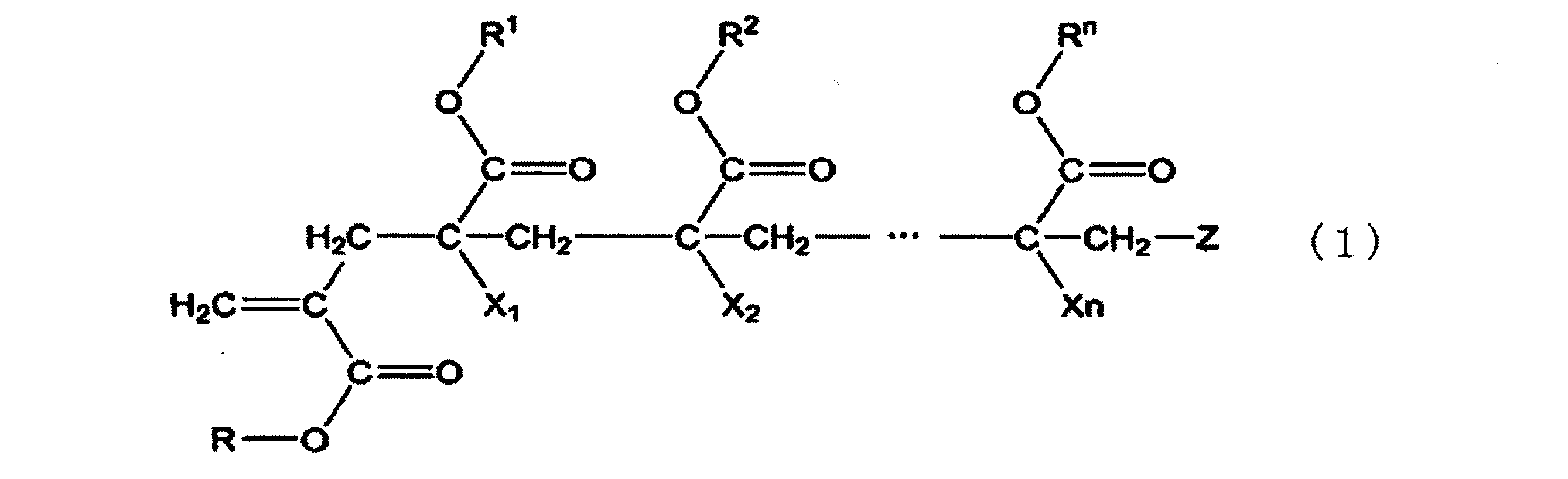

なお、以下において重合前のモノマー成分のことを「~単量体」といい、「単量体」を省略することもある。また、重合体を構成する構成単位のことを「~単量体単位」という。また、(メタ)アクリレートは、メタクリレート又はアクリレートを示す。
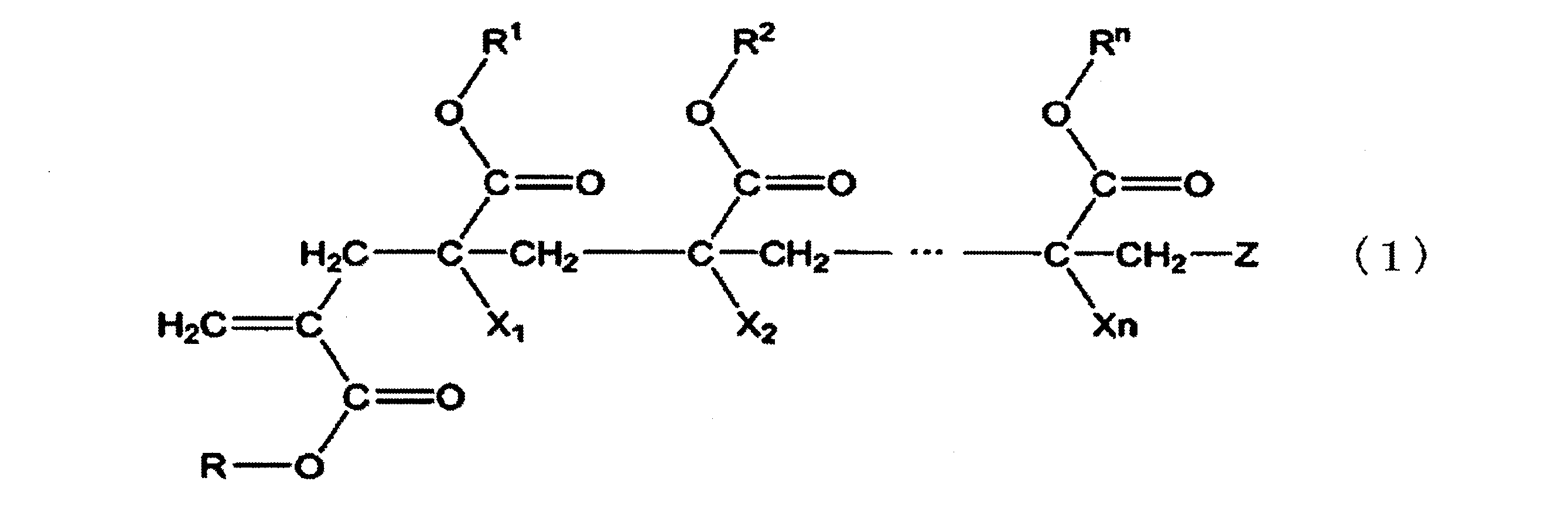
マクロモノマー(A)は、ポリ(メタ)アクリレートセグメントの片末端にラジカル重合可能な不飽和二重結合を有する基を持つ。
一般式(1)において、R及びR1~Rnは、それぞれ独立に、水素原子、アルキル基、シクロアルキル基、アリール基又は複素環基である。アルキル基、シクロアルキル基、アリール基又は複素環基は、置換基を有することができる。
R又はR1~Rnの置換基としてのカルバモイル基としては、例えば、N-メチルカルバモイル基及びN,N-ジメチルカルバモイル基が挙げられる。
R又はR1~Rnの置換基としてのアミド基としては、例えば、ジメチルアミド基が挙げられる。
R又はR1~Rnの置換基としてのハロゲン原子としては、例えば、フッ素原子、塩素原子、臭素原子、及びヨウ素原子が挙げられる。
R又はR1~Rnの置換基としてのアルコキシ基としては、例えば、炭素数1~12のアルコキシ基が挙げられる。具体例としては、メトキシ基が挙げられる。
R又はR1~Rnの置換基としての親水性又はイオン性を示す基としては、例えば、カルボキシ基のアルカリ塩又はスルホキシル基のアルカリ塩、ポリエチレンオキシド基、ポリプロピレンオキシド基等のポリ(アルキレンオキシド)基及び四級アンモニウム塩基等のカチオン性置換基が挙げられる。
アルキル基としては、メチル基、エチル基、n-プロピル基又はi-プロピル基が好ましく、入手のしやすさの観点から、メチル基がより好ましい。
一般式(1)において、X1~Xnは、それぞれ水素原子又はメチル基であり、メチル基が好ましい。さらに、マクロモノマー(A)の合成し易さの観点から、X1~Xnの半数以上がメチル基であることが好ましい。
一般式(1)において、Zは、マクロモノマー(A)の末端基である。マクロモノマー(A)の末端基としては、例えば、公知のラジカル重合で得られるポリマーの末端基と同様に、水素原子及びラジカル重合開始剤に由来する基が挙げられる。
マクロモノマー(A)の数平均分子量(Mn)は、ゲル透過クロマトグラフィー(GPC)を使用し、ポリメチルメタクリレート(PMMA)の検量線から算出した値を意味する。
マクロモノマー(A)を得るための原料モノマーとしては、例えば、メチル(メタ)アクリレート、エチル(メタ)アクリレート、n-プロピル(メタ)アクリレート、i-プロピル(メタ)アクリレート、n-ブチル(メタ)アクリレート、i-ブチル(メタ)アクリレート、t-ブチル(メタ)アクリレート、2-エチルヘキシル(メタ)アクリレート、n-ラウリル(メタ)アクリレート、n-ステアリル(メタ)アクリレート、シクロヘキシル(メタ)アクリレート、フェニル(メタ)アクリレート、ベンジル(メタ)アクリレート、イソボルニル(メタ)アクリレート、2-メトキシエチル(メタ)アクリレート、2-エトキシエチル(メタ)アクリレート、フェノキシエチル(メタ)アクリレート等の(メタ)アクリレート;2-ヒドロキシエチル(メタ)アクリレート、2-ヒドロキシプロピル(メタ)アクリレート、4-ヒドロキシブチル(メタ)アクリレート、グリセロール(メタ)アクリレート等の水酸基含有(メタ)アクリレート;(メタ)アクリル酸、2-(メタ)アクリロイルオキシエチルヘキサヒドロフタル酸、2-(メタ)アクリロイルオキシプロピルヘキサヒドロフタル酸、2-(メタ)アクリロイルオキシエチルフタル酸、2-(メタ)アクリロイルオキシプロピルフタル酸、2-(メタ)アクリロイルオキシエチルマレイン酸、2-(メタ)アクリロイルオキシプロピルマレイン酸、2-(メタ)アクリロイルオキシエチルコハク酸、2-(メタ)アクリロイルオキシプロピルコハク酸、クロトン酸、フマル酸、マレイン酸、イタコン酸、マレイン酸モノメチル、イタコン酸モノメチル等のカルボキシ基含有ビニル系単量体;無水マレイン酸、無水イタコン酸等の酸無水物基含有ビニル系単量体;グリジシル(メタ)アクリレート、グリジシルα-エチルアクリレート、3,4-エポキシブチル(メタ)アクリレート等のエポキシ基含有ビニル系単量体;ジメチルアミノエチル(メタ)アクリレート、ジエチルアミノエチル(メタ)アクリレート等のアミノ基含有(メタ)アクリレート系のビニル系単量体;(メタ)アクリルアミド、N-t-ブチル(メタ)アクリルアミド、N-メチロール(メタ)アクリルアミド、N-メトキシメチル(メタ)アクリルアミド、N-ブトキシメチル(メタ)アクリルアミド、ダイアセトンアクリルアミド、マレイン酸アミド、マレイミド等のアミド基を含有するビニル系単量体;スチレン、α-メチルスチレン、ビニルトルエン、(メタ)アクリロニトリル、塩化ビニル、酢酸ビニル、プロピオン酸ビニル等のビニル系単量体;ジビニルベンゼン、エチレングリコールジ(メタ)アクリレート、1,3-ブチレングリコールジ(メタ)アクリレート、1,6-ヘキサンジオールジ(メタ)アクリレート、トリエチレングリコールジ(メタ)アクリレート、テトラエチレングリコールジ(メタ)アクリレート、トリプロピレングリコールジ(メタ)アクリレート、トリメチロールプロパントリ(メタ)アクリレート、アリル(メタ)アクリレート、N,N’-メチレンビス(メタ)アクリルアミド等の多官能性のビニル系単量体;などが挙げられる。これらは、1種以上を適宜選択して使用することができる。
これらの中で、モノマーの入手のし易さの点で、メタクリレートが好ましい。
メタクリレートとしては、メチルメタクリレート、n-ブチルメタクリレート、ラウリルメタクリレート、ドデシルメタクリレート、ステアリルメタクリレート、2-エチルヘキシルメタクリレート、グリシジルメタクリレート、2-ヒドロキシエチルメタクリレート及び4-ヒドロキシブチルメタクリレートが好ましく、メチルメタクリレート、n-ブチルメタクリレート及び2-エチルヘキシルメタクリレートがより好ましい。
アクリレートとしては、例えば、メチルアクリレート、エチルアクリレート、n-プロピルアクリレート、i-プロピルアクリレート、n-ブチルアクリレート、i-ブチルアクリレート及びt-ブチルアクリレートが挙げられる。これらの中で、入手しやすさの点で、メチルアクリレートが好ましい。
マクロモノマー(A)は、公知の方法で製造できる。マクロモノマーの製造方法としては、例えば、コバルト連鎖移動剤を用いて製造する方法(米国特許4680352号明細書)、α-ブロモメチルスチレン等のα置換不飽和化合物を連鎖移動剤として用いる方法(国際公開88/04304号)、重合性基を化学的に結合させる方法(特開昭60-133007号広報、米国特許5147952号明細書)及び熱分解による方法(特開平11-240854号広報)等が挙げられる。
これらの中で、マクロモノマー(A)の製造方法としては、製造工程数が少なく、連鎖移動定数が高い触媒を使用する点で、コバルト連鎖移動剤を用いて製造する方法が好ましい。

マクロモノマー(A)とコモノマー(B)との反応機構については、山田らの報文(Journal of Polymer Science: Part A: Polymer Chemistry, Vol.41,p645-654(2003)、Progress in Polymer Science 31 (2006) p835-877)等に詳しく記載されている。具体的には、マクロモノマー(A)の末端二重結合基は、アクリレートラジカルとの反応では分岐構造を形成し、共重合することができる。一方、マクロモノマー(A)の末端二重結合基とメタクリレートラジカルとの反応では分岐構造の形成が困難であり、主に再開裂して末端二重結合基とメタクリレートラジカルが再生する。コモノマー(B)にスチレンを用いた場合は、分岐構造を形成可能であるが反応の進行が遅くなる傾向がある。よって、コモノマー(B)は、アクリレート(B1)を主成分とし、必要に応じてメタクリレート(B2)やその他のモノマー(B3)を用いることが好ましい。
コモノマー(B)は、マクロモノマー(A)と共重合可能であれば特に限定されず、必要に応じて各種の重合性単量体を使用できる。具体的には、マクロモノマー(A)を得るためのモノマーと同様のものが挙げられるが、前述のマクロモノマー(A)との反応性の点でアクリレート(B1)を主に用いることが好ましい。また、必要に応じてメタクリレート(B2)やその他のモノマー(B3)を用いることができる。
また、屈折率調整のための高屈成分として、例えば、フェニルアクリレート、ベンジルアクリレート、フェノキシエチルアクリレートを使用することができる。その他の目的としては、マクロモノマー(A)との相溶性確保を目的に、例えば、メチルアクリレート、エチルアクリレート等を使用することができる。
重合性成分(X)がマクロモノマー(A)とコモノマー(B)からなる場合、マクロモノマー(A)とコモノマー(B)との仕込比としては、コモノマー(B)とマクロモノマー(A)の仕込モル比である(B:A)が、99.98:0.02~95.00:5.00の範囲内であることが好ましく、99.90:0.10~95.00:5.00の範囲内であることがより好ましく、99.51:0.49~97.00:3.00の範囲内であることがさらに好ましい。
マクロモノマー(A)が少なすぎると、マクロモノマー(A)を含まずにコモノマー(B)のみからなるポリマーが生成する場合がある。逆にマクロモノマー(A)が多すぎると未反応のマクロモノマー(A)が大量に残る原因となる場合がある。本発明者らは鋭意検討の結果、マクロモノマー(A)とコモノマー(B)の仕込モル比が上記の範囲内であれば、重合反応中に残っているマクロモノマー(A)とコモノマー(B)の組成比がほぼ一定の状態を保つことができることを見出した。
マクロモノマー共重合体(Y)は、マクロモノマー(A)と、コモノマー(B)を含む重合性成分(X)を共重合して得られる。マクロモノマー共重合体(Y)は、マクロモノマー(A)に由来する単位と、コモノマー(B)に由来する単位を有する。
マクロモノマー共重合体(Y)は、マクロモノマー(A)単位とコモノマー(B)単位を有するブロックコポリマー(YI)、及び側鎖にマクロモノマー(A)単位を有するコモノマー(B)のグラフトコポリマー(YII)からなる群から選ばれる少なくとも1種を含む。さらに、マクロモノマー共重合体(Y)は、コモノマー(B)のみからなるポリマー(YIII)、マクロモノマー(A)単位のみを有するポリマー、未反応のマクロモノマー(A)、及び未反応のコモノマー(B)からなる群から選ばれる少なくとも1種を含有することができる。
ブロックコポリマー(YI)は、マクロモノマー(A)単位とコモノマー(B)の重合体からなる単位を同一分子内に併せ持つブロックコポリマーである。このブロックコポリマー(YI)は、コモノマー(B)がラジカルを有する活性種(成長ラジカル)となった状態でマクロモノマー(A)の末端二重結合と反応することで生成する。ブロックコポリマー(YI)の末端構造はマクロモノマー(A)と同じ構造の末端二重結合基となっているものを含む。つまり、ブロックコポリマー(YI)はマクロモノマー(A)単位とコモノマー(B)の重合体からなる単位を併せ持つブロックコポリマーで、且つ末端二重結合基を有するものを含む。この末端二重結合基を有するブロックコポリマー(YI)は、ブロックマクロモノマーと呼べる。
なお、トランス位とは、カルボニル基に対して二重結合を挟んで反対側にある水素原子のことを意味する。
グラフトコポリマー(YII)は、前述の末端二重結合を有するブロックコポリマー(YI)(前記ブロックマクロモノマー)がコモノマー(B)と共重合することで生成する。このグラフトコポリマー(YII)は同一分子内に複数のマクロモノマー(A)単位を含むものや多分岐構造になっているものを含む。マクロモノマー共重合体(Y)のミクロ相分離構造制御能や耐熱分解性の点で、ブロックコポリマー(YI)とグラフトコポリマー(YII)は共に良好な働きをするため、両方含まれていて問題ない。
ポリマー(YIII)は、コモノマー(B)のみが重合して生成したポリマーであり、ポリマー構造中にマクロモノマー(A)単位を含まないものである。ポリマー(YIII)は、マクロモノマー共重合体(Y)のミクロ相分離構造制御能を低下させるため、より少ないことが好ましい。
なお、本明細書において質量平均分子量(Mw)は、ゲル透過クロマトグラフィー(GPC)によって測定される、ポリメチルメタクリレート換算の質量平均分子量である。
下記式(2)で表されるHxについて説明する。
Hx=Hm/Ht (2)
Hxは、マクロモノマー共重合体(Y)においてマクロモノマー(A)の反応率やグラフトコポリマー(YII)の生成比を反映させた指標である。Hxが小さいほど、マクロモノマー共重合体(Y)が含むグラフトコポリマー(YII)が多く、且つマクロモノマー(A)の反応率が高い。それは、Hmの値はマクロモノマー(A)とコモノマー(B)の共重合反応の過程において常に減少するが、Htの値は重合後期においてHmの値よりも大きくなるためである。
Hmは、1H-NMRにおいて、マクロモノマー(A)の末端二重結合基のトランス位のプロトンと対応するピークの積分値である。マクロモノマー(A)は主成分がメタクリレートであることから、X1は主にメチル基である。その場合に末端二重結合基のトランス位のプロトンのピークは、5.43ppm付近と5.47ppm付近に現れる。Hmの値は、マクロモノマー(A)とコモノマー(B)の共重合反応の過程においてマクロモノマー(A)が消費されていくことで徐々に減少する。
Htは、1H-NMRにおいて、マクロモノマー(A)の末端二重結合基のトランス位のプロトンと対応するピークの積分値と、ブロックコポリマー(YI)の末端二重結合基のトランス位のプロトンと対応するピークの積分値の和である。マクロモノマー(A)は主成分がメタクリレートであることから、X1は主にメチル基であり、末端二重結合基のトランス位のプロトンのピークは、5.43ppm付近と5.47ppm付近に現れる。一方、ブロックコポリマー(YI)は、コモノマー(B)単量体単位が主にアクリレート(B1)単量体単位からなることから、一般式(1)におけるX1は主に水素原子であり、末端二重結合基のトランス位のプロトンのピークは、5.52ppm付近に現れる。
一般式(1)においてX1が水素原子である場合の末端二重結合基のトランス位のプロトンのピークである5.52ppm付近のピークは、マクロモノマー(A)とコモノマー(B)の共重合反応の過程において、ブロックコポリマー(YI)の生成と消費が同時に進行していくことから、重合初期には徐々にピークが大きくなっていくが、重合後期には徐々にピークが減少していく。
[NMR装置]
マクロモノマー(A)とコモノマー(B)の共重合反応を追跡する場合、高い分解能が求められることから、より高周波数のNMR(核磁気共鳴)装置を使用することが好ましい。具体的には、250MHz以上が好ましく、400MHz以上がより好ましく、500MHz以上がさらに好ましい。
マクロモノマー共重合体(Y)を溶解させる重溶媒は、マクロモノマー共重合体(Y)を均一に溶解させられるものであれば特に制限されないが、入手しやすさと溶解性の点で重クロロホルムが好ましい。特に、TMS(テトラメチルシラン)を基準物質として含む高純度の重クロロホルムを用いることが好ましい。
マクロモノマー共重合体(Y)は、再沈等の精製を行わずに測定することが好ましい。精製操作を実施すると、マクロモノマー共重合体(Y)が含む低分子量成分が除かれてしまい、正確な解析の妨げとなる場合がある。マクロモノマー共重合体(Y)を溶液重合で製造した場合もそのまま重溶媒で希釈して測定することが好ましい。
マクロモノマー共重合体(Y)は測定サンプル中に5質量%以上含むことが好ましい。溶液が薄すぎると一般式(1)の末端二重結合基のトランス位のプロトンのピークを検出することが困難となる。
1H-NMRの測定ではより積算回数を多くした方が、一般式(1)の末端二重結合基のトランス位のプロトンのピークが検出しやすくなる。積算回数は1000回以上が好ましく、5000回以上がより好ましく、10000回以上がさらに好ましい。測定時のサンプル溶液の温度はより高い方が好ましいが、重溶媒の沸点を考慮して適切な範囲で設定する。例えば、重溶媒として重クロロホルムを用いる場合、40℃程度が好ましい。
マクロモノマー共重合体(Y)の製造方法は、マクロモノマー(A)およびコモノマー(B)からなる重合性成分(X)を重合反応させる工程を有する。
重合性成分(X)を重合反応させる方法は特に限定されず、溶液重合、懸濁重合、乳化重合、塊状重合等の種々の方法を用いることができる。懸濁重合や乳化重合のような水系重合であれば重合発熱の制御が容易で回収操作がより簡便となるため生産性が高い点で好ましく、溶液重合であれば反応溶液の均一性が重合後期まで保たれた状態で反応させることが可能である。また、溶液重合や乳化重合はマクロモノマーの合成からマクロモノマー共重合体の合成まで連続して行うことが可能である点で有利である。
マクロモノマー共重合体(Y)が含む硫黄元素の含有量が、マクロモノマー共重合体(Y)の総質量に対し、0.002質量%以下であることが好ましい。具体的には、0~0.002質量%であることが好ましい。硫黄元素の含有量が上記範囲内であることにより、未反応のマクロモノマー(A)を低減し、グラフトコポリマー(YII)を多く得ることができる。
マクロモノマー共重合体(Y)が含硫黄連鎖移動剤残基を含まないことが好ましい。「連鎖移動剤残基」とは、重合体の末端に残存する連鎖移動剤由来の残基のことである。マクロモノマー共重合体(Y)が含硫黄連鎖移動剤残基を含まないことにより、未反応のマクロモノマー(A)を低減し、グラフトコポリマー(YII)を多く得ることができる。
アゾ化合物の具体例としては、例えば、2,2’-アゾビスイソブチロニトリル、2,2’-アゾビス(2,4-ジメチルバレロニトリル)、2 , 2’-アゾビス(2,4-ジメチル-4-メトキシバレロニトリル)等が挙げられる。
これらの中でも、ベンゾイルパーオキサイド、2,2’-アゾビスイソブチロニトリル、2,2’-アゾビス(2,4-ジメチルバレロニトリル)、2,2’-アゾビス(2,4-ジメチル-4-メトキシバレロニトリル)が好ましい。これらラジカル重合開始剤は、単独でまたは2種以上を組み合わせて用いることができる。
ラジカル重合開始剤は、マクロモノマー(A)とコモノマー(B)の合計量100質量部に対して0.0001~10質量部の範囲内で用いることが好ましい。
重合温度については特に制限はなく、例えば、-100~250℃であり、好ましくは0~200℃の範囲であり、さらに好ましくは60~80℃である。重合時間全体の5割以上を占める時間の重合温度が60℃以上80℃以下であることが好ましい。
[マクロモノマー(A)の反応率]
マクロモノマー(A)の反応率とは、マクロモノマー(A)がコモノマー(B)由来の単量体単位を含む共重合体に変化したものの割合を意味する。つまり、マクロモノマー(A)がグラフトコポリマー(YII)に変換された割合とは異なる。それは、マクロモノマー(A)由来の末端二重結合基は、共重合反応の過程において、ブロックコポリマー(YI)の末端に移動するためである。
本発明におけるマクロモノマー共重合体(A)の反応率は、HPLC(高速液体クロマトグラフィー)によって求めた値である。HPLC測定では、マクロモノマー(A)が含む単量体単位の組成とコモノマー(B)の組成が異なれば、測定条件を適切に設定することでマクロモノマー(A)ピークの面積や高さからマクロモノマー(A)の反応率を求めることができる。
コモノマー(B)の反応率は、例えば、1H-NMR(核磁気共鳴)やGC(ガスクロマトグラフィー)などによって求めることができる。NMRの場合、1H-NMRスペクトルや13C-NMRスペクトルからコモノマー(B)の反応率を求めることが可能である。GCの場合、コモノマー(B)が高分子量化して減少していく割合から反応率を求めることが可能である。コモノマー(B)の反応率は、NMRによって求めた場合とGCによって求めた場合で同等の値となる。本発明におけるコモノマー(B)の反応率は、原則として1H-NMRで求めた値を採用する。ただし、複数のモノマーをコモノマー(B)として併用するなどして基準ピークの大きさが見積れないなど、1H-NMRではコモノマー(B)の反応率が正確に算出できない場合は、GCもしくはその他の解析方法を用いてコモノマー(B)の反応率を求めることもできる。
マクロモノマー(A)由来の末端二重結合は、共重合の反応過程においてブロックコポリマー(YI)の末端に移動したのち、最終的にグラフトコポリマー(YII)に取り込まれることで初めて消費される。すなわち、マクロモノマー(A)由来の末端二重結合が消費されるとき、マクロモノマー共重合体(Y)中に分岐構造が生じる。
マクロモノマー(A)由来の末端二重結合反応率が高いほどマクロモノマー共重合体(Y)が多くのグラフトコポリマー(YII)を含むことになり好ましい。マクロモノマー(A)由来の末端二重結合反応率は、マクロモノマー(A)由来の末端二重結合の総モル数に対し、53モル%以上が好ましく、60モル%以上がより好ましく、70モル%以上がさらに好ましい。
本発明において、マクロモノマー(A)由来の末端二重結合反応率は、1H-NMR(核磁気共鳴)によって原料のマクロモノマー(A)とマクロモノマー共重合体(Y)を比較して求めた値である。
これは、マクロモノマー(A)由来の末端二重結合が一旦ブロックコポリマー(YI)の末端に移動したのちにグラフトコポリマー(YII)に取り込まれるためである。すなわち、マクロモノマー(A)の消費とコモノマー(B)の消費が同じように進行すると一定量のブロックコポリマー(YI)がグラフトコポリマー(YII)に取り込まれる前の状態で残る。マクロモノマー(A)由来の末端二重結合反応率を100モル%に近づけるためには、重合反応中にコモノマー(B)を滴下する方法が考えられるが、重合中に重合性成分(X)の組成が変化し、重合終盤にコモノマーのみからなるポリマー(YIII)が多く生成してしまう。
マクロモノマー共重合体(Y)が十分均一な組成になる重合条件では、マクロモノマー(A)由来の末端二重結合反応率は90モル%以下となりやすい。
マクロモノマー(A)由来の末端二重結合反応率は、マクロモノマー(A)由来の末端二重結合の総モル数に対し、53モル%以上90モル%以下が好ましく、60モル%以上85モル%以下がより好ましく、70モル%以上80モル%以下がさらに好ましい。
上記の条件で1H-NMR測定を実施した場合、一般式(1)でR及びR1~Rnがメチルの場合、マクロモノマー(A)の末端二重結合基のトランス位のプロトンピークは5.43ppm、5.47ppm、及び5.52ppmに観測され、ポリメチルメタクリレート部のメチルエステル(R1~Rn)由来のプロトンピークは3.6ppmに観測される。そこで、3.6ppmのピーク積分値を基準とし、5.43ppm、5.47ppm、及び5.52ppmのピーク積分値が減少した割合を算出することでマクロモノマー(A)由来の末端二重結合反応率を算出した。具体的には、あらかじめマクロモノマー(A)の1H-NMR測定を実施したのち、重合反応中にサンプリングした反応液を1H-NMR測定して比較し、マクロモノマー(A)由来の末端二重結合反応率を算出した。
コモノマー(B)がn-ブチルアクリレートの場合、1H-NMR測定でブチルエステル中の最もエステル結合に近いメチレン(-CH2-)部位のプロトンと、ポリn-ブチルアクリレート部のブチルエステル中の最もエステル結合に近いメチレン(-CH2-)部位のプロトンは、それぞれ4.1~4.3ppmと3.9~4.1ppmに観測される。3.9~4.3ppmのピーク積分値と、3.9~4.1ppmのピーク積分値の比を算出することでn-ブチルアクリレートの反応率を算出した。
マクロモノマー共重合体(Y)は単独で用いても良く、他の樹脂との混合物として用いても良い。他の樹脂は二種類以上を用いても良い。マクロモノマー共重合体(Y)の特性を改良するために他の樹脂を用いても良く、他の樹脂の特性を改良するためにマクロモノマー共重合体(Y)を用いても良い。
他の樹脂としては、例えば、ポリメタクリル酸メチル等のアクリル系樹脂、ポリオレフィン、ポリアミド、不飽和ポリエステル、ポリエチレンテレフタレート、ポリブチレンテレフタレート等の飽和ポリエステル、ポリカーボネート、ポリスチレン、ABS樹脂、AS樹脂、ポリ塩化ビニル、ポリフッ化ビニリデン等が挙げられる。
成形材料(C)は、マクロモノマー共重合体(Y)を含有し、成形に用いられる組成物である。成形材料(C)には、マクロモノマー共重合体(Y)を単独で、又は2種以上を組合せて用いることができる。さらに、成形材料(C)はマクロモノマー共重合体(Y)以外の他の樹脂を含むものでも良い。他の樹脂としては、例えば、ポリメタクリル酸メチル等のアクリル系樹脂、ポリオレフィン、ポリアミド、不飽和ポリエステル、ポリエチレンテレフタレート、ポリブチレンテレフタレート等の飽和ポリエステル、ポリカーボネート、ポリスチレン、ABS樹脂、AS樹脂、ポリ塩化ビニル、ポリフッ化ビニリデン等が挙げられる。
成形材料(C)が含む他の樹脂の割合としては、成形材料の総重量に対して、0~95%が好ましく、20~80質量%がより好ましい。
重合体とその他のポリマーを混合する方法としては、例えば、ヘンシェルミキサー、ブレンダー等の物理的混合方法及び押出機等の溶融混合法が挙げられる。
キャスト成形法は、マクロモノマー共重合体(Y)を含むシラップ(E)を調製し、鋳型中で重合・硬化させる工程を経てキャスト成形体(D)を製造する方法である。シラップ(E)は、マクロモノマー(Y)とモノマー(F)を必須成分とし、必要に応じてその他の成分を加えて調製される。キャスト成形法は、溶融成形法と比較してマクロモノマー共重合体(Y)によって励起されるミクロ相分離構造が固定されやすいという利点がある。
シラップ(E)が含むマクロモノマー共重合体(Y)の割合としては、例えば、5~80質量%が好ましく、10~70質量%がより好ましい。
シラップ(E)に使用するその他の成分としては、過酸化物、アゾ化合物等の熱重合開始剤;(1-ヒドロキシシクロヘキシル)フェニルメタノン、フェニルビス(2,4,6-トリメチルベンゾイル)ホスフィン=オキシド等の光重合開始剤;酸化防止剤、紫外線吸収剤、熱安定剤等の各種安定剤;無機顔料、有機顔料、染料等の着色剤;カーボンブラック、フェライト等の導電性付与剤;無機充填剤;滑材;離型剤;可塑剤;有機過酸化物;中和剤;架橋剤;ポリメタクリル酸メチル等のアクリル系樹脂;等が挙げられる。
キャスト成形体(D)の形状としては、例えば、シート状及び3次元形状が挙げられる。
[GPC測定]
Mw及びMnは、ゲル透過クロマトグラフィー(GPC)を使用して求めた。以下に測定条件を示す。
装置:HLC-8220(東ソー社製)
カラム:TSK GUARD COLUMN SUPER H-H(4.6×35mm、東ソー社製)と2本のTSK-GEL SUPER HM-H(6.0×150mm、東ソー社製)を直列に接続
溶離液:テトラヒドロフラン
測定温度:40℃
流速: 0.6mL/分
Mw(質量平均分子量)及びMn(数平均分子量)は、Polymer Laboratories製のポリメチルメタクリレート(Mp(ピーク分子量)=141,500、55,600、11,100及び1,590の4種)を用いて作成した検量線を使用して算出した。分子量分布は、式「分子量分布=(質量平均分子量)/(数平均分子量)」により算出した。
前記Hxを求めるためのHm及びHtの値は、1H-NMR測定によって求められる。1H-NMR測定は核磁気共鳴装置を用いて実施した。以下に測定条件を示す。
装置:UNITY INOVA500(Varian社製、周波数500MHz)
重溶媒:重クロロホルム(シグマ-アルドリッチ社製、テトラメチルシラン(TMS)0.05v/v%添加、純度99.7%)
サンプル調製:重合性成分(X)及びその反応生成物であるマクロモノマー共重合体(Y)の合計重量の割合が33質量%であるトルエン溶液を調製した。次いで前記トルエン溶液0.225gに対して重クロロホルムを1.1g加えてNMR測定用サンプル溶液とした。NMR測定用サンプル溶液における重クロロホルムとトルエンの重量比は88:12であった。NMR測定用サンプル溶液が含む重合性成分(X)及びその反応生成物であるマクロモノマー共重合体は、5.66質量%であった。
測定条件:積算回数10000回、測定温度40℃
解析方法:テトラメチルシランのプロトンピークの位置を0.00ppmとし、各ピークの位置を決定した。マクロモノマー(A)及びブロックコポリマー(YI)の末端二重結合基のトランス位のプロトン由来のピークは、5.43ppm、5.47ppm、及び5.52ppmに観測された。
マクロモノマー(A)の反応率は、HPLC(高速液体クロマトグラフィー)を使用して測定した。測定条件を以下に示す。
装置:Alliance e2695(ウォーターズ社製)
カラム:TSKgel ODS100V(5μm、4.6×150mm、東ソー社製)
溶離液:アセトニトリル(A液)、テトラヒドロフラン(B液)
グラジエント条件:リニアグラジエント 0分(A液/B液=100/0)-10分(A液/B液=0/100)-15分(A液/B液=0/100)
測定温度:40℃
流速:1.0mL/分
検出器:荷電粒子検出器 Corona ultra RS(サーモフィッシャーサイエンティフィック社製)
重合反応中にサンプリングした反応液をテトラヒドロフランに溶解し、サンプル溶液とした。また、マクロモノマー(A)をテトラヒドロフランに溶解し、標準溶液とした。標準溶液のクロマトグラムのうちマクロモノマー(A)に該当するピークの面積や高さから検量線を作成した。この検量線を用いてサンプルのクロマトグラムのうちマクロモノマー(A)に該当するピークの面積や高さからマクロモノマー(A)の反応率を求めた。
溶液重合で得られたマクロモノマー共重合体(Y)は、再沈殿を実施することで溶剤と残ったコモノマー(B)を取り除く方法で回収した。まず、重合反応溶液100質量部にトルエン200質量部を加えて希釈液300質量部を得た。次いで前記希釈液を、3000質量部のメタノール中に投じて沈殿物を生じさせ、その沈殿物を濾過して固体の回収物を得た。この回収物を減圧乾燥してマクロモノマー共重合体(Y)を得た。
耐熱分解性は、熱重量測定/示差熱分析装置を使用してマクロモノマー共重合体(Y)の重量減少を追跡して評価した。以下に測定条件を示す。
装置:SIIナノテクノロジー社製 TG/DTA6300
測定条件:窒素気流200mL/分、40℃~550℃、昇温速度10℃/分
マクロモノマー共重合体(Y)を含む成形材料を射出成形して2mm厚の成形板を得た後、ヘイズ値の測定を実施した。以下に測定条件を示す。
装置:日本電色工業社製 NDH2000
測定条件:全光線透過率はJIS K7361-1、ヘイズ値(曇価)はJIS K7316に準拠して評価した。
標準板としてVH001(三菱レイヨン社製、ポリメチルメタクリレート、商品名)で作成した2mm厚板を用い、各サンプルのヘイズ値をとの差をΔHaze値として算出した。ΔHaze値で比較することで、外部ヘイズの影響を除いた内部ヘイズの値を比較することができる。
撹拌機、冷却管及び温度計を備えた反応装置中に、17質量%水酸化カリウム水溶液61.6部、メチルメタクリレート19.1部及び脱イオン水19.3部を仕込んだ。次いで、反応装置内の液を室温にて撹拌し、発熱ピークを確認した後、4時間撹拌した。この後、反応装置中の反応液を室温まで冷却してメタクリル酸カリウム水溶液を得た。
撹拌装置を備えた合成装置中に、窒素雰囲気下で、酢酸コバルト(II)四水和物(和光純薬工業社製、和光特級)2.00g(8.03mmol)及びジフェニルグリオキシム(東京化成社製、EPグレード)3.86g(16.1mmol)及び予め窒素バブリングにより脱酸素したジエチルエーテル100mlを入れ、室温で2時間攪拌した。
撹拌機、冷却管及び温度計を備えた重合装置中に、脱イオン水135部、硫酸ナトリウム(Na2SO4)0.1部及び製造例1で製造した分散剤(1)(固形分10質量%)0.26質量部を入れて撹拌して、均一な水溶液とした。次に、メチルメタクリレート100部、製造例2で製造した連鎖移動剤(1)0.00125質量部及び重合開始剤としてパーオクタO(日油(株)製、1,1,3,3-テトラメチルブチルパーオキシ2-エチルヘキサノエート、商品名)0.1質量部を加え、水性分散液とした。
撹拌機、冷却管及び温度計を備えた重合装置中に、脱イオン水135部、硫酸ナトリウム(Na2SO4)0.1部及び製造例1で製造した分散剤(1)(固形分10質量%)0.26質量部を入れて撹拌して、均一な水溶液とした。次に、メチルメタクリレート95部、メチルアクリレート5部、製造例2で製造した連鎖移動剤(1)0.00240質量部及び重合開始剤としてパーオクタO(日油(株)製、1,1,3,3-テトラメチルブチルパーオキシ2-エチルヘキサノエート、商品名)0.1質量部を加え、水性分散液とした。
本例では、溶液重合法によりマクロモノマー共重合体(Y-1)を製造した。
攪拌機、冷却管及び温度計を備えたセパラブルフラスコ内に、トルエン(和光純薬工業社製)100部、製造例3で製造したマクロモノマー(A-1)64.0部を入れて50℃で1時間撹拌して均一な溶液とした。一度室温まで冷却後、n-ブチルアクリレート(三菱化学社製)36.0部、V59(和光純薬工業社製AMBN(2,2-アゾビス(2-メチルブチロニトリル)、商品名)0.3部を加えて撹拌して均一な溶液を得た。30分間窒素バブリングを実施してセパラブルフラスコ内の雰囲気を窒素置換した。次いで69℃まで昇温して重合を開始し、30分後、2時間後、5時間後に反応液をサンプリングを実施しながら反応を進行させた後、室温まで冷却してマクロモノマー共重合体(Y)を含むポリマー溶液を得た。
得られたマクロモノマー共重合体のMnは34,200、Mwは79,800、分子量分布(Mw/Mn)は2.3であった。HPLC測定から求めたマクロモノマー(A)の反応率は81%であった。NMR測定から求めたコモノマー(B)の反応率は85%、マクロモノマー(A)由来の末端二重結合反応率は60モル%、Hmの値を1.00とした時のHtの値は3.47であり、Hxの値は0.29、未反応のマクロモノマー(A)は7.5質量%であった。
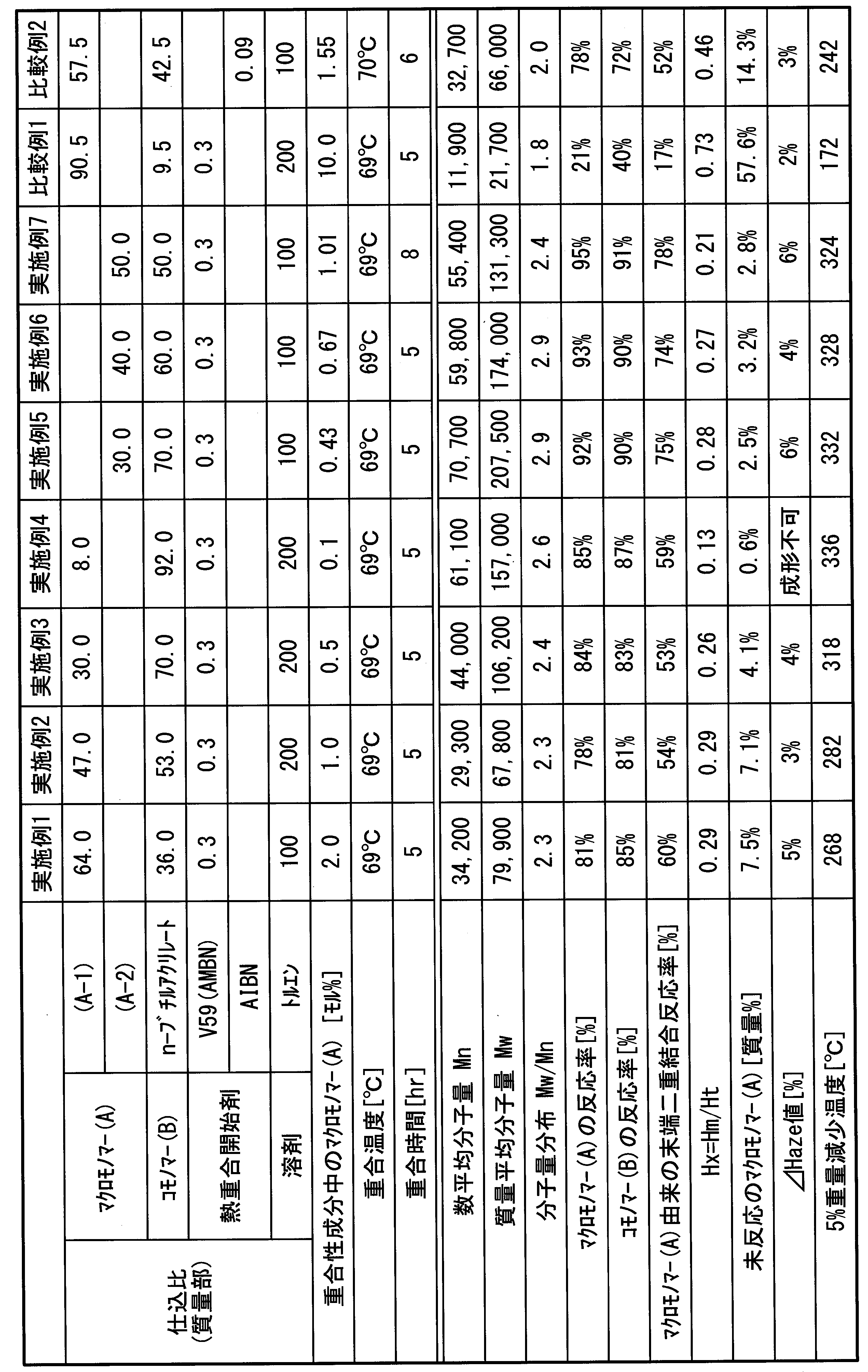
各重合条件を表1に記載の内容に変更し、実施例2~7、および比較例1~2を行い、マクロモノマー共重合体を得た。実施例2~7および比較例1~2の解析及び評価結果を表Xに示した。実施例4で得られたマクロモノマー共重合体は、高粘調液体として得られたため成形板が作成できなかった。このためΔHaze値は求めていない。
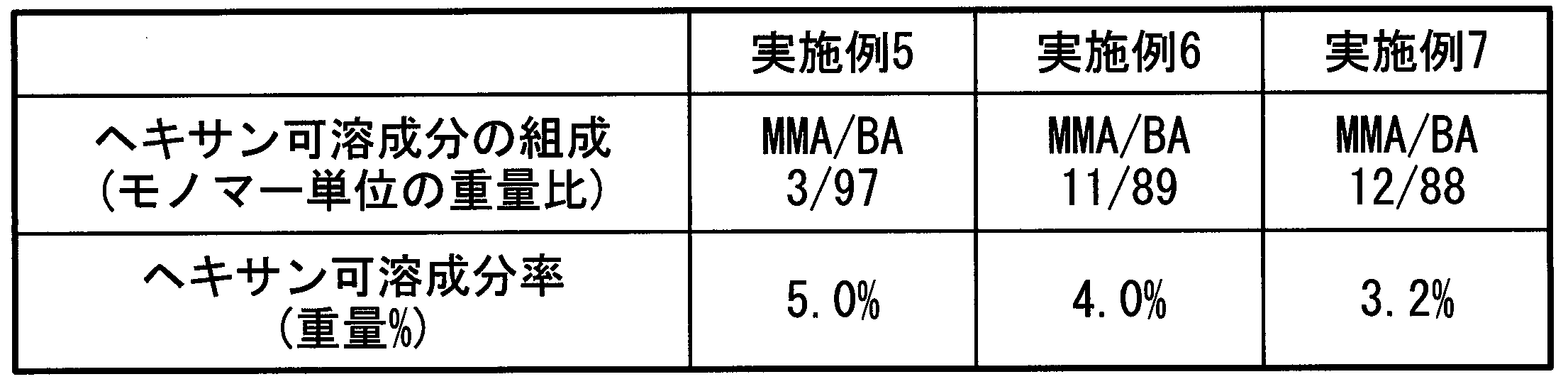
実施例5~7については、得られたポリマー溶液をヘキサンを使用して再沈し、ヘキサン可溶成分を単離し、その重量比を算出した。次いでヘキサン可溶成分を1H-NMR測定し、ポリマー組成を求めた。実施例5~7のヘキサン可溶成分の分析結果を表2にまとめた。表2中、「MMA」はメチルメタクリレート、「BA」はn-ブチルアクリレートを意味する。
Claims (12)
- 下記一般式(1)で表されるマクロモノマー(A)単量体単位と、前記マクロモノマー(A)と共重合可能なコモノマー(B)単量体単位とで構成されるマクロモノマー共重合体(Y)であって、下記式(2)で表されるHxの値が0.05以上0.40以下である、マクロモノマー共重合体(Y)。
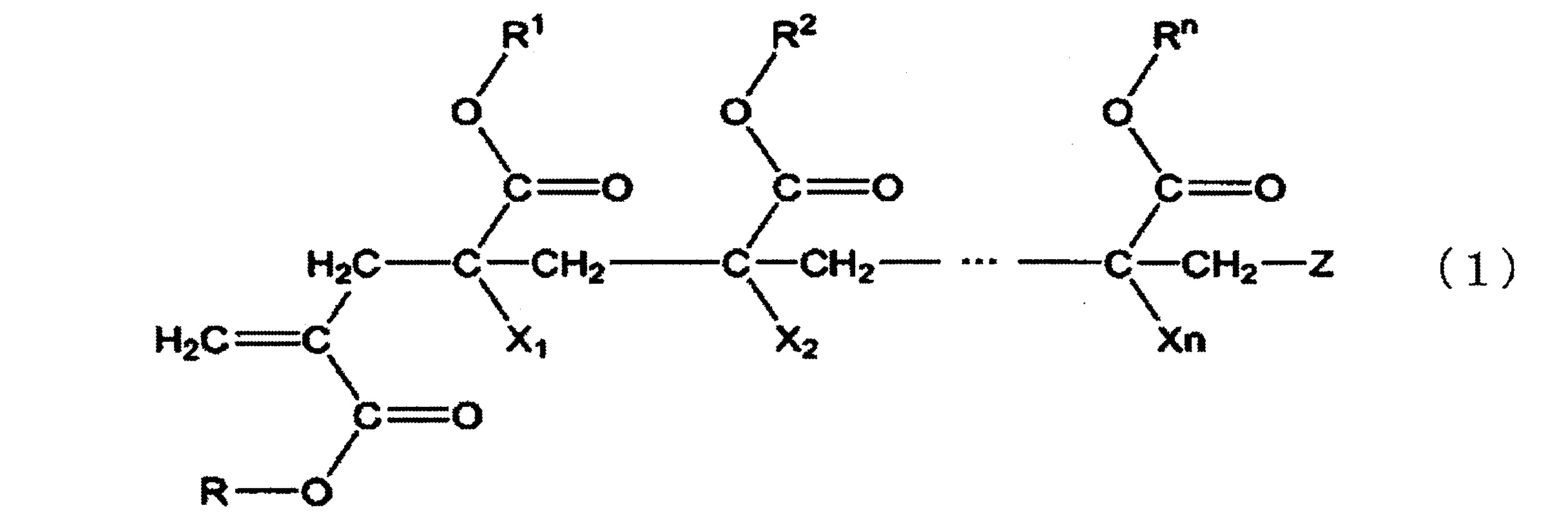
X1~Xnは、それぞれ独立に、水素原子又はメチル基である。
Zは、末端基である。
nは、2~10,000の自然数である。)
Hx=Hm/Ht (2)
(式(2)において、Hmは一般式(1)のX1がメチル基である場合の1H-NMRにおける末端二重結合基のトランス位のプロトン積分値であり、Htは式(1)のX1がメチル基及び水素原子である場合の1H-NMRにおける末端二重結合基のトランス位のプロトン積分値である。) - 前記式(2)において、NMR装置を使用し、重クロロホルムとトルエンの重量比が88:12である混合溶媒中、40℃の条件で1H-NMRを測定し、テトラメチルシランのピークを0.00ppmとした時、Hmは、5.43ppm、及び5.47ppmの1H-NMRピーク積分値の和であり、Htは5.43ppm、5.47ppm、及び5.52ppmの1H-NMRピーク積分値の和である、請求項1に記載のマクロモノマー共重合体(Y)。
- 前記マクロモノマー共重合体(Y)が含む硫黄元素の含有量が、マクロモノマー共重合体(Y)の総質量に対し、0.002質量%以下である、請求項1又は2に記載のマクロモノマー共重合体(Y)。
- 前記マクロモノマー共重合体(Y)が含硫黄連鎖移動剤残基を含まない、請求項1~3のいずれか一項に記載のマクロモノマー共重合体(Y)。
- 前記マクロモノマー共重合体(Y)が含む未反応のマクロモノマー(A)の含有量が、マクロモノマー共重合体(Y)の総質量に対し、10質量%以下である、請求項1~4のいずれか一項に記載のマクロモノマー共重合体(Y)。
- 前記マクロモノマー共重合体(Y)が含むコモノマー(B)単量体単位のみからなる重合体の含有量が、マクロモノマー共重合体(Y)の総質量に対し、10質量%以下である、請求項1~5のいずれか一項に記載のマクロモノマー共重合体(Y)。
- 下記一般式(1)で表されるマクロモノマー(A)、および前記マクロモノマー(A)と共重合可能なコモノマー(B)からなる重合性成分(X)を、重合反応終了時の前記マクロモノマー(A)由来の末端二重結合反応率が、マクロモノマー(A)由来の末端二重結合の総モル数に対し、53モル%以上90モル%以下となるように重合反応させる、マクロモノマー共重合体の製造方法。

X1~Xnは、それぞれ独立に、水素原子又はメチル基である。
Zは、末端基である。
nは、2~10,000の自然数である。) - 前記コモノマー(B)がアクリレートのみからなる、請求項7に記載のマクロモノマー共重合体(Y)の製造方法。
- 前記重合性成分(X)100モル%に対して、前記マクロモノマー(A)の含有量が0.02モル%以上8.0モル%以下である、請求項7又は8に記載のマクロモノマー共重合体(Y)の製造方法。
- 重合時間全体の5割以上を占める時間の重合温度が60℃以上80℃以下である、請求項7~9のいずれか一項に記載のマクロモノマー共重合体(Y)の製造方法。
- 前記マクロモノマー(A)及び前記コモノマー(B)を全量一括に仕込んでから重合反応を開始する、請求項7~10のいずれか一項に記載のマクロモノマー共重合体(Y)の製造方法。
- 前記マクロモノマー(A)の数平均分子量(Mn)が1,000以上である、請求項7~11のいずれか一項に記載のマクロモノマー共重合体(Y)の製造方法。
Priority Applications (5)
| Application Number | Priority Date | Filing Date | Title |
|---|---|---|---|
| JP2017517369A JP6500982B2 (ja) | 2016-05-19 | 2017-03-14 | マクロモノマー共重合体およびその製造方法 |
| EP17798997.7A EP3459979B1 (en) | 2016-05-19 | 2017-03-14 | Macromonomer copolymer and production process therefor |
| KR1020187032823A KR102134265B1 (ko) | 2016-05-19 | 2017-03-14 | 매크로 단량체 공중합체 및 그의 제조 방법 |
| CN201780029735.9A CN109153757B (zh) | 2016-05-19 | 2017-03-14 | 大分子单体共聚物以及其制造方法 |
| US16/190,622 US10793660B2 (en) | 2016-05-19 | 2018-11-14 | Macromonomer copolymer and method for producing same |
Applications Claiming Priority (2)
| Application Number | Priority Date | Filing Date | Title |
|---|---|---|---|
| JP2016-100647 | 2016-05-19 | ||
| JP2016100647 | 2016-05-19 |
Related Child Applications (1)
| Application Number | Title | Priority Date | Filing Date |
|---|---|---|---|
| US16/190,622 Continuation US10793660B2 (en) | 2016-05-19 | 2018-11-14 | Macromonomer copolymer and method for producing same |
Publications (1)
| Publication Number | Publication Date |
|---|---|
| WO2017199562A1 true WO2017199562A1 (ja) | 2017-11-23 |
Family
ID=60325942
Family Applications (1)
| Application Number | Title | Priority Date | Filing Date |
|---|---|---|---|
| PCT/JP2017/010151 Ceased WO2017199562A1 (ja) | 2016-05-19 | 2017-03-14 | マクロモノマー共重合体およびその製造方法 |
Country Status (6)
| Country | Link |
|---|---|
| US (1) | US10793660B2 (ja) |
| EP (1) | EP3459979B1 (ja) |
| JP (1) | JP6500982B2 (ja) |
| KR (1) | KR102134265B1 (ja) |
| CN (1) | CN109153757B (ja) |
| WO (1) | WO2017199562A1 (ja) |
Cited By (6)
| Publication number | Priority date | Publication date | Assignee | Title |
|---|---|---|---|---|
| WO2019103102A1 (ja) * | 2017-11-24 | 2019-05-31 | 三菱ケミカル株式会社 | ブロック共重合体組成物及びその製造方法 |
| JP2020147673A (ja) * | 2019-03-13 | 2020-09-17 | 三菱ケミカル株式会社 | 活性エネルギー線硬化性組成物 |
| JP2023096294A (ja) * | 2021-12-27 | 2023-07-07 | 三菱ケミカル株式会社 | 樹脂成形体及び樹脂シートの製造方法 |
| WO2023157793A1 (ja) | 2022-02-15 | 2023-08-24 | 三菱ケミカル株式会社 | 熱可塑性樹脂組成物、成形材料及び成形体 |
| EP4253438A4 (en) * | 2020-11-30 | 2024-05-29 | Mitsubishi Chemical Corporation | RESIN COMPOSITION, MOLDED BODY, AND MACROMONOMER COPOLYMER |
| US12264212B2 (en) | 2018-09-26 | 2025-04-01 | Mitsubishi Chemical Corporation | Copolymer for suppressing protein adsorption, method for producing copolymer, resin modifier, molding material, copolymer-containing composition, coating film, and article |
Families Citing this family (3)
| Publication number | Priority date | Publication date | Assignee | Title |
|---|---|---|---|---|
| WO2021193613A1 (ja) * | 2020-03-26 | 2021-09-30 | 三菱ケミカル株式会社 | 共重合体、樹脂組成物、成形体、フィルム状成形体、及び共重合体の製造方法 |
| TW202328375A (zh) * | 2021-09-13 | 2023-07-16 | 日商三菱化學股份有限公司 | 黏著片材、黏著劑組合物、附離型膜之黏著片材、圖像顯示裝置用積層體及可撓性圖像顯示裝置 |
| CN118339249A (zh) * | 2022-01-06 | 2024-07-12 | 株式会社Lg化学 | 粘合剂 |
Citations (10)
| Publication number | Priority date | Publication date | Assignee | Title |
|---|---|---|---|---|
| US4554324A (en) * | 1982-09-16 | 1985-11-19 | Minnesota Mining And Manufacturing Co. | Acrylate copolymer pressure-sensitive adhesive composition and sheet materials coated therewith |
| JPH0267303A (ja) * | 1988-08-31 | 1990-03-07 | Mitsubishi Rayon Co Ltd | くし形共重合体の製造方法 |
| JPH05170838A (ja) * | 1991-06-21 | 1993-07-09 | Mitsubishi Rayon Co Ltd | グラフト共重合体の製造方法 |
| JPH06298882A (ja) * | 1993-03-26 | 1994-10-25 | Roehm Gmbh | アクリレートを基礎とする熱可塑性の加工可能なエラストマー |
| JPH07506393A (ja) * | 1992-05-01 | 1995-07-13 | イー・アイ・デュポン・ドゥ・ヌムール・アンド・カンパニー | マクロモノマー連鎖移動剤を用いた架橋可能ポリマーの製造方法 |
| JPH1087754A (ja) * | 1996-08-30 | 1998-04-07 | E I Du Pont De Nemours & Co | 顔料入りのインクの分散剤として殊に有用なスルホネートおよびホスホネート基を含有するグラフトコポリマー |
| JP2000514845A (ja) * | 1996-02-23 | 2000-11-07 | イー・アイ・デュポン・ドウ・ヌムール・アンド・カンパニー | 分枝ポリマー合成 |
| JP2003002934A (ja) * | 2001-06-25 | 2003-01-08 | Toagosei Co Ltd | 水性樹脂分散体及びその製造方法並びに用途 |
| JP2004513890A (ja) * | 2000-09-29 | 2004-05-13 | スリーエム イノベイティブ プロパティズ カンパニー | フェンタニルの経皮デリバリのための組成物 |
| JP2011122113A (ja) * | 2009-12-14 | 2011-06-23 | Kansai Paint Co Ltd | エマルション樹脂系塗料 |
Family Cites Families (13)
| Publication number | Priority date | Publication date | Assignee | Title |
|---|---|---|---|---|
| US5053461A (en) * | 1988-08-31 | 1991-10-01 | Mitsubishi Rayon Co., Ltd. | Preparation method of comb copolymer, acrylic comb copolymer, and impact resistant resin composition |
| DE69201168T2 (de) | 1991-06-21 | 1995-09-14 | Mitsubishi Rayon Co | Verfahren zur Herstellung von Pfropfpolymere. |
| JP4154513B2 (ja) | 1996-05-16 | 2008-09-24 | スリーエム カンパニー | 接着剤組成物と使用方法 |
| US6174953B1 (en) * | 1998-02-19 | 2001-01-16 | E. I. Du Pont De Nemours And Company | Low molecular weight (meth) acrylate copolymer emulsions |
| JPH11240854A (ja) | 1998-02-23 | 1999-09-07 | Toagosei Co Ltd | オリゴマーの製造方法 |
| WO2002022690A2 (en) * | 2000-09-14 | 2002-03-21 | Rohm And Haas Company | A method of forming toughened thermoset articles and toughened thermoset articles produced thereby |
| WO2002074822A1 (en) * | 2001-03-15 | 2002-09-26 | Toagosei Co., Ltd. | Process for producing copolymer |
| JP2003165815A (ja) * | 2001-09-21 | 2003-06-10 | Toagosei Co Ltd | 水性樹脂分散体の製造方法及び粘着剤組成物 |
| CN1465452A (zh) | 2002-07-05 | 2004-01-07 | 郭善忠 | 一种金属塑料复合管及其制造方法 |
| JP5256590B2 (ja) * | 2006-08-04 | 2013-08-07 | 東亞合成株式会社 | 重合体微粒子の製造方法 |
| JP6406511B2 (ja) * | 2012-12-18 | 2018-10-17 | 三菱ケミカル株式会社 | ポリマー及びその製造方法、成形材料並びに成形体 |
| US10611870B2 (en) | 2013-10-16 | 2020-04-07 | Mitsubishi Chemical Corporation | Polymer, production method for same, and molded article |
| JP2015098571A (ja) | 2013-10-16 | 2015-05-28 | 三菱レイヨン株式会社 | 重合体及びその製造方法並びに成形体 |
-
2017
- 2017-03-14 JP JP2017517369A patent/JP6500982B2/ja active Active
- 2017-03-14 EP EP17798997.7A patent/EP3459979B1/en active Active
- 2017-03-14 CN CN201780029735.9A patent/CN109153757B/zh active Active
- 2017-03-14 WO PCT/JP2017/010151 patent/WO2017199562A1/ja not_active Ceased
- 2017-03-14 KR KR1020187032823A patent/KR102134265B1/ko active Active
-
2018
- 2018-11-14 US US16/190,622 patent/US10793660B2/en active Active
Patent Citations (10)
| Publication number | Priority date | Publication date | Assignee | Title |
|---|---|---|---|---|
| US4554324A (en) * | 1982-09-16 | 1985-11-19 | Minnesota Mining And Manufacturing Co. | Acrylate copolymer pressure-sensitive adhesive composition and sheet materials coated therewith |
| JPH0267303A (ja) * | 1988-08-31 | 1990-03-07 | Mitsubishi Rayon Co Ltd | くし形共重合体の製造方法 |
| JPH05170838A (ja) * | 1991-06-21 | 1993-07-09 | Mitsubishi Rayon Co Ltd | グラフト共重合体の製造方法 |
| JPH07506393A (ja) * | 1992-05-01 | 1995-07-13 | イー・アイ・デュポン・ドゥ・ヌムール・アンド・カンパニー | マクロモノマー連鎖移動剤を用いた架橋可能ポリマーの製造方法 |
| JPH06298882A (ja) * | 1993-03-26 | 1994-10-25 | Roehm Gmbh | アクリレートを基礎とする熱可塑性の加工可能なエラストマー |
| JP2000514845A (ja) * | 1996-02-23 | 2000-11-07 | イー・アイ・デュポン・ドウ・ヌムール・アンド・カンパニー | 分枝ポリマー合成 |
| JPH1087754A (ja) * | 1996-08-30 | 1998-04-07 | E I Du Pont De Nemours & Co | 顔料入りのインクの分散剤として殊に有用なスルホネートおよびホスホネート基を含有するグラフトコポリマー |
| JP2004513890A (ja) * | 2000-09-29 | 2004-05-13 | スリーエム イノベイティブ プロパティズ カンパニー | フェンタニルの経皮デリバリのための組成物 |
| JP2003002934A (ja) * | 2001-06-25 | 2003-01-08 | Toagosei Co Ltd | 水性樹脂分散体及びその製造方法並びに用途 |
| JP2011122113A (ja) * | 2009-12-14 | 2011-06-23 | Kansai Paint Co Ltd | エマルション樹脂系塗料 |
Non-Patent Citations (1)
| Title |
|---|
| See also references of EP3459979A4 * |
Cited By (14)
| Publication number | Priority date | Publication date | Assignee | Title |
|---|---|---|---|---|
| JP7243988B2 (ja) | 2017-11-24 | 2023-03-22 | 三菱ケミカル株式会社 | ブロック共重合体組成物及びその製造方法 |
| WO2019103102A1 (ja) * | 2017-11-24 | 2019-05-31 | 三菱ケミカル株式会社 | ブロック共重合体組成物及びその製造方法 |
| CN111566135B (zh) * | 2017-11-24 | 2023-08-25 | 三菱化学株式会社 | 嵌段共聚物组合物及其制造方法 |
| JPWO2019103102A1 (ja) * | 2017-11-24 | 2020-11-26 | 三菱ケミカル株式会社 | ブロック共重合体組成物及びその製造方法 |
| US11498994B2 (en) | 2017-11-24 | 2022-11-15 | Mitsubishi Chemical Corporation | Block copolymer composition and production method therefor |
| CN111566135A (zh) * | 2017-11-24 | 2020-08-21 | 三菱化学株式会社 | 嵌段共聚物组合物及其制造方法 |
| US12264212B2 (en) | 2018-09-26 | 2025-04-01 | Mitsubishi Chemical Corporation | Copolymer for suppressing protein adsorption, method for producing copolymer, resin modifier, molding material, copolymer-containing composition, coating film, and article |
| JP7243320B2 (ja) | 2019-03-13 | 2023-03-22 | 三菱ケミカル株式会社 | 活性エネルギー線硬化性組成物 |
| JP2020147673A (ja) * | 2019-03-13 | 2020-09-17 | 三菱ケミカル株式会社 | 活性エネルギー線硬化性組成物 |
| EP4253438A4 (en) * | 2020-11-30 | 2024-05-29 | Mitsubishi Chemical Corporation | RESIN COMPOSITION, MOLDED BODY, AND MACROMONOMER COPOLYMER |
| JP2023096294A (ja) * | 2021-12-27 | 2023-07-07 | 三菱ケミカル株式会社 | 樹脂成形体及び樹脂シートの製造方法 |
| JP7830935B2 (ja) | 2021-12-27 | 2026-03-17 | 三菱ケミカル株式会社 | 樹脂成形体及び樹脂シートの製造方法 |
| WO2023157793A1 (ja) | 2022-02-15 | 2023-08-24 | 三菱ケミカル株式会社 | 熱可塑性樹脂組成物、成形材料及び成形体 |
| KR20240105483A (ko) | 2022-02-15 | 2024-07-05 | 미쯔비시 케미컬 주식회사 | 열가소성 수지 조성물, 성형 재료 및 성형체 |
Also Published As
| Publication number | Publication date |
|---|---|
| JP6500982B2 (ja) | 2019-04-17 |
| EP3459979A1 (en) | 2019-03-27 |
| JPWO2017199562A1 (ja) | 2018-05-31 |
| US20190077898A1 (en) | 2019-03-14 |
| KR20180134980A (ko) | 2018-12-19 |
| EP3459979A4 (en) | 2019-05-15 |
| US10793660B2 (en) | 2020-10-06 |
| CN109153757A (zh) | 2019-01-04 |
| EP3459979B1 (en) | 2021-12-08 |
| CN109153757B (zh) | 2021-02-12 |
| KR102134265B1 (ko) | 2020-07-15 |
Similar Documents
| Publication | Publication Date | Title |
|---|---|---|
| JP6500982B2 (ja) | マクロモノマー共重合体およびその製造方法 | |
| JP6413767B2 (ja) | 重合体及びその製造方法、並びに成形体 | |
| JP6406511B2 (ja) | ポリマー及びその製造方法、成形材料並びに成形体 | |
| JP6520089B2 (ja) | 重合体の製造方法、成形材料及び成形体 | |
| JP6855866B2 (ja) | マクロモノマー共重合体および成形材料 | |
| JP6939002B2 (ja) | 樹脂組成物および成形材料 | |
| JP6961915B2 (ja) | フマル酸エステルマクロモノマー、フマル酸エステルマクロモノマー共重合体、およびそれらの製造方法 | |
| JP7035327B2 (ja) | マクロモノマー共重合体の製造方法 | |
| JP2017119829A (ja) | 熱可塑性樹脂組成物およびそれから作られた成形品 | |
| JP7803190B2 (ja) | 共重合体、樹脂組成物及び樹脂成形体 | |
| JP2015214614A (ja) | ブロックポリマ及びその製造方法 | |
| JP2019023319A (ja) | ブロックポリマ及びその製造方法 | |
| JP2025054493A (ja) | 粒子、及び粒子の製造方法 | |
| JP2025144178A (ja) | 粒子、成形材料、成形体、およびそれらの製造方法 | |
| JP2015098571A (ja) | 重合体及びその製造方法並びに成形体 | |
| JP6597211B2 (ja) | 樹脂組成物及び当該樹脂組成物からなる成形体 | |
| JP6372565B2 (ja) | ブロックポリマの製造方法 | |
| JP2023096294A (ja) | 樹脂成形体及び樹脂シートの製造方法 |
Legal Events
| Date | Code | Title | Description |
|---|---|---|---|
| ENP | Entry into the national phase |
Ref document number: 2017517369 Country of ref document: JP Kind code of ref document: A |
|
| ENP | Entry into the national phase |
Ref document number: 20187032823 Country of ref document: KR Kind code of ref document: A |
|
| NENP | Non-entry into the national phase |
Ref country code: DE |
|
| 121 | Ep: the epo has been informed by wipo that ep was designated in this application |
Ref document number: 17798997 Country of ref document: EP Kind code of ref document: A1 |
|
| ENP | Entry into the national phase |
Ref document number: 2017798997 Country of ref document: EP Effective date: 20181219 |