WO2017183628A1 - 造粒物およびその製造方法 - Google Patents
造粒物およびその製造方法 Download PDFInfo
- Publication number
- WO2017183628A1 WO2017183628A1 PCT/JP2017/015549 JP2017015549W WO2017183628A1 WO 2017183628 A1 WO2017183628 A1 WO 2017183628A1 JP 2017015549 W JP2017015549 W JP 2017015549W WO 2017183628 A1 WO2017183628 A1 WO 2017183628A1
- Authority
- WO
- WIPO (PCT)
- Prior art keywords
- granulated product
- less
- raw material
- stirring
- coating agent
- Prior art date
- Legal status (The legal status is an assumption and is not a legal conclusion. Google has not performed a legal analysis and makes no representation as to the accuracy of the status listed.)
- Ceased
Links
Images
Classifications
-
- A—HUMAN NECESSITIES
- A23—FOODS OR FOODSTUFFS; TREATMENT THEREOF, NOT COVERED BY OTHER CLASSES
- A23L—FOODS, FOODSTUFFS OR NON-ALCOHOLIC BEVERAGES, NOT OTHERWISE PROVIDED FOR; PREPARATION OR TREATMENT THEREOF
- A23L27/00—Spices; Flavouring agents or condiments; Artificial sweetening agents; Table salts; Dietetic salt substitutes; Preparation or treatment thereof
- A23L27/88—Taste or flavour enhancing agents
-
- A—HUMAN NECESSITIES
- A23—FOODS OR FOODSTUFFS; TREATMENT THEREOF, NOT COVERED BY OTHER CLASSES
- A23L—FOODS, FOODSTUFFS OR NON-ALCOHOLIC BEVERAGES, NOT OTHERWISE PROVIDED FOR; PREPARATION OR TREATMENT THEREOF
- A23L33/00—Modifying nutritive qualities of foods; Dietetic products; Preparation or treatment thereof
- A23L33/10—Modifying nutritive qualities of foods; Dietetic products; Preparation or treatment thereof using additives
- A23L33/17—Amino acids, peptides or proteins
- A23L33/175—Amino acids
-
- A—HUMAN NECESSITIES
- A23—FOODS OR FOODSTUFFS; TREATMENT THEREOF, NOT COVERED BY OTHER CLASSES
- A23L—FOODS, FOODSTUFFS OR NON-ALCOHOLIC BEVERAGES, NOT OTHERWISE PROVIDED FOR; PREPARATION OR TREATMENT THEREOF
- A23L27/00—Spices; Flavouring agents or condiments; Artificial sweetening agents; Table salts; Dietetic salt substitutes; Preparation or treatment thereof
- A23L27/70—Fixation, conservation, or encapsulation of flavouring agents
-
- A—HUMAN NECESSITIES
- A23—FOODS OR FOODSTUFFS; TREATMENT THEREOF, NOT COVERED BY OTHER CLASSES
- A23L—FOODS, FOODSTUFFS OR NON-ALCOHOLIC BEVERAGES, NOT OTHERWISE PROVIDED FOR; PREPARATION OR TREATMENT THEREOF
- A23L27/00—Spices; Flavouring agents or condiments; Artificial sweetening agents; Table salts; Dietetic salt substitutes; Preparation or treatment thereof
- A23L27/70—Fixation, conservation, or encapsulation of flavouring agents
- A23L27/72—Encapsulation
-
- A—HUMAN NECESSITIES
- A23—FOODS OR FOODSTUFFS; TREATMENT THEREOF, NOT COVERED BY OTHER CLASSES
- A23L—FOODS, FOODSTUFFS OR NON-ALCOHOLIC BEVERAGES, NOT OTHERWISE PROVIDED FOR; PREPARATION OR TREATMENT THEREOF
- A23L27/00—Spices; Flavouring agents or condiments; Artificial sweetening agents; Table salts; Dietetic salt substitutes; Preparation or treatment thereof
- A23L27/86—Addition of bitterness inhibitors
-
- A—HUMAN NECESSITIES
- A23—FOODS OR FOODSTUFFS; TREATMENT THEREOF, NOT COVERED BY OTHER CLASSES
- A23L—FOODS, FOODSTUFFS OR NON-ALCOHOLIC BEVERAGES, NOT OTHERWISE PROVIDED FOR; PREPARATION OR TREATMENT THEREOF
- A23L5/00—Preparation or treatment of foods or foodstuffs, in general; Food or foodstuffs obtained thereby; Materials therefor
-
- A—HUMAN NECESSITIES
- A23—FOODS OR FOODSTUFFS; TREATMENT THEREOF, NOT COVERED BY OTHER CLASSES
- A23P—SHAPING OR WORKING OF FOODSTUFFS, NOT FULLY COVERED BY A SINGLE OTHER SUBCLASS
- A23P20/00—Coating of foodstuffs; Coatings therefor; Making laminated, multi-layered, stuffed or hollow foodstuffs
- A23P20/10—Coating with edible coatings, e.g. with oils or fats
- A23P20/11—Coating with compositions containing a majority of oils, fats, mono/diglycerides, fatty acids, mineral oils, waxes or paraffins
-
- A—HUMAN NECESSITIES
- A23—FOODS OR FOODSTUFFS; TREATMENT THEREOF, NOT COVERED BY OTHER CLASSES
- A23V—INDEXING SCHEME RELATING TO FOODS, FOODSTUFFS OR NON-ALCOHOLIC BEVERAGES AND LACTIC OR PROPIONIC ACID BACTERIA USED IN FOODSTUFFS OR FOOD PREPARATION
- A23V2002/00—Food compositions, function of food ingredients or processes for food or foodstuffs
-
- A—HUMAN NECESSITIES
- A23—FOODS OR FOODSTUFFS; TREATMENT THEREOF, NOT COVERED BY OTHER CLASSES
- A23V—INDEXING SCHEME RELATING TO FOODS, FOODSTUFFS OR NON-ALCOHOLIC BEVERAGES AND LACTIC OR PROPIONIC ACID BACTERIA USED IN FOODSTUFFS OR FOOD PREPARATION
- A23V2200/00—Function of food ingredients
- A23V2200/16—Taste affecting agent
-
- A—HUMAN NECESSITIES
- A23—FOODS OR FOODSTUFFS; TREATMENT THEREOF, NOT COVERED BY OTHER CLASSES
- A23V—INDEXING SCHEME RELATING TO FOODS, FOODSTUFFS OR NON-ALCOHOLIC BEVERAGES AND LACTIC OR PROPIONIC ACID BACTERIA USED IN FOODSTUFFS OR FOOD PREPARATION
- A23V2250/00—Food ingredients
- A23V2250/02—Acid
- A23V2250/06—Amino acid
-
- A—HUMAN NECESSITIES
- A23—FOODS OR FOODSTUFFS; TREATMENT THEREOF, NOT COVERED BY OTHER CLASSES
- A23V—INDEXING SCHEME RELATING TO FOODS, FOODSTUFFS OR NON-ALCOHOLIC BEVERAGES AND LACTIC OR PROPIONIC ACID BACTERIA USED IN FOODSTUFFS OR FOOD PREPARATION
- A23V2300/00—Processes
- A23V2300/31—Mechanical treatment
-
- A—HUMAN NECESSITIES
- A61—MEDICAL OR VETERINARY SCIENCE; HYGIENE
- A61K—PREPARATIONS FOR MEDICAL, DENTAL OR TOILETRY PURPOSES
- A61K9/00—Medicinal preparations characterised by special physical form
- A61K9/14—Particulate form, e.g. powders, Processes for size reducing of pure drugs or the resulting products, Pure drug nanoparticles
- A61K9/16—Agglomerates; Granulates; Microbeadlets ; Microspheres; Pellets; Solid products obtained by spray drying, spray freeze drying, spray congealing,(multiple) emulsion solvent evaporation or extraction
- A61K9/1605—Excipients; Inactive ingredients
- A61K9/1617—Organic compounds, e.g. phospholipids, fats
Definitions
- the present invention relates to a granulated product and a method for producing the same.
- the present invention particularly relates to a granulated product and a method for producing the same, which are useful for suppressing (reducing) the bitterness of bitter components such as branched chain amino acids.
- a method of coating a component exhibiting off-flavors such as bitterness with a component such as a coating agent is known.
- a granule containing a pharmaceutical compound and a wax-like substance is subjected to heat treatment, and a powdery wax-like substance is added at a temperature at which the wax-like substance wets the surface.
- a method for obtaining a coated preparation with an unpleasant taste suppressed by applying hot melt coating is known (Patent Document 1).
- Patent Document 1 in order to ensure ease of oral intake while masking off-flavors, it is necessary to make the particle size distribution uniform while keeping the average particle diameter of the coated product within a predetermined range.
- the coated product has been subjected to fractionation means such as sieving to obtain particles of a desired particle size.
- the raw material particles and a binder having a melting point of 50 to 90 ° C. are granulated at room temperature, and the granulated product is heated at a temperature ranging from the melting point of the binder to the melting point + 30 ° C. to melt the binder,
- Patent Document 2 A method of obtaining a spherical granulated product having a narrow particle size distribution by cooling and solidifying is known (Patent Document 2).
- An object of the present invention is to provide a granulated product and a method for producing the same. Another object of the present invention is to provide a technique for suppressing (reducing) the bitterness of bitter components such as branched chain amino acids.
- raw material core particles containing a bitter component such as a branched chain amino acid and solid or semi-solid oil or fat at or above the melting point of the oil or fat It was found that the bitterness of bitter components such as branched chain amino acids can be suppressed (reduced) by stirring and mixing at a temperature to form a granulated product, and the present invention has been completed.
- the present invention can be exemplified as follows.
- Granules having the following properties (A) and (B): (A) The average particle diameter D50 is 50 ⁇ m or more; (B) The particle diameter non-uniformity D90 / D10 is 14.998 ⁇ (D50 [ ⁇ m] ⁇ 49) ⁇ 0.295 or less.
- the granulated product containing a bitter component is 14.998 ⁇ (D50 [ ⁇ m] ⁇ 49) ⁇ 0.295 or less.
- the granulated product containing a bitter component containing a coating agent.
- the granulated product, wherein the bitter component is coated with the coating agent.
- the granulated product, wherein the bitter component is an amino acid.
- the granulated product wherein the coating agent is one or more components selected from fats and oils having a melting point of 20 ° C or higher and emulsifiers having a melting point of 20 ° C or higher.
- the granulated product wherein the content of the bitter component in the granulated product is 30% (w / w) or more.
- the granulated product, wherein the content of the coating agent in the granulated product is 2% (w / w) to 30% (w / w).
- the granulated product having a particle size non-uniformity D90 / D10 of 14.998 ⁇ D50 [ ⁇ m] ⁇ 0.307 or less.
- a method for producing a granulated product comprising a step A in which raw material core particles and a coating agent are stirred and mixed at a temperature equal to or higher than the melting point of the coating agent.
- the said method whose content of the said bitterness component in the said raw material core particle is 30% (w / w) or more.
- the coating agent is one or more components selected from fats and oils having a melting point of 20 ° C or higher and emulsifiers having a melting point of 20 ° C or higher.
- the said method whose usage-amount of the said raw material core particle is 80% (w / w) or more as a weight ratio with respect to the whole quantity of the raw material of the said granulated material.
- the amount of the coating agent used is 2% (w / w) to 30% (w / w) when the average particle diameter D50 of the raw material core particles is 75 ⁇ m or less, and the average particle size of the raw material core particles The method, wherein the diameter D50 is greater than 75 ⁇ m and is 2% (w / w) to 10% (w / w).
- the method Prior to the step A, includes the step B of mixing the raw material core particles and the coating agent at a temperature below the melting point of the coating agent.
- Step A is performed using a stirrer equipped with a stir bar, The number of stirring in the step A is 10 m / s to 20 m / s when the stirring device capacity is 3 L or less as the peripheral speed of the stirring bar, and 4 m when the stirring device capacity exceeds 60 L. / S to 12 m / s, and when the capacity of the stirring device is more than 3L and 60L or less, the method is 4m / s to 20m / s.
- the granulated product, wherein the amino acid is a branched chain amino acid.
- the granulated product, wherein the amino acid is one or more amino acids selected from L-valine, L-leucine, and L-isoleucine.
- the granulated product having an average particle diameter D50 of 50 ⁇ m to 1200 ⁇ m.
- the granulated product, wherein the coating agent is a hardened oil of vegetable oil.
- the method, wherein the amino acid is a branched chain amino acid.
- the method, wherein the amino acid is one or more amino acids selected from L-valine, L-leucine, and L-isoleucine.
- the method, wherein the coating agent is a hardened oil of vegetable oil.
- the method of the present invention is a method for producing a granulated product, which includes Step A in which raw material core particles and a coating agent are stirred and mixed at a temperature equal to or higher than the melting point of the coating agent.
- the granulated material may be produced only from the raw material core particles and the coating agent, or not. That is, in the method of the present invention, a granulated product may be produced from raw material core particles, a coating agent, and other components.
- the raw materials of the granulated product that is, the raw material core particles, the coating agent, and other components (only when other components are used) are also collectively referred to as “raw materials”.
- the granulated product produced by the method of the present invention may specifically be raw material core particles coated with a coating agent.
- One granulated product produced by the method of the present invention may contain one raw material core particle, or two or more raw material core particles. That is, for example, one raw material core particle may be coated with a coating agent to form one granulated product, or two or more raw material core particles may be coated together with a coating agent to form 1 Individual granules may be formed.
- the raw material core particles are particles containing a bitter component
- the granulated product produced by the method of the present invention specifically has the bitterness of the raw material core particles, that is, the bitter taste contained in the raw material core particles.
- a granulated product in which the bitterness of the component is suppressed (reduced) may be used.
- the granulated product produced by the method of the present invention may specifically be the granulated product of the present invention described later.
- an effect of increasing the uniformity of the particle diameter of the granulated product can be obtained. That is, according to the method of the present invention, a granulated product having a high uniformity of particle diameter (that is, a sharp particle size distribution) can be obtained.
- the granulated product produced by the method of the present invention may have, for example, a particle diameter non-uniformity D90 / D10 of the granulated product of the present invention described later.
- the granulated product manufactured by the method of the present invention may have, for example, an average particle diameter D50 of the granulated product of the present invention described later.
- the bitterness of the raw material core particles is suppressed (reduced).
- An effect is obtained.
- This effect is also referred to as “bitter taste suppression effect”. That is, one aspect of the method of the present invention may be a method of suppressing the bitter taste of the bitter component, including Step A. “Inhibition (reduction) of bitterness” means that the strength of bitterness in the granulated product produced by the method of the present invention is small compared to the control product.
- control product examples include the raw material core particles themselves, or a granulated product produced by stirring and mixing the raw material core particles and the coating agent under conditions other than the range of the step A in the method of the present invention.
- the strength of bitterness can be determined, for example, by sensory evaluation using a specialized panel.
- the raw material core particles are particles containing a desired component.
- the kind of component contained in the raw material core particles is not particularly limited as long as a desired effect is obtained.
- the kind of component contained in the raw material core particles can be appropriately set according to various conditions such as the use of the granulated product produced by the method of the present invention.
- the raw material core particle may be, for example, a particle containing a bitter component.
- the raw material core particles may or may not be composed of bitter components. That is, the raw material core particles may be a combination of a bitter component and another component.
- the content of the bitter component in the raw material core particles is, for example, 30% (w / w) or more, 50% (w / w) or more, 70% (w / w) or more, 80% (w / w) or more, 90 % (W / w) or more, 95% (w / w) or more, or 97% (w / w) or more, 100% (w / w) or less, or 99% (w / w) or less Or a combination thereof.
- bitter components refers to components that exhibit bitterness.
- the kind of bitterness component is not particularly limited as long as a bitterness suppressing effect is obtained. That is, as the bitter component, any bitter component that desires to reduce bitterness can be selected.
- the bitter component include a bitter component mixed in a food or drink, a seasoning, or a pharmaceutical product.
- bitter components include amino acids, tannins, catechins, and caffeine.
- Specific examples of amino acids exhibiting bitterness include branched chain amino acids (BCAA) such as valine, leucine and isoleucine; aromatic amino acids such as phenylalanine, tryptophan and tyrosine; methionine, arginine, histidine and ornithine.
- BCAA branched chain amino acids
- bitter component an amino acid is preferable and BCAA is more preferable.
- one component may be used, or two or more components may be used in combination.
- two or more components selected from BCAA for example, all of valine, leucine, and isoleucine may be used.
- the two or more components may or may not coexist in a single particle (one raw material core particle). .
- amino acids are L-forms unless otherwise specified.
- any amino acid may be a free form, a salt, or a mixture thereof. That is, the term “amino acid” means a free amino acid, a salt thereof, or a mixture thereof, unless otherwise specified. Further, these amino acids (for example, free form and salt) may include anhydrides and hydrates unless otherwise specified.
- Salt is not particularly limited as long as it can be taken orally.
- specific examples of salts for acidic groups such as carboxyl groups include ammonium salts, salts with alkali metals such as sodium and potassium, salts with alkaline earth metals such as calcium and magnesium, aluminum salts, and zinc salts.
- Salts with organic amines such as triethylamine, ethanolamine, morpholine, pyrrolidine, piperidine, piperazine and dicyclohexylamine, and salts with basic amino acids such as arginine and lysine.
- a salt for a basic group such as an amino group specifically, a salt with an inorganic acid such as hydrochloric acid, sulfuric acid, phosphoric acid, nitric acid, hydrobromic acid, acetic acid, citric acid, benzoic acid, Maleic acid, fumaric acid, tartaric acid, succinic acid, tannic acid, butyric acid, hibenzic acid, pamoic acid, enanthic acid, decanoic acid, teocric acid, salicylic acid, lactic acid, oxalic acid, mandelic acid, malic acid, methylmalonic acid, adipic acid And salts with organic carboxylic acids such as methanesulfonic acid, benzenesulfonic acid and p-toluenesulfonic acid.
- an inorganic acid such as hydrochloric acid, sulfuric acid, phosphoric acid, nitric acid, hydrobromic acid, acetic acid, citric acid, benzoic
- bitter component or the raw material core particles containing the bitter component commercially available products may be used, or those obtained by appropriately producing them may be used.
- bitter ingredients can be produced by conventional methods.
- the bitter component can be produced by, for example, an extraction method, an enzymatic method, a fermentation method, a chemical synthesis method, or a combination thereof.
- a bitter component such as BCAA can be produced by culturing a microorganism having the ability to produce the bitter component and recovering the bitter component from the culture solution or cells (fermentation method).
- a bitter component such as BCAA can be produced by the method described in European Patent No. 0872547, European Patent No. 1942183, or European Patent Application Publication No. 2218729, for example.
- a bitter component can be manufactured by collect
- the bitter component can be used as raw material core particles, for example, as it is or after being appropriately processed.
- a fraction containing a bitter component can be used as raw material core particles as it is or after being appropriately processed.
- a fraction containing a bitter component for example, a culture solution obtained by culturing a microorganism capable of producing a bitter component such as BCAA, a fermentation product such as a cell, a culture supernatant, and the like, and These processed products are mentioned.
- the bitter component or the fraction containing it may be processed and used as raw material core particles so as to obtain a desired average particle diameter D50, for example.
- a bitterness component or a fraction containing it as a raw material core particle individually or in combination with another component.
- the raw material core particles containing the bitter component can be produced, for example, from the bitter component or a fraction containing the bitter component by extraction, concentration, drying, crystallization, pulverization, granulation, or a combination thereof.
- a fermented product such as a culture solution obtained by culturing a microorganism capable of producing a bitter component such as BCAA may be granulated while containing microbial cells and used as raw material core particles.
- a crystal of a bitter component such as BCAA or a material containing the same may be pulverized so as to obtain a desired average particle diameter D50 and used as raw material core particles.
- the pulverization can be performed using, for example, a pulverizer.
- the pulverizing apparatus is not particularly limited as long as the object can be pulverized to a desired degree.
- pulverizers include pin mills, jet mills, feather mills, rod mills, ball mills, vibration rod mills, vibration ball mills, and disk type mills, jaw crushers, gyratory crushers, cone crushers, smooth roll crushers, and teeth.
- Various crushers such as roll crusher, impact crusher, hammer crusher, food cutter and dicer.
- Specific examples of the hammer crusher include a pulverizer (AP-1, AP-4TH, etc .; manufactured by Hosokawa Micron Corporation).
- the type of other components (components other than the bitter component) contained in the raw material core particles is not particularly limited as long as a desired effect (for example, a bitter taste suppressing effect) is obtained.
- other components contained in the raw material core particles include components blended in foods and drinks, seasonings, or pharmaceuticals. Specific examples of such components include, for example, inorganic salts, organic acids and salts thereof, amino acids and salts thereof, nucleic acids and salts thereof, dietary fiber, pH buffering agents, excipients, bulking agents, perfumes ( Flavor ingredients) and edible oils.
- the raw material core particles may contain one component as another component (component other than the bitter component), or may contain two or more components. When two or more components are used as other components (components other than the bitter component), the two or more components may coexist in a single particle (one raw material core particle). Well, it does n’t have to be.
- the shape of the raw material core particles is not particularly limited as long as a desired effect (for example, a bitterness suppressing effect) is obtained.
- the mother particle may be in an arbitrary shape such as a spherical shape or a polyhedron.
- the raw material core particles may have a crystal shape that can be taken according to the type of the bitter component, for example.
- the size of the raw material core particles is not particularly limited as long as a desired effect (for example, a bitterness suppressing effect) is obtained.
- the size of the raw material core particles can be appropriately set according to various conditions such as the conditions of the step A, for example.
- the average particle diameter D50 of the raw material core particles is, for example, 0.1 ⁇ m or more, 0.5 ⁇ m or more, 1 ⁇ m or more, 5 ⁇ m or more, 10 ⁇ m or more, 20 ⁇ m or more, 30 ⁇ m or more, 50 ⁇ m or more, 75 ⁇ m or more, 100 ⁇ m or more, 150 ⁇ m or more, or 200 ⁇ m or more, 300 ⁇ m or less, 250 ⁇ m or less, 200 ⁇ m or less, 150 ⁇ m or less, 120 ⁇ m or less, 100 ⁇ m or less, 75 ⁇ m or less, 60 ⁇ m or less, 50 ⁇ m or less, less than 50 ⁇ m, 45 ⁇ m or less, or 40 ⁇ m or less, They may be a combination that does not contradict them.
- the average particle diameter D50 of the raw material core particles is, for example, 0.1 ⁇ m to 300 ⁇ m, 1 ⁇ m to 200 ⁇ m, 10 ⁇ m to 120 ⁇ m, 0.1 ⁇ m to less than 50 ⁇ m, 1 ⁇ m to less than 50 ⁇ m, or 10 ⁇ m to less than 50 ⁇ m. May be.
- the “average particle diameter D50” will be described later.
- the kind of coating agent is not particularly limited as long as a desired effect (for example, a bitter taste suppressing effect) is obtained.
- the coating agent include fats and oils and emulsifiers.
- the coating agent may be solid or semi-solid at normal temperature (for example, 20 ° C.).
- the melting point of the coating may be, for example, 20 ° C. or higher, 25 ° C. or higher, 30 ° C. or higher, 40 ° C. or higher, 50 ° C. or higher, or 60 ° C. or higher, 90 ° C. or lower, 80 ° C. or lower, 70 ° C. or lower, Or 60 degrees C or less may be sufficient, and the combination which is not inconsistent may be sufficient.
- the melting point of the coating agent may be, for example, 20 ° C. to 70 ° C., or 40 ° C. to 70 ° C.
- a coating agent one type of component may be used, or two or more types of components may be used in combination.
- Examples of the fats and oils include animal-derived fats and oils (animal fats and oils), plant-derived fats and oils (vegetable fats and oils), and hardened oils thereof.
- animal fats include chicken fat, pork fat, beef tallow, sheep oil, whale oil, fish oil, egg oil, and butter.
- fish oil include tuna oil, bonito oil, sardine oil, mackerel oil, salmon oil, and cod oil.
- vegetable oils include rapeseed oil, rice oil, safflower oil, sunflower oil, olive oil, peanut oil, palm oil, palm oil, soybean oil, corn oil, cottonseed oil, sesame oil, grape seed oil, and sesame oil.
- hardened oil is preferable.
- fats and oils that are liquid at room temperature can be cured (hydrogenated) and used as a coating agent.
- the hardened oil include hardened oils of vegetable oils such as rapeseed hardened oil, hardened palm oil, and hardened soybean oil.
- Preferable hardened oil includes extremely hardened oil.
- the extremely hardened oil include extremely hardened oils of vegetable oils such as rapeseed hardened oil, palm hardened oil, and soybean hardened oil.
- the emulsifier examples include monoglycerin fatty acid ester, polyglycerin fatty acid ester, sucrose fatty acid ester, sorbitan fatty acid ester, propylene glycol fatty acid ester, monoglycerin organic acid ester, and monoglycerin phosphate ester.
- “Monoglycerol fatty acid ester” is a compound in which a fatty acid is ester-bonded to a hydroxyl group of glycerol.
- the “polyglycerin fatty acid ester” is a compound in which a fatty acid is ester-bonded to a hydroxyl group of polyglycerin.
- sucrose fatty acid ester is a compound in which a fatty acid is ester-bonded to a hydroxyl group of sucrose (sucrose).
- Preferred emulsifiers include monoglycerol fatty acid esters and polyglycerol fatty acid esters.
- emulsifier for example, in the case of monoglycerin fatty acid ester, type of constituent fatty acid, esterification rate, esterification position, etc .; in the case of polyglycerin fatty acid ester, polymerization degree of polyglycerol, polymerized form of polyglycerol (linear Or cyclic or branched), the type of constituent fatty acid, esterification rate, esterification position, etc .; in the case of sucrose fatty acid ester, the type of constituent fatty acid, esterification rate, esterification position, etc.) is the desired melting point It can set suitably according to various conditions, such as.
- examples of the constituent fatty acid include fatty acids having 8 to 24 carbon atoms.
- the constituent fatty acid may be a saturated fatty acid or an unsaturated fatty acid.
- Specific examples of the fatty acid having 8 to 24 carbon atoms include caprylic acid, lauric acid, myristic acid, palmitic acid, stearic acid, oleic acid, behenic acid (behenic acid), and erucic acid.
- the constituent fatty acid one kind of fatty acid may be used, or two or more kinds of fatty acids may be used in combination.
- two or more fatty acids may be ester-bonded to one molecule of polyglycerol or one molecule of sucrose.
- the polymerization degree (average polymerization degree) of the polyglycerol may be, for example, 4 to 20, or 8 to 12.
- the degree of polymerization (average degree of polymerization) of polyglycerin is calculated based on the hydroxyl value of polyglycerin.
- the hydroxyl value of polyglycerin shall be measured in accordance with Japanese Industrial Standard JIS K 0070: 1992.
- the coating agent a commercially available product may be used, or an appropriately manufactured and acquired material may be used.
- the shape of the coating is not particularly limited as long as a desired effect (for example, a bitter taste suppressing effect) is obtained.
- a solid material is used as the coating agent.
- limit especially as a solid shape of a coating material Plate shape, flake shape, and a granular form are mentioned.
- the average particle diameter D50 when the coating agent is granular is not particularly limited, but may be, for example, 100 ⁇ m or less, 80 ⁇ m or less, 60 ⁇ m or less, or 50 ⁇ m or less.
- the coating agent may be adjusted in advance to the average particle diameter D50, or may be pulverized by mixing in Step B and adjusted to the average particle diameter D50.
- the coating agent can be produced by a conventional method.
- the coating agent can be produced, for example, by an extraction method, an enzymatic method, a chemical synthesis method, or a combination thereof.
- fats and oils can be manufactured by recovering from agricultural, aquatic and livestock products containing fats and oils.
- monoglycerol fatty acid ester can be manufactured by esterifying a fatty acid to glycerol.
- polyglycerol fatty acid ester can be produced by esterifying a fatty acid with polyglycerol.
- sucrose fatty acid ester can be produced by esterifying a fatty acid with sucrose.
- the coating may be purified to the desired degree.
- the coating agent a material having a purity of 50% (w / w) or more, 70% (w / w) or more, 90% (w / w) or more, or 95% (w / w) or more is used. Also good.
- the type of the other components is not particularly limited as long as a desired effect (for example, a bitter taste suppressing effect) is obtained.
- a desired effect for example, a bitter taste suppressing effect
- blended with food-drinks, a seasoning, or a pharmaceutical as mentioned above is mentioned.
- one type of component may be used, or two or more types of components may be used in combination.
- the method of the present invention includes a step (step A) of stirring and mixing the raw material core particles and the coating agent at a temperature equal to or higher than the melting point of the coating agent.
- step A a granulated material is formed.
- Step A may be performed batchwise or continuously.
- the amount of the raw material supplied to Step A is not particularly limited, and can be appropriately set according to various conditions such as the processing capacity of the stirring device to be used.
- the amount ratio of the raw material supplied to the process A is not particularly limited as long as a desired effect (for example, a bitter taste suppressing effect) is obtained.
- the amount ratio of the raw material supplied to the process A can be appropriately set according to various conditions such as the composition and size of the raw material.
- the amount of raw material core particles to be supplied to step A is, for example, 50% (w / w) or more, 70% (w / w) or more, as a weight ratio with respect to the total amount of raw materials, or 80% (w / w) or higher, 98% (w / w) or lower, 95% (w / w) or lower, or 90% (w / w) or lower, or a combination thereof It may be.
- the amount of raw material core particles to be supplied to step A is, for example, 50% (w / w) to 98% (w / w) as a weight ratio to the total amount of raw materials.
- the amount of the raw material core particles to be supplied to the step A is, for example, 30% (w / w) as the weight ratio of the amount of the bitter component contained in the raw material core particles to the total amount of the raw material.
- the amount of the raw material core particles to be supplied to the step A (the amount of the raw material core particles used) is specifically 30% as the weight ratio of the amount of the bitter component contained in the raw material core particles to the total amount of the raw material. It may be (w / w) to 98% (w / w), or 40% (w / w) to 95% (w / w).
- the amount of the coating material supplied to the step A is, for example, 2% (w / w) or more, 5% (w / w) or more, or 10% as a weight ratio to the total amount of raw materials.
- the amount of the coating material to be supplied to the step A is, for example, 2% (w / w) to 30% (w / w) as a weight ratio with respect to the total amount of raw materials. 2% (w / w) to 20% (w / w), 2% (w / w) to 10% (w / w), or 5% (w / w) to 20% (w / w) May be.
- the average particle diameter D50 of the raw material core particles is 80 ⁇ m or less, 75 ⁇ m or less, 70 ⁇ m or less, 65 ⁇ m or less, or 60 ⁇ m or less
- Each of the cases above 60 ⁇ m, above 65 ⁇ m, above 70 ⁇ m, above 75 ⁇ m, or above 80 ⁇ m, or when they are a consistent combination thereof may be selected from the ranges exemplified above.
- the amount of the coating agent supplied to step A (the amount of coating agent used) is, for example, when the average particle diameter D50 of the raw material core particles is 80 ⁇ m or less, 75 ⁇ m or less, 70 ⁇ m or less, 65 ⁇ m or less, or 60 ⁇ m or less.
- the weight ratio with respect to the total amount of the raw material is 2% (w / w) to 30% (w / w), or 5% (w / w). ) To 20% (w / w).
- the amount of the coating material supplied to Step A is, for example, that the average particle diameter D50 of the raw material core particles is more than 60 ⁇ m, more than 65 ⁇ m, more than 70 ⁇ m, more than 75 ⁇ m, or more than 80 ⁇ m.
- the weight ratio with respect to the total amount of the raw material may be 2% (w / w) to 10% (w / w).
- the description regarding the quantity of components, such as a bitterness component and a coating agent, when using the raw material containing the said component shall show the quantity of the said component in the said raw material unless it mentions specially. That is, for example, the amount of use and content (concentration) of components such as bitter components and coatings are the amounts of the components themselves in the materials unless otherwise specified. It is calculated based on
- the raw materials may be supplied to Step A after being mixed with each other, for example.
- the method of the present invention may include, for example, Step B of mixing raw materials (for example, raw material core particles and a coating agent) in advance before Step A.
- the means for mixing the raw materials is not particularly limited.
- the means for mixing the raw materials include stirring mixing and inversion mixing. That is, step B may be a step of stirring and mixing the raw materials, for example. Step B can be performed using, for example, a mixing apparatus.
- the mixing device include a stirring device as described later.
- the conditions for step B are not particularly limited as long as the raw materials are mixed to a desired degree. In step B, granulation may or may not proceed.
- the process B may be a process of mixing (for example, stirring and mixing) the raw materials at a temperature lower than the melting point of the coating agent.
- step A may be performed after step B is performed at a temperature lower than the melting point of the coating agent.
- the temperature can be raised during step B.
- the temperature may be raised from a temperature lower than the melting point of the coating agent to a temperature of the melting point of the coating agent.
- the process B may be started at a temperature lower than the melting point of the coating material and raised to the temperature of the melting point of the coating material.
- the process B may be regarded as before the temperature reaches the melting point of the coating material, and the process A may be regarded as after the temperature reaches the melting point of the coating material. That is, the temperature may be raised during the process B in this way, and the process A may be started.
- the time in step B is not particularly limited. Step B can be performed, for example, until the temperature is raised to a temperature equal to or higher than the melting point of the coating agent. Step B can be performed until, for example, the raw material core particles and the coating agent are uniformly dispersed to some extent. For example, in the case of stirring and mixing, the time of step B may be 1 minute or more, 3 minutes or more, or 5 minutes or more.
- the time of the process B may be 5 minutes or more, 10 minutes or more, or 20 minutes or more in the case of inversion mixing, for example.
- the mixing speed (for example, stirring speed and inversion speed) in step B can be set as appropriate.
- the description of the stirring number in the process A can be applied to the stirring number (stirring speed) in the process B.
- the number of stirring (stirring speed) in step B may or may not be the same as the number of stirring in step A.
- the number of stirring (stirring speed) in the process B may be 1400 to 2000 rpm in the scale of New Speed Kneader NSK-150S (Okada Seiko Co., Ltd.), for example.
- Process B and process A may be performed in the same container, and may not be so.
- Step A is performed at a temperature equal to or higher than the melting point of the coating agent. That is, the temperature in step A is a temperature equal to or higher than the melting point of the coating agent.
- the temperature in step A may be, for example, the melting point of the coating material + 2 ° C. or higher, + 5 ° C. or higher, + 10 ° C. or higher, + 15 ° C. or higher, or + 20 ° C. or higher.
- the temperature in step A varies depending on the melting point of the coating agent to be used, but may be, for example, 100 ° C. or lower, 90 ° C. or lower, 80 ° C. or lower, or 70 ° C. or lower.
- the temperature in step A may be, for example, a combination of the above ranges.
- the temperature is preferably within the above range for the entire period of step A, but may be temporarily outside the above range. That is, in the present invention, “the temperature of the process A is in a certain range” is not limited to the case where the temperature is within the range for the entire period of the process A, but the temperature is temporarily outside the range. Is also included. “Temporary” refers to a period of 20% or less, 15% or less, 10% or less, 5% or less, 3% or less, or 1% or less of the entire period of Step A. For example, in step A, the temperature may temporarily drop below the melting point of the coating agent. After completion of step A, the temperature may decrease. After completion of step A, the temperature may be lowered to, for example, room temperature.
- the temperature control method (for example, temperature raising method) is not particularly limited as long as the temperature can be maintained in a desired range.
- the temperature may be controlled directly, indirectly, or a combination thereof.
- the temperature can be directly controlled (for example, the temperature is increased) by heating a container (a stirring tank described later) in which stirring is performed.
- the means for heating the stirring tank is not particularly limited as long as the inside of the stirring tank can be heated.
- the heating means may be incorporated in the stirring tank or may be provided outside the stirring tank.
- the inside of the stirring tank can be heated from the outside by covering the stirring tank with a heating jacket and heating the jacket.
- the temperature can be indirectly controlled (for example, the temperature is increased) by stirring the raw material (shearing with a stirring bar).
- the temperature can be indirectly controlled (for example, the temperature is raised) using heat generated by stirring the raw material. That is, the temperature can be controlled (for example, increased in temperature) by, for example, heating the stirring tank, stirring the raw materials, or a combination thereof.
- the stirring tank may or may not be heated separately.
- the step B is performed by stirring and mixing, the temperature in the step B is higher than the melting point of the coating agent by the heating of the stirring tank, the stirring of the raw materials, or a combination thereof.
- the process A may be started by raising the temperature to 1.
- the stirring method is not particularly limited as long as a desired effect (for example, a bitter taste suppressing effect) is obtained.
- a stirring method for example, a known method can be used. Stirring can be performed in a suitable container. A container in which stirring is performed is also referred to as a “stirring tank”.
- the shape and size of the stirring tank are not particularly limited as long as a desired effect (for example, a bitter taste suppressing effect) is obtained.
- the shape of the stirring tank may be, for example, a cylinder, a cone, or a combination thereof.
- the stirring tank may be, for example, a vertical type or a horizontal type.
- the cross-sectional shape of the stirring tank may be, for example, a circle, an ellipse, or a polygon.
- the “cross section” means a horizontal section in a vertical stirring tank and a vertical section in a horizontal stirring tank.
- the cross-sectional shape is preferably circular.
- Stirring can be performed by rotating a stirring bar (also referred to as a stirring blade).
- the shape of the stirrer, the size, the number of installation, the installation position, the installation direction, and the like are not particularly limited as long as a desired effect (for example, a bitter taste suppressing effect) is obtained.
- the shape of the stirring bar may be, for example, a rod shape, a plate shape, a propeller shape, a spiral shape, or a combination thereof.
- a stirrer having a shape capable of obtaining a high shear force is effective for controlling the temperature (for example, raising the temperature).
- the size of the stirrer is, for example, 0.1 m or more, 0.2 m or more, 0.3 m or more, or 0.5 m as the length from the rotating shaft to the tip of the stirrer (that is, the rotation radius of the stirrer tip) It may be 2m or less, 1.5m or less, 1m or less, 0.7m or less, 0.5m or less, or 0.3m or less, or a non-conflicting combination thereof.
- the size of the stirring bar may be, for example, 0.2 m to 1 m as the length from the rotation shaft to the tip of the stirring bar.
- the stirrer can be installed to be rotatable about a predetermined rotation axis.
- the stirrer may be provided only at one location on the rotating shaft, or may be provided at two or more locations on the rotating shaft. Further, only one rotating shaft may be provided, or two or more rotating shafts may be provided.
- the rotating shaft may be provided at any position in the stirring tank.
- a rotating shaft may be provided in the center part of a stirring tank, for example. For example, when using a vertical stirring tank, a rotating shaft is provided in the vertical direction at the center of the stirring tank, and the raw material is supplied from the upper part of the stirring tank, so that the raw material moves downward while being stirred. The granulated material formed from the lower part can be recovered.
- the stirring device includes a stirring tank and a stirring bar.
- the stirring device may further include means for controlling the temperature as described above (for example, heating means).
- the stirrer is configured to supply the raw material to the stirring tank and discharge the formed granulated material from the stirring tank.
- the stirring device may have, for example, a raw material supply port and a formed granule discharge port separately, and an opening serving as both the raw material supply port and the formed granule discharge port You may have.
- the stirrer preferably has a raw material supply port and a formed granule discharge port separately.
- the stirrer is formed, for example, from a supply port provided in the upper part of the stirrer, the raw material is stirred in the stirring tank, and formed from a discharge port provided in the lower part of the stirrer.
- the granulated material may be configured to be discharged.
- the stirring device include a stirring granulator.
- the agitation granulator include various batch type agitation devices and various continuous type agitation devices.
- stirring device examples include, for example, a high-speed stirring type mixing granulator (NMG-5L, NMG-65H, etc .; manufactured by Nara Machinery Co., Ltd.), a hybridization system (NHS series (for example, NHS-0), etc.); Nara Machinery Co., Ltd.), New Speed Kneader (NSK series, etc .; Okada Seiko Co., Ltd.), Flexomix (FXD-250, etc .; Hosokawa Micron Co., Ltd.), and Vertical Granulator (Powrec).
- NMG-5L, NMG-65H, etc . manufactured by Nara Machinery Co., Ltd.
- NHS series for example, NHS-0
- NSK series New Speed Kneader
- Flexomix FXD-250, etc .
- Hosokawa Micron Co., Ltd. Hosokawa Micron Co., Ltd.
- Vertical Granulator PVFc
- agitation methods and agitation devices are not limited to step A, and can also be used when, for example, step B is performed by agitation and mixing.
- the number of stirring (stirring speed) in step A is not particularly limited as long as a desired effect (for example, a bitterness suppressing effect) is obtained.
- the number of stirring in the step A can be appropriately set according to various conditions such as the type of stirring device used.
- the number of stirring in step A may be, for example, 4 m / s or more, 5 m / s or more, 7 m / s or more, or 10 m / s or more as the peripheral speed of the stirring bar (that is, the rotational speed of the tip of the stirring bar).
- the number of stirring in the step A may be specifically, for example, 4 m / s to 20 m / s, 10 m / s to 20 m / s, or 4 m / s to 12 m / s as the peripheral speed of the stirring bar. .
- the number of stirring in the step A is, for example, more than 3L, 5L when the capacity of the stirring device is 60L or less, 50L or less, 40L or less, 30L or less, 20L or less, 10L or less, 7L or less, 5L or less, or 3L or less. It is possible to select from the above-exemplified ranges for each of the case of super, super-7L, super-10L, super-20L, super-30L, super-40L, super-50L, or super-60L, or a combination that is consistent with each other. .
- the number of stirring in the step A is, for example, when the capacity of the stirring device is 60 L or less, 50 L or less, 40 L or less, 30 L or less, 20 L or less, 10 L or less, 7 L or less, 5 L or less, or 3 L or less.
- the peripheral speed may be 10 m / s to 20 m / s.
- the number of stirring in the step A is, for example, when the capacity of the stirring device is more than 3L, more than 5L, more than 7L, more than 10L, more than 20L, more than 30L, more than 40L, more than 50L, or more than 60L.
- the peripheral speed of the child may be 4 m / s to 12 m / s.
- the number of stirring in the step A is, for example, that the capacity of the stirring device is more than 3L, 5L, 7L, 10L, 20L, 30L, 40L, or 50L, 60L or less, 50L or less, 40L
- the peripheral speed of the stirring bar may be 4 m / s to 20 m / s.
- the number of stirring in the step A is, for example, the capacity of the stirring device is more than 3L, 5L, 7L, 10L, 20L, 30L, 40L, or 50L, 60L or less, 50L or less, 40L
- the number of stirring (stirring speed) in step A may be, for example, 1400 to 2000 rpm on the scale of New Speed Kneader NSK-150S (Okada Seiko Co., Ltd.).
- the number of stirring is preferably within the above range during the entire period of step A, but may be temporarily out of the above range. That is, in the present invention, “the number of stirring in the step A (stirring speed) is within a certain range” is not limited to the case where the number of stirring is within the range in the entire period of the step A, and the number of stirring is temporary. Including cases that fall outside this range.
- stirring may be temporarily stopped. That is, stirring may be performed continuously or intermittently. That is, the stirring may be performed only once, or may be performed twice or more. Here, the period from the start of stirring to the stop of stirring is defined as “once”.
- conditions such as the number of stirrings may or may not be constant.
- conditions such as the number of stirring and the duration of stirring may or may not be the same each time. Agitation can be carried out, for example, until a granulated product is formed.
- the stirring time (time of step A) may be, for example, 1 minute or more, 2 minutes or more, 3 minutes or more, 5 minutes or more, 7 minutes or more, or 10 minutes or more, 150 minutes or less, 120 minutes or less, It may be 90 minutes or less, 60 minutes or less, 50 minutes or less, or 30 minutes or less, or a non-conflicting combination thereof.
- the stirring time (time of step A) is, for example, 2 minutes to 150 minutes, 2 minutes to 120 minutes, 2 minutes to 90 minutes, 3 minutes to 90 minutes, 5 minutes to 60 minutes, or 7 minutes. It may be up to 30 minutes.
- the formation of the desired granulated product can be confirmed, for example, by measuring the particle size (D50, D90 / D10, etc.) of the granulated product. Moreover, it can confirm that the desired granulated material was formed by confirming that the bitterness of the raw material core particle was reduced, for example.
- the granulated product of the present invention is a granulated product having the following properties (A) and (B): (A) The average particle diameter D50 is 50 ⁇ m or more; (B) The particle diameter non-uniformity D90 / D10 is 14.998 ⁇ (D50 [ ⁇ m] ⁇ 49) ⁇ 0.295 or less.
- the average particle diameter D50 of the granulated product of the present invention is 50 ⁇ m or more.
- the average particle diameter D50 of the granulated product of the present invention may be, for example, 60 ⁇ m or more, 80 ⁇ m or more, 100 ⁇ m or more, 200 ⁇ m or more, 300 ⁇ m or more, 500 ⁇ m or more, 700 ⁇ m or more, or 1000 ⁇ m or more, or 5000 ⁇ m or less, 3000 ⁇ m or less. 2000 ⁇ m or less, 1500 ⁇ m or less, 1200 ⁇ m or less, 1000 ⁇ m or less, 900 ⁇ m or less, 800 ⁇ m or less, 700 ⁇ m or less, 600 ⁇ m or less, or 500 ⁇ m or less.
- the average particle diameter D50 of the granulated product of the present invention may be a combination that does not contradict the above ranges.
- the average particle diameter D50 of the granulated product of the present invention may be, for example, 50 ⁇ m to 1200 ⁇ m, 50 ⁇ m to 1000 ⁇ m, 50 ⁇ m to 900 ⁇ m, 200 ⁇ m to 1000 ⁇ m, or 300 ⁇ m to 900 ⁇ m.
- the “average particle diameter D50” means the particle diameter at an integrated value of 50% on a volume basis in the particle size distribution obtained by the laser diffraction / scattering method.
- the average particle size D50 is measured by, for example, a laser diffraction particle size distribution measurement device (particle size distribution measurement device based on laser diffraction / scattering method) such as MICROTRAC HRA (manufactured by Nikkiso) or Partica LA-960 Wet (manufactured by Horiba). can do.
- a laser diffraction particle size distribution measurement device particle size distribution measurement device based on laser diffraction / scattering method
- MICROTRAC HRA manufactured by Nikkiso
- Partica LA-960 Wet manufactured by Horiba
- the particle size non-uniformity D90 / D10 of the granulated product of the present invention is 14.998 ⁇ (D50 [ ⁇ m] ⁇ 49) ⁇ 0.295 or less.
- the particle size non-uniformity D90 / D10 of the granulated product of the present invention may be 14.998 ⁇ D50 [ ⁇ m] ⁇ 0.307 or less.
- “D90” and “D10” mean the particle diameters at 90% and 10% of the integrated values on the volume basis in the particle size distribution obtained by the laser diffraction / scattering method, respectively.
- D90 / D10 is 1 or more, and the closer D90 / D10 is to 1, the more uniform the particle size distribution is.
- D90 and D10 are measured by, for example, a laser diffraction particle size distribution measuring device (particle size distribution measuring device based on laser diffraction / scattering method) such as MICROTRAC HRA (manufactured by Nikkiso Co., Ltd.) or Partica LA-960 Wet (manufactured by Horiba Seisakusho). be able to.
- a laser diffraction particle size distribution measuring device particle size distribution measuring device based on laser diffraction / scattering method
- MICROTRAC HRA manufactured by Nikkiso Co., Ltd.
- Partica LA-960 Wet manufactured by Horiba Seisakusho
- the components contained in the granulated product of the present invention are not particularly limited as long as a desired effect is obtained.
- the components contained in the granulated product of the present invention can be appropriately set according to various conditions such as the use of the granulated product of the present invention.
- a component contained in the granulated material of this invention a bitterness component, a coating agent, and another component are mentioned, for example. That is, the granulated product of the present invention may contain, for example, a bitter component, may contain a coating agent, and may contain a bitter component and a coating agent.
- the granulated product of the present invention may or may not be composed of, for example, a bitter component and a coating agent.
- the granulated product of the present invention may comprise, for example, a bitter component, a coating agent, and other components.
- a bitter component When the granulated product of the present invention contains a bitter component and a coating agent, the bitter taste suppressing effect can be obtained in the granulated product of the present invention.
- the bitterness suppressing effect is obtained in the granulated product of the present invention.
- the fact that the granulated product has the properties (A) and (B) means that the bitter component is uniformly coated with a coating agent. It is speculated that the bitterness-inhibiting effect is obtained as a result of suppressing the exposure of the bitterness component.
- the bitter components are as described above.
- the bitter component may be contained in the granulated product of the present invention in a state where the raw material core particles described above are formed. That is, the bitter component may be contained in the granulated product of the present invention by containing particles containing the bitter component in the granulated product of the present invention.
- the bitter component one type of component may be used, or two or more types of components may be used. When two or more components are used as the bitter component, the two or more components may or may not coexist in one particle of the granulated product of the present invention. .
- the coating agent is as described above.
- one component may be used, or two or more components may be used.
- the two or more components may or may not coexist in one particle of the granulated product of the present invention. .
- the type of other components (components other than the bitterness component and the coating agent) contained in the granulated product of the present invention is not particularly limited as long as a desired effect (for example, a bitterness suppressing effect) is obtained.
- a desired effect for example, a bitterness suppressing effect
- blended with food-drinks, a seasoning, or a pharmaceutical as mentioned above is mentioned.
- one type of component may be used, or two or more types of components may be used in combination. When two or more components are used as other components, the two or more components may or may not coexist in one particle of the granulated product of the present invention. Good.
- the content (concentration) of each component in the granulated product of the present invention is not particularly limited as long as a desired effect (for example, a bitter taste suppressing effect) is obtained.
- the content (concentration) of the bitter component in the granulated product of the present invention is, for example, 30% (w / w) or more, 40% (w / w) or more, 50% (w / w) or more, 70% (w / W) or more, or 80% (w / w) or more, 98% (w / w) or less, 95% (w / w) or less, 90% (w / w) or less, 80% ( w / w) or less, 70% (w / w) or less, or 50% (w / w) or less, or a consistent combination thereof.
- the content (concentration) of the bitter component in the granulated product of the present invention is, for example, 30% (w / w) to 98% (w / w), or 40% (w / w) to 95 % (W / w) may be sufficient.
- the content (concentration) of the coating agent in the granulated product of the present invention may be, for example, 2% (w / w) or more, 5% (w / w) or more, or 10% (w / w) or more.
- the content (concentration) of the coating agent in the granulated product of the present invention is, for example, 2% (w / w) to 30% (w / w), 2% (w / w) to 20% It may be (w / w), 2% (w / w) to 10% (w / w), or 5% (w / w) to 20% (w / w).
- the bitter component may be coated with a coating agent.
- a part or all of the bitter component may be coated with a coating agent. That is, “the bitter component is coated with the coating agent” is not limited to the case where all of the bitter component is coated with the coating agent, but also includes the case where only a part of the bitter component is coated with the coating agent. To do.
- “the bitter component is coated with a coating agent” is not limited to the case where the bitter component is coated with the coating agent alone, but the bitter component is coated with a mixture of the coating agent and other components. Including.
- the bitter component is coated with a mixture of the coating agent and the other components.
- the degree of coating of the bitter component with the coating agent is not particularly limited as long as a desired effect (for example, a bitter taste suppressing effect) is obtained.
- the ratio of the area where the bitter component is exposed to the total area of the surface of the granulated product of the present invention is, for example, 50% or less, 30% or less, 20% or less, 10% or less, 5% or less, 3% Or may be 0 (zero).
- the portion of the exposed raw material core particles with respect to the total area of the surface of the granulated product of the present invention is The area ratio may be, for example, 50% or less, 30% or less, 20% or less, 10% or less, 5% or less, 3% or less, or 0 (zero).
- the method for producing the granulated product of the present invention is not particularly limited.
- the granulated product of the present invention can be produced, for example, by the method of the present invention described above. That is, one aspect of the granulated product of the present invention may be a granulated product produced by the method of the present invention.
- the process corresponding to the process B is also referred to as “preliminary mixing process”, and the process corresponding to the process A is also referred to as “stirring and mixing process”.
- Example 1 Examination of particle size of raw material core particles
- a granulated product was produced using raw material core particles containing an amino acid and a coating material as raw materials, and the average particle size D50 of the raw material core particles and the granulated product The relevance to the bitter taste suppression effect was evaluated.
- the amino acids and coatings used are listed in Tables 1-3.
- Table 1 shows the production conditions of the granulated product.
- the premixing process was started at room temperature and the temperature was raised to a temperature equal to or higher than the melting point of the coating material.
- the time of the pre-mixing step varies depending on the temperature raising method, and is 12 minutes in the case of jacket heating (A in Table 1) and 70 in the case of using heat generated by stirring of the raw material (B in Table 1). Minutes to 90 minutes. Thereafter, a stirring and mixing step was performed at a temperature equal to or higher than the melting point of the coating agent to obtain a granulated product.
- the preliminary mixing step and the stirring and mixing step were carried out by stirring and mixing using New Speed Kneader NSK-150S (capacity 2.6 L; manufactured by Okada Seiko) in combination with a high shear type stirring blade.
- “amino acid MIX1” is about 40% (w / w) for leucine, about 11% (w / w) for isoleucine, about 11% (w / w) for valine, and the remaining six essential amino acids.
- prescribed average particle diameter D50 is shown.
- the pulverization was performed using Pulperizer AP-1 (manufactured by Hosokawa Micron).
- 14.998 ⁇ D50 ⁇ 0.307 is a numerical value calculated from the measured value of average particle diameter D50
- particle size distribution determination is D90 / D10 of the granulated product of 14.998.
- the obtained granulated product was subjected to measurement of particle size and evaluation of the bitterness suppressing effect.
- the particle size of the raw material core particles and the granulated product having a D50 of less than 500 ⁇ m was measured using MICROTRAC HRA (manufactured by Nikkiso Co., Ltd.).
- the particle size of the granulated product having a D50 of 500 ⁇ m or more was measured using Partica LA-960 Wet (Horiba Seisakusho). Sensory evaluation of the bitterness suppressing effect was performed as follows.
- each granulated product 0.5 g as the amount of raw material core particles
- the score was 10 points for the bitterness of 0.5 g of raw material core particles before granulation, and 1 point for the case where almost no bitterness was felt.
- the bitterness suppression effect in each granulated product was determined in four stages based on the following criteria.
- Example 2 Examination of stirring number (stirring speed)
- a granulated product was produced using raw material core particles containing an amino acid and a coating material as raw materials, and the influence of the stirring number (stirring speed) was evaluated.
- Example 3 Examination of stirring temperature
- a granulated product was produced using raw material core particles containing an amino acid and a coating material as raw materials, and the influence of the stirring temperature was evaluated.
- Example 4 Examination of granulation conditions
- granulated products were produced under various conditions using raw material core particles containing amino acids and a coating material as raw materials, and the influence of these conditions was evaluated.
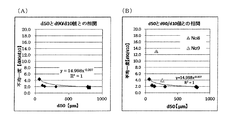
- Nos. 1 to 13 and Nos. 0-1 to 0-4 are obtained by reprinting the data obtained in Examples 1 to 3 based on the particle size distribution determination in this example.
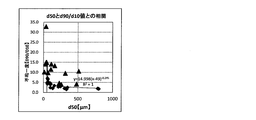
- FIG. 2 shows the correlation between D50 and D90 / D10 for the data obtained in Examples 1 to 4.
- the granulated product can be produced according to the present invention.
- the bitterness of bitter components such as branched chain amino acids can be suppressed (reduced).
Landscapes
- Chemical & Material Sciences (AREA)
- Life Sciences & Earth Sciences (AREA)
- Polymers & Plastics (AREA)
- Food Science & Technology (AREA)
- Engineering & Computer Science (AREA)
- Health & Medical Sciences (AREA)
- Nutrition Science (AREA)
- Oil, Petroleum & Natural Gas (AREA)
- Mycology (AREA)
- Proteomics, Peptides & Aminoacids (AREA)
- Medicinal Preparation (AREA)
- Coloring Foods And Improving Nutritive Qualities (AREA)
- General Preparation And Processing Of Foods (AREA)
Abstract
分岐鎖アミノ酸等の苦味成分の苦味を抑制(低減)する技術を提供する。苦味成分を含有する原料核粒子と被覆剤とを該被覆剤の融点以上の温度で撹拌混合して造粒物を形成することにより、苦味成分の苦味を抑制(低減)する。
Description
本発明は、造粒物およびその製造方法に関する。本発明は、特に、分岐鎖アミノ酸等の苦味成分の苦味を抑制(低減)するために有用な、造粒物およびその製造方法に関する。
苦味等の異味をマスキングする技術としては、苦味等の異味を呈する成分を被覆剤等の成分でコーティングする方法が知られている。具体的には、例えば、医薬化合物及びワックス状物質を含む素粒剤に加熱処理を施し、該ワックス状物質が表面を湿潤する温度下で粉末状ワックス状物質を加え、該素粒剤表面に熱溶融コーティングを施すことにより、不快味が抑制された被覆製剤を得る方法が知られている(特許文献1)。ここで、異味をマスキングしつつ経口摂取の容易性を担保するためには、コーティング品の平均粒子径を所定の範囲に収めつつ粒度分布を均一にすることが必要である。すなわち、粒子径が大きすぎると喉通りが悪く、粒子径が小さすぎるとムセが生じ、いずれの場合も経口摂取しづらい。また、粒子径が小さすぎると、コーティングが不十分となり、以て、異味のマスキングが不十分となり得る。しかしながら、目的の平均粒子径と粒度分布を示すコーティング品の製造は困難である。そのため、従来は、コーティング品をふるい分け等の分画手段に供し、目的の粒度の粒子を取得していた。
また、原料粒子と融点が50~90℃である結合剤とを常温下で造粒し、造粒物を結合剤の融点から融点+30℃の範囲の温度で加熱して結合剤を溶融し、冷却固化することにより、粒度分布の狭い球形造粒物を得る方法が知られている(特許文献2)。
本発明は、造粒物およびその製造方法を提供することを課題とする。また、本発明は、特に、分岐鎖アミノ酸等の苦味成分の苦味を抑制(低減)する技術を提供することを課題とする。
本発明者らは、上記課題を解決するために鋭意研究を行った結果、分岐鎖アミノ酸等の苦味成分を含有する原料核粒子と常温で固体または半固体の油脂とを前記油脂の融点以上の温度で撹拌混合して造粒物を形成することにより、分岐鎖アミノ酸等の苦味成分の苦味を抑制(低減)できることを見出し、本発明を完成させた。
すなわち、本発明は以下の通り例示できる。
[1]
下記性質(A)および(B)を有する造粒物:
(A)平均粒子径D50が、50μm以上である;
(B)粒子径不均一度D90/D10が、14.998×(D50[μm]-49)-0.295以下である。
[2]
苦味成分を含有する、前記造粒物。
[3]
被覆剤を含有する、前記造粒物。
[4]
前記苦味成分が前記被覆剤でコーティングされている、前記造粒物。
[5]
前記苦味成分が、アミノ酸である、前記造粒物。
[6]
前記被覆剤が、融点が20℃以上の油脂および融点が20℃以上の乳化剤から選択される1種またはそれ以上の成分である、前記造粒物。
[7]
前記造粒物における前記苦味成分の含有量が、30%(w/w)以上である、前記造粒物。
[8]
前記造粒物における前記被覆剤の含有量が、2%(w/w)~30%(w/w)である、前記造粒物。
[9]
粒子径不均一度D90/D10が、14.998×D50[μm]-0.307以下である、前記造粒物。
[10]
原料核粒子と被覆剤とを該被覆剤の融点以上の温度で撹拌混合する工程Aを含む、造粒物の製造方法。
[11]
前記原料核粒子が、苦味成分を含有する、前記方法。
[12]
前記原料核粒子における前記苦味成分の含有量が、30%(w/w)以上である、前記方法。
[13]
前記苦味成分が、アミノ酸である、前記方法。
[14]
前記被覆剤が、融点が20℃以上の油脂および融点が20℃以上の乳化剤から選択される1種またはそれ以上の成分である、前記方法。
[15]
前記原料核粒子の使用量が、前記造粒物の原料の全量に対する重量比として、80%(w/w)以上である、前記方法。
[16]
前記被覆剤の使用量が、前記原料核粒子の平均粒子径D50が75μm以下である場合には2%(w/w)~30%(w/w)であり、前記原料核粒子の平均粒子径D50が75μm超である場合には2%(w/w)~10%(w/w)である、前記方法。
[17]
前記工程Aの前に、前記原料核粒子と前記被覆剤とを前記被覆剤の融点未満の温度で混合する工程Bを含む、前記方法。
[18]
前記工程B中に昇温させる、前記方法。
[19]
前記工程Aにおける撹拌時間が、2分~150分である、前記方法。
[20]
前記工程Aが撹拌子を備える撹拌装置を用いて実施され、
前記工程Aにおける撹拌数が、撹拌子の周速として、前記撹拌装置の容量が3L以下の場合には10m/s~20m/sであり、前記撹拌装置の容量が60L超の場合には4m/s~12m/sであり、前記撹拌装置の容量が3L超60L以下の場合には4m/s~20m/sである、前記方法。
[21]
前記アミノ酸が、分岐鎖アミノ酸である、前記造粒物。
[22]
前記アミノ酸が、L-バリン、L-ロイシン、およびL-イソロイシンから選択される1種またはそれ以上のアミノ酸である、前記造粒物。
[23]
平均粒子径D50が、50μm~1200μmである、前記造粒物。
[24]
前記被覆剤が、植物油脂の硬化油である、前記造粒物。
[25]
前記アミノ酸が、分岐鎖アミノ酸である、前記方法。
[26]
前記アミノ酸が、L-バリン、L-ロイシン、およびL-イソロイシンから選択される1種またはそれ以上のアミノ酸である、前記方法。
[27]
前記被覆剤が、植物油脂の硬化油である、前記方法。
[28]
撹拌造粒装置を用いて実施される、前記方法。
[1]
下記性質(A)および(B)を有する造粒物:
(A)平均粒子径D50が、50μm以上である;
(B)粒子径不均一度D90/D10が、14.998×(D50[μm]-49)-0.295以下である。
[2]
苦味成分を含有する、前記造粒物。
[3]
被覆剤を含有する、前記造粒物。
[4]
前記苦味成分が前記被覆剤でコーティングされている、前記造粒物。
[5]
前記苦味成分が、アミノ酸である、前記造粒物。
[6]
前記被覆剤が、融点が20℃以上の油脂および融点が20℃以上の乳化剤から選択される1種またはそれ以上の成分である、前記造粒物。
[7]
前記造粒物における前記苦味成分の含有量が、30%(w/w)以上である、前記造粒物。
[8]
前記造粒物における前記被覆剤の含有量が、2%(w/w)~30%(w/w)である、前記造粒物。
[9]
粒子径不均一度D90/D10が、14.998×D50[μm]-0.307以下である、前記造粒物。
[10]
原料核粒子と被覆剤とを該被覆剤の融点以上の温度で撹拌混合する工程Aを含む、造粒物の製造方法。
[11]
前記原料核粒子が、苦味成分を含有する、前記方法。
[12]
前記原料核粒子における前記苦味成分の含有量が、30%(w/w)以上である、前記方法。
[13]
前記苦味成分が、アミノ酸である、前記方法。
[14]
前記被覆剤が、融点が20℃以上の油脂および融点が20℃以上の乳化剤から選択される1種またはそれ以上の成分である、前記方法。
[15]
前記原料核粒子の使用量が、前記造粒物の原料の全量に対する重量比として、80%(w/w)以上である、前記方法。
[16]
前記被覆剤の使用量が、前記原料核粒子の平均粒子径D50が75μm以下である場合には2%(w/w)~30%(w/w)であり、前記原料核粒子の平均粒子径D50が75μm超である場合には2%(w/w)~10%(w/w)である、前記方法。
[17]
前記工程Aの前に、前記原料核粒子と前記被覆剤とを前記被覆剤の融点未満の温度で混合する工程Bを含む、前記方法。
[18]
前記工程B中に昇温させる、前記方法。
[19]
前記工程Aにおける撹拌時間が、2分~150分である、前記方法。
[20]
前記工程Aが撹拌子を備える撹拌装置を用いて実施され、
前記工程Aにおける撹拌数が、撹拌子の周速として、前記撹拌装置の容量が3L以下の場合には10m/s~20m/sであり、前記撹拌装置の容量が60L超の場合には4m/s~12m/sであり、前記撹拌装置の容量が3L超60L以下の場合には4m/s~20m/sである、前記方法。
[21]
前記アミノ酸が、分岐鎖アミノ酸である、前記造粒物。
[22]
前記アミノ酸が、L-バリン、L-ロイシン、およびL-イソロイシンから選択される1種またはそれ以上のアミノ酸である、前記造粒物。
[23]
平均粒子径D50が、50μm~1200μmである、前記造粒物。
[24]
前記被覆剤が、植物油脂の硬化油である、前記造粒物。
[25]
前記アミノ酸が、分岐鎖アミノ酸である、前記方法。
[26]
前記アミノ酸が、L-バリン、L-ロイシン、およびL-イソロイシンから選択される1種またはそれ以上のアミノ酸である、前記方法。
[27]
前記被覆剤が、植物油脂の硬化油である、前記方法。
[28]
撹拌造粒装置を用いて実施される、前記方法。
以下、本発明を詳細に説明する。
<1>本発明の方法
本発明の方法は、原料核粒子と被覆剤とを該被覆剤の融点以上の温度で撹拌混合する工程Aを含む、造粒物の製造方法である。
本発明の方法は、原料核粒子と被覆剤とを該被覆剤の融点以上の温度で撹拌混合する工程Aを含む、造粒物の製造方法である。
本発明の方法においては、原料核粒子と被覆剤のみから造粒物を製造してもよく、そうでなくてもよい。すなわち、本発明の方法においては、原料核粒子と被覆剤と他の成分から造粒物を製造してもよい。造粒物の原料、すなわち原料核粒子と被覆剤と他の成分(他の成分については用いられる場合のみ)、を総称して「原料」ともいう。
本発明の方法により製造される造粒物は、具体的には、被覆剤でコーティングされた原料核粒子であってよい。本発明の方法により製造される造粒物の1個中には、1個の原料核粒子が含まれていてもよく、2個またはそれ以上の原料核粒子が含まれていてもよい。すなわち、例えば、1個の原料核粒子が被覆剤でコーティングされて1個の造粒物を形成していてもよく、2個またはそれ以上の原料核粒子がまとめて被覆剤でコーティングされて1個の造粒物を形成していてもよい。また、原料核粒子が苦味成分を含有する粒子である場合、本発明の方法により製造される造粒物は、具体的には、原料核粒子の苦味が、すなわち原料核粒子に含有される苦味成分の苦味が、抑制(低減)された造粒物であってよい。また、本発明の方法により製造される造粒物は、具体的には、後述する本発明の造粒物であってよい。
本発明の方法によれば、造粒物の粒子径の均一度を高める効果が得られる。すなわち、本発明の方法によれば、粒子径の均一度が高い(すなわち粒度分布がシャープな)造粒物が得られる。本発明の方法により製造される造粒物は、例えば、後述する本発明の造粒物の粒子径不均一度D90/D10を有していてよい。また、本発明の方法により製造される造粒物は、例えば、後述する本発明の造粒物の平均粒子径D50を有していてもよい。
また、原料核粒子が苦味成分を含有する粒子である場合、本発明の方法によれば、原料核粒子の苦味を、すなわち原料核粒子に含有される苦味成分の苦味を、抑制(低減)する効果が得られる。同効果を「苦味抑制効果」ともいう。すなわち、本発明の方法の一態様は、工程Aを含む、苦味成分の苦味を抑制する方法であってよい。「苦味の抑制(低減)」とは、対照品と比較して、本発明の方法により製造される造粒物における苦味の強さが小さいことをいう。対照品としては、原料核粒子そのものや、原料核粒子と被覆剤とを本発明の方法における工程Aの条件の範囲外の条件で撹拌混合することにより製造された造粒物が挙げられる。苦味の強さは、例えば、専門パネルによる官能評価により決定できる。
<原料核粒子>
原料核粒子は、所望の成分を含有する粒子である。原料核粒子に含有される成分の種類は、所望の効果が得られる限り、特に制限されない。原料核粒子に含有される成分の種類は、本発明の方法により製造される造粒物の用途等の諸条件に応じて適宜設定できる。原料核粒子は、例えば、苦味成分を含有する粒子であってよい。原料核粒子は、苦味成分からなるものであってもよく、そうでなくてもよい。すなわち、原料核粒子は、苦味成分と他の成分の組み合わせからなるものであってもよい。原料核粒子における苦味成分の含有量は、例えば、30%(w/w)以上、50%(w/w)以上、70%(w/w)以上、80%(w/w)以上、90%(w/w)以上、95%(w/w)以上、または97%(w/w)以上であってもよく、100%(w/w)以下、または99%(w/w)以下であってもよく、それらの組み合わせであってもよい。
原料核粒子は、所望の成分を含有する粒子である。原料核粒子に含有される成分の種類は、所望の効果が得られる限り、特に制限されない。原料核粒子に含有される成分の種類は、本発明の方法により製造される造粒物の用途等の諸条件に応じて適宜設定できる。原料核粒子は、例えば、苦味成分を含有する粒子であってよい。原料核粒子は、苦味成分からなるものであってもよく、そうでなくてもよい。すなわち、原料核粒子は、苦味成分と他の成分の組み合わせからなるものであってもよい。原料核粒子における苦味成分の含有量は、例えば、30%(w/w)以上、50%(w/w)以上、70%(w/w)以上、80%(w/w)以上、90%(w/w)以上、95%(w/w)以上、または97%(w/w)以上であってもよく、100%(w/w)以下、または99%(w/w)以下であってもよく、それらの組み合わせであってもよい。
「苦味成分」とは、苦味を呈する成分をいう。苦味成分の種類は、苦味抑制効果が得られる限り、特に制限されない。すなわち、苦味成分としては、苦味の低減を所望する任意の苦味成分を選択することができる。苦味成分としては、飲食品、調味料、または医薬品に配合される苦味成分が挙げられる。苦味成分としては、例えば、アミノ酸、タンニン、カテキン、カフェインが挙げられる。苦味を呈するアミノ酸として、具体的には、例えば、バリン、ロイシン、イソロイシン等の分岐鎖アミノ酸(BCAA);フェニルアラニン、トリプトファン、チロシン等の芳香族アミノ酸;メチオニン、アルギニン、ヒスチジン、オルニチンが挙げられる。苦味成分としては、中でも、アミノ酸が好ましく、BCAAがより好ましい。苦味成分としては、1種の成分を用いてもよく、2種またはそれ以上の成分を組み合わせて用いてもよい。例えば、苦味成分として、BCAAから選択される2種またはそれ以上の成分、例えば、バリン、ロイシン、イソロイシンの全て、を用いてもよい。苦味成分として2種またはそれ以上の成分を用いる場合、当該2種またはそれ以上の成分は、単一粒子(1個の原料核粒子)中に共存していてもよく、そうでなくてもよい。
本発明において、アミノ酸は、特記しない限り、いずれもL-体である。本発明において、アミノ酸は、いずれも、フリー体であってもよく、塩であってもよく、それらの混合物であってもよい。すなわち、「アミノ酸」という用語は、特記しない限り、フリー体のアミノ酸、もしくはその塩、またはそれらの混合物を意味する。また、これらアミノ酸(例えば、フリー体や塩)は、いずれも、特記しない限り、無水物および水和物を包含してよい。
塩は、経口摂取可能なものであれば特に制限されない。例えば、カルボキシル基等の酸性基に対する塩としては、具体的には、アンモニウム塩、ナトリウム、カリウム等のアルカリ金属との塩、カルシウム、マグネシウム等のアルカリ土類金属との塩、アルミニウム塩、亜鉛塩、トリエチルアミン、エタノールアミン、モルホリン、ピロリジン、ピペリジン、ピペラジン、ジシクロへキシルアミン等の有機アミンとの塩、アルギニン、リジン等の塩基性アミノ酸との塩が挙げられる。また、例えば、アミノ基等の塩基性基に対する塩としては、具体的には、塩酸、硫酸、リン酸、硝酸、臭化水素酸等の無機酸との塩、酢酸、クエン酸、安息香酸、マレイン酸、フマル酸、酒石酸、コハク酸、タンニン酸、酪酸、ヒベンズ酸、パモ酸、エナント酸、デカン酸、テオクル酸、サリチル酸、乳酸、シュウ酸、マンデル酸、リンゴ酸、メチルマロン酸、アジピン酸等の有機カルボン酸との塩、メタンスルホン酸、ベンゼンスルホン酸、p-トルエンスルホン酸等の有機スルホン酸との塩が挙げられる。塩としては、1種の塩を用いてもよく、2種またはそれ以上の塩を組み合わせて用いてもよい。
苦味成分またはそれを含有する原料核粒子としては、市販品を用いてもよく、適宜製造して取得したものを用いてもよい。
苦味成分は、常法により製造できる。苦味成分は、例えば、抽出法、酵素法、発酵法、化学合成法、またはそれらの組み合わせにより製造できる。例えば、BCAA等の苦味成分は、当該苦味成分の生産能を有する微生物を培養し、培養液または菌体から当該苦味成分を回収することで製造することができる(発酵法)。BCAA等の苦味成分は、具体的には、例えば、欧州特許0872547号、欧州特許1942183号、または欧州特許出願公開2218729号に記載の方法で製造することができる。また、苦味成分は、例えば、当該苦味成分を含有する農水畜産物から回収することで製造することができる。苦味成分は、所望の程度に精製されていてよい。
苦味成分は、例えば、そのまま、あるいは適宜加工して、原料核粒子として用いることができる。また、苦味成分を含有する画分を、そのまま、あるいは適宜加工して、原料核粒子として用いることもできる。苦味成分を含有する画分として、具体的には、例えば、BCAA等の苦味成分の生産能を有する微生物を培養して得られた培養液、菌体、培養上清等の発酵生産物、およびそれらの加工品が挙げられる。苦味成分またはそれを含有する画分は、例えば、所望の平均粒子径D50が得られるように加工して原料核粒子として用いてもよい。また、苦味成分またはそれを含有する画分は、単独で、あるいは他の成分と組み合わせて、原料核粒子として用いてもよい。苦味成分を含有する原料核粒子は、例えば、苦味成分またはそれを含有する画分から、抽出、濃縮、乾燥、晶析、粉砕、造粒、またはそれらの組み合わせにより製造することができる。例えば、BCAA等の苦味成分の生産能を有する微生物を培養して得られた培養液等の発酵生産物を、微生物菌体を含有したまま造粒し、原料核粒子として用いてもよい。また、例えば、BCAA等の苦味成分の結晶またはそれを含有する素材を所望の平均粒子径D50が得られるように粉砕し、原料核粒子として用いてもよい。粉砕は、例えば、粉砕装置を用いて行うことができる。粉砕装置は、対象物を所望の程度に粉砕できるものであれば特に制限されない。粉砕装置としては、例えば、ピンミル、ジェットミル、フェザーミル、ロッドミル、ボールミル、震動ロッドミル、震動ボールミル、円盤型ミルなどの各種ミル、ジョークラッシャー、ジャイレトリークラッシャー、コーンクラッシャー、平滑ロールクラッシャー、歯付きロールクラッシャー、インパクトクラッシャー、ハンマークラッシャーなどの各種クラッシャー、フードカッター、ダイサーが挙げられる。ハンマークラッシャーとして、具体的には、例えば、パルベライザー(AP-1やAP-4TH等;ホソカワミクロン製)が挙げられる。
原料核粒子に含有される他の成分(苦味成分以外の成分)の種類は、所望の効果(例えば苦味抑制効果)が得られる限り、特に制限されない。原料核粒子に含有される他の成分としては、飲食品、調味料、または医薬品に配合される成分が挙げられる。そのような成分として、具体的には、例えば、無機塩類、有機酸類およびその塩、アミノ酸類およびその塩、核酸類およびその塩、食物繊維、pH緩衝剤、賦形剤、増量剤、香料(フレーバー成分)、食用油が挙げられる。原料核粒子は、他の成分(苦味成分以外の成分)として、1種の成分を含有していてもよく、2種またはそれ以上の成分を含有していてもよい。他の成分(苦味成分以外の成分)として2種またはそれ以上の成分を用いる場合、当該2種またはそれ以上の成分は、単一粒子(1個の原料核粒子)中に共存していてもよく、そうでなくてもよい。
原料核粒子の形状は、所望の効果(例えば苦味抑制効果)が得られる限り、特に制限されない。母粒子は、球状や多面体等の任意の形状であってよい。原料核粒子は、例えば、苦味成分の種類に応じて取り得る結晶形状であってよい。原料核粒子のサイズは、所望の効果(例えば苦味抑制効果)が得られる限り、特に制限されない。原料核粒子のサイズは、例えば、工程Aの条件等の諸条件に応じて適宜設定できる。原料核粒子の平均粒子径D50は、例えば、0.1μm以上、0.5μm以上、1μm以上、5μm以上、10μm以上、20μm以上、30μm以上、50μm以上、75μm以上、100μm以上、150μm以上、または200μm以上であってもよく、300μm以下、250μm以下、200μm以下、150μm以下、120μm以下、100μm以下、75μm以下、60μm以下、50μm以下、50μm未満、45μm以下、または40μm以下であってもよく、それらの矛盾しない組み合わせであってもよい。原料核粒子の平均粒子径D50は、具体的には、例えば、0.1μm~300μm、1μm~200μm、10μm~120μm、0.1μm以上50μm未満、1μm以上50μm未満、または10μm以上50μm未満であってもよい。なお、「平均粒子径D50」については後述する。
<被覆剤>
被覆剤の種類は、所望の効果(例えば苦味抑制効果)が得られる限り、特に制限されない。被覆剤としては、油脂および乳化剤が挙げられる。被覆剤は、常温(例えば20℃)で固形状または半固形状であるものであってよい。被覆剤の融点は、例えば、20℃以上、25℃以上、30℃以上、40℃以上、50℃以上、または60℃以上であってもよく、90℃以下、80℃以下、70℃以下、または60℃以下であってもよく、それらの矛盾しない組み合わせであってもよい。被覆剤の融点は、具体的には、例えば、20℃~70℃、または40℃~70℃であってもよい。被覆剤としては、1種の成分を用いてもよく、2種またはそれ以上の成分を組み合わせて用いてもよい。
被覆剤の種類は、所望の効果(例えば苦味抑制効果)が得られる限り、特に制限されない。被覆剤としては、油脂および乳化剤が挙げられる。被覆剤は、常温(例えば20℃)で固形状または半固形状であるものであってよい。被覆剤の融点は、例えば、20℃以上、25℃以上、30℃以上、40℃以上、50℃以上、または60℃以上であってもよく、90℃以下、80℃以下、70℃以下、または60℃以下であってもよく、それらの矛盾しない組み合わせであってもよい。被覆剤の融点は、具体的には、例えば、20℃~70℃、または40℃~70℃であってもよい。被覆剤としては、1種の成分を用いてもよく、2種またはそれ以上の成分を組み合わせて用いてもよい。
油脂としては、動物由来の油脂(動物油脂)、植物由来の油脂(植物油脂)、およびそれらの硬化油が挙げられる。動物油脂としては、例えば、鶏脂、豚脂、牛脂、羊油、鯨油、魚油、卵油、バターが挙げられる。魚油としては、例えば、マグロ油、カツオ油、イワシ油、サバ油、サケ油、タラ油が挙げられる。植物油脂としては、例えば、菜種油、米油、紅花油、ヒマワリ油、オリーブ油、落花生油、パーム油、やし油、大豆油、コーン油、綿実油、ごま油、ぶどう種子油、えごま油が挙げられる。被覆剤として用いる油脂としては、硬化油が好ましい。例えば、常温で液体である油脂を硬化(水素添加)して、被覆剤として用いることができる。硬化油として、具体的には、例えば、菜種硬化油、パーム硬化油、大豆硬化油等の植物油脂の硬化油が挙げられる。好ましい硬化油としては、極度硬化油が挙げられる。極度硬化油として、具体的には、例えば、菜種極度硬化油、パーム極度硬化油、大豆極度硬化油等の植物油脂の極度硬化油が挙げられる。
乳化剤としては、モノグリセリン脂肪酸エステル、ポリグリセリン脂肪酸エステル、ショ糖脂肪酸エステル、ソルビタン脂肪酸エステル、プロピレングリコール脂肪酸エステル、モノグリセリン有機酸エステル、モノグリセリン燐酸エステルが挙げられる。「モノグリセリン脂肪酸エステル」とは、グリセリンの水酸基に脂肪酸がエステル結合した化合物である。「ポリグリセリン脂肪酸エステル」とは、ポリグリセリンの水酸基に脂肪酸がエステル結合した化合物である。「ショ糖脂肪酸エステル」とは、ショ糖(スクロース)の水酸基に脂肪酸がエステル結合した化合物である。好ましい乳化剤としては、モノグリセリン脂肪酸エステル、ポリグリセリン脂肪酸エステルが挙げられる。
乳化剤の分子構造(例えば、モノグリセリン脂肪酸エステルの場合、構成脂肪酸の種類、エステル化率、エステル化位置等;ポリグリセリン脂肪酸エステルの場合、ポリグリセリンの重合度、ポリグリセリンの重合形態(直鎖状か、環状か、分岐状か)、構成脂肪酸の種類、エステル化率、エステル化位置等;ショ糖脂肪酸エステルの場合、構成脂肪酸の種類、エステル化率、エステル化位置等)は、所望の融点等の諸条件に応じて適宜設定できる。
乳化剤が脂肪酸エステルである場合、その構成脂肪酸としては、例えば、炭素数8~24の脂肪酸が挙げられる。構成脂肪酸は、飽和脂肪酸であってもよく、不飽和脂肪酸であってもよい。炭素数8~24の脂肪酸として、具体的には、例えば、カプリル酸、ラウリン酸、ミリスチン酸、パルミチン酸、ステアリン酸、オレイン酸、ベヘニン酸(ベヘン酸;behenic acid)、エルカ酸が挙げられる。構成脂肪酸としては、1種の脂肪酸を用いてもよく、2種またはそれ以上の脂肪酸を組み合わせて用いてもよい。例えば、1分子のポリグリセリンまたは1分子のスクロースに2種またはそれ以上の脂肪酸がエステル結合していてもよい。乳化剤がポリグリセリン脂肪酸エステルである場合、ポリグリセリンの重合度(平均重合度)は、例えば、4~20であってもよく、8~12であってもよい。ポリグリセリンの重合度(平均重合度)は、ポリグリセリンの水酸基価に基づいて算出されるものとする。ポリグリセリンの水酸基価は、日本工業規格JIS K 0070:1992に準拠して測定されるものとする。
被覆剤としては、市販品を用いてもよく、適宜製造して取得したものを用いてもよい。
被覆剤の形状は、所望の効果(例えば苦味抑制効果)が得られる限り、特に制限されない。
本発明において、後述する工程Bを行う場合には、被覆剤としては固体のものが用いられる。被覆剤の固体形状としては、特に制限されないが、板状、フレーク状、粒状が挙げられる。被覆剤が粒状である場合の平均粒子径D50は、特に制限されないが、例えば、100μm以下、80μm以下、60μm以下、または50μm以下であってよい。被覆剤は、例えば、予め前記平均粒子径D50に調整されていてもよく、工程Bにおいて混合により粉砕され前記平均粒子径D50に調整されてもよい。
被覆剤は、常法により製造できる。被覆剤は、例えば、抽出法、酵素法、化学合成法、またはそれらの組み合わせにより製造できる。例えば、油脂は、油脂を含有する農水畜産物から回収することで製造することができる。また、例えば、モノグリセリン脂肪酸エステルは、グリセリンに脂肪酸をエステル結合させることにより製造できる。また、例えば、ポリグリセリン脂肪酸エステルは、ポリグリセリンに脂肪酸をエステル結合させることにより製造できる。また、例えば、ショ糖脂肪酸エステルは、スクロースに脂肪酸をエステル結合させることにより製造できる。被覆剤は、所望の程度に精製されていてよい。例えば、被覆剤としては、純度が50%(w/w)以上、70%(w/w)以上、90%(w/w)以上、または95%(w/w)以上のものを用いてもよい。
<他の成分>
他の成分(原料核粒子と被覆剤以外の成分)の種類は、所望の効果(例えば苦味抑制効果)が得られる限り、特に制限されない。他の成分としては、上述したような、飲食品、調味料、または医薬品に配合される成分が挙げられる。他の成分としては、1種の成分を用いてもよく、2種またはそれ以上の成分を組み合わせて用いてもよい。
他の成分(原料核粒子と被覆剤以外の成分)の種類は、所望の効果(例えば苦味抑制効果)が得られる限り、特に制限されない。他の成分としては、上述したような、飲食品、調味料、または医薬品に配合される成分が挙げられる。他の成分としては、1種の成分を用いてもよく、2種またはそれ以上の成分を組み合わせて用いてもよい。
<工程A>
本発明の方法は、原料核粒子と被覆剤を該被覆剤の融点以上の温度で撹拌混合する工程(工程A)を含む。工程Aにより、造粒物が形成される。工程Aは、バッチ式で行われてもよく、連続式で行われてもよい。
本発明の方法は、原料核粒子と被覆剤を該被覆剤の融点以上の温度で撹拌混合する工程(工程A)を含む。工程Aにより、造粒物が形成される。工程Aは、バッチ式で行われてもよく、連続式で行われてもよい。
工程Aへ供される原料の量は、特に制限されず、用いる撹拌装置の処理能力等の諸条件に応じて適宜設定することができる。工程Aへ供される原料の量比は、所望の効果(例えば苦味抑制効果)が得られる限り、特に制限されない。工程Aへ供される原料の量比は、原料の組成やサイズ等の諸条件に応じて適宜設定できる。
工程Aへ供される原料核粒子の量(原料核粒子の使用量)は、原料の全量に対する重量比として、例えば、50%(w/w)以上、70%(w/w)以上、または80%(w/w)以上であってもよく、98%(w/w)以下、95%(w/w)以下、または90%(w/w)以下であってもよく、それらの組み合わせであってもよい。工程Aへ供される原料核粒子の量(原料核粒子の使用量)は、原料の全量に対する重量比として、具体的には、例えば、50%(w/w)~98%(w/w)、または70%(w/w)~95%(w/w)であってもよい。また、工程Aへ供される原料核粒子の量(原料核粒子の使用量)は、原料の全量に対する原料核粒子に含有される苦味成分の量の重量比として、例えば、30%(w/w)以上、40%(w/w)以上、50%(w/w)以上、60%(w/w)以上、70%(w/w)以上、または80%(w/w)以上であってもよく、98%(w/w)以下、95%(w/w)以下、90%(w/w)以下、80%(w/w)以下、70%(w/w)以下、60%(w/w)以下、または50%(w/w)以下であってもよく、それらの矛盾しない組み合わせであってもよい。工程Aへ供される原料核粒子の量(原料核粒子の使用量)は、原料の全量に対する原料核粒子に含有される苦味成分の量の重量比として、具体的には、例えば、30%(w/w)~98%(w/w)、または40%(w/w)~95%(w/w)であってもよい。
工程Aへ供される被覆剤の量(被覆剤の使用量)は、原料の全量に対する重量比として、例えば、2%(w/w)以上、5%(w/w)以上、または10%(w/w)以上であってもよく、30%(w/w)以下、25%(w/w)以下、20%(w/w)以下、18%(w/w)以下、15%(w/w)以下、12%(w/w)以下、または10%(w/w)以下であってもよく、それらの矛盾しない組み合わせであってもよい。工程Aへ供される被覆剤の量(被覆剤の使用量)は、原料の全量に対する重量比として、具体的には、例えば、2%(w/w)~30%(w/w)、2%(w/w)~20%(w/w)、2%(w/w)~10%(w/w)、または5%(w/w)~20%(w/w)であってもよい。工程Aへ供される被覆剤の量(被覆剤の使用量)は、例えば、原料核粒子の平均粒子径D50が、80μm以下、75μm以下、70μm以下、65μm以下、または60μm以下である場合、60μm超、65μm超、70μm超、75μm超、または80μm超である場合、またはそれらの矛盾しない組み合わせである場合のそれぞれについて、上記例示した範囲から選択してもよい。工程Aへ供される被覆剤の量(被覆剤の使用量)は、例えば、原料核粒子の平均粒子径D50が、80μm以下、75μm以下、70μm以下、65μm以下、または60μm以下である場合に、特に、原料核粒子の平均粒子径D50が75μm以下である場合に、原料の全量に対する重量比として、2%(w/w)~30%(w/w)、または5%(w/w)~20%(w/w)であってもよい。また、工程Aへ供される被覆剤の量(被覆剤の使用量)は、例えば、原料核粒子の平均粒子径D50が、60μm超、65μm超、70μm超、75μm超、または80μm超である場合に、特に、原料核粒子の平均粒子径D50が75μm超である場合に、原料の全量に対する重量比として、2%(w/w)~10%(w/w)であってもよい。
なお、苦味成分および被覆剤等の成分の量に関する記載は、当該成分を含有する素材を用いる場合にあっては、特記しない限り、当該素材中の当該成分そのものの量を示すものとする。すなわち、例えば、苦味成分および被覆剤等の成分の使用量や含有量(濃度)は、当該成分を含有する素材を用いる場合にあっては、特記しない限り、当該素材中の当該成分そのものの量に基づいて算出されるものとする。
原料(例えば原料核粒子と被覆剤)は、例えば、互いに混合してから工程Aへ供されてよい。すなわち、本発明の方法は、例えば、工程Aの前に、予備的に原料(例えば原料核粒子と被覆剤)を混合する工程Bを含んでいてもよい。原料を混合する手段は、特に制限されない。原料を混合する手段としては、例えば、撹拌混合や反転混合が挙げられる。すなわち、工程Bは、例えば、原料を撹拌混合する工程であってよい。工程Bは、例えば、混合装置を用いて実施することができる。混合装置としては、後述するような撹拌装置が挙げられる。工程Bの条件は、所望の程度に原料が混合される限り、特に制限されない。工程Bにおいては、造粒が進行してもよく、しなくてもよい。工程Bの温度は、被覆剤の融点未満の温度で行うことが好ましい。すなわち、工程Bは、例えば、原料を被覆剤の融点未満の温度で混合(例えば撹拌混合)する工程であってよい。例えば、工程Bを被覆剤の融点未満の温度で実施した後に、工程Aを実施してもよい。例えば、工程B中に昇温させることができる。具体的には、例えば、工程B中に被覆剤の融点未満の温度から被覆剤の融点の温度まで昇温させてよい。より具体的には、例えば、工程Bを被覆剤の融点未満の温度で開始して被覆剤の融点の温度まで昇温させてよい。その場合、温度が被覆剤の融点に達する前を工程B、温度が被覆剤の融点に達した後を工程Aとみなしてよい。すなわち、このように工程B中に昇温させ、以て、工程Aを開始してもよい。工程Bの時間は特に制限されない。工程Bは、例えば、被覆剤の融点以上の温度に昇温するまで実施することができる。また、工程Bは、例えば、原料核粒子と被覆剤がある程度均一に分散するまで実施することができる。工程Bの時間は、例えば、撹拌混合の場合、1分以上、3分以上、または5分以上であってよい。また、工程Bの時間は、例えば、反転混合の場合、5分以上、10分以上、または20分以上であってよい。工程Bの混合速度(例えば撹拌速度や反転速度)は、適宜設定できる。例えば、撹拌混合により工程Bを実施する場合、工程Bにおける撹拌数(撹拌速度)は、工程Aにおける撹拌数についての記載を準用できる。工程Bにおける撹拌数(撹拌速度)は、工程Aにおける撹拌数と同一であってもよく、なくてもよい。工程Bにおける撹拌数(撹拌速度)は、例えば、ニュースピードニーダーNSK-150S(岡田精工株式会社製)のスケールにおいては1400~2000rpmであってもよい。工程Bと工程Aは、同一の容器内で行われてもよく、そうでなくてもよい。
工程Aは、該被覆剤の融点以上の温度で実施される。すなわち、工程Aにおける温度は、被覆剤の融点以上の温度である。工程Aにおける温度は、例えば、被覆剤の融点+2℃以上、+5℃以上、+10℃以上、+15℃以上、または+20℃以上であってもよい。工程Aにおける温度は、使用する被覆剤の融点によって異なるが、例えば、100℃以下、90℃以下、80℃以下、または70℃以下であってもよい。工程Aにおける温度は、例えば、上記の範囲の組み合わせであってもよい。温度は、工程Aの全期間において上記の範囲内であるのが好ましいが、一時的に上記の範囲外となってもよい。すなわち、本発明において、「工程Aの温度が或る範囲である」とは、工程Aの全期間において温度が当該範囲内である場合に限られず、温度が一時的に当該範囲外となる場合も包含する。「一時的」とは、工程Aの全期間の内の、20%以下、15%以下、10%以下、5%以下、3%以下、または1%以下の期間をいう。例えば、工程Aにおいて、温度は、一時的に被覆剤の融点未満に低下してもよい。工程Aの終了後、温度は低下してよい。工程Aの終了後、温度は、例えば、常温に低下してもよい。
温度の制御方法(例えば昇温方法)は、温度を所望の範囲に維持できる限り、特に制限されない。温度は、直接的に制御されてもよく、間接的に制御されてもよく、それらの組み合わせであってもよい。例えば、撹拌が行われる容器(後述する撹拌槽)を加熱することにより、温度を直接的に制御する(例えば昇温させる)ことができる。撹拌槽を加熱する手段は、撹拌槽内部を加熱できるものであれば、特に制限されない。加熱手段は、撹拌槽に組み込まれていてもよく、撹拌槽の外部に備わっていてもよい。例えば、撹拌槽を加熱用ジャケットで覆い、ジャケットを加熱することにより、撹拌槽内部を外部から加熱することができる。また、例えば、原料の撹拌(撹拌子によるせん断)により、温度を間接的に制御する(例えば昇温させる)ことができる。すなわち、原料の撹拌により発生する熱を利用して、温度を間接的に制御する(例えば昇温させる)ことができる。すなわち、温度は、例えば、撹拌槽の加熱、原料の撹拌、またはそれらの組み合わせにより制御する(例えば昇温させる)ことができる。例えば、原料の撹拌により温度を所望の範囲に維持できる場合には、別途、撹拌槽を加熱してもよく、しなくてもよい。具体的には、例えば、撹拌混合により工程Bを実施する場合、工程B中に撹拌槽の加熱、原料の撹拌、またはそれらの組み合わせにより被覆剤の融点未満の温度から被覆剤の融点以上の温度まで昇温させ、以て、工程Aを開始してもよい。
撹拌方法は、所望の効果(例えば苦味抑制効果)が得られる限り、特に制限されない。撹拌方法としては、例えば、公知の手法を利用することができる。撹拌は、適当な容器内で行うことができる。撹拌が行われる容器を、「撹拌槽」ともいう。撹拌槽の形状やサイズは、所望の効果(例えば苦味抑制効果)が得られる限り、特に制限されない。撹拌槽の形状は、例えば、筒状、錐状、またはそれらの組み合わせであってよい。撹拌槽は、例えば、縦型であってもよく、横型であってもよい。撹拌槽の断面形状は、例えば、円形、楕円形、または多角形であってよい。なお、ここでいう「断面」とは、縦型の撹拌槽にあっては水平断面、横型の撹拌槽にあっては垂直断面をいう。断面形状は、円形が好ましい。撹拌は、撹拌子(撹拌羽根ともいう)を回転させることにより実施できる。撹拌子の形状、サイズ、設置数、設置位置、設置方向等の態様は、所望の効果(例えば苦味抑制効果)が得られる限り、特に制限されない。撹拌子の形状は、例えば、棒状、板状、プロペラ状、らせん状、またはそれらの組み合わせであってよい。特に、高いせん断力が得られる形状の撹拌子は、温度を制御する(例えば昇温させる)のに有効である。撹拌子のサイズは、例えば、回転軸から撹拌子の先端までの長さ(すなわち撹拌子の先端の回転半径)として、0.1m以上、0.2m以上、0.3m以上、または0.5m以上であってもよく、2m以下、1.5m以下、1m以下、0.7m以下、0.5m以下、または0.3m以下であってもよく、それらの矛盾しない組み合わせであってもよい。撹拌子のサイズは、具体的には、例えば、回転軸から撹拌子の先端までの長さとして、0.2m~1mであってもよい。撹拌子は、所定の回転軸を中心に回転可能に設置することができる。撹拌子は、例えば、回転軸上の1箇所のみに設けられてよく、回転軸上の2またはそれ以上の箇所に設けられてもよい。また、回転軸は、1つのみ設けられてよく、2つまたはそれ以上設けられてもよい。回転軸は撹拌槽内のいずれの位置に設けられてもよい。回転軸は、例えば、撹拌槽の中央部に設けられてよい。例えば、縦型の撹拌槽を用いる場合、撹拌槽の中央部に垂直方向に回転軸を設け、撹拌槽の上部より原料を供給することにより、原料が撹拌されながら下方向に移動し、撹拌槽の下部から形成された造粒物を回収できる。
撹拌は、撹拌装置を用いて行うことができる。撹拌装置は、撹拌槽と撹拌子を備える。撹拌装置は、さらに、上述したような温度を制御する手段(例えば加熱手段)を備えていてもよい。撹拌装置は、原料を撹拌槽に供給し形成された造粒物を撹拌槽から排出できるように構成される。撹拌装置は、例えば、原料の供給口および形成された造粒物の排出口を別個に有していてもよく、原料の供給口および形成された造粒物の排出口の両方を兼ねる開口部を有していてもよい。撹拌装置は、原料の供給口および形成された造粒物の排出口を別個に有しているのが好ましい。撹拌装置は、具体的には、例えば、撹拌装置の上部に設けられた供給口から原料が投入され、撹拌槽内で原料が撹拌され、撹拌装置の下部に設けられた排出口から形成された造粒物が排出されるように構成されていてよい。撹拌装置としては、撹拌造粒装置が挙げられる。撹拌造粒装置としては、各種バッチ式撹拌装置や各種連続式撹拌装置が挙げられる。撹拌装置として、具体的には、例えば、高速撹拌型混合造粒機(NMG-5LやNMG-65H等;株式会社奈良機械製作所製)、ハイブリダイゼーションシステム(NHSシリーズ(例えばNHS-0)等;株式会社奈良機械製作所製)、ニュースピードニーダー(NSKシリーズ等;岡田精工株式会社製)、フレキソミックス(FXD-250等;ホソカワミクロン株式会社製)、バーチカル・グラニュレーター(パウレック製)が挙げられる。
これらの撹拌方法や撹拌装置は、工程Aに限られず、例えば、撹拌混合により工程Bを実施する場合にも利用できる。
工程Aにおける撹拌数(撹拌速度)は、所望の効果(例えば苦味抑制効果)が得られる限り、特に制限されない。工程Aにおける撹拌数は、例えば、用いる撹拌装置の種類等の諸条件に応じて適宜設定できる。工程Aにおける撹拌数は、撹拌子の周速(すなわち撹拌子の先端の回転速度)として、例えば、4m/s以上、5m/s以上、7m/s以上、または10m/s以上であってもよく、20m/s以下、17m/s以下、15m/s以下、14m/s以下、13m/s以下、12m/s以下、11m/s以下、または10m/s以下であってもよく、それらの矛盾しない組み合わせであってもよい。工程Aにおける撹拌数は、撹拌子の周速として、具体的には、例えば、4m/s~20m/s、10m/s~20m/s、または4m/s~12m/sであってもよい。工程Aにおける撹拌数は、例えば、撹拌装置の容量が、60L以下、50L以下、40L以下、30L以下、20L以下、10L以下、7L以下、5L以下、または3L以下である場合、3L超、5L超、7L超、10L超、20L超、30L超、40L超、50L超、または60L超である場合、またはそれらの矛盾しない組み合わせである場合のそれぞれについて、上記例示した範囲から選択してもよい。工程Aにおける撹拌数は、例えば、撹拌装置の容量が、60L以下、50L以下、40L以下、30L以下、20L以下、10L以下、7L以下、5L以下、または3L以下である場合に、撹拌子の周速として、10m/s~20m/sであってもよい。また、工程Aにおける撹拌数は、例えば、撹拌装置の容量が、3L超、5L超、7L超、10L超、20L超、30L超、40L超、50L超、または60L超である場合に、撹拌子の周速として、4m/s~12m/sであってもよい。また、工程Aにおける撹拌数は、例えば、撹拌装置の容量が、3L超、5L超、7L超、10L超、20L超、30L超、40L超、または50L超と、60L以下、50L以下、40L以下、30L以下、20L以下、10L以下、7L以下、または5L以下との矛盾しない組み合わせである場合に、撹拌子の周速として、4m/s~20m/sであってもよい。あるいは、工程Aにおける撹拌数は、例えば、撹拌装置の容量が、3L超、5L超、7L超、10L超、20L超、30L超、40L超、または50L超と、60L以下、50L以下、40L以下、30L以下、20L以下、10L以下、7L以下、または5L以下との矛盾しない組み合わせである場合に、撹拌子の周速として、N[m/s]以上であってもよく、M[m/s]以下であってもよく、N[m/s]~M[m/s]であってもよい;ここで、撹拌装置の容量をx[L]として、N=(-6x+588)/57、M=(-8x+1164)/57である。工程Aにおける撹拌数(撹拌速度)は、例えば、ニュースピードニーダーNSK-150S(岡田精工株式会社製)のスケールにおいては1400~2000rpmであってもよい。撹拌数は、工程Aの全期間において上記範囲であるのが好ましいが、一時的に上記範囲からはずれてもよい。すなわち、本発明において、「工程Aにおける撹拌数(撹拌速度)が或る範囲である」とは、工程Aの全期間において撹拌数が当該範囲内である場合に限られず、撹拌数が一時的に当該範囲外となる場合も包含する。一時的とは、工程Aの全期間の内の、20%以下、15%以下、10%以下、5%以下、3%以下、または1%以下の期間をいう。例えば、撹拌は一時的に停止してもよい。すなわち、撹拌は、連続的に行われてもよく、間欠的に行われてもよい。すなわち、撹拌は、1回のみ行われてもよく、2回またはそれ以上行われてもよい。なお、ここでは、撹拌が開始してから撹拌が停止するまでを「1回」とする。連続する撹拌の過程を通じて、撹拌数等の条件は、一定であってもよく、そうでなくてもよい。また、撹拌が、2回またはそれ以上行われる場合、撹拌数や撹拌の継続時間等の条件は、各回で同一であってもよく、そうでなくてもよい。撹拌は、例えば、造粒物が形成されるまで実施することができる。撹拌時間(工程Aの時間)は、例えば、1分以上、2分以上、3分以上、5分以上、7分以上、または10分以上であってもよく、150分以下、120分以下、90分以下、60分以下、50分以下、または30分以下であってもよく、それらの矛盾しない組み合わせであってもよい。撹拌時間(工程Aの時間)は、具体的には、例えば、2分~150分、2分~120分、2分~90分、3分~90分、5分~60分、または7分~30分であってもよい。
このようにして工程Aを実施することにより造粒物が得られる。
所望の造粒物が形成されたことは、例えば、造粒物の粒度(D50やD90/D10等)を測定することにより、確認できる。また、所望の造粒物が形成されたことは、例えば、原料核粒子の苦味が低減されたことを確認することにより、確認できる。
<2>本発明の造粒物
本発明の造粒物は、下記性質(A)および(B)を有する造粒物である:
(A)平均粒子径D50が、50μm以上である;
(B)粒子径不均一度D90/D10が、14.998×(D50[μm]-49)-0.295以下である。
本発明の造粒物は、下記性質(A)および(B)を有する造粒物である:
(A)平均粒子径D50が、50μm以上である;
(B)粒子径不均一度D90/D10が、14.998×(D50[μm]-49)-0.295以下である。
本発明の造粒物の平均粒子径D50は、50μm以上である。本発明の造粒物の平均粒子径D50は、例えば、60μm以上、80μm以上、100μm以上、200μm以上、300μm以上、500μm以上、700μm以上、または1000μm以上であってもよく、5000μm以下、3000μm以下、2000μm以下、1500μm以下、1200μm以下、1000μm以下、900μm以下、800μm以下、700μm以下、600μm以下、または500μm以下であってもよい。本発明の造粒物の平均粒子径D50は、上記の範囲の矛盾しない組み合わせであってもよい。本発明の造粒物の平均粒子径D50は、具体的には、例えば、50μm~1200μm、50μm~1000μm、50μm~900μm、200μm~1000μm、または300μm~900μmであってもよい。なお、「平均粒子径D50」とは、レーザー回折・散乱法によって得られた粒度分布における体積基準での積算値50%での粒径を意味する。平均粒子径D50は、例えば、MICROTRAC HRA(日機装社製)やPartica LA-960 Wet(堀場製作所製)等のレーザー回折式粒度分布測定装置(レーザー回折・散乱法に基づく粒度分布測定装置)により測定することができる。
本発明の造粒物の粒子径不均一度D90/D10は、14.998×(D50[μm]-49)-0.295以下である。本発明の造粒物の粒子径不均一度D90/D10は、14.998×D50[μm]-0.307以下であってもよい。なお、「D90」および「D10」とは、それぞれ、レーザー回折・散乱法によって得られた粒度分布における体積基準での積算値90%および10%での粒径を意味する。D90/D10は1以上であり、D90/D10が1に近いほど均一な粒径分布であることを意味する。D90およびD10は、例えば、MICROTRAC HRA(日機装社製)やPartica LA-960 Wet(堀場製作所製)等のレーザー回折式粒度分布測定装置(レーザー回折・散乱法に基づく粒度分布測定装置)により測定することができる。
本発明の造粒物に含有される成分は、所望の効果が得られる限り、特に制限されない。本発明の造粒物に含有される成分は、本発明の造粒物の用途等の諸条件に応じて適宜設定できる。本発明の造粒物に含有される成分としては、例えば、苦味成分、被覆剤、およびその他の成分が挙げられる。すなわち、本発明の造粒物は、例えば、苦味成分を含有していてもよく、被覆剤を含有していてもよく、苦味成分と被覆剤を含有していてもよい。本発明の造粒物は、例えば、苦味成分と被覆剤からなるものであってもよく、そうでなくてもよい。本発明の造粒物は、例えば、苦味成分と被覆剤とその他の成分からなるものであってもよい。本発明の造粒物が苦味成分と被覆剤を含有する場合、本発明の造粒物においては、苦味抑制効果が得られ得る。
本発明の造粒物において苦味抑制効果が得られるメカニズムは明らかではないが、造粒物が前記(A)および(B)の性質を有することは、被覆剤による苦味成分の均一なコーティングが行われたことを示し、これにより苦味成分の露出が抑えられた結果、苦味抑制効果が得られるものと推察される。
苦味成分については、上述した通りである。苦味成分は、上述した原料核粒子を形成した状態で本発明の造粒物に含有されていてもよい。すなわち、苦味成分は、苦味成分を含有する粒子が本発明の造粒物に含有されることにより、本発明の造粒物に含有されていてもよい。苦味成分としては、1種の成分を用いてもよく、2種またはそれ以上の成分を用いてもよい。苦味成分として2種またはそれ以上の成分を用いる場合、当該2種またはそれ以上の成分は、本発明の造粒物の1個の粒子中に共存していてもよく、そうでなくてもよい。
被覆剤については、上述した通りである。被覆剤としては、1種の成分を用いてもよく、2種またはそれ以上の成分を用いてもよい。被覆剤として2種またはそれ以上の成分を用いる場合、当該2種またはそれ以上の成分は、本発明の造粒物の1個の粒子中に共存していてもよく、そうでなくてもよい。
本発明の造粒物に含有される他の成分(苦味成分および被覆剤以外の成分)の種類は、所望の効果(例えば苦味抑制効果)が得られる限り、特に制限されない。他の成分としては、上述したような、飲食品、調味料、または医薬品に配合される成分が挙げられる。他の成分としては、1種の成分を用いてもよく、2種またはそれ以上の成分を組み合わせて用いてもよい。他の成分として2種またはそれ以上の成分を用いる場合、当該2種またはそれ以上の成分は、本発明の造粒物の1個の粒子中に共存していてもよく、そうでなくてもよい。
本発明の造粒物における各成分の含有量(濃度)は、所望の効果(例えば苦味抑制効果)が得られる限り、特に制限されない。
本発明の造粒物における苦味成分の含有量(濃度)は、例えば、30%(w/w)以上、40%(w/w)以上、50%(w/w)以上、70%(w/w)以上、または80%(w/w)以上であってもよく、98%(w/w)以下、95%(w/w)以下、90%(w/w)以下、80%(w/w)以下、70%(w/w)以下、または50%(w/w)以下であってもよく、それらの矛盾しない組み合わせであってもよい。本発明の造粒物における苦味成分の含有量(濃度)は、具体的には、例えば、30%(w/w)~98%(w/w)、または40%(w/w)~95%(w/w)であってもよい。
本発明の造粒物における被覆剤の含有量(濃度)は、例えば、2%(w/w)以上、5%(w/w)以上、または10%(w/w)以上であってもよく、30%(w/w)以下、25%(w/w)以下、20%(w/w)以下、18%(w/w)以下、15%(w/w)以下、12%(w/w)以下、または10%(w/w)以下であってもよく、それらの矛盾しない組み合わせであってもよい。本発明の造粒物における被覆剤の含有量(濃度)は、具体的には、例えば、2%(w/w)~30%(w/w)、2%(w/w)~20%(w/w)、2%(w/w)~10%(w/w)、または5%(w/w)~20%(w/w)であってもよい。
本発明の造粒物において、苦味成分は、被覆剤でコーティングされていてよい。苦味成分は、その一部または全てが、被覆剤でコーティングされていてよい。すなわち、「苦味成分が被覆剤でコーティングされる」とは、苦味成分の全てが被覆剤でコーティングされている場合に限られず、苦味成分の一部のみが被覆剤でコーティングされている場合も包含する。また、「苦味成分が被覆剤でコーティングされる」とは、苦味成分が被覆剤単独でコーティングされている場合に限られず、苦味成分が被覆剤と他の成分との混合物でコーティングされている場合も含む。すなわち、例えば、本発明の造粒物を製造する際に、苦味成分と被覆剤以外に加えて、さらに他の成分を原料として用いる場合、苦味成分が被覆剤と他の成分との混合物でコーティングされ得る。被覆剤による苦味成分のコーティングの程度は、所望の効果(例えば苦味抑制効果)が得られる限り、特に制限されない。本発明の造粒物の表面の総面積に対する苦味成分が露出している部分の面積の比率は、例えば、50%以下、30%以下、20%以下、10%以下、5%以下、3%以下、または0(ゼロ)であってよい。また、苦味成分が上述した原料核粒子を形成した状態で本発明の造粒物に含有されている場合、本発明の造粒物の表面の総面積に対する原料核粒子が露出している部分の面積の比率は、例えば、50%以下、30%以下、20%以下、10%以下、5%以下、3%以下、または0(ゼロ)であってよい。
本発明の造粒物を製造する方法は特に制限されない。本発明の造粒物は、例えば、上述した本発明の方法により製造できる。すなわち、本発明の造粒物の一態様は、本発明の方法により製造される造粒物であってよい。
以下、実施例により、本発明をさらに具体的に説明する。実施例中、工程Bに相当する工程を「予備混合工程」、工程Aに相当する工程を「撹拌混合工程」ともいう。
実施例1:原料核粒子の粒径の検討
本実施例では、アミノ酸を含有する原料核粒子と被覆剤を原料として造粒物を製造し、原料核粒子の平均粒子径D50と造粒物における苦味抑制効果との関連性を評価した。使用したアミノ酸と被覆剤については表1~3に記載した。
本実施例では、アミノ酸を含有する原料核粒子と被覆剤を原料として造粒物を製造し、原料核粒子の平均粒子径D50と造粒物における苦味抑制効果との関連性を評価した。使用したアミノ酸と被覆剤については表1~3に記載した。
(1)平均粒子径D50が50μm未満の原料核粒子を用いた場合
造粒物の製造条件を表1に示す。まず、原料核粒子と被覆剤を予備混合工程に供した。予備混合工程は、常温で開始し、被覆剤の融点以上の温度まで昇温させた。予備混合工程の時間は、昇温方法により異なり、ジャケット加熱の場合(表1中、A)には12分、原料の撹拌により発生する熱を利用する場合(表1中、B)には70分~90分とした。その後、被覆剤の融点以上の温度で撹拌混合工程を実施し、造粒物を得た。予備混合工程および撹拌混合工程は、ニュースピードニーダーNSK-150S(容量2.6 L;岡田精工製)を高せん断タイプの撹拌羽根と組み合わせて用いた撹拌混合により実施した。表中、「アミノ酸MIX1」は、ロイシンを約40%(w/w)、イソロイシンを約11%(w/w)、バリンを約11%(w/w)、他の必須アミノ酸6種を残部で含有する混合物を、所定の平均粒子径D50となるように粉砕したものを示す。表中、「アミノ酸MIX2」は、ロイシン:イソロイシン:バリン=2:1:1の混合物を、所定の平均粒子径D50となるように粉砕したものを示す。粉砕は、パルペライザーAP-1(ホソカワミクロン製)を用いて実施した。表中、「14.998×D50-0.307」は、平均粒子径D50の測定値より計算し求めた数値であり、「粒度分布判定」は、造粒物のD90/D10が14.998×D50[μm]-0.307以下である場合を「適」、そうでない場合を「不適」とした。得られた造粒物を、粒度の測定および苦味抑制効果の評価に供した。原料核粒子およびD50が500μm未満の造粒物の粒度の測定は、MICROTRAC HRA(日機装社製)を用いて実施した。D50が500μm以上の造粒物の粒度の測定は、Partica LA-960 Wet(堀場製作所製)を用いて実施した。苦味抑制効果の官能評価は、下記の通り実施した。
造粒物の製造条件を表1に示す。まず、原料核粒子と被覆剤を予備混合工程に供した。予備混合工程は、常温で開始し、被覆剤の融点以上の温度まで昇温させた。予備混合工程の時間は、昇温方法により異なり、ジャケット加熱の場合(表1中、A)には12分、原料の撹拌により発生する熱を利用する場合(表1中、B)には70分~90分とした。その後、被覆剤の融点以上の温度で撹拌混合工程を実施し、造粒物を得た。予備混合工程および撹拌混合工程は、ニュースピードニーダーNSK-150S(容量2.6 L;岡田精工製)を高せん断タイプの撹拌羽根と組み合わせて用いた撹拌混合により実施した。表中、「アミノ酸MIX1」は、ロイシンを約40%(w/w)、イソロイシンを約11%(w/w)、バリンを約11%(w/w)、他の必須アミノ酸6種を残部で含有する混合物を、所定の平均粒子径D50となるように粉砕したものを示す。表中、「アミノ酸MIX2」は、ロイシン:イソロイシン:バリン=2:1:1の混合物を、所定の平均粒子径D50となるように粉砕したものを示す。粉砕は、パルペライザーAP-1(ホソカワミクロン製)を用いて実施した。表中、「14.998×D50-0.307」は、平均粒子径D50の測定値より計算し求めた数値であり、「粒度分布判定」は、造粒物のD90/D10が14.998×D50[μm]-0.307以下である場合を「適」、そうでない場合を「不適」とした。得られた造粒物を、粒度の測定および苦味抑制効果の評価に供した。原料核粒子およびD50が500μm未満の造粒物の粒度の測定は、MICROTRAC HRA(日機装社製)を用いて実施した。D50が500μm以上の造粒物の粒度の測定は、Partica LA-960 Wet(堀場製作所製)を用いて実施した。苦味抑制効果の官能評価は、下記の通り実施した。
2名の専門パネラーが、各造粒物(原料核粒子の量として0.5g)を摂食して、その際に感じられた苦味の強さを評点付けし、その平均点を苦味強度とした。評点は、造粒前の原料核粒子0.5gの苦味を10点とし、苦味が殆ど感じられない場合を1点とした。各造粒物における苦味抑制効果を下記の基準に基づいて4段階で判定した。
[判定基準]
×:苦味抑制効果がない(苦味強度が7.5点以上10点以下)
△:苦味抑制効果がある(苦味強度が4.5点以上7.5点未満)
○:高い苦味抑制効果がある(苦味強度が2点以上4.5点未満)
◎:極めて高い苦味抑制効果がある(苦味強度が1点以上2点未満)
[判定基準]
×:苦味抑制効果がない(苦味強度が7.5点以上10点以下)
△:苦味抑制効果がある(苦味強度が4.5点以上7.5点未満)
○:高い苦味抑制効果がある(苦味強度が2点以上4.5点未満)
◎:極めて高い苦味抑制効果がある(苦味強度が1点以上2点未満)
造粒物の製造手順および造粒物の分析手順は、特記しない限り、以降の実験でも同一である。
結果を表1および図1(A)に示す。平均粒子径D50が50μm未満の原料核粒子を用いることで、目的の粒度分布と高い苦味抑制効果が得られることが明らかとなった。

(2)平均粒子径D50が100μm以上の原料核粒子を用いた場合
表2に示す条件で撹拌混合を実施し、造粒物を得た。予備混合工程の時間は、昇温方法により異なり、ジャケット加熱の場合(表2中、A)には5分~8分、原料の撹拌により発生する熱を利用する場合(表2中、B)には53分~58分とした。なお、No.9では撹拌装置としてハイブリダイゼーションシステムNHS-0(株式会社奈良機械製作所製)を用いた。得られた造粒物を、粒度の測定および苦味抑制効果の評価に供した。結果を表2および図1(B)に示す。平均粒子径D50が100μm以上の原料核粒子を用いた場合には、造粒物の粒度分布判定が不適となり、好ましい苦味抑制効果は得られなかった。
表2に示す条件で撹拌混合を実施し、造粒物を得た。予備混合工程の時間は、昇温方法により異なり、ジャケット加熱の場合(表2中、A)には5分~8分、原料の撹拌により発生する熱を利用する場合(表2中、B)には53分~58分とした。なお、No.9では撹拌装置としてハイブリダイゼーションシステムNHS-0(株式会社奈良機械製作所製)を用いた。得られた造粒物を、粒度の測定および苦味抑制効果の評価に供した。結果を表2および図1(B)に示す。平均粒子径D50が100μm以上の原料核粒子を用いた場合には、造粒物の粒度分布判定が不適となり、好ましい苦味抑制効果は得られなかった。

(3)原料核粒子の苦味の評価
実施例1(1)および(2)で用いた原料核粒子自体を、粒度の測定および苦味抑制効果の評価に供した。結果を表3に示す。平均粒子径D50によらず、いずれの原料核粒子も強い苦味を呈した。
実施例1(1)および(2)で用いた原料核粒子自体を、粒度の測定および苦味抑制効果の評価に供した。結果を表3に示す。平均粒子径D50によらず、いずれの原料核粒子も強い苦味を呈した。

実施例2:撹拌数(撹拌速度)の検討
本実施例では、アミノ酸を含有する原料核粒子と被覆剤を原料として造粒物を製造し、撹拌数(撹拌速度)の影響を評価した。
本実施例では、アミノ酸を含有する原料核粒子と被覆剤を原料として造粒物を製造し、撹拌数(撹拌速度)の影響を評価した。
表4に示す条件で撹拌混合を実施し、造粒物を得た。昇温は原料の撹拌により発生する熱を利用して実施し(表4中、B)、予備混合工程の時間はNo.10で180~210分、No.11で1~3分とした。なお、No.12では撹拌装置としてハイブリダイゼーションシステムNHS-0(株式会社奈良機械製作所製)を用いた。得られた造粒物を、粒度の測定および苦味抑制効果の評価に供した。結果を表4に示す。撹拌羽根(撹拌子)の周速が8m/sまたは60m/sの条件では、造粒物の粒度分布判定が不適となり、好ましい苦味抑制効果は得られなかった。

実施例3:撹拌温度の検討
本実施例では、アミノ酸を含有する原料核粒子と被覆剤を原料として造粒物を製造し、撹拌温度の影響を評価した。
本実施例では、アミノ酸を含有する原料核粒子と被覆剤を原料として造粒物を製造し、撹拌温度の影響を評価した。
表5に示す条件で撹拌混合を実施し、造粒物を得た。表5中、説明の便宜上、最高温度に到達後の工程を「撹拌混合工程」として示す。昇温は原料の撹拌により発生する熱を利用して実施し(表5中、B)、予備混合工程の時間はNo.12で90分、No.13で70分とした。得られた造粒物を、粒度の測定および苦味抑制効果の評価に供した。結果を表5に示す。撹拌温度が油脂の融点未満の条件では、造粒物の粒度分布判定が不適となり、好ましい苦味抑制効果は得られなかった。

実施例4:造粒条件の検討
本実施例では、アミノ酸を含有する原料核粒子と被覆剤を原料として各種条件で造粒物を製造し、それら条件の影響を評価した。
本実施例では、アミノ酸を含有する原料核粒子と被覆剤を原料として各種条件で造粒物を製造し、それら条件の影響を評価した。
表6~9に示す条件で撹拌混合を実施し、造粒物(No.14~31)を得た。昇温は原料の撹拌により発生する熱を利用して実施し、予備混合工程の時間は70分~90分とした。得られた造粒物を、粒度の測定および苦味抑制効果の評価に供した。表中、「14.998×(D50[μm]-49)-0.295」は、平均粒子径D50の測定値より計算し求めた数値であり、「粒度分布判定」は、造粒物のD90/D10が14.998×(D50[μm]-49)-0.295以下である場合を「適」、そうでない場合を「不適」とした。表中、No.1~13およびNo.0-1~0-4は、実施例1~3で得られたデータを本実施例での粒度分布判定に基づいて再掲したものである。また、実施例1~4で得られたデータについて、D50とD90/D10との相関を図2に示す。
(1)粒度分布判定の検討
結果を表6に示す。No.14~19の造粒物は、いずれも粒度分布判定が適となり、高い苦味抑制効果を示した。したがって、本実施例での粒度分布判定を満たす造粒物は、高い苦味抑制効果を示すことが示唆された。また、No.1~7の造粒物は、本実施例での粒度分布判定も適となった。また、No.0-1~0-4の造粒物は、本実施例での粒度分布判定も不適となった。
結果を表6に示す。No.14~19の造粒物は、いずれも粒度分布判定が適となり、高い苦味抑制効果を示した。したがって、本実施例での粒度分布判定を満たす造粒物は、高い苦味抑制効果を示すことが示唆された。また、No.1~7の造粒物は、本実施例での粒度分布判定も適となった。また、No.0-1~0-4の造粒物は、本実施例での粒度分布判定も不適となった。

(2)原料核粒子の粒径の検討
結果を表7に示す。原料核粒子の粒径を増大させた場合、粒度分布判定が不適となった。しかし、被覆剤の配合量を減少させることにより、原料核粒子の粒径を増大させた場合でも、粒度分布判定が適となった。
結果を表7に示す。原料核粒子の粒径を増大させた場合、粒度分布判定が不適となった。しかし、被覆剤の配合量を減少させることにより、原料核粒子の粒径を増大させた場合でも、粒度分布判定が適となった。

(3)撹拌数(撹拌速度)の検討
結果を表8に示す。撹拌装置として高速撹拌型混合造粒機NMG-65H(容量65 L;奈良機械製作所製)を用いた場合には、ニュースピードニーダーNSK-150S(容量2.6 L;岡田精工製)を用いた場合と比較して、低い撹拌速度で好適な造粒物が得られた。
結果を表8に示す。撹拌装置として高速撹拌型混合造粒機NMG-65H(容量65 L;奈良機械製作所製)を用いた場合には、ニュースピードニーダーNSK-150S(容量2.6 L;岡田精工製)を用いた場合と比較して、低い撹拌速度で好適な造粒物が得られた。

(4)撹拌温度の検討
結果を表9に示す。No.12~13の造粒物は、本実施例での粒度分布判定も不適となった。
結果を表9に示す。No.12~13の造粒物は、本実施例での粒度分布判定も不適となった。

本発明により、造粒物を製造することができる。また、本発明により、一態様においては、分岐鎖アミノ酸等の苦味成分の苦味を抑制(低減)することができる。
Claims (20)
- 下記性質(A)および(B)を有する造粒物:
(A)平均粒子径D50が、50μm以上である;
(B)粒子径不均一度D90/D10が、14.998×(D50[μm]-49)-0.295以下である。 - 苦味成分を含有する、請求項1に記載の造粒物。
- 被覆剤を含有する、請求項1または2に記載の造粒物。
- 前記苦味成分が前記被覆剤でコーティングされている、請求項3に記載の造粒物。
- 前記苦味成分が、アミノ酸である、請求項2~4のいずれか1項に記載の造粒物。
- 前記被覆剤が、融点が20℃以上の油脂および融点が20℃以上の乳化剤から選択される1種またはそれ以上の成分である、請求項3~5のいずれか1項に記載の造粒物。
- 前記造粒物における前記苦味成分の含有量が、30%(w/w)以上である、請求項2~6のいずれか1項に記載の造粒物。
- 前記造粒物における前記被覆剤の含有量が、2%(w/w)~30%(w/w)である、請求項3~7のいずれか1項に記載の造粒物。
- 粒子径不均一度D90/D10が、14.998×D50[μm]-0.307以下である、請求項1~8のいずれか1項に記載の造粒物。
- 原料核粒子と被覆剤とを該被覆剤の融点以上の温度で撹拌混合する工程Aを含む、造粒物の製造方法。
- 前記原料核粒子が、苦味成分を含有する、請求項10に記載の方法。
- 前記原料核粒子における前記苦味成分の含有量が、30%(w/w)以上である、請求項11に記載の方法。
- 前記苦味成分が、アミノ酸である、請求項11または12に記載の方法。
- 前記被覆剤が、融点が20℃以上の油脂および融点が20℃以上の乳化剤から選択される1種またはそれ以上の成分である、請求項10~13のいずれか1項に記載の方法。
- 前記原料核粒子の使用量が、前記造粒物の原料の全量に対する重量比として、80%(w/w)以上である、請求項10~14のいずれか1項に記載の方法。
- 前記被覆剤の使用量が、前記造粒物の原料の全量に対する重量比として、前記原料核粒子の平均粒子径D50が75μm以下である場合には2%(w/w)~30%(w/w)であり、前記原料核粒子の平均粒子径D50が75μm超である場合には2%(w/w)~10%(w/w)である、請求項10~15のいずれか1項に記載の方法。
- 前記工程Aの前に、前記原料核粒子と前記被覆剤とを前記被覆剤の融点未満の温度で混合する工程Bを含む、請求項10~16のいずれか1項に記載の方法。
- 前記工程B中に昇温させる、請求項17に記載の方法。
- 前記工程Aにおける撹拌時間が、2分~150分である、請求項10~18のいずれか1項に記載の方法。
- 前記工程Aが撹拌子を備える撹拌装置を用いて実施され、
前記工程Aにおける撹拌数が、撹拌子の周速として、前記撹拌装置の容量が3L以下の場合には10m/s~20m/sであり、前記撹拌装置の容量が60L超の場合には4m/s~12m/sであり、前記撹拌装置の容量が3L超60L以下の場合には4m/s~20m/sである、請求項10~19のいずれか1項に記載の方法。
Priority Applications (2)
| Application Number | Priority Date | Filing Date | Title |
|---|---|---|---|
| JP2018513184A JP7052722B2 (ja) | 2016-04-19 | 2017-04-18 | 造粒物およびその製造方法 |
| US16/163,801 US20190045825A1 (en) | 2016-04-19 | 2018-10-18 | Granulated product and method for manufacturing same |
Applications Claiming Priority (2)
| Application Number | Priority Date | Filing Date | Title |
|---|---|---|---|
| JP2016083727 | 2016-04-19 | ||
| JP2016-083727 | 2016-04-19 |
Related Child Applications (1)
| Application Number | Title | Priority Date | Filing Date |
|---|---|---|---|
| US16/163,801 Continuation US20190045825A1 (en) | 2016-04-19 | 2018-10-18 | Granulated product and method for manufacturing same |
Publications (1)
| Publication Number | Publication Date |
|---|---|
| WO2017183628A1 true WO2017183628A1 (ja) | 2017-10-26 |
Family
ID=60116057
Family Applications (1)
| Application Number | Title | Priority Date | Filing Date |
|---|---|---|---|
| PCT/JP2017/015549 Ceased WO2017183628A1 (ja) | 2016-04-19 | 2017-04-18 | 造粒物およびその製造方法 |
Country Status (4)
| Country | Link |
|---|---|
| US (1) | US20190045825A1 (ja) |
| JP (1) | JP7052722B2 (ja) |
| TW (1) | TWI749006B (ja) |
| WO (1) | WO2017183628A1 (ja) |
Cited By (3)
| Publication number | Priority date | Publication date | Assignee | Title |
|---|---|---|---|---|
| WO2019160120A1 (ja) * | 2018-02-16 | 2019-08-22 | 日本アイリッヒ株式会社 | 薬物含有粒子の製造方法 |
| WO2021054453A1 (ja) * | 2019-09-20 | 2021-03-25 | 株式会社明治 | アミノ酸含有顆粒 |
| JP2023146766A (ja) * | 2022-03-29 | 2023-10-12 | 味の素株式会社 | 造粒物およびその製造方法 |
Families Citing this family (1)
| Publication number | Priority date | Publication date | Assignee | Title |
|---|---|---|---|---|
| ES2972042T3 (es) | 2019-04-19 | 2024-06-10 | Sila S P A | Producto granulado a base de arginina |
Citations (11)
| Publication number | Priority date | Publication date | Assignee | Title |
|---|---|---|---|---|
| JPS5592661A (en) * | 1978-12-28 | 1980-07-14 | Ueno Seiyaku Oyo Kenkyusho:Kk | Coated fumaric acid preparation for food or feed additive and its production |
| JPS61238336A (ja) * | 1985-04-15 | 1986-10-23 | Ajinomoto Co Inc | 徐放性被覆物の製造法 |
| JP2001055344A (ja) * | 1999-08-13 | 2001-02-27 | Asahi Chem Ind Co Ltd | 味がマスクされた薬物 |
| JP2002128667A (ja) * | 2000-10-26 | 2002-05-09 | Ajinomoto Co Inc | 分岐鎖アミノ酸含有医薬用顆粒製剤とその製造方法 |
| JP2003212768A (ja) * | 2002-01-24 | 2003-07-30 | Ajinomoto Co Inc | 分岐鎖アミノ酸含有顆粒の製造方法 |
| JP2003277252A (ja) * | 2002-03-20 | 2003-10-02 | Asahi Kasei Corp | 粒状被覆製剤の製造方法 |
| JP2005298412A (ja) * | 2004-04-13 | 2005-10-27 | Minato Pharmaceutical Co Ltd | 被覆粒子 |
| WO2009017193A1 (ja) * | 2007-07-31 | 2009-02-05 | Ajinomoto Co., Inc. | 服用感の優れたアミノ酸含有顆粒製剤 |
| JP2011072308A (ja) * | 2009-09-01 | 2011-04-14 | Daito Kagaku Kk | 食品添加用被覆製剤及びその製造方法 |
| JP2011132170A (ja) * | 2009-12-24 | 2011-07-07 | Lion Corp | ラニチジン含有被覆粒子及びその製造方法 |
| WO2015046383A1 (ja) * | 2013-09-30 | 2015-04-02 | 富士フイルム株式会社 | 原薬含有核の製造方法、原薬含有核、医薬品組成物、及び口腔内崩壊錠 |
Family Cites Families (2)
| Publication number | Priority date | Publication date | Assignee | Title |
|---|---|---|---|---|
| JP6313626B2 (ja) * | 2014-03-28 | 2018-04-18 | 株式会社ファンケル | 顆粒剤 |
| TW201841573A (zh) * | 2017-04-04 | 2018-12-01 | 日商J 制油股份有限公司 | 呈味改善劑 |
-
2017
- 2017-04-18 JP JP2018513184A patent/JP7052722B2/ja active Active
- 2017-04-18 WO PCT/JP2017/015549 patent/WO2017183628A1/ja not_active Ceased
- 2017-04-19 TW TW106113124A patent/TWI749006B/zh active
-
2018
- 2018-10-18 US US16/163,801 patent/US20190045825A1/en not_active Abandoned
Patent Citations (11)
| Publication number | Priority date | Publication date | Assignee | Title |
|---|---|---|---|---|
| JPS5592661A (en) * | 1978-12-28 | 1980-07-14 | Ueno Seiyaku Oyo Kenkyusho:Kk | Coated fumaric acid preparation for food or feed additive and its production |
| JPS61238336A (ja) * | 1985-04-15 | 1986-10-23 | Ajinomoto Co Inc | 徐放性被覆物の製造法 |
| JP2001055344A (ja) * | 1999-08-13 | 2001-02-27 | Asahi Chem Ind Co Ltd | 味がマスクされた薬物 |
| JP2002128667A (ja) * | 2000-10-26 | 2002-05-09 | Ajinomoto Co Inc | 分岐鎖アミノ酸含有医薬用顆粒製剤とその製造方法 |
| JP2003212768A (ja) * | 2002-01-24 | 2003-07-30 | Ajinomoto Co Inc | 分岐鎖アミノ酸含有顆粒の製造方法 |
| JP2003277252A (ja) * | 2002-03-20 | 2003-10-02 | Asahi Kasei Corp | 粒状被覆製剤の製造方法 |
| JP2005298412A (ja) * | 2004-04-13 | 2005-10-27 | Minato Pharmaceutical Co Ltd | 被覆粒子 |
| WO2009017193A1 (ja) * | 2007-07-31 | 2009-02-05 | Ajinomoto Co., Inc. | 服用感の優れたアミノ酸含有顆粒製剤 |
| JP2011072308A (ja) * | 2009-09-01 | 2011-04-14 | Daito Kagaku Kk | 食品添加用被覆製剤及びその製造方法 |
| JP2011132170A (ja) * | 2009-12-24 | 2011-07-07 | Lion Corp | ラニチジン含有被覆粒子及びその製造方法 |
| WO2015046383A1 (ja) * | 2013-09-30 | 2015-04-02 | 富士フイルム株式会社 | 原薬含有核の製造方法、原薬含有核、医薬品組成物、及び口腔内崩壊錠 |
Cited By (6)
| Publication number | Priority date | Publication date | Assignee | Title |
|---|---|---|---|---|
| WO2019160120A1 (ja) * | 2018-02-16 | 2019-08-22 | 日本アイリッヒ株式会社 | 薬物含有粒子の製造方法 |
| JPWO2019160120A1 (ja) * | 2018-02-16 | 2021-02-12 | 日本アイリッヒ株式会社 | 薬物含有粒子の製造方法 |
| WO2021054453A1 (ja) * | 2019-09-20 | 2021-03-25 | 株式会社明治 | アミノ酸含有顆粒 |
| JPWO2021054453A1 (ja) * | 2019-09-20 | 2021-03-25 | ||
| US12576056B2 (en) | 2019-09-20 | 2026-03-17 | Meiji Co., Ltd. | Amino acid-containing granules |
| JP2023146766A (ja) * | 2022-03-29 | 2023-10-12 | 味の素株式会社 | 造粒物およびその製造方法 |
Also Published As
| Publication number | Publication date |
|---|---|
| US20190045825A1 (en) | 2019-02-14 |
| JPWO2017183628A1 (ja) | 2019-02-21 |
| TW201737899A (zh) | 2017-11-01 |
| TWI749006B (zh) | 2021-12-11 |
| JP7052722B2 (ja) | 2022-04-12 |
Similar Documents
| Publication | Publication Date | Title |
|---|---|---|
| Becker et al. | Solvent-Free Melting Techniques for the Preparation of Lipid-Based Solid Oral Formulations: Becker, Salar-Behzadi and Zimmer | |
| JP7052722B2 (ja) | 造粒物およびその製造方法 | |
| WO2018164202A1 (ja) | 乳化用粉末油脂組成物および乳化組成物 | |
| JP2010263796A (ja) | 豆腐用凝固製剤 | |
| CN101060795A (zh) | 含有植物甾醇类的组合物及其制造方法 | |
| JP4336979B2 (ja) | アラビアガムの改質方法 | |
| JP6271546B2 (ja) | 豆腐用凝固剤組成物及び該組成物を用いた豆腐の製造方法 | |
| CN101048079A (zh) | 含植物甾醇类的食品的制造方法 | |
| TWI557139B (zh) | 纖維素醚粉粒體的製造方法 | |
| JP5606835B2 (ja) | 食品添加用被覆製剤及びその製造方法 | |
| JP2023146766A (ja) | 造粒物およびその製造方法 | |
| JP2011079787A (ja) | 経口組成物 | |
| JPWO2020026946A1 (ja) | ソフトカプセル充填用組成物、及びそれを充填したソフトカプセル | |
| JPH0856604A (ja) | 可食性油性材料の粉末化方法 | |
| KR20150142724A (ko) | 가용화 나노칼슘의 제조방법 및 이를 이용한 음료 | |
| JP2021016320A (ja) | 香味油組成物、及びそれを含有する食品 | |
| JP3516298B2 (ja) | 豆腐用凝固剤組成物 | |
| JP2017136549A (ja) | 造粒物の製造法 | |
| JP7052204B2 (ja) | 組成物の吸湿固結を防止する方法 | |
| JP2003277787A (ja) | 油脂組成物の製造方法 | |
| JP4703388B2 (ja) | チオクト酸組成物及びその製造方法 | |
| JPH01165519A (ja) | 水溶性及び/又は脂溶性ビタミン粒状製剤及びその製造方法 | |
| JP2009273441A (ja) | 麺用品質改良剤 | |
| JP7846965B2 (ja) | タンパク質含有粉末の水分散性改良剤 | |
| JP4795222B2 (ja) | 豆腐用凝固製剤 |
Legal Events
| Date | Code | Title | Description |
|---|---|---|---|
| WWE | Wipo information: entry into national phase |
Ref document number: 2018513184 Country of ref document: JP |
|
| NENP | Non-entry into the national phase |
Ref country code: DE |
|
| 121 | Ep: the epo has been informed by wipo that ep was designated in this application |
Ref document number: 17785966 Country of ref document: EP Kind code of ref document: A1 |
|
| 122 | Ep: pct application non-entry in european phase |
Ref document number: 17785966 Country of ref document: EP Kind code of ref document: A1 |