WO2017183398A1 - 高分子化合物、中間組成物、負極電極、蓄電装置、及び高分子化合物の製造方法 - Google Patents
高分子化合物、中間組成物、負極電極、蓄電装置、及び高分子化合物の製造方法 Download PDFInfo
- Publication number
- WO2017183398A1 WO2017183398A1 PCT/JP2017/012436 JP2017012436W WO2017183398A1 WO 2017183398 A1 WO2017183398 A1 WO 2017183398A1 JP 2017012436 W JP2017012436 W JP 2017012436W WO 2017183398 A1 WO2017183398 A1 WO 2017183398A1
- Authority
- WO
- WIPO (PCT)
- Prior art keywords
- negative electrode
- general formula
- polymer compound
- cyclic structure
- polyacrylic acid
- Prior art date
- Legal status (The legal status is an assumption and is not a legal conclusion. Google has not performed a legal analysis and makes no representation as to the accuracy of the status listed.)
- Ceased
Links
- 0 C*(C)C1=N[Cl+]*N1 Chemical compound C*(C)C1=N[Cl+]*N1 0.000 description 4
Classifications
-
- C—CHEMISTRY; METALLURGY
- C08—ORGANIC MACROMOLECULAR COMPOUNDS; THEIR PREPARATION OR CHEMICAL WORKING-UP; COMPOSITIONS BASED THEREON
- C08G—MACROMOLECULAR COMPOUNDS OBTAINED OTHERWISE THAN BY REACTIONS ONLY INVOLVING UNSATURATED CARBON-TO-CARBON BONDS
- C08G73/00—Macromolecular compounds obtained by reactions forming a linkage containing nitrogen with or without oxygen or carbon in the main chain of the macromolecule, not provided for in groups C08G12/00 - C08G71/00
- C08G73/06—Polycondensates having nitrogen-containing heterocyclic rings in the main chain of the macromolecule
- C08G73/0666—Polycondensates containing five-membered rings, condensed with other rings, with nitrogen atoms as the only ring hetero atoms
- C08G73/0677—Polycondensates containing five-membered rings, condensed with other rings, with nitrogen atoms as the only ring hetero atoms with only two nitrogen atoms in the ring
-
- C—CHEMISTRY; METALLURGY
- C08—ORGANIC MACROMOLECULAR COMPOUNDS; THEIR PREPARATION OR CHEMICAL WORKING-UP; COMPOSITIONS BASED THEREON
- C08F—MACROMOLECULAR COMPOUNDS OBTAINED BY REACTIONS ONLY INVOLVING CARBON-TO-CARBON UNSATURATED BONDS
- C08F8/00—Chemical modification by after-treatment
- C08F8/30—Introducing nitrogen atoms or nitrogen-containing groups
- C08F8/32—Introducing nitrogen atoms or nitrogen-containing groups by reaction with amines
-
- C—CHEMISTRY; METALLURGY
- C08—ORGANIC MACROMOLECULAR COMPOUNDS; THEIR PREPARATION OR CHEMICAL WORKING-UP; COMPOSITIONS BASED THEREON
- C08F—MACROMOLECULAR COMPOUNDS OBTAINED BY REACTIONS ONLY INVOLVING CARBON-TO-CARBON UNSATURATED BONDS
- C08F8/00—Chemical modification by after-treatment
- C08F8/48—Isomerisation; Cyclisation
-
- C—CHEMISTRY; METALLURGY
- C08—ORGANIC MACROMOLECULAR COMPOUNDS; THEIR PREPARATION OR CHEMICAL WORKING-UP; COMPOSITIONS BASED THEREON
- C08J—WORKING-UP; GENERAL PROCESSES OF COMPOUNDING; AFTER-TREATMENT NOT COVERED BY SUBCLASSES C08B, C08C, C08F, C08G or C08H
- C08J3/00—Processes of treating or compounding macromolecular substances
- C08J3/24—Crosslinking, e.g. vulcanising, of macromolecules
-
- H—ELECTRICITY
- H01—ELECTRIC ELEMENTS
- H01G—CAPACITORS; CAPACITORS, RECTIFIERS, DETECTORS, SWITCHING DEVICES, LIGHT-SENSITIVE OR TEMPERATURE-SENSITIVE DEVICES OF THE ELECTROLYTIC TYPE
- H01G11/00—Hybrid capacitors, i.e. capacitors having different positive and negative electrodes; Electric double-layer [EDL] capacitors; Processes for the manufacture thereof or of parts thereof
- H01G11/22—Electrodes
- H01G11/30—Electrodes characterised by their material
- H01G11/32—Carbon-based
- H01G11/38—Carbon pastes or blends; Binders or additives therein
-
- H—ELECTRICITY
- H01—ELECTRIC ELEMENTS
- H01G—CAPACITORS; CAPACITORS, RECTIFIERS, DETECTORS, SWITCHING DEVICES, LIGHT-SENSITIVE OR TEMPERATURE-SENSITIVE DEVICES OF THE ELECTROLYTIC TYPE
- H01G11/00—Hybrid capacitors, i.e. capacitors having different positive and negative electrodes; Electric double-layer [EDL] capacitors; Processes for the manufacture thereof or of parts thereof
- H01G11/22—Electrodes
- H01G11/30—Electrodes characterised by their material
- H01G11/50—Electrodes characterised by their material specially adapted for lithium-ion capacitors, e.g. for lithium-doping or for intercalation
-
- H—ELECTRICITY
- H01—ELECTRIC ELEMENTS
- H01M—PROCESSES OR MEANS, e.g. BATTERIES, FOR THE DIRECT CONVERSION OF CHEMICAL ENERGY INTO ELECTRICAL ENERGY
- H01M4/00—Electrodes
- H01M4/02—Electrodes composed of, or comprising, active material
- H01M4/04—Processes of manufacture in general
- H01M4/0402—Methods of deposition of the material
- H01M4/0404—Methods of deposition of the material by coating on electrode collectors
-
- H—ELECTRICITY
- H01—ELECTRIC ELEMENTS
- H01M—PROCESSES OR MEANS, e.g. BATTERIES, FOR THE DIRECT CONVERSION OF CHEMICAL ENERGY INTO ELECTRICAL ENERGY
- H01M4/00—Electrodes
- H01M4/02—Electrodes composed of, or comprising, active material
- H01M4/04—Processes of manufacture in general
- H01M4/0471—Processes of manufacture in general involving thermal treatment, e.g. firing, sintering, backing particulate active material, thermal decomposition, pyrolysis
-
- H—ELECTRICITY
- H01—ELECTRIC ELEMENTS
- H01M—PROCESSES OR MEANS, e.g. BATTERIES, FOR THE DIRECT CONVERSION OF CHEMICAL ENERGY INTO ELECTRICAL ENERGY
- H01M4/00—Electrodes
- H01M4/02—Electrodes composed of, or comprising, active material
- H01M4/13—Electrodes for accumulators with non-aqueous electrolyte, e.g. for lithium-accumulators; Processes of manufacture thereof
- H01M4/133—Electrodes based on carbonaceous material, e.g. graphite-intercalation compounds or CFx
-
- H—ELECTRICITY
- H01—ELECTRIC ELEMENTS
- H01M—PROCESSES OR MEANS, e.g. BATTERIES, FOR THE DIRECT CONVERSION OF CHEMICAL ENERGY INTO ELECTRICAL ENERGY
- H01M4/00—Electrodes
- H01M4/02—Electrodes composed of, or comprising, active material
- H01M4/13—Electrodes for accumulators with non-aqueous electrolyte, e.g. for lithium-accumulators; Processes of manufacture thereof
- H01M4/134—Electrodes based on metals, Si or alloys
-
- H—ELECTRICITY
- H01—ELECTRIC ELEMENTS
- H01M—PROCESSES OR MEANS, e.g. BATTERIES, FOR THE DIRECT CONVERSION OF CHEMICAL ENERGY INTO ELECTRICAL ENERGY
- H01M4/00—Electrodes
- H01M4/02—Electrodes composed of, or comprising, active material
- H01M4/36—Selection of substances as active materials, active masses, active liquids
- H01M4/38—Selection of substances as active materials, active masses, active liquids of elements or alloys
- H01M4/381—Alkaline or alkaline earth metals elements
- H01M4/382—Lithium
-
- H—ELECTRICITY
- H01—ELECTRIC ELEMENTS
- H01M—PROCESSES OR MEANS, e.g. BATTERIES, FOR THE DIRECT CONVERSION OF CHEMICAL ENERGY INTO ELECTRICAL ENERGY
- H01M4/00—Electrodes
- H01M4/02—Electrodes composed of, or comprising, active material
- H01M4/62—Selection of inactive substances as ingredients for active masses, e.g. binders, fillers
- H01M4/621—Binders
- H01M4/622—Binders being polymers
-
- C—CHEMISTRY; METALLURGY
- C08—ORGANIC MACROMOLECULAR COMPOUNDS; THEIR PREPARATION OR CHEMICAL WORKING-UP; COMPOSITIONS BASED THEREON
- C08F—MACROMOLECULAR COMPOUNDS OBTAINED BY REACTIONS ONLY INVOLVING CARBON-TO-CARBON UNSATURATED BONDS
- C08F2810/00—Chemical modification of a polymer
- C08F2810/20—Chemical modification of a polymer leading to a crosslinking, either explicitly or inherently
-
- H—ELECTRICITY
- H01—ELECTRIC ELEMENTS
- H01M—PROCESSES OR MEANS, e.g. BATTERIES, FOR THE DIRECT CONVERSION OF CHEMICAL ENERGY INTO ELECTRICAL ENERGY
- H01M4/00—Electrodes
- H01M4/02—Electrodes composed of, or comprising, active material
- H01M2004/026—Electrodes composed of, or comprising, active material characterised by the polarity
- H01M2004/027—Negative electrodes
-
- Y—GENERAL TAGGING OF NEW TECHNOLOGICAL DEVELOPMENTS; GENERAL TAGGING OF CROSS-SECTIONAL TECHNOLOGIES SPANNING OVER SEVERAL SECTIONS OF THE IPC; TECHNICAL SUBJECTS COVERED BY FORMER USPC CROSS-REFERENCE ART COLLECTIONS [XRACs] AND DIGESTS
- Y02—TECHNOLOGIES OR APPLICATIONS FOR MITIGATION OR ADAPTATION AGAINST CLIMATE CHANGE
- Y02E—REDUCTION OF GREENHOUSE GAS [GHG] EMISSIONS, RELATED TO ENERGY GENERATION, TRANSMISSION OR DISTRIBUTION
- Y02E60/00—Enabling technologies; Technologies with a potential or indirect contribution to GHG emissions mitigation
- Y02E60/10—Energy storage using batteries
-
- Y—GENERAL TAGGING OF NEW TECHNOLOGICAL DEVELOPMENTS; GENERAL TAGGING OF CROSS-SECTIONAL TECHNOLOGIES SPANNING OVER SEVERAL SECTIONS OF THE IPC; TECHNICAL SUBJECTS COVERED BY FORMER USPC CROSS-REFERENCE ART COLLECTIONS [XRACs] AND DIGESTS
- Y02—TECHNOLOGIES OR APPLICATIONS FOR MITIGATION OR ADAPTATION AGAINST CLIMATE CHANGE
- Y02T—CLIMATE CHANGE MITIGATION TECHNOLOGIES RELATED TO TRANSPORTATION
- Y02T10/00—Road transport of goods or passengers
- Y02T10/60—Other road transportation technologies with climate change mitigation effect
- Y02T10/70—Energy storage systems for electromobility, e.g. batteries
Definitions
- the present invention relates to a polymer compound used as a binder for a negative electrode of a power storage device, an intermediate composition of the polymer compound, a negative electrode, a power storage device, and a method for producing the polymer compound.
- the electrode of the secondary battery is composed of, for example, a current collector formed of a metal material such as copper or aluminum, and an active material layer bound on the current collector.
- the active material layer contains an electrode binder for binding the active material to the current collector.
- polyacrylic acid which is an inexpensive polymer compound
- Patent document 1 discloses the binder for electrodes containing polyacrylic acid lithium salt and polyacrylic acid sodium salt.
- Patent document 2 discloses the binder for electrodes containing polyacrylic acid and polyethyleneimine.
- Patent document 3 discloses the binder for electrodes containing polyacrylic acid and an amine compound.
- An object of the present invention is to provide a polymer compound useful as a binder for a negative electrode of a power storage device, an intermediate composition for obtaining the polymer compound, a negative electrode using the polymer compound as a binder for a negative electrode, and a power storage device There is to do.
- Another object of the present invention is to provide a method for producing the polymer compound.
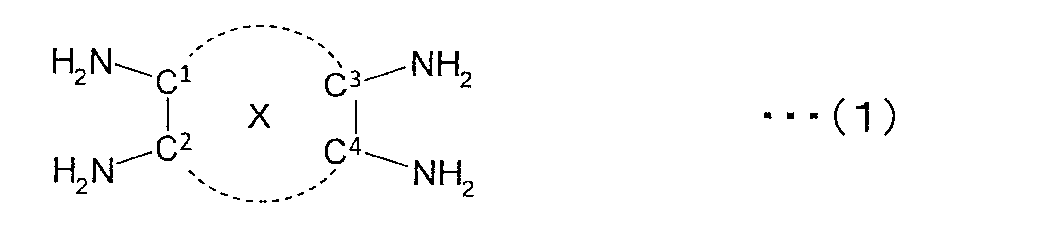
- a polymer compound used as a negative electrode binder of a power storage device comprising polyacrylic acid and a polyfunctional compound represented by the following general formula (1)
- a polymer formed by condensation with an amine wherein X is a cyclic structure comprising a benzene ring having 1 to 3 rings, and C 1 to C 4 are each a carbon atom constituting the benzene ring in the cyclic structure A compound is provided.
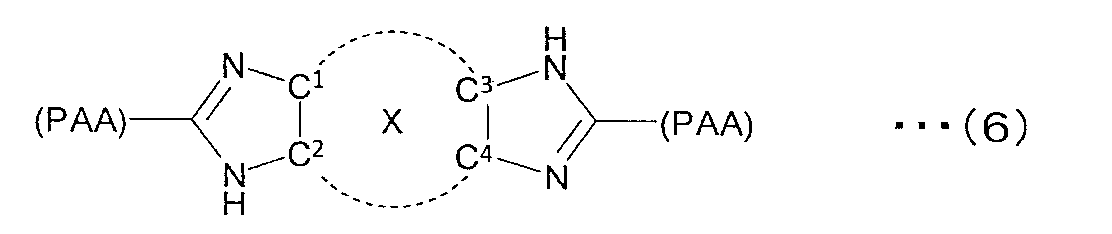
- a polymer compound used as a negative electrode binder of a power storage device wherein a chain structure composed of polyacrylic acid and a chain structure Or a cross-linked structure connecting the carboxylic acid side chains between the chain structures, the cross-linked structure is a cross-linked structure represented by the following general formula (6), and PAA is a chain composed of polyacrylic acid
- X is a cyclic structure composed of a benzene ring having 1 to 3 rings, and C 1 to C 4 are each a carbon atom constituting the benzene ring in the cyclic structure Is done.
- an intermediate composition of a polymer compound used as a negative electrode binder of a power storage device wherein polyacrylic acid is represented by the following general formula (1): Containing a polyfunctional amine shown and a solvent, wherein X is a cyclic structure composed of a benzene ring having 1 to 3 rings, and C 1 to C 4 are carbon atoms constituting the benzene ring in the cyclic structure, respectively.
- An intermediate composition is provided.
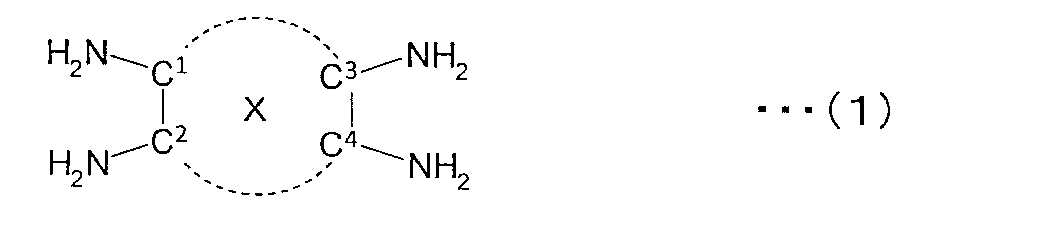
- a method for producing the above-described polymer compound comprising condensing polyacrylic acid and a polyfunctional amine represented by the following general formula (1).
- X is a cyclic structure composed of a benzene ring having 1 to 3 rings, and C 1 to C 4 are each a carbon atom constituting the benzene ring in the cyclic structure. Is done.
- a negative electrode for a power storage device comprising a negative electrode binder containing the above polymer compound and a negative electrode active material, comprising: Provides a negative electrode that is at least one selected from a carbon-based material capable of inserting and extracting lithium, an element that can be alloyed with lithium, and a compound that has an element that can be alloyed with lithium.
- a power storage device including the above negative electrode and a nonaqueous electrolyte.
- the polymer compound of the present embodiment is a compound obtained by condensing (A) polyacrylic acid and (B) a polyfunctional amine.
- Polyacrylic acid is a homopolymer made of acrylic acid.
- the weight average molecular weight of the polyacrylic acid is not particularly limited, but is preferably in the range of 10,000 to 2,000,000, and more preferably in the range of 25,000 to 1,800,000. More preferably, it is in the range of 50,000 to 1,500,000.
- the cycle characteristics of the power storage device tend to decrease as the weight average molecular weight of the polymer compound decreases.
- the polymer compound of this embodiment is used as a negative electrode binder, the cycle characteristics of the power storage device are maintained even if the weight average molecular weight of the polyacrylic acid constituting the polymer compound is reduced. Therefore, as the (A) polyacrylic acid, for example, low molecular weight polyacrylic acid of 250,000 or less or 100,000 or less is suitably used.
- the polyfunctional amine is a compound having a structure represented by the following general formula (1).
- X is a cyclic structure composed of a benzene ring having 1 to 3 rings, and C 1 to C 4 are each a carbon atom constituting the benzene ring in the cyclic structure.
- cyclic structure is a cyclic structure represented by the following general formula (2).
- the cyclic structure represented by the general formula (2) is a polycyclic cyclic structure in which two benzene rings are connected.
- the positions of C 1 and C 2 and the positions of C 3 and C 4 in each benzene ring are not particularly limited, but the benzene ring in which C 1 and C 2 are constituent elements If, benzene ring C 3 and C 4 is component are preferably different benzene rings.
- a substituent may be bonded to the carbon atom constituting each benzene ring.
- (B) polyfunctional amine having a cyclic structure represented by the general formula (2) examples include 3,3 ′, 4,4′-tetraaminobiphenyl (3,3′-diaminobenzidine), 2,2 Examples include ', 3,3'-tetraaminobiphenyl and 2,3,3', 4'-tetraaminobiphenyl.
- a cyclic structure represented by the following general formula (3) can be given.
- A is a methylene group or an oxygen atom.
- the cyclic structure represented by the general formula (3) is a polycyclic cyclic structure in which two benzene rings are connected by a methylene group or an oxygen atom.
- the positions of C 1 and C 2 and the positions of C 3 and C 4 in each benzene ring are not particularly limited, but the benzene ring in which C 1 and C 2 are constituent elements If, benzene ring C 3 and C 4 is component are preferably different benzene rings.
- a substituent may be bonded to the carbon atom constituting each benzene ring.
- (B) polyfunctional amine having a cyclic structure represented by the general formula (3) and A being a methylene group examples include 3,3 ′, 4,4′-tetraaminodiphenylmethane, 2 , 2 ′, 3,3′-tetraaminodiphenylmethane, 2,3,3 ′, 4′-tetraaminodiphenylmethane.
- (B) polyfunctional amine having a cyclic structure represented by the general formula (3) and A being an oxygen atom include 3,3 ′, 4,4′-tetraaminodiphenyl ether, 2 , 2 ', 3,3'-tetraaminodiphenyl ether, 2,3,3', 4'-tetraaminodiphenyl ether.
- a cyclic structure represented by the following general formula (4) can be given.
- n 0, 1, or 2.
- the positions of C 1 and C 2 and the positions of C 3 and C 4 in each benzene ring are not particularly limited.
- a substituent may be bonded to the carbon atom constituting each benzene ring.
- n is preferably 1 or 2.
- the benzene ring whose constituent elements are C 1 and C 2 and the benzene ring whose constituent elements are C 3 and C 4 are different benzene rings.
- (B) polyfunctional amine having a cyclic structure represented by the general formula (4) in which n is 0 include 1,2,4,5-tetraaminobenzene, 1,2, 3,4-tetraaminobenzene may be mentioned.
- (B) polyfunctional amine having a cyclic structure represented by the general formula (4), wherein n is 1, include 1,2,7,8-tetraaminonaphthalene, 1,2, Examples include 5,6-tetraaminonaphthalene, 1,2,6,7-tetraaminonaphthalene, and 2,3,6,7-tetraaminonaphthalene.
- (B) polyfunctional amine having a cyclic structure represented by the general formula (4), wherein n is 2, include 1,2,7,8-tetraaminoanthracene, 1,2, Examples include 5,6-tetraaminoanthracene, 1,2,6,7-tetraaminoanthracene, and 2,3,6,7-tetraaminoanthracene.
- (B) polyfunctional amine only 1 type may be used and 2 or more types may be used together.
- the blending ratio of (B) polyfunctional amine is set according to the number of carboxyl groups (A) polyacrylic acid has.
- the blending ratio of the (B) polyfunctional amine is preferably a blending ratio of 1/20 to 1/1 in terms of a molar ratio with respect to the carboxyl group of the (A) polyacrylic acid.
- the blending ratio is more preferably 1/1, and further preferably 1/10 to 1/2.
- the polymer compound of the present embodiment includes a mixing step of mixing (A) polyacrylic acid and (B) a polyfunctional amine in a solvent, and a heating step of heat-treating the intermediate composition obtained in the mixing step. It is obtained by going through.
- the mixing step is a step of obtaining a liquid intermediate composition obtained by mixing (A) polyacrylic acid, (B) a polyfunctional amine, and a solvent.
- a solvent used in the mixing step a solvent in which (A) polyacrylic acid and (B) a polyfunctional amine are dissolved can be appropriately selected and used.
- a non-aqueous solvent such as N-methyl-2-pyrrolidone, dimethylformamide, dimethylacetamide, dimethyl sulfoxide, propylene carbonate, ⁇ -butyrolactone, ethanol, and propanol.
- the heating step is a step of condensing (A) polyacrylic acid and (B) polyfunctional amine contained in the intermediate composition by heat-treating the intermediate composition.
- the heating temperature in the heating step is preferably in the range of 150 to 230 ° C., more preferably in the range of 180 to 200 ° C., from the viewpoint of promoting the formation of the crosslinked structure.
- a dehydration condensing agent may be added to the intermediate composition in order to promote the formation of a crosslinked structure by the condensation reaction of (A) polyacrylic acid and (B) polyfunctional amine.
- Examples of the dehydrating condensing agent include phosphorus oxychloride.
- the intermediate composition to be subjected to the heating step is a preheated intermediate composition.
- the temperature of the preheating treatment is preferably in the range of 40 to 140 ° C, more preferably in the range of 60 to 130 ° C.
- (A) polyacrylic acid and (B) polyfunctional amine contained in the intermediate composition associate to form a state in which the condensation reaction of carboxyl group and amino group is likely to proceed. .
- the condensation reaction can proceed efficiently in the heating step.
- the condensation reaction of the carboxyl group and amino group may partially proceed.
- the high molecular compound formed by condensing (A) polyacrylic acid and (B) polyfunctional amine is obtained by passing through a heating process.
- This polymer compound comprises (A) a carboxyl group of polyacrylic acid and (B) two amino groups bonded to C 1 and C 2 in the polyfunctional amine, and (A) a carboxyl group of polyacrylic acid.
- the polymer compound has a chain structure composed of polyacrylic acid and a crosslinked structure that connects carboxylic acid side chains (carboxyl groups) within the chain structure or between the chain structures.
- the crosslinked structure is a crosslinked structure shown by following General formula (6).
- PAA is a chain structure composed of polyacrylic acid
- X is a cyclic structure composed of benzene rings having 1 to 3 rings
- C 1- Each C 4 is a carbon atom constituting the benzene ring in the above cyclic structure.
- cyclic structure is a cyclic structure represented by the following general formula (2).
- the cyclic structure represented by the general formula (2) is a polycyclic cyclic structure in which two benzene rings are connected.
- the positions of C 1 and C 2 and the positions of C 3 and C 4 in each benzene ring are not particularly limited, but the benzene ring in which C 1 and C 2 are constituent elements If, benzene ring C 3 and C 4 is component are preferably different benzene rings.
- a substituent may be bonded to the carbon atom constituting each benzene ring.
- crosslinked structure having a cyclic structure represented by the general formula (2) Specific examples of the crosslinked structure having a cyclic structure represented by the general formula (2) are shown below.
- A is a methylene group or an oxygen atom.
- the cyclic structure represented by the general formula (3) is a polycyclic cyclic structure in which two benzene rings are connected by a methylene group or an oxygen atom.
- the positions of C 1 and C 2 and the positions of C 3 and C 4 in each benzene ring are not particularly limited, but the benzene ring in which C 1 and C 2 are constituent elements If, benzene ring C 3 and C 4 is component are preferably different benzene rings.
- a substituent may be bonded to the carbon atom constituting each benzene ring.
- crosslinked structure having a cyclic structure represented by the general formula (3) Specific examples of the crosslinked structure having a cyclic structure represented by the general formula (3) are shown below.
- n 0, 1, or 2.
- the positions of C 1 and C 2 and the positions of C 3 and C 4 in each benzene ring are not particularly limited.
- a substituent may be bonded to the carbon atom constituting each benzene ring.
- n is preferably 1 or 2.
- the benzene ring whose constituent elements are C 1 and C 2 and the benzene ring whose constituent elements are C 3 and C 4 are different benzene rings.
- crosslinked structure having a cyclic structure represented by the general formula (4) Specific examples of the crosslinked structure having a cyclic structure represented by the general formula (4) are shown below.
- the high molecular compound may have only 1 type of crosslinked structure shown by General formula (6), and may have 2 or more types.
- the cyclic structure in General formula (6) becomes a structure according to the cyclic structure in General formula (1).
- a chain structure composed of polyacrylic acid it is preferable that 10 to 100% of carboxyl groups in a number ratio form a crosslinked structure, and 20 to 100% of carboxyl groups form a crosslinked structure. Is more preferable.
- a negative electrode active material a negative electrode active material, a negative electrode binder, and a solvent are mixed to prepare a slurry. In that case, you may further mix other components, such as a conductive support agent, as needed.
- a known material used as a negative electrode active material for a power storage device such as a secondary battery for example, a carbon-based material, an element that can be alloyed with lithium, and a compound that has an element that can be alloyed with lithium are used. Can be used.
- the carbon-based material for example, a carbon-based material capable of occluding and releasing lithium can be used. Specific examples thereof include non-graphitizable carbon, natural graphite, artificial graphite, cokes, graphites, glassy materials. Examples thereof include carbons, organic polymer compound fired bodies, carbon fibers, activated carbon, and carbon blacks.
- elements that can be alloyed with lithium include Na, K, Rb, Cs, Fr, Be, Mg, Ca, Sr, Ba, Ra, Ti, Ag, Zn, Cd, Al, Ga, In, Si, Ge, Sn, Pb, Sb, Bi are mentioned. Of these, Si is particularly preferable.
- Examples of the compound having an element that can be alloyed with lithium include Na, K, Rb, Cs, Fr, Be, Mg, Ca, Sr, Ba, Ra, Ti, Ag, Zn, Cd, Al, Ga, and In. , Si, Ge, Sn, Pb, Sb, and a compound having an element selected from Bi.
- a silicon-based material that is a compound containing Si is particularly preferable.
- silicon-based material examples include SiB 4 , SiB 6 , Mg 2 Si, Ni 2 Si, TiSi 2 , MoSi 2 , CoSi 2 , NiSi 2 , CaSi 2 , CrSi 2 , Cu 5 Si, FeSi 2 , MnSi 2 , NbSi 2, TaSi 2, VSi 2 , WSi 2, ZnSi 2, SiC, Si 3 N 4, Si 2 N 2 O, SiO V (0 ⁇ V ⁇ 2), include SnSiO 3, LiSiO. Among these, SiO V (0 ⁇ V ⁇ 2) is particularly preferable.
- a silicon-based material a silicon material obtained from CaSi 2 through a decalcification reaction disclosed in International Publication No. 2014/080608 can also be used.
- the silicon material is obtained by, for example, decalcifying (for example, heat treatment at 300 to 1000 ° C.) a layered polysilane obtained by treating CaSi 2 with an acid (for example, hydrochloric acid or hydrogen fluoride). It is.
- the polymer compound of this embodiment is particularly preferably used in combination with a silicon-based material that is a negative electrode active material having a large degree of expansion and contraction during charge / discharge.
- a negative electrode active material only 1 type in said material may be used, and 2 or more types may be used together.
- the above intermediate composition is used as the negative electrode binder mixed in the slurry. Moreover, you may use together the binder for other negative electrodes as a binder for negative electrodes.
- examples of other negative electrode binders include polyvinylidene fluoride, polytetrafluoroethylene, styrene-butadiene rubber, polyimide, polyamideimide, carboxymethylcellulose, polyvinyl chloride, methacrylic resin, polyacrylonitrile, modified polyphenylene oxide, polyethylene oxide, Examples include polyethylene, polypropylene, polyacrylic acid, and phenol resin.
- the solid content of the intermediate composition is preferably 1% by mass or more, and preferably 10% by mass or more based on the total solid content of the negative electrode binder. It is more preferable.
- the blending ratio (negative electrode active material: negative electrode binder) in the mass ratio of the negative electrode active material and the negative electrode binder can be appropriately set according to the types of the negative electrode active material and the negative electrode binder.
- the blending ratio is, for example, preferably in the range of 5: 3 to 99: 1, more preferably in the range of 3: 1 to 97: 3, and in the range of 16: 3 to 95: 5. Is more preferable.
- the solvent a known solvent used at the time of producing an electrode of a power storage device such as a secondary battery can be appropriately used depending on the types of the negative electrode active material and the negative electrode binder.
- Specific examples of the solvent include N-methyl-2-pyrrolidone, methanol, and methyl isobutyl ketone.
- the conductive auxiliary agent a known conductive auxiliary agent used for the negative electrode of a power storage device such as a secondary battery can be used.
- the conductive assistant include acetylene black, carbon nanotube, and ketjen black. Among these conductive assistants, only one kind may be used, or two or more kinds may be used in combination.
- a dispersing agent when making a slurry contain a conductive support agent, it is preferable to contain a dispersing agent with a conductive support agent.
- the dispersant include polyvinyl pyrrolidone, polyvinyl alcohol, polyvinyl butyral, and a triazine compound. Among these dispersants, only one type may be used, or two or more types may be used in combination.
- the above slurry is applied to a current collector to form a negative electrode active material layer made of the slurry on the surface of the current collector.
- the negative electrode active material layer is removed by removing the solvent (slurry solvent and solvent contained in the intermediate composition) contained in the negative electrode active material layer, drying the negative electrode active material layer, and performing heat treatment. Is cured.
- (A) polyacrylic acid and (B) polyfunctional amine contained in the intermediate composition are condensed to form the polymer compound in the negative electrode active material layer.
- the heat treatment can be performed in a state in which the negative electrode active material layer contains a solvent, but it is more preferable to perform the drying treatment first and the negative electrode active material layer in a dried state.
- drying treatment and heat treatment include, for example, a method of heating using a heat source such as hot air, infrared rays, microwaves, and high frequencies under normal pressure or reduced pressure.
- a heat source such as hot air, infrared rays, microwaves, and high frequencies under normal pressure or reduced pressure.
- the drying treatment is preferably performed slowly at a low temperature rather than heated quickly at a high temperature, and the heating treatment is preferably performed quickly at a high temperature rather than heated slowly at a low temperature.
- a known metal material used as a current collector for a negative electrode of a power storage device such as a secondary battery can be used.
- the metal material that can be used as a current collector include silver, copper, gold, aluminum, magnesium, tungsten, cobalt, zinc, nickel, iron, platinum, tin, indium, titanium, ruthenium, tantalum, molybdenum, and stainless steel. It is done.
- the negative electrode using the polymer compound of the present embodiment as a negative electrode binder can be suitably used for a non-aqueous power storage device including a non-aqueous electrolyte as an electrolyte.
- the power storage device include a secondary battery, an electric double layer capacitor, and a lithium ion capacitor.
- such power storage devices are useful as non-aqueous secondary batteries for driving motors of electric vehicles and hybrid vehicles, and non-aqueous secondary batteries used in personal computers, portable communication devices, home appliances, office equipment, industrial equipment, etc. It is.
- the polymer compound of the present embodiment is a compound obtained by condensing polyacrylic acid and a polyfunctional amine represented by the general formula (1).
- the polymer compound of the present embodiment has a chain structure composed of polyacrylic acid and a crosslinked structure that connects carboxylic acid side chains in the chain structure or between the chain structures.
- the crosslinked structure is a crosslinked structure represented by the general formula (6).
- the polymer compound having the above configuration is useful as a binder for a negative electrode of a power storage device in terms of cycle characteristics and initial efficiency of the power storage device and adhesion of the negative electrode active material layer.
- the blending ratio of the polyfunctional amine represented by the general formula (1) is a blending ratio of 1/10 to 1/1 in terms of molar ratio with respect to the carboxyl group of (A) polyacrylic acid.
- A polyacrylic acid
- the polymer compound may be a polymer compound having a second crosslinked structure in addition to the first crosslinked structure represented by the general formula (6).
- (A) polyacrylic acid, (B) polyfunctional amine (polyfunctional amine represented by the general formula (1)) and (C) other polyfunctional amine may be a polymer compound.
- (C) a second crosslinked structure derived from other polyfunctional amine is further included. It becomes a polymer compound.
- polyfunctional amines include, for example, polyfunctional amines represented by the following general formula (5).
- Y is a linear alkyl group having 1 to 4 carbon atoms, a phenylene group, or an oxygen atom.
- the bonding position of Y in each benzene ring may be any of the ortho position, meta position and para position with respect to the amino group.
- a substituent may be bonded to the carbon atom constituting the structure.
- substituent bonded to the carbon atom constituting the linear alkyl group include a methyl group, an ethyl group, a fluoromethyl group, a difluoromethyl group, a trifluoromethyl group, a methoxy group, an ethoxy group, and an oxo group.
- substituents only 1 type may be couple
- the substituent bonded to the carbon atom constituting the linear alkyl group and the phenylene group may be an amino group or a substituent containing an amino group, and in this case, a polyfunctional group having three or more amino groups. Becomes an amine.
- R1 and R2 are each independently one or a plurality of hydrogen atoms, a methyl group, an ethyl group, a trifluoromethyl group, or a methoxy group.
- the bonding position of R1 may be any of an ortho position, a meta position, and a para position with respect to the amino group. The same applies to R2.
- polyfunctional amine represented by the general formula (5) Specific examples of the polyfunctional amine represented by the general formula (5) will be described.
- examples of the polyfunctional amine in which Y is a linear alkyl group include 3,3′-diaminodiphenylmethane, 4,4′-diaminodiphenylmethane, 3,4′-diaminodiphenylmethane, 4,4′-ethylenedianiline, 4 , 4'-diamino-3,3'-dimethyldiphenylmethane, 1,1-bis (4-aminophenyl) cyclohexane, 9,9-bis (4-aminophenyl) fluorene, 2,2'-bis (4-amino) Phenyl) hexafluoropropane, 4,4′-diaminobenzophenone, 4,4′-methylenebis (2-ethyl-6-methylaniline), pararose aniline.
- Examples of the polyfunctional amine in which Y is a phenylene group include 1,3,5-tris (4-aminophenyl) benzene.
- Examples of the polyfunctional amine in which Y is an oxygen atom include 4,4'-diaminodiphenyl ether.
- 1,3,5-tris (4-aminophenyl) benzene and pararose aniline are trifunctional amines having three amino groups.
- C As another polyfunctional amine, only 1 type of said polyfunctional amine may be used, and 2 or more types may be used together.
- the cross-linked structure derived from the polyfunctional amine represented by the general formula (5) includes an amide bond and an imide between the carboxyl group of (A) polyacrylic acid and the amino group of the polyfunctional amine represented by the general formula (5). It is at least one crosslinked structure selected from the following general formulas (7) to (9) in which at least one of the bonds is formed.
- PAA represents a chain structure composed of polyacrylic acid.
- Z is a crosslinked structure represented by the following general formula (10).
- the two carbonyl groups constituting one imide structure may be carbonyl groups bonded to different chain structures, or the same chain It may be a carbonyl group bonded to the structure.
- a maleimide structure is formed as the imide structure.
- Y is a linear alkyl group having 1 to 4 carbon atoms, a phenylene group, or an oxygen atom. Further, the bonding position of Y in each benzene ring may be any of the ortho position, meta position and para position with respect to the amino group.
- Y in the general formula (10) has a structure according to Y in the general formula (5).
- R1 and R2 are each independently one or more hydrogen atoms, a methyl group, an ethyl group, a trifluoromethyl group, or a methoxy group.
- the bonding position of R1 may be any of the ortho, meta, and para positions relative to the amino group.
- R1 and R2 in the general formula (10) have a structure according to R1 and R2 in the general formula (5).
- the blending ratio of the other polyfunctional amine is preferably 0.1 to 1.5 mol with respect to 1 mol of (B) polyfunctional amine (polyfunctional amine represented by the general formula (1)).
- the ratio of the second crosslinked structure to the first crosslinked structure is preferably 0.1 to 1.5.
- the polymer compound may have a carboxyl group having an aromatic monoamine bonded to the chain structure portion.
- it may be a polymer compound formed by condensation of (A) polyacrylic acid, (B) polyfunctional amine, and (D) aromatic monoamine.
- A polyacrylic acid
- B polyfunctional amine
- D aromatic monoamine
- An aromatic monoamine is an aromatic compound in which an amino group indicating a weak base is bonded to an aromatic compound having an aromatic ring structure, and (A) an amino group that can be condensed with a carboxyl group of polyacrylic acid. Has only one.
- the aromatic ring structure examples include a monocyclic structure having 4 to 8 members, and a polycyclic structure in which a plurality of (for example, 2 to 3) 4 to 8 members are combined. Can be mentioned.
- the aromatic ring structure may be a ring structure made of carbon or a heterocyclic structure containing an element other than carbon.
- the aromatic monoamine may be a primary amine or a secondary amine.
- aromatic monoamine examples include aniline, naphthylamine, aminoanthracene, aminopyrene, aminophenol, fluoroaniline, chloroaniline, bromoaniline, iodoaniline, toluidine, aminotriphenylamine, difluoroaniline, dichloroaniline, dibromo Aniline, diiodoaniline, dimethylaniline, trifluoroaniline, trichloroaniline, tribromoaniline, triiodoaniline, trimethylaniline, N, N-dimethyl-1,4-phenylenediamine, N, N-dimethyl-4,4 ′ -Diaminodiphenylmethane, anisidine, aminobenzenethiol, aminobenzonitrile. Only one kind of the above aromatic monoamines may be used, or two or more kinds may be used in combination.
- the blending ratio of the aromatic monoamine is preferably 0.1 to 1.0 mol with respect to 1 mol of (B) polyfunctional amine (polyfunctional amine represented by the general formula (1)). By setting it as the said ratio, it can suppress that physical properties, such as the intensity
- ⁇ Test 1> The battery characteristics and the adhesion of the negative electrode active material layer were evaluated when a polymer compound obtained by condensing polyacrylic acid and the polyfunctional amine represented by the general formula (1) was used as the negative electrode binder. Further, as a comparison object, battery characteristics and negative electrode active material layer in the case of using a polymer compound obtained by condensing PAA and a polyfunctional amine represented by the general formula (5) or polyacrylic acid as a negative electrode binder The peel strength was evaluated.
- PAA polyacrylic acid
- NMP N-methyl-2-pyrrolidone
- PAA + 3,3'-diaminobenzidine PAA having a weight average molecular weight of 130,000 was dissolved in NMP to prepare a 15% by mass PAA / NMP solution, and 3.31 g of this PAA / NMP solution (6.9 mmol in terms of monomer of PAA) was added to a flask under a nitrogen atmosphere. Sorted in. In the flask, 0.8 g (1.87 mmol) of a 50 mass% NMP solution of 3,3′-diaminobenzidine was added and stirred at room temperature for 30 minutes. Then, the intermediate composition of Example 1 was obtained in the state of the NMP solution by heat-processing (preheating process) at 110 degreeC for 2 hours.
- the intermediate composition contained in the negative electrode active material layer was subjected to a condensation reaction by heat treatment at 200 ° C. for 30 minutes in vacuum (under reduced pressure), and the negative electrode active material layer was heated and cured. This obtained the electrode sheet which contains the high molecular compound which has a crosslinked structure as a binder for negative electrodes.
- a separator is sandwiched between a negative electrode (evaluation electrode) formed by cutting an electrode sheet into a circle having a diameter of 11 mm and a positive electrode formed by cutting a metal lithium foil having a thickness of 500 ⁇ m into a circle having a diameter of 13 mm.
- a body battery was obtained.
- a lithium ion secondary battery was obtained by housing the electrode body battery in the battery case and injecting a non-aqueous electrolyte to seal the battery case.
- As the separator Hoechst Celanese glass filter and Celgard celgard 2400 were used.
- non-aqueous electrolyte a non-aqueous electrolyte was used in which lithium hexafluorophosphate was dissolved to a concentration of 1M in a mixed solvent in which ethylene carbonate and diethyl carbonate were mixed at a volume ratio of 1: 1.
- Cycle characteristics (%) (charge capacity after specified cycle / initial charge capacity) ⁇ 100 (Evaluation of adhesion of negative electrode active material layer)
- the obtained electrode sheet was cut into 2.5 cm ⁇ 4 cm to form a measurement sample, and peeled at 90 ° in accordance with JIS K 6854-1 using a peeling test apparatus (manufactured by MINEBEA, LTS-50N-S300). A test was conducted. By dividing the strength measured in the 90-degree peel test by the line width (2.5 cm), the peel strength of the measurement sample was calculated. The results are shown in Table 1.
- Test Example 1 using a polymer compound having a crosslinked structure derived from a polyfunctional amine represented by the general formula (1) as a binder for a negative electrode, and a polyfunctional amine represented by the general formula (5)
- the cycle characteristics were higher than in Test Example 3 in which PAA was used as the negative electrode binder. From this result, it is understood that cycle characteristics are improved by using a polymer compound having a chain structure composed of PAA and a crosslinked structure including a cyclic structure including a benzene ring as a binder for the negative electrode.
- Test Example 1 in which the polymer compound having a cross-linked structure derived from the polyfunctional amine represented by the general formula (1) was used as the binder for the negative electrode, the cross-linked structure derived from the polyfunctional amine represented by the general formula (5) Compared with Test Example 2 in which a polymer compound having a viscosity was used as a negative electrode binder, results of higher initial efficiency and peel strength were obtained. This result is considered due to the difference in the cross-linked structure of the polymer compound.
- the crosslinked structure of the polymer compound used in Test Example 2 is derived from the polyfunctional amine represented by the general formula (5) and is a crosslinked structure represented by the general formulas (7) to (9).
- This crosslinked structure is formed by forming an amide bond or an imide bond between the carboxyl group of PAA and the amino group of the polyfunctional amine represented by the general formula (5). Therefore, an irreversible reaction is likely to occur between the carbonyl oxygen of the carbonyl group in the amide bond or imide bond in the crosslinked structure and lithium, and this irreversible reaction reduces the amount of lithium moving between the electrodes, resulting in an initial efficiency. It is thought to decline.
- the crosslinked structure of the polymer compound used in Test Example 1 is derived from the polyfunctional amine represented by the general formula (1) and is a crosslinked structure represented by the general formula (6).
- This crosslinked structure is formed by the PAA carboxyl group and the two amino groups of the polyfunctional amine represented by the general formula (1) forming a benzimidazole-like bond structure.
- the carbonyl structure of the carboxyl group is converted to an imine structure, and carbonyl oxygen is eliminated from the crosslinked structure. Therefore, unlike the crosslinked structure having an amide bond or an imide bond, the irreversible reaction does not occur between carbonyl oxygen and lithium in the crosslinked structure portion, and the initial efficiency is unlikely to decrease.
- the benzimidazole-like bond structure has a rigid cross-linked structure, the resin strength of the polymer compound is improved. As a result, it is considered that the peel strength of the negative electrode active material layer is increased.
- the polymer compound having a crosslinked structure derived from the polyfunctional amine represented by the general formula (1) has battery characteristics (cycle characteristics and initial efficiency) and adhesion (peeling strength) of the negative electrode active material layer. From the viewpoint, it can be seen that it is useful as a binder for a negative electrode.
- PAA + 3,3′-diaminobenzidine PAA having a weight average molecular weight of 130,000 was dissolved in NMP to prepare a 15% by mass PAA / NMP solution, and 3.31 g of this PAA / NMP solution (6.9 mmol in terms of monomer of PAA) was added to a flask under a nitrogen atmosphere. Sorted in. A predetermined amount of 3,3′-diaminobenzidine 50 mass% NMP solution (0.35 to 6.9 mmol) was added to the flask and stirred at room temperature for 30 minutes. Thereafter, a heat treatment (preheating treatment) was performed at 110 ° C.
- the blending ratio of the polyfunctional amine represented by the general formula (1) is theoretically a blend in which a crosslinked structure derived from the polyfunctional amine is formed with respect to all the carboxyl groups of PAA.
- the ratio (1/2) is exceeded.
- all the carboxyl groups of PAA are bonded to the polyfunctional amine even though the polyfunctional amine that can only be bonded to the carboxyl group of PAA remains with only one pair of amino groups on one side.
- the number of cross-linked structures formed between PAAs is reduced. As a result, it is considered that the effect of improving the cycle characteristics is small.
- PAA + 3,3′-diaminobenzidine + 4,4′-diaminodiphenylmethane PAA having a weight average molecular weight of 130,000 was dissolved in NMP to prepare a 15% by mass PAA / NMP solution, and 3.31 g of this PAA / NMP solution (6.9 mmol in terms of monomer of PAA) was added to a flask under a nitrogen atmosphere. Sorted in.
- Example 2 In a flask, 0.4 g (0.93 mmol) of 50 mass% NMP solution of 3,3′-diaminobenzidine and 0.384 g (0.93 mmol) of 50 mass% NMP solution of 4,4′-diaminodiphenylmethane were added. In addition, the mixture was stirred at room temperature for 30 minutes. Then, the intermediate composition of Example 2 was obtained in the state of NMP solution by heat-processing (pre-heating process) at 110 degreeC for 2 hours.
- PAA + 3,3′-diaminobenzidine + 3,3′-diaminodiphenylmethane PAA having a weight average molecular weight of 130,000 was dissolved in NMP to prepare a 15% by mass PAA / NMP solution, and 3.31 g of this PAA / NMP solution (6.9 mmol in terms of monomer of PAA) was added to a flask under a nitrogen atmosphere. Sorted in.
- Example 3 In a flask, 0.4 g (0.93 mmol) of 50 mass% NMP solution of 3,3′-diaminobenzidine and 0.384 g (0.93 mmol) of 50 mass% NMP solution of 3,3′-diaminodiphenylmethane were added. In addition, the mixture was stirred at room temperature for 30 minutes. Then, the intermediate composition of Example 3 was obtained in the state of the NMP solution by heat-processing (pre-heating process) at 110 degreeC for 2 hours.
- PAA + 3,3′-diaminobenzidine + 4,4′-diaminodiphenyl ether PAA having a weight average molecular weight of 130,000 was dissolved in NMP to prepare a 15% by mass PAA / NMP solution, and 3.31 g of this PAA / NMP solution (6.9 mmol in terms of monomer of PAA) was added to a flask under a nitrogen atmosphere. Sorted in.
- Example 4 In a flask, 0.4 g (0.93 mmol) of 50 mass% NMP solution of 3,3′-diaminobenzidine and 0.392 g (0.93 mmol) of 50 mass% NMP solution of 4,4′-diaminodiphenyl ether were added. In addition, the mixture was stirred at room temperature for 30 minutes. Then, the intermediate composition of Example 4 was obtained in the state of NMP solution by heat-processing (pre-heating process) at 110 degreeC for 2 hours.
- Example 5 PAA + 3,3′-diaminobenzidine + aniline
- PAA having a weight average molecular weight of 130,000 was dissolved in NMP to prepare a 15% by mass PAA / NMP solution, and 3.31 g of this PAA / NMP solution (6.9 mmol in terms of monomer of PAA) was added to a flask under a nitrogen atmosphere. Sorted in.
- 0.8 g (1.87 mmol) of a 50 mass% NMP solution of 3,3′-diaminobenzidine and 0.173 g (0.93 mmol) of a 50 mass% NMP solution of aniline were added at room temperature. Stir for 30 minutes.
- the intermediate composition of Example 5 was obtained in the state of the NMP solution by heat-processing (preheating process) for 2 hours at 110 degreeC.
- Electrodes sheets were prepared using the polymer compound obtained from the intermediate composition as a negative electrode binder.
- a lithium ion secondary battery was prepared using the obtained electrode sheet, and the battery characteristics of the lithium ion secondary battery and the adhesion of the negative electrode active material layer were evaluated.
- the results are shown in Table 3.
- the method for producing the electrode sheet, the method for producing the lithium ion secondary battery, the method for evaluating the battery characteristics of the lithium ion secondary battery, and the method for evaluating the adhesion of the negative electrode active material layer are the same as those in Test 1.
- “ ⁇ ” in the “first crosslinked structure” column indicates that the negative electrode binder is a polymer compound having a crosslinked structure derived from the polyfunctional amine represented by the general formula (1). ing. “ ⁇ ” in the “second crosslinked structure” column indicates that the negative electrode binder is a polymer compound having a crosslinked structure derived from a polyfunctional amine represented by the general formula (5). “ ⁇ ” in the “Monoamine addition structure” column indicates that the negative electrode binder is a polymer compound having a carboxyl group to which an aromatic monoamine is bonded.
Landscapes
- Chemical & Material Sciences (AREA)
- Engineering & Computer Science (AREA)
- Chemical Kinetics & Catalysis (AREA)
- General Chemical & Material Sciences (AREA)
- Electrochemistry (AREA)
- Materials Engineering (AREA)
- Organic Chemistry (AREA)
- Health & Medical Sciences (AREA)
- Medicinal Chemistry (AREA)
- Polymers & Plastics (AREA)
- Power Engineering (AREA)
- Manufacturing & Machinery (AREA)
- Microelectronics & Electronic Packaging (AREA)
- Battery Electrode And Active Subsutance (AREA)
- Macromolecular Compounds Obtained By Forming Nitrogen-Containing Linkages In General (AREA)
- Addition Polymer Or Copolymer, Post-Treatments, Or Chemical Modifications (AREA)
- Electric Double-Layer Capacitors Or The Like (AREA)
- Processes Of Treating Macromolecular Substances (AREA)
Abstract
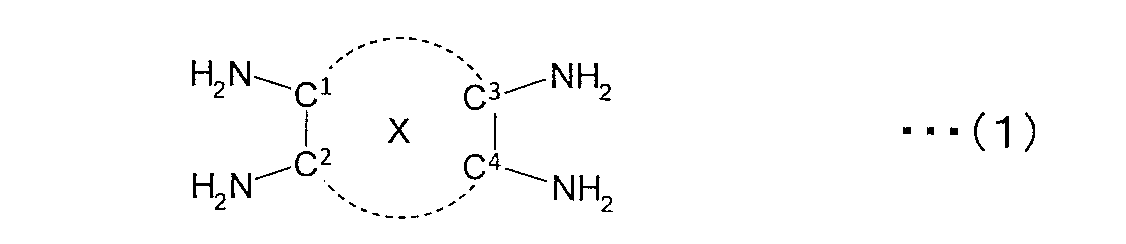
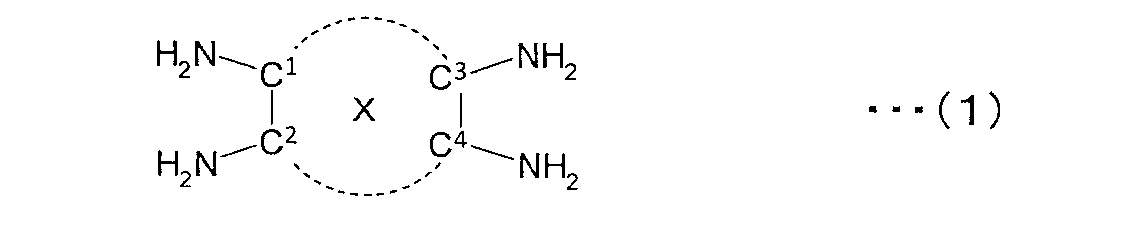
蓄電装置の負極用バインダーとして用いられる高分子化合物は、ポリアクリル酸と、下記一般式(1)で示される多官能アミンとが縮合してなる。下記一般式(1)において、Xは、環数が1~3のベンゼン環からなる環状構造であり、C1~C4はそれぞれ、当該環状構造におけるベンゼン環を構成する炭素原子である。
Description
本発明は、蓄電装置の負極用バインダーとして用いられる高分子化合物、その高分子化合物の中間組成物、負極電極、蓄電装置、及び高分子化合物の製造方法に関する。
二次電池を用いた製品として、携帯電話やノート型パソコン等の携帯機器が多く利用されている。二次電池は、電気自動車用の大型電源としても注目されている。
二次電池の電極は、例えば、銅やアルミニウム等の金属材料により形成された集電体と、その集電体上に結着された活物質層とから構成されている。一般に、活物質層には、活物質を集電体に結着させるための電極用バインダーが含まれている。近年、電極用バインダーとして、安価な高分子化合物であるポリアクリル酸の利用が試みられている。特許文献1は、ポリアクリル酸リチウム塩やポリアクリル酸ナトリウム塩を含む電極用バインダーを開示する。特許文献2は、ポリアクリル酸とポリエチレンイミンとを含む電極用バインダーを開示する。特許文献3は、ポリアクリル酸とアミン化合物とを含む電極用バインダーを開示する。
二次電池の電極は、例えば、銅やアルミニウム等の金属材料により形成された集電体と、その集電体上に結着された活物質層とから構成されている。一般に、活物質層には、活物質を集電体に結着させるための電極用バインダーが含まれている。近年、電極用バインダーとして、安価な高分子化合物であるポリアクリル酸の利用が試みられている。特許文献1は、ポリアクリル酸リチウム塩やポリアクリル酸ナトリウム塩を含む電極用バインダーを開示する。特許文献2は、ポリアクリル酸とポリエチレンイミンとを含む電極用バインダーを開示する。特許文献3は、ポリアクリル酸とアミン化合物とを含む電極用バインダーを開示する。
本研究者らは、ポリアクリル酸と、特定の分子構造を有する多官能アミンとが縮合してなる高分子化合物が二次電池等の蓄電装置の負極用バインダーとして有用であることを見出した。本発明の目的は、蓄電装置の負極用バインダーとして有用な高分子化合物、その高分子化合物を得るための中間組成物、その高分子化合物を負極用バインダーとして用いた負極電極、及び蓄電装置を提供することにある。また、本発明の目的は、その高分子化合物の製造方法を提供することにある。
上記課題を解決するため、本発明の第一の態様によれば、蓄電装置の負極用バインダーとして用いられる高分子化合物であって、ポリアクリル酸と、下記一般式(1)で示される多官能アミンとが縮合してなり、Xは、環数が1~3のベンゼン環からなる環状構造であり、C1~C4はそれぞれ、環状構造におけるベンゼン環を構成する炭素原子である、高分子化合物が提供される。


上記課題を解決するため、本発明の第六の態様によれば、上記の負極電極と、非水電解質とを備える蓄電装置が提供される。
以下、本発明を具体化した実施形態を詳細に説明する。
[高分子化合物]
本実施形態の高分子化合物は、(A)ポリアクリル酸と(B)多官能アミンとが縮合してなる化合物である。
[高分子化合物]
本実施形態の高分子化合物は、(A)ポリアクリル酸と(B)多官能アミンとが縮合してなる化合物である。
(A)ポリアクリル酸は、アクリル酸からなるホモポリマーである。ポリアクリル酸の重量平均分子量は、特に限定されないが、例えば、10,000~2,000,000の範囲であることが好ましく、25,000~1,800,000の範囲であることがより好ましく、50,000~1,500,000の範囲であることが更に好ましい。
ここで、ポリアミドイミド等の従来の高分子化合物を負極用バインダーとして用いた場合、高分子化合物の重量平均分子量が低下するにしたがって、蓄電装置のサイクル特性が低下する傾向がある。これに対して、本実施形態の高分子化合物を負極用バインダーとして用いた場合、高分子化合物を構成するポリアクリル酸の重量平均分子量が低下しても、蓄電装置のサイクル特性が維持される。そのため、(A)ポリアクリル酸として、例えば、250,000以下や100,000以下の低分子量のポリアクリル酸が好適に用いられる。
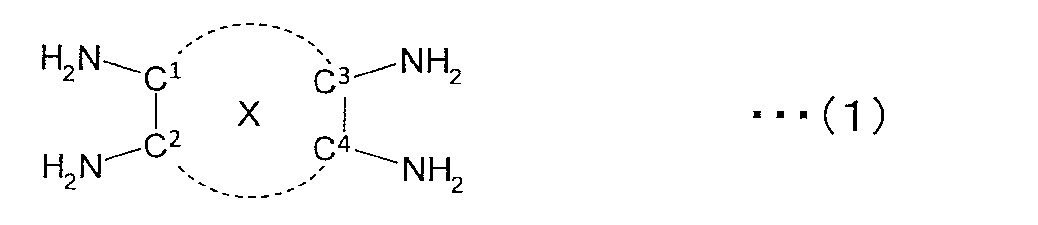
(B)多官能アミンは、下記一般式(1)で示される構造を有する化合物である。

上記環状構造の一例として、下記一般式(2)で示される環状構造が挙げられる。

一般式(2)で示される環状構造を有する(B)多官能アミンの具体例としては、3,3’,4,4’-テトラアミノビフェニル(3,3’-ジアミノベンジジン)、2,2’,3,3’-テトラアミノビフェニル、2,3,3’,4’-テトラアミノビフェニルが挙げられる。
また、上記環状構造の一例として、下記一般式(3)で示される環状構造が挙げられる。

一般式(3)で示される環状構造は、二つのベンゼン環がメチレン基又は酸素原子により連結された多環式の環状構造である。一般式(3)で示される環状構造において、各ベンゼン環におけるC1及びC2の位置、並びにC3及びC4の位置は特に限定されないが、C1及びC2が構成要素となるベンゼン環と、C3及びC4が構成要素となるベンゼン環は、異なるベンゼン環であることが好ましい。また、C1~C4に結合される4個のアミノ基に加えて、各ベンゼン環を構成する炭素原子に置換基が結合されていてもよい。
一般式(3)で示される環状構造を有する(B)多官能アミンであって、Aがメチレン基である場合の具体例としては、3,3’,4,4’-テトラアミノジフェニルメタン、2,2’,3,3’-テトラアミノジフェニルメタン、2,3,3’,4’-テトラアミノジフェニルメタンが挙げられる。
一般式(3)で示される環状構造を有する(B)多官能アミンであって、Aが酸素原子である場合の具体例としては、3,3’,4,4’-テトラアミノジフェニルエーテル、2,2’,3,3’-テトラアミノジフェニルエーテル、2,3,3’,4’-テトラアミノジフェニルエーテルが挙げられる。
また、上記環状構造の一例として、下記一般式(4)で示される環状構造が挙げられる。

一般式(4)で示される環状構造は、1個のベンゼン環からなる単環式の環状構造(n=0)、又は2~3個のベンゼン環が縮合してなる多環式の環状構造(n=1~2)である。一般式(3)で示される環状構造において、各ベンゼン環におけるC1及びC2の位置、並びにC3及びC4の位置は特に限定されない。また、C1~C4に結合される4個のアミノ基に加えて、各ベンゼン環を構成する炭素原子に置換基が結合されていてもよい。
また、一般式(4)で示される環状構造において、nは、1又は2であることが好ましい。この場合、C1及びC2が構成要素となるベンゼン環と、C3及びC4が構成要素となるベンゼン環は、異なるベンゼン環であることが好ましい。
一般式(4)で示される環状構造を有する(B)多官能アミンであって、nが0である場合の具体例としては、1,2,4,5-テトラアミノベンゼン、1,2,3,4-テトラアミノベンゼンが挙げられる。
一般式(4)で示される環状構造を有する(B)多官能アミンであって、nが1である場合の具体例としては、1,2,7,8-テトラアミノナフタレン、1,2,5,6-テトラアミノナフタレン、1,2,6,7-テトラアミノナフタレン、2,3,6,7-テトラアミノナフタレンが挙げられる。
一般式(4)で示される環状構造を有する(B)多官能アミンであって、nが2である場合の具体例としては、1,2,7,8-テトラアミノアントラセン、1,2,5,6-テトラアミノアントラセン、1,2,6,7-テトラアミノアントラセン、2,3,6,7-テトラアミノアントラセンが挙げられる。
なお、(B)多官能アミンとして、一種のみを用いてもよいし、二種以上を併用してもよい。
(B)多官能アミンの配合割合は、(A)ポリアクリル酸が有するカルボキシル基の数に応じて設定される。(B)多官能アミンの配合割合は、(A)ポリアクリル酸が有するカルボキシル基に対して、モル比で1/20~1/1となる配合割合であることが好ましく、1/10~1/1となる配合割合であることがより好ましく、1/10~1/2となる配合割合であることが更に好ましい。
(B)多官能アミンの配合割合は、(A)ポリアクリル酸が有するカルボキシル基の数に応じて設定される。(B)多官能アミンの配合割合は、(A)ポリアクリル酸が有するカルボキシル基に対して、モル比で1/20~1/1となる配合割合であることが好ましく、1/10~1/1となる配合割合であることがより好ましく、1/10~1/2となる配合割合であることが更に好ましい。
本実施形態の高分子化合物は、(A)ポリアクリル酸及び(B)多官能アミンを溶媒中で混合する混合工程と、混合工程にて得られた中間組成物を加熱処理する加熱工程とを経ることにより得られる。
混合工程は、(A)ポリアクリル酸と(B)多官能アミンと溶媒とが混合されてなる液状の中間組成物を得る工程である。混合工程に用いる溶媒としては、(A)ポリアクリル酸及び(B)多官能アミンが溶解する溶媒を適宜選択して用いることができる。特に、溶解性向上の観点から、N-メチル-2-ピロリドン、ジメチルホルムアミド、ジメチルアセトアミド、ジメチルスルホキシド、炭酸プロピレン、γ-ブチロラクトン、エタノール、プロパノール等の非水溶媒を用いることが好ましい。
加熱工程は、中間組成物を加熱処理することにより、中間組成物に含有される(A)ポリアクリル酸と(B)多官能アミンとを縮合させる工程である。加熱工程における加熱温度は、架橋構造の形成を促進させる観点から、150~230℃の範囲であることが好ましく、180~200℃の範囲であることがより好ましい。
また、(A)ポリアクリル酸と(B)多官能アミンとの縮合反応による架橋構造の形成を促進させるために、中間組成物に脱水縮合剤を添加してもよい。脱水縮合剤としては、例えば、オキシ塩化リンが挙げられる。
加熱工程に供される中間組成物は、予備加熱処理された中間組成物であることが好ましい。予備加熱処理の温度は、40~140℃の範囲であることが好ましく、60~130℃の範囲であることがより好ましい。予備加熱処理を行うことにより、中間組成物に含有される(A)ポリアクリル酸及び(B)多官能アミンが会合して、カルボキシル基とアミノ基の縮合反応が進行しやすい状態が形成される。その結果、加熱工程において、縮合反応を効率的に進行させることができる。予備加熱処理により、カルボキシル基とアミノ基の縮合反応が部分的に進行していてもよい。また、予備加熱処理された中間組成物を用いる場合、加熱工程は、中間組成物に含有される溶媒を除去した状態で行うことが好ましい。この場合、(A)ポリアクリル酸と(B)多官能アミンとの縮合反応が進行しやすくなる。
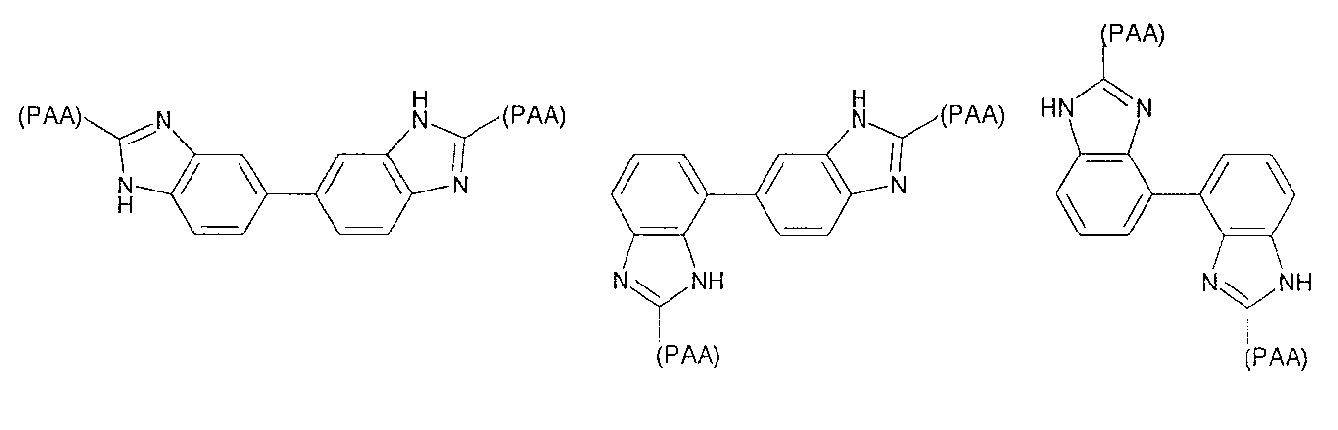
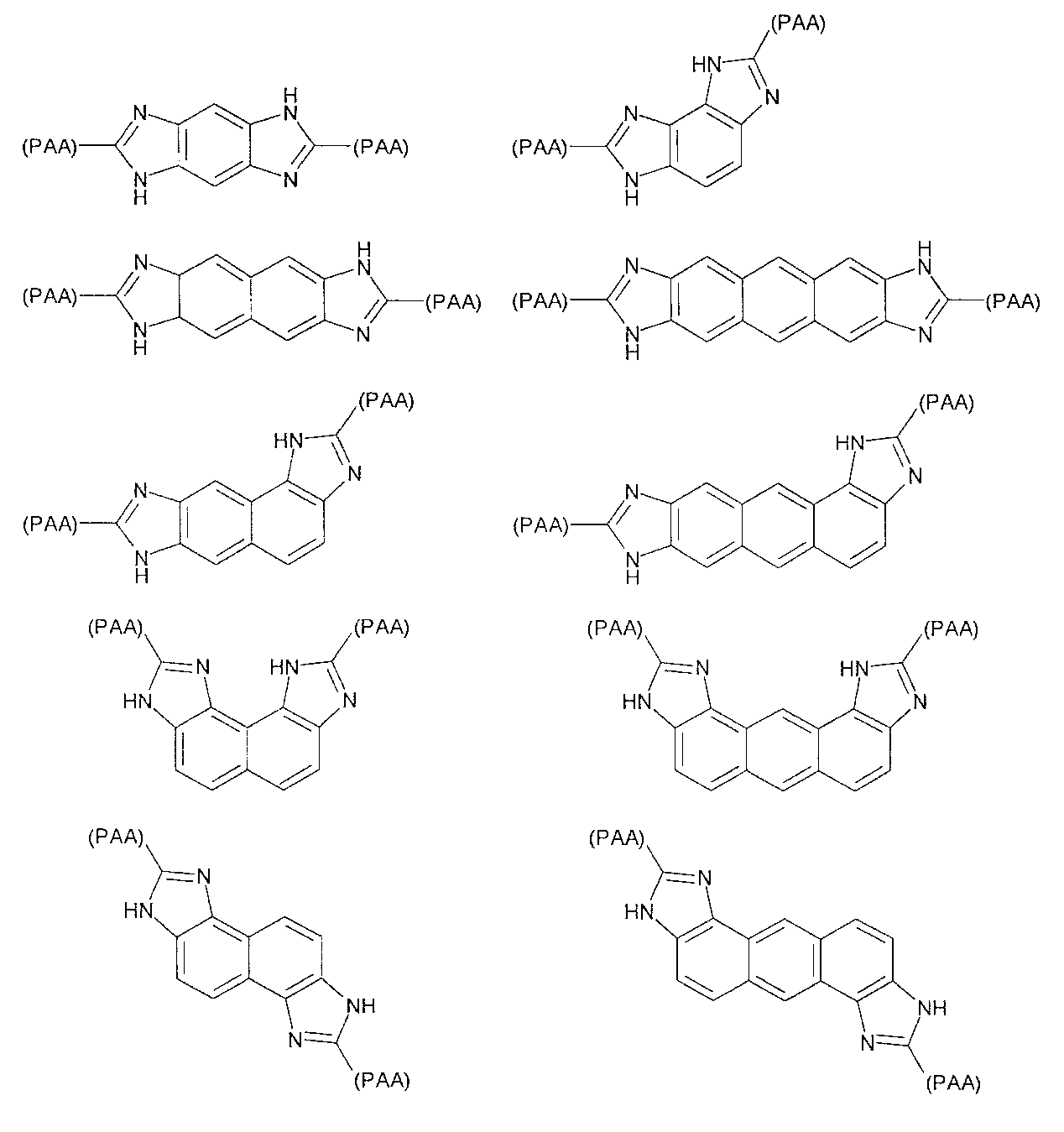
そして、加熱工程を経ることにより、(A)ポリアクリル酸と(B)多官能アミンとが縮合してなる高分子化合物が得られる。この高分子化合物は、(A)ポリアクリル酸のカルボキシル基と(B)多官能アミンにおけるC1及びC2に結合する二つのアミノ基との間、並びに(A)ポリアクリル酸のカルボキシル基と(B)多官能アミンにおけるC3及びC4に結合する二つのアミノ基との間のそれぞれにおいて、脱水縮合反応によるベンゾイミダゾール様の結合構造が形成されて、ポリアクリル酸同士が架橋された構造をなしていると考えられる。つまり、高分子化合物は、ポリアクリル酸により構成される鎖状構造と、その鎖状構造内又は鎖状構造間におけるカルボン酸側鎖(カルボキシル基)同士を接続する架橋構造とを有している。そして、その架橋構造は、下記一般式(6)で示される架橋構造である。

上記環状構造の一例として、下記一般式(2)で示される環状構造が挙げられる。

一般式(2)で示される環状構造を有する架橋構造の具体例を以下に示す。

一般式(3)で示される環状構造は、二つのベンゼン環がメチレン基又は酸素原子により連結された多環式の環状構造である。一般式(3)で示される環状構造において、各ベンゼン環におけるC1及びC2の位置、並びにC3及びC4の位置は特に限定されないが、C1及びC2が構成要素となるベンゼン環と、C3及びC4が構成要素となるベンゼン環は、異なるベンゼン環であることが好ましい。また、C1~C4に結合される4個のアミノ基に加えて、各ベンゼン環を構成する炭素原子に置換基が結合されていてもよい。
一般式(3)で示される環状構造を有する架橋構造の具体例を以下に示す。


一般式(4)で示される環状構造は、1個のベンゼン環からなる単環式の環状構造(n=0)、又は2~3個のベンゼン環が縮合してなる多環式の環状構造(n=1~2)である。一般式(3)で示される環状構造において、各ベンゼン環におけるC1及びC2の位置、並びにC3及びC4の位置は特に限定されない。また、C1~C4に結合される4個のアミノ基に加えて、各ベンゼン環を構成する炭素原子に置換基が結合されていてもよい。
また、一般式(4)で示される環状構造において、nは、1又は2であることが好ましい。この場合、C1及びC2が構成要素となるベンゼン環と、C3及びC4が構成要素となるベンゼン環は、異なるベンゼン環であることが好ましい。
一般式(4)で示される環状構造を有する架橋構造の具体例を以下に示す。
ポリアクリル酸により構成される鎖状構造において、個数割合で10~100%のカルボキシル基が架橋構造を形成していることが好ましく、20~100%のカルボキシル基が架橋構造を形成していることがより好ましい。
[負極電極]
次に、上記高分子化合物を負極用バインダーとして用いた負極電極を製造する方法の一例について記載する。
次に、上記高分子化合物を負極用バインダーとして用いた負極電極を製造する方法の一例について記載する。
まず、負極活物質、負極用バインダー、溶剤を混合してスラリーを調製する。その際、必要に応じて導電助剤等の他の成分を更に混合してもよい。
負極活物質としては、二次電池等の蓄電装置の負極活物質として用いられる公知の物質、例えば、炭素系材料、リチウムと合金化可能な元素、及びリチウムと合金化可能な元素を有する化合物を用いることができる。
負極活物質としては、二次電池等の蓄電装置の負極活物質として用いられる公知の物質、例えば、炭素系材料、リチウムと合金化可能な元素、及びリチウムと合金化可能な元素を有する化合物を用いることができる。
炭素系材料としては、例えば、リチウムを吸蔵及び放出可能な炭素系材料を用いることができ、その具体例としては、難黒鉛化性炭素、天然黒鉛、人造黒鉛、コークス類、グラファイト類、ガラス状炭素類、有機高分子化合物焼成体、炭素繊維、活性炭素、カーボンブラック類が挙げられる。
リチウムと合金化可能な元素としては、例えば、Na、K、Rb、Cs、Fr、Be、Mg、Ca、Sr、Ba、Ra、Ti、Ag、Zn、Cd、Al、Ga、In、Si、Ge、Sn、Pb、Sb、Biが挙げられる。これらのなかでも、Siが特に好ましい。
リチウムと合金化可能な元素を有する化合物としては、例えば、Na、K、Rb、Cs、Fr、Be、Mg、Ca、Sr、Ba、Ra、Ti、Ag、Zn、Cd、Al、Ga、In、Si、Ge、Sn、Pb、Sb、Biから選ばれる元素を有する化合物が挙げられる。これらのなかでも、Siを有する化合物であるシリコン系材料が特に好ましい。
シリコン系材料としては、例えば、SiB4、SiB6、Mg2Si、Ni2Si、TiSi2、MoSi2、CoSi2、NiSi2、CaSi2、CrSi2、Cu5Si、FeSi2、MnSi2、NbSi2、TaSi2、VSi2、WSi2、ZnSi2、SiC、Si3N4、Si2N2O、SiOV(0<V≦2)、SnSiO3、LiSiOが挙げられる。これらのなかでも、SiOV(0<V≦2)が特に好ましい。
また、シリコン系材料として、国際公開2014/080608号に開示される、CaSi2から脱カルシウム化反応を経て得られるシリコン材料を用いることもできる。上記シリコン材料は、例えば、CaSi2を酸(例えば、塩酸やフッ化水素)で処理して得られる層状ポリシランを、脱カルシウム化(例えば、300~1000℃の加熱処理)して得られるシリコン材料である。本実施形態の高分子化合物は、充放電時における膨張収縮の度合が大きい負極活物質であるシリコン系材料と組み合わせて用いることが特に好ましい。なお、負極活物質として、上記の物質のうちの一種のみを用いてもよいし、二種以上を併用してもよい。
スラリーに混合される負極用バインダーとしては、上記中間組成物が用いられる。
また、負極用バインダーとして、他の負極用バインダーを併用してもよい。他の負極用バインダーとしては、例えば、ポリフッ化ビニリデン、ポリ四フッ化エチレン、スチレン-ブタジエンゴム、ポリイミド、ポリアミドイミド、カルボキシメチルセルロース、ポリ塩化ビニル、メタクリル樹脂、ポリアクリロニトリル、変性ポリフェニレンオキシド、ポリエチレンオキシド、ポリエチレン、ポリプロピレン、ポリアクリル酸、フェノール樹脂が挙げられる。
また、負極用バインダーとして、他の負極用バインダーを併用してもよい。他の負極用バインダーとしては、例えば、ポリフッ化ビニリデン、ポリ四フッ化エチレン、スチレン-ブタジエンゴム、ポリイミド、ポリアミドイミド、カルボキシメチルセルロース、ポリ塩化ビニル、メタクリル樹脂、ポリアクリロニトリル、変性ポリフェニレンオキシド、ポリエチレンオキシド、ポリエチレン、ポリプロピレン、ポリアクリル酸、フェノール樹脂が挙げられる。
これらの他の負極用バインダーのうち、一種のみを併用してもよいし、二種以上を併用してもよい。なお、他の負極用バインダーを併用する場合、負極用バインダーの総固形分に対して、中間組成物の固形分が1質量%以上含まれていることが好ましく、10質量%以上含まれていることがより好ましい。
負極活物質と負極用バインダーとの質量比における配合割合(負極活物質:負極用バインダー)は、負極活物質及び負極用バインダーの種類に応じて適宜設定することができる。上記配合割合は、例えば、5:3~99:1の範囲であることが好ましく、3:1~97:3の範囲であることがより好ましく、16:3~95:5の範囲であることが更に好ましい。
溶剤としては、二次電池等の蓄電装置の電極の作製時に用いられる公知の溶剤を、負極活物質及び負極用バインダーの種類に応じて適宜用いることができる。溶剤の具体例としては、N-メチル-2-ピロリドン、メタノール、メチルイソブチルケトンが挙げられる。
導電助剤としては、二次電池等の蓄電装置の負極電極に用いられる公知の導電助剤を用いることができる。導電助剤の具体例としては、アセチレンブラック、カーボンナノチューブ、ケッチェンブラック等が挙げられる。これらの導電助剤のうち、一種のみを用いてもよいし、二種以上を併用してもよい。
なお、スラリー中に導電助剤を含有させる場合、導電助剤と共に分散剤を含有させることが好ましい。分散剤の具体例としては、ポリビニルピロリドン、ポリビニルアルコール、ポリビニルブチラール、トリアジン化合物等が挙げられる。これらの分散剤のうち、一種のみを用いてもよいし、二種以上を併用してもよい。
次いで、上記のスラリーを集電体に塗布して、集電体の表面にスラリーからなる負極活物質層を形成する。その後、負極活物質層に含有される溶媒(スラリーの溶剤、及び上記中間組成物に含有される溶媒)を除去して、負極活物質層を乾燥させるとともに、加熱処理することにより負極活物質層を硬化させる。この加熱処理により、上記中間組成物に含有される(A)ポリアクリル酸と(B)多官能アミンとが縮合して、負極活物質層中に上記高分子化合物が形成される。なお、上記加熱処理は、負極活物質層に溶媒が含まれている状態で行うこともできるが、先に乾燥処理を行い、負極活物質層を乾燥させた状態として行うことがより好ましい。
乾燥処理及び加熱処理の具体的方法としては、例えば、常圧下又は減圧下において、熱風、赤外線、マイクロ波、高周波等の熱源を用いて加熱する方法が挙げられる。加熱処理を行う際には、負極活物質層側から加熱するよりも集電体側から加熱することが好ましい。また、乾燥処理は、高温で素早く加熱するよりも、低温でゆっくりと加熱することが好ましく、加熱処理は、低温でゆっくり加熱するよりも、高温で素早く加熱することが好ましい。このように加熱することにより、蓄電装置の電池特性(初期効率やサイクル特性)を高めることができる。
集電体としては、二次電池等の蓄電装置の負極用の集電体として用いられる公知の金属材料を用いることができる。集電体として利用できる金属材料としては、例えば、銀、銅、金、アルミニウム、マグネシウム、タングステン、コバルト、亜鉛、ニッケル、鉄、白金、錫、インジウム、チタン、ルテニウム、タンタル、モリブデン、ステンレスが挙げられる。
本実施形態の高分子化合物を負極用バインダーとして用いた負極電極は、電解質として非水電解質を備える非水系の蓄電装置に好適に用いることができる。蓄電装置としては、例えば、二次電池、電気二重層コンデンサ、リチウムイオンキャパシタが挙げられる。また、こうした蓄電装置は、電気自動車及びハイブリッド自動車のモータ駆動用の非水系二次電池や、パソコン、携帯通信機器、家電製品、オフィス機器、産業機器等に利用される非水系二次電池として有用である。
次に、本実施形態の効果について記載する。
(1)本実施形態の高分子化合物は、ポリアクリル酸と、一般式(1)で示される多官能アミンとが縮合してなる化合物である。また、本実施形態の高分子化合物は、ポリアクリル酸により構成される鎖状構造と、鎖状構造内又は鎖状構造間におけるカルボン酸側鎖同士を接続する架橋構造とを有する。架橋構造は、一般式(6)で示される架橋構造である。
(1)本実施形態の高分子化合物は、ポリアクリル酸と、一般式(1)で示される多官能アミンとが縮合してなる化合物である。また、本実施形態の高分子化合物は、ポリアクリル酸により構成される鎖状構造と、鎖状構造内又は鎖状構造間におけるカルボン酸側鎖同士を接続する架橋構造とを有する。架橋構造は、一般式(6)で示される架橋構造である。
上記構成の高分子化合物は、蓄電装置のサイクル特性及び初期効率、負極活物質層の密着性の観点において、蓄電装置の負極用バインダーとして有用である。
(2)一般式(1)で示される多官能アミンの配合割合は、(A)ポリアクリル酸が有するカルボキシル基に対して、モル比で1/10~1/1となる配合割合である。また、ポリアクリル酸により構成される鎖状構造において、個数割合で20~100%のカルボキシル基が一般式(6)で示される架橋構造を形成している。
(2)一般式(1)で示される多官能アミンの配合割合は、(A)ポリアクリル酸が有するカルボキシル基に対して、モル比で1/10~1/1となる配合割合である。また、ポリアクリル酸により構成される鎖状構造において、個数割合で20~100%のカルボキシル基が一般式(6)で示される架橋構造を形成している。
上記構成によれば、当該高分子化合物を負極用バインダーとして用いた際に、蓄電装置のサイクル特性を向上させる効果が得られやすい。
上記実施形態は、次のように変更して具体化することも可能である。
上記実施形態は、次のように変更して具体化することも可能である。
高分子化合物は、一般式(6)で示される第1の架橋構造に加えて、第2の架橋構造を有する高分子化合物であってもよい。
例えば、(A)ポリアクリル酸と(B)多官能アミン(一般式(1)で示される多官能アミン)と、(C)その他の多官能アミンとが縮合してなる高分子化合物としてもよい。この場合、(B)多官能アミン由来の第1の架橋構造(一般式(6)で示される架橋構造)に加えて、(C)その他の多官能アミン由来の第2の架橋構造を更に有する高分子化合物となる。第2の架橋構造を付加することにより、高分子化合物の強度や柔軟性等の物性を調整することができる。
例えば、(A)ポリアクリル酸と(B)多官能アミン(一般式(1)で示される多官能アミン)と、(C)その他の多官能アミンとが縮合してなる高分子化合物としてもよい。この場合、(B)多官能アミン由来の第1の架橋構造(一般式(6)で示される架橋構造)に加えて、(C)その他の多官能アミン由来の第2の架橋構造を更に有する高分子化合物となる。第2の架橋構造を付加することにより、高分子化合物の強度や柔軟性等の物性を調整することができる。
その他の多官能アミンとしては、例えば、下記一般式(5)で示される多官能アミンが挙げられる。

Yが直鎖アルキル基及びフェニレン基である場合において、その構造を構成する炭素原子には置換基が結合されてもよい。例えば、直鎖アルキル基を構成する炭素原子に結合される置換基としては、メチル基、エチル基、フルオロメチル基、ジフルオロメチル基、トリフルオロメチル基、メトキシ基、エトキシ基、オキソ基が挙げられる。これらの置換基は、一種のみが結合されてもよいし、二種以上が結合されてもよい。また、一つの炭素原子に結合される置換基の数は、一つであってもよいし、二つであってもよい。また、直鎖アルキル基及びフェニレン基を構成する炭素原子に結合される置換基は、アミノ基、又はアミノ基を含む置換基であってもよく、この場合、3以上のアミノ基を有する多官能アミンとなる。
一般式(5)において、R1,R2は、それぞれ独立して、単数又は複数の水素原子、メチル基、エチル基、トリフルオロメチル基、又はメトキシ基である。R1がメチル基、エチル基、トリフルオロメチル基、又はメトキシ基である場合において、R1の結合位置は、アミノ基に対するオルト位、メタ位、パラ位のいずれであってもよい。R2についても同様である。
一般式(5)で示される多官能アミンの具体例について記載する。
Yが直鎖アルキル基である多官能アミンとしては、例えば、3,3’-ジアミノジフェニルメタン、4,4’-ジアミノジフェニルメタン、3,4’-ジアミノジフェニルメタン、4,4’-エチレンジアニリン、4,4’-ジアミノ-3,3’-ジメチルジフェニルメタン、1,1-ビス(4-アミノフェニル)シクロヘキサン、9、9-ビス(4-アミノフェニル)フルオレン、2,2’-ビス(4-アミノフェニル)ヘキサフルオロプロパン、4,4’-ジアミノベンゾフェノン、4,4’-メチレンビス(2-エチル-6-メチルアニリン)、パラローズアニリンが挙げられる。
Yが直鎖アルキル基である多官能アミンとしては、例えば、3,3’-ジアミノジフェニルメタン、4,4’-ジアミノジフェニルメタン、3,4’-ジアミノジフェニルメタン、4,4’-エチレンジアニリン、4,4’-ジアミノ-3,3’-ジメチルジフェニルメタン、1,1-ビス(4-アミノフェニル)シクロヘキサン、9、9-ビス(4-アミノフェニル)フルオレン、2,2’-ビス(4-アミノフェニル)ヘキサフルオロプロパン、4,4’-ジアミノベンゾフェノン、4,4’-メチレンビス(2-エチル-6-メチルアニリン)、パラローズアニリンが挙げられる。
Yがフェニレン基である多官能アミンとしては、例えば、1,3,5-トリス(4-アミノフェニル)ベンゼンが挙げられる。Yが酸素原子である多官能アミンとしては、例えば、4,4’-ジアミノジフェニルエーテルが挙げられる。1,3,5-トリス(4-アミノフェニル)ベンゼン、及びパラローズアニリンは、3つのアミノ基を有する三官能アミンである。(C)その他の多官能アミンとして、上記の多官能アミンのうちの一種のみを用いてもよいし、二種以上を併用してもよい。
一般式(5)で示される多官能アミン由来の架橋構造は、(A)ポリアクリル酸のカルボキシル基と、一般式(5)で示される多官能アミンのアミノ基との間にアミド結合及びイミド結合の少なくとも一方が形成されてなる下記一般式(7)~(9)から選ばれる少なくとも一種の架橋構造である。
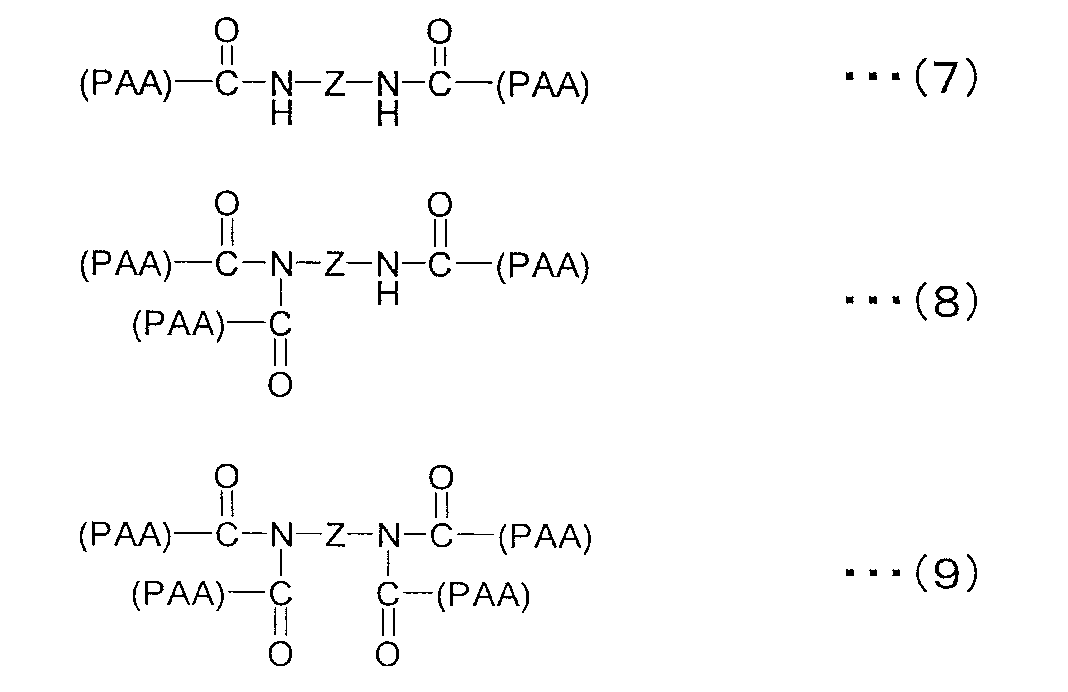

一般式(10)において、R1,R2は、それぞれ独立して、単数又は複数の水素原子、メチル基、エチル基、トリフルオロメチル基、又はメトキシ基である。R1がメチル基、トリフルオロメチル基、又はメトキシ基である場合において、R1の結合位置は、アミノ基に対するオルト位、メタ位、パラ位のいずれであってもよい。R2についても同様である。一般式(10)におけるR1,R2は、一般式(5)におけるR1,R2に準じた構造となる。
一般式(6)で示される第1の架橋構造と、一般式(7)~(9)から選ばれる少なくとも一種である第2の架橋構造とを有する高分子化合物とすることにより、負極用バインダーとして用いた場合に、負極活物質層の密着性が向上する。
(C)その他の多官能アミンの配合割合は、(B)多官能アミン(一般式(1)で示される多官能アミン)1モルに対して0.1~1.5モルであることが好ましい。また、高分子化合物において、第1の架橋構造に対する第2の架橋構造の比率は、0.1~1.5であることが好ましい。
高分子化合物は、その鎖状構造部分に、芳香族モノアミンが結合したカルボキシル基を有してもよい。
例えば、(A)ポリアクリル酸と、(B)多官能アミンと、(D)芳香族モノアミンとが縮合してなる高分子化合物としてもよい。芳香族モノアミンが結合したカルボキシル基を存在させることにより、高分子化合物の強度や柔軟性等の物性を調整することができる。
例えば、(A)ポリアクリル酸と、(B)多官能アミンと、(D)芳香族モノアミンとが縮合してなる高分子化合物としてもよい。芳香族モノアミンが結合したカルボキシル基を存在させることにより、高分子化合物の強度や柔軟性等の物性を調整することができる。
(D)芳香族モノアミンは、芳香環構造を有する芳香族化合物に、弱塩基を示すアミノ基が結合された芳香族化合物であり、(A)ポリアクリル酸のカルボキシル基と縮合可能なアミノ基を一つのみ有している。
芳香環構造としては、例えば、4員環~8員環の単環式の構造や、複数(例えば、2~3)の4員環~8員環が組み合わされた多環式の環状構造が挙げられる。芳香環構造は、炭素からなる環構造であってもよいし、炭素以外の元素を含む複素環構造であってもよい。また、(D)芳香族モノアミンは、一級アミンであってもよいし、二級アミンであってもよい。
(D)芳香族モノアミンの具体例としては、アニリン、ナフチルアミン、アミノアントラセン、アミノピレン、アミノフェノール、フルオロアニリン、クロロアニリン、ブロモアニリン、ヨードアニリン、トルイジン、アミノトリフェニルアミン、ジフルオロアニリン、ジクロロアニリン、ジブロモアニリン、ジヨードアニリン、ジメチルアニリン、トリフルオロアニリン、トリクロロアニリン、トリブロモアニリン、トリヨードアニリン、トリメチルアニリン、N,N-ジメチル-1,4-フェニレンジアミン、N,N-ジメチル-4,4’-ジアミノジフェニルメタン、アニシジン、アミノベンゼンチオール、アミノベンゾニトリルが挙げられる。上記の芳香族モノアミンのうちの一種のみを用いてもよいし、二種以上を併用してもよい。
(D)芳香族モノアミンの配合割合は、(B)多官能アミン(一般式(1)で示される多官能アミン)1モルに対して0.1~1.0モルであることが好ましい。上記割合とすることにより、高分子化合物の強度や柔軟性等の物性が大きく変化して負極用バインダーに適さなくなることを抑制できる。
以下に、上記実施形態をさらに具体化した実施例について説明する。
<試験1>
ポリアクリル酸と一般式(1)で示される多官能アミンとを縮合してなる高分子化合物を負極用バインダーとして用いた場合における、電池特性及び負極活物質層の密着性を評価した。また、比較対象として、PAAと一般式(5)で示される多官能アミンとを縮合してなる高分子化合物、又はポリアクリル酸を負極用バインダーとして用いた場合における、電池特性及び負極活物質層の剥離強度を評価した。
<試験1>
ポリアクリル酸と一般式(1)で示される多官能アミンとを縮合してなる高分子化合物を負極用バインダーとして用いた場合における、電池特性及び負極活物質層の密着性を評価した。また、比較対象として、PAAと一般式(5)で示される多官能アミンとを縮合してなる高分子化合物、又はポリアクリル酸を負極用バインダーとして用いた場合における、電池特性及び負極活物質層の剥離強度を評価した。
なお、以下では、ポリアクリル酸を「PAA」、N-メチル-2-ピロリドンを「NMP」と、それぞれ表記する。
(実施例1:PAA+3,3’-ジアミノベンジジン)
重量平均分子量13万のPAAをNMPに溶解させて、15質量%のPAA/NMP溶液を調製し、このPAA/NMP溶液3.31g(PAAのモノマー換算で6.9mmol)を窒素雰囲気下のフラスコ内に分取した。フラスコ内に、3,3’-ジアミノベンジジンの50質量%NMP溶液0.8g(1.87mmol)を加えて、室温にて30分間撹拌した。その後、110℃にて2時間、加熱処理(予備加熱処理)することにより、実施例1の中間組成物をNMP溶液の状態で得た。
(実施例1:PAA+3,3’-ジアミノベンジジン)
重量平均分子量13万のPAAをNMPに溶解させて、15質量%のPAA/NMP溶液を調製し、このPAA/NMP溶液3.31g(PAAのモノマー換算で6.9mmol)を窒素雰囲気下のフラスコ内に分取した。フラスコ内に、3,3’-ジアミノベンジジンの50質量%NMP溶液0.8g(1.87mmol)を加えて、室温にて30分間撹拌した。その後、110℃にて2時間、加熱処理(予備加熱処理)することにより、実施例1の中間組成物をNMP溶液の状態で得た。
(参考例1:PAA+4,4’-ジアミノジフェニルメタン)
重量平均分子量13万のPAAをNMPに溶解させて、15質量%のPAA/NMP溶液を調製し、このPAA/NMP溶液3.31g(PAAのモノマー換算で6.9mmol)を窒素雰囲気下のフラスコ内に分取した。フラスコ内に4,4’-ジアミノジフェニルメタンの50質量%NMP溶液0.74g(1.87mmol)を加えて、室温にて30分間撹拌した。その後、110℃にて2時間、加熱処理(予備加熱処理)することにより、参考例1の中間組成物をNMP溶液の状態で得た。
重量平均分子量13万のPAAをNMPに溶解させて、15質量%のPAA/NMP溶液を調製し、このPAA/NMP溶液3.31g(PAAのモノマー換算で6.9mmol)を窒素雰囲気下のフラスコ内に分取した。フラスコ内に4,4’-ジアミノジフェニルメタンの50質量%NMP溶液0.74g(1.87mmol)を加えて、室温にて30分間撹拌した。その後、110℃にて2時間、加熱処理(予備加熱処理)することにより、参考例1の中間組成物をNMP溶液の状態で得た。
(シリコン材料の作製)
0℃で氷浴したフッ化水素を1質量%の濃度で含有する濃塩酸20mlに、CaSi25gを加えて1時間撹拌した後、水を加えて更に5分間撹拌した。反応液を濾過して得られた黄色粉体を水及びエタノールで洗浄し、これを減圧乾燥することにより、層状ポリシランを得た。得られた層状ポリシランをアルゴン雰囲気下で800℃にて加熱することにより、ポリシランから水素が離脱したシリコン材料を得た。
0℃で氷浴したフッ化水素を1質量%の濃度で含有する濃塩酸20mlに、CaSi25gを加えて1時間撹拌した後、水を加えて更に5分間撹拌した。反応液を濾過して得られた黄色粉体を水及びエタノールで洗浄し、これを減圧乾燥することにより、層状ポリシランを得た。得られた層状ポリシランをアルゴン雰囲気下で800℃にて加熱することにより、ポリシランから水素が離脱したシリコン材料を得た。
(電極シートの作製)
上記シリコン材料77質量部、アセチレンブラック13質量部、実施例1の中間組成物のNMP溶液10質量部を混合するとともに、この混合物にNMPを加えてスラリーを調製した。集電体としての30μmの電解銅箔の表面に対して、ドクターブレード法を用いてスラリーを膜状に塗布した。そして、スラリー中のNMPを揮発させて除去することにより、電解銅箔上に負極活物質層を形成した。次いで、ロールプレス機を用いて、負極活物質層の厚さが20μmとなるように電解銅箔及び負極活物質層を圧縮することにより、電解銅箔と負極活物質層を強固に密着接合させた。その後、真空中(減圧下)にて200℃、30分の加熱処理を行うことにより、負極活物質層に含まれる中間組成物を縮合反応させるとともに、負極活物質層を加熱硬化させた。これにより、架橋構造を有する高分子化合物を負極用バインダーとして含有する電極シートを得た。
上記シリコン材料77質量部、アセチレンブラック13質量部、実施例1の中間組成物のNMP溶液10質量部を混合するとともに、この混合物にNMPを加えてスラリーを調製した。集電体としての30μmの電解銅箔の表面に対して、ドクターブレード法を用いてスラリーを膜状に塗布した。そして、スラリー中のNMPを揮発させて除去することにより、電解銅箔上に負極活物質層を形成した。次いで、ロールプレス機を用いて、負極活物質層の厚さが20μmとなるように電解銅箔及び負極活物質層を圧縮することにより、電解銅箔と負極活物質層を強固に密着接合させた。その後、真空中(減圧下)にて200℃、30分の加熱処理を行うことにより、負極活物質層に含まれる中間組成物を縮合反応させるとともに、負極活物質層を加熱硬化させた。これにより、架橋構造を有する高分子化合物を負極用バインダーとして含有する電極シートを得た。
また、実施例1の中間組成物のNMP溶液に代えて、参考例1の中間組成物のNMP溶液、又はPAAを用いて同様の電極シートを作製した。
(リチウムイオン二次電池の作製)
電極シートを直径11mmの円形に裁断してなる負極電極(評価極)と、厚さ500μmの金属リチウム箔を直径13mmの円形に裁断してなる正極電極との間にセパレータを挟装して電極体電池とした。電池ケース内に、電極体電池を収容するとともに非水電解質を注入して、電池ケースを密閉することにより、リチウムイオン二次電池を得た。なお、セパレータとしては、ヘキストセラニーズ社製ガラスフィルター及びセルガード社製celgard2400を用いた。非水電解質としては、エチレンカーボネートとジエチルカーボネートとを体積比1:1で混合した混合溶媒に、ヘキサフルオロリン酸リチウムを1Mの濃度となるように溶解させた非水電解質を用いた。
(リチウムイオン二次電池の作製)
電極シートを直径11mmの円形に裁断してなる負極電極(評価極)と、厚さ500μmの金属リチウム箔を直径13mmの円形に裁断してなる正極電極との間にセパレータを挟装して電極体電池とした。電池ケース内に、電極体電池を収容するとともに非水電解質を注入して、電池ケースを密閉することにより、リチウムイオン二次電池を得た。なお、セパレータとしては、ヘキストセラニーズ社製ガラスフィルター及びセルガード社製celgard2400を用いた。非水電解質としては、エチレンカーボネートとジエチルカーボネートとを体積比1:1で混合した混合溶媒に、ヘキサフルオロリン酸リチウムを1Mの濃度となるように溶解させた非水電解質を用いた。
(電池特性の評価)
得られたリチウムイオン二次電池について、直流電流0.2mAで負極電極における正極電極に対する電圧が0.01Vになるまで放電を行い、放電が終了してから10分後に、直流電流0.2mAで負極電極における正極電極に対する電圧が1.0Vになるまで充電を行った。このときの放電容量を初期放電容量とするとともに、充電容量を初期充電容量とした。そして、下記式に基づいて初期効率を算出した。その結果を表1に示す。
得られたリチウムイオン二次電池について、直流電流0.2mAで負極電極における正極電極に対する電圧が0.01Vになるまで放電を行い、放電が終了してから10分後に、直流電流0.2mAで負極電極における正極電極に対する電圧が1.0Vになるまで充電を行った。このときの放電容量を初期放電容量とするとともに、充電容量を初期充電容量とした。そして、下記式に基づいて初期効率を算出した。その結果を表1に示す。
初期効率(%)=(初期充電容量/初期放電容量)×100
また、上記の放電及び充電を1サイクルとして規定サイクルの充放電を行い、下記式に基づいてサイクル特性を算出した。その結果を表1に示す。
また、上記の放電及び充電を1サイクルとして規定サイクルの充放電を行い、下記式に基づいてサイクル特性を算出した。その結果を表1に示す。
サイクル特性(%)=(規定サイクル後の充電容量/初期充電容量)×100
(負極活物質層の密着性の評価)
得られた電極シートを2.5cm×4cmに裁断して測定サンプルを形成し、剥離試験装置(MINEBEA社製、LTS-50N-S300)を用いて、JIS K 6854-1に準拠した90度剥離試験を行った。90度剥離試験にて測定された強度を線幅(2.5cm)で除算することにより、測定サンプルの剥離強度を算出した。その結果を表1に示す。
(負極活物質層の密着性の評価)
得られた電極シートを2.5cm×4cmに裁断して測定サンプルを形成し、剥離試験装置(MINEBEA社製、LTS-50N-S300)を用いて、JIS K 6854-1に準拠した90度剥離試験を行った。90度剥離試験にて測定された強度を線幅(2.5cm)で除算することにより、測定サンプルの剥離強度を算出した。その結果を表1に示す。
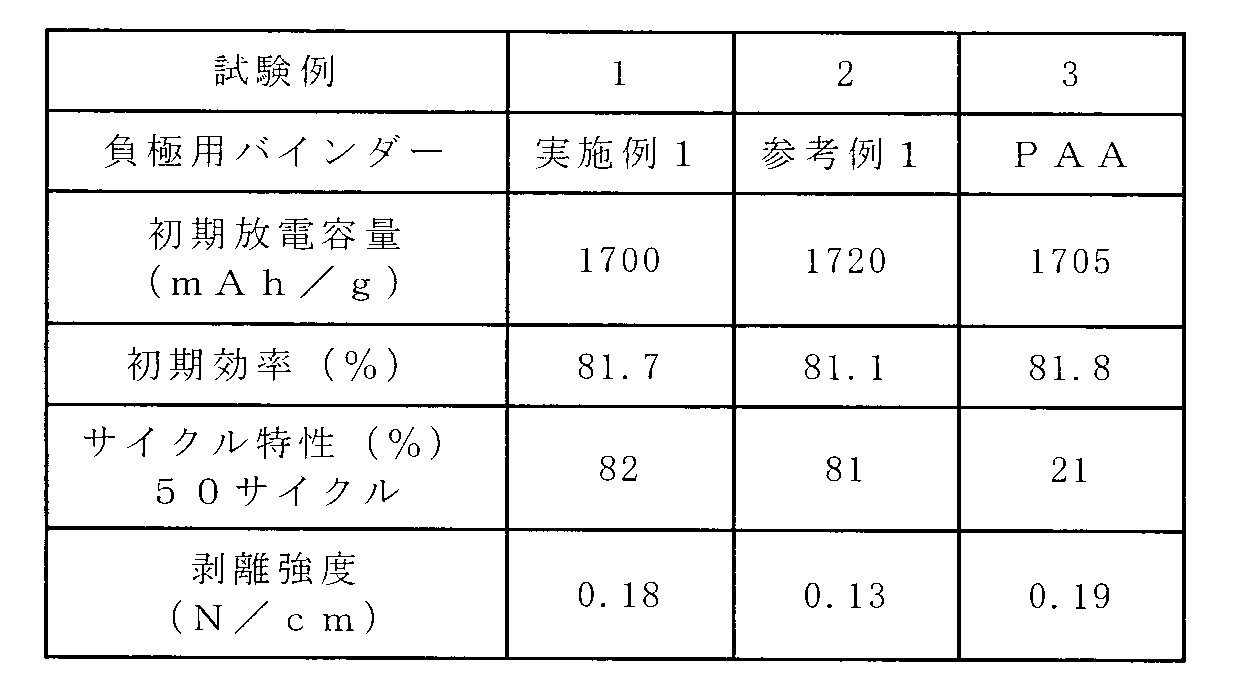
また、一般式(1)で示される多官能アミン由来の架橋構造を有する高分子化合物を負極用バインダーとして用いた試験例1においては、一般式(5)で示される多官能アミン由来の架橋構造を有する高分子化合物を負極用バインダーとして用いた試験例2と比較して、初期効率及び剥離強度が高くなる結果が得られた。この結果は、高分子化合物が有する架橋構造の違いに起因すると考えられる。
すなわち、試験例2において用いた高分子化合物が有する架橋構造は、一般式(5)で示される多官能アミンに由来し、一般式(7)~(9)で示される架橋構造である。この架橋構造は、PAAのカルボキシル基と一般式(5)で示される多官能アミンのアミノ基とがアミド結合又はイミド結合を形成してなる。そのため、架橋構造が有するアミド結合又はイミド結合におけるカルボニル基のカルボニル酸素とリチウムとの間で不可逆反応を起こしやすく、この不可逆反応によって、電極間を移動するリチウムの量が減少する結果、初期効率が低下すると考えられる。
一方、試験例1において用いた高分子化合物が有する架橋構造は、一般式(1)で示される多官能アミンに由来し、一般式(6)で示される架橋構造である。この架橋構造は、PAAのカルボキシル基と一般式(1)で示される多官能アミンの二つのアミノ基とがベンゾイミダゾール様の結合構造を形成してなる。この架橋構造の場合、カルボキシル基のカルボニル構造がイミン構造へと変換されて、カルボニル酸素が架橋構造から脱離している。そのため、アミド結合又はイミド結合を有する架橋構造のように、架橋構造部分においてカルボニル酸素とリチウムとの間で不可逆反応を起こすことがなく、初期効率が低下し難いと考えられる。加えて、ベンゾイミダゾール様の結合構造は、架橋構造が剛直であるため、高分子化合物の樹脂強度を向上させる。その結果、負極活物質層の剥離強度が高められると考えられる。
これらの結果から、一般式(1)で示される多官能アミン由来の架橋構造を有する高分子化合物は、電池特性(サイクル特性及び初期効率)、及び負極活物質層の密着性(剥離強度)の観点において、負極用バインダーとして有用であることが分かる。
<試験2>
次に、PAAと、一般式(1)で示される多官能アミンとを縮合してなる高分子化合物を負極用バインダーとして用いた場合において、上記多官能アミンの配合割合を異ならせた場合における電池特性の変化について評価した。
次に、PAAと、一般式(1)で示される多官能アミンとを縮合してなる高分子化合物を負極用バインダーとして用いた場合において、上記多官能アミンの配合割合を異ならせた場合における電池特性の変化について評価した。
(実施例1-1~1~5:PAA+3,3’-ジアミノベンジジン)
重量平均分子量13万のPAAをNMPに溶解させて、15質量%のPAA/NMP溶液を調製し、このPAA/NMP溶液3.31g(PAAのモノマー換算で6.9mmol)を窒素雰囲気下のフラスコ内に分取した。フラスコ内に、所定量の3,3’-ジアミノベンジジンの50質量%NMP溶液(0.35~6.9mmol)を加えて、室温にて30分間撹拌した。その後、110℃にて2時間、加熱処理(予備加熱処理)することにより、実施例1-1~1~5の中間組成物をNMP溶液の状態で得た。なお、各実施例における3,3’-ジアミノベンジジンの配合量、及びPAAと3,3’-ジアミノベンジジンとの配合割合は、表2に示すとおりである。
重量平均分子量13万のPAAをNMPに溶解させて、15質量%のPAA/NMP溶液を調製し、このPAA/NMP溶液3.31g(PAAのモノマー換算で6.9mmol)を窒素雰囲気下のフラスコ内に分取した。フラスコ内に、所定量の3,3’-ジアミノベンジジンの50質量%NMP溶液(0.35~6.9mmol)を加えて、室温にて30分間撹拌した。その後、110℃にて2時間、加熱処理(予備加熱処理)することにより、実施例1-1~1~5の中間組成物をNMP溶液の状態で得た。なお、各実施例における3,3’-ジアミノベンジジンの配合量、及びPAAと3,3’-ジアミノベンジジンとの配合割合は、表2に示すとおりである。
(電池特性の評価)
各実施例の中間組成物を用いて、中間組成物から得られる高分子化合物を負極用バインダーとする電極シートを作製した。得られた電極シートを用いてリチウムイオン二次電池を作製し、そのリチウムイオン二次電池の電池特性を評価した。それらの結果を表2に示す。電極シートの作製方法、リチウムイオン二次電池の作成方法、及びリチウムイオン二次電池の電池特性の評価方法は、試験1の方法と同じである。
各実施例の中間組成物を用いて、中間組成物から得られる高分子化合物を負極用バインダーとする電極シートを作製した。得られた電極シートを用いてリチウムイオン二次電池を作製し、そのリチウムイオン二次電池の電池特性を評価した。それらの結果を表2に示す。電極シートの作製方法、リチウムイオン二次電池の作成方法、及びリチウムイオン二次電池の電池特性の評価方法は、試験1の方法と同じである。

なお、試験例8においては、一般式(1)で示される多官能アミンの配合割合が、理論上、PAAが有するすべてのカルボキシル基に対して、多官能アミン由来の架橋構造が形成される配合割合(1/2)を超えている。この場合、片側の一対のアミノ基でしかPAAのカルボキシル基と結合できていない多官能アミンが残存するにもかかわらず、PAAのすべてのカルボキシル基が多官能アミンと結合した状態となることにより、PAA間に形成される架橋構造の数が少なくなる。その結果、サイクル特性の向上効果が小さいと考えられる。
<試験3>
次に、PAAと、一般式(1)で示される多官能アミンと、一般式(5)で示される多官能アミン又は芳香族モノアミンとを縮合してなる高分子化合物を負極用バインダーとして用いた場合における電池特性、及び負極活物質層の密着性を評価した。
次に、PAAと、一般式(1)で示される多官能アミンと、一般式(5)で示される多官能アミン又は芳香族モノアミンとを縮合してなる高分子化合物を負極用バインダーとして用いた場合における電池特性、及び負極活物質層の密着性を評価した。
(実施例2:PAA+3,3’-ジアミノベンジジン+4,4’-ジアミノジフェニルメタン)
重量平均分子量13万のPAAをNMPに溶解させて、15質量%のPAA/NMP溶液を調製し、このPAA/NMP溶液3.31g(PAAのモノマー換算で6.9mmol)を窒素雰囲気下のフラスコ内に分取した。フラスコ内に、3,3’-ジアミノベンジジンの50質量%NMP溶液0.4g(0.93mmol)と、4,4’-ジアミノジフェニルメタンの50質量%NMP溶液0.384g(0.93mmol)とを加えて、室温にて30分間撹拌した。その後、110℃にて2時間、加熱処理(予備加熱処理)することにより、実施例2の中間組成物をNMP溶液の状態で得た。
重量平均分子量13万のPAAをNMPに溶解させて、15質量%のPAA/NMP溶液を調製し、このPAA/NMP溶液3.31g(PAAのモノマー換算で6.9mmol)を窒素雰囲気下のフラスコ内に分取した。フラスコ内に、3,3’-ジアミノベンジジンの50質量%NMP溶液0.4g(0.93mmol)と、4,4’-ジアミノジフェニルメタンの50質量%NMP溶液0.384g(0.93mmol)とを加えて、室温にて30分間撹拌した。その後、110℃にて2時間、加熱処理(予備加熱処理)することにより、実施例2の中間組成物をNMP溶液の状態で得た。
(実施例3:PAA+3,3’-ジアミノベンジジン+3,3’-ジアミノジフェニルメタン)
重量平均分子量13万のPAAをNMPに溶解させて、15質量%のPAA/NMP溶液を調製し、このPAA/NMP溶液3.31g(PAAのモノマー換算で6.9mmol)を窒素雰囲気下のフラスコ内に分取した。フラスコ内に、3,3’-ジアミノベンジジンの50質量%NMP溶液0.4g(0.93mmol)と、3,3’-ジアミノジフェニルメタンの50質量%NMP溶液0.384g(0.93mmol)とを加えて、室温にて30分間撹拌した。その後、110℃にて2時間、加熱処理(予備加熱処理)することにより、実施例3の中間組成物をNMP溶液の状態で得た。
重量平均分子量13万のPAAをNMPに溶解させて、15質量%のPAA/NMP溶液を調製し、このPAA/NMP溶液3.31g(PAAのモノマー換算で6.9mmol)を窒素雰囲気下のフラスコ内に分取した。フラスコ内に、3,3’-ジアミノベンジジンの50質量%NMP溶液0.4g(0.93mmol)と、3,3’-ジアミノジフェニルメタンの50質量%NMP溶液0.384g(0.93mmol)とを加えて、室温にて30分間撹拌した。その後、110℃にて2時間、加熱処理(予備加熱処理)することにより、実施例3の中間組成物をNMP溶液の状態で得た。
(実施例4:PAA+3,3’-ジアミノベンジジン+4,4’-ジアミノジフェニルエーテル)
重量平均分子量13万のPAAをNMPに溶解させて、15質量%のPAA/NMP溶液を調製し、このPAA/NMP溶液3.31g(PAAのモノマー換算で6.9mmol)を窒素雰囲気下のフラスコ内に分取した。フラスコ内に、3,3’-ジアミノベンジジンの50質量%NMP溶液0.4g(0.93mmol)と、4,4’-ジアミノジフェニルエーテルの50質量%NMP溶液0.392g(0.93mmol)とを加えて、室温にて30分間撹拌した。その後、110℃にて2時間、加熱処理(予備加熱処理)することにより、実施例4の中間組成物をNMP溶液の状態で得た。
重量平均分子量13万のPAAをNMPに溶解させて、15質量%のPAA/NMP溶液を調製し、このPAA/NMP溶液3.31g(PAAのモノマー換算で6.9mmol)を窒素雰囲気下のフラスコ内に分取した。フラスコ内に、3,3’-ジアミノベンジジンの50質量%NMP溶液0.4g(0.93mmol)と、4,4’-ジアミノジフェニルエーテルの50質量%NMP溶液0.392g(0.93mmol)とを加えて、室温にて30分間撹拌した。その後、110℃にて2時間、加熱処理(予備加熱処理)することにより、実施例4の中間組成物をNMP溶液の状態で得た。
(実施例5:PAA+3,3’-ジアミノベンジジン+アニリン)
重量平均分子量13万のPAAをNMPに溶解させて、15質量%のPAA/NMP溶液を調製し、このPAA/NMP溶液3.31g(PAAのモノマー換算で6.9mmol)を窒素雰囲気下のフラスコ内に分取した。フラスコ内に、3,3’-ジアミノベンジジンの50質量%NMP溶液0.8g(1.87mmol)と、アニリンの50質量%NMP溶液0.173g(0.93mmol)とを加えて、室温にて30分間撹拌した。その後、110℃にて2時間、加熱処理(予備加熱処理)することにより、実施例5の中間組成物をNMP溶液の状態で得た。
重量平均分子量13万のPAAをNMPに溶解させて、15質量%のPAA/NMP溶液を調製し、このPAA/NMP溶液3.31g(PAAのモノマー換算で6.9mmol)を窒素雰囲気下のフラスコ内に分取した。フラスコ内に、3,3’-ジアミノベンジジンの50質量%NMP溶液0.8g(1.87mmol)と、アニリンの50質量%NMP溶液0.173g(0.93mmol)とを加えて、室温にて30分間撹拌した。その後、110℃にて2時間、加熱処理(予備加熱処理)することにより、実施例5の中間組成物をNMP溶液の状態で得た。
(電池特性、及び負極活物質層の密着性の評価)
実施例2~5の中間組成物を用いて、中間組成物から得られる高分子化合物を負極用バインダーとする電極シートを作製した。得られた電極シートを用いてリチウムイオン二次電池を作製し、そのリチウムイオン二次電池の電池特性、及び負極活物質層の密着性を評価した。それらの結果を表3に示す。電極シートの作製方法、リチウムイオン二次電池の作成方法、リチウムイオン二次電池の電池特性の評価方法、及び負極活物質層の密着性の評価方法は、試験1の方法と同じである。
実施例2~5の中間組成物を用いて、中間組成物から得られる高分子化合物を負極用バインダーとする電極シートを作製した。得られた電極シートを用いてリチウムイオン二次電池を作製し、そのリチウムイオン二次電池の電池特性、及び負極活物質層の密着性を評価した。それらの結果を表3に示す。電極シートの作製方法、リチウムイオン二次電池の作成方法、リチウムイオン二次電池の電池特性の評価方法、及び負極活物質層の密着性の評価方法は、試験1の方法と同じである。
なお、表3において、「第1の架橋構造」欄の「○」は、負極用バインダーが、一般式(1)で示される多官能アミン由来の架橋構造を有する高分子化合物であることを示している。「第2の架橋構造」欄の「○」は、負極用バインダーが、一般式(5)で示される多官能アミン由来の架橋構造を有する高分子化合物であることを示している。「モノアミン付加構造」欄の「○」は、負極用バインダーが、芳香族モノアミンが結合したカルボキシル基を有する高分子化合物であることを示している。
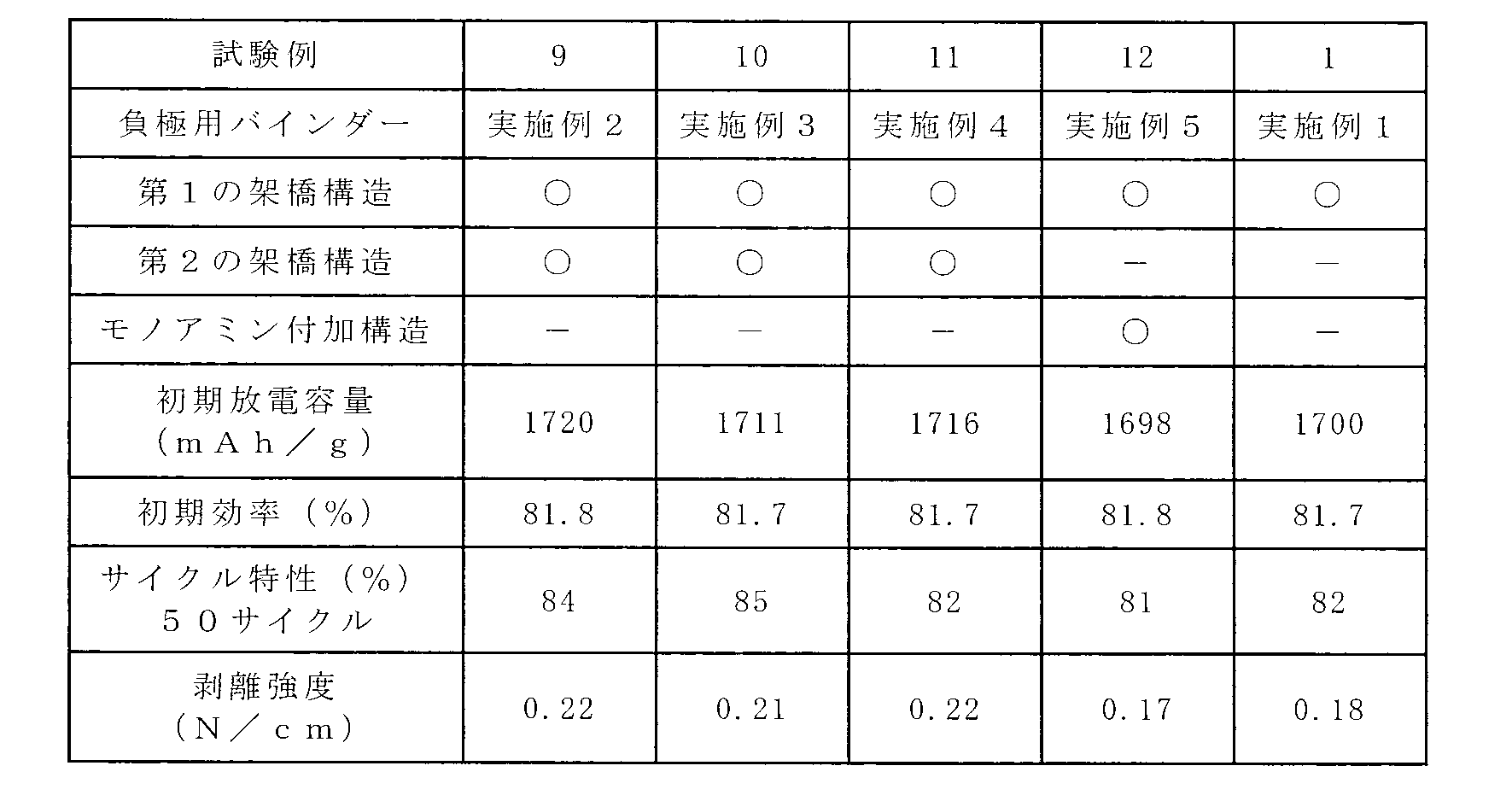
また、芳香族モノアミンが結合したカルボキシル基を有する高分子化合物を負極用バインダーとして用いた試験例12においては、すべての評価が、第1の架橋構造のみを有する高分子化合物を負極用バインダーとして用いた試験例1と同程度であった。この結果から、芳香族モノアミンが結合したカルボキシル基の存在は、一般式(1)で示される多官能アミン由来の架橋構造(第1の架橋構造)により得られる効果を阻害しないことが分かる。
Claims (11)
- 蓄電装置の負極用バインダーとして用いられる高分子化合物であって、
ポリアクリル酸と、下記一般式(1)で示される多官能アミンとが縮合してなり、
Xは、環数が1~3のベンゼン環からなる環状構造であり、C1~C4はそれぞれ、前記環状構造におけるベンゼン環を構成する炭素原子である、高分子化合物。
- 前記環状構造は、下記一般式(2)~(4)から選ばれる少なくとも一種の環状構造であり、
Aは、メチレン基又は酸素原子であり、nは、0、1、又は2である、請求項1に記載の高分子化合物。



- 前記ポリアクリル酸と、前記一般式(1)で示される多官能アミンと、下記一般式(5)で示される多官能アミンとが縮合してなり、
Yは、炭素数1~4の直鎖アルキル基、フェニレン基、又は酸素原子であり、R1,R2はそれぞれ独立して、水素原子、メチル基、トリフルオロメチル基、又はメトキシ基である、請求項1又は請求項2に記載の高分子化合物。

- 蓄電装置の負極用バインダーとして用いられる高分子化合物であって、
ポリアクリル酸により構成される鎖状構造と、前記鎖状構造内又は鎖状構造間におけるカルボン酸側鎖同士を接続する架橋構造とを有し、
前記架橋構造は、下記一般式(6)で示される架橋構造であり、
PAAは、ポリアクリル酸により構成される鎖状構造であり、Xは、環数が1~3のベンゼン環からなる環状構造であり、C1~C4はそれぞれ、前記環状構造におけるベンゼン環を構成する炭素原子である、高分子化合物。
- 前記環状構造は、下記一般式(2)~(4)から選ばれる少なくとも一種の環状構造であり、
Aは、メチレン基又は酸素原子であり、nは、0、1、又は2である、請求項4に記載の高分子化合物。



- 前記架橋構造は、前記一般式(6)で示される第1の架橋構造と、下記一般式(7)~(9)で示される架橋構造から選ばれる少なくとも一種の第2の架橋構造とを有し、
PAAは、ポリアクリル酸により構成される鎖状構造であり、Zは、下記一般式(10)で示される構造であり、
Yは、炭素数1~4の直鎖アルキル基、フェニレン基、又は酸素原子であり、R1,R2はそれぞれ独立して、水素原子、メチル基、トリフルオロメチル基、又はメトキシ基である、請求項4又は請求項5に記載の高分子化合物。


- 蓄電装置の負極用バインダーとして用いられる高分子化合物の中間組成物であって、
ポリアクリル酸と、下記一般式(1)で示される多官能アミンと、溶媒とを含有し、
Xは、環数が1~3のベンゼン環からなる環状構造であり、C1~C4はそれぞれ、前記環状構造におけるベンゼン環を構成する炭素原子である、中間組成物。
- 請求項4~6のいずれか一項に記載の高分子化合物の製造方法であって、
ポリアクリル酸と、下記一般式(1)で示される多官能アミンとを縮合させ、
Xは、環数が1~3のベンゼン環からなる環状構造であり、C1~C4はそれぞれ、前記環状構造におけるベンゼン環を構成する炭素原子である、高分子化合物の製造方法。
- 蓄電装置の負極電極であって、
請求項1~6のいずれか一項に記載の高分子化合物を含有する負極用バインダーと、負極活物質とを備え、
前記負極活物質は、リチウムを吸蔵及び放出し得る炭素系材料、リチウムと合金化可能な元素、及びリチウムと合金化可能な元素を有する化合物から選ばれる少なくとも一種である、負極電極。 - 前記負極活物質は、CaSi2から脱カルシウム化反応を経て得られるシリコン材料、Si、及びSiOV(0<V≦2)から選ばれる少なくとも一種である、請求項9に記載の負極電極。
- 請求項9又は請求項10に記載の負極電極と、非水電解質とを備える、蓄電装置。
Priority Applications (2)
| Application Number | Priority Date | Filing Date | Title |
|---|---|---|---|
| CN201780024131.5A CN109071709B (zh) | 2016-04-21 | 2017-03-27 | 高分子化合物、中间组成物、负极电极、蓄电装置以及高分子化合物的制造方法 |
| US16/094,029 US10875964B2 (en) | 2016-04-21 | 2017-03-27 | Polymeric binder of polyacrylic acid, polyfunctional amine, and linking benzene ring |
Applications Claiming Priority (2)
| Application Number | Priority Date | Filing Date | Title |
|---|---|---|---|
| JP2016085253A JP6610407B2 (ja) | 2016-04-21 | 2016-04-21 | 高分子化合物、中間組成物、負極電極、蓄電装置、及び高分子化合物の製造方法 |
| JP2016-085253 | 2016-04-21 |
Publications (1)
| Publication Number | Publication Date |
|---|---|
| WO2017183398A1 true WO2017183398A1 (ja) | 2017-10-26 |
Family
ID=60116010
Family Applications (1)
| Application Number | Title | Priority Date | Filing Date |
|---|---|---|---|
| PCT/JP2017/012436 Ceased WO2017183398A1 (ja) | 2016-04-21 | 2017-03-27 | 高分子化合物、中間組成物、負極電極、蓄電装置、及び高分子化合物の製造方法 |
Country Status (4)
| Country | Link |
|---|---|
| US (1) | US10875964B2 (ja) |
| JP (1) | JP6610407B2 (ja) |
| CN (1) | CN109071709B (ja) |
| WO (1) | WO2017183398A1 (ja) |
Cited By (5)
| Publication number | Priority date | Publication date | Assignee | Title |
|---|---|---|---|---|
| WO2020031596A1 (ja) * | 2018-08-10 | 2020-02-13 | 株式会社豊田自動織機 | 負極及び負極の製造方法並びに電極用結着剤 |
| WO2020031595A1 (ja) * | 2018-08-10 | 2020-02-13 | 株式会社豊田自動織機 | 負極の製造方法 |
| WO2020031597A1 (ja) * | 2018-08-10 | 2020-02-13 | 株式会社豊田自動織機 | 負極の製造方法及び電極用結着剤 |
| JP2020027791A (ja) * | 2018-08-10 | 2020-02-20 | 株式会社豊田自動織機 | 負極及び負極の製造方法並びに電極用結着剤 |
| WO2020066218A1 (ja) * | 2018-09-25 | 2020-04-02 | 株式会社豊田自動織機 | 負極用結着剤 |
Families Citing this family (1)
| Publication number | Priority date | Publication date | Assignee | Title |
|---|---|---|---|---|
| CN117050689B (zh) * | 2023-07-28 | 2024-03-19 | 江苏理工学院 | 一种导电聚合物粘合剂的制备方法及应用 |
Citations (4)
| Publication number | Priority date | Publication date | Assignee | Title |
|---|---|---|---|---|
| JP2009080971A (ja) * | 2007-09-25 | 2009-04-16 | Tokyo Univ Of Science | リチウムイオン電池用負極 |
| JP2009135103A (ja) * | 2007-11-28 | 2009-06-18 | Samsung Sdi Co Ltd | リチウム2次電池用負極及びこれを含むリチウム2次電池 |
| JP2012500891A (ja) * | 2008-08-25 | 2012-01-12 | ダウ グローバル テクノロジーズ エルエルシー | オリゴアミンを使用するカルボキシル含有ポリマーの架橋方法 |
| WO2016063882A1 (ja) * | 2014-10-21 | 2016-04-28 | 株式会社 豊田自動織機 | 高分子化合物、中間組成物、負極電極、蓄電装置、負極電極用スラリー、高分子化合物の製造方法、及び負極電極の製造方法 |
Family Cites Families (6)
| Publication number | Priority date | Publication date | Assignee | Title |
|---|---|---|---|---|
| DE19819752A1 (de) * | 1998-05-04 | 1999-11-11 | Basf Ag | Für elektrochemische Zellen geeignete Zusammensetzungen |
| JP2003003031A (ja) | 2001-06-25 | 2003-01-08 | Hitachi Chem Co Ltd | カルボキシル基含有樹脂組成物およびこれを用いた電池用バインダ樹脂組成物、電極および電池 |
| KR101041126B1 (ko) * | 2007-11-28 | 2011-06-13 | 삼성에스디아이 주식회사 | 리튬 이차 전지용 음극 및 이를 포함하는 리튬 이차 전지 |
| JP5534012B2 (ja) * | 2010-08-02 | 2014-06-25 | 日産自動車株式会社 | リチウムイオン二次電池用負極およびその製造方法 |
| US8653204B2 (en) * | 2010-08-04 | 2014-02-18 | Chang Gung University | Carboxylic polybenzimidazole |
| KR20160097706A (ko) * | 2015-02-09 | 2016-08-18 | 인천대학교 산학협력단 | 가역적인 산-염기 상호작용을 통해 물리적으로 가교된 실리콘 음극용 고분자 바인더 |
-
2016
- 2016-04-21 JP JP2016085253A patent/JP6610407B2/ja active Active
-
2017
- 2017-03-27 WO PCT/JP2017/012436 patent/WO2017183398A1/ja not_active Ceased
- 2017-03-27 CN CN201780024131.5A patent/CN109071709B/zh active Active
- 2017-03-27 US US16/094,029 patent/US10875964B2/en active Active
Patent Citations (4)
| Publication number | Priority date | Publication date | Assignee | Title |
|---|---|---|---|---|
| JP2009080971A (ja) * | 2007-09-25 | 2009-04-16 | Tokyo Univ Of Science | リチウムイオン電池用負極 |
| JP2009135103A (ja) * | 2007-11-28 | 2009-06-18 | Samsung Sdi Co Ltd | リチウム2次電池用負極及びこれを含むリチウム2次電池 |
| JP2012500891A (ja) * | 2008-08-25 | 2012-01-12 | ダウ グローバル テクノロジーズ エルエルシー | オリゴアミンを使用するカルボキシル含有ポリマーの架橋方法 |
| WO2016063882A1 (ja) * | 2014-10-21 | 2016-04-28 | 株式会社 豊田自動織機 | 高分子化合物、中間組成物、負極電極、蓄電装置、負極電極用スラリー、高分子化合物の製造方法、及び負極電極の製造方法 |
Cited By (6)
| Publication number | Priority date | Publication date | Assignee | Title |
|---|---|---|---|---|
| WO2020031596A1 (ja) * | 2018-08-10 | 2020-02-13 | 株式会社豊田自動織機 | 負極及び負極の製造方法並びに電極用結着剤 |
| WO2020031595A1 (ja) * | 2018-08-10 | 2020-02-13 | 株式会社豊田自動織機 | 負極の製造方法 |
| WO2020031597A1 (ja) * | 2018-08-10 | 2020-02-13 | 株式会社豊田自動織機 | 負極の製造方法及び電極用結着剤 |
| JP2020027791A (ja) * | 2018-08-10 | 2020-02-20 | 株式会社豊田自動織機 | 負極及び負極の製造方法並びに電極用結着剤 |
| JP7183707B2 (ja) | 2018-08-10 | 2022-12-06 | 株式会社豊田自動織機 | 負極及び負極の製造方法並びに電極用結着剤 |
| WO2020066218A1 (ja) * | 2018-09-25 | 2020-04-02 | 株式会社豊田自動織機 | 負極用結着剤 |
Also Published As
| Publication number | Publication date |
|---|---|
| JP6610407B2 (ja) | 2019-11-27 |
| CN109071709B (zh) | 2020-07-24 |
| CN109071709A (zh) | 2018-12-21 |
| US10875964B2 (en) | 2020-12-29 |
| JP2017195107A (ja) | 2017-10-26 |
| US20190119448A1 (en) | 2019-04-25 |
Similar Documents
| Publication | Publication Date | Title |
|---|---|---|
| JP6202217B2 (ja) | 高分子化合物、中間組成物、負極電極、蓄電装置、負極電極用スラリー、高分子化合物の製造方法、及び負極電極の製造方法 | |
| JP6610407B2 (ja) | 高分子化合物、中間組成物、負極電極、蓄電装置、及び高分子化合物の製造方法 | |
| JP6696210B2 (ja) | 負極用バインダー、中間組成物、負極電極、蓄電装置、負極電極用スラリー、高分子化合物の製造方法、及び負極電極の製造方法 | |
| JP6623808B2 (ja) | 負極電極用スラリー及び負極電極の製造方法 | |
| CN106463706A (zh) | 电极的制造方法 | |
| WO2017138395A1 (ja) | 高分子化合物、中間組成物、負極電極、蓄電装置、負極電極用スラリー、高分子化合物の製造方法、及び負極電極の製造方法 | |
| JP6365682B2 (ja) | 高分子化合物、中間組成物、負極電極、蓄電装置、負極電極用スラリー、高分子化合物の製造方法、及び負極電極の製造方法 | |
| CN115548248B (zh) | 一种正极复合材料及其制备方法、正极极片和全固态锂电池 | |
| JP6891900B2 (ja) | 負極用バインダー、中間組成物、負極電極、蓄電装置、高分子化合物の製造方法、及び蓄電装置の負極電極の製造方法 | |
| JP6642081B2 (ja) | 高分子化合物、負極用バインダー、中間組成物、負極電極、蓄電装置、負極電極用スラリー、高分子化合物の製造方法、及び負極電極の製造方法 | |
| JP6657758B2 (ja) | 中間組成物、負極電極用スラリー、及び負極電極の製造方法 | |
| JP6432371B2 (ja) | 蓄電装置用の負極電極 |
Legal Events
| Date | Code | Title | Description |
|---|---|---|---|
| NENP | Non-entry into the national phase |
Ref country code: DE |
|
| 121 | Ep: the epo has been informed by wipo that ep was designated in this application |
Ref document number: 17785740 Country of ref document: EP Kind code of ref document: A1 |
|
| 122 | Ep: pct application non-entry in european phase |
Ref document number: 17785740 Country of ref document: EP Kind code of ref document: A1 |