WO2017183259A1 - ケイ素含有硬化性組成物及びその硬化物 - Google Patents
ケイ素含有硬化性組成物及びその硬化物 Download PDFInfo
- Publication number
- WO2017183259A1 WO2017183259A1 PCT/JP2017/004412 JP2017004412W WO2017183259A1 WO 2017183259 A1 WO2017183259 A1 WO 2017183259A1 JP 2017004412 W JP2017004412 W JP 2017004412W WO 2017183259 A1 WO2017183259 A1 WO 2017183259A1
- Authority
- WO
- WIPO (PCT)
- Prior art keywords
- group
- silicon
- general formula
- curable composition
- represented
- Prior art date
- Legal status (The legal status is an assumption and is not a legal conclusion. Google has not performed a legal analysis and makes no representation as to the accuracy of the status listed.)
- Ceased
Links
Classifications
-
- C—CHEMISTRY; METALLURGY
- C08—ORGANIC MACROMOLECULAR COMPOUNDS; THEIR PREPARATION OR CHEMICAL WORKING-UP; COMPOSITIONS BASED THEREON
- C08K—Use of inorganic or non-macromolecular organic substances as compounding ingredients
- C08K3/00—Use of inorganic substances as compounding ingredients
-
- C—CHEMISTRY; METALLURGY
- C08—ORGANIC MACROMOLECULAR COMPOUNDS; THEIR PREPARATION OR CHEMICAL WORKING-UP; COMPOSITIONS BASED THEREON
- C08K—Use of inorganic or non-macromolecular organic substances as compounding ingredients
- C08K5/00—Use of organic ingredients
- C08K5/54—Silicon-containing compounds
- C08K5/548—Silicon-containing compounds containing sulfur
-
- C—CHEMISTRY; METALLURGY
- C08—ORGANIC MACROMOLECULAR COMPOUNDS; THEIR PREPARATION OR CHEMICAL WORKING-UP; COMPOSITIONS BASED THEREON
- C08G—MACROMOLECULAR COMPOUNDS OBTAINED OTHERWISE THAN BY REACTIONS ONLY INVOLVING UNSATURATED CARBON-TO-CARBON BONDS
- C08G77/00—Macromolecular compounds obtained by reactions forming a linkage containing silicon with or without sulfur, nitrogen, oxygen or carbon in the main chain of the macromolecule
- C08G77/04—Polysiloxanes
- C08G77/20—Polysiloxanes containing silicon bound to unsaturated aliphatic groups
-
- C—CHEMISTRY; METALLURGY
- C08—ORGANIC MACROMOLECULAR COMPOUNDS; THEIR PREPARATION OR CHEMICAL WORKING-UP; COMPOSITIONS BASED THEREON
- C08K—Use of inorganic or non-macromolecular organic substances as compounding ingredients
- C08K3/00—Use of inorganic substances as compounding ingredients
- C08K3/01—Use of inorganic substances as compounding ingredients characterized by their specific function
- C08K3/013—Fillers, pigments or reinforcing additives
-
- C—CHEMISTRY; METALLURGY
- C08—ORGANIC MACROMOLECULAR COMPOUNDS; THEIR PREPARATION OR CHEMICAL WORKING-UP; COMPOSITIONS BASED THEREON
- C08K—Use of inorganic or non-macromolecular organic substances as compounding ingredients
- C08K5/00—Use of organic ingredients
- C08K5/54—Silicon-containing compounds
- C08K5/541—Silicon-containing compounds containing oxygen
- C08K5/5415—Silicon-containing compounds containing oxygen containing at least one Si—O bond
-
- C—CHEMISTRY; METALLURGY
- C08—ORGANIC MACROMOLECULAR COMPOUNDS; THEIR PREPARATION OR CHEMICAL WORKING-UP; COMPOSITIONS BASED THEREON
- C08L—COMPOSITIONS OF MACROMOLECULAR COMPOUNDS
- C08L83/00—Compositions of macromolecular compounds obtained by reactions forming in the main chain of the macromolecule a linkage containing silicon with or without sulfur, nitrogen, oxygen or carbon only; Compositions of derivatives of such polymers
- C08L83/04—Polysiloxanes
Definitions
- the present invention relates to a silicon-containing curable composition and a cured product obtained by curing the same.
- the silicon-containing curable composition and the cured product thereof of the present invention are useful for materials for semiconductors, particularly for packages and lead frames for LEDs and the like.
- an object of the present invention is to provide a silicon-containing curable composition capable of producing a cured product which is excellent in adhesion to a silver base and a copper base and useful for electric and electronic materials and the like.
- the present inventors came to complete this invention, as a result of earnestly examining in order to solve the said subject paying attention to the structure and prepolymer of a specific silicon containing compound.
- the present invention A compound having a carbon-carbon double bond having reactivity with SiH group as the component (A) Siloxane compounds having an SiH group as the component (B) As the component (C), a silane compound represented by the following general formula (1),
- the present invention provides a silicon-containing curable composition characterized by containing a filler as the component (D).
- R 1 represents a hydrogen atom or an alkyl group having 1 to 4 carbon atoms
- A represents an alkanediyl group having 1 to 10 carbon atoms
- k represents a number of 2 or 3
- the present invention also provides a method of curing the above-mentioned silicon-containing curable composition, which comprises heating the above-mentioned silicon-containing curable composition.
- the present invention also provides a cured product obtained by curing the above-mentioned silicon-containing curable composition.
- the component (A) is a compound having a carbon-carbon double bond having reactivity with SiH groups.
- the bonding position of the carbon-carbon double bond having reactivity with the SiH group is not particularly limited, and any position in the molecule is possible.
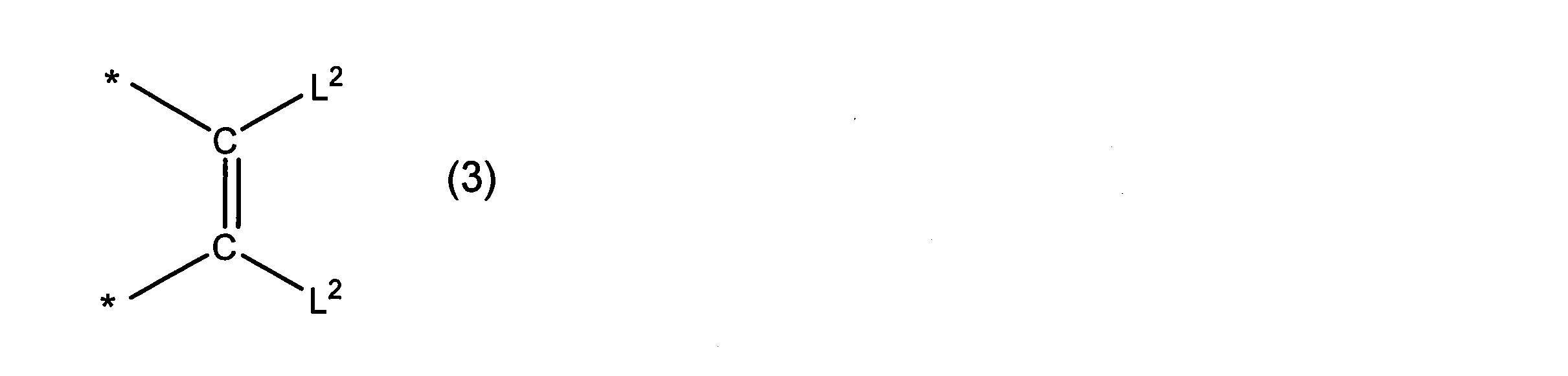
- the carbon-carbon double bond having reactivity with the SiH group is not particularly limited, and for example, it is represented by the group represented by the following general formula (2) and the following general formula (3) Mention may be made of groups forming an alicyclic ring.
- the use of a group forming an alicyclic ring represented by the following general formula (3) is preferable because the heat resistance of the cured product is increased.
- an organic compound having a carbon-carbon double bond having reactivity with an SiH group (hereinafter abbreviated as (A- ⁇ )
- silicone compounds having a carbon-carbon double bond having reactivity with SiH groups (hereinafter sometimes abbreviated as (A- ⁇ )) can be mentioned as compounds which can be preferably used.
- A- ⁇ only one type of compound can be used, or a plurality of types of compounds having different structures can be used.
- (A- ⁇ ) and (A- ⁇ ) can be used as a mixture.
- the above (A- ⁇ ) is not particularly limited as long as it is an organic compound having a carbon-carbon double bond having reactivity with a SiH group, and C, H, N, O, S and The organic compound which does not contain elements other than a halogen is preferable.
- trimethallyl isocyanurate and triallyl isocyanurate can be mentioned. These are commercially available as Tike and Tike derivatives (manufactured by Nippon Kasei Co., Ltd.), and these commercially available products can be used as (A- ⁇ ) in the present invention.
- the above (A- ⁇ ) is not particularly limited as long as it is a silicone compound having a carbon-carbon double bond having reactivity with a SiH group, and for example, a unit represented by the following general formula (4)
- the silicon-containing polymer to contain can be mentioned.
- R 2 represents an alkenyl group having 2 to 6 carbon atoms, and * represents a bond).
- Examples of the alkenyl group having 2 to 6 carbon atoms represented by R 2 in the general formula (4) include a vinyl group, 2-propenyl group, 3-butenyl group and the like.
- R 2 is preferably a vinyl group from the viewpoint of reactivity.
- the silicon-containing polymer containing a unit represented by the general formula (4) is, for example, hydrolyzing / condensing only one or more of organosilanes represented by the following general formula (A-1), or From one or more of organosilanes represented by the following general formula (A-1), an organosilane represented by the following general formula (A-2), and an organosilane represented by the following general formula (A-3) It can be produced by hydrolyzing and condensing a mixture containing at least one selected organosilane.
- R 3 represents an alkenyl group having 2 to 6 carbon atoms
- R 4 , R 5, and R 6 each independently represent a hydrogen atom or a hydrocarbon group
- X 1 represents a hydroxyl group, 1 to carbon atoms 6 represents an alkoxy group or a halogen atom.
- Examples of the alkenyl group having 2 to 6 carbon atoms represented by R 3 in the above general formula (A-1) include a vinyl group, 2-propenyl group, 3-butenyl group and the like.
- R 3 is preferably a vinyl group from the viewpoint of reactivity.
- hydrocarbon group represented by R 4 , R 5 and R 6 aliphatic carbonization such as alkyl group, alkenyl group and alkynyl group
- examples thereof include an alicyclic hydrocarbon group such as a hydrogen group and a cycloalkyl group, and an aromatic hydrocarbon group such as an aryl group and an arylalkyl group.
- the hydrocarbon group is preferably one having 1 to 10 carbon atoms.
- the alkoxy group having 1 to 6 carbon atoms represented by X 1 is a methoxy group And an ethoxy group, a propoxy group, a butoxy group and the like, and the halogen atom represented by X 1 includes a chlorine atom, a bromine atom, an iodine atom and the like. From the viewpoint of reactivity, X 1 is preferably a methoxy group or an ethoxy group.
- the respective X 1 's in the general formulas (A-1) to (A-3) may be the same as or different from each other.
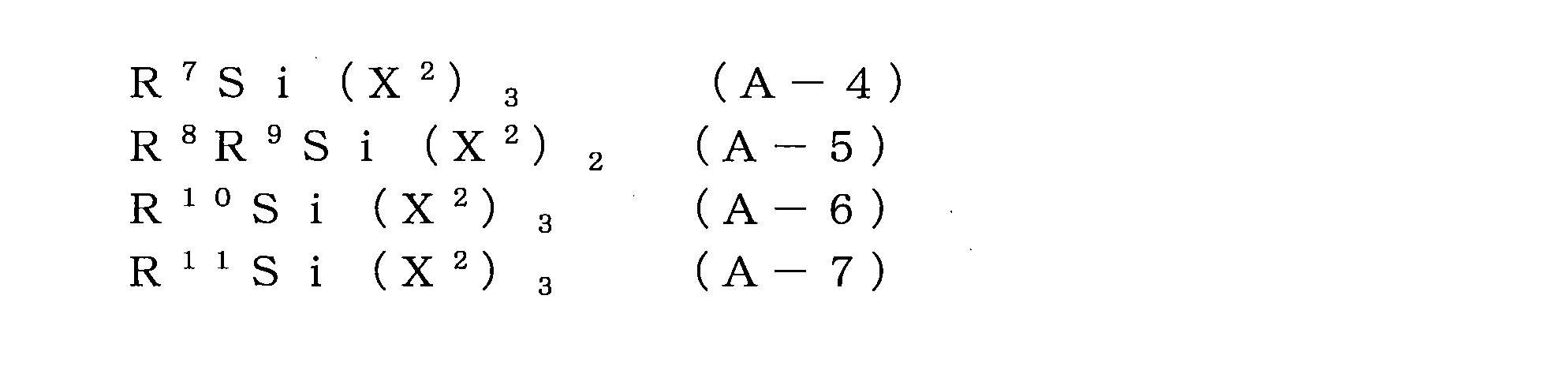
- One or more of 0 to 40 mol% of the organosilane (hereinafter sometimes abbreviated as (e)) represented by the general formula (A-7), and the organosilane (b) and the organosilane (c) It is obtained by hydrolyzing / condensing an organosilane mixture having a sum of 5 to 60 mol
- R 7 represents a hydrogen atom or an alkyl group having 1 to 6 carbon atoms
- R 8 and R 9 each independently represent a hydrogen atom, an alkyl group having 1 to 6 carbon atoms, or 2 to 6 carbon atoms
- R 10 represents an alkenyl group of 6 or a phenyl group which may be substituted with an alkyl group having 1 to 6 carbon atoms, and at least one of R 7 , R 8 and R 9 is a methyl group
- R 10 Represents a phenyl group which may be substituted by an alkyl group having 1 to 6 carbon atoms
- R 11 represents an epoxy group having 2 to 10 carbon atoms
- X 2 represents a hydroxyl group
- 1 to 6 carbon atoms 6 represents an alkoxy group or a halogen atom.
- the alkyl group having 1 to 6 carbon atoms represented by R 7 may be linear, branched or cyclic, and specific examples thereof include a methyl group and an ethyl group. And a propyl group, an isopropyl group, a butyl group, an s-butyl group, a t-butyl group, an isobutyl group, an amyl group, an isoamyl group, a t-amyl group, a hexyl group and a cyclohexyl group.
- R 7 is preferably a methyl group from the viewpoint of reactivity.
- Examples of the alkyl group of 1 to 6 include the same ones as those mentioned as the ones represented by R 7 above.
- Examples of the alkenyl group having 2 to 6 carbon atoms represented by R 8 and R 9 include the same ones as those exemplified as the above represented by R 3 .
- R 8 and R 9 are preferably a methyl group or an unsubstituted phenyl group, particularly preferably a methyl group.
- the alkyl group having 1 to 6 carbon atoms which may substitute the phenyl group represented by R 10 is the same as the one represented as the above R 7
- the ones of R 10 is preferably a non-substituted phenyl group from the viewpoint of industrial availability.
- the epoxy group having 2 to 10 carbon atoms represented by R 11 is a substituent having a three-membered cyclic ether, and examples thereof include an epoxyethyl group, a glycidyl group, 2 , 3-epoxybutyl, 3,4-epoxybutyl, epoxyethylphenyl, 4-epoxyethylphenylethyl, 3,4-epoxycyclohexyl, 2- (3,4-epoxycyclohexyl) ethyl, 2 And 3-epoxynorbornylethyl group.
- R 11 is preferably a glycidyl group, a 3,4-epoxycyclohexyl group or a 2- (3,4-epoxycyclohexyl) ethyl group from the viewpoint of imparting adhesion to different materials.
- Examples of the alkoxy group having 1 to 6 carbon atoms represented by X 2 in the general formulas (A-4) to (A-7) include a methoxy group, an ethoxy group, a propoxy group and a butoxy group.
- the halogen atom represented by X 2 a chlorine atom, a bromine atom, and an iodine atom.
- X 2 is preferably a methoxy group or an ethoxy group.
- the X 1 in the general formula (A-1) and the respective X 2 in the general formulas (A-4) to (A-7) may be identical to or different from each other.
- the hydrolysis / condensation reaction of alkoxysilanes is carried out by performing so-called sol-gel reactions.
- the sol-gel reaction preferably includes a method of carrying out a hydrolysis / condensation reaction with a catalyst such as an acid or a base in the absence or in a solvent.
- the solvent used here is not particularly limited, and specifically, water, methanol, ethanol, n-propanol, isopropanol, n-butanol, isobutanol, t-butanol, acetone, methyl ethyl ketone, dioxane, tetrahydrofuran, toluene and the like It is possible to use one of them or a mixture of two or more.
- the hydrolysis / condensation reaction of the above alkoxysilane proceeds by the formation of a silanol group (Si-OH) by hydrolysis with water by alkoxysilane, and condensation of the generated silanol groups or between the silanol group and the alkoxy group.
- Si-OH silanol group
- condensation of the generated silanol groups or between the silanol group and the alkoxy group it is preferable to add an appropriate amount of water, which can be added in a solvent or the catalyst can be added dissolved in water.
- the hydrolysis / condensation reaction also proceeds by the moisture in the air or a trace of moisture contained in the solvent.
- the catalyst such as acid or base used in the above hydrolysis / condensation reaction is not particularly limited as long as it promotes the hydrolysis / condensation reaction, and specifically, inorganic acids such as hydrochloric acid, phosphoric acid, sulfuric acid and the like; Organic acids such as acetic acid, oxalic acid, p-toluenesulfonic acid and monoisopropyl phosphate; inorganic bases such as sodium hydroxide, potassium hydroxide, lithium hydroxide and ammonia; etc.
- tyl acetate such as trimethylamine, triethylamine, monoethanolamine and diethanolamine Amine compounds; titanium esters such as tetraisopropyl titanate and tetrabutyl titanate; tin carboxylates such as dibutyltin laurate and tin octylate; boron compounds such as trifluoroboron; metals such as iron, cobalt, manganese and zinc Chlorides and metal carboxylates such as naphthenate or octylate ; Include aluminum compounds such as aluminum tris acetyl acetate are also using these one can also be used in combination of two or more.
- the method of adding a base catalyst and performing a polycondensation reaction under basicity (pH 7 or more) is mentioned as a preferable example.
- an acid catalyst can be added and hydrolysis and dehydration polycondensation can also be performed under acidity (pH 7 or less).
- the reaction system is preferably stirred, and the reaction can be promoted by heating to 40 to 150 ° C.
- the order of the hydrolysis / condensation reaction is not particularly limited.
- an alkoxysilane (R 3 Si (X 1 ) 3 ) having an alkenyl group and other alkoxysilanes (R 7 Si (X 2 ) 3 , R 8 R) Both 9 Si (X 2 ) 2 , R 10 Si (X 2 ) 3 , and R 11 Si (X 2 ) 3 ) can be mixed to carry out hydrolysis and condensation reactions, and among these five components, It is also possible to conduct hydrolysis and condensation reaction by adding another alkoxysilane after performing hydrolysis and condensation reaction to the extent that only one alkoxysilane is used.
- X 1 or X 2 is a hydroxyl group and one in which X 1 or X 2 is an alkoxy group can be used in combination, and in this case, those in which X 1 and X 2 are hydroxyl groups are hydrolyzed It can be used without decomposition.
- the hydrolysis / condensation reaction can be carried out as in the case of the alkoxysilane.
- reaction solvent, water and catalyst may be removed, for example, after a solvent such as toluene is added and the solvent is extracted,
- the extraction solvent may be distilled off under reduced pressure under a nitrogen stream.
- the organosilane (a) in the organosilane mixture is preferably 10 to 40 mol% from the viewpoint of controlling the crosslink density at the time of curing.
- the organosilanes (b) and (c) may be free of any one component as long as the sum of the organosilane (b) and the organosilane (c) is 5 to 60 mol%.
- the amount of organosilane (b) is preferably 20 to 40 mol% from the viewpoint of controlling the crosslink density during curing, and the amount of organosilane (c) is 10 to 25 from the viewpoint of imparting flexibility to the resin. It is preferable that it is mol%.
- the organosilane (d) may not be used, but is preferably 5 to 45 mol% from the viewpoint of control of the resin melting temperature. Although the organosilane (e) may not be used, it is preferably 5 to 25% by mole from the viewpoint of adhesion to different materials.
- the sum of the organosilane (b) and the organosilane (c) is preferably 25 to 55% by mole from the viewpoint of control of the crosslinking density at the time of curing.
- the organosilane contained in the above organosilane mixture is only the five components of organosilane (a), (b), (c), (d) and (e) from the viewpoint of molecular weight control of the silicon-containing polymer. Is preferred.
- the above is the (R 3 SiO 3/2) and shall also include (R 3 SiX'O 2/2), the above (R 7 SiO 3/2) (R 7 SiX'O 2/2) also contains The above (R 10 SiO 3/2 ) also includes (R 10 SiX′O 2/2 ), and the above (R 11 SiO 3/2 ) also includes (R 11 SiX′O 2/2 ).
- X ′ is the same as X 1 and X 2 contained in each of organosilanes (a), (b), (d) and (e), or represents an OH group.
- the proportion of phenyl groups in all organic components is 50% by mass or less, in particular 40% by mass or less Some of them are preferable, and those in which the ratio of methyl groups is 85% by mass or less, particularly 70% by mass or less are preferable.
- the proportion of the phenyl group is large, the melting point of the silicon-containing polymer becomes high and it becomes difficult to melt at the temperature at the time of molding, and it becomes difficult to increase the molecular weight of the cured product (polymer) at the time of molding.
- the proportion of phenyl group is small and the proportion of methyl group is large, and the ratio of the proportion of phenyl group to the proportion of methyl group (the former: the latter) is more preferably 30:50 to 30:80. .
- silicon-containing polymers containing units represented by the above general formula (4) silicon-containing polymers having a weight average molecular weight of 300 to 100,000 in terms of polystyrene conversion are preferable, and the weight average molecular weight is more preferable. Is in the range of 800 to 50,000.
- the weight average molecular weight of the silicon-containing polymer is smaller than 300, the thermal stability may be deteriorated, and if it is larger than 100,000, the resin may not melt at the processing temperature in transfer molding, or it may melt Also, the fluidity of the resin is low at high viscosity, and the moldability may be reduced.
- the silicon-containing polymer containing the unit represented by the above general formula (4) can also be used after modification.
- the modification to be applied to the silicon-containing polymer is not particularly limited, and various modifications that can be performed to make the silicone resin a reactive silicone resin are possible. More specifically, amino modification, epoxy modification, Carboxyl modification, carbinol modification, methacryl modification, mercapto modification, phenol modification, etc. can be performed by a conventional method.
- the silicon-containing polymer containing the unit represented by the above general formula (4) detailed above can be used alone or as a mixture of two or more.
- the siloxane compound which contains one or more carbon-carbon double bond which has the reactivity with Si-H group for example is mentioned. It can be mentioned.
- the siloxane compound is not particularly limited as long as it is a siloxane compound containing one or more carbon-carbon double bonds having reactivity with Si-H group in one molecule, for example, A variety of linear, cyclic, branched, and partial networks can be used. Among these, a siloxane compound containing two or more carbon-carbon double bonds having reactivity with Si-H group in one molecule is preferable, and carbon-carbon two having reactivity with Si-H group is preferable.
- a linear siloxane compound containing two or more heavy bonds in one molecule or a cyclic siloxane compound containing two or more carbon-carbon double bonds having reactivity with Si-H group in one molecule In the case, a silicon-containing curable composition having higher adhesion is particularly preferable.
- the linear siloxane compound containing two or more carbon-carbon double bonds having reactivity with the above Si-H group in one molecule is carbon-carbon double bonds having reactivity with Si-H groups Is a linear siloxane copolymer containing two or more in one molecule.
- the linear siloxane copolymer may be a random copolymer or a block copolymer.
- the number of carbon-carbon double bonds having reactivity with Si-H groups is preferably 2 to 10, and more preferably 2 to 6 from the viewpoint of the crosslink density of the cured product.
- alkenyl groups such as vinyl group, 2-propenyl group, 3-butenyl group and the like
- linear siloxane copolymers containing two or more carbon-carbon double bonds having reactivity with Si-H groups in one molecule the following general compounds are particularly preferable from the viewpoint of physical properties of the cured product:
- the linear siloxane copolymer represented by Formula (A-8) can be mentioned.
- R 12 and R 31 each independently represent an alkenyl group having 2 to 6 carbon atoms, an alkyl group having 1 to 6 carbon atoms, an epoxy group having 2 to 10 carbon atoms, or a trimethylsilyl group
- R 13 , R 14 , R 15 , R 16 , R 20 , R 24 , R 28 , R 29 and R 30 each independently represent a hydrogen atom or an alkyl group having 1 to 6 carbon atoms
- R 17 , R 18 and R 19 each represent a phenyl group
- R 21 , R 22 and R 23 each independently represent an alkenyl group having 2 to 6 carbon atoms
- R 25 , R 26 and R 27 each independently represent
- an epoxy group having 2 to 10 carbon atoms and R 12 and R 31 each being an alkyl group having 1 to 6 carbon atoms, v ⁇ 1 or v + w ⁇ 2, R 13 , R 14 and R 15, R 16, R 20, 24, when at least one of R 28, R 29 and R 30 are hydrogen
- alkenyl group having 2 to 6 carbon atoms represented by R 12 and R 31 and R 21 , R 22 and R 23 in the above general formula (A-8) those represented by R 3 above can be mentioned The same as those mentioned above can be mentioned.
- examples of the alkyl group having 1 to 6 carbon atoms represented by R 12 and R 31 and R 13 , R 14 , R 15 , R 16 , R 20 , R 24 , R 28 , R 29 and R 30 include the above-mentioned The same ones as listed for R 7 can be mentioned.
- examples of the epoxy group having 2 to 10 carbon atoms represented by R 12 and R 31 and R 25 , R 26 and R 27 include the same ones as those exemplified as the above R 11 .
- R 12 and R 31 are preferably a vinyl group or 2-propenyl group from the viewpoint of reactivity
- R 13 , R 14 , R 15 , R 16 , R 20 , R 24 , R 28 , R 29 and R 30 are preferably a methyl group or an ethyl group from the viewpoint of industrial availability
- R 21 , R 22 and R 23 are preferably a vinyl group or 2-amino group from the viewpoint of industrial availability.
- Propenyl is preferred.
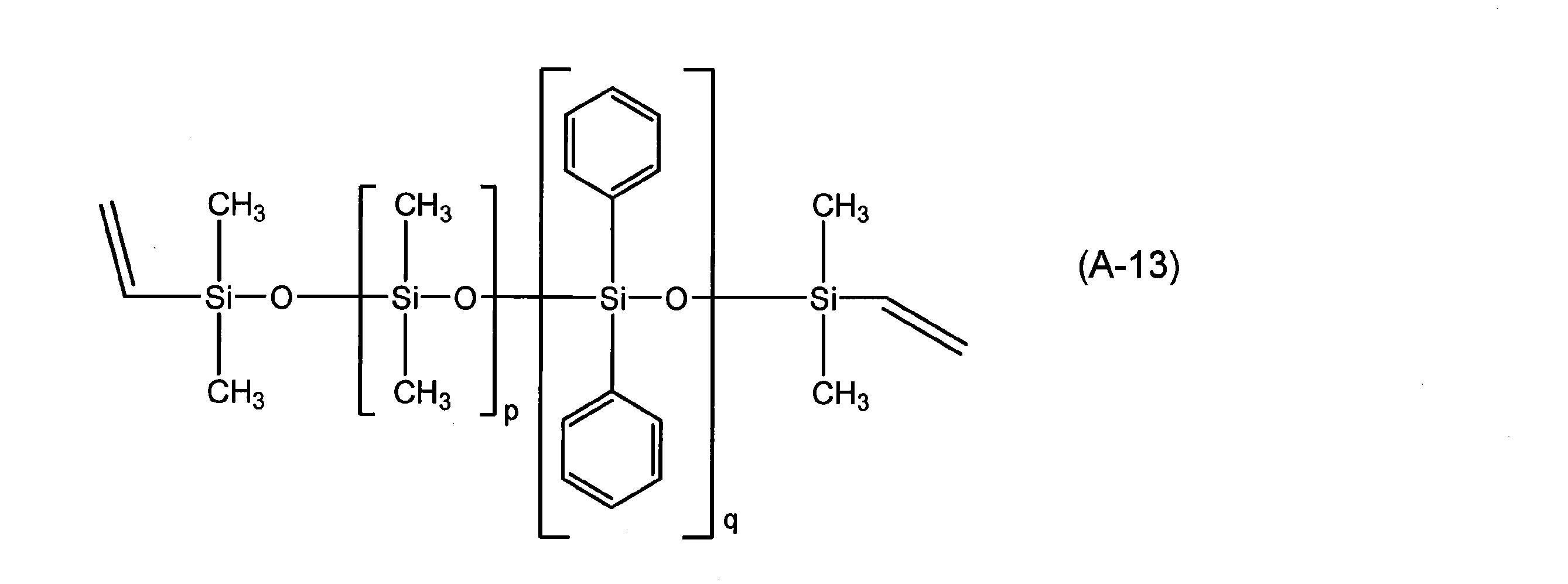
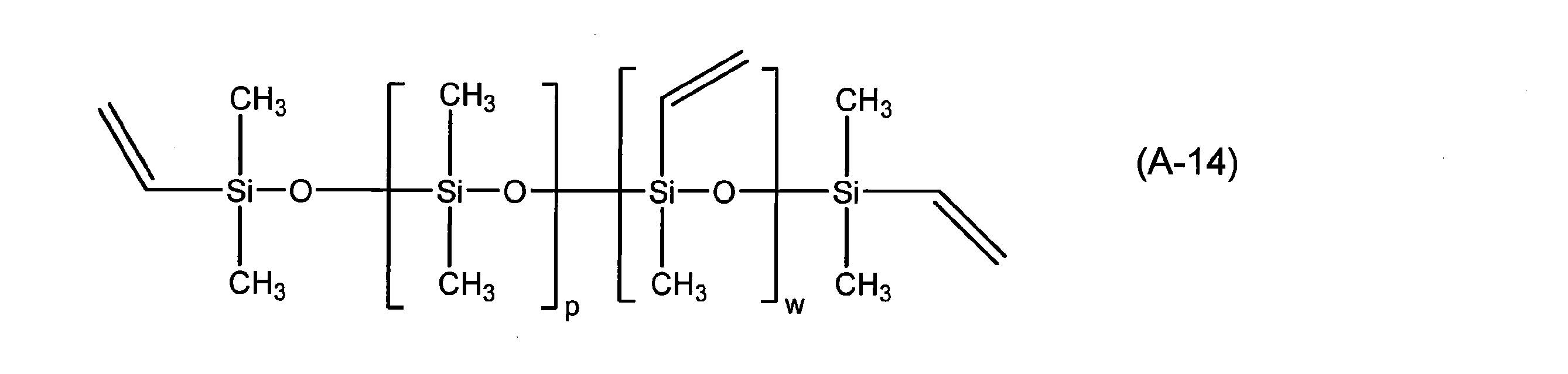
- the linear siloxane copolymer containing two or more carbon-carbon double bonds having reactivity with Si-H group in one molecule the following formula (A And -9) to (A-17).
- the number of carbon-carbon double bonds is preferably 2 to 10 And 2 to 6 are more preferable because the crosslink density of the cured product is increased.
- cyclic siloxane compounds containing two or more carbon-carbon double bonds having reactivity with Si-H groups in one molecule the following general formula (A-) is particularly preferable from the viewpoint of physical properties of a cured product:
- the cyclic siloxane compound represented by 18) can be mentioned.
- R 32 , R 33 and R 34 each represent an alkyl group having 1 to 6 carbon atoms or a phenyl group, and n R 32 may be the same or different, and m R 33 and m R 34 may also be the same or different, and n represents a number of 2 to 10, m represents a number of 0 to 8, and m + n22).
- R 32 , R 33 and R 34 examples include the same ones as those mentioned as the one represented by R 7 above.
- R 32 , R 33 and R 34 are preferably a methyl group or a phenyl group.
- n is preferably 2 to 4 because the crosslink density is good, and m is preferably 1 to 3 from the viewpoint of viscosity.
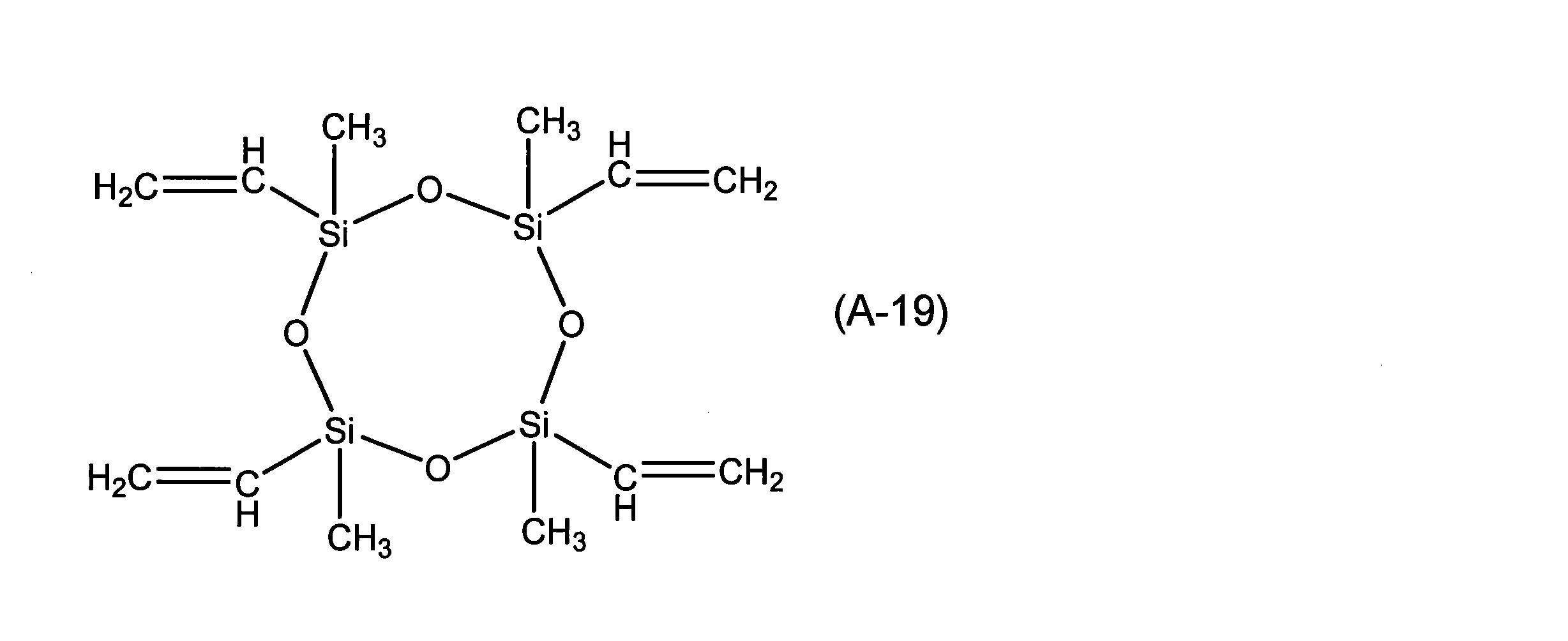
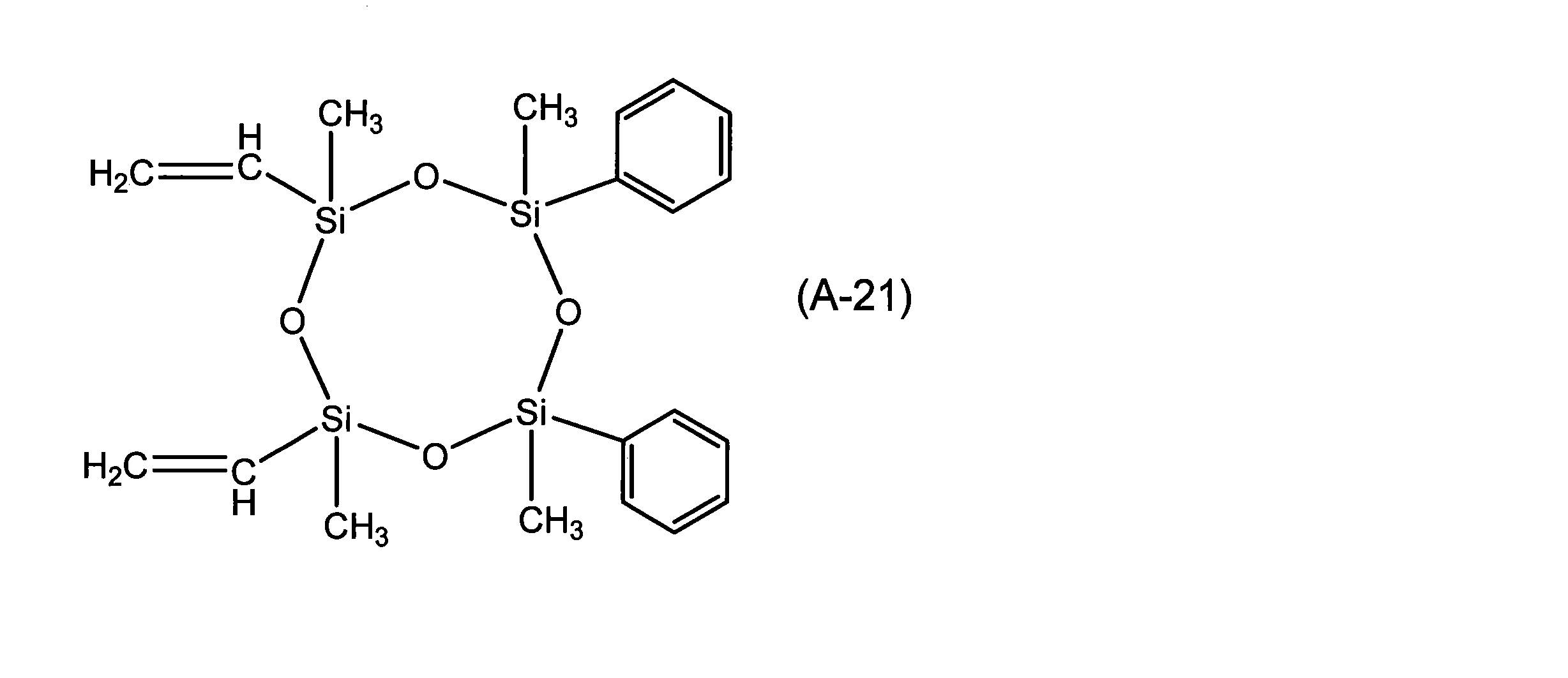
- a cyclic siloxane copolymer containing two or more carbon-carbon double bonds having reactivity with Si-H group in one molecule the following formula (A-19) And cyclic siloxane compounds shown by (A-21).
- a compound having a carbon-carbon double bond having reactivity with an SiH group may also have an SiH group (for example, a compound represented by the above formula (A-17)). Treat as (A) component, not (B) component. The component (B) has no carbon-carbon double bond having reactivity with SiH groups.
- Component (B) in the silicon-containing curable composition of the present invention is a siloxane compound having an SiH group.
- the component (B) is not particularly limited as long as it is a siloxane compound having one or more SiH groups in one molecule, and a siloxane compound having two or more SiH groups in one molecule is preferably used. Can.
- the content of the component (B) in the silicon-containing curable composition of the present invention is preferably in the range of 0.1 to 100 parts by mass, preferably 1 to 60 parts by mass, with respect to 100 parts by mass of the component (A).
- the range of 5 to 40 parts by mass is more preferable.
- siloxane compounds having two or more SiH groups in one molecule at least one selected from cyclic siloxane compounds represented by the following general formula (B-1), and the following general formula (B-2), Siloxane compounds having two or more SiH groups in one molecule, which are obtained by subjecting one or more compounds selected from compounds represented by formula (B-3) or the following general formula (B-4) to a hydrosilylation reaction
- (B- ⁇ ) may be used preferably.
- R 35 , R 36 and R 37 each independently represent a phenyl group which may be substituted with an alkyl group having 1 to 6 carbon atoms or an alkyl group having 1 to 6 carbon atoms
- the f R 35 may be the same or different
- the g R 36 and the g R 37 may each be the same or different
- f represents a number of 2 to 10
- R 38 represents an alkenyl group having 2 to 10 carbon atoms
- R 39 and R 40 each independently represent an alkyl group having 1 to 10 carbon atoms, an alkenyl group having 2 to 10 carbon atoms, or Represents an epoxy group having 2 to 10 carbon atoms
- h represents 1 or 2
- the alkyl group having 1 to 6 carbon atoms represented by R 35 , R 36 and R 37 may be linear, branched or cyclic, and specific examples thereof are Methyl group, ethyl group, propyl group, isopropyl group, butyl group, s-butyl group, t-butyl group, isobutyl group, amyl group, isoamyl group, t-amyl group, hexyl group, cyclohexyl group etc. It can be mentioned.
- R 35 is preferably a methyl group
- R 36 and R 37 are preferably a methyl group or a phenyl group.
- f is preferably 4 to 6
- g is preferably 0 to 1 in view of the crosslinking density of the curing reaction.
- the ratio of the number of methyl groups to the number of phenyl groups in the total number of substituents of R 35 to R 37 (the former: the latter) is 4: 1 to 1: 4.
- the range is preferable because the molecular weight can be stably controlled.
- Examples of the alkenyl group having 2 to 10 carbon atoms represented by R 38 , R 39 and R 40 in the general formula (B-4) include a vinyl group, 2-propenyl group, 3-butenyl group and the like. .
- the alkyl group having 1 to 10 carbon atoms represented by R 39 and R 40 can be linear, branched or cyclic, and specific examples thereof include methyl group , Ethyl, propyl, isopropyl, butyl, s-butyl, t-butyl, isobutyl, amyl, isoamyl, t-amyl, hexyl, cyclohexyl, heptyl, octyl Groups, nonyl groups, decyl groups, ethylhexyl groups and the like.
- the epoxy group having 2 to 10 carbon atoms represented by R 39 and R 40 is a substituent having a three-membered cyclic ether, and for example, an epoxyethyl group, glycidyl Group, 2,3-epoxybutyl group, 3,4-epoxybutyl group, epoxyethylphenyl group, 4-epoxyethylphenylethyl group, 3,4-epoxycyclohexyl group, 2- (3,4-epoxycyclohexyl) ethyl Group, 2,3-epoxy norbornyl ethyl group and the like.
- Examples of the cyclic siloxane compound represented by the above general formula (B-1) include 1,3,5,7-tetramethylcyclotetrasiloxane, 1,3,5,7,9-pentamethylcyclopentasiloxane, Examples thereof include 1,3,5,7,9,11-hexamethylcyclohexasiloxane and the like, and 1,3,5,7-tetramethylcyclotetrasiloxane is preferable.
- the cyclic siloxane compounds represented by the above general formula (B-1) can be used alone or in combination of two or more.
- the compound represented by the above general formula (B-2) represents divinylbenzene when h is 1, and any of o-divinylbenzene, m-divinylbenzene or p-divinylbenzene is possible, h When is 2, it indicates trivinylbenzene, and any of 1,2,3-trivinylbenzene, 1,2,4-trivinylbenzene and 1,3,5-trivinylbenzene is possible.
- the compound represented by the above general formula (B-2) may have a functional group other than a vinyl group (e.g., an alkyl group such as a methyl group) bonded to a benzene ring, or may be a mixture of these. .
- divinylbenzene is preferable.
- the compounds represented by the above-mentioned general formula (B-2), the above-mentioned formula (B-3) and the above-mentioned general formula (B-4) can be used singly or in combination of two or more kinds. it can.
- the (B- ⁇ ) is one or more selected from the cyclic siloxane compounds represented by the above general formula (B-1), and the above general formula (B-2), the above formula (B-3) or the above general formula It can be obtained by hydrosilylation reaction of one or more selected from the compounds represented by (B-4).
- the compounding ratio of one or more selected from the above compounds is not particularly limited as long as it has two or more SiH groups in one molecule.
- the ratio (the former: the latter) to the number of carbon-carbon double bonds having reactivity with the SiH group contained in one or more kinds selected from the compounds represented by the above general formula (B-4) is 10: It is in the range of 1 to 2: 1, more preferably in the range of 4: 1 to 2: 1.
- the concentration of the SiH group in the above (B- ⁇ ) is preferably 0.0001 mmol / g to 100 mmol / g, and more preferably 0.01 mmol / g to 20 mmol / g, because the curability will be good.
- the weight average molecular weight of the above (B- ⁇ ) is preferably 500 to 500,000, and from the viewpoint of good heat resistance, 1000 to 300,000 is more preferable.
- the measurement of the weight average molecular weight may be performed using GPC, and may be determined by polystyrene conversion.
- the above hydrosilylation reaction may be carried out using a platinum-based catalyst.
- a platinum-based catalyst known catalysts containing one or more metals of platinum, palladium and rhodium which promote the hydrosilylation reaction can be used.
- the platinum-based catalysts used as catalysts for hydrosilylation reactions include platinum-carbonylvinylmethyl complexes, platinum-divinyltetramethyldisiloxane complexes, platinum-cyclovinylmethylsiloxane complexes, platinum-based catalysts such as platinum-octylaldehyde complexes, etc.
- the catalyst examples include compounds containing palladium, rhodium, and the like, which are also platinum-based metals instead of platinum, and one of these may be used alone, or two or more may be used in combination. In particular, those containing platinum are preferable from the viewpoint of curability. Specifically, platinum-divinyltetramethyldisiloxane complex (Karstedt catalyst) and platinum-carbonylvinylmethyl complex (Ossko catalyst) are preferable. Also, a so-called Wilkinson catalyst containing the above-mentioned platinum-based metal, such as chlorotristriphenylphosphine rhodium (I), is also included in the platinum-based catalyst in the present invention.
- platinum-based metals such as chlorotristriphenylphosphine rhodium (I)
- the amount of use of the platinum-based catalyst is one or more selected from the cyclic siloxane compounds represented by the above general formula (B-1), and the above general formula (B-2), 5 mass% or less of the total amount of 1 or more types selected from the compound represented by B-3) or the said General formula (B-4) is preferable, and 0.0001-1.0 mass% is more preferable.
- the hydrosilylation reaction conditions are not particularly limited, and may be carried out under conventionally known conditions using the above catalyst, but from the viewpoint of curing rate, it is preferable to carry out at room temperature to 130 ° C.
- the catalyst can be removed after the hydrosilylation reaction, and can be used as it is for the silicon-containing curable composition without removal.
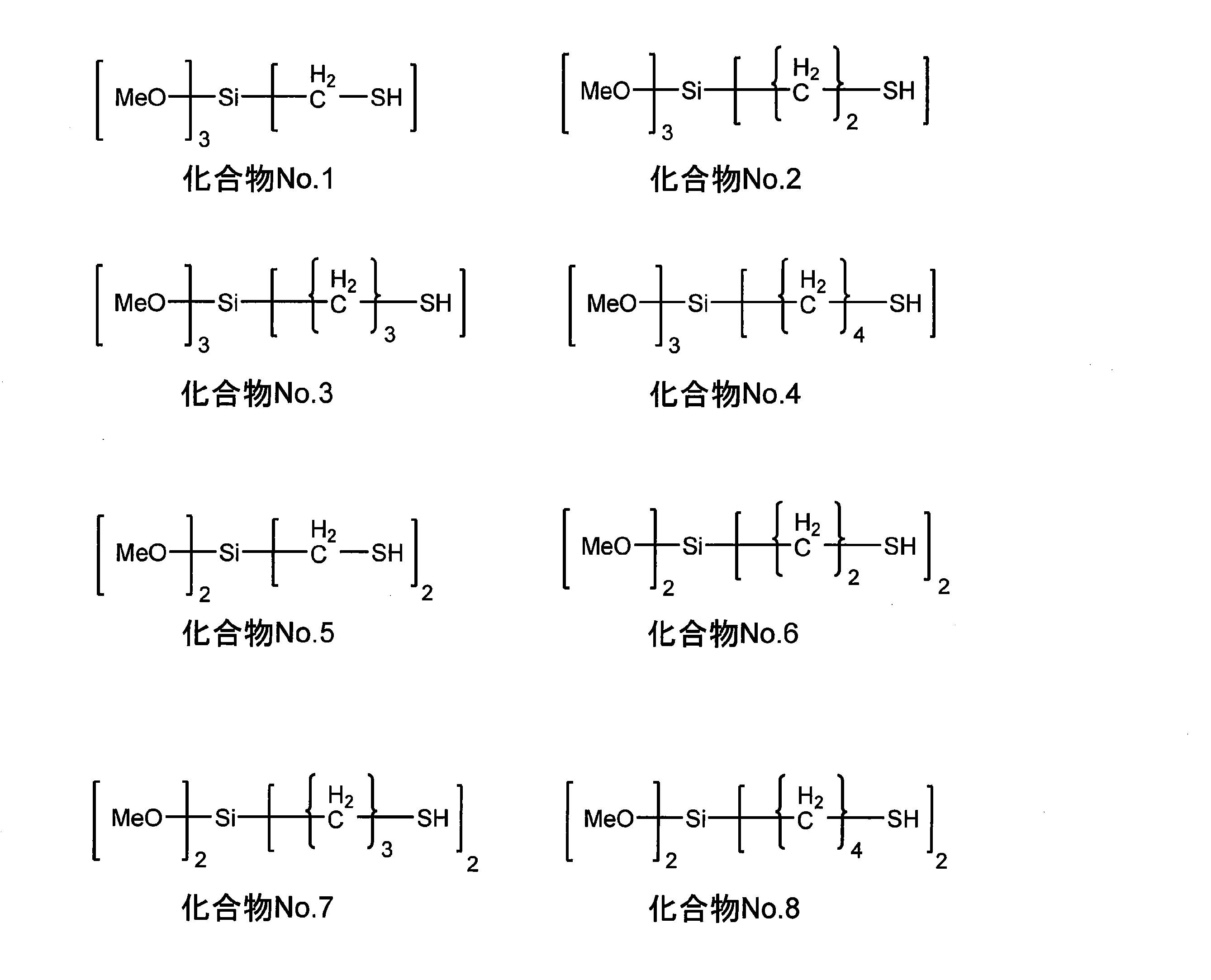
- the component (C) in the silicon-containing curable composition of the present invention is a silane compound represented by the above general formula (1).
- the silicon-containing curable composition can be obtained.
- the content of the component (C) in the silicon-containing curable composition of the present invention is preferably 0.001 to 0.1 parts by mass with respect to 100 parts by mass of the component (A). If the amount is less than 0.001 parts by mass, the effect of addition is hardly exhibited. Moreover, even if it adds more than 0.1 mass part, the compounding effect is hardly improved.
- examples of the alkyl group having 1 to 4 carbon atoms represented by R 1 include a methyl group, an ethyl group, a propyl group, an isopropyl group, a butyl group, a second butyl group, and a third group.
- a butyl group can be mentioned.
- a methyl group or an ethyl group is preferable because the cured product obtained is highly effective in having excellent adhesion to a silver base or copper base.
- Examples of the alkanediyl group having 1 to 10 carbon atoms represented by A in the general formula (1) include methylene, ethylene, propylene, butylene, isobutylene, pentylene, hexylene and heptylene. Groups, octylene groups and the like.
- An alkanediyl group having 1 to 5 carbon atoms is more preferable, and a propylene group is particularly preferable, because the resulting cured product is highly effective in having excellent adhesion to a silver base or copper base.
- k represents a number of 2 or 3. It is preferable that k be 3 because the resulting cured product is highly effective in having excellent adhesion to a silver base or copper base.
- the component (D) in the silicon-containing curable composition of the present invention is a filler.
- the resulting cured product can be colored to a desired color, and the hardness of the resulting cured product can be increased.
- the filler transparent fillers, white pigments and inorganic fillers are preferable.
- the content of the component (D) in the silicon-containing curable composition of the present invention is preferably 100 to 1,500 parts by mass, more preferably 100 to 1,400 parts by mass with respect to 100 parts by mass of the component (A). 300 to 1350 parts by mass is more preferable.
- the white pigment is added as a white colorant to enhance whiteness, and it is preferable to use, for example, titanium oxide.
- the unit lattice of this titanium oxide may be any of rutile type, anatase type and brookite type. However, in view of light resistance, rutile type is preferably used.
- the average particle size and shape are not limited, but the average particle size is usually 0.05 to 5.0 ⁇ m.
- the above-mentioned titanium oxide can be surface-treated in advance with a water-containing oxide such as Al or Si in order to enhance the compatibility and the dispersibility with the resin and the inorganic filler.
- the average particle size can be determined as a mass average value D 50 in the particle size distribution measurement by laser diffraction method (or median diameter).
- titanium oxide potassium titanate, zircon oxide, zinc sulfide, alumina, zinc oxide, magnesium oxide, beryllium oxide, barium sulfate or the like can be used as the white pigment.
- magnesium oxide and zinc oxide are preferable.
- These white pigments can be used alone or in combination with titanium oxide.
- silicas such as fused silica, fused spherical silica, crystalline silica, colloidal silica, fumed silica, silica gel
- metal oxides such as alumina, iron oxide, titanium oxide and antimony trioxide
- silicon nitride, aluminum nitride, nitride Ceramics such as boron and silicon carbide
- minerals such as mica and montmorillonite
- metal hydroxides such as aluminum hydroxide and magnesium hydroxide or those modified by organic modification treatment or the like
- Metal carbonates such as barium carbonate or those modified by organic modification treatment
- pigments such as metal borates and carbon black
- organic fillers such as acrylic beads, polymer fine particles, transparent resin beads, wood powder, pulp, cotton chips and the like can also be used.
- the average particle size and shape of the inorganic filler and the organic filler are not particularly limited, but the average particle size is usually 0.1 to 80 ⁇ m.
- the average particle size can be determined as a mass average value D 50 in the particle size distribution measurement by laser diffraction method (or median diameter).
- silicas, metal oxides, metal carbonates which may be modified, pigments are preferable, and in particular, fused silica, fused spherical silica, crystals Silica, silicone beads, colloidal silica, aluminum oxide, titanium oxide, calcium carbonate, magnesium carbonate, carbon black, kaolin and glass fibers are preferred.
- fused silica, fused spherical silica, and a composite of titanium oxide and calcium carbonate are preferably used from the viewpoint of resin formability.
- the particle size is not particularly limited, but it is preferably 4 to 40 ⁇ m, particularly 7 to 35 ⁇ m from the viewpoint of moldability and flowability. Further, in order to obtain high flowability, it is desirable to use one having a fine area of 3 ⁇ m or less, a medium particle size area of 4 to 8 ⁇ m, and a coarse area of 10 to 40 ⁇ m in combination.
- Optional components such as agents and additives can also be blended.
- the use amount of each optional component is not particularly limited, but in order to prevent the effects of the present invention from being impaired, the amount is 10% by mass or less in the silicon-containing curable composition of the present invention. Is preferably, and more preferably 5% by mass or less.
- organic peroxide for example, those generally used when curing a silicone rubber composition can be used, for example, benzoyl peroxide, o-methyl benzoyl peroxide, p-methyl benzoyl Peroxide, o-monochlorobenzoyl peroxide, p-monochlorobenzoyl peroxide, bis-2,4-dichlorobenzoyl peroxide, 2,4-dicumyl benzoyl peroxide, di-t-butyl benzoyl peroxide, t-butyl Benzoate, t-butylcumyl benzoyl peroxide, 1,1-bis (t-butylperoxy) -3,3,5-trimethylcyclohexane, 2,5-dimethyl-2,5-di (t-butylperoxy) ) Hexane, 1, 6-bis (t-butyl pao) Dicarboxy) hexane, dichromyl peroxide, dimyr
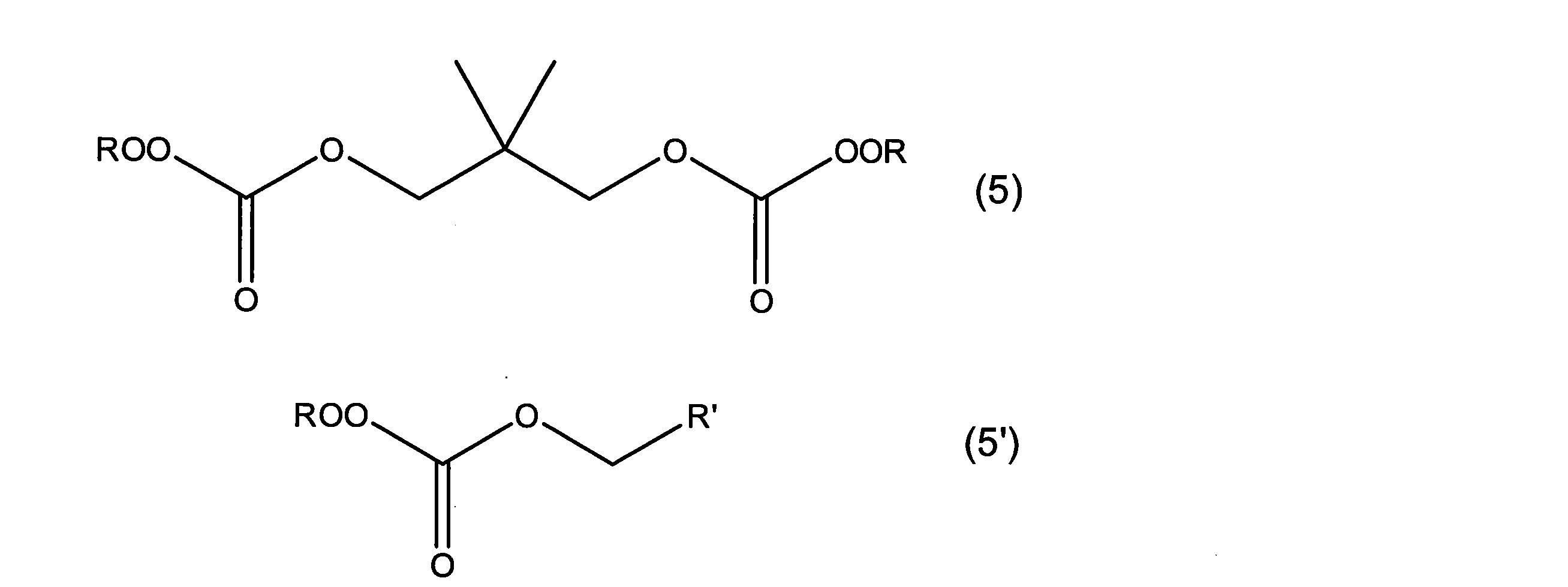
- R and R ′ each independently represent a hydrocarbon group having 3 to 10 carbon atoms
- Examples of the hydrocarbon group having 3 to 10 carbon atoms represented by R in the general formulas (5) and (5 ′) and R ′ in the general formula (5 ′) include propyl, isopropyl, butyl, Dibutyl, tert-butyl, isobutyl, amyl, isoamyl, tert-amyl, hexyl, cyclohexyl, cyclohexylmethyl, 2-cyclohexylethyl, heptyl, isoheptyl, tert-heptyl, n-octyl, isooctyl, tert-octyl, 2-ethylhexyl Alkyl groups such as nonyl, isononyl and decyl; alkenyl groups such as vinyl, 1-methylethenyl, 2-methylethenyl, propenyl, butenyl, isobutenyl, pentenyl,
- the content in the case of using the organic peroxide is preferably 0.0001 to 10 parts by mass, and more preferably 0.01 to 5 parts by mass with respect to 100 parts by mass of the component (A).
- metal catalyst examples include platinum catalysts, tris (2,4-pentanedionato) aluminum, triisopropoxide aluminum, Al (ClO 4 ) 3 , tetraisopropoxide titanium, tetraisobutoxide titanium, dibutyl bis (2,2, Examples thereof include metal catalysts such as Al-based, Ti-based and Sn-based metals such as 4-pentanedionato) tin and Bu 2 Sn (C 7 H 15 COO) 2 .
- platinum-based catalysts and Al-based catalysts are preferable from the viewpoint of reactivity and colorability, and in particular, platinum-carbonylvinylmethyl complex (Ossko catalyst), platinum-divinyltetramethyldisiloxane complex (Karstedt complex), tris (2,4-pentanedionato) aluminum is preferred.
- the content in the case of using the metal catalyst is preferably 1 ⁇ 10 ⁇ 4 to 0.5 parts by mass, and 1 ⁇ 10 ⁇ 3 to 0.2 parts by mass with respect to 100 parts by mass of the component (A). It is more preferable to contain part.
- a compound having a cyanuric acid structure can be used as the adhesion promoter.
- the compound having a cyanuric acid structure include isocyanuric acid, triallyl cyanuric acid, 1,3,5-triglycidyl isocyanuric acid, tris (2-hydroxyethyl) isocyanuric acid, tris (2,3-dihydroxypropyl).
- Isocyanuric acid, tris (2,3-epoxypropyl) isocyanuric acid Patent Nos. 2768426, JP-A-3-217169, JP-A-4-139211, JP-A-4-139174, JP-A-10-333330 Those described in the above can be used.
- these compounds may be subjected to various modification treatments such as silicone modification, ethylene oxide modification, propylene oxide modification and the like by a conventional method.
- modification treatments such as silicone modification, ethylene oxide modification, propylene oxide modification and the like by a conventional method.
- the content of the compound in the silicon-containing curable composition of the present invention is preferably 0.0001 to 10% by mass, and more preferably 0.01 to 1.0% by mass. preferable.
- antioxidants such as an antioxidant and a stabilizer
- a free radical scavenger it is preferably 0.1 to 10% by mass in the silicon-containing curable composition of the present invention, in terms of heat resistance, electrical properties, curability, mechanical properties, storage stability and handling. 1 to 5% by mass is more preferable.
- Examples of the various resins include polybutadiene resins and their modified products, modified products of acrylonitrile copolymers, polystyrene resins, polyethylene resins, fluorine resins, polyimide resins, polyether resins such as polyethylene glycol, polyphenylene ether and polypropylene glycol, polyurethane Resin, epoxy resin, phenol resin, polyester resin, melamine resin, polyamide resin, polyphenylene sulfide resin, etc. may be mentioned.
- the mold release agent for example, carnauba wax, fatty acid ester, glyceric acid ester, stearic acid, montanic acid, behenic acid and metal salts thereof, alkali metal compounds, organic titanium, organic zirconia, organic tin compounds, imidazole compounds, carboxyls
- a group-containing polyolefin, polyethylene-polyoxyethylene resin, carnauba etc. can be used.
- additives examples include brighteners, waxes, UV absorbers, antistatic agents, antioxidants, antidegradants, modifiers, silane coupling agents, defoamers, dyes, maleimide compounds And cyanate ester compounds, silicone gels, silicone oils and the like.
- the silicon-containing curable composition of the present invention is excellent in handleability because it is solid at room temperature (25 ° C.).
- the silicon-containing curable composition of the present invention may be in the form of powder, granules, tablets or the like, and may be used by dissolving in a solvent.
- the silicon-containing curable composition of the present invention preferably has a melting point of 50 ° C. or more and 150 ° C. or less, and more preferably 50 ° C. or more and 120 ° C. or less.
- the silicon-containing curable composition of the present invention is preferably melted at 50 ° C. to 150 ° C. and then cured by heat.
- the cured product comprising the silicon-containing curable composition of the present invention is excellent in adhesion to silver and copper substrates, and is also excellent in heat resistance and adhesion.
- heat resistance specifically, a cured product having a temperature of 400 ° C. or more, more preferably 500 ° C. or more, which suitably causes a weight loss of 5% by mass of the cured product is suitably obtained.
- a cured product with less occurrence of cracks is suitably obtained from the silicon-containing curable composition of the present invention.
- the silicon-containing curable composition of the present invention can be uniform and transparent, in which case it has good transparency to light such as ultraviolet light, and by adding a photoreactive catalyst, it can also be cured by light. It is possible. Of course, photoreactive monomers and resins can be further blended, and any one or more of the components in the silicon-containing curable composition can have a photoreactive group. Furthermore, from the silicon-containing curable composition of the present invention, weather resistance, hardness, stain resistance, flame resistance, moisture resistance, gas barrier properties, flexibility, elongation and strength, electrical insulation, low dielectric constant It is possible to obtain a material excellent in mechanical properties, optical properties, electrical properties, etc.
- the silicon-containing curable composition of the present invention can be cured by heating to form a cured product.
- This curing reaction can be carried out by mixing and heating the blending components of the silicon-containing curable composition of the present invention immediately before use, and a method of heating when curing the curing reaction by mixing all the blending components in advance.
- the heating temperature at the time of curing is equal to or higher than the temperature at which the resin melts, for example, 35 to 350 ° C. is preferable, and 50 to 250 ° C. is more preferable.
- the curing time is preferably 2 to 60 minutes, more preferably 2 to 10 minutes. Furthermore, after curing, they can be annealed or shaped.
- Annealing varies depending on temperature, but if it is 150 ° C., it is preferable to process for about 5 to 60 minutes.
- a cured product having excellent performance in heat resistance, durability, adhesion and the like can be obtained from the silicon-containing curable composition of the present invention.
- known methods such as transfer molding, compression molding, cast molding and the like can be used, and transfer molding is preferable from the viewpoint of workability and dimensional stability.
- Transfer molding is preferably performed using a transfer molding machine at a molding pressure of 5 to 20 N / mm 2 and a molding temperature of 120 to 190 ° C. for 30 to 500 seconds, particularly 150 to 185 ° C. for 30 to 180 seconds.
- the compression molding method is preferably performed using a compression molding machine at a molding temperature of 120 to 190 ° C. for 30 to 600 seconds, particularly 130 to 160 ° C. for 120 to 300 seconds.
- curing can be carried out at 150 to 185 ° C. for 2 to 20 hours.
- the film-forming methods such as spin casting, potting, and dipping, can be applied suitably.
- the cured product has excellent adhesion to a silver substrate and a copper substrate, and also various physical properties such as heat resistance, light resistance, crack resistance, colorability and the like. It can be utilized as an excellent curable composition.
- the silicon-containing curable composition and the cured product of the present invention are used as display materials, optical materials, recording materials, printed boards, semiconductors, solar cells, etc. in the field of electric and electronic materials; high voltage insulating materials, insulation and prevention It can be used as various materials for the purpose of vibration, water resistance, and moisture resistance.
- the reaction solution is cooled to room temperature, 600 g of toluene and 1500 g of ion-exchanged water are added to extract an oil layer, and after washing with water until neutral, the solvent is removed to obtain a silicon-containing polymer A-1 as component (A). 232.6 g were obtained (white powder).
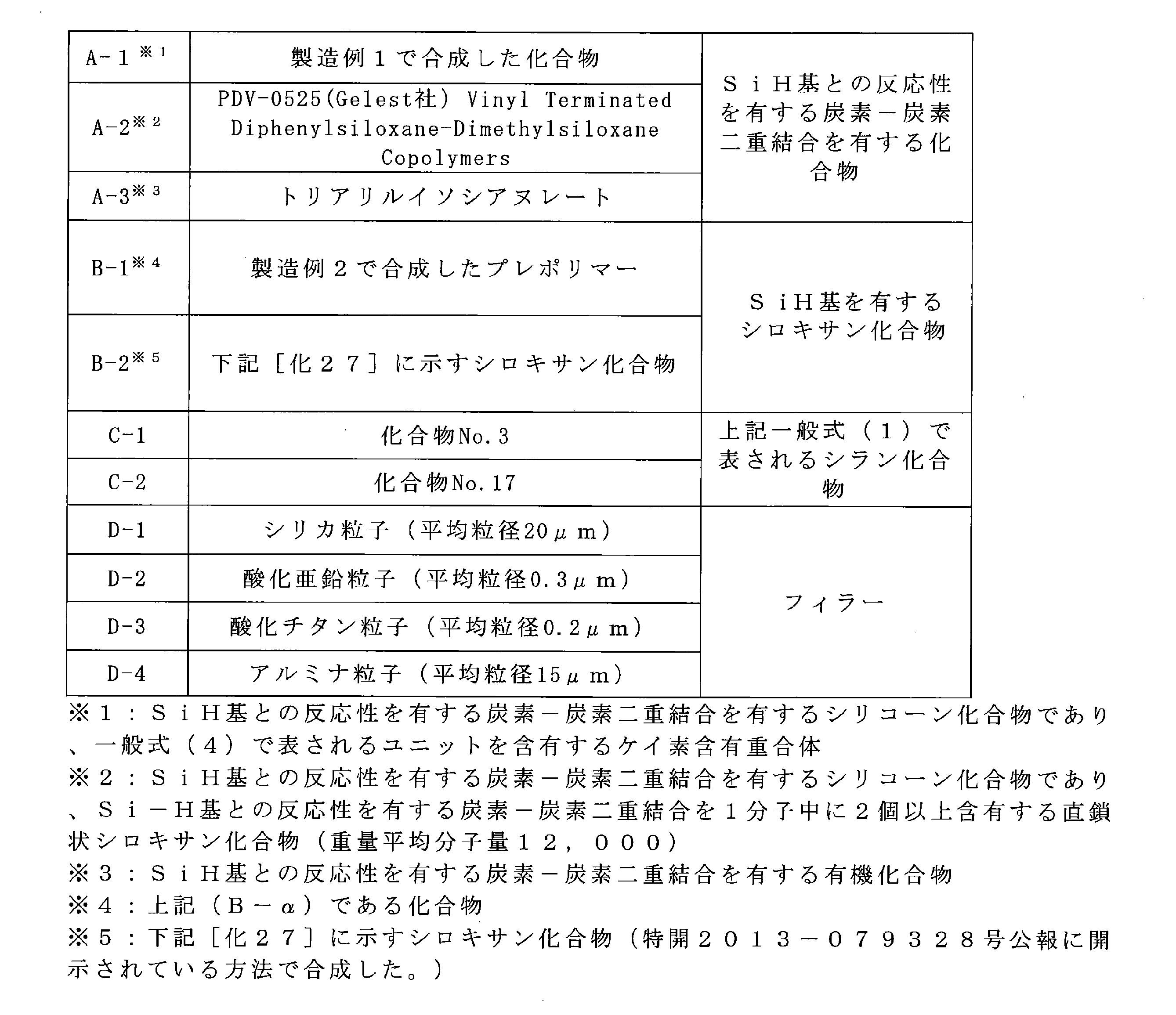
- Example 1 Production of Silicon-Containing Curable Composition Using the compounds shown in Table 1, Example Composition No. 1 was prepared according to the composition of Table 2. 1 to 28 were produced.
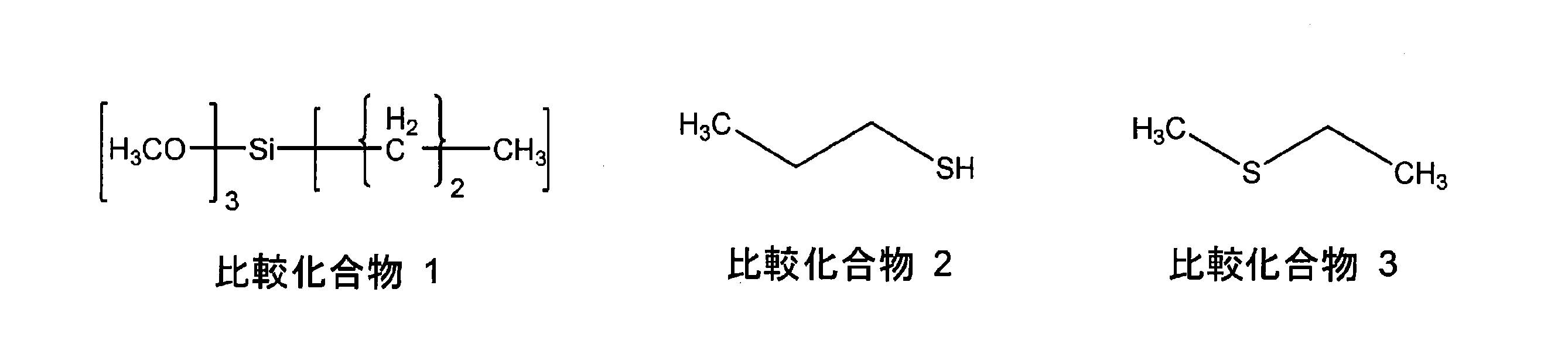
- Comparative Example 1 Production of Comparative Silicon-Containing Curable Composition Comparative compounds 1 to 30 were produced using the compounds shown in Table 1 and the following comparative compounds 1 to 3 according to the formulations shown in Table 3.
- Example 2 Production of a Cured Product 1
- Example Composition No. 1 to No. Each 28 is poured into a mold placed on a silver base (50 mm long ⁇ 55 mm wide ⁇ 0.25 mm thick), and heated at 170 ° C. for 180 seconds (forming step), then at 150 ° C. for 2 hours (after-baking step)
- Example 3 Cured product No. 3 having a diameter of 3.5 mm and a height of 4 mm by heating under the conditions of 1 to 28 were molded.
- Comparative Example 2 Production of Comparative Cured Product 1 Comparative Example Composition No. 1 to No.
- Each 30 is poured into a mold placed on a silver base (50 mm long ⁇ 55 mm wide ⁇ 0.25 mm thick), and heated at 170 ° C. for 180 seconds (forming step), then at 150 ° C. for 2 hours (after-baking step)
- a comparative example cured product 1 to 30 having a diameter of 3.5 mm and a height of 4 mm in the shape of a pudding cup was formed.
- Comparative Example cured products 1 to 30 had poor adhesion.
- Example 3 Production of a cured product 2
- Example Composition No. 1 to No. Each 28 is poured into a mold placed on a copper substrate (50 mm long ⁇ 55 mm wide ⁇ 0.25 mm thick), and heated at 170 ° C. for 180 seconds (forming step), then at 150 ° C. for 2 hours (after-baking step)
- Example 3 Cured product No. 3 having a diameter of 3.5 mm and a height of 4 mm by heating under the conditions of 29 to 56 were molded.
- Comparative Example 3 Production of Comparative Cured Product 2 Comparative Example Composition No. 1 to No.
- Each 30 is poured into a mold placed on a copper substrate (50 mm long ⁇ 55 mm wide ⁇ 0.25 mm thick), and heated at 170 ° C. for 180 seconds (forming step), then at 150 ° C. for 2 hours (after-baking step) By heating under the following conditions, a comparative example cured product 31 to 60 having a diameter of 3.5 mm and a height of 4 mm was formed.
- the purine cup test was conducted as follows for each of 29 to 56 and the cured product of comparative example 31 to 60. That is, the bond strength between the copper substrate and the molding resin is measured using a bond tester, and when the bond strength is higher than 20 kg / cm 2 is ++, and when it is in the range of 5 to 20 kg / cm 2 is +, 5 kg The adhesion was evaluated on the basis of-when it is less than / cm 2 . When the evaluation result is +, it means that excellent adhesion was shown, and when it is ++, it means that especially excellent adhesion was shown. The results are shown in Tables 4-1 to 4-4.
- Comparative Example cured products 31 to 60 had poor adhesion.
- Example cured product No. 1 using the silicon-containing curable composition of the present invention All of the samples 29 to 56 had good adhesion to the copper substrate.
- a silicon-containing curable composition capable of producing a cured product which is excellent in adhesion to a silver base or copper base and useful for electric / electronic materials and the like.
- the silicon-containing curable composition has good curability and can be subjected to mold molding such as transfer molding and injection molding, and the cured product is excellent in heat resistance, crack resistance and mechanical strength. Therefore, it can be suitably used as a sealing material for semiconductors, a sealing material for LEDs, a molding material of a package for white LEDs, and the like.
Landscapes
- Chemical & Material Sciences (AREA)
- Health & Medical Sciences (AREA)
- Chemical Kinetics & Catalysis (AREA)
- Medicinal Chemistry (AREA)
- Polymers & Plastics (AREA)
- Organic Chemistry (AREA)
- Compositions Of Macromolecular Compounds (AREA)
- Silicon Polymers (AREA)
Abstract
Description
また近年、電子情報分野では、技術の発展に伴い、使用される各種材料にも高度の性能が要求されることから、ケイ素の特長ある性質を生かして耐熱性、物理的・電気的特性に優れた材料が検討されてきている。その中で、ケイ素化合物のヒドロシリル化反応を応用して有用な化合物を製造する技術が多種、検討されている。また、電子情報分野での部材製造工程では、リソグラフィ工程が多用され、高い耐塩基性・耐溶剤性が要求されるようになってきている。そのため、高い耐塩基性・耐溶剤性を保持しつつ、高度の耐熱性、耐クラック性を同時に満足する材料が求められるようになってきている。
これらの要求に対し、種々のケイ素含有硬化性組成物が提案されている(例えば特許文献1~7等参照)。
(A)成分として、SiH基との反応性を有する炭素-炭素二重結合を有する化合物、
(B)成分として、SiH基を有するシロキサン化合物、
(C)成分として、下記一般式(1)で表されるシラン化合物、
(D)成分として、フィラー
を含有することを特徴とするケイ素含有硬化性組成物を提供するものである。




尚、上記一般式(A-1)~(A-3)におけるそれぞれのX1は、互いに同一である場合もあり、異なる場合もある。
上記一般式(A-6)において、R10で表されるフェニル基を置換する場合もある炭素原子数1~6のアルキル基としては、上記R7で表されるものとして挙げたものと同様のものが挙げられる。R10は、工業的入手性の点から、置換されていないフェニル基であることが好ましい。
オルガノシラン(b)及び(c)は、オルガノシラン(b)とオルガノシラン(c)との和が5~60モル%である限り、何れか一方の成分を用いないことも可能であるが、オルガノシラン(b)は、硬化時の架橋密度の制御の点から、20~40モル%であることが好ましく、オルガノシラン(c)は、樹脂への可撓性付与の点から、10~25モル%であることが好ましい。
オルガノシラン(d)は、用いないことも可能であるが、樹脂溶融温度の制御の点から、5~45モル%であることが好ましい。オルガノシラン(e)は、用いないことも可能であるが、異種材料への密着性付与の点から、5~25モル%であることが好ましい。
また、オルガノシラン(b)とオルガノシラン(c)との和は、硬化時の架橋密度の制御の点から、25~55モル%であることが好ましい。
また、上記オルガノシラン混合物に含まれるオルガノシランは、ケイ素含有重合体の分子量制御の点から、オルガノシラン(a)、(b)、(c)、(d)及び(e)の5成分のみであることが好ましい。
尚、上記(R3SiO3/2)には(R3SiX’O2/2)も含むものとし、上記(R7SiO3/2)には(R7SiX’O2/2)も含むものとし、上記(R10SiO3/2)には(R10SiX’O2/2)も含むものとし、上記(R11SiO3/2)には(R11SiX’O2/2)も含むものとする。X’は、オルガノシラン(a)、(b)、(d)及び(e)それぞれに含まれていたX1及びX2と同じであるか、OH基を表す。
Si-H基との反応性を有する炭素-炭素二重結合を1分子中に2個以上含有する直鎖状シロキサン共重合体の中でも、硬化物の物性の点から特に好ましいものとして、下記一般式(A-8)で表される直鎖状シロキサン共重合体を挙げることができる。

またR12及びR31、並びにR13、R14、R15、R16、R20、R24、R28、R29及びR30で表わされる炭素原子数1~6のアルキル基としては、上記R7で表されるものとして挙げたものと同様のものが挙げられる。
またR12及びR31、並びにR25、R26及びR27で表わされる炭素原子数2~10のエポキシ基としては、上記R11で表されるものとして挙げたものと同様のものが挙げられる。
これらのなかでも、Si-H基との反応性を有する炭素-炭素二重結合を1分子中に2個以上含有する直鎖状シロキサン共重合体の好ましい具体例としては、下記の式(A-9)~(A-17)で示される直鎖状シロキサン化合物が挙げられる。


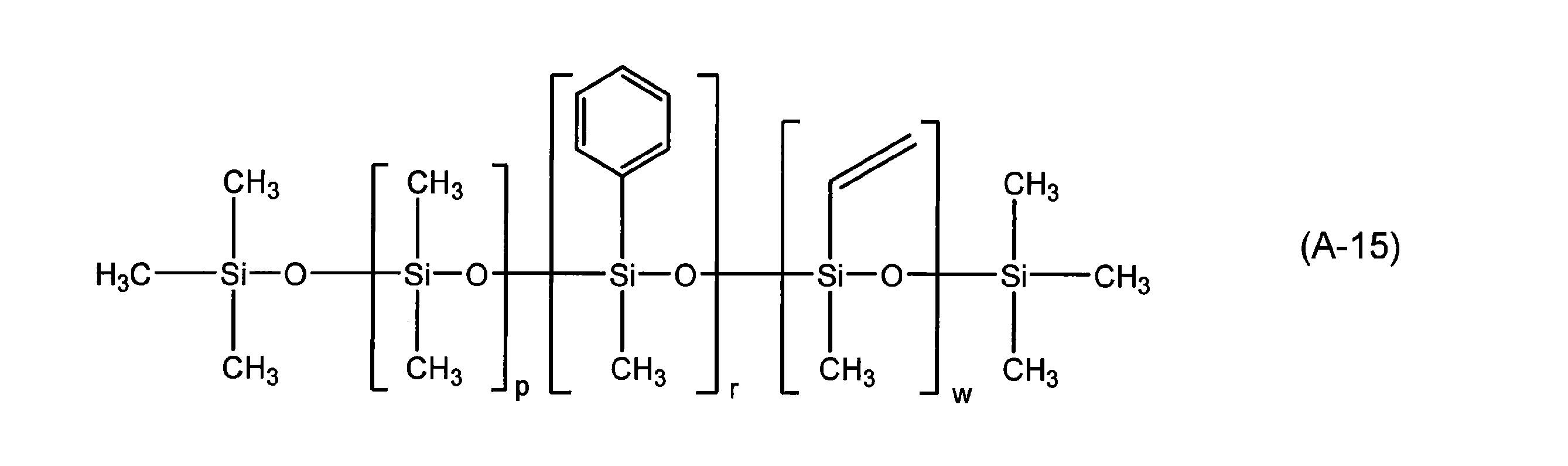
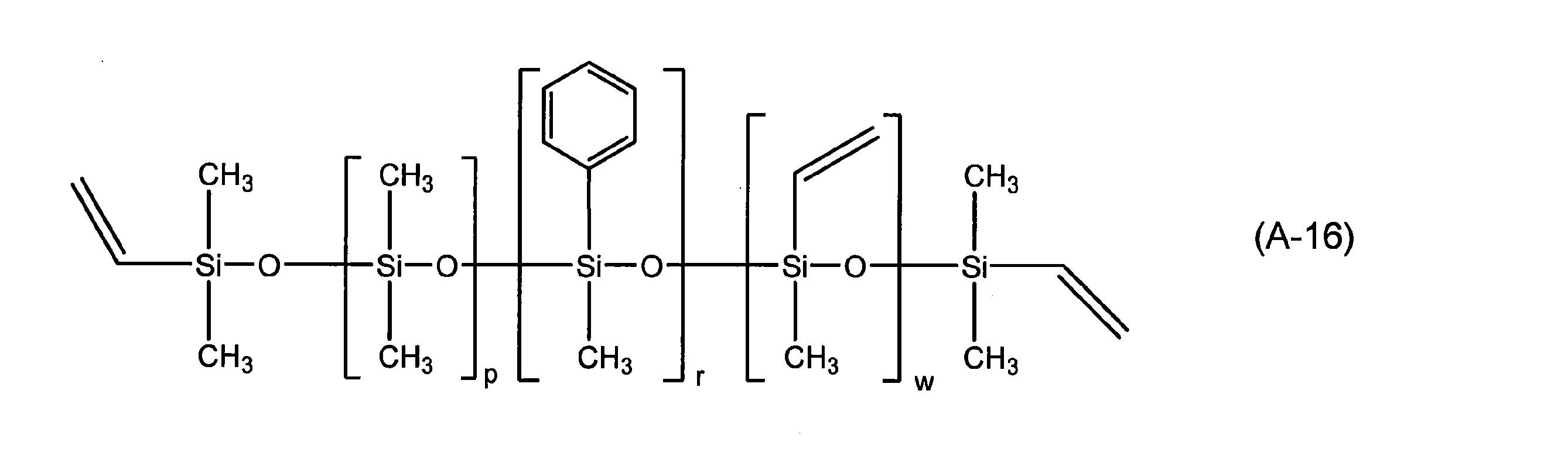

Si-H基との反応性を有する炭素-炭素二重結合を1分子中に2個以上含有する環状シロキサン化合物の中でも、硬化物の物性の点から特に好ましいものとして、下記一般式(A-18)で表される環状シロキサン化合物を挙げることができる。

これらのなかでも、Si-H基との反応性を有する炭素-炭素二重結合を1分子中に2個以上含有する環状シロキサン共重合体の好ましい具体例としては、下記の式(A-19)~(A-21)で示される環状シロキサン化合物が挙げられる。


f+g≧2である。)



尚、平均粒径は、レーザー光回折法による粒度分布測定における質量平均値D50(又はメジアン径)として求めることができる。
これら無機充填剤及び有機充填剤の平均粒径や形状は特に限定されないが、平均粒径は通常0.1~80μmである。尚、平均粒径は、レーザー光回折法による粒度分布測定における質量平均値D50(又はメジアン径)として求めることができる。
上記無機充填剤としては、とりわけ、溶融シリカ、溶融球状シリカ、酸化チタンと炭酸カルシウムの複合体が、樹脂の成形性の点から好適に用いられる。またその粒径は、特に限定されるものではないが、成形性、流動性の点から、4~40μm、特に7~35μmが好ましい。また、高流動性を得るためには、3μm以下の微細領域、4~8μmの中粒径領域、10~40μmの粗領域のものを組み合わせて使用することが望ましい。
これらの中でも、反応性及び着色性の点から、白金系触媒、Al系触媒が好ましく、特に、白金-カルボニルビニルメチル錯体(Ossko触媒)、白金-ジビニルテトラメチルジシロキサン錯体(Karstedt錯体)、トリス(2,4-ペンタンジオナト)アルミニウムが好ましい。
本発明のケイ素含有硬化性組成物は、加熱することにより硬化させて硬化物とすることができる。この硬化反応は、本発明のケイ素含有硬化性組成物の配合成分を使用直前に混合し加熱する方法で行うことができ、予め配合成分を全て混合しておき硬化反応を行うときに加熱する方法で行うこともできる。
硬化させる際の加熱温度は、樹脂が溶融する温度以上、例えば35~350℃が好ましく、50~250℃がより好ましい。硬化時間は2~60分が好ましく、2~10分がより好ましい。更に硬化後に、アニールしたり成形したりすることもできる。アニールは温度により時間が異なるが、150℃であれば5~60分程度処理することが好ましい。これらの硬化反応条件下に硬化反応を行うことにより、本発明のケイ素含有硬化性組成物から、耐熱性、耐久性、密着性等に優れた性能を有する硬化物を得ることができる。成形方法としては、トランスファー成形、圧縮成形、注型成形等の公知の方法を用いることができ、作業性及び寸法安定性の点から、トランスファー成形が好ましい。
また、本発明のケイ素含有硬化性組成物を硬化させる際には、スピンキャスト、ポッティング、ディッピング等の成膜方法を適宜適用することができる。
冷却管及び撹拌装置を付けた2000ml四つ口フラスコに、(a)成分としてビニルトリメトキシシラン0.5mol、(b)成分としてメチルトリメトキシシラン0.5mol、(c)成分としてジメチルジメトキシシラン0.25mol、(d)成分としてフェニルトリメトキシシラン1.0mol、及びトルエン650gを入れ、撹拌しながら、0.5%水酸化ナトリウム水溶液31.4gを30分かけて滴下し、60~65℃で3時間脱水重合反応した。室温に冷却し、トルエン600g及びイオン交換水1500gを添加して油層を抽出し、中性になるまで水洗した後、溶媒を除去して、(A)成分であるケイ素含有重合体A-1を232.6g得た(白色粉末)。ケイ素含有重合体A-1の重量平均分子量(Mw)を、下記条件によりGPCで分析したところ、Mw=15000(ポリスチレン換算)であった。
(GPCの測定条件)
カラム:SuperMultiporeHZ-M
展開溶媒:テトラヒドロフラン
1,3,5,7-テトラメチルシクロテトラシロキサン100部、ジビニルベンゼン100部、トルエン60部及び白金-カルボニルビニルメチル錯体(Ossko触媒)0.0005部を加えて撹拌しながら、5時間還流した。反応液から70℃で溶媒を減圧留去し、(B)成分であるプレポリマーB-1を得た。
上記条件によりGPCで分析したところ、プレポリマーB-1の重量平均分子量は、Mw=140,000(ポリスチレン換算)であり、ヒドロシリル基(Si-H基)の含有量は、1H-NMRから5.3mmol/gであった。
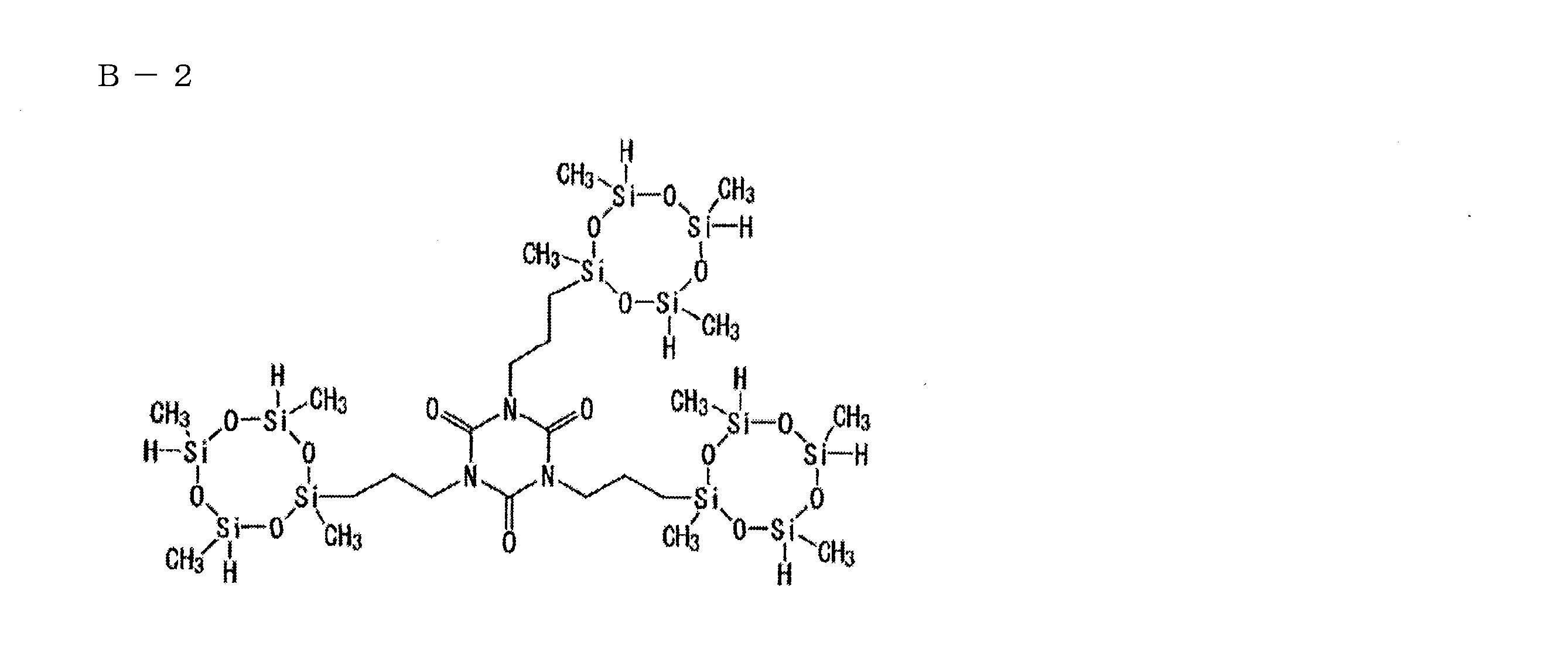
表1に示した化合物を用いて、表2の配合で実施例組成物No.1~28を製造した。

表1に示した化合物及び下記比較化合物1~3を用いて、表3の配合で比較例組成物1~30を製造した。

実施例組成物No.1~No.28をそれぞれ、銀基体(縦50mm×横55mm×厚み0.25mm)上に設置した金型に流し込み、170℃にて180秒(成形工程)、次いで150℃にて2時間(アフターベイク工程)の条件で加熱することで、直径3.5mm×高さ4mmのプリンカップ状の実施例硬化物No.1~28を成形した。
比較例組成物No.1~No.30をそれぞれ、銀基体(縦50mm×横55mm×厚み0.25mm)上に設置した金型に流し込み、170℃にて180秒(成形工程)、次いで150℃にて2時間(アフターベイク工程)の条件で加熱することで、直径3.5mm×高さ4mmのプリンカップ状の比較例硬化物1~30を成形した。
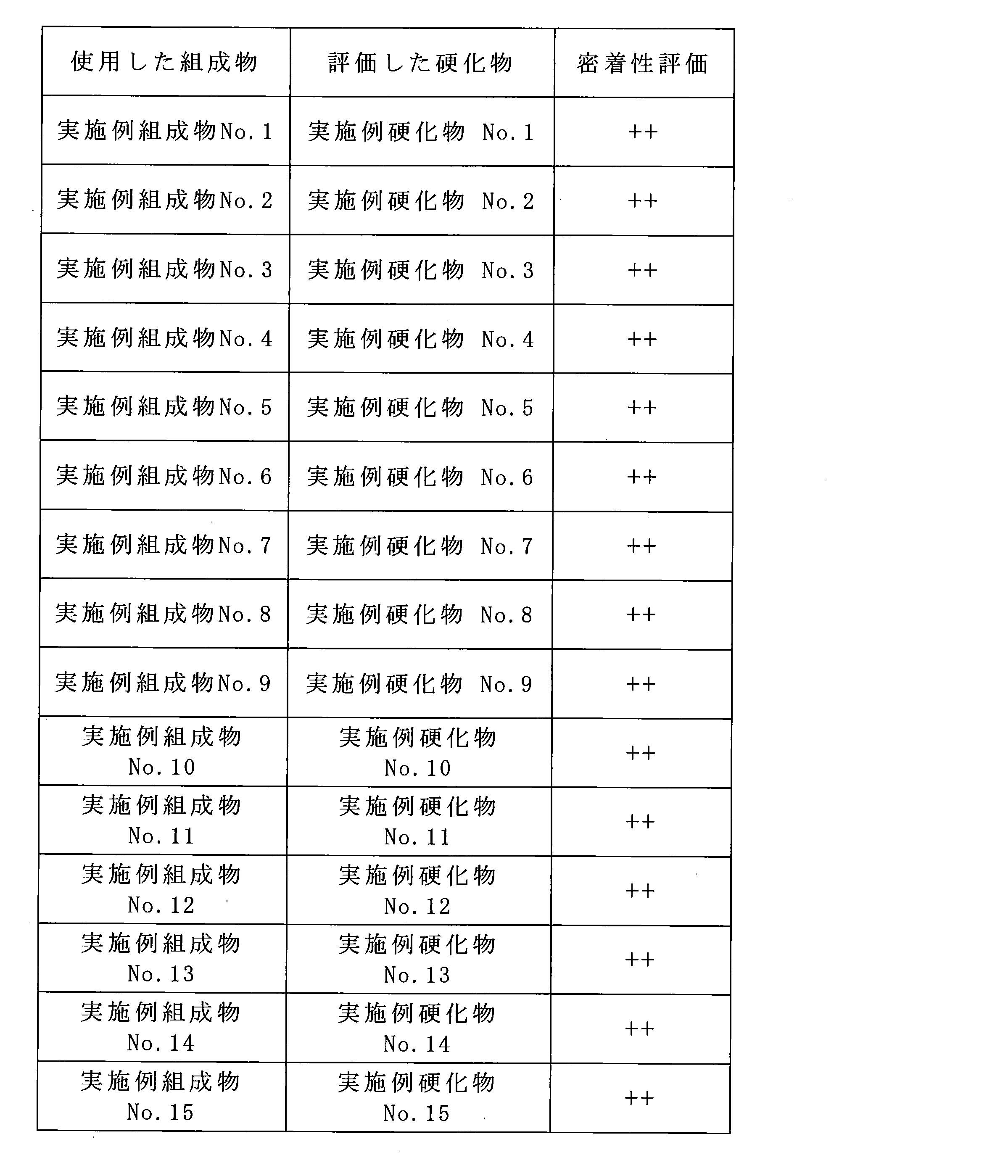
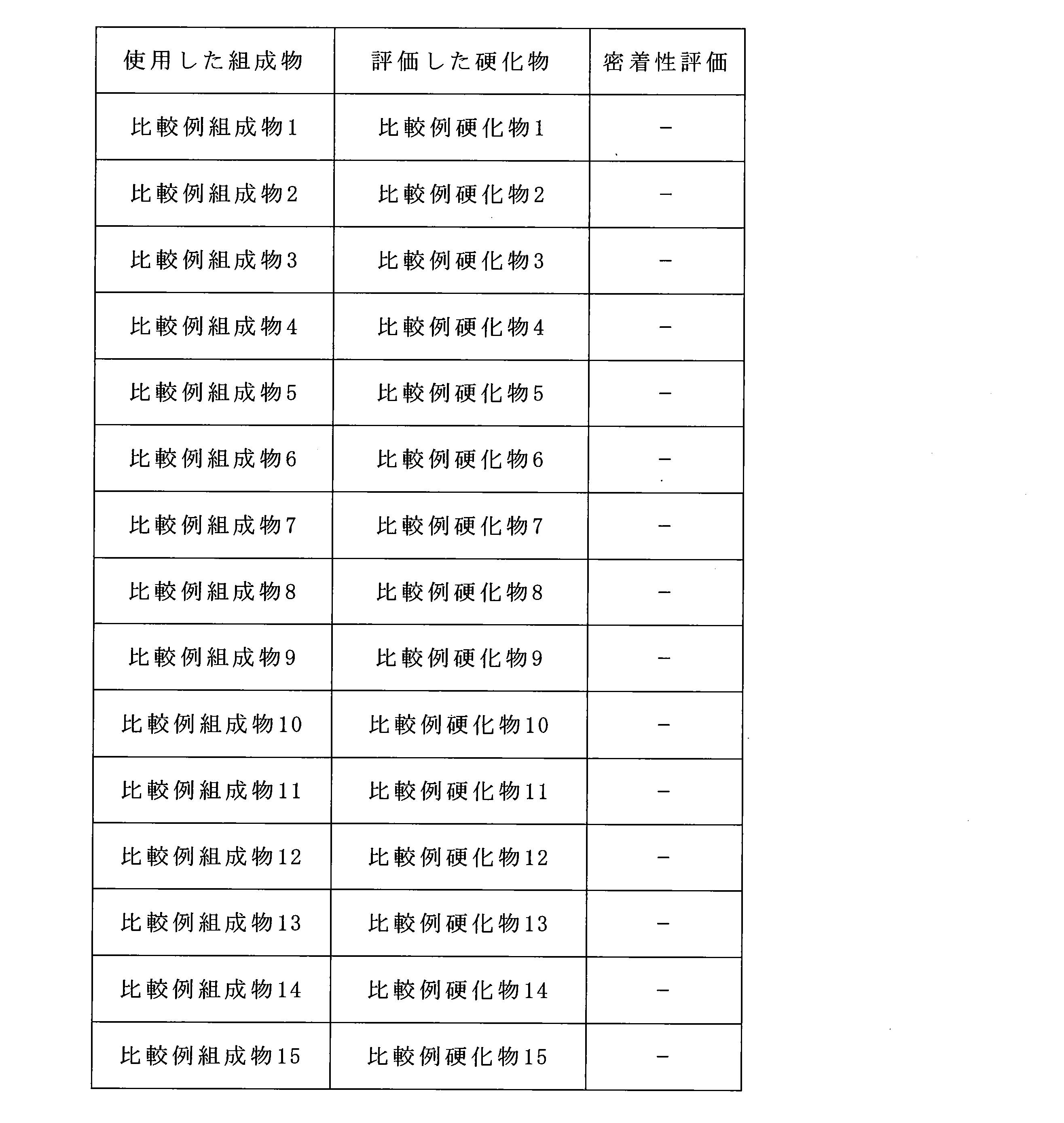
実施例硬化物No.1~28及び比較例硬化物1~30について、以下のようにしてプリンカップ試験を行った。即ち、ボンドテスターを用いて銀基体と成形樹脂との密着力を測定し、密着力が20kg/cm2より高い場合を++とし、5~20kg/cm2の範囲である場合を+とし、5kg/cm2未満である場合を-として密着性を評価した。評価結果が+である場合は優れた密着性を示したことを意味し、++である場合は特に優れた密着性を示したことを意味する。結果を表3-1~3-4に示す。


実施例組成物No.1~No.28をそれぞれ、銅基体(縦50mm×横55mm×厚み0.25mm)上に設置した金型に流し込み、170℃にて180秒(成形工程)、次いで150℃にて2時間(アフターベイク工程)の条件で加熱することで、直径3.5mm×高さ4mmのプリンカップ状の実施例硬化物No.29~56を成形した。
比較例組成物No.1~No.30をそれぞれ、銅基体(縦50mm×横55mm×厚み0.25mm)上に設置した金型に流し込み、170℃にて180秒(成形工程)、次いで150℃にて2時間(アフターベイク工程)の条件で加熱することで、直径3.5mm×高さ4mmのプリンカップ状の比較例硬化物31~60を成形した。
実施例硬化物No.29~56及び比較例硬化物31~60について、以下のようにしてプリンカップ試験を行った。即ち、ボンドテスターを用いて銅基体と成形樹脂との密着力を測定し、密着力が20kg/cm2より高い場合を++とし、5~20kg/cm2の範囲である場合を+とし、5kg/cm2未満である場合を-として密着性を評価した。評価結果が+である場合は優れた密着性を示したことを意味し、++である場合は特に優れた密着性を示したことを意味する。結果を表4-1~4-4に示す。


Claims (3)
- (A)成分として、SiH基との反応性を有する炭素-炭素二重結合を有する化合物、
(B)成分として、SiH基を有するシロキサン化合物、
(C)成分として、下記一般式(1)で表されるシラン化合物、
(D)成分として、フィラー
を含有することを特徴とするケイ素含有硬化性組成物。

- 請求項1に記載のケイ素含有硬化性組成物を加熱することを含む、該ケイ素含有硬化性組成物を硬化させる方法。
- 請求項1に記載のケイ素含有硬化性組成物を硬化させてなる硬化物。
Priority Applications (3)
| Application Number | Priority Date | Filing Date | Title |
|---|---|---|---|
| CN201780006197.1A CN108463509B (zh) | 2016-04-22 | 2017-02-07 | 含硅固化性组合物及其固化物 |
| JP2018512790A JPWO2017183259A1 (ja) | 2016-04-22 | 2017-02-07 | ケイ素含有硬化性組成物及びその硬化物 |
| KR1020187016260A KR102659459B1 (ko) | 2016-04-22 | 2017-02-07 | 규소 함유 경화성 조성물 및 그 경화물 |
Applications Claiming Priority (2)
| Application Number | Priority Date | Filing Date | Title |
|---|---|---|---|
| JP2016-086594 | 2016-04-22 | ||
| JP2016086594 | 2016-04-22 |
Publications (1)
| Publication Number | Publication Date |
|---|---|
| WO2017183259A1 true WO2017183259A1 (ja) | 2017-10-26 |
Family
ID=60116808
Family Applications (1)
| Application Number | Title | Priority Date | Filing Date |
|---|---|---|---|
| PCT/JP2017/004412 Ceased WO2017183259A1 (ja) | 2016-04-22 | 2017-02-07 | ケイ素含有硬化性組成物及びその硬化物 |
Country Status (5)
| Country | Link |
|---|---|
| JP (1) | JPWO2017183259A1 (ja) |
| KR (1) | KR102659459B1 (ja) |
| CN (1) | CN108463509B (ja) |
| TW (1) | TWI745348B (ja) |
| WO (1) | WO2017183259A1 (ja) |
Families Citing this family (2)
| Publication number | Priority date | Publication date | Assignee | Title |
|---|---|---|---|---|
| US12258456B2 (en) | 2019-02-22 | 2025-03-25 | Zhejiang Third Age Material Technology Co., Ltd | Preparation method for spherical or angular powder filler, spherical or angular powder filler obtained thereby, and application thereof |
| US12129341B2 (en) * | 2019-02-22 | 2024-10-29 | Zhejiang Third Age Material Technology Co., Ltd. | Preparation method for polysiloxane powder filler, polysiloxane powder filler obtained thereby and application thereof |
Citations (11)
| Publication number | Priority date | Publication date | Assignee | Title |
|---|---|---|---|---|
| JPS6071664A (ja) * | 1983-09-28 | 1985-04-23 | Toray Silicone Co Ltd | 硬化性オルガノポリシロキサン組成物 |
| JPH0359174A (ja) * | 1989-07-21 | 1991-03-14 | Toray Dow Corning Silicone Co Ltd | 繊維構造物処理用シリコーンゴム組成物 |
| JPH09328613A (ja) * | 1996-04-10 | 1997-12-22 | Yokohama Rubber Co Ltd:The | 貯蔵安定性に優れたポリシロキサン組成物 |
| JPH11130917A (ja) * | 1997-08-18 | 1999-05-18 | Wacker Chemie Gmbh | エラストマーに架橋可能な材料、該材料の製造法、成形体、シール、シール材料、封止用コンパウンド、およびこれらの製造法 |
| DE10065468A1 (de) * | 2000-12-28 | 2001-11-08 | Wacker Chemie Gmbh | Flüssigsiliconkautschuk mit verbessertem Druckverformungsrest und erhöhter Ölbeständigkeit |
| JP2003051325A (ja) * | 2001-05-23 | 2003-02-21 | Wacker Chemie Gmbh | 架橋してエラストマーになる組成物の、燃料電池及び燃料電池スタック中のシール材料としての使用及びこれにより得られるシール |
| WO2011155459A1 (ja) * | 2010-06-11 | 2011-12-15 | 株式会社Adeka | ケイ素含有硬化性組成物、該ケイ素含有硬化性組成物の硬化物及び該ケイ素含有硬化性組成物より形成されるリードフレーム基板 |
| CN102690521A (zh) * | 2012-06-19 | 2012-09-26 | 闾夏轶 | 一种纳米磁性硅橡胶及其制备方法和应用 |
| JP2013203798A (ja) * | 2012-03-27 | 2013-10-07 | Kaneka Corp | タック性を改善した熱硬化性樹脂組成物タブレット及びそれを用いた半導体のパッケージ |
| JP2014118464A (ja) * | 2012-12-14 | 2014-06-30 | Kaneka Corp | 流動性を改善した熱硬化性樹脂組成物及びそれを用いた半導体のパッケージ |
| WO2014192969A1 (ja) * | 2013-05-29 | 2014-12-04 | 東レ・ダウコーニング株式会社 | 半導体装置および半導体素子封止用硬化性シリコーン組成物 |
Family Cites Families (10)
| Publication number | Priority date | Publication date | Assignee | Title |
|---|---|---|---|---|
| US5645941A (en) | 1992-11-19 | 1997-07-08 | Shin-Etsu Chemical Co., Ltd. | Silicone resin/silicone rubber composite material |
| JP3403252B2 (ja) | 1994-08-31 | 2003-05-06 | 東レ・ダウコーニング・シリコーン株式会社 | 加熱硬化型シリコーンゴム組成物 |
| JP4314454B2 (ja) | 2002-09-20 | 2009-08-19 | 信越化学工業株式会社 | 自己接着性加熱硬化型液状シリコーンゴム組成物 |
| JP2005068295A (ja) | 2003-08-25 | 2005-03-17 | Shin Etsu Polymer Co Ltd | 熱硬化型定型シリコーン接着剤 |
| JP5137295B2 (ja) | 2005-02-24 | 2013-02-06 | 株式会社Adeka | ケイ素含有硬化性組成物及びその硬化物 |
| JP4325645B2 (ja) | 2006-06-14 | 2009-09-02 | 日亜化学工業株式会社 | トランスファーモールド用タブレット、その製造方法、発光装置及びその製造方法 |
| JP2009120732A (ja) | 2007-11-15 | 2009-06-04 | Sekisui Chem Co Ltd | 光半導体用樹脂組成物、光半導体素子用封止剤、光半導体素子用ダイボンド材、光半導体素子用アンダーフィル材及びそれらを用いた光半導体素子 |
| JP5294414B2 (ja) * | 2009-08-21 | 2013-09-18 | 信越化学工業株式会社 | オルガノポリシルメチレン組成物及びその硬化物 |
| JP5844371B2 (ja) * | 2011-08-10 | 2016-01-13 | 株式会社Adeka | ケイ素含有硬化性組成物及びその硬化物 |
| JP2013159776A (ja) * | 2012-02-09 | 2013-08-19 | Adeka Corp | ケイ素含有硬化性白色樹脂組成物及びその硬化物並びに該硬化物を用いた光半導体パッケージ及び反射材料 |
-
2017
- 2017-02-07 WO PCT/JP2017/004412 patent/WO2017183259A1/ja not_active Ceased
- 2017-02-07 KR KR1020187016260A patent/KR102659459B1/ko active Active
- 2017-02-07 JP JP2018512790A patent/JPWO2017183259A1/ja active Pending
- 2017-02-07 CN CN201780006197.1A patent/CN108463509B/zh active Active
- 2017-02-14 TW TW106104757A patent/TWI745348B/zh active
Patent Citations (11)
| Publication number | Priority date | Publication date | Assignee | Title |
|---|---|---|---|---|
| JPS6071664A (ja) * | 1983-09-28 | 1985-04-23 | Toray Silicone Co Ltd | 硬化性オルガノポリシロキサン組成物 |
| JPH0359174A (ja) * | 1989-07-21 | 1991-03-14 | Toray Dow Corning Silicone Co Ltd | 繊維構造物処理用シリコーンゴム組成物 |
| JPH09328613A (ja) * | 1996-04-10 | 1997-12-22 | Yokohama Rubber Co Ltd:The | 貯蔵安定性に優れたポリシロキサン組成物 |
| JPH11130917A (ja) * | 1997-08-18 | 1999-05-18 | Wacker Chemie Gmbh | エラストマーに架橋可能な材料、該材料の製造法、成形体、シール、シール材料、封止用コンパウンド、およびこれらの製造法 |
| DE10065468A1 (de) * | 2000-12-28 | 2001-11-08 | Wacker Chemie Gmbh | Flüssigsiliconkautschuk mit verbessertem Druckverformungsrest und erhöhter Ölbeständigkeit |
| JP2003051325A (ja) * | 2001-05-23 | 2003-02-21 | Wacker Chemie Gmbh | 架橋してエラストマーになる組成物の、燃料電池及び燃料電池スタック中のシール材料としての使用及びこれにより得られるシール |
| WO2011155459A1 (ja) * | 2010-06-11 | 2011-12-15 | 株式会社Adeka | ケイ素含有硬化性組成物、該ケイ素含有硬化性組成物の硬化物及び該ケイ素含有硬化性組成物より形成されるリードフレーム基板 |
| JP2013203798A (ja) * | 2012-03-27 | 2013-10-07 | Kaneka Corp | タック性を改善した熱硬化性樹脂組成物タブレット及びそれを用いた半導体のパッケージ |
| CN102690521A (zh) * | 2012-06-19 | 2012-09-26 | 闾夏轶 | 一种纳米磁性硅橡胶及其制备方法和应用 |
| JP2014118464A (ja) * | 2012-12-14 | 2014-06-30 | Kaneka Corp | 流動性を改善した熱硬化性樹脂組成物及びそれを用いた半導体のパッケージ |
| WO2014192969A1 (ja) * | 2013-05-29 | 2014-12-04 | 東レ・ダウコーニング株式会社 | 半導体装置および半導体素子封止用硬化性シリコーン組成物 |
Also Published As
| Publication number | Publication date |
|---|---|
| TWI745348B (zh) | 2021-11-11 |
| CN108463509B (zh) | 2021-06-18 |
| TW201807072A (zh) | 2018-03-01 |
| KR20180135863A (ko) | 2018-12-21 |
| JPWO2017183259A1 (ja) | 2019-02-21 |
| KR102659459B1 (ko) | 2024-04-23 |
| CN108463509A (zh) | 2018-08-28 |
Similar Documents
| Publication | Publication Date | Title |
|---|---|---|
| JP5844371B2 (ja) | ケイ素含有硬化性組成物及びその硬化物 | |
| JP5739418B2 (ja) | ケイ素含有硬化性組成物、該ケイ素含有硬化性組成物の硬化物及び該ケイ素含有硬化性組成物より形成されるリードフレーム基板 | |
| CN101519531B (zh) | 白色可热固化硅氧烷树脂组合物,光电元件外壳,以及模塑方法 | |
| CN101619169B (zh) | 热固性硅氧烷树脂-环氧树脂组合物和由其模制的预制包装体 | |
| KR101526862B1 (ko) | 규소 함유 화합물, 경화성 조성물 및 경화물 | |
| JP5329904B2 (ja) | ポリシロキサン系組成物およびそれから得られる硬化物 | |
| WO2011148896A1 (ja) | ポリシロキサン系組成物、硬化物、及び、光学デバイス | |
| JP2013159776A (ja) | ケイ素含有硬化性白色樹脂組成物及びその硬化物並びに該硬化物を用いた光半導体パッケージ及び反射材料 | |
| JP2008266484A (ja) | ケイ素含有化合物、硬化性組成物及び硬化物 | |
| JP5643009B2 (ja) | オルガノポリシロキサン系組成物を用いた光学デバイス | |
| JP6670046B2 (ja) | 硬化性樹脂組成物、樹脂硬化物、および半導体装置 | |
| TWI745348B (zh) | 含有矽之硬化性組合物及其硬化物 | |
| JP6161252B2 (ja) | ポリオルガノシロキサン変性体、該変性体を含有する組成物、該組成物を硬化させてなる硬化物 | |
| JP5620151B2 (ja) | 光学デバイス | |
| JP5819089B2 (ja) | 多面体構造ポリシロキサン変性体、該変性体を含有する組成物、該組成物を硬化させてなる硬化物 | |
| JP5912352B2 (ja) | 多面体構造ポリシロキサン変性体、該変性体を含有する組成物、該組成物を硬化させてなる硬化物 | |
| JP5923331B2 (ja) | ポリシロキサン系組成物、該組成物を用いてなる封止剤、および光学デバイス | |
| JP5710998B2 (ja) | 多面体構造ポリシロキサン変性体、該変性体を含有する組成物、該組成物を硬化させてなる硬化物 | |
| JP2012224744A (ja) | 多面体構造ポリシロキサン変性体、該変性体を含有する組成物、硬化物、および該組成物を用いた光学デバイス | |
| JP2013079337A (ja) | 多面体構造ポリシロキサン変性体、該変性体を含有する組成物、該組成物を硬化させてなる硬化物 |
Legal Events
| Date | Code | Title | Description |
|---|---|---|---|
| ENP | Entry into the national phase |
Ref document number: 2018512790 Country of ref document: JP Kind code of ref document: A |
|
| ENP | Entry into the national phase |
Ref document number: 20187016260 Country of ref document: KR Kind code of ref document: A |
|
| NENP | Non-entry into the national phase |
Ref country code: DE |
|
| 121 | Ep: the epo has been informed by wipo that ep was designated in this application |
Ref document number: 17785604 Country of ref document: EP Kind code of ref document: A1 |
|
| 122 | Ep: pct application non-entry in european phase |
Ref document number: 17785604 Country of ref document: EP Kind code of ref document: A1 |