WO2017179351A1 - 土壌改良方法 - Google Patents
土壌改良方法 Download PDFInfo
- Publication number
- WO2017179351A1 WO2017179351A1 PCT/JP2017/009692 JP2017009692W WO2017179351A1 WO 2017179351 A1 WO2017179351 A1 WO 2017179351A1 JP 2017009692 W JP2017009692 W JP 2017009692W WO 2017179351 A1 WO2017179351 A1 WO 2017179351A1
- Authority
- WO
- WIPO (PCT)
- Prior art keywords
- soil
- mass
- degradation product
- lignin
- less
- Prior art date
- Legal status (The legal status is an assumption and is not a legal conclusion. Google has not performed a legal analysis and makes no representation as to the accuracy of the status listed.)
- Ceased
Links
Classifications
-
- C—CHEMISTRY; METALLURGY
- C09—DYES; PAINTS; POLISHES; NATURAL RESINS; ADHESIVES; COMPOSITIONS NOT OTHERWISE PROVIDED FOR; APPLICATIONS OF MATERIALS NOT OTHERWISE PROVIDED FOR
- C09K—MATERIALS FOR MISCELLANEOUS APPLICATIONS, NOT PROVIDED FOR ELSEWHERE
- C09K17/00—Soil-conditioning materials or soil-stabilising materials
- C09K17/14—Soil-conditioning materials or soil-stabilising materials containing organic compounds only
- C09K17/18—Prepolymers; Macromolecular compounds
- C09K17/32—Prepolymers; Macromolecular compounds of natural origin, e.g. cellulosic materials
-
- A—HUMAN NECESSITIES
- A01—AGRICULTURE; FORESTRY; ANIMAL HUSBANDRY; HUNTING; TRAPPING; FISHING
- A01N—PRESERVATION OF BODIES OF HUMANS OR ANIMALS OR PLANTS OR PARTS THEREOF; BIOCIDES, e.g. AS DISINFECTANTS, AS PESTICIDES OR AS HERBICIDES; PEST REPELLANTS OR ATTRACTANTS; PLANT GROWTH REGULATORS
- A01N63/00—Biocides, pest repellants or attractants, or plant growth regulators containing microorganisms, viruses, microbial fungi, animals or substances produced by, or obtained from, microorganisms, viruses, microbial fungi or animals, e.g. enzymes or fermentates
- A01N63/20—Bacteria; Substances produced thereby or obtained therefrom
-
- A—HUMAN NECESSITIES
- A01—AGRICULTURE; FORESTRY; ANIMAL HUSBANDRY; HUNTING; TRAPPING; FISHING
- A01N—PRESERVATION OF BODIES OF HUMANS OR ANIMALS OR PLANTS OR PARTS THEREOF; BIOCIDES, e.g. AS DISINFECTANTS, AS PESTICIDES OR AS HERBICIDES; PEST REPELLANTS OR ATTRACTANTS; PLANT GROWTH REGULATORS
- A01N63/00—Biocides, pest repellants or attractants, or plant growth regulators containing microorganisms, viruses, microbial fungi, animals or substances produced by, or obtained from, microorganisms, viruses, microbial fungi or animals, e.g. enzymes or fermentates
- A01N63/30—Microbial fungi; Substances produced thereby or obtained therefrom
-
- C—CHEMISTRY; METALLURGY
- C05—FERTILISERS; MANUFACTURE THEREOF
- C05F—ORGANIC FERTILISERS NOT COVERED BY SUBCLASSES C05B, C05C, e.g. FERTILISERS FROM WASTE OR REFUSE
- C05F11/00—Other organic fertilisers
- C05F11/08—Organic fertilisers containing added bacterial cultures, mycelia or the like
Definitions
- the present invention relates to a soil improver, a soil improver composition, and a soil improvement method.
- Japanese Patent Application Laid-Open No. 2012-17459 describes a method for producing a soil improving material in which lignocellulosic biomass is saccharified through a predetermined process.
- Japanese Patent Laid-Open No. 2006-213900 a plant-based material comprising 50% by weight or more of bark is used as a raw material, the density is 0.8 to 3.0 g / cm 3 , and the volume is 2 to 100 times by absorbing water. Swelling, pelletized soil conditioners are described.
- low humicity coals such as grass charcoal, peat, and lignite are immersed in an alkaline solution of about 5 to about 10%, acid is added thereto, and then neutralized.
- a method for producing a soil conditioner for suspensions is described.
- Various solutions have been developed for the problem of lowering the emergence rate due to soil crusting. In J. Jpn. Soc. Soil Phys., 2006, 103, 3-12., It is possible to prevent this by applying sandy pyroclastic flow deposits to the soil where soil film formation is observed. Are listed.
- a soil surface layer called a soil crust may harden.
- the formation of soil film is thought to be affected by the degree of aggregate structure, moisture in soil, size of soil particles, soil viscosity, and the like. Moreover, the degree of hardening becomes stronger as the drying of the soil surface proceeds. In crops in which seeds such as soybeans are directly sown in the soil, seed germination and budding are significantly inhibited by the soil film.
- the present invention provides a soil conditioner, a soil conditioner composition, and a soil condition improvement method capable of improving soil properties in a field, such as suppressing the formation of soil films.
- the present invention relates to a lignin having an aldehyde yield of 5% by mass or more by alkali nitrobenzene oxidation, a weight average molecular weight of 300 or more and 100,000 or less, and a contact angle with water of 15 ° or more.
- the present invention relates to a soil conditioner containing a decomposed product as an active ingredient.
- the present invention provides a soil improvement containing a lignin degradation product having an aldehyde yield of 5% by mass or more by alkali nitrobenzene oxidation, a weight average molecular weight of 300 to 100,000, and a contact angle with water of 15 ° or more.
- the agent composition containing a lignin degradation product having an aldehyde yield of 5% by mass or more by alkali nitrobenzene oxidation, a weight average molecular weight of 300 to 100,000, and a contact angle with water of 15 ° or more.
- the present invention supplies soil with a lignin degradation product having an aldehyde yield of 5% by mass or more by oxidation of alkali nitrobenzene, a weight average molecular weight of 300 or more and 100,000 or less, and a contact angle with water of 15 ° or more.
- the present invention relates to a soil improvement method.
- the soil improvement agent and soil improvement agent composition which can improve the property of the soil in a field, such as suppressing formation of a soil film, are provided.
- the soil improvement method which can improve the property of the soil in a field, such as suppressing formation of a soil film, is provided.
- the soil improver of the present invention has an aldehyde yield by alkali nitrobenzene oxidation of 5% by mass or more, a weight average molecular weight of 300 to 100,000, and a lignin degradation product having a contact angle with water of 15 ° or more (
- the lignin degradation product of the present invention may be used as an active ingredient.
- the present invention includes a soil conditioner comprising the lignin degradation product of the present invention.
- the aldehyde yield of the lignin degradation product of the present invention is 5% by mass or more.
- This aldehyde yield is preferably 9% by mass or more, more preferably 10% by mass or more, still more preferably 15% by mass or more, and preferably 50% from the viewpoint of suppressing formation of a soil film by acting with soil components. It is at most mass%, more preferably at most 40 mass%, further preferably at most 30 mass%, still more preferably at most 26 mass%.
- the alkali nitrobenzene oxidation method of the lignin degradation product can be referred to, for example, the alkali nitrobenzene oxidation method described in “Lignin Chemistry Research Method” (published by Uni Publishing Co., Ltd., July 10, 1994).
- the aldehyde yield measured under the following conditions is adopted as the aldehyde yield of the lignin degradation product.
- Concentrated hydrochloric acid is added to the remaining aqueous layer to adjust the pH to 3 to 1, and extraction is further performed 3 times with 5 to 15 ml of diethyl ether.
- the diethyl ether extract is distilled off under reduced pressure to obtain an oxidized mixture.
- Make up the oxidation mixture with 20 mL of dichloromethane.
- 2 ml was filtered through a Millipore HVHP membrane (Nippon Millipore Corporation, pore size 0.45 ⁇ m) and subjected to gas chromatography (GC).
- GC gas chromatography
- a GC apparatus Agilent J & W GC column DB-5 (Agilent Technology Co., Ltd.) is used.
- the gas chromatography conditions are as follows: the sample volume is 1.0 ⁇ L, the helium flow rate is 10 ml / min, the inlet temperature is 200 ° C., and the split ratio is 10: 1.
- the temperature is raised from 60 to 250 ° C. at 5 ° C./min and held at 250 ° C. for 10 minutes.
- the quantification uses three aldehydes of vanillin, syringaldehyde, and parahydroxybenzaldehyde as reagents, creates a calibration curve with the peak area with respect to the content, and determines the yield of the three aldehydes in the lignin degradation product.
- the lignin degradation product of the present invention has a weight average molecular weight of 300 or more and 100,000 or less.
- the weight average molecular weight is preferably 1,000 or more, more preferably 3,000 or more, still more preferably 4,500 or more, and still more preferably, from the viewpoint of forming appropriate soil particles and suppressing the formation of soil films. Is 5,000 or more, and preferably 50,000 or less, more preferably 30,000 or less, still more preferably 26,000 or less, and still more preferably 20,000 or less.
- the weight average molecular weight of the lignin degradation product is measured under the following conditions.
- Method for measuring weight average molecular weight of lignin degradation product The weight average molecular weight of the lignin degradation product is measured by gel permeation chromatography (GPC) under the following operations and conditions.
- GPC operation Measurement is performed by injecting 100 ⁇ L of a sample solution (1 mg / mL) containing a lignin degradation product. The molecular weight of the sample is calculated based on a previously prepared calibration.
- the lignin degradation product of the present invention has a contact angle with water (hereinafter referred to as a water contact angle) of 15 ° or more.
- This water contact angle is preferably 17.5 ° or more, more preferably 20 ° or more, further preferably 26 ° or more, and preferably 100 ° or less, from the viewpoint of adhesion or adsorption maintenance between soil and lignin degradation products. More preferably, it is 80 degrees or less, More preferably, it is 60 degrees or less, More preferably, it is 40 degrees or less.
- the water contact angle of the lignin degradation product is measured under the following conditions.
- Measurement method of water contact angle of lignin degradation product When the lignin degradation product to be measured is obtained in the form of powder, 0.1 to 0.3 g is sampled and pressure is applied so that the density is 1.3 to 1.7 g / cm 3. A compressed product having a shape such as a cylinder, a cube, or a rectangular parallelepiped is used as a sample.
- the powder of a lignin decomposition product may be refined
- a sample for example, a compressed product of lignin degradation product, is placed so that the plane is horizontal, and 20 ° C. pure water is dropped onto the plane with a particle size of 5 ⁇ m, and the contact angle after 1 second is measured.
- the contact angle is obtained by determining the angle of the straight line connecting the left and right end points and the vertex of the droplet to the solid surface and doubling this ( ⁇ / 2 method). The measurement is performed 3 times per sample, and the value obtained as the average value is adopted as the water contact angle.
- the lignin degradation product of the present invention is obtained by degrading natural lignin obtained from plant biomass.
- the main bond of natural lignin is a ⁇ -O-4 bond, which forms a huge polymer.
- Lignin undergoes degradation of ⁇ -O-4 bonds and various condensation reactions in the process of extraction from plant biomass, and the composition of the bonds in lignin changes.
- Alkaline nitrobenzene oxidation is a technique for decomposing ⁇ -O-4 bonds in lignin and quantifying the amount of ⁇ -O-4 bonds from the aldehyde monomer produced. That is, the aldehyde yield by alkaline nitrobenzene oxidation indicates the degree of lignin modification, and the higher the value, the lower the degree of modification.
- the use of low-denatured lignin is expected to enhance the effects such as adhesion to soil and adsorptivity.
- a lignin degradation product having a predetermined molecular weight by growing fine particles in the soil to an appropriate particle size and agglomerating, the soil density decreases, It is estimated that the formation of soil film can be suppressed.
- the lignin degradation product of the present invention having a predetermined water contact angle is difficult to dissolve in water, and rain resistance is improved. As a result, the aggregate structure is maintained over a long period of time, and the effect of suppressing the formation of a soil film can be further maintained.
- the lignin degradation product of the present invention can be produced, for example, by the method for producing a soil improver of the present invention described later.
- the form of the soil conditioner of the present invention may be either solid or liquid, but solid is preferred.
- the solid is preferably a powder.
- the powder may have an average particle size of 0.1 ⁇ m or more and 10 mm or less.
- the lignin decomposition product of the present invention is preferably a powder, and more preferably a powder having the average particle diameter.
- the soil improver of the present invention can be used for applications such as a soil solidification inhibitor, a soil aggregating agent, a soil softening agent, a soil treatment agent, a soil hardness adjusting agent, and a soil film formation preventing agent.
- the soil conditioner of the present invention can be used in fields where various crops are cultivated.
- the soil conditioner of the present invention is useful, for example, in fields for cultivating vegetables (fruit vegetables, leaf vegetables, root vegetables), fruit trees, and cereals, and among them, it is particularly useful in cereal fields.
- it is useful in fields for soybeans.
- it is useful in a field for soybeans converted from paddy fields.
- Soybeans are rich in useful components such as lipids, amino acids, proteins, and isoflavones, and are used not only for direct edible use such as boiled beans but also as processed foods in Japan. Recently, soybean internal components have been used as cosmetic raw materials. Thus, soybean is an important crop.
- soybeans when soybeans are sown in paddy fields, low germination rate may be a problem.
- the cause lies in the physical properties of paddy soil.
- Paddy soil forms a hard soil film (crusted) when it is dried after rainfall.
- the sprouting cannot destroy the soil film and sprouting on the ground, or even if sprouting can cause problems in subsequent growth.
- the lignin degradation product of the present invention formation of a hard soil film in paddy field cropping fields can be efficiently suppressed, and the emergence rate of crops such as soybeans can be increased. Therefore, the yield of crops such as soybeans can be improved by using the lignin degradation product of the present invention.
- the soil improver composition of the present invention has a aldehyde yield by alkali nitrobenzene oxidation of 5% by mass or more, a weight average molecular weight of 300 to 100,000, and a contact angle with water of 15 ° or more.
- Product hereinafter also referred to as the lignin degradation product of the present invention.
- Specific examples and preferred embodiments of the lignin degradation product of the present invention used in the soil improver composition of the present invention are the same as those shown for the soil improver of the present invention.
- the soil improver composition of the present invention is preferably 25% by mass or more, more preferably 40% by mass, from the viewpoint of inhibiting the lignin degradation product of the present invention from efficiently forming a soil aggregate structure and forming a soil film. % Or more, more preferably 60% by mass or more, and preferably 100% by mass or less, more preferably 90% by mass or less, and still more preferably 80% by mass or less.
- the soil improver composition of the present invention can contain components other than the lignin degradation product of the present invention.
- fertilizer ingredients (2) Mineral powder or clay components such as zeolite, vermiculite, bentonite, soft silica (silicate clay), perlite, peat moss, bark compost or other soil improvement components, (3) polymer materials such as polyethyleneimine, polyvinyl alcohol, polyacrylic acid, (4) Signal molecules such as chitooligosaccharides, chitinous compounds, flavonoids such as isoflavones, rutin, (5) fungi such as arbuscular mycorrhizalfungus, (6) Bacillus genus bacteria, Pseudomonas genus bacteria, Azospirillum genus bacteria, Paenibacillus genus bacteria, Burkholderia genus bacteria, Serratia genus bacteria, Enterobacter ( Enterobacter), Brevibacterium, Curtobacterium, legume symbiotic rhizo
- examples of (5) arbuscularmycorrhizal fungus include fungi belonging to the genus Giga-spora and the genus Glomus.
- examples of (5) arbuscularmycorrhizal fungus include fungi belonging to the genus Giga-spora and the genus Glomus.
- examples of (5) arbuscularmycorrhizal fungus include fungi belonging to the genus Giga-spora and the genus Glomus.
- Glomus there can be mentioned Glomus intraradices.
- Bacillus bacteria include Bacillus amyloliquefaciens, Bacillus licheniformis, Bacillus subtilis, or Bacillus subtilis. Mention may be made of Thuringiensis.
- bacteria belonging to the genus Pseudomonas include Pseudomonas udoputida and Pseudomonas fluorescen.
- bacteria of the genus Azospirillum include Azospirillum ⁇ brasilense, Azospirillum lipoferum, Azospirillum halopraeferans, or Azospirillum amazonense.
- Examples of the genus Paenibacillus include Paenibacillus polymyxa and Paenibacillus macerans.
- Examples of bacteria belonging to the genus Burkholderia include Burkholderia gladioli.
- Examples of Serratia bacteria include Seratia marcescens.
- Examples of Enterobacter bacteria include Enterobacter cloacae.
- Examples of Brevibacterium genus bacteria include Brevibacterium iodinum or Brevibacterium brevis.
- Examples of the genus Curtobacterium include Curtobacterium ⁇ ⁇ flaccumfaciens.
- Examples of the legume symbiotic rhizobia include bacteria belonging to the genus Rhizobium, Bradyrhizobiu, or Azorhizobium.
- Examples of bacteria belonging to the genus Bradyrhizobiu include Bradyrhizobium ⁇ ⁇ ⁇ diazoefficiens, Bradyrhizobium japonicum, fredi di
- the soil improver composition of this invention can contain the fertilizer component of (1) 1 mass% or more and 50 mass% or less.
- the soil improver composition of the present invention may contain 1% by mass or more and 50% by mass or less of the mineral powder or clay component of (2) or other soil improvement component, or the polymer substance of (3), respectively. it can.
- the soil conditioner composition of the present invention may contain 2.5 ⁇ 10 ⁇ 13 mass% or more and 2.5 ⁇ 10 ⁇ 11 mass% or less of the signal molecule (4).
- the soil conditioner composition of the present invention contains (2) fungi and / or (6) bacteria, each of 10 2 cfu (colony forming unit) to 10 7 cfu per gram of the lignin degradation product of the present invention. be able to.
- the colony forming unit means the number of spores.
- soil conditioner composition of the present invention By adding the soil conditioner composition of the present invention to soil, useful microorganisms present in the soil, such as arbuscular mycorrhizal fungus, Bacillus bacteria and Pseudomonas bacteria Azospirillum bacteria, Paenibacillus bacteria, Burkholderia bacteria, Serratia bacteria, Enterobacter bacteria, Brevibacterium bacteria, Kurtobacteria It is expected that the activity of plant growth-promoting bacteria such as bacteria belonging to the genus Curtobacterium and leguminous symbiotic rhizobia can be improved and the amount of plant growth can be improved.
- useful microorganisms present in the soil such as arbuscular mycorrhizal fungus, Bacillus bacteria and Pseudomonas bacteria Azospirillum bacteria, Paenibacillus bacteria, Burkholderia bacteria, Serratia bacteria, Enterobacter bacteria, Brevibacterium bacteria, Kurtobacteria It is expected that the activity of plant growth-promoting bacteria
- the soil amendment composition of the present invention contains arbuscular mycorrhizal fungus, Bacillus bacteria, Pseudomonas bacteria, Azospirillum bacteria, Paenibacillus. ) Bacteria, Burkholderia, Seratia, Enterobacter, Brevibacterium, Curtobacterium, and other plant growth promoters It is expected that the activity of bacteria or leguminous symbiotic rhizobia and the amount of plant growth can be improved.
- the form of the soil conditioner composition of the present invention may be powder or liquid, and is preferably powder.
- the soil conditioner composition of the present invention comprises a soil solidification inhibitor composition, a soil aggregating agent composition, a soil softening agent composition, a soil treatment agent composition, a soil hardness adjusting agent composition, and a soil film formation inhibitor composition. It can be used for purposes such as goods.
- the soil improved by the soil improver or soil improver composition of the present invention may be any soil, but preferably according to the American soil classification system “Soil Taxonomy” (1974). However, soils belonging to Inceptisols, Entisols, Vertisols, Alfisols, or Ultisols are preferable, and preferably Inceptisol, Entisol, Vertisol, or Alfisol. Soil belonging to, and more preferably, soil belonging to Inceptisol, Entisol, or Vertisol.
- the aldehyde having an aldehyde yield by alkali nitrobenzene oxidation of 5% by mass or more, a weight average molecular weight of 300 or more and 100,000 or less, and a contact angle with water of 15 ° or more is obtained.
- a degradation product (hereinafter sometimes referred to as a lignin degradation product of the present invention) is supplied.
- Specific examples and preferred embodiments of the lignin degradation product of the present invention used in the soil improvement method of the present invention are the same as those shown for the soil improver of the present invention.
- supply of the lignin degradation product of this invention to soil can be performed by methods, such as mixing this lignin degradation product in soil, or spraying this lignin degradation product on soil.
- soil and the lignin degradation product of this invention are made to contact.
- the solid lignin degradation product of the present invention is mixed with soil, or the liquid product obtained by mixing the solid lignin degradation product of the present invention and a solvent such as water is mixed with the soil.
- a solvent such as water
- a spreader is used in combination with a cultivator, and the lignin degradation product of the present invention, the soil improver of the present invention, or the soil improver composition of the present invention.
- the lignin degradation product of the present invention is preferably 0.0001 part by mass or more per 100 parts by mass of soil from the viewpoint of suppressing the soil from efficiently forming a aggregate structure and forming a soil film. More preferably, 0.01 parts by mass or more, still more preferably 0.05 parts by mass or more, and preferably 10 parts by mass or less, more preferably 5 parts by mass or less, still more preferably 2.5 parts by mass or less.
- the lignin degradation product of the present invention When the lignin degradation product of the present invention is sprayed and supplied to the soil by the soil improvement method of the present invention, the lignin decomposition is performed per 10a of the soil from the viewpoint of suppressing the soil from efficiently forming a aggregate structure and forming a soil film.
- the product is preferably sprayed in an amount of 0.2 kg or more, more preferably 2 kg or more, further preferably 20 kg or more, and preferably 20000 kg or less, more preferably 5000 kg or less, still more preferably 2000 kg or less. Even when the lignin degradation product of the present invention is sprayed, the supply amount per 100 parts by mass of the soil may be within the above range.
- the lignin degradation product of the present invention can be obtained by degradation of plant bios.
- a method for producing a soil improver containing the lignin degradation product of the present invention a method for producing a soil improver having the following step 1 and step 2 can be mentioned.
- Step 1 Plant biomass, a basic compound of 8 to 70 parts by mass with respect to 100 parts by mass of the solid content of the plant biomass, and 10 to 10 parts by mass with respect to 100 parts by mass of the solid content of the plant biomass.
- Step 2 Mixing up to 5,000 parts by weight of water and treating with a H-factor of 25,000 or less to obtain a reactant
- Step 2 From the reactant obtained in Step 1, aldehyde yield by alkaline nitrobenzene oxidation Is a step of extracting a lignin degradation product having a weight average molecular weight of 300 or more and 100,000 or less and a contact angle with water of 15 ° or more.
- the manufacturing method of the soil improvement agent which can manufacture efficiently the lignin degradation product of this invention which can be used as a soil improvement agent which can improve the property of the soil in a field, such as suppressing formation of a soil film, is provided. Is done.
- step 1 the plant-based biomass is added in an amount of 8 to 70 parts by mass with respect to 100 parts by mass of the solid content of the plant-based biomass, and 10 to 10,000 parts by mass of water.
- heat treatment is performed with an H-factor of 25,000 or less.
- plant biomass includes herbaceous biomass and woody biomass. Among these, herbaceous biomass is preferable.
- Herbaceous biomass means plant raw materials other than trees growing on grassland, or non-woody plant parts. Specific examples include plant materials of grasses, mallows, legumes, and non-woody materials of palms.
- grass plant materials include bagasse such as sugar cane bagasse and sorghum bagasse, switchgrass, elephant grass, corn stover, corn cob, inawara, wheatwara, barley, sukiyaki, turf, johnsongrass, eliansus, and napiergrass.
- Examples of the plant material of the mallow family include kenaf and cotton.
- legume plant materials include alfalfa.
- Examples of the non-woody raw material of the palm family plant include palm palm empty fruit bunch.
- it is preferably a plant material of the grass family, more preferably sugar cane bagasse, corn cob, or rice straw, and still more preferably sugar cane bagasse.
- woody biomass examples include various types of wood such as wood chips obtained from conifers such as larch and cedar, hardwood such as oil palm and cypress; wood pulp produced from these woods, and the like. These plant biomass may be used alone or in combination of two or more.
- Plant biomass can be used without being pulverized, but is preferably pulverized from the viewpoint of processing efficiency.
- pulverizer used, for example, high pressure compression roll mill, roll mill such as roll rotating mill, vertical roller mill such as ring roller mill, roller race mill or ball race mill, rolling ball mill, vibrating ball mill, vibration Container drive medium mill such as rod mill, vibration tube mill, planetary ball mill or centrifugal fluidizing mill, tower pulverizer, stirring tank mill, medium tank mill such as flow tank mill or annular mill, high speed centrifugal roller mill, Examples thereof include a compacted shear mill such as an ang mill, a mortar, a stone mortar, a mass collider, a fret mill, an edge runner mill, a knife mill, a pin mill, and a cutter mill.
- a container-driven medium mill or a medium stirring mill preferably a container-driven medium mill, more preferably a container-driven medium mill, more preferably a vibrating ball mill
- a vibration mill such as a vibration rod mill or a vibration tube mill, more preferably a vibration rod mill.
- the pulverization method may be either batch type or continuous type.
- the material of the apparatus and / or medium used for pulverization is not particularly limited, and examples thereof include iron, stainless steel, alumina, zirconia, silicon carbide, silicon nitride, and glass. From the viewpoint of the pulverization efficiency of the cellulose-containing raw material. Therefore, iron, stainless steel, zirconia, silicon carbide, and silicon nitride are preferable, and iron or stainless steel is more preferable from the viewpoint of industrial use.
- the apparatus to be used is preferably a vibration mill, and the medium is preferably a rod or a ball.
- the outer diameter of the rod is preferably 5 mm or more, more preferably 10 mm or more, still more preferably 20 mm or more, from the viewpoint of efficient crushing, and from the same viewpoint, preferably It is 100 mm or less, More preferably, it is 50 mm or less, More preferably, it is 40 mm or less.
- the outer diameter of the ball is preferably 0.1 mm or more, more preferably 1 mm or more, from the viewpoint of efficient pulverization, and from the same viewpoint, preferably 100 mm or less, more Preferably it is 50 mm or less.
- the medium filling rate varies depending on the type of vibration mill, but is preferably 10% by volume or more, more preferably 30% by volume or more, and still more preferably 50% by volume or more from the viewpoint of efficient grinding. And preferably 95% by volume or less, more preferably 90% by volume or less, and still more preferably 70% by volume or less.
- the filling rate refers to the volume of the medium relative to the volume of the container of the stirring unit of the vibration mill.
- the pulverization time varies depending on the pulverizer used, the amount of energy used, etc., but is usually 1 minute or more, preferably 3 minutes or more, from the viewpoint of refinement of plant biomass, and the refinement of plant biomass. From the viewpoint of viewpoint and economy, it is usually 12 hours or shorter, preferably 3 hours or shorter, more preferably 1 hour or shorter, and further preferably 12 minutes or shorter.
- Examples of basic compounds used in the pulverization treatment include alkali metal hydroxides such as sodium hydroxide, potassium hydroxide and lithium hydroxide, alkaline earth metal hydroxides such as magnesium hydroxide and calcium hydroxide, sodium oxide, Alkali metal oxides such as potassium oxide, alkaline earth metal oxides such as magnesium oxide and calcium oxide, alkali metal sulfides such as sodium sulfide and potassium sulfide, alkaline earth metal sulfides such as magnesium sulfide and calcium sulfide, water Examples thereof include quaternary ammonium hydroxides such as tetramethylammonium oxide and tetrabutylammonium hydroxide.
- an alkali metal hydroxide or an alkaline earth metal hydroxide preferably an alkali metal hydroxide, and still more preferably sodium hydroxide or water.
- potassium oxide preferably an alkali metal hydroxide or an alkaline earth metal hydroxide, more preferably an alkali metal hydroxide, and still more preferably sodium hydroxide or water.
- the amount of the basic compound used in the pulverization treatment is the anhydroglucose unit (hereinafter sometimes referred to as “AGU”) 1 constituting the cellulose, assuming that all the holocellulose in the plant biomass is cellulose.
- AGU anhydroglucose unit
- it is 0.01 times mole or more, more preferably 0.05 times mole or more, still more preferably 0.1 times mole or more per mole, and from the viewpoint of neutralization and / or easy cleaning of basic compounds.
- From the viewpoint of the cost of the basic compound it is preferably 10 times mol or less, more preferably 8 times mol or less, still more preferably 5 times mol or less, still more preferably 1.5 times mol or less.
- the amount of water during the pulverization treatment is preferably 0.1% by mass or more, more preferably 0.5% by mass or more, still more preferably 1% by mass or more, and further preferably 2% by mass with respect to the dry mass of the plant biomass. And preferably 40% by mass or less, more preferably 30% by mass or less, and still more preferably 20% by mass or less.
- the amount of water at the time of pulverization means the amount of water relative to the dry mass of the plant-based biomass, and the amount of water contained in plant-based biomass and basic compounds can be reduced by drying treatment, etc. Thus, it can be adjusted as appropriate by increasing the amount of water.
- the average particle size of the plant biomass obtained after the pulverization treatment is preferably 1 ⁇ m or more, more preferably 5 ⁇ m or more, and preferably 150 ⁇ m or less, more preferably from the viewpoint of improving the yield of lignin and improving saccharification efficiency. 100 ⁇ m or less.
- the average particle size of the plant biomass is measured using a laser diffraction / scattering particle size distribution analyzer “LA-950” (manufactured by Horiba, Ltd.).
- the cellulose type I crystallinity of the plant biomass obtained after the pulverization is preferably 0% or more, and preferably 40% or less, more preferably 30%, from the viewpoint of improving the yield of lignin and improving the saccharification efficiency. Hereinafter, it is more preferably 20% or less, and further preferably 15% or less.
- the cellulose type I crystallinity of the plant biomass is calculated by the Segal method from the diffraction intensity value by the X-ray diffraction method, and is defined by the following calculation formula (1).
- a basic compound (hereinafter also referred to as “alkali”) is used.
- Basic compounds include alkali metal hydroxides such as sodium hydroxide, potassium hydroxide and lithium hydroxide, alkaline earth metal hydroxides such as magnesium hydroxide and calcium hydroxide, alkalis such as sodium oxide and potassium oxide.
- Alkaline earth metal oxides such as metal oxides, magnesium oxide and calcium oxide, alkali metal sulfides such as sodium sulfide and potassium sulfide, alkaline earth metal sulfides such as magnesium sulfide and calcium sulfide, tetramethylammonium hydroxide, And quaternary ammonium hydroxide such as tetrabutylammonium hydroxide.
- an alkali metal hydroxide or an alkaline earth metal hydroxide preferably an alkali metal hydroxide, and still more preferably.
- Sodium hydroxide or potassium hydroxide, and sodium hydroxide is preferred from the viewpoint of improving the recovery rate of the lignin degradation product of the present invention and from the viewpoint of workability such as handling at normal temperature and normal pressure.
- the amount of the basic compound in step 1 is preferably 70 parts by mass or less, more preferably 60 parts by mass or less, with respect to 100 parts by mass of the solid content of the plant biomass, from the viewpoint of increasing the recovery rate of the lignin degradation product of the present invention.
- it is 55 parts by mass or less, more preferably 50 parts by mass or less, further preferably 40 parts by mass or less, more preferably 30 parts by mass or less, still more preferably 20 parts by mass or less, and preferably 8 parts by mass or more. More preferably, it is 10 parts by mass or more.
- the amount of water in step 1 is determined from the viewpoint of enhancing the recovery rate of the lignin degradation product of the present invention, from the viewpoint of workability such as uniform stirring and mixing, and from the viewpoint of economics such as excessive equipment and heating costs.
- it is 10 parts by mass or more, more preferably 150 parts by mass or more, further preferably 250 parts by mass or more, more preferably 350 parts by mass or more, still more preferably 450 parts by mass or more, more preferably 100 parts by mass or more based on the solid content.
- Part or less more preferably 2,500 parts by weight or less, and still more preferably 1,500 parts by weight or less.
- the H-factor (hereinafter also referred to as HF) is preferably 0.01 or more, more preferably 0.1 from the viewpoint of increasing the recovery rate of the lignin degradation product of the present invention and economy. Or more, more preferably 1 or more, more preferably 2 or more, more preferably 3 or more, and 25,000 or less, preferably 10,000 or less, more preferably 5,000 or less, more preferably 3,000 or less. More preferably, not more than 1,500, more preferably not more than 1,200, still more preferably not more than 1,000, still more preferably not more than 400, still more preferably not more than 300, still more preferably not more than 100, still more preferably not more than 50, further Preferably it is 30 or less.
- HF is conventionally used as a control index in the pulp cooking process, and the effects of temperature and time are taken as one variable. Since the treatment in step 1 is accelerated and the reaction is simultaneously related to the temperature, the delignification reaction rate at 100 ° C. is set to 1, and the relative rate at other temperatures is obtained from the Arrhenius equation, and the time at that temperature is determined. It is calculated by HF which is a product of.
- HF is an index representing the total amount of heat given to the reaction system in the treatment using biomass alkali, and is represented by the following formula (1). HF is calculated by integrating the time t during which the biomass and the alkaline liquid are in contact.
- a treatment time of about 150 hours is required, and when heat treatment is performed at 85 ° C., a treatment time of about 20 hours is required.
- a treatment time of about 4.5 hours is required.
- the temperature and time of the treatment in Step 1 are preferably set from the viewpoint of the recovery rate of the lignin degradation product of the present invention, the reduction of the cycle time, and the economical efficiency.
- the treatment temperature in step 1 is, for example, 10 ° C. or higher, preferably 20 ° C. or higher, preferably 70 ° C. or higher from the viewpoint of increasing the recovery rate of the lignin degradation product of the present invention and shortening the cycle time. More preferably, it is 80 ° C. or more, more preferably 90 ° C. or more, further preferably 95 ° C. or more, and from the viewpoint of the recovery rate and economical efficiency of the lignin degradation product of the present invention, preferably 180 ° C. or less, more preferably 150 ° C. or lower, more preferably 140 ° C. or lower, more preferably 130 ° C. or lower, and further preferably 120 ° C. or lower.
- the time of the process of the process 1 represents the time maintained within the temperature range of said process, for example, the time maintained within the temperature range of 10 degreeC or more and 180 degrees C or less, Preferably the temperature range of 70 degreeC or more and 150 degrees C or less.
- the time maintained within the temperature range more preferably the time maintained within the temperature range of 80 ° C. to 140 ° C., more preferably the time maintained within the temperature range of 90 ° C. to 130 ° C., more preferably 95 ° C. to 120 ° C. It is the time maintained within the following temperature range.
- the time for the treatment in step 1 cannot be generally described because it changes depending on the scale of the treatment equipment or the temperature increase / decrease rate, but from the viewpoint of increasing the recovery rate of the lignin decomposition product of the present invention, preferably 0.1 hours or more, More preferably 0.5 hours or more, further preferably 1 hour or more, further preferably 1.5 hours or more, and the upper limit is not particularly limited, for example, 1 month or less, preferably 1 week or less, From the viewpoint of the recovery rate of the lignin degradation product of the invention, reduction of cycle time and economy, it is preferably 50 hours or less, more preferably 28 hours or less, still more preferably 20 hours or less, still more preferably 15 hours or less, and still more preferably. 10 hours or less, more preferably 8 hours or less.
- the lignin degradation product of the present invention is usually present in the aqueous phase portion of the reaction product obtained in the treatment of Step 1. Therefore, in step 2, the aqueous phase can be separated and the lignin degradation product of the present invention can be taken out from the aqueous phase.
- the said water phase can be taken out by isolate
- the aqueous phase can be extracted by washing the lignin decomposition product present in the solid part (in the solid phase) of the separated alkali-treated biomass with water, dissolving it in water, and extracting it.
- the aqueous phase recovered from the reaction liquid in step 1 and the aqueous phase recovered from the solid part of the alkali-treated biomass in step 1 are at least one selected from a solvent, preferably an alcohol having 1 to 3 carbon atoms.
- a step of precipitating impurities in the mixture, a step of removing the precipitated impurities, a step of removing the organic solvent from the mixture, and precipitating a lignin decomposition product for example, by adding an acid, a lignin decomposition product
- the lignin degradation product of the present invention can be obtained by the step of precipitating.
- the obtained lignin degradation product may be removed from the acid or basic compound by a dialysis membrane or the like.
- the lignin decomposition product thus obtained may be in a state of being dispersed together with water or other solvent, or may be solidified by evaporating the solvent.
- Step 3 A step of heating the lignin degradation product obtained in Step 2 Step 3 is preferably performed in the absence of a solvent.
- the heating temperature in step 3 is preferably 60 ° C. or higher, more preferably 100 ° C. or higher, and preferably 170 ° C. or lower, more preferably 140 ° C. or lower.
- the heating time in step 3 is preferably 1 minute or longer, more preferably 3 minutes or longer, and preferably 30 minutes or shorter, more preferably 10 minutes or shorter.
- the molecular weight of the obtained lignin degradation product can be adjusted by fractionation as necessary.
- the present invention relates to a soil improver for a lignin decomposition product having an aldehyde yield of 5% by mass or more by oxidation with alkali nitrobenzene, a weight average molecular weight of 300 to 100,000, and a contact angle with water of 15 ° or more. Concerning its use.
- the present invention contains a lignin decomposition product having an aldehyde yield of 5% by mass or more by alkali nitrobenzene oxidation, a weight average molecular weight of 300 or more and 100,000 or less, and a contact angle with water of 15 ° or more. It relates to the use of the composition as a soil conditioner composition.
- the aldehyde yield by alkali nitrobenzene oxidation used as a soil conditioner is 5% by mass or more, the weight average molecular weight is 300 or more and 100,000 or less, and the contact angle with water is 15 ° or more.
- this invention is used as a soil conditioner composition, the aldehyde yield by alkaline nitrobenzene oxidation is 5 mass% or more, the weight average molecular weight is 300 or more and 100,000 or less, and the contact angle with water is 15
- the present invention relates to a composition containing a lignin degradation product that is at least °.
- the lignin degradation product used in these is the lignin degradation product of the present invention, and preferred embodiments thereof are the same as the soil improver and soil improver composition of the present invention.
- a soil improver comprising, as an active ingredient, a lignin degradation product having an aldehyde yield by alkali nitrobenzene oxidation of 5% by mass or more, a weight average molecular weight of 300 to 100,000, and a contact angle with water of 15 ° or more.
- the lignin degradation product has a weight average molecular weight of 300 or more, preferably 1,000 or more, more preferably 3,000 or more, still more preferably 4,500 or more, still more preferably 5,000 or more, and 100,000.
- the soil improver according to ⁇ 1> which is preferably 50,000 or less, more preferably 30,000 or less, still more preferably 26,000 or less, and even more preferably 20,000 or less.
- the contact angle of the lignin degradation product with respect to water is 15 ° or more, preferably 17.5 ° or more, more preferably 20 ° or more, still more preferably 26 ° or more, and preferably 100 ° or less, more preferably 80 °.
- the soil improver according to ⁇ 1> or ⁇ 2> more preferably 60 ° or less, and still more preferably 40 ° or less.
- the aldehyde yield of the lignin degradation product by alkaline nitrobenzene oxidation is 5% by mass or more, preferably 9% by mass or more, more preferably 10% by mass or more, still more preferably 15% by mass or more, and preferably 50% by mass or less. More preferably, the soil improver according to any one of ⁇ 1> to ⁇ 3>, which is 40% by mass or less, more preferably 30% by mass or less, and still more preferably 26% by mass or less.
- a soil solidification inhibitor, a soil aggregating agent, a soil softening agent, a soil treatment agent, a soil hardness adjusting agent, or a soil film formation inhibitor comprising the soil improver according to any one of ⁇ 1> to ⁇ 4>.
- a soil improver composition comprising a lignin degradation product having an aldehyde yield of 5% by mass or more by oxidation with alkali nitrobenzene, a weight average molecular weight of 300 to 100,000, and a contact angle with water of 15 ° or more.
- the lignin degradation product has a weight average molecular weight of 300 or more, preferably 1,000 or more, more preferably 3,000 or more, still more preferably 4,500 or more, still more preferably 5,000 or more, and 100,000.
- the soil improver composition according to ⁇ 6> which is preferably 50,000 or less, more preferably 30,000 or less, still more preferably 26,000 or less, and even more preferably 20,000 or less.
- the contact angle of the lignin degradation product with respect to water is 15 ° or more, preferably 17.5 ° or more, more preferably 20 ° or more, still more preferably 26 ° or more, and preferably 100 ° or less, more preferably 80 °.
- the soil improver composition according to ⁇ 6> or ⁇ 7> more preferably 60 ° or less, and still more preferably 40 ° or less.
- the aldehyde yield of the lignin degradation product by alkaline nitrobenzene oxidation is 5% by mass or more, preferably 9% by mass or more, more preferably 10% by mass or more, still more preferably 15% by mass or more, and preferably 50% by mass or less.
- the lignin degradation product is preferably 25% by mass or more, more preferably 40% by mass or more, further preferably 60% by mass or more, and preferably 100% by mass or less, more preferably 90% by mass or less, still more preferably 80% by mass.
- the soil improver composition according to any one of ⁇ 6> to ⁇ 10>, which contains one or more of the following (1) to (6).
- Fertilizer component (2) Soil improving component other than mineral powder or clay component or the above lignin degradation product, preferably selected from zeolite, vermiculite, bentonite, soft silica (silicate white clay), perlite, peat moss, and bark compost Mineral powder or clay component or soil improvement component (3) polymer material, preferably a polymer material selected from polyethyleneimine, polyvinyl alcohol, and polyacrylic acid (4) signal molecule, preferably chitooligosaccharide, chitin compound, and Signal molecules selected from flavonoids, eg isoflavones, rutin (5) fungi, preferably fungi selected from arbuscular mycorrhizal fungus (6) bacteria, preferably Bacillus, Pseudomonas Bacteria, Azospirillum Azospirillum bacteria, Paen
- fungi preferably fungi selected from arbuscular mycorrhizal fungus (6) bacteria, preferably Bacillus bacteria, Pseudomonas bacteria, Azospirillum bacteria, Paenibacillus ( Paenibacillus, Burkholderia, Seratia, Enterobacter, Brevibacterium, Curtobacterium, and legumes Bacteria selected from symbiotic rhizobia
- a soil consolidation inhibitor composition, a soil aggregating agent composition, a soil softening agent composition, a soil treatment agent composition, soil comprising the soil improver composition according to any one of ⁇ 6> to ⁇ 13>.
- Hardness adjuster composition or soil film formation inhibitor composition comprising the soil improver composition according to any one of ⁇ 6> to ⁇ 13>.
- the soil improvement which supplies the lignin decomposition product whose aldehyde yield by alkali nitrobenzene oxidation is 5 mass% or more to a soil, whose weight average molecular weight is 300 or more and 100,000 or less, and whose contact angle with respect to water is 15 degrees or more Method.
- the lignin degradation product has a weight average molecular weight of 300 or more, preferably 1,000 or more, more preferably 3,000 or more, still more preferably 4,500 or more, still more preferably 5,000 or more, and 100,000.
- the soil improvement method according to ⁇ 15> which is preferably 50,000 or less, more preferably 30,000 or less, still more preferably 26,000 or less, and still more preferably 20,000 or less.
- the contact angle of the lignin degradation product with respect to water is 15 ° or more, preferably 17.5 ° or more, more preferably 20 ° or more, still more preferably 26 ° or more, and preferably 100 ° or less, more preferably 80 °.
- the soil improvement method according to ⁇ 15> or ⁇ 16> more preferably 60 ° or less, and still more preferably 40 ° or less.
- the aldehyde yield of the lignin degradation product by alkaline nitrobenzene oxidation is 5% by mass or more, preferably 9% by mass or more, more preferably 10% by mass or more, still more preferably 15% by mass or more, and preferably 50% by mass or less. More preferably, the soil improvement method according to any one of ⁇ 15> to ⁇ 17>, wherein the content is 40% by mass or less, more preferably 30% by mass or less, and still more preferably 26% by mass or less.
- the lignin degradation product is preferably 0.0001 parts by mass or more, more preferably 0.01 parts by mass or more, still more preferably 0.05 parts by mass or more, and preferably 10 parts by mass or less per 100 parts by mass of soil. More preferably 5 parts by mass or less, and still more preferably 2.5 parts by mass or less,
- the soil improvement method according to any one of ⁇ 15> to ⁇ 18>.
- the lignin degradation product is sprayed per soil 10a by 0.2 kg or more, more preferably 2 kg or more, further preferably 20 kg or more, and preferably 20000 kg or less, more preferably 5000 kg or less, still more preferably 2000 kg or less, ⁇ 15>- ⁇ 19>
- FIG. Step 1 Plant biomass, a basic compound of 8 to 70 parts by mass with respect to 100 parts by mass of the solid content of the plant biomass, and 10 to 10 parts by mass with respect to 100 parts by mass of the solid content of the plant biomass.
- Step 2 Mixing up to 5,000 parts by weight of water and treating with a H-factor of 25,000 or less to obtain a reactant
- Step 2 From the reactant obtained in Step 1, aldehyde yield by alkaline nitrobenzene oxidation Is a step of extracting a lignin degradation product having a weight average molecular weight of 300 or more and 100,000 or less and a contact angle with water of 15 ° or more.
- ⁇ 22> The method for producing a soil improver according to ⁇ 21>, wherein the plant biomass in step 1 is a herbaceous biomass.
- a lignin degradation product having an aldehyde yield by alkali nitrobenzene oxidation of 5% by mass or more, a weight average molecular weight of 300 to 100,000 and a contact angle with water of 15 ° or more as a soil conditioner.
- a lignin decomposition product having an aldehyde yield by alkali nitrobenzene oxidation of 5% by mass or more, a weight average molecular weight of 300 to 100,000, and a contact angle with water of 15 ° or more, which is used as a soil conditioner.
- Lignin decomposition used as a soil conditioner composition having an aldehyde yield of 5% by mass or more by alkali nitrobenzene oxidation, a weight average molecular weight of 300 to 100,000, and a contact angle with water of 15 ° or more.
- a composition containing a product having an aldehyde yield of 5% by mass or more by alkali nitrobenzene oxidation, a weight average molecular weight of 300 to 100,000, and a contact angle with water of 15 ° or more.
- Agricultural article having a soil improvement effect of a lignin degradation product having an aldehyde yield of 5% by mass or more by oxidation with alkali nitrobenzene, a weight average molecular weight of 300 to 100,000, and a contact angle with water of 15 ° or more.
- Process 1 As herbaceous biomass, sugarcane bagasse was put in a 30 g glass bottle as a dry mass, and a 1.6 mass% sodium hydroxide aqueous solution was added so that the solid content was 10 mass%. The glass bottle was heated in an autoclave at 95 ° C. for 6 hours to obtain a reaction product. The HF in step 1 was 3.5.
- Step 2 The reaction product obtained in Step 1 was filtered under reduced pressure using a 400 mesh SUS mesh and Nutsche. The residue was washed with 300 mL of ion exchange water at 90 ° C. The filtrate and the washing solution were collected, and 2.4 L of methanol (Wako Pure Chemical Industries, Ltd., special grade) was added. The precipitate was filtered under reduced pressure (Toyo Filter Paper Co., Ltd., filter paper No. 2), methanol was distilled off from the filtrate under reduced pressure, and the pH was adjusted to 4 with 1.0 M hydrochloric acid to obtain a suspension containing a lignin decomposition product.
- the suspension obtained in step 2 was centrifuged. Centrifugation was performed under the conditions of 10000 rpm for 20 minutes using “himac CR 20G III” manufactured by Hitachi Koki Co., Ltd. After centrifugation, the supernatant was removed, 300 mL of ion-exchanged water was added and stirred, and then centrifuged again under the same conditions as above and washed with water. Washing with water was performed twice, and the resulting precipitate was freeze-dried to obtain a powdered lignin decomposition product 1. The effective content in the lignin degradation product 1 was 78% by mass. The effective amount was determined by the Klarson lignin method. That is, according to the TAPPI formula analysis method T222om-83, the total lignin content was calculated as the sum of the acid-insoluble lignin ratio and the acid-soluble lignin ratio.
- the lignin degradation product 1 had an aldehyde yield of 22.5% by mass by oxidation of alkali nitrobenzene, a weight average molecular weight of 9,065, and a water contact angle of 29.9 °.
- the aldehyde yield and water contact angle were measured by the following methods.
- the weight average molecular weight was measured by the method described above.
- the diethyl ether extract is distilled off under reduced pressure to obtain an oxidized mixture.
- the oxidation mixture was made up with 20 mL of dichloromethane. 2 ml of the solution was filtered through a Millipore HVHP membrane (manufactured by Japan Millipore Corporation, pore size 0.45 ⁇ m) and subjected to gas chromatography (GC).
- GC gas chromatography
- a GC apparatus Agilent J & W GC column DB-5 (Agilent Technology Co., Ltd.) was used.
- the gas chromatography conditions were a sample volume of 1.0 ⁇ L, a helium flow rate of 10 ml / min, an inlet temperature of 200 ° C., and a split ratio of 10: 1.
- the temperature was maintained at 60 ° C. for 1 minute, then increased from 60 to 250 ° C. at a rate of 5 ° C./minute, and maintained at 250 ° C. for 10 minutes.
- three aldehydes of vanillin, syringaldehyde, and parahydroxybenzaldehyde were used as reagents, a calibration curve was created with the peak area with respect to the content, and the yields of the three aldehydes in the lignin degradation product were determined.
- the aldehyde yield (%) was calculated by the following formula.
- Aldehyde yield (%) (Aldehyde yield by adding three aldehyde amounts / Lignin decomposing substance amount) ⁇ 100
- Another dowel pin (manufactured by Wake Sangyo Co., Ltd .: product number DB-003) was placed in the spacer so that the thicker one (on dowel surface) was in contact with the lignin degradation product. That is, the lignin degradation product was placed in the spacer so as to be sandwiched between the thicker surfaces of the two dowel pins (on the dowel surface).
- both ends of the dowel pin were sandwiched using a rotary bench vise (manufactured by Trusco Nakayama Co., Ltd .: product number BV-65SN), and pressure was applied to the upper and lower dowel pins until the lignin decomposition product became granular.
- the HF in step 1 was 20.3.
- the effective content rate in the lignin decomposition product 2 was measured similarly to manufacture example 1, it was 81 mass%.
- the lignin degradation product 2 had an aldehyde yield of 20.3% by mass due to alkali nitrobenzene oxidation, a weight average molecular weight of 9,704, and a water contact angle of 32.8 °. These physical property values were measured in the same manner as the lignin degradation product 1.
- the added amount is a part by mass with respect to 100 parts by mass of soil (the same applies hereinafter).
- the soil conditioners used in the comparative examples are as follows.
- Lignin sulfonate Ca salt Ligno Super D, manufactured by Kono Shin Material Development Co., Ltd., the main component is lignin sulfonate Ca salt
- Comparative lignin degradation product 1 saccharification residue lignin obtained in Comparative Production Example 1 below.
- the saccharification residue lignin is obtained by removing a sugar solution from bagasse treated with a low alkali from those obtained by decomposing cellulose with an enzyme.
- ⁇ Comparative Production Example 1> (Process 1) As a lignocellulose raw material, sugarcane bagasse was put in a 50 g Erlenmeyer flask (1 L) as a dry mass, and ion-exchanged water and an acetate buffer were added so that the solid content was 10% by mass.
- Step 2 The reaction product obtained in Step 1 was filtered under reduced pressure using a 400 mesh SUS mesh and Nutsche. The residue was washed with 500 mL of ion exchange water to obtain a filtration residue (1) and a filtration suspension (2). Step 2 The obtained filtered suspension (2) was centrifuged.
- Comparative lignin degradation product 2 peat-derived lignin obtained in Comparative Production Example 2 below ⁇ Comparative Production Example 2>
- peat raw material peat moss (manufactured by Hokkaido Ryoko Co., Ltd.) was put in a 30 g glass bottle as a dry mass, and a 0.5 mass% sodium hydroxide aqueous solution was added so that the solid content was 10 mass%. The glass bottle was heated in a thermostat at 50 ° C. for 2 hours to obtain a reaction product.
- Process 2 The reaction product obtained in Step 1 was filtered under reduced pressure using a 400 mesh SUS mesh and Nutsche.
- Step 3 The obtained filtered suspension (1) was centrifuged. Centrifugation was performed under the condition of 8000 rpm for 30 minutes using “himac CR 20G III” manufactured by Hitachi Koki Co., Ltd. After centrifugation, the supernatant was removed, 300 mL of ion-exchanged water was added and stirred, and then centrifuged again under the same conditions as above and washed with water.
- Table 1 shows the results of measuring the aldehyde yield, contact angle, and weight average molecular weight of the peat-derived lignin in the same manner as the lignin degradation product 1.
- Decomposition product 3 was produced.
- the HF in step 1 was 12.8.
- the effective content rate in the lignin decomposition product 3 was measured similarly to manufacture example 1, it was 54 mass%.
- the lignin decomposition product 3 had an aldehyde yield of 12.9% by mass, oxidation of alkali nitrobenzene, a weight average molecular weight of 8,125, and a water contact angle of 36.9 °. These physical property values were measured in the same manner as the lignin degradation product 1.
- ⁇ Production Example 4> As in Production Example 1, except that the autoclave conditions in Step 1 were 135 ° C. for 7 hours to produce a powdered lignin degradation product 4 serving as a soil conditioner.
- the HF in Step 1 was 64.4.
- the effective content rate in the lignin decomposition product 4 was measured similarly to manufacture example 1, it was 66 mass%.
- the lignin decomposition product 4 had an aldehyde yield of 9.0 mass%, a weight average molecular weight of 5,121, and a water contact angle of 36.0 ° due to alkali nitrobenzene oxidation. These physical property values were measured in the same manner as the lignin degradation product 1.
- ⁇ Production Example 6> As in Production Example 1, except that the autoclave condition in Step 1 is 135 ° C. for 7 hours, the concentration of the aqueous sodium hydroxide solution is 5.0% by mass, and the powdered lignin is used as a soil conditioner.
- the decomposition product 6 was produced.
- the HF in Step 1 was 64.4.
- the effective content rate in the lignin decomposition product 6 was measured similarly to manufacture example 1, it was 53 mass%.
- the lignin decomposition product 6 had an aldehyde yield of 13.4% by mass by oxidation with alkali nitrobenzene, a weight average molecular weight of 4,559, and a water contact angle of 35.8 °. These physical property values were measured in the same manner as the lignin degradation product 1.
- ⁇ Production Example 7> As in Production Example 1, except that the autoclave conditions in Step 1 were 25 ° C. for 2 hours to produce a powdered lignin degradation product 7 serving as a soil conditioner.
- the HF in step 1 was 0.0.
- the effective content rate in the lignin decomposition product 7 was measured similarly to manufacture example 1, it was 41.7 mass%.
- the lignin decomposition product 7 had an aldehyde yield of 26.0% by mass by oxidation of alkali nitrobenzene, a weight average molecular weight of 9,994, and a water contact angle of 39.7 °. These physical property values were measured in the same manner as the lignin degradation product 1.
- the lignin decomposition product 8 When the effective content in the lignin decomposition product 8 was measured in the same manner as in Production Example 1, it was 59.4% by mass.
- the lignin decomposition product 8 had an aldehyde yield of 21.3% by mass due to alkali nitrobenzene oxidation, a weight average molecular weight of 16,148, and a water contact angle of 28.9 °. These physical property values were measured in the same manner as the lignin degradation product 1.
- ⁇ Production Example 9> As in Production Example 8, except that the heat treatment conditions in Step 3 were 120 ° C. for 5 minutes to produce a powdered lignin degradation product 9 serving as a soil conditioner.
- the effective content in the lignin decomposition product 9 was measured in the same manner as in Production Example 1, it was 66.9% by mass.
- the lignin decomposition product 9 had an aldehyde yield of 15.4% by mass by oxidation of alkali nitrobenzene, a weight average molecular weight of 18,289, and a water contact angle of 26.1 °. These physical property values were measured in the same manner as the lignin degradation product 1.
- ⁇ Production Example 10> As in Production Example 8, except that the heat treatment conditions in Step 3 were set at 140 ° C. for 5 minutes to produce a powdered lignin degradation product 10 serving as a soil conditioner.
- the effective content in the lignin degradation product 10 was measured in the same manner as in Production Example 1, it was 69.8% by mass.
- the lignin degradation product 10 had an aldehyde yield of 14.4% by mass by oxidation with alkali nitrobenzene, a weight average molecular weight of 25,663, and a water contact angle of 30.8 °. These physical property values were measured in the same manner as the lignin degradation product 1.
- the lignin degradation product 1 was prepared as a 0.2% suspension with respect to ion-exchanged water. Filtration was performed using 2 filter paper (manufactured by ADVANTEC) to obtain a filtrate. The obtained filtrate was subjected to fractionation using a pencil type module (manufactured by Asahi KASEI, model; SIP-0013 (UF)).
- the lignin degradation product 11 had an aldehyde yield of 12.6% by mass, 14,491 weight average molecular weight, and a water contact angle of 33.1 ° due to alkali nitrobenzene oxidation. These physical property values were measured in the same manner as the lignin degradation product 1.
- Example 13 to 16 The lignin degradation product 1 obtained in Production Example 1 and the components in Table 3 were uniformly mixed to produce a soil conditioner composition. Soil hardness was measured in the same manner as in Example 1 using the obtained soil conditioner composition. For the measurement of soil hardness, a predetermined amount shown in Table 3 was added to the soil conditioner composition shown in Table 3. The results are shown in Table 3. In all cases, the soil hardness was reduced, which proved useful as a soil conditioner composition.
Landscapes
- Life Sciences & Earth Sciences (AREA)
- Engineering & Computer Science (AREA)
- Chemical & Material Sciences (AREA)
- Zoology (AREA)
- Health & Medical Sciences (AREA)
- General Health & Medical Sciences (AREA)
- Microbiology (AREA)
- Organic Chemistry (AREA)
- Dentistry (AREA)
- Agronomy & Crop Science (AREA)
- Virology (AREA)
- Pest Control & Pesticides (AREA)
- Biotechnology (AREA)
- Wood Science & Technology (AREA)
- Environmental Sciences (AREA)
- Plant Pathology (AREA)
- General Life Sciences & Earth Sciences (AREA)
- Soil Sciences (AREA)
- Materials Engineering (AREA)
- Biochemistry (AREA)
- Mycology (AREA)
- Soil Conditioners And Soil-Stabilizing Materials (AREA)
- Processing Of Solid Wastes (AREA)
- Compounds Of Unknown Constitution (AREA)
Abstract
Description
農作物を栽培する圃場では、土壌の性質は生産性などの観点で重要な因子である。従来、土壌の性質を改良するための技術が種々提案されている。それらの中には、植物系材料を用いたものがある。
特開2012-17459号公報には、リグノセルロース系バイオマスを、所定の工程を経て糖化処理する土壌改良材の製造方法が記載されている。
特開2006-213900号公報には、50重量%以上が樹皮からなる植物系材料を原料とし、密度が0.8~3.0g/cm3であり、吸水して体積が2~100倍に膨張する、ペレット状の土壌改良剤が記載されている。
特公昭45-3171号公報には、草炭・泥炭・亜炭等の低腐植化度の炭類を約5~約10%のアルカリ溶液に浸漬処理し、これに酸を加え処理した後、中和することを特徴とする懸濁液用土壌改良剤の製造法が記載されている。
また、土壌クラスト化による出芽率低下の課題に対して、様々な解決技術が開発されている。J. Jpn. Soc. Soil Phys., 2006,103, 3-12.には、土膜形成が観察される土壌に対して砂質火砕流堆積物を客土する事で、これを防止出来る事が記載されている。
圃場において、土壌が湿った状態になった後、乾燥状態が続くと、土膜(ソイルクラスト)と呼ばれる、土壌表層が硬化する現象が発生することがある。土膜の形成には、団粒構造の程度、土壌中の水分、土壌粒子の大きさ、土壌の粘性などが影響すると考えられている。また、土壌表層の乾燥が進むにつれて硬化程度が強くなる。大豆のような種子を直接土壌に播く作物では、土膜により、種子の発芽や出芽が著しく阻害される。
本発明は、アルカリニトロベンゼン酸化によるアルデヒド収率が5質量%以上であり、重量平均分子量が300以上100,000以下であり、水に対する接触角が15°以上であるリグニン分解物を有効成分とする土壌改良剤に関する。
また、本発明によれば、土膜の形成を抑制するなど、圃場での土壌の性質を改良できる土壌改良方法が提供される。
<土壌改良剤>
本発明の土壌改良剤は、アルカリニトロベンゼン酸化によるアルデヒド収率が5質量%以上であり、重量平均分子量が300以上100,000以下であり、水に対する接触角が15°以上であるリグニン分解物(以下、本発明のリグニン分解物という場合もある)を有効成分とする。本発明は、本発明のリグニン分解物からなる土壌改良剤を包含する。
本発明では、具体的には、以下の条件で測定したアルデヒド収率を、リグニン分解物のアルデヒド収率として採用する。
測定対象のリグニン分解物50~200mg、2M 水酸化ナトリウム水溶液6~10ml、ニトロベンゼン0.4mlを20mlのバイアルに入れ、900rpmで撹拌しながら170℃で2.5時間加熱する。加熱終了後冷却し、5~15mlのジエチルエーテルで3回抽出し、ニトロベンゼン還元物と余分なニトロベンゼンを除去する。残った水層側に濃塩酸を加えてpH3~1に調整し、さらに5~15mlのジエチルエーテルで3回抽出する。このジエチルエーテル抽出液を減圧下で留去し、酸化混合物を得る。この酸化混合物をジクロロメタン20mLでメスアップする。そのうち2mlをミリポアHVHP膜(日本ミリポア株式会社製、孔径0.45μm)でろ過し、ガスクロマトグラフィ(GC)に供する。
ガスクロマトグラフィは、AgilentJ&W GCカラム DB-5(アジレント・テクノロジー株式会社製)を装着したGC装置(アジレント・テクノロジー株式会社製)を用いる。ガスクロマトグラフィの条件は、試料量は1.0μL、ヘリウム流速は10ml/分、抽入口温度200℃、スプリット比10:1とする。温度条件は、60℃で1分間保持した後、60~250℃まで5℃/分で昇温し、250℃で10分保持する。定量は、バニリン、シリンガアルデヒド、パラヒドロキシベンズアルデヒドの3つのアルデヒドを試薬として用い、含有量に対するピーク面積で検量線を作成し、リグニン分解物中の前記3つのアルデヒド収量をそれぞれ求める。次式でアルデヒド収率(%)を算出する。
アルデヒド収率(%)=(3つのアルデヒド量を合算したアルデヒド収量/リグニン分解物質量)×100
〔リグニン分解物の重量平均分子量の測定方法〕
リグニン分解物の重量平均分子量は、ゲル浸透クロマトグラフィー(GPC)により下記操作及び条件で測定する。
〔GPC操作〕
リグニン分解物を含有する試料溶液(1mg/mL)を100μL注入して測定を行う。試料の分子量は、あらかじめ作成した検線に基づき算出する。
〔GPC条件〕
機種:HLC-8120GPC(東ソー株式会社)
検出器:RI検出器
分離カラム:TSK-GEL α-M 2本(東ソー株式会社)
ガードカラム:TSKgel guardcolumn α(東ソー株式会社)
カラム温度:40℃
溶離液:60mmol/LのH3PO4と50mmol/LのLiBrを添加したN,N-ジメチルホムアミド溶液
溶離液流量:1mL/min
標準試料:単分散ポリスチレン混合溶液〔東ソー株式会社製のA-500(分子量5.0×10²)、F-10(分子量9.64×10⁴)、F-850(分子量8.42×10⁶)、Pressure Chemical社製(分子量4.0×10³、3.0×10⁴、9.29×10⁵)
測定対象のリグニン分解物が粉体で得られる場合は、その0.1~0.3gを採取し、密度が1.3~1.7g/cm3になるように圧力をかけて、平面を有する圧縮物、例えば、円柱、立方体、直方体のような形状を有する圧縮物としたものをサンプルとする。なお、測定対象のリグニン分解物の粒子が大きい場合や形状が不揃いの場合などは、粉砕して粒径や形状を調整した粉体とし、これを前記と同様に圧縮物としてサンプルとしてもよい。また、圧縮によりリグニン分解物の粉体が細粒化されてもよい。
サンプル、例えばリグニン分解物の圧縮物を、その平面が水平となるように設置し、前記平面に、20℃の純水を粒径5μmで滴下し、1秒後の接触角を測定する。接触角は、液滴の左右端点と頂点を結ぶ直線の固体表面に対する角度を求め、これを2倍することで求める(θ/2法)。測定は1つのサンプルにつき3回行い、その平均値として得た値を水接触角として採用する。
天然のリグニンの主要結合はβ-O-4結合であり、巨大高分子を形成している。リグニンは、植物系バイオマスから抽出される過程でβ-O-4結合の分解と、様々な縮合反応が進行し、リグニン中の結合の組成が変化する。アルカリニトロベンゼン酸化はリグニン中のβ-O-4結合を分解し、生成するアルデヒドモノマーからβ-O-4結合の量を定量する手法である。つまり、アルカリニトロベンゼン酸化によるアルデヒド収率は、リグニン変性の程度を示し、その値が高ければ高いほど変性の程度が低いことを示す。リグニンは低変性であるほど、脂肪族OH基やフェノール性OH基の含有量が高く、反応性が高い。本発明では、低変性のリグニンを用いることで、土壌との接着性や吸着性等の作用が高まることが期待される。
また、本発明では、所定の分子量を有するリグニン分解物を用いることで、土壌中の微細な粒子を適度な粒子径に成長させ、団粒化することにより、土壌の緻密性が低下するため、土膜の形成を抑制できるものと推測される。
また、所定の水接触角を有する本発明のリグニン分解物は、水に溶解し難くなり、耐雨性が向上する。この結果、長期間に渡って団粒構造が維持され、土膜化抑制効果をより持続させることができる。
大豆は、脂質、アミノ酸、タンパク質、イソフラボンなどの有用な成分を豊富に含み、煮豆などの直接的な食用用途だけでなく、我が国では加工用食品としても多く利用されている。また、最近では、大豆の内部成分が化粧品原料に使用されている。このように、大豆は重要な作物である。
一方で、水田転作畑に大豆を播種した場合、その発芽率の低さが問題になることがある。原因は、水田土壌の物理的性質にある。水田土壌は降雨後、乾燥すると硬い土膜(クラスト化)を形成する。この結果、大豆を播種した後に発芽したとしても、その芽が土膜を破壊できず、地上に出芽しない事や、出芽出来たとしても、その後の生育性に問題が生じる場合がある。
本発明のリグニン分解物を用いることで、水田転作畑の硬い土膜化を効率よく抑制でき、大豆などの作物の出芽率を高めることができる。そのため、本発明のリグニン分解物を用いることで、大豆などの作物の収量を向上させることができる。
本発明の土壌改良剤組成物は、アルカリニトロベンゼン酸化によるアルデヒド収率が5質量%以上であり、重量平均分子量が300以上100,000以下であり、水に対する接触角が15°以上であるリグニン分解物(以下、本発明のリグニン分解物という場合もある)を含有する。本発明の土壌改良剤組成物に用いる本発明のリグニン分解物の具体例や好ましい態様は、本発明の土壌改良剤で示したものと同じである。
例えば、
(1)肥料成分、
(2)ゼオライト、バーミキュライト、ベントナイト、ソフトシリカ(珪酸塩白土)、パーライト、ピートモス、バーク堆肥等の鉱物粉末又は粘土成分又は他の土壌改良成分、
(3)ポリエチレンイミン、ポリビニルアルコール、ポリアクリル酸等の高分子物質、
(4)キトオリゴ糖、キチン性化合物、フラボノイド、例えばイソフラボン、ルチン等のシグナル分子、
(5)アーバスキュラー菌根菌(arbuscular mycorrhizalfungus)等の真菌、
(6)バチルス(Bacillus)属細菌、シュードモナス(Pseudomonas)属細菌、アゾスピリラム(Azospirillum)属細菌、パエニバチルス(Paenibacillus)属細菌、バークホルデリア(Burkholderia)属細菌、セラチア(Seratia)属細菌、エンテロバクター(Enterobacter)属細菌、ブレビバクテリウム(Brevibacterium)属細菌、クルトバクテリウム(Curtobacterium)属細菌、マメ科共生根粒菌等の細菌、
などを含有することができる。
本発明の土壌改良剤組成物は、(2)の鉱物粉末もしくは粘土成分もしくは他の土壌改良成分、又は(3)の高分子物質を、それぞれ、1質量%以上50質量%以下含有することができる。
本発明の土壌改良剤組成物は、(4)のシグナル分子を2.5×10⁻¹³質量%以上2.5×10⁻¹¹質量%以下含有することができる。
本発明の土壌改良剤組成物は、(5)の真菌及び/又は(6)の細菌を、それぞれ、本発明のリグニン分解物1gあたり102cfu(コロニー形成単位)以上107cfu以下含有することができる。ここで真菌の場合には、コロニー形成単位は胞子の個数を意味する。
本発明の土壌改良方法では、土壌に、アルカリニトロベンゼン酸化によるアルデヒド収率が5質量%以上であり、重量平均分子量が300以上100,000以下であり、水に対する接触角が15°以上であるリグニン分解物(以下、本発明のリグニン分解物という場合もある)を供給する。本発明の土壌改良方法に用いる本発明のリグニン分解物の具体例や好ましい態様は、本発明の土壌改良剤で示したものと同じである。
本発明の土壌改良方法では、本発明の土壌改良剤又は土壌改良剤組成物を用いることが好ましい。
本発明では、固体の本発明のリグニン分解物を土壌と混合する、又は固体の本発明のリグニン分解物と水等の溶媒とを混合した液状物を土壌と混合することが好ましい。本発明のリグニン分解物を固体で使用する場合は粉体が好ましい。
圃場において本発明のリグニン分解物を土壌と混合する具体的な方法としては、耕運機などに散布機を併用し、本発明のリグニン分解物、本発明の土壌改良剤又は本発明の土壌改良剤組成物を散布しながら耕す方法が挙げられる。
本発明のリグニン分解物は、植物系バイオスの分解により得ることができる。
本発明のリグニン分解物を含有する土壌改良剤を製造する方法として、下記工程1、及び工程2を有する土壌改良剤の製造方法が挙げられる。
工程1:植物系バイオマス、該植物系バイオマスの固形分100質量部に対し8質量部以上70質量部以下の塩基性化合物、及び前記植物系バイオマスの固形分100質量部に対し10質量部以上10,000質量部以下の水を混合し、H-ファクターが25,000以下の条件で処理して反応物を得る工程
工程2:工程1で得られた反応物から、アルカリニトロベンゼン酸化によるアルデヒド収率が5質量%以上であり、重量平均分子量が300以上100,000以下であり、水に対する接触角が15°以上であるリグニン分解物を抽出する工程
植物系バイオマスとしては、草本系バイオマス、木質系バイオマスが挙げられる。これらの中でも、好ましくは草本系バイオマスである。
イネ科の植物原料としては、例えばサトウキビバガス、ソルガムバガス等のバガス、スイッチグラス、エレファントグラス、コーンストーバー、コーンコブ、イナワラ、ムギワラ、オオムギ、ススキ、芝、ジョンソングラス、エリアンサス、ネピアグラスが挙げられる。アオイ科の植物原料としては、例えばケナフ、ワタが挙げられる。マメ科の植物原料としては、例えばアルファルファが挙げられる。ヤシ科の植物の非木質原料としては、例えばパームヤシ空果房が挙げられる。
これらの中でも、生産性及び取扱い性の観点から、好ましくはイネ科の植物原料であり、より好ましくはサトウキビバガス、コーンコブ、又はイナワラであり、更に好ましくはサトウキビバガスである。
これらの植物系バイオマスは、1種単独でも、又は2種以上を組み合わせて用いてもよい。
用いられる粉砕機に特に制限はなく、例えば、高圧圧縮ロールミルや、ロール回転ミル等のロールミル、リングローラーミル、ローラーレースミル又はボールレースミル等の竪型ローラーミル、転動ボールミル、振動ボールミル、振動ロッドミル、振動チューブミル、遊星ボールミル又は遠心流動化ミル等の容器駆動媒体ミル、塔式粉砕機、攪拌槽式ミル、流通槽式ミル又はアニュラー式ミル等の媒体攪拌式ミル、高速遠心ローラーミルやオングミル等の圧密せん断ミル、乳鉢、石臼、マスコロイダー、フレットミル、エッジランナーミル、ナイフミル、ピンミル、カッターミル等が挙げられる。
これらの中では、植物系バイオマスの粉砕効率、及び生産性の観点から、好ましくは、容器駆動式媒体ミル又は媒体攪拌式ミル、より好ましくは、容器駆動式媒体ミル、更に好ましくは、振動ボールミル、振動ロッドミル又は振動チューブミル等の振動ミル、更に好ましくは、振動ロッドミルである。
粉砕に用いる装置及び/又は媒体の材質としては、特に制限はなく、例えば、鉄、ステンレス、アルミナ、ジルコニア、炭化珪素、チッ化珪素、ガラス等が挙げられるが、セルロース含有原料の粉砕効率の観点から、鉄、ステンレス、ジルコニア、炭化珪素、窒化珪素が好ましく、更に工業的な利用の観点から、鉄又はステンレスがより好ましい。
媒体がロッドの場合には、ロッドの外径は、効率的な粉砕の観点から、好ましくは5mm以上、より好ましくは10mm以上、更に好ましくは20mm以上であり、そして、同様の観点から、好ましくは100mm以下、より好ましくは50mm以下、更に好ましくは40mm以下である。
媒体がボールの場合は、ボールの外径としては、効率的な粉砕の観点から、好ましくは0.1mm以上、より好ましくは1mm以上であり、そして、同様の観点から、好ましくは100mm以下、より好ましくは50mm以下である。
粉砕の時間は、用いる粉砕機や使用するエネルギー量等によって変わるが、植物系バイオマスの微細化の観点から、通常1分以上、好ましくは3分以上であり、そして、植物系バイオマスの微細化の観点及び経済性の観点から、通常12時間以下、好ましくは3時間以下、より好ましくは1時間以下、更に好ましくは12分以下である。
粉砕処理に用いられる塩基性化合物としては、水酸化ナトリウム、水酸化カリウム、水酸化リチウムなどのアルカリ金属水酸化物、水酸化マグネシウム、水酸化カルシウムなどのアルカリ土類金属水酸化物、酸化ナトリウム、酸化カリウムなどのアルカリ金属酸化物、酸化マグネシウム、酸化カルシウムなどのアルカリ土類金属酸化物、硫化ナトリウム、硫化カリウムなどのアルカリ金属硫化物、硫化マグネシウム、硫化カルシウムなどのアルカリ土類金属硫化物、水酸化テトラメチルアンモニウム、水酸化テトラブチルアンモニウムなどの水酸化四級アンモニウムなどが挙げられる。これらの中でも、酵素糖化率向上の観点から、好ましくは、アルカリ金属水酸化物又はアルカリ土類金属水酸化物であり、より好ましくは、アルカリ金属水酸化物、更に好ましくは、水酸化ナトリウム又は水酸化カリウムである。これらの塩基性化合物は、単独で又は2種以上を組み合わせて用いることができる。
粉砕処理時の水分量は、植物系バイオマスの乾燥質量に対する水分量を意味し、乾燥処理などにより植物系バイオマス、塩基性化合物に含まれる水分量を低減することや、粉砕処理時に水を添加して水分量を上げることなどにより、適宜調整することができる。
セルロースI型結晶化度(%)=〔(I22.6-I18.5)/I22.6〕×100 (1)
〔I22.6は、X線回折における格子面(002面)(回折角2θ=22.6°)の回折強度、I18.5は、アモルファス部(回折角2θ=18.5°)の回折強度を示す。〕
工程1の塩基性化合物の量は、本発明のリグニン分解物の回収率を高める観点から、植物系バイオマスの固形分100質量部に対し、好ましくは70質量部以下、より好ましくは60質量部以下、更に好ましくは55質量部以下、更に好ましくは50質量部以下、更に好ましくは40質量部以下、更に好ましくは30質量部以下、更に好ましくは20質量部以下であり、そして好ましくは8質量部以上、より好ましくは10質量部以上である。
工程1の処理は温度が高いと反応が促進されるとともに時間も同時に関係するため、100℃の脱リグニン反応速度を1として、他の温度における相対速度をArrheniusの式より求め、その温度における時間との積であるHFによって算出される。
本発明においては、HFはバイオマスのアルカリを用いた処理で反応系に与えられた熱の総量を表す指標であり、下記式(1)により表される。HFはバイオマスとアルカリ液が接触している時間tを積分することで算出する。

工程1の処理の温度及び時間は、本発明のリグニン分解物の回収率、及びサイクルタイムの短縮、経済性の観点から、設定されるのが好ましい。
工程1の処理の時間は、上記の処理の温度範囲内で維持した時間を表し、例えば、10℃以上180℃以下の温度範囲内で維持した時間、好ましくは70℃以上150℃以下の温度範囲内で維持した時間、より好ましくは80℃以上140℃以下の温度範囲内で維持した時間、更に好ましくは90℃以上130℃以下の温度範囲内で維持した時間、更に好ましくは95℃以上120℃以下の温度範囲内で維持した時間である。
工程1の処理の時間は、処理設備のスケールや昇降温速度の違いによって変化するので一概に言えないが、本発明のリグニン分解物の回収率を高める観点から、好ましくは0.1時間以上、より好ましくは0.5時間以上、更に好ましくは1時間以上、更に好ましくは1.5時間以上であり、そして、上限は特に限定されず、例えば1か月以下、好ましくは、1週間以下、本発明のリグニン分解物の回収率、サイクルタイムの短縮及び経済性の観点から、好ましくは50時間以下、より好ましくは28時間以下、更に好ましくは20時間以下、更に好ましくは15時間以下、更に好ましくは10時間以下、更に好ましくは8時間以下である。
当該水相は、例えば、工程1のアルカリ処理バイオマスの液部を分離することで取り出すことができる。
当該水相は、前記分離に加えて、分離したアルカリ処理バイオマスの固形部中(固体相中)に存在するリグニン分解物を水で洗浄し、水中に溶解させて抽出し、取り出すことができる。
具体的には、工程1の反応液から回収した水相及び工程1のアルカリ処理バイオマスの固形部から回収した水相に、溶媒、好ましくは炭素数1以上3以下のアルコールから選ばれる少なくとも1種を含む溶媒を混合し、該混合物中で不純物を析出させる工程、析出した不純物を取り除く工程、及び、前記混合物から有機溶媒を取り除く工程、リグニン分解物を析出させる、例えば酸の添加によりリグニン分解物を析出させる工程、により、本発明のリグニン分解物を得ることができる。更に、得られたリグニン分解物は、透析膜等により酸又は塩基性化合物を除いてもよい。
このようにして得られたリグニン分解物は、水やその他の溶剤と共に分散された状態でも良く、また、溶媒を蒸発させて、固体としても良い。
工程3:工程2で得られたリグニン分解物を加熱する工程
工程3は、無溶媒下で行うことが好ましい。
工程3での加熱温度は、好ましくは60℃以上、より好ましくは100℃以上、そして、好ましくは170℃以下、より好ましくは140℃以下である。
また、工程3での加熱時間は、好ましくは1分以上、より好ましくは3分以上、そして、好ましくは30分以下、より好ましくは10分以下である。
本発明は、アルカリニトロベンゼン酸化によるアルデヒド収率が5質量%以上であり、重量平均分子量が300以上100,000以下であり、水に対する接触角が15°以上であるリグニン分解物の、土壌改良剤としての使用に関する。
また、本発明は、アルカリニトロベンゼン酸化によるアルデヒド収率が5質量%以上であり、重量平均分子量が300以上100,000以下であり、水に対する接触角が15°以上であるリグニン分解物を含有する組成物の、土壌改良剤組成物としての使用に関する。
本発明は、土壌改良剤として使用される、アルカリニトロベンゼン酸化によるアルデヒド収率が5質量%以上であり、重量平均分子量が300以上100,000以下であり、水に対する接触角が15°以上であるリグニン分解物に関する。
また、本発明は、土壌改良剤組成物として使用される、アルカリニトロベンゼン酸化によるアルデヒド収率が5質量%以上であり、重量平均分子量が300以上100,000以下であり、水に対する接触角が15°以上であるリグニン分解物を含有する組成物に関する。
これらで用いるリグニン分解物は、本発明のリグニン分解物であり、その好ましい態様は、本発明の土壌改良剤や土壌改良剤組成物と同じである。
アルカリニトロベンゼン酸化によるアルデヒド収率が5質量%以上であり、重量平均分子量が300以上100,000以下であり、水に対する接触角が15°以上であるリグニン分解物を有効成分とする土壌改良剤。
前記リグニン分解物の重量平均分子量が、300以上、好ましくは1,000以上、より好ましくは3,000以上、更に好ましくは4,500以上、より更に好ましくは5,000以上、そして、100,000以下、好ましくは50,000以下、より好ましくは30,000以下、更に好ましくは26,000以下、より更に好ましくは20,000以下である、前記<1>に記載の土壌改良剤。
前記リグニン分解物の水に対する接触角が、15°以上、好ましくは17.5°以上、より好ましくは20°以上、更に好ましくは26°以上、そして、好ましくは100°以下、より好ましくは80°以下、更に好ましくは60°以下、より更に好ましくは40°以下である、前記<1>又は<2>に記載の土壌改良剤。
前記リグニン分解物のアルカリニトロベンゼン酸化によるアルデヒド収率が、5質量%以上、好ましくは9質量%以上、より好ましくは10質量%以上、更に好ましくは15質量%以上、そして、好ましくは50質量%以下、より好ましくは40質量%以下、更に好ましくは30質量%以下、より更に好ましくは26質量%以下である、前記<1>~<3>の何れかに記載の土壌改良剤。
前記<1>~<4>の何れかに記載の土壌改良剤からなる、土壌固化防止剤、土壌団粒化剤、土壌軟化剤、土壌処理剤、土壌硬度調整剤、又は土膜形成防止剤。
アルカリニトロベンゼン酸化によるアルデヒド収率が5質量%以上であり、重量平均分子量が300以上100,000以下であり、水に対する接触角が15°以上であるリグニン分解物を含有する土壌改良剤組成物。
前記リグニン分解物の重量平均分子量が、300以上、好ましくは1,000以上、より好ましくは3,000以上、更に好ましくは4,500以上、より更に好ましくは5,000以上、そして、100,000以下、好ましくは50,000以下、より好ましくは30,000以下、更に好ましくは26,000以下、より更に好ましくは20,000以下である、前記<6>に記載の土壌改良剤組成物。
前記リグニン分解物の水に対する接触角が、15°以上、好ましくは17.5°以上、より好ましくは20°以上、更に好ましくは26°以上、そして、好ましくは100°以下、より好ましくは80°以下、更に好ましくは60°以下、より更に好ましくは40°以下である、前記<6>又は<7>に記載の土壌改良剤組成物。
前記リグニン分解物のアルカリニトロベンゼン酸化によるアルデヒド収率が、5質量%以上、好ましくは9質量%以上、より好ましくは10質量%以上、更に好ましくは15質量%以上、そして、好ましくは50質量%以下、より好ましくは40質量%以下、更に好ましくは30質量%以下、より更に好ましくは26質量%以下である、前記<6>~<8>の何れかに記載の土壌改良剤組成物。
前記リグニン分解物を、好ましくは25質量%以上、より好ましくは40質量%以上、更に好ましくは60質量%以上、そして、好ましくは100質量%以下、より好ましくは90質量%以下、更に好ましくは80質量%以下含有する、前記<6>~<9>の何れかに記載の土壌改良剤組成物。
下記(1)~(6)の1つ以上を含有する、前記<6>~<10>の何れかに記載の土壌改良剤組成物。
(1)肥料成分
(2)鉱物粉末又は粘土成分又は前記リグニン分解物以外の土壌改良成分、好ましくはゼオライト、バーミキュライト、ベントナイト、ソフトシリカ(珪酸塩白土)、パーライト、ピートモス、及びバーク堆肥から選ばれる鉱物粉末又は粘土成分又は土壌改良成分
(3)高分子物質、好ましくはポリエチレンイミン、ポリビニルアルコール、及びポリアクリル酸から選ばれる高分子物質
(4)シグナル分子、好ましくはキトオリゴ糖、キチン性化合物、及びフラボノイド、例えばイソフラボン、ルチンから選ばれるシグナル分子
(5)真菌、好ましくはアーバスキュラー菌根菌(arbuscularmycorrhizal fungus)から選ばれる真菌
(6)細菌、好ましくはバチルス(Bacillus)属細菌、シュードモナス(Pseudomonas)属細菌、アゾスピリラム(Azospirillum)属細菌、パエニバチルス(Paenibacillus)属細菌、バークホルデリア(Burkholderia)属細菌、セラチア(Seratia)属細菌、エンテロバクター(Enterobacter)属細菌、ブレビバクテリウム(Brevibacterium)属細菌、クルトバクテリウム(Curtobacterium)属細菌、及びマメ科共生根粒菌から選ばれる細菌
下記(5)及び(6)の少なくともいずれかを含有する、前記<6>~<11>の何れかに記載の土壌改良剤組成物。
(5)真菌、好ましくはアーバスキュラー菌根菌(arbuscularmycorrhizal fungus)から選ばれる真菌
(6)細菌、好ましくはバチルス(Bacillus)属細菌、シュードモナス(Pseudomonas)属細菌、アゾスピリラム(Azospirillum)属細菌、パエニバチルス(Paenibacillus)属細菌、バークホルデリア(Burkholderia)属細菌、セラチア(Seratia)属細菌、エンテロバクター(Enterobacter)属細菌、ブレビバクテリウム(Brevibacterium)属細菌、クルトバクテリウム(Curtobacterium)属細菌、及びマメ科共生根粒菌から選ばれる細菌
(5)の真菌及び/又は(6)の細菌を、それぞれ、前記リグニン分解物1gあたり102cfu(コロニー形成単位)以上107cfu以下含有する、前記<12>に記載の土壌改良剤組成物。
前記<6>~<13>の何れかに記載の土壌改良剤組成物からなる、土壌固化防止剤組成物、土壌団粒化剤組成物、土壌軟化剤組成物、土壌処理剤組成物、土壌硬度調整剤組成物、又は土膜形成防止剤組成物。
土壌に、アルカリニトロベンゼン酸化によるアルデヒド収率が5質量%以上であり、重量平均分子量が300以上100,000以下であり、水に対する接触角が15°以上であるリグニン分解物を供給する、土壌改良方法。
前記リグニン分解物の重量平均分子量が、300以上、好ましくは1,000以上、より好ましくは3,000以上、更に好ましくは4,500以上、より更に好ましくは5,000以上、そして、100,000以下、好ましくは50,000以下、より好ましくは30,000以下、更に好ましくは26,000以下、より更に好ましくは20,000以下である、前記<15>に記載の土壌改良方法。
前記リグニン分解物の水に対する接触角が、15°以上、好ましくは17.5°以上、より好ましくは20°以上、更に好ましくは26°以上、そして、好ましくは100°以下、より好ましくは80°以下、更に好ましくは60°以下、より更に好ましくは40°以下である、前記<15>又は<16>に記載の土壌改良方法。
前記リグニン分解物のアルカリニトロベンゼン酸化によるアルデヒド収率が、5質量%以上、好ましくは9質量%以上、より好ましくは10質量%以上、更に好ましくは15質量%以上、そして、好ましくは50質量%以下、より好ましくは40質量%以下、更に好ましくは30質量%以下、より更に好ましくは26質量%以下である、前記<15>~<17>の何れかに記載の土壌改良方法。
土壌100質量部あたり、前記リグニン分解物を、好ましくは0.0001質量部以上、より好ましくは0.01質量部以上、更に好ましくは0.05質量部以上、そして、好ましくは10質量部以下、より好ましくは5質量部以下、更に好ましくは2.5質量部以下供給する、前記<15>~<18>の何れかに記載の土壌改良方法。
土壌10aあたり、前記リグニン分解物を好ましくは0.2kg以上、より好ましくは2kg以上、更に好ましくは20kg以上、そして、好ましくは20000kg以下、より好ましくは5000kg以下、更に好ましくは2000kg以下散布する、前記<15>~<19>の何れかに記載の土壌改良方法。
下記工程1、及び工程2を有する土壌改良剤の製造方法。
工程1:植物系バイオマス、該植物系バイオマスの固形分100質量部に対し8質量部以上70質量部以下の塩基性化合物、及び前記植物系バイオマスの固形分100質量部に対し10質量部以上10,000質量部以下の水を混合し、H-ファクターが25,000以下の条件で処理して反応物を得る工程
工程2:工程1で得られた反応物から、アルカリニトロベンゼン酸化によるアルデヒド収率が5質量%以上であり、重量平均分子量が300以上100,000以下であり、水に対する接触角が15°以上であるリグニン分解物を抽出する工程
工程1の植物系バイオマスが草本系バイオマスである、前記<21>に記載の土壌改良剤の製造方法。
工程2の後に、以下の工程3を行う、前記<21>又は<22>に記載の土壌改良剤の製造方法。
工程3:工程2で得られたリグニン分解物を加熱する工程
工程3でリグニン分解物を無溶媒下で加熱する、前記<23>に記載の土壌改良剤の製造方法。
アルカリニトロベンゼン酸化によるアルデヒド収率が5質量%以上であり、重量平均分子量が300以上100,000以下であり、水に対する接触角が15°以上であるリグニン分解物の、土壌改良剤としての使用。
アルカリニトロベンゼン酸化によるアルデヒド収率が5質量%以上であり、重量平均分子量が300以上100,000以下であり、水に対する接触角が15°以上であるリグニン分解物を含有する組成物の、土壌改良剤組成物としての使用。
土壌改良剤として使用される、アルカリニトロベンゼン酸化によるアルデヒド収率が5質量%以上であり、重量平均分子量が300以上100,000以下であり、水に対する接触角が15°以上であるリグニン分解物。
土壌改良剤組成物として使用される、アルカリニトロベンゼン酸化によるアルデヒド収率が5質量%以上であり、重量平均分子量が300以上100,000以下であり、水に対する接触角が15°以上であるリグニン分解物を含有する組成物。
アルカリニトロベンゼン酸化によるアルデヒド収率が5質量%以上であり、重量平均分子量が300以上100,000以下であり、水に対する接触角が15°以上であるリグニン分解物の、土壌改良効果を有する農業用品の製造のために用いられる用途。
<製造例1>
下記工程1、2により、土壌改良剤となるリグニン分解物1を製造した。
(工程1)
草本系バイオマスとして、サトウキビバガスを、乾燥質量として30gガラス瓶に入れ、固形分含有量が10質量%になるように、1.6質量%水酸化ナトリウム水溶液を加えた。ガラス瓶をオートクレーブで、95℃、6時間加熱して反応物を得た。工程1でのHFは3.5であった。
工程1で得られた反応物を、400メッシュのSUSメッシュとヌッチェを用いて減圧濾過した。残渣を、90℃のイオン交換水300mLで洗浄した。ろ液と洗浄液を集め、メタノール(和光純薬工業株式会社、特級)2.4Lを加えた。析出物を減圧濾過し(東洋濾紙株式会社製、ろ紙No.2)、ろ液からメタノールを減圧留去し、1.0M 塩酸でpH4にしてリグニン分解物を含む懸濁液を得た。
遠心分離は、日立工機株式会社製「himac CR 20G III」を用いて、10000rpm、20分の条件で行った。
遠心分離後、上澄みを除き、イオン交換水300mLを加え、撹拌した後、再度、前記と同じ条件で遠心分離し、水洗を行った。水洗を2回行い、得られた沈殿物を凍結乾燥し、粉体状のリグニン分解物1を得た。リグニン分解物1中の有効分含有率は78質量%であった。該有効分は、クラーソン・リグニン法によって求めた。すなわち、TAPPI公式分析法T222om-83に従って、酸不溶性リグニン率と酸可溶性リグニン率の和で全体のリグニン含有率を算出した。
測定対象のリグニン分解物50mg、2M 水酸化ナトリウム水溶液7ml、ニトロベンゼン0.4mlを20mlのバイアルに入れ、900rpmで撹拌しながら170℃で2.5時間加熱した。加熱終了後冷却し、10mlのジエチルエーテルで3回抽出し、ニトロベンゼン還元物と余分なニトロベンゼンを除去した。残った水層側に濃塩酸を加えてpH1に調整し、さらに10mlのジエチルエーテルで3回抽出した。このジエチルエーテル抽出液を減圧下で留去し、酸化混合物を得る。この酸化混合物をジクロロメタン20mLでメスアップした。そのうち2mlをミリポアHVHP膜(日本ミリポア株式会社製、孔径0.45μm)でろ過し、ガスクロマトグラフィ(GC)に供した。
ガスクロマトグラフィは、AgilentJ&W GCカラム DB-5(アジレント・テクノロジー株式会社製)を装着したGC装置(アジレント・テクノロジー株式会社製)を用いた。ガスクロマトグラフィの条件は、試料量は1.0μL、ヘリウム流速は10ml/分、抽入口温度200℃、スプリット比10:1とした。温度条件は、60℃で1分間保持した後、60~250℃まで5℃/分で昇温し、250℃で10分保持した。定量は、バニリン、シリンガアルデヒド、パラヒドロキシベンズアルデヒドの3つのアルデヒドを試薬として用い、含有量に対するピーク面積で検量線を作成し、リグニン分解物中の前記3つのアルデヒド収量をそれぞれ求めた。次式でアルデヒド収率(%)を算出した。
アルデヒド収率(%)=(3つのアルデヒド量を合算したアルデヒド収量/リグニン分解物質量)×100
筒状スペーサー(株式会社八幡ねじ製:八幡ねじスペーサー、内径10.2mm×長さ30mm)内にダボピン(和気産業株式会社製:品番DB-003)の太い方(オンダボ面)を内側なるように設置した。次に、スペーサー内に、表1に示す粉体状のリグニン分解物を0.1~0.3g程度添加した。別のダボピン(和気産業株式会社製:品番DB-003)を、その太い方(オンダボ面)がリグニン分解物と当接するようにスペーサー内に設置した。すなわち、スペーサー内でリグニン分解物を、2つのダボピンの太い方(オンダボ面)の面で挟む形に設置した。
次に、上記ダボピンの両端を回転式ベンチバイス(トラスコ中山株式会社製:品番BV-65SN)を用いて挟み、リグニン分解物が粒状となるまで、上下のダボピンに圧力を加えた。この操作で、リグニン分解物に、密度が約1.5g/cm3になるように圧力をかけてリグニン分解物を天面と底面が平らな粒状物とした。
得られたリグニン分解物の粒状物を平滑な基盤に載せ、前記粒状物の表面(天面)に20℃の純水を粒径5μmで滴下し、1秒後の接触角を測定した。接触角は、液滴の左右端点と頂点を結ぶ直線の固体表面に対する角度を求め、これを2倍することで求めた(θ/2法)。測定は1つのサンプルにつき3回行い、その平均値として得た値を水接触角として採用した。
製造例1と同様に、ただし、工程1における、オートクレーブの条件を120℃、2時間として、土壌改良剤となる粉体状のリグニン分解物2を製造した。工程1でのHFは20.3であった。また、製造例1と同様にリグニン分解物2中の有効分含有率を測定したところ、81質量%であった。
リグニン分解物2は、アルカリニトロベンゼン酸化によるアルデヒド収率が20.3質量%、重量平均分子量が9,704、水接触角が32.8°であった。これらの物性値は、リグニン分解物1と同様に測定した。
<評価>
(1)土壌硬度の測定
土壌として、佐賀県の田土(沖積土)(含水率:30%)を採取したものを目開き2mmの篩に通し、粗大な粒子や石、礫を除いたものを使用した。
土壌を22.4Lのプラスチック製ポリエチレン袋(ユニパックSL-4:株式会社生産日本社製)に投入し、更に、表1に示す土壌改良剤を表1に示す所定量添加し、該袋内で10秒間撹拌して混合した。得られた混合物を土壌サンプルとした。
土壌サンプル700gを、底面に直径約2mmの穴を13個開けた1Lのポリプロピレン製ディスポカップ(アズワン株式会社製)内に投入した。
前記カップに、土壌サンプルの上から、475mlの水を投入し、その48時間後に再び475mlの水を投入した。
水を最後に投入した4日後(96時間後)の土壌サンプルの硬度を測定した。土壌サンプルの硬度測定は、山中式土壌硬度計(株式会社藤原製作所:標準型土壌硬度計No.351)を用いて行った。
前記土壌硬度計の取扱説明書に従い、土壌硬度計の先端コーンを鍔と土壌サンプルの表面が当たるまで差し込み、ゆっくりと引き抜いた。その際の目盛の指数(mm)を読み取り、次式にて支持力強度(kg/cm2)に換算した。支持力強度を土壌硬度として表1に示した。
P=〔100X〕/〔0.7952(40-X)2〕
P:支持力強度(kg/cm2)
X:指数(mm)
上記(1)の土壌サンプル900gを、底面に直径約2mmの穴を13個開けた1Lのポリプロピレン製ディスポカップ(アズワン株式会社製)内に投入した。土壌の表層から3cmの位置にダイズ(品種フクユタカ、岩倉種苗株式会社)を1粒ずつ、合計7粒播種し、カップ内の土壌サンプルで覆土を行った。播種処理後のカップに475mlの水を投入し、その48時間後に再び475mlの水を投入した。更にその48時間後に再び475mlの水を投入した。播種から7日後(576時間後)、子葉が完全に土壌から出ているものを出芽しているとみなし、出芽率の算出を行った。結果を表1に示した。

表中、比較例で用いた土壌改良剤は以下のものである。
・リグニンスルホン酸Ca塩:リグノスーパーD、河野新素材開発株式会社製、主成分がリグニンスルホン酸Ca塩
<比較製造例1>
(工程1)
リグノセルロース原料として、サトウキビバガスを乾燥質量として50g三角フラスコ(1L)に入れ、固形分含有量が10質量%になるように、イオン交換水及び酢酸バッファーを加えた。本液にCellicCTec2(ノボザイムズ社製、商品名)を50mg/g-基質になるよう添加し、バイオシェーカー内(タイテック株式会社製)にて50℃、150rpmで72時間の撹拌処理を行い、反応物を得た。
(工程2)
工程1で得られた反応物を、400メッシュのSUSメッシュとヌッチェを用いて減圧濾過した。残渣を500mLのイオン交換水で洗浄して、ろ過残渣(1)及びろ過懸濁液(2)を得た。
工程2得られたろ過懸濁液(2)を遠心分離した。
遠心分離は、日立工機株式会社製「himac CR 20G III」を用いて、8000rpm、30分の条件で行った。
遠心分離後、上澄みを除き、イオン交換水300mLを加え、撹拌した後、再度、前記と同じ条件で遠心分離し、水洗を行った。水洗を2回行い、得られた沈殿物(3)及び工程2で得られたろ過残渣(1)を混合し、凍結乾燥を行い、比較リグニン分解物1である糖化残渣リグニンを得た。この糖化残渣リグニンのアルデヒド収率、接触角をリグニン分解物1と同様に測定した結果を表1に示した。なお、この糖化残渣リグニンは、分子量が極めて大きいため、重量平均分子量の測定ができなかった。
<比較製造例2>
(工程1)
泥炭原料として、ピートモス(北海道緑興株式会社製)を乾燥質量として30gガラス瓶に入れ、固形分含有量が10質量%になるように、0.5質量%水酸化ナトリウム水溶液を加えた。ガラス瓶を恒温槽で50℃、2時間加熱して反応物を得た。
(工程2)
工程1で得られた反応物を、400メッシュのSUSメッシュとヌッチェを用いて減圧濾過した。残渣を、イオン交換水300mLで洗浄し、得られた、ろ液に対して1.0M 塩酸でpH3にして懸濁液(1)を得た。
(工程3)
工程2得られたろ過懸濁液(1)を遠心分離した。
遠心分離は、日立工機株式会社製「himac CR 20G III」を用いて、8000rpm、30分の条件で行った。
遠心分離後、上澄みを除き、イオン交換水300mLを加え、撹拌した後、再度、前記と同じ条件で遠心分離し、水洗を行った。水洗を2回行い、得られた沈殿物の凍結乾燥を行い、比較リグニン分解物2である泥炭由来リグニンを得た。この泥炭由来リグニンのアルデヒド収率、接触角、重量平均分子量をリグニン分解物1と同様に測定した結果を表1に示した。
製造例1と同様に、ただし、工程1における、オートクレーブの条件を120℃、1時間、処理時の水酸化ナトリウム水溶液の濃度を5.0質量%として、土壌改良剤となる粉体状のリグニン分解物3を製造した。工程1でのHFは12.8であった。また、製造例1と同様にリグニン分解物3中の有効分含有率を測定したところ、54質量%であった。
リグニン分解物3は、アルカリニトロベンゼン酸化によるアルデヒド収率が12.9質量%、重量平均分子量が8,125、水接触角が36.9°であった。これらの物性値は、リグニン分解物1と同様に測定した。
製造例1と同様に、ただし、工程1における、オートクレーブの条件を135℃、7時間として、土壌改良剤となる粉体状のリグニン分解物4を製造した。工程1でのHFは64.4であった。また、製造例1と同様にリグニン分解物4中の有効分含有率を測定したところ、66質量%であった。
リグニン分解物4は、アルカリニトロベンゼン酸化によるアルデヒド収率が9.0質量%、重量平均分子量が5,121、水接触角が36.0°であった。これらの物性値は、リグニン分解物1と同様に測定した。
製造例1と同様に、ただし、工程1における、オートクレーブの条件を135℃、7時間、処理時の水酸化ナトリウム水溶液の濃度を2.5質量%として、土壌改良剤となる粉体状のリグニン分解物5を製造した。工程1でのHFは64.4であった。また、製造例1と同様にリグニン分解物5中の有効分含有率を測定したところ、82質量%であった。
リグニン分解物5は、アルカリニトロベンゼン酸化によるアルデヒド収率が9.3質量%、重量平均分子量が5,432、水接触角が30.4°であった。これらの物性値は、リグニン分解物1と同様に測定した。
製造例1と同様に、ただし、工程1における、オートクレーブの条件を135℃、7時間、処理時の水酸化ナトリウム水溶液の濃度を5.0質量%として、土壌改良剤となる粉体状のリグニン分解物6を製造した。工程1でのHFは64.4であった。また、製造例1と同様にリグニン分解物6中の有効分含有率を測定したところ、53質量%であった。
リグニン分解物6は、アルカリニトロベンゼン酸化によるアルデヒド収率が13.4質量%、重量平均分子量が4,559、水接触角が35.8°であった。これらの物性値は、リグニン分解物1と同様に測定した。
製造例1と同様に、ただし、工程1における、オートクレーブの条件を25℃、2時間として、土壌改良剤となる粉体状のリグニン分解物7を製造した。工程1でのHFは0.0であった。また、製造例1と同様にリグニン分解物7中の有効分含有率を測定したところ、41.7質量%であった。
リグニン分解物7は、アルカリニトロベンゼン酸化によるアルデヒド収率が26.0質量%、重量平均分子量が9,994、水接触角が39.7°であった。これらの物性値は、リグニン分解物1と同様に測定した。
製造例1で得たリグニン分解物1に対して、下記工程3の処理を行い、土壌改良剤となる粉体状のリグニン分解物8を製造した。
(工程3)
ハロゲン水分計HG63(メトラー・トレド株式会社製)を用いて、無溶媒中、100℃、5分間の加熱処理を行った。加熱処理時間は100℃に到達してからの時間とし、昇温は機器内部温度が100℃に到達するまでの時間とし、降温は加熱処理終了後、素早く室温に晒し、成り行きで行った。
製造例1と同様にリグニン分解物8中の有効分含有率を測定したところ、59.4質量%であった。
リグニン分解物8は、アルカリニトロベンゼン酸化によるアルデヒド収率が21.3質量%、重量平均分子量が16,148、水接触角が28.9°であった。これらの物性値は、リグニン分解物1と同様に測定した。
製造例8と同様に、ただし、工程3における、加熱処理の条件を120℃、5分間として、土壌改良剤となる粉体状のリグニン分解物9を製造した。製造例1と同様にリグニン分解物9中の有効分含有率を測定したところ、66.9質量%であった。
リグニン分解物9は、アルカリニトロベンゼン酸化によるアルデヒド収率が15.4質量%、重量平均分子量が18,289、水接触角が26.1°であった。これらの物性値は、リグニン分解物1と同様に測定した。
製造例8と同様に、ただし、工程3における、加熱処理の条件を140℃、5分間として、土壌改良剤となる粉体状のリグニン分解物10を製造した。製造例1と同様にリグニン分解物10中の有効分含有率を測定したところ、69.8質量%であった。
リグニン分解物10は、アルカリニトロベンゼン酸化によるアルデヒド収率が14.4質量%、重量平均分子量が25,663、水接触角が30.8°であった。これらの物性値は、リグニン分解物1と同様に測定した。
製造例1で得たリグニン分解物1に対して、下記工程4の処理を行い、土壌改良剤となる粉体状のリグニン分解物11を製造した。
(工程4)
リグニン分解物1をイオン交換水に対して、0.2%の懸濁液として、No.2濾紙(ADVANTEC社製)を用いて、濾過を行い、濾液を得た。得られた濾液に対しペンシル型モジュール(AsahiKASEI社製、型式;SIP-0013(UF))を用いて分画処理を行った。
製造例1と同様にリグニン分解物11中の有効分含有率を測定したところ、78.7質量%であった。
リグニン分解物11は、アルカリニトロベンゼン酸化によるアルデヒド収率が12.6質量%、重量平均分子量が14,491、水接触角が33.1°であった。これらの物性値は、リグニン分解物1と同様に測定した。
上記で得られたリグニン分解物、及び比較の黒液リグニンを用いて、実施例1と同様に土壌硬度を測定した。結果を表2に示した。接触角が大きく、且つ土壌硬度が小さいものが、土壌改良剤としてより有用である。
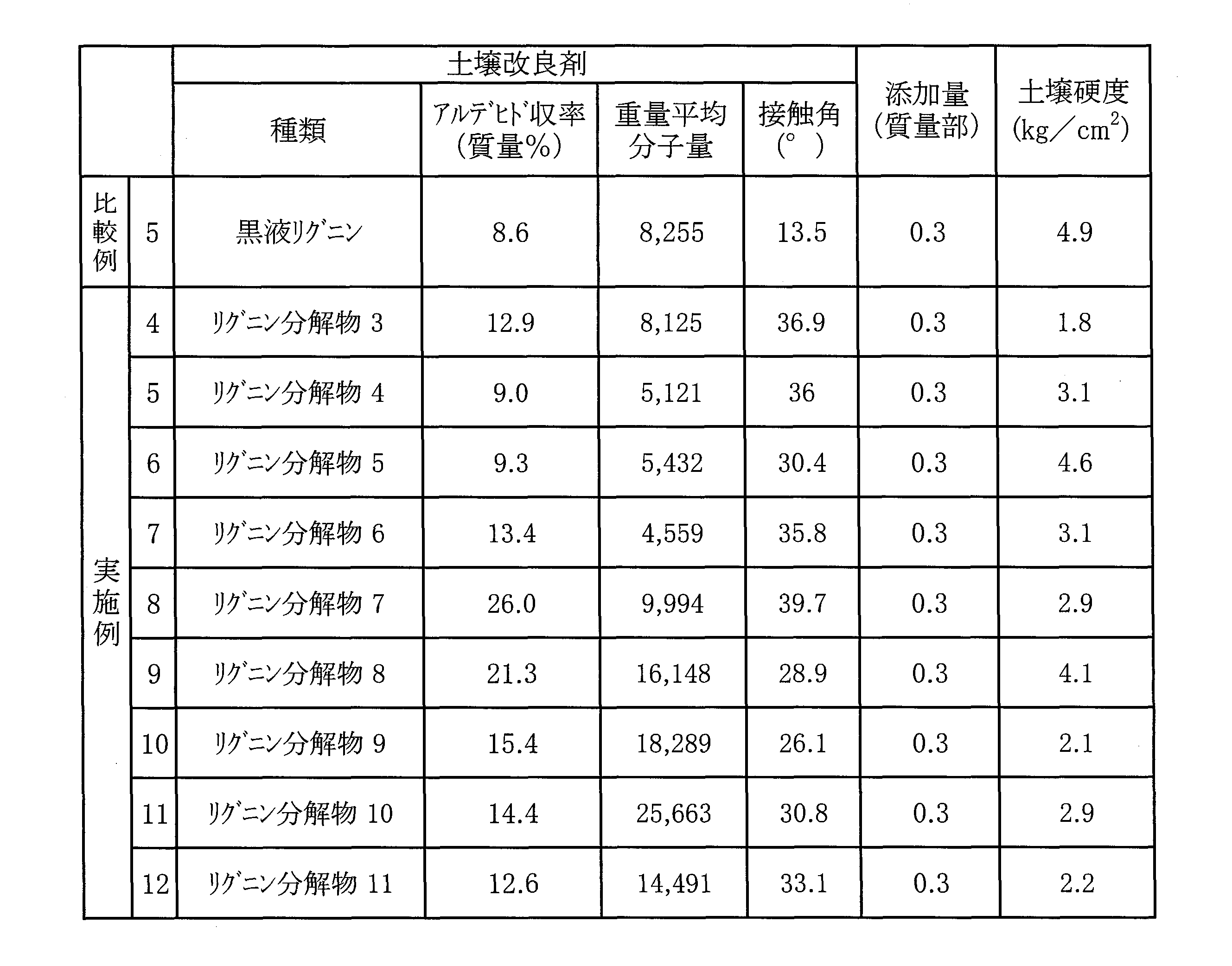
製造例1で得られたリグニン分解物1と表3の成分とを均一に混合して、土壌改良剤組成物を製造した。
得られた土壌改良剤組成物を用いて、実施例1同様に土壌硬度を測定した。土壌硬度の測定には、表3に示す土壌改良剤組成物を表3に示す所定量添加した。結果を表3に示した。いずれも土壌硬度が小さくなり、土壌改良剤組成物として有用であることがわかった。
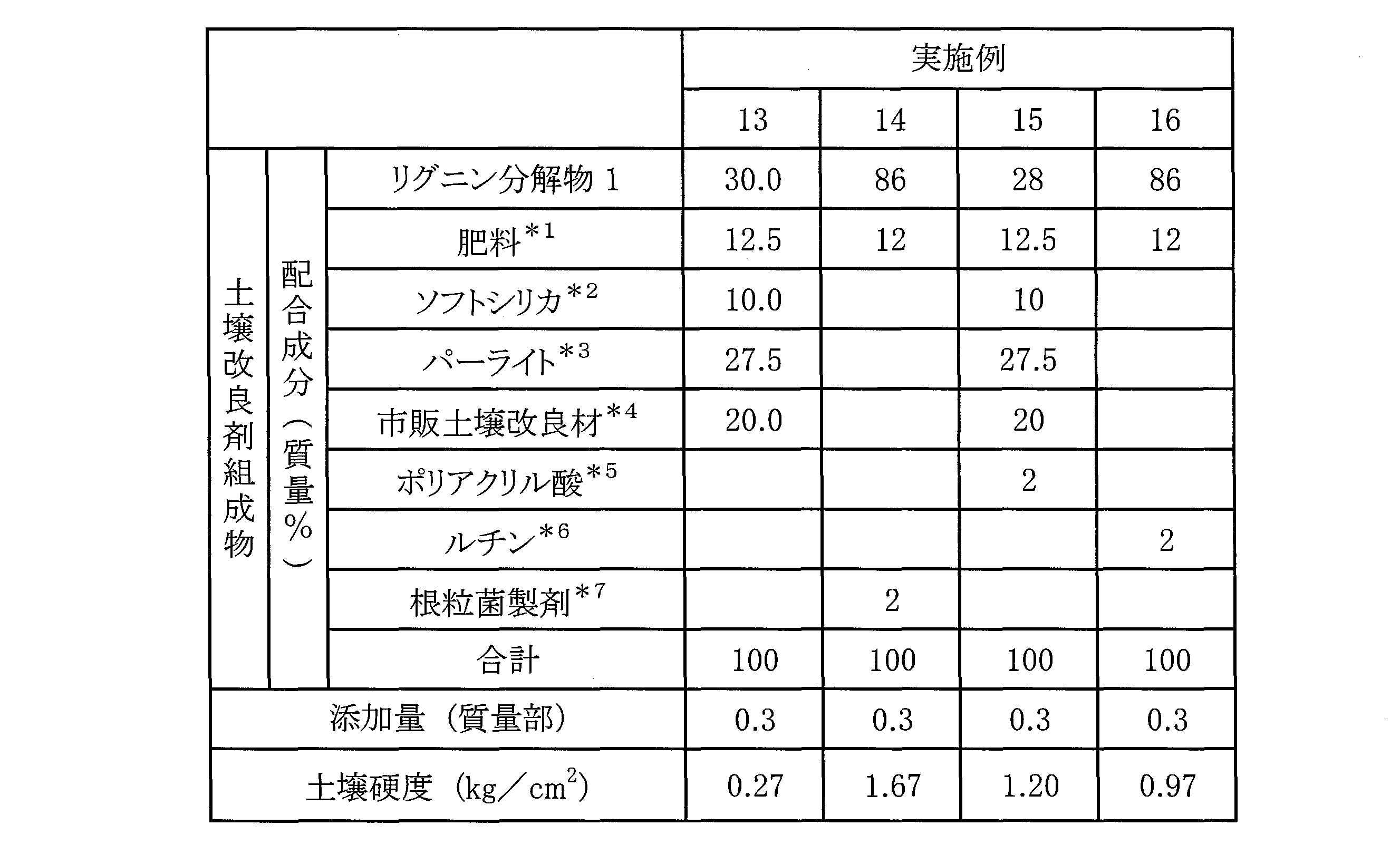
*1 肥料:商品名「みづほ化成肥料8号(肥料8-8-8)」、サンアグロ株式会社
*2 ソフトシリカ:ソフト・シリカ株式会社
*3 パーライト:株式会社錦幸園より入手
*4 市販土壌改良材:商品名「バークエース」、枚方畜産組合
*5 ポリアクリル酸:重量平均分子量1,000,000、和光純薬工業株式会社製
*6 ルチン:和光純薬工業株式会社製
*7 根粒菌製剤:商品名「まめぞう」、十勝農業協同組合 連合会農産化学研究所
Claims (9)
- 土壌に、アルカリニトロベンゼン酸化によるアルデヒド収率が5質量%以上であり、重量平均分子量が300以上100,000以下であり、水に対する接触角が15°以上であるリグニン分解物を供給する、土壌改良方法。
- 前記リグニン分解物のアルカリニトロベンゼン酸化によるアルデヒド収率が15質量%以上である、請求項1記載の土壌改良方法。
- 土壌100質量部あたり、前記リグニン分解物を0.0001質量部以上10質量部以下供給する、請求項1又は2に記載の土壌改良方法。
- 土壌10aあたり、前記リグニン分解物を0.2kg以上20000kg以下散布する、請求項1又は2に記載の土壌改良方法。
- アルカリニトロベンゼン酸化によるアルデヒド収率が5質量%以上であり、重量平均分子量が300以上100,000以下であり、水に対する接触角が15°以上であるリグニン分解物を有効成分とする土壌改良剤。
- 前記リグニン分解物のアルカリニトロベンゼン酸化によるアルデヒド収率が15質量%以上である、請求項5記載の土壌改良剤。
- アルカリニトロベンゼン酸化によるアルデヒド収率が5質量%以上であり、重量平均分子量が300以上100,000以下であり、水に対する接触角が15°以上であるリグニン分解物を含有する土壌改良剤組成物。
- 前記リグニン分解物のアルカリニトロベンゼン酸化によるアルデヒド収率が15質量%以上である、請求項7記載の土壌改良剤組成物。
- 下記(1)~(6)の1つ以上を含有する、前記請求項7又は8に記載の土壌改良剤組成物。
(1)肥料成分
(2)鉱物粉末又は粘土成分又は前記リグニン分解物以外の土壌改良成分
(3)高分子物質
(4)シグナル分子
(5)真菌
(6)細菌
Priority Applications (3)
| Application Number | Priority Date | Filing Date | Title |
|---|---|---|---|
| US16/080,749 US11279877B2 (en) | 2016-04-11 | 2017-03-10 | Method for improving soil |
| CN201780014363.2A CN108699440A (zh) | 2016-04-11 | 2017-03-10 | 土壤改良方法 |
| BR112018068071-0A BR112018068071B1 (pt) | 2016-04-11 | 2017-03-10 | Método para melhorar a qualidade do solo, agente de melhoria da qualidade do solo, e composição de agente de melhoria da qualidade do solo |
Applications Claiming Priority (2)
| Application Number | Priority Date | Filing Date | Title |
|---|---|---|---|
| JP2016-079000 | 2016-04-11 | ||
| JP2016079000 | 2016-04-11 |
Publications (1)
| Publication Number | Publication Date |
|---|---|
| WO2017179351A1 true WO2017179351A1 (ja) | 2017-10-19 |
Family
ID=60042575
Family Applications (1)
| Application Number | Title | Priority Date | Filing Date |
|---|---|---|---|
| PCT/JP2017/009692 Ceased WO2017179351A1 (ja) | 2016-04-11 | 2017-03-10 | 土壌改良方法 |
Country Status (5)
| Country | Link |
|---|---|
| US (1) | US11279877B2 (ja) |
| JP (1) | JP6962696B2 (ja) |
| CN (1) | CN108699440A (ja) |
| BR (1) | BR112018068071B1 (ja) |
| WO (1) | WO2017179351A1 (ja) |
Cited By (1)
| Publication number | Priority date | Publication date | Assignee | Title |
|---|---|---|---|---|
| WO2021200949A1 (ja) * | 2020-03-31 | 2021-10-07 | 花王株式会社 | 土壌改質剤 |
Families Citing this family (10)
| Publication number | Priority date | Publication date | Assignee | Title |
|---|---|---|---|---|
| US11505655B2 (en) * | 2017-08-10 | 2022-11-22 | Idemitsu Kosan Co., Ltd. | Modified lignin manufacturing method, modified lignin, and modified lignin-including resin composition material |
| JP6974988B2 (ja) * | 2017-09-05 | 2021-12-01 | 花王株式会社 | 植物収量向上剤 |
| CN116084198B (zh) * | 2018-05-28 | 2025-01-21 | 皮尔森生物工程技术(北京)有限公司 | 用于从植物材料的有机酸预处理回收产物的有效方法和组合物 |
| KR102250261B1 (ko) * | 2018-10-15 | 2021-05-10 | 경상국립대학교산학협력단 | 리그닌 변환체를 유효성분으로 함유하는 식물체의 생장 촉진용 조성물 |
| CN110240141B (zh) * | 2019-06-28 | 2021-05-28 | 浙江省农业科学院 | 一种提高生物炭碳素持留率和稳定性的方法 |
| JP2021080367A (ja) * | 2019-11-19 | 2021-05-27 | 出光興産株式会社 | 土壌改良剤、土壌、土壌改良方法及び改良された土壌の製造方法 |
| IT201900024877A1 (it) * | 2019-12-19 | 2021-06-19 | Upm Kymmene Corp | Ammendante, procedimenti per la sua preparazione e suoi usi |
| CN112341253A (zh) * | 2020-11-25 | 2021-02-09 | 广西大学 | 一种促进腐殖质形成的堆肥方法 |
| KR102654145B1 (ko) * | 2021-08-26 | 2024-04-03 | 국립순천대학교산학협력단 | 리그닌 바이오차를 포함하는 토양개량제 및 이의 제조방법 |
| CN121249372B (zh) * | 2025-12-04 | 2026-03-17 | 内蒙古草都草牧业股份有限公司 | 一种沙化土壤的微生物修复剂及其制备方法 |
Citations (6)
| Publication number | Priority date | Publication date | Assignee | Title |
|---|---|---|---|---|
| JP2004224893A (ja) * | 2003-01-22 | 2004-08-12 | Maeda Seikan Kk | 土壌用資材の製造方法 |
| JP2004300419A (ja) * | 2003-03-19 | 2004-10-28 | Jgc Corp | 改質ろ液の製造方法および該製造方法で得られる改質ろ液 |
| JP2006504524A (ja) * | 2002-11-01 | 2006-02-09 | コンプリヘンシブ リソーシーズ,リカバリー アンド リユース,インコーポレイテッド | 廃棄材料を処理するための装置、システム、および方法 |
| JP2013014737A (ja) * | 2011-07-05 | 2013-01-24 | Career Tech Co Ltd | バイオマスから高発熱燃料と高性能生物育成剤を得る方法 |
| CN103183541A (zh) * | 2013-04-12 | 2013-07-03 | 路德环境科技股份有限公司 | 有机废弃物制造生态有机肥方法 |
| JP2015024365A (ja) * | 2013-07-25 | 2015-02-05 | 住友ベークライト株式会社 | 土壌の浄化方法、及びそれに用いる吸着部材 |
Family Cites Families (38)
| Publication number | Priority date | Publication date | Assignee | Title |
|---|---|---|---|---|
| US4018591A (en) * | 1967-12-15 | 1977-04-19 | Prodotti Gianni S.R.L. | Product for activating and potentiating vegetable metabolism and for conditioning agricultural soil and method for the preparation thereof |
| DE2401878A1 (de) | 1973-01-18 | 1974-07-25 | Fertilizers Inc | Verfahren zur umwandlung von lignocellulosem material in duengemittel |
| JPS6092219A (ja) | 1983-10-24 | 1985-05-23 | Nissin Food Prod Co Ltd | 養液栽培による薬用物質の製造法 |
| JPS61100505A (ja) | 1984-10-20 | 1986-05-19 | Kinki Univ | まつたけ菌糸の成長促進剤 |
| JPH02289481A (ja) | 1988-09-02 | 1990-11-29 | Hitoyoshi Nama Concrete Kk | 杉・桧樹皮等の爆砕処理方法及び処理物 |
| JPH05874A (ja) | 1991-02-01 | 1993-01-08 | Nippon Hiryo Kk | 植物生育促進剤とその製造方法および植物生育促進剤を含有する肥料 |
| JP2699127B2 (ja) | 1991-10-22 | 1998-01-19 | 大日精化工業株式会社 | 芝生生育保持剤 |
| JPH0665016A (ja) | 1992-08-20 | 1994-03-08 | Sumitomo Ringyo Kk | 芝の根成長促進剤 |
| US5391542A (en) | 1993-06-10 | 1995-02-21 | Browning; Henry A. | Method of enhancing the growth of plants using alkyloxypolyethyleneoxyethanols |
| EP0744893B1 (en) | 1994-02-17 | 2000-04-12 | Abbott Laboratories | Pesticide adjuvant |
| DE4415049A1 (de) | 1994-04-29 | 1995-11-02 | Hoechst Schering Agrevo Gmbh | Acylierte Aminophenylsulfonylharnstoffe, Verfahren zu deren Herstellung und Verwendung als Herbizide und Wachstumsregulatoren |
| JP3148077B2 (ja) | 1994-06-29 | 2001-03-19 | 明治製菓株式会社 | 肥効促進性肥料及びそれを用いて肥効率を向上させる方法 |
| JP2978080B2 (ja) | 1995-03-22 | 1999-11-15 | 大日精化工業株式会社 | セントポーリア用開花促進剤 |
| NL1001620C2 (en) | 1995-06-22 | 1996-12-24 | Instituut Voor Agrobiologisch | Improvement in activity of plant growth regulators |
| US5994266A (en) | 1995-10-25 | 1999-11-30 | Abott Laboratories | Ultra violet radiation lignin protected pesticidal compositions |
| JP3138418B2 (ja) | 1995-12-04 | 2001-02-26 | 大日精化工業株式会社 | 植物用鮮度保持剤及び植物の鮮度保持方法 |
| JP3563559B2 (ja) | 1997-03-28 | 2004-09-08 | 大日精化工業株式会社 | 徐放性農園芸植物用活性剤及びその使用方法 |
| JPH11292671A (ja) | 1998-04-09 | 1999-10-26 | Gun Ei Chem Ind Co Ltd | 作物栄養補助剤及び該作物栄養補助剤を用いた作物栽培方法 |
| JP3715119B2 (ja) | 1998-11-02 | 2005-11-09 | 日本原子力研究所 | 繊維物質の分解抽出物による植物の障害抑制・生育促進剤 |
| JP2000264809A (ja) | 1999-03-17 | 2000-09-26 | Research Institute Of Innovative Technology For The Earth | 植物の生長調節用組成物 |
| EP1151667B1 (en) | 2000-04-28 | 2005-06-29 | Kao Corporation | Plant-activating agent |
| JP3768379B2 (ja) | 2000-04-28 | 2006-04-19 | 花王株式会社 | 植物活力剤 |
| CN1330057A (zh) | 2000-06-20 | 2002-01-09 | 张美华 | 用造纸黑液提取物生产多元有机肥 |
| CN1537830A (zh) | 2003-04-19 | 2004-10-20 | 顾小平 | 利用氢氧化钾碱法造纸制浆黑液生产肥料的方法 |
| JP2006213900A (ja) | 2005-02-01 | 2006-08-17 | Kono Shinsozai Kaihatsu Kk | 土壌改良剤 |
| CN101497794B (zh) * | 2009-03-10 | 2011-08-24 | 中国农业科学院农业资源与农业区划研究所 | 一种复合土壤调理剂及其制备方法 |
| US8597395B2 (en) | 2009-09-28 | 2013-12-03 | Floratine Biosciences, Inc. | Methods of reducing plant abiotic stress by applying a composition comprising lignins, tannins, and hydrocarbons |
| CA2775407A1 (en) | 2009-09-28 | 2011-03-31 | Fbsciences Holdings, Inc. | Fertilizer compositions and methods |
| JP2012017459A (ja) | 2010-06-07 | 2012-01-26 | Honda Motor Co Ltd | 土壌改良材の製造方法 |
| AT510346A1 (de) | 2010-09-02 | 2012-03-15 | Annikki Gmbh | Ligningewinnung |
| CN102181506A (zh) | 2011-02-28 | 2011-09-14 | 陕西科技大学 | 一种生物质预处理的方法 |
| JP6007081B2 (ja) * | 2011-12-20 | 2016-10-12 | 花王株式会社 | リグニン分解物の製造方法 |
| EP2802204B1 (en) | 2012-01-12 | 2020-09-09 | FBSciences Holdings, Inc. | Modulation of plant biology |
| JP6182368B2 (ja) | 2013-06-24 | 2017-08-16 | 花王株式会社 | リグニン分解物の製造方法 |
| JP6247030B2 (ja) | 2013-06-24 | 2017-12-13 | 花王株式会社 | 紫外線吸収剤 |
| CN103288553A (zh) * | 2013-06-27 | 2013-09-11 | 苏州禾润农业科技有限公司 | 一种生姜多元复合微生物肥及其制备方法 |
| GB201313803D0 (en) | 2013-08-01 | 2013-09-18 | Omex Agriculture Ltd | Fungicidal composition and method |
| BR112018068079B1 (pt) | 2016-04-11 | 2023-04-25 | Kao Corporation | Método para cultivar uma planta |
-
2017
- 2017-03-10 US US16/080,749 patent/US11279877B2/en active Active
- 2017-03-10 CN CN201780014363.2A patent/CN108699440A/zh active Pending
- 2017-03-10 JP JP2017045722A patent/JP6962696B2/ja active Active
- 2017-03-10 BR BR112018068071-0A patent/BR112018068071B1/pt active IP Right Grant
- 2017-03-10 WO PCT/JP2017/009692 patent/WO2017179351A1/ja not_active Ceased
Patent Citations (6)
| Publication number | Priority date | Publication date | Assignee | Title |
|---|---|---|---|---|
| JP2006504524A (ja) * | 2002-11-01 | 2006-02-09 | コンプリヘンシブ リソーシーズ,リカバリー アンド リユース,インコーポレイテッド | 廃棄材料を処理するための装置、システム、および方法 |
| JP2004224893A (ja) * | 2003-01-22 | 2004-08-12 | Maeda Seikan Kk | 土壌用資材の製造方法 |
| JP2004300419A (ja) * | 2003-03-19 | 2004-10-28 | Jgc Corp | 改質ろ液の製造方法および該製造方法で得られる改質ろ液 |
| JP2013014737A (ja) * | 2011-07-05 | 2013-01-24 | Career Tech Co Ltd | バイオマスから高発熱燃料と高性能生物育成剤を得る方法 |
| CN103183541A (zh) * | 2013-04-12 | 2013-07-03 | 路德环境科技股份有限公司 | 有机废弃物制造生态有机肥方法 |
| JP2015024365A (ja) * | 2013-07-25 | 2015-02-05 | 住友ベークライト株式会社 | 土壌の浄化方法、及びそれに用いる吸着部材 |
Cited By (3)
| Publication number | Priority date | Publication date | Assignee | Title |
|---|---|---|---|---|
| WO2021200949A1 (ja) * | 2020-03-31 | 2021-10-07 | 花王株式会社 | 土壌改質剤 |
| JPWO2021200949A1 (ja) * | 2020-03-31 | 2021-10-07 | ||
| JP7778683B2 (ja) | 2020-03-31 | 2025-12-02 | 花王株式会社 | 土壌改質剤 |
Also Published As
| Publication number | Publication date |
|---|---|
| US11279877B2 (en) | 2022-03-22 |
| CN108699440A (zh) | 2018-10-23 |
| BR112018068071A2 (pt) | 2019-01-08 |
| JP2017190448A (ja) | 2017-10-19 |
| BR112018068071B1 (pt) | 2023-04-11 |
| JP6962696B2 (ja) | 2021-11-05 |
| US20190023985A1 (en) | 2019-01-24 |
Similar Documents
| Publication | Publication Date | Title |
|---|---|---|
| JP6962696B2 (ja) | 土壌改良剤 | |
| FI124406B (fi) | Menetelmä maaperäaineksen käsittelemiseksi | |
| JP6498852B1 (ja) | 植物生育促進剤 | |
| Olomo et al. | Processing factors affecting the yield and physicochemical properties of starch from cassava chips and flour | |
| JP2025142297A (ja) | 土壌改質剤 | |
| Requena et al. | Chemical changes in humic substances from compost due to incubation with ligno-cellulolytic microorganisms and effects on lettuce growth | |
| KR102260994B1 (ko) | 간척지 비산먼지 저감을 위한 토양 개량제 제조방법 및 비산먼지 저감방법 | |
| CN102826910A (zh) | 一种复合微生物肥及其制备方法 | |
| JPWO2019078209A1 (ja) | 植物生育促進剤 | |
| CN115504830B (zh) | 一种微生物发酵的生物腐植酸、制备方法及应用 | |
| WO2021047282A1 (zh) | 一种富含腐殖质人工模拟土壤的制备方法 | |
| JP6498853B1 (ja) | 植物生育促進剤 | |
| Rychcik et al. | Dynamics of the soil organic matter in crop rotation and long-term monoculture | |
| CN110452071A (zh) | 一种基于超细微粉碎技术的盐碱地改良用复合肥料的制备方法 | |
| CN118562658A (zh) | 用于处理含油污泥的固体培养菌剂、制备方法及其应用 | |
| Feng et al. | Applicability of various organic and mineral materials for sustainable remediation of degraded coal mining soil | |
| WO2019065691A1 (ja) | 土壌の固結防止剤 | |
| WO2022222357A1 (zh) | 一种土壤改良剂及其制备方法 | |
| KR102857487B1 (ko) | 견운모와 휴믹산을 이용한 토질 개량제 및 그 제조방법 | |
| JP6974988B2 (ja) | 植物収量向上剤 | |
| JP7807820B2 (ja) | 草本繊維質素材及びその湿式粉砕物、それらの製造方法並びに用途 | |
| Chiellini et al. | Liquid mulch based on poly (vinyl alcohol). PVA‐soil interaction | |
| CN104561185A (zh) | 一种利用种子自然发芽生产多孔淀粉的方法 | |
| KR20100018140A (ko) | 석회질비료 또는 규산질비료 입상제조용 바인더 및 그제조방법 | |
| Sharma | SYNTHESIS AND APPLICATION OF BIOPOLYMER HYDROGELS FOR SEED GERMINATION IN Calendula |
Legal Events
| Date | Code | Title | Description |
|---|---|---|---|
| NENP | Non-entry into the national phase |
Ref country code: DE |
|
| REG | Reference to national code |
Ref country code: BR Ref legal event code: B01A Ref document number: 112018068071 Country of ref document: BR |
|
| 121 | Ep: the epo has been informed by wipo that ep was designated in this application |
Ref document number: 17782169 Country of ref document: EP Kind code of ref document: A1 |
|
| ENP | Entry into the national phase |
Ref document number: 112018068071 Country of ref document: BR Kind code of ref document: A2 Effective date: 20180906 |
|
| 122 | Ep: pct application non-entry in european phase |
Ref document number: 17782169 Country of ref document: EP Kind code of ref document: A1 |