WO2017168853A1 - ゴム並びにシール部品及びホース - Google Patents
ゴム並びにシール部品及びホース Download PDFInfo
- Publication number
- WO2017168853A1 WO2017168853A1 PCT/JP2016/086565 JP2016086565W WO2017168853A1 WO 2017168853 A1 WO2017168853 A1 WO 2017168853A1 JP 2016086565 W JP2016086565 W JP 2016086565W WO 2017168853 A1 WO2017168853 A1 WO 2017168853A1
- Authority
- WO
- WIPO (PCT)
- Prior art keywords
- rubber
- mass
- parts
- oil
- epm
- Prior art date
- Legal status (The legal status is an assumption and is not a legal conclusion. Google has not performed a legal analysis and makes no representation as to the accuracy of the status listed.)
- Ceased
Links
Images
Classifications
-
- C—CHEMISTRY; METALLURGY
- C08—ORGANIC MACROMOLECULAR COMPOUNDS; THEIR PREPARATION OR CHEMICAL WORKING-UP; COMPOSITIONS BASED THEREON
- C08L—COMPOSITIONS OF MACROMOLECULAR COMPOUNDS
- C08L23/00—Compositions of homopolymers or copolymers of unsaturated aliphatic hydrocarbons having only one carbon-to-carbon double bond; Compositions of derivatives of such polymers
- C08L23/02—Compositions of homopolymers or copolymers of unsaturated aliphatic hydrocarbons having only one carbon-to-carbon double bond; Compositions of derivatives of such polymers not modified by chemical after-treatment
- C08L23/16—Ethylene-propylene or ethylene-propylene-diene copolymers
-
- C—CHEMISTRY; METALLURGY
- C08—ORGANIC MACROMOLECULAR COMPOUNDS; THEIR PREPARATION OR CHEMICAL WORKING-UP; COMPOSITIONS BASED THEREON
- C08J—WORKING-UP; GENERAL PROCESSES OF COMPOUNDING; AFTER-TREATMENT NOT COVERED BY SUBCLASSES C08B, C08C, C08F, C08G or C08H
- C08J9/00—Working-up of macromolecular substances to porous or cellular articles or materials; After-treatment thereof
- C08J9/0061—Working-up of macromolecular substances to porous or cellular articles or materials; After-treatment thereof characterized by the use of several polymeric components
-
- C—CHEMISTRY; METALLURGY
- C09—DYES; PAINTS; POLISHES; NATURAL RESINS; ADHESIVES; COMPOSITIONS NOT OTHERWISE PROVIDED FOR; APPLICATIONS OF MATERIALS NOT OTHERWISE PROVIDED FOR
- C09K—MATERIALS FOR MISCELLANEOUS APPLICATIONS, NOT PROVIDED FOR ELSEWHERE
- C09K3/00—Materials not provided for elsewhere
- C09K3/10—Materials in mouldable or extrudable form for sealing or packing joints or covers
-
- F—MECHANICAL ENGINEERING; LIGHTING; HEATING; WEAPONS; BLASTING
- F16—ENGINEERING ELEMENTS AND UNITS; GENERAL MEASURES FOR PRODUCING AND MAINTAINING EFFECTIVE FUNCTIONING OF MACHINES OR INSTALLATIONS; THERMAL INSULATION IN GENERAL
- F16J—PISTONS; CYLINDERS; SEALINGS
- F16J15/00—Sealings
- F16J15/02—Sealings between relatively-stationary surfaces
- F16J15/021—Sealings between relatively-stationary surfaces with elastic packing
- F16J15/022—Sealings between relatively-stationary surfaces with elastic packing characterised by structure or material
-
- F—MECHANICAL ENGINEERING; LIGHTING; HEATING; WEAPONS; BLASTING
- F16—ENGINEERING ELEMENTS AND UNITS; GENERAL MEASURES FOR PRODUCING AND MAINTAINING EFFECTIVE FUNCTIONING OF MACHINES OR INSTALLATIONS; THERMAL INSULATION IN GENERAL
- F16J—PISTONS; CYLINDERS; SEALINGS
- F16J15/00—Sealings
- F16J15/02—Sealings between relatively-stationary surfaces
- F16J15/021—Sealings between relatively-stationary surfaces with elastic packing
- F16J15/022—Sealings between relatively-stationary surfaces with elastic packing characterised by structure or material
- F16J15/024—Sealings between relatively-stationary surfaces with elastic packing characterised by structure or material the packing being locally weakened in order to increase elasticity
- F16J15/027—Sealings between relatively-stationary surfaces with elastic packing characterised by structure or material the packing being locally weakened in order to increase elasticity and with a hollow profile
-
- F—MECHANICAL ENGINEERING; LIGHTING; HEATING; WEAPONS; BLASTING
- F16—ENGINEERING ELEMENTS AND UNITS; GENERAL MEASURES FOR PRODUCING AND MAINTAINING EFFECTIVE FUNCTIONING OF MACHINES OR INSTALLATIONS; THERMAL INSULATION IN GENERAL
- F16J—PISTONS; CYLINDERS; SEALINGS
- F16J15/00—Sealings
- F16J15/02—Sealings between relatively-stationary surfaces
- F16J15/06—Sealings between relatively-stationary surfaces with solid packing compressed between sealing surfaces
- F16J15/10—Sealings between relatively-stationary surfaces with solid packing compressed between sealing surfaces with non-metallic packing
- F16J15/102—Sealings between relatively-stationary surfaces with solid packing compressed between sealing surfaces with non-metallic packing characterised by material
-
- B—PERFORMING OPERATIONS; TRANSPORTING
- B60—VEHICLES IN GENERAL
- B60J—WINDOWS, WINDSCREENS, NON-FIXED ROOFS, DOORS, OR SIMILAR DEVICES FOR VEHICLES; REMOVABLE EXTERNAL PROTECTIVE COVERINGS SPECIALLY ADAPTED FOR VEHICLES
- B60J10/00—Sealing arrangements
- B60J10/15—Sealing arrangements characterised by the material
-
- C—CHEMISTRY; METALLURGY
- C08—ORGANIC MACROMOLECULAR COMPOUNDS; THEIR PREPARATION OR CHEMICAL WORKING-UP; COMPOSITIONS BASED THEREON
- C08J—WORKING-UP; GENERAL PROCESSES OF COMPOUNDING; AFTER-TREATMENT NOT COVERED BY SUBCLASSES C08B, C08C, C08F, C08G or C08H
- C08J2201/00—Foams characterised by the foaming process
- C08J2201/02—Foams characterised by the foaming process characterised by mechanical pre- or post-treatments
- C08J2201/026—Crosslinking before of after foaming
-
- C—CHEMISTRY; METALLURGY
- C08—ORGANIC MACROMOLECULAR COMPOUNDS; THEIR PREPARATION OR CHEMICAL WORKING-UP; COMPOSITIONS BASED THEREON
- C08J—WORKING-UP; GENERAL PROCESSES OF COMPOUNDING; AFTER-TREATMENT NOT COVERED BY SUBCLASSES C08B, C08C, C08F, C08G or C08H
- C08J2203/00—Foams characterized by the expanding agent
- C08J2203/04—N2 releasing, ex azodicarbonamide or nitroso compound
-
- C—CHEMISTRY; METALLURGY
- C08—ORGANIC MACROMOLECULAR COMPOUNDS; THEIR PREPARATION OR CHEMICAL WORKING-UP; COMPOSITIONS BASED THEREON
- C08J—WORKING-UP; GENERAL PROCESSES OF COMPOUNDING; AFTER-TREATMENT NOT COVERED BY SUBCLASSES C08B, C08C, C08F, C08G or C08H
- C08J2323/00—Characterised by the use of homopolymers or copolymers of unsaturated aliphatic hydrocarbons having only one carbon-to-carbon double bond; Derivatives of such polymers
- C08J2323/02—Characterised by the use of homopolymers or copolymers of unsaturated aliphatic hydrocarbons having only one carbon-to-carbon double bond; Derivatives of such polymers not modified by chemical after treatment
- C08J2323/16—Ethene-propene or ethene-propene-diene copolymers
-
- C—CHEMISTRY; METALLURGY
- C08—ORGANIC MACROMOLECULAR COMPOUNDS; THEIR PREPARATION OR CHEMICAL WORKING-UP; COMPOSITIONS BASED THEREON
- C08J—WORKING-UP; GENERAL PROCESSES OF COMPOUNDING; AFTER-TREATMENT NOT COVERED BY SUBCLASSES C08B, C08C, C08F, C08G or C08H
- C08J2423/00—Characterised by the use of homopolymers or copolymers of unsaturated aliphatic hydrocarbons having only one carbon-to-carbon double bond; Derivatives of such polymers
- C08J2423/02—Characterised by the use of homopolymers or copolymers of unsaturated aliphatic hydrocarbons having only one carbon-to-carbon double bond; Derivatives of such polymers not modified by chemical after treatment
- C08J2423/16—Ethene-propene or ethene-propene-diene copolymers
-
- C—CHEMISTRY; METALLURGY
- C08—ORGANIC MACROMOLECULAR COMPOUNDS; THEIR PREPARATION OR CHEMICAL WORKING-UP; COMPOSITIONS BASED THEREON
- C08J—WORKING-UP; GENERAL PROCESSES OF COMPOUNDING; AFTER-TREATMENT NOT COVERED BY SUBCLASSES C08B, C08C, C08F, C08G or C08H
- C08J2491/00—Characterised by the use of oils, fats or waxes; Derivatives thereof
-
- C—CHEMISTRY; METALLURGY
- C08—ORGANIC MACROMOLECULAR COMPOUNDS; THEIR PREPARATION OR CHEMICAL WORKING-UP; COMPOSITIONS BASED THEREON
- C08J—WORKING-UP; GENERAL PROCESSES OF COMPOUNDING; AFTER-TREATMENT NOT COVERED BY SUBCLASSES C08B, C08C, C08F, C08G or C08H
- C08J9/00—Working-up of macromolecular substances to porous or cellular articles or materials; After-treatment thereof
- C08J9/04—Working-up of macromolecular substances to porous or cellular articles or materials; After-treatment thereof using blowing gases generated by a previously added blowing agent
- C08J9/06—Working-up of macromolecular substances to porous or cellular articles or materials; After-treatment thereof using blowing gases generated by a previously added blowing agent by a chemical blowing agent
- C08J9/10—Working-up of macromolecular substances to porous or cellular articles or materials; After-treatment thereof using blowing gases generated by a previously added blowing agent by a chemical blowing agent developing nitrogen, the blowing agent being a compound containing a nitrogen-to-nitrogen bond
- C08J9/104—Hydrazines; Hydrazides; Semicarbazides; Semicarbazones; Hydrazones; Derivatives thereof
- C08J9/105—Hydrazines; Hydrazides; Semicarbazides; Semicarbazones; Hydrazones; Derivatives thereof containing sulfur
-
- C—CHEMISTRY; METALLURGY
- C08—ORGANIC MACROMOLECULAR COMPOUNDS; THEIR PREPARATION OR CHEMICAL WORKING-UP; COMPOSITIONS BASED THEREON
- C08L—COMPOSITIONS OF MACROMOLECULAR COMPOUNDS
- C08L2203/00—Applications
- C08L2203/14—Applications used for foams
-
- C—CHEMISTRY; METALLURGY
- C08—ORGANIC MACROMOLECULAR COMPOUNDS; THEIR PREPARATION OR CHEMICAL WORKING-UP; COMPOSITIONS BASED THEREON
- C08L—COMPOSITIONS OF MACROMOLECULAR COMPOUNDS
- C08L2205/00—Polymer mixtures characterised by other features
- C08L2205/02—Polymer mixtures characterised by other features containing two or more polymers of the same C08L -group
- C08L2205/025—Polymer mixtures characterised by other features containing two or more polymers of the same C08L -group containing two or more polymers of the same hierarchy C08L, and differing only in parameters such as density, comonomer content, molecular weight, structure
-
- C—CHEMISTRY; METALLURGY
- C08—ORGANIC MACROMOLECULAR COMPOUNDS; THEIR PREPARATION OR CHEMICAL WORKING-UP; COMPOSITIONS BASED THEREON
- C08L—COMPOSITIONS OF MACROMOLECULAR COMPOUNDS
- C08L2205/00—Polymer mixtures characterised by other features
- C08L2205/03—Polymer mixtures characterised by other features containing three or more polymers in a blend
-
- C—CHEMISTRY; METALLURGY
- C08—ORGANIC MACROMOLECULAR COMPOUNDS; THEIR PREPARATION OR CHEMICAL WORKING-UP; COMPOSITIONS BASED THEREON
- C08L—COMPOSITIONS OF MACROMOLECULAR COMPOUNDS
- C08L2312/00—Crosslinking
- C08L2312/02—Crosslinking with dienes
-
- F—MECHANICAL ENGINEERING; LIGHTING; HEATING; WEAPONS; BLASTING
- F16—ENGINEERING ELEMENTS AND UNITS; GENERAL MEASURES FOR PRODUCING AND MAINTAINING EFFECTIVE FUNCTIONING OF MACHINES OR INSTALLATIONS; THERMAL INSULATION IN GENERAL
- F16L—PIPES; JOINTS OR FITTINGS FOR PIPES; SUPPORTS FOR PIPES, CABLES OR PROTECTIVE TUBING; MEANS FOR THERMAL INSULATION IN GENERAL
- F16L11/00—Hoses, i.e. flexible pipes
- F16L11/04—Hoses, i.e. flexible pipes made of rubber or flexible plastics
Definitions
- the present invention relates to rubber and seal parts and hoses using the rubber.
- the following methods are known as methods for improving the sound insulation of seal parts such as rubber vehicles and buildings.
- Patent Document 4 describes an invention relating to a rubber component vulcanized foam comprising a mixture of EPDM and 10 to 50% by weight of EPM.
- vulcanizing agent use one or more suitable ones capable of vulcanizing or crosslinking EPDM and ethylene / propylene rubber” (paragraph 0012)
- paragraph 0012 uses one or more suitable ones capable of vulcanizing or crosslinking EPDM and ethylene / propylene rubber
- the EPM is crosslinked in Example 1.
- an organic peroxide paragraph 0029
- This is different from the present invention in that not only EPDM but also EPM is crosslinked.
- the reason why EPM is blended with EPDM is to reduce the diene content of the rubber component as a whole and to develop heat resistance and the like, and there is no description about sound insulation.
- Patent Document 5 discloses foaming / crosslinking a rubber composition containing ethylene- ⁇ -olefin-nonconjugated diene copolymer rubber, ethylene- ⁇ -olefin copolymer rubber, a foaming agent, and sulfur as a crosslinking agent.
- a rubber foam and a sealing material are described which have a density of 0.3 g / cm 3 or less.
- the ethylene- ⁇ -olefin-nonconjugated diene copolymer rubber is crosslinked, and the ethylene- ⁇ -olefin copolymer rubber is not crosslinked.
- the density is small, the sound insulation of the sealing parts is not good.
- the object of the present invention is not to increase the specific gravity of rubber or control the foamed form, but to reduce the physical properties or increase the weight by a new idea, and further to the materials described later.
- An object of the present invention is to provide a rubber, a sealing part, and a hose that can obtain good sound insulation without deteriorating the handling property.
- a further object of the present invention is to prevent whitening of the rubber surface.
- Oil is added to the rubber material for the purpose of volume increase, plasticization, softening (improving processability) and the like.
- extender oil extended oil
- process oil processing oil
- a rubber material for the purpose of softening (improving processability)
- extender oils, process oils, etc. include paraffinic oils, naphthenic oils, aromatic oils, or blends of these oils, but all oils have a weight average molecular weight in consideration of processability.
- Low molecular weight oil of about 500 to 1000 has been used. Oil has a low viscosity when its molecular weight is low, and high when its molecular weight is high.
- the rubber polymer includes a low molecular weight hydrocarbon oil having a weight average molecular weight of 1500 or less and a high molecular weight hydrocarbon oil having a weight average molecular weight of 5000 or more.
- a patent application was filed for the invention of a rubber material blended with (Patent Document 3 mentioned above).
- the high molecular weight hydrocarbon oil of the invention is a liquid having a high viscosity, there are problems such as that it takes time to weigh. Accordingly, the present inventors have continued further studies and, as a result of intensive studies, have found that good sound insulation can be obtained by using uncrosslinked EPM (ethylene-propylene rubber), and have reached the present invention.
- EPM ethylene-propylene rubber
- the present inventors have found that the rubber surface is whitened in a high temperature and high humidity test in a closed system depending on the blending in the present invention, and this whitening occurs when there is much blending of stearic acid. On the other hand, it was confirmed that when the amount of stearic acid was small, the sound insulation of the rubber was difficult to improve, and the kneadability and workability at the time of the material were lowered.
- the rubber of the present invention contains 5 to 45 parts by mass of non-crosslinked EPM and 100 parts by mass of oil of EPM or more with respect to 100 parts by mass of a crosslinked rubber polymer (excluding EPM).
- the specific gravity is more than 0.3 and 0.8 or less.
- the lower limit side of the specific gravity is preferably 0.4 or more.
- the upper limit side of the specific gravity is preferably 0.7 or less.
- the oil is preferably a hydrocarbon oil having a weight average molecular weight of 1500 or less.
- the mass ratio of oil to EPM is 1 to 10.
- the rubber preferably further contains 0.5 to 8 parts by mass of stearic acid with respect to 100 parts by mass of the rubber polymer. More preferably, it is the following (a) or (b).
- the rubber further contains 2 to 5 parts by mass of stearic acid with respect to 100 parts by mass of the rubber polymer.
- the rubber further contains 0.5 to 5 parts by mass of stearic acid and 0.5 to 20 parts by mass of a fatty acid ester processing aid with respect to 100 parts by mass of the rubber polymer.
- the seal part of the present invention is characterized by comprising the rubber.
- the hose of the present invention is made of the rubber.
- the upper limit of stearic acid is preferably 8 parts by mass. Further investigations have revealed that stearic acid blooms to the extent that whitening occurs when it exceeds 5 parts by weight. Therefore, when the upper limit of stearic acid is 5 parts by mass, whitening does not occur.
- stearic acid when stearic acid is contained in an amount of less than 2 parts by mass, the sound insulation is improved, but the viscosity at the time of the material is high, and the kneadability and workability are also insufficient.
- a fatty acid ester processing aid by further containing 0.5 to 20 parts by mass of a fatty acid ester processing aid, the viscosity is lowered and the kneadability and processability are improved without lowering the sound insulation.
- the action of the fatty acid ester processing aid is the same even when 2 to 5 parts by mass of stearic acid is contained.
- EPM Since EPM is solid, it can be handled in the same manner as other solid materials.
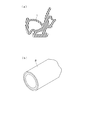
- FIG. 1A is a cross-sectional view of a weather strip for an automobile
- FIG. 2B is a cross-sectional view of a hose for an automobile.
- cross-linked rubber polymer The cross-linked rubber polymer (except EPM) is not particularly limited, but EPDM (ethylene-propylene-nonconjugated diene rubber), IIR (isobutylene / isoprene rubber), IR (isoprene rubber), NR (Natural rubber), BR (Butadiene rubber), SBR (Styrene butadiene rubber) and the like can be exemplified.
- the ethylene content is not particularly limited, but is preferably 60% by mass or less. When the ethylene content is high, there is a concern that the low-temperature characteristics of the vulcanized rubber are deteriorated.
- Non-conjugated dienes of EPDM are not particularly limited, and examples thereof include ENB (5-ethylidene-2-norbornene), DCPD (dicyclopentadiene), 1,4-HD (1,4-hexadiene) and the like.
- EPDM can be used in either a non-oil-extended type or an oil-extended type. The oil contained in the oil-extended type is included in “oil” in the present invention.
- the amount of non-crosslinked EPM is not particularly limited, but is preferably 5 to 45 parts by mass and more preferably 10 to 30 parts by mass with respect to 100 parts by mass of the rubber polymer. When the amount is less than 5 parts by mass, the effect of increasing the sound insulation is reduced, and when it exceeds 45 parts by mass, the viscosity of the material is increased.
- the ethylene content of EPM is not particularly limited, but is preferably 60% by mass or less. As the ethylene content increases, the low temperature properties decrease.
- the EPM can use either a non-oil-extended type or an oil-extended type. The oil contained in the oil-extended type is included in “oil” in the present invention.
- a vulcanizing agent for example, sulfur
- a sulfurizing agent for example, an organic peroxide
- Oil The amount of oil is not particularly limited, but is preferably a mass part equal to or higher than EPM (equivalent to a mass part of EPM). This is because rubber wraps around the roll during roll kneading and has good workability.
- the mass ratio of oil to EPM is not particularly limited, but is preferably 1 to 10, and more preferably 2 to 8. This is because if the mass ratio is less than 1, the workability decreases, and if the mass ratio exceeds 10, the plasticity is excessive and the processability decreases.
- group, or the hydrocarbon type oil which blended these can be illustrated.
- the weight average molecular weight of the hydrocarbon oil is preferably 1500 or less because the viscosity is low and the processability is improved. Although the minimum of a weight average molecular weight is not specifically limited, 100 is preferable from availability. Most of the oils such as extender oils and process oils conventionally added to rubber can be used as preferable oils corresponding to hydrocarbon oils having a weight average molecular weight of 100 to 1500.
- Stearic acid in the embodiment (a), stearic acid is contained in an amount of 0.5 to 5 parts by mass, more preferably 1 to 5 parts by mass, per 100 parts by mass of the rubber polymer. The reason why the content is 1 part by mass or more is to further improve the sound insulation and lower the viscosity of the material.
- the fatty acid ester processing aid may or may not be included.
- the fatty acid ester processing aid is contained in an amount of 0.5 to 20 parts by weight, more preferably 1 to 10 parts by weight, per 100 parts by weight of the rubber polymer. The reason for setting it to 1 part by mass or more is to further lower the viscosity at the time of material.
- the upper limit of the fatty acid ester-based processing aid is not particularly limited, but if it exceeds 20 parts by mass, the proportion of other components may be relatively reduced, affecting physical properties, and about 10 parts by mass. Is appropriate.
- the rubber may be blended with other blends. Although it does not specifically limit as another compound, Carbon black, a calcium carbonate, zinc white, an anti-aging agent, a coloring agent, a foaming agent, a vulcanization accelerator etc. can be illustrated.
- Molded product made of rubber is not particularly limited, but it is a seal part that can make use of high sound insulation.
- Seal parts such as weather strips for various vehicles such as automobiles, railway vehicles, ships, aircraft, door glass runs, window frames, engine gaskets, hood sealants, interior / exterior sealants, and electrical component sealants It is also possible to exemplify seal parts such as window frames of buildings.
- a hose such as an automobile hose can be exemplified, and the leakage of the flow sound of the fluid in the hose can be reduced.
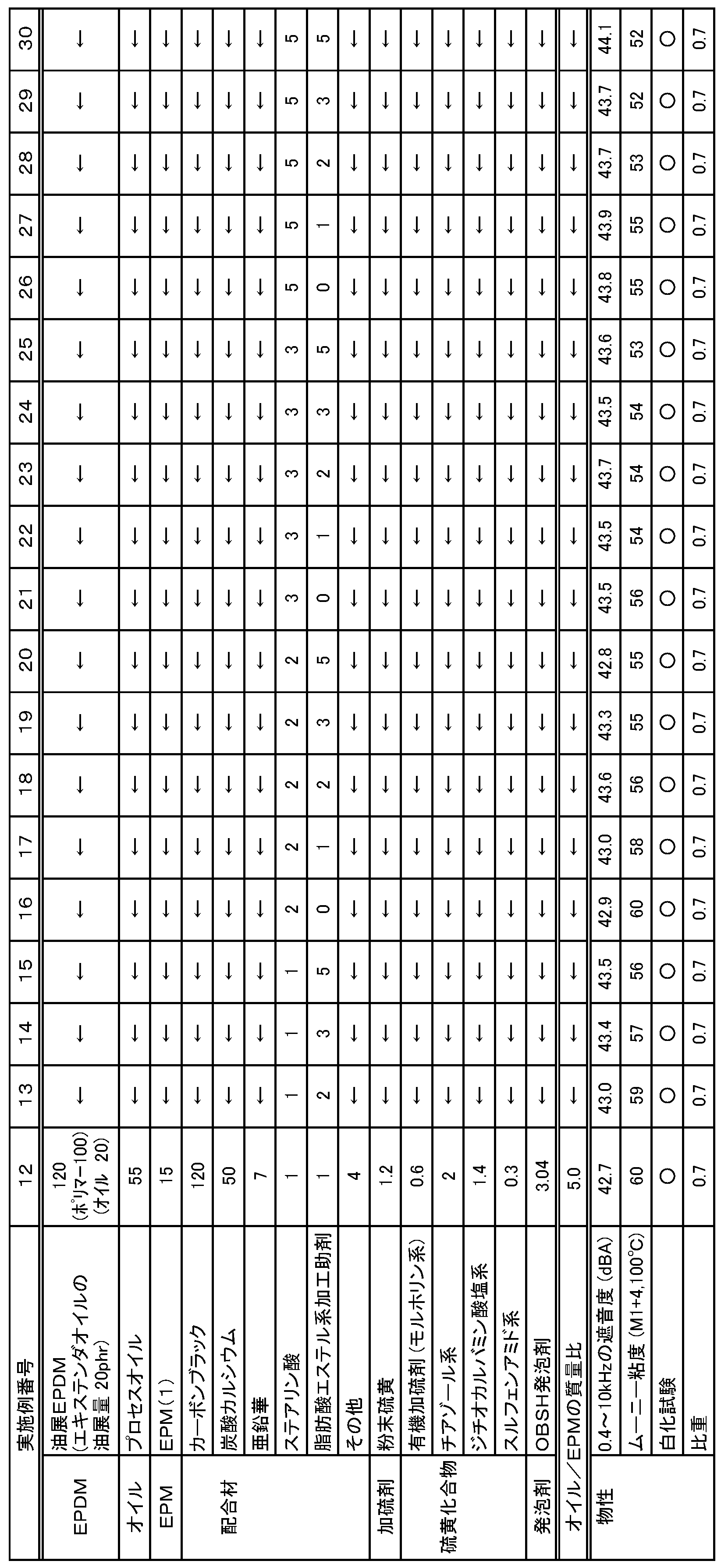
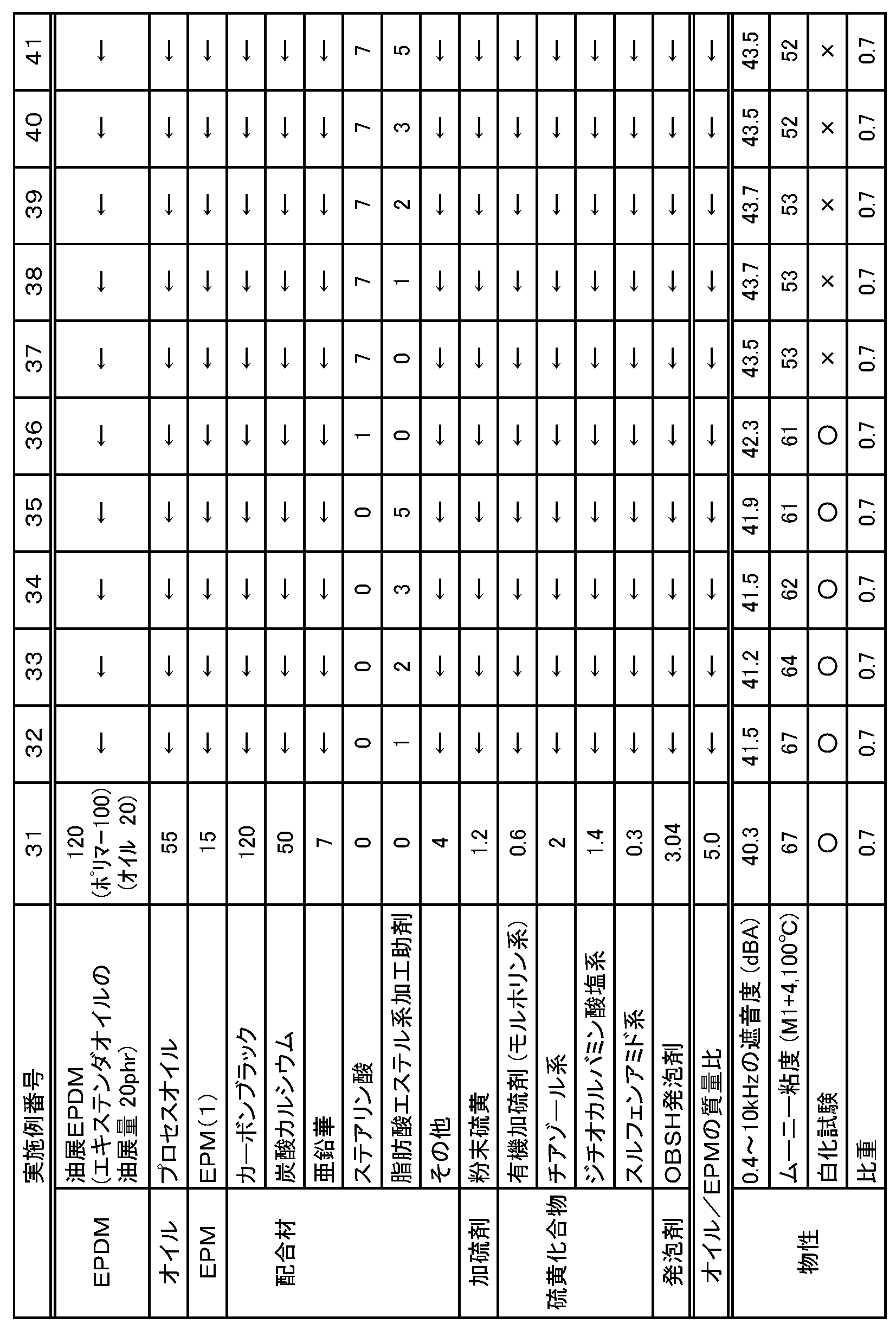
- the rubber materials of the rubbers of Examples 1 to 44 and Comparative Examples 1 to 5 having the formulations shown in the following Tables 1 to 4 (mixing values are parts by mass) were prepared, and foamed rubber sheets made of the respective rubbers were molded.
- Oil-extended EPDM trade name “Mitsui EPT8120E” (diene type ENB, diene content (ratio) 14 mass%, oil extended amount 20 phr) of Mitsui Chemicals, Inc. Therefore, 120 parts by mass of the oil-extended EPDM blended is composed of 100 parts by mass of the EPDM polymer and 20 parts by mass of the extender oil. The weight average molecular weight of the extender oil is not disclosed, but is estimated to be 1500 or less.
- EPM (1) Mitsui Chemicals' trade name “Mitsui EPT0045” (ethylene content (ratio) 51 mass%)
- EPM (2) Exxon Mobil Corporation trade name “Vistalon 404” (ethylene ratio 45 mass%) ).
- Process oil Trade name “Diana Process Oil PS-380” (paraffinic mineral oil, molecular weight 700, kinematic viscosity (100 ° C.) 30 mm 2 / s) from Idemitsu Kosan Co., Ltd.
- Carbon black iodine adsorption is 20 mg / g, DBP absorption amount is SRF of 115cm 3 / 100g.
- Stearic acid Trade name “Lunac S-50V” from Kao Corporation.
- Fatty acid ester processing aid Trade name “Emaster 430W” of Riken Vitamin Co., Ltd.
- Zinc flower Trade name “Meta Z-102” of Inoue Lime Industry Co., Ltd.
- -Vulcanizing agent sulfur powder.
- Organic vulcanizing agent Trade name “Barnock R” (4,4′-dithiodimorpholine) from Ouchi Shinsei Chemical Co., Ltd.
- -Foaming agent OBSH (p, p'-oxybisbenzenesulfonylhydrazide) foaming agent.
- the mass ratio of oil / EPM is the mass ratio of oil (total of process oil and extender oil in oil-extended EPDM) to EPM.
- the components of the rubber materials of the above examples and comparative examples are weighed so as to have the compounding ratios shown in Tables 1 to 4, respectively, kneaded using a Banbury mixer and roll, extruded with an extruder, and then heated.
- Mooney viscosity The Mooney viscosity (ML (1 + 4) 100 ° C.) of the kneaded rubber material (before vulcanization) was measured. It can be evaluated that the lower the Mooney viscosity, the better the workability.
- the produced foamed rubber sheet was set in a jig having an opening area of 10 mm ⁇ 90 mm, and a sound insulation degree (dBA) of 400 Hz to 10000 Hz was measured in an atmosphere at 23 ° C. It can be evaluated that the greater the sound insulation, the better the sound insulation.
- the degree of sound insulation required by rubber products varies, and the level of sound insulation varies greatly depending on the specific gravity of the rubber. Therefore, the sound insulation was evaluated by comparing the examples having the same specific gravity with the comparative examples.
- the foamed rubber sheets of Examples 1 to 41 and Comparative Examples 1 to 3 had a specific gravity of about 0.7 and were almost the same, and the foamed form was also the same visually.
- the foamed rubber sheets of Examples 42 and 43 and Comparative Example 4 had a specific gravity of 0.4.
- the specific gravity of the foamed rubber sheet of Example 44 and Comparative Example 5 was 0.5.
- the foamed rubber sheets of Examples 1 to 11 have improved sound insulation properties and better roll processability than Comparative Example 1.
- Comparative Example 2 roll processing could not be performed, and sound insulation properties could not be examined.
- Comparative Example 3 the sound insulation performance was improved as compared with Comparative Example 1, but the roll processability was insufficient.
- the foamed rubber sheets of Examples 12 to 30 were improved in sound insulation than Comparative Example 1, the Mooney viscosity was sufficiently low, and no whitening was observed.
- the foamed rubber sheets of Examples 31 to 35 were evaluated as being good because the sound insulation properties were almost the same as those of Comparative Example 1 despite the absence of stearic acid.
- the reason why the Mooney viscosity is slightly high is considered to be that the viscosity does not decrease sufficiently even when a fatty acid ester processing aid is added without stearic acid. Since there was no stearic acid, whitening was not seen.
- the foamed rubber sheet of Example 36 has higher sound insulation than Comparative Example 1 and Example 31. This is believed to be due to a small amount of stearic acid. The reason why the Mooney viscosity is slightly high is considered to be because the viscosity is not sufficiently lowered with a small amount of stearic acid because no fatty acid ester processing aid is added. No whitening was observed.
- the foamed rubber sheets of Examples 37 to 41 had higher sound insulation properties than those of Comparative Example 1 and Example 31, and Mooney viscosity was sufficiently low. Some whitening due to blooming out of stearic acid was observed.
- the foamed rubber sheets of Examples 42 and 43 were slightly improved in sound insulation than Comparative Example 4.
- the Mooney viscosity was sufficiently low and no whitening was observed.
- Example 44 The sound insulation of the foamed rubber sheet of Example 44 was slightly improved as compared with Comparative Example 5.
- the Mooney viscosity was sufficiently low and no whitening was observed.
- FIG. 1 shows a weather strip 1 (cross section) for automobiles and a hose 2 for sending fuel, refrigerant or air for automobiles, which are molded articles made of rubber of Examples 1 to 44.
- the weather strip 1 the sound insulation property of the sound that tries to pass through the weather strip 1 is improved.
- this hose 2 it can reduce that the flowing sound of the fuel in a hose, a refrigerant
- this invention is not limited to the said Example, It can change suitably in the range which does not deviate from the meaning of invention, and can be embodied.
Landscapes
- Chemical & Material Sciences (AREA)
- Engineering & Computer Science (AREA)
- General Engineering & Computer Science (AREA)
- Organic Chemistry (AREA)
- Mechanical Engineering (AREA)
- Health & Medical Sciences (AREA)
- Chemical Kinetics & Catalysis (AREA)
- Medicinal Chemistry (AREA)
- Polymers & Plastics (AREA)
- Materials Engineering (AREA)
- Compositions Of Macromolecular Compounds (AREA)
- Manufacture Of Porous Articles, And Recovery And Treatment Of Waste Products (AREA)
- Sealing Material Composition (AREA)
- General Chemical & Material Sciences (AREA)
- Oil, Petroleum & Natural Gas (AREA)
Abstract
【課題】物性低下、重量増加、材料取扱性悪化、白化等の問題を生じさせることなく、良好な遮音性を得る。 【解決手段】ゴムは、架橋したゴムポリマー(但し、EPMを除く。)100質量部に対して、架橋していないEPM5~45質量部と、EPM以上の質量部のオイルとを含み、発泡しており、比重が0.3超、0.8以下である。ウエザストリップ1及びホース2は、前記ゴムよりなるものである。
Description
本発明は、ゴム並びにそれを使用したシール部品及びホースに関するものである。
ゴムよりなる乗物、建物等のシール部品の遮音性を高める方法として、次の方法が知られている。
比重則(比重が大きいほど遮音性が優れる)に基づいてゴムの比重を大きくする方法として、特許文献1に記載のように、発泡ゴムの場合に発泡率を低くする方法がある。また、比重の高い添加剤の使用量を増やす方法も考えられる。しかし、この方法では、ゴム製品の重量が増加し、特に乗物のシール部品の場合、近年要求されている軽量化に相反することは問題である。
ゴムの発泡形態(独立気泡、連続気泡など)を制御する方法として、特許文献2に記載のように、粒径の異なる2種類の発泡剤を使用し、発泡ゴム中に相対的に大径の気泡と小径の気泡とを形成することにより、気泡が互いに連通して連続気泡となることを防ぎ、それぞれが単独気泡として存在するようにして、遮音性を向上させる方法がある。しかし、この方法では、発泡条件の最適な設定が難しく、設定によっては物性が低下するおそれもある。
上記以外の方法として、本出願人の出願に係る特許文献3に記載のように、ゴムに、通常添加される粘度が低い低分子量炭化水素系オイルとともに、通常添加されない粘度が高い高分子量炭化水素系オイルを添加して、後者の高分子量オイルの作用により遮音性を高める方法がある。この方法によれば、上記の問題はないが、高分子量オイルは粘度が高いため材料取扱性が悪く、秤量に時間がかかる等の課題が残っていた。
ところで、特許文献4には、EPDMと10~50重量%のEPMとの混合物からなるゴム成分の加硫発泡体に関する発明が記載されている。
しかし、「加硫剤としては、EPDMとエチレン・プロピレンゴムを加硫ないし架橋できる1種又は2種以上の適宜なものを用いる」(段落0012)と記載され、実施例1でEPMを架橋する有機過酸化物を用いていること(段落0029)から明らかなように、EPDMのみならずEPMも架橋した点で、本発明とは異なるものである。また、EPDMにEPMを配合した理由は、ゴム成分全体としてジエンの含量率を低下させて耐熱性等を発現させるためであって、遮音性についての記載はない。
しかし、「加硫剤としては、EPDMとエチレン・プロピレンゴムを加硫ないし架橋できる1種又は2種以上の適宜なものを用いる」(段落0012)と記載され、実施例1でEPMを架橋する有機過酸化物を用いていること(段落0029)から明らかなように、EPDMのみならずEPMも架橋した点で、本発明とは異なるものである。また、EPDMにEPMを配合した理由は、ゴム成分全体としてジエンの含量率を低下させて耐熱性等を発現させるためであって、遮音性についての記載はない。
また、特許文献5には、エチレン-α-オレフィン-非共役ジエン共重合体ゴム、エチレン-α-オレフィン共重合体ゴム、発泡剤、架橋剤としての硫黄を含むゴム組成物を発泡・架橋することにより得られ、密度が0.3g/cm3 以下であるゴム発泡体及びシール材が記載されている。エチレン-α-オレフィン-非共役ジエン共重合体ゴムは架橋され、エチレン-α-オレフィン共重合体ゴムは架橋されない。しかし、密度が小さいため、シール部品の遮音性は良くない。
そこで、本発明の目的は、ゴムの比重を大きくしたり発泡形態を制御したりするのではなく、新規な発想により、物性を低下させたり重量を増加させたりすることなく、さらには後述する材料の取扱性を悪化させることなく、良好な遮音性を得ることができるゴム並びにシール部品及びホースを提供することにある。
本発明のさらなる目的は、ゴム表面の白化を生じさせないようにすることにある。
ゴム材料には、体積増量、可塑化、軟化(加工性向上)等の目的でオイルが添加される。例えば、主にゴム素材メーカーにおいては、ゴム材料に体積増量や可塑化を目的とするエキステンダオイル(伸展油)が添加され、伸展ゴムあるいは油展ゴムと称して出荷される。また、主にゴム加工メーカーにおいては、ゴム材料に軟化(加工性向上)の目的でプロセスオイル(加工油)が添加され、混練して加工される。
これらエキステンダオイル、プロセスオイル等のオイルには、パラフィン系オイル、ナフテン系オイル、芳香族系オイル又はこれらをブレンドしたものがあるが、いずれのオイルも、加工性を考慮して、重量平均分子量500~1000程度の低分子量のオイルが使用されていた。オイルは、分子量が低いと粘度が低くなり、分子量が高いと粘度が高くなる。
先に、本発明者の一部は、このオイルに着目して検討し、ゴムポリマーに、重量平均分子量1500以下の低分子量炭化水素系オイルと、重量平均分子量5000以上の高分子量炭化水素系オイルとが配合されてなるゴム材料の発明に到って、特許出願をした(前述の特許文献3)。分子量の高いオイルを添加することで、オイルの分子同士、もしくはオイルとゴムポリマーの分子の絡み合いの数(密度)が増加し、その絡み合いの数が多いほど音の振動が伝わる際に生じる摩擦が大きくなり、音を熱に変換する能力が高まると考えられ、良好な遮音性が得られる。
上記発明の高分子量炭化水素系オイルは粘度が高い液体であるため、秤量に時間がかかる等の課題がある。そこで、本発明者らはさらに検討を続け、鋭意検討した結果、架橋していないEPM(エチレン-プロピレンゴム)を用いることで良好な遮音性が得られることを見出し、本発明に到った。
さらに本発明者らは、本発明においても配合によっては、密閉系における高温高湿度試験にてゴム表面が白化することに気付き、この白化はステアリン酸の配合が多いと発生することを見出した。一方、ステアリン酸の配合が少ないとゴムの遮音性が向上しにくく、材料時の混練性と加工性も低下することを確認した。
本発明のゴムは、架橋したゴムポリマー(但し、EPMを除く。)100質量部に対して、架橋していないEPM5~45質量部と、EPM以上の質量部のオイルとを含み、発泡しており、比重が0.3超、0.8以下であることを特徴とする。比重の下限側は、好ましくは0.4以上である。比重の上限側は、好ましくは0.7以下である。
オイルは、重量平均分子量1500以下の炭化水素系オイルであることが好ましい。
EPMに対するオイルの質量比が1~10であることが好ましい。
ゴムは、ゴムポリマー100質量部に対して、さらにステアリン酸0.5~8質量部を含むことが好ましい。より好ましくは、次の(a)又は(b)である。
(a)ゴムは、ゴムポリマー100質量部に対して、さらにステアリン酸2~5質量部を含む。
(b)ゴムは、ゴムポリマー100質量部に対して、さらにステアリン酸0.5~5質量部と、脂肪酸エステル系加工助剤0.5~20質量部とを含む。
本発明のシール部品は、前記ゴムよりなることを特徴とする。
本発明のホースは、前記ゴムよりなることを特徴とする。
本発明の作用を説明する。
(1)ゴムは、架橋していないEPMを含むことにより、400~10000Hzの音の遮音度(dBA)が大きくなり、すなわち遮音性が高くなる。そのメカニズムは、明確には判明していないが、架橋していないEPMを含むことにより、EPMの分子同士、もしくはEPMとゴムポリマーの分子の絡み合いの数(密度)が増加し、その絡み合いの数が多いほど音の振動が伝わる際に生じる摩擦が大きくなり、音を熱に変換する(音を吸収する)能力が高まるためと考えられる。
(1)ゴムは、架橋していないEPMを含むことにより、400~10000Hzの音の遮音度(dBA)が大きくなり、すなわち遮音性が高くなる。そのメカニズムは、明確には判明していないが、架橋していないEPMを含むことにより、EPMの分子同士、もしくはEPMとゴムポリマーの分子の絡み合いの数(密度)が増加し、その絡み合いの数が多いほど音の振動が伝わる際に生じる摩擦が大きくなり、音を熱に変換する(音を吸収する)能力が高まるためと考えられる。
(2)ステアリン酸を0.5質量部以上含むことにより、さらに遮音性が向上する。そのメカニズムは、現時点では判明していない。
但し、ステアリン酸は、その量が多いとブルームアウトしやすくなる。この点に鑑み、ステアリン酸の上限を8質量部とすることが好ましい。また、さらなる検討により、ステアリン酸は、5質量部を超えると、白化を生じさせる程度にブルームアウトすることが判明した。そこで、ステアリン酸の上限を5質量部とすれば、白化が生じないようになる。
但し、ステアリン酸は、その量が多いとブルームアウトしやすくなる。この点に鑑み、ステアリン酸の上限を8質量部とすることが好ましい。また、さらなる検討により、ステアリン酸は、5質量部を超えると、白化を生じさせる程度にブルームアウトすることが判明した。そこで、ステアリン酸の上限を5質量部とすれば、白化が生じないようになる。
一方、ステアリン酸を2質量部未満しか含まない場合には、遮音性は向上するが、材料時の粘度が高く、混練性と加工性が不十分となることも、さらなる検討により判明した。この場合、さらに脂肪酸エステル系加工助剤を0.5~20質量部含むことにより、遮音性を低下させることなく、粘度が下がり混練性と加工性が向上する。なお、この脂肪酸エステル系加工助剤による作用は、ステアリン酸を2~5質量部含む場合でも同様である。
(3)ゴムは、発泡しており、比重が0.3を超えている(好ましくは0.4以上である)ことにより、遮音性のレベルが一定以上あるので、上記(1)及び(2)の遮音性向上作用が顕著に現れる。比重が0.3以下であると、遮音性のレベルがもともと低いので、同作用があまり発現しない。
また、ゴムは、発泡しており、比重が0.8以下である(好ましくは0.7以下である)ことにより、ゴム製品の重量が抑えられ、特に乗物のシール部品の場合、近年要求されている軽量化に合致する。比重が0.8を超えると、ゴム製品の重量が増加する。
また、ゴムは、発泡しており、比重が0.8以下である(好ましくは0.7以下である)ことにより、ゴム製品の重量が抑えられ、特に乗物のシール部品の場合、近年要求されている軽量化に合致する。比重が0.8を超えると、ゴム製品の重量が増加する。
(4)EPMは固体であるため、他の固体材料と同様の方法で取り扱うことができる。
(5)ゴム中のオイルを全てEPMに代えてしてしまうと、ロール混練時にロールに巻きつかなくなり、加工性も悪くなる。そこで、ゴム中にEPM以上のオイルがある状態でEPMを配合することにより、ロール混練性を確保しつつ、遮音性を高めることができる。
本発明のゴム並びにシール部品及びホースによれば、物性を低下させたり重量を増加させたりすることなく、また、材料の取扱性やロール加工性を悪化させることなく、良好な遮音性を得ることができる。さらに、白化が生じないようにすることもできる。
1.架橋したゴムポリマー
架橋したゴムポリマー(但し、EPMを除く。)としては、特に限定されないが、EPDM(エチレン-プロピレン-非共役ジエンゴム)、IIR(イソブチレン・イソプレンゴム)、IR(イソプレンゴム)、NR(天然ゴム)、BR(ブタジエンゴム)、SBR(スチレン・ブタジエンゴム)等を例示できる。
EPDMの場合、エチレン含量は、特に限定されないが、60質量%以下が好ましい。エチレン含量が高くなると、加硫ゴムの低温特性が低下する懸念がある。
EPDMの非共役ジエンとしては、特に限定されないが、ENB(5-エチリデン-2-ノルボルネン)、DCPD(ジシクロペンタジエン)、1,4-HD(1,4-ヘキサジエン)等を例示できる。
EPDMは、非油展タイプ又は油展タイプのいずれも使用できる。油展タイプに含まれるオイル分は、本発明における「オイル」に算入される。
架橋したゴムポリマー(但し、EPMを除く。)としては、特に限定されないが、EPDM(エチレン-プロピレン-非共役ジエンゴム)、IIR(イソブチレン・イソプレンゴム)、IR(イソプレンゴム)、NR(天然ゴム)、BR(ブタジエンゴム)、SBR(スチレン・ブタジエンゴム)等を例示できる。
EPDMの場合、エチレン含量は、特に限定されないが、60質量%以下が好ましい。エチレン含量が高くなると、加硫ゴムの低温特性が低下する懸念がある。
EPDMの非共役ジエンとしては、特に限定されないが、ENB(5-エチリデン-2-ノルボルネン)、DCPD(ジシクロペンタジエン)、1,4-HD(1,4-ヘキサジエン)等を例示できる。
EPDMは、非油展タイプ又は油展タイプのいずれも使用できる。油展タイプに含まれるオイル分は、本発明における「オイル」に算入される。
2.架橋していないEPM
架橋していないEPMの量は、特に限定されないが、ゴムポリマー100質量部に対して、5~45質量部が好ましく、10~30質量部がより好ましい。5質量部未満だと、遮音性を高くする効果が小さくなり、45質量部を超えると、材料の粘度が高くなるからである。
EPMのエチレン含量は、特に限定されないが、60質量%以下が好ましい。エチレン含量が高くなると、低温特性が低下する。
EPMは、非油展タイプ又は油展タイプのいずれも使用できる。油展タイプに含まれるオイル分は、本発明における「オイル」に算入される。
本発明のゴムが、架橋したゴムポリマーと、架橋しないEPMを含むようにするには、ゴムポリマーを加硫しEPMを架橋しない加硫剤(例えば硫黄)を用いるようにし、EPMを架橋する加硫剤(例えば有機過酸化物)を用いないようにすればよい。
架橋していないEPMの量は、特に限定されないが、ゴムポリマー100質量部に対して、5~45質量部が好ましく、10~30質量部がより好ましい。5質量部未満だと、遮音性を高くする効果が小さくなり、45質量部を超えると、材料の粘度が高くなるからである。
EPMのエチレン含量は、特に限定されないが、60質量%以下が好ましい。エチレン含量が高くなると、低温特性が低下する。
EPMは、非油展タイプ又は油展タイプのいずれも使用できる。油展タイプに含まれるオイル分は、本発明における「オイル」に算入される。
本発明のゴムが、架橋したゴムポリマーと、架橋しないEPMを含むようにするには、ゴムポリマーを加硫しEPMを架橋しない加硫剤(例えば硫黄)を用いるようにし、EPMを架橋する加硫剤(例えば有機過酸化物)を用いないようにすればよい。
3.オイル
オイルの量は、特に限定されないが、EPM以上(EPMの質量部以上)の質量部とすることが好ましい。ゴムがロール混練時にロールに巻きつき、加工性も良いからである。
EPMに対するオイルの質量比は、特に限定されないが、1~10が好ましく、2~8がより好ましい。同質量比が1未満では、加工性が低下し、同質量比が10を超えると、可塑化しすぎて加工性が低下するからである。
オイルとしては、特に限定されないが、パラフィン系、ナフテン系、芳香族系又はこれらをブレンドした炭化水素系オイルを例示できる。炭化水素系オイルの重量平均分子量は、粘度が低く加工性が良くなることから、1500以下が好ましい。重量平均分子量の下限は、特に限定されないが、入手のしやすさから100が好ましい。従来よりゴムに添加されているエキステンダオイル、プロセスオイル等のオイルのほとんどは、この重量平均分子量100~1500の炭化水素系オイルに該当する好ましいものとして使用できる。
オイルの量は、特に限定されないが、EPM以上(EPMの質量部以上)の質量部とすることが好ましい。ゴムがロール混練時にロールに巻きつき、加工性も良いからである。
EPMに対するオイルの質量比は、特に限定されないが、1~10が好ましく、2~8がより好ましい。同質量比が1未満では、加工性が低下し、同質量比が10を超えると、可塑化しすぎて加工性が低下するからである。
オイルとしては、特に限定されないが、パラフィン系、ナフテン系、芳香族系又はこれらをブレンドした炭化水素系オイルを例示できる。炭化水素系オイルの重量平均分子量は、粘度が低く加工性が良くなることから、1500以下が好ましい。重量平均分子量の下限は、特に限定されないが、入手のしやすさから100が好ましい。従来よりゴムに添加されているエキステンダオイル、プロセスオイル等のオイルのほとんどは、この重量平均分子量100~1500の炭化水素系オイルに該当する好ましいものとして使用できる。
4.ステアリン酸
上記(a)の態様において、ステアリン酸は、ゴムポリマー100質量部に対して、0.5~5質量部含むが、1~5質量部含むことがより好ましい。1質量部以上とするのは、遮音性をより向上させるとともに、材料時の粘度をより下げるためである。
上記(a)の態様において、ステアリン酸は、ゴムポリマー100質量部に対して、0.5~5質量部含むが、1~5質量部含むことがより好ましい。1質量部以上とするのは、遮音性をより向上させるとともに、材料時の粘度をより下げるためである。
5.脂肪酸エステル系加工助剤
上記(a)の態様において、脂肪酸エステル系加工助剤は含んでも含まなくてもよい。
上記(b)の態様において、脂肪酸エステル系加工助剤は、ゴムポリマー100質量部に対して、0.5~20質量部含むが、1~10質量部含むことがより好ましい。1質量部以上とするのは、材料時の粘度をより下げるためである。脂肪酸エステル系加工助剤の上限は、特に限定されないのであるが、20質量部を超えると相対的に他の成分の割合が減って物性に影響する可能性があり、10質量部程度とするのが適当である。
上記(a)の態様において、脂肪酸エステル系加工助剤は含んでも含まなくてもよい。
上記(b)の態様において、脂肪酸エステル系加工助剤は、ゴムポリマー100質量部に対して、0.5~20質量部含むが、1~10質量部含むことがより好ましい。1質量部以上とするのは、材料時の粘度をより下げるためである。脂肪酸エステル系加工助剤の上限は、特に限定されないのであるが、20質量部を超えると相対的に他の成分の割合が減って物性に影響する可能性があり、10質量部程度とするのが適当である。
6.その他の配合物
ゴムは、他の配合物が配合されていてもよい。他の配合物としては、特に限定はされないが、カーボンブラック、炭酸カルシウム、亜鉛華、老化防止剤、着色剤、発泡剤、加硫促進剤等を例示できる。
ゴムは、他の配合物が配合されていてもよい。他の配合物としては、特に限定はされないが、カーボンブラック、炭酸カルシウム、亜鉛華、老化防止剤、着色剤、発泡剤、加硫促進剤等を例示できる。
7.ゴムよりなる成形品
本発明のゴムよりなる成形品としては、特に限定されないが、高い遮音性を生かせるのはシール部品である。自動車、鉄道車両、船舶、航空機等の各種乗物のウエザストリップ、ドアガラスラン、窓枠、エンジンのガスケット、フードのシール材、内外装部品のシール材、電装部品のシール材等のシール部品を例示することができ、また、建物の窓枠等のシール部品を例示することもできる。さらに、シール部品以外にも、自動車用ホース等のホースを例示することができ、ホース内の流動物の流動音が外部に漏れるのを低減できる。
本発明のゴムよりなる成形品としては、特に限定されないが、高い遮音性を生かせるのはシール部品である。自動車、鉄道車両、船舶、航空機等の各種乗物のウエザストリップ、ドアガラスラン、窓枠、エンジンのガスケット、フードのシール材、内外装部品のシール材、電装部品のシール材等のシール部品を例示することができ、また、建物の窓枠等のシール部品を例示することもできる。さらに、シール部品以外にも、自動車用ホース等のホースを例示することができ、ホース内の流動物の流動音が外部に漏れるのを低減できる。
次の表1~表4に示す配合(配合数値は質量部)の実施例1~44及び比較例1~5の各ゴムのゴム材料を調製し、各ゴムよりなる発泡ゴムシートを成形した。


ここで、使用した各成分の詳細は次のとおりである。
・油展EPDM:三井化学株式会社の商品名「三井EPT8120E」(ジエン種類ENB、ジエン含量(割合)14質量%、油展量20phr)である。よって、配合した油展EPDM120質量部は、EPDMポリマー100質量部と、エキステンダオイル20質量部とからなる。エキステンダオイルの重量平均分子量は、公表されていないが、1500以下と推定される。
・EPM(1):三井化学株式会社の商品名「三井EPT0045」(エチレン含量(割合)51質量%)である
・EPM(2):エクソン モービル コーポレーションの商品名「Vistalon404」(エチレン割合45質量%)である。
・プロセスオイル:出光興産株式会社の商品名「ダイアナプロセスオイルPS-380」(パラフィン系鉱物油、分子量700、動粘度(100℃)30mm2/s)である。
・油展EPDM:三井化学株式会社の商品名「三井EPT8120E」(ジエン種類ENB、ジエン含量(割合)14質量%、油展量20phr)である。よって、配合した油展EPDM120質量部は、EPDMポリマー100質量部と、エキステンダオイル20質量部とからなる。エキステンダオイルの重量平均分子量は、公表されていないが、1500以下と推定される。
・EPM(1):三井化学株式会社の商品名「三井EPT0045」(エチレン含量(割合)51質量%)である
・EPM(2):エクソン モービル コーポレーションの商品名「Vistalon404」(エチレン割合45質量%)である。
・プロセスオイル:出光興産株式会社の商品名「ダイアナプロセスオイルPS-380」(パラフィン系鉱物油、分子量700、動粘度(100℃)30mm2/s)である。
・カーボンブラック:よう素吸着量が20mg/g、DBP吸収量が115cm3/100gのSRFである。
・ステアリン酸:花王株式会社の商品名「ルナックS-50V」である。
・脂肪酸エステル系加工助剤:理研ビタミン株式会社の商品名「エマスター430W」である。
・亜鉛華:井上石灰工業株式会社の商品名「メタZ-102」である。
・加硫剤:硫黄粉末である。
・有機加硫剤:大内新興化学工業株式会社の商品名「バルノックR」(4,4'-ジチオジモルホリン)である。
・発泡剤:OBSH(p,p'-オキシビスベンゼンスルホニルヒドラジド)発泡剤である。
・ステアリン酸:花王株式会社の商品名「ルナックS-50V」である。
・脂肪酸エステル系加工助剤:理研ビタミン株式会社の商品名「エマスター430W」である。
・亜鉛華:井上石灰工業株式会社の商品名「メタZ-102」である。
・加硫剤:硫黄粉末である。
・有機加硫剤:大内新興化学工業株式会社の商品名「バルノックR」(4,4'-ジチオジモルホリン)である。
・発泡剤:OBSH(p,p'-オキシビスベンゼンスルホニルヒドラジド)発泡剤である。
オイル/EPMの質量比は、EPMに対するオイル(プロセスオイルと油展EPDM中のエキステンダオイルとの合計)の質量比である。
上記実施例及び比較例のゴム材料の成分を、それぞれ表1~表4の配合比になるように秤量し、バンバリーミキサーとロールとを用いて混練し、押出機で押し出した後、加熱することで加硫及び発泡させて厚さ1.2mmの発泡ゴムシートに成形加工した。加硫剤の硫黄は、EPDMを架橋し、EPMを架橋しないため、実施例及び比較例の発泡ゴムシートは、架橋したEPDMと、架橋していないEPMを含むものとなった。
上記実施例及び比較例のゴム材料について、次の評価を行った。
1.ロール加工性(但し、実施例1~11及び比較例1~3のみ)
上記ロール加工時にゴムが、ロールによく巻きついて加工性(混練性)が良好であれば良(○)、少しの浮きが見られれば可(△)、浮きが激しく加工できなければ不可(×)と評価した。
上記ロール加工時にゴムが、ロールによく巻きついて加工性(混練性)が良好であれば良(○)、少しの浮きが見られれば可(△)、浮きが激しく加工できなければ不可(×)と評価した。
2.加工性(ムーニー粘度)
上記の混練した(加硫前の)ゴム材料について、ムーニー粘度(ML(1+4)100℃)を測定した。ムーニー粘度が低いほど加工性が優れていると評価できる。
上記の混練した(加硫前の)ゴム材料について、ムーニー粘度(ML(1+4)100℃)を測定した。ムーニー粘度が低いほど加工性が優れていると評価できる。
上記実施例及び比較例のゴム材料により成形したゴム(発泡ゴムシート)について、次の測定及び評価を行った。
3.遮音性
作製した発泡ゴムシートを、開口面積10mm×90mmの冶具にセットし、23℃の雰囲気下で400Hz~10000Hzの遮音度(dBA)を測定した。遮音度が大きいほど遮音性が優れていると評価できる。
ゴム製品によって要求される遮音度は異なり、遮音度のレベルはゴムの比重によって大きく変わる。よって、遮音性の評価は、比重が同じである実施例と比較例との比較で行った。
作製した発泡ゴムシートを、開口面積10mm×90mmの冶具にセットし、23℃の雰囲気下で400Hz~10000Hzの遮音度(dBA)を測定した。遮音度が大きいほど遮音性が優れていると評価できる。
ゴム製品によって要求される遮音度は異なり、遮音度のレベルはゴムの比重によって大きく変わる。よって、遮音性の評価は、比重が同じである実施例と比較例との比較で行った。
4.白化試験
作製した発泡ゴムシートに対し、密閉系における高温高湿度試験を行った。ブルームアウトによる白化が見られなかったものを良(○)、見られたものを不可(×)と評価した。
作製した発泡ゴムシートに対し、密閉系における高温高湿度試験を行った。ブルームアウトによる白化が見られなかったものを良(○)、見られたものを不可(×)と評価した。
5.比重
作製した発泡ゴムシートの比重を測定した。
作製した発泡ゴムシートの比重を測定した。
実施例1~41及び比較例1~3の発泡ゴムシートは、比重が約0.7でほぼ同じであり、発泡形態も目視において同様であった。実施例42、43及び比較例4の発泡ゴムシートは、比重が0.4であった。実施例44及び比較例5の発泡ゴムシートは、比重が0.5であった。
実施例1~11の発泡ゴムシートは、比較例1よりも遮音性が向上し、ロール加工性も良好であった。比較例2は、ロール加工ができず、遮音性を調べることもできなかった。比較例3は、比較例1よりも遮音性が向上したが、ロール加工性が不十分であった。
実施例12~30の発泡ゴムシートは、比較例1よりも遮音性が向上し、ムーニー粘度は十分に低く、白化は見られなかった。
実施例31~35の発泡ゴムシートは、ステアリン酸がないにも拘わらず、遮音性は比較例1とほぼ同等であり、良好と評価した。ムーニー粘度がやや高いのは、ステアリン酸がないと脂肪酸エステル系加工助剤を添加しても粘度が十分に下がらないことによると考えられる。ステアリン酸がないため、白化は見られなかった。
実施例36の発泡ゴムシートは、比較例1や実施例31よりも遮音性が高くなった。これは、少量のステアリン酸によると考えられる。ムーニー粘度がやや高いのは、脂肪酸エステル系加工助剤が添加されていないため、少量のステアリン酸では粘度が十分に下がらないことによると考えられる。白化は見られなかった。
実施例37~41の発泡ゴムシートは、比較例1や実施例31よりも遮音性が高く、ムーニー粘度は十分に低かった。ステアリン酸のブルームアウトによる白化がやや見られた。
実施例42,43の発泡ゴムシートは、比較例4よりも遮音性がやや向上した。ムーニー粘度は十分に低く、白化は見られなかった。
実施例44の発泡ゴムシートは、比較例5よりも遮音性がやや向上した。ムーニー粘度は十分に低く、白化は見られなかった。
図1に、実施例1~44のゴムよりなる成形品である、自動車用のウエザストリップ1(断面)と、自動車用の燃料、冷媒又は空気を送るためのホース2を示す。このウエザストリップ1によれば、ウエザストリップ1を透過しようとする音の遮音性が向上する。また、このホース2によれば、ホース内の燃料、冷媒又は空気の流動音が外部に漏れるのを低減できる。
なお、本発明は前記実施例に限定されるものではなく、発明の趣旨から逸脱しない範囲で適宜変更して具体化することができる。
1 ウエザストリップ
2 ホース
2 ホース
Claims (9)
- 架橋したゴムポリマー(但し、EPMを除く。)100質量部に対して、架橋していないEPM5~45質量部と、EPM以上の質量部のオイルとを含み、発泡しており、比重が0.3超、0.8以下であることを特徴とするゴム。
- ゴムポリマーはEPDMである請求項1記載のゴム。
- オイルは、重量平均分子量1500以下の炭化水素系オイルである請求項1又は2記載のゴム。
- EPMに対するオイルの質量比が1~10である請求項1、2又は3記載のゴム。
- ゴムポリマー100質量部に対して、さらにステアリン酸0.5~8質量部を含む請求項1、2、3又は4記載のゴム。
- ゴムポリマー100質量部に対して、さらにステアリン酸2~5質量部を含む請求項1、2、3又は4記載のゴム。
- ゴムポリマー100質量部に対して、さらにステアリン酸0.5~5質量部と、脂肪酸エステル系加工助剤0.5~20質量部とを含む請求項1、2、3又は4記載のゴム。
- 請求項1~7のいずれか一項に記載のゴムよりなるシール部品。
- 請求項1~7のいずれか一項に記載のゴムよりなるホース。
Priority Applications (1)
| Application Number | Priority Date | Filing Date | Title |
|---|---|---|---|
| US16/072,558 US10875994B2 (en) | 2016-03-29 | 2016-12-08 | Rubber, seal component, and hose |
Applications Claiming Priority (2)
| Application Number | Priority Date | Filing Date | Title |
|---|---|---|---|
| JP2016-065454 | 2016-03-29 | ||
| JP2016065454 | 2016-03-29 |
Publications (1)
| Publication Number | Publication Date |
|---|---|
| WO2017168853A1 true WO2017168853A1 (ja) | 2017-10-05 |
Family
ID=59962879
Family Applications (1)
| Application Number | Title | Priority Date | Filing Date |
|---|---|---|---|
| PCT/JP2016/086565 Ceased WO2017168853A1 (ja) | 2016-03-29 | 2016-12-08 | ゴム並びにシール部品及びホース |
Country Status (3)
| Country | Link |
|---|---|
| US (1) | US10875994B2 (ja) |
| JP (1) | JP6733529B2 (ja) |
| WO (1) | WO2017168853A1 (ja) |
Cited By (1)
| Publication number | Priority date | Publication date | Assignee | Title |
|---|---|---|---|---|
| CN109851926A (zh) * | 2018-12-28 | 2019-06-07 | 宁国绿谷新材料有限公司 | 一种加密枪击垫的制作方法及产品 |
Families Citing this family (5)
| Publication number | Priority date | Publication date | Assignee | Title |
|---|---|---|---|---|
| JP6985916B2 (ja) * | 2017-12-15 | 2021-12-22 | 三井化学株式会社 | エチレン・α−オレフィン・非共役ポリエン共重合体組成物およびその用途 |
| JP7029285B2 (ja) * | 2017-12-15 | 2022-03-03 | 三井化学株式会社 | 共重合体組成物およびその用途 |
| JP7129507B1 (ja) | 2021-02-25 | 2022-09-01 | 美津濃株式会社 | 架橋発泡用樹脂組成物 |
| JP7787749B2 (ja) * | 2022-03-07 | 2025-12-17 | デンカ株式会社 | 多孔体及びその製造方法、吸音材、並びに、吸音方法 |
| CN116656017B (zh) * | 2023-07-28 | 2023-10-20 | 广东粤港澳大湾区黄埔材料研究院 | 一种阻尼复合体系与阻尼复合材料及其制备方法 |
Citations (7)
| Publication number | Priority date | Publication date | Assignee | Title |
|---|---|---|---|---|
| JPH061891A (ja) * | 1992-06-18 | 1994-01-11 | Mitsui Petrochem Ind Ltd | 耐熱防振ゴム用ゴム組成物 |
| JPH10221930A (ja) * | 1997-02-07 | 1998-08-21 | Arai Pump Mfg Co Ltd | スポンジゴム組成物およびこれを用いたスポンジゴムローラの製造方法 |
| JP2005061467A (ja) * | 2003-08-08 | 2005-03-10 | Hokushin Ind Inc | スポンジゴムロール |
| JP2006045329A (ja) * | 2004-08-04 | 2006-02-16 | Denki Kagaku Kogyo Kk | 発泡成形体 |
| JP2009074014A (ja) * | 2007-09-21 | 2009-04-09 | Toyo Quality One Corp | ゴム発泡体及びその製造方法 |
| CN102329461A (zh) * | 2011-10-10 | 2012-01-25 | 沈阳化工大学 | 一种三元乙丙海绵橡胶及其制备方法 |
| WO2016199473A1 (ja) * | 2015-06-09 | 2016-12-15 | 豊田合成株式会社 | ゴム並びにシール部品及びホース |
Family Cites Families (15)
| Publication number | Priority date | Publication date | Assignee | Title |
|---|---|---|---|---|
| JPS56118440A (en) | 1980-02-25 | 1981-09-17 | Mitsui Petrochem Ind Ltd | Rubber composition |
| JP3307033B2 (ja) | 1993-11-25 | 2002-07-24 | 住友化学工業株式会社 | スポンジ用ゴム組成物及びスポンジゴム |
| US5929165A (en) * | 1995-10-27 | 1999-07-27 | Riken Vinyl Industry Co., Ltd. | Thermoplastic elastomeric resin composition and a process for the preparation thereof |
| JP2001192488A (ja) | 2000-01-12 | 2001-07-17 | Sumitomo Chem Co Ltd | ゴム発泡体及びシール材 |
| JP2002080627A (ja) | 2000-07-06 | 2002-03-19 | Sumitomo Chem Co Ltd | ゴム発泡体及びシール材 |
| JP4554059B2 (ja) | 2000-11-08 | 2010-09-29 | 日東電工株式会社 | Epdm系加硫発泡体 |
| JP3655199B2 (ja) * | 2001-01-30 | 2005-06-02 | 東海興業株式会社 | ドアオープニングトリム及びその製造方法 |
| JP2005036053A (ja) | 2003-07-17 | 2005-02-10 | Sumitomo Chemical Co Ltd | ゴム発泡体の製造方法 |
| JP4912588B2 (ja) * | 2004-12-24 | 2012-04-11 | 日東電工株式会社 | エチレン・プロピレン・ジエンゴム連続気泡発泡体 |
| US8101254B2 (en) * | 2007-12-05 | 2012-01-24 | Mitsui Chemicals, Inc. | Rubber composition, crosslinked product and foam thereof, molded product therefrom, and use thereof |
| JP5513788B2 (ja) | 2009-07-01 | 2014-06-04 | 鬼怒川ゴム工業株式会社 | 自動車用ウェザーストリップ |
| KR101760845B1 (ko) * | 2009-11-20 | 2017-07-25 | 다우 글로벌 테크놀로지스 엘엘씨 | 저온 및 습윤 환경용 열가소성 탄성중합체 |
| JP5919147B2 (ja) * | 2012-09-05 | 2016-05-18 | 日東電工株式会社 | 吸音材およびシール材 |
| JP5814785B2 (ja) | 2011-12-28 | 2015-11-17 | 化成工業株式会社 | シール材用発泡ゴム成形体及びその製造方法 |
| JP6206293B2 (ja) | 2014-03-28 | 2017-10-04 | 豊田合成株式会社 | ゴム材料並びにシール部品及びホース |
-
2016
- 2016-12-08 US US16/072,558 patent/US10875994B2/en active Active
- 2016-12-08 WO PCT/JP2016/086565 patent/WO2017168853A1/ja not_active Ceased
- 2016-12-09 JP JP2016238982A patent/JP6733529B2/ja active Active
Patent Citations (7)
| Publication number | Priority date | Publication date | Assignee | Title |
|---|---|---|---|---|
| JPH061891A (ja) * | 1992-06-18 | 1994-01-11 | Mitsui Petrochem Ind Ltd | 耐熱防振ゴム用ゴム組成物 |
| JPH10221930A (ja) * | 1997-02-07 | 1998-08-21 | Arai Pump Mfg Co Ltd | スポンジゴム組成物およびこれを用いたスポンジゴムローラの製造方法 |
| JP2005061467A (ja) * | 2003-08-08 | 2005-03-10 | Hokushin Ind Inc | スポンジゴムロール |
| JP2006045329A (ja) * | 2004-08-04 | 2006-02-16 | Denki Kagaku Kogyo Kk | 発泡成形体 |
| JP2009074014A (ja) * | 2007-09-21 | 2009-04-09 | Toyo Quality One Corp | ゴム発泡体及びその製造方法 |
| CN102329461A (zh) * | 2011-10-10 | 2012-01-25 | 沈阳化工大学 | 一种三元乙丙海绵橡胶及其制备方法 |
| WO2016199473A1 (ja) * | 2015-06-09 | 2016-12-15 | 豊田合成株式会社 | ゴム並びにシール部品及びホース |
Cited By (1)
| Publication number | Priority date | Publication date | Assignee | Title |
|---|---|---|---|---|
| CN109851926A (zh) * | 2018-12-28 | 2019-06-07 | 宁国绿谷新材料有限公司 | 一种加密枪击垫的制作方法及产品 |
Also Published As
| Publication number | Publication date |
|---|---|
| JP6733529B2 (ja) | 2020-08-05 |
| JP2017179337A (ja) | 2017-10-05 |
| US20190031871A1 (en) | 2019-01-31 |
| US10875994B2 (en) | 2020-12-29 |
Similar Documents
| Publication | Publication Date | Title |
|---|---|---|
| WO2017168853A1 (ja) | ゴム並びにシール部品及びホース | |
| EP1985657B1 (en) | Hydrogenated nbr composition | |
| US10472489B2 (en) | Flame-proofed polymer composition | |
| CN110997791A (zh) | 橡胶组合物、交联橡胶组合物、轮胎和工业用橡胶部件 | |
| KR100848584B1 (ko) | 고무 조성물 및 그의 용도 | |
| KR101671903B1 (ko) | 글라스 런용 열가소성 탄성체 조성물 및 이의 제조방법 | |
| WO2012147386A1 (ja) | 水系ホース用ゴム組成物およびそれを用いた水系ホース | |
| JP6206293B2 (ja) | ゴム材料並びにシール部品及びホース | |
| EP3330316A1 (en) | Halogenated butyl rubber composition and antivibration grommet | |
| JP2001049056A (ja) | オレフィン系熱可塑性ゴム組成物 | |
| US9598568B2 (en) | Rubber composition for weather strip glass run channel | |
| US11512194B2 (en) | Thermoplastic resin composition for wire-coating and heat resistant wire | |
| WO2016199473A1 (ja) | ゴム並びにシール部品及びホース | |
| JPS621624B2 (ja) | ||
| KR101776413B1 (ko) | 나노 산화 아연 충전 웨더스트립 고무 조성물 및 이를 이용한 자동차용 웨더스트립 | |
| JP7752803B1 (ja) | ゴム組成物およびウェザーストリップ | |
| JPWO2019188339A1 (ja) | ゴム組成物およびそれを用いた混練機表面への粘着性の低減方法 | |
| US20250011589A1 (en) | Molded part of flame retardant elastomer composition for structural fire protection, and method of manufacturing corresponding molded parts | |
| JPS629258B2 (ja) | ||
| JP2025116729A (ja) | 水に浮く低比重ゴム組成物 | |
| JPS629259B2 (ja) | ||
| JP3577820B2 (ja) | ゴム組成物 | |
| JPS6213983B2 (ja) | ||
| JP2005120256A (ja) | 高耐久性ゴム組成物 | |
| JP2002047363A (ja) | 防振ゴム製品及びその製造法 |
Legal Events
| Date | Code | Title | Description |
|---|---|---|---|
| NENP | Non-entry into the national phase |
Ref country code: DE |
|
| 121 | Ep: the epo has been informed by wipo that ep was designated in this application |
Ref document number: 16897069 Country of ref document: EP Kind code of ref document: A1 |
|
| 122 | Ep: pct application non-entry in european phase |
Ref document number: 16897069 Country of ref document: EP Kind code of ref document: A1 |