WO2017164352A1 - フィルムロール梱包体及びその製造方法 - Google Patents
フィルムロール梱包体及びその製造方法 Download PDFInfo
- Publication number
- WO2017164352A1 WO2017164352A1 PCT/JP2017/011933 JP2017011933W WO2017164352A1 WO 2017164352 A1 WO2017164352 A1 WO 2017164352A1 JP 2017011933 W JP2017011933 W JP 2017011933W WO 2017164352 A1 WO2017164352 A1 WO 2017164352A1
- Authority
- WO
- WIPO (PCT)
- Prior art keywords
- film
- film roll
- sealing
- hygroscopic
- resin composition
- Prior art date
- Legal status (The legal status is an assumption and is not a legal conclusion. Google has not performed a legal analysis and makes no representation as to the accuracy of the status listed.)
- Ceased
Links
Images

Classifications
-
- B—PERFORMING OPERATIONS; TRANSPORTING
- B65—CONVEYING; PACKING; STORING; HANDLING THIN OR FILAMENTARY MATERIAL
- B65D—CONTAINERS FOR STORAGE OR TRANSPORT OF ARTICLES OR MATERIALS, e.g. BAGS, BARRELS, BOTTLES, BOXES, CANS, CARTONS, CRATES, DRUMS, JARS, TANKS, HOPPERS, FORWARDING CONTAINERS; ACCESSORIES, CLOSURES, OR FITTINGS THEREFOR; PACKAGING ELEMENTS; PACKAGES
- B65D57/00—Internal frames or supports for flexible articles, e.g. stiffeners; Separators for articles packaged in stacks or groups, e.g. for preventing adhesion of sticky articles
- B65D57/002—Separators for articles packaged in stacks or groups, e.g. stacked or nested
-
- B—PERFORMING OPERATIONS; TRANSPORTING
- B65—CONVEYING; PACKING; STORING; HANDLING THIN OR FILAMENTARY MATERIAL
- B65D—CONTAINERS FOR STORAGE OR TRANSPORT OF ARTICLES OR MATERIALS, e.g. BAGS, BARRELS, BOTTLES, BOXES, CANS, CARTONS, CRATES, DRUMS, JARS, TANKS, HOPPERS, FORWARDING CONTAINERS; ACCESSORIES, CLOSURES, OR FITTINGS THEREFOR; PACKAGING ELEMENTS; PACKAGES
- B65D57/00—Internal frames or supports for flexible articles, e.g. stiffeners; Separators for articles packaged in stacks or groups, e.g. for preventing adhesion of sticky articles
-
- B—PERFORMING OPERATIONS; TRANSPORTING
- B65—CONVEYING; PACKING; STORING; HANDLING THIN OR FILAMENTARY MATERIAL
- B65D—CONTAINERS FOR STORAGE OR TRANSPORT OF ARTICLES OR MATERIALS, e.g. BAGS, BARRELS, BOTTLES, BOXES, CANS, CARTONS, CRATES, DRUMS, JARS, TANKS, HOPPERS, FORWARDING CONTAINERS; ACCESSORIES, CLOSURES, OR FITTINGS THEREFOR; PACKAGING ELEMENTS; PACKAGES
- B65D81/00—Containers, packaging elements, or packages, for contents presenting particular transport or storage problems, or adapted to be used for non-packaging purposes after removal of contents
- B65D81/24—Adaptations for preventing deterioration or decay of contents; Applications to the container or packaging material of food preservatives, fungicides, pesticides or animal repellants
-
- B—PERFORMING OPERATIONS; TRANSPORTING
- B65—CONVEYING; PACKING; STORING; HANDLING THIN OR FILAMENTARY MATERIAL
- B65D—CONTAINERS FOR STORAGE OR TRANSPORT OF ARTICLES OR MATERIALS, e.g. BAGS, BARRELS, BOTTLES, BOXES, CANS, CARTONS, CRATES, DRUMS, JARS, TANKS, HOPPERS, FORWARDING CONTAINERS; ACCESSORIES, CLOSURES, OR FITTINGS THEREFOR; PACKAGING ELEMENTS; PACKAGES
- B65D81/00—Containers, packaging elements, or packages, for contents presenting particular transport or storage problems, or adapted to be used for non-packaging purposes after removal of contents
- B65D81/24—Adaptations for preventing deterioration or decay of contents; Applications to the container or packaging material of food preservatives, fungicides, pesticides or animal repellants
- B65D81/26—Adaptations for preventing deterioration or decay of contents; Applications to the container or packaging material of food preservatives, fungicides, pesticides or animal repellants with provision for draining away, or absorbing, or removing by ventilation, fluids, e.g. exuded by contents; Applications of corrosion inhibitors or desiccators
-
- B—PERFORMING OPERATIONS; TRANSPORTING
- B65—CONVEYING; PACKING; STORING; HANDLING THIN OR FILAMENTARY MATERIAL
- B65D—CONTAINERS FOR STORAGE OR TRANSPORT OF ARTICLES OR MATERIALS, e.g. BAGS, BARRELS, BOTTLES, BOXES, CANS, CARTONS, CRATES, DRUMS, JARS, TANKS, HOPPERS, FORWARDING CONTAINERS; ACCESSORIES, CLOSURES, OR FITTINGS THEREFOR; PACKAGING ELEMENTS; PACKAGES
- B65D85/00—Containers, packaging elements or packages, specially adapted for particular articles or materials
- B65D85/30—Containers, packaging elements or packages, specially adapted for particular articles or materials for articles particularly sensitive to damage by shock or pressure
-
- B—PERFORMING OPERATIONS; TRANSPORTING
- B65—CONVEYING; PACKING; STORING; HANDLING THIN OR FILAMENTARY MATERIAL
- B65D—CONTAINERS FOR STORAGE OR TRANSPORT OF ARTICLES OR MATERIALS, e.g. BAGS, BARRELS, BOTTLES, BOXES, CANS, CARTONS, CRATES, DRUMS, JARS, TANKS, HOPPERS, FORWARDING CONTAINERS; ACCESSORIES, CLOSURES, OR FITTINGS THEREFOR; PACKAGING ELEMENTS; PACKAGES
- B65D85/00—Containers, packaging elements or packages, specially adapted for particular articles or materials
- B65D85/66—Containers, packaging elements or packages, specially adapted for particular articles or materials for jumbo rolls; for rolls of floor covering
-
- C—CHEMISTRY; METALLURGY
- C08—ORGANIC MACROMOLECULAR COMPOUNDS; THEIR PREPARATION OR CHEMICAL WORKING-UP; COMPOSITIONS BASED THEREON
- C08K—Use of inorganic or non-macromolecular organic substances as compounding ingredients
- C08K3/00—Use of inorganic substances as compounding ingredients
-
- C—CHEMISTRY; METALLURGY
- C08—ORGANIC MACROMOLECULAR COMPOUNDS; THEIR PREPARATION OR CHEMICAL WORKING-UP; COMPOSITIONS BASED THEREON
- C08L—COMPOSITIONS OF MACROMOLECULAR COMPOUNDS
- C08L23/00—Compositions of homopolymers or copolymers of unsaturated aliphatic hydrocarbons having only one carbon-to-carbon double bond; Compositions of derivatives of such polymers
-
- H—ELECTRICITY
- H05—ELECTRIC TECHNIQUES NOT OTHERWISE PROVIDED FOR
- H05B—ELECTRIC HEATING; ELECTRIC LIGHT SOURCES NOT OTHERWISE PROVIDED FOR; CIRCUIT ARRANGEMENTS FOR ELECTRIC LIGHT SOURCES, IN GENERAL
- H05B33/00—Electroluminescent light sources
- H05B33/02—Details
- H05B33/04—Sealing arrangements, e.g. against humidity
-
- H—ELECTRICITY
- H05—ELECTRIC TECHNIQUES NOT OTHERWISE PROVIDED FOR
- H05B—ELECTRIC HEATING; ELECTRIC LIGHT SOURCES NOT OTHERWISE PROVIDED FOR; CIRCUIT ARRANGEMENTS FOR ELECTRIC LIGHT SOURCES, IN GENERAL
- H05B33/00—Electroluminescent light sources
- H05B33/10—Apparatus or processes specially adapted to the manufacture of electroluminescent light sources
Definitions
- the present invention relates to a film roll package of a sealing film and a method for producing the same.
- organic EL (Electroluminescence) element is a light-emitting element using an organic substance as a light-emitting material, and has recently attracted attention because it can emit light with high luminance at a low voltage.
- organic EL elements are extremely vulnerable to moisture, and the light emitting material (light emitting layer) is altered by moisture, resulting in a decrease in luminance, no light emission, or peeling of the interface between the electrode and the light emitting layer due to moisture. There is a problem that the metal is oxidized to increase the resistance.
- a sealing layer made of a resin composition is formed so as to cover the entire surface of the light emitting layer formed on the substrate, thereby sealing the organic EL device. To be done.
- Patent Document 1 contains a polyisobutylene resin, a polyisoprene resin having a functional group capable of reacting with an epoxy group and / or a polyisobutylene resin, a tackifying resin, and an epoxy resin.
- a resin composition is disclosed.
- Patent Document 2 discloses a resin composition containing a styrene-isobutylene-modified resin and a tackifier resin.
- a hygroscopic filler may be mix
- the sealing of the organic EL element with such a resin composition may be performed by a sealing film in which a resin composition layer is formed on a support from the viewpoint of productivity and the like. And when industrially producing such a sealing film, the area of the storage location can be reduced, and since it is advantageous for handling properties during transportation, etc., a protective film on the surface of the resin composition layer Are often produced and distributed in a roll form in which a sealing film is wound around a core.
- Such a film roll is generally distributed in a moisture-proof packaging material such as a highly moisture-proof aluminum bag in order to protect it from moisture in the atmosphere during transportation and storage.
- a problem is particularly noticeable when a pressure-sensitive adhesive resin composition is used for the resin composition layer.
- a desiccant such as a silica gel desiccant is disposed around the film roll, packed in a moisture-proof packaging material, and distributed.
- it is not always sufficient as a countermeasure against moisture that penetrates into the resin composition layer of the sealing film, and the surface of the film roll is obtained by pressing the desiccant during distribution to the film roll surface.
- the product value may be damaged by the trace of the desiccant.
- An object of the present invention is to provide a film roll package and a method for producing the same, which can sufficiently reduce the amount of moisture entering the film.
- the present inventor has accommodated the film roll of the sealing film in a moisture-proof packaging material in a state where the film roll is covered with a hygroscopic film. I found it to be solved.
- the present invention based on such knowledge is as follows.
- a film roll packaging body in which a sealing film having a support and a hygroscopic filler-containing resin composition layer provided on the support is wound around a winding core, the film roll being hygroscopic
- a film roll package that is hermetically sealed with a moisture-proof packaging material in a state of being covered with an adhesive film.
- the sealing film further has a protective film provided on the side opposite to the support side of the hygroscopic filler-containing resin composition layer.
- the film roll is a film roll with a cushion material in which a cushion material is further wound around the outside of the film roll.
- the film roll is a film roll with a dustproof film in which a dustproof film is wound around the outside of the sealing film, or a dustproof film is further wound around the cushioning material of the film roll with the cushioning material
- the hygroscopic film is a film having a hygroscopic amount of 1 g / m 2 or more due to a weight change before and after being left for one week in an environment of 25 ° C. and a relative humidity of 60% RH.
- the hygroscopic filler-containing resin composition layer of the sealing film is a resin composition layer containing an olefin resin, a tackifier, and a hygroscopic filler.
- the film roll package described in 1. [9] The film roll package according to any one of [1] to [8], wherein the sealing film support is a moisture-proof film. [10] The film roll package according to any one of [1] to [9], wherein the sealing film is for sealing an organic EL device.
- the first step is a step of winding the sealing film around the core and then winding the cushion material or winding the cushion material and the dust-proof film sequentially to create a film roll.
- [13] The method according to [11] or [12] above, wherein the sealing film is for sealing an organic EL device.
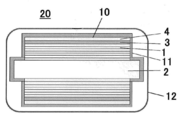
- FIG. 1 is a diagram schematically showing a cross section of a film roll package according to an embodiment of the present invention.
- the film roll package of the present invention is a moisture-proof film in a state in which a film roll 10 in which a sealing film 1 is wound around a core 2 is covered with a hygroscopic film 11.
- the main feature is that it is accommodated in the packaging material 12.
- the sealing film has a support and a hygroscopic filler-containing resin composition layer provided on the support.
- the surface opposite to the support side of the hygroscopic filler-containing resin composition layer is covered with a protective film from the viewpoint of suppressing foreign matter adhesion and moisture intrusion to the resin composition layer before sealing. It is desirable.
- a sealing film 1 shown in FIG. 1 is a sealing film having a configuration in which a support, a hygroscopic filler-containing resin composition layer, and a protective film are laminated in this order.
- the film roll package 20 shown in FIG. 1 is one of the preferred embodiments of the film roll package of the present invention, and the film roll 10 has a cushion material 3 wound around the outside of the sealing film 1 and is cushioned. A cushion material in which a dustproof film 4 is further wound around the outside of the material 3 and a film roll with a dustproof film.
- the film roll 10 has a basic configuration in which the sealing film 1 is wound around the core 2, and only the sealing film 1 is wound around the core 2, the sealing film. 1 may be a film roll with a cushioning material in which only the cushioning material 3 is further wound around the outside of the film 1 or a film roll with a dustproofing film in which only the dustproof film 4 is further wound around the outside of the sealing film 1. .
- the moisture content of the sealing film 1 in the hygroscopic filler-containing resin composition layer in the distribution process or the like is sufficiently suppressed by the action of the hygroscopic film 11. be able to.
- the element lifetime of an organic EL element can be fully improved by sealing an organic EL element etc. with the film 1 for sealing which took out the film roll from the packing body, and was rewound.
- the film roll 10 since the film roll 10 has the cushioning material 3, it is possible to prevent or alleviate the impact on the sealing film 1 during the distribution process of the film roll package, so that the reliability of the sealing film 1 is higher. Can be maintained at a level.
- the entire surface of the film roll 10 including the core 2 is in close contact with the hygroscopic film 11, even if a gap is formed between the film roll 10 and the hygroscopic film 11. good. That is, the entire film roll 10 may be surrounded by the hygroscopic film 11 so that the outer surface of the film roll 10 is not exposed.
- the film roll 10 includes a core 2 and a sealing film 1 wound around the core 2.
- the winding core 2 becomes a core around which the sealing film 1 is wound, and has a function of preventing wrinkling of the wound sealing film 1.
- the material of the core 2 is not particularly limited, and examples thereof include paper, wood, metal, resin, and fiber reinforced resin. These can use 1 type (s) or 2 or more types. Among these, resins and fiber reinforced resins are preferable from the viewpoints of light weight, deformation resistance, price, and the like.
- the resin include polyethylene, polypropylene, vinyl chloride, ABS resin, epoxy resin, polyester resin, butadiene rubber, polystyrene, polyimide resin, polyamide resin, polyamideimide resin, acrylic resin, vinyl chloride, polyvinylidene chloride, and polyurethane resin. It is done. Specific examples of the resin constituting the fiber reinforced resin include these exemplified resins.
- the fiber of the fiber reinforced resin examples include glass fiber, carbon fiber, metal fiber, polyimide fiber, and aramid fiber.
- fiber ie, a paper tube, as a winding core, it is preferable to use a dust-proof treated paper tube that is less likely to cause fouling.
- the shape of the core 2 is not particularly limited, but is usually columnar or cylindrical, and preferably cylindrical or columnar.
- the size (outer diameter) of the core 2 is not particularly limited.
- the outer diameter (diameter) is 30 from the viewpoint of ease of work in a subsequent process. It is preferably from ⁇ 300 mm, more preferably from 50 to 250 mm.
- the moisture content of the core 2 is preferably 3% by weight or less, and more preferably 1% by weight or less, from the viewpoint of suppressing moisture transfer to the moisture-absorbing film.
- the moisture content here is a value measured by a method of measuring the weight change of the core before and after placing the core in a constant temperature layer at 60 ° C. for 24 hours.
- silica gel for example, silica alumina gel (for example, allophane), natural zeolite, synthetic zeolite (for example, molecular sieve), quick lime (calcium oxide), bentonite clay inside the core 2.
- a desiccant such as calcium chloride, magnesium chloride, magnesium oxide (for example, montmorillonite) may be disposed. It is preferable that a desiccant is disposed inside the core 2 so that the desiccant does not directly touch the sealing film, so that no trace is left on the sealing film.
- the film for sealing is a film having a support and a hygroscopic filler-containing resin composition layer provided on the support.
- a film provided with a protective film on the side opposite to the support side of the hygroscopic filler-containing resin composition layer is preferable.
- a support having a barrier layer For the purpose of improving the moisture resistance of the sealing film or when the support is used as part of the sealing structure, it is preferable to use a support having a barrier layer as the support.
- a support having a barrier layer for example, as a barrier layer, a plastic film having a deposited film of an inorganic material such as silicon oxide (silica), silicon nitride, SiCN, amorphous silicon, etc. formed thereon; as a barrier layer, a stainless steel foil, Examples thereof include a plastic film in which a metal foil of aluminum foil is bonded to the surface.
- plastic film examples include polyolefin (for example, polyethylene, polypropylene, polyvinyl chloride, etc.), polyester (for example, polyethylene terephthalate (hereinafter sometimes abbreviated as “PET”), polyethylene-2,6-naphthalate (hereinafter, referred to as “polyethylene terephthalate”). Etc.)), and plastic films such as polycarbonate and polyimide are preferred, and PET films are particularly preferred.
- PET polyethylene terephthalate
- PET films such as polycarbonate and polyimide are preferred, and PET films are particularly preferred.
- Each of the barrier layer and the plastic film may have a multilayer structure of two or more layers.
- PET film having a silicon (silica) deposited film formed on the surface examples include Tech Barrier HX, AX, LX, L series (manufactured by Mitsubishi Plastics), X-BARRIER (manufactured by Mitsubishi Plastics), etc.
- This is a PET film having a silicon (silica) deposited film formed on the surface).
- PET Tsuki AL1N30 “Alpet 1N30” manufactured by Tokai Toyo Aluminum Sales Co., Ltd.
- PET Tsuki AL3025 “Alpet 3025” manufactured by Fukuda Kinzoku Co., Ltd. and the like are mentioned (the aluminum foil adhered to the surface) PET film).
- a polarizing plate can be used for the support.
- the support may be composed of a plurality of layers having different functions, such as using a plastic film with a barrier layer and a polarizing plate in combination.
- a support in which a plastic film with a barrier layer and a polarizing plate are bonded together with an adhesive such as an optical adhesive sheet (OCA) may be used.
- OCA optical adhesive sheet
- the sealing film is configured such that the plastic film with a barrier layer faces the hygroscopic filler-containing resin composition layer side.
- the support is It does not necessarily have moisture resistance.
- a support body which does not have moisture resistance the simple substance etc. of the plastic film mentioned as an illustration of the support body in the support body which has said barrier layer are mentioned, for example.
- the support that does not have moisture resistance is peeled off after the sealing film has been subjected to sealing of an element or the like.
- the release agent for the release treatment include a fluorine release agent, a silicone release agent, an alkyd resin release agent, and the like. Different types of release agents may be mixed and used.
- the thickness of the support is not particularly limited, but is preferably 10 to 150 ⁇ m, more preferably 20 to 100 ⁇ m, from the viewpoint of handling properties of the sealing film.
- the “thickness of the support” referred to here is the thickness of the entire support including the barrier layer when the support has a barrier layer.
- the protective film is used to prevent dust and the like from adhering to the surface of the hygroscopic filler-containing resin composition layer and scratches until the sealing film is actually used for forming the sealing structure.
- the plastic film exemplified in the above support can be used.
- a PET film, a PEN film or a COP (cycloolefin polymer) film is preferable, and a PET film is more preferable.
- the protective film may be subjected to a mold release treatment in addition to a mat treatment and a corona treatment. Specific examples of the release agent used for the release treatment include a fluorine-based release agent, a silicone-based release agent, and an alkyd resin-based release agent.
- the protective film may have a multilayer structure of two or more layers.
- the thickness of the protective film is not particularly limited, but is preferably 1 to 40 ⁇ m, and more preferably 10 to 30 ⁇ m.
- the sealing film is a film in which the hygroscopic filler-containing resin composition layer is made of a pressure-sensitive adhesive resin composition, the hygroscopic filler-containing resin composition layer is a non-pressure-sensitive adhesive resin composition (for example, Both of the film of the aspect which consists of a thermosetting resin composition etc. are included.
- Examples of the hygroscopic filler-containing pressure-sensitive adhesive resin composition include (A) polyolefin-based resin, (B) tackifying resin, and (C) moisture-absorbing resin.
- a resin composition containing a functional filler as an essential component is exemplified.
- the polyolefin-based resin (hereinafter also abbreviated as “(A) component”) is not particularly limited as long as it has a skeleton derived from an olefin monomer.
- examples of polyolefin resins include polyethylene resins, polypropylene resins, polybutene resins, and polyisobutylene resins.
- the polyolefin resin may be a random copolymer or a block copolymer for reasons such as making the polyolefin resin more preferable characteristics.
- the copolymer includes (i) a copolymer of two or more olefins, (ii) a copolymer of olefin and non-conjugated diene, or (iii) a monomer other than olefin such as olefin and styrene (non-conjugated). And copolymers with the exception of diene).
- the olefin can use 1 type (s) or 2 or more types.
- ethylene-nonconjugated diene copolymers examples include ethylene-nonconjugated diene copolymers, ethylene-butene-nonconjugated diene copolymers, ethylene-propylene copolymers, ethylene-propylene-nonconjugated diene copolymers, ethylene-propylene-butene copolymers.
- Polymer propylene-butene copolymer, propylene-butene-nonconjugated diene copolymer, isobutylene-butene copolymer, isobutylene-butene-nonconjugated diene copolymer, styrene-isobutylene copolymer, styrene-isobutylene-styrene A copolymer etc. are mentioned.
- polyolefin resins are acid anhydride groups (for example, succinic anhydride groups, maleic anhydride groups, glutaric anhydride groups, etc.) and / or epoxy groups. (That is, a polyolefin resin having an acid anhydride group and / or an epoxy group introduced into the molecule).
- the olefin resin having an acid anhydride group can be obtained, for example, by an unsaturated compound having an acid anhydride group and graft-modifying the polyolefin resin under radical reaction conditions.
- a polyolefin-based resin having an epoxy group is obtained, for example, by graft-modifying a polyolefin-based resin under a radical reaction condition with an unsaturated compound having an epoxy group.
- the concentration of the acid anhydride group and / or epoxy group is preferably 0.05 to 10 mmol / g, more preferably 0.1 to 5 mmol / g.
- the concentration of the acid anhydride group is obtained from the value of the acid value defined as the number of mg of potassium hydroxide necessary to neutralize the acid present in 1 g of resin according to the description of JIS K2501: 2003, The group concentration is determined from the epoxy equivalent obtained based on JIS K 7236: 1995.
- the number average molecular weight of the component (A) is not particularly limited, but the good coatability of the varnish of the pressure-sensitive adhesive resin composition at the time of producing the sealing film and the good phase with other components in the resin composition From the viewpoint of bringing about solubility, 500,000 or less is preferable, 300,000 or less is more preferable, and 150,000 or less is more preferable. On the other hand, it prevents cissing at the time of coating the varnish of the pressure-sensitive adhesive resin composition, expresses moisture resistance of the formed hygroscopic filler-containing pressure-sensitive adhesive resin composition layer, and improves mechanical strength. From a viewpoint, 10,000 or more are preferable, 30000 or more are more preferable, and 50000 or more are still more preferable.
- the number average molecular weight is measured by gel permeation chromatography (GPC) method (polystyrene conversion). Specifically, the number average molecular weight by the GPC method is as follows: LC-9A / RID-6A manufactured by Shimadzu Corporation as a measuring device, Shodex K-800P / K-804L manufactured by Showa Denko KK as a column, toluene, etc. as a mobile phase Can be calculated at a column temperature of 40 ° C. using a standard polystyrene calibration curve.
- GPC gel permeation chromatography
- the pressure-sensitive adhesive resin composition conventionally known ones such as those described in, for example, International Publication No. 2013/108731 and International Publication No. 2011/062167 can be used.
- the non-pressure-sensitive adhesive resin composition conventionally known ones such as a thermosetting resin composition described in International Publication No. 2010/084938 can be used.
- the resin composition layer may have a multilayer structure in which two or more resin composition layers such as those described in International Publication No. 2011/016408 are used.
- the content of the component (A) in the pressure-sensitive adhesive resin composition is not particularly limited, but brings good coating properties and compatibility of the varnish of the resin composition, and is good in the formed resin composition layer. From the viewpoint of ensuring wet heat resistance and handleability (tack suppression), it is preferably 80% by weight or less, more preferably 75% by weight or less per 100% by weight of the total nonvolatile content in the pressure-sensitive adhesive resin composition, 70 More preferably, it is not more than% by weight. On the other hand, from the viewpoint of improving moisture permeation resistance and transparency, it is preferably 5% by weight or more and more preferably 10% by weight or more per 100% by weight of the total nonvolatile content in the pressure-sensitive adhesive resin composition. .
- Tackifying resin (hereinafter also abbreviated as “component (B)”) is also called a tackifier, and is a resin that is added to a plastic polymer to impart tackiness.
- the component (B) is not particularly limited, and is not limited to terpene resin, modified terpene resin (hydrogenated terpene resin, terpene phenol copolymer resin, aromatic modified terpene resin, etc.), coumarone resin, indene resin, petroleum resin ( Aliphatic petroleum resins, hydrogenated alicyclic petroleum resins, aromatic petroleum resins, aliphatic aromatic copolymer petroleum resins, alicyclic petroleum resins, dicyclopentadiene petroleum resins and their hydrides) Preferably used.
- terpene resin aromatic modified terpene resin, terpene phenol copolymer resin, hydrogenated alicyclic petroleum resin, aromatic petroleum resin , Aliphatic aromatic copolymer petroleum resins, alicyclic petroleum resins are more preferred, alicyclic petroleum resins are more preferred, alicyclic saturated hydrocarbon resins are even more preferred, cyclohexane ring-containing saturated hydrocarbon resins Dicyclopentadiene-modified hydrocarbon resin is particularly preferable.
- Examples of commercially available products that can be used as the component (B) include YS resin PX, YS resin PXN (both manufactured by Yasuhara Chemical Co., Ltd.) and the like as terpene resins, and YS resin TO and TR series (any of aromatic modified terpene resins).
- YS resin PX YS resin PX
- YS resin PXN both manufactured by Yasuhara Chemical Co., Ltd.
- YS resin TO and TR series any of aromatic modified terpene resins.
- hydrogenated terpene resins include Clearon P, Clearon M, Clearon K series (all manufactured by Yasuhara Chemical Co., Ltd.)
- terpene phenol copolymer resins are YS Polystar 2000, Polystar U.
- Quinone 1325 and quintone 1345 both manufactured by Nippon Zeon Co., Ltd. and the like, and cyclohexane ring-containing saturated hydrocarbon resin such as TFS13-030 (Arakawa Chemical Co., Ltd.) and the like. It is done.
- the softening point of the component (B) is preferably from 50 to 200 ° C., more preferably from 90 to 180 ° C., from the viewpoint of softening the sheet in the resin composition sheet lamination step and having desired heat resistance. 150 ° C. is more preferable.
- the softening point is measured by the ring and ball method according to JIS K2207.
- the content of the component (B) in the pressure-sensitive adhesive resin composition is not particularly limited, but from the viewpoint of maintaining good moisture resistance of the resin composition, the nonvolatile content in the pressure-sensitive adhesive resin composition 80% by weight or less is preferable, 100% by weight or less is more preferable, and 50% by weight or less is more preferable. On the other hand, from the viewpoint of having sufficient adhesiveness, it is preferably 5% by weight or more, more preferably 10% by weight or more, and more preferably 15% by weight or more per 100% by weight of the total nonvolatile content in the pressure-sensitive adhesive resin composition. Further preferred.
- the (C) hygroscopic filler (hereinafter also abbreviated as “component (C)”) is not particularly limited as long as it is a filler capable of absorbing moisture, but is preferably a hygroscopic metal oxide.
- the hygroscopic metal oxide means a metal oxide that has the ability to absorb moisture and chemically reacts with the absorbed moisture to become a hydroxide. Specifically, it is one kind selected from calcium oxide, magnesium oxide, strontium oxide, aluminum oxide, barium oxide and the like, or a mixture or solid solution of two or more kinds.
- the mixture or solid solution of two or more include calcined dolomite (a mixture containing calcium oxide and magnesium oxide), calcined hydrotalcite (a solid solution containing calcium oxide and aluminum oxide), and the like.
- calcined dolomite a mixture containing calcium oxide and magnesium oxide
- calcined hydrotalcite a solid solution containing calcium oxide and aluminum oxide
- calcium oxide, magnesium oxide, and calcined hydrotalcite are preferable from the viewpoint of high hygroscopicity, cost, and stability of raw materials, and calcined hydrotalcite is more preferable.
- the calcined hydrotalcite reduces the amount of OH in the chemical structure by calcining natural hydrotalcite (Mg 6 Al 2 (OH) 16 CO 3 ⁇ 4H 2 O) and synthetic hydrotalcite (hydrotalcite-like compound) Or those disappeared are preferred.
- a calcined hydrotalcite having a BET specific surface area of 65 m 2 / g or more is particularly preferable.
- the calcined hydrotalcite having a BET specific surface area of 65 m 2 / g or more preferably has a BET specific surface area of 80 m 2 / g or more, and more preferably 100 m 2 / g or more.
- BET specific surface area is preferably from 200m 2 / g, more preferably at most 150m 2 / g.
- hygroscopic metal oxides include calcium oxide (“Moystop # 10” manufactured by Sankyo Flour Mills Co., Ltd.), magnesium oxide (“Kyowa Mag MF-150”, “Kyowa Mag MF-30”, Tateho Chemical Co., Ltd., Kyowa Chemical Industry Co., Ltd.) "Pure Mag FNMG” manufactured by Kogyo Co., Ltd.), lightly burned magnesium oxide (such as "TATEHOMAG # 500", “TATEHOMAG # 1000", TATEHOMAG # 5000 "manufactured by Tateho Chemical Industry Co., Ltd.) Etc.) and calcined hydrotalcite (“DHT-4A”, “DHT-4A-2”, “DHT-4C”, etc., manufactured by Kyowa Chemical Industry Co., Ltd.) and the like.
- the hygroscopic metal oxide those surface-treated with a surface treatment agent can be used.
- the surface treatment agent used for the surface treatment include higher fatty acids (preferably stearic acid, montanic acid, myristic acid, palmitic acid). Higher fatty acids having 18 or more carbon atoms such as acids), alkylsilanes, silane coupling agents, and the like. Among them, higher fatty acids and alkylsilanes are preferable (one or two or more surface treatment agents are used). Can be used).
- the treatment amount of the surface treatment agent is preferably 1 to 10% by weight with respect to the hygroscopic metal oxide.
- the content of the component (C) in the pressure-sensitive adhesive resin composition is not particularly limited, but is preferably 50% by weight or less and more preferably 40% by weight or less per 100% by weight of the total nonvolatile content in the resin composition. 30% by weight or less is more preferable. Moreover, 1 weight% or more is preferable per 5 weight% of total of the non volatile matter in a resin composition, 5 weight% or more is more preferable, and 10 weight% or more is still more preferable.
- the pressure-sensitive adhesive resin composition may contain a plasticizer from the viewpoint of improving the flexibility and moldability of the resin composition.
- plasticizers include paraffinic process oil, naphthenic process oil, liquid paraffin, polyethylene wax, polypropylene wax, petroleum jelly and other mineral oils, castor oil, cottonseed oil, rapeseed oil, soybean oil, palm oil, palm oil, olive oil.
- other liquid oils such as vegetable oil, liquid polybutene, hydrogenated liquid polybutene, liquid polybutadiene, and hydrogenated liquid polybutadiene.
- liquid poly ⁇ -olefins are preferable, and liquid polybutadiene is particularly preferable.
- the liquid poly ⁇ -olefin preferably has a low molecular weight from the viewpoint of adhesiveness, and preferably has a weight average molecular weight in the range of 500 to 5000, more preferably 1000 to 3000.
- a plasticizer may be used individually by 1 type and may be used in combination of 2 or more type.
- “liquid” means a state of a plasticizer at room temperature (25 ° C.).
- the pressure-sensitive adhesive resin composition contains a plasticizer, from the viewpoint of not adversely affecting the organic EL element, within a range of 50% by weight or less per 100% by weight of the total nonvolatile content in the resin composition. used.
- the pressure-sensitive adhesive resin composition may further contain an epoxy resin other than the polyolefin-based resin having an epoxy group, from the viewpoints of suppressing tackiness of the resin composition and stability of other physical properties.
- an epoxy resin other than the polyolefin-based resin having an epoxy group, from the viewpoints of suppressing tackiness of the resin composition and stability of other physical properties.
- the epoxy resin is formed by forming a crosslinked structure with the polyolefin resin having an acid anhydride group. Has the effect of improving moisture resistance.
- Such an epoxy resin is not particularly limited as long as it has an average of two or more epoxy groups per molecule.
- bisphenol A type epoxy resin for example, bisphenol A type epoxy resin, biphenyl type epoxy resin, biphenyl aralkyl type epoxy resin, naphthol type epoxy resin, naphthalene type epoxy resin, bisphenol F type epoxy resin, phosphorus-containing epoxy resin, bisphenol S type epoxy resin, aromatic glycidylamine Type epoxy resin (for example, tetraglycidyldiaminodiphenylmethane, triglycidyl-p-aminophenol, diglycidyltoluidine, diglycidylaniline, etc.), alicyclic epoxy resin, aliphatic chain epoxy resin, phenol novolac type epoxy resin, cresol novolac Type epoxy resin, bisphenol A novolac type epoxy resin, epoxy resin containing polyalkylene glycol skeleton, epoxy resin having butadiene structure, bisphenol And diglycidyl etherified products of naphthalenediol, glycidyl etherified products of phenols, digly
- the epoxy resin preferably has an epoxy equivalent of 100 to 1500 g / eq, more preferably 150 to 1000 g / eq, and still more preferably 200 to 800 g / eq.
- the “epoxy equivalent” is the number of grams (g / eq) of a resin containing 1 gram equivalent of an epoxy group, and is measured according to the method defined in JIS K 7236. Epoxy resins may be used alone or in combination of two or more.
- the content in the case of using an epoxy resin in the pressure-sensitive adhesive resin composition is not particularly limited, but is preferably 20% by weight or less, for example, 15% by weight per 100% by weight of the total nonvolatile content in the resin composition.
- the following is more preferable, 10% by weight or less is further preferable, 8% by weight or less is further more preferable, and 6% by weight or less is particularly preferable.
- 0.1 wt% or more per 100 wt% of the total nonvolatile content in the resin composition is preferable, 0.5 wt% or more is more preferable, 2% by weight or more is more preferable.
- the pressure-sensitive adhesive resin composition contains a polyolefin-based resin having an epoxy group or another epoxy resin, it may further contain a curing agent from the viewpoint of improving the curing performance of the resin composition.
- the curing agent is not particularly limited, and examples thereof include amine curing agents, guanidine curing agents, imidazole curing agents, phosphonium curing agents, and phenol curing agents.
- the curing agent other than the phenol curing agent is cured. Acts as an accelerator.
- the curing agent may be used alone or in combination of two or more. Although it does not restrict
- curing agent Quaternary ammonium salts, such as tetramethylammonium bromide and tetrabutylammonium bromide; DBU (1,8-diazabicyclo [5.4.0] undecene-7), DBN (1 , 5-diazabicyclo [4.3.0] nonene-5), DBU-phenol salt, DBU-octylate, DBU-p-toluenesulfonate, DBU-formate, DBU-phenol novolak resin salt, etc.
- Quaternary ammonium salts such as tetramethylammonium bromide and tetrabutylammonium bromide
- DBU 1,8-diazabicyclo [5.4.0] undecene-7
- DBN (1 , 5-diazabicyclo [4.3.0] nonene-5
- tertiary amines such as benzyldimethylamine, 2- (dimethylaminomethyl) phenol, 2,4,6-tris (diaminomethyl) phenol and their salts, aromatic dimethylurea, aliphatic dimethylurea, aromatic dimethyl Dimethylurea compounds such as urea; and the like. You may use these 1 type or in combination of 2 or more types.
- the guanidine curing agent is not particularly limited, but dicyandiamide, 1-methylguanidine, 1-ethylguanidine, 1-cyclohexylguanidine, 1-phenylguanidine, 1- (o-tolyl) guanidine, dimethylguanidine, diphenylguanidine, Trimethyl guanidine, tetramethyl guanidine, pentamethyl guanidine, 1,5,7-triazabicyclo [4.4.0] dec-5-ene, 7-methyl-1,5,7-triazabicyclo [4.4 .0] dec-5-ene, 1-methyl biguanide, 1-ethyl biguanide, 1-n-butyl biguanide, 1-n-octadecyl biguanide, 1,1-dimethyl biguanide, 1,1-diethyl biguanide, 1-cyclohexyl Biguanide, 1-allyl biguanide, 1-phenyl biguanide , 1-(o
- the imidazole curing agent is not particularly limited, but 1H-imidazole, 2-methyl-imidazole, 2-phenyl-4-methylimidazole, 1-cyanoethyl-2-ethyl-4-methyl-imidazole, 2-phenyl- 4,5-bis (hydroxymethyl) -imidazole, 1-benzyl-2-methylimidazole, 1-benzyl-2-phenylimidazole, 2-ethyl-4-methylimidazole, 2-phenyl-imidazole, 2-dodecyl-imidazole 2-heptadecylimidazole, 1,2-dimethyl-imidazole and the like.
- the phosphonium curing agent is not particularly limited, but is triphenylphosphine, phosphonium borate compound, tetraphenylphosphonium tetraphenylborate, n-butylphosphonium tetraphenylborate, tetrabutylphosphonium decanoate, (4-methylphenyl) triate. Examples thereof include phenylphosphonium thiocyanate, tetraphenylphosphonium thiocyanate, and butyltriphenylphosphonium thiocyanate. You may use these 1 type or in combination of 2 or more types.
- the type of phenolic curing agent is not particularly limited, but is MEH-7700, MEH-7810, MEH-7851 (Maywa Kasei), NHN, CBN, GPH (Nippon Kayaku), SN170, SN180, SN190. SN475, SN485, SN495, SN375, SN395 (manufactured by Tohto Kasei), TD2090 (manufactured by DIC), and the like.
- Specific examples of the triazine skeleton-containing phenolic curing agent include LA3018 (manufactured by DIC).
- the triazine skeleton-containing phenol novolak curing agent examples include LA7052, LA7054, LA1356 (manufactured by DIC) and the like. You may use these 1 type or in combination of 2 or more types.
- the content of the curing agent in the pressure-sensitive adhesive resin composition is not particularly limited, but from the viewpoint of preventing a decrease in moisture permeation resistance, 5% by weight per 100% by weight of the total nonvolatile content in the resin composition. The following is preferable and 1% by weight or less is more preferable. On the other hand, from the viewpoint of suppressing tackiness, 0.01% by weight or more is preferable and 0.05% by weight or more is more preferable per 100% by weight of the total nonvolatile content in the resin composition.
- the pressure-sensitive adhesive resin composition may optionally contain various additives other than the components described above.
- additives include silica, barium sulfate, talc, clay, mica powder, aluminum hydroxide, magnesium hydroxide, calcium carbonate, magnesium carbonate, boron nitride, aluminum borate, barium titanate, and strontium titanate.
- Inorganic fillers such as calcium titanate, magnesium titanate, bismuth titanate, titanium oxide, barium zirconate, calcium zirconate; organic fillers such as rubber particles, silicone powder, nylon powder, fluororesin powder; Orben, Benton Thickeners such as silicone-based, fluorine-based, polymer-based antifoaming agents or leveling agents; adhesion-imparting agents such as triazole compounds, thiazole compounds, triazine compounds, and porphyrin compounds.
- the method for preparing the pressure-sensitive adhesive resin composition is not particularly limited, and examples thereof include a method in which the compounding ingredients are mixed with a kneading roller, a rotary mixer, or the like, if necessary, by adding a solvent or the like.
- the non-pressure-sensitive adhesive resin composition layer of the sealing film is a film of an embodiment made of a non-pressure-sensitive adhesive resin composition
- the non-pressure-sensitive adhesive resin composition includes an epoxy resin and its curing agent.
- a thermosetting or photocurable resin composition containing a hygroscopic filler is used.
- the sealing film in the present invention is formed, for example, by preparing a varnish in which a resin composition is dissolved, and applying and drying the varnish on a support.
- the hygroscopic filler-containing resin composition layer formed in this way is an ester formed by reacting an acid anhydride group of an acid anhydride group-containing polyolefin resin and an epoxy group of an epoxy resin or an epoxy group-containing polyolefin resin. A bond is preferably formed.
- the organic solvent can be dried by blowing hot air or the like.
- organic solvents examples include ketones such as acetone, methyl ethyl ketone (hereinafter also abbreviated as “MEK”), cyclohexanone; and acetates such as ethyl acetate, butyl acetate, cellosolve acetate, propylene glycol monomethyl ether acetate, and carbitol acetate.
- ketones such as acetone, methyl ethyl ketone (hereinafter also abbreviated as “MEK”), cyclohexanone
- acetates such as ethyl acetate, butyl acetate, cellosolve acetate, propylene glycol monomethyl ether acetate, and carbitol acetate.
- Carbitols such as cellosolve and butyl carbitol
- aromatic hydrocarbons such as toluene and xylene
- dimethylformamide dimethylacetamide, N-methylpyrrolidone
- aromatic mixed solvents examples include “Swazole” (trade name, manufactured by Maruzen Petroleum Corporation) and “Ipsol” (trade name, manufactured by Idemitsu Kosan Co., Ltd.). You may use an organic solvent 1 type or in combination of 2 or more types. There are no particular restrictions on the drying conditions, but 50 to 100 ° C. for 1 to 60 minutes is preferable. By setting it as 50 degreeC or more, it becomes easy to reduce the amount of solvent which remains in a resin composition layer.
- the thickness of the hygroscopic filler-containing resin composition layer in the sealing film is preferably 3 to 200 ⁇ m, more preferably 5 to 100 ⁇ m, and even more preferably 5 to 50 ⁇ m.
- the target final sealing structure is a structure in which a sealing substrate is laminated on a hygroscopic filler-containing resin composition layer
- the portion where moisture can enter is only on the side of the resin composition layer. Therefore, by reducing the thickness of the resin composition layer, the area that contacts the outside air on the side portion is reduced. Therefore, it is desirable to reduce the thickness of the resin composition layer in order to block moisture.
- the layer thickness of the resin composition layer is too small, the element may be damaged when the sealing substrate is bonded, and the workability when the sealing substrate is bonded tends to decrease. is there. Further, setting the thickness of the resin composition layer within the above-mentioned preferable range means that the resin composition layer after the resin composition layer is transferred to a sealing target (for example, a substrate on which an element such as an organic EL element is formed). It is also effective in maintaining the uniformity of the thickness of the film.
- the winding of the sealing film around the core is not particularly limited, and a known method can be used. Specifically, a method of winding the sealing film using the winding core as a starting point can be mentioned.
- the cushion material 3 in the present invention is not particularly limited, and cellophane, polyethylene, polypropylene, soft polyvinyl chloride, polyester (for example, PET, PEN, copolymer obtained by copolymerizing 1,4-cyclohexanedimethanol and the like thereof) Polyester, etc.), polystyrene, polyurethane and other films as the main component, foamed films containing the resin as the main component and foamed with a foaming agent, the resin as the main component, and inorganic and / or organic pigments Films such as porous films with voids formed by stretching treatment, synthetic papers, non-woven fabrics, fine paper, art paper, coated paper, kraft paper, polyethylene laminated paper, water-soluble paper, impregnated paper, foamed paper, etc. Examples thereof include papers and laminates thereof. Moreover, what laminated
- a polyethylene foam film, a polyurethane foam film, and the like are preferable because they are particularly excellent in cushioning properties, light weight, moisture resistance, and price.
- the overall thickness of the cushion material is preferably 0.5 to 10 mm, more preferably 1 to 7 mm. If it is less than 0.5 mm, there is a possibility that a sufficient impact relaxation effect to the organic EL element sealing film 1 cannot be obtained. Moreover, when it exceeds 10 mm, there exists a possibility that a misalignment and a press mark may generate
- a commercially available product can be used as the cushion material.
- a highly foamed polyethylene sheet “Minafoam” (thickness: 2 mm) manufactured by Sakai Chemical Industry Co., Ltd. a highly foamed polyethylene sheet “Miramat” (thickness: 2 mm) manufactured by JSP Corporation
- Examples thereof include polyolefin foam sheet “FOLEC” (thickness: 1.8 mm) manufactured by Inoac Corporation, and air cap “petit petit roll D35” (thickness: 5 mm) manufactured by Kawakami Sangyo Co., Ltd.
- the dustproof film 4 is not particularly limited as long as it is a non-charged or low-charged film.
- a film mainly composed of a resin such as polyvinylidene chloride, polyethylene, polypropylene, polyvinyl chloride, or polymethylpentene, or a film mainly composed of the resin and blended with a conductive filler is used.
- the conductive filler is not particularly limited, and is a known antistatic agent such as a surfactant; a conductive filler obtained by imparting conductivity to sulfides such as zinc sulfide, copper sulfide, cadmium sulfide, nickel sulfide, and palladium sulfide; Metal oxides such as barium sulfate; tin oxide / zinc oxide, indium oxide and titanium oxide; conductive carbon filler; silicon organic compound; surface metal plating filler and the like can be applied.
- a polyvinylidene chloride film, a polypropylene film, a polyethylene film, a polyvinyl chloride film, and the like are preferable because they are excellent in transparency, lightness, price, and the like.
- the thickness of the dustproof film is preferably 5 to 75 ⁇ m, more preferably 8 to 50 ⁇ m, and particularly preferably 10 to 50 ⁇ m. If it is less than 5 ⁇ m, wrinkles may occur during the work, and if it exceeds 75 ⁇ m, the film may be lifted.
- a commercially available product can be used as the dustproof film.
- polyvinylidene chloride film “Saran Wrap” (thickness: 11 ⁇ m) manufactured by Asahi Kasei Co., Ltd.
- polypropylene film “FOA20” (thickness: 20 ⁇ m) manufactured by Futamura Chemical Co., Ltd.
- polypropylene film “Torphan” manufactured by Toray Industries, Inc.
- Polypropylene film “Alphan” (thickness: 20 ⁇ m) manufactured by Oji F-Tex.
- the hygroscopic film 11 is not particularly limited as long as it has a moisture absorption amount of 1 g / m 2 or more due to weight change before and after being left for one week in an environment of 25 ° C. and a relative humidity of 60% RH. be able to.
- Moisture absorption is 3 g / m 2 or more and more preferably the film, 5 g / m 2 or more is particularly preferable. If the moisture absorption is less than 1 g / m 2 , there is a possibility that moisture penetration into the hygroscopic filler-containing resin composition layer of the sealing film 1 cannot be sufficiently suppressed.
- the moisture absorption is preferably 15 g / m 2 or less, and more preferably 10 g / m 2 or less.
- the amount of moisture absorption exceeds 15 g / m 2 , the deformation of the hygroscopic film becomes large, and the handling tends to be hindered.
- the form of the hygroscopic film 11 is not particularly limited.
- a type of film in which a hygroscopic layer is formed on at least one side of a plastic substrate and (ii) a type in which both sides of the hygroscopic layer are sandwiched between plastic substrates.
- a film etc. are mentioned.
- the plastic substrate is a film obtained by melt-extrusion of an organic polymer and, if necessary, stretching, cooling, heat setting, etc. in the longitudinal direction and / or the width direction.
- the organic polymer is polyethylene. , Polypropylene, polyethylene terephthalate, polyethylene-2,6-naphthalate, nylon 6, nylon 4, nylon 66, nylon 12, polyvinyl chloride, polyvinylidene chloride, polyvinyl alcohol, wholly aromatic polyamide, polyamideimide, polyimide, polyetherimide , Polysulfone, polyphenylene sulfide, polyphenylene oxide and the like. Further, these organic polymers may be obtained by copolymerizing or blending a small amount of other organic polymers.
- additives such as antistatic agents, plasticizers, lubricants, colorants and the like may be added to these organic polymers.
- the plastic substrate preferably has a thickness in the range of 5 to 100 ⁇ m, more preferably in the range of 10 to 50 ⁇ m.
- the plastic substrate Prior to laminating the moisture-absorbing layer, the plastic substrate may be subjected to corona discharge treatment, glow discharge treatment, and other surface roughening treatment, and is also subjected to anchor coating treatment, printing, and decoration. Also good.
- a composition containing at least a moisture absorbent having a water vapor (moisture) absorbing ability and a base resin is used.
- the hygroscopic agent inorganic and organic ones can be used. Furthermore, as the inorganic hygroscopic agent, one that chemically absorbs moisture such as hydration and physically absorbs moisture such as molecular sieving effect. Things can be used. As the organic hygroscopic agent, an organic material having a hydrophilic group, particularly an organic material having a carboxyl group or a hydroxyl group can be used.
- the base resin is not particularly limited and can be appropriately selected from conventionally known resin materials.
- the thickness of the moisture absorbing layer is not particularly limited, but is preferably 5 ⁇ m or more and 100 ⁇ m or less, and more preferably 10 ⁇ m or more and 50 ⁇ m or less. When it is 5 ⁇ m or more, sufficient hygroscopicity can be secured, and when it is 100 ⁇ m or less, sufficient moldability can be secured.
- the total thickness of the hygroscopic film 11 is not particularly limited, but is preferably 20 to 150 ⁇ m, and more preferably 50 to 100 ⁇ m. If it is less than 20 ⁇ m, the target performance may not be exhibited. If it is greater than 150 ⁇ m, workability may be deteriorated.
- the hygroscopic film 11 has a crystal nucleating agent, a petroleum resin, an antistatic agent, an ultraviolet absorber, a lubricant, an antioxidant, a light stabilizer, an antiblocking agent, a surfactant, as long as the basic performance is not impaired.
- the additives such as dye, a pigment, a flame retardant, a deodorizer, a plasticizer, to the 1 or more layer contained in a hygroscopic film may be used.
- an antistatic function, a deodorizing function, an ultraviolet protection function, and the like can be imparted to the hygroscopic film and the package, and the storability of the package can be further improved.
- a commercially available product can be used as the hygroscopic film 11.
- a commercially available product can be used as the hygroscopic film 11.
- a suitable example for example, “Moisture Absorbing Sheet Dry Keep Film SPES48-231J” (thickness: 60 ⁇ m, moisture absorption amount: 6 g / m 2 ) manufactured by Sasaki Chemical Co., Ltd., “Moist Catch” manufactured by Kyodo Printing Co., Ltd. ZPA50 ”(thickness: 50 ⁇ m, moisture absorption 7 g / m 2 ), Toyo Aluminum Co., Ltd.“ Toyal Dry ”(thickness: 60 ⁇ m, moisture absorption: 6 g / m 2 ) and the like.
- the moisture-proof packaging material includes a bag and a box made of a gas barrier film having a function of preventing permeation of gas (water vapor).
- the gas barrier film preferably has a water vapor transmission rate of 5 g / m 2 / day or less, more preferably a water vapor transmission rate of 1 g / m 2 / day or less, and a water vapor transmission rate of 0.5 g / m 2 / day.
- the following are particularly preferred, and those having a water vapor transmission rate of 0.1 g / m 2 / day or less are most preferred.
- the gas barrier film includes a base material and a gas barrier layer.
- the gas barrier layer is usually disposed on the substrate. Moreover, the gas barrier layer may be arrange
- gas mainly means water vapor.
- the “water vapor transmission rate” is a value measured according to JIS Z 0208-1976: Cup method at a temperature of 40 ° C. and a relative humidity (RH) of 90%.
- the base material has a function of holding the gas barrier layer.
- the base material which concerns on this invention is not specifically limited, It is preferable that it is a foldable film base material which has flexibility and permeability
- the film substrate examples include polyolefin (PO) resins that are homopolymers or copolymers such as ethylene, propylene, and butene, amorphous polyolefin resins (APO) such as cyclic polyolefins, and polyesters such as PET and PEN.
- PO polyolefin
- APO amorphous polyolefin resins
- polyesters such as PET and PEN.
- polyamide (PA) resin such as copolymer nylon, polyvinyl alcohol (PVA) resin, polyvinyl alcohol resin such as ethylene-vinyl alcohol copolymer (EVOH), polyimide (PI ) Resin, polyetherimide (PEI) resin, polysulfone (PS) resin, polyethersulfone (PES) resin, polyetheretherketone (PEEK) resin, polycarbonate (PC) resin, polyvinyl butyrate (PVB) resin, poly Arylate (PAR) resin, Tylene tetrafluoride ethylene copolymer (ETFE), ethylene trifluoride chloride (PFA), ethylene tetrafluoride-perfluoroalkyl vinyl ether copolymer (FEP), polyvinylidene fluoride (PVDF), polyvinyl fluoride (PVF) And a resin film containing as a main component one or more selected from a resin group such as a fluororesin
- the substrate using the above resin film may be an unstretched film or a stretched film.
- the thickness of the base material is preferably 10 to 100 ⁇ m, and more preferably 15 to 75 ⁇ m.
- the substrate may be subjected to corona treatment.
- the gas barrier layer has a function of imparting gas barrier performance to the gas barrier film. Any gas barrier layer may be used as long as the water vapor permeability of the obtained gas barrier film is 5 g / m 2 / day or less.
- the gas barrier layer include an aluminum foil, an aluminum vapor deposition layer, and an inorganic layer.
- inorganic substances in the inorganic layer include zinc disulfide, aluminum oxide, indium oxide, tin oxide, gallium oxide, indium tin oxide (ITO), aluminum-added zinc oxide (AZO), zinc-tin composite oxide (ZTO), and aluminum nitride.
- the inorganic layer is formed by vapor deposition, sputtering, ion plating, or the like.
- the gas barrier layer may be a single layer or a laminate of two or more layers. When two or more layers are laminated, each layer may be a layer made of the same component or a layer made of different components.
- the thickness of the gas barrier layer is preferably 1 nm to 20 ⁇ m, and more preferably 100 nm to 15 ⁇ m.
- the thickness of a gas barrier layer here is a total thickness of two layers, when two or more gas barrier layers are laminated
- the method for packaging the film roll is not particularly limited, and a known method can be used. For example, after covering a film roll with a hygroscopic film, the film roll covered with the hygroscopic film is placed in a moisture-proof packaging material, and the packaging material is sealed.
- the sealing of the packaging material includes a method of heating a part (opening) of the packaging material, applying a pressure, then cooling and sealing (a packaging method by heat sealing).
- an inert gas By performing deaeration or replacement with an inert gas, the internal environment (such as dew point) of the package obtained by sealing the packaging material can be adjusted.
- Example 1 On a release PET film ASST2.25 (thickness: 100 ⁇ m, manufactured by Fujimori Kogyo Co., Ltd.) treated with a silicone release agent, a varnish obtained under the following conditions was uniformly applied with a die coater, By heating at 130 ° C. for 60 minutes, a resin composition layer having a thickness of 30 ⁇ m was formed. On this resin composition layer, a release PET film 025E-0010BD (thickness: 25 ⁇ m, manufactured by Fujimori Kogyo Co., Ltd.) which has been release-treated with a silicone release agent is laminated to prepare an organic EL sealing film. The organic EL sealing film was wound 10 m on a plastic core core having a diameter of 3 inches (7.62 cm).
- a highly foamed polyethylene sheet manufactured by Sakai Chemical Industry Co., Ltd., “Minafoam” (thickness: 2 mm)
- a polyvinylidene chloride film (Asahi Kasei Corporation, “Saran Wrap” (thickness: 11 ⁇ m))
- a moisture absorbing sheet dry keep film SPES48-231J (lamination structure: polyethylene / moisture absorbing layer / polyethylene, thickness: 60 ⁇ m, moisture absorption: 6 g / m 2 , Sasaki Chemical Co., Ltd.) Covered).
- Cyclohexane ring-containing saturated hydrocarbon resin (Alcon P125, 60% swazole solution, manufactured by Arakawa Chemical Co., Ltd.), maleic anhydride modified liquid polyisobutylene (HV-300M, manufactured by Toho Chemical Co., Ltd.), polybutene (HV-1900, JX Nippon Mining) Nisseki Energy Co., Ltd.) and calcined hydrotalcite (KW2200, manufactured by Kyowa Chemical Industry Co., Ltd.) were dispersed with three rolls to obtain a mixture.
- An ethylene-glycidyl methacrylate copolymer (BONDFAST BF-7M, manufactured by Sumitomo Chemical Co., Ltd.), an anionic polymerization curing agent (2,4,6-tris (diaminomethyl) phenol) and toluene are blended with the obtained mixture.
- the resulting mixture was uniformly dispersed with a high-speed rotary mixer to obtain a resin composition varnish.
- FIG. 2 is a schematic cross-sectional view of the obtained film roll package.
- Example 1 An organic EL sealing film was produced in the same manner as in Example 1, and the organic EL sealing film was wound 10 m on a plastic core core having a diameter of 3 inches (7.62 cm). Next, a highly foamed polyethylene sheet (“Minafoam” (thickness: 2 mm) manufactured by Sakai Chemical Industry Co., Ltd.) is wound, and a polyvinylidene chloride film (Asahi Kasei Corporation, “Saran Wrap” (thickness: 11 ⁇ m)) is further wound.
- Minafoam thinness: 2 mm
- a polyvinylidene chloride film Asahi Kasei Corporation, “Saran Wrap” (thickness: 11 ⁇ m)
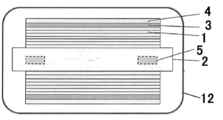
- FIG. 3 is a schematic cross-sectional view of the obtained film roll package.
- the organic EL sealing film was taken out from the packaging materials of Example 1, Reference Example 1 and Comparative Example 1 stored for 1 week and those stored for 1 month, respectively. : About 100 mm, length: about 100 mm, weight: 100 to 300 mg), the protective film is peeled off, and the moisture content of the resin composition layer is determined by the Karl Fischer moisture measuring device (Mitsubishi Chemical Analytech Co., Ltd.). Measured using a “trace moisture measuring device CA-200” manufactured by the manufacturer. This apparatus was composed of a glass container in which a heatable sample was placed and a titration apparatus containing a reaction liquid for titrating water vaporized when the sample was heated.
- the vaporized water moved from the glass container to the reaction solution side of the titration apparatus by flowing nitrogen at a flow rate of 250 ⁇ 25 ml / min.
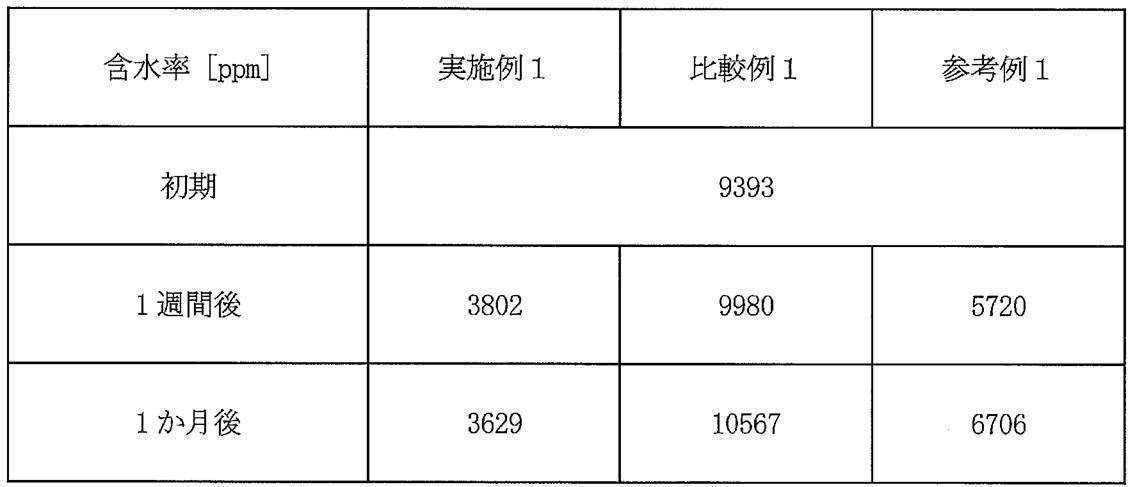
- a sample was put into a glass container replaced with a nitrogen atmosphere (water vapor amount ⁇ 0.1 ppm), the amount of water evaporated under the condition of 130 ° C. was titrated, and the moisture content of the resin composition layer was determined. Calculated. The results are shown in Table 1 below.
Landscapes
- Engineering & Computer Science (AREA)
- Mechanical Engineering (AREA)
- Chemical & Material Sciences (AREA)
- Food Science & Technology (AREA)
- Health & Medical Sciences (AREA)
- Chemical Kinetics & Catalysis (AREA)
- Medicinal Chemistry (AREA)
- Polymers & Plastics (AREA)
- Organic Chemistry (AREA)
- Manufacturing & Machinery (AREA)
- Electroluminescent Light Sources (AREA)
- Packages (AREA)
Abstract
Description
[2] 封止用フィルムが、吸湿性フィラー含有樹脂組成物層の支持体側とは反対側に設けられた保護フィルムをさらに有する、上記[1]記載のフィルムロール梱包体。
[3] フィルムロールが、フィルムロールの外側にクッション材がさらに巻き付けられたクッション材付きフィルムロールである、上記[1]記載のフィルムロール梱包体。
[4] フィルムロールが、封止用フィルムの外側に防塵用フィルムが巻き付けられた防塵用フィルム付きフィルムロールであるか、或いは、クッション材付きフィルムロールのクッション材の外側にさらに防塵用フィルムが巻き付けられたクッション材及び防塵用フィルム付きフィルムロールである、上記[1]~[3]のいずれか1つに記載のフィルムロール梱包体。
[5] 巻芯が中空であり、巻芯の内部に乾燥剤が配置されている、上記[1]~[4]のいずれか1つに記載のフィルムロール梱包体。
[6] 吸湿性フィルムが、25℃、相対湿度60%RHの環境下、1週間放置した前後の重量変化による吸湿量が1g/m2以上のフィルムである、上記[1]~[5]のいずれか1つに記載のフィルムロール梱包体。
[7] 吸湿性フィルムがポリエチレンテレフタレート層/吸湿層/ポリエチレンテレフタレート層の積層構成を有するフィルムである、上記[1]~[6]のいずれか1つに記載のフィルムロール梱包体。
[8] 封止用フィルムの吸湿性フィラー含有樹脂組成物層が、オレフィン系樹脂、粘着付与剤及び吸湿性フィラーを含む樹脂組成物層である、上記[1]~[7]のいずれか1つに記載のフィルムロール梱包体。
[9] 封止用フィルムの支持体が防湿性フィルムである、上記[1]~[8]のいずれか1つに記載のフィルムロール梱包体。
[10] 封止用フィルムが有機EL素子の封止用である、上記[1]~[9]のいずれか1つ記載のフィルムロール梱包体。
[11] 支持体と該支持体上に設けられた吸湿性フィラー含有樹脂組成物層とを有する封止用フィルムを巻芯に巻き付けてフィルムロールを作成する第1工程、
該フィルムロールを吸湿性フィルムで覆う第2工程、及び
該吸湿性フィルムで覆われたフィルムロールを防湿性の包材内に入れて、該包材を密封する第3工程を有する、フィルムロール梱包体の製造方法。
[12] 第1工程が、巻芯に、封止用フィルムを巻き付けた後、さらにクッション材を巻き付けるか、或いは、さらにクッション材及び防塵用フィルムを順次巻き付けて、フィルムロールを作成する工程である、上記[11]記載の方法。
[13] 封止用フィルムが有機EL素子の封止用である、上記[11]または[12]に記載の方法。
図1は本発明の一実施形態によるフィルムロール梱包体の断面を模式的に示した図である。
本発明のフィルムロール梱包体は、かかる図1に示されるように、封止用フィルム1が巻芯2に巻き付けられたフィルムロール10が、吸湿性フィルム11で覆われた状態で、防湿性の包材12内に収容されていることが主たる特徴である。
フィルムロール10は巻芯2および該巻芯2に巻き付けられた封止用フィルム1を含む。
巻芯2は、封止用フィルム1が巻き付けられるコアとなり、巻き付けられる封止用フィルム1のシワの発生を防止する機能等を有する。
封止用フィルムは、支持体と、支持体上に設けられた吸湿性フィラー含有樹脂組成物層とを有するフィルムである。封止用フィルムとしては、吸湿性フィラー含有樹脂組成物層の支持体側とは反対側に、保護フィルムが設けられているものが好ましい。
封止用フィルムの防湿性を向上させる目的で、或いは、支持体を封止構造の一部として利用する場合、支持体としては、バリア層を有する支持体を使用するのが好ましい。バリア層を有する支持体としては、例えば、バリア層として、酸化ケイ素(シリカ)、窒化ケイ素、SiCN、アモルファスシリコン等の無機物の蒸着膜が表面に形成されたプラスチックフィルム;バリア層として、ステンレス箔、アルミ箔の金属箔等が表面に接着したプラスチックフィルム等が挙げられる。プラスチックフィルムとしては、例えば、ポリオレフィン(例えば、ポリエチレン、ポリプロピレン、ポリ塩化ビニル等)、ポリエステル(例えば、ポリエチレンテレフタレート(以下「PET」と略称することがある。)、ポリエチレン-2,6-ナフタレート(以下「PEN」と略称することがある。)等)、ポリカーボネート、ポリイミド等のプラスチックフィルムが好適であり、PETフィルムが特に好ましい。バリア層およびプラスチックフィルムは各々2層以上の複層構造を有していてもよい。市販されているバリア層を有するプラスチックフィルムの例としては、テックバリアHX、AX、LX、Lシリーズ(三菱樹脂社製)、X-BARRIER(三菱樹脂社製)等が挙げられる(これらは、酸化ケイ素(シリカ)蒸着膜が表面に形成されたPETフィルムである)。また、東海東洋アルミ販売社製「PETツキAL1N30」、「アルペット1N30」、福田金属社製「PETツキAL3025」、「アルペット3025」等が挙げられる(これらは、アルミ箔が表面に接着したPETフィルムである)。
保護フィルムは、封止用フィルムを実際に封止構造の形成に使用する前まで、吸湿性フィラー含有樹脂組成物層表面へのゴミ等の付着やキズを防止するためのものであり、保護フィルムとしては、上記の支持体で例示したプラスチックフィルムを用いることができる。好ましくは、PETフィルム、PENフィルムまたはCOP(シクロオレフィンポリマー)フィルムであり、より好ましくはPETフィルムである。保護フィルムは予めマット処理、コロナ処理の他、離型処理を施してあってもよい。離型処理に使用される離型剤としては、具体的には、フッ素系離型剤、シリコーン系離型剤、アルキッド樹脂系離型剤等が挙げられる。保護フィルムは2層以上の複層構造であってもよい。保護フィルムの厚さも特に制限されないが、1~40μmが好ましく、10~30μmがより好ましい。
酸無水物基を有するオレフィン系樹脂は、例えば、酸無水物基を有する不飽和化合物で、ポリオレフィン系樹脂をラジカル反応条件下にて、グラフト変性することで得られる。また、酸無水物基を有する不飽和化合物をポリオレフィン系樹脂の構成単量体とともにラジカル共重合するようにしてもよい。同様に、エポキシ基を有するポリオレフィン系樹脂は、例えば、エポキシ基を有する不飽和化合物で、ポリオレフィン系樹脂をラジカル反応条件下にて、グラフト変性することで得られる。また、エポキシ基を有する不飽和化合物を、ポリオレフィン系樹脂の構成単量体とともにラジカル共重合するようにしてもよい。
なお樹脂組成物層は国際公開第2011/016408号に記載のもの等の樹脂組成物層が2層以上にされた複層構造であってもよい。
本発明におけるクッション材3としては、特に限定されず、セロハン、ポリエチレン、ポリプロピレン、軟質ポリ塩化ビニル、ポリエステル(例えば、PETやPEN、これらに1,4-シクロヘキサンジメタノール等を共重合させた共重合ポリエステルなど)、ポリスチレン、ポリウレタン等の樹脂を主成分とするフィルム、該樹脂を主成分とし、発泡剤を配合し発泡させた発泡フィルム、該樹脂を主成分とし、無機及び/又は有機顔料を配合し、延伸処理によりボイドを形成した多孔質フィルム等のフィルム類、合成紙類、不織布類、上質紙、アート紙、コート紙、クラフト紙、ポリエチレンラミネート紙、水溶紙、含浸紙、発泡紙等の紙類、及びこれらの積層体等が挙げられる。また、これらのフィルム類等を後述の吸湿性フィルムのプラスチック基材に積層したものを挙げることができる。
防塵用フィルム4としては、特に限定されず、非帯電または低帯電性のフィルムであればよい。例えば、ポリ塩化ビニリデン、ポリエチレン、ポリプロピレン、ポリ塩化ビニル、ポリメチルペンテン等の樹脂を主成分とするフィルムや、該樹脂を主成分とし、導電性フィラーを配合して成形されたフィルム等が使用される。導電性フィラーとしては、特に限定されず、公知の界面活性剤などの帯電防止剤;硫化亜鉛、硫化銅、硫化カドミウム、硫化ニッケル、硫化パラジウムなどの硫化物に導電性をもたせた導電性フィラー;硫酸バリウム;酸化錫・酸化亜鉛、酸化インジウム、酸化チタンなどの金属酸化物;導電性カーボンフィラー;ケイ素有機化合物;表面金属メッキフィラーなどが適用できる。
本発明において、吸湿性フィルム11としては、25℃、相対湿度60%RHの環境下、1週間放置した前後の重量変化による吸湿量が1g/m2以上のフィルムであれば特に制限なく使用することができる。フィルムの吸湿量は3g/m2以上がより好ましく、5g/m2以上が特に好ましい。吸湿量が1g/m2未満であると、封止用フィルム1の吸湿性フィラー含有樹脂組成物層中への水分侵入を十分に抑制できない恐れがある。また、吸湿量は15g/m2以下が好ましく、10g/m2以下がより好ましい。吸湿量が15g/m2を超えると、吸湿性フィルムの変形が大きくなり、取り扱いに支障をきたす傾向となる。
本発明において、防湿性の包材には、ガス(水蒸気)の透過を防止する機能を有するガスバリア性フィルムで作成された袋体や箱体が含まれる。
フィルムロールを包装する方法としては、特に制限されず、公知の方法が用いられうる。例えば、フィルムロールを吸湿性フィルムで覆った後、吸湿性フィルムで覆われたフィルムロールを防湿性の包材内に入れて、該包材を密封する。包材の密封は、包装材の一部(開口部)を加熱し、圧力を印加した後、冷却して、密封する方法(ヒートシールによる包装方法)が挙げられる。
シリコーン系離型剤で離型処理された離型PETフィルムASST2.25(厚さ:100μm、藤森工業株式会社製)上に、下記条件で得られたワニスをダイコーターにて均一に塗布し、130℃で60分間加熱することにより、厚さ30μmの樹脂組成物層を形成した。この樹脂組成物層上にシリコーン系離型剤で離型処理された離型PETフィルム025E-0010BD(厚さ:25μm、藤森工業株式会社製)をラミネートして有機EL封止用フィルムを作製し、直径3インチ(7.62cm)のプラスチックコア芯に対し、有機EL封止用フィルムを10m巻きとった。次に、高発泡ポリエチレンシート(酒井化学工業株式会社製、「ミナフォーム」(厚さ:2mm))を巻き付け、ポリ塩化ビニリデンフィルム(旭化成株式会社、「サランラップ」(厚さ:11μm))をさらに巻き付けた後、得られたフィルムロールの周囲を、吸湿シートドライキープフィルムSPES48-231J(積層構成:ポリエチレン/吸湿層/ポリエチレン、厚さ:60μm、吸湿量:6g/m2、佐々木化学薬品株式会社製)で覆った。これを、ポリエチレン基材にアルミニウム箔が接着された包材からなるアルミ袋MBY-92100(水蒸気透過率:0.5g/m2/day、エーディーワイ株式会社製)に入れた後、袋の入れ口をヒートシールにて閉じて、包装体(梱包体)を得た。
シクロヘキサン環含有飽和炭化水素樹脂(アルコンP125、60%スワゾール溶液、荒川化学社製)に、無水マレイン酸変性液状ポリイソブチレン(HV-300M、東邦化学工業社製)、ポリブテン(HV-1900、JX日鉱日石エネルギー社製)、および焼成ハイドロタルサイト(KW2200、協和化学工業社製)を3本ロールで分散させて、混合物を得た。得られた混合物に、エチレン-グリシジルメタクリレート共重合体(BONDFAST BF-7M、住友化学株式会社製)、アニオン重合型硬化剤(2,4,6-トリス(ジアミノメチル)フェノール)およびトルエンを配合し、得られた混合物を高速回転ミキサーで均一に分散して、樹脂組成物のワニスを得た。
実施例1と同様にして封止用フィルムを作製し、直径3インチ(7.62cm)のプラスチックコア芯に対し、有機EL封止用フィルムを10m巻きとった。次に、コア芯内部にシリカゲルMP20G(豊田化工株式会社製)を2つ固定し、高発泡ポリエチレンシート(酒井化学工業株式会社製、「ミナフォーム」(厚さ:2mm))を巻き付け、ポリ塩化ビニリデンフィルム(旭化成株式会社、「サランラップ」(厚さ:11μm))をさらに巻き付けた後、これをアルミ袋MBY-92100(エーディーワイ株式会社製)に入れ、袋の入れ口をヒートシールにて閉じ、包装体(梱包体)を得た。図2は得られたフィルムロール梱包体の模式断面図である。
実施例1と同様にして有機EL封止用フィルムを作製し、直径3インチ(7.62cm)のプラスチックコア芯に対し、有機EL封止用フィルムを10m巻きとった。次に、高発泡ポリエチレンシート(酒井化学工業株式会社製「ミナフォーム」(厚さ:2mm))を巻き付け、ポリ塩化ビニリデンフィルム(旭化成株式会社、「サランラップ」(厚さ:11μm))をさらに巻き付けた後、得られたフィルムロールをアルミ袋MBY-92100(水蒸気透過率:0.5g/m2/day、エーディーワイ株式会社製)に入れ、袋の入れ口をヒートシールにて閉じて、包装体(梱包体)を得た。図3は得られたフィルムロール梱包体の模式断面図である。
実施例1、参考例1及び比較例1の梱包体をそれぞれ1週間保管したものと、1ヶ月保管したものから、有機EL封止用フィルムを取り出し、有機EL封止用フィルムから、試料(横:約100mm、縦:約100mm、重量:100~300mg)を切り出し、保護フィルムを剥離して、その樹脂組成物層の含水率を、電量滴定法のカールフィッシャー水分測定装置(三菱化学アナリテック社製「微量水分測定装置CA-200」)を用いて測定した。この装置は、加熱可能なサンプルを設置するガラス容器と、サンプルを加熱する際に気化した水分を滴定する反応液が入った滴定装置から構成された。気化した水分は、流量:250±25ml/minの窒素を流すことでガラス容器から滴定装置の反応液側に移動した。測定は、窒素雰囲気下(水蒸気量<0.1ppm)に置換したガラス容器内に、サンプルを投入し、130℃の条件下で気化した水分の量を滴定し、樹脂組成物層の含水率を算出した。結果を下記表1に示す。
2 巻芯
3 クッション材
4 防塵用フィルム
5 乾燥剤
10 フィルムロール
11 吸湿性フィルム
12 防湿性の包材
Claims (13)
- 支持体と該支持体上に設けられた吸湿性フィラー含有樹脂組成物層とを有する封止用フィルムが巻芯に巻き付けられたフィルムロールの梱包体であって、該フィルムロールが吸湿性フィルムで覆われた状態で、防湿性の包材にて密封梱包されてなる、フィルムロール梱包体。
- 封止用フィルムが、吸湿性フィラー含有樹脂組成物層の支持体側とは反対側に設けられた保護フィルムをさらに有する、請求項1記載のフィルムロール梱包体。
- フィルムロールが、フィルムロールの外側にクッション材がさらに巻き付けられたクッション材付きフィルムロールである、請求項1記載のフィルムロール梱包体。
- フィルムロールが、封止用フィルムの外側に防塵用フィルムが巻き付けられた防塵用フィルム付きフィルムロールであるか、或いは、クッション材付きフィルムロールのクッション材の外側にさらに防塵用フィルムが巻き付けられたクッション材及び防塵用フィルム付きフィルムロールである、請求項1~3のいずれか1項記載のフィルムロール梱包体。
- 巻芯が中空であり、巻芯の内部に乾燥剤が配置されている、請求項1~4のいずれか1項記載のフィルムロール梱包体。
- 吸湿性フィルムが、25℃、相対湿度60%RHの環境下、1週間放置した前後の重量変化による吸湿量が1g/m2以上のフィルムである、請求項1~5のいずれか1項記載のフィルムロール梱包体。
- 吸湿性フィルムがポリエチレンテレフタレート層/吸湿層/ポリエチレンテレフタレート層の積層構成を有するフィルムである、請求項1~6のいずれか1項記載のフィルムロール梱包体。
- 封止用フィルムの吸湿性フィラー含有樹脂組成物層が、オレフィン系樹脂、粘着付与剤及び吸湿性フィラーを含む樹脂組成物層である、請求項1~7のいずれか1項記載のフィルムロール梱包体。
- 封止用フィルムの支持体が防湿性フィルムである、請求項1~8のいずれか1項記載のフィルムロール梱包体。
- 封止用フィルムが有機EL素子の封止用である、請求項1~9のいずれか1項記載のフィルムロール梱包体。
- 支持体と該支持体上に設けられた吸湿性フィラー含有樹脂組成物層とを有する封止用フィルムを巻芯に巻き付けてフィルムロールを作成する第1工程、
該フィルムロールを吸湿性フィルムで覆う第2工程、及び
該吸湿性フィルムで覆われたフィルムロールを防湿性の包材内に入れて、該包材を密封する第3工程を有する、フィルムロール梱包体の製造方法。 - 第1工程が、巻芯に、封止用フィルムを巻き付けた後、さらにクッション材を巻き付けるか、或いは、さらにクッション材及び防塵用フィルムを順次巻き付けて、フィルムロールを作成する工程である、請求項11記載の方法。
- 封止用フィルムが有機EL素子の封止用である、請求項11または12記載の方法。
Priority Applications (3)
| Application Number | Priority Date | Filing Date | Title |
|---|---|---|---|
| KR1020187030691A KR20180123145A (ko) | 2016-03-24 | 2017-03-24 | 필름 롤 곤포체(梱包體) 및 이의 제조방법 |
| CN201780019192.2A CN108883866A (zh) | 2016-03-24 | 2017-03-24 | 薄膜卷包装体及其制造方法 |
| JP2018507429A JPWO2017164352A1 (ja) | 2016-03-24 | 2017-03-24 | フィルムロール梱包体及びその製造方法 |
Applications Claiming Priority (2)
| Application Number | Priority Date | Filing Date | Title |
|---|---|---|---|
| JP2016-060126 | 2016-03-24 | ||
| JP2016060126 | 2016-03-24 |
Publications (1)
| Publication Number | Publication Date |
|---|---|
| WO2017164352A1 true WO2017164352A1 (ja) | 2017-09-28 |
Family
ID=59900545
Family Applications (1)
| Application Number | Title | Priority Date | Filing Date |
|---|---|---|---|
| PCT/JP2017/011933 Ceased WO2017164352A1 (ja) | 2016-03-24 | 2017-03-24 | フィルムロール梱包体及びその製造方法 |
Country Status (5)
| Country | Link |
|---|---|
| JP (1) | JPWO2017164352A1 (ja) |
| KR (1) | KR20180123145A (ja) |
| CN (1) | CN108883866A (ja) |
| TW (1) | TW201805351A (ja) |
| WO (1) | WO2017164352A1 (ja) |
Cited By (10)
| Publication number | Priority date | Publication date | Assignee | Title |
|---|---|---|---|---|
| WO2019189931A1 (ja) * | 2018-03-30 | 2019-10-03 | 東洋製罐グループホールディングス株式会社 | 電子デバイス用バリアフィルムの包装体 |
| JP2020097447A (ja) * | 2018-12-13 | 2020-06-25 | 住友化学株式会社 | 梱包体 |
| CN111386594A (zh) * | 2018-03-13 | 2020-07-07 | 日立化成株式会社 | 半导体密封成形用临时保护膜、带有临时保护膜的引线框、带有临时保护膜的密封成形体及制造半导体装置的方法 |
| WO2020250539A1 (ja) * | 2019-06-12 | 2020-12-17 | 富山住友電工株式会社 | 梱包体および梱包体の製造方法 |
| JP2021146296A (ja) * | 2020-03-19 | 2021-09-27 | 共同印刷株式会社 | 透明吸湿フィルム |
| JP2023106860A (ja) * | 2022-01-21 | 2023-08-02 | 味の素株式会社 | 封止用組成物およびその製造方法、並びに封止用シート |
| TWI830811B (zh) * | 2018-11-14 | 2024-02-01 | 日商電化股份有限公司 | 收納放熱基板之包裝袋及包裝箱 |
| JP2024138085A (ja) * | 2020-07-22 | 2024-10-07 | 味の素株式会社 | 封止用シートおよびポリマー組成物層 |
| US12398298B2 (en) | 2018-11-09 | 2025-08-26 | Resonac Corporation | Temporary protective film for producing semiconductor device, reel body, and method for producing semiconductor device |
| US12451367B2 (en) | 2019-06-19 | 2025-10-21 | Showa Denko Materials Co., Ltd. | Temporary protective film for semiconductor encapsulation molding, lead frame with temporary protective film, encapsulation molded body with temporary protective film, and method for manufacturing semiconductor device |
Families Citing this family (4)
| Publication number | Priority date | Publication date | Assignee | Title |
|---|---|---|---|---|
| CN110183808A (zh) * | 2019-06-20 | 2019-08-30 | 中原工学院 | 一种硫化铜柔性复合导电膜的制备方法 |
| CN113023424B (zh) * | 2021-02-26 | 2023-04-14 | 重庆市金利药包材料有限公司 | 一种药用包装袋的熟化装置 |
| CN113363389B (zh) * | 2021-06-23 | 2022-11-25 | 南开大学 | 一种钙钛矿太阳能电池p/i界面的修饰方法 |
| KR102683210B1 (ko) * | 2022-12-27 | 2024-07-09 | 율촌화학 주식회사 | 셀 파우치 포장 구조물 및 그의 형성방법 |
Citations (5)
| Publication number | Priority date | Publication date | Assignee | Title |
|---|---|---|---|---|
| JP2002173270A (ja) * | 2000-12-08 | 2002-06-21 | Toray Ind Inc | 磁気記録媒体用ポリエステルフィルムロールの包装体、その包装方法およびそのフィルムロールを用いた磁気記録媒体の製造方法 |
| JP2002347714A (ja) * | 2001-05-28 | 2002-12-04 | Asahi Kasei Corp | 吸湿性フィルムを包装する方法 |
| JP2003292045A (ja) * | 2002-03-29 | 2003-10-15 | Nippon Paper Industries Co Ltd | 包装方法 |
| WO2010116996A1 (ja) * | 2009-04-08 | 2010-10-14 | 日立化成工業株式会社 | 接着フィルム梱包体及びその製造方法 |
| JP2015191799A (ja) * | 2014-03-28 | 2015-11-02 | 古河電気工業株式会社 | 有機電子デバイス用素子封止用樹脂組成物、有機電子デバイス用素子封止用樹脂シート、有機エレクトロルミネッセンス素子、及び画像表示装置 |
Family Cites Families (7)
| Publication number | Priority date | Publication date | Assignee | Title |
|---|---|---|---|---|
| US6432516B1 (en) * | 1997-04-17 | 2002-08-13 | Kureha Kagaku Kogyo K.K. | Moistureproofing film and electroluminescent device |
| JP2002308343A (ja) * | 2001-04-09 | 2002-10-23 | Kuraray Co Ltd | 包装用材料及びフィルム巻取体 |
| JP2002347713A (ja) * | 2001-05-28 | 2002-12-04 | Asahi Kasei Corp | 吸湿性フィルムの包装方法 |
| JP2005255225A (ja) * | 2004-03-12 | 2005-09-22 | Dainippon Printing Co Ltd | テープロールの梱包体、及びその製造方法 |
| JP2010163189A (ja) * | 2009-01-16 | 2010-07-29 | Mitsubishi Plastics Inc | 高分子フィルムロール梱包体 |
| CN106927139B (zh) * | 2012-01-04 | 2020-03-31 | 株式会社可乐丽 | 聚乙烯醇薄膜卷的包装体 |
| JP5442147B1 (ja) * | 2013-03-19 | 2014-03-12 | 古河電気工業株式会社 | 有機エレクトロルミネッセンス素子封止用透明樹脂組成物、有機エレクトロルミネッセンス素子封止用樹脂シート、及び画像表示装置 |
-
2017
- 2017-03-24 TW TW106110000A patent/TW201805351A/zh unknown
- 2017-03-24 JP JP2018507429A patent/JPWO2017164352A1/ja active Pending
- 2017-03-24 WO PCT/JP2017/011933 patent/WO2017164352A1/ja not_active Ceased
- 2017-03-24 CN CN201780019192.2A patent/CN108883866A/zh active Pending
- 2017-03-24 KR KR1020187030691A patent/KR20180123145A/ko not_active Ceased
Patent Citations (5)
| Publication number | Priority date | Publication date | Assignee | Title |
|---|---|---|---|---|
| JP2002173270A (ja) * | 2000-12-08 | 2002-06-21 | Toray Ind Inc | 磁気記録媒体用ポリエステルフィルムロールの包装体、その包装方法およびそのフィルムロールを用いた磁気記録媒体の製造方法 |
| JP2002347714A (ja) * | 2001-05-28 | 2002-12-04 | Asahi Kasei Corp | 吸湿性フィルムを包装する方法 |
| JP2003292045A (ja) * | 2002-03-29 | 2003-10-15 | Nippon Paper Industries Co Ltd | 包装方法 |
| WO2010116996A1 (ja) * | 2009-04-08 | 2010-10-14 | 日立化成工業株式会社 | 接着フィルム梱包体及びその製造方法 |
| JP2015191799A (ja) * | 2014-03-28 | 2015-11-02 | 古河電気工業株式会社 | 有機電子デバイス用素子封止用樹脂組成物、有機電子デバイス用素子封止用樹脂シート、有機エレクトロルミネッセンス素子、及び画像表示装置 |
Cited By (26)
| Publication number | Priority date | Publication date | Assignee | Title |
|---|---|---|---|---|
| CN111386594B (zh) * | 2018-03-13 | 2023-10-13 | 株式会社力森诺科 | 半导体密封成形用临时保护膜、带有临时保护膜的引线框、带有临时保护膜的密封成形体及制造半导体装置的方法 |
| KR20220039835A (ko) * | 2018-03-13 | 2022-03-29 | 쇼와덴코머티리얼즈가부시끼가이샤 | 반도체 밀봉 성형용 가보호 필름, 가보호 필름 구비 리드 프레임, 가보호 필름 구비 밀봉 성형체, 및 반도체 장치를 제조하는 방법 |
| KR102664369B1 (ko) * | 2018-03-13 | 2024-05-10 | 가부시끼가이샤 레조낙 | 반도체 밀봉 성형용 가보호 필름, 가보호 필름 구비 리드 프레임, 가보호 필름 구비 밀봉 성형체, 및 반도체 장치를 제조하는 방법 |
| CN111386594A (zh) * | 2018-03-13 | 2020-07-07 | 日立化成株式会社 | 半导体密封成形用临时保护膜、带有临时保护膜的引线框、带有临时保护膜的密封成形体及制造半导体装置的方法 |
| KR20200128578A (ko) * | 2018-03-30 | 2020-11-13 | 도요세이칸 그룹 홀딩스 가부시키가이샤 | 전자 디바이스용 배리어 필름의 포장체 |
| CN111936394A (zh) * | 2018-03-30 | 2020-11-13 | 东洋制罐集团控股株式会社 | 电子器件用阻挡膜的包装体 |
| WO2019189931A1 (ja) * | 2018-03-30 | 2019-10-03 | 東洋製罐グループホールディングス株式会社 | 電子デバイス用バリアフィルムの包装体 |
| EP3778426A4 (en) * | 2018-03-30 | 2022-01-05 | Toyo Seikan Group Holdings, Ltd. | PACKAGING BODY OF A BARRIER FOR ELECTRONIC DEVICE |
| JP2019177934A (ja) * | 2018-03-30 | 2019-10-17 | 東洋製罐グループホールディングス株式会社 | 電子デバイス用バリアフィルムの包装体 |
| JP7135389B2 (ja) | 2018-03-30 | 2022-09-13 | 東洋製罐グループホールディングス株式会社 | 電子デバイス用バリアフィルムの包装体 |
| TWI786284B (zh) * | 2018-03-30 | 2022-12-11 | 日商東洋製罐集團控股股份有限公司 | 電子器件用阻隔膜之包裝體 |
| KR102494886B1 (ko) * | 2018-03-30 | 2023-02-06 | 도요세이칸 그룹 홀딩스 가부시키가이샤 | 전자 디바이스용 배리어 필름의 포장체 |
| US12398298B2 (en) | 2018-11-09 | 2025-08-26 | Resonac Corporation | Temporary protective film for producing semiconductor device, reel body, and method for producing semiconductor device |
| US11912489B2 (en) | 2018-11-14 | 2024-02-27 | Denka Company Limited | Package accommodating heat dissipation substrate and packing box |
| TWI830811B (zh) * | 2018-11-14 | 2024-02-01 | 日商電化股份有限公司 | 收納放熱基板之包裝袋及包裝箱 |
| JP2020097447A (ja) * | 2018-12-13 | 2020-06-25 | 住友化学株式会社 | 梱包体 |
| WO2020250539A1 (ja) * | 2019-06-12 | 2020-12-17 | 富山住友電工株式会社 | 梱包体および梱包体の製造方法 |
| EP3789317A4 (en) * | 2019-06-12 | 2022-04-13 | Sumitomo Electric Toyama Co., Ltd. | Packaging body and method for producing packaging body |
| US11220396B2 (en) | 2019-06-12 | 2022-01-11 | Sumitomo Electric Toyama Co., Ltd. | Package body and method of manufacturing package body |
| JPWO2020250539A1 (ja) * | 2019-06-12 | 2020-12-17 | ||
| US12451367B2 (en) | 2019-06-19 | 2025-10-21 | Showa Denko Materials Co., Ltd. | Temporary protective film for semiconductor encapsulation molding, lead frame with temporary protective film, encapsulation molded body with temporary protective film, and method for manufacturing semiconductor device |
| JP2021146296A (ja) * | 2020-03-19 | 2021-09-27 | 共同印刷株式会社 | 透明吸湿フィルム |
| JP2024138085A (ja) * | 2020-07-22 | 2024-10-07 | 味の素株式会社 | 封止用シートおよびポリマー組成物層 |
| JP7848832B2 (ja) | 2020-07-22 | 2026-04-21 | 味の素株式会社 | 封止用シートの製造方法 |
| JP2023106860A (ja) * | 2022-01-21 | 2023-08-02 | 味の素株式会社 | 封止用組成物およびその製造方法、並びに封止用シート |
| JP7643359B2 (ja) | 2022-01-21 | 2025-03-11 | 味の素株式会社 | 封止用組成物およびその製造方法、並びに封止用シート |
Also Published As
| Publication number | Publication date |
|---|---|
| JPWO2017164352A1 (ja) | 2019-01-31 |
| KR20180123145A (ko) | 2018-11-14 |
| CN108883866A (zh) | 2018-11-23 |
| TW201805351A (zh) | 2018-02-16 |
Similar Documents
| Publication | Publication Date | Title |
|---|---|---|
| JPWO2017164352A1 (ja) | フィルムロール梱包体及びその製造方法 | |
| KR101969288B1 (ko) | 밀봉용 수지 조성물 | |
| KR101677077B1 (ko) | 수지 조성물 | |
| JP6680295B2 (ja) | 封止用樹脂組成物 | |
| JP6760270B2 (ja) | ガスバリア性皮膜形成用コーティング剤およびガスバリア性フィルム | |
| JP6821985B2 (ja) | 封止用樹脂組成物 | |
| JP7848832B2 (ja) | 封止用シートの製造方法 | |
| JP7768168B2 (ja) | 封止用組成物および封止用シート | |
| JP6468810B2 (ja) | フィルム状封止材、封止シートおよび電子デバイス | |
| KR102312247B1 (ko) | 수분 흡수용 적층 보호 필름 | |
| WO2024195872A1 (ja) | 重合体組成物および重合体シート | |
| JP6530900B2 (ja) | フィルム状封止材、封止シートおよび電子デバイス | |
| TW202605058A (zh) | 聚合物組成物及聚合物薄片 | |
| TW202600495A (zh) | 聚合物組成物及聚合物薄片 | |
| TW202450448A (zh) | 電子裝置 | |
| WO2023182493A1 (ja) | 樹脂シートおよびその製造方法 |
Legal Events
| Date | Code | Title | Description |
|---|---|---|---|
| WWE | Wipo information: entry into national phase |
Ref document number: 2018507429 Country of ref document: JP |
|
| NENP | Non-entry into the national phase |
Ref country code: DE |
|
| ENP | Entry into the national phase |
Ref document number: 20187030691 Country of ref document: KR Kind code of ref document: A |
|
| 121 | Ep: the epo has been informed by wipo that ep was designated in this application |
Ref document number: 17770392 Country of ref document: EP Kind code of ref document: A1 |
|
| 122 | Ep: pct application non-entry in european phase |
Ref document number: 17770392 Country of ref document: EP Kind code of ref document: A1 |