WO2017163899A1 - プリプレグ及び成形品 - Google Patents
プリプレグ及び成形品 Download PDFInfo
- Publication number
- WO2017163899A1 WO2017163899A1 PCT/JP2017/009423 JP2017009423W WO2017163899A1 WO 2017163899 A1 WO2017163899 A1 WO 2017163899A1 JP 2017009423 W JP2017009423 W JP 2017009423W WO 2017163899 A1 WO2017163899 A1 WO 2017163899A1
- Authority
- WO
- WIPO (PCT)
- Prior art keywords
- meth
- prepreg
- acrylate
- compound
- resin
- Prior art date
- Legal status (The legal status is an assumption and is not a legal conclusion. Google has not performed a legal analysis and makes no representation as to the accuracy of the status listed.)
- Ceased
Links
Classifications
-
- C—CHEMISTRY; METALLURGY
- C08—ORGANIC MACROMOLECULAR COMPOUNDS; THEIR PREPARATION OR CHEMICAL WORKING-UP; COMPOSITIONS BASED THEREON
- C08J—WORKING-UP; GENERAL PROCESSES OF COMPOUNDING; AFTER-TREATMENT NOT COVERED BY SUBCLASSES C08B, C08C, C08F, C08G or C08H
- C08J5/00—Manufacture of articles or shaped materials containing macromolecular substances
- C08J5/04—Reinforcing macromolecular compounds with loose or coherent fibrous material
- C08J5/0405—Reinforcing macromolecular compounds with loose or coherent fibrous material with inorganic fibres
- C08J5/042—Reinforcing macromolecular compounds with loose or coherent fibrous material with inorganic fibres with carbon fibres
-
- C—CHEMISTRY; METALLURGY
- C08—ORGANIC MACROMOLECULAR COMPOUNDS; THEIR PREPARATION OR CHEMICAL WORKING-UP; COMPOSITIONS BASED THEREON
- C08G—MACROMOLECULAR COMPOUNDS OBTAINED OTHERWISE THAN BY REACTIONS ONLY INVOLVING UNSATURATED CARBON-TO-CARBON BONDS
- C08G18/00—Polymeric products of isocyanates or isothiocyanates
- C08G18/06—Polymeric products of isocyanates or isothiocyanates with compounds having active hydrogen
- C08G18/28—Polymeric products of isocyanates or isothiocyanates with compounds having active hydrogen characterised by the compounds used containing active hydrogen
- C08G18/67—Unsaturated compounds having active hydrogen
- C08G18/675—Low-molecular-weight compounds
- C08G18/6755—Unsaturated carboxylic acids
-
- C—CHEMISTRY; METALLURGY
- C08—ORGANIC MACROMOLECULAR COMPOUNDS; THEIR PREPARATION OR CHEMICAL WORKING-UP; COMPOSITIONS BASED THEREON
- C08F—MACROMOLECULAR COMPOUNDS OBTAINED BY REACTIONS ONLY INVOLVING CARBON-TO-CARBON UNSATURATED BONDS
- C08F290/00—Macromolecular compounds obtained by polymerising monomers on to polymers modified by introduction of aliphatic unsaturated end or side groups
- C08F290/02—Macromolecular compounds obtained by polymerising monomers on to polymers modified by introduction of aliphatic unsaturated end or side groups on to polymers modified by introduction of unsaturated end groups
- C08F290/06—Polymers provided for in subclass C08G
-
- C—CHEMISTRY; METALLURGY
- C08—ORGANIC MACROMOLECULAR COMPOUNDS; THEIR PREPARATION OR CHEMICAL WORKING-UP; COMPOSITIONS BASED THEREON
- C08G—MACROMOLECULAR COMPOUNDS OBTAINED OTHERWISE THAN BY REACTIONS ONLY INVOLVING UNSATURATED CARBON-TO-CARBON BONDS
- C08G18/00—Polymeric products of isocyanates or isothiocyanates
- C08G18/06—Polymeric products of isocyanates or isothiocyanates with compounds having active hydrogen
- C08G18/28—Polymeric products of isocyanates or isothiocyanates with compounds having active hydrogen characterised by the compounds used containing active hydrogen
- C08G18/40—High-molecular-weight compounds
- C08G18/48—Polyethers
- C08G18/4862—Polyethers containing at least a part of the ether groups in a side chain
-
- C—CHEMISTRY; METALLURGY
- C08—ORGANIC MACROMOLECULAR COMPOUNDS; THEIR PREPARATION OR CHEMICAL WORKING-UP; COMPOSITIONS BASED THEREON
- C08G—MACROMOLECULAR COMPOUNDS OBTAINED OTHERWISE THAN BY REACTIONS ONLY INVOLVING UNSATURATED CARBON-TO-CARBON BONDS
- C08G18/00—Polymeric products of isocyanates or isothiocyanates
- C08G18/06—Polymeric products of isocyanates or isothiocyanates with compounds having active hydrogen
- C08G18/28—Polymeric products of isocyanates or isothiocyanates with compounds having active hydrogen characterised by the compounds used containing active hydrogen
- C08G18/65—Low-molecular-weight compounds having active hydrogen with high-molecular-weight compounds having active hydrogen
-
- C—CHEMISTRY; METALLURGY
- C08—ORGANIC MACROMOLECULAR COMPOUNDS; THEIR PREPARATION OR CHEMICAL WORKING-UP; COMPOSITIONS BASED THEREON
- C08G—MACROMOLECULAR COMPOUNDS OBTAINED OTHERWISE THAN BY REACTIONS ONLY INVOLVING UNSATURATED CARBON-TO-CARBON BONDS
- C08G18/00—Polymeric products of isocyanates or isothiocyanates
- C08G18/06—Polymeric products of isocyanates or isothiocyanates with compounds having active hydrogen
- C08G18/70—Polymeric products of isocyanates or isothiocyanates with compounds having active hydrogen characterised by the isocyanates or isothiocyanates used
- C08G18/72—Polyisocyanates or polyisothiocyanates
- C08G18/721—Two or more polyisocyanates not provided for in one single group C08G18/73 - C08G18/80
-
- C—CHEMISTRY; METALLURGY
- C08—ORGANIC MACROMOLECULAR COMPOUNDS; THEIR PREPARATION OR CHEMICAL WORKING-UP; COMPOSITIONS BASED THEREON
- C08G—MACROMOLECULAR COMPOUNDS OBTAINED OTHERWISE THAN BY REACTIONS ONLY INVOLVING UNSATURATED CARBON-TO-CARBON BONDS
- C08G18/00—Polymeric products of isocyanates or isothiocyanates
- C08G18/06—Polymeric products of isocyanates or isothiocyanates with compounds having active hydrogen
- C08G18/70—Polymeric products of isocyanates or isothiocyanates with compounds having active hydrogen characterised by the isocyanates or isothiocyanates used
- C08G18/72—Polyisocyanates or polyisothiocyanates
- C08G18/728—Polymerisation products of compounds having carbon-to-carbon unsaturated bonds and having isocyanate or isothiocyanate groups or groups forming isocyanate or isothiocyanate groups
-
- C—CHEMISTRY; METALLURGY
- C08—ORGANIC MACROMOLECULAR COMPOUNDS; THEIR PREPARATION OR CHEMICAL WORKING-UP; COMPOSITIONS BASED THEREON
- C08G—MACROMOLECULAR COMPOUNDS OBTAINED OTHERWISE THAN BY REACTIONS ONLY INVOLVING UNSATURATED CARBON-TO-CARBON BONDS
- C08G18/00—Polymeric products of isocyanates or isothiocyanates
- C08G18/06—Polymeric products of isocyanates or isothiocyanates with compounds having active hydrogen
- C08G18/70—Polymeric products of isocyanates or isothiocyanates with compounds having active hydrogen characterised by the isocyanates or isothiocyanates used
- C08G18/72—Polyisocyanates or polyisothiocyanates
- C08G18/74—Polyisocyanates or polyisothiocyanates cyclic
- C08G18/76—Polyisocyanates or polyisothiocyanates cyclic aromatic
- C08G18/7657—Polyisocyanates or polyisothiocyanates cyclic aromatic containing two or more aromatic rings
- C08G18/7664—Polyisocyanates or polyisothiocyanates cyclic aromatic containing two or more aromatic rings containing alkylene polyphenyl groups
- C08G18/7671—Polyisocyanates or polyisothiocyanates cyclic aromatic containing two or more aromatic rings containing alkylene polyphenyl groups containing only one alkylene bisphenyl group
-
- C—CHEMISTRY; METALLURGY
- C08—ORGANIC MACROMOLECULAR COMPOUNDS; THEIR PREPARATION OR CHEMICAL WORKING-UP; COMPOSITIONS BASED THEREON
- C08J—WORKING-UP; GENERAL PROCESSES OF COMPOUNDING; AFTER-TREATMENT NOT COVERED BY SUBCLASSES C08B, C08C, C08F, C08G or C08H
- C08J5/00—Manufacture of articles or shaped materials containing macromolecular substances
- C08J5/24—Impregnating materials with prepolymers which can be polymerised in situ, e.g. manufacture of prepregs
- C08J5/241—Impregnating materials with prepolymers which can be polymerised in situ, e.g. manufacture of prepregs using inorganic fibres
- C08J5/243—Impregnating materials with prepolymers which can be polymerised in situ, e.g. manufacture of prepregs using inorganic fibres using carbon fibres
-
- C—CHEMISTRY; METALLURGY
- C08—ORGANIC MACROMOLECULAR COMPOUNDS; THEIR PREPARATION OR CHEMICAL WORKING-UP; COMPOSITIONS BASED THEREON
- C08J—WORKING-UP; GENERAL PROCESSES OF COMPOUNDING; AFTER-TREATMENT NOT COVERED BY SUBCLASSES C08B, C08C, C08F, C08G or C08H
- C08J2375/00—Characterised by the use of polyureas or polyurethanes; Derivatives of such polymers
- C08J2375/04—Polyurethanes
- C08J2375/14—Polyurethanes having carbon-to-carbon unsaturated bonds
Definitions
- the present invention relates to a prepreg that is excellent in workability and moldability and from which a molded product excellent in various physical properties such as interlaminar shear strength can be obtained, and a molded product thereof.
- Fiber reinforced resin composite materials reinforced with carbon fiber and glass fiber reinforced fibers are attracting attention as they are lightweight but have excellent heat resistance and mechanical strength. Use in structural applications is expanding.
- a molding method of the fiber reinforced resin composite material for example, a method of curing and molding by autoclave molding or press molding using an intermediate material called prepreg in which a reinforcing fiber is impregnated with a thermosetting resin is used.
- thermosetting resins such as epoxy resin compositions are generally used frequently. I came.
- a prepreg using an epoxy resin has a problem of requiring refrigerated storage because curing proceeds at room temperature.
- This radical polysynthetic resin composition is composed of a tri (meth) acrylate compound having a specific structure, a (meth) acrylic acid adduct of bisphenol A diglycidyl ether, and a radical polymerizable having a di (meth) acrylate compound having a specific structure as essential components.
- This radical polysynthetic resin composition has a problem that it requires UV curing to improve the workability (tackiness) of the prepreg, and the interlayer adhesion of the molded product is insufficient. .
- the problem to be solved by the present invention is to provide a prepreg that is excellent in workability and moldability and from which a molded product excellent in various physical properties such as interlaminar shear strength and heat resistance is obtained, and a molded product thereof.
- the present inventors are a molded product in which a specific urethane (meth) acrylate, a polymerization initiator, and a prepreg having carbon fibers as essential raw materials are excellent in workability and moldability, and are excellent in various physical properties such as interlaminar shear strength and heat resistance.
- the present invention was completed.
- the present invention relates to a prepreg comprising a urethane (meth) acrylate (A), a polymerization initiator (B), and a carbon fiber (C), which is a reaction product with (a2), and a molded product thereof.
- the molded product obtained from the prepreg of the present invention is excellent in interlaminar shear strength, heat resistance, etc., it is an automobile member, a railway vehicle member, an aerospace member, a ship member, a housing equipment member, a sports member, a light vehicle member, a building It can be suitably used for a civil engineering member, a housing of an OA device, or the like.
- the prepreg of the present invention comprises a polyisocyanate compound (a1) having polymethylene polyphenyl polyisocyanate (a1-1) as essential components and a compound (a2-1) having a hydroxyl group and a (meth) acryloyl group as essential components. It contains urethane (meth) acrylate (A), a polymerization initiator (B), and carbon fiber (C), which are a reaction product with the compound (a2) having a hydroxyl group.
- the urethane (meth) acrylate (A) is a reaction product of the polyisocyanate compound (a1) and the compound (a2) having a hydroxyl group.
- the polyisocyanate compound (a1) contains the polymethylene polyphenyl polyisocyanate (a1-1) as an essential raw material.
- These polymethylene polyphenyl polyisocyanates (a1-1) can be used alone or in combination of two or more.
- the polymethylene polyphenyl polyisocyanate (a1-1) is represented by the following general formula (1).
- n is an integer of 1 or more.
- polymethylene polyphenyl polyisocyanate (a1-1) Commercially available products that can be used as the polymethylene polyphenyl polyisocyanate (a1-1) include “Millionate MR-100”, “Millionate MR-200” manufactured by Tosoh Corporation, and “WANATE” manufactured by Wanhua Japan Co., Ltd. PM-200 “,” WANnate PM-400 “,” Cosmonate M-1500 “manufactured by Mitsui Chemicals, Inc.,” Boranate M-595 “manufactured by Dow Chemical Co., Ltd., and the like.
- the ratio of the polymethylene polyphenyl polyisocyanate (a1-1) in the prepreg raw material excluding the carbon fiber (C) is 1 to 40. It is preferably in the range of mass%.
- polyisocyanate compound (a1) other polyisocyanates (a1-2) other than the polymethylene polyphenyl polyisocyanate (a1-1) can be used in combination.
- Examples of the other polyisocyanate (a1-2) include diphenylmethane diisocyanate (MDI), carbodiimide-modified product of diphenylmethane diisocyanate, nurate-modified product, burette-modified product, urethane imine-modified product, number average of diethylene glycol, dipropylene glycol, and the like.
- MDI diphenylmethane diisocyanate
- carbodiimide-modified product of diphenylmethane diisocyanate nurate-modified product, burette-modified product, urethane imine-modified product, number average of diethylene glycol, dipropylene glycol, and the like.
- Diphenylmethane diisocyanate-modified products such as polyol-modified products modified with polyols having a molecular weight of 1,000 or less, tolylene diisocyanate (TDI), tolidine diisocyanate, polymethylene polyphenyl polyisocyanate, xylylene diisocyanate, 1,5-naphthalene diisocyanate, tetramethyl Aromatic polyisocyanates such as xylene diisocyanate; isophorone diisocyanate (IPDI), hydrogenated diphenyl Cycloaliphatic polyisocyanates such as diisocyanates, hydrogenated xylylene diisocyanates, norbornene diisocyanates; hexamethylene diisocyanate, hexamethylene diisocyanate nurate modified, burette modified, adduct, dimer acid diisocyanate, etc. be able to.
- TTI tolylene diisocyanate
- IPDI is
- the compound (a2) having a hydroxyl group uses a compound (a2-1) having a hydroxyl group and a (meth) acryloyl group as an essential raw material.
- Examples of the compound (a2-1) having a hydroxyl group and a (meth) acryloyl group include hydroxyalkyl (meth) acrylate and epoxy (meth) acrylate.
- these compounds (a2-1) having a hydroxyl group and a (meth) acryloyl group can be used alone or in combination of two or more.
- hydroxyalkyl (meth) acrylate examples include 2-hydroxyethyl (meth) acrylate, 3-hydroxypropyl (meth) acrylate, 4-hydroxy-n-butyl (meth) acrylate, and 2-hydroxypropyl (meth) acrylate. 2-hydroxy-n-butyl (meth) acrylate, 3-hydroxy-n-butyl (meth) acrylate and the like, and 2-hydroxyethyl (meth) acrylate is preferable.
- these hydroxyalkyl (meth) acrylates (B) can be used alone or in combination of two or more.
- the epoxy (meth) acrylate can be obtained by reacting an epoxy resin with (meth) acrylic acid and / or (meth) acrylic anhydride.
- the compound (a2) having a hydroxyl group other polyols (a2-2) other than the compound (a2-1) having a hydroxyl group and a (meth) acryloyl group are obtained because the toughness and the like of the obtained molded article are further improved. ) Is preferably used in combination.
- Examples of the other polyol (a2-2) include polyether polyol, polyester polyol, polycarbonate polyol, and polyalkylene polyol.
- the molar ratio (NCO / OH) between the isocyanate group (NCO) of the isocyanate compound (a1) and the hydroxyl group (OH) of the compound (a2) having a hydroxyl group, which is a raw material of the urethane (meth) acrylate (A), is 0. 0.1 to 1.5 is preferable, and 0.3 to 1.2 is more preferable.
- An organic peroxide is preferable, for example, a diacyl peroxide compound, a peroxyester compound, a hydroperoxide compound, a ketone peroxide compound, an alkyl perester compound, a peroxidation compound.
- a carbonate compound, a peroxyketal, etc. are mentioned, It can select suitably according to molding conditions.
- These polymerization initiators (B) can be used alone or in combination of two or more.
- a polymerization initiator having a temperature of 70 ° C. or more and 100 ° C. or less for obtaining a 10-hour half-life for the purpose of shortening the molding time. If it is 70 degreeC or more and 100 degrees C or less, since the life at normal temperature of a prepreg is long and it can harden
- Examples of such a polymerization initiator include 1,6-bis (t-butylperoxycarbonyloxy) hexane, 1,1-bis (t-butylperoxy) cyclohexane, 1,1-bis (t- Amylperoxy) cyclohexane, 1,1-bis (t-hexylperoxy) cyclohexane, t-butylperoxydiethyl acetate, t-butylperoxyisopropylcarbonate, t-amylperoxyisopropylcarbonate, t-hexylperoxyisopropyl Examples thereof include carbonate, di-tert-butylperoxyhexahydroterephthalate, t-amylperoxytrimethylhexanoate, and t-hexylperoxy-2-ethylhexanoate.
- the content of the polymerization initiator (B) is preferably in the range of 0.3 to 3% by mass in the prepreg component excluding the carbon fiber (C) because both curing characteristics and storage stability are excellent.
- carbon fiber (C) various types such as polyacrylonitrile-based, pitch-based, rayon-based, and the like can be used. Among these, a high-strength carbon fiber can be easily obtained. Is preferred.
- the shape of the carbon fiber (C) is not particularly limited, and a reinforcing fiber tow in which reinforcing fiber filaments are converged, a unidirectional material in which reinforcing fiber tows are aligned in one direction, a woven fabric, or a reinforcing fiber cut shortly.
- a reinforcing fiber tow in which reinforcing fiber filaments are converged a unidirectional material in which reinforcing fiber tows are aligned in one direction
- a woven fabric or a reinforcing fiber cut shortly.
- stitches are made so as not to unravel the sheets of fiber bundles aligned in one direction, such as plain weave, twill weave, satin weave, or non-crimp fabric, or sheets that are laminated at different angles. Stitching sheet etc. are mentioned.
- the basis weight of the reinforcing fibers is not particularly limited, but is preferably 10 g / m 2 to 650 g / m 2 .
- a basis weight of 10 g / m 2 or more is preferable because there is little unevenness in fiber width and mechanical properties are improved.
- a basis weight of 650 g / m 2 or less is preferable because the resin impregnation becomes good.
- the basis weight is more and more preferably 50 ⁇ 500g / m 2, particularly preferably 50 ⁇ 300g / m 2.
- the content of the carbon fiber (C) in the prepreg of the present invention is preferably in the range of 25 to 80% by mass and more preferably in the range of 40 to 70% by mass because the mechanical strength of the obtained molded product is further improved. More preferred.
- an ethylenically unsaturated monomer as a raw material for the prepreg of the present invention.
- these ethylenically unsaturated monomers include styrene compounds such as styrene, methylstyrene, halogenated styrene, and divinylbenzene; methyl (meth) acrylate, ethyl (meth) acrylate, propyl (meth) acrylate, butyl ( (Meth) acrylate, 2-ethylhexyl (meth) acrylate, cyclohexyl (meth) acrylate, isobornyl (meth) acrylate, benzyl (meth) acrylate, methylbenzyl (meth) acrylate, phenoxyethyl (meth) acrylate, methylphenoxy Ethyl (meth) acrylate, morpholine (me
- styrene compounds such as st
- Hydroxyl group-containing (meth) acrylate compounds ethylene glycol di (meth) acrylate, propylene glycol di (meth) acrylate, 1,4-butanediol di (meth) acrylate, 1,6-hexanediol di (meth) acrylate, bisphenol di
- di (meth) acrylate compounds such as (meth) acrylate and 1,4-cyclohexanedimethanol di (meth) acrylate. These can be used alone or in combination of two or more.
- monofunctional (meth) acrylates having a molecular weight of 150 to 250 are preferred from the viewpoint of mechanical strength and heat resistance of the molded body in terms of handling of odors and hazardous materials in the working environment.
- Phenoxyethyl (meth) acrylate and methylphenoxyethyl are preferred.
- (Meth) acrylate, benzyl (meth) acrylate, and methylbenzyl (meth) acrylate are more preferable, and phenoxyethyl (meth) acrylate and benzyl (meth) acrylate are more preferable.
- the ethylenically unsaturated monomer in the raw material of the prepreg of the present invention is preferably 1 to 50% by mass because the balance between workability (tackiness), heat resistance and curability is further improved.
- the mass% is more preferable.
- thermosetting resins thermoplastic resins, polymerization inhibitors, curing accelerators, fillers, low shrinkage agents, release agents , Thickeners, thickeners, pigments, antioxidants, plasticizers, flame retardants, antibacterial agents, UV stabilizers, reinforcing materials, photocuring agents, and the like.
- thermosetting resin examples include vinyl ester resins, unsaturated polyester resins, phenol resins, melamine resins, and furan resins. Moreover, these thermosetting resins can be used alone or in combination of two or more.
- thermoplastic resin examples include polyamide resin, polyethylene terephthalate resin, polybutylene terephthalate resin, polycarbonate resin, urethane resin, polypropylene resin, polyethylene resin, polystyrene resin, acrylic resin, polybutadiene resin, polyisoprene resin, and copolymers thereof. And the like modified by the above. Moreover, these thermoplastic resins can be used alone or in combination of two or more.
- polymerization inhibitor examples include hydroquinone, trimethylhydroquinone, pt-butylcatechol, t-butylhydroquinone, toluhydroquinone, p-benzoquinone, naphthoquinone, hydroquinone monomethyl ether, phenothiazine, copper naphthenate, and copper chloride. It is done. These polymerization inhibitors can be used alone or in combination of two or more.
- curing accelerator examples include metal soaps such as cobalt naphthenate, cobalt octenoate, vanadyl octenoate, copper naphthenate, and barium naphthenate, and metal chelates such as vanadyl acetyl acetate, cobalt acetyl acetate, and iron acetylacetonate.
- metal soaps such as cobalt naphthenate, cobalt octenoate, vanadyl octenoate, copper naphthenate, and barium naphthenate
- metal chelates such as vanadyl acetyl acetate, cobalt acetyl acetate, and iron acetylacetonate.
- amines include amine, m-toluidine, diethylenetriamine, pyridine, phenylmorpholine, piperidine, diethanolaniline and the like.
- These curing accelerators can be used alone or in combination of two or more.
- the filler includes an inorganic compound and an organic compound, and can be used to adjust physical properties such as strength, elastic modulus, impact strength, and fatigue durability of the molded product.
- Examples of the inorganic compound include calcium carbonate, magnesium carbonate, barium sulfate, mica, talc, kaolin, clay, celite, asbestos, barlite, baryta, silica, silica sand, dolomite limestone, gypsum, aluminum fine powder, hollow balloon, Alumina, glass powder, aluminum hydroxide, cryolite, zirconium oxide, antimony trioxide, titanium oxide, molybdenum dioxide, iron powder and the like can be mentioned.
- organic compound examples include natural polysaccharide powders such as cellulose and chitin, and synthetic resin powders.
- the synthetic resin powder is composed of hard resin, soft rubber, elastomer, polymer (copolymer), or the like.
- Particles having a multilayer structure such as organic powder or core-shell type can be used. Specific examples include particles made of butadiene rubber and / or acrylic rubber, urethane rubber, silicon rubber, polyimide resin powder, fluororesin powder, phenol resin powder, and the like. These fillers can be used alone or in combination of two or more.
- release agent examples include zinc stearate, calcium stearate, paraffin wax, polyethylene wax, and carnauba wax.
- paraffin wax, polyethylene wax, carnauba wax and the like are used.
- These mold release agents can be used alone or in combination of two or more.
- thickener examples include acrylic resin-based fine particles such as metal oxides and metal hydroxides such as magnesium oxide, magnesium hydroxide, calcium oxide, and calcium hydroxide, and handleability of the prepreg of the present invention. Can be selected as appropriate. These thickeners can be used alone or in combination of two or more.
- the prepreg of the present invention is prepared by using, for example, a known mixer such as a planetary mixer or a kneader, polymethylene polyphenyl polyisocyanate (a1-1), other isocyanate (a1-2), hydroxyl group and (meth) acryloyl.
- the reinforcing fiber (C) is impregnated into a resin solution in which a compound having a group (a2-1), other polyol (a2-2), and a polymerization initiator (B) are mixed.
- Step 1 for sandwiching and rolling with a rolling mill to obtain a sheet, and allowing this to stand at room temperature to 50 ° C. to react the isocyanate group of the polyisocyanate compound (a1) with the hydroxyl group of the compound having a hydroxyl group (a2) 2 is obtained.
- the thickness of the prepreg of the present invention is preferably 0.02 to 1.0 mm.
- a thickness of 0.02 mm or more is preferable because the handling for lamination becomes easy, and a thickness of 1 mm or less is preferable because the resin impregnation becomes good.
- 0.05 to 0.5 mm is more preferable.
- a mold heated to 110 ° C. to 160 ° C. in advance is used as a method for obtaining a molded product from the prepreg obtained above.
- a method is used in which the prepreg is cured by holding the mold, clamping with a compression molding machine, holding the molding pressure of 0.1 to 10 MPa, and then removing the molded product to obtain a molded product. It is done.
- a molding pressure of 1 to 8 MPa is maintained for 1 to 2 minutes per 1 mm thickness of the molded product, and heat compression molding is performed.
- the manufacturing method is preferred.
- the molded product obtained from the prepreg of the present invention is excellent in interlaminar shear strength, heat resistance, etc., it is an automobile member, a railway vehicle member, an aerospace member, a ship member, a housing equipment member, a sports member, a light vehicle member, a building It can be suitably used for a civil engineering member, a housing of an OA device, or the like.
- Example 1 Preparation and evaluation of prepreg (1)
- Mixture of polymethylene polyphenyl polyisocyanate and MDI (“Millionate MR-200” manufactured by Tosoh Corporation, polymethylene polyphenyl polyisocyanate content 56%; hereinafter abbreviated as “polymeric MDI mixture (1)”) 100 Parts, hydroxyethyl methacrylate 75.5 parts, pentaerythritol polyoxyethylene ether (“PNT-40” manufactured by Nippon Emulsifier Co., Ltd.), phenoxyethyl methacrylate 21 parts, polymerization initiator (Kayaku Akzo Co., Ltd.) 2 parts of “Trigonox 27” (organic peroxide) manufactured by the company were mixed.
- prepreg (1) was produced by aging at 45 ° C. for 24 hours.
- the content of polymethylene polyphenyl polyisocyanate in the raw material excluding carbon fibers was 26% by mass, and the molar ratio (NCO / OH) was 0.9.
- the thickness was 0.25 mm.
- Example 2 Production and evaluation of prepreg (2)
- Polymeric MDI mixture (1) 75 parts, 67 parts hydroxyethyl methacrylate, 25 parts pentaerythritol polyoxyethylene ether (“PNT-40” manufactured by Nippon Emulsifier Co., Ltd.), 21 parts phenoxyethyl methacrylate, polymerization started 2 parts of an agent (“Trigonox 27” manufactured by Kayaku Akzo Corporation, organic peroxide) was mixed.
- PNT-40 pentaerythritol polyoxyethylene ether
- phenoxyethyl methacrylate polymerization started 2 parts of an agent (“Trigonox 27” manufactured by Kayaku Akzo Corporation, organic peroxide) was mixed.
- Trigonox 27 manufactured by Kayaku Akzo Corporation, organic peroxide
- prepreg (2) was produced by aging at 45 ° C. for 24 hours.
- the polymethylene polyphenyl polyisocyanate content in the raw material excluding carbon fibers was 7% by mass, and the molar ratio (NCO / OH) was 0.9.
- the thickness was 0.25 mm.
- Example A molded product (2) was prepared and evaluated in the same manner as in Example 1 except that the prepreg (1) used in Example 1 was changed to the prepreg (2).
- prepreg (R1) was produced by aging at 45 ° C. for 24 hours.
- the molar ratio (NCO / OH) of this prepreg (R1) was 0.9.
- the thickness was 0.25 mm.
- Example A molded product (R1) was prepared and evaluated in the same manner as in Example 1 except that the prepreg (1) used in Example 1 was changed to the prepreg (R1).
- prepreg (R2) was produced by aging at 45 ° C. for 24 hours.
- the molar ratio (NCO / OH) of this prepreg (R2) was 0.9.
- the thickness was 0.25 mm.
- Example A molded product (R2) was prepared and evaluated in the same manner as in Example 1 except that the prepreg (1) used in Example 1 was changed to the prepreg (R2).
- prepreg (R3) was produced by aging at 45 ° C. for 24 hours.
- the molar ratio (NCO / OH) of this prepreg (R3) was 0.9.
- the thickness was 0.25 mm.
- Example A molded product (R3) was prepared and evaluated in the same manner as in Example 1 except that the prepreg (1) used in Example 1 was changed to the prepreg (R3).
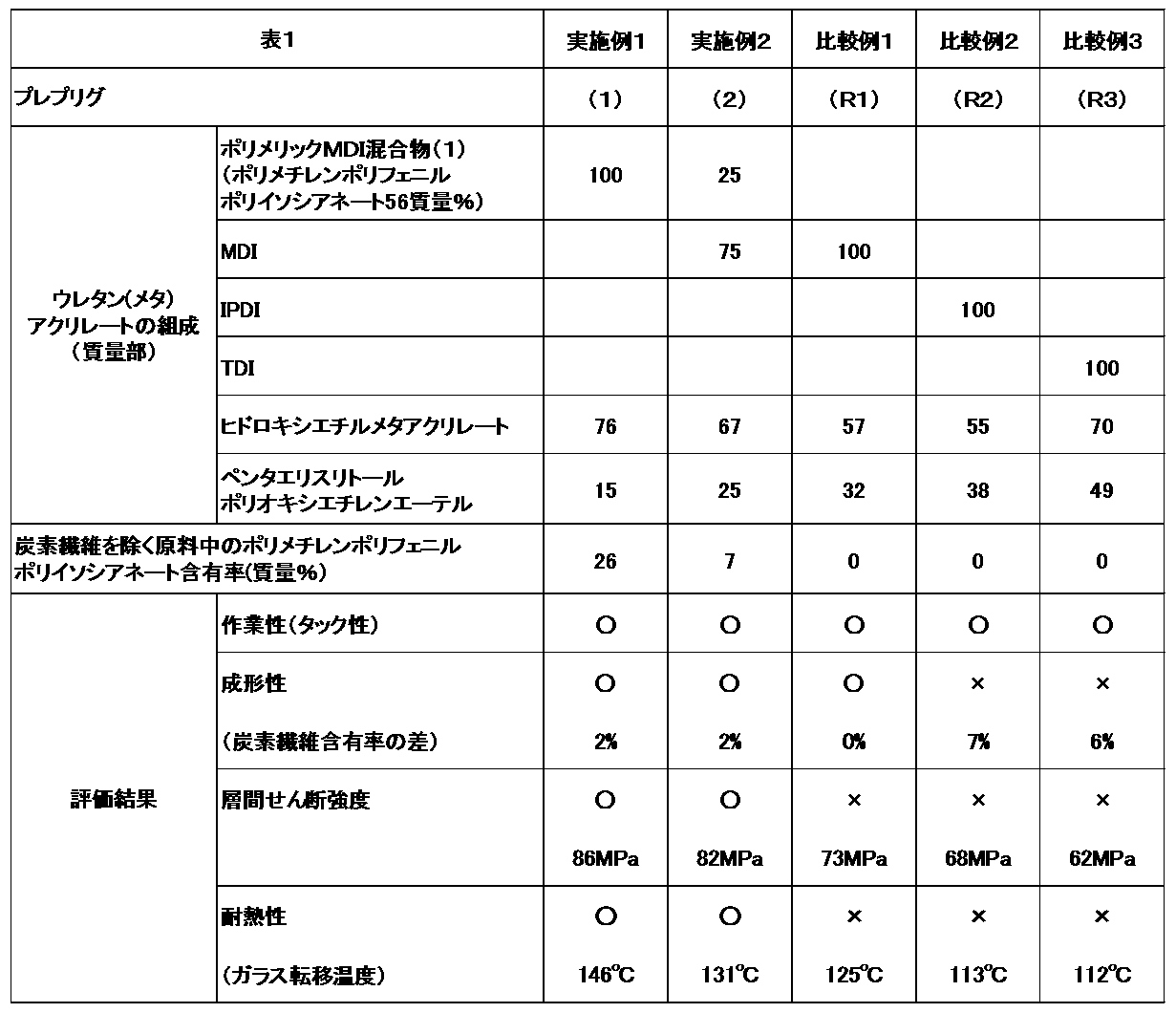
- Table 1 shows the evaluation results of the prepregs (1) to (3) and (R1) to (R3) obtained above.
- Comparative Example 1 is an example using MDI instead of polymethylene polyphenyl polyisocyanate, which is an essential component of the present invention, but it was confirmed that the interlayer shear strength and heat resistance of the molded product were insufficient. It was.
- Comparative Example 2 is an example using IPDI instead of polymethylene polyphenyl polyisocyanate which is an essential component of the present invention, but it was confirmed that moldability, interlayer shear strength and heat resistance of the molded product were insufficient. It was done.
- Comparative Example 3 is an example using TDI instead of polymethylene polyphenyl polyisocyanate, which is an essential component of the present invention, but it was confirmed that moldability, interlayer shear strength and heat resistance of the molded product were insufficient. It was done.
Landscapes
- Chemical & Material Sciences (AREA)
- Health & Medical Sciences (AREA)
- Chemical Kinetics & Catalysis (AREA)
- Medicinal Chemistry (AREA)
- Polymers & Plastics (AREA)
- Organic Chemistry (AREA)
- Engineering & Computer Science (AREA)
- Materials Engineering (AREA)
- Manufacturing & Machinery (AREA)
- Inorganic Chemistry (AREA)
- Reinforced Plastic Materials (AREA)
- Polyurethanes Or Polyureas (AREA)
Abstract
Description

以下、
ポリメチレンポリフェニルポリイソシアネートとMDIとの混合物(東ソー株式会社製「ミリオネート MR-200」、ポリメチレンポリフェニルポリイソシアネート含有量56%;以下、「ポリメリックMDI混合物(1)」と略記する。)100部とヒドロキシエチルメタアクリレート75.5部と、ペンタエリスリトールポリオキシエチレンエーテル(日本乳化剤株式会社製「PNT-40」)15部と、フェノキシエチルメタアクリレート21部と、重合開始剤(化薬アクゾ株式会社製「トリゴノックス27」、有機過酸化物)2部とを混合した。この混合物を離型PETフィルムの片面に塗布した後、ハンドレイアップ法により炭素繊維(三菱レーヨン株式会社製「TRK979PQRW」)を炭素繊維含有量が55%となるように含浸させ、同じ離型PETフィルムをかぶせた後、45℃24時間の条件にて、エージングさせることでプリプレグ(1)を作製した。このプリプレグ(1)における炭素繊維を除く原料中のポリメチレンポリフェニルポリイソシアネート含有率は26質量%であり、モル比(NCO/OH)は0.9であった。また、厚さは0.25mmであった。
上記で得られたプリプレグ(1)を室温で離型フィルム(SP-PET)から剥がす際の作業性を下記の基準に従って評価した。
○:離型フィルムに樹脂の付着あり
×:離型フィルムに樹脂の付着なし
上記で得られたプリプレグ(1)を9枚積層し、プレス機に設置し、圧力0.98MPaをかけながら、140℃2分の条件で樹脂を硬化させることで、成形品(1)を得た。
プリプレグ(1)の炭素繊維含有率と上記で得られた成形品(1)の炭素繊維含有率の差を測定し、成形性を下記の基準に従い評価した。
○:炭素繊維含有率の差が5%未満
×:炭素繊維含有率の差が5%以上
上記で得られた成形品(1)から、幅10mm、長さ22mmの試験片を切り出し、この試験片について、JIS K7078に従い、層間せん断強度を測定し、下記の基準に従い評価した。
○:75MPa以上
×:75MPa未満
上記で得られた成形品(1)から、幅5mm、長さ55mmの試験片を切り出し、この試験片について、エスアイアイ・ナノテクノロジー社製の「DMS6100」を用い、測定周波数1Hz、昇温速度3℃/分、硬化物の両持ち曲げによる動的粘弾性を測定した。得られた貯蔵弾性率のチャートのガラス領域の近似直線と転移領域の接線の交点をガラス転移温度とし、下記の基準に従い耐熱性を評価した。
○:ガラス転移温度が130℃以上
×:ガラス転移温度が130℃未満
ポリメリックMDI混合物(1)75部と、ヒドロキシエチルメタアクリレート67部と、ペンタエリスリトールポリオキシエチレンエーテル(日本乳化剤株式会社製「PNT-40」)25部と、フェノキシエチルメタアクリレート21部と、重合開始剤(化薬アクゾ株式会社製「トリゴノックス27」、有機過酸化物)2部とを混合した。この混合物を離型PETフィルムの片面に塗布した後、ハンドレイアップ法により炭素繊維(三菱レーヨン株式会社製「TRK979PQRW」)を炭素繊維含有量が55%となるように含浸させ、同じ離型PETフィルムをかぶせた後、45℃24時間の条件にて、エージングさせることでプリプレグ(2)を作製した。このプリプレグ(2)における炭素繊維を除く原料中のポリメチレンポリフェニルポリイソシアネート含有率は7質量%であり、モル比(NCO/OH)は0.9であった。また、厚さは0.25mmであった。
MDI(東ソー株式会社製「ミリオネートMT」)100部とヒドロキシエチルメタアクリレート57部と、ペンタエリスリトールポリオキシエチレンエーテル(日本乳化剤株式会社製「PNT-40」)32部と、フェノキシエチルメタアクリレート21部と、重合開始剤(化薬アクゾ株式会社製「トリゴノックス27」、有機過酸化物)2部とを混合した。この混合物を離型PETフィルムの片面に塗布した後、ハンドレイアップ法により炭素繊維(三菱レーヨン株式会社製「TRK979PQRW」)を炭素繊維含有量が55%となるように含浸させ、同じ離型PETフィルムをかぶせた後、45℃24時間の条件にて、エージングさせることでプリプレグ(R1)を作製した。このプリプレグ(R1)のモル比(NCO/OH)は0.9であった。また、厚さは0.25mmであった。
IPDI(エボニックデグサジャパン株式会社製「VESTANAT IPDI」)100部とヒドロキシエチルメタアクリレート55部と、ペンタエリスリトールポリオキシエチレンエーテル(日本乳化剤株式会社製「PNT-40」)38部と、フェノキシエチルメタアクリレート21部と、重合開始剤(化薬アクゾ株式会社製「トリゴノックス27」、有機過酸化物)2.2部とを混合した。この混合物を離型PETフィルムの片面に塗布した後、ハンドレイアップ法により炭素繊維(三菱レーヨン株式会社製「TRK979PQRW」)を炭素繊維含有量が55%となるように含浸させ、同じ離型PETフィルムをかぶせた後、45℃24時間の条件にて、エージングさせることでプリプレグ(R2)を作製した。このプリプレグ(R2)のモル比(NCO/OH)は0.9であった。また、厚さは0.25mmであった。
TDI(三井化学株式会社製「コスモネートT-80」)100部とヒドロキシエチルメタアクリレート70部と、ペンタエリスリトールポリオキシエチレンエーテル(日本乳化剤株式会社製「PNT-40」)49部と、フェノキシエチルメタアクリレート24部と、重合開始剤(化薬アクゾ株式会社製「トリゴノックス27」、有機過酸化物)2.5部とを混合した。この混合物を離型PETフィルムの片面に塗布した後、ハンドレイアップ法により炭素繊維(三菱レーヨン株式会社製「TRK979PQRW」)を炭素繊維含有量が55%となるように含浸させ、同じ離型PETフィルムをかぶせた後、45℃24時間の条件にて、エージングさせることでプリプレグ(R3)を作製した。このプリプレグ(R3)のモル比(NCO/OH)は0.9であった。また、厚さは0.25mmであった。
Claims (3)
- ポリメチレンポリフェニルポリイソシアネート(a1-1)を必須成分とするポリイソシアネート化合物(a1)と、水酸基及び(メタ)アクリロイル基を有する化合物(a2-1)を必須成分とする水酸基を有する化合物(a2)との反応物であるウレタン(メタ)アクリレート(A)、重合開始剤(B)、及び炭素繊維(C)を含有することを特徴とするプリプレグ。
- 前記炭素繊維(C)を除いた原料中の前記ポリメチレンポリフェニルポリイソシアネート(a1-1)の比率が、1~40質量%の範囲である請求項1記載のプリプレグ。
- 請求項1又は2記載のプリプレグの硬化物であることを特徴とする成形品。
Priority Applications (5)
| Application Number | Priority Date | Filing Date | Title |
|---|---|---|---|
| CN201780018821.XA CN108779276B (zh) | 2016-03-24 | 2017-03-09 | 预浸料和成形品 |
| JP2017546253A JP6260754B1 (ja) | 2016-03-24 | 2017-03-09 | プリプレグ及び成形品 |
| US16/087,198 US10793690B2 (en) | 2016-03-24 | 2017-03-09 | Prepreg and molded article |
| EP17769944.4A EP3434718B1 (en) | 2016-03-24 | 2017-03-09 | Prepreg and molded article |
| KR1020187027021A KR102197901B1 (ko) | 2016-03-24 | 2017-03-09 | 프리프레그 및 성형품 |
Applications Claiming Priority (2)
| Application Number | Priority Date | Filing Date | Title |
|---|---|---|---|
| JP2016-060094 | 2016-03-24 | ||
| JP2016060094 | 2016-03-24 |
Publications (1)
| Publication Number | Publication Date |
|---|---|
| WO2017163899A1 true WO2017163899A1 (ja) | 2017-09-28 |
Family
ID=59900137
Family Applications (1)
| Application Number | Title | Priority Date | Filing Date |
|---|---|---|---|
| PCT/JP2017/009423 Ceased WO2017163899A1 (ja) | 2016-03-24 | 2017-03-09 | プリプレグ及び成形品 |
Country Status (7)
| Country | Link |
|---|---|
| US (1) | US10793690B2 (ja) |
| EP (1) | EP3434718B1 (ja) |
| JP (1) | JP6260754B1 (ja) |
| KR (1) | KR102197901B1 (ja) |
| CN (1) | CN108779276B (ja) |
| TW (1) | TWI719173B (ja) |
| WO (1) | WO2017163899A1 (ja) |
Cited By (6)
| Publication number | Priority date | Publication date | Assignee | Title |
|---|---|---|---|---|
| WO2019065209A1 (ja) * | 2017-09-27 | 2019-04-04 | Dic株式会社 | プリプレグ用樹脂組成物、プリプレグ及び成形品 |
| WO2019065210A1 (ja) * | 2017-09-27 | 2019-04-04 | Dic株式会社 | プリプレグ用樹脂組成物、プリプレグ及び成形品 |
| JPWO2021131566A1 (ja) * | 2019-12-25 | 2021-07-01 | ||
| WO2021187030A1 (ja) * | 2020-03-17 | 2021-09-23 | Dic株式会社 | プリプレグ、及び、成型品 |
| EP3747937A4 (en) * | 2018-03-02 | 2021-11-03 | Arisawa Mfg. Co., Ltd. | PRE-IMPREGNATED AND MANUFACTURING PROCESS FOR PRE-IMPREGNATED MOLDED ARTICLE |
| WO2022249672A1 (ja) * | 2021-05-24 | 2022-12-01 | Dic株式会社 | プリプレグ、プリプレグの製造方法、及び、成形品 |
Families Citing this family (4)
| Publication number | Priority date | Publication date | Assignee | Title |
|---|---|---|---|---|
| JP6532840B2 (ja) * | 2016-05-30 | 2019-06-19 | 日本ユピカ株式会社 | プリプレグシート、及び繊維強化複合材料の製造方法 |
| JP7428258B2 (ja) * | 2020-08-04 | 2024-02-06 | Dic株式会社 | プラスチック基材用水性インクジェットインクの調製のための水性顔料分散体、水性インクジェットインク及び印刷物 |
| CN116323161B (zh) * | 2020-09-14 | 2024-07-02 | 住友电木株式会社 | 夹芯板的制造方法和夹芯板 |
| EP4342663A4 (en) * | 2021-05-18 | 2024-10-23 | DIC Corporation | METHOD FOR STRENGTHENING AND REPAIRING A STRUCTURE AND STRUCTURE |
Citations (5)
| Publication number | Priority date | Publication date | Assignee | Title |
|---|---|---|---|---|
| JPS62135528A (ja) * | 1985-12-10 | 1987-06-18 | Dainippon Ink & Chem Inc | 成形用組成物 |
| JP2006152161A (ja) | 2004-11-30 | 2006-06-15 | Mitsubishi Rayon Co Ltd | 繊維強化樹脂複合材料用プリプレグ |
| WO2014119234A1 (ja) * | 2013-01-29 | 2014-08-07 | 日本ユピカ株式会社 | ウレタン(メタ)アクリレート化合物 |
| WO2015133289A1 (ja) * | 2014-03-07 | 2015-09-11 | Dic株式会社 | 加熱圧縮成形用成形材料、それを用いた成形品及びその製造方法 |
| WO2017043325A1 (ja) * | 2015-09-07 | 2017-03-16 | Dic株式会社 | 加熱圧縮成形用成形材料、それを用いた成形品及びその製造方法 |
Family Cites Families (5)
| Publication number | Priority date | Publication date | Assignee | Title |
|---|---|---|---|---|
| JPH03192111A (ja) * | 1989-12-22 | 1991-08-22 | Takemoto Oil & Fat Co Ltd | 熱硬化性不飽和ウレタン樹脂組成物の製造方法及び該製造方法によつて得られる熱硬化性不飽和ウレタン樹脂組成物 |
| JP2931159B2 (ja) * | 1992-06-08 | 1999-08-09 | 竹本油脂株式会社 | 重合性液状樹脂組成物及びこれを型内硬化して得られる成形物 |
| US5382619A (en) * | 1993-02-05 | 1995-01-17 | Takemoto Yushi Kabushiki Kaisha | Polymerizable compositions and in-mold cured products using same |
| WO2011092962A1 (ja) * | 2010-01-28 | 2011-08-04 | ディーエイチ・マテリアル株式会社 | 炭素繊維用サイジング剤、炭素繊維、及びその製造方法、ならびに、炭素繊維を含む成形材料及び成形品 |
| RU2616696C2 (ru) | 2012-03-20 | 2017-04-18 | Байер Интеллектуэль Проперти Гмбх | Устойчивые при хранении полиуретановые препреги и полученные из них волокнистые композиционные конструктивные элементы |
-
2017
- 2017-03-09 EP EP17769944.4A patent/EP3434718B1/en active Active
- 2017-03-09 WO PCT/JP2017/009423 patent/WO2017163899A1/ja not_active Ceased
- 2017-03-09 JP JP2017546253A patent/JP6260754B1/ja active Active
- 2017-03-09 CN CN201780018821.XA patent/CN108779276B/zh active Active
- 2017-03-09 US US16/087,198 patent/US10793690B2/en active Active
- 2017-03-09 KR KR1020187027021A patent/KR102197901B1/ko active Active
- 2017-03-23 TW TW106109654A patent/TWI719173B/zh not_active IP Right Cessation
Patent Citations (5)
| Publication number | Priority date | Publication date | Assignee | Title |
|---|---|---|---|---|
| JPS62135528A (ja) * | 1985-12-10 | 1987-06-18 | Dainippon Ink & Chem Inc | 成形用組成物 |
| JP2006152161A (ja) | 2004-11-30 | 2006-06-15 | Mitsubishi Rayon Co Ltd | 繊維強化樹脂複合材料用プリプレグ |
| WO2014119234A1 (ja) * | 2013-01-29 | 2014-08-07 | 日本ユピカ株式会社 | ウレタン(メタ)アクリレート化合物 |
| WO2015133289A1 (ja) * | 2014-03-07 | 2015-09-11 | Dic株式会社 | 加熱圧縮成形用成形材料、それを用いた成形品及びその製造方法 |
| WO2017043325A1 (ja) * | 2015-09-07 | 2017-03-16 | Dic株式会社 | 加熱圧縮成形用成形材料、それを用いた成形品及びその製造方法 |
Non-Patent Citations (1)
| Title |
|---|
| See also references of EP3434718A4 |
Cited By (19)
| Publication number | Priority date | Publication date | Assignee | Title |
|---|---|---|---|---|
| WO2019065209A1 (ja) * | 2017-09-27 | 2019-04-04 | Dic株式会社 | プリプレグ用樹脂組成物、プリプレグ及び成形品 |
| WO2019065210A1 (ja) * | 2017-09-27 | 2019-04-04 | Dic株式会社 | プリプレグ用樹脂組成物、プリプレグ及び成形品 |
| JPWO2019065209A1 (ja) * | 2017-09-27 | 2019-11-14 | Dic株式会社 | プリプレグ用樹脂組成物、プリプレグ及び成形品 |
| JPWO2019065210A1 (ja) * | 2017-09-27 | 2019-11-14 | Dic株式会社 | プリプレグ用樹脂組成物、プリプレグ及び成形品 |
| US11760849B2 (en) | 2017-09-27 | 2023-09-19 | Dic Corporation | Prepreg resin composition, prepreg and molded article |
| US11479630B2 (en) | 2017-09-27 | 2022-10-25 | Dic Corporation | Prepreg resin composition, prepreg, and molded article |
| EP3747937A4 (en) * | 2018-03-02 | 2021-11-03 | Arisawa Mfg. Co., Ltd. | PRE-IMPREGNATED AND MANUFACTURING PROCESS FOR PRE-IMPREGNATED MOLDED ARTICLE |
| US11865794B2 (en) | 2018-03-02 | 2024-01-09 | Arisawa Mfg. Co., Ltd. | Prepreg and method for manufacturing molded prepreg article |
| JP7014348B2 (ja) | 2019-12-25 | 2022-02-01 | Dic株式会社 | プリプレグ及び成形品 |
| CN114746490A (zh) * | 2019-12-25 | 2022-07-12 | Dic株式会社 | 预浸料和成形品 |
| WO2021131566A1 (ja) | 2019-12-25 | 2021-07-01 | Dic株式会社 | プリプレグ及び成形品 |
| JPWO2021131566A1 (ja) * | 2019-12-25 | 2021-07-01 | ||
| JPWO2021187030A1 (ja) * | 2020-03-17 | 2021-09-23 | ||
| WO2021187030A1 (ja) * | 2020-03-17 | 2021-09-23 | Dic株式会社 | プリプレグ、及び、成型品 |
| JP7052938B2 (ja) | 2020-03-17 | 2022-04-12 | Dic株式会社 | プリプレグ、及び、成型品 |
| WO2022249672A1 (ja) * | 2021-05-24 | 2022-12-01 | Dic株式会社 | プリプレグ、プリプレグの製造方法、及び、成形品 |
| JP7197067B1 (ja) * | 2021-05-24 | 2022-12-27 | Dic株式会社 | プリプレグ、プリプレグの製造方法、及び、成形品 |
| CN116997598A (zh) * | 2021-05-24 | 2023-11-03 | Dic株式会社 | 预浸渍体、预浸渍体的制造方法以及成形品 |
| US12031002B2 (en) | 2021-05-24 | 2024-07-09 | Dic Corporation | Prepreg, method for producing prepreg, and molded article |
Also Published As
| Publication number | Publication date |
|---|---|
| US10793690B2 (en) | 2020-10-06 |
| KR102197901B1 (ko) | 2021-01-05 |
| JPWO2017163899A1 (ja) | 2018-04-05 |
| KR20180110155A (ko) | 2018-10-08 |
| EP3434718B1 (en) | 2021-04-28 |
| JP6260754B1 (ja) | 2018-01-17 |
| US20190092915A1 (en) | 2019-03-28 |
| CN108779276A (zh) | 2018-11-09 |
| TW201802158A (zh) | 2018-01-16 |
| CN108779276B (zh) | 2021-12-07 |
| EP3434718A1 (en) | 2019-01-30 |
| TWI719173B (zh) | 2021-02-21 |
| EP3434718A4 (en) | 2019-11-06 |
Similar Documents
| Publication | Publication Date | Title |
|---|---|---|
| JP6260754B1 (ja) | プリプレグ及び成形品 | |
| CN111133040B (zh) | 预浸渍体用树脂组合物、预浸渍体及成型品 | |
| JP6150034B1 (ja) | プリプレグ及び成形品 | |
| JP6610982B2 (ja) | プリプレグ用樹脂組成物、プリプレグ及び成形品 | |
| JP7014348B2 (ja) | プリプレグ及び成形品 | |
| WO2021106588A1 (ja) | プリプレグ用樹脂組成物、プリプレグ及び成形品 | |
| CN114729144B (zh) | 预浸料和成形品 | |
| WO2025004816A1 (ja) | プリプレグ用樹脂組成物、プリプレグ及び成形品 | |
| WO2023199692A1 (ja) | プリプレグ用樹脂組成物、プリプレグ及び成形品 | |
| CN115003736A (zh) | 预浸料和成型品 |
Legal Events
| Date | Code | Title | Description |
|---|---|---|---|
| ENP | Entry into the national phase |
Ref document number: 2017546253 Country of ref document: JP Kind code of ref document: A |
|
| ENP | Entry into the national phase |
Ref document number: 20187027021 Country of ref document: KR Kind code of ref document: A |
|
| WWE | Wipo information: entry into national phase |
Ref document number: 1020187027021 Country of ref document: KR |
|
| WWE | Wipo information: entry into national phase |
Ref document number: 2017769944 Country of ref document: EP |
|
| ENP | Entry into the national phase |
Ref document number: 2017769944 Country of ref document: EP Effective date: 20181024 |
|
| 121 | Ep: the epo has been informed by wipo that ep was designated in this application |
Ref document number: 17769944 Country of ref document: EP Kind code of ref document: A1 |