WO2017154848A1 - シリルアセタール、オリゴシロキサン、及びそれらの製造方法 - Google Patents
シリルアセタール、オリゴシロキサン、及びそれらの製造方法 Download PDFInfo
- Publication number
- WO2017154848A1 WO2017154848A1 PCT/JP2017/008836 JP2017008836W WO2017154848A1 WO 2017154848 A1 WO2017154848 A1 WO 2017154848A1 JP 2017008836 W JP2017008836 W JP 2017008836W WO 2017154848 A1 WO2017154848 A1 WO 2017154848A1
- Authority
- WO
- WIPO (PCT)
- Prior art keywords
- carbon atoms
- group
- hydrocarbon group
- oligosiloxane
- structure represented
- Prior art date
- Legal status (The legal status is an assumption and is not a legal conclusion. Google has not performed a legal analysis and makes no representation as to the accuracy of the status listed.)
- Ceased
Links
- 0 CC1(OCN**)OC1 Chemical compound CC1(OCN**)OC1 0.000 description 1
Classifications
-
- C—CHEMISTRY; METALLURGY
- C07—ORGANIC CHEMISTRY
- C07F—ACYCLIC, CARBOCYCLIC OR HETEROCYCLIC COMPOUNDS CONTAINING ELEMENTS OTHER THAN CARBON, HYDROGEN, HALOGEN, OXYGEN, NITROGEN, SULFUR, SELENIUM OR TELLURIUM
- C07F7/00—Compounds containing elements of Groups 4 or 14 of the Periodic Table
- C07F7/02—Silicon compounds
- C07F7/08—Compounds having one or more C—Si linkages
-
- C—CHEMISTRY; METALLURGY
- C07—ORGANIC CHEMISTRY
- C07F—ACYCLIC, CARBOCYCLIC OR HETEROCYCLIC COMPOUNDS CONTAINING ELEMENTS OTHER THAN CARBON, HYDROGEN, HALOGEN, OXYGEN, NITROGEN, SULFUR, SELENIUM OR TELLURIUM
- C07F7/00—Compounds containing elements of Groups 4 or 14 of the Periodic Table
- C07F7/02—Silicon compounds
- C07F7/08—Compounds having one or more C—Si linkages
- C07F7/18—Compounds having one or more C—Si linkages as well as one or more C—O—Si linkages
-
- C—CHEMISTRY; METALLURGY
- C07—ORGANIC CHEMISTRY
- C07B—GENERAL METHODS OF ORGANIC CHEMISTRY; APPARATUS THEREFOR
- C07B61/00—Other general methods
Definitions
- the present invention relates to silyl acetals, oligosiloxanes, and methods for producing them, and more particularly, to methods for producing silyl acetals using iridium complexes and the like, methods for producing oligosiloxanes using Lewis acids, and methods for producing these
- the present invention relates to silyl acetals and oligosiloxanes that can be produced in the same manner.
- Siloxane bonds (Si-O-Si) have higher bond energy than carbon-carbon bonds (CC) and carbon-oxygen bonds (CO), which are organic skeletons. It is known that the compound is excellent in durability, weather resistance and the like.
- the formation method of siloxane bond has been actively studied for a long time. Typical methods include hydrolysis / dehydration condensation of silanol, alkoxysilane, chlorosilane, etc., cross-coupling of chlorosilane and silanol (or alkoxysilane). A method by cross coupling of hydrosilane and silanol (or alkoxysilane) is known.
- An object of the present invention is to provide a useful intermediate that can be efficiently derived into oligosiloxane or oligosiloxane.
- the present inventors have found that acyloxysilane and hydrosilane react in the presence of an iridium complex to produce silylacetal, and further, the produced silylacetal is a Lewis acid.
- the inventors found that an oligosiloxane is produced by causing intramolecular rearrangement in the presence of the present invention, thereby completing the present invention. That is, the present invention is as follows.
- R 1 represents a hydrogen atom or a hydrocarbon group having 1 to 18 carbon atoms
- R 2 each independently represents a hydrocarbon having 1 to 18 carbon atoms.
- R 3 each independently has a hydrogen atom, a hydrocarbon group having 1 to 18 carbon atoms, an alkoxy group having a hydrocarbon group having 1 to 12 carbon atoms, or a hydrocarbon group having 3 to 18 carbon atoms.
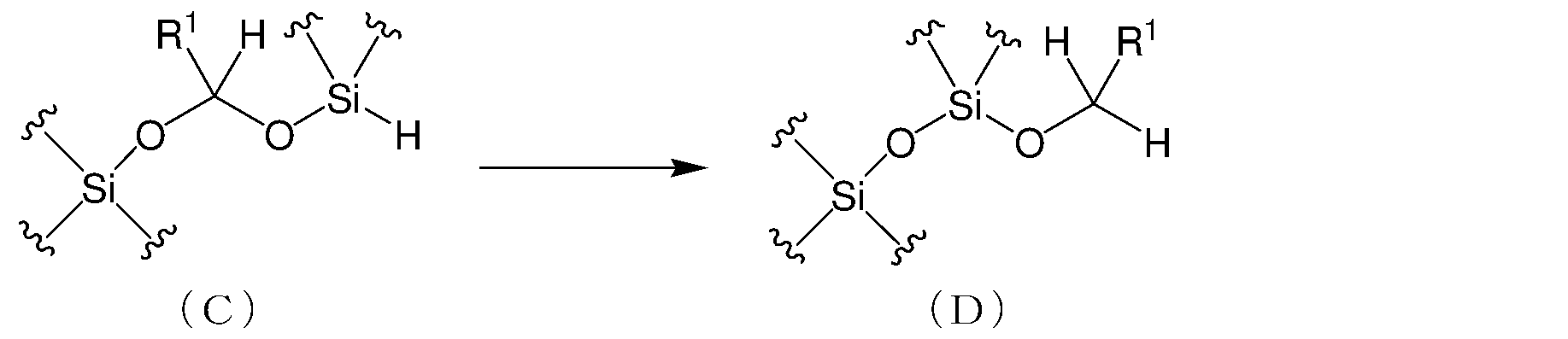
- ⁇ 3> including a rearrangement step of reacting a silyl acetal having a structure represented by the following formula (C) in the presence of a Lewis acid to produce an oligosiloxane having a structure represented by the following formula (D).
- a method for producing an oligosiloxane In the formulas (C) to (D), R 1 represents a hydrogen atom or a hydrocarbon group having 1 to 18 carbon atoms.
- ⁇ 4> The method for producing an oligosiloxane according to ⁇ 3>, wherein the Lewis acid is a boron compound having Lewis acidity.
- the silyl acetal having the structure represented by the formula (C) is an acyloxysilane having the structure represented by the following formula (A) and the following formula (B) in the presence of an iridium complex and / or an iridium salt.
- R 1 represents a hydrogen atom or a hydrocarbon group having 1 to 18 carbon atoms.
- R 1 represents a hydrogen atom or a hydrocarbon group having 1 to 18 carbon atoms.
- R 1 represents a hydrogen atom or a hydrocarbon group having 1 to 18 carbon atoms.
- R 1 represents a hydrogen atom or a hydrocarbon group having 1 to 18 carbon atoms.
- R 1 represents a hydrogen atom or a hydrocarbon group having 1 to 18 carbon atoms
- R 2 represents Each independently a hydrocarbon group having 1 to 18 carbon atoms, an alkoxy group having a hydrocarbon group having 1 to 12 carbon atoms, a silyloxy group having a hydrocarbon group having 3 to 18 carbon atoms
- R 3 and R 4 are each independently a hydrogen atom, a hydrocarbon group having 1 to 18 carbon atoms, or a hydrocarbon group having 1 to 12 carbon atoms.
- a useful silyl acetal that can be efficiently derived into oligosiloxane and oligosiloxane can be provided.
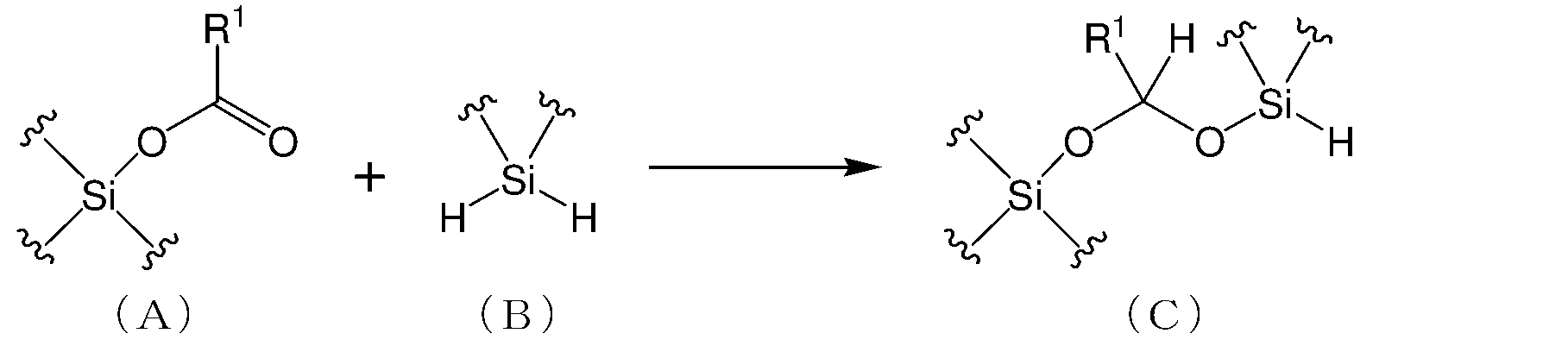
- the method for producing a silyl acetal which is one embodiment of the present invention includes an acyloxysilane having a structure represented by the following formula (A) and a structure represented by the following formula (B) in the presence of an iridium complex and / or an iridium salt.
- addition step for producing a silyl acetal having a structure represented by the following formula (C) by reacting hydrosilane having: (In the formulas (A) to (C), R 1 represents a hydrogen atom or a hydrocarbon group having 1 to 18 carbon atoms.)
- R 1 represents a hydrogen atom or a hydrocarbon group having 1 to 18 carbon atoms.
- silyl acetal which has a structure represented by Formula (C) obtained by an addition process is a useful compound which can be efficiently induced
- the wavy lines in the formulas (A) to (C) mean that the structure ahead is arbitrary.
- the “addition process” will be described in detail.
- an acyloxysilane having a structure represented by the formula (A) and a hydrosilane having a structure represented by the formula (B) are reacted with each other in the formula (C).
- an acyloxysilane having a structure represented by the formula (A) and a hydrosilane having a structure represented by the formula (B) are reacted with each other in the formula (C).
- the specific kind of acylsilane which has a structure represented by Formula (A), and the hydrosilane which has a structure represented by Formula (B) is especially limited Rather, it should be appropriately selected according to the target oligosiloxane.
- acyloxysilane having a structure represented by the formula (A) examples include acyloxysilane represented by the following formula (A-1).
- R 1 is a hydrogen atom or a hydrocarbon group having 1 to 18 carbon atoms
- R 2 is independently a hydrocarbon group having 1 to 18 carbon atoms
- R 1 represents a “hydrogen atom” or “hydrocarbon group having 1 to 18 carbon atoms”, and the “hydrocarbon group” includes a branched structure, a cyclic structure, and a carbon-carbon unsaturated bond (carbon- Each of which may have a carbon double bond, carbon-carbon triple bond), and may be any of a saturated hydrocarbon group, an unsaturated hydro
- an oxygen atom such as an ether group (—O—), an oxygen atom such as a silyloxy group (—O—Si—), a silicon atom, or a functional group (linking group) containing a halogen atom is present inside or at the end of the carbon skeleton. May be included.
- a hydrocarbon group having 2 carbon atoms including an ether group such as —CH 2 —O—CH 3 (methoxymethyl group) and a silyloxy group such as —CH 2 —O—Si (CH 3 ) 3 are included.
- a hydrocarbon group having 4 carbon atoms (trimethylsilyloxymethyl group) and the like are included.
- the number of carbon atoms when R 1 is a hydrocarbon group is preferably 12 or less, more preferably 6 or less, and the number of carbon atoms when R 1 is an aromatic hydrocarbon group is usually 6 or more. .
- R 1 includes a hydrogen atom, a methyl group (—CH 3 , —Me), an ethyl group (—C 2 H 5 , —Et), an n-propyl group ( —n C 3 H 7 , —n Pr), i -Propyl group ( -i C 3 H 7 , -i Pr), n-butyl group ( -n C 4 H 9 , -n Bu), t-butyl group ( -t C 4 H 9 , -t Bu), n-pentyl group ( -n C 5 H 11 ), n-hexyl group ( -n C 6 H 13 , -n Hex), cyclohexyl group ( -c C 6 H 11 , -Cy), phenyl group (-C 6 H 5 , —Ph), a naphthyl group (—C 12 H 7 , —Naph), and the like.
- a methyl group
- R 2 each independently has a “hydrocarbon group having 1 to 18 carbon atoms”, an “alkoxy group having a hydrocarbon group having 1 to 12 carbon atoms”, or a “hydrocarbon group having 3 to 18 carbon atoms”.
- the term “silyloxy group”, “acyloxy group having a hydrocarbon group having 1 to 18 carbon atoms”, or “halogen atom” is the same as the case of R 1 .
- the number of carbon atoms when R 2 is a hydrocarbon group is preferably 12 or less, more preferably 6 or less, and the number of carbon atoms when R 2 is an aromatic hydrocarbon group is usually 6 or more. .
- the number of carbon atoms when R 2 is an alkoxy group is preferably 10 or less, more preferably 6 or less.
- the number of carbon atoms when R 2 is a silyloxy group is preferably 10 or less, more preferably 6 or less.
- the number of carbon atoms when R 2 is an acyloxy group is preferably 12 or less, more preferably 6 or less.
- R 2 includes a methyl group (—CH 3 , —Me), an ethyl group (—C 2 H 5 , —Et), an n-propyl group ( —n C 3 H 7 , —n Pr), and an i-propyl group.
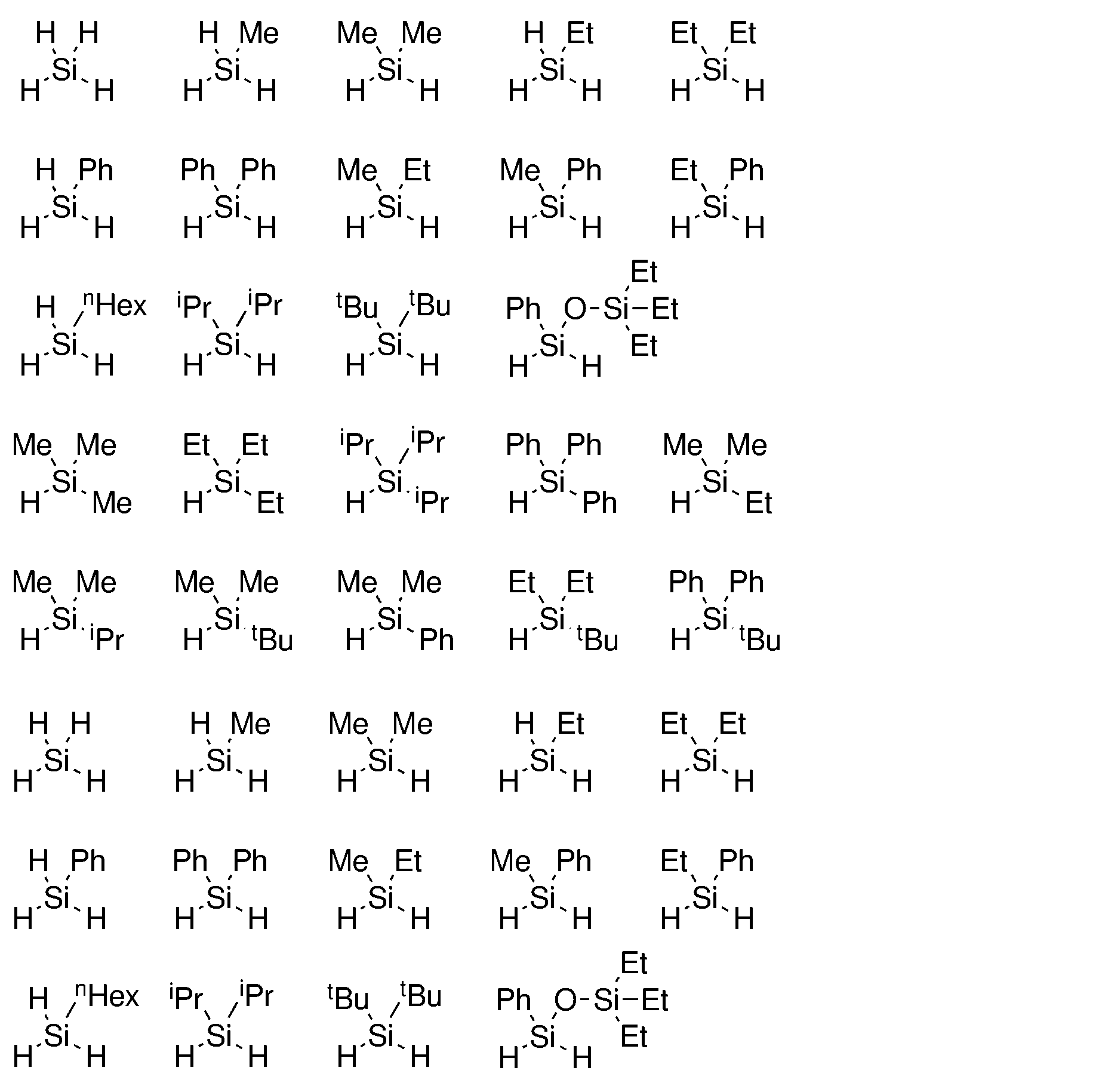
- Examples of the acyloxysilane represented by the formula (A-1) include those represented by the following formula.
- Examples of the hydrosilane having a structure represented by the formula (B) include a hydrosilane represented by the following formula (B-1).
- each R 3 independently represents a hydrogen atom, a hydrocarbon group having 1 to 18 carbon atoms, an alkoxy group having a hydrocarbon group having 1 to 12 carbon atoms, or 3 to 3 carbon atoms. Represents a silyloxy group having 18 hydrocarbon groups or a halogen atom.
- R 3 each independently has a “hydrocarbon group having 1 to 18 carbon atoms”, “an alkoxy group having a hydrocarbon group having 1 to 12 carbon atoms”, or “a hydrocarbon group having 3 to 18 carbon atoms”.
- the term “silyloxy group” or “halogen atom” is used, but the “hydrocarbon group” has the same meaning as in R 1 .
- the number of carbon atoms when R 3 is a hydrocarbon group is preferably 12 or less, more preferably 6 or less, and the number of carbon atoms when R 3 is an aromatic hydrocarbon group is usually 6 or more.
- R 3 is an alkoxy group the number of carbon atoms is preferably 10 or less, more preferably 6 or less.
- R 3 is a silyloxy group the number of carbon atoms is preferably 10 or less, more preferably 6 or less.
- R 3 includes a hydrogen atom, a methyl group (—CH 3 , —Me), an ethyl group (—C 2 H 5 , —Et), an n-propyl group ( —n C 3 H 7 , —n Pr), i -Propyl group ( -i C 3 H 7 , -i Pr), n-butyl group ( -n C 4 H 9 , -n Bu), t-butyl group ( -t C 4 H 9 , -t Bu), n-pentyl group ( -n C 5 H 11 ), n-hexyl group ( -n C 6 H 13 , -n Hex), cyclohexyl group ( -c C 6 H 11 , -Cy), phenyl group (-C 6 H 5 , -Ph), naphthyl group (-C 12 H 7 , -Naph), methoxy group (-OCH 3 , -OM
- hydrosilane represented by the formula (B-1) examples include those represented by the following formula.
- the use amount (charge amount) of the hydrosilane having the structure represented by the formula (B) is usually 0.3 times or more, preferably in terms of the amount of substance, in terms of the amount of the acyloxysilane having the structure represented by the formula (A). Is 0.5 times or more, more preferably 1 time or more, and usually 5 times or less, preferably 3 times or less, more preferably 1.5 times or less. Within the above range, silyl acetal can be more efficiently produced.
- the addition step is a step performed in the presence of an iridium complex and / or an iridium salt (hereinafter sometimes abbreviated as “iridium complex etc.”), but the iridium oxidation number, ligand or The specific type of counter ion is not particularly limited, and can be appropriately selected according to the purpose.
- the oxidation number of iridium is usually 0, +1, +2, +3, +4, +5, and +6, but is preferably +1.
- Examples of the ligand or counter ion, or a compound capable of becoming such include cyclooctene, 1,5-cyclooctadiene, ethylene, norbornadiene, chloride anion (Cl ⁇ ), bromide anion (Br ⁇ ) and the like.
- Examples of the iridium complex include chlorobis (cyclooctene) iridium (I) dimer ([Ir (coe) 2 Cl] 2 ), chloro (1,5-cyclooctadiene) iridium (I) dimer ([Ir (cod) Cl ] 2 ) etc. are mentioned.
- a silyl acetal can be more efficiently produced as described above.
- the amount of iridium complex or the like used is usually 0.0001 times or more, preferably 0.001 times or more, more preferably, in terms of the amount of the substance with respect to the acyloxysilane having the structure represented by the formula (A). Is 0.005 times or more, usually 0.5 times or less, preferably 0.1 times or less, more preferably 0.05 times or less. Within the above range, silyl acetal can be more efficiently produced.
- a solvent is preferably used.
- the type of the solvent is not particularly limited and can be appropriately selected according to the purpose.
- the solvent is a hydrocarbon solvent such as hexane, benzene, or toluene; an ether type such as diethyl ether or tetrahydrofuran (THF).
- Solvent Halogen-based solvents such as methylene chloride and chloroform. Of these, benzene is particularly preferred. A silyl acetal can be more efficiently produced as described above.
- the reaction temperature in the addition step is usually ⁇ 80 ° C. or higher, preferably 0 ° C. or higher, more preferably 20 ° C. or higher, and usually 120 ° C. or lower, preferably 80 ° C. or lower, more preferably 40 ° C. or lower.
- the reaction time in the addition step is usually 1 hour or longer, preferably 6 hours or longer, more preferably 12 hours or longer, and usually 96 hours or shorter, preferably 48 hours or shorter, more preferably 24 hours or shorter.
- the addition step can be performed in the air, but is preferably performed in an inert atmosphere such as nitrogen or argon. Within the above range, silyl acetal can be more efficiently produced.
- R 3 each independently has a hydrogen atom, a hydrocarbon group having 1 to 18 carbon atoms, an alkoxy group having a hydrocarbon group having 1 to 12 carbon atoms, or a hydrocarbon group having 3 to 18 carbon atoms. Represents a silyloxy group or a halogen atom.
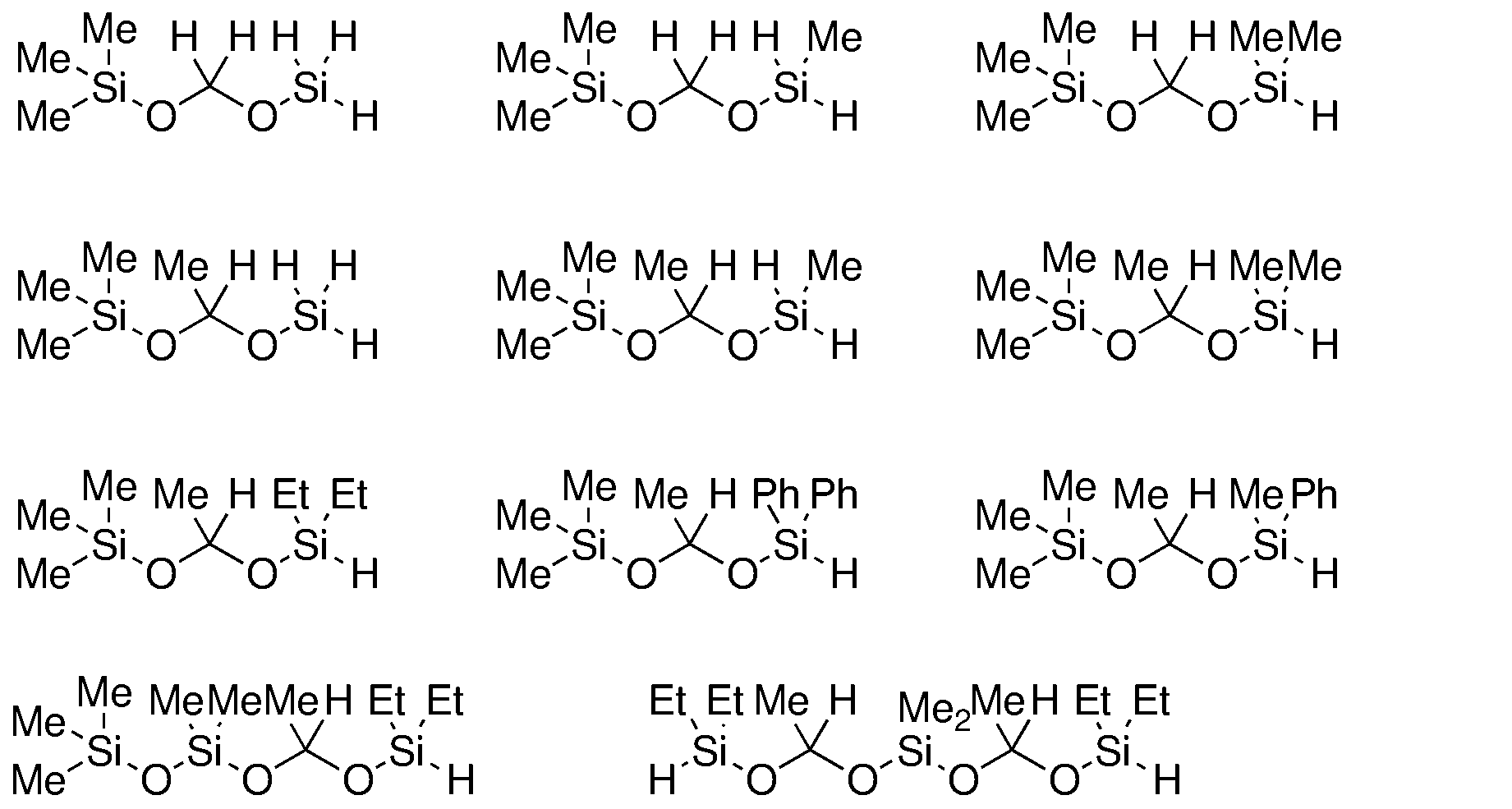
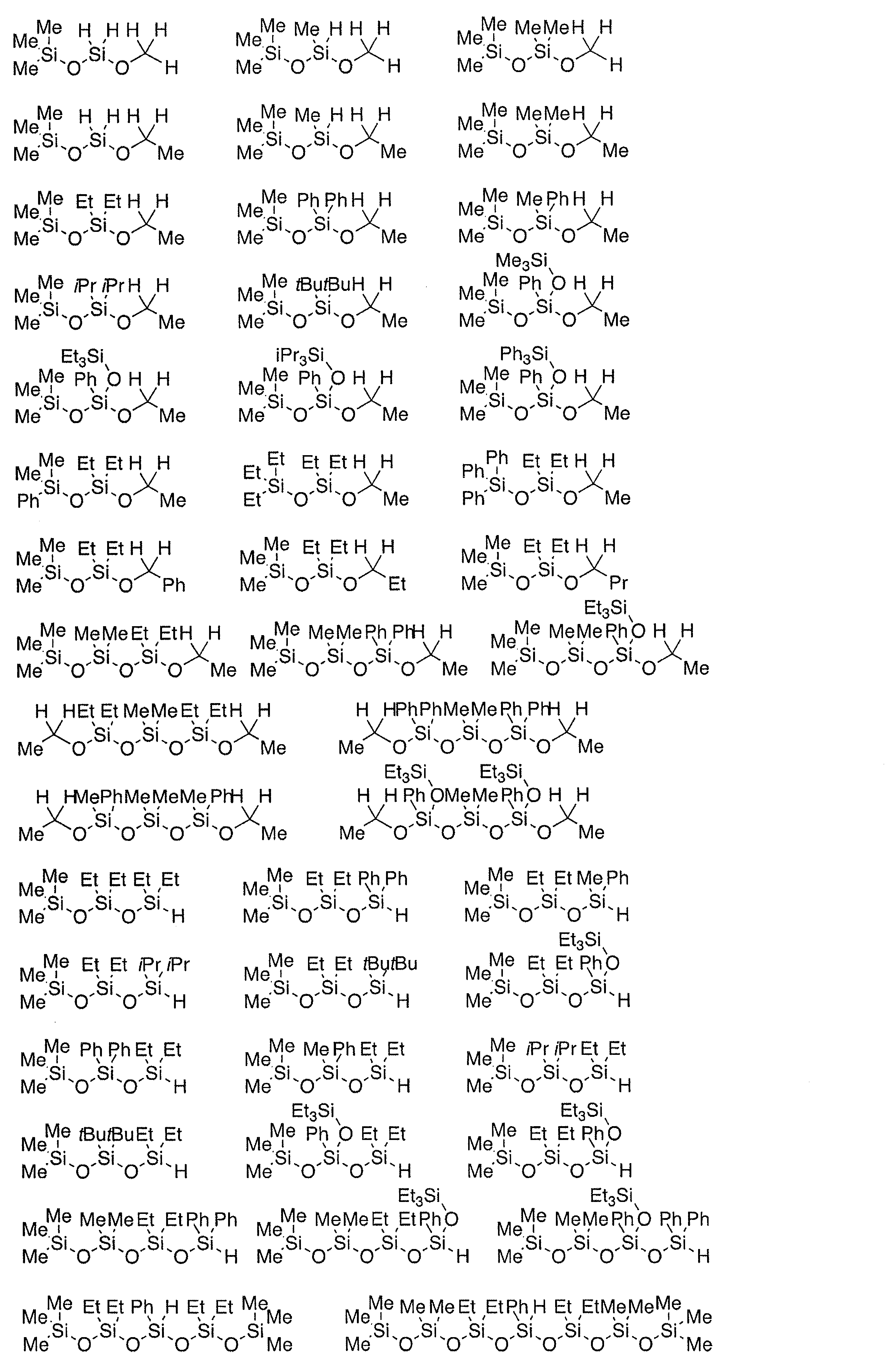
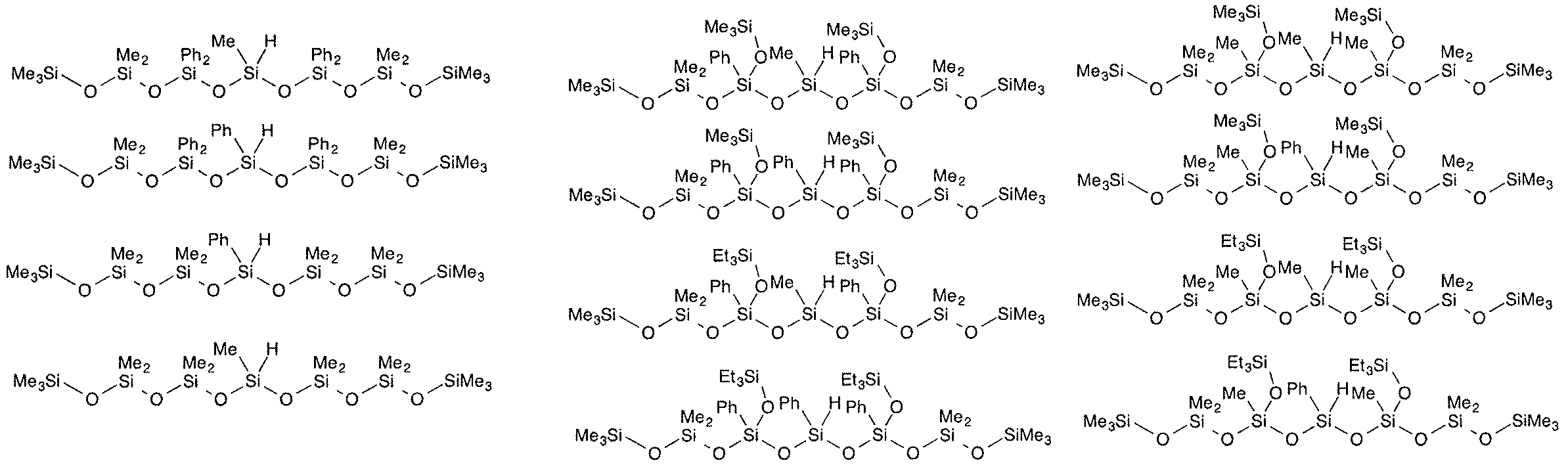
- Examples of the silyl acetal represented by any one of the formulas (C-1) to (C-4) include those represented by the following formula.
- a method for producing an oligosiloxane which is another embodiment of the present invention (hereinafter sometimes abbreviated as “method for producing an oligosiloxane of the present invention”) is represented by the following formula (C) in the presence of a Lewis acid. It includes a rearrangement step (hereinafter sometimes abbreviated as “rearrangement step”) in which an oligosiloxane having a structure represented by the following formula (D) is produced by reacting a silyl acetal having the following structure: .
- R 1 represents a hydrogen atom or a hydrocarbon group having 1 to 18 carbon atoms.
- the present inventors have found that acyloxysilane and hydrosilane react with each other in the presence of an iridium complex to produce silyl acetal, and the generated silyl acetal undergoes intramolecular rearrangement in the presence of a Lewis acid, resulting in oligosiloxane. Was found to generate efficiently. Since the above-described addition step and rearrangement step proceed rapidly under relatively mild conditions, the method for producing oligosiloxane by combining the addition step and rearrangement step is basically a by-product at the stage where the oligosiloxane is formed.
- the wavy line in the formulas (C) to (D) means that the structure ahead is arbitrary.
- the “dislocation process” will be described in detail.
- the rearrangement step is a step of reacting a silyl acetal having a structure represented by the formula (C) in the presence of a Lewis acid to produce an oligosiloxane having a structure represented by the formula (D).
- the specific kind of the silyl acetal having the structure represented by C) is not particularly limited, and can be appropriately selected according to the target oligosiloxane.
- Examples of the silyl acetal having a structure represented by the formula (C) include silyl acetals represented by any one of the above-described formulas (C-1) to (C-4).
- it is preferable that the silyl acetal which has a structure represented by Formula (C) is what was obtained by the above-mentioned addition process.
- the oligosiloxane production method combining the addition step and the rearrangement step can produce oligosiloxane more efficiently and also suppress by-products.
- the rearrangement step is a step performed in the presence of a Lewis acid.
- the Lewis acid is not particularly limited as long as it is a compound having Lewis acidity, and can be appropriately selected according to the purpose.
- the Lewis acid tris (pentafluorophenyl) borane (B (C 6 F 5 ) 3 ) is preferable.
- An oligosiloxane can be produced more efficiently when it is as described above.
- the use amount (charge amount) of the Lewis acid is usually 0.0001 times or more, preferably 0.001 times or more, more preferably, in terms of the amount of the silyl acetal having the structure represented by the formula (C). It is 0.005 times or more, usually 0.5 times or less, preferably 0.1 times or less, more preferably 0.05 times or less. When it is within the above range, oligosiloxane can be produced more efficiently.
- the rearrangement step preferably uses a solvent.
- the type of the solvent is not particularly limited and can be appropriately selected according to the purpose.
- the solvent is a hydrocarbon solvent such as hexane, benzene, or toluene; an ether type such as diethyl ether or tetrahydrofuran (THF).
- Solvent Halogen-based solvents such as methylene chloride and chloroform. Of these, benzene is particularly preferred. An oligosiloxane can be produced more efficiently when it is as described above.
- the reaction temperature in the rearrangement step is usually ⁇ 80 ° C. or higher, preferably 0 ° C. or higher, more preferably 20 ° C. or higher, and usually 120 ° C. or lower, preferably 80 ° C. or lower, more preferably 40 ° C. or lower.
- the reaction time in the rearrangement step is usually 1 minute or more, preferably 5 minutes or more, more preferably 10 minutes or more, and usually 96 hours or less, preferably 48 hours or less, more preferably 24 hours or less.
- the rearrangement step can be performed in the air, but is preferably performed in an inert atmosphere such as nitrogen or argon. When it is within the above range, oligosiloxane can be produced more efficiently.
- the silyl acetal represented by the formula (C) is preferably obtained by the above-described addition step.
- the silyl acetal having the structure represented by the formula (C) is:
- the addition step and rearrangement step proceed in one reactor. There may be.
- oligosiloxane can be produced sequentially in one pot, and the oligosiloxane can be produced very efficiently.
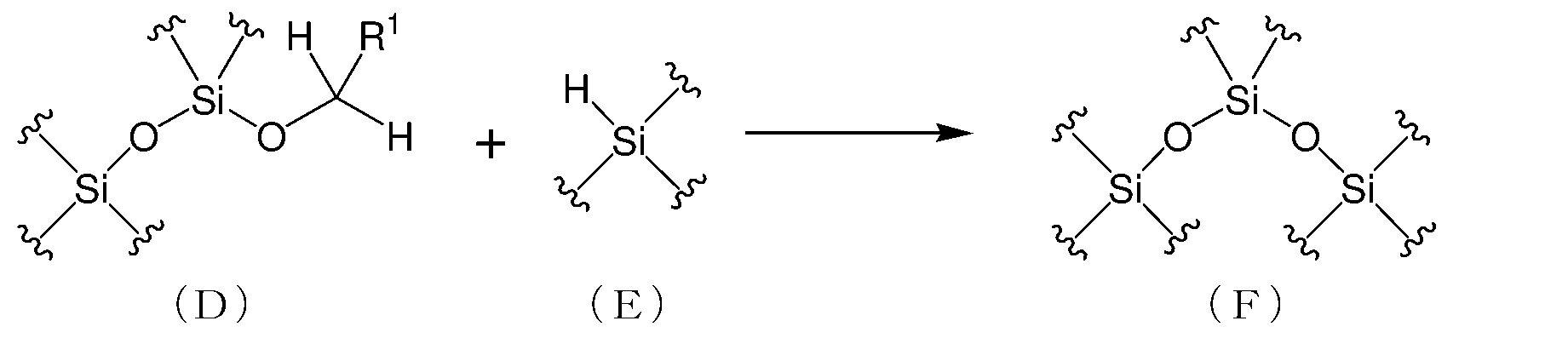
- the oligosiloxane production method of the present invention is not particularly limited as long as it includes the above-described rearrangement step, but is represented by the following formula (D) obtained in the rearrangement step in the presence of a Lewis acid.
- a substitution step (hereinafter referred to as “substitution step”) in which an oligosiloxane having a structure and a hydrosilane having a structure represented by the following formula (E) are reacted to produce an oligosiloxane having a structure represented by the following formula (F) May be omitted).
- substitution step in which an oligosiloxane having a structure and a hydrosilane having a structure represented by the following formula (E) are reacted to produce an oligosiloxane having a structure represented by the following formula (F) May be omitted).
- R 1 represents a hydrogen atom or a hydrocarbon group having 1 to 18 carbon atoms.
- the wavy lines in the formulas (D) to (F) mean that the structure ahead is arbitrary.
- the oligosiloxane having the structure represented by the formula (D) obtained in the rearrangement step is reacted with the hydrosilane having the structure represented by the formula (E) to form a structure represented by the formula (F).
- Specific types of oligosiloxane having a structure represented by the formula (D) and hydrosilane having a structure represented by the formula (E) are not particularly limited. It should be appropriately selected depending on the oligosiloxane to be used. Examples of the oligosiloxane having a structure represented by the formula (D) include those represented by any of the following formulas (D-1) to (D-4).
- R 1 represents a hydrogen atom or a hydrocarbon group having 1 to 18 carbon atoms
- R 2 each independently represents a hydrocarbon having 1 to 18 carbon atoms.
- R 3 each independently has a hydrogen atom, a hydrocarbon group having 1 to 18 carbon atoms, an alkoxy group having a hydrocarbon group having 1 to 12 carbon atoms, or a hydrocarbon group having 3 to 18 carbon atoms. Represents a silyloxy group or a halogen atom.
- “R 1 ”, “R 2 ”, and “R 3 ” are the same as those described above.
- Examples of the hydrosilane having a structure represented by the formula (E) include a hydrosilane represented by the following formula (E-1).
- each R 4 independently represents a hydrogen atom, a hydrocarbon group having 1 to 18 carbon atoms, an alkoxy group having a hydrocarbon group having 1 to 12 carbon atoms, or 3 to 3 carbon atoms. Represents a silyloxy group having 18 hydrocarbon groups or a halogen atom.
- R 4 each independently has a “hydrocarbon group having 1 to 18 carbon atoms”, an “alkoxy group having a hydrocarbon group having 1 to 12 carbon atoms”, or a “hydrocarbon group having 3 to 18 carbon atoms”.
- the term “silyloxy group” or “halogen atom” is used, but the “hydrocarbon group” has the same meaning as in R 1 .
- the number of carbon atoms when R 4 is a hydrocarbon group is preferably 12 or less, more preferably 6 or less, and the number of carbon atoms when R 4 is an aromatic hydrocarbon group is usually 6 or more.
- R 4 is an alkoxy group, the number of carbon atoms is preferably 10 or less, more preferably 6 or less.
- R 4 is a silyloxy group the number of carbon atoms is preferably 10 or less, more preferably 6 or less.
- R 4 includes a hydrogen atom, a methyl group (—CH 3 , —Me), an ethyl group (—C 2 H 5 , —Et), an n-propyl group ( —n C 3 H 7 , —n Pr), i -Propyl group ( -i C 3 H 7 , -i Pr), n-butyl group ( -n C 4 H 9 , -n Bu), t-butyl group ( -t C 4 H 9 , -t Bu), n-pentyl group ( -n C 5 H 11 ), n-hexyl group ( -n C 6 H 13 , -n Hex), cyclohexyl group ( -c C 6 H 11 , -Cy), phenyl group (-C 6 H 5 , -Ph), naphthyl group (-C 12 H 7 , -Naph), methoxy group (-OCH 3 , -OM
- hydrosilane represented by the formula (E-1) examples include those represented by the following formula.
- the amount of use of the hydrosilane having the structure represented by the formula (E) (charge amount) is usually 0.5 times or more, preferably in terms of the amount of the substance based on the oligosiloxane having the structure represented by the formula (D). Is 0.8 times or more, more preferably 1.0 times or more, usually 5 times or less, preferably 2 times or less, more preferably 1.5 times or less. When it is within the above range, oligosiloxane can be produced more efficiently.
- the substitution step is a step performed in the presence of a Lewis acid
- the Lewis acid is not particularly limited as long as it is a compound having Lewis acidity, and can be appropriately selected according to the purpose.
- the Lewis acid tris (pentafluorophenyl) borane (B (C 6 F 5 ) 3 ) is preferable.
- An oligosiloxane can be produced more efficiently when it is as described above.
- the use amount (charge amount) of the Lewis acid is usually 0.0001 times or more, preferably 0.001 times or more, more preferably, in terms of the amount of substance with respect to the oligosiloxane having the structure represented by the formula (D). It is 0.005 times or more, usually 0.5 times or less, preferably 0.1 times or less, more preferably 0.05 times or less. When it is within the above range, oligosiloxane can be produced more efficiently.
- the solvent is a hydrocarbon solvent such as hexane, benzene, or toluene; an ether type such as diethyl ether or tetrahydrofuran (THF).
- Solvent Halogen-based solvents such as methylene chloride and chloroform. Of these, benzene is particularly preferred. An oligosiloxane can be produced more efficiently when it is as described above.
- the reaction temperature in the substitution step is usually ⁇ 80 ° C. or higher, preferably 0 ° C. or higher, more preferably 20 ° C. or higher, and usually 120 ° C. or lower, preferably 80 ° C. or lower, more preferably 40 ° C. or lower.
- the reaction time of the substitution step is usually 1 minute or more, preferably 5 minutes or more, more preferably 10 minutes or more, and usually 96 hours or less, preferably 48 hours or less, more preferably 24 hours or less.
- the replacement step can be performed in the air, but is preferably performed in an inert atmosphere such as nitrogen or argon. When it is within the above range, oligosiloxane can be produced more efficiently.
- the substitution step is a step of reacting the oligosiloxane having the structure represented by the formula (D) obtained in the rearrangement step.
- the oligosiloxane having the structure represented by the formula (D) is isolated and purified.
- hydrosilane having a structure represented by the formula (E) may be introduced into the reactor after the rearrangement step, and the substitution step may proceed as it is.
- oligosiloxane can be produced sequentially in one pot, and the oligosiloxane can be produced very efficiently.
- oligosiloxane is generated by the rearrangement step and the substitution step, but the following formulas (D-1) to (D-4) and the following formulas (F-1) to (F) that can be generated by the rearrangement step or the like. -2) is also an embodiment of the present invention.
- R 1 represents a hydrogen atom or a hydrocarbon group having 1 to 18 carbon atoms
- R 2 represents Each independently a hydrocarbon group having 1 to 18 carbon atoms, an alkoxy group having a hydrocarbon group having 1 to 12 carbon atoms, a silyloxy group having a hydrocarbon group having 3 to 18 carbon atoms
- R 3 and R 4 are each independently a hydrogen atom, a hydrocarbon group having 1 to 18 carbon atoms, or a hydrocarbon group having 1 to 12 carbon atoms.
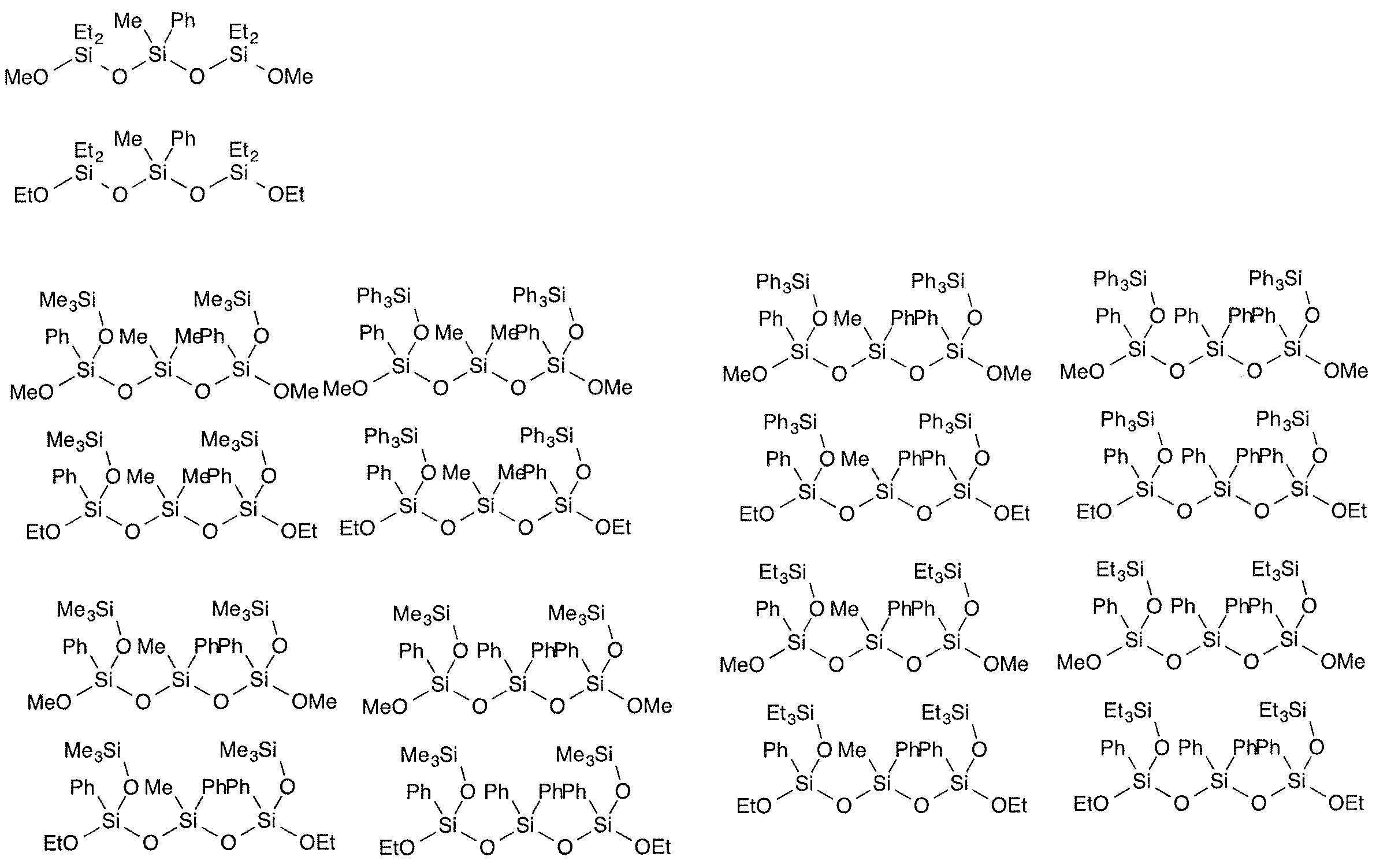
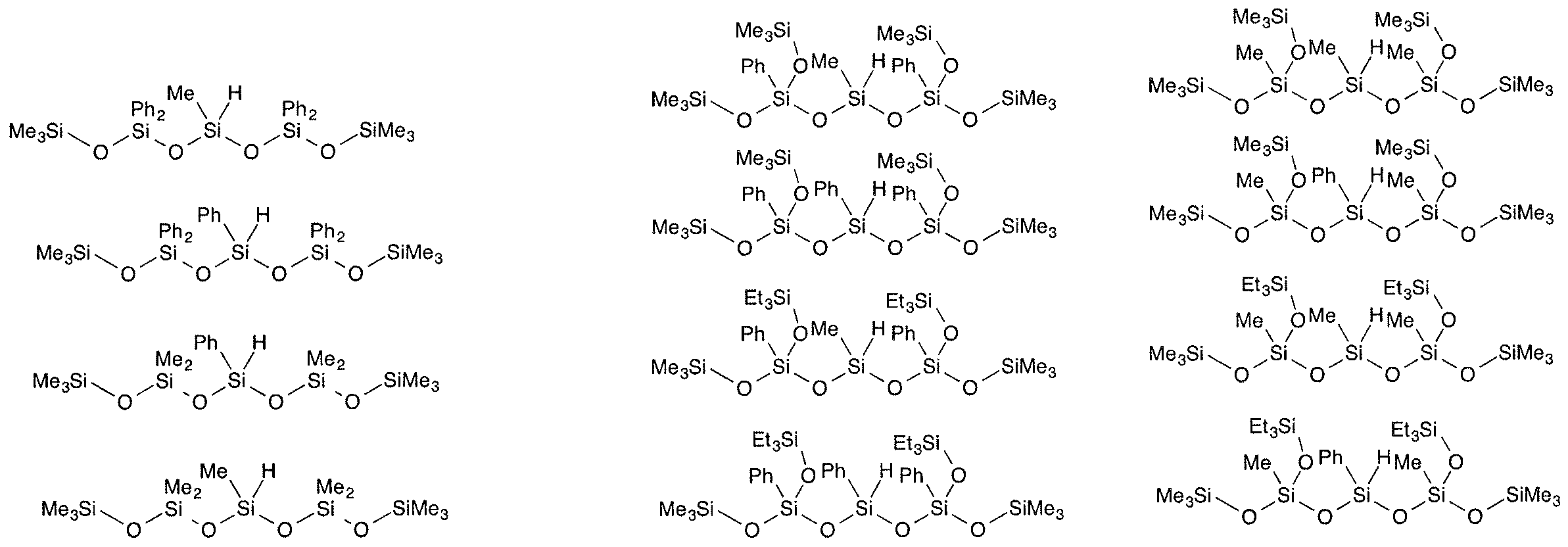
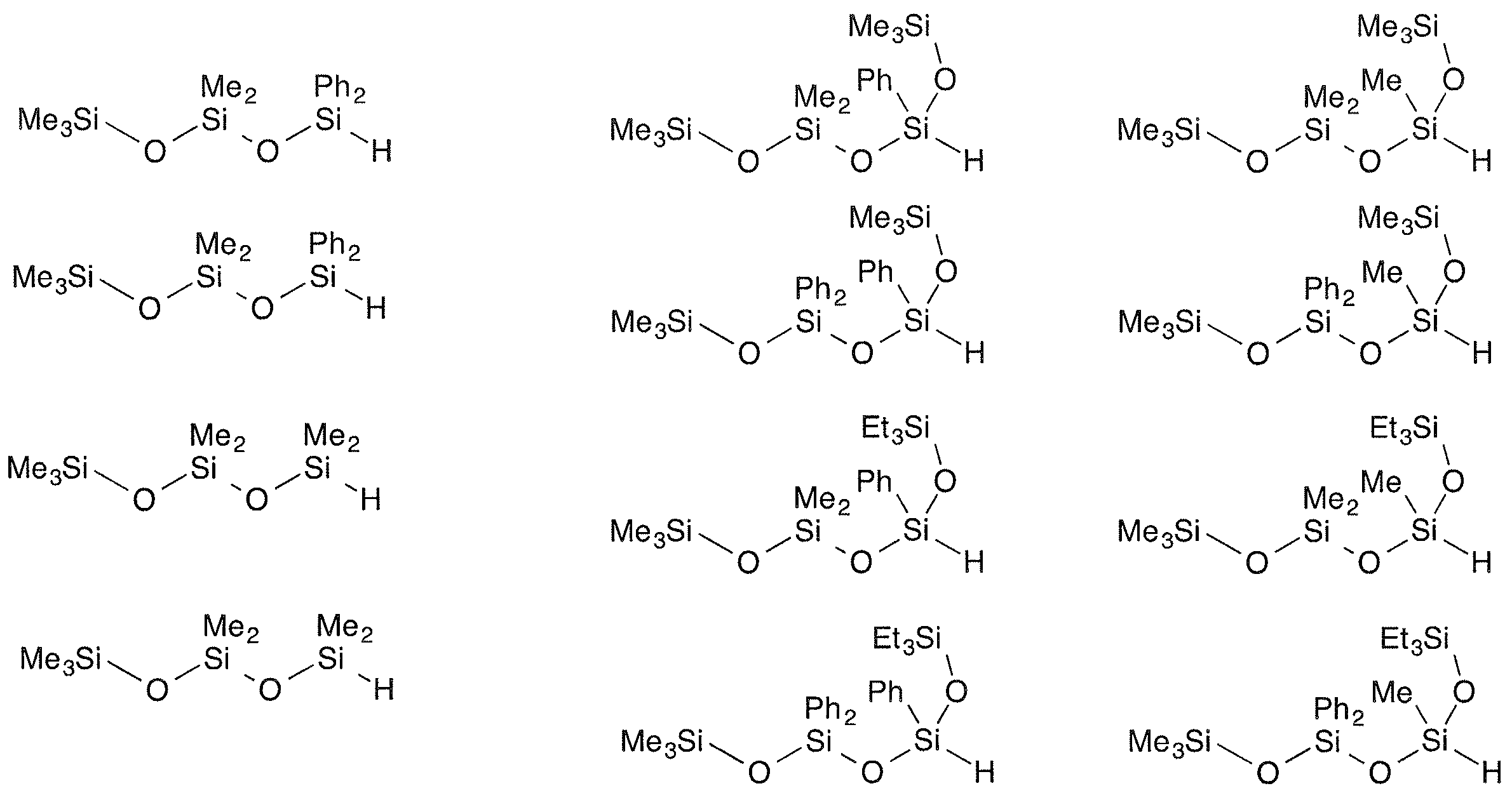
- Examples of the oligosiloxane represented by any of the following formulas (D-1) to (D-4) and the following formulas (F-1) to (F-2) include those represented by the following formula.
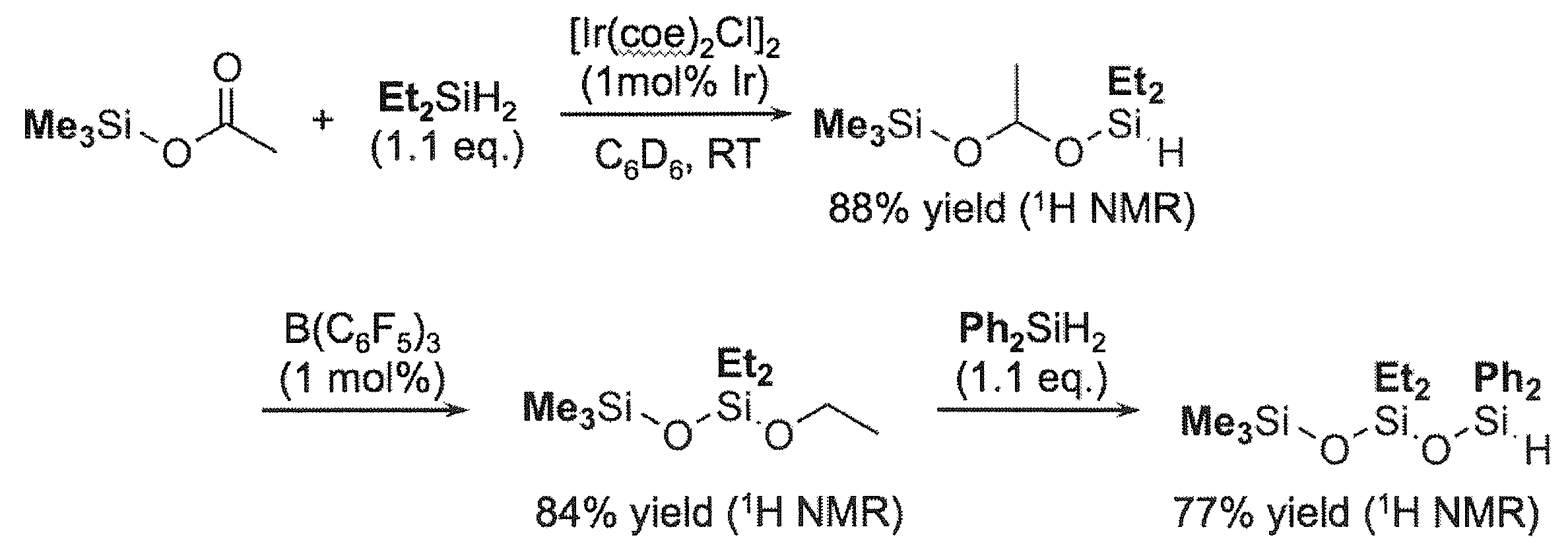
- Example 1 Me 3 SiOAc (90.2 ⁇ L, 0.60 mmol) and mesitylene (internal standard, 21.0 ⁇ L, 0.15 mmol) were dissolved in deuterated benzene C 6 D 6 (3.0 mL). This solution (0.5 mL) was added to an NMR tube containing [Ir (coe) 2 Cl] 2 (0.5 mg, 1 mol% Ir), followed by Et 2 SiH 2 (14.2 ⁇ L, 0.11 mmol). It was. After 12 hours, it was confirmed by 1 H NMR measurement that silylacetal was produced in a yield of 88%.
- Example 2 The reaction was performed in the same manner as in Example 1 except that Et 2 SiH 2 was changed to MePhSiH 2 (15.1 ⁇ L, 0.11 mmol). As a result, the yield of silyl acetal was 79%, the yield of disiloxane was 65%, and the yield of trisiloxane was 63%.
- Trisiloxane (colorless oil) 1 H NMR (C 6 D 6 ): 7.71-7.68 (m, 6H), 7.19-7.15 (m, 9H), 5.90 (s, 1H), 0.39 (s 3H), 0.09 (s, 9H) ppm.
- Example 7 The reaction was performed in the same manner as in Example 1 except that Ph 2 SiH 2 was changed to MePhSiH 2 (15.1 ⁇ L, 0.11 mmol). As a result, the yield of silyl acetal was 79%, the yield of disiloxane was 79%, and the yield of trisiloxane was 70%.
- Example 9 The reaction was performed in the same manner as in Example 1 except that Ph 2 SiH 2 was changed to Et 3 SiOSiH 2 Ph (25.9 ⁇ L, 0.10 mmol). As a result, the yield of silyl acetal was 93%, the yield of disiloxane was 83%, and the yield of tetrasiloxane was 74%. Tetrasiloxane (colorless oil) 1 H NMR (C 6 D 6 ): 7.79-7.77 (m, 2H), 7.25-7.18 (m, 3H), 5.44 (s, 1H), 1.06-1 .00 (m, 15H), 0.65-0.60 (m, 10H), 0.15 (s, 9H) ppm.
- Example 10 The reaction was performed in the same manner as in Example 1 except that Ph 2 SiH 2 was changed to PhSiH 3 (6.1 ⁇ L, 0.05 mmol). As a result, the yield of silyl acetal was 85%, the yield of disiloxane was 71%, and the yield of oligosiloxane was 52%.
- Example 11 Et 2 SiH 2 and MePhSiH 2 (15.1 ⁇ L, 0.11mmol) was changed to, except that the Ph 2 SiH 2 MePhSiH 2 (13.7 ⁇ L , 0.10mmol) , the reaction in the same manner as in Example 1 Went. As a result, the yield of silyl acetal was 96%, and the yield of trisiloxane was 71%.
- Trisiloxane (colorless oil, diastereo ratio 1: 1)
- Oligosiloxane produced by the production method of the present invention can be used as a raw material for silicone oil, silicone rubber, organic-inorganic hybrid material and the like.
Landscapes
- Chemical & Material Sciences (AREA)
- Organic Chemistry (AREA)
- Low-Molecular Organic Synthesis Reactions Using Catalysts (AREA)
Abstract
イリジウム錯体及び/又はイリジウム塩の存在下、下記式(A)で表される構造を有するアシルオキシシランと下記式(B)で表される構造を有するヒドロシランを反応させて下記式(C)で表される構造を有するシリルアセタールを生成する付加工程を含む製造方法によって、オリゴシロキサンに効率良く誘導することができる有用なシリルアセタールを効率良く製造することができる。(式(A)~(C)中、R1は水素原子、又は炭素原子数1~18の炭化水素基を表す。)
Description
本発明は、シリルアセタール、オリゴシロキサン、及びそれらの製造方法に関し、より詳しくはイリジウム錯体等を利用したシリルアセタールの製造方法及びルイス酸を利用したオリゴシロキサンの製造方法、並びにこれらの製造方法を利用して製造することができるシリルアセタール及びオリゴシロキサンに関する。
シロキサン結合(Si-O-Si)は、有機骨格である炭素-炭素結合(C-C)や炭素-酸素結合(C-O)に比べて結合エネルギーが大きく、シロキサン結合を骨格とする有機ケイ素化合物は、耐久性、耐候性等に優れることが知られている。シロキサン結合の形成方法は古くから活発に検討されており、代表的な方法としてシラノール、アルコキシシラン、クロロシラン等の加水分解・脱水縮合による方法、クロロシランとシラノール(又はアルコキシシラン)のクロスカップリングによる方法、ヒドロシランとシラノール(又はアルコキシシラン)のクロスカップリングによる方法等が知られている。
一方、炭素-酸素二重結合(C=O)から炭素-酸素-ケイ素結合(C-O-Si)を形成する反応としては、イリジウム触媒を用いたエステルのヒドロシリル化反応(例えば、非特許文献1参照)やホウ素化合物を用いたカルボニル化合物のヒドロシリル化反応(例えば、非特許文献2参照)等が報告されている。
C.Cheng,et al.,Angew.Chem.Int.Ed.2012,51,9422.
D.J.Parks,et al.,J.Am.Chem.Soc.1996,118,9440.
本発明は、オリゴシロキサンやオリゴシロキサンに効率良く誘導することができる有用な中間体を提供することを目的とする。
本発明者らは、前記課題を解決すべく鋭意検討を重ねた結果、イリジウム錯体等の存在下でアシルオキシシランとヒドロシランが反応してシリルアセタールが生成すること、さらに生成したシリルアセタールがルイス酸の存在下で分子内転位を起こしてオリゴシロキサンが生成することを見出し、本発明を完成させた。
即ち、本発明は以下の通りである。
即ち、本発明は以下の通りである。
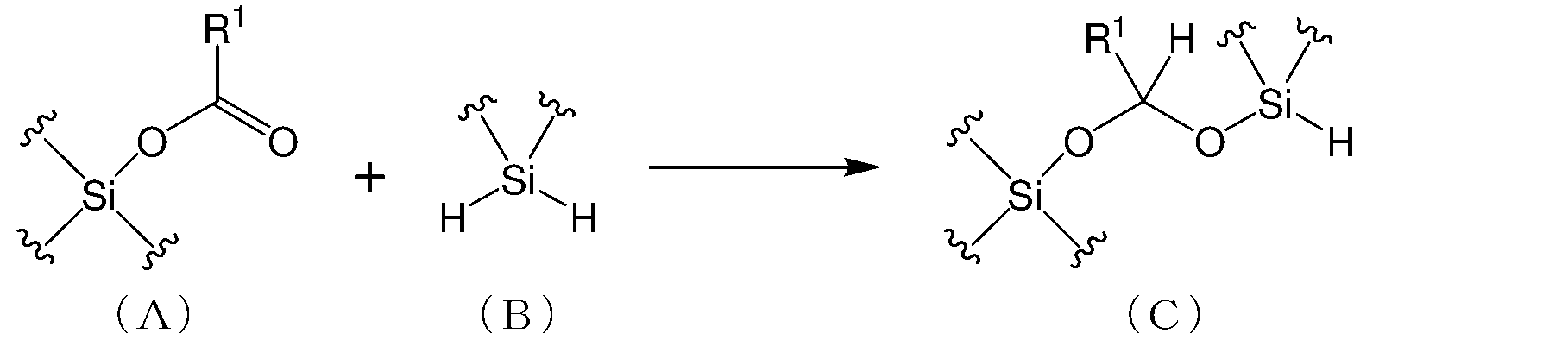
<1> イリジウム錯体及び/又はイリジウム塩の存在下、下記式(A)で表される構造を有するアシルオキシシランと下記式(B)で表される構造を有するヒドロシランを反応させて下記式(C)で表される構造を有するシリルアセタールを生成する付加工程を含むことを特徴とするシリルアセタールの製造方法。

(式(A)~(C)中、R1は水素原子、又は炭素原子数1~18の炭化水素基を表す。)
<2> 下記式(C-1)~(C-4)の何れかで表されるシリルアセタール。
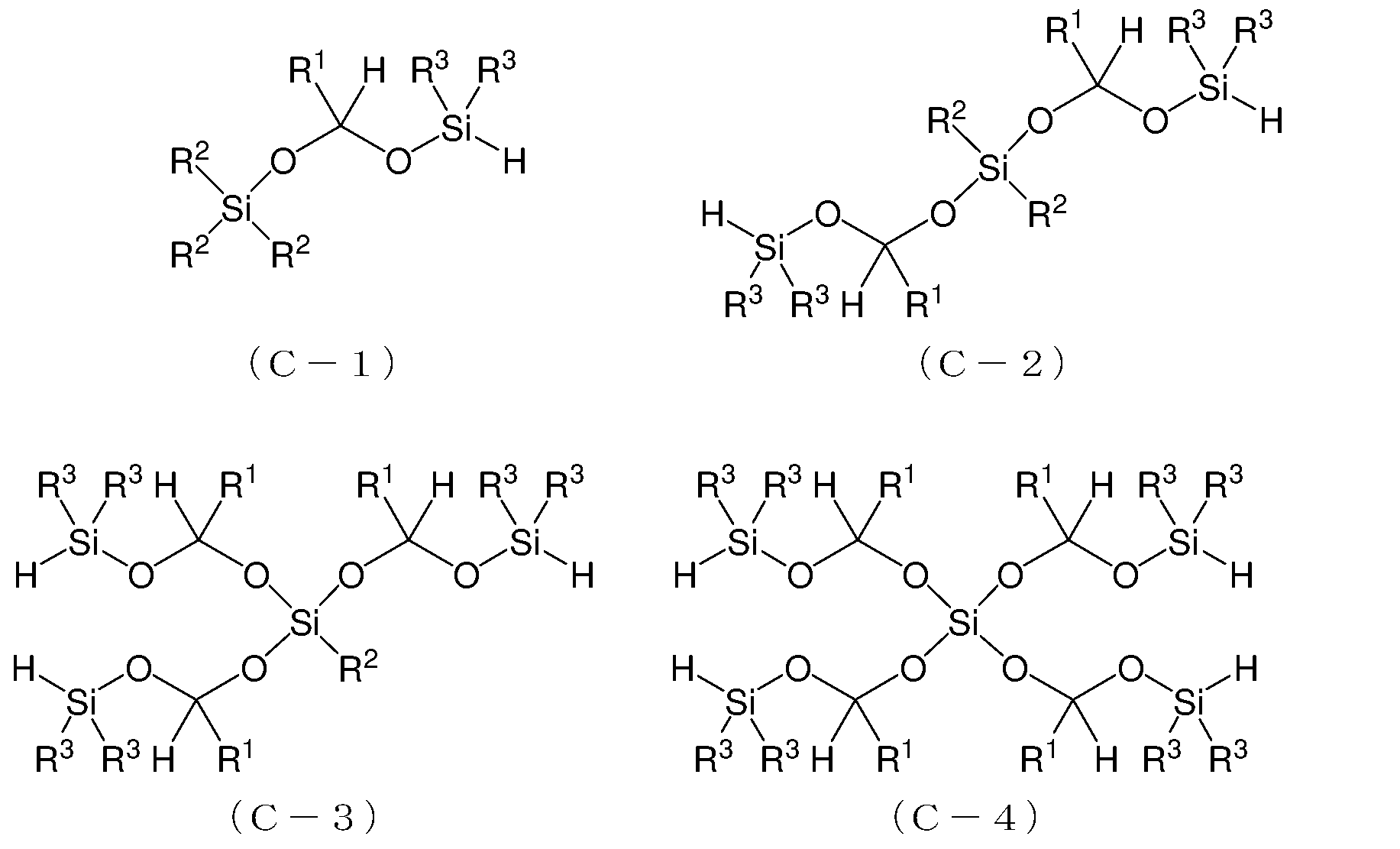
(式(C-1)~(C-4)中、R1は水素原子、又は炭素原子数1~18の炭化水素基を、R2はそれぞれ独立して炭素原子数1~18の炭化水素基、炭素原子数1~12の炭化水素基を有するアルコキシ基、炭素原子数3~18の炭化水素基を有するシリルオキシ基、炭素原子数1~18の炭化水素基を有するアシルオキシ基、又はハロゲン原子を、R3はそれぞれ独立して水素原子、炭素原子数1~18の炭化水素基、炭素原子数1~12の炭化水素基を有するアルコキシ基、炭素原子数3~18の炭化水素基を有するシリルオキシ基、又はハロゲン原子を表す。)
<3> ルイス酸の存在下、下記式(C)で表される構造を有するシリルアセタールを反応させて下記式(D)で表される構造を有するオリゴシロキサンを生成する転位工程を含むことを特徴とするオリゴシロキサンの製造方法。
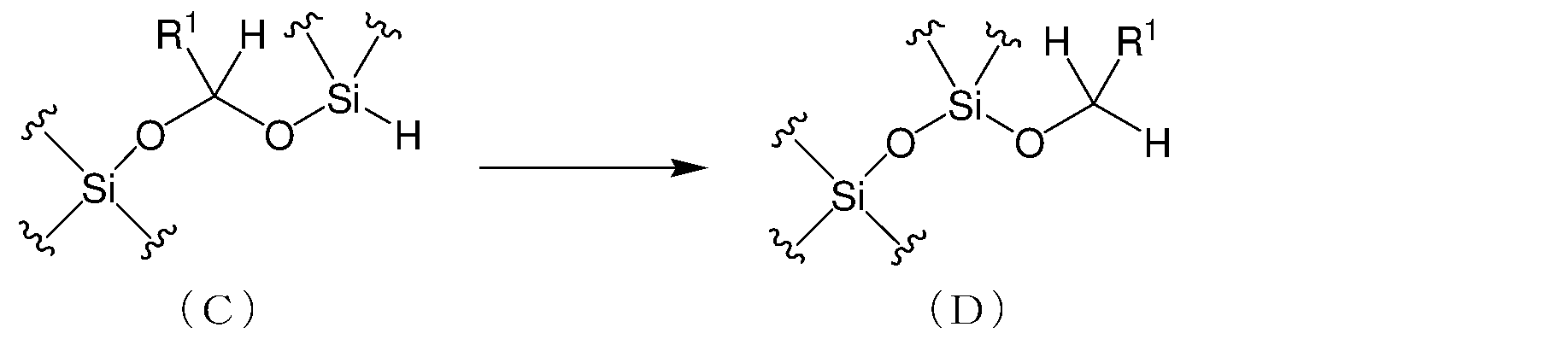
(式(C)~(D)中、R1は水素原子、又は炭素原子数1~18の炭化水素基を表す。)
<4> 前記ルイス酸が、ルイス酸性を有するホウ素化合物である、<3>に記載のオリゴシロキサンの製造方法。
<5> 前記式(C)で表される構造を有するシリルアセタールが、イリジウム錯体及び/又はイリジウム塩の存在下、下記式(A)で表される構造を有するアシルオキシシランと下記式(B)で表される構造を有するヒドロシランを反応させて下記式(C)で表される構造を有するシリルアセタールを生成する付加工程によって得られたものである、<3>又は<4>に記載のオリゴシロキサンの製造方法。
(式(A)~(C)中、R1は水素原子、又は炭素原子数1~18の炭化水素基を表す。)
<6> 前記イリジウム錯体及び/又はイリジウム塩と前記ルイス酸が1つの反応器内に存在することによって、前記付加工程及び前記転位工程が1つの反応器内で進行する、<5>に記載のオリゴシロキサンの製造方法。
<7> ルイス酸の存在下、前記転位工程で得られた式(D)で表される構造を有するオリゴシロキサンと下記式(E)で表される構造を有するヒドロシランを反応させて下記式(F)で表される構造を有するオリゴシロキサンを生成する置換工程を含む、<3>~<6>の何れかに記載のオリゴシロキサンの製造方法。
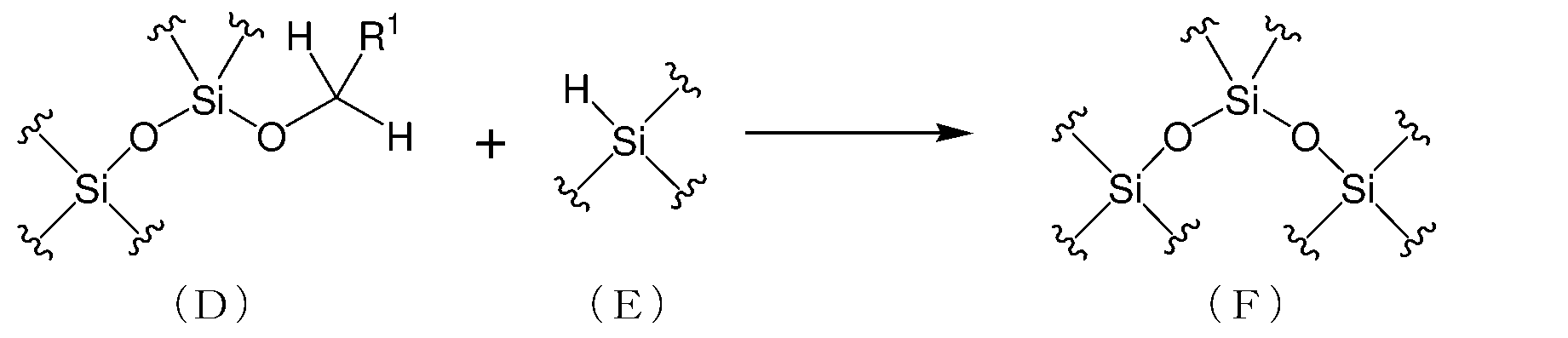
(式(D)~(F)中、R1は水素原子、又は炭素原子数1~18の炭化水素基を表す。)
<8> ルイス酸の存在下、下記式(D)で表される構造を有するオリゴシロキサンと下記式(E)で表される構造を有するヒドロシランを反応させて下記式(F)で表される構造を有するオリゴシロキサンを生成する置換工程を含むオリゴシロキサンの製造方法。

(式(D)~(F)中、R1は水素原子、又は炭素原子数1~18の炭化水素基を表す。)
<9> 下記式(D-1)~(D-4)及び下記式(F-1)~(F-2)の何れかで表されるオリゴシロキサン。
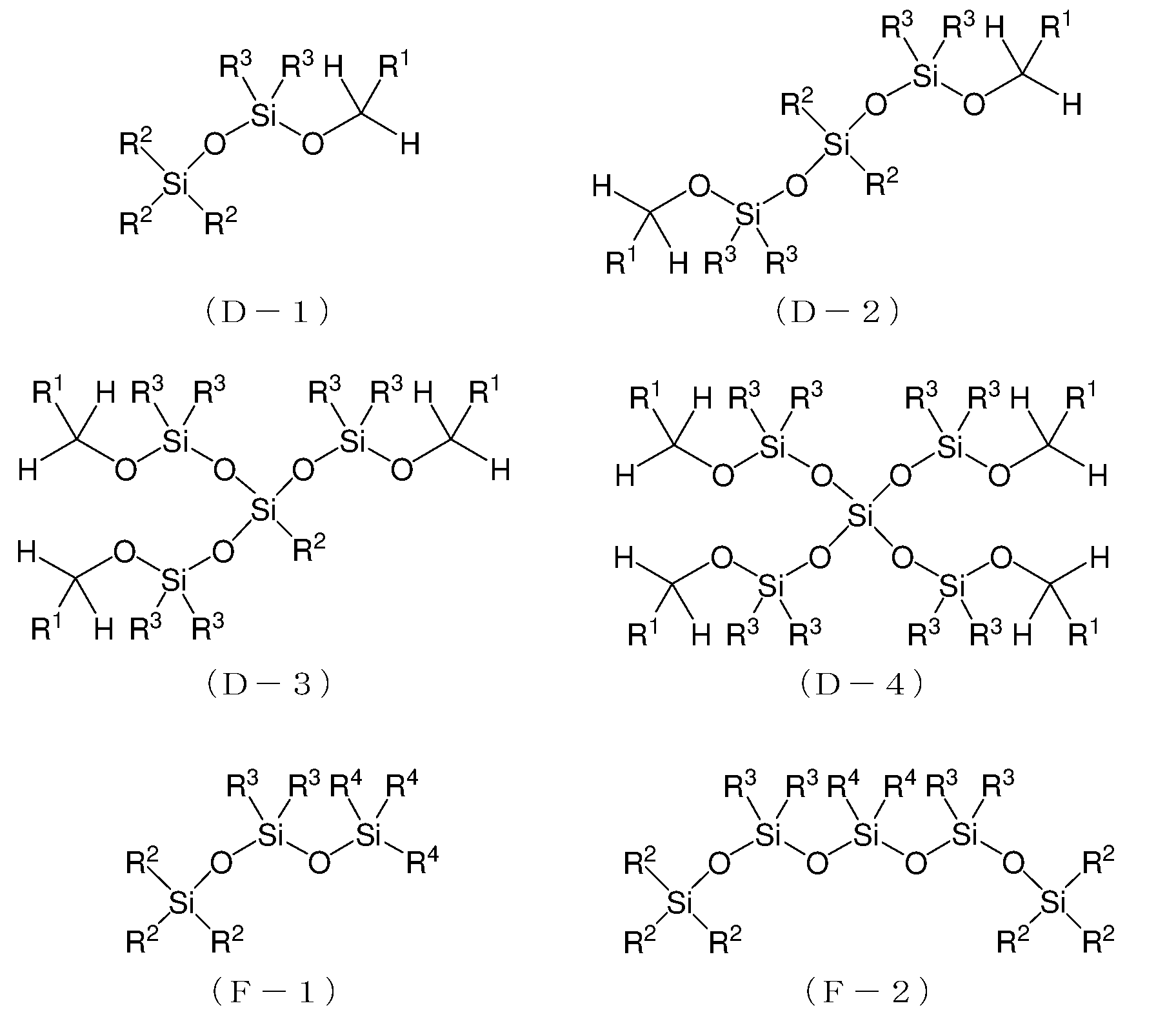
(式(D-1)~(D-4)及び式(F-1)~(F-2)中、R1は水素原子、又は炭素原子数1~18の炭化水素基を、R2はそれぞれ独立して炭素原子数1~18の炭化水素基、炭素原子数1~12の炭化水素基を有するアルコキシ基、炭素原子数3~18の炭化水素基を有するシリルオキシ基、炭素原子数1~18の炭化水素基を有するアシルオキシ基、又はハロゲン原子を、R3及びR4はそれぞれ独立して水素原子、炭素原子数1~18の炭化水素基、炭素原子数1~12の炭化水素基を有するアルコキシ基、炭素原子数3~18の炭化水素基を有するシリルオキシ基、又はハロゲン原子を表す。)
<2> 下記式(C-1)~(C-4)の何れかで表されるシリルアセタール。
<3> ルイス酸の存在下、下記式(C)で表される構造を有するシリルアセタールを反応させて下記式(D)で表される構造を有するオリゴシロキサンを生成する転位工程を含むことを特徴とするオリゴシロキサンの製造方法。
<4> 前記ルイス酸が、ルイス酸性を有するホウ素化合物である、<3>に記載のオリゴシロキサンの製造方法。
<5> 前記式(C)で表される構造を有するシリルアセタールが、イリジウム錯体及び/又はイリジウム塩の存在下、下記式(A)で表される構造を有するアシルオキシシランと下記式(B)で表される構造を有するヒドロシランを反応させて下記式(C)で表される構造を有するシリルアセタールを生成する付加工程によって得られたものである、<3>又は<4>に記載のオリゴシロキサンの製造方法。
<6> 前記イリジウム錯体及び/又はイリジウム塩と前記ルイス酸が1つの反応器内に存在することによって、前記付加工程及び前記転位工程が1つの反応器内で進行する、<5>に記載のオリゴシロキサンの製造方法。
<7> ルイス酸の存在下、前記転位工程で得られた式(D)で表される構造を有するオリゴシロキサンと下記式(E)で表される構造を有するヒドロシランを反応させて下記式(F)で表される構造を有するオリゴシロキサンを生成する置換工程を含む、<3>~<6>の何れかに記載のオリゴシロキサンの製造方法。
<8> ルイス酸の存在下、下記式(D)で表される構造を有するオリゴシロキサンと下記式(E)で表される構造を有するヒドロシランを反応させて下記式(F)で表される構造を有するオリゴシロキサンを生成する置換工程を含むオリゴシロキサンの製造方法。
<9> 下記式(D-1)~(D-4)及び下記式(F-1)~(F-2)の何れかで表されるオリゴシロキサン。
本発明によれば、オリゴシロキサンとオリゴシロキサンに効率良く誘導することができる有用なシリルアセタールを提供することができる。
本発明の詳細を説明するに当たり、具体例を挙げて説明するが、本発明の趣旨を逸脱しない限り以下の内容に限定されるものではなく、適宜変更して実施することができる。
<シリルアセタールの製造方法>
本発明の一態様であるシリルアセタールの製造方法は、イリジウム錯体及び/又はイリジウム塩の存在下、下記式(A)で表される構造を有するアシルオキシシランと下記式(B)で表される構造を有するヒドロシランを反応させて下記式(C)で表される構造を有するシリルアセタールを生成する付加工程(以下、「付加工程」と略す場合がある。)を含むことを特徴とする。

(式(A)~(C)中、R1は水素原子、又は炭素原子数1~18の炭化水素基を表す。)
本発明者らは、オリゴシロキサンやオリゴシロキサンを効率良く生成することができる有用な中間体を求めて検討を重ねた結果、イリジウム錯体等の存在下でアシルオキシシランとヒドロシランが反応してシリルアセタールが生成することを見出したのである。なお、詳細は後述するが、付加工程によって得られる式(C)で表される構造を有するシリルアセタールは、オリゴシロキサンに効率良く誘導することができる有用な化合物である。
なお、式(A)~(C)中の波線は、その先の構造が任意であることを意味する。
以下、「付加工程」について詳細に説明する。
本発明の一態様であるシリルアセタールの製造方法は、イリジウム錯体及び/又はイリジウム塩の存在下、下記式(A)で表される構造を有するアシルオキシシランと下記式(B)で表される構造を有するヒドロシランを反応させて下記式(C)で表される構造を有するシリルアセタールを生成する付加工程(以下、「付加工程」と略す場合がある。)を含むことを特徴とする。
本発明者らは、オリゴシロキサンやオリゴシロキサンを効率良く生成することができる有用な中間体を求めて検討を重ねた結果、イリジウム錯体等の存在下でアシルオキシシランとヒドロシランが反応してシリルアセタールが生成することを見出したのである。なお、詳細は後述するが、付加工程によって得られる式(C)で表される構造を有するシリルアセタールは、オリゴシロキサンに効率良く誘導することができる有用な化合物である。
なお、式(A)~(C)中の波線は、その先の構造が任意であることを意味する。
以下、「付加工程」について詳細に説明する。
付加工程は、イリジウム錯体及び/又はイリジウム塩の存在下、式(A)で表される構造を有するアシルオキシシランと式(B)で表される構造を有するヒドロシランを反応させて式(C)で表される構造を有するシリルアセタールを生成する工程であるが、式(A)で表される構造を有するアシルオキシシランと式(B)で表される構造を有するヒドロシランの具体的種類は、特に限定されず、目的とするオリゴシロキサンに応じて適宜選択されるべきである。
式(A)で表される構造を有するアシルオキシシランとしては、下記式(A-1)で表されるアシルオキシシランが挙げられる。

(式(A-1)中、R1は水素原子、又は炭素原子数1~18の炭化水素基を、R2はそれぞれ独立して炭素原子数1~18の炭化水素基、炭素原子数1~12の炭化水素基を有するアルコキシ基、炭素原子数3~18の炭化水素基を有するシリルオキシ基、炭素原子数1~18の炭化水素基を有するアシルオキシ基、又はハロゲン原子を表す。)
R1は「水素原子」、又は「炭素原子数1~18の炭化水素基」を表しているが、「炭化水素基」は、分岐構造、環状構造、及び炭素-炭素不飽和結合(炭素-炭素二重結合、炭素-炭素三重結合)のそれぞれを有していてもよく、飽和炭化水素基、不飽和炭化水素基、芳香族炭化水素基等の何れであってもよいことを意味し、さらに酸素原子、ケイ素原子、又はハロゲン原子からなる群より選択される少なくとも1種の原子を含んでいてもよいことを意味する。従って、エーテル基(-O-)等の酸素原子、シリルオキシ基(-O-Si-)等の酸素原子及びケイ素原子、又はハロゲン原子を含む官能基(連結基)を炭素骨格の内部又は末端に含んでいてもよい。例えば-CH2-O-CH3のようなエーテル基を含む炭素原子数2の炭化水素基(メトキシメチル基)、及び-CH2-O-Si(CH3)3のようなシリルオキシ基を含む炭素原子数4の炭化水素基(トリメチルシリルオキシメチル基)等が含まれる。
R1が炭化水素基である場合の炭素原子数は、好ましくは12以下、より好ましくは6以下であり、R1が芳香族炭化水素基である場合の炭素原子数は、通常6以上である。
R1としては、水素原子、メチル基(-CH3,-Me)、エチル基(-C2H5,-Et)、n-プロピル基(-nC3H7,-nPr)、i-プロピル基(-iC3H7,-iPr)、n-ブチル基(-nC4H9,-nBu)、t-ブチル基(-tC4H9,-tBu)、n-ペンチル基(-nC5H11)、n-ヘキシル基(-nC6H13,-nHex)、シクロヘキシル基(-cC6H11,-Cy)、フェニル基(-C6H5,-Ph)、ナフチル基(-C12H7,-Naph)等が挙げられる。この中でも、メチル基、フェニル基等が特に好ましい。
式(A)で表される構造を有するアシルオキシシランとしては、下記式(A-1)で表されるアシルオキシシランが挙げられる。
R1は「水素原子」、又は「炭素原子数1~18の炭化水素基」を表しているが、「炭化水素基」は、分岐構造、環状構造、及び炭素-炭素不飽和結合(炭素-炭素二重結合、炭素-炭素三重結合)のそれぞれを有していてもよく、飽和炭化水素基、不飽和炭化水素基、芳香族炭化水素基等の何れであってもよいことを意味し、さらに酸素原子、ケイ素原子、又はハロゲン原子からなる群より選択される少なくとも1種の原子を含んでいてもよいことを意味する。従って、エーテル基(-O-)等の酸素原子、シリルオキシ基(-O-Si-)等の酸素原子及びケイ素原子、又はハロゲン原子を含む官能基(連結基)を炭素骨格の内部又は末端に含んでいてもよい。例えば-CH2-O-CH3のようなエーテル基を含む炭素原子数2の炭化水素基(メトキシメチル基)、及び-CH2-O-Si(CH3)3のようなシリルオキシ基を含む炭素原子数4の炭化水素基(トリメチルシリルオキシメチル基)等が含まれる。
R1が炭化水素基である場合の炭素原子数は、好ましくは12以下、より好ましくは6以下であり、R1が芳香族炭化水素基である場合の炭素原子数は、通常6以上である。
R1としては、水素原子、メチル基(-CH3,-Me)、エチル基(-C2H5,-Et)、n-プロピル基(-nC3H7,-nPr)、i-プロピル基(-iC3H7,-iPr)、n-ブチル基(-nC4H9,-nBu)、t-ブチル基(-tC4H9,-tBu)、n-ペンチル基(-nC5H11)、n-ヘキシル基(-nC6H13,-nHex)、シクロヘキシル基(-cC6H11,-Cy)、フェニル基(-C6H5,-Ph)、ナフチル基(-C12H7,-Naph)等が挙げられる。この中でも、メチル基、フェニル基等が特に好ましい。
R2はそれぞれ独立して「炭素原子数1~18の炭化水素基」、「炭素原子数1~12の炭化水素基を有するアルコキシ基」、「炭素原子数3~18の炭化水素基を有するシリルオキシ基」、「炭素原子数1~18の炭化水素基を有するアシルオキシ基」、又は「ハロゲン原子」を表しているが、「炭化水素基」はR1の場合と同義である。
R2が炭化水素基である場合の炭素原子数は、好ましくは12以下、より好ましくは6以下であり、R2が芳香族炭化水素基である場合の炭素原子数は、通常6以上である。
R2がアルコキシ基である場合の炭素原子数は、好ましくは10以下、より好ましくは6以下である。
R2がシリルオキシ基である場合の炭素原子数は、好ましくは10以下、より好ましくは6以下である。
R2がアシルオキシ基である場合の炭素原子数は、好ましくは12以下、より好ましくは6以下である。
R2としては、メチル基(-CH3,-Me)、エチル基(-C2H5,-Et)、n-プロピル基(-nC3H7,-nPr)、i-プロピル基(-iC3H7,-iPr)、n-ブチル基(-nC4H9,-nBu)、t-ブチル基(-tC4H9,-tBu)、n-ペンチル基(-nC5H11)、n-ヘキシル基(-nC6H13,-nHex)、シクロヘキシル基(-cC6H11,-Cy)、フェニル基(-C6H5,-Ph)、ナフチル基(-C12H7,-Naph)、メトキシ基(-OCH3,-OMe)、エトキシ基(-OC2H5,-OEt)、n-プロポキシ基(-OnC3H7,-OnPr)、i-プロポキシ基(-OiC3H7,-OiPr)、n-ブトキシ基(-OnC4H9,-OnBu)、t-ブトキシ基(-OtC4H9,-OtBu)、フェノキシ基(-OC6H5,-OPh)、アセチルオキシ基(-OC(=O)CH3)、塩素原子、臭素原子、ヨウ素原子、トリメチルシリルオキシ基(-OSi(CH3)3)、トリエチルシリルオキシ基(-OSi(C2H5)3)、1,1,3,3,3-ペンタメチルジシリルオキシ基(-OSi(CH3)2-OSi(CH3)3)等が挙げられる。この中でも、メチル基、フェニル基等が特に好ましい。
R2が炭化水素基である場合の炭素原子数は、好ましくは12以下、より好ましくは6以下であり、R2が芳香族炭化水素基である場合の炭素原子数は、通常6以上である。
R2がアルコキシ基である場合の炭素原子数は、好ましくは10以下、より好ましくは6以下である。
R2がシリルオキシ基である場合の炭素原子数は、好ましくは10以下、より好ましくは6以下である。
R2がアシルオキシ基である場合の炭素原子数は、好ましくは12以下、より好ましくは6以下である。
R2としては、メチル基(-CH3,-Me)、エチル基(-C2H5,-Et)、n-プロピル基(-nC3H7,-nPr)、i-プロピル基(-iC3H7,-iPr)、n-ブチル基(-nC4H9,-nBu)、t-ブチル基(-tC4H9,-tBu)、n-ペンチル基(-nC5H11)、n-ヘキシル基(-nC6H13,-nHex)、シクロヘキシル基(-cC6H11,-Cy)、フェニル基(-C6H5,-Ph)、ナフチル基(-C12H7,-Naph)、メトキシ基(-OCH3,-OMe)、エトキシ基(-OC2H5,-OEt)、n-プロポキシ基(-OnC3H7,-OnPr)、i-プロポキシ基(-OiC3H7,-OiPr)、n-ブトキシ基(-OnC4H9,-OnBu)、t-ブトキシ基(-OtC4H9,-OtBu)、フェノキシ基(-OC6H5,-OPh)、アセチルオキシ基(-OC(=O)CH3)、塩素原子、臭素原子、ヨウ素原子、トリメチルシリルオキシ基(-OSi(CH3)3)、トリエチルシリルオキシ基(-OSi(C2H5)3)、1,1,3,3,3-ペンタメチルジシリルオキシ基(-OSi(CH3)2-OSi(CH3)3)等が挙げられる。この中でも、メチル基、フェニル基等が特に好ましい。
式(A-1)で表されるアシルオキシシランとしては、下記式で表されるものが挙げられる。

式(B)で表される構造を有するヒドロシランとしては、下記式(B-1)で表されるヒドロシランが挙げられる。

(式(B-1)中、R3はそれぞれ独立して水素原子、炭素原子数1~18の炭化水素基、炭素原子数1~12の炭化水素基を有するアルコキシ基、炭素原子数3~18の炭化水素基を有するシリルオキシ基、又はハロゲン原子を表す。)
R3はそれぞれ独立して「炭素原子数1~18の炭化水素基」、「炭素原子数1~12の炭化水素基を有するアルコキシ基」、「炭素原子数3~18の炭化水素基を有するシリルオキシ基」、又は「ハロゲン原子」を表しているが、「炭化水素基」はR1の場合と同義である。
R3が炭化水素基である場合の炭素原子数は、好ましくは12以下、より好ましくは6以下であり、R3が芳香族炭化水素基である場合の炭素原子数は、通常6以上である。
R3がアルコキシ基である場合の炭素原子数は、好ましくは10以下、より好ましくは6以下である。
R3がシリルオキシ基である場合の炭素原子数は、好ましくは10以下、より好ましくは6以下である。
R3としては、水素原子、メチル基(-CH3,-Me)、エチル基(-C2H5,-Et)、n-プロピル基(-nC3H7,-nPr)、i-プロピル基(-iC3H7,-iPr)、n-ブチル基(-nC4H9,-nBu)、t-ブチル基(-tC4H9,-tBu)、n-ペンチル基(-nC5H11)、n-ヘキシル基(-nC6H13,-nHex)、シクロヘキシル基(-cC6H11,-Cy)、フェニル基(-C6H5,-Ph)、ナフチル基(-C12H7,-Naph)、メトキシ基(-OCH3,-OMe)、エトキシ基(-OC2H5,-OEt)、n-プロポキシ基(-OnC3H7,-OnPr)、i-プロポキシ基(-OiC3H7,-OiPr)、n-ブトキシ基(-OnC4H9,-OnBu)、t-ブトキシ基(-OtC4H9,-OtBu)、フェノキシ基(-OC6H5,-OPh)、塩素原子、臭素原子、ヨウ素原子、トリメチルシリルオキシ基(-OSi(CH3)3)、トリエチルシリルオキシ基(-OSi(C2H5)3)、1,1,3,3,3-ペンタメチルジシリルオキシ基(-OSi(CH3)2-OSi(CH3)3)等が挙げられる。この中でも、メチル基、フェニル基等が特に好ましい。
R3はそれぞれ独立して「炭素原子数1~18の炭化水素基」、「炭素原子数1~12の炭化水素基を有するアルコキシ基」、「炭素原子数3~18の炭化水素基を有するシリルオキシ基」、又は「ハロゲン原子」を表しているが、「炭化水素基」はR1の場合と同義である。
R3が炭化水素基である場合の炭素原子数は、好ましくは12以下、より好ましくは6以下であり、R3が芳香族炭化水素基である場合の炭素原子数は、通常6以上である。
R3がアルコキシ基である場合の炭素原子数は、好ましくは10以下、より好ましくは6以下である。
R3がシリルオキシ基である場合の炭素原子数は、好ましくは10以下、より好ましくは6以下である。
R3としては、水素原子、メチル基(-CH3,-Me)、エチル基(-C2H5,-Et)、n-プロピル基(-nC3H7,-nPr)、i-プロピル基(-iC3H7,-iPr)、n-ブチル基(-nC4H9,-nBu)、t-ブチル基(-tC4H9,-tBu)、n-ペンチル基(-nC5H11)、n-ヘキシル基(-nC6H13,-nHex)、シクロヘキシル基(-cC6H11,-Cy)、フェニル基(-C6H5,-Ph)、ナフチル基(-C12H7,-Naph)、メトキシ基(-OCH3,-OMe)、エトキシ基(-OC2H5,-OEt)、n-プロポキシ基(-OnC3H7,-OnPr)、i-プロポキシ基(-OiC3H7,-OiPr)、n-ブトキシ基(-OnC4H9,-OnBu)、t-ブトキシ基(-OtC4H9,-OtBu)、フェノキシ基(-OC6H5,-OPh)、塩素原子、臭素原子、ヨウ素原子、トリメチルシリルオキシ基(-OSi(CH3)3)、トリエチルシリルオキシ基(-OSi(C2H5)3)、1,1,3,3,3-ペンタメチルジシリルオキシ基(-OSi(CH3)2-OSi(CH3)3)等が挙げられる。この中でも、メチル基、フェニル基等が特に好ましい。
式(B-1)で表されるヒドロシランとしては、下記式で表されるものが挙げられる。

式(B)で表される構造を有するヒドロシランの使用量(仕込量)は、式(A)で表される構造を有するアシルオキシシランに対して物質量換算で、通常0.3倍以上、好ましくは0.5倍以上、より好ましくは1倍以上であり、通常5倍以下、好ましくは3倍以下、より好ましくは1.5倍以下である。上記範囲内であると、より効率良くシリルアセタールを製造することができる。
付加工程は、イリジウム錯体及び/又はイリジウム塩(以下、「イリジウム錯体等」と略す場合がある。)の存在下で行われる工程であるが、イリジウム錯体等におけるイリジウムの酸化数、配位子若しくは対イオンの具体的種類等は特に限定されず、目的に応じて適宜選択することができる。
イリジウムの酸化数は、通常0、+1、+2、+3、+4、+5、+6であるが、+1であることが好ましい。
配位子若しくは対イオン、又はこれらになり得る化合物としては、シクロオクテン、1、5-シクロオクタジエン、エチレン、ノルボルナジエン、塩化物アニオン(Cl-)、臭化物アニオン(Br-)等が挙げられる。
イリジウム錯体等としては、クロロビス(シクロオクテン)イリジウム(I)ダイマー([Ir(coe)2Cl]2)、クロロ(1、5-シクロオクタジエン)イリジウム(I)ダイマー([Ir(cod)Cl]2)等が挙げられる。上記のものであると、より効率良くシリルアセタールを製造することができる。
イリジウムの酸化数は、通常0、+1、+2、+3、+4、+5、+6であるが、+1であることが好ましい。
配位子若しくは対イオン、又はこれらになり得る化合物としては、シクロオクテン、1、5-シクロオクタジエン、エチレン、ノルボルナジエン、塩化物アニオン(Cl-)、臭化物アニオン(Br-)等が挙げられる。
イリジウム錯体等としては、クロロビス(シクロオクテン)イリジウム(I)ダイマー([Ir(coe)2Cl]2)、クロロ(1、5-シクロオクタジエン)イリジウム(I)ダイマー([Ir(cod)Cl]2)等が挙げられる。上記のものであると、より効率良くシリルアセタールを製造することができる。
イリジウム錯体等の使用量(仕込量)は、式(A)で表される構造を有するアシルオキシシランに対して物質量換算で、通常0.0001倍以上、好ましくは0.001倍以上、より好ましくは0.005倍以上であり、通常0.5倍以下、好ましくは0.1倍以下、より好ましくは0.05倍以下である。上記範囲内であると、より効率良くシリルアセタールを製造することができる。
付加工程は、溶媒を使用することが好ましい。また、溶媒の種類は特に限定されず、目的に応じて適宜選択することができるが、具体的にはヘキサン、ベンゼン、トルエン等の炭化水素系溶媒;ジエチルエーテル、テトラヒドロフラン(THF)等のエーテル系溶媒;塩化メチレン、クロロホルム等のハロゲン系溶媒等が挙げられる。この中でもベンゼンが特に好ましい。
上記のものであると、より効率良くシリルアセタールを製造することができる。
上記のものであると、より効率良くシリルアセタールを製造することができる。
付加工程の反応温度は、通常-80℃以上、好ましくは0℃以上、より好ましくは20℃以上であり、通常120℃以下、好ましくは80℃以下、より好ましくは40℃以下である。
付加工程の反応時間は、通常1時間以上、好ましくは6時間以上、より好ましくは12時間以上であり、通常96時間以下、好ましくは48時間以下、より好ましくは24時間以下である。
付加工程は、大気下で行うこともできるが、窒素、アルゴン等の不活性雰囲気下で行うことが好ましい。
上記範囲内であると、より効率良くシリルアセタールを製造することができる。
付加工程の反応時間は、通常1時間以上、好ましくは6時間以上、より好ましくは12時間以上であり、通常96時間以下、好ましくは48時間以下、より好ましくは24時間以下である。
付加工程は、大気下で行うこともできるが、窒素、アルゴン等の不活性雰囲気下で行うことが好ましい。
上記範囲内であると、より効率良くシリルアセタールを製造することができる。
<シリルアセタール>
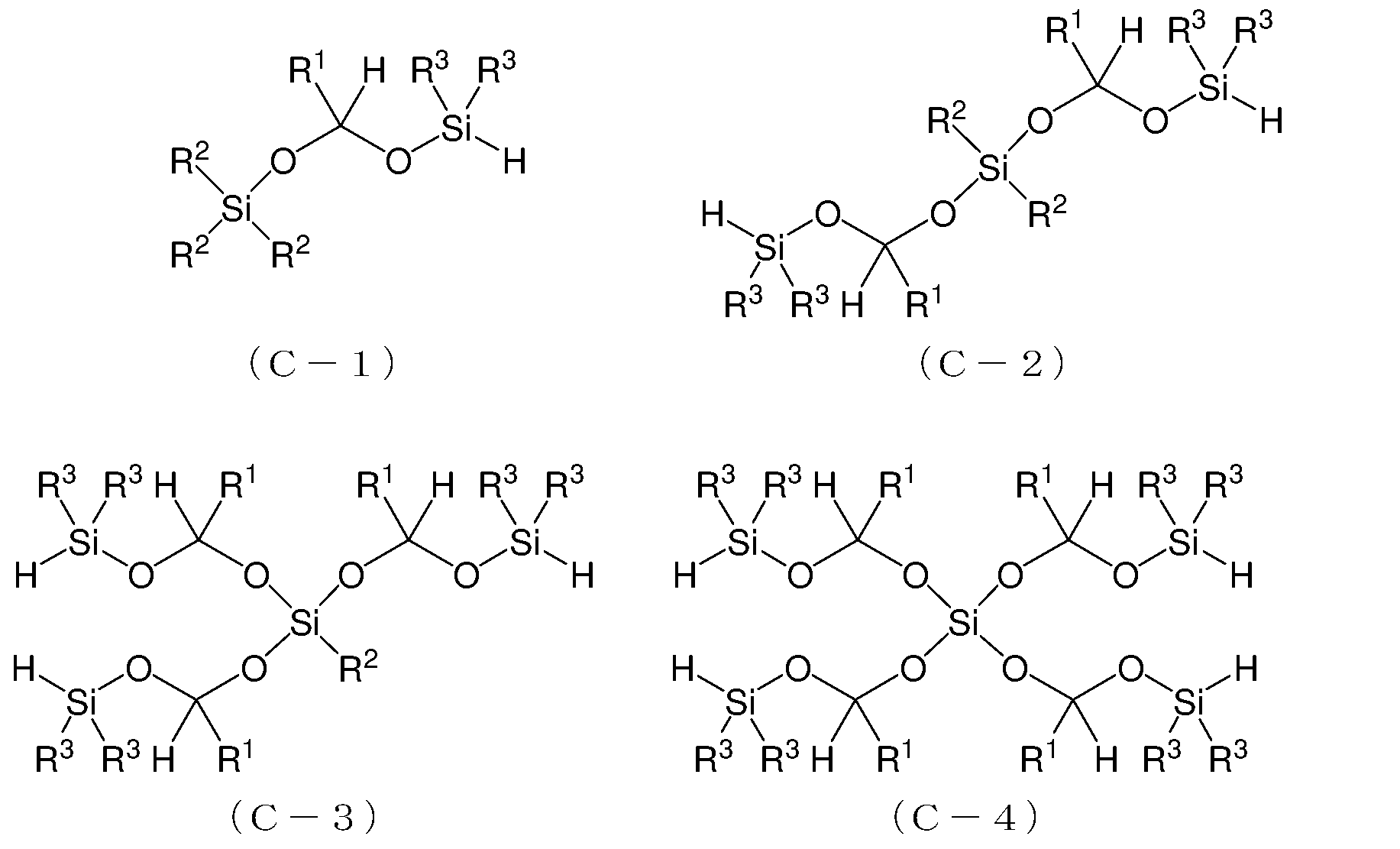
付加工程によって有用なシリルアセタールが生成することを前述したが、付加工程によって生成することができる下記式(C-1)~(C-4)の何れかで表されるシリルアセタールも本発明の一態様である。
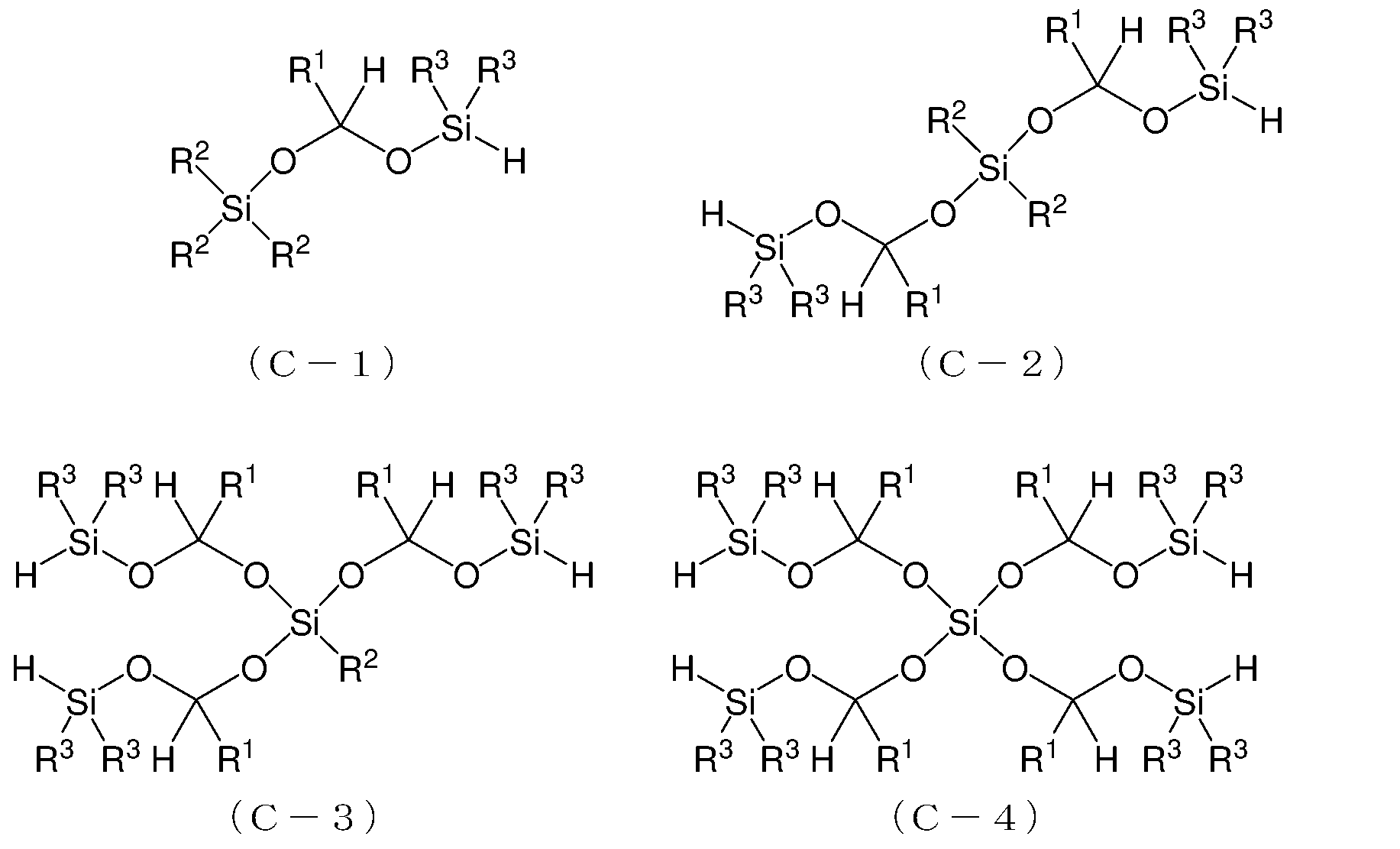
(式(C-1)~(C-4)中、R1は水素原子、又は炭素原子数1~18の炭化水素基を、R2はそれぞれ独立して炭素原子数1~18の炭化水素基、炭素原子数1~12の炭化水素基を有するアルコキシ基、炭素原子数3~18の炭化水素基を有するシリルオキシ基、炭素原子数1~18の炭化水素基を有するアシルオキシ基、又はハロゲン原子を、R3はそれぞれ独立して水素原子、炭素原子数1~18の炭化水素基、炭素原子数1~12の炭化水素基を有するアルコキシ基、炭素原子数3~18の炭化水素基を有するシリルオキシ基、又はハロゲン原子を表す。)
なお、式(C-1)~(C-4)における「R1」、「R2」、「R3」は、前述したものと同様のものが挙げられる。
付加工程によって有用なシリルアセタールが生成することを前述したが、付加工程によって生成することができる下記式(C-1)~(C-4)の何れかで表されるシリルアセタールも本発明の一態様である。
なお、式(C-1)~(C-4)における「R1」、「R2」、「R3」は、前述したものと同様のものが挙げられる。
式(C-1)~(C-4)の何れかで表されるシリルアセタールとしては、下記式で表されるものが挙げられる。
<オリゴシロキサンの製造方法>
本発明の別の一態様であるオリゴシロキサンの製造方法(以下、「本発明のオリゴシロキサンの製造方法」と略す場合がある。)は、ルイス酸の存在下、下記式(C)で表される構造を有するシリルアセタールを反応させて下記式(D)で表される構造を有するオリゴシロキサンを生成する転位工程(以下、「転位工程」と略す場合がある。)を含むことを特徴とする。

(式(C)~(D)中、R1は水素原子、又は炭素原子数1~18の炭化水素基を表す。)
本発明者らは、イリジウム錯体等の存在下でアシルオキシシランとヒドロシランが反応してシリルアセタールが生成することを見出すとともに、生成したシリルアセタールがルイス酸の存在下で分子内転位を起こしてオリゴシロキサンが効率良く生成することを見出したのである。
前述の付加工程と転位工程が比較的温和な条件下で速やかに進行するため、付加工程と転位工程を組み合せたオリゴシロキサンの製造方法は、オリゴシロキサンが生成した段階で原理的に副生成物が生じない特長を有している。シロキサン結合を形成する従来法は、「縮合反応」によるものが一般的であり、水、アルコール、塩化水素、水素等の副生成物が多量に生成してしまうため、例えばシリコーン等の有機ケイ素化合物内にこれらが残留したり、気泡が生じたりして、製品の品質を低下させる要因ともなっている。付加工程と転位工程を組み合せたオリゴシロキサンの製造方法は、副生成物を抑制する観点からも優れた方法であると言えるのである。
なお、本発明において「オリゴシロキサン」とは、ジシロキサン、トリシロキサン、テトラシロキサン等の-(SiO)n-(n=2~20)結合を有する化合物を意味するものとする。
また、式(C)~(D)中の波線は、その先の構造が任意であることを意味する。
以下、「転位工程」について詳細に説明する。
本発明の別の一態様であるオリゴシロキサンの製造方法(以下、「本発明のオリゴシロキサンの製造方法」と略す場合がある。)は、ルイス酸の存在下、下記式(C)で表される構造を有するシリルアセタールを反応させて下記式(D)で表される構造を有するオリゴシロキサンを生成する転位工程(以下、「転位工程」と略す場合がある。)を含むことを特徴とする。
本発明者らは、イリジウム錯体等の存在下でアシルオキシシランとヒドロシランが反応してシリルアセタールが生成することを見出すとともに、生成したシリルアセタールがルイス酸の存在下で分子内転位を起こしてオリゴシロキサンが効率良く生成することを見出したのである。
前述の付加工程と転位工程が比較的温和な条件下で速やかに進行するため、付加工程と転位工程を組み合せたオリゴシロキサンの製造方法は、オリゴシロキサンが生成した段階で原理的に副生成物が生じない特長を有している。シロキサン結合を形成する従来法は、「縮合反応」によるものが一般的であり、水、アルコール、塩化水素、水素等の副生成物が多量に生成してしまうため、例えばシリコーン等の有機ケイ素化合物内にこれらが残留したり、気泡が生じたりして、製品の品質を低下させる要因ともなっている。付加工程と転位工程を組み合せたオリゴシロキサンの製造方法は、副生成物を抑制する観点からも優れた方法であると言えるのである。
なお、本発明において「オリゴシロキサン」とは、ジシロキサン、トリシロキサン、テトラシロキサン等の-(SiO)n-(n=2~20)結合を有する化合物を意味するものとする。
また、式(C)~(D)中の波線は、その先の構造が任意であることを意味する。
以下、「転位工程」について詳細に説明する。
転位工程は、ルイス酸の存在下、式(C)で表される構造を有するシリルアセタールを反応させて式(D)で表される構造を有するオリゴシロキサンを生成する工程であるが、式(C)で表される構造を有するシリルアセタールの具体的種類は、特に限定されず、目的とするオリゴシロキサンに応じて適宜選択することができる。
式(C)で表される構造を有するシリルアセタールとしては、前述した式(C-1)~(C-4)の何れかで表されるシリルアセタールが挙げられる。
なお、式(C)で表される構造を有するシリルアセタールは、前述の付加工程によって得られたものであることが好ましい。付加工程と転位工程を組み合せたオリゴシロキサンの製造方法は、より効率良くオリゴシロキサンを製造することができるとともに、副生成物を抑制することもできる。
式(C)で表される構造を有するシリルアセタールとしては、前述した式(C-1)~(C-4)の何れかで表されるシリルアセタールが挙げられる。
なお、式(C)で表される構造を有するシリルアセタールは、前述の付加工程によって得られたものであることが好ましい。付加工程と転位工程を組み合せたオリゴシロキサンの製造方法は、より効率良くオリゴシロキサンを製造することができるとともに、副生成物を抑制することもできる。
転位工程は、ルイス酸の存在下で行われる工程であるが、ルイス酸はルイス酸性を有する化合物であれば、具体的種類は特に限定されず、目的に応じて適宜選択することができる。
ルイス酸としては、トリス(ペンタフルオロフェニル)ボラン(B(C6F5)3)が好ましい。上記のものであると、より効率良くオリゴシロキサンを製造することができる。
ルイス酸としては、トリス(ペンタフルオロフェニル)ボラン(B(C6F5)3)が好ましい。上記のものであると、より効率良くオリゴシロキサンを製造することができる。
ルイス酸の使用量(仕込量)は、式(C)で表される構造を有するシリルアセタールに対して物質量換算で、通常0.0001倍以上、好ましくは0.001倍以上、より好ましくは0.005倍以上であり、通常0.5倍以下、好ましくは0.1倍以下、より好ましくは0.05倍以下である。上記範囲内であると、より効率良くオリゴシロキサンを製造することができる。
転位工程は、溶媒を使用することが好ましい。また、溶媒の種類は特に限定されず、目的に応じて適宜選択することができるが、具体的にはヘキサン、ベンゼン、トルエン等の炭化水素系溶媒;ジエチルエーテル、テトラヒドロフラン(THF)等のエーテル系溶媒;塩化メチレン、クロロホルム等のハロゲン系溶媒等が挙げられる。この中でもベンゼンが特に好ましい。
上記のものであると、より効率良くオリゴシロキサンを製造することができる。
上記のものであると、より効率良くオリゴシロキサンを製造することができる。
転位工程の反応温度は、通常-80℃以上、好ましくは0℃以上、より好ましくは20℃以上であり、通常120℃以下、好ましくは80℃以下、より好ましくは40℃以下である。
転位工程の反応時間は、通常1分以上、好ましくは5分以上、より好ましくは10分以上であり、通常96時間以下、好ましくは48時間以下、より好ましくは24時間以下である。
転位工程は、大気下で行うこともできるが、窒素、アルゴン等の不活性雰囲気下で行うことが好ましい。
上記範囲内であると、より効率良くオリゴシロキサンを製造することができる。
転位工程の反応時間は、通常1分以上、好ましくは5分以上、より好ましくは10分以上であり、通常96時間以下、好ましくは48時間以下、より好ましくは24時間以下である。
転位工程は、大気下で行うこともできるが、窒素、アルゴン等の不活性雰囲気下で行うことが好ましい。
上記範囲内であると、より効率良くオリゴシロキサンを製造することができる。
式(C)で表されるシリルアセタールは、前述の付加工程によって得られたものであることが好ましいことを前述したが、この場合、式(C)で表される構造を有するシリルアセタールは、単離・精製した後に転位工程に使用するほか、付加工程を行う際に反応器内にイリジウム錯体等とルイス酸をそれぞれ投入し、付加工程及び転位工程を1つの反応器内で進行させる態様であってもよい。このような態様であると、ワンポットで逐次的にオリゴシロキサンを生成することができ、非常に効率良くオリゴシロキサンを製造することができる。
本発明のオリゴシロキサンの製造方法は、前述の転位工程を含むものであれば、その他については特に限定されないが、ルイス酸の存在下、転位工程で得られた下記式(D)で表される構造を有するオリゴシロキサンと下記式(E)で表される構造を有するヒドロシランを反応させて下記式(F)で表される構造を有するオリゴシロキサンを生成する置換工程(以下、「置換工程」と略す場合がある。)を含むことが好ましい。置換工程を含むことにより、得られたオリゴシロキサンに新たなシロキサン結合を形成することができる。なお、置換工程を含むオリゴシロキサンの製造方法も本発明の一態様である。
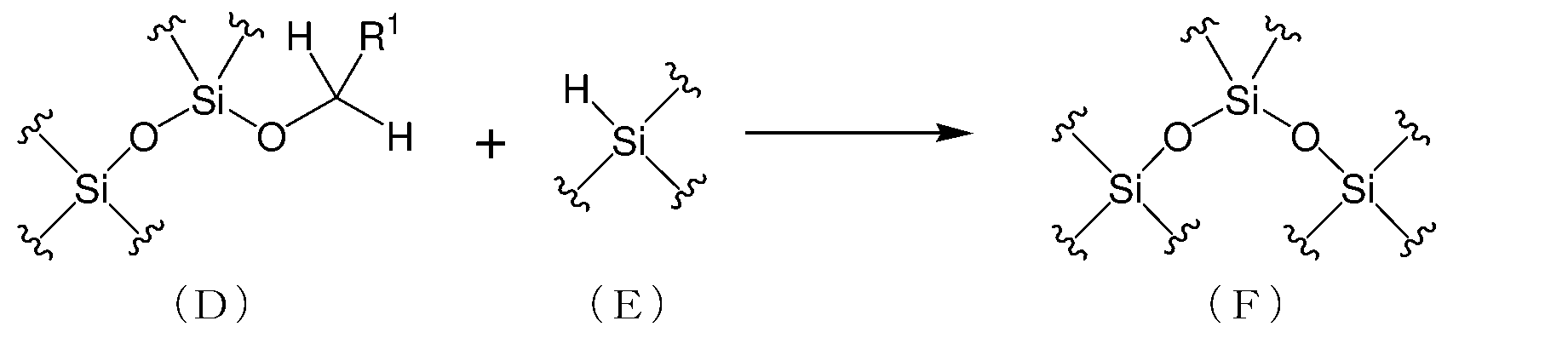
(式(D)~(F)中、R1は水素原子、又は炭素原子数1~18の炭化水素基を表す。)
なお、式(D)~(F)中の波線は、その先の構造が任意であることを意味する。
なお、式(D)~(F)中の波線は、その先の構造が任意であることを意味する。
置換工程は、転位工程で得られた式(D)で表される構造を有するオリゴシロキサンと式(E)で表される構造を有するヒドロシランを反応させて式(F)で表される構造を有するオリゴシロキサンを生成する工程であるが、式(D)で表される構造を有するオリゴシロキサンと式(E)で表される構造を有するヒドロシランの具体的種類は、特に限定されず、目的とするオリゴシロキサンに応じて適宜選択されるべきである。
式(D)で表される構造を有するオリゴシロキサンとしては、下記式(D-1)~(D-4)の何れかで表されるオリゴシロキサンが挙げられる。

(式(D-1)~(D-4)中、R1は水素原子、又は炭素原子数1~18の炭化水素基を、R2はそれぞれ独立して炭素原子数1~18の炭化水素基、炭素原子数1~12の炭化水素基を有するアルコキシ基、炭素原子数3~18の炭化水素基を有するシリルオキシ基、炭素原子数1~18の炭化水素基を有するアシルオキシ基、又はハロゲン原子を、R3はそれぞれ独立して水素原子、炭素原子数1~18の炭化水素基、炭素原子数1~12の炭化水素基を有するアルコキシ基、炭素原子数3~18の炭化水素基を有するシリルオキシ基、又はハロゲン原子を表す。)
なお、式(D-1)~(D-4)における「R1」、「R2」、「R3」は、前述したものと同様のものが挙げられる。
式(D)で表される構造を有するオリゴシロキサンとしては、下記式(D-1)~(D-4)の何れかで表されるオリゴシロキサンが挙げられる。
なお、式(D-1)~(D-4)における「R1」、「R2」、「R3」は、前述したものと同様のものが挙げられる。
式(E)で表される構造を有するヒドロシランとしては、下記式(E-1)で表されるヒドロシランが挙げられる。

(式(E-1)中、R4はそれぞれ独立して水素原子、炭素原子数1~18の炭化水素基、炭素原子数1~12の炭化水素基を有するアルコキシ基、炭素原子数3~18の炭化水素基を有するシリルオキシ基、又はハロゲン原子を表す。)
R4はそれぞれ独立して「炭素原子数1~18の炭化水素基」、「炭素原子数1~12の炭化水素基を有するアルコキシ基」、「炭素原子数3~18の炭化水素基を有するシリルオキシ基」、又は「ハロゲン原子」を表しているが、「炭化水素基」はR1の場合と同義である。
R4が炭化水素基である場合の炭素原子数は、好ましくは12以下、より好ましくは6以下であり、R4が芳香族炭化水素基である場合の炭素原子数は、通常6以上である。
R4がアルコキシ基である場合の炭素原子数は、好ましくは10以下、より好ましくは6以下である。
R4がシリルオキシ基である場合の炭素原子数は、好ましくは10以下、より好ましくは6以下である。
R4としては、水素原子、メチル基(-CH3,-Me)、エチル基(-C2H5,-Et)、n-プロピル基(-nC3H7,-nPr)、i-プロピル基(-iC3H7,-iPr)、n-ブチル基(-nC4H9,-nBu)、t-ブチル基(-tC4H9,-tBu)、n-ペンチル基(-nC5H11)、n-ヘキシル基(-nC6H13,-nHex)、シクロヘキシル基(-cC6H11,-Cy)、フェニル基(-C6H5,-Ph)、ナフチル基(-C12H7,-Naph)、メトキシ基(-OCH3,-OMe)、エトキシ基(-OC2H5,-OEt)、n-プロポキシ基(-OnC3H7,-OnPr)、i-プロポキシ基(-OiC3H7,-OiPr)、n-ブトキシ基(-OnC4H9,-OnBu)、t-ブトキシ基(-OtC4H9,-OtBu)、フェノキシ基(-OC6H5,-OPh)、塩素原子、臭素原子、ヨウ素原子、トリメチルシリルオキシ基(-OSi(CH3)3)、トリエチルシリルオキシ基(-OSi(C2H5)3)、1,1,3,3,3-ペンタメチルジシリルオキシ基(-OSi(CH3)2-OSi(CH3)3)等が挙げられる。この中でも、メチル基、フェニル基等が特に好ましい。
R4はそれぞれ独立して「炭素原子数1~18の炭化水素基」、「炭素原子数1~12の炭化水素基を有するアルコキシ基」、「炭素原子数3~18の炭化水素基を有するシリルオキシ基」、又は「ハロゲン原子」を表しているが、「炭化水素基」はR1の場合と同義である。
R4が炭化水素基である場合の炭素原子数は、好ましくは12以下、より好ましくは6以下であり、R4が芳香族炭化水素基である場合の炭素原子数は、通常6以上である。
R4がアルコキシ基である場合の炭素原子数は、好ましくは10以下、より好ましくは6以下である。
R4がシリルオキシ基である場合の炭素原子数は、好ましくは10以下、より好ましくは6以下である。
R4としては、水素原子、メチル基(-CH3,-Me)、エチル基(-C2H5,-Et)、n-プロピル基(-nC3H7,-nPr)、i-プロピル基(-iC3H7,-iPr)、n-ブチル基(-nC4H9,-nBu)、t-ブチル基(-tC4H9,-tBu)、n-ペンチル基(-nC5H11)、n-ヘキシル基(-nC6H13,-nHex)、シクロヘキシル基(-cC6H11,-Cy)、フェニル基(-C6H5,-Ph)、ナフチル基(-C12H7,-Naph)、メトキシ基(-OCH3,-OMe)、エトキシ基(-OC2H5,-OEt)、n-プロポキシ基(-OnC3H7,-OnPr)、i-プロポキシ基(-OiC3H7,-OiPr)、n-ブトキシ基(-OnC4H9,-OnBu)、t-ブトキシ基(-OtC4H9,-OtBu)、フェノキシ基(-OC6H5,-OPh)、塩素原子、臭素原子、ヨウ素原子、トリメチルシリルオキシ基(-OSi(CH3)3)、トリエチルシリルオキシ基(-OSi(C2H5)3)、1,1,3,3,3-ペンタメチルジシリルオキシ基(-OSi(CH3)2-OSi(CH3)3)等が挙げられる。この中でも、メチル基、フェニル基等が特に好ましい。
式(E-1)で表されるヒドロシランとしては、下記式で表されるものが挙げられる。
式(E)で表される構造を有するヒドロシランの使用量(仕込量)は、式(D)で表される構造を有するオリゴシロキサンに対して物質量換算で、通常0.5倍以上、好ましくは0.8倍以上、より好ましくは1.0倍以上であり、通常5倍以下、好ましくは2倍以下、より好ましくは1.5倍以下である。上記範囲内であると、より効率良くオリゴシロキサンを製造することができる。
置換工程は、ルイス酸の存在下で行われる工程であるが、ルイス酸はルイス酸性を有する化合物であれば、具体的種類は特に限定されず、目的に応じて適宜選択することができる。
ルイス酸としては、トリス(ペンタフルオロフェニル)ボラン(B(C6F5)3)が好ましい。上記のものであると、より効率良くオリゴシロキサンを製造することができる。
ルイス酸としては、トリス(ペンタフルオロフェニル)ボラン(B(C6F5)3)が好ましい。上記のものであると、より効率良くオリゴシロキサンを製造することができる。
ルイス酸の使用量(仕込量)は、式(D)で表される構造を有するオリゴシロキサンに対して物質量換算で、通常0.0001倍以上、好ましくは0.001倍以上、より好ましくは0.005倍以上であり、通常0.5倍以下、好ましくは0.1倍以下、より好ましくは0.05倍以下である。上記範囲内であると、より効率良くオリゴシロキサンを製造することができる。
置換工程は、溶媒を使用することが好ましい。また、溶媒の種類は特に限定されず、目的に応じて適宜選択することができるが、具体的にはヘキサン、ベンゼン、トルエン等の炭化水素系溶媒;ジエチルエーテル、テトラヒドロフラン(THF)等のエーテル系溶媒;塩化メチレン、クロロホルム等のハロゲン系溶媒等が挙げられる。この中でもベンゼンが特に好ましい。
上記のものであると、より効率良くオリゴシロキサンを製造することができる。
上記のものであると、より効率良くオリゴシロキサンを製造することができる。
置換工程の反応温度は、通常-80℃以上、好ましくは0℃以上、より好ましくは20℃以上であり、通常120℃以下、好ましくは80℃以下、より好ましくは40℃以下である。
置換工程の反応時間は、通常1分以上、好ましくは5分以上、より好ましくは10分以上であり、通常96時間以下、好ましくは48時間以下、より好ましくは24時間以下である。
置換工程は、大気下で行うこともできるが、窒素、アルゴン等の不活性雰囲気下で行うことが好ましい。
上記範囲内であると、より効率良くオリゴシロキサンを製造することができる。
置換工程の反応時間は、通常1分以上、好ましくは5分以上、より好ましくは10分以上であり、通常96時間以下、好ましくは48時間以下、より好ましくは24時間以下である。
置換工程は、大気下で行うこともできるが、窒素、アルゴン等の不活性雰囲気下で行うことが好ましい。
上記範囲内であると、より効率良くオリゴシロキサンを製造することができる。
置換工程は、転位工程で得られた式(D)で表される構造を有するオリゴシロキサンを反応させる工程であるが、式(D)で表される構造を有するオリゴシロキサンは、単離・精製した後に置換工程に使用するほか、転位工程後に反応器内に式(E)で表される構造を有するヒドロシランを投入し、そのまま置換工程を進行させる態様であってもよい。このような態様であると、ワンポットで逐次的にオリゴシロキサンを生成することができ、非常に効率良くオリゴシロキサンを製造することができる。
<オリゴシロキサン>
転位工程、置換工程によってオリゴシロキサンが生成することを前述したが、転位工程等によって生成することができる下記式(D-1)~(D-4)及び下記式(F-1)~(F-2)の何れかで表されるオリゴシロキサンも本発明の一態様である。

(式(D-1)~(D-4)及び式(F-1)~(F-2)中、R1は水素原子、又は炭素原子数1~18の炭化水素基を、R2はそれぞれ独立して炭素原子数1~18の炭化水素基、炭素原子数1~12の炭化水素基を有するアルコキシ基、炭素原子数3~18の炭化水素基を有するシリルオキシ基、炭素原子数1~18の炭化水素基を有するアシルオキシ基、又はハロゲン原子を、R3及びR4はそれぞれ独立して水素原子、炭素原子数1~18の炭化水素基、炭素原子数1~12の炭化水素基を有するアルコキシ基、炭素原子数3~18の炭化水素基を有するシリルオキシ基、又はハロゲン原子を表す。)
なお、式(D-1)~(D-4)及び式(F-1)~(F-2)における「R1」、「R2」、「R3」、「R4」は、前述したものと同様のものが挙げられる。
転位工程、置換工程によってオリゴシロキサンが生成することを前述したが、転位工程等によって生成することができる下記式(D-1)~(D-4)及び下記式(F-1)~(F-2)の何れかで表されるオリゴシロキサンも本発明の一態様である。
なお、式(D-1)~(D-4)及び式(F-1)~(F-2)における「R1」、「R2」、「R3」、「R4」は、前述したものと同様のものが挙げられる。
下記式(D-1)~(D-4)及び下記式(F-1)~(F-2)の何れかで表されるオリゴシロキサンとしては、下記式で表されるものが挙げられる。

以下に実施例を挙げて本発明をさらに具体的に説明するが、本発明の趣旨を逸脱しない限り適宜変更することができる。従って、本発明の範囲は以下に示す具体例により限定的に解釈されるべきものではない。
<実施例1>
Me3SiOAc(90.2μL,0.60mmol)、メシチレン(内標準、21.0μL,0.15mmol)を重ベンゼンC6D6(3.0mL)に溶解させた。[Ir(coe)2Cl]2(0.5mg,1mol%Ir)が入ったNMR管にこの溶液(0.5mL)を加え、さらにEt2SiH2(14.2μL,0.11mmol)を加えた。12時間後、シリルアセタールが収率88%で生成していることを1H NMR測定によって確認した。その後、この反応溶液にB(C6F5)3(0.5mg,1mol%)を加えたところ、30分後にジシロキサンが収率84%で生成していることを1H NMR測定によって確認した。さらに、Ph2SiH2(20.3μL,0.11mmol)を加えると、15分後にトリシロキサンが収率77%で得られた。
シリルアセタール(無色オイル状)
1H NMR(C6D6):5.35(q、J=4.9Hz、1H)、4.72(quin、J=2.3Hz、1H)、1.34(d、J=4.9Hz、3H)、1.04-1.00(m、6H)、0.72-0.63(m、4H)、0.15(s、9H)ppm.29Si NMR(C6D6):14.3、5.2ppm.
ジシロキサン(無色オイル状)
1H NMR(C6D6):3.68(q、J=7.0Hz、2H)、1.15(t、J=7.0Hz、3H)、1.03(t、J=8.0Hz、6H)、0.59(q、J=8.0Hz、4H)、0.16(s、9H)ppm.29Si NMR(C6D6):7.3、-13.0ppm.
トリシロキサン(無色オイル状)
1H NMR(C6D6):7.73-7.71(m、4H)、7.21-7.18(m、6H)、5.86(s、1H)、1.00(t、J=8.0Hz、6H)、0.59(q、J=8.0Hz、4H)、0.12(s、9H)ppm.13C NMR(C6D6):136.3、134.7、130.5、128.3、7.8、6.8、1.9ppm.29Si NMR(C6D6):7.8、-17.6、-22.1ppm.HRMS(ESI):m/z calcd for C19H30O2Si3Na [M+Na]+:397.1446;found:397.1444.
Me3SiOAc(90.2μL,0.60mmol)、メシチレン(内標準、21.0μL,0.15mmol)を重ベンゼンC6D6(3.0mL)に溶解させた。[Ir(coe)2Cl]2(0.5mg,1mol%Ir)が入ったNMR管にこの溶液(0.5mL)を加え、さらにEt2SiH2(14.2μL,0.11mmol)を加えた。12時間後、シリルアセタールが収率88%で生成していることを1H NMR測定によって確認した。その後、この反応溶液にB(C6F5)3(0.5mg,1mol%)を加えたところ、30分後にジシロキサンが収率84%で生成していることを1H NMR測定によって確認した。さらに、Ph2SiH2(20.3μL,0.11mmol)を加えると、15分後にトリシロキサンが収率77%で得られた。
シリルアセタール(無色オイル状)
1H NMR(C6D6):5.35(q、J=4.9Hz、1H)、4.72(quin、J=2.3Hz、1H)、1.34(d、J=4.9Hz、3H)、1.04-1.00(m、6H)、0.72-0.63(m、4H)、0.15(s、9H)ppm.29Si NMR(C6D6):14.3、5.2ppm.
ジシロキサン(無色オイル状)
1H NMR(C6D6):3.68(q、J=7.0Hz、2H)、1.15(t、J=7.0Hz、3H)、1.03(t、J=8.0Hz、6H)、0.59(q、J=8.0Hz、4H)、0.16(s、9H)ppm.29Si NMR(C6D6):7.3、-13.0ppm.
トリシロキサン(無色オイル状)
1H NMR(C6D6):7.73-7.71(m、4H)、7.21-7.18(m、6H)、5.86(s、1H)、1.00(t、J=8.0Hz、6H)、0.59(q、J=8.0Hz、4H)、0.12(s、9H)ppm.13C NMR(C6D6):136.3、134.7、130.5、128.3、7.8、6.8、1.9ppm.29Si NMR(C6D6):7.8、-17.6、-22.1ppm.HRMS(ESI):m/z calcd for C19H30O2Si3Na [M+Na]+:397.1446;found:397.1444.
<実施例2>
Et2SiH2をMePhSiH2(15.1μL,0.11mmol)に変更した以外、実施例1と同様の方法により反応を行った。結果、シリルアセタールの収率が79%、ジシロキサンの収率が65%、トリシロキサンの収率が63%であった。
シリルアセタール(無色オイル状、ジアステレオ比 1.2:1)
1H NMR(C6D6):7.66-7.62(m)、7.22-7.19(m)、5.40-5.37(m)、5.32-5.30(m)、1.34(d、J=4.9Hz、3Hminor)、1.32(d、J=4.9Hz、3Hmajor)、0.43(t、J=2.9Hz、3Hmajor)、0.42(d、J=4.9Hz、3Hminor)、0.09(s、9Hmajor)、0.07(s、9Hminor)ppm.
ジシロキサン(無色オイル状)
1H NMR(C6D6):7.73-7.71(m、2H)、7.26-7.20(m、3H)、3.72-3.67(m、2H)、1.13(t、J=7.0Hz、3H)、0.35(s、3H)、0.16(s、9H)ppm.
トリシロキサン(無色オイル状)
1H NMR(C6D6):7.71-7.68(m、6H)、7.19-7.15(m、9H)、5.90(s、1H)、0.39(s、3H)、0.09(s、9H)ppm.13C NMR(C6D6):137.8、135.9、134.8、133.7、130.5、130.1、128.3、128.2、1.9、-0.0ppm.29Si NMR(C6D6):9.5、-21.3、-30.9ppm.HRMS(ESI):m/z calcd for C22H28O2Si3Na [M+Na]+:431.1289;found:431.1294.

Et2SiH2をMePhSiH2(15.1μL,0.11mmol)に変更した以外、実施例1と同様の方法により反応を行った。結果、シリルアセタールの収率が79%、ジシロキサンの収率が65%、トリシロキサンの収率が63%であった。
シリルアセタール(無色オイル状、ジアステレオ比 1.2:1)
1H NMR(C6D6):7.66-7.62(m)、7.22-7.19(m)、5.40-5.37(m)、5.32-5.30(m)、1.34(d、J=4.9Hz、3Hminor)、1.32(d、J=4.9Hz、3Hmajor)、0.43(t、J=2.9Hz、3Hmajor)、0.42(d、J=4.9Hz、3Hminor)、0.09(s、9Hmajor)、0.07(s、9Hminor)ppm.
ジシロキサン(無色オイル状)
1H NMR(C6D6):7.73-7.71(m、2H)、7.26-7.20(m、3H)、3.72-3.67(m、2H)、1.13(t、J=7.0Hz、3H)、0.35(s、3H)、0.16(s、9H)ppm.
トリシロキサン(無色オイル状)
1H NMR(C6D6):7.71-7.68(m、6H)、7.19-7.15(m、9H)、5.90(s、1H)、0.39(s、3H)、0.09(s、9H)ppm.13C NMR(C6D6):137.8、135.9、134.8、133.7、130.5、130.1、128.3、128.2、1.9、-0.0ppm.29Si NMR(C6D6):9.5、-21.3、-30.9ppm.HRMS(ESI):m/z calcd for C22H28O2Si3Na [M+Na]+:431.1289;found:431.1294.
<実施例3>
[Ir(coe)2Cl]2(3.6mg,2mol%Ir)を重ベンゼンC6D6(2.0mL)に溶解させた。ここに、Me3SiOAc(60.2μL,0.40mmol)、メシチレン(内標準、14.0μL,0.10mmol)、Ph2SiH2(81.1μL,0.44mmol)を順に加えて撹拌した。72時間後、シリルアセタールが収率92%で生成していることを1H NMR測定によって確認した。その後、この反応溶液にB(C6F5)3(2.0mg,1mol%)を加えたところ、20分後にジシロキサンが収率78%で生成していることを1H NMR測定によって確認した。さらに、Et2SiH2(51.9μL,0.40mmol)を加えると、20分後にトリシロキサンが収率82%で得られた。
シリルアセタール(無色オイル状)
1H NMR(C6D6):7.75-7.72(m、4H)、7.18-7.16(m、6H)、5.78(s、1H)、5.49(q、J=4.9Hz、1H)、1.37(d、J=4.9Hz、3H)、0.05(s、9H)ppm.
ジシロキサン(無色オイル状)
1H NMR(C6D6):7.81-7.79(m、4H)、7.21-7.19(m、6H)、3.79(q、J=7.0Hz、2H)、1.15(t、J=7.0Hz、3H)、0.16(s、9H)ppm.
トリシロキサン(無色オイル状)
1H NMR(C6D6):7.80-7.78(m、4H)、7.23-7.18(m、6H)、4.94(quin、J=2.3Hz、1H)、0.97(t、J=8.0Hz、6H)、0.70-0.60(m、4H)、0.17(s、9H)ppm.13C NMR(C6D6):136.6、134.6、130.3、128.1、7.3、6.8、2.0ppm.29Si NMR(C6D6):10.4、2.0、-45.1ppm.

[Ir(coe)2Cl]2(3.6mg,2mol%Ir)を重ベンゼンC6D6(2.0mL)に溶解させた。ここに、Me3SiOAc(60.2μL,0.40mmol)、メシチレン(内標準、14.0μL,0.10mmol)、Ph2SiH2(81.1μL,0.44mmol)を順に加えて撹拌した。72時間後、シリルアセタールが収率92%で生成していることを1H NMR測定によって確認した。その後、この反応溶液にB(C6F5)3(2.0mg,1mol%)を加えたところ、20分後にジシロキサンが収率78%で生成していることを1H NMR測定によって確認した。さらに、Et2SiH2(51.9μL,0.40mmol)を加えると、20分後にトリシロキサンが収率82%で得られた。
シリルアセタール(無色オイル状)
1H NMR(C6D6):7.75-7.72(m、4H)、7.18-7.16(m、6H)、5.78(s、1H)、5.49(q、J=4.9Hz、1H)、1.37(d、J=4.9Hz、3H)、0.05(s、9H)ppm.
ジシロキサン(無色オイル状)
1H NMR(C6D6):7.81-7.79(m、4H)、7.21-7.19(m、6H)、3.79(q、J=7.0Hz、2H)、1.15(t、J=7.0Hz、3H)、0.16(s、9H)ppm.
トリシロキサン(無色オイル状)
1H NMR(C6D6):7.80-7.78(m、4H)、7.23-7.18(m、6H)、4.94(quin、J=2.3Hz、1H)、0.97(t、J=8.0Hz、6H)、0.70-0.60(m、4H)、0.17(s、9H)ppm.13C NMR(C6D6):136.6、134.6、130.3、128.1、7.3、6.8、2.0ppm.29Si NMR(C6D6):10.4、2.0、-45.1ppm.
<実施例4>
[Ir(coe)2Cl]2(7.2mg,4mol%Ir)を重ベンゼンC6D6(2.0mL)に溶解させた。ここに、Me3SiOAc(60.2μL,0.40mmol)、メシチレン(内標準、14.0μL,0.10mmol)、iPr2SiH2(72.1μL,0.44mmol)を順に加えて撹拌した。48時間後、シリルアセタールが収率94%で生成していることを1H NMR測定によって確認した。その後、この反応溶液にB(C6F5)3(2.0mg,1mol%)を加えたところ、30分後にジシロキサンが収率69%で生成していることを1H NMR測定によって確認した。さらに、Ph2SiH2(73.7μL,0.40mmol)を加えると、30分後にトリシロキサンが収率64%で得られた。
シリルアセタール(無色オイル状)
1H NMR(C6D6):5.37(q、J=4.9Hz、1H)、4.48(t、J=1.5Hz、1H)、1.36(d、J=4.9Hz、3H)、1.15-1.07(m、12H)、1.04-0.95(m、2H)、0.15(s、9H)ppm.
ジシロキサン(無色オイル状)
1H NMR(C6D6):3.71(q、J=7.0Hz、2H)、1.15(t、J=7.0Hz、3H)、1.12(d、J=7.4Hz、6H)、1.10(d、J=7.4Hz、6H)、0.96-0.88(m、2H)、0.17(s、9H)ppm.
トリシロキサン(無色オイル状)
1H NMR(C6D6):7.74-7.72(m、4H)、7.21-7.17(m、6H)、5.88(s、1H)、1.07(d、J=7.4Hz、6H)、1.06(d、J=7.4Hz、6H)、0.95-0.87(m、2H)、0.13(s、9H)ppm.13C NMR(C6D6):136.3、134.7、130.5、128.3、17.3、13.7、2.0ppm.29Si NMR(C6D6):7.2、-20.3、-21.9ppm.

[Ir(coe)2Cl]2(7.2mg,4mol%Ir)を重ベンゼンC6D6(2.0mL)に溶解させた。ここに、Me3SiOAc(60.2μL,0.40mmol)、メシチレン(内標準、14.0μL,0.10mmol)、iPr2SiH2(72.1μL,0.44mmol)を順に加えて撹拌した。48時間後、シリルアセタールが収率94%で生成していることを1H NMR測定によって確認した。その後、この反応溶液にB(C6F5)3(2.0mg,1mol%)を加えたところ、30分後にジシロキサンが収率69%で生成していることを1H NMR測定によって確認した。さらに、Ph2SiH2(73.7μL,0.40mmol)を加えると、30分後にトリシロキサンが収率64%で得られた。
シリルアセタール(無色オイル状)
1H NMR(C6D6):5.37(q、J=4.9Hz、1H)、4.48(t、J=1.5Hz、1H)、1.36(d、J=4.9Hz、3H)、1.15-1.07(m、12H)、1.04-0.95(m、2H)、0.15(s、9H)ppm.
ジシロキサン(無色オイル状)
1H NMR(C6D6):3.71(q、J=7.0Hz、2H)、1.15(t、J=7.0Hz、3H)、1.12(d、J=7.4Hz、6H)、1.10(d、J=7.4Hz、6H)、0.96-0.88(m、2H)、0.17(s、9H)ppm.
トリシロキサン(無色オイル状)
1H NMR(C6D6):7.74-7.72(m、4H)、7.21-7.17(m、6H)、5.88(s、1H)、1.07(d、J=7.4Hz、6H)、1.06(d、J=7.4Hz、6H)、0.95-0.87(m、2H)、0.13(s、9H)ppm.13C NMR(C6D6):136.3、134.7、130.5、128.3、17.3、13.7、2.0ppm.29Si NMR(C6D6):7.2、-20.3、-21.9ppm.
<実施例5>
[Ir(coe)2Cl]2(7.2mg,4mol%Ir)を重ベンゼンC6D6(2.0mL)に溶解させた。ここに、Me3SiOAc(60.2μL,0.40mmol)、メシチレン(内標準、14.0μL,0.10mmol)、tBu2SiH2(87.0μL,0.44mmol)を順に加えて撹拌した。48時間後、シリルアセタールが収率91%で生成していることを1H NMR測定によって確認した。
シリルアセタール(無色オイル状)
1H NMR(C6D6):5.39(q、J=4.9Hz、1H)、4.26(s、1H)、1.36(d、J=4.9Hz、3H)、1.12(s、9H)、1.07(s、9H)、0.15(s、9H)ppm.

[Ir(coe)2Cl]2(7.2mg,4mol%Ir)を重ベンゼンC6D6(2.0mL)に溶解させた。ここに、Me3SiOAc(60.2μL,0.40mmol)、メシチレン(内標準、14.0μL,0.10mmol)、tBu2SiH2(87.0μL,0.44mmol)を順に加えて撹拌した。48時間後、シリルアセタールが収率91%で生成していることを1H NMR測定によって確認した。
シリルアセタール(無色オイル状)
1H NMR(C6D6):5.39(q、J=4.9Hz、1H)、4.26(s、1H)、1.36(d、J=4.9Hz、3H)、1.12(s、9H)、1.07(s、9H)、0.15(s、9H)ppm.
<実施例6>
Et2SiH2をEt3SiOSiH2Ph(21.5μL,0.083mmol)に変更した以外、実施例1と同様の方法により反応を行った。結果、シリルアセタールの収率が83%、トリシロキサンの収率が77%、テトラシロキサンの収率が73%であった。
シリルアセタール(無色オイル状、ジアステレオーマー比 2.4:1)
1H NMR(C6D6):7.81-7.77(m)、7.23-7.17(m)、5.62(q、J=5.0Hz、1Hmajor)、5.54(q、J=5.0Hz、1Hminor)、5.41(s、1Hmajor)、5.41(s、1Hminor)、1.00(t、J=7.9Hz、9Hminor)、0.99(t、J=8.0Hz、9Hmajor)、0.65-0.59(m)、0.13(s)ppm.
トリシロキサン(無色オイル状)
1H NMR(C6D6):7.85-7.83(m、2H)、7.26-7.19(m、3H)、3.82(q、J=7.0Hz、2H)、1.18(t、J=7.0Hz、3H)、1.03(t、J=8.0Hz、9H)、0.66(q、J=8.0Hz、6H)、0.21(s、9H)ppm.
テトラシロキサン(無色オイル状)
1H NMR(C6D6):7.84-7.82(m、2H)、7.74-7.72(m、4H)、7.20-7.16(m、9H)、5.94(s、1H)、0.99(t、J=8.0Hz、9H)、0.61(q、J=8.0Hz、6H)、0.15(s、9H)ppm.13C NMR(C6D6):135.7、135.0、134.8、134.4、130.5、130.3、128.3、128.1、7.0、6.5、1.8ppm.29Si NMR(C6D6):12.6、9.6、-21.3、-76.7ppm.

Et2SiH2をEt3SiOSiH2Ph(21.5μL,0.083mmol)に変更した以外、実施例1と同様の方法により反応を行った。結果、シリルアセタールの収率が83%、トリシロキサンの収率が77%、テトラシロキサンの収率が73%であった。
シリルアセタール(無色オイル状、ジアステレオーマー比 2.4:1)
1H NMR(C6D6):7.81-7.77(m)、7.23-7.17(m)、5.62(q、J=5.0Hz、1Hmajor)、5.54(q、J=5.0Hz、1Hminor)、5.41(s、1Hmajor)、5.41(s、1Hminor)、1.00(t、J=7.9Hz、9Hminor)、0.99(t、J=8.0Hz、9Hmajor)、0.65-0.59(m)、0.13(s)ppm.
トリシロキサン(無色オイル状)
1H NMR(C6D6):7.85-7.83(m、2H)、7.26-7.19(m、3H)、3.82(q、J=7.0Hz、2H)、1.18(t、J=7.0Hz、3H)、1.03(t、J=8.0Hz、9H)、0.66(q、J=8.0Hz、6H)、0.21(s、9H)ppm.
テトラシロキサン(無色オイル状)
1H NMR(C6D6):7.84-7.82(m、2H)、7.74-7.72(m、4H)、7.20-7.16(m、9H)、5.94(s、1H)、0.99(t、J=8.0Hz、9H)、0.61(q、J=8.0Hz、6H)、0.15(s、9H)ppm.13C NMR(C6D6):135.7、135.0、134.8、134.4、130.5、130.3、128.3、128.1、7.0、6.5、1.8ppm.29Si NMR(C6D6):12.6、9.6、-21.3、-76.7ppm.
<実施例7>
Ph2SiH2をMePhSiH2(15.1μL,0.11mmol)に変更した以外、実施例1と同様の方法により反応を行った。結果、シリルアセタールの収率が79%、ジシロキサンの収率が79%、トリシロキサンの収率が70%であった。
トリシロキサン(無色オイル状)
1H NMR(C6D6):7.66-7.64(m、2H)、7.24-7.18(m、3H)、5.43(q、J=2.8Hz、1H)、1.00(t、J=8.0Hz、6H)、0.57(q、J=8.0Hz、4H)、0.43(d、J=2.8Hz、3H)、0.14(s、9H)ppm.13C NMR(C6D6):138.0、133.8、130.2、128.3、7.8、6.8、2.0、-0.1ppm.29Si NMR(C6D6):7.6、-14.1、-18.2ppm.

Ph2SiH2をMePhSiH2(15.1μL,0.11mmol)に変更した以外、実施例1と同様の方法により反応を行った。結果、シリルアセタールの収率が79%、ジシロキサンの収率が79%、トリシロキサンの収率が70%であった。
トリシロキサン(無色オイル状)
1H NMR(C6D6):7.66-7.64(m、2H)、7.24-7.18(m、3H)、5.43(q、J=2.8Hz、1H)、1.00(t、J=8.0Hz、6H)、0.57(q、J=8.0Hz、4H)、0.43(d、J=2.8Hz、3H)、0.14(s、9H)ppm.13C NMR(C6D6):138.0、133.8、130.2、128.3、7.8、6.8、2.0、-0.1ppm.29Si NMR(C6D6):7.6、-14.1、-18.2ppm.
<実施例8>
Ph2SiH2をiPr2SiH2(16.4μL,0.10mmol)に変更し、置換工程の反応時間を10時間に変更した以外、実施例1と同様の方法により反応を行った。結果、シリルアセタールの収率が91%、ジシロキサンの収率が84%、トリシロキサンの収率が74%であった。
トリシロキサン(無色オイル状)
1H NMR(C6D6):4.53(t、J=1.8Hz、1H)、1.11(d、J=7.4Hz、6H)、1.07(d、J=7.4Hz、6H)、1.04(t、J=8.0Hz、6H)、0.96-0.89(m、2H)、0.59(q、J=8.0Hz、4H)、0.17(s、9H)ppm.

Ph2SiH2をiPr2SiH2(16.4μL,0.10mmol)に変更し、置換工程の反応時間を10時間に変更した以外、実施例1と同様の方法により反応を行った。結果、シリルアセタールの収率が91%、ジシロキサンの収率が84%、トリシロキサンの収率が74%であった。
トリシロキサン(無色オイル状)
1H NMR(C6D6):4.53(t、J=1.8Hz、1H)、1.11(d、J=7.4Hz、6H)、1.07(d、J=7.4Hz、6H)、1.04(t、J=8.0Hz、6H)、0.96-0.89(m、2H)、0.59(q、J=8.0Hz、4H)、0.17(s、9H)ppm.
<実施例9>
Ph2SiH2をEt3SiOSiH2Ph(25.9μL,0.10mmol)に変更した以外、実施例1と同様の方法により反応を行った。結果、シリルアセタールの収率が93%、ジシロキサンの収率が83%、テトラシロキサンの収率が74%であった。
テトラシロキサン(無色オイル状)
1H NMR(C6D6):7.79-7.77(m、2H)、7.25-7.18(m、3H)、5.44(s、1H)、1.06-1.00(m、15H)、0.65-0.60(m、10H)、0.15(s、9H)ppm.13C NMR(C6D6):137.5、133.5、130.6、128.4、7.8、7.0、6.8、6.8、6.6、1.9ppm.29Si NMR(C6D6):13.7、7.8、-19.0、-49.0ppm.HRMS(ESI):m/z calcd for C19H40O3Si4Na [M+Na]+:451.1947;found:451.1963.

Ph2SiH2をEt3SiOSiH2Ph(25.9μL,0.10mmol)に変更した以外、実施例1と同様の方法により反応を行った。結果、シリルアセタールの収率が93%、ジシロキサンの収率が83%、テトラシロキサンの収率が74%であった。
テトラシロキサン(無色オイル状)
1H NMR(C6D6):7.79-7.77(m、2H)、7.25-7.18(m、3H)、5.44(s、1H)、1.06-1.00(m、15H)、0.65-0.60(m、10H)、0.15(s、9H)ppm.13C NMR(C6D6):137.5、133.5、130.6、128.4、7.8、7.0、6.8、6.8、6.6、1.9ppm.29Si NMR(C6D6):13.7、7.8、-19.0、-49.0ppm.HRMS(ESI):m/z calcd for C19H40O3Si4Na [M+Na]+:451.1947;found:451.1963.
<実施例10>
Ph2SiH2をPhSiH3(6.1μL,0.05mmol)に変更した以外、実施例1と同様の方法により反応を行った。結果、シリルアセタールの収率が85%、ジシロキサンの収率が71%、オリゴシロキサンの収率が52%であった。
オリゴシロキサン(無色オイル状)
1H NMR(C6D6):7.82-7.80(m、2H)、7.25-7.18(m、3H)、5.47(s、1H)、1.07(t、J=8.0Hz、6H)、1.04(t、J=8.0Hz、6H)、0.65(q、J=8.0Hz、4H)、0.63(q、J=8.0Hz、4H)、0.16(s、18H)ppm.13C NMR(C6D6):137.1、133.5、130.6、7.8、6.9、6.8、2.0ppm.29Si NMR(C6D6):7.9、-18.8、-49.7ppm.HRMS(ESI):m/z calcd for C20H44O4Si5Na [M+Na]+:511.1978;found:511.1975.

Ph2SiH2をPhSiH3(6.1μL,0.05mmol)に変更した以外、実施例1と同様の方法により反応を行った。結果、シリルアセタールの収率が85%、ジシロキサンの収率が71%、オリゴシロキサンの収率が52%であった。
オリゴシロキサン(無色オイル状)
1H NMR(C6D6):7.82-7.80(m、2H)、7.25-7.18(m、3H)、5.47(s、1H)、1.07(t、J=8.0Hz、6H)、1.04(t、J=8.0Hz、6H)、0.65(q、J=8.0Hz、4H)、0.63(q、J=8.0Hz、4H)、0.16(s、18H)ppm.13C NMR(C6D6):137.1、133.5、130.6、7.8、6.9、6.8、2.0ppm.29Si NMR(C6D6):7.9、-18.8、-49.7ppm.HRMS(ESI):m/z calcd for C20H44O4Si5Na [M+Na]+:511.1978;found:511.1975.
<実施例11>
Et2SiH2をMePhSiH2(15.1μL,0.11mmol)に変更し、Ph2SiH2をMePhSiH2(13.7μL,0.10mmol)に変更した以外、実施例1と同様の方法により反応を行った。結果、シリルアセタールの収率が96%、トリシロキサンの収率が71%であった。
トリシロキサン(無色オイル状、ジアステレオ比 1:1)
1H NMR(C6D6):7.70-7.68(m、4H)、7.62-7.61(m、4H)、7.21-7.17(m、12H)、5.46(q、J=2.9Hz、1H)、5.45(q、J=2.9Hz、1H)、0.41(d、J=2.9Hz、3H)、0.40(d、J=2.9Hz、3H)、0.37(s、3H)、0.36(s、3H)、0.12(s、9H)、0.11(s、9H)ppm.

Et2SiH2をMePhSiH2(15.1μL,0.11mmol)に変更し、Ph2SiH2をMePhSiH2(13.7μL,0.10mmol)に変更した以外、実施例1と同様の方法により反応を行った。結果、シリルアセタールの収率が96%、トリシロキサンの収率が71%であった。
トリシロキサン(無色オイル状、ジアステレオ比 1:1)
1H NMR(C6D6):7.70-7.68(m、4H)、7.62-7.61(m、4H)、7.21-7.17(m、12H)、5.46(q、J=2.9Hz、1H)、5.45(q、J=2.9Hz、1H)、0.41(d、J=2.9Hz、3H)、0.40(d、J=2.9Hz、3H)、0.37(s、3H)、0.36(s、3H)、0.12(s、9H)、0.11(s、9H)ppm.
<実施例12>
[Ir(coe)2Cl]2(0.9mg,2mol%Ir)を重ベンゼンC6D6(2.0mL)に溶解させた。ここに、Me2Si(OAc)2(66.5μL,0.40mmol)、メシチレン(内標準、14.0μL,0.10mmol)、Et2SiH2(27.2μL,0.21mmol)を順に加えて撹拌した。24時間後、シリルアセタールが収率94%で生成していることを1H NMR測定によって確認した。その後、この反応溶液にB(C6F5)3(0.5mg,1mol%)を加えたところ、2時間後にトリシロキサンが収率62%で生成していることを1H NMR測定によって確認した。
シリルアセタール(無色オイル状、ジアステレオマー比 1:1)
1H NMR(C6D6):5.53(q、J=4.9Hz、2H)、5.52(q、J=4.9Hz、2H)、4.74-4.72(m、4H)、1.42(d、J=4.9Hz、6H)、1.42(d、J=4.9Hz、6H)、1.03(t、J=8.0Hz、12H)、1.02(t、J=8.0Hz、12H)、0.74-0.64(m、16H)、0.27(s、3H)、0.27(s、6H)、0.24(s、3H)ppm.
トリシロキサン(無色オイル状)
1H NMR(C6D6):3.74(q、J=7.0Hz、4H)、1.18(t、J=7.0Hz、6H)、1.07(t、J=7.9Hz、12H)、0.65(q、J=7.9Hz、8H)、0.23(s、6H)ppm.

[Ir(coe)2Cl]2(0.9mg,2mol%Ir)を重ベンゼンC6D6(2.0mL)に溶解させた。ここに、Me2Si(OAc)2(66.5μL,0.40mmol)、メシチレン(内標準、14.0μL,0.10mmol)、Et2SiH2(27.2μL,0.21mmol)を順に加えて撹拌した。24時間後、シリルアセタールが収率94%で生成していることを1H NMR測定によって確認した。その後、この反応溶液にB(C6F5)3(0.5mg,1mol%)を加えたところ、2時間後にトリシロキサンが収率62%で生成していることを1H NMR測定によって確認した。
シリルアセタール(無色オイル状、ジアステレオマー比 1:1)
1H NMR(C6D6):5.53(q、J=4.9Hz、2H)、5.52(q、J=4.9Hz、2H)、4.74-4.72(m、4H)、1.42(d、J=4.9Hz、6H)、1.42(d、J=4.9Hz、6H)、1.03(t、J=8.0Hz、12H)、1.02(t、J=8.0Hz、12H)、0.74-0.64(m、16H)、0.27(s、3H)、0.27(s、6H)、0.24(s、3H)ppm.
トリシロキサン(無色オイル状)
1H NMR(C6D6):3.74(q、J=7.0Hz、4H)、1.18(t、J=7.0Hz、6H)、1.07(t、J=7.9Hz、12H)、0.65(q、J=7.9Hz、8H)、0.23(s、6H)ppm.
<実施例13>
[Ir(coe)2Cl]2(3.6mg,2mol%Ir)を重ベンゼンC6D6(2.0mL)に溶解させた。ここに、Me3SiOSiMe2OAc(91.7μL,0.40mmol)、メシチレン(内標準、14.0μL,0.10mmol)、Et3SiOSiH2Ph(114.1μL,0.44mmol)を順に加えて撹拌した。24時間後、シリルアセタールが収率85%で生成していることを1H NMR測定によって確認した。その後、この反応溶液にB(C6F5)3(2.0mg,1mol%)を加えたところ、1時間後にテトラシロキサンが収率88%で生成していることを1H NMR測定によって確認した。さらに、Ph2SiH2(73.7μL,0.40mmol)を加えると、30分後にペンタシロキサンが収率76%で得られた。
シリルアセタール(無色オイル状、ジアステレオマー比 2:1)
1H NMR(C6D6):7.85-7.80(m)、7.24-7.17(m)、5.79(q、J=5.0Hz、1Hmajor)、5.70(q、J=5.0Hz、1Hminor)、5.46(s、1Hmajor)、5.46(s、1Hminor)、1.54-1.52(m)、1.03-0.99(m)、0.66-0.61(m)、0.18(s、3Hmajor)、0.18(s、3Hmajor)、0.17(s、3Hminor)、0.17(s、3Hminor)、0.13(s、9Hmajor)、0.13(s、9Hminor)ppm.
テトラシロキサン(無色オイル状)
1H NMR(C6D6):7.91-7.84(m、2H)、7.27-7.19(m、3H)、3.87(q、J=7.0Hz、2H)、1.20(t、J=7.0Hz、3H)、1.05(t、J=8.0Hz、9H)、0.68(q、J=8.0Hz、6H)、0.25(s、3H)、0.24(s、3H)、0.16(s、9H)ppm.
ペンタシロキサン(無色オイル状)
1H NMR(C6D6):7.89-7.87(m、2H)、7.75-7.74(m、4H)、7.21-7.17(m、9H)、5.96(s、1H)、1.00(t、J=7.9Hz、9H)、0.65(q、J=7.9Hz、6H)、0.20(s、3H)、0.17(s、3H)、0.12(s、9H)ppm.13C NMR(C6D6):135.7、134.8、134.7、134.4、130.5、130.3、128.3、7.0、6.5、1.9、1.4、1.4ppm.29Si NMR(C6D6):12.8、8.0、-20.4、-21.3、-77.7ppm.HRMS(ESI):m/z calcd for C29H46O4Si5Na [M+Na]+:621.2135;found:621.2140.

[Ir(coe)2Cl]2(3.6mg,2mol%Ir)を重ベンゼンC6D6(2.0mL)に溶解させた。ここに、Me3SiOSiMe2OAc(91.7μL,0.40mmol)、メシチレン(内標準、14.0μL,0.10mmol)、Et3SiOSiH2Ph(114.1μL,0.44mmol)を順に加えて撹拌した。24時間後、シリルアセタールが収率85%で生成していることを1H NMR測定によって確認した。その後、この反応溶液にB(C6F5)3(2.0mg,1mol%)を加えたところ、1時間後にテトラシロキサンが収率88%で生成していることを1H NMR測定によって確認した。さらに、Ph2SiH2(73.7μL,0.40mmol)を加えると、30分後にペンタシロキサンが収率76%で得られた。
シリルアセタール(無色オイル状、ジアステレオマー比 2:1)
1H NMR(C6D6):7.85-7.80(m)、7.24-7.17(m)、5.79(q、J=5.0Hz、1Hmajor)、5.70(q、J=5.0Hz、1Hminor)、5.46(s、1Hmajor)、5.46(s、1Hminor)、1.54-1.52(m)、1.03-0.99(m)、0.66-0.61(m)、0.18(s、3Hmajor)、0.18(s、3Hmajor)、0.17(s、3Hminor)、0.17(s、3Hminor)、0.13(s、9Hmajor)、0.13(s、9Hminor)ppm.
テトラシロキサン(無色オイル状)
1H NMR(C6D6):7.91-7.84(m、2H)、7.27-7.19(m、3H)、3.87(q、J=7.0Hz、2H)、1.20(t、J=7.0Hz、3H)、1.05(t、J=8.0Hz、9H)、0.68(q、J=8.0Hz、6H)、0.25(s、3H)、0.24(s、3H)、0.16(s、9H)ppm.
ペンタシロキサン(無色オイル状)
1H NMR(C6D6):7.89-7.87(m、2H)、7.75-7.74(m、4H)、7.21-7.17(m、9H)、5.96(s、1H)、1.00(t、J=7.9Hz、9H)、0.65(q、J=7.9Hz、6H)、0.20(s、3H)、0.17(s、3H)、0.12(s、9H)ppm.13C NMR(C6D6):135.7、134.8、134.7、134.4、130.5、130.3、128.3、7.0、6.5、1.9、1.4、1.4ppm.29Si NMR(C6D6):12.8、8.0、-20.4、-21.3、-77.7ppm.HRMS(ESI):m/z calcd for C29H46O4Si5Na [M+Na]+:621.2135;found:621.2140.
本発明の製造方法によって製造されたオリゴシロキサンは、シリコーンオイル、シリコーンゴム、有機無機ハイブリット素材等の原料として利用することができる。
Claims (9)
- イリジウム錯体及び/又はイリジウム塩の存在下、下記式(A)で表される構造を有するアシルオキシシランと下記式(B)で表される構造を有するヒドロシランを反応させて下記式(C)で表される構造を有するシリルアセタールを生成する付加工程を含むことを特徴とするシリルアセタールの製造方法。

- 下記式(C-1)~(C-4)の何れかで表されるシリルアセタール。
- ルイス酸の存在下、下記式(C)で表される構造を有するシリルアセタールを反応させて下記式(D)で表される構造を有するオリゴシロキサンを生成する転位工程を含むことを特徴とするオリゴシロキサンの製造方法。
- 前記ルイス酸が、ルイス酸性を有するホウ素化合物である、請求項3に記載のオリゴシロキサンの製造方法。
- 前記式(C)で表される構造を有するシリルアセタールが、イリジウム錯体及び/又はイリジウム塩の存在下、下記式(A)で表される構造を有するアシルオキシシランと下記式(B)で表される構造を有するヒドロシランを反応させて下記式(C)で表される構造を有するシリルアセタールを生成する付加工程によって得られたものである、請求項3又は4に記載のオリゴシロキサンの製造方法。
- 前記イリジウム錯体及び/又はイリジウム塩と前記ルイス酸が1つの反応器内に存在することによって、前記付加工程及び前記転位工程が1つの反応器内で進行する、請求項5に記載のオリゴシロキサンの製造方法。
- ルイス酸の存在下、前記転位工程で得られた式(D)で表される構造を有するオリゴシロキサンと下記式(E)で表される構造を有するヒドロシランを反応させて下記式(F)で表される構造を有するオリゴシロキサンを生成する置換工程を含む、請求項3~6の何れか1項に記載のオリゴシロキサンの製造方法。

- ルイス酸の存在下、下記式(D)で表される構造を有するオリゴシロキサンと下記式(E)で表される構造を有するヒドロシランを反応させて下記式(F)で表される構造を有するオリゴシロキサンを生成する置換工程を含むオリゴシロキサンの製造方法。
- 下記式(D-1)~(D-4)及び下記式(F-1)~(F-2)の何れかで表されるオリゴシロキサン。

Priority Applications (1)
| Application Number | Priority Date | Filing Date | Title |
|---|---|---|---|
| JP2018504480A JP6703287B2 (ja) | 2016-03-09 | 2017-03-06 | シリルアセタール、オリゴシロキサン、及びそれらの製造方法 |
Applications Claiming Priority (2)
| Application Number | Priority Date | Filing Date | Title |
|---|---|---|---|
| JP2016-045337 | 2016-03-09 | ||
| JP2016045337 | 2016-03-09 |
Publications (1)
| Publication Number | Publication Date |
|---|---|
| WO2017154848A1 true WO2017154848A1 (ja) | 2017-09-14 |
Family
ID=59790575
Family Applications (1)
| Application Number | Title | Priority Date | Filing Date |
|---|---|---|---|
| PCT/JP2017/008836 Ceased WO2017154848A1 (ja) | 2016-03-09 | 2017-03-06 | シリルアセタール、オリゴシロキサン、及びそれらの製造方法 |
Country Status (2)
| Country | Link |
|---|---|
| JP (2) | JP6703287B2 (ja) |
| WO (1) | WO2017154848A1 (ja) |
Cited By (3)
| Publication number | Priority date | Publication date | Assignee | Title |
|---|---|---|---|---|
| WO2018159756A1 (ja) * | 2017-03-02 | 2018-09-07 | 国立研究開発法人産業技術総合研究所 | 配列制御オリゴシロキサン、それらの製造方法及びオリゴシロキサン合成機 |
| CN113150025A (zh) * | 2021-03-09 | 2021-07-23 | 南方科技大学 | 一种硅中心手性硅氧化合物及其制备方法 |
| JP2022025139A (ja) * | 2017-12-04 | 2022-02-09 | 国立研究開発法人産業技術総合研究所 | シロキサンの製造方法 |
Families Citing this family (1)
| Publication number | Priority date | Publication date | Assignee | Title |
|---|---|---|---|---|
| JP7486907B2 (ja) | 2021-07-09 | 2024-05-20 | 信越化学工業株式会社 | オルガノポリシロキサン及びその製造方法 |
Family Cites Families (10)
| Publication number | Priority date | Publication date | Assignee | Title |
|---|---|---|---|---|
| US2731485A (en) * | 1949-07-26 | 1956-01-17 | Union Carbide & Carbon Corp | Polysiloxanes produced by the reaction of dialkyldialkoxysilanes in the presence of aluminum or boron halides |
| JPS51137798A (en) * | 1975-05-23 | 1976-11-27 | Shin Etsu Chem Co Ltd | Foam controller for preparing polyurethane foams |
| US4077993A (en) * | 1977-04-27 | 1978-03-07 | Olin Corporation | Method for the preparation of alkoxysilane cluster compounds |
| JPS5622712A (en) * | 1979-07-31 | 1981-03-03 | Shin Etsu Chem Co Ltd | Hair cosmetic |
| JPS5747764A (en) * | 1980-08-30 | 1982-03-18 | Dainichi Nippon Cables Ltd | Composition changeable to ceramic at high temperature |
| JP3206384B2 (ja) * | 1995-08-01 | 2001-09-10 | 信越化学工業株式会社 | アルコキシシロキサンの製造方法 |
| JP4180417B2 (ja) * | 2003-03-27 | 2008-11-12 | 信越化学工業株式会社 | 多孔質膜形成用組成物、多孔質膜の製造方法、多孔質膜、層間絶縁膜、及び半導体装置 |
| JP2010052986A (ja) * | 2008-08-28 | 2010-03-11 | Chromanik Technologies Inc | 表面処理されたシリカ及びその製造方法 |
| DE102009002075A1 (de) * | 2009-04-01 | 2010-10-07 | Wacker Chemie Ag | Verfahren zur Herstellung von Kohlenwasserstoffoxysiliciumverbindungen |
| JP6015949B2 (ja) * | 2013-05-02 | 2016-10-26 | 国立研究開発法人産業技術総合研究所 | シロキサン製造法 |
-
2017
- 2017-03-06 WO PCT/JP2017/008836 patent/WO2017154848A1/ja not_active Ceased
- 2017-03-06 JP JP2018504480A patent/JP6703287B2/ja active Active
-
2019
- 2019-10-28 JP JP2019195624A patent/JP6938048B2/ja active Active
Non-Patent Citations (4)
| Title |
|---|
| CHENG,C. ET AL.: "Efficient Reduction of Esters to Aldehydes through Iridium-Catalyzed Hydrosilylation", ANGEWANDTE CHEMIE , INTERNATIONAL EDITION, vol. 51, no. 37, 2012, pages 9422 - 9424, XP055414784 * |
| HARDWICK,J.A. ET AL.: "Addition of Nitriles to Two Brook Silenes", ORGANOMETALLICS, vol. 30, no. 10, 2011, pages 2831 - 2837, XP055414785 * |
| MATSUMOTO,K. ET AL.: "By-Product-Free Siloxane- Bond Formation and Programmed One-Pot Oligosiloxane Synthesis", ANGEWANDTE CHEMIE , INTERNATIONAL EDITION, vol. 56, no. 12, 2017, pages 3168 - 3171, XP055414789 * |
| RIDUAN,S.N. ET AL.: "Mechanistic Insights into the Reduction of Carbon Dioxide with Silanes over N-Heterocyclic Carbene Catalysts", CHEMCATCHEM, vol. 5, no. 6, 2013, pages 1490 - 1496, XP055414783 * |
Cited By (5)
| Publication number | Priority date | Publication date | Assignee | Title |
|---|---|---|---|---|
| WO2018159756A1 (ja) * | 2017-03-02 | 2018-09-07 | 国立研究開発法人産業技術総合研究所 | 配列制御オリゴシロキサン、それらの製造方法及びオリゴシロキサン合成機 |
| US10975107B2 (en) | 2017-03-02 | 2021-04-13 | National Institute Of Advanced Industrial Science And Technology | Sequence-controlled oligosiloxane and manufacturing method and oligosiloxane synthesizer therefor |
| JP2022025139A (ja) * | 2017-12-04 | 2022-02-09 | 国立研究開発法人産業技術総合研究所 | シロキサンの製造方法 |
| JP7190770B2 (ja) | 2017-12-04 | 2022-12-16 | 国立研究開発法人産業技術総合研究所 | シロキサンの製造方法 |
| CN113150025A (zh) * | 2021-03-09 | 2021-07-23 | 南方科技大学 | 一种硅中心手性硅氧化合物及其制备方法 |
Also Published As
| Publication number | Publication date |
|---|---|
| JP6703287B2 (ja) | 2020-06-03 |
| JP2020012007A (ja) | 2020-01-23 |
| JP6938048B2 (ja) | 2021-09-22 |
| JPWO2017154848A1 (ja) | 2019-02-21 |
Similar Documents
| Publication | Publication Date | Title |
|---|---|---|
| JP6938048B2 (ja) | オリゴシロキサン、及びシリルアセタールからのオリゴシロキサンの製造方法 | |
| KR101710043B1 (ko) | 하이드로실릴화 촉매 | |
| KR20090055616A (ko) | 고리형 유기실란의 합성 방법 | |
| JP6621226B2 (ja) | シロキサン及びその製造方法 | |
| JP2013060376A (ja) | オルガノキシシラン化合物の製造方法 | |
| CN104470935B (zh) | 氧杂环硅烷及其制备方法 | |
| JP6167936B2 (ja) | 環状シラザン化合物の製造方法 | |
| JP6598406B2 (ja) | イリジウム錯体等を用いたアリル化合物のヒドロシリル化によるシリル化合物の製造方法 | |
| JP2016155771A (ja) | シロキシ基を有するビスシリルエタン化合物及びその製造方法 | |
| JP7178105B2 (ja) | オルガノシロキサン及びオルガノシロキサンの製造方法 | |
| JP3137439B2 (ja) | 1−アザ−2−シラシクロブタン化合物及びその製造法 | |
| JP7190770B2 (ja) | シロキサンの製造方法 | |
| JP6842621B2 (ja) | 反応性置換基を有するシルセスキオキサンの製造方法 | |
| WO2021085535A1 (ja) | 化合物及びその製造方法 | |
| JP2017145229A (ja) | ルイス酸を用いた環状シロキサンの製造方法 | |
| JP6665437B2 (ja) | 第3級アルキルシラン及び第3級アルキルアルコキシシランの製造方法 | |
| JP7016149B2 (ja) | シロキサンの製造方法 | |
| JP2019073473A (ja) | 錯体化合物及びシロキサンの製造方法 | |
| JP2002012597A (ja) | 有機ケイ素化合物 | |
| JP2004284963A (ja) | 芳香族シラン化合物の製造方法 | |
| JP4096669B2 (ja) | 有機金属触媒およびこれを用いたフェニルシランの製造方法 | |
| JPWO2018101416A1 (ja) | イオウ含有有機ケイ素化合物の製造方法 | |
| US9139603B2 (en) | [3-(2-norbornyl)-2-norbornyl]silane compound and making method | |
| JP2021017427A (ja) | ビスハロアルキルシロキサン化合物及びその製造方法、並びに、両末端官能性のシロキサン化合物の製造方法 | |
| JP2021091632A (ja) | 化合物、及び、化合物の製造方法 |
Legal Events
| Date | Code | Title | Description |
|---|---|---|---|
| WWE | Wipo information: entry into national phase |
Ref document number: 2018504480 Country of ref document: JP |
|
| NENP | Non-entry into the national phase |
Ref country code: DE |
|
| 121 | Ep: the epo has been informed by wipo that ep was designated in this application |
Ref document number: 17763188 Country of ref document: EP Kind code of ref document: A1 |
|
| 122 | Ep: pct application non-entry in european phase |
Ref document number: 17763188 Country of ref document: EP Kind code of ref document: A1 |