WO2017135423A1 - 離型フィルム - Google Patents
離型フィルム Download PDFInfo
- Publication number
- WO2017135423A1 WO2017135423A1 PCT/JP2017/004023 JP2017004023W WO2017135423A1 WO 2017135423 A1 WO2017135423 A1 WO 2017135423A1 JP 2017004023 W JP2017004023 W JP 2017004023W WO 2017135423 A1 WO2017135423 A1 WO 2017135423A1
- Authority
- WO
- WIPO (PCT)
- Prior art keywords
- acid
- component
- resin
- modified polyolefin
- release film
- Prior art date
- Legal status (The legal status is an assumption and is not a legal conclusion. Google has not performed a legal analysis and makes no representation as to the accuracy of the status listed.)
- Ceased
Links
Classifications
-
- B—PERFORMING OPERATIONS; TRANSPORTING
- B32—LAYERED PRODUCTS
- B32B—LAYERED PRODUCTS, i.e. PRODUCTS BUILT-UP OF STRATA OF FLAT OR NON-FLAT, e.g. CELLULAR OR HONEYCOMB, FORM
- B32B27/00—Layered products comprising a layer of synthetic resin
-
- B—PERFORMING OPERATIONS; TRANSPORTING
- B32—LAYERED PRODUCTS
- B32B—LAYERED PRODUCTS, i.e. PRODUCTS BUILT-UP OF STRATA OF FLAT OR NON-FLAT, e.g. CELLULAR OR HONEYCOMB, FORM
- B32B27/00—Layered products comprising a layer of synthetic resin
- B32B27/06—Layered products comprising a layer of synthetic resin as the main or only constituent of a layer, which is next to another layer of the same or of a different material
- B32B27/08—Layered products comprising a layer of synthetic resin as the main or only constituent of a layer, which is next to another layer of the same or of a different material of synthetic resin
-
- B—PERFORMING OPERATIONS; TRANSPORTING
- B32—LAYERED PRODUCTS
- B32B—LAYERED PRODUCTS, i.e. PRODUCTS BUILT-UP OF STRATA OF FLAT OR NON-FLAT, e.g. CELLULAR OR HONEYCOMB, FORM
- B32B27/00—Layered products comprising a layer of synthetic resin
- B32B27/32—Layered products comprising a layer of synthetic resin comprising polyolefins
-
- B—PERFORMING OPERATIONS; TRANSPORTING
- B32—LAYERED PRODUCTS
- B32B—LAYERED PRODUCTS, i.e. PRODUCTS BUILT-UP OF STRATA OF FLAT OR NON-FLAT, e.g. CELLULAR OR HONEYCOMB, FORM
- B32B27/00—Layered products comprising a layer of synthetic resin
- B32B27/34—Layered products comprising a layer of synthetic resin comprising polyamides
-
- B—PERFORMING OPERATIONS; TRANSPORTING
- B32—LAYERED PRODUCTS
- B32B—LAYERED PRODUCTS, i.e. PRODUCTS BUILT-UP OF STRATA OF FLAT OR NON-FLAT, e.g. CELLULAR OR HONEYCOMB, FORM
- B32B27/00—Layered products comprising a layer of synthetic resin
- B32B27/36—Layered products comprising a layer of synthetic resin comprising polyesters
-
- B—PERFORMING OPERATIONS; TRANSPORTING
- B32—LAYERED PRODUCTS
- B32B—LAYERED PRODUCTS, i.e. PRODUCTS BUILT-UP OF STRATA OF FLAT OR NON-FLAT, e.g. CELLULAR OR HONEYCOMB, FORM
- B32B2255/00—Coating on the layer surface
- B32B2255/10—Coating on the layer surface on synthetic resin layer or on natural or synthetic rubber layer
-
- B—PERFORMING OPERATIONS; TRANSPORTING
- B32—LAYERED PRODUCTS
- B32B—LAYERED PRODUCTS, i.e. PRODUCTS BUILT-UP OF STRATA OF FLAT OR NON-FLAT, e.g. CELLULAR OR HONEYCOMB, FORM
- B32B2255/00—Coating on the layer surface
- B32B2255/26—Polymeric coating
-
- B—PERFORMING OPERATIONS; TRANSPORTING
- B32—LAYERED PRODUCTS
- B32B—LAYERED PRODUCTS, i.e. PRODUCTS BUILT-UP OF STRATA OF FLAT OR NON-FLAT, e.g. CELLULAR OR HONEYCOMB, FORM
- B32B2307/00—Properties of the layers or laminate
- B32B2307/20—Properties of the layers or laminate having particular electrical or magnetic properties, e.g. piezoelectric
- B32B2307/212—Electromagnetic interference shielding
-
- B—PERFORMING OPERATIONS; TRANSPORTING
- B32—LAYERED PRODUCTS
- B32B—LAYERED PRODUCTS, i.e. PRODUCTS BUILT-UP OF STRATA OF FLAT OR NON-FLAT, e.g. CELLULAR OR HONEYCOMB, FORM
- B32B2307/00—Properties of the layers or laminate
- B32B2307/70—Other properties
- B32B2307/748—Releasability
Definitions
- the present invention relates to a release film suitable as a film for protecting tapes and films having adhesiveness and adhesiveness.
- Adhesive / adhesive films and sheets are widely used as surface protection films such as decorative plates, coated steel plates, window glass, liquid crystal panel plates, retardation plates, light guide plates, etc., flexible printed circuit boards It is used as a component for aircraft and aircraft.
- a release film is attached to the pressure-sensitive adhesive surface in order to prevent blocking and protect the pressure-sensitive adhesive / bonded surface (hereinafter simply referred to as a pressure-sensitive adhesive surface).
- a release film is desired not to be peeled off by light vibration or impact in the manufacturing process, and to have an appropriate adhesive strength so that the release film can be smoothly peeled off.
- Patent Document 1 discloses a release sheet in which a polyester film is provided with a resin layer containing a polypropylene-based modified polyolefin resin.
- Patent Document 2 discloses a stretched polypropylene film as a protective sheet (release film) having good punchability in a coverlay in which a protective sheet (release film) is laminated on a pressure-sensitive adhesive sheet made of a base film and an adhesive. And a polyethylene terephthalate film are bonded together, and the release layer is a stretched polypropylene film.
- Patent Document 3 proposes a method using a silicone-based release agent.
- the release sheet of Patent Document 1 and the protective sheet constituting the cover lay of Patent Document 2 are suitable for punching processing to make a hole together with the attached release sheet or protective sheet, In the process of punching only the adhesive sheet with the protective sheet attached (so-called half cut), the release sheet or the protective sheet may float from the adhesive sheet. When the release sheet or the protective sheet is lifted, the pressure-sensitive adhesive sheet punched into the part mold may fall off during transportation.
- the release film using the silicone-based release agent of Patent Document 3 is excellent in stability over time without degrading the release properties over time even when bonded to an adhesive sheet and stored for a long time at room temperature.
- the low molecular weight silicone compound contained in the silicone release agent may migrate to the pressure-sensitive adhesive surface of the pressure-sensitive adhesive sheet and remain.
- the silicone compound remaining on the pressure-sensitive adhesive surface of the pressure-sensitive adhesive sheet not only causes a decrease in the pressure-sensitive adhesive strength of the pressure-sensitive adhesive, but also causes the printing ink to repel and causes poor electrical conduction.
- the development of a “silicone-free” release film that does not use any silicone has been demanded particularly for adhesive sheets for electronic parts such as coverlays and electromagnetic wave shielding films.
- the present invention provides an appropriate adhesive capable of suppressing lifting from the pressure-sensitive adhesive sheet during processing such as half cut in which only the pressure-sensitive adhesive sheet is punched out with the release film attached to the pressure-sensitive adhesive sheet. It has strength and has the conflicting effect that it can be peeled off smoothly as it was before storage even when pasted on the pressure sensitive adhesive sheet and stored at room temperature for a long time. It aims at providing the release film which does not transfer to.
- the present inventors have found that the above-mentioned problems can be solved by forming a resin layer having a specific composition on a base film, and have reached the present invention.
- the gist of the present invention is the following (1) to (11).
- a release film having a resin layer on at least one surface of a base film contains 100 parts by mass of an acid-modified polyolefin resin, 10 to 1000 parts by mass of a hydroxyl group-containing resin, and 0.3 to 50 parts by mass of a crosslinking agent.
- the acid-modified polyolefin resin contains an acid-modified component, an acrylate component, and an olefin component
- a release film wherein the olefin component contains a propylene component.
- the acrylic ester component content is 10% by mass or less
- the propylene component content is 1 to 96% by mass. Mold film.
- the mass ratio (acrylic ester component / propylene component) of the acrylic ester component to the propylene component in the acid-modified polyolefin resin is 0.1 / 99.9 to 25.0 / 75.0.
- the mass ratio ((acrylic ester component + propylene component) / acid modified component) of the total content of the acrylic ester component and the propylene component and the content of the acid modified component in the acid-modified polyolefin resin is 99 /
- the resin layer has a mass ratio ((acrylic acid ester component + propylene component) / crosslinking agent) of the total content of the acrylic ester component and the propylene component and the content of the crosslinking agent of 99/1 to 90 / 10.
- the acid-modified polyolefin resin is a mixture of a resin containing an acid-modified component and an acrylate component, and a resin containing an acid-modified component and a propylene component (1) to (7)
- the present invention has an appropriate adhesive strength that does not cause floating even in a punching process such as half-cut, and even when stored for a long time at room temperature in a state of being attached to an adhesive sheet, it is equivalent to that before storage
- the release film of the present invention has a resin layer on at least one surface of a base film, and the resin layer needs to contain an acid-modified polyolefin resin, a hydroxyl group-containing resin, and a crosslinking agent.
- the acid-modified polyolefin resin constituting the resin layer needs to contain an acid-modified component, a propylene component as an olefin component, and an acrylate component.
- the acid-modified polyolefin resin may contain these three components as a single resin, or two or more kinds of resins containing a part of these three components are mixed, and these three components are mixed in the mixture. It may be contained. Since the acid-modified polyolefin resin in the present invention preferably contains the three components at a mass ratio described later, it is preferable to mix two or more resins containing a part of the three components.
- the acid-modified polyolefin resin needs to contain a propylene component as an olefin component.
- the content of the propylene component in the acid-modified polyolefin resin is preferably 1 to 96% by mass, 1 to 92% by mass, or 1 to 90% by mass, from 30 to 96% by mass, from the viewpoint of releasability. More preferably, it is 30 to 92% by mass, or 30 to 90% by mass, more preferably 40 to 96%, 40 to 92% by mass, or 40 to 90% by mass, 50 to 96% by mass, 50% by mass. It is particularly preferable that the content be ⁇ 92 mass%, or 50 to 90 mass%.
- the content of the propylene component in the olefin component is preferably 50% by mass or more because it can impart an appropriate peel strength to the resulting resin layer and suppress an increase in peel strength over time. .
- the olefin component of the acid-modified polyolefin resin may contain an olefin component other than the propylene component, and the olefin component other than the propylene component is not particularly limited, but ethylene, isobutylene, 2-butene, 1- Examples thereof include alkenes having 2 to 6 carbon atoms such as butene, 1-pentene and 1-hexene, and a mixture thereof may also be used.
- the olefin component of the acid-modified polyolefin resin does not contain 1-butene from the viewpoint of peelability after long-term storage and punchability.
- an acid-modified component of the acid-modified polyolefin resin includes an unsaturated carboxylic acid component, specifically, acrylic acid, methacrylic acid, maleic acid, maleic anhydride, itaconic acid, itaconic anhydride, fumaric acid.
- unsaturated dicarboxylic acid half esters, half amides and the like can be mentioned.
- acrylic acid, methacrylic acid, maleic acid, and maleic anhydride are preferable, and acrylic acid, methacrylic acid, and maleic anhydride are particularly preferable in order to stably disperse the resin in the aqueous dispersion of the resin that will be described later. Two or more of these acid-modified components may be contained in the acid-modified polyolefin resin.
- the ratio of the acid-modified component in the acid-modified polyolefin resin is preferably 1 to 10% by mass, more preferably 1.5 to 7% by mass, and further preferably 2 to 5% by mass.
- the ratio of the acid-modified component is less than 1% by mass, the ratio of the polar group in the acid-modified polyolefin resin contained in the resin layer decreases, so that sufficient adhesion to the base film may not be obtained. There is a possibility of contaminating the adhesive sheet. Furthermore, in the aqueous dispersion of the resin described later, it tends to be difficult to stably disperse the resin.
- Examples of the acrylate component constituting the acid-modified polyolefin resin include esterified products of (meth) acrylic acid and alcohols having 1 to 30 carbon atoms. Among them, (meth) acrylic acid is easy to obtain. An esterified product of alcohol with an alcohol having 1 to 20 carbon atoms is preferred. Specific examples of such compounds include methyl (meth) acrylate, ethyl (meth) acrylate, propyl (meth) acrylate, butyl (meth) acrylate, hexyl (meth) acrylate, (meth) acrylic acid.
- Examples include octyl, decyl (meth) acrylate, lauryl (meth) acrylate, dodecyl (meth) acrylate, stearyl (meth) acrylate, and the like. Mixtures of these may be used. Of these, methyl (meth) acrylate, ethyl (meth) acrylate, butyl (meth) acrylate, hexyl acrylate, and octyl acrylate are more preferable from the viewpoint of adhesion to the base film, and ethyl acrylate. Further, butyl acrylate is more preferable, and ethyl acrylate is particularly preferable.
- (Meth) acrylic acid means “acrylic acid or methacrylic acid”.
- the acrylic ester component has a polar group in the molecule, like the acid-modified component. Therefore, by including the acrylic ester component in the acid-modified polyolefin resin, the adhesion to the pressure-sensitive adhesive sheet and the adhesion to the base film are enhanced. However, if the amount of the acrylate component is too large, the properties of the olefin-derived resin are lost, and the releasability from the pressure-sensitive adhesive sheet may be reduced.
- the content of the acrylic ester component in the acid-modified polyolefin resin is preferably 10% by mass or less, more preferably 0.1 to 10% by mass, and more preferably 0.1 to 8% by mass, It is more preferably 4 to 4% by mass, 0.3 to 10% by mass, or 0.3 to 8% by mass, and particularly preferably 0.3 to 4% by mass.
- it contains an acrylic ester component, the releasability of the resin layer other than the adhesion to the base film is not impaired.
- the mass ratio (acrylic ester / propylene) of the acrylate component and the propylene component is 0.1 / 99 from the viewpoint of achieving both initial peelability and peelability after long-term storage. 9.9 to 25.0 / 75.0, preferably 0.2 / 99.8 to 15.0 / 85.0, more preferably 0.5 / 99.5 to 10.0 / 90.0 is more preferable, and 0.7 / 99.3 to 7.0 / 93.0 is particularly preferable.
- the acid-modified polyolefin resin containing the acid-modified component, the acrylate component, and the propylene component is a mass ratio of the total content of the acrylate component and the propylene component and the content of the acid-modified component ( (Acrylic acid ester component + propylene component) / acid-modified component) is more preferably 99/1 to 95/5.
- the acid-modified polyolefin resin is preferably a polypropylene resin in which the unsaturated carboxylic acid component as the acid-modifying component described above is introduced, and the method is not particularly limited.
- examples thereof include a method in which an unsaturated carboxylic acid component is graft copolymerized with a polypropylene resin by a method of reacting by heating and stirring in the presence of a radical generator.
- the former method is preferable because the operation is simple.
- the radical generator used for graft copolymerization include di-tert-butyl peroxide, dicumyl peroxide, tert-butyl hydroperoxide, tert-butyl cumyl peroxide, benzoyl peroxide, dilauryl peroxide, Examples thereof include organic peroxides such as cumene hydroperoxide, tert-butyl peroxybenzoate, methyl ethyl ketone peroxide, and di-tert-butyl diperphthalate, and azonitriles such as azobisisobutyronitrile. These may be appropriately selected and used based on the reaction temperature.
- the acid-modified polyolefin resin may contain other components in an amount of about 10% by mass or less of the total acid-modified polyolefin resin.
- Other components include 1-octene; (meth) acrylic amides; alkyl vinyl ethers such as methyl vinyl ether and ethyl vinyl ether; vinyls such as vinyl formate, vinyl acetate, vinyl propionate, vinyl pivalate, vinyl versatate Vinyl alcohol obtained by saponifying esters and vinyl esters with basic compounds, etc .; 2-hydroxyethyl acrylate; glycidyl (meth) acrylate; (meth) acrylonitrile; styrene; substituted styrene; halogenated vinyls; And vinylidene halides, carbon monoxide, sulfur dioxide, and the like. Mixtures of these can also be used.
- the copolymerization form of each component is not limited, and examples thereof include random copolymerization and block copolymerization. Of these, random copolymerization is preferred from the viewpoint of ease of polymerization. Moreover, what mixed 2 or more types of polyolefin resin so that it may become the structural component ratio of this invention may be sufficient.
- the resin layer needs to contain a hydroxyl group-containing resin together with the acid-modified polyolefin resin.
- the hydroxyl group-containing resin when the hydroxyl group-containing resin is dispersed in the acid-modified polyolefin resin, the release property of the acid-modified polyolefin resin and the crosslinking agent can be improved, and at the same time, the increase in peel strength can be suppressed.
- adhesiveness with the base film which hydroxyl-containing resin itself has can be exhibited.
- the type of hydroxyl group-containing resin is not particularly limited, but vinyl alcohol such as polyvinyl alcohol, butenediol-vinyl alcohol copolymer, ethylene-vinyl alcohol copolymer, etc., which is a complete or partially saponified vinyl ester (co) polymer. Based resins and the like.
- the hydroxyl group-containing resin preferably has water solubility for use as a liquid as described later.
- the average degree of polymerization of polyvinyl alcohol as the hydroxyl group-containing resin is not particularly limited, and is, for example, 200 to 5,000. From the viewpoint of improving the stability of the liquid material for forming the resin layer, the average degree of polymerization is 300. It is preferably ⁇ 2,000.
- the content of the hydroxyl group-containing resin in the resin layer needs to be 10 to 1000 parts by mass, preferably 20 to 500 parts by mass, and preferably 50 to 300 parts by mass with respect to 100 parts by mass of the acid-modified polyolefin resin. More preferably, it is part by mass. If the content of the hydroxyl group-containing resin is less than 10 parts by mass, the releasability tends to be poor over time, and if it exceeds 1000 parts by mass, the viscosity of the liquid material for forming the resin layer increases, Unevenness is likely to occur, and gel may be generated.
- a commercially available hydroxyl group-containing resin can be used.
- the resin layer needs to contain a crosslinking agent together with the acid-modified polyolefin resin and the hydroxyl group-containing resin.
- a cross-linking agent By containing a cross-linking agent, the constituent components of the resin layer are cross-linked, the cohesive force of the resin layer is improved and it is difficult to transfer to the pressure-sensitive adhesive sheet, the increase in peel strength with time can be suppressed, and the water resistance is improved. It can be improved.
- the content of the crosslinking agent in the resin layer needs to be 0.3 to 50 parts by mass, preferably 0.5 to 30 parts by mass with respect to 100 parts by mass of the acid-modified polyolefin resin. It is more preferably 1 to 10 parts by mass.
- the content of the crosslinking agent is less than 0.3 parts by mass, the cohesive force of the resin layer becomes weak, the resin layer easily moves to the pressure-sensitive adhesive sheet, and the releasability becomes poor with time, and 50 mass.
- it exceeds the part a reaction occurs between the resin layer and the pressure-sensitive adhesive sheet, and the releasability may be poor.
- the mass ratio of the total content of the acrylic ester component and the propylene component constituting the acid-modified polyolefin resin and the content of the crosslinking agent is 99/1 to 95/5 from the viewpoint of achieving both peelability after long-term storage and residual adhesiveness of the adhesive sheet.
- crosslinking agent a compound having a plurality of functional groups that react with a carboxyl group in the molecule can be used, among which an isocyanate compound, a melamine compound, a urea compound, an epoxy compound, a carbodiimide compound, an oxazoline compound, and the like are preferable.
- carbodiimide compounds and oxazoline compounds are effective.
- These crosslinking agents may be used in combination.
- the carbodiimide compound used as the crosslinking agent is not particularly limited as long as it has one or more carbodiimide groups in the molecule.
- the carbodiimide compound forms an ester with two carboxyl groups in the acid-modified part of the acid-modified polyolefin resin in one carbodiimide part to achieve crosslinking.
- carbodiimide compound examples include, for example, p-phenylene-bis (2,6-xylylcarbodiimide), tetramethylene-bis (t-butylcarbodiimide), cyclohexane-1,4-bis (methylene-t-butylcarbodiimide)
- carbodiimide group examples include compounds having a carbodiimide group such as polycarbodiimide which is a polymer having a carbodiimide group. These 1 type (s) or 2 or more types can be used.
- polycarbodiimide is preferable from the viewpoint of ease of handling.
- Examples of commercially available products of polycarbodiimide include the Carbodilite series manufactured by Nisshinbo Co., Ltd.
- water-soluble types “SV-02”, “V-02”, “V-02-L2”, “ Emulsion type “E-01”, “E-02”; Organic solution type “V-01”, “V-03”, “V-07”, “V-09”; Type “V-05”.
- the oxazoline compound used as the crosslinking agent is not particularly limited as long as it has two or more oxazoline groups in the molecule.
- the oxazoline compound forms an amide ester with one carboxyl group in the acid-modified portion of the acid-modified polyolefin resin in each of the two oxazoline portions to achieve crosslinking.
- Specific examples of the oxazoline compound include, for example, 2,2′-bis (2-oxazoline), 2,2′-ethylene-bis (4,4′-dimethyl-2-oxazoline), 2,2′-p-phenylene.
- Examples thereof include compounds having an oxazoline group such as bis (2-oxazoline) and bis (2-oxazolinylcyclohexane) sulfide, and polymers containing oxazoline. These 1 type (s) or 2 or more types can be used. Among these, an oxazoline group-containing polymer is preferable because of ease of handling.
- Commercially available products of the oxazoline group-containing polymer include EPOCROSS series manufactured by Nippon Shokubai Co., Ltd.
- the resin layer may contain a lubricant as long as the effects of the present invention are not impaired.
- a lubricant for example, calcium carbonate, magnesium carbonate, calcium oxide, zinc oxide, magnesium oxide, silicon oxide, sodium silicate, aluminum hydroxide, iron oxide, zirconium oxide, barium sulfate, titanium oxide, tin oxide, antimony trioxide, Inorganic particles such as carbon black and molybdenum disulfide, acrylic cross-linked polymers, styrene cross-linked polymers, silicone particles, fluororesins, benzoguanamine resins, phenolic resins, nylon resins, polyethylene wax and other organic particles, surfactants, etc. Is mentioned.
- the resin layer in the present invention contains a specific amount of a hydroxyl group-containing resin and a crosslinking agent in addition to the acid-modified polyolefin resin, for example, it is affixed to a reactive adhesive sheet such as urethane or an epoxy adhesive sheet.
- a reactive adhesive sheet such as urethane or an epoxy adhesive sheet.
- it has excellent releasability, and even if it is stored at room temperature with the resin layer of the release film attached to such an adhesive sheet, the peel strength increases with time. Can be suppressed.
- the peel force between the adhesive sheet and the resin layer when the resin layer of the release film of the present invention is measured by being attached to a urethane thermosetting adhesive sheet (LIOELM TSU0041SI-25DL manufactured by Toyochem Co., Ltd.) (gf / 50 mm) preferably satisfies the formulas (1) and (2) in the peel force P0 immediately after being attached and the peel force P1 after 30 days at 25 ° C.
- the urethane thermosetting adhesive sheet as the pressure-sensitive adhesive sheet has a reduced adhesive strength even after the resin layer is attached.
- the residual adhesion rate can be 70% or more, preferably 80% or more, and more preferably 85% or more.
- the thickness of the resin layer is preferably 0.01 to 1 ⁇ m, more preferably 0.03 to 0.7 ⁇ m, and even more preferably 0.05 to 0.5 ⁇ m. If the thickness of the resin layer is less than 0.01 ⁇ m, sufficient releasability cannot be obtained, and if it exceeds 1 ⁇ m, the releasability will not be saturated and will not be improved, but the cohesive force will be reduced and transferred to an adhesive sheet. It becomes easy to do.
- polyester films such as polyethylene terephthalate (PET), polybutylene terephthalate (PBT), polyethylene naphthalate (PEN), and polylactic acid (PLA), and polyolefins such as polypropylene.
- polystyrene film polyamide 6, poly-p-xylylene adipamide (MXD6 nylon), polyamide 66, polyamide 46, polyamide 4T, polyamide 6T, polyamide 9T and other polyamide films, polycarbonate film, polyacrylonitrile film, polyimide Films, multilayers thereof (for example, polyamide 6 / MXD6 nylon / polyamide 6, polyamide 6 / ethylene-vinyl alcohol copolymer / polyamide 6), Coalescing the like are used, a polyester film having mechanical strength and dimensional stability, the polyamide film is preferable.
- the base film may be a single-layer film, but in order to improve handling properties while realizing high smoothness, it is preferably a multilayer film composed of two types of layers, and three or more types of layers are laminated. It may be a multilayer film.
- the outer layer of the multilayer film in which the resin layer is not provided preferably contains a roughening substance, and the layer in which the resin layer is provided is a roughening substance. It is preferable not to contain.
- the roughening substance include inorganic particles such as silicon dioxide, calcium carbonate, kaolinite, titanium dioxide, and silica alumina, and organic particles such as silicone, polymethyl methacrylate, and ethyl vinylbenzene.
- the surface roughness of the layer provided with the resin layer is reduced. Further, the roughening substance does not bleed out to the interface with the resin layer and the surface of the resin layer, and it is possible to prevent the adhesion of the resin layer and the base film from being deteriorated and contamination of the pressure-sensitive adhesive surface during peeling.
- the multilayer film is a method in which the resin and resin composition constituting each layer are melted separately, extruded using a multilayer die, laminated and fused before solidification, biaxially stretched, heat-fixed, Two or more kinds of polyesters can be separately melted and extruded to form a film, which can be produced by a method of laminating and fusing them in an unstretched state or after stretching. From the simplicity of the process, it is preferable to use a multilayer die and laminate and fuse before solidification.
- the release film of the present invention is obtained by applying a liquid material containing an acid-modified polyolefin resin, a hydroxyl group-containing resin, and a cross-linking agent in a liquid medium to the base film. It can be easily produced industrially by a method of forming a resin layer by drying, stretching and heat treatment.
- the liquid medium constituting the resin layer-forming liquid material is preferably an aqueous medium.
- the aqueous medium means a solvent containing water and an amphiphilic organic solvent and having a water content of 2% by mass or more, and may be water alone.
- the amphiphilic organic solvent means an organic solvent having a water solubility of 5% by mass or more at 20 ° C. (For the solubility of water in an organic solvent at 20 ° C., for example, “Solvent Handbook” (Kodansha) (Scientific, 1990, 10th edition)).
- amphiphilic organic solvent examples include alcohols such as methanol, ethanol, n-propanol and isopropanol, ethers such as tetrahydrofuran and 1,4-dioxane, ketones such as acetone and methyl ethyl ketone, methyl acetate, acetic acid- Esters such as n-propyl, isopropyl acetate, methyl propionate, ethyl propionate, dimethyl carbonate, ethylene glycol derivatives such as ethylene glycol-n-butyl ether, and other substances including ammonia, diethylamine, triethylamine, diethanolamine, triethanolamine Organic amine compounds such as N, N-dimethylethanolamine and N, N-diethylethanolamine, and lactams such as 2-pyrrolidone and N-methyl-2-pyrrolidone.
- alcohols such as methanol, ethanol, n-propanol and isopropan
- the liquid for forming the resin layer can be prepared by adding a hydroxyl group-containing resin or a crosslinking agent to the liquid of the acid-modified polyolefin resin.
- a hydroxyl group-containing resin or a crosslinking agent for the liquid material of the acid-modified polyolefin resin.
- an aqueous dispersion of the acid-modified polyolefin resin can be used as the liquid material of the acid-modified polyolefin resin.
- the method for aqueous dispersion of the acid-modified polyolefin resin is not particularly limited, and examples thereof include the method described in WO 02/055598.
- the dispersed particle size of the acid-modified polyolefin resin in the aqueous medium preferably has a number average particle size of 1 ⁇ m or less from the viewpoint of stability when mixed with other components and storage stability after mixing.
- the solid content concentration of the aqueous dispersion of the acid-modified polyolefin resin is not particularly limited, but is preferably 1 to 60% by mass and 5 to 30% by mass in order to keep the viscosity of the aqueous dispersion moderate. More preferred.
- the solid content concentration of the liquid material for forming a resin layer obtained by mixing an aqueous dispersion of an acid-modified polyolefin resin, a hydroxyl group-containing resin, and a crosslinking agent can be appropriately selected depending on the lamination conditions, the desired thickness and performance, etc. There is no particular limitation. However, in order to keep the viscosity of the liquid material moderate and to form a uniform resin layer, the content is preferably 2 to 30% by mass, and more preferably 3 to 20% by mass. Antioxidants, ultraviolet absorbers, lubricants, colorants, and the like can be added to the resin layer-forming liquid as long as the performance is not impaired.
- the method for applying the resin layer forming liquid to the base film is a known method such as gravure roll coating, reverse roll coating, wire bar coating, lip coating, air knife coating, curtain flow coating, Examples thereof include spray coating, dip coating, and brushing.
- the resin layer can be formed in a state where the degree of orientation crystallization on the surface of the base film is small, so that the adhesion between the base film and the resin layer is improved.
- the resin layer can be heat-treated at a higher temperature while the base film is in tension, the releasability and the remaining adhesive force can be improved without deteriorating the quality of the base film.
- the manufacturing process can be simplified, but also the cost can be improved by reducing the thickness of the resin layer.
- the liquid material is applied to the base film stretched in the uniaxial direction, the base film coated with the liquid material is dried, and then the base film is Further stretching and heat treatment in a direction perpendicular to the direction is preferred for convenience and operational reasons.
- a functional layer having slipperiness and antistatic property may be laminated on the surface opposite to the resin layer provided on the base film in the present invention.
- the method is used, for example, the method of apply
- the release film of the present invention may be partially recycled and reused as a film raw material.
- the release film of this invention is not limited to this, it is suitable as a release film used with respect to an adhesive sheet, and should be used suitably especially as a release film of the adhesive sheet which has an adhesive of curable resin. Can do. As a preferred application, it can be suitably used as a release film for pressure-sensitive adhesive sheets for electronic parts such as coverlays and electromagnetic shielding films.
- Solid content concentration of aqueous dispersion of acid-modified polyolefin resin An appropriate amount of an aqueous dispersion of acid-modified polyolefin resin is weighed and heated at 150 ° C. until the mass of the residue (solid content) reaches a constant weight. The partial concentration was determined.
- Number average and weight average particle diameter of acid-modified polyolefin resin particles A number average particle diameter (mn) and a weight average particle diameter (mw) using a Microtrac particle size distribution analyzer UPA150 (MODEL No. 9340) manufactured by Nikkiso Co., Ltd. Asked. The refractive index of the resin was 1.5.
- a urethane-based thermosetting adhesive sheet (Toyochem, LIOELM TSU0041SI-25DL) having a width of 50 mm and a length of 150 mm and a polyimide film (Toray DuPont, Kapton 300H) are arranged in this order on the resin layer side of the release film.
- the sample was pressure-bonded to a sample using a rubber roll at a temperature of 80 ° C., a linear pressure of 1.5 kg / 300 mm, and a speed of 1 m / min.
- Sample is sandwiched in the form of metal plate / rubber plate / sample / rubber plate / metal plate, left at 2 kPa load and 70 ° C. atmosphere for 20 hours, then cooled to room temperature for 30 minutes or more, for peel strength measurement A sample was obtained.
- the urethane thermosetting adhesive sheet and the release film of this peel strength measurement sample were peeled, and the initial peelability was evaluated according to the following criteria.
- ⁇ Can be peeled smoothly without resistance.
- ⁇ There is resistance, but it can be peeled off when a little force is applied.
- X When it tries to peel, it fractures
- an unused urethane-based thermosetting adhesive sheet having a width of 50 mm and a length of 150 mm and a polyimide film are stuck on the corona-treated surface of the biaxially stretched polyester resin film in this order, and the load is 2 kPa at room temperature for 20 hours. I left it alone. Thereafter, in a thermostatic chamber at 25 ° C., the urethane thermosetting adhesive sheet and the biaxially stretched polyester resin film were peeled off to evaluate the adhesiveness. The former adhesiveness was compared with the latter adhesiveness, and the residual adhesiveness of the urethane-based thermosetting adhesive sheet peeled from the release film surface was evaluated.
- Acid-modified polyolefin resins “P-1” to “P-6” were produced by the following method.
- Acid-modified polyolefin resin “P-2” 280 g of polypropylene was heated and melted in a four-necked flask under a nitrogen atmosphere. Thereafter, while maintaining the system temperature at 170 ° C., 12.0 g of maleic anhydride as an unsaturated carboxylic acid and 6.0 g of dicumyl peroxide as a radical generator were added over 1 hour with stirring. The reaction was carried out for 1 hour. After completion of the reaction, the obtained reaction product was put into a large amount of acetone to precipitate a resin. This resin was further washed several times with acetone to remove unreacted maleic anhydride and then dried under reduced pressure in a vacuum dryer to obtain an acid-modified polyolefin resin “P-2”. The properties of the obtained resin are shown in Table 1.
- Table 1 shows the composition and characteristics of the acid-modified polyolefin resin other than the above-mentioned acid-modified polyolefin resins, using the following commercially available products and those manufactured by the above method.
- Acid-modified polyolefin resin “P-7” manufactured by Dow Chemical Co., Primacol 5980I
- Acid-modified polyolefin resin “P-8” Arkema, Bondine LX-4110
- An aqueous dispersion of acid-modified polyolefin resin was produced by the following method.
- Acid-modified polyolefin resin aqueous dispersion “E-1” Using a stirrer equipped with a 1 L glass container that can be sealed with a heater, 60.0 g of acid-modified polyolefin resin “P-1”, 60.0 g of ethylene glycol-n-butyl ether, 4.5 g of N, N-dimethylethanolamine and 188.1 g of distilled water were charged into the above glass container. When the stirring blade was rotated at a rotational speed of 300 rpm, no resin precipitation was observed at the bottom of the container, and it was confirmed that the container was in a floating state. Therefore, while maintaining this state, the heater was turned on and heated after 10 minutes. Then, the system temperature was kept at 140 ° C.
- the system temperature was kept at 140 ° C. and further stirred for 60 minutes. Then, it cooled to room temperature (about 25 degreeC), stirring with air cooling with the rotational speed of 300 rpm. Thereafter, it was filtered under pressure (air pressure 0.2 MPa) through a 300 mesh stainless steel filter (wire diameter 0.035 mm, plain weave) to obtain a milky white uniform acid-modified polyolefin resin aqueous dispersion “E-2”. There was almost no residual resin on the filter.
- Acid-modified polyolefin resin aqueous dispersions “E-4” and “E-6” Aqueous dispersions “E-4” and “E-6” were obtained in the same manner as “E-3” except that “P-4” and “P-6” were used as the acid-modified polyolefin resins.
- Acid-modified polyolefin resin aqueous dispersion “E-5” Using a stirrer equipped with a heat-resistant 1 L glass container with a heater, 60.0 g of acid-modified polyolefin resin “P-5”, 90.0 g of n-propanol, 6.2 g of triethylamine and 143.8 g Of distilled water was charged into a glass container. When the stirring blade was rotated at a rotational speed of 300 rpm, no resin precipitation was observed at the bottom of the container, and it was confirmed that the container was in a floating state. Therefore, while maintaining this state, the heater was turned on and heated after 10 minutes. Then, the system temperature was kept at 140 ° C. and further stirred for 60 minutes.
- Acid-modified polyolefin resin aqueous dispersion “E-7” As the polyolefin resin, an ethylene-acrylic acid copolymer resin (P-7, Primacol 5980I manufactured by Dow Chemical Co., Ltd., 20% by mass acrylic acid copolymer) was used. Using a stirrer equipped with a hermetic pressure-resistant 1 liter glass container with a heater, 60.0 g of Primacol 5980I, 16.8 g of triethylamine, and 223.2 g of distilled water were charged into the glass container, and a stirring blade When stirring was performed at a rotation speed of 300 rpm, no precipitation of resin particles was observed at the bottom of the container, confirming that it was in a floating state.
- P-7 ethylene-acrylic acid copolymer resin
- Primacol 5980I manufactured by Dow Chemical Co., Ltd., 20% by mass acrylic acid copolymer
- the heater was turned on and heated after 10 minutes. Then, the system temperature was kept at 120 ° C. and further stirred for 40 minutes. Then, after cooling to room temperature (about 25 ° C.) while stirring with air rotation at 300 rpm, pressure filtration (air pressure 0.2 MPa) with a 300 mesh stainless steel filter (wire diameter 0.035 mm, plain weave) As a result, a slightly cloudy acid-modified polyolefin resin aqueous dispersion “E-7” was obtained.
- Acid-modified polyolefin resin aqueous dispersion “E-8” Using a stirrer equipped with a hermetically sealed 1 liter glass container with a heater, 60.0 g of acid-modified polyolefin resin (P-8, Arkema, Bondine LX-4110), 75.0 g of n-propanol
- P-8 acid-modified polyolefin resin
- n-propanol 75.0 g of n-propanol
- Acid-modified polyolefin resin aqueous dispersion “E-9” 60.0 g of acid-modified polyolefin resin (P-9, Arkema, Bondine AX-8390), 100.0 g of n-propanol using a stirrer equipped with a heat-resistant 1 liter glass container with a heater
- a stirrer equipped with a heat-resistant 1 liter glass container with a heater
- the heater was turned on and heated after 10 minutes. Then, the system temperature was kept at 120 ° C.
- hydroxyl group-containing resin The following were used as the hydroxyl group-containing resin.
- Polyvinyl alcohol aqueous solution (OH-1) As the hydroxyl group-containing resin, polyvinyl alcohol (manufactured by Nippon Vinegar Poval, JT-05, polymerization degree 500, saponification degree 94%) was used. 8 g of JT-05 was added to 92 g of water, stirred for 30 minutes at room temperature, then warmed to 90 ° C., further stirred for 30 minutes, cooled to room temperature, and 8% by weight aqueous polyvinyl alcohol solution (OH— 1) was obtained.
- Example 1 Aqueous dispersions of acid-modified polyolefin resins “E-1” and “E-8”, an aqueous solution of polyvinyl alcohol aqueous solution “OH-1” and an oxazoline compound (Nippon Shokubai Co., Ltd., Epocross WS-700, solid content concentration 25 (Mass%) was mixed so that the solid content ratio of each component would be the value shown in Table 2 to obtain a resin layer forming liquid.
- polyethylene terephthalate manufactured by Nippon Ester Co., Ltd., UT-UBR, intrinsic viscosity: 0.62, glass transition temperature: 78 ° C., melting point: 255 ° C.
- Resin and silica particles manufactured by JGC Catalysts, OSCAL (EN-5001SIV), particle size 1.0 ⁇ m
- the thickness ratio (A layer / B layer) was adjusted to 22/3, extruded from the T-die outlet, and rapidly cooled and solidified to obtain an unstretched film composed of the A layer and the B layer. .
- This unstretched film is stretched 3.5 times on a roll type longitudinal stretching machine at 85 ° C., and then the resin layer forming liquid is applied to the surface of layer A so as to be 2.7 g / m 2. And passed through a hot air drying oven at 50 ° C. for 20 seconds.
- the end of the sheet is continuously held by a clip of a flat type stretching machine, stretched 4.5 times in width at 100 ° C., and then the relaxation rate in the lateral direction is set to 3%. Release after heat treatment at 230 ° C. for 2 seconds or more and then heat treatment at 230 ° C. for 3 seconds to provide a 0.05 ⁇ m thick resin layer on one surface of a 25 ⁇ m thick biaxially stretched polyester film A film was obtained.
- Example 2 Comparative Examples 1 to 8 A release film was obtained in the same manner as in Example 1 except that the composition of the liquid for forming the resin layer was changed so that the composition of the resin layer was as described in Tables 2 to 4.
- the base film was changed to 2 types / 3 layers having a layer thickness ratio (A layer / B layer / A layer) of 2/6/2.
- the film was changed to a single layer having a layer thickness ratio (A layer / B layer) of 10/0.
- Example 21 The liquid for resin layer formation prepared in Example 1 was applied to a corona-treated surface of a biaxially stretched polyester film (Embret PET-38, thickness 38 ⁇ m, manufactured by Unitika) using a Meyer bar, and then 120 After drying at 30 ° C. for 30 seconds to form a 0.5 ⁇ m thick resin layer on the film, aging was performed at 50 ° C. for 2 days to obtain a release film.
- a corona-treated surface of a biaxially stretched polyester film Embret PET-38, thickness 38 ⁇ m, manufactured by Unitika
- Example 22 The liquid material for forming a resin layer prepared in Example 1 was applied to a corona-treated surface of a polyamide film (manufactured by Unitika, EX25, thickness 25 ⁇ m) using a Meyer bar, and then dried at 120 ° C. for 30 seconds. After forming a 0.5 ⁇ m thick resin layer on the film, a release film was obtained by aging at 50 ° C. for 2 days.
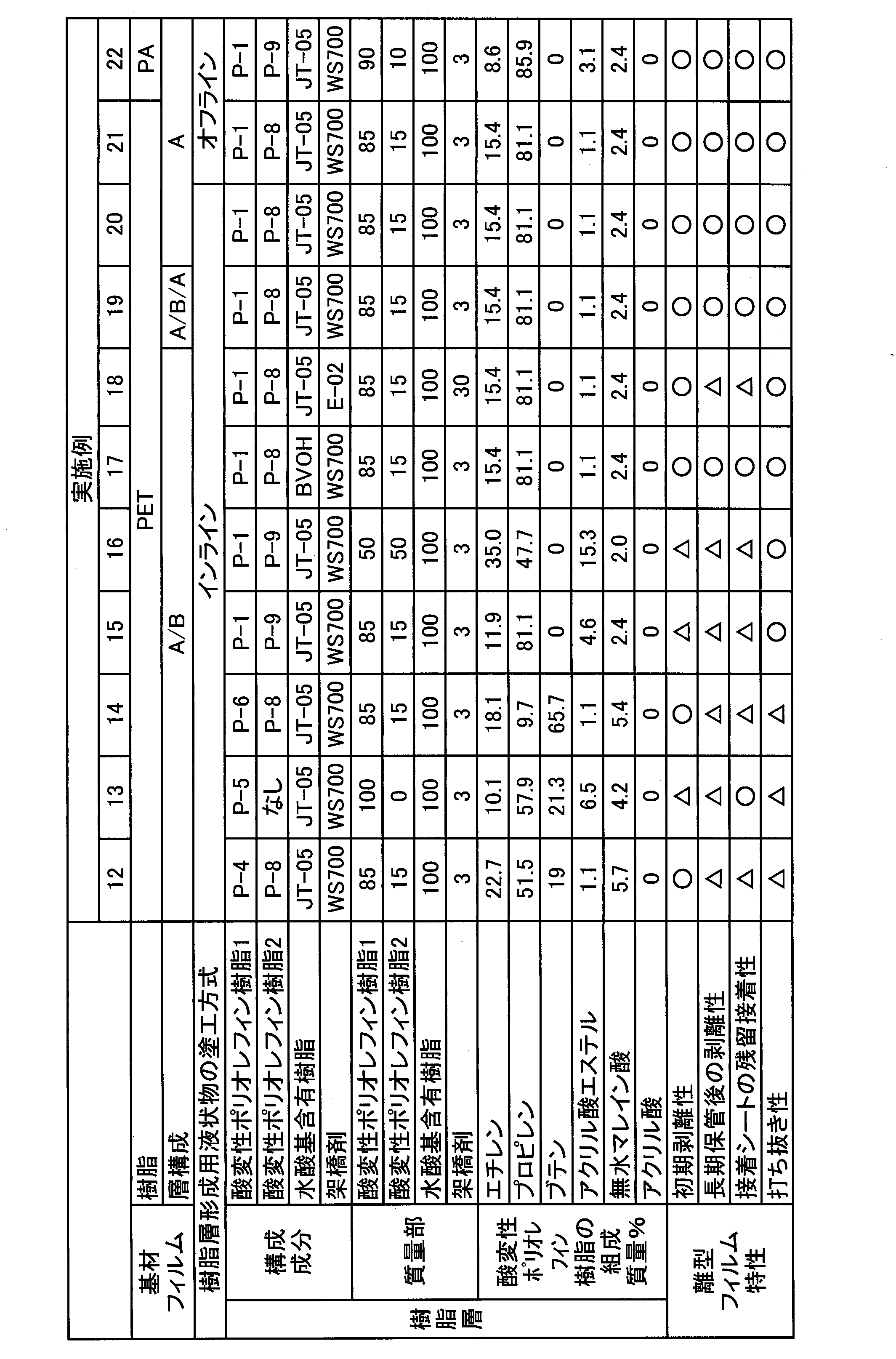
- Tables 2 to 4 show the structures and characteristics of the release films obtained in Examples 1 to 22 and Comparative Examples 1 to 8.
- the release films of Examples 1 to 22 were excellent in peelability even when they were attached to an adhesive sheet and stored at room temperature for a long time. Further, the adhesive sheet from which the release film was peeled was also excellent in the residual adhesiveness, and had an appropriate adhesive strength, so that it was excellent in punchability. Particularly in Examples 1, 3, 4, 8, 17, and 19 to 22, the mass ratio of the acid-modified component, propylene component, and acrylate component of the acid-modified polyolefin resin is in a suitable range, and the hydroxyl group-containing resin and the cross-linked resin Since the content of the agent is also suitable, it was excellent in peelability after long-term storage, residual adhesiveness of the adhesive sheet, and punchability.
- the release film of Comparative Example 1 since the acid-modified polyolefin resin constituting the resin layer did not contain an acrylate ester component, peeling was too light, so that floating occurred in the punching evaluation. Since the acid-modified polyolefin resin constituting the resin layer did not contain a propylene component, the release film of Comparative Example 2 could not be peeled off when attached to an adhesive sheet and stored at room temperature for a long time. In the release films of Comparative Examples 3 to 5, since the content of the hydroxyl group-containing resin is outside the range specified in the present invention, the release films cannot be peeled off when they are attached to an adhesive sheet and stored for a long time at room temperature.
- the residual adhesiveness was lowered.
- the content of the crosslinking agent deviates from the range specified in the present invention. Therefore, any release film can be peeled off when it is attached to an adhesive sheet and stored at room temperature for a long time.
- the residual adhesiveness was lowered.
- the release film of Comparative Example 6 was inferior in punchability.
Landscapes
- Laminated Bodies (AREA)
- Adhesive Tapes (AREA)
Abstract
Description
たとえば、特許文献1には、ポリエステルフィルムにポリプロピレン系変性ポリオレフィン樹脂を含有する樹脂層を設けてなる離型シートが開示されている。また、特許文献2には、ベースフィルムと接着剤からなる粘着シートに保護シート(離型フィルム)が積層されたカバーレイにおいて、打ち抜き性が良好な保護シート(離型フィルム)として、延伸ポリプロピレンフィルムとポリエチレンテレフタレートフィルムとが貼り合わされ、離型層が延伸ポリプロピレンフィルムであるものが開示されている。
この問題を解決する方法として、たとえば、特許文献3には、シリコーン系離型剤を用いる方法が提案されている。
また、特許文献3のシリコーン系離型剤を用いた離型フィルムは、粘着シートに貼り合わせて室温で長期保管しても、経時的に離型性が低下することがなく経時安定性に優れるが、シリコーン系離型剤の中に含まれる低分子量のシリコーン化合物が、粘着シートの粘着剤表面に移行して、残存することがあった。粘着シートの粘着剤表面に残存するシリコーン化合物は、粘着剤の粘着力の低下を起すだけでなく、印刷インクを弾いたり、電気の導通不良を引き起こす原因となる。このため、特にカバーレイや電磁波シールドフィルムなどの電子部品用の粘着シートに対しては、シリコーン類を一切使用しない「シリコーンフリー」の離型フィルムの開発が求められていた。
(1)基材フィルムの少なくとも一方の面に樹脂層を有する離型フィルムであって、
樹脂層が、酸変性ポリオレフィン樹脂100質量部、水酸基含有樹脂10~1000質量部、および架橋剤0.3~50質量部を含有し、
酸変性ポリオレフィン樹脂が、酸変性成分と、アクリル酸エステル成分と、オレフィン成分とを含有し、
オレフィン成分がプロピレン成分を含有することを特徴とする離型フィルム。
(2)酸変性ポリオレフィン樹脂における、アクリル酸エステル成分の含有量が10質量%以下であり、かつ、プロピレン成分の含有量が1~96質量%であることを特徴とする(1)記載の離型フィルム。
(3)酸変性ポリオレフィン樹脂における、アクリル酸エステル成分とプロピレン成分の含有量の質量比(アクリル酸エステル成分/プロピレン成分)が0.1/99.9~25.0/75.0であることを特徴とする(1)または(2)記載の離型フィルム。
(4)酸変性ポリオレフィン樹脂のオレフィン成分におけるプロピレン成分の含有量が50質量%以上であることを特徴とする(1)~(3)のいずれかに記載の離型フィルム。
(5)酸変性ポリオレフィン樹脂のオレフィン成分が1-ブテン成分を含有しないことを特徴とする(1)~(4)のいずれかに記載の離型フィルム。
(6)酸変性ポリオレフィン樹脂における、アクリル酸エステル成分とプロピレン成分の含有量の合計と酸変性成分の含有量との質量比((アクリル酸エステル成分+プロピレン成分)/酸変性成分)が99/1~95/5であることを特徴とする(1)~(5)のいずれかに記載の離型フィルム。
(7)樹脂層における、アクリル酸エステル成分とプロピレン成分の含有量の合計と架橋剤の含有量との質量比((アクリル酸エステル成分+プロピレン成分)/架橋剤)が99/1~90/10であることを特徴とする(1)~(6)のいずれかに記載の離型フィルム。
(8)酸変性ポリオレフィン樹脂は、酸変性成分およびアクリル酸エステル成分を含有する樹脂と、酸変性成分およびプロピレン成分を含有する樹脂との混合物であることを特徴とする(1)~(7)のいずれかに記載の離型フィルム。
(9)基材フィルムがポリエステルフィルムまたはポリアミドフィルムであり、樹脂層の厚みが0.01~1μmであることを特徴とする(1)~(8)のいずれかに記載の離型フィルム。
(10)硬化性樹脂の粘着剤を有する粘着シート用であることを特徴とする(1)~(9)のいずれかに記載の離型フィルム。
(11)電磁波シールドフィルム用途で用いることを特徴とする(1)~(10)のいずれかに記載の離型フィルム。
酸変性ポリオレフィン樹脂における、プロピレン成分の含有量は、離型性の点から、1~96質量%、1~92質量%、もしくは1~90質量%であることが好ましく、30~96質量%、30~92質量%、もしくは30~90質量%であることがより好ましく、40~96質量、40~92質量%、もしくは40~90質量%であることがさらに好ましく、50~96質量%、50~92質量%、もしくは50~90質量%であることが特に好ましい。
オレフィン成分におけるプロピレン成分の含有量は、得られる樹脂層に適度な剥離強度を付与することができるとともに、剥離力の経時的増加を抑制することができるため、50質量%以上であることが好ましい。
アクリル酸エステル成分は、酸変性成分と同様、分子内に極性基を有している。そのためアクリル酸エステル成分を酸変性ポリオレフィン樹脂中に含めることによって、粘着シートとの接着性や、基材フィルムとの密着性が高くなる。しかし、アクリル酸エステル成分量が多すぎると、オレフィン由来の樹脂の性質が失われ、粘着シートとの離型性が低下する可能性がある。酸変性ポリオレフィン樹脂における、アクリル酸エステル成分の含有量は、10質量%以下であることが好ましく、0.1~10質量%、0.1~8質量%であることがより好ましく、0.1~4質量%、0.3~10質量%、もしくは0.3~8質量%であることがさらに好ましく、0.3~4質量%であることが特に好ましい。
なお、アクリル酸エステル成分を含有しても、基材フィルムとの密着性以外に樹脂層が有する離型性を損ねることがない。
グラフト共重合に使用するラジカル発生剤としては、例えば、ジ-tert-ブチルパーオキシド、ジクミルパーオキシド、tert-ブチルヒドロパーオキシド、tert-ブチルクミルパーオキシド、ベンゾイルパーオキシド、ジラウリルパーオキシド、クメンハイドロパーオキシド、tert-ブチルパーオキシベンゾエート、メチルエチルケトンパーオキシド、ジ-tert-ブチルジパーフタレートなどの有機過酸化物類や、アゾビスイソブチロニトリルなどのアゾニトリル類が挙げられる。これらは、反応温度に基づいて適宜選択して使用すればよい。
水酸基含有樹脂は、後述のように液状物として使用する場合のために、水溶性を有していることが好ましい。
水酸基含有樹脂としてのポリビニルアルコールの平均重合度は、特に限定されるものではなく、例えば、200~5,000であり、樹脂層を形成するための液状物の安定性向上の観点からは、300~2,000であることが好ましい。
カルボジイミド化合物の具体例として、例えば、p-フェニレン-ビス(2,6-キシリルカルボジイミド)、テトラメチレン-ビス(t-ブチルカルボジイミド)、シクロヘキサン-1,4-ビス(メチレン-t-ブチルカルボジイミド)などのカルボジイミド基を有する化合物や、カルボジイミド基を有する重合体であるポリカルボジイミドが挙げられる。これらの1種または2種以上を用いることができる。これらの中でも、取り扱いやすさから、ポリカルボジイミドが好ましい。
ポリカルボジイミドの市販品としては、日清紡社製のカルボジライトシリーズが挙げられ、具体的には、水溶性タイプの「SV-02」、「V-02」、「V-02-L2」、「V-04」;エマルションタイプの「E-01」、「E-02」;有機溶液タイプの「V-01」、「V-03」、「V-07」、「V-09」;無溶剤タイプの「V-05」が挙げられる。
オキサゾリン化合物の具体例として、例えば、2,2′-ビス(2-オキサゾリン)、2,2′-エチレン-ビス(4,4′-ジメチル-2-オキサゾリン)、2,2′-p-フェニレン-ビス(2-オキサゾリン)、ビス(2-オキサゾリニルシクロヘキサン)スルフィドなどのオキサゾリン基を有する化合物や、オキサゾリン基含有ポリマーが挙げられる。これらの1種または2種以上を用いることができる。これらの中でも、取り扱いやすさからオキサゾリン基含有ポリマーが好ましい。
オキサゾリン基含有ポリマーの市販品としては、日本触媒社製のエポクロスシリーズが挙げられ、具体的には、水溶性タイプの「WS-500」、「WS-700」;エマルションタイプの「K-1010E」、「K-1020E」、「K-1030E」、「K-2010E」、「K-2020E」、「K-2030E」などが挙げられる。
P1/P0≦10 (1)
50≦P0≦200 (2)
粘着シートのウレタン系粘着剤表面が離型フィルムの樹脂層により汚染された場合、粘着シートの再粘着性が低下し、粘着シートとしての性能を損なう。したがって、残留接着率は高い方が好ましい。
基材フィルムとして多層フィルムを使用する場合、多層フィルムの外層のうち、樹脂層が設けられない層は、粗面化物質を含有することが好ましく、樹脂層が設けられる層は、粗面化物質を含有しないことが好ましい。粗面化物質としては例えば、二酸化ケイ素、炭酸カルシウム、カオリナイト、二酸化チタン、シリカアルミナ等の無機粒子や、シリコーンやポリメタクリル酸メチル、エチルビニルベンゼン等の有機粒子が挙げられる。樹脂層が設けられる層に粗面化物質を含有させないことにより、樹脂層を設けた層の表面粗さが小さくなる。また、樹脂層との界面および樹脂層表面へ粗面化物質がブリードアウトすることがなく、樹脂層と基材フィルムの密着性低下や、剥離時に粘着剤表面の汚染を防ぐことができる。
多層フィルムは、それぞれの層を構成する樹脂や樹脂組成物を別々に溶融して、複層ダイスを用いて押出し、固化前に積層融着させた後、二軸延伸、熱固定する方法や、2種以上のポリエステルを別々に溶融、押出してそれぞれフィルム化し、未延伸状態でまたは延伸後に、それらを積層融着させる方法などによって製造することができる。プロセスの簡便性から、複層ダイスを用い、固化前に積層融着させることが好ましい。
両親媒性有機溶剤とは、20℃における有機溶剤に対する水の溶解性が5質量%以上である有機溶剤をいう(20℃における有機溶剤に対する水の溶解性については、例えば「溶剤ハンドブック」(講談社サイエンティフィク、1990年第10版)等の文献に記載されている)。
両親媒性有機溶剤の具体例としては、メタノール、エタノール、n-プロパノール、イソプロパノール等のアルコール類、テトラヒドロフラン、1,4-ジオキサン等のエーテル類、アセトン、メチルエチルケトン等のケトン類、酢酸メチル、酢酸-n-プロピル、酢酸イソプロピル、プロピオン酸メチル、プロピオン酸エチル、炭酸ジメチル等のエステル類、エチレングリコール-n-ブチルエーテル等のエチレングリコール誘導体類、そのほか、アンモニアを含む、ジエチルアミン、トリエチルアミン、ジエタノールアミン、トリエタノールアミン、N,N-ジメチルエタノールアミン、N,N-ジエチルエタノールアミン等の有機アミン化合物、2-ピロリドン、N-メチル-2-ピロリドンなどのラクタム類等を挙げることができる。
酸変性ポリオレフィン樹脂の液状物としては、酸変性ポリオレフィン樹脂の水性分散体を用いることができる。酸変性ポリオレフィン樹脂を水性分散化する方法は、特に限定されないが、例えば、国際公開第02/055598号に記載された方法が挙げられる。
水性媒体中の酸変性ポリオレフィン樹脂の分散粒子径は、他の成分との混合時の安定性および混合後の保存安定性の点から、数平均粒子径が1μm以下であることが好ましく、0.8μm以下であることがより好ましい。このような粒径は、国際公開第02/055598号に記載の製法により達成可能である。なお、酸変性ポリオレフィン樹脂の数平均粒子径は動的光散乱法によって測定される。
酸変性ポリオレフィン樹脂の水性分散体の固形分濃度は、特に限定されるものではないが、水性分散体の粘性を適度に保つためには、1~60質量%が好ましく、5~30質量%がより好ましい。
樹脂層形成用液状物には、その性能が損なわれない範囲で、酸化防止剤、紫外線吸収剤、滑剤、着色剤などを添加することもできる。
なお、後述する各種の特性は、以下の方法によって測定または評価した。
酸変性ポリオレフィン樹脂の酸価をJIS K5407に準じて測定し、その値からカルボキシル基を有する酸変性成分の含有量を求めた。
オルトジクロロベンゼン(d4)中で、120℃にて1H-NMR、13C-NMR分析(バリアン社製、300MHz)を行い求めた。13C-NMR分析では、定量性を考慮したゲート付きデカップリング法を用いて測定した。
GPC分析(東ソー社製、HLC-8020、カラムはTSK-GEL)を用いて、試料をテトラヒドロフランに溶解して40℃で測定し、ポリスチレン標準試料で作成した検量線から重量平均分子量を求めた。テトラヒドロフランに溶解し難い場合はオルトジクロロベンゼンを用いた。
JIS K7210:1999記載の方法に準じて、190℃、2160g荷重で測定した。
酸変性ポリオレフィン樹脂の水性分散体を適量秤量し、これを150℃で残存物(固形分)の質量が恒量に達するまで加熱し、固形分濃度を求めた。
日機装社製、マイクロトラック粒度分布計UPA150(MODEL No.9340)を用い、数平均粒子径(mn)および重量平均粒子径(mw)を求めた。なお、樹脂の屈折率は1.5とした。
離型フィルムの樹脂層側に、巾50mm、長さ150mmのウレタン系熱硬化性接着シート(トーヨーケム社製、LIOELM TSU0041SI-25DL)とポリイミドフィルム(東レ・デュポン社製、Kapton300H)をこの順になるように、ゴムロールを用いて温度80℃、線圧1.5kg/300mm、速度1m/minで圧着して、試料とした。試料を、金属板/ゴム板/試料/ゴム板/金属板の形で挟み、2kPa荷重、70℃の雰囲気で20時間放置し、その後30分以上冷却して常温に戻して、剥離強度測定用試料を得た。25℃の恒温室で、この剥離強度測定用試料のウレタン系熱硬化性接着シートと離型フィルムとを剥離して、下記の基準で初期剥離性を評価した。
○:抵抗なくスムーズに剥離することができる。
△:抵抗があるが、少し力をいれると剥離できる。
×:剥離しようとすると破断するか、または剥離できない。
上記(7)で示した方法で作製した剥離強度測定用試料を25℃の恒温室で30日間保管した後、25℃の恒温室で、この剥離強度測定用試料のウレタン系熱硬化性接着シートと離型フィルムとを剥離し、上記(7)の基準で長期保管後の剥離性を評価した。
上記(8)長期保管後のウレタン系熱硬化性接着シートとの剥離性の試験により離型フィルム表面から剥離したポリイミドフィルム上のウレタン系熱硬化性接着シートを、二軸延伸ポリエステル樹脂フィルム(ユニチカ社製、エンブレットPET-12、厚さ12μm)のコロナ処理面に貼付し、2kPa荷重、室温で20時間放置した。その後、25℃の恒温室で、ウレタン系熱硬化性接着シートと二軸延伸ポリエステル樹脂フィルムとを剥離して接着性を評価した。
一方、二軸延伸ポリエステル樹脂フィルムのコロナ処理面に、巾50mm、長さ150mmの未使用のウレタン系熱硬化性接着シートとポリイミドフィルムをこの順になるように貼付し、2kPa荷重、室温で20時間放置した。その後、25℃の恒温室で、ウレタン系熱硬化性接着シートと二軸延伸ポリエステル樹脂フィルムとを剥離して接着性を評価した。
前者の接着性を後者の接着性と比較して、離型フィルム表面から剥離したウレタン系熱硬化性接着シートの残留接着性を評価した。
○:80%以上
△:70%以上、80%未満
×:70%未満
上記(7)で示した方法で作製した剥離強度測定用試料のポリイミドフィルム側からハーフカットを行い、離型フィルムに発生した浮きを、カットした部分からの寸法を測定することにより、打ち抜き性を評価した。浮きの幅が2mm未満のときを「○」、2mm以上、4mm未満のときを「△」、4mm以上のときを「×」と評価した。
プロピレン-エチレン共重合体(プロピレン/エチレン=95.5/2.0質量比)280gを、4つ口フラスコ中において、窒素雰囲気下で加熱溶融させた。その後、系内温度を170℃に保って、撹拌下、不飽和カルボン酸としての無水マレイン酸10.0gとラジカル発生剤としてのジクミルパーオキサイド6.0gとをそれぞれ1時間かけて加え、その後1時間反応させた。反応終了後、得られた反応物を多量のアセトン中に投入し、樹脂を析出させた。この樹脂をさらにアセトンで数回洗浄し、未反応の無水マレイン酸を除去した後、減圧乾燥機中で減圧乾燥して、酸変性ポリオレフィン樹脂「P-1」を得た。得られた樹脂の特性を表1に示す。
ポリプロピレン280gを、4つ口フラスコ中において、窒素雰囲気下で加熱溶融させた。その後、系内温度を170℃に保って、撹拌下、不飽和カルボン酸としての無水マレイン酸12.0gとラジカル発生剤としてのジクミルパーオキサイド6.0gとをそれぞれ1時間かけて加え、その後1時間反応させた。反応終了後、得られた反応物を多量のアセトン中に投入し、樹脂を析出させた。この樹脂をさらにアセトンで数回洗浄し、未反応の無水マレイン酸を除去した後、減圧乾燥機中で減圧乾燥して、酸変性ポリオレフィン樹脂「P-2」を得た。得られた樹脂の特性を表1に示す。
プロピレン-エチレン共重合体(プロピレン/エチレン=81.8/18.2質量%、重量平均分子量85,000)280gを、4つ口フラスコ中において、窒素雰囲気下で加熱溶融させた。その後、系内温度を180℃に保って、撹拌下、不飽和カルボン酸としての無水マレイン酸35.0gとラジカル発生剤としてのジ-t-ブチルパーオキサイド6.0gとをそれぞれ2時間かけて加え、その後1時間反応させた。反応終了後、得られた反応物を多量のアセトン中に投入し、樹脂を析出させた。この樹脂をさらにアセトンで数回洗浄し、未反応の無水マレイン酸を除去した後、減圧乾燥機中で減圧乾燥して、酸変性ポリオレフィン樹脂「P-3」を得た。得られた樹脂の特性を表1に示す。
プロピレン-ブテン-エチレン三元共重合体(ヒュルスジャパン社製、ベストプラスト708、プロピレン/ブテン/エチレン=64.8/23.9/11.3質量%)280gを、4つ口フラスコ中において、窒素雰囲気下で加熱溶融させた。その後、系内温度を170℃に保って、撹拌下、不飽和カルボン酸としての無水マレイン酸32.0gとラジカル発生剤としてのジクミルパーオキサイド6.0gとをそれぞれ1時間かけて加え、その後1時間反応させた。反応終了後、得られた反応物を多量のアセトン中に投入し、樹脂を析出させた。この樹脂をさらにアセトンで数回洗浄し、未反応の無水マレイン酸を除去した後、減圧乾燥機中で減圧乾燥して、酸変性ポリオレフィン樹脂「P-4」を得た。得られた樹脂の特性を表1に示す。
プロピレン-ブテン-エチレン三元共重合体(ヒュルスジャパン社製、ベストプラスト708、プロピレン/ブテン/エチレン=64.8/23.9/11.3質量%)100g、トルエン500gを、撹拌機と冷却管と滴下ロートとを取り付けた4つ口フラスコ中において、窒素雰囲気下で加熱溶融させた。その後、系内温度を110℃に保って、撹拌下、ラジカル発生剤としてジクミルパーオキサイド1.0gのヘプタン20g溶液を1時間かけて加えた。その後、不飽和カルボン酸として無水マレイン酸7.0g、アクリル酸ラウリル10.0g、ジクミルパーオキサイド0.5gのヘプタン10g溶液をそれぞれ1時間かけて滴下し、その後30分間反応させた。反応終了後、室温まで冷却し、その後、得られた反応物を多量のアセトン中に投入し、樹脂を析出させた。この樹脂をさらにアセトンで数回洗浄し、未反応物を除去した後、減圧乾燥機中で減圧乾燥して酸変性ポリオレフィン樹脂「P-5」を得た。得られた樹脂の特性を表1に示す。
プロピレン-ブテン-エチレン三元共重合体(ヒュルスジャパン社製、ベストプラスト408、プロピレン/ブテン/エチレン=12.3/82.2/5.5質量%)を用いた以外は酸変性ポリオレフィン樹脂「P-4」と同様にして、酸変性ポリオレフィン樹脂「P-6」を得た。得られた樹脂の特性を表1に示す。
酸変性ポリオレフィン樹脂「P-7」:ダウケミカル社製、プリマコール5980I
酸変性ポリオレフィン樹脂「P-8」:アルケマ社製、ボンダインLX-4110
酸変性ポリオレフィン樹脂「P-9」:アルケマ社製、ボンダインAX-8390

ヒーター付きの密閉できる耐圧1L容ガラス容器を備えた撹拌機を用いて、60.0gの酸変性ポリオレフィン樹脂「P-1」、60.0gのエチレングリコール-n-ブチルエーテル、4.5gのN,N-ジメチルエタノールアミンおよび188.1gの蒸留水を上記のガラス容器内に仕込んだ。そして、撹拌翼の回転速度を300rpmとして撹拌したところ、容器底部には樹脂の沈澱は認められず、浮遊状態となっていることが確認された。そこでこの状態を保ちつつ、10分後にヒーターの電源を入れ加熱した。そして系内温度を140℃に保ってさらに60分間撹拌した。その後、空冷にて、回転速度300rpmのまま撹拌しつつ室温(約25℃)まで冷却した。その後、300メッシュのステンレス製フィルター(線径0.035mm、平織)で加圧濾過(空気圧0.2MPa)し、乳白色の均一な酸変性ポリオレフィン樹脂水性分散体「E-1」を得た。なお、フィルター上には残存樹脂は殆どなかった。
ヒーター付きの密閉できる耐圧1L容ガラス容器を備えた撹拌機を用いて、60.0gの酸変性ポリオレフィン樹脂「P-2」、60.0gのエチレングリコール-n-ブチルエーテル、5.0gのN,N-ジメチルエタノールアミンおよび188.1gの蒸留水を上記のガラス容器内に仕込んだ。そして、撹拌翼の回転速度を300rpmとして撹拌したところ、容器底部には樹脂の沈澱は認められず、浮遊状態となっていることが確認された。そこでこの状態を保ちつつ、10分後にヒーターの電源を入れ加熱した。そして系内温度を140℃に保ってさらに60分間撹拌した。その後、空冷にて、回転速度300rpmのまま撹拌しつつ室温(約25℃)まで冷却した。その後、300メッシュのステンレス製フィルター(線径0.035mm、平織)で加圧濾過(空気圧0.2MPa)し、乳白色の均一な酸変性ポリオレフィン樹脂水性分散体「E-2」を得た。なお、フィルター上には残存樹脂は殆どなかった。
ヒーター付きの密閉できる耐圧1L容ガラス容器を備えた撹拌機を用いて、60.0gの酸変性ポリオレフィン樹脂「P-3」、45.0gのエチレングリコール-n-ブチルエーテル、6.9gのN,N-ジメチルエタノールアミンおよび188.1gの蒸留水を上記のガラス容器内に仕込んだ。そして、撹拌翼の回転速度を300rpmとして撹拌したところ、容器底部には樹脂の沈澱は認められず、浮遊状態となっていることが確認された。そこでこの状態を保ちつつ、10分後にヒーターの電源を入れ加熱した。そして系内温度を140℃に保ってさらに60分間撹拌した。その後、空冷にて、回転速度300rpmのまま撹拌しつつ室温(約25℃)まで冷却した。その後、300メッシュのステンレス製フィルター(線径0.035mm、平織)で加圧濾過(空気圧0.2MPa)し、乳白黄色の均一な酸変性ポリオレフィン樹脂水性分散体「E-3」を得た。なお、フィルター上には残存樹脂は殆どなかった。
酸変性ポリオレフィン樹脂として「P-4」、「P-6」を用いた以外は「E-3」と同様にして、水性分散体「E-4」、「E-6」を得た。
ヒーター付きの密閉できる耐圧1L容ガラス容器を備えた撹拌機を用いて、60.0gの酸変性ポリオレフィン樹脂「P-5」、90.0gのn-プロパノール、6.2gのトリエチルアミンおよび143.8gの蒸留水をガラス容器内に仕込んだ。そして、撹拌翼の回転速度を300rpmとして撹拌したところ、容器底部には樹脂の沈澱は認められず、浮遊状態となっていることが確認された。そこでこの状態を保ちつつ、10分後にヒーターの電源を入れ加熱した。そして系内温度を140℃に保ってさらに60分間撹拌した。その後、空冷にて、回転速度300rpmのまま撹拌しつつ室温(約25℃)まで冷却した後、300メッシュのステンレス製フィルター(線径0.035mm、平織)で加圧濾過(空気圧0.2MPa)し、乳白黄色の均一な酸変性ポリオレフィン樹脂水性分散体「E-5」を得た。
ポリオレフィン樹脂としてエチレン-アクリル酸共重合体樹脂(P-7、ダウケミカル製 プリマコール5980I、アクリル酸20質量%共重合体)を用いた。ヒーター付きの密閉できる耐圧1リットル容ガラス容器を備えた撹拌機を用いて、60.0gのプリマコール5980I、16.8gのトリエチルアミン、および223.2gの蒸留水をガラス容器内に仕込み、撹拌翼の回転速度を300rpmとして撹拌したところ、容器底部には樹脂粒状物の沈澱は認められず、浮遊状態となっていることが確認された。そこでこの状態を保ちつつ、10分後にヒーターの電源を入れ加熱した。そして系内温度を120℃に保ってさらに40分間撹拌した。その後、空冷にて、回転速度300rpmのまま攪拌しつつ室温(約25℃)まで冷却した後、300メッシュのステンレス製フィルター(線径0.035mm、平織)で加圧濾過(空気圧0.2MPa)し、微白濁の酸変性ポリオレフィン樹脂水性分散体「E-7」を得た。
ヒーター付きの密閉できる耐圧1リットル容ガラス容器を備えた撹拌機を用いて、60.0gの酸変性ポリオレフィン樹脂(P-8、アルケマ社製、ボンダインLX-4110)、75.0gのn-プロパノール、2.5gのトリエチルアミンおよび162.5gの蒸留水をガラス容器内に仕込み、撹拌翼の回転速度を300rpmとして撹拌したところ、容器底部には樹脂粒状物の沈澱は認められず、浮遊状態となっていることが確認された。そこでこの状態を保ちつつ、10分後にヒーターの電源を入れ加熱した。そして系内温度を120℃に保ってさらに20分間撹拌した。その後、空冷にて、回転速度300rpmのまま攪拌しつつ室温(約25℃)まで冷却した後、300メッシュのステンレス製フィルター(線径0.035mm、平織)で加圧濾過(空気圧0.2MPa)し、乳白色の均一な酸変性ポリオレフィン樹脂水性分散体「E-8」を得た。
ヒーター付きの密閉できる耐圧1リットル容ガラス容器を備えた撹拌機を用いて、60.0gの酸変性ポリオレフィン樹脂(P-9、アルケマ社製、ボンダインAX-8390)、100.0gのn-プロパノール、2.5gのトリエチルアミンおよび137.5gの蒸留水をガラス容器内に仕込み、撹拌翼の回転速度を300rpmとして撹拌したところ、容器底部には樹脂粒状物の沈澱は認められず、浮遊状態となっていることが確認された。そこでこの状態を保ちつつ、10分後にヒーターの電源を入れ加熱した。そして系内温度を120℃に保ってさらに20分間撹拌した。その後、空冷にて、回転速度300rpmのまま攪拌しつつ室温(約25℃)まで冷却した後、300メッシュのステンレス製フィルター(線径0.035mm、平織)で加圧濾過(空気圧0.2MPa)し、乳白色の均一な酸変性ポリオレフィン樹脂水性分散体「E-9」を得た。
(1)ポリビニルアルコール水溶液(OH-1)
水酸基含有樹脂としてポリビニルアルコール(日本酢ビ・ポバール社製、JT-05、重合度500、ケン化度94%)を用いた。8gのJT-05を92gの水中に添加し、室温で30分撹拌した後、90℃まで昇温し、さらに30分撹拌した後、室温まで冷却して8質量%のポリビニルアルコール水溶液(OH-1)を得た。
(2)ブテンジオール-ビニルアルコール共重合樹脂(BVOH)水溶液
水酸基含有樹脂としてJT-05の代わりにブテンジオール-ビニルアルコール共重合樹脂(日本合成化学社製、OKS-8049P)を用いた以外は上記(OH-1)と同様にして8質量%ブテンジオール-ビニルアルコール共重合樹脂(BVOH)水溶液(OH-2)を得た。
酸変性ポリオレフィン樹脂の水性分散体「E-1」と「E-8」と、ポリビニルアルコール水溶液「OH-1」とオキサゾリン化合物の水性溶液(日本触媒社製、エポクロスWS-700、固形分濃度25質量%)を各成分の固形分比率が表2に示した値となるように混合して、樹脂層形成用液状物を得た。
ポリエチレンテレフタレート(日本エステル社製、UT-UBR、固有粘度:0.62、ガラス転移温度:78℃、融点:255℃)をスクリュー径90mmの押出機に投入して280℃で溶融したA層形成用の樹脂と、シリカ粒子(日揮触媒社製、OSCAL(EN-5001SIV)、粒径1.0μm)を含有量が0.030質量%になるように添加したポリエチレンテレフタレート(固有粘度:0.62、ガラス転移温度:78℃、融点:255℃)をスクリュー径65mmの押出機に投入して280℃で溶融したB層形成用の樹脂とを、2層フィードブロック内で合流させ、総厚みが380μm、厚みの比(A層/B層)が22/3となるよう調整してTダイ出口より押出し、急冷固化してA層とB層とからなる未延伸フィルムを得た。
この未延伸フィルムをロール式縦延伸機で85℃の条件下、3.5倍に延伸し、その後、樹脂層形成用液状物を2.7g/m2となるように、A層表面に塗布し、50℃の熱風乾燥炉を20秒通過させた。
その後、連続的にシート端部をフラット式延伸機のクリップに把持させ、100℃の条件下、横4.5倍に延伸を施し、その後、横方向の弛緩率を3%として、200~210℃で2秒間以上熱処理した後で、230℃で3秒間の熱処理を施して、厚さ25μmの2軸延伸ポリエステルフィルムの一方の面に、厚さ0.05μmの樹脂層が設けられた離型フィルムを得た。
樹脂層形成用液状物の組成を変更して、樹脂層の組成が表2~4の記載になるようした以外は実施例1と同様にして、離型フィルムを得た。
なお、実施例19においては、基材フィルムを層の厚み比(A層/B層/A層)が2/6/2である2種3層に変更し、実施例20においては、基材フィルムを層の厚み比(A層/B層)が10/0である単層に変更した。
実施例1で調製した樹脂層形成用液状物を、二軸延伸ポリエステルフィルム(ユニチカ社製、エンブレットPET-38、厚さ38μm)のコロナ処理面に、マイヤーバーを用いて塗布した後、120℃で30秒間乾燥させて、厚さ0.5μmの樹脂層をフィルム上に形成させたのち、50℃で2日間エージングを行うことで離型フィルムを得た。
実施例1で調製した樹脂層形成用液状物を、ポリアミドフィルム(ユニチカ社製、EX25、厚さ25μm)のコロナ処理面に、マイヤーバーを用いて塗布した後、120℃で30秒間乾燥させて、厚さ0.5μmの樹脂層をフィルム上に形成させたのち、50℃で2日間エージングを行うことで離型フィルムを得た。
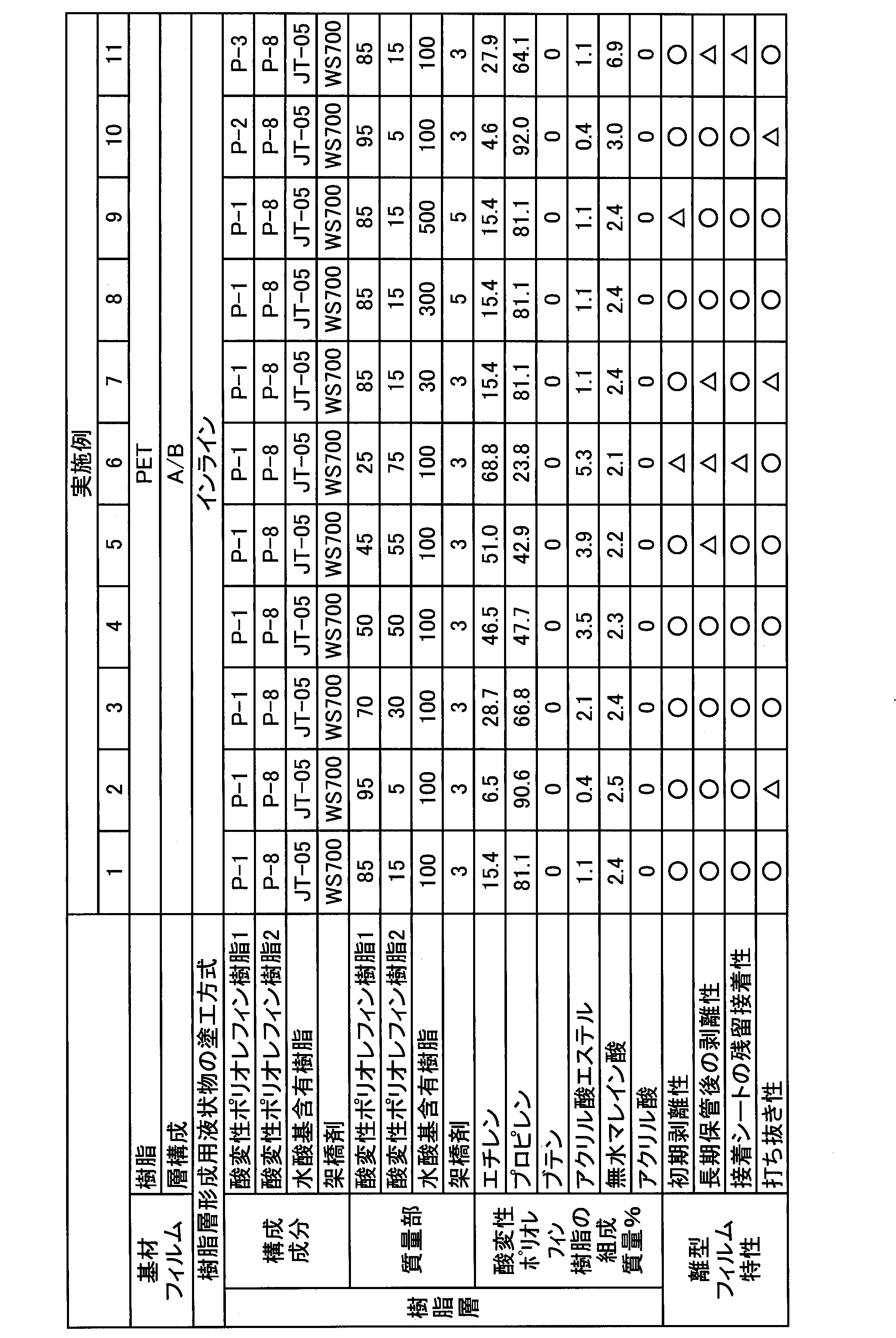
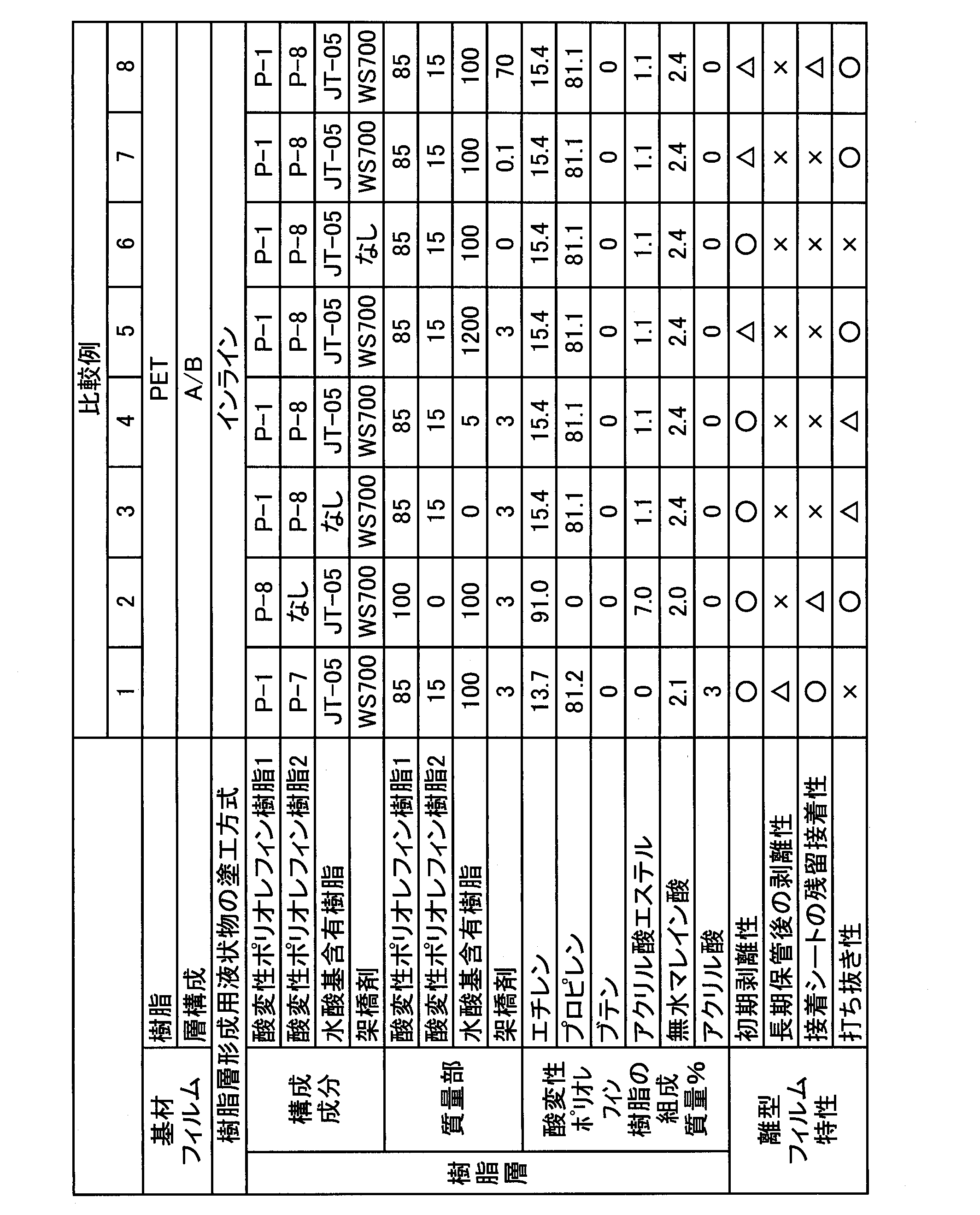
一方、比較例1の離型フィルムは、樹脂層を構成する酸変性ポリオレフィン樹脂がアクリル酸エステル成分を含有しないため、剥離が軽すぎるため、打ち抜き性評価で浮きが生じた。
比較例2の離型フィルムは、樹脂層を構成する酸変性ポリオレフィン樹脂がプロピレン成分を含有しないため、接着シートに貼り付けて室温で長期保管した場合に剥離できなかった。
比較例3~5の離型フィルムは、水酸基含有樹脂の含有量がそれぞれ本発明で規定する範囲から外れるため、接着シートに貼り付けて室温で長期保管した場合に剥離できず、離型フィルムを剥離した粘着シートにおいても、残留接着性が低下した。
比較例6~8の離型フィルムは、架橋剤の含有量が、それぞれ本発明で規定する範囲から外れるため、いずれの離型フィルムも接着シートに貼り付けて室温で長期保管した場合に剥離できず、離型フィルムを剥離した粘着シートにおいても、残留接着性が低下した。比較例6の離型フィルムにおいては打ち抜き性についても劣っていた。
Claims (11)
- 基材フィルムの少なくとも一方の面に樹脂層を有する離型フィルムであって、
樹脂層が、酸変性ポリオレフィン樹脂100質量部、水酸基含有樹脂10~1000質量部、および架橋剤0.3~50質量部を含有し、
酸変性ポリオレフィン樹脂が、酸変性成分と、アクリル酸エステル成分と、オレフィン成分とを含有し、
オレフィン成分がプロピレン成分を含有することを特徴とする離型フィルム。 - 酸変性ポリオレフィン樹脂における、アクリル酸エステル成分の含有量が10質量%以下であり、かつ、プロピレン成分の含有量が1~96質量%であることを特徴とする請求項1記載の離型フィルム。
- 酸変性ポリオレフィン樹脂における、アクリル酸エステル成分とプロピレン成分の含有量の質量比(アクリル酸エステル成分/プロピレン成分)が0.1/99.9~25.0/75.0であることを特徴とする請求項1または2記載の離型フィルム。
- 酸変性ポリオレフィン樹脂のオレフィン成分におけるプロピレン成分の含有量が50質量%以上であることを特徴とする請求項1~3のいずれかに記載の離型フィルム。
- 酸変性ポリオレフィン樹脂のオレフィン成分が1-ブテン成分を含有しないことを特徴とする請求項1~4のいずれかに記載の離型フィルム。
- 酸変性ポリオレフィン樹脂における、アクリル酸エステル成分とプロピレン成分の含有量の合計と酸変性成分の含有量との質量比((アクリル酸エステル成分+プロピレン成分)/酸変性成分)が99/1~95/5であることを特徴とする請求項1~5のいずれかに記載の離型フィルム。
- 樹脂層における、アクリル酸エステル成分とプロピレン成分の含有量の合計と架橋剤の含有量との質量比((アクリル酸エステル成分+プロピレン成分)/架橋剤)が99/1~90/10であることを特徴とする請求項1~6のいずれかに記載の離型フィルム。
- 酸変性ポリオレフィン樹脂は、酸変性成分およびアクリル酸エステル成分を含有する樹脂と、酸変性成分およびプロピレン成分を含有する樹脂との混合物であることを特徴とする請求項1~7のいずれかに記載の離型フィルム。
- 基材フィルムがポリエステルフィルムまたはポリアミドフィルムであり、樹脂層の厚みが0.01~1μmであることを特徴とする請求項1~8のいずれかに記載の離型フィルム。
- 硬化性樹脂の粘着剤を有する粘着シート用であることを特徴とする請求項1~9のいずれかに記載の離型フィルム。
- 電磁波シールドフィルム用途で用いることを特徴とする請求項1~10のいずれかに記載の離型フィルム。
Priority Applications (4)
| Application Number | Priority Date | Filing Date | Title |
|---|---|---|---|
| CN201780009581.7A CN108602338B (zh) | 2016-02-05 | 2017-02-03 | 脱模膜 |
| JP2017558029A JP6301032B2 (ja) | 2016-02-05 | 2017-02-03 | 離型フィルム |
| KR1020187017324A KR102602354B1 (ko) | 2016-02-05 | 2017-02-03 | 이형 필름 |
| HK18113660.2A HK1254679A1 (zh) | 2016-02-05 | 2017-02-03 | 脱模膜 |
Applications Claiming Priority (4)
| Application Number | Priority Date | Filing Date | Title |
|---|---|---|---|
| JP2016020425 | 2016-02-05 | ||
| JP2016-020425 | 2016-02-05 | ||
| JP2016168707 | 2016-08-31 | ||
| JP2016-168707 | 2016-08-31 |
Publications (1)
| Publication Number | Publication Date |
|---|---|
| WO2017135423A1 true WO2017135423A1 (ja) | 2017-08-10 |
Family
ID=59500790
Family Applications (1)
| Application Number | Title | Priority Date | Filing Date |
|---|---|---|---|
| PCT/JP2017/004023 Ceased WO2017135423A1 (ja) | 2016-02-05 | 2017-02-03 | 離型フィルム |
Country Status (6)
| Country | Link |
|---|---|
| JP (1) | JP6301032B2 (ja) |
| KR (1) | KR102602354B1 (ja) |
| CN (1) | CN108602338B (ja) |
| HK (1) | HK1254679A1 (ja) |
| TW (1) | TWI715717B (ja) |
| WO (1) | WO2017135423A1 (ja) |
Cited By (2)
| Publication number | Priority date | Publication date | Assignee | Title |
|---|---|---|---|---|
| WO2018062266A1 (ja) * | 2016-09-30 | 2018-04-05 | ユニチカ株式会社 | 離型シート |
| WO2020129962A1 (ja) * | 2018-12-20 | 2020-06-25 | 東洋紡株式会社 | 離型フィルム |
Families Citing this family (1)
| Publication number | Priority date | Publication date | Assignee | Title |
|---|---|---|---|---|
| CN113733698A (zh) * | 2021-08-20 | 2021-12-03 | 江苏澳盛复合材料科技有限公司 | 一种聚丙烯离型薄膜及其方法 |
Citations (5)
| Publication number | Priority date | Publication date | Assignee | Title |
|---|---|---|---|---|
| JP2011020351A (ja) * | 2009-07-16 | 2011-02-03 | Unitika Ltd | 転写シート |
| WO2012105341A1 (ja) * | 2011-02-04 | 2012-08-09 | 日東電工株式会社 | 剥離剤、離型材および粘着テープ |
| JP2013099907A (ja) * | 2011-11-10 | 2013-05-23 | Unitika Ltd | ドライフィルムレジスト用ベースフィルムおよびそれを用いた積層体 |
| WO2014109341A1 (ja) * | 2013-01-11 | 2014-07-17 | ユニチカ株式会社 | 離型フィルムおよびその製造方法 |
| JP2015189014A (ja) * | 2014-03-27 | 2015-11-02 | ユニチカ株式会社 | 離型フィルム |
Family Cites Families (3)
| Publication number | Priority date | Publication date | Assignee | Title |
|---|---|---|---|---|
| JPH0641502A (ja) | 1992-07-23 | 1994-02-15 | Toray Ind Inc | カバーレイ |
| JPH1016164A (ja) | 1996-07-08 | 1998-01-20 | Teijin Ltd | 離形フイルム |
| JP4815745B2 (ja) * | 2003-01-30 | 2011-11-16 | 三菱樹脂株式会社 | 離型剤溶液および離型フィルム |
-
2017
- 2017-02-03 TW TW106103872A patent/TWI715717B/zh active
- 2017-02-03 WO PCT/JP2017/004023 patent/WO2017135423A1/ja not_active Ceased
- 2017-02-03 CN CN201780009581.7A patent/CN108602338B/zh active Active
- 2017-02-03 HK HK18113660.2A patent/HK1254679A1/zh unknown
- 2017-02-03 KR KR1020187017324A patent/KR102602354B1/ko active Active
- 2017-02-03 JP JP2017558029A patent/JP6301032B2/ja active Active
Patent Citations (5)
| Publication number | Priority date | Publication date | Assignee | Title |
|---|---|---|---|---|
| JP2011020351A (ja) * | 2009-07-16 | 2011-02-03 | Unitika Ltd | 転写シート |
| WO2012105341A1 (ja) * | 2011-02-04 | 2012-08-09 | 日東電工株式会社 | 剥離剤、離型材および粘着テープ |
| JP2013099907A (ja) * | 2011-11-10 | 2013-05-23 | Unitika Ltd | ドライフィルムレジスト用ベースフィルムおよびそれを用いた積層体 |
| WO2014109341A1 (ja) * | 2013-01-11 | 2014-07-17 | ユニチカ株式会社 | 離型フィルムおよびその製造方法 |
| JP2015189014A (ja) * | 2014-03-27 | 2015-11-02 | ユニチカ株式会社 | 離型フィルム |
Cited By (3)
| Publication number | Priority date | Publication date | Assignee | Title |
|---|---|---|---|---|
| WO2018062266A1 (ja) * | 2016-09-30 | 2018-04-05 | ユニチカ株式会社 | 離型シート |
| JP6328362B1 (ja) * | 2016-09-30 | 2018-05-23 | ユニチカ株式会社 | 離型シート |
| WO2020129962A1 (ja) * | 2018-12-20 | 2020-06-25 | 東洋紡株式会社 | 離型フィルム |
Also Published As
| Publication number | Publication date |
|---|---|
| TWI715717B (zh) | 2021-01-11 |
| CN108602338B (zh) | 2020-08-28 |
| TW201739852A (zh) | 2017-11-16 |
| HK1254679A1 (zh) | 2019-07-26 |
| KR20180111777A (ko) | 2018-10-11 |
| CN108602338A (zh) | 2018-09-28 |
| JP6301032B2 (ja) | 2018-03-28 |
| KR102602354B1 (ko) | 2023-11-16 |
| JPWO2017135423A1 (ja) | 2018-02-22 |
Similar Documents
| Publication | Publication Date | Title |
|---|---|---|
| JP5111508B2 (ja) | 離型用シート | |
| JP5697808B2 (ja) | 離型フィルムおよびその製造方法 | |
| JP5774857B2 (ja) | 易滑性ポリエステルフィルムおよびその製造方法 | |
| JP7106112B2 (ja) | 離型フィルムおよびその製造方法 | |
| JP6301032B2 (ja) | 離型フィルム | |
| JP2020055307A (ja) | 離型フィルム | |
| JP5653123B2 (ja) | 離型用シート | |
| JP5254698B2 (ja) | 離型用シート | |
| JP2014054811A (ja) | 離型シートおよびその製造方法 | |
| JP2013184462A (ja) | 離型シートおよびその製造方法 | |
| JP7493740B2 (ja) | 離型フィルムおよびその製造方法 | |
| JP2020069664A (ja) | 離型シートおよびその製造方法 | |
| JP2018161797A (ja) | 離型フィルム | |
| JP2021054046A (ja) | 感光性樹脂用離型フィルム、感光性樹脂積層フィルムおよび感光性樹脂構成体 | |
| JP2017057257A (ja) | ポリオレフィン樹脂水性分散体、離型シート、及び離型シートの製造方法 | |
| JP2017007280A (ja) | 離型シート | |
| WO2023163076A1 (ja) | 表面改質シート、積層体、表面改質部材、塗装物、接合体、表面改質部材の製造方法、塗装物の製造方法、及び接合体の製造方法 | |
| JP2013184461A (ja) | 離型シートおよびその製造方法 | |
| HK40001267B (zh) | 脱模膜及其制造方法 | |
| JP2014133420A (ja) | 易滑性ポリエステルフィルムの製造方法 | |
| JP2016065169A (ja) | 粘着剤積層体 |
Legal Events
| Date | Code | Title | Description |
|---|---|---|---|
| 121 | Ep: the epo has been informed by wipo that ep was designated in this application |
Ref document number: 17747574 Country of ref document: EP Kind code of ref document: A1 |
|
| ENP | Entry into the national phase |
Ref document number: 2017558029 Country of ref document: JP Kind code of ref document: A |
|
| ENP | Entry into the national phase |
Ref document number: 20187017324 Country of ref document: KR Kind code of ref document: A |
|
| NENP | Non-entry into the national phase |
Ref country code: DE |
|
| 122 | Ep: pct application non-entry in european phase |
Ref document number: 17747574 Country of ref document: EP Kind code of ref document: A1 |