WO2017104665A1 - 導電性粘着テープ - Google Patents
導電性粘着テープ Download PDFInfo
- Publication number
- WO2017104665A1 WO2017104665A1 PCT/JP2016/087070 JP2016087070W WO2017104665A1 WO 2017104665 A1 WO2017104665 A1 WO 2017104665A1 JP 2016087070 W JP2016087070 W JP 2016087070W WO 2017104665 A1 WO2017104665 A1 WO 2017104665A1
- Authority
- WO
- WIPO (PCT)
- Prior art keywords
- conductive
- particles
- pressure
- adhesive tape
- meth
- Prior art date
- Legal status (The legal status is an assumption and is not a legal conclusion. Google has not performed a legal analysis and makes no representation as to the accuracy of the status listed.)
- Ceased
Links
Images
Classifications
-
- C—CHEMISTRY; METALLURGY
- C09—DYES; PAINTS; POLISHES; NATURAL RESINS; ADHESIVES; COMPOSITIONS NOT OTHERWISE PROVIDED FOR; APPLICATIONS OF MATERIALS NOT OTHERWISE PROVIDED FOR
- C09J—ADHESIVES; NON-MECHANICAL ASPECTS OF ADHESIVE PROCESSES IN GENERAL; ADHESIVE PROCESSES NOT PROVIDED FOR ELSEWHERE; USE OF MATERIALS AS ADHESIVES
- C09J9/00—Adhesives characterised by their physical nature or the effects produced, e.g. glue sticks
- C09J9/02—Electrically-conducting adhesives
-
- C—CHEMISTRY; METALLURGY
- C09—DYES; PAINTS; POLISHES; NATURAL RESINS; ADHESIVES; COMPOSITIONS NOT OTHERWISE PROVIDED FOR; APPLICATIONS OF MATERIALS NOT OTHERWISE PROVIDED FOR
- C09J—ADHESIVES; NON-MECHANICAL ASPECTS OF ADHESIVE PROCESSES IN GENERAL; ADHESIVE PROCESSES NOT PROVIDED FOR ELSEWHERE; USE OF MATERIALS AS ADHESIVES
- C09J11/00—Features of adhesives not provided for in group C09J9/00, e.g. additives
- C09J11/02—Non-macromolecular additives
- C09J11/04—Non-macromolecular additives inorganic
-
- C—CHEMISTRY; METALLURGY
- C09—DYES; PAINTS; POLISHES; NATURAL RESINS; ADHESIVES; COMPOSITIONS NOT OTHERWISE PROVIDED FOR; APPLICATIONS OF MATERIALS NOT OTHERWISE PROVIDED FOR
- C09J—ADHESIVES; NON-MECHANICAL ASPECTS OF ADHESIVE PROCESSES IN GENERAL; ADHESIVE PROCESSES NOT PROVIDED FOR ELSEWHERE; USE OF MATERIALS AS ADHESIVES
- C09J11/00—Features of adhesives not provided for in group C09J9/00, e.g. additives
- C09J11/02—Non-macromolecular additives
- C09J11/06—Non-macromolecular additives organic
-
- C—CHEMISTRY; METALLURGY
- C09—DYES; PAINTS; POLISHES; NATURAL RESINS; ADHESIVES; COMPOSITIONS NOT OTHERWISE PROVIDED FOR; APPLICATIONS OF MATERIALS NOT OTHERWISE PROVIDED FOR
- C09J—ADHESIVES; NON-MECHANICAL ASPECTS OF ADHESIVE PROCESSES IN GENERAL; ADHESIVE PROCESSES NOT PROVIDED FOR ELSEWHERE; USE OF MATERIALS AS ADHESIVES
- C09J201/00—Adhesives based on unspecified macromolecular compounds
-
- C—CHEMISTRY; METALLURGY
- C09—DYES; PAINTS; POLISHES; NATURAL RESINS; ADHESIVES; COMPOSITIONS NOT OTHERWISE PROVIDED FOR; APPLICATIONS OF MATERIALS NOT OTHERWISE PROVIDED FOR
- C09J—ADHESIVES; NON-MECHANICAL ASPECTS OF ADHESIVE PROCESSES IN GENERAL; ADHESIVE PROCESSES NOT PROVIDED FOR ELSEWHERE; USE OF MATERIALS AS ADHESIVES
- C09J7/00—Adhesives in the form of films or foils
- C09J7/20—Adhesives in the form of films or foils characterised by their carriers
Definitions
- the present invention relates to a conductive adhesive tape in which an adhesive layer is disposed on the surface of a conductive substrate.
- conductive adhesive tape is used for the purpose of shielding electromagnetic waves and grounding for preventing static electricity.
- Patent Document 1 discloses a conductive adhesive tape having a total thickness of 30 ⁇ m or less.
- This conductive pressure-sensitive adhesive tape includes a conductive base material and a conductive pressure-sensitive adhesive layer containing conductive particles.
- the conductive particles have a particle diameter d85 of 5 to 9 ⁇ m.
- the conductive adhesive layer has a thickness of 1 to 6 ⁇ m.
- nickel particles that are entirely nickel metal are used as the conductive particles.
- Patent Document 1 due to the use of nickel particles as conductive particles, it is difficult to form a thin film smoothly unless a pulverization process such as a jet mill is performed due to secondary aggregation of particles. is there.
- the tackiness is likely to be lowered. If the content of the conductive particles in the conductive pressure-sensitive adhesive layer is reduced in order to suppress the decrease in adhesiveness, the electrical characteristics are likely to be lowered.
- the conductive particles are likely to aggregate, the surface smoothness of the pressure-sensitive adhesive may be lowered, and the adhesiveness may be lowered. Further, when exposed to high temperature or high humidity after application, floating and peeling will occur. Is likely to occur.
- An object of the present invention is to provide a conductive pressure-sensitive adhesive tape that can increase the adhesiveness while maintaining its electrical characteristics, and can hardly be lifted and peeled even when exposed to high temperature or high humidity after being attached. Is to provide.
- a conductive substrate and a pressure-sensitive adhesive layer disposed on the surface of the substrate are provided, and the pressure-sensitive adhesive layer includes a pressure-sensitive adhesive and conductive particles.
- the conductive particles have base particles excluding metal particles, and conductive portions arranged on the surface of the base particles, and in the pressure-sensitive adhesive layer, 100 parts by weight of the pressure-sensitive adhesive, A conductive pressure-sensitive adhesive tape in which the content of the conductive particles is 20 parts by weight or less is provided.
- the average thickness of the adhesive layer is 20 ⁇ m or less.
- the base material particles are resin particles.
- the substrate is a metal foil.
- the CV value of the particle diameter of the conductive particles is 3% or less.
- the conductive pressure-sensitive adhesive tape according to the present invention includes a base material having conductivity and a pressure-sensitive adhesive layer disposed on the surface of the base material, and the pressure-sensitive adhesive layer includes a pressure-sensitive adhesive and conductive particles.
- the conductive particles include base particles excluding metal particles and conductive portions arranged on the surface of the base particles, and in the pressure-sensitive adhesive layer, 100 parts by weight of the pressure-sensitive adhesive.
- the content of the conductive particles is 20 parts by weight or less, it is possible to increase the adhesiveness while maintaining the electrical characteristics, and even if it is exposed to high temperature or high humidity after being attached, it can float and peel. Can be made difficult to occur.
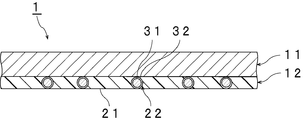
- FIG. 1 is a cross-sectional view schematically showing a conductive pressure-sensitive adhesive tape according to an embodiment of the present invention.
- FIG. 1 is a cross-sectional view schematically showing a conductive adhesive tape according to an embodiment of the present invention.
- the base material 11 has conductivity.
- the base material 11 is a conductive base material.
- the pressure-sensitive adhesive layer 12 has adhesiveness.
- the pressure-sensitive adhesive layer 12 is disposed on the surface of the substrate 11.
- the pressure-sensitive adhesive layer 12 includes a pressure-sensitive adhesive 21 and a plurality of conductive particles 22.
- the conductive particles 22 have base material particles 31 and conductive portions 32.
- the base particle 31 is a particle excluding metal particles.
- the conductive part 32 is, for example, a conductive layer.
- the conductive portion 32 is disposed on the surface of the base particle 31.
- the content of the conductive particles 22 is 20 parts by weight or less with respect to the content of the pressure-sensitive adhesive 21 of 100 parts by weight.
- the conductive pressure-sensitive adhesive tape includes a base material having conductivity and a pressure-sensitive adhesive layer disposed on the surface of the base material.
- the pressure-sensitive adhesive layer includes a pressure-sensitive adhesive and conductive particles.
- the said electroconductive particle has a base material particle except a metal particle, and the electroconductive part arrange
- the content of the conductive particles is 20 parts by weight or less with respect to 100 parts by weight of the pressure-sensitive adhesive (component excluding the solvent of the pressure-sensitive adhesive layer and the conductive particles).
- the adhesiveness can be increased while maintaining the electrical characteristics. Furthermore, in the present invention, since the above-described configuration is provided, even if the film is exposed to high temperature or high humidity after pasting, it is possible to make it difficult for floating and peeling to occur. In the present invention, excellent electrical characteristics can be exhibited despite the relatively small content of conductive particles. In the present invention, it is not necessary to increase the thickness of the conductive pressure-sensitive adhesive tape and the pressure-sensitive adhesive layer so as to exhibit sufficient pressure-sensitive adhesive properties.
- the average thickness of the pressure-sensitive adhesive layer is 20 ⁇ m or less, sufficient adhesive properties can be exhibited, and even if the average thickness of the pressure-sensitive adhesive layer is 10 ⁇ m or less, sufficient adhesive properties can be exhibited. it can.
- the present inventors have used base particles excluding metal particles and conductive particles having a conductive portion arranged on the surface of the base particles, It has been found that secondary agglomeration is suppressed, dispersibility is improved, and stable electrical characteristics can be exhibited even with a content of conductive particles of 20 parts by weight or less.
- the specific conductive particles the specific gravity can be made smaller than that of the metal particles, and in the specific conductive particles, it is easy to reduce the variation in the surface state as compared with the metal particles. For this reason, in this invention, it is easy to improve an electrical characteristic effectively.
- the base material is a support for supporting the pressure-sensitive adhesive layer.
- the substrate include metal foil and conductive resin material. From the viewpoint of further improving the electrical characteristics of the conductive adhesive tape, the substrate is preferably a metal foil.
- the material of the metal foil examples include gold, silver, copper, nickel, iron, tin, aluminum, and a graphite sheet.
- the metal foil is preferably a gold foil, a copper foil, or an aluminum foil, and more preferably a copper foil or an aluminum foil.
- a copper foil is preferable.
- an aluminum foil is preferable.
- the thermal conductivity of the substrate is preferably 90 W / m ⁇ K or more, more preferably 100 W / m ⁇ K or more.
- the content of the conductive particles is 20 parts by weight or less with respect to 100 parts by weight of the pressure-sensitive adhesive.
- conductive particles having base particles excluding metal particles and conductive portions arranged on the surface of the base particles are used as the conductive particles.
- the effect of the present invention can be further enhanced as compared with the case of using conductive particles that are metal particles.
- the conductive layer is electrically conductive with respect to 100 parts by weight of the adhesive.
- the content of the conductive particles is preferably 0.1 parts by weight or more, more preferably 0.75 parts by weight or more, further preferably 1 part by weight or more, preferably 15 parts by weight or less, more preferably 10 parts by weight or less, More preferably, it is 5 parts by weight or less.
- the average thickness of the pressure-sensitive adhesive layer is preferably 1 ⁇ m or more, more preferably 3 ⁇ m or more, preferably 40 ⁇ m or less, more preferably 20 ⁇ m or less, still more preferably 15 ⁇ m or less, and particularly preferably 10 ⁇ m or less.
- the pressure-sensitive adhesiveness is further increased.
- the electrical characteristics are further enhanced.
- an electrical property can fully be improved.
- the average particle size of the conductive particles is preferably 1 ⁇ m or more, more preferably 3 ⁇ m or more, preferably 40 ⁇ m or less, more preferably 15 ⁇ m or less, and even more preferably 10 ⁇ m or less.
- the electrical characteristics are further enhanced.
- the adhesive property is further enhanced.
- the particle diameter of the conductive particles means the maximum diameter.
- the maximum diameter means a diameter.
- the average particle diameter of the conductive particles is calculated by measuring arbitrarily selected 50 conductive particles using an electron microscope or an optical microscope, and calculating the average particle diameter of each conductive particle. Is preferred.
- the CV value (coefficient of variation) of the particle diameter of the conductive particles is preferably 3% or less, more preferably 2% or less.
- the lower limit of the CV value of the particle diameter of the conductive particles is not particularly limited.
- the CV value of the particle diameter of the conductive particles may be 1% or more.
- the CV value (coefficient of variation) of the particle diameter of the conductive particles is calculated by the following formula.
- CV value (%) ( ⁇ / Dn) ⁇ 100 ⁇ : Standard deviation of particle diameter of conductive particles Dn: Average value of particle diameter of conductive particles
- the average thickness of the conductive part is preferably 5 nm or more, more preferably 10 nm or more, still more preferably 20 nm or more, particularly preferably 50 nm or more, preferably 3000 nm or less, more preferably 1000 nm or less, and even more preferably 800 nm or less. More preferably, it is 500 nm or less, particularly preferably 400 nm or less, and most preferably 300 nm or less.
- the conductive part may be a single layer or a multilayer.
- the average thickness of the conductive part is the total thickness of the multilayer conductive part when the conductive part is a multilayer.
- the electrical characteristics are further improved, and the variation in the electrical characteristics is further suppressed.
- the average thickness of the conductive portion is not more than the above upper limit, the aggregation of the conductive particles is further suppressed, and the occurrence of floating and peeling at a high temperature or high humidity is further suppressed.
- the thickness of the conductive part can be measured by observing the cross section of the conductive particles using, for example, a transmission electron microscope (TEM).
- TEM transmission electron microscope
- the pressure-sensitive adhesive layer may contain a solvent separately from the pressure-sensitive adhesive and the conductive particles.
- the solvent can be removed by volatilization, for example, by heating at 100 ° C. or higher.
- Adhesive examples include (meth) acrylic pressure-sensitive adhesives, rubber-based pressure-sensitive adhesives, urethane-based pressure-sensitive adhesives, epoxy-based pressure-sensitive adhesives, and silicone-based pressure-sensitive adhesives. From the viewpoint of suppressing an excessive increase in the adhesive strength at high temperatures, the pressure-sensitive adhesive is preferably a (meth) acrylic pressure-sensitive adhesive.
- the above (meth) acrylic pressure-sensitive adhesive is a pressure-sensitive adhesive obtained by adding a crosslinking agent, a tackifying resin, various stabilizers and the like to a (meth) acrylic polymer as necessary.
- the (meth) acrylic polymer is not particularly limited, but (meth) acrylic copolymer obtained by copolymerizing a mixed monomer containing a (meth) acrylic acid ester monomer and another copolymerizable monomer. A polymer is preferred.
- the (meth) acrylic acid ester monomer is not particularly limited, but is an esterification reaction product of a primary or secondary alkyl alcohol having 1 to 12 carbon atoms in the alkyl group and (meth) acrylic acid (
- a (meth) acrylic acid ester monomer is preferable, and specific examples include ethyl (meth) acrylate, butyl (meth) acrylate, and 2-ethylhexyl (meth) acrylate.
- the said (meth) acrylic acid ester monomer only 1 type may be used and 2 or more types may be used together.
- Examples of the other copolymerizable polymerizable monomer include hydroxyalkyl (meth) acrylates such as 2-hydroxyethyl (meth) acrylate, hydroxypropyl (meth) acrylate, and hydroxybutyl (meth) acrylate; Functionality such as isobornyl (meth) acrylate, glycerin dimethacrylate, glycidyl (meth) acrylate, 2-methacryloyloxyethyl isocyanate, (meth) acrylic acid, itaconic acid, maleic anhydride, crotonic acid, maleic acid and fumaric acid Monomer.
- the other copolymerizable polymerizable monomer only one kind may be used, or two or more kinds may be used in combination.
- the crosslinking agent is not particularly limited, and for example, an isocyanate crosslinking agent, an epoxy crosslinking agent, a melamine crosslinking agent, a peroxide crosslinking agent, a urea crosslinking agent, a metal alkoxide crosslinking agent, a metal chelate crosslinking agent.
- the said crosslinking agent only 1 type may be used and 2 or more types may be used together.
- the tackifying resin is not particularly limited, and examples thereof include petroleum resins such as aliphatic copolymers, aromatic copolymers, aliphatic-aromatic copolymers, and alicyclic copolymers.
- the tackifying resin may be a hydrogenated resin. As for the said tackifier resin, only 1 type may be used and 2 or more types may be used together.
- the said electroconductive particle has a base material particle except a metal particle, and the electroconductive part arrange
- the base particles include resin particles, inorganic particles excluding metal particles, and organic-inorganic hybrid particles.
- the substrate particles are preferably resin particles or organic-inorganic hybrid particles.
- the base particles may be core-shell particles.
- the core may be an organic core, and the shell may be an inorganic shell.
- the base material particles are preferably resin particles.
- the substrate particles are preferably not glass beads (glass particles).
- the resin that is the material of the resin particles examples include polyolefin resins such as polyethylene, polypropylene, polystyrene, polyvinyl chloride, polyvinylidene chloride, polyisobutylene, and polybutadiene; acrylic resins such as polymethyl methacrylate and polymethyl acrylate; Alkylene terephthalate, polycarbonate, polyamide, phenol formaldehyde resin, melamine formaldehyde resin, benzoguanamine formaldehyde resin, urea formaldehyde resin, phenol resin, melamine resin, benzoguanamine resin, urea resin, epoxy resin, unsaturated polyester resin, saturated polyester resin, polysulfone, polyphenylene Oxide, polyacetal, polyimide, polyamideimide, polyether ether Ketones, polyether sulfones, and polymers such as obtained by a variety of polymerizable monomer having
- the resin for forming the resin particles has an ethylenically unsaturated group from the viewpoint of further improving the electrical characteristics, adhesiveness, and prevention of occurrence of floating and peeling under high temperature or high humidity.
- a polymer obtained by polymerizing one or more polymerizable monomers is preferable.
- the polymerizable monomer having an ethylenically unsaturated group includes a non-crosslinkable monomer and And a crosslinkable monomer.
- non-crosslinkable monomer examples include styrene monomers such as styrene and ⁇ -methylstyrene; carboxyl group-containing monomers such as (meth) acrylic acid, maleic acid, and maleic anhydride; (Meth) acrylate, ethyl (meth) acrylate, propyl (meth) acrylate, butyl (meth) acrylate, 2-ethylhexyl (meth) acrylate, lauryl (meth) acrylate, cetyl (meth) acrylate, stearyl (meth) acrylate, cyclohexyl ( Alkyl (meth) acrylate compounds such as meth) acrylate and isobornyl (meth) acrylate; 2-hydroxyethyl (meth) acrylate, glycerol (meth) acrylate, polyoxyethylene (meth) acrylate, glycidyl (meth) acrylate, etc.
- Oxygen atom-containing (meth) acrylate compounds Nitrile-containing monomers such as (meth) acrylonitrile; Vinyl ether compounds such as methyl vinyl ether, ethyl vinyl ether, and propyl vinyl ether; Acids such as vinyl acetate, vinyl butyrate, vinyl laurate, and vinyl stearate Vinyl ester compounds; unsaturated hydrocarbons such as ethylene, propylene, isoprene, and butadiene; halogen-containing monomers such as trifluoromethyl (meth) acrylate, pentafluoroethyl (meth) acrylate, vinyl chloride, vinyl fluoride, and chlorostyrene Etc.
- Nitrile-containing monomers such as (meth) acrylonitrile
- Vinyl ether compounds such as methyl vinyl ether, ethyl vinyl ether, and propyl vinyl ether
- Acids such as vinyl acetate, vinyl butyrate, vinyl laurate, and vinyl stea
- crosslinkable monomer examples include tetramethylolmethane tetra (meth) acrylate, tetramethylolmethane tri (meth) acrylate, tetramethylolmethane di (meth) acrylate, trimethylolpropane tri (meth) acrylate, and dipenta Erythritol hexa (meth) acrylate, dipentaerythritol penta (meth) acrylate, glycerol tri (meth) acrylate, glycerol di (meth) acrylate, (poly) ethylene glycol di (meth) acrylate, (poly) propylene glycol di (meth) Polyfunctional (meth) acrylate compounds such as acrylate, (poly) tetramethylene glycol di (meth) acrylate, 1,4-butanediol di (meth) acrylate; triallyl (iso) sia Silane-
- (meth) acryl indicates acrylic and methacrylic.
- (meth) acrylate refers to acrylate and methacrylate.
- the resin particles can be obtained by polymerizing the polymerizable monomer having an ethylenically unsaturated group by a known method. Examples of this method include a method of suspension polymerization in the presence of a radical polymerization initiator, and a method of polymerization by swelling a monomer together with a radical polymerization initiator using non-crosslinked seed particles.
- the substrate particles are inorganic particles or organic-inorganic hybrid particles excluding metal particles
- examples of the inorganic material that is the material of the substrate particles include silica and carbon black.
- the inorganic substance is not a metal.
- the particles formed from the silica are not particularly limited. For example, after forming a crosslinked polymer particle by hydrolyzing a silicon compound having two or more hydrolyzable alkoxysilyl groups, firing may be performed as necessary.
- grains obtained by performing are mentioned.
- the organic / inorganic hybrid particles include organic / inorganic hybrid particles formed of a crosslinked alkoxysilyl polymer and an acrylic resin.
- the 10% K value of the substrate particles is preferably 4000 N / mm 2 or less.
- the base particles having the specific compression characteristics are relatively soft and flexible. When the base conductive pressure-sensitive adhesive tape is affixed, the base particles are flexible, so that they can be compressed and deformed, and the electrical characteristics can be further enhanced as compared with the case of using relatively hard base particles. Can do.
- the 10% K value of the base particles used in the examples described later is below this upper limit.
- the 10% K value of the substrate particles can be measured as follows.
- the base particles are compressed under a condition that a smooth tester end face of a cylinder (diameter 50 ⁇ m, made of diamond) is loaded at 25 ° C. and a maximum test load 20 mN over 60 seconds.
- the load value (N) and compression displacement (mm) at this time are measured. From the measured value obtained, the compression elastic modulus can be obtained by the following formula.
- the micro compression tester for example, “Fischer Scope H-100” manufactured by Fischer is used.
- the material for the conductive part is not particularly limited.
- the material of the conductive part is preferably a metal.
- the metal include gold, silver, palladium, copper, platinum, zinc, iron, tin, lead, aluminum, cobalt, indium, nickel, chromium, titanium, antimony, bismuth, thallium, germanium, cadmium, tungsten, and molybdenum. , Silicon and alloys thereof.
- the metal include tin-doped indium oxide (ITO) and solder. From the viewpoint of effectively improving the electrical characteristics, an alloy containing tin, nickel, palladium, copper or gold is preferable, and nickel or palladium is more preferable.
- Electrolytic copper foil (1) (average thickness 12 ⁇ m)
- Adhesive layer material Adhesive solution (1): In a reactor equipped with a thermometer, a stirrer and a condenser, butyl acrylate 60 parts by weight, 2-ethylhexyl acrylate 36.9 parts by weight, acrylic acid 3 parts by weight, 2-hydroxyethyl acrylate 0. After 1 part by weight and 80 parts by weight of ethyl acetate were added and the atmosphere was replaced with nitrogen, the reactor was heated to start refluxing. Subsequently, 0.1 part by weight of azobisisobutyronitrile was added as a polymerization initiator in the reactor. The solution was refluxed at 70 ° C. for 5 hours to obtain a solution of the acrylic copolymer (a). About the obtained acrylic copolymer (a), the weight average molecular weight measured by GPC method using "2690 Separations Model" made from Water as a column was 1.4 million.
- Conductive particles (1) Metal-coated particles, average particle size of 10 ⁇ m, particle size CV value of 1.3%, particles in which acrylic resin particles are coated with nickel conductive parts (thickness 100 nm)
- Conductive particles (2) Metal-coated particles, average particle diameter of 6 ⁇ m, particle diameter CV value of 2.3%, particles in which acrylic resin particles are coated with nickel conductive parts (thickness 100 nm)
- Conductive particles (X) nickel particles, average particle size 2.2 ⁇ m, particle size CV value 9.6%
- Conductive particles (Z) particles coated with silver-coated glass powder, average particle diameter of 26 ⁇ m, silver conductive part (thickness 100 nm)
- Examples 1 to 7 and Comparative Examples 1 to 7 The electroconductive particle shown in Table 1 was mix
- the compounding quantity of electroconductive particle is a compounding quantity from which the content of electroconductive particle turns into the quantity shown in Table 1 with respect to 100 weight part of adhesives in the adhesive layer obtained.
- a PET separator having a thickness of 25 ⁇ m was prepared, and the composition was applied to the release-treated surface of the separator and dried at 100 ° C. for 3 minutes to form an adhesive layer having a thickness of 10 ⁇ m.
- this pressure-sensitive adhesive layer was formed to the base material shown in Table 1, a conductive pressure-sensitive adhesive tape having the pressure-sensitive adhesive layer having an average thickness shown in Table 1 was obtained.
- no substrate was used in Comparative Examples 5 and 6, no substrate was used.
- Adhesion criteria ⁇ : Adhesive strength is 11 N / 25 mm or more ⁇ : Adhesive strength is 10 N / 25 mm or more and less than 11 N / 25 mm ⁇ : Adhesive strength is less than 10 N / 25 mm
- Resistance value 1 ( ⁇ ) (electrical characteristics)
- the obtained conductive adhesive tape was cut into a size of 10 mm ⁇ 10 mm, and the separator was peeled off to obtain a conductive adhesive tape piece.
- the affixing area to each electrode was 1 mm ⁇ 10 mm.
- the resistance value after pressure release was read 60 times every 5 seconds and averaged to evaluate the resistance value.
- the resistance value was determined according to the following criteria. In addition, it is excellent in the electrical property, so that resistance value is low.
- the resistance value “OL” means a state where the measurement value exceeds the measurement limit (1 G ⁇ ) and the resistance value cannot be measured.
- Resistance value is 1 ⁇ or less ⁇ : Resistance value exceeds 1 ⁇ , 3.1 ⁇ or less ⁇ : Resistance value exceeds 3.1 ⁇ , or the result is “OL”
- Resistance value 2 ( ⁇ ) (electrical characteristics)
- the obtained conductive adhesive tape was cut into a size of 10 mm ⁇ 2 mm, and the separator was peeled off to obtain a conductive adhesive tape piece.
- a piece of conductive adhesive tape was attached to an aluminum plate electrode having a width of 1 mm by applying a pressure of 3 kg / cm 2 for 5 seconds.
- the affixing area to each electrode was 1 mm ⁇ 2 mm.
- the resistance value after pressure release was read 60 times every 5 seconds and averaged to evaluate the resistance value.
- the resistance value was determined according to the following criteria. In addition, it is excellent in the electrical property, so that resistance value is low.
- the resistance value “OL” means a state where the measurement value exceeds the measurement limit (1 G ⁇ ) and the resistance value cannot be measured.
- Resistance value is 10 ⁇ or less ⁇ : Resistance value exceeds 10 ⁇ , 25 ⁇ or less ⁇ : Resistance value exceeds 25 ⁇ , or the result is “OL”
- the obtained conductive adhesive tape was cut into a size of 20 mm ⁇ 20 mm, and the separator was peeled off to obtain a conductive adhesive tape piece. From the adhesive layer side of the conductive adhesive tape piece, 5mm to the right from the starting point to the end point in the plan view, 2mm under the right angle, 13mm to the left bent at a right angle, and attached to a glass plate (thickness 2mm) As a result, a laminate was obtained.
- the 5 mm ⁇ 20 mm attachment surface was cut to 1.5 mm ⁇ 20 mm (1) and 0.7 mm ⁇ 20 mm (2), and unnecessary portions cut were peeled off to obtain evaluation samples.
- the 1.5 mm ⁇ 20 mm and 0.7 mm ⁇ 20 mm sticking surfaces of (1) and (2) were crimped by reciprocating a 2 kg rubber roller once. After leaving for 20 minutes in the same environment, the obtained laminate was left for 72 hours under the conditions of 60 ° C. and humidity 90% RH. After leaving, the floating and peeling of the conductive pressure-sensitive adhesive tapes (1) and (2) were observed, and the resilience resistance was determined according to the following criteria.
Landscapes
- Chemical & Material Sciences (AREA)
- Organic Chemistry (AREA)
- Inorganic Chemistry (AREA)
- Adhesives Or Adhesive Processes (AREA)
- Adhesive Tapes (AREA)
Abstract
Description
上記基材は、上記粘着剤層を支持するための支持体である。上記基材としては、金属箔及び導電性樹脂材等が挙げられる。導電性粘着テープの電気特性をより一層高める観点からは、上記基材は金属箔であることが好ましい。
上記粘着剤層において、上記粘着剤100重量部に対して、上記導電性粒子の含有量は20重量部以下である。本発明では、導電性粒子の含有量が同じである場合に、導電性粒子として、金属粒子を除く基材粒子と上記基材粒子の表面上に配置された導電部を有する導電性粒子を用いることで、金属粒子である導電性粒子を用いた場合と比べて、本発明の効果をより一層高めることができる。電気特性、粘着性、及び、高温又は高湿下での浮き及び剥離の発生防止性をより一層バランスよく高める観点からは、上記粘着剤層において、上記粘着剤100重量部に対して、上記導電性粒子の含有量は好ましくは0.1重量部以上、より好ましくは0.75重量部以上、更に好ましくは1重量部以上であり、好ましくは15重量部以下、より好ましくは10重量部以下、更に好ましくは5重量部以下である。
ρ:導電性粒子の粒子径の標準偏差
Dn:導電性粒子の粒子径の平均値
上記粘着剤としては、(メタ)アクリル系粘着剤、ゴム系粘着剤、ウレタン系粘着剤、エポキシ系粘着剤及びシリコーン系粘着剤等が挙げられる。高温下での粘着力の過度な上昇を抑制する観点からは、上記粘着剤は、(メタ)アクリル系粘着剤であることが好ましい。
上記導電性粒子は、金属粒子を除く基材粒子と、上記基材粒子の表面上に配置された導電部とを有する。
F:基材粒子が10%圧縮変形したときの荷重値(N)
S:基材粒子が10%圧縮変形したときの圧縮変位(mm)
R:基材粒子の半径(mm)
電解銅箔(1)(平均厚み12μm)
粘着剤溶液(1):温度計、攪拌機及び冷却管を備えた反応器に、ブチルアクリレート60重量部、2-エチルヘキシルアクリレート36.9重量部、アクリル酸3重量部、2-ヒドロキシエチルアクリレート0.1重量部、及び、酢酸エチル80重量部を加え、窒素置換した後、反応器を加熱して還流を開始した。続いて、上記反応器内に、重合開始剤としてアゾビスイソブチロニトリル0.1重量部を添加した。70℃で5時間還流させて、アクリル共重合体(a)の溶液を得た。得られたアクリル共重合体(a)について、カラムとしてWater社製「2690 Separations Model」を用いてGPC法により測定された重量平均分子量は、140万であった。
基材粒子の10%K値を、上述した方法により算出した。
下記の表1に示す粘着剤溶液に、表1に示す導電性粒子を配合し、配合物を得た。なお、導電性粒子の配合量は、得られる粘着剤層において、粘着剤100重量部に対して、導電性粒子の含有量が表1に示す量となる配合量である。
(1)粘着力
JIS Z0237に準拠して、得られた導電性粘着テープの180度剥離粘着力を測定した。具体的には、得られた導電性粘着テープを、25mm×100mmに裁断し、セパレーターを剥離して導電性粘着テープ片を得た。導電性粘着テープ片を、被着体であるJIS G4305の280番研磨SUSに、23℃及び湿度65%RH試験室において2kgゴムローラーを1往復させ圧着し、貼り付けた。同様の環境下にて20分放置した後、引張速度300mm/minにて、導電性粘着テープ片をSUSから180度方向に引き剥がし、その引き剥がしに要する力を測定することで、粘着力を評価した。粘着力を下記の基準で判定した。
○:粘着力が11N/25mm以上
△:粘着力が10N/25mm以上、11N/25mm未満
×:粘着力が10N/25mm未満
得られた導電性粘着テープを、10mm×10mmのサイズに裁断し、セパレーターを剥離して導電性粘着テープ片を得た。幅1mmのアルミニウム板電極に3kg/cm2の加圧を5秒間かけて導電性粘着テープ片を貼り付けた。各電極への貼り付け面積を1mm×10mmとした。その後、23℃及び湿度65%RH試験室において、圧開放後の抵抗値を5秒毎60回読み取り平均化することで、抵抗値を評価した。抵抗値を下記の基準で判定した。なお、抵抗値が低いほど、電気特性に優れている。抵抗値の「O.L.」は測定限界(1GΩ)を超え、抵抗値が測定できない状態を意味する。
○:抵抗値が1Ω以下
△:抵抗値が1Ωを超え、3.1Ω以下
×:抵抗値が3.1Ωを超える、又は、結果が「O.L.」
得られた導電性粘着テープを、10mm×2mmのサイズに裁断し、セパレーターを剥離して導電性粘着テープ片を得た。幅1mmのアルミニウム板電極に3kg/cm2の加圧を5秒間かけて導電性粘着テープ片を貼り付けた。各電極への貼り付け面積を1mm×2mmとした。その後、23℃及び湿度65%RH試験室において、圧開放後の抵抗値を5秒毎60回読み取り平均化することで、抵抗値を評価した。抵抗値を下記の基準で判定した。なお、抵抗値が低いほど、電気特性に優れている。抵抗値の「O.L.」は測定限界(1GΩ)を超え、抵抗値が測定できない状態を意味する。
○:抵抗値が10Ω以下
△:抵抗値が10Ωを超え、25Ω以下
×:抵抗値が25Ωを超える、又は、結果が「O.L.」
得られた導電性粘着テープを、20mm×20mmのサイズに裁断し、セパレーターを剥離して導電性粘着テープ片を得た。導電性粘着テープ片の粘着剤層側から、平面視において貼り付け起点から貼り付け終点まで右に5mm、直角に曲げ下に2mm、直角に曲げ左に13mm、ガラス板(厚さ2mm)に貼り付けて、積層体を得た。5mm×20mmの貼り付け面を1.5mm×20mm(1)及び0.7mm×20mm(2)となるよう裁断し、裁断した不必要な部分は剥ぎ取り、評価サンプルを得た。(1)、(2)の1.5mm×20mm及び0.7mm×20mmの貼り付け面を、2kgゴムローラーを1往復させ圧着した。同様の環境下にて20分放置した後、得られた積層体を60℃及び湿度90%RHの条件で72時間放置した。放置後に、導電性粘着テープ(1),(2)の浮き及び剥離を観察し、耐反発性を下記の基準で判定した。
○:導電性粘着テープ(1)及び(2)の双方で、浮き及び剥離の双方が発生しない
△:導電性粘着テープ(2)で、浮き及び剥離の双方が発生しない。導電性粘着テープ(1)で、浮き又は剥離が発生
×:導電性粘着テープ(1)及び(2)の双方で、浮き又は剥離が発生
得られた配合物(粘着剤溶液に導電性粒子を配合した配合物)を、光学顕微鏡を用いて観察し、導電性粒子の凝集の有無を確認した。

11…基材
12…粘着剤層
21…粘着剤
22…導電性粒子
31…基材粒子
32…導電部
Claims (5)
- 導電性を有する基材と、
前記基材の表面上に配置された粘着剤層とを備え、
前記粘着剤層は、粘着剤と、導電性粒子とを含み、
前記導電性粒子は、金属粒子を除く基材粒子と、前記基材粒子の表面上に配置された導電部とを有し、
前記粘着剤層において、前記粘着剤100重量部に対して、前記導電性粒子の含有量が20重量部以下である、導電性粘着テープ。 - 前記粘着剤層の平均厚みが20μm以下である、請求項1に記載の導電性粘着テープ。
- 前記基材粒子が樹脂粒子である、請求項1又は2に記載の導電性粘着テープ。
- 前記基材が金属箔である、請求項1~3のいずれか1項に記載の導電性粘着テープ。
- 前記導電性粒子の粒子径のCV値が3%以下である、請求項1~4のいずれか1項に記載の導電性粘着テープ。
Priority Applications (3)
| Application Number | Priority Date | Filing Date | Title |
|---|---|---|---|
| KR1020187006261A KR20180094836A (ko) | 2015-12-15 | 2016-12-13 | 도전성 점착 테이프 |
| CN201680046144.8A CN107849402A (zh) | 2015-12-15 | 2016-12-13 | 导电性粘接带 |
| JP2016575241A JP6832161B2 (ja) | 2015-12-15 | 2016-12-13 | 導電性粘着テープ |
Applications Claiming Priority (2)
| Application Number | Priority Date | Filing Date | Title |
|---|---|---|---|
| JP2015-244073 | 2015-12-15 | ||
| JP2015244073 | 2015-12-15 |
Publications (1)
| Publication Number | Publication Date |
|---|---|
| WO2017104665A1 true WO2017104665A1 (ja) | 2017-06-22 |
Family
ID=59056695
Family Applications (1)
| Application Number | Title | Priority Date | Filing Date |
|---|---|---|---|
| PCT/JP2016/087070 Ceased WO2017104665A1 (ja) | 2015-12-15 | 2016-12-13 | 導電性粘着テープ |
Country Status (5)
| Country | Link |
|---|---|
| JP (1) | JP6832161B2 (ja) |
| KR (1) | KR20180094836A (ja) |
| CN (1) | CN107849402A (ja) |
| TW (1) | TW201727667A (ja) |
| WO (1) | WO2017104665A1 (ja) |
Families Citing this family (2)
| Publication number | Priority date | Publication date | Assignee | Title |
|---|---|---|---|---|
| TWI703197B (zh) * | 2019-07-16 | 2020-09-01 | 東莞爵士先進電子應用材料有限公司 | 自粘複合型導電膠帶製備方法 |
| CN110894408B (zh) * | 2019-11-22 | 2021-11-09 | 烟台德邦科技股份有限公司 | 一种热熔型导电胶及其制备方法 |
Citations (5)
| Publication number | Priority date | Publication date | Assignee | Title |
|---|---|---|---|---|
| JP2004091750A (ja) * | 2002-09-04 | 2004-03-25 | Shin Etsu Chem Co Ltd | 導電性シリコーン粘着剤組成物 |
| JP2015010109A (ja) * | 2013-06-26 | 2015-01-19 | 日東電工株式会社 | 導電性粘着テープ |
| JP2015010110A (ja) * | 2013-06-26 | 2015-01-19 | 日東電工株式会社 | 導電性粘着テープ |
| JP2015127392A (ja) * | 2013-11-27 | 2015-07-09 | 日東電工株式会社 | 導電性粘着テープ、電子部材及び粘着剤 |
| WO2016186099A1 (ja) * | 2015-05-20 | 2016-11-24 | 積水化学工業株式会社 | 導電性粘着材及び導電性基材付き導電性粘着材 |
Family Cites Families (4)
| Publication number | Priority date | Publication date | Assignee | Title |
|---|---|---|---|---|
| JP3373094B2 (ja) * | 1994-10-28 | 2003-02-04 | 積水化学工業株式会社 | 弾力性微粒子及びその製造方法並びに弾力性導電微粒子 |
| KR100719802B1 (ko) * | 2005-12-28 | 2007-05-18 | 제일모직주식회사 | 이방 전도 접속용 고신뢰성 전도성 미립자 |
| JP2012190795A (ja) * | 2011-02-25 | 2012-10-04 | Sekisui Chem Co Ltd | 異方性導電材料、接続構造体及び接続構造体の製造方法 |
| JP2014149918A (ja) * | 2011-06-06 | 2014-08-21 | Hitachi Chemical Co Ltd | フィルム状回路接続材料及び回路接続構造体 |
-
2016
- 2016-12-13 KR KR1020187006261A patent/KR20180094836A/ko not_active Withdrawn
- 2016-12-13 JP JP2016575241A patent/JP6832161B2/ja active Active
- 2016-12-13 CN CN201680046144.8A patent/CN107849402A/zh active Pending
- 2016-12-13 WO PCT/JP2016/087070 patent/WO2017104665A1/ja not_active Ceased
- 2016-12-15 TW TW105141560A patent/TW201727667A/zh unknown
Patent Citations (5)
| Publication number | Priority date | Publication date | Assignee | Title |
|---|---|---|---|---|
| JP2004091750A (ja) * | 2002-09-04 | 2004-03-25 | Shin Etsu Chem Co Ltd | 導電性シリコーン粘着剤組成物 |
| JP2015010109A (ja) * | 2013-06-26 | 2015-01-19 | 日東電工株式会社 | 導電性粘着テープ |
| JP2015010110A (ja) * | 2013-06-26 | 2015-01-19 | 日東電工株式会社 | 導電性粘着テープ |
| JP2015127392A (ja) * | 2013-11-27 | 2015-07-09 | 日東電工株式会社 | 導電性粘着テープ、電子部材及び粘着剤 |
| WO2016186099A1 (ja) * | 2015-05-20 | 2016-11-24 | 積水化学工業株式会社 | 導電性粘着材及び導電性基材付き導電性粘着材 |
Also Published As
| Publication number | Publication date |
|---|---|
| CN107849402A (zh) | 2018-03-27 |
| TW201727667A (zh) | 2017-08-01 |
| JP6832161B2 (ja) | 2021-02-24 |
| JPWO2017104665A1 (ja) | 2018-10-04 |
| KR20180094836A (ko) | 2018-08-24 |
Similar Documents
| Publication | Publication Date | Title |
|---|---|---|
| JP5291316B2 (ja) | 導電性粘着テープ | |
| CN100572482C (zh) | 粘合剂组合物、粘合片类以及表面保护薄膜 | |
| KR102093270B1 (ko) | 도전성 입자, 수지 입자, 도전 재료 및 접속 구조체 | |
| JP6363684B2 (ja) | 電池用粘着シートおよびリチウムイオン電池 | |
| US20150191636A1 (en) | Pressure-sensitive adhesive sheet | |
| CN103421439B (zh) | 导电性薄型粘合片 | |
| JP4403360B2 (ja) | 導電性粘着シート | |
| CN103718138B (zh) | 触摸面板 | |
| CN101541903B (zh) | 粘接剂和使用该粘接剂的连接结构体 | |
| CN104212373A (zh) | 导电性双面粘合带 | |
| JP6420906B2 (ja) | 粘着剤組成物及び粘着テープ | |
| CN104673123A (zh) | 导电性粘合带、电子构件及粘合剂 | |
| TW201216301A (en) | Anisotropic conductive film | |
| JP2013527861A (ja) | 粘着剤組成物、粘着シート及びタッチパネル | |
| CN103814346A (zh) | 触摸面板 | |
| JP5110675B2 (ja) | 粘着剤組成物、およびそれを用いてなる粘着シート類 | |
| CN108300371A (zh) | 导电性压敏粘合带 | |
| TWI484504B (zh) | 向異性導電膜、其製備方法、及壓製電路端子之方法 | |
| CN102007190B (zh) | 粘接材料带以及粘接材料带卷绕体 | |
| JP6832161B2 (ja) | 導電性粘着テープ | |
| JPH11349910A (ja) | 導電性粘着剤及びそれを備えた粘着剤物品 | |
| WO2017170371A1 (ja) | 導電性粘着テープ | |
| JP5824478B2 (ja) | 導電性粘着テープ | |
| JP6748203B2 (ja) | 導電性粘着剤組成物及び導電性粘着テープ | |
| JP2018095724A (ja) | 放熱粘着シート及び情報表示装置 |
Legal Events
| Date | Code | Title | Description |
|---|---|---|---|
| ENP | Entry into the national phase |
Ref document number: 2016575241 Country of ref document: JP Kind code of ref document: A |
|
| 121 | Ep: the epo has been informed by wipo that ep was designated in this application |
Ref document number: 16875642 Country of ref document: EP Kind code of ref document: A1 |
|
| ENP | Entry into the national phase |
Ref document number: 20187006261 Country of ref document: KR Kind code of ref document: A |
|
| NENP | Non-entry into the national phase |
Ref country code: DE |
|
| 122 | Ep: pct application non-entry in european phase |
Ref document number: 16875642 Country of ref document: EP Kind code of ref document: A1 |