WO2017090684A1 - Dnaポリメラーゼ変異体 - Google Patents
Dnaポリメラーゼ変異体 Download PDFInfo
- Publication number
- WO2017090684A1 WO2017090684A1 PCT/JP2016/084807 JP2016084807W WO2017090684A1 WO 2017090684 A1 WO2017090684 A1 WO 2017090684A1 JP 2016084807 W JP2016084807 W JP 2016084807W WO 2017090684 A1 WO2017090684 A1 WO 2017090684A1
- Authority
- WO
- WIPO (PCT)
- Prior art keywords
- dna polymerase
- dna
- amino acid
- polymerase
- present
- Prior art date
- Legal status (The legal status is an assumption and is not a legal conclusion. Google has not performed a legal analysis and makes no representation as to the accuracy of the status listed.)
- Ceased
Links
Images


Classifications
-
- C—CHEMISTRY; METALLURGY
- C12—BIOCHEMISTRY; BEER; SPIRITS; WINE; VINEGAR; MICROBIOLOGY; ENZYMOLOGY; MUTATION OR GENETIC ENGINEERING
- C12N—MICROORGANISMS OR ENZYMES; COMPOSITIONS THEREOF; PROPAGATING, PRESERVING, OR MAINTAINING MICROORGANISMS; MUTATION OR GENETIC ENGINEERING; CULTURE MEDIA
- C12N9/00—Enzymes; Proenzymes; Compositions thereof; Processes for preparing, activating, inhibiting, separating or purifying enzymes
- C12N9/10—Transferases (2.)
- C12N9/12—Transferases (2.) transferring phosphorus containing groups, e.g. kinases (2.7)
- C12N9/1241—Nucleotidyltransferases (2.7.7)
- C12N9/1252—DNA-directed DNA polymerase (2.7.7.7), i.e. DNA replicase
-
- C—CHEMISTRY; METALLURGY
- C12—BIOCHEMISTRY; BEER; SPIRITS; WINE; VINEGAR; MICROBIOLOGY; ENZYMOLOGY; MUTATION OR GENETIC ENGINEERING
- C12N—MICROORGANISMS OR ENZYMES; COMPOSITIONS THEREOF; PROPAGATING, PRESERVING, OR MAINTAINING MICROORGANISMS; MUTATION OR GENETIC ENGINEERING; CULTURE MEDIA
- C12N1/00—Microorganisms; Compositions thereof; Processes of propagating, maintaining or preserving microorganisms or compositions thereof; Processes of preparing or isolating a composition containing a microorganism; Culture media therefor
- C12N1/20—Bacteria; Culture media therefor
-
- C—CHEMISTRY; METALLURGY
- C12—BIOCHEMISTRY; BEER; SPIRITS; WINE; VINEGAR; MICROBIOLOGY; ENZYMOLOGY; MUTATION OR GENETIC ENGINEERING
- C12N—MICROORGANISMS OR ENZYMES; COMPOSITIONS THEREOF; PROPAGATING, PRESERVING, OR MAINTAINING MICROORGANISMS; MUTATION OR GENETIC ENGINEERING; CULTURE MEDIA
- C12N15/00—Mutation or genetic engineering; DNA or RNA concerning genetic engineering, vectors, e.g. plasmids, or their isolation, preparation or purification; Use of hosts therefor
- C12N15/09—Recombinant DNA-technology
- C12N15/11—DNA or RNA fragments; Modified forms thereof; Non-coding nucleic acids having a biological activity
- C12N15/52—Genes encoding for enzymes or proenzymes
-
- C—CHEMISTRY; METALLURGY
- C12—BIOCHEMISTRY; BEER; SPIRITS; WINE; VINEGAR; MICROBIOLOGY; ENZYMOLOGY; MUTATION OR GENETIC ENGINEERING
- C12N—MICROORGANISMS OR ENZYMES; COMPOSITIONS THEREOF; PROPAGATING, PRESERVING, OR MAINTAINING MICROORGANISMS; MUTATION OR GENETIC ENGINEERING; CULTURE MEDIA
- C12N15/00—Mutation or genetic engineering; DNA or RNA concerning genetic engineering, vectors, e.g. plasmids, or their isolation, preparation or purification; Use of hosts therefor
- C12N15/09—Recombinant DNA-technology
- C12N15/63—Introduction of foreign genetic material using vectors; Vectors; Use of hosts therefor; Regulation of expression
-
- C—CHEMISTRY; METALLURGY
- C12—BIOCHEMISTRY; BEER; SPIRITS; WINE; VINEGAR; MICROBIOLOGY; ENZYMOLOGY; MUTATION OR GENETIC ENGINEERING
- C12N—MICROORGANISMS OR ENZYMES; COMPOSITIONS THEREOF; PROPAGATING, PRESERVING, OR MAINTAINING MICROORGANISMS; MUTATION OR GENETIC ENGINEERING; CULTURE MEDIA
- C12N15/00—Mutation or genetic engineering; DNA or RNA concerning genetic engineering, vectors, e.g. plasmids, or their isolation, preparation or purification; Use of hosts therefor
- C12N15/09—Recombinant DNA-technology
- C12N15/63—Introduction of foreign genetic material using vectors; Vectors; Use of hosts therefor; Regulation of expression
- C12N15/70—Vectors or expression systems specially adapted for E. coli
-
- C—CHEMISTRY; METALLURGY
- C12—BIOCHEMISTRY; BEER; SPIRITS; WINE; VINEGAR; MICROBIOLOGY; ENZYMOLOGY; MUTATION OR GENETIC ENGINEERING
- C12N—MICROORGANISMS OR ENZYMES; COMPOSITIONS THEREOF; PROPAGATING, PRESERVING, OR MAINTAINING MICROORGANISMS; MUTATION OR GENETIC ENGINEERING; CULTURE MEDIA
- C12N15/00—Mutation or genetic engineering; DNA or RNA concerning genetic engineering, vectors, e.g. plasmids, or their isolation, preparation or purification; Use of hosts therefor
- C12N15/09—Recombinant DNA-technology
- C12N15/63—Introduction of foreign genetic material using vectors; Vectors; Use of hosts therefor; Regulation of expression
- C12N15/74—Vectors or expression systems specially adapted for prokaryotic hosts other than E. coli, e.g. Lactobacillus, Micromonospora
-
- C—CHEMISTRY; METALLURGY
- C12—BIOCHEMISTRY; BEER; SPIRITS; WINE; VINEGAR; MICROBIOLOGY; ENZYMOLOGY; MUTATION OR GENETIC ENGINEERING
- C12P—FERMENTATION OR ENZYME-USING PROCESSES TO SYNTHESISE A DESIRED CHEMICAL COMPOUND OR COMPOSITION OR TO SEPARATE OPTICAL ISOMERS FROM A RACEMIC MIXTURE
- C12P19/00—Preparation of compounds containing saccharide radicals
- C12P19/26—Preparation of nitrogen-containing carbohydrates
- C12P19/28—N-glycosides
- C12P19/30—Nucleotides
- C12P19/34—Polynucleotides, e.g. nucleic acids, oligoribonucleotides
Definitions
- the present invention relates to a DNA polymerase mutant.
- DNA polymerase is an enzyme useful as a genetic engineering reagent, and is widely used in nucleic acid amplification methods, DNA base sequencing methods, nucleic acid labeling, site-directed mutagenesis methods, and the like.
- Various DNA polymerases suitable for PCR which is a kind of nucleic acid amplification method, and whole genome amplification reaction (hereinafter sometimes referred to as WGA) have been developed and are commercially available from various companies.
- DNA polymerases are classified into seven families (A, B, C, D, E, X, and Y) based on the similarity of their amino acid sequences. Among them, DNA polymerases belonging to family A (also referred to as pol I enzyme) and family B (also referred to as ⁇ -type enzyme) are commercially available as genetic engineering reagents.
- Examples of enzymes belonging to family A include Thermus aquaticus-derived Pol I (hereinafter sometimes referred to as Taq polymerase), Geobacillus stearothermophilus-derived Pol I (hereinafter sometimes referred to as Bst polymerase) and Thermus thermophilus-derived Pol I. (Hereinafter sometimes referred to as Tth polymerase).
- Taq polymerase Thermus aquaticus-derived Pol I
- Bst polymerase Geobacillus stearothermophilus-derived Pol I
- Tth polymerase Thermus thermophilus-derived Pol I.
- As a characteristic of DNA polymerase belonging to Family A an enzyme that has strong DNA chain elongation activity and does not have 3 ′ ⁇ 5 ′ exonuclease activity (hereinafter referred to as proofreading activity, hereinafter referred to as 3 ′ ⁇ 5 ′ exo activity) And having TdT (terminal deoxynucleotide transfer) activity.
- Tth polymerase is known as a DNA polymerase having reverse transcription activity.
- the strand displacement activity (hereinafter sometimes referred to as SD activity) is an activity of replicating a new DNA strand while dissociating the hydrogen bond of the double-stranded DNA used as a template by itself. Because of its properties, strand-displacing DNA polymerase does not require dissociation of template double-stranded DNA, so it can synthesize DNA at a constant temperature and is not susceptible to synthesis inhibition due to DNA secondary structure. ing.
- Strand displacement DNA polymerases are often used for isothermal nucleic acid amplification reactions.
- strand displacement DNA extension reaction String Displacement Amplification; hereinafter sometimes referred to as SDA; Non-Patent Documents 1 and 2), rolling circle amplification method (Rolling circle amplification; hereinafter referred to as RCA)
- Non-patent document 3 Non-patent document 3
- CPA cross priming amplification method
- non-patent document 4 loop-mediated isothermal amplification method
- Loop-Mediated Isolation Amplification sometimes referred to as LAMP;
- Non-Patent Document 5 ICAN method (Isothermal and Chimeric primer-in) tiated Amplification of Nucleic acids; hereinafter, may be referred to as ICAN; there is Patent Documents 1 and 2) or the like.
- DNA polymerase derived from phi29 phage belonging to Family B has a very strong strand displacement activity. This enzyme is used for rolling circle amplification by replicating template DNA. Examples of commercially available products include TempliPhi and GenomiPhi (both manufactured by GE Healthcare).
- Bst polymerase is a thermostable DNA polymerase having strand displacement activity, but the optimum temperature is about 63 ° C., and it is inactivated at 68 ° C. or higher.
- ⁇ 29 polymerase exhibits activity in the middle temperature range of 20 to 37 ° C., and has the feature of being inactivated by heating at 65 ° C. for 10 minutes. Therefore, these polymerases cannot be used for nucleic acid amplification reactions in which template DNA is dissociated by thermal denaturation.
- SD Polymerase (manufactured by BIORON, WO2014 / 161712) is commercially available as a thermostable Taq polymerase mutant that has been imparted with strand displacement activity and lacks exo activity.
- the amplification efficiency in PCR using the SD Polymerase is equivalent to that of the existing Thermococcus litoralis-derived Vent DNA polymerase or Pyrococcus furiosus-derived Pfu polymerase.
- An object of the present invention is to provide a DNA polymerase which has high heat resistance and preferably strong strand displacement activity and can efficiently replicate a long template DNA.
- the present inventors compared and analyzed amino acid sequences between DNA polymerases belonging to Family A. As a result, high strand displacement activity was imparted by introducing amino acid substitutions that increase the sum of the charges at the template DNA binding site of the DNA polymerase that lost 5 ′ ⁇ 3 ′ exonuclease activity. It was clarified that a DNA polymerase can be created, and the present invention was completed.
- the first invention of the present invention is an amino acid sequence of a DNA polymerase belonging to Family A, which has an amino acid substitution that increases the sum of charges at the template DNA binding site, and 5 ′ ⁇ 3 ′ exonuclease.
- the present invention relates to a DNA polymerase having no activity, or a DNA polymerase having 95% or more sequence identity with the amino acid sequence of the DNA polymerase.
- amino acid increasing the sum of charges examples include amino acids selected from arginine, lysine, histidine, serine and alanine.
- the “template DNA binding site of DNA polymerase” is not intended to limit the present invention.
- 685 of the amino acid sequence of Taq DNA polymerase represented by SEQ ID NO: 1 in the sequence listing is used.
- examples thereof include a site containing an amino acid residue corresponding to the 687th amino acid.
- the DNA polymerase having the “substituted amino acid sequence” is, for example, (1) substitution of amino acid corresponding to the 685th proline in the amino acid sequence of Taq DNA polymerase with arginine or serine, (2) substitution of amino acid corresponding to 686th tyrosine with arginine, and (3) substitution of amino acid corresponding to 687th glutamic acid with arginine, lysine or alanine,
- the “DNA polymerase belonging to Family A” is preferably a heat-resistant DNA polymerase.
- the “DNA polymerase belonging to family A” may be a DNA polymerase derived from a Thermus bacterium.
- the “DNA polymerase belonging to family A” is preferably a DNA polymerase in which the N-terminal sequence is deleted compared to the amino acid sequence of the DNA polymerase belonging to wild-type family A.
- Taq DNA polymerase deleted from the N-terminal sequence preferably Taq DNA polymerase deleted from the N-terminal to 289 amino acids or Taq DNA deleted from the N-terminal to 280 amino acids A polymerase is mentioned.
- a DNA polymerase belonging to family A a DNA polymerase from which the N-terminal sequence related to the 5 ′ ⁇ 3 ′ exonuclease activity of the DNA polymerase belonging to wild-type family A is deleted is also a preferred example. .
- the second invention of the present invention relates to a nucleic acid comprising a base sequence encoding the DNA polymerase of the first invention of the present invention.
- the nucleic acid is not particularly limited, and examples thereof include a nucleic acid encoding the DNA polymerase of the first invention, including the base sequence shown in any of SEQ ID NOs: 5 to 9 and 20 to 23 in the sequence listing.
- the DNA polymerase preferably has strand displacement activity.
- the third invention of the present invention relates to a vector comprising a nucleic acid encoding the DNA polymerase of the second invention of the present invention.
- the DNA polymerase preferably has strand displacement activity.
- the fourth invention of the present invention relates to a transformant comprising the vector of the third invention of the present invention or the nucleic acid of the second invention of the present invention.
- the fifth invention of the present invention relates to a method for producing a DNA polymerase, comprising culturing the transformant of the fourth invention of the present invention and collecting the DNA polymerase from the culture.
- the DNA polymerase preferably has strand displacement activity.
- the sixth invention of the present invention relates to a method for producing a DNA molecule comprising the step of incubating the DNA polymerase of the first invention of the present invention and a template DNA together.
- the method for producing a DNA molecule may be a polymerase chain reaction or an isothermal nucleic acid amplification reaction.
- the DNA polymerase preferably has strand displacement activity.
- the seventh invention of the present invention relates to a kit containing the DNA polymerase of the first invention of the present invention.
- the DNA polymerase preferably has strand displacement activity.
- the present invention provides a DNA polymerase having high heat resistance, capable of efficient long-chain replication of template DNA, and preferably having strong strand displacement activity.
- strand displacement activity refers to the activity of replicating a new DNA strand while dissociating the hydrogen bond of double-stranded DNA as a template by itself.
- a preferable DNA polymerase of the present invention has a strand displacement activity. For example, it has a strand displacement activity comparable to or stronger than a known DNA polymerase known to have a strand displacement activity.
- “increasing the sum of charges” means that the sum of charges of each amino acid residue after substitution at a certain site is larger than the sum of charges of each amino acid residue before substitution at that site. .
- the DNA polymerase of the present invention and the nucleic acid encoding the same The first aspect of the present invention relates to a DNA polymerase, which increases the sum of charges in the template DNA binding site in the amino acid sequence of a DNA polymerase belonging to family A.
- the DNA polymerase preferably has strand displacement activity.
- sequence identity means sequence identity when the amino acid sequence other than the template DNA binding site is defined as 100% in the amino acid sequence of DNA polymerase, preferably DNA polymerase It has 95% or more, more preferably 100% sequence identity with the amino acid sequence.
- the DNA polymerase may be an amino acid residue in which the total charge of the template DNA binding site is increased by amino acid substitution, and the charge does not change before and after substitution at the site. And amino acid residues having increased charge may be mixed. The increase in total charge is achieved by the substitution of a negatively charged amino acid with a non-charged amino acid or a positively charged amino acid, and a substitution of a non-charged amino acid with a positively charged amino acid.
- a DNA polymerase having a larger number of amino acid residues having an increased charge than the number of amino acid residues whose charge does not change is preferable, and a DNA polymerase having an increased charge in all amino acid residues at the site is more preferable.
- a DNA polymerase in which all amino acid residues at the site are substituted with basic amino acids having a positive charge and a DNA polymerase in which all amino acid residues at the site are substituted with the most highly charged arginine are preferred in the present invention.
- a site that binds to the template DNA may be selected from the three-dimensional structure of the polymerase.
- a template DNA binding site is specified as a site containing amino acid residues corresponding to amino acids 685 to 687 of the amino acid sequence of the polymerase. can do.
- the substituted amino acid sequence is, for example, (1) substitution of an amino acid corresponding to the 685th proline in the amino acid sequence of wild-type Taq DNA polymerase with arginine or serine, (2) substitution of amino acid corresponding to 686th tyrosine with arginine, and (3) substitution of amino acid corresponding to 687th glutamic acid with arginine, lysine or alanine, A DNA polymerase having one or more substitutions selected from the group consisting of, preferably having strand displacement activity.
- the DNA polymerase of the present invention is characterized by having no 5 ' ⁇ 3' exonuclease activity.
- Many of the DNA polymerases belonging to Family A have 5 ' ⁇ 3' exonuclease activity, but can be used in the present invention by deleting the activity by a known method. For example, there are known methods of introducing mutations such as substitution or deletion of amino acid residues contributing to 5 ' ⁇ 3' exonuclease activity, and methods of deleting domains important for the activity.
- the DNA polymerase of the present invention is not particularly limited to the present invention, but preferably has heat resistance. Needless to say, a PCR method including a DNA heat denaturation step, and also in an isothermal nucleic acid amplification method, a thermostable DNA polymerase that can be used in a reaction under a high temperature condition that can weaken the base pairing of DNA is advantageous.
- the DNA polymerase of the present invention produced using a thermophilic microorganism DNA polymerase belonging to family A is a particularly preferred embodiment.
- having heat resistance is not particularly limited, for example, but the residual activity when DNA polymerase is held at 90 ° C. for 30 minutes is 100%, or at 95 ° C. for 30 minutes. It indicates the property that the residual activity when held is 75% or more.
- thermostable DNA polymerase of Taq DNA polymerase and other Thermus genus bacteria for example, Thermus thermophilus, Thermus flavus, etc.
- the DNA polymerase of the present invention can be prepared by introducing the amino acid substitution described above into the template DNA binding site of the N-terminal deletion.
- Taq DNA polymerase KlenTaq
- Taq DNA polymerase from which amino acids from the N-terminal to 289 residues are deleted as described in the examples of this specification. (Taq large fragment) is suitable for the present invention.
- a DNA polymerase comprising an amino acid sequence selected from SEQ ID NOs: 40 to 48 in the sequence listing, preferably having a strand displacement activity, is exemplified as the DNA polymerase of the present invention (that is, a DNA polymerase variant).
- Particularly preferred as the DNA polymerase of the present invention is a DNA polymerase having the amino acid sequence represented by SEQ ID NO: 44 in the Sequence Listing.
- the 117th glutamic acid residue of Taq DNA polymerase is an alanine residue
- the 119th aspartic acid residue is an alanine residue
- the 142nd aspartic acid residue is an alanine residue.
- the present invention may be combined with a 5 ′ ⁇ 3 ′ exonuclease deletion product in which the 144th aspartic acid residue is substituted with an alanine residue.
- amino acid substitutions other than those described above may be further introduced for the purpose of enhancing the performance of the DNA polymerase of the present invention.
- the present invention is not limited in any way, for example, the mutation described in Japanese Patent No. 4193997 (mutation that increases the total charge of glutamic acid at position 742 and alanine at position 743 of Taq polymerase) is introduced into the DNA polymerase of the present invention. May be.
- the DNA polymerase mutant described in Japanese Patent No. 4193997 is disclosed to have increased elongation activity, and it can be expected that the elongation activity of the DNA polymerase of the present invention is further increased by further introducing the mutation.
- a DNA polymerase fused with a molecule having a specific function may be used for the purpose of enhancing the performance of the DNA polymerase.
- the “molecule having a specific function” include peptide / polypeptide having affinity with DNA and peptide / polypeptide interacting with a protein involved in DNA synthesis.
- a “DNA polymerase fused with a molecule having a specific function” is sometimes referred to as a “fusion polypeptide”, and such a fusion polypeptide is also included in the DNA polymerase.
- PCNA proliferating cell nuclear antigen
- PCNA is a homomultimer that forms a circular structure called “sliding clamp” and promotes the DNA synthesis reaction.
- PCNA is highly conserved from yeast to humans.
- PCNA plays an important role in post-replication modifications such as cell division, DNA replication, repair, cell cycle regulation, DNA methylation and chromatin remodeling. I'm in charge.
- PCNA forms complexes with various proteins other than DNA polymerase and RFC (replication factor C; replication factor C), and is involved in DNA repair / replication and other gene regulatory functions. It is known that at least 12 proteins bind to PCNA in humans. Each protein is retained on the DNA strand by binding to PCNA via a PIP box (PIP box; PCNA interaction protein box).
- DNA polymerases belonging to Family A do not interact with PCNA. However, by adding a peptide that binds to PCNA to the DNA polymerase of the present invention, the reaction rate and extensibility in the DNA synthesis reaction can be improved.
- the “peptide that binds to PCNA” is not particularly limited as long as it has the ability to bind to PCNA.
- Examples of the peptide include peptides containing a PIP box which is a peptide present in various PCNA binding proteins.
- the PIP box is an amino acid sequence present in a protein that interacts with PCNA, and functions to keep the protein on the DNA strand via PCNA. It is known that thermophilic bacterial proteins involved in DNA replication and the like (for example, replication factor C large subunit) have a PIP box.
- a PIP box suitable for the present invention is an oligopeptide consisting of at least 8 amino acids.
- A1 is a glutamine residue
- A2 and A3 are optional.
- A4 is an amino acid residue selected from the group consisting of a leucine residue, an isoleucine residue and a methionine residue
- A5 and A6 are arbitrary amino acid residues
- A7 is a phenylalanine residue or tryptophan residue
- A8 Is an amino acid residue selected from the group consisting of phenylalanine residue, tryptophan residue or leucine residue. Particularly preferred are those described in SEQ ID NO: 52 of the Sequence Listing containing 8 amino acid QATLFDFL.
- the amino acid may further contain 9 amino acids having a lysine residue on the N-terminal side of the 8 amino acid oligopeptide.
- the PIP box used in the present invention is not particularly limited, and examples thereof include those derived from proteins produced by thermophilic bacteria.
- a PIP box derived from a replication factor C large subunit of a thermophilic bacterium is preferred, and a PIP box derived from a replication factor C large subunit of Pyrococcus furiosus is more preferred. Alternatively, it may be a functional equivalent having substantially the same activity.
- a plurality of these PIP boxes may be present in the fusion polypeptide of the present invention.
- the number of PIP boxes contained in the fusion polypeptide is not particularly limited, but is 1 to 6, preferably 2 to 4.
- These plural PIP boxes may have different amino acid sequences as long as they fulfill their functions. Further, another amino acid sequence such as a linker peptide described later may be sandwiched between the plurality of PIP boxes.
- linker peptide may be present on the C-terminal side of the PIP box.
- the “linker peptide” constituting the fusion polypeptide of the present invention refers to the polypeptides to be fused with each other or the peptide and the polypeptide in order to avoid inhibiting the function and folding of the fusion polypeptide of the present invention. It is a peptide inserted between The length of the linker peptide is not particularly limited, but a peptide having 3 to 100 amino acids, preferably 5 to 50 amino acids is exemplified.
- linker peptide There are no particular restrictions on the type of amino acid that constitutes the linker peptide, but it is better to avoid those in which the linker itself forms a complex higher order structure, and it contains many amino acids with relatively small side chains, such as serine and glycine. Peptides are often used.
- the present invention is not limited in any way, the DNA polymerase of the present invention in which the PIP box is added to the N-terminal side is preferable.
- the present invention is not limited at all, but a reaction solution containing PCNA is used.
- PCNA known PCNA or a variant thereof can be used, but preferably heat-resistant PCNA or a variant thereof is used.
- Pyrococcus furiosus-derived PCNA or Thermococcus kodakarensis-derived PCNA is exemplified.
- mutant PCNA can also be used in various embodiments of the present invention such as the nucleic acid amplification composition of the present invention.
- mutant PCNA usable in the present invention for example, mutant PCNA described in International Publication WO 2007/004654 pamphlet, that is, P.I.
- mutant PCNA having a sequence in which the 143rd amino acid residue is changed from aspartic acid to arginine (D143R) is exemplified.
- the second aspect of the present invention is a nucleic acid encoding the DNA polymerase of the first aspect of the present invention.
- any nucleic acid encoding a DNA polymerase containing an amino acid sequence selected from SEQ ID NOs: 40 to 48 in the sequence listing may be used. More preferred is a nucleic acid comprising a base sequence selected from SEQ ID NOs: 5 to 9 and 20 to 23 in the sequence listing. Particularly preferred is a nucleic acid comprising the base sequence represented by SEQ ID NO: 9 in the sequence listing.
- the DNA polymerase preferably has strand displacement activity.
- the nucleic acid encoding the DNA polymerase according to the first aspect of the present invention is not particularly limited as long as it is a codon that encodes a protein that can be expressed in a host to be used and has DNA polymerase activity. Codon optimization may be performed to increase the expression level. The optimization is preferably performed by a method usually used in this field. When codon optimization is performed, it is necessary to prevent changes in the encoded amino acid sequence.
- the nucleic acid according to the second aspect of the present invention may further contain a nucleic acid encoding an affinity tag in order to facilitate purification of the expressed polypeptide.
- examples of the nucleic acid according to the second aspect of the present invention include a histidine (His) tag, a glutathione S-transferase (GST) tag, and a maltose binding protein (MBP).
- His histidine
- GST glutathione S-transferase
- MBP maltose binding protein
- the tag may be added at any position on the 5 'end and / or 3' end side of the nucleic acid encoding the DNA polymerase of the present invention, and may be appropriately added at a position where expression and tag functions are not hindered.
- the tag is preferably a tag that can be cleaved in the purification step of the expressed fusion polypeptide.
- examples of such cleavable tags include fusion polypeptides such as Factor Xa, PreScission Protease, Thrombin, Enterokinase, TEV protease (Tobacco Etch Virus Protease), and the like.
- a tag comprising a nucleic acid encoding a recognition sequence for a cleavage protease.
- the third aspect of the present invention is a vector containing the nucleic acid of the second aspect of the present invention.
- the vector for inserting the nucleic acid of the second aspect of the present invention is not particularly limited as long as it is an expression vector usually used in this field.
- a vector capable of autonomous replication in a host cell or a vector that can be integrated into a host chromosome can be used.
- vectors for example, plasmid vectors, phage vectors, virus vectors and the like can be used.
- plasmid vectors plasmids suitable for the host used, for example, plasmids derived from E.
- plasmids derived from bacteria belonging to the genus Bacillus and plasmids derived from yeasts are well known to those skilled in the art, and many are commercially available. In the present invention, these known plasmids and their modifications can be used.
- ⁇ phage for example, Charon4A, Charon21A, EMBL3, EMBL4, ⁇ gt10, ⁇ gt11, ⁇ ZAP
- the viral vector include animal viruses such as retrovirus and vaccinia virus. Insect viruses such as baculovirus can be used.
- the promoter to be loaded on the expression vector can be selected according to the host. For example, in E.
- coli coli
- promoters derived from E. coli and phages such as trp promoter, lac promoter, PL promoter, PR promoter, etc., and modifications thereof should be used.
- an expression system for example, a pET expression system
- a phage-derived promoter and an RNA polymerase gene may be used.
- many heterologous protein expression systems using yeast, insect cells and mammalian cells as hosts have been constructed and are already on the market. These expression systems may be used for producing a DNA polymerase such as the fusion polypeptide of the present invention.
- the fourth aspect of the present invention is a transformant comprising the vector of the third aspect of the present invention or the nucleic acid of the second aspect of the present invention.
- the host transformed with the vector of the third aspect of the present invention or the host into which the nucleic acid of the second aspect of the present invention is introduced is not particularly limited as long as it is a host usually used in this field.
- any of prokaryotic cells, yeast, animal cells, insect cells, plant cells and the like may be used as long as the DNA polymerase such as the fusion polypeptide of the present invention can be expressed.
- prokaryotic cells for example, Escherichia coli (Escherichia coli), etc., Bacillus subtilis, Bacillus genus, Pseudomonas putidas, Pseudomonas putida, etc.
- Bacteria belonging to the genus Rhizobium such as Rhizobium meliloti can be used as host cells.
- E. coli that can be used for the production of heterologous proteins are well known to those skilled in the art and many are commercially available (for example, Escherichia coli BL21, E. coli XL1-Blue, E. coli XL2-Blue, E. coli).
- DH1 E. coli JM109, E.
- Bacillus subtilis MI114 which is a bacterium belonging to the genus Bacillus.
- Subtilis 207-21, Brevibacterium genus Brevibacillus choshinensis, etc. are known as hosts for production of heterologous proteins. These host cells can be combined with an appropriate expression vector and used to produce a DNA polymerase such as the fusion polypeptide of the present invention.
- the method of introducing the expression vector into the host is not particularly limited as long as it can introduce a nucleic acid into the host.
- a method using calcium ions, an electroporation method, a spheroplast method, a lithium acetate method, etc. Can be used.
- the method for introducing a recombinant vector into insect cells is not particularly limited as long as DNA can be introduced into insect cells, and for example, calcium phosphate method, lipofection method, electroporation method and the like can be used.
- Phage vectors and virus vectors can be used to infect host cells by a method corresponding to these vectors to obtain transformants that express a DNA polymerase such as the fusion polypeptide of the present invention.
- the fifth aspect of the present invention is a method for producing a DNA polymerase, comprising culturing the transformant of the fourth aspect of the present invention and collecting the DNA polymerase from the culture.
- the DNA polymerase preferably has strand displacement activity.
- the culture conditions are not particularly limited as long as the conditions are suitable for the expression vector and host to be used.
- the present invention is not limited in any way, for example, when E. coli is transformed with a pET vector, the transformant is inoculated into LB medium and cultured with shaking at 37 ° C., for example. IPTG is added when the OD of the culture solution reaches 0.2 to 0.3. In order to induce the expression of the target protein, for example, at 37 ° C.
- the DNA polymerase of the present invention can be obtained by centrifuging the culture solution, washing the obtained bacterial cells, and then ultrasonically crushing. Since the crushed material is often contaminated, it is purified by a suitable combination of purification methods used in this field, for example, ammonium sulfate precipitation, anion exchange column, cation exchange column, gel filtration column, affinity chromatography column, dialysis, etc. It is desirable to do.
- nucleic acid amplification method using the DNA polymerase of the present invention can be used for the production of DNA molecules.
- an example of the nucleic acid amplification method of the present invention is a method for producing a DNA molecule comprising a step of incubating the DNA polymerase of the present invention and a template DNA together.
- the DNA polymerase preferably has a strand displacement activity.
- the method may further comprise a primer.
- the primer may be one kind or plural kinds.
- the primer may be a specific primer, a random primer, or a mixture thereof. The kind of the said primer can be suitably selected according to the objective.
- the method for producing the DNA molecule may be any method usually used in this field.
- the present invention is not limited in any way, the nucleic acid amplification method of the present invention can be used for, for example, polymerase chain reaction or isothermal nucleic acid amplification reaction.
- a reaction solution containing a divalent metal salt (magnesium salt, etc.), dNTP (deoxyribonucleotide triphosphate), a buffer component for maintaining pH is usually used.
- a divalent metal salt magnesium salt, etc.
- dNTP deoxyribonucleotide triphosphate
- a buffer component for maintaining pH is usually used.
- the divalent metal ions constituting the divalent metal salt include magnesium ions, manganese ions, and cobalt ions. Suitable divalent metal ions and their concentrations for each DNA polymerase are known in the art.
- the divalent metal ion can be supplied in the form of a salt such as chloride, sulfate, or acetate.
- the concentration of the divalent metal ion in the composition of the present invention is preferably exemplified by 0.5 to 20 mM, for example.
- dNTP at least one of dATP, dCTP, dGTP and dTTP, or derivatives thereof is used.
- dATP dCTP, dGTP, and dTTP are used.
- an oligonucleotide that has a sequence complementary to the nucleic acid sequence of the template nucleic acid and hybridizes to the template nucleic acid under the reaction conditions used is used as the primer. Is done.
- the primer chain length is preferably 6 nucleotides or more, more preferably 10 nucleotides or more from the viewpoint of hybridization specificity, and preferably 100 nucleotides or less, more preferably from the viewpoint of oligonucleotide synthesis. Is 30 nucleotides or less.
- the oligonucleotide can be chemically synthesized, for example, by a known method. Moreover, it may be an oligonucleotide derived from a biological sample, for example, isolated from a restriction endonuclease digest of DNA prepared from a natural sample.
- the DNA polymerase of the present invention preferably has excellent strand displacement activity, it is particularly useful for DNA synthesis under isothermal conditions using a double-stranded nucleic acid as a template.
- long-chain DNA can be synthesized under isothermal conditions using microbial genomic DNA as a template.
- the long chain DNA is useful as DNA for genome analysis and genome editing.
- the nucleic acid amplification method of the present invention may be combined with a real-time detection technique.
- a real-time detection technique an amplification product is detected over time in parallel with the amplification reaction using an intercalator or a fluorescently labeled probe.
- intercalators include SYBR (registered trademark) Green I and other nucleic acid binding dyes
- fluorescently labeled probes include CyCleave (registered trademark) probes and molecular beacon probes.
- the kit of the present invention is a kit containing the DNA polymerase of the present invention.
- the DNA polymerase preferably has a strand displacement activity.
- the kit includes reagents necessary for the reaction such as primers, divalent metal salt, dNTP, buffer solution, and sterilized water used in the above reaction in addition to the DNA polymerase of the present invention.
- natural or artificial template DNA for positive control and a sterile tube that is a container may be further included.
- a kit containing a composition that can be used by mixing the DNA polymerase, divalent metal salt, dNTP, buffer component, etc. of the present invention and simply adding template DNA and water (such as sterile water) at the time of use is also included in the present invention. Is included.
- kit of the present invention may contain an intercalator or a fluorescently labeled probe.
- intercalators include SYBR (registered trademark) Green I and other nucleic acid binding dyes
- fluorescently labeled probes include CyClave (registered trademark) probes and molecular beacon probes.
- Taq polymerase mutant plasmid Focusing on the region of P685 to E687 in the amino acid sequence of Taq polymerase (GenBank No .: AAA27507), the following mutants were produced. That is, Taq large fragment (Taq DNA polymerase from which amino acids from the N-terminal to 289 residues were deleted; hereinafter may be referred to as TaqLF) having the base sequence shown in SEQ ID NO: 4 in the sequence listing was inserted.
- TaqLF Taq large fragment
- pET24a plasmid (manufactured by Merck Millipore) was prepared, and this plasmid is referred to as pET-TaqLF plasmid, which was used as a basis for the QuickChange site-directed mutagenesis kit (Ajiji). Site-directed mutation was introduced using Rent Biotechnology).
- the Taq55 to Taq59 mutants were subjected to site-specific mutation using a combination of the primer sets for mutagenesis described in Table 1 using the above-described pET-TaqLF plasmid as a template DNA.
- PCR conditions at the time of production were 95 ° C .; 30 seconds, 55 ° C .; 60 seconds, 68 ° C .; 8 minutes as one cycle, and 14 cycles were performed.
- 1 ⁇ l of the reaction solution was used for E. coli.
- E. coli JM109 strain manufactured by Takara Bio Inc.
- the plasmid was purified from the resulting colonies, the base sequence was analyzed, and it was confirmed that the target sequence was obtained.
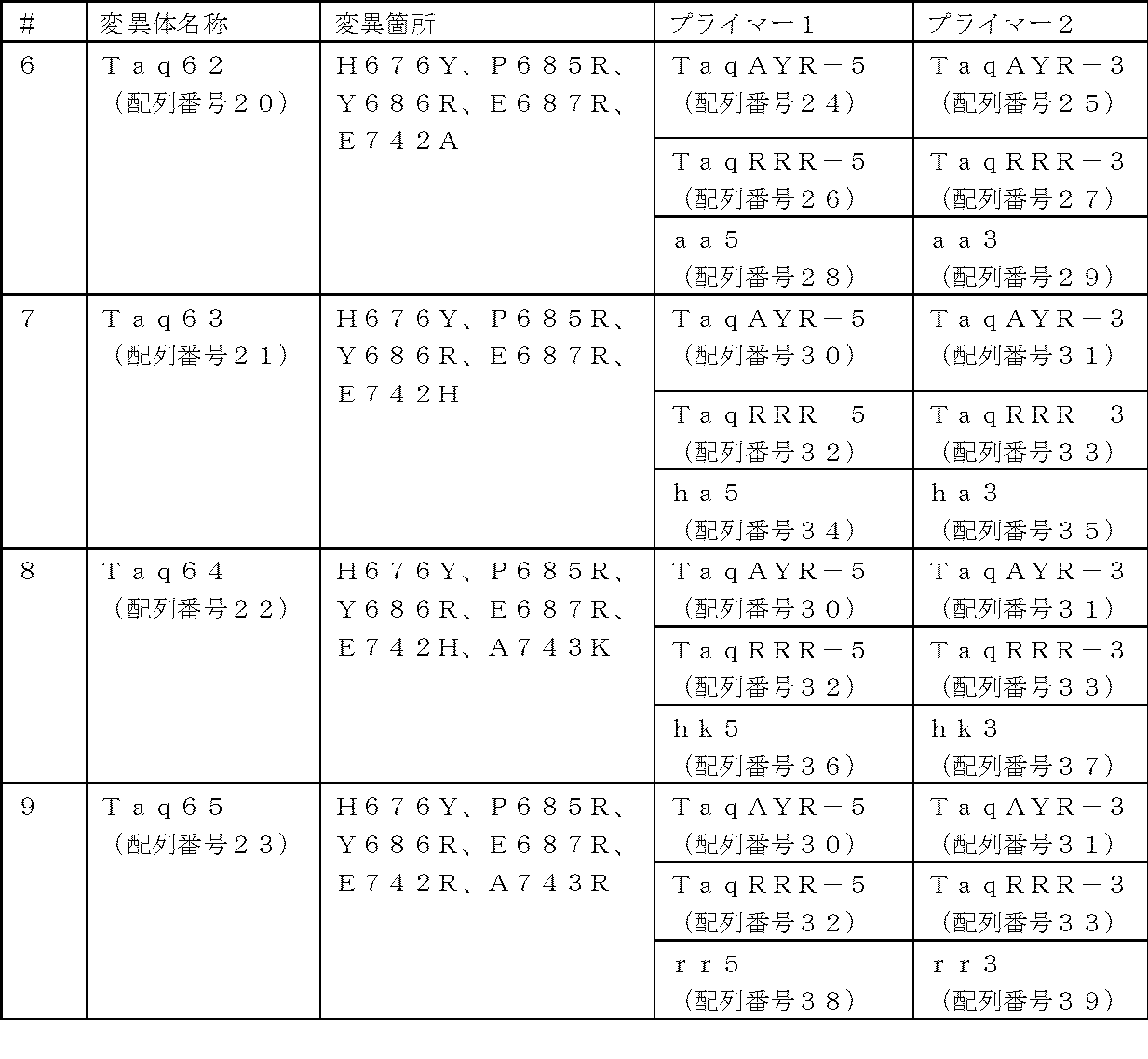
- Taq62 to Taq65 mutants were created based on the Taq59 mutant. That is, the Taq62 mutant uses the pET28-TaqLF plasmid described in Example 1 (1) as a template DNA, the combination of SEQ ID NOs: 24 and 25, the combination of SEQ ID NOs: 26 and 27, or the combination of SEQ ID NOs: 28 and 29. Site-specific mutation was performed three times with the combined mutagenesis primer set. Similarly to Taq62, the Taq63 to Taq65 mutants were subjected to site-specific mutation using the mutation-introducing primer set shown in Table 2. Mutagenesis and purification are the same as described above.
- mutant Taq polymerase was produced as follows. Using the mutant plasmid prepared in Example 1 (2) according to the instruction manual, E. coli BL21-CodonPlus-RIL strain (manufactured by Agilent Biotechnology) was transformed. When the OD600 of this culture solution reached 0.2 to 0.3, IPTG (manufactured by Wako Pure Chemical Industries, Ltd.) was added to a final concentration of 1 mM. In order to induce expression of the target protein gene, the cells were cultured with shaking at 25 ° C. for 14 hours, and the culture was collected by centrifugation (5000 ⁇ g, 10 minutes).
- the obtained bacterial cells were washed with a PBS solution (150 mM NaCl, 20 mM Na 2 HPO 4 , 2 mM NaH 2 PO 4 , pH 7.5).
- the cells are suspended in solution A [50 mM Tris-HCl, pH 8.0, 1 mM EDTA, 1 mM phenylmethylsulfonyl fluoride (phenylmethylsulfonyl fluoride, PMSF (manufactured by Wako Pure Chemical Industries, Ltd.)], and the cells are suspended by ultrasound on ice.
- the crushed liquid was centrifuged (23,700 ⁇ g, 4 ° C., 10 minutes), and the supernatant was heat-treated at 80 ° C.
- ammonium sulfate was added to give a 80% saturated solution, and after centrifugation (23,700 ⁇ g, 4 ° C., 10 minutes), the precipitate was dissolved in solution B [50 mM Tris-HCl, pH 8.0, 1M (NH 4 ) 2 SO 4 ] and equilibrated with solution B were applied to 5 ml of a hydrophobic column HiTrap Butyl FF (manufactured by GE Healthcare), and the protein was eluted with an ammonium sulfate concentration gradient from 1M to 0M.
- the elution fraction was dialyzed with Solution C [50 mM Tris-HCl, pH 8.0, 50 mM NaCl] using a cellulose tube for dialysis, and equilibrated with Solution C.
- HiTrap Heparin HP manufactured by GE Healthcare
- the eluted fraction was dialyzed against Solution C, and finally applied to 1 ml of an anion exchange column HiTrap Q HP (manufactured by GE Healthcare), and the protein was eluted with a sodium chloride concentration gradient from 50 mM to 0.5 M.
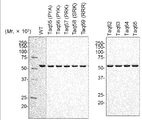
- the obtained protein was subjected to 12% SDS-PAGE, CBB staining was performed according to a conventional method, and the purity was tested.Proteins were produced and purified from Taq55 to Taq59 and Taq62 to 65 by the above method. It was shown in FIG.
- the produced protein showed a single band and was confirmed to be purified.
- the amino acid sequences of the obtained mutants Taq55 to 59 and 62 to 65 are shown in SEQ ID NOs: 40 to 48 in the sequence listing.
- Primer extension activity For measuring the primer extension activity of wild-type and mutant TaqLF, a 55 nt oligonucleotide (M13-pri55, SEQ ID NO: 5 ′) radiolabeled with [ ⁇ - 32 P] ATP.
- Primed DNA (primed-DNA) obtained by annealing 49) to 2,961 nt circular single-stranded DNA [pBlueScript II SK (+) (manufactured by Agilent Biotechnology)] was used as substrate DNA.
- Reaction solution D in 20 ⁇ l [20 mM Tris-HCl, pH 8.8, 10 mM KCl, 3.5 mM MgCl 2 , 0.1 mg / ml BSA, 0.1% Tween 20, 5 nM primed-DNA and 0.25 mM dNTP] Wild type TaqLF or mutant TaqLF was mixed so as to have a concentration of 10 nM, and reacted at 72 ° C. for 2.5 minutes or 10 minutes. The reaction was stopped by adding 2 ⁇ l of reaction stop solution [300 mM NaOH, 6 mM EDTA, 18% Ficoll 400, 0.15% bromocresol green and 0.24% xylene cyanol] per 8 ⁇ l of each reaction mixture.
- reaction stop solution [300 mM NaOH, 6 mM EDTA, 18% Ficoll 400, 0.15% bromocresol green and 0.24% xylene cyanol] per 8 ⁇ l of each reaction mixture.
- TaqLF WT has already become 3.2 kb for one round of the template after 2.5 minutes of reaction, and a 3.8 kb dark band and a position of 6 kb after 10 minutes of reaction. A thin band was detected.
- Taq55 extended to 3.4 kb in a reaction of 2.5 minutes.
- a dark band was observed up to a position of 4.3 kb, and a thin band was observed up to a position of 7 kb.
- Taq56 extended to 4.3 kb in a 2.5 minute reaction.
- a dark band was seen up to a position of 6.5 kb, and a thin band was seen up to a position of 9 kb.
- Taq57 was extended to 6.5 kb in a reaction of 2.5 minutes. In 10 minutes, a dark band was seen up to a position of 10 kb or more. Taq58 extended to 7.0 kb in a 2.5 minute reaction. In 10 minutes, a dark band was seen up to a position of 10 kb or more. Taq59 was extended to 8.0 kb in a reaction of 2.5 minutes. In 10 minutes, a dark band was seen up to a position of 10 kb or more.
- the sequence of the template DNA binding site of TaqLF WT is PYE, and the charge is -1.
- the charge of Taq55 is 0, the charge of Taq56 is +1, the charge of Taq57 and Taq58 is +2, and the charge of Taq59 is +3. This indicates that as the charge becomes positive, the elongation activity increases and the SD activity also increases.
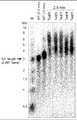
- Taq59 and Taq62 to Taq65 were examined for an increase in elongation activity.
- the evaluation method is the same as the method described above. That is, as shown in FIG. 2-2, Taq62 to Taq65 in which amino acids were mutated to positive charge at the E742 or E742 and A743 sites of the mutant Taq59 showed an improvement in the strand displacement activity over Taq59. From the above, it was confirmed that the strand displacement activity can be improved by combining substitution of amino acid sequences at positions 685 to 687 corresponding to the template DNA binding site of Taq DNA polymerase with substitution of amino acid sequences at other sites.
- Example 2 Measurement of binding ability to primed DNA by gel shift method The affinity between mutant Taq polymerase and primed DNA was examined using a gel shift assay. The measurement was performed as follows. First, a substrate for measuring DNA binding ability is a 27 nt single-stranded DNA (d27, SEQ ID NO: 50) radiolabeled with 32 P at the 5 ′ end and an unlabeled 49 nt single-stranded DNA (49N, SEQ ID NO: 51 ) was annealed as substrate DNA.
- d27 27 nt single-stranded DNA
- 49N unlabeled 49 nt single-stranded DNA
- DNA in 10 ⁇ l of Solution E [20 mM Tris-HCl, pH 8.8, 10 mM NaCl, 5 mM MgCl 2 , 14 mM 2-mercaptoethanol, 0.1 mg / ml BSA and 5% (v / v) glycerol] containing 2 nM substrate DNA Polymerase protein was added at 0.6 to 400 nM and incubated at 40 ° C. for 5 minutes.
- the DNA-enzyme mixture was applied to a 1% agarose gel and electrophoresed in a 0.1 ⁇ TAE solution [4 mM Tris base, 2 mM acetic acid and 0.1 mM EDTA]. After completion of electrophoresis, the gel was dried, and the dried gel was exposed to an imaging plate. Labeled DNA was detected using Typhoon TRIO +.
- Example 3 Amplification of genomic DNA using Taq59 polymerase (1) Comparison with known Taq DNA polymerase Using Taq59 prepared in Example 1, DNA amplification was performed using Pfu genomic DNA as a template.
- the composition of the reaction solution is 8 nM Taq59 polymerase, x1 SD buffer, 0.5 mM dNTPs, 10 ng Pfu genomic DNA, 10 ⁇ M pd (N) 6, 0.25 mg / ml BSA.
- the reaction was carried out by 99 cycles of (A) 50 ° C .; 6 hours or (B) 30 ° C .; 60 seconds, 68 ° C .; 60 seconds.
- wild-type Taq DNA polymerase having the amino acid sequence described in SEQ ID NO: 1 in the sequence listing Taq DNA polymerase having the amino acid sequence described in SEQ ID NO: 3 in the sequence listing
- SD having a commercially available SD activity.
- -Polymerase BIORON
- the product was then analyzed using an alkaline agarose gel.
- the elongation temperature was performed in two ways: (A) 50 ° C and (B) 70 ° C.
- the reaction consisted of 32 nM polymerase, 20 mM Tris-HCl, pH 8.8, 10 mM KCl, 3.5 mM MgCl 2 , 0.1% Tween 20, 0.5 mM dNTPs, 10 ng Pfu gene DNA, 10 ⁇ M pd (N) 6, 0.25 mg 60 cycles of 40 ° C .; 10 seconds, 50 ° C .; 1 minute, 50 ° C. or 70 ° C .; 5 minutes in a reaction solution containing 20 ⁇ l / ml BSA.
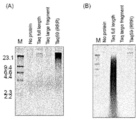
- the obtained product was subjected to 0.8% alkaline agarose gel electrophoresis and stained with SYBR (registered trademark) Green II Nucleic Acid Gel Stain (manufactured by Takara Bio Inc.). The results are shown in FIG.
- the wild-type Taq DNA polymerase and the Taq DNA polymerase Large Fragment hardly amplified DNA, but in the Taq59 of the present invention, the 23.1 kb marker was not between the well and the well. Amplification of high molecular DNA was observed.
- the wild type Taq DNA polymerase amplified a wide range of DNA up to 23 kb.
- DNA was not amplified by Taq large fragment.
- amplification of high molecular DNA was observed between the 23.1 kb marker and the well.
- the DNA polymerase of the present invention has high heat resistance. Furthermore, it was found that the DNA polymerase of the present invention can efficiently replicate even a long chain DNA of 23 kb or more.
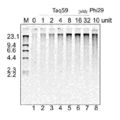
- DNA was amplified in the Taq59 concentration range of 1 to 32 nM.
- the reaction composition was 20 mM Tris-HCl, pH 8.8, 10 mM KCl, 3.5 mM MgCl 2 , 0.1% Tween 20, 0.5 mM dNTPs, 10 ng Pfu gene DNA, 10 ⁇ M pd (N) 6, 0.25 mg / ml BSA.
- the reaction was carried out at 50 ° C. for 6 hours.
- the product ([0082]) was subjected to 0.8% alkaline agarose gel electrophoresis and stained with SYBR® Green II Nucleic Acid Gel Stain. The results are shown in FIG.
- the band concentration increases in proportion to the enzyme concentration, and is constant at higher concentrations.
- the position of the band was below the well.
- phi29 DNA polymerase Taq59 of the present invention was compared with commercially available phi29 DNA polymerase.
- the phi29 DNA polymerase used in this experiment is manufactured by New England Biolabs (trade name: phi29 DNA Polymerase) and is known to have a very strong strand displacement activity. Reaction was 50 mM Tris-HCl, pH 7.5, 10 mM (NH 4 ) 2 SO 4 , 10 mM MgCl 2 , 4 mM DTT, 0.5 mM dNTPs, 10 ng Pfu gene DNA, 10 ⁇ M pd (N) 6, 0.25 mg / ml A 20 ⁇ l reaction solution containing BSA was used.
- phi29 DNA polymerase amplified DNA between the 23 kb marker and the well.
- Taq59 of the present invention has a larger amount of amplified product than phi29 DNA polymerase. From this, it was confirmed that the DNA polymerase having strand displacement activity of the present invention is more suitable for genome amplification than phi29 DNA polymerase. Thus, it was found that the DNA polymerase of the present invention has a strong strand displacement activity.
- the DNA polymerase having strand displacement activity of the present invention has high heat resistance, enables efficient long-chain replication of the template DNA, and has strong strand displacement activity, so that the efficient length of the template DNA can be increased. Strand replication became possible.
- the DNA polymerase having the strand displacement activity is useful in a wide range of fields such as genetic engineering, biology, medicine and agriculture.
- SEQ ID NO: 1 Amino acid sequence of Taq DNA polymerase wild type SEQ ID NO: 2: Nucleotide sequence of Taq DNA polymerase wild type SEQ ID NO: 3: Amino acid sequence of Taq DNA polymerase large fragment SEQ ID NO: 4 Nucleotide sequence of Taq DNA polymerase large fragment Sequence number 5: Nucleotide sequence of DNA polymerase variant Taq55 Sequence number 6: Nucleotide sequence of DNA polymerase variant Taq56 Sequence number 7: Nucleotide sequence of DNA polymerase variant Taq57 Sequence number 8: Nucleotide sequence of DNA polymerase variant Taq58 Sequence number 9: Nucleotide sequence of DNA polymerase variant Taq59 Sequence number 10: Mutagenesis primer TaqPYA-5 SEQ ID NO: 11: Mutagenesis primer TaqPYA-3 SEQ ID NO: 12: Mutagenism primer TaqPYK-5 SEQ ID NO: 13: Mutagenesis primer TaqPYK-3 SEQ ID NO: 14
Landscapes
- Health & Medical Sciences (AREA)
- Life Sciences & Earth Sciences (AREA)
- Genetics & Genomics (AREA)
- Engineering & Computer Science (AREA)
- Chemical & Material Sciences (AREA)
- Organic Chemistry (AREA)
- Zoology (AREA)
- Wood Science & Technology (AREA)
- Bioinformatics & Cheminformatics (AREA)
- Biotechnology (AREA)
- Molecular Biology (AREA)
- General Engineering & Computer Science (AREA)
- Biomedical Technology (AREA)
- Microbiology (AREA)
- Biochemistry (AREA)
- General Health & Medical Sciences (AREA)
- Plant Pathology (AREA)
- Physics & Mathematics (AREA)
- Biophysics (AREA)
- Medicinal Chemistry (AREA)
- Chemical Kinetics & Catalysis (AREA)
- General Chemical & Material Sciences (AREA)
- Tropical Medicine & Parasitology (AREA)
- Virology (AREA)
- Enzymes And Modification Thereof (AREA)
- Micro-Organisms Or Cultivation Processes Thereof (AREA)
- Preparation Of Compounds By Using Micro-Organisms (AREA)
Abstract
Thermus aquaticus (Taq) DNAポリメラーゼの鋳型DNA結合部位において、当該部位の電荷の総和を増加するアミノ酸残基へ置換した鎖置換活性を有するTaqポリメラーゼ、当該ポリメラーゼをコードする核酸、当該核酸を含むベクター、当該核酸を含むベクターまたは当該核酸を含む形質転換体、当該ポリメラーゼの製造方法、当該ポリメラーゼを利用した核酸増幅方法、当該ポリメラーゼを含むキットに関する。本発明により、高耐熱性を有し、鋳型DNAの効率的な長鎖複製が可能であり、かつ強力な鎖置換活性を有するDNAポリメラーゼが提供される。
Description
本発明はDNAポリメラーゼ変異体に関する。
DNAポリメラーゼは遺伝子工学用試薬として有用な酵素であり、核酸増幅法、DNA塩基配列決定法、核酸の標識化、部位特異的変異導入法などに広く使用されている。また、核酸増幅法の一種であるPCR法や全ゲノム増幅反応(Whole Genome Amplification;以下、WGAと記載することがある)に適した種々のDNAポリメラーゼが開発され、各社から市販されている。
現在知られているDNAポリメラーゼはそのアミノ酸配列の類似性に基づき、7つのファミリー(A、B、C、D、E、X、およびY)に分類されている。そのうち、ファミリーA(ポルI型酵素ともいう)およびファミリーB(α型酵素ともいう)に属するDNAポリメラーゼが遺伝子工学用試薬として市販されている。
ファミリーAに属する酵素の例として、Thermus aquaticus由来Pol I(以下、Taqポリメラーゼと記載することがある)、Geobacillus stearothermophilus由来Pol I(以下、Bstポリメラーゼと記載することがある)やThermus thermophilus由来Pol I(以下、Tthポリメラーゼと記載することがある)が挙げられる。
ファミリーAに属するDNAポリメラーゼの特徴として、DNA鎖伸長活性が強い、3’→5’エキソヌクレアーゼ活性(プルーフリーディング活性、以下、3’→5’エキソ活性と記載することがある)を持たない酵素が多い、TdT(末端デオキシヌクレオチド転移)活性を有すること等が挙げられる。また、鎖置換活性を有する酵素と有さない酵素があり、Taqポリメラーゼは鎖置換活性を有さないが、Bstポリメラーゼのラージフラグメントは該活性を有する。Tthポリメラーゼは、逆転写活性を併せ持つDNAポリメラーゼとして知られている。
ファミリーAに属するDNAポリメラーゼの特徴として、DNA鎖伸長活性が強い、3’→5’エキソヌクレアーゼ活性(プルーフリーディング活性、以下、3’→5’エキソ活性と記載することがある)を持たない酵素が多い、TdT(末端デオキシヌクレオチド転移)活性を有すること等が挙げられる。また、鎖置換活性を有する酵素と有さない酵素があり、Taqポリメラーゼは鎖置換活性を有さないが、Bstポリメラーゼのラージフラグメントは該活性を有する。Tthポリメラーゼは、逆転写活性を併せ持つDNAポリメラーゼとして知られている。
鎖置換活性(strand displacement activity;以下、SD活性と記載することがある)とは、鋳型となる二本鎖DNAの水素結合を自ら解離しつつ、新しいDNA鎖を複製する活性である。鎖置換型DNAポリメラーゼは、その特性から鋳型二本鎖DNAの解離を必要としないため一定温度でのDNA合成が可能であり、またDNAの二次構造による合成阻害を受けにくいという特徴を有している。
鎖置換型DNAポリメラーゼは等温核酸増幅反応に利用されることが多い。等温核酸増幅反応としては、鎖置換型DNA伸長反応(Strand Displacement Amplification;以下、SDAと記載することがある;非特許文献1、2)、ローリングサークル増幅法(Rolling circle amplification;以下、RCAと記載することがある;非特許文献3)、交差プライミング増幅法(cross priming amplification;以下、CPAと記載することがある;非特許文献4)、ループ介在等温増幅法(Loop-Mediated Isothermal Amplification;以下、LAMPと記載することがある;非特許文献5)、ICAN法(Isothermal and Chimeric primer-initiated Amplification of Nucleic acids;以下、ICANと記載することがある;特許文献1、2)等がある。
ファミリーBに属する、phi29ファージ由来DNAポリメラーゼ(以下、φ29ポリメラーゼと記載することがある)は非常に強い鎖置換活性を有している。この酵素は、鋳型DNAの複製をローリングサークル増幅法に利用されている。市販品の例として、TempliPhi、GenomiPhi(ともにGE Healthcare社製)がある。
等温核酸増幅法を高い特異性で実施するためには、高温条件下でプライマーを配列特異的に鋳型DNAへアニーリングさせる必要がある。Bstポリメラーゼは鎖置換活性を有する耐熱性DNAポリメラーゼだが、至適温度は約63℃であり、68℃以上では失活する。φ29ポリメラーゼは、20~37℃の中温域で活性を示し、65℃で10分間加熱することにより失活する特徴を有する。そのため、これらのポリメラーゼは、鋳型DNAを熱変性によって乖離させる核酸増幅反応には使用できない。
鎖置換活性を付与した、かつエキソ活性を欠失した耐熱性のTaqポリメラーゼ変異体として、SD Polymerase(BIORON社製、WO2014/161712)が市販されている。しかしながら、該SD Polymeraseを使用したPCRでの増幅効率は、既存のThermococcus litoralis 由来Vent DNAポリメラーゼやPyrococcus furiosus由来Pfuポリメラーゼと同等の性能である。
そのため、高耐熱性を有し、鋳型DNAの効率的な長鎖複製が可能であり、かつ好ましくは強力な鎖置換活性を有するDNAポリメラーゼが求められていた。
ヌクレイック アシッズ リサーチ(Nucleic Acids Res.)、第20巻、第7号、1691~6ページ(1992年)
米国科学アカデミー紀要(Proc Natl Acad Sci U S A.)、第89巻、第1号、392~6ページ(1992年)
米国科学アカデミー紀要(Proc Natl Acad Sci U S A.)、第92巻、第10号、4641~5ページ(1995年)
サイエンス リポート(Sci Rep.)、第2巻、246ページ(2012年) doi: 10.1038/srep00246
ヌクレイック アシッズ リサーチ(Nucleic Acids Res.)、第28巻、第12号、E63ページ(2000年)
本発明の目的は、高耐熱性と、好ましくは強力な鎖置換活性を有し、長鎖の鋳型DNAを効率よく複製することが可能なDNAポリメラーゼを提供することにある。
本発明者らは、ファミリーAに属するDNAポリメラーゼ間のアミノ酸配列を比較、解析した。その結果、5’→3’エキソヌクレアーゼ活性を失ったDNAポリメラーゼの鋳型DNA結合部位において、当該部位の電荷の総和を増加するようなアミノ酸置換を導入することにより、高い鎖置換活性が付与されたDNAポリメラーゼを創製できることを明らかにし、本発明を完成させた。
すなわち、本発明の第一の発明は、ファミリーAに属するDNAポリメラーゼのアミノ酸配列において、鋳型DNA結合部位にその電荷の総和が増加するようなアミノ酸置換を有し、かつ5’→3’エキソヌクレアーゼ活性を有さないDNAポリメラーゼ、または該DNAポリメラーゼのアミノ酸配列と95%以上の配列同一性を有するDNAポリメラーゼに関する。
本発明の第一の発明において、「電荷の総和を増加するアミノ酸」は、例えば、アルギニン、リジン、ヒスチジン、セリンおよびアラニンから選択されるアミノ酸が挙げられる。
本発明の第一の発明において、「DNAポリメラーゼの鋳型DNA結合部位」は、本発明を何ら限定するものではないが、例えば、配列表の配列番号1で示されるTaq DNAポリメラーゼのアミノ酸配列の685~687番目のアミノ酸に相当するアミノ酸残基を含む部位が挙げられる。
本発明の第一の発明において、「置換されたアミノ酸配列」を有するDNAポリメラーゼは、例えば、Taq DNAポリメラーゼのアミノ酸配列の
(1)685番目のプロリンに相当するアミノ酸のアルギニンまたはセリンへの置換、
(2)686番目のチロシンに相当するアミノ酸のアルギニンへの置換、および
(3)687番目のグルタミン酸に相当するアミノ酸のアルギニン、リジンまたはアラニンへの置換、
からなる群より選択される1以上の置換を有するDNAポリメラーゼである。具体的には、配列表の配列番号40~48のいずれかに示されるアミノ酸配列を含むDNAポリメラーゼが挙げられる。
(1)685番目のプロリンに相当するアミノ酸のアルギニンまたはセリンへの置換、
(2)686番目のチロシンに相当するアミノ酸のアルギニンへの置換、および
(3)687番目のグルタミン酸に相当するアミノ酸のアルギニン、リジンまたはアラニンへの置換、
からなる群より選択される1以上の置換を有するDNAポリメラーゼである。具体的には、配列表の配列番号40~48のいずれかに示されるアミノ酸配列を含むDNAポリメラーゼが挙げられる。
本発明の第一の発明において、「ファミリーAに属するDNAポリメラーゼ」は、耐熱性DNAポリメラーゼが好ましい。
また本発明の第一の発明において、「ファミリーAに属するDNAポリメラーゼ」は、Thermus属細菌由来DNAポリメラーゼであってもよい。
さらに本発明の第一の発明において、「ファミリーAに属するDNAポリメラーゼ」は、野生型のファミリーAに属するDNAポリメラーゼのアミノ酸配列と比較してN末端側配列が欠失したDNAポリメラーゼが好ましく、特に限定はされないがN末端側配列が欠失したTaq DNAポリメラーゼ、好ましくはN末端から289残基までのアミノ酸を欠失したTaq DNAポリメラーゼやN末端から280残基までのアミノ酸を欠失したTaq DNAポリメラーゼが挙げられる。本明細書において、ファミリーAに属するDNAポリメラーゼとしては、野生型のファミリーAに属するDNAポリメラーゼの5’→3’エキソヌクレアーゼ活性に関係するN末端側配列が欠失したDNAポリメラーゼも好ましい例である。
本発明の第二の発明は、本発明の第一の発明のDNAポリメラーゼをコードする塩基配列を含む核酸に関する。当該核酸としては、特に限定はされないが、配列表の配列番号5~9および20~23のいずれかに示される塩基配列を含む、前記第一の発明のDNAポリメラーゼをコードする核酸が例示される。該DNAポリメラーゼは鎖置換活性を有することが好ましい。
本発明の第三の発明は、本発明の第二の発明のDNAポリメラーゼをコードする核酸を含むベクターに関する。該DNAポリメラーゼは鎖置換活性を有することが好ましい。
本発明の第四の発明は、本発明の第三の発明のベクターまたは本発明の第二の発明の核酸を含む形質転換体に関する。
本発明の第五の発明は、本発明の第四の発明の形質転換体を培養し、培養物からDNAポリメラーゼを採取することを特徴とするDNAポリメラーゼの製造方法に関する。該DNAポリメラーゼは鎖置換活性を有することが好ましい。
本発明の第六の発明は、本発明の第一の発明のDNAポリメラーゼおよび鋳型DNAを共にインキュベートする工程を含むDNA分子の製造方法に関する。本発明の第六の発明において、DNA分子の製造方法はポリメラーゼ連鎖反応または等温核酸増幅反応であってもよい。該DNAポリメラーゼは鎖置換活性を有することが好ましい。
本発明の第七の発明は、本発明の第一の発明のDNAポリメラーゼを含むキットに関する。該DNAポリメラーゼは鎖置換活性を有することが好ましい。
本発明により、高耐熱性を有し、鋳型DNAの効率的な長鎖複製が可能であり、かつ好ましくは強力な鎖置換活性を有するDNAポリメラーゼが提供される。
本発明において、「鎖置換活性」とは、鋳型となる二本鎖DNAの水素結合を自ら解離しつつ、新しいDNA鎖を複製する活性を指す。本発明の好ましいDNAポリメラーゼは鎖置換活性を有するものであり、例えば、鎖置換活性を有することが知られている公知のDNAポリメラーゼと同程度又はより強い鎖置換活性を有する。
本発明において、「電荷の総和を増加する」とは、ある部位の置換後の各アミノ酸残基の電荷の総和が、当該部位の置換前の各アミノ酸残基の電荷の総和より大きいことを指す。本発明を何ら限定するものではないが、例えば、置換前のアミノ酸配列がプロリン-チロシン-グルタミン酸(3残基)の場合、電荷の総和は0+0+(-1)=-1である。これをアルギニン-アルギニン-アルギニンへ置換した場合、電荷の総和は(+1)+(+1)+(+1)=+3である。この置換において、当該部位の電荷の総和は-1から+3へ変化しており、電荷の総和が増加したという。
以下、さらに詳細に説明する。
1.本発明のDNAポリメラーゼおよびそれをコードする核酸
本発明の第一の態様は、DNAポリメラーゼに関し、これは、ファミリーAに属するDNAポリメラーゼのアミノ酸配列において、鋳型DNA結合部位にその電荷の総和が増加するようなアミノ酸置換を有し、かつ5’→3’エキソヌクレアーゼ活性を有さないDNAポリメラーゼ、ならびに前記DNAポリメラーゼのアミノ酸配列と95%以上の配列同一性を有し、かつ同等の活性を有するDNAポリメラーゼである。該DNAポリメラーゼは鎖置換活性を有することが好ましい。なお、本明細書において、「配列同一性」とは、DNAポリメラーゼのアミノ酸配列において、鋳型DNA結合部位以外のアミノ酸配列を100%とする場合の配列同一性のことであり、好ましくはDNAポリメラーゼのアミノ酸配列と95%以上、より好ましくは100%の配列同一性を有する。
本発明の第一の態様は、DNAポリメラーゼに関し、これは、ファミリーAに属するDNAポリメラーゼのアミノ酸配列において、鋳型DNA結合部位にその電荷の総和が増加するようなアミノ酸置換を有し、かつ5’→3’エキソヌクレアーゼ活性を有さないDNAポリメラーゼ、ならびに前記DNAポリメラーゼのアミノ酸配列と95%以上の配列同一性を有し、かつ同等の活性を有するDNAポリメラーゼである。該DNAポリメラーゼは鎖置換活性を有することが好ましい。なお、本明細書において、「配列同一性」とは、DNAポリメラーゼのアミノ酸配列において、鋳型DNA結合部位以外のアミノ酸配列を100%とする場合の配列同一性のことであり、好ましくはDNAポリメラーゼのアミノ酸配列と95%以上、より好ましくは100%の配列同一性を有する。
本発明の第一の態様の好ましい形態において、DNAポリメラーゼは、アミノ酸置換によってその鋳型DNA結合部位の電荷の総和が増加していればよく、当該部位において置換の前後で電荷が変わらないアミノ酸残基と電荷が増加したアミノ酸残基が混在していてもよい。総電荷の増加は、負電荷を有するアミノ酸から電荷を有しないアミノ酸または正電荷を有するアミノ酸への置換、ならびに電荷を有しないアミノ酸から正電荷を有するアミノ酸への置換によって達成される。本発明には、電荷が変わらないアミノ酸残基の数より電荷が増加したアミノ酸残基の数が多いDNAポリメラーゼが好ましく、当該部位のアミノ酸残基すべてにおいて電荷が増加したDNAポリメラーゼがより好ましい。例えば、当該部位のアミノ酸残基すべてが正電荷を有する塩基性アミノ酸に置換されたDNAポリメラーゼ、さらに、当該部位のアミノ酸残基すべてが最も高電荷のアルギニンに置換されたDNAポリメラーゼが本発明に好ましい。
ファミリーAに属するDNAポリメラーゼの鋳型DNA結合部位は、当該ポリメラーゼの立体構造から鋳型DNAに結合する部位を選択してもよい。特に限定はされないが例えば、配列表の配列番号1で示されるTaqポリメラーゼにおいては、当該ポリメラーゼのアミノ酸配列の685~687番目のアミノ酸に相当するアミノ酸残基を含む部位として、鋳型DNA結合部位を特定することができる。
本発明の第一の態様の好ましい形態において、置換されたアミノ酸配列は、例えば、野生型Taq DNAポリメラーゼのアミノ酸配列における
(1)685番目のプロリンに相当するアミノ酸のアルギニンまたはセリンへの置換、
(2)686番目のチロシンに相当するアミノ酸のアルギニンへの置換、および
(3)687番目のグルタミン酸に相当するアミノ酸のアルギニン、リジンまたはアラニンへの置換、
からなる群より選択される1以上の置換を有する、好ましくは鎖置換活性を有するDNAポリメラーゼである。
(1)685番目のプロリンに相当するアミノ酸のアルギニンまたはセリンへの置換、
(2)686番目のチロシンに相当するアミノ酸のアルギニンへの置換、および
(3)687番目のグルタミン酸に相当するアミノ酸のアルギニン、リジンまたはアラニンへの置換、
からなる群より選択される1以上の置換を有する、好ましくは鎖置換活性を有するDNAポリメラーゼである。
本発明のDNAポリメラーゼは5’→3’エキソヌクレアーゼ活性を有していないという特徴を有している。ファミリーAに属するDNAポリメラーゼの多くは5’→3’エキソヌクレアーゼ活性を有しているが、公知の方法で当該活性を欠失させることにより、本発明に利用することが可能である。例えば、5’→3’エキソヌクレアーゼ活性に寄与するアミノ酸残基を置換もしくは欠失させるような変異の導入や、前記活性に重要なドメインを欠失させる方法が知られている。
本発明のDNAポリメラーゼとしては、特に本発明を限定するものではないが、耐熱性を有するものであることが望ましい。DNAの熱変性工程を含むPCR法は言うまでもなく、等温核酸増幅法においても、DNAの塩基対結合を弱めることができる高温条件下での反応に使用できる耐熱性DNAポリメラーゼは有利である。ファミリーAに属する、好熱性微生物のDNAポリメラーゼを利用して作製された本発明のDNAポリメラーゼは、特に好適な態様である。本明細書において耐熱性を有するとは、例えば、特に限定するものではないが、DNAポリメラーゼを90℃にて30分間保持した場合の残存活性が100%であるか、又は95℃にて30分間保持した場合の残存活性が75%以上である性質を指すものである。
Taq DNAポリメラーゼやその他のThermus属細菌(例えば、Thermus thermophilus、Thermus flavus等)の耐熱性DNAポリメラーゼでは5’→3’エキソヌクレアーゼ活性ドメインがN末端側に位置しているので、これらのDNAポリメラーゼのN末端側欠失体の鋳型DNA結合部位に前記のアミノ酸置換を導入することにより、本発明のDNAポリメラーゼを作製することができる。例えば、N末端から280残基までのアミノ酸を欠失したTaq DNAポリメラーゼ(KlenTaq)や、本明細書の実施例に記載された、N末端から289残基までのアミノ酸を欠失したTaq DNAポリメラーゼ(Taq large fragment)は本発明に好適である。例えば、配列表の配列番号40~48から選択されるアミノ酸配列を含む、好ましくは鎖置換活性を有するDNAポリメラーゼが、本発明のDNAポリメラーゼ(即ち、DNAポリメラーゼ変異体)として挙げられる。本発明のDNAポリメラーゼとして特に好適には、配列表の配列番号44で示されるアミノ酸配列を有するDNAポリメラーゼである。さらに本発明の別態様としては、Taq DNAポリメラーゼの117番目のグルタミン酸残基をアラニン残基に、119番目のアスパラギン酸残基をアラニン残基に、142番目のアスパラギン酸残基をアラニン残基に、さらに144番目のアスパラギン酸残基をアラニン残基に置換した5’→3’エキソヌクレアーゼ欠失体と本発明を組み合わせてもよい。
本発明の第一の態様のより好ましい形態において、本発明のDNAポリメラーゼの性能を高めることを目的として、上記以外のアミノ酸置換をさらに導入してもよい。本発明を何ら限定するものではないが、例えば、特許第4193997号記載の変異(Taqポリメラーゼの742位のグルタミン酸と743位のアラニンの電荷の総和を増加する変異)を本発明のDNAポリメラーゼへ導入してもよい。特許第4193997号記載のDNAポリメラーゼ変異体は、伸長活性が高くなったと開示されており、該変異をさらに導入することにより、本発明のDNAポリメラーゼの伸長活性がさらに高くなることが期待できる。
あるいは、本発明の第一の態様において、当該DNAポリメラーゼの性能を高めることを目的として、特定の機能を有する分子と融合させたDNAポリメラーゼであってもよい。前記の「特定の機能を有する分子」としては、DNAと親和性を有するペプチド・ポリペプチドや、DNAの合成に関与するタンパク質と相互作用するペプチド・ポリペプチドが例示される。本明細書において、「特定の機能を有する分子と融合させたDNAポリメラーゼ」を「融合ポリペプチド」と称する場合があり、かかる融合ポリペプチドもDNAポリメラーゼに包含される。
PCNA(増殖細胞核抗原:proliferating cell nuclear antigen)は、ホモ多量体で「スライディング・クランプ(sliding clamp)」と呼ばれる環状構造を形成し、DNA合成反応を促進する。PCNAは酵母からヒトまで高度に保存されており、真核細胞において、PCNAは細胞分裂、DNA複製、修復、細胞周期調節、DNAメチル化やクロマチンリモデリングのような複製後修飾で重要な役割を担っている。PCNAは、DNAポリメラーゼやRFC(replication factor C;複製因子C)以外にもさまざまなタンパク質と複合体を形成し、DNAの修復・複製やその他の遺伝子制御機能に関与する。ヒトでは少なくとも12個のタンパク質がPCNAと結合することが知られている。各タンパク質はPIPボックス(PIP box;PCNA interaction protein box)を介してPCNAと結合することでDNA鎖上に留め置かれることになる。
ファミリーAに属するDNAポリメラーゼの多くはPCNAと相互作用することはない。しかしながら、本発明DNAポリメラーゼにPCNAと結合するペプチドを付加することにより、DNA合成反応における反応速度や伸張性を向上させることができる。
「PCNAと結合するペプチド」とは、PCNAと結合する能力を有するペプチドであれば特に限定はない。該ペプチドとして、種々のPCNA結合性タンパク質に存在するペプチドであるPIPボックスを含むペプチドが例示される。PIPボックスはPCNAと相互作用するタンパク質に存在するアミノ酸配列で、PCNAを介して当該タンパク質をDNA鎖上に留める働きをする。DNA複製などに関与する、好熱性細菌のタンパク質(例えば複製因子Cラージサブユニット等)がPIPボックスを有していることが知られている。本発明において好適なPIPボックスは、少なくとも8アミノ酸からなるオリゴペプチドであって、A1-A2-A3-A4-A5-A6-A7-A8と表記すると、A1はグルタミン残基、A2とA3は任意のアミノ酸残基、A4はロイシン残基、イソロイシン残基およびメチオニン残基からなる群から選択されるアミノ酸残基、A5とA6は任意のアミノ酸残基、A7はフェニルアラニン残基又はトリプトファン残基、A8はフェニルアラニン残基、トリプトファン残基又はロイシン残基からなる群から選択されるアミノ酸残基、であるものが例示される。特に好ましくは、8アミノ酸のQATLFDFLを含む配列表の配列番号52記載のものが挙げられる。さらに本発明においては、前記8アミノ酸のオリゴペプチドのN末端側にさらにリジン残基を有する9アミノ酸を含むものであってもよい。
さらに本発明で使用するPIPボックスは、特に限定はされないが好熱性細菌が産生するタンパク質由来のものが挙げられる。好ましくは好熱性細菌の複製因子Cラージサブユニット由来のPIPボックスが例示され、さらに好ましくはPyrococcus furiosusの複製因子Cラージサブユニット由来のPIPボックスが例示される。あるいはこれと実質的に同等の活性を有する機能的同等物であってもよい。
また、これらのPIPボックスは、本発明の融合ポリペプチド内に複数個存在してもよい。融合ポリペプチドに含まれるPIPボックスの数は、特に限定はないが、1~6個、好ましくは2~4個が例示される。これら複数のPIPボックスは、その機能を果たす限りにおいては、それぞれのアミノ酸配列が異なっていてもよい。また、複数のPIPボックス同士の間には、例えば後述のリンカーペプチドなど、別のアミノ酸配列が挟まっていてもよい。
また、これらのPIPボックスは、本発明の融合ポリペプチド内に複数個存在してもよい。融合ポリペプチドに含まれるPIPボックスの数は、特に限定はないが、1~6個、好ましくは2~4個が例示される。これら複数のPIPボックスは、その機能を果たす限りにおいては、それぞれのアミノ酸配列が異なっていてもよい。また、複数のPIPボックス同士の間には、例えば後述のリンカーペプチドなど、別のアミノ酸配列が挟まっていてもよい。
さらに上記PIPボックスのC末側には、「リンカーペプチド」が存在してもよい。本発明の融合ポリペプチドを構成する「リンカーペプチド」とは、本発明の融合ポリペプチドにおいて、その機能やフォールディングが阻害されるのを回避するために、融合されるポリペプチド同士あるいはペプチドとポリペプチドの間に挿入されるペプチドである。リンカーペプチドの長さに特に制限はないが、3~100アミノ酸、好ましくは5~50アミノ酸のペプチドが例示される。当該リンカーペプチドを構成するアミノ酸の種類に特に制限はないが、リンカー自身が複雑な高次構造を形成するものは避けた方がよく、側鎖が比較的小さいアミノ酸、例えばセリンやグリシンを多く含むペプチドがよく用いられる。
本発明を何ら限定するものではないが、上記PIPボックスをN末端側に付加された本発明のDNAポリメラーゼが好適である。当該PIPボックスをN末端側に付加された本発明のDNAポリメラーゼを使用する際には、本発明を何ら限定するものではないが、PCNAを含有する反応液が使用される。前記のPCNAとしては公知のPCNAもしくはその変異体を使用することができるが、好ましくは耐熱性のPCNAもしくはその変異体が使用される。特に限定はされないがPyrococcus furiosus由来PCNAあるいはThermococcus kodakarensis由来PCNAなどが例示される。さらに変異型PCNAも本発明の核酸増幅用組成物等の本発明の種々の態様に使用することができる。本発明に使用可能な好ましい変異型PCNAとしては、例えば国際公開WO2007/004654号パンフレットに記載された変異型PCNA、すなわち、P.furiosusのPCNAの第82番目、第84番目、第109番目、第139番目、第143番目、第147番目のアミノ酸残基を他のアミノ酸に置換した配列を有する変異型PCNAが例示される。本発明の特に好ましい態様では、第143番目のアミノ酸残基をアスパラギン酸からアルギニン(D143R)に換えた配列を有する変異型PCNAが例示される。
本発明の第二の態様は、本発明の第一の態様のDNAポリメラーゼをコードする核酸である。好適には、配列表の配列番号40~48から選択されるアミノ酸配列を含むDNAポリメラーゼをコードする核酸であればよい。さらに好適には、配列表の配列番号5~9および20~23から選択される塩基配列を含む核酸である。特に好適には、配列表の配列番号9で示される塩基配列を含む核酸である。該DNAポリメラーゼは鎖置換活性を有することが好ましい。
本発明の第一の態様のDNAポリメラーゼをコードする核酸は、使用する宿主(host)において発現可能かつDNAポリメラーゼ活性を有するタンパク質をコードするコドンであれば特に限定は無く、発現可能にするためまたは発現量を増加させるためにコドンの最適化を行ってもよい。該最適化は、本分野において通常使用されている方法によって行うことが好ましい。なお、コドンの最適化を行う場合、コードされているアミノ酸配列に変化が生じないようにする必要がある。
本発明の第二の態様の核酸は、発現させたポリペプチドの精製を容易にするために、アフィニティタグをコードする核酸をさらに含んでいてもよい。本発明を何ら限定するものではないが、本発明の第二の態様の核酸としては、例えば、ヒスチジン(His)タグ、グルタチオンS-トランスフェラーゼ(GST)タグ、マルトース結合タンパク質(maltose binding protein;MBP)タグ、8残基のアミノ酸(Trp-Ser-His-Pro-Gln-Phe-Glu-Lys)からなるStrep(II)タグなどをコードする核酸である。当該タグを付加する位置は、本発明のDNAポリメラーゼをコードする核酸の5’末端および/または3’末端側のいずれでもよく、発現およびタグ機能の障害とならない位置に適宜付加すればよい。なお、該タグは、発現させた融合ポリペプチドの精製段階において切断できるタグが好ましい。本発明を何ら限定するものではないが、かかる切断できるタグとしては、例えば、Facror Xa、PreScission Protease、トロンビン(Thrombin)、エンテロキナーゼ(enterokinase)、TEVプロテアーゼ(Tobacco Etch Virus Protease)などの融合ポリペプチド切断用プロテアーゼの認識配列をコードする核酸を含むタグである。
本発明の第三の態様は、本発明の第二の態様の核酸を含むベクターである。本発明の第二の態様の核酸を挿入するベクターとしては、本分野において通常使用されている発現ベクターであれば、特に限定は無い。宿主細胞において自立複製が可能なベクターや宿主染色体に組み込まれ得るベクターを使用することができる。このようなベクターとしては、例えば、プラスミドベクター、ファージベクター、ウイルスベクター等を使用することができる。プラスミドベクターとしては、使用する宿主に適したプラスミド、例えば大腸菌由来のプラスミド、バチルス属細菌由来のプラスミド、酵母由来のプラスミドが当業者に周知であり、また、市販されているものも多い。本発明にはこれら公知のプラスミドやその改変体を使用することができる。ファージベクターとしては、例えば、λファージ(例えば、Charon4A、Charon21A、EMBL3、EMBL4、λgt10、λgt11、λZAP)等を使用することができ、ウイルスベクターとしては、例えば、レトロウイルス、ワクシニアウイルス等の動物ウイルス、バキュロウイルス等の昆虫ウイルスを使用することができる。発現ベクターに搭載するプロモーターは宿主に応じて選択することができ、例えば大腸菌ではtrpプロモーター、lacプロモーター、PLプロモーター、PRプロモーター等の大腸菌やファージ等に由来するプロモーターやそれらの改変体を使用することができるが、前記のものに限定されるものではない。さらに、ファージ由来のプロモーターとRNAポリメラーゼ遺伝子を組み合わせた発現系(例えばpET発現系等)を利用してもよい。さらに、酵母、昆虫細胞、哺乳動物細胞を宿主とする異種タンパク質発現系も数多く構築されており、また、すでに市販もされている。本発明の融合ポリペプチド等のDNAポリメラーゼの製造にはこれらの発現系を使用してもよい。
本発明の第四の態様は、本発明の第三の態様のベクターまたは本発明の第二の態様の核酸を含む形質転換体である。本発明の第三の態様のベクターによって形質転換される宿主または本発明の本発明の第二の態様の核酸を導入される宿主としては、本分野において通常使用されている宿主であれば、特に限定は無く、本発明の融合ポリペプチド等のDNAポリメラーゼを発現し得る限り、原核細胞、酵母、動物細胞、昆虫細胞、植物細胞等のいずれを使用してもよい。
原核細胞を宿主細胞とする場合、例えば、エッシェリヒア・コリ(Escherichia coli:大腸菌)等のエシェリヒア属、バチルス・ズブチリス(Bacillus subtilis)等のバチルス属、シュードモナス・プチダ(Pseudomonas putida)等のシュードモナス属、及びリゾビウム・メリロティ(Rhizobium meliloti)等のリゾビウム属に属する細菌を宿主細胞として使用することができる。異種タンパク質の製造に使用可能な大腸菌は当業者に周知であり、また、市販されているものも多い(例えば、Escherichia coli BL21、E.coli XL1-Blue、E.coli XL2-Blue、E.coli DH1、E.coli JM109、E.coli HB101等)。また、バチルス属細菌であるBacillus subtilis MI114、B.subtilis 207-21等、Brevibacillus属細菌であるもBrevibacillus choshinensis等が異種タンパク質の製造用宿主として知られている。これらの宿主細胞を適切な発現ベクターと組み合わせ、本発明の融合ポリペプチド等のDNAポリメラーゼの製造に使用することができる。
発現ベクターの宿主への導入方法としては、宿主に核酸を導入し得る方法であれば特に限定されず、例えば、カルシウムイオンを用いる方法、エレクトロポレーション法、スフェロプラスト法、酢酸リチウム法等を使用することができる。昆虫細胞への組換えベクターの導入方法は、昆虫細胞にDNAを導入し得る限り特に限定されず、例えば、リン酸カルシウム法、リポフェクション法、エレクトロポレーション法等を使用することができる。ファージベクターやウイルスベクターは、これらベクターに応じた方法で宿主細胞への感染を実施し、本発明の融合ポリペプチド等のDNAポリメラーゼを発現する形質転換体を得ることができる。
本発明の第五の態様は、本発明の第四の態様の形質転換体を培養し、培養物からDNAポリメラーゼを採取することを特徴とするDNAポリメラーゼの製造方法である。該DNAポリメラーゼは鎖置換活性を有することが好ましい。培養条件は、使用する発現ベクター、宿主等に適した条件であれば特に限定はない。本発明を何ら限定するものではないが、例えば、pETベクターにて大腸菌を形質転換した場合、形質転換体をLB培地へ接種し、例えば37℃にて振盪培養する。培養液のODが0.2~0.3になった時点でIPTGを添加、目的タンパク質の発現を誘導するために、例えば37℃で2~5時間、37℃では発現量が少ない場合には15~30℃で2~24時間、好ましくは20~25℃で4~5時間、あるいは発現量をさらに増やす目的には好ましくは20~25℃で10~20時間、振盪培養する。培養液を遠心分離し、得られた菌体を洗浄後、超音波破砕することによって本発明のDNAポリメラーゼを得ることができる。破砕物は夾雑物が多いため、本分野において使用されている精製方法、例えば、硫酸アンモニウム沈殿法、陰イオン交換カラム、陽イオン交換カラム、ゲル濾過カラム、アフィニティクロマトカラム、透析等を適宜組み合わせるによって精製を行うことが望ましい。
2.本発明のDNAポリメラーゼを用いる核酸増幅方法
本発明のDNAポリメラーゼを用いた核酸増幅方法は、DNA分子の製造に利用可能である。本発明を何ら限定するものではないが、前記本発明の核酸増幅方法の例としては、本発明のDNAポリメラーゼおよび鋳型DNAを共にインキュベートする工程を含むDNA分子の製造方法である。ここで、該DNAポリメラーゼは鎖置換活性を有することが好ましい。該方法は、さらにプライマーを含んでいてもよい。当該プライマーは、一種でも複数種でもよい。また、当該プライマーは、特異的プライマーでもランダムプライマーあるいはそれらの混合物でもよい。当該プライマーの種類は、目的に応じて適宜選択することができる。当該DNA分子の製造方法は、本分野において通常使用されている方法であればよい。本発明を何ら限定するものではないが、前記本発明の核酸増幅方法は、例えば、ポリメラーゼ連鎖反応または等温核酸増幅反応に使用できる。
本発明のDNAポリメラーゼを用いた核酸増幅方法は、DNA分子の製造に利用可能である。本発明を何ら限定するものではないが、前記本発明の核酸増幅方法の例としては、本発明のDNAポリメラーゼおよび鋳型DNAを共にインキュベートする工程を含むDNA分子の製造方法である。ここで、該DNAポリメラーゼは鎖置換活性を有することが好ましい。該方法は、さらにプライマーを含んでいてもよい。当該プライマーは、一種でも複数種でもよい。また、当該プライマーは、特異的プライマーでもランダムプライマーあるいはそれらの混合物でもよい。当該プライマーの種類は、目的に応じて適宜選択することができる。当該DNA分子の製造方法は、本分野において通常使用されている方法であればよい。本発明を何ら限定するものではないが、前記本発明の核酸増幅方法は、例えば、ポリメラーゼ連鎖反応または等温核酸増幅反応に使用できる。
本発明のDNAポリメラーゼを利用する反応を実施する際には、通常、二価金属塩(マグネシウム塩等)、dNTP(デオキシリボヌクレオチド三リン酸)、pH維持のための緩衝成分等を含む反応液が調製される。二価金属塩を構成する二価金属イオンとしては、マグネシウムイオン、マンガンイオン、およびコバルトイオンが例示される。各DNAポリメラーゼに適する二価金属イオンとその濃度は、当該分野で知られている。二価金属イオンは塩化物、硫酸塩、または酢酸塩等の塩の形態で供給され得る。本発明を特に限定するものではないが、本発明の組成物中の二価金属イオンの濃度としては、例えば0.5~20mMが好ましく例示される。dNTPとしては、dATP、dCTP、dGTPおよびdTTP、もしくはそれらの誘導体の少なくとも1種が使用される。好適にはdATP、dCTP、dGTP、およびdTTPの4種類の混合物が使用される。
プライマーを使用してDNA合成を実施する場合、鋳型となる核酸の核酸配列に相補的な配列を有しており、使用される反応条件において鋳型となる核酸にハイブリダイズするオリゴヌクレオチドがプライマーとして使用される。プライマーの鎖長は、ハイブリダイゼーションの特異性の観点から、好ましくは6ヌクレオチド以上であり、更に好ましくは10ヌクレオチド以上であり、オリゴヌクレオチドの合成の観点から、好ましくは100ヌクレオチド以下であり、更に好ましくは30ヌクレオチド以下である。前記オリゴヌクレオチドは、例えば公知の方法により化学的に合成することができる。また、生物試料由来のオリゴヌクレオチドであっても良く、例えば天然の試料より調製したDNAの制限エンドヌクレアーゼ消化物から単離して作製しても良い。
本発明のDNAポリメラーゼは好ましくは優れた鎖置換活性を有していることから、二本鎖核酸を鋳型とした等温条件下でのDNA合成に特に有用である。下記実施例3に記載のとおり、微生物ゲノムDNAを鋳型として、等温条件下で長鎖長のDNAを合成することができる。当該長鎖長のDNAは、ゲノム解析やゲノム編集用のDNAとして有用である。
さらに本発明の核酸増幅方法は、リアルタイム検出技術と組み合わせてもよい。当該リアルタイム検出では、インターカーレーターや蛍光標識プローブを使用して、増幅反応と並行して増幅産物が経時的に検出される。インターカーレーターとしてはSYBR(登録商標) Green Iやその他の核酸結合性色素が、蛍光標識プローブとしてはCyCleave(登録商標)プローブあるいはモレキュラービーコンプローブ等が、それぞれ挙げられる。
3.本発明のキット
本発明のキットは、本発明のDNAポリメラーゼを含むキットである。ここで、該DNAポリメラーゼは鎖置換活性を有することが好ましい。本発明を何ら限定するものではないが、当該キットには、本発明のDNAポリメラーゼに加えて、上記反応に使用するプライマー、二価金属塩、dNTP、緩衝液、滅菌水等反応に必要な試薬類、陽性コントロール用の天然のまたは人工の鋳型DNAおよび容器である滅菌チューブをさらに含んでいてもよい。さらに、本発明のDNAポリメラーゼ、二価金属塩、dNTP、緩衝成分などを混合し、使用時に鋳型DNAと水(滅菌水等)を添加するのみで使用可能な組成物を含むキットも本発明に包含される。
本発明のキットは、本発明のDNAポリメラーゼを含むキットである。ここで、該DNAポリメラーゼは鎖置換活性を有することが好ましい。本発明を何ら限定するものではないが、当該キットには、本発明のDNAポリメラーゼに加えて、上記反応に使用するプライマー、二価金属塩、dNTP、緩衝液、滅菌水等反応に必要な試薬類、陽性コントロール用の天然のまたは人工の鋳型DNAおよび容器である滅菌チューブをさらに含んでいてもよい。さらに、本発明のDNAポリメラーゼ、二価金属塩、dNTP、緩衝成分などを混合し、使用時に鋳型DNAと水(滅菌水等)を添加するのみで使用可能な組成物を含むキットも本発明に包含される。
さらに本発明のキットは、インターカーレーターや蛍光標識プローブを含有していてもよい。インターカーレーターとしてはSYBR(登録商標) Green Iやその他の核酸結合性色素が、蛍光標識プローブとしては、CyCleave(登録商標)プローブあるいはモレキュラービーコンプローブ等が、それぞれ挙げられる。
以下に本発明を実施例により具体的に説明するが、本発明の範囲はこれら実施例に何ら限定されるものではない。
実施例1 SD活性を有するTaqポリメラーゼの作製
(1)ポリメラーゼ変異体プラスミドの調製
Taqポリメラーゼ(GenBank No.:AAA27507のアミノ酸配列中のP685~E687の領域に注目し、以下に示す変異体を作製した。すなわち、配列表の配列番号4記載の塩基配列を有するTaq large fragment(N末端から289残基までのアミノ酸を欠失したTaq DNAポリメラーゼ;以下、TaqLFと表記することがある)が挿入されたpET24aプラスミド(Merck Millipore社製)を調製した。当該プラスミドを、pET-TaqLFプラスミドと称す。このプラスミドをもとに、QuickChange site-directed mutagenesis kit(アジレント・バイオテクノロジー社製)を用いて部位特異的変異を導入した。
(1)ポリメラーゼ変異体プラスミドの調製
Taqポリメラーゼ(GenBank No.:AAA27507のアミノ酸配列中のP685~E687の領域に注目し、以下に示す変異体を作製した。すなわち、配列表の配列番号4記載の塩基配列を有するTaq large fragment(N末端から289残基までのアミノ酸を欠失したTaq DNAポリメラーゼ;以下、TaqLFと表記することがある)が挿入されたpET24aプラスミド(Merck Millipore社製)を調製した。当該プラスミドを、pET-TaqLFプラスミドと称す。このプラスミドをもとに、QuickChange site-directed mutagenesis kit(アジレント・バイオテクノロジー社製)を用いて部位特異的変異を導入した。
またTaq55~Taq59変異体は、前述のpET-TaqLFプラスミドを鋳型DNAとし、表1記載の変異導入用プライマーセットの組み合わせで部位特異的変異を行った。作製時のPCR条件は、95℃;30秒、55℃;60秒、68℃;8分を1サイクルとし、14サイクル行った。反応終了後、反応液の1μlを用いてE.coli JM109株(タカラバイオ社製)を形質転換し、LB-カナマイシンプレートに撒いた。生じたコロニーからプラスミドを精製し、塩基配列を解析し、目的の配列が得られていることを確認した。

さらに、Taq59変異体をベースにTaq62~Taq65変異体を作成した。すなわち、Taq62変異体は、実施例1(1)記載のpET28-TaqLFプラスミドを鋳型DNAとし、表2記載の配列番号24および25の組み合わせ、配列番号26および27の組み合わせあるいは配列番号28および29の組み合わせの変異導入用プライマーセットで3回部位特異的変異を行った。Taq63~Taq65変異体もTaq62同様、表2記載の変異導入用プライマーセットで部位特異的変異を行った。変異導入および精製は、前述の操作と同じである。
(2)変異Taqポリメラーゼの産生および精製
変異Taqポリメラーゼの産生は、以下の様に行った。実施例1(2)で調製した変異体プラスミドを用いて取扱説明書に沿ってE. coli BL21-CodonPlus-RIL株(アジレント・バイオテクノロジー社製)を形質転換した。
この培養液のOD600が0.2~0.3となったところでIPTG(和光純薬社製)を終濃度1mMとなるよう添加した。目的タンパク質遺伝子の発現を誘導するために25℃で14時間振とう培養し、培養液を遠心分離(5000×g、10分間)して集菌した。得られた菌体をPBS溶液(150mM NaCl、20mM Na2HPO4、2mM NaH2PO4、pH 7.5)で洗浄した。菌体を溶液A[50mM Tris-HCl,pH 8.0、1mM EDTA、1mM フッ化フェニルメチルスルホニル(phenylmethylsulfonyl fluoride、PMSF(和光純薬社製)]に懸濁し、氷上で超音波により菌体を破砕した。破砕液を遠心分離(23,700×g、4℃、10分間)し、その上清を80℃、20分間熱処理し、遠心分離(23,700×g、4℃、10分間)した。得られた上清に塩化ナトリウムを終濃度1Mとなるように添加し、その液へ終濃度が0.15%(w/v)となるように5%ポリエチレンイミン(polyethyleneimine、Sigma-Aldrich社製)溶液を添加後、氷上に30分間静置した。遠心分離(23,700×g、4℃、10分間)により得られた上清に硫酸アンモニウムを80%飽和溶液となるように添加した。遠心分離(23,700×g、4℃、10分間)後、沈殿を溶液B[50mM Tris-HCl,pH 8.0、1M (NH4)2SO4]に溶解し、溶液Bで平衡化した疎水性カラム HiTrap Butyl FF(GEヘルスケア社製) 5mlに供し、1Mから0Mまでの硫酸アンモニウム濃度勾配によってタンパク質を溶出させた。溶出画分を溶液C[50mM Tris-HCl,pH 8.0、50mM NaCl]で透析用セルロースチューブを用いて透析し、溶液Cで平衡化したアフィニティカラム HiTrap Heparin HP(GEヘルスケア社製) 1mlに供し、50mMから1Mまでの塩化ナトリウム濃度勾配によってタンパク質を溶出させた。溶出画分を溶液Cで透析し、最後に陰イオン交換カラムHiTrap Q HP(GEヘルスケア社製) 1mlに供し、50mMから0.5Mまでの塩化ナトリウム濃度勾配によってタンパク質を溶出させた。得られたタンパク質は、12%SDS-PAGEに供し、定法に従ってCBB染色を行い、純度を検定した。Taq55~Taq59およびTaq62~65を上記方法にて、タンパク質を産生および精製した。その結果を図1に示した。
変異Taqポリメラーゼの産生は、以下の様に行った。実施例1(2)で調製した変異体プラスミドを用いて取扱説明書に沿ってE. coli BL21-CodonPlus-RIL株(アジレント・バイオテクノロジー社製)を形質転換した。
この培養液のOD600が0.2~0.3となったところでIPTG(和光純薬社製)を終濃度1mMとなるよう添加した。目的タンパク質遺伝子の発現を誘導するために25℃で14時間振とう培養し、培養液を遠心分離(5000×g、10分間)して集菌した。得られた菌体をPBS溶液(150mM NaCl、20mM Na2HPO4、2mM NaH2PO4、pH 7.5)で洗浄した。菌体を溶液A[50mM Tris-HCl,pH 8.0、1mM EDTA、1mM フッ化フェニルメチルスルホニル(phenylmethylsulfonyl fluoride、PMSF(和光純薬社製)]に懸濁し、氷上で超音波により菌体を破砕した。破砕液を遠心分離(23,700×g、4℃、10分間)し、その上清を80℃、20分間熱処理し、遠心分離(23,700×g、4℃、10分間)した。得られた上清に塩化ナトリウムを終濃度1Mとなるように添加し、その液へ終濃度が0.15%(w/v)となるように5%ポリエチレンイミン(polyethyleneimine、Sigma-Aldrich社製)溶液を添加後、氷上に30分間静置した。遠心分離(23,700×g、4℃、10分間)により得られた上清に硫酸アンモニウムを80%飽和溶液となるように添加した。遠心分離(23,700×g、4℃、10分間)後、沈殿を溶液B[50mM Tris-HCl,pH 8.0、1M (NH4)2SO4]に溶解し、溶液Bで平衡化した疎水性カラム HiTrap Butyl FF(GEヘルスケア社製) 5mlに供し、1Mから0Mまでの硫酸アンモニウム濃度勾配によってタンパク質を溶出させた。溶出画分を溶液C[50mM Tris-HCl,pH 8.0、50mM NaCl]で透析用セルロースチューブを用いて透析し、溶液Cで平衡化したアフィニティカラム HiTrap Heparin HP(GEヘルスケア社製) 1mlに供し、50mMから1Mまでの塩化ナトリウム濃度勾配によってタンパク質を溶出させた。溶出画分を溶液Cで透析し、最後に陰イオン交換カラムHiTrap Q HP(GEヘルスケア社製) 1mlに供し、50mMから0.5Mまでの塩化ナトリウム濃度勾配によってタンパク質を溶出させた。得られたタンパク質は、12%SDS-PAGEに供し、定法に従ってCBB染色を行い、純度を検定した。Taq55~Taq59およびTaq62~65を上記方法にて、タンパク質を産生および精製した。その結果を図1に示した。
図1に示したように、産生されたタンパク質は単一のバンドを示し、精製されていることが確認された。また、得られた変異体Taq55~59、62~65のアミノ酸配列を配列表の配列番号40~48に示した。
(3)プライマー伸長活性
野生型および変異型のTaqLFのプライマー伸長活性測定には、5’末端を[γ-32P]ATPを用いて放射性標識させた55ntのオリゴヌクレオチド(M13-pri55、配列番号49)を2,961ntの環状一本鎖DNA[pBlueScript II SK(+)(アジレント・バイオテクノロジー社製)]にアニールさせたプライムドDNA(primed-DNA)を基質DNAとして用いた。
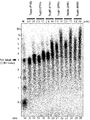
反応液D 20μl[20mM Tris-HCl,pH 8.8、10mM KCl、3.5mM MgCl2、0.1mg/ml BSA、0.1%Tween 20、5nM primed-DNAおよび0.25mM dNTP]中で10nMになるように野生型TaqLFまたは変異型TaqLFを混合し、72℃で2.5分間または10分間反応させた。各反応混合液8μlあたり反応停止液[300mM NaOH、6mM EDTA、18%Ficoll 400、0.15%bromocresol greenおよび0.24%xylene cyanol] 2μlを加えることで反応を停止させた。これを0.8%アルカリアガロースゲルに供し、アルカリ溶液[50mM NaOHおよび1mM EDTA]中で電気泳動した。電気泳動後、ゲルを乾燥させ、乾燥ゲルをイメージングプレート(FUJIFILM社製)に露光させた。Typhoon TRIO+(GEヘルスケア社)を用いて、合成されたDNAを検出した。野生型及び各変異Taqポリメラーゼのプライマー伸長活性の結果を図2-1および図2-2に示した。
野生型および変異型のTaqLFのプライマー伸長活性測定には、5’末端を[γ-32P]ATPを用いて放射性標識させた55ntのオリゴヌクレオチド(M13-pri55、配列番号49)を2,961ntの環状一本鎖DNA[pBlueScript II SK(+)(アジレント・バイオテクノロジー社製)]にアニールさせたプライムドDNA(primed-DNA)を基質DNAとして用いた。
反応液D 20μl[20mM Tris-HCl,pH 8.8、10mM KCl、3.5mM MgCl2、0.1mg/ml BSA、0.1%Tween 20、5nM primed-DNAおよび0.25mM dNTP]中で10nMになるように野生型TaqLFまたは変異型TaqLFを混合し、72℃で2.5分間または10分間反応させた。各反応混合液8μlあたり反応停止液[300mM NaOH、6mM EDTA、18%Ficoll 400、0.15%bromocresol greenおよび0.24%xylene cyanol] 2μlを加えることで反応を停止させた。これを0.8%アルカリアガロースゲルに供し、アルカリ溶液[50mM NaOHおよび1mM EDTA]中で電気泳動した。電気泳動後、ゲルを乾燥させ、乾燥ゲルをイメージングプレート(FUJIFILM社製)に露光させた。Typhoon TRIO+(GEヘルスケア社)を用いて、合成されたDNAを検出した。野生型及び各変異Taqポリメラーゼのプライマー伸長活性の結果を図2-1および図2-2に示した。
図2-1に示したように、TaqLF WTは、2.5分の反応ですでに鋳型一周分の3.2kbになっており、10分の反応で3.8kbの濃いバンドと6kbの位置に薄いバンドが検出された。
一方、Taq55は2.5分の反応で、3.4kbまで伸長した。10分では4.3kbの位置まで濃いバンドが、7kbの位置まで薄いバンドが見られた。
Taq56は2.5分の反応で、4.3kbまで伸長した。10分では6.5kbの位置まで濃いバンドが、9kbの位置まで薄いバンドが見られた。
Taq57は2.5分の反応で、6.5kbまで伸長した。10分では10kb以上の位置まで濃いバンドが見られた。
Taq58は2.5分の反応で、7.0kbまで伸長した。10分では10kb以上の位置まで濃いバンドが見られた。
Taq59は2.5分の反応で、8.0kbまで伸長した。10分では10kb以上の位置まで濃いバンドが見られた。
一方、Taq55は2.5分の反応で、3.4kbまで伸長した。10分では4.3kbの位置まで濃いバンドが、7kbの位置まで薄いバンドが見られた。
Taq56は2.5分の反応で、4.3kbまで伸長した。10分では6.5kbの位置まで濃いバンドが、9kbの位置まで薄いバンドが見られた。
Taq57は2.5分の反応で、6.5kbまで伸長した。10分では10kb以上の位置まで濃いバンドが見られた。
Taq58は2.5分の反応で、7.0kbまで伸長した。10分では10kb以上の位置まで濃いバンドが見られた。
Taq59は2.5分の反応で、8.0kbまで伸長した。10分では10kb以上の位置まで濃いバンドが見られた。
TaqLF WTの鋳型DNA結合部位の配列はPYEであり、荷電は-1である。Taq55の荷電は0、Taq56の荷電は+1、Taq57およびTaq58の荷電は+2、Taq59の荷電は+3である。このことから荷電が正になるにつれ、伸長活性が大きくなり、SD活性も増大することがわかった。
さらに伸長活性の増大についてTaq59、Taq62~Taq65について検討した。評価方法は、前記で述べた方法と同じである。すなわち、図2-2に示したように、変異体Taq59のE742あるいはE742およびA743部位についてアミノ酸を正荷電に変異させたTaq62~Taq65について、Taq59よりも鎖置換活性の改善が見られた。以上のことから、TaqDNAポリメラーゼの鋳型DNA結合部位に相当する685~687位のアミノ酸配列の置換とその他の部位のアミノ酸配列の置換を組み合わせることにより、鎖置換活性を向上できることが確認できた。
実施例2 ゲルシフト法によるプライムドDNAとの結合能の測定
ゲルシフトアッセイを用いて変異TaqポリメラーゼとプライムドDNAとの親和性を調べた。測定は以下のようにして行った。
まず、DNA結合能測定の基質は、5’末端を32Pで放射性標識させた27ntの一本鎖DNA(d27、配列番号50)と非標識の49ntの一本鎖DNA(49N、配列番号51)をアニールさせたDNAを基質DNAとして使用した。2nM 基質DNAを含む溶液E [20mM Tris-HCl,pH 8.8、10mM NaCl、5mM MgCl2、14mM 2-mercaptoethanol、0.1mg/ml BSAおよび5%(v/v)glycerol]10μl中でDNAポリメラーゼタンパク質を0.6~400nMになるよう加え、40℃で5分間恒温させた。DNA-酵素混合液を1%アガロースゲルに供し、0.1×TAE溶液[4mM Tris base、2mM acetic acidおよび0.1mM EDTA]中で電気泳動した。電気泳動終了後、ゲルを乾燥させ、乾燥させたゲルをイメージングプレートに露光させた。Typhoon TRIO+を用いて、標識DNAを検出した。
ゲルシフトアッセイを用いて変異TaqポリメラーゼとプライムドDNAとの親和性を調べた。測定は以下のようにして行った。
まず、DNA結合能測定の基質は、5’末端を32Pで放射性標識させた27ntの一本鎖DNA(d27、配列番号50)と非標識の49ntの一本鎖DNA(49N、配列番号51)をアニールさせたDNAを基質DNAとして使用した。2nM 基質DNAを含む溶液E [20mM Tris-HCl,pH 8.8、10mM NaCl、5mM MgCl2、14mM 2-mercaptoethanol、0.1mg/ml BSAおよび5%(v/v)glycerol]10μl中でDNAポリメラーゼタンパク質を0.6~400nMになるよう加え、40℃で5分間恒温させた。DNA-酵素混合液を1%アガロースゲルに供し、0.1×TAE溶液[4mM Tris base、2mM acetic acidおよび0.1mM EDTA]中で電気泳動した。電気泳動終了後、ゲルを乾燥させ、乾燥させたゲルをイメージングプレートに露光させた。Typhoon TRIO+を用いて、標識DNAを検出した。
ゲルシフトアッセイの結果を図3に示した。
以前の結果[フロンティアーズ イン マイクロバイオロジー(Front Microbiol.)、第5巻、461ページ(2014年)、doi: 10.3389/fmicb.2014.00461]から、野生型TaqポリメラーゼとプライムドDNAとの見かけの解離定数Kd値は、400nMであった。
一方、Taq55~Taq59変異体では、領域内の荷電が+2のTaq57およびTaq58は、Taq57のシフトバンドはみられないものの、400nMのタンパク質の添加ではプライムドDNAの量が減少していた。Taq58では、25nMのタンパク質量でシフトバンドが現れ、見かけのKd値は100nMであった。
次に、荷電が+3のTaq59では、25nMのタンパク質で、明らかなシフトバンドがあらわれ、400nMでは2段階のシフトが見られた。見かけのKd値は、40nMであった。
以上の結果から、プライマー伸長活性とゲルシフトには相関があった。
以前の結果[フロンティアーズ イン マイクロバイオロジー(Front Microbiol.)、第5巻、461ページ(2014年)、doi: 10.3389/fmicb.2014.00461]から、野生型TaqポリメラーゼとプライムドDNAとの見かけの解離定数Kd値は、400nMであった。
一方、Taq55~Taq59変異体では、領域内の荷電が+2のTaq57およびTaq58は、Taq57のシフトバンドはみられないものの、400nMのタンパク質の添加ではプライムドDNAの量が減少していた。Taq58では、25nMのタンパク質量でシフトバンドが現れ、見かけのKd値は100nMであった。
次に、荷電が+3のTaq59では、25nMのタンパク質で、明らかなシフトバンドがあらわれ、400nMでは2段階のシフトが見られた。見かけのKd値は、40nMであった。
以上の結果から、プライマー伸長活性とゲルシフトには相関があった。
実施例3 Taq59ポリメラーゼを用いたゲノムDNAの増幅
(1)既知Taq DNAポリメラーゼとの比較
実施例1で調製したTaq59を用いてPfu ゲノムDNAを鋳型としてDNA増幅をおこなった。反応液組成は、8nM Taq59ポリメラーゼ、x1 SD buffer、0.5mM dNTPs、10ng Pfu ゲノムDNA、10μM pd(N)6、0.25mg/ml BSAである。反応は、(A)50℃;6時間または(B)30℃;60秒、68℃;60秒を99サイクル行った。また、対照サンプルとして、配列表の配列番号1記載のアミノ酸配列を有する野生型Taq DNAポリメラーゼ、配列表の配列番号3記載のアミノ酸配列を有するTaq DNAポリメラーゼ Large Fragmentおよび市販品のSD活性を有するSD-ポリメラーゼ(BIORON社製)も使用した。
(1)既知Taq DNAポリメラーゼとの比較
実施例1で調製したTaq59を用いてPfu ゲノムDNAを鋳型としてDNA増幅をおこなった。反応液組成は、8nM Taq59ポリメラーゼ、x1 SD buffer、0.5mM dNTPs、10ng Pfu ゲノムDNA、10μM pd(N)6、0.25mg/ml BSAである。反応は、(A)50℃;6時間または(B)30℃;60秒、68℃;60秒を99サイクル行った。また、対照サンプルとして、配列表の配列番号1記載のアミノ酸配列を有する野生型Taq DNAポリメラーゼ、配列表の配列番号3記載のアミノ酸配列を有するTaq DNAポリメラーゼ Large Fragmentおよび市販品のSD活性を有するSD-ポリメラーゼ(BIORON社製)も使用した。
生成物は、0.7%アガロースゲルで分離し、SYBR(登録商標) Gold Nucleic Acid Gel Stain(サーモフィッシャーサイエンティフィック社製)で染色した。結果を図4に示した。
図4(A)および(B)に示したように、それぞれの条件において、野生型Taq DNAポリメラーゼ、Taq DNAポリメラーゼ Large FragmentおよびSD-ポリメラーゼでは増幅バンドは得られなかったが、本発明のTaq59はアプライしたウェルとゲルとの境にバンドが得られた。
次に、アルカリアガロースゲルを用いて生成物を解析した。
まず、伸長温度を(A)50℃および(B)70℃の2通りで行った。反応は、32nM ポリメラーゼ、20mM Tris-HCl,pH8.8、10mM KCl、3.5mM MgCl2、0.1%Tween20、0.5mM dNTPs、10ng Pfu genome DNA、10μM pd(N)6、0.25mg/ml BSAを含む液量20μlの反応液で40℃;10秒、50℃;1分、50℃または70℃;5分を60サイクル行った。得られた生成物を0.8%アルカリアガロースゲル電気泳動に供し、SYBR(登録商標) Green II Nucleic Acid Gel Stain(タカラバイオ社製)により染色した。結果を図5に示した。
まず、伸長温度を(A)50℃および(B)70℃の2通りで行った。反応は、32nM ポリメラーゼ、20mM Tris-HCl,pH8.8、10mM KCl、3.5mM MgCl2、0.1%Tween20、0.5mM dNTPs、10ng Pfu genome DNA、10μM pd(N)6、0.25mg/ml BSAを含む液量20μlの反応液で40℃;10秒、50℃;1分、50℃または70℃;5分を60サイクル行った。得られた生成物を0.8%アルカリアガロースゲル電気泳動に供し、SYBR(登録商標) Green II Nucleic Acid Gel Stain(タカラバイオ社製)により染色した。結果を図5に示した。
図5に示したように、50℃の伸長温度では、野生型Taq DNAポリメラーゼおよびTaq DNAポリメラーゼ Large FragmentではほとんどDNAが増幅されなかったが、本発明のTaq59では23.1kbのマーカーとウェルの間に高分子DNAの増幅が見られた。
70℃の伸長温度では、野生型Taq DNAポリメラーゼでは23kbまでの広範囲にDNAが増幅された。一方、Taq large fragmentではDNAは増幅されなかった。Taq59では、23.1kbのマーカーとウェルの間に高分子DNAの増幅が見られた。このように、本発明のDNAポリメラーゼは高い耐熱性を有することが分かった。さらに、本発明のDNAポリメラーゼは23kb以上という長鎖長のDNAであっても効率良く複製できることが分かった。
70℃の伸長温度では、野生型Taq DNAポリメラーゼでは23kbまでの広範囲にDNAが増幅された。一方、Taq large fragmentではDNAは増幅されなかった。Taq59では、23.1kbのマーカーとウェルの間に高分子DNAの増幅が見られた。このように、本発明のDNAポリメラーゼは高い耐熱性を有することが分かった。さらに、本発明のDNAポリメラーゼは23kb以上という長鎖長のDNAであっても効率良く複製できることが分かった。
次に、Taq59の濃度を1~32nMの範囲でDNAの増幅を行った。
反応組成は、20mM Tris-HCl, pH8.8、10mM KCl、3.5mM MgCl2、0.1%Tween20、0.5mM dNTPs、10ng Pfu genome DNA、10μM pd(N)6、0.25mg/ml BSAである。反応は、50℃で6時間行った。生成物([0082])を0.8% アルカリアガロースゲル電気泳動に供し、SYBR(登録商標) Green II Nucleic Acid Gel Stainにより染色した。その結果を図6に示した。
反応組成は、20mM Tris-HCl, pH8.8、10mM KCl、3.5mM MgCl2、0.1%Tween20、0.5mM dNTPs、10ng Pfu genome DNA、10μM pd(N)6、0.25mg/ml BSAである。反応は、50℃で6時間行った。生成物([0082])を0.8% アルカリアガロースゲル電気泳動に供し、SYBR(登録商標) Green II Nucleic Acid Gel Stainにより染色した。その結果を図6に示した。
図6に示したようにTaq59の濃度が1~8nMまでは酵素濃度に比例してバンドの濃度が濃くなり、それ以上の濃度では一定であった。バンドの位置は、ウェルよりは下にあった。
(2)phi29 DNAポリメラーゼとの比較
本発明のTaq59と市販のphi29 DNAポリメラーゼについて比較した。本実験で使用したphi29 DNAポリメラーゼはニュー・イングランド・バイオラボ社製(商品名:phi29 DNA Polymerase)であり、非常に強い鎖置換活性を有することが知られている。
反応は、50mM Tris-HCl, pH7.5、10mM (NH4)2SO4、10mM MgCl2、4mM DTT、0.5mM dNTPs、10ng Pfu genome DNA、10μM pd(N)6、0.25mg/ml BSAを含む容量20μlの反応液を用いた。反応液に10Uの前記市販ポリメラーゼを加え、反応は30℃で18時間行った。生成物および[0082]の生成物を0.8%アルカリアガロースゲル電気泳動に供し、SYBR(登録商標) Green II Nucleic Acid Gel Stainにより染色した。その結果を図6に示した。
本発明のTaq59と市販のphi29 DNAポリメラーゼについて比較した。本実験で使用したphi29 DNAポリメラーゼはニュー・イングランド・バイオラボ社製(商品名:phi29 DNA Polymerase)であり、非常に強い鎖置換活性を有することが知られている。
反応は、50mM Tris-HCl, pH7.5、10mM (NH4)2SO4、10mM MgCl2、4mM DTT、0.5mM dNTPs、10ng Pfu genome DNA、10μM pd(N)6、0.25mg/ml BSAを含む容量20μlの反応液を用いた。反応液に10Uの前記市販ポリメラーゼを加え、反応は30℃で18時間行った。生成物および[0082]の生成物を0.8%アルカリアガロースゲル電気泳動に供し、SYBR(登録商標) Green II Nucleic Acid Gel Stainにより染色した。その結果を図6に示した。
図6に示したように、phi29 DNAポリメラーゼは23kbのマーカーとウェルの間にDNAが増幅された。一方、本発明のTaq59は、phi29 DNAポリメラーゼと比較して、増幅産物量が多いことが確認できた。このことから、本発明の鎖置換活性を有するDNAポリメラーゼがphi29 DNAポリメラーゼよりゲノム増幅に適していることが確認できた。このように、本発明のDNAポリメラーゼは強力な鎖置換活性を有することが分かった。
本発明の鎖置換活性を有するDNAポリメラーゼが高耐熱性を有し、鋳型DNAの効率的な長鎖複製が可能であり、かつ強力な鎖置換活性を有することにより、鋳型DNAの効率的な長鎖複製が可能となった。当該鎖置換活性を有するDNAポリメラーゼは、遺伝子工学、生物学、医学、農業等幅広い分野において有用である。
配列番号1:Amino acid sequence of Taq DNA polymerase wild type
配列番号2:Nucleotide sequence of Taq DNA polymerase wild type
配列番号3:Amino acid sequence of Taq DNA polymerase large fragment
配列番号4:Nucleotide sequence of Taq DNA polymerase large fragment
配列番号5:Nucleotide sequence of DNA polymerase variant Taq55
配列番号6:Nucleotide sequence of DNA polymerase variant Taq56
配列番号7:Nucleotide sequence of DNA polymerase variant Taq57
配列番号8:Nucleotide sequence of DNA polymerase variant Taq58
配列番号9:Nucleotide sequence of DNA polymerase variant Taq59
配列番号10:Mutagenesis primer TaqPYA-5
配列番号11:Mutagenesis primer TaqPYA-3
配列番号12:Mutagenesis primer TaqPYK-5
配列番号13:Mutagenesis primer TaqPYK-3
配列番号14:Mutagenesis primer TaqPRK-5
配列番号15:Mutagenesis primer TaqPRK-3
配列番号16:Mutagenesis primer TaqSRK-5
配列番号17:Mutagenesis primer TaqSRK-3
配列番号18:Mutagenesis primer TaqRRR-5
配列番号19:Mutagenesis primer TaqRRR-3
配列番号20:Nucleotide sequence of DNA polymerase variant Taq62
配列番号21:Nucleotide sequence of DNA polymerase variant Taq63
配列番号22:Nucleotide sequence of DNA polymerase variant Taq64
配列番号23:Nucleotide sequence of DNA polymerase variant Taq65
配列番号24:Mutagenesis primer TaqAYR-5
配列番号25:Mutagenesis primer TaqAYR-3
配列番号26:Mutagenesis primer TaqRRR-5
配列番号27:Mutagenesis primer TaqRRR-3
配列番号28:Mutagenesis primer aa5
配列番号29:Mutagenesis primer aa3
配列番号30:Mutagenesis primer TaqAYR-5
配列番号31:Mutagenesis primer TaqAYR-3
配列番号32:Mutagenesis primer TaqRRR-5
配列番号33:Mutagenesis primer TaqRRR-3
配列番号34:Mutagenesis primer ha5
配列番号35:Mutagenesis primer ha3
配列番号36:Mutagenesis primer hk5
配列番号37:Mutagenesis primer hk3
配列番号38:Mutagenesis primer rr5
配列番号39:Mutagenesis primer rr3
配列番号40:Amino acid sequence of DNA polymerase variant Taq55
配列番号41:Amino acid sequence of DNA polymerase variant Taq56
配列番号42:Amino acid sequence of DNA polymerase variant Taq57
配列番号43:Amino acid sequence of DNA polymerase variant Taq58
配列番号44:Amino acid sequence of DNA polymerase variant Taq59
配列番号45:Amino acid sequence of DNA polymerase variant Taq62
配列番号46:Amino acid sequence of DNA polymerase variant Taq63
配列番号47:Amino acid sequence of DNA polymerase variant Taq64
配列番号48:Amino acid sequence of DNA polymerase variant Taq65
配列番号49:55nt Oligonucleotides M13-pri55
配列番号50:27nt Oligonucleotides d27
配列番号51:49nt Oligonucleotides 49N
配列番号52:Amino acid sequence of Pyrococcus furiosus RFC-L PIP-box
配列番号2:Nucleotide sequence of Taq DNA polymerase wild type
配列番号3:Amino acid sequence of Taq DNA polymerase large fragment
配列番号4:Nucleotide sequence of Taq DNA polymerase large fragment
配列番号5:Nucleotide sequence of DNA polymerase variant Taq55
配列番号6:Nucleotide sequence of DNA polymerase variant Taq56
配列番号7:Nucleotide sequence of DNA polymerase variant Taq57
配列番号8:Nucleotide sequence of DNA polymerase variant Taq58
配列番号9:Nucleotide sequence of DNA polymerase variant Taq59
配列番号10:Mutagenesis primer TaqPYA-5
配列番号11:Mutagenesis primer TaqPYA-3
配列番号12:Mutagenesis primer TaqPYK-5
配列番号13:Mutagenesis primer TaqPYK-3
配列番号14:Mutagenesis primer TaqPRK-5
配列番号15:Mutagenesis primer TaqPRK-3
配列番号16:Mutagenesis primer TaqSRK-5
配列番号17:Mutagenesis primer TaqSRK-3
配列番号18:Mutagenesis primer TaqRRR-5
配列番号19:Mutagenesis primer TaqRRR-3
配列番号20:Nucleotide sequence of DNA polymerase variant Taq62
配列番号21:Nucleotide sequence of DNA polymerase variant Taq63
配列番号22:Nucleotide sequence of DNA polymerase variant Taq64
配列番号23:Nucleotide sequence of DNA polymerase variant Taq65
配列番号24:Mutagenesis primer TaqAYR-5
配列番号25:Mutagenesis primer TaqAYR-3
配列番号26:Mutagenesis primer TaqRRR-5
配列番号27:Mutagenesis primer TaqRRR-3
配列番号28:Mutagenesis primer aa5
配列番号29:Mutagenesis primer aa3
配列番号30:Mutagenesis primer TaqAYR-5
配列番号31:Mutagenesis primer TaqAYR-3
配列番号32:Mutagenesis primer TaqRRR-5
配列番号33:Mutagenesis primer TaqRRR-3
配列番号34:Mutagenesis primer ha5
配列番号35:Mutagenesis primer ha3
配列番号36:Mutagenesis primer hk5
配列番号37:Mutagenesis primer hk3
配列番号38:Mutagenesis primer rr5
配列番号39:Mutagenesis primer rr3
配列番号40:Amino acid sequence of DNA polymerase variant Taq55
配列番号41:Amino acid sequence of DNA polymerase variant Taq56
配列番号42:Amino acid sequence of DNA polymerase variant Taq57
配列番号43:Amino acid sequence of DNA polymerase variant Taq58
配列番号44:Amino acid sequence of DNA polymerase variant Taq59
配列番号45:Amino acid sequence of DNA polymerase variant Taq62
配列番号46:Amino acid sequence of DNA polymerase variant Taq63
配列番号47:Amino acid sequence of DNA polymerase variant Taq64
配列番号48:Amino acid sequence of DNA polymerase variant Taq65
配列番号49:55nt Oligonucleotides M13-pri55
配列番号50:27nt Oligonucleotides d27
配列番号51:49nt Oligonucleotides 49N
配列番号52:Amino acid sequence of Pyrococcus furiosus RFC-L PIP-box
Claims (19)
- ファミリーAに属するDNAポリメラーゼのアミノ酸配列において、鋳型DNA結合部位にその電荷の総和が増加するようなアミノ酸置換を有し、かつ5’→3’エキソヌクレアーゼ活性を有さないDNAポリメラーゼ、または該DNAポリメラーゼのアミノ酸配列と95%以上の配列同一性を有するDNAポリメラーゼ。
- さらに鎖置換活性を有する請求項1記載のDNAポリメラーゼ。
- 鋳型DNA結合部位のアミノ酸のうち、少なくとも1残基がアルギニン、リジン、ヒスチジン、セリンおよびアラニンから選択されるアミノ酸残基に置換されている請求項1または2記載のDNAポリメラーゼ。
- 鋳型DNA結合部位が、配列表の配列番号1で示されるThermus aquaticus (Taq) DNAポリメラーゼのアミノ酸配列の685~687番目のアミノ酸に相当する部位である請求項1~3のいずれか1項に記載のDNAポリメラーゼ。
- Taq DNAポリメラーゼのアミノ酸配列の
(1)685番目のプロリンに相当するアミノ酸のアルギニンまたはセリンへの置換、
(2)686番目のチロシンに相当するアミノ酸のアルギニンへの置換、および
(3)687番目のグルタミン酸に相当するアミノ酸のアルギニン、リジンまたはアラニンへの置換、
からなる群より選択される1以上の置換を有する請求項4記載のDNAポリメラーゼ。 - ファミリーAに属するDNAポリメラーゼが、耐熱性のDNAポリメラーゼである請求項1記載のDNAポリメラーゼ。
- 前記ファミリーAに属するDNAポリメラーゼが、Thermus属細菌のDNAポリメラーゼである請求項6記載のDNAポリメラーゼ。
- 前記ファミリーAに属するDNAポリメラーゼが、野生型のファミリーAに属するDNAポリメラーゼのN末端側配列が欠失したDNAポリメラーゼである請求項6または7記載のDNAポリメラーゼ。
- 前記ファミリーAに属するDNAポリメラーゼが、N末端側配列が欠失したTaq DNAポリメラーゼである請求項8記載のDNAポリメラーゼ。
- 前記ファミリーAに属するDNAポリメラーゼが、N末端から289残基までのアミノ酸を欠失したTaq DNAポリメラーゼである請求項9記載のDNAポリメラーゼ。
- 配列表の配列番号40~48のいずれかに示されるアミノ酸配列を含む請求項1記載のDNAポリメラーゼ。
- 請求項1~11いずれか1項に記載のDNAポリメラーゼをコードする塩基配列を含む核酸。
- 配列表の配列番号5~9および20~23のいずれかに示される塩基配列を含む請求項1記載のDNAポリメラーゼをコードする核酸。
- 請求項12または13記載の核酸を含むベクター。
- 請求項14記載のベクター、または請求項12または13記載の核酸を含む形質転換体。
- 請求項15記載の形質転換体を培養し、培養物からDNAポリメラーゼを採取することを特徴とするDNAポリメラーゼの製造方法。
- 請求項1~11いずれか1項に記載のDNAポリメラーゼおよび鋳型DNAを共にインキュベートする工程を含むDNA分子の製造方法。
- 前記製造方法がポリメラーゼ連鎖反応または等温核酸増幅反応で実施される請求項17記載の製造方法。
- 請求項1~11いずれか1項に記載のDNAポリメラーゼを含むキット。
Priority Applications (3)
| Application Number | Priority Date | Filing Date | Title |
|---|---|---|---|
| US15/779,247 US11046939B2 (en) | 2015-11-27 | 2016-11-24 | DNA polymerase variant |
| JP2017552697A JP6963238B2 (ja) | 2015-11-27 | 2016-11-24 | Dnaポリメラーゼ変異体 |
| CN201680080499.9A CN108473970B (zh) | 2015-11-27 | 2016-11-24 | Dna聚合酶变体 |
Applications Claiming Priority (2)
| Application Number | Priority Date | Filing Date | Title |
|---|---|---|---|
| JP2015-231674 | 2015-11-27 | ||
| JP2015231674 | 2015-11-27 |
Publications (1)
| Publication Number | Publication Date |
|---|---|
| WO2017090684A1 true WO2017090684A1 (ja) | 2017-06-01 |
Family
ID=58764105
Family Applications (1)
| Application Number | Title | Priority Date | Filing Date |
|---|---|---|---|
| PCT/JP2016/084807 Ceased WO2017090684A1 (ja) | 2015-11-27 | 2016-11-24 | Dnaポリメラーゼ変異体 |
Country Status (4)
| Country | Link |
|---|---|
| US (1) | US11046939B2 (ja) |
| JP (1) | JP6963238B2 (ja) |
| CN (1) | CN108473970B (ja) |
| WO (1) | WO2017090684A1 (ja) |
Cited By (3)
| Publication number | Priority date | Publication date | Assignee | Title |
|---|---|---|---|---|
| JP2021507694A (ja) * | 2017-12-15 | 2021-02-25 | ウニベルシテテット イ トロムソ−ノルゲス アークティスク ウニベルシテット | Dnaポリメラーゼ |
| EP3822349A4 (en) * | 2018-07-13 | 2022-04-06 | Takara Bio Inc. | DNA POLYMERASE MUTATION SUITABLE FOR NUCLEIC ACID AMPLIFICATION FROM RNA |
| WO2022138887A1 (ja) * | 2020-12-25 | 2022-06-30 | 株式会社ニッポンジーン | 改変型dnaポリメラーゼ |
Families Citing this family (4)
| Publication number | Priority date | Publication date | Assignee | Title |
|---|---|---|---|---|
| CN108473970B (zh) * | 2015-11-27 | 2022-09-13 | 国立大学法人九州大学 | Dna聚合酶变体 |
| US11613738B2 (en) * | 2019-05-14 | 2023-03-28 | Abclonal Science, Inc. | Mutant Taq polymerase resistant to inhibition of amplification in the presence of cyanine dye |
| CN111690626B (zh) * | 2020-07-02 | 2021-03-26 | 南京诺唯赞生物科技股份有限公司 | 一种融合型Taq DNA聚合酶及其制备方法和应用 |
| CN118222537B (zh) * | 2024-04-23 | 2024-10-25 | 湖南艾科瑞生物工程有限公司 | 性能提升的Taq DNA聚合酶突变体及其制备方法和应用 |
Citations (5)
| Publication number | Priority date | Publication date | Assignee | Title |
|---|---|---|---|---|
| JP2005512566A (ja) * | 2001-12-20 | 2005-05-12 | アマシャム・バイオサイエンス・コーポレイション | ThermoanaerobacterthermohydrosulfuricusDNAポリメラーゼI変異体による核酸標識 |
| JP2008506417A (ja) * | 2004-05-20 | 2008-03-06 | ミルコ・ビー・ケルメクキエフ | Pcr反応における全血の使用 |
| JP2009136188A (ja) * | 2007-12-05 | 2009-06-25 | Precision System Science Co Ltd | 新規dnaポリメラーゼ |
| WO2010091203A2 (en) * | 2009-02-04 | 2010-08-12 | Lucigen Corporation | Rna-and dna-copying enzymes |
| WO2011055737A1 (ja) * | 2009-11-06 | 2011-05-12 | 株式会社ニッポンジーン | 耐熱性鎖置換型dnaポリメラーゼ及び該dnaポリメラーゼの生産方法 |
Family Cites Families (8)
| Publication number | Priority date | Publication date | Assignee | Title |
|---|---|---|---|---|
| US6346379B1 (en) * | 1997-09-11 | 2002-02-12 | F. Hoffman-La Roche Ag | Thermostable DNA polymerases incorporating nucleoside triphosphates labeled with fluorescein family dyes |
| US6951722B2 (en) | 1999-03-19 | 2005-10-04 | Takara Bio Inc. | Method for amplifying nucleic acid sequence |
| ATE362532T1 (de) | 1999-03-19 | 2007-06-15 | Takara Bio Inc | Verfahren zur amplifizierung einer nukleinsäuresequenz unter verwendung eines chimären primers |
| EA005739B1 (ru) | 2000-08-23 | 2005-06-30 | Такара Био Инк. | Способ амплификации нуклеиновых кислот |
| AU2004203649B2 (en) * | 2003-08-12 | 2006-01-12 | F. Hoffmann-La Roche Ag | Thermostable Taq polymerase fragment |
| US20050260606A1 (en) | 2004-05-20 | 2005-11-24 | Kermekchiev Milko B | Use of whole blood in PCR reactions |
| WO2010062777A2 (en) | 2008-11-03 | 2010-06-03 | Kapabiosystems | Modified type a dna polymerases |
| CN108473970B (zh) * | 2015-11-27 | 2022-09-13 | 国立大学法人九州大学 | Dna聚合酶变体 |
-
2016
- 2016-11-24 CN CN201680080499.9A patent/CN108473970B/zh not_active Expired - Fee Related
- 2016-11-24 JP JP2017552697A patent/JP6963238B2/ja not_active Expired - Fee Related
- 2016-11-24 WO PCT/JP2016/084807 patent/WO2017090684A1/ja not_active Ceased
- 2016-11-24 US US15/779,247 patent/US11046939B2/en not_active Expired - Fee Related
Patent Citations (5)
| Publication number | Priority date | Publication date | Assignee | Title |
|---|---|---|---|---|
| JP2005512566A (ja) * | 2001-12-20 | 2005-05-12 | アマシャム・バイオサイエンス・コーポレイション | ThermoanaerobacterthermohydrosulfuricusDNAポリメラーゼI変異体による核酸標識 |
| JP2008506417A (ja) * | 2004-05-20 | 2008-03-06 | ミルコ・ビー・ケルメクキエフ | Pcr反応における全血の使用 |
| JP2009136188A (ja) * | 2007-12-05 | 2009-06-25 | Precision System Science Co Ltd | 新規dnaポリメラーゼ |
| WO2010091203A2 (en) * | 2009-02-04 | 2010-08-12 | Lucigen Corporation | Rna-and dna-copying enzymes |
| WO2011055737A1 (ja) * | 2009-11-06 | 2011-05-12 | 株式会社ニッポンジーン | 耐熱性鎖置換型dnaポリメラーゼ及び該dnaポリメラーゼの生産方法 |
Non-Patent Citations (3)
| Title |
|---|
| LI Y. ET AL.: "Crystal structures of open and closed forms of binary and ternary complexes of the large fragment of Thermus aquaticus DNA polymerase I: structural basis for nucleotide incorporation", EMBO J., vol. 17, no. 24, 1998, pages 7514 - 7525, XP055386502, ISSN: 0261-4189 * |
| TERUYA NAKAMURA ET AL.: "Watching DNA Polymerasen Make a Phosphodiester Bond", BIOPHYSICS, vol. 53, 2013, pages 254 - 257, ISSN: 0582-4052 * |
| YAMAGAMI T. ET AL.: "Mutant Taq DNA polymerases with improved elongation ability as a useful reagent for genetic engineering", FRONTIERS IN MICROBIOLOGY, vol. 5, no. 461, 2014, pages 1 - 10, XP055386500, ISSN: 1664-302X * |
Cited By (7)
| Publication number | Priority date | Publication date | Assignee | Title |
|---|---|---|---|---|
| JP2021507694A (ja) * | 2017-12-15 | 2021-02-25 | ウニベルシテテット イ トロムソ−ノルゲス アークティスク ウニベルシテット | Dnaポリメラーゼ |
| JP7361694B2 (ja) | 2017-12-15 | 2023-10-16 | ウニベルシテテット イ トロムソ-ノルゲス アークティスク ウニベルシテット | Dnaポリメラーゼ |
| EP3822349A4 (en) * | 2018-07-13 | 2022-04-06 | Takara Bio Inc. | DNA POLYMERASE MUTATION SUITABLE FOR NUCLEIC ACID AMPLIFICATION FROM RNA |
| US12018294B2 (en) | 2018-07-13 | 2024-06-25 | Takara Bio Inc. | DNA polymerase mutant suited to nucleic acid amplification from RNA |
| US12359177B2 (en) | 2018-07-13 | 2025-07-15 | Takara Bio Inc. | DNA polymerase mutant suited to nucleic acid amplification from RNA |
| WO2022138887A1 (ja) * | 2020-12-25 | 2022-06-30 | 株式会社ニッポンジーン | 改変型dnaポリメラーゼ |
| JP7180944B1 (ja) * | 2020-12-25 | 2022-11-30 | 株式会社ニッポンジーン | 改変型dnaポリメラーゼ |
Also Published As
| Publication number | Publication date |
|---|---|
| JPWO2017090684A1 (ja) | 2018-10-11 |
| CN108473970B (zh) | 2022-09-13 |
| US11046939B2 (en) | 2021-06-29 |
| US20180346889A1 (en) | 2018-12-06 |
| JP6963238B2 (ja) | 2021-11-05 |
| CN108473970A (zh) | 2018-08-31 |
Similar Documents
| Publication | Publication Date | Title |
|---|---|---|
| JP6963238B2 (ja) | Dnaポリメラーゼ変異体 | |
| JP7061078B2 (ja) | 耐熱性の逆転写酵素変異体 | |
| CN102272319B (zh) | 用于提高核酸扩增反应效率的方法和组合物 | |
| JP7067737B2 (ja) | Dnaポリメラーゼ変異体 | |
| CN112585264B (zh) | 重组型kod聚合酶 | |
| CN109937252B (zh) | 重组dna聚合酶 | |
| KR101751554B1 (ko) | 파지 φ29 dna 폴리머라아제 키메라 | |
| KR102880295B1 (ko) | Rna로부터의 핵산 증폭반응에 적합한 dna 폴리머라아제 돌연변이체 | |
| CN112899253B (zh) | 具有dna聚合酶活性的多肽、重组载体及其制备方法与应用 | |
| CN106536727B (zh) | 来自红海卤池生物的dna聚合酶 | |
| JP6720632B2 (ja) | 融合タンパク質 | |
| JP3891330B2 (ja) | 改変された耐熱性dnaポリメラーゼ | |
| WO2021127848A1 (zh) | 嵌合dna聚合酶及其应用 | |
| CN108192907B (zh) | 一种热稳定dna扩增融合酶 | |
| CN111349623B (zh) | 9°n dna聚合酶突变体 | |
| JP4355830B2 (ja) | 新規dna複製因子 | |
| WO2024065925A1 (zh) | 一种dna聚合酶及其制备方法和应用 | |
| WO2016084879A1 (ja) | 核酸増幅試薬 | |
| WO2022210748A1 (ja) | 新規なガイドrnaとの複合体形成能を有するポリペプチド | |
| JP2002360261A (ja) | Dnaポリメラーゼ関連因子 | |
| JP5324083B2 (ja) | 高反応性耐熱性dnaリガーゼ | |
| WO2020037295A1 (en) | Enhanced speed polymerases for sanger sequencing | |
| WO2026071892A1 (en) | N-terminal fragment of dna polymerase, dna polymerase, method for producing the same, and use thereof for isothermal dna amplification at low temperatures | |
| CN116286717A (zh) | 一种用于荧光探针法qPCR的热启动B族DNA聚合酶及其制备方法与应用 | |
| CN121399254A (zh) | Dna聚合酶突变体及其在测序中的应用 |
Legal Events
| Date | Code | Title | Description |
|---|---|---|---|
| 121 | Ep: the epo has been informed by wipo that ep was designated in this application |
Ref document number: 16868627 Country of ref document: EP Kind code of ref document: A1 |
|
| ENP | Entry into the national phase |
Ref document number: 2017552697 Country of ref document: JP Kind code of ref document: A |
|
| NENP | Non-entry into the national phase |
Ref country code: DE |
|
| 122 | Ep: pct application non-entry in european phase |
Ref document number: 16868627 Country of ref document: EP Kind code of ref document: A1 |