WO2017073091A1 - 粘着フィルム - Google Patents
粘着フィルム Download PDFInfo
- Publication number
- WO2017073091A1 WO2017073091A1 PCT/JP2016/055204 JP2016055204W WO2017073091A1 WO 2017073091 A1 WO2017073091 A1 WO 2017073091A1 JP 2016055204 W JP2016055204 W JP 2016055204W WO 2017073091 A1 WO2017073091 A1 WO 2017073091A1
- Authority
- WO
- WIPO (PCT)
- Prior art keywords
- film
- compound
- group
- adhesive layer
- acid
- Prior art date
- Legal status (The legal status is an assumption and is not a legal conclusion. Google has not performed a legal analysis and makes no representation as to the accuracy of the status listed.)
- Ceased
Links
Classifications
-
- C—CHEMISTRY; METALLURGY
- C09—DYES; PAINTS; POLISHES; NATURAL RESINS; ADHESIVES; COMPOSITIONS NOT OTHERWISE PROVIDED FOR; APPLICATIONS OF MATERIALS NOT OTHERWISE PROVIDED FOR
- C09J—ADHESIVES; NON-MECHANICAL ASPECTS OF ADHESIVE PROCESSES IN GENERAL; ADHESIVE PROCESSES NOT PROVIDED FOR ELSEWHERE; USE OF MATERIALS AS ADHESIVES
- C09J7/00—Adhesives in the form of films or foils
- C09J7/30—Adhesives in the form of films or foils characterised by the adhesive composition
-
- C—CHEMISTRY; METALLURGY
- C08—ORGANIC MACROMOLECULAR COMPOUNDS; THEIR PREPARATION OR CHEMICAL WORKING-UP; COMPOSITIONS BASED THEREON
- C08G—MACROMOLECULAR COMPOUNDS OBTAINED OTHERWISE THAN BY REACTIONS ONLY INVOLVING UNSATURATED CARBON-TO-CARBON BONDS
- C08G18/00—Polymeric products of isocyanates or isothiocyanates
- C08G18/02—Polymeric products of isocyanates or isothiocyanates of isocyanates or isothiocyanates only
- C08G18/022—Polymeric products of isocyanates or isothiocyanates of isocyanates or isothiocyanates only the polymeric products containing isocyanurate groups
-
- B—PERFORMING OPERATIONS; TRANSPORTING
- B29—WORKING OF PLASTICS; WORKING OF SUBSTANCES IN A PLASTIC STATE IN GENERAL
- B29C—SHAPING OR JOINING OF PLASTICS; SHAPING OF MATERIAL IN A PLASTIC STATE, NOT OTHERWISE PROVIDED FOR; AFTER-TREATMENT OF THE SHAPED PRODUCTS, e.g. REPAIRING
- B29C55/00—Shaping by stretching, e.g. drawing through a die; Apparatus therefor
- B29C55/02—Shaping by stretching, e.g. drawing through a die; Apparatus therefor of plates or sheets
-
- C—CHEMISTRY; METALLURGY
- C08—ORGANIC MACROMOLECULAR COMPOUNDS; THEIR PREPARATION OR CHEMICAL WORKING-UP; COMPOSITIONS BASED THEREON
- C08F—MACROMOLECULAR COMPOUNDS OBTAINED BY REACTIONS ONLY INVOLVING CARBON-TO-CARBON UNSATURATED BONDS
- C08F220/00—Copolymers of compounds having one or more unsaturated aliphatic radicals, each having only one carbon-to-carbon double bond, and only one being terminated by only one carboxyl radical or a salt, anhydride ester, amide, imide or nitrile thereof
- C08F220/02—Monocarboxylic acids having less than ten carbon atoms; Derivatives thereof
- C08F220/10—Esters
- C08F220/12—Esters of monohydric alcohols or phenols
- C08F220/16—Esters of monohydric alcohols or phenols of phenols or of alcohols containing two or more carbon atoms
- C08F220/18—Esters of monohydric alcohols or phenols of phenols or of alcohols containing two or more carbon atoms with acrylic or methacrylic acids
- C08F220/1802—C2-(meth)acrylate, e.g. ethyl (meth)acrylate
-
- C—CHEMISTRY; METALLURGY
- C08—ORGANIC MACROMOLECULAR COMPOUNDS; THEIR PREPARATION OR CHEMICAL WORKING-UP; COMPOSITIONS BASED THEREON
- C08F—MACROMOLECULAR COMPOUNDS OBTAINED BY REACTIONS ONLY INVOLVING CARBON-TO-CARBON UNSATURATED BONDS
- C08F220/00—Copolymers of compounds having one or more unsaturated aliphatic radicals, each having only one carbon-to-carbon double bond, and only one being terminated by only one carboxyl radical or a salt, anhydride ester, amide, imide or nitrile thereof
- C08F220/02—Monocarboxylic acids having less than ten carbon atoms; Derivatives thereof
- C08F220/10—Esters
- C08F220/12—Esters of monohydric alcohols or phenols
- C08F220/16—Esters of monohydric alcohols or phenols of phenols or of alcohols containing two or more carbon atoms
- C08F220/18—Esters of monohydric alcohols or phenols of phenols or of alcohols containing two or more carbon atoms with acrylic or methacrylic acids
- C08F220/1808—C8-(meth)acrylate, e.g. isooctyl (meth)acrylate or 2-ethylhexyl (meth)acrylate
-
- C—CHEMISTRY; METALLURGY
- C08—ORGANIC MACROMOLECULAR COMPOUNDS; THEIR PREPARATION OR CHEMICAL WORKING-UP; COMPOSITIONS BASED THEREON
- C08G—MACROMOLECULAR COMPOUNDS OBTAINED OTHERWISE THAN BY REACTIONS ONLY INVOLVING UNSATURATED CARBON-TO-CARBON BONDS
- C08G18/00—Polymeric products of isocyanates or isothiocyanates
- C08G18/06—Polymeric products of isocyanates or isothiocyanates with compounds having active hydrogen
- C08G18/08—Processes
- C08G18/0804—Manufacture of polymers containing ionic or ionogenic groups
- C08G18/0819—Manufacture of polymers containing ionic or ionogenic groups containing anionic or anionogenic groups
- C08G18/0823—Manufacture of polymers containing ionic or ionogenic groups containing anionic or anionogenic groups containing carboxylate salt groups or groups forming them
-
- C—CHEMISTRY; METALLURGY
- C08—ORGANIC MACROMOLECULAR COMPOUNDS; THEIR PREPARATION OR CHEMICAL WORKING-UP; COMPOSITIONS BASED THEREON
- C08G—MACROMOLECULAR COMPOUNDS OBTAINED OTHERWISE THAN BY REACTIONS ONLY INVOLVING UNSATURATED CARBON-TO-CARBON BONDS
- C08G18/00—Polymeric products of isocyanates or isothiocyanates
- C08G18/06—Polymeric products of isocyanates or isothiocyanates with compounds having active hydrogen
- C08G18/08—Processes
- C08G18/10—Prepolymer processes involving reaction of isocyanates or isothiocyanates with compounds having active hydrogen in a first reaction step
-
- C—CHEMISTRY; METALLURGY
- C08—ORGANIC MACROMOLECULAR COMPOUNDS; THEIR PREPARATION OR CHEMICAL WORKING-UP; COMPOSITIONS BASED THEREON
- C08G—MACROMOLECULAR COMPOUNDS OBTAINED OTHERWISE THAN BY REACTIONS ONLY INVOLVING UNSATURATED CARBON-TO-CARBON BONDS
- C08G18/00—Polymeric products of isocyanates or isothiocyanates
- C08G18/06—Polymeric products of isocyanates or isothiocyanates with compounds having active hydrogen
- C08G18/08—Processes
- C08G18/16—Catalysts
- C08G18/18—Catalysts containing secondary or tertiary amines or salts thereof
- C08G18/1875—Catalysts containing secondary or tertiary amines or salts thereof containing ammonium salts or mixtures of secondary of tertiary amines and acids
-
- C—CHEMISTRY; METALLURGY
- C08—ORGANIC MACROMOLECULAR COMPOUNDS; THEIR PREPARATION OR CHEMICAL WORKING-UP; COMPOSITIONS BASED THEREON
- C08G—MACROMOLECULAR COMPOUNDS OBTAINED OTHERWISE THAN BY REACTIONS ONLY INVOLVING UNSATURATED CARBON-TO-CARBON BONDS
- C08G18/00—Polymeric products of isocyanates or isothiocyanates
- C08G18/06—Polymeric products of isocyanates or isothiocyanates with compounds having active hydrogen
- C08G18/28—Polymeric products of isocyanates or isothiocyanates with compounds having active hydrogen characterised by the compounds used containing active hydrogen
- C08G18/2805—Compounds having only one group containing active hydrogen
- C08G18/2895—Compounds containing active methylene groups
-
- C—CHEMISTRY; METALLURGY
- C08—ORGANIC MACROMOLECULAR COMPOUNDS; THEIR PREPARATION OR CHEMICAL WORKING-UP; COMPOSITIONS BASED THEREON
- C08G—MACROMOLECULAR COMPOUNDS OBTAINED OTHERWISE THAN BY REACTIONS ONLY INVOLVING UNSATURATED CARBON-TO-CARBON BONDS
- C08G18/00—Polymeric products of isocyanates or isothiocyanates
- C08G18/06—Polymeric products of isocyanates or isothiocyanates with compounds having active hydrogen
- C08G18/28—Polymeric products of isocyanates or isothiocyanates with compounds having active hydrogen characterised by the compounds used containing active hydrogen
- C08G18/30—Low-molecular-weight compounds
- C08G18/32—Polyhydroxy compounds; Polyamines; Hydroxyamines
- C08G18/3203—Polyhydroxy compounds
- C08G18/3206—Polyhydroxy compounds aliphatic
-
- C—CHEMISTRY; METALLURGY
- C08—ORGANIC MACROMOLECULAR COMPOUNDS; THEIR PREPARATION OR CHEMICAL WORKING-UP; COMPOSITIONS BASED THEREON
- C08G—MACROMOLECULAR COMPOUNDS OBTAINED OTHERWISE THAN BY REACTIONS ONLY INVOLVING UNSATURATED CARBON-TO-CARBON BONDS
- C08G18/00—Polymeric products of isocyanates or isothiocyanates
- C08G18/06—Polymeric products of isocyanates or isothiocyanates with compounds having active hydrogen
- C08G18/28—Polymeric products of isocyanates or isothiocyanates with compounds having active hydrogen characterised by the compounds used containing active hydrogen
- C08G18/30—Low-molecular-weight compounds
- C08G18/34—Carboxylic acids; Esters thereof with monohydroxyl compounds
- C08G18/348—Hydroxycarboxylic acids
-
- C—CHEMISTRY; METALLURGY
- C08—ORGANIC MACROMOLECULAR COMPOUNDS; THEIR PREPARATION OR CHEMICAL WORKING-UP; COMPOSITIONS BASED THEREON
- C08G—MACROMOLECULAR COMPOUNDS OBTAINED OTHERWISE THAN BY REACTIONS ONLY INVOLVING UNSATURATED CARBON-TO-CARBON BONDS
- C08G18/00—Polymeric products of isocyanates or isothiocyanates
- C08G18/06—Polymeric products of isocyanates or isothiocyanates with compounds having active hydrogen
- C08G18/28—Polymeric products of isocyanates or isothiocyanates with compounds having active hydrogen characterised by the compounds used containing active hydrogen
- C08G18/40—High-molecular-weight compounds
- C08G18/42—Polycondensates having carboxylic or carbonic ester groups in the main chain
- C08G18/4205—Polycondensates having carboxylic or carbonic ester groups in the main chain containing cyclic groups
- C08G18/4208—Polycondensates having carboxylic or carbonic ester groups in the main chain containing cyclic groups containing aromatic groups
- C08G18/4211—Polycondensates having carboxylic or carbonic ester groups in the main chain containing cyclic groups containing aromatic groups derived from aromatic dicarboxylic acids and dialcohols
- C08G18/4216—Polycondensates having carboxylic or carbonic ester groups in the main chain containing cyclic groups containing aromatic groups derived from aromatic dicarboxylic acids and dialcohols from mixtures or combinations of aromatic dicarboxylic acids and aliphatic dicarboxylic acids and dialcohols
-
- C—CHEMISTRY; METALLURGY
- C08—ORGANIC MACROMOLECULAR COMPOUNDS; THEIR PREPARATION OR CHEMICAL WORKING-UP; COMPOSITIONS BASED THEREON
- C08G—MACROMOLECULAR COMPOUNDS OBTAINED OTHERWISE THAN BY REACTIONS ONLY INVOLVING UNSATURATED CARBON-TO-CARBON BONDS
- C08G18/00—Polymeric products of isocyanates or isothiocyanates
- C08G18/06—Polymeric products of isocyanates or isothiocyanates with compounds having active hydrogen
- C08G18/28—Polymeric products of isocyanates or isothiocyanates with compounds having active hydrogen characterised by the compounds used containing active hydrogen
- C08G18/40—High-molecular-weight compounds
- C08G18/42—Polycondensates having carboxylic or carbonic ester groups in the main chain
- C08G18/44—Polycarbonates
-
- C—CHEMISTRY; METALLURGY
- C08—ORGANIC MACROMOLECULAR COMPOUNDS; THEIR PREPARATION OR CHEMICAL WORKING-UP; COMPOSITIONS BASED THEREON
- C08G—MACROMOLECULAR COMPOUNDS OBTAINED OTHERWISE THAN BY REACTIONS ONLY INVOLVING UNSATURATED CARBON-TO-CARBON BONDS
- C08G18/00—Polymeric products of isocyanates or isothiocyanates
- C08G18/06—Polymeric products of isocyanates or isothiocyanates with compounds having active hydrogen
- C08G18/28—Polymeric products of isocyanates or isothiocyanates with compounds having active hydrogen characterised by the compounds used containing active hydrogen
- C08G18/40—High-molecular-weight compounds
- C08G18/62—Polymers of compounds having carbon-to-carbon double bonds
- C08G18/6212—Polymers of alkenylalcohols; Acetals thereof; Oxyalkylation products thereof
-
- C—CHEMISTRY; METALLURGY
- C08—ORGANIC MACROMOLECULAR COMPOUNDS; THEIR PREPARATION OR CHEMICAL WORKING-UP; COMPOSITIONS BASED THEREON
- C08G—MACROMOLECULAR COMPOUNDS OBTAINED OTHERWISE THAN BY REACTIONS ONLY INVOLVING UNSATURATED CARBON-TO-CARBON BONDS
- C08G18/00—Polymeric products of isocyanates or isothiocyanates
- C08G18/06—Polymeric products of isocyanates or isothiocyanates with compounds having active hydrogen
- C08G18/28—Polymeric products of isocyanates or isothiocyanates with compounds having active hydrogen characterised by the compounds used containing active hydrogen
- C08G18/40—High-molecular-weight compounds
- C08G18/62—Polymers of compounds having carbon-to-carbon double bonds
- C08G18/6216—Polymers of alpha-beta ethylenically unsaturated carboxylic acids or of derivatives thereof
- C08G18/622—Polymers of esters of alpha-beta ethylenically unsaturated carboxylic acids
- C08G18/6225—Polymers of esters of acrylic or methacrylic acid
- C08G18/6229—Polymers of hydroxy groups containing esters of acrylic or methacrylic acid with aliphatic polyalcohols
-
- C—CHEMISTRY; METALLURGY
- C08—ORGANIC MACROMOLECULAR COMPOUNDS; THEIR PREPARATION OR CHEMICAL WORKING-UP; COMPOSITIONS BASED THEREON
- C08G—MACROMOLECULAR COMPOUNDS OBTAINED OTHERWISE THAN BY REACTIONS ONLY INVOLVING UNSATURATED CARBON-TO-CARBON BONDS
- C08G18/00—Polymeric products of isocyanates or isothiocyanates
- C08G18/06—Polymeric products of isocyanates or isothiocyanates with compounds having active hydrogen
- C08G18/70—Polymeric products of isocyanates or isothiocyanates with compounds having active hydrogen characterised by the isocyanates or isothiocyanates used
- C08G18/71—Monoisocyanates or monoisothiocyanates
-
- C—CHEMISTRY; METALLURGY
- C08—ORGANIC MACROMOLECULAR COMPOUNDS; THEIR PREPARATION OR CHEMICAL WORKING-UP; COMPOSITIONS BASED THEREON
- C08G—MACROMOLECULAR COMPOUNDS OBTAINED OTHERWISE THAN BY REACTIONS ONLY INVOLVING UNSATURATED CARBON-TO-CARBON BONDS
- C08G18/00—Polymeric products of isocyanates or isothiocyanates
- C08G18/06—Polymeric products of isocyanates or isothiocyanates with compounds having active hydrogen
- C08G18/70—Polymeric products of isocyanates or isothiocyanates with compounds having active hydrogen characterised by the isocyanates or isothiocyanates used
- C08G18/72—Polyisocyanates or polyisothiocyanates
- C08G18/73—Polyisocyanates or polyisothiocyanates acyclic
-
- C—CHEMISTRY; METALLURGY
- C08—ORGANIC MACROMOLECULAR COMPOUNDS; THEIR PREPARATION OR CHEMICAL WORKING-UP; COMPOSITIONS BASED THEREON
- C08G—MACROMOLECULAR COMPOUNDS OBTAINED OTHERWISE THAN BY REACTIONS ONLY INVOLVING UNSATURATED CARBON-TO-CARBON BONDS
- C08G18/00—Polymeric products of isocyanates or isothiocyanates
- C08G18/06—Polymeric products of isocyanates or isothiocyanates with compounds having active hydrogen
- C08G18/70—Polymeric products of isocyanates or isothiocyanates with compounds having active hydrogen characterised by the isocyanates or isothiocyanates used
- C08G18/72—Polyisocyanates or polyisothiocyanates
- C08G18/74—Polyisocyanates or polyisothiocyanates cyclic
- C08G18/75—Polyisocyanates or polyisothiocyanates cyclic cycloaliphatic
- C08G18/751—Polyisocyanates or polyisothiocyanates cyclic cycloaliphatic containing only one cycloaliphatic ring
- C08G18/752—Polyisocyanates or polyisothiocyanates cyclic cycloaliphatic containing only one cycloaliphatic ring containing at least one isocyanate or isothiocyanate group linked to the cycloaliphatic ring by means of an aliphatic group
- C08G18/753—Polyisocyanates or polyisothiocyanates cyclic cycloaliphatic containing only one cycloaliphatic ring containing at least one isocyanate or isothiocyanate group linked to the cycloaliphatic ring by means of an aliphatic group containing one isocyanate or isothiocyanate group linked to the cycloaliphatic ring by means of an aliphatic group having a primary carbon atom next to the isocyanate or isothiocyanate group
- C08G18/755—Polyisocyanates or polyisothiocyanates cyclic cycloaliphatic containing only one cycloaliphatic ring containing at least one isocyanate or isothiocyanate group linked to the cycloaliphatic ring by means of an aliphatic group containing one isocyanate or isothiocyanate group linked to the cycloaliphatic ring by means of an aliphatic group having a primary carbon atom next to the isocyanate or isothiocyanate group and at least one isocyanate or isothiocyanate group linked to a secondary carbon atom of the cycloaliphatic ring, e.g. isophorone diisocyanate
-
- C—CHEMISTRY; METALLURGY
- C08—ORGANIC MACROMOLECULAR COMPOUNDS; THEIR PREPARATION OR CHEMICAL WORKING-UP; COMPOSITIONS BASED THEREON
- C08G—MACROMOLECULAR COMPOUNDS OBTAINED OTHERWISE THAN BY REACTIONS ONLY INVOLVING UNSATURATED CARBON-TO-CARBON BONDS
- C08G18/00—Polymeric products of isocyanates or isothiocyanates
- C08G18/06—Polymeric products of isocyanates or isothiocyanates with compounds having active hydrogen
- C08G18/70—Polymeric products of isocyanates or isothiocyanates with compounds having active hydrogen characterised by the isocyanates or isothiocyanates used
- C08G18/72—Polyisocyanates or polyisothiocyanates
- C08G18/80—Masked polyisocyanates
- C08G18/8061—Masked polyisocyanates masked with compounds having only one group containing active hydrogen
- C08G18/8093—Compounds containing active methylene groups
-
- C—CHEMISTRY; METALLURGY
- C08—ORGANIC MACROMOLECULAR COMPOUNDS; THEIR PREPARATION OR CHEMICAL WORKING-UP; COMPOSITIONS BASED THEREON
- C08G—MACROMOLECULAR COMPOUNDS OBTAINED OTHERWISE THAN BY REACTIONS ONLY INVOLVING UNSATURATED CARBON-TO-CARBON BONDS
- C08G63/00—Macromolecular compounds obtained by reactions forming a carboxylic ester link in the main chain of the macromolecule
- C08G63/02—Polyesters derived from hydroxycarboxylic acids or from polycarboxylic acids and polyhydroxy compounds
- C08G63/12—Polyesters derived from hydroxycarboxylic acids or from polycarboxylic acids and polyhydroxy compounds derived from polycarboxylic acids and polyhydroxy compounds
- C08G63/16—Dicarboxylic acids and dihydroxy compounds
- C08G63/18—Dicarboxylic acids and dihydroxy compounds the acids or hydroxy compounds containing carbocyclic rings
- C08G63/181—Acids containing aromatic rings
- C08G63/183—Terephthalic acids
-
- C—CHEMISTRY; METALLURGY
- C08—ORGANIC MACROMOLECULAR COMPOUNDS; THEIR PREPARATION OR CHEMICAL WORKING-UP; COMPOSITIONS BASED THEREON
- C08J—WORKING-UP; GENERAL PROCESSES OF COMPOUNDING; AFTER-TREATMENT NOT COVERED BY SUBCLASSES C08B, C08C, C08F, C08G or C08H
- C08J5/00—Manufacture of articles or shaped materials containing macromolecular substances
- C08J5/18—Manufacture of films or sheets
-
- C—CHEMISTRY; METALLURGY
- C08—ORGANIC MACROMOLECULAR COMPOUNDS; THEIR PREPARATION OR CHEMICAL WORKING-UP; COMPOSITIONS BASED THEREON
- C08J—WORKING-UP; GENERAL PROCESSES OF COMPOUNDING; AFTER-TREATMENT NOT COVERED BY SUBCLASSES C08B, C08C, C08F, C08G or C08H
- C08J7/00—Chemical treatment or coating of shaped articles made of macromolecular substances
- C08J7/04—Coating
-
- C—CHEMISTRY; METALLURGY
- C09—DYES; PAINTS; POLISHES; NATURAL RESINS; ADHESIVES; COMPOSITIONS NOT OTHERWISE PROVIDED FOR; APPLICATIONS OF MATERIALS NOT OTHERWISE PROVIDED FOR
- C09J—ADHESIVES; NON-MECHANICAL ASPECTS OF ADHESIVE PROCESSES IN GENERAL; ADHESIVE PROCESSES NOT PROVIDED FOR ELSEWHERE; USE OF MATERIALS AS ADHESIVES
- C09J133/00—Adhesives based on homopolymers or copolymers of compounds having one or more unsaturated aliphatic radicals, each having only one carbon-to-carbon double bond, and at least one being terminated by only one carboxyl radical, or of salts, anhydrides, esters, amides, imides, or nitriles thereof; Adhesives based on derivatives of such polymers
- C09J133/04—Homopolymers or copolymers of esters
- C09J133/06—Homopolymers or copolymers of esters of esters containing only carbon, hydrogen and oxygen, the oxygen atom being present only as part of the carboxyl radical
- C09J133/08—Homopolymers or copolymers of acrylic acid esters
-
- C—CHEMISTRY; METALLURGY
- C09—DYES; PAINTS; POLISHES; NATURAL RESINS; ADHESIVES; COMPOSITIONS NOT OTHERWISE PROVIDED FOR; APPLICATIONS OF MATERIALS NOT OTHERWISE PROVIDED FOR
- C09J—ADHESIVES; NON-MECHANICAL ASPECTS OF ADHESIVE PROCESSES IN GENERAL; ADHESIVE PROCESSES NOT PROVIDED FOR ELSEWHERE; USE OF MATERIALS AS ADHESIVES
- C09J167/00—Adhesives based on polyesters obtained by reactions forming a carboxylic ester link in the main chain; Adhesives based on derivatives of such polymers
- C09J167/02—Polyesters derived from dicarboxylic acids and dihydroxy compounds
-
- C—CHEMISTRY; METALLURGY
- C09—DYES; PAINTS; POLISHES; NATURAL RESINS; ADHESIVES; COMPOSITIONS NOT OTHERWISE PROVIDED FOR; APPLICATIONS OF MATERIALS NOT OTHERWISE PROVIDED FOR
- C09J—ADHESIVES; NON-MECHANICAL ASPECTS OF ADHESIVE PROCESSES IN GENERAL; ADHESIVE PROCESSES NOT PROVIDED FOR ELSEWHERE; USE OF MATERIALS AS ADHESIVES
- C09J175/00—Adhesives based on polyureas or polyurethanes; Adhesives based on derivatives of such polymers
- C09J175/04—Polyurethanes
-
- C—CHEMISTRY; METALLURGY
- C09—DYES; PAINTS; POLISHES; NATURAL RESINS; ADHESIVES; COMPOSITIONS NOT OTHERWISE PROVIDED FOR; APPLICATIONS OF MATERIALS NOT OTHERWISE PROVIDED FOR
- C09J—ADHESIVES; NON-MECHANICAL ASPECTS OF ADHESIVE PROCESSES IN GENERAL; ADHESIVE PROCESSES NOT PROVIDED FOR ELSEWHERE; USE OF MATERIALS AS ADHESIVES
- C09J175/00—Adhesives based on polyureas or polyurethanes; Adhesives based on derivatives of such polymers
- C09J175/04—Polyurethanes
- C09J175/06—Polyurethanes from polyesters
-
- C—CHEMISTRY; METALLURGY
- C09—DYES; PAINTS; POLISHES; NATURAL RESINS; ADHESIVES; COMPOSITIONS NOT OTHERWISE PROVIDED FOR; APPLICATIONS OF MATERIALS NOT OTHERWISE PROVIDED FOR
- C09J—ADHESIVES; NON-MECHANICAL ASPECTS OF ADHESIVE PROCESSES IN GENERAL; ADHESIVE PROCESSES NOT PROVIDED FOR ELSEWHERE; USE OF MATERIALS AS ADHESIVES
- C09J7/00—Adhesives in the form of films or foils
- C09J7/20—Adhesives in the form of films or foils characterised by their carriers
- C09J7/22—Plastics; Metallised plastics
-
- C—CHEMISTRY; METALLURGY
- C09—DYES; PAINTS; POLISHES; NATURAL RESINS; ADHESIVES; COMPOSITIONS NOT OTHERWISE PROVIDED FOR; APPLICATIONS OF MATERIALS NOT OTHERWISE PROVIDED FOR
- C09J—ADHESIVES; NON-MECHANICAL ASPECTS OF ADHESIVE PROCESSES IN GENERAL; ADHESIVE PROCESSES NOT PROVIDED FOR ELSEWHERE; USE OF MATERIALS AS ADHESIVES
- C09J7/00—Adhesives in the form of films or foils
- C09J7/20—Adhesives in the form of films or foils characterised by their carriers
- C09J7/22—Plastics; Metallised plastics
- C09J7/25—Plastics; Metallised plastics based on macromolecular compounds obtained otherwise than by reactions involving only carbon-to-carbon unsaturated bonds
- C09J7/255—Polyesters
-
- C—CHEMISTRY; METALLURGY
- C09—DYES; PAINTS; POLISHES; NATURAL RESINS; ADHESIVES; COMPOSITIONS NOT OTHERWISE PROVIDED FOR; APPLICATIONS OF MATERIALS NOT OTHERWISE PROVIDED FOR
- C09J—ADHESIVES; NON-MECHANICAL ASPECTS OF ADHESIVE PROCESSES IN GENERAL; ADHESIVE PROCESSES NOT PROVIDED FOR ELSEWHERE; USE OF MATERIALS AS ADHESIVES
- C09J7/00—Adhesives in the form of films or foils
- C09J7/30—Adhesives in the form of films or foils characterised by the adhesive composition
- C09J7/38—Pressure-sensitive adhesives [PSA]
-
- C—CHEMISTRY; METALLURGY
- C09—DYES; PAINTS; POLISHES; NATURAL RESINS; ADHESIVES; COMPOSITIONS NOT OTHERWISE PROVIDED FOR; APPLICATIONS OF MATERIALS NOT OTHERWISE PROVIDED FOR
- C09J—ADHESIVES; NON-MECHANICAL ASPECTS OF ADHESIVE PROCESSES IN GENERAL; ADHESIVE PROCESSES NOT PROVIDED FOR ELSEWHERE; USE OF MATERIALS AS ADHESIVES
- C09J7/00—Adhesives in the form of films or foils
- C09J7/30—Adhesives in the form of films or foils characterised by the adhesive composition
- C09J7/38—Pressure-sensitive adhesives [PSA]
- C09J7/381—Pressure-sensitive adhesives [PSA] based on macromolecular compounds obtained by reactions involving only carbon-to-carbon unsaturated bonds
- C09J7/385—Acrylic polymers
-
- C—CHEMISTRY; METALLURGY
- C09—DYES; PAINTS; POLISHES; NATURAL RESINS; ADHESIVES; COMPOSITIONS NOT OTHERWISE PROVIDED FOR; APPLICATIONS OF MATERIALS NOT OTHERWISE PROVIDED FOR
- C09J—ADHESIVES; NON-MECHANICAL ASPECTS OF ADHESIVE PROCESSES IN GENERAL; ADHESIVE PROCESSES NOT PROVIDED FOR ELSEWHERE; USE OF MATERIALS AS ADHESIVES
- C09J7/00—Adhesives in the form of films or foils
- C09J7/40—Adhesives in the form of films or foils characterised by release liners
- C09J7/401—Adhesives in the form of films or foils characterised by release liners characterised by the release coating composition
-
- C—CHEMISTRY; METALLURGY
- C08—ORGANIC MACROMOLECULAR COMPOUNDS; THEIR PREPARATION OR CHEMICAL WORKING-UP; COMPOSITIONS BASED THEREON
- C08F—MACROMOLECULAR COMPOUNDS OBTAINED BY REACTIONS ONLY INVOLVING CARBON-TO-CARBON UNSATURATED BONDS
- C08F220/00—Copolymers of compounds having one or more unsaturated aliphatic radicals, each having only one carbon-to-carbon double bond, and only one being terminated by only one carboxyl radical or a salt, anhydride ester, amide, imide or nitrile thereof
- C08F220/02—Monocarboxylic acids having less than ten carbon atoms; Derivatives thereof
- C08F220/10—Esters
- C08F220/12—Esters of monohydric alcohols or phenols
- C08F220/16—Esters of monohydric alcohols or phenols of phenols or of alcohols containing two or more carbon atoms
- C08F220/18—Esters of monohydric alcohols or phenols of phenols or of alcohols containing two or more carbon atoms with acrylic or methacrylic acids
- C08F220/1804—C4-(meth)acrylate, e.g. butyl (meth)acrylate, isobutyl (meth)acrylate or tert-butyl (meth)acrylate
-
- C—CHEMISTRY; METALLURGY
- C08—ORGANIC MACROMOLECULAR COMPOUNDS; THEIR PREPARATION OR CHEMICAL WORKING-UP; COMPOSITIONS BASED THEREON
- C08F—MACROMOLECULAR COMPOUNDS OBTAINED BY REACTIONS ONLY INVOLVING CARBON-TO-CARBON UNSATURATED BONDS
- C08F220/00—Copolymers of compounds having one or more unsaturated aliphatic radicals, each having only one carbon-to-carbon double bond, and only one being terminated by only one carboxyl radical or a salt, anhydride ester, amide, imide or nitrile thereof
- C08F220/02—Monocarboxylic acids having less than ten carbon atoms; Derivatives thereof
- C08F220/10—Esters
- C08F220/12—Esters of monohydric alcohols or phenols
- C08F220/16—Esters of monohydric alcohols or phenols of phenols or of alcohols containing two or more carbon atoms
- C08F220/18—Esters of monohydric alcohols or phenols of phenols or of alcohols containing two or more carbon atoms with acrylic or methacrylic acids
- C08F220/1818—C13or longer chain (meth)acrylate, e.g. stearyl (meth)acrylate
-
- C—CHEMISTRY; METALLURGY
- C08—ORGANIC MACROMOLECULAR COMPOUNDS; THEIR PREPARATION OR CHEMICAL WORKING-UP; COMPOSITIONS BASED THEREON
- C08J—WORKING-UP; GENERAL PROCESSES OF COMPOUNDING; AFTER-TREATMENT NOT COVERED BY SUBCLASSES C08B, C08C, C08F, C08G or C08H
- C08J2367/00—Characterised by the use of polyesters obtained by reactions forming a carboxylic ester link in the main chain; Derivatives of such polymers
-
- C—CHEMISTRY; METALLURGY
- C08—ORGANIC MACROMOLECULAR COMPOUNDS; THEIR PREPARATION OR CHEMICAL WORKING-UP; COMPOSITIONS BASED THEREON
- C08J—WORKING-UP; GENERAL PROCESSES OF COMPOUNDING; AFTER-TREATMENT NOT COVERED BY SUBCLASSES C08B, C08C, C08F, C08G or C08H
- C08J2433/00—Characterised by the use of homopolymers or copolymers of compounds having one or more unsaturated aliphatic radicals, each having only one carbon-to-carbon double bond, and only one being terminated by only one carboxyl radical, or of salts, anhydrides, esters, amides, imides, or nitriles thereof; Derivatives of such polymers
-
- C—CHEMISTRY; METALLURGY
- C08—ORGANIC MACROMOLECULAR COMPOUNDS; THEIR PREPARATION OR CHEMICAL WORKING-UP; COMPOSITIONS BASED THEREON
- C08J—WORKING-UP; GENERAL PROCESSES OF COMPOUNDING; AFTER-TREATMENT NOT COVERED BY SUBCLASSES C08B, C08C, C08F, C08G or C08H
- C08J2467/00—Characterised by the use of polyesters obtained by reactions forming a carboxylic ester link in the main chain; Derivatives of such polymers
-
- C—CHEMISTRY; METALLURGY
- C08—ORGANIC MACROMOLECULAR COMPOUNDS; THEIR PREPARATION OR CHEMICAL WORKING-UP; COMPOSITIONS BASED THEREON
- C08J—WORKING-UP; GENERAL PROCESSES OF COMPOUNDING; AFTER-TREATMENT NOT COVERED BY SUBCLASSES C08B, C08C, C08F, C08G or C08H
- C08J2475/00—Characterised by the use of polyureas or polyurethanes; Derivatives of such polymers
- C08J2475/04—Polyurethanes
-
- C—CHEMISTRY; METALLURGY
- C08—ORGANIC MACROMOLECULAR COMPOUNDS; THEIR PREPARATION OR CHEMICAL WORKING-UP; COMPOSITIONS BASED THEREON
- C08K—Use of inorganic or non-macromolecular organic substances as compounding ingredients
- C08K5/00—Use of organic ingredients
- C08K5/0008—Organic ingredients according to more than one of the "one dot" groups of C08K5/01 - C08K5/59
- C08K5/0025—Crosslinking or vulcanising agents; including accelerators
-
- C—CHEMISTRY; METALLURGY
- C09—DYES; PAINTS; POLISHES; NATURAL RESINS; ADHESIVES; COMPOSITIONS NOT OTHERWISE PROVIDED FOR; APPLICATIONS OF MATERIALS NOT OTHERWISE PROVIDED FOR
- C09J—ADHESIVES; NON-MECHANICAL ASPECTS OF ADHESIVE PROCESSES IN GENERAL; ADHESIVE PROCESSES NOT PROVIDED FOR ELSEWHERE; USE OF MATERIALS AS ADHESIVES
- C09J2301/00—Additional features of adhesives in the form of films or foils
- C09J2301/40—Additional features of adhesives in the form of films or foils characterized by the presence of essential components
- C09J2301/408—Additional features of adhesives in the form of films or foils characterized by the presence of essential components additives as essential feature of the adhesive layer
-
- C—CHEMISTRY; METALLURGY
- C09—DYES; PAINTS; POLISHES; NATURAL RESINS; ADHESIVES; COMPOSITIONS NOT OTHERWISE PROVIDED FOR; APPLICATIONS OF MATERIALS NOT OTHERWISE PROVIDED FOR
- C09J—ADHESIVES; NON-MECHANICAL ASPECTS OF ADHESIVE PROCESSES IN GENERAL; ADHESIVE PROCESSES NOT PROVIDED FOR ELSEWHERE; USE OF MATERIALS AS ADHESIVES
- C09J2400/00—Presence of inorganic and organic materials
- C09J2400/20—Presence of organic materials
- C09J2400/22—Presence of unspecified polymer
- C09J2400/225—Presence of unspecified polymer in the release coating
-
- C—CHEMISTRY; METALLURGY
- C09—DYES; PAINTS; POLISHES; NATURAL RESINS; ADHESIVES; COMPOSITIONS NOT OTHERWISE PROVIDED FOR; APPLICATIONS OF MATERIALS NOT OTHERWISE PROVIDED FOR
- C09J—ADHESIVES; NON-MECHANICAL ASPECTS OF ADHESIVE PROCESSES IN GENERAL; ADHESIVE PROCESSES NOT PROVIDED FOR ELSEWHERE; USE OF MATERIALS AS ADHESIVES
- C09J2433/00—Presence of (meth)acrylic polymer
-
- C—CHEMISTRY; METALLURGY
- C09—DYES; PAINTS; POLISHES; NATURAL RESINS; ADHESIVES; COMPOSITIONS NOT OTHERWISE PROVIDED FOR; APPLICATIONS OF MATERIALS NOT OTHERWISE PROVIDED FOR
- C09J—ADHESIVES; NON-MECHANICAL ASPECTS OF ADHESIVE PROCESSES IN GENERAL; ADHESIVE PROCESSES NOT PROVIDED FOR ELSEWHERE; USE OF MATERIALS AS ADHESIVES
- C09J2467/00—Presence of polyester
-
- C—CHEMISTRY; METALLURGY
- C09—DYES; PAINTS; POLISHES; NATURAL RESINS; ADHESIVES; COMPOSITIONS NOT OTHERWISE PROVIDED FOR; APPLICATIONS OF MATERIALS NOT OTHERWISE PROVIDED FOR
- C09J—ADHESIVES; NON-MECHANICAL ASPECTS OF ADHESIVE PROCESSES IN GENERAL; ADHESIVE PROCESSES NOT PROVIDED FOR ELSEWHERE; USE OF MATERIALS AS ADHESIVES
- C09J2467/00—Presence of polyester
- C09J2467/006—Presence of polyester in the substrate
-
- C—CHEMISTRY; METALLURGY
- C09—DYES; PAINTS; POLISHES; NATURAL RESINS; ADHESIVES; COMPOSITIONS NOT OTHERWISE PROVIDED FOR; APPLICATIONS OF MATERIALS NOT OTHERWISE PROVIDED FOR
- C09J—ADHESIVES; NON-MECHANICAL ASPECTS OF ADHESIVE PROCESSES IN GENERAL; ADHESIVE PROCESSES NOT PROVIDED FOR ELSEWHERE; USE OF MATERIALS AS ADHESIVES
- C09J2475/00—Presence of polyurethane
Definitions
- examples of the dicarboxylic acid component of the copolyester include isophthalic acid, phthalic acid, terephthalic acid, 2,6-naphthalenedicarboxylic acid, adipic acid, sebacic acid, and oxycarboxylic acid (for example, p-oxybenzoic acid).
- examples of the glycol component include one or more types such as ethylene glycol, diethylene glycol, propylene glycol, butanediol, 4-cyclohexanedimethanol, neopentyl glycol and the like.
- the titanium element content is usually 50 ppm or less, preferably 1 to 20 ppm, more preferably 2 to 10 ppm. If the content of the titanium compound is too high, the polyester may be deteriorated in the process of melt-extruding the polyester, resulting in a strong yellowish film. If the content is too low, the polymerization efficiency is poor and the cost is low. In some cases, a film having a sufficient strength or a sufficient strength cannot be obtained. Moreover, when using the polyester by a titanium compound, it is preferable to use a phosphorus compound in order to reduce the activity of a titanium compound for the purpose of suppressing deterioration in the step of melt extrusion.
- the obtained unstretched sheet is stretched in one direction by a roll or a tenter type stretching machine.
- the stretching temperature is usually 70 to 120 ° C., preferably 80 to 110 ° C.
- the stretching ratio is usually 2.5 to 7 times, preferably 3.0 to 6 times.
- the film is stretched in the direction orthogonal to the first-stage stretching direction, usually at 70 to 170 ° C., usually 2.5 to 7 times, preferably 3.0 to 6 times.
- a method of obtaining a biaxially oriented film by performing heat treatment usually under a temperature of 180 to 270 ° C. under tension or under relaxation within 30% can be mentioned.
- a method in which stretching in one direction is performed in two or more stages can be employed. In that case, it is preferable to carry out so that the draw ratios in the two directions finally fall within the above ranges.
- the formation of the adhesive layer constituting the adhesive film will be described.
- the method for forming the adhesive layer include methods such as coating, transfer, and lamination. Considering the ease of forming the adhesive layer, it is preferable to form it by coating.
- the present invention has an adhesive layer containing a resin having a glass transition point of 0 ° C. or less and a crosslinking agent, and the adhesive strength of the adhesive layer to the polymethyl methacrylate plate is in the range of 1 to 1000 mN / cm. Is an essential requirement.
- a conventionally known resin can be used as the resin having a glass transition point of 0 ° C. or lower.
- the resin include a polyester resin, an acrylic resin, a urethane resin, a polyvinyl resin (polyvinyl alcohol, vinyl chloride vinyl acetate copolymer, etc.) and the like.
- Acrylic resin and urethane resin are preferred, polyester resin and acrylic resin are more preferred, and polyester resin is more preferred due to the strength of adhesive properties.
- a polyester resin or an acrylic resin is preferable.
- the base material is a polyester film, when considering the adhesion to the base material, the polyester resin is less susceptible to change with time. Acrylic resin is the most preferable in view of the lack.
- the polyester resin includes, for example, those composed of the following polyvalent carboxylic acid and polyvalent hydroxy compound as main constituent components. That is, as the polyvalent carboxylic acid, terephthalic acid, isophthalic acid, orthophthalic acid, phthalic acid, 4,4′-diphenyldicarboxylic acid, 2,5-naphthalenedicarboxylic acid, 1,5-naphthalenedicarboxylic acid, and 2,6 -Naphthalenedicarboxylic acid, 2,7-naphthalenedicarboxylic acid, 1,4-cyclohexanedicarboxylic acid, 2-potassium sulfoterephthalic acid, 5-sodium sulfoisophthalic acid, adipic acid, azelaic acid, sebacic acid, dodecanedicarboxylic acid, glutar Acid, succinic acid, trimellitic acid, trimesic acid, pyromellitic acid, trimellitic anhydride, phthalic anhydride,
- an aliphatic polyvalent carboxylic acid or an aliphatic polyvalent hydroxy compound as a constituent component in order to lower the glass transition point to 0 ° C. or lower.
- a polyester resin is composed of an aromatic polyvalent carboxylic acid and a polyvalent hydroxy compound including an aliphatic group, in order to lower the glass transition point than a general polyester resin, an aliphatic polyvalent compound is used. It is effective to contain a carboxylic acid. From the viewpoint of lowering the glass transition point, it is preferable that the aliphatic polycarboxylic acid has a long carbon number, and the carbon number is usually 6 or more (adipic acid), preferably 8 or more, more preferably 10 or more. Yes, the upper limit of the preferred range is 20.
- the number of carbon atoms is preferably 4 or more (butanediol), and the content of the hydroxy component in the polyester resin is usually 10 mol%. As mentioned above, Preferably it is the range of 30 mol% or more.
- aqueous system In consideration of suitability for in-line coating, it is preferable to use an aqueous system, and for that purpose, a hydrophilic functional group, sulfonic acid, sulfonic acid metal salt, carboxylic acid, or carboxylic acid metal salt is contained in the polyester resin. preferable. In view of good dispersibility in water, sulfonic acid and sulfonic acid metal salt are preferable, and sulfonic acid metal salt is particularly preferable.
- the content in the acid component in the polyester resin is usually 0.1 to 10 mol%, preferably 0.2 to 8%. It is in the range of mol%. By using in the above range, water dispersibility is good.
- the acid component in the polyester resin in consideration of the appearance of coating in in-line coating, adhesion and blocking to the substrate film, and the reduction of migration (adhesive residue) to the adherend when used as a surface protective film It is preferable that a certain amount of aromatic polyvalent carboxylic acid is contained.
- aromatic polycarboxylic acids a benzene ring structure such as terephthalic acid or isophthalic acid is preferable to a naphthalene ring structure from the viewpoint of adhesive properties. In order to further improve the adhesive properties, it is more preferable to use two or more kinds of aromatic polyvalent carboxylic acids in combination.
- Monomers, and their salts such as 2-hydroxyethyl (meth) acrylate, 2-hydroxypropyl (meth) acrylate, 4-hydroxybutyl (meth) acrylate, monobutylhydroxyfumarate, monobutylhydroxyitaconate
- Various hydroxyl group-containing monomers various such as methyl (meth) acrylate, ethyl (meth) acrylate, propyl (meth) acrylate, butyl (meth) acrylate, 2-ethylhexyl (meth) acrylate, lauryl (meth) acrylate No (meta) Luric acid esters; various nitrogen-containing compounds such as (meth) acrylamide, diacetone acrylamide, N-methylolacrylamide or (meth) acrylonitrile; various styrenes such as styrene, ⁇ -methylstyrene, divinylbenzene, vinyltoluene Various vinyl esters such as derivatives
- the content of the monomer having a homopolymer glass transition point of 0 ° C. or less as a monomer constituting the acrylic resin is usually 30% by weight or more, preferably 45% by weight, as a proportion of the whole acrylic resin. More preferably, it is in the range of 60% by weight or more, particularly preferably 70% by weight or more. The upper limit of the preferred range is 99% by weight. It is easy to obtain good adhesive properties by using in this range.
- the total content of normal butyl acrylate and 2-ethylhexyl acrylate in the acrylic resin is usually 30% by weight or more, preferably 40% by weight or more. More preferably, it is in the range of 50% by weight or more, and the upper limit of the preferred range is 99% by weight.
- the glass transition point of the acrylic resin for improving the adhesive property is essential to be 0 ° C. or less, preferably ⁇ 10 ° C. or less, more preferably ⁇ 20 ° C. or less, and further preferably ⁇ 30 ° C. or less.
- the lower limit of the preferred range is ⁇ 80 ° C. It becomes easy to set it as the film which has the optimal adhesion characteristic by using in the said range.
- Examples of the carbonate compound include dimethyl carbonate, diethyl carbonate, diphenyl carbonate, and ethylene carbonate.
- Examples of the polycarbonate-based polyols obtained from these reactions include poly (1,6-hexylene) carbonate, poly (3- And methyl-1,5-pentylene) carbonate.
- Polyester polyols include polycarboxylic acids (malonic acid, succinic acid, glutaric acid, adipic acid, pimelic acid, suberic acid, sebacic acid, fumaric acid, maleic acid, terephthalic acid, isophthalic acid, etc.) or their acid anhydrides.
- polycarboxylic acids malonic acid, succinic acid, glutaric acid, adipic acid, pimelic acid, suberic acid, sebacic acid, fumaric acid, maleic acid, terephthalic acid, isophthalic acid, etc.
- polycarbonate polyols and polyether polyols are more preferably used, and polycarbonate polyols are particularly preferable.
- the glass transition point of the urethane resin for improving the adhesive property is essential to be 0 ° C. or less, preferably ⁇ 10 ° C. or less, more preferably ⁇ 20 ° C. or less, and further preferably ⁇ 30 ° C. or less.
- the lower limit of the preferred range is ⁇ 80 ° C. It becomes easy to set it as the film which has the optimal adhesion characteristic by using in the said range.
- Aliphatic isocyanates such as aliphatic isocyanate, methylene diisocyanate, propylene diisocyanate, lysine diisocyanate, trimethylhexamethylene diisocyanate, hexamethylene diisocyanate, cyclohexane diisocyanate, methylcyclohexane diisocyanate, isophorone diisocyanate, methylene bis (4-cyclohexyl isocyanate), isopropylidene dicyclohexyl diisocyanate
- Alicyclic isocyanates such as bets are exemplified.
- polymers and derivatives such as burettes, isocyanurates, uretdiones, and carbodiimide modified products of these isocyanates are also included. These may be used alone or in combination.
- isocyanates aliphatic isocyanates or alicyclic isocyanates are more preferable than aromatic isocyanates in order to avoid yellowing due to ultraviolet rays.
- the blocking agent When used in the state of blocked isocyanate, the blocking agent includes, for example, bisulfites, phenolic compounds such as phenol, cresol, and ethylphenol, and alcohols such as propylene glycol monomethyl ether, ethylene glycol, benzyl alcohol, methanol, and ethanol.
- Compounds, active methylene compounds such as dimethyl malonate, diethyl malonate, methyl isobutanoyl acetate, methyl acetoacetate, ethyl acetoacetate, acetylacetone, mercaptan compounds such as butyl mercaptan, dodecyl mercaptan, ⁇ -caprolactam, ⁇ -valerolactam, etc.
- polyepoxy compound examples include sorbitol polyglycidyl ether, polyglycerol polyglycidyl ether, pentaerythritol polyglycidyl ether, diglycerol polyglycidyl ether, triglycidyl tris (2-hydroxyethyl) isocyanate, glycerol polyglycidyl ether, trimethylolpropane.
- Polypropylene glycol diglycidyl ether polypropylene glycol diglycidyl ether, poly Examples of tetramethylene glycol diglycidyl ether and monoepoxy compounds include allyl glycidyl ether, 2-ethylhexyl glycidyl ether, phenyl glycidyl ether, and glycidyl amine compounds such as N, N, N ′, N′-tetraglycidyl-m-xylyl. Examples include range amine and 1,3-bis (N, N-diglycidylamino) cyclohexane.
- polyether epoxy compounds are preferred from the viewpoint of good adhesive properties.
- the amount of the epoxy group is preferably a polyepoxy compound that is trifunctional or more polyfunctional than bifunctional.
- Addition-polymerizable oxazoline group-containing monomers include 2-vinyl-2-oxazoline, 2-vinyl-4-methyl-2-oxazoline, 2-vinyl-5-methyl-2-oxazoline, 2-isopropenyl-2-oxazoline, Examples thereof include 2-isopropenyl-4-methyl-2-oxazoline, 2-isopropenyl-5-ethyl-2-oxazoline, and the like, and one or a mixture of two or more thereof can be used. Of these, 2-isopropenyl-2-oxazoline is preferred because it is easily available industrially.
- a silane coupling compound is an organosilicon compound having a hydrolyzable group such as an organic functional group and an alkoxy group in one molecule.
- a hydrolyzable group such as an organic functional group and an alkoxy group in one molecule.
- epoxy group-containing silane coupling compounds such as vinyl groups and (meth) acryl groups, amino group-containing silane couplings Compounds are more preferred.
- cross-linking agents are used in a design that improves the performance of the adhesive layer by reacting in the drying process or the film forming process. It can be inferred that unreacted products of these crosslinking agents, compounds after the reaction, or a mixture thereof exist in the resulting adhesive layer.
- Resins having a glass transition point exceeding 0 ° C. are used for the appearance of the adhesive layer, adjustment of adhesive strength, reinforcement of the adhesive layer, adhesion to the substrate film, improvement of blocking resistance, etc. There is also a concern that the adhesive strength may be greatly reduced, so caution is required.
- the polyester resins, acrylic resins, and urethane resins that are more preferably used as described above, the acrylic resin may greatly reduce the adhesive strength as compared with the polyester resin and the urethane resin. Therefore, a more preferable resin is a polyester resin or a urethane resin.
- the polyester resin as a resin having a glass transition point exceeding 0 ° C.
- the aromatic compound is preferably an aromatic polyvalent carboxylic acid from the viewpoint of adjustment of adhesive strength, etc., than the aromatic polyvalent hydroxy compound.
- the content of the aromatic polyvalent carboxylic acid as a proportion in the acid component in the polyester resin is usually 50% by weight or more, preferably 70% by weight or more, more preferably 80% by weight or more, and particularly preferably 90% by weight. %, And it is preferable not to contain an aliphatic polyvalent carboxylic acid, particularly an aliphatic polyvalent carboxylic acid having 6 or more carbon atoms, from the viewpoints of adjustment of adhesive strength and blocking resistance.
- a functional layer may be provided on the surface opposite to the adhesive layer of the film for providing various functions.
- a release layer in order to reduce blocking of the film by the adhesive layer, and in order to prevent defects due to adhesion of dust around the film due to film peeling or frictional charging, an antistatic layer is provided.
- the functional layer may be provided by coating, may be provided by in-line coating, or may employ offline coating. In-line coating is preferably used from the viewpoint of stabilization of production cost, release performance by in-line heat treatment, antistatic performance, and the like.
- the release agent contained in the functional layer is not particularly limited, and conventionally known release agents can be used.
- release agents for example, long-chain alkyl group-containing compounds, fluorine compounds, silicone compounds, waxes and the like.
- a long-chain alkyl compound and a fluorine compound are preferable from the viewpoint of low contamination and excellent blocking reduction, and a silicone compound is preferable when it is particularly important to reduce blocking.
- wax is effective for improving the surface decontamination property.
- the polymer may be a single compound or a polymer of multiple compounds. From the viewpoint of releasability, the perfluoroalkyl group preferably has 3 to 11 carbon atoms. Further, it may be a polymer with a compound containing a long-chain alkyl compound as described later. Moreover, it is also preferable that it is a polymer with vinyl chloride from a viewpoint of adhesiveness with a base material.
- the silicone compound is a compound having a silicone structure in the molecule, and examples thereof include alkyl silicones such as dimethyl silicone and diethyl silicone, phenyl silicones having a phenyl group, and methyl phenyl silicone. Silicones having various functional groups can also be used, such as ether groups, hydroxyl groups, amino groups, epoxy groups, carboxylic acid groups, halogen groups such as fluorine, perfluoroalkyl groups, various alkyl groups, and various types. Examples thereof include hydrocarbon groups such as aromatic groups. As other functional groups, silicones having vinyl groups and hydrogen silicones in which hydrogen atoms are directly bonded to silicon atoms are also common, and both are used in combination to form silicones (addition reaction between vinyl groups and hydrogen silane). It can also be used.
- a polyether group-containing silicone compound is preferable from the viewpoint of less back surface transfer, good dispersibility in an aqueous solvent and high suitability for in-line coating.
- the polyether group may be present in the side chain or terminal of the silicone or may be present in the main chain. From the viewpoint of dispersibility in an aqueous solvent, it is preferably present in the side chain or terminal.
- the number of ether bonds in the polyether group is usually in the range of 1 to 30, preferably 2 to 20, and more preferably 3 to 15 from the viewpoint of improving the dispersibility in an aqueous solvent and the durability of the functional layer. .
- dispersibility will worsen, and conversely too much, durability and mold release performance will worsen.
- the polyether group content of the polyether group-containing silicone is usually 0.001 to 0.30%, preferably 0.01 to 0.20%, in terms of molar ratio, where the siloxane bond of the silicone is 1.
- the range is preferably 0.03 to 0.15%, particularly preferably 0.05 to 0.12%. By using within this range, it is possible to maintain the dispersibility in water, the durability of the functional layer, and the good releasability.
- the low molecular component (number average molecular weight is 500 or less) of silicone is as small as possible.
- the total ratio is usually 15% by weight or less, preferably 10% by weight or less, and more preferably 5% by weight or less.
- silicon-bonded vinyl groups (vinyl silane) and hydrogen groups (hydrogen silane) can cause changes in performance over time if left unreacted in the functional layer.
- the content of the functional group is usually 0.1 mol% or less, preferably not contained.
- a weight ratio it is usually in the range of 0.01 to 0.5, preferably 0.05 to 0.4, and more preferably 0.1 to 0.3.
- the wax is a wax selected from natural waxes, synthetic waxes, and blended waxes.
- Natural waxes are plant waxes, animal waxes, mineral waxes, and petroleum waxes. Examples of plant waxes include candelilla wax, carnauba wax, rice wax, wood wax, jojoba oil and the like. Animal waxes include beeswax, lanolin, whale wax and the like. Examples of the mineral wax include montan wax, ozokerite, and ceresin. Examples of petroleum wax include paraffin wax, microcrystalline wax, and petrolatum. Synthetic waxes include synthetic hydrocarbons, modified waxes, hydrogenated waxes, fatty acids, acid amides, amines, imides, esters, ketones, and the like.
- synthetic waxes are preferable from the viewpoint of stable characteristics, among which polyethylene wax is more preferable, and oxidized polyethylene wax is more preferable.
- the number average molecular weight of the synthetic wax is usually in the range of 500 to 30000, preferably 1000 to 15000, and more preferably 2000 to 8000, from the viewpoints of stability of properties such as blocking and handling.
- the compound having an ammonium group is a compound having an ammonium group in the molecule, and examples thereof include aliphatic amines, alicyclic amines, and ammonium amines of aromatic amines.
- the compound having an ammonium group is preferably a compound having a polymer type ammonium group, and the ammonium group has a structure incorporated in the main chain or side chain of the polymer, not as a counter ion. It is preferable.
- a polymer obtained by polymerizing a monomer containing an addition polymerizable ammonium group or a precursor of an ammonium group such as an amine is used as a polymer compound having an ammonium group, which is preferably used.
- a monomer containing an addition polymerizable ammonium group or a precursor of an ammonium group such as an amine may be polymerized alone, or it may be a copolymer of a monomer containing these and another monomer. May be.
- the two substituents bonded to the nitrogen atom of the compound having a pyrrolidinium ring are each independently an alkyl group, a phenyl group, and the like. Even if these alkyl groups and phenyl groups are substituted with the groups shown below, Good. Substitutable groups are, for example, hydroxyl group, amide group, ester group, alkoxy group, phenoxy group, naphthoxy group, thioalkoxy, thiophenoxy group, cycloalkyl group, trialkylammonium alkyl group, cyano group, and halogen. Further, the two substituents bonded to the nitrogen atom may be chemically bonded.
- — (CH 2 ) m — (m 2 to 5), —CH (CH 3 ) CH (CH 3 ) —, —CH ⁇ CH—CH ⁇ CH—, —CH ⁇ CH—CH ⁇ N—, —CH ⁇ CH—N ⁇ C—, —CH 2 OCH 2 —, — (CH 2 ) 2 O (CH 2 ) 2 — and the like.
- a polymer having a pyrrolidinium ring can be obtained by cyclopolymerizing a diallylamine derivative using a radical polymerization catalyst.
- the polymerization is carried out by using a polymerization initiator such as hydrogen peroxide, benzoyl peroxide, tertiary butyl peroxide in a polar solvent such as water or methanol, ethanol, isopropanol, formamide, dimethylformamide, dioxane, acetonitrile as a solvent.
- a polymerization initiator such as hydrogen peroxide, benzoyl peroxide, tertiary butyl peroxide in a polar solvent such as water or methanol, ethanol, isopropanol, formamide, dimethylformamide, dioxane, acetonitrile as a solvent.
- a compound having a polymerizable carbon-carbon unsaturated bond with a diallylamine derivative may be used as a copoly
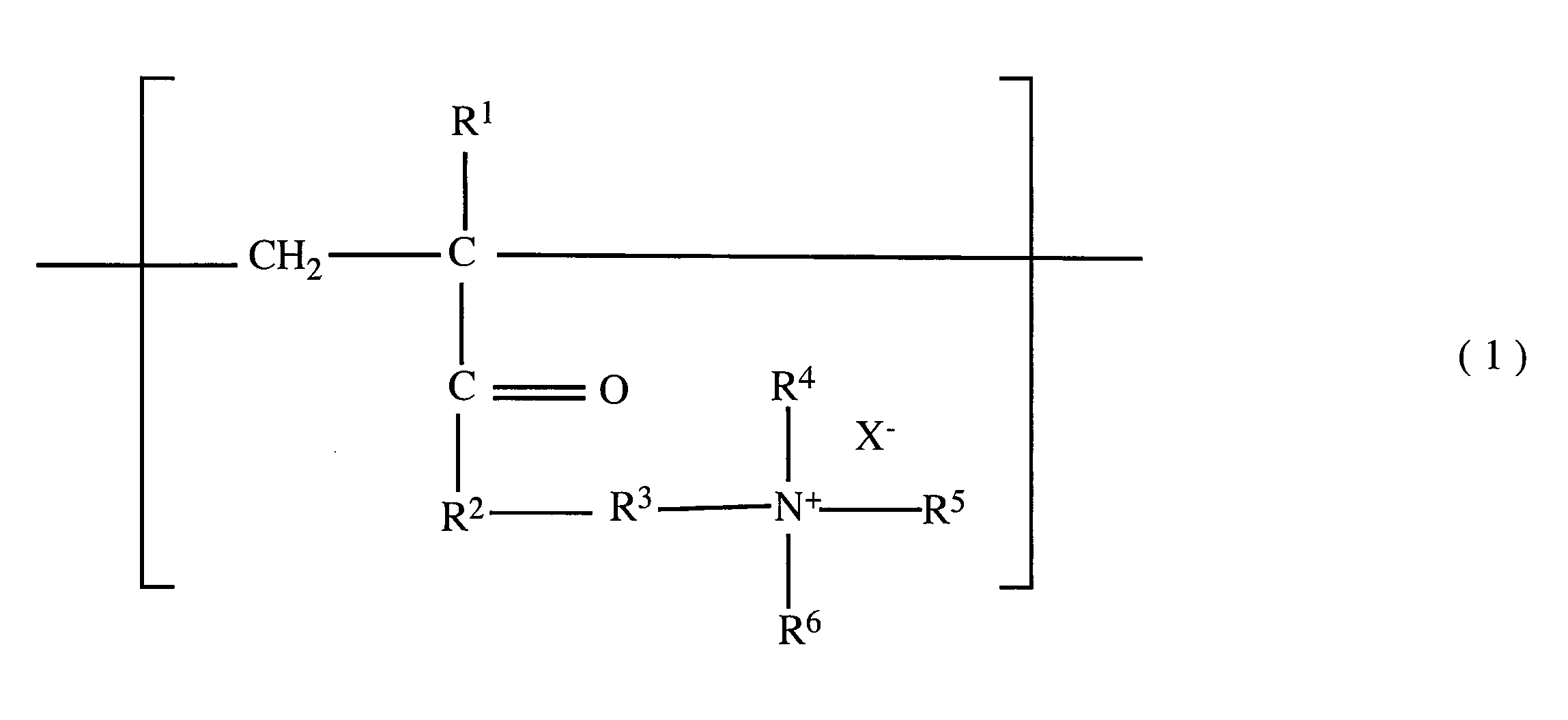
- a polymer having the structure of the following formula (1) is preferable in that it is excellent in antistatic properties and wet heat resistance.
- a single polymer or copolymer, or a plurality of other components may be copolymerized.
- the substituent R 1 is a hydrogen atom or a hydrocarbon group such as an alkyl group having 1 to 20 carbon atoms or a phenyl group
- R 2 is —O—, —NH— or —S—
- R 3 is An alkylene group having 1 to 20 carbon atoms or another structure capable of forming the structure of formula 1
- R 4 , R 5 and R 6 are each independently a hydrogen atom, an alkyl group having 1 to 20 carbon atoms, or a phenyl group.
- a hydrocarbon group provided with a functional group such as a hydroxyalkyl group, and X- is various counter ions.
- the substituent R 1 in the formula (1) is preferably a hydrogen atom or an alkyl group having 1 to 6 carbon atoms.
- 3 is preferably an alkyl group having 1 to 6 carbon atoms
- R 4 , R 5 and R 6 are preferably each independently a hydrogen atom or an alkyl group having 1 to 6 carbon atoms, more preferably , R 4 , R 5 , or R 6 is a hydrogen atom, and the other substituent is an alkyl group having 1 to 4 carbon atoms.
- the number average molecular weight of the compound having an ammonium group is usually 1,000 to 500,000, preferably 2,000 to 350,000, and more preferably 5,000 to 200,000.
- the molecular weight is less than 1000, the strength of the coating film may be weakened or the heat stability may be poor.
- the molecular weight exceeds 500,000, the viscosity of the coating solution increases, and the handleability and applicability may deteriorate.
- polyether compounds include polyethylene oxide, polyether ester amide, acrylic resin having polyethylene glycol in the side chain, and the like.
- the compound having a sulfonic acid group is a compound containing a sulfonic acid or a sulfonate in the molecule.
- a compound having a large amount of sulfonic acid or a sulfonate such as polystyrene sulfonic acid is preferably used. It is done.
- the conductive polymer examples include polythiophene-based, polyaniline-based, polypyrrole-based, and polyacetylene-based polymers.
- polythiophene-based polymers using poly (3,4-ethylenedioxythiophene) in combination with polystyrene sulfonic acid are preferably used.
- the conductive polymer is preferable to the other antistatic agents described above in that the resistance value is low.
- it is necessary to devise measures such as reducing the amount used in applications where coloring and cost are a concern.
- particles can be used in combination with the formation of the functional layer in order to improve blocking and slipperiness.
- the functional layer has mold release performance, it often has sufficient blocking resistance and slipperiness, and therefore it may be preferable not to use particles from the viewpoint of the appearance of the functional layer.
- the crosslinking agent is usually 0.5 to 80% by weight, preferably 1 to 65% by weight, more preferably 3 to 50% by weight, and particularly preferably 5 to 40% by weight. Most preferably, it is in the range of 8 to 25% by weight.
- the proportion of the release agent is generally different depending on the type of the release agent. Although it cannot be said, it is usually 3% by weight or more, preferably 15% by weight or more, more preferably 25 to 99% by weight. If it is less than 3% by weight, the blocking reduction may not be sufficient.
- the proportion in the functional layer is usually 10% by weight or more, preferably 20 to 90% by weight, more preferably 25 to 70% by weight. By using it in the above range, blocking can be easily reduced.
- the above ratio can be reduced, usually 1% by weight or more, preferably 2 to 50% by weight, more preferably 3 to 30% by weight. It is a range.
- the ratio of the crosslinking agent is usually 90% by weight or less, preferably 10 to 70% by weight, and more preferably 20 to 50% by weight.
- a crosslinking agent a melamine compound is preferable from a viewpoint of blocking reduction.
- the proportion of the antistatic agent as the proportion in the functional layer cannot be generally described because the appropriate amount varies depending on the type of the antistatic agent. However, it is usually 0.5% by weight or more, preferably 3 to 90% by weight, more preferably 5 to 70% by weight, and particularly preferably 8 to 60% by weight. If it is less than 0.5% by weight, the antistatic effect is not sufficient, and the effect of preventing the adhesion of surrounding dust and the like may not be sufficient.
- the proportion in the antistatic layer is usually 5% by weight or more, preferably 10 to 90% by weight, more preferably 20 to 70% by weight, particularly preferably. Is in the range of 25-60% by weight. If it is less than 5% by weight, the antistatic effect is not sufficient, and the effect of preventing the adhesion of surrounding dust and the like may not be sufficient.
- the proportion in the antistatic layer is usually 0.5% by weight or more, preferably 3 to 70% by weight, more preferably 5 to 50% by weight, particularly preferably 8 to It is in the range of 30% by weight. If it is less than 0.5% by weight, the antistatic effect is not sufficient, and the effect of preventing the adhesion of surrounding dust and the like may not be sufficient.
- the above-mentioned series of compounds is used as a solution or solvent dispersion, and a solution prepared by adjusting the solid content concentration to about 0.1 to 80% by weight as a guide is coated on the film. It is preferable to produce an adhesive film.
- an aqueous solution or a water dispersion is more preferable.
- a small amount of an organic solvent may be contained in the coating solution for the purpose of improving the dispersibility in water, improving the film forming property, and the like.
- only one type of organic solvent may be used, and two or more types may be used as appropriate.
- the film thickness of the adhesive layer depends on the material used for the adhesive layer, so it cannot be said unconditionally. However, in order to adjust the adhesive force more appropriately, or to improve the blocking properties, the appearance of the adhesive layer, etc. It is 10 ⁇ m or less, preferably 1 nm to 4 ⁇ m, more preferably 10 nm to 1 ⁇ m, particularly preferably 20 to 500 nm, and most preferably 30 to 400 nm.
- a general adhesive layer has a thickness of several tens of ⁇ m, but in such a case, for example, when used for manufacturing a polarizing plate, the adhesive film is used as a polarizing plate, a retardation plate, a viewing angle expansion plate, and the like.
- the protrusion can be minimized by adjusting the film thickness within the above-mentioned range. This effect becomes better as the adhesive layer is thinner.
- the thinner the adhesive layer is the smaller the absolute amount of the adhesive layer present on the film is, and the more effective the adhesive paste component is transferred to the adherend and the reduction in adhesive residue.
- it can be seen that by setting the film thickness in the above-mentioned range it is possible to achieve an appropriate adhesive strength that is not too strong. For example, for polarizing plate manufacturing processes, both adhesive performance and peeling performance that peels after bonding are achieved.
- the adhesive-peeling operation can be easily performed, and an optimum film can be obtained.
- the adhesive properties may be different depending on the configuration of the adhesive layer. Since it may disappear, use in the above-mentioned suitable range according to a use is preferable.
- the thickness of the functional layer depends on the function to be provided and cannot be generally specified, for example, the functional layer for imparting release performance and antistatic performance is usually 1 nm to 3 ⁇ m, preferably 10 nm to The range is 1 ⁇ m, more preferably 20 to 500 nm, particularly preferably 20 to 200 nm.
- the film thickness of the functional layer within the above range, it becomes easy to improve the blocking characteristics, improve the antistatic performance, or obtain a good appearance.
- Examples of methods for forming the adhesive layer and functional layer include gravure coating, reverse roll coating, die coating, air doctor coating, blade coating, rod coating, bar coating, curtain coating, knife coating, transfer roll coating, squeeze coating, and impregnation.
- Conventionally known coating methods such as coat, kiss coat, spray coat, calendar coat, and extrusion coat can be used.
- the film constituting the adhesive film in the present invention may be subjected to surface treatment such as corona treatment or plasma treatment in advance.
- the adhesive strength of the adhesive layer is essentially 1 to 1000 mN / cm, preferably 3 to 800 mN / cm or more, more preferably 1 to 1000 mN / cm, as measured by the measurement method described later. Is in the range of 5 to 500 mN / cm, more preferably 7 to 300 mN / cm, and particularly preferably 10 to 100 mN / cm. When it is out of the above range, depending on the adherend, there is a case where there is no adhesive force, a case where the adhesive force is too strong to be easily peeled off, or film blocking becomes remarkable.
- the pressure-sensitive adhesive layer side surface and the opposite side surface are overlapped, and the conditions are 40 ° C., 80% RH, 10 kg / cm 2 , 20 hours.
- the peeling load after pressing is usually 100 g / cm or less, preferably 30 g / cm or less, more preferably 20 g / cm or less, particularly preferably 10 g / cm or less, and most preferably 8 g / cm or less.
- roughening the film surface on the side opposite to the pressure-sensitive adhesive layer may be one of the means for improving the blocking property with the pressure-sensitive adhesive layer. . Since it depends on the type and adhesive strength of the adhesive layer, it cannot be said unconditionally. However, if there is a purpose to improve the blocking characteristics by surface roughness, regardless of the functional layer, the film surface on the side opposite to the adhesive layer
- the arithmetic average roughness (Sa) is usually in the range of 5 nm or more, preferably 8 nm or more, more preferably 30 nm or more, and the upper limit is not particularly limited, but the upper limit of the preferred range is 300 nm from the viewpoint of transparency. .
- the releasability when the releasability is good by a method such as providing a release functional layer on the side surface opposite to the adhesive layer, the releasability becomes dominant, so the influence of Sa is small and no special attention is required.
- the influence of Sa when the releasability is weak, the influence of Sa may become large, which can be an effective means for improving the blocking characteristics.
- Number average molecular weight measurement method Measurement was performed using GPC (HLC-8120GPC manufactured by Tosoh Corporation). The number average molecular weight was calculated in terms of polystyrene.
- Adhesive layer adhesive residue (transfer properties) evaluation method In the evaluation method (8), after the attached film was peeled off, A was observed when there was no adhesive residue (transferred trace of the adhesive layer), and B was designated when there was adhesive residue.
- the polyester used in the examples and comparative examples was prepared as follows. ⁇ Method for producing polyester (A)> 100 parts by weight of dimethyl terephthalate, 60 parts by weight of ethylene glycol, 30 ppm of ethyl acid phosphate with respect to the resulting polyester, and 100 ppm of magnesium acetate tetrahydrate with respect to the resulting polyester as the catalyst at 260 ° C. in a nitrogen atmosphere at 260 ° C. The reaction was allowed to proceed. Subsequently, 50 ppm of tetrabutyl titanate was added to the resulting polyester, the temperature was raised to 280 ° C. over 2 hours and 30 minutes, the pressure was reduced to 0.3 kPa in absolute pressure, and melt polycondensation was further carried out for 80 minutes. A polyester (A) having 0.63 and an amount of diethylene glycol of 2 mol% was obtained.
- polyester (B) > 100 parts by weight of dimethyl terephthalate, 60 parts by weight of ethylene glycol, and magnesium acetate tetrahydrate as a catalyst were subjected to an esterification reaction at 225 ° C. in a nitrogen atmosphere at 900 ppm with respect to the produced polyester. Subsequently, 3500 ppm of orthophosphoric acid was added to the produced polyester, and 70 ppm of germanium dioxide was added to the produced polyester. The temperature was raised to 280 ° C. over 2 hours and 30 minutes, and the pressure was reduced to an absolute pressure of 0.4 kPa. After 85 minutes of melt polycondensation, polyester (B) having an intrinsic viscosity of 0.64 and a diethylene glycol amount of 2 mol% was obtained.
- polyester (C) is obtained using the same method as the production method of polyester (A) except that 0.3 part by weight of silica particles having an average particle diameter of 2 ⁇ m is added before melt polymerization. It was.
- the polyester (D) is produced using the same method as the production method of the polyester (A) except that 0.6 parts by weight of silica particles having an average particle diameter of 3.2 ⁇ m is added before the melt polymerization. Got.
- Block polyisocyanate with active methylene obtained by adding 58.9 parts of n-butanol and maintaining at a reaction solution temperature of 80 ° C. for 2 hours and then adding 0.86 part of 2-ethylhexyl acid phosphate.
- Antistatic agent compound having ammonium group: (VIB) A polymer compound having a number average molecular weight of 50000, wherein the counter ion is a methanesulfonic acid ion, comprising a structural unit of the following formula (2).
- the film was stretched 3.1 times in the machine direction at a film temperature of 85 ° C. using the roll peripheral speed difference, and then the coating liquid A1 shown in Table 1 below was applied to the thickness of the adhesive layer (dried) on one side of the film. (After) is applied to 90 nm, and coating liquid B1 shown in the following Table 2 is applied to the opposite surface so that the film thickness (after drying) of the functional layer is 30 nm, guided to a tenter, at 95 ° C.
- the film After drying for 10 seconds, the film was stretched 4.2 times at 120 ° C in the transverse direction, heat-treated at 230 ° C for 10 seconds, and then relaxed by 2% in the transverse direction, with a thickness of 38 ⁇ m, the back side of the adhesive layer (function A pressure-sensitive adhesive film having a surface Sa of 9 nm was obtained.
- the adhesive strength with the polymethylmethacrylate plate was 10 mN / cm, the adhesive property was good, the anti-blocking property was excellent, and the transfer to the adherend was not good. It was.
- the properties of this film are shown in Tables 3 and 4 below.
- Example 1 In Example 1, it manufactured like Example 1 except having changed an application agent composition into an application agent composition shown in Tables 1 and 2, and obtained an adhesive film. As shown in the following Tables 3 to 14, 21 and 22, the obtained adhesive film had good adhesive strength, anti-blocking properties and transferability to the adherend.
- Example 237-326 In Example 1, it manufactured like Example 1 except having changed an application agent composition into an application agent composition shown in Tables 1 and 2, and obtained an adhesive film. As shown in Tables 15 to 20 below, the obtained pressure-sensitive adhesive film had good adhesive strength, anti-blocking properties, migration to an adherend and antistatic performance.
- the film was stretched 3.1 times in the machine direction at a film temperature of 85 ° C. using the roll peripheral speed difference, and then the coating liquid A1 shown in Tables 1 and 2 below was applied to the surface layer 1 side of the longitudinally stretched film.
- the film thickness (after drying) is applied to 120 nm, and the coating liquid B1 shown in Table 2 below is applied to the opposite side so that the film thickness (after drying) of the functional layer is 30 nm, leading to a tenter. , Dried at 95 ° C. for 10 seconds, stretched 4.2 times in the transverse direction at 120 ° C., heat treated at 230 ° C. for 10 seconds, relaxed 2% in the transverse direction, thickness 38 ⁇ m, adhesive layer An adhesive film having a surface Sa of 30 nm on the back side (surface layer 2 side, functional layer side) was obtained.
- Example 335 In Example 335, except having changed a coating agent composition into the coating agent composition shown in Table 1 and 2, it manufactured like Example 335 and obtained the adhesive film. As shown in Tables 21 and 22 below, the obtained adhesive film had good adhesive force and transferability to the adherend.
- the film was stretched 3.1 times in the machine direction at a film temperature of 85 ° C. using the roll peripheral speed difference, and then the coating liquid A1 shown in Table 1 below was applied to the surface layer 1 side of the longitudinally stretched film. After coating to 120 nm (after drying), guiding to a tenter, drying at 95 ° C.
- the pressure-sensitive adhesive film was relaxed by 2% in the transverse direction, the thickness was 38 ⁇ m, and the surface Sa on the back side of the pressure-sensitive adhesive layer was 55 nm.
- Example 343 In Example 343, it manufactured similarly to Example 343 except having changed a coating agent composition into the coating agent composition shown in Table 1, and obtained the adhesive film. As shown in the following Tables 21 and 22, the obtained pressure-sensitive adhesive film had good adhesive strength, anti-blocking properties and transferability to the adherend.
- Comparative Example 1 In Example 1, it manufactured like Example 1 except not having provided an adhesion layer and a functional layer, and obtained a polyester film. When the obtained polyester film was evaluated, as shown in Table 23 below, it was a film having no adhesive force.
- Example 1 In Example 1, except having changed a coating agent composition into the coating agent composition shown to Table 1 and 2, it manufactured like Example 1 and the polyester film was obtained. As shown in Tables 23 and 24, when the obtained polyester film had no adhesive force, the case where the transferability to the adherend was poor was observed.
- Comparative Example 10 In Example 1, it manufactured like Example 1 except not having provided an adhesion layer and a functional layer, and obtained a polyester film. On the polyester film without the adhesive layer, the coating liquid C5 shown in Table 1 below is applied so that the thickness (after drying) of the adhesive layer is 150 nm, dried at 100 ° C. for 60 seconds, and by offline coating. A polyester film having an adhesive layer laminated thereon was obtained. As shown in Table 24, the obtained adhesive film had poor transfer characteristics and transferability to the adherend.
- Comparative Example 11 On the polyester film without the adhesive layer and functional layer obtained in Comparative Example 1, the coating liquid C5 shown in Table 1 below was applied at 100 ° C. for 120 seconds so that the film thickness (after drying) of the adhesive layer was 20 ⁇ m. Drying was performed to obtain a polyester film having an adhesive layer formed by off-line coating. When the polyester film was cut after bonding the pressure-sensitive adhesive layer side, the component of the pressure-sensitive adhesive layer that was not seen in the examples was seen to be contaminated by the pressure-sensitive adhesive component. Further, the adhesive strength exceeded 1000 mN / cm, and measurement was not successful. The other characteristics were as shown in Tables 23 and 24.
- the adhesive film of the present invention has few fish eyes, for example, for use as a surface protection film for preventing scratches or preventing adhesion of dirt during transport, storage or processing of resin plates, metal plates, etc. It is excellent in mechanical strength and heat resistance, has good adhesive properties, and can be suitably used for applications that require little transfer of the adhesive layer to the adherend.
Landscapes
- Chemical & Material Sciences (AREA)
- Organic Chemistry (AREA)
- Chemical Kinetics & Catalysis (AREA)
- Health & Medical Sciences (AREA)
- Medicinal Chemistry (AREA)
- Polymers & Plastics (AREA)
- Engineering & Computer Science (AREA)
- Manufacturing & Machinery (AREA)
- Materials Engineering (AREA)
- Mechanical Engineering (AREA)
- Laminated Bodies (AREA)
- Adhesive Tapes (AREA)
- Adhesives Or Adhesive Processes (AREA)
- Materials For Medical Uses (AREA)
Abstract
Description
かかるウレタン樹脂は、塗布後の乾燥工程において中和剤が外れたカルボキシル基を、他の架橋剤による架橋反応点として用いることが出来る。これにより、コーティング前の液の状態での安定性に優れる上、得られる粘着層の耐久性、耐溶剤性、耐水性、耐ブロッキング性等をさらに改善することが可能となる。
これらの反応性基を有する化合物としては、例えば、ポリビニルアルコール、ポリエチレンイミン、ポリエチレンアミン、反応性基含有ポリエステル樹脂、反応性基含有ポリ(メタ)アクリル樹脂等が挙げられる。これらの中でも離型性や取り扱い易さを考慮するとポリビニルアルコールであることが好ましい。
ポリエステルに非相溶な他のポリマー成分および顔料を除去したポリエステル1gを精秤し、フェノール/テトラクロロエタン=50/50(重量比)の混合溶媒100mlを加えて溶解させ、30℃で測定した。
株式会社島津製作所製、遠心沈降式粒度分布測定装置 SA-CP3型を使用して測定した等価球形分布における積算(重量基準)50%の値を平均粒径とした。
後述する実施例、比較例の粘着層とは反対側のフィルム表面(機能層がある場合には機能層側の表面)を、株式会社菱化システム製、非接触表面・層断面形状計測システムVertScan(登録商標)R550GMLを使用して、CCDカメラ:SONY HR-50 1/3’、対物レンズ:20倍、鏡筒:1X Body、ズームレンズ:No Relay、波長フィルター:530 white、測定モード:Waveにて測定し、4次の多項式補正による出力を用いた。
粘着層または機能層の表面をRuO4で染色し、エポキシ樹脂中に包埋した。その後、超薄切片法により作成した切片をRuO4で染色し、粘着層断面をTEM(株式会社日立ハイテクノロジーズ製 H-7650、加速電圧100V)を用いて測定した。
株式会社パーキンエルマージャパン製、示差走査熱量測定装置(DSC) 8500を使用して、-100~200℃において毎分10℃の昇温条件で測定した。
GPC(東ソー株式会社製 HLC-8120GPC)を用いて測定した。数平均分子量はポリスチレン換算で算出した。
ポリメチルメタクリレート板(株式会社クラレ製 コモグラス(登録商標)、厚さ1mm)の表面に、5cm幅の本発明の粘着フィルムの粘着層面を5cm幅の2kgゴムローラーにて1往復圧着し、室温にて1時間放置後の剥離力を測定した。剥離力は、株式会社島津製作所製「Ezgraph」を使用し、引張速度300mm/分の条件下、180°剥離を行った。
(7-1)のポリメチルメタクリレート板に変えて、後述する比較例1で得られた粘着層のないポリエステルフィルム表面(厚さ38μm)を用いて粘着力を評価すること以外は(7-1)と同様にして評価を行った。
1枚のA4サイズの粘着フィルムの粘着層側と、後述する比較例1の粘着層がないA4サイズのポリエステルフィルムを重ねて指で強く押さえて粘着特性を評価した。指で軽く押さえただけでフィルムが貼りついて、粘着層を有する方のフィルムのみを持っても貼りついた状態を保持できる場合を5点、指で強く押さえることでフィルムが貼りついて、粘着層を有する方のフィルムのみを持っても貼りついた状態を保持できる場合を4点、指で強く押さえることでフィルムが貼りついて、粘着層を有する方のフィルムのみを持っても貼りついた状態を保持できるが、3秒以内に剥がれてしまう場合を3点、指で強く押さえることでフィルムには粘着特性が微小に見られるが、貼りついた状態を保持できない場合を2点、指で強く押さえても全く粘着特性が見られない場合を1点とした。
フィルムを剥がした後、再度同様な操作を同一箇所で行ったとき、評価結果が同等となる場合をA、粘着特性が悪化する場合をBとした。
上記評価方法(8)において、貼りつけたフィルムを剥がした後を観察し、糊残り(粘着層の転着跡)がない場合をA、糊残りがある場合をBとした。
測定するポリエステルフィルムを2枚用意し、粘着層側と、粘着層とは反対側(機能層がある場合は機能層側)を重ね合わせて、12cm×10cmの面積を、40℃、80%RH、10kg/cm2、20時間の条件下でプレスした。その後、フィルム同士をASTM D1893に規定された方法に準じて剥離し、その剥離荷重を測定した。
剥離荷重が軽いものほどブロッキングしにくく良好であり、通常100g/cm以下、好ましくは30g/cm以下、さらに好ましくは20g/cm以下、特に好ましくは10g/cm以下、最も好ましくは8g/cm以下の範囲である。なお、本評価で300g/cmを超えるものや、評価の途中でフィルムが破れてしまうものや、プレスにより明らかなブロッキングが発生してしまうものは実用的ではなく、それらの場合はCと評価した。
ポリメチルメタクリレート板(株式会社クラレ製 コモグラス(登録商標)、厚さ1mm)の表面に、5cm幅の本発明の粘着フィルムの粘着層面を5cm幅の2kgゴムローラーにて2往復圧着し、貼りつけ、60℃で5日間処理した後、フィルムを剥がしてポリメチルメタクリレート板の表面を観察した。
ポリメチルメタクリレート板に何も跡がない(粘着層の移行が見られない)場合をA、フィルムのエッジ付近にわずかに薄い跡が残る場合をB、エッジ付近以外にも白い跡が観察される(粘着層が移行している)場合をCとした。なお、被着体に貼りつかない場合は「-」と記載した。
日本ヒューレット・パッカード株式会社製高抵抗測定器:HP4339Bおよび測定電極:HP16008Bを使用し、23℃、50%RHの測定雰囲気下でポリエステルフィルムを十分調湿後、印可電圧100Vで1分後の帯電防止層の表面抵抗を測定した。
23℃、50%RHの測定雰囲気下でポリエステルフィルムを十分調湿後、帯電防止層を綿布で10往復こする。これを、細かく砕いた煙草の灰の上に静かに近づけ、灰の付着状況を以下の基準で評価した。
A:フィルムを灰に接触させても付着しない
B:フィルムを灰に接触させると少し付着する
C:フィルムを灰に近づけただけで多量に付着する
<ポリエステル(A)の製造方法>
テレフタル酸ジメチル100重量部、エチレングリコール60重量部、エチルアシッドフォスフェートを生成ポリエステルに対して30ppm、触媒として酢酸マグネシウム・四水和物を生成ポリエステルに対して100ppmを窒素雰囲気下、260℃でエステル化反応をさせた。引き続いて、テトラブチルチタネートを生成ポリエステルに対して50ppm添加し、2時間30分かけて280℃まで昇温すると共に、絶対圧力0.3kPaまで減圧し、さらに80分、溶融重縮合させ、極限粘度0.63、ジエチレングリコール量が2モル%のポリエステル(A)を得た。
テレフタル酸ジメチル100重量部、エチレングリコール60重量部、触媒として酢酸マグネシウム・四水和物を生成ポリエステルに対して900ppmを窒素雰囲気下、225℃でエステル化反応をさせた。引き続いて、正リン酸を生成ポリエステルに対して3500ppm、二酸化ゲルマニウムを生成ポリエステルに対して70ppm添加し、2時間30分かけて280℃まで昇温すると共に、絶対圧力0.4kPaまで減圧し、さらに85分、溶融重縮合させ、極限粘度0.64、ジエチレングリコール量が2モル%のポリエステル(B)を得た。
ポリエステル(A)の製造方法において、溶融重合前に平均粒径2μmのシリカ粒子を0.3重量部添加する以外はポリエステル(A)の製造方法と同様の方法を用いてポリエステル(C)を得た。
ポリエステル(A)の製造方法において、溶融重合前に平均粒径3.2μmのシリカ粒子を0.6重量部添加する以外はポリエステル(A)の製造方法と同様の方法を用いてポリエステル(D)を得た。
(化合物例)
・ポリエステル樹脂:(IA)
下記組成からなるポリエステル樹脂(ガラス転移点:-20℃)の水分散体
モノマー組成:(酸成分)ドデカンジカルボン酸/テレフタル酸/イソフタル酸/5-ソジウムスルホイソフタル酸//(ジオール成分)エチレングリコール/1,4-ブタンジオール=20/38/38/4//40/60(mol%)
・ポリエステル樹脂:(IB)
下記組成からなるポリエステル樹脂(ガラス転移点:-30℃)の水分散体
モノマー組成:(酸成分)ドデカンジカルボン酸/テレフタル酸/イソフタル酸/5-ソジウムスルホイソフタル酸//(ジオール成分)エチレングリコール/1,4-ブタンジオール=30/33/33/4//40/60(mol%)
・アクリル樹脂:(IC)
下記組成からなるアクリル樹脂(ガラス転移点:-50℃)の水分散体
2-エチルへキシルアクリレート/ラウリルメタクリレート/2-ヒドロキシエチルメタクリレート/アクリル酸/メタクリル酸=50/25/15/5/5(重量%)
・アクリル樹脂:(ID)
下記組成からなるアクリル樹脂(ガラス転移点:-30℃)の水分散体
ノルマルブチルアクリレート/2-エチルへキシルアクリレート/エチルアクリレート/2-ヒドロキシエチルメタクリレート/アクリル酸=20/20/56/2/2(重量%)
・ウレタン樹脂:(IE)
下記組成からなるウレタン樹脂(ガラス転移点:-30℃)の水分散体
1,6-ヘキサンジオールとジエチルカーボネートからなる数平均分子量が2000のポリカーボネートポリオール/数平均分子量400のポリエチレングリコール/ブタンジオール/イソホロンジイソシアネート/ジメチロールプロピオン酸=83/2/2/11/2(重量%)
・イソシアネート系化合物:(IIB)
ヘキサメチレンジイソシアネート1000部を60℃で攪拌し、触媒としてテトラメチルアンモニウム・カプリレート0.1部を加えた。4時間後、リン酸0.2部を添加して反応を停止させ、イソシアヌレート型ポリイソシアネート組成物を得た。得られたイソシアヌレート型ポリイソシアネート組成物100部、数平均分子量400のメトキシポリエチレングリコール42.3部、プロピレングリコールモノメチルエーテルアセテート29.5部を仕込み、80℃で7時間保持した。その後反応液温度を60℃に保持し、イソブタノイル酢酸メチル35.8部、マロン酸ジエチル32.2部、ナトリウムメトキシドの28%メタノール溶液0.88部を添加し、4時間保持した。n-ブタノール58.9部を添加し、反応液温度80℃で2時間保持し、その後、2-エチルヘキシルアシッドホスフェート0.86部を添加して得られた活性メチレンによるブロックポリイソシアネート。
・オキサゾリン化合物:(IIC)
オキサゾリン基及びポリアルキレンオキシド鎖を有するアクリルポリマー エポクロス(オキサゾリン基量=4.5mmol/g、株式会社日本触媒製)
・エポキシ化合物:(IID)多官能ポリエポキシ化合物である、ポリグリセロールポリグリシジルエーテル
下記組成からなるポリエステル樹脂(ガラス転移点:30℃)の水分散体
モノマー組成:(酸成分)テレフタル酸/イソフタル酸/5-ソジウムスルホイソフタル酸//(ジオール成分)エチレングリコール/1,4-ブタンジオール/ジエチレングリコール=40/56/4//45/25/30(mol%)
・ポリエステル樹脂:(IIIB)
下記組成からなるポリエステル樹脂(ガラス転移点:50℃)の水分散体
モノマー組成:(酸成分)テレフタル酸/イソフタル酸/5-ソジウムスルホイソフタル酸//(ジオール成分)エチレングリコール/1,4-ブタンジオール/ジエチレングリコール=50/46/4//70/20/10(mol%)
・ウレタン樹脂:(IIIC)
下記組成からなるウレタン樹脂(ガラス転移点:50℃)の水分散体
イソホロンジイソシアネートユニット/テレフタル酸ユニット/イソフタル酸ユニット/エチレングリコールユニット/ジエチレングリコールユニット/ジメチロールプロパン酸ユニット=12/19/18/21/25/5(mol%)
・アクリル樹脂:(IIID)
下記組成からなるアクリル樹脂(ガラス転移点:40℃)の水分散体
エチルアクリレート/メチルメタクリレート/N-メチロールアクリルアミド/アクリル酸=48/45/4/3(重量%)
4つ口フラスコにキシレン200部、オクタデシルイソシアネート600部を加え、攪拌下に加熱した。キシレンが還流し始めた時点から、平均重合度500、ケン化度88モル%のポリビニルアルコール100部を少量ずつ10分間隔で約2時間にわたって加えた。ポリビニルアルコールを加え終わってから、さらに2時間還流を行い、反応を終了した。反応混合物を約80℃まで冷却してから、メタノール中に加えたところ、反応生成物が白色沈殿として析出したので、この沈殿を濾別し、キシレン140部を加え、加熱して完全に溶解させた後、再びメタノールを加えて沈殿させるという操作を数回繰り返した後、沈殿をメタノールで洗浄し、乾燥粉砕して得た。
下記組成からなるフッ素化合物の水分散体
オクタデシルアクリレート/パーフルオロヘキシルエチルメタクリレート/塩化ビニル=66/17/17(重量%)
ジメチルシリコーンの側鎖に、モル比でジメチルシロキサン100に対して、エチレングリコール鎖が8であるポリエチレングリコール(末端は水酸基)を1含有する、数平均分子量7000のポリエーテル基含有シリコーン(シリコーンのシロキサン結合を1とした場合、モル比の割合で、ポリエーテル基のエーテル結合は0.07である)。数平均分子量500以下の低分子成分は3%、ケイ素に結合したビニル基(ビニルシラン)、水素基(ハイドロゲンシラン)は存在せず。なお、本化合物は、重量比で、ポリエーテル基含有シリコーンを1として、ドデシルベンゼンスルホン酸ナトリウムを0.25の割合で配合し、水分散したもの。
攪拌機、温度計、温度コントローラーを備えた内容量1.5Lの乳化設備に融点105℃、酸価16mgKOH/g、密度0.93g/mL、数平均分子量5000の酸化ポリエチレンワックス300g、イオン交換水650gとデカグリセリンモノオレエート界面活性剤を50g、48%水酸化カリウム水溶液10gを加え窒素で置換後、密封し150℃で1時間高速攪拌した後130℃に冷却し、高圧ホモジナイザーを400気圧下で通過させ40℃に冷却したワックスエマルション。
主鎖にピロリジニウム環を有する下記組成で重合したポリマー
ジアリルジメチルアンモニウムクロライド/ジメチルアクリルアミド/N-メチロールアクリルアミド=90/5/5(mol%)。数平均分子量30000。
下記式(2)の構成単位からなる、対イオンがメタンスルホン酸イオンである数平均分子量50000の高分子化合物。
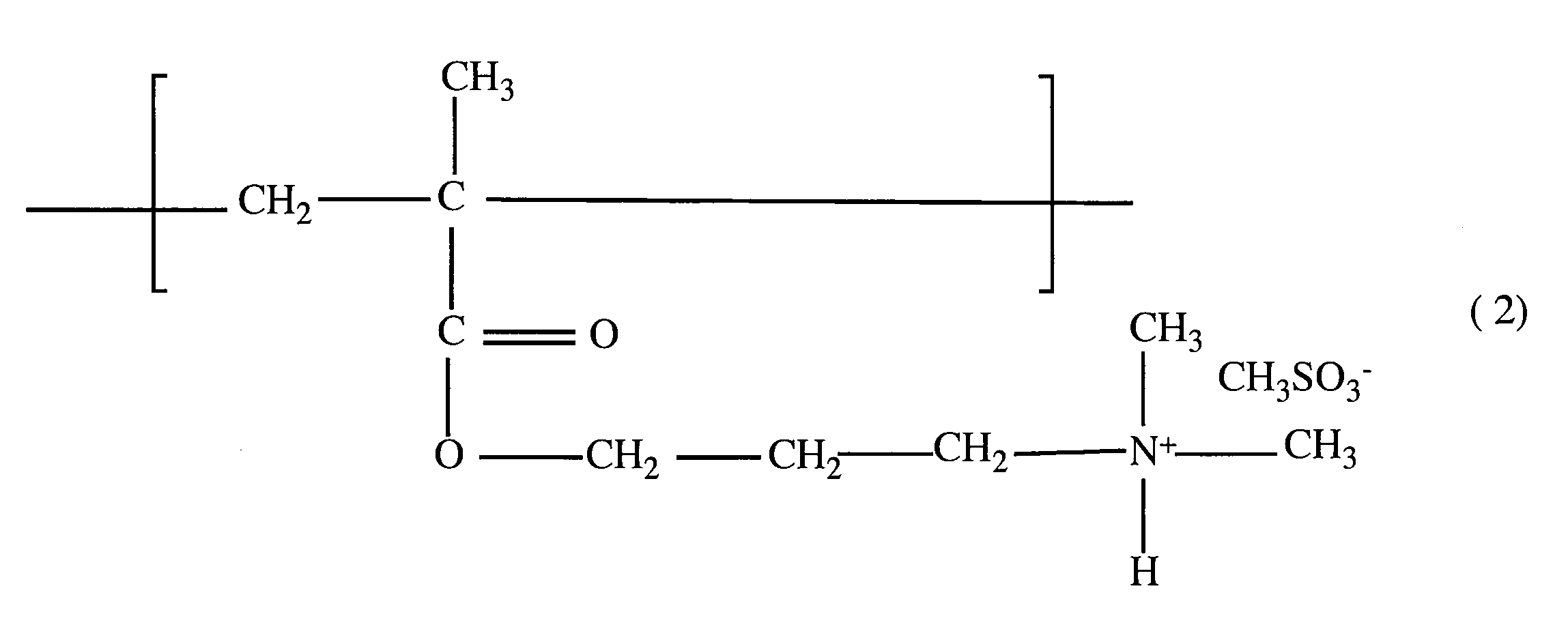
ポリエステル(A)、(B)、(C)をそれぞれ91%、3%、6%の割合で混合した混合原料を最外層(表層)の原料とし、ポリエステル(A)、(B)をそれぞれ97%、3%の割合で混合した混合原料を中間層の原料として、2台の押出機に各々を供給し、各々285℃で溶融した後、40℃に設定した冷却ロール上に、2種3層(表層/中間層/表層=3:32:3の吐出量)の層構成で共押出し冷却固化させて未延伸シートを得た。
次いで、ロール周速差を利用してフィルム温度85℃で縦方向に3.1倍延伸した後、この縦延伸フィルムの片面に、下記表1に示す塗布液A1を粘着層の膜厚(乾燥後)が90nmになるように塗布し、反対側の面に下記表2に示す塗布液B1を機能層の膜厚(乾燥後)が30nmになるように塗布し、テンターに導き、95℃で10秒間乾燥させた後、横方向に120℃で4.2倍延伸し、230℃で10秒間熱処理を行った後、横方向に2%弛緩し、厚さ38μm、粘着層の裏面側(機能層側)の表面のSaが9nmの粘着フィルムを得た。
実施例1において、塗布剤組成を表1および2に示す塗布剤組成に変更する以外は実施例1と同様にして製造し、粘着フィルムを得た。得られ粘着フィルムは下記表3~14、21および22に示すとおり、粘着力、耐ブロッキング特性および被着体への移行性は良好であった。
実施例1において、塗布剤組成を表1および2に示す塗布剤組成に変更する以外は実施例1と同様にして製造し、粘着フィルムを得た。得られた粘着フィルムは下記表15~20に示すとおり、粘着力、耐ブロッキング特性、被着体への移行性および帯電防止性能は良好であった。
ポリエステル(A)、(B)、(C)をそれぞれ91%、3%、6%の割合で混合した混合原料を最外層(表層1)の原料とし、ポリエステル(A)、(B)、(D)をそれぞれ72%、3%、25%の割合で混合した混合原料を最外層(表層2)の原料とし、ポリエステル(A)、(B)をそれぞれ97%、3%の割合で混合した混合原料を中間層の原料として、2台の押出機に各々を供給し、各々285℃で溶融した後、40℃に設定した冷却ロール上に、3種3層(表層1/中間層/表層2=6:26:6の吐出量)の層構成で共押出し冷却固化させて未延伸シートを得た。次いで、ロール周速差を利用してフィルム温度85℃で縦方向に3.1倍延伸した後、この縦延伸フィルムの表層1側に、下記表1および2に示す塗布液A1を粘着層の膜厚(乾燥後)が120nmになるように塗布し、反対側の面に下記表2に示す塗布液B1を機能層の膜厚(乾燥後)が30nmになるように塗布し、テンターに導き、95℃で10秒間乾燥させた後、横方向に120℃で4.2倍延伸し、230℃で10秒間熱処理を行った後、横方向に2%弛緩し、厚さ38μm、粘着層の裏面側(表層2側、機能層側)の表面のSaが30nmの粘着フィルムを得た。
実施例335において、塗布剤組成を表1および2に示す塗布剤組成に変更する以外は実施例335と同様にして製造し、粘着フィルムを得た。得られた粘着フィルムは下記表21および22に示すとおり、粘着力および被着体への移行性は良好であった。
ポリエステル(A)、(B)、(C)をそれぞれ91%、3%、6%の割合で混合した混合原料を最外層(表層1)の原料とし、ポリエステル(A)、(B)、(D)をそれぞれ47%、3%、50%の割合で混合した混合原料を最外層(表層2)の原料とし、ポリエステル(A)、(B)をそれぞれ97%、3%の割合で混合した混合原料を中間層の原料として、2台の押出機に各々を供給し、各々285℃で溶融した後、40℃に設定した冷却ロール上に、3種3層(表層1/中間層/表層2=4:30:4の吐出量)の層構成で共押出し冷却固化させて未延伸シートを得た。次いで、ロール周速差を利用してフィルム温度85℃で縦方向に3.1倍延伸した後、この縦延伸フィルムの表層1側に、下記表1に示す塗布液A1を粘着層の膜厚(乾燥後)が120nmになるように塗布し、テンターに導き、95℃で10秒間乾燥させた後、横方向に120℃で4.2倍延伸し、230℃で10秒間熱処理を行った後、横方向に2%弛緩し、厚さ38μm、粘着層の裏面側の表面のSaが55nmの粘着フィルムを得た。
実施例343において、塗布剤組成を表1に示す塗布剤組成に変更する以外は実施例343と同様にして製造し、粘着フィルムを得た。得られた粘着フィルムは下記表21および22に示すとおり、粘着力、耐ブロッキング特性および被着体への移行性は良好であった。
実施例1において、粘着層および機能層を設けなかったこと以外は実施例1と同様にして製造し、ポリエステルフィルムを得た。得られたポリエステルフィルムを評価したところ、下記表23に示すとおり、粘着力はないフィルムであった。
実施例1において、塗布剤組成を表1および2に示す塗布剤組成に変更する以外は実施例1と同様にして製造し、ポリエステルフィルムを得た。得られたポリエステルフィルムは表23および24に示すとおり、粘着力がない場合、被着体への移行性が悪い場合が見られた。
実施例1において、粘着層および機能層を設けなかったこと以外は実施例1と同様にして製造し、ポリエステルフィルムを得た。この粘着層のないポリエステルフィルム上に、下記表1に示す塗布液C5を粘着層の膜厚(乾燥後)が150nmになるように塗布し、100℃で60秒間の乾燥を行い、オフラインコーティングによる粘着層が積層されたポリエステルフィルムを得た。得られた粘着フィルムは表24に示すとおり、転着特性および被着体への移行性が悪いものであった。
比較例1で得られた粘着層および機能層がないポリエステルフィルム上に、下記表1に示す塗布液C5を粘着層の膜厚(乾燥後)が20μmとなるように、100℃で120秒間の乾燥を行い、オフラインコーティングによる粘着層が形成されたポリエステルフィルムを得た。ポリエステルフィルムに粘着層側を貼り合わせた後に断裁したところ、実施例では見られなかった、粘着層の成分のはみ出しが見られ、粘着成分による汚染が懸念される結果であった。また粘着力は1000mN/cmを超えるものであり、うまく測定ができなかった。その他の特性は表23および24に示すとおりであった。
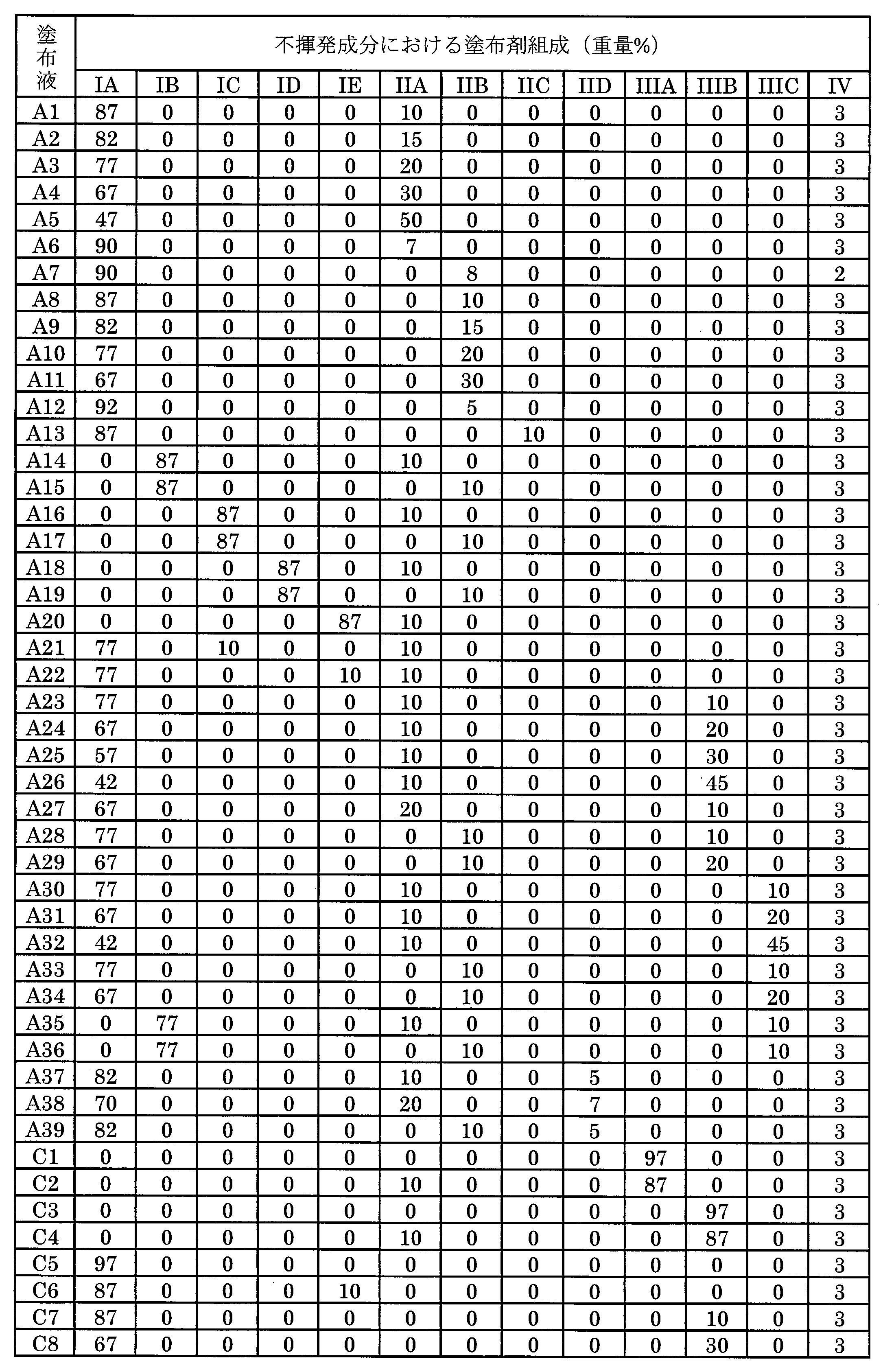
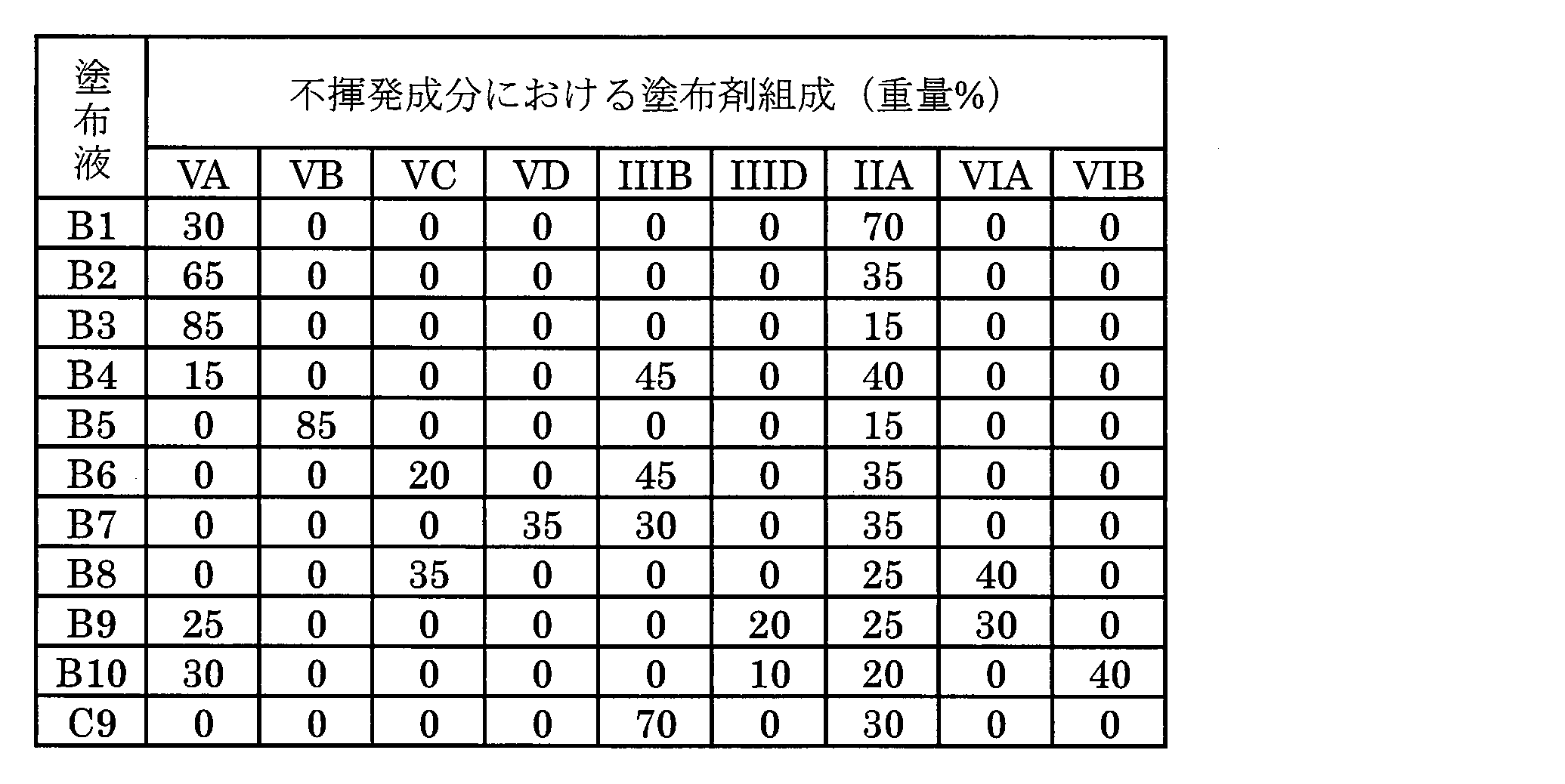

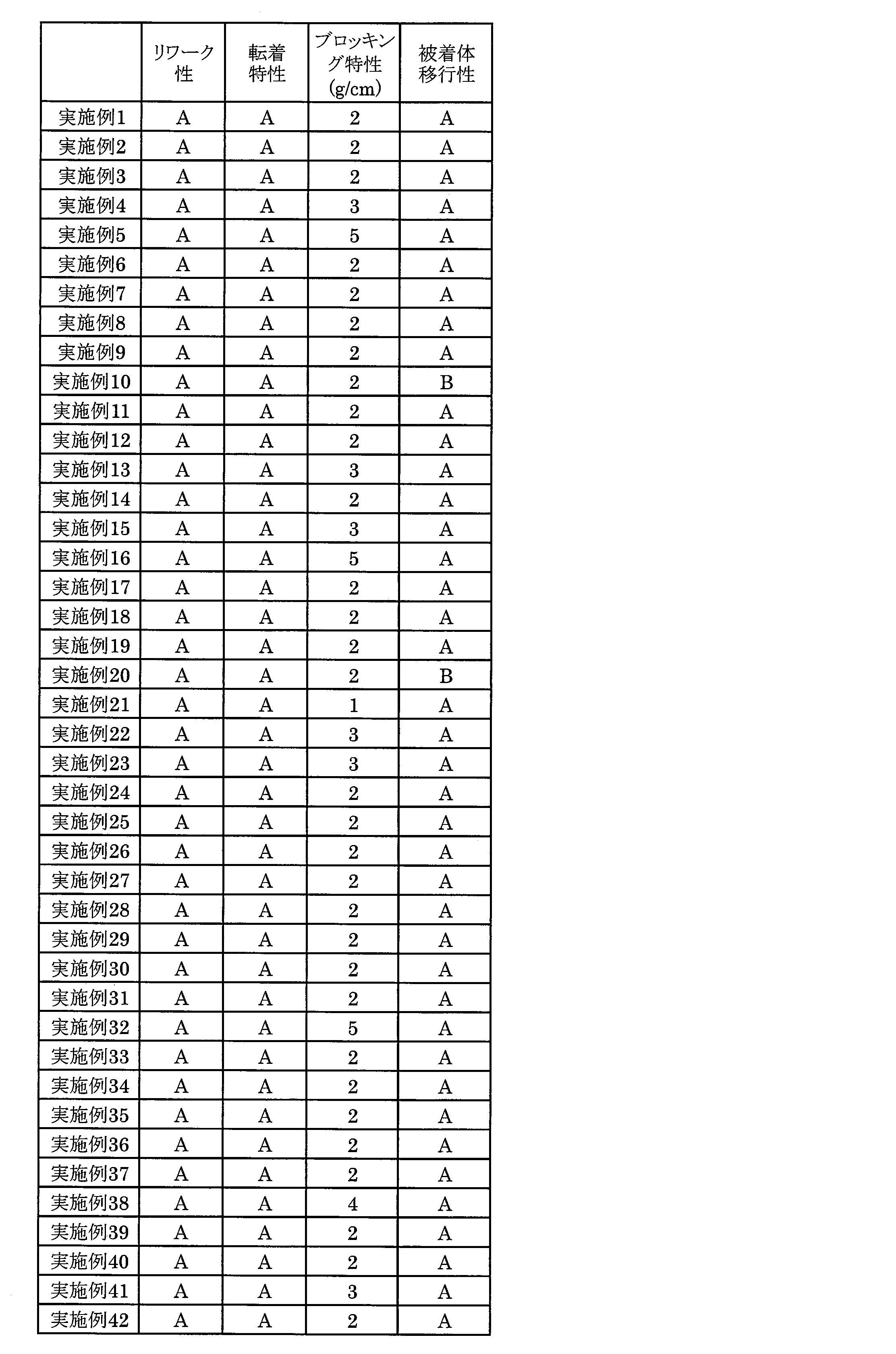
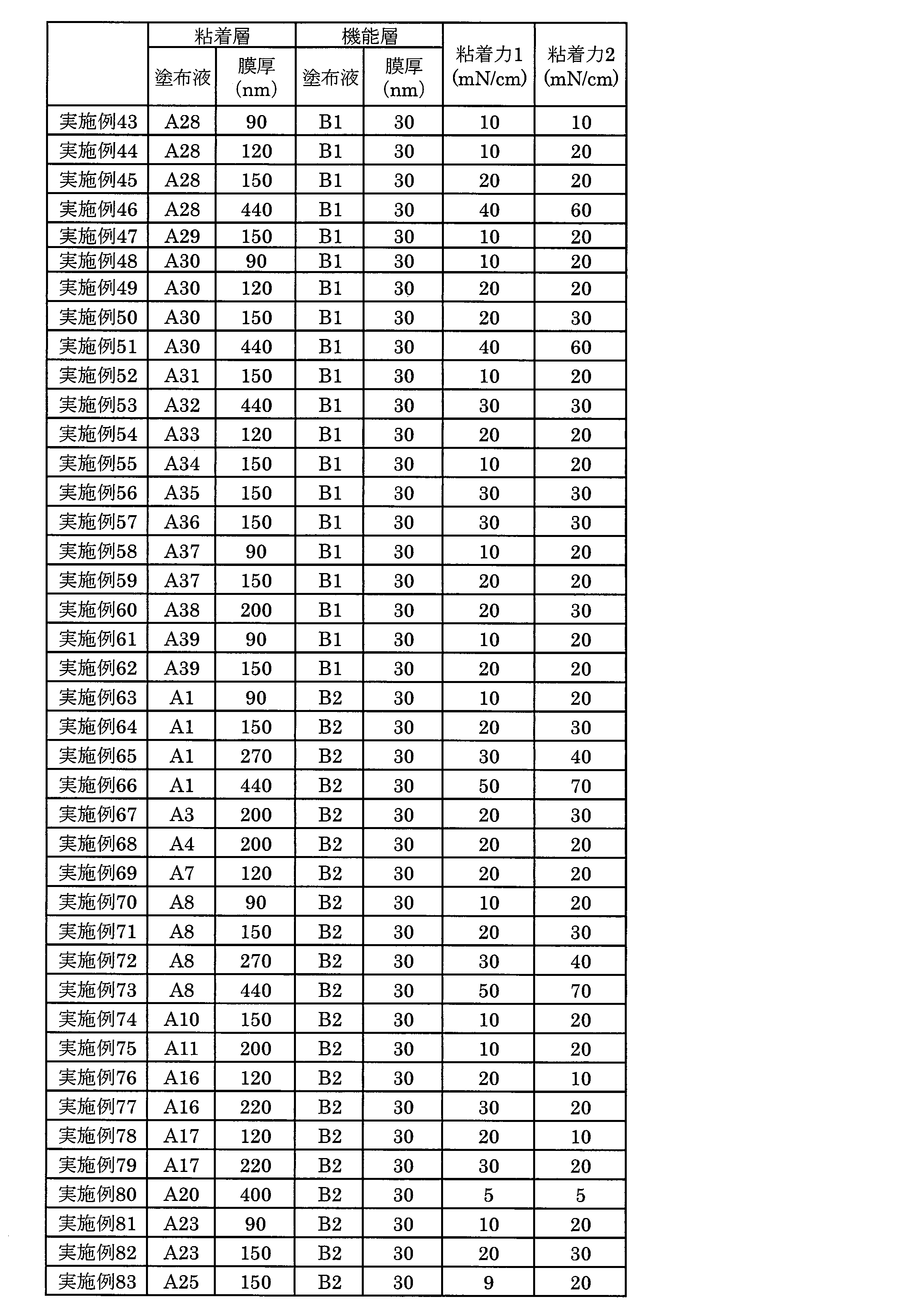


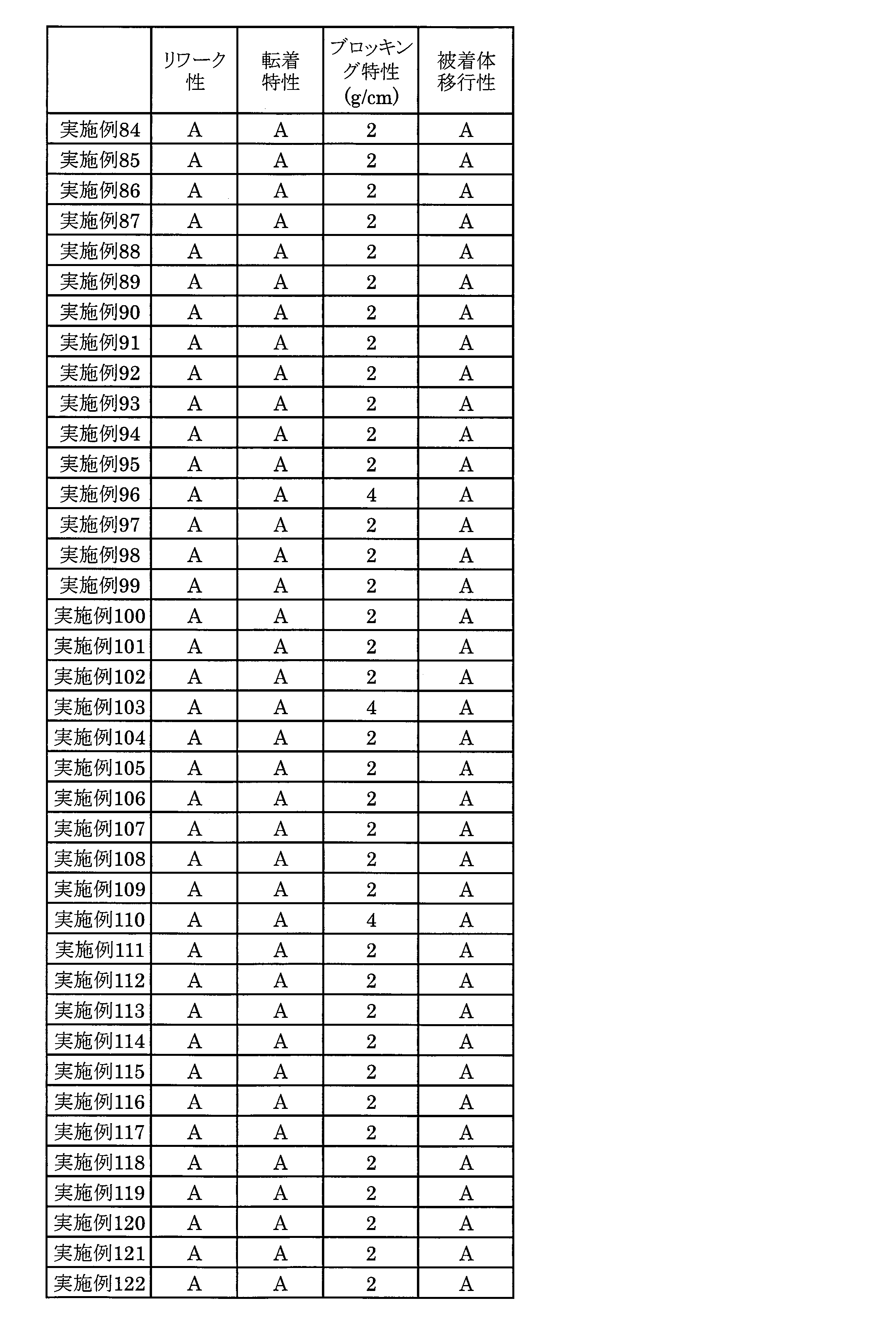


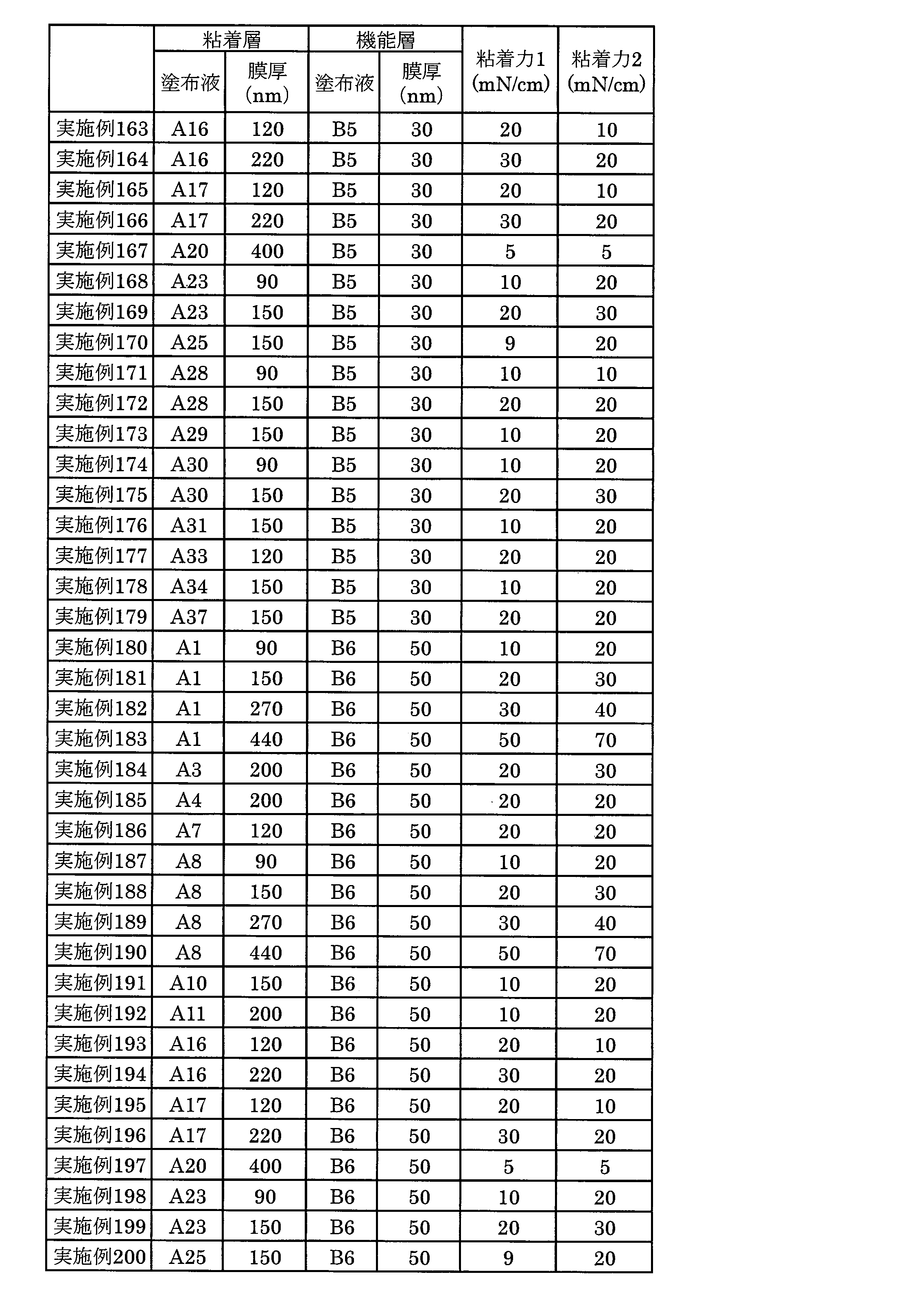


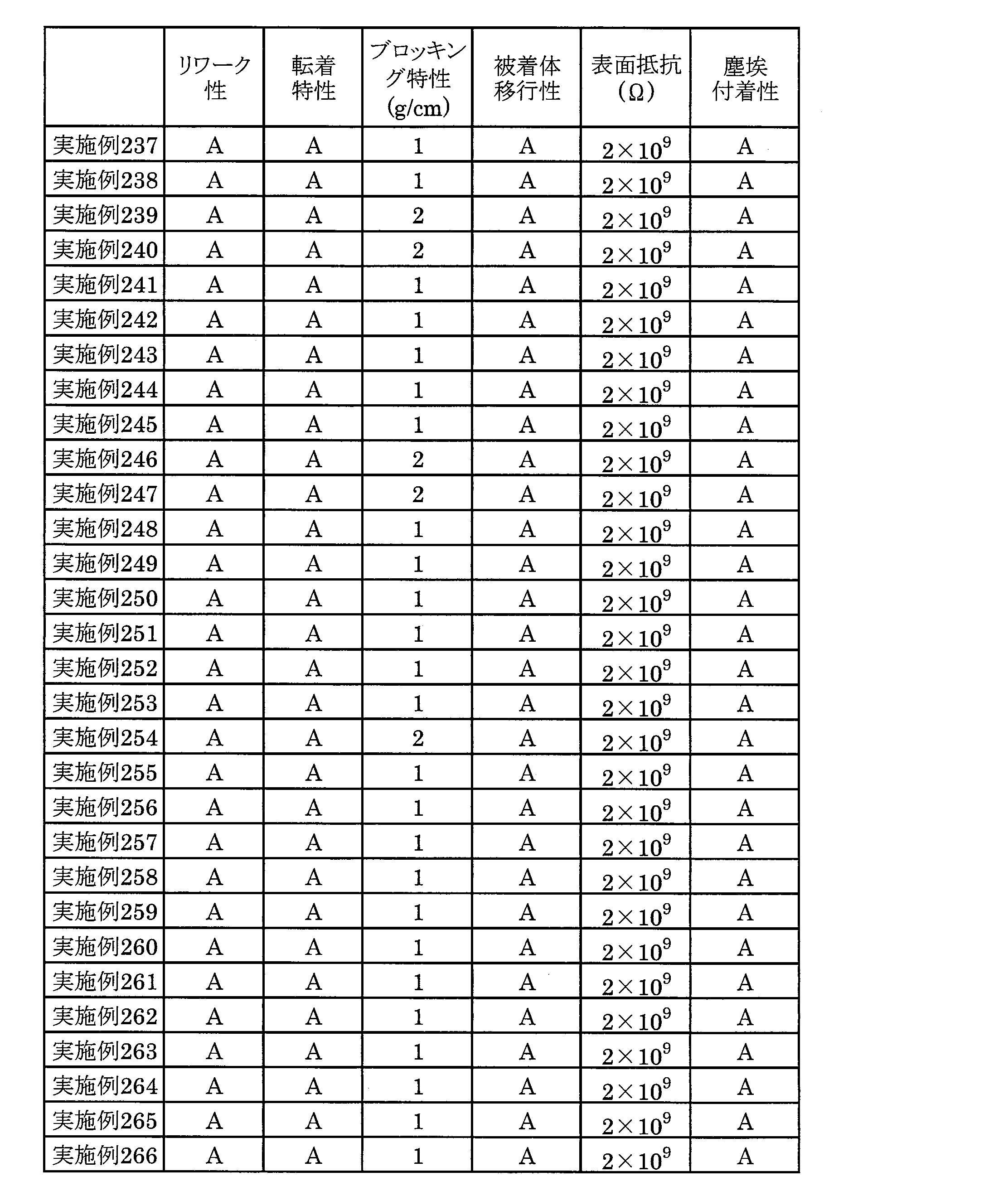
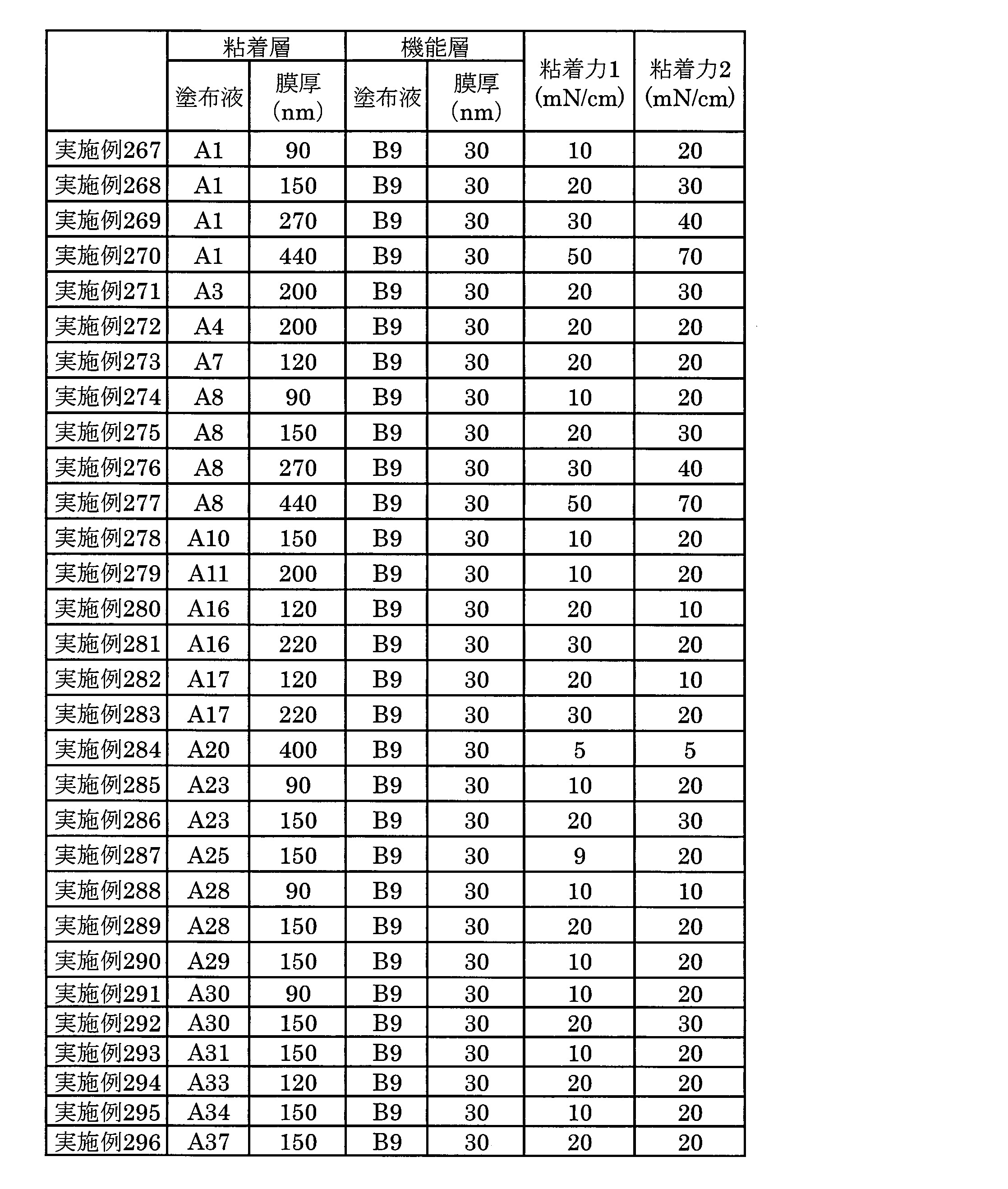
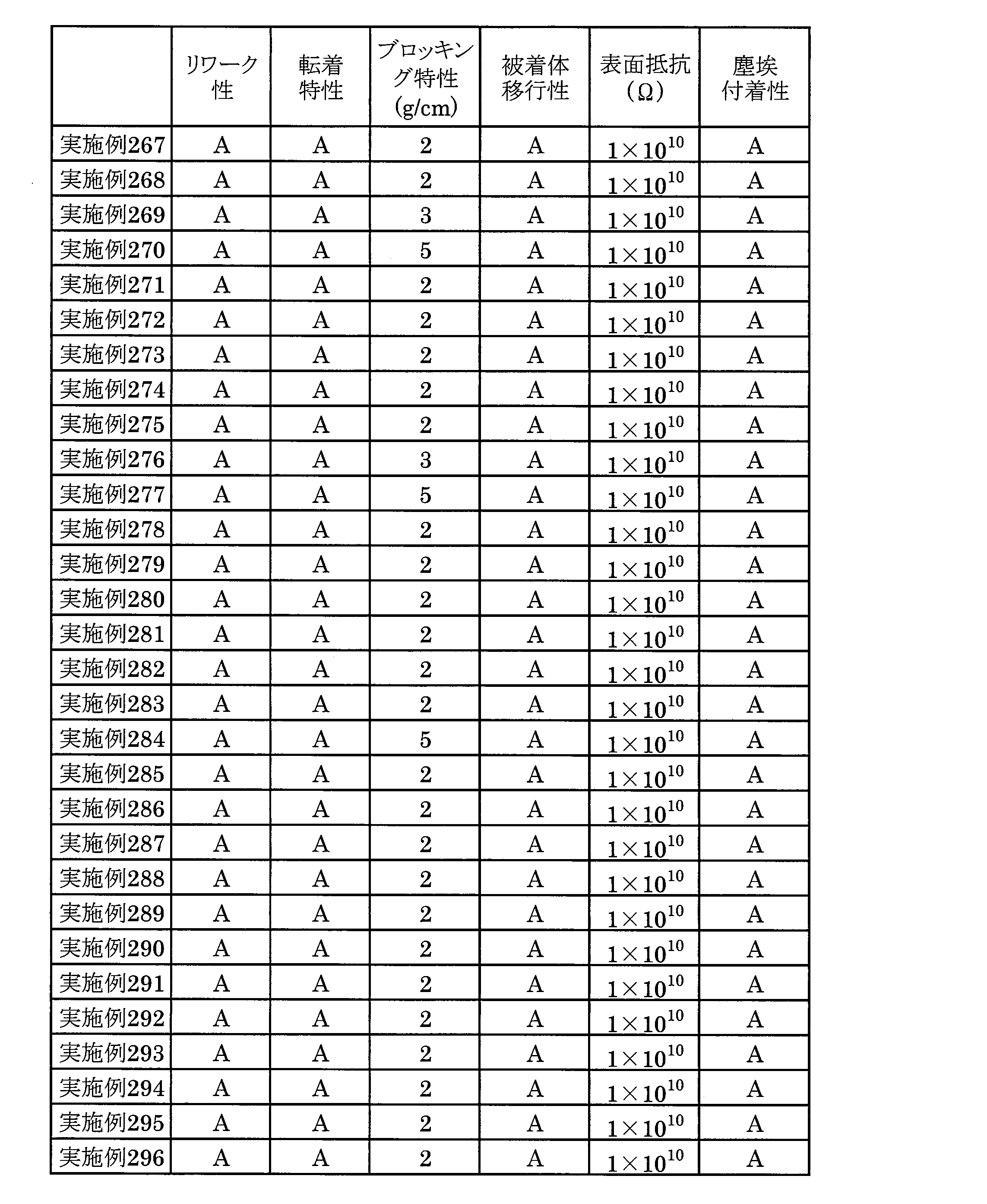


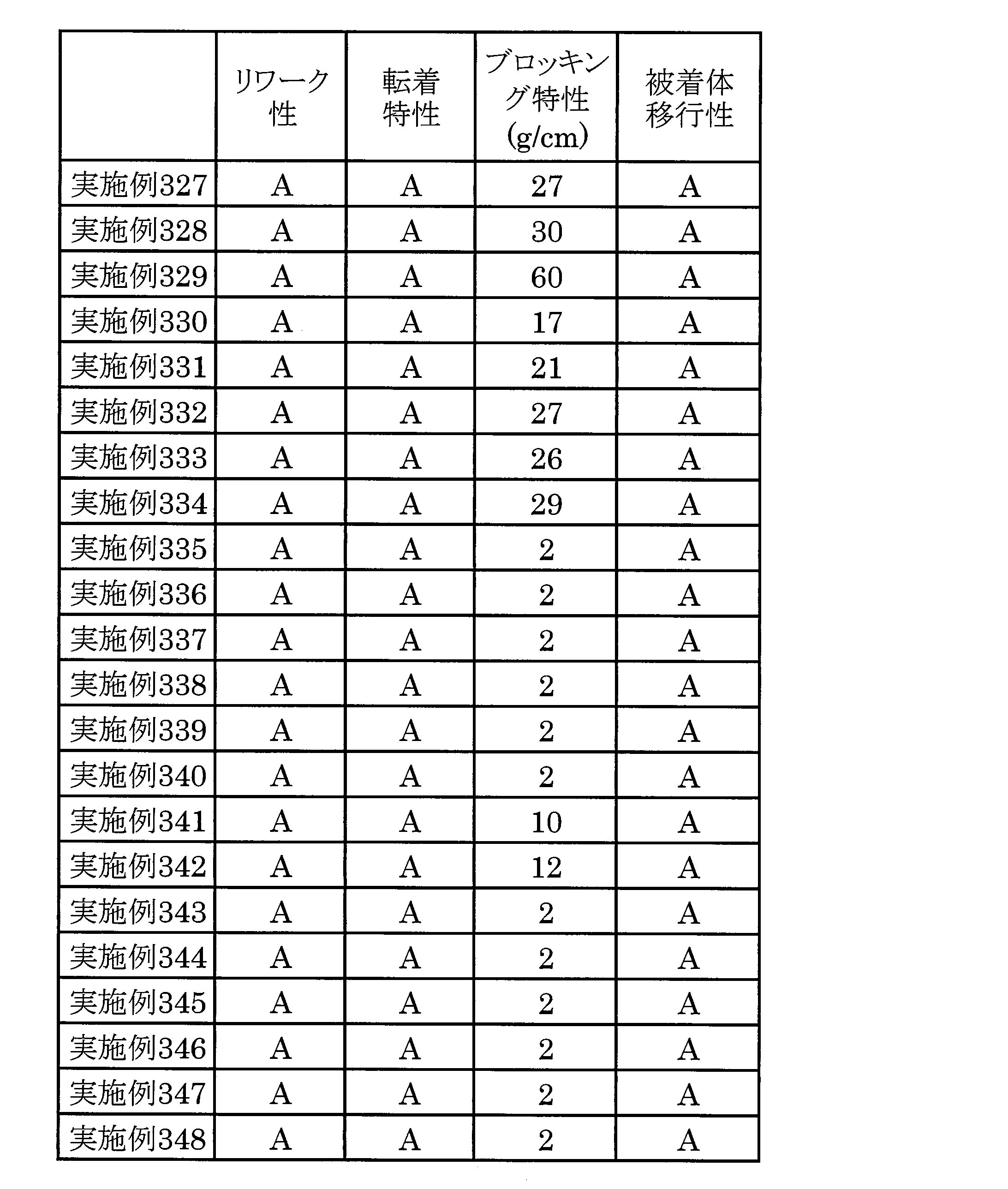


Claims (8)
- ポリエステルフィルムの少なくとも片面に、ガラス転移点が0℃以下の樹脂と架橋剤とを含有する粘着層を有し、当該粘着層のポリメチルメタクリレート板との粘着力が1~1000mN/cmの範囲であることを特徴とする粘着フィルム。
- 粘着層がコーティングにより形成されたものである請求項1に記載の粘着フィルム。
- ガラス転移点が0℃以下の樹脂が、ポリエステル樹脂、アクリル樹脂、ウレタン樹脂から選ばれる少なくとも1種である請求項1または2記載の粘着フィルム。
- 架橋剤が、エポキシ化合物、メラミン化合物、イソシアネート系化合物、オキサゾリン化合物、カルボジイミド系化合物、シランカップリング化合物から選ばれる少なくとも1種である請求項1~3の何れかに記載の粘着フィルム。
- 粘着層中の割合としてガラス転移点が0℃以下の樹脂が10~99.5重量%である請求項1~4の何れかに記載の粘着フィルム。
- 粘着層中の割合として架橋剤が0.5~80重量%である請求項1~5の何れかに記載の粘着フィルム。
- 粘着層の膜厚が10μm以下である請求項1~6の何れかに記載の粘着フィルム。
- ポリエステルフィルムの粘着層とは反対側の面に機能層を有する請求項1~7の何れかに記載の粘着フィルム。
Priority Applications (5)
| Application Number | Priority Date | Filing Date | Title |
|---|---|---|---|
| KR1020187028793A KR102015343B1 (ko) | 2015-10-31 | 2016-02-23 | 점착 필름 |
| CN201680000951.6A CN107075325A (zh) | 2015-10-31 | 2016-02-23 | 粘接膜 |
| KR1020167022740A KR101913599B1 (ko) | 2015-10-31 | 2016-02-23 | 점착 필름 |
| US15/230,756 US20170121567A1 (en) | 2015-10-31 | 2016-08-08 | Adhesive film |
| US15/941,066 US20180223131A1 (en) | 2015-10-31 | 2018-03-30 | Adhesive film |
Applications Claiming Priority (2)
| Application Number | Priority Date | Filing Date | Title |
|---|---|---|---|
| JP2015215307A JP6365506B2 (ja) | 2015-10-31 | 2015-10-31 | 積層ポリエステルフィルム |
| JP2015-215307 | 2015-10-31 |
Related Child Applications (1)
| Application Number | Title | Priority Date | Filing Date |
|---|---|---|---|
| US15/230,756 Continuation-In-Part US20170121567A1 (en) | 2015-10-31 | 2016-08-08 | Adhesive film |
Publications (1)
| Publication Number | Publication Date |
|---|---|
| WO2017073091A1 true WO2017073091A1 (ja) | 2017-05-04 |
Family
ID=58631449
Family Applications (1)
| Application Number | Title | Priority Date | Filing Date |
|---|---|---|---|
| PCT/JP2016/055204 Ceased WO2017073091A1 (ja) | 2015-10-31 | 2016-02-23 | 粘着フィルム |
Country Status (6)
| Country | Link |
|---|---|
| US (2) | US20170121567A1 (ja) |
| JP (1) | JP6365506B2 (ja) |
| KR (2) | KR102015343B1 (ja) |
| CN (1) | CN107075325A (ja) |
| TW (2) | TW201714998A (ja) |
| WO (1) | WO2017073091A1 (ja) |
Cited By (1)
| Publication number | Priority date | Publication date | Assignee | Title |
|---|---|---|---|---|
| CN110093132A (zh) * | 2018-01-29 | 2019-08-06 | 深圳正峰印刷有限公司 | 一种丝网印刷用油性保护胶及其制备方法和印刷方法 |
Families Citing this family (20)
| Publication number | Priority date | Publication date | Assignee | Title |
|---|---|---|---|---|
| US20180171207A1 (en) | 2015-06-17 | 2018-06-21 | Clariant International Ltd. | Water-Soluble Or Water-Swellable Polymers As Water Loss Reducers In Cement Slurries |
| WO2017154226A1 (ja) * | 2016-03-09 | 2017-09-14 | 三菱樹脂株式会社 | 粘着フィルム及びその製造方法 |
| US11384186B2 (en) | 2016-12-12 | 2022-07-12 | Clariant International Ltd | Polymer comprising certain level of bio-based carbon |
| ES2867526T3 (es) | 2016-12-12 | 2021-10-20 | Clariant Int Ltd | Uso de un polímero bioderivado en una composición cosmética, dermatológica o farmacéutica |
| ES3017507T3 (en) | 2016-12-15 | 2025-05-13 | Clariant Int Ltd | Water-soluble and/or water-swellable hybrid polymer |
| EP3554644B1 (en) | 2016-12-15 | 2025-03-19 | Clariant International Ltd | Water-soluble and/or water-swellable hybrid polymer |
| EP3554643B1 (en) | 2016-12-15 | 2025-03-19 | Clariant International Ltd | Water-soluble and/or water-swellable hybrid polymer |
| US11339241B2 (en) | 2016-12-15 | 2022-05-24 | Clariant International Ltd. | Water-soluble and/or water-swellable hybrid polymer |
| JP6531857B2 (ja) * | 2018-06-22 | 2019-06-19 | 三菱ケミカル株式会社 | 積層ポリエステルフィルムの製造方法 |
| CN109021175B (zh) * | 2018-07-11 | 2019-08-06 | 清远市保鸿涂料有限公司 | 一种聚氨酯丙烯酸酯的分散体及其应用 |
| JP7388054B2 (ja) * | 2018-09-26 | 2023-11-29 | 三菱ケミカル株式会社 | ポリエステル系粘着剤組成物、ポリエステル系粘着剤及び粘着シート |
| TWI692516B (zh) * | 2018-11-30 | 2020-05-01 | 財團法人中華民國紡織業拓展會 | 無二異氰酸酯之感壓膠複合材料 |
| TWI664082B (zh) * | 2018-11-30 | 2019-07-01 | 財團法人中華民國紡織業拓展會 | 於聚氨酯薄膜上備製無二異氰酸之感壓膠複合材料 |
| WO2020261037A1 (en) | 2019-06-26 | 2020-12-30 | 3M Innovative Properties Company | Aqueous-based release coatings and articles therefrom |
| JP6777216B1 (ja) * | 2019-12-10 | 2020-10-28 | 住友ベークライト株式会社 | カバーテープおよび電子部品包装体 |
| WO2021117624A1 (ja) * | 2019-12-10 | 2021-06-17 | 住友ベークライト株式会社 | カバーテープおよび電子部品包装体 |
| DE102020205192A1 (de) * | 2020-04-23 | 2021-10-28 | Mitsubishi Polyester Film Gmbh | Biaxial orientierte, ein- oder mehrschichtige Polyesterfolie mit einer Haftvermittlungs-Beschichtung basierend auf einem Co-Polyester und einer Verankerungskomponente. |
| JP7834433B2 (ja) * | 2021-05-31 | 2026-03-24 | 東洋アルミエコープロダクツ株式会社 | フィルター構造体 |
| CN114316330A (zh) * | 2021-12-22 | 2022-04-12 | 合肥乐凯科技产业有限公司 | 一种光学聚酯薄膜及其制备方法 |
| WO2024035084A1 (ko) * | 2022-08-09 | 2024-02-15 | 코오롱인더스트리 주식회사 | 자가치유층을 포함하는 태양광용 백시트 및 이의 제조 방법 |
Citations (7)
| Publication number | Priority date | Publication date | Assignee | Title |
|---|---|---|---|---|
| JPH0598219A (ja) | 1991-10-14 | 1993-04-20 | Sekisui Chem Co Ltd | 表面保護フイルム |
| JP2007045913A (ja) * | 2005-08-09 | 2007-02-22 | Nippon Synthetic Chem Ind Co Ltd:The | ポリエステル系樹脂、粘着剤および粘着シート |
| JP2007169458A (ja) * | 2005-12-22 | 2007-07-05 | Fujimori Kogyo Co Ltd | 保護フィルム |
| JP2007238766A (ja) * | 2006-03-08 | 2007-09-20 | Mitsubishi Chemicals Corp | 接着剤及びその製造方法、接着剤硬化物、並びにこれを用いた積層体 |
| JP2007270005A (ja) | 2006-03-31 | 2007-10-18 | Toyobo Co Ltd | ポリプロピレン系樹脂フィルムおよび表面保護フィルム |
| JP2010185016A (ja) * | 2009-02-12 | 2010-08-26 | Nippon Shokubai Co Ltd | 溶剤型再剥離用粘着剤組成物および再剥離用粘着製品 |
| JP2011231203A (ja) * | 2010-04-27 | 2011-11-17 | Hitachi Chem Co Ltd | 表面保護フィルム用アクリル系粘着剤 |
Family Cites Families (33)
| Publication number | Priority date | Publication date | Assignee | Title |
|---|---|---|---|---|
| JPH0978037A (ja) * | 1995-09-18 | 1997-03-25 | Oji Paper Co Ltd | 粘着フィルムとこれを用いたコンクリートの気孔計測方法 |
| JP2001096698A (ja) * | 1999-09-28 | 2001-04-10 | Teijin Ltd | 表面保護フィルム |
| JP2001113845A (ja) * | 1999-10-22 | 2001-04-24 | Teijin Ltd | 感熱転写用ポリエステルフィルム |
| JP2002053686A (ja) * | 2000-08-08 | 2002-02-19 | Teijin Ltd | 易接着性ポリエステルフィルム |
| KR100852373B1 (ko) * | 2001-08-07 | 2008-08-14 | 데이진 듀폰 필름 가부시키가이샤 | 이축 배향 적층 폴리에스테르필름 및 하드코팅 적층필름 |
| JP2003154616A (ja) * | 2001-11-20 | 2003-05-27 | Teijin Dupont Films Japan Ltd | 積層フィルム及び表面保護フィルム |
| US6893718B2 (en) * | 2002-05-20 | 2005-05-17 | 3M Innovative Properties Company | Pressure sensitive adhesive composition, articles made therewith and method of use |
| JP4493273B2 (ja) * | 2003-01-29 | 2010-06-30 | 日東電工株式会社 | 両面粘着シートおよびタッチパネル付き表示装置 |
| JP2005010760A (ja) * | 2003-05-26 | 2005-01-13 | Nitto Denko Corp | 偏光板用接着剤、偏光板、その製造方法、光学フィルムおよび画像表示装置 |
| JP4954505B2 (ja) * | 2005-06-28 | 2012-06-20 | 日東電工株式会社 | 粘着剤組成物および粘着シート類 |
| JP2007009109A (ja) * | 2005-07-01 | 2007-01-18 | Dainippon Ink & Chem Inc | 表面保護用粘着フィルム |
| JP2007099879A (ja) * | 2005-10-04 | 2007-04-19 | Nippon Synthetic Chem Ind Co Ltd:The | 粘着剤及びその粘着シート |
| KR100907982B1 (ko) * | 2006-12-27 | 2009-07-16 | 제일모직주식회사 | 점착필름 형성용 조성물에 의한 반도체 패키지용 점착필름을 포함하는 다이싱 다이본드 필름 |
| JP2008208310A (ja) * | 2007-02-28 | 2008-09-11 | Fujifilm Corp | 光学用易接着フィルム及び光学シート並びに表示装置 |
| CN103630961A (zh) * | 2008-01-31 | 2014-03-12 | 日东电工株式会社 | 偏振片保护膜、偏振板及图像显示装置 |
| JP2009221440A (ja) * | 2008-03-19 | 2009-10-01 | Toyo Ink Mfg Co Ltd | ポリエステル樹脂及びそれを用いてなる感圧式接着剤組成物 |
| JP5689793B2 (ja) * | 2008-05-29 | 2015-03-25 | コーロン インダストリーズ インク | 保護フィルム |
| CN102395469B (zh) * | 2009-04-22 | 2014-05-07 | 三菱树脂株式会社 | 叠层聚酯膜 |
| JP5271204B2 (ja) * | 2009-05-25 | 2013-08-21 | 三菱樹脂株式会社 | 積層ポリエステルフィルム |
| WO2010147090A1 (ja) * | 2009-06-15 | 2010-12-23 | 東洋インキ製造株式会社 | ウレタン樹脂、活性エネルギー線硬化性接着剤、及び太陽電池用裏面保護シート |
| JP5600037B2 (ja) * | 2010-06-30 | 2014-10-01 | 帝人デュポンフィルム株式会社 | インモールド転写材用粘着離型ポリエステルフィルム |
| JP2012064927A (ja) * | 2010-08-17 | 2012-03-29 | Toyobo Co Ltd | 太陽電池用易接着性黒色ポリエステルフィルムおよびそれを用いたバックシート |
| JP5834702B2 (ja) * | 2011-02-09 | 2015-12-24 | 東洋紡株式会社 | 太陽電池用易接着性ポリエステルフィルムおよびそれを用いたフロントシート |
| JP5621642B2 (ja) * | 2011-02-09 | 2014-11-12 | 東洋紡株式会社 | 易接着性ポリエステルフィルム |
| JP4771022B2 (ja) * | 2011-03-25 | 2011-09-14 | 東洋紡績株式会社 | 光学用易接着性ポリエステルフィルム |
| JP5778471B2 (ja) * | 2011-04-30 | 2015-09-16 | 三菱樹脂株式会社 | 表面保護フィルム用ポリエステルフィルムおよび表面保護フィルム |
| JP6104500B2 (ja) * | 2011-07-06 | 2017-03-29 | Dic株式会社 | 両面粘着テープ |
| JP5752522B2 (ja) * | 2011-08-19 | 2015-07-22 | 富士フイルム株式会社 | 光学機能部材支持用積層フィルム及びその製造方法、シート及びその製造方法、プリズムシート |
| JP5608198B2 (ja) * | 2012-08-20 | 2014-10-15 | 三菱樹脂株式会社 | 積層ポリエステルフィルム |
| JP6146090B2 (ja) * | 2013-03-29 | 2017-06-14 | 大日本印刷株式会社 | 粘着フィルム、粘着フィルムの製造方法 |
| JP6291679B2 (ja) * | 2014-03-31 | 2018-03-14 | リンテック株式会社 | 透明導電性基板用表面保護フィルムの製造方法、透明導電性基板用表面保護フィルムおよび積層体 |
| JP5773042B2 (ja) * | 2014-08-06 | 2015-09-02 | 東洋紡株式会社 | 易接着性ポリエステルフィルム |
| JP6828437B2 (ja) * | 2015-08-06 | 2021-02-10 | 東レ株式会社 | 粘着フィルムおよび粘着フィルムロール |
-
2015
- 2015-10-31 JP JP2015215307A patent/JP6365506B2/ja active Active
-
2016
- 2016-02-23 CN CN201680000951.6A patent/CN107075325A/zh active Pending
- 2016-02-23 WO PCT/JP2016/055204 patent/WO2017073091A1/ja not_active Ceased
- 2016-02-23 KR KR1020187028793A patent/KR102015343B1/ko active Active
- 2016-02-23 KR KR1020167022740A patent/KR101913599B1/ko active Active
- 2016-03-08 TW TW105107038A patent/TW201714998A/zh unknown
- 2016-03-08 TW TW110125924A patent/TWI802931B/zh active
- 2016-08-08 US US15/230,756 patent/US20170121567A1/en not_active Abandoned
-
2018
- 2018-03-30 US US15/941,066 patent/US20180223131A1/en not_active Abandoned
Patent Citations (7)
| Publication number | Priority date | Publication date | Assignee | Title |
|---|---|---|---|---|
| JPH0598219A (ja) | 1991-10-14 | 1993-04-20 | Sekisui Chem Co Ltd | 表面保護フイルム |
| JP2007045913A (ja) * | 2005-08-09 | 2007-02-22 | Nippon Synthetic Chem Ind Co Ltd:The | ポリエステル系樹脂、粘着剤および粘着シート |
| JP2007169458A (ja) * | 2005-12-22 | 2007-07-05 | Fujimori Kogyo Co Ltd | 保護フィルム |
| JP2007238766A (ja) * | 2006-03-08 | 2007-09-20 | Mitsubishi Chemicals Corp | 接着剤及びその製造方法、接着剤硬化物、並びにこれを用いた積層体 |
| JP2007270005A (ja) | 2006-03-31 | 2007-10-18 | Toyobo Co Ltd | ポリプロピレン系樹脂フィルムおよび表面保護フィルム |
| JP2010185016A (ja) * | 2009-02-12 | 2010-08-26 | Nippon Shokubai Co Ltd | 溶剤型再剥離用粘着剤組成物および再剥離用粘着製品 |
| JP2011231203A (ja) * | 2010-04-27 | 2011-11-17 | Hitachi Chem Co Ltd | 表面保護フィルム用アクリル系粘着剤 |
Cited By (1)
| Publication number | Priority date | Publication date | Assignee | Title |
|---|---|---|---|---|
| CN110093132A (zh) * | 2018-01-29 | 2019-08-06 | 深圳正峰印刷有限公司 | 一种丝网印刷用油性保护胶及其制备方法和印刷方法 |
Also Published As
| Publication number | Publication date |
|---|---|
| KR20180112878A (ko) | 2018-10-12 |
| US20180223131A1 (en) | 2018-08-09 |
| JP6365506B2 (ja) | 2018-08-01 |
| TW202142653A (zh) | 2021-11-16 |
| KR101913599B1 (ko) | 2018-10-31 |
| US20170121567A1 (en) | 2017-05-04 |
| TWI802931B (zh) | 2023-05-21 |
| CN107075325A (zh) | 2017-08-18 |
| TW201714998A (zh) | 2017-05-01 |
| JP2017088635A (ja) | 2017-05-25 |
| KR20170062417A (ko) | 2017-06-07 |
| KR102015343B1 (ko) | 2019-08-28 |
Similar Documents
| Publication | Publication Date | Title |
|---|---|---|
| JP6365506B2 (ja) | 積層ポリエステルフィルム | |
| WO2017154226A1 (ja) | 粘着フィルム及びその製造方法 | |
| JP6455566B2 (ja) | 積層ポリエステルフィルム | |
| JP6077063B2 (ja) | 積層フィルム | |
| JP2018043241A (ja) | 積層ポリエステルフィルムの製造方法。 | |
| WO2016092905A1 (ja) | 塗布フィルム | |
| WO2016203669A1 (ja) | 粘着フィルム | |
| JP6308235B2 (ja) | 積層ポリエステルフィルム | |
| JP6319331B2 (ja) | 積層ポリエステルフィルム | |
| JP6428878B2 (ja) | 積層フィルム | |
| JP6428879B2 (ja) | 積層フィルム | |
| JP2017042914A (ja) | 積層フィルム | |
| JP6120936B1 (ja) | 粘着ポリエステルフィルム積層体 | |
| JP6085656B1 (ja) | 積層ポリエステルフィルム | |
| JP6350623B2 (ja) | 積層フィルム | |
| JP6583146B2 (ja) | 積層ポリエステルフィルムおよびその製造方法 | |
| JP2018123325A (ja) | 積層ポリエステルフィルム | |
| JP6344426B2 (ja) | 積層ポリエステルフィルム | |
| JP2018168385A (ja) | 積層ポリエステルフィルムの製造方法 | |
| JP6319330B2 (ja) | 積層ポリエステルフィルム | |
| JP6109356B1 (ja) | 積層ポリエステルフィルム | |
| JP6308236B2 (ja) | 積層ポリエステルフィルムの製造方法 | |
| JP6168120B2 (ja) | 積層ポリエステルフィルム | |
| JP6439746B2 (ja) | 積層ポリエステルフィルム | |
| JP6380459B2 (ja) | 積層ポリエステルフィルム |
Legal Events
| Date | Code | Title | Description |
|---|---|---|---|
| REEP | Request for entry into the european phase |
Ref document number: 2016745031 Country of ref document: EP |
|
| WWE | Wipo information: entry into national phase |
Ref document number: 2016745031 Country of ref document: EP |
|
| ENP | Entry into the national phase |
Ref document number: 20167022740 Country of ref document: KR Kind code of ref document: A |
|
| 121 | Ep: the epo has been informed by wipo that ep was designated in this application |
Ref document number: 16745031 Country of ref document: EP Kind code of ref document: A1 |
|
| NENP | Non-entry into the national phase |
Ref country code: DE |