WO2017047749A1 - 塗料用樹脂エマルション - Google Patents
塗料用樹脂エマルション Download PDFInfo
- Publication number
- WO2017047749A1 WO2017047749A1 PCT/JP2016/077447 JP2016077447W WO2017047749A1 WO 2017047749 A1 WO2017047749 A1 WO 2017047749A1 JP 2016077447 W JP2016077447 W JP 2016077447W WO 2017047749 A1 WO2017047749 A1 WO 2017047749A1
- Authority
- WO
- WIPO (PCT)
- Prior art keywords
- meth
- monomer
- mass
- emulsion
- parts
- Prior art date
- Legal status (The legal status is an assumption and is not a legal conclusion. Google has not performed a legal analysis and makes no representation as to the accuracy of the status listed.)
- Ceased
Links
Classifications
-
- C—CHEMISTRY; METALLURGY
- C08—ORGANIC MACROMOLECULAR COMPOUNDS; THEIR PREPARATION OR CHEMICAL WORKING-UP; COMPOSITIONS BASED THEREON
- C08F—MACROMOLECULAR COMPOUNDS OBTAINED BY REACTIONS ONLY INVOLVING CARBON-TO-CARBON UNSATURATED BONDS
- C08F257/00—Macromolecular compounds obtained by polymerising monomers on to polymers of aromatic monomers as defined in group C08F12/00
- C08F257/02—Macromolecular compounds obtained by polymerising monomers on to polymers of aromatic monomers as defined in group C08F12/00 on to polymers of styrene or alkyl-substituted styrenes
-
- C—CHEMISTRY; METALLURGY
- C08—ORGANIC MACROMOLECULAR COMPOUNDS; THEIR PREPARATION OR CHEMICAL WORKING-UP; COMPOSITIONS BASED THEREON
- C08F—MACROMOLECULAR COMPOUNDS OBTAINED BY REACTIONS ONLY INVOLVING CARBON-TO-CARBON UNSATURATED BONDS
- C08F2/00—Processes of polymerisation
- C08F2/12—Polymerisation in non-solvents
- C08F2/16—Aqueous medium
- C08F2/22—Emulsion polymerisation
-
- C—CHEMISTRY; METALLURGY
- C08—ORGANIC MACROMOLECULAR COMPOUNDS; THEIR PREPARATION OR CHEMICAL WORKING-UP; COMPOSITIONS BASED THEREON
- C08F—MACROMOLECULAR COMPOUNDS OBTAINED BY REACTIONS ONLY INVOLVING CARBON-TO-CARBON UNSATURATED BONDS
- C08F212/00—Copolymers of compounds having one or more unsaturated aliphatic radicals, each having only one carbon-to-carbon double bond, and at least one being terminated by an aromatic carbocyclic ring
- C08F212/02—Monomers containing only one unsaturated aliphatic radical
- C08F212/04—Monomers containing only one unsaturated aliphatic radical containing one ring
- C08F212/06—Hydrocarbons
- C08F212/08—Styrene
-
- C—CHEMISTRY; METALLURGY
- C08—ORGANIC MACROMOLECULAR COMPOUNDS; THEIR PREPARATION OR CHEMICAL WORKING-UP; COMPOSITIONS BASED THEREON
- C08F—MACROMOLECULAR COMPOUNDS OBTAINED BY REACTIONS ONLY INVOLVING CARBON-TO-CARBON UNSATURATED BONDS
- C08F220/00—Copolymers of compounds having one or more unsaturated aliphatic radicals, each having only one carbon-to-carbon double bond, and only one being terminated by only one carboxyl radical or a salt, anhydride ester, amide, imide or nitrile thereof
- C08F220/02—Monocarboxylic acids having less than ten carbon atoms; Derivatives thereof
- C08F220/10—Esters
- C08F220/12—Esters of monohydric alcohols or phenols
- C08F220/14—Methyl esters, e.g. methyl (meth)acrylate
-
- C—CHEMISTRY; METALLURGY
- C08—ORGANIC MACROMOLECULAR COMPOUNDS; THEIR PREPARATION OR CHEMICAL WORKING-UP; COMPOSITIONS BASED THEREON
- C08F—MACROMOLECULAR COMPOUNDS OBTAINED BY REACTIONS ONLY INVOLVING CARBON-TO-CARBON UNSATURATED BONDS
- C08F220/00—Copolymers of compounds having one or more unsaturated aliphatic radicals, each having only one carbon-to-carbon double bond, and only one being terminated by only one carboxyl radical or a salt, anhydride ester, amide, imide or nitrile thereof
- C08F220/02—Monocarboxylic acids having less than ten carbon atoms; Derivatives thereof
- C08F220/10—Esters
- C08F220/12—Esters of monohydric alcohols or phenols
- C08F220/16—Esters of monohydric alcohols or phenols of phenols or of alcohols containing two or more carbon atoms
- C08F220/18—Esters of monohydric alcohols or phenols of phenols or of alcohols containing two or more carbon atoms with acrylic or methacrylic acids
-
- C—CHEMISTRY; METALLURGY
- C09—DYES; PAINTS; POLISHES; NATURAL RESINS; ADHESIVES; COMPOSITIONS NOT OTHERWISE PROVIDED FOR; APPLICATIONS OF MATERIALS NOT OTHERWISE PROVIDED FOR
- C09D—COATING COMPOSITIONS, e.g. PAINTS, VARNISHES OR LACQUERS; FILLING PASTES; CHEMICAL PAINT OR INK REMOVERS; INKS; CORRECTING FLUIDS; WOODSTAINS; PASTES OR SOLIDS FOR COLOURING OR PRINTING; USE OF MATERIALS THEREFOR
- C09D125/00—Coating compositions based on homopolymers or copolymers of compounds having one or more unsaturated aliphatic radicals, each having only one carbon-to-carbon double bond, and at least one being terminated by an aromatic carbocyclic ring; Coating compositions based on derivatives of such polymers
- C09D125/02—Homopolymers or copolymers of hydrocarbons
- C09D125/04—Homopolymers or copolymers of styrene
- C09D125/08—Copolymers of styrene
- C09D125/14—Copolymers of styrene with unsaturated esters
-
- C—CHEMISTRY; METALLURGY
- C09—DYES; PAINTS; POLISHES; NATURAL RESINS; ADHESIVES; COMPOSITIONS NOT OTHERWISE PROVIDED FOR; APPLICATIONS OF MATERIALS NOT OTHERWISE PROVIDED FOR
- C09D—COATING COMPOSITIONS, e.g. PAINTS, VARNISHES OR LACQUERS; FILLING PASTES; CHEMICAL PAINT OR INK REMOVERS; INKS; CORRECTING FLUIDS; WOODSTAINS; PASTES OR SOLIDS FOR COLOURING OR PRINTING; USE OF MATERIALS THEREFOR
- C09D133/00—Coating compositions based on homopolymers or copolymers of compounds having one or more unsaturated aliphatic radicals, each having only one carbon-to-carbon double bond, and at least one being terminated by only one carboxyl radical, or of salts, anhydrides, esters, amides, imides, or nitriles thereof; Coating compositions based on derivatives of such polymers
- C09D133/04—Homopolymers or copolymers of esters
- C09D133/06—Homopolymers or copolymers of esters of esters containing only carbon, hydrogen and oxygen, the oxygen atom being present only as part of the carboxyl radical
- C09D133/08—Homopolymers or copolymers of acrylic acid esters
-
- C—CHEMISTRY; METALLURGY
- C09—DYES; PAINTS; POLISHES; NATURAL RESINS; ADHESIVES; COMPOSITIONS NOT OTHERWISE PROVIDED FOR; APPLICATIONS OF MATERIALS NOT OTHERWISE PROVIDED FOR
- C09D—COATING COMPOSITIONS, e.g. PAINTS, VARNISHES OR LACQUERS; FILLING PASTES; CHEMICAL PAINT OR INK REMOVERS; INKS; CORRECTING FLUIDS; WOODSTAINS; PASTES OR SOLIDS FOR COLOURING OR PRINTING; USE OF MATERIALS THEREFOR
- C09D133/00—Coating compositions based on homopolymers or copolymers of compounds having one or more unsaturated aliphatic radicals, each having only one carbon-to-carbon double bond, and at least one being terminated by only one carboxyl radical, or of salts, anhydrides, esters, amides, imides, or nitriles thereof; Coating compositions based on derivatives of such polymers
- C09D133/04—Homopolymers or copolymers of esters
- C09D133/06—Homopolymers or copolymers of esters of esters containing only carbon, hydrogen and oxygen, the oxygen atom being present only as part of the carboxyl radical
- C09D133/10—Homopolymers or copolymers of methacrylic acid esters
-
- C—CHEMISTRY; METALLURGY
- C09—DYES; PAINTS; POLISHES; NATURAL RESINS; ADHESIVES; COMPOSITIONS NOT OTHERWISE PROVIDED FOR; APPLICATIONS OF MATERIALS NOT OTHERWISE PROVIDED FOR
- C09D—COATING COMPOSITIONS, e.g. PAINTS, VARNISHES OR LACQUERS; FILLING PASTES; CHEMICAL PAINT OR INK REMOVERS; INKS; CORRECTING FLUIDS; WOODSTAINS; PASTES OR SOLIDS FOR COLOURING OR PRINTING; USE OF MATERIALS THEREFOR
- C09D143/00—Coating compositions based on homopolymers or copolymers of compounds having one or more unsaturated aliphatic radicals, each having only one carbon-to-carbon double bond, and containing boron, silicon, phosphorus, selenium, tellurium, or a metal; Coating compositions based on derivatives of such polymers
- C09D143/04—Homopolymers or copolymers of monomers containing silicon
-
- C—CHEMISTRY; METALLURGY
- C09—DYES; PAINTS; POLISHES; NATURAL RESINS; ADHESIVES; COMPOSITIONS NOT OTHERWISE PROVIDED FOR; APPLICATIONS OF MATERIALS NOT OTHERWISE PROVIDED FOR
- C09D—COATING COMPOSITIONS, e.g. PAINTS, VARNISHES OR LACQUERS; FILLING PASTES; CHEMICAL PAINT OR INK REMOVERS; INKS; CORRECTING FLUIDS; WOODSTAINS; PASTES OR SOLIDS FOR COLOURING OR PRINTING; USE OF MATERIALS THEREFOR
- C09D151/00—Coating compositions based on graft polymers in which the grafted component is obtained by reactions only involving carbon-to-carbon unsaturated bonds; Coating compositions based on derivatives of such polymers
- C09D151/003—Coating compositions based on graft polymers in which the grafted component is obtained by reactions only involving carbon-to-carbon unsaturated bonds; Coating compositions based on derivatives of such polymers grafted on to macromolecular compounds obtained by reactions only involving unsaturated carbon-to-carbon bonds
-
- C—CHEMISTRY; METALLURGY
- C09—DYES; PAINTS; POLISHES; NATURAL RESINS; ADHESIVES; COMPOSITIONS NOT OTHERWISE PROVIDED FOR; APPLICATIONS OF MATERIALS NOT OTHERWISE PROVIDED FOR
- C09D—COATING COMPOSITIONS, e.g. PAINTS, VARNISHES OR LACQUERS; FILLING PASTES; CHEMICAL PAINT OR INK REMOVERS; INKS; CORRECTING FLUIDS; WOODSTAINS; PASTES OR SOLIDS FOR COLOURING OR PRINTING; USE OF MATERIALS THEREFOR
- C09D153/00—Coating compositions based on block copolymers containing at least one sequence of a polymer obtained by reactions only involving carbon-to-carbon unsaturated bonds; Coating compositions based on derivatives of such polymers
-
- C—CHEMISTRY; METALLURGY
- C09—DYES; PAINTS; POLISHES; NATURAL RESINS; ADHESIVES; COMPOSITIONS NOT OTHERWISE PROVIDED FOR; APPLICATIONS OF MATERIALS NOT OTHERWISE PROVIDED FOR
- C09D—COATING COMPOSITIONS, e.g. PAINTS, VARNISHES OR LACQUERS; FILLING PASTES; CHEMICAL PAINT OR INK REMOVERS; INKS; CORRECTING FLUIDS; WOODSTAINS; PASTES OR SOLIDS FOR COLOURING OR PRINTING; USE OF MATERIALS THEREFOR
- C09D5/00—Coating compositions, e.g. paints, varnishes or lacquers, characterised by their physical nature or the effects produced; Filling pastes
- C09D5/02—Emulsion paints including aerosols
-
- C—CHEMISTRY; METALLURGY
- C09—DYES; PAINTS; POLISHES; NATURAL RESINS; ADHESIVES; COMPOSITIONS NOT OTHERWISE PROVIDED FOR; APPLICATIONS OF MATERIALS NOT OTHERWISE PROVIDED FOR
- C09D—COATING COMPOSITIONS, e.g. PAINTS, VARNISHES OR LACQUERS; FILLING PASTES; CHEMICAL PAINT OR INK REMOVERS; INKS; CORRECTING FLUIDS; WOODSTAINS; PASTES OR SOLIDS FOR COLOURING OR PRINTING; USE OF MATERIALS THEREFOR
- C09D7/00—Features of coating compositions, not provided for in group C09D5/00; Processes for incorporating ingredients in coating compositions
- C09D7/40—Additives
- C09D7/65—Additives macromolecular
-
- C—CHEMISTRY; METALLURGY
- C08—ORGANIC MACROMOLECULAR COMPOUNDS; THEIR PREPARATION OR CHEMICAL WORKING-UP; COMPOSITIONS BASED THEREON
- C08F—MACROMOLECULAR COMPOUNDS OBTAINED BY REACTIONS ONLY INVOLVING CARBON-TO-CARBON UNSATURATED BONDS
- C08F220/00—Copolymers of compounds having one or more unsaturated aliphatic radicals, each having only one carbon-to-carbon double bond, and only one being terminated by only one carboxyl radical or a salt, anhydride ester, amide, imide or nitrile thereof
- C08F220/02—Monocarboxylic acids having less than ten carbon atoms; Derivatives thereof
- C08F220/10—Esters
- C08F220/12—Esters of monohydric alcohols or phenols
- C08F220/16—Esters of monohydric alcohols or phenols of phenols or of alcohols containing two or more carbon atoms
- C08F220/18—Esters of monohydric alcohols or phenols of phenols or of alcohols containing two or more carbon atoms with acrylic or methacrylic acids
- C08F220/1808—C8-(meth)acrylate, e.g. isooctyl (meth)acrylate or 2-ethylhexyl (meth)acrylate
-
- C—CHEMISTRY; METALLURGY
- C08—ORGANIC MACROMOLECULAR COMPOUNDS; THEIR PREPARATION OR CHEMICAL WORKING-UP; COMPOSITIONS BASED THEREON
- C08F—MACROMOLECULAR COMPOUNDS OBTAINED BY REACTIONS ONLY INVOLVING CARBON-TO-CARBON UNSATURATED BONDS
- C08F2800/00—Copolymer characterised by the proportions of the comonomers expressed
- C08F2800/20—Copolymer characterised by the proportions of the comonomers expressed as weight or mass percentages
Definitions
- the present invention relates to a resin emulsion for paints. More specifically, the present invention relates to a paint resin that can be suitably used for paints such as top coats called top coats that are applied to the surfaces of, for example, interiors and exteriors of buildings and ceramic building materials.
- the present invention relates to an emulsion, a method for producing the same, and a paint containing the paint resin emulsion.
- water-based paints containing water-dispersible resins such as water-soluble resins and emulsions have been used to avoid environmental problems due to the release of volatile organic compounds into the atmosphere.
- water-based paints are generally inferior in water resistance and weather resistance compared to organic solvent-based paints due to water as a solvent.
- a resin composition for aqueous coatings containing a resin emulsion containing polymer particles containing a silicon compound and / or a partially hydrolyzed condensate thereof has been proposed (for example, see Patent Document 1).
- the water-based paint composition is desired to have improved weather resistance and water resistance, and has the property of preventing the paint film from flowing down even when the paint film is formed in the vertical direction (hereinafter, Pattern retention) is required.
- Resin emulsion containing emulsion particles is used as a coating resin composition that forms a coating film excellent in weather resistance, water resistance and pattern retention, and acid groups in monomer components used as raw materials for the emulsion particles
- a coating resin composition in which the content of the containing monomer is 0.3% by mass or less has been proposed (see, for example, Patent Document 2). Since the resin composition for paints is excellent in weather resistance, water resistance and pattern retention, it can be suitably used for, for example, top coat paints.
- the present invention has been made in view of the above prior art, and is generally excellent in weather resistance, freezing fluid retention, pattern retention, low-temperature film-forming stability, deformation resistance, adhesion, and dilution stability. It is an object of the present invention to provide a resin emulsion for paint, a method for producing the same, and a paint containing the resin emulsion for paint.
- the present invention (1) A resin emulsion containing emulsion particles having an inner layer and an outer layer, which contains 80 to 100% by mass of a styrene monomer and 0 to 20% by mass of a monomer other than the styrene monomer.
- a resin emulsion for paints which is comprehensively excellent in weather resistance, freeze flow retention, pattern retention, low-temperature film-forming stability, deformation resistance, adhesion and dilution stability.
- a resin emulsion for paints which is comprehensively excellent in weather resistance, freezing fluidity retention, pattern retention, low-temperature film-forming stability, deformation resistance, adhesion and dilution stability, and for the paint A paint containing a resin emulsion is provided.
- the formed coating film is, for example, As described in Japanese Patent Application Laid-Open No. 7-70513, etc., it is considered that it is inferior in weather resistance and film-forming property and becomes hard and brittle. Therefore, it has been conventionally considered that it is not preferable to contain a styrene monomer at a content of 50% by weight or more in a monomer component generally used as a raw material for emulsion particles.
- the resin emulsion of the present invention a polymer containing a monomer component containing a styrene monomer at a content rate of 80% by mass or more far exceeding 50% by mass is a resin layer of emulsion particles.
- the resin emulsion of the present invention has a polymer containing a monomer component containing a styrenic monomer at a content of 80% by mass or more far exceeding 50% by mass in the resin layer of the emulsion particles. It can be used, and has excellent weather resistance, freeze flow retention, pattern retention, low-temperature film-forming stability, deformation resistance, adhesion and dilution stability. Is extremely high.
- the resin emulsion for paints of the present invention contains emulsion particles having an inner layer and an outer layer as described above.
- the resin emulsion for coatings of the present invention is a resin emulsion containing emulsion particles having an inner layer and an outer layer, and is 80 to 100% by mass of a styrene monomer and 0 to 20 monomers other than the styrene monomer.
- the monomer content is 10 to 55% by mass.
- the resin emulsion for coatings of the present invention comprises, for example, emulsion polymerization of monomer component A containing 80 to 100% by mass of a styrene monomer and 0 to 20% by mass of a monomer other than the styrene monomer.
- a resin layer containing the polymer (II) formed by emulsion polymerization is formed, and the content of styrene monomer in all monomer components used as raw materials for the emulsion particles is adjusted to 10 to 55% by mass. Can be obtained.
- the inner layer of the resin emulsion for paints of the present invention may be composed of a resin layer containing the polymer (I), the outer layer may be composed of a resin layer containing the polymer (II), and the inner layer may be composed of the polymer (II ), And the outer layer may be composed of a resin layer containing the polymer (I).
- the inner layer contains the polymer (I). It is a resin layer to contain, and it is preferable that an outer layer is a resin layer containing polymer (II).
- the resin emulsion for paints of the present invention has the inner layer and the viewpoint of comprehensively improving weather resistance, freezing fluid retention, pattern retention, low-temperature film-forming stability, deformation resistance, adhesion and dilution stability.
- a resin layer other than the inner layer and the outer layer may be formed in the emulsion particles as long as the object of the present invention is not hindered. Therefore, an inner layer may be further formed inside the inner layer of the emulsion particles, an intermediate layer may be formed between the inner layer and the outer layer of the emulsion particles, and an outer layer is further formed outside the outer layer of the emulsion particles. May be.
- a monomer layer B in which the outer layer contains 70 to 100% by mass of (meth) acrylic acid ester and 0 to 30% by mass of monomers other than the (meth) acrylic acid ester Is a resin layer containing a polymer (II) obtained by emulsion polymerization of a styrene monomer in the total monomer component used as a raw material for emulsion particles.
- the resin emulsion will be described.
- the coating resin emulsion is obtained, for example, by emulsion polymerization of monomer component A containing 80 to 100% by mass of a styrene monomer and 0 to 20% by mass of a monomer other than the styrene monomer.
- monomer component A containing 80 to 100% by mass of a styrene monomer and 0 to 20% by mass of a monomer other than the styrene monomer.
- the polymer (I) forming the inner layer is an emulsion polymerized monomer component A containing 80 to 100% by mass of a styrene monomer and 0 to 20% by mass of a monomer other than the styrene monomer. To obtain.
- the content of the styrenic monomer in the monomer component A is comprehensively improved in weather resistance, freezing fluid retention, pattern retention, low-temperature film-forming stability, deformation resistance, adhesion, and dilution stability. From the viewpoint, it is 80 to 100% by mass. Therefore, the monomer component A may be comprised only with the styrene-type monomer. In addition, the monomer component A comprehensively improves weather resistance, freezing fluid retention, pattern retention, low-temperature film-forming stability, deformation resistance, adhesion, and dilution stability. The monomer other than the styrenic monomer may be contained within the range of%.
- the styrene monomer means a monomer having a styrene skeleton.
- examples of the styrenic monomer include styrene, ⁇ -methylstyrene, p-methylstyrene, tert-butylstyrene, chlorostyrene, vinyltoluene, and the like, but the present invention is limited only to such examples. is not. These monomers may be used alone or in combination of two or more.
- Styrene monomers have alkyl groups such as methyl and tert-butyl groups, nitro groups, nitrile groups, alkoxyl groups, acyl groups, sulfone groups, hydroxyl groups, halogen atoms, etc. in the benzene ring. May be.
- styrene monomers is preferable from the viewpoint of improving the weather resistance of the coating film.
- Examples of the monomer other than the styrene monomer include an ethylenically unsaturated monomer other than the styrene monomer.
- ethylenically unsaturated monomers other than styrene monomers include aromatic monomers other than styrene monomers, ethylenically unsaturated monomers other than aromatic monomers, and the like. These monomers may be used alone or in combination of two or more.
- Examples of the aromatic monomer other than the styrene monomer include aralkyl (meth) acrylate.
- Examples of the aralkyl (meth) acrylate include aralkyl having 7 to 18 carbon atoms such as benzyl (meth) acrylate, phenylethyl (meth) acrylate, methylbenzyl (meth) acrylate, naphthylmethyl (meth) acrylate, and the like.
- (meth) acrylate etc. are mentioned, this invention is not limited only to this illustration. These monomers may be used alone or in combination of two or more.
- (meth) acrylate means “acrylate” or “methacrylate”
- (meth) acryl means “acryl” or “methacryl”.
- ethylenically unsaturated monomer other than the aromatic monomer examples include an ethylenically unsaturated aliphatic monomer and an ethylenically unsaturated alicyclic structure-containing monomer. Is not limited to such examples.
- ethylenically unsaturated monomers other than aromatic monomers include, for example, alkyl (meth) acrylates, hydroxyl group-containing (meth) acrylates, acid group-containing monomers, and carbonyl group-containing ethylenically unsaturated monomers.
- the present invention is not limited to such examples. These monomers may be used alone or in combination of two or more.
- Alkyl (meth) acrylate includes alkyl (meth) acrylate having an alicyclic structure.
- alkyl (meth) acrylate examples include methyl (meth) acrylate, ethyl (meth) acrylate, n-butyl (meth) acrylate, isobutyl (meth) acrylate, tert-butyl (meth) acrylate, sec-butyl (meth) Alkyl having 1 to 18 carbon atoms in the alkyl group such as acrylate, 2-ethylhexyl (meth) acrylate, tridecyl (meth) acrylate, cyclohexyl (meth) acrylate, n-octyl (meth) acrylate, n-lauryl (meth) acrylate, etc.
- an alkyl group Is preferably an alkyl (meth) acrylate having 1 to 8 carbon atoms, and more preferably an alkyl (meth) acrylate having an alkyl group having 4 to 8 carbon atoms.
- hydroxyl group-containing (meth) acrylate examples include 2-hydroxyethyl (meth) acrylate, 2-hydroxypropyl (meth) acrylate, 3-hydroxypropyl (meth) acrylate, 2-hydroxybutyl (meth) acrylate, and 4-hydroxy Examples thereof include hydroxyalkyl (meth) acrylates having 1 to 18 carbon atoms, such as butyl (meth) acrylate, but the present invention is not limited to such examples. These monomers may be used alone or in combination of two or more.
- Examples of the acid group-containing monomer include (meth) acrylic acid, maleic acid, fumaric acid, crotonic acid, itaconic acid, citraconic acid, maleic anhydride, maleic acid monomethyl ester, maleic acid monobutyl ester, and itaconic acid monomethyl.
- Examples thereof include carboxyl group-containing aliphatic monomers such as esters, itaconic acid monobutyl ester, and vinyl benzoic acid, but the present invention is not limited to such examples. These monomers may be used alone or in combination of two or more.
- Aliphatic monomers are preferred, acrylic acid, methacrylic acid and itaconic acid are more preferred, and acrylic acid and methacrylic acid are even more preferred.
- Examples of the carbonyl group-containing ethylenically unsaturated monomer include acrolein, boromyristol, vinyl ethyl ketone, (meth) acryloxyalkylpropenal, acetonyl (meth) acrylate, diacetone (meth) acrylate, and 2-hydroxypropyl.
- (Meth) acrylate acetylacetate, butanediol-1,4-acrylate acetylacetate, 2- (acetoacetoxy) ethyl (meth) acrylate, and the like can be mentioned, but the present invention is not limited to such examples.
- These monomers may be used alone or in combination of two or more.
- Examples of the oxo group-containing ethylenically unsaturated monomer include (di) ethylene glycols such as ethylene glycol (meth) acrylate, ethylene glycol methoxy (meth) acrylate, diethylene glycol (meth) acrylate, diethylene glycol methoxy (meth) acrylate ( Although methoxy) (meth) acrylate etc. are mentioned, this invention is not limited only to this illustration. These monomers may be used alone or in combination of two or more.
- fluorine atom-containing ethylenically unsaturated monomer examples include those having 2 to 6 carbon atoms in a fluoroalkyl group such as trifluoroethyl (meth) acrylate, tetrafluoropropyl (meth) acrylate, and octafluoropentyl (meth) acrylate.
- fluoroalkyl (meth) acrylate of these is mentioned, this invention is not limited only to this illustration. These monomers may be used alone or in combination of two or more.
- nitrogen-containing ethylenically unsaturated monomer examples include acrylamide compounds such as (meth) acrylamide, N, N-dimethylaminopropyl acrylamide, diacetone acrylamide, dimethylaminoethyl (meth) acrylate, and diethylaminoethyl (meth).
- acrylamide compounds such as (meth) acrylamide, N, N-dimethylaminopropyl acrylamide, diacetone acrylamide, dimethylaminoethyl (meth) acrylate, and diethylaminoethyl (meth).
- nitrogen atom-containing (meth) acrylates such as acrylate, N-vinylpyrrolidone, and the like, but the present invention is not limited to such examples.
- These monomers may be used alone or in combination of two or more.
- epoxy group-containing ethylenically unsaturated monomer examples include epoxy group-containing (meth) acrylates such as glycidyl (meth) acrylate, but the present invention is not limited to such examples. These monomers may be used alone or in combination of two or more.
- examples of monomers other than styrene monomers include aromatic monomers other than styrene monomers, alkyl (meth) acrylates, hydroxyl group-containing (meth) acrylates, and acid group-containing monomers. , Oxo group-containing ethylenically unsaturated monomers, fluorine atom-containing ethylenically unsaturated monomers, nitrogen atom-containing ethylenically unsaturated monomers, epoxy group-containing ethylenically unsaturated monomers, etc. These monomers may be used alone or in combination of two or more.
- Ethylenically unsaturated monomers are preferred, at least one ethylenically unsaturated monomer selected from the group consisting of alkyl (meth) acrylates and (meth) acrylic acids is more preferred, and the alkyl group has a carbon number of More preferably, at least one ethylenically unsaturated monomer selected from the group consisting of alkyl (meth) acrylates having 1 to 8 carbon atoms and (meth) acrylic acid is selected from methyl (meth) acrylate, tert-butyl ( From the group consisting of (meth) acrylate, 2-ethylhexyl (meth) acrylate, cyclohexyl (meth) acrylate and (meth) acrylic acid At least one ethylenically unsaturated monomer selected from the group consisting of alkyl (meth) acrylates and (meth) acrylic acids is more preferred, and the alkyl group has a carbon number of More preferably, at least
- Examples of the method for emulsion polymerization of the monomer component A include, for example, water; an emulsifier is dissolved in a medium such as an aqueous medium containing water and a water-soluble organic solvent such as a lower alcohol such as methanol, and a single amount under stirring.
- a medium such as an aqueous medium containing water and a water-soluble organic solvent such as a lower alcohol such as methanol, and a single amount under stirring.
- the method of dropping the body component A and the polymerization initiator, the method of dropping the monomer component A previously emulsified using an emulsifier and water, into water or an aqueous medium, and the like are mentioned. It is not limited only to the method. In addition, it is preferable to set the quantity of a medium suitably according to the content rate of the non volatile matter contained in the resin emulsion obtained.
- the emulsifier examples include an anionic emulsifier, a nonionic emulsifier, a cationic emulsifier, an amphoteric emulsifier, and a polymer emulsifier. These emulsifiers may be used alone or in combination of two or more. When two or more types of emulsifiers are used in combination, for example, a combination of an anionic emulsifier and a nonionic emulsifier can be used.
- anionic emulsifier examples include alkyl sulfate salts such as ammonium dodecyl sulfate and sodium dodecyl sulfate; alkyl sulfonate salts such as ammonium dodecyl sulfonate and sodium dodecyl sulfonate; alkyl aryl sulfonate salts such as ammonium dodecyl benzene sulfonate and sodium dodecyl naphthalene sulfonate; Examples include polyoxyethylene alkyl sulfate salts; polyoxyethylene alkyl aryl sulfate salts; dialkyl sulfosuccinates; aryl sulfonic acid-formaldehyde condensates; fatty acid salts such as ammonium laurate and sodium stearate. It is not limited to illustration only.
- Nonionic emulsifiers include, for example, polyoxyethylene alkyl ether, polyoxyethylene alkyl aryl ether, condensate of polyethylene glycol and polypropylene glycol, sorbitan fatty acid ester, polyoxyethylene sorbitan fatty acid ester, fatty acid monoglyceride, ethylene oxide and aliphatic Examples include condensates with amines, but the present invention is not limited to such examples.
- Examples of the cationic emulsifier include alkylammonium salts such as dodecyl ammonium chloride, but the present invention is not limited to such examples.
- amphoteric emulsifiers examples include betaine ester type emulsifiers, but the present invention is not limited to such examples.
- polymer emulsifier examples include poly (meth) acrylates such as sodium polyacrylate; polyvinyl alcohol; polyvinyl pyrrolidone; polyhydroxyalkyl (meth) acrylates such as polyhydroxyethyl acrylate; single polymers constituting these polymers.
- poly (meth) acrylates such as sodium polyacrylate
- polyvinyl alcohol such as polyvinyl alcohol
- polyvinyl pyrrolidone polyhydroxyalkyl (meth) acrylates
- polyhydroxyethyl acrylate single polymers constituting these polymers.
- an emulsifier having a polymerizable group that is, so-called reactive emulsifiers are preferable, and non-nonylphenyl emulsifiers are preferable from the viewpoint of environmental protection.
- reactive emulsifiers include propenyl-alkylsulfosuccinic acid ester salts, (meth) acrylic acid polyoxyethylene sulfonate salts, (meth) acrylic acid polyoxyethylene phosphonate salts [for example, manufactured by Sanyo Chemical Industries, Ltd.
- the amount of the emulsifier per 100 parts by mass of the monomer component A is preferably 0.5 parts by mass or more, more preferably 1 part by mass or more, further preferably 2 parts by mass or more, and further, from the viewpoint of improving the polymerization stability. Preferably, it is 3 parts by mass or more, and preferably 10 masses from the viewpoint of comprehensively improving weather resistance, freeze flow retention, pattern retention, low temperature film-forming stability, deformation resistance, adhesion and dilution stability. Part or less, more preferably 8 parts by weight or less, further preferably 6 parts by weight or less, and still more preferably 5 parts by weight or less.
- polymerization initiator examples include azobisisobutyronitrile, 2,2-azobis (2-methylbutyronitrile), 2,2-azobis (2,4-dimethylvaleronitrile), 2,2-azobis ( Azo compounds such as 2-diaminopropane) hydrochloride, 4,4-azobis (4-cyanovaleric acid), 2,2-azobis (2-methylpropionamidine); ammonium persulfate, sodium persulfate, potassium persulfate, etc.
- Persulfates such as hydrogen peroxide, benzoyl peroxide, parachlorobenzoyl peroxide, lauroyl peroxide, ammonium peroxide, and the like are included, but the present invention is not limited to such examples. .
- These polymerization initiators may be used alone or in combination of two or more.
- the amount of the polymerization initiator per 100 parts by mass of the monomer component A is preferably 0.05 parts by mass or more, more preferably from the viewpoint of increasing the polymerization rate and reducing the residual amount of the unreacted monomer component A. From the viewpoint of improving the water permeability of the coating film, it is preferably 1 part by mass or less, and more preferably 0.5 part by mass or less.
- the method for adding the polymerization initiator is not particularly limited. Examples of the addition method include batch charging, divided charging, and continuous dripping. Further, from the viewpoint of accelerating the completion time of the polymerization reaction, a part of the polymerization initiator may be added before or after the monomer component A is added to the reaction system.
- a reducing agent such as sodium bisulfite and a polymerization initiator decomposition agent such as transition metal salt such as ferrous sulfate are added in an appropriate amount to the reaction system. Also good.
- additives such as a chain transfer agent such as a compound having a thiol group such as tert-dodecyl mercaptan, a pH buffering agent, a chelating agent, and a film-forming aid may be added to the reaction system.
- a chain transfer agent such as a compound having a thiol group such as tert-dodecyl mercaptan
- a pH buffering agent such as a thiol group such as tert-dodecyl mercaptan
- a chelating agent such as sodium bicarbonate
- film-forming aid such as sodium bicarbonate
- the atmosphere in which the monomer component A is emulsion polymerized is not particularly limited, but is preferably an inert gas such as nitrogen gas or argon gas from the viewpoint of increasing the efficiency of the polymerization initiator.
- the polymerization temperature when the monomer component A is emulsion-polymerized is not particularly limited, but is usually preferably 50 to 100 ° C., more preferably 60 to 95 ° C.
- the polymerization temperature may be constant or may be changed during the polymerization reaction.
- the polymerization time for emulsion polymerization of the monomer component A is not particularly limited, and may be appropriately set according to the progress of the polymerization reaction, but is usually about 2 to 9 hours.
- the polymer (I) forming the inner layer is obtained in the form of emulsion particles.
- the polymer (I) may have a crosslinked structure.
- the weight average molecular weight of the polymer (I) is either the case where the polymer (I) has a crosslinked structure or the case where the polymer (I) does not have a crosslinked structure.
- it is 100,000 or more, More preferably, it is 300,000 or more, More preferably, it is 550,000 or more, Most preferably, it is 600,000 or more.
- the upper limit of the weight average molecular weight of the polymer (I) is not particularly limited when it has a crosslinked structure, and it is difficult to measure the weight average molecular weight. From the viewpoint of improving the viscosity, it is preferably 5 million or less.
- gel permeation chromatography manufactured by Tosoh Corporation, product number: HLC-8120GPC, column: TSKgel G-5000HXL and TSKgel GMHXL-L are used in series
- the weight average molecular weight (in terms of polystyrene) measured by
- the outer layer containing the polymer (II) is formed by emulsion polymerization of the monomer component B containing%.
- the monomer component B When the monomer component B is emulsion-polymerized, the monomer component B is emulsion-polymerized after the polymerization reaction rate of the monomer component A reaches 90% or more, preferably 95% or more. This is preferable from the viewpoint of forming a layer separation structure in the particles.
- the object of the present invention is An operation for forming a resin layer containing another polymer may be included as necessary within the range not hindered.
- Examples of the (meth) acrylic acid ester used for the monomer component B include alkyl (meth) acrylate, hydroxyl group-containing (meth) acrylate, oxo group-containing (meth) acrylate, fluorine atom-containing (meth) acrylate, and nitrogen atom. Containing (meth) acrylate, epoxy group-containing (meth) acrylate, (meth) acrylate-based silane group-containing monomer, aralkyl (meth) acrylate, (meth) acrylate-based UV-stable monomer, (meth) acrylate-based UV Although an absorptive monomer etc. are mentioned, this invention is not limited only to this illustration. These monomers may be used alone or in combination of two or more.
- alkyl (meth) acrylate examples include methyl (meth) acrylate, ethyl (meth) acrylate, n-butyl (meth) acrylate, isobutyl (meth) acrylate, tert-butyl (meth) acrylate, sec-butyl (meth) Acrylate, 2-ethylhexyl (meth) acrylate, tridecyl (meth) acrylate, cyclohexyl (meth) acrylate, n-octyl (meth) acrylate, n-lauryl (meth) acrylate, 2- (acetoacetoxy) ethyl (meth) acrylate, etc.
- alkyl (meth) acrylates having 1 to 18 carbon atoms in the alkyl group but the present invention is not limited to such examples. These monomers may be used alone or in combination of two or more.
- alkyl (meth) acrylates from the viewpoint of comprehensively improving weather resistance, freezing fluid retention, pattern retention, low-temperature film-forming stability, deformation resistance, adhesion and dilution stability, carbon of the alkyl group
- An alkyl (meth) acrylate having a number of 1 to 8 is preferred, and at least one selected from the group consisting of methyl (meth) acrylate, tert-butyl (meth) acrylate, 2-ethylhexyl (meth) acrylate, and cyclohexyl (meth) acrylate. More preferred are alkyl (meth) acrylates. These monomers may be used alone or in combination of two or more.
- hydroxyl group-containing (meth) acrylate examples include 2-hydroxyethyl (meth) acrylate, 2-hydroxypropyl (meth) acrylate, 3-hydroxypropyl (meth) acrylate, 2-hydroxybutyl (meth) acrylate, and 4-hydroxy Examples thereof include hydroxyalkyl (meth) acrylates having 1 to 18 carbon atoms, such as butyl (meth) acrylate, but the present invention is not limited to such examples. These monomers may be used alone or in combination of two or more.
- Examples of the oxo group-containing (meth) acrylate include (di) ethylene glycol (methoxy) (ethylene glycol (meth) acrylate, ethylene glycol methoxy (meth) acrylate, diethylene glycol (meth) acrylate, diethylene glycol methoxy (meth) acrylate) ( Examples thereof include, but are not limited to such examples. These monomers may be used alone or in combination of two or more.
- fluorine atom-containing (meth) acrylate examples include fluoroalkyl having 2 to 6 carbon atoms in a fluoroalkyl group such as trifluoroethyl (meth) acrylate, tetrafluoropropyl (meth) acrylate, and octafluoropentyl (meth) acrylate.
- fluorine atom-containing (meth) acrylate examples include fluoroalkyl having 2 to 6 carbon atoms in a fluoroalkyl group such as trifluoroethyl (meth) acrylate, tetrafluoropropyl (meth) acrylate, and octafluoropentyl (meth) acrylate.
- (meth) acrylate etc. are mentioned, this invention is not limited only to this illustration. These monomers may be used alone or in combination of two or more.
- nitrogen atom-containing (meth) acrylate examples include dimethylaminoethyl (meth) acrylate and diethylaminoethyl (meth) acrylate, but the present invention is not limited to such examples. These monomers may be used alone or in combination of two or more.
- epoxy group-containing (meth) acrylate examples include glycidyl (meth) acrylate, but the present invention is not limited to such examples. These monomers may be used alone or in combination of two or more.
- Examples of the (meth) acrylate-based silane group-containing monomer include ⁇ - (meth) acryloyloxypropyltrimethoxysilane, ⁇ - (meth) acryloyloxypropylhydroxysilane, and ⁇ - (meth) acryloyloxypropylmethylhydroxysilane.
- the present invention is not limited to such examples. These monomers may be used alone or in combination of two or more.
- aralkyl (meth) acrylate examples include aralkyl having 7 to 18 carbon atoms such as benzyl (meth) acrylate, phenylethyl (meth) acrylate, methylbenzyl (meth) acrylate, naphthylmethyl (meth) acrylate, and the like.
- (meth) acrylate etc. are mentioned, this invention is not limited only to this illustration. These monomers may be used alone or in combination of two or more.
- Examples of (meth) acrylate-based UV-stable monomers include 2,2,6,6-tetramethylpiperidine-4- (meth) acrylate and 1,2,2,6,6-pentamethylpiperidine-4. Examples include-(meth) acrylate, 2,2,6,6-tetramethylpiperidine-4-cyano-4- (meth) acrylate, and the like, but the present invention is not limited to such examples. These monomers may be used alone or in combination of two or more.
- Examples of the (meth) acrylate-based UV-absorbing monomer include benzotriazole-based UV-absorbing monomers and benzophenone-based UV-absorbing monomers, but the present invention is limited only to such examples. It is not something. These monomers may be used alone or in combination of two or more.
- Examples of the (meth) acrylate-based UV-absorbing monomer include 2- [2′-hydroxy-5 ′-(meth) acryloyloxymethylphenyl] -2H-benzotriazole, 2- [2′-hydroxy-5 '-(Meth) acryloyloxyethylphenyl] -2H-benzotriazole, 2- [2'-hydroxy-5'-(meth) acryloyloxymethylphenyl] -5-tert-butyl-2H-benzotriazole, 2- [ 2′-hydroxy-5 ′-(meth) acryloyloxypropylphenyl] -2H-benzotriazole, 2- [2′-hydroxy-5 ′-(meth) acryloyloxyhexylphenyl] -2H-benzotriazole, 2- [ 2'-hydroxy-3'-tert-butyl-5 '-(meth) acryloyloxy Tylphenyl] -2H-benzotriazole, 2-
- alkyl (meta ) Acrylates from the viewpoint of comprehensively improving weather resistance, freezing fluid retention, pattern retention, low-temperature film-forming stability, deformation resistance, adhesion and dilution stability
- alkyl (meta ) Acrylates alkyl (meta ) Acrylates, (meth) acrylate-based silane group-containing monomers, and (meth) acrylate-based UV-stable monomers are preferred, and alkyl (meth) acrylates having 1 to 8 carbon atoms in esters (meth) acrylates More preferred are silane group-containing monomers and (meth) acrylate-based UV-stable monomers.
- the content of alkyl (meth) acrylate in (meth) acrylic acid ester is comprehensively improved in weather resistance, freezing fluid retention, pattern retention, low-temperature film-forming stability, deformation resistance, adhesion and dilution stability. From the viewpoint of making it preferable, it is preferably 85% by mass or more, and more preferably 90% by mass or more, in terms of weather resistance, freezing fluid retention, pattern retention, low-temperature film-forming stability, deformation resistance, adhesion and dilution stability. From the viewpoint of comprehensive improvement, it is preferably 100% by mass or less.
- the content of alkyl (meth) acrylate in (meth) acrylic acid ester is preferably 99% by mass. Hereinafter, it is 98 mass% or less more preferably.
- the content of (meth) acrylic acid esters other than alkyl (meth) acrylates in (meth) acrylic acid esters is from the viewpoint of sufficiently expressing the properties of (meth) acrylic acid esters other than the alkyl (meth) acrylates.
- it is 1% by mass or more, more preferably 2% by mass or more, and it is comprehensively improved in weather resistance, freezing fluid retention, pattern retention, low-temperature film-forming stability, deformation resistance, adhesion and dilution stability.
- it is 15 mass% or less, More preferably, it is 10 mass% or less.
- the content of (meth) acrylic ester UV-stable monomer in (meth) acrylic ester is weather resistance, freezing fluid retention, pattern retention, low-temperature film-forming stability, deformation resistance, adhesion
- weather resistance preferably 0.1% by mass or more, more preferably 0.3% by mass or more, further preferably 0.5% by mass or more, and still more preferably 1% by mass.
- weather resistance, freeze flow retention, pattern retention, low temperature film-forming stability, deformation resistance, adhesion and dilution stability preferably 10% by mass or less, more preferably Is 8 mass% or less.
- the content of (meth) acrylic acid ester in monomer component B is comprehensively improved in weather resistance, freezing fluid retention, pattern retention, low-temperature film-forming stability, deformation resistance, adhesion and dilution stability. From the viewpoint of making it, 70% by mass or more, preferably 75% by mass or more, more preferably 80% by mass or more, weather resistance, freezing fluid retention, pattern retention, low-temperature film-forming stability, deformation resistance, adhesion From the viewpoint of comprehensively improving the dilution stability, it is 100% by mass or less. Therefore, although the monomer component B may be comprised only with (meth) acrylic acid ester, it may contain other monomers other than (meth) acrylic acid ester.
- the content of the other monomer in the monomer component B is 0 to 30% by mass, preferably 0 to 25% by mass, and more preferably 0 to 20% by mass.
- Examples of other monomers include aromatic monomers other than aromatic (meth) acrylates such as aralkyl (meth) acrylate, acid group-containing monomers, amide group-containing monomers, and (meth) acrylates.
- aromatic monomers other than aromatic (meth) acrylates such as aralkyl (meth) acrylate, acid group-containing monomers, amide group-containing monomers, and (meth) acrylates.
- Silane group-containing monomers other than silane group-containing monomers such as aralkyl (meth) acrylate, acid group-containing monomers, amide group-containing monomers, and (meth) acrylates.
- Silane group-containing monomers other than silane group-containing monomers such as aralkyl (meth) acrylate, acid group-containing monomers, amide group-containing monomers, and (meth) acrylates.
- Silane group-containing monomers other than silane group-containing monomers such as aralkyl (meth
- aromatic monomers other than aromatic (meth) acrylates include styrene monomers such as styrene, ⁇ -methylstyrene, p-methylstyrene, tert-butylstyrene, chlorostyrene, and vinyltoluene. Although mentioned, this invention is not limited only to this illustration. These monomers may be used alone or in combination of two or more. Styrene monomers have alkyl groups such as methyl groups and tert-butyl groups, functional groups such as nitro groups, nitrile groups, alkoxyl groups, acyl groups, sulfone groups, hydroxyl groups, and halogen atoms in the benzene ring. May be.
- Examples of the acid group-containing monomer include (meth) acrylic acid, maleic acid, fumaric acid, crotonic acid, itaconic acid, citraconic acid, maleic anhydride, maleic acid monomethyl ester, maleic acid monobutyl ester, and itaconic acid monomethyl.
- Examples thereof include carboxyl group-containing aliphatic monomers such as esters, itaconic acid monobutyl ester, and vinyl benzoic acid, but the present invention is not limited to such examples. These monomers may be used alone or in combination of two or more.
- Aliphatic monomers are preferred, acrylic acid, methacrylic acid and itaconic acid are more preferred, and acrylic acid and methacrylic acid are even more preferred.
- amide group-containing monomer examples include acrylamide compounds such as (meth) acrylamide, N, N-dimethylaminopropylacrylamide, and diacetone acrylamide, nitrogen atom-containing (meth) acrylate compounds, and N-vinylpyrrolidone.
- acrylamide compounds such as (meth) acrylamide, N, N-dimethylaminopropylacrylamide, and diacetone acrylamide, nitrogen atom-containing (meth) acrylate compounds, and N-vinylpyrrolidone.
- these monomers may be used alone or in combination of two or more.
- silane group-containing monomers other than (meth) acrylate-based silane group-containing monomers include, for example, vinyltrimethoxysilane, vinyltriethoxysilane, vinyltri (methoxyethoxy) silane, 2-styrylethyltrimethoxysilane, and vinyl. Although trichlorosilane etc. are mentioned, this invention is not limited only to this illustration. These monomers may be used alone or in combination of two or more.
- UV-stable monomers other than (meth) acrylate-based UV-stable monomers include 4- (meth) acryloylamino-2,2,6,6-tetramethylpiperidine and 4- (meth) acryloyl. -1-methoxy-2,2,6,6-tetramethylpiperidine, 1- (meth) acryloyl-4- (meth) acryloylamino-2,2,6,6-tetramethylpiperidine, 4-crotonoylamino- 2,2,6,6-tetramethylpiperidine, 4- (meth) acryloylamino-1,2,2,6,6-pentamethylpiperidine, 4-cyano-4- (meth) acryloylamino-2,2, 6,6-tetramethylpiperidine, 4-crotonoyloxy-2,2,6,6-tetramethylpiperidine, 1- (meth) acryloyl-4-cyano-4- ( And acryloylamino-2,2,6,6-te
- UV-absorbing monomers other than (meth) acrylic acid ester UV-absorbing monomers include, for example, 2- [2′-hydroxy-5 ′-(meth) acryloylaminomethyl-5′-tert- Octylphenyl] -2H-benzotriazole and the like, but the present invention is not limited to such examples. These monomers may be used alone or in combination of two or more.
- Aromatic monomers other than (meth) acrylate are preferred, styrene monomers are more preferred, and styrene is even more preferred.
- the content of monomers other than (meth) acrylic acid ester in monomer component B is the weather resistance, freezing fluid retention, pattern retention, low-temperature film-forming stability, deformation resistance, adhesion and dilution stability. From the viewpoint of comprehensively improving, the content is 30% by mass or less, preferably 25% by mass or less, more preferably 20% by mass or less, and the lower limit is 0% by mass.
- the method and polymerization conditions for subjecting the monomer component B to emulsion polymerization may be the same as the method for subjecting the monomer A to emulsion polymerization and the polymerization conditions.
- emulsion particles in which the resin layer containing the polymer (II) forming the outer layer is formed on the surface of the inner layer can be obtained.
- a surface layer containing another polymer may be further formed as necessary within the range in which the object of the present invention is not inhibited.
- the polymer (II) may have a crosslinked structure.
- the weight average molecular weight of the polymer (II) is either the case where the polymer (II) has a crosslinked structure or the case where the polymer (II) does not have a crosslinked structure.
- it is 100,000 or more, More preferably, it is 300,000 or more, More preferably, it is 550,000 or more, Most preferably, it is 600,000 or more.
- the upper limit of the weight average molecular weight of the polymer (II) is not particularly limited because it is difficult to measure the weight average molecular weight of the polymer (II) when it has a crosslinked structure. From the viewpoint of improving the ratio, it is preferably 1,000,000 or less, more preferably 700,000 or less.
- the content of styrenic monomers in all monomer components used as raw materials for emulsion particles is weather resistance, freezing fluid retention, pattern retention, low-temperature film-forming stability, deformation resistance.
- it is 10% by mass or more, preferably 15% by mass or more, more preferably 20% by mass or more, and weather resistance, freezing fluid retention, pattern retention.
- it is 55% by mass or less, preferably 50% by mass or less, more preferably 45% by mass or less, and further preferably 40% by mass. % Or less.
- the content of monomers other than the styrene monomer in all monomer components used as a raw material for emulsion particles is the weather resistance, freezing fluid retention, pattern retention, low-temperature film-forming stability, From the viewpoint of comprehensively improving the deformability, adhesion, and dilution stability, it is 45% by mass or more, preferably 50% by mass or more, more preferably 55% by mass or more, further preferably 60% by mass or more, and weather resistance. , 90% by mass or less, preferably 85% by mass or less, from the viewpoint of improving the viewpoint of comprehensively improving freezing fluidity retention, pattern retention, low-temperature film-forming stability, deformation resistance, adhesion and dilution stability. More preferably, it is 80 mass% or less.
- the content of acid group-containing monomers in all monomer components used as raw materials for emulsion particles is weather resistance, freezing fluid retention, pattern retention, low-temperature film-forming stability, deformation resistance, adhesion
- it is preferably 0.1% by mass or more, more preferably 0.2% by mass or more, and further preferably 0.3% by mass or more.
- From the viewpoint of comprehensively improving retention, pattern retention, low-temperature film-forming stability, deformation resistance, adhesion, and dilution stability preferably 10% by mass or less, more preferably 8% by mass or less, and still more preferably. 5% by mass or less.
- the acid group-containing monomer is used to improve the mechanical stability of the resin emulsion, the miscibility and dilution stability with the pigment, and the adhesion of the formed coating film to the substrate. It is preferable that it is contained in the monomer component used as a raw material of the resin layer to comprise.
- the content of the acid group-containing monomer in the monomer component used as a raw material for the resin layer constituting the outermost layer is determined by the mechanical stability of the resin emulsion, the miscibility with the pigment and the dilution stability, and the base material. From the viewpoint of improving the adhesion of the coating film to be formed, it is preferably 0.5% by mass or more, more preferably 1% by mass or more, and further preferably 3% by mass or more. From the viewpoint of improving weather resistance and pattern retention, the content is preferably 10% by mass or less, more preferably 8% by mass or less.
- the glass transition temperature of the polymer (I) is weather resistance, freezing fluid retention, pattern retention, low-temperature film-forming stability, deformation resistance, adhesion, and dilution stability.
- the temperature is preferably 60 ° C. or higher, more preferably 65 ° C. or higher, and further preferably 70 ° C. or higher.
- Weather resistance, freezing fluid retention, pattern retention, low-temperature film-forming stability From the viewpoint of comprehensively improving the deformability, adhesion, and dilution stability, it is preferably 120 ° C. or lower, more preferably 115 ° C. or lower, and further preferably 110 ° C. or lower.
- the glass transition temperature of the polymer (I) can be easily adjusted by adjusting the composition of the monomer used for the monomer component.
- the glass transition temperature of the polymer (II) is preferably from the viewpoint of comprehensively improving the weather resistance, freezing fluid retention, pattern retention, low-temperature film-forming stability, deformation resistance, adhesion and dilution stability. -25 ° C or higher, more preferably -20 ° C or higher, more preferably -15 ° C or higher.
- Weather resistance, freezing fluid retention, pattern retention, low-temperature film-forming stability, deformation resistance, adhesion, and dilution stability From the viewpoint of comprehensively improving the property, it is preferably 40 ° C. or lower, more preferably 35 ° C. or lower.
- the glass transition temperature of the polymer (II) can be easily adjusted by adjusting the composition of the monomer used for the monomer component.
- the glass transition temperature of the emulsion particles themselves is comprehensive in terms of weather resistance, freezing fluid retention, pattern retention, low-temperature film formation stability, deformation resistance, adhesion and dilution stability. From the viewpoint of improving, it is preferably ⁇ 5 ° C. or higher, more preferably 5 ° C. or higher, and further preferably 15 ° C. or higher. Weather resistance, freezing fluid retention, pattern retention, low-temperature film-forming stability, deformation resistance, From the viewpoint of comprehensively improving adhesion and dilution stability, it is preferably 65 ° C. or lower, more preferably 60 ° C. or lower, and further preferably 55 ° C. or lower.
- the glass transition temperature of the polymer is, for example, 100 ° C. for a homopolymer of styrene, ⁇ 70 ° C. for a homopolymer of 2-ethylhexyl acrylate, 130 ° C. for a homopolymer of methacrylic acid, and 105 ° C. for a homopolymer of methyl methacrylate.
- the glass transition temperature of the polymer is a value obtained based on the Fox equation, but the measured value of the glass transition temperature of the polymer was obtained based on the Fox equation.
- the value is preferably the same.
- the actual measured value of the glass transition temperature of the polymer can be obtained, for example, by measuring the differential scanning calorific value.
- the glass transition temperature of the polymer means the glass transition temperature determined based on the above formula unless otherwise specified.
- the total amount of monomers with unknown glass transition temperature in the monomer component is 10% by mass.
- the glass transition temperature is determined using only monomers whose glass transition temperature is known.
- the glass transition temperature of the polymer is determined by differential scanning calorimetry (DSC), differential calorimetry (DTA), It is calculated
- Examples of the differential scanning calorimeter measuring device include Seiko Instruments Inc., product number: DSC220C. Further, when measuring the differential scanning calorific value, a method of drawing a differential scanning calorific value (DSC) curve, a method of obtaining a first derivative curve from the differential scanning calorific value (DSC) curve, a method of performing a smoothing process, and a method of obtaining a target peak temperature There is no limitation in particular. For example, when the measuring device is used, the drawing may be performed from data obtained by using the measuring device. At that time, analysis software capable of performing mathematical processing can be used.
- analysis software examples include analysis software [manufactured by Seiko Instruments Inc., product number: EXSTAR6000], but the present invention is not limited to such examples.
- the peak temperature obtained in this way may include an error due to plotting of about 5 ° C. up and down.
- the solubility parameter (hereinafter also referred to as SP value) of the polymer (II) is preferably higher than the SP value of the polymer (I) from the viewpoint of forming a layer separation structure in the emulsion particles. Moreover, it is preferable that the difference of SP value of polymer (I) and SP value of polymer (II) is large from a viewpoint of forming a layer-separated structure within emulsion particles.
- the emulsion particles are composed of a polymer (I) in which a large amount of a styrene monomer having a low SP value is used and a polymer (II) having a high SP value. Has an ideal structure that is clearly separated.
- the SP value is a value defined by the regular solution theory introduced by Hildebrand and is also a measure of the solubility of the binary solution. In general, substances having similar SP values tend to be mixed with each other. Therefore, the SP value is also a measure for judging the ease of mixing of the solute and the solvent.
- the mass ratio of the polymer (I) to the polymer (II) [polymer (I) / polymer (II)] is weather resistance, freezing fluid retention, pattern retention, low-temperature film-forming stability, deformation resistance. From the viewpoint of comprehensively improving the property, adhesion and dilution stability, it is preferably 15/85 or more, more preferably 20/80 or more, still more preferably 25/75 or more, weather resistance, freezing fluid retention, From the viewpoint of comprehensively improving pattern retention, low-temperature film-forming stability, deformation resistance, adhesion, and dilution stability, it is preferably 85/15 or less, more preferably 80/20 or less, and even more preferably 75/25. It is as follows.
- the total content of the polymer (I) and the polymer (II) in the emulsion particles depends on weather resistance, freezing fluid retention, pattern retention, low-temperature film-forming stability, deformation resistance, adhesion and dilution stability. From the viewpoint of comprehensive improvement, it is 30% by mass or more, preferably 35% by mass or more, more preferably 40% by mass or more, and further preferably 45% by mass or more.
- the average particle diameter of the emulsion particles is preferably 30 nm or more, more preferably 50 nm or more, and even more preferably 70 nm or more, from the viewpoint of improving the water permeability of the coating film. , Preferably 250 nm or less, more preferably 200 nm or less.
- the average particle size of the emulsion particles is measured using a particle size distribution measuring instrument (Particle Sizing Systems, trade name: NICOMP Model 380) by a dynamic light scattering method. It means the volume average particle diameter.
- the content of the non-volatile content in the resin emulsion for paints of the present invention is preferably 30% by mass or more, more preferably 40% by mass or more from the viewpoint of improving productivity, and preferably from the viewpoint of improving handleability. It is 70 mass% or less, More preferably, it is 60 mass% or less.
- the content of non-volatile content in the resin emulsion for paint is determined by weighing 1 g of the resin emulsion for paint and drying it at a temperature of 110 ° C. for 1 hour with a hot air dryer.
- ,formula: [Non-volatile content in resin emulsion for paint (% by mass)] ([Residue mass] ⁇ [resin emulsion for paint 1 g]) ⁇ 100 Means the value obtained based on
- the minimum film-forming temperature of the resin emulsion for paints of the present invention is preferably ⁇ 5 ° C. or higher, more preferably 5 ° C. or higher, and further preferably 10 ° C. or higher from the viewpoint of increasing the coating film hardness, thereby improving the film-forming property. From the viewpoint of making it, it is preferably 70 ° C. or lower, more preferably 65 ° C. or lower, and further preferably 60 ° C. or lower.
- the minimum film-forming temperature of the resin emulsion for paint is applied with an applicator so that the thickness of the resin emulsion for paint is 0.2 mm on a glass plate placed on a thermal gradient tester. It means the temperature when it is dried and cracks occur.
- the resin emulsion for paints of the present invention is, for example, an ultraviolet absorber, ultraviolet stabilizer, filler, leveling agent, dispersant, thickener, wetting agent, plasticizer, Additives such as agents, dyes, pigments and antioxidants may be contained in appropriate amounts.
- the resin emulsion for paints of the present invention obtained as described above forms a coating film that is comprehensively excellent in weather resistance, freezing fluid retention, pattern retention, low-temperature film-forming stability, and deformation resistance.
- paints such as top coats (water-based paints) called top coats that are painted on the interior and exterior of buildings, ceramic building materials, and the like.
- the paint of the present invention contains the resin emulsion for paint.
- the paint of the present invention may be composed only of the resin emulsion for paints, and, for example, within the range in which the object of the present invention is not impaired, One or more of agents, pigments, thickeners, matting agents, dispersants, wetting agents, UV absorbers, UV stabilizers, fillers, leveling agents, stabilizers, pigments, dyes, antioxidants, etc. May be included.
- the paint include enamel paint and clear paint.
- the coating material of the present invention may be applied by only one layer, or may be applied by recoating two or more layers. When the coating is performed by recoating two or more layers, only a part of the layers may be formed by the coating material of the present invention, or all the layers may be formed by the coating material of the present invention.
- a first layer for example, undercoat layer
- a second layer for example, topcoat layer
- the method of overcoating and drying a paint is mentioned, this invention is not limited by this method.
- Examples of the method for applying the paint of the present invention include a coating method using a brush, a bar coater, an applicator, an air spray, an airless spray, a roll coater, a flow coater, and the like. It is not limited.
- the paint of the present invention can be suitably used, for example, when painting on the interior and exterior of buildings, exterior walls, and the like, and can also be suitably used for inorganic building materials such as ceramic building materials.
- ceramic building materials include tiles and outer wall materials. Ceramic building materials are obtained by adding inorganic fillers, fibrous materials, etc. to hydraulic glue that is the raw material of inorganic hardened bodies, molding the resulting mixture, curing the resulting molded body, and curing it. can get.
- an inorganic building material which comprises the exterior of a building, a flexible board, a calcium silicate board, a gypsum slag perlite board, a piece of wood cement board, a precast concrete board, an ALC board, a gypsum board etc. are mentioned, for example.
- paint of the present invention When applying the paint of the present invention to building materials, for example, spray, roller, brush, iron, etc. can be used.
- the said building material when apply
- Preparation Example 1 223 parts deionized water, 60 parts dispersant (trade name: Demol EP, manufactured by Kao Corporation), 50 parts dispersant (trade name: DISCOAT N-14, manufactured by Daiichi Kogyo Seiyaku Co., Ltd.), wetting agent [Kao Co., Ltd., trade name: Emulgen LS-106] 10 parts, propylene glycol 50 parts, titanium oxide [Ishihara Sangyo Co., Ltd., trade name: Taipei CR-95] 1000 parts and glass beads (diameter: 1 mm) ) After dispersing 200 parts with a homodisper at a rotational speed of 3000 min ⁇ 1 for 60 minutes, a white paste was prepared by filtering through a 100 mesh (JIS mesh, hereinafter the same) wire mesh.
- JIS mesh JIS mesh
- Example 1 764 parts of deionized water was charged into a flask equipped with a dropping funnel, a stirrer, a nitrogen gas inlet tube, a thermometer, and a reflux condenser.
- a dropping funnel 189 parts of deionized water, 40 parts of a 25% aqueous solution of an emulsifier (Daiichi Kogyo Seiyaku Co., Ltd., trade name: Aqualon BC-10), 450 parts of styrene, 40 parts of 2-ethylhexyl acrylate and 10 parts of methacrylic acid
- a pre-emulsion for dropping is prepared, 73 parts corresponding to 5% of the total amount of all monomer components are added to the flask, and the temperature is raised to 80 ° C.
- the contents of the flask were maintained at 80 ° C. for 60 minutes. Subsequently, 189 parts of deionized water, 40 parts of a 25% aqueous solution of an emulsifier (manufactured by ADEKA, trade name: Adeka Soap SR-10), A pre-emulsion for second-stage dropping comprising 50 parts of styrene, 150 parts of methyl methacrylate, 270 parts of 2-ethylhexyl acrylate and 30 parts of 2,2,6,6-tetramethylpiperidine-4-methacrylate was prepared, and the resulting pre-emulsion was prepared. The emulsion and 15 parts of a 5% aqueous solution of ammonium persulfate were added dropwise into the flask uniformly over 120 minutes.
- an emulsifier manufactured by ADEKA, trade name: Adeka Soap SR-10
- the contents of the flask were maintained at 80 ° C. for 60 minutes, and the pH was adjusted to 8 by adding 25% aqueous ammonia to complete the polymerization.
- the resin emulsion was prepared by filtering with a 300 mesh metal-mesh. The content of nonvolatile components in this resin emulsion was 45%.
- the emulsion particles contained in the resin emulsion obtained above have a two-layer structure, the styrene content in the monomer component constituting the inner layer is 90%, and the monomer component constituting the outer layer (
- the content of the (meth) acrylic acid ester is 90%
- the mass ratio of the inner layer to the outer layer is 50/50
- the total content of the inner layer and the outer layer in the emulsion particles is 100%
- the raw material for the emulsion particles The content of styrene in all monomers used is 50%
- the content of acid group-containing monomers in all monomers used as raw materials for emulsion particles is 1%
- the glass transition temperature of (II) is ⁇ 15 ° C.
- the glass transition temperature of the polymer (I) constituting the inner layer is 77 ° C.
- the glass transition temperature of the whole emulsion particles is 2 ° C. It was °C.
- Example 2 764 parts of deionized water was charged into a flask equipped with a dropping funnel, a stirrer, a nitrogen gas inlet tube, a thermometer, and a reflux condenser.
- a pre-emulsion for dripping comprising 94.5 parts of deionized water, 20 parts of a 25% aqueous solution of emulsifier [Daiichi Kogyo Seiyaku Co., Ltd., trade name: Aqualon BC-10] and 250 parts of styrene in a dropping funnel, Among them, 73 parts corresponding to 5% of the total amount of all monomer components were added into the flask, the temperature was raised to 80 ° C.
- the contents of the flask were maintained at 80 ° C. for 60 minutes, followed by 283.5 parts of deionized water and a 25% aqueous solution of an emulsifier [manufactured by ADEKA, trade name: Adeka Soap SR-10] 60 Second-stage dripping pre-form consisting of 400 parts methyl methacrylate, 330 parts 2-ethylhexyl acrylate, 10 parts ⁇ -methacryloyloxypropyltrimethoxysilane and 10 parts 2,2,6,6-tetramethylpiperidine-4-methacrylate. An emulsion was prepared, and the obtained pre-emulsion and 22.5 parts of 5% ammonium persulfate aqueous solution were uniformly dropped into the flask over 180 minutes.
- the contents in the flask were maintained at 80 ° C. for 60 minutes, and the pH was adjusted to 8 by adding 25% aqueous ammonia to complete the polymerization.
- the resin emulsion was prepared by filtering with a 300 mesh metal-mesh. The content of nonvolatile components in this resin emulsion was 45%.
- the emulsion particles contained in the resin emulsion obtained above have a two-layer structure, the styrene content in the monomer component constituting the inner layer is 100%, and the monomer component constituting the outer layer ( The content of the (meth) acrylic acid ester is 100%, the mass ratio of the inner layer to the outer layer is 25/75, and the total content of the inner layer and the outer layer in the emulsion particles is 100%.
- the content of styrene in all monomers used is 25%
- the content of acid group-containing monomers in all monomers used as raw materials for emulsion particles is 0%
- the polymer constituting the outer layer The glass transition temperature of (II) is 1 ° C.
- the glass transition temperature of the polymer (I) constituting the inner layer is 100 ° C.
- the glass transition temperature of the whole emulsion particle is It was 1 °C.
- Example 3 764 parts of deionized water was charged into a flask equipped with a dropping funnel, a stirrer, a nitrogen gas inlet tube, a thermometer, and a reflux condenser.
- a dropping funnel 126 parts of deionized water, 27 parts of a 25% aqueous solution of an emulsifier (Daiichi Kogyo Seiyaku Co., Ltd., trade name: Aqualon BC-10), 300 parts of styrene, 30 parts of 2-ethylhexyl acrylate and 3 parts of methacrylic acid
- a pre-emulsion for dripping was prepared, and 73 parts corresponding to 5% of the total amount of all monomer components were added to the flask, and the temperature was raised to 80 ° C.
- the contents of the flask were maintained at 80 ° C. for 60 minutes, followed by 126 parts of deionized water, 27 parts of a 25% aqueous solution of an emulsifier (manufactured by ADEKA, trade name: Adeka Soap SR-10), methyl
- a pre-emulsion for dropping comprising 234 parts of methacrylate, 90 parts of 2-ethylhexyl acrylate and 10 parts of 2,2,6,6-tetramethylpiperidine-4-methacrylate was prepared, and the resulting pre-emulsion and 10% aqueous 5% ammonium persulfate solution 10 The portion was dropped into the flask uniformly over 90 minutes.
- the contents in the flask were maintained at 80 ° C. for 60 minutes, and the pH was adjusted to 8 by adding 25% aqueous ammonia to complete the polymerization.
- the resin emulsion was prepared by filtering with a 300 mesh metal-mesh. The content of nonvolatile components in this resin emulsion was 45%.
- the emulsion particles contained in the resin emulsion obtained above have a three-layer structure, the styrene content in the monomer component constituting the inner layer is 90%, and the monomer component constituting the outer layer (
- the content of the (meth) acrylic acid ester is 100%, an intermediate layer is provided between the inner layer and the outer layer, the mass ratio of the inner layer to the outer layer is 50/50, and the total of the inner layer and the outer layer in the emulsion particles
- the content is about 66.7%
- the styrene content in all the monomers used as the raw material for the emulsion particles is 30%, and the acid group-containing single amount in all the monomers used as the raw material for the emulsion particles
- the body content is 0.3%
- the glass transition temperature of the polymer (II) constituting the outer layer is 34 ° C.
- the glass transition temperature of the polymer (I) constituting the inner layer is 74 ° C.
- Example 4 764 parts of deionized water was charged into a flask equipped with a dropping funnel, a stirrer, a nitrogen gas inlet tube, a thermometer, and a reflux condenser.
- a pre-emulsion for dripping comprising 94.5 parts of deionized water, 20 parts of a 25% aqueous solution of emulsifier [Daiichi Kogyo Seiyaku Co., Ltd., trade name: Aqualon BC-10] and 250 parts of styrene in a dropping funnel, Among them, 73 parts corresponding to 5% of the total amount of all monomer components were added into the flask, the temperature was raised to 80 ° C.
- a pre-emulsion for second-stage dropping comprising 1 part, 380 parts of methyl methacrylate, 330 parts of 2-ethylhexyl acrylate, 10 parts of ⁇ -methacryloyloxypropyltrimethoxysilane and 30 parts of acrylic acid, and the resulting pre-emulsion and 5% 22.5 parts of an aqueous ammonium persulfate solution was uniformly dropped into the flask over 180 minutes.
- the contents in the flask were maintained at 80 ° C. for 60 minutes, and the pH was adjusted to 8 by adding 25% aqueous ammonia to complete the polymerization.
- the resin emulsion was prepared by filtering with a 300 mesh metal-mesh. The content of nonvolatile components in this resin emulsion was 45%.
- the emulsion particles contained in the resin emulsion obtained above have a two-layer structure, the styrene content in the monomer component constituting the inner layer is 100%, and the monomer component constituting the outer layer ( The content of the (meth) acrylic acid ester is 96%, the mass ratio of the inner layer to the outer layer is 25/75, and the total content of the inner layer and the outer layer in the emulsion particles is 100%.
- the content of styrene in all monomers used is 25%
- the content of acid group-containing monomers in all monomers used as raw materials for emulsion particles is 3%
- the polymer constituting the outer layer The glass transition temperature of (II) is 1 ° C.
- the glass transition temperature of the polymer (I) constituting the inner layer is 100 ° C.
- the glass transition temperature of the whole emulsion particle is 2 ° C. It was °C.
- Example 5 764 parts of deionized water was charged into a flask equipped with a dropping funnel, a stirrer, a nitrogen gas inlet tube, a thermometer, and a reflux condenser.
- the dropping funnel consists of 126 parts of deionized water, 27 parts of a 25% aqueous solution of an emulsifier (Daiichi Kogyo Seiyaku Co., Ltd., trade name: Aqualon BC-10), 280 parts of styrene, 50 parts of methyl methacrylate and 3 parts of methacrylic acid.
- an emulsifier Daiichi Kogyo Seiyaku Co., Ltd., trade name: Aqualon BC-10
- a pre-emulsion for dripping was prepared, of which 73 parts corresponding to 5% of the total amount of all monomer components were added to the flask, the temperature was raised to 80 ° C. while gently blowing nitrogen gas, and 10 parts of a 5% ammonium persulfate aqueous solution was added. Was added to initiate the polymerization. Thereafter, the remainder of the pre-emulsion for dropping and 10 parts of 5% ammonium persulfate aqueous solution were uniformly dropped into the flask over 90 minutes.
- the contents in the flask were maintained at 80 ° C. for 60 minutes, and the pH was adjusted to 8 by adding 25% aqueous ammonia to complete the polymerization.
- the resin emulsion was prepared by filtering with a 300 mesh metal-mesh. The content of nonvolatile components in this resin emulsion was 45%.
- the emulsion particles contained in the resin emulsion obtained above have a three-layer structure, the content of styrene in the monomer component constituting the inner layer is 84%, and the monomer component constituting the outer layer (
- the content of the (meth) acrylic acid ester is 94%, an intermediate layer is provided between the inner layer and the outer layer, the mass ratio of the inner layer to the outer layer is 50/50, and the total of the inner layer and the outer layer in the emulsion particles
- the content is about 66.7%, the content of styrene in all monomers used as the raw material for emulsion particles is 28%, and the acid group-containing single amount in all monomers used as the raw material for emulsion particles
- the body content is 2.4%, the glass transition temperature of the polymer (II) constituting the outer layer is 34 ° C., and the glass transition temperature of the polymer (I) constituting the inner layer is 101 ° C., The glass transition temperature of the entire Marushon particles
- Comparative Example 1 764 parts of deionized water was charged into a flask equipped with a dropping funnel, a stirrer, a nitrogen gas inlet tube, a thermometer, and a reflux condenser.
- a dropping funnel 189 parts of deionized water, 40 parts of a 25% aqueous solution of an emulsifier (Daiichi Kogyo Seiyaku Co., Ltd., trade name: Aqualon BC-10), 450 parts of styrene, 40 parts of 2-ethylhexyl acrylate and 10 parts of methacrylic acid
- a pre-emulsion for dropping is prepared, 73 parts corresponding to 5% of the total amount of all monomer components are added to the flask, and the temperature is raised to 80 ° C.
- the contents of the flask were maintained at 80 ° C. for 60 minutes, followed by 189 parts of deionized water, 40 parts of a 25% aqueous solution of an emulsifier (manufactured by ADEKA, trade name: Adeka Soap SR-10), styrene
- ADEKA Adeka Soap SR-10
- styrene A pre-emulsion for second-stage dropping comprising 200 parts, 270 parts of 2-ethylhexyl acrylate and 30 parts of 2,2,6,6-tetramethylpiperidine-4-methacrylate was prepared, and the resulting pre-emulsion and 5% ammonium persulfate 15 parts of the aqueous solution was uniformly dropped into the flask over 120 minutes.
- the contents of the flask were maintained at 80 ° C. for 60 minutes, and the pH was adjusted to 8 by adding 25% aqueous ammonia to complete the polymerization.
- the resin emulsion was prepared by filtering with a 300 mesh metal-mesh. The content of nonvolatile components in this resin emulsion was 45%.
- the emulsion particles contained in the resin emulsion obtained above have a two-layer structure, the styrene content in the monomer component constituting the inner layer is 90%, and the monomer component constituting the outer layer (
- the content of the (meth) acrylic acid ester is 60%, the mass ratio of the inner layer to the outer layer is 50/50, the total content of the inner layer and the outer layer in the emulsion particles is 100%, and the raw material for the emulsion particles
- the content of styrene in all monomers used is 65%, the content of acid group-containing monomers in all monomers used as raw materials for emulsion particles is 1%, and the polymer constituting the outer layer
- the glass transition temperature of (II) is ⁇ 15 ° C.
- the glass transition temperature of the polymer (I) constituting the inner layer is 77 ° C.
- the glass transition temperature of the whole emulsion particles is 2 ° C. It was °C.
- Comparative Example 2 764 parts of deionized water was charged into a flask equipped with a dropping funnel, a stirrer, a nitrogen gas inlet tube, a thermometer, and a reflux condenser.
- a dropping funnel 189 parts of deionized water, 40 parts of a 25% aqueous solution of an emulsifier [Daiichi Kogyo Seiyaku Co., Ltd., trade name: Aqualon BC-10], 250 parts of styrene, 200 parts of methyl methacrylate, 40 parts of 2-ethylhexyl acrylate And 10 parts of methacrylic acid, a pre-emulsion for dropwise addition, of which 73 parts, which is 5% of the total amount of all monomer components, is added to the flask, and the temperature is raised to 80 ° C.
- the contents of the flask were maintained at 80 ° C. for 60 minutes, and the pH was adjusted to 8 by adding 25% aqueous ammonia to complete the polymerization.
- the resin emulsion was prepared by filtering with a 300 mesh metal-mesh. The content of nonvolatile components in this resin emulsion was 45%.
- the emulsion particles contained in the resin emulsion obtained above have a two-layer structure, the styrene content in the monomer component constituting the inner layer is 50%, and in the monomer component constituting the outer layer ( The content of the (meth) acrylic acid ester is 100%, the mass ratio of the inner layer to the outer layer is 50/50, and the total content of the inner layer and the outer layer in the emulsion particles is 100%.
- the content of styrene in all monomers used is 25%
- the content of acid group-containing monomers in all monomers used as raw materials for emulsion particles is 2%
- the polymer constituting the outer layer The glass transition temperature of (II) is ⁇ 15 ° C.
- the glass transition temperature of the polymer (I) constituting the inner layer is 79 ° C.
- the glass transition temperature of the whole emulsion particles is It was 5 °C.
- Comparative Example 3 764 parts of deionized water was charged into a flask equipped with a dropping funnel, a stirrer, a nitrogen gas inlet tube, a thermometer, and a reflux condenser.
- a pre-emulsion for dropping comprising 19 parts of deionized water, 4 parts of a 25% aqueous solution of an emulsifier [Daiichi Kogyo Seiyaku Co., Ltd., trade name: Aqualon BC-10] and 50 parts of styrene was prepared in a dropping funnel. The whole amount of the pre-emulsion was added into the flask, the temperature was raised to 80 ° C.
- the contents of the flask were maintained at 80 ° C. for 60 minutes, and the pH was adjusted to 8 by adding 25% aqueous ammonia to complete the polymerization.
- the resin emulsion was prepared by filtering with a 300 mesh metal-mesh. The content of nonvolatile components in this resin emulsion was 45%.
- the emulsion particles contained in the resin emulsion obtained above have a two-layer structure, the styrene content in the monomer component constituting the inner layer is 100%, and the monomer component constituting the outer layer ( The content of the (meth) acrylic acid ester is 100%, the mass ratio of the inner layer to the outer layer is 50/50, and the total content of the inner layer and the outer layer in the emulsion particles is 100%.
- the content of styrene in all monomers used is 5%
- the content of acid group-containing monomers in all monomers used as raw materials for emulsion particles is 0%
- the polymer constituting the outer layer The glass transition temperature of (II) is ⁇ 14 ° C.
- the glass transition temperature of the polymer (I) constituting the inner layer is 100 ° C.
- a slate plate (manufactured by Nippon Test Panel Co., Ltd., length: 70 mm, width: 150 mm, thickness: 6 mm) is sealed with an air sprayer [SK Kaken Co., Ltd., trade name: EX sealer]. It was uniformly applied at a coating amount of 150 g / m 2 and dried in air at 23 ° C. for 1 week.
- Pattern retention 150g of sealer manufactured by SK Kaken Co., Ltd., trade name: EX sealer
- a straight plate manufactured by Nippon Test Panel, length: 7 cm, width: 15 cm, thickness: 6 mm
- the coating was uniformly applied at a coating amount of / m 2 and dried in air at 23 ° C. for 1 week.
- a sample prepared by adding 5 parts of water to 100 parts of paint on the coating surface of the sealer of the slate plate is a dripping tester [manufactured by Otsugi Base Co., Ltd., trade name: Sag Tester BOX 75-175] (film (Thickness: 4 mil, 8 mil, 10 mil, 15 mil, 20 mil) After being dried in air at 23 ° C. for 1 day, the state of the coating film was visually observed and evaluated based on the following evaluation criteria.
- a sample prepared by adding 10 parts of water to 100 parts of paint on the surface of the sealer of the slate plate was applied with a 10 mil thick applicator and dried in a thermostatic device adjusted to 5 ° C. for 24 hours. It was.
- the slate plate was immersed in water at room temperature for 24 hours, then pulled up from the water and dried at room temperature (about 25 ° C.) for 24 hours. Thereafter, the coating state of the slate plate was magnified 10 times with a magnifying glass and visually observed, and low-temperature film-forming stability was evaluated based on the following evaluation criteria.
- evaluation criteria A: No crack O: A small crack (less than 5 mm in length) is observed in the coating film.
- X A large crack (length of 5 mm or more) is observed in the coating film.
- a sample prepared by adding 10 parts of water to 100 parts of the coating material was applied to the sealer coating surface of the slate plate with a 10 mil thick applicator and dried in air at 23 ° C. for 24 hours.
- a gauze (length: 7 cm, width: 7 cm) is placed on the surface of the formed coating film, a weight of 250 g is placed on the gauze, and it is kept in air at room temperature (about 25 ° C.) for 2 hours. After being allowed to stand, the surface of the coating film was visually observed, and the deformation resistance was evaluated based on the following evaluation criteria.
- evaluation criteria ⁇ : There is no gauze residue on the surface of the coating film ⁇ : There is a residue of shallow gauze on the surface of the coating film ⁇ : There is a residue of deep gauze on the surface of the coating film
- Adhesion A straight plate (manufactured by Nippon Test Panel, length: 7 cm, width: 15 cm, thickness: 6 mm) is sealed with 30 g / sealer (product name: EX sealer, manufactured by SK Kaken Co., Ltd.) by air spray.
- the coating was uniformly applied at a coating amount of m 2 and dried in air at 23 ° C. for 1 week.
- test plate was obtained by applying the paint obtained above to the slate plate sealer with a 10 mil applicator and drying in air at 23 ° C. for 1 day.
- the coating film on the test plate was cut with a cutter knife so that 100 2 mm square grids were formed, and cellophane adhesive tape (manufactured by Nichiban Co., Ltd., product number: CT405AP-18) was cut into the grids.
- a peel test was performed in accordance with JIS K5400, the number of remaining grids was counted, and the adhesion was evaluated based on the following evaluation criteria. (Evaluation criteria) ⁇ : 90 or more remaining grids ⁇ : 75 to 89 remaining grids ⁇ : 50 to 74 remaining grids ⁇ : 49 or less remaining grids
- Dilution stability Prepared by adding 30 parts of water to 100 parts of the paint obtained above on a straight plate (manufactured by Nippon Test Panel, length: 7 cm, width: 15 cm, thickness: 6 mm). The test plate was obtained by applying the sample with a 20 mil applicator and drying in air at 23 ° C. for 1 day.
- test plate obtained above was immersed in water at room temperature for 1 day, then pulled up from the water to wipe off moisture, and further dried at 40 ° C. for 1 day. Thereafter, the coating state of the test plate was magnified 30 times with a magnifying glass and visually observed, and dilution stability was evaluated based on the following evaluation criteria.
- evaluation criteria A: No crack B: Only bubbles are observed in the coating film.
- ⁇ A small crack (less than 5 mm in length) is observed in the coating film.
- X A large crack (length of 5 mm or more) is observed in the coating film.
- the resin emulsion for paints of the present invention is expected to be used as an aqueous one-pack type, for example, in paints such as top coats called top coats that are painted on the surface of building exteriors, ceramic building materials, etc. Is done.
Landscapes
- Chemical & Material Sciences (AREA)
- Organic Chemistry (AREA)
- Life Sciences & Earth Sciences (AREA)
- Engineering & Computer Science (AREA)
- Materials Engineering (AREA)
- Wood Science & Technology (AREA)
- Chemical Kinetics & Catalysis (AREA)
- Health & Medical Sciences (AREA)
- Medicinal Chemistry (AREA)
- Polymers & Plastics (AREA)
- Dispersion Chemistry (AREA)
- Paints Or Removers (AREA)
Abstract
Description
(1) 内層および外層を有するエマルション粒子を含有する樹脂エマルションであって、スチレン系単量体80~100質量%および当該スチレン系単量体以外の単量体0~20質量%を含有する単量体成分Aを乳化重合させてなる重合体(I)を含有する樹脂層および(メタ)アクリル酸エステル70~100質量%および当該(メタ)アクリル酸エステル以外の単量体0~30質量%を含有する単量体成分Bを乳化重合させてなる重合体(II)を含有する樹脂層を有し、エマルション粒子の原料として使用される全単量体成分におけるスチレン系単量体の含有率が10~55質量%である塗料用樹脂エマルション、
(2) 内層が重合体(I)を含有する樹脂層であり、外層が重合体(II)を含有する樹脂層である前記(1)に記載の塗料用樹脂エマルション、
(3) エマルション粒子の原料として使用される全単量体成分に酸基含有単量体が含有され、当該全単量体成分における酸基含有単量体の含有率が0.1~10質量%である前記(1)または(2)に記載の塗料用樹脂エマルション、
(4) 前記(1)~(3)のいずれかに記載の塗料用樹脂エマルションを含有する塗料、
(5) 塗料が上塗り塗料である前記(4)に記載の塗料用樹脂エマルション、
(6) 前記(1)に記載の内層および外層を有するエマルション粒子を含有する樹脂エマルションの製造方法であって、スチレン系単量体80~100質量%および当該スチレン系単量体以外の単量体0~20質量%を含有する単量体成分Aを乳化重合させてなる重合体(I)を含有する樹脂層および(メタ)アクリル酸エステル70~100質量%および当該(メタ)アクリル酸エステル以外の単量体0~30質量%を含有する単量体成分Bを乳化重合させてなる重合体(II)を含有する樹脂層を形成させ、エマルション粒子の原料として使用される全単量体成分におけるスチレン系単量体の含有率を10~55質量%に調整することを特徴とする塗料用樹脂エマルションの製造方法、
(7) 内層が重合体(I)を含有する樹脂層であり、外層が重合体(II)を含有する樹脂層である前記(6)に記載の塗料用樹脂エマルションの製造方法、
(8) スチレン系単量体80~100質量%および当該スチレン系単量体以外の単量体0~20質量%を含有する単量体成分Aを乳化重合させ、得られた重合体(I)を含有する樹脂層を内層として形成させた後、当該樹脂層上に(メタ)アクリル酸エステル70~100質量%および当該(メタ)アクリル酸エステル以外の単量体0~30質量%を含有する単量体成分Bを乳化重合させ、得られた重合体(II)を含有する樹脂層を外層として形成させる際に、エマルション粒子の原料として使用される全単量体成分におけるスチレン系単量体の含有率を10~55質量%に調整する前記(6)または(7)に記載の塗料用樹脂エマルションの製造方法、および
(9) エマルション粒子の原料として使用される全単量体成分に酸基含有単量体が含有され、当該全単量体成分における酸基含有単量体の含有率が0.1~10質量%である前記(6)~(8)のいずれかに記載の塗料用樹脂エマルションの製造方法
に関する。
1/Tg=Σ(Wm/Tgm)/100
〔式中、Wmは重合体の原料として用いられる単量体成分における単量体mの含有率(重量%)、Tgmは単量体mの単独重合体のガラス転移温度(絶対温度:K)を示す〕
で表されるフォックス(Fox)の式に基づいて求められた温度を意味する。
〔塗料用樹脂エマルションにおける不揮発分の含有率(質量%)〕
=(〔残渣の質量〕÷〔塗料用樹脂エマルション1g〕)×100
に基づいて求められた値を意味する。
脱イオン水223部、分散剤〔花王(株)製、商品名:デモールEP〕60部、分散剤〔第一工業製薬(株)製、商品名:ディスコートN-14〕50部、湿潤剤〔花王(株)製、商品名:エマルゲンLS-106〕10部、プロピレングリコール50部、酸化チタン〔石原産業(株)製、商品名:タイペークCR-95〕1000部およびガラスビーズ(直径:1mm)200部をホモディスパーで回転速度3000min-1にて60分間分散させた後、100メッシュ(JISメッシュ、以下同じ)の金網で濾過することにより、白色ペーストを調製した。
滴下ロート、撹拌機、窒素ガス導入管、温度計および還流冷却管を備えたフラスコ内に脱イオン水764部を仕込んだ。滴下ロートに脱イオン水189部、乳化剤〔第一工業製薬(株)製、商品名:アクアロンBC-10〕の25%水溶液40部、スチレン450部、2-エチルヘキシルアクリレート40部およびメタクリル酸10部からなる滴下用プレエマルションを調製し、そのうち全単量体成分の総量の5%にあたる73部をフラスコ内に添加し、ゆるやかに窒素ガスを吹き込みながら80℃まで昇温し、5%過硫酸アンモニウム水溶液10部を添加し、重合を開始した。その後、滴下用プレエマルションの残部と5%過硫酸アンモニウム水溶液15部を120分間にわたり均一にフラスコ内に滴下した。
滴下ロート、撹拌機、窒素ガス導入管、温度計および還流冷却管を備えたフラスコ内に脱イオン水764部を仕込んだ。滴下ロートに脱イオン水94.5部、乳化剤〔第一工業製薬(株)製、商品名:アクアロンBC-10〕の25%水溶液20部およびスチレン250部からなる滴下用プレエマルションを調製し、そのうち全単量体成分の総量の5%にあたる73部をフラスコ内に添加し、ゆるやかに窒素ガスを吹き込みながら80℃まで昇温し、5%過硫酸アンモニウム水溶液10部を添加し、重合を開始した。その後、滴下用プレエマルションの残部と5%過硫酸アンモニウム水溶液7.5部を60分間にわたり均一にフラスコ内に滴下した。
滴下ロート、撹拌機、窒素ガス導入管、温度計および還流冷却管を備えたフラスコ内に脱イオン水764部を仕込んだ。滴下ロートに脱イオン水126部、乳化剤〔第一工業製薬(株)製、商品名:アクアロンBC-10〕の25%水溶液27部、スチレン300部、2-エチルヘキシルアクリレート30部およびメタクリル酸3部からなる滴下用プレエマルション調製し、そのうち全単量体成分の総量の5%にあたる73部をフラスコ内に添加し、ゆるやかに窒素ガスを吹き込みながら80℃まで昇温し、5%過硫酸アンモニウム水溶液10部を添加し、重合を開始した。その後、滴下用プレエマルションの残部と5%過硫酸アンモニウム水溶液10部を90分間にわたり均一にフラスコ内に滴下した。
滴下ロート、撹拌機、窒素ガス導入管、温度計および還流冷却管を備えたフラスコ内に脱イオン水764部を仕込んだ。滴下ロートに脱イオン水94.5部、乳化剤〔第一工業製薬(株)製、商品名:アクアロンBC-10〕の25%水溶液20部およびスチレン250部からなる滴下用プレエマルションを調製し、そのうち全単量体成分の総量の5%にあたる73部をフラスコ内に添加し、ゆるやかに窒素ガスを吹き込みながら80℃まで昇温し、5%過硫酸アンモニウム水溶液10部を添加し、重合を開始した。その後、滴下用プレエマルションの残部と5%過硫酸アンモニウム水溶液7.5部を60分間にわたり均一にフラスコ内に滴下した。
滴下ロート、撹拌機、窒素ガス導入管、温度計および還流冷却管を備えたフラスコ内に脱イオン水764部を仕込んだ。滴下ロートに脱イオン水126部、乳化剤〔第一工業製薬(株)製、商品名:アクアロンBC-10〕の25%水溶液27部、スチレン280部、メチルメタクリレート50部およびメタクリル酸3部からなる滴下用プレエマルション調製し、そのうち全単量体成分の総量の5%にあたる73部をフラスコ内に添加し、ゆるやかに窒素ガスを吹き込みながら80℃まで昇温し、5%過硫酸アンモニウム水溶液10部を添加し、重合を開始した。その後、滴下用プレエマルションの残部と5%過硫酸アンモニウム水溶液10部を90分間にわたり均一にフラスコ内に滴下した。
滴下ロート、撹拌機、窒素ガス導入管、温度計および還流冷却管を備えたフラスコ内に脱イオン水764部を仕込んだ。滴下ロートに脱イオン水189部、乳化剤〔第一工業製薬(株)製、商品名:アクアロンBC-10〕の25%水溶液40部、スチレン450部、2-エチルヘキシルアクリレート40部およびメタクリル酸10部からなる滴下用プレエマルションを調製し、そのうち全単量体成分の総量の5%にあたる73部をフラスコ内に添加し、ゆるやかに窒素ガスを吹き込みながら80℃まで昇温し、5%過硫酸アンモニウム水溶液10部を添加し、重合を開始した。その後、滴下用プレエマルションの残部と5%過硫酸アンモニウム水溶液15部を120分間にわたり均一にフラスコ内に滴下した。
滴下ロート、撹拌機、窒素ガス導入管、温度計および還流冷却管を備えたフラスコ内に脱イオン水764部を仕込んだ。滴下ロートに脱イオン水189部、乳化剤〔第一工業製薬(株)製、商品名:アクアロンBC-10〕の25%水溶液40部、スチレン250部、メチルメタクリレート200部、2-エチルヘキシルアクリレート40部およびメタクリル酸10部からなる滴下用プレエマルションを調製し、そのうち全単量体成分の総量の5%にあたる73部をフラスコ内に添加し、ゆるやかに窒素ガスを吹き込みながら80℃まで昇温し、5%過硫酸アンモニウム水溶液10部を添加し、重合を開始した。その後、滴下用プレエマルションの残部と5%過硫酸アンモニウム水溶液15部を120分間にわたり均一にフラスコ内に滴下した。
滴下ロート、撹拌機、窒素ガス導入管、温度計および還流冷却管を備えたフラスコ内に脱イオン水764部を仕込んだ。滴下ロートに脱イオン水19部、乳化剤〔第一工業製薬(株)製、商品名:アクアロンBC-10〕の25%水溶液4部およびスチレン50部からなる滴下用プレエマルションを調製し、得られたプレエマルションの全量をフラスコ内に添加し、ゆるやかに窒素ガスを吹き込みながら80℃まで昇温し、5%過硫酸アンモニウム水溶液10部を添加し、重合を開始した。その後、フラスコの内容物を80℃で30分間維持し、引き続いて脱イオン水359部、乳化剤〔(株)ADEKA製、商品名:アデカリアソープSR-10〕の25%水溶液76部、メチルメタクリレート410部、2-エチルヘキシルアクリレート510部および2,2,6,6-テトラメチルピペリジン-4-メタクリレート30部からなる2段目滴下用プレエマルションを調製し、得られたプレエマルションおよび5%過硫酸アンモニウム水溶液30部を240分間にわたり均一にフラスコ内に滴下した。
スレート板〔日本テストパネル(株)製、縦:70mm、横:150mm、厚さ:6mm〕にシーラー〔エスケー化研(株)製、商品名:EXシーラー〕をエアスプレーで150g/m2の塗布量で均一に塗布し、23℃の空気中で1週間乾燥させた。
[光沢保持率(%)]
=〔[耐候性試験後の光沢]÷[耐候性試験前の光沢]〕×100
に基づいて求め、以下の評価基準に基づいて耐候性を評価した。
・試験機:メタルウェザー〔ダイプラ・ウィンテス(株)製、品番:KU-R4〕
・照射:気温65℃で相対湿度50%の空気中で4時間照射(照射強度:80mW/cm2)
・湿潤:気温35℃で相対湿度98%の空気中で4時間
・シャワー:湿潤前後に各30秒間
◎:光沢性保持率90%以上
○:光沢性保持率80%以上90%未満
△:光沢性保持率60%以上80%未満
×:光沢性保持率60%未満
樹脂エマルション100部を200mL容の金属缶〔善友金属(株)製、プライマー丸缶〕内に入れ、-3℃の空気中で1日間放置し、次いで23℃の空気中に1日間放置する操作を1サイクルとし、当該操作を3サイクル行なった後、樹脂エマルションの凍結流動保持性を以下の評価基準に基づいて評価した。
(評価基準)
◎:流動性に変化がなく、-3℃の空気中で凍結なし
○:流動性に変化がなく、-3℃の空気中で凍結あり
△:流動性の低下あり
×:流動性がなく、固化
ストレート板(日本テストパネル製、縦:7cm、横:15cm、厚さ:6mm)にシーラー〔エスケー化研(株)製、商品名:EXシーラー〕をエアスプレーにて150g/m2の塗布量で均一に塗布し、23℃の空気中で1週間乾燥させた。
◎:塗膜の境界が明確に分かれており、塗装直後と変化なし。
○:塗膜の境界が接近しているが、分かれている。
△:塗膜の境界が不明瞭になっている。
×:塗膜の境界が保持されていない。
ストレート板(日本テストパネル製、縦:7cm、横:15cm、厚さ:6mm)にシーラー〔エスケー化研(株)製、商品名:EXシーラー〕をエアスプレーにて150g/m2の塗布量で均一に塗布し、23℃の空気中で1週間乾燥させた。
(評価基準)
◎:クラックなし
○:塗膜に小さいクラック(長さ5mm未満)が見受けられる。
×:塗膜に大きいクラック(長さ5mm以上)が見受けられる。
ストレート板(日本テストパネル製、縦:7cm、横:15cm、厚さ:6mm)にシーラー〔エスケー化研(株)製、商品名:EXシーラー〕をエアスプレーにて150g/m2の塗布量で均一に塗布し、23℃の空気中で1週間乾燥させた。
(評価基準)
◎:塗膜の表面にガーゼの残痕なし
○:塗膜の表面に浅いガーゼの残痕あり
×:塗膜の表面に深いガーゼの残痕あり
ストレート板(日本テストパネル製、縦:7cm、横:15cm、厚さ:6mm)にシーラー〔エスケー化研(株)製、商品名:EXシーラー〕をエアスプレーにて30g/m2の塗布量で均一に塗布し、23℃の空気中で1週間乾燥させた。
(評価基準)
◎:残存している碁盤目が90個以上
〇:残存している碁盤目が75~89個
△:残存している碁盤目が50~74個
×:残存している碁盤目が49個以下
ストレート板(日本テストパネル製、縦:7cm、横:15cm、厚さ:6mm)に、前記で得られた塗料100部に対して水30部を添加することによって調製した試料を20milアプリケーターで塗布し、23℃の空気中で1日間乾燥させることにより、試験板を得た。
(評価基準)
◎:クラックなし
○:塗膜に気泡のみが見受けられる。
△:塗膜に小さいクラック(長さ5mm未満)が見受けられる。
×:塗膜に大きいクラック(長さ5mm以上)が見受けられる。
前記各物性の評価において、◎を100点、○を80点、△を50点、×を0点とし、各物性の得点を合計することによって総合得点(最高得点:700点、最低得点:0点)を求め、総合評価の指標とした。その結果を表1に示す。
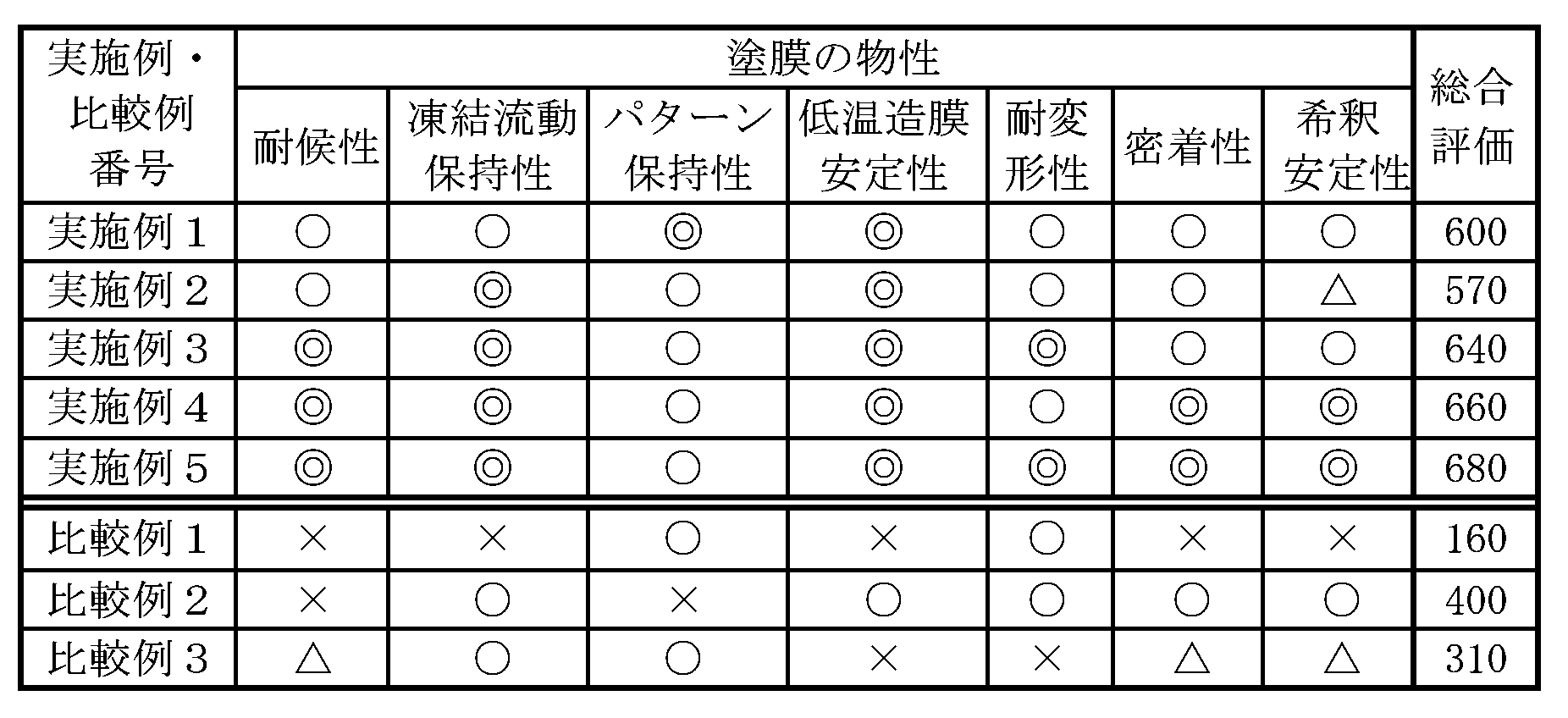
Claims (9)
- 内層および外層を有するエマルション粒子を含有する樹脂エマルションであって、スチレン系単量体80~100質量%および当該スチレン系単量体以外の単量体0~20質量%を含有する単量体成分Aを乳化重合させてなる重合体(I)を含有する樹脂層および(メタ)アクリル酸エステル70~100質量%および当該(メタ)アクリル酸エステル以外の単量体0~30質量%を含有する単量体成分Bを乳化重合させてなる重合体(II)を含有する樹脂層を有し、エマルション粒子の原料として使用される全単量体成分におけるスチレン系単量体の含有率が10~55質量%である塗料用樹脂エマルション。
- 内層が重合体(I)を含有する樹脂層であり、外層が重合体(II)を含有する樹脂層である請求項1に記載の塗料用樹脂エマルション。
- エマルション粒子の原料として使用される全単量体成分に酸基含有単量体が含有され、当該全単量体成分における酸基含有単量体の含有率が0.1~10質量%である請求項1または2に記載の塗料用樹脂エマルション。
- 請求項1~3のいずれかに記載の塗料用樹脂エマルションを含有する塗料。
- 塗料が上塗り塗料である請求項4に記載の塗料用樹脂エマルション。
- 請求項1に記載の内層および外層を有するエマルション粒子を含有する樹脂エマルションの製造方法であって、スチレン系単量体80~100質量%および当該スチレン系単量体以外の単量体0~20質量%を含有する単量体成分Aを乳化重合させてなる重合体(I)を含有する樹脂層および(メタ)アクリル酸エステル70~100質量%および当該(メタ)アクリル酸エステル以外の単量体0~30質量%を含有する単量体成分Bを乳化重合させてなる重合体(II)を含有する樹脂層を形成させ、エマルション粒子の原料として使用される全単量体成分におけるスチレン系単量体の含有率を10~55質量%に調整することを特徴とする塗料用樹脂エマルションの製造方法。
- 内層が重合体(I)を含有する樹脂層であり、外層が重合体(II)を含有する樹脂層である請求項6に記載の塗料用樹脂エマルションの製造方法。
- スチレン系単量体80~100質量%および当該スチレン系単量体以外の単量体0~20質量%を含有する単量体成分Aを乳化重合させ、得られた重合体(I)を含有する樹脂層を内層として形成させた後、当該樹脂層上に(メタ)アクリル酸エステル70~100質量%および当該(メタ)アクリル酸エステル以外の単量体0~30質量%を含有する単量体成分Bを乳化重合させ、得られた重合体(II)を含有する樹脂層を外層として形成させる際に、エマルション粒子の原料として使用される全単量体成分におけるスチレン系単量体の含有率を10~55質量%に調整する請求項6または7に記載の塗料用樹脂エマルションの製造方法。
- エマルション粒子の原料として使用される全単量体成分に酸基含有単量体が含有され、当該全単量体成分における酸基含有単量体の含有率が0.1~10質量%である請求項6~8いずれかに記載の塗料用樹脂エマルションの製造方法。
Priority Applications (3)
| Application Number | Priority Date | Filing Date | Title |
|---|---|---|---|
| US15/760,576 US11203699B2 (en) | 2015-09-18 | 2016-09-16 | Resin emulsion for coating materials |
| CN201680052895.0A CN108026405B (zh) | 2015-09-18 | 2016-09-16 | 涂料用树脂乳液 |
| JP2017540002A JP6419346B2 (ja) | 2015-09-18 | 2016-09-16 | 塗料用樹脂エマルション |
Applications Claiming Priority (2)
| Application Number | Priority Date | Filing Date | Title |
|---|---|---|---|
| JP2015185587 | 2015-09-18 | ||
| JP2015-185587 | 2015-09-18 |
Publications (1)
| Publication Number | Publication Date |
|---|---|
| WO2017047749A1 true WO2017047749A1 (ja) | 2017-03-23 |
Family
ID=58289340
Family Applications (1)
| Application Number | Title | Priority Date | Filing Date |
|---|---|---|---|
| PCT/JP2016/077447 Ceased WO2017047749A1 (ja) | 2015-09-18 | 2016-09-16 | 塗料用樹脂エマルション |
Country Status (4)
| Country | Link |
|---|---|
| US (1) | US11203699B2 (ja) |
| JP (1) | JP6419346B2 (ja) |
| CN (1) | CN108026405B (ja) |
| WO (1) | WO2017047749A1 (ja) |
Cited By (2)
| Publication number | Priority date | Publication date | Assignee | Title |
|---|---|---|---|---|
| JP2018053204A (ja) * | 2016-09-30 | 2018-04-05 | 株式会社日本触媒 | 塗料用樹脂エマルション |
| JP2021167435A (ja) * | 2017-03-31 | 2021-10-21 | 株式会社日本触媒 | 樹脂エマルション |
Families Citing this family (4)
| Publication number | Priority date | Publication date | Assignee | Title |
|---|---|---|---|---|
| KR102419825B1 (ko) * | 2019-10-01 | 2022-07-12 | 주식회사 케이씨씨 | 도료 조성물 |
| CN111087512A (zh) * | 2019-10-18 | 2020-05-01 | 江苏富琪森新材料有限公司 | 一种用于pet薄膜涂层材料的丙烯酸乳液及其制备方法 |
| US12031031B2 (en) * | 2020-03-06 | 2024-07-09 | Nissin Chemical Industry Co., Ltd. | Emulsion composition, a coating agent and a laminate |
| CN111320719A (zh) * | 2020-03-24 | 2020-06-23 | 佛山祺祥合成材料有限公司 | 一种高渗透性丙烯酸乳液 |
Citations (7)
| Publication number | Priority date | Publication date | Assignee | Title |
|---|---|---|---|---|
| JPH0625365A (ja) * | 1992-02-25 | 1994-02-01 | Takeda Chem Ind Ltd | コア・シェル重合体及びそれより得られるプラスチゾル |
| JP2004059623A (ja) * | 2002-07-25 | 2004-02-26 | Kansai Paint Co Ltd | 複層型重合体エマルション |
| JP2008540787A (ja) * | 2005-05-19 | 2008-11-20 | ビーエーエスエフ ソシエタス・ヨーロピア | 改善した弾性を有する有色ポリマー系 |
| JP2010126666A (ja) * | 2008-11-28 | 2010-06-10 | Nippon Shokubai Co Ltd | 防錆塗料用エマルション |
| JP2011111492A (ja) * | 2009-11-25 | 2011-06-09 | Nippon Shokubai Co Ltd | シーラー用塗料組成物 |
| JP2012021135A (ja) * | 2010-06-18 | 2012-02-02 | Nippon Shokubai Co Ltd | 防錆塗料用水性樹脂組成物 |
| US20160152854A1 (en) * | 2014-12-01 | 2016-06-02 | Rohm And Haas Company | Phosphorus acid functionalized opaque polymer |
Family Cites Families (16)
| Publication number | Priority date | Publication date | Assignee | Title |
|---|---|---|---|---|
| US4391928A (en) * | 1981-09-04 | 1983-07-05 | Nl Industries, Inc. | Opacifying polymeric particle and uses |
| US4473679A (en) * | 1983-12-12 | 1984-09-25 | Borg-Warner Chemicals, Inc. | Thermoplastic acrylic elastomers |
| US5053441A (en) * | 1988-09-23 | 1991-10-01 | Union Oil Company Of California | Core/shell particles and process for making same |
| DE3902103A1 (de) * | 1989-01-25 | 1990-08-02 | Roehm Gmbh | Bindemittel fuer waessrige glanzfarben |
| JP2857178B2 (ja) * | 1989-10-11 | 1999-02-10 | 株式会社日本触媒 | メタクリル系ラッカー組成物 |
| US5521253A (en) * | 1990-10-12 | 1996-05-28 | The Dow Chemical Company | Hollow polymer latex particles |
| JP2546216B2 (ja) * | 1991-11-18 | 1996-10-23 | 株式会社日本触媒 | 高耐候性一液架橋型エマルション |
| TW279871B (ja) | 1992-02-25 | 1996-07-01 | Takeda Pharm Industry Co Ltd | |
| JPH0770513A (ja) | 1993-08-02 | 1995-03-14 | Kansai Paint Co Ltd | 上塗用塗料組成物 |
| WO1998008882A1 (en) * | 1996-08-29 | 1998-03-05 | S.C. Johnson Commercial Markets, Inc. | Aqueous two-stage emulsion polymers, blends and coatings thereof and method of making the same |
| US6677047B2 (en) * | 2000-02-04 | 2004-01-13 | Shin-Etsu Chemical Co., Ltd. | Coating composition, coating method, and coated article |
| JP4618865B2 (ja) | 2000-10-31 | 2011-01-26 | 株式会社カネカ | シリコン化合物が包含された樹脂エマルション、その製造方法、および該樹脂エマルションを含有してなる水性塗料用樹脂組成物 |
| US7812090B2 (en) * | 2006-06-02 | 2010-10-12 | Valspar Sourcing, Inc. | High performance aqueous coating compositions |
| WO2008123372A1 (ja) * | 2007-03-30 | 2008-10-16 | Nippon Shokubai Co., Ltd. | 制振材用エマルション |
| CN102224207B (zh) | 2008-11-26 | 2015-04-22 | 株式会社日本触媒 | 密封材料用树脂乳液 |
| JP6343417B2 (ja) | 2012-08-04 | 2018-06-13 | 株式会社日本触媒 | 塗料用樹脂組成物 |
-
2016
- 2016-09-16 WO PCT/JP2016/077447 patent/WO2017047749A1/ja not_active Ceased
- 2016-09-16 JP JP2017540002A patent/JP6419346B2/ja active Active
- 2016-09-16 CN CN201680052895.0A patent/CN108026405B/zh active Active
- 2016-09-16 US US15/760,576 patent/US11203699B2/en active Active
Patent Citations (7)
| Publication number | Priority date | Publication date | Assignee | Title |
|---|---|---|---|---|
| JPH0625365A (ja) * | 1992-02-25 | 1994-02-01 | Takeda Chem Ind Ltd | コア・シェル重合体及びそれより得られるプラスチゾル |
| JP2004059623A (ja) * | 2002-07-25 | 2004-02-26 | Kansai Paint Co Ltd | 複層型重合体エマルション |
| JP2008540787A (ja) * | 2005-05-19 | 2008-11-20 | ビーエーエスエフ ソシエタス・ヨーロピア | 改善した弾性を有する有色ポリマー系 |
| JP2010126666A (ja) * | 2008-11-28 | 2010-06-10 | Nippon Shokubai Co Ltd | 防錆塗料用エマルション |
| JP2011111492A (ja) * | 2009-11-25 | 2011-06-09 | Nippon Shokubai Co Ltd | シーラー用塗料組成物 |
| JP2012021135A (ja) * | 2010-06-18 | 2012-02-02 | Nippon Shokubai Co Ltd | 防錆塗料用水性樹脂組成物 |
| US20160152854A1 (en) * | 2014-12-01 | 2016-06-02 | Rohm And Haas Company | Phosphorus acid functionalized opaque polymer |
Cited By (3)
| Publication number | Priority date | Publication date | Assignee | Title |
|---|---|---|---|---|
| JP2018053204A (ja) * | 2016-09-30 | 2018-04-05 | 株式会社日本触媒 | 塗料用樹脂エマルション |
| JP2021167435A (ja) * | 2017-03-31 | 2021-10-21 | 株式会社日本触媒 | 樹脂エマルション |
| JP7572333B2 (ja) | 2017-03-31 | 2024-10-23 | 株式会社日本触媒 | 樹脂エマルション |
Also Published As
| Publication number | Publication date |
|---|---|
| JP6419346B2 (ja) | 2018-11-07 |
| CN108026405A (zh) | 2018-05-11 |
| US11203699B2 (en) | 2021-12-21 |
| US20180258310A1 (en) | 2018-09-13 |
| CN108026405B (zh) | 2020-12-01 |
| JPWO2017047749A1 (ja) | 2018-07-05 |
Similar Documents
| Publication | Publication Date | Title |
|---|---|---|
| JP6419346B2 (ja) | 塗料用樹脂エマルション | |
| JP6343417B2 (ja) | 塗料用樹脂組成物 | |
| JP6725283B2 (ja) | 塗料用水性樹脂組成物 | |
| JP6899641B2 (ja) | 樹脂組成物 | |
| JP6747839B2 (ja) | 塗料用水性樹脂組成物 | |
| JP6712891B2 (ja) | 上塗り塗料用樹脂エマルション | |
| JP6839311B2 (ja) | 塗料用水性樹脂組成物 | |
| JP2024146370A (ja) | 塗料用アクリル系樹脂エマルション | |
| JP6656046B2 (ja) | ひび割れ補修用シーラー用樹脂組成物 | |
| JP6697919B2 (ja) | 塗料用水性樹脂組成物 | |
| JP6595863B2 (ja) | 塗料用樹脂エマルション | |
| JP6664918B2 (ja) | 水性樹脂分散体の製造方法 | |
| JP7168595B2 (ja) | 窯業建材用樹脂エマルション | |
| JP6688096B2 (ja) | 下地補修用樹脂組成物 | |
| JP6105354B2 (ja) | 積層塗膜 | |
| JP6918082B2 (ja) | シーラー用水性樹脂組成物 | |
| JP7382696B2 (ja) | 塗料用樹脂エマルション | |
| JP6979268B2 (ja) | シーラー用樹脂エマルション | |
| JP6463452B2 (ja) | 塗料用樹脂組成物 | |
| JP6259145B2 (ja) | 塗料用樹脂組成物 | |
| JP6626302B2 (ja) | シーラー用水性樹脂組成物 | |
| JP6624863B2 (ja) | 塗料用樹脂エマルション | |
| JP2020045497A (ja) | シーラー用水性樹脂組成物 | |
| HK1255229A1 (zh) | 用作RORγ调节剂的经过取代的四氢喹啉酮化合 |
Legal Events
| Date | Code | Title | Description |
|---|---|---|---|
| 121 | Ep: the epo has been informed by wipo that ep was designated in this application |
Ref document number: 16846620 Country of ref document: EP Kind code of ref document: A1 |
|
| DPE1 | Request for preliminary examination filed after expiration of 19th month from priority date (pct application filed from 20040101) | ||
| ENP | Entry into the national phase |
Ref document number: 2017540002 Country of ref document: JP Kind code of ref document: A |
|
| WWE | Wipo information: entry into national phase |
Ref document number: 15760576 Country of ref document: US |
|
| NENP | Non-entry into the national phase |
Ref country code: DE |
|
| 122 | Ep: pct application non-entry in european phase |
Ref document number: 16846620 Country of ref document: EP Kind code of ref document: A1 |