WO2017038736A1 - 難燃ポリカーボネート樹脂組成物、それを用いたシート及びフィルム、ならびにそれらの製造方法 - Google Patents
難燃ポリカーボネート樹脂組成物、それを用いたシート及びフィルム、ならびにそれらの製造方法 Download PDFInfo
- Publication number
- WO2017038736A1 WO2017038736A1 PCT/JP2016/075133 JP2016075133W WO2017038736A1 WO 2017038736 A1 WO2017038736 A1 WO 2017038736A1 JP 2016075133 W JP2016075133 W JP 2016075133W WO 2017038736 A1 WO2017038736 A1 WO 2017038736A1
- Authority
- WO
- WIPO (PCT)
- Prior art keywords
- polycarbonate resin
- resin composition
- mass
- sheet
- film
- Prior art date
- Legal status (The legal status is an assumption and is not a legal conclusion. Google has not performed a legal analysis and makes no representation as to the accuracy of the status listed.)
- Ceased
Links
Classifications
-
- C—CHEMISTRY; METALLURGY
- C08—ORGANIC MACROMOLECULAR COMPOUNDS; THEIR PREPARATION OR CHEMICAL WORKING-UP; COMPOSITIONS BASED THEREON
- C08K—Use of inorganic or non-macromolecular organic substances as compounding ingredients
- C08K5/00—Use of organic ingredients
- C08K5/0008—Organic ingredients according to more than one of the "one dot" groups of C08K5/01 - C08K5/59
- C08K5/0066—Flame-proofing or flame-retarding additives
-
- B—PERFORMING OPERATIONS; TRANSPORTING
- B29—WORKING OF PLASTICS; WORKING OF SUBSTANCES IN A PLASTIC STATE IN GENERAL
- B29C—SHAPING OR JOINING OF PLASTICS; SHAPING OF MATERIAL IN A PLASTIC STATE, NOT OTHERWISE PROVIDED FOR; AFTER-TREATMENT OF THE SHAPED PRODUCTS, e.g. REPAIRING
- B29C48/00—Extrusion moulding, i.e. expressing the moulding material through a die or nozzle which imparts the desired form; Apparatus therefor
- B29C48/03—Extrusion moulding, i.e. expressing the moulding material through a die or nozzle which imparts the desired form; Apparatus therefor characterised by the shape of the extruded material at extrusion
- B29C48/07—Flat, e.g. panels
- B29C48/08—Flat, e.g. panels flexible, e.g. films
-
- C—CHEMISTRY; METALLURGY
- C08—ORGANIC MACROMOLECULAR COMPOUNDS; THEIR PREPARATION OR CHEMICAL WORKING-UP; COMPOSITIONS BASED THEREON
- C08J—WORKING-UP; GENERAL PROCESSES OF COMPOUNDING; AFTER-TREATMENT NOT COVERED BY SUBCLASSES C08B, C08C, C08F, C08G or C08H
- C08J5/00—Manufacture of articles or shaped materials containing macromolecular substances
- C08J5/18—Manufacture of films or sheets
-
- C—CHEMISTRY; METALLURGY
- C08—ORGANIC MACROMOLECULAR COMPOUNDS; THEIR PREPARATION OR CHEMICAL WORKING-UP; COMPOSITIONS BASED THEREON
- C08K—Use of inorganic or non-macromolecular organic substances as compounding ingredients
- C08K5/00—Use of organic ingredients
- C08K5/49—Phosphorus-containing compounds
- C08K5/51—Phosphorus bound to oxygen
- C08K5/52—Phosphorus bound to oxygen only
- C08K5/521—Esters of phosphoric acids, e.g. of H3PO4
-
- C—CHEMISTRY; METALLURGY
- C08—ORGANIC MACROMOLECULAR COMPOUNDS; THEIR PREPARATION OR CHEMICAL WORKING-UP; COMPOSITIONS BASED THEREON
- C08K—Use of inorganic or non-macromolecular organic substances as compounding ingredients
- C08K5/00—Use of organic ingredients
- C08K5/49—Phosphorus-containing compounds
- C08K5/5399—Phosphorus bound to nitrogen
-
- C—CHEMISTRY; METALLURGY
- C08—ORGANIC MACROMOLECULAR COMPOUNDS; THEIR PREPARATION OR CHEMICAL WORKING-UP; COMPOSITIONS BASED THEREON
- C08K—Use of inorganic or non-macromolecular organic substances as compounding ingredients
- C08K7/00—Use of ingredients characterised by shape
- C08K7/02—Fibres or whiskers
- C08K7/04—Fibres or whiskers inorganic
- C08K7/14—Glass
-
- C—CHEMISTRY; METALLURGY
- C08—ORGANIC MACROMOLECULAR COMPOUNDS; THEIR PREPARATION OR CHEMICAL WORKING-UP; COMPOSITIONS BASED THEREON
- C08K—Use of inorganic or non-macromolecular organic substances as compounding ingredients
- C08K7/00—Use of ingredients characterised by shape
- C08K7/16—Solid spheres
- C08K7/18—Solid spheres inorganic
- C08K7/20—Glass
-
- C—CHEMISTRY; METALLURGY
- C08—ORGANIC MACROMOLECULAR COMPOUNDS; THEIR PREPARATION OR CHEMICAL WORKING-UP; COMPOSITIONS BASED THEREON
- C08L—COMPOSITIONS OF MACROMOLECULAR COMPOUNDS
- C08L69/00—Compositions of polycarbonates; Compositions of derivatives of polycarbonates
-
- C—CHEMISTRY; METALLURGY
- C08—ORGANIC MACROMOLECULAR COMPOUNDS; THEIR PREPARATION OR CHEMICAL WORKING-UP; COMPOSITIONS BASED THEREON
- C08F—MACROMOLECULAR COMPOUNDS OBTAINED BY REACTIONS ONLY INVOLVING CARBON-TO-CARBON UNSATURATED BONDS
- C08F2500/00—Characteristics or properties of obtained polyolefins; Use thereof
- C08F2500/02—Low molecular weight, e.g. <100,000 Da.
-
- C—CHEMISTRY; METALLURGY
- C08—ORGANIC MACROMOLECULAR COMPOUNDS; THEIR PREPARATION OR CHEMICAL WORKING-UP; COMPOSITIONS BASED THEREON
- C08F—MACROMOLECULAR COMPOUNDS OBTAINED BY REACTIONS ONLY INVOLVING CARBON-TO-CARBON UNSATURATED BONDS
- C08F2500/00—Characteristics or properties of obtained polyolefins; Use thereof
- C08F2500/12—Melt flow index or melt flow ratio
-
- C—CHEMISTRY; METALLURGY
- C08—ORGANIC MACROMOLECULAR COMPOUNDS; THEIR PREPARATION OR CHEMICAL WORKING-UP; COMPOSITIONS BASED THEREON
- C08L—COMPOSITIONS OF MACROMOLECULAR COMPOUNDS
- C08L27/00—Compositions of homopolymers or copolymers of compounds having one or more unsaturated aliphatic radicals, each having only one carbon-to-carbon double bond, and at least one being terminated by a halogen; Compositions of derivatives of such polymers
- C08L27/02—Compositions of homopolymers or copolymers of compounds having one or more unsaturated aliphatic radicals, each having only one carbon-to-carbon double bond, and at least one being terminated by a halogen; Compositions of derivatives of such polymers not modified by chemical after-treatment
- C08L27/12—Compositions of homopolymers or copolymers of compounds having one or more unsaturated aliphatic radicals, each having only one carbon-to-carbon double bond, and at least one being terminated by a halogen; Compositions of derivatives of such polymers not modified by chemical after-treatment containing fluorine atoms
-
- C—CHEMISTRY; METALLURGY
- C08—ORGANIC MACROMOLECULAR COMPOUNDS; THEIR PREPARATION OR CHEMICAL WORKING-UP; COMPOSITIONS BASED THEREON
- C08L—COMPOSITIONS OF MACROMOLECULAR COMPOUNDS
- C08L27/00—Compositions of homopolymers or copolymers of compounds having one or more unsaturated aliphatic radicals, each having only one carbon-to-carbon double bond, and at least one being terminated by a halogen; Compositions of derivatives of such polymers
- C08L27/02—Compositions of homopolymers or copolymers of compounds having one or more unsaturated aliphatic radicals, each having only one carbon-to-carbon double bond, and at least one being terminated by a halogen; Compositions of derivatives of such polymers not modified by chemical after-treatment
- C08L27/12—Compositions of homopolymers or copolymers of compounds having one or more unsaturated aliphatic radicals, each having only one carbon-to-carbon double bond, and at least one being terminated by a halogen; Compositions of derivatives of such polymers not modified by chemical after-treatment containing fluorine atoms
- C08L27/18—Homopolymers or copolymers or tetrafluoroethene
-
- G—PHYSICS
- G01—MEASURING; TESTING
- G01N—INVESTIGATING OR ANALYSING MATERIALS BY DETERMINING THEIR CHEMICAL OR PHYSICAL PROPERTIES
- G01N25/00—Investigating or analyzing materials by the use of thermal means
- G01N25/20—Investigating or analyzing materials by the use of thermal means by investigating the development of heat, i.e. calorimetry, e.g. by measuring specific heat, by measuring thermal conductivity
- G01N25/48—Investigating or analyzing materials by the use of thermal means by investigating the development of heat, i.e. calorimetry, e.g. by measuring specific heat, by measuring thermal conductivity on solution, sorption, or a chemical reaction not involving combustion or catalytic oxidation
- G01N25/4846—Investigating or analyzing materials by the use of thermal means by investigating the development of heat, i.e. calorimetry, e.g. by measuring specific heat, by measuring thermal conductivity on solution, sorption, or a chemical reaction not involving combustion or catalytic oxidation for a motionless, e.g. solid sample
- G01N25/4866—Investigating or analyzing materials by the use of thermal means by investigating the development of heat, i.e. calorimetry, e.g. by measuring specific heat, by measuring thermal conductivity on solution, sorption, or a chemical reaction not involving combustion or catalytic oxidation for a motionless, e.g. solid sample by using a differential method
Definitions
- the present invention relates to a flame retardant polycarbonate resin composition reinforced with an inorganic filler, a sheet and a film using the same, and a production method thereof.
- Polycarbonate resins are excellent in transparency, impact resistance, heat resistance, etc., and the resulting molded products are also excellent in dimensional stability, etc., so housings for electrical and electronic equipment, automotive parts, optical discs, etc. It is widely used as a raw material resin for manufacturing precision molded products such as parts. In particular, in a case of a home appliance, an electronic device, an image display device, or the like, a product with high commercial value can be obtained by making use of its beautiful appearance. Further, reinforced polycarbonate resins obtained by adding various inorganic fillers to polycarbonate resins are also used in a wide range of applications due to their excellent mechanical strength and heat resistance.
- the casings of electrical and electronic equipment have been extremely thinned and miniaturized due to the trend toward miniaturization of the equipment itself, and are as high as V-1 or more at a thickness of 0.8 mm or less in the UL94 vertical combustion test. Flame retardancy has been required.
- an extrusion molding machine such as sheet / film molding is more advantageous than an injection molding machine.
- an inorganic filler is included to improve mechanical properties, the fluidity of the resin composition is lowered. Therefore, in injection molding, it is difficult to mold a large area with a thickness of 0.8 mm or less.
- a multi-point gate is used for molding, problems such as deterioration of physical properties due to welds and poor appearance occur.
- an extrusion molded product has a different flowability range suitable for molding from that of an injection molded product, there is no such problem, and it is possible to continuously mold even a large area.
- Patent Document 1 describes a polycarbonate resin composition using glass fiber as an inorganic filler and a metal salt flame retardant or an organic phosphorus flame retardant as a flame retardant.
- the viscosity average molecular weight range of the polycarbonate resin is particularly preferable in the range of 14,000 to 24,000, the viscosity average molecular weight in the examples is 22,400, the flame retardancy is 0.8 mm in thickness, 1. V-0 at 6 mm.
- Patent Document 2 describes a polycarbonate resin composition using glass fiber as an inorganic filler and a phosphazene compound as a flame retardant.
- the viscosity average molecular weight range of the polycarbonate resin is particularly preferable in the range of 17,000 to 24,000, the viscosity average molecular weight in the examples is 21,000, and the flame retardancy is V ⁇ at a thickness of 1.0 mm. 0.
- compositions described in Patent Documents 1 and 2 have insufficient flame retardancy when the molded product is made to have a thinner thickness. Further, since the composition is a flame retardant polycarbonate resin composition used for injection molding, It was difficult to obtain a thin film sheet having an area.
- Patent Document 3 describes a polycarbonate resin composition for extrusion molding.
- the viscosity average molecular weight range is particularly preferably 17,000 to 28,000, and the flame retardancy in the examples is V-0 at a thickness of 0.5 mm.
- Patent Document 3 since the composition described in Patent Document 3 does not have an inorganic filler, sufficient bending characteristics cannot be obtained and mechanical strength is insufficient.
- An object of the present invention is to provide a polycarbonate resin sheet and a polycarbonate resin composition suitable for a film and film having excellent heat resistance, excellent mechanical strength (particularly rigidity), and excellent flame resistance even when thin. It is in providing the sheet
- the present invention is as follows.
- the polycarbonate 300 ° C. of the resin composition, the polycarbonate resin composition according to the melt volume rate is 2.0 ⁇ 10cm 3 / 10min in 1.2 kg [1].
- the polycarbonate resin (A) having a viscosity average molecular weight of 28,000 to 60,000 is 18 to 75% by mass
- the phosphorus-based flame retardant (B) is 5 to 30% by mass
- fibrous or plate-like inorganic A polycarbonate resin composition containing 18 to 50% by mass of a filler (C) and 0.1 to 2% by mass of a fluoropolymer (D).
- a sheet and a film made of polycarbonate resin having excellent heat resistance, excellent mechanical strength (particularly rigidity), and excellent flame retardancy even when thinned are obtained.
- inorganic fillers such as glass fiber and phosphorus-based flame retardants are generally used in resin compositions for the purpose of improving mechanical properties and imparting flame retardancy, respectively.
- the polycarbonate resin composition using both of them has a problem that, as the molded product becomes thinner, it becomes easier to drop during the UL94 vertical combustion test, and sufficient flame retardancy cannot be obtained.
- the inventors of the present application have found that the specific gravity of the composition is increased by the addition of a flame retardant such as glass fiber, and the heat resistance and viscosity of the resin composition are increased by the addition of the flame retardant.
- polycarbonate resin (A) Although there is no restriction
- the polycarbonate resin is an optionally branched thermoplastic polymer or copolymer obtained by reacting a dihydroxy compound or a small amount of a branching agent with phosgene, triphosgene or a carbonic acid diester.
- the production method of the polycarbonate resin is not particularly limited, and a polycarbonate resin produced by a conventionally known phosgene method (interfacial polymerization method) or a melting method (transesterification method) can be used. Further, when the melting method is used, a polycarbonate resin in which the amount of OH groups of terminal groups is adjusted can be used.
- the raw material dihydroxy compound examples include 2,2-bis (4-hydroxyphenyl) propane (ie, “bisphenol A”), tetramethylbisphenol A, bis (4-hydroxyphenyl) -p-diisopropylbenzene, hydroquinone, resorcinol, 4 , 4-dihydroxydiphenyl and the like. Two or more of these may be used in combination. It is preferable to use bisphenol A as a main component in terms of impact resistance and heat resistance.
- the polycarbonate resin containing bisphenol A as a main component refers to a resin using 60 to 100 mol%, preferably 90 to 100 mol% of bisphenol A among bisphenols to be used.
- a compound in which one or more tetraalkylphosphonium sulfonates are bonded to the above aromatic dihydroxy compound can also be used.
- it may be a copolymer mainly composed of a polycarbonate resin such as a copolymer of the dihydroxy compound and a compound having a siloxane structure.
- a part of the above-mentioned dihydroxy compound may be replaced with a branching agent.
- the branching agent is not particularly limited.
- phloroglucin 4,6-dimethyl-2,4,6-tri (4-hydroxyphenyl) heptene-2, 4,6-dimethyl-2,4,6-tri (4-hydroxyphenyl) heptane, 2,6-dimethyl-2,4,6-tri (4-hydroxyphenylheptene-3,1,3,5-tri (4-hydroxyphenyl) benzene, 1,1,
- Polyhydroxy compounds such as 1-tri (4-hydroxyphenyl) ethane, 3,3-bis (4-hydroxyaryl) oxindole (ie, “isatin bisphenol”), 5-chloruisatin, 5,7-dichlorouisatin, 5 -Bromoisatin, etc.
- the amount of the compound to be substituted is usually 0.01 to 10 mol% with respect to the dihydroxy compound.
- polycarbonate resin (A) among those described above, polycarbonate resin derived from 2,2-bis (4-hydroxyphenyl) propane (ie, “bisphenol A”), or 2,2-bis (4-hydroxyphenyl) Preference is given to polycarbonate copolymers derived from propane (ie "bisphenol A”) and other aromatic dihydroxy compounds.
- polycarbonate resins may be used alone or in combination of two or more.
- a monovalent hydroxy compound such as an aromatic hydroxy compound may be used as a terminal terminator.
- the monovalent aromatic hydroxy compound include m- and p-methylphenol, m- and p-propylphenol, p-tert-butylphenol, and p-long chain alkyl-substituted phenol.
- the molecular weight of the polycarbonate resin (A) used in the present invention is 28,000 to 60,000 in terms of viscosity average molecular weight [Mv] from the viewpoints of moldability and strength of the molded product.
- the viscosity average molecular weight of the polycarbonate resin (A) is 28,000 or more, the resin composition has a high viscosity and dripping at the time of a combustion test by suppressing deformation at the time of melting, particularly at the time of a combustion test in the case of a thin film Is preferable from the viewpoint of flame retardancy.
- the viscosity average molecular weight of the polycarbonate resin (A) is 60,000 or less, an increase in screw torque during melt extrusion can be suppressed, which is more preferable from the viewpoint of ease of molding processability. It is preferably 30,000 to 55,000, more preferably 35,000 to 50,000 in terms of the effect of preventing dripping at the firing test and the ease of molding.
- the viscosity average molecular weight [Mv] of the polycarbonate resin can be measured by the method described below.
- ⁇ Viscosity average molecular weight (Mv) measurement conditions The viscosity average molecular weight [Mv] is calculated from the following Schnell's viscosity equation using methylene chloride as a solvent and obtaining an intrinsic viscosity [ ⁇ ] (unit: dl / g) at a temperature of 20 ° C. using an Ubbelohde viscometer. Value (viscosity average molecular weight: Mv).
- the intrinsic viscosity [ ⁇ ] is a value calculated from the following equation by measuring the specific viscosity [ ⁇ sp ] at each solution concentration [C] (g / dl).
- the polycarbonate resin composition of the present invention contains a phosphorus-based flame retardant (B) for improving flame retardancy.
- phosphoric flame retardant (B) phosphate ester flame retardants, phosphazene flame retardants and the like can be used.
- phosphorus-based flame retardant (B) one type may be used alone, or two or more types may be mixed and used.
- phosphate ester flame retardants are preferably used because they have a high flame retarding effect and a fluidity improving effect.
- the phosphate ester flame retardant is not limited, but in particular, the phosphate ester flame retardant is preferably a phosphate ester compound represented by the following general formula (IIa).
- R 1 , R 2 , R 3 and R 4 are each independently an alkyl group having 1 to 8 carbon atoms or a carbon number which may be substituted with an alkoxy group having 1 to 8 carbon atoms.
- An alkyl group having 1 to 8 carbon atoms, or an aryl group having 6 to 20 carbon atoms which may be substituted with phenyl optionally substituted with an alkyl group having 1 to 8 carbon atoms, p, q, r and s are Each independently 0 or 1, t is an integer of 0 to 5, and X represents an arylene group or a divalent group represented by the following formula (IIb).
- B represents a single bond, —C (CH 3 ) 2 —, —SO 2 —, —S—, or —O—).
- examples of the aryl group represented by R 1 to R 4 include a phenyl group and a naphthyl group.
- examples of the arylene group for X include a phenylene group and a naphthylene group.
- the compound represented by formula (IIa) is a phosphate ester, and when t is greater than 0, it is a condensed phosphate ester (including a mixture).
- a condensed phosphate ester is particularly preferably used.
- phosphate ester flame retardant represented by the general formula (IIa) include trimethyl phosphate, triethyl phosphate, tributyl phosphate, trioctyl phosphate, tributoxyethyl phosphate, triphenyl phosphate.
- triphenyl phosphate bisphenol A tetraphenyl diphosphate, resorcinol tetraphenyl diphosphate, resorcinol bisdi 2,6-xylenyl phosphate and the like are preferable.
- Examples of commercially available phosphoric acid ester flame retardants include FP-600 manufactured by ADEKA Corporation, and PX-200 manufactured by Daihachi Chemical Industry Co., Ltd.
- phosphate ester flame retardants may be used alone or in combination of two or more.
- the phosphazene-based flame retardant can be used as an effective phosphorus-based flame retardant because it can suppress a decrease in the heat resistance of the resin composition due to the addition of the flame retardant compared to the phosphate ester-based flame retardant.
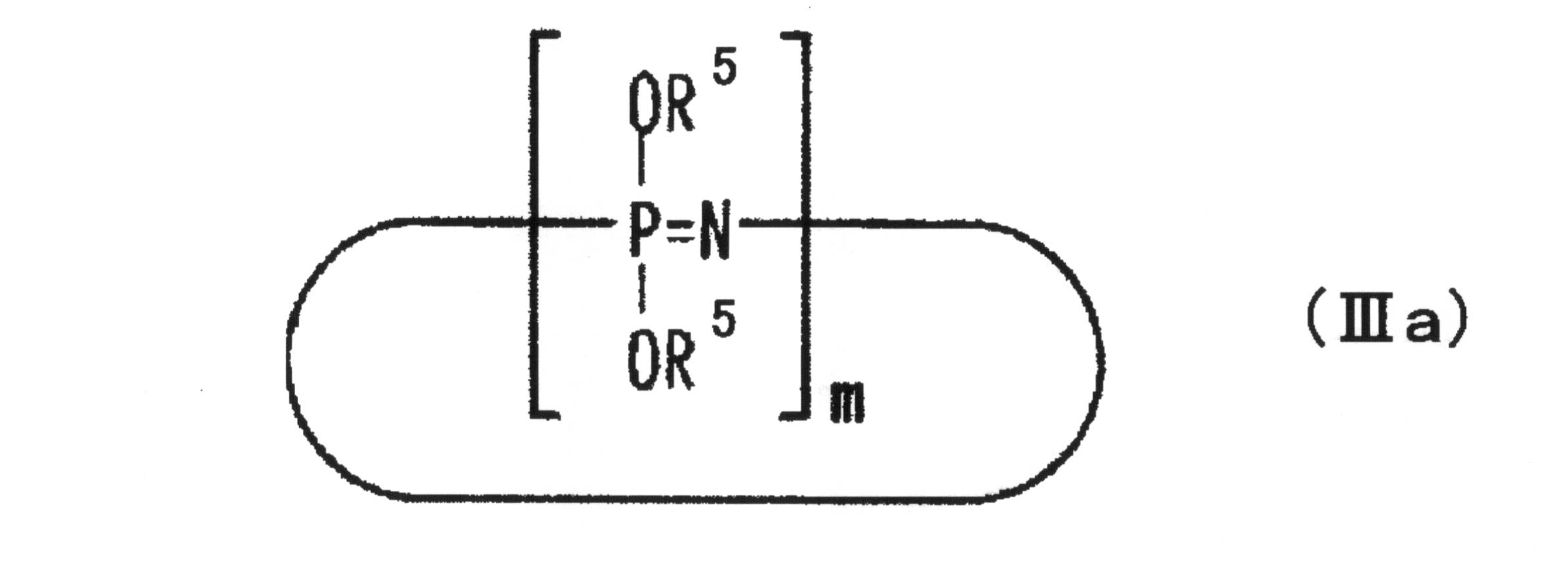
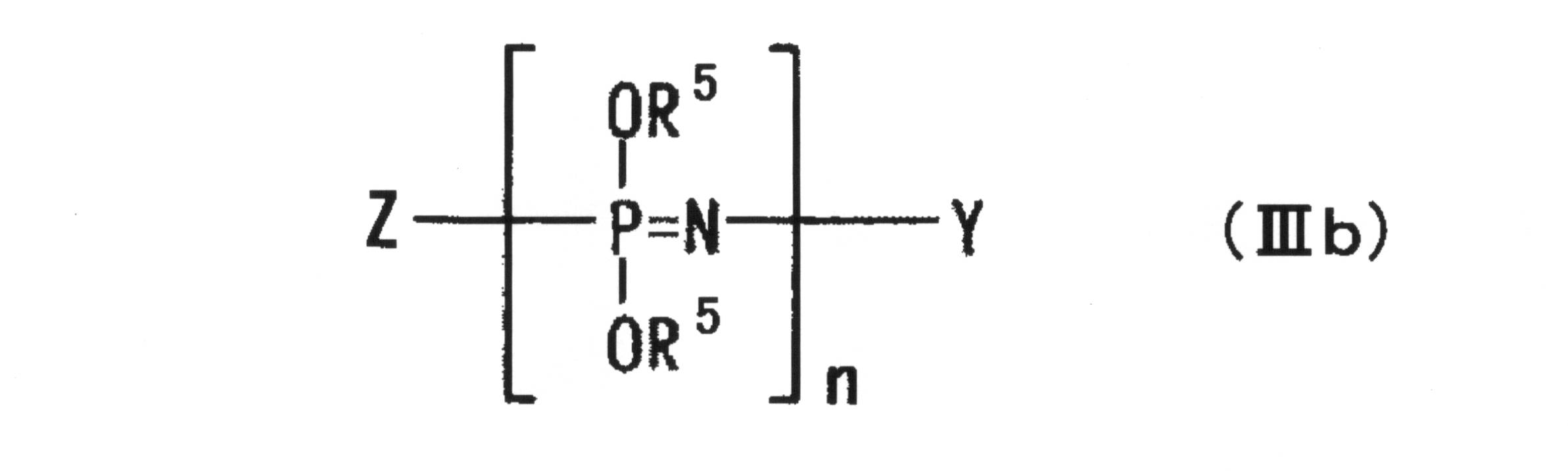
- the phosphazene-based flame retardant is an organic compound having a —P ⁇ N— bond in the molecule.
- the phosphazene-based flame retardant is preferably a cyclic phosphazene compound represented by the following general formula (IIIa) or a general formula (IIIb) And a crosslinked phosphazene compound in which at least one phosphazene compound selected from the group consisting of the following general formula (IIIa) and the following general formula (IIIb) is crosslinked by a crosslinking group.
- a crosslinked phosphazene compound those crosslinked by a crosslinking group represented by the following general formula (IIIc) are preferable from the viewpoint of flame retardancy.
- n is an integer of 3 ⁇ 10,000
- Y is - 4 represents P (OR 5 ) 4 group or —P (O) (OR 5 ) 2 group
- R 5 may be the same or different and represents an aryl group or an alkylaryl group.
- A is —C (CH 3 ) 2 —, —SO 2 —, —S—, or —O—, and l is 0 or 1.
- Examples of the cyclic and / or chain phosphazene compounds represented by the general formulas (IIIa) and (IIIb) include, for example, R 5 may be substituted with an alkyl group having 1 to 6 carbon atoms. What is an aryl group is mentioned preferably.
- cyclic or chain phosphazene compounds wherein R 5 is an aryl group such as a phenyl group; R 5 is a tolyl group (o-, m-, p-tolyloxy group), xylyl (2,3, A cyclic or chain phenoxyphosphazene which is an aryl group having 6 to 20 carbon atoms and substituted with alkyl having 1 to 6 carbon atoms, preferably 1 to 3 carbon atoms, such as 2,6-, 3,5-xylyl group; And cyclic or chain phenoxyphosphazene in which R 5 is combined.
- R 5 is an aryl group such as a phenyl group
- R 5 is a tolyl group (o-, m-, p-tolyloxy group), xylyl (2,3,
- a cyclic or chain phenoxyphosphazene which is an aryl group having 6 to 20 carbon atoms and substituted with alkyl having 1 to 6 carbon
- phenoxyphosphazene for example, o-tolyloxyphosphazene, m-tolyloxyphosphazene, p-tolyloxyphosphazene, o, m-tolyloxyphosphazene, o, p-tolyloxyphosphazene
- M p-tolyloxyphosphazene, o, m, p-tolyloxyphosphazene, etc.
- (poly) xylyloxyphosphazene, etc. and cyclic and / or chain C 1-6 alkyl C 6-20 aryloxyphosphazenes
- phenoxytolyloxyphosphazenes eg, phenoxy o-tolyloxyphosphazenes, phenoxy m-tolyloxyphosphazenes, phenoxy p-tolyloxyphospha
- Examples thereof include chain C 6-20 aryl C 1-10 alkyl C 6-20 aryloxyphosphazene , and preferably cyclic and / or chain phenoxyphosphazene, cyclic and / or chain C 1-3 alkyl C 6-20 Aryloxyphosphazenes, C 6-20 aryloxy C 1-3 alkyl C 6-20 aryloxyphosphazenes (eg, cyclic and / or chained tolyloxyphosphazenes, cyclic and / or chained phenoxytolylphenoxyphosphazenes, etc.).
- chain C 6-20 aryl C 1-10 alkyl C 6-20 aryloxyphosphazene and preferably cyclic and / or chain phenoxyphosphazene, cyclic and / or chain C 1-3 alkyl C 6-20 Aryloxyphosphazenes, C 6-20 aryloxy C 1-3 alkyl C 6-20 aryloxyphosphazen
- C 1-6 means “having 1 to 6 carbon atoms”, and the same applies to “C 6-20 ”, “C 1-10 ”, and the like.
- (poly) phenoxy Indicates one or both of “phenoxy...” And “polyphenoxy.
- cyclic phosphazene compound represented by the general formula (IIIa) cyclic phenoxyphosphazene in which R 5 is a phenyl group is particularly preferable.
- the cyclic phenoxyphosphazene compound is preferably a compound in which m in the general formula (IIIa) is an integer of 3 to 8, and may be a mixture of compounds having different m.
- Such a cyclic phenoxyphosphazene compound is obtained by, for example, hexachlorocyclotriphosphazene, octachlorocyclohexane from a cyclic and linear chlorophosphazene mixture obtained by reacting ammonium chloride and phosphorus pentachloride at a temperature of 120 to 130 ° C.
- a cyclic chlorophosphazene such as tetraphosphazene or decachlorocyclopentaphosphazene can be taken out and then substituted with a phenoxy group.
- chain phosphazene compound represented by the general formula (IIIb) chain phenoxyphosphazene in which R 5 is a phenyl group is particularly preferable.
- a chain phenoxyphosphazene compound for example, a cyclic phenoxyphosphazene compound chloride obtained by the above method (for example, hexachlorocyclotriphosphazene) is subjected to reduction polymerization at a temperature of 220 to 250 ° C., and the resulting polymerization is obtained. Examples thereof include compounds obtained by substituting a linear dichlorophosphazene having a degree of 3 to 10,000 with a phenoxy group.
- N in the general formula (IIIb) of the linear phenoxyphosphazene compound is preferably 3 to 1,000, more preferably 3 to 100, and further preferably 3 to 25.
- bridged phenoxyphosphazene compound examples include a compound having a crosslinked structure of 4,4′-sulfonyldiphenylene (bisphenol S residue) and a crosslinked structure of 2,2- (4,4′-diphenylene) isopropylidene group.
- crosslinked phosphazene compound a crosslinked phenoxyphosphazene compound obtained by crosslinking a cyclic phenoxyphosphazene compound in which R 5 is a phenyl group in the general formula (IIIa) with a crosslinking group represented by the above general formula (IIIc), or the above A crosslinked phenoxyphosphazene compound obtained by crosslinking a chain phenoxyphosphazene compound in which R 5 is a phenyl group in the general formula (IIIb) with a crosslinking group represented by the above general formula (IIIc) is preferable from the viewpoint of flame retardancy, and cyclic A crosslinked phenoxyphosphazene compound obtained by crosslinking a phenoxyphosphazene compound with a crosslinking group represented by the general formula (IIIc) is more preferable.
- the content of the phenylene group in the crosslinked phosphazene compound is such that the cyclic phosphazene compound represented by the general formula (IIIa) and / or the all-phenyl group and phenylene in the chain phenoxyphosphazene compound represented by the general formula (IIIb) Based on the number of bases, it is usually 50 to 99.9%, preferably 70 to 90%.
- the crosslinked phenoxyphosphazene compound is particularly preferably a compound having no free hydroxyl group in the molecule.
- the phosphazene-based flame retardant is obtained by crosslinking the cyclic phenoxyphosphazene compound represented by the general formula (IIIa) and the cyclic phenoxyphosphazene compound represented by the general formula (IIIa) with a crosslinking group.
- at least one selected from the group consisting of crosslinked phenoxyphosphazene compounds is preferred.
- Examples of commercially available phosphazene-based flame retardants include cyclic phenoxyphosphazenes “Ravitor FP-110” and “Ravitor FP-110T” manufactured by Fushimi Pharmaceutical Co., Ltd. and “SPS100” manufactured by Otsuka Chemical Co., Ltd.
- phosphazene flame retardants may be used alone or in combination of two or more.
- Fibrous or plate-like inorganic filler (C) contains a fibrous or plate-like inorganic filler.
- Inorganic fillers are generally classified into fibrous inorganic fillers, plate-like inorganic fillers, and spherical inorganic fillers (beads) based on their shapes. Fibrous inorganic fillers and plate-like inorganic fillers are superior to spherical inorganic fillers in the reinforcing effect of the resin composition, in particular, the rigidity such as the bending elastic modulus and bending strength of the molded product.
- the reinforcing effect of the polycarbonate resin composition is excellent.
- At least one selected from a material and a silicate-based reinforcing material can be used. Among these, it is particularly preferable to use a glass-based reinforcing material.
- the fibrous or plate-like inorganic filler one kind may be used alone, or two or more kinds may be mixed and used.
- Glass reinforcement The kind in particular of glass type reinforcing agent is not restrict
- Fibrous glass-based reinforcing agents that is, glass fibers include chopped strands, roving glass, and the like, and any known form of glass fibers can be used. From the viewpoint of productivity, chopped strands (chopped glass fibers ) Is preferred.
- the glass fiber chopped strand is obtained by cutting glass fibers (strands) obtained by bundling tens to thousands of glass single fibers (filaments) into a predetermined length.
- blending to the masterbatch etc. of polycarbonate resin or glass fiber (long fiber) is not ask
- a resin composition in which a predetermined amount of glass fiber is blended is manufactured by mixing and kneading a resin (master batch) in which glass fibers are kneaded at a high ratio and a resin in which glass fibers are not kneaded. Can do.
- Examples of the plate-like glass-based reinforcing agent include glass flakes.
- Glass flake is usually a glass flake having an average particle size of 10 to 4000 ⁇ m, an average thickness of 0.1 to 10 ⁇ m, and an aspect ratio (average maximum diameter / average thickness ratio) of about 2 to 1000. .
- a fibrous or plate-like glass-based reinforcing material may be used alone or in combination of two or more.
- two or more kinds of glass fibers including milled fibers
- two or more kinds of glass flakes having different average particle diameters, average thicknesses, and aspect ratios.
- May be used in combination or one or two or more kinds of glass fibers (including milled fibers) may be used in combination, or one or more kinds of flakes and one or more kinds of glass fibers (milled fibers). May be used in combination.
- particle size glass beads can be used in combination for the purpose of dimensional stabilization.
- Carbon-based reinforcement examples include carbon fibers and carbon nanotubes as fibrous fillers, and graphite as plate-like fillers. Of these, carbon fibers and graphite are preferably used.
- carbon-based reinforcing material one type may be used alone, or two or more types may be mixed and used.
- two or more carbon-based reinforcing materials having different materials, average particle diameters, and shapes may be used in combination.
- a silicate reinforcing material can also be used.
- Wollastonite or the like can be used as the fibrous filler, and talc or mica can be used as the plate-like filler.
- a silicate type reinforcing material may be used individually by 1 type, and 2 or more types may be mixed and used for it.
- metal fibers such as potassium titanate whisker, calcium carbonate whisker, aluminum borate whisker, titanium oxide whisker, zinc oxide whisker, and magnesium sulfate whisker can be used.
- whiskers such as potassium titanate whisker, calcium carbonate whisker, aluminum borate whisker, titanium oxide whisker, zinc oxide whisker, and magnesium sulfate whisker
- Other plate-like fillers that can be used include metal flakes, silica, alumina, calcium carbonate, and the like.
- these other inorganic fillers one kind may be used alone, or two or more kinds may be mixed and used.
- These fibrous or plate-like inorganic fillers may be surface-treated with a surface treatment agent, and by such surface treatment, the resin component and the fibrous or plate-like inorganic filler are bonded. And improved mechanical strength can be achieved.
- the polycarbonate resin composition of the present invention contains a fluoropolymer (D) as an anti-dripping agent. Moreover, 1 type may be used for a fluoropolymer and it may use 2 or more types together by arbitrary combinations and arbitrary ratios.
- the fluoropolymer include fluorinated polyolefins such as polyfluoroethylene.
- the fluorinated polyolefin is a polymer or copolymer containing a fluoroethylene structure.
- a polymer or copolymer containing a fluoroethylene structure is a polymer whose main component is a fluoroethylene structure (constituent unit).
- the fluoroethylene structure constitutes a fluorinated polyolefin.
- the total amount of monomer units is preferably 40 to 100% by mass, more preferably 50 to 100% by mass, and still more preferably 60 to 100% by mass.
- polydifluoroethylene polytetrafluoroethylene resin
- tetrafluoroethylene / hexafluoropropylene copolymer tetrafluoroethylene / perfluoroalkyl vinyl ether copolymer
- a polytetrafluoroethylene resin is preferable in terms of flame retardancy
- polytetrafluoroethylene having a fibril forming ability is particularly preferable. This shows the tendency to disperse
- Polytetrafluoroethylene having fibril-forming ability is classified as type 3 according to the ASTM standard.
- Polytetrafluoroethylene can be used in solid form or in the form of an aqueous dispersion.
- polytetrafluoroethylene having fibril-forming ability include, for example, Mitsui DuPont Fluorochemical Co., Ltd., Teflon (registered trademark) 6J or Teflon (registered trademark) 30J, or Daikin Industries, Ltd.
- Teflon registered trademark
- Teflon registered trademark 30J
- Polyflon FA-500H The number average molecular weight of polytetrafluoroethylene is not particularly limited, but is preferably 3 million to tens of millions (for example, 3,000,000 to 90,000,000).
- the polycarbonate resin composition (100% by mass) of the present invention comprises 18 to 75% by mass of the above polycarbonate resin (A) having a viscosity average molecular weight of 28,000 to 60,000, and 5 to 30% by mass of the phosphorus flame retardant (B). Further, the fiber or plate-like inorganic filler (C) is contained in an amount of 18 to 50% by mass, and the fluoropolymer (D) is contained in an amount of 0.1 to 2% by mass.
- the content of the polycarbonate resin (A) is less than 18% by mass, the toughness of the resin composition may be reduced, and if it exceeds 75% by mass, the mechanical strength and flame retardancy may be insufficient.
- a preferable content of the polycarbonate resin (A) is 27 to 71% by mass, more preferably 34 to 68% by mass in terms of toughness, mechanical strength, and flame retardancy.
- the content of the phosphorus-based flame retardant in polycarbonate resin composition (B) has a melt volume rate of the polycarbonate resin composition (MVR) (300 °C, 1.2kg ) control to become 2.0 ⁇ 10cm 3 / 10min It is preferable to do.
- MVR polycarbonate resin composition
- phosphorus-based flame retardants (B) particularly phosphate ester-based flame retardants, have an effect of improving fluidity. Therefore, the higher the content of phosphorus-based flame retardant (B), the higher the melt volume rate of the composition tends to increase. is there.
- the content of the phosphorus-based flame retardant (B) is less than 5% by mass, dripping at the time of combustion is suppressed, but the combustion time may be long.
- the addition amount of the phosphorus-based flame retardant (B) exceeds 30% by mass, dripping during combustion, heat resistance reduction, and toughness of the matrix resin may be reduced.
- the addition amount of the phosphorus-based flame retardant (B) is preferably 6 to 25% by mass, more preferably 7 to 20% by mass, and 10 to 20% by mass from the viewpoint of flame retardancy and heat resistance.
- the preferred content of the fibrous or plate-like inorganic filler (C) is 22.5 to 50% by mass, more preferably 22.5 to 47.5% by mass, and even more preferably 25 to 45%. % By mass.
- the strength improvement effect due to the blending of the reinforcing filler (B) cannot be sufficiently obtained. It tends to be damaged.
- the fluoropolymer (D) content is preferably from 0.1 to 1.0% by mass, more preferably from the viewpoint of further improving the flame retardancy and ensuring the appearance and mechanical strength of the molded product. 15 to 0.75% by mass.
- the content of the fluoropolymer is less than or equal to the lower limit of the above range, the effect of improving the flame retardancy by the fluoropolymer may be insufficient, and when the content of the fluoropolymer exceeds the upper limit of the above range In addition, there is a possibility that a poor appearance of a molded product obtained by molding the polycarbonate resin composition or a decrease in mechanical strength may occur.
- the aromatic polycarbonate resin composition of this invention may contain other resin components other than a polycarbonate resin (A) and a fluoropolymer (D) as a resin component.
- polystyrene resin high impact polystyrene resin, hydrogenated polystyrene resin, polyacryl styrene resin, ABS resin, AS resin, AES resin, ASA resin, SMA resin, polyalkyl methacrylate resin, Polymethacryl methacrylate resin, polyphenyl ether resin, polycarbonate resin other than component (A), amorphous polyalkylene terephthalate resin, polyester resin, amorphous polyamide resin, poly-4-methylpentene-1, cyclic polyolefin resin, non Crystalline polyarylate resin, polyether sulfone, etc. are mentioned. These may be used alone or in combination of two or more.
- the aromatic polycarbonate resin composition of the present invention may further contain various additives as long as the effects of the present invention are not impaired.
- additives include heat stabilizers, antioxidants, mold release agents, UV absorbers, dyes and pigments, antistatic agents, flame retardants, anti-dripping agents, impact strength improvers, plasticizers, dispersants, antibacterial agents. Agents and the like.
- One of these additives may be contained, or two or more thereof may be contained in any combination and ratio.
- polycarbonate resin (A) according to the present invention, phosphorus-based flame retardant (B), fibrous or plate-like inorganic filler (C), fluoropolymer (D), and necessary.
- Other ingredients to be blended according to the above are mixed in advance using various mixers such as a tumbler, a Henschel mixer, and a super mixer, and then Banbury mixer, roll, Brabender, single-screw kneading extruder, twin-screw kneading extruder And a melt kneading method using a mixer such as a kneader.
- the inorganic filler (C) is preferably supplied and mixed from a side feeder installed on the downstream side of the extruder separately from the resin component in order to suppress crushing.
- the polycarbonate resin composition of the present invention using the melt indexer, conforming to ISO 1133 with a heating temperature 300 ° C., weight 1.2 kg, the preheating melt volume rate at time 500 sec (MVR) (cm 3 / 10min ) is 2. it is preferable that the 0 ⁇ 10cm 3 / 10min. If the melt volume rate 2.0 cm 3 / 10min or more, if the sheet or film melt volume rate 10cm deterioration of productivity due to an increase in torque during melt extrusion can be prevented 3 / 10min or less, inhibit dripping during burning it can.
- Melt volume rate is more preferably 2.0 ⁇ 9.0cm 3 / 10min, more preferably 2.0 ⁇ 8.0cm 3 / 10min, particularly preferably 2.0 ⁇ 6.0cm 3 / 10min.
- the glass transition temperature of the resin component of the present invention is preferably 75 to 170 ° C, more preferably 85 to 160 ° C, and particularly preferably 95 to 150 ° C. When the glass transition temperature is 75 ° C. or higher, the heat resistance is excellent, and when it is 170 ° C. or lower, the moldability is good.
- the resin component here is a component including the component (A), the component (B), and the component (D), and excluding the inorganic filler such as the component (C) from the polycarbonate resin composition of the present invention. is there.
- the polycarbonate resin composition of the present invention can be formed into various forms of molded articles.
- the polycarbonate resin composition of the present invention it is possible to provide a molded product excellent in flame retardancy with a thin wall, which was difficult with a conventional polycarbonate resin composition.
- Examples of application of the molded article of the present invention include parts such as electric and electronic equipment, OA equipment, information terminal equipment, machine parts, home appliances, vehicle parts, building members, various containers, leisure goods / miscellaneous goods, and lighting equipment. Can be mentioned.
- the molded article of the present invention is particularly suitable for use in parts and nameplates of electrical and electronic equipment, OA equipment, information terminal equipment, home appliances, lighting equipment and the like because of its excellent flame retardancy. It is particularly suitable for use in equipment, parts of lighting equipment, and sheet members.
- the polycarbonate resin composition of the present invention is suitably used for molding into a sheet and a film, and a sheet and a film excellent in heat resistance, mechanical strength (particularly rigidity), and thin flame retardancy can be obtained.
- a melt extrusion method for example, a T-die molding method
- seat or a film including the process of extruding the said polycarbonate resin composition is provided.
- an unreinforced thermoplastic resin layer may be laminated on one or both surfaces of the surface layer. That is, according to one aspect of the present invention, a laminated sheet or film having a thermoplastic resin layer on at least one surface of a polycarbonate resin layer is provided. By doing in this way, favorable surface smoothness, glossiness, and impact resistance can be obtained, and when the back surface of the non-reinforced layer is printed, a deep appearance can be obtained.
- the laminated thermoplastic resin may contain various additives.
- additives include stabilizers, antioxidants, mold release agents, ultraviolet absorbers, dyes and pigments, antistatic agents, flame retardants, impact strength improvers, plasticizers, dispersants, antibacterial agents, and the like.
- One of these resin additives may be contained, or two or more thereof may be contained in any combination and ratio.
- sheet is generally a thin product whose thickness is small and flat instead of length and width, and “film” is extremely small compared to the length and width, and has a maximum thickness.
- sheet and film are not clearly distinguished, and both are used as the same meaning.
- the thickness of the film or sheet (polycarbonate resin layer in the case of a laminate) obtained from the polycarbonate resin composition of the present invention is preferably in the range of 400 to 1200 ⁇ m, more preferably in the range of 400 to 1000 ⁇ m, and 500 to The range of 1000 ⁇ m is even more preferable, and the range of 500 to 800 ⁇ m is even more preferable.
- the thickness is 400 ⁇ m or more, high rigidity can be obtained, and when the thickness is 1200 ⁇ m or less, it can be suitably used for a casing of an electric / electronic device that needs to be thinned.
- the flexural modulus of the film or sheet obtained from the polycarbonate resin composition of the present invention is preferably 5 GPa or more, more preferably 6 GPa or more, and further preferably 8 GPa or more. The higher the upper limit, the better, but it is usually 15 GPa or less.
- the flexural modulus of the film or sheet means that a sheet molded to 0.6 mm is punched into a dumbbell test piece shape, and the width is 10 mm, a fulcrum using an autograph (AGS-X manufactured by Shimadzu Corporation). It can be measured by performing a bending test in the sheet extrusion direction (flow direction) at a distance of 40 mm and a test speed of 2 mm / min.
- the film or sheet obtained from the resin composition of the present invention has excellent flame retardancy. Specifically, when evaluated by a method based on the UL94V test, V-1 or V-0 is preferable, and V-0 is more preferable.
- the UL94V test can be performed by the method described in the examples below.
- UL94V is a method for evaluating flame retardancy from the afterflame time and drip properties after indirect flame of a burner for 10 seconds on a test piece of a predetermined size held vertically, V-0, V- In order to have flame retardancy of 1 and V-2, it is necessary to satisfy the criteria shown in Table 1 below.
- the afterflame time is the length of time for which the test piece continues to burn with flame after the ignition source is moved away.
- the cotton ignition by the drip is determined by whether or not the labeling cotton, which is about 300 mm below the lower end of the test piece, is ignited by a drip from the test piece. Further, if any of the five samples did not satisfy the above criteria, it was evaluated as NR (NotRated) because V-2 was not satisfied.
- the mixed powder of polycarbonate and additive obtained above was charged into a material inlet (hopper) of a twin screw extruder (TEX30 ⁇ ), and pellets were produced by melt extrusion at 300 ° C.
- the discharge rate of the twin screw extruder TEX30 ⁇ was 20 kg / hr, and the screw rotation speed was 200 rpm.
- Glass fiber (Nippon Denki Glass Co., Ltd. T-571: Glass chopped strand (average fiber diameter 13 ⁇ m, average fiber length 3 mm, aminosilane treatment, heat-resistant urethane bundling, cross-sectional shape: circular) )) was fed from the downstream side of the extruder to 30% by mass using a side feeder.
- the obtained polycarbonate resin composition pellets were molded by an extruder to obtain a film molded product (sheet).
- the extrusion molding conditions here were as follows. Extruder: Twin screw extruder manufactured by Nippon Steel Co., Ltd. Molded product dimensions: width 400mm x thickness 0.6mm x length 10m Cylinder temperature: 290 ° C Die temperature: 290 ° C Roll temperature: 110 ° C Discharge rate: 23kg / h Roll speed: 1.1 m / min.
- the extrusion molding machine and the extrusion molding conditions are the same in the following examples and comparative examples.
- Example 2 Same as Example 1 except that the viscosity average molecular weight (Mv) of the polycarbonate powder was 28,000 (E-2000F manufactured by Mitsubishi Engineering-Plastics Co., Ltd .: polycarbonate manufactured by interfacial polymerization from bisphenol A and carbonyl chloride). is there.
- Mv viscosity average molecular weight
- Example 3 The same as Example 2 except that the flame retardant (Ravitor FP-110T manufactured by Fushimi Pharmaceutical Co., Ltd.) was changed to 5% by mass.
- Example 4 The same as Example 1 except that the flame retardant (Ravitor FP-110T manufactured by Fushimi Pharmaceutical Co., Ltd.) was changed to 30% by mass.
- Example 5 The same as Example 1 except that the flame retardant was 12.5% by mass of condensed phosphate ester (PX-200 manufactured by Daihachi Chemical Industry Co., Ltd.).
- Example 6 The same as Example 1 except that the glass fiber (T-571 manufactured by Nippon Electric Glass Co., Ltd.) was changed to 20% by mass.
- Example 7 The same as Example 1 except that the glass fiber (T-571 manufactured by Nippon Electric Glass Co., Ltd.) was changed to 40% by mass.
- Example 8 The same as Example 1, except that the glass fiber (T-571 manufactured by Nippon Electric Glass Co., Ltd.) was changed to 50% by mass.
- Example 9 The same as Example 1 except that PTFE (Daikin Industries, Ltd., Polyflon FA-500H) was changed to 0.1% by mass.
- Example 10 The same as Example 1 except that PTFE (polyflon FA-500H manufactured by Daikin Industries, Ltd.) was 2.0 mass%.
- Example 11 The flame retardant (Ravitor FP-110T manufactured by Fushimi Pharmaceutical Co., Ltd.) is 10% by mass, PTFE (polyflon FA-500H manufactured by Daikin Industries, Ltd.) is 0.4% by mass, and the thickness of the film molded product (sheet) is Example 2 is the same as Example 2 except for 0.8 mm.
- Example 12 The same as in Example 1 except that the flame retardant was 17.5% by mass of condensed phosphate ester (PX-200 manufactured by Daihachi Chemical Industry Co., Ltd.).
- Example 1 The same as Example 1 except that the viscosity average molecular weight (Mv) of the polycarbonate powder was 23,000 (S-3000F manufactured by Mitsubishi Engineering Plastics).
- Example 3 The same as Example 1, except that the flame retardant (Ravitor FP-110T manufactured by Fushimi Pharmaceutical Co., Ltd.) was changed to 2% by mass.
- ⁇ Comparative example 4> The same as Example 1 except that the flame retardant (Ravitor FP-110T manufactured by Fushimi Pharmaceutical Co., Ltd.) was 32 mass%.
- Example 7 The same as Example 1 except that PTFE (Daikin Industries, Ltd., Polyflon FA-500H) was changed to 0.05 mass%.
- Example 8> The same as Example 1 except that PTFE (Daikin Industries, Ltd., Polyflon FA-500H) was changed to 2.5 mass%.
- PTFE Denikin Industries, Ltd., Polyflon FA-500H
- ⁇ Comparative Example 9> It is the same as that of Example 1 except it replaced with glass fiber and set it as the glass bead ("EGB731B" by Potters Barodini, average particle diameter of 18 micrometers, aminosilane treatment).
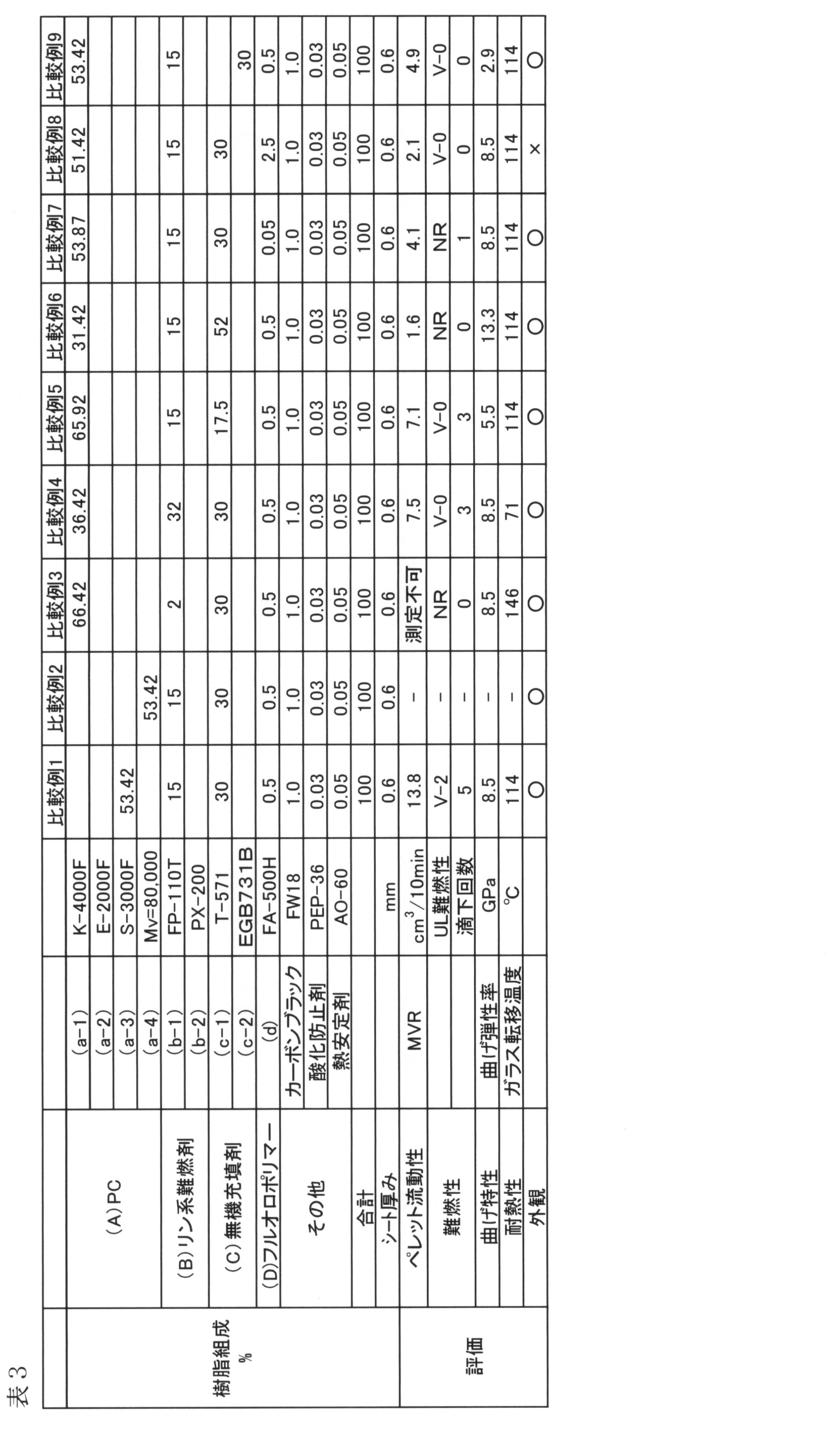
- Table 2 to Table 3 show the following.
- Each of Examples 1 to 12 contains a polycarbonate resin having a viscosity average molecular weight of 28,0000 to 60,000, a phosphorus-based flame retardant, a fibrous or plate-like inorganic filler, and a fluoropolymer in a predetermined composition.
- melt volume rate of the resin composition pellets is 2.0 ⁇ 10cm 3 / 10min, flexural modulus 5.8GPa more excellent good flame retardancy in the mechanical properties moldings thickness 0.8mm or less, It also has heat resistance of glass transition temperature of 75 ° C or higher.
- a phosphazene compound is used as the phosphorus flame retardant, it is confirmed that better heat resistance can be achieved as compared with the case where a phosphate ester compound is used.
- Comparative Example 1 The viscosity-average molecular weight of polycarbonate powder (Mv) is 23,000 is dropped cotton ignited during flame contact for melt volume rate is more than 10 cm 3 / 10min, the UL94 vertical burning test standard It was equivalent to V-2.
- Comparative Example 3 having a flame retardant amount of 2% by mass has a long combustion time and fails the UL94 vertical combustion test standard.
- Comparative Example 4 having an amount of flame retardant of 32% by mass has a low glass transition temperature and insufficient heat resistance.
- Comparative Example 5 having a glass fiber content of 15% by mass has a low flexural modulus and insufficient mechanical properties.
- Comparative Example 6 having a glass fiber content of 52% by mass has a large specific gravity, so that the glass fiber easily drops and fails the UL94 vertical combustion test standard.
- Comparative Example 7 having a PTFE of 0.05% by mass does not have a drip prevention effect and has insufficient flame retardancy.
- Comparative Example 9 in which the inorganic filler is a glass bead is not a fibrous inorganic filler, and therefore has a low flexural modulus and insufficient rigidity.
- each of the polycarbonate resin (A), the phosphorus-based flame retardant (B), the fibrous or plate-like inorganic filler (C), and the fluoropolymer (D) having a specific viscosity average molecular weight is contained in a predetermined range. According to the polycarbonate resin composition, it was confirmed that a thin film / sheet having excellent heat resistance, excellent mechanical strength, and excellent flame resistance even when thin can be produced.
- the flame-retardant polycarbonate resin sheet and film of the present invention have high rigidity and excellent flame retardancy, they can be suitably used as a casing sheet and film for electronic and electrical equipment.
Landscapes
- Chemical & Material Sciences (AREA)
- Health & Medical Sciences (AREA)
- Chemical Kinetics & Catalysis (AREA)
- Medicinal Chemistry (AREA)
- Polymers & Plastics (AREA)
- Organic Chemistry (AREA)
- Engineering & Computer Science (AREA)
- Manufacturing & Machinery (AREA)
- Materials Engineering (AREA)
- Mechanical Engineering (AREA)
- Compositions Of Macromolecular Compounds (AREA)
- Manufacture Of Macromolecular Shaped Articles (AREA)
- Extrusion Moulding Of Plastics Or The Like (AREA)
Abstract
Description
本発明の目的は、優れた耐熱性、優れた機械的強度(特に剛性)、および薄肉とした場合にも優れた難燃性を有するポリカーボネート樹脂製シート、フィルムに好適なポリカーボネート樹脂組成物およびこれを用いたシート・フィルムを提供することにある。
[1] 粘度平均分子量が28,000~60,000のポリカーボネート樹脂(A)18~75質量%、リン系難燃剤(B)5~30質量%、繊維状または板状の無機充填剤(C)18~50質量%、及びフルオロポリマー(D)0.1~2質量%を含むポリカーボネート樹脂組成物。
[2] 前記ポリカーボネート樹脂組成物の300℃、1.2kgにおけるメルトボリュームレートが2.0~10cm3/10minである[1]に記載のポリカーボネート樹脂組成物。
[3] 前記リン系難燃剤(B)がホスファゼン化合物または縮合型リン酸エステルである[1]または[2]に記載のポリカーボネート樹脂組成物。
[4] 前記リン系難燃剤(B)がホスファゼン化合物である[1]~[3]のいずれかに記載のポリカーボネート樹脂組成物。
[5] 無機充填剤(C)の含有量が、22.5~50質量%である[1]~[4]のいずれかに記載のポリカーボネート樹脂組成物。
[6] 前記無機充填剤(C)がガラス繊維である[1]~[5]のいずれかに記載のポリカーボネート樹脂組成物。
[7] シートまたはフィルム用の[1]~[6]のいずれかに記載のポリカーボネート樹脂組成物。
[8] [1]~[7]のいずれかに記載のポリカーボネート樹脂組成物を用いたシートまたはフィルム。
[9] 厚さが400~1200μmである[8]に記載のシートまたはフィルム。
[10] UL94V試験による評価結果がV-0またはV-1である[8]または[9]に記載のシートまたはフィルム。
[11] 前記ポリカーボネート樹脂(A)、前記リン系難燃剤(B)および前記フルオロポリマー(D)を含む樹脂成分のガラス転移温度が75℃以上である[8]~[10]のいずれかに記載のシートまたはフィルム。
[12] [1]~[7]のいずれか一項に記載のポリカーボネート樹脂組成物を押出成形する工程を含む、シートまたはフィルムの製造方法。
本発明の一形態は、粘度平均分子量が28,000~60,000のポリカーボネート樹脂(A)18~75質量%、リン系難燃剤(B)5~30質量%、繊維状または板状の無機充填剤(C)18~50質量%、及びフルオロポリマー(D)0.1~2質量%を含むポリカーボネート樹脂組成物である。本形態のポリカーボネート樹脂組成物によれば、優れた耐熱性、優れた機械的強度(特に剛性)、および薄肉とした場合にも優れた難燃性を有するポリカーボネート樹脂製シート、フィルムが得られる。
本発明で使用されるポリカーボネート樹脂(A)(以下「(A)成分」と称す場合がある。)の種類には、特に制限はないものの、耐熱性、機械的物性、および電気的特性の点で芳香族ポリカーボネート樹脂の使用が特に好ましい。ポリカーボネート樹脂は、ジヒドロキシ化合物又はこれと少量の分岐剤とを、ホスゲンもしくはトリホスゲン又は炭酸ジエステルと反応させることによって得られる、分岐していてもよい熱可塑性重合体又は共重合体である。
ポリカーボネート樹脂の製造方法は、特に限定されるものではなく、従来公知のホスゲン法(界面重合法)や溶融法(エステル交換法)により製造したものを使用することができる。また、溶融法を用いた場合には、末端基のOH基量を調整したポリカーボネート樹脂を使用することができる。
<粘度平均分子量(Mv)測定条件>
粘度平均分子量[Mv]は、溶媒としてメチレンクロライドを使用し、ウベローデ粘度計を用いて温度20℃での極限粘度[η](単位dl/g)を求め、下記Schnellの粘度式から算出される値(粘度平均分子量:Mv)を意味する。


本発明のポリカーボネート樹脂組成物は、難燃性の改善のためにリン系難燃剤(B)を含有する。
リン酸エステル系難燃剤は、中でも難燃化効果が高く、流動性向上効果があり、好ましく用いられる。リン酸エステル系難燃剤は限定されないが、特に、このリン酸エステル系難燃剤としては、下記の一般式(IIa)で表されるリン酸エステル系化合物が好ましい。


ホスファゼン系難燃剤は、リン酸エステル系難燃剤と比較して難燃剤の添加による樹脂組成物の耐熱性の低下を抑制できるため、効果的なリン系難燃剤として用いられる。ホスファゼン系難燃剤は、分子中に-P=N-結合を有する有機化合物であり、ホスファゼン系難燃剤としては、好ましくは下記一般式(IIIa)で表される環状ホスファゼン化合物、下記一般式(IIIb)で表される鎖状ホスファゼン化合物、下記一般式(IIIa)及び下記一般式(IIIb)からなる群より選択される少なくとも一種のホスファゼン化合物が架橋基によって架橋されてなる架橋ホスファゼン化合物が挙げられる。架橋ホスファゼン化合物としては、下記一般式(IIIc)で表される架橋基によって架橋されてなるものが難燃性の点から好ましい。

本発明のポリカーボネート樹脂組成物は繊維状または板状の無機充填剤を含む。無機充填剤は一般に、その形状から繊維状無機充填剤、板状無機充填剤、球状無機充填剤(ビーズ)に分類される。繊維状無機充填剤、板状無機充填剤は、球状無機充填剤に比べて、樹脂組成物の補強効果、特に成形品の曲げ弾性率、曲げ強度等の剛性に優れる。
ガラス系強化剤の種類は特に制限されず、繊維状または板状であればよい。
炭素系強化材としては、繊維状の充填剤として炭素繊維、カーボンナノチューブ等、板状充填剤として黒鉛が挙げられ、これらのうち、炭素繊維、黒鉛が好ましく用いられる。
本発明においては、珪酸塩系強化材も用いることができる。繊維状充填剤としてワラストナイト等、板状充填剤としてタルク、マイカ等を用いることができる。珪酸塩系強化材は1種を単独で用いてもよく、2種以上を混合して用いてもよい。
その他繊維状充填剤として、金属繊維;チタン酸カリウムウイスカー、炭酸カルシウムウイスカー、ホウ酸アルミニウムウイスカー、酸化チタンウイスカー、酸化亜鉛ウイスカー、硫酸マグネシウムウイスカーなどのウイスカーを用いることもできる。その他板状充填剤としては、金属フレーク、シリカ、アルミナ、炭酸カルシウム等を用いることもできる。これらのその他の無機充填剤についても、1種を単独で用いてもよく、2種以上を混合して用いてもよい。
本発明のポリカーボネート樹脂組成物は、滴下防止剤としてフルオロポリマー(D)を含有する。また、フルオロポリマーは、1種類を用いてもよく、2種類以上を任意の組み合わせ及び任意の比率で併用してもよい。
本発明のポリカーボネート樹脂組成物(100質量%)は、粘度平均分子量が28,000~60,000の上記ポリカーボネート樹脂(A)18~75質量%、リン系難燃剤(B)5~30質量%、繊維状または板状の無機充填剤(C)18~50質量%、及びフルオロポリマー(D)0.1~2質量%含有する。
(その他の樹脂成分)
本発明の芳香族ポリカーボネート樹脂組成物は、本発明の目的を損なわない限りにおいて、樹脂成分として、ポリカーボネート樹脂(A)やフルオロポリマー(D)以外の他の樹脂成分を含有していてもよい。配合し得る他の樹脂成分としては、例えば、ポリスチレン樹脂、ハイインパクトポリスチレン樹脂、水添ポリスチレン樹脂、ポリアクリルスチレン樹脂、ABS樹脂、AS樹脂、AES樹脂、ASA樹脂、SMA樹脂、ポリアルキルメタクリレート樹脂、ポリメタクリルメタクリレート樹脂、ポリフェニルエーテル樹脂、(A)成分以外のポリカーボネート樹脂、非晶性ポリアルキレンテレフタレート樹脂、ポリエステル樹脂、非晶性ポリアミド樹脂、ポリ-4-メチルペンテン-1、環状ポリオレフィン樹脂、非晶性ポリアリレート樹脂、ポリエーテルサルフォンなどが挙げられる。これらは1種または2種以上を組み合わせて使用されうる。
本発明の芳香族ポリカーボネート樹脂組成物は、本発明の効果を損なわない範囲で、更に種々の添加剤を含有していても良い。このような添加剤としては、熱安定剤、酸化防止剤、離型剤、紫外線吸収剤、染顔料、帯電防止剤、難燃剤、滴下防止剤、衝撃強度改良剤、可塑剤、分散剤、抗菌剤などが挙げられる。これらの添加剤は1種が含有されていてもよく、2種以上が任意の組み合わせ及び比率で含有されていても良い。
本発明のポリカーボネート樹脂組成物の製造方法に制限はなく、公知のポリカーボネート樹脂組成物の製造方法を広く採用することができる。
本発明のポリカーボネート樹脂組成物はメルトインデクサを使用し、ISO 1133に準拠して加熱温度300℃、重り1.2kg、予熱時間500秒におけるメルトボリュームレート(MVR)(cm3/10min)が2.0~10cm3/10minであることが好ましい。メルトボリュームレート2.0cm3/10min以上であれば、シート・フィルム溶融押出時のトルクの上昇による生産性の低下を防止できるメルトボリュームレート10cm3/10min以下であれば、燃焼時の滴下を抑制できる。メルトボリュームレートはより好ましくは2.0~9.0cm3/10min、さらに好ましくは2.0~8.0cm3/10min、特に好ましくは2.0~6.0cm3/10minである。メルトボリュームレートをこのような範囲とすることで、燃焼時の滴下を防止し、良好な難燃性のシートが得られる。
本発明の樹脂成分のガラス転移温度は75~170℃であることが好ましく、85~160℃がより好ましく、95~150℃が特に好ましい。ガラス転移温度が75℃以上であると耐熱性が優れたものとなり、170℃以下であると成形加工性が良好となる。なお、ここでいう樹脂成分とは(A)成分、(B)成分および(D)成分を含み、本発明のポリカーボネート樹脂組成物から(C)成分等の無機充填剤を除いた成分のことである。
本発明のポリカーボネート樹脂組成物は、様々な形態の成形体にすることができる。特に、本発明のポリカーボネート樹脂組成物を用いることで従来のポリカーボネート樹脂組成物では困難であった薄肉での難燃性に優れた成形品の提供が可能となる。本発明の成形品の適用例を挙げると、電気電子機器、OA機器、情報端末機器、機械部品、家電製品、車輌部品、建築部材、各種容器、レジャー用品・雑貨類、照明機器等の部品が挙げられる。これらの中でも、本発明の成形品は、その優れた難燃性から、特に電気電子機器、OA機器、情報端末機器、家電製品、照明機器等の部品及び銘板へ用いて好適であり、電気電子機器、照明機器の部品、シート部材に用いて特に好適である。なかでも本発明のポリカーボネート樹脂組成物は、シート及びフィルムへの成形に好適に用いられ、耐熱性、機械的強度(特に剛性)、および薄肉難燃性に優れたシート及びフィルムが得られる。
本発明のポリカーボネート樹脂組成物から得られるフィルムまたはシート(積層体の場合にはポリカーボネート樹脂層)の厚みは、400~1200μmの範囲であることが好ましく、400~1000μmの範囲がより好ましく、500~1000μmの範囲がより一層好ましく、500~800μmの範囲がさらに好ましい。400μm以上とすることで高い剛性を得ることができ、1200μm以下とすることにより薄肉化が必要な電気電子機器の筐体等に好適に用いることができる。
本発明のポリカーボネート樹脂組成物から得られるフィルムまたはシートの曲げ弾性率は、好ましくは5GPa以上であり、より好ましくは6GPa以上であり、さらに好ましくは8GPa以上である。上限は高いほどよいが、通常15GPa以下である。なお、本発明において、フィルムまたはシートの曲げ弾性率とは、0.6mmに成形したシートをダンベル試験片形状に打ち抜き、オートグラフ(島津製作所社製 AGS-X)を用いて、幅10mm、支点間距離40mm、試験速度2mm/minでシート押出方向(流れ方向)の曲げ試験を行うことにより測定することができる。
本発明の樹脂組成物から得られるフィルムまたはシートは、優れた難燃性を有する。具体的には、UL94V試験に準拠した方法で評価した場合に、好ましくはV-1またはV-0であり、より好ましくはV-0である。なお、UL94V試験は下記の実施例に記載の方法で行うことができる。
以下の実施例および比較例で用いた測定・評価法は、以下の通りである。
<ペレット流動性>
樹脂組成物ペレットについて、東洋精機社製G-01を使用し、ISO 1133に準拠して加熱温度300℃、重り1.2kg、予熱時間500秒におけるメルトボリュームレート(cm3/10min)を測定した。
<難燃性>
樹脂シートを長さ125mm、幅13mmに切断し、難燃性試験用試験片を作製した。この試験片を温度23℃、湿度50%の恒温室の中で48時間調湿し、米国アンダーライターズ・ラボラトリーズ(UL)が定めているUL94V試験(機器の部品用プラスチック材料の燃焼試験)に準拠して燃焼性試験を行った。UL94Vとは、鉛直に保持した所定の大きさの試験片にバーナーの炎を10秒間接炎した後の残炎時間やドリップ性から難燃性を評価する方法であり、V-0、V-1及びV-2の難燃性を有するためには、以下の表1に示す基準を満たすことが必要となる。

成形したシートをダンベル試験片形状に打ち抜き、オートグラフ(島津製作所社製 AGS-X)を用いて、幅10mm、支点間距離40mm、試験速度2mm/minでシート押出方向(流れ方向)の曲げ試験を行い、曲げ弾性率を測定した。
5GPa未満のものを不良、5GPa以上8GPa未満のものを良好、8GPa以上のものを最良と評価することができる。
<耐熱性>
樹脂成分のガラス転移温度を示差熱走査熱量分析計セイコー電子工業(株)製のSSC-5200(DSC)により昇温速度10℃/minで測定した。測定は樹脂成分が溶融する温度(260℃)に20℃/minで昇温し、-30℃まで急冷した後、再度10℃/minで昇温(2nd run)した。ガラス転移温度は2nd runのプロファイルで算出した値とした。
75℃未満であるものを不良、75℃以上であるものを良好と評価できる。
<外観>
前記方法で製造したシートを目視にて観察し、以下の基準に従って外観評価の判定を行った。
○:白点異物等が観察されず、良好な外観である。
×:白点異物が観察される。
ポリカーボネート紛体(粘度平均分子量(Mv):40,000(三菱エンジニアリングプラスチックス(株)製K-4000F:ビスフェノールAおよび塩化カルボニルから界面重合法で製造したポリカーボネート)53.42質量%に、リン系酸化防止剤((株)ADEKA製PEP36)を0.03質量%、および熱安定剤((株)ADEKA製AO-60)を0.05質量%、フェノキシホスファゼン系難燃剤(伏見製薬(株)製ラビトルFP-110T;上記式(IIIa)においてm≧3(主構造:環状3量体)、R5=フェニル基である化合物)を15質量%、PTFE(フィブリル形性能を有するポリテトラフルオロエチレン;ダイキン工業(株)製ポリフロンFA-500H)を0.5質量%、着色用に染顔料としてカーボンブラック(エボニックデグサ社製 商品名「Color Black FW18」)を1.0質量%添加して、タンブラーで混合した(以下の実施例および比較例においても同様である)。
押出成形機:(株)日本製鋼所製二軸押出成形機
成形品寸法:幅400mm×厚み0.6mm×長さ10m
シリンダー温度:290℃
ダイス温度:290℃
ロール温度:110℃
吐出量:23kg/h
ロール速度:1.1m/min
以下の実施例、比較例においても押出成形機と押出成形条件は同様である。
ポリカーボネート紛体の粘度平均分子量(Mv)を28,000(三菱エンジニアリングプラスチックス(株)製E-2000F:ビスフェノールAおよび塩化カルボニルから界面重合法で製造したポリカーボネート)とした以外は実施例1と同様である。
難燃剤(伏見製薬(株)製ラビトルFP-110T)を5質量%とした以外は実施例2と同様である。
難燃剤(伏見製薬(株)製ラビトルFP-110T)を30質量%とした以外は実施例1と同様である。
難燃剤を縮合リン酸エステル(大八化学工業(株)製PX-200)12.5質量%とした以外は実施例1と同様である。
ガラス繊維(日本電気硝子製T-571)を20質量%とした以外は実施例1と同様である。
ガラス繊維(日本電気硝子製T-571)を40質量%とした以外は実施例1と同様である。
ガラス繊維(日本電気硝子製T-571)を50質量%とした以外は実施例1と同様である。
PTFE(ダイキン工業(株)製ポリフロンFA-500H)を0.1質量%とした以外は実施例1と同様である。
PTFE(ダイキン工業(株)製ポリフロンFA-500H)を2.0質量%とした以外は実施例1と同様である。
難燃剤(伏見製薬(株)製ラビトルFP-110T)を10質量%とし、PTFE(ダイキン工業(株)製ポリフロンFA-500H)を0.4質量%とし、フィルム成形品(シート)の厚みを0.8mmとした以外は実施例2と同様である。
難燃剤を縮合リン酸エステル(大八化学工業(株)製PX-200)17.5質量%とした以外は実施例1と同様である。
ポリカーボネート紛体の粘度平均分子量(Mv)を23,000(三菱エンジニアリングプラスチックス(株)製S-3000F)とした以外は実施例1と同様である。
ポリカーボネート紛体の粘度平均分子量(Mv)を80,000(ビスフェノールAおよび塩化カルボニルから界面重合法で製造したポリカーボネートとした以外は実施例1と同様である。
難燃剤(伏見製薬(株)製ラビトルFP-110T)を2質量%とした以外は実施例1と同様である。
難燃剤(伏見製薬(株)製ラビトルFP-110T)を32質量%とした以外は実施例1と同様である。
ガラス繊維(日本電気硝子製T-571)は15質量%とした以外は実施例1と同様である。
ガラス繊維(日本電気硝子製T-571)は52質量%とした以外は実施例1と同様である。
PTFE(ダイキン工業(株)製ポリフロンFA-500H)を0.05質量%とした以外は実施例1と同様である。
PTFE(ダイキン工業(株)製ポリフロンFA-500H)を2.5質量%とした以外は実施例1と同様である。
<比較例9>
ガラス繊維に代えてガラスビーズ(ポッターズバロディーニ社製「EGB731B」、平均粒径18μm、アミノシラン処理)とした以外は実施例1と同様である。
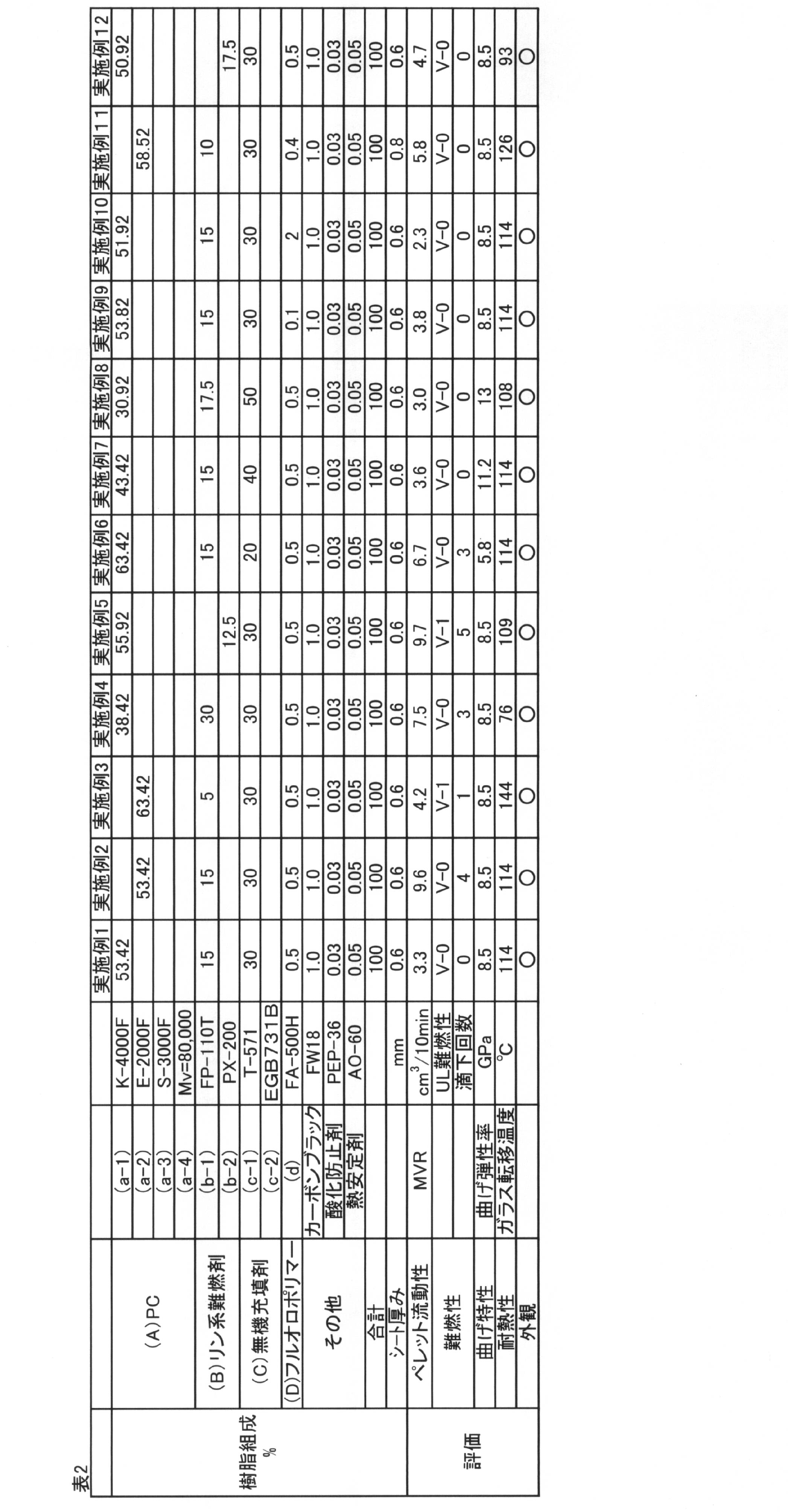
さらに、リン系難燃剤としてホスファゼン化合物を用いた場合には、リン酸エステル化合物を用いた場合に比べて、良好な耐熱性が達成できることが確認される。
Claims (11)
- 粘度平均分子量が28,000~60,000のポリカーボネート樹脂(A)18~75質量%、リン系難燃剤(B)5~30質量%、繊維状または板状の無機充填剤(C)18~50質量%、及びフルオロポリマー(D)0.1~2質量%を含むポリカーボネート樹脂組成物。
- 前記ポリカーボネート樹脂組成物の300℃、1.2kgにおけるメルトボリュームレートが2.0~10cm3/10minである請求項1に記載のポリカーボネート樹脂組成物。
- 前記リン系難燃剤(B)がホスファゼン化合物または縮合型リン酸エステルである請求項1または2に記載のポリカーボネート樹脂組成物。
- 前記リン系難燃剤(B)がホスファゼン化合物である、請求項1~3のいずれか一項に記載のポリカーボネート樹脂組成物。
- 無機充填剤(C)の含有量が、22.5~50質量%である、請求項1~4のいずれか一項に記載のポリカーボネート樹脂組成物。
- 前記無機充填剤(C)がガラス繊維である請求項1~5のいずれか一項に記載のポリカーボネート樹脂組成物。
- 請求項1~6のいずれか一項に記載のポリカーボネート樹脂組成物を用いたシートまたはフィルム。
- 厚さが400~1200μmである、請求項7に記載のシートまたはフィルム。
- UL94V試験による評価結果がV-0またはV-1である請求項7または8に記載のシートまたはフィルム。
- 前記ポリカーボネート樹脂(A)、前記リン系難燃剤(B)および前記フルオロポリマー(D)を含む樹脂成分のガラス転移温度が75℃以上である請求項7~9のいずれか一項に記載のシートまたはフィルム。
- 請求項1~6のいずれか一項に記載のポリカーボネート樹脂組成物を押出成形する工程を含む、シートまたはフィルムの製造方法。
Priority Applications (4)
| Application Number | Priority Date | Filing Date | Title |
|---|---|---|---|
| KR1020187008883A KR102564588B1 (ko) | 2015-08-31 | 2016-08-29 | 난연 폴리카보네이트 수지 조성물, 그것을 이용한 시트 및 필름, 및 그들의 제조 방법 |
| JP2017538006A JP6761806B2 (ja) | 2015-08-31 | 2016-08-29 | 難燃ポリカーボネート樹脂組成物、それを用いたシート及びフィルム、ならびにそれらの製造方法 |
| CN201680049595.7A CN107922724B (zh) | 2015-08-31 | 2016-08-29 | 阻燃聚碳酸酯树脂组合物、使用其的片材和膜以及它们的制造方法 |
| US15/743,884 US10508191B2 (en) | 2015-08-31 | 2016-08-29 | Flame-retardant polycarbonate resin composition, sheet and film each using same, and method for producing said sheet or film |
Applications Claiming Priority (2)
| Application Number | Priority Date | Filing Date | Title |
|---|---|---|---|
| JP2015-171096 | 2015-08-31 | ||
| JP2015171096 | 2015-08-31 |
Publications (1)
| Publication Number | Publication Date |
|---|---|
| WO2017038736A1 true WO2017038736A1 (ja) | 2017-03-09 |
Family
ID=58187556
Family Applications (1)
| Application Number | Title | Priority Date | Filing Date |
|---|---|---|---|
| PCT/JP2016/075133 Ceased WO2017038736A1 (ja) | 2015-08-31 | 2016-08-29 | 難燃ポリカーボネート樹脂組成物、それを用いたシート及びフィルム、ならびにそれらの製造方法 |
Country Status (6)
| Country | Link |
|---|---|
| US (1) | US10508191B2 (ja) |
| JP (1) | JP6761806B2 (ja) |
| KR (1) | KR102564588B1 (ja) |
| CN (1) | CN107922724B (ja) |
| TW (1) | TW201723055A (ja) |
| WO (1) | WO2017038736A1 (ja) |
Cited By (1)
| Publication number | Priority date | Publication date | Assignee | Title |
|---|---|---|---|---|
| WO2019044066A1 (ja) * | 2017-08-28 | 2019-03-07 | 神島化学工業株式会社 | 針状無水炭酸マグネシウム及びその製造方法、並びに樹脂組成物 |
Families Citing this family (4)
| Publication number | Priority date | Publication date | Assignee | Title |
|---|---|---|---|---|
| KR20220084270A (ko) * | 2019-10-16 | 2022-06-21 | 유니티카 가부시끼가이샤 | 수지 조성물 및 성형품 |
| KR102347830B1 (ko) * | 2019-10-31 | 2022-01-05 | 롯데케미칼 주식회사 | 열가소성 수지 조성물 및 이로부터 제조된 성형품 |
| KR102660612B1 (ko) * | 2020-08-31 | 2024-04-24 | 롯데케미칼 주식회사 | 열가소성 수지 조성물 및 이로부터 제조된 성형품 |
| CN113292838B (zh) * | 2021-07-05 | 2022-09-06 | 广东聚石化学股份有限公司 | 一种无卤型低翘曲低线膨胀系数挤出级薄壁阻燃聚碳酸酯复合材料及其制备方法 |
Citations (4)
| Publication number | Priority date | Publication date | Assignee | Title |
|---|---|---|---|---|
| JP2006316149A (ja) * | 2005-05-11 | 2006-11-24 | Sumitomo Dow Ltd | 難燃性ポリカーボネート樹脂フィルム |
| JP2013064047A (ja) * | 2011-09-16 | 2013-04-11 | Mitsubishi Chemicals Corp | ポリカーボネート樹脂組成物 |
| WO2013115151A1 (ja) * | 2012-01-31 | 2013-08-08 | 三菱エンジニアリングプラスチックス株式会社 | ポリカーボネート樹脂組成物 |
| JP2013194200A (ja) * | 2012-03-22 | 2013-09-30 | Idemitsu Kosan Co Ltd | ポリカーボネート樹脂組成物及びそれを用いた成形体 |
Family Cites Families (5)
| Publication number | Priority date | Publication date | Assignee | Title |
|---|---|---|---|---|
| JP5142358B2 (ja) | 2007-03-12 | 2013-02-13 | 住化スタイロンポリカーボネート株式会社 | 押出成形用難燃性ポリカーボネート樹脂組成物およびそれからなる成形品 |
| JP5602997B2 (ja) | 2008-09-16 | 2014-10-08 | 帝人株式会社 | ガラス繊維強化芳香族ポリカーボネート樹脂組成物 |
| EP2554244A4 (en) * | 2010-03-29 | 2014-12-17 | Ilkovics Roberto Tomás Miklos | METHOD FOR THE REMOVAL OF ACID GASES FROM THE AIR AND FROM COMBUSTION GAS FROM COMBUSTION AND COMBUSTION ENGINES BY ABSORPTION WITH A SODIUM HYDROXIDE SOLUTION AND METHOD FOR OBTAINING SODIUM CARBONATE FOR THE RECOVERY OF CARBON DIOXIDE CERTIFICATES |
| JP5449443B2 (ja) | 2012-04-20 | 2014-03-19 | 三菱エンジニアリングプラスチックス株式会社 | ポリカーボネート樹脂組成物 |
| US9018286B2 (en) * | 2012-05-24 | 2015-04-28 | Sabic Global Technologies B.V. | Flame retardant polycarbonate compositions, methods of manufacture thereof and articles comprising the same |
-
2016
- 2016-08-29 JP JP2017538006A patent/JP6761806B2/ja active Active
- 2016-08-29 KR KR1020187008883A patent/KR102564588B1/ko active Active
- 2016-08-29 US US15/743,884 patent/US10508191B2/en active Active
- 2016-08-29 CN CN201680049595.7A patent/CN107922724B/zh active Active
- 2016-08-29 WO PCT/JP2016/075133 patent/WO2017038736A1/ja not_active Ceased
- 2016-08-30 TW TW105127900A patent/TW201723055A/zh unknown
Patent Citations (4)
| Publication number | Priority date | Publication date | Assignee | Title |
|---|---|---|---|---|
| JP2006316149A (ja) * | 2005-05-11 | 2006-11-24 | Sumitomo Dow Ltd | 難燃性ポリカーボネート樹脂フィルム |
| JP2013064047A (ja) * | 2011-09-16 | 2013-04-11 | Mitsubishi Chemicals Corp | ポリカーボネート樹脂組成物 |
| WO2013115151A1 (ja) * | 2012-01-31 | 2013-08-08 | 三菱エンジニアリングプラスチックス株式会社 | ポリカーボネート樹脂組成物 |
| JP2013194200A (ja) * | 2012-03-22 | 2013-09-30 | Idemitsu Kosan Co Ltd | ポリカーボネート樹脂組成物及びそれを用いた成形体 |
Cited By (2)
| Publication number | Priority date | Publication date | Assignee | Title |
|---|---|---|---|---|
| WO2019044066A1 (ja) * | 2017-08-28 | 2019-03-07 | 神島化学工業株式会社 | 針状無水炭酸マグネシウム及びその製造方法、並びに樹脂組成物 |
| JP2019038725A (ja) * | 2017-08-28 | 2019-03-14 | 神島化学工業株式会社 | 針状無水炭酸マグネシウム及びその製造方法、並びに樹脂組成物 |
Also Published As
| Publication number | Publication date |
|---|---|
| CN107922724B (zh) | 2020-07-03 |
| CN107922724A (zh) | 2018-04-17 |
| US10508191B2 (en) | 2019-12-17 |
| KR102564588B1 (ko) | 2023-08-07 |
| KR20180048852A (ko) | 2018-05-10 |
| US20180201754A1 (en) | 2018-07-19 |
| JPWO2017038736A1 (ja) | 2018-06-14 |
| JP6761806B2 (ja) | 2020-09-30 |
| TW201723055A (zh) | 2017-07-01 |
Similar Documents
| Publication | Publication Date | Title |
|---|---|---|
| JP6716551B2 (ja) | ポリカーボネート樹脂組成物、およびポリカーボネート樹脂製プリプレグ | |
| JP5615992B1 (ja) | レーザーダイレクトストラクチャリング用樹脂組成物、樹脂成形品、およびメッキ層付樹脂成形品の製造方法 | |
| JP5946256B2 (ja) | ポリカーボネート樹脂組成物 | |
| WO2018047693A1 (ja) | ポリカーボネート樹脂組成物 | |
| JP6761806B2 (ja) | 難燃ポリカーボネート樹脂組成物、それを用いたシート及びフィルム、ならびにそれらの製造方法 | |
| JP2019059813A (ja) | ポリカーボネート樹脂組成物 | |
| JP2007099799A (ja) | 高熱伝導絶縁性ポリカーボネート系樹脂組成物および成形体 | |
| JP2025168562A (ja) | ポリカーボネート樹脂組成物 | |
| JP2003105184A (ja) | ポリカーボネート樹脂組成物 | |
| JP5863350B2 (ja) | ポリカーボネート樹脂組成物 | |
| JP2007099798A (ja) | 熱伝導性ポリカーボネート系樹脂組成物および成形体 | |
| JP6749331B2 (ja) | 難燃ポリカーボネート樹脂組成物、それを用いたシート及びフィルム、ならびにそれらの製造方法 | |
| JP6695342B2 (ja) | 難燃ポリカーボネート樹脂組成物、それを用いたシート及びフィルム、ならびにそれらの製造方法 | |
| JP2017095667A (ja) | 樹脂組成物、成形体、電子部品、電子機器、及び電子事務機器 | |
| TWI398463B (zh) | An aromatic polycarbonate resin composition and a molded body using the same | |
| KR20110017851A (ko) | 방향족 폴리카보네이트 수지 조성물 및 그 성형체 | |
| JP2009120790A (ja) | ウェルド部の外観に優れた難燃性ポリカーボネート樹脂組成物及びそれからなる成形品。 | |
| JP6713272B2 (ja) | ポリカーボネート系樹脂組成物、製品、筐体形成用樹脂、ポリカーボネート系樹脂組成物を筐体形成用樹脂として使用する方法、およびポリカーボネート系樹脂組成物の製造方法 | |
| JP2009120791A (ja) | ウェルド部の外観に優れた難燃性ポリカーボネート樹脂組成物及びそれからなる成形品。 | |
| JP5170959B2 (ja) | 難燃性ガラス繊維強化樹脂組成物 | |
| JP2019206650A (ja) | 難燃性ポリカーボネート樹脂組成物 | |
| JP2008150451A (ja) | 流動性の改良された難燃性ポリカーボネート樹脂組成物 | |
| JP2011038046A (ja) | 芳香族ポリカーボネート樹脂組成物 |
Legal Events
| Date | Code | Title | Description |
|---|---|---|---|
| 121 | Ep: the epo has been informed by wipo that ep was designated in this application |
Ref document number: 16841768 Country of ref document: EP Kind code of ref document: A1 |
|
| ENP | Entry into the national phase |
Ref document number: 2017538006 Country of ref document: JP Kind code of ref document: A |
|
| WWE | Wipo information: entry into national phase |
Ref document number: 15743884 Country of ref document: US |
|
| NENP | Non-entry into the national phase |
Ref country code: DE |
|
| ENP | Entry into the national phase |
Ref document number: 20187008883 Country of ref document: KR Kind code of ref document: A |
|
| 122 | Ep: pct application non-entry in european phase |
Ref document number: 16841768 Country of ref document: EP Kind code of ref document: A1 |