WO2017038486A1 - 自動車ユーザ情報管理システム - Google Patents
自動車ユーザ情報管理システム Download PDFInfo
- Publication number
- WO2017038486A1 WO2017038486A1 PCT/JP2016/074126 JP2016074126W WO2017038486A1 WO 2017038486 A1 WO2017038486 A1 WO 2017038486A1 JP 2016074126 W JP2016074126 W JP 2016074126W WO 2017038486 A1 WO2017038486 A1 WO 2017038486A1
- Authority
- WO
- WIPO (PCT)
- Prior art keywords
- user information
- user
- information
- vehicle
- information management
- Prior art date
- Legal status (The legal status is an assumption and is not a legal conclusion. Google has not performed a legal analysis and makes no representation as to the accuracy of the status listed.)
- Ceased
Links
Images




Classifications
-
- B—PERFORMING OPERATIONS; TRANSPORTING
- B60—VEHICLES IN GENERAL
- B60W—CONJOINT CONTROL OF VEHICLE SUB-UNITS OF DIFFERENT TYPE OR DIFFERENT FUNCTION; CONTROL SYSTEMS SPECIALLY ADAPTED FOR HYBRID VEHICLES; ROAD VEHICLE DRIVE CONTROL SYSTEMS FOR PURPOSES NOT RELATED TO THE CONTROL OF A PARTICULAR SUB-UNIT
- B60W30/00—Purposes of road vehicle drive control systems not related to the control of a particular sub-unit, e.g. of systems using conjoint control of vehicle sub-units
- B60W30/14—Adaptive cruise control
- B60W30/16—Control of distance between vehicles, e.g. keeping a distance to preceding vehicle
-
- A—HUMAN NECESSITIES
- A61—MEDICAL OR VETERINARY SCIENCE; HYGIENE
- A61B—DIAGNOSIS; SURGERY; IDENTIFICATION
- A61B5/00—Measuring for diagnostic purposes; Identification of persons
- A61B5/117—Identification of persons
- A61B5/1171—Identification of persons based on the shapes or appearances of their bodies or parts thereof
- A61B5/1172—Identification of persons based on the shapes or appearances of their bodies or parts thereof using fingerprinting
-
- B—PERFORMING OPERATIONS; TRANSPORTING
- B60—VEHICLES IN GENERAL
- B60R—VEHICLES, VEHICLE FITTINGS, OR VEHICLE PARTS, NOT OTHERWISE PROVIDED FOR
- B60R16/00—Electric or fluid circuits specially adapted for vehicles and not otherwise provided for; Arrangement of elements of electric or fluid circuits specially adapted for vehicles and not otherwise provided for
- B60R16/02—Electric or fluid circuits specially adapted for vehicles and not otherwise provided for; Arrangement of elements of electric or fluid circuits specially adapted for vehicles and not otherwise provided for electric constitutive elements
- B60R16/037—Electric or fluid circuits specially adapted for vehicles and not otherwise provided for; Arrangement of elements of electric or fluid circuits specially adapted for vehicles and not otherwise provided for electric constitutive elements for occupant comfort, e.g. for automatic adjustment of appliances according to personal settings, e.g. seats, mirrors, steering wheel
-
- B—PERFORMING OPERATIONS; TRANSPORTING
- B60—VEHICLES IN GENERAL
- B60W—CONJOINT CONTROL OF VEHICLE SUB-UNITS OF DIFFERENT TYPE OR DIFFERENT FUNCTION; CONTROL SYSTEMS SPECIALLY ADAPTED FOR HYBRID VEHICLES; ROAD VEHICLE DRIVE CONTROL SYSTEMS FOR PURPOSES NOT RELATED TO THE CONTROL OF A PARTICULAR SUB-UNIT
- B60W40/00—Estimation or calculation of non-directly measurable driving parameters for road vehicle drive control systems not related to the control of a particular sub unit, e.g. by using mathematical models
- B60W40/08—Estimation or calculation of non-directly measurable driving parameters for road vehicle drive control systems not related to the control of a particular sub unit, e.g. by using mathematical models related to drivers or passengers
- B60W40/09—Driving style or behaviour
-
- B—PERFORMING OPERATIONS; TRANSPORTING
- B60—VEHICLES IN GENERAL
- B60W—CONJOINT CONTROL OF VEHICLE SUB-UNITS OF DIFFERENT TYPE OR DIFFERENT FUNCTION; CONTROL SYSTEMS SPECIALLY ADAPTED FOR HYBRID VEHICLES; ROAD VEHICLE DRIVE CONTROL SYSTEMS FOR PURPOSES NOT RELATED TO THE CONTROL OF A PARTICULAR SUB-UNIT
- B60W50/00—Details of control systems for road vehicle drive control not related to the control of a particular sub-unit, e.g. process diagnostic or vehicle driver interfaces
- B60W50/08—Interaction between the driver and the control system
-
- G—PHYSICS
- G08—SIGNALLING
- G08G—TRAFFIC CONTROL SYSTEMS
- G08G1/00—Traffic control systems for road vehicles
-
- G—PHYSICS
- G08—SIGNALLING
- G08G—TRAFFIC CONTROL SYSTEMS
- G08G1/00—Traffic control systems for road vehicles
- G08G1/09—Arrangements for giving variable traffic instructions
- G08G1/0962—Arrangements for giving variable traffic instructions having an indicator mounted inside the vehicle, e.g. giving voice messages
- G08G1/0968—Systems involving transmission of navigation instructions to the vehicle
-
- G—PHYSICS
- G08—SIGNALLING
- G08G—TRAFFIC CONTROL SYSTEMS
- G08G1/00—Traffic control systems for road vehicles
- G08G1/16—Anti-collision systems
Definitions
- the present invention relates to an automobile user information management system capable of automatically setting a function adjustable by a user in an automobile according to the individual tendency of the user.
- Patent Document 1 an in-vehicle computer system that selectively enables execution of a driver-dependent function in accordance with user information indicating the preference and propensity of the user of the car on board.
- the driver's identity is estimated based on current driving data / behavior (user information) regarding one or more driver profiles, and the driver's dependence is determined based on the estimated driver's identity.
- This is an in-vehicle computer system that selectively enables execution of the functions. Therefore, it is necessary for the in-vehicle computer system to accumulate past driving data / behavior for each of a plurality of users, and to reach a state where it is possible to selectively execute a driver-dependent function based on the identity of the driver. Needs to establish a driver profile, which takes a long time to learn.
- the present invention provides an automobile user information management system capable of reliably and easily recognizing individual users without guessing the user's identity.
- the automobile user information management system of the present invention includes a cloud server that stores user information that depends on individual automobile users in association with the biometric information of the user, biometric authentication means that authenticates the detected biometric information, A control unit that controls a function adjustable by a user in the vehicle according to the user information downloaded from the cloud server based on the authenticated biometric information.
- the said control unit detects the content which the user set by the adjustment in the said vehicle as user information which depends on the said user, and transmits to the said cloud server with the said biometric information which the said biometric recognition sensor recognizes. It is preferable to have a user information management means. As a result, the contents directly set by the user in the automobile are stored in the cloud server.
- the user information includes any of the air conditioning temperature in the vehicle, the volume of the audio, and the seat position.
- the user information may be information related to the destination of driving, an inter-vehicle distance from a preceding vehicle, and an inter-vehicle distance when a brake operation is performed.
- the inter-vehicle distance is preferably measured by processing an image from a stereo camera.
- the biometric authentication unit is provided in a portable device carried by a user, and the portable device is authenticated by the biometric authentication unit being able to communicate with the control unit by performing biometric authentication.
- a system configuration in which information is transmitted and the control unit downloads the user information associated with the received biological information from the cloud server is possible.
- the portable device is not limited to a dedicated device having a biometric authentication function, and may be a general-purpose portable information terminal such as a smartphone or a tablet computer as long as it has a biometric authentication function.
- the automobile user information management system of the present invention since the user's unique biometric information is recognized, it does not require time until the driver's profile is established, and the function of the automobile is obtained while accumulating user information. Can be adjusted to your liking.
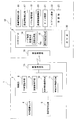
- the conceptual diagram of the motor vehicle user information management system which concerns on embodiment of this invention is shown.
- the block diagram explaining the structure of the portable apparatus and motor vehicle in FIG. 1 is shown.
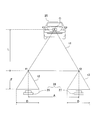
- the schematic diagram explaining the measuring method of the inter-vehicle distance from the right-and-left camera to a preceding vehicle by a stereo camera is shown.
- movement of the portable apparatus in a motor vehicle user information management system is shown.
- movement of the portable device authentication means of a control unit is shown.
- movement of the user information management means of a control unit is shown.
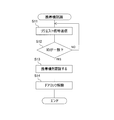
- movement which measures the distance between vehicles to a preceding vehicle is shown.
- FIG. 1 is a conceptual diagram showing the overall configuration of the automobile user information management system 100.
- the automobile user information management system 100 includes a portable device 1 carried by a user, a control unit 2 mounted on the automobile 12, and a cloud server 3.
- the control unit 2 and the cloud server 3 are connected via a communication network 6.
- FIG. 2 is a block diagram showing the configurations of the portable device 1 and the control unit 2.
- the portable device 1 includes a biological recognition sensor 4, a registration instruction device 5, a wireless communication unit 13, and a control unit 7.
- the biometric recognition sensor 4 detects biometric information peculiar to the user, such as a fingerprint, a finger vein pattern, and a heartbeat.
- the biometric recognition sensor 4 in this example is a fingerprint sensor. When a person presses the tip of a finger against a detection unit arranged on the case surface of the portable device 1, the fingerprint pattern is detected as biometric information.
- the wireless communication unit 13 performs wireless communication with the control unit 2 of the automobile 12 at a short distance in the RF band. In this case, when the control unit 2 determines that the portable device 1 existing in the wireless communication range is registered in advance, wireless communication is possible.
- the control unit 7 includes a computer including a CPU, a ROM, and a RAM.
- Each of the biometric authentication unit 8, the communication control unit 9, and the biometric information registration unit 10 is a control program in which the CPU is stored in the ROM. It is realized by processing.
- the control part 7 is provided with the registration biometric information storage part 11 by the flash memory which has memorize
- the biometric information registration unit 10 stores the biometric information (in this example, fingerprint information) detected by the biometric recognition sensor 4 in the registered biometric information storage unit 11 in response to the registration instruction signal from the registration instruction device 5.
- biometric information in this example, fingerprint information
- a plurality of biological information can be registered in the registered biological information storage unit 11.
- the registration instruction device 5 is configured by a switch device that outputs a registration instruction signal by a predetermined operation by a registrant.
- the registration instruction device 5 is usually provided separately from the portable device 1 from the viewpoint of security. Therefore, it is preferable that the mobile phone 1 is used by being connected at the time of registration setting.
- the portable device 1 described above has a configuration in which a so-called “portable device” conventionally used in an electronic key system is provided with a fingerprint authentication function, but the portable device 1 has a short distance such as a fingerprint authentication function or Bluetooth. It may be a portable information terminal such as a smartphone or a tablet computer having a wireless function.
- the biometric authentication unit 8 compares the detected biometric information with the registered biometric information stored in the registered biometric information storage unit 11 and determines whether or not they match each other. Determine. If they match, the authentication flag 8a provided in the RAM is set.
- the communication control means 9 exchanges signals for inter-device authentication between the portable device 1 and the control unit 2 of the automobile 12.
- the inter-device authentication at this time is performed by transmitting an ID set in advance in the portable device 1 in response to receiving a request signal that the control unit 2 periodically transmits.
- the control unit 2 is a main control unit of the automobile 12 composed of a CPU, and performs control processing of each electrical equipment including the traveling system 30 based on execution of predetermined software.
- FIG. 2 shows the user information management means 14 and the portable device authentication means 15 for performing the authentication operation with the portable device 1, which are directly related to the operation of the automobile user information management system 100 according to the present invention. These are also realized by executing this software.
- the control unit 2 is connected to a vehicle information detection unit 16 that detects vehicle information.
- vehicle information detection unit 16 is, for example, a wheel speed sensor, a throttle sensor, a brake pedal sensor, a parking brake sensor, a steering sensor, and a shift sensor that are appropriately arranged in each part of the traveling system 30 of the automobile. The detection result by the sensor is supplied to the control unit 2 as vehicle information.
- the wheel speed sensor is a sensor that detects the rotational speed of the wheel.
- the throttle sensor is a sensor that detects the opening of the engine throttle.
- the brake pedal sensor is a sensor that detects the depression amount of the brake pedal.
- the parking brake sensor is a sensor that detects an operating state of the parking brake.
- the steering sensor is a sensor that detects the steering amount of the steering wheel.
- the shift sensor is a sensor that detects a shift position selected by the shift lever.
- control unit 2 is connected to a peripheral information detection unit 17 that detects a proximity state with an object existing in front, rear, and side of the automobile 12 as peripheral information.
- a peripheral information detection unit 17 for example, a stereo camera, a laser sensor, or a sonar sensor is used.
- the peripheral information detection unit 17 supplies the detection result of the peripheral information to the control unit 2.
- control unit 2 includes a wireless communication unit 18 that performs short-range wireless communication with the portable device 1, a door and trunk door lock drive unit 19, a seat drive mechanism unit 20, an audio device 21, a navigation device 22, and an in-vehicle air conditioner. 23 etc. It is connected with vehicle equipment.
- the user information management means 14 detects user information in association with the biological information transmitted from the portable device 1.
- user information for example, the position of the seat, the address of the home or work, the frequently visited place, the store, the air conditioning environment in the car, the inter-vehicle distance with the preceding vehicle according to the speed of the car, the brake operation There is an inter-vehicle distance (brake operation timing) with the preceding vehicle.
- the seat drive mechanism unit 20 can adjust the seat position in the front-rear direction by sliding the position of the seat by converting the rotational force of the motor into a linear motion using a rack and pinion. Therefore, the user information management means 14 can detect the position of the seat as user information from the number of rotations of the pinion in the forward and reverse directions.
- the user information management means 14 can detect the user information of the address of the home or work by being input to the navigation device 22 by the user. And the user information management means 14 can detect the frequently visited places and shops by inputting the addresses of those places to the navigation device 22 and setting the guidance to the destination.
- the air conditioning environment in the vehicle can be detected by the user information management means 14 from the temperature, air volume, and wind direction information set by the user in the air conditioner 23 in the vehicle.
- the user information management means 14 can detect from the detection information which the vehicle information detection part 16 and the periphery information detection part 17 output when a user drives the driving system 30 by driving the automobile 12.
- a stereo camera 28 in which a pair of cameras 26 and 27 (see FIG. 3) that detect the field of view ahead of the traveling direction of the automobile 12 is arranged on the left and right of the front windshield is used for the peripheral information detection unit 17. be able to.
- the user information management means 14 performs pattern matching processing on the images sent from the cameras 26 and 27, and detects the presence of the vehicle or motorcycle by detecting the contour of the scenery captured by the images.
- An image processing unit 14a for determination is provided. Therefore, a pattern data file in which the image features to be detected are registered in advance is set in the ROM. And the user information management means 14 judges that it is a preceding vehicle, when the image of the left front side which the camera 26 imaged, and the image of the right front side which the camera 27 imaged have each caught the car, the motorcycle, etc. in common, A parallax image is generated and the distance to the detection target is measured.
- the vehicle information detecting unit 16 takes in the speed of the host vehicle detected by the wheel speed sensor at this time, and maintains the inter-vehicle distance. When the vehicle speed is detected.
- the user information management means 14 detects the inter-vehicle distance from the preceding vehicle when the user performs the brake operation from the inter-vehicle distance measured when the vehicle information detection unit 16 detects the brake operation by the brake pedal sensor. To do.
- the control unit 2 transmits the information detected by the user information management means 14 and the biological information acquired from the portable device 1 to the cloud server 3.
- the cloud server 3 includes a user information database 3a that stores biometric information and user information detected by the control unit 2 in association with each other, and stores various user information transmitted from the control unit 2 in the user information database 3a. I will do it.
- FIG. 4 is a flowchart showing the operation of the portable device 1, and the control unit 7 of the portable device 1 determines whether or not the biological information is detected by the biological recognition sensor 4 by the biometric authentication means 8 (step S1).
- the biometric sensor 4 detects biometric information based on the fingerprint.
- the biometric authentication unit 8 collates the detected biometric information with the registered biometric information stored in the registered biometric information storage unit 11 to register the user in advance. It is determined whether or not the user is a new user (step 2). However, when the collation does not match and the user is not a registered user, the process of step S4 is performed. The operation at this time will be clarified later.
- the control unit 7 establishes a wireless communication connection with the control unit 2 of the automobile 12. Is made possible (step S3).
- the state in which wireless communication connection is possible means that when the control unit 2 of the automobile 12 transmits a request signal by the portable device authentication means 15, the portable device 1 transmits an ID by the communication control means 9 in response thereto. It is a state that can be done. In this state, when the portable device 1 approaches the vehicle and receives a request signal from the control unit 2, an ID signal is transmitted.
- FIG. 5 is a flowchart showing the operation of “recognition of portable device” by the portable device authentication means 15 of the control unit 2.
- the portable device recognition means 15 transmits a request signal for requesting an ID to the portable device 1 (step S11).
- the biometric authentication unit 8 confirms that the user is a registered user and the wireless communication connection is possible
- the ID is transmitted when the request signal is received.
- the portable device authentication means 15 determines whether or not the ID matches a preset ID (step S12), and recognizes the presence of the portable device 1 if the ID matches (step S13). .
- authentication between the control unit 7 and the control unit 2 is established.
- step S 5 when authentication with the control unit 2 is established (“YES” in step S ⁇ b> 4), the portable device 1 uses the biological information detected by the biological recognition sensor 4 as the control unit 2. (Step S5). However, when the authentication with the control unit 2 is not established, the wireless communication connection with the control unit 2 is switched to an impossible state (step S5).
- control unit 2 outputs a door lock release signal to the door lock drive unit 19 to release the door lock when authentication with the portable device 1 is established (step S14), and a portable device recognition process routine is performed. Exit.
- control unit 2 executes predetermined software and controls each electrical device in the traveling system 30 of the vehicle 12 in response to a user operation, thereby causing the vehicle 12 to travel. .
- FIG. 6 is a flowchart showing the operation of “user information management” by the user information management means 15 of the control unit 2.
- the user information management means 15 accesses the cloud server 3 (step S21), and inquires whether user information corresponding to the biological information transmitted from the portable device 1 is stored (step S22).
- step S23 If user information is stored, it is downloaded and the air conditioning temperature in the vehicle, audio volume, seat position, etc. are set to conditions according to the user based on the acquired user information (step S23).
- the setting at this time includes supplying user information of the user's home and workplace, frequently visited places, and store addresses to the navigation device 22. Therefore, if the destination is one of these addresses, the user only needs to select a location when setting the destination in the navigation device 22.
- the inter-vehicle distance and the brake operation timing are mainly useful information for the autonomous driving vehicle, but will become clear later.
- step S24 when the user information linked
- the setting contents are collected as user information (step S24). Further, even when user information is stored in the cloud server 3 and the setting according to the user is performed in step S23, the user information is collected in step S24 because it may be changed after that. .
- the collection of the office or home address user's address in the user information from the portable terminal such as a smartphone carried by the user to the control unit 2 is performed.
- the user information management means 14 can also detect by transmitting. In this case, the user transmits the portable terminal to the control unit 2 by a wired connection such as USB or a short-distance wireless connection such as Bluetooth or Wi-Fi.
- the user information management unit 14 stores the collected user information in the cloud Whether to upload to the server 3 is determined (step S25).
- the user information is not initially stored in the cloud server 3
- the user information collected together with the biological information is transferred to the cloud server 3.
- the user information management means 14 ends the user information management routine.
- the inter-vehicle distance and the brake operation timing are information mainly applied in the case of an autonomous driving vehicle.
- Level 1 is called a safe driving support system, where the vehicle performs acceleration, steering, or braking.
- Level 2 is called a semi-automatic driving system (semi-automatic driving), in which a vehicle simultaneously performs a plurality of operations of acceleration, steering, and braking.
- Level 3 is a state in which acceleration, steering, and braking are all performed by the vehicle and the driver responds only in an emergency.
- Level 4 is called a fully automatic driving system in which acceleration, steering and braking are all performed by a person other than the driver and the driver is not involved at all.
- Levels 2 to 4 are also called automated driving systems ("Step SIP (Strategic Innovation Creation Program) Automated Driving System Research and Development Plan", November 13, 2014, Cabinet Office, Policy Director (Science Technology and innovation)). Therefore, “automatic driving” in this specification basically refers to automatic driving at a fully automated level from level 1 to level 4 described above.
- the user's preferred distance between vehicles and brake operation timing are acquired as user information, and during automatic driving, the vehicle automatically travels at the distance between vehicles and brake operation timing based on this data. This can give the user a sense of security.
- FIG. 7 is a flowchart for explaining the operation in which the user information management means 14 measures the inter-vehicle distance in step S24.
- the image processing unit 14a takes in image data from the left and right cameras of the stereo camera (step S31). Then, the image processing unit 14a refers to the pattern data file, performs pattern matching processing on each image captured by the cameras 26 and 27, and recognizes the contour of the detection target, so that there is a preceding vehicle. It is determined whether or not (step S32).
- the image processing unit 14a generates a parallax image by fixing the position of the preceding vehicle in these two images and superimposing them.
- An inter-vehicle distance from the preceding vehicle is measured from the image by calculation (step S33).
- FIG. 3 is a diagram schematically showing the relationship between the distances from both the cameras 26 and 27 to the preceding vehicle 25 in the parallax image.
- the triangle t1 having the three focal points f1 and f2 of the cameras 26 and 27 and the position O of the preceding vehicle 25, and the three vertexes of both ends of the parallax D of the camera 26 and the focal point f1.
- the user information management means 14 detects the speed of the host vehicle from the wheel speed sensor, but periodically acquires the inter-vehicle distance L and the speed. The distance between the vehicles maintained by the user is detected according to the speed. And the user information management means 14 calculates the average value of the distance between vehicles in each speed step for every 10 km / h, for example, and makes it the user information of the distance between vehicles.
- the user information management means 14 acquires the inter-vehicle distance L detected by the image processing unit 14a and the speed detected from the wheel speed sensor, and is also 10 km / The average value of the inter-vehicle distance at each speed stage for each h is calculated and used as the user information of the inter-vehicle distance (that is, the brake operation timing) for performing the brake operation.
- the user information management means 14 transmits the user information of the inter-vehicle distance and the brake operation timing to the cloud server 3 in step S26 together with other user information.
- these user information have been sent together. It is stored in the user information database in association with the biological information.
- the user information sent to the cloud server 3 is downloaded by access from the control unit 2 of the automobile.
- the control unit 2 is relieved to the user.
- the automatic driving is controlled by controlling the traveling system 30 so as to realize an inter-vehicle distance and a brake operation timing that give a feeling.
- the automobile user information management system 100 in order to acquire user information of a user in association with individual biometric information of the user and store it in the cloud server 3, and to download user information corresponding to the biometric information, Even if changes, the same in-vehicle environment and automatic driving conditions can be provided to the user. Or, in the case of the same car, even if the users are different, the in-vehicle environment and the conditions of automatic driving according to the users can be provided for each user.
- biometric authentication is performed by the portable device 1, but the biometric recognition sensor 4 and the biometric authentication means 8 may be provided in the automobile 12.
- the user information is acquired by the user information management means 14 provided in the control unit 2 of the automobile 12 and uploaded to the cloud server 3 together with the biological information.
- the user includes a fingerprint sensor.
- a system may be used in which biometric information and user information are set by accessing directly from an information terminal such as a personal computer.
- the cloud server 3 transmits a web page when a user accesses an established website from an information terminal. And a user inputs user information and biometric information into a web page. Regarding the inter-vehicle distance and the brake operation timing, the cloud server 3 may display a vehicle driving simulation on a web page so that the user can input the inter-vehicle distance and the brake operation timing from the information terminal.
- each music user uploads the music information reproduced from the audio device 21 to the cloud server 3 together with the biometric information of the user by using a music medium such as a CD or an MP3 player. It is stored in the information database 3a. Then, the control unit 2 extracts the common music from the music information of each person downloaded from the cloud server 3, so that the music that the user likes in common can be reproduced from the audio device 21.
- the user information includes personal information such as home and work addresses, and when automatic driving becomes popular in the future, it may be necessary to include highly confidential personal information such as chronic diseases. It is done. There is a risk in storing these personal information in the cloud server 3. Therefore, it is preferable to store personal information in the user information in the portable device 1 and store other information in the cloud server 3. In order to hold personal information in the portable device 1, it is directly input from an information terminal owned by the user.
- the portable device 1 acquires the biological information of the user by the biological recognition sensor 4, the portable device 1 transmits personal information together with the biological information to the control unit 2, and the control unit 2 associates the biological information with the cloud server 3. Download user information other than stored personal information.
- the cloud server 3 when the cloud server 3 stores user information including personal information, the cloud server 3 encrypts and stores the user information and decrypts the user information downloaded by the control unit 2. Obtain.
- the key information to be decrypted is set in advance by the user and input to the portable device 1.
- the portable device 1 obtains the user's biological information by the biological recognition sensor 4, the key information is displayed together with the biological information. Transmit to the control unit 2.
Landscapes
- Engineering & Computer Science (AREA)
- Automation & Control Theory (AREA)
- Physics & Mathematics (AREA)
- Mechanical Engineering (AREA)
- Transportation (AREA)
- Health & Medical Sciences (AREA)
- General Physics & Mathematics (AREA)
- Life Sciences & Earth Sciences (AREA)
- Biophysics (AREA)
- Molecular Biology (AREA)
- Radar, Positioning & Navigation (AREA)
- Mathematical Physics (AREA)
- Human Computer Interaction (AREA)
- Pathology (AREA)
- Biomedical Technology (AREA)
- Heart & Thoracic Surgery (AREA)
- Medical Informatics (AREA)
- Remote Sensing (AREA)
- Surgery (AREA)
- Animal Behavior & Ethology (AREA)
- General Health & Medical Sciences (AREA)
- Public Health (AREA)
- Veterinary Medicine (AREA)
- Traffic Control Systems (AREA)
- Measurement Of The Respiration, Hearing Ability, Form, And Blood Characteristics Of Living Organisms (AREA)
- Control Of Driving Devices And Active Controlling Of Vehicle (AREA)
Applications Claiming Priority (2)
| Application Number | Priority Date | Filing Date | Title |
|---|---|---|---|
| JP2015168532A JP2017043268A (ja) | 2015-08-28 | 2015-08-28 | 自動車ユーザ情報管理システム |
| JP2015-168532 | 2015-08-28 |
Publications (1)
| Publication Number | Publication Date |
|---|---|
| WO2017038486A1 true WO2017038486A1 (ja) | 2017-03-09 |
Family
ID=58187513
Family Applications (1)
| Application Number | Title | Priority Date | Filing Date |
|---|---|---|---|
| PCT/JP2016/074126 Ceased WO2017038486A1 (ja) | 2015-08-28 | 2016-08-18 | 自動車ユーザ情報管理システム |
Country Status (2)
| Country | Link |
|---|---|
| JP (1) | JP2017043268A (enExample) |
| WO (1) | WO2017038486A1 (enExample) |
Cited By (5)
| Publication number | Priority date | Publication date | Assignee | Title |
|---|---|---|---|---|
| CN107316363A (zh) * | 2017-07-05 | 2017-11-03 | 奇瑞汽车股份有限公司 | 一种基于生物识别技术的汽车智能互联系统 |
| CN112298192A (zh) * | 2019-07-31 | 2021-02-02 | 比亚迪股份有限公司 | 车辆及其控制策略生成方法和装置 |
| JPWO2021124894A1 (enExample) * | 2019-12-20 | 2021-06-24 | ||
| CN113395673A (zh) * | 2020-03-13 | 2021-09-14 | 丰田自动车株式会社 | 系统、车载装置以及信息处理方法 |
| WO2023189543A1 (ja) * | 2022-03-30 | 2023-10-05 | 株式会社デンソー | 車両用パーソナライズ設定システム、及び車両用パーソナライズ設定方法 |
Families Citing this family (9)
| Publication number | Priority date | Publication date | Assignee | Title |
|---|---|---|---|---|
| CN107578559A (zh) * | 2017-09-19 | 2018-01-12 | 奇瑞汽车股份有限公司 | 共享汽车的控制方法、装置及计算机可读存储介质 |
| KR101995124B1 (ko) * | 2017-09-20 | 2019-07-01 | 동국대학교 경주캠퍼스 산학협력단 | 생체 정보에 기반한 자동차 제어 시스템 |
| JP7087747B2 (ja) * | 2018-07-11 | 2022-06-21 | オムロン株式会社 | 車載機、運行管理装置、運行管理システム、及び運転者確認方法 |
| CN110789635B (zh) * | 2018-08-03 | 2022-08-12 | 黄学正 | 智能型移动载具 |
| JP7140067B2 (ja) | 2019-07-12 | 2022-09-21 | 株式会社デンソー | 車両制御装置、車両制御方法、及びプログラム |
| JP7723525B2 (ja) | 2021-08-03 | 2025-08-14 | 株式会社Subaru | 乗員に応じた車両の設定システム、および車両 |
| JP7723524B2 (ja) | 2021-08-03 | 2025-08-14 | 株式会社Subaru | 乗員に応じた車両の設定システム、および車両 |
| JP7783704B2 (ja) * | 2021-08-03 | 2025-12-10 | 株式会社Subaru | 乗員に応じた車両の設定システム |
| JP7719660B2 (ja) | 2021-08-03 | 2025-08-06 | 株式会社Subaru | 乗員に応じた車両の設定システム |
Citations (6)
| Publication number | Priority date | Publication date | Assignee | Title |
|---|---|---|---|---|
| JP2007245842A (ja) * | 2006-03-15 | 2007-09-27 | Yokogawa Electric Corp | 走行制御システム |
| JP2007269268A (ja) * | 2006-03-31 | 2007-10-18 | Denso Corp | 自動車用ユーザーもてなしシステム |
| JP2009286343A (ja) * | 2008-05-30 | 2009-12-10 | Fujitsu Ten Ltd | 遠隔車両制御システム、乗員認証装置および遠隔車両制御方法 |
| JP2010105498A (ja) * | 2008-10-29 | 2010-05-13 | Toyota Motor Corp | 車群走行システム及び車群走行装置 |
| JP2015505284A (ja) * | 2011-12-29 | 2015-02-19 | インテル コーポレイション | 車両の乗員を識別するシステム、方法、及び装置 |
| JP2015128988A (ja) * | 2014-01-06 | 2015-07-16 | ハーマン インターナショナル インダストリーズ インコーポレイテッド | 自動の運転手識別 |
Family Cites Families (3)
| Publication number | Priority date | Publication date | Assignee | Title |
|---|---|---|---|---|
| JP3438279B2 (ja) * | 1993-05-19 | 2003-08-18 | マツダ株式会社 | 自動車の車速制御装置 |
| JP4743251B2 (ja) * | 2008-10-06 | 2011-08-10 | トヨタ自動車株式会社 | 追従制御装置 |
| US10518782B2 (en) * | 2012-06-05 | 2019-12-31 | Toyota Jidosha Kabushiki Kaisha | Driving characteristics estimating device and drive assisting system |
-
2015
- 2015-08-28 JP JP2015168532A patent/JP2017043268A/ja active Pending
-
2016
- 2016-08-18 WO PCT/JP2016/074126 patent/WO2017038486A1/ja not_active Ceased
Patent Citations (6)
| Publication number | Priority date | Publication date | Assignee | Title |
|---|---|---|---|---|
| JP2007245842A (ja) * | 2006-03-15 | 2007-09-27 | Yokogawa Electric Corp | 走行制御システム |
| JP2007269268A (ja) * | 2006-03-31 | 2007-10-18 | Denso Corp | 自動車用ユーザーもてなしシステム |
| JP2009286343A (ja) * | 2008-05-30 | 2009-12-10 | Fujitsu Ten Ltd | 遠隔車両制御システム、乗員認証装置および遠隔車両制御方法 |
| JP2010105498A (ja) * | 2008-10-29 | 2010-05-13 | Toyota Motor Corp | 車群走行システム及び車群走行装置 |
| JP2015505284A (ja) * | 2011-12-29 | 2015-02-19 | インテル コーポレイション | 車両の乗員を識別するシステム、方法、及び装置 |
| JP2015128988A (ja) * | 2014-01-06 | 2015-07-16 | ハーマン インターナショナル インダストリーズ インコーポレイテッド | 自動の運転手識別 |
Cited By (18)
| Publication number | Priority date | Publication date | Assignee | Title |
|---|---|---|---|---|
| CN107316363A (zh) * | 2017-07-05 | 2017-11-03 | 奇瑞汽车股份有限公司 | 一种基于生物识别技术的汽车智能互联系统 |
| CN112298192A (zh) * | 2019-07-31 | 2021-02-02 | 比亚迪股份有限公司 | 车辆及其控制策略生成方法和装置 |
| CN112298192B (zh) * | 2019-07-31 | 2022-10-18 | 比亚迪股份有限公司 | 车辆及其控制策略生成方法和装置 |
| WO2021124894A1 (ja) * | 2019-12-20 | 2021-06-24 | テイ・エス テック株式会社 | シートシステム |
| JP7518398B2 (ja) | 2019-12-20 | 2024-07-18 | テイ・エス テック株式会社 | シートシステム |
| CN114746304A (zh) * | 2019-12-20 | 2022-07-12 | 提爱思科技股份有限公司 | 座椅系统 |
| JPWO2021124894A1 (enExample) * | 2019-12-20 | 2021-06-24 | ||
| US20220371474A1 (en) * | 2019-12-20 | 2022-11-24 | Ts Tech Co., Ltd. | Seat system |
| JP7709085B2 (ja) | 2019-12-20 | 2025-07-16 | テイ・エス テック株式会社 | シートシステム |
| US12246622B2 (en) | 2019-12-20 | 2025-03-11 | Ts Tech Co., Ltd. | Seat system that changes the threshould of the pressure load based on the pressure load to the sensor with output by touch operation of sensors |
| US11845362B2 (en) | 2019-12-20 | 2023-12-19 | Ts Tech Co., Ltd. | Seat system with output by touch operation of sensors |
| JP2024111248A (ja) * | 2019-12-20 | 2024-08-16 | テイ・エス テック株式会社 | シートシステム |
| CN114746304B (zh) * | 2019-12-20 | 2024-07-09 | 提爱思科技股份有限公司 | 座椅系统 |
| CN113395673A (zh) * | 2020-03-13 | 2021-09-14 | 丰田自动车株式会社 | 系统、车载装置以及信息处理方法 |
| CN113395673B (zh) * | 2020-03-13 | 2024-04-09 | 丰田自动车株式会社 | 系统、车载装置以及信息处理方法 |
| JP2023148272A (ja) * | 2022-03-30 | 2023-10-13 | 株式会社デンソー | 車両用パーソナライズ設定システム、及び車両用パーソナライズ設定方法 |
| JP7652124B2 (ja) | 2022-03-30 | 2025-03-27 | 株式会社デンソー | 車両用パーソナライズ設定システム、及び車両用パーソナライズ設定方法 |
| WO2023189543A1 (ja) * | 2022-03-30 | 2023-10-05 | 株式会社デンソー | 車両用パーソナライズ設定システム、及び車両用パーソナライズ設定方法 |
Also Published As
| Publication number | Publication date |
|---|---|
| JP2017043268A (ja) | 2017-03-02 |
Similar Documents
| Publication | Publication Date | Title |
|---|---|---|
| JP2017043268A (ja) | 自動車ユーザ情報管理システム | |
| JP7345919B2 (ja) | 車両 | |
| JP6751436B2 (ja) | 自律走行車両へのアクセス及び運転制御 | |
| JP7110729B2 (ja) | 自動運転システム及び自動運転システムの制御方法 | |
| JP7073880B2 (ja) | 進路決定装置 | |
| US20180154903A1 (en) | Attention monitoring method and system for autonomous vehicles | |
| US10384647B2 (en) | Electronic key system | |
| US20180245929A1 (en) | Map information update system and map information update server | |
| JP2018188028A (ja) | 運転者監視装置、及び運転者監視方法 | |
| JP2015513368A5 (enExample) | ||
| KR101484212B1 (ko) | 자동차의 운전자 인식 시스템 및 인식 방법 | |
| JP7690932B2 (ja) | 車両の運転支援システム | |
| WO2019062953A1 (zh) | 车辆转向助力的控制方法和装置、存储介质和车辆 | |
| US11524642B2 (en) | System and method for setting information about vehicle | |
| JP2017043268A5 (enExample) | ||
| US9297665B2 (en) | System and method for sending a destination point to a vehicle navigation system from a portable electronic device | |
| CN115730287A (zh) | 身份认证方法及车辆 | |
| CN110308744A (zh) | 车辆及其控制方法和装置 | |
| JP6584904B2 (ja) | 操作者判定装置 | |
| JP6576781B2 (ja) | 車両設定装置 | |
| JP6587467B2 (ja) | 操作者判定装置 | |
| JP2017052408A (ja) | 判定装置 | |
| JP6534586B2 (ja) | 判定装置 | |
| JP6599198B2 (ja) | 操作者判定装置 | |
| CN118991653B (zh) | 汽车功能部件记忆控制方法、计算机装置和存储介质 |
Legal Events
| Date | Code | Title | Description |
|---|---|---|---|
| 121 | Ep: the epo has been informed by wipo that ep was designated in this application |
Ref document number: 16841518 Country of ref document: EP Kind code of ref document: A1 |
|
| NENP | Non-entry into the national phase |
Ref country code: DE |
|
| 32PN | Ep: public notification in the ep bulletin as address of the adressee cannot be established |
Free format text: NOTING OF LOSS OF RIGHTS PURSUANT TO RULE 112(1) EPC (EPO FORM 1205A DATED 30/05/2018) |
|
| 122 | Ep: pct application non-entry in european phase |
Ref document number: 16841518 Country of ref document: EP Kind code of ref document: A1 |