WO2017022508A1 - ガラス板の製造方法、およびガラス板 - Google Patents
ガラス板の製造方法、およびガラス板 Download PDFInfo
- Publication number
- WO2017022508A1 WO2017022508A1 PCT/JP2016/071450 JP2016071450W WO2017022508A1 WO 2017022508 A1 WO2017022508 A1 WO 2017022508A1 JP 2016071450 W JP2016071450 W JP 2016071450W WO 2017022508 A1 WO2017022508 A1 WO 2017022508A1
- Authority
- WO
- WIPO (PCT)
- Prior art keywords
- less
- glass plate
- content
- glass
- mass
- Prior art date
- Legal status (The legal status is an assumption and is not a legal conclusion. Google has not performed a legal analysis and makes no representation as to the accuracy of the status listed.)
- Ceased
Links
Images

Classifications
-
- C—CHEMISTRY; METALLURGY
- C03—GLASS; MINERAL OR SLAG WOOL
- C03B—MANUFACTURE, SHAPING, OR SUPPLEMENTARY PROCESSES
- C03B18/00—Shaping glass in contact with the surface of a liquid
- C03B18/02—Forming sheets
- C03B18/12—Making multilayer, coloured or armoured glass
-
- C—CHEMISTRY; METALLURGY
- C03—GLASS; MINERAL OR SLAG WOOL
- C03B—MANUFACTURE, SHAPING, OR SUPPLEMENTARY PROCESSES
- C03B18/00—Shaping glass in contact with the surface of a liquid
- C03B18/02—Forming sheets
- C03B18/14—Changing the surface of the glass ribbon, e.g. roughening
-
- C—CHEMISTRY; METALLURGY
- C03—GLASS; MINERAL OR SLAG WOOL
- C03C—CHEMICAL COMPOSITION OF GLASSES, GLAZES OR VITREOUS ENAMELS; SURFACE TREATMENT OF GLASS; SURFACE TREATMENT OF FIBRES OR FILAMENTS MADE FROM GLASS, MINERALS OR SLAGS; JOINING GLASS TO GLASS OR OTHER MATERIALS
- C03C3/00—Glass compositions
- C03C3/04—Glass compositions containing silica
- C03C3/076—Glass compositions containing silica with 40% to 90% silica, by weight
- C03C3/083—Glass compositions containing silica with 40% to 90% silica, by weight containing aluminium oxide or an iron compound
-
- C—CHEMISTRY; METALLURGY
- C03—GLASS; MINERAL OR SLAG WOOL
- C03C—CHEMICAL COMPOSITION OF GLASSES, GLAZES OR VITREOUS ENAMELS; SURFACE TREATMENT OF GLASS; SURFACE TREATMENT OF FIBRES OR FILAMENTS MADE FROM GLASS, MINERALS OR SLAGS; JOINING GLASS TO GLASS OR OTHER MATERIALS
- C03C3/00—Glass compositions
- C03C3/04—Glass compositions containing silica
- C03C3/076—Glass compositions containing silica with 40% to 90% silica, by weight
- C03C3/083—Glass compositions containing silica with 40% to 90% silica, by weight containing aluminium oxide or an iron compound
- C03C3/085—Glass compositions containing silica with 40% to 90% silica, by weight containing aluminium oxide or an iron compound containing an oxide of a divalent metal
-
- C—CHEMISTRY; METALLURGY
- C03—GLASS; MINERAL OR SLAG WOOL
- C03C—CHEMICAL COMPOSITION OF GLASSES, GLAZES OR VITREOUS ENAMELS; SURFACE TREATMENT OF GLASS; SURFACE TREATMENT OF FIBRES OR FILAMENTS MADE FROM GLASS, MINERALS OR SLAGS; JOINING GLASS TO GLASS OR OTHER MATERIALS
- C03C3/00—Glass compositions
- C03C3/04—Glass compositions containing silica
- C03C3/076—Glass compositions containing silica with 40% to 90% silica, by weight
- C03C3/083—Glass compositions containing silica with 40% to 90% silica, by weight containing aluminium oxide or an iron compound
- C03C3/085—Glass compositions containing silica with 40% to 90% silica, by weight containing aluminium oxide or an iron compound containing an oxide of a divalent metal
- C03C3/087—Glass compositions containing silica with 40% to 90% silica, by weight containing aluminium oxide or an iron compound containing an oxide of a divalent metal containing calcium oxide, e.g. common sheet or container glass
-
- C—CHEMISTRY; METALLURGY
- C03—GLASS; MINERAL OR SLAG WOOL
- C03C—CHEMICAL COMPOSITION OF GLASSES, GLAZES OR VITREOUS ENAMELS; SURFACE TREATMENT OF GLASS; SURFACE TREATMENT OF FIBRES OR FILAMENTS MADE FROM GLASS, MINERALS OR SLAGS; JOINING GLASS TO GLASS OR OTHER MATERIALS
- C03C3/00—Glass compositions
- C03C3/04—Glass compositions containing silica
- C03C3/076—Glass compositions containing silica with 40% to 90% silica, by weight
- C03C3/089—Glass compositions containing silica with 40% to 90% silica, by weight containing boron
- C03C3/091—Glass compositions containing silica with 40% to 90% silica, by weight containing boron containing aluminium
-
- C—CHEMISTRY; METALLURGY
- C03—GLASS; MINERAL OR SLAG WOOL
- C03C—CHEMICAL COMPOSITION OF GLASSES, GLAZES OR VITREOUS ENAMELS; SURFACE TREATMENT OF GLASS; SURFACE TREATMENT OF FIBRES OR FILAMENTS MADE FROM GLASS, MINERALS OR SLAGS; JOINING GLASS TO GLASS OR OTHER MATERIALS
- C03C3/00—Glass compositions
- C03C3/04—Glass compositions containing silica
- C03C3/076—Glass compositions containing silica with 40% to 90% silica, by weight
- C03C3/089—Glass compositions containing silica with 40% to 90% silica, by weight containing boron
- C03C3/091—Glass compositions containing silica with 40% to 90% silica, by weight containing boron containing aluminium
- C03C3/093—Glass compositions containing silica with 40% to 90% silica, by weight containing boron containing aluminium containing zinc or zirconium
Definitions
- the present invention relates to a glass plate manufacturing method and a glass plate.
- the manufacturing method of a glass plate has a shaping
- the present invention has been made in view of the above problems, and has as its main object to provide a method for producing a glass plate that can visualize a heterogeneous layer to be removed by polishing.
- a method for producing a glass plate comprising a forming step of forming molten glass into a strip-like glass ribbon on a molten metal in a bath,
- the content (A) of all antimony converted to Sb 2 O 3 is 100 mass ppm or more and 5000 mass ppm or less
- the content (B) of all sulfur converted to SO 3 is 100 mass.
- the content (C) of all iron converted to Fe 2 O 3 is 60 ppm by mass or less, and the following formulas (1) and (2) are satisfied:
- a glass plate manufacturing method in which a colored layer having a predetermined depth is formed from the bottom surface by reducing antimony oxide in the vicinity of the bottom surface of the glass ribbon. 0.03 ⁇ A / B ⁇ 50 (1) A / D ⁇ 2.2 (2)
- D is a content of trivalent iron terms of Fe 2 O 3, it is the content of all of the iron in terms of Fe 2 O 3 (C) below.
- a glass plate manufacturing method capable of visualizing a heterogeneous layer to be removed by polishing.
- FIG. 1 is a cross-sectional view showing a glass plate manufacturing apparatus according to an embodiment.
- the glass plate manufacturing apparatus shown in FIG. 1 includes a melting apparatus 10, a forming apparatus 30, a connecting apparatus 40, and a slow cooling apparatus 50.
- the melting apparatus 10 produces the molten glass G2 by melting the glass raw material G1.
- the melting apparatus 10 includes, for example, a melting furnace 11 and a burner 12.
- the melting furnace 11 forms a melting chamber 11a for melting the glass raw material G1. Molten glass G2 is accommodated in the melting chamber 11a.
- the burner 12 forms a flame in the upper space of the melting chamber 11a.
- the glass raw material G1 gradually melts into the molten glass G2 by the radiant heat of the flame.
- the forming apparatus 30 forms the molten glass G2 produced by the melting apparatus 10 into a strip-like glass ribbon G3.
- the molding apparatus 30 includes, for example, a molding furnace 31 and a molding heater 32.
- the forming furnace 31 forms a forming chamber 31a for forming the molten glass G2.
- the temperature of the molding chamber 31a decreases as it goes from the inlet of the molding furnace 31 to the outlet of the molding furnace 31.
- the forming furnace 31 includes a bathtub 311 and a ceiling 312 disposed above the bathtub 311.
- the bathtub 311 accommodates the molten metal M.
- molten metal M for example, molten tin is used.
- a molten tin alloy or the like can also be used.
- the upper space of the molding chamber 31a is filled with a reducing gas.
- the reducing gas is composed of, for example, a mixed gas of hydrogen gas and nitrogen gas.
- the bathtub 311 forms the molten glass G2 continuously supplied on the molten metal M into a strip-shaped glass ribbon G3 using the liquid level of the molten metal M.
- the glass ribbon G3 is gradually solidified while flowing from the upstream side of the bathtub 311 to the downstream side, and is pulled up from the molten metal M in the downstream area of the bathtub 311.
- the molded heater 32 is suspended from the ceiling 312.
- a plurality of forming heaters 32 are provided at intervals in the flow direction of the glass ribbon G3, and adjust the temperature distribution in the flow direction of the glass ribbon G3.
- a plurality of forming heaters 32 are provided at intervals in the width direction of the glass ribbon G3, and adjust the temperature distribution in the width direction of the glass ribbon G3.
- connection device 40 connects the molding device 30 and the slow cooling device 50.
- a slight gap between the connection device 40 and the slow cooling device 50 may be filled with a heat insulating material.
- the connection device 40 includes a connection furnace 41, an intermediate heater 42, and a lift-out roll 43.
- connection furnace 41 is disposed between the forming furnace 31 and the slow cooling furnace 51, and forms a connection chamber 41a that restricts the heat removal of the glass ribbon G3 conveyed between them. Rapid cooling of the glass ribbon G3 can be prevented between the forming furnace 31 and the slow cooling furnace 51.
- the intermediate heater 42 is disposed in the connection chamber 41a.
- a plurality of intermediate heaters 42 are provided at intervals in the conveyance direction of the glass ribbon G3, and adjust the temperature distribution in the conveyance direction of the glass ribbon G3.
- the intermediate heater 42 may be divided in the width direction of the glass ribbon G3, and the temperature distribution in the width direction of the glass ribbon G3 may be adjusted.
- the lift-out roll 43 is disposed in the connection chamber 41a.
- the lift-out roll 43 is rotationally driven by a motor or the like, pulls up the glass ribbon G3 from the molten metal M, and conveys it from the forming furnace 31 to the slow cooling furnace 51.
- a plurality of lift-out rolls 43 are provided at intervals in the conveyance direction of the glass ribbon G3.
- the slow cooling device 50 gradually cools the glass ribbon G3 formed by the forming device 30.
- the slow cooling device 50 includes a slow cooling furnace 51, a slow cooling heater 52, and a slow cooling roll 53.
- the slow cooling furnace 51 forms a slow cooling chamber 51a for gradually cooling the glass ribbon G3.
- the temperature of the slow cooling chamber 51a decreases from the entrance of the slow cooling furnace 51 toward the outlet of the slow cooling furnace 51.
- the slow cooling heater 52 is disposed in the slow cooling chamber 51a.
- a plurality of slow cooling heaters 52 are provided at intervals in the conveyance direction of the glass ribbon G3, and adjust the temperature distribution in the conveyance direction of the glass ribbon G3.
- the slow cooling heater 52 may be divided in the width direction of the glass ribbon G3 to adjust the temperature distribution in the width direction of the glass ribbon G3.
- the slow cooling roll 53 is disposed in the slow cooling chamber 51a.
- the slow cooling roll 53 is rotationally driven by a motor or the like, and conveys the glass ribbon G3 from the inlet of the slow cooling furnace 51 toward the outlet of the slow cooling furnace 51.
- a plurality of slow cooling rolls 53 are provided at intervals in the conveyance direction of the glass ribbon G3.
- the glass ribbon G3 that has been slowly cooled in the slow cooling device 50 is cut into a predetermined size by a cutting machine to obtain a product glass plate.
- the manufacturing apparatus of a glass plate may be various.
- the glass plate manufacturing apparatus may include a refining apparatus that defoams bubbles contained in the molten glass G ⁇ b> 2 between the melting apparatus 10 and the forming apparatus 30.
- the glass plate manufacturing apparatus may further include a polishing apparatus that polishes the bottom surface of the glass ribbon G3 after cutting.
- the polishing apparatus may polish not only the bottom surface of the glass ribbon G3 but also the top surface opposite to the bottom surface of the glass ribbon G3. When polishing both the bottom surface and the top surface, the polishing apparatus may polish the bottom surface and the top surface at the same time, or may polish them separately.
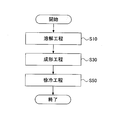
- FIG. 2 is a flowchart illustrating a glass plate manufacturing method according to an embodiment.
- the manufacturing method of the glass plate shown in FIG. 2 has melting
- molten glass G2 is produced by melting glass raw material G1.
- the molten glass G2 produced in the melting step S10 is formed into a strip-like glass ribbon G3.
- the molten glass G2 is continuously supplied onto the molten metal M, and the molten glass G2 is formed into a strip-shaped glass ribbon G3 using the liquid level of the molten metal M.
- the glass ribbon G3 is gradually solidified while flowing from the upstream side of the bathtub 311 to the downstream side.
- the glass ribbon G3 formed in the forming step S30 is gradually cooled.
- the slowly cooled glass ribbon G3 is cut into a predetermined size by a cutting machine to obtain a glass plate as a product.
- the manufacturing method of a glass plate may be various.
- the manufacturing method of a glass plate may have a clarification process which defoams the foam
- the manufacturing method of a glass plate may further have the grinding
- polishing step not only the bottom surface of the glass ribbon G3 but also the top surface of the glass ribbon G3 may be polished.
- the bottom surface and the top surface may be polished simultaneously or separately.
- a heterogeneous layer having a predetermined depth is formed from the bottom surface.
- the heterogeneous layer is significantly rich in the element (for example, Sn) of the molten metal M.
- the depth of the heterogeneous layer is not particularly limited, but is, for example, 0.5 ⁇ m to 15 ⁇ m from the bottom surface.
- a colored layer having a predetermined depth is formed from the bottom surface by reducing antimony oxide in the vicinity of the bottom surface of the glass ribbon G3.
- polishing can be visualized and the presence or absence of a foreign layer can be discriminate
- the depth of the colored layer is set according to the thickness of the heterogeneous layer, and is set to 0.5 ⁇ m to 15 ⁇ m from the bottom surface, for example.
- the glass ribbon G3 is reduced from the bottom surface side of the glass ribbon G3 by the contact between the glass ribbon G3 and the molten metal M. Thereby, the antimony oxide contained in the glass ribbon G3 in the vicinity of the bottom surface is reduced, the antimony colloidal particles are generated, and a brown colored layer can be formed.
- the formation of the colored layer is realized by adjusting the chemical composition of the glass ribbon G3. Since the chemical composition of the glass ribbon G3 is substantially the same as the chemical composition of the glass plate, the chemical composition of the glass plate is represented below.
- the content (A) of all antimony converted to Sb 2 O 3 is 100 mass ppm or more and 5000 mass ppm or less, and the content (B) of all sulfur converted to SO 3 is 100 mass ppm.
- the content (C) of all iron converted to Fe 2 O 3 is 60 mass ppm or less, and the following formulas (1) and (2) are satisfied. 0.03 ⁇ A / B ⁇ 50 (1) A / D ⁇ 2.2 (2) Wherein (2), D is a content of trivalent iron terms of Fe 2 O 3, or less content of total iron as calculated as Fe 2 O 3 (C).
- the content (A) is the total antimony content (A)
- the content (B) is the total sulfur content (B)
- the content (C) is the total iron content (C)
- the content (D) is Also called Fe 3+ content (D).
- XRF fluorescent X-ray analysis
- E is the content of divalent iron converted to Fe 2 O 3 and is measured by a method according to ASTM (American Society for Testing and Materials) C169-92.
- the total antimony content (A) is 100 mass ppm or more and 5000 mass ppm or less. Most of the antimony is contained as an oxide in the glass ribbon G3 at the start of molding, and is reduced from both the upper and lower sides during molding. When the total antimony content (A) is 100 mass ppm or more and 5000 mass ppm or less, an appropriate amount of antimony colloidal particles can be generated by reduction of antimony oxide. If the total antimony content (A) exceeds 5000 ppm by mass, the antimony oxide may be reduced by being exposed to a reducing atmosphere during molding, and metal particles may precipitate on the glass surface and become cloudy.
- the total sulfur content (B) is 100 ppm by mass or more. Most of the sulfur is contained in the glass ribbon G3 as an oxide at the start of molding. Sulfur oxide is distributed substantially uniformly throughout the thickness direction of the glass ribbon G3 at the start of molding, and is reduced from both the upper and lower sides during molding. Sulfur oxide is more easily reduced than antimony oxide, and antimony oxide is reduced after the reduction of sulfur oxide. If total sulfur content (B) is 100 mass ppm or more, the reduction
- the depth of the colored layer is determined by the ratio of the content of antimony oxide and the content of sulfur oxide at the start of molding. Therefore, the ratio (A / B) is set to 0.03 or more and 50 or less. Although details will be described later in the column of Examples, when the ratio (A / B) is 0.03 or more and 50 or less, a colored layer having an appropriate depth can be obtained. Therefore, if the colored layer is removed by polishing, the heterogeneous layer can be removed, and unnecessary polishing can be suppressed, and an increase in polishing time and polishing cost can be suppressed.
- the total iron content (C) is 60 ppm by mass or less. Most of iron is contained as an oxide in the glass ribbon G3 at the start of molding. When the total iron content (C) is 60 mass ppm or less, coloring by iron ions can be suppressed, and coloring by antimony colloid particles can be visually recognized. Since iron ions are present substantially uniformly throughout the thickness direction of the glass ribbon G3 and the glass ribbon G3 is colored throughout the thickness direction, the end of the glass ribbon G3 in the thickness direction is selectively colored alone. I can't. On the other hand, when iron is not contained at all in the glass ribbon G3, the function of supporting the coloring by the antimony colloid particles is weak and the preparation of the glass raw material G1 is difficult. It may be.
- the ratio (A / D) is set to 2.2 or more. Although details will be described later in the column of Examples, if the ratio (A / D) is 2.2 or more, the total antimony content (A) is sufficiently large compared to the Fe 3+ content (D), and the trivalent Coloring by iron ions can be suppressed, and coloring by antimony colloidal particles can be visually recognized.
- the glass plate preferably has a total iron content (C) of 50 mass ppm or less and an Fe 3+ content (D) of 40 mass ppm or less from the viewpoint of the visibility of the colored layer.
- the total iron content (C) is more preferably 40 ppm by mass or less, particularly preferably 38 ppm by mass or less, and most preferably 36 ppm by mass or less.
- the Fe 3+ content (D) is more preferably 38 ppm by mass or less, particularly preferably 36 ppm by mass or less, and most preferably 35 ppm by mass or less.
- the glass plate preferably has a total sulfur content (B) of 600 mass ppm or more and a ratio (A / B) of 2.5 or less. Although details will be described later in the column of Examples, if the total sulfur content (B) is 600 mass ppm or more and the ratio (A / B) is 2.5 or less, the bottom surface and the top of the glass ribbon G3. A colored layer can be selectively formed on the bottom surface of both surfaces. When polishing of the top surface is not required, unnecessary polishing work can be omitted.
- a colored layer having a predetermined depth from the top surface may be formed by reducing antimony oxide in the vicinity of the top surface of the glass ribbon G3. Thereby, the layer removed by grinding
- the depth of the colored layer is set according to the polishing amount.
- the glass ribbon G3 is reduced from the top surface side of the glass ribbon G3 by the contact between the glass ribbon G3 and the reducing gas. As a result, the antimony oxide in the vicinity of the top surface of the glass ribbon G3 is reduced, and antimony colloidal particles are generated, whereby a brown colored layer can be formed. Coloring of the top surface can be realized by reducing the total sulfur content (B), and can be realized by setting the ratio (A / B) to more than 2.5.
- the glass plate preferably has a total content of all transition metals of the group consisting of Ni, Cr, Co, V and Se of 5.0 mass ppm or less. The fewer these transition metals, the better. These transition metals are for coloring the glass ribbon G3 in the whole thickness direction like iron. Further, these transition metals can affect the reduction of antimony oxide by changing the valence. The content of each transition metal is measured by inductively coupled plasma mass spectrometry (ICP-MS).
- ICP-MS inductively coupled plasma mass spectrometry
- the glass plate has two main surfaces.
- One main surface is composed of a bottom surface of the glass ribbon G3 or a polished surface obtained by polishing the bottom surface.
- the other main surface is composed of a top surface of the glass ribbon G3 or a polished surface obtained by polishing the top surface.
- the difference in Sn concentration between the two main surfaces is 10 2 cps or more and 10 6 cps or less. This density difference indicates that the glass plate was produced by the float process.
- a concentration difference of 10 2 cps or more can be detected even after the bottom surface of the glass ribbon G3 is polished.
- Secondary ion mass spectrometry can be measured by a commercially available analyzer such as ADEPT 1010 manufactured by ULVAC-PHI.
- the measurement is performed, for example, using O 2+ as primary ions, under conditions of an acceleration voltage of 5 kV, a beam current of 1000 nA, a raster size of 200 ⁇ 200 ⁇ m 2 , and a sample angle of 45 °.
- the arithmetic average roughness of each main surface of the glass plate is 0.1 ⁇ m or less. This indicates that scratches or the like generated in the process of making the bottom surface of the glass ribbon G3 have been polished.
- the top surface is a free surface that does not come into contact with the molten metal M, so the arithmetic average roughness of the top surface is already 0.1 ⁇ m or less before polishing.
- the arithmetic average roughness is “arithmetic average roughness” described in Japanese Industrial Standard (JIS B 0601) and can be measured by an atomic force microscope (AFM).
- the glass plate may have any one of the following two glass compositions A and B in terms of oxide-based mass percentage.
- the glass composition of a glass plate is not limited to the following two types of glass compositions A and B.
- the glass plate of glass composition A is expressed in terms of mass percentage in terms of oxide, SiO 2 is 60 to 80%, Al 2 O 3 is 0 to 7%, MgO is 0 to 10%, CaO is 0 to 20%, SrO 0-15%, BaO 0-15%, Na 2 O 3-20%, and K 2 O 0-10%.
- the glass plate of the glass composition B is expressed in oxide-based mass percentage, with SiO 2 being 45 to 80%, Al 2 O 3 being more than 7% and not more than 30%, B 2 O 3 being 0 to 15%, and MgO being 0 ⁇ 15%, CaO 0-6%, SrO 0-5%, BaO 0-5%, Na 2 O 7-20%, K 2 O 0-10%, and ZrO 2 0-10 % Is included.
- SiO 2 is a main component of glass.
- the SiO 2 content is preferably 60% or more, more preferably 63% or more in the glass composition A, and preferably 45% in the glass composition B. Above, more preferably 50% or more.
- the content of SiO 2 is easy to dissolve and the foam quality is good, and the content of divalent iron (Fe 2+ ) in the glass is kept low, and the optical properties are good. Therefore, in the glass composition A, it is preferably 80% or less, more preferably 75% or less, and in the glass composition B, it is preferably 80% or less, more preferably 70% or less.
- Al 2 O 3 is a component that improves the weather resistance of the glass in the glass compositions A and B.
- Al 2 O 3 is an optional component in the glass composition A and an essential component in the glass composition B.
- the content of Al 2 O 3 is preferably 1% or more, more preferably 2% or more in the glass composition A, and in the glass composition B Is preferably more than 7%, more preferably 10% or more.
- the content of Al 2 O 3 is preferably in the glass composition A. Is 7% or less, more preferably 5% or less.
- the glass composition B it is preferably 30% or less, more preferably 23% or less.
- B 2 O 3 is a component that promotes melting of the glass raw material and improves mechanical properties and weather resistance, but it does not cause inconveniences such as generation of striae due to volatilization and furnace wall erosion.
- the content of B 2 O 3 is preferably 5% or less, more preferably 2% or less, further preferably 1% or less, and in the glass composition B, preferably 15% or less. More preferably, it is 12% or less.
- Alkali metal oxides such as Li 2 O, Na 2 O, and K 2 O are useful components for accelerating melting of glass raw materials and adjusting thermal expansion, viscosity, and the like.
- the content of Na 2 O is preferably 3% or more, more preferably 8% or more.
- the content of Na 2 O is preferably 7% or more, more preferably 10% or more.
- the content of Na 2 O is preferably 20% or less in the glass compositions A and B in order to maintain the clarity during melting and maintain the foam quality of the produced glass, and 15% The following is more preferable.
- the content of K 2 O is preferably 10% or less, more preferably 7% or less.
- Li 2 O is an optional component, but in order to facilitate vitrification, to keep the iron content contained as impurities derived from the raw material low, and to keep the batch cost low, in the glass compositions A and B, Li 2 O or less can be contained at 2% or less.
- the total content of these alkali metal oxides maintains the clarification at the time of melting, and the glass composition A and B in order to maintain the foam quality of the produced glass. Is preferably 5% to 20%, more preferably 8% to 15%.
- Alkaline earth metal oxides such as MgO, CaO, SrO, and BaO are useful components for accelerating melting of glass raw materials and adjusting thermal expansion, viscosity, and the like.
- MgO has the effect of lowering the viscosity during glass melting and promoting melting. Moreover, since there exists an effect
- CaO is a component that promotes melting of the glass raw material and adjusts viscosity, thermal expansion, and the like, and therefore can be contained in the glass compositions A and B.
- the content of CaO is preferably 3% or more, more preferably 5% or more.
- the glass composition A is preferably 20% or less, more preferably 10% or less, and the glass composition B is preferably 6% or less, more preferably 4% or less.
- SrO has the effect of increasing the thermal expansion coefficient and lowering the high temperature viscosity of the glass.
- SrO can be contained in the glass compositions A and B.
- the SrO content is preferably 15% or less, more preferably 10% or less, and in the glass composition B, 5% or less. Preferably, it is more preferably 3% or less.
- BaO like SrO, has the effect of increasing the coefficient of thermal expansion and lowering the high temperature viscosity of the glass. In order to obtain the above effect, BaO can be contained. However, in order to keep the thermal expansion coefficient of the glass low, the content of BaO in the glass composition A is preferably 15% or less, more preferably 10% or less, and 5% or less in the glass composition B. Preferably, it is 3% or less.
- the total content of these alkaline earth metal oxides is preferably 10 in the glass composition A in order to keep the coefficient of thermal expansion low, good devitrification properties, and maintain strength. % Or more, more preferably 13% or more.
- the glass composition B it is 1% or more, more preferably 10% or more.
- 30% or less is preferable, and more preferably 27% or less.
- the composition B it is preferably 15% or less, more preferably 10% or less.
- ZrO 2 may be contained as an optional component in an amount of 10% or less, preferably 5% or less. However, if it exceeds 10%, the glass tends to be devitrified, which is not preferable.
- the glass plate may contain one or more of SnO 2 and As 2 O 3 as an oxidizing agent and a clarifying agent.
- the content of SnO 2 or As 2 O 3 is preferably 0 to 0.5% in terms of mass percentage. 0.2% or less is more preferable, 0.1% or less is more preferable, and it is further more preferable not to contain substantially.
- SnO 2 and As 2 O 3 act as an oxidizing agent for glass, they may be added within the above range depending on the purpose of adjusting the amount of Fe 2+ in the glass.
- As 2 O 3 is not positively contained from the environmental viewpoint.
- Glass plate may include TiO 2.
- TiO 2 When TiO 2 is contained, TiO 2 also functions as a component that absorbs visible light. Therefore, the content of TiO 2 is preferably 1000 ppm or less with respect to the total amount of the glass composition described above. The content of TiO 2 is more preferably 500 ppm or less, and particularly preferably 100 ppm or less, from the viewpoint of not reducing the internal transmittance of the glass plate at a wavelength of 400 to 700 nm.
- Glass plate may include CeO 2.
- CeO 2 has the effect of reducing the redox of iron, and can reduce the absorption of glass at a wavelength of 400 to 700 nm. However, if containing CeO 2 in a large amount, CeO 2, compared the total amount of the glass composition described above to function as a component which absorbs visible light not only causes solarization, and 1000ppm or less Is preferred.
- the CeO 2 content is more preferably 500 ppm or less, further preferably 400 ppm or less, particularly preferably 300 ppm or less, and most preferably 250 ppm or less.
- it is preferable that 0.1 ppm or more is always added in order to easily suppress variations in product characteristics during production, particularly color variations. Addition of 1.0 ppm or more is preferable for color control, and addition of 5.0 ppm or more is more preferable.
- ppm means mass ppm.
- the glass plate may contain Ni.
- Ni since Ni also functions as a coloring component, the Ni content is preferably 10 ppm or less with respect to the total amount of the glass composition described above.
- Ni is preferably 1.0 ppm or less, more preferably 0.8 ppm or less, and 0.6 ppm or less from the viewpoint of not reducing the internal transmittance of the glass plate at a wavelength of 400 to 700 nm. Is more preferable, and 0.5 ppm or less is particularly preferable.
- the glass plate may contain Cr.
- Cr When Cr is contained, Cr also functions as a coloring component. Therefore, the Cr content is preferably 10 ppm or less with respect to the total amount of the glass composition described above.
- Cr is preferably 2.0 ppm or less, more preferably 1.6 ppm or less, and 1.2 ppm or less from the viewpoint of not reducing the internal transmittance of the glass plate at a wavelength of 400 to 700 nm. Is more preferably 1.0 ppm or less, even more preferably 0.8 ppm or less, and most preferably 0.6 ppm or less.
- the glass plate may contain Mn.
- Mn functions as a component that absorbs visible light
- the Mn content is preferably 50 ppm or less with respect to the total amount of the glass composition described above.
- Mn is preferably 30 ppm or less, more preferably 20 ppm or less, even more preferably 15 ppm or less, from the viewpoint of not reducing the internal transmittance of the glass plate at a wavelength of 400 to 700 nm. The following is particularly preferable.
- the glass plate may contain at least one element selected from the group consisting of Se, Co, V, and Cu. When these elements are contained, they also function as a component that absorbs visible light. Therefore, the content of each element is preferably 5.0 ppm or less, more preferably 2.0 ppm or less. More preferably, it is 0 ppm or less. In particular, it is most preferable that these elements are not substantially contained so as not to lower the internal transmittance of the glass plate at a wavelength of 400 to 700 nm.
- Examples 1 to 21 glass plates were produced by the float method under the same conditions except for the mixing ratio of the glass raw materials.
- Examples 1 to 18 are examples, and examples 19 to 21 are comparative examples.
- the produced glass plate is evaluated by the presence or absence of coloring of the top surface of the glass ribbon, the presence or absence of coloring of the bottom surface of the glass ribbon, the depth of the colored layer from the bottom surface, and the visibility of the colored layer formed on the bottom surface. did.
- the visibility of the colored layer is determined by CIE 1976 (L * a * b * ) according to the method described in JIS Z 8781-4 (2013) based on the transmittance measured in both the glass plate before and after removing the colored layer by polishing .
- the color difference ⁇ E * ab under the C light source in the color system was calculated and evaluated in four stages based on it. Specifically, a case where ⁇ E * ab is 6.5 or more is “ ⁇ ”, a case where it is 1.6 or more and less than 6.5 is “ ⁇ ”, and a case where ⁇ E * ab is 0.4 or more and less than 1.6 is “ The case of “ ⁇ ” or less than 0.4 was designated as “x”.
- Results are shown in Tables 1-3.
- “%” means mass%
- “ppm” means mass ppm.
- the glass plates of Examples 1 to 18 have a total antimony content (A) of 100 mass ppm to 5000 mass ppm and a total sulfur content (B) of 100 mass ppm. Since the total iron content (C) is 60 mass ppm or less, the ratio (A / B) is 0.03 or more and 50 or less, and the ratio (A / D) is 2.2 or more. A colored layer having an appropriate depth could be formed from the bottom surface.
- the glass plates of Examples 1 to 13 and Examples 16 to 18 have a total sulfur content (B) of 600 mass ppm or more and a ratio (A / B) of 2.5 or less.
- a colored layer could be selectively formed on the bottom surface of both the bottom surface and the top surface.
- the glass plate of Example 20 has a ratio (A / B) equivalent to that of Example 6, for example, but has a large total iron content (C) and Fe 3+ content (D), and coloring by iron ions is remarkable. Since it appeared, the colored layer by the antimony colloidal particle was not visually recognized.
- the glass plate of Example 21 has a too large ratio (A / B), the depth of the colored layer is too deep, and unnecessary polishing is required.
- Molding device 31 Molding furnace 311 Bathtub G1 Glass raw material G2 Molten glass G3 Glass ribbon M Molten metal
Landscapes
- Chemical & Material Sciences (AREA)
- Engineering & Computer Science (AREA)
- Materials Engineering (AREA)
- Organic Chemistry (AREA)
- Life Sciences & Earth Sciences (AREA)
- Chemical Kinetics & Catalysis (AREA)
- General Chemical & Material Sciences (AREA)
- Geochemistry & Mineralogy (AREA)
- Glass Compositions (AREA)
Abstract
【解決手段】浴槽内の溶融金属上で溶融ガラスを帯板状のガラスリボンに成形する成形工程を有する、ガラス板の製造方法であって、前記ガラス板は、Sb2O3に換算した全てのアンチモンの含有量(A)が100質量ppm以上5000質量ppm以下であり、SO3に換算した全ての硫黄の含有量(B)が100質量ppm以上であり、Fe2O3に換算した全ての鉄の含有量(C)が60質量ppm以下であり、且つ下記の式(1)、(2)が成立し、前記成形工程では、前記ガラスリボンにおけるボトム面の近傍の酸化アンチモンを還元させることで、前記ボトム面から所定の深さの着色層を形成する、ガラス板の製造方法。 0.03≦A/B≦50・・・(1) A/D≧2.2・・・(2) 式(2)中、Dは、Fe2O3に換算した3価の鉄の含有量である。
Description
本発明は、ガラス板の製造方法、およびガラス板に関する。
ガラス板の製造方法は、浴槽内の溶融金属上で溶融ガラスを帯板状のガラスリボンに成形する成形工程を有する(例えば特許文献1参照)。ガラスリボンのボトム面は溶融金属と接触するため、ボトム面から所定の深さの異質層が形成される。そこで、成形工程の後に、ボトム面を研磨する研磨工程が必要な場合がある。研磨工程によって異質層が除去できる。また、研磨工程によって傷なども除去できる。
従来、ガラスリボンを見たとき、ボトム面をどの程度研磨すればよいか不明であった。
本発明は、上記課題に鑑みてなされたものであり、研磨によって除去する異質層を可視化できる、ガラス板の製造方法の提供を主な目的とする。
上記課題を解決するため、本発明の一態様によれば、
浴槽内の溶融金属上で溶融ガラスを帯板状のガラスリボンに成形する成形工程を有する、ガラス板の製造方法であって、
前記ガラス板は、Sb2O3に換算した全てのアンチモンの含有量(A)が100質量ppm以上5000質量ppm以下であり、SO3に換算した全ての硫黄の含有量(B)が100質量ppm以上であり、Fe2O3に換算した全ての鉄の含有量(C)が60質量ppm以下であり、且つ下記の式(1)、(2)が成立し、
前記成形工程では、前記ガラスリボンにおけるボトム面の近傍の酸化アンチモンを還元させることで、前記ボトム面から所定の深さの着色層を形成する、ガラス板の製造方法が提供される。
0.03≦A/B≦50・・・(1)
A/D≧2.2・・・(2)
式(2)中、Dは、Fe2O3に換算した3価の鉄の含有量であって、Fe2O3に換算した全ての鉄の含有量(C)以下である。
浴槽内の溶融金属上で溶融ガラスを帯板状のガラスリボンに成形する成形工程を有する、ガラス板の製造方法であって、
前記ガラス板は、Sb2O3に換算した全てのアンチモンの含有量(A)が100質量ppm以上5000質量ppm以下であり、SO3に換算した全ての硫黄の含有量(B)が100質量ppm以上であり、Fe2O3に換算した全ての鉄の含有量(C)が60質量ppm以下であり、且つ下記の式(1)、(2)が成立し、
前記成形工程では、前記ガラスリボンにおけるボトム面の近傍の酸化アンチモンを還元させることで、前記ボトム面から所定の深さの着色層を形成する、ガラス板の製造方法が提供される。
0.03≦A/B≦50・・・(1)
A/D≧2.2・・・(2)
式(2)中、Dは、Fe2O3に換算した3価の鉄の含有量であって、Fe2O3に換算した全ての鉄の含有量(C)以下である。
本発明の一態様によれば、研磨によって除去する異質層を可視化できる、ガラス板の製造方法が提供される。
以下、本発明を実施するための形態について図面を参照して説明する。各図面において、同一の又は対応する構成には、同一の又は対応する符号を付して説明を省略する。本明細書において、数値範囲を表す「~」はその前後の数値を含む範囲を意味する。
図1は、一実施形態によるガラス板の製造装置を示す断面図である。図1に示すガラス板の製造装置は、溶解装置10、成形装置30、接続装置40、および徐冷装置50を有する。
溶解装置10は、ガラス原料G1を溶解することで溶融ガラスG2を作製する。溶解装置10は、例えば溶解炉11と、バーナー12とを有する。
溶解炉11は、ガラス原料G1を溶解する溶解室11aを形成する。溶解室11aには溶融ガラスG2が収容される。
バーナー12は、溶解室11aの上部空間に火炎を形成する。この火炎の輻射熱によってガラス原料G1が溶融ガラスG2に徐々に溶け込む。
成形装置30は、溶解装置10で作製した溶融ガラスG2を帯板状のガラスリボンG3に成形する。成形装置30は、例えば成形炉31と、成形ヒータ32とを有する。
成形炉31は、溶融ガラスG2を成形する成形室31aを形成する。成形炉31の入口から成形炉31の出口に向かうほど、成形室31aの温度が低い。成形炉31は、浴槽311と、浴槽311の上方に配設される天井312とを有する。
浴槽311は、溶融金属Mを収容する。溶融金属Mとしては、例えば溶融スズが用いられる。溶融スズの他に、溶融スズ合金なども使用可能である。溶融金属Mの酸化を抑止するため、成形室31aの上部空間は還元性ガスで満たされる。還元性ガスは、例えば水素ガスと窒素ガスとの混合ガスで構成される。
浴槽311は、溶融金属Mの上に連続的に供給された溶融ガラスG2を、溶融金属Mの液面を利用して帯板状のガラスリボンG3に成形する。ガラスリボンG3は、浴槽311の上流側から下流側に流動しながら徐々に固化され、浴槽311の下流域において溶融金属Mから引き上げられる。
成形ヒータ32は、天井312から吊り下げられる。成形ヒータ32は、ガラスリボンG3の流動方向に間隔をおいて複数設けられ、ガラスリボンG3の流動方向における温度分布を調整する。また、成形ヒータ32は、ガラスリボンG3の幅方向に間隔をおいて複数設けられ、ガラスリボンG3の幅方向における温度分布を調整する。
接続装置40は、成形装置30と徐冷装置50とを接続する。接続装置40と徐冷装置50との間の僅かな隙間には断熱材が詰められてよい。接続装置40は、接続炉41と、中間ヒータ42と、リフトアウトロール43とを有する。
接続炉41は、成形炉31と徐冷炉51との間に配設され、これらの間を搬送されるガラスリボンG3の脱熱を制限する接続室41aを形成する。成形炉31と徐冷炉51との間においてガラスリボンG3の急冷が防止できる。
中間ヒータ42は、接続室41aに配設される。中間ヒータ42は、ガラスリボンG3の搬送方向に間隔をおいて複数設けられ、ガラスリボンG3の搬送方向における温度分布を調整する。中間ヒータ42は、ガラスリボンG3の幅方向に分割され、ガラスリボンG3の幅方向おける温度分布を調整してもよい。
リフトアウトロール43は、接続室41aに配設される。リフトアウトロール43は、モータなどによって回転駆動され、ガラスリボンG3を溶融金属Mから引き上げ、成形炉31から徐冷炉51に搬送する。リフトアウトロール43は、ガラスリボンG3の搬送方向に間隔をおいて複数設けられる。
徐冷装置50は、成形装置30で成形されたガラスリボンG3を徐冷する。徐冷装置50は、徐冷炉51と、徐冷ヒータ52と、徐冷ロール53とを有する。
徐冷炉51は、ガラスリボンG3を徐冷する徐冷室51aを形成する。徐冷炉51の入口から徐冷炉51の出口に向かうほど、徐冷室51aの温度が低い。
徐冷ヒータ52は、徐冷室51aに配設される。徐冷ヒータ52は、ガラスリボンG3の搬送方向に間隔をおいて複数設けられ、ガラスリボンG3の搬送方向における温度分布を調整する。徐冷ヒータ52は、ガラスリボンG3の幅方向に分割され、ガラスリボンG3の幅方向おける温度分布を調整してもよい。
徐冷ロール53は、徐冷室51aに配設される。徐冷ロール53は、モータなどによって回転駆動され、徐冷炉51の入口から徐冷炉51の出口に向けてガラスリボンG3を搬送する。徐冷ロール53は、ガラスリボンG3の搬送方向に間隔をおいて複数設けられる。
徐冷装置50において徐冷されたガラスリボンG3は切断機で所定のサイズに切断され、製品であるガラス板が得られる。
尚、ガラス板の製造装置は、多種多様であってよい。例えば、ガラス板の製造装置は、溶解装置10と成形装置30との間に、溶融ガラスG2に含まれる泡を脱泡する清澄装置を有してもよい。また、ガラス板の製造装置は、切断の後に、ガラスリボンG3のボトム面を研磨する研磨装置をさらに有してもよい。研磨装置は、ガラスリボンG3のボトム面のみならず、ガラスリボンG3のボトム面とは反対側のトップ面を研磨してもよい。研磨装置は、ボトム面とトップ面の両方を研磨する場合、ボトム面とトップ面を同時に研磨してもよいし、別々に研磨してもよい。
次に、図2を参照して、上記構成のガラス板の製造装置を用いた、ガラス板の製造方法について説明する。図2は、一実施形態によるガラス板の製造方法を示すフローチャートである。図2に示すガラス板の製造方法は、溶解工程S10、成形工程S30、および徐冷工程S50を有する。
溶解工程S10では、ガラス原料G1を溶解することで溶融ガラスG2を作製する。
成形工程S30では、溶解工程S10により作製した溶融ガラスG2を帯板状のガラスリボンG3に成形する。例えば、成形工程S30では、溶融金属Mの上に溶融ガラスG2を連続的に供給し、溶融金属Mの液面を利用して溶融ガラスG2を帯板状のガラスリボンG3に成形する。ガラスリボンG3は、浴槽311の上流側から下流側に流動しながら、徐々に固化される。
徐冷工程S50では、成形工程S30により成形したガラスリボンG3を徐冷する。徐冷されたガラスリボンG3は切断機で所定のサイズに切断され、製品であるガラス板が得られる。
尚、ガラス板の製造方法は、多種多様であってよい。例えば、ガラス板の製造方法は、溶解工程S10と成形工程S30との間に、溶融ガラスG2に含まれる泡を脱泡する清澄工程を有してもよい。また、ガラス板の製造方法は、切断の後に、ガラスリボンG3のボトム面を研磨する研磨工程をさらに有してもよい。研磨工程は、ガラスリボンG3のボトム面のみならず、ガラスリボンG3のトップ面を研磨してもよい。研磨工程は、ボトム面とトップ面の両方を研磨する場合、ボトム面とトップ面を同時に研磨してもよいし、別々に研磨してもよい。
ところで、ガラスリボンG3のボトム面は溶融金属Mと接触するため、ボトム面から所定の深さの異質層が形成される。異質層は、溶融金属Mの元素(例えばSn)に顕著に富む。異質層の深さは、特に限定されないが、例えばボトム面から0.5μm~15μmである。
そこで、本実施形態の成形工程S30では、ガラスリボンG3におけるボトム面近傍の酸化アンチモンを還元させることで、ボトム面から所定の深さの着色層を形成する。これにより、研磨によって除去する異質層を可視化でき、研磨後に着色層の有無によって異質層の有無を判別できる。着色層の深さは、異質層の厚さに応じて設定されるが、例えばボトム面から0.5μm~15μmに設定される。
ガラスリボンG3は、ガラスリボンG3と溶融金属Mとの接触によって、ガラスリボンG3のボトム面側から還元される。これにより、ガラスリボンG3におけるボトム面近傍に含まれる酸化アンチモンが還元され、アンチモンコロイド粒子が生じ、茶褐色の着色層が形成できる。
着色層の形成は、ガラスリボンG3の化学組成を調整することで実現する。ガラスリボンG3の化学組成はガラス板の化学組成と略同じであるため、以下、ガラス板の化学組成で代表する。
ガラス板は、Sb2O3に換算した全てのアンチモンの含有量(A)が100質量ppm以上5000質量ppm以下であり、SO3に換算した全ての硫黄の含有量(B)が100質量ppm以上であり、Fe2O3に換算した全ての鉄の含有量(C)が60質量ppm以下であり、且つ下記の式(1)、(2)が成立する。
0.03≦A/B≦50・・・(1)
A/D≧2.2・・・(2)
式(2)中、Dは、Fe2O3に換算した3価の鉄の含有量であって、Fe2O3に換算した全鉄の含有量(C)以下である。以下、含有量(A)を全アンチモン含有量(A)、含有量(B)を全硫黄含有量(B)、含有量(C)を全鉄含有量(C)、含有量(D)をFe3+含有量(D)とも呼ぶ。これらの含有量(A)、(B)、(C)は、蛍光X線分析(XRF)によって測定する。含有量(D)は、D=C-Eの式を用いて算出する。Eは、Fe2O3に換算した2価の鉄の含有量であり、ASTM(American Society for Testing and Materials)C169-92に準じる方法で測定する。
0.03≦A/B≦50・・・(1)
A/D≧2.2・・・(2)
式(2)中、Dは、Fe2O3に換算した3価の鉄の含有量であって、Fe2O3に換算した全鉄の含有量(C)以下である。以下、含有量(A)を全アンチモン含有量(A)、含有量(B)を全硫黄含有量(B)、含有量(C)を全鉄含有量(C)、含有量(D)をFe3+含有量(D)とも呼ぶ。これらの含有量(A)、(B)、(C)は、蛍光X線分析(XRF)によって測定する。含有量(D)は、D=C-Eの式を用いて算出する。Eは、Fe2O3に換算した2価の鉄の含有量であり、ASTM(American Society for Testing and Materials)C169-92に準じる方法で測定する。
全アンチモン含有量(A)は、100質量ppm以上5000質量ppm以下である。アンチモンの大部分は、成形開始時にガラスリボンG3に酸化物として含まれており、成形中に上下両側から還元される。全アンチモン含有量(A)が100質量ppm以上5000質量ppm以下であれば、酸化アンチモンの還元によって、適量のアンチモンコロイド粒子が生成できる。全アンチモン含有量(A)が5000質量ppmを超えると、成形時に還元雰囲気に晒されることで酸化アンチモンが還元されて金属の粒子がガラス表面上に析出し白濁する場合がある。
全硫黄含有量(B)は、100質量ppm以上である。硫黄の大部分は、成形開始時にガラスリボンG3に酸化物として含まれている。酸化硫黄は、成形開始時にガラスリボンG3の厚さ方向全体に略均一に分布し、成形中に上下両側から還元される。酸化硫黄は酸化アンチモンよりも還元されやすく、酸化硫黄の減少後に酸化アンチモンが還元される。全硫黄含有量(B)が100質量ppm以上であれば、ガラスリボンG3の厚さ方向中央部における酸化アンチモンの還元を抑制できる。
着色層の深さは、成形開始時における、酸化アンチモンの含有量と酸化硫黄の含有量との比などで決まる。そこで、比(A/B)は、0.03以上50以下とする。詳しくは実施例の欄で後述するが、比(A/B)が0.03以上50以下であれば、適度な深さの着色層が得られる。よって、研磨によって着色層を除去すれば異質層を除去できると共に、無駄な研磨を抑制でき研磨時間や研磨コストの増大を抑制できる。
全鉄含有量(C)は、60質量ppm以下である。鉄の大部分は、成形開始時にガラスリボンG3に酸化物として含まれている。全鉄含有量(C)が60質量ppm以下であることで、鉄イオンによる着色が抑制でき、アンチモンコロイド粒子による着色が視認できる。鉄イオンは、ガラスリボンG3の厚さ方向全体に略均一に存在し、ガラスリボンG3を厚さ方向全体に着色するため、単独ではガラスリボンG3の厚さ方向端部を選択的に着色することはできない。一方、鉄がガラスリボンG3に全く含まれていない場合、アンチモンコロイド粒子による着色を支援する機能が弱く、ガラス原料G1の調製も困難であるので、全鉄含有量(C)は10質量ppm以上であってよい。
鉄イオンによる着色の色はその価数によって異なるが、主に3価の鉄イオンによる着色の色がアンチモンコロイドによる着色に近い色を示す。そこで、比(A/D)は、2.2以上とする。詳しくは実施例の欄で後述するが、比(A/D)が2.2以上であれば、Fe3+含有量(D)に比べ全アンチモン含有量(A)が十分に多く、3価の鉄イオンによる着色が抑制でき、アンチモンコロイド粒子による着色が視認できる。
ガラス板は、着色層の視認性の観点から、好ましくは、全鉄含有量(C)が50質量ppm以下であり、且つFe3+含有量(D)が40質量ppm以下である。全鉄含有量(C)は、より好ましくは40質量ppm以下、特に好ましくは38質量ppm以下、最も好ましくは36質量ppm以下である。Fe3+含有量(D)は、より好ましくは38質量ppm以下、特に好ましくは36質量ppm以下、最も好ましくは35質量ppm以下である。
ガラス板は、好ましくは、全硫黄含有量(B)が600質量ppm以上であり、且つ比(A/B)が2.5以下である。詳しくは実施例の欄で後述するが、全硫黄含有量(B)が600質量ppm以上であり、且つ比(A/B)が2.5以下であれば、ガラスリボンG3のボトム面とトップ面の両面のうち、ボトム面に選択的に着色層を形成できる。トップ面の研磨が要求されていない場合に、不要な研磨作業が省略できる。
トップ面を研磨する場合には、ガラスリボンG3におけるトップ面近傍の酸化アンチモンを還元させることで、トップ面から所定の深さの着色層を形成してもよい。これにより、研磨によって除去する層を可視化できる。着色層の深さは、研磨量に応じて設定される。
ガラスリボンG3は、ガラスリボンG3と還元性ガスとの接触によって、ガラスリボンG3のトップ面側から還元される。これにより、ガラスリボンG3におけるトップ面近傍の酸化アンチモンが還元され、アンチモンコロイド粒子が生じ、茶褐色の着色層が形成できる。トップ面の着色は、全硫黄含有量(B)を減らすことで実現でき、比(A/B)を2.5超とすることで実現できる。
ガラス板は、好ましくは、Ni、Cr、Co、VおよびSeからなる群の全ての遷移金属の合計含有量が5.0質量ppm以下である。これらの遷移金属は、少ないほど良い。これらの遷移金属は、鉄と同様に、ガラスリボンG3を厚さ方向全体に着色するためである。また、これらの遷移金属は、価数を変えることで、酸化アンチモンの還元に影響を与えうるためである。各遷移金属の含有量は、誘導結合プラズマ質量分析法(ICP-MS)により測定する。
ガラス板は、2つの主表面を有する。一方の主表面は、ガラスリボンG3のボトム面、またはボトム面を研磨した研磨面で構成される。他方の主表面は、ガラスリボンG3のトップ面、またはトップ面を研磨した研磨面で構成される。
ガラス板は、各主表面におけるSnの濃度を二次イオン質量分析法(SIMS)によって測定した場合に、2つの主表面におけるSnの濃度差が102cps以上106cps以下である。この濃度差は、ガラス板がフロート法で作製されたことを表す。ガラスリボンG3のボトム面の研磨量によっては、ガラスリボンG3のボトム面の研磨後も、102cps以上の濃度差が検出できる。
二次イオン質量分析法は、市販の分析装置、例えばアルバック・ファイ社製ADEPT1010によって測定できる。その測定は、例えば、一次イオンとしてO2+を用い、加速電圧5kV、ビーム電流1000nA、ラスターサイズ200×200μm2、試料角度45°の条件下で行う。
ガラス板は、各主表面の算術平均粗さが0.1μm以下である。これは、ガラスリボンG3のボトム面の製板過程で生じる傷等が研磨されたことを表す。一方、トップ面はボトム面とは異なり溶融金属Mとは接触せず自由表面であるため、トップ面の算術平均粗さは研磨前に既に0.1μm以下である。ここで、算術平均粗さとは、日本工業規格(JIS B 0601)に記載の「算術平均粗さ」であって、原子間力顕微鏡(AFM)により測定できる。
ガラス板は、酸化物換算の質量百分率表示で、下記2種類のガラス組成A、Bのうちのいずれかのガラス組成を有してよい。尚、ガラス板のガラス組成は、下記2種類のガラス組成A、Bに限定されない。
ガラス組成Aのガラス板は、酸化物換算の質量百分率表示で、SiO2を60~80%、Al2O3を0~7%、MgOを0~10%、CaOを0~20%、SrOを0~15%、BaOを0~15%、Na2Oを3~20%、およびK2Oを0~10%含む。
ガラス組成Bのガラス板は、酸化物換算の質量百分率表示で、SiO2を45~80%、Al2O3を7%超30%以下、B2O3を0~15%、MgOを0~15%、CaOを0~6%、SrOを0~5%、BaOを0~5%、Na2Oを7~20%、K2Oを0~10%、およびZrO2を0~10%含む。
以下、ガラス板に含まれる各元素の酸化物換算での含有量について説明する。以下の説明において、「%」とは質量%を意味し、「ppm」とは質量ppmを意味する。
SiO2は、ガラスの主成分である。
SiO2の含有量は、ガラスの耐候性、失透特性を保つため、ガラス組成Aにおいては、好ましくは60%以上、より好ましくは63%以上であり、ガラス組成Bにおいては、好ましくは45%以上、より好ましくは50%以上である。
一方、SiO2の含有量は、溶解を容易にし、泡品質を良好なものとするために、またガラス中の二価鉄(Fe2+)の含有量を低く抑え、光学特性を良好なものとするため、ガラス組成Aにおいては、好ましくは80%以下、より好ましくは75%以下であり、ガラス組成Bにおいては、好ましくは80%以下、より好ましくは70%以下である。
SiO2の含有量は、ガラスの耐候性、失透特性を保つため、ガラス組成Aにおいては、好ましくは60%以上、より好ましくは63%以上であり、ガラス組成Bにおいては、好ましくは45%以上、より好ましくは50%以上である。
一方、SiO2の含有量は、溶解を容易にし、泡品質を良好なものとするために、またガラス中の二価鉄(Fe2+)の含有量を低く抑え、光学特性を良好なものとするため、ガラス組成Aにおいては、好ましくは80%以下、より好ましくは75%以下であり、ガラス組成Bにおいては、好ましくは80%以下、より好ましくは70%以下である。
Al2O3は、ガラス組成A及びBにおいてはガラスの耐候性を向上させる成分である。Al2O3は、ガラス組成Aにおいては任意成分であり、ガラス組成Bにおいては必須成分である。ガラス板において実用上必要な耐候性を維持するためには、Al2O3の含有量は、ガラス組成Aにおいては、好ましくは1%以上、より好ましくは2%以上であり、ガラス組成Bにおいては、好ましくは7%超、より好ましくは10%以上である。
但し、二価鉄(Fe2+)の含有量を低く抑え、光学特性を良好なものとし、泡品質を良好なものとするため、Al2O3の含有量は、ガラス組成Aにおいては、好ましくは7%以下、より好ましくは5%以下であり、ガラス組成Bにおいては、好ましくは30%以下、より好ましくは23%以下である。
但し、二価鉄(Fe2+)の含有量を低く抑え、光学特性を良好なものとし、泡品質を良好なものとするため、Al2O3の含有量は、ガラス組成Aにおいては、好ましくは7%以下、より好ましくは5%以下であり、ガラス組成Bにおいては、好ましくは30%以下、より好ましくは23%以下である。
B2O3は、ガラス原料の溶融を促進し、機械的特性や耐候性を向上させる成分であるが、揮発による脈理(ream)の生成、炉壁の侵食等の不都合が生じないために、B2O3の含有量は、ガラス組成Aにおいては、好ましくは5%以下、より好ましくは2%以下、さらに好ましくは1%以下であり、ガラス組成Bにおいては、好ましくは15%以下、より好ましくは、12%以下である。
Li2O、Na2O、及び、K2Oといったアルカリ金属酸化物は、ガラス原料の溶融を促進し、熱膨張、粘性等を調整するのに有用な成分である。
そのため、Na2Oの含有量は、ガラス組成Aにおいては、好ましくは3%以上、より好ましくは、8%以上である。Na2Oの含有量は、ガラス組成Bにおいては、好ましくは7%以上、より好ましくは、10%以上である。但し、溶解時の清澄性を保持し、製造されるガラスの泡品質を保つために、Na2Oの含有量は、ガラス組成A及びBにおいては、20%以下とするのが好ましく、15%以下とするのがさらに好ましい。
また、K2Oの含有量は、ガラス組成A及びBにおいては、好ましくは10%以下、より好ましくは7%以下である。
また、Li2Oは、任意成分であるが、ガラス化を容易にし、原料に由来する不純物として含まれる鉄含有量を低く抑え、バッチコストを低く抑えるために、ガラス組成A及びBにおいて、Li2Oを2%以下含有させることができる。
また、これらのアルカリ金属酸化物の合計含有量(Li2O+Na2O+K2O)は、溶解時の清澄性を保持し、製造されるガラスの泡品質を保つために、ガラス組成A及びBにおいては、好ましくは5%~20%、より好ましくは8%~15%である。
MgO、CaO、SrO、及びBaOといったアルカリ土類金属酸化物は、ガラス原料の溶融を促進し、熱膨張、粘性等を調整するのに有用な成分である。
MgOは、ガラス溶解時の粘性を下げ、溶解を促進する作用がある。また、比重を低減させ、ガラス板に疵をつきにくくする作用があるために、ガラス組成A、Bにおいて、含有させることができる。また、ガラスの熱膨張係数を低く、失透特性を良好なものとするために、MgOの含有量は、ガラス組成Aにおいては、好ましくは10%以下、より好ましくは8%以下、さらに好ましくは5%以下であり、ガラス組成Bにおいては、好ましくは15%以下、より好ましくは12%以下、さらに好ましくは10%以下である。
CaOは、ガラス原料の溶融を促進し、また粘性、熱膨張等を調整する成分であるので、ガラス組成A、Bにおいて含有させることができる。上記の作用を得るためには、ガラス組成Aにおいては、CaOの含有量は、好ましくは3%以上、より好ましくは5%以上である。また、失透を良好にするためには、ガラス組成Aにおいては、好ましくは20%以下、より好ましくは10%以下であり、ガラス組成Bにおいては、好ましくは6%以下であり、より好ましくは4%以下である。
SrOは、熱膨張係数の増大及びガラスの高温粘度を下げる効果がある。かかる効果を得るために、ガラス組成A、Bにおいて、SrOを含有させることができる。但し、ガラスの熱膨張係数を低く抑えるため、ガラス組成Aにおいて、SrOの含有量は、15%以下とするのが好ましく、10%以下とするのがより好ましく、ガラス組成Bにおいては5%以下とするのが好ましく、3%以下とするのがより好ましい。
BaOは、SrO同様に熱膨張係数の増大及びガラスの高温粘度を下げる効果がある。上記の効果を得るためにBaOを含有させることができる。但し、ガラスの熱膨張係数を低く抑えるため、ガラス組成AにおいてBaOの含有量は、15%以下とするのが好ましく、10%以下とするのがより好ましく、ガラス組成Bにおいては5%以下とするのが好ましく、3%以下とするのがより好ましい。
また、これらアルカリ土類金属酸化物の合計含有量(MgO+CaO+SrO+BaO)は、熱膨張係数を低く抑え、失透特性を良好なものとし、強度を維持するために、ガラス組成Aにおいては、好ましくは10%以上、より好ましくは13%以上であり、ガラス組成Bにおいては1%以上、より好ましくは10%以上である。ただし多くなると相対的に他の成分の量が少なくなることにより失透特性と強度に問題が出てしまうため、ガラス組成Aにおいては30%以下が好ましく、より好ましくは27%以下であり、ガラス組成Bにおいては、好ましくは15%以下、より好ましくは10%以下である。
ガラス組成A、Bにおいて、ガラスの耐熱性及び表面硬度の向上のために、任意成分としてZrO2を、10%以下、好ましくは5%以下含有させてもよい。但し、10%超であると、ガラスが失透しやすくなるので、好ましくない。
また、ガラス板は、酸化剤及び清澄剤としてSnO2及びAs2O3のうちの一つ以上を含有してもよい。この場合、SnO2またはAs2O3の含有量は、質量百分率表示で0~0.5%が好ましい。0.2%以下がより好ましく、0.1%以下がさらに好ましく、実質的に含有しないことがさらに好ましい。
ただし、SnO2及びAs2O3は、ガラスの酸化剤として作用するため、ガラスのFe2+の量を調節する目的により上記範囲内で添加してもよい。ただし、As2O3は、環境面から積極的に含有させるものではない。
ただし、SnO2及びAs2O3は、ガラスの酸化剤として作用するため、ガラスのFe2+の量を調節する目的により上記範囲内で添加してもよい。ただし、As2O3は、環境面から積極的に含有させるものではない。
ガラス板は、TiO2を含んでもよい。TiO2を含有する場合、TiO2は、可視光を吸収する成分としても機能するので、TiO2の含有量は、上記したガラス組成の合量に対し、1000ppm以下とするのが好ましい。TiO2は、波長400~700nmにおけるガラス板の内部透過率を低下させないという観点から、含有量を500ppm以下とすることがより好ましく、100ppm以下とすることが特に好ましい。
ガラス板は、CeO2を含んでもよい。CeO2には鉄のレドックスを下げる効果があり、波長400~700nmにおけるガラスの吸収を小さくすることができる。しかし、CeO2を多量に含有する場合、CeO2は、ソーラリゼーションの原因となるだけでなく可視光を吸収する成分としても機能するため上記したガラス組成の合量に対し、1000ppm以下とするのが好ましい。また、CeO2の含有量は、500ppm以下とするのがより好ましく、400ppm以下とするのがさらに好ましく、300ppm以下とするのが特に好ましく、250ppm以下とするのが最も好ましい。添加する場合は製造時の製品特性のばらつき、特に色味のばらつきを抑制しやすくするために常に0.1ppm以上添加してあることが好ましい。色味の制御には1.0ppm以上の添加が好ましく5.0ppm以上の添加がより好ましい。
以下、ガラス板に任意で含まれるその他の元素の含有量について説明する。以下の説明において、「ppm」とは質量ppmを意味する。
ガラス板は、Niを含有してもよい。Niを含有する場合、Niは、着色成分としても機能するので、Niの含有量は、上記したガラス組成の合量に対し、10ppm以下とするのが好ましい。特に、Niは、波長400~700nmにおけるガラス板の内部透過率を低下させないという観点から、1.0ppm以下とするのが好ましく、0.8ppm以下とするのがより好ましく、0.6ppm以下とするのがさらに好ましく、0.5ppm以下とすることが特に好ましい。
ガラス板は、Crを含有してもよい。Crを含有する場合、Crは、着色成分としても機能するので、Crの含有量は、上記したガラス組成の合量に対し、10ppm以下とするのが好ましい。特に、Crは、波長400~700nmにおけるガラス板の内部透過率を低下させないという観点から、2.0ppm以下とするのが好ましく、1.6ppm以下とするのがより好ましく、1.2ppm以下とするのがさらに好ましく、1.0ppm以下とすることが特に好ましく、0.8ppm以下とすることが一段と好ましく、0.6ppm以下とすることが最も好ましい。
ガラス板は、Mnを含有してもよい。Mnを含有する場合、Mnは、可視光を吸収する成分としても機能するので、Mnの含有量は、上記したガラス組成の合量に対し、50ppm以下とするのが好ましい。特に、Mnは、波長400~700nmにおけるガラス板の内部透過率を低下させないという観点から、30ppm以下とするのが好ましく、20ppm以下とするのがより好ましく、15ppm以下とするのがさらに好ましく、10ppm以下とするのが特に好ましい。
ガラス板は、Se、Co、V及びCuからなる群より選ばれる少なくとも1種の元素を含んでもよい。これらの元素を含有する場合、可視光を吸収する成分としても機能するので、前記元素の含有量はそれぞれ5.0ppm以下とするのが好ましく、2.0ppm以下とすることがより好ましく、1.0ppm以下とするのがさらに好ましい。特に、これら元素は、波長400~700nmにおけるガラス板の内部透過率を低下させないように、実質的に含有しないことが最も好ましい。
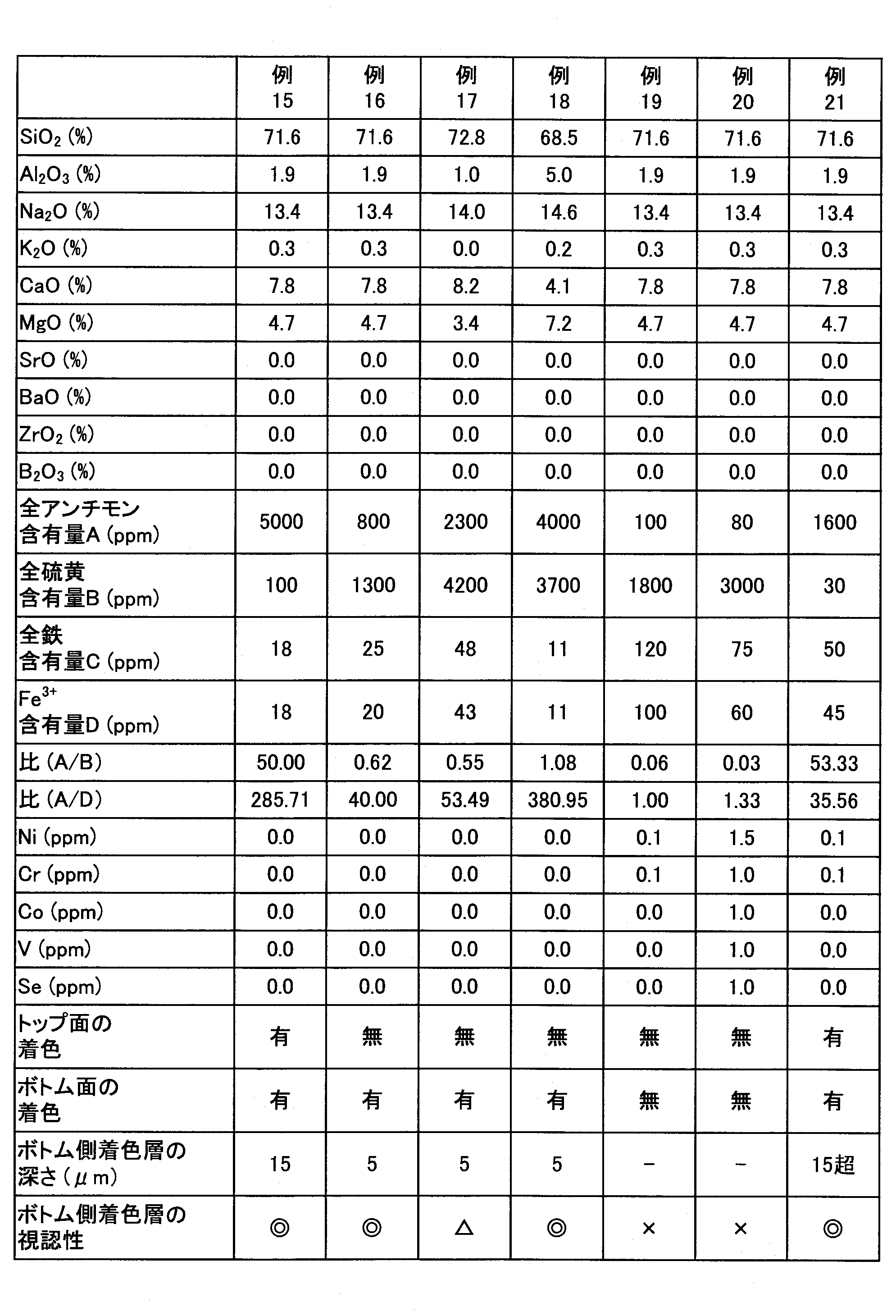
例1~21では、ガラス原料の配合比以外、同じ条件でフロート法によってガラス板を製造した。例1~18が実施例、例19~21が比較例である。
製造したガラス板は、ガラスリボンのトップ面の着色の有無、ガラスリボンのボトム面の着色の有無、ボトム面からの着色層の深さ、およびボトム面に形成される着色層の視認性で評価した。
着色層の視認性は、着色層を研磨によって除去する前と後の両方のガラス板において測定した透過率から、JIS Z 8781-4(2013)に記載の方法に従ってCIE1976(L*a*b*)表色系におけるC光源下での色差ΔE*
abを算出し、それに基づいて4段階で評価した。具体的には、ΔE*
abが6.5以上である場合を「◎」、1.6以上6.5未満である場合を「○」、0.4以上1.6未満である場合を「△」、0.4未満である場合を「×」とした。
結果を表1~3に示す。表1~3において、「%」とは質量%を意味し、「ppm」とは質量ppmを意味する。

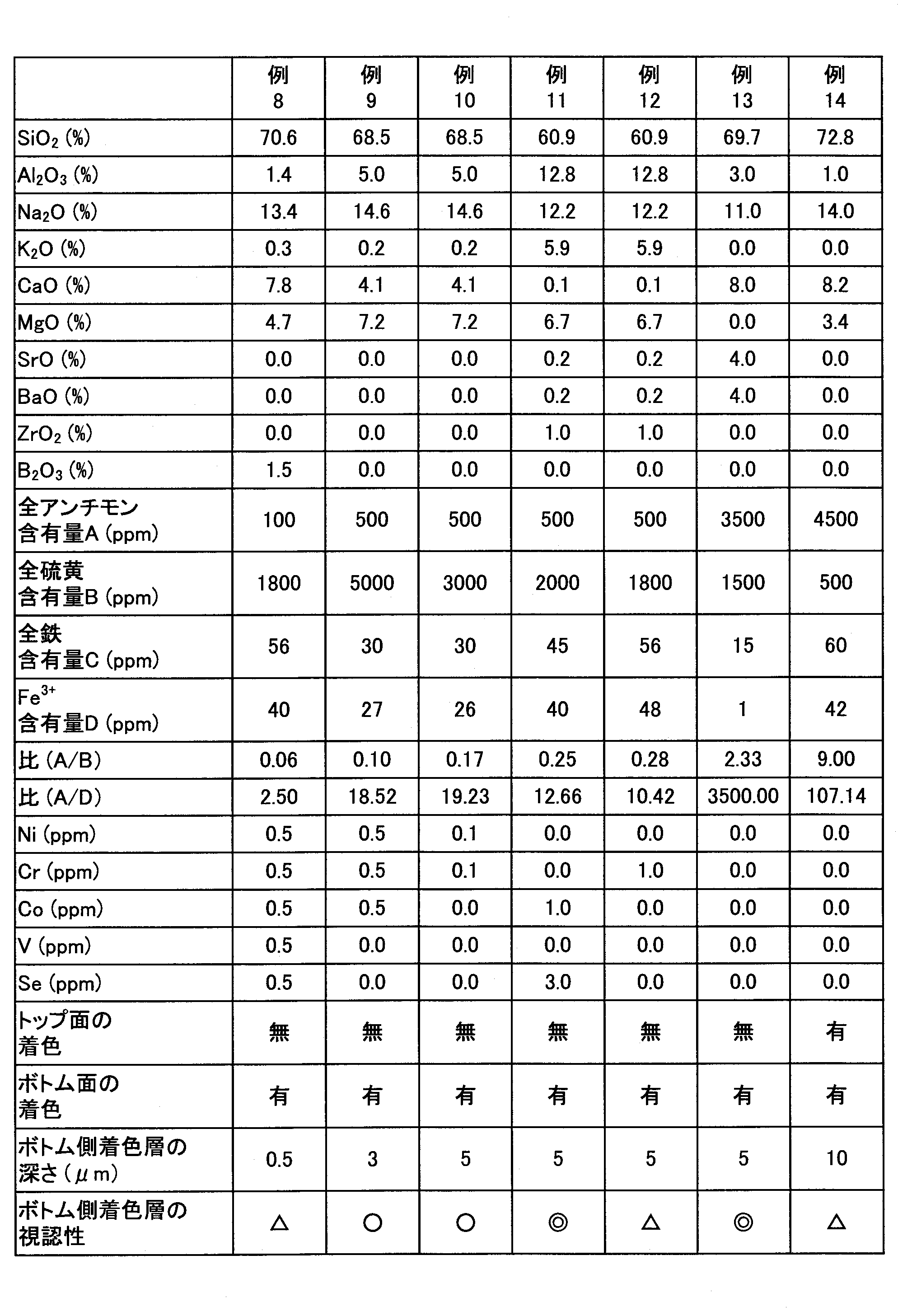
また、例1~13および例16~18のガラス板は、全硫黄含有量(B)が600質量ppm以上であり、且つ比(A/B)が2.5以下であるので、ガラスリボンのボトム面とトップ面の両面のうちボトム面に選択的に着色層が形成できた。
一方、例19のガラス板は、全鉄含有量(C)が多過ぎ、且つFe3+含有量(D)が多過ぎて比(A/D)が小さ過ぎるので、鉄イオンによる着色が顕著に表れ、そのためにアンチモンコロイド粒子による着色層が視認できなかった。
また、例20のガラス板は、たとえば例6と同等の比(A/B)であるが、全鉄含有量(C)、Fe3+含有量(D)が多く、鉄イオンによる着色が顕著に表れるので、アンチモンコロイド粒子による着色層が視認できなかった。
また、例21のガラス板は、比(A/B)が大き過ぎるため、着色層の深さが深過ぎ、無駄な研磨が必要になる。
以上、ガラス板の製造方法の実施形態などについて説明したが、本発明は上記実施形態などに限定されず、特許請求の範囲に記載された本発明の要旨の範囲内において、種々の変形、改良が可能である。
本出願は、2015年8月3日に日本国特許庁に出願された特願2015-153498号に基づく優先権を主張するものであり、特願2015-153498号の全内容を本出願に援用する。
30 成形装置
31 成形炉
311 浴槽
G1 ガラス原料
G2 溶融ガラス
G3 ガラスリボン
M 溶融金属
31 成形炉
311 浴槽
G1 ガラス原料
G2 溶融ガラス
G3 ガラスリボン
M 溶融金属
Claims (15)
- 浴槽内の溶融金属上で溶融ガラスを帯板状のガラスリボンに成形する成形工程を有する、ガラス板の製造方法であって、
前記ガラス板は、Sb2O3に換算した全てのアンチモンの含有量(A)が100質量ppm以上5000質量ppm以下であり、SO3に換算した全ての硫黄の含有量(B)が100質量ppm以上であり、Fe2O3に換算した全ての鉄の含有量(C)が60質量ppm以下であり、且つ下記の式(1)、(2)が成立し、
前記成形工程では、前記ガラスリボンにおけるボトム面の近傍の酸化アンチモンを還元させることで、前記ボトム面から所定の深さの着色層を形成する、ガラス板の製造方法。
0.03≦A/B≦50・・・(1)
A/D≧2.2・・・(2)
式(2)中、Dは、Fe2O3に換算した3価の鉄の含有量であって、Fe2O3に換算した全ての鉄の含有量(C)以下である。 - 前記ガラス板は、Fe2O3に換算した全ての鉄の含有量(C)が50質量ppm以下であり、且つFe2O3に換算した3価の鉄の含有量(D)が40質量ppm以下である、請求項1に記載のガラス板の製造方法。
- 前記ガラス板は、SO3に換算した全ての硫黄の含有量(B)が600質量ppm以上であり、且つ比(A/B)が2.5以下である、請求項1または2に記載のガラス板の製造方法。
- 前記ガラス板は、Ni、Cr、Co、VおよびSeからなる群の全ての遷移金属の合計含有量が5.0質量ppm以下である、請求項1~3のいずれか1項に記載のガラス板の製造方法。
- 前記ガラス板は、酸化物換算の質量百分率表示で、SiO2を60~80%、Al2O3を0~7%、MgOを0~10%、CaOを0~20%、SrOを0~15%、BaOを0~15%、Na2Oを3~20%、およびK2Oを0~10%含む、請求項1~4のいずれか1項に記載のガラス板の製造方法。
- 前記ガラス板は、酸化物換算の質量百分率表示で、SiO2を45~80%、Al2O3を7%超30%以下、B2O3を0~15%、MgOを0~15%、CaOを0~6%、SrOを0~5%、BaOを0~5%、Na2Oを7~20%、K2Oを0~10%、およびZrO2を0~10%含む、請求項1~4のいずれか1項に記載のガラス板の製造方法。
- 前記成形工程の後に、前記ガラスリボンの前記ボトム面を研磨する研磨工程を有する、請求項1~6のいずれか1項に記載のガラス板の製造方法。
- Sb2O3に換算した全てのアンチモンの含有量(A)が100質量ppm以上5000質量ppm以下であり、SO3に換算した全ての硫黄の含有量(B)が100質量ppm以上であり、Fe2O3に換算した全ての鉄の含有量(C)が60質量ppm以下であり、且つ下記の式(1)、(2)が成立する、ガラス板。
0.03≦A/B≦50・・・(1)
A/D≧2.2・・・(2)
式(2)中、Dは、Fe2O3に換算した3価の鉄の含有量であって、Fe2O3に換算した全ての鉄の含有量(C)以下である。 - Fe2O3に換算した全ての鉄の含有量(C)が50質量ppm以下であり、且つFe2O3に換算した3価の鉄の含有量(D)が40質量ppm以下である、請求項8に記載のガラス板。
- SO3に換算した全ての硫黄の含有量(B)が600質量ppm以上であり、且つ比(A/B)が2.5以下である、請求項8または9に記載のガラス板。
- Ni、Cr、Co、VおよびSeからなる群の全ての遷移金属の合計含有量が5.0質量ppm以下である、請求項8~10のいずれか1項に記載のガラス板。
- 酸化物換算の質量百分率表示で、SiO2を60~80%、Al2O3を0~7%、MgOを0~10%、CaOを0~20%、SrOを0~15%、BaOを0~15%、Na2Oを3~20%、およびK2Oを0~10%含む、請求項8~11のいずれか1項に記載のガラス板。
- 酸化物換算の質量百分率表示で、SiO2を45~80%、Al2O3を7%超30%以下、B2O3を0~15%、MgOを0~15%、CaOを0~6%、SrOを0~5%、BaOを0~5%、Na2Oを7~20%、K2Oを0~10%、およびZrO2を0~10%含む、請求項8~11のいずれか1項に記載のガラス板。
- 2つの主表面を有し、
各前記主表面におけるSnの濃度を二次イオン質量分析法(SIMS)によって測定した場合に、2つの前記主表面におけるSnの濃度差が102cps以上106cps以下である、請求項8~13のいずれか1項に記載のガラス板。 - 2つの主表面を有し、
各前記主表面の算術平均粗さが0.1μm以下である、請求項8~14のいずれか1項に記載のガラス板。
Applications Claiming Priority (2)
| Application Number | Priority Date | Filing Date | Title |
|---|---|---|---|
| JP2015-153498 | 2015-08-03 | ||
| JP2015153498A JP2018150180A (ja) | 2015-08-03 | 2015-08-03 | ガラス板の製造方法、およびガラス板 |
Publications (1)
| Publication Number | Publication Date |
|---|---|
| WO2017022508A1 true WO2017022508A1 (ja) | 2017-02-09 |
Family
ID=57942916
Family Applications (1)
| Application Number | Title | Priority Date | Filing Date |
|---|---|---|---|
| PCT/JP2016/071450 Ceased WO2017022508A1 (ja) | 2015-08-03 | 2016-07-21 | ガラス板の製造方法、およびガラス板 |
Country Status (3)
| Country | Link |
|---|---|
| JP (1) | JP2018150180A (ja) |
| TW (1) | TW201716345A (ja) |
| WO (1) | WO2017022508A1 (ja) |
Cited By (3)
| Publication number | Priority date | Publication date | Assignee | Title |
|---|---|---|---|---|
| KR20210024047A (ko) * | 2018-06-27 | 2021-03-04 | 비트로 플랫 글래스 엘엘씨 | 고 알루미나 저 소다 유리 조성물 |
| WO2024117054A1 (ja) * | 2022-12-01 | 2024-06-06 | Agc株式会社 | ガラス板及びガラス板の製造方法 |
| US12630460B2 (en) | 2022-03-01 | 2026-05-19 | Vitro Flat Glass Llc | High alumina low soda glass compositions |
Families Citing this family (1)
| Publication number | Priority date | Publication date | Assignee | Title |
|---|---|---|---|---|
| JP7220583B2 (ja) * | 2019-02-14 | 2023-02-10 | AvanStrate株式会社 | ガラス基板の製造方法 |
Citations (7)
| Publication number | Priority date | Publication date | Assignee | Title |
|---|---|---|---|---|
| JP2000315477A (ja) * | 1999-04-28 | 2000-11-14 | Matsushita Electronics Industry Corp | 蛍光ランプ |
| JP2004220719A (ja) * | 2003-01-16 | 2004-08-05 | Hoya Corp | 情報記録媒体用基板、情報記録媒体およびその製造方法、ならびに情報記録装置 |
| JP2007238398A (ja) * | 2006-03-10 | 2007-09-20 | Nippon Sheet Glass Co Ltd | ソーダ石灰系ガラス組成物 |
| JP2011011951A (ja) * | 2009-07-03 | 2011-01-20 | Asahi Glass Co Ltd | フラットパネルディスプレイ用ガラス基板およびその製造方法、ならびにそれを用いたディスプレイパネル |
| JP2013151428A (ja) * | 2006-05-29 | 2013-08-08 | Nippon Electric Glass Co Ltd | Li2O−Al2O3−SiO2系結晶化ガラス |
| JP2014144907A (ja) * | 2013-01-04 | 2014-08-14 | Nippon Electric Glass Co Ltd | ガラス板 |
| JP2015193521A (ja) * | 2014-03-19 | 2015-11-05 | 日本電気硝子株式会社 | 紫外線透過ガラス及びその製造方法 |
-
2015
- 2015-08-03 JP JP2015153498A patent/JP2018150180A/ja active Pending
-
2016
- 2016-07-21 WO PCT/JP2016/071450 patent/WO2017022508A1/ja not_active Ceased
- 2016-07-27 TW TW105123785A patent/TW201716345A/zh unknown
Patent Citations (7)
| Publication number | Priority date | Publication date | Assignee | Title |
|---|---|---|---|---|
| JP2000315477A (ja) * | 1999-04-28 | 2000-11-14 | Matsushita Electronics Industry Corp | 蛍光ランプ |
| JP2004220719A (ja) * | 2003-01-16 | 2004-08-05 | Hoya Corp | 情報記録媒体用基板、情報記録媒体およびその製造方法、ならびに情報記録装置 |
| JP2007238398A (ja) * | 2006-03-10 | 2007-09-20 | Nippon Sheet Glass Co Ltd | ソーダ石灰系ガラス組成物 |
| JP2013151428A (ja) * | 2006-05-29 | 2013-08-08 | Nippon Electric Glass Co Ltd | Li2O−Al2O3−SiO2系結晶化ガラス |
| JP2011011951A (ja) * | 2009-07-03 | 2011-01-20 | Asahi Glass Co Ltd | フラットパネルディスプレイ用ガラス基板およびその製造方法、ならびにそれを用いたディスプレイパネル |
| JP2014144907A (ja) * | 2013-01-04 | 2014-08-14 | Nippon Electric Glass Co Ltd | ガラス板 |
| JP2015193521A (ja) * | 2014-03-19 | 2015-11-05 | 日本電気硝子株式会社 | 紫外線透過ガラス及びその製造方法 |
Cited By (6)
| Publication number | Priority date | Publication date | Assignee | Title |
|---|---|---|---|---|
| KR20210024047A (ko) * | 2018-06-27 | 2021-03-04 | 비트로 플랫 글래스 엘엘씨 | 고 알루미나 저 소다 유리 조성물 |
| JP2021528357A (ja) * | 2018-06-27 | 2021-10-21 | ビトロ フラット グラス エルエルシー | 高アルミナ低ソーダガラス組成物 |
| JP7500446B2 (ja) | 2018-06-27 | 2024-06-17 | ビトロ フラット グラス エルエルシー | 高アルミナ低ソーダガラス組成物 |
| KR102808901B1 (ko) | 2018-06-27 | 2025-05-15 | 비트로 플랫 글래스 엘엘씨 | 고 알루미나 저 소다 유리 조성물 |
| US12630460B2 (en) | 2022-03-01 | 2026-05-19 | Vitro Flat Glass Llc | High alumina low soda glass compositions |
| WO2024117054A1 (ja) * | 2022-12-01 | 2024-06-06 | Agc株式会社 | ガラス板及びガラス板の製造方法 |
Also Published As
| Publication number | Publication date |
|---|---|
| TW201716345A (zh) | 2017-05-16 |
| JP2018150180A (ja) | 2018-09-27 |
Similar Documents
| Publication | Publication Date | Title |
|---|---|---|
| JP6247229B2 (ja) | 高歪点アルミノシリケートガラス | |
| US10392293B2 (en) | High-transparency glass | |
| JP6692812B2 (ja) | ディスプレイ用ガラス基板およびその製造方法 | |
| TWI570082B (zh) | 具低氧化鋯含量的顯示器品質玻璃片的大量生產 | |
| KR101489983B1 (ko) | 무알칼리 유리의 제조 방법 | |
| TWI642642B (zh) | Optical glass and manufacturing method thereof | |
| CN102363553B (zh) | 应用特定澄清方法制备透明玻璃或透明拉制玻璃的方法 | |
| US20190352217A1 (en) | Flat glass, method for producing same, and use thereof | |
| JP2015512849A5 (ja) | ||
| KR101135919B1 (ko) | 디스플레이용 유리 기판 및 그 제조방법 | |
| CN104058589B (zh) | 高度折射的薄玻璃 | |
| KR101273782B1 (ko) | 기판용 유리 조성물 | |
| US20100255980A1 (en) | Low iron high transmission glass with boron oxide for improved optics, durability and refining, and corresponding method | |
| JP2007238398A (ja) | ソーダ石灰系ガラス組成物 | |
| CN112930328A (zh) | 尺寸稳定的玻璃 | |
| JP2014172798A (ja) | ガラス、カレットおよび光学素子の製造方法 | |
| JP2017178711A (ja) | 磁気記録媒体用ガラス基板及びその製造方法 | |
| EP1989152A2 (en) | Method of making glass including use of boron oxide for reducing glass refiting time | |
| JP2018150180A (ja) | ガラス板の製造方法、およびガラス板 | |
| CN115210191A (zh) | 光学玻璃 | |
| JP4053810B2 (ja) | 異常分散性を有する光学ガラス | |
| WO2015064595A1 (ja) | フロートバス用錫合金浴、フロートガラスの製造装置、フロートガラスの製造方法、および、フロートガラス | |
| JP7685820B2 (ja) | 光学ガラスおよび光学素子 | |
| JP2007126298A (ja) | 光学ガラス | |
| TWI649291B (zh) | 高折射薄鏡片 |
Legal Events
| Date | Code | Title | Description |
|---|---|---|---|
| 121 | Ep: the epo has been informed by wipo that ep was designated in this application |
Ref document number: 16832787 Country of ref document: EP Kind code of ref document: A1 |
|
| NENP | Non-entry into the national phase |
Ref country code: DE |
|
| NENP | Non-entry into the national phase |
Ref country code: JP |
|
| 122 | Ep: pct application non-entry in european phase |
Ref document number: 16832787 Country of ref document: EP Kind code of ref document: A1 |