WO2017018345A1 - 熱収縮性ポリエステル系フィルム、およびその製造方法、包装体 - Google Patents
熱収縮性ポリエステル系フィルム、およびその製造方法、包装体 Download PDFInfo
- Publication number
- WO2017018345A1 WO2017018345A1 PCT/JP2016/071558 JP2016071558W WO2017018345A1 WO 2017018345 A1 WO2017018345 A1 WO 2017018345A1 JP 2016071558 W JP2016071558 W JP 2016071558W WO 2017018345 A1 WO2017018345 A1 WO 2017018345A1
- Authority
- WO
- WIPO (PCT)
- Prior art keywords
- film
- heat
- shrinkage
- stretching
- less
- Prior art date
- Legal status (The legal status is an assumption and is not a legal conclusion. Google has not performed a legal analysis and makes no representation as to the accuracy of the status listed.)
- Ceased
Links
Images

Classifications
-
- B—PERFORMING OPERATIONS; TRANSPORTING
- B29—WORKING OF PLASTICS; WORKING OF SUBSTANCES IN A PLASTIC STATE IN GENERAL
- B29C—SHAPING OR JOINING OF PLASTICS; SHAPING OF MATERIAL IN A PLASTIC STATE, NOT OTHERWISE PROVIDED FOR; AFTER-TREATMENT OF THE SHAPED PRODUCTS, e.g. REPAIRING
- B29C55/00—Shaping by stretching, e.g. drawing through a die; Apparatus therefor
- B29C55/02—Shaping by stretching, e.g. drawing through a die; Apparatus therefor of plates or sheets
- B29C55/10—Shaping by stretching, e.g. drawing through a die; Apparatus therefor of plates or sheets multiaxial
- B29C55/12—Shaping by stretching, e.g. drawing through a die; Apparatus therefor of plates or sheets multiaxial biaxial
- B29C55/14—Shaping by stretching, e.g. drawing through a die; Apparatus therefor of plates or sheets multiaxial biaxial successively
-
- B—PERFORMING OPERATIONS; TRANSPORTING
- B29—WORKING OF PLASTICS; WORKING OF SUBSTANCES IN A PLASTIC STATE IN GENERAL
- B29D—PRODUCING PARTICULAR ARTICLES FROM PLASTICS OR FROM SUBSTANCES IN A PLASTIC STATE
- B29D7/00—Producing flat articles, e.g. films or sheets
- B29D7/01—Films or sheets
-
- B—PERFORMING OPERATIONS; TRANSPORTING
- B29—WORKING OF PLASTICS; WORKING OF SUBSTANCES IN A PLASTIC STATE IN GENERAL
- B29C—SHAPING OR JOINING OF PLASTICS; SHAPING OF MATERIAL IN A PLASTIC STATE, NOT OTHERWISE PROVIDED FOR; AFTER-TREATMENT OF THE SHAPED PRODUCTS, e.g. REPAIRING
- B29C55/00—Shaping by stretching, e.g. drawing through a die; Apparatus therefor
- B29C55/02—Shaping by stretching, e.g. drawing through a die; Apparatus therefor of plates or sheets
- B29C55/10—Shaping by stretching, e.g. drawing through a die; Apparatus therefor of plates or sheets multiaxial
- B29C55/12—Shaping by stretching, e.g. drawing through a die; Apparatus therefor of plates or sheets multiaxial biaxial
-
- B—PERFORMING OPERATIONS; TRANSPORTING
- B29—WORKING OF PLASTICS; WORKING OF SUBSTANCES IN A PLASTIC STATE IN GENERAL
- B29C—SHAPING OR JOINING OF PLASTICS; SHAPING OF MATERIAL IN A PLASTIC STATE, NOT OTHERWISE PROVIDED FOR; AFTER-TREATMENT OF THE SHAPED PRODUCTS, e.g. REPAIRING
- B29C61/00—Shaping by liberation of internal stresses; Making preforms having internal stresses; Apparatus therefor
- B29C61/06—Making preforms having internal stresses, e.g. plastic memory
-
- B—PERFORMING OPERATIONS; TRANSPORTING
- B65—CONVEYING; PACKING; STORING; HANDLING THIN OR FILAMENTARY MATERIAL
- B65D—CONTAINERS FOR STORAGE OR TRANSPORT OF ARTICLES OR MATERIALS, e.g. BAGS, BARRELS, BOTTLES, BOXES, CANS, CARTONS, CRATES, DRUMS, JARS, TANKS, HOPPERS, FORWARDING CONTAINERS; ACCESSORIES, CLOSURES, OR FITTINGS THEREFOR; PACKAGING ELEMENTS; PACKAGES
- B65D23/00—Details of bottles or jars not otherwise provided for
- B65D23/08—Coverings or external coatings
-
- B—PERFORMING OPERATIONS; TRANSPORTING
- B65—CONVEYING; PACKING; STORING; HANDLING THIN OR FILAMENTARY MATERIAL
- B65D—CONTAINERS FOR STORAGE OR TRANSPORT OF ARTICLES OR MATERIALS, e.g. BAGS, BARRELS, BOTTLES, BOXES, CANS, CARTONS, CRATES, DRUMS, JARS, TANKS, HOPPERS, FORWARDING CONTAINERS; ACCESSORIES, CLOSURES, OR FITTINGS THEREFOR; PACKAGING ELEMENTS; PACKAGES
- B65D25/00—Details of other kinds or types of rigid or semi-rigid containers
- B65D25/20—External fittings
-
- B—PERFORMING OPERATIONS; TRANSPORTING
- B65—CONVEYING; PACKING; STORING; HANDLING THIN OR FILAMENTARY MATERIAL
- B65D—CONTAINERS FOR STORAGE OR TRANSPORT OF ARTICLES OR MATERIALS, e.g. BAGS, BARRELS, BOTTLES, BOXES, CANS, CARTONS, CRATES, DRUMS, JARS, TANKS, HOPPERS, FORWARDING CONTAINERS; ACCESSORIES, CLOSURES, OR FITTINGS THEREFOR; PACKAGING ELEMENTS; PACKAGES
- B65D65/00—Wrappers or flexible covers; Packaging materials of special type or form
- B65D65/02—Wrappers or flexible covers
-
- B—PERFORMING OPERATIONS; TRANSPORTING
- B65—CONVEYING; PACKING; STORING; HANDLING THIN OR FILAMENTARY MATERIAL
- B65D—CONTAINERS FOR STORAGE OR TRANSPORT OF ARTICLES OR MATERIALS, e.g. BAGS, BARRELS, BOTTLES, BOXES, CANS, CARTONS, CRATES, DRUMS, JARS, TANKS, HOPPERS, FORWARDING CONTAINERS; ACCESSORIES, CLOSURES, OR FITTINGS THEREFOR; PACKAGING ELEMENTS; PACKAGES
- B65D75/00—Packages comprising articles or materials partially or wholly enclosed in strips, sheets, blanks, tubes or webs of flexible sheet material, e.g. in folded wrappers
-
- B—PERFORMING OPERATIONS; TRANSPORTING
- B65—CONVEYING; PACKING; STORING; HANDLING THIN OR FILAMENTARY MATERIAL
- B65D—CONTAINERS FOR STORAGE OR TRANSPORT OF ARTICLES OR MATERIALS, e.g. BAGS, BARRELS, BOTTLES, BOXES, CANS, CARTONS, CRATES, DRUMS, JARS, TANKS, HOPPERS, FORWARDING CONTAINERS; ACCESSORIES, CLOSURES, OR FITTINGS THEREFOR; PACKAGING ELEMENTS; PACKAGES
- B65D77/00—Packages formed by enclosing articles or materials in preformed containers, e.g. boxes, cartons, sacks or bags
- B65D77/22—Details
-
- C—CHEMISTRY; METALLURGY
- C08—ORGANIC MACROMOLECULAR COMPOUNDS; THEIR PREPARATION OR CHEMICAL WORKING-UP; COMPOSITIONS BASED THEREON
- C08J—WORKING-UP; GENERAL PROCESSES OF COMPOUNDING; AFTER-TREATMENT NOT COVERED BY SUBCLASSES C08B, C08C, C08F, C08G or C08H
- C08J5/00—Manufacture of articles or shaped materials containing macromolecular substances
- C08J5/18—Manufacture of films or sheets
-
- B—PERFORMING OPERATIONS; TRANSPORTING
- B29—WORKING OF PLASTICS; WORKING OF SUBSTANCES IN A PLASTIC STATE IN GENERAL
- B29K—INDEXING SCHEME ASSOCIATED WITH SUBCLASSES B29B, B29C OR B29D, RELATING TO MOULDING MATERIALS OR TO MATERIALS FOR MOULDS, REINFORCEMENTS, FILLERS OR PREFORMED PARTS, e.g. INSERTS
- B29K2067/00—Use of polyesters or derivatives thereof, as moulding material
- B29K2067/003—PET, i.e. poylethylene terephthalate
-
- B—PERFORMING OPERATIONS; TRANSPORTING
- B29—WORKING OF PLASTICS; WORKING OF SUBSTANCES IN A PLASTIC STATE IN GENERAL
- B29K—INDEXING SCHEME ASSOCIATED WITH SUBCLASSES B29B, B29C OR B29D, RELATING TO MOULDING MATERIALS OR TO MATERIALS FOR MOULDS, REINFORCEMENTS, FILLERS OR PREFORMED PARTS, e.g. INSERTS
- B29K2105/00—Condition, form or state of moulded material or of the material to be shaped
- B29K2105/02—Condition, form or state of moulded material or of the material to be shaped heat shrinkable
-
- B—PERFORMING OPERATIONS; TRANSPORTING
- B29—WORKING OF PLASTICS; WORKING OF SUBSTANCES IN A PLASTIC STATE IN GENERAL
- B29K—INDEXING SCHEME ASSOCIATED WITH SUBCLASSES B29B, B29C OR B29D, RELATING TO MOULDING MATERIALS OR TO MATERIALS FOR MOULDS, REINFORCEMENTS, FILLERS OR PREFORMED PARTS, e.g. INSERTS
- B29K2995/00—Properties of moulding materials, reinforcements, fillers, preformed parts or moulds
- B29K2995/0037—Other properties
- B29K2995/0049—Heat shrinkable
-
- B—PERFORMING OPERATIONS; TRANSPORTING
- B29—WORKING OF PLASTICS; WORKING OF SUBSTANCES IN A PLASTIC STATE IN GENERAL
- B29L—INDEXING SCHEME ASSOCIATED WITH SUBCLASS B29C, RELATING TO PARTICULAR ARTICLES
- B29L2031/00—Other particular articles
- B29L2031/744—Labels, badges, e.g. marker sleeves
-
- C—CHEMISTRY; METALLURGY
- C08—ORGANIC MACROMOLECULAR COMPOUNDS; THEIR PREPARATION OR CHEMICAL WORKING-UP; COMPOSITIONS BASED THEREON
- C08J—WORKING-UP; GENERAL PROCESSES OF COMPOUNDING; AFTER-TREATMENT NOT COVERED BY SUBCLASSES C08B, C08C, C08F, C08G or C08H
- C08J2367/00—Characterised by the use of polyesters obtained by reactions forming a carboxylic ester link in the main chain; Derivatives of such polymers
Definitions
- the present invention relates to a heat-shrinkable polyester film suitable for heat-shrinkable label applications, a production method thereof, and a package using the label.
- polyester-based heat that has high heat resistance, easy incineration, and excellent solvent resistance for uses such as label packaging, cap seals, and integrated packaging that protect glass bottles or plastic bottles and display products.
- Shrinkable films have been widely used as shrinkage labels, and the amount of use tends to increase with an increase in PET (polyethylene terephthalate) bottle containers and the like.
- the heat-shrinkable polyester film whose width direction is the main shrinkage direction is stretched at a high magnification in the width direction in order to develop shrinkage characteristics in the width direction.
- low-stretching is only performed, and some are not stretched.
- Such a film that has been stretched at a low magnification in the longitudinal direction or a film that has been stretched only in the width direction has a disadvantage that the mechanical strength in the longitudinal direction is inferior.
- the mechanical strength in the longitudinal direction is increased, but the contraction rate in the longitudinal direction is also increased and the shrinkage finish is deteriorated.
- Patent Document 2 claims that the shrinkage stress is 3 MPa to 20 MPa, but in Examples, it is as high as 8.2 to 18 MPa.
- Patent Document 3 claims that the shrinkage stress is from 7 MPa to 14 MPa, but in the examples, it is 8.1 to 13.3 MPa. This is presumably because the stretching stress in the width direction was increased by biaxial stretching.
- Patent Documents 1 to 3 whose main shrinkage direction is the width direction have no problem in beverage PET bottle containers, but thin packaging such as lunch boxes and side dishes sold at convenience stores and supermarkets.
- thin packaging such as lunch boxes and side dishes sold at convenience stores and supermarkets.
- a heat-shrinkable film having a high shrinkage stress is used in a thin container, troubles such as deformation of the container due to the shrinkage stress of the film occur during shrinkage.
- Patent Document 4 claims that the shrinkage stress is 6 MPa or more, and in Examples, it is as high as 7 MPa or more.
- Comparative Example 1 there is a film having a low shrinkage stress of 3.9 MPa, which is considered to be due to a low shrinkage rate of 26%.
- Patent Document 5 is the same as Patent Document 4, and the shrinkage stress is 6 MPa or more, and in Examples, it is as high as 7 MPa or more.
- Comparative Example 5 there is a film having a low shrinkage stress of 4.7 MPa, which is considered to be because the shrinkage rate is as low as 33%.
- the present invention has a high heat shrinkage rate in the main shrinkage direction, a direction perpendicular to the main shrinkage direction has a small heat shrinkage rate, a high mechanical strength in the direction perpendicular to the main shrinkage direction, and a perforation opening property. It is an object of the present invention to provide a heat-shrinkable polyester film that is also excellent in shrinkage finish. It is an object of the first invention of the present application to provide the heat-shrinkable polyester film having a width direction as a main shrinkage direction and a longitudinal direction as a direction orthogonal to the main shrinkage direction.
- the second invention of the present application is to provide the heat-shrinkable polyester film having a longitudinal direction as a main shrinkage direction and a width direction as a direction orthogonal to the main shrinkage direction.
- the heat-shrinkable polyester film having the main shrinkage direction as the width direction is referred to as the first invention of the present application
- the heat-shrinkable polyester film having the main shrinkage direction as the longitudinal direction is referred to as the second invention of the present application.
- the present invention is common to both inventions.
- the present invention that has solved the above problems is a heat-shrinkable polyester film characterized by satisfying the following requirements (1) to (4).
- Hot water heat shrinkage rate when the film is immersed in 98 ° C. hot water for 10 seconds is 40% or more and 85% or less in the film main shrinkage direction
- the thermal shrinkage rate is ⁇ 5% or more and 15% or less in the direction perpendicular to the film main shrinkage direction.
- the maximum shrinkage stress in the film main shrinkage direction measured under hot air at 90 ° C. is 2 MPa or more and 7 MPa or less, and The shrinkage stress after 30 seconds from the start of the measurement of the shrinkage stress is 60% or more and 100% or less of the maximum shrinkage stress.
- the component unit derived from diethylene glycol in 100 mol% of all polyester resin components is 6 mol% or more.
- the inventors By including the amount of diethylene glycol (DEG) in the above requirement (4) in the constituent unit of the polyester resin, the inventors reduce the stretching stress in the width direction at the time of stretching, but the heat shrinkage rate in the film width direction It has been found that only the shrinkage stress in the width direction decreases without decreasing. In addition, the present inventors have found that this phenomenon has the same effect even in biaxial stretching, and completed the present invention.
- DEG diethylene glycol
- ethylene terephthalate is a main constituent, and the monomer component that can be an amorphous component in all polyester resin components is contained in an amount of 13 mol% or more.
- the main shrinkage direction is the film width direction.
- the main shrinkage direction is the film longitudinal direction.
- the tensile fracture strength in the direction orthogonal to the film main shrinkage direction is 60 MPa or more and 180 MPa or less.
- the right-angled tear strength per unit thickness in the direction perpendicular to the main shrinkage direction after shrinking 10% in the main shrinkage direction in warm water at 80 ° C. is 180 N / mm or more. It is preferable that it is 350 N / mm or less.
- the haze is preferably 2% or more and 18% or less.
- the present invention also includes a package formed by heat-shrinking a label obtained from the above heat-shrinkable polyester film by covering at least a part of the outer periphery of the package object.
- the present invention is a method for producing the above heat-shrinkable polyester film, comprising a step of stretching in the main shrinkage direction and a step of stretching in the direction orthogonal to the main shrinkage direction. A manufacturing method is also included.
- the heat-shrinkable polyester film of the present invention not only has a high shrinkage rate but also has a low shrinkage stress. Therefore, it is suitable for a thin container, and a heat-shrinkable film capable of packaging a wider object than before can be provided.
- the mechanical strength in the longitudinal direction perpendicular to the width direction (main shrinkage direction) or the width direction perpendicular to the longitudinal direction (main shrinkage direction) is high. Therefore, when used as a label for PET bottles, etc., it can be attached to a container such as a bottle very efficiently within a short period of time. Can be expressed. Moreover, since the film strength is high, the processing characteristics when performing printing and tubing are good.
- the shrinkage rate of shrinkage stress is small, and the shrinkage stress 30 seconds after the start of shrinkage is also high, so even if the container is thermally expanded during the heating of the label mounting process, the followability is good and the label does not loosen easily and has a good appearance. Is obtained.
- the perforation as a label is good, and when the label is opened, it can be cut cleanly along the perforation from the beginning of tearing to the completion of tearing.
- the heat-shrinkable polyester film of the present invention is produced by being stretched biaxially in the length-width or width-length, it can be produced very efficiently.
- the heat-shrinkable polyester film of the present invention has extremely high adhesive strength when the front and back surfaces (or the same surface) are bonded with a solvent, and is suitable for various coated labels such as labels for PET bottles. Can be used.
- the heat-shrinkable polyester film of the present invention includes not only a heat-shrinkable polyester film alone but also a heat-shrinkable film laminated with different resins having a heat-shrinkable polyester film layer.
- the package packaged with the label obtained from the heat-shrinkable polyester film of the present invention has a beautiful appearance.
- the heat-shrinkable polyester film of the present invention will be described in detail.
- a film is normally obtained by conveying using a roll etc. and extending
- the conveyance direction of a film is called a longitudinal direction
- the direction orthogonal to the said longitudinal direction is called a film width direction. Therefore, the width direction of the heat-shrinkable polyester film shown below is a direction perpendicular to the roll unwinding direction, and the film longitudinal direction refers to a direction parallel to the roll unwinding direction.
- the main shrinkage direction in the heat-shrinkable polyester film obtained in the examples and comparative examples of the first invention of the present application is the width direction, and the heat-shrinkable polyester obtained in the examples and comparative examples of the second invention of the present application.
- the main shrinkage direction in the system film is the longitudinal direction.
- the present inventors obtain a heat-shrinkable polyester film having a high mechanical strength in the longitudinal direction and an excellent perforation opening property as described in Patent Document 2 and Patent Document 3.
- a so-called longitudinal-lateral stretching method is employed in which the film is stretched in the direction.
- an intermediate heat treatment is performed before stretching in the width direction in order to relieve the contraction force in the longitudinal direction after stretching in the longitudinal direction.
- One method for obtaining a film with higher shrinkage is to increase the amount of monomer components (hereinafter simply referred to as amorphous components) constituting units that can be amorphous in the film.
- amorphous components monomer components constituting units that can be amorphous in the film.
- the film obtained by the conventional horizontal uniaxial stretching method an increase in the shrinkage ratio commensurate with the increase in the amount of the amorphous component was recognized.
- the film obtained by the above-described longitudinal-transverse stretching method and the film obtained by the above-described lateral-longitudinal stretching method found by the present inventors have a shrinkage ratio commensurate with the increased amount even if the amount of amorphous component is increased. It was found that there was no increase. If the amount of the amorphous component is further increased, the thickness unevenness increases and the productivity becomes worse. Therefore, the present inventors paid attention to diethylene glycol (hereinafter also simply referred to as “DEG”).
- DEG diethylene glyco
- the present inventors have found that when diethylene glycol is used as the constituent unit of the polyester resin, the stretching stress during film stretching is reduced, and further, only the shrinkage stress can be reduced without reducing the shrinkage rate.
- the polyester used in the heat-shrinkable polyester film of the present invention has an ethylene terephthalate unit as a main constituent component.
- the ethylene terephthalate unit is preferably 50 mol% or more, more preferably 60 mol% or more, and still more preferably 70 mol% or more, in 100 mol% of the polyester structural unit.
- dicarboxylic acid components constituting the polyester of the present invention include aromatic dicarboxylic acids such as isophthalic acid, orthophthalic acid, and 2,6-naphthalenedicarboxylic acid, fats such as adipic acid, azelaic acid, sebacic acid, and decanedicarboxylic acid. And alicyclic dicarboxylic acids such as 1,4-cyclohexanedicarboxylic acid.
- amorphous polymer specifically refers to a case where there is no endothermic peak due to melting as measured by a DSC differential scanning calorimeter. Amorphous polymers are substantially not crystallized and cannot be in a crystalline state, or have a very low crystallinity even when crystallized.
- the “crystalline polymer” is not the above “amorphous polymer”, that is, a case where it has an endothermic peak due to melting as measured by a DSC differential scanning calorimeter.
- a crystalline polymer is one that can be crystallized at elevated temperatures, has a crystallizable property, or has already been crystallized.
- the stereoregularity of the polymer is low, the target property of the polymer is poor, the polymer has a large side chain, the polymer has many branches, and the intermolecular molecules
- an amorphous polymer is obtained.
- crystallization may proceed sufficiently to become a crystalline polymer.
- the polymer may be crystalline or amorphous, and therefore, in the present invention, the expression “unit derived from a monomer that can be an amorphous component” is used. Using.
- the monomer unit is a repeating unit constituting a polymer derived from one polyhydric alcohol molecule and one polycarboxylic acid molecule.
- the monomer unit consisting of terephthalic acid and ethylene glycol is the main monomer unit constituting the polymer
- the monomer unit consisting of isophthalic acid and ethylene glycol the monomer unit consisting of terephthalic acid and neopentyl glycol, terephthalic acid and 1.4-cyclohexane
- a monomer unit composed of dimethanol, a monomer unit composed of isophthalic acid and butanediol, and the like can be cited as a monomer-derived unit that can be the amorphous component.
- the polyester does not contain a trivalent or higher polyvalent carboxylic acid (for example, trimellitic acid, pyromellitic acid, and anhydrides thereof).
- a trivalent or higher polyvalent carboxylic acid for example, trimellitic acid, pyromellitic acid, and anhydrides thereof.
- the diol component constituting the polyester includes ethylene glycol, 1,3-propanediol, 2,2-diethyl-1,3-propanediol, and 2-n-butyl-2-ethyl-1,3-propanediol.
- Fats such as 2,2-isopropyl-1,3-propanediol, 2,2-di-n-butyl-1,3-propanediol, 1,4-butanediol, hexanediol, neopentyl glycol, hexanediol Diols, alicyclic diols such as 1,4-cyclohexanedimethanol, and aromatic diols such as bisphenol A.
- the polyester used in the heat-shrinkable polyester film of the present invention needs to contain a structural unit derived from diethylene glycol.
- the structural unit derived from diethylene glycol is preferably 6% by mole or more, more preferably 7% by mole or more, and still more preferably 8% by mole or more in 100% by mole of the polyester structural unit.
- the upper limit of the structural unit derived from diethylene glycol is preferably 30 mol% or less, more preferably 28 mol% or less, and even more preferably 26 mol% or less.
- the component unit derived from diethylene glycol is contained in an amount of 6 mol% or more, the effect of the present invention such as reduction of shrinkage stress is improved, which is preferable.
- the diethylene glycol component is contained in an amount of more than 30 mol%, it is not preferable because deteriorated products and defects in the film increase.
- the total of the amorphous components in 100 mol% of the polyhydric alcohol component and 100 mol% of the polyvalent carboxylic acid component (that is, in the total of 200 mol%) in all polyester resins is preferably 13 mol% or more. Is at least 15 mol%, more preferably at least 17 mol%, particularly preferably at least 19 mol%, most preferably at least 20 mol%.
- the upper limit of the total amount of amorphous components is not particularly limited, but is preferably 30 mol% or less, more preferably 28 mol% or less, and particularly preferably 26 mol% or less.
- the polyester should not contain a diol having 8 or more carbon atoms (for example, octanediol) or a trihydric or higher polyhydric alcohol (for example, trimethylolpropane, trimethylolethane, glycerin, diglycerin, etc.). Is preferred. In the heat-shrinkable polyester film obtained by using polyesters containing these diols or polyhydric alcohols, it is difficult to achieve a necessary high shrinkage rate. Further, it is also preferable that the polyester does not contain triethylene glycol and polyethylene glycol as much as possible.
- various additives as required, for example, waxes, antioxidants, antistatic agents, crystal nucleating agents, viscosity reducing agents, heat stability
- An agent, a coloring pigment, an anti-coloring agent, an ultraviolet absorber and the like can be added.
- fine particles as a lubricant for improving the workability (slidability) of the film.
- the fine particles any one can be selected.
- inorganic fine particles silica, alumina, titanium dioxide, calcium carbonate, kaolin, barium sulfate, etc.
- organic fine particles for example, acrylic resin Examples thereof include particles, melamine resin particles, silicone resin particles, and crosslinked polystyrene particles.
- the average particle size of the fine particles is in the range of 0.05 to 3.0 ⁇ m (when measured with a Coulter counter) and can be appropriately selected as necessary.
- the above particles into the resin forming the heat-shrinkable polyester film for example, it can be added at any stage for producing the polyester resin, but it can be added at the esterification stage or transesterification reaction. After completion, it is preferable to add as a slurry dispersed in ethylene glycol or the like at a stage before the start of the polycondensation reaction, and proceed with the polycondensation reaction.
- a method of blending a slurry of particles dispersed in ethylene glycol or water using a vented kneading extruder and a polyester resin material, or a dried particle and a polyester resin material using a kneading extruder It is also preferable to carry out by a method of blending and the like.
- the heat-shrinkable polyester film of the present invention can be subjected to corona treatment, coating treatment, flame treatment or the like in order to improve the adhesion of the film surface.
- the heat-shrinkable polyester film of the present invention is immersed in 98 ° C. hot water for 10 seconds in a no-load state, and immediately immersed in water at 25 ° C. ⁇ 0.5 ° C. for 10 seconds. From the length, the heat shrinkage rate in the width direction (main shrinkage direction) of the film calculated by the following formula 1 (that is, hot water heat shrinkage rate of 98 ° C.) is 40% or more and 85% or less.
- Thermal shrinkage rate ⁇ (length before shrinkage ⁇ length after shrinkage) / length before shrinkage ⁇ ⁇ 100 (%)
- the hot water heat shrinkage rate in the main shrinkage direction at 98 ° C. is less than 40%, it cannot meet the demand for a high shrinkage film covering the entire container (so-called full label), and the shrinkage amount is small, so it is used as a label
- the label after heat shrinkage may be distorted, insufficiently shrunk, wrinkled or loosened.
- the hot shrinkage at 98 ° C. is preferably 45% or more, more preferably 50% or more, particularly preferably 55% or more, and most preferably 60% or more.
- requirement degree with respect to the film whose hot water heat shrinkage rate of main shrinkage in 98 degreeC exceeds 85% is low, the upper limit of hot water heat shrinkage rate was made into 85%.
- the heat-shrinkable polyester film of the present invention has a hot-water heat shrinkage rate of 98 ° C. in the direction (longitudinal direction) perpendicular to the main film shrinkage direction measured in the same manner as above, but not less than ⁇ 5% and not more than 15%. It is. If the hot water heat shrinkage rate in the direction orthogonal to the main shrinkage direction at 98 ° C. is less than ⁇ 5%, the amount of the film stretched by heating is excessive, and a good shrinkage appearance is obtained when used as a container label. In contrast, if the hot water heat shrinkage rate in the direction orthogonal to the main shrinkage direction at 98 ° C.
- the label after heat shrinkage becomes shorter (the label height decreases), and the label area Is not preferable as a full label, and is not preferable because distortion is likely to occur in the label after heat shrinkage.
- the upper limit of hot water heat shrinkage in the direction orthogonal to the main shrinkage direction at 98 ° C. it is preferably 12% or less, more preferably 10% or less, particularly preferably 9% or less, and most preferably 8% or less.
- the hot water heat shrinkage rate in the direction orthogonal to the main shrinkage direction at 98 ° C. is lower than ⁇ 5%, the label height becomes higher after shrinkage, and as a result, the surplus becomes double and wrinkles. 5%.
- the heat-shrinkable polyester film of the present invention has a maximum shrinkage stress in the film main shrinkage direction measured under hot air of 90 ° C. of 2 MPa or more and 7 MPa or less, and a shrinkage stress after 30 seconds from the start of the measurement of the shrinkage stress. It is preferably 60% or more and 100% or less of the maximum shrinkage stress.
- the measurement of shrinkage stress shall be performed by the method as described in an Example.
- the maximum shrinkage stress at 90 ° C. of the main film shrinkage exceeds 7 MPa, there is no problem in a PET bottle container or the like, but in a thinned container, it is not preferable because the shrinkage stress is crushed during shrinkage.
- the maximum shrinkage stress at 90 ° C. is more preferably 6 MPa or less, and further preferably 5 MPa or less. Further, if the maximum shrinkage stress in the main film shrinkage direction at 90 ° C. is less than 2 MPa, the label may be loosened and not adhere to the container when used as a container label, which is not preferable.
- the maximum shrinkage stress at 90 ° C. is more preferably 2.5 MPa or more, and further preferably 3 MPa or more.
- the shrinkage stress in the main film shrinkage direction after 30 seconds from the start of measurement in hot air at 90 ° C. is preferably 60% or more and 100% or less with respect to the maximum shrinkage stress. That is, the heat-shrinkable polyester film of the present invention exhibits a unique heat-shrinkage characteristic that exhibits a shrinkage stress equivalent to the maximum heat-shrinkage stress even after 30 seconds from the start of heat shrinkage.
- stress ratio maximum shrinkage stress
- the stress ratio is more preferably 75% or more, further preferably 80% or more, and particularly preferably 90% or more. A larger stress ratio is preferable because the followability becomes better. However, since the shrinkage stress after 30 seconds cannot exceed the maximum shrinkage stress, the upper limit is 100%.
- the main shrinkage direction is preferably the film width direction.
- the longitudinal direction of the heat-shrinkable polyester film is the film-forming direction (line direction) of the heat-shrinkable film
- the width direction of the heat-shrinkable polyester film is the above-described longitudinal direction.
- the main shrinkage direction in the heat-shrinkable polyester film obtained in the examples and comparative examples of the first invention of the present application is the width direction.
- the main shrinkage direction is preferably the film longitudinal direction.
- the main shrinkage direction in the heat-shrinkable polyester film obtained in the examples and comparative examples of the second invention of the present application is the longitudinal direction.
- the heat-shrinkable polyester film of the present invention preferably has a tensile fracture strength in the direction orthogonal to the main shrinkage direction of 60 MPa or more and 150 MPa or less.
- a method for measuring the tensile fracture strength will be described in Examples.
- the tensile fracture strength is less than 60 MPa, the “waist” (stiffness) when attached to a container as a label becomes weak.
- the tensile fracture strength is more preferably 80 MPa or more, and further preferably 100 MPa or more.
- the tensile fracture strength in the direction orthogonal to the main shrinkage direction can be within the above range unless the longitudinal stretching step is performed in the first invention of the present application and the transverse stretching process is performed in the second invention of the present application. Absent.
- the heat-shrinkable polyester film of the present invention was subjected to 10% shrinkage in the main shrinkage direction in warm water at 80 ° C., and then the right-angle tear strength per unit thickness in the direction perpendicular to the film main shrinkage direction was determined. It is preferable that the right-angled tear strength in the direction orthogonal to the main shrinkage direction is 180 N / mm or more and 350 N / mm or less. In addition, the measuring method of right-angled tear strength is demonstrated in an Example.
- the right-angled tear strength is smaller than 180 N / mm, it is not preferable since it may be easily broken by an impact such as dropping during transportation when used as a label. If it is larger than 350 N / mm, the cutability (ease of tearing) at the time of tearing the label becomes poor.
- the right-angled tear strength is more preferably 250 N / mm or more, further preferably 280 N / mm or more, and more preferably 330 N / mm or less.
- the heat-shrinkable polyester film of the present invention preferably has a haze of 2% to 18%. If the haze exceeds 18%, the transparency becomes poor and the appearance may be deteriorated during label production, which is not preferable.
- the haze value is more preferably 15% or less, further preferably 13% or less, particularly preferably 12% or less, and most preferably 9% or less. Further, the smaller the haze value is, the more preferable, but in consideration of the necessity of adding a predetermined amount of lubricant to the film for the purpose of imparting practically necessary slipperiness, the lower limit is about 2%.
- the heat-shrinkable polyester film of the present invention is not particularly limited, but preferably has a thickness of 6 ⁇ m to 70 ⁇ m. A more preferable lower limit of the thickness is 10 ⁇ m.
- the heat-shrinkable polyester film of the present invention is formed by melting and extruding the above-described polyester raw material with an extruder to form an unstretched film, and biaxially stretching the unstretched film by the predetermined method shown below and heat-treating it. Can be obtained.
- the polyester can be obtained by polycondensing the above-described preferred dicarboxylic acid component and diol component by a known method. Usually, two or more kinds of chip-like polyester are mixed and used as a raw material for the film.
- the polyester raw material is preferably dried using a dryer such as a hopper dryer or a paddle dryer, or a vacuum dryer. After the polyester raw material is dried in such a manner, it is melted at a temperature of 200 to 300 ° C. and extruded into a film using an extruder. In extruding, any existing method such as a T-die method or a tubular method can be employed.
- an unstretched film can be obtained by quenching the extruded sheet-like molten resin.
- a method of rapidly cooling the molten resin a method of obtaining a substantially unoriented resin sheet by casting the molten resin from a die onto a rotating drum and rapidly solidifying it can be suitably employed.
- the unstretched film obtained is stretched in the longitudinal direction under predetermined conditions as will be described later, the film after the longitudinal stretching is annealed and then rapidly cooled, and then heat-treated.
- the heat-shrinkable polyester film of the present invention can be obtained by cooling the heat-treated film under predetermined conditions, stretching in the width direction under predetermined conditions, and heat-treating again.
- the preferable film forming method for obtaining the heat-shrinkable polyester film of the first invention of the present application will be described.
- the heat-shrinkable polyester film of the present invention is formed by the following procedure. (1) Control of longitudinal stretching conditions (2) Intermediate heat treatment after longitudinal stretching (3) Natural cooling (interruption of heating) between intermediate heat treatment and transverse stretching (4) Forced cooling of the film after natural cooling (5) Control of transverse stretching conditions (6) Heat treatment after transverse stretching (7) During the above production process, a step of relaxing in the longitudinal direction at least twice is provided.
- the stretching temperature is set to Tg to Tg + 30 ° C., and stretched to 3.3 to 4.6 times. There is a need.
- the longitudinal stretching either one-stage stretching or two-stage or more multi-stage stretching can be used.
- the stretching temperature is too high or the total longitudinal stretching ratio is increased, amorphous molecules are stretched, and the thermal shrinkage in the longitudinal direction tends to increase.
- the longitudinal stretching ratio is too large, oriented crystallization of the film after longitudinal stretching proceeds, breakage is likely to occur in the transverse stretching step, and the shrinkage in the transverse direction after transverse stretching is also not preferred.
- the upper limit of the longitudinal draw ratio is set to 4.6 times.
- the longitudinal draw ratio is more preferably 4.5 times or less, and even more preferably 4.4 times or less.
- the longitudinal draw ratio is preferably 3.3 times or more, more preferably 3.4 times or more, and further preferably 3.5 times or more.
- the temperature of the intermediate heat treatment is more preferably Tg + 41 ° C. or higher, further preferably Tg + 42 ° C. or higher, more preferably Tg + 58 ° C. or lower, and further preferably Tg + 56 ° C. or lower. If the temperature of the intermediate heat treatment is too high, the molecular chain oriented by longitudinal stretching changes to crystals, and a high thermal shrinkage cannot be obtained after transverse stretching. On the other hand, the time for the intermediate heat treatment needs to be appropriately adjusted according to the raw material composition within the range of 6.0 seconds to 12.0 seconds. In the intermediate heat treatment, the amount of heat given to the film is important. If the temperature of the intermediate heat treatment is low, a long-term intermediate heat treatment is required. However, if the intermediate heat treatment time is too long, the equipment becomes large, so it is preferable to adjust the temperature and time appropriately.
- the crystallization of the film is suppressed by controlling the temperature of the intermediate heat treatment to Tg + 60 ° C. or lower. For this reason, by setting the temperature of the intermediate heat treatment to Tg + 60 ° C. or lower, crystallization can be suppressed and the shrinkage rate in the width direction can be increased. Further, by suppressing the temperature of the intermediate heat treatment to Tg + 60 ° C. or less, it is possible to suppress the crystallization of the surface layer of the film and keep the solvent adhesive strength high, and it is also possible to reduce the thickness unevenness in the longitudinal direction.
- the intermediate zone when the strip-shaped paper piece is hung in a state where the film is not passed through, the accompanying flow and the cooling zone accompanying the running of the film so that the paper piece hangs down almost completely in the vertical direction. It is preferable to block the hot air from. If the time for passing through the intermediate zone is less than 0.5 seconds, the transverse stretching becomes high-temperature stretching, and the shrinkage rate in the transverse direction cannot be sufficiently increased. On the contrary, the time for passing through the intermediate zone is sufficient if it is 3.0 seconds, and setting it longer than that is not preferable because it wastes equipment.
- the time for passing through the intermediate zone is more preferably 0.7 seconds or more, further preferably 0.9 seconds or more, more preferably 2.8 seconds or less, and further preferably 2.6 seconds or less.
- the naturally cooled film is not stretched as it is, but the film temperature is Tg or more and Tg + 40 ° C. or less. Therefore, it is necessary to actively cool. By performing such forced cooling treatment, it becomes possible to obtain a film having good perforation opening properties when used as a label.
- the temperature of the film after forced cooling is more preferably Tg + 2 ° C. or more, further preferably Tg + 4 ° C. or more, more preferably Tg + 35 ° C. or less, and further preferably Tg + 30 ° C. or less.
- the shrinkage rate in the width direction of the film becomes low, and the shrinkability when used as a label becomes insufficient.
- the temperature of the film after forced cooling to be Tg + 40 ° C. or less, the shrinkage rate in the width direction of the film can be kept large.
- the temperature of the film after forced cooling remains above Tg + 40 ° C., the stress of transverse stretching performed after cooling tends to decrease, and the thickness unevenness in the width direction tends to increase, but the temperature of the film after cooling By performing forced cooling so that the temperature becomes Tg + 40 ° C. or less, it becomes possible to increase the stress of transverse stretching performed after cooling and reduce the thickness variation in the width direction.
- the transverse stretching is performed so that the magnification is 3 times or more and 7 times or less at a temperature of Tg + 10 ° C. or more and Tg + 40 ° C. or less in a state where both ends in the width direction are held by clips in the tenter. There is a need.
- the transverse stretching temperature is more preferably Tg + 13 ° C. or more, more preferably Tg + 16 ° C. or more, more preferably Tg + 37 ° C.
- the transverse stretching ratio is more preferably 3.5 times or more, further preferably 4 times or more, more preferably 6.5 times or less, and still more preferably 6 times or less.
- the heat treatment temperature is lower than Tg, it cannot relax sufficiently in the width direction, and when the final product is stored at room temperature, shrinkage in the width direction (so-called natural shrinkage rate) increases with time, which is not preferable. Further, the longer the heat treatment time, the better. However, if the heat treatment time is too long, the equipment becomes large.
- Relaxation (relaxation) step in the longitudinal direction In order to reduce the contraction rate in the longitudinal direction, it is preferable to thermally relax (relax) the molecules oriented in the longitudinal direction by longitudinal stretching.
- the residual shrinkage stress in the longitudinal direction of the film after longitudinal stretching is large, there is a drawback that the hot-water heat shrinkage in the longitudinal direction of the film after transverse stretching becomes large and shrinkage finishing properties are deteriorated.
- Heat treatment in the transverse stretching step is effective in reducing the hot water heat shrinkage rate in the longitudinal direction of the film, but only relaxation by heat increases the number of crystals in the film and increases the shrinkage rate in the width direction. It is unsuitable.
- the film in order to increase the shrinkage rate in the width direction and reduce the shrinkage rate in the longitudinal direction, it is an effective means to stretch in the longitudinal direction and then relax in the longitudinal direction.
- the inventors have found that the film can be controlled by relaxing the film in the longitudinal direction by the following means. Of the following (i) to (iii), it is desirable to perform any two steps or to perform all three steps. (i) The film after longitudinal stretching is heated at a temperature of not less than Tg and not more than Tg + 60 ° C., and using a roll having a speed difference, not less than 10% and not more than 50% in the longitudinal direction in a time of not less than 0.05 seconds and not more than 5 seconds. The process of performing relaxation.
- any of temperature control rolls, near infrared rays, far infrared rays, hot air heaters and the like can be used.
- (i) Relax after longitudinal stretching Heat the film after longitudinal stretching at a temperature of Tg or more and Tg + 60 ° C or less, and use a roll with a speed difference in the longitudinal direction for a time of 0.05 seconds or more and 5.0 seconds or less. It is desirable to perform a relaxation of 10% to 50%. When the temperature is lower than Tg, the film after longitudinal stretching does not shrink and cannot be relaxed, which is not preferable. On the other hand, when it is higher than Tg + 60 ° C., the film is crystallized, and the transparency and the like are deteriorated.
- the film temperature during relaxation is more preferably Tg + 10 ° C. or more and Tg + 55 ° C. or less, and further preferably Tg + 20 ° C. or more and Tg + 50 ° C. or less.
- the time for relaxing in the longitudinal direction of the film after longitudinal stretching is preferably from 0.05 seconds to 5 seconds. If it is less than 0.05 seconds, relaxation will be short, and if the temperature is not higher than Tg + 60 ° C., relaxation unevenness will occur, which is not preferable. If the relaxation time is longer than 5 seconds, the film can be relaxed at a low temperature and there is no problem as a film. However, since the equipment becomes large, it is preferable to adjust the temperature and time appropriately.
- the relaxation time is more preferably 0.1 seconds to 4.5 seconds, and still more preferably 0.5 seconds to 4 seconds.
- the relaxation rate in the longitudinal direction of the film after longitudinal stretching is less than 10%, the molecular orientation in the longitudinal direction cannot be sufficiently relaxed, which is not preferable.
- the relaxation rate in the longitudinal direction of the film after longitudinal stretching is larger than 50%, the perpendicular tear strength in the longitudinal direction increases and the tensile fracture strength decreases, which is not preferable.
- the relaxation rate of the film after longitudinal stretching is more preferably from 15% to 45%, and further preferably from 20% to 40%.
- a heating device heating furnace
- any of temperature control rolls, near infrared heaters, far infrared heaters, hot air heaters and the like can be used.
- the length is 21% or more and 40% in the longitudinal direction in a time of 0.1 second to 12 seconds. It is desirable to perform the following relaxations: When the relaxation rate is less than 21%, it is not preferable because the molecular orientation in the longitudinal direction cannot be sufficiently relaxed. On the other hand, if the relaxation rate is larger than 40%, the right-angled tear strength in the longitudinal direction increases and the tensile fracture strength decreases, which is not preferable.
- the relaxation rate is more preferably 22% or more, more preferably 38% or less, and further preferably 36% or less.
- the time for relaxing in the longitudinal direction in the intermediate heat treatment step is preferably 0.1 second or more and 12 seconds or less. If the time is less than 0.1 seconds, relaxation becomes short, and if the temperature is not higher than Tg + 60 ° C., relaxation unevenness occurs, which is not preferable. If the relaxation time is longer than 12 seconds, there is no problem as a film, but the equipment becomes large. Therefore, it is preferable to adjust the temperature and time appropriately.
- the relaxation time is more preferably 0.3 seconds or more and 11 seconds or less, and further preferably 0.5 seconds or more and 10 seconds or less.
- the length is 21% or more and 40% in the longitudinal direction in a time of 0.1 second or more and 9 seconds or less. It is desirable to perform the following relaxations: When the relaxation rate is less than 21%, it is not preferable because the molecular orientation in the longitudinal direction cannot be sufficiently relaxed. On the other hand, if the relaxation rate is larger than 40%, the right-angled tear strength in the longitudinal direction increases and the tensile fracture strength decreases, which is not preferable.
- the relaxation rate is more preferably 22% or more, more preferably 38% or less, and further preferably 36% or less.
- the time for relaxing in the longitudinal direction in the final heat treatment step is preferably 0.1 seconds or more and 9 seconds or less. If the time is less than 0.1 seconds, relaxation becomes short, and if the temperature is not higher than Tg + 50 ° C., relaxation unevenness occurs, which is not preferable. If the relaxation time is longer than 9 seconds, there is no problem as a film. However, since the equipment becomes large, it is preferable to appropriately adjust the temperature and time.
- the relaxation time is more preferably 0.3 seconds or more and 8 seconds or less, and further preferably 0.5 seconds or more and 7 seconds or less.
- the unstretched film obtained by the above-described method is stretched in the width direction under predetermined conditions, the film after the transverse stretching is heat-treated, and then rapidly cooled. It is possible to obtain the heat-shrinkable polyester film of the second invention of the present application by stretching in the longitudinal direction under predetermined conditions and heat-treating again.
- a preferable film forming method for obtaining the heat-shrinkable polyester film of the second invention of the present application will be described in detail in consideration of the difference from the conventional film-forming method of the heat-shrinkable polyester film.
- the heat-shrinkable polyester film is usually produced by stretching only in the direction in which the unstretched film is desired to be shrunk (that is, the main shrinkage direction, the longitudinal direction in the second invention of the present application).
- the main shrinkage direction that is, the longitudinal direction in the second invention of the present application.
- the present inventors have obtained the heat-shrinkable polyester-based film of the second invention of the present application with good perforation opening and high productivity.
- the following findings were obtained.
- -It is considered necessary to leave some molecules oriented in the width direction in order to improve the perforation-opening property when used as a label.
- ⁇ In order to achieve a good finish after shrinkage when used as a label, it is essential that the shrinkage force in the width direction is not expressed. To that end, the tension state of molecules oriented in the width direction is eliminated. It is thought that it is necessary to do.
- the present inventors have found that “a molecule that is oriented in the width direction and does not contribute to the shrinkage force” in the film in order to satisfy both good shrinkage finish and followability, and simultaneously perforation openability. It was thought that it was necessary to have an appropriate molecular orientation. Then, a trial and error was carried out by paying attention to what kind of stretching would allow “molecules that are oriented in the width direction and do not contribute to the shrinkage force” to exist in the film and to control them.
- transverse stretching stretching in the transverse direction (lateral stretching) is performed.
- the transverse stretching is preferably performed at a temperature of Tg or more and Tg + 20 ° C., about 3.5 to 5 times in a state where both ends in the film width direction are held by clips in a tenter (first tenter).
- Tg temperature of Tg or more and Tg + 20 ° C.
- first tenter first tenter
- the draw ratio is lower than 3.5 times, thickness unevenness is likely to occur, and productivity is deteriorated.
- the draw ratio is higher than 5 times, the oriented crystallization of the film after transverse stretching proceeds and breakage tends to occur in the longitudinal stretching step, which is not preferable.
- preheating preheating is preferably performed until the film surface reaches Tg + 30 ° C. above Tg.
- the film After transverse stretching, it is preferable to pass the film through an intermediate zone where no aggressive heating operation is performed. If there is a temperature difference between the transverse stretching zone of the first tenter and the intermediate heat treatment zone, the heat of the intermediate heat treatment zone (hot air itself or radiant heat) flows into the transverse stretching zone, and the temperature of the transverse stretching zone is not stable, so the film quality is stable. Therefore, it is preferable to carry out the intermediate heat treatment after passing the film after the transverse stretching and before the intermediate heat treatment through the intermediate zone over a predetermined time.
- the intermediate heat treatment zone hot air itself or radiant heat
- this intermediate zone when a strip-shaped paper piece is hung in a state where the film is not passed through, the accompanying flow accompanying the running of the film, the transverse stretching zone and the middle so that the paper piece hangs almost completely in the vertical direction.
- a transit time of about 1 to 5 seconds is sufficient for the intermediate zone. If it is less than 1 second, the length of the intermediate zone becomes insufficient, and the heat blocking effect is insufficient. Further, it is preferable that the passing time of the intermediate zone is long, but if it is too long, the equipment becomes large, so about 5 seconds is sufficient.
- transverse stretching is performed under certain conditions
- intermediate heat treatment is performed under predetermined conditions according to the state of the film after the transverse stretching
- longitudinal stretching is performed under predetermined conditions according to the state of the film after the intermediate heat treatment
- the temperature of the intermediate heat treatment is more preferably Tg + 43 ° C. or more, further preferably Tg + 46 ° C. or more, more preferably Tg + 67 ° C. or less, and further preferably Tg + 64 ° C. or less.
- the time for the intermediate heat treatment needs to be appropriately adjusted according to the raw material composition within a range of 5 seconds to 15 seconds.
- the amount of heat given to the film is important. If the temperature of the intermediate heat treatment is low, a long-term intermediate heat treatment is required. However, if the intermediate heat treatment time is too long, the equipment becomes large, so it is preferable to adjust the temperature and time appropriately.
- the degree of molecular orientation in the width direction can be increased, and the tensile fracture strength in the width direction can be kept large while keeping the right-angle tear strength small.
- the temperature of the intermediate heat treatment to Tg + 70 ° C. or less, it becomes possible to suppress crystallization of the film, maintain stretchability in the width direction, and suppress troubles due to breakage. Further, the crystallization of the surface layer of the film can be suppressed and the solvent adhesive strength can be kept large, and the thickness unevenness in the width direction can be reduced. Thereby, a lateral uniaxially stretched polyester film is obtained.
- the intermediate heat treatment may be relaxed, but if the relaxation rate is higher than 40%, the degree of molecular orientation decreases and the tensile fracture strength in the width direction decreases, so the relaxation rate is 40. % Or less is preferable.
- the present inventors paid attention to diethylene glycol as a method for reducing only the longitudinal stretching stress while increasing the longitudinal stretching ratio and maintaining the longitudinal shrinkage ratio high.
- diethylene glycol By adding a predetermined amount of diethylene glycol, an increase in stretching stress was small even when the stretching ratio was increased by longitudinal stretching, and the shrinkage stress in the longitudinal direction could be lowered.
- the film after the intermediate heat treatment is guided to a longitudinal stretching machine in which a plurality of roll groups are continuously arranged, and after preheating until the film temperature reaches Tg + 20 ° C. over Tg on the preheating roll. It is preferable to heat the film so that the film temperature becomes Tg + 10 ° C. or higher and Tg + 60 ° C. with an infrared heater or the like, and to perform longitudinal stretching so that the stretching ratio is 2.5 to 5 times.
- a heating roll may be used as the longitudinal stretching roll.
- the longitudinal stretching temperature is preferably Tg + 20 ° C. or higher, and more preferably Tg + 25 ° C. or higher.
- the upper limit of the longitudinal stretching temperature is considered to be Tg + 60 ° C. in order to prevent adhesion of the film to the roll.
- the longitudinal draw ratio is preferably from 2.7 times to 4.8 times, and more preferably from 2.8 times to 4.6 times.
- the film after longitudinal stretching is not less than 5 seconds at a temperature of Tg ° C. or higher and Tg + 40 ° C. or lower in a state where both ends in the film width direction are held by clips in the tenter (second tenter). It needs to be finally heat treated for a time of 10 seconds or less.
- the relaxation in the width direction may be optionally performed simultaneously with the heat treatment. When relaxing, it is preferably 0% or more and 30% or less. When the relaxation rate in the width direction exceeds 30%, the molecular orientation in the film width direction decreases, and the right-angle tear strength and tensile fracture strength in the width direction decrease, which is not preferable.
- the relaxation rate in the width direction is more preferably 27% or less, and further preferably 24% or less.
- the shrinkage rate in the longitudinal direction is lowered, and the thermal shrinkage rate in the longitudinal direction at 98 ° C. is less than 40%, which is not preferable.
- the heat treatment temperature is lower than Tg, thermal relaxation of the molecular orientation in the longitudinal direction cannot be sufficiently performed, and when the final product is stored at room temperature, the shrinkage in the longitudinal direction (so-called natural shrinkage rate) increases over time. It is not preferable. Also, the longer the heat treatment time is, the better. However, if the heat treatment time is too long, the equipment becomes large.
- the package of the present invention is formed by heat-shrinking a label having a perforation or a notch obtained from the heat-shrinkable polyester film of the present invention on at least a part of the outer periphery of the package object.
- the packaging object include PET bottles for beverages, various bottles, cans, plastic containers such as confectionery and lunch boxes, paper boxes, and the like.
- the label is heat-shrinked by about 5 to 70% and adhered to the package.
- printing may be given to the label coat
- an organic solvent is applied slightly inside from one end of a rectangular film, and the film is immediately rolled and the ends are overlapped and bonded to form a label, or a roll Apply the organic solvent slightly inside from the edge of one side of the film wound up in the shape of a film, immediately roll up the film, overlap the edges and adhere, cut the tube to make a label .
- the organic solvent for adhesion cyclic ethers such as 1,3-dioxolane or tetrahydrofuran are preferable.
- aromatic hydrocarbons such as benzene, toluene, xylene and trimethylbenzene
- halogenated hydrocarbons such as methylene chloride and chloroform
- phenols such as phenol, and mixtures thereof
- the maximum value of the contraction stress measurement value from the start of measurement of the contraction stress to 30 seconds after the start of the measurement was defined as the maximum value of the contraction stress (maximum contraction stress (MPa)).
- maximum contraction stress (MPa) the maximum value of the contraction stress.
- the distance between chucks was fixed to 100 mm, and the transition of the shrinkage stress from the start of measurement to 30 seconds after the start of measurement was measured.
- [Tensile fracture strength] A strip-shaped test piece having a measurement direction (film longitudinal direction or width direction) of 140 mm and a direction orthogonal to the measurement direction (film width direction or longitudinal direction) of 20 mm was produced. Using a universal tensile tester “DSS-100” (manufactured by Shimadzu Corporation), hold both ends of the test piece with a chuck at 20 mm each side (distance between chucks: 100 mm), conditions of ambient temperature 23 ° C., tensile speed 200 mm / min. A tensile test was performed at, and the strength at the time of tensile fracture (stress) was defined as tensile fracture strength.
- DSS-100 universal tensile tester
- the film is attached to a rectangular frame having a predetermined length in a state of being loosened in advance (that is, both ends of the film are gripped by the frame).
- the film is immersed in hot water at 80 ° C. for about 5 seconds until the slack film becomes a tension state in the frame (until the slack disappears), so that the film is 10% in the main contraction direction (width direction or longitudinal direction). Shrink.
- a test piece having the shape shown in FIG. 1 was cut out from the film after 10% shrinkage in accordance with JIS-K-7128-3.
- the unit of length is mm
- R represents a radius.
- contraction direction of a film was made to become a tear direction.
- the both ends (width direction) of the test piece are grasped with a universal tensile testing machine (“Autograph” manufactured by Shimadzu Corporation), and a tensile test is performed at a tensile speed of 200 mm / min.
- the film is orthogonal to the main shrinkage direction.
- the maximum load when completely tearing in the direction (longitudinal direction or width direction) was measured. The maximum load was divided by the thickness of the film to calculate the right-angle tear strength per unit thickness.
- Tg glass transition point
- the heat-shrinkable film was preliminarily printed in three colors with grass, gold, and white ink from Toyo Ink Manufacturing Co., Ltd.
- the cylindrical label (The label which made the main shrinkage
- the diameter of the label in the shrinking direction was 35 cm, and the non-shrinking direction (height direction of the container) was 4 cm. Put a label on a thin polyethylene container with a side of 20cm square and a height direction of 6cm.
- Label height The height of the label described above was measured and evaluated according to the following criteria. (Evaluation criteria in Table 3) ⁇ : Label height is 38 mm or more ⁇ : Label height is 36 mm or more and less than 38 mm ⁇ : Label height is less than 36 mm (Evaluation criteria in Table 5) ⁇ : Label height is 38 mm or more ⁇ : Label height is less than 38 mm
- the wrinkle generation state was evaluated according to the following criteria.
- Perforation opening A label having perforations in a direction perpendicular to the main shrinkage direction was attached to the container under the same conditions as the above-described shrinkage distortion conditions of the label. However, the perforations were formed by putting holes having a length of 1 mm at intervals of 1 mm, and two perforations were provided in the longitudinal direction (height direction) of the label over a width of 22 mm and a length of 40 mm. Tear off the perforation of the label with your fingertips, count the number of labels that could not be torn cleanly along the perforation in the vertical direction, or remove the label from the bottle. Percentage of unseal perforation for all 50 samples (%) was calculated. If the perforation failure rate is 20% or less, it is practically acceptable.
- polyesters (A, B, C, D, E, F) shown in Table 1 were synthesized by the same method as described above.
- IPA isophthalic acid
- DEG is diethylene glycol
- NPG is neopentyl glycol
- CHDM 1,4-cyclohexanedimethanol.
- the intrinsic viscosities of polyesters A, B, C, D, E, and F are 0.68 dl / g, 0.68 dl / g, 0.72 dl / g, 0.72 dl / g, 0.70 dl / g, and 0, respectively. 0.72 dl / g.
- Each polyester was appropriately formed into a chip shape.
- Tables 1 and 2 show the compositions of the polyester raw materials used in the examples and comparative examples, and the resin compositions and production conditions of the films in the examples and comparative examples, respectively.
- Example 1 The above-described polyester A, polyester B, and polyester C were mixed at a mass ratio of 5:25:70 and charged into an extruder.
- the mixed resin was melted at 260 ° C., extruded from a T-die, wound around a rotating metal roll cooled to a surface temperature of 30 ° C., and rapidly cooled to obtain an unstretched film having a thickness of 228 ⁇ m.
- the take-up speed of the unstretched film was about 20 m / min.
- the Tg of the unstretched film was 65 ° C.
- the obtained unstretched film was guided to a longitudinal stretching machine in which a plurality of roll groups were continuously arranged, and stretched 4 times in the longitudinal direction at 75 ° C. using a difference in rotational speed of the rolls.
- the film immediately after longitudinal stretching was passed through a heating furnace.
- the inside of the heating furnace was heated with a hot air heater, and the set temperature was 95 ° C.
- 30% relaxation treatment was performed in the longitudinal direction.
- the relaxation processing time was 0.6 seconds.
- the film after the relaxation treatment was guided to a transverse stretching machine (tenter) and continuously passed through an intermediate heat treatment zone, an intermediate zone (natural cooling zone), a cooling zone (forced cooling zone), a transverse stretching zone, and a final heat treatment zone.
- an intermediate zone of the tenter when the strip-shaped paper piece is hung in a state where the film is not passed through, the hot air from the intermediate heat treatment zone and the cooling zone so that the paper piece hangs almost completely in the vertical direction. The cooling air of was shut off.
- the distance between the film and the shielding plate was adjusted so that most of the accompanying flow accompanying the running of the film was blocked by the shielding plate provided between the intermediate heat treatment zone and the intermediate zone.
- the distance between the film and the shielding plate was adjusted so that most of the accompanying flow accompanying the traveling of the film was blocked by the shielding plate at the boundary between the intermediate zone and the cooling zone.
- the film after the longitudinal stretching guided by the tenter was subjected to heat treatment at 123 ° C. for 8 seconds in an intermediate heat treatment zone. At this time, the relaxation rate in the longitudinal direction was set to 28.6%.
- the film after transverse stretching was guided to the final heat treatment zone, and was heat-treated at 91 ° C. for 5 seconds in the final heat treatment zone. Then, it cooled, the both edge part was cut and removed, and the biaxially stretched film of thickness 20 micrometers was continuously manufactured over predetermined length by winding in roll shape with a width of 500 mm. The properties of the obtained film were evaluated by the method described above.
- Example 2 A film having a thickness of 20 ⁇ m was produced in the same manner as in Example 1 except that the polyester C was changed to the polyester D. The evaluation results are shown in Table 3.
- Example 3 A film having a thickness of 20 ⁇ m was produced in the same manner as in Example 1 except that polyester A, polyester B, and polyester C were mixed at a mass ratio of 5:35:60.
- the Tg of the unstretched film was 65 ° C.
- the evaluation results are shown in Table 3.
- Example 4 A film having a thickness of 20 ⁇ m was produced in the same manner as in Example 1 except that polyester A, polyester B, and polyester F were mixed at a mass ratio of 5:25:70.
- the Tg of the unstretched film was 63 ° C.
- the evaluation results are shown in Table 3.
- Example 5 A film having a thickness of 20 ⁇ m was produced in the same manner as in Example 1 except that polyester A, polyester B, polyester C, and polyester E were mixed at a mass ratio of 5: 12: 70: 13. The Tg of the unstretched film was 67 ° C. The evaluation results are shown in Table 3.
- Example 6 A film having a thickness of 20 ⁇ m was produced in the same manner as in Example 1 except that the longitudinal relaxation was changed from the intermediate heat treatment step to the final heat treatment step. The evaluation results are shown in Table 3.
- Example 7 A film having a thickness of 20 ⁇ m was produced in the same manner as in Example 1 except that polyester A, polyester B, polyester C, and polyester E were mixed at a mass ratio of 5: 25: 60: 10. The Tg of the unstretched film was 66 ° C. The evaluation results are shown in Table 3.
- Comparative Example 1 Implemented except that the thickness of the unstretched film is 100 ⁇ m, the longitudinal stretching and relaxation in the longitudinal direction are not performed, the temperature of the intermediate heat treatment zone is changed to 100 ° C., the transverse stretching temperature is set to 70 ° C., and the final heat treatment temperature is changed to 80 ° C.
- a film having a thickness of 20 ⁇ m was produced in the same manner as in Example 1. The evaluation results are shown in Table 3. The film had a small stress ratio and a large difference between the maximum shrinkage stress and the shrinkage stress after 30 seconds.
- Comparative Example 2 Polyester A, polyester C, and polyester E were changed to mixing at a mass ratio of 5:70:25.
- the Tg of the unstretched film was 72 ° C.
- the evaluation results are shown in Table 3. The shrinkage stress in the width direction was high, and the container was deformed.
- Example 8 The above-described polyester A, polyester B, and polyester C were mixed at a mass ratio of 5:25:70 and charged into an extruder. This mixed resin was melted at 260 ° C., extruded from a T-die, wound around a rotating metal roll cooled to a surface temperature of 30 ° C., and rapidly cooled to obtain an unstretched film having a thickness of 209 ⁇ m. At this time, the take-up speed of the unstretched film (the rotation speed of the metal roll) was about 20 m / min. The Tg of the unstretched film was 65 ° C.
- the obtained unstretched film was led to a tenter (first tenter) in which a transverse stretching zone, an intermediate zone, and an intermediate heat treatment zone were continuously provided.
- a tenter first tenter
- the hot air from the stretching zone and the hot air from the heat treatment zone are blown so that the paper piece hangs almost completely in the vertical direction. It was cut off.
- the film was relaxed 10% in the transverse direction to obtain a transversely uniaxially stretched film having a thickness of 58 ⁇ m.
- the laterally stretched film is guided to a longitudinal stretching machine in which a plurality of roll groups are continuously arranged, preheated on a preheating roll until the film temperature reaches Tg + 15 ° C., and then the film temperature is Tg + 23 ° C. with an infrared heater.
- the temperature was raised to 3.5 and the film was stretched 3.5 times, and then forcibly cooled by a cooling roll set at a surface temperature of 25 ° C.
- the cooled film was guided to a tenter (second tenter), and was heat-treated in an atmosphere of Tg + 13 ° C. for 10 seconds in the second tenter. At the same time, 8% relaxation was applied in the width direction. Then, it cooled, the both edge part was cut and removed, and the biaxially stretched film of thickness 18micrometer was continuously manufactured over predetermined length by winding in roll shape with width 500mm. The properties of the obtained film were evaluated by the method described above. The evaluation results are shown in Table 5. The film had good cutability and shrink finish.
- Example 9 A film having a thickness of 18 ⁇ m was produced in the same manner as in Example 8 except that the polyester C was changed to the polyester D. The evaluation results are shown in Table 5.
- Example 10 A film having a thickness of 18 ⁇ m was produced in the same manner as in Example 8 except that polyester A, polyester B, and polyester C were mixed at a mass ratio of 5:45:50.
- the Tg of the unstretched film was 62 ° C.
- the evaluation results are shown in Table 5.
- Example 11 A film having a thickness of 18 ⁇ m was produced in the same manner as in Example 8 except that polyester A, polyester B, and polyester F were changed to mixing at a mass ratio of 5:25:70.
- the Tg of the unstretched film was 63 ° C.
- the evaluation results are shown in Table 5.
- Example 12 A film having a thickness of 18 ⁇ m was produced in the same manner as in Example 8 except that polyester A, polyester B, polyester C, and polyester E were mixed at a mass ratio of 5: 5: 70: 20.
- the Tg of the unstretched film was 68 ° C.
- the evaluation results are shown in Table 5.
- Example 13 Polyester A, polyester B, and polyester C were mixed at a mass ratio of 5:15:80, and the thickness of the unstretched film was 243 ⁇ m. Further, the transverse relaxation rate after transverse stretching was changed to 15.5%, the longitudinal stretching ratio was 4 times, and the transverse relaxation rate in the final heat treatment step was changed to 0%. A film having a thickness of 18 ⁇ m was produced in the same manner as in Example 8 except for those conditions. The Tg of the unstretched film was 68 ° C. The evaluation results are shown in Table 5.
- Example 14 A film having a thickness of 18 ⁇ m was produced in the same manner as in Example 8 except that the temperature of the final heat treatment step was changed to Tg + 33 ° C. The evaluation results are shown in Table 5.
- Comparative Example 3 The thickness of the unstretched film was 63 ⁇ m, and a film having a thickness of 18 ⁇ m was produced in the same manner as in Example 8 without performing transverse stretching and final heat treatment. The evaluation results are shown in Table 5. The film had a small stress ratio and a large difference between the maximum shrinkage stress and the shrinkage stress after 30 seconds. Moreover, the tensile fracture strength in the width direction was low, and the right-angle tear strength was high. The label using the obtained film was inferior in shrinkage finish and perforation opening rate as compared with the Examples.
- Comparative Example 4 A film having a thickness of 18 ⁇ m was produced in the same manner as in Example 8 except that polyester A, polyester C, and polyester E were mixed at a mass ratio of 5:73:22. Tg was 72 ° C. The evaluation results are shown in Table 5. The label using the obtained film having a high shrinkage stress was a label in which container deformation occurred as compared with the Examples.
- the heat-shrinkable polyester film of the present invention has a high heat shrinkage rate, the shrinkage stress is low and the attenuation of the stress is small. Therefore, the heat-shrinkable polyester film is suitable for labeling applications such as thin containers. Can be used. A package such as a container obtained by using the heat-shrinkable polyester film of the present invention as a label has a beautiful appearance.
Landscapes
- Engineering & Computer Science (AREA)
- Mechanical Engineering (AREA)
- Chemical & Material Sciences (AREA)
- Manufacturing & Machinery (AREA)
- Materials Engineering (AREA)
- Chemical Kinetics & Catalysis (AREA)
- Medicinal Chemistry (AREA)
- Polymers & Plastics (AREA)
- Organic Chemistry (AREA)
- Health & Medical Sciences (AREA)
- Shaping By String And By Release Of Stress In Plastics And The Like (AREA)
- Manufacture Of Macromolecular Shaped Articles (AREA)
- Details Of Rigid Or Semi-Rigid Containers (AREA)
Abstract
Description
本願第一の発明は、幅方向を主収縮方向とし、長手方向を主収縮方向に直交する方向とする前記の熱収縮性ポリエステルフィルムを提供することを課題とするものである。
本願第二の発明は、長手方向を主収縮方向とし、幅方向を主収縮方向に直交する方向とする前記の熱収縮性ポリエステルフィルムを提供することを課題とするものである。
上記課題を解決した本発明は、以下の要件(1)~(4)を満足することを特徴とする熱収縮性ポリエステル系フィルムである。
(1)98℃の温水にフィルムを10秒間浸漬したときの温湯熱収縮率が、フィルム主収縮方向で40%以上85%以下
(2)98℃の温水にフィルムを10秒間浸漬したときの温湯熱収縮率が、フィルム主収縮方向に直交する方向で-5%以上15%以下
(3)90℃の熱風下で測定したフィルム主収縮方向の最大収縮応力が2MPa以上7MPa以下であり、かつ、収縮応力測定開始時から30秒後の収縮応力が最大収縮応力の60%以上100%以下
(4)全ポリエステル樹脂成分100mol%中ジエチレングリコール由来の構成ユニットが6mol%以上
熱収縮率={(収縮前の長さ-収縮後の長さ)/収縮前の長さ}×100(%) 式1
本発明の熱収縮性ポリエステル系フィルムは、下記手順で成膜される。
(1)縦延伸条件の制御
(2)縦延伸後における中間熱処理
(3)中間熱処理と横延伸との間における自然冷却(加熱の遮断)
(4)自然冷却後のフィルムの強制冷却
(5)横延伸条件の制御
(6)横延伸後の熱処理
(7)上記の製造工程中、2回以上長手方向にリラックスする工程を設ける
(1)縦延伸条件の制御
本発明の縦-横延伸法によるフィルムの製造においては、延伸温度をTg以上Tg+30℃以下とし、3.3倍以上4.6倍以下となるように縦延伸する必要がある。縦延伸は一段延伸でも二段以上の多段延伸でも、どちらも用いることができる。
長手方向に配向した分子を熱緩和させるため、縦延伸後に熱処理を行う。このとき、未延伸フィルムを縦延伸した後に、テンター内で幅方向の両端際をクリップによって把持した状態で、Tg+40℃以上Tg+60℃以下の温度で6.0秒以上12.0秒以下の時間にわたって熱処理(以下、中間熱処理という)することが必要である。
本発明の縦-横延伸法によるフィルムの製造においては、縦延伸後に中間熱処理を施す必要があるが、その縦延伸と中間熱処理の後において、0.5秒以上3.0秒以下の時間にわたって、フィルムを積極的な加熱操作を実行しない中間ゾーンを通過させる必要がある。すなわち、横延伸用のテンターの横延伸ゾーンの前方に中間ゾーンを設けておき、縦延伸後の中間熱処理後のフィルムをテンターに導き、所定時間をかけてこの中間ゾーンを通過させた後に、横延伸を実施するのが好ましい。加えて、その中間ゾーンにおいては、フィルムを通過させていない状態で短冊状の紙片を垂らしたときに、その紙片がほぼ完全に鉛直方向に垂れ下がるように、フィルムの走行に伴う随伴流および冷却ゾーンからの熱風を遮断するのが好ましい。なお、中間ゾーンを通過させる時間が0.5秒を下回ると、横延伸が高温延伸となり、横方向の収縮率を充分に高くすることができなくなるので好ましくない。反対に中間ゾーンを通過させる時間は3.0秒もあれば充分であり、それ以上の長さに設定しても、設備の無駄となるので好ましくない。なお、中間ゾーンを通過させる時間は、0.7秒以上がより好ましく、0.9秒以上がさらに好ましく、2.8秒以下がより好ましく、2.6秒以下がさらに好ましい。
本発明の縦-横延伸法によるフィルムの製造においては、自然冷却したフィルムをそのまま横延伸するのではなく、フィルムの温度がTg以上Tg+40℃以下となるように積極的に強制冷却することが必要である。かかる強制冷却処理を施すことによって、ラベルとした際のミシン目開封性が良好なフィルムを得ることが可能となる。なお、強制冷却後のフィルムの温度は、Tg+2℃以上がより好ましく、Tg+4℃以上がさらに好ましく、Tg+35℃以下がより好ましく、Tg+30℃以下がさらに好ましい。
横延伸は、テンター内で幅方向の両端際をクリップによって把持した状態で、Tg+10℃以上Tg+40℃以下の温度で3倍以上7倍以下の倍率となるように行う必要がある。かかる所定条件での横延伸を施すことによって、幅方向へ分子を配向させて幅方向の高い収縮力を発現させることが可能となり、ラベルとした際のミシン目開封性が良好なフィルムを得ることが可能となる。なお、横延伸の温度は、Tg+13℃以上がより好ましく、Tg+16℃以上がさらに好ましく、Tg+37℃以下がより好ましく、Tg+34℃以下がさらに好ましい。一方、横延伸の倍率は、3.5倍以上がより好ましく、4倍以上がさらに好ましく、6.5倍以下がより好ましく、6倍以下がさらに好ましい。
横延伸後のフィルムは、テンター内で幅方向の両端際をクリップで把持した状態で、Tg以上Tg+50℃以下の温度で1秒以上9秒以下の時間にわたって最終的に熱処理されることが必要である。熱処理温度がTg+50℃より高いと、幅方向の収縮率が低下し、98℃の熱収縮率が50%より小さくなって好ましくない。また、熱処理温度がTgより低いと、幅方向へ充分に弛緩できず、最終的な製品を常温下で保管した時に、経時で幅方向の収縮(いわゆる自然収縮率)が大きくなり好ましくない。また、熱処理時間は長いほど好ましいが、あまりに長いと設備が巨大化するので、9秒以下とすることが好ましい。
長手方向の収縮率を小さくするには、縦延伸によって長手方向に配向した分子を、熱緩和(リラックス)させることが好ましい。縦延伸後のフィルムの長手方向の残留収縮応力が大きいと、横延伸後のフィルム長手方向の温湯熱収縮率が大きくなり、収縮仕上り性が悪くなる欠点がある。横延伸工程で熱処理を行うことが、フィルム長手方向の温湯熱収縮率を下げるのに有効であるが、熱による緩和だけではフィルム中の結晶が多くなり、幅方向の収縮率を高くするのに不向きである。
(i)縦延伸後のフィルムをTg以上Tg+60℃以下の温度で加熱し、速度差のあるロ
ールを用いて、0.05秒以上5秒以下の時間で長手方向に10%以上50%以下のリラックスを実施する工程。加熱手段は、温調ロール、近赤外線、遠赤外線、熱風ヒータ等のいずれも用いることができる。
(ii)中間熱処理工程において、対向するテンター内の把持用クリップ間の距離を縮めることにより、0.1秒以上12秒以下の時間で長手方向に21%以上40%以下リラックスを実施する工程。
(iii)最終熱処理工程において、対向するテンター内の把持用クリップ間の距離を縮め
ることにより、0.1秒以上9秒以下の時間で長手方向に21%以上40%以下リラックスを実施する工程。
(i)縦延伸後のリラックス
縦延伸後のフィルムをTg以上Tg+60℃以下の温度で加熱し、速度差のあるロールを用いて、0.05秒以上5.0秒以下の時間で長手方向に10%以上50%以下のリラックスを実施することが望ましい。温度がTgより低いと縦延伸後のフィルムが収縮せずリラックスを実施できないため、好ましくない。一方、Tg+60℃より高いと、フィルムが結晶化し、透明性等が悪くなるため、好ましくない。リラックス時のフィルム温度は、Tg+10℃以上Tg+55℃以下がより好ましく、Tg+20℃以上Tg+50℃以下がさらに好ましい。
中間熱処理工程においては、対向するテンター内の把持用クリップ間の距離を縮めることにより、0.1秒以上12秒以下の時間で長手方向に21%以上40%以下のリラックスを実施することが望ましい。リラックス率が21%未満であると、長手方向の分子配向の緩和が充分に行えず、好ましくない。またリラックス率が40%より大きいと、長手方向の直角引裂強度が大きくなり、引張破壊強さが小さくなるので好ましくない。リラックス率は22%以上がより好ましく、38%以下がより好ましく、36%以下がさらに好ましい。
最終熱処理工程においては、対向するテンター内の把持用クリップ間の距離を縮めることにより、0.1秒以上9秒以下の時間で長手方向に21%以上40%以下のリラックスを実施することが望ましい。リラックス率が21%未満であると、長手方向の分子配向の緩和が充分に行えず、好ましくない。またリラックス率が40%より大きいと、長手方向の直角引裂強度が大きくなり、引張破壊強さが小さくなるので好ましくない。リラックス率は22%以上がより好ましく、38%以下がより好ましく、36%以下がさらに好ましい。
上述したように、熱収縮性ポリエステル系フィルムは、通常、未延伸フィルムを収縮させたい方向(すなわち主収縮方向、本願第二の発明では長手方向)のみに延伸することによって製造される。本発明者等が従来の製造方法について検討した結果、従来の熱収縮性ポリエステル系フィルムの製造においては、以下のような問題点があることが判明した。
・単純に長手方向に延伸するだけであると、上述の如く、幅方向の機械的強度が小さくなり、ラベルとした場合のミシン目開封性が悪くなる。その上、製膜装置の製品採取幅を広げることが困難で、生産性が悪い。
・また単純に長手方向に延伸するだけであると、上述の如く、長手方向の収縮応力と収縮速度が相反する事になり、ボトル飲料等のラベルとして収縮させる際の仕上り性と、収縮させた後のボトルとラベルの弛み(追従性)が不充分である。
・長手方向に延伸した後に幅方向に延伸する方法を採用すると、どのような延伸条件を採用しても、長手方向の収縮力を充分に発現させることができない。さらに、幅方向の収縮力が同時に発現してしまい、ラベルとした際に収縮装着後の仕上りが悪くなる。
・幅方向に延伸した後に長手方向に延伸する方法を採用すると、長手方向の収縮力は発現させることができるものの、幅方向の収縮力が同時に発現してしまい、ラベルとした際に収縮装着後の仕上りが悪くなる。
・ラベルとした際のミシン目開封性を良好なものとするためには、幅方向へ配向した分子をある程度残しておく必要があると考えられる。
・ラベルとした際の収縮装着後の仕上りを良好なものとするためには、幅方向への収縮力を発現させないことが不可欠であり、そのためには幅方向へ配向した分子の緊張状態を解消する必要があると考えられる。
・幅方向に配向した分子を残すことにより、長手方向に収縮する際の長手方向の分子配向の変化が遅くなり、収縮速度を遅くできると考えられる。
・幅方向に配向した分子を残すことにより、長手方向に収縮する際に発生する収縮応力の時間による減少を抑制し、追従性を改善できると考える。
(8)横延伸条件の制御
(9)横延伸後における中間熱処理
(10)原料による縦延伸条件の制御
(11)縦延伸後の熱処理
(8)横延伸条件の制御
まず、横方向の延伸(横延伸)を行う。横延伸は、テンター(第1テンター)内でフィルム幅方向の両端際をクリップによって把持した状態で、Tg以上Tg+20℃で、3.5~5倍程度、行うことが好ましい。延伸倍率が3.5倍より低いと、厚みムラが起こりやすくなる上に、生産性が悪くなり好ましくない。延伸倍率が5倍より高いと、横延伸後のフィルムの配向結晶化が進み、縦延伸工程で破断が生じ易くなり、好ましくない。なお、横延伸の前には、予備加熱を行っておくことが好ましく、予備加熱はフィルム表面がTg以上Tg+30℃になるまで行うとよい。
“幅方向に配向しつつ収縮力に寄与しない分子”をフィルム内に存在させるためには、幅方向に配向した分子を熱緩和させることが好ましいが、従来、フィルムの二軸延伸において、一軸目の延伸と二軸目の延伸との間において、高温の熱処理をフィルムに施すと、熱処理後のフィルムが結晶化してしまうため、それ以上延伸することができない、というのが業界での技術常識であった。しかしながら、本発明者等が試行錯誤した結果、横-縦延伸法において、ある一定の条件で横延伸を行い、その横延伸後のフィルムの状態に合わせて中間熱処理を所定の条件で行い、さらに、その中間熱処理後のフィルムの状態に合わせて所定の条件で縦延伸を施すことによって、縦延伸時に破断を起こさせることなく、“幅方向に配向しつつ収縮力に寄与しない分子”をフィルム内に存在させ得る、という驚くべき事実が判明した。
縦収縮率を発現させるには、縦延伸が用いられてきた。一般的には縦収縮率を高くすると、縦方向の収縮応力も高くなる。縦方向の収縮応力を低下させるには、縦延伸時の延伸応力を低下させる必要がある。そして、縦延伸応力を低下させる方策の一つとして、縦延伸倍率を下げるという方法があるが、縦延伸倍率を下げると、物質収支の関係により、発現する収縮率も低下してしまうため、好ましくない。
縦延伸後のフィルムは、テンター(第2テンター)内でフィルム幅方向の両端際をクリップで把持した状態で、Tg℃以上Tg+40℃以下の温度で、5秒以上10秒以下の時間にわたって最終的に熱処理されることが必要である。幅方向へのリラックス(弛緩)はこの熱処理と同時に任意で実施してもよい。リラックスを行う場合は、0%以上30%以下が好ましい。幅方向へのリラックス率が30%を超えると、フィルム幅方向の分子配向が低下し、幅方向の直角引裂強度や引張破壊強さが低下してしまうため好ましくない。幅方向へのリラックス率は27%以下がより好ましく、24%以下がさらに好ましい。
フィルムを10cm×10cmの正方形に裁断し、98℃±0.5℃の温水中に無荷重状態で10秒間浸漬して熱収縮させた後、25℃±0.5℃の水中に10秒間浸漬し、水中から引き出してフィルムの縦および横方向の寸法を測定し、下記式(1)にしたがって、それぞれ熱収縮率を求めた。熱収縮率の大きい方向を主収縮方向とした。
熱収縮率={(収縮前の長さ-収縮後の長さ)/収縮前の長さ}×100(%) 式(1)
熱収縮性フィルムから主収縮方向の長さが200mm、幅20mmの短冊状フィルムサンプルを切り出し、東洋ボールドウィン社製(現社名オリエンテック)の加熱炉付き強伸度測定機テシロン万能試験機 PTM-250(オリエンテック社の登録商標)を用いて収縮応力を測定した。強伸度測定機の加熱炉は予め炉内を90℃に加熱しておき、フィルムサンプルを把持するためのチャック間距離は100mmとした。サンプルを強伸度測定機のチャックに取り付ける際には、加熱炉の送風を一旦止めて加熱炉の扉を開け、長さ方向150mmのサンプルの両端25mmずつをチャック間に挟み、チャック間距離は100mmとして、チャック間とサンプルの長さ方向とが一致し且つサンプルが水平となるように緩みなく固定した。サンプルをチャックに取り付けた後、速やかに加熱炉の扉を閉めて、送風を再開した。加熱炉の扉を閉め送風を再開した時点を収縮応力の測定開始時点とし、30秒後の収縮応力(MPa)を求めた。また、収縮応力の測定開始時点から、測定開始後30秒までの間における収縮応力測定値の最大値を収縮応力の最大値(最大収縮応力(MPa))とした。尚、収縮応力の測定時にはチャック間距離を100mmに固定し、測定開始から測定開始後30秒までの収縮応力の推移を測定した。そして、収縮応力の最大値に対する測定開始時点から30秒後の収縮応力の値の比率を収縮応力比とした(下式で表す)
収縮応力比(%)=(30秒後の収縮応力の値)÷(収縮応力の最大値)×100
測定方向(フィルム長手方向又は幅方向)が140mm、測定方向と直交する方向(フィルム幅方向又は長手方向)が20mmの短冊状の試験片を作製した。万能引張試験機「DSS-100」(島津製作所製)を用いて、試験片の両端をチャックで片側20mmずつ把持(チャック間距離100mm)して、雰囲気温度23℃、引張速度200mm/minの条件にて引張試験を行い、引張破壊時の強度(応力)を引張破壊強さとした。
所定の長さを有する矩形状の枠にフィルムを予め弛ませた状態で装着する(すなわち、フィルムの両端を枠によって把持させる)。そして、弛んだフィルムが枠内で緊張状態となるまで(弛みがなくなるまで)、約5秒間にわたって80℃の温水に浸漬させることによって、フィルムを主収縮方向(幅方向又は長手方向)に10%収縮させた。この10%収縮後のフィルムから、JIS-K-7128-3に準じて、図1に示す形状の試験片を切り出した。また、図1中、長さの単位はmmであり、Rは半径を表す。なお、試験片を切り出す際は、フィルムの主収縮方向と直交する方向(長手方向又は幅方向)が引き裂き方向になるようにした。次に、万能引張試験機(島津製作所製「オートグラフ」)で試験片の両端(幅方向)を掴み、引張速度200mm/分の条件にて引張試験を行い、フィルムが主収縮方向と直交する方向(長手方向又は幅方向)に完全に引き裂かれたときの最大荷重を測定した。この最大荷重をフィルムの厚みで除して、単位厚み当たりの直角引裂強度を算出した。
ヘイズはJIS K7136に準じて、ヘイズメーター(日本精密機械社製)を用いて測定した。
セイコー電子工業社製の示差走査熱量計(型式:DSC220)を用いて、未延伸フィルム5mgを、-40℃から120℃まで、昇温速度10℃/分で昇温し、得られた吸熱曲線より求めた。ガラス転移温度以下のベースラインの延長線と遷移部における最大傾斜を示す接線との交点の温度をガラス転移温度(Tg)とした。
熱収縮性フィルムに、予め東洋インキ製造(株)の草・金・白色のインキで3色印刷を施した。そして、印刷した熱収縮性フィルムの両端部をジオキソランで接着することにより、円筒状のラベル(熱収縮性フィルムの主収縮方向を周方向としたラベル)を作製し、それを裁断した。ラベルの収縮方向の直径は35cm、非収縮方向(容器に高さ方向)は4cmであった。1辺が20cm四方、高さ方向が6cmの厚みが薄いポリエチレン性の容器にラベルを被せ、ゾーン温度90℃のFuji Astec Inc製スチームトンネル(型式;SH-1500-L)内を、3秒で通過させることにより、ラベルを熱収縮させてボトルに装着した。収縮後の仕上り性の評価として、装着されたラベル上部の360度方向の歪みをゲージを使用して測定し、歪みの最大値を求めた。以下の基準に従って評価した。
(表3の評価基準)
◎:最大歪み 3.0mm未満
○:最大歪み 3.0mm以上4.0mm未満
×:最大歪み 4.0mm以上
(表5の評価基準)
○:最大歪み 3.0mm未満
×:最大歪み 3.0mm以上
上記したラベルの高さを測定し、以下の基準に従って評価した。
(表3の評価基準)
◎:ラベル高さが38mm以上
○:ラベル高さが36mm以上38mm未満
×:ラベル高さが36mm未満
(表5の評価基準)
○:ラベル高さが38mm以上
×:ラベル高さが38mm未満
上記したラベル収縮状態を以下の基準に従って評価した。
○:装着したラベルと容器との間に弛みが無く収縮している。
×:ラベルと容器の間に収縮不足による弛みがある。
上記したラベルの収縮歪みの条件と同一の条件で、シワの発生状態を、以下の基準に従って評価した。
◎:大きさ2mm以上のシワの数が零。
○:大きさ2mm以上のシワの数が1個以上2個以下。
×:大きさ2mm以上のシワの数が3個以上。
上記したラベルの収縮歪みの条件と同一の条件で、容器変形の発生状態を、以下の基準に従って評価した。
○:容器の変形2mm未満
×:容器の変形2mm以上
予め主収縮方向と直交する方向にミシン目を入れておいたラベルを、上記したラベルの収縮歪みの条件と同一の条件で容器に装着した。ただし、ミシン目は、長さ1mmの孔を1mm間隔で入れることによって形成し、ラベルの縦方向(高さ方向)に幅22mm、長さ40mmにわたって2本設けた。ラベルのミシン目を指先で引裂き、縦方向にミシン目に沿って綺麗に裂けなかったり、ラベルをボトルから外すことができなかった本数を数え、全サンプル50本に対するミシン目開封不良率(%)を算出した。ミシン目開封不良率が20%以下であれば、実用上、合格である。
撹拌機、温度計および部分環流式冷却器を備えたステンレススチール製オートクレーブに、二塩基酸成分としてジメチルテレフタレート(DMT)100モル%と、グリコール成分としてエチレングリコール(EG)100モル%とを、エチレングリコールがモル比でジメチルテレフタレートの2.2倍になるように仕込み、エステル交換触媒として酢酸亜鉛を0.05モル%(酸成分に対して)用いて、生成するメタノールを系外へ留去しながらエステル交換反応を行った。その後、重縮合触媒として三酸化アンチモン0.025モル%(酸成分に対して)を添加し、280℃で26.6Pa(0.2トール)の減圧条件下、重縮合反応を行い、固有粘度0.70dl/gのポリエステル(A)を得た。このポリエステルはポリエチレンテレフタレートである。なお、上記ポリエステル(A)の製造の際には、滑剤としてSiO2(富士シリシア社製サイリシア266)をポリエステルに対して8,000ppmの割合で添加した。また、上記と同様な方法により、表1に示すポリエステル(A,B,C,D,E,F)を合成した。なお、表中、IPAはイソフタル酸、DEGはジエチレングルコール、NPGはネオペンチルグリコール、CHDMは1,4-シクロヘキサンジメタノールである。ポリエステルA,B,C,D,E、Fの固有粘度は、それぞれ、0.68dl/g,0.68dl/g,0.72dl/g,0.72dl/g,0.70dl/g,0.72dl/gであった。なお、各ポリエステルは、適宜チップ状にした。

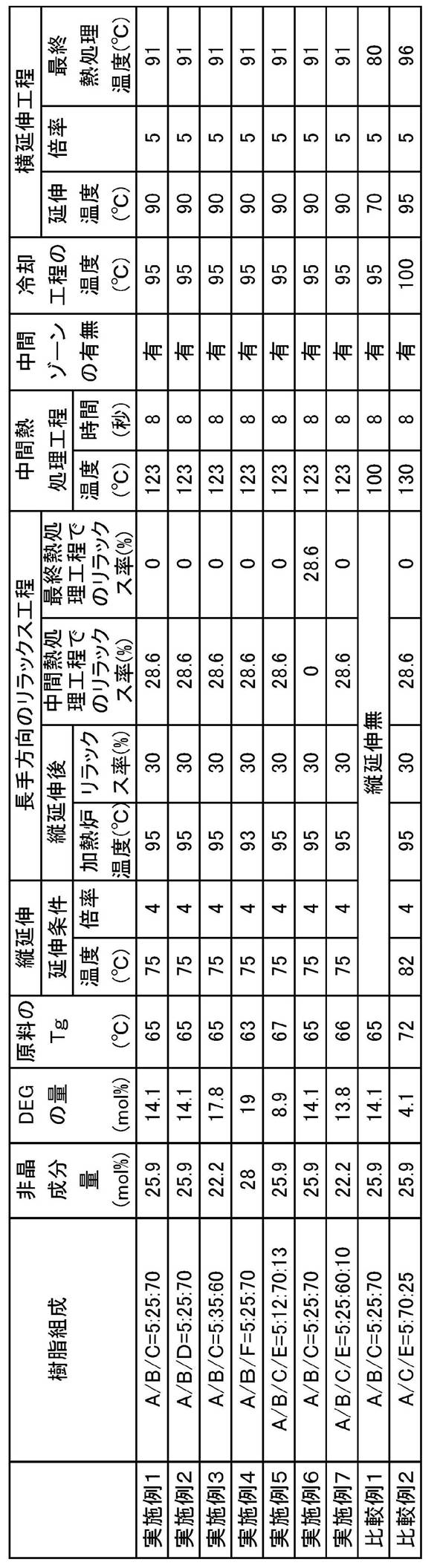
実施例1
上記したポリエステルA、ポリエステルB、ポリエステルCを質量比5:25:70で混合して押出機に投入した。この混合樹脂を260℃で溶融させてTダイから押出し、表面温度30℃に冷却された回転する金属ロールに巻き付けて急冷することにより、厚さ228μmの未延伸フィルムを得た。このときの未延伸フィルムの引取速度(金属ロールの回転速度)は、約20m/minであった。未延伸フィルムのTgは65℃であった。
得られた未延伸フィルムを、複数のロール群を連続的に配置した縦延伸機へ導き、ロールの回転速度差を利用して、75℃で縦方向に4倍延伸した。
ポリエステルCをポリエステルDに変更した以外は実施例1と同様の方法で厚さ20μmのフィルムを製造した。評価結果を表3に示す。
ポリエステルA、ポリエステルB、ポリエステルCを質量比5:35:60で混合に変更した以外は実施例1と同様の方法で厚さ20μmのフィルムを製造した。未延伸フィルムのTgは65℃であった。評価結果を表3に示す。
ポリエステルA、ポリエステルB、ポリエステルFを質量比5:25:70で混合に変更した以外は実施例1と同様の方法で厚さ20μmのフィルムを製造した。未延伸フィルムのTgは63℃であった。評価結果を表3に示す。
ポリエステルA、ポリエステルB、ポリエステルC、ポリエステルEを質量比5:12:70:13で混合に変更した以外は実施例1と同様の方法で厚さ20μmのフィルムを製造した。未延伸フィルムのTgは67℃であった。評価結果を表3に示す。
長手方向のリラックスを、中間熱処理工程から最終熱処理工程に変更した以外は実施例1と同様の方法で厚さ20μmのフィルムを製造した。評価結果を表3に示す。
ポリエステルA、ポリエステルB、ポリエステルC、ポリエステルEを質量比5:25:60:10で混合に変更した以外は実施例1と同様の方法で厚さ20μmのフィルムを製造した。未延伸フィルムのTgは66℃であった。評価結果を表3に示す。
未延伸フィルムの厚みを100μmとし、縦延伸と長手方向へのリラックスを行わず、中間熱処理ゾーンの温度を100℃、横延伸温度を70℃、最終熱処理温度を80℃に変更した以外は、実施例1と同様の方法で厚さ20μmのフィルムを製造した。評価結果を表3に示す。応力比が小さく、最大収縮応力と30秒後の収縮応力の差が大きいフィルムであった。
ポリエステルA、ポリエステルC、ポリエステルEを質量比5:70:25で混合に変更した。縦延伸の温度を72度、中間熱処理工程の温度を130℃、冷却工程の温度を100℃、横延伸温度を95℃、最終熱処理温度を96℃とした以外は実施例1と同様の方法で厚さ20μmのフィルムを製造した。未延伸フィルムのTgは72℃であった。評価結果を表3に示す。幅方向の収縮応力が高く、容器の変形が生じた。
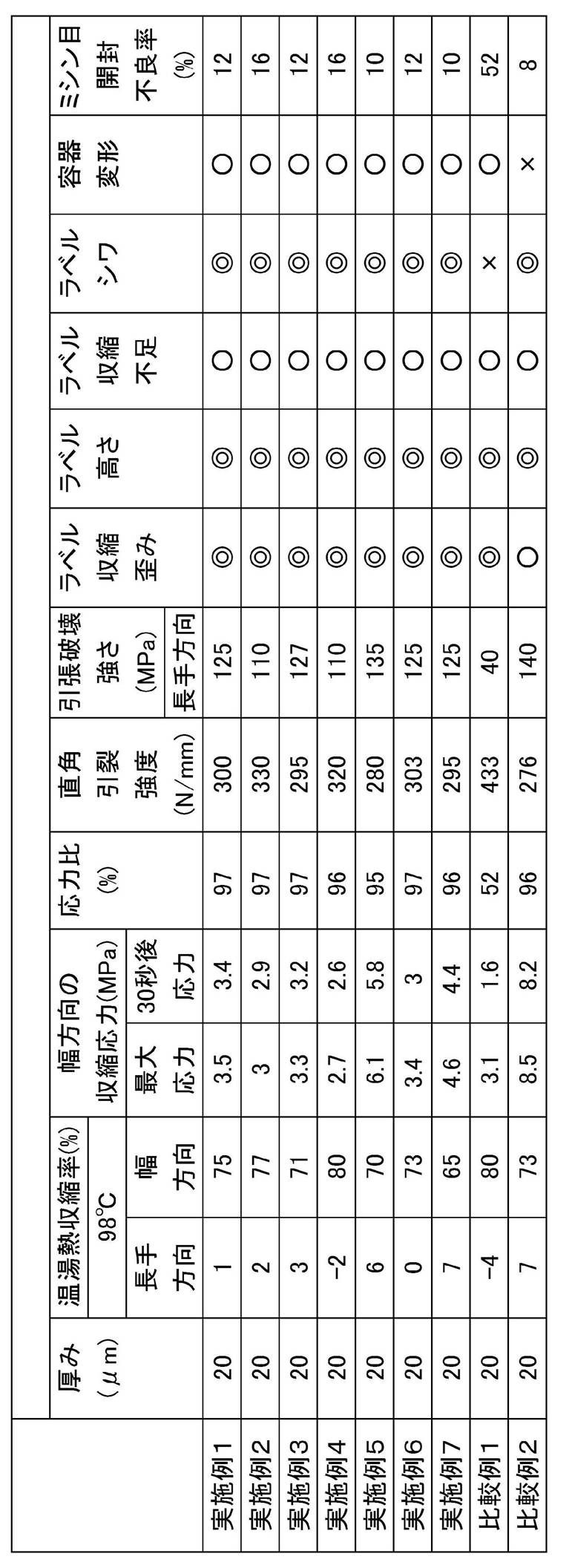

実施例8
上記したポリエステルA、ポリエステルB、ポリエステルCを質量比5:25:70で混合して押出機に投入した。この混合樹脂を260℃で溶融させてTダイから押出し、表面温度30℃に冷却された回転する金属ロールに巻き付けて急冷することにより、厚さ209μmの未延伸フィルムを得た。このときの未延伸フィルムの引取速度(金属ロールの回転速度)は、約20m/minであった。未延伸フィルムのTgは65℃であった。
ポリエステルCをポリエステルDに変更した以外は実施例8と同様の方法で厚さ18μmのフィルムを製造した。評価結果を表5に示す。
ポリエステルA、ポリエステルB、ポリエステルCを質量比5:45:50で混合に変更した以外は実施例8と同様の方法で厚さ18μmのフィルムを製造した。未延伸フィルムのTgは62℃であった。評価結果を表5に示す。
ポリエステルA、ポリエステルB、ポリエステルFを質量比5:25:70で混合に変更した以外は実施例8と同様の方法で厚さ18μmのフィルムを製造した。未延伸フィルムのTgは63℃であった。評価結果を表5に示す。
ポリエステルA、ポリエステルB、ポリエステルC、ポリエステルEを質量比5:5:70:20で混合に変更した以外は実施例8と同様の方法で厚さ18μmのフィルムを製造した。未延伸フィルムのTgは68℃であった。評価結果を表5に示す。
ポリエステルA、ポリエステルB、ポリエステルCを質量比5:15:80で混合し、未延伸フィルムの厚みを243μmとした。また、横延伸後の横リラックス率を15.5%、縦延伸倍率を4倍、最終熱処理工程での横リラックス率を0%に変更した。それらの条件以外は実施例8と同様の方法で厚さ18μmのフィルムを製造した。未延伸フィルムのTgは68℃であった。評価結果を表5に示す。
最終熱処理工程の温度をTg+33℃に変更した以外は実施例8と同様の方法で厚さ18μmのフィルムを製造した。評価結果を表5に示す。
未延伸フィルムの厚みを63μmとし、横延伸と最終熱処理を行わずに実施例8と同様の方法で厚さ18μmのフィルムを製造した。評価結果を表5に示す。応力比が小さく、最大収縮応力と30秒後の収縮応力の差が大きいフィルムであった。また幅方向の引張破壊強さが低く、直角引裂き強度が高かった。得られたフィルムを用いたラベルは 実施例と比較し、収縮仕上り性やミシン目開封率が劣るラベルであった。
ポリエステルA、ポリエステルC、ポリエステルEを質量比5:73:22で混合に変更した以外は実施例8と同様の方法で厚さ18μmのフィルムを製造した。Tgは72℃であった。評価結果を表5に示す。収縮応力が高く、得られたフィルムを用いたラベルは、実施例と比較し、容器変形が起こるラベルであった。
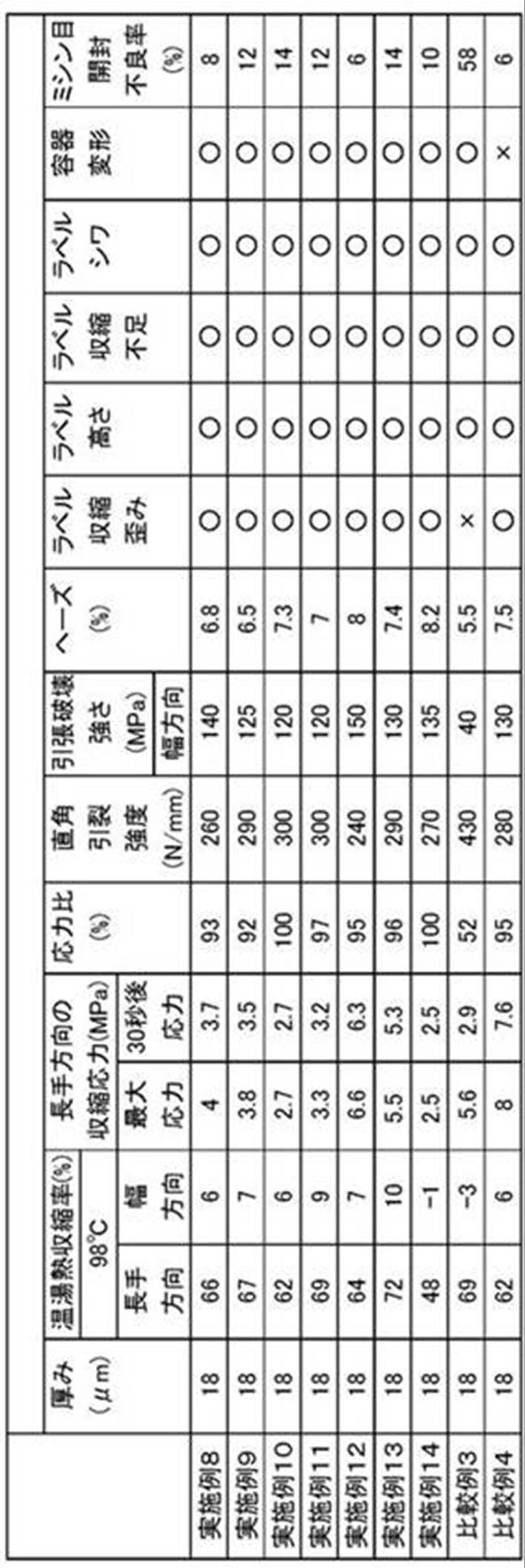
Claims (9)
- 以下の要件(1)~(4)を満足することを特徴とする熱収縮性ポリエステル系フィルム。
(1)98℃の温水にフィルムを10秒間浸漬したときの温湯熱収縮率が、フィルム主収縮方向で40%以上85%以下
(2)98℃の温水にフィルムを10秒間浸漬したときの温湯熱収縮率が、フィルム主収縮方向に直交する方向で-5%以上15%以下
(3)90℃の熱風下で測定したフィルム主収縮方向の最大収縮応力が2MPa以上7MPa以下であり、かつ、収縮応力測定開始時から30秒後の収縮応力が最大収縮応力の60%以上100%以下
(4)全ポリエステル樹脂成分100mol%中ジエチレングリコール由来の構成ユニットが6mol%以上 - エチレンテレフタレートを主たる構成成分とし、全ポリエステル樹脂成分中において非晶質成分となりうるモノマー成分を13モル%以上含有していることを特徴とする請求項1に記載の熱収縮性ポリエステル系フィルム。
- 主収縮方向がフィルム幅方向であることを特徴とする請求項1又は2に記載の熱収縮性ポリエステル系フィルム。
- 主収縮方向がフィルム長手方向であることを特徴とする請求項1又は2に記載の熱収縮性ポリエステル系フィルム。
- フィルム主収縮方向に直交する方向の引張破壊強さが、60MPa以上180MPa以下であることを特徴とする請求項1~4のいずれかに記載の熱収縮性ポリエステル系フィルム。
- 80℃の温水中で主収縮方向に10%収縮させた後の主収縮方向に直交する方向の単位厚み当たりの直角引裂強度が、180N/mm以上350N/mm以下であることを特徴とする請求項1~5のいずれかに記載の熱収縮性ポリエステル系フィルム。
- ヘイズが2%以上18%以下である事を特徴とする請求項1~6のいずれかに記載の熱収縮性ポリエステル系フィルム。
- 請求項1~7のいずれかに記載の熱収縮性ポリエステル系フィルムから得られたラベルで、包装対象物の少なくとも外周の一部を被覆して熱収縮させて形成されることを特徴とする包装体。
- 請求項1~7のいずれかに記載の熱収縮性ポリエステル系フィルムを製造する方法であって主収縮方向に延伸する工程と、主収縮方向に対して直交する方向に延伸する工程を含むことを特徴とする熱収縮性ポリエステル系フィルムの製造方法。
Priority Applications (4)
| Application Number | Priority Date | Filing Date | Title |
|---|---|---|---|
| US15/745,990 US10173818B2 (en) | 2015-07-24 | 2016-07-22 | Heat-shrinkable polyester film, and production method therefor and package thereof |
| CN201680043368.3A CN107848194B (zh) | 2015-07-24 | 2016-07-22 | 热收缩性聚酯系薄膜、和其制造方法、包装体 |
| JP2016559661A JP6572907B2 (ja) | 2015-07-24 | 2016-07-22 | 熱収縮性ポリエステル系フィルム、およびその製造方法、包装体 |
| KR1020187001784A KR102508095B1 (ko) | 2015-07-24 | 2016-07-22 | 열 수축성 폴리에스테르계 필름 및 그의 제조 방법, 포장체 |
Applications Claiming Priority (4)
| Application Number | Priority Date | Filing Date | Title |
|---|---|---|---|
| JP2015-146588 | 2015-07-24 | ||
| JP2015146588 | 2015-07-24 | ||
| JP2015-155881 | 2015-08-06 | ||
| JP2015155881 | 2015-08-06 |
Publications (1)
| Publication Number | Publication Date |
|---|---|
| WO2017018345A1 true WO2017018345A1 (ja) | 2017-02-02 |
Family
ID=57884769
Family Applications (1)
| Application Number | Title | Priority Date | Filing Date |
|---|---|---|---|
| PCT/JP2016/071558 Ceased WO2017018345A1 (ja) | 2015-07-24 | 2016-07-22 | 熱収縮性ポリエステル系フィルム、およびその製造方法、包装体 |
Country Status (6)
| Country | Link |
|---|---|
| US (1) | US10173818B2 (ja) |
| JP (1) | JP6572907B2 (ja) |
| KR (1) | KR102508095B1 (ja) |
| CN (1) | CN107848194B (ja) |
| TW (1) | TWI725978B (ja) |
| WO (1) | WO2017018345A1 (ja) |
Cited By (10)
| Publication number | Priority date | Publication date | Assignee | Title |
|---|---|---|---|---|
| KR20190137148A (ko) * | 2017-04-27 | 2019-12-10 | 도요보 가부시키가이샤 | 열수축성 필름용 폴리에스테르 수지, 열수축성 필름, 열수축성 라벨 및 포장체 |
| WO2020026972A1 (ja) * | 2018-08-03 | 2020-02-06 | 東洋紡株式会社 | 非晶性のフィルム用共重合ポリエステル原料、熱収縮性ポリエステル系フィルム、熱収縮性ラベル、及び包装体 |
| JP2020097745A (ja) * | 2017-02-13 | 2020-06-25 | 東洋紡株式会社 | 非晶性のフィルム用共重合ポリエステル原料、熱収縮性ポリエステル系フィルム、熱収縮性ラベル、及び包装体 |
| CN113905958A (zh) * | 2019-06-05 | 2022-01-07 | 东洋纺株式会社 | 将纵(长度)方向作为主收缩方向的热收缩性聚酯系薄膜 |
| WO2022024936A1 (ja) * | 2020-07-29 | 2022-02-03 | 東洋紡株式会社 | 熱収縮性ポリエステル系フィルム、熱収縮性ラベル、及び包装体 |
| WO2022071046A1 (ja) * | 2020-10-01 | 2022-04-07 | 東洋紡株式会社 | 熱収縮性ポリエステル系フィルム |
| JPWO2022181436A1 (ja) * | 2021-02-24 | 2022-09-01 | ||
| JP2023077918A (ja) * | 2021-11-25 | 2023-06-06 | リンテック株式会社 | 成形品用ラベル、ラベル付き成形品、及びラベル付き成形品の製造方法 |
| JP2023540401A (ja) * | 2020-10-07 | 2023-09-22 | ボンセット アメリカ コーポレーション | ポリエステル系熱収縮フィルム |
| US12371217B2 (en) * | 2019-07-26 | 2025-07-29 | Toyobo Co., Ltd. | Heat-shrinkable polyester film |
Families Citing this family (8)
| Publication number | Priority date | Publication date | Assignee | Title |
|---|---|---|---|---|
| JP7530370B2 (ja) | 2018-10-08 | 2024-08-07 | イーストマン ケミカル カンパニー | 樹脂混合物製の結晶化可能な収縮性フィルムおよび熱成形性シート |
| US12384907B2 (en) * | 2018-12-28 | 2025-08-12 | Toyobo Co., Ltd. | Biaxially oriented polypropylene film |
| US12522695B2 (en) | 2019-10-08 | 2026-01-13 | Eastman Chemical Company | Catalyst systems for crystallizable reactor grade resins with recycled content |
| WO2021210512A1 (ja) * | 2020-04-15 | 2021-10-21 | 東洋紡株式会社 | 共重合ポリエステル樹脂、熱収縮性フィルム、熱収縮性ラベル、および包装体 |
| DE112020007130T5 (de) * | 2020-04-30 | 2023-03-16 | Bonset America Corporation | Schrumpffolie auf Polyesterbasis |
| EP4151553A4 (en) * | 2020-05-12 | 2024-06-05 | Toyobo Co., Ltd. | COPOLYESTER RAW MATERIAL FOR FILMS, HEAT-SHRINKABLE POLYESTER FILMS, HEAT-SHRINKABLE LABELS AND PACKAGING |
| JP7092173B2 (ja) * | 2020-10-23 | 2022-06-28 | 三菱ケミカル株式会社 | 熱収縮性フィルム、箱状包装資材及び電池セル、熱収縮性フィルムの製造方法 |
| TWI790692B (zh) * | 2021-07-22 | 2023-01-21 | 遠東新世紀股份有限公司 | 熱收縮聚酯標籤膜及其製備方法、容器 |
Citations (7)
| Publication number | Priority date | Publication date | Assignee | Title |
|---|---|---|---|---|
| JPH03142224A (ja) * | 1989-10-30 | 1991-06-18 | Toyobo Co Ltd | 熱収縮性ポリエステル系フイルム |
| JP2007016120A (ja) * | 2005-07-07 | 2007-01-25 | Toyobo Co Ltd | 熱収縮性ポリエステル系フィルム及びラベルとその製造方法 |
| JP2007056156A (ja) * | 2005-08-25 | 2007-03-08 | Toyobo Co Ltd | 熱収縮性ポリエステル系フィルム及びラベルとその製造方法 |
| JP2011102392A (ja) * | 2006-08-30 | 2011-05-26 | Toyobo Co Ltd | 熱収縮性ポリエステル系フィルム、およびその製造方法、包装体 |
| JP2011184690A (ja) * | 2010-03-09 | 2011-09-22 | Skc Co Ltd | 熱収縮性ポリエステル系フィルム |
| JP5240387B1 (ja) * | 2012-07-26 | 2013-07-17 | 東洋紡株式会社 | 熱収縮性ポリエステル系フィルムおよび包装体 |
| JP2014055236A (ja) * | 2012-09-12 | 2014-03-27 | Toyobo Co Ltd | 本包装用熱収縮性ポリエステル系フィルム |
Family Cites Families (12)
| Publication number | Priority date | Publication date | Assignee | Title |
|---|---|---|---|---|
| JPS5240387B2 (ja) | 1972-01-29 | 1977-10-12 | ||
| JPS644326A (en) | 1987-06-25 | 1989-01-09 | Toyo Boseki | Heat-shrinkable polyester film |
| EP0751183B1 (en) | 1986-12-19 | 2003-04-09 | Toyo Boseki Kabushiki Kaisha | Thermo-shrinkable polyester films |
| JPH0533895A (ja) | 1991-07-29 | 1993-02-09 | Inba Denki Sangyo Kk | キヤツプ |
| JP4252419B2 (ja) * | 2003-10-07 | 2009-04-08 | ユニチカ株式会社 | ガスバリアー性シュリンクフィルム及びその製造方法 |
| JP2007186662A (ja) * | 2005-12-16 | 2007-07-26 | Toyobo Co Ltd | 熱収縮性ポリエステル系フィルム及び熱収縮性ラベル |
| JP4882919B2 (ja) | 2006-08-30 | 2012-02-22 | 東洋紡績株式会社 | 熱収縮性ポリエステル系フィルム、およびその製造方法、包装体 |
| US8697207B2 (en) * | 2006-12-20 | 2014-04-15 | Toyo Boseki Kabushiki Kaisha | Heat shrinkable polyolefin film and process for producing the same |
| CN101970212B (zh) * | 2008-02-27 | 2014-05-07 | 东洋纺织株式会社 | 白色热收缩性聚酯类膜、白色热收缩性聚酯类膜的制造方法、标签及包装体 |
| US20090227735A1 (en) * | 2008-03-07 | 2009-09-10 | Eastman Chemical Company | Miscible polyester blends and shrinkable films prepared therefrom |
| KR101268217B1 (ko) * | 2010-03-31 | 2013-06-10 | 코오롱인더스트리 주식회사 | 열수축성 폴리에스테르계 단층 필름 |
| CN102529274B (zh) * | 2011-12-30 | 2014-05-28 | 广东德冠薄膜新材料股份有限公司 | 一种聚烯烃热收缩薄膜及其制备方法 |
-
2016
- 2016-07-22 CN CN201680043368.3A patent/CN107848194B/zh active Active
- 2016-07-22 US US15/745,990 patent/US10173818B2/en active Active
- 2016-07-22 WO PCT/JP2016/071558 patent/WO2017018345A1/ja not_active Ceased
- 2016-07-22 TW TW105123234A patent/TWI725978B/zh active
- 2016-07-22 JP JP2016559661A patent/JP6572907B2/ja active Active
- 2016-07-22 KR KR1020187001784A patent/KR102508095B1/ko active Active
Patent Citations (7)
| Publication number | Priority date | Publication date | Assignee | Title |
|---|---|---|---|---|
| JPH03142224A (ja) * | 1989-10-30 | 1991-06-18 | Toyobo Co Ltd | 熱収縮性ポリエステル系フイルム |
| JP2007016120A (ja) * | 2005-07-07 | 2007-01-25 | Toyobo Co Ltd | 熱収縮性ポリエステル系フィルム及びラベルとその製造方法 |
| JP2007056156A (ja) * | 2005-08-25 | 2007-03-08 | Toyobo Co Ltd | 熱収縮性ポリエステル系フィルム及びラベルとその製造方法 |
| JP2011102392A (ja) * | 2006-08-30 | 2011-05-26 | Toyobo Co Ltd | 熱収縮性ポリエステル系フィルム、およびその製造方法、包装体 |
| JP2011184690A (ja) * | 2010-03-09 | 2011-09-22 | Skc Co Ltd | 熱収縮性ポリエステル系フィルム |
| JP5240387B1 (ja) * | 2012-07-26 | 2013-07-17 | 東洋紡株式会社 | 熱収縮性ポリエステル系フィルムおよび包装体 |
| JP2014055236A (ja) * | 2012-09-12 | 2014-03-27 | Toyobo Co Ltd | 本包装用熱収縮性ポリエステル系フィルム |
Cited By (25)
| Publication number | Priority date | Publication date | Assignee | Title |
|---|---|---|---|---|
| JP7254730B2 (ja) | 2017-02-13 | 2023-04-10 | 東洋紡株式会社 | 非晶性のフィルム用共重合ポリエステル原料、熱収縮性ポリエステル系フィルム、熱収縮性ラベル、及び包装体 |
| TWI748056B (zh) * | 2017-02-13 | 2021-12-01 | 日商東洋紡股份有限公司 | 熱收縮性聚酯系膜、熱收縮性標籤以及包裝體 |
| JP2020097745A (ja) * | 2017-02-13 | 2020-06-25 | 東洋紡株式会社 | 非晶性のフィルム用共重合ポリエステル原料、熱収縮性ポリエステル系フィルム、熱収縮性ラベル、及び包装体 |
| EP3581604A4 (en) * | 2017-02-13 | 2020-12-02 | Toyobo Co., Ltd. | RAW COPOLYESTER MATERIAL FOR AMORPHIC FILM, HEAT-SHRINKABLE POLYESTER-BASED FILM, HEAT-SHRINKABLE LABEL AND PACKAGING |
| US11084901B2 (en) | 2017-04-27 | 2021-08-10 | Toyobo Co., Ltd. | Polyester resin for heat-shrinkable film, heat-shrinkable film, heat-shrinkable label, and packaged product |
| KR102252173B1 (ko) * | 2017-04-27 | 2021-05-13 | 도요보 가부시키가이샤 | 열수축성 필름용 폴리에스테르 수지, 열수축성 필름, 열수축성 라벨 및 포장체 |
| EP3617247A4 (en) * | 2017-04-27 | 2020-12-30 | Toyobo Co., Ltd. | POLYESTER RESIN FOR HEAT SHRINK FILM, HEAT SHRINK FILM, HEAT SHRINK LABEL AND PACKAGING |
| KR20190137148A (ko) * | 2017-04-27 | 2019-12-10 | 도요보 가부시키가이샤 | 열수축성 필름용 폴리에스테르 수지, 열수축성 필름, 열수축성 라벨 및 포장체 |
| JPWO2020026972A1 (ja) * | 2018-08-03 | 2021-08-12 | 東洋紡株式会社 | 非晶性のフィルム用共重合ポリエステル原料、熱収縮性ポリエステル系フィルム、熱収縮性ラベル、及び包装体 |
| WO2020026972A1 (ja) * | 2018-08-03 | 2020-02-06 | 東洋紡株式会社 | 非晶性のフィルム用共重合ポリエステル原料、熱収縮性ポリエステル系フィルム、熱収縮性ラベル、及び包装体 |
| JP7363788B2 (ja) | 2018-08-03 | 2023-10-18 | 東洋紡株式会社 | 非晶性のフィルム用共重合ポリエステル原料、熱収縮性ポリエステル系フィルム、熱収縮性ラベル、及び包装体 |
| CN113905958A (zh) * | 2019-06-05 | 2022-01-07 | 东洋纺株式会社 | 将纵(长度)方向作为主收缩方向的热收缩性聚酯系薄膜 |
| US12371217B2 (en) * | 2019-07-26 | 2025-07-29 | Toyobo Co., Ltd. | Heat-shrinkable polyester film |
| JP7364085B2 (ja) | 2020-07-29 | 2023-10-18 | 東洋紡株式会社 | 熱収縮性ポリエステル系フィルム、熱収縮性ラベル、及び包装体 |
| JPWO2022024936A1 (ja) * | 2020-07-29 | 2022-02-03 | ||
| WO2022024936A1 (ja) * | 2020-07-29 | 2022-02-03 | 東洋紡株式会社 | 熱収縮性ポリエステル系フィルム、熱収縮性ラベル、及び包装体 |
| WO2022071046A1 (ja) * | 2020-10-01 | 2022-04-07 | 東洋紡株式会社 | 熱収縮性ポリエステル系フィルム |
| JP2023540401A (ja) * | 2020-10-07 | 2023-09-22 | ボンセット アメリカ コーポレーション | ポリエステル系熱収縮フィルム |
| JP7392202B2 (ja) | 2020-10-07 | 2023-12-05 | ボンセット アメリカ コーポレーション | ポリエステル系熱収縮フィルム |
| US12570814B2 (en) | 2020-10-07 | 2026-03-10 | Bonset America Corporation | Heat-shrinkable polyester film |
| WO2022181436A1 (ja) * | 2021-02-24 | 2022-09-01 | 東洋紡株式会社 | 熱収縮性ポリエステル系フィルム |
| JPWO2022181436A1 (ja) * | 2021-02-24 | 2022-09-01 | ||
| JP7782542B2 (ja) | 2021-02-24 | 2025-12-09 | 東洋紡株式会社 | 熱収縮性ポリエステル系フィルム |
| JP2023077918A (ja) * | 2021-11-25 | 2023-06-06 | リンテック株式会社 | 成形品用ラベル、ラベル付き成形品、及びラベル付き成形品の製造方法 |
| JP7724142B2 (ja) | 2021-11-25 | 2025-08-15 | リンテック株式会社 | 成形品用ラベル、ラベル付き成形品、及びラベル付き成形品の製造方法 |
Also Published As
| Publication number | Publication date |
|---|---|
| US20180208375A1 (en) | 2018-07-26 |
| KR102508095B1 (ko) | 2023-03-10 |
| CN107848194A (zh) | 2018-03-27 |
| CN107848194B (zh) | 2020-02-28 |
| TW201710093A (zh) | 2017-03-16 |
| JP6572907B2 (ja) | 2019-09-11 |
| TWI725978B (zh) | 2021-05-01 |
| KR20180031681A (ko) | 2018-03-28 |
| US10173818B2 (en) | 2019-01-08 |
| JPWO2017018345A1 (ja) | 2018-05-10 |
Similar Documents
| Publication | Publication Date | Title |
|---|---|---|
| JP6572907B2 (ja) | 熱収縮性ポリエステル系フィルム、およびその製造方法、包装体 | |
| JP6337774B2 (ja) | 熱収縮性ポリエステル系フィルムおよび包装体 | |
| JP5240387B1 (ja) | 熱収縮性ポリエステル系フィルムおよび包装体 | |
| JP6036832B2 (ja) | 熱収縮性ポリエステル系フィルムおよび包装体 | |
| JP6485054B2 (ja) | 熱収縮性ポリエステル系フィルムおよび包装体 | |
| JP5633808B2 (ja) | 熱収縮性ポリエステル系フィルム、およびその製造方法、包装体 | |
| JP6459533B2 (ja) | 熱収縮性ポリエステル系フィルムおよび包装体 | |
| JPWO2016152517A1 (ja) | 熱収縮性ポリエステル系フィルムおよび包装体 | |
| JP6835127B2 (ja) | 熱収縮性ポリエステル系フィルムおよび包装体 | |
| JP6642001B2 (ja) | 熱収縮性ポリエステル系フィルム及び包装体 | |
| TWI696551B (zh) | 熱收縮性聚酯系膜及包裝體 | |
| JPWO2020026972A1 (ja) | 非晶性のフィルム用共重合ポリエステル原料、熱収縮性ポリエステル系フィルム、熱収縮性ラベル、及び包装体 | |
| JP2015229242A (ja) | 熱収縮性ポリエステル系フィルム及び包装体 | |
| JP6673453B2 (ja) | 熱収縮性ポリエステル系フィルムおよび包装体 | |
| WO2020246420A1 (ja) | 縦(長手)方向を主収縮方向とする熱収縮性ポリエステル系フィルム |
Legal Events
| Date | Code | Title | Description |
|---|---|---|---|
| ENP | Entry into the national phase |
Ref document number: 2016559661 Country of ref document: JP Kind code of ref document: A |
|
| 121 | Ep: the epo has been informed by wipo that ep was designated in this application |
Ref document number: 16830450 Country of ref document: EP Kind code of ref document: A1 |
|
| WWE | Wipo information: entry into national phase |
Ref document number: 15745990 Country of ref document: US |
|
| ENP | Entry into the national phase |
Ref document number: 20187001784 Country of ref document: KR Kind code of ref document: A |
|
| NENP | Non-entry into the national phase |
Ref country code: DE |
|
| 122 | Ep: pct application non-entry in european phase |
Ref document number: 16830450 Country of ref document: EP Kind code of ref document: A1 |