WO2016175268A1 - アルミニウム被覆ニッケルコバルト含有複合水酸化物とその製造方法、非水系電解質二次電池用正極活物質とその製造方法、および、非水系電解質二次電池 - Google Patents
アルミニウム被覆ニッケルコバルト含有複合水酸化物とその製造方法、非水系電解質二次電池用正極活物質とその製造方法、および、非水系電解質二次電池 Download PDFInfo
- Publication number
- WO2016175268A1 WO2016175268A1 PCT/JP2016/063304 JP2016063304W WO2016175268A1 WO 2016175268 A1 WO2016175268 A1 WO 2016175268A1 JP 2016063304 W JP2016063304 W JP 2016063304W WO 2016175268 A1 WO2016175268 A1 WO 2016175268A1
- Authority
- WO
- WIPO (PCT)
- Prior art keywords
- positive electrode
- composite hydroxide
- aluminum
- active material
- range
- Prior art date
- Legal status (The legal status is an assumption and is not a legal conclusion. Google has not performed a legal analysis and makes no representation as to the accuracy of the status listed.)
- Ceased
Links
Images


Classifications
-
- C—CHEMISTRY; METALLURGY
- C01—INORGANIC CHEMISTRY
- C01G—COMPOUNDS CONTAINING METALS NOT COVERED BY SUBCLASSES C01D OR C01F
- C01G53/00—Compounds of nickel
- C01G53/40—Complex oxides containing nickel and at least one other metal element
- C01G53/42—Complex oxides containing nickel and at least one other metal element containing alkali metals, e.g. LiNiO2
- C01G53/44—Complex oxides containing nickel and at least one other metal element containing alkali metals, e.g. LiNiO2 containing manganese
-
- C—CHEMISTRY; METALLURGY
- C01—INORGANIC CHEMISTRY
- C01G—COMPOUNDS CONTAINING METALS NOT COVERED BY SUBCLASSES C01D OR C01F
- C01G53/00—Compounds of nickel
- C01G53/40—Complex oxides containing nickel and at least one other metal element
- C01G53/42—Complex oxides containing nickel and at least one other metal element containing alkali metals, e.g. LiNiO2
-
- C—CHEMISTRY; METALLURGY
- C01—INORGANIC CHEMISTRY
- C01G—COMPOUNDS CONTAINING METALS NOT COVERED BY SUBCLASSES C01D OR C01F
- C01G53/00—Compounds of nickel
- C01G53/80—Compounds containing nickel, with or without oxygen or hydrogen, and containing one or more other elements
- C01G53/84—Hydroxides
-
- H—ELECTRICITY
- H01—ELECTRIC ELEMENTS
- H01M—PROCESSES OR MEANS, e.g. BATTERIES, FOR THE DIRECT CONVERSION OF CHEMICAL ENERGY INTO ELECTRICAL ENERGY
- H01M10/00—Secondary cells; Manufacture thereof
- H01M10/05—Accumulators with non-aqueous electrolyte
- H01M10/052—Li-accumulators
-
- H—ELECTRICITY
- H01—ELECTRIC ELEMENTS
- H01M—PROCESSES OR MEANS, e.g. BATTERIES, FOR THE DIRECT CONVERSION OF CHEMICAL ENERGY INTO ELECTRICAL ENERGY
- H01M10/00—Secondary cells; Manufacture thereof
- H01M10/05—Accumulators with non-aqueous electrolyte
- H01M10/052—Li-accumulators
- H01M10/0525—Rocking-chair batteries, i.e. batteries with lithium insertion or intercalation in both electrodes; Lithium-ion batteries
-
- H—ELECTRICITY
- H01—ELECTRIC ELEMENTS
- H01M—PROCESSES OR MEANS, e.g. BATTERIES, FOR THE DIRECT CONVERSION OF CHEMICAL ENERGY INTO ELECTRICAL ENERGY
- H01M4/00—Electrodes
- H01M4/02—Electrodes composed of, or comprising, active material
- H01M4/13—Electrodes for accumulators with non-aqueous electrolyte, e.g. for lithium-accumulators; Processes of manufacture thereof
- H01M4/131—Electrodes based on mixed oxides or hydroxides, or on mixtures of oxides or hydroxides, e.g. LiCoOx
-
- H—ELECTRICITY
- H01—ELECTRIC ELEMENTS
- H01M—PROCESSES OR MEANS, e.g. BATTERIES, FOR THE DIRECT CONVERSION OF CHEMICAL ENERGY INTO ELECTRICAL ENERGY
- H01M4/00—Electrodes
- H01M4/02—Electrodes composed of, or comprising, active material
- H01M4/36—Selection of substances as active materials, active masses, active liquids
- H01M4/362—Composites
- H01M4/366—Composites as layered products
-
- H—ELECTRICITY
- H01—ELECTRIC ELEMENTS
- H01M—PROCESSES OR MEANS, e.g. BATTERIES, FOR THE DIRECT CONVERSION OF CHEMICAL ENERGY INTO ELECTRICAL ENERGY
- H01M4/00—Electrodes
- H01M4/02—Electrodes composed of, or comprising, active material
- H01M4/36—Selection of substances as active materials, active masses, active liquids
- H01M4/48—Selection of substances as active materials, active masses, active liquids of inorganic oxides or hydroxides
- H01M4/485—Selection of substances as active materials, active masses, active liquids of inorganic oxides or hydroxides of mixed oxides or hydroxides for inserting or intercalating light metals, e.g. LiTi2O4 or LiTi2OxFy
-
- H—ELECTRICITY
- H01—ELECTRIC ELEMENTS
- H01M—PROCESSES OR MEANS, e.g. BATTERIES, FOR THE DIRECT CONVERSION OF CHEMICAL ENERGY INTO ELECTRICAL ENERGY
- H01M4/00—Electrodes
- H01M4/02—Electrodes composed of, or comprising, active material
- H01M4/36—Selection of substances as active materials, active masses, active liquids
- H01M4/48—Selection of substances as active materials, active masses, active liquids of inorganic oxides or hydroxides
- H01M4/50—Selection of substances as active materials, active masses, active liquids of inorganic oxides or hydroxides of manganese
- H01M4/505—Selection of substances as active materials, active masses, active liquids of inorganic oxides or hydroxides of manganese of mixed oxides or hydroxides containing manganese for inserting or intercalating light metals, e.g. LiMn2O4 or LiMn2OxFy
-
- H—ELECTRICITY
- H01—ELECTRIC ELEMENTS
- H01M—PROCESSES OR MEANS, e.g. BATTERIES, FOR THE DIRECT CONVERSION OF CHEMICAL ENERGY INTO ELECTRICAL ENERGY
- H01M4/00—Electrodes
- H01M4/02—Electrodes composed of, or comprising, active material
- H01M4/36—Selection of substances as active materials, active masses, active liquids
- H01M4/48—Selection of substances as active materials, active masses, active liquids of inorganic oxides or hydroxides
- H01M4/52—Selection of substances as active materials, active masses, active liquids of inorganic oxides or hydroxides of nickel, cobalt or iron
- H01M4/525—Selection of substances as active materials, active masses, active liquids of inorganic oxides or hydroxides of nickel, cobalt or iron of mixed oxides or hydroxides containing iron, cobalt or nickel for inserting or intercalating light metals, e.g. LiNiO2, LiCoO2 or LiCoOxFy
-
- C—CHEMISTRY; METALLURGY
- C01—INORGANIC CHEMISTRY
- C01P—INDEXING SCHEME RELATING TO STRUCTURAL AND PHYSICAL ASPECTS OF SOLID INORGANIC COMPOUNDS
- C01P2004/00—Particle morphology
- C01P2004/01—Particle morphology depicted by an image
- C01P2004/03—Particle morphology depicted by an image obtained by SEM
-
- C—CHEMISTRY; METALLURGY
- C01—INORGANIC CHEMISTRY
- C01P—INDEXING SCHEME RELATING TO STRUCTURAL AND PHYSICAL ASPECTS OF SOLID INORGANIC COMPOUNDS
- C01P2004/00—Particle morphology
- C01P2004/30—Particle morphology extending in three dimensions
- C01P2004/39—Particle morphology extending in three dimensions parallelepiped-like
-
- C—CHEMISTRY; METALLURGY
- C01—INORGANIC CHEMISTRY
- C01P—INDEXING SCHEME RELATING TO STRUCTURAL AND PHYSICAL ASPECTS OF SOLID INORGANIC COMPOUNDS
- C01P2004/00—Particle morphology
- C01P2004/50—Agglomerated particles
-
- C—CHEMISTRY; METALLURGY
- C01—INORGANIC CHEMISTRY
- C01P—INDEXING SCHEME RELATING TO STRUCTURAL AND PHYSICAL ASPECTS OF SOLID INORGANIC COMPOUNDS
- C01P2004/00—Particle morphology
- C01P2004/60—Particles characterised by their size
- C01P2004/61—Micrometer sized, i.e. from 1-100 micrometer
-
- C—CHEMISTRY; METALLURGY
- C01—INORGANIC CHEMISTRY
- C01P—INDEXING SCHEME RELATING TO STRUCTURAL AND PHYSICAL ASPECTS OF SOLID INORGANIC COMPOUNDS
- C01P2004/00—Particle morphology
- C01P2004/60—Particles characterised by their size
- C01P2004/62—Submicrometer sized, i.e. from 0.1-1 micrometer
-
- C—CHEMISTRY; METALLURGY
- C01—INORGANIC CHEMISTRY
- C01P—INDEXING SCHEME RELATING TO STRUCTURAL AND PHYSICAL ASPECTS OF SOLID INORGANIC COMPOUNDS
- C01P2004/00—Particle morphology
- C01P2004/60—Particles characterised by their size
- C01P2004/64—Nanometer sized, i.e. from 1-100 nanometer
-
- C—CHEMISTRY; METALLURGY
- C01—INORGANIC CHEMISTRY
- C01P—INDEXING SCHEME RELATING TO STRUCTURAL AND PHYSICAL ASPECTS OF SOLID INORGANIC COMPOUNDS
- C01P2004/00—Particle morphology
- C01P2004/80—Particles consisting of a mixture of two or more inorganic phases
-
- C—CHEMISTRY; METALLURGY
- C01—INORGANIC CHEMISTRY
- C01P—INDEXING SCHEME RELATING TO STRUCTURAL AND PHYSICAL ASPECTS OF SOLID INORGANIC COMPOUNDS
- C01P2006/00—Physical properties of inorganic compounds
- C01P2006/11—Powder tap density
-
- C—CHEMISTRY; METALLURGY
- C01—INORGANIC CHEMISTRY
- C01P—INDEXING SCHEME RELATING TO STRUCTURAL AND PHYSICAL ASPECTS OF SOLID INORGANIC COMPOUNDS
- C01P2006/00—Physical properties of inorganic compounds
- C01P2006/12—Surface area
-
- Y—GENERAL TAGGING OF NEW TECHNOLOGICAL DEVELOPMENTS; GENERAL TAGGING OF CROSS-SECTIONAL TECHNOLOGIES SPANNING OVER SEVERAL SECTIONS OF THE IPC; TECHNICAL SUBJECTS COVERED BY FORMER USPC CROSS-REFERENCE ART COLLECTIONS [XRACs] AND DIGESTS
- Y02—TECHNOLOGIES OR APPLICATIONS FOR MITIGATION OR ADAPTATION AGAINST CLIMATE CHANGE
- Y02E—REDUCTION OF GREENHOUSE GAS [GHG] EMISSIONS, RELATED TO ENERGY GENERATION, TRANSMISSION OR DISTRIBUTION
- Y02E60/00—Enabling technologies; Technologies with a potential or indirect contribution to GHG emissions mitigation
- Y02E60/10—Energy storage using batteries
Definitions
- the present invention includes an aluminum-coated nickel cobalt-containing composite hydroxide and a production method thereof, a positive electrode active material for a nonaqueous electrolyte secondary battery using the aluminum-coated nickel cobalt-containing composite hydroxide as a precursor, and a production method thereof, and The present invention relates to a non-aqueous electrolyte secondary battery.
- a non-aqueous electrolyte secondary battery includes a negative electrode, a positive electrode, an electrolytic solution, and the like, and an active material capable of desorbing and inserting lithium is used as a material for the negative electrode and the positive electrode.
- Non-aqueous electrolyte secondary batteries are currently being actively researched and developed, and in particular, non-aqueous electrolyte secondary batteries using a lithium transition metal-containing composite oxide having a layered structure or a spinel structure as a positive electrode active material. Since a high voltage of 4V class can be obtained, it has been put into practical use as a battery having a high energy density.
- lithium cobalt composite oxide LiCoO 2
- lithium nickel composite oxide LiNiO 2
- Lithium nickel cobalt manganese composite oxide LiNi 1/3 Co 1/3 Mn 1/3 O 2
- lithium manganese composite oxide using manganese LiMn 2 O 4
- lithium nickel manganese composite oxide LiNi 0.5 Lithium transition metal-containing composite oxides such as Mn 0.5 O 2
- lithium nickel composite oxides are attracting attention as a positive electrode active material that exhibits a larger charge / discharge capacity than lithium cobalt composite oxides and can produce secondary batteries of relatively low cost and high energy density.
- the lithium nickel composite oxide has a problem that the stability of the crystal structure is lower than that of the lithium cobalt composite oxide, and the cycle characteristics and the high temperature stability are inferior.
- a part of nickel constituting the lithium-nickel composite oxide is replaced with a transition metal element such as cobalt, manganese and iron, or a dissimilar metal element such as aluminum, magnesium, vanadium and tin. It is common practice to improve the stability of the crystal structure.
- a transition metal element such as cobalt, manganese and iron, or a dissimilar metal element such as aluminum, magnesium, vanadium and tin.
- cobalt is effective in preventing phase transition
- aluminum is effective in stabilizing the crystal structure.
- the addition of a metal element that does not contribute to the Redox reaction may greatly impair the high charge / discharge capacity that is an inherent characteristic of the lithium nickel composite oxide.
- nickel-containing composite hydroxide which is a precursor of lithium-nickel-containing composite oxide containing aluminum
- aluminum inhibits densification of nickel-containing composite hydroxide. Therefore, a reduction in charge / discharge capacity in the finally obtained lithium nickel-containing composite oxide is inevitable. Therefore, development of a lithium nickel-containing composite oxide that can improve the stability of the crystal structure without impairing the charge / discharge capacity is desired.
- Japanese Patent Laid-Open No. 2010-24083 discloses that a reaction tank is connected in a two-stage cascade. First, an aqueous solution containing a nickel compound and a cobalt compound, an aqueous sodium hydroxide solution and an ammonium ion supplier are added to the first-stage reaction tank.
- a raw material solution composed of an aqueous solution containing water is supplied individually and simultaneously to react to form a nickel cobalt composite hydroxide, and then, while supplying the nickel cobalt composite hydroxide to the second stage reaction vessel
- Ni 1-x Co x (OH) 2 (wherein x is 0.01 to 0.3)
- Japanese Patent Publication No. WO2011 / 122448 as an improvement electrode active material capable output characteristics, the general formula: Li w (Ni 1-x -y Co x Al y) 1-z M z O 2 (0 .98 ⁇ w ⁇ 1.10, 0.05 ⁇ x ⁇ 0.3, 0.01 ⁇ y ⁇ 0.1, 0 ⁇ z ⁇ 0.05, where M is Mg, Fe, Cu, Zn, (003) plane crystallite diameter determined by X-ray diffraction and Scherrer equation is 1200 to 1600 ⁇ ⁇ , which is composed of secondary particles in which primary particles represented by (at least one metal element selected from Ga) are agglomerated.
- a lithium nickel composite oxide has been proposed.
- M is at least one metal element selected from Mg, Fe, Cu, Zn, and Ga
- the surface of a nickel composite hydroxide preferably a hydroxide composed of Ni, Co, and M, having a half-width of (101) plane by X-ray diffraction of 0.45 ° to 0.8 ° is preferably hydroxylated.
- a nickel composite hydroxide coated with aluminum has been proposed.
- the positive electrode active material described in this document is mainly intended to improve output characteristics in a low temperature environment, and is not intended to improve cycle characteristics or high temperature storage stability at all.
- the present invention relates to a positive electrode active material for a non-aqueous electrolyte secondary battery having improved cycle characteristics and high-temperature storage stability without impairing both the charge / discharge capacity and output characteristics of the positive electrode active material comprising a lithium nickel composite oxide, and
- An object is to provide a manufacturing method.
- Another object of the present invention is to provide an aluminum-coated nickel cobalt-containing composite hydroxide that is a precursor of the positive electrode active material and a method for producing the same.
- an object of this invention is to provide the non-aqueous electrolyte secondary battery using this positive electrode active material.
- Aluminum-coated-nickel-cobalt containing composite hydroxide of the present invention have the general formula: Ni 1-x-y- z Co x Al y Mg z (OH) 2 (although, 0.05 ⁇ x ⁇ 0.20,0. Secondary structure having a solid structure represented by 01 ⁇ y ⁇ 0.06, 0.01 ⁇ z ⁇ 0.03), which is formed by agglomerating a plurality of primary particles and covered with a film made of aluminum or an aluminum compound.
- the particles have an average particle size in the range of 4 ⁇ m to 7 ⁇ m, a tap density of 1.5 g / mL or more, and a specific surface area of 5.5 m 2 / g to 7.5 m 2 / It is in the range of g.
- the thickness of the coating is preferably in the range of 0.001 ⁇ m to 0.01 ⁇ m.
- the primary particles are preferably rectangular parallelepiped and have an average particle size in the range of 0.01 ⁇ m to 0.1 ⁇ m.
- the method for producing the aluminum-coated nickel-cobalt-containing composite hydroxide of the present invention In an inert atmosphere, the temperature is controlled within the range of 45 ° C to 55 ° C, the pH value based on the liquid temperature of 25 ° C is controlled within the range of 10.8 to 11.8, and the ammonium ion concentration is controlled within the range of 8 g / L to 12 g / L.
- Nickel cobalt consisting of secondary particles of solid structure formed by aggregating a plurality of primary particles by batch crystallization method by supplying raw material aqueous solution containing nickel, cobalt and magnesium to the reaction aqueous solution A crystallization step to obtain a composite hydroxide containing,
- the secondary particles are coated with a coating made of aluminum or an aluminum compound by mixing a slurry containing the nickel cobalt-containing composite hydroxide and a coating solution containing aluminum to form a mixed aqueous solution.
- a coating step of obtaining an aluminum-coated nickel-cobalt-containing composite hydroxide represented by: It is characterized by providing.
- the positive electrode active material for a non-aqueous electrolyte secondary battery of the present invention have the general formula: Li u Ni 1-x- y-z Co x Al y Mg z O 2 ( however, 1.00 ⁇ u ⁇ 1.04,0 0.05 ⁇ x ⁇ 0.20, 0.01 ⁇ y ⁇ 0.06, 0.01 ⁇ z ⁇ 0.03), and a secondary of a solid structure formed by agglomeration of a plurality of primary particles It is composed of lithium nickel cobalt-containing composite oxide having a layered structure composed of particles, the average particle diameter of the secondary particles is in the range of 4 ⁇ m to 7 ⁇ m, the tap density is 2.0 g / mL or more, and , specific surface area lies in the range of 0.7m 2 /g ⁇ 1.0m 2 / g.
- the primary particles are preferably rectangular parallelepiped and have an average particle size in the range of 0.05 ⁇ m to 0.5 ⁇ m.
- the method for producing a positive electrode active material for a non-aqueous electrolyte secondary battery of the present invention is as follows.
- a method for producing a positive electrode active material comprising an oxide, Mixing the aluminum-coated nickel-cobalt composite hydroxide of the present invention and a lithium compound to obtain a lithium mixture;
- the firing temperature in the firing step is preferably in the range of 700 ° C to 800 ° C.
- the oxidative roasting temperature in the oxidative roasting step is not higher than the calcination temperature and is in the range of 600 ° C to 800 ° C.
- the positive electrode active material for a non-aqueous electrolyte secondary battery of the present invention includes a positive electrode, a negative electrode, a separator, and a non-aqueous electrolyte.
- the positive electrode active material for the non-aqueous electrolyte secondary battery of the present invention is used as the positive electrode material of the positive electrode. It is characterized in that a substance is used.
- aluminum as an additive element can be uniformly dispersed in the secondary particles of the positive electrode active material for a non-aqueous electrolyte secondary battery, and charging / discharging of the positive electrode active material comprising a lithium nickel-containing composite oxide
- the cycle characteristics and high-temperature storage stability can be improved without impairing the capacity and output characteristics. Therefore, by using a positive electrode active material having such characteristics as the positive electrode material, it is possible to improve the battery characteristics of the non-aqueous electrolyte secondary battery.
- an aluminum-coated nickel cobalt-containing composite hydroxide as a precursor capable of realizing a positive electrode active material having such characteristics can be provided by industrial means. For this reason, the industrial significance of the present invention is extremely large.
- FIG. 1 is an SEM image (10,000 times) of the positive electrode active material obtained in Example 1.
- FIG. FIG. 2 is a schematic cross-sectional view of a 2032 type coin-type battery used for battery evaluation.
- the present inventors provide a positive electrode active material that can improve cycle characteristics and high-temperature storage stability without deteriorating charge / discharge capacity and output characteristics when a non-aqueous electrolyte secondary battery is configured. Researched earnestly.
- the present inventors added a trace amount of magnesium to the aluminum-coated nickel-cobalt-containing composite hydroxide and conducted the crystallization reaction in an inert atmosphere. It was found that the growth of secondary particles can be promoted while preventing the oxidation of primary particles. Moreover, the positive electrode active material having the aluminum-coated nickel-cobalt-containing composite hydroxide as a precursor has both cycle characteristics and high-temperature storage stability at the same time without damaging charge / discharge capacity and output characteristics when a secondary battery is constructed. The knowledge that it can be improved was obtained. The present invention has been completed based on these findings.
- Aluminum-Coated Nickel Cobalt-Containing Composite Hydroxide (1) Composition The aluminum-coated nickel cobalt-containing composite hydroxide of the present invention (hereinafter referred to as “Al-coated composite hydroxide”) has the general formula: Ni 1-xy- z Co X Al y Mg z ( OH) 2 (although, 0.05 ⁇ x ⁇ 0.20,0.01 ⁇ y ⁇ 0.06,0.01 ⁇ z ⁇ 0.03) represented by.
- Ni nickel
- Al aluminum
- magnesium (Mg) magnesium
- the Al-coated composite hydroxide of the present invention is composed of secondary particles formed by aggregation of a plurality of primary particles.
- the secondary particles are preferably substantially spherical.
- the substantially spherical shape includes not only spherical secondary particles but also spherical and elliptical spheres having fine irregularities on the surface.
- the secondary particles constituting the Al-coated composite hydroxide of the present invention have a structure in which a main part having a solid structure in which nickel, cobalt and magnesium are uniformly dispersed is coated with a coating made of aluminum or an aluminum compound.
- the thickness of the coating is preferably controlled in the range of 0.001 ⁇ m to 0.01 ⁇ m, more preferably 0.004 ⁇ m to 0.007 ⁇ m. If the thickness of the coating is less than 0.001 ⁇ m, the coating amount of aluminum or aluminum compound is too small, so that aluminum may not be uniformly diffused in the firing step. On the other hand, when the thickness of the coating exceeds 0.01 ⁇ m, there is a possibility that a region where aluminum is present at a high concentration is formed on the surface of the positive electrode active material having this Al-coated composite hydroxide as a precursor and in the vicinity thereof. is there. In this case, the insertion reaction and the elimination reaction of lithium are inhibited, and the characteristics of the positive electrode active material are impaired.
- the particle shape of the secondary particles constituting the Al-coated composite hydroxide can be confirmed by observation using a scanning electron microscope (SEM).
- SEM scanning electron microscope
- the particle structure of the secondary particles can be confirmed by observing SEM after embedding an Al-coated composite hydroxide in a resin or the like and making the cross-section observable by cross-section polisher processing or the like.
- the thickness of the peritoneum can be measured by characteristic X-ray spectroscopic analysis (energy dispersive X-ray analysis: EDX).
- the average particle size of secondary particles is in the range of 4 ⁇ m to 7 ⁇ m, preferably in the range of 4.2 ⁇ m to 6.5 ⁇ m, more preferably in the range of 5.0 ⁇ m to 6.0 ⁇ m. It is necessary to be. By controlling the average particle size in such a range, it becomes possible to control the average particle size of the positive electrode active material having the Al-coated composite hydroxide as a precursor in an appropriate range. On the other hand, when the average particle size is less than 4 ⁇ m, not only does it take a long time to solid-liquid separate the crystallized Al-coated composite hydroxide in the crystallization step described later, but also the Al-coated composite after drying. Hydroxides are likely to scatter.
- an average particle diameter means a volume reference
- the primary particles constituting the secondary particles preferably have a rectangular parallelepiped shape.
- the average particle size of the primary particles is preferably in the range of 0.01 ⁇ m to 0.1 ⁇ m, and more preferably in the range of 0.04 ⁇ m to 0.07 ⁇ m.
- the secondary particles can be made higher in density.
- the rectangular parallelepiped shape includes not only those having a cross-sectional shape formed in a rectangular shape, but also those in which the cross-sectional shape is formed in a quadrangle other than a rectangle, or one surface of the rectangular parallelepiped constituted by a curved surface. Shall be included.
- the shape of the primary particles can be confirmed by SEM observation after making the secondary particles cross-sectional observable, as in the case of observing the particle structure of the secondary particles described above.
- the average particle size of the primary particles means the crystallite size, and can be obtained by the following Scherrer equation using the result of the powder X-ray diffraction measurement.
- ⁇ Scherrer formula> Crystallite diameter ( ⁇ ) 0.9 ⁇ / ( ⁇ cos ⁇ )
- ⁇ Half width at diffraction peak from each surface
- ⁇ Diffraction angle (5)
- Tap density The tap density of the secondary particles is 1.5 g / mL or more, preferably 1.6 g / mL or more, more preferably 1. It is required to be 7 g / mL. When the tap density is less than 1.5 g / mL, the filling property of the positive electrode active material using the Al-coated composite hydroxide as a precursor is lowered.
- the upper limit of the tap density is not particularly limited, but is about 2.4 g / mL under normal production conditions.
- the tap density means the bulk density after tapping the sample powder collected in a container 100 times based on JIS Z-2504, and can be measured using a shaking specific gravity measuring instrument. it can.
- the specific surface area of the specific surface area the secondary particles is preferably in the range of 5.5m 2 /g ⁇ 7.5m 2 / g, in the range of 5.5m 2 /g ⁇ 7.0m 2 / g More preferably.
- the specific surface area appropriate range of the positive electrode active material to the Al-coated mixed hydroxide precursor (0.7m 2 /g ⁇ 1.0m 2 / g) can be controlled.
- the specific surface area can be measured by the BET method by nitrogen gas adsorption.
- the method for producing an Al-coated composite hydroxide of the present invention is the method for producing the Al-coated composite hydroxide of the present invention described above, in an inert atmosphere, at a temperature.
- a reaction aqueous solution in which the pH value in the range of 45 ° C. to 55 ° C., the pH value on the basis of the liquid temperature of 25 ° C. is controlled in the range of 10.8 to 11.8, and the ammonium ion concentration is in the range of 8 g / L to 12 g / L.
- a nickel cobalt composite hydroxide (hereinafter referred to as “composite”) comprising a solid secondary particle formed by aggregating a plurality of primary particles through a crystallization reaction by supplying a raw material aqueous solution containing cobalt and magnesium.
- a crystallization step of obtaining a hydroxide), a slurry containing the composite hydroxide and a coating solution containing aluminum are mixed, and the secondary particles of the composite hydroxide are mixed with aluminum or Is provided with a coating step of coating with a coating made of an aluminum compound to obtain an Al-coated composite hydroxide.
- Crystallization step The crystallization step is performed in an inert atmosphere with a temperature in the range of 45 ° C to 55 ° C, a pH value in the range of 25 ° C based on the liquid temperature of 10.8 to 11.8, and an ammonium ion concentration.
- a raw aqueous solution containing nickel, cobalt and magnesium is supplied to a reaction aqueous solution controlled in the range of 8 g / L to 12 g / L, and a composite hydroxide is obtained by batch crystallization.
- water-soluble metal compounds specifically nitrates, sulfates, chlorides, and the like can be used.
- a sulfate it is preferable to use a sulfate in consideration of cost and mixing of halogen.
- the concentration of the raw material aqueous solution is adjusted to the total of the metal compounds, preferably in the range of 1.0 mol / L to 2.6 mol / L, more preferably in the range of 1.5 mol / L to 2.2 mol / L.
- concentration of the raw material aqueous solution is less than 1.0 mol / L, the amount of crystallized material per reaction tank decreases, and thus the productivity decreases.
- concentration of the raw material aqueous solution exceeds 2.6 mol / L, it exceeds the saturation concentration at room temperature, so that the metal compound crystals may reprecipitate and clog piping and the like.
- the metal compound does not necessarily have to be supplied to the reaction vessel as a raw material aqueous solution.
- the total concentration of all the metal compound aqueous solutions is in the above range.
- an aqueous metal compound solution may be prepared to form an aqueous solution of each metal compound, and then supplied to the reaction vessel at a predetermined ratio.
- the aqueous alkali solution for adjusting the pH value in the aqueous reaction solution is not particularly limited, and a general aqueous alkali metal hydroxide solution such as sodium hydroxide or potassium hydroxide can be used.
- the alkali metal hydroxide can be directly added to the reaction aqueous solution, but it is preferably added as an aqueous solution in view of easy pH control.
- the concentration of the alkali metal hydroxide aqueous solution is preferably adjusted in the range of 20% by mass to 50% by mass, more preferably in the range of 20% by mass to 30% by mass.
- the method for supplying the alkaline aqueous solution is not particularly limited as long as the pH value of the reaction aqueous solution is not locally increased and is maintained within a predetermined range.
- the reaction aqueous solution is sufficiently stirred.
- it may be supplied by a pump capable of controlling the flow rate such as a metering pump.
- the aqueous solution containing an ammonium ion supplier is optionally added to adjust the solubility of metal ions in the reaction aqueous solution.
- the aqueous solution containing such an ammonium ion supplier is not particularly limited, and for example, aqueous ammonia or an aqueous solution of ammonium sulfate, ammonium chloride, ammonium carbonate, or ammonium fluoride can be used.
- the concentration is preferably adjusted to a range of 20% by mass to 30% by mass, more preferably a range of 22% by mass to 28% by mass. By restricting the ammonia water concentration to such a range, loss of ammonia due to volatilization or the like can be suppressed to a minimum, so that production efficiency can be improved.
- the supply method of the aqueous solution containing an ammonium ion supplier can also be supplied by a pump capable of controlling the flow rate, similarly to the alkaline aqueous solution.
- the atmosphere (reaction atmosphere) during the crystallization step needs to be an inert atmosphere having an oxygen concentration of 2% by volume or less, preferably 0.5% by volume or less. It becomes. That is, it is preferable to make an inert atmosphere made of an inert gas such as nitrogen or argon that contains almost no oxygen, and these inert gases are sprayed onto the surface of the reaction aqueous solution to contact the reaction aqueous solution with oxygen. It is more preferable to block completely.
- an inert atmosphere By controlling the reaction atmosphere in the crystallization process to an inert atmosphere, secondary particles having a high density and an appropriate average particle diameter can be obtained.
- the oxygen concentration in the reaction atmosphere exceeds 2% by volume, the growth of the secondary particles is suppressed due to the oxidation of the primary particles of the composite hydroxide. The charge / discharge capacity of the active material cannot be improved.
- reaction temperature It is necessary to control the temperature of the aqueous reaction solution (reaction temperature) in the range of 45 ° C. to 55 ° C., preferably in the range of 48 ° C. to 52 ° C. By controlling the reaction temperature within such a range, secondary particles having a high density and an appropriate average particle diameter can be obtained.
- reaction temperature when the reaction temperature is less than 45 ° C. or exceeds 55 ° C., the secondary particles of the composite hydroxide become indefinite or finer, and thus the charge / discharge capacity of the obtained secondary battery Can not be improved.
- the pH value of the aqueous reaction solution needs to be controlled in the range of 10.8 to 11.8, preferably in the range of 11.1 to 11.4, based on the liquid temperature of 25 ° C.
- the pH value in such a range, secondary particles having a high density and an appropriate average particle diameter can be obtained.
- the pH value is less than 10.8 or more than 11.8, the secondary particles of the composite hydroxide become indefinite or finer, so that the finally obtained positive electrode active The charge / discharge capacity of the substance cannot be improved.
- ammonium ion concentration in the aqueous reaction solution needs to be controlled in the range of 8 g / L to 12 g / L, preferably in the range of 9.5 g / L to 10.5 g / L. Since ammonium ions function as a complexing agent in the aqueous reaction solution, if the ammonium ion concentration is less than 8 g / L, it may be difficult to keep the solubility of metal ions constant during the crystallization reaction, It becomes easy to gel. As a result, secondary particles of composite hydroxide having a uniform shape and particle size cannot be obtained.
- the composite hydroxide obtained in the crystallization step is obtained in the form of a slurry
- the composite hydroxide can be separated from the slurry by a known means such as filtration after the crystallization step. Necessary. Thereafter, the composite hydroxide after solid-liquid separation is washed with water by a water washing step to remove remaining impurities. In the present invention, the water washing step is included as part of the crystallization step.
- the washing method is not particularly limited, and a known method can be used. However, since the washing conditions (such as the amount of washing water and washing time) differ depending on the washing method and the composition and amount of the composite hydroxide to be washed, a composite hydroxide or positive electrode active material is prepared in advance. It is preferable to select appropriately after confirming the amounts of chlorine and impurities contained therein. Thereby, it becomes possible to control the composition and amount of impurities of the positive electrode active material in a more appropriate range.
- the washing with water is preferably performed in a plurality of times, more preferably in 2 to 5 operations, rather than in a single operation.
- the composite hydroxide secondary particles are formed by mixing the slurry containing the composite hydroxide obtained in the crystallization step and the coating solution containing aluminum to form a mixed aqueous solution.
- This is a step of obtaining an Al-coated composite hydroxide by coating with a film made of aluminum or an aluminum compound.
- an appropriate amount of water is added to the composite hydroxide obtained in the crystallization step to form a slurry, and this slurry is stirred to form a dispersion in which secondary particles of the composite hydroxide are dispersed.
- the stirring time at this time is not particularly limited as long as the secondary particles of the composite hydroxide can be uniformly dispersed, but it is generally sufficient to be 15 to 45 minutes.
- the dispersion and a solution containing aluminum as a coating material are mixed.
- a coating solution an aqueous solution in which a water-soluble aluminum salt such as sodium aluminate, aluminum sulfate, or aluminum nitrate is dissolved in water can be used.
- a water-soluble aluminum salt such as sodium aluminate, aluminum sulfate, or aluminum nitrate
- its concentration is preferably in the range of 0.1 mol / L to 2.0 mol / L, more preferably 0.1 mol / L to 1.0 mol / L, in terms of aluminum. Adjust to the range.
- the concentration of the coating solution is less than 0.1 mol / L, the supply amount increases and the productivity deteriorates.
- concentration of the coating solution exceeds 2.0 mol / L, it exceeds the saturation concentration at normal temperature, so that crystals of sodium aluminate may precipitate and clog piping and the like.
- an alkoxide solution containing aluminum can be used instead of the above-described aqueous solution.
- the pH value is in the range of 9.6 to 10.4, preferably 9.7 to 10.4 based on the liquid temperature of 25 ° C.
- Sulfuric acid is dripped so that it may be controlled in the range of 2.
- aluminum or an aluminum compound can be deposited on the surface of the secondary particles of the composite hydroxide to obtain an Al-coated composite hydroxide. If the pH value of the mixed aqueous solution is less than 9.6, the Al-coated composite hydroxide may be partially dissolved.
- the pH value of the mixed aqueous solution exceeds 10.4, aluminum or an aluminum compound cannot be sufficiently precipitated, and it becomes difficult to obtain an Al-coated composite hydroxide having a target composition.
- conditions such as the temperature of the mixed aqueous solution are not limited, but from the viewpoint of workability and the like, it is preferably set to normal temperature and normal pressure.
- the drying step is a step of heating the Al-coated composite hydroxide after the coating step to remove residual moisture.
- the heating temperature (drying temperature) in the drying process is not necessarily required to be a high temperature as long as moisture can be removed to such an extent that the operation in the subsequent process is easy, and is generally controlled within a range of 110 ° C to 130 ° C. It is more preferable that the temperature is controlled in the range of 115 ° C to 125 ° C. When the drying temperature is less than 110 ° C., it takes a long time to remove residual moisture, and the productivity is deteriorated. On the other hand, even if the drying temperature exceeds 130 ° C., not only the effect cannot be obtained, but also the energy cost increases.
- Positive electrode active material and production method thereof 2-1.
- the positive electrode active material of the present invention has a general formula: Li u Ni 1-xyz Co x Al y Mg z O 2 (where 1.00 ⁇ u ⁇ 1.04, 0 .05 ⁇ x ⁇ 0.20, 0.01 ⁇ y ⁇ 0.06, 0.01 ⁇ z ⁇ 0.03).
- the composition of the positive electrode active material can be obtained by ICP emission spectroscopic analysis or the like, as in the case of the Al-coated composite hydroxide.
- the value of u indicating the lithium (Li) content is in the range of 1.00 to 1.04, preferably in the range of 1.02 to 1.03.
- the value of u is less than 1.00, the amount of lithium is insufficient, and a positive electrode active material other than a positive electrode active material having a desired composition is generated. Therefore, when a secondary battery is configured using such a positive electrode active material The charge / discharge capacity of the positive electrode active material is reduced.
- the value of u exceeds 1.04, sintering of secondary particles constituting the positive electrode active material proceeds excessively and the specific surface area decreases, so that the charge / discharge capacity similarly decreases.
- Nickel (Ni) is an element that contributes to higher potential and higher capacity of the secondary battery.
- the value of (1-xyz) indicating the nickel content is in the range of 0.71 to 0.93, preferably in the range of 0.80 to 0.88.
- the value of (1-xyz) is less than 0.71, the charge / discharge capacity of the positive electrode active material cannot be improved.
- the value of (1-xyz) exceeds 0.93, the contents of cobalt, aluminum and magnesium are reduced, and the effect of addition cannot be obtained sufficiently.
- Co Co is an element that contributes to the improvement of charge / discharge cycle characteristics.
- the value x indicating the cobalt content is in the range of 0.05 to 0.20.
- the value of x is less than 0.05, the crystal structure of the positive electrode active material becomes unstable.
- the value of x exceeds 0.20, the charge / discharge capacity of the positive electrode active material decreases.
- Aluminum (Al) is an element that contributes to stabilization of the crystal structure.
- the value of y indicating the aluminum content is in the range of 0.01 to 0.06, preferably in the range of 0.02 to 0.04. If the value of y is less than 0.01, the effect of addition cannot be sufficiently obtained. On the other hand, if the value of y exceeds 0.06, the metal element contributing to the Redox reaction is reduced, so that the charge / discharge capacity of the positive electrode active material is reduced.
- Magnesium (Mg) is an element that contributes to the stability of a secondary battery using the positive electrode active material while promoting the growth of the secondary particles of the positive electrode active material by adding a small amount thereof.
- the value of z indicating the magnesium content is in the range of 0.01 to 0.03, preferably in the range of 0.01 to 0.02. If the value of z is less than 0.01, the effect of addition cannot be sufficiently obtained. On the other hand, when the value of z exceeds 0.03, the growth of secondary particles is suppressed, so that the charge / discharge capacity of the positive electrode active material decreases.
- lithium nickel cobalt-containing composite oxide means that the oxide contains lithium, nickel, and cobalt as main constituent elements, and these constituent elements and other constituent elements (aluminum and magnesium). ).
- additive elements other than the constituent elements described above are not included, but cases where inevitable impurities are included are also within the scope of the present invention. This point also applies to the definition of nickel-cobalt-containing composite hydroxide.
- the crystal structure of the lithium nickel cobalt-containing composite oxide constituting the positive electrode active material becomes a layered structure, and in powder X-ray diffraction measurement, lithium nickelate (LiNiO 2 ). Shows the same diffraction pattern. That is, the positive electrode active material of the present invention has a crystal structure in which cobalt, magnesium and aluminum are uniformly dissolved in a matrix composed of LiNiO 2 . For this reason, the positive electrode active material of the present invention can improve the stability of the crystal structure even when the addition amount of magnesium and aluminum is very small. The cycle characteristics and high-temperature storage stability can be improved without impairing the charge / discharge capacity of the active material.
- the positive electrode active material of the present invention is composed of secondary particles formed by agglomerating a plurality of primary particles by taking over the particle structure of the Al-coated composite hydroxide that is the precursor.
- the secondary particles are preferably substantially spherical.
- the secondary particles constituting the lithium nickel cobalt-containing composite oxide of the positive electrode active material of the present invention have a solid structure in which lithium, nickel, cobalt, aluminum, and magnesium are uniformly dispersed.
- the surface of the secondary particles of the composite hydroxide is coated with a coating made of aluminum or an aluminum compound at the precursor stage, so that the surface aluminum is not converted during the conversion from the precursor to the positive electrode active material. It is uniformly dispersed inside the secondary particles.
- the particle structure and crystal structure of the positive electrode active material can be stabilized while suppressing the amount of aluminum added, and the positive electrode active material according to the present invention can be obtained without impairing the charge / discharge capacity and output characteristics. The effect of improving the cycle characteristics can be obtained.
- the average particle size of secondary particles is in the range of 4 ⁇ m to 7 ⁇ m, preferably in the range of 4.2 ⁇ m to 6.8 ⁇ m, more preferably in the range of 4.5 ⁇ m to 6.5 ⁇ m. It is necessary to be. When the average particle size is less than 4.0 ⁇ m, the chargeability of the positive electrode active material is lowered, and therefore when the secondary battery is configured, the charge / discharge capacity of the positive electrode active material cannot be increased. On the other hand, when the average particle size exceeds 7.0 ⁇ m, the specific surface area of the positive electrode active material is significantly reduced, leading to a decrease in output characteristics.
- the primary particles constituting the secondary particles are preferably rectangular parallelepiped. Further, the average particle diameter is preferably in the range of 0.05 ⁇ m to 0.5 ⁇ m, and more preferably in the range of 0.1 ⁇ m to 0.5 ⁇ m. When the shape and average particle diameter of the primary particles satisfy such conditions, the positive electrode active material (secondary particles) has a high density, so that the charge / discharge capacity of the positive electrode active material can be improved.
- the tap density of the secondary particles is required to be 2.0 g / mL or more, preferably 2.2 g / mL or more.
- the tap density is less than 2.0 g / mL, the filling property is low, and the charge / discharge capacity of the positive electrode active material cannot be improved.
- the upper limit of the tap density is not particularly limited, but the upper limit under normal production conditions is about 2.4 g / mL.
- the specific surface area of the specific surface area the secondary particles is preferably in the range of 0.7m 2 /g ⁇ 1.0m 2 / g, in the range of 0.8m 2 /g ⁇ 0.9m 2 / g More preferably.
- the specific surface area of the specific surface area the secondary particles is preferably in the range of 0.7m 2 /g ⁇ 1.0m 2 / g, in the range of 0.8m 2 /g ⁇ 0.9m 2 / g More preferably.
- the method for producing a positive electrode active material of the present invention comprises a step of mixing the above-described composite hydroxide of the present invention and a lithium compound to obtain a lithium mixture (mixing step), and this lithium mixture. And a step of firing under specific conditions (firing step). In addition, you may add the oxidation roasting process demonstrated below, a calcination process, a crushing process, etc. as needed.
- Oxidation roasting step In the oxidation roasting step, the Al-coated composite hydroxide after coating or drying is oxidized and roasted at a temperature in the range of 600 ° C to 800 ° C in an oxidizing atmosphere. And obtaining a roasted product.
- the roasted product is obtained by converting not only the Al-coated composite hydroxide from which excess moisture has been removed in the oxidative roasting process but also converting the Al-coated composite hydroxide into an oxide by the oxidative roasting process.
- Al-coated composite oxide or a mixture of Al-coated composite hydroxide and Al-coated composite oxide is also included.
- the positive electrode active material by mixing the Al-coated composite hydroxide after the coating step or the drying step with the lithium compound as it is and firing it, but by pre-oxidizing and baking, the positive electrode active material Therefore, the positive electrode active material with better crystallinity can be synthesized.
- the atmosphere in the oxidative roasting step is preferably an oxidizing atmosphere, more preferably an atmosphere having an oxygen concentration of 18% by volume or more, particularly a mixed atmosphere of oxygen having the above oxygen concentration and an inert gas. preferable. That is, the oxidation roasting step is preferably performed in the air or an oxygen stream. If the oxygen concentration is less than 18% by volume, the Al-coated composite hydroxide may not be sufficiently oxidized.
- the heating temperature (roasting temperature) in the oxidation roasting step is preferably not higher than the firing temperature and in the range of 600 ° C to 800 ° C, and more preferably in the range of 650 ° C to 750 ° C.
- the roasting temperature is less than 600 ° C., the Al-coated composite hydroxide may not be sufficiently oxidized.
- the roasting temperature exceeds 800 ° C., not only the effect cannot be obtained but also the energy cost increases.
- the holding time (roasting time) at the roasting temperature is not particularly limited, but is preferably in the range of 3 hours to 15 hours, and more preferably in the range of 5 hours to 10 hours.
- the roasting time is less than 3 hours, the Al-coated composite hydroxide may not be sufficiently oxidized.
- the roasting time exceeds 15 hours, the productivity is remarkably deteriorated.
- the furnace used in the oxidation roasting step is not limited as long as it can heat the Al-coated composite hydroxide in an oxidizing atmosphere, but an electric furnace that does not generate gas is preferably used. it can.
- the mixing step is a step of obtaining a lithium mixture by mixing a lithium compound with an Al-coated composite hydroxide or a roasted product thereof.
- the ratio of the number of lithium atoms (Li) to the total number of atoms (Me) of metal atoms other than lithium in the lithium mixture, specifically, nickel, cobalt, aluminum, and magnesium (Me) (Li / Me ) Is in the range of 1.00 to 1.04, preferably in the range of 1.02 to 1.03, it is necessary to mix the Al-coated composite hydroxide or its roasted product with the lithium compound. . That is, since Li / Me hardly changes before and after the firing step, the Al-coated composite hydroxide or its roasted so that Li / Me in the mixing step is generally Li / Me of the target positive electrode active material. It is necessary to mix the ceramic and the lithium compound.
- the lithium compound used in the mixing step is not particularly limited, but it is preferable to use lithium hydroxide, lithium nitrate, lithium carbonate, or a mixture thereof from the viewpoint of availability.
- lithium hydroxide is preferably used in consideration of easy handling and quality stability.
- the Al-coated composite hydroxide or its roasted product and the lithium compound are sufficiently mixed so that no fine powder is generated. Insufficient mixing may cause variations in Li / Me between individual secondary particles, and may not provide sufficient battery characteristics.
- a general mixer can be used for mixing. For example, a shaker mixer, a Laedige mixer, a Julia mixer, a V blender, or the like can be used.
- the holding time at the calcining temperature is preferably in the range of 1 hour to 10 hours, and more preferably in the range of 3 hours to 6 hours.
- the atmosphere in the calcination step is preferably an oxidizing atmosphere in which the oxygen concentration is preferably 98% by volume or more, more preferably 99% by volume or more, as in the baking step described later.
- the firing step the lithium mixture obtained in the mixing step is fired under predetermined conditions, and lithium is diffused into the Al-coated composite hydroxide or its roasted product to synthesize a positive electrode active material. It is.
- the furnace used in the firing step is not particularly limited as long as the lithium mixture can be fired in an oxygen stream, and either a batch type or a continuous type furnace can be used.
- the firing atmosphere should be an oxidizing atmosphere having an oxygen concentration of 98% by volume or more, preferably 99% by volume or more. In particular, firing in an oxygen stream is preferable. When the oxygen concentration is less than 98% by volume, the synthesis reaction of the positive electrode active material cannot be sufficiently advanced, and the crystallinity of the positive electrode active material is lowered.
- the firing temperature is preferably in the range of 700 ° C to 800 ° C, more preferably in the range of 720 ° C to 760 ° C.
- the firing temperature is less than 700 ° C.
- lithium and aluminum are not sufficiently diffused, and surplus lithium, unreacted Al-coated composite hydroxide or a roasted product thereof remains, or the resulting positive electrode active material has poor crystallinity. There is a risk of becoming sufficient.
- the firing temperature exceeds 800 ° C., the positive electrode active materials are vigorously sintered and abnormal grain growth may be caused. In this case, the ratio of irregular coarse particles increases and the specific surface area decreases, thereby causing problems such as an increase in positive electrode resistance and a decrease in charge / discharge capacity.
- the rate of temperature increase from at least 500 ° C. to the firing temperature is in the range of 3 ° C./min to 10 ° C./min.
- the temperature is in the range of 5 ° C./min to 8 ° C./min.
- the holding time (firing time) in the firing time is preferably 3 hours or more, and more preferably in the range of 6 to 24 hours. If the firing time is less than 3 hours, the synthesis of the positive electrode active material may not proceed sufficiently.
- the cooling rate from the firing temperature to at least 200 ° C. is preferably in the range of 2 ° C./min to 10 ° C./min, more preferably in the range of 5 ° C./min to 10 ° C./min. .
- the positive electrode active material after the firing step may be agglomerated or slightly sintered. In such a case, it is preferable to crush the aggregate or sintered body of the positive electrode active material. Thereby, the average particle diameter and particle size distribution of the positive electrode active material can be adjusted to a suitable range.
- pulverization means that mechanical energy is applied to an aggregate composed of a plurality of secondary particles generated by sintering necking between secondary particles during firing, and the secondary particles themselves are hardly destroyed. It means an operation of separating and loosening the aggregates.
- known means can be used, for example, a pin mill or a hammer mill can be used. At this time, it is preferable to adjust the crushing force to an appropriate range so as not to destroy the secondary particles.
- Non-aqueous electrolyte secondary battery of the present invention includes the same components as a general non-aqueous electrolyte secondary battery, such as a positive electrode, a negative electrode, a separator, and a non-aqueous electrolyte solution.
- a general non-aqueous electrolyte secondary battery such as a positive electrode, a negative electrode, a separator, and a non-aqueous electrolyte solution.
- the embodiment described below is merely an example, and the nonaqueous electrolyte secondary battery of the present invention is applied to various modified and improved embodiments based on the embodiment described in the present specification. It is also possible to do.
- the powdery positive electrode active material obtained by the present invention is mixed with a conductive additive and a binder, and activated carbon, a viscosity modifier, and other solvents are added as necessary, and these are kneaded.
- a positive electrode mixture paste is prepared.
- the mixing ratio in the positive electrode mixture paste is also an important factor for determining the performance of the non-aqueous electrolyte secondary battery.
- the solid content of the positive electrode mixture excluding the solvent is 100 parts by mass
- the content of the positive electrode active material is in the range of 60 parts by mass to 95 parts by mass, as in the case of the positive electrode of a general nonaqueous electrolyte secondary battery.
- the conductive auxiliary agent content can be in the range of 1 to 20 parts by mass
- the binder content can be in the range of 1 to 20 parts by mass.
- the obtained positive electrode mixture paste is applied to the surface of a current collector made of aluminum foil, for example, and dried to disperse the solvent. If necessary, pressurization may be performed by a roll press or the like in order to increase the electrode density. In this way, a sheet-like positive electrode can be produced.
- This positive electrode can be cut into a suitable size according to the intended battery and used for battery production.
- the method for manufacturing the positive electrode is not limited to the above-described examples, and other methods may be used.
- the conductive auxiliary agent is added to give appropriate conductivity to the electrode.
- the conductive aid for example, graphite (natural graphite, artificial graphite, expanded graphite, etc.), and carbon black materials such as acetylene black and ketjen black can be used.
- the binder plays a role of tethering the positive electrode active material particles.
- PVDF polyvinylidene fluoride
- PTFE polytetrafluoroethylene
- fluoro rubber ethylene propylene diene rubber
- styrene butadiene cellulose resin
- poly Acrylic acid or the like can be used.
- a positive electrode active material, a conductive additive and activated carbon can be dispersed and a solvent for dissolving the binder can be added to the positive electrode mixture.
- a solvent for dissolving the binder can be added to the positive electrode mixture.
- an organic solvent such as N-methyl-2-pyrrolidone can be used as the solvent.
- activated carbon can be added to the positive electrode mixture in order to increase the electric double layer capacity.
- Negative electrode The negative electrode is made of metal lithium, lithium alloy or the like, or a negative electrode active material capable of absorbing and desorbing lithium ions mixed with a binder and added with a suitable solvent to form a paste. It is applied to the surface of a metal foil current collector such as copper, dried, and compressed to increase the electrode density as necessary.
- the negative electrode active material examples include lithium-containing materials such as metal lithium and lithium alloys, natural graphite capable of inserting and extracting lithium ions, organic compound fired bodies such as artificial graphite and phenolic resins, and carbon materials such as coke.
- the powdery body can be used.
- a fluorine-containing resin such as PVDF can be used as the negative electrode binder as in the case of the positive electrode, and N-methyl-2-pyrrolidone is used as a solvent for dispersing the negative electrode active material and the binder.
- An organic solvent such as can be used.
- the separator is disposed between the positive electrode and the negative electrode, and has a function of separating the positive electrode and the negative electrode and holding the electrolyte.
- a separator for example, a thin film such as polyethylene or polypropylene and a film having many fine pores can be used.
- the separator is not particularly limited as long as it has the above function.
- Non-aqueous electrolyte is obtained by dissolving a lithium salt as a supporting salt in an organic solvent.
- organic solvent examples include cyclic carbonates such as ethylene carbonate, propylene carbonate, butylene carbonate, and trifluoropropylene carbonate, chain carbonates such as diethyl carbonate, dimethyl carbonate, ethylmethyl carbonate, and dipropyl carbonate, and tetrahydrofuran, 2-methyltetrahydrofuran.
- cyclic carbonates such as ethylene carbonate, propylene carbonate, butylene carbonate, and trifluoropropylene carbonate
- chain carbonates such as diethyl carbonate, dimethyl carbonate, ethylmethyl carbonate, and dipropyl carbonate
- tetrahydrofuran 2-methyltetrahydrofuran.
- ether compounds such as dimethoxyethane
- sulfur compounds such as ethyl methyl sulfone and butane sultone
- phosphorus compounds such as triethyl phosphate and trioctyl phosphate, or a mixture
- LiPF 6 LiBF 4 , LiClO 4 , LiAsF 6 , LiN (CF 3 SO 2 ) 2 , and complex salts thereof can be used.
- non-aqueous electrolyte solution may contain a radical scavenger, a surfactant, a flame retardant, and the like.
- Non-aqueous electrolyte secondary battery composed of the above positive electrode, negative electrode, separator, and non-aqueous electrolyte can be made into various shapes such as a cylindrical shape and a laminated shape. it can.
- the positive electrode and the negative electrode are laminated via a separator to form an electrode body, which is impregnated with a non-aqueous electrolyte solution, and the positive electrode current collector and the positive electrode terminal connected to the outside And a negative electrode current collector and a negative electrode terminal leading to the outside are connected using a current collecting lead or the like, and then sealed in a battery case to complete a non-aqueous electrolyte secondary battery.
- the non-aqueous electrolyte secondary battery of the present invention uses the positive electrode active material of the present invention as the positive electrode material as described above, the charge / discharge capacity, output characteristics, cycle It can be evaluated that it has excellent characteristics and high temperature storage stability.
- the positive electrode resistance R 0 in the initial state can be set to 1.01 ⁇ or less, preferably 0.99 ⁇ or less.
- the ratio R 4 / R 0 of the positive electrode resistance R 4 after the lapse of 4 weeks for R 0 2.0 or less preferably Can be 1.8 or less.
- the non-aqueous electrolyte secondary battery of the present invention is excellent in charge / discharge capacity, cycle characteristics, and high-temperature storage stability as described above, it can be used in small portable electronic devices (such as notebook personal computers and mobile phone terminals). Suitable for power supply.
- the non-aqueous electrolyte secondary battery of the present invention can be miniaturized and can simplify an expensive protection circuit, so that it can be used as a power source for transportation equipment that is restricted by the mounting space. Can also be suitably used.
- Example 1 (Example 1) a) Preparation of Al-coated composite hydroxide After the nickel-cobalt-containing composite hydroxide is crystallized by batch crystallization, the secondary particles of the composite hydroxide are coated with aluminum. A hydroxide was produced.
- nickel sulfate, cobalt sulfate and magnesium sulfate are dissolved in pure water, and 247L of a raw material aqueous solution having a nickel concentration of 1.65 mol / L, a cobalt concentration of 0.31 mol / L and a magnesium concentration of 0.02 mol / L is prepared. did.
- 140 L of pure water, 6 L of 25% by mass sodium hydroxide aqueous solution and 6 L of 25% by mass ammonia water were supplied to the reaction tank to prepare a reaction aqueous solution.
- the temperature of the reaction aqueous solution was set to 50 ° C., and nitrogen gas was blown from above to block contact between the reaction aqueous solution and oxygen.
- a 25 mass% sodium hydroxide aqueous solution was supplied so that the pH value was maintained at 11.3 on the basis of the liquid temperature of 25 ° C., and the raw material was fed at 1 L / min.
- the composite hydroxide was crystallized by supplying an aqueous solution.
- ammonia water was supplied at 0.1 L / min so that the ammonium ion concentration of the reaction aqueous solution was maintained at 10 g / L (crystallization step).
- the reaction aqueous solution (slurry) was filtered, and the composite hydroxide after solid-liquid separation was washed with pure water (water washing step).
- This composite hydroxide is put into a container containing 150 L of pure water to prepare a slurry. While stirring the obtained slurry with a stirrer, an aqueous sodium aluminate solution having an aluminum concentration of 0.1 mol / L is added. Supplied. After 30 minutes, 10% by mass of sulfuric acid was added dropwise, and the pH value in the container was adjusted to 9 and 7 on the basis of the liquid temperature of 25 ° C., whereby the secondary particles of the composite hydroxide were made of aluminum. Covered.
- the Al-coated composite hydroxide thus obtained was filtered and washed with pure water (coating process). Further, the obtained Al-coated composite hydroxide was dried by heating at a temperature of 120 ° C. for 24 hours to obtain a final powdery Al-coated composite hydroxide (drying step).
- the secondary particle of this Al-coated composite hydroxide is a film in which the main part of the solid structure made of nickel, cobalt and magnesium is made of aluminum hydroxide having a thickness of 0.005 ⁇ m It was confirmed that it was coated with.
- This lithium mixture was put in a cordierite bowl and heated at 500 ° C. for 3 hours in an oxygen stream using a baking furnace (manufactured by Hiroki Co., Ltd., PVF3060), then heated to 730 ° C. Hold at temperature for 10 hours. Then, after cooling to room temperature in oxygen stream, the positive electrode active material was obtained by crushing (a calcination process, a baking process, and a crushing process).
- this positive electrode active material is represented by the general formula: Li 1.02 Ni 0.81 Co 0.15 Al 0.03 Mg 0.01 O 2. confirmed.
- the positive electrode active material was composed of substantially spherical secondary particles formed by agglomerating rectangular parallelepiped primary particles. Subsequently, this positive electrode active material was embedded in a resin, and the cross section was polished so that a cross-section could be observed. Similarly, SEM observation was performed. As a result, this positive electrode active material was confirmed to have a solid structure.
- the average particle diameter (crystallite diameter) of the primary particles constituting the positive electrode active material is 0.2 ⁇ m, and the crystal structure is the same as that of lithium nickelate (LiNiO 2 ). It was confirmed that it consisted only of a layered structure. From this result, it is understood that this positive electrode active material is a solid solution of cobalt, magnesium and aluminum in a matrix composed of LiNiO 2 .
- this positive electrode active material has an average particle size of 5.5 ⁇ m and a tap density of 2.3 g / mL and the specific surface area were confirmed to be 1.0 m 2 / g.
- lithium metal is used for the negative electrode 3b, and an equivalent mixed solution of ethylene carbonate (EC) and diethyl carbonate (DEC) using 1M LiClO 4 as a supporting salt is used as the electrolyte, and the dew point is controlled at ⁇ 80 ° C.
- EC ethylene carbonate
- DEC diethyl carbonate
- 1M LiClO 4 1M LiClO 4 as a supporting salt
- the 2032 type coin battery 1 is left for about 24 hours, and after the open circuit voltage OCV (Open Circuit Voltage) is stabilized, the current density with respect to the positive electrode is set to 0.1 mA / cm 2 and the cut-off voltage becomes 4.3V. Until charged. After 1 hour of rest, the battery was discharged until the cut-off voltage reached 3.0 V, and the discharge capacity was measured to obtain the initial discharge capacity. At this time, a multi-channel voltage / current generator (manufactured by Advantest Corporation, R6741A) was used for the measurement of the initial discharge capacity. As a result, it was confirmed that the initial discharge capacity was 200.1 mAh / g.
- OCV Open Circuit Voltage
- the laminate type battery was charged again until the cut-off voltage became 4.3 V, and then stored in a warmer maintained at 60 ° C. After 1 week, the battery was discharged until the cut-off voltage reached 3.0 V, and the discharge capacity and impedance were measured in the same manner. Such measurement was repeated over 4 weeks, and the high-temperature storage stability of the laminated battery was evaluated. The results are shown in Table 4.
- Example 2 In the crystallization step, an Al-coated composite hydroxide, a positive electrode active material, and a secondary battery were obtained in the same manner as in Example 1 except that the magnesium concentration of the raw material aqueous solution was 0.06 mol / L. Evaluation was performed. The results are shown in Tables 2-4. The evaluation results for the following Examples 3 to 9 and Comparative Example 7 are similarly shown in Tables 2 to 4.
- Example 3 In the crystallization step, the Al-coated composite hydroxide, the positive electrode active material, and the secondary battery were the same as in Example 1 except that the pH value of the reaction aqueous solution was adjusted to 10.8 based on the liquid temperature of 25 ° C. And evaluated.
- Example 4 In the crystallization step, the Al-coated composite hydroxide, the positive electrode active material, and the secondary battery were the same as in Example 1 except that the pH value of the reaction aqueous solution was adjusted to 11.8 based on the liquid temperature of 25 ° C. And evaluated.
- Example 5 In the crystallization step, an Al-coated composite hydroxide, a positive electrode active material, and a secondary battery were obtained and evaluated in the same manner as in Example 1 except that the temperature of the reaction aqueous solution was set to 45 ° C. .
- Example 6 In the crystallization step, an Al-coated composite hydroxide, a positive electrode active material, and a secondary battery were obtained and evaluated in the same manner as in Example 1 except that the temperature of the reaction aqueous solution was set to 55 ° C. .
- Example 7 In the crystallization step, an Al-coated composite hydroxide, a positive electrode was prepared in the same manner as in Example 1 except that ammonia water was supplied at 0.08 L / min so that the ammonia concentration in the reaction aqueous solution was 8 g / L. An active material and a secondary battery were obtained and evaluated.
- Example 8 In the crystallization step, an Al-coated composite hydroxide, a positive electrode was prepared in the same manner as in Example 1 except that ammonia water was supplied at 0.12 L / min so that the ammonia concentration in the reaction aqueous solution was 12 g / L. An active material and a secondary battery were obtained and evaluated.
- Example 9 In the crystallization step, an Al-coated composite hydroxide, a positive electrode active material, and a secondary battery were obtained and evaluated in the same manner as in Example 1 except that the oxygen concentration in the reaction atmosphere was maintained at 2% by volume. Went.
- Example 2 The same evaluation as in Example 1 was performed on this Al + Mg coated composite hydroxide. Moreover, except having used this Al + Mg coating composite hydroxide, it carried out similarly to Example 1, and obtained the positive electrode active material and the secondary battery, and performed the evaluation.
- Comparative Example 3 An Al + Mg-coated composite hydroxide, a positive electrode active material, and a secondary battery were obtained and evaluated in the same manner as in Comparative Example 2 except that a magnesium sulfate aqueous solution having a magnesium concentration of 0.2 mol / L was used. .
- Example 4 In the crystallization process, the nickel concentration was 1.65 mol / L and the cobalt concentration was 0.31 mol / L, and the raw material aqueous solution not containing magnesium was used. A nickel-cobalt composite hydroxide, a positive electrode active material, and a secondary battery were obtained in the same manner as in Example 1 except that the cobalt composite hydroxide was recovered and the coating step was not performed. Went.
Landscapes
- Chemical & Material Sciences (AREA)
- Chemical Kinetics & Catalysis (AREA)
- Electrochemistry (AREA)
- General Chemical & Material Sciences (AREA)
- Inorganic Chemistry (AREA)
- Organic Chemistry (AREA)
- Engineering & Computer Science (AREA)
- Composite Materials (AREA)
- Materials Engineering (AREA)
- Manufacturing & Machinery (AREA)
- Battery Electrode And Active Subsutance (AREA)
- Inorganic Compounds Of Heavy Metals (AREA)
Abstract
【課題】充放電容量、出力特性を損ねることなく、サイクル特性および高温保存性が改善された非水系電解質二次電池用正極活物質を提供する。 【解決手段】不活性雰囲気中、温度を45℃~55℃、液温25℃基準におけるpH値を10.8~11.8、およびアンモニウムイオン濃度を8g/L~12g/Lに制御した反応水溶液に、Ni、CoおよびMgを含有する原料水溶液を供給して、バッチ式晶析法により、ニッケルコバルト含有複合水酸化物を得る。この複合水酸化物を含むスラリーとAlを含む被覆溶液を混合し、混合水溶液を形成することにより、この複合水酸化物の二次粒子をAlまたはAl化合物からなる被膜によって被覆して、一般式:Ni1-x-y-zCoxAlyMgz(OH)2(ただし、0.05≦x≦0.20、0.01≦y≦0.06、0.01≦z≦0.03)で表される、Al被覆複合水酸化物を得る。このAl被覆複合水酸化物を前駆体として、二次粒子中にAlを含む構成元素が均質に分散された構造の正極活物質を合成する。
Description
本発明は、アルミニウム被覆ニッケルコバルト含有複合水酸化物とその製造方法、このアルミニウム被覆ニッケルコバルト含有複合水酸化物を前駆体とする非水系電解質二次電池用正極活物質とその製造方法、および、非水系電解質二次電池に関する。
近年、携帯電話やノート型パソコンなどの携帯電子機器の普及に伴い、高いエネルギ密度を有する小型で軽量な二次電池の開発が強く望まれている。また、モータ駆動用電源、特に輸送機器用電源として高出力の二次電池の開発が強く望まれている。これらの要求を満たす二次電池として、非水系電解質二次電池であるリチウムイオン二次電池がある。非水系電解質二次電池は、負極、正極、電解液などにより構成され、その負極および正極の材料には、リチウムを脱離および挿入することが可能な活物質が用いられる。
非水系電解質二次電池については、現在、研究開発が盛んに行われており、特に、層状構造またはスピネル構造を有するリチウム遷移金属含有複合酸化物を正極活物質として用いた非水系電解質二次電池は、4V級の高い電圧が得られるため、高いエネルギ密度を有する電池として実用化が進んでいる。
このような非水系電解質二次電池の正極材料として、現在、合成が比較的容易なリチウムコバルト複合酸化物(LiCoO2)、コバルトよりも安価なニッケルを用いたリチウムニッケル複合酸化物(LiNiO2)、リチウムニッケルコバルトマンガン複合酸化物(LiNi1/3Co1/3Mn1/3O2)、マンガンを用いたリチウムマンガン複合酸化物(LiMn2O4)、リチウムニッケルマンガン複合酸化物(LiNi0.5Mn0.5O2)などのリチウム遷移金属含有複合酸化物が提案されている。
これらの中でも、リチウムニッケル複合酸化物は、リチウムコバルト複合酸化物よりも大きな充放電容量を示し、比較的安価で高エネルギ密度の二次電池を製造可能な正極活物質として注目を集めている。一方、リチウムニッケル複合酸化物は、リチウムコバルト複合酸化物と比べて、結晶構造の安定性が低く、サイクル特性や高温安定性に劣るといった問題がある。
この問題に対して、リチウムニッケル複合酸化物を構成するニッケルの一部を、コバルト、マンガンおよび鉄などの遷移金属元素や、アルミニウム、マグネシウム、バナジウムおよびスズなどの異種金属元素で置換し、これによって、結晶構造の安定性を改善することが一般的に行われている。これらの金属元素の中で、コバルトは相転移の防止に、アルミニウムは結晶構造の安定化に、それぞれ有効であることが知られている。しかしながら、Redox反応に寄与しない金属元素の添加によって、リチウムニッケル複合酸化物の本来的な特徴である高い充放電容量を大きく損なうおそれがある。特に、アルミニウムを含むリチウムニッケル含有複合酸化物の前駆体であるニッケル含有複合水酸化物を共沈法で得ようとする場合には、アルミニウムがニッケル含有複合水酸化物の高密度化を阻害するため、最終的に得られるリチウムニッケル含有複合酸化物における充放電容量の低下を免れない。このため、充放電容量を損なうことなく、結晶構造の安定性を改善可能なリチウムニッケル含有複合酸化物の開発が望まれている。
たとえば、特開2010-24083号公報には、反応槽を2段カスケードに接続し、まず、1段目の反応槽に、ニッケル化合物とコバルト化合物を含む水溶液、水酸化ナトリウム水溶液およびアンモニウムイオン供給体を含む水溶液からなる原料溶液を、それぞれ個別にかつ同時に供給して反応させ、ニッケルコバルト複合水酸化物を生成し、次いで、2段目の反応槽に、ニッケルコバルト複合水酸化物を供給しながら、アルミン酸ナトリウム水溶液と硫酸水溶液とを供給して反応させることにより、連続的に、一般式:Ni1-xCox(OH)2(式中、xは、0.01~0.3である)で表され、アルミニウムからなる被覆層を有し、かつ、全量に対してアルミニウムを0.1質量%~5質量%含有する、水酸化アルミニウム被覆ニッケルコバルト複合水酸化物を製造する方法が記載されている。
この製造方法によれば、共沈反応中にアルミニウムの影響を受けることがないため、高密度なニッケルコバルト複合水酸化物が得られる。しかも、この水酸化アルミニウム被覆ニッケルコバルト複合水酸化物を焼成した場合、アルミニウムをニッケルコバルト複合水酸化物の粒子中に均一に拡散させることができるため、その添加量をごく少量とした場合であっても、最終的に得られるリチウムニッケルコバルト複合酸化物の結晶構造の安定性を改善することが可能となる。すなわち、この製造方法によれば、充放電容量を損なうことなく、リチウムニッケル含有複合酸化物からなる正極活物質のサイクル特性や高温安定性を改善することができると考えられる。しかしながら、この製造方法では、粗大粒子の割合が多くなるため、リチウムニッケル複合酸化物の比表面積を十分に確保することが難しく、二次電池を構成した場合に、正極活物質の出力特性が著しく低下するおそれがある。
これに対して、WO2011/122448号公報には、出力特性を改善可能な正極活物質として、一般式:Liw(Ni1-x-yCoxAly)1-zMzO2(0.98≦w≦1.10、0.05≦x≦0.3、0.01≦y≦0.1、0≦z≦0.05、ただし、Mは、Mg、Fe、Cu、Zn、Gaから選ばれた少なくとも1種の金属元素)で表される一次粒子が凝集した二次粒子により構成され、X線回折およびScherrer式により求められる(003)面結晶子径が、1200Å~1600Åであるリチウムニッケル複合酸化物が提案されている。なお、この文献では、この正極活物質の前駆体として、共沈法で得られ、一般式:(Ni1-x-yCoxAly)1-zMz(OH)2(0.05≦x≦0.3、0.01≦y≦0.1、0≦z≦0.05、ただし、Mは、Mg、Fe、Cu、Zn、Gaから選ばれた少なくとも1種の金属元素)で表され、X線回折による(101)面半価幅が0.45°~0.8°であるニッケル複合水酸化物、好ましくはNi、Co、Mからなる水酸化物の表面が水酸化アルミニウムで被覆されたニッケル複合水酸化物が提案されている。
しかしながら、この文献に記載の正極活物質は、主として低温環境下における出力特性の改善を図ったものであり、サイクル特性や高温保存性の改善はまったく意図されていない。
本発明は、リチウムニッケル複合酸化物からなる正極活物質の充放電容量および出力特性のいずれをも損ねることなく、サイクル特性および高温保存性を改善した非水系電解質二次電池用正極活物質およびその製造方法を提供することを目的とする。また、本発明は、この正極活物質の前駆体であるアルミニウム被覆ニッケルコバルト含有複合水酸化物とその製造方法を提供することを目的とする。さらに、本発明は、この正極活物質を用いた非水系電解質二次電池を提供することを目的とする。
本発明のアルミニウム被覆ニッケルコバルト含有複合水酸化物は、一般式:Ni1-x-y-zCoxAlyMgz(OH)2(ただし、0.05≦x≦0.20、0.01≦y≦0.06、0.01≦z≦0.03)で表され、複数の一次粒子が凝集して形成され、アルミニウムまたはアルミニウム化合物からなる被膜によって被覆された中実構造の二次粒子からなり、該二次粒子の平均粒径が4μm~7μmの範囲にあり、タップ密度が1.5g/mL以上であり、かつ、比表面積が5.5m2/g~7.5m2/gの範囲にあることを特徴とする。
前記被膜の厚さは、0.001μm~0.01μmの範囲にあることが好ましい。
前記一次粒子は、直方体状であり、その平均粒径が0.01μm~0.1μmの範囲にあることが好ましい。
本発明のアルミニウム被覆ニッケルコバルト含有複合水酸化物の製造方法は、
不活性雰囲気中、温度を45℃~55℃の範囲、液温25℃基準におけるpH値を10.8~11.8の範囲、およびアンモニウムイオン濃度を8g/L~12g/Lの範囲に制御した反応水溶液に、ニッケル、コバルトおよびマグネシウムを含有する原料水溶液を供給して、バッチ式晶析法により、複数の一次粒子が凝集して形成される中実構造の二次粒子からなる、ニッケルコバルト含有複合水酸化物を得る、晶析工程と、
前記ニッケルコバルト含有複合水酸化物を含むスラリーとアルミニウムを含む被覆溶液を混合し、混合水溶液を形成することにより、前記二次粒子を、アルミニウムまたはアルミニウム化合物からなる被膜によって被覆して、一般式:Ni1-x-y-zCoxAlyMgz(OH)2(ただし、0.05≦x≦0.20、0.01≦y≦0.06、0.01≦z≦0.03)で表される、アルミニウム被覆ニッケルコバルト含有複合水酸化物を得る、被覆工程と、
を備えることを特徴とする。
不活性雰囲気中、温度を45℃~55℃の範囲、液温25℃基準におけるpH値を10.8~11.8の範囲、およびアンモニウムイオン濃度を8g/L~12g/Lの範囲に制御した反応水溶液に、ニッケル、コバルトおよびマグネシウムを含有する原料水溶液を供給して、バッチ式晶析法により、複数の一次粒子が凝集して形成される中実構造の二次粒子からなる、ニッケルコバルト含有複合水酸化物を得る、晶析工程と、
前記ニッケルコバルト含有複合水酸化物を含むスラリーとアルミニウムを含む被覆溶液を混合し、混合水溶液を形成することにより、前記二次粒子を、アルミニウムまたはアルミニウム化合物からなる被膜によって被覆して、一般式:Ni1-x-y-zCoxAlyMgz(OH)2(ただし、0.05≦x≦0.20、0.01≦y≦0.06、0.01≦z≦0.03)で表される、アルミニウム被覆ニッケルコバルト含有複合水酸化物を得る、被覆工程と、
を備えることを特徴とする。
前記混合水溶液の、液温25℃基準におけるpH値を9.6~10.4の範囲に制御することが好ましい。
前記アルミニウム被覆ニッケルコバルト含有複合水酸化物を110℃~130℃の範囲の温度に加熱して乾燥する、乾燥工程をさらに備えることが好ましい。
本発明の非水系電解質二次電池用正極活物質は、一般式:LiuNi1-x-y-zCoxAlyMgzO2(ただし、1.00≦u≦1.04、0.05≦x≦0.20、0.01≦y≦0.06、0.01≦z≦0.03)で表され、複数の一次粒子が凝集して形成された中実構造の二次粒子により構成されている、層状構造のリチウムニッケルコバルト含有複合酸化物からなり、前記二次粒子の平均粒径が4μm~7μmの範囲にあり、タップ密度が2.0g/mL以上であり、かつ、比表面積が0.7m2/g~1.0m2/gの範囲にあることを特徴とする。
前記一次粒子は、直方体状で、その平均粒径が0.05μm~0.5μmの範囲にあることが好ましい。
本発明の非水系電解質二次電池用正極活物質の製造方法は、
一般式:LiuNi1-x-y-zCoxAlyMgzO2(ただし、1.00≦u≦1.04、0.05≦x≦0.20、0.01≦y≦0.06、0.01≦z≦0.03)で表され、複数の一次粒子が凝集して形成された中実構造の二次粒子により構成されている、層状構造のリチウムニッケルコバルト含有複合酸化物からなる正極活物質の製造方法であって、
本発明のアルミニウム被覆ニッケルコバルト複合水酸化物とリチウム化合物を混合して、リチウム混合物を得る、混合工程と、
前記リチウム混合物を、酸素濃度が98容量%以上の酸化性雰囲気中で焼成することにより、リチウムニッケルコバルト含有複合酸化物を得る、焼成工程と、
を備えることを特徴とする。
一般式:LiuNi1-x-y-zCoxAlyMgzO2(ただし、1.00≦u≦1.04、0.05≦x≦0.20、0.01≦y≦0.06、0.01≦z≦0.03)で表され、複数の一次粒子が凝集して形成された中実構造の二次粒子により構成されている、層状構造のリチウムニッケルコバルト含有複合酸化物からなる正極活物質の製造方法であって、
本発明のアルミニウム被覆ニッケルコバルト複合水酸化物とリチウム化合物を混合して、リチウム混合物を得る、混合工程と、
前記リチウム混合物を、酸素濃度が98容量%以上の酸化性雰囲気中で焼成することにより、リチウムニッケルコバルト含有複合酸化物を得る、焼成工程と、
を備えることを特徴とする。
前記焼成工程における焼成温度を700℃~800℃の範囲とすることが好ましい。
前記混合工程の前に、前記アルミニウム被覆ニッケルコバルト含有複合水酸化物を酸化焙焼する、酸化焙焼工程をさらに備えることが好ましい。
前記酸化焙焼工程における酸化焙焼温度を、前記焼成温度以下で、かつ、600℃~800℃の範囲とすることが好ましい。
本発明の非水系電解質二次電池用正極活物質は、正極と、負極と、セパレータと、非水系電解質とを備え、前記正極の正極材料として、本発明の非水系電解質二次電池用正極活物質が用いられていることを特徴とする。
本発明によれば、非水系電解質二次電池用正極活物質の二次粒子中に添加元素であるアルミニウムを均一に分散させることができ、リチウムニッケル含有複合酸化物からなる正極活物質の充放電容量や出力特性を損ねることなく、そのサイクル特性および高温保存性を改善することができる。よって、このような特性を有する正極活物質を正極材料として使用することで、非水系電解質二次電池の電池特性の改善を図ることができる。また、本発明によれば、このような特性を有する正極活物質を実現可能とする、その前駆体としてのアルミニウム被覆ニッケルコバルト含有複合水酸化物を工業的な手段により提供することができる。このため、本発明の工業的意義はきわめて大きい。
本発明者らは、上述の問題に鑑みて、非水系電解質二次電池を構成した場合に、充放電容量や出力特性を損なうことなく、サイクル特性および高温保存性を改善可能な正極活物質について鋭意研究を重ねた。
WO2011/122448号公報をはじめとする従来技術では、正極活物質の前駆体として用いられるアルミニウム被覆ニッケルコバルト含有複合水酸化物を共沈法によって得ようとする場合、反応雰囲気を酸化性雰囲気とすることが一般的である。これにより、アルミニウム被覆ニッケルコバルト含有複合水酸化物の二次粒子を構成する一次粒子を適度に微細化し、一次粒子間に電解液が侵入可能な空隙を多数存在させ、二次粒子の電解液との接触面積を増加させることで、正極活物質の出力特性を改善することが可能となる。一方、このような技術では、アルミニウムが高濃度で偏析する場合があるため、正極活物質を合成する過程で、このアルミニウムが酸化されることにより、不動態である酸化アルミニウムが高濃度で存在する領域が正極活物質中に形成されてしまう。この結果、酸化アルミニウムが抵抗層となり、二次電池を構成した場合に、正極活物質の充放電容量や出力特性の低下を招く。
本発明者らは、これらの点を踏まえて、さらに研究を重ねた結果、アルミニウム被覆ニッケルコバルト含有複合水酸化物に微量のマグネシウムを添加するとともに、晶析反応を不活性雰囲気で行うことで、一次粒子の酸化を防止しつつ、二次粒子の成長を促進することができるとの知見を得た。また、このアルミニウム被覆ニッケルコバルト含有複合水酸化物を前駆体とする正極活物質は、二次電池を構成した場合に、充放電容量や出力特性を損なうことなく、サイクル特性および高温保存性を同時に改善することができるとの知見を得た。本発明は、これらの知見に基づき完成されたものである。
1.アルミニウム被覆ニッケルコバルト含有複合水酸化物
1-1.アルミニウム被覆ニッケルコバルト含有複合水酸化物
(1)組成
本発明のアルミニウム被覆ニッケルコバルト含有複合水酸化物(以下、「Al被覆複合水酸化物」という)は、一般式:Ni1-x-y-zCoXAlyMgz(OH)2(ただし、0.05≦x≦0.20、0.01≦y≦0.06、0.01≦z≦0.03)で表される。なお、ニッケル(Ni)、コバルト(Co)、アルミニウム(Al)、マグネシウム(Mg)の含有量およびその臨界的意義については、後述する正極活物質の場合と同様であるため、ここでの説明は省略する。
1-1.アルミニウム被覆ニッケルコバルト含有複合水酸化物
(1)組成
本発明のアルミニウム被覆ニッケルコバルト含有複合水酸化物(以下、「Al被覆複合水酸化物」という)は、一般式:Ni1-x-y-zCoXAlyMgz(OH)2(ただし、0.05≦x≦0.20、0.01≦y≦0.06、0.01≦z≦0.03)で表される。なお、ニッケル(Ni)、コバルト(Co)、アルミニウム(Al)、マグネシウム(Mg)の含有量およびその臨界的意義については、後述する正極活物質の場合と同様であるため、ここでの説明は省略する。
(2)粒子構造
本発明のAl被覆複合水酸化物は、複数の一次粒子が凝集して形成された二次粒子により構成される。この二次粒子は、略球状であることが好ましい。ここで、略球状には、二次粒子が球状であるばかりでなく、表面に微細な凹凸を有する球状や楕円球状なども含まれる。
本発明のAl被覆複合水酸化物は、複数の一次粒子が凝集して形成された二次粒子により構成される。この二次粒子は、略球状であることが好ましい。ここで、略球状には、二次粒子が球状であるばかりでなく、表面に微細な凹凸を有する球状や楕円球状なども含まれる。
また、本発明のAl被覆複合水酸化物を構成する二次粒子は、ニッケル、コバルトおよびマグネシウムが均一に分散した中実構造を有する主部が、アルミニウムまたはアルミニウム化合物からなる被膜によって被覆された構造を有する。これにより、アルミニウムの添加量を抑制しつつ、このAl被覆複合水酸化物を前駆体とする正極活物質の粒子構造や結晶構造を安定化させることができるため、充放電容量や出力特性を損ねることなく、得られる正極活物質のサイクル特性を改善することが可能となる。
このようなAl被覆複合水酸化物において、被膜の厚さは、好ましくは0.001μm~0.01μm、より好ましくは0.004μm~0.007μmの範囲に制御される。被膜の厚さが0.001μm未満では、アルミニウムまたはアルミニウム化合物の被覆量が少なすぎるため、焼成工程において、アルミニウムが均一に拡散しないおそれがある。一方、被膜の厚さが0.01μmを超えると、このAl被覆複合水酸化物を前駆体とする正極活物質の表面およびその近傍に、アルミニウムが高濃度で存在する領域が形成されるおそれがある。この場合、リチウムの挿入反応および脱離反応が阻害され、正極活物質の特性が損なわれることとなる。
なお、Al被覆複合水酸化物を構成する二次粒子の粒子形状は、走査型電子顕微鏡(SEM)を用いた観察により確認することができる。また、二次粒子の粒子構造は、Al被覆複合水酸化物を樹脂などに埋め込み、クロスセクションポリッシャ加工などによって断面観察が可能な状態とした上で、SEM観察することにより確認することができる。さらに、被腹膜の厚さは、特性エックス線分光分析(エネルギー分散型X線分析:EDX)により測定することができる。
(3)二次粒子の平均粒径
二次粒子の平均粒径は、4μm~7μmの範囲、好ましくは4.2μm~6.5μmの範囲、より好ましくは5.0μm~6.0μmの範囲にあることが必要となる。平均粒径をこのような範囲に制御することにより、このAl被覆複合水酸化物を前駆体とする正極活物質の平均粒径を適切な範囲に制御することが可能となる。これに対して、平均粒径が4μm未満では、後述する晶析工程において、晶析したAl被覆複合水酸化物を固液分離するのに長時間を要するばかりでなく、乾燥後のAl被覆複合水酸化物が飛散しやすくなる。一方、平均粒径が7μmを超えると、このAl被覆複合水酸化物を前駆体とする正極活物質の粗大化を招く。なお、本発明において、平均粒径とは、体積基準平均粒径(MV)を意味し、レーザ光回折散乱式粒度分析計で測定した体積積算値から求めることができる。
二次粒子の平均粒径は、4μm~7μmの範囲、好ましくは4.2μm~6.5μmの範囲、より好ましくは5.0μm~6.0μmの範囲にあることが必要となる。平均粒径をこのような範囲に制御することにより、このAl被覆複合水酸化物を前駆体とする正極活物質の平均粒径を適切な範囲に制御することが可能となる。これに対して、平均粒径が4μm未満では、後述する晶析工程において、晶析したAl被覆複合水酸化物を固液分離するのに長時間を要するばかりでなく、乾燥後のAl被覆複合水酸化物が飛散しやすくなる。一方、平均粒径が7μmを超えると、このAl被覆複合水酸化物を前駆体とする正極活物質の粗大化を招く。なお、本発明において、平均粒径とは、体積基準平均粒径(MV)を意味し、レーザ光回折散乱式粒度分析計で測定した体積積算値から求めることができる。
(4)一次粒子の形状および平均粒径
二次粒子を構成する一次粒子は、その形状が直方体状であることが好ましい。また、一次粒子の平均粒径は、0.01μm~0.1μmの範囲にあることが好ましく、0.04μm~0.07μmの範囲にあることがより好ましい。一次粒子の形状および平均粒径がこのような条件を満たすことにより、二次粒子をより高密度にすることができる。なお、本発明において、直方体状には、断面形状が長方形に形成されたものだけではなく、断面形状が長方形以外の四角形に形成されたものや、直方体の一面が曲面で構成されたものなども含まれるものとする。
二次粒子を構成する一次粒子は、その形状が直方体状であることが好ましい。また、一次粒子の平均粒径は、0.01μm~0.1μmの範囲にあることが好ましく、0.04μm~0.07μmの範囲にあることがより好ましい。一次粒子の形状および平均粒径がこのような条件を満たすことにより、二次粒子をより高密度にすることができる。なお、本発明において、直方体状には、断面形状が長方形に形成されたものだけではなく、断面形状が長方形以外の四角形に形成されたものや、直方体の一面が曲面で構成されたものなども含まれるものとする。
一次粒子の形状は、上述した二次粒子の粒子構造を観察する場合と同様に、二次粒子を断面観察が可能な状態とした上で、SEM観察することにより確認することができる。また、本発明では、一次粒子の平均粒径とは結晶子径を意味し、粉末X線回折測定の結果を用いて、次のシェラーの式によって求めることができる。
<シェラーの式>
結晶子径(Å)=0.9λ/(βcosθ)
ただし、λ:使用X線管球の波長(CuKα=1.542Å)
β:各面からの回折ピークにおける半価幅
θ:回折角
(5)タップ密度
二次粒子のタップ密度は、1.5g/mL以上、好ましくは1.6g/mL以上、より好ましくは1.7g/mLであることが必要とされる。タップ密度が1.5g/mL未満では、このAl被覆複合水酸化物を前駆体とする正極活物質の充填性が低くなってしまう。一方、タップ密度の上限値は、特に制限されるものではないが、通常の製造条件では、2.4g/mL程度となる。なお、本発明において、タップ密度とは、JIS Z-2504に基づき、容器に採取した試料粉末を、100回タッピングした後のかさ密度を意味し、振とう比重測定器を用いて測定することができる。
結晶子径(Å)=0.9λ/(βcosθ)
ただし、λ:使用X線管球の波長(CuKα=1.542Å)
β:各面からの回折ピークにおける半価幅
θ:回折角
(5)タップ密度
二次粒子のタップ密度は、1.5g/mL以上、好ましくは1.6g/mL以上、より好ましくは1.7g/mLであることが必要とされる。タップ密度が1.5g/mL未満では、このAl被覆複合水酸化物を前駆体とする正極活物質の充填性が低くなってしまう。一方、タップ密度の上限値は、特に制限されるものではないが、通常の製造条件では、2.4g/mL程度となる。なお、本発明において、タップ密度とは、JIS Z-2504に基づき、容器に採取した試料粉末を、100回タッピングした後のかさ密度を意味し、振とう比重測定器を用いて測定することができる。
(6)比表面積
二次粒子の比表面積は、5.5m2/g~7.5m2/gの範囲にあることが好ましく、5.5m2/g~7.0m2/gの範囲にあることがより好ましい。比表面積をこのような範囲に制御することにより、このAl被覆複合水酸化物を前駆体とする正極活物質の比表面積を適切な範囲(0.7m2/g~1.0m2/g)に制御することができる。なお、本発明において、比表面積は、窒素ガス吸着によるBET法により測定することができる。
二次粒子の比表面積は、5.5m2/g~7.5m2/gの範囲にあることが好ましく、5.5m2/g~7.0m2/gの範囲にあることがより好ましい。比表面積をこのような範囲に制御することにより、このAl被覆複合水酸化物を前駆体とする正極活物質の比表面積を適切な範囲(0.7m2/g~1.0m2/g)に制御することができる。なお、本発明において、比表面積は、窒素ガス吸着によるBET法により測定することができる。
1-2.アルミニウム被覆ニッケルコバルト含有複合水酸化物の製造方法
本発明のAl被覆複合水酸化物の製造方法は、上述した本発明のAl被覆複合水酸化物の製造方法であって、不活性雰囲気中、温度を45℃~55℃の範囲、液温25℃基準におけるpH値を10.8~11.8の範囲、およびアンモニウムイオン濃度を8g/L~12g/Lの範囲に制御した反応水溶液に、ニッケル、コバルおよびマグネシウムを含有する原料水溶液を供給して、晶析反応により、複数の一次粒子が凝集して形成される中実構造の二次粒子からなるニッケルコバルト複合水酸化物(以下、「複合水酸化物」という)を得る、晶析工程と、この複合水酸化物を含むスラリーとアルミニウムを含む被覆溶液を混合し、複合水酸化物の二次粒子をアルミニウムまたはアルミニウム化合物からなる被膜によって被覆して、Al被覆複合水酸化物を得る、被覆工程と、を備えることを特徴とする。
本発明のAl被覆複合水酸化物の製造方法は、上述した本発明のAl被覆複合水酸化物の製造方法であって、不活性雰囲気中、温度を45℃~55℃の範囲、液温25℃基準におけるpH値を10.8~11.8の範囲、およびアンモニウムイオン濃度を8g/L~12g/Lの範囲に制御した反応水溶液に、ニッケル、コバルおよびマグネシウムを含有する原料水溶液を供給して、晶析反応により、複数の一次粒子が凝集して形成される中実構造の二次粒子からなるニッケルコバルト複合水酸化物(以下、「複合水酸化物」という)を得る、晶析工程と、この複合水酸化物を含むスラリーとアルミニウムを含む被覆溶液を混合し、複合水酸化物の二次粒子をアルミニウムまたはアルミニウム化合物からなる被膜によって被覆して、Al被覆複合水酸化物を得る、被覆工程と、を備えることを特徴とする。
(1)晶析工程
晶析工程は、不活性雰囲気中、温度を45℃~55℃の範囲、液温25℃基準におけるpH値を10.8~11.8の範囲、およびアンモニウムイオン濃度を8g/L~12g/Lの範囲に制御した反応水溶液に、ニッケル、コバルおよびマグネシウムを含有する原料水溶液を供給して、バッチ式晶析法により、複合水酸化物を得る工程である。
晶析工程は、不活性雰囲気中、温度を45℃~55℃の範囲、液温25℃基準におけるpH値を10.8~11.8の範囲、およびアンモニウムイオン濃度を8g/L~12g/Lの範囲に制御した反応水溶液に、ニッケル、コバルおよびマグネシウムを含有する原料水溶液を供給して、バッチ式晶析法により、複合水酸化物を得る工程である。
なお、晶析法として、連続晶析法を採用した場合には、得られる複合水酸化物の二次粒子の粒径が不均一となるため、アルミニウムの被覆量にばらつきが生じるという問題がある。このような問題を回避するため、本発明のAl被覆複合水酸化物の製造方法では、晶析法として、バッチ式晶析法を採用することが必要となる。
a)供給水溶液
[原料水溶液]
原料水溶液として、ニッケル、コバルトおよびマグネシウムを含むものを使用することが必要となる。なお、これらの金属元素の比率は、通常、目的とする複合水酸化物の組成比となるように調整される。すなわち、原料水溶液中の金属元素(ニッケル、コバルト、マグネシウム)の比率(原子比)は、Ni:Co:Mg=(1-x-y-z):x:z(ただし、0.05≦x≦0.20、0.01≦y≦0.06、0.01≦z≦0.03)となるように調整される。
a)供給水溶液
[原料水溶液]
原料水溶液として、ニッケル、コバルトおよびマグネシウムを含むものを使用することが必要となる。なお、これらの金属元素の比率は、通常、目的とする複合水酸化物の組成比となるように調整される。すなわち、原料水溶液中の金属元素(ニッケル、コバルト、マグネシウム)の比率(原子比)は、Ni:Co:Mg=(1-x-y-z):x:z(ただし、0.05≦x≦0.20、0.01≦y≦0.06、0.01≦z≦0.03)となるように調整される。
金属元素の供給原としては、水溶性の金属化合物、具体的には、硝酸塩、硫酸塩および塩化物などを用いることができる。これらの中でも、コストやハロゲンの混入を考慮すると、硫酸塩を好適に用いることが好ましい。
また、原料水溶液の濃度は、金属化合物の合計で、好ましくは1.0mol/L~2.6mol/Lの範囲、より好ましくは1.5mol/L~2.2mol/Lの範囲に調整する。原料水溶液の濃度が1.0mol/L未満では、反応槽当たりの晶析物量が少なくなるため、生産性が低下する。一方、原料水溶液の濃度が2.6mol/Lを超えると、常温での飽和濃度を超えるため、金属化合物の結晶が再析出して、配管などを詰まらせるおそれがある。
なお、金属化合物は、必ずしも原料水溶液として反応槽に供給しなくてもよい。たとえば、混合すると反応して目的とする化合物以外の化合物が生成されてしまう金属化合物を用いて晶析反応を行う場合には、全金属化合物水溶液の合計の濃度が上記範囲となるように、個別に金属化合物水溶液を調製して、個々の金属化合物の水溶液とした上で、所定の割合で反応槽内に供給してもよい。
[アルカリ水溶液]
反応水溶液中のpH値を調整するアルカリ水溶液は、特に制限されることはなく、水酸化ナトリウムや水酸化カリウムなどの一般的なアルカリ金属水酸化物水溶液を用いることができる。なお、アルカリ金属水酸化物を、直接、反応水溶液に添加することもできるが、pH制御の容易さから、水溶液として添加することが好ましい。この場合、アルカリ金属水酸化物水溶液の濃度を、好ましくは20質量%~50質量%の範囲、より好ましくは20質量%~30質量%の範囲に調整する。アルカリ金属水溶液の濃度をこのような範囲に規制することにより、反応系に供給する溶媒量(水量)を抑制しつつ、添加位置で局所的にpH値が高くなることを防止することができるため、粒度分布の狭い複合水酸化物の二次粒子を効率的に得ることができる。
反応水溶液中のpH値を調整するアルカリ水溶液は、特に制限されることはなく、水酸化ナトリウムや水酸化カリウムなどの一般的なアルカリ金属水酸化物水溶液を用いることができる。なお、アルカリ金属水酸化物を、直接、反応水溶液に添加することもできるが、pH制御の容易さから、水溶液として添加することが好ましい。この場合、アルカリ金属水酸化物水溶液の濃度を、好ましくは20質量%~50質量%の範囲、より好ましくは20質量%~30質量%の範囲に調整する。アルカリ金属水溶液の濃度をこのような範囲に規制することにより、反応系に供給する溶媒量(水量)を抑制しつつ、添加位置で局所的にpH値が高くなることを防止することができるため、粒度分布の狭い複合水酸化物の二次粒子を効率的に得ることができる。
なお、アルカリ水溶液の供給方法は、反応水溶液のpH値が局所的に高くならず、かつ、所定の範囲に維持される限り、特に制限されることはなく、たとえば、反応水溶液を十分に撹拌しながら、定量ポンプなどの流量制御が可能なポンプにより供給すればよい。
[アンモニウムイオン供給体を含む水溶液]
アンモニウムイオン供給体を含む水溶液は、反応水溶液中の金属イオンの溶解度を調整するために、任意的に添加されるものである。このようなアンモニウムイオン供給体を含む水溶液についても、特に制限されることはなく、たとえば、アンモニア水、または、硫酸アンモニウム、塩化アンモニウム、炭酸アンモニウムもしくはフッ化アンモニウムなどの水溶液を使用することができる。
アンモニウムイオン供給体を含む水溶液は、反応水溶液中の金属イオンの溶解度を調整するために、任意的に添加されるものである。このようなアンモニウムイオン供給体を含む水溶液についても、特に制限されることはなく、たとえば、アンモニア水、または、硫酸アンモニウム、塩化アンモニウム、炭酸アンモニウムもしくはフッ化アンモニウムなどの水溶液を使用することができる。
アンモニウムイオン供給体として、アンモニア水を使用する場合、その濃度は、好ましくは20質量%~30質量%の範囲、より好ましくは22質量%~28質量%の範囲に調整する。アンモニア水の濃度をこのような範囲に規制することにより、揮発などによるアンモニアの損失を最小限に抑制することができるため、生産効率の向上を図ることができる。
なお、アンモニウムイオン供給体を含む水溶液の供給方法も、アルカリ水溶液と同様に、流量制御が可能なポンプにより供給することができる。
b)反応条件
[反応雰囲気]
本発明のAl被覆複合水酸化物の製造方法では、晶析工程中の雰囲気(反応雰囲気)を酸素濃度が2容量%以下、好ましくは0.5容量%以下の不活性雰囲気とすることが必要となる。すなわち、酸素をほとんど含まない、窒素やアルゴンなどの不活性ガスからなる不活性雰囲気とすることが好ましく、反応水溶液の表面に、これらの不活性ガスを吹き付けて、反応水溶液と酸素との接触を完全に遮断することがより好ましい。晶析工程中の反応雰囲気を不活性雰囲気に制御することにより、高密度で、適度な平均粒径を有する二次粒子を得ることができる。これに対して、反応雰囲気中の酸素濃度が2容量%を超えると、複合水酸化物の一次粒子の酸化に起因して、二次粒子の成長が抑制されるため、最終的に得られる正極活物質の充放電容量を改善することができなくなる。
[反応雰囲気]
本発明のAl被覆複合水酸化物の製造方法では、晶析工程中の雰囲気(反応雰囲気)を酸素濃度が2容量%以下、好ましくは0.5容量%以下の不活性雰囲気とすることが必要となる。すなわち、酸素をほとんど含まない、窒素やアルゴンなどの不活性ガスからなる不活性雰囲気とすることが好ましく、反応水溶液の表面に、これらの不活性ガスを吹き付けて、反応水溶液と酸素との接触を完全に遮断することがより好ましい。晶析工程中の反応雰囲気を不活性雰囲気に制御することにより、高密度で、適度な平均粒径を有する二次粒子を得ることができる。これに対して、反応雰囲気中の酸素濃度が2容量%を超えると、複合水酸化物の一次粒子の酸化に起因して、二次粒子の成長が抑制されるため、最終的に得られる正極活物質の充放電容量を改善することができなくなる。
[反応温度]
反応水溶液の温度(反応温度)は、45℃~55℃の範囲、好ましくは48℃~52℃の範囲に制御することが必要となる。反応温度をこのような範囲に制御することにより、高密度で、適度な平均粒径を有する二次粒子を得ることができる。これに対して、反応温度が45℃未満または55℃を超える場合には、複合水酸化物の二次粒子が不定形となったり、微細化したりするため、得られる二次電池の充放電容量を改善することができなくなる。また、晶析工程後に、二次粒子をろ過などによって固液分離することが困難となり、生産性の悪化を招く。
反応水溶液の温度(反応温度)は、45℃~55℃の範囲、好ましくは48℃~52℃の範囲に制御することが必要となる。反応温度をこのような範囲に制御することにより、高密度で、適度な平均粒径を有する二次粒子を得ることができる。これに対して、反応温度が45℃未満または55℃を超える場合には、複合水酸化物の二次粒子が不定形となったり、微細化したりするため、得られる二次電池の充放電容量を改善することができなくなる。また、晶析工程後に、二次粒子をろ過などによって固液分離することが困難となり、生産性の悪化を招く。
[pH値]
反応水溶液のpH値は、液温25℃基準で、10.8~11.8の範囲、好ましくは11.1~11.4の範囲に制御することが必要となる。pH値をこのような範囲に制御することにより、高密度で、適度な平均粒径を有する二次粒子を得ることができる。これに対して、pH値が10.8未満または11.8を超える場合には、複合水酸化物の二次粒子が不定形となったり、微細化したりするため、最終的に得られる正極活物質の充放電容量を改善することができなくなる。
反応水溶液のpH値は、液温25℃基準で、10.8~11.8の範囲、好ましくは11.1~11.4の範囲に制御することが必要となる。pH値をこのような範囲に制御することにより、高密度で、適度な平均粒径を有する二次粒子を得ることができる。これに対して、pH値が10.8未満または11.8を超える場合には、複合水酸化物の二次粒子が不定形となったり、微細化したりするため、最終的に得られる正極活物質の充放電容量を改善することができなくなる。
[アンモニウムイオン濃度]
反応水溶液中のアンモニウムイオン濃度は、8g/L~12g/Lの範囲、好ましくは9.5g/L~10.5g/Lの範囲に制御することが必要となる。反応水溶液中においてアンモニウムイオンは錯化剤として機能するため、アンモニウムイオン濃度が8g/L未満では、晶析反応中に、金属イオンの溶解度を一定に保持することが困難となったり、反応水溶液がゲル化しやすくなったりする。この結果、形状や粒径の整った複合水酸化物の二次粒子を得ることができなくなる。一方、アンモニウムイオン濃度が12g/Lを超えると、金属イオンの溶解度が大きくなりすぎるため、反応水溶液中に残存する金属イオン量が増加し、組成ずれなどの原因となる。
反応水溶液中のアンモニウムイオン濃度は、8g/L~12g/Lの範囲、好ましくは9.5g/L~10.5g/Lの範囲に制御することが必要となる。反応水溶液中においてアンモニウムイオンは錯化剤として機能するため、アンモニウムイオン濃度が8g/L未満では、晶析反応中に、金属イオンの溶解度を一定に保持することが困難となったり、反応水溶液がゲル化しやすくなったりする。この結果、形状や粒径の整った複合水酸化物の二次粒子を得ることができなくなる。一方、アンモニウムイオン濃度が12g/Lを超えると、金属イオンの溶解度が大きくなりすぎるため、反応水溶液中に残存する金属イオン量が増加し、組成ずれなどの原因となる。
(2)水洗工程
晶析工程で得られた複合水酸化物はスラリー状で得られるため、晶析工程後に、ろ過などの公知の手段によって、スラリーから複合水酸化物を固液分離することが必要となる。その後、水洗工程により、固液分離後の複合水酸化物を、水洗し、残留する不純物を除去する。なお、本発明においては、水洗工程は、晶析工程の一部に含まれるものとする。
晶析工程で得られた複合水酸化物はスラリー状で得られるため、晶析工程後に、ろ過などの公知の手段によって、スラリーから複合水酸化物を固液分離することが必要となる。その後、水洗工程により、固液分離後の複合水酸化物を、水洗し、残留する不純物を除去する。なお、本発明においては、水洗工程は、晶析工程の一部に含まれるものとする。
水洗方法は、特に制限されることはなく、公知の方法を利用することができる。ただし、水洗条件(洗浄水の量や洗浄時間など)は、水洗方法や水洗する複合水酸化物の組成や量などに応じて異なるため、予備的に複合水酸化物や正極活物質を作製し、これらに含まれる塩素や不純物の量を確認した上で、適宜選択することが好ましい。これにより、正極活物質の組成および不純物量を、より適切な範囲に制御することが可能となる。なお、水洗は、一回の操作で行うよりも、複数回に分けて行うことが好ましく、2回~5回の操作に分けて行うことがより好ましい。
(3)被覆工程
被覆工程は、晶析工程で得られた複合水酸化物を含むスラリーとアルミニウムを含む被覆溶液を混合し、混合水溶液を形成することにより、複合水酸化物の二次粒子を、アルミニウムまたはアルミニウム化合物からなる被膜によって被覆して、Al被覆複合水酸化物を得る工程である。
被覆工程は、晶析工程で得られた複合水酸化物を含むスラリーとアルミニウムを含む被覆溶液を混合し、混合水溶液を形成することにより、複合水酸化物の二次粒子を、アルミニウムまたはアルミニウム化合物からなる被膜によって被覆して、Al被覆複合水酸化物を得る工程である。
はじめに、晶析工程で得られた複合水酸化物に適量の水を加えてスラリー化し、このスラリーを撹拌することにより、複合水酸化物の二次粒子が分散した分散液を形成する。この際の撹拌時間は、複合水酸化物の二次粒子を均一に分散させることができる限り、特に制限されることはないが、概ね、15分~45分とすれば十分である。
次に、分散液を撹拌したまま、この分散液と被覆材料となるアルミニウムを含む溶液(被覆溶液)を混合する。被覆溶液としては、アルミン酸ナトリウム、硫酸アルミニウム、硝酸アルミニウムなどの水溶性のアルミニウム塩を水に溶解した水溶液を用いることができる。これらの中でも、廃水処理が容易なアルミン酸ナトリウムを含む水溶液を用いることが好ましい。いずれの被覆溶液を用いる場合であっても、その濃度は、アルミニウム換算で、好ましくは0.1mоl/L~2.0mоl/Lの範囲、より好ましくは0.1mоl/L~1.0mоl/Lの範囲に調整する。被覆溶液の濃度が0.1mоl/L未満では、その供給量が増大し、生産性が悪化してしまう。一方、被覆溶液の濃度が2.0mоl/Lを超えると、常温での飽和濃度を超えるため、アルミン酸ナトリウムの結晶が析出して、配管などを詰まらせるおそれがある。なお、被覆溶液としては、上述した水溶液に替えて、アルミニウムを含むアルコキシド溶液を用いることもできる。
続いて、分散液と被覆溶液を混合した水溶液(混合水溶液)を撹拌しつつ、そのpH値が、液温25℃基準で9.6~10.4の範囲、好ましくは9.7~10.2の範囲に制御されるように硫酸を滴下する。これによって、複合水酸化物の二次粒子の表面にアルミニウムまたはアルミニウム化合物を析出させ、Al被覆複合水酸化物を得ることができる。混合水溶液のpH値が9.6未満では、Al被覆複合水酸化物が部分的に溶解してしまうおそれがある。一方、混合水溶液のpH値が10.4を超えると、アルミニウムまたはアルミニウム化合物を十分に析出させることができず、目的とする組成を有するAl被覆複合水酸化物を得ることが困難となる。なお、被覆工程では、混合水溶液の温度などの条件が制限されることはないが、作業性などの観点から、常温常圧とすることが好ましい。
複合水酸化物の二次粒子をアルミニウムまたはアルミニウム化合物で被覆する方法としては、このほか、複合水酸化物の二次粒子の表面に、アルミニウムまたはアルミニウム化合物を含むスラリーを吹き付けて乾燥させる方法などが挙げられる。しかしながら、このような方法では、被膜の厚さにばらつきが生じるため、得られる正極活物質において、粒子中に、アルミニウムを均一に分散させることができない。これに対して、上述した本発明の被覆工程によれば、二次粒子の表面上に均質な被膜を形成することができるため、得られる正極活物質の二次粒子中に、アルミニウムを均一に分散させることができる。
(4)乾燥工程
乾燥工程は、被覆工程後に、Al被覆複合水酸化物を加熱し、残留水分を除去する工程である。
乾燥工程は、被覆工程後に、Al被覆複合水酸化物を加熱し、残留水分を除去する工程である。
乾燥工程における加熱温度(乾燥温度)は、後の工程における操作が容易となる程度に水分を除去できればよいので、必ずしも高温とする必要はなく、概ね、110℃~130℃の範囲に制御することが好ましく、115℃~125℃の範囲に制御することがより好ましい。乾燥温度が110℃未満では、残留水分を除去するのに長時間を要し、生産性が悪化する。一方、乾燥温度が130℃を超えても、それ以上の効果を得ることができないばかりか、エネルギコストの増大を招く。
2.正極活物質とその製造方法
2-1.正極活物質
(1)組成
本発明の正極活物質は、一般式:LiuNi1-x-y-zCoxAlyMgzO2(ただし、1.00≦u≦1.04、0.05≦x≦0.20、0.01≦y≦0.06、0.01≦z≦0.03)で表される。なお、正極活物質の組成は、Al被覆複合水酸化物の場合と同様に、ICP発光分光分析法などによって求めることができる。
2-1.正極活物質
(1)組成
本発明の正極活物質は、一般式:LiuNi1-x-y-zCoxAlyMgzO2(ただし、1.00≦u≦1.04、0.05≦x≦0.20、0.01≦y≦0.06、0.01≦z≦0.03)で表される。なお、正極活物質の組成は、Al被覆複合水酸化物の場合と同様に、ICP発光分光分析法などによって求めることができる。
リチウム(Li)の含有量を示すuの値は、1.00~1.04の範囲、好ましくは1.02~1.03の範囲とする。uの値が1.00未満では、リチウム量が不足し、所望の組成を有する正極活物質以外の正極活物質が生成するため、このような正極活物質を用いて二次電池を構成した場合における、正極活物質の充放電容量が低下する。一方、uの値が1.04を超えると、正極活物質を構成する二次粒子同士の焼結が過剰に進行し、比表面積が低下するため、同様に充放電容量が低下する。
ニッケル(Ni)は、二次電池の高電位化および高容量化に寄与する元素である。ニッケルの含有量を示す(1-x-y-z)の値は、0.71~0.93の範囲、好ましくは0.80~0.88の範囲とする。(1-x-y-z)の値が0.71未満では、正極活物質の充放電容量を向上させることができない。一方、(1-x-y-z)の値が0.93を超えると、コバルト、アルミニウムおよびマグネシウムの含有量が減少し、その添加効果を十分に得ることができなくなる。
コバルト(Co)は、充放電サイクル特性の向上に寄与する元素である。コバルトの含有量を示すxの値は、0.05~0.20の範囲とする。xの値が0.05未満では、この正極活物質の結晶構造が不安定になる。一方、xの値が0.20を超えると、正極活物質の充放電容量が低下してしまう。
アルミニウム(Al)は、結晶構造の安定化に寄与する元素である。アルミニウムの含有量を示すyの値は、0.01~0.06の範囲、好ましくは0.02~0.04の範囲とする。yの値が0.01未満では、その添加効果を十分に得ることができない。一方、yの値が0.06を超えると、Redox反応に寄与する金属元素が減少するため、正極活物質の充放電容量が低下してしまう。
マグネシウム(Mg)は、その微量の添加により、正極活物質の二次粒子の成長を促進するとともに、この正極活物質を用いた二次電池の安定性に寄与する元素である。マグネシウムの含有量を示すzの値は、0.01~0.03の範囲、好ましくは0.01~0.02の範囲とする。zの値が0.01未満では、その添加効果を十分に得ることができない。一方、zの値が0.03を超えると、二次粒子の成長が抑制されるため、正極活物質の充放電容量が低下してしまう。
なお、本発明において、リチウムニッケルコバルト含有複合酸化物の用語は、この酸化物が、主となる構成元素としてリチウム、ニッケルおよびコバルトを含有し、これらの構成元素と他の構成元素(アルミニウムおよびマグネシウム)との複合酸化物であることを意味する。なお、本発明においては、上述した構成元素以外の添加元素を含まないが、不可避不純物が含まれる場合も、本発明の範囲内である。この点は、ニッケルコバルト含有複合水酸化物の定義にも当てはまるものとする。
(2)結晶構造
本発明の組成の範囲内では、正極活物質を構成するリチウムニッケルコバルト含有複合酸化物の結晶構造は、層状構造となり、粉末X線回折測定では、ニッケル酸リチウム(LiNiO2)と同様の回折パターンを示す。すなわち、本発明の正極活物質は、LiNiO2によって構成されたマトリックス中に、コバルト、マグネシウムおよびアルミニウムが一様に固溶した結晶構造を備える。このため、本発明の正極活物質では、マグネシウムおよびアルミニウムの添加量をごく微量とした場合であっても結晶構造の安定性を改善することができるため、二次電池を構成した場合に、正極活物質の充放電容量を損なうことなく、そのサイクル特性や高温保存性を向上させることが可能となる。
本発明の組成の範囲内では、正極活物質を構成するリチウムニッケルコバルト含有複合酸化物の結晶構造は、層状構造となり、粉末X線回折測定では、ニッケル酸リチウム(LiNiO2)と同様の回折パターンを示す。すなわち、本発明の正極活物質は、LiNiO2によって構成されたマトリックス中に、コバルト、マグネシウムおよびアルミニウムが一様に固溶した結晶構造を備える。このため、本発明の正極活物質では、マグネシウムおよびアルミニウムの添加量をごく微量とした場合であっても結晶構造の安定性を改善することができるため、二次電池を構成した場合に、正極活物質の充放電容量を損なうことなく、そのサイクル特性や高温保存性を向上させることが可能となる。
(3)粒子構造
本発明の正極活物質は、その前駆体であるAl被覆複合水酸化物の粒子構造を引き継ぎ、複数の一次粒子が凝集して形成された二次粒子により構成される。この二次粒子は、略球状であることが好ましい。
本発明の正極活物質は、その前駆体であるAl被覆複合水酸化物の粒子構造を引き継ぎ、複数の一次粒子が凝集して形成された二次粒子により構成される。この二次粒子は、略球状であることが好ましい。
また、本発明の正極活物質のリチウムニッケルコバルト含有複合酸化物を構成する二次粒子は、リチウム、ニッケル、コバルト、アルミニウムおよびマグネシウムが均一に分散した中実構造を有する。本発明では、前駆体の段階で複合水酸化物の二次粒子の表面が、アルミニウムまたはアルミニウム化合物からなる被膜によって被覆されているため、前駆体から正極活物質への転換時に、表面のアルミニウムが二次粒子の内部に均質に分散される。これにより、アルミニウムの添加量を抑制しつつ、正極活物質の粒子構造や結晶構造を安定化させることができ、本発明による、充放電容量や出力特性を損ねることなく、得られる正極活物質のサイクル特性を改善する効果が得られる。
(4)二次粒子の平均粒径
二次粒子の平均粒径は、4μm~7μmの範囲、好ましくは4.2μm~6.8μmの範囲、より好ましくは4.5μm~6.5μmの範囲にあることが必要とされる。平均粒径が4.0μm未満では、正極活物質の充填性が低下するため、二次電池を構成した場合に、正極活物質の充放電容量を増加させることができない。一方、平均粒径が7.0μmを超えると、正極活物質の比表面積が大幅に小さくなり、出力特性の低下を招く。
二次粒子の平均粒径は、4μm~7μmの範囲、好ましくは4.2μm~6.8μmの範囲、より好ましくは4.5μm~6.5μmの範囲にあることが必要とされる。平均粒径が4.0μm未満では、正極活物質の充填性が低下するため、二次電池を構成した場合に、正極活物質の充放電容量を増加させることができない。一方、平均粒径が7.0μmを超えると、正極活物質の比表面積が大幅に小さくなり、出力特性の低下を招く。
(5)一次粒子の形状および平均粒径
二次粒子を構成する一次粒子は、直方体状であることが好ましい。また、その平均粒径は、0.05μm~0.5μmの範囲にあることが好ましく、0.1μm~0.5μmの範囲にあることがより好ましい。一次粒子の形状および平均粒径がこのような条件を満たすことにより、正極活物質(二次粒子)が高密度となるため、この正極活物質の充放電容量を改善することができる。
二次粒子を構成する一次粒子は、直方体状であることが好ましい。また、その平均粒径は、0.05μm~0.5μmの範囲にあることが好ましく、0.1μm~0.5μmの範囲にあることがより好ましい。一次粒子の形状および平均粒径がこのような条件を満たすことにより、正極活物質(二次粒子)が高密度となるため、この正極活物質の充放電容量を改善することができる。
(6)タップ密度
二次粒子のタップ密度は、2.0g/mL以上、好ましくは2.2g/mL以上であることが必要とされる。タップ密度が2.0g/mL未満では、充填性が低く、正極活物質の充放電容量を改善することができない。一方、タップ密度の上限値は、特に制限されることはないが、通常の製造条件での上限は、2.4g/mL程度となる。
二次粒子のタップ密度は、2.0g/mL以上、好ましくは2.2g/mL以上であることが必要とされる。タップ密度が2.0g/mL未満では、充填性が低く、正極活物質の充放電容量を改善することができない。一方、タップ密度の上限値は、特に制限されることはないが、通常の製造条件での上限は、2.4g/mL程度となる。
(7)比表面積
二次粒子の比表面積は、0.7m2/g~1.0m2/gの範囲にあることが好ましく、0.8m2/g~0.9m2/gの範囲にあることがより好ましい。比表面積をこのような範囲に制御することにより、正極活物質の出力特性を確保しつつ、サイクル特性を改善することが可能となる。これに対して、正極活物質の比表面積が0.7m2/g未満では、二次電池を構成した場合に、正極活物質の電解液との反応面積を確保することができず、出力特性が大幅に低下する。一方、正極活物質の比表面積が1.0m2/gを超えると、電解液との反応性が高くなりすぎるため、サイクル特性が低下するおそれがある。
二次粒子の比表面積は、0.7m2/g~1.0m2/gの範囲にあることが好ましく、0.8m2/g~0.9m2/gの範囲にあることがより好ましい。比表面積をこのような範囲に制御することにより、正極活物質の出力特性を確保しつつ、サイクル特性を改善することが可能となる。これに対して、正極活物質の比表面積が0.7m2/g未満では、二次電池を構成した場合に、正極活物質の電解液との反応面積を確保することができず、出力特性が大幅に低下する。一方、正極活物質の比表面積が1.0m2/gを超えると、電解液との反応性が高くなりすぎるため、サイクル特性が低下するおそれがある。
2-2.正極活物質の製造方法
本発明の正極活物質の製造方法は、上述した本発明の複合水酸化物とリチウム化合物とを混合して、リチウム混合物を得る工程(混合工程)と、このリチウム混合物を特定条件で焼成する工程(焼成工程)とを備えることを特徴とする。なお、必要に応じて、以下で説明する酸化焙焼工程、仮焼工程および解砕工程などを追加してもよい。
本発明の正極活物質の製造方法は、上述した本発明の複合水酸化物とリチウム化合物とを混合して、リチウム混合物を得る工程(混合工程)と、このリチウム混合物を特定条件で焼成する工程(焼成工程)とを備えることを特徴とする。なお、必要に応じて、以下で説明する酸化焙焼工程、仮焼工程および解砕工程などを追加してもよい。
(1)酸化焙焼工程
酸化焙焼工程は、被覆工程または乾燥工程後のAl被覆複合水酸化物を、酸化性雰囲気中、600℃~800℃の範囲の温度で酸化焙焼することにより酸化し、焙焼物を得る工程である。なお、焙焼物には、酸化焙焼工程において余剰水分を除去されたAl被覆複合水酸化物のみならず、酸化焙焼工程により、Al被覆複合水酸化物を酸化物に転換することにより得られたAl被覆複合酸化物、または、Al被覆複合水酸化物とAl被覆複合酸化物との混合物も含まれる。
酸化焙焼工程は、被覆工程または乾燥工程後のAl被覆複合水酸化物を、酸化性雰囲気中、600℃~800℃の範囲の温度で酸化焙焼することにより酸化し、焙焼物を得る工程である。なお、焙焼物には、酸化焙焼工程において余剰水分を除去されたAl被覆複合水酸化物のみならず、酸化焙焼工程により、Al被覆複合水酸化物を酸化物に転換することにより得られたAl被覆複合酸化物、または、Al被覆複合水酸化物とAl被覆複合酸化物との混合物も含まれる。
被覆工程または乾燥工程後のAl被覆複合水酸化物を、そのままリチウム化合物と混合し、焼成することで正極活物質を合成することも可能であるが、予め酸化焙焼することにより、正極活物質の合成反応を円滑に進行させることができるため、結晶性がより優れた正極活物質を合成することが可能となる。
酸化焙焼工程における雰囲気は、酸化性雰囲気とすることが好ましく、酸素濃度が18容量%以上の雰囲気とすることがより好ましく、上記酸素濃度の酸素と不活性ガスの混合雰囲気とすることが特に好ましい。すなわち、酸化焙焼工程は、大気ないしは酸素気流中で行うことが好ましい。酸素濃度が18容量%未満では、Al被覆複合水酸化物を十分に酸化することができない場合がある。
酸化焙焼工程における加熱温度(焙焼温度)は、前記焼成温度以下で、かつ、600℃~800℃の範囲とすることが好ましく、650℃~750℃の範囲とすることがより好ましい。焙焼温度が600℃未満では、Al被覆複合水酸化物を十分に酸化することができない場合がある。一方、焙焼温度が800℃を超えても、それ以上の効果を得ることができないばかりか、エネルギコストの増大を招く。
焙焼温度における保持時間(焙焼時間)は、特に制限されることはないが3時間~15時間の範囲とすることが好ましく、5時間~10時間の範囲とすることがより好ましい。焙焼時間が3時間未満では、Al被覆複合水酸化物を十分に酸化することができない場合がある。一方、焙焼時間が15時間を超えると、生産性が著しく悪化する。
なお、酸化焙焼工程で用いる炉は、酸化性雰囲気中でAl被覆複合水酸化物を加熱できるものであれば制限されることはないが、ガス発生のない電気炉などを好適に用いることができる。
(2)混合工程
混合工程は、Al被覆複合水酸化物またはその焙焼物に、リチウム化合物を混合して、リチウム混合物を得る工程である。
混合工程は、Al被覆複合水酸化物またはその焙焼物に、リチウム化合物を混合して、リチウム混合物を得る工程である。
混合工程では、リチウム混合物中のリチウム以外の金属原子、具体的には、ニッケル、コバルト、アルミニウム、マグネシウムとの原子数の総和(Me)に対する、リチウムの原子数(Li)の比率(Li/Me)が、1.00~1.04の範囲、好ましくは1.02~1.03の範囲となるように、Al被覆複合水酸化物またはその焙焼物とリチウム化合物を混合することが必要となる。すなわち、焼成工程の前後ではLi/Meはほとんど変化しないので、混合工程におけるLi/Meが、概ね、目的とする正極活物質のLi/Meとなるように、Al被覆複合水酸化物またはその焙焼物とリチウム化合物を混合することが必要となる。
混合工程で使用するリチウム化合物は、特に制限されることはないが、入手の容易性から、水酸化リチウム、硝酸リチウム、炭酸リチウム、またはこれらの混合物を用いることが好ましい。特に、取り扱いの容易さや品質の安定性を考慮すると、水酸化リチウムを用いることが好ましい。
また、Al被覆複合水酸化物またはその焙焼物とリチウム化合物は、微粉が生じない程度に十分に混合することが好ましい。混合が不十分であると、個々の二次粒子間でLi/Meにばらつきが生じ、十分な電池特性を得ることができない場合がある。なお、混合には、一般的な混合機を使用することができる。たとえば、シェーカーミキサ、レーディゲミキサ、ジュリアミキサ、Vブレンダなどを用いることができる。
(3)仮焼工程
リチウム化合物として、水酸化リチウムを使用する場合には、混合工程後、焼成工程の前に、リチウム混合物を、後述する焼成温度よりも低温、かつ、350℃~650℃の範囲の温度、好ましくは450℃~550℃の範囲の温度で、すなわち、水酸化リチウムとAl被覆複合水酸化物またはその焙焼物との反応温度(仮焼温度)で仮焼する、仮焼工程を行ってもよい。これにより、リチウムを十分に二次粒子内に拡散させることができ、より均一な正極活物質を得ることができる。
リチウム化合物として、水酸化リチウムを使用する場合には、混合工程後、焼成工程の前に、リチウム混合物を、後述する焼成温度よりも低温、かつ、350℃~650℃の範囲の温度、好ましくは450℃~550℃の範囲の温度で、すなわち、水酸化リチウムとAl被覆複合水酸化物またはその焙焼物との反応温度(仮焼温度)で仮焼する、仮焼工程を行ってもよい。これにより、リチウムを十分に二次粒子内に拡散させることができ、より均一な正極活物質を得ることができる。
仮焼温度での保持時間は、1時間~10時間の範囲とすることが好ましく、3時間~6時間の範囲とすることがより好ましい。また、仮焼工程における雰囲気は、後述する焼成工程と同様に、酸素の濃度が好ましくは98容量%以上、より好ましくは99容量%以上の酸化性雰囲気とすることが好ましい。
(4)焼成工程
焼成工程は、混合工程で得られたリチウム混合物を所定の条件で焼成し、Al被覆複合水酸化物またはその焙焼物中にリチウムを拡散させて、正極活物質を合成する工程である。なお、焼成工程で用いる炉は、酸素気流中でリチウム混合物を焼成することができる限り、特に制限されることはなく、バッチ式または連続式の炉のいずれも用いることができる。
焼成工程は、混合工程で得られたリチウム混合物を所定の条件で焼成し、Al被覆複合水酸化物またはその焙焼物中にリチウムを拡散させて、正極活物質を合成する工程である。なお、焼成工程で用いる炉は、酸素気流中でリチウム混合物を焼成することができる限り、特に制限されることはなく、バッチ式または連続式の炉のいずれも用いることができる。
a)焼成雰囲気
焼成雰囲気は、酸素濃度が98容量%以上、好ましくは99容量%以上の酸化性雰囲気とすることが必要である。特に、酸素気流中で焼成することが好ましい。酸素濃度が98容量%未満では、正極活物質の合成反応を十分に進行させることができず、正極活物質の結晶性が低下してしまう。
焼成雰囲気は、酸素濃度が98容量%以上、好ましくは99容量%以上の酸化性雰囲気とすることが必要である。特に、酸素気流中で焼成することが好ましい。酸素濃度が98容量%未満では、正極活物質の合成反応を十分に進行させることができず、正極活物質の結晶性が低下してしまう。
b)焼成温度
焼成温度は、700℃~800℃の範囲とすることが好ましく、720℃~760℃の範囲とすることがより好ましい。焼成温度が700℃未満では、リチウムおよびアルミニウムが十分に拡散せず、余剰のリチウムや未反応のAl被覆複合水酸化物またはその焙焼物が残存したり、得られる正極活物質の結晶性が不十分なものとなったりするおそれがある。一方、焼成温度が800℃を超えると、正極活物質同士が激しく焼結し、異常粒成長が引き起こされるおそれがある。この場合、不定形な粗大粒子の割合が増大し、比表面積が減少することによって、正極抵抗の上昇や充放電容量の低下といった問題が生じる。
焼成温度は、700℃~800℃の範囲とすることが好ましく、720℃~760℃の範囲とすることがより好ましい。焼成温度が700℃未満では、リチウムおよびアルミニウムが十分に拡散せず、余剰のリチウムや未反応のAl被覆複合水酸化物またはその焙焼物が残存したり、得られる正極活物質の結晶性が不十分なものとなったりするおそれがある。一方、焼成温度が800℃を超えると、正極活物質同士が激しく焼結し、異常粒成長が引き起こされるおそれがある。この場合、不定形な粗大粒子の割合が増大し、比表面積が減少することによって、正極抵抗の上昇や充放電容量の低下といった問題が生じる。
なお、Al被覆複合水酸化物またはその焙焼物とリチウム化合物との反応を均一に進行させる観点から、少なくとも500℃から焼成温度までの昇温速度を3℃/分~10℃/分の範囲とすることが好ましく、5℃/分~8℃/分の範囲とすることがより好ましい。また、リチウム化合物の融点付近の温度で、好ましくは1時間~5時間の範囲で、より好ましくは3時間~5時間の範囲で保持することにより、Al被覆複合水酸化物またはその焙焼物とリチウム化合物との反応を、一層均一に進行させることができる。
c)焼成時間
焼成時間での保持時間(焼成時間)は、3時間以上とすることが好ましく、6時間~24時間の範囲とすることがより好ましい。焼成時間が3時間未満では、正極活物質の合成が十分に進行しないおそれがある。
焼成時間での保持時間(焼成時間)は、3時間以上とすることが好ましく、6時間~24時間の範囲とすることがより好ましい。焼成時間が3時間未満では、正極活物質の合成が十分に進行しないおそれがある。
なお、焼成後、焼成温度から少なくとも200℃までの冷却速度を2℃/分~10℃/分の範囲とすることが好ましく、5℃/分~10℃/分の範囲とすることがより好ましい。これにより、生産性を確保しつつ、匣鉢などの設備が、急冷により破損することを防止することができる。
(5)解砕工程
焼成工程後の正極活物質は、凝集または軽度の焼結が生じている場合がある。このような場合、正極活物質の凝集体または焼結体を解砕することが好ましい。これによって、正極活物質の平均粒径や粒度分布を好適な範囲に調整することができる。なお、解砕とは、焼成時に二次粒子間の焼結ネッキングなどにより生じた複数の二次粒子からなる凝集体に、機械的エネルギを投入して、二次粒子自体をほとんど破壊することなく分離させて、凝集体をほぐす操作を意味する。
焼成工程後の正極活物質は、凝集または軽度の焼結が生じている場合がある。このような場合、正極活物質の凝集体または焼結体を解砕することが好ましい。これによって、正極活物質の平均粒径や粒度分布を好適な範囲に調整することができる。なお、解砕とは、焼成時に二次粒子間の焼結ネッキングなどにより生じた複数の二次粒子からなる凝集体に、機械的エネルギを投入して、二次粒子自体をほとんど破壊することなく分離させて、凝集体をほぐす操作を意味する。
解砕の方法としては、公知の手段を用いることができ、たとえば、ピンミルやハンマーミルなどを使用することができる。この際、二次粒子を破壊しないように解砕力を適切な範囲に調整することが好ましい。
3.非水系電解質二次電池
本発明の非水系電解質二次電池は、正極、負極、セパレータ、非水系電解液などの、一般の非水系電解質二次電池と同様の構成要素を備える。なお、以下に説明する実施形態は例示にすぎず、本発明の非水系電解質二次電池は、本明細書に記載されている実施形態を基づいて、種々の変更、改良を施した形態に適用することも可能である。
本発明の非水系電解質二次電池は、正極、負極、セパレータ、非水系電解液などの、一般の非水系電解質二次電池と同様の構成要素を備える。なお、以下に説明する実施形態は例示にすぎず、本発明の非水系電解質二次電池は、本明細書に記載されている実施形態を基づいて、種々の変更、改良を施した形態に適用することも可能である。
(1)構成部材
a)正極
本発明により得られた非水系電解質二次電池用正極活物質を正極材料として用いて、たとえば、以下のようにして非水系電解質二次電池の正極を作製する。
a)正極
本発明により得られた非水系電解質二次電池用正極活物質を正極材料として用いて、たとえば、以下のようにして非水系電解質二次電池の正極を作製する。
まず、本発明により得られた粉末状の正極活物質に、導電助剤および結着剤を混合し、さらに必要に応じて活性炭、粘度調整剤、その他の溶剤を添加し、これらを混練して正極合材ペーストを作製する。その際、正極合材ペースト中のそれぞれの混合比も、非水系電解質二次電池の性能を決定する重要な要素となる。たとえば、溶剤を除いた正極合材の固形分を100質量部とした場合、一般の非水系電解質二次電池の正極と同様に、正極活物質の含有量を60質量部~95質量部の範囲とし、導電助剤の含有量を1質量部~20質量部の範囲とし、結着剤の含有量を1質量部~20質量部の範囲とすることができる。
得られた正極合材ペーストを、たとえば、アルミニウム箔製の集電体の表面に塗布し、乾燥して、溶剤を飛散させる。必要に応じて、電極密度を高めるべく、ロールプレスなどにより加圧してもよい。このようにして、シート状の正極を作製することができる。この正極は、目的とする電池に応じて適当な大きさに裁断して、電池の作製に供することができる。ただし、正極の作製方法は、上述した例示のものに限られることはなく、他の方法を利用してもよい。
導電助剤は、電極に適当な導電性を与えるために添加されるものである。導電助剤としては、たとえば、黒鉛(天然黒鉛、人造黒鉛、膨張黒鉛など)や、アセチレンブラックやケッチェンブラックなどのカーボンブラック系材料を用いることができる。
結着剤は、正極活物質粒子をつなぎ止める役割を果たすもので、たとえば、ポリフッ化ビニリデン(PVDF)、ポリテトラフルオロエチレン(PTFE)、フッ素ゴム、エチレンプロピレンジエンゴム、スチレンブタジエン、セルロース系樹脂、ポリアクリル酸などを用いることができる。
また、上述の通り、必要に応じて、正極活物質、導電助剤および活性炭を分散させ、結着剤を溶解する溶剤を正極合材に添加することができる。溶剤としては、具体的には、N-メチル-2-ピロリドンなどの有機溶剤を用いることができる。また、正極合材には、電気二重層容量を増加させるために、活性炭を添加することもできる。
b)負極
負極には、金属リチウムやリチウム合金など、あるいは、リチウムイオンを吸蔵および脱離できる負極活物質に、結着剤を混合し、適当な溶剤を加えてペースト状にした負極合材を、銅などの金属箔集電体の表面に塗布し、乾燥し、必要に応じて電極密度を高めるべく圧縮して形成したものを使用する。
負極には、金属リチウムやリチウム合金など、あるいは、リチウムイオンを吸蔵および脱離できる負極活物質に、結着剤を混合し、適当な溶剤を加えてペースト状にした負極合材を、銅などの金属箔集電体の表面に塗布し、乾燥し、必要に応じて電極密度を高めるべく圧縮して形成したものを使用する。
負極活物質としては、たとえば、金属リチウムやリチウム合金などのリチウムを含有する物質、リチウムイオンを吸蔵および脱離できる天然黒鉛、人造黒鉛およびフェノール樹脂などの有機化合物焼成体、ならびにコークスなどの炭素物質の粉状体を用いることができる。この場合、負極結着剤としては、正極と同様に、PVDFなどの含フッ素樹脂を用いることができ、これらの負極活物質および結着剤を分散させる溶剤としては、N-メチル-2-ピロリドンなどの有機溶剤を用いることができる。
c)セパレータ
セパレータは、正極と負極との間に挟み込んで配置されるものであり、正極と負極とを分離し、電解質を保持する機能を有する。このようなセパレータとしては、たとえば、ポリエチレンやポリプロピレンなどの薄い膜で、微細な孔を多数有する膜を用いることができるが、上記機能を有するものであれば、特に制限されることはない。
セパレータは、正極と負極との間に挟み込んで配置されるものであり、正極と負極とを分離し、電解質を保持する機能を有する。このようなセパレータとしては、たとえば、ポリエチレンやポリプロピレンなどの薄い膜で、微細な孔を多数有する膜を用いることができるが、上記機能を有するものであれば、特に制限されることはない。
d)非水系電解液
非水系電解液は、支持塩としてのリチウム塩を有機溶媒に溶解したものである。
非水系電解液は、支持塩としてのリチウム塩を有機溶媒に溶解したものである。
有機溶媒としては、エチレンカーボネート、プロピレンカーボネート、ブチレンカーボネートおよびトリフルオロプロピレンカーボネートなどの環状カーボネート、ジエチルカーボネート、ジメチルカーボネート、エチルメチルカーボネートおよびジプロピルカーボネートなどの鎖状カーボネート、さらに、テトラヒドロフラン、2-メチルテトラヒドロフランおよびジメトキシエタンなどのエーテル化合物、エチルメチルスルホンやブタンスルトンなどの硫黄化合物、リン酸トリエチルやリン酸トリオクチルなどのリン化合物などから選ばれる1種を単独で、あるいは2種以上を混合して用いることができる。
支持塩としては、LiPF6、LiBF4、LiClO4、LiAsF6、LiN(CF3SO2)2、およびこれらの複合塩などを用いることができる。
さらに、非水系電解液は、ラジカル捕捉剤、界面活性剤および難燃剤などを含んでいてもよい。
(2)非水系電解質二次電池
以上の正極、負極、セパレータおよび非水系電解液で構成される本発明の非水系電解質二次電池は、円筒形や積層形など、種々の形状にすることができる。
以上の正極、負極、セパレータおよび非水系電解液で構成される本発明の非水系電解質二次電池は、円筒形や積層形など、種々の形状にすることができる。
いずれの形状を採る場合であっても、正極および負極を、セパレータを介して積層することにより電極体とし、これを非水系電解液に含浸し、正極集電体と外部に通じる正極端子との間、および、負極集電体と外部に通じる負極端子との間を、集電用リードなどを用いて接続した後、電池ケースに密閉して、非水系電解質二次電池を完成させる。
(3)非水系電解質二次電池の特性
本発明の非水系電解質二次電池は、上述したように、本発明の正極活物質を正極材料として用いているため、充放電容量、出力特性、サイクル特性および高温保存性に優れていると評価することができる。
本発明の非水系電解質二次電池は、上述したように、本発明の正極活物質を正極材料として用いているため、充放電容量、出力特性、サイクル特性および高温保存性に優れていると評価することができる。
たとえば、本発明の正極活物質を用いて、図3に示すような2032型コイン電池を構成した場合には、199mAh/g以上、好ましくは200mAh/g以上の初期放電容量と、70%以上、好ましくは75%以上の200サイクル容量維持率を同時に達成することができる。また、ラミネート型電池を作製した場合において、初期状態における正極抵抗R0を1.01Ω以下、好ましくは0.99Ω以下とすることができる。さらに、このラミネート型電池を60℃に維持された保温器内に4週間保管した場合において、R0に対する4週間経過後における正極抵抗R4の比R4/R0を2.0以下、好ましくは1.8以下とすることができる。
(4)用途
本発明の非水系電解質二次電池は、上述のように、充放電容量、サイクル特性ならびに高温保存性に優れるため、小型携帯電子機器(ノート型パーソナルコンピュータや携帯電話端末など)の電源に好適である。また、このような本発明の非水系電解質二次電池は、小型化が可能であり、かつ、高価な保護回路を簡略化することもできるため、搭載スペースに制約を受ける輸送用機器の電源としても好適に用いることができる。
本発明の非水系電解質二次電池は、上述のように、充放電容量、サイクル特性ならびに高温保存性に優れるため、小型携帯電子機器(ノート型パーソナルコンピュータや携帯電話端末など)の電源に好適である。また、このような本発明の非水系電解質二次電池は、小型化が可能であり、かつ、高価な保護回路を簡略化することもできるため、搭載スペースに制約を受ける輸送用機器の電源としても好適に用いることができる。
以下、実施例および比較例を用いて、本発明をより詳細に説明する。
(実施例1)
a)Al被覆複合水酸化物の作製
ニッケルコバルト含有複合水酸化物をバッチ式晶析法により晶析させた後、この複合水酸化物の二次粒子をアルミニウムで被覆することにより、Al被覆複合水酸化物を製造した。
a)Al被覆複合水酸化物の作製
ニッケルコバルト含有複合水酸化物をバッチ式晶析法により晶析させた後、この複合水酸化物の二次粒子をアルミニウムで被覆することにより、Al被覆複合水酸化物を製造した。
はじめに、硫酸ニッケル、硫酸コバルトおよび硫酸マグネシウムを純水に溶解し、ニッケル濃度が1.65mоl/L、コバルト濃度が0.31mоl/L、マグネシウム濃度が0.02mоl/Lである原料水溶液を247L調製した。同時に、反応槽に、純水を140L、25質量%の水酸化ナトリウム水溶液を6Lおよび25質量%のアンモニア水を6L供給することにより、反応水溶液を調製した。
この反応水溶液の温度を50℃に設定するとともに、上方より窒素ガスを吹きかけることにより、反応水溶液と酸素との接触を遮断した。この状態で、反応水溶液を撹拌しつつ、そのpH値が、液温25℃基準で11.3に維持されるように、25質量%の水酸化ナトリウム水溶液を供給するとともに、1L/分で原料水溶液を供給することにより、複合水酸化物を晶析させた。この際、反応水溶液のアンモニウムイオン濃度が10g/Lに維持されるように、0.1L/分でアンモニア水を供給した(晶析工程)。
晶析工程後、反応水溶液(スラリー)をろ過し、固液分離後の複合水酸化物を純水で洗浄した(水洗工程)。この複合水酸化物を、純水150Lが入った容器内に投入してスラリーを作製し、得られたスラリーを撹拌機で撹拌しつつ、アルミニウム濃度が0.1mol/Lのアルミン酸ナトリウム水溶液を供給した。30分経過後、10質量%の硫酸を滴下し、容器内のpH値が、液温25℃基準で9、7となるように調整することにより、複合水酸化物の二次粒子をアルミニウムによって被覆した。このようにして得られたAl被覆複合水酸化物をろ過した後、純水で洗浄した(被覆工程)。さらに、得られたAl被覆複合水酸化物を120℃の温度で24時間加熱することにより乾燥し、最終的な粉末状のAl被覆複合水酸化物を得た(乾燥工程)。
b)Al被覆複合水酸化物の評価
[組成]
ICP発光分光分析装置(島津製作所製、ICP-9000)による分析の結果、このAl被覆複合水酸化物は、一般式:Ni0.82Co0.16Al0.03Mg0.01(OH)2で表されるものであることが確認された。
[組成]
ICP発光分光分析装置(島津製作所製、ICP-9000)による分析の結果、このAl被覆複合水酸化物は、一般式:Ni0.82Co0.16Al0.03Mg0.01(OH)2で表されるものであることが確認された。
[粒子構造]
SEM(日立製作所製、S-4700)観察の結果、このAl被覆複合水酸化物は、直方体状一次粒子が凝集して形成された略球状の二次粒子からなることが確認された。続いて、このAl被覆複合水酸化物を樹脂に埋め込み、クロスセクションポリシャ加工により断面観察可能な状態とした上で、同様にSEM観察した。この結果、このAl被覆複合水酸化物の二次粒子は、中実構造を備えていることが確認された。
SEM(日立製作所製、S-4700)観察の結果、このAl被覆複合水酸化物は、直方体状一次粒子が凝集して形成された略球状の二次粒子からなることが確認された。続いて、このAl被覆複合水酸化物を樹脂に埋め込み、クロスセクションポリシャ加工により断面観察可能な状態とした上で、同様にSEM観察した。この結果、このAl被覆複合水酸化物の二次粒子は、中実構造を備えていることが確認された。
また、粉末X線回折測定の結果、このAl被覆複合水酸化物の二次粒子を構成する一次粒子の平均粒径(結晶子径)は、0.06μmであることが確認された
さらに、粒子断面を特性X線分光分析した結果、このAl被覆複合水酸化物の二次粒子は、ニッケル、コバルトおよびマグネシウムからなる中実構造の主部が、厚さ0.005μmの水酸化アルミニウムからなる被膜によって被覆されたものであることが確認された。
さらに、粒子断面を特性X線分光分析した結果、このAl被覆複合水酸化物の二次粒子は、ニッケル、コバルトおよびマグネシウムからなる中実構造の主部が、厚さ0.005μmの水酸化アルミニウムからなる被膜によって被覆されたものであることが確認された。
[平均粒径、タップ密度および比表面積]
レーザ光回折散乱式粒度分析計(日機装株式会社製、マイクロトラック)、振とう比重測定器、および窒素吸着式BET法測定機(マウンテック製、マックソーブ)を用いた測定の結果、このAl被覆複合水酸化物の二次粒子は、平均粒径が5.3μm、タップ密度が1.8g/mL、比表面積が6.2m2/gであることが確認された。これらの結果を表2に示す。
レーザ光回折散乱式粒度分析計(日機装株式会社製、マイクロトラック)、振とう比重測定器、および窒素吸着式BET法測定機(マウンテック製、マックソーブ)を用いた測定の結果、このAl被覆複合水酸化物の二次粒子は、平均粒径が5.3μm、タップ密度が1.8g/mL、比表面積が6.2m2/gであることが確認された。これらの結果を表2に示す。
c)正極活物質の作製
このAl被覆複合水酸化物を、コージェライト製の匣鉢に入れて、焙焼炉(アドバンテック株式会社製、FUM373)を用いて、大気雰囲気下、700℃の温度で10時間酸化焙焼した後、室温まで冷却し、焙焼物を得た(酸化焙焼工程)。
このAl被覆複合水酸化物を、コージェライト製の匣鉢に入れて、焙焼炉(アドバンテック株式会社製、FUM373)を用いて、大気雰囲気下、700℃の温度で10時間酸化焙焼した後、室温まで冷却し、焙焼物を得た(酸化焙焼工程)。
続いて、Li/Me=1.02となるように、この焙焼物と水酸化リチウムを混合し、リチウム混合物を得た(混合工程)。
このリチウム混合物をコージェライト製の匣鉢に入れて、焼成炉(株式会社広築製、PVF3060)を用いて、酸素気流中、500℃で3時間加熱した後、730℃まで昇温し、この温度で10時間保持した。その後、酸素気流中で室温まで冷却した後、解砕することにより、正極活物質を得た(仮焼工程、焼成工程および解砕工程)。
d)正極活物質の評価
[組成]
ICP発光分光分析装置による分析の結果、この正極活物質は、一般式:Li1.02Ni0.81Co0.15Al0.03Mg0.01O2で表されるものであることが確認された。
[組成]
ICP発光分光分析装置による分析の結果、この正極活物質は、一般式:Li1.02Ni0.81Co0.15Al0.03Mg0.01O2で表されるものであることが確認された。
[粒子構造]
SEM観察の結果、この正極活物質は、直方体状一次粒子が凝集して形成された略球状の二次粒子からなることが確認された。続いて、この正極活物質を樹脂に埋め込み、クロスセクションポリシャ加工により断面観察可能な状態とした上で、同様にSEM観察をした。この結果、この正極活物質は、中実構造を備えていることが確認された。
SEM観察の結果、この正極活物質は、直方体状一次粒子が凝集して形成された略球状の二次粒子からなることが確認された。続いて、この正極活物質を樹脂に埋め込み、クロスセクションポリシャ加工により断面観察可能な状態とした上で、同様にSEM観察をした。この結果、この正極活物質は、中実構造を備えていることが確認された。
また、粉末X線回折測定の結果、この正極活物質を構成する一次粒子の平均粒径(結晶子径)は0.2μmであり、かつ、その結晶構造がニッケル酸リチウム(LiNiO2)と同様の層状構造のみからなることが確認された。この結果から、この正極活物質は、LiNiO2によって構成されたマトリックス中に、コバルト、マグネシウムおよびアルミニウムが一様に固溶したものであることが理解される。
[平均粒径、タップ密度および比表面積]
レーザ光回折散乱式粒度分析計、振とう比重測定器および窒素吸着式BET法測定機を用いた測定の結果、この正極活物質は、平均粒径が5.5μm、タップ密度が2.3g/mL、比表面積が1.0m2/gであることが確認された。これらの結果を表3に示す。
レーザ光回折散乱式粒度分析計、振とう比重測定器および窒素吸着式BET法測定機を用いた測定の結果、この正極活物質は、平均粒径が5.5μm、タップ密度が2.3g/mL、比表面積が1.0m2/gであることが確認された。これらの結果を表3に示す。
e)二次電池の作製および評価
[充放電容量の評価]
この正極活物質を用いて、図3に示すような2032型コイン電池1を作製した。はじめに、上述の正極活物質を85質量%、アセチレンブラックを10質量%、PVDFを5質量%ずつ秤量し、これらを混合した後、これにNMP(n-メチルピロリドン)を適量加えてペースト状にした。この正極合材ペーストを、アルミニウム箔上に、乾燥後の正極活物質の面密度が7mg/cm2となるように塗布し、120℃の温度で真空乾燥した後、直径が13mmの円板状に打ち抜くことで、正極3aを作製した。なお、負極3bにはリチウム金属を、電解液には1MのLiClO4を支持塩とするエチレンカーボネート(EC)とジエチルカーボネート(DEC)の等量混合液を使用し、露点が-80℃に管理されたアルゴン雰囲気のグローブボックス内で、2032型コイン電池1を組み立てた。
[充放電容量の評価]
この正極活物質を用いて、図3に示すような2032型コイン電池1を作製した。はじめに、上述の正極活物質を85質量%、アセチレンブラックを10質量%、PVDFを5質量%ずつ秤量し、これらを混合した後、これにNMP(n-メチルピロリドン)を適量加えてペースト状にした。この正極合材ペーストを、アルミニウム箔上に、乾燥後の正極活物質の面密度が7mg/cm2となるように塗布し、120℃の温度で真空乾燥した後、直径が13mmの円板状に打ち抜くことで、正極3aを作製した。なお、負極3bにはリチウム金属を、電解液には1MのLiClO4を支持塩とするエチレンカーボネート(EC)とジエチルカーボネート(DEC)の等量混合液を使用し、露点が-80℃に管理されたアルゴン雰囲気のグローブボックス内で、2032型コイン電池1を組み立てた。
その後、2032型コイン電池1を24時間程度放置し、開回路電圧OCV(Open Circuit Voltage)が安定した後、正極に対する電流密度を0.1mA/cm2として、カットオフ電圧が4.3Vとなるまで充電した。1時間の休止後、カットオフ電圧が3.0Vになるまで放電し、その放電容量を測定することにより、初期放電容量を求めた。この際、初期放電容量の測定には、マルチチャンネル電圧/電流発生器(株式会社アドバンテスト製、R6741A)を用いた。この結果、初期放電容量は200.1mAh/gであることが確認された。
[サイクル特性の評価]
上述した2032型コイン電池において、正極に対する電流密度を正極活物質1g当たり360mAとして4.1Vまで充電した後、3.0Vまで放電する操作を200サイクル行い、初期放電容量に対する200サイクル後の放電容量の比(200サイクル容量維持率)を求めることにより、サイクル特性を評価した。この結果、200サイクル容量維持率は、78%であることが確認された。
上述した2032型コイン電池において、正極に対する電流密度を正極活物質1g当たり360mAとして4.1Vまで充電した後、3.0Vまで放電する操作を200サイクル行い、初期放電容量に対する200サイクル後の放電容量の比(200サイクル容量維持率)を求めることにより、サイクル特性を評価した。この結果、200サイクル容量維持率は、78%であることが確認された。
[出力特性および高温保存性の評価]
2032型コイン電池1の場合と同様にして、ラミネート型電池を作製した。24時間程度放置し、開回路電圧OCV(Open Circuit Voltage)が安定した後、正極に対する電流密度を0.1mA/cm2として、カットオフ電圧が4.3Vとなるまで充電し、1時間の休止後、カットオフ電圧が3.0Vになるまで放電した。この際、マルチチャンネル電圧/電流発生器を用いて、放電容量とインピーダンスを測定した。
2032型コイン電池1の場合と同様にして、ラミネート型電池を作製した。24時間程度放置し、開回路電圧OCV(Open Circuit Voltage)が安定した後、正極に対する電流密度を0.1mA/cm2として、カットオフ電圧が4.3Vとなるまで充電し、1時間の休止後、カットオフ電圧が3.0Vになるまで放電した。この際、マルチチャンネル電圧/電流発生器を用いて、放電容量とインピーダンスを測定した。
再度、カットオフ電圧が4.3Vとなるまでラミネート型電池を充電した後、60℃に維持した保温器内に保管した。1週間経過後、カットオフ電圧が3.0Vとなるまで放電し、同様に、放電容量とインピーダンスを測定した。このような測定を4週間にわたって繰り返し行い、ラミネート型電池の高温保存性を評価した。以上の結果を表4に示す。
(実施例2)
晶析工程おいて、原料水溶液のマグネシウム濃度を0.06mоl/Lとしたこと以外は、実施例1と同様にして、Al被覆複合水酸化物、正極活物質および二次電池を得て、その評価を行った。この結果を表2~表4に示す。なお、以下の実施例3~9、および比較例7についても、その評価結果を同様に表2~表4に示す。
晶析工程おいて、原料水溶液のマグネシウム濃度を0.06mоl/Lとしたこと以外は、実施例1と同様にして、Al被覆複合水酸化物、正極活物質および二次電池を得て、その評価を行った。この結果を表2~表4に示す。なお、以下の実施例3~9、および比較例7についても、その評価結果を同様に表2~表4に示す。
(実施例3)
晶析工程において、反応水溶液のpH値を、液温25℃基準で10.8に調整したこと以外は、実施例1と同様にして、Al被覆複合水酸化物、正極活物質および二次電池を得て、その評価を行った。
晶析工程において、反応水溶液のpH値を、液温25℃基準で10.8に調整したこと以外は、実施例1と同様にして、Al被覆複合水酸化物、正極活物質および二次電池を得て、その評価を行った。
(実施例4)
晶析工程において、反応水溶液のpH値を、液温25℃基準で11.8に調整したこと以外は、実施例1と同様にして、Al被覆複合水酸化物、正極活物質および二次電池を得て、その評価を行った。
晶析工程において、反応水溶液のpH値を、液温25℃基準で11.8に調整したこと以外は、実施例1と同様にして、Al被覆複合水酸化物、正極活物質および二次電池を得て、その評価を行った。
(実施例5)
晶析工程において、反応水溶液の温度を45℃に設定したこと以外は、実施例1と同様にして、Al被覆複合水酸化物、正極活物質および二次電池を得て、その評価を行った。
晶析工程において、反応水溶液の温度を45℃に設定したこと以外は、実施例1と同様にして、Al被覆複合水酸化物、正極活物質および二次電池を得て、その評価を行った。
(実施例6)
晶析工程において、反応水溶液の温度を55℃に設定したこと以外は、実施例1と同様にして、Al被覆複合水酸化物、正極活物質および二次電池を得て、その評価を行った。
晶析工程において、反応水溶液の温度を55℃に設定したこと以外は、実施例1と同様にして、Al被覆複合水酸化物、正極活物質および二次電池を得て、その評価を行った。
(実施例7)
晶析工程において、反応水溶液のアンモニア濃度が8g/Lとなるように、0.08L/分でアンモニア水を供給したこと以外は、実施例1と同様にして、Al被覆複合水酸化物、正極活物質および二次電池を得て、その評価を行った。
晶析工程において、反応水溶液のアンモニア濃度が8g/Lとなるように、0.08L/分でアンモニア水を供給したこと以外は、実施例1と同様にして、Al被覆複合水酸化物、正極活物質および二次電池を得て、その評価を行った。
(実施例8)
晶析工程において、反応水溶液のアンモニア濃度が12g/Lとなるように、0.12L/分でアンモニア水を供給したこと以外は、実施例1と同様にして、Al被覆複合水酸化物、正極活物質および二次電池を得て、その評価を行った。
晶析工程において、反応水溶液のアンモニア濃度が12g/Lとなるように、0.12L/分でアンモニア水を供給したこと以外は、実施例1と同様にして、Al被覆複合水酸化物、正極活物質および二次電池を得て、その評価を行った。
(実施例9)
晶析工程において、反応雰囲気中における酸素濃度を2容量%に維持したこと以外は、実施例1と同様にして、Al被覆複合水酸化物、正極活物質および二次電池を得て、その評価を行った。
晶析工程において、反応雰囲気中における酸素濃度を2容量%に維持したこと以外は、実施例1と同様にして、Al被覆複合水酸化物、正極活物質および二次電池を得て、その評価を行った。
(比較例1)
晶析工程において、ニッケル濃度が1.65mоl/Lおよびコバルト濃度が0.31mоl/Lで、マグネシウムを含まない原料水溶液を使用したこと以外は、実施例1と同様にして、Al被覆複合水酸化物、正極活物質および二次電池を得て、その評価を行った。
晶析工程において、ニッケル濃度が1.65mоl/Lおよびコバルト濃度が0.31mоl/Lで、マグネシウムを含まない原料水溶液を使用したこと以外は、実施例1と同様にして、Al被覆複合水酸化物、正極活物質および二次電池を得て、その評価を行った。
(比較例2)
晶析工程において、ニッケル濃度が1.65mоl/Lおよびコバルト濃度が0.31mоl/Lで、マグネシウムを含まない原料水溶液を使用したこと以外は、実施例1と同様にして、Al被覆複合水酸化物を得た。このAl被覆複合水酸化物を純水中に分散させ、撹拌しつつ、pH値が10.5となるように水酸化ナトリウム水溶液を滴下した。この状態で、0.1mоl/Lの硫酸マグネシウム水溶液を供給することにより、Al被覆複合水酸化物の二次粒子の表面にマグネシウムを析出させた。
晶析工程において、ニッケル濃度が1.65mоl/Lおよびコバルト濃度が0.31mоl/Lで、マグネシウムを含まない原料水溶液を使用したこと以外は、実施例1と同様にして、Al被覆複合水酸化物を得た。このAl被覆複合水酸化物を純水中に分散させ、撹拌しつつ、pH値が10.5となるように水酸化ナトリウム水溶液を滴下した。この状態で、0.1mоl/Lの硫酸マグネシウム水溶液を供給することにより、Al被覆複合水酸化物の二次粒子の表面にマグネシウムを析出させた。
このAl+Mg被覆複合水酸化物に対して、実施例1と同様の評価を行った。また、このAl+Mg被覆複合水酸化物を用いたこと以外は、実施例1と同様にして、正極活物質および二次電池を得て、その評価を行った。
(比較例3)
マグネシウム濃度が0.2mоl/Lの硫酸マグネシウム水溶液を用いたこと以外は、比較例2と同様にして、Al+Mg被覆複合水酸化物、正極活物質および二次電池を得て、その評価を行った。
マグネシウム濃度が0.2mоl/Lの硫酸マグネシウム水溶液を用いたこと以外は、比較例2と同様にして、Al+Mg被覆複合水酸化物、正極活物質および二次電池を得て、その評価を行った。
(比較例4)
晶析工程において、ニッケル濃度が1.65mоl/Lおよびコバルト濃度が0.31mоl/Lで、マグネシウムを含まない原料水溶液を使用したこと、反応槽からオーバーフローさせた反応水溶液をろ過することにより、ニッケルコバルト複合水酸化物を回収したこと、および、被覆工程を行わなかったこと以外は、実施例1と同様にして、ニッケルコバルト複合水酸化物、正極活物質および二次電池を得て、その評価を行った。
晶析工程において、ニッケル濃度が1.65mоl/Lおよびコバルト濃度が0.31mоl/Lで、マグネシウムを含まない原料水溶液を使用したこと、反応槽からオーバーフローさせた反応水溶液をろ過することにより、ニッケルコバルト複合水酸化物を回収したこと、および、被覆工程を行わなかったこと以外は、実施例1と同様にして、ニッケルコバルト複合水酸化物、正極活物質および二次電池を得て、その評価を行った。
(比較例5)
晶析工程において、ニッケル濃度が1.65mоl/L、コバルト濃度が0.31mоl/Lおよびマグネシウム濃度が0.02mоl/Lである原料水溶液を使用したこと以外は、比較例4と同様にして、ニッケルコバルトマグネシウム複合水酸化物、正極活物質および二次電池を得て、その評価を行った。
晶析工程において、ニッケル濃度が1.65mоl/L、コバルト濃度が0.31mоl/Lおよびマグネシウム濃度が0.02mоl/Lである原料水溶液を使用したこと以外は、比較例4と同様にして、ニッケルコバルトマグネシウム複合水酸化物、正極活物質および二次電池を得て、その評価を行った。
(比較例6)
晶析工程において、ニッケル濃度が1.65mоl/L、コバルト濃度が0.31mоl/Lおよびマグネシウム濃度が0.06mоl/Lである原料水溶液を使用したこと以外は、比較例4と同様にして、ニッケルコバルトマグネシウム複合水酸化物、正極活物質および二次電池を得て、その評価を行った。
晶析工程において、ニッケル濃度が1.65mоl/L、コバルト濃度が0.31mоl/Lおよびマグネシウム濃度が0.06mоl/Lである原料水溶液を使用したこと以外は、比較例4と同様にして、ニッケルコバルトマグネシウム複合水酸化物、正極活物質および二次電池を得て、その評価を行った。
(比較例7)
晶析工程において、反応雰囲気を酸素濃度が21容量%の酸化性雰囲気としたこと以外は、実施例1と同様にして、Al被覆複合水酸化物、正極活物質および二次電池を得て、その評価を行った。
晶析工程において、反応雰囲気を酸素濃度が21容量%の酸化性雰囲気としたこと以外は、実施例1と同様にして、Al被覆複合水酸化物、正極活物質および二次電池を得て、その評価を行った。

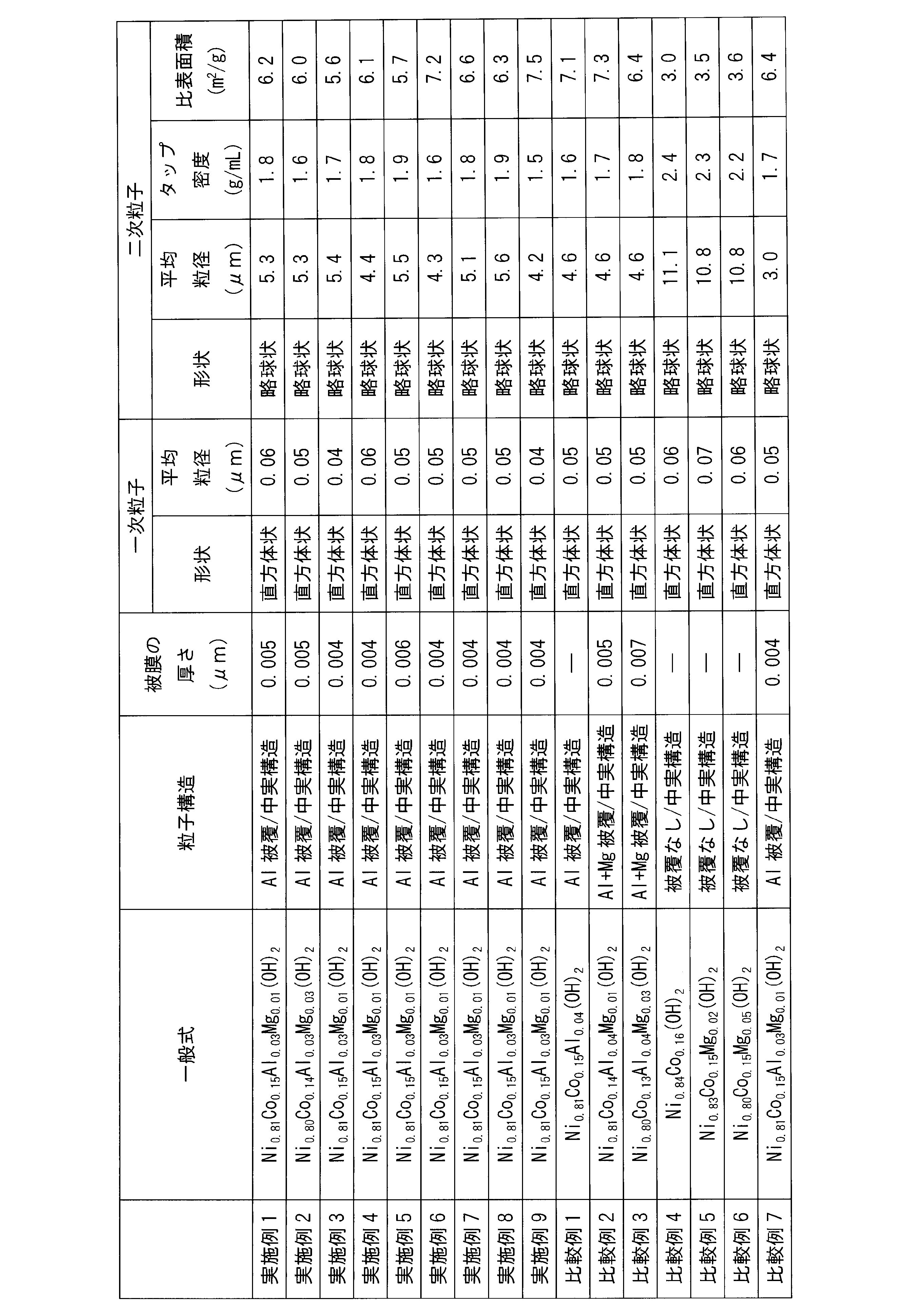
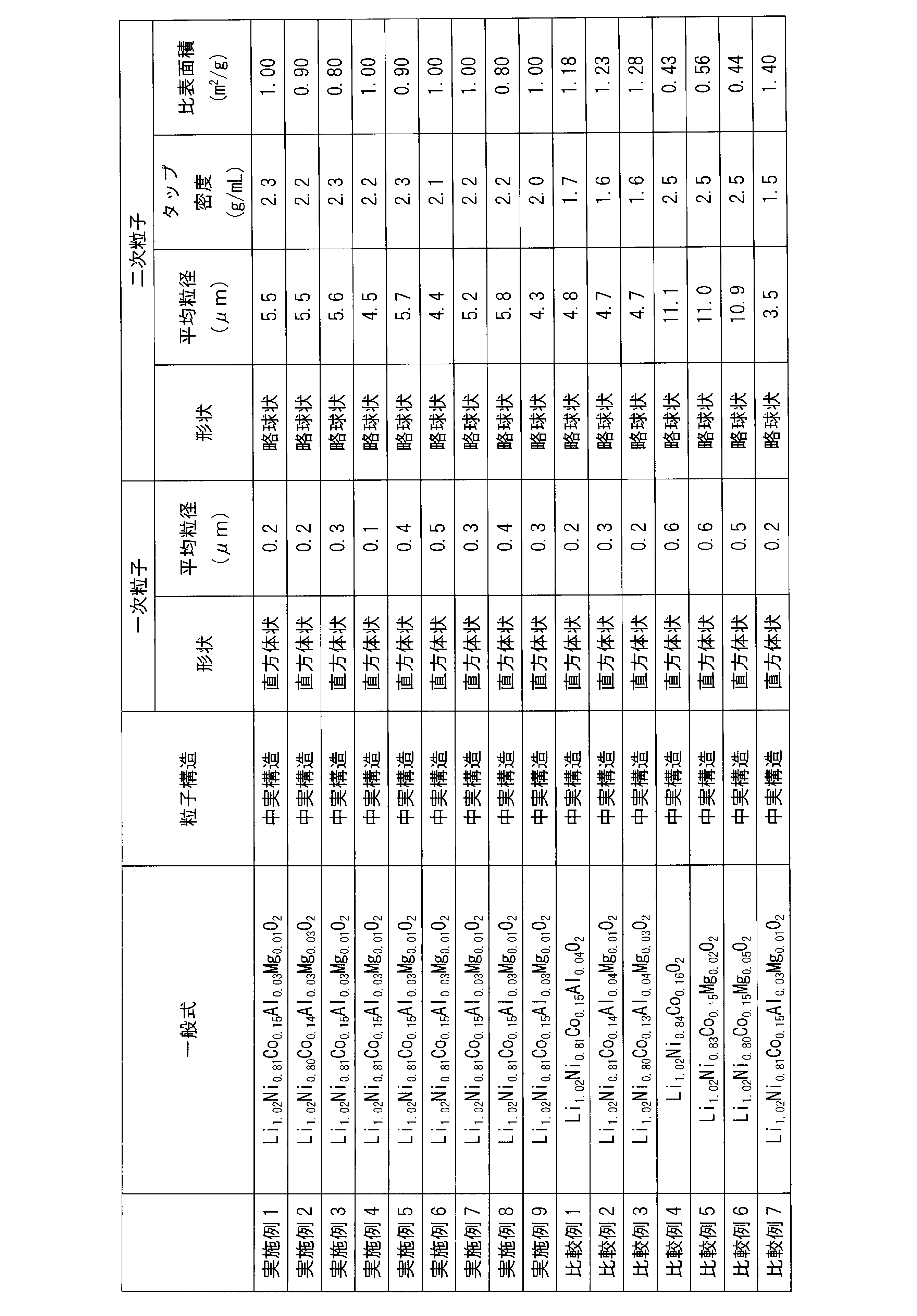

1 コイン型電池
2 ケース
2a 正極缶
2b 負極缶
2c ガスケット
3 電極
3a 正極
3b 負極
3c セパレータ
2 ケース
2a 正極缶
2b 負極缶
2c ガスケット
3 電極
3a 正極
3b 負極
3c セパレータ
Claims (13)
- 一般式:Ni1-x-y-zCoxAlyMgz(OH)2(ただし、0.05≦x≦0.20、0.01≦y≦0.06、0.01≦z≦0.03)で表され、複数の一次粒子が凝集して形成され、アルミニウムまたはアルミニウム化合物からなる被膜によって被覆された中実構造の二次粒子からなり、
該二次粒子の平均粒径が4μm~7μm以下の範囲にあり、タップ密度が1.5g/mL以上であり、かつ、比表面積が5.5m2/g~7.5m2/gの範囲にある、
アルミニウム被覆ニッケルコバルト含有複合水酸化物。 - 前記被膜の厚さが0.001μm~0.01μmの範囲にある、請求項1に記載のアルミニウム被覆ニッケルコバルト含有複合水酸化物。
- 前記一次粒子は、直方体状であり、その平均粒径が0.01μm~0.1μmの範囲にある、請求項1または2に記載のアルミニウム被覆ニッケルコバルト含有複合水酸化物。
- 一般式:Ni1-x-y-zCoxAlyMgz(OH)2(ただし、0.05≦x≦0.20、0.01≦y≦0.06、0.01≦z≦0.03)で表される、アルミニウム被覆ニッケルコバルト含有複合水酸化物の製造方法であって、
不活性雰囲気中、温度を45℃~55℃の範囲、液温25℃基準におけるpH値を10.8~11.8の範囲、およびアンモニウムイオン濃度を8g/L~12g/Lの範囲に制御した反応水溶液に、ニッケル、コバルトおよびマグネシウムを含有する原料水溶液を供給して、バッチ式晶析法により、複数の一次粒子が凝集して形成される中実構造の二次粒子からなる、ニッケルコバルト含有複合水酸化物を得る、晶析工程と、
前記ニッケルコバルト含有複合水酸化物を含むスラリーとアルミニウムを含む被覆溶液を混合し、混合水溶液を形成することにより、前記二次粒子を、アルミニウムまたはアルミニウム化合物からなる被膜によって被覆して、アルミニウム被覆ニッケルコバルト含有複合水酸化物を得る、被覆工程と、
を備える、アルミニウム被覆ニッケルコバルト含有複合水酸化物の製造方法。 - 前記混合水溶液の、液温25℃基準におけるpH値を9.6~10.4の範囲に制御する、請求項4に記載のアルミニウム被覆ニッケルコバルト含有複合水酸化物の製造方法。
- 前記アルミニウム被覆ニッケルコバルト含有複合水酸化物を110℃~130℃の範囲の温度に加熱して乾燥する、乾燥工程をさらに備える、請求項4または5に記載のアルミニウム被覆ニッケルコバルト含有複合水酸化物の製造方法。
- 一般式:LiuNi1-x-y-zCoxAlyMgzO2(ただし、1.00≦u≦1.04、0.05≦x≦0.20、0.01≦y≦0.06、0.01≦z≦0.03)で表され、複数の一次粒子が凝集して形成された中実構造の二次粒子により構成されている、層状構造のリチウムニッケルコバルト複合酸化物からなり、前記二次粒子の平均粒径が4μm~7μmの範囲にあり、タップ密度が2.0g/mL以上であり、かつ、比表面積が0.7m2/g~1.0m2/gの範囲にある、
非水系電解質二次電池用正極活物質。 - 前記一次粒子は、直方体状で、その平均粒径が0.05μm~0.5μmの範囲にある、請求項7に記載の非水系電解質二次電池用正極活物質。
- 一般式:LiuNi1-x-y-zCoxAlyMgzO2(ただし、1.00≦u≦1.04、0.05≦x≦0.20、0.01≦y≦0.06、0.01≦z≦0.03)で表され、複数の一次粒子が凝集して形成された中実構造の二次粒子により構成されている、層状構造のリチウムニッケルコバルト含有複合酸化物からなる非水系電解質二次電池用正極活物質の製造方法であって、
請求項1~3のいずれかに記載のアルミニウム被覆ニッケルコバルト含有複合水酸化物とリチウム化合物を混合して、リチウム混合物を得る、混合工程と、
前記リチウム混合物を、酸素濃度が98容量%以上の酸化性雰囲気中で焼成することにより、リチウムニッケルコバルト含有複合酸化物を得る、焼成工程と、
を備える、非水系電解質二次電池用正極活物質の製造方法。 - 前記焼成工程における焼成温度を700℃~800℃の範囲とする、請求項9に記載の非水系電解質二次電池用正極活物質の製造方法。
- 前記混合工程の前に、前記アルミニウム被覆ニッケルコバルト含有複合水酸化物を酸化焙焼する、酸化焙焼工程をさらに備える、請求項9または10に記載の非水系電解質二次電池用正極活物質の製造方法。
- 前記酸化焙焼工程における酸化焙焼温度を、前記焼成温度以下で、かつ、600℃~800℃の範囲とする、請求項9~11のいずれかに記載の非水系電解質二次電池用正極活物質の製造方法。
- 正極と、負極と、セパレータと、非水系電解質とを備え、前記正極の正極材料として、請求項7または8に記載の非水系電解質二次電池用正極活物質が用いられている、非水系電解質二次電池。
Priority Applications (3)
| Application Number | Priority Date | Filing Date | Title |
|---|---|---|---|
| US15/569,504 US10858265B2 (en) | 2015-04-28 | 2016-04-27 | Aluminum-coated nickel cobalt containing composite hydroxide and method for manufacturing same, cathode active material for non-aqueous electrolyte secondary battery and method for manufacturing same, and non-aqueous electrolyte secondary battery |
| CN201680024376.3A CN107531510B (zh) | 2015-04-28 | 2016-04-27 | 铝包覆含镍钴复合氢氧化物及制造方法、非水系电解质二次电池及正极活性物质及制造方法 |
| US17/083,411 US12195352B2 (en) | 2015-04-28 | 2020-10-29 | Aluminum-coated nickel cobalt containing composite hydroxide and method for manufacturing same, cathode active material for non-aqueous electrolyte secondary battery and method for manufacturing same, and non-aqueous electrolyte secondary battery |
Applications Claiming Priority (2)
| Application Number | Priority Date | Filing Date | Title |
|---|---|---|---|
| JP2015-092123 | 2015-04-28 | ||
| JP2015092123A JP6766322B2 (ja) | 2015-04-28 | 2015-04-28 | アルミニウム被覆ニッケルコバルト複合水酸化物粒子とその製造方法、非水系電解質二次電池用正極活物質とその製造方法、および、非水系電解質二次電池 |
Related Child Applications (2)
| Application Number | Title | Priority Date | Filing Date |
|---|---|---|---|
| US15/569,504 A-371-Of-International US10858265B2 (en) | 2015-04-28 | 2016-04-27 | Aluminum-coated nickel cobalt containing composite hydroxide and method for manufacturing same, cathode active material for non-aqueous electrolyte secondary battery and method for manufacturing same, and non-aqueous electrolyte secondary battery |
| US17/083,411 Division US12195352B2 (en) | 2015-04-28 | 2020-10-29 | Aluminum-coated nickel cobalt containing composite hydroxide and method for manufacturing same, cathode active material for non-aqueous electrolyte secondary battery and method for manufacturing same, and non-aqueous electrolyte secondary battery |
Publications (1)
| Publication Number | Publication Date |
|---|---|
| WO2016175268A1 true WO2016175268A1 (ja) | 2016-11-03 |
Family
ID=57198446
Family Applications (1)
| Application Number | Title | Priority Date | Filing Date |
|---|---|---|---|
| PCT/JP2016/063304 Ceased WO2016175268A1 (ja) | 2015-04-28 | 2016-04-27 | アルミニウム被覆ニッケルコバルト含有複合水酸化物とその製造方法、非水系電解質二次電池用正極活物質とその製造方法、および、非水系電解質二次電池 |
Country Status (4)
| Country | Link |
|---|---|
| US (2) | US10858265B2 (ja) |
| JP (1) | JP6766322B2 (ja) |
| CN (1) | CN107531510B (ja) |
| WO (1) | WO2016175268A1 (ja) |
Cited By (4)
| Publication number | Priority date | Publication date | Assignee | Title |
|---|---|---|---|---|
| CN109962237A (zh) * | 2017-12-26 | 2019-07-02 | 湖南杉杉能源科技股份有限公司 | 一种镍复合氢氧化物及其制造方法 |
| US20210135211A1 (en) * | 2017-08-30 | 2021-05-06 | Panasonic Intellectual Property Management Co., Ltd. | Positive electrode active material for nonaqueous electrolyte secondary batteries, and nonaqueous electrolyte secondary battery |
| EP3780178A4 (en) * | 2018-04-02 | 2021-06-02 | Panasonic Intellectual Property Management Co., Ltd. | POSITIVE ELECTRODE ACTIVE SUBSTANCE FOR NON-AQUEOUS ELECTROLYTE SECONDARY BATTERY, AND NON-AQUEOUS ELECTROLYTE SECONDARY BATTERY |
| CN114835173A (zh) * | 2022-04-21 | 2022-08-02 | 蜂巢能源科技股份有限公司 | 一种正极材料前驱体及其制备方法和正极材料 |
Families Citing this family (27)
| Publication number | Priority date | Publication date | Assignee | Title |
|---|---|---|---|---|
| KR101872574B1 (ko) | 2013-03-12 | 2018-06-28 | 애플 인크. | 향상된 캐소드 물질을 사용하는 높은 전압, 높은 체적 에너지 밀도의 리튬 이온 배터리 |
| US9716265B2 (en) | 2014-08-01 | 2017-07-25 | Apple Inc. | High-density precursor for manufacture of composite metal oxide cathodes for Li-ion batteries |
| WO2017058650A1 (en) | 2015-09-30 | 2017-04-06 | Hongli Dai | Cathode-active materials, their precursors, and methods of preparation |
| CN109075333B (zh) | 2016-03-14 | 2022-11-18 | 苹果公司 | 用于锂离子电池的阴极活性材料 |
| CN109075336B (zh) * | 2016-03-31 | 2021-07-02 | 松下知识产权经营株式会社 | 非水电解质二次电池 |
| WO2018057584A1 (en) | 2016-09-20 | 2018-03-29 | Apple Inc. | Cathode active materials having improved particle morphologies |
| WO2018057621A1 (en) | 2016-09-21 | 2018-03-29 | Apple Inc. | Surface stabilized cathode material for lithium ion batteries and synthesizing method of the same |
| CN110720152B (zh) * | 2017-07-27 | 2022-11-04 | 松下知识产权经营株式会社 | 非水电解质二次电池用正极活性物质、非水电解质二次电池用正极活性物质的制造方法和非水电解质二次电池 |
| KR102698846B1 (ko) * | 2017-11-22 | 2024-08-26 | 주식회사 엘지에너지솔루션 | 리튬 이차전지용 양극활물질 및 그 제조방법 |
| CN111344885B (zh) * | 2017-11-30 | 2023-05-12 | 松下知识产权经营株式会社 | 非水电解质二次电池用正极活性物质和非水电解质二次电池用正极活性物质的制造方法 |
| US11695108B2 (en) | 2018-08-02 | 2023-07-04 | Apple Inc. | Oxide mixture and complex oxide coatings for cathode materials |
| US11749799B2 (en) | 2018-08-17 | 2023-09-05 | Apple Inc. | Coatings for cathode active materials |
| EP3659975A1 (en) * | 2018-11-28 | 2020-06-03 | Basf Se | Process for the manufacture of a nickel composite hydroxide |
| CN113474298A (zh) * | 2019-02-26 | 2021-10-01 | 住友金属矿山株式会社 | 锂离子二次电池用正极活性物质、锂离子二次电池用正极活性物质的制造方法、锂离子二次电池 |
| CN110436531A (zh) * | 2019-06-20 | 2019-11-12 | 浙江美都海创锂电科技有限公司 | 低表面残碱的高镍单晶三元正极材料及其制备方法 |
| US11757096B2 (en) | 2019-08-21 | 2023-09-12 | Apple Inc. | Aluminum-doped lithium cobalt manganese oxide batteries |
| US12074321B2 (en) | 2019-08-21 | 2024-08-27 | Apple Inc. | Cathode active materials for lithium ion batteries |
| US12206100B2 (en) | 2019-08-21 | 2025-01-21 | Apple Inc. | Mono-grain cathode materials |
| KR102341407B1 (ko) * | 2019-10-29 | 2021-12-20 | 삼성에스디아이 주식회사 | 리튬이차전지용 양극 활물질 및 그 제조방법, 그리고 상기 양극 활물질을 채용한 양극과 리튬이차전지 |
| GB202004492D0 (en) * | 2020-03-27 | 2020-05-13 | Johnson Matthey Plc | Cathode material and process |
| GB202004485D0 (en) * | 2020-03-27 | 2020-05-13 | Johnson Matthey Plc | Cathode material and process |
| CA3192551A1 (en) * | 2020-09-25 | 2022-03-31 | Basf Se | Process for the manufacture of a coated cathode active material |
| KR102654402B1 (ko) * | 2021-04-13 | 2024-04-03 | 주식회사 엘 앤 에프 | 이차전지 양극 활물질용 신규 전구체 입자 |
| US12698215B2 (en) * | 2021-07-16 | 2026-08-04 | Basf Se | Method for making precursors of cathode active materials for lithium ion batteries |
| CN114560515B (zh) * | 2022-03-25 | 2023-11-24 | 骆驼集团资源循环襄阳有限公司 | 一种溶胶凝胶法制备铝包覆型三元前驱体的方法 |
| CN115986108A (zh) * | 2022-12-27 | 2023-04-18 | 巴斯夫杉杉电池材料有限公司 | 一种三元多晶正极材料及其制备方法 |
| CN116947123B (zh) * | 2023-09-18 | 2023-11-21 | 四川新能源汽车创新中心有限公司 | 一种改性正极材料及其制备方法和应用 |
Citations (2)
| Publication number | Priority date | Publication date | Assignee | Title |
|---|---|---|---|---|
| WO2011122448A1 (ja) * | 2010-03-29 | 2011-10-06 | 住友金属鉱山株式会社 | 非水系電解質二次電池用正極活物質とその製造方法、および該正極活物質の前駆体、ならびに該正極活物質を用いた非水系電解質二次電池 |
| JP2013171743A (ja) * | 2012-02-21 | 2013-09-02 | Sumitomo Metal Mining Co Ltd | ニッケルコバルト複合水酸化物及びその製造方法 |
Family Cites Families (15)
| Publication number | Priority date | Publication date | Assignee | Title |
|---|---|---|---|---|
| JP3624663B2 (ja) * | 1996-12-24 | 2005-03-02 | 株式会社日立製作所 | 電池 |
| DE19849343A1 (de) * | 1997-10-30 | 1999-06-02 | Samsung Display Devices Co Ltd | Lithiumcompositoxid, dessen Herstellung und sekundäre Lithiumionzelle mit Lithiumcompositoxid als aktives Material der positiven Elektrode |
| JP5079247B2 (ja) * | 2005-03-23 | 2012-11-21 | パナソニック株式会社 | リチウムイオン二次電池およびその製造法 |
| CN1868895A (zh) | 2005-05-27 | 2006-11-29 | 深圳市比克电池有限公司 | 球形掺杂氢氧化亚镍与多元金属氧化物的合成方法及电池 |
| JP2007035356A (ja) * | 2005-07-25 | 2007-02-08 | Toyota Central Res & Dev Lab Inc | リチウムイオン二次電池 |
| JP4811007B2 (ja) * | 2005-12-10 | 2011-11-09 | 堺化学工業株式会社 | リチウム二次電池用正極活物質とリチウム二次電池 |
| JP5008328B2 (ja) | 2006-03-30 | 2012-08-22 | 住友金属鉱山株式会社 | 非水電解質二次電池用の正極活物質、その製造方法及びそれを用いた非水電解質二次電池 |
| JP2009129820A (ja) * | 2007-11-27 | 2009-06-11 | Toyota Central R&D Labs Inc | リチウムニッケル複合酸化物及びそれを用いたリチウムイオン二次電池並びにリチウムニッケル複合酸化物の製造方法 |
| JP5359080B2 (ja) | 2008-07-18 | 2013-12-04 | 住友金属鉱山株式会社 | 水酸化アルミニウム被覆ニッケルコバルト複合水酸化物の製造方法 |
| JP4574730B2 (ja) | 2009-11-16 | 2010-11-04 | キヤノン株式会社 | 電子線装置の製造方法および電子線装置 |
| JP5894388B2 (ja) * | 2011-07-26 | 2016-03-30 | 住友金属鉱山株式会社 | 非水電解質二次電池用正極活物質、その製造方法及びそれを用いた非水電解質二次電池 |
| JP5971109B2 (ja) * | 2011-12-20 | 2016-08-17 | 住友金属鉱山株式会社 | ニッケル複合水酸化物とその製造方法、非水系電解質二次電池用正極活物質とその製造方法、および非水系電解質二次電池 |
| WO2014010448A1 (ja) * | 2012-07-12 | 2014-01-16 | 住友金属鉱山株式会社 | 非水系電解質二次電池用正極活物質およびその製造方法、ならびに該正極活物質を用いた非水系電解質二次電池 |
| CN102916172A (zh) * | 2012-10-17 | 2013-02-06 | 上海锦众信息科技有限公司 | 一种锂离子电池富锂锰基正极材料的制备方法 |
| CN104393281B (zh) * | 2014-12-03 | 2017-01-25 | 梁贺君 | 一种锰镍锂正极材料的制备方法 |
-
2015
- 2015-04-28 JP JP2015092123A patent/JP6766322B2/ja active Active
-
2016
- 2016-04-27 WO PCT/JP2016/063304 patent/WO2016175268A1/ja not_active Ceased
- 2016-04-27 US US15/569,504 patent/US10858265B2/en active Active
- 2016-04-27 CN CN201680024376.3A patent/CN107531510B/zh active Active
-
2020
- 2020-10-29 US US17/083,411 patent/US12195352B2/en active Active
Patent Citations (2)
| Publication number | Priority date | Publication date | Assignee | Title |
|---|---|---|---|---|
| WO2011122448A1 (ja) * | 2010-03-29 | 2011-10-06 | 住友金属鉱山株式会社 | 非水系電解質二次電池用正極活物質とその製造方法、および該正極活物質の前駆体、ならびに該正極活物質を用いた非水系電解質二次電池 |
| JP2013171743A (ja) * | 2012-02-21 | 2013-09-02 | Sumitomo Metal Mining Co Ltd | ニッケルコバルト複合水酸化物及びその製造方法 |
Cited By (6)
| Publication number | Priority date | Publication date | Assignee | Title |
|---|---|---|---|---|
| US20210135211A1 (en) * | 2017-08-30 | 2021-05-06 | Panasonic Intellectual Property Management Co., Ltd. | Positive electrode active material for nonaqueous electrolyte secondary batteries, and nonaqueous electrolyte secondary battery |
| US12255325B2 (en) * | 2017-08-30 | 2025-03-18 | Panasonic Intellectual Property Management Co., Ltd. | Positive electrode active material for nonaqueous electrolyte secondary batteries, and nonaqueous electrolyte secondary battery |
| CN109962237A (zh) * | 2017-12-26 | 2019-07-02 | 湖南杉杉能源科技股份有限公司 | 一种镍复合氢氧化物及其制造方法 |
| CN109962237B (zh) * | 2017-12-26 | 2021-08-31 | 湖南杉杉能源科技股份有限公司 | 一种镍复合氢氧化物及其制造方法 |
| EP3780178A4 (en) * | 2018-04-02 | 2021-06-02 | Panasonic Intellectual Property Management Co., Ltd. | POSITIVE ELECTRODE ACTIVE SUBSTANCE FOR NON-AQUEOUS ELECTROLYTE SECONDARY BATTERY, AND NON-AQUEOUS ELECTROLYTE SECONDARY BATTERY |
| CN114835173A (zh) * | 2022-04-21 | 2022-08-02 | 蜂巢能源科技股份有限公司 | 一种正极材料前驱体及其制备方法和正极材料 |
Also Published As
| Publication number | Publication date |
|---|---|
| US20210039960A1 (en) | 2021-02-11 |
| US10858265B2 (en) | 2020-12-08 |
| JP6766322B2 (ja) | 2020-10-14 |
| US20180215629A1 (en) | 2018-08-02 |
| US12195352B2 (en) | 2025-01-14 |
| CN107531510A (zh) | 2018-01-02 |
| CN107531510B (zh) | 2020-03-24 |
| JP2016204239A (ja) | 2016-12-08 |
Similar Documents
| Publication | Publication Date | Title |
|---|---|---|
| US12195352B2 (en) | Aluminum-coated nickel cobalt containing composite hydroxide and method for manufacturing same, cathode active material for non-aqueous electrolyte secondary battery and method for manufacturing same, and non-aqueous electrolyte secondary battery | |
| KR102603503B1 (ko) | 비수계 전해질 이차 전지용 정극 활물질과 그의 제조 방법 및 비수계 전해질 이차 전지 | |
| KR102203425B1 (ko) | 전이 금속 복합 수산화물 입자와 그의 제조 방법, 비수전해질 이차 전지용 정극 활물질과 그의 제조 방법, 및 비수전해질 이차 전지 | |
| JP5971109B2 (ja) | ニッケル複合水酸化物とその製造方法、非水系電解質二次電池用正極活物質とその製造方法、および非水系電解質二次電池 | |
| JP6252383B2 (ja) | マンガンコバルト複合水酸化物及びその製造方法、正極活物質及びその製造方法、並びに非水系電解質二次電池 | |
| US11594726B2 (en) | Positive electrode active material for lithium ion secondary battery, method for manufacturing positive electrode active material for lithium ion secondary battery, and lithium ion secondary battery | |
| KR101694086B1 (ko) | 비수계 전해질 2차 전지용 정극 활물질의 전구체가 되는 전이 금속 복합 수산화물과 그 제조방법, 그 비수계 전해질 2차 전지용 정극 활물질과 그 제조방법, 및 상기 정극 활물질을 이용한 비수계 전해질 2차 전지 | |
| CN107078294B (zh) | 非水系电解质二次电池用正极活性物质、其制造方法和使用其的非水系电解质二次电池 | |
| JP7159639B2 (ja) | 遷移金属複合水酸化物の粒子の製造方法、及び、リチウムイオン二次電池用正極活物質の製造方法 | |
| JP6511965B2 (ja) | 非水系電解質二次電池用正極活物質とその製造方法および非水系電解質二次電池 | |
| WO2016208413A1 (ja) | 遷移金属含有複合水酸化物とその製造方法、非水電解質二次電池用正極活物質とその製造方法、および非水電解質二次電池 | |
| JP7272134B2 (ja) | リチウムイオン二次電池用正極活物質およびその製造方法、並びに、リチウムイオン二次電池 | |
| JP7452570B2 (ja) | 非水系電解質二次電池用正極活物質 | |
| JPWO2019163846A1 (ja) | 金属複合水酸化物とその製造方法、非水電解質二次電池用正極活物質とその製造方法、および非水電解質二次電池 | |
| JP7183815B2 (ja) | ニッケルマンガンコバルト含有複合水酸化物およびその製造方法、リチウムイオン二次電池用正極活物質およびその製造方法、並びに、リチウムイオン二次電池 | |
| JP7408912B2 (ja) | リチウムイオン二次電池用正極活物質の製造方法 | |
| JPWO2019087503A1 (ja) | 非水系電解質二次電池用正極活物質、非水系電解質二次電池及び非水系電解質二次電池用正極活物質の製造方法 | |
| JP7183813B2 (ja) | ニッケルマンガンコバルト含有複合水酸化物およびその製造方法、リチウムイオン二次電池用正極活物質およびその製造方法、並びに、リチウムイオン二次電池 | |
| JP2008117729A (ja) | 非水系電解質二次電池用正極活物質、その製造方法及びそれを用いた非水系電解質二次電池 | |
| JP7183812B2 (ja) | ニッケルマンガンコバルト含有複合水酸化物およびその製造方法、リチウムイオン二次電池用正極活物質およびその製造方法、並びに、リチウムイオン二次電池 | |
| JP7183814B2 (ja) | ニッケルマンガンコバルト含有複合水酸化物およびその製造方法、リチウムイオン二次電池用正極活物質およびその製造方法、並びに、リチウムイオン二次電池 | |
| KR20250011667A (ko) | 리튬 이온 이차 전지용 정극 활물질과 그 제조 방법 | |
| JP7389376B2 (ja) | 非水系電解質二次電池用正極活物質 | |
| JP2021005548A (ja) | リチウムイオン二次電池用正極活物質およびその製造方法、並びに、リチウムイオン二次電池 | |
| JP7273260B2 (ja) | リチウムイオン二次電池用正極活物質とその製造方法およびリチウムイオン二次電池 |
Legal Events
| Date | Code | Title | Description |
|---|---|---|---|
| 121 | Ep: the epo has been informed by wipo that ep was designated in this application |
Ref document number: 16786544 Country of ref document: EP Kind code of ref document: A1 |
|
| WWE | Wipo information: entry into national phase |
Ref document number: 15569504 Country of ref document: US |
|
| NENP | Non-entry into the national phase |
Ref country code: DE |
|
| 122 | Ep: pct application non-entry in european phase |
Ref document number: 16786544 Country of ref document: EP Kind code of ref document: A1 |