WO2016147807A1 - アルミニウム合金製ブレージングシート - Google Patents
アルミニウム合金製ブレージングシート Download PDFInfo
- Publication number
- WO2016147807A1 WO2016147807A1 PCT/JP2016/055090 JP2016055090W WO2016147807A1 WO 2016147807 A1 WO2016147807 A1 WO 2016147807A1 JP 2016055090 W JP2016055090 W JP 2016055090W WO 2016147807 A1 WO2016147807 A1 WO 2016147807A1
- Authority
- WO
- WIPO (PCT)
- Prior art keywords
- brazing
- mass
- intermediate layer
- core material
- aluminum alloy
- Prior art date
- Legal status (The legal status is an assumption and is not a legal conclusion. Google has not performed a legal analysis and makes no representation as to the accuracy of the status listed.)
- Ceased
Links
Images


Classifications
-
- B—PERFORMING OPERATIONS; TRANSPORTING
- B23—MACHINE TOOLS; METAL-WORKING NOT OTHERWISE PROVIDED FOR
- B23K—SOLDERING OR UNSOLDERING; WELDING; CLADDING OR PLATING BY SOLDERING OR WELDING; CUTTING BY APPLYING HEAT LOCALLY, e.g. FLAME CUTTING; WORKING BY LASER BEAM
- B23K35/00—Rods, electrodes, materials, or media, for use in soldering, welding, or cutting
- B23K35/22—Rods, electrodes, materials, or media, for use in soldering, welding, or cutting characterised by the composition or nature of the material
- B23K35/24—Selection of soldering or welding materials proper
- B23K35/28—Selection of soldering or welding materials proper with the principal constituent melting at less than 950°C
- B23K35/286—Al as the principal constituent
-
- B—PERFORMING OPERATIONS; TRANSPORTING
- B23—MACHINE TOOLS; METAL-WORKING NOT OTHERWISE PROVIDED FOR
- B23K—SOLDERING OR UNSOLDERING; WELDING; CLADDING OR PLATING BY SOLDERING OR WELDING; CUTTING BY APPLYING HEAT LOCALLY, e.g. FLAME CUTTING; WORKING BY LASER BEAM
- B23K35/00—Rods, electrodes, materials, or media, for use in soldering, welding, or cutting
- B23K35/02—Rods, electrodes, materials, or media, for use in soldering, welding, or cutting characterised by mechanical features, e.g. shape
- B23K35/0222—Rods, electrodes, materials, or media, for use in soldering, welding, or cutting characterised by mechanical features, e.g. shape for use in soldering or brazing
- B23K35/0233—Sheets or foils
- B23K35/0238—Sheets or foils layered
-
- B—PERFORMING OPERATIONS; TRANSPORTING
- B32—LAYERED PRODUCTS
- B32B—LAYERED PRODUCTS, i.e. PRODUCTS BUILT-UP OF STRATA OF FLAT OR NON-FLAT, e.g. CELLULAR OR HONEYCOMB, FORM
- B32B15/00—Layered products comprising a layer of metal
- B32B15/01—Layered products comprising a layer of metal all layers being exclusively metallic
-
- B—PERFORMING OPERATIONS; TRANSPORTING
- B32—LAYERED PRODUCTS
- B32B—LAYERED PRODUCTS, i.e. PRODUCTS BUILT-UP OF STRATA OF FLAT OR NON-FLAT, e.g. CELLULAR OR HONEYCOMB, FORM
- B32B15/00—Layered products comprising a layer of metal
- B32B15/01—Layered products comprising a layer of metal all layers being exclusively metallic
- B32B15/016—Layered products comprising a layer of metal all layers being exclusively metallic all layers being formed of aluminium or aluminium alloys
-
- B—PERFORMING OPERATIONS; TRANSPORTING
- B32—LAYERED PRODUCTS
- B32B—LAYERED PRODUCTS, i.e. PRODUCTS BUILT-UP OF STRATA OF FLAT OR NON-FLAT, e.g. CELLULAR OR HONEYCOMB, FORM
- B32B15/00—Layered products comprising a layer of metal
- B32B15/20—Layered products comprising a layer of metal comprising aluminium or copper
-
- C—CHEMISTRY; METALLURGY
- C22—METALLURGY; FERROUS OR NON-FERROUS ALLOYS; TREATMENT OF ALLOYS OR NON-FERROUS METALS
- C22C—ALLOYS
- C22C21/00—Alloys based on aluminium
-
- C—CHEMISTRY; METALLURGY
- C22—METALLURGY; FERROUS OR NON-FERROUS ALLOYS; TREATMENT OF ALLOYS OR NON-FERROUS METALS
- C22C—ALLOYS
- C22C21/00—Alloys based on aluminium
- C22C21/06—Alloys based on aluminium with magnesium as the next major constituent
- C22C21/08—Alloys based on aluminium with magnesium as the next major constituent with silicon
-
- C—CHEMISTRY; METALLURGY
- C22—METALLURGY; FERROUS OR NON-FERROUS ALLOYS; TREATMENT OF ALLOYS OR NON-FERROUS METALS
- C22C—ALLOYS
- C22C21/00—Alloys based on aluminium
- C22C21/12—Alloys based on aluminium with copper as the next major constituent
-
- C—CHEMISTRY; METALLURGY
- C22—METALLURGY; FERROUS OR NON-FERROUS ALLOYS; TREATMENT OF ALLOYS OR NON-FERROUS METALS
- C22C—ALLOYS
- C22C21/00—Alloys based on aluminium
- C22C21/12—Alloys based on aluminium with copper as the next major constituent
- C22C21/14—Alloys based on aluminium with copper as the next major constituent with silicon
-
- C—CHEMISTRY; METALLURGY
- C23—COATING METALLIC MATERIAL; COATING MATERIAL WITH METALLIC MATERIAL; CHEMICAL SURFACE TREATMENT; DIFFUSION TREATMENT OF METALLIC MATERIAL; COATING BY VACUUM EVAPORATION, BY SPUTTERING, BY ION IMPLANTATION OR BY CHEMICAL VAPOUR DEPOSITION, IN GENERAL; INHIBITING CORROSION OF METALLIC MATERIAL OR INCRUSTATION IN GENERAL
- C23C—COATING METALLIC MATERIAL; COATING MATERIAL WITH METALLIC MATERIAL; SURFACE TREATMENT OF METALLIC MATERIAL BY DIFFUSION INTO THE SURFACE, BY CHEMICAL CONVERSION OR SUBSTITUTION; COATING BY VACUUM EVAPORATION, BY SPUTTERING, BY ION IMPLANTATION OR BY CHEMICAL VAPOUR DEPOSITION, IN GENERAL
- C23C30/00—Coating with metallic material characterised only by the composition of the metallic material, i.e. not characterised by the coating process
-
- B—PERFORMING OPERATIONS; TRANSPORTING
- B23—MACHINE TOOLS; METAL-WORKING NOT OTHERWISE PROVIDED FOR
- B23K—SOLDERING OR UNSOLDERING; WELDING; CLADDING OR PLATING BY SOLDERING OR WELDING; CUTTING BY APPLYING HEAT LOCALLY, e.g. FLAME CUTTING; WORKING BY LASER BEAM
- B23K1/00—Soldering, e.g. brazing, or unsoldering
- B23K1/0008—Soldering, e.g. brazing, or unsoldering specially adapted for particular articles or work
- B23K1/0012—Brazing of heat exchangers
-
- F—MECHANICAL ENGINEERING; LIGHTING; HEATING; WEAPONS; BLASTING
- F28—HEAT EXCHANGE IN GENERAL
- F28F—DETAILS OF HEAT-EXCHANGE AND HEAT-TRANSFER APPARATUS, OF GENERAL APPLICATION
- F28F19/00—Preventing the formation of deposits or corrosion, e.g. by using filters or scrapers
Definitions
- the present invention relates to an aluminum alloy brazing sheet used for a heat exchanger for automobiles.
- an aluminum alloy brazing sheet having a core material clad with an intermediate layer and a brazing material is used.
- Mn 0.5 to 2.0 mass% (hereinafter simply referred to as%)
- Cu 0.1 to 1.0%
- Mg 0 to 1.0%
- Ti 0 to Mn: 0.01 to 2.0%
- Zn 0.05 to 5.0%
- Cu: 0.05% or less the balance being Al and unavoidable impurities, and having a thickness of 30
- An Al alloy brazing sheet has been proposed in which an intermediate layer of ⁇ 150 ⁇ m is provided and an Al—Si alloy brazing material is combined on the intermediate layer with a cladding thickness of 30 ⁇ 150 ⁇ m.
- This invention is made in view of the said subject,
- the subject is to provide the brazing alloy sheet made from aluminum alloy which can maintain the intensity
- the aluminum alloy brazing sheet according to the present invention is provided between a core material, a brazing material provided on at least one surface side of the core material, and the core material and the brazing material on at least one surface side.
- An aluminum alloy brazing sheet comprising: an intermediate layer, wherein the core material is Cu: 0.50 to 1.10% by mass, Si: 0.10 to 1.10% by mass, Mn: 0.60 to 2
- the intermediate layer is made of Zn: 0.50 to 10.00% by mass, Si: 0.20% by mass or more and 1.10% by mass. It contains the following, the balance being made of Al and unavoidable impurities, and the brazing material is made of an Al-Si based alloy.
- the core material contains predetermined amounts of Cu, Si and Mn, and the intermediate layer contains a predetermined amount of Si, whereby the post-braze strength of the brazing sheet is improved.
- thinning of the brazing sheet that is, reduction in post-brazing strength due to reduction in core material ratio can be compensated by strengthening the core material and the intermediate layer.
- the core material containing a predetermined amount of Cu and the intermediate layer containing a predetermined amount of Zn increase the potential difference between the core material and the intermediate layer, and the sacrificial anode effect of the intermediate layer is improved. Thereby, even if the intermediate layer is thinned, the corrosion resistance of the brazing sheet can be maintained.
- the thickness of the intermediate layer is preferably 0.05 mm or more and 35% or less of the total thickness of the brazing sheet.
- the post-brazing strength and the corrosion resistance are further improved by the predetermined thickness of the intermediate layer.
- the intermediate layer may further contain Mn: 0.10 to 1.50% by mass.
- the post-brazing strength of the brazing sheet is improved by the intermediate layer further containing a predetermined amount of Mn.
- the core material further comprises Mg: 0.05 to 0.50 mass%, Cr: 0.05 to 0.30 mass%, and Ti: 0.05 to 0.30 mass. And at least one of 0.05 to 0.30% by mass may be contained.
- the core material further contains at least one of Mg, Cr, Ti and Zr in a predetermined amount, so that the post-brazing strength of the brazing sheet is improved.
- the core material further contains a predetermined amount of Ti, the corrosion resistance of the brazing sheet is improved.
- the core material further contains a predetermined amount of Mg, the brazing property of the brazing sheet is improved.
- the intermediate layer further contains Mg: 0.05 to 0.50 mass%, Cr: 0.05 to 0.30 mass%, Ti: 0.05 to 0.30. It may contain at least one of mass% and Zr: 0.05 to 0.30 mass%.
- the post-brazing strength of the brazing sheet is improved by the intermediate layer further containing at least one of Mg, Cr, Ti and Zr in a predetermined amount.
- the intermediate layer further contains a predetermined amount of Ti the corrosion resistance of the brazing sheet is improved.
- the intermediate layer further contains a predetermined amount of Mg the brazing property of the brazing sheet is improved.
- the aluminum alloy brazing sheet according to the present invention excellent post-braze strength, corrosion resistance and brazeability can be exhibited even if the thickness is reduced.
- the brazing sheet 1 ⁇ / b> A includes a core 2, a brazing material 4 provided on one side of the core 2, and an intermediate layer 3 provided between the core 2 and the brazing material 4.
- the thickness of the entire brazing sheet 1A is preferably 0.30 to 1.00 mm in order to make the brazing sheet 1A lighter in weight and improve the strength after brazing.
- the total thickness of the sheet is preferably 0.80 mm or less, and more preferably 0.60 mm or less, from the viewpoint of weight reduction by thinness. Each component will be described below.
- the core material 2 is made of an aluminum alloy containing predetermined amounts of Cu, Si and Mn, with the balance being Al and unavoidable impurities.
- the reasons for numerical limitation of the component composition will be described.
- Cu of core material 0.50 to 1.10% by mass
- Cu increases the potential of the core material and contributes to the improvement of the corrosion resistance and the strength after brazing through solid solution strengthening. If the content of Cu is less than 0.50% by mass, the strength after brazing is insufficient. On the other hand, if the content of Cu exceeds 1.10% by mass, the solidus temperature of the core material 2 is lowered, and local melting occurs at the time of heat addition to brazing. Therefore, the content of Cu in the core material 2 is 0.50 to 1.10% by mass.
- Si of core material 0.10 to 1.10% by mass
- Si contributes to the improvement of post-braze strength by solid solution strengthening and by dispersion strengthening by forming dispersed particles with Mn. If the content of Si is less than 0.10% by mass, the strength after brazing is insufficient. On the other hand, when the content of Si exceeds 1.10% by mass, the solidus temperature of the core material 2 is lowered, and local melting occurs at the time of heat addition to brazing. Therefore, the content of Si in the core material 2 is 0.10 to 1.10% by mass. Further, from the viewpoint of improving the post-brazing strength of the core material 2, it is preferable that the lower limit value of the content of Si exceeds 0.20 mass% and the upper limit value is 1.00 mass% or less.
- Mn in core 0.60 to 2.00% by mass
- Mn contributes to the improvement of the strength after brazing by forming dispersed particles with Si to strengthen dispersion. If the content of Mn is less than 0.60% by mass, the strength after brazing is insufficient. On the other hand, when the content of Mn exceeds 2.00% by mass, a coarse intermetallic compound is formed at the time of casting, and the workability is reduced, which makes it difficult to roll the material. Therefore, the content of Mn in the core material 2 is 0.60 to 2.00% by mass.
- the balance of the component composition of the core material 2 is composed of Al and unavoidable impurities.
- an unavoidable impurity Fe, Zn etc. are mentioned, for example.
- the content of Fe is 0.70% by mass or less, preferably 0.50% by mass or less.
- the content of Zn is 0.10% by mass or less. If the content is as described above, the core material 2 is allowed to be contained because the effects of the present invention are not impaired.
- the core material 2 may further contain a predetermined amount of at least one of Mg, Cr, Ti and Zr in the component composition.
- Mg in core 0.05 to 0.50% by mass
- Mg contributes to the improvement of the strength after brazing by forming a precipitation phase with Si and strengthening the precipitation after brazing. If the content of Mg is less than 0.05% by mass, the effect of improving the strength after brazing may be insufficient.
- the content of Mg exceeds 0.50 mass%
- the brazing material when the brazing material is directly disposed on one side of the core material 2 or when the joining member is present, the Mg diffused at the time of brazing reacts with the flux By forming a high melting point compound, the function of the flux is impaired and the brazability is reduced. Therefore, when the core material 2 contains Mg, the content of Mg is 0.05 to 0.50 mass%.
- the upper limit of the content of Mg is preferably 0.30% by mass or less.
- Cr of core material 0.05 to 0.30 mass% Cr contributes to the improvement of the strength after brazing by forming Al 3 Cr dispersed particles and strengthening the dispersion. If the content of Cr is less than 0.05% by mass, the effect of improving the strength after brazing may be insufficient. On the other hand, if the content of Cr exceeds 0.30% by mass, coarse intermetallic compounds are formed at the time of casting, and the workability is reduced, which makes it difficult to roll the material. Therefore, when the core material 2 contains Cr, the content of Cr is 0.05 to 0.30 mass%.
- Ti of core material 0.05 to 0.30 mass% Ti is distributed in layers in the aluminum alloy, so that the corrosion form of the core material 2 is stratified, and the corrosion progress rate in the thickness direction can be reduced, which contributes to the improvement of the corrosion resistance. If the content of Ti is less than 0.05% by mass, the effect of improving the corrosion resistance may not be sufficiently obtained. On the other hand, when the content of Ti exceeds 0.30% by mass, coarse intermetallic compounds are easily formed during casting, and the processability is reduced, which makes it difficult to roll the material. Therefore, when the core material 2 contains Ti, the content of Ti is 0.05 to 0.30 mass%.
- Zr of core material 0.05 to 0.30 mass%
- Zr contributes to the improvement of the post-braze strength by forming Al 3 Zr dispersed particles and strengthening the dispersion. If the content of Zr is less than 0.05% by mass, the effect of improving the strength after brazing may be insufficient. On the other hand, if the content of Zr exceeds 0.30% by mass, coarse intermetallic compounds are formed at the time of casting, and the workability is reduced, which makes it difficult to roll the material. Therefore, when the core material 2 contains Zr, the content of Zr is 0.05 to 0.30 mass%.
- the core material 2 contains at least one or more of Mg, Cr, Ti and Zr as the component composition
- the total amount of the contained components is 0.05 or less from the viewpoint of improving the post-braze strength and corrosion resistance. It is preferable that it is 0.50 mass%.
- the intermediate layer 3 is made of an aluminum alloy containing predetermined amounts of Zn and Si, with the balance being Al and unavoidable impurities. The reasons for numerical limitation of the component composition of the intermediate layer 3 will be described below.
- Zn in the intermediate layer 0.50 to 10.00 mass%
- Zn contributes to the improvement of the corrosion resistance by causing the potential of the intermediate layer 3 to grow and causing a potential difference with the core material 2. If the content of Zn is less than 0.50 mass%, the potential difference with the core material 2 becomes small, and it becomes difficult to secure corrosion resistance. On the other hand, when the content of Zn exceeds 10.00 mass%, the potential difference between the intermediate layer 3 and the core material 2 becomes excessive, and the intermediate layer 3 is consumed at an early stage, resulting in a decrease in the sacrificial anode effect. Therefore, the content of Zn in the intermediate layer 3 is 0.50 to 10.00 mass%. Further, from the viewpoint of improving the corrosion resistance of the intermediate layer 3, the lower limit value of the content of Zn is preferably 2.50% by mass, and the upper limit value is preferably 6.00% by mass.
- Si in intermediate layer more than 0.20% by mass and not more than 1.10% by mass
- Si contributes to improvement in post-braze strength by solid solution strengthening.
- the intermediate layer 3 contains Mn
- dispersion strengthening by forming dispersed particles of Si and Mn contributes to the improvement of the strength after brazing. If the content of Si is 0.20% by mass or less, the strength after brazing is insufficient.
- the content of Si exceeds 1.10% by mass, the solidus temperature of the intermediate layer 3 is lowered, and local melting occurs at the time of heat addition to the brazing, which lowers the corrosion resistance. Therefore, the content of Si in the intermediate layer 3 is more than 0.20% by mass and not more than 1.10% by mass.
- the upper limit value of the content of Si is preferably 1.00 mass%.
- the remainder of the middle layer Al and unavoidable impurities
- the remainder is Al and unavoidable impurities in addition to the above.
- an unavoidable impurity Fe, In, Sn, and Ni are mentioned, for example, and content of Fe is 0.70 mass% or less, Preferably it is 0.50 mass% or less.
- the content of each element other than Fe is less than 0.05% by mass, preferably not more than 0.03% by mass. If it is the said content, in order to not impair the effect of this invention, containing in the intermediate
- the intermediate layer 3 preferably has a predetermined thickness.
- the reason for numerical limitation of the thickness of the intermediate layer 3 will be described.
- the intermediate layer 3 is disposed between the core material 2 and the brazing material 4 as a sacrificial anticorrosive layer. If the thickness of the intermediate layer 3 is less than 0.05 mm, the amount of the sacrificial anticorrosive layer may be insufficient, whereby the corrosion resistance may not be sufficiently improved.
- the thickness of the intermediate layer 3 exceeds 35% of the total thickness of the brazing sheet 1A, ie, the cladding ratio of the intermediate layer 3 exceeds 35%, the ratio of the core 2 to the total thickness of the sheet In some cases, the strength after brazing can not be sufficiently improved.
- the lower limit of the thickness of the intermediate layer 3 is preferably 0.07 mm from the viewpoint of improving the corrosion resistance.
- the upper limit of the thickness of the intermediate layer 3 is preferably 35% of the thickness of the entire sheet, that is, the cladding ratio of the intermediate layer is 35% or less, from the viewpoint of improving the strength after brazing.
- the intermediate layer 3 may further contain a predetermined amount of Mn in the component composition.
- Mn of the intermediate layer 0.10 to 1.50 mass%
- Mn contributes to the improvement of the strength after brazing by forming dispersed particles with Si to strengthen dispersion. If the content of Mn is less than 0.10% by mass, the effect of improving the strength after brazing may be insufficient. On the other hand, when the content of Mn exceeds 1.50% by mass, a coarse intermetallic compound is formed at the time of casting, and the workability is reduced, which makes it difficult to roll the material. Therefore, when the intermediate layer 3 contains Mn, the content of Mn is 0.10 to 1.50 mass%.
- the intermediate layer 3 may further contain a predetermined amount of at least one of Mg, Cr, Ti and Z in the component composition.
- Mg in the intermediate layer 0.05 to 0.50% by mass
- Mg contributes to the improvement of the strength after brazing by forming a precipitation phase with Si and strengthening the precipitation after brazing. If the content of Mg is less than 0.05% by mass, the effect of improving the strength after brazing may be insufficient. On the other hand, if the content of Mg exceeds 0.50% by mass, Mg diffused to the brazing material at the time of brazing reacts with the flux to form a high melting point compound, and as a result, the function of the flux is impaired. Sex is reduced. Therefore, when the intermediate layer contains Mg, the content of Mg is 0.05 to 0.50 mass%. In order to obtain stable brazeability, the upper limit of the content of Mg is preferably 0.30% by mass or less.
- Cr of the intermediate layer 0.05 to 0.30 mass% Cr contributes to the improvement of the strength after brazing by forming Al 3 Cr dispersed particles and strengthening the dispersion. If the content of Cr is less than 0.05% by mass, the effect of improving the strength after brazing may be insufficient. On the other hand, if the content of Cr exceeds 0.30% by mass, coarse intermetallic compounds are formed at the time of casting, and the workability is reduced, which makes it difficult to roll the material. Therefore, when the intermediate layer contains Cr, the content of Cr is 0.05 to 0.30% by mass.
- Ti in intermediate layer 0.05 to 0.30 mass% Ti is distributed in a layered manner in the aluminum alloy, so that the corrosion form of the intermediate layer 3 is stratified, and the corrosion progress rate in the thickness direction can be reduced, which contributes to the improvement of the corrosion resistance. If the content of Ti is less than 0.05% by mass, the effect of improving the corrosion resistance may not be sufficiently obtained. On the other hand, when the content of Ti exceeds 0.30% by mass, coarse intermetallic compounds are easily formed during casting, and the processability is reduced, which makes it difficult to roll the material. Therefore, when the intermediate layer contains Ti, the content of Ti is 0.05 to 0.30 mass%.
- Zr of the intermediate layer 0.05 to 0.30 mass%
- Zr contributes to the improvement of the post-braze strength by forming Al 3 Zr dispersed particles and strengthening the dispersion. If the content of Zr is less than 0.05% by mass, the effect of improving the strength after brazing may be insufficient. On the other hand, if the content of Zr exceeds 0.30% by mass, coarse intermetallic compounds are formed at the time of casting, and the workability is reduced, which makes it difficult to roll the material. Therefore, when the intermediate layer contains Zr, the content of Zr is 0.05 to 0.30 mass%.
- the intermediate layer 3 contains at least one or more of Mg, Cr, Ti, and Zr as a component composition
- the total amount of the contained components is 0.05 from the viewpoint of improving the post-braze strength and corrosion resistance. It is preferable that the content be up to 0.50 mass%.
- the brazing material 4 is made of an Al-Si based alloy.
- the Al-Si alloy is not particularly limited, but examples thereof include Al-Si alloys specified in JIS, such as 4343 alloy and 4045 alloy.
- the Al—Si based alloy includes an alloy containing Zn as well as an alloy containing Si. That is, as the Al-Si-based alloy, any commonly used Al-Si-based alloy or Al-Si-Zn-based alloy may be used. It is also possible to use an Al-Si-Mg-based or Al-Si-Mg-Bi-based alloy used for vacuum brazing.
- the Al—Si based alloy may contain Fe, Cu, Mn, etc. in addition to Si, Zn, Mg, Bi.
- the brazing material 4 it is preferable to use one containing Si: 4.00 to 13.00% by mass and the balance being Al and incidental impurities. Further, from the viewpoint of securing the brazing property, the content of Si of the brazing material 4 is desirably 7.00 to 12.00 mass%.
- the method of manufacturing the brazing sheet 1A manufactures a core material, an intermediate layer, and a brazing material, which are materials of the brazing sheet 1A.
- the method for producing the core material, the intermediate layer, and the brazing material is not particularly limited.
- the core material can be manufactured by subjecting the obtained ingot to facing as necessary and homogenizing heat treatment.
- the resulting ingot is surface-cut and homogenized and heat-treated as necessary.
- the intermediate layer and the brazing material can be manufactured by hot rolling to a predetermined plate thickness.
- an intermediate layer is stacked on one side of the core material, and a brazing material is stacked on the outer side of the intermediate layer to form a laminated plate.
- the laminated plate materials are hot-rolled to be crimped and rolled, and then cold-rolled to produce a brazing sheet 1A including the core material 2, the intermediate layer 3 and the brazing material 4.
- the brazing sheet 1B includes a core material 2, a first brazing material 4a provided on one surface side of the core material 2, a second brazing material 4b provided on the other surface side of the core material 2, and a core material And an intermediate layer 3 provided between the first brazing filler metal 2a and the first brazing filler metal 4a. Further, the thickness of the entire sheet of the brazing sheet 1B is the same as that of the brazing sheet 1A. Each component will be described below.
- the core material 2 is the same as the above in the component composition and thickness.
- the first and second brazing materials 4a and 4b are the same as the brazing material 4 in component composition and thickness.
- the intermediate layer 3 is similar to the above in the component composition and thickness. Further, the material and thickness of each of the first brazing filler metal 4a and the second brazing filler metal 4b may be the same or different.
- the brazing sheet 1 ⁇ / b> C includes a core material 2, a first brazing material 4 a provided on one surface side of the core material 2, a second brazing material 4 b provided on the other surface side of the core material 2, and a core material
- the first intermediate layer 3a is provided between the core 2 and the first brazing material 4a
- the second intermediate layer 3b is provided between the core 2 and the second brazing material 4b.
- the thickness of the entire sheet of the brazing sheet 1C is the same as that of the brazing sheet 1A.
- the core material 2 is the same as the above in the component composition and thickness.
- the first and second brazing materials 4a and 4b are the same as the brazing material 4 in component composition and thickness.
- the first and second intermediate layers 3a and 3b are the same as the intermediate layer 3 in component composition and thickness. That is, from the viewpoint of improving the corrosion resistance, the thickness of each of the first intermediate layer 3a and the second intermediate layer 3b is preferably 0.05 mm or more, and from the viewpoint of improving the strength after brazing, the first intermediate layer 3a and the first intermediate layer 3a
- the total thickness of each of the two intermediate layers 3b is preferably 35% or less of the total thickness of the sheet. Further, the material and thickness of each of the first brazing filler metal 4a and the second brazing filler metal 4b may be the same or different.
- the materials and thicknesses of the first intermediate layer 3a and the second intermediate layer 3b may be the same or different.
- the method of manufacturing the brazing sheet 1B is the same as the method of manufacturing the brazing sheet 1A described above except that the core material, the intermediate layer, the first brazing material, and the second brazing material are stacked to form a laminated plate.
- the method of manufacturing the brazing sheet 1C is the same as the method of manufacturing the brazing sheet 1A described above except that the core material, the first intermediate layer, the second intermediate layer, the first brazing material and the second brazing material are stacked to form a laminated plate. is there.
- brazing sheet according to the present invention and the method for producing the same are as described above, but in carrying out the present invention, conditions and the like which are not specified may be conventionally known ones, and can be obtained It is needless to say that the invention is not limited as long as the effect is exhibited.
- the intermediate layers (Nos. 1 to 17) were stacked on one surface side of the core material (Nos. 1 to 16), and the brazing material was stacked on the outer side of the intermediate layers to form a laminated plate.
- the laminated plate materials are subjected to hot rolling to press and roll each of them, and then to cold rolling to obtain a three-layer brazing sheet 1A having a core 2, an intermediate layer 3 and a brazing material 4 shown in FIG. (Test materials No. 1 to 38) were manufactured.
- the layer structure of the brazing sheet 1A is shown in Tables 3 and 4.
- the intermediate layer (Nos. 1, 12) is overlapped on one surface side of the core material (No. 1, 2, 8), and the brazing material is overlapped on the outer side of the intermediate layers (No. 1, 12);
- the said brazing material was accumulated on the other surface side of core material (No.1, 2, 8), and it was set as the board
- the layer configuration of the brazing sheet 1B is shown in Table 5.
- an intermediate layer (No. 1) is overlapped on one surface side of the core material (No. 1), and the brazing material is laminated on the outer side of the intermediate layer (No. 1), and the other surface side of the core material (No. 1)
- An intermediate layer (No. 1) is overlaid on the outer layer, and the brazing material is overlaid on the outside of the intermediate layer (No. 1) to form a laminated plate.
- the laminated plate materials are subjected to hot rolling to press and roll each of them, and then to cold rolling, whereby the core 2, the first intermediate layer 3 a, the second intermediate layer 3 b, and the first shown in FIG. 3.
- a five-layer brazing sheet 1C (sample material No. 43) provided with the brazing material 4a and the second brazing material 4b is manufactured.
- the layer configuration of the brazing sheet 1C is shown in Table 6.
- the test material was subjected to a heat treatment simulating brazing held at 600 ° C. for 5 minutes under a nitrogen atmosphere. Then, it hold
- the post-braze strength those with a tensile strength of 155 MPa or more are evaluated as extremely good ( ⁇ ), those with less than 155 MPa are evaluated as good ( ⁇ ), and those with less than 145 MPa are evaluated as defective ( ⁇ ) did.
- test material was processed into a test piece (vertical width 60 mm ⁇ horizontal width 50 mm) after performing heating corresponding to brazing at 600 ° C. ⁇ 5 minutes in a nitrogen atmosphere.
- the entire surface on the core 2 side shown in FIG. 1 and the second brazing material 4 b side shown in FIGS. 2 and 3 is covered with a masking seal, and the intermediate layer 3 side shown in FIGS.
- the first intermediate layer 3a side shown is a test surface. Then, it was evaluated by performing an OY water immersion test and measuring the corrosion depth.
- the corrosion resistance on the intermediate layer side is extremely good ( ⁇ ) when the corrosion depth after the test is less than or equal to the intermediate layer thickness, but the corrosion depth exceeds the intermediate layer thickness but corrosion penetrating the plate thickness does not occur Was evaluated as good ( ⁇ ), and corrosion occurring through the thickness was regarded as defective ( ⁇ ).
- intermediate layer thickness refers to sample No. At 43 is meant the thickness of the first intermediate layer.
- penetrating the thickness as used herein means that the corrosion which penetrates the core material 2 in the thickness direction occurs.
- the brazing property was evaluated by the evaluation method described in Takemoto et al., “Aluminum Brazing Handbook (revised edition)”, pp. 132 to 136 of the Light Metal Welded Structure Association (issued in March 2003).
- the test material was processed to a vertical width of 25 mm x a horizontal width of 60 mm and used as a lower plate. As shown in FIG. 4, the lower plate 11 is placed horizontally with the brazing material 4 side (see FIG. 1) or the first brazing material 4a side (see FIG.
- the lower plate 11 Between the upper plate 12 (JIS 3003-O material, thickness 2.0 mm ⁇ length 25 mm ⁇ width 55 mm), which is disposed vertically to the sheet, with a ⁇ 2 mm stainless steel spacer 13 interposed, and a fixed gap I set it to 14. The position of the spacer 13 was interposed at a distance of 50 mm from one end of the upper plate 12 (the contact point to the lower plate 11).
- the lower plate 11 was coated with 5 g / m 2 of flux (FL-7 manufactured by Morita Chemical Industries, Ltd.) on the surface of the brazing material 4 side or the surface of the first brazing material 4 a. Then, after heat treatment is performed at 600 ° C.
- brazeability was quantified by measuring the length of the lower plate 11 in the width direction from the installation point 12 and the lower plate 11 with a caliper. The brazeability was also measured and evaluated in the same manner as for the first brazing filler metal surface 4a for the second brazing filler metal 4b surface.
- test materials No. 1 and 2 satisfy the requirements of the present invention. 1 to 27 and 39 to 43 (Examples) were excellent in post-brazing strength, intermediate layer side corrosion resistance and brazing property. On the other hand, as shown in Table 4, test material No. 1 which does not satisfy the requirements of the present invention. 28 to 38 were inferior to the examples as shown below.
- test material No. No. 28 was inferior in strength after brazing because the amount of Si in the core material was less than the lower limit value.
- Test material No. In No. 29 since the Mn content of the core material is less than the lower limit value, the strength after brazing was inferior.
- Test material No. In No. 30 since the amount of Cu of the core material is less than the lower limit value, the strength after brazing was inferior.
- Test material No. In 31 (comparative example), local melting occurred because the amount of Si in the core material exceeded the upper limit value.
- Test material No. In No. 32 comparativative example
- Test material No. In the sample No. 33 comparativative example), rolling of the material was difficult because the amount of Mn of the core material exceeded the upper limit value.
- Test material No. In 34 the Zn amount in the intermediate layer was less than the lower limit value, so the intermediate layer side corrosion resistance was inferior.
- Test material No. No. 35 was inferior in strength after brazing because the amount of Si in the intermediate layer was less than the lower limit value.
- Test material No. In 36 the Zn content of the intermediate layer exceeded the upper limit value, so the intermediate layer side corrosion resistance was inferior.
- Test material No. In No. 37 since the amount of Si in the intermediate layer exceeded the upper limit value, local melting occurred and the corrosion resistance on the intermediate layer side decreased.
- Test material No. No. 38 (comparative example) was inferior in strength after brazing because both the Si content of the core material and the Si content of the intermediate layer were less than the lower limit value.
- An aluminum alloy brazing sheet comprising: a core material; a brazing material provided on at least one surface side of the core material; and an intermediate layer provided between the core material and the brazing material on at least one surface side,
- the core material contains Cu: 0.50 to 1.10% by mass, Si: 0.10 to 1.10% by mass, Mn: 0.60 to 2.00% by mass, the balance being Al and unavoidable impurities
- the intermediate layer contains Zn: 0.50 to 10.00% by mass, Si: more than 0.20% by mass and 1.10% by mass or less, with the balance being Al and inevitable impurities
- the brazing material is an Al-Si based alloy, and the brazing sheet is made of an aluminum alloy.
- ⁇ Aspect 2 The aluminum alloy brazing sheet according to aspect 1, wherein the thickness of the intermediate layer is 0.05 mm or more and 35% or less of the total thickness of the brazing sheet.
- ⁇ Aspect 3 The aluminum alloy brazing sheet according to aspect 1 or 2, wherein the intermediate layer further contains Mn: 0.10 to 1.50% by mass.
- the core material further contains Mg: 0.05 to 0.50% by mass, Cr: 0.05 to 0.30% by mass, Ti: 0.05 to 0.30% by mass and Zr: 0.05 to 0.30.
- Aspect 3 The aluminum alloy brazing sheet according to any one of aspects 1 to 3, comprising at least one or more of mass%.
- the intermediate layer further contains Mg: 0.05 to 0.50% by mass, Cr: 0.05 to 0.30% by mass, Ti: 0.05 to 0.30% by mass, and Zr: 0.05 to 0.. 6.
- brazing sheet 2 core material 3: middle layer 3a: first middle layer 3b: second middle layer 4: brazing material 4a: first brazing material 4b: second brazing material
Landscapes
- Chemical & Material Sciences (AREA)
- Engineering & Computer Science (AREA)
- Mechanical Engineering (AREA)
- Materials Engineering (AREA)
- Metallurgy (AREA)
- Organic Chemistry (AREA)
- Chemical Kinetics & Catalysis (AREA)
- Laminated Bodies (AREA)
Abstract
薄肉化しても、優れたろう付後強度と耐食性を維持できるアルミニウム合金製ブレージングシートを提供する。ブレージングシート1Aは、心材2と、心材2の少なくとも一面側に設けられたろう材4と、心材2と少なくとも一面側のろう材4との間に設けられた中間層3とを備え、心材2は、Cu:0.50~1.10質量%、Si:0.10~1.10質量%、Mn:0.60~2.00質量%を含有し、残部がAlおよび不可避的不純物からなり、中間層3は、Zn:0.50~10.00質量%、Si:0.20質量%を越えて1.10質量%以下を含有し、残部がAlおよび不可避的不純物からなり、ろう材4は、AlSi系合金からなる。
Description
本発明は、自動車用熱交換器に使用されるアルミニウム合金製ブレージングシートに関する。
自動車に搭載される熱交換器のプレート材には、心材に中間層およびろう材をクラッドした構成のアルミニウム合金製ブレージングシートが用いられる。例えば、特許文献1には、Mn:0.5~2.0mass%(以下単に%と記す)、Cu:0.1~1.0%、Mg:0~1.0%、Ti:0~0.3%を含有し、残部がAlおよび不可避的不純物からなるAl合金芯材の片面あるいは両面に、Mn:0.01~2.0%、Zn:0.05~5.0%、Ti:0~0.3%を含有し、更にMg:0.05%以下、Cu:0.05%以下に規制し、残部がAlおよび不可避的不純物からなるAl合金であって、厚さが30~150μmの中間層を設け、前記中間層の上にAl-Si系合金ろう材を30~150μmのクラッド厚さで合わせたことを特徴とするAl合金製ブレージングシートが提案されている。
近年、自動車の小型・軽量化の要求にともない、熱交換器にも小型化、軽量化、高性能化が求められており、実現には熱交換器を構成するプレート材の薄肉化を図る必要がある。また、プレート材には高強度だけでなく、ろう付性、耐食性の維持が必要である。従来のプレート材に用いられているブレージングシートでは、犠牲防食機能を持つ中間層を設けることによって、耐食性を確保している。しかしながら、従来のブレージングシートでは、薄肉化に伴い芯材比率も小さくなるため、芯材によるろう付後強度の維持ができないという問題がある。また、従来のブレージングシートでは、中間層の強度は芯材よりも低いため、中間層を設けるだけでは薄肉化されたブレージングシートのろう付後強度の低下を補うことができないという問題がある。
本発明は前記課題に鑑みてなされたものであり、その課題は、薄肉化しても、優れたろう付後強度と耐食性を維持できるアルミニウム合金製ブレージングシートを提供することにある。
前記課題を解決するため、本発明に係るアルミニウム合金製ブレージングシートは、心材と、前記心材の少なくとも一面側に設けられたろう材と、前記心材と少なくとも一面側の前記ろう材との間に設けられた中間層とを備えるアルミニウム合金製ブレージングシートであって、前記心材は、Cu:0.50~1.10質量%、Si:0.10~1.10質量%、Mn:0.60~2.00質量%を含有し、残部がAlおよび不可避的不純物からなり、前記中間層は、Zn:0.50~10.00質量%、Si:0.20質量%を越えて1.10質量%以下を含有し、残部がAlおよび不可避的不純物からなり、前記ろう材は、Al-Si系合金からなることを特徴とする。
本発明のアルミニウム合金製ブレージングシートは、心材が所定量のCu、SiおよびMnを含有し、かつ、中間層が所定量のSiを含有することによって、ブレージングシートのろう付後強度が向上する。それにより、ブレージングシートの薄肉化、すなわち、心材比率の減少によるろう付後強度の低下を、心材および中間層の高強度化により補うことができる。また、心材が所定量のCuを含有すること、中間層が所定量のZnを含有することによって、心材と中間層との電位差が大きくなり、中間層の犠牲陽極効果が向上する。それにより、中間層が薄肉化されても、ブレージングシートの耐食性が維持できる。
本発明に係るアルミニウム合金製ブレージングシートは、前記中間層は、その厚さが0.05mm以上、かつ、前記ブレージングシートの全体の厚さの35%以下であることが好ましい。
本発明のアルミニウム合金製ブレージングシートは、中間層が所定の厚さであることによって、ろう付後強度および耐食性がさらに向上する。
本発明のアルミニウム合金製ブレージングシートは、中間層が所定の厚さであることによって、ろう付後強度および耐食性がさらに向上する。
本発明に係るアルミニウム合金製ブレージングシートは、前記中間層が、さらにMn:0.10~1.50質量%を含有してもよい。
本発明のアルミニウム合金製ブレージングシートは、中間層が所定量のMnをさらに含有することによって、ブレージングシートのろう付後強度が向上する。
本発明のアルミニウム合金製ブレージングシートは、中間層が所定量のMnをさらに含有することによって、ブレージングシートのろう付後強度が向上する。
本発明に係るアルミニウム合金製ブレージングシートは、前記心材が、さらにMg:0.05~0.50質量%、Cr:0.05~0.30質量%、Ti:0.05~0.30質量%およびZr:0.05~0.30質量%の少なくとも1種以上を含有してもよい。
本発明のアルミニウム合金製ブレージングシートは、心材が所定量のMg、Cr、TiおよびZrの少なくとも1種以上をさらに含有することによって、ブレージングシ-トのろう付後強度が向上する。また、心材が所定量のTiをさらに含有する場合には、ブレージングシートの耐食性が向上する。また、心材が所定量のMgをさらに含有する場合には、ブレージングシートのろう付性が向上する。
本発明に係るアルミニウム合金製ブレージングシートは、前記中間層が、さらにMg:0.05~0.50質量%、Cr:0.05~0.30質量%、Ti:0.05~0.30質量%およびZr:0.05~0.30質量%の少なくとも1種以上を含有してもよい。
本発明のアルミニウム合金製ブレージングシートは、中間層が所定量のMg、Cr、TiおよびZrの少なくとも1種以上をさらに含有することによって、ブレージングシ-トのろう付後強度が向上する。また、中間層が所定量のTiをさらに含有する場合には、ブレージングシートの耐食性が向上する。また、中間層が所定量のMgをさらに含有する場合には、ブレージングシートのろう付性が向上する。
本発明に係るアルミニウム合金製ブレージングシートによれば、薄肉化しても、優れたろう付後強度、耐食性およびろう付性を奏することができる。
本発明に係るアルミニウム合金製ブレージングシート(以下、ブレージングシートと称す)の第1の実施形態について説明する。
図1に示すように、ブレージングシート1Aは、心材2と、心材2の片面側に設けられたろう材4と、心材2とろう材4との間に設けられた中間層3とを備える。また、ブレージングシート1Aのシート全体の厚さは、ブレージングシート1Aの軽量化とろう付後強度の向上を両立化するために、0.30~1.00mmが好ましい。シート全体の厚さは、薄肉による軽量化の観点から、0.80mm以下が好ましく、0.60mm以下がさらに好ましい。以下、各構成について説明する。
図1に示すように、ブレージングシート1Aは、心材2と、心材2の片面側に設けられたろう材4と、心材2とろう材4との間に設けられた中間層3とを備える。また、ブレージングシート1Aのシート全体の厚さは、ブレージングシート1Aの軽量化とろう付後強度の向上を両立化するために、0.30~1.00mmが好ましい。シート全体の厚さは、薄肉による軽量化の観点から、0.80mm以下が好ましく、0.60mm以下がさらに好ましい。以下、各構成について説明する。
<心材>
心材2は、所定量のCu、SiおよびMnを含有し、残部がAlおよび不可避的不純物からなるアルミニウム合金からなる。以下、成分組成の数値限定理由について説明する。
心材2は、所定量のCu、SiおよびMnを含有し、残部がAlおよび不可避的不純物からなるアルミニウム合金からなる。以下、成分組成の数値限定理由について説明する。
(心材のCu:0.50~1.10質量%)
Cuは、心材の電位を貴化し、また固溶強化により耐食性とろう付後強度の向上に寄与する。Cuの含有量が0.50質量%未満では、ろう付後強度が不十分である。一方、Cuの含有量が1.10質量%を超えると、心材2の固相線温度が低くなり、ろう付加熱時に局部溶融が生じる。したがって、心材2のCuの含有量は、0.50~1.10質量%である。
Cuは、心材の電位を貴化し、また固溶強化により耐食性とろう付後強度の向上に寄与する。Cuの含有量が0.50質量%未満では、ろう付後強度が不十分である。一方、Cuの含有量が1.10質量%を超えると、心材2の固相線温度が低くなり、ろう付加熱時に局部溶融が生じる。したがって、心材2のCuの含有量は、0.50~1.10質量%である。
(心材のSi:0.10~1.10質量%)
Siは、固溶強化によって、また、Mnと分散粒子を形成することによる分散強化によって、ろう付後強度の向上に寄与する。Siの含有量が0.10質量%未満では、ろう付後強度が不十分である。一方、Siの含有量が1.10質量%を超えると心材2の固相線温度が低くなり、ろう付加熱時に局部溶融が生じる。したがって、心材2のSiの含有量は、0.10~1.10質量%である。また、心材2のろう付後強度を向上させる観点から、Siの含有量の下限値は0.20質量%を越えて、上限値は1.00質量%以下であることが好ましい。
Siは、固溶強化によって、また、Mnと分散粒子を形成することによる分散強化によって、ろう付後強度の向上に寄与する。Siの含有量が0.10質量%未満では、ろう付後強度が不十分である。一方、Siの含有量が1.10質量%を超えると心材2の固相線温度が低くなり、ろう付加熱時に局部溶融が生じる。したがって、心材2のSiの含有量は、0.10~1.10質量%である。また、心材2のろう付後強度を向上させる観点から、Siの含有量の下限値は0.20質量%を越えて、上限値は1.00質量%以下であることが好ましい。
(心材のMn:0.60~2.00質量%)
Mnは、Siと分散粒子を形成して分散強化することで、ろう付後強度の向上に寄与する。Mnの含有量が0.60質量%未満では、ろう付後強度が不十分である。一方、Mnの含有量が2.00質量%を超えると、鋳造時に粗大な金属間化合物を形成し、加工性が低下するため、素材の圧延が困難となる。したがって、心材2のMnの含有量は、0.60~2.00質量%である。
Mnは、Siと分散粒子を形成して分散強化することで、ろう付後強度の向上に寄与する。Mnの含有量が0.60質量%未満では、ろう付後強度が不十分である。一方、Mnの含有量が2.00質量%を超えると、鋳造時に粗大な金属間化合物を形成し、加工性が低下するため、素材の圧延が困難となる。したがって、心材2のMnの含有量は、0.60~2.00質量%である。
(心材の残部:Alおよび不可避的不純物)
心材2の成分組成は、前記の他に残部がAlおよび不可避的不純物からなる。なお、不可避的不純物としては、例えば、Fe、Zn等が挙げられる。Feの含有量は、0.70質量%以下、好ましくは0.50質量%以下である。Znの含有量は、0.10質量%以下である。前記のような含有量であれば、本発明の効果を妨げないため、心材2に含有することが許容される。
心材2の成分組成は、前記の他に残部がAlおよび不可避的不純物からなる。なお、不可避的不純物としては、例えば、Fe、Zn等が挙げられる。Feの含有量は、0.70質量%以下、好ましくは0.50質量%以下である。Znの含有量は、0.10質量%以下である。前記のような含有量であれば、本発明の効果を妨げないため、心材2に含有することが許容される。
心材2は、前記成分組成に所定量のMg、Cr、TiおよびZrの少なくとも1種以上をさらに含有してもよい。以下、Mg量等の数値限定理由について説明する。
(心材のMg:0.05~0.50質量%)
Mgは、ろう付後にSiと析出相を形成し析出強化することで、ろう付後強度の向上に寄与する。Mgの含有量が0.05質量%未満では、ろう付後強度の向上効果が不十分である場合がある。一方、Mgの含有量が0.50質量%を超えると、心材2の片面側にろう材が直接配置される場合や接合部材が存在する場合は、ろう付時に拡散したMgとフラックスが反応し、高融点化合物を形成することで、フラックスの機能が損なわれるために、ろう付性が低下する。したがって、心材2にMgを含有させる場合、Mgの含有量は、0.05~0.50質量%である。なお、安定したろう付性を得るためには、Mgの含有量の上限値は、0.30質量%以下が好ましい。
(心材のMg:0.05~0.50質量%)
Mgは、ろう付後にSiと析出相を形成し析出強化することで、ろう付後強度の向上に寄与する。Mgの含有量が0.05質量%未満では、ろう付後強度の向上効果が不十分である場合がある。一方、Mgの含有量が0.50質量%を超えると、心材2の片面側にろう材が直接配置される場合や接合部材が存在する場合は、ろう付時に拡散したMgとフラックスが反応し、高融点化合物を形成することで、フラックスの機能が損なわれるために、ろう付性が低下する。したがって、心材2にMgを含有させる場合、Mgの含有量は、0.05~0.50質量%である。なお、安定したろう付性を得るためには、Mgの含有量の上限値は、0.30質量%以下が好ましい。
(心材のCr:0.05~0.30質量%)
Crは、Al3Cr分散粒子を形成して分散強化することで、ろう付後強度の向上に寄与する。Crの含有量が0.05質量%未満では、ろう付後強度の向上効果が不十分である場合がある。一方、Crの含有量が0.30質量%を超えると、鋳造時に粗大な金属間化合物を形成し、加工性が低下するため、素材の圧延が困難となる。したがって、心材2にCrを含有させる場合、Crの含有量は、0.05~0.30質量%である。
Crは、Al3Cr分散粒子を形成して分散強化することで、ろう付後強度の向上に寄与する。Crの含有量が0.05質量%未満では、ろう付後強度の向上効果が不十分である場合がある。一方、Crの含有量が0.30質量%を超えると、鋳造時に粗大な金属間化合物を形成し、加工性が低下するため、素材の圧延が困難となる。したがって、心材2にCrを含有させる場合、Crの含有量は、0.05~0.30質量%である。
(心材のTi:0.05~0.30質量%)
Tiは、アルミニウム合金中において層状に分布することにより、心材2の腐食形態が層状化し、厚さ方向への腐食進行速度を低減することができるため、耐食性の向上に寄与する。Tiの含有量が0.05質量%未満では、耐食性の向上の効果が十分には得られない場合がある。一方、Tiの含有量が0.30質量%を超えると、鋳造時に粗大な金属間化合物を形成し易くなり、加工性が低下するため、素材の圧延が困難となる。したがって、心材2にTiを含有させる場合、Tiの含有量は、0.05~0.30質量%である。
Tiは、アルミニウム合金中において層状に分布することにより、心材2の腐食形態が層状化し、厚さ方向への腐食進行速度を低減することができるため、耐食性の向上に寄与する。Tiの含有量が0.05質量%未満では、耐食性の向上の効果が十分には得られない場合がある。一方、Tiの含有量が0.30質量%を超えると、鋳造時に粗大な金属間化合物を形成し易くなり、加工性が低下するため、素材の圧延が困難となる。したがって、心材2にTiを含有させる場合、Tiの含有量は、0.05~0.30質量%である。
(心材のZr:0.05~0.30質量%)
Zrは、Al3Zr分散粒子を形成して分散強化することで、ろう付後強度の向上に寄与する。Zrの含有量が0.05質量%未満では、ろう付後強度の向上効果が不十分である場合がある。一方、Zrの含有量が0.30質量%を超えると、鋳造時に粗大な金属間化合物を形成し、加工性が低下するため、素材の圧延が困難となる。したがって、心材2にZrを含有させる場合、Zrの含有量は、0.05~0.30質量%である。
Zrは、Al3Zr分散粒子を形成して分散強化することで、ろう付後強度の向上に寄与する。Zrの含有量が0.05質量%未満では、ろう付後強度の向上効果が不十分である場合がある。一方、Zrの含有量が0.30質量%を超えると、鋳造時に粗大な金属間化合物を形成し、加工性が低下するため、素材の圧延が困難となる。したがって、心材2にZrを含有させる場合、Zrの含有量は、0.05~0.30質量%である。
心材2は、成分組成としてMg、Cr、TiおよびZrの少なくとも1種以上を含有する場合には、ろう付後強度および耐食性を向上させる観点から、含有された成分の合計量は0.05~0.50質量%であることが好ましい。
<中間層>
中間層3は、所定量のZnおよびSiを含有し、残部がAlおよび不可避的不純物からなるアルミニウム合金からなる。以下に、中間層3の成分組成の数値限定理由について説明する。
中間層3は、所定量のZnおよびSiを含有し、残部がAlおよび不可避的不純物からなるアルミニウム合金からなる。以下に、中間層3の成分組成の数値限定理由について説明する。
(中間層のZn:0.50~10.00質量%)
Znは、中間層3の電位を卑化させ、心材2との電位差を生じさせることにより、耐食性の向上に寄与する。Znの含有量が0.50質量%未満では、心材2との電位差が小さくなり、耐食性を確保するのが困難になる。一方、Znの含有量が10.00質量%を超えると、中間層3と心材2との電位差が過大となり、中間層3が早期に消耗することで、結果的に犠牲陽極効果が低下する。したがって、中間層3のZnの含有量は、0.50~10.00質量%である。また、中間層3の耐食性を向上させる観点から、Znの含有量の下限値は2.50質量%、上限値は6.00質量%であることが好ましい。
Znは、中間層3の電位を卑化させ、心材2との電位差を生じさせることにより、耐食性の向上に寄与する。Znの含有量が0.50質量%未満では、心材2との電位差が小さくなり、耐食性を確保するのが困難になる。一方、Znの含有量が10.00質量%を超えると、中間層3と心材2との電位差が過大となり、中間層3が早期に消耗することで、結果的に犠牲陽極効果が低下する。したがって、中間層3のZnの含有量は、0.50~10.00質量%である。また、中間層3の耐食性を向上させる観点から、Znの含有量の下限値は2.50質量%、上限値は6.00質量%であることが好ましい。
(中間層のSi:0.20質量%を越え1.10質量%以下)
Siは、固溶強化によって、ろう付後強度の向上に寄与する。また、中間層3がMnを含有する場合には、SiとMnとの分散粒子を形成することによる分散強化によって、ろう付後強度の向上に寄与する。Siの含有量が0.20質量%以下では、ろう付後強度が不十分である。一方、Siの含有量が1.10質量%を超えると、中間層3の固相線温度が低くなり、ろう付加熱時に局部溶融が生じることで耐食性が低下する。したがって、中間層3のSiの含有量は、0.20質量%を越えて1.10質量%以下である。
また、中間層3の強度を向上させる観点から、Siの含有量の上限値は1.00質量%であることが好ましい。
Siは、固溶強化によって、ろう付後強度の向上に寄与する。また、中間層3がMnを含有する場合には、SiとMnとの分散粒子を形成することによる分散強化によって、ろう付後強度の向上に寄与する。Siの含有量が0.20質量%以下では、ろう付後強度が不十分である。一方、Siの含有量が1.10質量%を超えると、中間層3の固相線温度が低くなり、ろう付加熱時に局部溶融が生じることで耐食性が低下する。したがって、中間層3のSiの含有量は、0.20質量%を越えて1.10質量%以下である。
また、中間層3の強度を向上させる観点から、Siの含有量の上限値は1.00質量%であることが好ましい。
(中間層の残部:Alおよび不可避的不純物)
中間層3の成分組成は、前記の他に残部がAlおよび不可避的不純物からなる。なお、不可避的不純物としては、例えば、Fe、In、Sn、Niが挙げられ、Feの含有量は、0.70質量%以下、好ましくは0.50質量%以下である。また、Fe以外の元素の含有量は、それぞれ0.05質量%未満、好ましくはそれぞれ0.03質量%以下である。前記の含有量であれば、本発明の効果を妨げないため、中間層3に含有することが許容される。
中間層3の成分組成は、前記の他に残部がAlおよび不可避的不純物からなる。なお、不可避的不純物としては、例えば、Fe、In、Sn、Niが挙げられ、Feの含有量は、0.70質量%以下、好ましくは0.50質量%以下である。また、Fe以外の元素の含有量は、それぞれ0.05質量%未満、好ましくはそれぞれ0.03質量%以下である。前記の含有量であれば、本発明の効果を妨げないため、中間層3に含有することが許容される。
中間層3は、所定の厚さを有することが好ましい。以下、中間層3の厚さの数値限定理由について説明する。
(中間層厚さ:0.05mm以上、かつ、シート全体の厚さの35%以下)
中間層3は、心材2とろう材4との間に犠牲防食層として配置される。中間層3の厚さが0.05mm未満であると、犠牲防食層の量が不足することで、耐食性を十分に向上できない場合がある。一方、中間層3の厚さがブレージングシート1Aのシート全体の厚さの35%を超える、すなわち、中間層3のクラッド率が35%を超えると、シート全体の厚さに占める心材2の比率が小さくなり、ろう付後強度を十分に向上できない場合がある。また、中間層3は、耐食性を向上させる観点から、その厚さの下限値は0.07mmが好ましい。また、中間層3は、ろう付後強度を向上させる観点から、その厚さの上限値はシート全体の厚さの35%、すなわち、中間層のクラッド率が35%以下であることが好ましい。
(中間層厚さ:0.05mm以上、かつ、シート全体の厚さの35%以下)
中間層3は、心材2とろう材4との間に犠牲防食層として配置される。中間層3の厚さが0.05mm未満であると、犠牲防食層の量が不足することで、耐食性を十分に向上できない場合がある。一方、中間層3の厚さがブレージングシート1Aのシート全体の厚さの35%を超える、すなわち、中間層3のクラッド率が35%を超えると、シート全体の厚さに占める心材2の比率が小さくなり、ろう付後強度を十分に向上できない場合がある。また、中間層3は、耐食性を向上させる観点から、その厚さの下限値は0.07mmが好ましい。また、中間層3は、ろう付後強度を向上させる観点から、その厚さの上限値はシート全体の厚さの35%、すなわち、中間層のクラッド率が35%以下であることが好ましい。
中間層3は、前記成分組成に所定量のMnをさらに含有してもよい。以下、Mn量の数値限定理由について説明する。
(中間層のMn:0.10~1.50質量%)
Mnは、Siと分散粒子を形成して分散強化することで、ろう付後強度の向上に寄与する。Mnの含有量が0.10質量%未満では、ろう付後強度の向上効果が不十分である場合がある。一方、Mnの含有量が1.50質量%を超えると、鋳造時に粗大な金属間化合物を形成し、加工性が低下するため、素材の圧延が困難となる。したがって、中間層3にMnを含有させる場合、Mnの含有量は、0.10~1.50質量%である。
(中間層のMn:0.10~1.50質量%)
Mnは、Siと分散粒子を形成して分散強化することで、ろう付後強度の向上に寄与する。Mnの含有量が0.10質量%未満では、ろう付後強度の向上効果が不十分である場合がある。一方、Mnの含有量が1.50質量%を超えると、鋳造時に粗大な金属間化合物を形成し、加工性が低下するため、素材の圧延が困難となる。したがって、中間層3にMnを含有させる場合、Mnの含有量は、0.10~1.50質量%である。
中間層3は、前記成分組成に所定量のMg、Cr、TiおよびZの少なくとも1種以上をさらに含有してもよい。以下、Mg量等の数値限定理由について説明する。
(中間層のMg:0.05~0.50質量%)
Mgは、ろう付後にSiと析出相を形成し析出強化することで、ろう付後強度の向上に寄与する。Mgの含有量が0.05質量%未満では、ろう付後強度の向上効果が不十分である場合がある。一方、Mgの含有量が0.50質量%を超えると、ろう付時にろう材側に拡散したMgとフラックスが反応し高融点化合物を形成することで、フラックスの機能を損なわせる結果、ろう付性が低下する。したがって、中間層にMgを含有させる場合、Mgの含有量は、0.05~0.50質量%である。なお、安定したろう付性を得るためには、Mgの含有量の上限値は、0.30質量%以下が好ましい。
(中間層のMg:0.05~0.50質量%)
Mgは、ろう付後にSiと析出相を形成し析出強化することで、ろう付後強度の向上に寄与する。Mgの含有量が0.05質量%未満では、ろう付後強度の向上効果が不十分である場合がある。一方、Mgの含有量が0.50質量%を超えると、ろう付時にろう材側に拡散したMgとフラックスが反応し高融点化合物を形成することで、フラックスの機能を損なわせる結果、ろう付性が低下する。したがって、中間層にMgを含有させる場合、Mgの含有量は、0.05~0.50質量%である。なお、安定したろう付性を得るためには、Mgの含有量の上限値は、0.30質量%以下が好ましい。
(中間層のCr:0.05~0.30質量%)
Crは、Al3Cr分散粒子を形成して分散強化することで、ろう付後強度の向上に寄与する。Crの含有量が0.05質量%未満では、ろう付後強度の向上効果が不十分である場合がある。一方、Crの含有量が0.30質量%を超えると、鋳造時に粗大な金属間化合物を形成し、加工性が低下するため、素材の圧延が困難となる。したがって、中間層にCrを含有させる場合、Crの含有量は、0.05~0.30質量%である。
Crは、Al3Cr分散粒子を形成して分散強化することで、ろう付後強度の向上に寄与する。Crの含有量が0.05質量%未満では、ろう付後強度の向上効果が不十分である場合がある。一方、Crの含有量が0.30質量%を超えると、鋳造時に粗大な金属間化合物を形成し、加工性が低下するため、素材の圧延が困難となる。したがって、中間層にCrを含有させる場合、Crの含有量は、0.05~0.30質量%である。
(中間層のTi:0.05~0.30質量%)
Tiは、アルミニウム合金中において層状に分布することにより、中間層3の腐食形態が層状化し、厚さ方向への腐食進行速度を低減することができるため、耐食性の向上に寄与する。Tiの含有量が0.05質量%未満では、耐食性の向上の効果が十分には得られない場合がある。一方、Tiの含有量が0.30質量%を超えると、鋳造時に粗大な金属間化合物を形成し易くなり、加工性が低下するため、素材の圧延が困難となる。したがって、中間層にTiを含有させる場合、Tiの含有量は、0.05~0.30質量%である。
Tiは、アルミニウム合金中において層状に分布することにより、中間層3の腐食形態が層状化し、厚さ方向への腐食進行速度を低減することができるため、耐食性の向上に寄与する。Tiの含有量が0.05質量%未満では、耐食性の向上の効果が十分には得られない場合がある。一方、Tiの含有量が0.30質量%を超えると、鋳造時に粗大な金属間化合物を形成し易くなり、加工性が低下するため、素材の圧延が困難となる。したがって、中間層にTiを含有させる場合、Tiの含有量は、0.05~0.30質量%である。
(中間層のZr:0.05~0.30質量%)
Zrは、Al3Zr分散粒子を形成して分散強化することで、ろう付後強度の向上に寄与する。Zrの含有量が0.05質量%未満では、ろう付後強度の向上効果が不十分である場合がある。一方、Zrの含有量が0.30質量%を超えると、鋳造時に粗大な金属間化合物を形成し、加工性が低下するため、素材の圧延が困難となる。したがって、中間層にZrを含有させる場合、Zrの含有量は、0.05~0.30質量%である。
Zrは、Al3Zr分散粒子を形成して分散強化することで、ろう付後強度の向上に寄与する。Zrの含有量が0.05質量%未満では、ろう付後強度の向上効果が不十分である場合がある。一方、Zrの含有量が0.30質量%を超えると、鋳造時に粗大な金属間化合物を形成し、加工性が低下するため、素材の圧延が困難となる。したがって、中間層にZrを含有させる場合、Zrの含有量は、0.05~0.30質量%である。
中間層3は、成分組成としてMg、Cr、TiおよびZrの少なくとも1種以上を含有する場合には、ろう付後強度および耐食性を向上させる観点から、含有された成分の合計量は0.05~0.50質量%であることが好ましい。
<ろう材>
ろう材4は、Al-Si系合金からなる。このAl-Si系合金としては、特に限定されないが、JIS規定のAl-Si系合金、例えば4343合金、4045合金等が挙げられる。そして、Al-Si系合金とは、Siを含有した合金の他に、Znを含有した合金も含むものが挙げられる。すなわち、Al-Si系合金としては、通常使用されているAl-Si系合金、またはAl-Si-Zn系合金であればどのようなものでもよい。また、真空ろう付用に用いられるAl-Si-Mg系、Al-Si-Mg-Bi系合金を使用することも可能である。さらに、Al-Si系合金は、Si、Zn、Mg、Biの他に、Fe、Cu、Mn等を含有してもよい。
ろう材4は、Al-Si系合金からなる。このAl-Si系合金としては、特に限定されないが、JIS規定のAl-Si系合金、例えば4343合金、4045合金等が挙げられる。そして、Al-Si系合金とは、Siを含有した合金の他に、Znを含有した合金も含むものが挙げられる。すなわち、Al-Si系合金としては、通常使用されているAl-Si系合金、またはAl-Si-Zn系合金であればどのようなものでもよい。また、真空ろう付用に用いられるAl-Si-Mg系、Al-Si-Mg-Bi系合金を使用することも可能である。さらに、Al-Si系合金は、Si、Zn、Mg、Biの他に、Fe、Cu、Mn等を含有してもよい。
ろう材4として、具体的には、Si:4.00~13.00質量%を含有し、残部がAlおよび不可避的不純物からなるものを用いることが好ましい。また、ろう付性を確保する観点から、ろう材4のSiの含有量は、7.00~12.00質量%であることが望ましい。
ブレージングシート1Aの製造方法は、ブレージングシート1Aの材料である心材、中間層、およびろう材を製造する。この心材、中間層、およびろう材の製造方法は特に限定されない。例えば、前記した組成の心材用アルミニウム合金を所定の鋳造温度で鋳造した後、得られた鋳塊を必要に応じて面削し、均質化熱処理することで、心材を製造することができる。また、前記した組成の中間層用アルミニウム合金、およびろう材用アルミニウム合金を所定の鋳造温度で鋳造した後、得られた鋳塊を必要に応じて面削し、均質化熱処理する。そして、所定の板厚まで熱間圧延することで、中間層、およびろう材を製造することができる。
その後、心材の一面側に中間層を重ね、中間層の外側にろう材を重ねて合わせ板材とする。そして、当該合わせ板材に熱間圧延を施すことによりそれぞれを圧着・圧延させ、次いで冷間圧延を施すことで、心材2、中間層3およびろう材4を備えたブレージングシート1Aを製造する。なお、前記製造方法においては、必要に応じて冷間圧延途中、または冷間圧延後に焼鈍工程を行っても良い。
次に、本発明に係るブレージングシートの第2の実施形態について説明する。
図2に示すように、ブレージングシート1Bは、心材2と、心材2の一面側に設けられた第1ろう材4aと、心材2の他面側に設けられた第2ろう材4bと、心材2と第1ろう材4aとの間に設けられた中間層3とを備える。また、ブレージングシート1Bのシート全体の厚さは、前記ブレージングシート1Aと同様である。以下、各構成について説明する。
図2に示すように、ブレージングシート1Bは、心材2と、心材2の一面側に設けられた第1ろう材4aと、心材2の他面側に設けられた第2ろう材4bと、心材2と第1ろう材4aとの間に設けられた中間層3とを備える。また、ブレージングシート1Bのシート全体の厚さは、前記ブレージングシート1Aと同様である。以下、各構成について説明する。
心材2は、成分組成および厚さにおいて前記と同様である。第1および第2ろう材4a、4bは、成分組成および厚さにおいて前記ろう材4と同様である。中間層3は、成分組成および厚さにおいて前記と同様である。また、第1ろう材4a、第2ろう材4bのそれぞれの材質および厚さは、同一であっても、異なっていてもよい。
次に、本発明に係るブレージングシートの第3の実施形態について説明する。
図3に示すように、ブレージングシート1Cは、心材2と、心材2の一面側に設けられた第1ろう材4aと、心材2の他面側に設けられた第2ろう材4bと、心材2と第1ろう材4aとの間に設けられた第1中間層3aと、心材2と第2ろう材4bとの間に設けられた第2中間層3bを備える。また、ブレージングシート1Cのシート全体の厚さは、前記ブレージングシート1Aと同様である。以下、各構成について説明する。
図3に示すように、ブレージングシート1Cは、心材2と、心材2の一面側に設けられた第1ろう材4aと、心材2の他面側に設けられた第2ろう材4bと、心材2と第1ろう材4aとの間に設けられた第1中間層3aと、心材2と第2ろう材4bとの間に設けられた第2中間層3bを備える。また、ブレージングシート1Cのシート全体の厚さは、前記ブレージングシート1Aと同様である。以下、各構成について説明する。
心材2は、成分組成および厚さにおいて前記と同様である。第1および第2ろう材4a、4bは、成分組成および厚さにおいて前記ろう材4と同様である。第1および第2中間層3a、3bは、成分組成および厚さにおいて前記中間層3と同様である。すなわち、耐食性向上の観点から、第1中間層3aと第2中間層3bのそれぞれの厚さは0.05mm以上が好ましく、また、ろう付後強度向上の観点から、第1中間層3aと第2中間層3bのそれぞれの厚さの合計が、シート全体の厚さの35%以下であることが好ましい。また、第1ろう材4a、第2ろう材4bのそれぞれの材質および厚さは、同一であっても、異なっていてもよい。また、第1中間層3a、第2中間層3bのそれぞれの材質および厚さは、同一であっても、異なっていてもよい。
ブレージングシート1Bの製造方法は、心材、中間層、第1ろう材および第2ろう材を重ねて合わせ板材とすること以外は前記したブレージングシート1Aの製造方法と同様である。ブレージングシート1Cの製造方法は、心材、第1中間層、第2中間層、第1ろう材および第2ろう材を重ねて合わせ板材とすること以外は前記したブレージングシート1Aの製造方法と同様である。
本発明に係るブレージングシートおよびその製造方法は以上説明したとおりであるが、本発明を行うにあたり、明示していない条件等については、従来公知のものであればよく、前記明示した条件によって得られる効果を奏する限りにおいて、限定されないことは言うまでもない。
本発明の実施例について説明する。
表1に示す成分組成の心材用アルミニウム合金を鋳造した後、得られた鋳塊を面削し、均質化熱処理することで、心材(No.1~16)を製造した。また、表2に示す成分組成の中間層用アルミニウム合金を鋳造した後、得られた鋳塊を面削し、均質化熱処理し、熱間圧延することで、中間層(No.1~17)を製造した。さらに、Si:10.00質量%を含有し、残部がAlおよび不可避的不純物からなるろう材用アルミニウム合金を鋳造した後、得られた鋳塊を面削し、均質化熱処理し、熱間圧延することで、ろう材を製造した。
表1に示す成分組成の心材用アルミニウム合金を鋳造した後、得られた鋳塊を面削し、均質化熱処理することで、心材(No.1~16)を製造した。また、表2に示す成分組成の中間層用アルミニウム合金を鋳造した後、得られた鋳塊を面削し、均質化熱処理し、熱間圧延することで、中間層(No.1~17)を製造した。さらに、Si:10.00質量%を含有し、残部がAlおよび不可避的不純物からなるろう材用アルミニウム合金を鋳造した後、得られた鋳塊を面削し、均質化熱処理し、熱間圧延することで、ろう材を製造した。

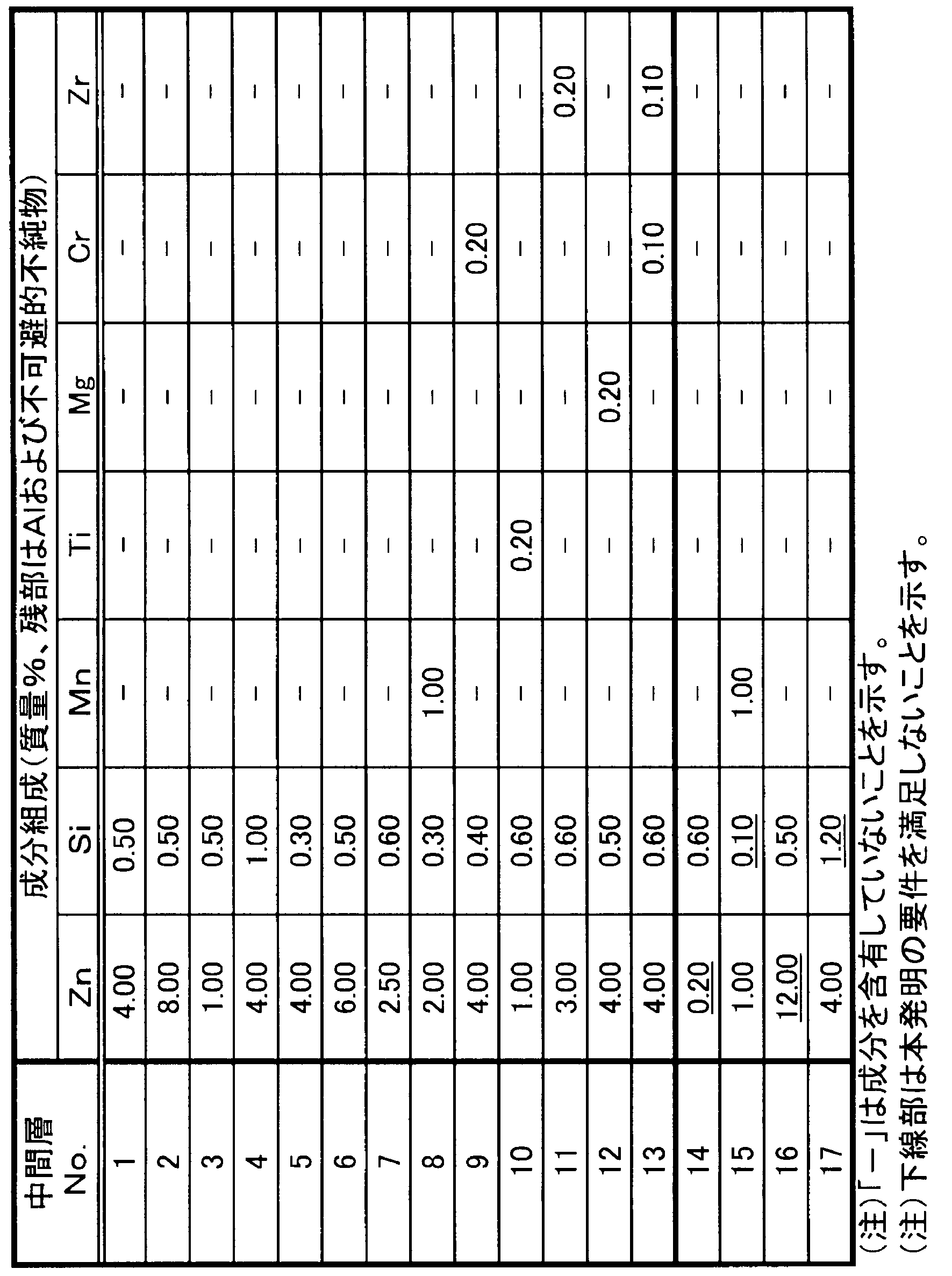
前記心材(No.1~16)の一面側に前記中間層(No.1~17)を重ね、当該中間層の外側に前記ろう材を重ねて合わせ板材とした。当該合わせ板材に熱間圧延を施すことによりそれぞれを圧着・圧延させ、次いで冷間圧延を施すことで、図1に示す心材2、中間層3およびろう材4を備えた3層のブレージングシート1A(供試材No.1~38)を製造した。ブレージングシート1Aの層構成を表3、4に示す。
また、前記心材(No.1,2,8)の一面側に前記中間層(No.1,12)を重ね、当該中間層(No.1、12)の外側に前記ろう材を重ね、前記心材(No.1,2,8)の他面側に前記ろう材を重ねて合わせ板材とした。当該合わせ板材に熱間圧延を施すことによりそれぞれを圧着・圧延させ、次いで冷間圧延を施すことで、図2に示す心材2、中間層3、第1ろう材4aおよび第2ろう材4bを備えた4層のブレージングシート1B(供試材No.39~42)を製造した。ブレージングシート1Bの層構成を表5に示す。
また、前記心材(No.1)の一面側に中間層(No.1)を重ね、当該中間層(No.1)の外側に前記ろう材を重ね、心材(No.1)の他面側に中間層(No.1)を重ね、当該中間層(No.1)の外側に前記ろう材を重ねて合わせ板材とする。そして、当該合わせ板材に熱間圧延を施すことによりそれぞれを圧着・圧延させ、次いで冷間圧延を施すことで、図3に示す心材2、第1中間層3a、第2中間層3b、第1ろう材4aおよび第2ろう材4bを備えた5層のブレージングシート1C(供試材No.43)を製造する。ブレージングシート1Cの層構成を表6に示す。
製造されたブレージングシート(供試材No.1~43)を用いて、ろう付後強度、中間層側耐食性およびろう付性について以下のとおり測定、評価した。その結果を表3~6に示す。
(ろう付後強度)
供試材について、窒素雰囲気の下、600℃で5分間保持のろう付を模擬した熱処理を施した。その後、室温で7日間保持し、引張方向が圧延方向と平行となるように、JIS5号試験片に加工して、室温にて引張試験を実施することによりろう付後強度を測定した。
ろう付後強度は、引張強さが155MPa以上のものを極めて良好(◎)と評価し、155MPa未満145MPa以上のものを良好(○)と評価し、145MPa未満のものを不良(×)と評価した。
供試材について、窒素雰囲気の下、600℃で5分間保持のろう付を模擬した熱処理を施した。その後、室温で7日間保持し、引張方向が圧延方向と平行となるように、JIS5号試験片に加工して、室温にて引張試験を実施することによりろう付後強度を測定した。
ろう付後強度は、引張強さが155MPa以上のものを極めて良好(◎)と評価し、155MPa未満145MPa以上のものを良好(○)と評価し、145MPa未満のものを不良(×)と評価した。
(中間層側耐食性)
供試材について、窒素雰囲気の下、600℃×5分間のろう付相当の加熱を行なった後に、試験片(縦幅60mm×横幅50mm)に加工した。その試験片について、図1に示す心材2側、図2および図3に示す第2ろう材4b側の全面をマスキング用シールで覆い、図1および図2に示す中間層3側、図3に示す第1中間層3a側を試験面とした。そして、OY水浸漬試験を行い、腐食深さを測定することにより評価した。
供試材について、窒素雰囲気の下、600℃×5分間のろう付相当の加熱を行なった後に、試験片(縦幅60mm×横幅50mm)に加工した。その試験片について、図1に示す心材2側、図2および図3に示す第2ろう材4b側の全面をマスキング用シールで覆い、図1および図2に示す中間層3側、図3に示す第1中間層3a側を試験面とした。そして、OY水浸漬試験を行い、腐食深さを測定することにより評価した。
このOY水浸漬試験とは、88℃のOY水に8時間浸漬し(使用時を想定)、室温のOY水に16時間浸漬(保管時を想定)するという一連の作業を1サイクルとし、これを60サイクル繰り返した後の最大腐食深さを測定するというものである。なお、OY(Old Yokohama river water)水とは、代表的な日本の河川に含有される塩素イオン及び硫酸イオン等を模擬した腐食試験液であり、このOY水の組成(Cl-:195ppm、SO4
2-:60ppm、Cu2+:1ppm、Fe3+:30ppm)が規定されている(Y.Ando.et.al.,SAE Technical Paper 870180(1987))。
中間層側耐食性は、試験後の腐食深さが中間層厚さ以下のものを極めて良好(◎)、腐食深さが中間層厚さを超えるが板厚を貫通する腐食が発生しなかったものを良好(○)、板厚を貫通する腐食が発生したものを不良(×)とした。なお、ここでいう“中間層厚さ”とは、試料No.43においては第1中間層の厚さを意味する。また、ここでいう“板厚を貫通する”とは、厚さ方向において心材2を貫通する腐食が発生することをいう。
(ろう付性)
ろう付性は、竹本正ら著、「アルミニウムブレージングハンドブック(改訂版)」、軽金属溶接構造協会(2003年3月発行)の132~136頁に記載されている評価方法により評価した。供試材を縦幅25mm×横幅60mmに加工し下板とした。図4に示すように、ろう材4面(図1参照)または第1ろう材4a面(図2または図3参照)が上向きとなるように水平に置いた下板11と、この下板11に対して垂直に立てて配置した上板12(JIS3003-O材、厚さ2.0mm×縦幅25mm×横幅55mm))との間に、φ2mmのステンレス製スペーサ13を挟んで、一定の間隙14を設定した。なお、スペーサ13の位置は、上板12の一端(下板11への接地点)から50mmの距離に挟んだ。また、下板11は、ろう材4面側または第1ろう材4a面側にフラックス(森田化学工業株製FL-7)を5g/m2塗布した。そして、窒素雰囲気下、600℃で5分間という条件の加熱処理を行った後、下板11と上板12との間隙14がフィレットにより充填された長さ(間隙充填長さ。すなわち、上板12と下板11の設置点から、下板11の幅方向への長さ)をノギスで測定してろう付性を数値化した。なお、第2ろう材4b面についても、第1ろう材面4aと同様にしてろう付性を測定、評価した。
ろう付性は、竹本正ら著、「アルミニウムブレージングハンドブック(改訂版)」、軽金属溶接構造協会(2003年3月発行)の132~136頁に記載されている評価方法により評価した。供試材を縦幅25mm×横幅60mmに加工し下板とした。図4に示すように、ろう材4面(図1参照)または第1ろう材4a面(図2または図3参照)が上向きとなるように水平に置いた下板11と、この下板11に対して垂直に立てて配置した上板12(JIS3003-O材、厚さ2.0mm×縦幅25mm×横幅55mm))との間に、φ2mmのステンレス製スペーサ13を挟んで、一定の間隙14を設定した。なお、スペーサ13の位置は、上板12の一端(下板11への接地点)から50mmの距離に挟んだ。また、下板11は、ろう材4面側または第1ろう材4a面側にフラックス(森田化学工業株製FL-7)を5g/m2塗布した。そして、窒素雰囲気下、600℃で5分間という条件の加熱処理を行った後、下板11と上板12との間隙14がフィレットにより充填された長さ(間隙充填長さ。すなわち、上板12と下板11の設置点から、下板11の幅方向への長さ)をノギスで測定してろう付性を数値化した。なお、第2ろう材4b面についても、第1ろう材面4aと同様にしてろう付性を測定、評価した。
間隙充填長さが25mm以上のものを極めて良好(◎)と評価し、25mm未満15mm以上のものを良好(○)と評価し、15mm未満のものを不良(×)と評価した。
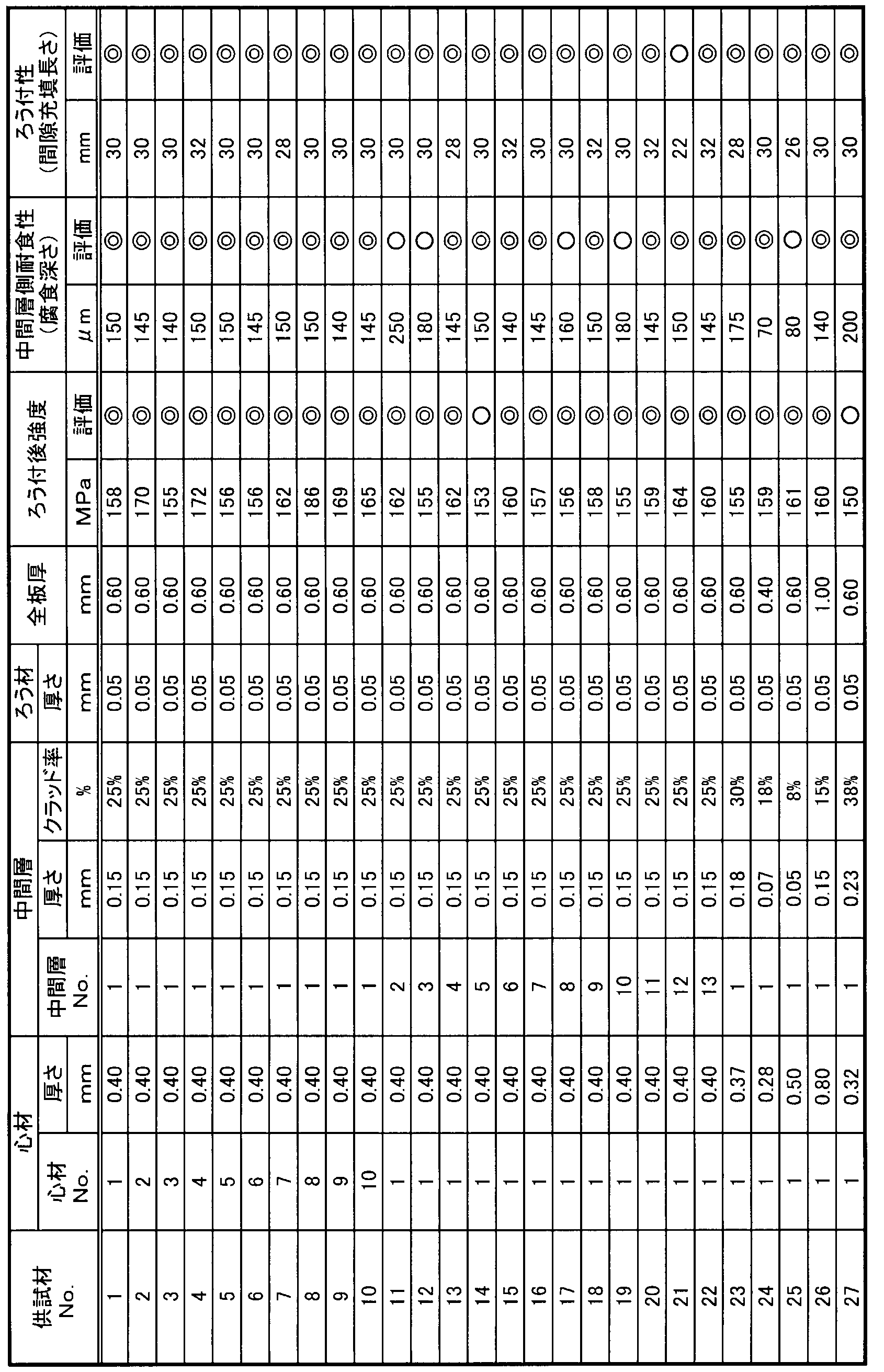



表3、5、6に示すように、本発明の要件を満足する供試材No.1~27、39~43(実施例)は、ろう付後強度、中間層側耐食性およびろう付性において優れていた。
一方、表4に示すように、本発明の要件を満足しない供試材No.28~38は、以下に示すように実施例に比べて劣っていた。
一方、表4に示すように、本発明の要件を満足しない供試材No.28~38は、以下に示すように実施例に比べて劣っていた。
具体的には、供試材No.28(比較例)は、心材のSi量が下限値未満であるため、ろう付後強度が劣っていた。供試材No.29(比較例)は、心材のMn量が下限値未満であるため、ろう付後強度が劣っていた。供試材No.30(比較例)は、心材のCu量が下限値未満であるため、ろう付後強度が劣っていた。供試材No.31(比較例)は、心材のSi量が上限値を超えるため、局部溶融が発生した。供試材No.32(比較例)は、心材のCu量が上限値を超えるため、局部溶融が発生した。供試材No.33(比較例)は、心材のMn量が上限値を超えるため、素材の圧延が困難であった。
供試材No.34(比較例)は、中間層のZn量が下限値未満であるため、中間層側耐食性が劣っていた。供試材No.35(比較例)は、中間層のSi量が下限値未満であるため、ろう付後強度が劣っていた。供試材No.36(比較例)は、中間層のZn量が上限値を超えるため、中間層側耐食性が劣っていた。供試材No.37(比較例)は、中間層のSi量が上限値を超えるため、局部溶融が発生し中間層側耐食性が低下した。
供試材No.38(比較例)は、心材のSi量と中間層のSi量のいずれもが下限値未満であるため、ろう付後強度が劣っていた。
なお、本発明は以下の態様を含む。
・態様1
心材と、前記心材の少なくとも一面側に設けられたろう材と、前記心材と少なくとも一面側の前記ろう材との間に設けられた中間層とを備えるアルミニウム合金製ブレージングシートであって、
前記心材は、Cu:0.50~1.10質量%、Si:0.10~1.10質量%、Mn:0.60~2.00質量%を含有し、残部がAlおよび不可避的不純物からなり、前記中間層は、Zn:0.50~10.00質量%、Si:0.20質量%を越えて1.10質量%以下を含有し、残部がAlおよび不可避的不純物からなり、
前記ろう材は、Al-Si系合金からなることを特徴とするアルミニウム合金製ブレージングシート。
・態様2
前記中間層は、その厚さが0.05mm以上、かつ、前記ブレージングシートの全体の厚さの35%以下であることを特徴とする態様1に記載のアルミニウム合金製ブレージングシート。
・態様3
前記中間層が、さらにMn:0.10~1.50質量%を含有することを特徴とする態様1または態様2に記載のアルミニウム合金製ブレージングシート。
・態様4
前記心材が、さらにMg:0.05~0.50質量%、Cr:0.05~0.30質量%、Ti:0.05~0.30質量%およびZr:0.05~0.30質量%の少なくとも1種以上を含有することを特徴とする態様1から態様3のいずれかに記載のアルミニウム合金製ブレージングシート。
・態様5
前記中間層が、さらにMg:0.05~0.50質量%、Cr:0.05~0.30質量%、Ti:0.05~0.30質量%およびZr:0.05~0.30質量%の少なくとも1種以上を含有することを特徴とする態様1から態様4のいずれかに記載のアルミニウム合金製ブレージングシート。
・態様1
心材と、前記心材の少なくとも一面側に設けられたろう材と、前記心材と少なくとも一面側の前記ろう材との間に設けられた中間層とを備えるアルミニウム合金製ブレージングシートであって、
前記心材は、Cu:0.50~1.10質量%、Si:0.10~1.10質量%、Mn:0.60~2.00質量%を含有し、残部がAlおよび不可避的不純物からなり、前記中間層は、Zn:0.50~10.00質量%、Si:0.20質量%を越えて1.10質量%以下を含有し、残部がAlおよび不可避的不純物からなり、
前記ろう材は、Al-Si系合金からなることを特徴とするアルミニウム合金製ブレージングシート。
・態様2
前記中間層は、その厚さが0.05mm以上、かつ、前記ブレージングシートの全体の厚さの35%以下であることを特徴とする態様1に記載のアルミニウム合金製ブレージングシート。
・態様3
前記中間層が、さらにMn:0.10~1.50質量%を含有することを特徴とする態様1または態様2に記載のアルミニウム合金製ブレージングシート。
・態様4
前記心材が、さらにMg:0.05~0.50質量%、Cr:0.05~0.30質量%、Ti:0.05~0.30質量%およびZr:0.05~0.30質量%の少なくとも1種以上を含有することを特徴とする態様1から態様3のいずれかに記載のアルミニウム合金製ブレージングシート。
・態様5
前記中間層が、さらにMg:0.05~0.50質量%、Cr:0.05~0.30質量%、Ti:0.05~0.30質量%およびZr:0.05~0.30質量%の少なくとも1種以上を含有することを特徴とする態様1から態様4のいずれかに記載のアルミニウム合金製ブレージングシート。
本出願は、出願日が2015年3月17日である日本国特許出願、特願第2015-053194号を基礎出願とする優先権主張を伴い、特願第2015-053194号は参照することにより本明細書に取り込まれる。
1A、1B、1C:ブレージングシート
2:心材
3:中間層
3a:第1中間層
3b:第2中間層
4:ろう材
4a:第1ろう材
4b:第2ろう材
2:心材
3:中間層
3a:第1中間層
3b:第2中間層
4:ろう材
4a:第1ろう材
4b:第2ろう材
Claims (5)
- 心材と、前記心材の少なくとも一面側に設けられたろう材と、前記心材と少なくとも一面側の前記ろう材との間に設けられた中間層とを備えるアルミニウム合金製ブレージングシートであって、
前記心材は、Cu:0.50~1.10質量%、Si:0.10~1.10質量%、Mn:0.60~2.00質量%を含有し、残部がAlおよび不可避的不純物からなり、前記中間層は、Zn:0.50~10.00質量%、Si:0.20質量%を越えて1.10質量%以下を含有し、残部がAlおよび不可避的不純物からなり、
前記ろう材は、Al-Si系合金からなることを特徴とするアルミニウム合金製ブレージングシート。 - 前記中間層は、その厚さが0.05mm以上、かつ、前記ブレージングシートの全体の厚さの35%以下であることを特徴とする請求項1に記載のアルミニウム合金製ブレージングシート。
- 前記中間層が、さらにMn:0.10~1.50質量%を含有することを特徴とする請求項1または請求項2に記載のアルミニウム合金製ブレージングシート。
- 前記心材が、さらにMg:0.05~0.50質量%、Cr:0.05~0.30質量%、Ti:0.05~0.30質量%およびZr:0.05~0.30質量%の少なくとも1種以上を含有することを特徴とする請求項1または請求項2に記載のアルミニウム合金製ブレージングシート。
- 前記中間層が、さらにMg:0.05~0.50質量%、Cr:0.05~0.30質量%、Ti:0.05~0.30質量%およびZr:0.05~0.30質量%の少なくとも1種以上を含有することを特徴とする請求項1または請求項2に記載のアルミニウム合金製ブレージングシート。
Priority Applications (2)
| Application Number | Priority Date | Filing Date | Title |
|---|---|---|---|
| US15/558,655 US20180111232A1 (en) | 2015-03-17 | 2016-02-22 | Brazing sheet formed from aluminum alloy |
| CN201680015739.7A CN107406922A (zh) | 2015-03-17 | 2016-02-22 | 铝合金制钎焊板 |
Applications Claiming Priority (2)
| Application Number | Priority Date | Filing Date | Title |
|---|---|---|---|
| JP2015-053194 | 2015-03-17 | ||
| JP2015053194A JP6300747B2 (ja) | 2015-03-17 | 2015-03-17 | アルミニウム合金製ブレージングシート |
Publications (1)
| Publication Number | Publication Date |
|---|---|
| WO2016147807A1 true WO2016147807A1 (ja) | 2016-09-22 |
Family
ID=56918903
Family Applications (1)
| Application Number | Title | Priority Date | Filing Date |
|---|---|---|---|
| PCT/JP2016/055090 Ceased WO2016147807A1 (ja) | 2015-03-17 | 2016-02-22 | アルミニウム合金製ブレージングシート |
Country Status (4)
| Country | Link |
|---|---|
| US (1) | US20180111232A1 (ja) |
| JP (1) | JP6300747B2 (ja) |
| CN (1) | CN107406922A (ja) |
| WO (1) | WO2016147807A1 (ja) |
Cited By (1)
| Publication number | Priority date | Publication date | Assignee | Title |
|---|---|---|---|---|
| US20230028846A1 (en) * | 2019-12-13 | 2023-01-26 | Aleris Rolled Products Germany Gmbh | Multi-layered aluminum brazing sheet material |
Families Citing this family (10)
| Publication number | Priority date | Publication date | Assignee | Title |
|---|---|---|---|---|
| JP2017029989A (ja) * | 2015-07-29 | 2017-02-09 | 株式会社Uacj | アルミニウム構造体の製造方法 |
| JP6055573B1 (ja) * | 2016-06-23 | 2016-12-27 | 三菱アルミニウム株式会社 | フラックスフリーろう付用のブレージングシート、フラックスフリーろう付方法および熱交換器のフラックスフリーろう付方法 |
| JP6868383B2 (ja) * | 2016-12-14 | 2021-05-12 | 株式会社Uacj | アルミニウム合金ブレージングシートの製造方法 |
| JP6970841B2 (ja) * | 2016-12-14 | 2021-11-24 | 株式会社Uacj | アルミニウム合金ブレージングシート及びその製造方法 |
| JP6909744B2 (ja) * | 2018-03-07 | 2021-07-28 | 株式会社Uacj | フラックスフリーろう付用アルミニウム合金ブレージングシート |
| CN113661263A (zh) * | 2019-04-04 | 2021-11-16 | 株式会社Uacj | 铝合金硬钎焊板及其制造方法 |
| JP7364522B2 (ja) * | 2020-03-31 | 2023-10-18 | 株式会社神戸製鋼所 | アルミニウム合金ブレージングシート、及び、アルミニウム合金ブレージングシートのろう付方法 |
| JP7290605B2 (ja) * | 2020-06-08 | 2023-06-13 | 株式会社神戸製鋼所 | アルミニウム合金ブレージングシート、及び、アルミニウム合金ろう付体 |
| EP4323144A4 (en) * | 2021-04-15 | 2025-02-26 | Arconic Technologies LLC | Brazing sheets, articles formed from brazing sheets, and methods of forming articles |
| CN115070257B (zh) * | 2022-06-21 | 2023-09-26 | 郑州机械研究所有限公司 | 一种铝硅铜钎料箔及其制备方法和应用 |
Citations (8)
| Publication number | Priority date | Publication date | Assignee | Title |
|---|---|---|---|---|
| JP2005505421A (ja) * | 2000-12-21 | 2005-02-24 | アルコア インコーポレーテツド | アルミニウムを内部層に有する多重層化された熱処理可能な蝋着シート |
| JP2005523164A (ja) * | 2002-04-18 | 2005-08-04 | アルコア インコーポレイテッド | 高寿命、高成形性ブレージングシート |
| JP2006131923A (ja) * | 2004-11-02 | 2006-05-25 | Denso Corp | ろう付け性、耐食性および熱間圧延性に優れた熱交換器用アルミニウム合金クラッド材および該アルミニウム合金クラッド材を用いるろう付けによる熱交換器の製造方法 |
| JP2006152380A (ja) * | 2004-11-30 | 2006-06-15 | Denso Corp | 耐エロージョン・コロージョン性と一般耐食性に優れた熱交換器用アルミニウム合金クラッド材 |
| JP2009167509A (ja) * | 2008-01-21 | 2009-07-30 | Furukawa-Sky Aluminum Corp | アルミニウム合金クラッド材 |
| US20120237793A1 (en) * | 2011-03-16 | 2012-09-20 | Baumann Stephen F | Multi-layer brazing sheet |
| JP2014189814A (ja) * | 2013-03-26 | 2014-10-06 | Uacj Corp | 高耐食性アルミニウム合金ブレージングシート及び自動車用熱交換器の流路形成部品 |
| JP2014189813A (ja) * | 2013-03-26 | 2014-10-06 | Uacj Corp | 高耐食性アルミニウム合金ブレージングシート |
Family Cites Families (5)
| Publication number | Priority date | Publication date | Assignee | Title |
|---|---|---|---|---|
| JPH10158769A (ja) * | 1996-11-29 | 1998-06-16 | Furukawa Electric Co Ltd:The | Al合金製ブレージングシート |
| JP3794820B2 (ja) * | 1998-04-21 | 2006-07-12 | 神鋼アルコア輸送機材株式会社 | 高耐食性アルミニウム合金製ブレージングシート |
| CN101287573B (zh) * | 2005-10-13 | 2013-04-03 | 阿勒里斯铝业科布伦茨有限公司 | 一种四层或五层的钎焊薄板以及包含其的钎焊组件 |
| US7749613B2 (en) * | 2006-04-21 | 2010-07-06 | Alcoa Inc. | Multilayer braze-able sheet |
| JP2011068933A (ja) * | 2009-09-24 | 2011-04-07 | Kobe Steel Ltd | 熱交換器用アルミニウム合金クラッド材 |
-
2015
- 2015-03-17 JP JP2015053194A patent/JP6300747B2/ja not_active Expired - Fee Related
-
2016
- 2016-02-22 CN CN201680015739.7A patent/CN107406922A/zh active Pending
- 2016-02-22 WO PCT/JP2016/055090 patent/WO2016147807A1/ja not_active Ceased
- 2016-02-22 US US15/558,655 patent/US20180111232A1/en not_active Abandoned
Patent Citations (8)
| Publication number | Priority date | Publication date | Assignee | Title |
|---|---|---|---|---|
| JP2005505421A (ja) * | 2000-12-21 | 2005-02-24 | アルコア インコーポレーテツド | アルミニウムを内部層に有する多重層化された熱処理可能な蝋着シート |
| JP2005523164A (ja) * | 2002-04-18 | 2005-08-04 | アルコア インコーポレイテッド | 高寿命、高成形性ブレージングシート |
| JP2006131923A (ja) * | 2004-11-02 | 2006-05-25 | Denso Corp | ろう付け性、耐食性および熱間圧延性に優れた熱交換器用アルミニウム合金クラッド材および該アルミニウム合金クラッド材を用いるろう付けによる熱交換器の製造方法 |
| JP2006152380A (ja) * | 2004-11-30 | 2006-06-15 | Denso Corp | 耐エロージョン・コロージョン性と一般耐食性に優れた熱交換器用アルミニウム合金クラッド材 |
| JP2009167509A (ja) * | 2008-01-21 | 2009-07-30 | Furukawa-Sky Aluminum Corp | アルミニウム合金クラッド材 |
| US20120237793A1 (en) * | 2011-03-16 | 2012-09-20 | Baumann Stephen F | Multi-layer brazing sheet |
| JP2014189814A (ja) * | 2013-03-26 | 2014-10-06 | Uacj Corp | 高耐食性アルミニウム合金ブレージングシート及び自動車用熱交換器の流路形成部品 |
| JP2014189813A (ja) * | 2013-03-26 | 2014-10-06 | Uacj Corp | 高耐食性アルミニウム合金ブレージングシート |
Cited By (1)
| Publication number | Priority date | Publication date | Assignee | Title |
|---|---|---|---|---|
| US20230028846A1 (en) * | 2019-12-13 | 2023-01-26 | Aleris Rolled Products Germany Gmbh | Multi-layered aluminum brazing sheet material |
Also Published As
| Publication number | Publication date |
|---|---|
| US20180111232A1 (en) | 2018-04-26 |
| JP2016172897A (ja) | 2016-09-29 |
| CN107406922A (zh) | 2017-11-28 |
| JP6300747B2 (ja) | 2018-03-28 |
Similar Documents
| Publication | Publication Date | Title |
|---|---|---|
| WO2016147807A1 (ja) | アルミニウム合金製ブレージングシート | |
| JP6452626B2 (ja) | アルミニウム合金クラッド材及びその製造方法、ならびに、当該アルミニウム合金クラッド材を用いた熱交換器及びその製造方法 | |
| JP6452627B2 (ja) | アルミニウム合金クラッド材及びその製造方法、ならびに、当該アルミニウム合金クラッド材を用いた熱交換器及びその製造方法 | |
| EP3222738B1 (en) | Aluminum alloy cladding material for heat exchanger | |
| JP5054404B2 (ja) | 熱交換器用アルミニウム合金クラッド材およびブレージングシート | |
| EP3222739B1 (en) | Aluminum alloy cladding material for heat exchanger | |
| WO2015141193A1 (ja) | アルミニウム合金クラッド材及びその製造方法、ならびに、当該アルミニウム合金クラッド材を用いた熱交換器及びその製造方法 | |
| WO2015146322A1 (ja) | アルミニウム合金製ブレージングシート | |
| CN111065753B (zh) | 换热器用铝合金硬钎焊片材 | |
| JP6286335B2 (ja) | アルミニウム合金製ブレージングシート | |
| JP2011068933A (ja) | 熱交換器用アルミニウム合金クラッド材 | |
| WO2017169633A1 (ja) | アルミニウム合金製ブレージングシート | |
| JP5498213B2 (ja) | ろう付け性に優れた高強度熱交換器用アルミニウム合金クラッド材 | |
| JP6351205B2 (ja) | 高耐食性アルミニウム合金ブレージングシート | |
| JP5302114B2 (ja) | 真空ろう付け用アルミニウム合金ブレージングシート | |
| JP6159843B1 (ja) | アルミニウム合金製ブレージングシート | |
| JP3984444B2 (ja) | 高強度アルミニウムブレージングシート及びそれを使用した熱交換器 | |
| JP2010242112A (ja) | 高強度アルミニウム合金ブレージングシート | |
| US9545777B2 (en) | Corrosion-resistant brazing sheet package | |
| JP2017110266A (ja) | ろう付け後の強度に優れたアルミニウム合金製ブレージングシート | |
| JP6227462B2 (ja) | アルミニウム合金クラッド材 | |
| JP2017172025A (ja) | 熱交換器用アルミニウム合金クラッド材 | |
| JP6159841B1 (ja) | アルミニウム合金製ブレージングシート | |
| JP6272930B2 (ja) | アルミニウム合金製ブレージングシート | |
| WO2017159356A1 (ja) | アルミニウム合金製ブレージングシート |
Legal Events
| Date | Code | Title | Description |
|---|---|---|---|
| 121 | Ep: the epo has been informed by wipo that ep was designated in this application |
Ref document number: 16764637 Country of ref document: EP Kind code of ref document: A1 |
|
| WWE | Wipo information: entry into national phase |
Ref document number: 15558655 Country of ref document: US |
|
| NENP | Non-entry into the national phase |
Ref country code: DE |
|
| 122 | Ep: pct application non-entry in european phase |
Ref document number: 16764637 Country of ref document: EP Kind code of ref document: A1 |