WO2016145860A1 - 一种具有有机骨架结构的钙钛矿太阳能电池及其制备方法 - Google Patents
一种具有有机骨架结构的钙钛矿太阳能电池及其制备方法 Download PDFInfo
- Publication number
- WO2016145860A1 WO2016145860A1 PCT/CN2015/093047 CN2015093047W WO2016145860A1 WO 2016145860 A1 WO2016145860 A1 WO 2016145860A1 CN 2015093047 W CN2015093047 W CN 2015093047W WO 2016145860 A1 WO2016145860 A1 WO 2016145860A1
- Authority
- WO
- WIPO (PCT)
- Prior art keywords
- perovskite
- organic polymer
- film
- organic
- polymer
- Prior art date
- Legal status (The legal status is an assumption and is not a legal conclusion. Google has not performed a legal analysis and makes no representation as to the accuracy of the status listed.)
- Ceased
Links
Images



Classifications
-
- H—ELECTRICITY
- H10—SEMICONDUCTOR DEVICES; ELECTRIC SOLID-STATE DEVICES NOT OTHERWISE PROVIDED FOR
- H10K—ORGANIC ELECTRIC SOLID-STATE DEVICES
- H10K85/00—Organic materials used in the body or electrodes of devices covered by this subclass
- H10K85/50—Organic perovskites; Hybrid organic-inorganic perovskites [HOIP], e.g. CH3NH3PbI3
-
- H—ELECTRICITY
- H10—SEMICONDUCTOR DEVICES; ELECTRIC SOLID-STATE DEVICES NOT OTHERWISE PROVIDED FOR
- H10K—ORGANIC ELECTRIC SOLID-STATE DEVICES
- H10K30/00—Organic devices sensitive to infrared radiation, light, electromagnetic radiation of shorter wavelength or corpuscular radiation
- H10K30/10—Organic devices sensitive to infrared radiation, light, electromagnetic radiation of shorter wavelength or corpuscular radiation comprising heterojunctions between organic semiconductors and inorganic semiconductors
- H10K30/15—Sensitised wide-bandgap semiconductor devices, e.g. dye-sensitised TiO2
- H10K30/151—Sensitised wide-bandgap semiconductor devices, e.g. dye-sensitised TiO2 the wide bandgap semiconductor comprising titanium oxide, e.g. TiO2
-
- Y—GENERAL TAGGING OF NEW TECHNOLOGICAL DEVELOPMENTS; GENERAL TAGGING OF CROSS-SECTIONAL TECHNOLOGIES SPANNING OVER SEVERAL SECTIONS OF THE IPC; TECHNICAL SUBJECTS COVERED BY FORMER USPC CROSS-REFERENCE ART COLLECTIONS [XRACs] AND DIGESTS
- Y02—TECHNOLOGIES OR APPLICATIONS FOR MITIGATION OR ADAPTATION AGAINST CLIMATE CHANGE
- Y02E—REDUCTION OF GREENHOUSE GAS [GHG] EMISSIONS, RELATED TO ENERGY GENERATION, TRANSMISSION OR DISTRIBUTION
- Y02E10/00—Energy generation through renewable energy sources
- Y02E10/50—Photovoltaic [PV] energy
- Y02E10/549—Organic PV cells
Definitions
- the invention belongs to the field of perovskite solar cells, and in particular relates to a perovskite solar cell having an organic skeleton structure and a preparation method thereof.
- perovskite solar cells are an important topic in the field of solar cell research.
- Perovskite solar cells have the advantages of high conversion efficiency, simple manufacturing process and low manufacturing cost, and have high commercial value.
- Perovskite solar cells are formed by sequentially depositing different materials on a transparent conductive substrate.
- the main light absorbing material is an organic-inorganic hybrid perovskite with a chemical composition of MAX 3 and M representing CH 3 NH 3+ .
- An organic group such as CH 3 (NH 2 ) 2+ or an inorganic ion such as Cs +
- A represents a metal ion such as Pb 2+ or Sn 2+
- X represents a halogen ion such as Cl ⁇ , Br ⁇ or I ⁇ .
- perovskite solar cells The highest conversion efficiency of perovskite solar cells in the laboratory reported in the literature has reached 18.4% (Nam Joong Jeon, Jun Hong Noh, Woon Seok Yang, Young Chan Kim, Seungchan Ryu, Jangwon Seo, Sang Il Seok, Nature, 2015, 517, pp476-480), close to the laboratory record of traditional polysilicon batteries (20.4%).
- the material deposition of perovskite solar cells is basically using a spin coating or spraying process of an organic solution, and the manufacturing cost is very low; the processing temperature of the perovskite solar cell is substantially below 100 degrees Celsius, and the energy consumption is very low.
- the existing perovskite solar cells can be classified into two categories according to the device structure: a perovskite solar cell having an inorganic skeleton structure, and a perovskite solar cell having a planar heterojunction structure.
- a perovskite solar cell having an inorganic framework structure requires a mesoporous layer of a metal oxide (TiO 2 , Al 2 O 3 , etc.) nanoparticle to be deposited on a transparent conductive substrate in advance. This step requires additional synthesis of a metal oxide.
- Nanoparticles, and the formation of mesoporous layers requires annealing temperatures above 400 degrees Celsius, which incur additional manufacturing costs (Michael M. Lee, Teuscher, Tsutomu Miyasaka, Takurou N. Murakami, Henry J. Snaith, Science, 2012, 338, pp 643-647).
- a perovskite solar cell with a planar heterojunction structure needs to deposit an AX 2 film on a transparent conductive substrate and then react with the MX solution to form a perovskite material of the MAX 3 structure. This process is called a two-step method. (Dianyi Liu, Jinli Yang, Timothy L.
- perovskite solar cell with a planar heterojunction structure deposits a perovskite film directly on a transparent conductive substrate using a solution containing a perovskite component, which is called a one-step method, but the film formation quality is not uniform and cannot be satisfied.
- the existing perovskite solar cells are very sensitive to the humidity of the air, and the perovskite material decomposes when reacted with water molecules if exposed to the air, seriously affecting the service life of the perovskite solar cell (Michael Gratzel, Nature Materials, 2014, 13, pp838-842).
- the organic polymer-containing perovskite precursor solution provided by the invention comprises an organic polymer, MX, AY 2 and a solvent, wherein M is selected from the group consisting of organic groups CH 3 NH 3 + and CH 3 (NH 2 ) 2 Any one of + or an inorganic ion Cs + , A is selected from any one of metal ions Pb 2+ and Sn 2+ , and both X and Y are selected from halogen ions.
- the organic polymer has the following characteristics: (1) has insulation; (2) is compatible with the solvent; (3) has no or little influence on light absorption and carrier transportation; (4) It does not react with each component in the perovskite precursor.
- the organic polymer is an insulating carbon chain polymer and/or a hetero chain polymer, and the molecular weight of the insulating carbon chain polymer and/or the hetero chain polymer is 200 Da to 200,000 Da, and the hetero chain polymer is mainly
- the chain is a polymer compound in which a carbon atom is covalently bonded to other atoms, and the other atom may be specifically selected from at least one of N, O and S.
- the organic polymer may specifically be selected from at least one of polyethylene glycol and polyvinyl alcohol, preferably polyethylene glycol, and the polyethylene glycol has a molecular weight of 200 Da to 200,000 Da, specifically 20,000 Da.
- the solvent is at least one of N,N-dimethylformamide, dimethyl samarium and ⁇ -hydroxybutyrolactone.
- the halogen ion is selected from any one of Cl - , Br - and I - and the like.
- the molar ratio of the MX to the AY 2 is (1-3): 1, specifically 3:1.
- the molar fraction of the organic polymer in the organic polymer-containing perovskite precursor liquid is 0.0005 mol/L to 0.004 mol/L, specifically 0.001 mol/L.
- the molar fraction of the MX in the organic polymer-containing perovskite precursor fluid is from 1 mol/L to 3 mol/L.
- the preparation method of the organic polymer-containing perovskite precursor liquid provided by the invention comprises the steps of: dissolving the organic polymer, the MX and the AY 2 in the solvent in the above ratio, mixing
- the organic polymer-containing perovskite precursor solution can be prepared by stirring uniformly.
- the invention provides a method for preparing an organic polymer-containing perovskite film, comprising the steps of: coating the organic polymer-containing perovskite precursor liquid on a substrate, annealing, and then On the substrate To the organic polymer-containing perovskite film.
- the annealing treatment is carried out at a temperature of 60 to 110 ° C for a period of 50 to 80 minutes.
- the organic polymer-containing perovskite film has a thickness of 200 to 400 nm.
- the perovskite in the perovskite film containing the organic polymer described herein is only a substance similar to the perovskite structure, and does not necessarily mean a perovskite.
- the organic polymer-containing perovskite film prepared by the present invention is also within the scope of the present invention.
- Another object of the present invention is to provide a perovskite solar cell having an organic skeleton structure and a method of producing the same.
- the method for preparing a perovskite solar cell having an organic skeleton structure provided by the invention comprises the following steps:
- the conductive substrate may specifically be FTO glass or ITO glass.
- the depositing the TiO 2 film on the surface of the conductive substrate may be performed by spin coating or spraying a solution containing the titanium salt on the surface of the conductive substrate, drying, and annealing at a high temperature to obtain the TiO 2 film. .
- the titanium salt in the titanium salt-containing solution may specifically be diisopropyl (acetylacetonate) titanate.
- the solvent in the titanium salt-containing solution may specifically be at least one of isopropyl alcohol and ethanol.
- the titanium salt has a mass fraction of 30% to 80% in the titanium salt-containing solution.
- the solution containing the titanium salt may specifically be an isopropanol solution of diisopropyl acetylacetonate titanate, and the mass fraction is 30%-80%, specifically 75%.
- the high temperature annealing temperature is 400-500 ° C, specifically 450 ° C; time is 15-30 minutes.
- the TiO 2 film has a thickness of 20 to 50 nm.
- the conductive substrate further includes a step of cleaning the conductive substrate before use, specifically, ultrasonic cleaning in deionized water, acetone, and ethanol, and in order to improve the surface wettability of the substrate, the conductive substrate may be further Plasma cleaning.
- the annealing treatment is carried out at a temperature of 50 to 150 ° C for a period of 40 to 70 minutes.
- the perovskite film has a thickness of 200 to 400 nm.
- the hole transporting material may be a hole transporting material commonly used by a person skilled in the art to prepare a perovskite solar cell, such as an organic polymer; the organic polymer may specifically be spiro- OMeTAD, purchased from Opitit.
- the hole transporting material has a molar fraction of the hole transporting material of 70 to 80 mg/ml, and the organic solvent may be specifically selected from at least one of chlorobenzene and dichlorobenzene.
- a substance which increases its conductivity such as 4-tert-butylpyridine, lithium bistrifluoromethanesulfonimide (Li-TFSI) acetonitrile solution, may also be added thereto.
- Li-TFSI lithium bistrifluoromethanesulfonimide
- Specific concentration can be 520 mg/mL and the like.
- the coating of the hole conductor solution on the perovskite film may be prepared as follows: coating the hole conductor solution by spin coating or spraying. On the surface of the perovskite film.
- the hole transport layer has a thickness of 100 to 300 nm.
- the method further comprises the step of oxidizing the hole transport layer, the oxidation being carried out in a dark air, the temperature of the oxidation being 20-60 ° C, time It is 6-12h.
- the deposition electrode material may specifically deposit a metal material on the surface of the hole transport material by a thermal evaporation method, and the metal material may be specifically selected from at least one of the following: gold, silver, platinum, and the like.
- the counter electrode material layer has a thickness of 60-100 nm.
- the perovskite solar cell having the organic skeleton structure prepared by the invention also belongs to the protection scope of the invention.
- the perovskite solar cell with organic skeleton structure prepared by the invention can open circuit voltage up to 1.1V under 1.5AM standard sunlight, the short circuit current density can reach 22mA/cm 2 , and the filling factor can reach 72%.
- the photoelectric conversion efficiency can reach up to 16%.
- the invention adds a modified material (organic polymer) to the perovskite material, so that the perovskite material can remain stable for a long time under a humid environment. Even if exposed to humid air for a long time and under standard sunlight, the performance of the perovskite solar cell does not decay, and the perovskite film does not damage when subjected to strain. Finally, the film-forming quality of the perovskite material is improved, and a uniform film is directly formed on the substrate using a solution containing a perovskite component, thereby reducing the manufacturing cost and achieving mass production.
- a modified material organic polymer
- a certain concentration of an organic polymer such as polyethylene glycol or the like is added to a precursor liquid for preparing a perovskite film.
- an organic polymer such as polyethylene glycol or the like
- the skeleton layer of the organic polymer is simultaneously formed, thereby ensuring the flatness and uniformity of the film.
- the functional group of the organic polymer can combine with water molecules in the air to prevent the decomposition of the perovskite and water molecules, thereby improving the stability and service life of the perovskite solar cell.
- FIG. 1 is a schematic view showing the structure of a perovskite solar cell having an organic skeleton structure and other structural structures of a perovskite solar cell.
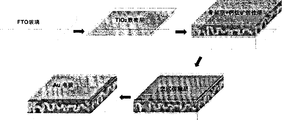
- FIG. 2 is a process flow diagram for preparing a perovskite solar cell having an organic framework structure.
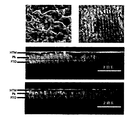
- FIG. 3 is a scanning electron micrograph of a top view (b) and a cross-sectional view (d) of a perovskite film containing polyethylene glycol in Example 1, and a top of a perovskite film not containing a polyethylene glycol skeleton layer.
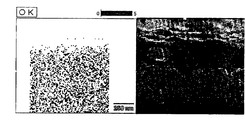
- Example 4 is a distribution diagram of polyethylene glycol in a perovskite film in Example 1, in which an oxygen element is used to represent a distribution of a polyethylene glycol monomer.
- Fig. 5 is a view showing the process in which the perovskite material of Example 1 is gradually wetted back to the original state after the perovskite film containing the organic polymer is wetted by ultrasonic water mist.
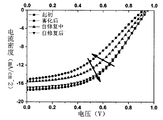
- Example 6 is a graph showing current-voltage response curves of a corresponding cell device in a self-healing process under 1.5AM standard sunlight after the perovskite film containing the organic polymer in Example 1 is wetted by ultrasonic water mist.
- Example 7 is a graph showing current-voltage response curves of a perovskite solar cell containing an organic framework structure in Example 1 under 1.5 AM standard sunlight.
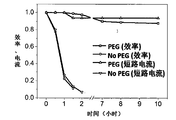
- Example 8 is a variation of various performance indexes (short-circuit current density, conversion efficiency) of a perovskite solar cell containing a machine skeleton structure in Example 1 under a humidity of 1.5 AM for 30 hours at a humidity of 30 rh in accordance with the illumination time. happening.
- Isopropanol solution containing 75 wt% of diisopropyl bis(acetylacetonate) titanate was diluted 39 times with ethanol, spin-coated on the surface of FTO glass at 2000 r/min for 30 s, and dried at 450 ° C after drying. After treatment for 20 minutes, a dense TiO 2 film having a thickness of 50 nm was formed;
- the prepared perovskite precursor containing polyethylene glycol was spin-coated on FTO glass coated with dense TiO 2 film at 4000 r/min for 30 seconds, and then annealed at 60 ° C for 45 minutes, and annealed at 105 ° C for 65 minutes, 60 Annealing at °C for 4 hours to form a perovskite film having a thickness of 400 nm;
- FIG. 3 A scanning electron micrograph of a top view and a cross-sectional view of the organic polymer-containing perovskite film in the step 3) is shown in FIG. 3, and it can be seen from FIG. 3 that the perovskite film containing no polymer is shown. Great roughness and even a lot of holes. However, film uniformity is greatly improved after the addition of the polymer.
- Fig. 4 The distribution of polyethylene glycol in the perovskite film is shown in Fig. 4. As can be seen from Fig. 4, the polymer is uniformly distributed and the entire perovskite film, the oxygen element represents a polyethylene glycol monomer.
- FIG. 5 and FIG. 6 The self-repairing process of the perovskite film after being wetted by the ultrasonic water mist and the test results of the corresponding battery device are shown in FIG. 5 and FIG. 6. It can be seen from FIG. 5 and FIG. 6 that the upper row of FIG. 5 is 4
- the picture is a perovskite film containing an organic polymer skeleton.
- the lower four images in Figure 5 are perovskite films without an organic polymer skeleton.
- Figure 5 (a) is before atomization
- FIG. 5(c) is 1 minute after the completion of the atomization
- FIG. 5(d) is 2 minutes after the completion of the atomization.
- Figure 8 shows the performance index (efficiency, short-circuit current density) of the solar cell under the 1.5AM standard solar illumination for 10 hours.
- the ordinate on the ordinate is the normalization of the efficiency and short-circuit current density. After the relative value, the maximum efficiency and current are unified to 1. From Figure 8, it can be seen that the photoelectric efficiency and short-circuit current density of the perovskite solar cell without organic skeleton decay to a very low level within 2 hours; The perovskite solar cell with organic skeleton has no photoelectric efficiency and short circuit current density within 10 hours. Significantly decayed.
- a common inorganic skeleton structure perovskite solar cell needs to deposit an inorganic mesoporous film on a substrate in advance, which is composed of nanoparticles of an inorganic material.
- the process of producing nanoparticles requires complex processes (such as grinding, spinning, dispersion, etc.).
- the process of forming a mesoporous film is to prepare the nanoparticle into a uniformly dispersed slurry, apply it on a substrate, and then heat-anneal it.
- the perovskite solar cell of the present invention omits many steps of preparing a nanoparticle slurry, high temperature annealing, and the like, and greatly simplifies the preparation process;
- the perovskite film in the perovskite solar cell with common planar heterojunction structure has large surface undulation, uneven thickness, risk of short circuit, low reproducibility of the battery, and difficulty in realizing large-area components. .
- the organic polymer in the precursor liquid spontaneously forms a support skeleton, thereby ensuring uniformity of the perovskite film;
- the organic polymer-containing perovskite film according to the present invention does not react with water molecules even if it is exposed to moist air. At the same time, the perovskite film containing organic polymer will gradually return to its original state after being wetted by ultrasonic water mist. This self-repairing ability is derived from the interaction of functional groups and water molecules in the organic polymer.
- the perovskite solar cell prepared by the invention has continuous exposure to moist air and standard sunlight, and the performance indexes have no obvious attenuation, indicating the stability of the organic framework structure of the perovskite solar cell and Repeatability is far superior to other structures of perovskite solar cells.
Landscapes
- Chemical & Material Sciences (AREA)
- Engineering & Computer Science (AREA)
- Materials Engineering (AREA)
- Photovoltaic Devices (AREA)
Abstract
一种具有有机骨架结构的钙钛矿太阳能电池及其制备方法。制备方法包括如下步骤:1)在导电衬底表面沉积TiO2薄膜,得到沉积在导电衬底表面的TiO2薄膜;2)将含有机聚合物的钙钛矿前驱液涂覆在TiO2薄膜上,退火处理,在TiO2薄膜上得到钙钛矿薄膜;3)将空穴传输材料溶于有机溶剂中,得到空穴导电物溶液;4)将空穴导电物溶液涂覆在钙钛矿薄膜上,形成空穴传输层,再在其上沉积对电极材料,形成对电极材料层,即得到具有有机骨架结构的钙钛矿太阳能电池。该制备方法简单,通过加入有机聚合物保证了钙钛矿薄膜的均匀性,同时,在潮湿空气中暴露时,不会反应分解,也具有自修复能力,具有高稳定性和重复性。
Description
本发明属于钙钛矿太阳能电池领域,具体涉及一种具有有机骨架结构的钙钛矿太阳能电池及其制备方法。
目前,钙钛矿太阳能电池是太阳能电池研究领域的一个重要课题。钙钛矿太阳能电池具有转换效率高、制造工艺简单、制造成本低廉的优势,具有很高的商业化价值。钙钛矿太阳能电池是在透明导电衬底上依次沉积不同的材料形成的,主要的吸光材料是有机无机杂化的钙钛矿,其化学组分为MAX3,M代表CH3NH3+、CH3(NH2)2+等有机基团或Cs+等无机离子,A代表Pb2+、Sn2+等金属离子,X代表Cl-、Br-、I-等卤素离子。文献报道的实验室中钙钛矿太阳能电池的最高转换效率已经达到18.4%(Nam Joong Jeon,Jun Hong Noh,Woon Seok Yang,Young Chan Kim,Seungchan Ryu,Jangwon Seo,Sang Il Seok,Nature,2015,517,pp476-480),逼近传统多晶硅电池的实验室纪录(20.4%)。钙钛矿太阳能电池的材料沉积基本都使用有机溶液的旋涂或喷涂工艺,制造成本非常低;钙钛矿太阳能电池的加工温度基本在100摄氏度以下,能量消耗非常低。
但是现有的钙钛矿太阳能电池的制造步骤仍然存在优化的空间。现有的钙钛矿太阳能电池根据器件结构可以分为两大类:无机骨架结构的钙钛矿太阳能电池,平面异质结结构的钙钛矿太阳能电池。无机骨架结构的钙钛矿太阳能电池需要预先在透明导电衬底上沉积一层金属氧化物(TiO2、Al2O3等)纳米颗粒的介孔层,这一步骤要求额外地合成金属氧化物纳米颗粒,而且介孔层的形成要求400摄氏度以上的退火温度,这些都造成额外的制造成本(Michael M.Lee, Teuscher,Tsutomu Miyasaka,Takurou N.Murakami,Henry J.Snaith,Science,2012,338,pp643-647)。一种平面异质结结构的钙钛矿太阳能电池需要在透明导电衬底上沉积AX2薄膜后,再与MX溶液反应生成MAX3结构的钙钛矿材料,这种工艺被称为两步法(Dianyi Liu,Jinli Yang,Timothy L.Kelly,Journal of the American Chemical Society,2014,136,pp17116-17122)。这样合成钙钛矿材料与一次性沉积钙钛矿薄膜相比,引入了额外的加工步骤,增加了制造成本和不可控因素。另一种平面异质结结构的钙钛矿太阳能电池使用含有钙钛矿成分的溶液直接在透明导电衬底上沉积钙钛矿薄膜,被称为一步法,但是成膜质量不均匀,无法满足大规模生产的技术要求(Huanping Zhou,Qi Chen,Gang Li,Song Luo,Tze-bing Song,Hsin-Sheng Duan,Ziruo Hong,Jingbi You,
Yongsheng Liu,Yang Yang,Science,2014,345,pp542-546)。
Teuscher,Tsutomu Miyasaka,Takurou N.Murakami,Henry J.Snaith,Science,2012,338,pp643-647)。一种平面异质结结构的钙钛矿太阳能电池需要在透明导电衬底上沉积AX2薄膜后,再与MX溶液反应生成MAX3结构的钙钛矿材料,这种工艺被称为两步法(Dianyi Liu,Jinli Yang,Timothy L.Kelly,Journal of the American Chemical Society,2014,136,pp17116-17122)。这样合成钙钛矿材料与一次性沉积钙钛矿薄膜相比,引入了额外的加工步骤,增加了制造成本和不可控因素。另一种平面异质结结构的钙钛矿太阳能电池使用含有钙钛矿成分的溶液直接在透明导电衬底上沉积钙钛矿薄膜,被称为一步法,但是成膜质量不均匀,无法满足大规模生产的技术要求(Huanping Zhou,Qi Chen,Gang Li,Song Luo,Tze-bing Song,Hsin-Sheng Duan,Ziruo Hong,Jingbi You,
Yongsheng Liu,Yang Yang,Science,2014,345,pp542-546)。
另外,现有的钙钛矿太阳能电池对空气的湿度非常敏感,钙钛矿材料如果暴露在空气中会与水分子反应而分解,严重地影响钙钛矿太阳能电池的使用寿命(Michael Gratzel,Nature Materials,2014,13,pp838-842)。
因此,现有的钙钛矿太阳能电池虽然具有很多优点,但是因为其制造工艺和材料稳定性的局限性,还没有在光伏发电领域得到普及应用。
发明内容
本发明的目的在于提供一种含有机聚合物的钙钛矿前驱液及其制备方法。
本发明所提供的含有机聚合物的钙钛矿前驱液,由有机聚合物、MX、AY2和溶剂组成,其中,M选自有机基团CH3NH3
+和CH3(NH2)2
+中的任意一种或无机离子Cs+,A选自金属离子Pb2+和Sn2+中的任意一种,X和Y均选自卤素离子。
所述有机聚合物具有如下几个特点:(1)具有绝缘性;(2)与所述溶剂相溶;(3)对光吸收和载流子的运输无影响或影响很小;(4)与所述钙钛矿前驱液中各组分不反应。
所述有机聚合物为绝缘性碳链高分子和/或杂链高分子,所述绝缘性碳链高分子和/或杂链高分子的分子量为200Da-200000Da,所述杂链高分子为主链由碳原子与其他原子以共价键连接而成的高分子化合物,所述其他原子具体可选自N、O和S中的至少一种。
所述有机聚合物具体可选自聚乙二醇和聚乙烯醇中至少一种,优选为聚乙二醇,所述聚乙二醇的分子量为200Da-200000Da,具体可为20000Da。
所述溶剂为N,N-二甲基甲酰胺、二甲基桠枫和γ-羟基丁酸内酯中的至少一种。
所述卤素离子选自Cl-、Br-和I-等中的任意一种。
所述MX和所述AY2的摩尔比为(1-3):1,具体可为3:1。
所述含有机聚合物的钙钛矿前驱液中所述有机聚合物的摩尔分数为0.0005mol/L-0.004mol/L,具体可为0.001mol/L。
所述含有机聚合物的钙钛矿前驱液中所述MX的摩尔分数为1mol/L-3mol/L。
本发明所提供的含有机聚合物的钙钛矿前驱液的制备方法,包括如下步骤:将所述有机聚合物、所述MX和所述AY2按所述比例溶于所述溶剂中,混合搅拌均匀,即可制备得到所述含有机聚合物的钙钛矿前驱液。
本发明的再一个目的在于提供一种含有机聚合物的钙钛矿薄膜及其制备方法。
本发明所提供的一种含有机聚合物的钙钛矿薄膜的制备方法,包括如下步骤:在衬底上涂覆所述含有机聚合物的钙钛矿前驱液,退火处理,即可在所述衬底上得
到所述含有机聚合物的钙钛矿薄膜。
上述制备方法中,所述退火处理的温度为60-110℃,时间为50-80分钟。
所述含有机聚合物的钙钛矿薄膜的厚度为200-400纳米。
此处所述含有机聚合物的钙钛矿薄膜中的钙钛矿只是针对和钙钛矿结构类似的物质,并不实指钙钛矿。
本发明所制备得到的含有机聚合物的钙钛矿薄膜也属于本发明的保护范围。
本发明的另一个目的在于提供一种具有有机骨架结构的钙钛矿太阳能电池及其制备方法。
本发明所提供的具有有机骨架结构的钙钛矿太阳能电池的制备方法,包括如下步骤:
1)在导电衬底表面沉积TiO2薄膜,作为空穴阻挡层,得到沉积在导电衬底表面的TiO2薄膜;
2)将所述含有机聚合物的钙钛矿前驱液涂覆在所述TiO2薄膜上,退火处理,即可在所述TiO2薄膜上得到含有机聚合物的钙钛矿薄膜;
3)将空穴传输材料溶于有机溶剂中,得到空穴导电物溶液;
4)将所述空穴导电物溶液涂覆在所述钙钛矿薄膜上,形成空穴传输层,再在其上沉积对电极材料,形成对电极材料层,即得到所述具有有机骨架结构的钙钛矿太阳能电池。
上述制备方法中,步骤1)中,所述导电衬底具体可为FTO玻璃或ITO玻璃。
所述在导电衬底表面沉积TiO2薄膜具体可按如下步骤进行:将含钛盐的溶液旋涂或喷涂在所述导电衬底表面,干燥后,高温退火,即可得到所述TiO2薄膜。
所述含钛盐的溶液中的钛盐具体可为二(乙酰丙酮基)钛酸二异丙酯。
所述含钛盐的溶液中的溶剂具体可为异丙醇和乙醇中至少一种。
所述含钛盐的溶液中钛盐的质量分数为30%-80%。
所述含钛盐的溶液具体可为二(乙酰丙酮基)钛酸二异丙酯的异丙醇溶液,质量分数为30%-80%,具体为75%。
所述高温退火的温度为400-500℃,具体可为450℃;时间为15-30分钟。
所述TiO2薄膜的厚度为20-50纳米。
所述导电衬底在使用之前,还包括对其进行清洗的步骤,具体可依次在去离子水、丙酮和乙醇中超声清洗,为了提高衬底表面浸润性,还可对所述导电衬底进行等离子体清洗。
上述制备方法中,步骤2)中,所述退火处理的温度为50-150℃,时间为40-70分钟。
所述钙钛矿薄膜的厚度为200-400纳米。
上述制备方法中,步骤3)中,所述空穴传输材料可为本领域技术人员制备钙钛矿太阳能电池常用的空穴传输材料,如有机聚合物;所述有机聚合物具体可为spiro-OMeTAD,购自奥匹维特公司。
所述空穴导电物溶液中空穴传输材料的摩尔分数为70-80mg/ml,所述有机溶剂具体可选自氯苯和二氯苯中至少一种。
为了提高所述空穴导电物溶液的导电率,还可向其中添加增加其导电率的物质,如:4-叔丁基吡啶、双三氟甲烷磺酰亚胺锂(Li-TFSI)乙腈溶液(具体浓度可为520mg/mL)等。
上述制备方法中,步骤4)中,所述将空穴导电物溶液涂覆在所述钙钛矿薄膜上具体可按如下方法制备:用旋涂或喷涂将所述空穴导电物溶液涂覆在所述钙钛矿薄膜表面。
所述空穴传输层的厚度为100-300纳米。
为了提高所述空穴传输层的导电率,还包括对所述空穴传输层进行氧化的步骤,所述氧化是在黑暗的空气中进行的,所述氧化的温度为20-60℃,时间为6-12h。
所述沉积对电极材料具体可将金属材料通过热蒸镀方法沉积在所述空穴传输材料表面,所述金属材料具体可选自如下至少一种:金、银和铂等。
所述对电极材料层的厚度为60-100纳米。
本发明所制备得到的具有有机骨架结构的钙钛矿太阳能电池也属于本发明的保护范围。
本发明所制备得到的具有有机骨架结构的钙钛矿太阳能电池在1.5AM标准太阳光照下,开路电压最高能达到1.1V,短路电流密度最高能达到22mA/cm2,填充因子最高能达到72%,光电转换效率最高能达到16%。
本发明在钙钛矿材料中加入改性材料(有机聚合物),使钙钛矿材料在潮湿的环境下能够长时间保持稳定。即使长时间暴露在潮湿的空气中和标准太阳光照下,钙钛矿太阳能电池的性能都不发生衰减,同时,钙钛矿薄膜在受到应变时不会发生损伤。最终,改善钙钛矿材料的成膜质量,使用含有钙钛矿成分的溶液在衬底上直接形成均匀的薄膜,降低制造成本,实现大规模生产。
本发明通过在制备钙钛矿薄膜的前驱液中加入一定浓度的有机聚合物,例如:聚乙二醇等。在前驱液反应生成钙钛矿的过程中,同时形成有机聚合物的骨架层,保证了薄膜的平整度和均匀性。同时有机聚合物的官能团能够与空气中的水分子结合,防止钙钛矿与水分子反应而分解,提高了钙钛矿太阳能电池的稳定性和使用寿命。
图1为具有有机骨架结构的钙钛矿太阳能电池结构示意图和其他钙钛矿太阳能电池结构示意图。
图2为制备具有有机骨架结构的钙钛矿太阳能电池的工艺流程图。
图3为实施例1中含有聚乙二醇的钙钛矿薄膜的顶视图(b)和截面图(d)的扫描电子显微镜照片和不含聚乙二醇骨架层的钙钛矿薄膜的顶视图(a)和截面图(c)的扫描电子显微镜照片,其中HTM,Pk,FTO分别指空穴传输层Spiro-OMeTAD,钙钛矿薄膜,掺氟的氧化锡导电薄膜。
图4为实施例1中聚乙二醇在钙钛矿薄膜中的分布图,其中,用氧元素来代表聚乙二醇单体的分布。
图5为实施例1中含有机聚合物的钙钛矿薄膜被超声水雾润湿后,钙钛矿材料逐渐自发回复原状的过程。
图6为实施例1中含有机聚合物的钙钛矿薄膜被超声水雾润湿后,相应的电池器件在自修复过程中,在1.5AM标准太阳光光照下电流电压响应曲线。
图7为实施例1中含有有机骨架结构的钙钛矿太阳能电池在1.5AM标准太阳光光照下电流电压响应曲线。
图8为实施例1中含有机骨架结构的钙钛矿太阳能电池连续2小时处于1.5AM标准太阳光照,30rh的湿度下电池的各项性能指标(短路电流密度、转化效率)随光照时间的变化情况。
实施例1、制备具有有机骨架结构的钙钛矿太阳能电池
1)把FTO玻璃分别在去离子水、丙酮和乙醇中超声清洗20min,再把FTO玻璃放入等离子体清洗机中,在空气的气氛下,以20sccm的空气流量,在功率90W下处理30秒;
2)将含75wt%的二(乙酰丙酮基)钛酸二异丙酯的异丙醇溶液用乙醇稀释39倍,以2000r/min在FTO玻璃表面旋涂30s,待干燥后,450℃下退火处理20分钟,形成厚度为50纳米致密TiO2薄膜;
3)将CH3NH3I与PbCl2用N,N-二甲基甲酰胺(DMF)溶解得到混合溶液,使两者在混合溶液中的摩尔浓度分别为3mol/L和1mol/L,再向每毫升混合溶液中加入20
mg的聚乙二醇(分子量20000Da),使其摩尔浓度为0.001mol/L,搅拌均匀。把制备好的含有聚乙二醇的钙钛矿前驱液以4000r/min在覆有致密TiO2薄膜的FTO玻璃上旋涂30秒,依次用60℃退火45分钟,105℃退火65分钟,60℃退火4小时,形成厚度为400纳米的钙钛矿薄膜;
4)取80mg的spiro-OMeTAD,用1mL氯苯溶解,再添加30μL的4-叔丁基吡啶和20μL浓度为520mg/mL的双三氟甲烷磺酰亚胺锂(Li-TFSI)乙腈溶液,混合均匀,得到空穴导电物溶液,并将其以3000r/min在钙钛矿薄膜上旋涂30s,置于黑暗的空气中氧化10小时左右,得到200纳米的空穴传输层。最后热蒸镀100nm厚的金电极,完成钙钛矿太阳能电池的制备。
步骤3)中的含有机聚合物的钙钛矿薄膜的顶视图和截面图的扫描电子显微镜照片如图3所示,从图3可得知:在不包含聚合物的钙钛矿薄膜显示出很大的粗糙度,甚至出现很多孔洞。然而,在加入聚合物之后,薄膜均匀度得到极大的改善。
聚乙二醇在钙钛矿薄膜中的分布如图4所示,从图4可得知:聚合物均匀分布与整个钙钛矿薄膜中,氧元素代表聚乙二醇单体。
钙钛矿薄膜在被超声水雾湿润之后的材料自修复过程及相应电池器件的测试结果如图5和图6所示,从图5和图6可得知:图5中的上面一排4张图片是含有有机聚合物骨架的钙钛矿薄膜,图5中的下面一排4张图片是不含有有机聚合物骨架的钙钛矿薄膜,图5(a)为雾化前,图5(b)为刚雾化后,图5(c)为雾化结束后1分钟,图5(d)为雾化结束后2分钟。从图5中的上面一排4张图片可看出经过水蒸气处理后的钙钛矿薄膜,颜色变白,对应效率变低,经过一段时间自修复之后,钙钛矿颜色恢复到黑色,效率又回到了初始值。从图5中的下面一排4张图片可看出雾化后钙钛矿薄膜发生分解出现黄色物质,且不能恢复到初始状态。
为了作对比,我们完全按实施例1中步骤,除了在步骤3)中不添加有机聚合物,制备得到了不含有机骨架的钙钛矿太阳能电池,并进行了相应的对比测试,从图7的电流电压响应曲线可得知:制备得到的含有机骨架的钙钛矿太阳能电池的开路电压最高能达到1.1V,短路电流密度最高能达到22mA/cm2,填充因子最高能达到72%,光电转换效率最高能达到16%。
图8为太阳能电池连续10小时处于1.5AM标准太阳光照下各项性能指标(效率、短路电流密度)随光照时间的变化情况,其中,图8中的纵坐标为效率和短路电流密度的归一化后的相对值,最大的效率和电流统一到1,从图8可得知:不含有机骨架的钙钛矿太阳能电池的光电效率和短路电流密度在2小时之内衰减到很低;而含有机骨架的钙钛矿太阳能电池在10小时之内光电效率和短路电流密度都没有发
生明显衰减。
工业应用
(1)常见的无机骨架结构的钙钛矿太阳能电池需要预先在衬底上沉积无机介孔薄膜,它由无机材料的纳米颗粒组成。生产纳米颗粒的过程,需要复杂的工艺(例如研磨、旋蒸、分散等)。形成介孔薄膜的过程,是将纳米颗粒配制成分散均匀的浆料,涂在衬底上,再高温退火处理。其中配制浆料需要多种添加剂(例如造孔剂、分散剂、粘结剂、表面活性剂等),过程繁琐;高温退火温度往往超过400℃,能耗较高。而本发明涉及的钙钛矿太阳能电池,省略了制备纳米颗粒浆料、高温退火等诸多步骤,大大简化了制备工艺;
(2)常见的平面异质结结构的钙钛矿太阳能电池中的钙钛矿薄膜表面起伏很大,厚度不均匀,存在短路的风险,电池的可重复性不高,难以实现大面积的组件。本发明涉及的钙钛矿太阳能电池,在形成钙钛矿薄膜的过程中,前驱液中的有机聚合物会自发形成支撑骨架,保证了钙钛矿薄膜的均匀性;
(3)本发明涉及的含有机聚合物的钙钛矿薄膜,即使暴露在潮湿的空气中,也不会与水分子反应分解。同时含有机聚合物的钙钛矿薄膜在经过超声水雾湿润之后,会逐渐恢复原状,这种自修复能力来源于有机聚合物中的官能团与水分子的相互作用。本发明制备的有机骨架结构的钙钛矿太阳能电池持续暴露在潮湿的空气中和标准太阳光照下,各项性能指标都没有明显的衰减,说明有机骨架结构的钙钛矿太阳能电池的稳定性和可重复性远优于其他结构的钙钛矿太阳能电池。
Claims (11)
- 一种含有机聚合物的钙钛矿前驱液,由有机聚合物、MX、AY2和溶剂组成,其中,M选自有机基团CH3NH3 +和CH3(NH2)2 +中的任意一种或无机离子Cs+,A选自金属离子Pb2+和Sn2+中的任意一种,X和Y均选自卤素离子;所述有机聚合物具有如下几个特点:(1)具有绝缘性;(2)与所述溶剂相溶;(3)对光吸收和载流子的运输无影响或影响很小;(4)与所述钙钛矿前驱液中各组分不反应。
- 根据权利要求1所述的钙钛矿前驱液,其特征在于:所述有机聚合物为绝缘性碳链高分子和/或杂链高分子,所述绝缘性碳链高分子和/或杂链高分子的分子量为200Da-200000Da,所述杂链高分子为主链由碳原子与其他原子以共价键连接而成的高分子化合物,所述其他原子选自N、O和S中的至少一种;所述有机聚合物选自聚乙二醇和聚乙烯醇中的至少一种;所述溶剂为N,N-二甲基甲酰胺、二甲基桠枫和γ-羟基丁酸内酯中的至少一种;所述卤素离子选自Cl-、Br-和I-中的任意一种;所述MX和所述AY2的摩尔比为(1-3):1;所述含有机聚合物的钙钛矿前驱液中所述有机聚合物的摩尔分数为0.0005mol/L-0.004mol/L;所述含有机聚合物的钙钛矿前驱液中所述MX的摩尔分数为1mol/L-3mol/L。
- 权利要求1或2所述的含有机聚合物的钙钛矿前驱液的制备方法,包括如下步骤:将所述有机聚合物、所述MX和所述AY2按所述比例溶于所述溶剂中,混合搅拌均匀,即制备得到所述含有机聚合物的钙钛矿前驱液。
- 一种含有机聚合物的钙钛矿薄膜的制备方法,包括如下步骤:在衬底上涂覆权利要求1或2所述的含有机聚合物的钙钛矿前驱液,退火处理,即在所述衬底上得到所述含有机聚合物的钙钛矿薄膜。
- 根据权利要求4所述的制备方法,其特征在于:所述退火处理的温度为60-110℃,时间为50-80分钟;所述含有机聚合物的钙钛矿薄膜的厚度为200-400纳米。
- 权利要求4或5所述方法而得到的钙钛矿薄膜。
- 一种具有有机骨架结构的钙钛矿太阳能电池的制备方法,包括如下步骤:1)在导电衬底表面沉积TiO2薄膜,得到沉积在导电衬底表面的TiO2薄膜;2)将权利要求1或2所述的含有机聚合物的钙钛矿前驱液涂覆在所述TiO2薄膜上,退火处理,在所述TiO2薄膜上得到钙钛矿薄膜;3)将空穴传输材料溶于有机溶剂中,得到空穴导电物溶液;4)将所述空穴导电物溶液涂覆在所述钙钛矿薄膜上,形成空穴传输层,再在其上沉积对电极材料,形成对电极材料层,即得到所述具有有机骨架结构的钙钛矿太阳能电池。
- 根据权利要求7所述的制备方法,其特征在于:步骤1)中,所述导电衬底为FTO玻璃或ITO玻璃;所述在导电衬底表面沉积TiO2薄膜按如下步骤进行:将含钛盐的溶液旋涂或喷涂在所述导电衬底表面,干燥后,高温退火,得到所述TiO2薄膜。
- 根据权利要求8所述的制备方法,其特征在于:所述含钛盐的溶液中的钛盐为二(乙酰丙酮基)钛酸二异丙酯;所述含钛盐的溶液中的溶剂为异丙醇和乙醇中的至少一种;所述含钛盐的溶液中钛盐的质量分数为30%-80%。
- 根据权利要求7-9中任一项所述的制备方法,其特征在于:步骤1)中,所述高温退火的温度为400-500℃;时间为15-30分钟;所述TiO2薄膜的厚度为20-50纳米;所述导电衬底在使用之前,还包括对其进行清洗的步骤,依次在去离子水、丙酮和乙醇中超声清洗,并用等离子体清洗;步骤2)中,所述退火处理的温度为60-110℃,时间为50-80分钟;所述含有机聚合物的钙钛矿薄膜的厚度为200-400纳米;步骤3)中,所述空穴传输材料为有机聚合物,所述有机聚合物为spiro-OMeTAD;所述空穴导电物溶液中所述空穴传输材料的摩尔分数为70-80mg/ml,所述有机溶剂选自氯苯和二氯苯中至少一种;步骤4)中,所述将空穴传输材料涂覆在所述钙钛矿薄膜上按如下方法制备:用旋涂或喷涂将所述空穴导电物溶液涂覆在所述钙钛矿薄膜表面;所述空穴传输层的厚度为100-300纳米;步骤4)中,还包括对所述空穴传输层进行氧化的步骤,所述氧化是在黑暗的空气中进行的,所述氧化的温度为20-60℃,时间为6-12h;所述沉积对电极材料为将金属材料通过热蒸镀方法沉积在所述空穴传输材料表面,所述金属材料选自如下至少一种:金、银和铂;所述对电极材料层的厚度为60-100纳米。
- 权利要求7-10中任一项所述的方法制备得到的具有有机骨架结构的钙钛矿太阳能电池。
Applications Claiming Priority (2)
| Application Number | Priority Date | Filing Date | Title |
|---|---|---|---|
| CN201510111505.X | 2015-03-13 | ||
| CN201510111505.XA CN106033797A (zh) | 2015-03-13 | 2015-03-13 | 一种具有有机骨架结构的钙钛矿太阳能电池及其制备方法 |
Publications (1)
| Publication Number | Publication Date |
|---|---|
| WO2016145860A1 true WO2016145860A1 (zh) | 2016-09-22 |
Family
ID=56918306
Family Applications (1)
| Application Number | Title | Priority Date | Filing Date |
|---|---|---|---|
| PCT/CN2015/093047 Ceased WO2016145860A1 (zh) | 2015-03-13 | 2015-10-28 | 一种具有有机骨架结构的钙钛矿太阳能电池及其制备方法 |
Country Status (2)
| Country | Link |
|---|---|
| CN (1) | CN106033797A (zh) |
| WO (1) | WO2016145860A1 (zh) |
Cited By (24)
| Publication number | Priority date | Publication date | Assignee | Title |
|---|---|---|---|---|
| CN109585661A (zh) * | 2018-12-07 | 2019-04-05 | 郑州大学 | 一种界面增强型高光-热稳定钙钛矿薄膜的制备方法 |
| CN109659437A (zh) * | 2018-11-23 | 2019-04-19 | 上海工程技术大学 | 基于低温石墨烯气凝胶的钙钛矿太阳能电池及其制备 |
| CN109728169A (zh) * | 2018-12-28 | 2019-05-07 | 陕西师范大学 | 一种掺杂有功能添加剂的钙钛矿太阳电池及其制备方法 |
| CN109935694A (zh) * | 2017-12-19 | 2019-06-25 | 国家纳米科学中心 | 一种钙钛矿薄膜及其制备方法与应用 |
| CN110246969A (zh) * | 2019-06-24 | 2019-09-17 | 上海工程技术大学 | 一种吡啶修饰氧化锡致密层的钙钛矿太阳能电池的制备方法 |
| CN111540835A (zh) * | 2020-05-11 | 2020-08-14 | 北京工业大学 | 一种提高钙钛矿太阳能电池热稳定性的方法 |
| CN111952461A (zh) * | 2020-07-06 | 2020-11-17 | 河南师范大学 | 一种钙钛矿太阳能电池的制备方法 |
| CN112993067A (zh) * | 2019-12-13 | 2021-06-18 | 中国科学院大连化学物理研究所 | 一种无机钙钛矿太阳能电池及其制备方法 |
| CN113241409A (zh) * | 2021-04-19 | 2021-08-10 | 陕西师范大学 | 钙钛矿太阳电池及制备方法 |
| CN113644199A (zh) * | 2021-06-13 | 2021-11-12 | 西北工业大学 | 植酸二钾络合二氧化锡的钙钛矿太阳能电池及其制备方法 |
| CN114156412A (zh) * | 2021-12-08 | 2022-03-08 | 重庆大学 | 含大尺寸强配位有机阴离子的钾盐在钙钛矿太阳能电池中的应用 |
| CN114188487A (zh) * | 2021-12-10 | 2022-03-15 | 中国地质大学(北京) | 利用含乙酸铵的反溶剂制备钙钛矿太阳能电池的方法 |
| CN114695679A (zh) * | 2022-03-08 | 2022-07-01 | 电子科技大学 | 一种制备可机械损伤自修复的钙钛矿薄膜的方法 |
| CN114684786A (zh) * | 2020-12-25 | 2022-07-01 | 江苏康润净化科技有限公司 | 一种基于钙钛矿二氧化钛异质结构高效制氢制氧的方法 |
| CN114784196A (zh) * | 2022-03-16 | 2022-07-22 | 北京大学深圳研究生院 | 钙钛矿吸光层及其制备方法、太阳能电池及其制备方法 |
| CN115036427A (zh) * | 2022-06-10 | 2022-09-09 | 重庆大学 | 基于金刚烷衍生物的埋底界面缺陷钝化与应力释放及其钙钛矿太阳能电池制备方法 |
| CN115117258A (zh) * | 2022-07-12 | 2022-09-27 | 河南大学 | 一种在spiro-OMeTAD中添加MWCNT:NiO的太阳能电池及其制备方法 |
| CN115394880A (zh) * | 2022-09-22 | 2022-11-25 | 南通南京大学材料工程技术研究院 | Cs-Pb-Br钙钛矿薄膜制备方法、钙钛矿薄膜及钙钛矿太阳能电池 |
| CN115425153A (zh) * | 2022-08-26 | 2022-12-02 | 浙江爱旭太阳能科技有限公司 | 一种钙钛矿吸收层、制备方法及钙钛矿太阳能电池 |
| WO2022255618A1 (ko) * | 2021-06-03 | 2022-12-08 | 한양대학교 산학협력단 | 자기 복원성 페로브스카이트 박막, 이를 제조하는 방법 및 이를 이용한 전자 소자 |
| CN115548165A (zh) * | 2022-10-26 | 2022-12-30 | 北方民族大学 | 一种大面积钙钛矿电池二氧化钛空穴阻挡层的制备方法 |
| CN115558137A (zh) * | 2022-09-30 | 2023-01-03 | 华中科技大学 | 一种基于可见光诱导自修复柔性钙钛矿薄膜的制备方法 |
| CN116056532A (zh) * | 2022-12-02 | 2023-05-02 | 安徽科技学院 | 一种钙钛矿薄膜的制备方法 |
| CN118360579A (zh) * | 2024-06-20 | 2024-07-19 | 安徽纬科材料科技有限公司 | 基于金属靶材制作钙钛矿薄膜的方法 |
Families Citing this family (17)
| Publication number | Priority date | Publication date | Assignee | Title |
|---|---|---|---|---|
| CN106531889B (zh) * | 2016-12-26 | 2019-04-23 | 英利集团有限公司 | 基于聚乙二炔/钙钛矿纳米复合薄膜的太阳能电池及制备方法 |
| CN107324665B (zh) * | 2017-05-31 | 2020-12-08 | 苏州大学 | 一种聚乙二醇辅助制备纯无机钙钛矿薄膜的方法 |
| CN107919439B (zh) * | 2017-11-15 | 2020-01-14 | 武汉理工大学 | 一种稳定的钙钛矿太阳能电池及其制备方法 |
| CN108258126B (zh) * | 2018-01-29 | 2019-07-16 | 芜湖乐知智能科技有限公司 | 一种基于无机钙钛矿的光电探测器及其制备方法 |
| CN110880550A (zh) * | 2018-09-05 | 2020-03-13 | 杭州纤纳光电科技有限公司 | 含有表面活性剂的前驱体溶液的涂布设备及其方法 |
| CN110880554B (zh) * | 2018-09-05 | 2023-04-07 | 杭州纤纳光电科技有限公司 | 前驱体溶液与表面活性剂分步涂布的设备及其方法 |
| CN110880551A (zh) * | 2018-09-05 | 2020-03-13 | 杭州纤纳光电科技有限公司 | 含有表面活性剂的钙钛矿溶液涂布设备及其方法 |
| CN110880553A (zh) * | 2018-09-05 | 2020-03-13 | 杭州纤纳光电科技有限公司 | 钙钛矿与表面活性剂的混合溶液的涂布设备及其方法 |
| CN110880555A (zh) * | 2018-09-05 | 2020-03-13 | 杭州纤纳光电科技有限公司 | 前驱体与表面活性剂的混合溶液的涂布设备及其方法 |
| CN110880552B (zh) * | 2018-09-05 | 2024-10-18 | 杭州纤纳光电科技有限公司 | 钙钛矿溶液与表面活性剂分步涂布设备及其方法 |
| CN110578174A (zh) * | 2019-08-09 | 2019-12-17 | 北京工业大学 | 一种降低形核数量的钙钛矿单晶生长方法 |
| CN110707214A (zh) * | 2019-09-05 | 2020-01-17 | 深圳市华星光电半导体显示技术有限公司 | 一种钙钛矿薄膜添加剂、钙钛矿薄膜制备方法及其应用 |
| US20240180026A1 (en) * | 2021-04-07 | 2024-05-30 | Perovskia Solar Ag | Printable composition for opto-electronic device |
| CN113258006B (zh) * | 2021-05-12 | 2022-12-09 | 华能新能源股份有限公司 | 一种含有栅线的钙钛矿电池结构及其制备方法 |
| CN113571647A (zh) * | 2021-06-25 | 2021-10-29 | 太原理工大学 | 一种溶剂蒸汽辅助倒置退火方法及其应用 |
| CN115353293B (zh) * | 2022-08-25 | 2024-03-12 | 北京航空航天大学 | 一种垂直取向结晶生长钙钛矿薄膜的制备方法 |
| CN120484303B (zh) * | 2025-07-15 | 2025-11-21 | 安徽大学 | 一种含氟聚合物调控的混合卤素钙钛矿薄膜及其制备方法与应用 |
Citations (3)
| Publication number | Priority date | Publication date | Assignee | Title |
|---|---|---|---|---|
| JP2003267733A (ja) * | 2002-03-13 | 2003-09-25 | Japan Carlit Co Ltd:The | 金属酸化物前駆体溶液とその調整方法及び金属酸化物薄膜とその形成方法 |
| CN102060534A (zh) * | 2010-11-12 | 2011-05-18 | 北京工业大学 | 具有介孔孔壁的三维有序大孔La1-xSrxCrO3的制备方法 |
| CN104332560A (zh) * | 2014-09-04 | 2015-02-04 | 武汉大学 | 一种氯溴碘共混钙钛矿光吸收层材料的制备方法 |
Family Cites Families (3)
| Publication number | Priority date | Publication date | Assignee | Title |
|---|---|---|---|---|
| WO2003107471A1 (ja) * | 2002-06-14 | 2003-12-24 | 日立マクセル株式会社 | 光電変換素子及びその製造方法 |
| CN101235556A (zh) * | 2008-03-12 | 2008-08-06 | 长春理工大学 | 一种制备钙钛矿型稀土复合氧化物超长纳米纤维的方法 |
| EP2551951B1 (en) * | 2010-03-24 | 2020-02-26 | FUJIFILM Corporation | Method for manufacturing photoelectric conversion element, photoelectric conversion element and photoelectrochemical cell |
-
2015
- 2015-03-13 CN CN201510111505.XA patent/CN106033797A/zh active Pending
- 2015-10-28 WO PCT/CN2015/093047 patent/WO2016145860A1/zh not_active Ceased
Patent Citations (3)
| Publication number | Priority date | Publication date | Assignee | Title |
|---|---|---|---|---|
| JP2003267733A (ja) * | 2002-03-13 | 2003-09-25 | Japan Carlit Co Ltd:The | 金属酸化物前駆体溶液とその調整方法及び金属酸化物薄膜とその形成方法 |
| CN102060534A (zh) * | 2010-11-12 | 2011-05-18 | 北京工业大学 | 具有介孔孔壁的三维有序大孔La1-xSrxCrO3的制备方法 |
| CN104332560A (zh) * | 2014-09-04 | 2015-02-04 | 武汉大学 | 一种氯溴碘共混钙钛矿光吸收层材料的制备方法 |
Cited By (34)
| Publication number | Priority date | Publication date | Assignee | Title |
|---|---|---|---|---|
| CN109935694A (zh) * | 2017-12-19 | 2019-06-25 | 国家纳米科学中心 | 一种钙钛矿薄膜及其制备方法与应用 |
| CN109659437A (zh) * | 2018-11-23 | 2019-04-19 | 上海工程技术大学 | 基于低温石墨烯气凝胶的钙钛矿太阳能电池及其制备 |
| CN109585661B (zh) * | 2018-12-07 | 2022-10-11 | 郑州大学 | 一种界面增强型高光-热稳定钙钛矿薄膜的制备方法 |
| CN109585661A (zh) * | 2018-12-07 | 2019-04-05 | 郑州大学 | 一种界面增强型高光-热稳定钙钛矿薄膜的制备方法 |
| CN109728169B (zh) * | 2018-12-28 | 2022-08-23 | 陕西师范大学 | 一种掺杂有功能添加剂的钙钛矿太阳电池及其制备方法 |
| CN109728169A (zh) * | 2018-12-28 | 2019-05-07 | 陕西师范大学 | 一种掺杂有功能添加剂的钙钛矿太阳电池及其制备方法 |
| CN110246969A (zh) * | 2019-06-24 | 2019-09-17 | 上海工程技术大学 | 一种吡啶修饰氧化锡致密层的钙钛矿太阳能电池的制备方法 |
| CN110246969B (zh) * | 2019-06-24 | 2023-04-28 | 上海工程技术大学 | 一种吡啶修饰氧化锡致密层的钙钛矿太阳能电池的制备方法 |
| CN112993067A (zh) * | 2019-12-13 | 2021-06-18 | 中国科学院大连化学物理研究所 | 一种无机钙钛矿太阳能电池及其制备方法 |
| CN112993067B (zh) * | 2019-12-13 | 2022-11-15 | 中国科学院大连化学物理研究所 | 一种无机钙钛矿太阳能电池及其制备方法 |
| CN111540835A (zh) * | 2020-05-11 | 2020-08-14 | 北京工业大学 | 一种提高钙钛矿太阳能电池热稳定性的方法 |
| CN111540835B (zh) * | 2020-05-11 | 2023-08-11 | 北京工业大学 | 一种提高钙钛矿太阳能电池热稳定性的方法 |
| CN111952461A (zh) * | 2020-07-06 | 2020-11-17 | 河南师范大学 | 一种钙钛矿太阳能电池的制备方法 |
| CN114684786A (zh) * | 2020-12-25 | 2022-07-01 | 江苏康润净化科技有限公司 | 一种基于钙钛矿二氧化钛异质结构高效制氢制氧的方法 |
| CN113241409A (zh) * | 2021-04-19 | 2021-08-10 | 陕西师范大学 | 钙钛矿太阳电池及制备方法 |
| CN113241409B (zh) * | 2021-04-19 | 2023-03-24 | 陕西师范大学 | 钙钛矿太阳电池及制备方法 |
| WO2022255618A1 (ko) * | 2021-06-03 | 2022-12-08 | 한양대학교 산학협력단 | 자기 복원성 페로브스카이트 박막, 이를 제조하는 방법 및 이를 이용한 전자 소자 |
| CN113644199A (zh) * | 2021-06-13 | 2021-11-12 | 西北工业大学 | 植酸二钾络合二氧化锡的钙钛矿太阳能电池及其制备方法 |
| CN113644199B (zh) * | 2021-06-13 | 2022-11-25 | 西北工业大学 | 植酸二钾络合二氧化锡的钙钛矿太阳能电池及其制备方法 |
| CN114156412A (zh) * | 2021-12-08 | 2022-03-08 | 重庆大学 | 含大尺寸强配位有机阴离子的钾盐在钙钛矿太阳能电池中的应用 |
| CN114156412B (zh) * | 2021-12-08 | 2023-04-07 | 重庆大学 | 含大尺寸强配位有机阴离子的钾盐在钙钛矿太阳能电池中的应用 |
| CN114188487A (zh) * | 2021-12-10 | 2022-03-15 | 中国地质大学(北京) | 利用含乙酸铵的反溶剂制备钙钛矿太阳能电池的方法 |
| CN114695679A (zh) * | 2022-03-08 | 2022-07-01 | 电子科技大学 | 一种制备可机械损伤自修复的钙钛矿薄膜的方法 |
| CN114695679B (zh) * | 2022-03-08 | 2023-09-12 | 电子科技大学 | 一种制备可机械损伤自修复的钙钛矿薄膜的方法 |
| CN114784196A (zh) * | 2022-03-16 | 2022-07-22 | 北京大学深圳研究生院 | 钙钛矿吸光层及其制备方法、太阳能电池及其制备方法 |
| CN115036427A (zh) * | 2022-06-10 | 2022-09-09 | 重庆大学 | 基于金刚烷衍生物的埋底界面缺陷钝化与应力释放及其钙钛矿太阳能电池制备方法 |
| CN115036427B (zh) * | 2022-06-10 | 2023-04-07 | 重庆大学 | 基于金刚烷衍生物的埋底界面缺陷钝化与应力释放及其钙钛矿太阳能电池制备方法 |
| CN115117258A (zh) * | 2022-07-12 | 2022-09-27 | 河南大学 | 一种在spiro-OMeTAD中添加MWCNT:NiO的太阳能电池及其制备方法 |
| CN115425153A (zh) * | 2022-08-26 | 2022-12-02 | 浙江爱旭太阳能科技有限公司 | 一种钙钛矿吸收层、制备方法及钙钛矿太阳能电池 |
| CN115394880A (zh) * | 2022-09-22 | 2022-11-25 | 南通南京大学材料工程技术研究院 | Cs-Pb-Br钙钛矿薄膜制备方法、钙钛矿薄膜及钙钛矿太阳能电池 |
| CN115558137A (zh) * | 2022-09-30 | 2023-01-03 | 华中科技大学 | 一种基于可见光诱导自修复柔性钙钛矿薄膜的制备方法 |
| CN115548165A (zh) * | 2022-10-26 | 2022-12-30 | 北方民族大学 | 一种大面积钙钛矿电池二氧化钛空穴阻挡层的制备方法 |
| CN116056532A (zh) * | 2022-12-02 | 2023-05-02 | 安徽科技学院 | 一种钙钛矿薄膜的制备方法 |
| CN118360579A (zh) * | 2024-06-20 | 2024-07-19 | 安徽纬科材料科技有限公司 | 基于金属靶材制作钙钛矿薄膜的方法 |
Also Published As
| Publication number | Publication date |
|---|---|
| CN106033797A (zh) | 2016-10-19 |
Similar Documents
| Publication | Publication Date | Title |
|---|---|---|
| WO2016145860A1 (zh) | 一种具有有机骨架结构的钙钛矿太阳能电池及其制备方法 | |
| Yuan et al. | Boosted charge extraction of NbO x-enveloped SnO 2 nanocrystals enables 24% efficient planar perovskite solar cells | |
| Cojocaru et al. | Surface treatment of the compact TiO2 layer for efficient planar heterojunction perovskite solar cells | |
| Lu et al. | Identifying the optimum thickness of electron transport layers for highly efficient perovskite planar solar cells | |
| Liang et al. | Chemical bath deposited rutile TiO2 compact layer toward efficient planar heterojunction perovskite solar cells | |
| CN106910798B (zh) | 一种无机钙钛矿太阳能电池及其制备方法 | |
| Kumar et al. | Room‐temperature spray deposition of large‐area SnO2 electron transport layer for high performance, stable FAPbI3‐based perovskite solar cells | |
| CN102176382A (zh) | 石墨烯-量子点复合薄膜的制备方法及构建的太阳能电池 | |
| CN106206949A (zh) | 一种柔性钙钛矿太阳能电池及其制备方法 | |
| He et al. | Scalable Preparation of High‐Performance ZnO–SnO2 Cascaded Electron Transport Layer for Efficient Perovskite Solar Modules | |
| CN109004048A (zh) | 一种铯铅溴无机钙钛矿量子点薄膜的制备方法及基于其的光伏器件 | |
| Duan et al. | TiO2/ZnO/TiO2 sandwich multi‐layer films as a hole‐blocking layer for efficient perovskite solar cells | |
| CN109768167B (zh) | 无电流迟滞的钙钛矿太阳电池及其制备方法 | |
| Lu et al. | Efficient perovskite solar cells based on novel three-dimensional TiO2 network architectures | |
| CN109037398A (zh) | 一种铯锡碘薄膜的制备方法及基于其的光伏器件 | |
| Guo et al. | Improvement of stability of ZnO/CH 3 NH 3 PbI 3 bilayer by aging step for preparing high-performance perovskite solar cells under ambient conditions | |
| CN108767120A (zh) | 一种利用碳量子点制备钙钛矿薄膜的方法及太阳能电池 | |
| KR101689161B1 (ko) | 페로브스카이트 태양전지 및 이의 제조 방법 | |
| Hu et al. | Transparent conductive oxide layer and hole selective layer free back-contacted hybrid perovskite solar cell | |
| Gu et al. | Flexible perovskite solar cells with enhanced performance based on a void-free imbedded interface via a thin layer of mesoporous TiO2 | |
| CN112687808A (zh) | 一种基于硫酸盐掺杂的高稳定钙钛矿太阳能电池 | |
| CN108649124B (zh) | 一种高效率无机钙钛矿太阳电池及其制备方法 | |
| Wang et al. | Interfacial engineering with carbon–graphite–Cu δ Ni 1− δ O for ambient-air stable composite-based hole-conductor-free perovskite solar cells | |
| CN115425148B (zh) | 一种钙钛矿太阳能电池及制备方法 | |
| CN105448524B (zh) | 银掺杂有机金属钙钛矿材料、太阳能电池及其制作方法 |
Legal Events
| Date | Code | Title | Description |
|---|---|---|---|
| 121 | Ep: the epo has been informed by wipo that ep was designated in this application |
Ref document number: 15885230 Country of ref document: EP Kind code of ref document: A1 |
|
| NENP | Non-entry into the national phase |
Ref country code: DE |
|
| 32PN | Ep: public notification in the ep bulletin as address of the adressee cannot be established |
Free format text: NOTING OF LOSS OF RIGHTS PURSUANT TO RULE 112(1) EPC (EPO FORM 1205A DATED 19/03/2018) |
|
| 122 | Ep: pct application non-entry in european phase |
Ref document number: 15885230 Country of ref document: EP Kind code of ref document: A1 |