WO2016136752A1 - パターン形成方法およびこれを用いて製造した電子デバイス - Google Patents
パターン形成方法およびこれを用いて製造した電子デバイス Download PDFInfo
- Publication number
- WO2016136752A1 WO2016136752A1 PCT/JP2016/055281 JP2016055281W WO2016136752A1 WO 2016136752 A1 WO2016136752 A1 WO 2016136752A1 JP 2016055281 W JP2016055281 W JP 2016055281W WO 2016136752 A1 WO2016136752 A1 WO 2016136752A1
- Authority
- WO
- WIPO (PCT)
- Prior art keywords
- water
- composition
- pattern
- photosensitive composition
- forming method
- Prior art date
- Legal status (The legal status is an assumption and is not a legal conclusion. Google has not performed a legal analysis and makes no representation as to the accuracy of the status listed.)
- Ceased
Links
Images

Classifications
-
- G—PHYSICS
- G03—PHOTOGRAPHY; CINEMATOGRAPHY; ANALOGOUS TECHNIQUES USING WAVES OTHER THAN OPTICAL WAVES; ELECTROGRAPHY; HOLOGRAPHY
- G03F—PHOTOMECHANICAL PRODUCTION OF TEXTURED OR PATTERNED SURFACES, e.g. FOR PRINTING, FOR PROCESSING OF SEMICONDUCTOR DEVICES; MATERIALS THEREFOR; ORIGINALS THEREFOR; APPARATUS SPECIALLY ADAPTED THEREFOR
- G03F7/00—Photomechanical, e.g. photolithographic, production of textured or patterned surfaces, e.g. printing surfaces; Materials therefor, e.g. comprising photoresists; Apparatus specially adapted therefor
- G03F7/004—Photosensitive materials
- G03F7/09—Photosensitive materials characterised by structural details, e.g. supports, auxiliary layers
- G03F7/11—Photosensitive materials characterised by structural details, e.g. supports, auxiliary layers having cover layers or intermediate layers, e.g. subbing layers
-
- G—PHYSICS
- G03—PHOTOGRAPHY; CINEMATOGRAPHY; ANALOGOUS TECHNIQUES USING WAVES OTHER THAN OPTICAL WAVES; ELECTROGRAPHY; HOLOGRAPHY
- G03F—PHOTOMECHANICAL PRODUCTION OF TEXTURED OR PATTERNED SURFACES, e.g. FOR PRINTING, FOR PROCESSING OF SEMICONDUCTOR DEVICES; MATERIALS THEREFOR; ORIGINALS THEREFOR; APPARATUS SPECIALLY ADAPTED THEREFOR
- G03F7/00—Photomechanical, e.g. photolithographic, production of textured or patterned surfaces, e.g. printing surfaces; Materials therefor, e.g. comprising photoresists; Apparatus specially adapted therefor
- G03F7/0035—Multiple processes, e.g. applying a further resist layer on an already in a previously step, processed pattern or textured surface
-
- G—PHYSICS
- G03—PHOTOGRAPHY; CINEMATOGRAPHY; ANALOGOUS TECHNIQUES USING WAVES OTHER THAN OPTICAL WAVES; ELECTROGRAPHY; HOLOGRAPHY
- G03F—PHOTOMECHANICAL PRODUCTION OF TEXTURED OR PATTERNED SURFACES, e.g. FOR PRINTING, FOR PROCESSING OF SEMICONDUCTOR DEVICES; MATERIALS THEREFOR; ORIGINALS THEREFOR; APPARATUS SPECIALLY ADAPTED THEREFOR
- G03F7/00—Photomechanical, e.g. photolithographic, production of textured or patterned surfaces, e.g. printing surfaces; Materials therefor, e.g. comprising photoresists; Apparatus specially adapted therefor
- G03F7/004—Photosensitive materials
- G03F7/022—Quinonediazides
- G03F7/0226—Quinonediazides characterised by the non-macromolecular additives
-
- G—PHYSICS
- G03—PHOTOGRAPHY; CINEMATOGRAPHY; ANALOGOUS TECHNIQUES USING WAVES OTHER THAN OPTICAL WAVES; ELECTROGRAPHY; HOLOGRAPHY
- G03F—PHOTOMECHANICAL PRODUCTION OF TEXTURED OR PATTERNED SURFACES, e.g. FOR PRINTING, FOR PROCESSING OF SEMICONDUCTOR DEVICES; MATERIALS THEREFOR; ORIGINALS THEREFOR; APPARATUS SPECIALLY ADAPTED THEREFOR
- G03F7/00—Photomechanical, e.g. photolithographic, production of textured or patterned surfaces, e.g. printing surfaces; Materials therefor, e.g. comprising photoresists; Apparatus specially adapted therefor
- G03F7/004—Photosensitive materials
- G03F7/022—Quinonediazides
- G03F7/023—Macromolecular quinonediazides; Macromolecular additives, e.g. binders
- G03F7/0233—Macromolecular quinonediazides; Macromolecular additives, e.g. binders characterised by the polymeric binders or the macromolecular additives other than the macromolecular quinonediazides
- G03F7/0236—Condensation products of carbonyl compounds and phenolic compounds, e.g. novolak resins
-
- G—PHYSICS
- G03—PHOTOGRAPHY; CINEMATOGRAPHY; ANALOGOUS TECHNIQUES USING WAVES OTHER THAN OPTICAL WAVES; ELECTROGRAPHY; HOLOGRAPHY
- G03F—PHOTOMECHANICAL PRODUCTION OF TEXTURED OR PATTERNED SURFACES, e.g. FOR PRINTING, FOR PROCESSING OF SEMICONDUCTOR DEVICES; MATERIALS THEREFOR; ORIGINALS THEREFOR; APPARATUS SPECIALLY ADAPTED THEREFOR
- G03F7/00—Photomechanical, e.g. photolithographic, production of textured or patterned surfaces, e.g. printing surfaces; Materials therefor, e.g. comprising photoresists; Apparatus specially adapted therefor
- G03F7/004—Photosensitive materials
- G03F7/027—Non-macromolecular photopolymerisable compounds having carbon-to-carbon double bonds, e.g. ethylenic compounds
-
- G—PHYSICS
- G03—PHOTOGRAPHY; CINEMATOGRAPHY; ANALOGOUS TECHNIQUES USING WAVES OTHER THAN OPTICAL WAVES; ELECTROGRAPHY; HOLOGRAPHY
- G03F—PHOTOMECHANICAL PRODUCTION OF TEXTURED OR PATTERNED SURFACES, e.g. FOR PRINTING, FOR PROCESSING OF SEMICONDUCTOR DEVICES; MATERIALS THEREFOR; ORIGINALS THEREFOR; APPARATUS SPECIALLY ADAPTED THEREFOR
- G03F7/00—Photomechanical, e.g. photolithographic, production of textured or patterned surfaces, e.g. printing surfaces; Materials therefor, e.g. comprising photoresists; Apparatus specially adapted therefor
- G03F7/004—Photosensitive materials
- G03F7/038—Macromolecular compounds which are rendered insoluble or differentially wettable
-
- G—PHYSICS
- G03—PHOTOGRAPHY; CINEMATOGRAPHY; ANALOGOUS TECHNIQUES USING WAVES OTHER THAN OPTICAL WAVES; ELECTROGRAPHY; HOLOGRAPHY
- G03F—PHOTOMECHANICAL PRODUCTION OF TEXTURED OR PATTERNED SURFACES, e.g. FOR PRINTING, FOR PROCESSING OF SEMICONDUCTOR DEVICES; MATERIALS THEREFOR; ORIGINALS THEREFOR; APPARATUS SPECIALLY ADAPTED THEREFOR
- G03F7/00—Photomechanical, e.g. photolithographic, production of textured or patterned surfaces, e.g. printing surfaces; Materials therefor, e.g. comprising photoresists; Apparatus specially adapted therefor
- G03F7/004—Photosensitive materials
- G03F7/039—Macromolecular compounds which are photodegradable, e.g. positive electron resists
-
- G—PHYSICS
- G03—PHOTOGRAPHY; CINEMATOGRAPHY; ANALOGOUS TECHNIQUES USING WAVES OTHER THAN OPTICAL WAVES; ELECTROGRAPHY; HOLOGRAPHY
- G03F—PHOTOMECHANICAL PRODUCTION OF TEXTURED OR PATTERNED SURFACES, e.g. FOR PRINTING, FOR PROCESSING OF SEMICONDUCTOR DEVICES; MATERIALS THEREFOR; ORIGINALS THEREFOR; APPARATUS SPECIALLY ADAPTED THEREFOR
- G03F7/00—Photomechanical, e.g. photolithographic, production of textured or patterned surfaces, e.g. printing surfaces; Materials therefor, e.g. comprising photoresists; Apparatus specially adapted therefor
- G03F7/004—Photosensitive materials
- G03F7/039—Macromolecular compounds which are photodegradable, e.g. positive electron resists
- G03F7/0392—Macromolecular compounds which are photodegradable, e.g. positive electron resists the macromolecular compound being present in a chemically amplified positive photoresist composition
-
- G—PHYSICS
- G03—PHOTOGRAPHY; CINEMATOGRAPHY; ANALOGOUS TECHNIQUES USING WAVES OTHER THAN OPTICAL WAVES; ELECTROGRAPHY; HOLOGRAPHY
- G03F—PHOTOMECHANICAL PRODUCTION OF TEXTURED OR PATTERNED SURFACES, e.g. FOR PRINTING, FOR PROCESSING OF SEMICONDUCTOR DEVICES; MATERIALS THEREFOR; ORIGINALS THEREFOR; APPARATUS SPECIALLY ADAPTED THEREFOR
- G03F7/00—Photomechanical, e.g. photolithographic, production of textured or patterned surfaces, e.g. printing surfaces; Materials therefor, e.g. comprising photoresists; Apparatus specially adapted therefor
- G03F7/004—Photosensitive materials
- G03F7/09—Photosensitive materials characterised by structural details, e.g. supports, auxiliary layers
- G03F7/095—Photosensitive materials characterised by structural details, e.g. supports, auxiliary layers having more than one photosensitive layer
-
- G—PHYSICS
- G03—PHOTOGRAPHY; CINEMATOGRAPHY; ANALOGOUS TECHNIQUES USING WAVES OTHER THAN OPTICAL WAVES; ELECTROGRAPHY; HOLOGRAPHY
- G03F—PHOTOMECHANICAL PRODUCTION OF TEXTURED OR PATTERNED SURFACES, e.g. FOR PRINTING, FOR PROCESSING OF SEMICONDUCTOR DEVICES; MATERIALS THEREFOR; ORIGINALS THEREFOR; APPARATUS SPECIALLY ADAPTED THEREFOR
- G03F7/00—Photomechanical, e.g. photolithographic, production of textured or patterned surfaces, e.g. printing surfaces; Materials therefor, e.g. comprising photoresists; Apparatus specially adapted therefor
- G03F7/16—Coating processes; Apparatus therefor
- G03F7/162—Coating on a rotating support, e.g. using a whirler or a spinner
-
- G—PHYSICS
- G03—PHOTOGRAPHY; CINEMATOGRAPHY; ANALOGOUS TECHNIQUES USING WAVES OTHER THAN OPTICAL WAVES; ELECTROGRAPHY; HOLOGRAPHY
- G03F—PHOTOMECHANICAL PRODUCTION OF TEXTURED OR PATTERNED SURFACES, e.g. FOR PRINTING, FOR PROCESSING OF SEMICONDUCTOR DEVICES; MATERIALS THEREFOR; ORIGINALS THEREFOR; APPARATUS SPECIALLY ADAPTED THEREFOR
- G03F7/00—Photomechanical, e.g. photolithographic, production of textured or patterned surfaces, e.g. printing surfaces; Materials therefor, e.g. comprising photoresists; Apparatus specially adapted therefor
- G03F7/16—Coating processes; Apparatus therefor
- G03F7/168—Finishing the coated layer, e.g. drying, baking, soaking
-
- G—PHYSICS
- G03—PHOTOGRAPHY; CINEMATOGRAPHY; ANALOGOUS TECHNIQUES USING WAVES OTHER THAN OPTICAL WAVES; ELECTROGRAPHY; HOLOGRAPHY
- G03F—PHOTOMECHANICAL PRODUCTION OF TEXTURED OR PATTERNED SURFACES, e.g. FOR PRINTING, FOR PROCESSING OF SEMICONDUCTOR DEVICES; MATERIALS THEREFOR; ORIGINALS THEREFOR; APPARATUS SPECIALLY ADAPTED THEREFOR
- G03F7/00—Photomechanical, e.g. photolithographic, production of textured or patterned surfaces, e.g. printing surfaces; Materials therefor, e.g. comprising photoresists; Apparatus specially adapted therefor
- G03F7/20—Exposure; Apparatus therefor
-
- G—PHYSICS
- G03—PHOTOGRAPHY; CINEMATOGRAPHY; ANALOGOUS TECHNIQUES USING WAVES OTHER THAN OPTICAL WAVES; ELECTROGRAPHY; HOLOGRAPHY
- G03F—PHOTOMECHANICAL PRODUCTION OF TEXTURED OR PATTERNED SURFACES, e.g. FOR PRINTING, FOR PROCESSING OF SEMICONDUCTOR DEVICES; MATERIALS THEREFOR; ORIGINALS THEREFOR; APPARATUS SPECIALLY ADAPTED THEREFOR
- G03F7/00—Photomechanical, e.g. photolithographic, production of textured or patterned surfaces, e.g. printing surfaces; Materials therefor, e.g. comprising photoresists; Apparatus specially adapted therefor
- G03F7/20—Exposure; Apparatus therefor
- G03F7/2002—Exposure; Apparatus therefor with visible light or UV light, through an original having an opaque pattern on a transparent support, e.g. film printing, projection printing; by reflection of visible or UV light from an original such as a printed image
- G03F7/2004—Exposure; Apparatus therefor with visible light or UV light, through an original having an opaque pattern on a transparent support, e.g. film printing, projection printing; by reflection of visible or UV light from an original such as a printed image characterised by the use of a particular light source, e.g. fluorescent lamps or deep UV light
-
- G—PHYSICS
- G03—PHOTOGRAPHY; CINEMATOGRAPHY; ANALOGOUS TECHNIQUES USING WAVES OTHER THAN OPTICAL WAVES; ELECTROGRAPHY; HOLOGRAPHY
- G03F—PHOTOMECHANICAL PRODUCTION OF TEXTURED OR PATTERNED SURFACES, e.g. FOR PRINTING, FOR PROCESSING OF SEMICONDUCTOR DEVICES; MATERIALS THEREFOR; ORIGINALS THEREFOR; APPARATUS SPECIALLY ADAPTED THEREFOR
- G03F7/00—Photomechanical, e.g. photolithographic, production of textured or patterned surfaces, e.g. printing surfaces; Materials therefor, e.g. comprising photoresists; Apparatus specially adapted therefor
- G03F7/26—Processing photosensitive materials; Apparatus therefor
- G03F7/30—Imagewise removal using liquid means
- G03F7/32—Liquid compositions therefor, e.g. developers
-
- G—PHYSICS
- G03—PHOTOGRAPHY; CINEMATOGRAPHY; ANALOGOUS TECHNIQUES USING WAVES OTHER THAN OPTICAL WAVES; ELECTROGRAPHY; HOLOGRAPHY
- G03F—PHOTOMECHANICAL PRODUCTION OF TEXTURED OR PATTERNED SURFACES, e.g. FOR PRINTING, FOR PROCESSING OF SEMICONDUCTOR DEVICES; MATERIALS THEREFOR; ORIGINALS THEREFOR; APPARATUS SPECIALLY ADAPTED THEREFOR
- G03F7/00—Photomechanical, e.g. photolithographic, production of textured or patterned surfaces, e.g. printing surfaces; Materials therefor, e.g. comprising photoresists; Apparatus specially adapted therefor
- G03F7/26—Processing photosensitive materials; Apparatus therefor
- G03F7/30—Imagewise removal using liquid means
- G03F7/32—Liquid compositions therefor, e.g. developers
- G03F7/322—Aqueous alkaline compositions
-
- G—PHYSICS
- G03—PHOTOGRAPHY; CINEMATOGRAPHY; ANALOGOUS TECHNIQUES USING WAVES OTHER THAN OPTICAL WAVES; ELECTROGRAPHY; HOLOGRAPHY
- G03F—PHOTOMECHANICAL PRODUCTION OF TEXTURED OR PATTERNED SURFACES, e.g. FOR PRINTING, FOR PROCESSING OF SEMICONDUCTOR DEVICES; MATERIALS THEREFOR; ORIGINALS THEREFOR; APPARATUS SPECIALLY ADAPTED THEREFOR
- G03F7/00—Photomechanical, e.g. photolithographic, production of textured or patterned surfaces, e.g. printing surfaces; Materials therefor, e.g. comprising photoresists; Apparatus specially adapted therefor
- G03F7/26—Processing photosensitive materials; Apparatus therefor
- G03F7/30—Imagewise removal using liquid means
- G03F7/32—Liquid compositions therefor, e.g. developers
- G03F7/325—Non-aqueous compositions
-
- G—PHYSICS
- G03—PHOTOGRAPHY; CINEMATOGRAPHY; ANALOGOUS TECHNIQUES USING WAVES OTHER THAN OPTICAL WAVES; ELECTROGRAPHY; HOLOGRAPHY
- G03F—PHOTOMECHANICAL PRODUCTION OF TEXTURED OR PATTERNED SURFACES, e.g. FOR PRINTING, FOR PROCESSING OF SEMICONDUCTOR DEVICES; MATERIALS THEREFOR; ORIGINALS THEREFOR; APPARATUS SPECIALLY ADAPTED THEREFOR
- G03F7/00—Photomechanical, e.g. photolithographic, production of textured or patterned surfaces, e.g. printing surfaces; Materials therefor, e.g. comprising photoresists; Apparatus specially adapted therefor
- G03F7/26—Processing photosensitive materials; Apparatus therefor
- G03F7/40—Treatment after imagewise removal, e.g. baking
Definitions
- the present invention relates to a pattern forming method and an electronic device manufactured using the same, and more specifically, a laminate having excellent adhesion between each layer of a resist film, giving a high-definition pattern, and having high gas barrier properties and solvent resistance.
- the present invention relates to a pattern forming method and an electronic device manufactured using the pattern forming method.
- Patent Document 1 discloses a resist structure for pattern formation in which a resist film, a water-soluble polymer film, and a resist film are sequentially laminated on a substrate
- Patent Document 2 discloses surface treatment of a lower layer resist.
- a resist pattern forming method for forming an upper layer resist is disclosed
- Patent Documents 3 and 4 disclose a black matrix composed of a coating film of a black photosensitive resin composition having different optical hardness.
- an object of the present invention is to provide a pattern formation method that provides a highly fine pattern with excellent adhesion between each layer of a resist film, and a laminate having high gas barrier properties and high solvent resistance, and an electron manufactured using the same. To provide a device.
- the film is formed on the support using the composition (1), and a predetermined part of the film is irradiated with active energy rays to change the developability of the predetermined part.
- a pattern forming method including an exposure step (2) and a development step (3) for developing the film to obtain a pattern, wherein the steps (1) to (3) are repeated a plurality of times.
- a plurality of compositions having different solubility in a developer is used as the composition, and the resulting pattern has a multilayer structure.
- the uppermost layer of the multilayer structure is preferably obtained from a water-developable photosensitive composition, an organic solvent-developable photosensitive composition, or an alkali-developable photosensitive composition.
- the plurality of compositions are a water-soluble composition, an organic solvent-soluble composition, an alkali-soluble composition, a water-developable photosensitive composition, and an organic There are at least two selected from the group consisting of a solvent-developable photosensitive composition and an alkali-developable photosensitive composition, and it is preferable to use a photosensitive composition for at least the uppermost layer.
- the said process (1) apply
- a step of applying an upper layer made of an organic solvent-developable photosensitive composition, wherein the step (3) is a development step of developing or dissolving the upper layer to obtain a pattern, and subsequently developing or dissolving the lower layer A development step for obtaining a pattern, and in the step (1), a lower layer made of a water-soluble composition or a water-developable photosensitive composition is applied to a support, followed by an alkali-developable feeling.
- Development or dissolution A developing step of obtaining a pattern and is preferably.
- the water-soluble composition contains a binder resin and water
- the organic solvent-soluble composition contains a binder resin and an organic solvent
- the water-soluble composition At least one of the product and the organic solvent-soluble composition further contains a crosslinking agent
- the crosslinking agent is an oxazoline compound or a carbodiimide compound
- the organic solvent-developable photosensitive composition is radical polymerization A photosensitive compound or a cationically polymerizable compound and a polymerization initiator
- the alkali-developable photosensitive composition contains at least a binder resin having an alkali-developability, a polymerization initiator and a solvent, and the water.
- the developable photosensitive composition preferably contains a water-soluble polymer having a photosensitive group and water.
- the energy amount of the active energy ray is preferably 0.1 to 500,000 mJ / cm 2
- the thickness of the multilayer structure of the resulting pattern is 0.1 to 1000 ⁇ m
- the line width is preferably 1 to 1000 ⁇ m and the space is preferably 1 to 1000 ⁇ m.
- the ratio of the film thickness of the upper layer to the lower layer is 0.1: 99.9 to 99.9: 0.1.
- the electronic device of the present invention is characterized by having a pattern formed by the pattern forming method of the present invention.
- a pattern forming method capable of providing a high-definition pattern with excellent adhesion between each layer of a resist film, and obtaining a laminate having high gas barrier properties and solvent resistance, and an electronic device manufactured using the same. Can be provided.
- the pattern forming method of the present invention includes a step (1) of forming a film on a support using a composition, and irradiating a predetermined part of the obtained film with active energy rays to change developability of the predetermined part. It includes an exposure step (2) and a development step (3) for developing a film to obtain a pattern.
- a plurality of compositions having different solubility in a developer are used as the composition, and the resulting pattern has a multilayer structure.
- step (1) a layer composed of a plurality of compositions having different solubility in a developing solution is applied on a support and then repeatedly dried. Subsequently, in step (2), a predetermined portion of the film is irradiated with an active energy ray for exposure, and in step (3), the film is repeatedly processed with a plurality of developers.
- a series of steps for performing the step (1), the step (2) and the step (3) is repeated a plurality of times.
- the composition in the step (1) Are different in solubility in the developer for each of the above-described series of flows, and the developer used for development in the step (3) is different for each of the above-described series of flows.
- step (1) a lower layer made of the composition is applied to the support and then dried, and then the upper layer is obtained from the composition.
- a film is formed by laminating films, and the compositions constituting the upper layer and the lower layer have different solubility in the developer.
- step (2) a predetermined portion of the film is irradiated with an active energy ray to be exposed, and in step (3), the film is repeatedly processed with a plurality of developers.
- the heating step is performed as a pre-cure before the exposure as the step (2) or as the post-cure after performing the development as the step (3). You may pass.
- heating the laminate by placing the laminate on a hot plate there are proximity methods, adsorption methods, conveyor methods, etc. using heating devices such as thermal heads and clean ovens. It can be done by combining. Heating is preferably performed at 50 to 200 ° C. for several seconds to 1 hour.
- a known method can be used, for example, a curtain coating method, an extrusion coating method, a roll coating method, a spin coating method, a dip coating method, a bar coating method, Die coater, curtain coater, spray coating method, slide coating method, blade coating method, gravure coating method, printing coating method, knife coating method, fountain reverse coating method, various printing methods such as electrostatic painting method, dipping, etc. Means can be used.
- the film it is possible to use a film obtained by applying the composition to another support and drying it, and then separating it from the support.
- a dry film can be used.
- Supports include cellulose esters such as diacetylcellulose, triacetylcellulose (TAC), propionylcellulose, butyrylcellulose, acetylpropionylcellulose, nitrocellulose; polyamides; polycarbonates; polyethylene terephthalate, polyethylene naphthalate, polybutylene terephthalate, poly- Polyesters such as 1,4-cyclohexanedimethylene terephthalate, polyethylene-1,2-diphenoxyethane-4,4′-dicarboxylate, polybutylene terephthalate; polystyrene; polyolefins such as polyethylene, polypropylene, polymethylpentene; polymethyl Acrylic resins such as methacrylate; Polycarbonate; Polysulfone; Polyethersulfone; Polyetherke Emissions; polyetherimides; polyoxyethylene, other polymeric materials such as norbornene resins, metals, wood, rubber, plastic, soda glass, quartz glass, ceramic products, paper, canvas, a semiconductor
- a solvent-soluble composition an alkali-soluble composition, a solvent-developable photosensitive composition or an alkali-developable photosensitive composition can be used as the composition.
- a photosensitive composition is used as the composition.
- the solvent-soluble composition contains a binder resin and, if necessary, a radically polymerizable compound and / or a solvent described later.
- binder resin examples include polyolefin polymers such as polyethylene, polypropylene and polyisobutylene; diene polymers such as polybutadiene and polyisoprene; polymers having a conjugated polyene structure such as polyacetylene polymers and polyphenylene polymers; polyvinyl chloride and polystyrene.
- the weight average molecular weight (Mw) in terms of polystyrene by gel permeation chromatography (GPC) of the binder resin is usually 1,000 to 500,000, preferably 2,000 to 200,000, more preferably 3,000 to 100,000. 000. In this case, if the Mw of the binder resin is less than 1,500, the heat resistance of the film tends to be lowered, whereas if it exceeds 300,000, the developability and coatability of the film tend to be lowered.
- the solvent examples include ketones such as methyl ethyl ketone, methyl amyl ketone, diethyl ketone, acetone, methyl isopropyl ketone, methyl isobutyl ketone, cyclopentanone, cyclohexanone, isophorone; ethyl ether, dioxane, tetrahydrofuran, 1,2-dimethoxyethane 1, 2-diethoxyethane, dipropylene glycol dimethyl ether, and the like; Methyl acetate, ethyl acetate, acetate-n-propyl, isopropyl acetate, n-butyl acetate, and the like; Dimethyl succinate, diethyl succinate, Dibasic acid esters such as dimethyl adipate, diethyl adipate, dimethyl glutarate, diethyl glutarate; ethylene glycol monomethyl ether, ethylene glycol monoeth
- Water-soluble polymers include polyvinyl alcohol, polyvinyl alcohol derivatives modified with silanol groups, oxidized starch, etherified / esterified / grafted modified starch, cellulose derivatives such as gelatin / casein / carboxymethylcellulose, polyvinyl Pyrrolidone, water-soluble polyester resin, water-soluble polyacrylate resin such as 2-hydroxypropyl acrylate polymer and 4-hydroxybutyl acrylate polymer, water-soluble polycarbonate resin, water-soluble polyvinyl acetate resin, water-soluble styrene acrylate resin, water-soluble Vinyl toluene acrylate resin, water-soluble polyurethane resin, polyvinylamide polyacrylamide, water-soluble polyamide resin such as modified acrylamide, water-soluble urea resin, water-soluble polycaprolactone resin, Water-
- water-soluble polymer commercially available ones can also be used.
- a radically polymerizable compound As the solvent-soluble composition, a radically polymerizable compound, a radical polymerization initiator, and optionally a solvent containing a solvent can be used.
- the polymerization initiator is a thermal radical polymerization initiator, polymerization is performed by heating. Reaction is performed to form a film.
- the polymerization initiator is a radical photopolymerization initiator, it becomes a solvent-developable photosensitive composition, which undergoes a polymerization reaction by irradiating active energy rays to form a film.
- the radically polymerizable compound is not particularly limited, and those conventionally used can be used.
- those conventionally used can be used.
- Unsaturated aliphatic hydrocarbons (meth) acrylic acid, ⁇ -chloroacrylic acid, itaconic acid, maleic acid, citraconic acid, fumaric acid, hymic acid, crotonic acid, isocrotonic acid, vinylacetic acid, allylacetic acid, cinnamic acid, sorbine Acid, mesaconic acid, succinic acid mono [2- (meth) acryloyloxyethyl], phthalic acid mono [2- (meth) acryloyloxyethyl], ⁇ -carboxypolycaprolactone mono (meth) acrylate, etc.
- a mono (meth) acrylate of a polymer having a carboxy group and a hydroxyl group Such as hydroxyethyl (meth) acrylate / malate, hydroxypropyl (meth) acrylate / malate, dicyclopentadiene / malate or polyfunctional (meth) acrylate having one carboxyl group and two or more (meth) acryloyl groups Unsaturated polybasic acids; 2-hydroxyethyl (meth) acrylate, 2-hydroxypropyl (meth) acrylate, glycidyl (meth) acrylate, the following compound No. A1-No.
- A4 methyl (meth) acrylate, butyl (meth) acrylate, isobutyl (meth) acrylate, tert-butyl (meth) acrylate, cyclohexyl (meth) acrylate, n-octyl (meth) acrylate, ( Isooctyl (meth) acrylate, isononyl (meth) acrylate, stearyl (meth) acrylate, lauryl (meth) acrylate, methoxyethyl (meth) acrylate, dimethylaminomethyl (meth) acrylate, dimethyl (meth) acrylate Aminoethyl, aminopropyl (meth) acrylate, dimethylaminopropyl (meth) acrylate, ethoxyethyl (meth) acrylate, poly (ethoxy) ethyl (meth) acrylate, butoxyethoxyethyl (
- radically polymerizable compounds can be used alone or in admixture of two or more, and when used in admixture of two or more, they are copolymerized in advance to form a copolymer. You may use things together.
- thermal radical polymerization initiator examples include 2,2′-azobisisobutyronitrile, 2,2′-azobis (methylisobutyrate), 2,2′-azobis-2,4-dimethylvaleronitrile, 1,1 Azo initiators such as' -azobis (1-acetoxy-1-phenylethane); benzoyl peroxide, di-t-butylbenzoyl peroxide, t-butylperoxypivalate, di (4-t-butylcyclohexyl) Examples thereof include peroxide initiators such as peroxydicarbonate, and persulfates such as ammonium persulfate, sodium persulfate, and potassium persulfate. These can be used alone or in combination of two or more.
- the radical photopolymerization initiator may be any compound that can initiate radical polymerization upon receiving light irradiation.
- Examples thereof include ketones such as acetophenone compounds, benzyl compounds, benzophenone compounds, and thioxanthone compounds.
- Examples of preferred compounds include acyl compounds, acylphosphine oxide compounds, and oxime compounds.
- acetophenone compounds include diethoxyacetophenone, 2-hydroxy-2-methyl-1-phenylpropan-1-one, 4′-isopropyl-2-hydroxy-2-methylpropiophenone, and 2-hydroxymethyl-2.
- benzylic compound examples include benzyl and anisyl.
- benzophenone compounds include benzophenone, methyl o-benzoylbenzoate, Michler's ketone, 4,4′-bisdiethylaminobenzophenone, 4,4′-dichlorobenzophenone, 4-benzoyl-4′-methyldiphenyl sulfide, and the like.
- thioxanthone compound examples include thioxanthone, 2-methylthioxanthone, 2-ethylthioxanthone, 2-chlorothioxanthone, 2-isopropylthioxanthone, and 2,4-diethylthioxanthone.
- Acylphosphine oxide compounds include 2,4,6-trimethylbenzoyl-diphenyl-phosphine oxide, ethyl phenyl (2,4,6-trimethylbenzoyl) phosphinate, bis (2,4,6-trimethylbenzoyl) -phenyl Examples thereof include phosphine oxide and bis (2,4,6-trimethylbenzoyl) (2-methylprop-1-yl) phosphine oxide.
- oxime compound a compound represented by the following general formula (I) is particularly preferable from the viewpoint of sensitivity.
- R 1 and R 2 are each independently a hydrogen atom, a cyano group, an alkyl group having 1 to 20 carbon atoms, an aryl group having 6 to 30 carbon atoms, or 7 carbon atoms. Represents an arylalkyl group of ⁇ 30 or a heterocyclic group of 2 to 20 carbon atoms.
- R 3 and R 4 are each independently a halogen atom, nitro group, cyano group, hydroxyl group, carboxyl group, R 5 , OR 6 , SR 7 , NR 8 R 9 , COR 10 , SOR 11 , SO 2 R 12 or CONR 13 R 14 is represented, and R 3 and R 4 may be bonded to each other to form a ring.
- R 5 , R 6 , R 7 , R 8 , R 9 , R 10 , R 11 , R 12 , R 13 and R 14 are each independently an alkyl group having 1 to 20 carbon atoms, or 6 to 6 carbon atoms.
- 30 represents an aryl group, an arylalkyl group having 7 to 30 carbon atoms, or a heterocyclic group having 2 to 20 carbon atoms.
- X 1 represents an oxygen atom, a sulfur atom, a selenium atom, CR 15 R 16 , CO, NR 17 or PR 18 , and X 2 represents a single bond or CO.
- R 1 , R 2 , R 5 , R 6 , R 7 , R 8 , R 9 , R 10 , R 15 , R 16 , R 17 and R 18 alkyl group having 1 to 20 carbon atoms, carbon atoms Represents an aryl group having 6 to 30 carbon atoms or an arylalkyl group having 7 to 30 carbon atoms, and the methylene group in the alkyl group or arylalkyl group is a halogen atom, nitro group, cyano group, hydroxyl group, carboxyl group or heterocyclic group. May be substituted, interrupted by —O—, and R 3 and R 4 may each independently form a ring together with one of the adjacent benzene rings, a represents an integer of 0 to 4, and b represents an integer of 0 to 5.
- photo radical polymerization initiators can be used alone or in combination of two or more according to the desired performance.
- a cationically polymerizable compound As the solvent-soluble composition, a cationically polymerizable compound, a cationically polymerizable initiator, and optionally a solvent containing a solvent can be used.
- the polymerization initiator is a thermal cationic polymerization initiator, A polymerization reaction is performed to form a film.
- the polymerization initiator is a photocationic polymerization initiator, it becomes a solvent-developable photosensitive composition and undergoes a polymerization reaction by irradiation with active energy rays to form a film.
- the cationically polymerizable compound one or a mixture of two or more cationically polymerizable compounds that can be polymerized or crosslinked by a cationic polymerization initiator activated by light or heat irradiation can be used.
- the active compound are an epoxy compound, an oxetane compound, a cyclic lactone compound, a cyclic acetal compound, a cyclic thioether compound, a spiro orthoester compound, a vinyl compound, and the like, and one or more of these may be used. It can.
- epoxy compounds and oxetane compounds that are easy to obtain and convenient for handling are suitable.
- an alicyclic epoxy compound an aromatic epoxy compound, an aliphatic epoxy compound and the like are suitable.
- alicyclic epoxy compound examples include polyglycidyl ether of polyhydric alcohol having at least one alicyclic ring or cyclohexene oxide or cyclopentene oxide obtained by epoxidizing a cyclohexene or cyclopentene ring-containing compound with an oxidizing agent.
- UVR-6100, UVR-6105, UVR-6110, UVR-6128, UVR-6200 (above, Union Carbide), Celoxide 2021, Celoxide 2021P, Celoxide 2081, Celoxide 2083, Celoxide 2085, Celoxide 2000, Celoxide 3000, Cyclomer A200, Cyclomer M100, Cyclomer M101, Epolide GT-301, Epolide GT-302, Epolide 401, Epolide 403, ETHB, Epolide HD300 (above, Daicel Chemical Industry Co., Ltd.), KRM-2110, KRM-2199 (above, ADEKA Co., Ltd.) and the like.
- aromatic epoxy resin examples include polyhydric phenol having at least one aromatic ring or polyglycidyl ether of an alkylene oxide adduct thereof, for example, an epoxy compound bisphenol represented by the general formula (IV).
- A bisphenol F, or a glycidyl ether of a compound obtained by further adding an alkylene oxide thereto; phenol novolac type epoxy compound, biphenyl novolac type epoxy compound, cresol novolac type epoxy compound, bisphenol A novolac type epoxy compound, dicyclopentadiene novolak type epoxy Novolac epoxy compounds such as compounds; 3,4-epoxy-6-methylcyclohexylmethyl-3,4-epoxy-6-methylcyclohexanecarboxylate, 3,4 Alicyclic epoxy compounds such as epoxycyclohexylmethyl-3,4-epoxycyclohexanecarboxylate and 1-epoxyethyl-3,4-epoxycyclohexane; phthalic acid diglycidyl ester
- aliphatic epoxy resins include polyglycidyl ethers of aliphatic polyhydric alcohols or alkylene oxide adducts thereof, polyglycidyl esters of aliphatic long-chain polybasic acids, homopolymers synthesized by vinyl polymerization of glycidyl acrylate or glycidyl methacrylate. , Copolymers synthesized by vinyl polymerization of glycidyl acrylate or glycidyl methacrylate and other vinyl monomers.
- Typical compounds include glycidyl methacrylate, methyl glycidyl ether, ethyl glycidyl ether, propyl glycidyl ether, isopropyl glycidyl ether, butyl glycidyl ether, isobutyl glycidyl ether, t-butyl glycidyl ether, pentyl glycidyl ether, hexyl glycidyl ether, heptyl glycidyl ether Octyl glycidyl ether, nonyl glycidyl ether, decyl glycidyl ether, undecyl glycidyl ether, dodecyl glycidyl ether, tridecyl glycidyl ether, tetradecyl glycidyl ether, pentadecyl glycidyl
- Glycidyl ethers of polyhydric alcohols such as triglycidyl ether of sorbitol, tetraglycidyl ether of sorbitol, hexaglycidyl ether of dipentaerythritol, diglycidyl ether of polyethylene glycol, diglycidyl ether of polypropylene
- monoglycidyl ethers of higher aliphatic alcohols phenols, cresols, butylphenols, monoglycidyl ethers of polyether alcohols obtained by adding alkylene oxides to these, glycidyl esters of higher fatty acids, epoxidized soybean oil, epoxy Examples include octyl stearate, butyl epoxy stearate, and epoxidized polybutadiene.
- Epicoat 801 Epicoat 828 (above, manufactured by Yuka Shell Epoxy Co., Ltd.), PY-306, 0163, DY-022 (above, Ciba Specialty Chemicals) KRM-2720, EP-4100, EP-4000, EP-4080, EP-4900, ED-505, ED-506 (above, manufactured by ADEKA Corporation), Epolite M-1230, Epolite EHDG-L , Epolite 40E, Epolite 100E, Epolite 200E, Epolite 400E, Epolite 70P, Epolite 200P, Epolite 400P, Epolite 1500NP, Epolite 1600, Epolite 80MF, Epolite 100MF, Epolite 4000, Epolite 300 Epolite FR-1500 (above, Kyoeisha Chemical Co., Ltd.), Santo Tote ST0000, YD-716,
- oxetane compound examples include the following compounds. 3-ethyl-3-hydroxymethyloxetane, 3- (meth) allyloxymethyl-3-ethyloxetane, (3-ethyl-3-oxetanylmethoxy) methylbenzene, 4-fluoro- [1- (3-ethyl-3 -Oxetanylmethoxy) methyl] benzene, 4-methoxy- [1- (3-ethyl-3-oxetanylmethoxy) methyl] benzene, [1- (3-ethyl-3-oxetanylmethoxy) ethyl] phenyl ether, isobutoxymethyl (3-ethyl-3-oxetanylmethyl) ether, isobornyloxyethyl (3-ethyl-3-oxetanylmethyl) ether, isobornyl (3-ethyl-3-oxetanylmethyl) ether
- oxetane compounds are effective and preferable when used particularly when flexibility is required.
- cationically polymerizable compounds include cyclic lactone compounds such as ⁇ -propiolactone and ⁇ -caprolactone; cyclic acetals such as trioxane, 1,3-dioxolane, and 1,3,6-trioxane cyclooctane.
- Cyclic thioether compound such as tetrahydrothiophene derivative
- Spiro ortho ester compound obtained by reaction of the above-mentioned epoxy compound and lactone
- vinyl compounds such as ethylenically unsaturated compounds such as styrene, vinylcyclohexene, isobutylene and polybutadiene; oxolane compounds such as tetrahydrofuran and 2,3-dimethyltetrahydrofuran; thiirane compounds such as ethylene sulfide and thioepichlorohydrin; Examples include thietane compounds such as propyne sulfide and 3,3-dimethylthietane; and well-known compounds such as silicones.
- oxolane compounds such as tetrahydrofuran and 2,3-dimethyltetrahydrofuran
- thiirane compounds such as ethylene sulfide and thioepichlorohydrin
- Examples include thietane compounds such as propyne sulfide and 3,3-dimethylthietane; and well-known compounds such as silicones.
- the cationic polymerization initiator may be any compound that can be activated by light or heat irradiation.
- onium salts and naphthalimide sulfonate compounds are preferred.
- it acts as a thermal cationic polymerization initiator or as a photocationic polymerization initiator.
- Examples of the onium salt include a cation salt and an anion salt represented by [M] r + [G] r- .
- the cation [M] r + is preferably onium, and the structure thereof can be represented by, for example, the following general formula [(R 29 ) f Q] r + .
- R 29 is an organic group having 1 to 60 carbon atoms and any number of atoms other than carbon atoms.
- f is an integer of 1 to 5.
- the f R 29 s are independent and may be the same or different. Further, at least one is preferably an organic group as described above having an aromatic ring.
- anion [G] r- monovalent ions such as chloride ions, bromide ions, iodide ions, fluoride ions, etc .; perchlorate ions, chlorate ions, Inorganic anions such as thiocyanate ion, hexafluorophosphate ion, hexafluoroantimonate ion, tetrafluoroborate ion; tetrakis (pentafluorophenyl) borate, tetra (3,5-difluoro-4-methoxyphenyl) borate Borate anions such as tetrafluoroborate, tetraarylborate, tetrakis (pentafluorophenyl) borate; methanesulfonate ion, dodecylsulfonate ion, benzenesulfonate ion, toluenesulfonate
- aromatic onium salts such as aryldiazonium salts, diaryliodonium salts, and triarylsulfonium salts.
- aromatic onium salts such as aryldiazonium salts, diaryliodonium salts, and triarylsulfonium salts.
- one of them can be used alone, or two or more of them can be mixed and used.
- preferable examples include ( ⁇ 5 -2,4-cyclopentadien-1-yl) [(1,2,3,4,5,6- ⁇ )-(1-methylethyl) benzene] -iron.
- -Iron-arene complexes such as hexafluorophosphate
- aluminum complexes such as tris (acetylacetonato) aluminum, tris (ethylacetonatoacetato) aluminum, tris (salicylaldehyde) aluminum and silanols such as triphenylsilanol
- silanols such as triphenylsilanol
- aromatic sulfonium salts are preferably used from the viewpoints of practical use and photosensitivity.
- aromatic sulfonium salt commercially available ones can also be used.
- WPAG-336, WPAG-367, WPAG-370, WPAG-469, WPAG-638 manufactured by Wako Pure Chemical Industries, Ltd.
- CPI-100P CPI-101A, CPI-200K, CPI-210S (manufactured by Sun Apro)
- naphthalimide sulfonate compound those represented by the following general formula (II) are preferable from the viewpoint of sensitivity.
- R 21 is substituted with an aliphatic hydrocarbon group having 1 to 18 carbon atoms, an aryl group having 6 to 20 carbon atoms, an arylalkyl group having 7 to 20 carbon atoms, or an acyl group.
- R 22 , R 23 , R 24 , R 25 , R 26 and R 27 are each a hydrogen atom, a halogen atom, a cyano group, a hydroxyl group, a nitro group, a carboxyl group, or an optionally substituted carbon atom having 1 to Represents an alkyl group having 40 carbon atoms, an aryl group having 6 to 20 carbon atoms, an arylalkyl group having 7 to 20 carbon atoms, or a heterocyclic-containing group having 2 to 20 carbon atoms.
- oxime sulfonate compound those represented by the following general formula (III) are preferable from the viewpoint of sensitivity.
- R 31 is substituted with an aliphatic hydrocarbon group having 1 to 18 carbon atoms, an aryl group having 6 to 20 carbon atoms, an arylalkyl group having 7 to 20 carbon atoms, or an acyl group.
- R 32 and R 53 are each a cyano group, a carboxyl group, an optionally substituted alkyl group having 1 to 40 carbon atoms, an aryl group having 6 to 20 carbon atoms, or an aryl having 7 to 20 carbon atoms.
- the photoacid generator examples include compounds that generate an acid upon irradiation with active energy rays.
- diazonaphthoquinone compound examples include 2,3,4-trihydroxybenzophenone, 4- (4- [1,1-bis (4-hydroxyphenyl) ethyl] - ⁇ , ⁇ -dimethylbenzyl) phenol, and 6-diazo. And -5,6-dihydro-5-oxo-1-naphthalenesulfonic acid.
- a water-soluble polymer having a photosensitive group introduced can be used as the binder resin.
- the photosensitive group vinyl group, allyl group, styryl group, cinnamyl group, cinnamoyl group, cinnamylidene group, cinnamylidene acetyl group, chalcone group, coumarin group, isocoumarin group, 2,5-dimethoxystilbene group, maleimide group, ⁇ -phenylmaleimide group, 2-pyrone group, azide group, thymine group, quinone group, maleimide group, uracil group, pyrimidine group, stilbazolium group, styrylpyridinium group, styrylquinolium group, epoxy group, oxetane group, vinyl ether group, Examples include an allyl ether group, an acetylacetone structure, a ⁇ -diketone
- the alkali-soluble composition contains a binder resin having alkali solubility and, if necessary, the radical polymerizable compound and / or solvent.
- a binder resin having alkali solubility a resin having a carboxyl group or a phenolic hydroxyl group in the resin side chain or main chain can be used.
- acrylic resin (co) polymer acrylic acid ester copolymer Unsaturated monobasic to epoxy groups such as coalesced, phenol and / or cresol novolac epoxy resins, polyphenylmethane type epoxy resins having polyfunctional epoxy groups, epoxy acrylate resins, epoxy compounds represented by the following general formula (IV) Resins obtained by reacting acids and further polybasic acid anhydrides, styrene / maleic anhydride resins, acid anhydride-modified resins of novolac epoxy acrylate, hydroxystyrene polymers and their derivatives, phenol resins, phosphate polymers Etc. Can be used.
- X 3 represents a direct bond, a methylene group, an alkylidene group having 1 to 4 carbon atoms, an alicyclic hydrocarbon group having 3 to 20 carbon atoms, O, S, SO 2 , SS , SO, CO, OCO, or a group represented by the following formula (I), (B) or (C), wherein the alkylidene group may be substituted with a halogen atom, and R 41 , R 42 , R 43 , R 44 , R 45 , R 46 , R 47 and R 48 are each independently a hydrogen atom, an alkyl group having 1 to 5 carbon atoms, an alkoxy group having 1 to 8 carbon atoms, or 2 to 2 carbon atoms.
- Z 3 represents a hydrogen atom, a phenyl group optionally substituted by an alkyl group having 1 to 10 carbon atoms or an alkoxy group having 1 to 10 carbon atoms, or an alkyl having 1 to 10 carbon atoms.
- a cycloalkyl group having 3 to 10 carbon atoms which may be substituted by a group or an alkoxy group having 1 to 10 carbon atoms
- Y 1 is an alkyl group having 1 to 10 carbon atoms, 1 to 10 carbon atoms
- An alkoxy group, an alkenyl group having 2 to 10 carbon atoms or a halogen atom wherein the alkyl group, alkoxy group and alkenyl group may be substituted with a halogen atom
- d is an integer of 0 to 5.
- Y 2 and Z 4 are each independently an alkyl group having 1 to 10 carbon atoms which may be substituted with a halogen atom, or 6 carbon atoms which may be substituted with a halogen atom.
- a heterocyclic group, or an alkylene moiety in the above alkyl group and arylalkyl group is interrupted by an unsaturated bond, —O—
- Z 4 may form a ring with the adjacent Z 4 each other, p represents an integer of 0 to 4, q represents an integer of 0 ⁇ 8, r is an integer of from 0 to 4 S represents an integer of 0 to 4, and the total number of r and s is an integer of 2 to 4.
- the unsaturated monobasic acid that acts on the epoxy compound includes acrylic acid, methacrylic acid, crotonic acid, cinnamic acid, sorbic acid, hydroxyethyl methacrylate / malate, hydroxyethyl acrylate / malate, hydroxypropyl methacrylate / malate, hydroxypropyl acrylate -Malate, dicyclopentadiene malate, etc. are mentioned.
- polybasic acid anhydride examples include biphenyltetracarboxylic dianhydride, tetrahydrophthalic anhydride, succinic anhydride, biphthalic anhydride, maleic anhydride, Merit acid anhydride, pyromellitic acid anhydride, 2,2′-3,3′-benzophenone tetracarboxylic acid anhydride, ethylene glycol bisanhydro trimellitate, glycerol tris anhydro trimellitate, hexahydrophthalic anhydride, Methyltetrahydrophthalic anhydride, nadic anhydride, methylnadic anhydride, trialkyltetrahydrophthalic anhydride, hexahydrophthalic anhydride, 5- (2,5-dioxotetrahydrofuryl) -3-methyl-3-cyclohexene- 1,2-dicarboxylic anhydr
- the reaction molar ratio of the epoxy compound, the unsaturated monobasic acid and the polybasic acid anhydride is preferably as follows. That is, in an epoxy adduct having a structure in which 0.1 to 1.0 carboxyl groups of the unsaturated monobasic acid are added to one epoxy group of the epoxy compound, the hydroxyl group 1 of the epoxy adduct is It is preferable that the ratio of the acid anhydride structure of the polybasic acid anhydride is 0.1 to 1.0. Reaction of the said epoxy compound, the said unsaturated monobasic acid, and the said polybasic acid anhydride can be performed in accordance with a conventional method.
- the alkali-developable photosensitive composition contains the binder resin having alkali developability, the radical polymerizable compound, a photopolymerization initiator, and, if necessary, a solvent.
- the above cationic polymerizable compound can be further used.
- the binder resin having alkali developability preferably has a solid acid value in the range of 5 to 120 mgKOH / g, and the amount of the cationic polymerizable compound used is preferably selected so as to satisfy the acid value. .
- alkali-developable photosensitive composition among the radical polymerizable compounds, those having an alkali-developable functional group such as a hydroxy group or a carboxyl group, a photopolymerization initiator, and a solvent containing an optional solvent are used.
- a film can also be formed by polymerizing a radically polymerizable compound having an alkali-developable functional group.
- the alkali-developable photosensitive composition contains a high molecular polymer in which a protective group capable of decomposing by the action of an acid is introduced into a resist base resin, a photoacid generator, and, if necessary, a solvent.
- a positive resist that is solubilized in the developer by the polarity change induced by the deprotection reaction of the resist base resin by the action of the acid generated from the acid generator, or a resin obtained by reacting the resist base resin with a crosslinking agent, photoacid Contains a generator and a solvent, causes a chemical chain reaction such as polymerization or cross-linking, insolubilizes in the developing solution by cross-linking reaction or polarity change of the resist base resin, and only unexposed portions are selectively selected during development.
- the negative resist to be removed can also be used, and is particularly useful as a chemically amplified resist.
- the resist base resin may be selected from the group consisting of polyhydroxystyrene and derivatives thereof; polyacrylic acid and derivatives thereof; polymethacrylic acid and derivatives thereof; hydroxystyrene, acrylic acid, methacrylic acid and derivatives thereof.
- Polymer two or more copolymers selected from hydroxystyrene, styrene and derivatives thereof; polyolefin and derivatives thereof, cycloolefin and derivatives thereof, maleic anhydride, and acrylic acid and derivatives thereof 3
- the above-mentioned resist base resin has a polystyrene-reduced weight average molecular weight (Mw) by gel permeation chromatography (GPC) of usually 1,000 to 500,000, preferably 2,000 to 200,000, more preferably 3,000 to 100,000.
- Mw polystyrene-reduced weight average molecular weight
- GPC gel permeation chromatography
- Examples of the protecting group include methoxycarbonyl group, ethoxycarbonyl group, isopropyloxycarbonyl group, phenoxycarbonyl group, acetoxy group, methoxyacetyloxy group, propionyloxy group, butyryloxy group, t-butylcarbonyloxy group, benzoyloxy group, adamantyl Ester groups such as carbonyloxy groups; tertiary alkyl groups, trialkylsilyl groups, oxoalkyl groups, aryl-substituted alkyl groups, heteroalicyclic groups such as tetrahydropyran-2-yl groups; tertiary alkylcarbonyl groups, tertiary Acetal groups such as alkylcarbonylalkyl groups, tertiary alkyloxycarbonyl groups, tertiary alkyloxycarbonylalkyl groups, alkoxyalkyl groups, tetrahydropyranyl groups,
- the cross-linking agent can be arbitrarily selected from those conventionally used as cross-linking agents, and examples thereof include bisdiazide compounds, amino resins having a hydroxyl group or an alkoxyl group, such as melamine resins, urea resins, and guanamines. Examples thereof include resins, glycoluril-formaldehyde resins, succinylamide-formaldehyde resins, ethyleneurea-formaldehyde resins, and the like.
- These may be those obtained by reacting melamine, urea, guanamine, glycoluril, succinylamide, or ethyleneurea with formalin in boiling water to form methylol, or further reacting it with a lower alcohol to produce alkoxylation.
- crosslinking agent examples thereof include Nicarak MX-750, Nicarac MW-30, Nicarac MX-290 (manufactured by Sanwa Chemical Co., Ltd.).
- the alkali-developable photosensitive composition a resist base resin, a photoacid generator, and a solvent containing a solvent as necessary can be used.
- a solvent containing a solvent as necessary.
- a colorant can be further used.
- an inorganic or organic colorant, or an inorganic or organic dye can be used in addition to a color pigment.
- the pigment refers to a colorant that is insoluble in the solvent described later, and includes inorganic or organic colorants or inorganic or organic dyes that are insoluble in the solvent, or those obtained by rake formation of inorganic or organic dyes. .
- Color pigments include carbon black obtained by the furnace method, channel method or thermal method, or carbon black such as acetylene black, ketjen black or lamp black, the carbon black adjusted or coated with an epoxy resin, the carbon black Is previously dispersed in a solvent with a resin and coated with a resin of 20 to 200 mg / g, an acid or alkaline surface treatment of the above carbon black, an average particle size of 8 nm or more, and a DBP oil absorption of 90 ml / 100 g. the following carbon black, the total amount of oxygen calculated from the CO and CO 2 in volatiles at 950 ° C.
- carbon black is surface area 100 m 2 per 9mg or more, graphite, graphitized carbon black, activated carbon, carbon fibers, carbon nanotubes
- Black pigments such as carbon microcoil, carbon nanohorn, carbon aerogel, fullerene, aniline black, pigment black 7, titanium black, nigrosine, chromium oxide green, miloli blue, cobalt green, cobalt blue, manganese, ferrocyanide, Phosphate ultramarine, bitumen, ultramarine, cerulean blue, pyridiane, emerald green, lead sulfate, yellow lead, zinc yellow, red bean (red iron oxide (III)), cadmium red, synthetic iron black, amber, lake pigment, etc.
- Examples include organic or inorganic pigments.
- Examples of the inorganic or organic colorant include, for example, nitroso compounds, nitro compounds, azo compounds, diazo compounds, xanthene compounds, quinoline compounds, anthraquinone compounds, coumarin compounds, cyanine compounds, phthalocyanine compounds, isoindolinone compounds, isoindoline compounds, Quinacridone compounds, anthanthrone compounds, perinone compounds, perylene compounds, diketopyrrolopyrrole compounds, thioindigo compounds, dioxazine compounds, triphenylmethane compounds, quinophthalone compounds, naphthalene tetracarboxylic acids, nigrosine compounds, azo dyes, metal complex compounds of cyanine dyes, etc. Is mentioned.
- pigments can also be used as the colored pigment, for example, Pigment Red 1, 2, 3, 9, 10, 14, 17, 22, 23, 31, 38, 41, 48, 49, 88, 90. 97, 112, 119, 122, 123, 144, 149, 166, 168, 169, 170, 171, 177, 179, 180, 184, 185, 192, 200, 202, 209, 215, 216, 217, 220 223, 224, 226, 227, 228, 240, 254; Pigment Orange 13, 31, 34, 36, 38, 43, 46, 48, 49, 51, 52, 55, 59, 60, 61, 62, 64 , 65, 71; Pigment Yellow 1, 3, 12, 13, 14, 16, 17, 20, 24, 55, 60, 73, 81, 83, 86, 93, 95 97, 98, 100, 109, 110, 113, 114, 117, 120, 125, 126, 127, 129, 137, 138, 139, 147,
- known dyes can be used as the inorganic or organic dye.
- known dyes include, for example, azo dyes, anthraquinone dyes, indigoid dyes, triarylmethane dyes, xanthene dyes, alizarin dyes, acridine dyes stilbene dyes, thiazole dyes, naphthol dyes, quinoline dyes, nitro dyes, indamine dyes, oxazine dyes, Examples thereof include phthalocyanine dyes, cyanine dyes, and nigrosine dyes.
- the exposure method is carried out through a mask.
- a resist film made of a positive photosensitive composition when exposed, the solubility in the developer increases, and the exposed portion is removed.
- a resist film made of a photosensitive composition when exposed to light, the solubility in a developer is lowered, and an exposed portion remains after development.
- FIG. 1 is a schematic cross-sectional view of an example of a two-layer pattern manufactured by the pattern forming method of the present invention.
- FIG. 1 (a) shows that a first layer and a second layer are stacked on a substrate with substantially the same width.
- (B) is a pattern in which the first layer and the second layer are laminated in a tapered shape on the substrate
- (c) is a pattern in which the first layer and the second layer are formed on the substrate. Is a pattern laminated in a reverse taper shape.
- a multi-tone mask such as a gray tone mask / halftone mask, a high-definition mask called a reticle, or the like can be used in addition to a photomask.
- ultra-high pressure mercury lamp high pressure mercury lamp, medium pressure mercury lamp, low pressure mercury lamp, mercury vapor arc lamp, xenon arc lamp, carbon arc lamp, metal halide lamp, fluorescent lamp, tungsten lamp, excimer lamp, From 2000 angstroms obtained from electrodeless light source, germicidal lamp, light emitting diode, CRT light source, LED, excimer laser, nitrogen laser, argon ion laser, helium cadmium laser, helium neon laser, krypton ion laser, various semiconductor lasers, YAG laser, etc.
- Electromagnetic energy having a wavelength of 7000 angstroms or high energy rays such as EUV, electron beam, X-ray, high-frequency radiation can be used, but preferably emits light having a wavelength of 300 to 450 nm.
- Energy of the active energy ray is 0.1 ⁇ 500,000mJ / cm 2, preferably 5 ⁇ 50,000mJ / cm 2, more preferably from 10 ⁇ 20,000mJ / cm 2.
- a laser direct drawing method that directly forms an image from digital information such as a computer can be used without using a mask.
- the laser light light having a wavelength of 340 to 430 nm is preferably used.
- a conventionally known method such as dip (immersion) development, spray development, paddle development or the like is used. After development, washing is performed with a dedicated rinse or pure water, followed by drying. Development is preferably performed at room temperature to 80 ° C. for several seconds to 10 minutes. In the development, an optimum developer is used for dissolving each composition constituting the multilayer structure.
- the above-mentioned neutral solvents can be used, but ketones, ethers, esters, cellosolves, BTX, halogenated aromatic hydrocarbons, etc., or these Of these, those having a boiling point of 50 to 200 ° C. are preferred because there is no residual solvent after development, and those having a boiling point of 70 to 150 ° C. are more preferred.
- alkaline developers examples include organic developers containing TMAH (tetramethylammonium hydroxide), sodium hydroxide, potassium hydroxide, sodium carbonate, sodium silicate, potassium silicate, sodium metasilicate, and sodium triphosphate.
- TMAH tetramethylammonium hydroxide
- An inorganic developer containing a representative alkali metal hydroxide, carbonate, silicate, or phosphate can be used, and the concentration of the alkali developer is 0.0001 to 10%.
- the negative type developer is usually an aqueous solution having a relatively low pH (7 to 11.5) that does not contain an inorganic strong alkali component.
- the film thickness of the entire resist film is 0.1 to 1000 ⁇ m, preferably 0.5 to 100 ⁇ m, and more preferably 1 to 20 ⁇ m.
- the line width is 1 to 1000 ⁇ m, preferably 3 to 500 ⁇ m, and more preferably 5 to 100 ⁇ m.
- the space is 1 to 1000 ⁇ m, preferably 3 to 500 ⁇ m, and more preferably 5 to 100 ⁇ m.
- the ratio of the film thickness of the upper layer to the lower layer is between 0.1: 99.9 and 99.9: 0.1, and is arbitrary according to the usage.
- the film thickness ratio is preferably such that the developer for the upper layer does not completely dissolve the lower layer.
- a colorant such as a monomer, a photobase initiator, a crosslinking agent, a surfactant, an inorganic filler, an organic filler, a pigment, or a dye, an antifoaming agent, or a thickening agent as necessary.
- Dispersant leveling agent, organometallic coupling agent, thixotropic agent, carbon compound, fine metal particles, metal oxide, flame retardant, plasticizer, light stabilizer, heat stabilizer, anti-aging agent, elastomer particles, chain
- resin additives such as transfer agents, polymerization inhibitors, ultraviolet absorbers, antioxidants, antistatic agents, mold release agents, flow regulators, adhesion promoters, organic polymers, and melamine can be added. .
- Specific applications of the pattern obtained by the pattern forming method of the present invention include a printing plate, a laminate, a printed board, a dry film, a circuit, an interlayer insulating film, a photo spacer, a black column spacer, a color filter, a solid-state imaging device, Solar panel, touch panel, flat panel display, light emitting diode, organic light emitting element, liquid crystal display element, semiconductor element, photosensitive element, luminescent film, fluorescent film, MEMS element, 3D mounting element, imprint, actuator, hologram, plasmon Examples include devices, printer heads, polarizing plates, polarizing films, optical waveguides, various printed materials, tablets, cosmetics, and dental materials.
- Alkali-developable photosensitive composition No. Preparation of 5 SPC-1000 (alkali developable binder resin manufactured by Showa Denko KK), M-402 (radical polymerizable compound manufactured by Toagosei Co., Ltd.) 5.5 parts, Irgacure OXE-02 (radical polymerization initiator manufactured by BASF) 1.5 parts, C.I. I. Pigment green 58 dispersion 28 parts, C.I. I. 20 parts of Pigment Yellow 150 dispersion, 1.5 parts of 2-mercaptobenzothiazole and 0.05 parts of Megafac F-554 (a surfactant manufactured by DIC) are mixed, and PGMEA is added so that the solid content is 20%. Alkali-developable photosensitive composition No. 5 was obtained.
- Water-soluble composition No. 30 Preparation of the above water-soluble composition No. 30 900 parts of 28, 33 parts of Pesresin A-230 (polyester containing carboxyl group made by Takamatsu Oil and Fat, solid content 30%), 4 parts of Epocross WS-700 (Nippon Catalytic Oxazoline Compound, solid content 25%) and ORGATIZ ZC-126 (Matsumoto Fine Chemical Zirconyl Chloride Compound, solid content 30%) 1 part was mixed, and the water-soluble composition No. 1 was mixed. 30 was obtained.
- A 0.04% aqueous sodium hydroxide solution
- B ion-exchanged water
- C organic solvent (2-butanone)
- the patterns of Example 4 and Example 22 were used, and the adhesiveness and gas barrier properties of the pattern of Example 99 and the solvent-developable photosensitive composition No. 8 was used to evaluate only the pattern formed, exposed and developed using 8.
- the stackability when the layers were formed in the order of the lower layer and the upper layer was evaluated.
- the evaluation criteria are as follows. ⁇ : The upper layer was able to be formed without any disturbance in the lower layer. ⁇ : White turbidity or partially mixed. ⁇ : When the upper layer composition was applied, the film surface was disturbed, the lower layer was dissolved, etc. Did not form
- Organic solvent soluble composition No. 2-butanone was added to 15 compositions to make a 1% by mass solution. Using the obtained solution, a lower layer having a film thickness of 0.1 ⁇ m was prepared. Subsequently, the water-developable photosensitive composition No. 2 was used to produce an upper layer having a thickness of 10 ⁇ m. On the other hand, the organic solvent-soluble composition No. 15 was used to prepare a lower layer having a thickness of 10 ⁇ m. Subsequently, the alkali-developable photosensitive composition No. 1 was used to produce an upper layer having a thickness of 10 ⁇ m. About any laminated body, the favorable pattern shape was able to be obtained by developing with the developing solution B for the upper layer, and the developing solution C for the lower layer.
- Example 99 The pattern obtained in Example 99 and the solvent-developable photosensitive composition No. For the pattern obtained using No. 8, adhesion was evaluated according to JIS K5600-5-6 (adhesion (cross-cut method)). In Example 99, there was no peeling or the like (Category 0), but the solvent-developable photosensitive composition No. Most of the pattern obtained using 8 was peeled off (Category 4).
- Example 99 (Gas barrier properties) The pattern obtained in Example 99 and the solvent-developable photosensitive composition No. The pattern obtained using 8 was measured with an oxygen permeability measuring device 8001 (manufactured by ILLINOIS INSTRUMENTS, INC.) Using a 50 cm 2 folder.
- Example 99 is ⁇ 0.01 cc / m 2 / day
- solvent-developable photosensitive composition No. 8 was 150 cc / m 2 / day.
- the pattern obtained by the pattern forming method of the present invention is excellent in lamination property, photolithography property (sensitivity, resolution, developability), gas barrier property, solvent resistance and the like.
Landscapes
- Physics & Mathematics (AREA)
- General Physics & Mathematics (AREA)
- Spectroscopy & Molecular Physics (AREA)
- Engineering & Computer Science (AREA)
- Architecture (AREA)
- Structural Engineering (AREA)
- Materials For Photolithography (AREA)
- Photosensitive Polymer And Photoresist Processing (AREA)
- Exposure And Positioning Against Photoresist Photosensitive Materials (AREA)
- Exposure Of Semiconductors, Excluding Electron Or Ion Beam Exposure (AREA)
Abstract
Description
前記組成物として、現像液に対する溶解性の互いに異なる複数の組成物を用い、得られるパターンが多層構造を有することを特徴とするものである。
本発明のパターン形成方法は、支持体に、組成物を用いて膜を形成する工程(1)と、得られた膜の所定部分に活性エネルギー線を照射して所定部分の現像性を変化させる露光工程(2)と、膜を現像してパターンを得る現像工程(3)と、を含む。本発明のパターンの形成方法においては、組成物として、現像液に対する溶解性の互いに異なる複数の組成物を用い、得られるパターンが多層構造を有する。



を用いることができる。



アデカアークルズWR-301(ADEKA社製アルカリ現像性バインダー樹脂)5.1部、カヤラッドDPHA(日本化薬社製ジペンタエリスリトールヘキサアクリレート)1.1部、NCI-831(ADEKA社製ラジカル重合開始剤)1.0部、MA100(三菱化学社製カーボンブラック)3.5部、KBM403(信越化学工業社製アルコキシシランカップリング剤)0.3部およびPGMEA89部を混合し、アルカリ現像性感光性組成物No.1を得た。
スチルバゾリウム化ポリビニルアルコール5部およびイオン交換水95部を加熱混合し、水現像性感光性組成物No.2を得た。
スチルバゾリウム化ポリビニルアルコール4.8部、WATER BLACK R-510(オリヱント化学工業社製ニグロシン系染料)0.2部およびイオン交換水95部を加熱混合し、水現像性感光性組成物No.3を得た。
ポリ(p-ヒドロキシスチレン)の30モル%がt-ブトキシカルボニル基で置換された構造を有する樹脂(Mw=12000)49.8部、トリフェニルスルフォニウム ノナフルオロブタン-1-スルホネート 0.1部、トリフルオロメタンスルホン酸=1,3-ジオキソ-1H,3H-ベンゾ[d,e]イソキノリン-2-イルエステル(ナフタルイミドスルホネート化合物)0.1部およびPGMEA50部をアルカリ現像性感光性組成物No.4を得た。
SPC-1000(昭和電工社製アルカリ現像性バインダー樹脂)12部、M-402(東亞合成社製ラジカル重合性化合物)5.5部、イルガキュアOXE-02(BASF製ラジカル重合開始剤)1.5部、C.I.ピグメントグリーン58分散液28部、C.I.ピグメントイエロー150分散液20部、2-メルカプトベンゾチアゾール1.5部、メガファックF-554(DIC製界面活性剤)0.05部を混合し、固形分が20%となるようPGMEAを加えてアルカリ現像性感光性組成物No.5を得た。
ノボラック樹脂5部、o-ナフトキノンジアジド-4-スルホン酸エステル8部、メキサメトキシテトラミン2部、乳酸エチル50部、N,N’-ジメチルホルムアミド25部、C.I.ソルベントブルー25の4部C.I.ソルベントイエロー82の2部、C.Iソルベントイエロー162の2部を混合し、アルカリ現像性感光性組成物No.6を得た。
3,4-エポキシシクロヘキシルメチル-3,4-エポキシシクロヘキシルカルボキシレート80部、1,4-ブタンジオールジグリシジルエーテル18部、アデカオプトマーSP-171(ADEKA製光カチオン重合開始剤)2部を混合し、溶媒現像性感光性組成物No.7を得た。
UA-306Hペンタエリスリトールトリアクリレートヘキサメチレンジイソシアネート ウレタンプレポリマー(共栄社化学製バインダー樹脂)20部、カヤラッドDPCA-60(日本化薬製ジペンタエリスリトールカプロラクトン変性アクリレート)80部、イルガキュア184(BASF製光ラジカル重合開始剤)5部を混合し、溶媒現像性感光性組成物No.8を得た。
ノボラック樹脂5部、o-ナフトキノンジアジド-4-スルホン酸エステル8部および乳酸エチル50部を混合し、アルカリ現像性感光性組成物No.9を得た。
クラレポバールPVA203(クラレ製水溶性重合体)5部およびイオン交換水95部を加熱混合し、水溶解性組成物No.10を得た。
クラレポバールPVA103(クラレ製水溶性重合体)5部およびイオン交換水95部を加熱混合し、水溶解性組成物No.11を得た。
ニチゴーGポリマーOKS-1083(日本合成化学工業製ブテンジオールビニルアルコールコポリマー)10部およびイオン交換水95部を加熱混合し、水溶解性組成物No.12を得た。
ゴーセネックスZ-200(日本合成化学工業製アセチルアセトン構造を有するPVA)10部およびイオン交換水90部を加熱混合し、水溶解性組成物No.13を得た。
ゴーセネックスZ-200を9部、BONJET BLACK CW-1(オリヱント化学工業製自己分散型カーボンブラック、20%水溶液)5部およびイオン交換水86部を加熱混合し、水溶解性組成物No.14を得た。
スミペックスLG(住友化学社製アクリル系バインダー樹脂)10部および2-ブタノン90部を混合し、有機溶媒溶解性組成物No.15を得た。
スミペックスLG9.5部、エチル-2-シアノ-3-(4-ジエチルアミノ)フェニル)アクリレート0.5部、2-ブタノン18部およびシクロヘキサノン72部を混合し、有機溶媒溶解性組成物No.16を得た。
K-90(日本触媒社製ポリビニルピロリドン)5部およびイオン交換水95部を混合し、水溶解性組成物No.17を得た。
GE191-053(昭和電工社製ポリビニルアセトアミド)5部およびイオン交換水95部を混合し、水溶解性組成物No.18を得た。
ポリアクリルアミド(東京化成工業社製)5部およびイオン交換水95部を混合し、水溶解性組成物No.19を得た。
AQナイロンA-90(東レ社製水溶性重合体)5部およびイオン交換水95部を混合し、水溶解性組成物No.20を得た。
ゴーセネックスZ-300(日本合成化学工業製アセチルアセトン構造を有するPVA)10部およびイオン交換水90部を加熱混合し、水溶解性組成物No.21を得た。
上記水溶解性組成物No.21の900部、ペスレジンA-690(高松油脂製カルボキシル基含有ポリエステル、固形分20%)50部およびエポクロスWS-700(日本触媒性オキサゾリン化合物、固形分25%)4部を混合し、水溶解性組成物No.22を得た。
上記水溶解性組成物No.21の900部、ペスレジンA-690(高松油脂製カルボキシル基含有ポリエステル、固形分20%)50部、エポクロスWS-700(日本触媒性オキサゾリン化合物、固形分25%)4部およびオルガチックスZC-126(マツモトファインケミカル製塩化ジルコニル化合物、固形分30%)1部を混合し、水溶解性組成物No.23を得た。
上記水溶解性組成物No.21の900部、ペスレジンA-690(高松油脂製カルボキシル基含有ポリエステル、固形分20%)50部、エポクロスWS-700(日本触媒性オキサゾリン化合物、固形分25%)4部およびカルボジライトV-02-L2(日清紡ケミカル製カルボジイミド化合物、固形分40%)2.5部を混合し、水溶解性組成物No.24を得た。
上記水溶解性組成物No.21の900部、ペスレジンA-690(高松油脂製カルボキシル基含有ポリエステル、固形分20%)50部、エポクロスWS-700(日本触媒性オキサゾリン化合物、固形分25%)4部、カルボジライトV-02-L2(日清紡ケミカル製カルボジイミド化合物、固形分40%)2.5部およびオルガチックスZC-126(マツモトファインケミカル製塩化ジルコニル化合物、固形分30%)0.33部を混合し、水溶解性組成物No.25を得た。
ゴーセネックスT-330H(日本合成化学工業製カルボキシル基を有するPVA)10部およびイオン交換水90部を加熱混合し、水溶解性組成物No.26を得た。
上記水溶解性組成物No.21の630部、上記水溶性組成物No.26の270部、ペスレジンA-690(高松油脂製カルボキシル基含有ポリエステル、固形分20%)50部およびエポクロスWS-700(日本触媒性オキサゾリン化合物、固形分25%)4部を混合し、水溶解性組成物No.27を得た。
ゴーセネックスZ-200(日本合成化学工業製アセチルアセトン構造を有するPVA)10部およびイオン交換水90部を加熱混合し、水溶解性組成物No.28を得た。
上記水溶解性組成物No.28の900部、ペスレジンA-230(高松油脂製カルボキシル基含有ポリエステル、固形分30%)33部およびエポクロスWS-700(日本触媒性オキサゾリン化合物、固形分25%)4部を混合し、水溶解性組成物No.29を得た。
上記水溶解性組成物No.28の900部、ペスレジンA-230(高松油脂製カルボキシル基含有ポリエステル、固形分30%)33部、エポクロスWS-700(日本触媒性オキサゾリン化合物、固形分25%)4部およびオルガチックスZC-126(マツモトファインケミカル製塩化ジルコニル化合物、固形分30%)1部を混合し、水溶解性組成物No.30を得た。
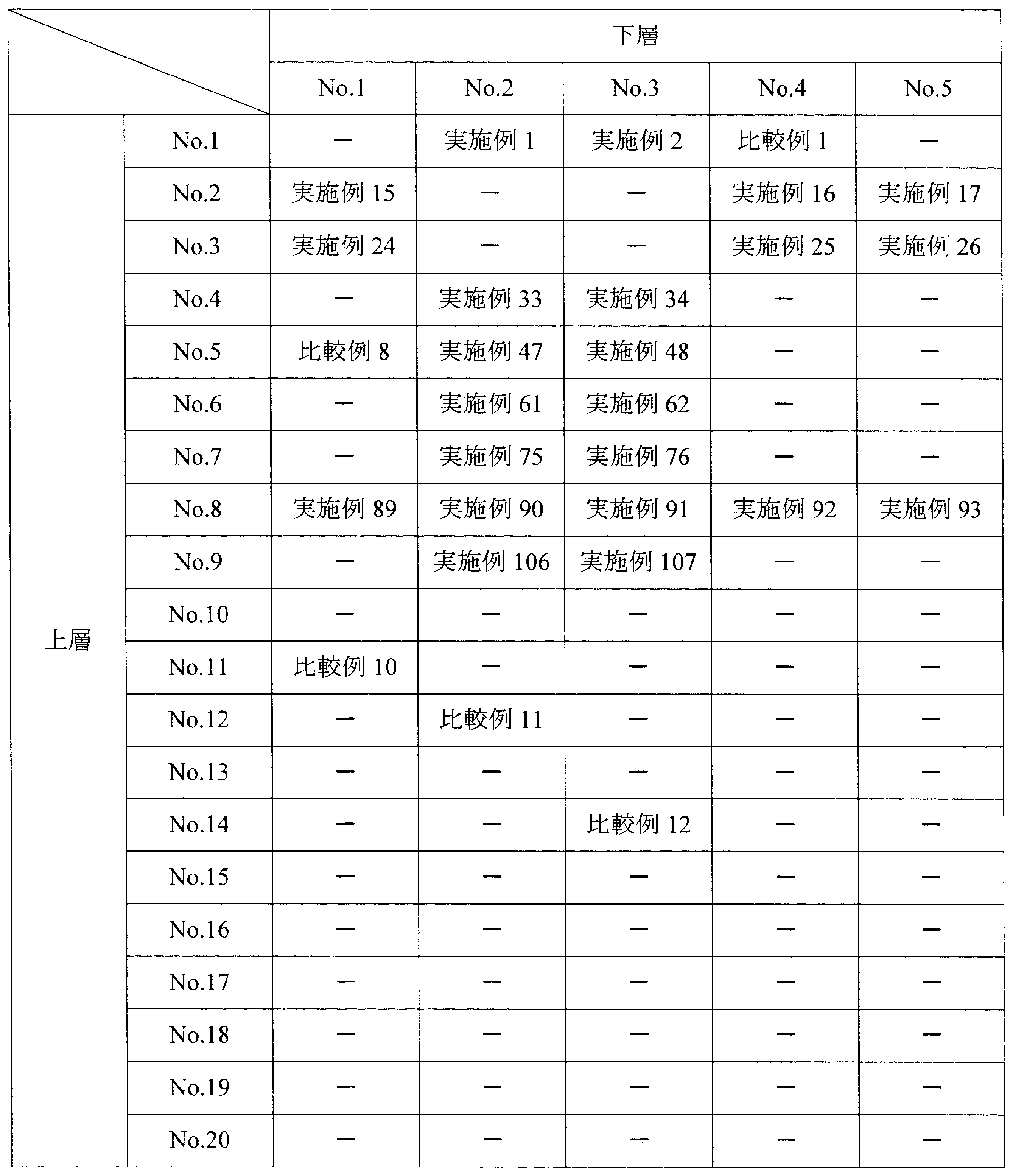
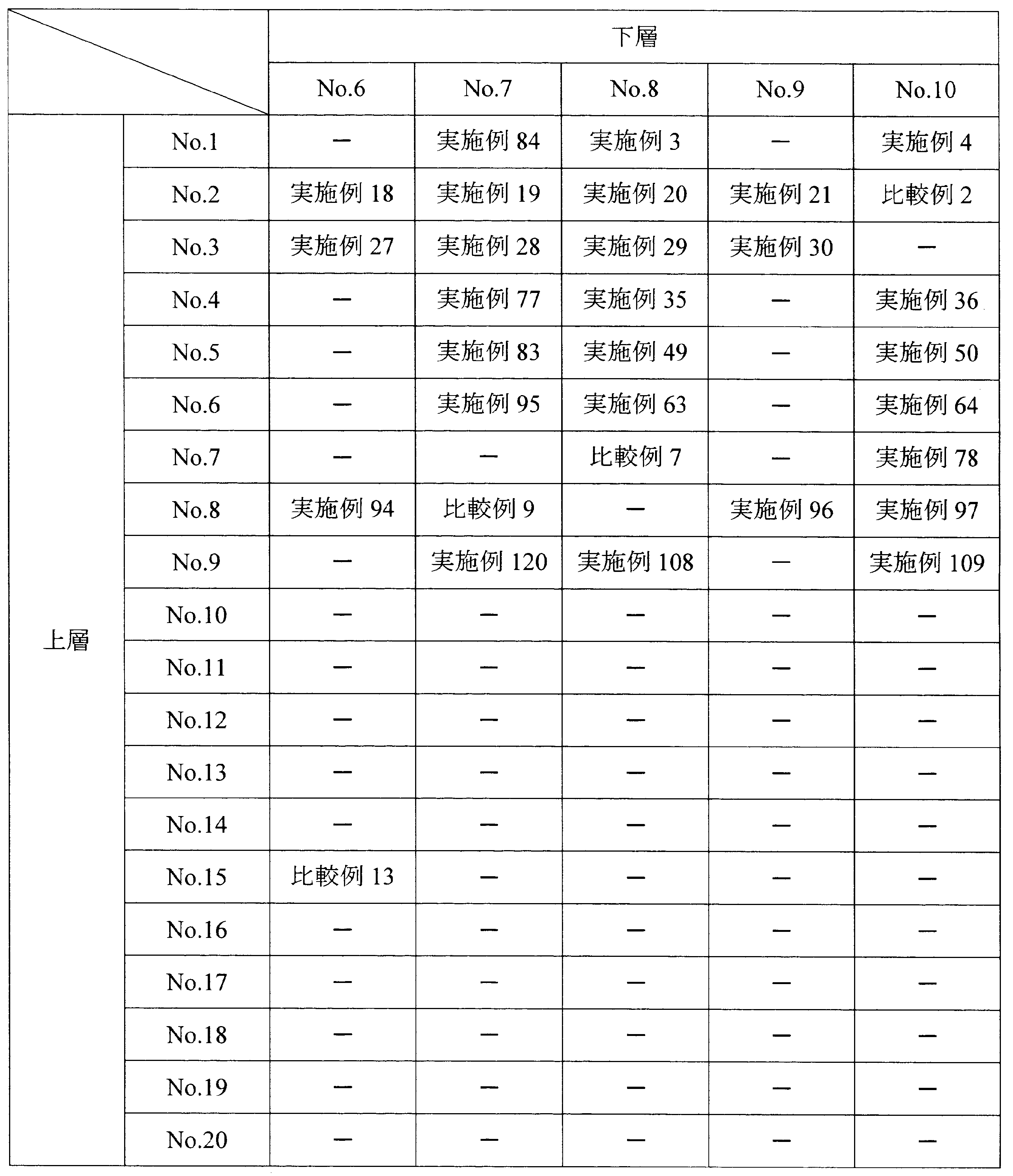
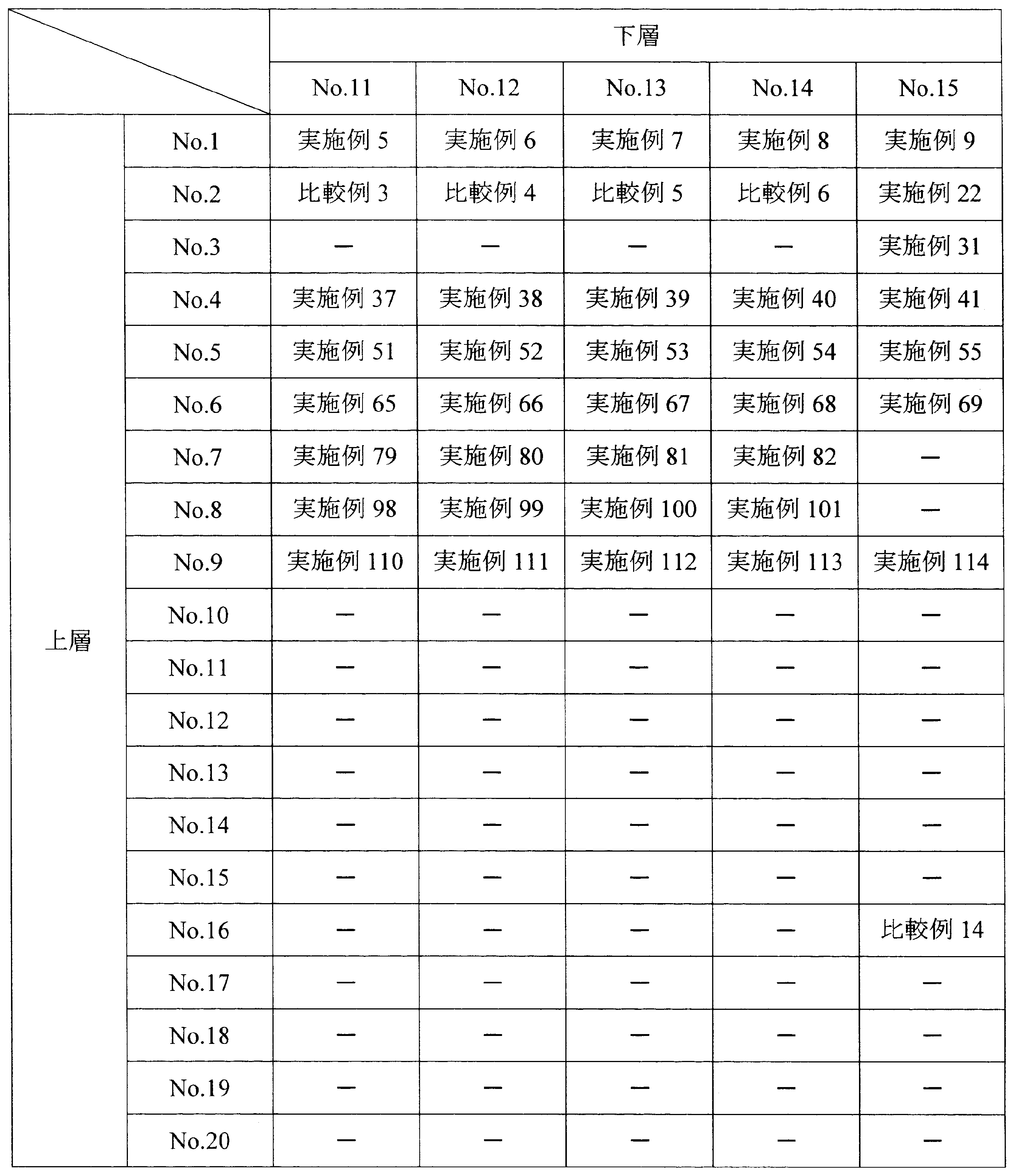
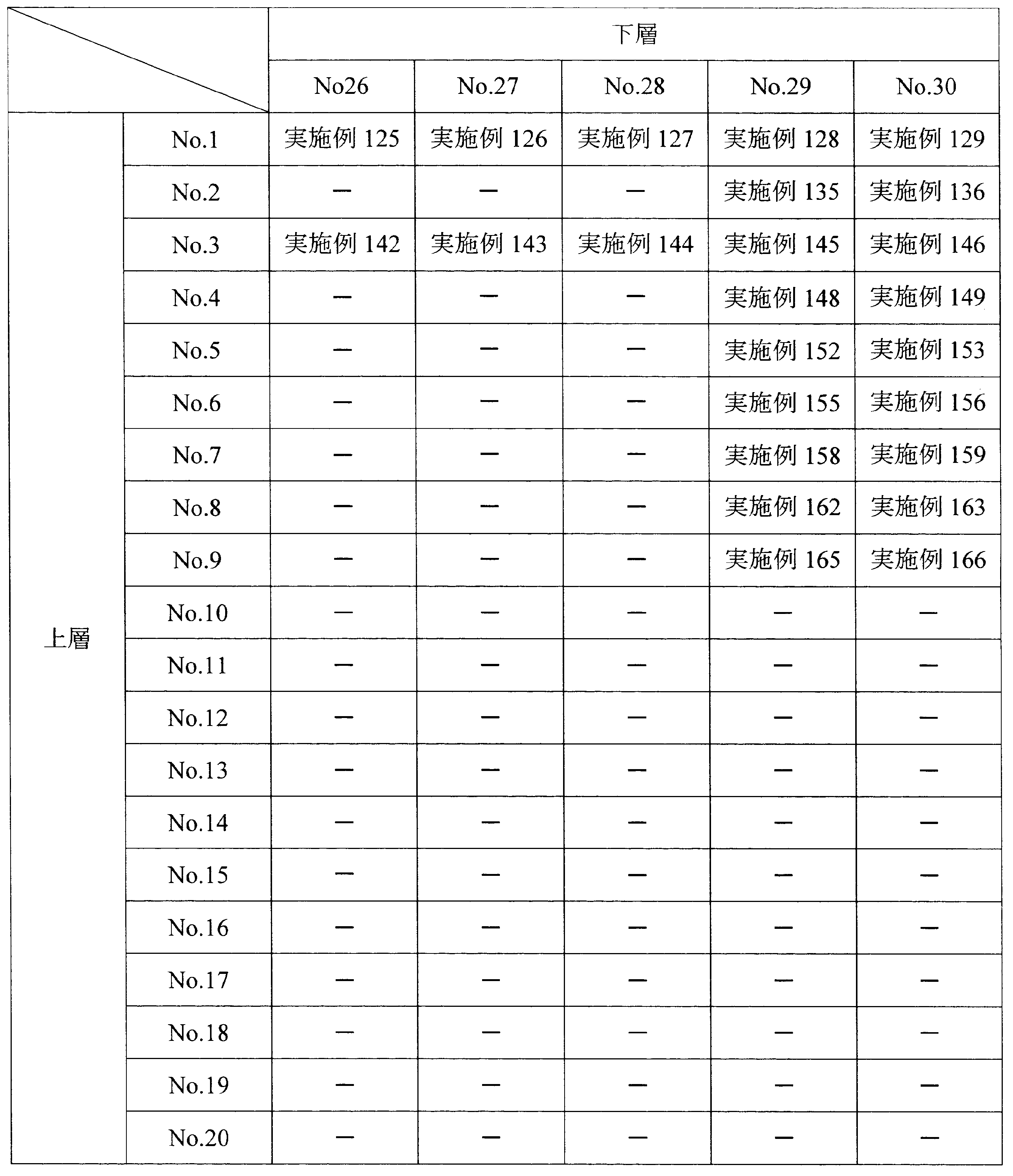
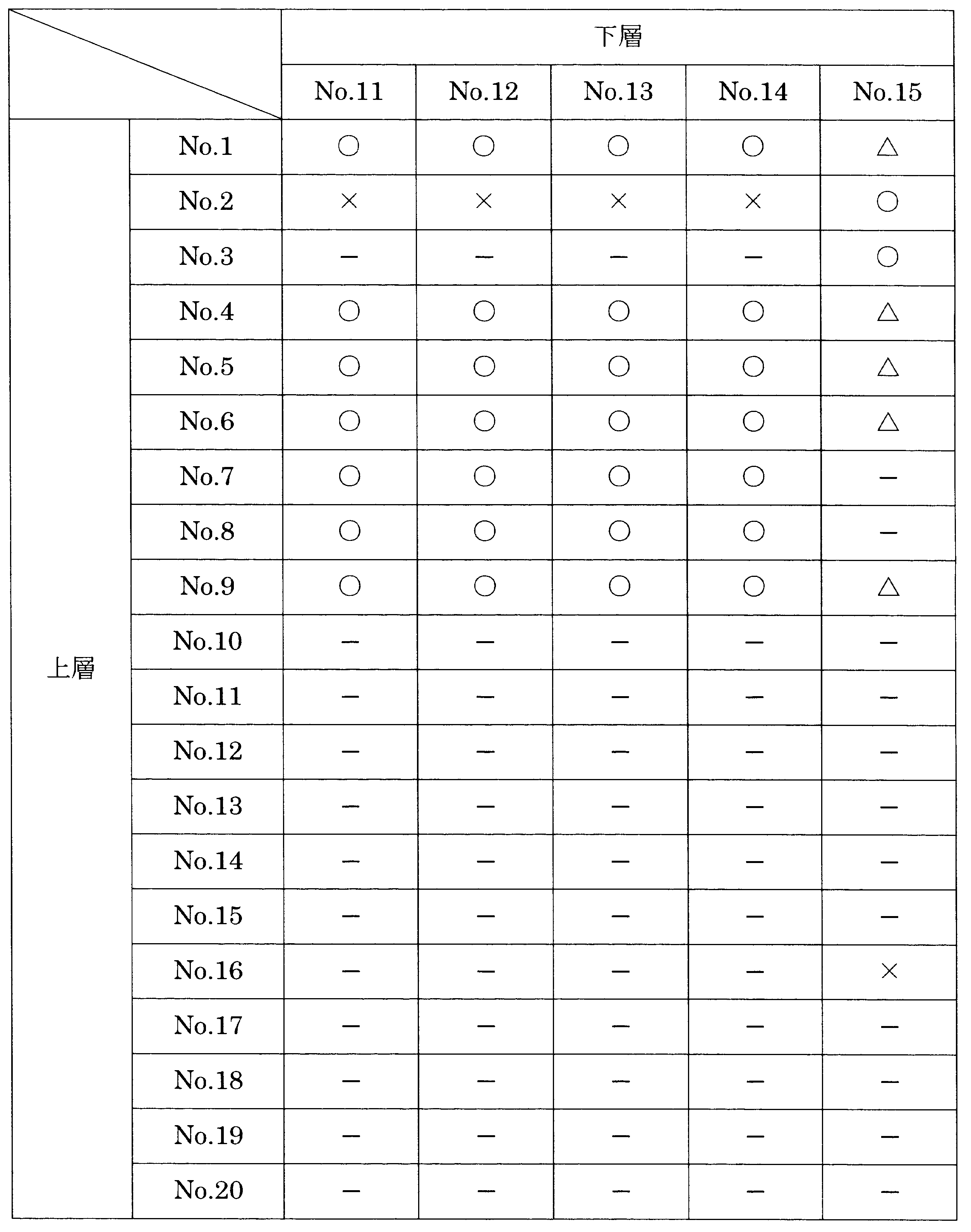
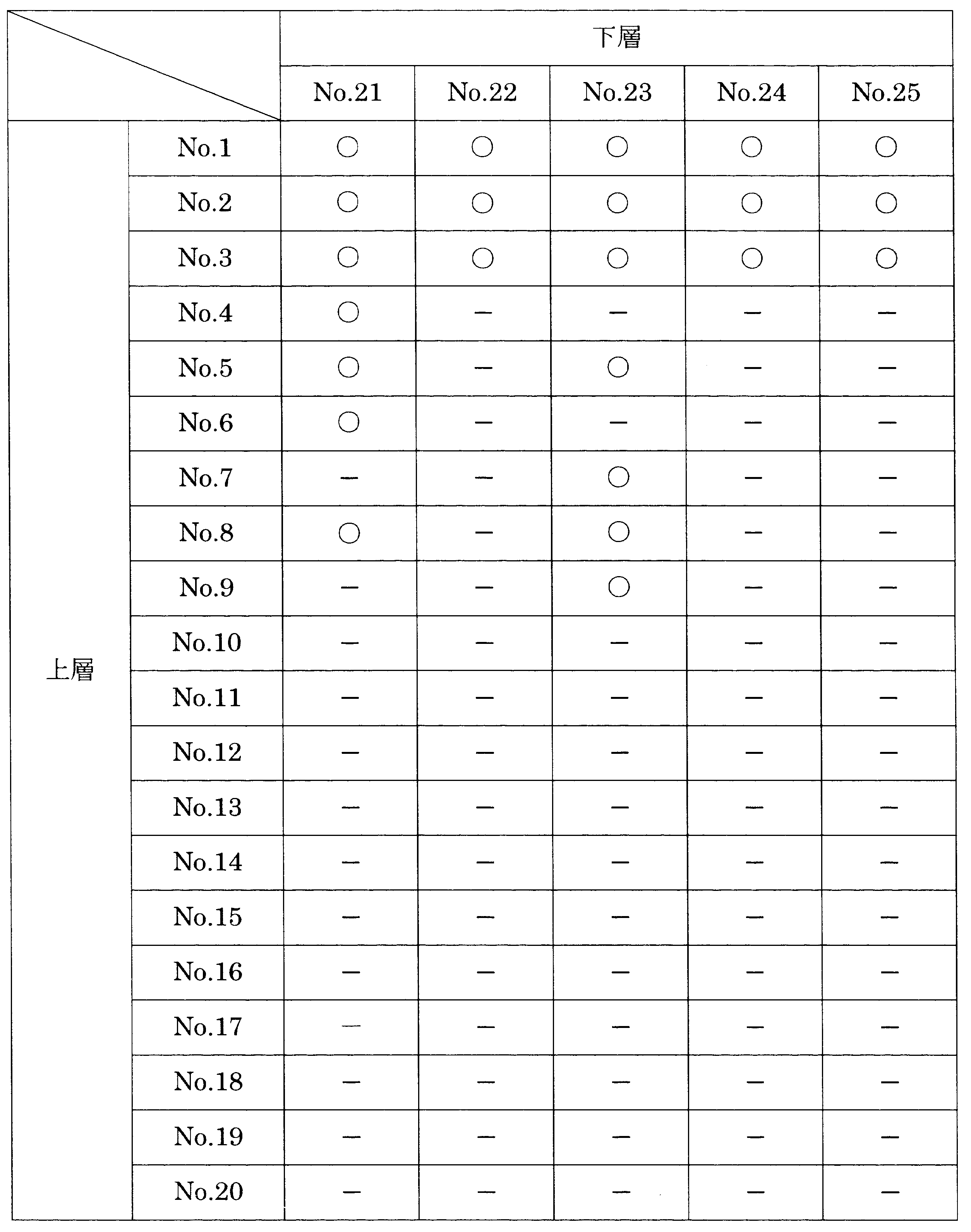
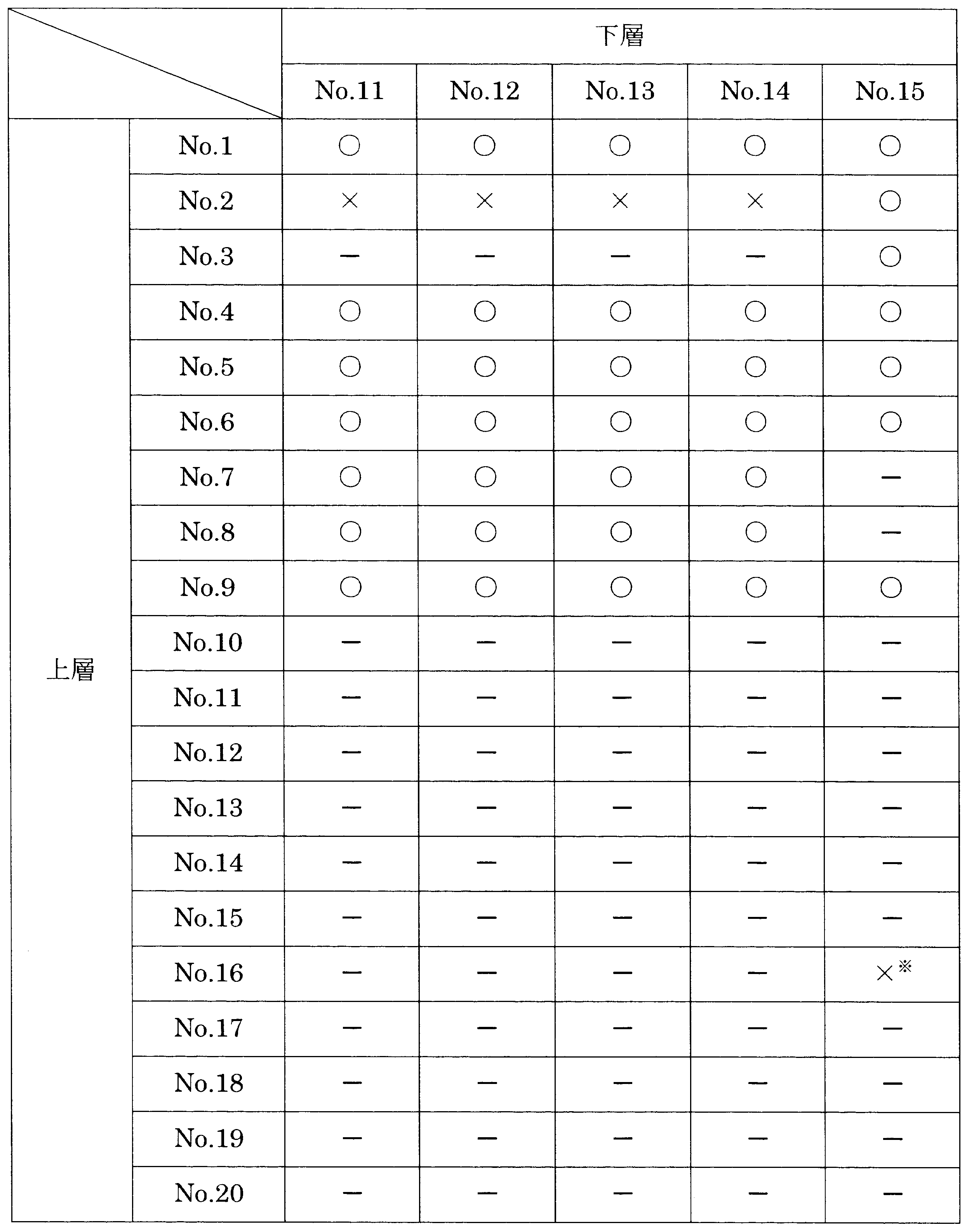
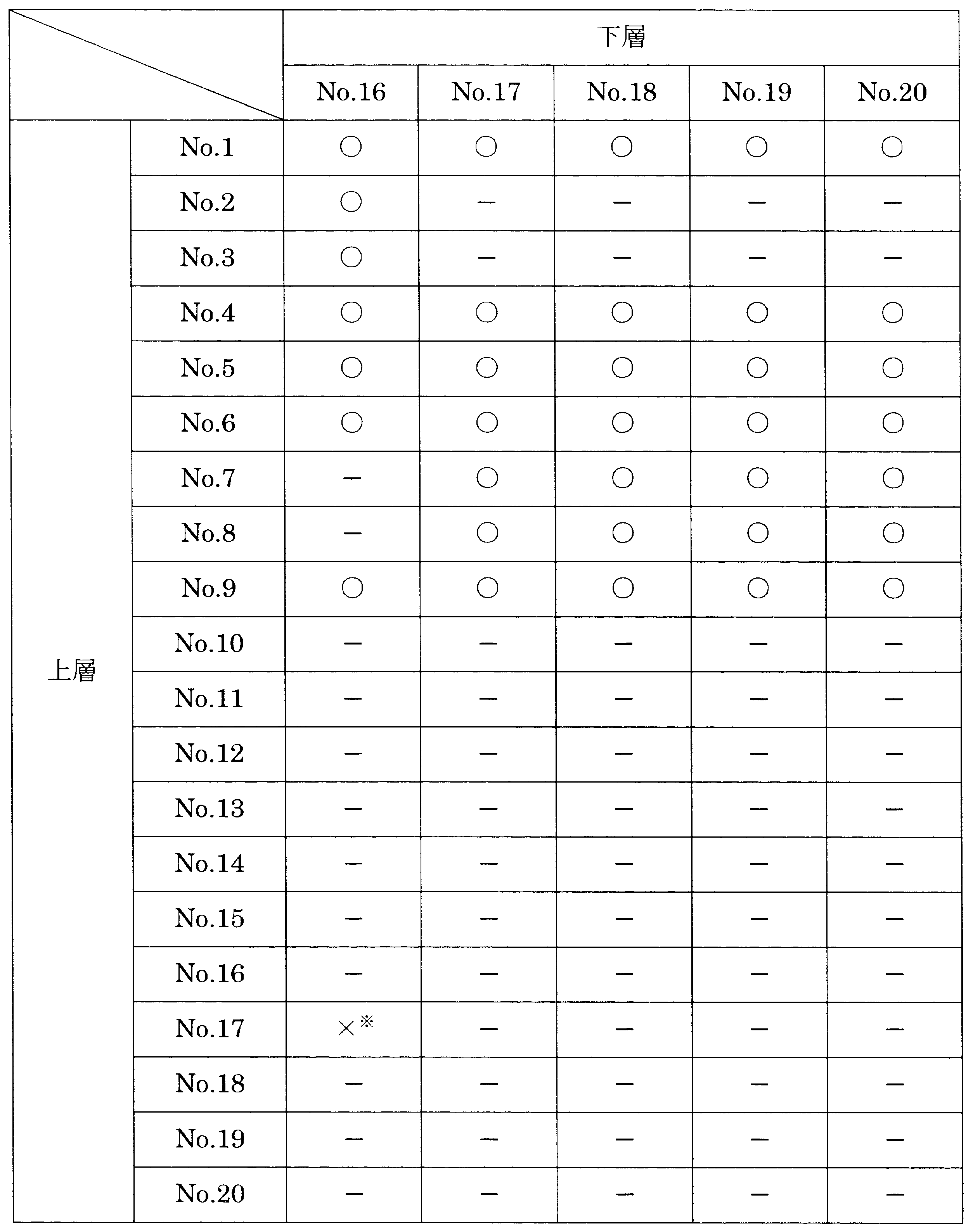
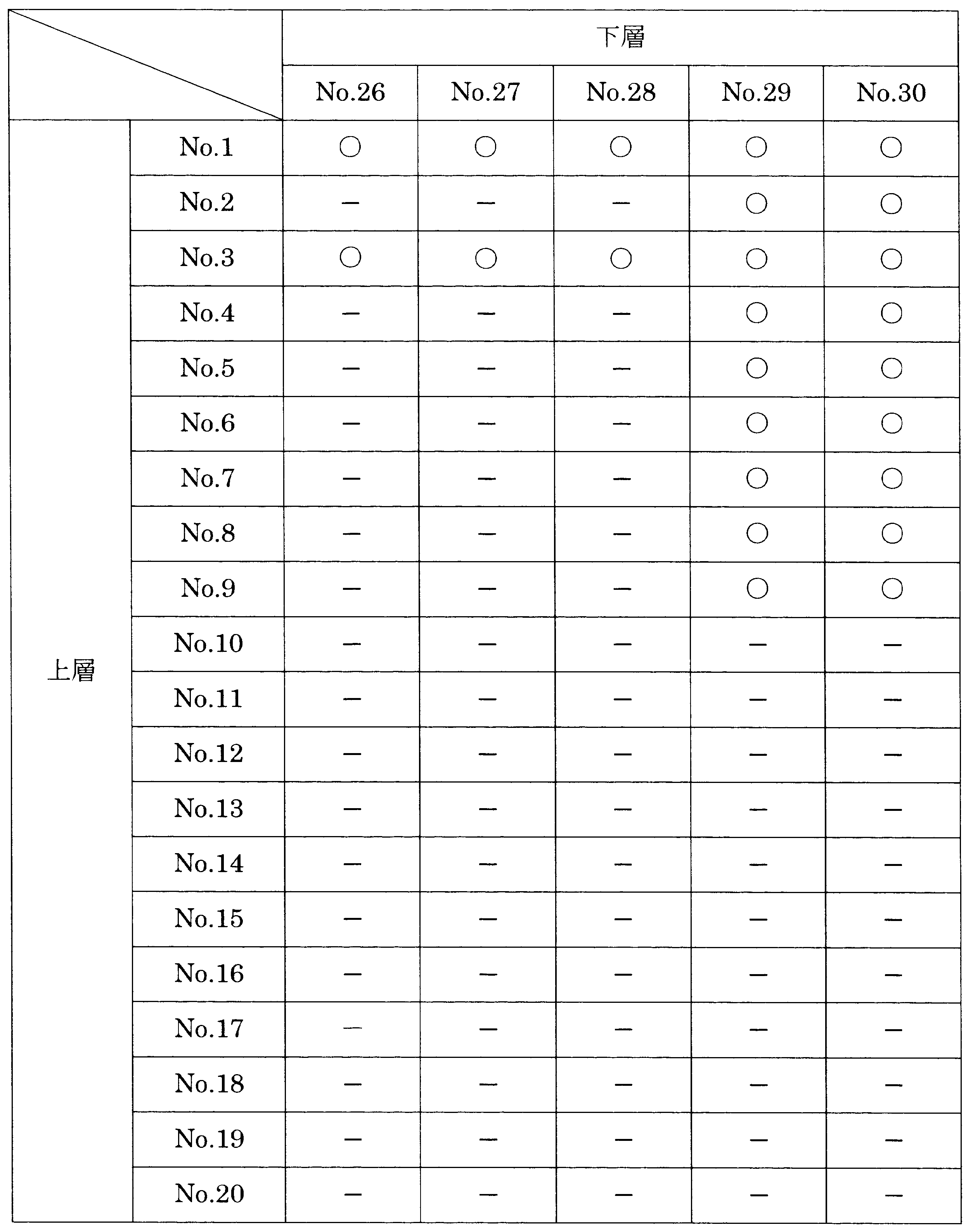
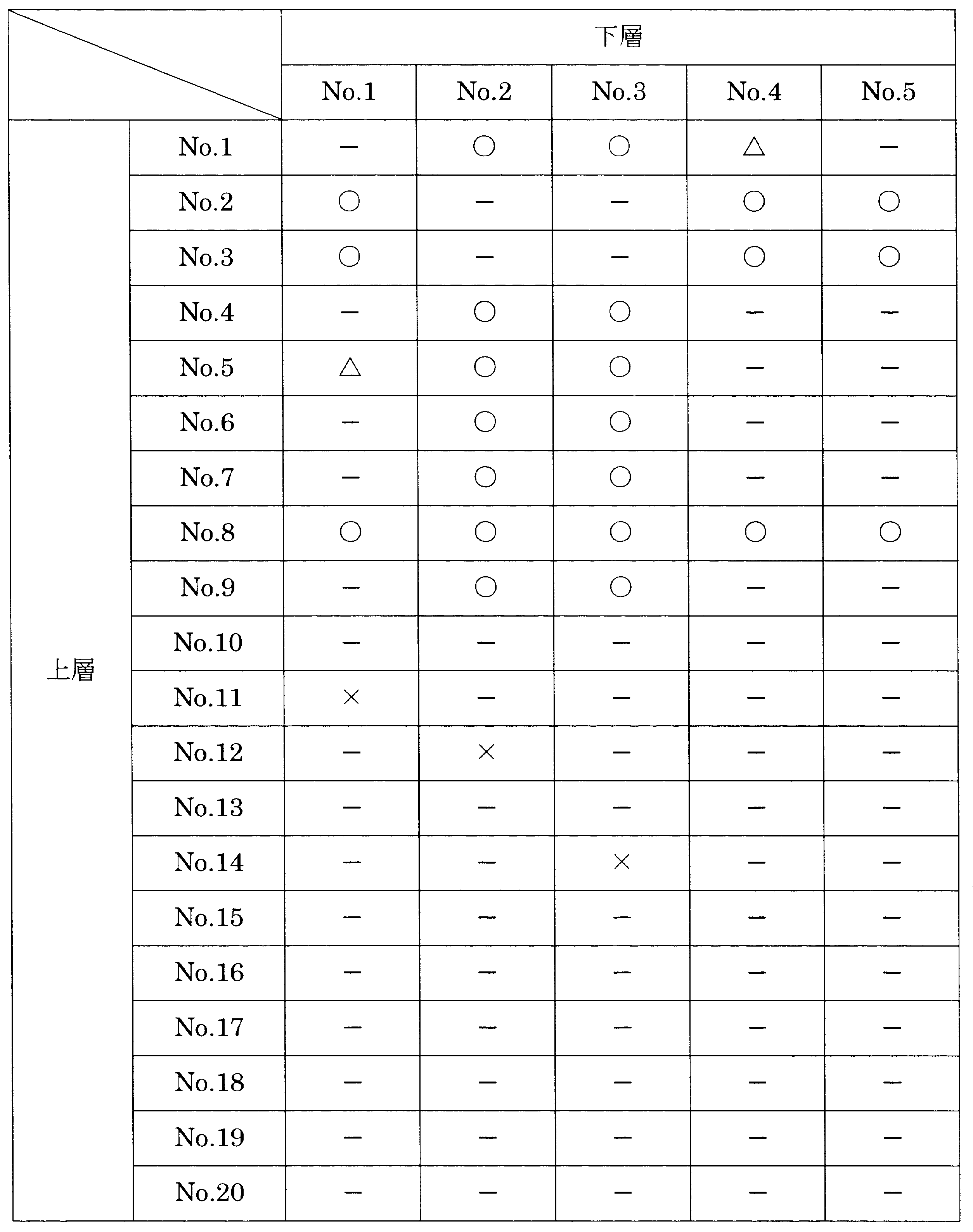
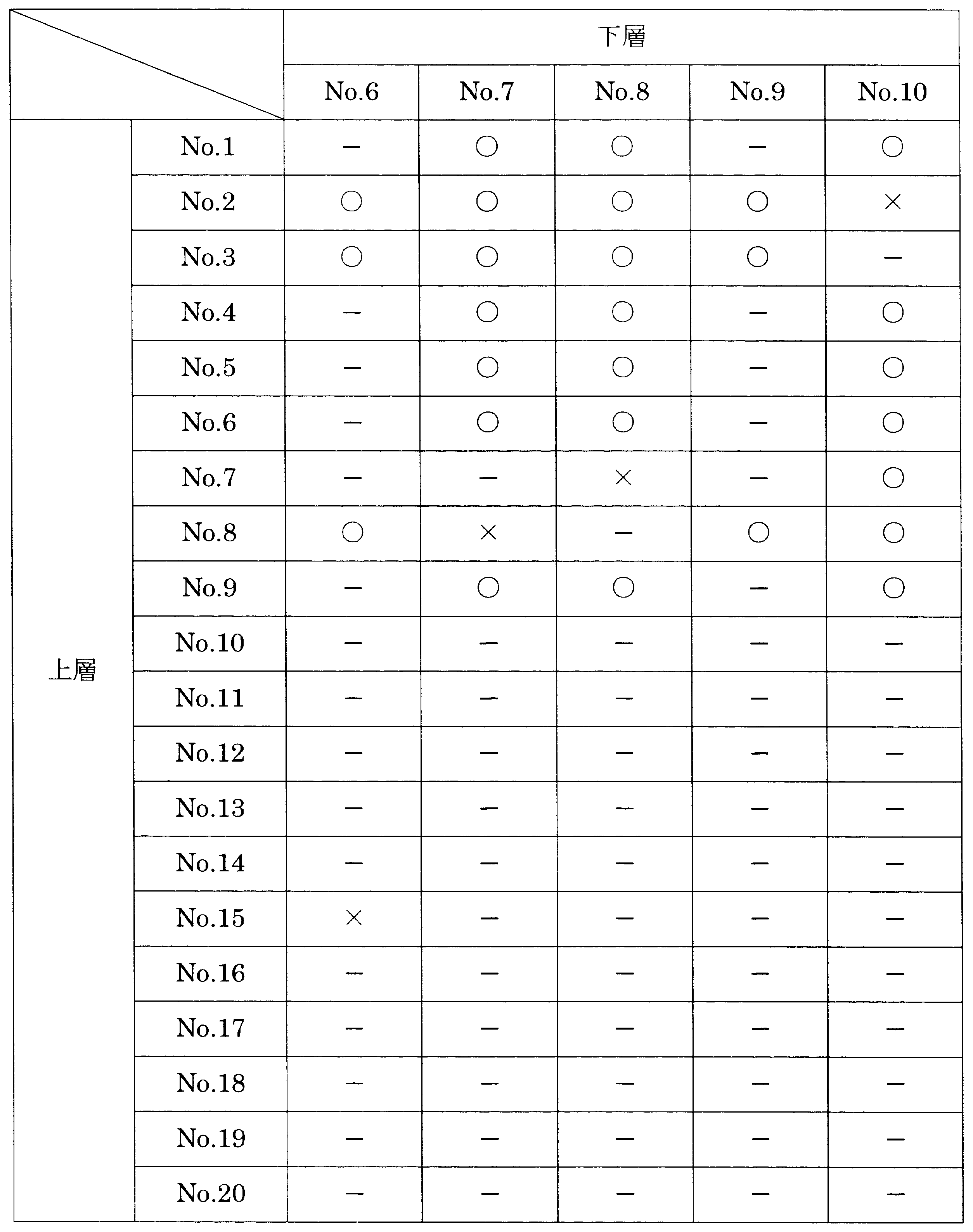
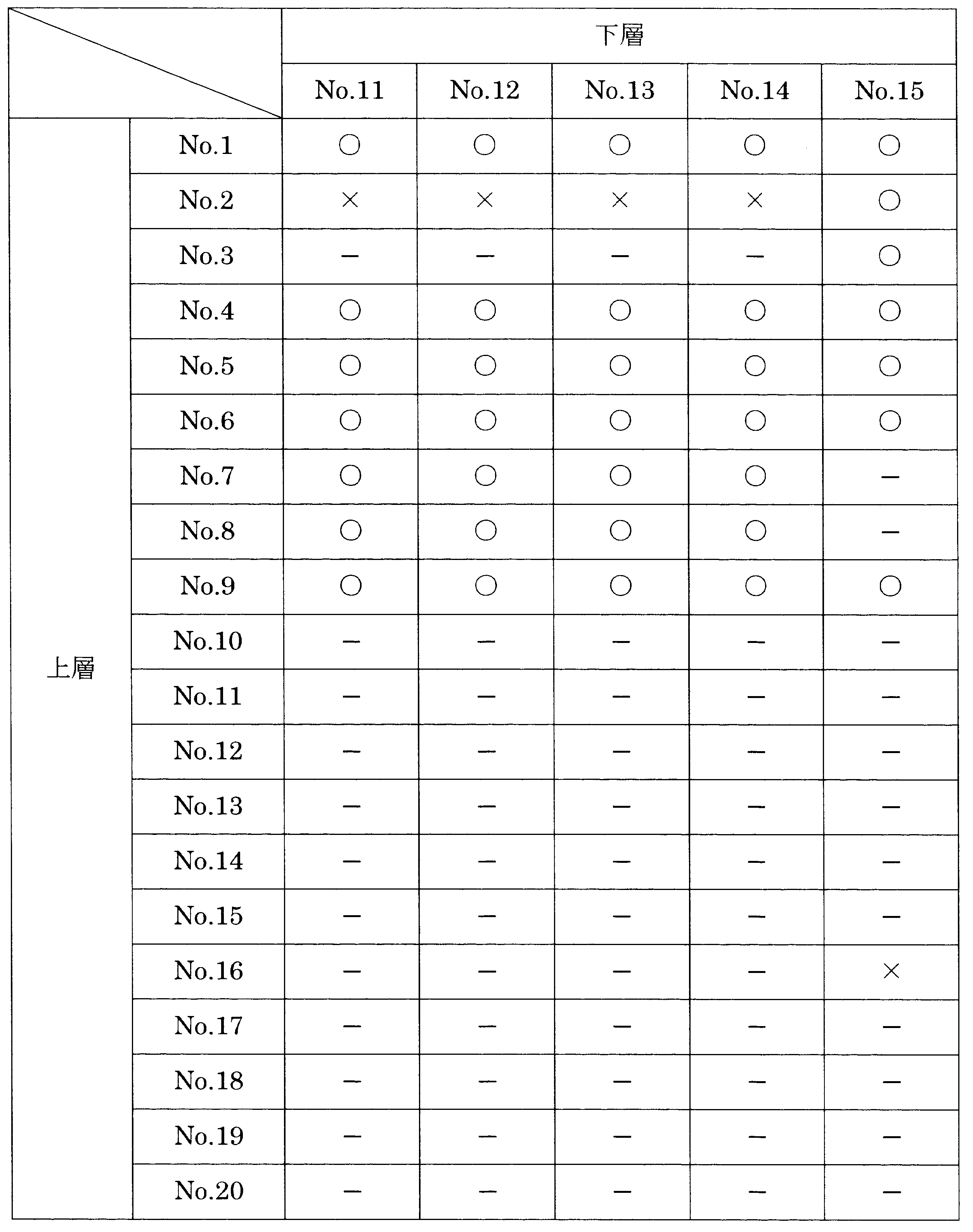
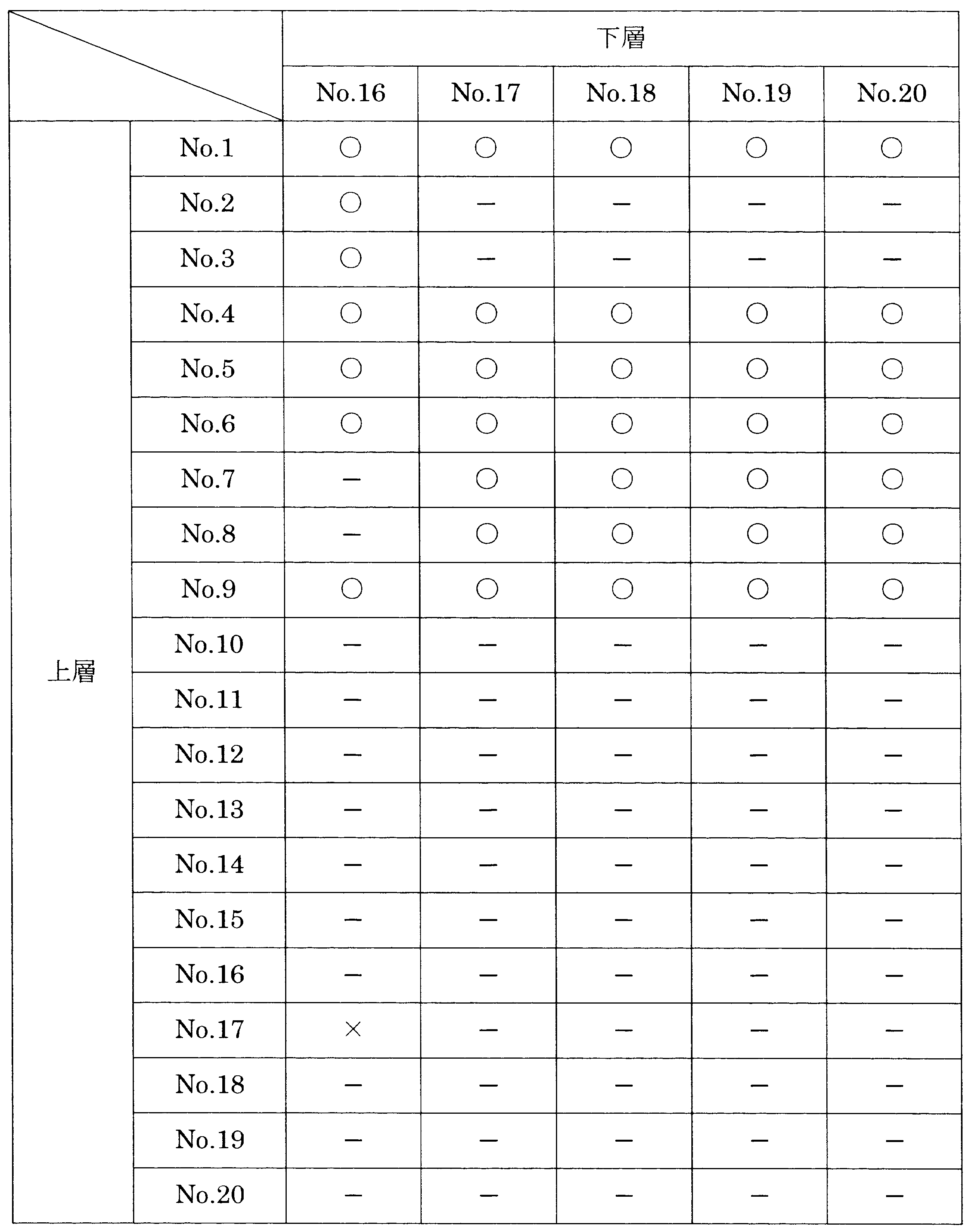
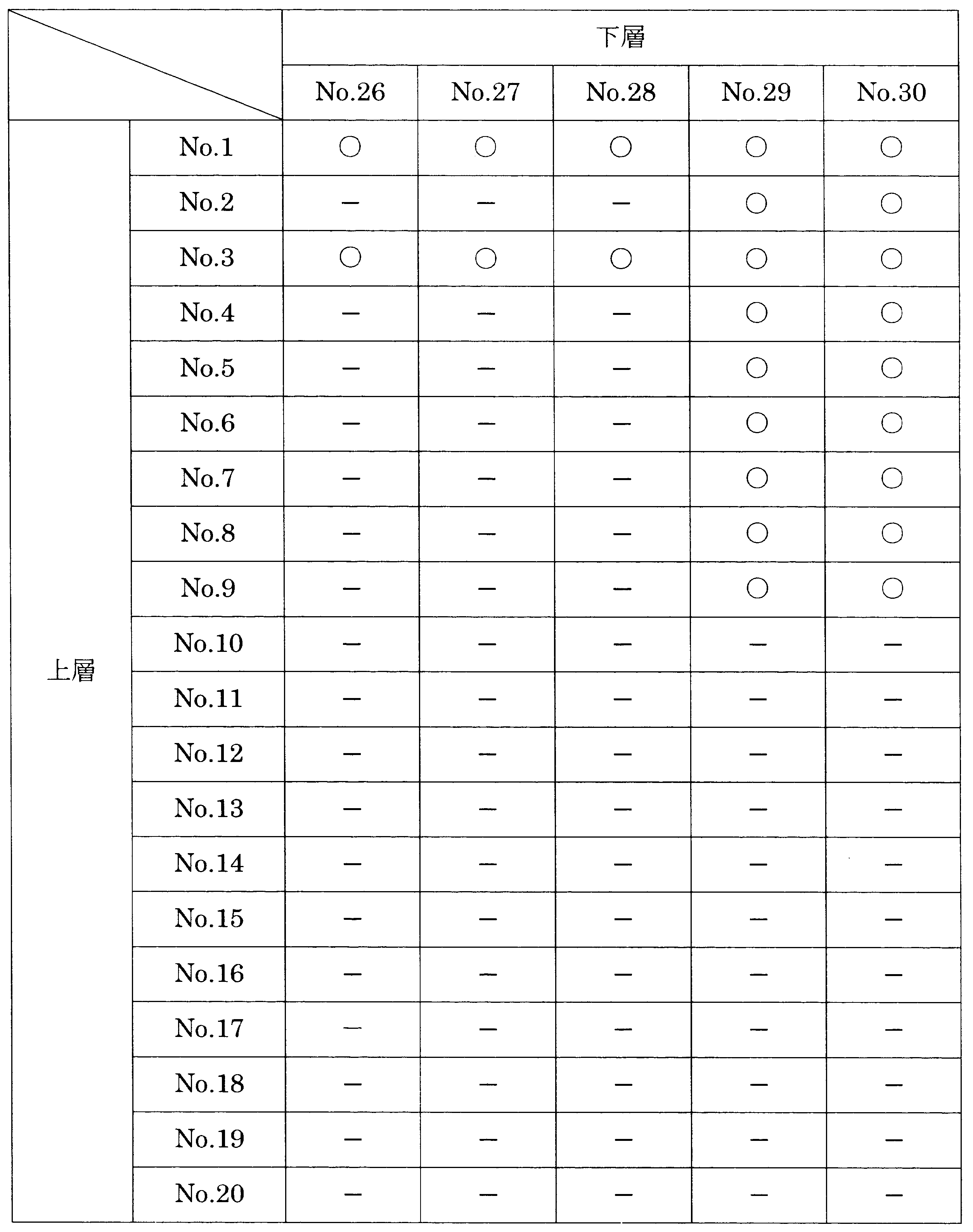
[表1]~[表6]に示す組み合わせで、ガラス基板または下層膜上にスピンコーターを用いて下層を塗布して乾燥し、上層を塗布した後100℃のホットプレートで10分間プリベークを行い膜を形成した。その後、室温まで冷却し、フォトマスク(LINE/SPACE=100μm/100μm)を介し、高圧水銀ランプを用い、各膜に365nmの波長を含む光を3200mJ/cm2照射した。続いて、[表7]に示す現像液を用い、23℃で上層、下層の順に現像を行った。現像後、基板を120℃のオーブン内で10分乾燥させてパターンを得た。



B:イオン交換水
C:有機溶媒(2-ブタノン)
下層、上層の順に成膜した際の積層性について評価した。評価基準は以下のとおりである。
○:下層に乱れが無く上層が成膜出来たもの
△:白濁化や、一部混和が生じたもの
×:上層の組成を塗布した際、膜面乱れや下層の溶解等が生じ、積層膜を形成しなかったもの
現像、乾燥後のパターンをレーザー顕微鏡で確認した。評価基準は以下のとおりである。
○:パターンが100±5μm以内のもの
△:100±10μm以内のもの
×:100±10μm以上あるいはパターンが無くなっているもの
現像、乾燥後のパターンを23℃でN-メチルピロリドン(NMP)に5分間浸漬後、窒素ガスで上面の溶媒を除去した。試験前後の膜面の状態観察により評価を行なった。評価基準は以下のとおりである。
○:膜面変化無し
△:一部膨潤や溶解
×:全面が膨潤や溶解により変化
水溶解性組成物No.10にイオン交換水を加え、2質量%水溶液とした。得られた水溶液を用いて膜厚0.1μmの下層を作製した。続いて、アルカリ現像性感光性組成物No.1を用いて、膜厚10μmの上層を作製した。一方、水溶解性組成物No.10を用いて膜厚10μmの下層を作製し、その上層にアルカリ現像性感光性組成物No.1を用いて、膜厚10μmの上層を作製した。いずれの積層体についても、上層を現像液A、下層を現像液Bで現像することで、良好なパターン形状を得ることが出来た。
実施例99で得られたパターン、および溶媒現像性感光性組成物No.8を用いて得られたパターンについて、JIS K5600-5-6(付着性(クロスカット法))に準じて密着性を評価した。実施例99はハガレ等が無かった(分類0)であったが、溶媒現像性感光性組成物No.8を用いて得られたパターンは大部分が剥がれた(分類4)。
実施例99で得られたパターン、および溶媒現像性感光性組成物No.8を用いて得られたパターンについて、酸素透過率測定装置8001(ILLINOIS INSTRUMENTS,INC.製)を使用し、50cm2フォルダーで測定した。実施例99は<0.01cc/m2/day、溶媒現像性感光性組成物No.8は150cc/m2/dayであった。







2 第1層
3 第2層
Claims (17)
- 支持体に、組成物を用いて膜を形成する工程(1)と、前記膜の所定部分に活性エネルギー線を照射して所定部分の現像性を変化させる露光工程(2)と、前記膜を現像してパターンを得る現像工程(3)と、を含み、前記工程(1)~(3)を複数回繰り返すパターン形成方法において、
前記組成物として、現像液に対する溶解性の互いに異なる複数の組成物を用い、得られるパターンが多層構造を有することを特徴とするパターン形成方法。 - 前記多層構造の最上層が、水現像性感光性組成物、有機溶媒現像性感光性組成物、またはアルカリ現像性感光性組成物から得られる請求項1記載のパターン形成方法。
- 前記複数の組成物が、水溶解性組成物と、有機溶媒溶解性組成物と、アルカリ溶解性組成物と、水現像性感光性組成物と、有機溶媒現像性感光性組成物と、アルカリ現像性感光性組成物と、からなる群から選ばれる少なくとも2種であり、少なくとも最上層には感光性組成物を用いる請求項1記載のパターン形成方法。
- 前記工程(1)が、支持体に、水溶解性組成物または水現像性感光性組成物からなる下層を塗布し、続いてアルカリ現像性感光性組成物または有機溶媒現像性感光性組成物からなる上層を塗布する工程であり、前記工程(3)が、前記上層を現像または溶解してパターンを得る現像工程と、続いて前記下層を現像または溶解してパターンを得る現像工程と、である請求項1記載のパターン形成方法。
- 前記工程(1)が、支持体に、アルカリ溶解性組成物、アルカリ現像性感光性組成物または有機溶媒現像性感光性組成物からなる下層を塗布し、続いて水現像性感光性組成物からなる上層を塗布する工程であり、感光性組成物であり、前記工程(3)が、前記上層を現像してパターンを得る現像工程と、続いて前記下層を現像してパターンを得る現像工程と、である請求項1記載のパターン形成方法。
- 前記工程(1)および前記工程(2)の間、および/または、前記工程(3)の後に加熱工程を有する請求項1記載のパターン形成方法。
- 前記水溶解性組成物が、バインダー樹脂および水を含有し、前記有機溶媒溶解性組成物が、バインダー樹脂および有機溶媒を含有する請求項3記載のパターン形成方法。
- 前記水溶性組成物および前記有機溶媒溶解性組成物のうち少なくとも一方が、さらに架橋剤を含有する請求項7記載のパターン形成方法。
- 前記架橋剤が、オキサゾリン化合物またはカルボジイミド化合物である請求項8記載のパターン形成方法。
- 前記有機溶媒現像性感光性組成物が、ラジカル重合性化合物またはカチオン重合性化合物と、重合開始剤と、を含有する請求項2記載のパターン形成方法。
- 前記アルカリ現像性感光性組成物が、少なくともアルカリ現像性を有するバインダー樹脂、重合開始剤および溶媒を含有する請求項2記載のパターン形成方法。
- 前記水現像性感光性組成物が、感光性基を有する水溶性重合体および水を含有する請求項2記載のパターン形成方法。
- 前記活性エネルギー線のエネルギー量が、0.1~500000mJ/cm2である請求項1記載のパターン形成方法。
- 得られるパターンの多層構造の膜厚を0.1~1000μm、線幅を1~1000μm、スペースを1~1000μmとする請求項1記載のうちいずれか一項記載のパターン形成方法。
- 前記上層と前記下層の膜厚の比を、0.1:99.9~99.9:0.1とする請求項4記載のパターン形成方法。
- 前記上層と前記下層の膜厚の比を、0.1:99.9~99.9:0.1とする請求項5記載のパターン形成方法。
- 請求項1記載のパターン形成方法により形成されたパターンを有することを特徴とする電子デバイス。
Priority Applications (4)
| Application Number | Priority Date | Filing Date | Title |
|---|---|---|---|
| US15/551,736 US10386721B2 (en) | 2015-02-26 | 2016-02-23 | Pattern formation method and electronic device manufactured using same |
| JP2017502392A JP6854751B2 (ja) | 2015-02-26 | 2016-02-23 | パターン形成方法およびこれを用いて製造した電子デバイス |
| CN201680009871.7A CN107250913A (zh) | 2015-02-26 | 2016-02-23 | 图案形成方法和使用其制造的电子设备 |
| KR1020177026874A KR102523847B1 (ko) | 2015-02-26 | 2016-02-23 | 패턴 형성 방법 및 이를 이용하여 제조한 전자 디바이스 |
Applications Claiming Priority (2)
| Application Number | Priority Date | Filing Date | Title |
|---|---|---|---|
| JP2015-037451 | 2015-02-26 | ||
| JP2015037451 | 2015-02-26 |
Publications (1)
| Publication Number | Publication Date |
|---|---|
| WO2016136752A1 true WO2016136752A1 (ja) | 2016-09-01 |
Family
ID=56788983
Family Applications (1)
| Application Number | Title | Priority Date | Filing Date |
|---|---|---|---|
| PCT/JP2016/055281 Ceased WO2016136752A1 (ja) | 2015-02-26 | 2016-02-23 | パターン形成方法およびこれを用いて製造した電子デバイス |
Country Status (6)
| Country | Link |
|---|---|
| US (1) | US10386721B2 (ja) |
| JP (1) | JP6854751B2 (ja) |
| KR (1) | KR102523847B1 (ja) |
| CN (1) | CN107250913A (ja) |
| TW (1) | TWI678597B (ja) |
| WO (1) | WO2016136752A1 (ja) |
Cited By (6)
| Publication number | Priority date | Publication date | Assignee | Title |
|---|---|---|---|---|
| WO2018117138A1 (ja) * | 2016-12-22 | 2018-06-28 | 株式会社Adeka | 水溶性組成物、パターン形成剤、これらを用いた硬化物の製造方法および硬化物 |
| JP2018169600A (ja) * | 2017-03-29 | 2018-11-01 | 東洋インキScホールディングス株式会社 | 固体撮像素子向けカラーフィルタ用感光性緑色着色組成物および固体撮像素子用カラーフィルタ |
| WO2018230564A1 (ja) * | 2017-06-16 | 2018-12-20 | 株式会社Adeka | コーティング組成物 |
| JP2021110877A (ja) * | 2020-01-14 | 2021-08-02 | 住友電気工業株式会社 | 半導体装置の製造方法 |
| JPWO2021246445A1 (ja) * | 2020-06-03 | 2021-12-09 | ||
| WO2022186231A1 (ja) * | 2021-03-03 | 2022-09-09 | 日産化学株式会社 | ベンジリデンシアノ酢酸エステル基を有するレジスト下層膜形成組成物 |
Families Citing this family (7)
| Publication number | Priority date | Publication date | Assignee | Title |
|---|---|---|---|---|
| JP2018083143A (ja) * | 2016-11-22 | 2018-05-31 | キヤノン株式会社 | 液体吐出ヘッドの製造方法、液体吐出ヘッド、印字装置および印字方法 |
| TWI614573B (zh) * | 2016-12-30 | 2018-02-11 | 臻鼎科技股份有限公司 | 水溶性感光樹脂組合物及覆蓋膜 |
| US11549020B2 (en) | 2019-09-23 | 2023-01-10 | Canon Kabushiki Kaisha | Curable composition for nano-fabrication |
| JP2021123048A (ja) * | 2020-02-06 | 2021-08-30 | 東洋アルミニウム株式会社 | 加飾フィルムの製造方法 |
| CN111668271B (zh) * | 2020-06-11 | 2021-08-24 | 武汉华星光电半导体显示技术有限公司 | Oled显示面板及其制备方法、oled显示装置 |
| WO2022145158A1 (ja) * | 2020-12-28 | 2022-07-07 | 東京応化工業株式会社 | 感光性ドライフィルム、積層フィルム、積層フィルムの製造方法及びパターン化されたレジスト膜の製造方法 |
| JP2024171383A (ja) * | 2023-05-30 | 2024-12-12 | 株式会社リコー | 液体吐出ヘッド及びその製造方法、液体吐出ユニット、並びに液体吐出装置 |
Citations (5)
| Publication number | Priority date | Publication date | Assignee | Title |
|---|---|---|---|---|
| JP2006220863A (ja) * | 2005-02-09 | 2006-08-24 | Fuji Photo Film Co Ltd | パターン形成材料、並びにパターン形成装置及びパターン形成方法 |
| JP2013164628A (ja) * | 2013-05-16 | 2013-08-22 | Renesas Electronics Corp | レジストパターン形成方法および半導体装置の製造方法 |
| JP2014098889A (ja) * | 2012-10-19 | 2014-05-29 | Fujifilm Corp | 保護膜形成用の樹脂組成物、保護膜、パターン形成方法、電子デバイスの製造方法及び電子デバイス |
| JP2014137435A (ja) * | 2013-01-16 | 2014-07-28 | Shin Etsu Chem Co Ltd | パターン形成方法 |
| JP2014178671A (ja) * | 2013-02-14 | 2014-09-25 | Shin Etsu Chem Co Ltd | パターン形成方法 |
Family Cites Families (12)
| Publication number | Priority date | Publication date | Assignee | Title |
|---|---|---|---|---|
| JPH06326018A (ja) | 1993-05-13 | 1994-11-25 | Nec Corp | パターン形式用レジスト構造とパターン形成方法 |
| JPH06349728A (ja) | 1993-06-14 | 1994-12-22 | Sony Corp | レジストパターンの形成方法 |
| JP3894908B2 (ja) | 2003-06-24 | 2007-03-22 | 電気化学工業株式会社 | 半導体ウエハ裏面研削用粘着シート |
| JP4376706B2 (ja) * | 2004-06-30 | 2009-12-02 | 東京応化工業株式会社 | ネガ型ホトレジスト組成物を用いたメッキ形成物の形成方法 |
| JP2007133333A (ja) * | 2005-11-14 | 2007-05-31 | Fujifilm Corp | 感光性組成物及び感光性フィルム、並びに、永久パターン及びその形成方法 |
| CN101149562A (zh) * | 2006-09-22 | 2008-03-26 | 富士胶片株式会社 | 感光性组合物、感光性薄膜、永久图案形成方法及印刷电路板 |
| CN101952777B (zh) * | 2007-12-18 | 2014-04-09 | 旭化成电子材料株式会社 | 使用负型感光性树脂层压体的抗蚀剂固化物的制造方法、负型感光性树脂层压体、以及负型感光性树脂层压体的使用方法 |
| JP5994618B2 (ja) | 2012-12-14 | 2016-09-21 | デクセリアルズ株式会社 | 光硬化性樹脂組成物及びそれを用いた画像表示装置の製造方法 |
| JP2014157179A (ja) | 2013-02-14 | 2014-08-28 | Toppan Printing Co Ltd | ブラックマトリックス、カラーフィルタ、液晶表示装置及びブラックマトリックスの形成方法 |
| JP6214903B2 (ja) | 2013-04-10 | 2017-10-18 | 株式会社日立ハイテクノロジーズ | 検査装置 |
| JP6414057B2 (ja) | 2013-06-06 | 2018-10-31 | 横浜ゴム株式会社 | 光硬化性樹脂および光硬化性樹脂組成物 |
| KR102020812B1 (ko) | 2013-06-17 | 2019-09-11 | 도레이 카부시키가이샤 | 적층 수지 블랙 매트릭스 기판의 제조 방법 |
-
2016
- 2016-02-23 CN CN201680009871.7A patent/CN107250913A/zh active Pending
- 2016-02-23 US US15/551,736 patent/US10386721B2/en active Active
- 2016-02-23 WO PCT/JP2016/055281 patent/WO2016136752A1/ja not_active Ceased
- 2016-02-23 KR KR1020177026874A patent/KR102523847B1/ko active Active
- 2016-02-23 JP JP2017502392A patent/JP6854751B2/ja active Active
- 2016-02-26 TW TW105105966A patent/TWI678597B/zh active
Patent Citations (5)
| Publication number | Priority date | Publication date | Assignee | Title |
|---|---|---|---|---|
| JP2006220863A (ja) * | 2005-02-09 | 2006-08-24 | Fuji Photo Film Co Ltd | パターン形成材料、並びにパターン形成装置及びパターン形成方法 |
| JP2014098889A (ja) * | 2012-10-19 | 2014-05-29 | Fujifilm Corp | 保護膜形成用の樹脂組成物、保護膜、パターン形成方法、電子デバイスの製造方法及び電子デバイス |
| JP2014137435A (ja) * | 2013-01-16 | 2014-07-28 | Shin Etsu Chem Co Ltd | パターン形成方法 |
| JP2014178671A (ja) * | 2013-02-14 | 2014-09-25 | Shin Etsu Chem Co Ltd | パターン形成方法 |
| JP2013164628A (ja) * | 2013-05-16 | 2013-08-22 | Renesas Electronics Corp | レジストパターン形成方法および半導体装置の製造方法 |
Cited By (17)
| Publication number | Priority date | Publication date | Assignee | Title |
|---|---|---|---|---|
| JP7096772B2 (ja) | 2016-12-22 | 2022-07-06 | 株式会社Adeka | 水溶性組成物、パターン形成剤、これらを用いた硬化物の製造方法および硬化物 |
| JPWO2018117138A1 (ja) * | 2016-12-22 | 2019-10-31 | 株式会社Adeka | 水溶性組成物、パターン形成剤、これらを用いた硬化物の製造方法および硬化物 |
| WO2018117138A1 (ja) * | 2016-12-22 | 2018-06-28 | 株式会社Adeka | 水溶性組成物、パターン形成剤、これらを用いた硬化物の製造方法および硬化物 |
| JP2018169600A (ja) * | 2017-03-29 | 2018-11-01 | 東洋インキScホールディングス株式会社 | 固体撮像素子向けカラーフィルタ用感光性緑色着色組成物および固体撮像素子用カラーフィルタ |
| KR20190126811A (ko) * | 2017-03-29 | 2019-11-12 | 토요잉크Sc홀딩스주식회사 | 고체 촬상소자용 착색 조성물 |
| US11614574B2 (en) | 2017-03-29 | 2023-03-28 | Toppan Printing Co., Ltd. | Coloring composition for solid-state imaging element |
| KR102499703B1 (ko) * | 2017-03-29 | 2023-02-15 | 토요잉크Sc홀딩스주식회사 | 고체 촬상소자용 착색 조성물 |
| WO2018230564A1 (ja) * | 2017-06-16 | 2018-12-20 | 株式会社Adeka | コーティング組成物 |
| CN110741053A (zh) * | 2017-06-16 | 2020-01-31 | 株式会社Adeka | 涂料组合物 |
| JPWO2018230564A1 (ja) * | 2017-06-16 | 2020-04-30 | 株式会社Adeka | コーティング組成物 |
| EP3640307A4 (en) * | 2017-06-16 | 2021-02-24 | Adeka Corporation | COATING COMPOSITION |
| JP2021110877A (ja) * | 2020-01-14 | 2021-08-02 | 住友電気工業株式会社 | 半導体装置の製造方法 |
| JP7338482B2 (ja) | 2020-01-14 | 2023-09-05 | 住友電気工業株式会社 | 半導体装置の製造方法 |
| WO2021246445A1 (ja) * | 2020-06-03 | 2021-12-09 | 昭和電工株式会社 | ポジ型感光性樹脂組成物、及び有機el素子隔壁 |
| JPWO2021246445A1 (ja) * | 2020-06-03 | 2021-12-09 | ||
| JP7789669B2 (ja) | 2020-06-03 | 2025-12-22 | 日本ポリテック株式会社 | ポジ型感光性樹脂組成物、及び有機el素子隔壁 |
| WO2022186231A1 (ja) * | 2021-03-03 | 2022-09-09 | 日産化学株式会社 | ベンジリデンシアノ酢酸エステル基を有するレジスト下層膜形成組成物 |
Also Published As
| Publication number | Publication date |
|---|---|
| TWI678597B (zh) | 2019-12-01 |
| US20180039179A1 (en) | 2018-02-08 |
| KR102523847B1 (ko) | 2023-04-19 |
| JP6854751B2 (ja) | 2021-04-07 |
| US10386721B2 (en) | 2019-08-20 |
| JPWO2016136752A1 (ja) | 2017-12-07 |
| TW201642045A (zh) | 2016-12-01 |
| CN107250913A (zh) | 2017-10-13 |
| KR20170121240A (ko) | 2017-11-01 |
Similar Documents
| Publication | Publication Date | Title |
|---|---|---|
| KR102523847B1 (ko) | 패턴 형성 방법 및 이를 이용하여 제조한 전자 디바이스 | |
| TWI793206B (zh) | 化合物、組合物、硬化物及硬化物之製造方法 | |
| CN110869467B (zh) | 组合物、固化物及固化物的制造方法 | |
| JP6423215B2 (ja) | 光硬化性組成物 | |
| CN106132929A (zh) | 肟酯化合物和含有该化合物的光聚合引发剂 | |
| KR102160115B1 (ko) | 광경화성 조성물 | |
| TW201430040A (zh) | 鹼性顯影性感光性組合物 | |
| JP5510080B2 (ja) | カラーフィルタ用着色組成物、カラーフィルタ及びカラー液晶表示素子 | |
| JP2022061912A (ja) | 重合性組成物、硬化物、表示装置及び硬化物の製造方法 | |
| JP2021157181A (ja) | 着色組成物、着色硬化膜及び表示素子 | |
| JP6401982B2 (ja) | 潜在性添加剤及び感光性組成物 | |
| JP5510050B2 (ja) | カラーフィルタ用着色組成物、カラーフィルタ、カラー液晶表示素子及びカラーフィルタの製造方法 | |
| JP7393205B2 (ja) | 化合物、潜在性紫外線吸収剤、組成物、硬化物及び硬化物の製造方法 | |
| JP2005134439A (ja) | 感光性樹脂組成物及びその硬化物 | |
| TWI588213B (zh) | Coloring photosensitive composition | |
| KR102890783B1 (ko) | 착색 감광성 수지 조성물, 컬러필터 및 화상표시장치 | |
| KR102762228B1 (ko) | 감광성 수지 조성물, 이를 이용하여 제조된 컬러필터 및 이를 포함하는 표시장치 | |
| TWI788428B (zh) | 化合物、潛在性防氧化劑、組合物、硬化物及硬化物之製造方法 | |
| KR20250130989A (ko) | 착색 감광성 수지 조성물, 이로부터 제조되는 컬러 필터 및 화상 표시 장치 | |
| TWI652315B (zh) | Novel compounds and color-sensitive photosensitive compositions | |
| KR102397093B1 (ko) | 착색 감광성 수지 조성물, 이를 포함하는 컬러필터 및 표시장치 | |
| KR20230125637A (ko) | 착색 감광성 수지 조성물, 컬러필터 및 화상표시장치 |
Legal Events
| Date | Code | Title | Description |
|---|---|---|---|
| 121 | Ep: the epo has been informed by wipo that ep was designated in this application |
Ref document number: 16755496 Country of ref document: EP Kind code of ref document: A1 |
|
| ENP | Entry into the national phase |
Ref document number: 2017502392 Country of ref document: JP Kind code of ref document: A |
|
| WWE | Wipo information: entry into national phase |
Ref document number: 15551736 Country of ref document: US |
|
| NENP | Non-entry into the national phase |
Ref country code: DE |
|
| ENP | Entry into the national phase |
Ref document number: 20177026874 Country of ref document: KR Kind code of ref document: A |
|
| 122 | Ep: pct application non-entry in european phase |
Ref document number: 16755496 Country of ref document: EP Kind code of ref document: A1 |