WO2016132743A1 - 樹脂組成物、成形品および積層体 - Google Patents
樹脂組成物、成形品および積層体 Download PDFInfo
- Publication number
- WO2016132743A1 WO2016132743A1 PCT/JP2016/000879 JP2016000879W WO2016132743A1 WO 2016132743 A1 WO2016132743 A1 WO 2016132743A1 JP 2016000879 W JP2016000879 W JP 2016000879W WO 2016132743 A1 WO2016132743 A1 WO 2016132743A1
- Authority
- WO
- WIPO (PCT)
- Prior art keywords
- mass
- resin composition
- lubricant
- resin
- parts
- Prior art date
- Legal status (The legal status is an assumption and is not a legal conclusion. Google has not performed a legal analysis and makes no representation as to the accuracy of the status listed.)
- Ceased
Links
Classifications
-
- C—CHEMISTRY; METALLURGY
- C08—ORGANIC MACROMOLECULAR COMPOUNDS; THEIR PREPARATION OR CHEMICAL WORKING-UP; COMPOSITIONS BASED THEREON
- C08L—COMPOSITIONS OF MACROMOLECULAR COMPOUNDS
- C08L25/00—Compositions of, homopolymers or copolymers of compounds having one or more unsaturated aliphatic radicals, each having only one carbon-to-carbon double bond, and at least one being terminated by an aromatic carbocyclic ring; Compositions of derivatives of such polymers
- C08L25/02—Homopolymers or copolymers of hydrocarbons
- C08L25/04—Homopolymers or copolymers of styrene
- C08L25/08—Copolymers of styrene
- C08L25/14—Copolymers of styrene with unsaturated esters
-
- B—PERFORMING OPERATIONS; TRANSPORTING
- B32—LAYERED PRODUCTS
- B32B—LAYERED PRODUCTS, i.e. PRODUCTS BUILT-UP OF STRATA OF FLAT OR NON-FLAT, e.g. CELLULAR OR HONEYCOMB, FORM
- B32B27/00—Layered products comprising a layer of synthetic resin
- B32B27/18—Layered products comprising a layer of synthetic resin characterised by the use of special additives
-
- B—PERFORMING OPERATIONS; TRANSPORTING
- B32—LAYERED PRODUCTS
- B32B—LAYERED PRODUCTS, i.e. PRODUCTS BUILT-UP OF STRATA OF FLAT OR NON-FLAT, e.g. CELLULAR OR HONEYCOMB, FORM
- B32B27/00—Layered products comprising a layer of synthetic resin
- B32B27/06—Layered products comprising a layer of synthetic resin as the main or only constituent of a layer, which is next to another layer of the same or of a different material
- B32B27/08—Layered products comprising a layer of synthetic resin as the main or only constituent of a layer, which is next to another layer of the same or of a different material of synthetic resin
-
- B—PERFORMING OPERATIONS; TRANSPORTING
- B32—LAYERED PRODUCTS
- B32B—LAYERED PRODUCTS, i.e. PRODUCTS BUILT-UP OF STRATA OF FLAT OR NON-FLAT, e.g. CELLULAR OR HONEYCOMB, FORM
- B32B27/00—Layered products comprising a layer of synthetic resin
- B32B27/30—Layered products comprising a layer of synthetic resin comprising vinyl (co)polymers; comprising acrylic (co)polymers
-
- B—PERFORMING OPERATIONS; TRANSPORTING
- B32—LAYERED PRODUCTS
- B32B—LAYERED PRODUCTS, i.e. PRODUCTS BUILT-UP OF STRATA OF FLAT OR NON-FLAT, e.g. CELLULAR OR HONEYCOMB, FORM
- B32B27/00—Layered products comprising a layer of synthetic resin
- B32B27/30—Layered products comprising a layer of synthetic resin comprising vinyl (co)polymers; comprising acrylic (co)polymers
- B32B27/302—Layered products comprising a layer of synthetic resin comprising vinyl (co)polymers; comprising acrylic (co)polymers comprising aromatic vinyl (co)polymers, e.g. styrenic (co)polymers
-
- B—PERFORMING OPERATIONS; TRANSPORTING
- B32—LAYERED PRODUCTS
- B32B—LAYERED PRODUCTS, i.e. PRODUCTS BUILT-UP OF STRATA OF FLAT OR NON-FLAT, e.g. CELLULAR OR HONEYCOMB, FORM
- B32B27/00—Layered products comprising a layer of synthetic resin
- B32B27/36—Layered products comprising a layer of synthetic resin comprising polyesters
- B32B27/365—Layered products comprising a layer of synthetic resin comprising polyesters comprising polycarbonates
-
- C—CHEMISTRY; METALLURGY
- C08—ORGANIC MACROMOLECULAR COMPOUNDS; THEIR PREPARATION OR CHEMICAL WORKING-UP; COMPOSITIONS BASED THEREON
- C08K—Use of inorganic or non-macromolecular organic substances as compounding ingredients
- C08K5/00—Use of organic ingredients
- C08K5/04—Oxygen-containing compounds
- C08K5/05—Alcohols; Metal alcoholates
-
- C—CHEMISTRY; METALLURGY
- C08—ORGANIC MACROMOLECULAR COMPOUNDS; THEIR PREPARATION OR CHEMICAL WORKING-UP; COMPOSITIONS BASED THEREON
- C08K—Use of inorganic or non-macromolecular organic substances as compounding ingredients
- C08K5/00—Use of organic ingredients
- C08K5/04—Oxygen-containing compounds
- C08K5/09—Carboxylic acids; Metal salts thereof; Anhydrides thereof
-
- C—CHEMISTRY; METALLURGY
- C08—ORGANIC MACROMOLECULAR COMPOUNDS; THEIR PREPARATION OR CHEMICAL WORKING-UP; COMPOSITIONS BASED THEREON
- C08K—Use of inorganic or non-macromolecular organic substances as compounding ingredients
- C08K5/00—Use of organic ingredients
- C08K5/04—Oxygen-containing compounds
- C08K5/10—Esters; Ether-esters
- C08K5/101—Esters; Ether-esters of monocarboxylic acids
- C08K5/103—Esters; Ether-esters of monocarboxylic acids with polyalcohols
-
- C—CHEMISTRY; METALLURGY
- C08—ORGANIC MACROMOLECULAR COMPOUNDS; THEIR PREPARATION OR CHEMICAL WORKING-UP; COMPOSITIONS BASED THEREON
- C08L—COMPOSITIONS OF MACROMOLECULAR COMPOUNDS
- C08L25/00—Compositions of, homopolymers or copolymers of compounds having one or more unsaturated aliphatic radicals, each having only one carbon-to-carbon double bond, and at least one being terminated by an aromatic carbocyclic ring; Compositions of derivatives of such polymers
- C08L25/02—Homopolymers or copolymers of hydrocarbons
- C08L25/04—Homopolymers or copolymers of styrene
- C08L25/08—Copolymers of styrene
-
- C—CHEMISTRY; METALLURGY
- C08—ORGANIC MACROMOLECULAR COMPOUNDS; THEIR PREPARATION OR CHEMICAL WORKING-UP; COMPOSITIONS BASED THEREON
- C08L—COMPOSITIONS OF MACROMOLECULAR COMPOUNDS
- C08L33/00—Compositions of homopolymers or copolymers of compounds having one or more unsaturated aliphatic radicals, each having only one carbon-to-carbon double bond, and only one being terminated by only one carboxyl radical, or of salts, anhydrides, esters, amides, imides or nitriles thereof; Compositions of derivatives of such polymers
- C08L33/04—Homopolymers or copolymers of esters
- C08L33/06—Homopolymers or copolymers of esters of esters containing only carbon, hydrogen and oxygen, which oxygen atoms are present only as part of the carboxyl radical
- C08L33/10—Homopolymers or copolymers of methacrylic acid esters
-
- C—CHEMISTRY; METALLURGY
- C08—ORGANIC MACROMOLECULAR COMPOUNDS; THEIR PREPARATION OR CHEMICAL WORKING-UP; COMPOSITIONS BASED THEREON
- C08L—COMPOSITIONS OF MACROMOLECULAR COMPOUNDS
- C08L33/00—Compositions of homopolymers or copolymers of compounds having one or more unsaturated aliphatic radicals, each having only one carbon-to-carbon double bond, and only one being terminated by only one carboxyl radical, or of salts, anhydrides, esters, amides, imides or nitriles thereof; Compositions of derivatives of such polymers
- C08L33/04—Homopolymers or copolymers of esters
- C08L33/06—Homopolymers or copolymers of esters of esters containing only carbon, hydrogen and oxygen, which oxygen atoms are present only as part of the carboxyl radical
- C08L33/10—Homopolymers or copolymers of methacrylic acid esters
- C08L33/12—Homopolymers or copolymers of methyl methacrylate
Definitions
- the present invention relates to a resin composition containing a methacrylic resin, a vinyl copolymer and a lubricant. Moreover, it is related with the molded article and laminated body containing the said resin composition.
- a methacrylic resin having excellent transparency, scratch resistance, weather resistance, and the like may contain a lubricant for the purpose of improving releasability and workability (for example, Patent Documents 1 and 2).
- a lubricant improves the physical properties, while lowering the heat resistance and moisture resistance.
- the decrease in heat resistance causes a dimensional change of a molded body using such a methacrylic resin composition, and thus becomes a problem in applications where dimensional accuracy is required.
- a decrease in moisture resistance becomes a problem for the same reason.
- a copolymer resin made of styrene and maleic anhydride is known as a resin having high heat resistance and moisture resistance.
- Non-Patent Document 1 reports that a copolymer resin comprising styrene and maleic anhydride containing 18 to 35% by mass of maleic anhydride has higher heat resistance than methacrylic resin.
- Non-Patent Document 2 there is a description that a copolymer resin of styrene and maleic anhydride is a low water-absorbing resin.
- Patent Documents 3 and 4 a copolymer composed of styrene and maleic anhydride is used.
- a composition in which a resin is blended with a methacrylic resin is disclosed.
- JP 2012-180454 A Japanese Patent No. 3400104 International Publication No. 2014/021264 JP 2014-160583 A
- filter filtration has the effect of capturing and crushing gels in the resin composition generated during the polymerization process, including contamination, and gels generated before the filter in the melt molding process, while the resin is contained in the filter. There was a problem that it stayed for a long time and promoted gelation.
- the present invention has been made in view of the above-mentioned problems.
- the object of the present invention is to provide a resin composition containing a methacrylic resin and a lubricant, a resin composition, a molded article, and a laminate in which gel is hardly generated during melt molding. Is to provide a body.
- the lubricant (x1) composed of monoglycerides of saturated fatty acids having 10 to 24 carbon atoms is not contained or is 0.1 parts by mass or less with respect to 100 parts by mass of the resin mixture (M).
- the vinyl copolymer (B) contains 50 to 84% by mass of structural units derived from the aromatic vinyl compound (b1) and 15 to 49 structural units derived from the cyclic acid anhydride (b2).
- the resin composition according to any one of [1] to [5] which has a glass transition temperature of 115 to 160 ° C.
- a molded article comprising the resin composition according to any one of [1] to [9].
- a laminate comprising: [12] The laminate according to [11], wherein the thermoplastic resin composition (T) is a resin composition containing polycarbonate. [13] The laminate according to [11] or [12], wherein a difference in glass transition temperature between the thermoplastic resin composition (T) and the resin composition is 30 ° C. or less. [14] The laminate according to any one of [11] to [13], further comprising a scratch-resistant layer on at least one surface.
- the resin composition according to the present invention is a resin composition containing a methacrylic resin, an aromatic vinyl-cyclic acid anhydride copolymer, and a lubricant, and includes a resin composition, a molded product, and a laminate that are unlikely to form a gel during melt molding. There is an excellent effect that it can be provided.
- the numerical value specified by this specification shows the value obtained when it measures by the method described in the Example mentioned later.
- the weight average molecular weight Mw and the number average molecular weight Mn are standard polystyrene conversion values measured by GPC (gel permeation chromatography), and indicate values obtained when measured by the method described in Examples described later.
- the numerical values “A to B” specified in the present specification indicate ranges that are larger than the numerical values A and A and satisfy the values smaller than the numerical values B and B.
- the resin composition of the present invention comprises a methacrylic resin (A), a structural unit derived from an aromatic vinyl compound (b1) represented by the following general formula (1), and a cyclic acid anhydride represented by the following general formula (2) 100 parts by mass of a resin mixture (M) containing a vinyl copolymer (B) containing a structural unit derived from (b2) (hereinafter referred to as “SMA resin (B)”), and a specific lubricant It contains.
- M resin mixture
- B vinyl copolymer
- SMA resin (B) a specific lubricant It contains.
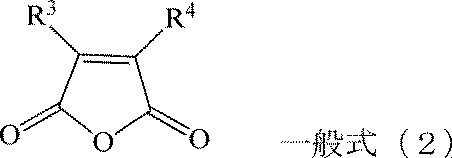
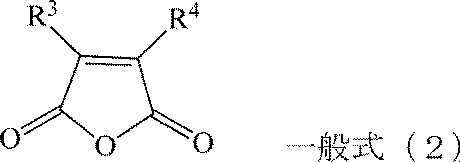
- R 1 and R 2 each independently represents a hydrogen atom or an alkyl group.
- R 3 and R 4 each independently represent a hydrogen atom or an alkyl group.
- the resin mixture (M) contains a methacrylic resin (A) and an SMA resin (B).
- the content of the methacrylic resin (A) in the resin mixture (M) is in the range of 5 to 90% by mass.
- the content of the methacrylic resin (A) in the resin mixture (M) is preferably 10% by mass or more, more preferably 15% by mass or more, further preferably 20% by mass or more, 30 Most preferably, it is at least mass%.
- the content of the methacrylic resin (A) in the resin mixture (M) is preferably 85% by mass or less, more preferably 80% by mass or less, and further preferably 75% by mass or less. 60% by mass or less is most preferable.
- the layer comprising the resin composition of the present invention has excellent scratch resistance when the content of the methacrylic resin (A) in the resin mixture (M) is 5% by mass or more, and is 90% by mass or less. Thus, it is possible to suppress the occurrence of warpage under high temperature and high humidity when laminated with other layers.
- the methacrylic resin (A) is a resin containing a structural unit derived from a methacrylic acid ester.
- the methacrylic acid ester include methyl methacrylate (hereinafter referred to as “MMA”), ethyl methacrylate, n-propyl methacrylate, isopropyl methacrylate, n-butyl methacrylate, isobutyl methacrylate, tert-butyl methacrylate, Methacrylic acid alkyl esters such as pentyl methacrylate, hexyl methacrylate, heptyl methacrylate, 2-ethylhexyl methacrylate, nonyl methacrylate, decyl methacrylate, dodecyl methacrylate; 1-methylcyclopentyl methacrylate, cyclohexyl methacrylate, cyclohexane methacrylate methacrylic acid; heptyl,
- the content of the structural unit derived from the methacrylic ester in the methacrylic resin (A) is preferably 90% by mass or more, more preferably 95% by mass or more, further preferably 98% by mass or more, and only the structural unit derived from the methacrylic ester. It may be.
- the methacrylic resin (A) preferably contains 90% by mass or more of structural units derived from MMA, more preferably 95% by mass or more, and 98% by mass or more. Is more preferable, and only a structural unit derived from MMA may be used.
- the methacrylic resin (A) may contain a structural unit derived from another monomer other than the methacrylic acid ester.
- Such other monomers include methyl acrylate (hereinafter referred to as “MA”), ethyl acrylate, n-propyl acrylate, isopropyl acrylate, n-butyl acrylate, isobutyl acrylate, tert-acrylate Butyl, hexyl acrylate, 2-ethylhexyl acrylate, nonyl acrylate, decyl acrylate, dodecyl acrylate, stearyl acrylate, 2-hydroxyethyl acrylate, 2-hydroxypropyl acrylate, 4-hydroxybutyl acrylate, acrylic Cyclohexyl acid, 2-methoxyethyl acrylate, 3-methoxybutyl acrylate, trifluoromethyl acrylate, trifluoroethyl acrylate, pentafluoro
- the total content of structural units derived from these other monomers in the methacrylic resin (A) is preferably 10% by mass or less, more preferably 5% by mass or less, and even more preferably 2% by mass or less.
- the methacrylic resin (A) can be obtained by polymerizing the above methacrylic acid ester alone or the methacrylic acid ester and another monomer as an optional component.
- a plurality of types of monomers in such polymerization usually, such a plurality of types of monomers are mixed to prepare a monomer mixture and then subjected to polymerization.
- radical polymerization is preferably performed by a method such as a bulk polymerization method, a suspension polymerization method, a solution polymerization method, and an emulsion polymerization method from the viewpoint of productivity.
- the weight average molecular weight (hereinafter referred to as “Mw”) of the methacrylic resin (A) is preferably 40,000 to 500,000.
- Mw weight average molecular weight
- the laminate of the present invention is excellent in scratch resistance and heat resistance, and when it is 500,000 or less, the resin mixture (M) is excellent in molding processability, Productivity of the laminate of the present invention can be increased.
- the content of the SMA resin (B) in the resin mixture (M) is in the range of 10 to 95% by mass.
- the content of the SMA resin (B) in the resin mixture (M) is preferably 15% by mass or more, more preferably 20% by mass or more, further preferably 25% by mass or more, and 40% by mass. Most preferably, it is at least%.
- the content of the SMA resin (B) in the resin mixture (M) is preferably 90% by mass or less, more preferably 85% by mass or less, and further preferably 80% by mass or less. Most preferably, it is 70 mass% or less.
- the layer made of the resin composition of the present invention is laminated with another layer because the content of the SMA resin (B) in the resin mixture (M) is 10% by mass or more, it warps under high temperature and high humidity. Generation
- production can be suppressed and it is excellent in abrasion resistance because it is 95 mass% or less.
- the SMA resin (B) is a vinyl copolymer (B) comprising at least a structural unit (b1) derived from an aromatic vinyl compound and a structural unit (b2) derived from a cyclic acid anhydride.
- Examples of the alkyl group independently represented by R 1 and R 2 in the general formula (1) and R 3 and R 4 in the general formula (2) include a methyl group, an ethyl group, an n-propyl group, an isopropyl group, n-butyl group, sec-butyl group, isobutyl group, t-butyl group, n-pentyl group, isopentyl group, neopentyl group, n-hexyl group, n-heptyl group, n-octyl group, 2-ethylhexyl group, nonyl Group, decyl group, dodecyl group and the like, preferably an alkyl group having 12 or less carbon atoms, methyl group, ethyl group, n-propyl group, isopropyl group, n-butyl group, sec-butyl group, isobutyl group, t-butyl group
- R 1 is preferably a hydrogen atom, a methyl group, an ethyl group or a t-butyl group.
- R 2 , R 3 and R 4 are preferably a hydrogen atom, a methyl group and an ethyl group.
- the content of the structural unit derived from the aromatic vinyl compound (b1) in the SMA resin (B) is preferably 50% by mass or more, more preferably 55% by mass or more, and 60% by mass or more. More preferably. Further, the content of the structural unit derived from the aromatic vinyl compound (b1) in the SMA resin (B) is preferably 84% by mass or less, more preferably 82% by mass or less, and 80% by mass or less. More preferably. When the content is in the range of 50 to 84% by mass, the resin mixture (M) is excellent in moisture resistance and transparency.
- the SMA resin (B) is composed of two monomers, the aromatic vinyl compound (b1) and the cyclic acid anhydride (b2), the aromatic vinyl compound (b1) in the SMA resin (B).
- the content of the structural unit derived from is preferably in the range of 50 to 85% by mass.
- aromatic vinyl compound (b1) examples include styrene; alkyl substituted styrenes such as 2-methylstyrene, 3-methylstyrene, 4-methylstyrene, 4-ethylstyrene, 4-tert-butylstyrene; ⁇ -methylstyrene , ⁇ -alkyl-substituted styrene such as 4-methyl- ⁇ -methylstyrene; and styrene is preferable from the viewpoint of availability.
- aromatic vinyl compounds (b1) may be used alone or in combination of two or more.
- the content of the structural unit derived from the cyclic acid anhydride (b2) in the SMA resin (B) is preferably 15% by mass or more, more preferably 18% by mass or more, and 20% by mass or more. More preferably.
- the content of the structural unit derived from the cyclic acid anhydride (b2) in the SMA resin (B) is preferably 49% by mass or less, more preferably 45% by mass or less, and 40% by mass or less. More preferably. When the content is in the range of 15 to 49% by mass, the resin mixture (M) is excellent in heat resistance and transparency.
- the SMA resin (B) is composed of two monomers, an aromatic vinyl compound (b1) and a cyclic acid anhydride (b2)
- the cyclic acid anhydride (b2) in the SMA resin (B) is preferably in the range of 15 to 50% by mass.
- Examples of the cyclic acid anhydride (b2) include maleic anhydride, citraconic anhydride, and dimethylmaleic anhydride, and maleic anhydride is preferable from the viewpoint of availability.
- a cyclic acid anhydride (b2) may be used individually by 1 type, or may use multiple types together.
- the SMA resin (B) preferably contains a structural unit derived from a methacrylic acid ester in addition to the aromatic vinyl compound (b1) and the cyclic acid anhydride (b2).
- the content of the structural unit derived from the methacrylic acid ester (b3) in the SMA resin (B) is preferably 1% by mass or more, more preferably 3% by mass or more, and more preferably 5% by mass or more. More preferably.
- the content of the structural unit derived from the methacrylic acid ester (b3) in the SMA resin (B) is preferably 35% by mass or less, more preferably 30% by mass or less, and 26% by mass or less. More preferably it is. When the content is in the range of 1 to 35% by mass, the transparency and thermal stability are further improved.
- Examples of the methacrylic acid ester (b3) include MMA, ethyl methacrylate, propyl methacrylate, isopropyl methacrylate, n-butyl methacrylate, propyl methacrylate, isopropyl methacrylate, n-butyl methacrylate, isobutyl methacrylate t -Butyl, 2-ethylhexyl methacrylate, cyclohexyl methacrylate, phenyl methacrylate, benzyl methacrylate, 1-phenylethyl methacrylate; and the like.
- methacrylic acid esters methacrylic acid alkyl esters having 1 to 7 carbon atoms in the alkyl group are preferable, and MMA is particularly preferable because the obtained SMA resin is excellent in heat resistance and transparency.
- methacrylic acid ester may be used individually by 1 type, or may use multiple types together.
- the SMA resin (B) may have a structural unit derived from another monomer other than the aromatic vinyl compound (b1), the cyclic acid anhydride (b2), and the methacrylic acid ester (b3).
- Such other monomers include MA, ethyl acrylate, n-propyl acrylate, isopropyl acrylate, n-butyl acrylate, isobutyl acrylate, tert-butyl acrylate, hexyl acrylate, 2-ethylhexyl acrylate.
- the content of the structural unit derived from the other monomer in the SMA resin (B) is preferably 10% by mass or less, more preferably 5% by mass or less, and further preferably 2% by mass or less.
- the SMA resin (B) is obtained by polymerizing at least the monomers of the aromatic vinyl compound (b1) and the cyclic acid anhydride (b2).
- the monomer may be polymerized by adding the methacrylic acid ester (b3) and other optional monomers.
- the monomers to be used are mixed to prepare a monomer mixture and then subjected to polymerization.
- radical-polymerize by methods, such as a block polymerization method and a solution polymerization method.
- the Mw of the SMA resin (B) is preferably in the range of 40,000 to 300,000.
- the laminate of the present invention has excellent scratch resistance and impact resistance, and when it is 300,000 or less, the resin mixture (M) has excellent moldability.
- the productivity of a molded product comprising the resin composition of the present invention can be increased.
- the mass ratio of the methacrylic resin (A) and the SMA resin (B) contained in the resin mixture (M) suppresses the occurrence of warpage under high temperature and high humidity, and is transparent. From the viewpoint of the property and scratch resistance, it is preferably in the range of 5/95 to 90/10.
- the mass ratio is more preferably 10/90 or more, further preferably 15/85 or more, and particularly preferably 20/80 or more. Further, the mass ratio is more preferably 85/15 or less, further preferably 80/20 or less, and particularly preferably 75/25 or less.
- a melt mixing method for example, a solution mixing method, or the like can be used.
- a melt mixing method for example, using a melt kneader such as a uniaxial or multiaxial kneader, an open roll, a Banbury mixer, a kneader, and the like, under an inert gas atmosphere such as nitrogen gas, argon gas, helium gas, etc. Perform melt-kneading.
- the methacrylic resin (A) and the SMA resin (B) are dissolved and mixed in an organic solvent such as toluene, tetrahydrofuran, or methyl ethyl ketone.
- the resin mixture (M) may contain a polymer other than the methacrylic resin (A) and the SMA resin (B) as long as the effects of the present invention are not impaired.
- examples of such other polymers include polyolefins such as polyethylene, polypropylene, polybutene-1, poly-4-methylpentene-1, polynorbornene, ethylene ionomers; polystyrene, styrene-maleic anhydride copolymer, high impact polystyrene, Styrenic resins such as AS resin, ABS resin, AES resin, AAS resin, ACS resin, MBS resin; methyl methacrylate-styrene copolymer; polyester such as polyethylene terephthalate and polybutylene terephthalate; nylon 6, nylon 66, polyamide elastomer Polyamides such as polyphenylene sulfide, polyether ether ketone, polyester, polysulfone, polyphenylene oxide, polyimide,
- Resin mixture (M) may contain various additives as necessary.
- additives include antioxidants, thermal deterioration inhibitors, ultraviolet absorbers, light stabilizers, lubricants, mold release agents, polymer processing aids, antistatic agents, flame retardants, dyes / pigments, and light diffusing agents. , Matting agents, impact resistance modifiers, phosphors and the like.
- the content of these additives can be appropriately set within a range not impairing the effects of the present invention.
- the content of the antioxidant is 0.01 to 1 part by mass with respect to 100 parts by mass of the resin mixture (M).
- the UV absorber content is 0.01-3 parts by mass
- the light stabilizer content is 0.01-3 parts by mass
- the lubricant content is 0.01-3 parts by mass
- the dye / pigment content is The amount is preferably 0.01 to 3 parts by mass.
- the methacrylic resin (A) and / or the SMA resin (B) may be added when polymerizing the methacrylic resin (A) and / or the SMA resin (B). Even when the SMA resin (B) is mixed, it may be added after the methacrylic resin (A) and the SMA resin (B) are mixed.
- the glass transition temperature of the resin mixture (M) is preferably in the range of 120 to 160 ° C.
- the lower limit of the glass transition temperature is more preferably 130 ° C. or higher, and further preferably 140 ° C. or higher.
- the upper limit value of the glass transition temperature is more preferably 155 ° C. or less, and further preferably 150 ° C. or less.
- the glass transition temperature in this specification is a temperature when it measures with the temperature increase rate of 10 degree-C / min using a differential scanning calorimeter, and is calculated by the midpoint method.
- the melt flow rate (hereinafter referred to as “MFR”) of the resin mixture (M) is preferably in the range of 1 to 10 g / 10 minutes.
- the lower limit value of MFR is more preferably 1.5 g / 10 min or more, and further preferably 2.0 g / 10 min.
- the upper limit value of MFR is more preferably 7.0 g / 10 min or less, and further preferably 4.0 g / 10 min or less.
- MFR of the resin mixture (M) in this specification is a value measured using a melt indexer at a temperature of 230 ° C. and a load of 3.8 kg.
- the lubricant is a known additive that is added to the resin in order to impart lubricity and releasability.
- Known lubricants include higher alcohol lubricants, hydrocarbon lubricants, fatty acid lubricants, fatty acid metal salt lubricants, aliphatic amide lubricants, ester lubricants, and the like.
- a lubricant that satisfies the following conditions (i) and (ii) is used.
- the lubricant (x1) composed of a monoglyceride of a saturated fatty acid having 10 to 24 carbon atoms is not contained, or 0.1 parts by mass or less with respect to 100 parts by mass of the resin mixture (M).
- At least one lubricant (Y) selected from the group consisting of (excluding the lubricant (x2)) is 0.001 to 2 parts by mass with respect to 100 parts by mass of the resin mixture (M).
- the total amount of the lubricant is preferably in the range of 0.001 to 3 parts by mass with respect to 100 parts by mass of the resin mixture (M) from the viewpoint of the balance between the heat resistance of the resin composition and the appearance quality of the molded body.
- the total amount of the lubricant is more preferably 0.005 parts by mass or more, still more preferably 0.01 parts by mass or more, still more preferably 0.1 parts by mass or more, and 0.15 parts by mass. The above is most preferable.
- the total amount of the lubricant is more preferably 2 parts by mass or less, and further preferably 1 part by mass or less.
- the lubricant (x1) is a lubricant composed of a monoglyceride of a saturated fatty acid having 10 to 24 carbon atoms
- the lubricant (x2) is a lubricant composed of a fatty acid ester having two or more hydroxyl groups in one molecule excluding the lubricant (x1). It is. That is, when the lubricant (X) is a lubricant composed of a fatty acid ester having two or more hydroxyl groups in one molecule, the lubricant (X) is composed of the lubricant (x1) and the lubricant (x2). ) Minus the lubricant (x1) is the lubricant (x2).
- the lubricant (Y) is at least one selected from the group consisting of higher alcohols, hydrocarbons, fatty acids, fatty acid metal salts, aliphatic amides, and fatty acid esters (excluding the lubricant (x1) and the lubricant (x2)). is there. That is, the lubricant (Y) is obtained by removing the lubricant (X) from higher alcohols, hydrocarbons, fatty acids, fatty acid metal salts, aliphatic amides, and fatty acid esters.
- Examples of the lubricant (x1) include monoglycerides such as glycerin monostearate and glycerin monobehenate.
- the lubricant (x1) may be used alone or in combination of two or more.
- Glycerol monostearate and stearic acid monoglyceride are terms indicating the same compound.
- the amount of lubricant (x1) is 0 to 0.1 parts by mass with respect to 100 parts by mass of the resin mixture (M).
- the amount of the lubricant (x1) is preferably 0.05 parts by mass or less, more preferably 0.03 parts by mass or less, and 0.01 parts by mass with respect to 100 parts by mass of the resin mixture (M). More preferably, it is as follows.
- the amount of the lubricant (x1) is too large, when the resin composition is melt-molded, it reacts with the cyclic acid anhydride (b2) unit of the vinyl copolymer (B) to form a gel, and foreign matter is formed in the molded product. It tends to cause defects and poor appearance.
- Examples of the lubricant (x2) include polyhydric alcohol fatty acid partial esters other than the lubricant (x1). Specifically, pentaerythritol monostearate such as pentaerythritol monostearate and pentaerythritol distearate, sorbitan Examples include sorbitan mono / diester such as monostearate and sorbitan monopalmitate.
- the number of carbon atoms of the fatty acid is preferably 10 to 40, more preferably 10 to 24, and still more preferably 14 to 24.
- the fatty acid may be an unsaturated fatty acid or a saturated fatty acid.
- the lubricant (x2) may be used alone or in combination of two or more.
- the lubricant (Y) is at least one selected from the group consisting of higher alcohols, hydrocarbons, fatty acids, fatty acid metal salts, aliphatic amides, and fatty acid esters (excluding the lubricant (x1) and the lubricant (x2)). is there.
- the lubricant (Y) is preferably at least one selected from the group consisting of an aliphatic monohydric alcohol having 12 to 18 carbon atoms and a saturated fatty acid having 16 to 24 carbon atoms, more preferably 12 to 18 carbon atoms. It is an aliphatic monohydric alcohol.
- the amount of the lubricant (Y) is 0.001 to 2 parts by mass with respect to 100 parts by mass of the resin mixture (M).
- the amount of the lubricant (Y) is preferably 0.005 parts by mass or more, more preferably 0.01 parts by mass or more, and 0.1 parts by mass with respect to 100 parts by mass of the resin mixture (M). More preferably, it is more preferably 0.12 parts by mass or more.
- the lubricant (Y) can be used alone or in combination of two or more. It is preferable to use a plurality of lubricants (Y) having a difference in melting point of 5 ° C. or more as the lubricant (Y) because the effects such as anti-friction properties can be exhibited in a wider temperature range.
- the higher alcohol examples include lauryl alcohol, myristyl alcohol, cetyl alcohol, stearyl alcohol, and oleyl alcohol.
- the higher alcohol used in the present invention is preferably an aliphatic monohydric alcohol, more preferably an aliphatic monohydric alcohol having 12 to 18 carbon atoms, from the viewpoint of high anti-friction properties and less mold and roll stains. Further, a saturated aliphatic monohydric alcohol having 12 to 18 carbon atoms is more preferable, and a saturated aliphatic monohydric alcohol having 16 to 18 carbon atoms is still more preferable.
- the hydrocarbon is preferably an aliphatic hydrocarbon having 12 or more carbon atoms from the viewpoint of high antifriction and releasability.
- Commercially available products such as aliphatic hydrocarbons such as liquid paraffin, microcrystalline wax, natural paraffin, synthetic paraffin and polyolefin wax; partial oxides of aliphatic hydrocarbons; halides of aliphatic hydrocarbons can be used. Even in the case of these commercially available mixtures, the aliphatic hydrocarbons contained preferably have an average number of carbon atoms of 12 or more.
- fatty acid examples include lauric acid, palmitic acid, stearic acid, arachidic acid, behenic acid, lignoceric acid, oleic acid, erucic acid, arachidonic acid, and 12-hydroxystearic acid.
- the fatty acid used in the present invention is preferably a fatty acid having 10 or more carbon atoms, more preferably a fatty acid having 16 to 24 carbon atoms, more preferably a carbon atom, from the viewpoint of high anti-friction properties and less mold and roll stains. Saturated fatty acids of several 16 to 24 are more preferred.
- fatty acid metal salt examples include cadmium stearate, cadmium laurate, cadmium ricinoleate, cadmium naphthenate, cadmium 2-ethylhexoate, barium stearate, barium laurate, barium ricinoleate, barium naphthenate, and barium 2-ethylhexoate.
- the fatty acid constituting the fatty acid metal salt is preferably a fatty acid having 10 or more carbon atoms, more preferably a fatty acid having 16 to 24 carbon atoms, from the viewpoint of high anti-friction properties and less mold dirt and roll dirt. More preferred are saturated fatty acids having 16 to 24 carbon atoms.
- the metal constituting the fatty acid metal salt calcium, magnesium, zinc, lead, tin, iron, cadmium, aluminum, barium, cobalt, nickel, manganese, strontium, titanium, vanadium, from the viewpoint of stability and antifriction And at least one metal selected from the group consisting of copper, and more preferably at least one metal selected from the group consisting of calcium, magnesium, zinc and lead.
- aliphatic amide examples include lauric acid amide, palmitic acid amide, stearic acid amide, arachidic acid amide, behenic acid amide, oleic acid amide, eicosenoic acid amide, erucic acid amide, erucic acid amide, methylene bis stearic acid amide, ethylene Examples thereof include bis-stearic acid amide.
- the aliphatic amide used in the present invention is preferably a fatty acid amide having 12 or more carbon atoms, more preferably a fatty acid amide having 16 to 22 carbon atoms from the viewpoint of high anti-friction properties and less mold and roll stains. An unsaturated fatty acid amide having 16 to 22 carbon atoms is more preferable.
- the fatty acid ester (excluding lubricant (x1) + lubricant (x2)) is a fatty acid ester not having two or more hydroxyl groups in one molecule.
- a fatty acid ester of a monohydric alcohol a fatty acid of a dihydric alcohol
- examples thereof include diglyceride, triglyceride, acetylated monoglyceride, stearyl stearate, butyl stearate, ethylene glycol monostearate, ethylene glycol distearate and the like.
- the fatty acid ester used in the present invention (excluding the lubricant (x1) + lubricant (x2)) is a carbon atom of the fatty acid in the fatty acid ester from the viewpoint of high anti-friction properties and less mold dirt and roll dirt.
- the number is preferably 10 or more, more preferably 16 to 24.
- the lubricant of the present invention may further satisfy the following conditions (iii) and (iv). By satisfying (iii) and (iv), no foreign material defect or poor appearance is caused in the molded product when the resin composition is melt-molded.
- the lubricant (x2) is not contained or is 0.1 part by mass or less with respect to 100 parts by mass of the resin mixture (M).
- the total of the lubricant (x1) and the lubricant (x2) is in the range of 0 to 0.1 with respect to 100 parts by mass of the resin mixture (M).
- the amount of the lubricant (x2) is more preferably 0.05 parts by mass or less, and 0.03 parts by mass or less with respect to 100 parts by mass of the resin mixture (M). More preferably, it is particularly preferably 0.01 parts by mass or less.
- the amount of the lubricant (x2) is too large, a gel is formed when the resin composition is melt-molded, and there is a tendency to cause a foreign matter defect or an appearance defect in the molded product.
- the resin composition of the present invention may contain various additives as necessary.
- additives include heat stabilizers, antioxidants, heat deterioration inhibitors, ultraviolet absorbers, light stabilizers, inorganic fillers, inorganic or organic fibers, polymer processing aids, antistatic agents, flame retardants, Examples thereof include dyes and pigments, colorants, matting agents, light diffusing agents, impact modifiers, phosphors, adhesives, tackifiers, plasticizers, and foaming agents.
- the content of these additives can be appropriately set as long as the effects of the present invention are not impaired.
- the content of the antioxidant is 0.01 to 1.0 part by mass
- the content of the ultraviolet absorber is 0.01 to 3.0 parts by mass
- the content is preferably 0.00001 to 0.01 parts by mass.
- the method for preparing the resin composition according to the present invention is not particularly limited.
- a resin mixture (M) is kneaded at a temperature equal to or higher than the softening point, and a lubricant that satisfies the requirements (i) and (ii) is added to 100 parts by mass of the resin mixture (M) of the present invention, and an additive that is blended as necessary It can be obtained by adding an agent and another polymer and kneading.
- the resin mixture (M), the lubricant satisfying the requirements (i) and (ii) of the present invention, the additive blended as necessary, and other polymers are dissolved in a solvent, and the solvent is removed from the solution. Can be obtained by removing.
- the resin composition according to the present invention has a glass transition temperature of preferably 115 to 160 ° C. More preferably, it is 130 to 155 ° C, and further preferably 140 to 150 ° C. By setting the glass transition temperature of the resin composition within the range of 115 to 160 ° C., the resin composition has a good balance between heat resistance and impact resistance.
- the resin composition is laminated with a thermoplastic resin such as polycarbonate. Warpage of the body under high temperature and high humidity is suppressed.
- the resin composition according to the present invention has a saturated water absorption in water at 23 ° C. of preferably 0.3 to 1.9% by mass. More preferred is 0.3 to 1.5% by mass, and further more preferred is 0.3 to 1.0% by mass.
- the saturated water absorption is the rate of increase in mass at the time when equilibrium is reached by immersing the molded product in distilled water at 23 ° C. and measuring the mass over time relative to the mass of the molded product vacuum-dried for 3 days or more. It is a measured value.
- the resin composition of the present invention is formed by extrusion molding methods such as co-extrusion molding, T-die lamination molding, and extrusion coating; insert injection molding, two-color injection molding, core back injection molding, sandwich injection molding, Various molded products can be obtained by heat-melt molding by an injection molding method such as an injection breath molding method; blow molding method; calendar molding method; press molding method; slush molding method.
- the resin composition of the present invention is also suitable for the production of molded products that require high temperature and long-term residence conditions because gels are unlikely to form even when melt molded for a long time at high temperatures.
- the resin composition of the present invention is suitable for production of thin and wide molded articles such as sheets, films, and plates.
- the laminate of the present invention has at least one layer composed of the resin composition of the present invention (hereinafter also referred to as resin composition [C1]) and at least one layer composed of another material.
- resin composition [C1] the resin composition of the present invention
- Other materials used for the laminate of the present invention are not particularly limited. Examples thereof include organic materials such as resins; inorganic materials such as simple metals and metal oxides.
- the laminate according to an embodiment of the present invention has at least one layer made of the resin composition [C1] and at least one layer made of the resin composition [C2] which is another layer.
- Resin contained in the resin composition [C2] is not particularly limited.
- the resin include polyolefin such as polyethylene and polypropylene, polystyrene, (meth) acrylic resin, polyester, polyamide, polycarbonate, polyvinyl chloride, polyvinylidene chloride, polyvinyl alcohol, ethylene-vinyl alcohol copolymer, polyacetal, polyfluoride.
- Resin of resin composition [C2] can be used individually by 1 type or in combination of 2 or more types. Of these, thermoplastic resins are preferable, and polycarbonate is more preferable.
- the amount of polycarbonate contained in the resin composition [C2] is preferably 90% by mass or more, more preferably 95% by mass or more, and 98% by mass or more. More preferably.
- the weight average molecular weight of the polycarbonate is preferably 20,000 to 100,000. When the weight average molecular weight of the polycarbonate is within the above range, the heat resistance and impact resistance of the resin composition [C2] are improved, and a laminated sheet comprising the resin composition [C1] and the resin composition [C2] is obtained. It can be manufactured with excellent moldability and high productivity.
- the polycarbonate has Mw / Mn of preferably 1.7 to 2.6, more preferably 1.7 to 2.3, and still more preferably 1.7 to 2.0.
- polycarbonate Commercially available products may be used as the polycarbonate.
- “Taflon (registered trademark)” manufactured by Teijin Chemicals Ltd. and “Panlite (registered trademark)” manufactured by Teijin Chemicals Ltd. can be suitably used.
- the resin composition [C2] used in the present invention is preferably a thermoplastic resin composition (T) having a glass transition temperature of 130 to 160 ° C.
- the thermoplastic resin composition (T) is preferably a resin composition containing polycarbonate.
- the glass transition temperature of resin composition [C2] is comparable as the glass transition temperature of resin composition [C1].
- the difference ⁇ Tg between the glass transition temperature of the resin composition [C2] and the glass transition temperature of the resin composition [C1] is preferably 30 ° C. or less, more preferably 20 ° C. or less. When the glass transition temperature of both resins is 30 ° C. or lower, the effect of suppressing the occurrence of warpage of the laminate under high temperature and high humidity becomes higher.
- the resin composition [C2] used in the present invention preferably has a saturated water absorption of 0.2 to 0.5% by mass. Moreover, it is preferable that the resin composition [C2] has the same saturated water absorption as that of the resin composition [C1]. Specifically, the difference in saturated water absorption between the resin composition [C2] and the resin composition [C1], that is, ⁇ saturated water absorption is preferably 1.5% by mass or less, more preferably 1.0% by mass or less. It is. When the saturated water absorption of both resins is about the same, the effect of suppressing the occurrence of warpage of the laminate under high temperature and high humidity becomes higher.
- the resin composition [C2] used in the present invention may contain a known additive in order to improve heat decomposition resistance, heat discoloration resistance, light resistance and the like.
- Additives include antioxidants, thermal degradation inhibitors, UV absorbers, light stabilizers, lubricants, mold release agents, polymer processing aids, antistatic agents, flame retardants, dyes and pigments, light diffusing agents, organic dyes , Matting agents, impact resistance modifiers, phosphors and the like.
- the laminate according to another embodiment of the present invention includes at least one layer [L1] composed of the resin composition [C1], at least one layer [L2] composed of the resin composition [C2], and at least one function. And a property-imparting layer [L3].
- the functionality-imparting layer [L3] is not particularly limited. Examples thereof include a scratch-resistant layer, a hard coat layer, an antistatic layer, an antifouling layer, a friction reducing layer, an antiglare layer, an antireflection layer, an adhesive layer, and an impact strength imparting layer.
- the functional layer [L3] can be formed by a known method.
- the hard coat layer can be obtained by applying a resin solution for hard coat, drying and curing.
- the antireflection layer can be obtained by laminating a low refractive index film and a high refractive index film by vapor deposition or the like.
- the scratch-resistant layer, the hard coat layer, the antistatic layer, the antifouling layer, the friction reducing layer, the antiglare layer, the antireflection layer and the like are generally on the outermost side of the laminate.
- Only 1 type may be provided for functional provision layer [L3], and multiple types may be provided.
- the laminate of the present invention preferably has a scratch-resistant layer on at least one surface.
- the layer structure in the laminate of the present invention is not particularly limited.
- the layer composed of the resin composition [C1] is the [L1] layer
- the layer composed of the resin composition [C2] is the [L2] layer
- the functional layer [L3] is “ For example, [L1] layer / [L2] layer, [L1] layer / [L2] layer / [L1] layer, [L2] layer / [L1] layer / [L2] layer, [L1] layer / [L2] layer / [L1] layer / [L2] layer / [L1] layer, [L1] layer / [L2] layer / [L3] layer, [L3] layer / [L1] layer / [ [L2] layer, [L3] layer / [L1] layer / [ [L2] layer, [L3] layer / [L1] layer / [ [L2] layer, [L3] layer / [L1] layer / [
- [L3] layer / [L1] layer / [L2] layer when the [L3] layer is a hard coat layer, [L3] layer / [L1] layer / [L2] layer / [L3] layer, L3] layer / [L1] layer / [L2] layer / [L1] layer / [L3] layer are preferable.
- the present invention is useful in a laminate having a shape such as a sheet, a thin plate, or a film.
- a protective cover it is preferable to arrange
- a laminate having a layer configuration of [L1] layer / [L2] layer may be arranged in the order of [L1] layer / [L2] layer / protected surface, or [L1] layer / [L2] layer / [ It is preferable to arrange the laminated body having the layer configuration of the L1 layer in the order of [L1] layer / [L2] layer / ⁇ [L1] layer / protected surface.
- the total thickness of the laminate according to the present invention can be set depending on the application, but is preferably 0.2 to 2 mm, more preferably 0.3 to 1.5 mm. If it is too thin, the rigidity tends to be insufficient. If it is too thick, it tends to hinder weight reduction of liquid crystal display devices.
- the thickness of the layer made of the resin composition [C1] in the laminate according to the present invention is preferably in the range of 0.02 to 0.5 mm.
- the lower limit value of the thickness of the layer is more preferably 0.03 mm or more, and further preferably 0.05 mm or more.
- the upper limit value of the thickness of the layer is more preferably 0.3 mm or less, and further preferably 0.1 mm or less.
- the laminate according to the present invention has a lamination order that is symmetric in the thickness direction, and the thickness of each layer is also symmetric. More preferred.
- the laminate according to the present invention is not particularly limited by the production method, and can be produced by a multilayer molding method such as multilayer extrusion molding, multilayer blow molding, multilayer press molding, multicolor injection molding, insert injection molding, or the like. .
- multilayer extrusion molding of the resin composition [C1] and the resin composition [C2] is preferable from the viewpoint of productivity.
- the method of multilayer extrusion molding is not particularly limited, and a known multilayer extrusion molding method used for the production of multilayer laminates of thermoplastic resins is adopted, and includes, for example, a flat T die and a polishing roll having a mirror-finished surface. Molded by the machine.
- a heat-melted resin composition [C1] and a resin composition [C2] are laminated before the T die is flown, or a resin composition [C1] and a resin composition [C2].
- the resin composition [C1] and the resin composition [C2] are preferably melt filtered through a filter before multilayer molding.
- a filter used for melt filtration is not particularly limited.
- the filter is appropriately selected from known ones in terms of operating temperature, viscosity, required filtration accuracy, and the like.
- Specific examples of the filter include nonwoven fabric made of polypropylene, cotton, polyester, viscose rayon, glass fiber, etc .; phenol resin impregnated cellulose film; metal fiber nonwoven fabric sintered film; metal powder sintered film; wire mesh; Can be mentioned.
- a plurality of laminated metal fiber nonwoven fabric sintered films it is preferable to use a plurality of laminated metal fiber nonwoven fabric sintered films.
- the resin composition of the present invention has excellent heat resistance and moisture resistance. Further, when a molded product and a laminate are produced using the resin composition of the present invention, the adhesion with the molding roll and the release property are good, and the gel is generated even if the melt molding is continued for a long time. It can be improved effectively.
- a molded product and a laminate obtained by melt-molding the resin composition according to the present invention have a small dimensional change, few foreign object defects, and a good appearance, and therefore can be suitably used for an optical member or the like.
- ⁇ Glass transition temperature (Tg)> In accordance with JIS K7121, the resin composition of the present invention was heated from room temperature to 200 ° C. at 20 ° C./min, held for 10 minutes, cooled to room temperature, and then from room temperature to 200 ° C. at 10 / min. Differential scanning calorimetry (DSC) analysis was performed under the temperature conditions for increasing the temperature. The midpoint glass transition temperature obtained from the DSC curve measured at the second temperature increase was adopted as the glass transition temperature in the present invention. A DSC-50 manufactured by Shimadzu Corporation was used as a measuring device.
- DSC Differential scanning calorimetry
- the resin composition of the present invention was injection molded under the conditions of a cylinder temperature of 280 ° C., a mold temperature of 75 ° C., and a molding cycle of 1 minute.
- a square test piece having a thickness of 2 mm and a side of 50 mm was obtained.
- the test piece was vacuum-dried for 24 hours under the conditions of a temperature of 80 ° C. and 5 mmHg.
- the test piece was then allowed to cool in a desiccator. Immediately after removing the test piece from the desiccator, the mass (initial mass) was measured.
- ⁇ Production Example 1> In an autoclave, 96.5 parts by mass of methyl methacrylate, 2.5 parts by mass of methyl acrylate, 0.06 parts by mass of azobisisobutyronitrile, 0.25 parts by mass of n-octyl mercaptan, 250 parts by mass Of water, 0.09 parts by weight of dispersant and 1.07 parts by weight of pH adjuster were added. While stirring the inside of the autoclave, the liquid temperature was raised from room temperature to 70 ° C. and held at 70 ° C. for 120 minutes to carry out the polymerization reaction. The liquid temperature was lowered to room temperature, and the polymerization reaction liquid was extracted from the autoclave.
- a solid content is removed from the polymerization reaction solution by filtration, washed with water, and dried with hot air at 80 ° C. for 24 hours to obtain a bead-shaped methacrylic resin (A) having a glass transition temperature of 110 ° C. and a saturated water absorption of 2.1% by mass. Obtained.
- Example 1a 90 parts by weight of methacrylic resin (A), 10 parts by weight of vinyl copolymer (B) (manufactured by Denki Kagaku Kogyo Co., Ltd., Regis R-200, glass transition temperature 134 ° C., saturated water absorption 0.7% by weight) and lubricant (Y) 0.15 parts by mass of cetanol (Kao Co., Ltd., Calcoal 6098) and 0.03 parts by mass of stearic acid monoglyceride (Kao Co., Ltd., Excel T95) as a lubricant (x1) in a biaxial kneader Melt kneading was performed at a temperature of 230 ° C. Thereafter, the molten resin was extruded to obtain a pellet-shaped resin composition [1].
- Table 1 shows the composition and physical properties (Tg and saturated water absorption rate of the resin composition) of the resin composition [1].
- Example 2a A resin composition [2] is obtained in the same manner as in Example 1a except that the composition ratio of the resin mixture (M) is 70 parts by mass of the methacrylic resin (A) and 30 parts by mass of the vinyl copolymer (B). It was. Table 1 shows the composition and physical properties of the resin composition [2].
- Example 3a A resin composition [3] was obtained in the same manner as in Example 1a except that the composition ratio of the resin mixture (M) was 50 parts by mass of the methacrylic resin (A) and 50 parts by mass of the vinyl copolymer (B). It was.
- the composition and physical properties of the resin composition [3] are shown in Table 1.
- Example 4a A resin composition [4] is obtained in the same manner as in Example 1a except that the composition ratio of the resin mixture (M) is 30 parts by mass of the methacrylic resin (A) and 70 parts by mass of the vinyl copolymer (B). It was.
- the composition and physical properties of the resin composition [4] are shown in Table 1.
- Example 5a A resin composition [5] is obtained in the same manner as in Example 1a except that the composition ratio of the resin mixture (M) is 5 parts by mass of the methacrylic resin (A) and 95 parts by mass of the vinyl copolymer (B). It was.
- the composition and physical properties of the resin composition [5] are shown in Table 1.
- Example 6a A resin composition [6] was obtained in the same manner as in Example 4a except that the amount of cetanol was changed to 0.3.
- the composition and physical properties of the resin composition [6] are shown in Table 1.
- Example 7a A resin composition [7] was obtained in the same manner as in Example 4a, except that the amount of stearic acid monoglyceride was changed to 0.05 parts by mass.
- the composition and physical properties of the resin composition [7] are shown in Table 1.
- Example 8a Resin composition in the same manner as in Example 4a, except that 0.03 parts by mass of pentaerythritol distearate (lubricant (x2) (manufactured by NOF Corporation, Unistar H-476D)) was used instead of monoglyceride stearate as a lubricant.
- lubricant (x2) manufactured by NOF Corporation, Unistar H-476D
- Table 1 shows the composition and physical properties of the resin composition [8].
- Example 9a A resin composition [9] was obtained in the same manner as in Example 4a, except that the lubricant (Y) consisting only of 0.15 parts by mass of cetanol was used as the lubricant.
- the composition and physical properties of the resin composition [9] are shown in Table 1.
- Example 10a Resin composition [10] was obtained in the same manner as in Example 4a, except that 0.05 parts by mass of stearyl alcohol (Kalco 8098, manufactured by Kao Corporation) was added as a lubricant (Y). The composition and physical properties of the resin composition [10] are shown in Table 1.
- Example 11a A resin composition [11] was obtained in the same manner as in Example 4a except that stearyl alcohol was used instead of cetanol as the lubricant (Y). The composition and physical properties of the resin composition [11] are shown in Table 1.
- Example 12a Resin composition [12] was obtained in the same manner as in Example 4a except that stearic acid (Lunac S-90V, manufactured by Kao Corporation) was used as the lubricant (Y) instead of cetanol.
- stearic acid Linac S-90V, manufactured by Kao Corporation
- Y lubricant
- Table 1 The composition and physical properties of the resin composition [12] are shown in Table 1.
- Example 13a A resin composition [13] was obtained in the same manner as in Example 4a, except that N, N′-methylenebisstearic acid amide (Nippon Kasei Co., Ltd., bisamide LA) was used instead of cetanol as the lubricant (Y). It was.
- N, N′-methylenebisstearic acid amide Nippon Kasei Co., Ltd., bisamide LA
- cetanol lubricant
- Example 14a A resin composition [14] was obtained in the same manner as in Example 4a, except that low molecular weight polyethylene (manufactured by Sanyo Chemical Industries, Ltd., Sunwax 15-P) was used instead of cetanol as the lubricant (Y).
- low molecular weight polyethylene manufactured by Sanyo Chemical Industries, Ltd., Sunwax 15-P
- cetanol lubricant
- Example 1a A resin composition [15] was obtained in the same manner as in Example 1a except that the composition ratio of the resin mixture (M) was 95 parts by mass of the methacrylic resin (A) and 5 parts by mass of the vinyl copolymer (B). It was. Table 1 shows the composition and physical properties of the resin composition [15].
- a resin composition [16] is obtained in the same manner as in Example 1a except that the composition ratio of the resin mixture (M) is 3 parts by mass of the methacrylic resin (A) and 97 parts by mass of the vinyl copolymer (B). It was.
- the composition and physical properties of the resin composition [16] are shown in Table 1.
- Example 3a A resin composition [17] was obtained in the same manner as in Example 3a, except that the amount of stearic acid monoglyceride as the lubricant (x1) was changed to 0.15 parts by mass.
- the composition and physical properties of the resin composition [17] are shown in Table 1.
- the resin compositions according to the present invention (Examples 1a to 14a) have a high glass transition temperature and a low saturated water absorption rate, and thus are excellent in heat resistance and moisture resistance.
- the laminate obtained after 15 hours of continuous operation was visually observed to count the number of gel-like foreign matter defects.
- the gel-like foreign substance defect is a high molecular weight body of a resin composition exhibiting transparency, and is counted as a defect by disturbing the interface layer of the laminate. In the area of 2 m 2, the average number of defects was less than 2, and the case where it was 2 or more was defined as Poor.
- ⁇ Moldability> The surface of the laminate on the side of the resin mixture (M) was visually observed to inspect for the presence or absence of step-like defects (release marks) perpendicular to the extrusion flow direction. In the range of 30 cm in the extruding flow direction, Good had no stepped defects or almost could not be visually recognized, and Poor did not correspond to Good.
- ⁇ War change amount> A rectangular test piece having a short side of 65 mm and a long side of 110 mm was cut out from the laminate so that the direction perpendicular to the extrusion flow direction was the short side and the direction parallel to the extrusion flow direction was the long side. After picking and hanging the short side of the test piece and leaving it in an environmental tester set at a temperature of 75 ° C. and a relative humidity of 50% for 4 hours, the test piece was allowed to cool to 25 ° C. Warped.
- test piece Place the test piece warped in a bow shape on the surface plate so that the end of the test piece is in contact with the surface plate (that is, the test piece is chevron-shaped), and the gap between the surface plate and the test piece is The maximum distance (usually, the vicinity of the center of the long side of the test piece is maximum) was measured using a gap gauge. This value was used as the initial warpage amount. Subsequently, the short side of the bowed test piece was picked and hung and left in an environmental test machine set at a temperature of 85 ° C. and a relative humidity of 85% for 72 hours. The specimen was allowed to cool in an environmental testing machine set at 25 ° C.
- warpage change amount A material having a warpage variation of 1.0 mm or less was defined as Good, and a material having a curvature variation exceeding 1.0 mm was defined as Poor.
- Example 1b Polycarbonate ("SD Polyca (registered trademark) PCX" manufactured by Sumika Stylon Polycarbonate Co., Ltd., the same shall apply hereinafter) to a single-screw extruder [I] with a shaft diameter of 150 mm set at a cylinder temperature of 245 to 260 ° C and a discharge rate of 430 kg / hour. Of pellets were continuously charged. The pellets of the resin composition [1] were continuously charged into a single screw extruder [II] with a shaft diameter of 65 mm set at a cylinder temperature of 215 to 230 ° C. and a discharge rate of 37 kg / hour.
- SD Polyca (registered trademark) PCX manufactured by Sumika Stylon Polycarbonate Co., Ltd., the same shall apply hereinafter
- Example 2b Except for changing the resin composition [1] to the resin composition [2], a layer composed of the resin composition [2] having a thickness of 80 ⁇ m and a layer composed of a polycarbonate having a thickness of 920 ⁇ m were prepared in the same manner as in Example 1b. A laminate having a total thickness of 1000 ⁇ m was obtained.
- Example 3b Except for changing the resin composition [1] to the resin composition [3], a layer composed of the resin composition [3] having a thickness of 80 ⁇ m and a layer composed of a polycarbonate having a thickness of 920 ⁇ m were prepared in the same manner as in Example 1b. A laminate having a total thickness of 1000 ⁇ m was obtained.
- Example 4b Except for changing the resin composition [1] to the resin composition [4], a layer composed of the resin composition [4] having a thickness of 80 ⁇ m and a layer composed of a polycarbonate having a thickness of 920 ⁇ m were prepared in the same manner as in Example 1b. A laminate having a total thickness of 1000 ⁇ m was obtained.
- Example 5b Except that the resin composition [1] was changed to the resin composition [5], a layer composed of the resin composition [5] having a thickness of 80 ⁇ m and a layer composed of a polycarbonate having a thickness of 920 ⁇ m were prepared in the same manner as in Example 1b. A laminate having a total thickness of 1000 ⁇ m was obtained.
- Example 6b Except for changing the resin composition [1] to the resin composition [6], a layer composed of the resin composition [6] having a thickness of 80 ⁇ m and a layer composed of a polycarbonate having a thickness of 920 ⁇ m were prepared in the same manner as in Example 1b. A laminate having a total thickness of 1000 ⁇ m was obtained.
- Example 7b Except for changing the resin composition [1] to the resin composition [7], a layer made of the resin composition [7] having a thickness of 80 ⁇ m and a layer made of a polycarbonate having a thickness of 920 ⁇ m were prepared in the same manner as in Example 1b. A laminate having a total thickness of 1000 ⁇ m was obtained.
- Example 8b Except for changing the resin composition [1] to the resin composition [8], a layer made of the resin composition [8] having a thickness of 80 ⁇ m and a layer made of a polycarbonate having a thickness of 920 ⁇ m were prepared in the same manner as in Example 1b. A laminate having a total thickness of 1000 ⁇ m was obtained.
- Example 9b Except for changing the resin composition [1] to the resin composition [9], a layer made of the resin composition [9] having a thickness of 80 ⁇ m and a layer made of a polycarbonate having a thickness of 920 ⁇ m were prepared in the same manner as in Example 1b. A laminate having a total thickness of 1000 ⁇ m was obtained.
- Example 10b Except for changing the resin composition [1] to the resin composition [10], a layer composed of the resin composition [10] having a thickness of 80 ⁇ m and a layer composed of a polycarbonate having a thickness of 920 ⁇ m were prepared in the same manner as in Example 1b. A laminate having a total thickness of 1000 ⁇ m was obtained.
- Example 11b Except for changing the resin composition [1] to the resin composition [11], a layer made of the resin composition [11] having a thickness of 80 ⁇ m and a layer made of a polycarbonate having a thickness of 920 ⁇ m were prepared in the same manner as in Example 1b. A laminate having a total thickness of 1000 ⁇ m was obtained.
- Example 12b Except for changing the resin composition [1] to the resin composition [12], a layer made of the resin composition [12] having a thickness of 80 ⁇ m and a layer made of a polycarbonate having a thickness of 920 ⁇ m were prepared in the same manner as in Example 1b. A laminate having a total thickness of 1000 ⁇ m was obtained.
- Example 13b Except for changing the resin composition [1] to the resin composition [13], a layer made of the resin composition [13] having a thickness of 80 ⁇ m and a layer made of a polycarbonate having a thickness of 920 ⁇ m were prepared in the same manner as in Example 1b. A laminate having a total thickness of 1000 ⁇ m was obtained.
- Example 14b Except that the resin composition [1] was changed to the resin composition [14], a layer composed of the resin composition [14] having a thickness of 80 ⁇ m and a layer composed of a polycarbonate having a thickness of 920 ⁇ m were prepared in the same manner as in Example 1b. A laminate having a total thickness of 1000 ⁇ m was obtained.
- ⁇ Comparative Example 4b> A layer composed of a resin composition [10] having a thickness of 80 ⁇ m and a layer composed of a polycarbonate having a thickness of 920 ⁇ m were prepared in the same manner as in Example 1b except that the resin composition [1] was changed to the resin composition [18]. A laminate having a total thickness of 1000 ⁇ m was obtained.
- Table 2 shows the evaluation results of Examples 1b to 14b and Comparative Examples 1b to 4b.
- the laminates according to the present invention have few foreign matter defects caused by gels or the like that may be generated during long-term melt molding, and few release marks. I understand. Furthermore, it can be seen that the laminate according to the present invention is excellent in scratch resistance and has little warping even when left under high temperature and high humidity.
- Examples of uses of the molded product, molded product and laminate according to the present invention include billboard components such as advertising towers, stand billboards, sleeve billboards, field billboards, and rooftop billboards; display components such as showcases, partition plates, and store displays.
- billboard components such as advertising towers, stand billboards, sleeve billboards, field billboards, and rooftop billboards
- display components such as showcases, partition plates, and store displays.
Landscapes
- Chemical & Material Sciences (AREA)
- Health & Medical Sciences (AREA)
- Chemical Kinetics & Catalysis (AREA)
- Medicinal Chemistry (AREA)
- Polymers & Plastics (AREA)
- Organic Chemistry (AREA)
- Compositions Of Macromolecular Compounds (AREA)
- Laminated Bodies (AREA)
Abstract
Description
(i)炭素原子数10~24の飽和脂肪酸のモノグリセライドからなる滑剤(x1)が、含まれないか若しくは樹脂混合物(M)100質量部に対し0.1質量部以下である。
(ii)高級アルコール、炭化水素、脂肪酸、脂肪酸金属塩、脂肪族アミド、および脂肪酸エステル(但し、滑剤(x1)および当該滑剤(x1)以外の1分子中に水酸基を2以上有する脂肪酸エステルからなる滑剤(x2)を除く)からなる群より選ばれる少なくとも一つの滑剤(Y)が樹脂混合物(M)100質量部に対し0.001~2質量部、含まれる。

[2] 滑剤(Y)が、炭素原子数12~18の脂肪族1価アルコールおよび炭素原子数16~24の飽和脂肪酸からなる群より選ばれる少なくとも一つである[1]に記載の樹脂組成物。
[3] 樹脂混合物(M)が、メタクリル樹脂(A)30~60質量%と、ビニル系共重合体(B)40~70質量%とを含有する[1]又は[2]に記載の樹脂組成物。
[4] ビニル系共重合体(B)は、芳香族ビニル化合物(b1)に由来する構造単位を50~84質量%含有し、環状酸無水物(b2)に由来する構造単位を15~49質量%含有し、メタクリル酸エステル(b3)に由来する構造単位を1~35質量%含有する[1]~[3]のいずれかに記載の樹脂組成物。
[5] メタクリル酸エステル(b3)がメタクリル酸メチルである[4]に記載の樹脂組成物。
[6] ガラス転移温度が、115~160℃である[1]~[5]のいずれかに記載の樹脂組成物。
[7] 23℃の水中における飽和吸水率が、0.3~1.9質量%である[1]~[6]のいずれかに記載の樹脂組成物。
[8] 前記滑剤が、更に以下の(iii)および(iv)の条件を満たす[1]~[7]のいずれかに記載の樹脂組成物。
(iii)滑剤(x2)が含まれないか、樹脂混合物(M)100質量部に対し0.1質量部以下である。
(iv)滑剤(x1)と滑剤(x2)の合計が樹脂混合物(M)100質量部に対し0~0.1の範囲にある。
[9] 前記滑剤の総量が、樹脂混合物(M)100質量部に対し0.1質量部以上であることを特徴する[1]~[8]のいずれかに記載の樹脂組成物。
[12] 熱可塑性樹脂組成物(T)が、ポリカーボネートを含有する樹脂組成物である[11]に記載の積層体。
[13] 熱可塑性樹脂組成物(T)と前記樹脂組成物とのガラス転移温度の差が30℃以下である[11]又は[12]に記載の積層体。
[14] 少なくとも一方の表面に、さらに耐擦傷性層を備える請求項[11]~[13]のいずれかに記載の積層体。
本発明の樹脂組成物は、メタクリル樹脂(A)と、下記一般式(1)で示される芳香族ビニル化合物(b1)に由来する構造単位および下記一般式(2)で示される環状酸無水物(b2)に由来する構造単位を含むビニル系共重合体(B)(以下、「SMA樹脂(B)」と称する)とを含有する樹脂混合物(M)100質量部と、特定の滑剤とを含有してなるものである。

本発明に係る樹脂混合物(M)は、メタクリル樹脂(A)と、SMA樹脂(B)とを含有してなるものである。
樹脂混合物(M)中のメタクリル樹脂(A)の含有量は5~90質量%の範囲である。樹脂混合物(M)中のメタクリル樹脂(A)の含有量は、10質量%以上であることが好ましく、15質量%以上であることがより好ましく、20質量%以上であることがさらに好ましく、30質量%以上であることが最も好ましい。また、樹脂混合物(M)中のメタクリル樹脂(A)の含有量は、85質量%以下であることが好ましく、80質量%以下であることがより好ましく、75質量%以下であることがさらに好ましく、60質量%以下であることが最も好ましい。本発明の樹脂組成物からなる層は、樹脂混合物(M)中のメタクリル樹脂(A)の含有量が5質量%以上であることで耐擦傷性に優れるものとなり、90質量%以下であることで、他の層と積層した際に高温高湿下における反りの発生を抑制できる。
樹脂混合物(M)中における他の重合体の含有量は10質量%以下であることが好ましく、5質量%以下であることがより好ましく、2質量%以下であることがさらに好ましい。
滑剤は、減摩性、離型性を付与するために樹脂に添加される公知の添加剤である。滑剤としては、高級アルコール系滑剤、炭化水素系滑剤、脂肪酸系滑剤、脂肪酸金属塩系滑剤、脂肪族アミド系滑剤、エステル系滑剤などが知られている。これらのうち、本発明においては、滑剤が以下の条件(i)および(ii)を満たすものを用いる。
(i)炭素原子数10~24の飽和脂肪酸のモノグリセライドからなる滑剤(x1)を含まないか、若しくは樹脂混合物(M)100質量部に対し0.1質量部以下である。
(ii)高級アルコール、炭化水素、脂肪酸、脂肪酸金属塩、脂肪族アミド、および脂肪酸エステル(但し、滑剤(x1)および当該滑剤(x1)以外の1分子中に水酸基を2以上有する脂肪酸エステルからなる滑剤(x2)を除く)からなる群より選ばれる少なくとも一つの滑剤(Y)を、樹脂混合物(M)100質量部に対し0.001~2質量部とする。
脂肪酸金属塩を構成する脂肪酸としては、減摩性が高く且つ金型汚れやロール汚れが少ないという観点から、炭素原子数10以上の脂肪酸が好ましく、炭素原子数16~24の脂肪酸がより好ましく、炭素原子数16~24の飽和脂肪酸がさらに好ましい。脂肪酸金属塩を構成する金属としては、安定性、減摩性の観点から、カルシウム、マグネシウム、亜鉛、鉛、錫、鉄、カドミウム、アルミニウム、バリウム、コバルト、ニッケル、マンガン、ストロンチウム、チタン、バナジウム、および銅からなる群より選ばれる少なくとも1つの金属を含むことが好ましく、カルシウム、マグネシウム、亜鉛および鉛からなる群より選ばれる少なくとも1つの金属を含むことがより好ましい。
(iii)滑剤(x2)が含まれないか、樹脂混合物(M)100質量部に対し0.1質量部以下である。
(iv)滑剤(x1)と滑剤(x2)の合計が、樹脂混合物(M)100質量部に対し0~0.1の範囲にある。
本発明の積層体は、本発明の樹脂組成物(以下、樹脂組成物[C1]ともいう)からなる少なくとも1層と、他の材料からなる少なくとも1層とを有するものである。本発明の積層体に用いられる他の材料は、特に限定されない。例えば、樹脂などの有機材料;金属単体、金属酸化物などの無機材料が挙げられる。
多層押出し成形の方法は特に限定されず、熱可塑性樹脂の多層積層体の製造に用いられる公知の多層押出し成形法が採用され、例えば、フラットなTダイと表面が鏡面仕上げされたポリシングロールを備えた装置によって成形される。Tダイの方式としては、加熱溶融状態の樹脂組成物[C1]および樹脂組成物[C2]がTダイ流入前に積層されるフィードブロック方式、あるいは樹脂組成物[C1]および樹脂組成物[C2]がTダイ内部で積層されるマルチマニホールド方式などを採用できる。積層体を構成する各層間の界面の平滑性を高める観点から、マルチマニホールド方式が好ましい。
前記フィルターの濾過精度に特に制限はないが、30μm以下であることが好ましく、10μm以下であることがより好ましく、5μm以下であることがさらに好ましい。
JIS K7121に準拠して、本発明の樹脂組成物を、室温から200℃まで20℃/分で昇温し、10分間保持し、室温まで冷却し、次いで室温から200℃までを10/分で昇温させる温度条件において示差走査熱量(DSC)分析を行った。2回目の昇温時に測定されるDSC曲線から求められる中間点ガラス転移温度を本発明におけるガラス転移温度として採用した。測定装置として島津製作所製DSC-50を用いた。
射出成形機(住友重機械工業株式会社製、SE-180DU-HP)を用いて、シリンダ温度280℃、金型温度75℃および成形サイクル1分の条件で本発明の樹脂組成物を射出成形して、厚さ2mm、一辺50mmの正方形の試験片を得た。温度80℃、5mmHgの条件下において試験片を24時間真空乾燥させた。次いで、試験片をデシケータ中で放冷した。デシケータから試験片を取り出して直ぐに質量(初期質量)を測定した。
次いで該試験片を23℃の蒸留水に浸漬した。試験片を水から取り出し、表面に付着した水を拭き取って質量を測定した。該試験片を蒸留水に浸漬し、上記と同様にして質量を測定した。質量変化がなくなるまで蒸留水への浸漬、質量測定を繰り返した。質量変化がなくなったときの質量(吸水質量)と、初期質量とから、下式によって飽和吸水率を算出した。
飽和吸水率(%)=[(吸水質量-初期質量)/初期質量]×100
オートクレーブに、96.5質量部のメタクリル酸メチル、2.5質量部のアクリル酸メチル、0.06質量部のアゾビスイソブチロニトリル、0.25質量部のn-オクチルメルカプタン、250質量部の水、0.09質量部の分散剤および1.07質量部のpH調整剤を入れた。
オートクレーブ内を攪拌しながら、液温を室温から70℃に上げ、70℃で120分間保持して、重合反応を行った。液温を室温まで下げ、重合反応液をオートクレーブから抜き出した。重合反応液から固形分を濾過で取り出し、水で洗浄し、80℃にて24時間熱風乾燥させ、ガラス転移温度110℃、飽和吸水率2.1質量%のビーズ状のメタクリル樹脂(A)を得た。
メタクリル樹脂(A)90質量部、ビニル系共重合体(B)(電気化学工業株式会社製、レジスファイR-200、ガラス転移温度134℃、飽和吸水率0.7質量%)10質量部および滑剤(Y)としてセタノール(花王株式会社製、カルコール6098)0.15質量部、滑剤(x1)としてステアリン酸モノグリセリド(花王株式会社製、エキセルT95)0.03質量部を2軸混練機にてシリンダ温度230℃で溶融混練した。その後、溶融樹脂を押し出して、ペレット状の樹脂組成物[1]を得た。樹脂組成物[1]の組成および物性(樹脂組成物のTgおよび飽和吸水率)を表1に示す。
樹脂混合物(M)の組成比率を、メタクリル樹脂(A)70質量部、ビニル系共重合体(B)30質量部とした以外は実施例1aと同じ手法にて樹脂組成物[2]を得た。樹脂組成物[2]の組成および物性を表1に示す。
樹脂混合物(M)の組成比率を、メタクリル樹脂(A)50質量部、ビニル系共重合体(B)50質量部とした以外は実施例1aと同じ手法にて樹脂組成物[3]を得た。樹脂組成物[3]の組成および物性を表1に示す。
樹脂混合物(M)の組成比率を、メタクリル樹脂(A)30質量部、ビニル系共重合体(B)70質量部とした以外は実施例1aと同じ手法にて樹脂組成物[4]を得た。樹脂組成物[4]の組成および物性を表1に示す。
樹脂混合物(M)の組成比率を、メタクリル樹脂(A)5質量部、ビニル系共重合体(B)95質量部とした以外は実施例1aと同じ手法にて樹脂組成物[5]を得た。樹脂組成物[5]の組成および物性を表1に示す。
セタノールの量を0.3に変えた以外は実施例4aと同じ手法にて樹脂組成物[6]を得た。樹脂組成物[6]の組成および物性を表1に示す。
ステアリン酸モノグリセライドの量を0.05質量部に変えた以外は実施例4aと同じ手法にて樹脂組成物[7]を得た。樹脂組成物[7]の組成および物性を表1に示す。
滑剤としてステアリン酸モノグリセライドの代わりにペンタエリスリトールジステアレート(滑剤(x2)(日油株式会社製、ユニスターH-476D)を0.03質量部加えた以外は実施例4aと同じ手法にて樹脂組成物[8]を得た。樹脂組成物[8]の組成および物性を表1に示す。
滑剤としてセタノール0.15質量部のみからなる滑剤(Y)を用いた以外は実施例4aと同じ手法にて樹脂組成物[9]を得た。樹脂組成物[9]の組成および物性を表1に示す。
滑剤(Y)としてステアリルアルコール(花王株式会社製、カルコール8098)を0.05質量部加えた以外は実施例4aと同じ手法にて樹脂組成物[10]を得た。樹脂組成物[10]の組成および物性を表1に示す。
滑剤(Y)としてセタノールの代わりにステアリルアルコールを用いた以外は実施例4aと同じ手法にて樹脂組成物[11]を得た。樹脂組成物[11]の組成および物性を表1に示す。
滑剤(Y)としてセタノールの代わりにステアリン酸(花王株式会社製、ルナックS‐90V)を用いた以外は実施例4aと同じ手法にて樹脂組成物[12]を得た。樹脂組成物[12]の組成および物性を表1に示す。
滑剤(Y)としてセタノールの代わりにN,N’-メチレンビスステアリン酸アマイド(日本化成株式会社製、ビスアマイドLA)を用いた以外は実施例4aと同じ手法にて樹脂組成物[13]を得た。樹脂組成物[13]の組成および物性を表1に示す。
滑剤(Y)としてセタノールの代わりに低分子量ポリエチレン(三洋化成工業株式会社製、サンワックス15-P)を用いた以外は実施例4aと同じ手法にて樹脂組成物[14]を得た。樹脂組成物[14]の組成および物性を表1に示す。
樹脂混合物(M)の組成比率を、メタクリル樹脂(A)95質量部、ビニル系共重合体(B)5質量部とした以外は実施例1aと同じ手法にて樹脂組成物[15]を得た。樹脂組成物[15]の組成および物性を表1に示す。
樹脂混合物(M)の組成比率を、メタクリル樹脂(A)3質量部、ビニル系共重合体(B)97質量部とした以外は実施例1aと同じ手法にて樹脂組成物[16]を得た。樹脂組成物[16]の組成および物性を表1に示す。
滑剤(x1)であるステアリン酸モノグリセリドの量を0.15質量部に変えた以外は実施例3aと同じ手法にて樹脂組成物[17]を得た。樹脂組成物[17]の組成および物性を表1に示す。
滑剤を用いないこと以外は実施例3aと同じ手法にて樹脂組成物[18]を得た。樹脂組成物[18]の組成および物性を表1に示す。

シリンダ温度245~260℃、吐出量430kg/時に設定された、軸径150mmのベント付き単軸押出機[I] (東芝機械株式会社)にポリカーボネート(住化スタイロンポリカーボネート株式会社製「SDポリカ(登録商標)PCX」)のペレットを連続的に投入した。シリンダ温度215~230℃、吐出量37kg/時に設定された、軸径65mmのベント付き単軸押出機[II](東芝機械株式会社)に実施例および比較例の樹脂組成物のペレットを連続的に投入した。
押出機[I]および押出機[II]から同時にポリカーボネートと樹脂組成物とを押出して、それぞれ予め樹脂を充填させたフィルター孔サイズ15μmのプリーツ型円筒フィルター(富士フィルター工業株式会社製)を通過後に、ジャンクションブロックに導入し、次いで樹脂吐出口幅1600mm、リップ間隔2.0mmのマルチマニホールドダイ(ノードソン株式会社)で温度230~245℃にてポリカーボネートと樹脂組成物とを共押出成形した。
下記の押出条件において、15時間連続運転後に得られた積層体を目視観察してゲル状異物欠点の数を数えた。ゲル状異物欠点とは、透明性を呈した樹脂組成物の高分子量体であり、積層体の界面層を乱すことで欠点としてカウントされる。2m2の面積内において、欠点数が平均2個未満であったものをGood、2個以上であったものをPoorとした。
積層体の樹脂混合物(M)側表面を目視観察して押出流れ方向に直交する段差状欠点(離型マーク)の有無を検査した。押出流れ方向に30cmの範囲において、段差状欠点が全く若しくはほとんど視認できなかったものをGood、前記Goodに該当しないものをPoorとした。
積層体から、押出流れ方向に対して垂直な方向が短辺、押出流れ方向に対して平行な方向が長辺となるように、短辺65mm、長辺110mmの長方形試験片を切り出した。試験片の短辺を摘み吊り、温度75℃、相対湿度50%に設定した環境試験機の中に、4時間放置した後、試験片を25℃に放冷した結果、試験片は弓状に反った。弓状に反った試験片を、定盤の上に該試験片を端部が定盤に接するように(即ち、試験片が山形になるように)置き、定盤と試験片との隙間の最大距離(通常、試験片の長辺中央部付近が最大となる。)を、隙間ゲージを用いて測定した。この値を初期反り量とした。
続いて、弓状に反った試験片の短辺を摘み吊り、温度85℃、相対湿度85%に設定した環境試験機の中に、72時間放置した。試験片を25℃、相対湿度50%に設定した環境試験機内で4時間放冷後、上記と同じ方法で定盤と試験片との隙間の最大距離を測定した。この測定値と初期反り量との差を「反り変化量」と定義した。反り変化量が1.0mm以下のものをGood、反り変化量が1.0mm超のものをPoorとした。
テーブル移動式鉛筆引掻き試験機(型式P)(東洋精機株式会社製)を用いて測定した。実施例および比較例で得られた積層体の樹脂混合物(M)からなる層の表面に対して角度45度、荷重750gで鉛筆の芯を押し付けながら引っ掻き傷の傷跡の有無を確認した。鉛筆の芯の硬度は順に増していき、傷跡を生じた時点よりも1段階軟かい芯の硬度を耐擦傷性とした。耐擦傷性が、F以上のものをGood、F未満のものをPoorとした。
シリンダ温度245~260℃、吐出量430kg/時に設定された、軸径150mmの単軸押出機[I]にポリカーボネート(住化スタイロンポリカーボネート株式会社製「SDポリカ(登録商標)PCX」。以下同じ)のペレットを連続的に投入した。シリンダ温度215~230℃、吐出量37kg/時に設定された、軸径65mmの単軸押出機[II]に樹脂組成物[1]のペレットを連続的に投入した。
押出機[I]および押出機[II]から同時にポリカーボネートと樹脂組成物[1]とを押出して、それぞれ予め樹脂を充填させたフィルター孔サイズ15μmのプリーツ型円筒フィルター(富士フィルター工業株式会社製)を通過後に、ジャンクションブロックに導入し、次いで樹脂吐出口幅1600mm、リップ間隔2.0mmのマルチマニホールドダイ(ノードソン株式会社)で温度245℃にてポリカーボネートと樹脂組成物[1]とを共押出成形してシート状にした。このシートを、横4本ロールの1,2番ロール間にてバンク成形し、4本ロールにて鏡面を転写しながら冷却し、厚さ80μmの樹脂組成物[1]からなる層と厚さ920μmのポリカーボネートからなる層とからなる総厚さ1000μmの積層体を得た。
樹脂組成物[1]を樹脂組成物[2]に変えた以外は実施例1bと同じ方法にて厚さ80μmの樹脂組成物[2]からなる層と厚さ920μmのポリカーボネートからなる層とからなる総厚さ1000μmの積層体を得た。
樹脂組成物[1]を樹脂組成物[3]に変えた以外は実施例1bと同じ方法にて厚さ80μmの樹脂組成物[3]からなる層と厚さ920μmのポリカーボネートからなる層とからなる総厚さ1000μmの積層体を得た。
樹脂組成物[1]を樹脂組成物[4]に変えた以外は実施例1bと同じ方法にて厚さ80μmの樹脂組成物[4]からなる層と厚さ920μmのポリカーボネートからなる層とからなる総厚さ1000μmの積層体を得た。
樹脂組成物[1]を樹脂組成物[5]に変えた以外は実施例1bと同じ方法にて厚さ80μmの樹脂組成物[5]からなる層と厚さ920μmのポリカーボネートからなる層とからなる総厚さ1000μmの積層体を得た。
樹脂組成物[1]を樹脂組成物[6]に変えた以外は実施例1bと同じ方法にて厚さ80μmの樹脂組成物[6]からなる層と厚さ920μmのポリカーボネートからなる層とからなる総厚さ1000μmの積層体を得た。
樹脂組成物[1]を樹脂組成物[7]に変えた以外は実施例1bと同じ方法にて厚さ80μmの樹脂組成物[7]からなる層と厚さ920μmのポリカーボネートからなる層とからなる総厚さ1000μmの積層体を得た。
樹脂組成物[1]を樹脂組成物[8]に変えた以外は実施例1bと同じ方法にて厚さ80μmの樹脂組成物[8]からなる層と厚さ920μmのポリカーボネートからなる層とからなる総厚さ1000μmの積層体を得た。
樹脂組成物[1]を樹脂組成物[9]に変えた以外は実施例1bと同じ方法にて厚さ80μmの樹脂組成物[9]からなる層と厚さ920μmのポリカーボネートからなる層とからなる総厚さ1000μmの積層体を得た。
樹脂組成物[1]を樹脂組成物[10]に変えた以外は実施例1bと同じ方法にて厚さ80μmの樹脂組成物[10]からなる層と厚さ920μmのポリカーボネートからなる層とからなる総厚さ1000μmの積層体を得た。
樹脂組成物[1]を樹脂組成物[11]に変えた以外は実施例1bと同じ方法にて厚さ80μmの樹脂組成物[11]からなる層と厚さ920μmのポリカーボネートからなる層とからなる総厚さ1000μmの積層体を得た。
樹脂組成物[1]を樹脂組成物[12]に変えた以外は実施例1bと同じ方法にて厚さ80μmの樹脂組成物[12]からなる層と厚さ920μmのポリカーボネートからなる層とからなる総厚さ1000μmの積層体を得た。
樹脂組成物[1]を樹脂組成物[13]に変えた以外は実施例1bと同じ方法にて厚さ80μmの樹脂組成物[13]からなる層と厚さ920μmのポリカーボネートからなる層とからなる総厚さ1000μmの積層体を得た。
樹脂組成物[1]を樹脂組成物[14]に変えた以外は実施例1bと同じ方法にて厚さ80μmの樹脂組成物[14]からなる層と厚さ920μmのポリカーボネートからなる層とからなる総厚さ1000μmの積層体を得た。
樹脂組成物[1]を樹脂組成物[15]に変えた以外は実施例1bと同じ方法にて厚さ80μmの樹脂組成物[8]からなる層と厚さ920μmのポリカーボネートからなる層とからなる総厚さ1000μmの積層体を得た。
樹脂組成物[1]を樹脂組成物[16]に変えた以外は実施例1bと同じ方法にて厚さ80μmの樹脂組成物[9]からなる層と厚さ920μmのポリカーボネートからなる層とからなる総厚さ1000μmの積層体を得た。
樹脂組成物[1]を樹脂組成物[17]に変えた以外は実施例1bと同じ方法にて厚さ80μmの樹脂組成物[9]からなる層と厚さ920μmのポリカーボネートからなる層とからなる総厚さ1000μmの積層体を得た。
樹脂組成物[1]を樹脂組成物[18]に変えた以外は実施例1bと同じ方法にて厚さ80μmの樹脂組成物[10]からなる層と厚さ920μmのポリカーボネートからなる層とからなる総厚さ1000μmの積層体を得た。
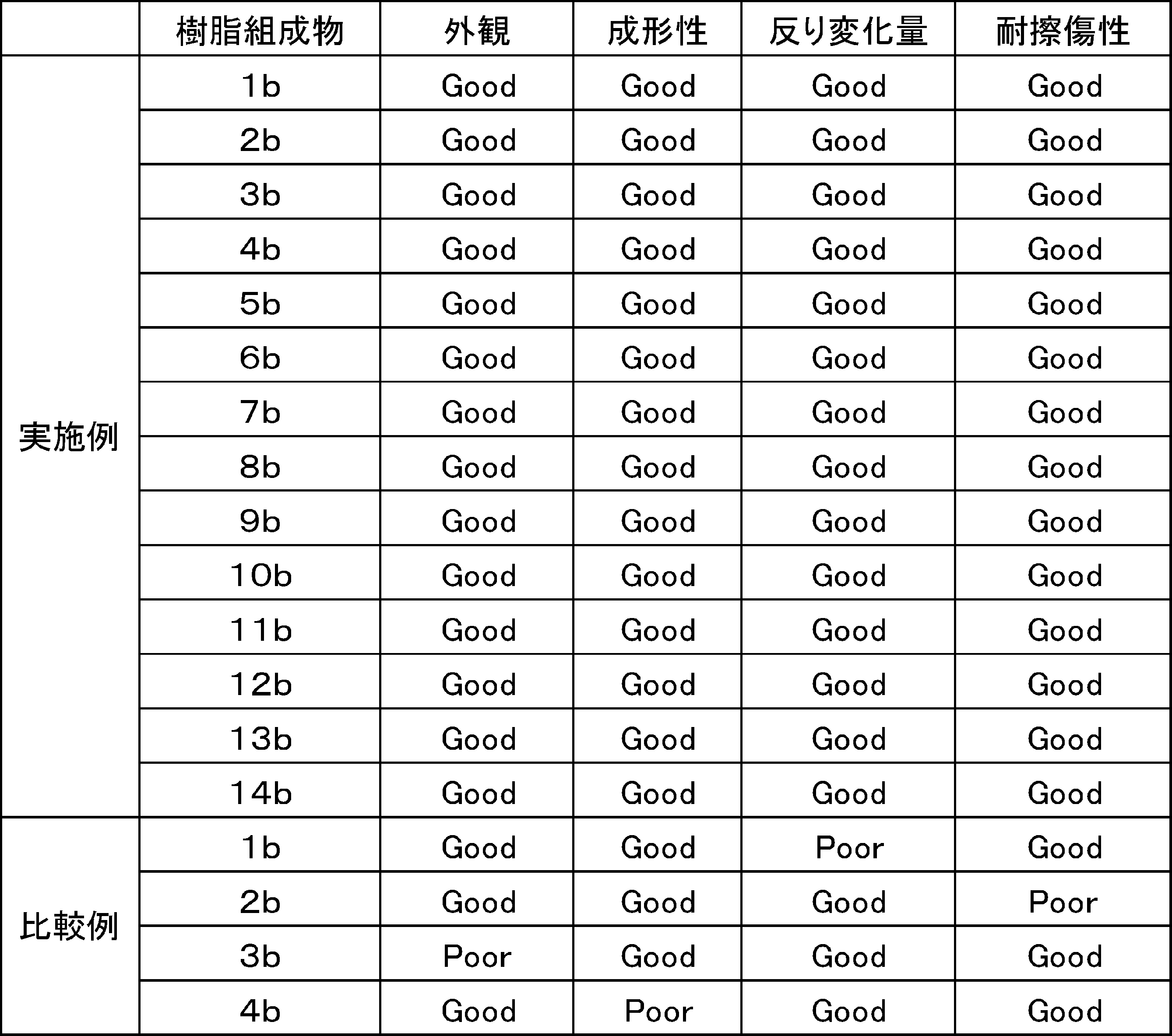
Claims (14)
- メタクリル樹脂(A)5~90質量%と、下記一般式(1)で示される芳香族ビニル化合物(b1)に由来する構造単位および下記一般式(2)で示される環状酸無水物(b2)に由来する構造単位とより少なくともなるビニル系共重合体(B)10~95質量%とを含有する樹脂混合物(M)と、
滑剤とを含有し、
前記滑剤が以下の(i)および(ii)の条件を満たす樹脂組成物。
(i)炭素原子数10~24の飽和脂肪酸のモノグリセライドからなる滑剤(x1)が、含まれないか若しくは樹脂混合物(M)100質量部に対し0.1質量部以下である。
(ii)高級アルコール、炭化水素、脂肪酸、脂肪酸金属塩、脂肪族アミド、および脂肪酸エステル(但し、滑剤(x1)および当該滑剤(x1)以外の1分子中に水酸基を2以上有する脂肪酸エステルからなる滑剤(x2)を除く)からなる群より選ばれる少なくとも一つの滑剤(Y)が樹脂混合物(M)100質量部に対し0.001~2質量部、含まれる。


- 滑剤(Y)が、炭素原子数12~18の脂肪族1価アルコールおよび炭素原子数16~24の飽和脂肪酸からなる群より選ばれる少なくとも一つである請求項1に記載の樹脂組成物。
- 樹脂混合物(M)が、メタクリル樹脂(A)30~60質量%と、ビニル系共重合体(B)40~70質量%とを含有する請求項1又は2に記載の樹脂組成物。
- ビニル系共重合体(B)は、芳香族ビニル化合物(b1)に由来する構造単位を50~84質量%含有し、環状酸無水物(b2)に由来する構造単位を15~49質量%含有し、メタクリル酸エステル(b3)に由来する構造単位を1~35質量%含有する請求項1~3のいずれか1項に記載の樹脂組成物。
- メタクリル酸エステル(b3)がメタクリル酸メチルである請求項4に記載の樹脂組成物。
- ガラス転移温度が、115~160℃である請求項1~5のいずれか1項に記載の樹脂組成物。
- 23℃の水中における飽和吸水率が、0.3~1.9質量%である請求項1~6のいずれか1項に記載の樹脂組成物。
- 前記滑剤が、更に以下の(iii)および(iv)の条件を満たす請求項1~7のいずれか1項に記載の樹脂組成物。
(iii)滑剤(x2)が含まれないか、樹脂混合物(M)100質量部に対し0.1質量部以下である。
(iv)滑剤(x1)と滑剤(x2)の合計が樹脂混合物(M)100質量部に対し0~0.1質量部の範囲にある。 - 前記滑剤の総量が、樹脂混合物(M)100質量部に対し0.1質量部以上である請求項1~8のいずれか1項に記載の樹脂組成物。
- 請求項1~9のいずれか1項に記載の樹脂組成物を具備する成形品。
- 請求項1~9のいずれか1項に記載の樹脂組成物からなる層と、
ガラス転移温度が130~160℃の範囲にある熱可塑性樹脂組成物(T)からなる層とを具備する積層体。 - 熱可塑性樹脂組成物(T)が、ポリカーボネートを含有する樹脂組成物である請求項11に記載の積層体。
- 熱可塑性樹脂組成物(T)と前記樹脂組成物とのガラス転移温度の差が30℃以下である請求項11又は12に記載の積層体。
- 少なくとも一方の表面に、さらに耐擦傷性層を備える請求項11~13のいずれか1項に記載の積層体。
Priority Applications (3)
| Application Number | Priority Date | Filing Date | Title |
|---|---|---|---|
| JP2017500527A JP6679562B2 (ja) | 2015-02-20 | 2016-02-18 | 樹脂組成物、成形品および積層体 |
| CN201680011302.6A CN107250261B (zh) | 2015-02-20 | 2016-02-18 | 树脂组合物、成型品和层叠体 |
| KR1020177025231A KR102451853B1 (ko) | 2015-02-20 | 2016-02-18 | 수지 조성물, 성형품 및 적층체 |
Applications Claiming Priority (2)
| Application Number | Priority Date | Filing Date | Title |
|---|---|---|---|
| JP2015031222 | 2015-02-20 | ||
| JP2015-031222 | 2015-02-20 |
Publications (1)
| Publication Number | Publication Date |
|---|---|
| WO2016132743A1 true WO2016132743A1 (ja) | 2016-08-25 |
Family
ID=56688924
Family Applications (1)
| Application Number | Title | Priority Date | Filing Date |
|---|---|---|---|
| PCT/JP2016/000879 Ceased WO2016132743A1 (ja) | 2015-02-20 | 2016-02-18 | 樹脂組成物、成形品および積層体 |
Country Status (5)
| Country | Link |
|---|---|
| JP (1) | JP6679562B2 (ja) |
| KR (1) | KR102451853B1 (ja) |
| CN (1) | CN107250261B (ja) |
| TW (1) | TWI691544B (ja) |
| WO (1) | WO2016132743A1 (ja) |
Cited By (2)
| Publication number | Priority date | Publication date | Assignee | Title |
|---|---|---|---|---|
| WO2018084068A1 (ja) * | 2016-11-01 | 2018-05-11 | デンカ株式会社 | 加飾フィルム |
| JPWO2019203230A1 (ja) * | 2018-04-16 | 2021-05-27 | 株式会社クラレ | 積層シートとその製造方法、及び保護カバー付きディスプレイ |
Families Citing this family (2)
| Publication number | Priority date | Publication date | Assignee | Title |
|---|---|---|---|---|
| CN114787275B (zh) * | 2019-12-12 | 2024-03-01 | 三菱化学株式会社 | 树脂成型体及树脂成型体的制造方法 |
| JP7136249B1 (ja) * | 2021-03-09 | 2022-09-13 | 三菱ケミカル株式会社 | 熱板融着用メタクリル系樹脂組成物、及び熱板融着への使用及び融着方法 |
Citations (11)
| Publication number | Priority date | Publication date | Assignee | Title |
|---|---|---|---|---|
| JPH02105844A (ja) * | 1988-10-15 | 1990-04-18 | Kyowa Gas Chem Ind Co Ltd | メタクリル系樹脂組成物 |
| JPH02115255A (ja) * | 1988-10-25 | 1990-04-27 | Kyowa Gas Chem Ind Co Ltd | メタクリル系樹脂組成物 |
| JPH0641386A (ja) * | 1992-07-23 | 1994-02-15 | Sumitomo Chem Co Ltd | メタクリル系樹脂組成物 |
| JPH06207074A (ja) * | 1993-01-13 | 1994-07-26 | Mitsubishi Rayon Co Ltd | メタクリル系樹脂成形材料 |
| JP2004210907A (ja) * | 2002-12-27 | 2004-07-29 | Kuraray Co Ltd | 光学部材用メタクリル系樹脂組成物およびそれを用いた光学部材 |
| JP2014198454A (ja) * | 2013-03-13 | 2014-10-23 | 住友化学株式会社 | 樹脂積層板およびそれを用いた耐擦傷性樹脂積層板 |
| WO2015041311A1 (ja) * | 2013-09-20 | 2015-03-26 | 株式会社クラレ | 樹脂組成物およびその成形品 |
| WO2015050051A1 (ja) * | 2013-10-02 | 2015-04-09 | 株式会社クラレ | 積層体 |
| WO2015079867A1 (ja) * | 2013-11-26 | 2015-06-04 | 三菱瓦斯化学株式会社 | 透明樹脂積層体 |
| WO2015133530A1 (ja) * | 2014-03-07 | 2015-09-11 | 株式会社クラレ | 積層体 |
| WO2016009831A1 (ja) * | 2014-07-14 | 2016-01-21 | 三菱樹脂株式会社 | 積層体 |
Family Cites Families (5)
| Publication number | Priority date | Publication date | Assignee | Title |
|---|---|---|---|---|
| JP3400104B2 (ja) * | 1993-05-31 | 2003-04-28 | 株式会社クラレ | メタクリル系樹脂組成物およびその製造方法 |
| JP3870715B2 (ja) * | 2001-05-08 | 2007-01-24 | 日立化成工業株式会社 | 非複屈折性ピックアップレンズ用樹脂組成物及びこれを用いたピックアップレンズ |
| JP6097472B2 (ja) | 2011-03-01 | 2017-03-15 | 株式会社クラレ | メタクリル系樹脂組成物および成形品 |
| KR102050371B1 (ko) | 2012-07-30 | 2019-11-29 | 덴카 주식회사 | 메타크릴 수지 내열성 향상용의 공중합체 |
| JP6058420B2 (ja) | 2013-02-20 | 2017-01-11 | デンカ株式会社 | 導光板 |
-
2016
- 2016-02-18 WO PCT/JP2016/000879 patent/WO2016132743A1/ja not_active Ceased
- 2016-02-18 CN CN201680011302.6A patent/CN107250261B/zh active Active
- 2016-02-18 JP JP2017500527A patent/JP6679562B2/ja active Active
- 2016-02-18 KR KR1020177025231A patent/KR102451853B1/ko active Active
- 2016-02-19 TW TW105104852A patent/TWI691544B/zh active
Patent Citations (11)
| Publication number | Priority date | Publication date | Assignee | Title |
|---|---|---|---|---|
| JPH02105844A (ja) * | 1988-10-15 | 1990-04-18 | Kyowa Gas Chem Ind Co Ltd | メタクリル系樹脂組成物 |
| JPH02115255A (ja) * | 1988-10-25 | 1990-04-27 | Kyowa Gas Chem Ind Co Ltd | メタクリル系樹脂組成物 |
| JPH0641386A (ja) * | 1992-07-23 | 1994-02-15 | Sumitomo Chem Co Ltd | メタクリル系樹脂組成物 |
| JPH06207074A (ja) * | 1993-01-13 | 1994-07-26 | Mitsubishi Rayon Co Ltd | メタクリル系樹脂成形材料 |
| JP2004210907A (ja) * | 2002-12-27 | 2004-07-29 | Kuraray Co Ltd | 光学部材用メタクリル系樹脂組成物およびそれを用いた光学部材 |
| JP2014198454A (ja) * | 2013-03-13 | 2014-10-23 | 住友化学株式会社 | 樹脂積層板およびそれを用いた耐擦傷性樹脂積層板 |
| WO2015041311A1 (ja) * | 2013-09-20 | 2015-03-26 | 株式会社クラレ | 樹脂組成物およびその成形品 |
| WO2015050051A1 (ja) * | 2013-10-02 | 2015-04-09 | 株式会社クラレ | 積層体 |
| WO2015079867A1 (ja) * | 2013-11-26 | 2015-06-04 | 三菱瓦斯化学株式会社 | 透明樹脂積層体 |
| WO2015133530A1 (ja) * | 2014-03-07 | 2015-09-11 | 株式会社クラレ | 積層体 |
| WO2016009831A1 (ja) * | 2014-07-14 | 2016-01-21 | 三菱樹脂株式会社 | 積層体 |
Cited By (4)
| Publication number | Priority date | Publication date | Assignee | Title |
|---|---|---|---|---|
| WO2018084068A1 (ja) * | 2016-11-01 | 2018-05-11 | デンカ株式会社 | 加飾フィルム |
| JPWO2018084068A1 (ja) * | 2016-11-01 | 2019-09-19 | デンカ株式会社 | 加飾フィルム |
| JPWO2019203230A1 (ja) * | 2018-04-16 | 2021-05-27 | 株式会社クラレ | 積層シートとその製造方法、及び保護カバー付きディスプレイ |
| JP7216717B2 (ja) | 2018-04-16 | 2023-02-01 | 株式会社クラレ | 積層シートとその製造方法、及び保護カバー付きディスプレイ |
Also Published As
| Publication number | Publication date |
|---|---|
| JP6679562B2 (ja) | 2020-04-15 |
| KR102451853B1 (ko) | 2022-10-07 |
| TW201708372A (zh) | 2017-03-01 |
| CN107250261A (zh) | 2017-10-13 |
| JPWO2016132743A1 (ja) | 2017-11-30 |
| KR20170118117A (ko) | 2017-10-24 |
| TWI691544B (zh) | 2020-04-21 |
| CN107250261B (zh) | 2020-07-28 |
Similar Documents
| Publication | Publication Date | Title |
|---|---|---|
| JP6743024B2 (ja) | 樹脂組成物、成形品および積層体 | |
| TWI633147B (zh) | 丙烯酸樹脂薄膜及其製造方法 | |
| TWI669213B (zh) | Laminated body | |
| JP6832334B2 (ja) | 透明樹脂積層体 | |
| JP6430950B2 (ja) | 積層体 | |
| TW201532817A (zh) | 透明樹脂層合體 | |
| JP6357163B2 (ja) | 樹脂組成物およびその成形品 | |
| JP6679562B2 (ja) | 樹脂組成物、成形品および積層体 | |
| CN115427227A (zh) | 层叠体 | |
| US20160311204A1 (en) | Synthetic resin laminate | |
| TW201615416A (zh) | 合成樹脂層合體 | |
| WO2019194210A1 (ja) | (メタ)アクリル樹脂組成物、フィルムおよびその製造方法 | |
| KR20160080277A (ko) | 다층시트 | |
| JPWO2017170736A1 (ja) | アイオノマー積層シートとその製造方法および積層体 | |
| WO2016121924A1 (ja) | メタクリル系樹脂組成物およびそれを用いた積層体 | |
| CN114829493A (zh) | 甲基丙烯酸类树脂组合物 | |
| WO2021125292A1 (ja) | メタクリル系共重合体及びその製造方法、メタクリル系共重合体組成物及び成形体 |
Legal Events
| Date | Code | Title | Description |
|---|---|---|---|
| 121 | Ep: the epo has been informed by wipo that ep was designated in this application |
Ref document number: 16752132 Country of ref document: EP Kind code of ref document: A1 |
|
| ENP | Entry into the national phase |
Ref document number: 2017500527 Country of ref document: JP Kind code of ref document: A |
|
| NENP | Non-entry into the national phase |
Ref country code: DE |
|
| ENP | Entry into the national phase |
Ref document number: 20177025231 Country of ref document: KR Kind code of ref document: A |
|
| 122 | Ep: pct application non-entry in european phase |
Ref document number: 16752132 Country of ref document: EP Kind code of ref document: A1 |