WO2016129666A1 - オーステナイト系耐熱合金溶接継手の製造方法およびそれを用いて得られる溶接継手 - Google Patents
オーステナイト系耐熱合金溶接継手の製造方法およびそれを用いて得られる溶接継手 Download PDFInfo
- Publication number
- WO2016129666A1 WO2016129666A1 PCT/JP2016/054094 JP2016054094W WO2016129666A1 WO 2016129666 A1 WO2016129666 A1 WO 2016129666A1 JP 2016054094 W JP2016054094 W JP 2016054094W WO 2016129666 A1 WO2016129666 A1 WO 2016129666A1
- Authority
- WO
- WIPO (PCT)
- Prior art keywords
- less
- content
- heat
- welded joint
- heat treatment
- Prior art date
- Legal status (The legal status is an assumption and is not a legal conclusion. Google has not performed a legal analysis and makes no representation as to the accuracy of the status listed.)
- Ceased
Links
Classifications
-
- B—PERFORMING OPERATIONS; TRANSPORTING
- B23—MACHINE TOOLS; METAL-WORKING NOT OTHERWISE PROVIDED FOR
- B23K—SOLDERING OR UNSOLDERING; WELDING; CLADDING OR PLATING BY SOLDERING OR WELDING; CUTTING BY APPLYING HEAT LOCALLY, e.g. FLAME CUTTING; WORKING BY LASER BEAM
- B23K35/00—Rods, electrodes, materials, or media, for use in soldering, welding, or cutting
- B23K35/22—Rods, electrodes, materials, or media, for use in soldering, welding, or cutting characterised by the composition or nature of the material
- B23K35/24—Selection of soldering or welding materials proper
- B23K35/30—Selection of soldering or welding materials proper with the principal constituent melting at less than 1550°C
- B23K35/3033—Ni as the principal constituent
-
- B—PERFORMING OPERATIONS; TRANSPORTING
- B23—MACHINE TOOLS; METAL-WORKING NOT OTHERWISE PROVIDED FOR
- B23K—SOLDERING OR UNSOLDERING; WELDING; CLADDING OR PLATING BY SOLDERING OR WELDING; CUTTING BY APPLYING HEAT LOCALLY, e.g. FLAME CUTTING; WORKING BY LASER BEAM
- B23K35/00—Rods, electrodes, materials, or media, for use in soldering, welding, or cutting
- B23K35/22—Rods, electrodes, materials, or media, for use in soldering, welding, or cutting characterised by the composition or nature of the material
- B23K35/24—Selection of soldering or welding materials proper
- B23K35/30—Selection of soldering or welding materials proper with the principal constituent melting at less than 1550°C
-
- B—PERFORMING OPERATIONS; TRANSPORTING
- B23—MACHINE TOOLS; METAL-WORKING NOT OTHERWISE PROVIDED FOR
- B23K—SOLDERING OR UNSOLDERING; WELDING; CLADDING OR PLATING BY SOLDERING OR WELDING; CUTTING BY APPLYING HEAT LOCALLY, e.g. FLAME CUTTING; WORKING BY LASER BEAM
- B23K9/00—Arc welding or cutting
- B23K9/23—Arc welding or cutting taking account of the properties of the materials to be welded
-
- B—PERFORMING OPERATIONS; TRANSPORTING
- B23—MACHINE TOOLS; METAL-WORKING NOT OTHERWISE PROVIDED FOR
- B23K—SOLDERING OR UNSOLDERING; WELDING; CLADDING OR PLATING BY SOLDERING OR WELDING; CUTTING BY APPLYING HEAT LOCALLY, e.g. FLAME CUTTING; WORKING BY LASER BEAM
- B23K9/00—Arc welding or cutting
- B23K9/235—Preliminary treatment
-
- C—CHEMISTRY; METALLURGY
- C22—METALLURGY; FERROUS OR NON-FERROUS ALLOYS; TREATMENT OF ALLOYS OR NON-FERROUS METALS
- C22C—ALLOYS
- C22C19/00—Alloys based on nickel or cobalt
- C22C19/03—Alloys based on nickel or cobalt based on nickel
- C22C19/05—Alloys based on nickel or cobalt based on nickel with chromium
-
- C—CHEMISTRY; METALLURGY
- C22—METALLURGY; FERROUS OR NON-FERROUS ALLOYS; TREATMENT OF ALLOYS OR NON-FERROUS METALS
- C22C—ALLOYS
- C22C30/00—Alloys containing less than 50% by weight of each constituent
-
- C—CHEMISTRY; METALLURGY
- C22—METALLURGY; FERROUS OR NON-FERROUS ALLOYS; TREATMENT OF ALLOYS OR NON-FERROUS METALS
- C22C—ALLOYS
- C22C30/00—Alloys containing less than 50% by weight of each constituent
- C22C30/02—Alloys containing less than 50% by weight of each constituent containing copper
-
- C—CHEMISTRY; METALLURGY
- C22—METALLURGY; FERROUS OR NON-FERROUS ALLOYS; TREATMENT OF ALLOYS OR NON-FERROUS METALS
- C22F—CHANGING THE PHYSICAL STRUCTURE OF NON-FERROUS METALS AND NON-FERROUS ALLOYS
- C22F1/00—Changing the physical structure of non-ferrous metals or alloys by heat treatment or by hot or cold working
- C22F1/10—Changing the physical structure of non-ferrous metals or alloys by heat treatment or by hot or cold working of nickel or cobalt or alloys based thereon
Definitions
- the present invention relates to a method for manufacturing a welded joint using an austenitic heat-resistant alloy that has been used for a long time as a high-temperature member such as a main steam pipe or a reheat steam pipe of a boiler for thermal power generation, and a welded joint obtained by using the same.
- various members including thick members such as main steam pipes and reheat steam pipes, which conventionally used ferritic heat resistant steel, are required to have high strength, and high strength austenitic heat resistant Application of alloys or Ni-base heat-resistant alloys is being studied.
- Patent Document 1 discloses a Ni-based alloy product that improves the hot workability by using W to increase the high-temperature strength and defining the effective B amount.
- Patent Document 2 discloses an austenitic heat-resistant alloy having enhanced creep rupture strength by utilizing Cr, Ti and Zr.
- Patent Document 3 discloses a Ni-based heat-resistant alloy that contains a large amount of W and uses Al and Ti to increase the creep rupture strength by solid solution strengthening and precipitation strengthening by the ⁇ ′ phase.
- the austenitic heat-resistant alloys or Ni-base heat-resistant alloys are used as structures, they are generally assembled by welding. At that time, it is known that various cracks are likely to occur in the welded portion mainly due to metallurgical factors. In particular, there is a problem that so-called stress relaxation cracks occur when used in a high temperature environment for a long time.
- the stress relaxation crack is a crack generated in the process in which the residual stress generated by welding is relaxed.
- Patent Document 4 discloses an austenitic heat-resistant alloy that uses Al, Ti, and Nb to increase the creep strength, and at the same time, manages the contents of P and B and increases the liquefaction cracking resistance by containing Nd. Has been. Patent Document 5 also uses Mo and W to increase the creep strength and regulate the content of impurity elements, and Ti and Al, and resistance to liquefaction cracking during welding and stress relaxation cracking during use. An austenitic heat-resistant alloy with improved properties is disclosed.
- the austenitic heat-resistant alloy structures used at these high temperatures may need to be partially repaired by welding due to partial damage due to aging. It was newly found that when welding is performed using these austenitic heat-resistant alloys used at high temperatures, cracks may occur in the weld heat-affected zone.
- the present invention has been made in view of the above situation, and uses an austenitic heat-resistant alloy welded joint using an austenitic heat-resistant alloy that has been used for a long time as a high-temperature member such as a main steam pipe or a reheat steam pipe of a boiler for thermal power generation.
- An object of the present invention is to provide a method for producing a welded joint and a welded joint obtained by using the method.
- the present inventors first conducted a detailed investigation on a crack occurrence phenomenon in a weld heat-affected zone of a welded joint using an austenitic heat-resistant alloy exposed to a high temperature for a long time. As a result, the following ⁇ 1> to ⁇ 3> were confirmed.
- the austenitic heat-resistant alloy in which the precipitation phase is present in the grains and the impurities are segregated at the grain boundaries is welded, the maximum ultimate temperature is high in the weld heat affected zone near the melting boundary. It dissolves again in the parent phase, and the grain boundary segregation is eliminated. However, in the weld heat-affected zone a little away from the melting boundary, the maximum temperature reached is low, so re-solution of intragranular precipitates and elimination of grain boundary segregation do not occur.
- thermal stress is generated in the weld heat affected zone due to expansion and contraction accompanying welding.
- the heat treatment applied before welding is effective when the heat treatment holding temperature TP is 1050 to 1300 ° C. and the heat treatment holding time t P is [ ⁇ 0.1 ⁇ (T P / 50-30)] or more. It is. However, if the heat treatment holding time t P exceeds [ ⁇ 0.1 ⁇ (T P / 10-145)], there is an adverse effect rather than no effect.
- the present invention has been made on the basis of the above knowledge, and the gist thereof is a manufacturing method of the following austenitic heat-resistant alloy welded joint and a welded joint obtained by using the same.
- the chemical composition of the alloy base material is mass%, C: 0.04 to 0.12%, Si: 1.0% or less, Mn: 2.0% or less, P: 0.03% or less, S: 0.01% or less, Ni: 42.0-54.0%, Cr: 20.0-33.0%, W: 3.0-10.0%, Ti: 0.05 to 1.0%, Al: 0.3% or less, B: 0.0001 to 0.01%, N: 0.02% or less, O: 0.01% or less, Ca: 0 to 0.05%, Mg: 0 to 0.05%, REM: 0 to 0.5% Co: 0 to 1.0%, Cu: 0 to 4.0%, Mo: 0 to 1.0%, V: 0 to 0.5% Nb: 0 to 0.5%, Zr: 0 to 0.05%, The balance: The method for producing an austenitic heat-resistant alloy welded joint according to (1), which is Fe and impurities.
- the chemical composition is mass%, C: 0.04 to 0.12%, Si: 1.0% or less, Mn: 2.0% or less, P: 0.03% or less, S: 0.01% or less, Ni: 42.0 to 48.0%, Cr: 20.0-26.0%, W: 4.0-10.0%, Ti: 0.05 to 0.15%, Nb: 0.1 to 0.4%, Al: 0.3% or less, B: 0.0001 to 0.01%, N: 0.02% or less, O: 0.01% or less, Ca: 0 to 0.05%, Mg: 0 to 0.05%, REM: 0 to 0.1%, Co: 0 to 1.0%, Cu: 0 to 4.0%, Mo: 0 to 1.0%, V: 0 to 0.5% Balance: Fe and impurities, and An alloy base material used under the conditions satisfying the following formulas (i) and (ii): A method for producing an austenitic heat-resistant alloy welded joint, wherein heat treatment is performed under conditions satisfying the following formulas (iii) and (iv) and
- the chemical composition of the alloy base material is mass%, Ca: 0.0001 to 0.05%, Mg: 0.0001 to 0.05%, REM: 0.0005 to 0.1%, Co: 0.01 to 1.0%, Cu: 0.01 to 4.0%, Mo: 0.01 to 1.0%, and V: 0.01 to 0.5%,
- the chemical composition is mass%, C: 0.04 to 0.12%, Si: 0.5% or less, Mn: 1.5% or less, P: 0.03% or less, S: 0.01% or less, Ni: 46.0-54.0%, Cr: 27.0-33.0%, W: 3.0-9.0%, Ti: 0.05 to 1.0%, Zr: 0.005 to 0.05%, Al: 0.05-0.3% B: 0.0001 to 0.005%, N: 0.02% or less, O: 0.01% or less, Ca: 0 to 0.05%, Mg: 0 to 0.05%, REM: 0 to 0.5% Co: 0 to 1.0%, Cu: 0 to 4.0%, Mo: 0 to 1.0%, V: 0 to 0.5% Nb: 0 to 0.5%, Balance: Fe and impurities, and An alloy base material used under the conditions satisfying the following formulas (i) and (ii): A method for producing an austenitic heat-resistant alloy welded joint, wherein heat treatment is performed under conditions satisfying the following formulas (i)
- the chemical composition of the alloy base material is mass%, Ca: 0.0001 to 0.05%, Mg: 0.0001 to 0.05%, REM: 0.0005 to 0.5%, Co: 0.01 to 1.0%, Cu: 0.01 to 4.0%, Mo: 0.01 to 1.0%, V: 0.01 to 0.5%, and Nb: 0.01 to 0.5%,
- the manufacturing method of the austenitic heat-resistant-alloy weld joint as described in said (2) or (5) containing 1 or more types selected from these.
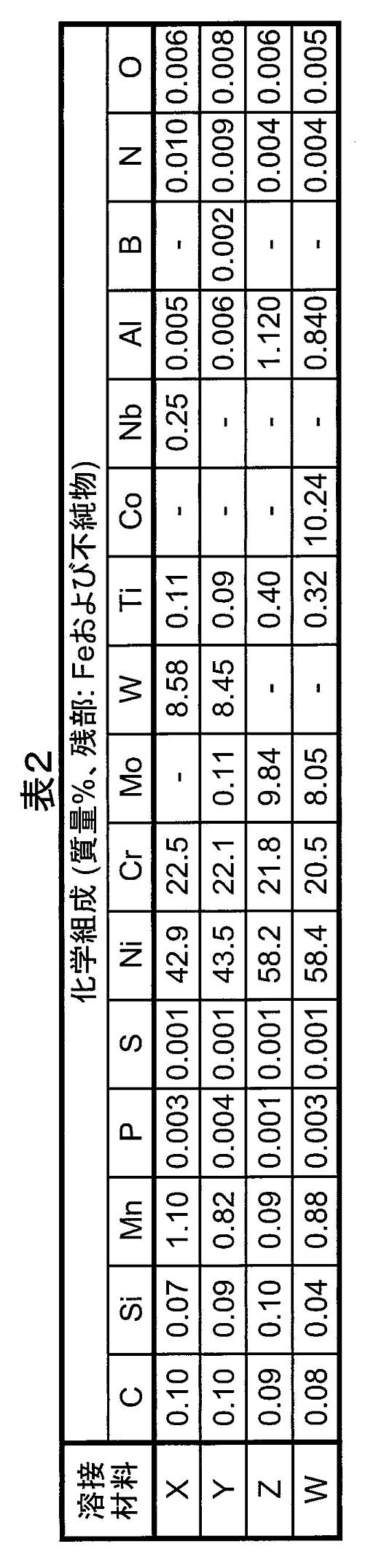
- the chemical composition is mass%, C: 0.06 to 0.18%, Si: 1.0% or less, Mn: 2.0% or less, P: 0.03% or less, S: 0.01% or less, Ni: 40.0-60.0%, Cr: 20.0-33.0%, One or more selected from Mo and W: Total 6.0 to 13.0% Ti: 0.05 to 1.5%, Co: 0 to 15.0% Nb: 0 to 0.5%, Al: 1.5% or less, B: 0 to 0.005%, N: 0.18% or less, O: 0.01% or less, The balance: The method for producing an austenitic heat-resistant alloy welded joint according to any one of (1) to (8), wherein welding is performed using a welding material that is Fe and impurities.
- an austenitic heat-resistant alloy welded joint is stably used by using an austenitic heat-resistant alloy that has been used for a long time as a high-temperature member such as a main steam pipe or a reheat steam pipe of a boiler for thermal power generation. Obtainable.
- % for the content means “% by mass”.
- C 0.04 to 0.12% C is an element having the effect of stabilizing austenite, forming fine carbides, and improving the creep strength during use at high temperatures. In order to sufficiently obtain this effect, a C content of 0.04% or more is necessary. However, if the C content is excessive, the carbide becomes coarse and precipitates in a large amount, so that the contribution to the creep strength is saturated. Not only that, it reduces ductility and reduces weldability in materials that have been used for a long time. Therefore, the C content is 0.12% or less.
- the C content is preferably 0.05% or more, and more preferably 0.06% or more. Further, the C content is preferably 0.11% or less, and more preferably 0.08% or less.
- Si 1.0% or less
- Si is an element that has a deoxidizing action and is effective in improving corrosion resistance and oxidation resistance at high temperatures.
- an upper limit is set for the Si content to 1.0% or less.
- the Si content is preferably 0.8% or less, more preferably 0.5% or less, and further preferably 0.3% or less.
- the Si content is preferably 0.02% or more, and more preferably 0.05% or more.
- Mn 2.0% or less Mn, like Si, is an element having a deoxidizing action. Mn also contributes to stabilization of austenite. However, when the Mn content is excessive, embrittlement is caused, and the toughness and creep ductility are also reduced. Therefore, an upper limit is set for the Mn content to 2.0% or less.
- the Mn content is preferably 1.8% or less, more preferably 1.5% or less, and even more preferably 1.3% or less.
- the Mn content is preferably 0.02% or more, and more preferably 0.05% or more.
- P 0.03% or less
- P is an element contained in the alloy as an impurity and segregates at the grain boundary of the weld heat-affected zone during welding to increase liquefaction cracking sensitivity. Furthermore, when segregated at the grain boundaries when used for a long time at high temperature, the creep ductility is lowered, and the weldability is lowered in the material used for a long time. Therefore, an upper limit is set for the P content to 0.03% or less.
- the P content is preferably 0.025% or less, and more preferably 0.02% or less.
- the P content is preferably 0.0005% or more, and more preferably 0.0008% or more.
- S 0.01% or less S is an element which is contained in the alloy as an impurity like P and segregates at the grain boundary of the weld heat-affected zone during welding to increase liquefaction cracking sensitivity. Furthermore, when used for a long time at a high temperature, it segregates at the grain boundary and causes embrittlement, and the weldability is lowered in the material used for a long time. Therefore, an upper limit is set for the S content to 0.01% or less. The S content is preferably 0.008% or less, and more preferably 0.005% or less.
- the S content is preferably 0.0001% or more, and more preferably 0.0002% or more.
- Ni 42.0-54.0%
- Ni is an effective element for obtaining austenite, and is an essential element for ensuring the structural stability when used for a long time at a high temperature.
- a Ni content of 42.0% or more is necessary.
- Ni is an expensive element, and if it is contained in a large amount, the cost increases. Therefore, an upper limit is provided so that the Ni content is 54.0% or less.
- the Ni content is preferably 42.5% or more, and more preferably 43.0% or more. Further, the Ni content is preferably 53.0% or less, and more preferably 52.0% or less.
- Cr 20.0-33.0%
- Cr is an essential element for securing oxidation resistance and corrosion resistance at high temperatures. Further, Cr contributes to ensuring creep strength by forming fine carbides or further Cr-enriched phases. In order to obtain the above effects within the range of the Ni content of the present invention, a Cr content of 20.0% or more is necessary. However, if the Cr content exceeds 33.0%, the stability of austenite at high temperatures deteriorates and the creep strength decreases. In addition, a large amount of carbide or further Cr-enriched phase is precipitated, the deformation resistance is increased, and the weldability is lowered in a material used for a long time. Therefore, the Cr content is 33.0% or less.
- the Cr content is preferably 20.5% or more, and more preferably 21.0% or more. Further, the Cr content is preferably 32.5% or less, and more preferably 32.0% or less.
- W 3.0-10.0%
- W is an element that contributes greatly to the improvement of creep strength and tensile strength at high temperatures by forming a solid solution in the matrix or forming a fine intermetallic compound phase.
- a W content of 3.0% or more is necessary.
- the effect is saturated, and the creep strength is decreased.
- precipitation of a large amount of intermetallic compounds may be caused, the deformation resistance may be increased, and the weldability may be lowered in a material used for a long time.
- an upper limit is provided so that the W content is 10.0% or less.
- the W content is preferably 3.5% or more, more preferably 4.0% or more, further preferably 4.5% or more, and particularly preferably 5.0% or more. preferable. Further, the W content is preferably 9.5% or less, more preferably 9.0% or less, further preferably 8.5% or less, and 8.0% or less. Is particularly preferred.
- Ti 0.05 to 1.0% Ti precipitates in the grains as a fine carbonitride or intermetallic compound phase, and contributes to the improvement of creep strength and tensile strength at high temperatures. In order to sufficiently obtain the effect, a Ti content of 0.05% or more is necessary. However, if the Ti content is excessive, a large amount of carbonitride precipitates, leading to a decrease in creep ductility and toughness, and a decrease in weldability in materials used for a long time. Therefore, an upper limit is set so that the Ti content is 1.0% or less.
- the Ti content is preferably 0.06% or more, and more preferably 0.07% or more. Further, the Ti content is preferably 0.9% or less, and more preferably 0.8% or less.
- Al 0.3% or less
- Al is an element that has a deoxidizing action, precipitates as an intermetallic compound phase during use, and contributes to an improvement in creep strength.
- an upper limit is set so that the Al content is 0.3% or less.
- the Al content is preferably 0.2% or less, and more preferably 0.1% or less.
- the Al content is preferably 0.0005% or more, and more preferably 0.001% or more. Further, when it is desired to obtain the effect of improving the creep strength, the Al content is preferably 0.05% or more, more preferably 0.06% or more, and 0.07% or more. Further preferred.
- B 0.0001 to 0.01%
- B is an element effective for improving the creep strength by finely dispersing grain boundary carbides and segregating at the grain boundaries to strengthen the grain boundaries.
- the B content needs to be 0.0001% or more.
- an upper limit is provided so that the B content is 0.01% or less.
- the B content is preferably 0.0005% or more, and more preferably 0.001% or more. Further, the B content is preferably 0.008% or less, and more preferably 0.006% or less.
- N 0.02% or less N is an element effective for stabilizing austenite, but if it is contained in excess, a large amount of fine nitride precipitates in the grains during use at high temperatures, Decreases creep ductility and toughness. Furthermore, the weldability of the material used for a long time is lowered. Therefore, an upper limit is set for the N content to 0.02% or less.
- the N content is preferably 0.018% or less, and more preferably 0.015% or less.
- the N content is preferably 0.0005% or more, and more preferably 0.0008% or more.
- O 0.01% or less O (oxygen) is contained as an impurity in the alloy, and when its content is excessive, hot workability is lowered, and further, toughness and ductility are deteriorated. For this reason, an upper limit is set for the O content to 0.01% or less.
- the content of O is preferably 0.008% or less, and more preferably 0.005% or less.
- the O content is preferably 0.0005% or more, and more preferably 0.0008% or more.
- Ca 0 to 0.05% Since Ca is an element having an effect of improving hot workability, Ca may be contained. However, when the content of Ca is excessive, it combines with O to significantly reduce cleanliness, and on the other hand, deteriorate hot workability. Therefore, when Ca is contained, its content is set to 0.05% or less. The Ca content is preferably 0.03% or less.
- the Ca content is preferably 0.0001% or more, and more preferably 0.0005% or more.
- Mg 0 to 0.05% Since Mg is an element having an effect of improving hot workability like Ca, it may be contained. However, if the Mg content is excessive, it combines with O to significantly reduce cleanliness, and on the contrary, deteriorate hot workability. Therefore, when it contains Mg, the content shall be 0.05% or less.
- the Mg content is preferably 0.03% or less.
- Mg content 0.0001% or more it is preferable to make Mg content 0.0001% or more, and it is more preferable to set it as 0.0005% or more.
- REM 0 to 0.5% REM is an element that has a strong affinity with S and has an effect of improving hot workability, and therefore may be contained. However, when the content of REM becomes excessive, it combines with O to significantly reduce cleanliness and, on the contrary, deteriorate hot workability. Therefore, when it contains REM, the content shall be 0.5% or less.
- the REM content is preferably 0.2% or less, more preferably 0.1% or less, and further preferably 0.06% or less.
- REM content when obtaining said effect, it is preferable to make REM content into 0.0005% or more, and it is more preferable to set it as 0.001% or more.
- REM is a generic name for a total of 17 elements of Sc, Y and lanthanoid, and the content of REM refers to the total content of one or more elements of REM. Further, REM is generally contained in Misch metal. For this reason, for example, it may be added in the form of misch metal and contained so that the amount of REM falls within the above range.
- the above Ca, Mg, and REM all have an effect of improving the hot workability, and therefore can be contained alone or in combination of two or more thereof.
- the total amount when these elements are contained in combination is preferably 0.5% or less.
- Co 0 to 1.0%
- Co is an effective element for obtaining austenite, and contributes to the improvement of creep strength by increasing phase stability, so it may be contained.
- Co is an extremely expensive element, excessive content of Co causes a significant cost increase. Therefore, when Co is contained, the content is made 1.0% or less.
- the Co content is preferably 0.8% or less, and more preferably 0.4% or less.
- Co content 0.01% or more, and it is more preferable to set it as 0.03% or more.
- Cu 0 to 4.0%
- Cu is an element having an action of improving creep strength. That is, Cu, like Ni and Co, is an effective element for obtaining austenite, and contributes to the improvement of creep strength by increasing phase stability. For this reason, you may contain Cu. However, when Cu is contained excessively, the hot workability is lowered. Therefore, when it contains Cu, the content shall be 4.0% or less.
- the Cu content is preferably 3.0% or less, and more preferably 1.0% or less.
- Mo 0 to 1.0%
- Mo is an element having an effect of improving the creep strength. That is, since Mo has a function of improving the creep strength at a high temperature by dissolving in the matrix, it may be contained. However, when Mo is contained excessively, the stability of austenite is lowered, and instead the creep strength is lowered. Therefore, when it contains Mo, the content shall be 1.0% or less.
- the Mo content is preferably 0.8% or less, and more preferably 0.5% or less.
- Mo content when obtaining said effect, it is preferable to make Mo content into 0.01% or more, and it is more preferable to set it as 0.03% or more.
- V 0 to 0.5%
- V is an element having an effect of improving the creep strength. That is, V combines with C or N to form fine carbides or carbonitrides, and has the effect of improving creep strength, so may be included.
- V when V is contained excessively, it precipitates in a large amount as a carbide or carbonitride, leading to a decrease in creep ductility and a decrease in weldability in a material used for a long time. Therefore, when V is contained, the content is set to 0.5% or less.
- the V content is preferably 0.4% or less, and more preferably 0.2% or less.
- Nb 0 to 0.5% Nb, like Ti and V, may combine with C or N to precipitate in the grains as fine carbides or carbonitrides and contribute to the improvement of creep strength at high temperatures, so may be included.
- Nb content is excessive, a large amount of carbides and carbonitrides are precipitated, resulting in a decrease in creep ductility and toughness, and a decrease in weldability in materials used for a long time. Therefore, an upper limit is provided so that the Nb content is 0.5% or less.
- the Nb content is preferably 0.4% or less, more preferably 0.38% or less, and further preferably 0.35% or less.
- the Nb content is preferably 0.01% or more, more preferably 0.02% or more, and even more preferably 0.05% or more. .
- the above Co, Cu, Mo, V, and Nb all have the effect of improving the creep strength, and therefore, any one of them or a combination of two or more thereof can be contained.
- the total amount when these elements are contained in combination is preferably 6.0% or less.
- Zr 0 to 0.05% Zr, like Ti, dissolves in the matrix and improves the creep strength at high temperatures.
- Zr has a strong affinity for S, and the fixation of S improves the creep ductility.
- an upper limit is provided so that the Zr content is 0.05% or less.
- the Zr content is preferably 0.04% or less, and more preferably 0.03% or less.
- Zr content is 0.005% or more, It is more preferable that it is 0.008% or more, It is further more preferable that it is 0.01% or more. .
- the alloy base material used for manufacturing the austenitic heat-resistant alloy welded joint according to the present invention has a chemical composition containing the above-described elements, with the balance being Fe and impurities.
- impurities refer to materials mixed from ores, scraps, or production environments as raw materials when an alloy is industrially produced.
- the following two types are typical as the composition of the alloy base material.
- the chemical composition is mass%, C: 0.04 to 0.12%, Si: 1.0% or less, Mn: 2.0% or less, P: 0.03% or less, S: 0.00. 01% or less, Ni: 42.0 to 48.0%, Cr: 20.0 to 26.0%, W: 4.0 to 10.0%, Ti: 0.05 to 0.15%, Nb: 0.1-0.4%, Al: 0.3% or less, B: 0.0001-0.01%, N: 0.02% or less, O: 0.01% or less, Ca: 0-0.
- Mg 0 to 0.05%
- REM 0 to 0.1%
- Co 0 to 1.0%
- Cu 0 to 4.0%
- Mo 0 to 1.0%
- V 0 to 0.5%
- alloy base material which is Fe and impurities.
- the chemical composition is mass%, C: 0.04 to 0.12%, Si: 0.5% or less, Mn: 1.5% or less, P: 0.03% or less, S: 0.00. 01% or less, Ni: 46.0-54.0%, Cr: 27.0-33.0%, W: 3.0-9.0%, Ti: 0.05-1.0%, Zr: 0.005 to 0.05%, Al: 0.05 to 0.3%, B: 0.0001 to 0.005%, N: 0.02% or less, O: 0.01% or less, Ca: 0 -0.05%, Mg: 0-0.05%, REM: 0-0.5%, Co: 0-1.0%, Cu: 0-4.0%, Mo: 0-1.0% V: 0 to 0.5%, Nb: 0 to 0.5%, balance: Fe and an alloy base material containing impurities.
- the Si content is preferably 0.6% or less.
- the Ni content is preferably 48.0% or less, more preferably 47.5% or less, and even more preferably 47.0% or less.
- the Cr content is preferably 25.5% or less, and more preferably 25.0% or less.
- the Ti content is preferably 0.14% or less, and more preferably 0.13% or less.
- Nb content is preferably 0.12% or more, and more preferably 0.15% or more.
- the Mn content is preferably 1.1% or less.
- the Ni content is preferably 46.0% or more, more preferably 47.0% or more, and further preferably 48.0% or more.
- the Cr content is preferably 27.5% or more, and more preferably 28.0% or more.
- the Nb content is preferably 0.2% or less.
- Alloy matrix used in the production of austenitic heat resistant alloy welded joint use conditions invention alloy base material, satisfy the heating and holding temperature T A is below formula (i) in use, and the heating retention time of use temperature T a and parameters determined from the heating retention time t a (hereinafter also referred to as P a.) is that used in the conditions satisfying the following (ii) expression.
- the alloy base material used for manufacturing the austenitic heat-resistant alloy welded joint of the present invention is heated to 600 to 850 ° C., precipitates are finely precipitated in the crystal grains.
- the alloy base material has the chemical composition described in (a) above, a Laves phase that is M 23 C 6 carbide and an intermetallic compound precipitates, and the chemical composition described in (b) above is obtained.
- the bcc phase enriched with M 23 C 6 carbide and Cr tends to precipitate.
- heat treatment is performed before welding the alloy base material.
- the heat treatment needs to be performed under the condition that the heat treatment holding temperature T P and the heat treatment holding time t P satisfy the following formulas (iii) and (iv).
- Heat treatment holding temperature T P (° C.): 1050 ⁇ T P ⁇ 1300 (iii)
- T P 1050 ⁇ T P ⁇ 1300 (iii)
- the heat treatment holding temperature T P when the heat treatment holding temperature T P exceeds 1300 ° C., local melting of the grain boundary is started. Therefore, the heat treatment holding temperature TP is set to 1300 ° C. or lower.
- Heat treatment holding temperature T P is preferably at 1080 ° C. or higher, more preferably 1100 ° C. or higher.
- the heat treatment holding temperature T P is preferably 1280 ° C. or less, more preferably 1250 ° C. or less.
- a heat treatment holding temperature T P is 1250 ° C. or less, more preferably 1230 ° C. or less, 1200 ° C. or less More preferably.
- Heat treatment holding time t P (h): - 0.1 ⁇ (T P / 50-30) ⁇ t P ⁇ -0.1 ⁇ (T P / 10-145) ⁇ (iv)
- the heat treatment holding time t P needs to be ⁇ 0.1 ⁇ (T P / 50-30) or more. This is because if the heat treatment holding time t P is less than this value, the time required for the diffusion of the alloy element to achieve re-dissolution of precipitates in the matrix and reduction of grain boundary segregation becomes insufficient. .
- the heat treatment holding time t P exceeds ⁇ 0.1 ⁇ (T P / 10-145)
- the crystal grain size becomes extremely large, and liquefaction cracks are likely to occur near the melting line during welding. Therefore, the heat treatment holding time t P needs to be ⁇ 0.1 ⁇ (T P / 10-145) or less.
- the average cooling rate up to 500 ° C. is preferably 50 ° C./h or more. This is because when the average cooling rate is less than 50 ° C./h, carbides and the like are precipitated again in the grains in the course of cooling, and grain boundary segregation of impurities may occur.
- the heat treatment at least in a range within 30 mm from the welded portion. This is because strain generated by thermal stress generated during welding becomes large in this region.
- C 0.06 to 0.18% C is an element that has the effect of stabilizing the austenite in the weld metal after welding, forming fine carbides, and improving the creep strength during use at high temperatures. Furthermore, by forming eutectic carbide with Cr during welding solidification, it contributes to reduction of solidification cracking sensitivity. In order to sufficiently obtain this effect, a C content of 0.06% or more is necessary. However, if the C content is excessive, a large amount of carbide precipitates, so that the creep strength and ductility are reduced. Therefore, the C content is 0.18% or less. The C content is preferably 0.07% or more, and more preferably 0.08% or more. Further, the C content is preferably 0.16% or less, and more preferably 0.14% or less.
- Si 1.0% or less
- Si is an element that is effective for deoxidation at the time of manufacturing a welding material and is effective for improving the corrosion resistance and oxidation resistance of the weld metal after welding at a high temperature.
- an upper limit is set for the Si content to 1.0% or less.
- the Si content is preferably 0.8% or less, and more preferably 0.6% or less.
- the Si content is preferably 0.02% or more, and more preferably 0.05% or more.
- Mn 2.0% or less Mn, like Si, is an element effective for deoxidation during the production of a welding material. Mn also contributes to stabilization of austenite in the weld metal after welding. However, when the Mn content is excessive, embrittlement is caused, and the toughness and creep ductility are also reduced. Therefore, an upper limit is set for the Mn content to 2.0% or less.
- the Mn content is preferably 1.8% or less, and more preferably 1.5% or less.
- the Mn content is preferably 0.02% or more, and more preferably 0.05% or more.
- P 0.03% or less
- P is an element that is contained in the welding material as an impurity and increases the susceptibility to solidification cracking during welding. Furthermore, the creep ductility of the weld metal after long time use at high temperature is reduced. Therefore, an upper limit is set for the P content to 0.03% or less.
- the P content is preferably 0.025% or less, and more preferably 0.02% or less.
- the P content is preferably 0.0005% or more, and more preferably 0.0008% or more.
- S 0.01% or less
- S is an element that is contained in the welding material as an impurity as in the case of P and increases the susceptibility to solidification cracking during welding. Furthermore, S segregates at columnar grain boundaries during use for a long time in weld metal, leading to embrittlement and increasing stress relaxation crack sensitivity. Therefore, an upper limit is set for the S content to 0.01% or less.
- the S content is preferably 0.008% or less, and more preferably 0.005% or less.
- the S content is preferably 0.0001% or more, and more preferably 0.0002% or more.
- Ni 40.0-60.0%
- Ni is an element effective for stabilizing austenite in the weld metal after welding, and is an essential element for ensuring the creep strength when used for a long time.
- the Ni content of the welding material needs to be 40.0% or more.
- Ni is an expensive element, and even in a welding material manufactured in a small scale, if a large amount is contained, the cost increases. Therefore, an upper limit is provided so that the Ni content is 60.0% or less.
- the Ni content is preferably 40.5% or more, and more preferably 41.0% or more. Further, the Ni content is preferably 59.5% or less, and more preferably 59.0% or less.
- Cr 20.0-33.0%
- Cr is an effective element for ensuring oxidation resistance and corrosion resistance at high temperatures of the weld metal after welding. Further, Cr contributes to ensuring the creep strength by forming a fine carbide or a bcc phase enriched with Cr. Furthermore, forming eutectic carbide with C during welding also contributes to a reduction in solidification cracking susceptibility. In order to obtain these effects, a Cr content of 20% or more is necessary. However, when the Cr content exceeds 33.0%, the stability of austenite at high temperatures deteriorates in the Ni content range of 40 to 60%, leading to a decrease in creep strength. Therefore, the Cr content is 33.0% or less.
- the Cr content is preferably 20.5% or more, and more preferably 21.0% or more. Further, the Cr content is preferably 32.5% or less, and more preferably 32.0% or less. When the alloy base material has the chemical composition described in (a) above, the Cr content is preferably 26.0% or less, and more preferably 25.5% or less. More preferably, it is 25.0% or less.
- Mo and W are elements that make a solid solution in the matrix in the weld metal or form a fine intermetallic compound phase and greatly contribute to the improvement of the creep strength and tensile strength at high temperatures. In order to sufficiently obtain this effect, it is necessary to contain at least 6.0% in total of at least one selected from Mo and W. However, even if these elements are contained excessively, the effect is saturated, and on the contrary, the creep strength is lowered. Furthermore, since Mo and W are expensive elements, an excessive amount causes an increase in cost. Therefore, an upper limit is provided so that the total content of one or more selected from Mo and W is 13.0% or less. The total content is preferably 6.5% or more, and more preferably 7.0% or more. Further, the total content is preferably 12.5% or less, and more preferably 12.0% or less.
- Ti 0.05 to 0.6% Ti is an element that precipitates in the grains as a fine carbonitride in the weld metal and further as an intermetallic compound phase with Ni, and contributes to an improvement in creep strength and tensile strength at high temperatures.
- the Ti content needs to be 0.05% or more.
- an upper limit is set so that the Ti content is 1.5% or less.
- the Ti content is preferably 0.06% or more, and more preferably 0.07% or more. Moreover, it is preferable that Ti content is 1.3% or less, and it is more preferable that it is 1.1% or less.
- the Ti content is preferably 0.6% or less, more preferably 0.58% or less, More preferably, it is 0.55% or less.
- Co 0 to 15.0%
- Co is an effective element for obtaining austenite, and contributes to the improvement of creep strength by increasing phase stability, so it may be contained.
- Co is an extremely expensive element, even if it is a welding material, excessive content causes a significant cost increase. Therefore, when Co is contained, the content is made 15.0% or less.
- the Co content is preferably 14.0% or less, and more preferably 13.0% or less.
- Co content 0.01% or more, and it is more preferable to set it as 0.03% or more.
- Nb 0 to 0.5% Nb, like Ti, is combined with C or N and precipitates in the grains as fine carbides or carbonitrides, and contributes to the improvement of creep strength at high temperatures. Therefore, Nb may be contained. However, when the Nb content is excessive, a large amount of carbide or carbonitride precipitates, resulting in a decrease in creep ductility and toughness. Therefore, when Nb is contained, the content is set to 0.5% or less. The Nb content is preferably 0.48% or less, and more preferably 0.45% or less.
- Nb content 0.01% or more, and it is more preferable to set it as 0.03% or more.
- Al 1.5% or less
- Al is an element effective for deoxidation at the time of manufacturing a welding material.
- a fine intermetallic compound phase is formed in the weld metal, which contributes to the improvement of creep strength.
- the Al content is excessive, the cleanliness of the alloy is remarkably deteriorated, and the hot workability and ductility of the welding material are lowered, so that the productivity is lowered.
- a large amount of intermetallic phase is formed in the weld metal, and the stress relaxation cracking susceptibility when used at a high temperature for a long time is remarkably increased. Therefore, an upper limit is set so that the Al content is 1.5% or less.
- the Al content is preferably 1.4% or less, and more preferably 1.3% or less.
- the Al content is preferably 0.0005% or more, and more preferably 0.001% or more.
- B 0 to 0.005% Since B is an element effective for improving the creep strength of the weld metal, it may be contained. However, if the B content is excessive, the susceptibility to solidification cracking during welding is significantly increased. Therefore, an upper limit is provided so that the B content is 0.005% or less.
- the B content is preferably 0.004% or less, and more preferably 0.003% or less.
- B content 0.0001% or more it is preferable to make B content 0.0001% or more, and it is more preferable to set it as 0.0005% or more.
- N 0.18% or less
- N is an element that stabilizes austenite in the weld metal, improves creep strength, and contributes to securing tensile strength by solid solution. However, if it is contained excessively, a large amount of fine nitride precipitates in the grains during use at high temperatures, leading to a decrease in creep ductility and toughness. Therefore, an upper limit is set for the N content to 0.18% or less.
- the N content is preferably 0.16% or less, and more preferably 0.14% or less.
- the N content is preferably 0.0005% or more, and more preferably 0.0008% or more.
- O 0.01% or less O (oxygen) is contained as an impurity in the welding material, and when its content is excessive, hot workability is deteriorated and productivity is deteriorated. For this reason, an upper limit is set for the O content to 0.01% or less.
- the content of O is preferably 0.008% or less, and more preferably 0.005% or less.
- the O content is preferably 0.0005% or more, and more preferably 0.0008% or more.
- the welding material used for manufacturing the austenitic heat-resistant alloy welded joint according to the present invention has a chemical composition containing the above-described elements, with the balance being Fe and impurities.
- the alloy base material is subjected to heat treatment and then welded.
- the welding method is not particularly limited, and for example, gas tungsten arc welding, gas metal arc welding, covered arc welding, or the like can be used.
- the shape or dimensions of the alloy base material and the welding material used for manufacturing the austenitic heat-resistant alloy welded joint according to the present invention are not particularly limited. However, the manufacturing method according to the present invention is particularly effective when an alloy base material having a thickness of 30 mm or more is used. Therefore, the thickness of the alloy base material is preferably 30 mm or more.
- An alloy having the chemical composition shown in Table 1 was melted to produce an ingot. After forming by hot forging using the above ingot, solution heat treatment was performed to produce an austenitic heat-resistant alloy plate having a thickness of 30 mm, a width of 50 mm, and a length of 100 mm.
- the austenitic heat-resistant alloy plate was heated at the heating holding temperature and heating holding time shown in Table 3. Thereafter, except for the weld joints of test numbers A3 and A22, heat treatment was performed at the heat treatment holding temperature, the heat treatment holding time and the average cooling rate shown in Table 3.
- a V groove having a groove angle of 30 ° and a root thickness of 1 mm was processed in the longitudinal direction of the alloy plate described above. After that, on the SM400B steel plate specified in JIS G3160 (2008) having a thickness of 50 mm, a width of 200 mm, and a length of 200 mm, four rounds were restrained and welded using the covered arc welding rod DNiCrFe-3 specified in JIS Z3224 (1999). .
- the test numbers A1, A2, A5 to A8, A10 to A16, A18, A20, A21, A23 to A26, B2 to B6, C1 and D1 satisfy the heat treatment conditions of the present invention. It can be seen that the welded joint of No. 1 passed the result of the crack observation test, and even if the thickness was 30 mm, a sound welded joint was obtained.
- test numbers A3 and A22 were cracked in the weld heat affected zone because the alloy plate was not heat treated.
- the weld joint of test number A4 had a low heat treatment holding temperature of 1000 ° C. before welding, so that the re-dissolution of precipitates was insufficient, so the deformation resistance within the grains was high, and the grain boundaries The resolution of segregation was insufficient. Therefore, a weld crack occurred at a position slightly away from the melting line during welding.
- the weld joint of test number A19 had a heat treatment holding temperature as high as 1350 ° C., so local melting of the grain boundary occurred, and the part opened during cracking and cracking occurred.
- the heat treatment retention time exceeded the range specified in the present invention, so that the crystal grains were significantly coarsened, and liquefaction cracks occurred in the portion adjacent to the melt line during welding.
- An alloy having the chemical composition shown in Table 4 was melted to produce an ingot. After forming by hot forging using the above ingot, solution heat treatment was performed to produce an austenitic heat-resistant alloy plate having a thickness of 30 mm, a width of 50 mm, and a length of 100 mm.
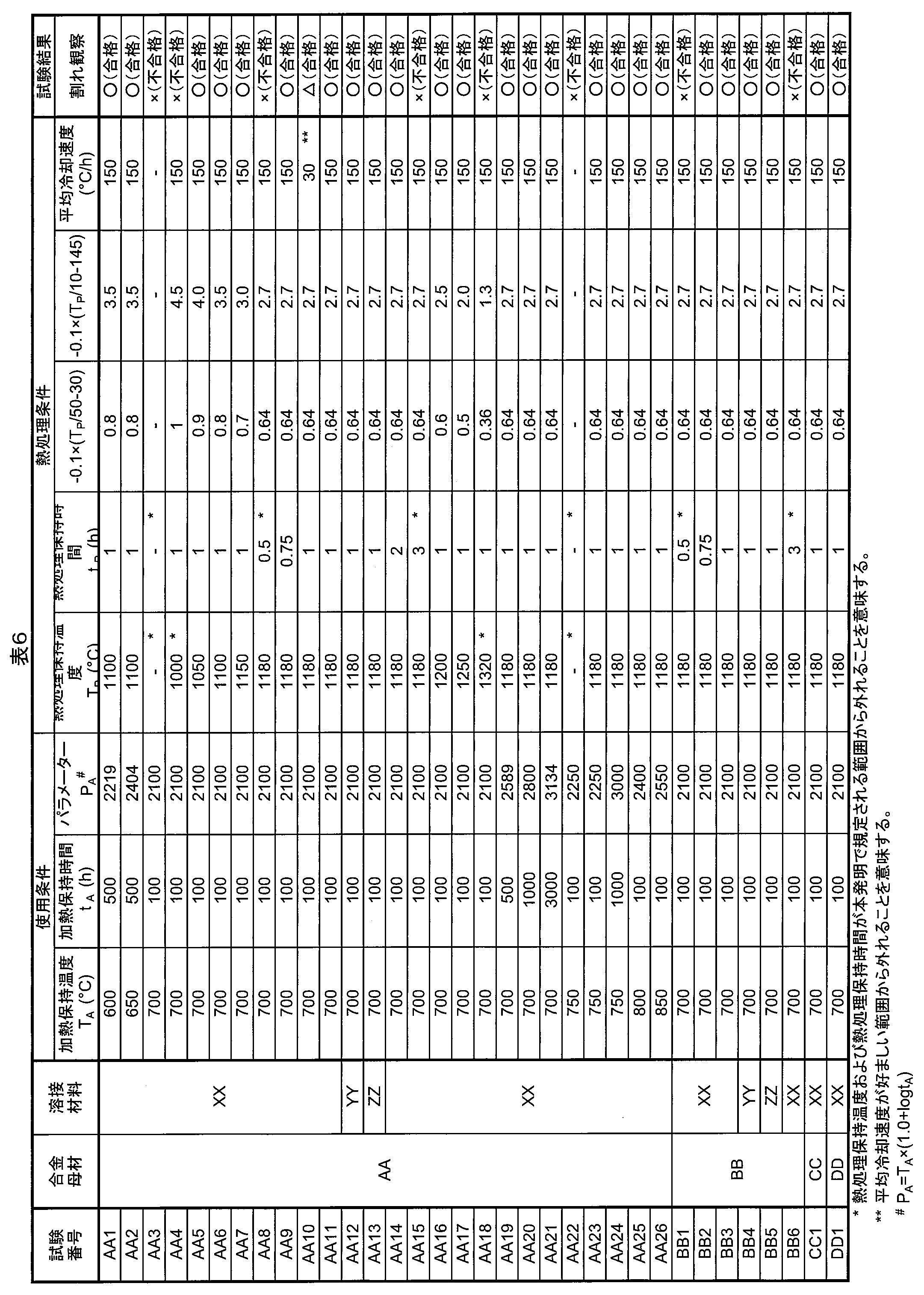
- the austenitic heat-resistant alloy plate was heated at the heating holding temperature and heating holding time shown in Table 6. Thereafter, except for the welded joints of test numbers AA3 and AA22, heat treatment was performed at the heat treatment holding temperature, the heat treatment holding time and the average cooling rate shown in Table 6.
- a V groove having a groove angle of 30 ° and a root thickness of 1 mm was processed in the longitudinal direction of the alloy plate described above. After that, on the SM400B steel plate specified in JIS G3160 (2008) having a thickness of 50 mm, a width of 200 mm, and a length of 200 mm, four rounds were restrained and welded using the covered arc welding rod DNiCrFe-3 specified in JIS Z3224 (1999). .
- test numbers AA3 and AA22 were cracked in the weld heat affected zone because the alloy plate was not heat-treated.
- the weld joint of test number AA4 had a low heat treatment holding temperature of 1000 ° C. before welding, so that the re-dissolution of precipitates was insufficient, so the deformation resistance in the grains was high, and the grain boundary The resolution of segregation was insufficient. Therefore, a weld crack occurred at a position slightly away from the melting line during welding.
- the weld joint of test number AA18 had a heat treatment holding temperature as high as 1320 ° C., so local melting of the grain boundary occurred, and the part opened during welding and cracking occurred.
- the heat treatment holding time was less than the range specified in the present invention, so that re-dissolution of precipitates and elimination of grain boundary segregation were insufficient, and a little away from the melting line during welding. A weld crack occurred at the position.
- the heat treatment holding time exceeded the range specified in the present invention, so that the crystal grains were significantly coarsened, and liquefaction cracks occurred in the portion adjacent to the melt line during welding.
- an austenitic heat-resistant alloy welded joint is stably used by using an austenitic heat-resistant alloy that has been used for a long time as a high-temperature member such as a main steam pipe or a reheat steam pipe of a boiler for thermal power generation. Obtainable.
Landscapes
- Chemical & Material Sciences (AREA)
- Engineering & Computer Science (AREA)
- Mechanical Engineering (AREA)
- Materials Engineering (AREA)
- Metallurgy (AREA)
- Organic Chemistry (AREA)
- Physics & Mathematics (AREA)
- Plasma & Fusion (AREA)
- Thermal Sciences (AREA)
- Crystallography & Structural Chemistry (AREA)
- Heat Treatment Of Steel (AREA)
- Arc Welding In General (AREA)
- Heat Treatment Of Articles (AREA)
Abstract
Description
下記(iii)式および(iv)式を満足する条件で熱処理を施した後、溶接する、オーステナイト系耐熱合金溶接継手の製造方法。
600≦TA≦850 ・・・(i)
2100≦TA×(1.0+logtA) ・・・(ii)
1050≦TP≦1300 ・・・(iii)
-0.1×(TP/50-30)≦tP≦-0.1×(TP/10-145) ・・・(iv)
ただし、上式中の各記号の意味は下記の通りである。
TA:使用時の加熱保持温度(℃)
tA:使用時の加熱保持時間(h)
TP:熱処理保持温度(℃)
tP:熱処理保持時間(h)
C:0.04~0.12%、
Si:1.0%以下、
Mn:2.0%以下、
P:0.03%以下、
S:0.01%以下、
Ni:42.0~54.0%、
Cr:20.0~33.0%、
W:3.0~10.0%、
Ti:0.05~1.0%、
Al:0.3%以下、
B:0.0001~0.01%、
N:0.02%以下、
O:0.01%以下、
Ca:0~0.05%、
Mg:0~0.05%、
REM:0~0.5%、
Co:0~1.0%、
Cu:0~4.0%、
Mo:0~1.0%、
V:0~0.5%、
Nb:0~0.5%、
Zr:0~0.05%、
残部:Feおよび不純物である、上記(1)に記載のオーステナイト系耐熱合金溶接継手の製造方法。
C:0.04~0.12%、
Si:1.0%以下、
Mn:2.0%以下、
P:0.03%以下、
S:0.01%以下、
Ni:42.0~48.0%、
Cr:20.0~26.0%、
W:4.0~10.0%、
Ti:0.05~0.15%、
Nb:0.1~0.4%、
Al:0.3%以下、
B:0.0001~0.01%、
N:0.02%以下、
O:0.01%以下、
Ca:0~0.05%、
Mg:0~0.05%、
REM:0~0.1%、
Co:0~1.0%、
Cu:0~4.0%、
Mo:0~1.0%、
V:0~0.5%、
残部:Feおよび不純物であり、かつ、
下記(i)式および(ii)式を満足する条件で使用された合金母材を、
下記(iii)式および(iv)式を満足する条件で熱処理を施した後、溶接する、オーステナイト系耐熱合金溶接継手の製造方法。
600≦TA≦850 ・・・(i)
2800≦TA×(1.0+logtA) ・・・(ii)
1050≦TP≦1300 ・・・(iii)
-0.1×(TP/50-30)≦tP≦-0.1×(TP/10-145) ・・・(iv)
ただし、上式中の各記号の意味は下記の通りである。
TA:使用時の加熱保持温度(℃)
tA:使用時の加熱保持時間(h)
TP:熱処理保持温度(℃)
tP:熱処理保持時間(h)
Ca:0.0001~0.05%、
Mg:0.0001~0.05%、
REM:0.0005~0.1%、
Co:0.01~1.0%、
Cu:0.01~4.0%、
Mo:0.01~1.0%、および
V:0.01~0.5%、
から選択される1種以上を含有する、上記(2)または(3)に記載のオーステナイト系耐熱合金溶接継手の製造方法。
C:0.04~0.12%、
Si:0.5%以下、
Mn:1.5%以下、
P:0.03%以下、
S:0.01%以下、
Ni:46.0~54.0%、
Cr:27.0~33.0%、
W:3.0~9.0%、
Ti:0.05~1.0%、
Zr:0.005~0.05%、
Al:0.05~0.3%、
B:0.0001~0.005%、
N:0.02%以下、
O:0.01%以下、
Ca:0~0.05%、
Mg:0~0.05%、
REM:0~0.5%、
Co:0~1.0%、
Cu:0~4.0%、
Mo:0~1.0%、
V:0~0.5%、
Nb:0~0.5%、
残部:Feおよび不純物であり、かつ、
下記(i)式および(ii)式を満足する条件で使用された合金母材を、
下記(iii)式および(iv)式を満足する条件で熱処理を施した後、溶接する、オーステナイト系耐熱合金溶接継手の製造方法。
600≦TA≦850 ・・・(i)
2100≦TA×(1.0+logtA) ・・・(ii)
1050≦TP≦1250 ・・・(iii)
-0.1×(TP/50-30)≦tP≦-0.1×(TP/10-145) ・・・(iv)
ただし、上式中の各記号の意味は下記の通りである。
TA:使用時の加熱保持温度(℃)
tA:使用時の加熱保持時間(h)
TP:熱処理保持温度(℃)
tP:熱処理保持時間(h)
Ca:0.0001~0.05%、
Mg:0.0001~0.05%、
REM:0.0005~0.5%、
Co:0.01~1.0%、
Cu:0.01~4.0%、
Mo:0.01~1.0%、
V:0.01~0.5%、および
Nb:0.01~0.5%、
から選択される1種以上を含有する、上記(2)または(5)に記載のオーステナイト系耐熱合金溶接継手の製造方法。
C:0.06~0.18%、
Si:1.0%以下、
Mn:2.0%以下、
P:0.03%以下、
S:0.01%以下、
Ni:40.0~60.0%、
Cr:20.0~33.0%、
MoおよびWから選択される1種以上:合計6.0~13.0%
Ti:0.05~1.5%、
Co:0~15.0%、
Nb:0~0.5%、
Al:1.5%以下、
B:0~0.005%、
N:0.18%以下、
O:0.01%以下、
残部:Feおよび不純物である溶接材料を使用して溶接する、上記(1)から上記(8)までのいずれかに記載のオーステナイト系耐熱合金溶接継手の製造方法。
本発明に係るオーステナイト系耐熱合金溶接継手の製造に使用する合金母材に含有される各元素の限定理由は下記のとおりである。
Cは、オーステナイトを安定化させる作用を有するとともに、微細な炭化物を形成し、高温使用中のクリープ強度を向上させる効果を有する元素である。この効果を充分に得るためには、0.04%以上のC含有量が必要である。しかしながら、C含有量が過剰であると、炭化物が粗大となり、かつ、多量に析出するため、クリープ強度への寄与が飽和する。そればかりでなく、延性を低下させて、長時間使用した材料において溶接性を低下させる。したがって、C含有量は0.12%以下とする。C含有量は、0.05%以上であることが好ましく、0.06%以上であることがより好ましい。また、C含有量は、0.11%以下であることが好ましく、0.08%以下であることがより好ましい。
Siは、脱酸作用を有するとともに、高温での耐食性および耐酸化性の向上に有効な元素である。しかしながら、Siが過剰に含有された場合にはオーステナイトの安定性が低下して、靱性およびクリープ強度の低下を招く。そのため、Siの含有量に上限を設けて1.0%以下とする。Si含有量は、0.8%以下であることが好ましく、0.5%以下であることがより好ましく、0.3%以下であることがさらに好ましい。
Mnは、Siと同様、脱酸作用を有する元素である。また、Mnは、オーステナイトの安定化にも寄与する。しかしながら、Mnの含有量が過剰になると脆化を招き、さらに、靱性およびクリープ延性の低下も生じる。そのため、Mnの含有量に上限を設けて2.0%以下とする。Mnの含有量は、1.8%以下であることが好ましく、1.5%以下であることがより好ましく、1.3%以下であることがさらに好ましい。
Pは、不純物として合金中に含まれ、溶接中に溶接熱影響部の結晶粒界に偏析して、液化割れ感受性を高める元素である。さらに、高温で長時間使用した際に粒界に偏析し、クリープ延性を低下させるとともに、長時間使用した材料において溶接性を低下させる。そのため、Pの含有量に上限を設けて0.03%以下とする。Pの含有量は、0.025%以下であることが好ましく、0.02%以下であることがより好ましい。
Sは、Pと同様に不純物として合金中に含まれ、溶接中に溶接熱影響部の結晶粒界に偏析して、液化割れ感受性を高める元素である。さらに、高温で長時間使用した際に粒界に偏析して脆化を招き、長時間使用した材料において溶接性を低下させる。そのため、Sの含有量に上限を設けて0.01%以下とする。Sの含有量は、0.008%以下であることが好ましく、0.005%以下であることがより好ましい。
Niは、オーステナイトを得るために有効な元素であり、高温での長時間使用時における組織安定性を確保するために必須の元素である。本発明のCr含有量の範囲で充分な効果を得るためには、42.0%以上のNi含有量が必要である。しかしながら、Niは高価な元素であり、多量に含有させるとコストの増大を招く。そのため、上限を設けて、Niの含有量を54.0%以下とする。Ni含有量は、42.5%以上であることが好ましく、43.0%以上であることがより好ましい。また、Ni含有量は、53.0%以下であることが好ましく、52.0%以下であることがより好ましい。
Crは、高温での耐酸化性および耐食性の確保のために必須の元素である。また、Crは、微細な炭化物またはさらにCr富化相を形成してクリープ強度の確保にも寄与する。本発明のNi含有量の範囲で、上記の効果を得るためには、20.0%以上のCr含有量が必要である。しかしながら、Crの含有量が33.0%を超えると、高温でのオーステナイトの安定性が劣化してクリープ強度の低下を招く。さらに、多量の炭化物またはさらにCr富化相の析出を招き、変形抵抗を高め、長時間使用した材料において溶接性を低下させる。したがって、Crの含有量を33.0%以下とする。Cr含有量は、20.5%以上であることが好ましく、21.0%以上であることがより好ましい。また、Cr含有量は、32.5%以下であることが好ましく、32.0%以下であることがより好ましい。
Wは、マトリックスに固溶し、または、微細な金属間化合物相を形成して、高温でのクリープ強度および引張強さの向上に大きく寄与する元素である。この効果を充分に得るためには、3.0%以上のW含有量が必要である。しかしながら、Wを過剰に含有させても効果は飽和し、却ってクリープ強度を低下させる。さらに、多量の金属間化合物の析出を招き、変形抵抗を高め、長時間使用した材料において溶接性を低下させる場合もある。また、高価な元素であるため、過剰に含有させるとコストの増大を招く。そのため上限を設けて、Wの含有量を10.0%以下とする。
Tiは、微細な炭窒化物または金属間化合物相として粒内に析出し、高温でのクリープ強度および引張強さの向上に寄与する。その効果を充分に得るためには、0.05%以上のTi含有量が必要である。しかしながら、Tiの含有量が過剰になると、炭窒化物が多量に析出し、クリープ延性および靱性の低下を招くとともに、長時間使用した材料において溶接性を低下させる。そのため、上限を設けて、Tiの含有量を1.0%以下とする。Ti含有量は、0.06%以上であることが好ましく、0.07%以上であることがより好ましい。また、Ti含有量は、0.9%以下であることが好ましく、0.8%以下であることがより好ましい。
Alは、脱酸作用を有するとともに、使用中に金属間化合物相として析出し、クリープ強度の向上にも寄与する元素である。しかしながら、Alの含有量が過剰になると合金の清浄性が著しく劣化して、熱間加工性および延性が低下する。そのため、上限を設けて、Alの含有量を0.3%以下とする。Al含有量は、0.2%以下であることが好ましく、0.1%以下であることがより好ましい。
Bは、粒界炭化物を微細分散させることにより、クリープ強度を向上させるとともに、粒界に偏析して粒界を強化するのに有効な元素である。この効果を得るためには、B含有量を0.0001%以上とする必要がある。しかしながら、Bの含有量が過剰になると、溶接中の溶接熱サイクルにより溶融境界近傍の熱影響部にBが多量に偏析して粒界の融点が低下し、液化割れ感受性が高まる。そのため、上限を設けて、Bの含有量を0.01%以下とする。B含有量は、0.0005%以上であることが好ましく、0.001%以上であることがより好ましい。また、B含有量は、0.008%以下であることが好ましく、0.006%以下であることがより好ましい。
Nは、オーステナイトを安定にするのに有効な元素であるものの、過剰に含有されると、高温での使用中に多量の微細窒化物が粒内に析出して、クリープ延性および靱性の低下を招く。さらには、長時間使用した材料の溶接性を低下させる。そのため、Nの含有量に上限を設けて0.02%以下とする。Nの含有量は、0.018%以下であることが好ましく、0.015%以下であることがより好ましい。
O(酸素)は、不純物として合金中に含まれ、その含有量が過剰になると熱間加工性が低下し、さらに靱性および延性の劣化を招く。このため、Oの含有量に上限を設けて0.01%以下とする。Oの含有量は、0.008%以下であることが好ましく、0.005%以下であることがより好ましい。
Caは、熱間加工性を改善する作用を有する元素であるため、含有させてもよい。しかしながら、Caの含有量が過剰になると、Oと結合して、清浄性を著しく低下させ、却って熱間加工性を劣化させる。したがって、Caを含有させる場合には、その含有量を0.05%以下とする。Ca含有量は、0.03%以下であることが好ましい。
Mgは、Caと同様、熱間加工性を改善する作用を有する元素であるため、含有させてもよい。しかしながら、Mgの含有量が過剰になると、Oと結合して、清浄性を著しく低下させ、却って熱間加工性を劣化させる。したがって、Mgを含有させる場合には、その含有量を0.05%以下とする。Mg含有量は、0.03%以下であることが好ましい。
REMは、Sとの親和力が強く、熱間加工性を改善する作用を有する元素であるため、含有させてもよい。しかしながら、REMの含有量が過剰になると、Oと結合して、清浄性を著しく低下させ、却って熱間加工性を劣化させる。したがって、REMを含有させる場合には、その含有量を0.5%以下とする。REM含有量は、0.2%以下であることが好ましく、0.1%以下であることがより好ましく、0.06%以下であることがさらに好ましい。
Coは、Niと同様に、オーステナイトを得るために有効な元素であり、相安定性を高めてクリープ強度の向上に寄与するため、含有させてもよい。しかしながら、Coは極めて高価な元素であるため、Coの過剰の含有は大幅なコスト増を招く。したがって、Coを含有させる場合には、その含有量を1.0%以下とする。Co含有量は、0.8%以下であることが好ましく、0.4%以下であることがより好ましい。
Cuは、クリープ強度を向上させる作用を有する元素である。すなわち、Cuは、NiおよびCoと同様に、オーステナイトを得るために有効な元素であり、相安定性を高めてクリープ強度の向上に寄与する。このため、Cuを含有させてもよい。しかしながら、Cuが過剰に含有された場合には、熱間加工性の低下を招く。したがって、Cuを含有させる場合には、その含有量を4.0%以下とする。Cu含有量は、3.0%以下であることが好ましく、1.0%以下であることがより好ましい。
Moは、クリープ強度を向上させる作用を有する元素である。すなわち、Moは、マトリックスに固溶して高温でのクリープ強度を向上させる作用を有するため、含有させてもよい。しかしながら、Moが過剰に含有された場合、オーステナイトの安定性が低下して、却ってクリープ強度の低下を招く。したがって、Moを含有させる場合には、その含有量を1.0%以下とする。Mo含有量は、0.8%以下であることが好ましく、0.5%以下であることがより好ましい。
Vは、クリープ強度を向上させる作用を有する元素である。すなわち、Vは、CまたはNと結合して微細な炭化物または炭窒化物を形成し、クリープ強度を向上させる作用を有するため、含有させてもよい。しかしながら、Vが過剰に含有された場合、炭化物または炭窒化物として多量に析出し、クリープ延性の低下を招くとともに、長時間使用した材料において溶接性を低下させる。したがって、Vを含有させる場合には、その含有量を0.5%以下とする。V含有量は、0.4%以下であることが好ましく、0.2%以下であることがより好ましい。
Nbは、TiおよびVと同様に、CまたはNと結合して微細な炭化物または炭窒化物として粒内に析出し、高温でのクリープ強度向上に寄与するため、含有させてもよい。しかしながら、Nbの含有量が過剰になると、炭化物および炭窒化物として多量に析出し、クリープ延性および靱性の低下を招くとともに、長時間使用した材料において溶接性を低下させる。そのため、上限を設けて、Nbの含有量を0.5%以下とする。Nb含有量は、0.4%以下であることが好ましく、0.38%以下であることがより好ましく、0.35%以下であることがさらに好ましい。
Zrは、Tiと同様に、マトリックスに固溶して高温でのクリープ強度を向上させる。また、Zrは、Sとの親和力が強く、Sの固定によりクリープ延性も向上させる。しかしながら、Zrの含有量が過剰になると、クリープ延性の低下を招く。そのため、上限を設けて、Zrの含有量を0.05%以下とする。Zr含有量は、0.04%以下であることが好ましく、0.03%以下であることがより好ましい。
本発明のオーステナイト系耐熱合金溶接継手の製造に使用する合金母材は、使用時の加熱保持温度TAが下記(i)式を満足し、かつ、使用時の加熱保持温度TAおよび加熱保持時間tAから決まるパラメーター(以下、PAともいう。)が下記(ii)式を満足する条件で使用されたものである。
PA:2100≦TA×(1.0+logtA) ・・・(ii)
本発明のオーステナイト系耐熱合金溶接継手の製造に使用する合金母材は、600~850℃に加熱された場合、結晶粒内に析出物が微細に析出する。特に、合金母材が上記(a)に記載される化学組成を有する場合においては、M23C6炭化物および金属間化合物であるラーベス相が析出し、上記(b)に記載される化学組成を有する場合においては、M23C6炭化物およびCrが富化したbcc相が析出する傾向にある。
本発明のオーステナイト系耐熱合金溶接継手の製造方法では、前記合金母材を溶接する前に熱処理を施す。上記熱処理は、溶接割れを防止するため、熱処理保持温度TPおよび熱処理保持時間tPが下記(iii)式および(iv)式を満足する条件で行う必要がある。
溶接割れを防止するためには、熱処理により、高温での使用中に過剰に粒内に析出した析出物を再度基地に固溶させるとともに、粒界に偏析した不純物元素を軽減させることが有効である。そのためには、熱処理保持温度TPを少なくとも1050℃以上にする必要がある。しかしながら、熱処理保持温度TPが1300℃を超えると、粒界の局部溶融が開始される。そのため、熱処理保持温度TPは1300℃以下とする。
溶接割れを防止するためには、熱処理の実施が有効であるが、その熱処理保持時間tPは-0.1×(TP/50-30)以上とする必要がある。これは、熱処理保持時間tPがこの値を下回ると、析出物の基地への再固溶および粒界偏析の軽減を達成するための合金元素の拡散に要する時間が不充分となるためである。しかしながら、熱処理保持時間tPが-0.1×(TP/10-145)を超えると、結晶粒径の粗大化が著しくなり、溶接の際、溶融線近傍に液化割れが生じやすくなる。そのため、熱処理保持時間tPは、-0.1×(TP/10-145)以下とする必要がある。
本発明に係るオーステナイト系耐熱合金溶接継手の製造に使用する溶接材料の化学組成については特に制限は設けない。しかしながら、下記に示す範囲の化学組成を有する溶接材料を用いることが好ましい。各元素の限定理由は下記のとおりである。
Cは、溶接後の溶接金属中のオーステナイトを安定化させる作用を有するとともに、微細な炭化物を形成し、高温使用中のクリープ強度を向上させる効果を有する元素である。さらには、溶接凝固中にCrと共晶炭化物を形成することで、凝固割れ感受性の低減にも寄与する。この効果を充分に得るためには、0.06%以上のC含有量が必要である。しかしながら、C含有量が過剰であると、炭化物が多量に析出するため、却ってクリープ強度および延性を低下させる。したがって、C含有量は0.18%以下とする。C含有量は0.07%以上であることが好ましく、0.08%以上であることがより好ましい。また、C含有量は0.16%以下であることが好ましく、0.14%以下であることがより好ましい。
Siは、溶接材料の製造時において脱酸に有効であるとともに、溶接後の溶接金属の高温での耐食性および耐酸化性の向上に有効な元素である。しかしながら、Siが過剰に含有された場合にはオーステナイトの安定性が低下して、靱性およびクリープ強度の低下を招く。そのため、Siの含有量に上限を設けて1.0%以下とする。Si含有量は0.8%以下であることが好ましく、0.6%以下であることがより好ましい。
Mnは、Siと同様、溶接材料の製造時において脱酸に有効な元素である。また、Mnは、溶接後の溶接金属中のオーステナイトの安定化にも寄与する。しかしながら、Mnの含有量が過剰になると脆化を招き、さらに、靱性およびクリープ延性の低下も生じる。そのため、Mnの含有量に上限を設けて2.0%以下とする。Mnの含有量は1.8%以下であることが好ましく、1.5%以下であることがより好ましい。
Pは、不純物として溶接材料中に含まれ、溶接中に凝固割れ感受性を高める元素である。さらに、高温で長時間使用した後の溶接金属のクリープ延性を低下させる。そのため、Pの含有量に上限を設けて0.03%以下とする。Pの含有量は、0.025%以下であることが好ましく、0.02%以下であることがより好ましい。
Sは、Pと同様に不純物として溶接材料中に含まれ、溶接中に凝固割れ感受性を高める元素である。さらに、Sは、溶接金属において長時間使用中に柱状晶粒界に偏析して脆化を招き、応力緩和割れ感受性を高める。そのため、Sの含有量に上限を設けて0.01%以下とする。Sの含有量は、0.008%以下であることが好ましく、0.005%以下であることがより好ましい。
Niは、溶接後の溶接金属中のオーステナイトを安定化させるのに有効な元素であり、長時間使用時のクリープ強度を確保するために必須の元素である。その効果を得るためには、溶接材料のNi含有量を40.0%以上とする必要がある。しかしながら、Niは高価な元素であり、小規模製造の溶接材料においても、多量に含有させるとコストの増大を招く。そのため、上限を設けて、Niの含有量を60.0%以下とする。Ni含有量は、40.5%以上であることが好ましく、41.0%以上であることがより好ましい。また、Ni含有量は、59.5%以下であることが好ましく、59.0%以下であることがより好ましい。
Crは、溶接後の溶接金属の高温での耐酸化性および耐食性の確保のために有効な元素である。また、Crは、微細な炭化物またはCrが富化したbcc相を形成してクリープ強度の確保にも寄与する。さらに、溶接中にCと共晶炭化物を形成することで、凝固割れ感受性の低減にも寄与する。これらの効果を得るためには、20%以上のCr含有量が必要である。しかしながら、Crの含有量が33.0%を超えると、上記40~60%のNi量範囲において高温でのオーステナイトの安定性が劣化してクリープ強度の低下を招く。したがって、Crの含有量を33.0%以下とする。
MoおよびWは、溶接金属においてマトリックスに固溶し、または、微細な金属間化合物相を形成して、高温でのクリープ強度および引張強さの向上に大きく寄与する元素である。この効果を充分に得るためには、MoおよびWから選択される1種以上を合計で6.0%以上含有させる必要である。しかしながら、これらの元素を過剰に含有させても効果は飽和し、却ってクリープ強度を低下させる。さらに、MoおよびWは高価な元素であるため、過剰に含有させるとコストの増大を招く。そのため上限を設けて、MoおよびWから選択される1種以上の合計含有量を13.0%以下とする。合計含有量は、6.5%以上であることが好ましく、7.0%以上であることがより好ましい。また、合計含有量は、12.5%以下であることが好ましく、12.0%以下であることがより好ましい。
Tiは、溶接金属中に微細な炭窒化物として、さらに、Niとの金属間化合物相として、粒内に析出し、高温でのクリープ強度および引張強さの向上に寄与する元素である。その効果を充分に得るためには、Ti含有量を0.05%以上とする必要がある。しかしながら、Tiの含有量が過剰になると炭窒化物が多量に析出し、クリープ延性および靱性の低下を招く。そのため、上限を設けて、Tiの含有量を1.5%以下とする。
Coは、Niと同様に、オーステナイトを得るために有効な元素であり、相安定性を高めてクリープ強度の向上に寄与するため、含有させてもよい。しかしながら、Coは極めて高価な元素であるため、溶接材料といえども過剰の含有は大幅なコスト増を招く。したがって、Coを含有させる場合には、その含有量を15.0%以下とする。Co含有量は、14.0%以下であることが好ましく、13.0%以下であることがより好ましい。
Nbは、Tiと同様に、CまたはNと結合して微細な炭化物または炭窒化物として粒内に析出し、高温でのクリープ強度向上に寄与するため、含有させてもよい。しかしながら、Nbの含有量が過剰になると、炭化物または炭窒化物として多量に析出し、クリープ延性および靱性の低下を招く。そのため、Nbを含有させる場合には、その含有量を0.5%以下とする。Nb含有量は、0.48%以下であることが好ましく、0.45%以下であることがより好ましい。
Alは、溶接材料の製造時において脱酸に有効な元素である。また、溶接金属において微細な金属間化合物相を形成して、クリープ強度の向上に寄与する。しかしながら、Alの含有量が過剰になると合金の清浄性が著しく劣化して、溶接材料の熱間加工性および延性が低下するため、製造性が低下する。加えて、溶接金属中で多量の金属間化合物相を形成し、高温で長時間使用した際の応力緩和割れ感受性を著しく高める。そのため、上限を設けて、Alの含有量を1.5%以下とする。Al含有量は、1.4%以下であることが好ましく、1.3%以下であることがより好ましい。
Bは、溶接金属のクリープ強度の向上に有効な元素であるため、含有させてもよい。しかしながら、Bの含有量が過剰になると、溶接中の凝固割れ感受性が著しく高くなる。そのため、上限を設けて、Bの含有量を0.005%以下とする。B含有量は、0.004%以下であることが好ましく、0.003%以下であることがより好ましい。
Nは、溶接金属中のオーステナイトを安定化させ、クリープ強度を向上させるとともに、固溶して引張強さの確保に寄与する元素である。しかしながら、過剰に含有されると、高温での使用中に多量の微細窒化物が粒内に析出してクリープ延性および靱性の低下を招く。そのため、N含有量に上限を設けて0.18%以下とする。N含有量は、0.16%以下であることが好ましく、0.14%以下であることがより好ましい。
O(酸素)は、不純物として溶接材料中に含まれ、その含有量が過剰になると熱間加工性が低下し、製造性の劣化を招く。このため、Oの含有量に上限を設けて0.01%以下とする。Oの含有量は、0.008%以下であることが好ましく、0.005%以下であることがより好ましい。
本発明のオーステナイト系耐熱合金溶接継手の製造方法では、前記合金母材に熱処理を施した後、溶接する。溶接方法としては、特に限定されるものではなく、例えば、ガスタングステンアーク溶接、ガスメタルアーク溶接、被覆アーク溶接などを用いることができる。


得られた溶接継手の5か所から採取した試料の横断面を鏡面研磨、腐食し、光学顕微鏡により検鏡を行い、溶接熱影響部の割れ有無を調査した。そして、5個の試料のうち、全ての試料で割れが認められなかった溶接継手を「○」、1~2個の試料で割れが認められた溶接継手を「△」とし、「合格」と判定した。また、5個の試料全てで割れが認められた溶接継手を「×」とし、「不合格」と判定した。


Claims (10)
- 下記(i)式および(ii)式を満足する条件で使用された合金母材を、
下記(iii)式および(iv)式を満足する条件で熱処理を施した後、溶接する、オーステナイト系耐熱合金溶接継手の製造方法。
600≦TA≦850 ・・・(i)
2100≦TA×(1.0+logtA) ・・・(ii)
1050≦TP≦1300 ・・・(iii)
-0.1×(TP/50-30)≦tP≦-0.1×(TP/10-145) ・・・(iv)
ただし、上式中の各記号の意味は下記の通りである。
TA:使用時の加熱保持温度(℃)
tA:使用時の加熱保持時間(h)
TP:熱処理保持温度(℃)
tP:熱処理保持時間(h) - 前記合金母材の化学組成が、質量%で、
C:0.04~0.12%、
Si:1.0%以下、
Mn:2.0%以下、
P:0.03%以下、
S:0.01%以下、
Ni:42.0~54.0%、
Cr:20.0~33.0%、
W:3.0~10.0%、
Ti:0.05~1.0%、
Al:0.3%以下、
B:0.0001~0.01%、
N:0.02%以下、
O:0.01%以下、
Ca:0~0.05%、
Mg:0~0.05%、
REM:0~0.5%、
Co:0~1.0%、
Cu:0~4.0%、
Mo:0~1.0%、
V:0~0.5%、
Nb:0~0.5%、
Zr:0~0.05%、
残部:Feおよび不純物である、請求項1に記載のオーステナイト系耐熱合金溶接継手の製造方法。 - 化学組成が、質量%で、
C:0.04~0.12%、
Si:1.0%以下、
Mn:2.0%以下、
P:0.03%以下、
S:0.01%以下、
Ni:42.0~48.0%、
Cr:20.0~26.0%、
W:4.0~10.0%、
Ti:0.05~0.15%、
Nb:0.1~0.4%、
Al:0.3%以下、
B:0.0001~0.01%、
N:0.02%以下、
O:0.01%以下、
Ca:0~0.05%、
Mg:0~0.05%、
REM:0~0.1%、
Co:0~1.0%、
Cu:0~4.0%、
Mo:0~1.0%、
V:0~0.5%、
残部:Feおよび不純物であり、かつ、
下記(i)式および(ii)式を満足する条件で使用された合金母材を、
下記(iii)式および(iv)式を満足する条件で熱処理を施した後、溶接する、オーステナイト系耐熱合金溶接継手の製造方法。
600≦TA≦850 ・・・(i)
2800≦TA×(1.0+logtA) ・・・(ii)
1050≦TP≦1300 ・・・(iii)
-0.1×(TP/50-30)≦tP≦-0.1×(TP/10-145) ・・・(iv)
ただし、上式中の各記号の意味は下記の通りである。
TA:使用時の加熱保持温度(℃)
tA:使用時の加熱保持時間(h)
TP:熱処理保持温度(℃)
tP:熱処理保持時間(h) - 前記合金母材の化学組成が、質量%で、
Ca:0.0001~0.05%、
Mg:0.0001~0.05%、
REM:0.0005~0.1%、
Co:0.01~1.0%、
Cu:0.01~4.0%、
Mo:0.01~1.0%、および
V:0.01~0.5%、
から選択される1種以上を含有する、請求項2または請求項3に記載のオーステナイト系耐熱合金溶接継手の製造方法。 - 化学組成が、質量%で、
C:0.04~0.12%、
Si:0.5%以下、
Mn:1.5%以下、
P:0.03%以下、
S:0.01%以下、
Ni:46.0~54.0%、
Cr:27.0~33.0%、
W:3.0~9.0%、
Ti:0.05~1.0%、
Zr:0.005~0.05%、
Al:0.05~0.3%、
B:0.0001~0.005%、
N:0.02%以下、
O:0.01%以下、
Ca:0~0.05%、
Mg:0~0.05%、
REM:0~0.5%、
Co:0~1.0%、
Cu:0~4.0%、
Mo:0~1.0%、
V:0~0.5%、
Nb:0~0.5%、
残部:Feおよび不純物であり、かつ、
下記(i)式および(ii)式を満足する条件で使用された合金母材を、
下記(iii)式および(iv)式を満足する条件で熱処理を施した後、溶接する、オーステナイト系耐熱合金溶接継手の製造方法。
600≦TA≦850 ・・・(i)
2100≦TA×(1.0+logtA) ・・・(ii)
1050≦TP≦1250 ・・・(iii)
-0.1×(TP/50-30)≦tP≦-0.1×(TP/10-145) ・・・(iv)
ただし、上式中の各記号の意味は下記の通りである。
TA:使用時の加熱保持温度(℃)
tA:使用時の加熱保持時間(h)
TP:熱処理保持温度(℃)
tP:熱処理保持時間(h) - 前記合金母材の化学組成が、質量%で、
Ca:0.0001~0.05%、
Mg:0.0001~0.05%、
REM:0.0005~0.5%、
Co:0.01~1.0%、
Cu:0.01~4.0%、
Mo:0.01~1.0%、
V:0.01~0.5%、および
Nb:0.01~0.5%、
から選択される1種以上を含有する、請求項2または請求項5に記載のオーステナイト系耐熱合金溶接継手の製造方法。 - 前記熱処理において、冷却過程における500℃までの平均冷却速度が50℃/h以上である、請求項1から請求項6までのいずれかに記載のオーステナイト系耐熱合金溶接継手の製造方法。
- 前記熱処理は、少なくとも被溶接部から30mm以内の範囲すべてに施す、請求項1から請求項7までのいずれかに記載のオーステナイト系耐熱合金溶接継手の製造方法。
- 化学組成が、質量%で、
C:0.06~0.18%、
Si:1.0%以下、
Mn:2.0%以下、
P:0.03%以下、
S:0.01%以下、
Ni:40.0~60.0%、
Cr:20.0~33.0%、
MoおよびWから選択される1種以上:合計6.0~13.0%
Ti:0.05~1.5%、
Co:0~15.0%、
Nb:0~0.5%、
Al:1.5%以下、
B:0~0.005%、
N:0.18%以下、
O:0.01%以下、
残部:Feおよび不純物である溶接材料を使用して溶接する、請求項1から請求項8までのいずれかに記載のオーステナイト系耐熱合金溶接継手の製造方法。 - 請求項1から請求項9までのいずれかに記載の製造方法を用いて得られる、オーステナイト系耐熱合金溶接継手。
Priority Applications (3)
| Application Number | Priority Date | Filing Date | Title |
|---|---|---|---|
| JP2016574855A JP6390723B2 (ja) | 2015-02-12 | 2016-02-12 | オーステナイト系耐熱合金溶接継手の製造方法 |
| KR1020177022948A KR102031776B1 (ko) | 2015-02-12 | 2016-02-12 | 오스테나이트계 내열합금 용접 조인트의 제조 방법 및 그것을 이용하여 얻어지는 용접 조인트 |
| CN201680010103.3A CN107250417B (zh) | 2015-02-12 | 2016-02-12 | 奥氏体系耐热合金焊接接头的制造方法及使用其得到的焊接接头 |
Applications Claiming Priority (4)
| Application Number | Priority Date | Filing Date | Title |
|---|---|---|---|
| JP2015025553 | 2015-02-12 | ||
| JP2015025548 | 2015-02-12 | ||
| JP2015-025548 | 2015-02-12 | ||
| JP2015-025553 | 2015-02-12 |
Publications (1)
| Publication Number | Publication Date |
|---|---|
| WO2016129666A1 true WO2016129666A1 (ja) | 2016-08-18 |
Family
ID=56614885
Family Applications (1)
| Application Number | Title | Priority Date | Filing Date |
|---|---|---|---|
| PCT/JP2016/054094 Ceased WO2016129666A1 (ja) | 2015-02-12 | 2016-02-12 | オーステナイト系耐熱合金溶接継手の製造方法およびそれを用いて得られる溶接継手 |
Country Status (4)
| Country | Link |
|---|---|
| JP (1) | JP6390723B2 (ja) |
| KR (1) | KR102031776B1 (ja) |
| CN (1) | CN107250417B (ja) |
| WO (1) | WO2016129666A1 (ja) |
Cited By (3)
| Publication number | Priority date | Publication date | Assignee | Title |
|---|---|---|---|---|
| JP2018127672A (ja) * | 2017-02-08 | 2018-08-16 | 新日鐵住金株式会社 | オーステナイト系耐熱合金部材 |
| JP2020186439A (ja) * | 2019-05-14 | 2020-11-19 | 日本製鉄株式会社 | オーステナイト系耐熱合金部材 |
| JP2021049571A (ja) * | 2019-09-26 | 2021-04-01 | 日本製鉄株式会社 | オーステナイト系ステンレス鋼溶接継手 |
Families Citing this family (10)
| Publication number | Priority date | Publication date | Assignee | Title |
|---|---|---|---|---|
| CN109909641B (zh) * | 2017-12-13 | 2022-03-29 | 中国科学院金属研究所 | 一种高温合金连接用钴基粉末钎料及其制备方法和应用 |
| JP6950752B2 (ja) * | 2018-01-10 | 2021-10-13 | 日本製鉄株式会社 | オーステナイト系耐熱合金及びその製造方法 |
| JP6447793B1 (ja) * | 2018-03-27 | 2019-01-09 | 新日鐵住金株式会社 | 被覆アーク溶接棒用のNi基合金心線、被覆アーク溶接棒、及び被覆アーク溶接棒の製造方法 |
| CN110446582B (zh) | 2018-03-27 | 2020-07-28 | 日本制铁株式会社 | 埋弧焊用Ni基合金丝以及焊接接头的制造方法 |
| CN109894772B (zh) * | 2019-04-29 | 2021-03-19 | 重庆大学 | 一种用于拳头式仿生结构大型热锻模具皮肤层的药芯丝材及其制备方法 |
| CN112593120A (zh) * | 2020-12-09 | 2021-04-02 | 上海蓝铸特种合金材料有限公司 | 一种镍基多元合金及其制成的管材和制备方法 |
| CN113172361B (zh) * | 2021-05-12 | 2022-09-23 | 远景能源有限公司 | 风力发电机组轮毂焊接修复方法及系统 |
| CN115383346A (zh) * | 2021-05-25 | 2022-11-25 | 丹阳市凯鑫合金材料有限公司 | 一种镍基合金焊丝的生产方法 |
| CN115478194B (zh) * | 2021-06-15 | 2023-11-10 | 中国科学院金属研究所 | 一种激光修复用NiCrWMoCoNbAlTi粉体材料及其制备方法 |
| CN115094274A (zh) * | 2022-07-05 | 2022-09-23 | 江苏以豪合金有限公司 | 镍铬高电阻电热合金丝及其制备方法 |
Citations (5)
| Publication number | Priority date | Publication date | Assignee | Title |
|---|---|---|---|---|
| JP2000160313A (ja) * | 1998-06-30 | 2000-06-13 | Howmet Res Corp | ニッケル基超耐熱合金とこのニッケル基超耐熱合金の溶接前熱処理及び溶接法 |
| JP2013094827A (ja) * | 2011-11-02 | 2013-05-20 | Nippon Steel & Sumitomo Metal Corp | Ni基耐熱合金用溶接材料ならびにそれを用いてなる溶接金属および溶接継手 |
| JP2014140884A (ja) * | 2013-01-25 | 2014-08-07 | Nippon Steel & Sumitomo Metal | オーステナイト系耐熱鋼用溶接材料ならびにそれを用いて製造される溶接金属及び溶接継手 |
| JP2014145109A (ja) * | 2013-01-29 | 2014-08-14 | Nippon Steel & Sumitomo Metal | オーステナイト系耐熱合金部材およびオーステナイト系耐熱合金素材 |
| WO2014130441A1 (en) * | 2013-02-22 | 2014-08-28 | Siemens Aktiengesellschaft | Pre-weld heat treatment for a nickel based superalloy |
Family Cites Families (9)
| Publication number | Priority date | Publication date | Assignee | Title |
|---|---|---|---|---|
| JP4382244B2 (ja) * | 2000-04-11 | 2009-12-09 | 日立金属株式会社 | 耐高温硫化腐食性に優れたNi基合金の製造方法 |
| US7854064B2 (en) * | 2006-06-05 | 2010-12-21 | United Technologies Corporation | Enhanced weldability for high strength cast and wrought nickel superalloys |
| CA2674091C (en) * | 2007-01-15 | 2012-02-21 | Sumitomo Metal Industries, Ltd. | Austenitic stainless steel welded joint and austenitic stainless steel welding material |
| ES2728670T3 (es) * | 2008-06-16 | 2019-10-28 | Nippon Steel Corp | Aleación austenítica resistente al calor, miembro a presión resistente al calor que comprende la aleación, y método para la fabricación del mismo miembro |
| EP2330225B1 (en) | 2008-10-02 | 2015-03-25 | Nippon Steel & Sumitomo Metal Corporation | Nickel based heat-resistant alloy |
| JP4780189B2 (ja) | 2008-12-25 | 2011-09-28 | 住友金属工業株式会社 | オーステナイト系耐熱合金 |
| JP4631986B1 (ja) | 2009-09-16 | 2011-02-16 | 住友金属工業株式会社 | Ni基合金製品およびその製造方法 |
| KR20120073356A (ko) | 2009-12-10 | 2012-07-04 | 수미도모 메탈 인더스트리즈, 리미티드 | 오스테나이트계 내열 합금 |
| JP4835771B1 (ja) * | 2010-06-14 | 2011-12-14 | 住友金属工業株式会社 | Ni基耐熱合金用溶接材料ならびにそれを用いてなる溶接金属および溶接継手 |
-
2016
- 2016-02-12 JP JP2016574855A patent/JP6390723B2/ja active Active
- 2016-02-12 KR KR1020177022948A patent/KR102031776B1/ko active Active
- 2016-02-12 CN CN201680010103.3A patent/CN107250417B/zh active Active
- 2016-02-12 WO PCT/JP2016/054094 patent/WO2016129666A1/ja not_active Ceased
Patent Citations (5)
| Publication number | Priority date | Publication date | Assignee | Title |
|---|---|---|---|---|
| JP2000160313A (ja) * | 1998-06-30 | 2000-06-13 | Howmet Res Corp | ニッケル基超耐熱合金とこのニッケル基超耐熱合金の溶接前熱処理及び溶接法 |
| JP2013094827A (ja) * | 2011-11-02 | 2013-05-20 | Nippon Steel & Sumitomo Metal Corp | Ni基耐熱合金用溶接材料ならびにそれを用いてなる溶接金属および溶接継手 |
| JP2014140884A (ja) * | 2013-01-25 | 2014-08-07 | Nippon Steel & Sumitomo Metal | オーステナイト系耐熱鋼用溶接材料ならびにそれを用いて製造される溶接金属及び溶接継手 |
| JP2014145109A (ja) * | 2013-01-29 | 2014-08-14 | Nippon Steel & Sumitomo Metal | オーステナイト系耐熱合金部材およびオーステナイト系耐熱合金素材 |
| WO2014130441A1 (en) * | 2013-02-22 | 2014-08-28 | Siemens Aktiengesellschaft | Pre-weld heat treatment for a nickel based superalloy |
Cited By (5)
| Publication number | Priority date | Publication date | Assignee | Title |
|---|---|---|---|---|
| JP2018127672A (ja) * | 2017-02-08 | 2018-08-16 | 新日鐵住金株式会社 | オーステナイト系耐熱合金部材 |
| JP2020186439A (ja) * | 2019-05-14 | 2020-11-19 | 日本製鉄株式会社 | オーステナイト系耐熱合金部材 |
| JP7421054B2 (ja) | 2019-05-14 | 2024-01-24 | 日本製鉄株式会社 | オーステナイト系耐熱合金部材 |
| JP2021049571A (ja) * | 2019-09-26 | 2021-04-01 | 日本製鉄株式会社 | オーステナイト系ステンレス鋼溶接継手 |
| JP7393626B2 (ja) | 2019-09-26 | 2023-12-07 | 日本製鉄株式会社 | オーステナイト系ステンレス鋼溶接継手 |
Also Published As
| Publication number | Publication date |
|---|---|
| CN107250417B (zh) | 2019-08-16 |
| JP6390723B2 (ja) | 2018-09-19 |
| KR102031776B1 (ko) | 2019-10-14 |
| JPWO2016129666A1 (ja) | 2017-08-10 |
| KR20170104589A (ko) | 2017-09-15 |
| CN107250417A (zh) | 2017-10-13 |
Similar Documents
| Publication | Publication Date | Title |
|---|---|---|
| JP6390723B2 (ja) | オーステナイト系耐熱合金溶接継手の製造方法 | |
| JP5236651B2 (ja) | 高温強度に優れたボイラ用低熱膨張Ni基超耐熱合金及びそれを用いたボイラ部品並びにボイラ部品の製造方法 | |
| JP6519007B2 (ja) | Ni基耐熱合金溶接継手の製造方法 | |
| JP6323188B2 (ja) | Ni基耐熱合金溶接継手の製造方法 | |
| CN106978551B (zh) | Ni基耐热合金焊接接头的制造方法及Ni基耐热合金焊接接头 | |
| JP6201724B2 (ja) | Ni基耐熱合金部材およびNi基耐熱合金素材 | |
| WO2018151222A1 (ja) | Ni基耐熱合金およびその製造方法 | |
| WO2011071054A1 (ja) | オーステナイト系耐熱合金 | |
| JP6384611B2 (ja) | オーステナイト系耐熱合金及び溶接構造物 | |
| JP6620475B2 (ja) | Ni基耐熱合金管の製造方法 | |
| JP5899806B2 (ja) | Hazにおける耐液化割れ性に優れたオーステナイト系耐熱合金 | |
| JP6795038B2 (ja) | オーステナイト系耐熱合金およびそれを用いた溶接継手 | |
| JP2014156628A (ja) | Ni基耐熱合金部材およびNi基耐熱合金素材 | |
| JP5998963B2 (ja) | Ni基耐熱合金部材 | |
| JP6439579B2 (ja) | オーステナイト系耐熱合金溶接継手の製造方法およびそれを用いて得られる溶接継手 | |
| JP2021167439A (ja) | オーステナイト系耐熱合金溶接継手 | |
| JP6825514B2 (ja) | オーステナイト系耐熱合金部材 | |
| JP2021011610A (ja) | オーステナイト系耐熱合金溶接継手 | |
| JP2021021130A (ja) | オーステナイト系耐熱合金溶接継手 | |
| JP2019130591A (ja) | 溶接継手 | |
| JP2019173122A (ja) | 溶接継手 | |
| JP2021025095A (ja) | オーステナイト系耐熱合金溶接継手 | |
| JP2021167440A (ja) | オーステナイト系耐熱合金溶接継手 | |
| JP2021167438A (ja) | オーステナイト系耐熱合金溶接継手 | |
| JP2021025096A (ja) | オーステナイト系耐熱合金溶接継手 |
Legal Events
| Date | Code | Title | Description |
|---|---|---|---|
| 121 | Ep: the epo has been informed by wipo that ep was designated in this application |
Ref document number: 16749309 Country of ref document: EP Kind code of ref document: A1 |
|
| ENP | Entry into the national phase |
Ref document number: 2016574855 Country of ref document: JP Kind code of ref document: A |
|
| NENP | Non-entry into the national phase |
Ref country code: DE |
|
| ENP | Entry into the national phase |
Ref document number: 20177022948 Country of ref document: KR Kind code of ref document: A |
|
| 122 | Ep: pct application non-entry in european phase |
Ref document number: 16749309 Country of ref document: EP Kind code of ref document: A1 |