WO2016121643A1 - ポリエステル中空繊維球状体 - Google Patents
ポリエステル中空繊維球状体 Download PDFInfo
- Publication number
- WO2016121643A1 WO2016121643A1 PCT/JP2016/051838 JP2016051838W WO2016121643A1 WO 2016121643 A1 WO2016121643 A1 WO 2016121643A1 JP 2016051838 W JP2016051838 W JP 2016051838W WO 2016121643 A1 WO2016121643 A1 WO 2016121643A1
- Authority
- WO
- WIPO (PCT)
- Prior art keywords
- fiber
- polyester
- polyester hollow
- hollow fiber
- crimp
- Prior art date
- Legal status (The legal status is an assumption and is not a legal conclusion. Google has not performed a legal analysis and makes no representation as to the accuracy of the status listed.)
- Ceased
Links
Images
Classifications
-
- D—TEXTILES; PAPER
- D04—BRAIDING; LACE-MAKING; KNITTING; TRIMMINGS; NON-WOVEN FABRICS
- D04H—MAKING TEXTILE FABRICS, e.g. FROM FIBRES OR FILAMENTARY MATERIAL; FABRICS MADE BY SUCH PROCESSES OR APPARATUS, e.g. FELTS, NON-WOVEN FABRICS; COTTON-WOOL; WADDING ; NON-WOVEN FABRICS FROM STAPLE FIBRES, FILAMENTS OR YARNS, BONDED WITH AT LEAST ONE WEB-LIKE MATERIAL DURING THEIR CONSOLIDATION
- D04H1/00—Non-woven fabrics formed wholly or mainly of staple fibres or like relatively short fibres
- D04H1/40—Non-woven fabrics formed wholly or mainly of staple fibres or like relatively short fibres from fleeces or layers composed of fibres without existing or potential cohesive properties
- D04H1/42—Non-woven fabrics formed wholly or mainly of staple fibres or like relatively short fibres from fleeces or layers composed of fibres without existing or potential cohesive properties characterised by the use of certain kinds of fibres insofar as this use has no preponderant influence on the consolidation of the fleece
- D04H1/4391—Non-woven fabrics formed wholly or mainly of staple fibres or like relatively short fibres from fleeces or layers composed of fibres without existing or potential cohesive properties characterised by the use of certain kinds of fibres insofar as this use has no preponderant influence on the consolidation of the fleece characterised by the shape of the fibres
- D04H1/43918—Non-woven fabrics formed wholly or mainly of staple fibres or like relatively short fibres from fleeces or layers composed of fibres without existing or potential cohesive properties characterised by the use of certain kinds of fibres insofar as this use has no preponderant influence on the consolidation of the fleece characterised by the shape of the fibres nonlinear fibres, e.g. crimped or coiled fibres
-
- D—TEXTILES; PAPER
- D01—NATURAL OR MAN-MADE THREADS OR FIBRES; SPINNING
- D01F—CHEMICAL FEATURES IN THE MANUFACTURE OF ARTIFICIAL FILAMENTS, THREADS, FIBRES, BRISTLES OR RIBBONS; APPARATUS SPECIALLY ADAPTED FOR THE MANUFACTURE OF CARBON FILAMENTS
- D01F6/00—Monocomponent artificial filaments or the like of synthetic polymers; Manufacture thereof
- D01F6/58—Monocomponent artificial filaments or the like of synthetic polymers; Manufacture thereof from homopolycondensation products
- D01F6/62—Monocomponent artificial filaments or the like of synthetic polymers; Manufacture thereof from homopolycondensation products from polyesters
-
- D—TEXTILES; PAPER
- D04—BRAIDING; LACE-MAKING; KNITTING; TRIMMINGS; NON-WOVEN FABRICS
- D04H—MAKING TEXTILE FABRICS, e.g. FROM FIBRES OR FILAMENTARY MATERIAL; FABRICS MADE BY SUCH PROCESSES OR APPARATUS, e.g. FELTS, NON-WOVEN FABRICS; COTTON-WOOL; WADDING ; NON-WOVEN FABRICS FROM STAPLE FIBRES, FILAMENTS OR YARNS, BONDED WITH AT LEAST ONE WEB-LIKE MATERIAL DURING THEIR CONSOLIDATION
- D04H1/00—Non-woven fabrics formed wholly or mainly of staple fibres or like relatively short fibres
- D04H1/40—Non-woven fabrics formed wholly or mainly of staple fibres or like relatively short fibres from fleeces or layers composed of fibres without existing or potential cohesive properties
- D04H1/42—Non-woven fabrics formed wholly or mainly of staple fibres or like relatively short fibres from fleeces or layers composed of fibres without existing or potential cohesive properties characterised by the use of certain kinds of fibres insofar as this use has no preponderant influence on the consolidation of the fleece
- D04H1/4326—Condensation or reaction polymers
- D04H1/435—Polyesters
-
- D—TEXTILES; PAPER
- D04—BRAIDING; LACE-MAKING; KNITTING; TRIMMINGS; NON-WOVEN FABRICS
- D04H—MAKING TEXTILE FABRICS, e.g. FROM FIBRES OR FILAMENTARY MATERIAL; FABRICS MADE BY SUCH PROCESSES OR APPARATUS, e.g. FELTS, NON-WOVEN FABRICS; COTTON-WOOL; WADDING ; NON-WOVEN FABRICS FROM STAPLE FIBRES, FILAMENTS OR YARNS, BONDED WITH AT LEAST ONE WEB-LIKE MATERIAL DURING THEIR CONSOLIDATION
- D04H1/00—Non-woven fabrics formed wholly or mainly of staple fibres or like relatively short fibres
- D04H1/40—Non-woven fabrics formed wholly or mainly of staple fibres or like relatively short fibres from fleeces or layers composed of fibres without existing or potential cohesive properties
- D04H1/42—Non-woven fabrics formed wholly or mainly of staple fibres or like relatively short fibres from fleeces or layers composed of fibres without existing or potential cohesive properties characterised by the use of certain kinds of fibres insofar as this use has no preponderant influence on the consolidation of the fleece
- D04H1/4391—Non-woven fabrics formed wholly or mainly of staple fibres or like relatively short fibres from fleeces or layers composed of fibres without existing or potential cohesive properties characterised by the use of certain kinds of fibres insofar as this use has no preponderant influence on the consolidation of the fleece characterised by the shape of the fibres
-
- D—TEXTILES; PAPER
- D04—BRAIDING; LACE-MAKING; KNITTING; TRIMMINGS; NON-WOVEN FABRICS
- D04H—MAKING TEXTILE FABRICS, e.g. FROM FIBRES OR FILAMENTARY MATERIAL; FABRICS MADE BY SUCH PROCESSES OR APPARATUS, e.g. FELTS, NON-WOVEN FABRICS; COTTON-WOOL; WADDING ; NON-WOVEN FABRICS FROM STAPLE FIBRES, FILAMENTS OR YARNS, BONDED WITH AT LEAST ONE WEB-LIKE MATERIAL DURING THEIR CONSOLIDATION
- D04H1/00—Non-woven fabrics formed wholly or mainly of staple fibres or like relatively short fibres
- D04H1/40—Non-woven fabrics formed wholly or mainly of staple fibres or like relatively short fibres from fleeces or layers composed of fibres without existing or potential cohesive properties
- D04H1/42—Non-woven fabrics formed wholly or mainly of staple fibres or like relatively short fibres from fleeces or layers composed of fibres without existing or potential cohesive properties characterised by the use of certain kinds of fibres insofar as this use has no preponderant influence on the consolidation of the fleece
- D04H1/4391—Non-woven fabrics formed wholly or mainly of staple fibres or like relatively short fibres from fleeces or layers composed of fibres without existing or potential cohesive properties characterised by the use of certain kinds of fibres insofar as this use has no preponderant influence on the consolidation of the fleece characterised by the shape of the fibres
- D04H1/43914—Non-woven fabrics formed wholly or mainly of staple fibres or like relatively short fibres from fleeces or layers composed of fibres without existing or potential cohesive properties characterised by the use of certain kinds of fibres insofar as this use has no preponderant influence on the consolidation of the fleece characterised by the shape of the fibres hollow fibres
-
- D—TEXTILES; PAPER
- D04—BRAIDING; LACE-MAKING; KNITTING; TRIMMINGS; NON-WOVEN FABRICS
- D04H—MAKING TEXTILE FABRICS, e.g. FROM FIBRES OR FILAMENTARY MATERIAL; FABRICS MADE BY SUCH PROCESSES OR APPARATUS, e.g. FELTS, NON-WOVEN FABRICS; COTTON-WOOL; WADDING ; NON-WOVEN FABRICS FROM STAPLE FIBRES, FILAMENTS OR YARNS, BONDED WITH AT LEAST ONE WEB-LIKE MATERIAL DURING THEIR CONSOLIDATION
- D04H1/00—Non-woven fabrics formed wholly or mainly of staple fibres or like relatively short fibres
- D04H1/70—Non-woven fabrics formed wholly or mainly of staple fibres or like relatively short fibres characterised by the method of forming fleeces or layers, e.g. reorientation of fibres
- D04H1/76—Non-woven fabrics formed wholly or mainly of staple fibres or like relatively short fibres characterised by the method of forming fleeces or layers, e.g. reorientation of fibres otherwise than in a plane, e.g. in a tubular way
Definitions
- the present invention relates to a polyester hollow fiber sphere. More specifically, the present invention is not only lightweight and excellent in bulkiness, but also is soft and rich in texture similar to feathers and has excellent heat retention, and is suitably used as a batting material for cushions and down jackets.
- the present invention relates to a fiber sphere formed using hollow fibers.
- feathers and polyester staple fibers have been widely used as down jackets and shuffling batting materials and cushioning materials.
- feathers are generally waterfowl feathers that are rich in texture, light in weight, have excellent heat retention, are easy to follow along the body, have excellent bulkiness, and have a high recovery rate.
- the supply amount is limited, and there is a problem that the supply amount fluctuates due to the influence of natural conditions and epidemics.
- feathers in order to be able to use feathers as stuffed cotton, it is necessary to go through many processes such as hair collection, selection, disinfection, degreasing and stuffing, and the work is also complicated in that the feathers soar. As a result, the price of products made with feathers tends to increase.
- polyester-based short fibers are inexpensive and excellent in bulkiness, and have good processability when processed into products such as yarn-making properties and nonwoven fabrics during fiber production. Therefore, a method of covering a sheet obtained by opening polyester short fibers with a card and laminating fiber webs in layers is well known. However, in this method, there is a problem that it takes time and effort to cover the layered fiber web laminate with the side ground.
- polyester fibers, polyamide fibers, polyolefin fibers and acrylic fibers have been proposed as the main material of spherical cotton (see Patent Document 3 and Patent Document 4).
- the fiber material used is, for example, a fiber spheroid made of polyester fiber and binder fiber, and hot air or the like is formed when the spheroid is formed. Because the binder fiber is heat-sealed by heat treatment, the fiber shrinks during heat formation to form a high-density fiber sphere, resulting in inferior softness as a sphere, or due to the presence of a heat-bonding part, the softness of the sphere There is a problem that is inferior.
- a cushioning material has been proposed in which a binder liquid is sprayed on the surface of spherical cotton and molded, and the surface of the spherical cotton and the surface of another spherical cotton are adhered (see Patent Document 5).
- the binder liquid is sprayed on the spherical cotton to form a mold, the spherical bodies are bonded to each other, so that the workability to the final product, that is, the blowing property is poor or the fluidity of the spherical body is poor. There is a problem that the bulkiness decreases.
- the object of the present invention is to solve the above-mentioned problems in the prior art, and is not only lightweight and excellent in bulkiness but also soft and rich in texture similar to feathers, as a filling material such as cushions and down jackets
- An object of the present invention is to provide a polyester hollow fiber sphere suitably used.
- the present inventors considered that it is preferable to use a polyester hollow fiber in order to obtain a fiber spherical body having both light weight and bulkiness.
- a polyester hollow fiber in order to obtain a fiber spherical body having both light weight and bulkiness.
- studies were conducted to obtain an appropriate crimped form.
- the present inventors have come up with the present invention by repeatedly studying the single fiber fineness and hollowness of the polyester hollow fiber.
- the present invention achieves the above object, and the polyester hollow fiber spheroid of the present invention has a single fiber fineness of 2.0 to 6.6 dtex, a hollowness of 15 to 35%, and a crimp. number 2-8 peaks / 25 mm, crimp rate of 6 to 14% is fiber spheres fiber length of 20 ⁇ 50 mm, it bulky is below 8,200 or more ⁇ 11,500cm 3 / 50g It is a polyester hollow fiber spherical body characterized by these. According to a preferred embodiment of the polyester hollow fiber sphere of the present invention, the polyester hollow fiber has an intrinsic viscosity of 0.60 to 0.75.
- the oil agent containing polysiloxane is adhered in a proportion of 0.3 to 1.0% by mass with respect to the mass of the polyester hollow fiber.
- the polyester hollow fiber has a fiber friction coefficient ⁇ s of 0.06 to 0.14.
- the crimp hollow ratio number ratio represented by the following formula (1) of the polyester hollow fiber is 1.5 to 3.0.
- Crimp rate number ratio crimp rate / crimp number (1).
- the method for producing the above-mentioned polyester hollow fiber spheroid of the present invention comprises spinning polyester from a spinneret for hollow fibers, blowing a cooling air from one side of the spun yarn and asymmetrically cooling it, and then drawing after hot drawing and crimping.
- Polyester-containing oil agent is applied without going through the process, cut into a predetermined fiber length, crimped into a spiral shape by heating steam treatment, and then heat-set to obtain a polyester hollow fiber, and the obtained polyester
- a method for producing a polyester hollow fiber sphere comprising opening a hollow fiber and processing it into a fiber sphere.
- the polyester hollow fiber is not only lightweight and excellent in bulkiness, but also soft, rich in texture similar to feathers, excellent in heat retention, and suitably used as a batting material for cushions, down jackets, etc.
- a fiber spheroid formed by using is obtained.
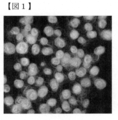
- FIG. 1 is a drawing-substituting photograph illustrating a polyester hollow fiber sphere of the present invention.
- the polyester hollow fiber sphere of the present invention is a polyester hollow fiber made of polyester having an intrinsic viscosity of 0.60 to 0.75, and has a single fiber fineness of 2.0 to 6.6 dtex and a hollowness of 15 to 35%.
- the crimp number is 2 to 8 crests / 25 mm, the crimp rate is 6 to 14%, the fiber length is 20 to 50 mm, and the oil agent containing polysiloxane is 0.3 to 1.0% with respect to the polyester fiber mass.
- ⁇ s is attached at the rate of a fiber spheroids fiber friction coefficient ⁇ s is obtained by using the polyester hollow fiber 0.06 to 0.14 and a bulk height 8,200 or more ⁇ 11,500cm 3 / 50g A spherical body composed of the following polyester hollow fibers.
- polyester constituting the polyester hollow fiber used in the present invention examples include polyethylene terephthalate, polybutylene terephthalate, polytrimethylene terephthalate, polyethylene naphthalate, and polybutylene naphthalate, among which polyethylene terephthalate is preferably used.
- the intrinsic viscosity of the polyester used in the present invention is preferably 0.60 to 0.75.
- the intrinsic viscosity is more preferably 0.62 to 0.72.
- the crimping ability is reduced and the crimp is lowered, so that the fiber is difficult to be rounded in processing into the fiber sphere, and the formation of the fiber sphere is difficult. Furthermore, the fiber spheroid having a sufficient bulkiness may not be obtained due to the low rigidity of the fiber.
- the intrinsic viscosity exceeds 0.75, the melt viscosity becomes high and it may be difficult to produce the fiber.
- the single fiber fineness of the polyester hollow fiber used in the present invention is 2.0 to 6.6 dtex.
- the single fiber fineness is preferably 2.2 to 4.4 dtex.
- the positive single fiber fineness is reduced, so that the crimping power is reduced and the crimp is reduced, so that the fiber is spherical in the processing to the fiber spherical body. It becomes difficult to curl, and formation of a fiber spherical body becomes difficult. Furthermore, since the rigidity of the fiber is lowered, a fiber spherical body lacking in bulkiness is obtained.
- the single fiber fineness exceeds 6.6 dtex, the fiber spheroids that are soft and approximate to feathers cannot be obtained due to the increased rigidity of the fibers.
- the hollow ratio of the polyester hollow fiber used in the present invention is 15 to 35%.
- the hollow ratio is more preferably 20 to 30%.
- the hollow ratio is less than 15%, asymmetric cooling is insufficient, crimping ability is reduced, and crimping is reduced, so that the fiber is difficult to be rounded in processing into a fiber spheroid, thereby forming a fiber spheroid. Becomes difficult.
- the hollow ratio exceeds 35%, there are many yarn breaks during yarn production, and stable fiber production may be difficult.
- the hollow ratio of the polyester hollow fiber can be expressed in% by calculating the ratio of the hollow part area to the total area of the fiber cross section including the hollow part based on the fiber cross-sectional enlarged photograph.
- “hollow” means having a hollow portion inside the outer shape of the fiber in the fiber cross section.
- the hollow portion is preferably located at the fiber center portion, but there are also those that are displaced from the fiber center portion and are eccentric, but the hollow portion is preferably located at the fiber center.
- the hollowness depends on the die design, the intrinsic viscosity of the polyester and the cooling conditions, and can be controlled by those skilled in the art by each specific setting.
- the crimp number of the polyester hollow fiber used in the present invention is 2 to 8 crests / 25 mm.
- the crimp number is preferably 3 to 7 crests / 25 mm.
- the number of crimps is less than 2 peaks / 25 mm, the fiber is difficult to be rounded in processing into a fiber sphere, and the formation of the fiber sphere is difficult.
- the number of crimps exceeds 8 crests / 25 mm, the resulting fiber spherical body has a small diameter and a high density, resulting in a fiber spherical body lacking in bulkiness.
- the crimp rate of the polyester hollow fiber used in the present invention is preferably 6 to 14%.
- the crimp rate is 6 to 8%, more preferably 6.
- the crimp ratio is less than 6%, the fiber is difficult to be rounded in processing into the fiber sphere, and the formation of the fiber sphere is difficult.
- the crimp ratio exceeds 14%, the diameter of the obtained fiber sphere is reduced and the density is increased, so that the fiber sphere is lacking in bulk.
- the fiber length of the polyester hollow fiber used in the present invention is 20 to 50 mm.
- the fiber length is preferably 25 to 40 mm.
- the fiber length is less than 20 mm, the entanglement between the fibers becomes weak in the processing to the fiber sphere, and the entanglement of the fibers is released, so that it becomes difficult to maintain the shape of the sphere.
- the fiber length exceeds 50 mm, the fiber is difficult to be rounded in processing into a fiber sphere, and the formation of the fiber sphere is difficult, and furthermore, the fiber spheres are easily entangled with each other. Defect product quality deteriorates.
- the oil agent containing polysiloxane is preferably applied and adhered in the range (ratio) of 0.3 to 1.0% by mass with respect to the mass of the polyester hollow fiber used in the present invention.
- the amount of oil agent attached is more preferably 0.4 to 0.8% by mass.
- the amount of the oil containing polysiloxane is less than 0.3% by mass, the smoothness of the fibers is low and the fiber spheres are liable to be entangled with each other.
- the oil agent adhesion amount exceeds 1.0% by mass, no further improvement in fiber smoothness is observed, which may lead to deterioration of the basic unit.
- polysiloxane used in the present invention for example, amino-modified silicone can be used.
- an oil containing polysiloxane in addition to polysiloxane, the oil agent preferably contains a phosphoric acid compound, an aliphatic compound, and a halogen compound, and further preferably contains an antioxidant, a flame retardant, and an antistatic agent. It is.
- the application of the oil containing polysiloxane is preferably applied immediately before cutting the tow in the step of producing the short fiber of the polyester hollow fiber used in the present invention.
- the polysiloxane concentration is preferably 3 to 10% by mass, more preferably 4 to 8% by mass, and an oil agent aqueous solution is applied to the polyester hollow fiber, followed by drying at an arbitrary temperature. preferable.
- the fiber friction coefficient ⁇ s of the polyester hollow fiber used in the present invention is preferably 0.06 to 0.14.
- the fiber friction coefficient ⁇ s is more preferably 0.07 to 0.12.
- the smoothness of the fibers becomes low and the fiber spheroids are easily entangled with each other.
- the fiber friction coefficient ⁇ s exceeds 0.12, no further improvement in fiber smoothness is observed.
- Bulky polyester hollow fibers spheroids it is important that at most 8,200 or more ⁇ 11,500cm 3 / 50g.
- Bulky is preferably 9,000 or more ⁇ 10,700cm 3 / 50g or less. If the bulk height less than 8,200cm 3 / 50g, not bulky is obtained, and fiber spheroids inferior lightness and voluminous feeling. On the other hand, it is difficult to obtain a production conditions bulky obtain a fibrous spheroids exceeding 11,500cm 3 / 50g.
- the crimp ratio ratio of the polyester hollow fiber used in the present invention is preferably 1.5 to 3.0.
- the crimp ratio ratio is more preferably 8 to 12%. If the crimp ratio number ratio is less than 1.5, it becomes difficult to form fiber spheres because the fibers are less likely to be rounded during processing into fiber spheres. On the other hand, if the crimp ratio number ratio exceeds 3.0, stable fiber production for obtaining high crimp expression becomes difficult.
- the crimp ratio number ratio is expressed by the following equation (1).
- Crimp rate number ratio crimp rate / crimp number (1)
- the polyester is melted, passed through a spinneret having preferably 90 to 400 hollow fiber discharge holes, and melt-spun and spun so as to form a hollow portion at a spinning temperature about 15 to 30 ° C. higher than the melting point.
- air at a temperature of preferably 10 to 25 ° C. is asymmetrically cooled with an air flow of preferably 80 to 130 m / min, and further preferably air at a temperature of 10 to 25 ° C. is preferably 140 to 170 m / min.
- the undrawn yarn tow is obtained by cooling with an air volume of 1 and applying a spinning oil agent, preferably once in a can at a take-up speed of 1000 to 1700 m / min.
- the obtained undrawn yarn tow is subjected to one-stage drawing at a draw ratio of preferably 2.3 to 3.0 times, preferably using a liquid bath at a temperature of 75 to 100 ° C., via a crimping step.
- an oil solution containing a polysiloxane-containing oil agent preferably in a concentration of 3 to 10% by mass, is applied by a shower so as to be preferably in the range of 0.3 to 1.0% by mass with respect to the fiber mass.
- Polyester hollow fibers can be produced.
- the above spiral crimp is a crimp in which fibers are formed in a coil shape.
- the method for forming a polyester hollow fiber sphere according to the present invention sufficiently opens the polyester hollow fiber obtained as described above using a card provided with a plurality of rollers having a garnet wire provided on the surface thereof.
- a fiber that has been sufficiently opened is blown into a room provided with a rotating body that rotates with multiple fins. Rigidized with a device that can be taken out after stirring, or stiffened into a large room with a vortex of air in a somewhat large room and spheroidized to form a rigid body (fin) or air
- the loop-like crimp further proceeds and a fiber spherical body can be formed.
- the size of the polyester hollow fiber spheres is preferably 3 to 8 mm in average diameter, more preferably 4 to 6 mm. Processing of fiber spheres having an average diameter of less than 3 mm is difficult, and when the average diameter exceeds 8 mm, the fiber spheres are products lacking in product processability such as blowing.
- FIG. 1 is a drawing-substituting photograph illustrating a polyester hollow fiber sphere of the present invention.
- the polyester hollow fiber spherical body of FIG. 1 has small size variation, good bulkiness, and almost no unmolded fiber.
- polyester hollow fiber spheres of the present invention are not only lightweight and have excellent bulkiness, but also are soft and rich in texture similar to feathers, and are suitably used as batting materials such as cushions and down jackets.
- polyester hollow fiber sphere of the present invention and the production method thereof will be described in detail with reference to examples.
- the measuring method of physical properties etc. is as follows.
- Crimp rate number ratio crimp rate / crimp number (adhesion amount of oil containing polysiloxane to fiber mass)
- Hollow ratio (%) (Hollow part mass / Fiber part cross-sectional mass) ⁇ 100 (2) (Bulk height of fiber spherical body)
- a fiber spheroid sample 50 g ⁇ 0.1 g is weighed, put into a measuring cylinder having an inner diameter of 28.8 cm and a height of 50 cm, and a bulk height after 5 minutes is measured with a load of 94.3 g.
- the measurement result was an average value of 5 times, and was calculated by the following formula (3).
- H is the bulk height (average value) of the sample, and the unit is cm.)
- Example 1 A polyester hollow fiber was produced by the following method. Polyethylene terephthalate having an intrinsic viscosity of 0.650 (melting point: 260 ° C.) is melted and melt-spun at a spinning temperature of 280 ° C. through a hollow die having 300 discharge holes. After asymmetric cooling with an air volume of minutes, an undrawn yarn tow was obtained at a take-up speed of 1500 m / min.
- the obtained undrawn yarn tow is subjected to one-stage drawing at a draw ratio of 2.6 times using a liquid bath at a temperature of 80 ° C., and an oil agent containing polysiloxane without going through a crimping step.
- a shower cutting into the prescribed fiber lengths listed in Table 1, causing crimping to occur in a spiral shape by heating and steaming at a temperature of 200 ° C., and heat setting at a temperature of 165 ° C. for 10 minutes.
- Polyester hollow fibers having various characteristics shown in 1 were produced.
- polyester hollow fibers are sufficiently opened in a card having a plurality of rollers with garnet wires provided on the surface, and a plurality of the hollow fibers in a cylindrical space where air turbulence easily occurs.
- Polyester hollow fiber spheres were obtained with an apparatus in which fibers were blown into a room provided with a rotating body with the fins attached and rotated for a predetermined period of time after turbulent stirring. It was confirmed that the obtained fiber structure had excellent bulkiness and was a soft hollow polyester hollow fiber sphere. The results are shown in Table 1.
- Example 1 A polyester hollow fiber was produced under the same conditions as in Example 1 except that a polyester hollow fiber having a fiber length of 64 mm was obtained, and a polyester hollow fiber spherical body was obtained. Polyester hollow fibers constituting the obtained polyester hollow fiber spheres have a long fiber length, and therefore the fibers are difficult to be rounded in processing into fiber spheres. The part where was entangled was recognized. The results are shown in Table 1.
- Example 2 A polyester hollow fiber was produced under the same conditions as in Example 1 except that a polyester hollow fiber having a single fiber fineness of 1.7 dtex was obtained, and a fiber spherical body was obtained. Since the single fiber fineness and the crimping rate are low, the fiber is difficult to be rounded in processing into a fiber spherical body, and therefore, a polyester hollow fiber spherical body could not be formed. The results are shown in Table 1.
- Example 3 A polyester hollow fiber was produced under the same conditions as in Example 1 except that the polyester hollow fiber had a single fiber fineness of 7.5 dtex, and a fiber spherical body was obtained. Since the single fiber fineness is large and the rigidity of the fiber is high, a fiber spherical body lacking in softness was obtained. The results are shown in Table 1. [Comparative Example 4] It is the same until the step of applying the oil agent containing polysiloxane in the shower in Example 1, and then heat-set at a temperature of 160 ° C. for 10 minutes, then cut to a specified fiber length, and heat-set for 10 minutes at a temperature of 160 ° C.
- polyester hollow fibers having various characteristics shown in Table 1 were produced, and fiber spheres were obtained.
- the crimped form is a three-dimensional spiral, and the S and Z directions are random, so that the resulting fiber spheres are too tangled, the texture is hard, and the bulkiness is inferior It became a spherical body.
- the results are shown in Table 1.
Landscapes
- Engineering & Computer Science (AREA)
- Textile Engineering (AREA)
- Chemical & Material Sciences (AREA)
- Chemical Kinetics & Catalysis (AREA)
- General Chemical & Material Sciences (AREA)
- Artificial Filaments (AREA)
- Treatments For Attaching Organic Compounds To Fibrous Goods (AREA)
- Yarns And Mechanical Finishing Of Yarns Or Ropes (AREA)
- Nonwoven Fabrics (AREA)
Abstract
Description
本発明のポリエステル中空繊維球状体の好ましい態様によれば、前記のポリエステル中空繊維の固有粘度は0.60~0.75である。
本発明のポリエステル中空繊維球状体の好ましい態様によれば、前記のポリエステル中空繊維の質量に対してポリシロキサンを含む油剤が0.3~1.0質量%の割合で付着されている。
本発明のポリエステル中空繊維球状体の好ましい態様によれば、前記のポリエステル中空繊維の繊維摩擦係数μsが0.06~0.14である。
・けん縮率数比=けん縮率/けん縮数・・・・(1)。
けん縮率数比=けん捲率/けん縮数・・・・(1)
次に、本発明で用いられるポリエステル中空繊維とポリエステル中空繊維球状体の製造方法について、具体的に一態様を例示して説明する。
試料をオルソクロロフェノールに溶解して、ウベローデ粘度計を用いて自然落下時間を測定し、標準試料との相対値で固有粘度をN=3の平均値で求めた。
JIS L1015(2010年)に準じて測定した。
捲縮数と捲縮率をJIS L1015(2010年)に準じて測定し、式1に示す方法でけん縮率数比を算出した。
(式1)けん縮率数比=けん縮率/けん縮数
(繊維質量に対するポリシロキサンを含む油剤の付着量)
試料を発煙硫酸と発煙硝酸で分解し、電気炉で炭化した後、アルカリで溶解する。その後、モリウデン酸アンモニウムで発色させ分光高度計で吸光度を測定し、検量線から無機シリコーン(Si)量を算出し、N=3の平均値を油分量に換算した。
(中空率)
得られたポリエステル中空繊維の断面を、顕微鏡を用いて400倍の倍率で撮影し、さらに断面写真を拡大コピーする。コピーした用紙について、繊維部断面を切り取り、電子天秤でN=20質量を測定する。次に中空部を切り取り、電子天秤でN=20質量を測定し、次式(2)で示す質量比率で算出した。
中空率(%)=(中空部質量/繊維部断面質量)×100・・・(2)
(繊維球状体のかさ高)
繊維球状体サンプル50g±0.1gを計量し、内径が28.8cmで高さが50cmの測定シリンダーに投入し、94.3gの荷重をかけて5分後のかさ高を測定する。測定結果は5回の平均値とし、次式(3)により算出した。
かさ高=V=πd2H/4(単位:cm3/50g)・・・(3)
(式中、dは、次の測定シリンダー内径d=28.8cmである。Hは、試料のかさ高(平均値)であり、単位はcmである。)
(繊維球状体の直径)
任意に選択した繊維球状体の直径をノギスにより測定し、N=100の平均値を求めた。
10人のパネラーが手で触れた時の触感(風合い;ソフト性/柔らかさ)をランク付けで、良好~不良を5~0点として評価した。その平均点が4点を超えると風合い良好(○)とし、4点未満を風合い不良(×)として評価した。
ポリエステル中空繊維を、次の方法で製造した。固有粘度が0.650のポリエチレンテレフタレート(融点260℃)を溶融し、吐出孔を300孔有する中空口金を通して紡糸温度280℃で溶融紡糸し、口金から紡糸直後、20℃の温度の空気を100m/分の風量で非対称冷却させた後、引き取り速度1500m/分で未延伸糸トウを得た。
繊維長が64mmのポリエステル中空繊維としたこと以外は、実施例1と同じ条件でポリエステル中空繊維を製造し、ポリエステル中空繊維球状体を得た。得られたポリエステル中空繊維球状体を構成するポリエステル中空繊維は、繊維長が長いため、繊維球状体への加工において繊維が球状に丸まり難くなることにより、繊維球状体形状不良部分や繊維球状体同士が絡まった部分が認められた。結果を表1に示す。
単繊維繊度が1.7dtexのポリエステル中空繊維としたこと以外は、実施例1と同じ条件でポリエステル中空繊維を製造し、繊維球状体を得た。単繊維繊度と捲縮率が低いため、繊維球状体への加工において繊維が球状に丸まり難くなることにより、ポリエステル中空繊維球状体の形成ができなかった。結果を表1に示す。
単繊維繊度が7.5dtexのポリエステル中空繊維としたこと以外は、実施例1と同じ条件でポリエステル中空繊維を製造し、繊維球状体を得た。単繊維繊度が大きく繊維の剛性が高いため、柔らかさに欠ける繊維球状体が得られた。結果を表1に示す。
[比較例4]
実施例1においてポリシロキサンを含む油剤をシャワーで付与する工程までは同様とし、その後、160℃の温度で10分間熱セット後、規定の繊維長に切断し、160℃の温度で10分熱セットすることにより、表1に示す諸特性のポリエステル中空繊維を製造し、繊維球状体を得た。けん縮形態が、三次元のらせん状となり、かつ、S方向、Z方向のものがランダムなものとなるため、得られる繊維球状体は絡まりすぎ、風合いが硬く、さらには、嵩高性が劣る繊維球状体となった。結果を表1に示す。

Claims (7)
- 単繊維繊度が2.0~6.6dtex、中空率が15~35%、けん縮数が2~8山/25mm、けん縮率が6~14%、繊維長が20~50mmとするポリエステル中空繊維を用いてなる繊維球状体であり、かさ高が8,200以上~11,500cm3/50g以下であることを特徴とするポリエステル中空繊維球状体。
- 該ポリエステル中空繊維の固有粘度が0.60~0.75であることを特徴とする請求項1記載のポリエステル中空繊維球状体。
- 該ポリエステル中空繊維に、ポリエステル繊維質量に対してポリシロキサンを含む油剤が0.3~1.0質量%の割合で付着されていることを特徴とする請求項2記載のポリエステル中空繊維球状体。
- 該ポリエステル中空繊維の繊維摩擦係数μsが0.06~0.14であることを特徴とする請求項3記載のポリエステル中空繊維球状体。
- 次式(1)で示されるポリエステル中空繊維のけん縮率数比が、1.5~3.0であることを特徴とする請求項1記載のポリエステル中空繊維球状体。
けん縮率数比=けん縮率/けん縮数・・・・(1) - 請求項1に記載の中空繊維球状体を中綿としたことを特徴とするダウンジャケット。
- ポリエステルを中空糸用紡糸口金から紡出し、紡出糸の片側から冷却風を吹き付けて非対称冷却した後に引き取り、熱延伸後、けん縮付与工程を介さずにポリシロキサンを含む油剤を付与し、所定の繊維長に切断後、加熱スチーム処理によりスパイラル状にけん縮発現させた後に熱セットして、ポリエステル中空繊維を得、得られたポリエステル中空繊維を開繊し繊維球状体に加工することを特徴とするポリエステル中空繊維球状体の製造方法。
Priority Applications (3)
| Application Number | Priority Date | Filing Date | Title |
|---|---|---|---|
| JP2016505635A JP6645421B2 (ja) | 2015-01-26 | 2016-01-22 | ポリエステル中空繊維球状体 |
| CN201680007252.4A CN107208321B (zh) | 2015-01-26 | 2016-01-22 | 聚酯中空纤维球状体 |
| KR1020177013014A KR102416737B1 (ko) | 2015-01-26 | 2016-01-22 | 폴리에스테르 중공 섬유 구상체 |
Applications Claiming Priority (2)
| Application Number | Priority Date | Filing Date | Title |
|---|---|---|---|
| JP2015-012171 | 2015-01-26 | ||
| JP2015012171 | 2015-01-26 |
Publications (1)
| Publication Number | Publication Date |
|---|---|
| WO2016121643A1 true WO2016121643A1 (ja) | 2016-08-04 |
Family
ID=56543256
Family Applications (1)
| Application Number | Title | Priority Date | Filing Date |
|---|---|---|---|
| PCT/JP2016/051838 Ceased WO2016121643A1 (ja) | 2015-01-26 | 2016-01-22 | ポリエステル中空繊維球状体 |
Country Status (4)
| Country | Link |
|---|---|
| JP (1) | JP6645421B2 (ja) |
| KR (1) | KR102416737B1 (ja) |
| CN (1) | CN107208321B (ja) |
| WO (1) | WO2016121643A1 (ja) |
Cited By (1)
| Publication number | Priority date | Publication date | Assignee | Title |
|---|---|---|---|---|
| WO2018113767A1 (zh) * | 2016-12-23 | 2018-06-28 | 东丽纤维研究所(中国)有限公司 | 聚酯中空长纤维及其制备方法 |
Families Citing this family (7)
| Publication number | Priority date | Publication date | Assignee | Title |
|---|---|---|---|---|
| WO2020179238A1 (ja) * | 2019-03-01 | 2020-09-10 | 株式会社カネカ | 捲縮を有するポリエステル系繊維、その製造方法、それを含むパイル布帛、及びパイル布帛の製造方法 |
| CN114162774A (zh) * | 2020-09-11 | 2022-03-11 | 东丽纤维研究所(中国)有限公司 | 一种纤维球 |
| KR102487609B1 (ko) * | 2020-10-14 | 2023-01-11 | 주식회사 나프 | 우수한 탄성회복력을 가지는 섬유집합체의 제조방법 |
| CN112323252A (zh) * | 2020-10-28 | 2021-02-05 | 青岛热源纤维科技有限公司 | 一种可机洗的高蓬松度保温填充材料 |
| CN112695404A (zh) * | 2020-12-24 | 2021-04-23 | 上海德福伦化纤有限公司 | 一种细旦三维卷曲中空加硅ptt纤维及其制备方法 |
| CN116575182B (zh) * | 2023-07-14 | 2023-09-19 | 江苏富之岛美安纺织品科技有限公司 | 一种pla双组分超膨超弹珍珠棉球加工设备及其制作方法 |
| TWI847822B (zh) * | 2023-07-31 | 2024-07-01 | 遠東新世紀股份有限公司 | 纖維填充物及其纖維填充絮片 |
Citations (9)
| Publication number | Priority date | Publication date | Assignee | Title |
|---|---|---|---|---|
| JPS52103263A (en) * | 1976-02-25 | 1977-08-30 | Mitsubishi Rayon Co | Method of producing feather quiltt like bedding |
| JPS56169813A (en) * | 1980-05-29 | 1981-12-26 | Toyobo Co Ltd | Synthetic fiber for wadding |
| JPS5789649A (en) * | 1980-11-25 | 1982-06-04 | Teijin Ltd | Production of padding material |
| JPS6040088A (ja) * | 1983-08-12 | 1985-03-02 | 東レ株式会社 | 詰め綿用ポリエステル繊維 |
| JPS6055989A (ja) * | 1983-09-08 | 1985-04-01 | 東レ株式会社 | 詰め綿用ポリエステル繊維 |
| JPS6233856A (ja) * | 1985-05-15 | 1987-02-13 | イ−・アイ・デユポン・デ・ニモアス・アンド・カンパニ− | 改良したポリエステルフアイバ−フイル及びその製造方法 |
| JPH02118150A (ja) * | 1986-10-21 | 1990-05-02 | E I Du Pont De Nemours & Co | ポリエステルファイバーボールのゆるい結合された集合体の製造法 |
| JPH08188944A (ja) * | 1995-01-06 | 1996-07-23 | Toray Ind Inc | 繊維混合物および繊維成形体並びに繊維成形体の製造方法 |
| CN1743515A (zh) * | 2005-09-19 | 2006-03-08 | 上海联吉合纤有限公司 | 涤纶细旦高中空短纤维及其生产方法 |
Family Cites Families (12)
| Publication number | Priority date | Publication date | Assignee | Title |
|---|---|---|---|---|
| JPS5836031A (ja) * | 1981-08-28 | 1983-03-02 | Hitachi Ltd | 雑音低減装置 |
| JPS61125377A (ja) | 1984-11-21 | 1986-06-13 | 日本エステル株式会社 | 詰綿体の製造方法 |
| JP3701765B2 (ja) | 1997-03-13 | 2005-10-05 | 帝人ファイバー株式会社 | 高弾性球状体よりなる応力拡散性の改善された成形品 |
| KR100270437B1 (ko) * | 1998-08-25 | 2001-03-02 | 김윤 | 자발고권축 중공섬유제조용 방사구금 |
| WO2001049909A1 (fr) * | 2000-01-07 | 2001-07-12 | Teijin Limited | Fibres polyester frisees et structure fibreuse les comprenant |
| JP4522592B2 (ja) | 2001-01-05 | 2010-08-11 | 株式会社クラレ | 球状繊維構造体およびその製造方法 |
| JP3936861B2 (ja) | 2001-12-07 | 2007-06-27 | 寛範 石井 | クッション材の製造方法及び製造装置 |
| JP4791175B2 (ja) | 2005-12-26 | 2011-10-12 | 帝人ファイバー株式会社 | 高弾性繊維球状体からなる成型品 |
| CN201074257Y (zh) * | 2007-01-19 | 2008-06-18 | 东华大学 | 一种三维卷曲中空合成纤维 |
| CN102851805B (zh) * | 2011-06-30 | 2016-03-30 | 东丽纤维研究所(中国)有限公司 | 一种假捻加工纤维 |
| JP2014167185A (ja) * | 2013-02-28 | 2014-09-11 | Toray Ind Inc | ポリメチルペンテン中空繊維を含有してなる紡績糸およびそれからなる繊維構造体 |
| CN105002579B (zh) * | 2015-05-18 | 2017-07-18 | 浙江恒逸高新材料有限公司 | 一种高中空细旦聚酯长丝及其制备方法 |
-
2016
- 2016-01-22 CN CN201680007252.4A patent/CN107208321B/zh active Active
- 2016-01-22 JP JP2016505635A patent/JP6645421B2/ja active Active
- 2016-01-22 KR KR1020177013014A patent/KR102416737B1/ko active Active
- 2016-01-22 WO PCT/JP2016/051838 patent/WO2016121643A1/ja not_active Ceased
Patent Citations (9)
| Publication number | Priority date | Publication date | Assignee | Title |
|---|---|---|---|---|
| JPS52103263A (en) * | 1976-02-25 | 1977-08-30 | Mitsubishi Rayon Co | Method of producing feather quiltt like bedding |
| JPS56169813A (en) * | 1980-05-29 | 1981-12-26 | Toyobo Co Ltd | Synthetic fiber for wadding |
| JPS5789649A (en) * | 1980-11-25 | 1982-06-04 | Teijin Ltd | Production of padding material |
| JPS6040088A (ja) * | 1983-08-12 | 1985-03-02 | 東レ株式会社 | 詰め綿用ポリエステル繊維 |
| JPS6055989A (ja) * | 1983-09-08 | 1985-04-01 | 東レ株式会社 | 詰め綿用ポリエステル繊維 |
| JPS6233856A (ja) * | 1985-05-15 | 1987-02-13 | イ−・アイ・デユポン・デ・ニモアス・アンド・カンパニ− | 改良したポリエステルフアイバ−フイル及びその製造方法 |
| JPH02118150A (ja) * | 1986-10-21 | 1990-05-02 | E I Du Pont De Nemours & Co | ポリエステルファイバーボールのゆるい結合された集合体の製造法 |
| JPH08188944A (ja) * | 1995-01-06 | 1996-07-23 | Toray Ind Inc | 繊維混合物および繊維成形体並びに繊維成形体の製造方法 |
| CN1743515A (zh) * | 2005-09-19 | 2006-03-08 | 上海联吉合纤有限公司 | 涤纶细旦高中空短纤维及其生产方法 |
Cited By (2)
| Publication number | Priority date | Publication date | Assignee | Title |
|---|---|---|---|---|
| WO2018113767A1 (zh) * | 2016-12-23 | 2018-06-28 | 东丽纤维研究所(中国)有限公司 | 聚酯中空长纤维及其制备方法 |
| RU2748416C2 (ru) * | 2016-12-23 | 2021-05-25 | Торэй Индастриз, Инк. | Полое полиэфирное филаментное волокно и способ его получения |
Also Published As
| Publication number | Publication date |
|---|---|
| JPWO2016121643A1 (ja) | 2017-11-02 |
| CN107208321B (zh) | 2020-02-28 |
| CN107208321A (zh) | 2017-09-26 |
| JP6645421B2 (ja) | 2020-02-14 |
| KR20170104442A (ko) | 2017-09-15 |
| KR102416737B1 (ko) | 2022-07-05 |
Similar Documents
| Publication | Publication Date | Title |
|---|---|---|
| JP6645421B2 (ja) | ポリエステル中空繊維球状体 | |
| CN109072498B (zh) | 膨体纱 | |
| JP5700048B2 (ja) | ポリ塩化ビニル系樹脂繊維の製造方法 | |
| EP3514276A1 (en) | Fiber-filled material and fiber product using same | |
| JP6414228B2 (ja) | 詰め綿 | |
| JP6970399B2 (ja) | 人工毛髪用フィラメントおよび人工毛髪製品 | |
| KR102611708B1 (ko) | 벌키사 | |
| JP6103059B2 (ja) | 詰め綿 | |
| US20200141029A1 (en) | Reduced density synthetic fiber utilizing hollow microcapsules | |
| JP2013177701A (ja) | 混綿詰め綿 | |
| JP2015190080A (ja) | 繊維球状体用ポリエステル系複合繊維および繊維球状体 | |
| CN108239794A (zh) | 一种聚酯中空长纤维 | |
| TW201925560A (zh) | 一種填充物及其用途 | |
| JP2017166103A (ja) | 海島型中空複合繊維および繊維球状体 | |
| JP5578185B2 (ja) | 混綿詰め綿 | |
| JP2015188487A (ja) | 詰綿 | |
| JP6472273B2 (ja) | 粒状綿用短繊維、および粒状綿、並びにそれを用いた詰綿製品 | |
| JP2015175074A (ja) | 偏心芯鞘型複合繊維およびそれを用いた繊維球状体 | |
| JP2019157296A (ja) | 嵩高構造糸、中綿、及びそれを用いた繊維詰め物体および繊維製品 | |
| JP2025134119A (ja) | ポリエステル中空繊維原綿、ポリエステル中空繊維球状体およびそれらの製造方法 | |
| JP7205161B2 (ja) | ポリエステル異形断面部分融着仮撚加工糸 | |
| JP2015052178A (ja) | ポリエステル繊維構造体および詰綿 | |
| JP6465090B2 (ja) | 嵩高糸 | |
| JP2022144473A (ja) | ポリエステル繊維およびそれからなる繊維球状体 | |
| JP7205196B2 (ja) | 嵩高糸 |
Legal Events
| Date | Code | Title | Description |
|---|---|---|---|
| ENP | Entry into the national phase |
Ref document number: 2016505635 Country of ref document: JP Kind code of ref document: A |
|
| 121 | Ep: the epo has been informed by wipo that ep was designated in this application |
Ref document number: 16743246 Country of ref document: EP Kind code of ref document: A1 |
|
| ENP | Entry into the national phase |
Ref document number: 20177013014 Country of ref document: KR Kind code of ref document: A |
|
| NENP | Non-entry into the national phase |
Ref country code: DE |
|
| 122 | Ep: pct application non-entry in european phase |
Ref document number: 16743246 Country of ref document: EP Kind code of ref document: A1 |