WO2016084548A1 - 高分子化合物、中間組成物、負極電極、蓄電装置、負極電極用スラリー、高分子化合物の製造方法、及び負極電極の製造方法 - Google Patents
高分子化合物、中間組成物、負極電極、蓄電装置、負極電極用スラリー、高分子化合物の製造方法、及び負極電極の製造方法 Download PDFInfo
- Publication number
- WO2016084548A1 WO2016084548A1 PCT/JP2015/080632 JP2015080632W WO2016084548A1 WO 2016084548 A1 WO2016084548 A1 WO 2016084548A1 JP 2015080632 W JP2015080632 W JP 2015080632W WO 2016084548 A1 WO2016084548 A1 WO 2016084548A1
- Authority
- WO
- WIPO (PCT)
- Prior art keywords
- negative electrode
- compound
- polymer compound
- group
- active material
- Prior art date
- Legal status (The legal status is an assumption and is not a legal conclusion. Google has not performed a legal analysis and makes no representation as to the accuracy of the status listed.)
- Ceased
Links
Classifications
-
- H—ELECTRICITY
- H01—ELECTRIC ELEMENTS
- H01M—PROCESSES OR MEANS, e.g. BATTERIES, FOR THE DIRECT CONVERSION OF CHEMICAL ENERGY INTO ELECTRICAL ENERGY
- H01M4/00—Electrodes
- H01M4/02—Electrodes composed of, or comprising, active material
- H01M4/62—Selection of inactive substances as ingredients for active masses, e.g. binders, fillers
- H01M4/621—Binders
- H01M4/622—Binders being polymers
-
- C—CHEMISTRY; METALLURGY
- C07—ORGANIC CHEMISTRY
- C07C—ACYCLIC OR CARBOCYCLIC COMPOUNDS
- C07C211/00—Compounds containing amino groups bound to a carbon skeleton
- C07C211/43—Compounds containing amino groups bound to a carbon skeleton having amino groups bound to carbon atoms of six-membered aromatic rings of the carbon skeleton
- C07C211/54—Compounds containing amino groups bound to a carbon skeleton having amino groups bound to carbon atoms of six-membered aromatic rings of the carbon skeleton having amino groups bound to two or three six-membered aromatic rings
- C07C211/55—Diphenylamines
-
- C—CHEMISTRY; METALLURGY
- C08—ORGANIC MACROMOLECULAR COMPOUNDS; THEIR PREPARATION OR CHEMICAL WORKING-UP; COMPOSITIONS BASED THEREON
- C08F—MACROMOLECULAR COMPOUNDS OBTAINED BY REACTIONS ONLY INVOLVING CARBON-TO-CARBON UNSATURATED BONDS
- C08F20/00—Homopolymers and copolymers of compounds having one or more unsaturated aliphatic radicals, each having only one carbon-to-carbon double bond, and only one being terminated by only one carboxyl radical or a salt, anhydride, ester, amide, imide or nitrile thereof
- C08F20/02—Monocarboxylic acids having less than ten carbon atoms, Derivatives thereof
-
- C—CHEMISTRY; METALLURGY
- C08—ORGANIC MACROMOLECULAR COMPOUNDS; THEIR PREPARATION OR CHEMICAL WORKING-UP; COMPOSITIONS BASED THEREON
- C08F—MACROMOLECULAR COMPOUNDS OBTAINED BY REACTIONS ONLY INVOLVING CARBON-TO-CARBON UNSATURATED BONDS
- C08F8/00—Chemical modification by after-treatment
- C08F8/30—Introducing nitrogen atoms or nitrogen-containing groups
- C08F8/32—Introducing nitrogen atoms or nitrogen-containing groups by reaction with amines
-
- C—CHEMISTRY; METALLURGY
- C08—ORGANIC MACROMOLECULAR COMPOUNDS; THEIR PREPARATION OR CHEMICAL WORKING-UP; COMPOSITIONS BASED THEREON
- C08F—MACROMOLECULAR COMPOUNDS OBTAINED BY REACTIONS ONLY INVOLVING CARBON-TO-CARBON UNSATURATED BONDS
- C08F8/00—Chemical modification by after-treatment
- C08F8/40—Introducing phosphorus atoms or phosphorus-containing groups
-
- C—CHEMISTRY; METALLURGY
- C08—ORGANIC MACROMOLECULAR COMPOUNDS; THEIR PREPARATION OR CHEMICAL WORKING-UP; COMPOSITIONS BASED THEREON
- C08F—MACROMOLECULAR COMPOUNDS OBTAINED BY REACTIONS ONLY INVOLVING CARBON-TO-CARBON UNSATURATED BONDS
- C08F8/00—Chemical modification by after-treatment
- C08F8/42—Introducing metal atoms or metal-containing groups
-
- H—ELECTRICITY
- H01—ELECTRIC ELEMENTS
- H01G—CAPACITORS; CAPACITORS, RECTIFIERS, DETECTORS, SWITCHING DEVICES, LIGHT-SENSITIVE OR TEMPERATURE-SENSITIVE DEVICES OF THE ELECTROLYTIC TYPE
- H01G11/00—Hybrid capacitors, i.e. capacitors having different positive and negative electrodes; Electric double-layer [EDL] capacitors; Processes for the manufacture thereof or of parts thereof
- H01G11/04—Hybrid capacitors
- H01G11/06—Hybrid capacitors with one of the electrodes allowing ions to be reversibly doped thereinto, e.g. lithium ion capacitors [LIC]
-
- H—ELECTRICITY
- H01—ELECTRIC ELEMENTS
- H01G—CAPACITORS; CAPACITORS, RECTIFIERS, DETECTORS, SWITCHING DEVICES, LIGHT-SENSITIVE OR TEMPERATURE-SENSITIVE DEVICES OF THE ELECTROLYTIC TYPE
- H01G11/00—Hybrid capacitors, i.e. capacitors having different positive and negative electrodes; Electric double-layer [EDL] capacitors; Processes for the manufacture thereof or of parts thereof
- H01G11/22—Electrodes
- H01G11/30—Electrodes characterised by their material
- H01G11/32—Carbon-based
- H01G11/38—Carbon pastes or blends; Binders or additives therein
-
- H—ELECTRICITY
- H01—ELECTRIC ELEMENTS
- H01M—PROCESSES OR MEANS, e.g. BATTERIES, FOR THE DIRECT CONVERSION OF CHEMICAL ENERGY INTO ELECTRICAL ENERGY
- H01M4/00—Electrodes
- H01M4/02—Electrodes composed of, or comprising, active material
- H01M4/04—Processes of manufacture in general
- H01M4/0402—Methods of deposition of the material
- H01M4/0404—Methods of deposition of the material by coating on electrode collectors
-
- H—ELECTRICITY
- H01—ELECTRIC ELEMENTS
- H01M—PROCESSES OR MEANS, e.g. BATTERIES, FOR THE DIRECT CONVERSION OF CHEMICAL ENERGY INTO ELECTRICAL ENERGY
- H01M4/00—Electrodes
- H01M4/02—Electrodes composed of, or comprising, active material
- H01M4/04—Processes of manufacture in general
- H01M4/0471—Processes of manufacture in general involving thermal treatment, e.g. firing, sintering, backing particulate active material, thermal decomposition, pyrolysis
-
- H—ELECTRICITY
- H01—ELECTRIC ELEMENTS
- H01M—PROCESSES OR MEANS, e.g. BATTERIES, FOR THE DIRECT CONVERSION OF CHEMICAL ENERGY INTO ELECTRICAL ENERGY
- H01M4/00—Electrodes
- H01M4/02—Electrodes composed of, or comprising, active material
- H01M4/13—Electrodes for accumulators with non-aqueous electrolyte, e.g. for lithium-accumulators; Processes of manufacture thereof
- H01M4/133—Electrodes based on carbonaceous material, e.g. graphite-intercalation compounds or CFx
-
- H—ELECTRICITY
- H01—ELECTRIC ELEMENTS
- H01M—PROCESSES OR MEANS, e.g. BATTERIES, FOR THE DIRECT CONVERSION OF CHEMICAL ENERGY INTO ELECTRICAL ENERGY
- H01M4/00—Electrodes
- H01M4/02—Electrodes composed of, or comprising, active material
- H01M4/13—Electrodes for accumulators with non-aqueous electrolyte, e.g. for lithium-accumulators; Processes of manufacture thereof
- H01M4/134—Electrodes based on metals, Si or alloys
-
- H—ELECTRICITY
- H01—ELECTRIC ELEMENTS
- H01M—PROCESSES OR MEANS, e.g. BATTERIES, FOR THE DIRECT CONVERSION OF CHEMICAL ENERGY INTO ELECTRICAL ENERGY
- H01M4/00—Electrodes
- H01M4/02—Electrodes composed of, or comprising, active material
- H01M4/13—Electrodes for accumulators with non-aqueous electrolyte, e.g. for lithium-accumulators; Processes of manufacture thereof
- H01M4/139—Processes of manufacture
- H01M4/1393—Processes of manufacture of electrodes based on carbonaceous material, e.g. graphite-intercalation compounds or CFx
-
- H—ELECTRICITY
- H01—ELECTRIC ELEMENTS
- H01M—PROCESSES OR MEANS, e.g. BATTERIES, FOR THE DIRECT CONVERSION OF CHEMICAL ENERGY INTO ELECTRICAL ENERGY
- H01M4/00—Electrodes
- H01M4/02—Electrodes composed of, or comprising, active material
- H01M4/13—Electrodes for accumulators with non-aqueous electrolyte, e.g. for lithium-accumulators; Processes of manufacture thereof
- H01M4/139—Processes of manufacture
- H01M4/1395—Processes of manufacture of electrodes based on metals, Si or alloys
-
- H—ELECTRICITY
- H01—ELECTRIC ELEMENTS
- H01M—PROCESSES OR MEANS, e.g. BATTERIES, FOR THE DIRECT CONVERSION OF CHEMICAL ENERGY INTO ELECTRICAL ENERGY
- H01M4/00—Electrodes
- H01M4/02—Electrodes composed of, or comprising, active material
- H01M4/36—Selection of substances as active materials, active masses, active liquids
- H01M4/38—Selection of substances as active materials, active masses, active liquids of elements or alloys
- H01M4/386—Silicon or alloys based on silicon
-
- H—ELECTRICITY
- H01—ELECTRIC ELEMENTS
- H01M—PROCESSES OR MEANS, e.g. BATTERIES, FOR THE DIRECT CONVERSION OF CHEMICAL ENERGY INTO ELECTRICAL ENERGY
- H01M4/00—Electrodes
- H01M4/02—Electrodes composed of, or comprising, active material
- H01M4/36—Selection of substances as active materials, active masses, active liquids
- H01M4/58—Selection of substances as active materials, active masses, active liquids of inorganic compounds other than oxides or hydroxides, e.g. sulfides, selenides, tellurides, halogenides or LiCoFy; of polyanionic structures, e.g. phosphates, silicates or borates
- H01M4/583—Carbonaceous material, e.g. graphite-intercalation compounds or CFx
- H01M4/587—Carbonaceous material, e.g. graphite-intercalation compounds or CFx for inserting or intercalating light metals
-
- C—CHEMISTRY; METALLURGY
- C08—ORGANIC MACROMOLECULAR COMPOUNDS; THEIR PREPARATION OR CHEMICAL WORKING-UP; COMPOSITIONS BASED THEREON
- C08L—COMPOSITIONS OF MACROMOLECULAR COMPOUNDS
- C08L2312/00—Crosslinking
- C08L2312/08—Crosslinking by silane
-
- H—ELECTRICITY
- H01—ELECTRIC ELEMENTS
- H01M—PROCESSES OR MEANS, e.g. BATTERIES, FOR THE DIRECT CONVERSION OF CHEMICAL ENERGY INTO ELECTRICAL ENERGY
- H01M10/00—Secondary cells; Manufacture thereof
- H01M10/05—Accumulators with non-aqueous electrolyte
-
- H—ELECTRICITY
- H01—ELECTRIC ELEMENTS
- H01M—PROCESSES OR MEANS, e.g. BATTERIES, FOR THE DIRECT CONVERSION OF CHEMICAL ENERGY INTO ELECTRICAL ENERGY
- H01M10/00—Secondary cells; Manufacture thereof
- H01M10/05—Accumulators with non-aqueous electrolyte
- H01M10/052—Li-accumulators
-
- Y—GENERAL TAGGING OF NEW TECHNOLOGICAL DEVELOPMENTS; GENERAL TAGGING OF CROSS-SECTIONAL TECHNOLOGIES SPANNING OVER SEVERAL SECTIONS OF THE IPC; TECHNICAL SUBJECTS COVERED BY FORMER USPC CROSS-REFERENCE ART COLLECTIONS [XRACs] AND DIGESTS
- Y02—TECHNOLOGIES OR APPLICATIONS FOR MITIGATION OR ADAPTATION AGAINST CLIMATE CHANGE
- Y02E—REDUCTION OF GREENHOUSE GAS [GHG] EMISSIONS, RELATED TO ENERGY GENERATION, TRANSMISSION OR DISTRIBUTION
- Y02E60/00—Enabling technologies; Technologies with a potential or indirect contribution to GHG emissions mitigation
- Y02E60/10—Energy storage using batteries
-
- Y—GENERAL TAGGING OF NEW TECHNOLOGICAL DEVELOPMENTS; GENERAL TAGGING OF CROSS-SECTIONAL TECHNOLOGIES SPANNING OVER SEVERAL SECTIONS OF THE IPC; TECHNICAL SUBJECTS COVERED BY FORMER USPC CROSS-REFERENCE ART COLLECTIONS [XRACs] AND DIGESTS
- Y02—TECHNOLOGIES OR APPLICATIONS FOR MITIGATION OR ADAPTATION AGAINST CLIMATE CHANGE
- Y02E—REDUCTION OF GREENHOUSE GAS [GHG] EMISSIONS, RELATED TO ENERGY GENERATION, TRANSMISSION OR DISTRIBUTION
- Y02E60/00—Enabling technologies; Technologies with a potential or indirect contribution to GHG emissions mitigation
- Y02E60/13—Energy storage using capacitors
-
- Y—GENERAL TAGGING OF NEW TECHNOLOGICAL DEVELOPMENTS; GENERAL TAGGING OF CROSS-SECTIONAL TECHNOLOGIES SPANNING OVER SEVERAL SECTIONS OF THE IPC; TECHNICAL SUBJECTS COVERED BY FORMER USPC CROSS-REFERENCE ART COLLECTIONS [XRACs] AND DIGESTS
- Y02—TECHNOLOGIES OR APPLICATIONS FOR MITIGATION OR ADAPTATION AGAINST CLIMATE CHANGE
- Y02T—CLIMATE CHANGE MITIGATION TECHNOLOGIES RELATED TO TRANSPORTATION
- Y02T10/00—Road transport of goods or passengers
- Y02T10/60—Other road transportation technologies with climate change mitigation effect
- Y02T10/70—Energy storage systems for electromobility, e.g. batteries
Definitions
- the present invention relates to a polymer compound used as a binder for a negative electrode of a power storage device, an intermediate composition of the polymer compound, a negative electrode, a power storage device, a slurry for a negative electrode, a method for producing a polymer compound, and a method for producing a negative electrode About.
- the electrode of the secondary battery is composed of, for example, a current collector formed of a metal material such as copper or aluminum, and an active material layer bound on the current collector.
- the active material layer includes a binder as an electrode binder for binding the active material to the current collector.
- Patent document 1 discloses the binder for electrodes containing polyacrylic acid lithium salt and polyacrylic acid sodium salt.
- Patent document 2 discloses the binder for electrodes containing polyacrylic acid and polyethyleneimine.
- Patent document 3 discloses the binder for electrodes containing polyacrylic acid and an amine compound.
- an object of the present invention is to provide a polymer compound useful as a negative electrode binder for a power storage device, and to provide an intermediate composition for obtaining the polymer compound.
- Another object of the present invention is to provide a negative electrode, a power storage device, and a slurry for a negative electrode using the polymer compound as a negative electrode binder.
- the objective of this invention is providing the manufacturing method of the polymer compound, and the manufacturing method of a negative electrode.
- a polymer compound used as a binder for a negative electrode of a power storage device comprising a vinyl polymer containing a carboxyl group, an aromatic It is a compound formed by condensing a polyfunctional amine with a third compound selected from phosphorous acid, phosphite, trialkoxysilane, and phosphoric acid.
- a polymer compound used as a negative electrode binder of a power storage device a vinyl polymer containing a carboxyl group, an aromatic polyfunctional amine, At least one selected from a phosphoric acid group, a phosphoric acid ester group and a trialkoxysilane group is added to the carboxyl group of the polymer compound obtained by condensation of.
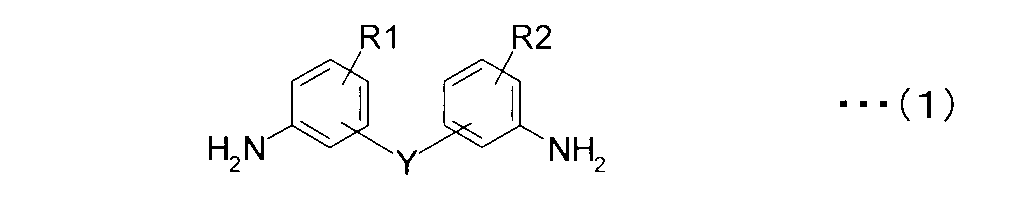
- the aromatic polyfunctional amine is a polyfunctional amine represented by the following general formula (1), and Y is a linear alkyl group having 1 to 4 carbon atoms, a phenylene group, or an oxygen atom.
- R 1 and R 2 are each independently preferably a single or a plurality of hydrogen atoms, a methyl group, an ethyl group, a trifluoromethyl group, or a methoxy group.
- an intermediate composition of a polymer compound used as a binder for a negative electrode of a power storage device includes a vinyl-based polymer containing a carboxyl group, an aromatic polyfunctional amine, a third compound selected from phosphorous acid, phosphite, trialkoxysilane, and phosphoric acid, a non-aqueous solvent, Containing.
- a method for producing a polymer compound used as a negative electrode binder of a power storage device is provided.
- the polymer compound is obtained by condensing a vinyl-based polymer containing a carboxyl group, an aromatic polyfunctional amine, and a third compound selected from phosphorous acid, phosphite, trialkoxysilane, and phosphoric acid, Manufactured.
- the third compound is at least one selected from phosphorous acid, phosphite, and trialkoxysilane, and after the vinyl polymer and the aromatic polyfunctional amine are mixed. Further, it is preferable to mix a third compound.
- a vinyl polymer and an aromatic polyfunctional amine are mixed and heated at a temperature of 40 to 140 ° C., and then a third compound is further mixed to a temperature of 150 to 230 ° C. It is preferable to heat with.
- the third compound is phosphoric acid, and after heating the vinyl polymer, the aromatic polyfunctional amine, and the third compound at a temperature of 40 to 140 ° C., 150 ° C. Heating at a temperature of ⁇ 230 ° C. is preferred.
- a negative electrode of a power storage device includes a negative electrode binder containing the above-described polymer compound and a negative electrode active material, and the negative electrode active material is a carbon-based material that can occlude and release lithium, an element that can be alloyed with lithium, and lithium. And at least one compound selected from compounds having elements that can be alloyed.
- the negative electrode active material is preferably at least one selected from a silicon material obtained through a decalcification reaction from CaSi 2 , Si, and SiO V (0>v> 2).
- a power storage device including the above negative electrode and a nonaqueous electrolyte.
- a slurry for a negative electrode used for manufacturing a negative electrode of a power storage device.
- a slurry for a negative electrode contains the above intermediate composition, a negative electrode active material, and a solvent.
- the negative electrode active material is a carbon-based material capable of inserting and extracting lithium, an element that can be alloyed with lithium, and lithium. And at least one compound selected from compounds having elements that can be alloyed.
- a method for manufacturing a negative electrode of a power storage device wherein the negative electrode active material layer is formed on a current collector using the slurry for negative electrode described above.
- a method of forming is provided.
- the negative electrode slurry is at least selected from a silicon material obtained through a decalcification reaction from CaSi 2 as a negative electrode active material, Si, and SiO V (0>v> 2). It is preferable to contain one kind.
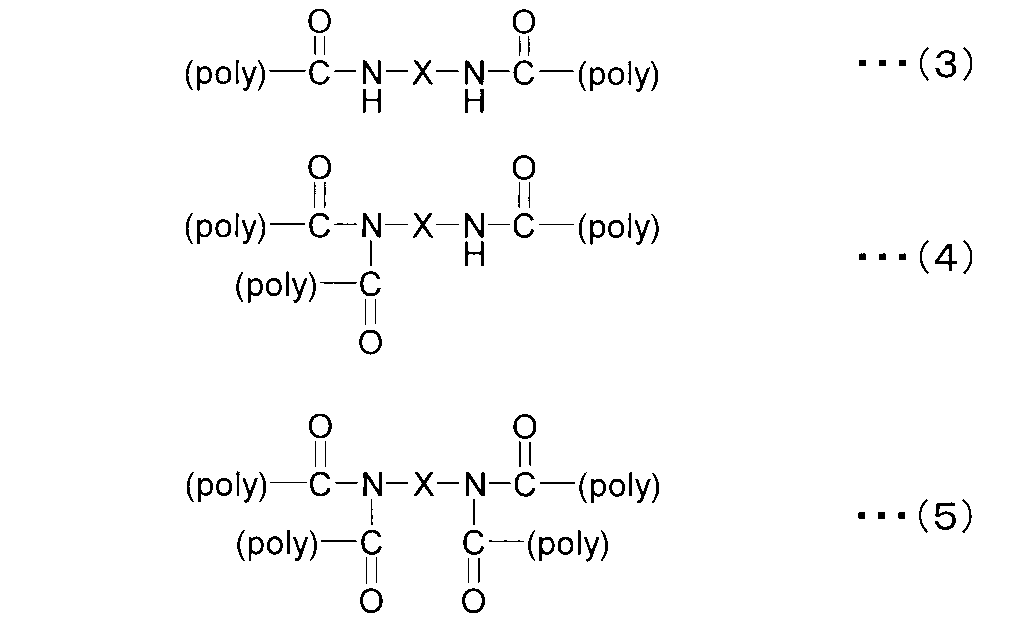
- a polymer compound used as a negative electrode binder of a power storage device has a chain structure composed of a vinyl-based polymer containing a carboxyl group, and a crosslinked structure that connects the carboxylic acid side chains in the chain structure or between the chain structures. And at least one cross-linked structure selected from the following general formulas (3) to (5), and at least one selected from a phosphoric acid group, a phosphoric ester group, and a trialkoxysilane group in the carboxyl group of the chain structure. It has been added.
- a negative electrode binder containing the above polymer compound.
- a method for manufacturing a negative electrode of a power storage device includes an active material layer forming step of forming a negative electrode active material layer on a current collector using a mixture containing the above intermediate composition and a negative electrode active material, and heat-treating the negative electrode active material layer A condensation step of condensing the vinyl polymer and the aromatic polyfunctional amine.
- the characteristics of the power storage device are improved.
- the polymer compound of the present embodiment is a compound obtained by condensing (A) a vinyl polymer containing a carboxyl group, (B) an aromatic polyfunctional amine, and (C) a third compound.
- (A) As a vinyl polymer containing a carboxyl group for example, polyacrylic acid, polymethacrylic acid, a copolymer of acrylic acid and methacrylic acid, at least one of acrylic acid and methacrylic acid, and another vinyl monomer The copolymer of these is mentioned.
- Other vinyl monomers include, for example, vinyl groups such as acrylic ester, methacrylic ester, butene, isobutene, maleic acid, itaconic acid, acrylamide, methacrylamide, styrene, acrylonitrile, methacrylonitrile, vinylene groups, Or the compound which has a vinylidene group is mentioned. Only one of these other vinyl monomers may be used, or two or more may be used in combination.
- the vinyl polymer containing a carboxyl group (A) is simply referred to as (A) vinyl polymer.
- the weight average molecular weight of the vinyl polymer is not particularly limited, but is preferably in the range of 10,000 to 2,000,000, for example, in the range of 25,000 to 1,800,000. Is more preferable, and the range of 50,000 to 1,500,000 is even more preferable.
- the cycle characteristics of the power storage device tend to decrease as the weight average molecular weight of the polymer compound decreases.
- the polymer compound of the present embodiment is used as a negative electrode binder, the power storage device is configured even when the weight average molecular weight of the vinyl polymer constituting the polymer compound and containing a carboxyl group is decreased. The cycle characteristics are maintained. Therefore, as the vinyl polymer containing a carboxyl group, for example, a low molecular weight vinyl polymer of 250,000 or less or 100,000 or less is suitably used.
- An aromatic polyfunctional amine is a compound having an aromatic ring structure such as a benzene ring in the molecular structure and two or more amino groups bonded to the aromatic ring.
- an aromatic polyfunctional amine the compound which has a structure shown in following General formula (1) is mentioned, for example.
- Y is a linear alkyl group having 1 to 4 carbon atoms, a phenylene group, or an oxygen atom.
- the bonding position of Y in each benzene ring may be any of the ortho position, meta position and para position with respect to the amino group.
- a substituent may be bonded to the carbon atom constituting the structure.
- substituent bonded to the carbon atom constituting the linear alkyl group include a methyl group, an ethyl group, a fluoromethyl group, a difluoromethyl group, a trifluoromethyl group, a methoxy group, an ethoxy group, and an oxo group.
- substituents only 1 type may be couple
- the substituent bonded to the carbon atom constituting the linear alkyl group and the phenylene group may be an amino group or a substituent containing an amino group, and in this case, it has three or more amino groups. It becomes a polyfunctional amine.
- R1 and R2 are each independently one or more hydrogen atoms, a methyl group, an ethyl group, a trifluoromethyl group, or a methoxy group.
- the bonding position of R1 may be any of an ortho position, a meta position, and a para position with respect to the amino group. The same applies to R2.
- Examples of the polyfunctional amine in which Y is a linear alkyl group include 3,3′-diaminodiphenylmethane, 4,4′-diaminodiphenylmethane, 3,4′-diaminodiphenylmethane, 4,4′-ethylenedianiline, 4 , 4'-diamino-3,3'-dimethyldiphenylmethane, 1,1-bis (4-aminophenyl) cyclohexane, 9,9-bis (4-aminophenyl) fluorene, 2,2'-bis (4-amino) Phenyl) hexafluoropropane, 4,4′-diaminobenzophenone, 4,4′-methylenebis (2-ethyl-6-methylaniline), pararose aniline.
- Examples of the polyfunctional amine in which Y is a phenylene group include 1,3,5-tris (4-aminophenyl) benzene.
- Examples of the polyfunctional amine in which Y is an oxygen atom include 4,4′-diaminodiphenyl ether.
- 1,3,5-tris (4-aminophenyl) benzene and pararose aniline are trifunctional amines having three amino groups. Only one kind of the above polyfunctional amines may be used, or two or more kinds may be used in combination.
- Examples of (B) aromatic polyfunctional amines other than the compound having the structure represented by the general formula (1) include 1,2-diaminobenzene, 1,3-diaminobenzene, 1,4-diaminobenzene, 2 , 4-diaminotoluene, 2,5-diaminotoluene, 3,4-diaminotoluene, 3,4-diaminobenzoic acid, 3,5-diaminobenzoic acid, 1,5-diaminonaphthalene, 1,8-diaminonaphthalene Can be mentioned. Only one kind of the above aromatic polyfunctional amines may be used, or two or more kinds may be used in combination.
- the blending ratio of the aromatic polyfunctional amine is set according to the number of amino groups in the (B) aromatic polyfunctional amine. That is, the blending ratio is set so that the number of carboxyl groups in (A) the vinyl polymer is larger than the number of amino groups in (B) the aromatic polyfunctional amine. In other words, the blending ratio is set so that the carboxyl group in the vinyl polymer (A) is 1 equivalent or more with respect to 1 equivalent of the amino group in (B) the aromatic polyfunctional amine.
- the ratio (carboxyl group / amino group ratio) of the number of carboxyl groups of the (A) vinyl polymer and the number of amino groups of the (B) aromatic polyfunctional amine is in the range of 1.5 / 1 to 15/1. Preferably, it is preferably in the range of 2/1 to 10/1.
- (C) As the third compound at least one selected from phosphorous acid, phosphite, and trialkoxysilane is used.
- the phosphite ester include alkyl phosphate esters having a linear or branched alkyl group having 1 to 4 carbon atoms, such as dimethyl phosphite, trimethyl phosphite, diethyl phosphite, triethyl phosphite. Can be mentioned.
- trialkoxysilane examples include compounds having a structure represented by the general formula (2).
- R3 to R5 each independently represents a linear or branched alkyl group having 1 to 4 carbon atoms.
- Examples of the compound having the structure represented by the general formula (2) include trimethoxysilane and triethoxysilane.
- the blending ratio of the third compound is preferably in the range of 1/100 to 1/10 equivalent to 1 equivalent of (A) vinyl polymer in terms of monomer.
- the blending ratio of (C) the third compound is 1/100 to 1/20 equivalent relative to 1 equivalent of the monomer-based (A) vinyl polymer.
- the range is preferable, and the range of 1/75 to 1/30 equivalent is more preferable.
- the third compound is a phosphite or trialkoxysilane
- the blending ratio of (C) the third compound is 1/100 to 1 with respect to 1 equivalent of (A) vinyl polymer in terms of monomer.
- a range of / 10 equivalents is preferable, and a range of 1/75 to 1/20 equivalents is more preferable.
- (A) the vinyl polymer is a copolymer
- the blending ratio of the (C) third compound is preferably in the range of 1/100 to 1/5 equivalent to 1 equivalent of the carboxyl group of the (A) vinyl polymer, and 1/50 to 1 / A range of 10 equivalents is more preferable.
- the polymer compound of the present embodiment includes (A) a vinyl polymer and (B) an aromatic polyfunctional amine mixed in a solvent, a first mixing step, and a first intermediate composition obtained in the first mixing step. And (C) a second mixing step of further mixing the third compound and a heating step of heat-treating the second intermediate composition obtained in the second mixing step.
- the first mixing step is a step of obtaining a first intermediate composition obtained by mixing (A) a vinyl polymer, (B) an aromatic polyfunctional amine, and a solvent.
- a solvent used in the first mixing step a solvent in which (A) a vinyl polymer and (B) an aromatic polyfunctional amine can be appropriately selected can be used.
- a non-aqueous solvent such as N-methyl-2-pyrrolidone, dimethylformamide, dimethylacetamide, dimethyl sulfoxide, propylene carbonate, ⁇ -butyrolactone, ethanol, and propanol.
- (C) the third compound is condensed with the carboxyl group of the vinyl polymer (A) contained in the first intermediate composition by mixing the (C) third compound with the first intermediate composition.
- This is a step of obtaining a second intermediate composition.
- the condensation reaction in the second mixing step proceeds by stirring at room temperature, but if necessary, a catalyst may be added to the reaction system or heat treatment may be performed to increase the reaction rate of the condensation reaction. Good.
- the heating step is a step of condensing (A) the vinyl polymer and (B) the aromatic polyfunctional amine contained in the second intermediate composition by heat-treating the second intermediate composition.
- the heating temperature in the heating step is preferably in the range of 150 to 230 ° C, and more preferably in the range of 180 to 200 ° C.
- a catalyst When heating the second intermediate composition, a catalyst may be added to the intermediate composition in order to advance a condensation reaction that forms an amide bond and an imide bond, or to increase the reaction rate of the condensation reaction.
- a dehydration catalyst such as carbodiimide, diphenyl phosphate azide, BOP reagent and the like is preferably used.
- the second intermediate composition to be subjected to the heating step is preferably an intermediate composition that has been preheated in the first mixing step.
- the temperature of the preheating treatment is preferably in the range of 40 to 140 ° C, more preferably in the range of 60 to 130 ° C.
- a polymer compound obtained by condensing (A) a vinyl polymer, (B) an aromatic polyfunctional amine, and (C) a third compound is obtained.
- this polymer compound at least one of an amide bond and an imide bond is formed between (A) a carboxyl group of a vinyl polymer and (B) an amino group of an aromatic polyfunctional amine. It is considered that the polymers have a crosslinked structure.
- (A) the carboxyl group of the vinyl polymer and (C) the third compound are condensed to form a terminal structure derived from (C) the third compound in the carboxyl group.
- the polymer compound has (A) a chain structure composed of a vinyl polymer, and a crosslinked structure that connects carboxylic acid side chains in the chain structure or between the chain structures. Part of the free carboxyl group has a terminal structure derived from (C) the third compound.
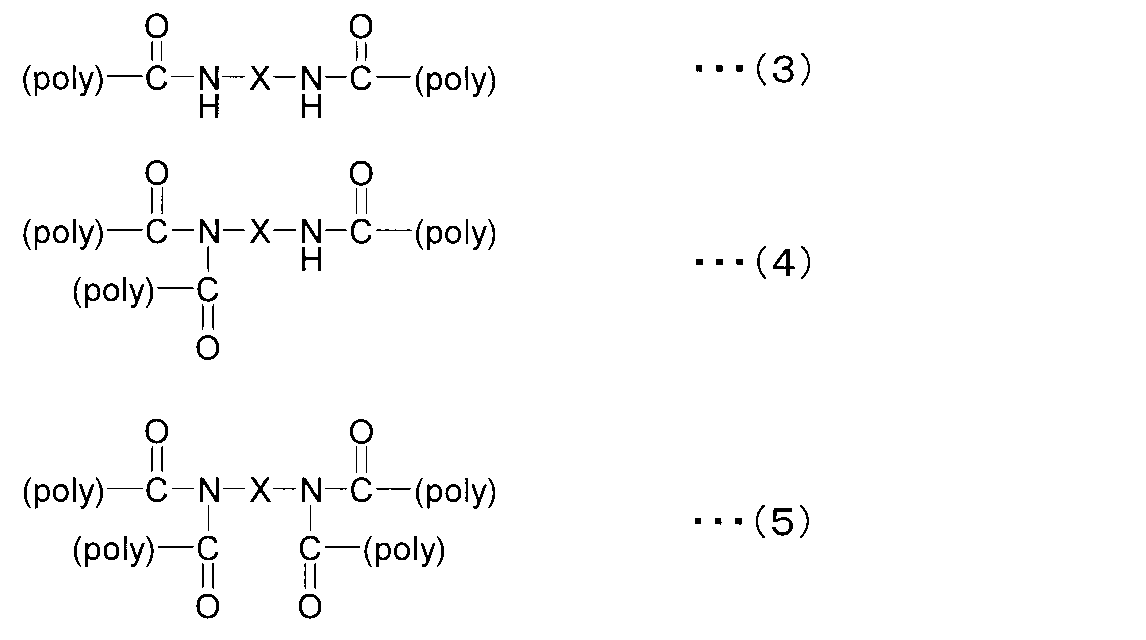
- the crosslinked structure is at least one crosslinked structure selected from the following general formulas (3) to (5).
- poly indicates a chain structure composed of (A) a vinyl polymer.
- the two carbonyl groups constituting one imide structure may be carbonyl groups bonded to different chain structures, or the same chain It may be a carbonyl group bonded to the structure.
- a maleimide structure is formed as the imide structure.
- X is a structure derived from (B) an aromatic polyfunctional amine.
- Y is a linear alkyl group having 1 to 4 carbon atoms, a phenylene group, or an oxygen atom. Further, the bonding position of Y in each benzene ring may be any of the ortho position, meta position and para position with respect to the amino group.
- Y in the general formula (6) has a structure according to Y in the general formula (1).
- R1 and R2 are each independently one or a plurality of hydrogen atoms, a methyl group, an ethyl group, a trifluoromethyl group, or a methoxy group.
- the bonding position of R1 may be any of an ortho position, a meta position, and a para position with respect to the amino group.
- R1 and R2 in the general formula (5) have a structure according to R1 and R2 in the general formula (1).
- the polymer compound preferably has both an amide bond portion and an imide bond portion in its crosslinked structure. That is, it is preferable that the crosslinked structure has at least a crosslinked structure of the general formula (3) and the general formula (5) or at least a crosslinked structure of the general formula (4).
- a negative electrode active material a negative electrode binder, and a solvent are mixed to prepare a slurry. In that case, you may further mix other components, such as a conductive support agent, as needed.
- the negative electrode active material a known material used as a negative electrode active material for a power storage device such as a secondary battery, for example, a carbon-based material, an element that can be alloyed with lithium, and a compound that has an element that can be alloyed with lithium are used. Can be used.
- the carbon-based material for example, a carbon-based material capable of occluding and releasing lithium can be used. Specific examples thereof include non-graphitizable carbon, natural graphite, artificial graphite, cokes, graphites, glassy materials. Examples thereof include carbons, organic polymer compound fired bodies, carbon fibers, activated carbon, and carbon blacks.
- elements that can be alloyed with lithium include Na, K, Rb, Cs, Fr, Be, Mg, Ca, Sr, Ba, Ra, Ti, Ag, Zn, Cd, Al, Ga, In, Si, Ge, Sn, Pb, Sb, Bi are mentioned. Of these, Si is particularly preferable.
- Examples of the compound having an element that can be alloyed with lithium include Na, K, Rb, Cs, Fr, Be, Mg, Ca, Sr, Ba, Ra, Ti, Ag, Zn, Cd, Al, Ga, and In. , Si, Ge, Sn, Pb, Sb, and a compound having an element selected from Bi.
- a silicon-based material that is a compound containing Si is particularly preferable.
- silicon-based material examples include SiB 4 , SiB 6 , Mg 2 Si, Ni 2 Si, TiSi 2 , MoSi 2 , CoSi 2 , NiSi 2 , CaSi 2 , CrSi 2 , Cu 5 Si, FeSi 2 , MnSi 2 , NbSi 2, TaSi 2, VSi 2 , WSi 2, ZnSi 2, SiC, Si 3 N 4, Si 2 N 2 O, SiO V (0 ⁇ V ⁇ 2), include SnSiO 3, LiSiO. Among these, SiO V (0 ⁇ V ⁇ 2) is particularly preferable.
- a silicon-based material a silicon material obtained from CaSi 2 through a decalcification reaction disclosed in International Publication No. 2014/080608 can also be used.
- the silicon material is obtained by, for example, decalcifying (for example, heat treatment at 300 to 1000 ° C.) a layered polysilane obtained by treating CaSi 2 with an acid (for example, hydrochloric acid or hydrogen fluoride). It is.
- the negative electrode active material one type of material may be used alone, or a plurality of materials may be used in combination.
- the polymer compound of this embodiment is particularly preferably used in combination with a silicon-based material that is a negative electrode active material having a large degree of expansion and contraction during charge / discharge.
- the negative electrode active material only one of the above substances may be used, or two or more kinds may be used in combination.
- the negative electrode binder to be mixed with the slurry the second intermediate composition is used.
- the second intermediate composition is simply referred to as an intermediate composition.
- negative electrode binders may be used in combination as the negative electrode binder.
- examples of other negative electrode binders include polyvinylidene fluoride, polytetrafluoroethylene, styrene-butadiene rubber, polyimide, polyamideimide, carboxymethyl cellulose, polyvinyl chloride, methacrylic resin, polyacrylonitrile, modified polyphenylene oxide, polyethylene oxide, Examples include polyethylene, polypropylene, polyacrylic acid, and phenol resin.
- the fixed amount of the intermediate composition is preferably contained by 1% by mass or more with respect to the total solid content of the negative electrode binder, and is contained by 10% by mass or more. It is more preferable.
- the blending ratio (negative electrode active material: negative electrode binder) in the mass ratio of the negative electrode active material and the negative electrode binder can be appropriately set according to the types of the negative electrode active material and the negative electrode binder.
- the blending ratio is, for example, preferably in the range of 5: 3 to 99: 1, more preferably in the range of 3: 1 to 97: 3, and in the range of 16: 3 to 95: 5. Is more preferable.
- the solvent a known solvent used at the time of producing an electrode of a power storage device such as a secondary battery can be appropriately used depending on the types of the negative electrode active material and the negative electrode binder.
- Specific examples of the solvent include N-methyl-2-pyrrolidone, methanol, and methyl isobutyl ketone.
- the above slurry is applied to a current collector to form a negative electrode active material layer made of the slurry on the surface of the current collector.
- the solvent the slurry solvent and the solvent contained in the intermediate composition
- the negative electrode active material layer is removed, and the negative electrode active material layer is dried.
- the negative electrode active material layer is cured by heat treatment at a temperature of 150 to 230 ° C.
- the said heat processing can also be performed in the state in which the negative electrode active material layer contains the solvent, it is more preferable to perform as the state which dried the negative electrode active material layer.
- a known metal material used as a current collector for a negative electrode of a power storage device such as a secondary battery can be used.
- the metal material that can be used for the current collector include silver, copper, gold, aluminum, magnesium, tungsten, cobalt, zinc, nickel, iron, platinum, tin, indium, titanium, ruthenium, tantalum, molybdenum, and stainless steel. It is done.
- the negative electrode using the polymer compound of this embodiment as a negative electrode binder is suitably used for a non-aqueous power storage device including a non-aqueous electrolyte as an electrolyte.
- the power storage device include a secondary battery, an electric double layer capacitor, and a lithium ion capacitor.
- such power storage devices are useful as non-aqueous secondary batteries for driving motors of electric vehicles and hybrid vehicles, and non-aqueous secondary batteries used in personal computers, portable communication devices, home appliances, office equipment, industrial equipment, etc. It is.
- the polymer compound of the present embodiment is at least one third compound selected from a vinyl polymer containing a carboxyl group, an aromatic polyfunctional amine, phosphorous acid, phosphite, and trialkoxysilane. It is a polymer compound formed by condensation with a compound.
- the polymer compound of the present embodiment includes a phosphate group, a phosphate ester group, a trial group on a carboxyl group of a polymer compound obtained by condensation of a vinyl polymer containing a carboxyl group and an aromatic polyfunctional amine. It is a polymer compound to which at least one kind selected from a alkoxysilane group is added.
- the polymer compound of the present embodiment includes a vinyl compound containing a carboxyl group, an aromatic polyfunctional amine, a third compound selected from phosphorous acid, phosphite, and trialkoxysilane, A polymer compound obtained by heat-treating an intermediate composition (second intermediate composition) containing a nonaqueous solvent at a temperature of 150 ° C. to 230 ° C.
- the polymer compound of the present embodiment is useful as a negative electrode binder for power storage devices. Further, by using the polymer compound of this embodiment as a negative electrode binder, the characteristics (initial efficiency and cycle characteristics) of the power storage device can be improved.
- a terminal structure containing a phosphorus atom or a silicon atom derived from the third compound is introduced to a carboxyl group that does not form a crosslinked structure.
- Such a terminal structure is superior in adhesion to the current collector as compared with the carboxyl group. That is, in the negative electrode binder having a carboxyl group as an adhesive portion with the current collector, the carboxyl group may be combined with lithium in the electrolytic solution to become lithium carbonate and be detached from the negative electrode binder. Such elimination of the carboxyl group leads to a decrease in the adhesion of the negative electrode binder to the current collector, and peeling of the negative electrode binder from the current collector.
- the polymer compound of the present embodiment as the negative electrode binder maintains the cycle characteristics of the power storage device even when the weight average molecular weight of the chain structure composed of a vinyl-based polymer containing a carboxyl group is lowered. It has easy properties. Therefore, even when a low molecular weight polymer compound having a short chain structure portion is used, it can function effectively as a binder for a negative electrode.
- the slurry can be prepared with a smaller amount of solvent, so that the solid content ratio of the slurry can be set large.
- the drying time for volatilizing the solvent from the negative electrode active material layer in producing the negative electrode is shortened, and the productivity of the negative electrode is improved. Therefore, when the polymer compound of the present embodiment is used as a negative electrode binder, the productivity of the negative electrode can be easily improved.
- the aromatic polyfunctional amine is a polyfunctional amine represented by the above general formula (1).
- this polyfunctional amine the two amino groups are bonded to different aromatic rings linked by a Y moiety. Therefore, the elasticity of the polymer compound is improved by allowing movement such as rotation in the Y portion. Thereby, the binder for negative electrodes using the polymer compound of this embodiment becomes easy to follow a volume change due to expansion and contraction associated with insertion and extraction of lithium or the like. As a result, the characteristics of the power storage device are improved.
- the third compound is phosphorous acid, phosphite, or trialkoxysilane. These compounds are compatible with the first intermediate composition in which a vinyl polymer containing a carboxyl group and an aromatic polyfunctional amine are associated with each other. Therefore, after the formation of the first intermediate composition, the third compound can be added to obtain a polymer compound. As a result, the first compound can be selectively produced with respect to carboxyl groups that do not form a crosslinked structure in the polymer compound. A structure derived from three compounds can be introduced. Thereby, the adhesiveness based on the terminal structure derived from the third compound is effectively improved, and the cycle characteristics of the power storage device are also improved.
- Examples of the compound having a structure similar to phosphorous acid, phosphite, and trialkoxysilane include phosphoric acid.
- the third compound is added to the polymer after forming the first intermediate composition due to problems such as compatibility with the first intermediate composition.
- the synthetic route of obtaining a compound cannot be employed. Therefore, it is difficult to selectively introduce a structure derived from phosphoric acid to a carboxyl group that does not form a crosslinked structure in the polymer compound.
- the third compound is a phosphite or trialkoxysilane.
- the phosphite and trialkoxysilane are particularly excellent in compatibility with the first intermediate composition as compared with phosphorous acid, which is a compound having high hydrophilicity. Therefore, in the second mixing step, in the case of phosphorous acid, the vinyl polymer is excessively added in the case of phosphate ester and trialkoxysilane, even if the blending amount is high such that the vinyl polymer aggregates. It can mix
- the polymer compound of this embodiment is a polymer compound obtained by condensing (A) a vinyl polymer containing a carboxyl group, (B) an aromatic polyfunctional amine, and (C) a third compound.
- a vinyl polymer containing a carboxyl group and (B) an aromatic polyfunctional amine are the same as those in the first embodiment.
- C As the third compound, phosphoric acid is used.
- the blending ratio of the (C) third compound is preferably in the range of 1/100 to 1/10 equivalent, and 1/75 to 1/20 equivalent to 1 equivalent of the vinyl polymer (A) in terms of monomer. More preferably, it is the range.
- (A) the vinyl polymer is a copolymer
- (C) the third compound Set the blend ratio.
- the polymer compound of the present embodiment is obtained by a mixing step of mixing (A) a vinyl polymer, (B) an aromatic polyfunctional amine, and (C) a third compound in a solvent, and a mixing step. It is obtained by going through a heating step of heat-treating the obtained intermediate composition.
- the mixing step is a step of obtaining an intermediate composition formed by mixing (A) a vinyl polymer, (B) an aromatic polyfunctional amine, (C) a third compound, and a solvent.
- a solvent used in the mixing step (A) a vinyl polymer and (B) a solvent in which an aromatic polyfunctional amine is dissolved can be appropriately selected and used.
- a non-aqueous solvent such as N-methyl-2-pyrrolidone, dimethylformamide, dimethylacetamide, dimethyl sulfoxide, propylene carbonate, ⁇ -butyrolactone, ethanol, and propanol.
- the heating step is a step of condensing (A) a vinyl polymer, (B) an aromatic polyfunctional amine, and (C) a third compound contained in the intermediate composition by heat-treating the intermediate composition. .
- a polymer compound obtained by condensation of (A) a vinyl polymer, (B) an aromatic polyfunctional amine, and (C) a third compound is obtained.
- the heating temperature in the heating step is preferably in the range of 150 to 230 ° C, and more preferably in the range of 180 to 200 ° C.
- the heating temperature in the heating step is preferably in the range of 150 to 230 ° C, and more preferably in the range of 180 to 200 ° C.
- a catalyst may be added to the intermediate composition in order to advance a condensation reaction for forming an amide bond and an imide bond, or to increase the reaction rate of the condensation reaction.
- a dehydration catalyst such as carbodiimide, diphenylphosphoric azide, BOP reagent and the like can be suitably used.
- the intermediate composition subjected to the heating step is an intermediate composition that has been preheated in the mixing step.
- the temperature of the preheating treatment is preferably in the range of 40 to 140 ° C, more preferably in the range of 60 to 130 ° C.
- the heating step is preferably performed in a state in which the solvent contained in the intermediate composition is removed.
- the condensation reaction of (A) vinyl polymer and (B) aromatic polyfunctional amine is likely to proceed.
- a negative electrode can be produced using the negative electrode binder as in the polymer compound of the first embodiment.
- the negative electrode using the polymer compound of the present embodiment as a negative electrode binder is suitably used for a non-aqueous power storage device including a non-aqueous electrolyte as an electrolyte.
- the polymer compound of the present embodiment is a polymer compound obtained by condensing a vinyl polymer containing a carboxyl group, an aromatic polyfunctional amine, and phosphoric acid. Further, the polymer compound of the present embodiment comprises an intermediate composition containing a vinyl polymer containing a carboxyl group, an aromatic polyfunctional amine, phosphoric acid, and a non-aqueous solvent at 150 ° C. to 230 ° C. It is a polymer compound obtained by heat treatment at a temperature.
- the polymer compound of the present embodiment is useful as a negative electrode binder for power storage devices. Further, by using the polymer compound of this embodiment as a negative electrode binder, the characteristics (initial efficiency and cycle characteristics) of the power storage device can be improved.
- PAA + 4,4′-diaminodiphenylmethane + phosphorous acid PAA having a weight average molecular weight of 800,000 was dissolved in NMP to prepare a 10% by mass PAA / NMP solution, and 6 ml of this PAA / NMP solution (9.5 mmol in terms of monomer of PAA) was placed in a flask under a nitrogen atmosphere. Sorted. Separately, 0.1 g (0.5 mmol) of 4,4′-diaminodiphenylmethane was dissolved in 0.4 ml of NMP to prepare an amine / NMP solution.
- PAA + 4,4′-diaminodiphenylmethane + triethoxysilane PAA having a weight average molecular weight of 800,000 was dissolved in NMP to prepare a 10% by mass PAA / NMP solution, and 6 ml of this PAA / NMP solution (9.5 mmol in terms of monomer of PAA) was placed in a flask under a nitrogen atmosphere. Sorted. Separately, 0.1 g (0.5 mmol) of 4,4′-diaminodiphenylmethane was dissolved in 0.4 ml of NMP to prepare an amine / NMP solution.
- a polymer compound obtained by condensing PAA and 4,4′-diaminodiphenylmethane was synthesized.
- PAA having a weight average molecular weight of 800,000 was dissolved in NMP to prepare a 10% by mass PAA / NMP solution, and 6 ml of this PAA / NMP solution (9.5 mmol in terms of monomer of PAA) was placed in a flask under a nitrogen atmosphere. Sorted.
- the negative electrode active material layer in a state where NMP is removed and dried is subjected to heat treatment in a vacuum (under reduced pressure) at 160 ° C. for 2 hours, whereby the intermediate composition contained in the negative electrode active material layer is obtained.
- the negative electrode active material layer was heated and cured. This obtained the electrode sheet which contains the high molecular compound which has a crosslinked structure as a binder for negative electrodes.
- an electrode sheet using PAA and PAI (a polymer compound having an amide bond portion and an imide bond portion in the molecular structure) as a negative electrode binder was similarly prepared. Furthermore, an electrode sheet was prepared in the same manner using the intermediate composition of Reference Example 1.
- a separator is sandwiched between a negative electrode (evaluation electrode) formed by cutting an electrode sheet into a circle having a diameter of 11 mm and a positive electrode formed by cutting a metal lithium foil having a thickness of 500 ⁇ m into a circle having a diameter of 13 mm.
- a body battery was obtained.
- a lithium ion secondary battery was obtained by housing the electrode body battery in the battery case and injecting a non-aqueous electrolyte to seal the battery case.
- Hoechst Celanese glass filter and Celgard celgard 2400 were used as the separator.
- non-aqueous electrolyte a non-aqueous electrolyte was used in which lithium hexafluorophosphate was dissolved to a concentration of 1M in a mixed solvent in which ethylene carbonate and diethyl carbonate were mixed at a volume ratio of 1: 1.
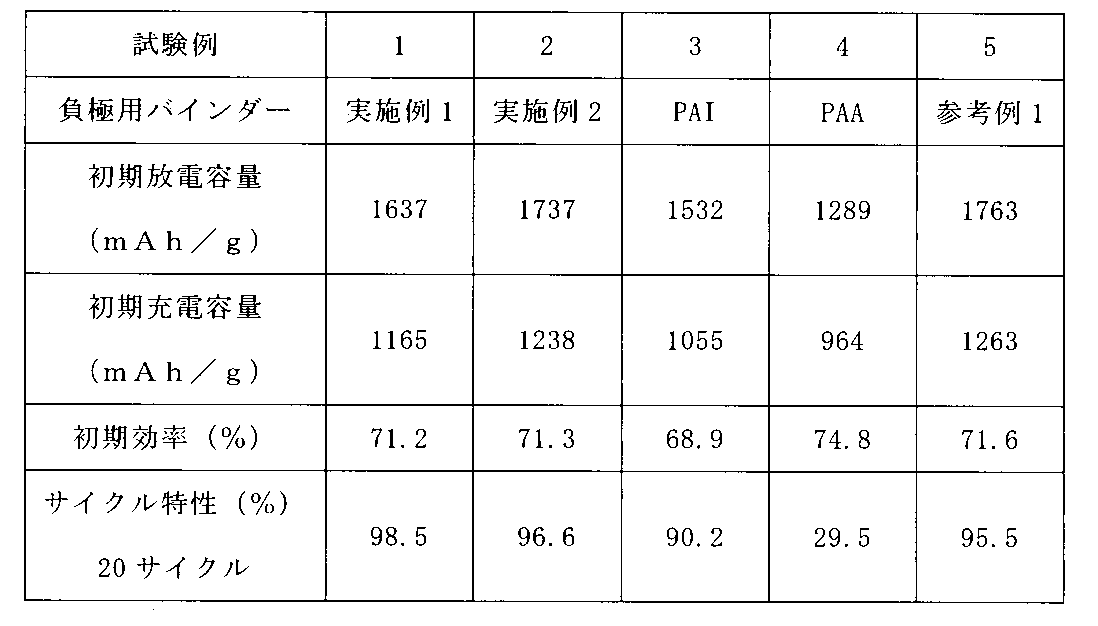
- Cycle characteristics (%) (charge capacity after specified cycle / initial charge capacity) x 100
- Test Examples 1 and 2 using Examples 1 and 2 showed high cycle characteristics. . From this result, it was confirmed that the cycle characteristics were improved by introducing phosphorous acid or triethoxysilane into the molecular structure of the negative electrode binder.
- Electrode sheet 70 parts by mass of the silicon material, 15 parts by mass of natural graphite, 5 parts by mass of acetylene black, and 10 parts by mass of the NMP solution of the intermediate composition of Example 1 were mixed, and NMP was added to this mixture to prepare a slurry.
- the slurry was applied in the form of a film using a doctor blade method on the surface of a 30 ⁇ m electrolytic copper foil as a current collector.
- the negative electrode active material layer was formed on the electrolytic copper foil by volatilizing and removing NMP in the slurry.
- the electrolytic copper foil and the negative electrode active material layer are firmly adhered to each other by compressing the electrolytic copper foil and the negative electrode active material layer so that the thickness of the negative electrode active material layer becomes 20 ⁇ m using a roll press machine. Joined.
- the intermediate composition contained in the negative electrode active material layer is subjected to heat treatment at 180 ° C. for 2 hours in vacuum (under reduced pressure) on the negative electrode active material layer in a state where NMP is removed and dried.
- the negative electrode active material layer was heated and cured. This obtained the electrode sheet which contains the high molecular compound which has a crosslinked structure as a binder for negative electrodes. Moreover, it replaced with the NMP solution of the Example, and produced the same electrode sheet using PAI and PAA. Furthermore, an electrode sheet was prepared in the same manner using the intermediate composition of Reference Example 1.
- a lithium ion secondary battery was produced using the obtained electrode sheet, and the battery characteristics of the lithium ion secondary battery were evaluated. The results are shown in Table 2.
- the method for producing the lithium ion secondary battery and the method for evaluating the battery characteristics of the lithium ion secondary battery are the same as those described above.
- PAA + 4,4′-diaminodiphenylmethane + triethyl phosphite PAA having a weight average molecular weight of 800,000 was dissolved in NMP to prepare a 10% by mass PAA / NMP solution, and 6 ml of this PAA / NMP solution (9.5 mmol in terms of monomer of PAA) was placed in a flask under a nitrogen atmosphere. Sorted. Separately, an amine / NMP solution in which 0.1 g (0.5 mmol) of 4,4′-diaminodiphenylmethane was dissolved in 0.4 ml of NMP was prepared.
- Example 3-1 An intermediate composition (second intermediate composition) of 3-2 and 3-3 was obtained in the form of an NMP solution.
- Example 1 intermediate compositions (second intermediate compositions) of Examples 1-1 and 1-2 with different amounts of phosphorous acid were obtained.
- the blending amounts of phosphorous acid in Examples 1-1 and 1-2 are as shown in Table 3.
- Example 1-1 is the same intermediate composition as in Example 1 above.
- Example 1-2 was prepared in the same manner as in Example 1 except that the blending amount of phosphorous acid was different.
- Example 11 As shown in Table 3, the initial efficiency and cycle characteristics in Test Example 11 using the polymer compound of Example 3-2 as the negative electrode binder were the same as in Example 1-1 as the negative electrode binder. It was confirmed that the initial efficiency and the cycle characteristics in Test Example 13 were comparable. From this result, it was confirmed that a polymer compound using a phosphite was also useful as a binder for a negative electrode of a power storage device such as a secondary battery.
- PAA + 4,4′-diaminodiphenylmethane + phosphoric acid PAA having a weight average molecular weight of 800,000 was dissolved in NMP to prepare a 10% by mass PAA / NMP solution, and 7 ml of this PAA / NMP solution (9.5 mmol in terms of monomer of PAA) was placed in a flask under a nitrogen atmosphere. Sorted. To this solution was added 15 ⁇ l (0.15 mmol) of phosphoric acid, and the mixture was stirred at room temperature for 6 hours.
- Example 4 0.1 g (0.5 mmol) of 4,4′-diaminodiphenylmethane was dissolved in 0.4 ml of NMP to prepare an amine / NMP solution. While stirring the PAA / NMP solution in the flask, the whole amount of the amine / NMP solution was dropped into the PAA / NMP solution, and stirring was continued for 30 minutes at room temperature. Then, the intermediate composition of Example 4 was obtained in the state of NMP solution by heat-processing (preheating process) for 3 hours at 130 degreeC using the Dean-Stark apparatus.
- Test Example 15 using Example 4 showed high cycle characteristics. From this result, it was confirmed that the cycle characteristics were improved by introducing phosphoric acid into the molecular structure of the negative electrode binder.
- PAA + 4,4′-diaminodiphenylmethane + phosphorous acid PAA having a weight average molecular weight of 100,000 is dissolved in NMP to prepare a 10% by mass PAA / NMP solution, and 7 ml of this PAA / NMP solution (9.5 mmol in terms of monomer of PAA) is placed in a flask under a nitrogen atmosphere. Sorted. Separately, 0.1 g (0.5 mmol) of 4,4′-diaminodiphenylmethane was dissolved in 0.4 ml of NMP to prepare an amine / NMP solution.
- a first NMP solution was prepared by dissolving 2.503 g (10 mmol) of 4,4′-diaminodiphenylmethane in 17.5 g of NMP. Separately, 1.92 g (10 mmol) of trimellitic anhydride chloride was dissolved in 13.4 g of NMP to prepare a second NMP solution. Under an inert gas atmosphere, the second NMP solution is added to the first NMP solution, followed by heat treatment at 90 ° C. for 5 hours, whereby a PAI NMP solution having a molecular weight of 20,000 (solid content ratio of 12. 5% by mass) was obtained.
- a first NMP solution was prepared by dissolving 2.503 g (10 mmol) of 4,4′-diaminodiphenylmethane in 11.4 g of NMP. Separately, 1.92 g (10 mmol) of trimellitic anhydride chloride was dissolved in 8.75 g of NMP to prepare a second NMP solution. In an inert gas atmosphere, the second NMP solution is added to the first NMP solution, followed by heat treatment at 80 ° C. for 3 hours, whereby a PAI NMP solution having a molecular weight of 5,000 (solid content ratio: 18 mass). %).
- An electrode sheet was produced using the obtained intermediate composition of Example 5 and the NMP solution of PAI of Reference Examples 2 and 3. Moreover, the lithium ion secondary battery was produced using the obtained electrode sheet, and the battery characteristic of the lithium ion secondary battery was evaluated. The results are shown in Table 5. The method for producing the electrode sheet and the lithium ion secondary battery and the method for evaluating the battery characteristics of the lithium ion secondary battery are the same as those in Test 2.
- Example 1-1 to 1-3 PAA + 4,4′-diaminodiphenylmethane + phosphorous acid
- the amount of 4,4′-diaminodiphenylmethane was varied to obtain intermediate compositions of Examples 1-1 to 1-3 having different carboxyl group / amino group ratios.
- the carboxyl group / amino group ratio in each example is as shown in Table 6.
- Example 1-1 is the same intermediate composition as Example 1 above, and its carboxyl group / amino group ratio is “9.5”.
- Examples 1-2 to 1-3 were prepared in the same manner as in Example 1 except that the amount of 4,4′-diaminodiphenylmethane was different.
- PAA + 3,4′-diaminodiphenylmethane + phosphorous acid PAA having a weight average molecular weight of 800,000 was dissolved in NMP to prepare a 10% by mass PAA / NMP solution, and 6 ml of this PAA / NMP solution (9.5 mmol in terms of monomer of PAA) was placed in a flask under a nitrogen atmosphere. Sorted. Separately, 0.1 g (0.5 mmol) of 3,4'-diaminodiphenylmethane was dissolved in 0.4 ml of NMP to prepare an amine / NMP solution.
- PAA + 3,3′-diaminodiphenylmethane + phosphorous acid PAA having a weight average molecular weight of 800,000 was dissolved in NMP to prepare a 10% by mass PAA / NMP solution, and 6 ml of this PAA / NMP solution (9.5 mmol in terms of monomer of PAA) was placed in a flask under a nitrogen atmosphere. Sorted. Separately, an amine / NMP solution in which 0.1 g (0.5 mmol) of 3,3′-diaminodiphenylmethane was dissolved in 0.4 ml of NMP was prepared.
- PAA + 4,4′-diaminodiphenyl ether + phosphorous acid PAA having a weight average molecular weight of 800,000 was dissolved in NMP to prepare a 10% by mass PAA / NMP solution, and 6 ml of this PAA / NMP solution (9.5 mmol in terms of monomer of PAA) was placed in a flask under a nitrogen atmosphere. Sorted. Separately, an amine / NMP solution in which 100 mg (0.5 mmol) of 4,4′-diaminodiphenyl ether was dissolved in 1 ml of NMP was prepared.
- PAA + 4,4′-diaminobenzophenone + phosphorous acid PAA having a weight average molecular weight of 800,000 was dissolved in NMP to prepare a 10% by mass PAA / NMP solution, and 6 ml of this PAA / NMP solution (9.5 mmol in terms of monomer of PAA) was placed in a flask under a nitrogen atmosphere. Sorted. Separately, an amine / NMP solution in which 106 mg (0.5 mmol) of 4,4′-diaminobenzophenone was dissolved in 1 ml of NMP was prepared.
- PAA + pararose aniline + phosphorous acid PAA having a weight average molecular weight of 800,000 was dissolved in NMP to prepare a 10% by mass PAA / NMP solution, and 6 ml of this PAA / NMP solution (9.5 mmol in terms of monomer of PAA) was placed in a flask under a nitrogen atmosphere. Sorted. Separately, an amine / NMP solution in which 153 mg (0.5 mmol) of pararose aniline was dissolved in 2 ml of NMP was prepared.
- PAA + 4,4′-methylenebis (2-ethyl-6-methylaniline) + phosphorous acid PAA having a weight average molecular weight of 800,000 was dissolved in NMP to prepare a 10% by mass PAA / NMP solution, and 6 ml of this PAA / NMP solution (9.5 mmol in terms of monomer of PAA) was placed in a flask under a nitrogen atmosphere. Sorted. Separately, an amine / NMP solution in which 141 mg (0.5 mmol) of 4,4′-methylenebis (2-ethyl-6-methylaniline) was dissolved in 2 ml of NMP was prepared.
- PAA + 2,2′-bis (4-aminophenyl) hexafluoropropane + phosphorous acid PAA having a weight average molecular weight of 800,000 was dissolved in NMP to prepare a 10% by mass PAA / NMP solution, and 6 ml of this PAA / NMP solution (9.5 mmol in terms of monomer of PAA) was placed in a flask under a nitrogen atmosphere. Sorted. Separately, an amine / NMP solution in which 167 mg (0.5 mmol) of 2,2′-bis (4-aminophenyl) hexafluoropropane was dissolved in 2 ml of NMP was prepared.
Landscapes
- Chemical & Material Sciences (AREA)
- Engineering & Computer Science (AREA)
- Chemical Kinetics & Catalysis (AREA)
- General Chemical & Material Sciences (AREA)
- Electrochemistry (AREA)
- Materials Engineering (AREA)
- Organic Chemistry (AREA)
- Manufacturing & Machinery (AREA)
- Power Engineering (AREA)
- Polymers & Plastics (AREA)
- Medicinal Chemistry (AREA)
- Health & Medical Sciences (AREA)
- Microelectronics & Electronic Packaging (AREA)
- Inorganic Chemistry (AREA)
- Battery Electrode And Active Subsutance (AREA)
Abstract
Description
二次電池の電極は、例えば、銅やアルミニウム等の金属材料により形成された集電体と、その集電体上に結着された活物質層とから構成されている。一般に、活物質層は、活物質を集電体に結着させるための電極用バインダーとして、結着剤を含む。近年、電極用バインダーとして、ポリアクリル酸等のカルボキシル基を含有するビニル系ポリマーの利用が試みられている。特許文献1は、ポリアクリル酸リチウム塩やポリアクリル酸ナトリウム塩を含む電極用バインダーを開示する。特許文献2は、ポリアクリル酸とポリエチレンイミンとを含む電極用バインダーを開示する。特許文献3は、ポリアクリル酸とアミン化合物とを含む電極用バインダーを開示する。
上記課題を解決するため、本発明の第七の態様によれば、蓄電装置の負極電極の製造に用いられる負極電極用スラリーが提供される。負極電極用スラリーは、上記の中間組成物と、負極活物質と、溶剤とを含有し、負極活物質は、リチウムを吸蔵及び放出し得る炭素系材料、リチウムと合金化可能な元素、及びリチウムと合金化可能な元素を有する化合物から選ばれる少なくとも一種である。

以下、本発明を具体化した第1実施形態を詳細に説明する。
本実施形態の高分子化合物は、(A)カルボキシル基を含有するビニル系ポリマーと、(B)芳香族多官能アミンと、(C)第3化合物とが縮合してなる化合物である。

Yが直鎖アルキル基である多官能アミンとしては、例えば、3,3’-ジアミノジフェニルメタン、4,4’-ジアミノジフェニルメタン、3,4’-ジアミノジフェニルメタン、4,4’-エチレンジアニリン、4,4’-ジアミノ―3,3’-ジメチルジフェニルメタン、1,1-ビス(4-アミノフェニル)シクロヘキサン、9、9-ビス(4-アミノフェニル)フルオレン、2,2’-ビス(4-アミノフェニル)ヘキサフルオロプロパン、4,4’-ジアミノベンゾフェノン、4,4’-メチレンビス(2-エチル-6-メチルアニリン)、パラローズアニリンが挙げられる。Yがフェニレン基である多官能アミンとしては、例えば、1,3,5-トリス(4-アミノフェニル)ベンゼンが挙げられる。Yが酸素原子である多官能アミンとしては、例えば、4,4’-ジアミノジフェニルエーテルが挙げられる。1,3,5-トリス(4-アミノフェニル)ベンゼン、及びパラローズアニリンは、3つのアミノ基を有する三官能アミンである。上記の多官能アミンのうちの一種のみを用いてもよいし、二種以上を併用してもよい。


まず、負極活物質、負極用バインダー、溶剤を混合してスラリーを調製する。その際、必要に応じて導電助剤等の他の成分を更に混合してもよい。
スラリーに混合される負極用バインダーとしては、上記第2中間組成物が用いられる。以下では、第2中間組成物について単に中間組成物と記載する。
(1)本実施形態の高分子化合物は、カルボキシル基を含有するビニル系ポリマーと、芳香族多官能アミンと、亜リン酸、亜リン酸エステル、及びトリアルコシキシランから選ばれる少なくとも一種の第3化合物とが縮合してなる高分子化合物である。また、本実施形態の高分子化合物は、カルボキシル基を含有するビニル系ポリマーと、芳香族多官能アミンとが縮合してなる高分子化合物のカルボキシル基に、リン酸基、リン酸エステル基、トリアルコシキシラン基から選ばれる少なくとも一種が付加されている高分子化合物である。また、本実施形態の高分子化合物は、カルボキシル基を含有するビニル系ポリマーと、芳香族多官能アミンと、亜リン酸、亜リン酸エステル、及びトリアルコシキシラン、から選ばれる第3化合物と、非水溶媒とを含有する中間組成物(第2中間組成物)を、150℃~230℃の温度で熱処理してなる高分子化合物である。
以下、本発明を具体化した第2実施形態を詳細に説明する。
本実施形態の高分子化合物は、(A)カルボキシル基を含有するビニル系ポリマーと、(B)芳香族多官能アミンと、(C)第3化合物とが縮合してなる高分子化合物である。
(C)第3化合物としては、リン酸が用いられる。
(5)本実施形態の高分子化合物は、カルボキシル基を含有するビニル系ポリマーと、芳香族多官能アミンと、リン酸とが縮合してなる高分子化合物である。また、本実施形態の高分子化合物は、カルボキシル基を含有するビニル系ポリマーと、芳香族多官能アミンと、リン酸と、非水溶媒とを含有する中間組成物を、150℃~230℃の温度で熱処理してなる高分子化合物である。
<試験1>
上記第3化合物として、亜リン酸又はトリアルコキシシランを用いた高分子化合物を負極用バインダーとして用いた場合における電池特性を評価した。以下では、ポリアクリル酸を「PAA」、N-メチル-2-ピロリドンを「NMP」、ポリアミドイミドを「PAI」と、それぞれ表記する。
重量平均分子量80万のPAAをNMPに溶解して、10質量%のPAA/NMP溶液を調製し、このPAA/NMP溶液6ml(PAAのモノマー換算で9.5mmol)を窒素雰囲気下のフラスコ内に分取した。また、別途、4,4’-ジアミノジフェニルメタン0.1g(0.5mmol)をNMP0.4mlに溶解して、アミン/NMP溶液を調製した。フラスコ内のPAA/NMP溶液を撹拌しながら、PAA/NMP溶液中にアミン/NMP溶液の全量を滴下し、室温にて30分間撹拌を続けた。その後、ディーン・スターク装置を用いて、130℃にて3時間、加熱処理(予備加熱処理)を行った。そして、この処理液に15mg(0.18mmol)の亜リン酸を加え、室温にて6時間撹拌することにより、実施例1の中間組成物(第2中間組成物)をNMP溶液の状態で得た。
重量平均分子量80万のPAAをNMPに溶解して、10質量%のPAA/NMP溶液を調製し、このPAA/NMP溶液6ml(PAAのモノマー換算で9.5mmol)を窒素雰囲気下のフラスコ内に分取した。また、別途、4,4’-ジアミノジフェニルメタン0.1g(0.5mmol)をNMP0.4mlに溶解して、アミン/NMP溶液を調製した。フラスコ内のPAA/NMP溶液を撹拌しながら、PAA/NMP溶液中にアミン/NMP溶液の全量を滴下し、室温にて30分間撹拌を続けた。その後、ディーン・スターク装置を用いて、130℃にて3時間、加熱処理(予備加熱処理)を行った。そして、この処理液に20μl(0.11mmol)のトリエトキシシランを加え、室温にて12時間撹拌することにより、実施例2の中間組成物(第2中間組成物)をNMP溶液の状態で得た。
(参考例1:PAA+4,4’-ジアミノジフェニルメタン)
重量平均分子量80万のPAAをNMPに溶解して、10質量%のPAA/NMP溶液を調製し、このPAA/NMP溶液6ml(PAAのモノマー換算で9.5mmol)を窒素雰囲気下のフラスコ内に分取した。また、別途、4,4’-ジアミノジフェニルメタン0.1g(0.5mmol)をNMP0.4mlに溶解して、アミン/NMP溶液を調製した。フラスコ内のPAA/NMP溶液を撹拌しながら、PAA/NMP溶液中にアミン/NMP溶液の全量を滴下し、室温にて30分間撹拌を続けた。その後、ディーン・スターク装置を用いて、130℃にて3時間、加熱処理(予備加熱処理)することにより、参考例1の中間組成物をNMP溶液の状態で得た。
SiO85質量部、アセチレンブラック5質量部、実施例1、2の中間組成物のNMP溶液10質量部を混合するとともに、この混合物にNMPを加えてスラリーを調製した。30μmの電解銅箔(集電体)の表面に、ドクターブレード法を用いてスラリーを膜状に塗布した。そして、スラリー中のNMPを揮発させて除去することにより、電解銅箔上に負極活物質層を形成した。次いで、ロールプレス機を用いて、負極活物質層の厚さが20μmとなるように電解銅箔及び負極活物質層を圧縮することにより、電解銅箔と負極活物質層を強固に密着させて接合した。
電極シートを直径11mmの円形に裁断してなる負極電極(評価極)と、厚さ500μmの金属リチウム箔を直径13mmの円形に裁断してなる正極電極との間にセパレータを挟装して電極体電池とした。電池ケース内に、電極体電池を収容するとともに非水電解質を注入して、電池ケースを密閉することにより、リチウムイオン二次電池を得た。セパレータとしては、ヘキストセラニーズ社製ガラスフィルター及びセルガード社製celgard2400を用いた。非水電解質としては、エチレンカーボネートとジエチルカーボネートとを体積比1:1で混合した混合溶媒に、ヘキサフルオロリン酸リチウムを1Mの濃度となるように溶解した非水電解質を用いた。
得られたリチウムイオン電池について、直流電流0.2mAで負極電極における正極電極に対する電圧が0.01Vになるまで放電を行い、放電が終了してから10分後に、直流電流0.2mAで負極電極における正極電極に対する電圧が1.0Vになるまで充電を行った。このときの放電容量を初期放電容量とするとともに、充電容量を初期充電容量とした。そして、下記式に基づいて初期効率を算出した。その結果を表1に示す。
また、上記の放電及び充電を1サイクルとして規定サイクルの充放電を行い、下記式に基づいてサイクル特性を算出した。その結果を表1に示す。
次に、負極活物質として層状ポリシランから形成されたシリコン材料を用いた場合における電池特性を評価した。本試験では、実施例1の中間組成物から得られる高分子化合物を負極用バインダーとして用いた。
0℃で氷浴したフッ化水素を1質量%の濃度で含有する濃塩酸20mlに、CaSi25gを加えて1時間撹拌した後、水を加えて更に5分間撹拌した。反応液を濾過して得られた黄色粉体を水及びエタノールで洗浄し、これを減圧乾燥することにより、層状ポリシランを得た。得られた層状ポリシランをアルゴン雰囲気下で500℃に加熱することにより、ポリシランから水素が離脱したシリコン材料を得た。
上記シリコン材料70質量部、天然黒鉛15質量部、アセチレンブラック5質量部、実施例1の中間組成物のNMP溶液10質量部を混合するとともに、この混合物にNMPを加えてスラリーを調製した。集電体としての30μmの電解銅箔の表面に対して、ドクターブレード法を用いてスラリーを膜状に塗布した。そして、スラリー中のNMPを揮発させて除去することにより、電解銅箔上に負極活物質層を形成した。次いで、ロールプレス機を用いて、負極活物質層の厚さが20μmとなるように電解銅箔及び負極活物質層を圧縮することにより、電解銅箔と負極活物質層を強固に密着させて接合した。
得られた電極シートを用いてリチウムイオン二次電池を作製し、そのリチウムイオン二次電池の電池特性を評価した。その結果を表2に示す。リチウムイオン二次電池の作製方法、及びリチウムイオン二次電池の電池特性の評価方法は、上記の方法と同じである。

次に、上記第3化合物として、亜リン酸エステルを用いた高分子化合物を負極用バインダーとして用いた場合における電池特性を評価した。
重量平均分子量80万のPAAをNMPに溶解して、10質量%のPAA/NMP溶液を調製し、このPAA/NMP溶液6ml(PAAのモノマー換算で9.5mmol)を窒素雰囲気下のフラスコ内に分取した。また、別途、4,4’-ジアミノジフェニルメタン0.1g(0.5mmol)をNMP0.4mlに溶解したアミン/NMP溶液を調製した。フラスコ内のPAA/NMP溶液を撹拌しながら、PAA/NMP溶液中にアミン/NMP溶液の全量を滴下し、室温にて30分間撹拌を続けた。その後、ディーン・スターク装置を用いて、130℃にて3時間、加熱処理(予備加熱処理)を行った。そして、この処理液に15mg(0.09mmol)、30mg(0.18mmol)、又は150mg(0.9mmol)の亜リン酸トリエチルを加え、室温にて6時間撹拌することにより、実施例3-1、3-2、3-3の中間組成物(第2中間組成物)をNMP溶液の状態で得た。
得られた実施例3-1、3-2、3-3及び実施例1-1、1-2の中間組成物を用いて、中間組成物から得られる高分子化合物を負極用バインダーとする電極シートを作製した。また、得られた電極シートを用いてリチウムイオン二次電池を作製し、そのリチウムイオン二次電池の電池特性を評価した。その結果を表2に示す。電極シート及びリチウムイオン二次電池の作製方法、並びにリチウムイオン二次電池の電池特性の評価方法は、試験2の方法と同じである。

次に、上記第3化合物として、リン酸を用いた高分子化合物を負極用バインダーとして用いた場合における電池特性を評価した。
重量平均分子量80万のPAAをNMPに溶解して、10質量%のPAA/NMP溶液を調製し、このPAA/NMP溶液7ml(PAAのモノマー換算で9.5mmol)を窒素雰囲気下のフラスコ内に分取した。この溶液にリン酸15μl(0.15mmol)を加え、室温にて6時間撹拌した。また、別途、4,4’-ジアミノジフェニルメタン0.1g(0.5mmol)をNMP0.4mlに溶解して、アミン/NMP溶液を調製した。フラスコ内のPAA/NMP溶液を撹拌しながら、PAA/NMP溶液中にアミン/NMP溶液の全量を滴下し、室温にて30分間撹拌を続けた。その後、ディーン・スターク装置を用いて、130℃にて3時間、加熱処理(予備加熱処理)することにより、実施例4の中間組成物をNMP溶液の状態で得た。
得られた実施例4の中間組成物を用いて、中間組成物から得られる高分子化合物を負極用バインダーとする電極シートを作製した。また、得られた電極シートを用いてリチウムイオン二次電池を作製し、そのリチウムイオン二次電池の電池特性を評価した。その結果を表2に示す。電極シート及びリチウムイオン二次電池の作製方法、並びにリチウムイオン二次電池の電池特性の評価方法は、試験1の方法と同じである。

次に、上記第3化合物として亜リン酸を用いた高分子化合物を負極用バインダーとして用いた場合において、カルボキシル基を含有するビニル系ポリマーの分子量を異ならせた場合の電池特性の変化について評価した。
重量平均分子量10万のPAAをNMPに溶解して、10質量%のPAA/NMP溶液を調製し、このPAA/NMP溶液7ml(PAAのモノマー換算で9.5mmol)を窒素雰囲気下のフラスコ内に分取した。また、別途、4,4’-ジアミノジフェニルメタン0.1g(0.5mmol)をNMP0.4mlに溶解して、アミン/NMP溶液を調製した。フラスコ内のPAA/NMP溶液を撹拌しながら、PAA/NMP溶液中にアミン/NMP溶液の全量を滴下し、室温にて30分間撹拌を続けた。その後、ディーン・スターク装置を用いて、110℃にて3時間、加熱処理(予備加熱処理)を行った。そして、この処理液に15mg(0.18mmol)の亜リン酸を加え、室温にて12時間撹拌することにより、実施例5の中間組成物(第2中間組成物)をNMP溶液の状態で得た。
(参考例2:PAI)
4,4’-ジアミノジフェニルメタン2.503g(10mmol)を17.5gのNMPに溶解して、第1のNMP溶液を調製した。また、別途、無水トリメリット酸クロリド1.92g(10mmol)を13.4gのNMPに溶解して、第2のNMP溶液を調製した。不活性ガス雰囲気下にて、第1のNMP溶液に第2のNMP溶液を加え、90℃にて5時間、加熱処理することにより、分子量20,000のPAIのNMP溶液(固形分比12.5質量%)を得た。
4,4’-ジアミノジフェニルメタン2.503g(10mmol)を11.4gのNMPに溶解して、第1のNMP溶液を調製した。また、別途、無水トリメリット酸クロリド1.92g(10mmol)を8.75gのNMPに溶解して、第2のNMP溶液を調製した。不活性ガス雰囲気下にて、第1のNMP溶液に第2のNMP溶液を加え、80℃にて3時間、加熱処理することにより、分子量5,000のPAIのNMP溶液(固形分比18質量%)を得た。
得られた実施例5の中間組成物、及び参考例2、3のPAIのNMP溶液を用いて、電極シートを作製した。また、得られた電極シートを用いてリチウムイオン二次電池を作製し、そのリチウムイオン二次電池の電池特性を評価した。その結果を表5に示す。電極シート及びリチウムイオン二次電池の作製方法、並びにリチウムイオン二次電池の電池特性の評価方法は、試験2の方法と同じである。

次に、実施例1の中間組成物について、カルボキシル基を含有するビニル系ポリマーと芳香族多官能アミンとの配合割合を異ならせることによって、カルボキシル基/アミノ基比率を異ならせた場合の電池特性の変化について評価した。
実施例1の中間組成物について、4,4’-ジアミノジフェニルメタンの配合量を異ならせて、カルボキシル基/アミノ基比率の異なる実施例1-1~1-3の中間組成物を得た。各実施例のカルボキシル基/アミノ基比率は表6に示すとおりである。実施例1-1については、上記実施例1と同一の中間組成物であり、そのカルボキシル基/アミノ基比率は「9.5」である。実施例1-2~1-3については、4,4’-ジアミノジフェニルメタンの配合量が異なる点を除いて、実施例1と同様の方法により調製した。
得られた実施例1-1~1-3の中間組成物を用いて、中間組成物から得られる高分子化合物を負極用バインダーとする電極シートを作製した。また、得られた電極シートを用いてリチウムイオン二次電池を作製し、そのリチウムイオン二次電池の電池特性を評価した。その結果を表6に示す。電極シート及びリチウムイオン二次電池の作製方法、並びにリチウムイオン二次電池の電池特性の評価方法は、試験2の方法と同じである。

次に、上記第3化合物として亜リン酸を用いた高分子化合物を負極用バインダーとして用いた場合において、芳香族多官能アミンを異ならせた場合の電池特性の変化について評価した。
重量平均分子量80万のPAAをNMPに溶解して、10質量%のPAA/NMP溶液を調製し、このPAA/NMP溶液6ml(PAAのモノマー換算で9.5mmol)を窒素雰囲気下のフラスコ内に分取した。また、別途、3,4’-ジアミノジフェニルメタン0.1g(0.5mmol)をNMP0.4mlに溶解して、アミン/NMP溶液を調製した。フラスコ内のPAA/NMP溶液を撹拌しながら、PAA/NMP溶液中にアミン/NMP溶液の全量を滴下し、室温にて30分間撹拌を続けた。その後、ディーン・スターク装置を用いて、130℃にて3時間、加熱処理(予備加熱処理)を行った。そして、この処理液に15mg(0.18mmol)の亜リン酸を加え、室温にて6時間撹拌することにより、実施例1の中間組成物(第2中間組成物)をNMP溶液の状態で得た。
重量平均分子量80万のPAAをNMPに溶解して、10質量%のPAA/NMP溶液を調製し、このPAA/NMP溶液6ml(PAAのモノマー換算で9.5mmol)を窒素雰囲気下のフラスコ内に分取した。また、別途、3,3’-ジアミノジフェニルメタン0.1g(0.5mmol)をNMP0.4mlに溶解したアミン/NMP溶液を調製した。フラスコ内のPAA/NMP溶液を撹拌しながら、PAA/NMP溶液中にアミン/NMP溶液の全量を滴下し、室温にて30分間撹拌を続けた。その後、ディーン・スターク装置を用いて、130℃にて3時間、加熱処理(予備加熱処理)を行った。そして、この処理液に15mg(0.18mmol)の亜リン酸を加え、室温にて6時間撹拌することにより、実施例1の中間組成物(第2中間組成物)をNMP溶液の状態で得た。
重量平均分子量80万のPAAをNMPに溶解して、10質量%のPAA/NMP溶液を調製し、このPAA/NMP溶液6ml(PAAのモノマー換算で9.5mmol)を窒素雰囲気下のフラスコ内に分取した。また、別途、4,4’-ジアミノジフェニルエーテル100mg(0.5mmol)をNMP1mlに溶解したアミン/NMP溶液を調製した。フラスコ内のPAA/NMP溶液を撹拌しながら、PAA/NMP溶液中にアミン/NMP溶液の全量を滴下し、室温にて30分間撹拌を続けた。その後、ディーン・スターク装置を用いて、130℃にて3時間、加熱処理(予備加熱処理)を行った。そして、この処理液に15mg(0.18mmol)の亜リン酸を加え、室温にて6時間撹拌することにより、実施例1の中間組成物(第2中間組成物)をNMP溶液の状態で得た。
重量平均分子量80万のPAAをNMPに溶解して、10質量%のPAA/NMP溶液を調製し、このPAA/NMP溶液6ml(PAAのモノマー換算で9.5mmol)を窒素雰囲気下のフラスコ内に分取した。また、別途、4,4’-ジアミノベンゾフェノン106mg(0.5mmol)をNMP1mlに溶解したアミン/NMP溶液を調製した。フラスコ内のPAA/NMP溶液を撹拌しながら、PAA/NMP溶液中にアミン/NMP溶液の全量を滴下し、室温にて30分間撹拌を続けた。その後、ディーン・スターク装置を用いて、130℃にて3時間、加熱処理(予備加熱処理)を行った。そして、この処理液に15mg(0.18mmol)の亜リン酸を加え、室温にて6時間撹拌することにより、実施例1の中間組成物(第2中間組成物)をNMP溶液の状態で得た。
重量平均分子量80万のPAAをNMPに溶解して、10質量%のPAA/NMP溶液を調製し、このPAA/NMP溶液6ml(PAAのモノマー換算で9.5mmol)を窒素雰囲気下のフラスコ内に分取した。また、別途、パラローズアニリン153mg(0.5mmol)をNMP2mlに溶解したアミン/NMP溶液を調製した。フラスコ内のPAA/NMP溶液を撹拌しながら、PAA/NMP溶液中にアミン/NMP溶液の全量を滴下し、室温にて30分間撹拌を続けた。その後、ディーン・スターク装置を用いて、130℃にて3時間、加熱処理(予備加熱処理)を行った。そして、この処理液に15mg(0.18mmol)の亜リン酸を加え、室温にて6時間撹拌することにより、実施例1の中間組成物(第2中間組成物)をNMP溶液の状態で得た。
重量平均分子量80万のPAAをNMPに溶解して、10質量%のPAA/NMP溶液を調製し、このPAA/NMP溶液6ml(PAAのモノマー換算で9.5mmol)を窒素雰囲気下のフラスコ内に分取した。また、別途、4,4’-メチレンビス(2-エチル-6-メチルアニリン)141mg(0.5mmol)をNMP2mlに溶解したアミン/NMP溶液を調製した。フラスコ内のPAA/NMP溶液を撹拌しながら、PAA/NMP溶液中にアミン/NMP溶液の全量を滴下し、室温にて30分間撹拌を続けた。その後、ディーン・スターク装置を用いて、130℃にて3時間、加熱処理(予備加熱処理)を行った。そして、この処理液に15mg(0.18mmol)の亜リン酸を加え、室温にて6時間撹拌することにより、実施例1の中間組成物(第2中間組成物)をNMP溶液の状態で得た。
重量平均分子量80万のPAAをNMPに溶解して、10質量%のPAA/NMP溶液を調製し、このPAA/NMP溶液6ml(PAAのモノマー換算で9.5mmol)を窒素雰囲気下のフラスコ内に分取した。また、別途、2,2’-ビス(4-アミノフェニル)ヘキサフルオロプロパン167mg(0.5mmol)をNMP2mlに溶解したアミン/NMP溶液を調製した。フラスコ内のPAA/NMP溶液を撹拌しながら、PAA/NMP溶液中にアミン/NMP溶液の全量を滴下し、室温にて30分間撹拌を続けた。その後、ディーン・スターク装置を用いて、130℃にて3時間、加熱処理(予備加熱処理)を行った。そして、この処理液に15mg(0.18mmol)の亜リン酸を加え、室温にて6時間撹拌することにより、実施例1の中間組成物(第2中間組成物)をNMP溶液の状態で得た。
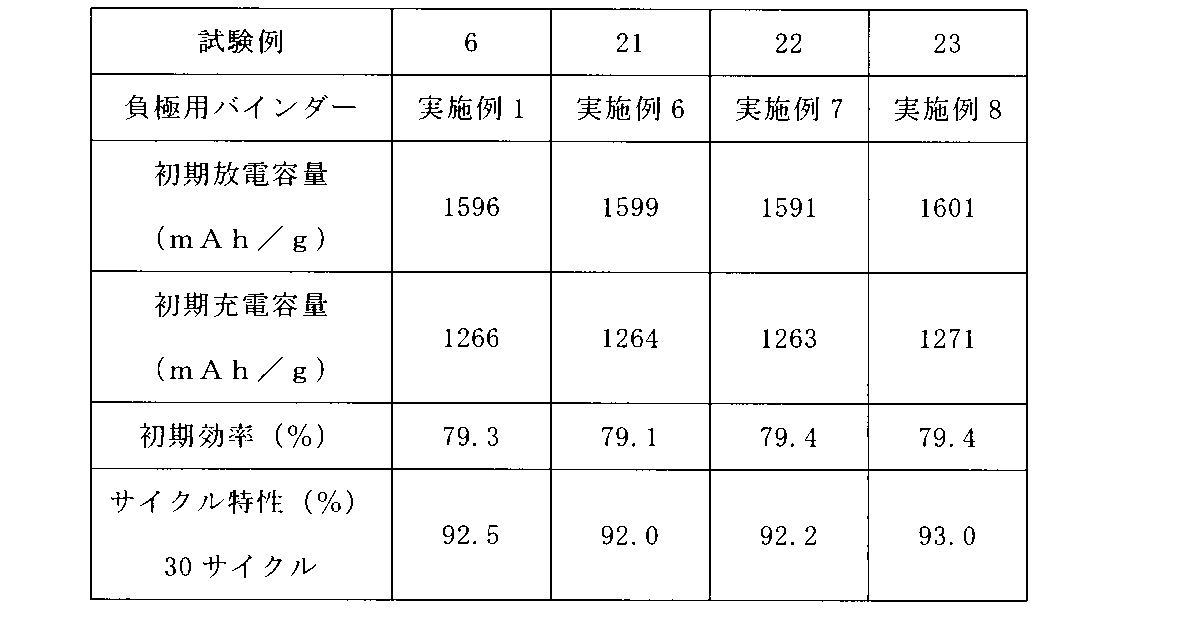
得られた実施例6~12の中間組成物を用いて、中間組成物から得られる高分子化合物を負極用バインダーとする電極シートを作製した。また、得られた電極シートを用いてリチウムイオン二次電池を作製し、そのリチウムイオン二次電池の電池特性を評価した。その結果を表7及び表8に示す。電極シート及びリチウムイオン二次電池の作製方法、並びにリチウムイオン二次電池の電池特性の評価方法は、試験2の方法と同じである。

Claims (17)
- 蓄電装置の負極用バインダーとして用いられる高分子化合物であって、
前記高分子化合物は、
カルボキシル基を含有するビニル系ポリマーと、
芳香族多官能アミンと、
亜リン酸、亜リン酸エステル、トリアルコシキシラン、及びリン酸から選ばれる第3化合物とが縮合してなる化合物であることを特徴とする高分子化合物。 - 蓄電装置の負極用バインダーとして用いられる高分子化合物であって、
カルボキシル基を含有するビニル系ポリマーと、芳香族多官能アミンとが縮合してなる高分子化合物のカルボキシル基に、リン酸基、リン酸エステル基、トリアルコシキシラン基から選ばれる少なくとも一種が付加されていることを特徴とする高分子化合物。 - 前記芳香族多官能アミンは、下記一般式(1)に示す多官能アミンであり、
Yは、炭素数1~4の直鎖アルキル基、フェニレン基、又は酸素原子であり、R1,R2はそれぞれ独立して、単数又は複数の水素原子、メチル基、エチル基、トリフルオロメチル基、又はメトキシ基であることを特徴とする請求項1又は請求項2に記載の高分子化合物。

- 蓄電装置の負極用バインダーとして用いられる高分子化合物の中間組成物であって、
カルボキシル基を含有するビニル系ポリマーと、
芳香族多官能アミンと、
亜リン酸、亜リン酸エステル、トリアルコシキシラン、及びリン酸から選ばれる第3化合物と、
非水溶媒と
を含有することを特徴とする中間組成物。 - 蓄電装置の負極用バインダーとして用いられる高分子化合物の製造方法であって、
カルボキシル基を含有するビニル系ポリマーと、
芳香族多官能アミンと、
亜リン酸、亜リン酸エステル、トリアルコシキシラン、及びリン酸から選ばれる第3化合物とを縮合させることを特徴とする高分子化合物の製造方法。 - 前記第3化合物は、亜リン酸、亜リン酸エステル、及びトリアルコシキシランから選ばれる少なくとも一種であり、
前記ビニル系ポリマーと前記芳香族多官能アミンとを混合した後、さらに前記第3化合物を混合することを特徴とする請求項5に記載の高分子化合物の製造方法。 - 前記ビニル系ポリマーと前記芳香族多官能アミンとを混合して40~140℃の温度で加熱した後、さらに前記第3化合物を混合して150℃~230℃の温度で加熱することを特徴とする請求項6に記載の高分子化合物の製造方法。
- 前記第3化合物は、リン酸であり、
前記ビニル系ポリマーと、前記芳香族多官能アミンと、前記第3化合物とを40~140℃の温度で加熱した後、150℃~230℃の温度で加熱することを特徴とする請求項6に記載の高分子化合物の製造方法。 - 蓄電装置の負極電極であって、
請求項1~3のいずれか一項に記載の高分子化合物を含有する負極用バインダーと、負極活物質とを備え、
前記負極活物質は、リチウムを吸蔵及び放出し得る炭素系材料、リチウムと合金化可能な元素、及びリチウムと合金化可能な元素を有する化合物から選ばれる少なくとも一種であることを特徴とする負極電極。 - 前記負極活物質は、CaSi2から脱カルシウム化反応を経て得られるシリコン材料、Si、及びSiOV(0>v>2)から選ばれる少なくとも一種であることを特徴とする請求項9に記載の負極電極。
- 請求項9又は請求項10に記載の負極電極と、非水電解質とを備えることを特徴とする蓄電装置。
- 蓄電装置の負極電極の製造に用いられる負極電極用スラリーであって、
請求項4に記載の中間組成物と、負極活物質と、溶剤とを含有し、
前記負極活物質は、リチウムを吸蔵及び放出し得る炭素系材料、リチウムと合金化可能な元素、及びリチウムと合金化可能な元素を有する化合物から選ばれる少なくとも一種であることを特徴とする負極電極用スラリー。 - 蓄電装置の負極電極の製造方法であって、
請求項12に記載の負極電極用スラリーを用いて、集電体に対して負極活物質層を形成することを特徴とする負極電極の製造方法。 - 前記負極電極用スラリーは、前記負極活物質として、CaSi2から脱カルシウム化反応を経て得られるシリコン材料、Si、及びSiOV(0>v>2)から選ばれる少なくとも一種を含有することを特徴とする請求項13に記載の負極電極の製造方法。
- 蓄電装置の負極用バインダーとして用いられる高分子化合物であって、
カルボキシル基を含有するビニル系ポリマーにより構成される鎖状構造と、
前記鎖状構造内又は鎖状構造間におけるカルボン酸側鎖同士を接続する架橋構造とを有し、
前記架橋構造は、下記一般式(3)~(5)から選ばれる少なくとも一種の架橋構造であり、前記鎖状構造が有するカルボキシル基に、リン酸基、リン酸エステル基、トリアルコシキシラン基から選ばれる少なくとも一種が付加されていることを特徴とする高分子化合物。
- 請求項1~3、15のいずれか一項に記載の高分子化合物を含有する負極用バインダー。
- 蓄電装置の負極電極の製造方法であって、
前記中間組成物と負極活物質とを含有する混合物を用いて、集電体上に負極活物質層を形成する活物質層形成工程と、
前記負極活物質層を熱処理することにより、前記ビニル系ポリマーと前記芳香族多官能アミンとを縮合させる縮合工程と
を有する負極電極の製造方法。
Priority Applications (3)
| Application Number | Priority Date | Filing Date | Title |
|---|---|---|---|
| JP2016561464A JP6365682B2 (ja) | 2014-11-25 | 2015-10-30 | 高分子化合物、中間組成物、負極電極、蓄電装置、負極電極用スラリー、高分子化合物の製造方法、及び負極電極の製造方法 |
| US15/528,776 US10707490B2 (en) | 2014-11-25 | 2015-10-30 | Polymer compound, intermediate composition, negative electrode, electricity storage device, slurry for negative electrodes, method for producing polymer compound, and method for producing negative electrode |
| DE112015005307.7T DE112015005307T5 (de) | 2014-11-25 | 2015-10-30 | Polymerverbindung, intermediäre zusammensetzung, negativelektrode elektrizitätsspeichervorrichtung, aufschlämmung für negativelektroden, verfahren zum herstellen einer polymerverbindung und verfahren zum herstellen einer negativelektrode |
Applications Claiming Priority (2)
| Application Number | Priority Date | Filing Date | Title |
|---|---|---|---|
| JP2014-238097 | 2014-11-25 | ||
| JP2014238097 | 2014-11-25 |
Publications (1)
| Publication Number | Publication Date |
|---|---|
| WO2016084548A1 true WO2016084548A1 (ja) | 2016-06-02 |
Family
ID=56074122
Family Applications (1)
| Application Number | Title | Priority Date | Filing Date |
|---|---|---|---|
| PCT/JP2015/080632 Ceased WO2016084548A1 (ja) | 2014-11-25 | 2015-10-30 | 高分子化合物、中間組成物、負極電極、蓄電装置、負極電極用スラリー、高分子化合物の製造方法、及び負極電極の製造方法 |
Country Status (4)
| Country | Link |
|---|---|
| US (1) | US10707490B2 (ja) |
| JP (1) | JP6365682B2 (ja) |
| DE (1) | DE112015005307T5 (ja) |
| WO (1) | WO2016084548A1 (ja) |
Cited By (4)
| Publication number | Priority date | Publication date | Assignee | Title |
|---|---|---|---|---|
| JP2017076551A (ja) * | 2015-10-15 | 2017-04-20 | 株式会社豊田自動織機 | 中間組成物、負極電極用スラリー、及び負極電極の製造方法 |
| WO2017138395A1 (ja) * | 2016-02-12 | 2017-08-17 | 株式会社 豊田自動織機 | 高分子化合物、中間組成物、負極電極、蓄電装置、負極電極用スラリー、高分子化合物の製造方法、及び負極電極の製造方法 |
| WO2017141674A1 (ja) * | 2016-02-18 | 2017-08-24 | 株式会社 豊田自動織機 | 高分子化合物、中間組成物、負極電極、蓄電装置、負極電極用スラリー、高分子化合物の製造方法、及び負極電極の製造方法 |
| JP2018014188A (ja) * | 2016-07-19 | 2018-01-25 | 株式会社豊田自動織機 | 負極活物質、負極電極、及び負極活物質の製造方法 |
Citations (3)
| Publication number | Priority date | Publication date | Assignee | Title |
|---|---|---|---|---|
| JP2012104406A (ja) * | 2010-11-11 | 2012-05-31 | Toyo Kagaku Kk | 電極用バインダー |
| JP2013008667A (ja) * | 2011-05-24 | 2013-01-10 | Nippon Zeon Co Ltd | 二次電池用負極、二次電池、負極用スラリー組成物及び二次電池用負極の製造方法 |
| JP2013012357A (ja) * | 2011-06-28 | 2013-01-17 | Nippon Zeon Co Ltd | 二次電池用負極、二次電池、負極用スラリー組成物及び二次電池用負極の製造方法 |
Family Cites Families (15)
| Publication number | Priority date | Publication date | Assignee | Title |
|---|---|---|---|---|
| JP2003003031A (ja) | 2001-06-25 | 2003-01-08 | Hitachi Chem Co Ltd | カルボキシル基含有樹脂組成物およびこれを用いた電池用バインダ樹脂組成物、電極および電池 |
| JP5638756B2 (ja) | 2005-09-29 | 2014-12-10 | エルジー・ケム・リミテッド | 性能の向上した電極及びこれを備える電気化学素子 |
| JP5252386B2 (ja) | 2007-09-25 | 2013-07-31 | 学校法人東京理科大学 | リチウムイオン電池用負極 |
| US7931984B2 (en) | 2007-11-28 | 2011-04-26 | Samsung Sdi Co., Ltd. | Negative electrode for rechargeable lithium battery, and rechargeable lithium battery including the same |
| JP2009256570A (ja) | 2008-03-17 | 2009-11-05 | Hitachi Chem Co Ltd | アクリルポリマー、その合成方法、及びこれを用いた重合性樹脂組成物、ゲル状高分子電解質 |
| JP5569515B2 (ja) | 2009-02-25 | 2014-08-13 | 日本ゼオン株式会社 | リチウムイオン二次電池用電極 |
| JP5534012B2 (ja) | 2010-08-02 | 2014-06-25 | 日産自動車株式会社 | リチウムイオン二次電池用負極およびその製造方法 |
| WO2012120895A1 (ja) | 2011-03-09 | 2012-09-13 | パナソニック株式会社 | 端子付電池 |
| JP5970183B2 (ja) | 2011-12-21 | 2016-08-17 | 東洋化学株式会社 | 電極用バインダー |
| KR101735855B1 (ko) | 2012-04-16 | 2017-05-24 | 삼성에스디아이 주식회사 | 수용성 바인더 조성물 |
| JP5099394B1 (ja) | 2012-05-31 | 2012-12-19 | Jsr株式会社 | 蓄電デバイスの電極用バインダー組成物 |
| US9437872B2 (en) * | 2012-12-04 | 2016-09-06 | Samsung Sdi Co., Ltd. | Negative electrode for rechargeable lithium battery, method of preparing the same and rechargeable lithium battery including the same |
| JP6226355B2 (ja) | 2012-12-04 | 2017-11-08 | 三星エスディアイ株式会社SAMSUNG SDI Co., LTD. | リチウムイオン二次電池用バインダ、リチウムイオン二次電池用負極活物質層、及びリチウムイオン二次電池 |
| US20140312268A1 (en) | 2013-04-23 | 2014-10-23 | E I Du Pont De Nemours And Company | Battery binder |
| JP6395371B2 (ja) * | 2013-11-26 | 2018-09-26 | 三星エスディアイ株式会社Samsung SDI Co., Ltd. | リチウムイオン二次電池用負極活物質層及びリチウムイオン二次電池 |
-
2015
- 2015-10-30 WO PCT/JP2015/080632 patent/WO2016084548A1/ja not_active Ceased
- 2015-10-30 US US15/528,776 patent/US10707490B2/en active Active
- 2015-10-30 JP JP2016561464A patent/JP6365682B2/ja active Active
- 2015-10-30 DE DE112015005307.7T patent/DE112015005307T5/de not_active Withdrawn
Patent Citations (3)
| Publication number | Priority date | Publication date | Assignee | Title |
|---|---|---|---|---|
| JP2012104406A (ja) * | 2010-11-11 | 2012-05-31 | Toyo Kagaku Kk | 電極用バインダー |
| JP2013008667A (ja) * | 2011-05-24 | 2013-01-10 | Nippon Zeon Co Ltd | 二次電池用負極、二次電池、負極用スラリー組成物及び二次電池用負極の製造方法 |
| JP2013012357A (ja) * | 2011-06-28 | 2013-01-17 | Nippon Zeon Co Ltd | 二次電池用負極、二次電池、負極用スラリー組成物及び二次電池用負極の製造方法 |
Cited By (6)
| Publication number | Priority date | Publication date | Assignee | Title |
|---|---|---|---|---|
| JP2017076551A (ja) * | 2015-10-15 | 2017-04-20 | 株式会社豊田自動織機 | 中間組成物、負極電極用スラリー、及び負極電極の製造方法 |
| WO2017138395A1 (ja) * | 2016-02-12 | 2017-08-17 | 株式会社 豊田自動織機 | 高分子化合物、中間組成物、負極電極、蓄電装置、負極電極用スラリー、高分子化合物の製造方法、及び負極電極の製造方法 |
| US10538625B2 (en) | 2016-02-12 | 2020-01-21 | Kabushiki Kaisha Toyota Jidoshokki | Polymer compound, intermediate composition, negative electrode, electrical storage device, slurry for negative electrode, method for producing polymer compound, and method for producing negative electrode |
| WO2017141674A1 (ja) * | 2016-02-18 | 2017-08-24 | 株式会社 豊田自動織機 | 高分子化合物、中間組成物、負極電極、蓄電装置、負極電極用スラリー、高分子化合物の製造方法、及び負極電極の製造方法 |
| US10351672B2 (en) | 2016-02-18 | 2019-07-16 | Kabushiki Kaisha Toyota Jidoshokki | Polymer compound formed by condensing polyacrylic acid, polyamine and aromatic monoamine, intermediate composition, negative electrode, electrical storage device, slurry for negative electrode, method for producing polymer compound, and method for producing negative electrode |
| JP2018014188A (ja) * | 2016-07-19 | 2018-01-25 | 株式会社豊田自動織機 | 負極活物質、負極電極、及び負極活物質の製造方法 |
Also Published As
| Publication number | Publication date |
|---|---|
| DE112015005307T5 (de) | 2017-08-24 |
| JP6365682B2 (ja) | 2018-08-01 |
| JPWO2016084548A1 (ja) | 2017-09-14 |
| US20170331114A1 (en) | 2017-11-16 |
| US10707490B2 (en) | 2020-07-07 |
Similar Documents
| Publication | Publication Date | Title |
|---|---|---|
| JP6202217B2 (ja) | 高分子化合物、中間組成物、負極電極、蓄電装置、負極電極用スラリー、高分子化合物の製造方法、及び負極電極の製造方法 | |
| CN105229832B (zh) | 二次电池用粘合剂组合物、二次电池电极用浆料组合物、二次电池用负极及二次电池 | |
| JP5128873B2 (ja) | 二次電池用電極及びその製造方法 | |
| CN109071709B (zh) | 高分子化合物、中间组成物、负极电极、蓄电装置以及高分子化合物的制造方法 | |
| JP6365682B2 (ja) | 高分子化合物、中間組成物、負極電極、蓄電装置、負極電極用スラリー、高分子化合物の製造方法、及び負極電極の製造方法 | |
| WO2017141674A1 (ja) | 高分子化合物、中間組成物、負極電極、蓄電装置、負極電極用スラリー、高分子化合物の製造方法、及び負極電極の製造方法 | |
| JP2017143027A (ja) | 負極電極用スラリー及び負極電極の製造方法 | |
| JP2018014188A (ja) | 負極活物質、負極電極、及び負極活物質の製造方法 | |
| WO2017138395A1 (ja) | 高分子化合物、中間組成物、負極電極、蓄電装置、負極電極用スラリー、高分子化合物の製造方法、及び負極電極の製造方法 | |
| JP6891900B2 (ja) | 負極用バインダー、中間組成物、負極電極、蓄電装置、高分子化合物の製造方法、及び蓄電装置の負極電極の製造方法 | |
| JP6642081B2 (ja) | 高分子化合物、負極用バインダー、中間組成物、負極電極、蓄電装置、負極電極用スラリー、高分子化合物の製造方法、及び負極電極の製造方法 | |
| JP6432371B2 (ja) | 蓄電装置用の負極電極 | |
| CN115362572A (zh) | 用于锂离子电池的聚酰胺酸衍生物粘合剂 | |
| TWI924660B (zh) | 用於鋰離子電池之聚醯胺酸衍生物黏合劑 | |
| JP6657758B2 (ja) | 中間組成物、負極電極用スラリー、及び負極電極の製造方法 |
Legal Events
| Date | Code | Title | Description |
|---|---|---|---|
| 121 | Ep: the epo has been informed by wipo that ep was designated in this application |
Ref document number: 15862553 Country of ref document: EP Kind code of ref document: A1 |
|
| ENP | Entry into the national phase |
Ref document number: 2016561464 Country of ref document: JP Kind code of ref document: A |
|
| WWE | Wipo information: entry into national phase |
Ref document number: 15528776 Country of ref document: US |
|
| WWE | Wipo information: entry into national phase |
Ref document number: 112015005307 Country of ref document: DE |
|
| 122 | Ep: pct application non-entry in european phase |
Ref document number: 15862553 Country of ref document: EP Kind code of ref document: A1 |