WO2016068293A1 - 磁気ディスク用アルミニウム合金基板 - Google Patents
磁気ディスク用アルミニウム合金基板 Download PDFInfo
- Publication number
- WO2016068293A1 WO2016068293A1 PCT/JP2015/080756 JP2015080756W WO2016068293A1 WO 2016068293 A1 WO2016068293 A1 WO 2016068293A1 JP 2015080756 W JP2015080756 W JP 2015080756W WO 2016068293 A1 WO2016068293 A1 WO 2016068293A1
- Authority
- WO
- WIPO (PCT)
- Prior art keywords
- mass
- aluminum alloy
- less
- magnetic disk
- alloy substrate
- Prior art date
- Legal status (The legal status is an assumption and is not a legal conclusion. Google has not performed a legal analysis and makes no representation as to the accuracy of the status listed.)
- Ceased
Links
Images

Classifications
-
- C—CHEMISTRY; METALLURGY
- C22—METALLURGY; FERROUS OR NON-FERROUS ALLOYS; TREATMENT OF ALLOYS OR NON-FERROUS METALS
- C22C—ALLOYS
- C22C21/00—Alloys based on aluminium
- C22C21/02—Alloys based on aluminium with silicon as the next major constituent
-
- C—CHEMISTRY; METALLURGY
- C22—METALLURGY; FERROUS OR NON-FERROUS ALLOYS; TREATMENT OF ALLOYS OR NON-FERROUS METALS
- C22C—ALLOYS
- C22C21/00—Alloys based on aluminium
-
- C—CHEMISTRY; METALLURGY
- C22—METALLURGY; FERROUS OR NON-FERROUS ALLOYS; TREATMENT OF ALLOYS OR NON-FERROUS METALS
- C22C—ALLOYS
- C22C21/00—Alloys based on aluminium
- C22C21/06—Alloys based on aluminium with magnesium as the next major constituent
-
- C—CHEMISTRY; METALLURGY
- C22—METALLURGY; FERROUS OR NON-FERROUS ALLOYS; TREATMENT OF ALLOYS OR NON-FERROUS METALS
- C22F—CHANGING THE PHYSICAL STRUCTURE OF NON-FERROUS METALS AND NON-FERROUS ALLOYS
- C22F1/00—Changing the physical structure of non-ferrous metals or alloys by heat treatment or by hot or cold working
- C22F1/04—Changing the physical structure of non-ferrous metals or alloys by heat treatment or by hot or cold working of aluminium or alloys based thereon
-
- C—CHEMISTRY; METALLURGY
- C22—METALLURGY; FERROUS OR NON-FERROUS ALLOYS; TREATMENT OF ALLOYS OR NON-FERROUS METALS
- C22F—CHANGING THE PHYSICAL STRUCTURE OF NON-FERROUS METALS AND NON-FERROUS ALLOYS
- C22F1/00—Changing the physical structure of non-ferrous metals or alloys by heat treatment or by hot or cold working
- C22F1/04—Changing the physical structure of non-ferrous metals or alloys by heat treatment or by hot or cold working of aluminium or alloys based thereon
- C22F1/043—Changing the physical structure of non-ferrous metals or alloys by heat treatment or by hot or cold working of aluminium or alloys based thereon of alloys with silicon as the next major constituent
-
- G—PHYSICS
- G11—INFORMATION STORAGE
- G11B—INFORMATION STORAGE BASED ON RELATIVE MOVEMENT BETWEEN RECORD CARRIER AND TRANSDUCER
- G11B5/00—Recording by magnetisation or demagnetisation of a record carrier; Reproducing by magnetic means; Record carriers therefor
- G11B5/62—Record carriers characterised by the selection of the material
- G11B5/73—Base layers, i.e. all non-magnetic layers lying under a lowermost magnetic recording layer, e.g. including any non-magnetic layer in between a first magnetic recording layer and either an underlying substrate or a soft magnetic underlayer
- G11B5/739—Magnetic recording media substrates
- G11B5/73911—Inorganic substrates
- G11B5/73917—Metallic substrates, i.e. elemental metal or metal alloy substrates
- G11B5/73919—Aluminium or titanium elemental or alloy substrates
Definitions
- the present invention relates to an aluminum alloy substrate for a magnetic disk.
- An aluminum alloy magnetic disk used for a storage device of a computer has a good plating property and excellent mechanical properties and workability.
- JIS5086 (Mg of 3.5% to 4.5% by mass, 0.50%) Fe in mass% or less, Si in 0.40 mass% or less, Mn in 0.20 mass% to 0.70 mass%, Cr in 0.05 mass% to 0.25 mass%, 0.10 mass% (Cu, 0.15 mass% or less of Ti, 0.25 mass% or less of Zn, the balance Al and inevitable impurities).
- the aluminum alloy magnetic disk is designed to limit the content of impurities such as Fe and Si in JIS5086 and reduce the intermetallic compounds in the matrix for the purpose of improving pit defects due to the drop-out of intermetallic compounds in the pre-plating process. It is manufactured from an aluminum alloy substrate that has been prepared, or an aluminum alloy substrate to which Cu and / or Zn in JIS5086 is intentionally added for the purpose of improving plating properties.
- a general aluminum alloy magnetic disk is manufactured by first producing an annular aluminum alloy substrate, plating the aluminum alloy substrate, and then attaching a magnetic material to the surface of the aluminum alloy substrate.
- an aluminum alloy magnetic disk made of the JIS 5086 alloy is manufactured by the following manufacturing process. First, an aluminum alloy having a desired chemical component is cast, the ingot is hot-rolled, and then cold-rolled to produce a rolled material having a necessary thickness as a magnetic disk. This rolled material is preferably annealed in the middle of cold rolling as required. Next, this rolled material is punched into an annular shape, and in order to remove distortion and the like caused by the manufacturing process, an aluminum alloy plate made into an annular shape is laminated, and pressurized from both sides to be annealed and flattened. Annealing is performed. Thereby, an annular aluminum alloy substrate is produced.
- the annular aluminum alloy substrate thus manufactured is subjected to cutting, grinding, degreasing, etching, zincate treatment (Zn substitution treatment) as a pretreatment, and then Ni—P, which is a hard nonmagnetic metal, as a base treatment. After electroless plating and polishing the plated surface, the magnetic material is sputtered. Thereby, the magnetic disk made of aluminum alloy is manufactured.
- magnetic disks are required to have a large capacity and a high density because of the need for multimedia and the like.
- the number of magnetic disks mounted on a storage device is increasing, and accordingly, the thickness of the magnetic disk is required to be reduced.
- the magnetic area per bit is further miniaturized due to the high density of the magnetic disk, even if there are fine pits (holes) on the plated surface of the magnetic disk, it causes an error when reading data. . For this reason, high smoothness with few pits is required on the plated surface of the magnetic disk.
- Patent Document 1 when Mn and Zr are added to an Al—Mg-based alloy, the recrystallization temperature of the aluminum alloy substrate is raised and the recrystallization is suppressed to increase the strength, and when the magnetic head collides with the magnetic disk. Describes a method that does not cause fine irregularities.
- Patent Document 1 can increase the strength, but since the rigidity is low, contact between the magnetic head and the magnetic disk is unavoidable, and the unevenness or scratches on the extremely fine surface can be reduced. Absent. In addition, since it contains a large amount of Mn, there are many coarse compounds in the aluminum alloy substrate, the compounds drop off in the pre-plating process, and large pits are generated on the surface, resulting in frequent pits on the plating surface. Therefore, excellent smoothness of the target plating surface has not been obtained.
- the present invention has been made in view of the above circumstances, and an object thereof is to provide an aluminum alloy substrate for a magnetic disk having a smooth plating surface and high rigidity.
- the aluminum alloy substrate for a magnetic disk of the present invention 0.5 mass% or more and 24.0 mass% or less of Si; 0.01 mass% to 3.00 mass% Fe; Containing It consists of the balance Al and inevitable impurities, It is characterized by that.
- the aluminum alloy substrate for the magnetic disk is 0.005 mass% or more and 2.000 mass% or less of Cu, Mg of 0.1% by mass or more and 6.0% by mass or less, 0.1 mass% or more and 2.0 mass% or less of Ni, 0.01 mass% or more and 2.00 mass% or less of Cr, 0.01% by mass or more and 2.00% by mass or less of Mn, 0.001 mass% or more and 0.100 mass% or less of Na, 0.001 mass% or more and 0.100 mass% or less of Sr, 0.001 mass% or more and 0.100 mass% or less of P, One or more elements selected from the group consisting of:
- the aluminum alloy substrate for the magnetic disk is You may further contain 0.005 mass% or more and 2.000 mass% or less Zn.
- the aluminum alloy substrate for the magnetic disk is You may further contain Ti and B whose sum total is 0.005 mass% or more and 0.500 mass% or less.
- the aluminum alloy substrate for the magnetic disk is
- the second phase particles having a maximum diameter of more than 100 ⁇ m or less 3 ⁇ m is 100 / mm 2 or more 50000 / mm 2 may be distributed in the following distribution density.
- the aluminum alloy substrate for the magnetic disk is Second phase particles may be included, and the longest diameter of the second phase particles may be 100 ⁇ m or less.
- the aluminum alloy substrate for the magnetic disk is A skin material made of pure Al or Al—Mg alloy may be clad on both sides.
- an aluminum alloy substrate for a magnetic disk having a smooth plating surface and high rigidity can be provided.
- the present inventors paid attention to the rigidity of the aluminum alloy substrate and the smoothness of the plating surface, and conducted intensive investigation and research on the relationship between these characteristics and the components and structure of the aluminum alloy substrate. As a result, the present inventors have found that the Si content and Fe content of the aluminum alloy substrate have a great influence on the rigidity and the smoothness of the plating surface. It has also been found that the size and distribution density of the second phase particles (such as Si particles or Al—Fe—Si compounds) have a great influence on the rigidity and the smoothness of the plating surface. Based on these findings, the inventors have arrived at the present invention.
- An aluminum alloy substrate for a magnetic disk is used as a single layer bare material or a three layer clad material.
- An alloy plate obtained by metallurgically joining two or more alloy plates different from a clad material.
- an intermediate material of a three-layer clad material is a core material, and materials on both sides of the core material are skin materials.
- the aluminum alloy substrate includes both a bare material and a clad material unless otherwise specified.
- (silicon) Si exists mainly as Si particles, and has the effect of improving the rigidity of the aluminum alloy substrate.
- the Si content in the aluminum alloy is less than 0.5% by mass, the aluminum alloy has insufficient rigidity.
- the Si content in the aluminum alloy exceeds 24.0% by mass, coarse Si particles are generated.
- Si particles fall off during etching, zincate treatment, cutting or grinding. Large depressions occur, and the smoothness of the plating surface is reduced.
- coarse Si particles present on the side surface of the substrate fall off during etching, zincate treatment, or cutting, and a large depression is generated on the side surface of the substrate.
- the Si content in the aluminum alloy is in the range of 0.5% by mass or more and 24.0% by mass or less. Further, the Si content is preferably in the range of 1.0% by mass or more and 18.0% by mass or less from the viewpoint of rigidity and rollability. More preferably, it is the range of 1.5 mass% or more and 13.0 mass% or less.
- (iron) Fe exists mainly as an Al—Fe—Si based compound and has an effect of improving the rigidity of the aluminum alloy substrate. If the Fe content in the aluminum alloy is less than 0.01% by mass, the rigidity is insufficient. On the other hand, if the Fe content in the aluminum alloy exceeds 3.00%, a coarse Al—Fe—Si compound is formed. In the case of a bare material, Al is used during etching, zincate treatment, cutting or grinding. The —Fe—Si compound falls off and a large depression is generated, and the smoothness of the plating surface is lowered.
- the coarse Al—Fe—Si-based compound present on the side surface of the substrate falls off during etching, zincate treatment, or cutting, and a large depression is generated on the side surface of the substrate.
- the content of Fe in the aluminum alloy is in the range of 0.05% by mass to 3.00% by mass.
- the content rate of Fe has the preferable range of 0.10 to 3.00 mass%.
- the aluminum alloy substrate for a magnetic disk is preferably 0.005% by mass or more and 2.000% by mass or less of Cu, preferably 0.1%.
- Mn from 01% by mass to 2.00% by mass, preferably Na from 0.001% by mass to 0.100% by mass, preferably Sr from 0.001% by mass to 0.100% by mass, preferably 0 1 or 2 selected from the group consisting of 0.005 mass% or more and 0.500 mass% or less, wherein the total content of P, preferably Ti and B, is 0.001 mass% or more and 0.100 mass% or less.
- P preferably Ti and B
- (copper) Cu exists mainly as an Al—Cu-based compound and has the effect of improving the rigidity of the aluminum alloy substrate.
- the content of Cu in the aluminum alloy is 0.005% by mass or more, the effect of improving rigidity and the effect of improving smoothness can be further obtained.
- the content of Cu in the aluminum alloy is 2.000% by mass or less, the formation of coarse Al—Cu compounds is suppressed.
- the content of Cu in the aluminum alloy is preferably in the range of 0.005% by mass to 2.000% by mass, and more preferably in the range of 0.010% by mass to less than 2.000% by mass.
- (magnesium) Mg exists mainly as an Mg—Si compound and has an effect of improving the rigidity of the aluminum alloy substrate.
- the Mg content in the aluminum alloy is 0.1% by mass or more, the effect of improving the rigidity can be further obtained.
- the Mg content in the aluminum alloy is 6.0% by mass or less, generation of a coarse Mg—Si compound is suppressed.
- the Mg-Si compound is prevented from dropping off during etching, zincate treatment, cutting or grinding, and large depressions are generated, and the smoothness of the plating surface is further suppressed from being lowered. Can do.
- the content of Mg in the aluminum alloy is preferably in the range of 0.1% by mass to 6.0% by mass, and more preferably in the range of 0.3% by mass to less than 1.0% by mass.
- (nickel) Ni exists mainly as an Al—Ni-based compound and has an effect of improving the rigidity of the aluminum alloy substrate.
- the content of Ni in the aluminum alloy is 0.1% by mass or more, the effect of improving rigidity can be further obtained.
- the content of Ni in the aluminum alloy is 2.0% by mass or less, generation of a coarse Al—Ni compound is suppressed.
- the Al-Ni compound is prevented from dropping off during etching, zincate processing, cutting or grinding, and large depressions are prevented, and the smoothness of the plating surface is further suppressed from being lowered. Can do.
- the Ni content in the aluminum alloy is preferably in the range of 0.1% by mass or more and 2.0% by mass or less, and more preferably 0.3% by mass or more and less than 2.0% by mass.
- (chromium) Cr exists mainly as an Al—Cr-based compound and has an effect of improving the rigidity of the aluminum alloy substrate.
- the Cr content in the aluminum alloy is 0.01% by mass or more, the effect of improving the rigidity can be further obtained.
- the content of Cr in the aluminum alloy is 2.00% by mass or less, generation of a coarse Al—Cr compound is suppressed.
- the Al-Cr compound is prevented from dropping off during etching, zincate treatment, cutting or grinding, and large depressions are prevented, and the smoothness of the plating surface is further suppressed from being lowered. Can do.
- the Cr content in the aluminum alloy is preferably in the range of 0.01% by mass to 2.00% by mass, and more preferably 0.1% by mass to less than 2.0% by mass.
- Mn exists mainly as an Al—Mn—Si compound, and has the effect of improving the rigidity of the aluminum alloy substrate.
- the content of Mn in the aluminum alloy is 0.01% by mass or more, the effect of improving the rigidity can be further obtained.
- the content of Mn in the aluminum alloy is 2.00% by mass or less, generation of a coarse Al—Mn—Si compound is suppressed.
- the Al-Mn-Si compound is prevented from dropping off during etching, zincate treatment, cutting or grinding, and large depressions are prevented, and the smoothness of the plating surface is further suppressed from decreasing. can do.
- the content of Mn in the aluminum alloy is preferably in the range of 0.01% by mass to 2.00% by mass, and more preferably 0.1% by mass to less than 2.0% by mass.
- (zinc) Zn has the effect of reducing the amount of dissolved Al during the zincate treatment, and depositing the zincate film uniformly, thinly and densely and improving the smoothness and adhesion of the plating in the next step.
- the Zn content in the aluminum alloy is 0.005 mass% or more, the amount of dissolved Al during zincate treatment is reduced, and the zincate film is uniformly and thinly and densely adhered, thereby improving the smoothness of plating. A further improvement effect can be obtained.
- the Zn content in the aluminum alloy is 2.000% by mass or less, in the case of a bare material, it is possible to further prevent the zincate film from becoming uniform and the smoothness of the plating surface from being lowered.
- the zincate film on the side surface of the substrate can be made uniform and plating adhesion can be prevented from being lowered, and plating peeling can be further suppressed from occurring at the boundary between the core material and the skin material on the side surface of the substrate. Therefore, the Zn content in the aluminum alloy is preferably in the range of 0.005 mass% to 2.000 mass%, and more preferably in the range of 0.100 mass% to less than 2.000 mass%.
- (Sodium, strontium, phosphorus) Na, Sr, and P have the effect of reducing the Si particles in the aluminum alloy substrate and improving the plating properties. In addition, there is an effect of reducing the non-uniformity of the size of the Si particles in the aluminum alloy substrate and reducing the rigidity variation in the aluminum alloy substrate. Therefore, in the aluminum alloy, preferably 0.001% by mass to 0.100% by mass Na, preferably 0.001% by mass to 0.100% by mass Sr, preferably 0.001% by mass to 0%. 1 or 2 or more elements selected from the group consisting of 100% by mass or less of P may be selectively added. However, if each of Na, Sr, and P is less than 0.001% by mass, the above effect cannot be obtained.
- each of Na, Sr, and P is contained in excess of 0.100%, the effect is saturated and no further significant improvement effect can be obtained.
- the content of each of Na, Sr, and P is more preferably in the range of 0.003% by mass to 0.025% by mass.
- Ti and B form borides such as TiB 2 or Al 3 Ti in the solidification process during casting, and these become crystal grain nuclei, so that the crystal grains can be refined. This improves the plating properties. In addition, there is an effect of improving the rigidity of the aluminum alloy substrate. However, if the total content of Ti and B is less than 0.005% by mass, the above effect cannot be obtained. On the other hand, even if the total content of Ti and B exceeds 0.500% by mass, the effect is saturated and no further significant improvement effect can be obtained. for that reason.
- the total content of Ti and B in the case of adding Ti and B is preferably in the range of 0.005% by mass to 0.500% by mass, and in the range of 0.010% by mass to 0.100% by mass. More preferred.
- the balance of the aluminum alloy according to the embodiment of the present invention is made of aluminum and unavoidable impurities.
- inevitable impurities for example, V and the like
- V and the like are each 0.03% or less and a total of 0.15% or less, the characteristics of the aluminum alloy substrate obtained in the present invention are not impaired. .
- composition of skin material (Composition of skin material) Next, the alloy components of the cladding material of the clad material constituting the aluminum alloy substrate for magnetic disks according to the embodiment of the present invention and the content thereof will be described.
- the aluminum alloy substrate according to the embodiment of the present invention it is possible to obtain excellent smoothness of the plating surface only with the bare material, but plating is performed by attaching a skin material with few second phase particles to both surfaces of the core material. The surface becomes smoother.
- the skin material may be either pure Al or Al—Mg alloy. Pure Al and Al—Mg alloys have fewer coarse second phase particles than other alloys, and are excellent in plating properties.
- the pure Al skin material used for the aluminum alloy substrate according to the embodiment of the present invention includes 0.005 mass% to 0.600 mass% Cu, 0.005 mass% to 0.600 mass% Zn, and And 0.001 mass% or more and 0.300 mass% or less of Si and 0.001 mass% or more and 0.300 mass% or less of Fe, and the remaining Al and inevitable impurities are preferable. .
- the skin material of the Al—Mg alloy used for the aluminum alloy substrate according to the embodiment of the present invention includes Mg of 0.3% by mass or more and 8.0% by mass or less, and 0.005% by mass or more and 0.600% by mass or less.
- the second phase particles having the longest diameter of 3 ⁇ m or more and 100 ⁇ m or less have an effect of improving the rigidity of the aluminum alloy substrate.
- second phase particles having a longest diameter of 3 ⁇ m or more 100 ⁇ m or less, 100 / mm 2 or more 50000 / mm 2 or less distribution It is preferable to disperse at a density. Sufficient rigidity can be further obtained by dispersing the second phase particles having the longest diameter of 3 ⁇ m or more and 100 ⁇ m or less at a distribution density of 100 particles / mm 2 or more.
- the second phase particles having the longest diameter of 3 ⁇ m or more and 100 ⁇ m or less are dispersed at a distribution density of 50000 particles / mm 2 or less.
- the zincate treatment it is possible to prevent the second phase particles from dropping and generating a large depression during cutting or grinding, and it is possible to further suppress the deterioration of the smoothness of the plating surface.
- the second phase particles on the side surface of the substrate are prevented from falling off during etching, zincate processing, and cutting, and a large depression is generated, and plating peeling occurs at the boundary between the core material and the skin material on the side surface of the substrate.
- the second phase particles having a longest diameter of 3 ⁇ m or more 100 ⁇ m or less are dispersed in a distribution density of 100 pieces / mm 2 or more 50000 / mm 2 or less preferably It is more preferable to disperse at a distribution density of 1000 / mm 2 or more and less than 30000 / mm 2 .
- the longest diameter of the second phase particles existing in the aluminum alloy substrate is less than 3 ⁇ m, the dent generated by the second phase particles is not regarded as a problem, and is excluded from the distribution density target.
- the 2nd phase particle of the longest diameter exceeding 100 micrometers which exists in an aluminum alloy substrate is 0 piece / mm ⁇ 2 >. If the number of second phase particles having a longest diameter exceeding 100 ⁇ m is 1 / mm 2 or more, the second phase particles drop off during etching, zincate treatment, cutting or grinding in the bare material, and a large dent is generated. There is a possibility that a smooth plating surface cannot be obtained. In addition, in the clad material, the second phase particles on the side surface of the substrate may fall off during etching, zincate processing, or cutting, and a large dent may be generated, and plating peeling may occur at the boundary between the core material and the skin material on the side surface of the substrate. .
- the longest diameter refers to the maximum value of the distance between one point on the contour line and another point on the contour line in the planar image of the second phase particles observed with an optical microscope, The maximum value is measured for all points on the contour line, and finally the largest value selected from these maximum values.
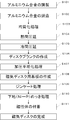
- step S101 preparation of the aluminum alloy (step S101) to cold rolling (step S105) is a process of manufacturing an aluminum alloy plate, and the production of the disk blank (step S106) to the adhesion of the magnetic substance (step S111)
- the manufactured aluminum alloy plate is used as a magnetic disk.
- a molten aluminum alloy having the above component composition is prepared by heating and melting in accordance with a conventional method (step S101).
- an aluminum alloy is cast from the prepared molten aluminum alloy by a semi-continuous casting (DC casting) method or a continuous casting (CC) method (step S102).
- the cooling rate during casting is preferably in the range of 0.1 to 1000 ° C./s. When the cooling rate during casting is less than 0.1 ° C./s, the dispersion density of the second phase particles having the longest diameter of 3 to 100 ⁇ m exceeds 50000 particles / mm 2, and the second density during etching, zincate treatment, cutting or grinding is the first.
- step S103 homogenization processing of the cast aluminum alloy is performed (step S103). Homogenization treatment may not be performed, but when it is performed, it is preferably performed at 400 to 500 ° C.
- the homogenized aluminum alloy is hot-rolled to obtain a plate material (step S104).
- the conditions are not particularly limited, and the hot rolling start temperature is 300 to 500 ° C., and the hot rolling end temperature is 260 to 400 ° C.
- the hot-rolled plate is cold-rolled to obtain an aluminum alloy plate having a thickness of about 1.0 mm (step S105).
- the product is finished to the required product thickness by cold rolling.
- the conditions for cold rolling are not particularly limited, and may be determined according to the required product sheet strength and / or sheet thickness, and the rolling rate is 20 to 80%.
- An annealing treatment may be performed before cold rolling or in the middle of cold rolling to ensure cold rolling processability.
- the annealing treatment is performed, for example, in the case of batch heating, it is preferably performed at 300 to 450 ° C. for 0.1 to 10 hours, and in the case of continuous heating, the heating is performed at 400 to 500 ° C. from 0 to It is preferably performed under the condition of holding for 60 seconds.
- the aluminum alloy plate is punched into an annular shape to create a disk blank (step S106).
- the disk blank is subjected to pressure annealing at 300 ° C. or higher and 450 ° C. or lower for 30 minutes or more in the atmosphere to create a flattened aluminum alloy substrate (step S107).
- the aluminum alloy substrate is cut, ground, degreased, and etched (step S108).
- a zincate process Zn substitution process
- a base treatment Ni-P plating
- a magnetic material is attached to the surface that has been subjected to the base treatment by sputtering to form a magnetic disk (step S111).
- step S201 preparation of the aluminum alloy (step S201) to cold rolling (step S205) is a process of manufacturing an aluminum alloy plate, and the production of the disk blank (step S206) to the adhesion of the magnetic substance (step S211)
- the manufactured aluminum alloy plate is used as a magnetic disk.
- a molten aluminum alloy having the above-described component composition is prepared by heating and melting the core material and the skin material according to a conventional method (step S201).
- an aluminum alloy is cast from a molten aluminum alloy having a desired composition by a semi-continuous casting (DC casting) method or a continuous casting (CC) method (step S202-1).
- homogenization treatment of the ingot for skin material is performed, hot rolling to obtain a desired skin material, and a core material having a desired thickness is obtained by chamfering the ingot for core material, on both sides of the core material
- a step of combining the skin materials to form a laminated material is performed (step S202-2).
- an ingot prepared by, for example, a semi-continuous casting (DC casting) method or a continuous casting (CC) method is used as the core material.
- the oxide film is removed by performing mechanical removal such as chamfering or cutting and / or chemical removal such as alkali cleaning, the subsequent pressure contact between the core material and the skin material is made good (step S202-1 and S202-2).
- the ingot obtained by the DC casting method or the CC method is chamfered and hot-rolled to obtain a plate material having a predetermined size.
- the homogenization treatment may or may not be performed before hot rolling, but when it is performed, it is preferably performed at 350 ° C. or higher and 550 ° C. or lower for 1 hour or longer.
- the conditions are not particularly limited.
- the hot rolling start temperature is 350 ° C. or more and 500 ° C. or less
- the hot rolling end temperature is 260 ° C. It is preferable to set it to 380 degreeC or more.
- the cladding ratio of the skin material is not particularly limited, but a necessary product plate It is appropriately determined according to the strength and / or flatness and the grinding amount, and is preferably 3% or more and 30% or less, and more preferably 5% or more and 20% or less.
- the cast aluminum alloy is homogenized (step S203).
- an inert gas such as nitrogen gas or argon gas
- a reducing gas such as carbon monoxide
- a vacuum such as a vacuum. It is preferably performed in a non-oxidizing atmosphere such as a gas.
- the homogenized aluminum alloy is hot-rolled to obtain a plate material (step S204).
- the core material and the skin material are clad.
- the conditions are not particularly limited, and the hot rolling start temperature is preferably 300 ° C. or higher and 500 ° C. or lower, and the hot rolling end temperature is preferably 260 ° C. or higher and 400 ° C. or lower.
- the plate thickness is about 3.0 mm.
- the aluminum alloy sheet obtained by hot rolling is finished to a desired product sheet thickness by cold rolling (step S205).
- the conditions for cold rolling are not particularly limited, and may be determined according to the required product plate strength and / or plate thickness, and the rolling rate is preferably 20% or more and 80% or less.
- Annealing treatment may be performed before cold rolling or during cold rolling to ensure cold rolling processability.
- the annealing treatment is performed, for example, in the case of batch-type heating, it is preferably performed at 300 ° C. to 450 ° C. for 0.1 hour to 10 hours.
- the plate thickness is about 1.0 mm.
- each of the above steps is related to the generation of the second phase particles.
- the characteristics of the aluminum alloy substrate for the magnetic disk of the core material according to the embodiment of the present invention are particularly the cooling rate at the time of casting the core material in step S202-1. Has a big influence.
- the cooling rate at the time of casting the core material is preferably 0.1 ° C./s or more and 1000 ° C./s or less in order to obtain a desired distribution of second phase particles.
- the distribution density of second phase particles having a longest diameter of 3 ⁇ m or more and 100 ⁇ m or less exceeds 50000 particles / mm 2 , during etching, during zincate treatment, during cutting There is a possibility that the second phase particles on the side surface of the substrate drop off and a large depression is generated, and plating peeling occurs at the boundary between the core material and the skin material on the side surface of the substrate.
- the cooling rate during casting of the core exceeds 1000 ° C./s, the distribution density of the second phase particles having the longest diameter of 3 ⁇ m or more and 100 ⁇ m or less becomes less than 100 particles / mm 2 , and sufficient rigidity may not be obtained. is there. Therefore, the cooling rate during casting of the core is preferably in the range of 0.1 ° C./s to 1000 ° C./s.
- various methods can be applied to clad the core material and the skin material.
- the rolling press-contact method normally used for manufacture of a brazing sheet etc. is mentioned.
- homogenization step S203
- hot rolling step S204
- cold rolling step S205
- step S206 In order to process the aluminum alloy plate of the clad material for a magnetic disk, the processes from disk blank production (step S206) to magnetic material adhesion (step S211) are performed.
- the process of disk blank production (step S206) to magnetic material adhesion (step S211) is a process of processing a bare aluminum alloy plate for a magnetic disk.
- Disk blank production (step S106) to magnetic material adhesion This is the same as the step (Step S111).
- Alloy No. A1 to A7, A11 to A36, and AC1 to AC4 are alloy nos.
- A8 to A10 a molten aluminum alloy was cast by the CC method to produce an ingot (step S102).
- Hot rolled sheets of A1-A6, A8-A36 and AC1-AC4 alloys are annealed at 400 ° C for 2 hours and rolled to a final thickness of 1.0 mm by cold rolling (rolling ratio 66.7%). Then, an aluminum alloy plate was obtained (step S105).
- a disk blank was produced by punching the aluminum alloy plate into an annular shape having an outer diameter of 96 mm and an inner diameter of 24 mm (step S106).
- the disc blank was subjected to pressure annealing at 400 ° C. for 3 hours (step S107). End face processing was performed to obtain an outer diameter of 95 mm and an inner diameter of 25 mm, and grinding (surface 10 ⁇ m grinding) was performed (step S108). Then, after degreasing at 60 ° C. for 5 minutes with AD-68F (manufactured by Uemura Kogyo), etching is performed at 65 ° C. for 1 minute with AD-107F (manufactured by Uemura Kogyo), and 30% HNO 3 aqueous solution (room temperature ) For 20 seconds.
- AD-68F manufactured by Uemura Kogyo
- etching is performed at 65 ° C. for 1 minute with AD-107F (manufactured by Uemura Kogyo)
- 30% HNO 3 aqueous solution room temperature
- step S109 The surface of the disk blank whose surface was adjusted was subjected to a zincate treatment using AD-301F-3X (manufactured by Uemura Kogyo) (step S109).
- the surface treated with zincate is electrolessly plated with Ni-P to a thickness of 17 ⁇ m using an electroless Ni—P plating solution (Nimden HDX (manufactured by Uemura Kogyo)) and then finish-polished with a blanket (polishing amount 4 ⁇ m)) Performed (step S110).
- step S102 Aluminum alloy ingot after casting (step S102) process, aluminum alloy plate after cold rolling (step S105) process, aluminum alloy substrate after grinding process (step S108), and plating treatment polishing (step S110) process The following evaluation was performed on the aluminum alloy substrate.
- step S105 The aluminum alloy plate after cold rolling (step S105) was heated at 400 ° C. for 3 hours, and then Young's modulus was measured by a resonance method to evaluate rigidity.
- the measurement of rigidity was performed at room temperature using a JE-RT type apparatus manufactured by Nippon Techno Plus Co., Ltd. Those having a Young's modulus of 75 GPa or higher were evaluated as excellent ((), those having a Young's modulus of 72 GPa or more and less than 75 GPa were evaluated as good ( ⁇ ), and those having a Young's modulus of less than 72 GPa were determined as poor ( ⁇ ).
- Distribution density of second phase particles with a longest diameter of 3-100 ⁇ m and a longest diameter of 100 ⁇ m The distribution density (particles / mm 2 ) of the second phase particles having a longest diameter of 3 to 100 ⁇ m and a longest diameter of 100 ⁇ m was observed by observing 1 mm 2 of the cross section of the aluminum alloy substrate after grinding (step S108) at 400 ⁇ with an optical microscope. Second-phase particles having a longest diameter of 3 to 100 ⁇ m and a longest diameter of 100 ⁇ m were counted to determine the distribution density.
- Comparative Examples 1 to 4 were inferior in the smoothness or rigidity of the plating surface.
- the Young's modulus was low and the rigidity was poor because the Si content was small.
- Comparative Example 2 since the content of Si was large, a large amount of coarse Si particles were generated, so that the Si particles dropped out during the plating pretreatment, and a large depression was generated. As a result, many pits were generated on the plating surface, and the smoothness of the plating surface was deteriorated.
- the Young's modulus was low and the rigidity was poor because the Fe content was small.
- Comparative Example 4 a large amount of coarse Al—Fe—Si-based compound was produced due to the high Fe content, and this compound dropped out during the pre-plating treatment, resulting in a large depression. As a result, many pits were generated on the plating surface, and the smoothness of the plating surface was deteriorated.
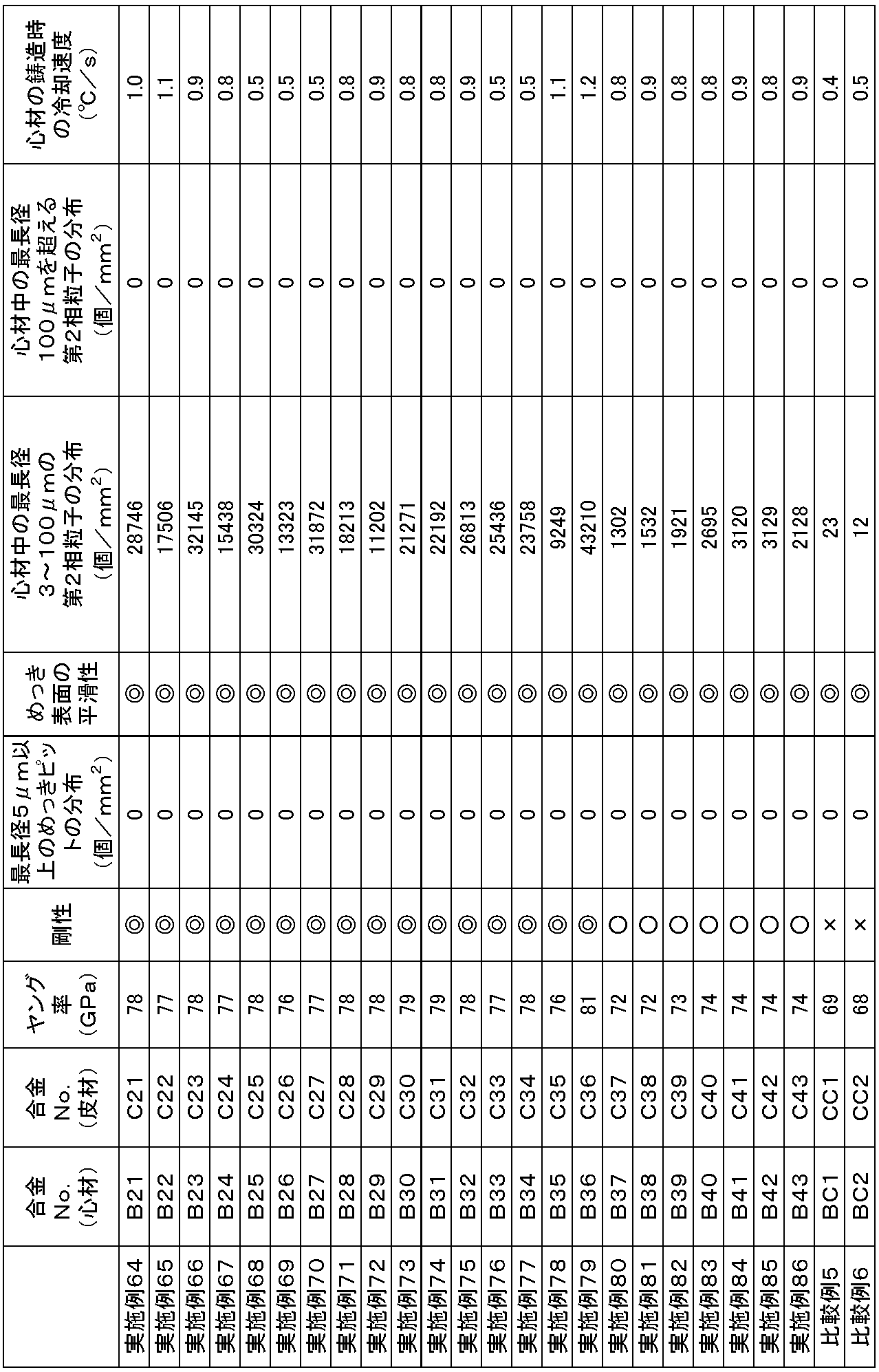
- Tables 7 to 10 Each alloy having the component composition shown in Tables 7 to 10 was melted in accordance with a conventional method, and a molten aluminum alloy was melted (step S201).
- Tables 7 and 8 show the core material of the clad material
- Tables 9 and 10 show the component composition of the clad material.
- “-” indicates the measurement limit value or less.
- alloy no The aluminum alloy melts of B1 to B7, B11 to B36, BC1 and BC2 are alloy Nos.
- ingots were produced by the CC method (step S202-1).
- the ingot for skin material was produced by the all alloy DC casting method. Alloy No.
- the core materials B1 to B7, B11 to B36, BC1 and BC2 were chamfered on both sides of the ingot 15 mm to form core materials (step S202-2).
- the skin material was chamfered 15 mm on both sides of the ingot, homogenized at 520 ° C. for 6 hours in the atmosphere, hot-rolled, and alloy No.
- C1 to C7, C11 to C36, CC1 and CC2 are hot-rolled plates having a thickness of 15 mm.
- C8 to C10 were hot-rolled plates having a thickness of 0.5 mm.
- the hot-rolled sheet was washed with caustic soda to make a skin material, and the skin material was combined on both sides of the core material to make a laminated material.
- the homogenization process was performed at 480 degreeC for 3 hours (step S203).
- Hot rolling was performed at a rolling start temperature of 460 ° C. and a rolling end temperature of 340 ° C. to obtain a hot rolled plate having a thickness of 3.0 mm (step S204). Alloy No.
- Hot rolled sheets other than B7 and C7 alloys were annealed at 400 ° C. for 2 hours, and rolled to a final sheet thickness of 1.0 mm by cold rolling (rolling rate: 66.7%) to obtain an aluminum alloy sheet.
- the aluminum alloy plate was punched out into an annular shape having an outer diameter of 96 mm and an inner diameter of 24 mm to produce a disc blank (step S206).
- the disc blank was subjected to pressure annealing at 400 ° C. for 3 hours (step S207). End face processing was performed to obtain an outer diameter of 95 mm and an inner diameter of 25 mm, and grinding (surface 10 ⁇ m grinding) was performed (step S208). Then, after degreasing at 60 ° C. for 5 minutes with AD-68F (manufactured by Uemura Kogyo), etching is performed at 65 ° C. for 1 minute with AD-107F (manufactured by Uemura Kogyo), and 30% HNO 3 aqueous solution (room temperature ) For 20 seconds.
- AD-68F manufactured by Uemura Kogyo
- etching is performed at 65 ° C. for 1 minute with AD-107F (manufactured by Uemura Kogyo)
- 30% HNO 3 aqueous solution room temperature
- the surface of the disk blank whose surface was adjusted was subjected to double zincate treatment using AD-301F-3X (manufactured by Uemura Kogyo) (step S209).
- the surface treated with zincate is electrolessly plated with Ni-P to a thickness of 17 ⁇ m using an electroless Ni—P plating solution (Nimden HDX (manufactured by Uemura Kogyo)) and then finish-polished with a blanket (polishing amount 4 ⁇ m)) Performed (step S210).
- step S202-1 The ingot after the casting (step S202-1) process, the aluminum alloy plate after the cold rolling (step S205) process, the aluminum alloy substrate after the grinding process (step S208), and the plating treatment polishing (step S210) )
- the following evaluation was performed on the aluminum alloy substrate after the process.
- the present invention is preferably used for a magnetic disk of a computer storage device, for example.
Landscapes
- Chemical & Material Sciences (AREA)
- Engineering & Computer Science (AREA)
- Metallurgy (AREA)
- Materials Engineering (AREA)
- Mechanical Engineering (AREA)
- Organic Chemistry (AREA)
- Physics & Mathematics (AREA)
- Thermal Sciences (AREA)
- Crystallography & Structural Chemistry (AREA)
- Inorganic Chemistry (AREA)
- Magnetic Record Carriers (AREA)
- Manufacturing Of Magnetic Record Carriers (AREA)
Abstract
Description
0.5質量%以上24.0質量%以下のSiと、
0.01質量%以上~3.00質量%以下のFeと、
を含有し、
残部Alと不可避的不純物からなる、
ことを特徴とする。
0.005質量%以上2.000質量%以下のCu、
0.1質量%以上6.0質量%以下のMg、
0.1質量%以上2.0質量%以下のNi、
0.01質量%以上2.00質量%以下のCr、
0.01質量%以上2.00質量%以下のMn、
0.001質量%以上0.100質量%以下のNa、
0.001質量%以上0.100質量%以下のSr、
0.001質量%以上0.100質量%以下のP、
からなる群から選択された1又は2以上の元素をさらに含有してもよい。
0.005質量%以上2.000質量%以下のZnをさらに含有してもよい。
含有量の合計が0.005質量%以上0.500質量%以下のTi及びBをさらに含有してもよい。
3μm以上100μm以下の最長径を有する第2相粒子が、100個/mm2以上50000個/mm2以下の分布密度で分散してもよい。
第2相粒子を含み、該第2相粒子の最長径が100μm以下であってもよい。
両面に純Al又はAl-Mg系合金からなる皮材がクラッドされてもよい。
Siは、主としてSi粒子として存在し、アルミニウム合金基板の剛性を向上させる効果がある。アルミニウム合金中のSiの含有率が0.5質量%未満では、アルミニウム合金の剛性が不十分となる。一方、アルミニウム合金中のSiの含有率が24.0質量%を超過すると、粗大なSi粒子が生成し、ベア材の場合、エッチング時、ジンケート処理時、切削又は研削加工時にSi粒子が脱落して大きな窪みが発生し、めっき表面の平滑性が低下する。クラッド材の心材の場合は、基板側面に存在する粗大なSi粒子がエッチング時、ジンケート処理時、切削時に脱落して、基板側面に大きな窪みが発生する。特に基板側面の心材と皮材の境界部に大きな窪みが発生すると、めっきと基板の密着性が悪くなり、めっき剥離が生じてしまう。そのため、アルミニウム合金中のSiの含有率は、0.5質量%以上24.0質量%以下の範囲とする。また、Siの含有率は、剛性及び圧延性の兼合いから1.0質量%以上18.0質量%以下の範囲が好ましい。さらに好ましくは1.5質量%以上13.0質量%以下の範囲である。
Feは、主としてAl-Fe-Si系化合物として存在し、アルミニウム合金基板の剛性を向上させる効果がある。アルミニウム合金中のFeの含有率が0.01質量%未満では、剛性が不十分となる。一方、アルミニウム合金中のFeの含有率が3.00%を超過すると粗大なAl-Fe-Si系化合物が生成し、ベア材の場合は、エッチング時、ジンケート処理時、切削又は研削加工時にAl-Fe-Si系化合物が脱落して大きな窪みが発生し、めっき表面の平滑性が低下する。クラッド材の心材の場合は、基板側面に存在する粗大なAl-Fe-Si系化合物がエッチング時、ジンケート処理時、切削時に脱落して、基板側面に大きな窪みが発生する。特に基板側面の心材と皮材の境界部に大きな窪みが発生すると、めっきと基板の密着性が悪くなり、めっき剥離が生じてしまう。そのため、アルミニウム合金中のFeの含有量は、0.05質量%以上3.00質量%以下の範囲とする。また、Feの含有率は、0.10質量%以上3.00質量%以下の範囲が好ましい。
Cuは、主としてAl-Cu系化合物として存在し、アルミニウム合金基板の剛性を向上させる効果がある。また、ジンケート処理時のAl溶解量を減少させ、またジンケート皮膜を均一に、薄く、緻密に付着させ、次工程のめっきの平滑性を向上させる効果がある。アルミニウム合金中のCuの含有率が0.005質量%以上であることによって、剛性向上の効果と平滑生を向上させる効果とを一層得ることができる。また、アルミニウム合金中のCuの含有率が2.000質量%以下であることによって、粗大なAl-Cu系化合物の生成を抑制する。ベア材の場合、エッチング時、ジンケート処理時、切削又は研削加工時にAl-Cu系化合物が脱落して大きな窪みが発生することを抑制し、めっき表面の平滑性を向上させる効果を一層得ることができる。クラッド材の心材の場合は、エッチング時、ジンケート処理時、切削時に基板側面の粗大なAl-Cu系化合物が脱落して大きな窪みが発生することを抑制し、基板側面の心材と皮材の境界部にめっき剥離が生じることを一層抑制することができる。そのため、アルミニウム合金中のCuの含有率は、0.005質量%以上2.000質量%以下の範囲が好ましく、0.010質量%以上2.000質量%未満の範囲がより好ましい。
Mgは、主としてMg-Si系化合物として存在し、アルミニウム合金基板の剛性を向上させる効果がある。アルミニウム合金中のMgの含有率が0.1質量%以上であることによって、剛性を向上させる効果を一層得ることができる。また、アルミニウム合金中のMgの含有率が6.0質量%以下であることによって、粗大なMg-Si系化合物が生成することを抑制する。ベア材の場合、エッチング時、ジンケート処理時、切削又は研削加工時にMg-Si系化合物が脱落して大きな窪みが発生することを抑制し、めっき表面の平滑性が低下することを一層抑制することができる。クラッド材の心材の場合は、エッチング時、ジンケート処理時、切削時に基板側面の粗大なMg-Si系化合物が脱落して大きな窪みが発生することを抑制し、基板側面の心材と皮材の境界部にめっき剥離が生じることを一層抑制することができる。そのため、アルミニウム合金中のMgの含有率は、0.1質量%以上6.0質量%以下の範囲が好ましく、0.3質量%以上1.0質量%未満の範囲がより好ましい。
Niは、主としてAl-Ni系化合物として存在し、アルミニウム合金基板の剛性を向上させる効果がある。アルミニウム合金中のNiの含有率が0.1質量%以上であることによって、剛性を向上させる効果を一層得ることができる。また、アルミニウム合金中のNiの含有率が2.0質量%以下であることによって、粗大なAl-Ni系化合物が生成することを抑制する。ベア材の場合、エッチング時、ジンケート処理時、切削又は研削加工時にAl-Ni系化合物が脱落して大きな窪みが発生することを抑制し、めっき表面の平滑性が低下することを一層抑制することができる。クラッド材の心材の場合は、エッチング時、ジンケート処理時、切削時に基板側面の粗大なAl-Ni系化合物が脱落して大きな窪みが発生することを抑制し、基板側面の心材と皮材の境界部にめっき剥離が生じることを一層抑制することができる。そのため、アルミニウム合金中のNiの含有率は、0.1質量%以上2.0質量%以下の範囲が好ましく、0.3質量%以上2.0質量%未満がより好ましい。
Crは、主としてAl-Cr系化合物として存在し、アルミニウム合金基板の剛性を向上させる効果がある。アルミニウム合金中のCrの含有率が0.01質量%以上であることによって、剛性を向上させる効果を一層得ることができる。また、アルミニウム合金中のCrの含有率が2.00質量%以下であることによって、粗大なAl-Cr系化合物が生成することを抑制する。ベア材の場合、エッチング時、ジンケート処理時、切削又は研削加工時にAl-Cr系化合物が脱落して大きな窪みが発生することを抑制し、めっき表面の平滑性が低下することを一層抑制することができる。クラッド材の心材の場合は、エッチング時、ジンケート処理時、切削時に基板側面の粗大なAl-Cr系化合物が脱落して大きな窪みが発生することを抑制し、基板側面の心材と皮材の境界部にめっき剥離が生じることを一層抑制することができる。そのため、アルミニウム合金中のCrの含有率は、0.01質量%以上2.00質量%以下の範囲が好ましく、0.1質量%以上2.0質量%未満がより好ましい。
Mnは、主としてAl-Mn-Si系化合物として存在し、アルミニウム合金基板の剛性を向上させる効果がある。アルミニウム合金中のMnの含有率が0.01質量%以上であることによって、剛性を向上させる効果を一層得ることができる。また、アルミニウム合金中のMnの含有率が2.00質量%以下であることによって、粗大なAl-Mn-Si系化合物が生成することを抑制する。ベア材の場合、エッチング時、ジンケート処理時、切削又は研削加工時にAl-Mn-Si系化合物が脱落して大きな窪みが発生することを抑制し、めっき表面の平滑性が低下することを一層抑制することができる。クラッド材の心材の場合は、エッチング時、ジンケート処理時、切削時に基板側面の粗大なAl-Mn-Si系化合物が脱落して大きな窪みが発生することを抑制し、基板側面の心材と皮材の境界部にめっき剥離が生じることを一層抑制することができる。そのため、アルミニウム合金中のMnの含有率は、0.01質量%以上2.00質量%以下の範囲が好ましく、0.1質量%以上2.0質量%未満がより好ましい。
Znは、ジンケート処理時のAl溶解量を減少させ、またジンケート皮膜を均一に、薄く、緻密に付着させ、次工程のめっきの平滑性及び密着性を向上させる効果がある。アルミニウム合金中のZnの含有率が0.005質量%以上であることによって、ジンケート処理時のAl溶解量を減少させ、またジンケート皮膜を均一に、薄く、緻密に付着させ、めっきの平滑性を向上させる効果を一層得ることができる。また、アルミニウム合金中のZnの含有率が2.000質量%以下であることによって、ベア材の場合、ジンケート皮膜が均一となりめっき表面の平滑性が低下することを一層抑制することができる。クラッド材の場合は、基板側面のジンケート皮膜が均一となりめっき密着性が低下することを抑制し、基板側面の心材と皮材の境界部にめっき剥離が生じることをより一層抑制することができる。そのため、アルミニウム合金中のZnの含有率は、0.005質量%以上2.000質量%以下の範囲が好ましく、0.100質量%以上2.000質量%未満の範囲がより好ましい。
Na、Sr及びPは、アルミニウム合金基板中のSi粒子を微細化し、めっき性を改善する効果が得られる。また、アルミニウム合金基板中のSi粒子のサイズの不均一性を小さくし、アルミニウム合金基板中の剛性のバラつきを低減させる効果がある。そのため、アルミニウム合金中に、好ましくは0.001質量%以上0.100質量%以下のNa、好ましくは0.001質量%以上0.100質量%以下のSr、好ましくは0.001質量%以上0.100質量%以下のPからなる群から選択された1又は2以上の元素を選択的に添加されてもよい。但し、Na、Sr、Pのそれぞれが0.001質量%未満では、上記の効果が得られない。一方、Na、Sr、Pのそれぞれが0.100%を超過して含有してもその効果は飽和し、それ以上の顕著な改善効果が得られない。また、Na、Sr、Pを添加する場合のNa、Sr、Pのそれぞれの含有量は、0.003質量%以上0.025質量%以下の範囲がより好ましい。
Ti及びBは、鋳造時の凝固過程において、TiB2などのホウ化物又はAl3Tiを形成し、これらが結晶粒核となるため、結晶粒を微細化することが可能となる。これによりめっき性が改善する。また、アルミニウム合金基板の剛性を向上させる効果がある。但し、Ti及びBの含有量の合計が0.005質量%未満では、上記の効果が得られない。一方、Ti及びBの含有量の合計が0.500質量%を超過してもその効果は飽和し、それ以上の顕著な改善効果が得られない。そのため。Ti及びBを添加する場合のTi及びBの含有量の合計は、0.005質量%以上0.500質量%以下の範囲が好ましく、0.010質量%以上0.100質量%以下の範囲がより好ましい。
また、本発明の実施形態に係るアルミニウム合金の残部は、アルミニウムと不可避的不純物とからなる。ここで、不可避的不純物(例えばV等)は、各々が0.03%以下で、かつ合計で0.15%以下であれば、本発明で得られるアルミニウム合金基板としての特性を損なうことはない。
次に、本発明の実施形態に係る磁気ディスク用アルミニウム合金基板を構成するクラッド材の皮材の合金成分及びその含有率について説明する。
次に、本発明の実施形態に係る磁気ディスク用アルミニウム合金基板のクラッド材の心材及びベア材における第2相粒子の分布状態について説明する。
以下、本発明の実施形態に係る磁気ディスク用アルミニウム合金基板の製造工程の各工程及びプロセス条件を詳細に説明する。
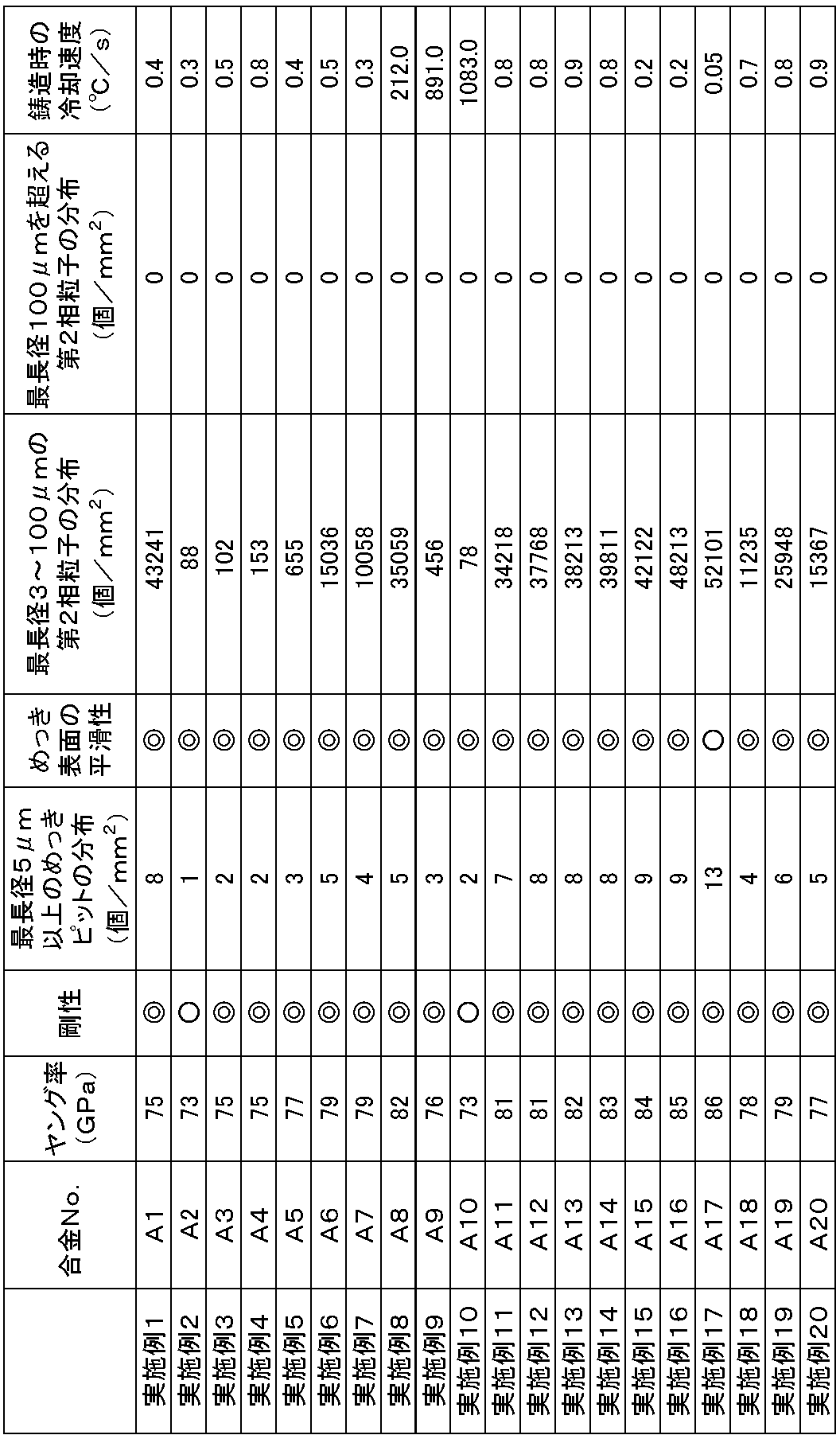
まず、ベア材の磁気ディスク用アルミニウム合金基板の実施例について説明する。表1及び表2に示す成分組成の各合金を常法に従って溶解し、アルミニウム合金溶湯を溶製した(ステップS101)。表1及び表2中「-」は、測定限界値以下を示す。

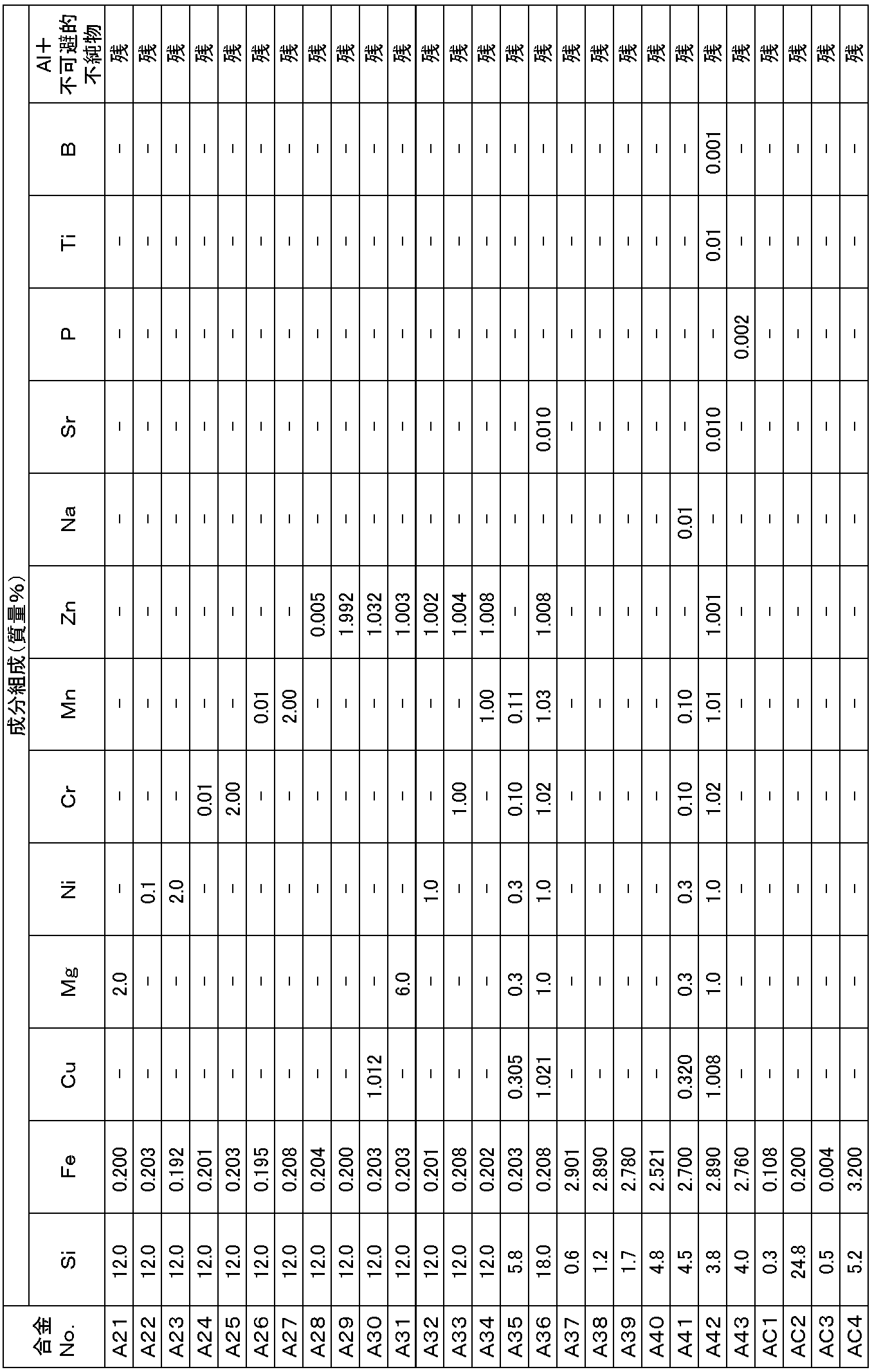
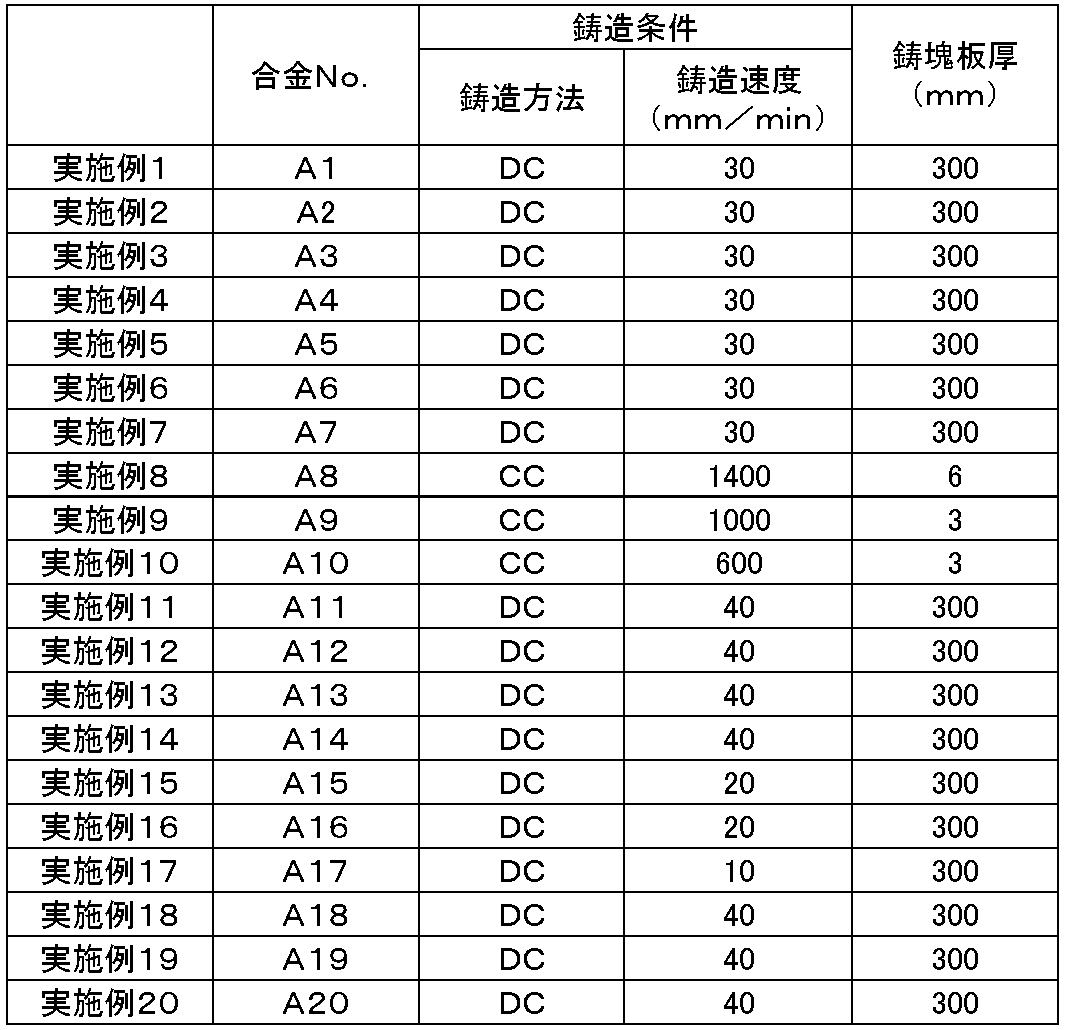
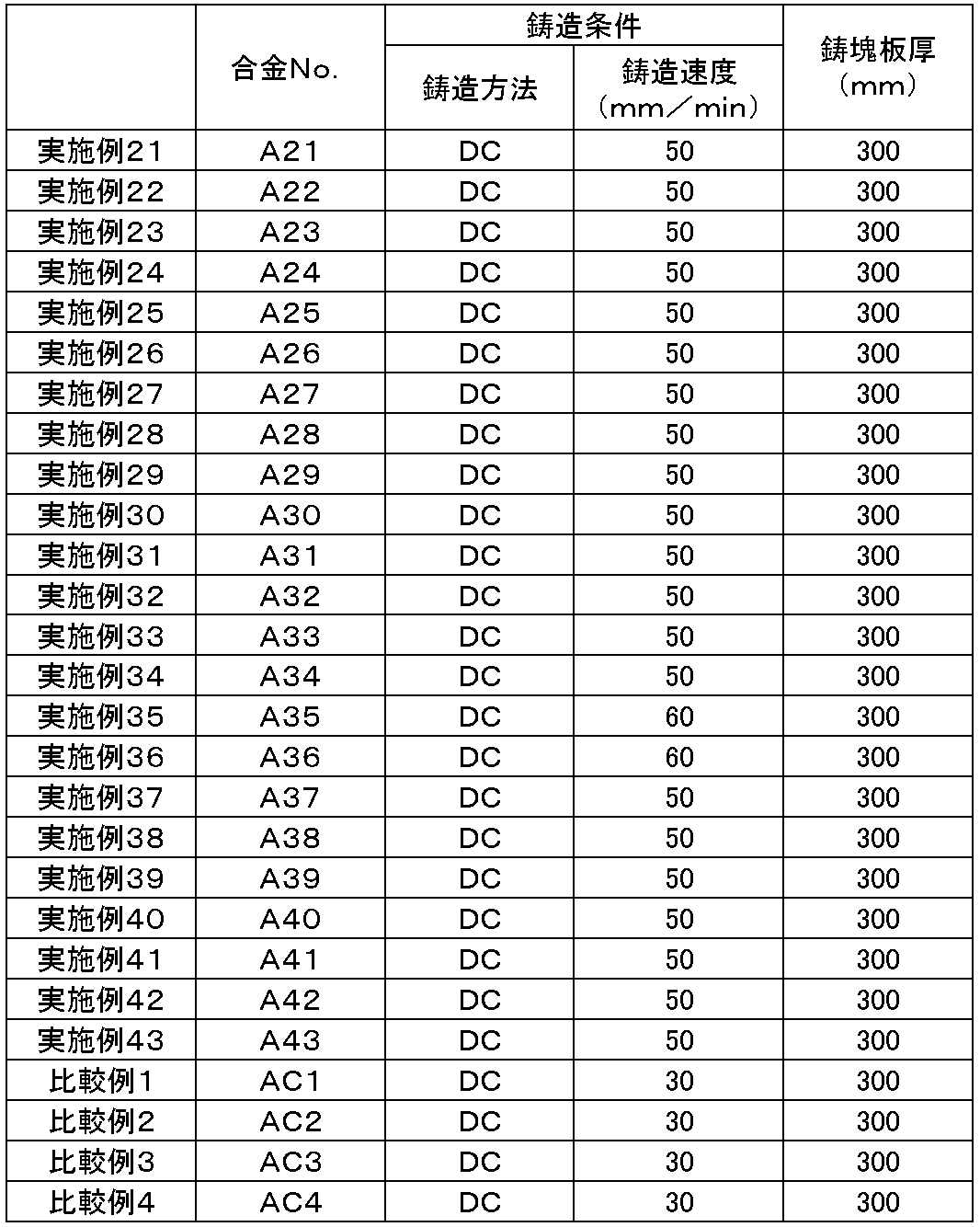
鋳造(ステップS102)後の鋳塊のDAS(Dendrite Arm Spacing)を測定し、鋳造時の冷却速度を算出した。DASは光学顕微鏡により鋳塊厚さ方向の断面組織観察を行い、2次枝法により測定した。測定は、鋳塊の厚さ方向の中央部の断面を用いた。
冷延(ステップS105)後のアルミニウム合金板を400℃、3時間の条件で加熱した後、共振法によりヤング率を測定し、剛性の評価を行った。剛性の測定は、日本テクノプラス株式会社製のJE-RT型の装置を用い室温で行った。ヤング率75GPa以上のものを優良(◎印)とし、ヤング率72GPa以上75GPa未満のものを良好(○印)とし、ヤング率72GPa未満のものを不良(×印)とした。
最長径3~100μmと最長径100μmを超える第2相粒子の分布密度(個/mm2)は、研削加工(ステップS108)後のアルミニウム合金基板断面を光学顕微鏡により400倍で1mm2観察し、最長径3~100μmと最長径100μmを超える第2相粒子を数え、分布密度を求めた。
Ni-Pめっき処理研磨(ステップS110)後のアルミニウム合金基盤の表面を光学顕微鏡により500倍で1mm2観察し、最長径5μm以上の大きさのピットの個数を数え、単位面積当たりの個数(個数密度:個/mm2)を求めた。ピットが0~10個/mm2の場合を優良(◎印)とし、10~20個/mm2の場合を良好(○印)、20個/mm2を超える場合を不良(×印)とした。以上の評価結果を表5及び表6に示す。

次に、クラッド材の磁気ディスク用アルミニウム合金基板の実施例について説明する。
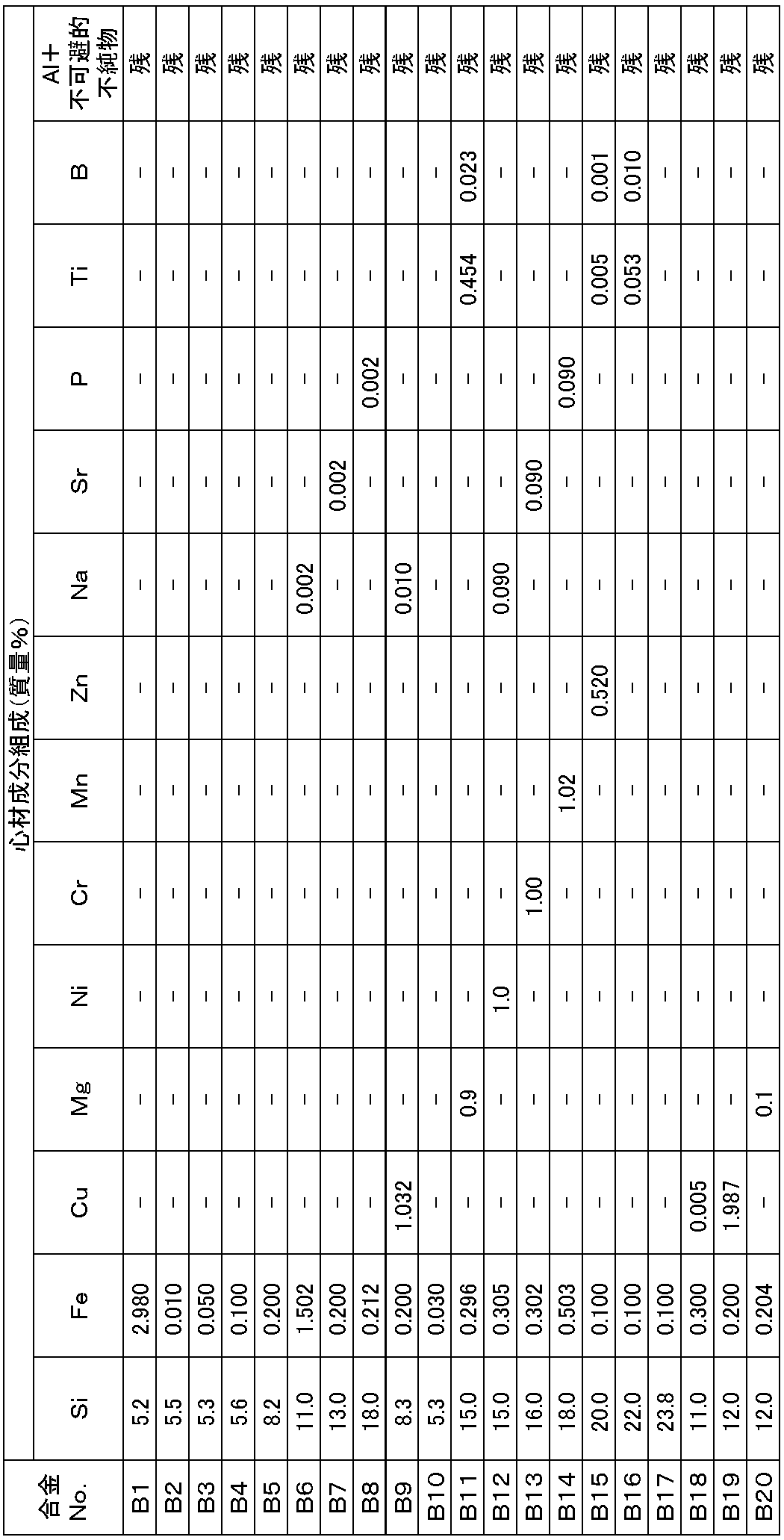


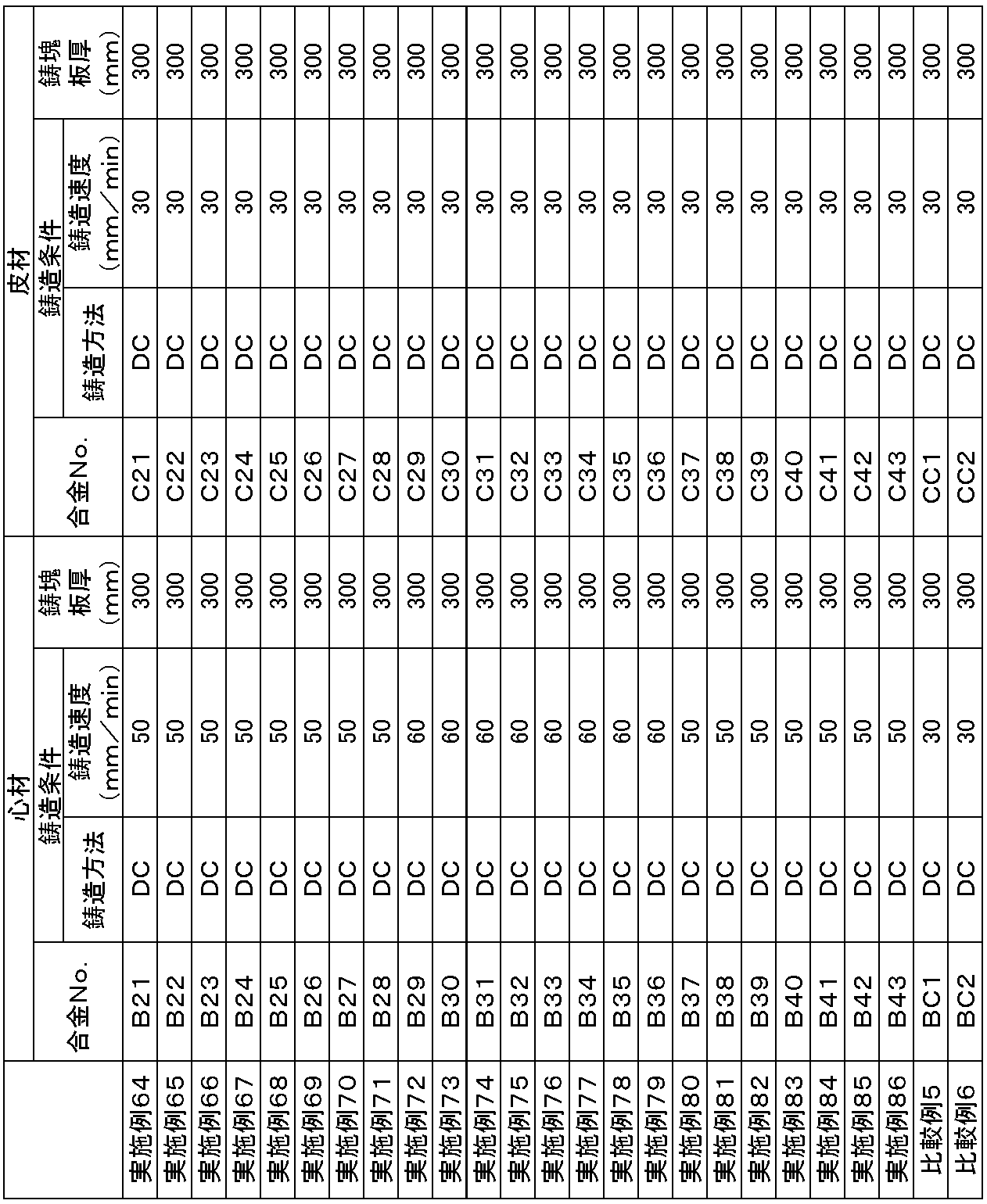
鋳造(ステップS202-1)後の鋳塊のDASを測定し、鋳造時の冷却速度を算出した。DASは光学顕微鏡により鋳塊厚さ方向の断面組織観察を行い、2次枝法により測定した。測定は、鋳塊の厚さ方向の中央部の断面を用いた。
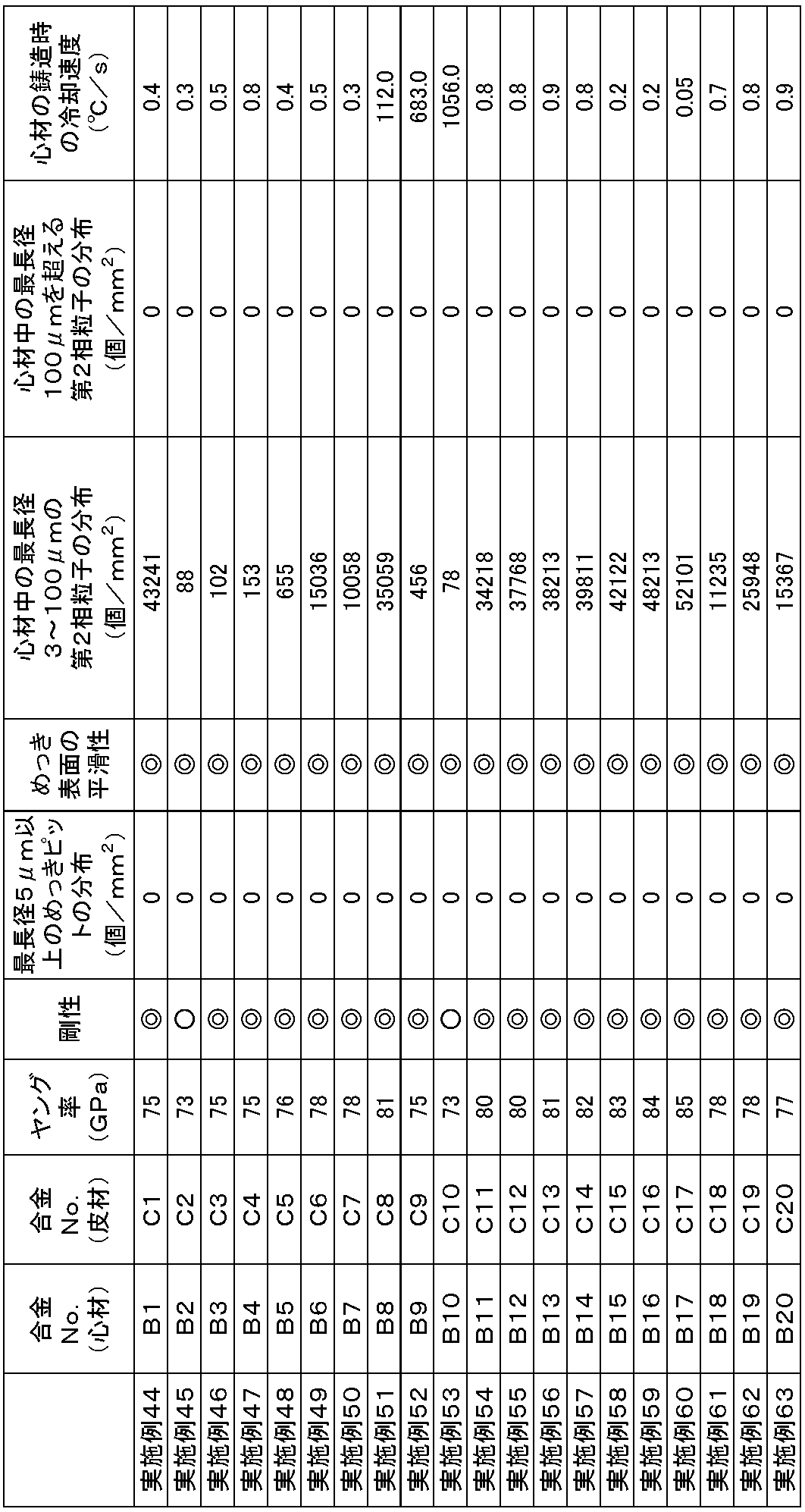
Claims (7)
- 0.5質量%以上24.0質量%以下のSiと、
0.01質量%以上3.00質量%以下のFeと、
を含有し、
残部Alと不可避的不純物からなる、
ことを特徴とする磁気ディスク用アルミニウム合金基板。 - 0.005質量%以上2.000質量%以下のCu、
0.1質量%以上6.0質量%以下のMg、
0.1質量%以上2.0質量%以下のNi、
0.01質量%以上2.00質量%以下のCr、
0.01質量%以上2.00質量%以下のMn、
0.001質量%以上0.100質量%以下のNa、
0.001質量%以上0.100質量%以下のSr、
0.001質量%以上0.100質量%以下のP、
からなる群から選択された1又は2以上の元素をさらに含有する、
ことを特徴とする請求項1に記載の磁気ディスク用アルミニウム合金基板。 - 0.005質量%以上2.000質量%以下のZn、
をさらに含有する、
ことを特徴とする請求項1又は請求項2に記載の磁気ディスク用アルミニウム合金基板。 - 含有量の合計が0.005質量%以上0.500質量%以下のTi及びB、
をさらに含有する、
ことを特徴とする請求項1乃至3の何れか1項に記載の磁気ディスク用アルミニウム合金基板。 - 3μm以上100μm以下の最長径を有する第2相粒子が、100個/mm2以上50000個/mm2以下の分布密度で分散する、
ことを特徴とする請求項1乃至4の何れか1項に記載の磁気ディスク用アルミニウム合金基板。 - 第2相粒子を含み、該第2相粒子の最長径が100μm以下である、
ことを特徴とする請求項1乃至5の何れか1項に記載の磁気ディスク用アルミニウム合金基板。 - 両面に純Al又はAl-Mg系合金からなる皮材がクラッドされる、
ことを特徴とする請求項1乃至6の何れか1項に記載の磁気ディスク用アルミニウム合金基板。
Priority Applications (4)
| Application Number | Priority Date | Filing Date | Title |
|---|---|---|---|
| CN201580059337.2A CN107109543B (zh) | 2014-10-31 | 2015-10-30 | 磁盘用铝合金基板 |
| JP2016512714A JP6014785B2 (ja) | 2014-10-31 | 2015-10-30 | 磁気ディスク用アルミニウム合金基板 |
| US15/522,921 US20170327930A1 (en) | 2014-10-31 | 2015-10-30 | Aluminum alloy substrate for magnetic disk |
| MYPI2017701483A MY182369A (en) | 2014-10-31 | 2015-10-30 | Aluminum alloy substrate for magnetic disk |
Applications Claiming Priority (2)
| Application Number | Priority Date | Filing Date | Title |
|---|---|---|---|
| JP2014-223387 | 2014-10-31 | ||
| JP2014223387 | 2014-10-31 |
Publications (1)
| Publication Number | Publication Date |
|---|---|
| WO2016068293A1 true WO2016068293A1 (ja) | 2016-05-06 |
Family
ID=55857626
Family Applications (1)
| Application Number | Title | Priority Date | Filing Date |
|---|---|---|---|
| PCT/JP2015/080756 Ceased WO2016068293A1 (ja) | 2014-10-31 | 2015-10-30 | 磁気ディスク用アルミニウム合金基板 |
Country Status (5)
| Country | Link |
|---|---|
| US (1) | US20170327930A1 (ja) |
| JP (1) | JP6014785B2 (ja) |
| CN (1) | CN107109543B (ja) |
| MY (1) | MY182369A (ja) |
| WO (1) | WO2016068293A1 (ja) |
Cited By (41)
| Publication number | Priority date | Publication date | Assignee | Title |
|---|---|---|---|---|
| JP2018005969A (ja) * | 2016-07-08 | 2018-01-11 | 昭和電工株式会社 | 磁気記録媒体用基板およびハードディスクドライブ |
| US9875765B2 (en) * | 2015-12-25 | 2018-01-23 | Showa Denko K.K. | Base for magnetic recording medium |
| KR101834645B1 (ko) | 2016-07-01 | 2018-03-06 | 김상훈 | 반도체 공정라인 바닥 패널용 알루미늄 합금 및 그 제조방법 |
| JP2018106775A (ja) * | 2016-12-27 | 2018-07-05 | 昭和電工株式会社 | 磁気記録媒体用基板およびハードディスクドライブ |
| JP2018106777A (ja) * | 2016-12-27 | 2018-07-05 | 昭和電工株式会社 | 磁気記録媒体用基板およびハードディスクドライブ |
| JP2018106776A (ja) * | 2016-12-27 | 2018-07-05 | 昭和電工株式会社 | 磁気記録媒体用基板およびハードディスクドライブ |
| CN108368568A (zh) * | 2016-04-27 | 2018-08-03 | 株式会社Uacj | 磁盘用基板 |
| JP2018123395A (ja) * | 2017-02-02 | 2018-08-09 | 株式会社神戸製鋼所 | 磁気ディスク用アルミニウム合金板、磁気ディスク用アルミニウム合金ブランクおよび磁気ディスク用アルミニウム合金サブストレート |
| JP2018125056A (ja) * | 2017-02-03 | 2018-08-09 | 昭和電工株式会社 | 磁気記録媒体用基板およびハードディスクドライブ |
| WO2018155237A1 (ja) * | 2017-02-27 | 2018-08-30 | 株式会社Uacj | 磁気ディスク用アルミニウム合金基板及びその製造方法、ならびに、この磁気ディスク用アルミニウム合金基板を用いた磁気ディスク |
| JP2018159122A (ja) * | 2017-03-23 | 2018-10-11 | 株式会社神戸製鋼所 | 磁気ディスク用アルミニウム合金板、磁気ディスク用アルミニウム合金ブランクおよび磁気ディスク用アルミニウム合金サブストレート |
| WO2018207523A1 (ja) * | 2017-05-12 | 2018-11-15 | 株式会社Uacj | 磁気ディスク用アルミニウム合金基板及びその製造方法、ならびに、この磁気ディスク用アルミニウム合金基板を用いた磁気ディスク |
| CN108929974A (zh) * | 2017-05-23 | 2018-12-04 | 昭和电工株式会社 | 铝合金材料 |
| JP6439082B1 (ja) * | 2017-02-01 | 2018-12-19 | 株式会社Uacj | アルミニウム合金製の磁気ディスク基板及びその製造方法 |
| JP2018204074A (ja) * | 2017-06-06 | 2018-12-27 | 株式会社神戸製鋼所 | 磁気ディスク用アルミニウム合金板、磁気ディスク用アルミニウム合金ブランクおよび磁気ディスク用アルミニウム合金サブストレート |
| JP2019021368A (ja) * | 2017-07-21 | 2019-02-07 | 古河電気工業株式会社 | 磁気ディスク用アルミニウム合金基板 |
| US20190062878A1 (en) * | 2017-08-28 | 2019-02-28 | Showa Denko K.K. | Aluminum alloy substrate for magnetic recording medium, substrate for magnetic recording medium, magnetic recording medium, and hard disk drive |
| JP2019040653A (ja) * | 2017-08-28 | 2019-03-14 | 昭和電工株式会社 | 磁気記録媒体用アルミニウム合金基板、磁気記録媒体用基板、磁気記録媒体、ハードディスクドライブ |
| JP2019040652A (ja) * | 2017-08-28 | 2019-03-14 | 昭和電工株式会社 | 磁気記録媒体用アルミニウム合金基板、磁気記録媒体用基板、磁気記録媒体、ハードディスクドライブ |
| JP2019040654A (ja) * | 2017-08-28 | 2019-03-14 | 昭和電工株式会社 | 磁気記録媒体用基板、磁気記録媒体、ハードディスクドライブ |
| WO2019064679A1 (ja) * | 2017-09-28 | 2019-04-04 | 株式会社Uacj | 磁気ディスク用アルミニウム合金基板及びその製造方法、ならびに、当該磁気ディスク用アルミニウム合金基板を用いた磁気ディスク |
| JP2019079582A (ja) * | 2017-10-20 | 2019-05-23 | 昭和電工株式会社 | 磁気記録媒体用アルミニウム合金基板の製造方法 |
| US20190228799A1 (en) * | 2018-01-19 | 2019-07-25 | Showa Denko K.K. | Aluminum alloy substrate for magnetic recording medium and method for manufacturing the same, substrate for magnetic recording medium, magnetic recording medium, and hard disc drive |
| US20190228797A1 (en) * | 2018-01-19 | 2019-07-25 | Showa Denko K.K. | Aluminum alloy substrate for magnetic recording medium and method for manufacturing the same, substrate for magnetic recording medium, magnetic recording medium, and hard disc drive |
| US20190228798A1 (en) * | 2018-01-19 | 2019-07-25 | Showa Denko K.K. | Aluminum alloy substrate for magnetic recording medium and method for manufacturing the same, substrate for magnetic recording medium, magnetic recording medium, and hard disc drive |
| CN110121745A (zh) * | 2016-12-28 | 2019-08-13 | 东洋钢钣株式会社 | 硬盘基片以及使用该硬盘基片的硬盘装置 |
| JP2019145192A (ja) * | 2018-02-23 | 2019-08-29 | 株式会社Uacj | 磁気ディスク、並びに、磁気ディスク用のアルミニウム合基板及び該アルミニウム合金基板の製造方法 |
| WO2019171675A1 (ja) * | 2018-03-09 | 2019-09-12 | 株式会社Uacj | 磁気ディスク基板及びその製造方法並びに磁気ディスク |
| JP2020009512A (ja) * | 2018-07-09 | 2020-01-16 | 株式会社Uacj | 磁気ディスク基板及びその製造方法並びに磁気ディスク |
| JP2020521885A (ja) * | 2017-06-06 | 2020-07-27 | ノベリス・インコーポレイテッドNovelis Inc. | テクスチャの少ないアルミニウム合金物品およびその作製方法 |
| US11008640B2 (en) * | 2016-11-01 | 2021-05-18 | Uacj Corporation | Aluminum alloy for low-pressure casting |
| US11037594B2 (en) | 2018-02-17 | 2021-06-15 | Uacj Corporation | Aluminum-alloy substrate for magnetic disk, method for manufacturing same and magnetic disk employing said aluminum-alloy substrate for magnetic disk |
| KR20220023144A (ko) * | 2020-08-20 | 2022-03-02 | ㈜에스엘엠글로벌 | 열전도율이 우수한 주조용 알루미늄 합금 및 알루미늄 합금 주조방법 |
| KR20220030102A (ko) * | 2020-09-02 | 2022-03-10 | ㈜에스엘엠글로벌 | 열전도율이 우수한 주조용 알루미늄 합금 및 알루미늄 합금 주조방법 |
| US11341995B2 (en) | 2018-10-15 | 2022-05-24 | Uacj Corporation | Aluminum alloy sheet for magnetic disk and production method therefor, and magnetic disk using said aluminum alloy sheet for magnetic disk |
| WO2022131211A1 (ja) * | 2020-12-15 | 2022-06-23 | 株式会社Uacj | 磁気ディスク用アルミニウム合金基板及び磁気ディスク |
| US11404082B2 (en) | 2018-09-21 | 2022-08-02 | Uacj Corporation | Aluminium alloy substrate for magnetic disk, method for fabricating the same, and magnetic disk composed of aluminium alloy substrate for magnetic disk |
| US11482251B2 (en) | 2018-11-26 | 2022-10-25 | Uacj Corporation | Aluminum alloy substrate for magnetic disk and method for manufacturing same, aluminum alloy base disk for magnetic disk and method for manufacturing same, and magnetic disk and method for manufacturing the same |
| JP2023009544A (ja) * | 2021-07-07 | 2023-01-20 | 堺アルミ株式会社 | アルミニウム合金圧延材およびその製造方法 |
| US12033665B2 (en) | 2020-10-22 | 2024-07-09 | Uacj Corporation | Thin substrate built-in hard disk drive and base plate member for thin substrate built-in hard disk drive |
| US12555602B2 (en) | 2020-07-03 | 2026-02-17 | Uacj Corporation | Magnetic disk substrate and magnetic disk using magnetic disk substrate |
Families Citing this family (8)
| Publication number | Priority date | Publication date | Assignee | Title |
|---|---|---|---|---|
| US10699738B2 (en) * | 2016-12-27 | 2020-06-30 | Showa Denko K.K. | Base for magnetic recording medium, and HDD |
| JP6427290B1 (ja) * | 2017-11-22 | 2018-11-21 | 株式会社Uacj | 磁気ディスク用アルミニウム合金基板及びその製造方法、ならびに、当該磁気ディスク用アルミニウム合金基板を用いた磁気ディスク |
| JP6492218B1 (ja) * | 2018-07-25 | 2019-03-27 | 株式会社Uacj | 磁気ディスク用アルミニウム合金板及びその製造方法、ならびに、この磁気ディスク用アルミニウム合金板を用いた磁気ディスク |
| WO2020060763A1 (en) * | 2018-09-17 | 2020-03-26 | Arconic Inc. | Corrosion resistant aluminum alloy |
| JP2020107384A (ja) * | 2018-12-28 | 2020-07-09 | 昭和電工株式会社 | 磁気記録媒体用アルミニウム合金基板、磁気記録媒体用基板、磁気記録媒体、ハードディスクドライブ |
| JP6826679B2 (ja) * | 2019-03-14 | 2021-02-03 | 株式会社神戸製鋼所 | 磁気ディスク用アルミニウム合金ブランクおよび磁気ディスク用アルミニウム合金サブストレート |
| CN111893353B (zh) * | 2020-08-10 | 2021-07-06 | 广东省材料与加工研究所 | 一种高强耐热铝合金材料及其制备方法 |
| CN118028666B (zh) * | 2024-02-05 | 2024-12-03 | 广东辉煌金属制品有限公司 | Al-Si系铝合金及其制备方法、散热结构 |
Citations (5)
| Publication number | Priority date | Publication date | Assignee | Title |
|---|---|---|---|---|
| JPS56105846A (en) * | 1980-01-28 | 1981-08-22 | Kobe Steel Ltd | Production of al base alloy plate for magnetic disc |
| JPS62230947A (ja) * | 1986-03-31 | 1987-10-09 | Sumitomo Light Metal Ind Ltd | メッキ性に優れた磁気ディスク用アルミニウム合金 |
| JPS63319142A (ja) * | 1987-06-24 | 1988-12-27 | Furukawa Alum Co Ltd | 磁気ディスク基板用アルミニウム合金合わせ材 |
| JP2010168602A (ja) * | 2009-01-20 | 2010-08-05 | Kobe Steel Ltd | 磁気ディスク用アルミニウム合金基板およびその製造方法 |
| JP2011102415A (ja) * | 2009-11-10 | 2011-05-26 | Kobe Steel Ltd | 磁気ディスク用アルミニウム合金板及びその製造方法 |
Family Cites Families (3)
| Publication number | Priority date | Publication date | Assignee | Title |
|---|---|---|---|---|
| FR2721041B1 (fr) * | 1994-06-13 | 1997-10-10 | Pechiney Recherche | Tôle d'alliage aluminium-silicium destinée à la construction mécanique, aéronautique et spatiale. |
| AU2020597A (en) * | 1996-04-03 | 1997-10-29 | Alusuisse Technology & Management Ag | Coating substrate |
| JP3301919B2 (ja) * | 1996-06-26 | 2002-07-15 | 株式会社神戸製鋼所 | 切粉分断性に優れたアルミニウム合金押出材 |
-
2015
- 2015-10-30 MY MYPI2017701483A patent/MY182369A/en unknown
- 2015-10-30 CN CN201580059337.2A patent/CN107109543B/zh active Active
- 2015-10-30 JP JP2016512714A patent/JP6014785B2/ja active Active
- 2015-10-30 US US15/522,921 patent/US20170327930A1/en not_active Abandoned
- 2015-10-30 WO PCT/JP2015/080756 patent/WO2016068293A1/ja not_active Ceased
Patent Citations (5)
| Publication number | Priority date | Publication date | Assignee | Title |
|---|---|---|---|---|
| JPS56105846A (en) * | 1980-01-28 | 1981-08-22 | Kobe Steel Ltd | Production of al base alloy plate for magnetic disc |
| JPS62230947A (ja) * | 1986-03-31 | 1987-10-09 | Sumitomo Light Metal Ind Ltd | メッキ性に優れた磁気ディスク用アルミニウム合金 |
| JPS63319142A (ja) * | 1987-06-24 | 1988-12-27 | Furukawa Alum Co Ltd | 磁気ディスク基板用アルミニウム合金合わせ材 |
| JP2010168602A (ja) * | 2009-01-20 | 2010-08-05 | Kobe Steel Ltd | 磁気ディスク用アルミニウム合金基板およびその製造方法 |
| JP2011102415A (ja) * | 2009-11-10 | 2011-05-26 | Kobe Steel Ltd | 磁気ディスク用アルミニウム合金板及びその製造方法 |
Cited By (73)
| Publication number | Priority date | Publication date | Assignee | Title |
|---|---|---|---|---|
| US9875765B2 (en) * | 2015-12-25 | 2018-01-23 | Showa Denko K.K. | Base for magnetic recording medium |
| CN108368568A (zh) * | 2016-04-27 | 2018-08-03 | 株式会社Uacj | 磁盘用基板 |
| KR101834645B1 (ko) | 2016-07-01 | 2018-03-06 | 김상훈 | 반도체 공정라인 바닥 패널용 알루미늄 합금 및 그 제조방법 |
| CN107591164B (zh) * | 2016-07-08 | 2019-06-07 | 昭和电工株式会社 | 磁记录介质基板和硬盘驱动器 |
| CN107591164A (zh) * | 2016-07-08 | 2018-01-16 | 昭和电工株式会社 | 磁记录介质基板和硬盘驱动器 |
| JP2018005969A (ja) * | 2016-07-08 | 2018-01-11 | 昭和電工株式会社 | 磁気記録媒体用基板およびハードディスクドライブ |
| US11008640B2 (en) * | 2016-11-01 | 2021-05-18 | Uacj Corporation | Aluminum alloy for low-pressure casting |
| JP2018106775A (ja) * | 2016-12-27 | 2018-07-05 | 昭和電工株式会社 | 磁気記録媒体用基板およびハードディスクドライブ |
| JP2018106777A (ja) * | 2016-12-27 | 2018-07-05 | 昭和電工株式会社 | 磁気記録媒体用基板およびハードディスクドライブ |
| JP2018106776A (ja) * | 2016-12-27 | 2018-07-05 | 昭和電工株式会社 | 磁気記録媒体用基板およびハードディスクドライブ |
| CN110121745A (zh) * | 2016-12-28 | 2019-08-13 | 东洋钢钣株式会社 | 硬盘基片以及使用该硬盘基片的硬盘装置 |
| US11205453B2 (en) | 2016-12-28 | 2021-12-21 | Toyo Kohan Co., Ltd. | Hard disk substrate and hard disk device including the hard disk substrate |
| US10767247B2 (en) | 2017-02-01 | 2020-09-08 | Uacj Corporation | Aluminum alloy magnetic disk substrate and method for producing same |
| JP6439082B1 (ja) * | 2017-02-01 | 2018-12-19 | 株式会社Uacj | アルミニウム合金製の磁気ディスク基板及びその製造方法 |
| JP2018123395A (ja) * | 2017-02-02 | 2018-08-09 | 株式会社神戸製鋼所 | 磁気ディスク用アルミニウム合金板、磁気ディスク用アルミニウム合金ブランクおよび磁気ディスク用アルミニウム合金サブストレート |
| CN108389593B (zh) * | 2017-02-03 | 2020-06-12 | 昭和电工株式会社 | 磁记录介质用衬底及硬盘驱动器 |
| US10573342B2 (en) | 2017-02-03 | 2020-02-25 | Showa Denko K.K. | Base for magnetic recording medium, and HDD |
| CN108389593A (zh) * | 2017-02-03 | 2018-08-10 | 昭和电工株式会社 | 磁记录介质用衬底及硬盘驱动器 |
| JP2018125056A (ja) * | 2017-02-03 | 2018-08-09 | 昭和電工株式会社 | 磁気記録媒体用基板およびハードディスクドライブ |
| CN110337692A (zh) * | 2017-02-27 | 2019-10-15 | 株式会社Uacj | 磁盘用铝合金基板及其制造方法、以及使用该磁盘用铝合金基板的磁盘 |
| US11208710B2 (en) | 2017-02-27 | 2021-12-28 | Uacj Corporation | Aluminum alloy substrate for magnetic disks, method for producing same, and magnetic disk using this aluminum alloy substrate for magnetic disks |
| WO2018155237A1 (ja) * | 2017-02-27 | 2018-08-30 | 株式会社Uacj | 磁気ディスク用アルミニウム合金基板及びその製造方法、ならびに、この磁気ディスク用アルミニウム合金基板を用いた磁気ディスク |
| CN110337692B (zh) * | 2017-02-27 | 2021-01-29 | 株式会社Uacj | 磁盘用铝合金基板及其制造方法、以及使用该磁盘用铝合金基板的磁盘 |
| JP2018142389A (ja) * | 2017-02-27 | 2018-09-13 | 株式会社Uacj | 磁気ディスク基板用アルミニウム合金板及びその製造方法、ならびに、この磁気ディスク基板用アルミニウム合金板を用いた磁気ディスク |
| JP2018159122A (ja) * | 2017-03-23 | 2018-10-11 | 株式会社神戸製鋼所 | 磁気ディスク用アルミニウム合金板、磁気ディスク用アルミニウム合金ブランクおよび磁気ディスク用アルミニウム合金サブストレート |
| CN110622243A (zh) * | 2017-05-12 | 2019-12-27 | 株式会社Uacj | 磁盘用铝合金基板及其制造方法、以及使用了该磁盘用铝合金基板的磁盘 |
| JP2018190479A (ja) * | 2017-05-12 | 2018-11-29 | 株式会社Uacj | 磁気ディスク用アルミニウム合金基板及びその製造方法、ならびに、この磁気ディスク用アルミニウム合金基板を用いた磁気ディスク |
| CN110622243B (zh) * | 2017-05-12 | 2021-08-10 | 株式会社Uacj | 磁盘用铝合金基板及其制造方法、以及使用了该磁盘用铝合金基板的磁盘 |
| US11721361B2 (en) | 2017-05-12 | 2023-08-08 | Uacj Corporation | Aluminum alloy substrate for magnetic disks, method for producing same, and magnetic disk using said aluminum alloy substrate for magnetic disks |
| WO2018207523A1 (ja) * | 2017-05-12 | 2018-11-15 | 株式会社Uacj | 磁気ディスク用アルミニウム合金基板及びその製造方法、ならびに、この磁気ディスク用アルミニウム合金基板を用いた磁気ディスク |
| CN108929974A (zh) * | 2017-05-23 | 2018-12-04 | 昭和电工株式会社 | 铝合金材料 |
| JP2020521885A (ja) * | 2017-06-06 | 2020-07-27 | ノベリス・インコーポレイテッドNovelis Inc. | テクスチャの少ないアルミニウム合金物品およびその作製方法 |
| JP2018204074A (ja) * | 2017-06-06 | 2018-12-27 | 株式会社神戸製鋼所 | 磁気ディスク用アルミニウム合金板、磁気ディスク用アルミニウム合金ブランクおよび磁気ディスク用アルミニウム合金サブストレート |
| JP7009514B2 (ja) | 2017-06-06 | 2022-02-10 | ノベリス・インコーポレイテッド | テクスチャの少ないアルミニウム合金物品およびその作製方法 |
| JP2019021368A (ja) * | 2017-07-21 | 2019-02-07 | 古河電気工業株式会社 | 磁気ディスク用アルミニウム合金基板 |
| US20190062878A1 (en) * | 2017-08-28 | 2019-02-28 | Showa Denko K.K. | Aluminum alloy substrate for magnetic recording medium, substrate for magnetic recording medium, magnetic recording medium, and hard disk drive |
| JP2019040654A (ja) * | 2017-08-28 | 2019-03-14 | 昭和電工株式会社 | 磁気記録媒体用基板、磁気記録媒体、ハードディスクドライブ |
| JP2019040652A (ja) * | 2017-08-28 | 2019-03-14 | 昭和電工株式会社 | 磁気記録媒体用アルミニウム合金基板、磁気記録媒体用基板、磁気記録媒体、ハードディスクドライブ |
| JP2019040653A (ja) * | 2017-08-28 | 2019-03-14 | 昭和電工株式会社 | 磁気記録媒体用アルミニウム合金基板、磁気記録媒体用基板、磁気記録媒体、ハードディスクドライブ |
| CN109423564A (zh) * | 2017-08-28 | 2019-03-05 | 昭和电工株式会社 | 磁记录介质用铝合金基板、磁记录介质用基板、磁记录介质和硬盘驱动器 |
| US11423937B2 (en) | 2017-09-28 | 2022-08-23 | Uacj Corporation | Aluminum alloy substrate for magnetic disk, method for producing the same, and magnetic disk using aluminum alloy substrate for magnetic disk |
| JP2019065320A (ja) * | 2017-09-28 | 2019-04-25 | 株式会社Uacj | 磁気ディスク用アルミニウム合金基板及びその製造方法、ならびに、当該磁気ディスク用アルミニウム合金基板を用いた磁気ディスク |
| WO2019064679A1 (ja) * | 2017-09-28 | 2019-04-04 | 株式会社Uacj | 磁気ディスク用アルミニウム合金基板及びその製造方法、ならびに、当該磁気ディスク用アルミニウム合金基板を用いた磁気ディスク |
| JP2019079582A (ja) * | 2017-10-20 | 2019-05-23 | 昭和電工株式会社 | 磁気記録媒体用アルミニウム合金基板の製造方法 |
| US20190228798A1 (en) * | 2018-01-19 | 2019-07-25 | Showa Denko K.K. | Aluminum alloy substrate for magnetic recording medium and method for manufacturing the same, substrate for magnetic recording medium, magnetic recording medium, and hard disc drive |
| US20190228797A1 (en) * | 2018-01-19 | 2019-07-25 | Showa Denko K.K. | Aluminum alloy substrate for magnetic recording medium and method for manufacturing the same, substrate for magnetic recording medium, magnetic recording medium, and hard disc drive |
| US20190228799A1 (en) * | 2018-01-19 | 2019-07-25 | Showa Denko K.K. | Aluminum alloy substrate for magnetic recording medium and method for manufacturing the same, substrate for magnetic recording medium, magnetic recording medium, and hard disc drive |
| US10916268B2 (en) | 2018-01-19 | 2021-02-09 | Showa Denko K.K. | Aluminum alloy substrate for magnetic recording medium and method for manufacturing the same, substrate for magnetic recording medium, magnetic recording medium, and hard disc drive |
| US10916267B2 (en) | 2018-01-19 | 2021-02-09 | Showa Denko K.K. | Aluminum alloy substrate for magnetic recording medium and method for manufacturing the same, substrate for magnetic recording medium, magnetic recording medium, and hard disc drive |
| US10923149B2 (en) | 2018-01-19 | 2021-02-16 | Showa Denko K.K. | Aluminum alloy substrate for magnetic recording medium and method for manufacturing the same, substrate for magnetic recording medium, magnetic recording medium, and hard disc drive |
| US11037594B2 (en) | 2018-02-17 | 2021-06-15 | Uacj Corporation | Aluminum-alloy substrate for magnetic disk, method for manufacturing same and magnetic disk employing said aluminum-alloy substrate for magnetic disk |
| US11211088B2 (en) | 2018-02-23 | 2021-12-28 | Uacj Corporation | Magnetic disc, aluminum alloy substrate for magnetic disc, and production method for aluminum alloy substrate |
| JP2019145192A (ja) * | 2018-02-23 | 2019-08-29 | 株式会社Uacj | 磁気ディスク、並びに、磁気ディスク用のアルミニウム合基板及び該アルミニウム合金基板の製造方法 |
| WO2019163239A1 (ja) * | 2018-02-23 | 2019-08-29 | 株式会社Uacj | 磁気ディスク、並びに、磁気ディスク用のアルミニウム合金基板及び該アルミニウム合金基板の製造方法 |
| JP2019160361A (ja) * | 2018-03-09 | 2019-09-19 | 株式会社Uacj | 磁気ディスク基板及びその製造方法並びに磁気ディスク |
| WO2019171675A1 (ja) * | 2018-03-09 | 2019-09-12 | 株式会社Uacj | 磁気ディスク基板及びその製造方法並びに磁気ディスク |
| US11270730B2 (en) | 2018-03-09 | 2022-03-08 | Uacj Corporation | Magnetic disk substrate, method for manufacturing same and magnetic disk |
| JP2020009512A (ja) * | 2018-07-09 | 2020-01-16 | 株式会社Uacj | 磁気ディスク基板及びその製造方法並びに磁気ディスク |
| US11404082B2 (en) | 2018-09-21 | 2022-08-02 | Uacj Corporation | Aluminium alloy substrate for magnetic disk, method for fabricating the same, and magnetic disk composed of aluminium alloy substrate for magnetic disk |
| US11341995B2 (en) | 2018-10-15 | 2022-05-24 | Uacj Corporation | Aluminum alloy sheet for magnetic disk and production method therefor, and magnetic disk using said aluminum alloy sheet for magnetic disk |
| US11482251B2 (en) | 2018-11-26 | 2022-10-25 | Uacj Corporation | Aluminum alloy substrate for magnetic disk and method for manufacturing same, aluminum alloy base disk for magnetic disk and method for manufacturing same, and magnetic disk and method for manufacturing the same |
| US12555602B2 (en) | 2020-07-03 | 2026-02-17 | Uacj Corporation | Magnetic disk substrate and magnetic disk using magnetic disk substrate |
| KR102472890B1 (ko) | 2020-08-20 | 2022-12-02 | ㈜에스엘엠글로벌 | 열전도율이 우수한 주조용 알루미늄 합금 및 알루미늄 합금 주조방법 |
| KR20220023144A (ko) * | 2020-08-20 | 2022-03-02 | ㈜에스엘엠글로벌 | 열전도율이 우수한 주조용 알루미늄 합금 및 알루미늄 합금 주조방법 |
| KR20220030102A (ko) * | 2020-09-02 | 2022-03-10 | ㈜에스엘엠글로벌 | 열전도율이 우수한 주조용 알루미늄 합금 및 알루미늄 합금 주조방법 |
| KR102472891B1 (ko) | 2020-09-02 | 2022-12-02 | ㈜에스엘엠글로벌 | 열전도율이 우수한 주조용 알루미늄 합금 및 알루미늄 합금 주조방법 |
| US12033665B2 (en) | 2020-10-22 | 2024-07-09 | Uacj Corporation | Thin substrate built-in hard disk drive and base plate member for thin substrate built-in hard disk drive |
| JP7190475B2 (ja) | 2020-12-15 | 2022-12-15 | 株式会社Uacj | 磁気ディスク用アルミニウム合金基板及び磁気ディスク |
| JP2022094683A (ja) * | 2020-12-15 | 2022-06-27 | 株式会社Uacj | 磁気ディスク用アルミニウム合金基板及び磁気ディスク |
| US12243570B2 (en) | 2020-12-15 | 2025-03-04 | Furukawa Electric Co., Ltd. | Aluminum alloy substrate for magnetic disc and magnetic disc |
| WO2022131211A1 (ja) * | 2020-12-15 | 2022-06-23 | 株式会社Uacj | 磁気ディスク用アルミニウム合金基板及び磁気ディスク |
| JP2023009544A (ja) * | 2021-07-07 | 2023-01-20 | 堺アルミ株式会社 | アルミニウム合金圧延材およびその製造方法 |
| JP7724094B2 (ja) | 2021-07-07 | 2025-08-15 | 堺アルミ株式会社 | アルミニウム合金圧延材およびその製造方法 |
Also Published As
| Publication number | Publication date |
|---|---|
| CN107109543A (zh) | 2017-08-29 |
| JP6014785B2 (ja) | 2016-10-25 |
| MY182369A (en) | 2021-01-21 |
| JPWO2016068293A1 (ja) | 2017-04-27 |
| CN107109543B (zh) | 2019-07-16 |
| US20170327930A1 (en) | 2017-11-16 |
Similar Documents
| Publication | Publication Date | Title |
|---|---|---|
| JP6014785B2 (ja) | 磁気ディスク用アルミニウム合金基板 | |
| JP6316511B2 (ja) | 磁気ディスク用基板 | |
| JP6807142B2 (ja) | 磁気ディスク用アルミニウム合金基板及びその製造方法 | |
| JP6437583B2 (ja) | 磁気ディスク基板用アルミニウム合金板及びその製造方法、ならびに、この磁気ディスク基板用アルミニウム合金板を用いた磁気ディスク | |
| JP6998305B2 (ja) | 磁気ディスク基板用アルミニウム合金板及びその製造方法、並びに磁気ディスク | |
| JP6389577B1 (ja) | 磁気ディスク用アルミニウム合金基板及びその製造方法、ならびに、当該磁気ディスク用アルミニウム合金基板を用いた磁気ディスク | |
| JP6402229B1 (ja) | 磁気ディスク用アルミニウム合金基板及びその製造方法、ならびに、当該磁気ディスク用アルミニウム合金基板を用いた磁気ディスク | |
| JPWO2016190277A1 (ja) | 磁気ディスク用アルミニウム合金基板及びその製造方法、ならびに、当該磁気ディスク用アルミニウム合金基板を用いた磁気ディスク | |
| JP2020029595A (ja) | 磁気ディスク用アルミニウム合金ブランク及びその製造方法、ならびに、当該磁気ディスク用アルミニウム合金ブランクを用いた磁気ディスク及びその製造方法 | |
| JP6990290B1 (ja) | 磁気ディスク用アルミニウム合金ディスクブランク及び磁気ディスク | |
| WO2018092547A1 (ja) | 磁気ディスク用アルミニウム合金基板及びその製造方法 | |
| JP2019167602A (ja) | 磁気ディスク用アルミニウム合金板及びその製造方法、ならびに、当該磁気ディスク用アルミニウム合金板を用いた磁気ディスク | |
| JP6131083B2 (ja) | 磁気ディスク基板用アルミニウム合金板及びその製造方法 | |
| JP5901168B2 (ja) | 磁気ディスク用アルミニウム合金基板及びその製造方法、ならびに、下地処理磁気ディスク用アルミニウム合金基板及びその製造方法 | |
| JP2017110273A (ja) | 磁気ディスク基板用アルミニウム合金基板及びその製造方法、ならびに、当該アルミニウム合金基板を用いた磁気ディスクの製造方法 | |
| JP6998499B1 (ja) | 磁気ディスク用アルミニウム合金基板、ならびに、当該磁気ディスク用アルミニウム合金基板を用いた磁気ディスク | |
| JP5836352B2 (ja) | 磁気ディスク用アルミニウム合金基板及びその製造方法 | |
| WO2020080363A1 (ja) | 磁気ディスク用アルミニウム合金板及びその製造方法、ならびに、当該磁気ディスク用アルミニウム合金板を用いた磁気ディスク | |
| WO2020022380A1 (ja) | 磁気ディスク用アルミニウム合金板及びその製造方法、ならびに、この磁気ディスク用アルミニウム合金板を用いた磁気ディスク | |
| JP3710009B2 (ja) | 磁気ディスク基板用アルミニウム合金板及びその製造方法 | |
| JP2017166017A (ja) | 磁気ディスク用アルミニウム合金基板 | |
| JP2020007624A (ja) | 磁気ディスク用アルミニウム合金基板及びその製造方法、ならびに、当該磁気ディスク用アルミニウム合金基板を用いた磁気ディスク | |
| JPH10121178A (ja) | ジンケート処理性と下地処理性に優れた高容量磁気ディスク基板用アルミニウム合金クラッド板およびその製造方法 | |
| JPH10102177A (ja) | 高容量磁気ディスク基板用アルミニウム合金クラッド板およびその製造方法 | |
| JP7118824B2 (ja) | 磁気ディスク用アルミニウム合金板、その製造方法、磁気ディスク基板及び磁気ディスク |
Legal Events
| Date | Code | Title | Description |
|---|---|---|---|
| ENP | Entry into the national phase |
Ref document number: 2016512714 Country of ref document: JP Kind code of ref document: A |
|
| 121 | Ep: the epo has been informed by wipo that ep was designated in this application |
Ref document number: 15854504 Country of ref document: EP Kind code of ref document: A1 |
|
| WWE | Wipo information: entry into national phase |
Ref document number: 15522921 Country of ref document: US |
|
| NENP | Non-entry into the national phase |
Ref country code: DE |
|
| 122 | Ep: pct application non-entry in european phase |
Ref document number: 15854504 Country of ref document: EP Kind code of ref document: A1 |