WO2016038771A1 - 研磨組成物及び研磨方法 - Google Patents
研磨組成物及び研磨方法 Download PDFInfo
- Publication number
- WO2016038771A1 WO2016038771A1 PCT/JP2015/003328 JP2015003328W WO2016038771A1 WO 2016038771 A1 WO2016038771 A1 WO 2016038771A1 JP 2015003328 W JP2015003328 W JP 2015003328W WO 2016038771 A1 WO2016038771 A1 WO 2016038771A1
- Authority
- WO
- WIPO (PCT)
- Prior art keywords
- polishing
- iii
- polishing composition
- iron
- water
- Prior art date
- Legal status (The legal status is an assumption and is not a legal conclusion. Google has not performed a legal analysis and makes no representation as to the accuracy of the status listed.)
- Ceased
Links
Images

Classifications
-
- C—CHEMISTRY; METALLURGY
- C09—DYES; PAINTS; POLISHES; NATURAL RESINS; ADHESIVES; COMPOSITIONS NOT OTHERWISE PROVIDED FOR; APPLICATIONS OF MATERIALS NOT OTHERWISE PROVIDED FOR
- C09G—POLISHING COMPOSITIONS; SKI WAXES
- C09G1/00—Polishing compositions
- C09G1/02—Polishing compositions containing abrasives or grinding agents
-
- B—PERFORMING OPERATIONS; TRANSPORTING
- B24—GRINDING; POLISHING
- B24B—MACHINES, DEVICES, OR PROCESSES FOR GRINDING OR POLISHING; DRESSING OR CONDITIONING OF ABRADING SURFACES; FEEDING OF GRINDING, POLISHING, OR LAPPING AGENTS
- B24B37/00—Lapping machines or devices; Accessories
-
- B—PERFORMING OPERATIONS; TRANSPORTING
- B24—GRINDING; POLISHING
- B24B—MACHINES, DEVICES, OR PROCESSES FOR GRINDING OR POLISHING; DRESSING OR CONDITIONING OF ABRADING SURFACES; FEEDING OF GRINDING, POLISHING, OR LAPPING AGENTS
- B24B37/00—Lapping machines or devices; Accessories
- B24B37/04—Lapping machines or devices; Accessories designed for working plane surfaces
- B24B37/042—Lapping machines or devices; Accessories designed for working plane surfaces operating processes therefor
- B24B37/044—Lapping machines or devices; Accessories designed for working plane surfaces operating processes therefor characterised by the composition of the lapping agent
-
- C—CHEMISTRY; METALLURGY
- C09—DYES; PAINTS; POLISHES; NATURAL RESINS; ADHESIVES; COMPOSITIONS NOT OTHERWISE PROVIDED FOR; APPLICATIONS OF MATERIALS NOT OTHERWISE PROVIDED FOR
- C09K—MATERIALS FOR MISCELLANEOUS APPLICATIONS, NOT PROVIDED FOR ELSEWHERE
- C09K3/00—Materials not provided for elsewhere
- C09K3/14—Anti-slip materials; Abrasives
- C09K3/1409—Abrasive particles per se
-
- C—CHEMISTRY; METALLURGY
- C09—DYES; PAINTS; POLISHES; NATURAL RESINS; ADHESIVES; COMPOSITIONS NOT OTHERWISE PROVIDED FOR; APPLICATIONS OF MATERIALS NOT OTHERWISE PROVIDED FOR
- C09K—MATERIALS FOR MISCELLANEOUS APPLICATIONS, NOT PROVIDED FOR ELSEWHERE
- C09K3/00—Materials not provided for elsewhere
- C09K3/14—Anti-slip materials; Abrasives
- C09K3/1454—Abrasive powders, suspensions and pastes for polishing
- C09K3/1463—Aqueous liquid suspensions
-
- H—ELECTRICITY
- H10—SEMICONDUCTOR DEVICES; ELECTRIC SOLID-STATE DEVICES NOT OTHERWISE PROVIDED FOR
- H10P—GENERIC PROCESSES OR APPARATUS FOR THE MANUFACTURE OR TREATMENT OF DEVICES COVERED BY CLASS H10
- H10P52/00—Grinding, lapping or polishing of wafers, substrates or parts of devices
-
- H—ELECTRICITY
- H10—SEMICONDUCTOR DEVICES; ELECTRIC SOLID-STATE DEVICES NOT OTHERWISE PROVIDED FOR
- H10P—GENERIC PROCESSES OR APPARATUS FOR THE MANUFACTURE OR TREATMENT OF DEVICES COVERED BY CLASS H10
- H10P52/00—Grinding, lapping or polishing of wafers, substrates or parts of devices
- H10P52/40—Chemomechanical polishing [CMP]
- H10P52/403—Chemomechanical polishing [CMP] of conductive or resistive materials
Definitions
- the present invention relates to a polishing composition and a polishing method.
- polishing such as chemical mechanical polishing (CMP) has become an indispensable technique in the manufacturing process of semiconductor elements.
- a metal layer such as tungsten, copper, or aluminum is embedded in a groove formed on the insulating layer, thereby depositing a metal layer in the groove portion. Then, CMP is used to remove unnecessary portions of the metal layer.
- CMP is also used in this process.
- the principle of CMP is to move the semiconductor substrate and the polishing pad relative to each other while holding the semiconductor substrate and pressing it onto the polishing pad affixed on the surface plate. At this time, a polishing composition containing abrasive grains and a reagent is supplied onto the polishing pad. Thereby, the chemical reaction by the reagent and the mechanical polishing effect by the abrasive grains can be obtained, the unevenness of the substrate surface can be shaved and the surface can be flattened.
- polishing speed polishing rate
- scratches dishing that is a dent in the embedded pattern portion
- defects resulting from polishing such as erosion that reduces the thickness of the insulating layer portion other than the wiring region.
- the polishing rate is related to the productivity in the semiconductor manufacturing process, and the productivity is reflected in the cost of the semiconductor element, so that a high polishing rate is required.
- defects as described above cause variations in the characteristics of semiconductor elements and affect yield and reliability, it is an important issue how to suppress the occurrence of defects in the CMP process. As the process progresses, a higher level of polishing process has been demanded.
- Patent Documents 5 and 6 describe a polishing composition capable of controlling a selection ratio defined by a polishing rate ratio between a metal layer and an insulating layer in order to suppress erosion.
- the selection ratio is increased, as the polishing progresses, the metal layer is excessively polished with respect to the insulating layer, which tends to cause dishing and scratches on the insulating layer.
- the selection ratio is lowered, the occurrence of dishing and scratches can be suppressed, but there is a problem that the difference in the polishing rate between the metal layer and the insulating layer is small and the polishing of the insulating layer proceeds and erosion is likely to occur.
- the present invention has been made in view of the above-described problems, and can maintain the high polishing rate while suppressing the generation of defects derived from polishing such as scratching, dishing, and erosion, and polishing the metal layer and the insulator layer. It is an object of the present invention to provide a polishing composition capable of arbitrarily adjusting a selection ratio, which is a speed ratio, and a semiconductor substrate polishing method using the same.
- a polishing composition containing metal oxide particles as abrasive grains, wherein the metal oxide particles have a maximum diffraction intensity in a powder X-ray diffraction pattern. Including a portion having a half width of less than 1 °, and further comprising two or more water-soluble polymers having different weight average molecular weights as the selection ratio adjusting agent, wherein the ratio of the weight average molecular weights of the water-soluble polymers is 10 or more.
- the polishing rate can be maintained high, and
- the polishing composition can suppress the occurrence of defects such as scratching, dishing, and erosion, and can easily adjust the selectivity to an arbitrary value.
- any one of titanium oxide, zirconium oxide, cerium oxide, aluminum oxide, manganese oxide, a mixture of at least two of these, or one of these metal oxides can be included.
- metal oxide particles used in the present invention metal oxide particles containing these are suitable.
- the water-soluble polymer is selected from the group consisting of polycarboxylic acid or a salt thereof, polystyrene sulfonic acid or a salt thereof, polyacrylic acid or a salt thereof, polyvinyl pyrrolidone, anion-modified polyvinyl alcohol, polyacrylamide, or polyether. At least one kind can be included.
- water-soluble polymer used in the present invention water-soluble polymers containing these are preferred.
- the polishing composition of the present invention preferably further contains an oxidizing agent.
- the surface of the semiconductor substrate can be oxidized, and polishing can be effectively promoted.
- the oxidizing agent contains at least one of a peroxide and an iron (III) salt.
- the peroxide contains at least one selected from the group consisting of persulfuric acid, periodic acid, perchloric acid, salts thereof, and hydrogen peroxide.
- iron (III) salt iron sulfate (III), iron nitrate (III), iron chloride (III), iron oxalate (III), tris (oxalato) iron (III) potassium, hexacyanoiron (III) It is preferable to include at least one selected from the group consisting of ammonium, potassium hexacyanoiron (III), iron (III) citrate, and iron (III) ammonium citrate.
- the surface of the semiconductor substrate can be appropriately oxidized, and polishing can be promoted more effectively.
- the present invention also provides a polishing method characterized by polishing a semiconductor substrate using the above polishing composition in order to achieve the above object.
- the semiconductor substrate preferably includes a metal layer.
- the present invention is suitable for polishing a semiconductor substrate including a metal layer.
- the metal layer is preferably tungsten or a tungsten alloy.
- the present invention is particularly suitable for polishing a semiconductor substrate containing tungsten or a tungsten alloy as a metal layer.
- polishing composition of the present invention With the polishing composition of the present invention and a polishing method using the same, it is easy to adjust the selection ratio to an arbitrary value while maintaining the high polishing rate and suppressing the generation of defects derived from polishing. .
- the polishing composition of the present invention contains, as abrasive grains, metal oxide particles having a half-value width of less than 1 ° at the peak portion where the diffraction intensity in the powder X-ray diffraction pattern is maximized, and further adjusting the selectivity.
- the agent is characterized in that it contains two or more water-soluble polymers having different weight average molecular weights, and the water-soluble polymer has a ratio of different weight average molecular weights of 10 or more.
- the selection ratio adjusting agent refers to an agent that adjusts the selection ratio, which is the ratio of the polishing rate. For example, in polishing a semiconductor substrate, the selection ratio of the polishing rate between the metal layer and the insulating layer is adjusted to an arbitrary value. A substance that plays a role.
- the polishing rate and the scratch when using a highly crystalline metal oxide particle having a half width of less than 1 °, the polishing rate and the scratch, compared with the case of using a metal oxide powder having a half width of 1 ° or more, Defect characteristics such as dishing are improved.
- the detailed mechanism is unknown at present, it may be due to the effective hardness of the metal oxide particles or the chemical interaction between the surface of the metal oxide particles and the surface of the object to be polished.
- the full width at half maximum of the metal oxide particles contained in the polishing composition of the present invention is, for example, from an X-ray pattern obtained by a ⁇ -2 ⁇ method using copper K ⁇ rays having a wavelength of 1.5418 ( ⁇ ) as an X-ray source. Can be sought.
- the half-value width means a peak width at a position where the peak intensity is half the peak intensity excluding the background with respect to the peak having the maximum intensity.
- the crystal structure of the metal oxide particles is not particularly limited, and may be a single crystal phase or a plurality of crystal phases as long as the half width is less than 1 °. Also good. Further, the metal oxide particles may be a composite oxide, and can be appropriately selected according to the object to be polished and the purpose.
- the metal oxide any of titanium oxide, zirconium oxide, cerium oxide, aluminum oxide, manganese oxide, or a mixture of at least two of these is preferable.
- the composite oxide is preferably a composite oxide containing at least one metal oxide of titanium oxide, zirconium oxide, cerium oxide, aluminum oxide, and manganese oxide.
- the composite oxide include, but are not limited to, zirconia / ceria composite oxide, alumina / ceria composite oxide, zirconia / yttria composite oxide, and iron / manganese composite oxide.
- the metal oxide particles preferably have an average primary particle diameter of 10 nm or more and 400 nm or less. If the average primary particle diameter of the metal oxide particles is 10 nm or more, a sufficient polishing rate can be obtained, and if it is 400 nm or less, the generation of scratches can be reduced.
- the particle size distribution of the metal oxide particles is not particularly limited as long as it is within this particle size range, and may be appropriately changed according to the purpose.
- the average primary particle diameter of the metal oxide particles is measured by measuring a particle image obtained by a transmission electron microscope (TEM) or a scanning electron microscope (SEM), and the maximum diameter in a fixed direction of 100 or more particles, that is, ferret ( It is preferable to calculate from the average value of the Feret diameter.
- TEM transmission electron microscope
- SEM scanning electron microscope
- the content of the metal oxide particles in the polishing composition is preferably 0.1% by mass or more and 10% by mass or less, and particularly preferably 0.3% by mass or more and 3% by mass or less. If the content of the metal oxide particles is 0.1% by mass or more, a sufficient polishing rate can be obtained, and if the content is 10% by mass or less, generation of defects such as scratches is suppressed. it can
- the method for producing the metal oxide particles is not particularly limited and can be appropriately selected depending on the purpose.
- a method of thermally decomposing a precursor of a metal oxide produced by a precipitation method or the like see JP-A-2006-32966
- a sol-gel method by hydrolysis of a metal alkoxide see JP-A-2013-18690
- a metal Spray decomposition method in which chloride gas or metal salt is sprayed and decomposed by heat, plasma or the like
- hydrothermal synthesis method in which metal salt solution is reacted in supercritical water
- Japanese Patent Application Laid-Open No. 6-40726 Japanese Patent Application Laid-Open No. 6-40726
- a laser ablation method see International Publication No.
- the water-soluble polymer contained in the polishing composition of the present invention includes polycarboxylic acid or a salt thereof, polystyrene sulfonic acid or a salt thereof, polyacrylic acid or a salt thereof, polyvinyl pyrrolidone, anion-modified polyvinyl alcohol, polyacrylamide, or polyether. At least one selected from the group consisting of is preferably used.
- the anion-modified polyvinyl alcohol those having a carboxyl group, a sulfonic acid group, a silanol group or the like as a modifying group are preferable.
- the amount of the modifying group in the anion-modified polyvinyl alcohol molecule can be appropriately adjusted according to the purpose.
- the polymerization degree or molecular weight of the water-soluble polymer is not particularly limited, and can be appropriately selected according to the type and particle size of the metal oxide particles to be used and the object to be polished.
- the water-soluble polymer contained in the polishing composition can suppress erosion due to the interaction between the surface to be polished and the surface of the metal oxide particles that are abrasive grains.
- the influence of the interaction between the surface of the metal oxide abrasive grain and the surface of the object to be polished changes depending on the degree of polymerization of the water-soluble polymer.
- the degree of polymerization is low and the weight average molecular weight is small, the interaction is weak and the effect of reducing the polishing rate is small, but the effect of suppressing defects such as erosion is weak.
- the degree of polymerization is high and the weight average molecular weight is large, the interaction is large and the effect of reducing the polishing rate is large, but the effect of suppressing defects such as erosion is strong.
- the polishing rate is reduced. It is possible to adjust the amount of erosion while suppressing.
- the water-soluble polymers having different weight average molecular weights may be the same or different, and are not particularly limited.
- the polishing composition of the present invention has a blending ratio of water-soluble polymers having different weight average molecular weights and respective weight average molecular weights, the material to be polished, the width of the pattern formed on the polishing object, By appropriately adjusting according to the density and the like, the selection ratio in polishing can be arbitrarily adjusted.
- the present invention includes abrasive grains composed of highly crystalline metal oxide particles having a half-value width of less than 1 ° in the peak portion where the diffraction intensity is maximum in the powder X-ray diffraction pattern, and a weight average molecular weight.
- abrasive grains composed of highly crystalline metal oxide particles having a half-value width of less than 1 ° in the peak portion where the diffraction intensity is maximum in the powder X-ray diffraction pattern, and a weight average molecular weight.
- the polishing composition can be easily controlled and the selectivity can be easily adjusted.
- the polishing composition of the present invention may further contain an oxidizing agent.
- the oxidizing agent is not particularly limited, but preferably contains at least one or more of an organic or inorganic compound comprising a peroxide or an iron (III) salt. Although it does not specifically limit as a peroxide, It is preferable that at least 1 or more types chosen from the group which consists of persulfuric acid, periodic acid, perchloric acid, these salts, and hydrogen peroxide is included.
- the compound comprising an iron (III) salt is not particularly limited, but iron (III) sulfate, iron (III) nitrate, iron (III) chloride, iron (III) oxalate, tris (oxalato) iron (III) It is preferable that at least one selected from the group consisting of potassium, hexacyanoiron (III) ammonium, hexacyanoiron (III) potassium, iron (III) citrate, and iron (III) ammonium citrate is included.
- the polishing composition of the present invention contains such an oxidizing agent, the surface of the semiconductor substrate can be oxidized and polishing can be effectively promoted.
- an anionic polymer, a cationic polymer or a nonionic polymer may be added as a dispersant to the polishing composition of the present invention.
- the type, structure and molecular weight of these polymers are not particularly limited and can be appropriately selected according to the purpose.
- the anionic polymer polycarboxylic acid, polystyrene sulfonic acid, as the cationic polymer, alkyltrimethylammonium salt, alkylamidoamine salt, as the nonionic polymer, sorbitan fatty acid ester or the like can be used.
- the pH of the polishing composition in the present invention is not particularly limited, and can be appropriately selected according to the polishing object and purpose.
- the pH is preferably 1 or more and 6 or less.
- Means for adjusting the pH of the polishing composition include inorganic acids such as nitric acid, hydrochloric acid and sulfuric acid, organic acids such as acetic acid, oxalic acid and succinic acid, inorganic bases such as potassium hydroxide and ammonia, tetramethyl hydroxide An organic base such as ammonium (TetraMethylAmmonium Hydroxide: TMAH) can be used.
- polishing composition of the present invention a polishing method using the polishing composition of the present invention will be described.
- a case where a semiconductor substrate is polished on one side will be described as an example.
- the present invention is not limited to this, and the polishing composition of the present invention can also be used for double-side polishing.
- the single-side polishing apparatus is a single-side polishing apparatus 10 including a surface plate 3 to which a polishing pad 4 is attached, a polishing composition supply mechanism 5, a polishing head 2, and the like. Can do.
- the semiconductor substrate W is held by the polishing head 2, the polishing composition 1 of the present invention is supplied onto the polishing pad 4 from the polishing composition supply mechanism 5, and the surface plate 3 and the polishing head 2. Each is rotated to bring the surface of the semiconductor substrate W into sliding contact with the polishing pad 4 to perform polishing.
- the semiconductor substrate W may include a metal layer, and the metal layer may be tungsten or a tungsten alloy.
- the polishing method of the present invention is suitable for polishing a surface including a metal layer as an object to be polished, and is particularly suitable for polishing a metal layer made of tungsten or a tungsten alloy.
- Such a polishing method using the polishing composition of the present invention can maintain a high polishing rate and can suppress generation of scratches, dishing and erosion. Further, the mixing ratio of the water-soluble polymers having different weight average molecular weights and the respective weight average molecular weights of the polishing composition to be used are determined depending on the material to be polished, the width of the pattern formed on the polishing target, and the density of the pattern. By appropriately adjusting, the selection ratio in polishing can be arbitrarily adjusted.
- Example 1 Using the polishing composition of the present invention, a semiconductor substrate was polished, and the dishing amount, erosion amount, polishing rate (polishing rate), selection ratio, and presence / absence of scratches in the polished semiconductor substrate were evaluated.
- the polishing composition used in Example 1 was produced as follows. First, zirconium oxide having a monoclinic crystal structure, an X-ray half width of 0.4169 °, and an average primary particle diameter of 35 nm was added to pure water so that the content becomes 1.0 mass%. Dispersed. Next, as a water-soluble polymer, polyacrylic acid having a weight average molecular weight of 5,000 and polyacrylic acid having a weight average molecular weight of 100,000 were respectively added at concentrations shown in conditions 1-a to 1-e in Table 1 below. . Thus, in Example 1, the same kind of water-soluble polymer having a weight average molecular weight ratio of 20 was added to prepare five kinds of aqueous solutions.
- the half-value width of zirconium oxide was measured with RINT2500 manufactured by Rigaku Corporation under the conditions of a light receiving slit width of 0.3 mm, a tube voltage of 50 kV, a tube current of 60 mA, a scan speed of 3 ° / min, and a sampling width of 0.024 °. Went.
- the polishing rate in polishing the tungsten film and the polishing rate in polishing the silicon oxide film were measured, and the ratio of these polishing rates was determined as the selection ratio.
- a blanket substrate in which a tungsten layer of about 800 nm was deposited on a silicon substrate having a diameter of 12 inches (300 mm) via a titanium nitride layer of about 10 nm in thickness was used. And it grind
- the film thickness was determined from the sheet resistivity measured by a 4-probe sheet resistance measuring machine (RT-70V, manufactured by Napson Co., Ltd.) by the following formula 1.
- ⁇ ⁇ s ⁇ t (1) (Here, ⁇ : specific resistance (constant), ⁇ s : sheet resistivity, t: film thickness.)
- a blanket substrate in which an HDP (High Density Plasma) silicon oxide film was deposited on a silicon substrate having a diameter of 12 inches (300 mm) as a polishing target was used. And it grind
- the thickness of the silicon oxide film was measured by an ellipsometer (SE800 manufactured by SENTTECH).
- the semiconductor substrate to be polished was filled with tungsten having a thickness of about 600 nm via a titanium nitride layer having a thickness of about 1 nm in a linear groove having a width of 100 nm and a depth of 200 nm at an interval of 100 nm to fill the groove portion.
- a substrate with a pattern was obtained. And it grind
- the laser microscope (1LM21 manufactured by Lasertec Corporation) was used to observe any 10 points near the center of the substrate and any 10 points near the outer periphery of the substrate on the surface of the patterned substrate after polishing. The presence or absence of scratches was confirmed.
- Example 1 Poli-762 (manufactured by G & P Technology, Inc.) was used as the polishing apparatus, and IC1000 (manufactured by Nitta Haas Co., Ltd.) was used as the polishing pad.
- the polishing conditions were as follows: the load applied to the substrate to be polished was 193 g / cm 2 , the platen rotation speed was 70 rpm, the polishing head rotation speed was 70 rpm, and the slurry (polishing composition) supply rate was 100 mL / min. .
- Tables 10 and 11 show the dishing amount, the erosion amount, the polishing rate, the selection ratio, and the presence / absence of scratches of Example 1 as described above, Examples 2 to 5 described later, and Comparative Examples 1 to 4 described later.
- the dishing amount could be suppressed to be equal to or smaller than that of the comparative example shown in Table 11, and the erosion amount could be suppressed to be smaller than that of the comparative example. Further, no scratch was generated.
- the polishing rate was significantly higher than that of the comparative example.
- the selection ratio changes corresponding to the change in the mixing ratio of the water-soluble polymer (see the concentration of each water-soluble polymer in Table 1). From this, for example, as in Example 1, each water-soluble polymer It has been found that it is easy to adjust to an arbitrary selection ratio by adjusting the addition amount of the functional polymer.
- Example 2 Each semiconductor substrate was polished under the same conditions as in Example 1 except that the ratio of the type of water-soluble polymer added to the polishing composition and the weight average molecular weight ratio was changed to 14, and dishing was performed in the same manner as in Example 1. The amount, the amount of erosion, the polishing rate, the selection ratio, and the presence or absence of scratches were evaluated.
- the water-soluble polymer polyacrylic acid having a weight average molecular weight of 5,000 and polyacrylic acid having a weight average molecular weight of 70,000 were respectively used at the concentrations shown in the conditions 2-a to 2-e in Table 2 below. Added.
- Example 2 the dishing amount can be suppressed to be equal to or smaller than that of the comparative example shown in Table 11, and the erosion amount can be suppressed to be smaller than that of the comparative example. Did not occur.
- the polishing rate was significantly higher than that of the comparative example.
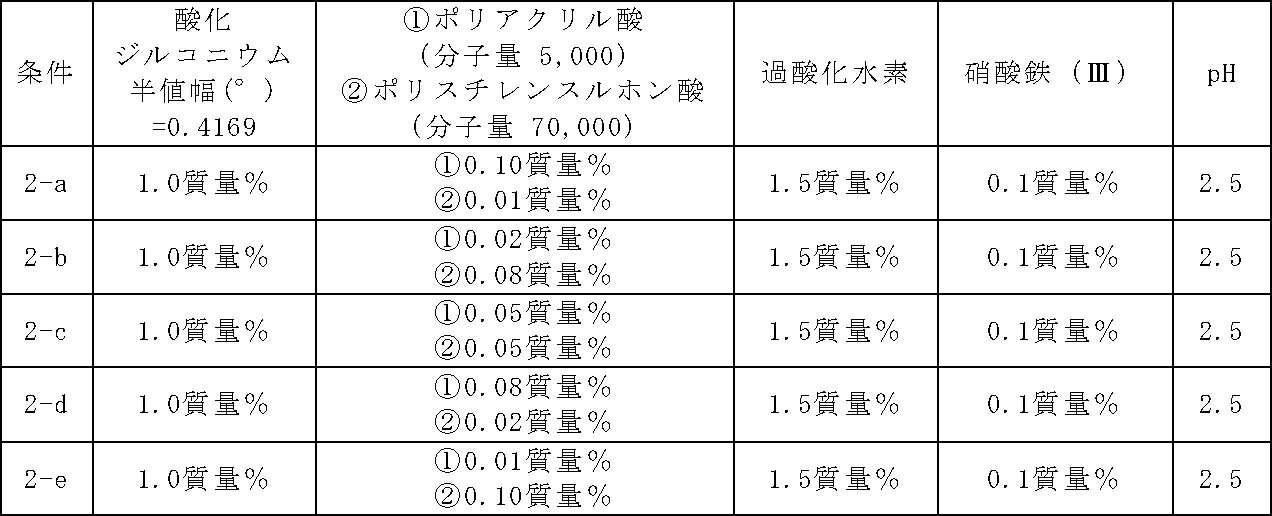
- the selection ratio changes corresponding to the change in the mixing ratio of the water-soluble polymer (see the concentration of each water-soluble polymer in Table 2). From this, it is easy to adjust to an arbitrary selection ratio. I found out.
- Example 3 Each semiconductor substrate was polished under the same conditions as in Example 2 except that the metal oxide particles added to the polishing composition were changed to those having a half-value width of 0.9056 °, and dishing was performed in the same manner as in Example 2. The amount, the amount of erosion, the polishing rate, the selection ratio, and the presence or absence of scratches were evaluated.
- the metal oxide particles zirconium oxide having a monoclinic crystal structure, an X-ray half width of 0.9056 °, and an average particle diameter of 40 nm was used.
- polyacrylic acid having a weight average molecular weight of 5,000 and polystyrene sulfonic acid having a weight average molecular weight of 70,000 were respectively added at concentrations shown in the conditions 3-a to 3-e in Table 3 below.
- the dishing amount and the erosion amount can be suppressed to be equal to or smaller than those of a comparative example described later, and no scratch was generated.
- the polishing rate was significantly higher than the comparative examples described later.
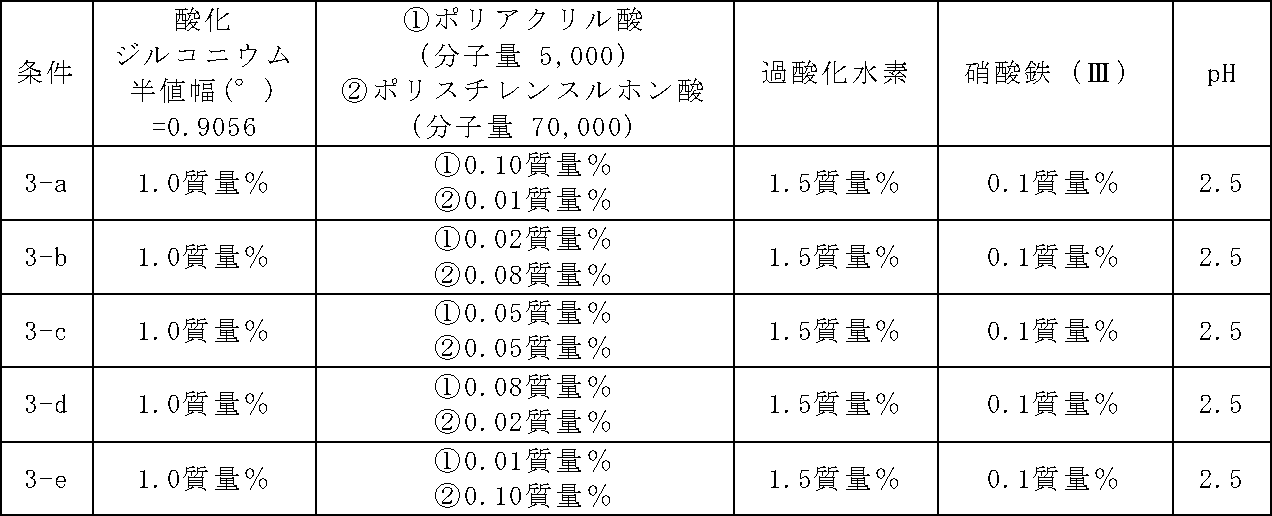
- the selection ratio changes corresponding to the change in the mixing ratio of the water-soluble polymer (see the concentration of each water-soluble polymer in Table 3). From this, it is easy to adjust to an arbitrary selection ratio. I found out.
- Example 4 Each semiconductor substrate is polished under the same conditions as in Example 1 except that three types of water-soluble polymers are added to the polishing composition, and the dishing amount, erosion amount, polishing rate, The selection ratio and the presence or absence of scratches were evaluated.
- the water-soluble polymer polyacrylic acid having a weight average molecular weight of 5,000, polystyrene sulfonic acid having a weight average molecular weight of 70,000, and polyacrylamide having a weight average molecular weight of 1,000,000 were used.
- the respective concentrations shown in Table 4 under conditions 4-a to 4-e were added.
- the dishing amount and the erosion amount can be suppressed to be equal to or smaller than those of a comparative example described later, and no scratch was generated.
- the polishing rate was significantly higher than the comparative examples described later.
- the selection ratio changed corresponding to the change in the blending ratio of the water-soluble polymer. From this, it was found that the selection ratio can be easily adjusted.
- Example 5 Each semiconductor substrate was polished under the same conditions as in Example 1 except that the ratio of the weight average molecular weight of the water-soluble polymer added to the polishing composition was changed to 10, and the dishing amount in the same manner as in Example 1, The amount of erosion, the polishing rate, the selection ratio, and the presence or absence of scratches were evaluated.
- a water-soluble polymer polyacrylic acid having a weight average molecular weight of 5000 and polyvinyl pyrrolidone having a weight average molecular weight of 50,000 were respectively added at concentrations shown in the conditions 5-a to 5-e in Table 5 below.
- Example 5 a different type of water-soluble polymer having a weight average molecular weight ratio of 10 was added.
- the dishing amount and the erosion amount could be suppressed to be equal to or smaller than those of the comparative example, and no scratch was generated.
- the polishing rate was significantly higher than the comparative examples described later.
- the selection ratio changes substantially corresponding to the change in the mixing ratio of the water-soluble polymer (see the concentration of each water-soluble polymer in Table 5). From this, it can be easily adjusted to an arbitrary selection ratio. It turns out that.
- Comparative Example 1 Each semiconductor substrate was subjected to the same conditions as in Example 1 except that the metal oxide particles added to the polishing composition had a half width of 0.4917 ° and the ratio of the weight average molecular weight of the water-soluble polymer was changed to 2. The dishing amount, the erosion amount, the polishing rate, the selection ratio, and the presence or absence of scratches were evaluated in the same manner as in Example 1.
- Comparative Example 1 first, zirconium oxide having a monoclinic crystal structure, an X-ray half width of 0.4917 °, and an average particle diameter of 61 nm was dispersed in pure water so as to be 1.0 mass%. .
- polyacrylic acid having a weight average molecular weight of 5000 and polyacrylic acid having a weight average molecular weight of 10,000 were respectively added at concentrations shown in conditions 6-a to 6-e in Table 6 below.
- Comparative Example 1 the same kind of water-soluble polymer having a weight average molecular weight ratio of 2 was added. Further, 1.5% by mass of hydrogen peroxide and 0.1% by mass of iron (III) nitrate were added to the aqueous solution and mixed. Thereafter, the pH of the solution was adjusted to 2.5 with nitric acid. Thus, 5 types of polishing composition from which the density
- the dishing amount was equal to or increased with the above-described embodiment, and the erosion amount was increased.
- the polishing rate in particular, the polishing rate of the tungsten film was lower than that in the above-described embodiment.
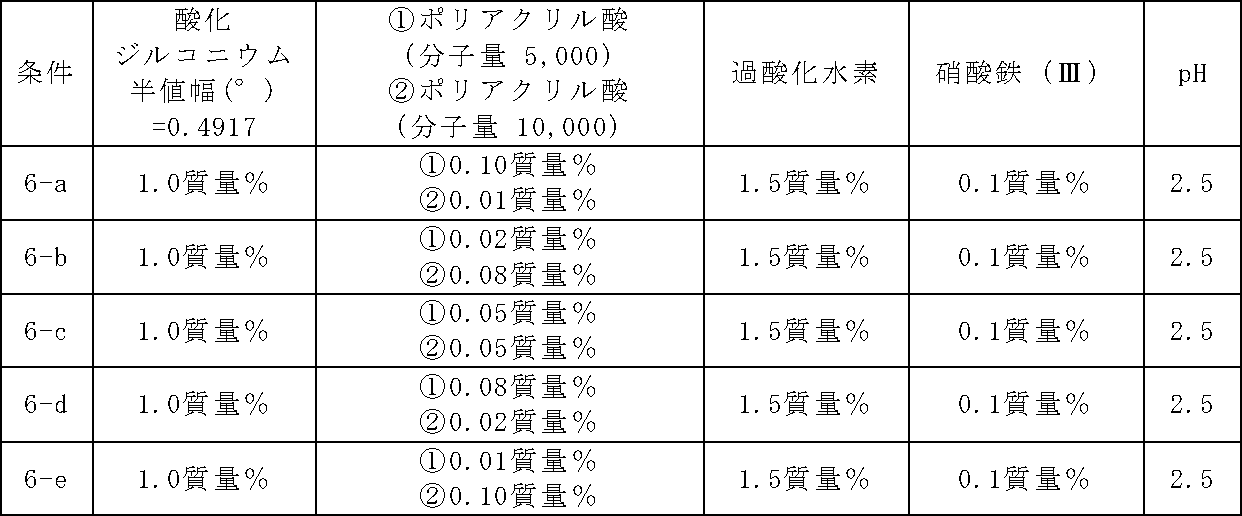
- the selection ratio changes irregularly regardless of the change in the blending ratio of the water-soluble polymer. From this, when the ratio of the weight average molecular weight of the water-soluble polymer is less than 10, any selection ratio I can't adjust it.
- Comparative Example 2 Each semiconductor substrate was polished under the same conditions as in Example 2 except that the metal oxide particles added to the polishing composition were changed to those having a half width of 1.8413 °, and the dishing amount, erosion amount, polishing rate The selection ratio and the presence or absence of scratches were evaluated.
- zirconium oxide having a monoclinic crystal structure, an X-ray half width of 1.8413 °, and an average particle diameter of 45 nm was used as the metal oxide particles.
- water-soluble polymer polyacrylic acid having a weight average molecular weight of 5,000 and polyacrylic acid having a weight average molecular weight of 70,000 were respectively added at concentrations shown in conditions 7-a to 7-e in Table 7 below.
- a polishing composition having a metal oxide particle X-ray half-width of 1 ° or more was used.
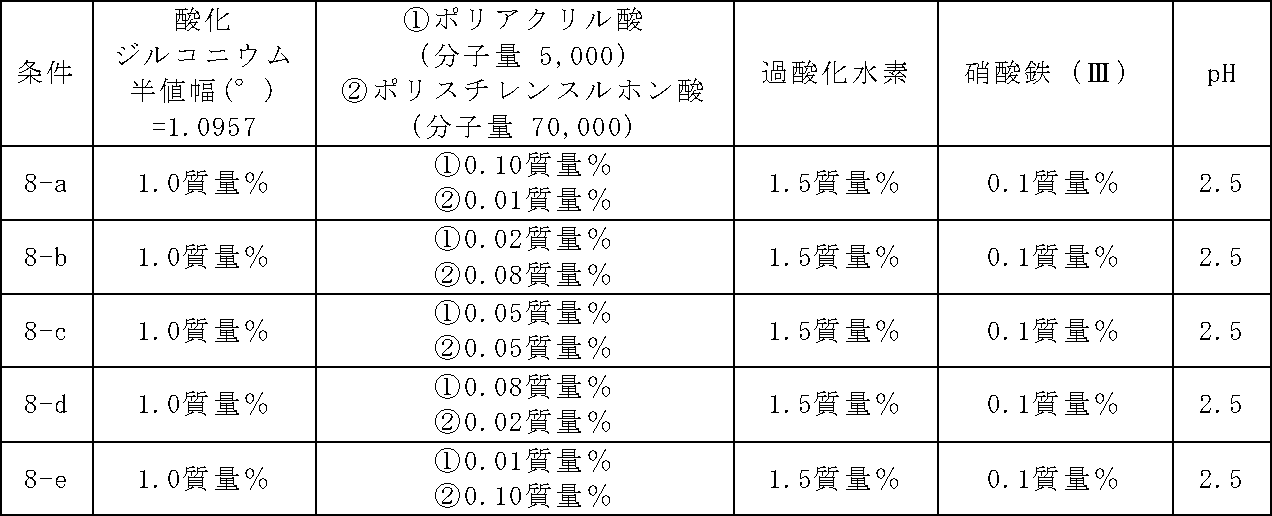
- Example 3 Each semiconductor substrate was polished under the same conditions as in Example 2 except that the metal oxide particles added to the polishing composition were changed to those having a half-value width of 1.0957 °. The dishing amount, the erosion amount, the polishing rate, the selection ratio, and the presence or absence of scratches were evaluated. As the added metal oxide particles, zirconium oxide having a monoclinic crystal structure, an X-ray half width of 1.0957 °, and an average particle diameter of 61 nm was used.
- polyacrylic acid having a weight average molecular weight of 5,000 and polystyrene sulfonic acid having a weight average molecular weight of 70,000 were respectively added at concentrations shown in conditions 8-a to 8-e in Table 8 below.
- Comparative Example 4 Each semiconductor substrate was polished under the same conditions as in Example 1 except that the ratio of the weight average molecular weight of the water-soluble polymer in the polishing composition to be used was changed to 9, and the dishing amount in the same manner as in Example 1, The amount of erosion, the polishing rate, the selection ratio, and the presence or absence of scratches were evaluated.
- the water-soluble polymer polyacrylic acid having a weight average molecular weight of 5000 and polyacrylic acid having a weight average molecular weight of 45,000 were respectively added at concentrations shown in conditions 9-a to 9-e in Table 9 below. .
- the dishing amount was equal to or increased in the above-described embodiment, and the erosion amount was increased.
- the polishing rate the polishing rate of the tungsten film was lower than that of the above-described embodiment.
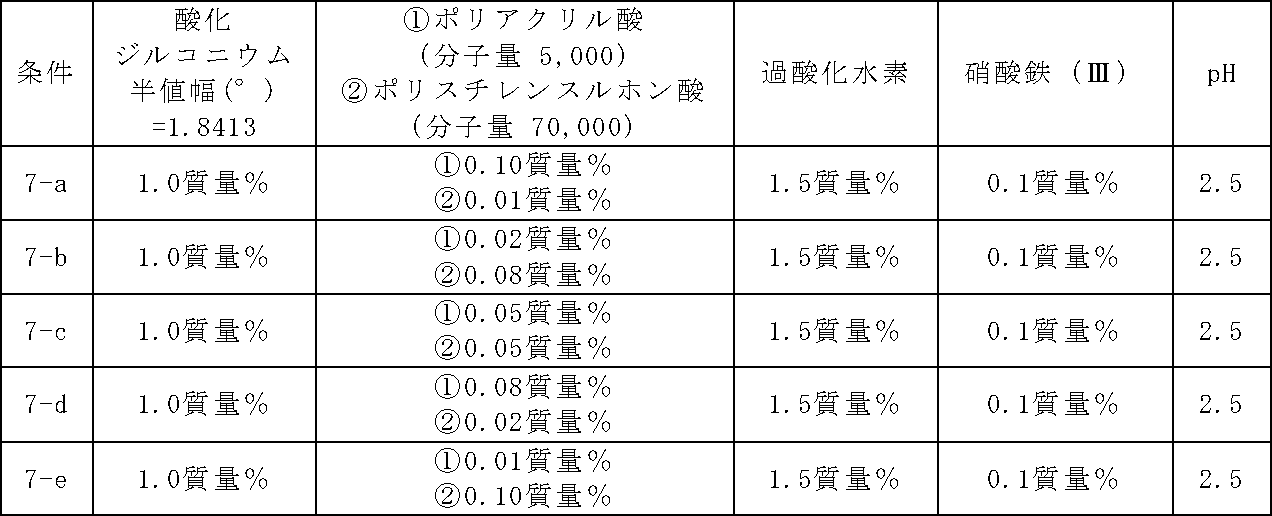
- the selection ratio changed irregularly regardless of the change in the blending ratio of the water-soluble polymer. From this, it was found that the selection ratio cannot be adjusted to an arbitrary selection ratio as in the examples. .
- the present invention is not limited to the above embodiment.
- the above-described embodiment is an exemplification, and the present invention has any configuration that has substantially the same configuration as the technical idea described in the claims of the present invention and that exhibits the same effects. Are included in the technical scope.
Landscapes
- Chemical & Material Sciences (AREA)
- Engineering & Computer Science (AREA)
- Organic Chemistry (AREA)
- Materials Engineering (AREA)
- Mechanical Engineering (AREA)
- Mechanical Treatment Of Semiconductor (AREA)
- Finish Polishing, Edge Sharpening, And Grinding By Specific Grinding Devices (AREA)
Abstract
Description
本発明は、金属層を含んだ半導体基板の研磨に好適である。
本発明は、金属層としてタングステン又はタングステン合金を含んだ半導体基板の研磨に特に好適である。
本発明の研磨組成物は、砥粒として、粉末X線回折パターンにおける回折強度が最大となるピーク部分の半値幅が1°未満である金属酸化物粒子を含有しており、さらに、選択比調節剤として、重量平均分子量が異なる水溶性ポリマーを2種類以上含み、該水溶性ポリマーの異なる重量平均分子量の比が10以上のものを含むものであることを特徴としている。尚、選択比調節剤とは、研磨速度の比である選択比を調整するものを言い、例えば半導体基板の研磨において、金属層と絶縁層の研磨速度の選択比を、任意の値に調節する役割を果たす物質のことを言う。
このような研磨装置10では、研磨ヘッド2で半導体基板Wを保持し、研磨組成物供給機構5から研磨パッド4上に本発明の研磨組成物1を供給するとともに、定盤3と研磨ヘッド2をそれぞれ回転させて半導体基板Wの表面を研磨パッド4に摺接させることにより研磨を行う。
本発明の研磨方法は被研磨物として金属層を含む表面の研磨に好適であり、特にタングステン、タングステン合金から成る金属層の研磨に対し好適に用いられる。
本発明の研磨組成物を使用して、半導体基板の研磨を行い、研磨後の半導体基板における、ディッシング量、エロージョン量、研磨速度(研磨レート)、選択比、スクラッチの有無を評価した。
最初に、結晶構造が単斜晶構造であり、X線半値幅が0.4169°、平均1次粒子径が35nmである酸化ジルコニウムを、含有量が1.0質量%となるよう純水に分散させた。次に、水溶性ポリマーとして、重量平均分子量が5,000のポリアクリル酸及び重量平均分子量100,000のポリアクリル酸を下記表1の条件1-a~1-eに示す濃度でそれぞれ添加した。このように、実施例1では、重量平均分子量の比が20である同種の水溶性ポリマーを添加し、5種の水溶液を作製した。さらに、これらの水溶液に過酸化水素1.5質量%、硝酸鉄(III)0.1質量%を添加し混合した。その後、硝酸により溶液のpHを2.5に調整した。このようにして、各水溶性ポリマーの濃度が異なる5種類の研磨組成物を製造した。

ρ=ρs×t ・・・ (1)
(ここで、ρ:比抵抗(定数)、ρs:シート抵抗率、t:膜厚である。)
表10に示すように、実施例1では、ディッシング量を、表11に示す比較例と同等又はそれよりも小さく抑えることができ、エロージョン量を比較例よりも小さく抑えることができた。またスクラッチは発生しなかった。研磨速度は、比較例よりも、大幅に大きくなった。また、選択比は、水溶性ポリマーの配合比の変化(表1の各水溶性ポリマーの濃度参照)に対応した変化をしており、このことから、例えばこの実施例1のように、各水溶性ポリマーの添加量などを調整すれば、任意の選択比に調節することが容易であることが分かった。
研磨組成物に添加する水溶性ポリマーの種類及び重量平均分子量の比を14に変えたこと以外、実施例1と同様な条件で各半導体基板の研磨を行い、実施例1と同様な方法でディッシング量、エロージョン量、研磨速度、選択比、スクラッチの有無を評価した。
実施例2では、水溶性ポリマーとして、重量平均分子量が5,000のポリアクリル酸及び重量平均分子量70,000のポリアクリル酸を下記表2の条件2-a~2-eに示す濃度でそれぞれ添加した。
研磨組成物に添加する金属酸化物粒子を半値幅0.9056°のものに変えたこと以外、実施例2と同様な条件で各半導体基板の研磨を行い、実施例2と同様な方法でディッシング量、エロージョン量、研磨速度、選択比、スクラッチの有無を評価した。
実施例3では、金属酸化物粒子として、結晶構造が単斜晶構造、X線半値幅が0.9056°、平均粒子径が40nmである酸化ジルコニウムを使用した。また、水溶性ポリマーとして、重量平均分子量が5,000のポリアクリル酸及び重量平均分子量70,000のポリスチレンスルホン酸を下記表3の条件3-a~3-eに示す濃度でそれぞれ添加した。
研磨組成物に添加する水溶性ポリマーを3種類としたこと以外、実施例1と同様な条件で各半導体基板の研磨を行い、実施例1と同様な方法でディッシング量、エロージョン量、研磨速度、選択比、スクラッチの有無を評価した。
実施例4では、水溶性ポリマーとして、重量平均分子量が5,000のポリアクリル酸、重量平均分子量が70,000のポリスチレンスルホン酸、及び重量平均分子量が1,000,000のポリアクリルアミドを、下記表4の条件4-a~4-eに示す濃度でそれぞれ添加した。

研磨組成物に添加する水溶性ポリマーの重量平均分子量の比を10に変えたこと以外、実施例1と同様な条件で各半導体基板の研磨を行い、実施例1と同様な方法でディッシング量、エロージョン量、研磨速度、選択比、スクラッチの有無を評価した。
実施例5では、水溶性ポリマーとして、重量平均分子量が5000のポリアクリル酸及び重量平均分子量50,000のポリビニルピロリドンを下記表5の条件5-a~5-eに示す濃度でそれぞれ添加した。このように、実施例5では、重量平均分子量の比が10である異種の水溶性ポリマーを添加した。

研磨組成物に添加する金属酸化物粒子を半値幅が0.4917°のものに、水溶性ポリマーの重量平均分子量の比を2に変えたこと以外、実施例1と同様な条件で各半導体基板の研磨を行い、実施例1と同様な方法でディッシング量、エロージョン量、研磨速度、選択比、スクラッチの有無を評価した。
比較例1では、最初に、結晶構造が単斜晶構造、X線半値幅が0.4917°、平均粒子径が61nmである酸化ジルコニウムを1.0質量%となるよう純水に分散させた。次に、水溶性ポリマーとして、重量平均分子量が5000のポリアクリル酸及び重量平均分子量10,000のポリアクリル酸を下記表6の条件6-a~6-eに示す濃度でそれぞれ添加した。このように、比較例1では、重量平均分子量の比が2である同種の水溶性ポリマーを添加した。さらに、この水溶液に過酸化水素1.5質量%、硝酸鉄(III)0.1質量%を添加し混合した。その後、硝酸により溶液のpHを2.5に調整した。このようにして、各水溶性ポリマーの濃度が異なる5種類の研磨組成物を製造した。
研磨組成物に添加する金属酸化物粒子を半値幅が1.8413°のものに変えたこと以外、実施例2と同様な条件で各半導体基板の研磨を行い、ディッシング量、エロージョン量、研磨速度、選択比、スクラッチの有無を評価した。
比較例2では、金属酸化物粒子として、結晶構造が単斜晶構造、X線半値幅が1.8413°、平均粒子径が45nmである酸化ジルコニウムを使用した。また、水溶性ポリマーとして、重量平均分子量が5,000のポリアクリル酸及び重量平均分子量70,000のポリアクリル酸を下記表7の条件7-a~7-eに示す濃度でそれぞれ添加した。このように、比較例2では、金属酸化物粒子のX線半値幅が1°以上の研磨組成物を使用した。
研磨組成物に添加する金属酸化物粒子を半値幅が1.0957°のものに変えたこと以外、実施例2と同様な条件で各半導体基板の研磨を行い、実施例2と同様な方法でディッシング量、エロージョン量、研磨速度、選択比、スクラッチの有無を評価した。
添加した金属酸化物粒子は、結晶構造が単斜晶構造、X線半値幅が1.0957°、平均粒子径が61nmである酸化ジルコニウムを使用した。また、水溶性ポリマーとして、重量平均分子量が5,000のポリアクリル酸及び重量平均分子量70,000のポリスチレンスルホン酸を下記表8の条件8-a~8-eに示す濃度でそれぞれ添加した。
使用する研磨組成物における水溶性ポリマーの重量平均分子量の比を9に変えたこと以外、実施例1と同様な条件で各半導体基板の研磨を行い、実施例1と同様な方法でディッシング量、エロージョン量、研磨速度、選択比、スクラッチの有無を評価した。
比較例4では、水溶性ポリマーとして、重量平均分子量が5000のポリアクリル酸及び重量平均分子量45,000のポリアクリル酸を下記表9の条件9-a~9-eに示す濃度でそれぞれ添加した。


Claims (10)
- 砥粒として金属酸化物粒子を含む研磨組成物であって、
前記金属酸化物粒子として、粉末X線回折パターンにおける回折強度が最大となるピーク部分の半値幅が1°未満のものを含み、
さらに、選択比調節剤として、重量平均分子量が異なる水溶性ポリマーを2種類以上含み、該水溶性ポリマーの異なる重量平均分子量の比が10以上のものを含むものであることを特徴とする研磨組成物。 - 前記金属酸化物粒子として、酸化チタン、酸化ジルコニウム、酸化セリウム、酸化アルミニウム、酸化マンガンのいずれか、あるいはこれらの中の少なくとも2つ以上の混合物、又はこれらの金属酸化物のうち1つ以上を含有する複合酸化物を含むことを特徴とする請求項1に記載の研磨組成物。
- 前記水溶性ポリマーとして、ポリカルボン酸又はその塩、ポリスチレンスルホン酸又はその塩、ポリアクリル酸又はその塩、ポリビニルピロリドン、アニオン変性ポリビニルアルコール、ポリアクリルアミド、ポリエーテルからなる群より選ばれる少なくとも1種類以上を含むことを特徴とする請求項1又は請求項2に記載の研磨組成物。
- さらに酸化剤を含むことを特徴とする請求項1から請求項3のいずれか1項に記載の研磨組成物。
- 前記酸化剤として、過酸化物と鉄(III)塩のうち少なくとも1種類以上を含むことを特徴とする請求項4に記載の研磨組成物。
- 前記過酸化物として、過硫酸、過ヨウ素酸、過塩素酸、これらの塩、及び過酸化水素からなる群より選ばれる少なくとも1種類以上を含むことを特徴とする請求項5に記載の研磨組成物。
- 前記鉄(III)塩として、硫酸鉄(III)、硝酸鉄(III)、塩化鉄(III)、シュウ酸鉄(III)、トリス(オキサラト)鉄(III)カリウム、ヘキサシアノ鉄(III)アンモニウム、ヘキサシアノ鉄(III)カリウム、クエン酸鉄(III)、クエン酸鉄(III)アンモニウムからなる群より選ばれる少なくとも1種類以上を含むことを特徴とする請求項5又は請求項6に記載の研磨組成物。
- 請求項1から請求項7のいずれか1項に記載の研磨組成物を用いて半導体基板を研磨することを特徴とする研磨方法。
- 前記半導体基板が金属層を含むことを特徴とする請求項8に記載の研磨方法。
- 前記金属層は、タングステン又はタングステン合金であることを特徴とする請求項9に記載の研磨方法。
Priority Applications (3)
| Application Number | Priority Date | Filing Date | Title |
|---|---|---|---|
| US15/506,644 US20180223129A1 (en) | 2014-09-12 | 2015-07-02 | Polishing composition and polishing method |
| KR1020177006385A KR102395418B1 (ko) | 2014-09-12 | 2015-07-02 | 연마조성물 및 연마방법 |
| CN201580047692.8A CN106687552B (zh) | 2014-09-12 | 2015-07-02 | 研磨组合物以及研磨方法 |
Applications Claiming Priority (2)
| Application Number | Priority Date | Filing Date | Title |
|---|---|---|---|
| JP2014-186114 | 2014-09-12 | ||
| JP2014186114A JP6268069B2 (ja) | 2014-09-12 | 2014-09-12 | 研磨組成物及び研磨方法 |
Publications (1)
| Publication Number | Publication Date |
|---|---|
| WO2016038771A1 true WO2016038771A1 (ja) | 2016-03-17 |
Family
ID=55458551
Family Applications (1)
| Application Number | Title | Priority Date | Filing Date |
|---|---|---|---|
| PCT/JP2015/003328 Ceased WO2016038771A1 (ja) | 2014-09-12 | 2015-07-02 | 研磨組成物及び研磨方法 |
Country Status (6)
| Country | Link |
|---|---|
| US (1) | US20180223129A1 (ja) |
| JP (1) | JP6268069B2 (ja) |
| KR (1) | KR102395418B1 (ja) |
| CN (1) | CN106687552B (ja) |
| TW (1) | TWI719948B (ja) |
| WO (1) | WO2016038771A1 (ja) |
Families Citing this family (6)
| Publication number | Priority date | Publication date | Assignee | Title |
|---|---|---|---|---|
| KR101834418B1 (ko) * | 2015-10-02 | 2018-03-05 | 유비머트리얼즈주식회사 | 슬러리 및 이를 이용한 기판 연마 방법 |
| CN113755099B (zh) * | 2020-05-27 | 2022-07-12 | 万华化学集团电子材料有限公司 | 蓝宝石化学机械抛光液及其应用 |
| CN112536710B (zh) * | 2020-12-01 | 2022-03-22 | 新乡市万华数控设备有限公司 | 一种用于双面研磨机的测量机构 |
| EP4392498A4 (en) * | 2021-08-25 | 2025-07-16 | Cmc Mat Llc | COMPOSITION FOR CMP COMPRISING AN ANIONIC ABRASIVE |
| JP7727461B2 (ja) * | 2021-09-17 | 2025-08-21 | 株式会社フジミインコーポレーテッド | 研磨用組成物、研磨方法、および半導体基板の製造方法 |
| JP2024539352A (ja) * | 2021-10-28 | 2024-10-28 | フジフイルム エレクトロニック マテリアルズ ユー.エス.エー., インコーポレイテッド | 研磨組成物及びその使用方法 |
Citations (3)
| Publication number | Priority date | Publication date | Assignee | Title |
|---|---|---|---|---|
| JP2006516067A (ja) * | 2002-11-13 | 2006-06-15 | デュポン エアー プロダクツ ナノマテリアルズ エルエルシー | 研磨剤組成物とそれによる研磨方法 |
| WO2008081943A1 (ja) * | 2006-12-28 | 2008-07-10 | Kao Corporation | 研磨液組成物 |
| WO2013125446A1 (ja) * | 2012-02-21 | 2013-08-29 | 日立化成株式会社 | 研磨剤、研磨剤セット及び基体の研磨方法 |
Family Cites Families (19)
| Publication number | Priority date | Publication date | Assignee | Title |
|---|---|---|---|---|
| US5391258A (en) | 1993-05-26 | 1995-02-21 | Rodel, Inc. | Compositions and methods for polishing |
| SE501814C2 (sv) | 1993-08-06 | 1995-05-22 | Skf Ab | Anordning för lastmätning i rullningslager |
| JPH0821557A (ja) | 1994-07-07 | 1996-01-23 | Kitz Corp | バルブ用アクチュエータ |
| KR20020027571A (ko) * | 1999-08-24 | 2002-04-13 | 갤반 마틴 | 절연체와 금속의 cmp용 조성물 및 이에 관련된 방법 |
| EP1448737B1 (en) * | 2001-11-15 | 2012-01-25 | Samsung Electronics Co., Ltd. | Slurry composition including an additive composition, and method of polishing an object using the slurry composition |
| AU2003235964A1 (en) * | 2002-04-30 | 2003-11-17 | Hitachi Chemical Co., Ltd. | Polishing fluid and polishing method |
| US20050189322A1 (en) * | 2004-02-27 | 2005-09-01 | Lane Sarah J. | Compositions and methods for chemical mechanical polishing silica and silicon nitride |
| US7303993B2 (en) | 2004-07-01 | 2007-12-04 | Rohm And Haas Electronic Materials Cmp Holdings, Inc. | Chemical mechanical polishing compositions and methods relating thereto |
| KR100630691B1 (ko) * | 2004-07-15 | 2006-10-02 | 삼성전자주식회사 | 산화세륨 연마 입자 및 그 제조 방법과 cmp용 슬러리조성물 및 그 제조 방법과 이들을 이용한 기판 연마 방법 |
| US7126199B2 (en) | 2004-09-27 | 2006-10-24 | Intel Corporation | Multilayer metal gate electrode |
| KR20080011044A (ko) * | 2006-07-28 | 2008-01-31 | 주식회사 엘지화학 | 산화세륨 분말, 그 제조방법, 및 이를 포함하는cmp슬러리 |
| JP2006228823A (ja) * | 2005-02-15 | 2006-08-31 | Nitta Haas Inc | 金属膜研磨用組成物 |
| US20070210278A1 (en) * | 2006-03-08 | 2007-09-13 | Lane Sarah J | Compositions for chemical mechanical polishing silicon dioxide and silicon nitride |
| CN101517709B (zh) * | 2006-09-13 | 2011-05-25 | 旭硝子株式会社 | 半导体集成电路装置用抛光剂、抛光方法、以及制造半导体集成电路装置的方法 |
| WO2008044477A1 (en) * | 2006-10-06 | 2008-04-17 | Jsr Corporation | Aqueous dispersion for chemical mechanical polishing and chemical mechanical polishing method for semiconductor device |
| JP2008135453A (ja) * | 2006-11-27 | 2008-06-12 | Fujimi Inc | 研磨用組成物及び研磨方法 |
| JP5403909B2 (ja) * | 2007-04-05 | 2014-01-29 | 花王株式会社 | 研磨液組成物 |
| TW201000613A (en) * | 2008-04-23 | 2010-01-01 | Hitachi Chemical Co Ltd | Polishing agent and method for polishing substrate using the same |
| JP2013145800A (ja) | 2012-01-13 | 2013-07-25 | National Institute Of Advanced Industrial & Technology | 半導体装置及びその製造方法 |
-
2014
- 2014-09-12 JP JP2014186114A patent/JP6268069B2/ja active Active
-
2015
- 2015-07-02 CN CN201580047692.8A patent/CN106687552B/zh active Active
- 2015-07-02 US US15/506,644 patent/US20180223129A1/en not_active Abandoned
- 2015-07-02 WO PCT/JP2015/003328 patent/WO2016038771A1/ja not_active Ceased
- 2015-07-02 KR KR1020177006385A patent/KR102395418B1/ko active Active
- 2015-09-10 TW TW104129932A patent/TWI719948B/zh active
Patent Citations (3)
| Publication number | Priority date | Publication date | Assignee | Title |
|---|---|---|---|---|
| JP2006516067A (ja) * | 2002-11-13 | 2006-06-15 | デュポン エアー プロダクツ ナノマテリアルズ エルエルシー | 研磨剤組成物とそれによる研磨方法 |
| WO2008081943A1 (ja) * | 2006-12-28 | 2008-07-10 | Kao Corporation | 研磨液組成物 |
| WO2013125446A1 (ja) * | 2012-02-21 | 2013-08-29 | 日立化成株式会社 | 研磨剤、研磨剤セット及び基体の研磨方法 |
Also Published As
| Publication number | Publication date |
|---|---|
| JP6268069B2 (ja) | 2018-01-24 |
| CN106687552A (zh) | 2017-05-17 |
| CN106687552B (zh) | 2019-09-03 |
| TWI719948B (zh) | 2021-03-01 |
| KR20170054397A (ko) | 2017-05-17 |
| JP2016056327A (ja) | 2016-04-21 |
| US20180223129A1 (en) | 2018-08-09 |
| KR102395418B1 (ko) | 2022-05-09 |
| TW201623547A (zh) | 2016-07-01 |
Similar Documents
| Publication | Publication Date | Title |
|---|---|---|
| JP6130316B2 (ja) | 研磨組成物及び研磨方法並びに研磨組成物の製造方法 | |
| JP6268069B2 (ja) | 研磨組成物及び研磨方法 | |
| US6251150B1 (en) | Slurry composition and method of chemical mechanical polishing using same | |
| TWI658133B (zh) | 拋光漿料組合物 | |
| TW200914379A (en) | Method for preparing cerium carbonate powder and cerium oxide powder | |
| JP5247691B2 (ja) | 酸化セリウム粉末、その製造方法及びこれを含むcmpスラリー | |
| JP6827318B2 (ja) | 酸化セリウム砥粒 | |
| CN115678438B (zh) | 研磨用组合物 | |
| JP2000160138A (ja) | 研磨用組成物 | |
| JP2011171446A (ja) | Cmp用研磨液及びこれを用いた研磨方法 | |
| JP2019071366A (ja) | 酸化セリウム含有複合研磨材 | |
| JP7569717B2 (ja) | 酸化珪素膜用研磨液組成物 | |
| TW202222697A (zh) | 二氧化鈰及研磨劑 | |
| JP2018090682A (ja) | 研磨組成物、研磨方法、及び研磨組成物の製造方法 | |
| JP2015143332A (ja) | 研磨剤、研磨方法および半導体集積回路装置の製造方法 | |
| JP7668977B1 (ja) | 研磨用分散液 | |
| JP4159679B2 (ja) | 研磨用組成物 | |
| JP7019379B2 (ja) | 複合砥粒 | |
| WO2022071120A1 (ja) | 酸化セリウム及び研磨剤 | |
| KR100613836B1 (ko) | 연마용 슬러리 및 이의 제조 방법 및 기판 연마 방법 | |
| TW202517748A (zh) | 用於高度摻雜硼之矽膜之基於鈦氧化物之化學機械拋光組合物 | |
| JP2020181906A (ja) | 研磨液組成物 |
Legal Events
| Date | Code | Title | Description |
|---|---|---|---|
| 121 | Ep: the epo has been informed by wipo that ep was designated in this application |
Ref document number: 15840184 Country of ref document: EP Kind code of ref document: A1 |
|
| WWE | Wipo information: entry into national phase |
Ref document number: 15506644 Country of ref document: US |
|
| ENP | Entry into the national phase |
Ref document number: 20177006385 Country of ref document: KR Kind code of ref document: A |
|
| NENP | Non-entry into the national phase |
Ref country code: DE |
|
| 122 | Ep: pct application non-entry in european phase |
Ref document number: 15840184 Country of ref document: EP Kind code of ref document: A1 |