WO2015182353A1 - 焼成ペースト組成物およびその用途 - Google Patents
焼成ペースト組成物およびその用途 Download PDFInfo
- Publication number
- WO2015182353A1 WO2015182353A1 PCT/JP2015/063427 JP2015063427W WO2015182353A1 WO 2015182353 A1 WO2015182353 A1 WO 2015182353A1 JP 2015063427 W JP2015063427 W JP 2015063427W WO 2015182353 A1 WO2015182353 A1 WO 2015182353A1
- Authority
- WO
- WIPO (PCT)
- Prior art keywords
- group
- paste composition
- copolymer
- fired
- mass
- Prior art date
- Legal status (The legal status is an assumption and is not a legal conclusion. Google has not performed a legal analysis and makes no representation as to the accuracy of the status listed.)
- Ceased
Links
Classifications
-
- C—CHEMISTRY; METALLURGY
- C08—ORGANIC MACROMOLECULAR COMPOUNDS; THEIR PREPARATION OR CHEMICAL WORKING-UP; COMPOSITIONS BASED THEREON
- C08L—COMPOSITIONS OF MACROMOLECULAR COMPOUNDS
- C08L33/00—Compositions of homopolymers or copolymers of compounds having one or more unsaturated aliphatic radicals, each having only one carbon-to-carbon double bond, and only one being terminated by only one carboxyl radical, or of salts, anhydrides, esters, amides, imides or nitriles thereof; Compositions of derivatives of such polymers
- C08L33/04—Homopolymers or copolymers of esters
- C08L33/06—Homopolymers or copolymers of esters of esters containing only carbon, hydrogen and oxygen, which oxygen atoms are present only as part of the carboxyl radical
-
- C—CHEMISTRY; METALLURGY
- C08—ORGANIC MACROMOLECULAR COMPOUNDS; THEIR PREPARATION OR CHEMICAL WORKING-UP; COMPOSITIONS BASED THEREON
- C08F—MACROMOLECULAR COMPOUNDS OBTAINED BY REACTIONS ONLY INVOLVING CARBON-TO-CARBON UNSATURATED BONDS
- C08F220/00—Copolymers of compounds having one or more unsaturated aliphatic radicals, each having only one carbon-to-carbon double bond, and only one being terminated by only one carboxyl radical or a salt, anhydride ester, amide, imide or nitrile thereof
- C08F220/02—Monocarboxylic acids having less than ten carbon atoms; Derivatives thereof
- C08F220/10—Esters
- C08F220/12—Esters of monohydric alcohols or phenols
- C08F220/16—Esters of monohydric alcohols or phenols of phenols or of alcohols containing two or more carbon atoms
- C08F220/18—Esters of monohydric alcohols or phenols of phenols or of alcohols containing two or more carbon atoms with acrylic or methacrylic acids
- C08F220/1804—C4-(meth)acrylate, e.g. butyl (meth)acrylate, isobutyl (meth)acrylate or tert-butyl (meth)acrylate
-
- C—CHEMISTRY; METALLURGY
- C08—ORGANIC MACROMOLECULAR COMPOUNDS; THEIR PREPARATION OR CHEMICAL WORKING-UP; COMPOSITIONS BASED THEREON
- C08F—MACROMOLECULAR COMPOUNDS OBTAINED BY REACTIONS ONLY INVOLVING CARBON-TO-CARBON UNSATURATED BONDS
- C08F220/00—Copolymers of compounds having one or more unsaturated aliphatic radicals, each having only one carbon-to-carbon double bond, and only one being terminated by only one carboxyl radical or a salt, anhydride ester, amide, imide or nitrile thereof
- C08F220/02—Monocarboxylic acids having less than ten carbon atoms; Derivatives thereof
- C08F220/10—Esters
-
- C—CHEMISTRY; METALLURGY
- C08—ORGANIC MACROMOLECULAR COMPOUNDS; THEIR PREPARATION OR CHEMICAL WORKING-UP; COMPOSITIONS BASED THEREON
- C08F—MACROMOLECULAR COMPOUNDS OBTAINED BY REACTIONS ONLY INVOLVING CARBON-TO-CARBON UNSATURATED BONDS
- C08F220/00—Copolymers of compounds having one or more unsaturated aliphatic radicals, each having only one carbon-to-carbon double bond, and only one being terminated by only one carboxyl radical or a salt, anhydride ester, amide, imide or nitrile thereof
- C08F220/02—Monocarboxylic acids having less than ten carbon atoms; Derivatives thereof
- C08F220/10—Esters
- C08F220/12—Esters of monohydric alcohols or phenols
- C08F220/14—Methyl esters, e.g. methyl (meth)acrylate
-
- C—CHEMISTRY; METALLURGY
- C08—ORGANIC MACROMOLECULAR COMPOUNDS; THEIR PREPARATION OR CHEMICAL WORKING-UP; COMPOSITIONS BASED THEREON
- C08F—MACROMOLECULAR COMPOUNDS OBTAINED BY REACTIONS ONLY INVOLVING CARBON-TO-CARBON UNSATURATED BONDS
- C08F220/00—Copolymers of compounds having one or more unsaturated aliphatic radicals, each having only one carbon-to-carbon double bond, and only one being terminated by only one carboxyl radical or a salt, anhydride ester, amide, imide or nitrile thereof
- C08F220/02—Monocarboxylic acids having less than ten carbon atoms; Derivatives thereof
- C08F220/10—Esters
- C08F220/12—Esters of monohydric alcohols or phenols
- C08F220/16—Esters of monohydric alcohols or phenols of phenols or of alcohols containing two or more carbon atoms
- C08F220/18—Esters of monohydric alcohols or phenols of phenols or of alcohols containing two or more carbon atoms with acrylic or methacrylic acids
- C08F220/1811—C10or C11-(Meth)acrylate, e.g. isodecyl (meth)acrylate, isobornyl (meth)acrylate or 2-naphthyl (meth)acrylate
-
- C—CHEMISTRY; METALLURGY
- C08—ORGANIC MACROMOLECULAR COMPOUNDS; THEIR PREPARATION OR CHEMICAL WORKING-UP; COMPOSITIONS BASED THEREON
- C08K—Use of inorganic or non-macromolecular organic substances as compounding ingredients
- C08K3/00—Use of inorganic substances as compounding ingredients
- C08K3/01—Use of inorganic substances as compounding ingredients characterized by their specific function
- C08K3/013—Fillers, pigments or reinforcing additives
-
- C—CHEMISTRY; METALLURGY
- C08—ORGANIC MACROMOLECULAR COMPOUNDS; THEIR PREPARATION OR CHEMICAL WORKING-UP; COMPOSITIONS BASED THEREON
- C08K—Use of inorganic or non-macromolecular organic substances as compounding ingredients
- C08K3/00—Use of inorganic substances as compounding ingredients
- C08K3/02—Elements
- C08K3/08—Metals
-
- C—CHEMISTRY; METALLURGY
- C08—ORGANIC MACROMOLECULAR COMPOUNDS; THEIR PREPARATION OR CHEMICAL WORKING-UP; COMPOSITIONS BASED THEREON
- C08L—COMPOSITIONS OF MACROMOLECULAR COMPOUNDS
- C08L33/00—Compositions of homopolymers or copolymers of compounds having one or more unsaturated aliphatic radicals, each having only one carbon-to-carbon double bond, and only one being terminated by only one carboxyl radical, or of salts, anhydrides, esters, amides, imides or nitriles thereof; Compositions of derivatives of such polymers
- C08L33/04—Homopolymers or copolymers of esters
- C08L33/06—Homopolymers or copolymers of esters of esters containing only carbon, hydrogen and oxygen, which oxygen atoms are present only as part of the carboxyl radical
- C08L33/10—Homopolymers or copolymers of methacrylic acid esters
-
- C—CHEMISTRY; METALLURGY
- C09—DYES; PAINTS; POLISHES; NATURAL RESINS; ADHESIVES; COMPOSITIONS NOT OTHERWISE PROVIDED FOR; APPLICATIONS OF MATERIALS NOT OTHERWISE PROVIDED FOR
- C09D—COATING COMPOSITIONS, e.g. PAINTS, VARNISHES OR LACQUERS; FILLING PASTES; CHEMICAL PAINT OR INK REMOVERS; INKS; CORRECTING FLUIDS; WOODSTAINS; PASTES OR SOLIDS FOR COLOURING OR PRINTING; USE OF MATERIALS THEREFOR
- C09D11/00—Inks
- C09D11/02—Printing inks
-
- H—ELECTRICITY
- H01—ELECTRIC ELEMENTS
- H01B—CABLES; CONDUCTORS; INSULATORS; SELECTION OF MATERIALS FOR THEIR CONDUCTIVE, INSULATING OR DIELECTRIC PROPERTIES
- H01B1/00—Conductors or conductive bodies characterised by the conductive materials; Selection of materials as conductors
- H01B1/20—Conductive material dispersed in non-conductive organic material
- H01B1/22—Conductive material dispersed in non-conductive organic material the conductive material comprising metals or alloys
-
- H—ELECTRICITY
- H01—ELECTRIC ELEMENTS
- H01G—CAPACITORS; CAPACITORS, RECTIFIERS, DETECTORS, SWITCHING DEVICES, LIGHT-SENSITIVE OR TEMPERATURE-SENSITIVE DEVICES OF THE ELECTROLYTIC TYPE
- H01G4/00—Fixed capacitors; Processes of their manufacture
- H01G4/002—Details
- H01G4/018—Dielectrics
- H01G4/06—Solid dielectrics
- H01G4/08—Inorganic dielectrics
- H01G4/12—Ceramic dielectrics
-
- H—ELECTRICITY
- H01—ELECTRIC ELEMENTS
- H01G—CAPACITORS; CAPACITORS, RECTIFIERS, DETECTORS, SWITCHING DEVICES, LIGHT-SENSITIVE OR TEMPERATURE-SENSITIVE DEVICES OF THE ELECTROLYTIC TYPE
- H01G4/00—Fixed capacitors; Processes of their manufacture
- H01G4/002—Details
- H01G4/018—Dielectrics
- H01G4/06—Solid dielectrics
- H01G4/14—Organic dielectrics
-
- H—ELECTRICITY
- H01—ELECTRIC ELEMENTS
- H01G—CAPACITORS; CAPACITORS, RECTIFIERS, DETECTORS, SWITCHING DEVICES, LIGHT-SENSITIVE OR TEMPERATURE-SENSITIVE DEVICES OF THE ELECTROLYTIC TYPE
- H01G4/00—Fixed capacitors; Processes of their manufacture
- H01G4/30—Stacked capacitors
-
- C—CHEMISTRY; METALLURGY
- C08—ORGANIC MACROMOLECULAR COMPOUNDS; THEIR PREPARATION OR CHEMICAL WORKING-UP; COMPOSITIONS BASED THEREON
- C08K—Use of inorganic or non-macromolecular organic substances as compounding ingredients
- C08K3/00—Use of inorganic substances as compounding ingredients
- C08K3/02—Elements
- C08K3/08—Metals
- C08K2003/0862—Nickel
Definitions
- the present invention relates to a fired paste composition and its use.
- the fired paste composition is a composition containing inorganic powder (filler) such as metal powder, metal oxide powder, ceramic powder, glass powder, fluorescent powder, binder resin, solvent, etc., and applied to a substrate. It is a composition used for baking to thermally decompose the binder resin to form a pattern of inorganic powder.
- inorganic powder iller
- inorganic powder such as metal powder, metal oxide powder, ceramic powder, glass powder, fluorescent powder, binder resin, solvent, etc.
- conductive paste compositions containing conductive powder are used for circuit formation, capacitor production, and the like.
- ceramic paste compositions containing ceramic powder and glass paste compositions containing glass powder are used for dielectric layers of plasma display panels (PDP), dielectric layers of multilayer ceramic capacitors (MLCC), fluorescent display tubes, and the like.
- a paste composition containing indium tin oxide (ITO) is used as a transparent electrode material for manufacturing a PDP, a liquid crystal display panel (LCD), a touch panel, a circuit formation of a solar cell panel driving unit, and the like.
- paste compositions containing phosphors are used for inorganic electroluminescence (EL) devices, PDPs, FEDs, etc., and paste compositions containing silver are used for solar cells, light emitting diodes (LEDs), etc. .
- Application to the substrate of this baked paste composition is, for example, application using screen printing, die coating printing, doctor blade printing, roll coating printing, offset printing, gravure printing, flexographic printing, inkjet printing, dispensing printing, etc. Or a casting method for processing into a sheet shape is used.
- the binder resin is required to have a coating property on the base material and a dispersibility of the inorganic powder by the coating method.
- ethyl cellulose and polyvinyl butyral which are excellent in these performances have been used as binder resins (see, for example, Patent Document 1).
- the binder resin used as described above is non-conductive, if there is a carbon component residue after firing, for example, an electronic product in which a pattern of conductive inorganic powder in the paste composition is formed. Since problems such as hindering performance occur, it is desirable that the properties (baking properties) of being thermally decomposed without leaving a carbon component residue by firing are good. However, the above-mentioned ethyl cellulose and polyvinyl butyral are not sufficiently thermally decomposable and have poor baking properties.
- an acrylic resin having a good baking property is used as a binder resin for the baking paste composition.
- the interaction between the (meth) acryloyl groups occurs in the polymer chain and between the polymer chains due to the bias of the carbonyl moiety of the (meth) acryloyl group, and the polymer chain is entangled. It exists in a baking paste composition in a state. For this reason, the fired paste composition causes stringing during coating, and the smoothness of the surface of the coating film is impaired.
- An object of the present invention is to provide a fired paste composition having an appropriate viscosity, excellent printability, and good fireability.
- the present invention includes, for example, the following [1] to [12].
- a baked paste composition comprising a copolymer (A).
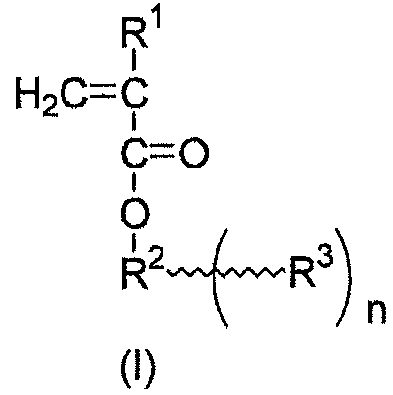
- R 1 represents a hydrogen atom or a methyl group
- R 2 represents a branched hydrocarbon group, a linear hydrocarbon group, a group having a cyclic structure or a single bond
- R 3 represents Represents a group selected from the group consisting of a hydroxyl group, a carboxyl group, an amino group, an amide group, an acetoacetoxy group, an acid anhydride group, a sulfonic acid group, a phosphoric acid group, a thiol group, and a heterocyclic group
- n is 1-6.
- R represents an integer, and when n is 2 or more, R 3 may be the same or different.
- R 2 is a single bond or a linear hydrocarbon group
- R 3 is a heterocyclic ring.
- R 2 and R 3 are bonded by 1 or 2 bonds.
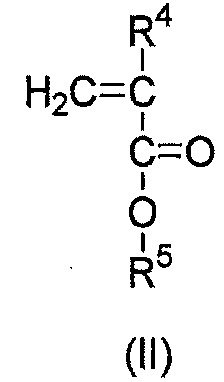
- R 4 represents a hydrogen atom or a methyl group
- R 5 represents a branched alkyl group or a group having a cyclic structure.
- the copolymer (A) is contained in an amount of 1 to 20% by mass
- the solvent (B) is contained in an amount of 20 to 70% by mass
- the inorganic powder (C) is contained in an amount of 100% by mass of the fired paste composition.
- a green sheet comprising the fired paste composition according to any one of [3] to [6].
- a multilayer ceramic capacitor produced using the fired paste composition according to any one of [3] to [6].
- the fired paste composition of the present invention has an appropriate viscosity, and by applying a stress such as stirring at the time of coating, the fluidity becomes good, so that a coating film having excellent printability and a smooth surface can be obtained. Can do. Moreover, the calcination property is also good.
- (meth) acryloyl is used to indicate acryloyl and / or methacryloyl
- (meth) acrylate is used to indicate acrylate and / or methacrylate
- (Meth) acryl is used to indicate both or one of acrylic and methacrylic.
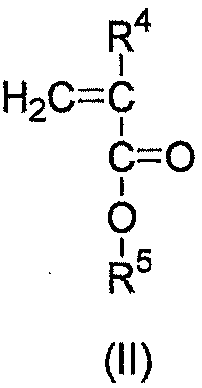
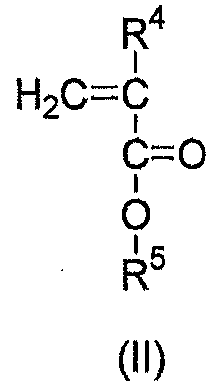
- the fired paste composition of the present invention comprises 10 to 80% by mass of the monomer (a-1) represented by the following general formula (I) and the monomer (a-2) represented by the following general formula (II): ) is 100% by mass of the total monomer mixture (monomer mixture containing 20 to 90 mass%.) by copolymerizing obtained, and a weight average molecular weight of 2.01 ⁇ 10 5 ⁇ 1. It contains a copolymer (A) that is 5 ⁇ 10 6 .
- R 1 represents a hydrogen atom or a methyl group
- R 2 represents a branched hydrocarbon group, a linear hydrocarbon group, a group having a cyclic structure or a single bond
- R 3 represents Represents a group selected from the group consisting of a hydroxyl group, a carboxyl group, an amino group, an amide group, an acetoacetoxy group, an acid anhydride group, a sulfonic acid group, a phosphoric acid group, a thiol group, and a heterocyclic group
- n is 1-6.
- R represents an integer, and when n is 2 or more, R 3 may be the same or different.
- R 2 is a single bond or a linear hydrocarbon group
- R 3 is a heterocyclic ring.
- R 2 and R 3 are bonded by 1 or 2 bonds.
- R 4 represents a hydrogen atom or a methyl group
- R 5 represents a branched alkyl group or a group having a cyclic structure.
- R 1 represents a hydrogen atom or a methyl group
- R 2 represents a branched hydrocarbon group, a linear hydrocarbon group, a group having a cyclic structure or a single bond
- R 3 represents Represents a group selected from the group consisting of a hydroxyl group, a carboxyl group, an amino group, an amide group, an acetoacetoxy group, an acid anhydride group, a sulfonic acid group, a phosphoric acid group, a thiol group, and a heterocyclic group
- n is 1-6.
- R represents an integer, and when n is 2 or more, R 3 may be the same or different.
- R 3 is a heterocyclic ring. a group linked by one or two of the coupling hand R 2 and R 3.
- R ⁇ 1 > is a hydrogen atom or a methyl group.
- R 2 represents a branched hydrocarbon group, a linear hydrocarbon group, a group having a cyclic structure, or a single bond.
- Examples of the branched hydrocarbon group include a branched alkylene group and a group obtained by removing hydrogen from a branched alkylene group so as to be trivalent to hexavalent, preferably trivalent to tetravalent.
- a group obtained by removing hydrogen from a branched alkylene group so as to be trivalent to hexavalent is, for example, in the case of trivalent, the branched alkylene group is divalent as it is. Is a group in which one hydrogen is removed and the position can be substituted with any group.
- Examples of the branched alkylene group include iso-butylene group, sec-butylene group, tert-butylene group, 2-ethylhexylene group, neopentylene group, isooctylene group, 2,2,4-trimethylpentylene and the like.
- the number of carbon atoms of the branched hydrocarbon group is preferably from 4 to 18 carbon atoms, more preferably from 4 to 10 carbon atoms, from the viewpoint of achieving a viscosity suitable for coating film formation.
- linear hydrocarbon group examples include a linear alkylene group and a group obtained by removing hydrogen from a linear alkylene group so as to be trivalent to hexavalent, preferably trivalent to tetravalent.
- linear alkylene groups include methylene, ethylene, propylene, butylene, pentylene, hexylene, heptylene, octylene, decylene, laurylene, and the like.
- the carbon number of the linear hydrocarbon group is preferably 1 to 4 carbon atoms, more preferably 1 or 2 carbon atoms, from the viewpoint of achieving a viscosity suitable for coating film formation.
- R 3 is a heterocyclic group.
- Examples of the group having a cyclic structure include a cyclic hydrocarbon group and a cyclic hydrocarbon group having a chain portion.
- Examples of the cyclic hydrocarbon group include a cyclic alkylene group, a group obtained by removing hydrogen from a cyclic alkylene group so as to be trivalent to hexavalent, preferably trivalent to tetravalent, and an aromatic group.
- cyclic alkylene groups are cyclobutyl, cyclopentyl, cyclohexyl, cycloheptyl, cyclooctyl, tricyclodecyl, bicyclooctyl, tricyclododecyl, isobornyl, adamantyl, tetracyclododecyl, dicyclo And groups obtained by removing one hydrogen from each of a cyclopentanyl group and a dimethylcyclohexyl group.
- Examples of the aromatic group include a group obtained by removing one hydrogen from each of a phenyl group, a naphthyl group, an anthryl group, a phenanthryl group, a tolyl group, a xylyl group, and a mesityl group.
- Examples of the chain portion of the cyclic hydrocarbon group having a chain portion include at least one selected from the group consisting of a carbonyl group, an oxy group, and an alkylene group having 1 to 12 carbon atoms, preferably 1 to 6 carbon atoms. It is done.
- Examples of the cyclic hydrocarbon group of the cyclic hydrocarbon group having a chain portion include the same as described above.
- Examples of the cyclic hydrocarbon group having a chain portion include an ethyleneoxycarbonylcyclohexylene group.
- the number of carbon atoms of the cyclic hydrocarbon group is preferably 4 to 18 carbon atoms, more preferably 4 to 10 carbon atoms, from the viewpoint of obtaining a viscosity suitable for coating film formation.
- R 3 is a heterocyclic group.
- R 2 represents a branched hydrocarbon group, a straight chain hydrocarbon group from the viewpoint of solubility in a solvent among the branched hydrocarbon group, straight chain hydrocarbon group, cyclic group or single bond.
- a group obtained by removing hydrogen from an alkylene group and a single bond are preferable.
- a branched hydrocarbon group having 4 to 10 carbon atoms and cyclic alkylene A cyclic alkylene group having 4 to 12 carbon atoms, a cyclic alkylene group having a chain portion, a group obtained by removing hydrogen from a cyclic alkylene group so as to be trivalent to hexavalent, and a chain portion having a trivalent to 4 Hydrogen from the cyclic alkylene group More preferably have a group, more preferably a branched hydrocarbon group having 4 to 10 carbon atoms.
- R 3 is selected from the group consisting of a hydroxyl group, a carboxyl group, an amino group, an amide group, an acetoacetoxy group, an acid anhydride group, a sulfonic acid group, a phosphoric acid group, a thiol group, and a heterocyclic group. Represents a group.
- the heterocyclic group an oxirane group and an oxolane group are preferable.
- a hydroxyl group, a carboxyl group, an amino group, an acid anhydride group, an oxirane group, and an oxolane group are preferable, and a hydroxyl group, an amino group, an acid anhydride group, an oxirane group, and an oxolane group are more preferable.
- the heterocyclic group includes a condensed ring such as a 3,4-epoxycyclohexane group.
- n represents an integer of 1 to 6, and when n is 2 or more, R 3 may be the same or different. n is preferably an integer of 1 to 3, and more preferably 1 and 2. When R 2 has a valence of 2, n is 1.
- R 2 is considered to play a role as a steric hindrance group except in the case of a single bond and a linear hydrocarbon group
- R 3 is considered to play a role of forming an intermolecular force.
- the heterocyclic group plays both roles. Therefore, when R 3 is a heterocyclic group, R 2 does not need to be a steric hindrance group. Therefore, when R 3 is a heterocyclic group, R 2 is a single bond or a linear hydrocarbon. It may be a group.
- R 2 and R 3 are bonded by one or two bonds. Many of the above exemplified R 3, bonded to R 2 by a bonding hand. However, for example, when R 3 is an acid anhydride group, there are two acid anhydride group ends, and therefore R 2 is bonded to R 2 by two bonds. When the valence of R 2 is 2, the bond is 1.
- the monomer (a-1) is 10 to 80% by mass, preferably 10 to 70% by mass, and more preferably 30 to 60% by mass.
- the ratio of the monomer (a-1) is in the above range, stringing can be suppressed and thixotropic property is good, so that the printability is good and the calcination property is reduced. Absent.
- R 4 represents a hydrogen atom or a methyl group
- R 5 represents a branched alkyl group or a group having a cyclic structure.
- R 4 is a hydrogen atom or a methyl group.
- R 5 is a branched alkyl group or a group having a cyclic structure.
- the monomer (a-2) does not include the monomer (a-1).
- Examples of the branched alkyl group include an iso-butyl group, a sec-butyl group, a tert-butyl group, a 2-ethylhexyl group, a neopentyl group, and an isooctyl group.
- the number of carbon atoms of the branched alkyl group is preferably 4 to 18 carbon atoms, more preferably 4 to 10 carbon atoms, from the viewpoint of achieving a viscosity suitable for coating film formation.
- Examples of the group having a cyclic structure include a cyclic alkyl group, a cyclic alkyl group having a chain portion, an aromatic group, and an aromatic group having a chain portion.
- Cyclic alkyl groups include cyclobutyl, cyclopentyl, cyclohexyl, cycloheptyl, cyclooctyl, tricyclodecyl, bicyclooctyl, tricyclododecyl, isobornyl, adamantyl, tetracyclododecyl, dicyclo
- Examples of the aromatic group include a phenyl group, a naphthyl group, an anthryl group, a phenanthryl group, a tolyl group, a xylyl group, and a mesityl group.
- Examples of the cyclic alkyl group having a chain part and the chain part of an aromatic group having a chain part include alkylene groups having 1 to 12 carbon atoms, preferably 1 to 6 carbon atoms.
- the carbon number of the cyclic alkyl group is preferably 4 to 18 carbon atoms, more preferably 4 to 10 carbon atoms, from the viewpoint of achieving a viscosity suitable for coating film formation.
- the carbon number of the aromatic group is preferably 6 to 18 carbon atoms, more preferably 6 to 10 carbon atoms, from the viewpoint of solubility in a solvent.
- R 5 is preferably a branched alkyl group, a cyclic alkyl group, or a cyclic alkyl group having a chain portion from the viewpoint of solubility in a solvent among the branched alkyl group or the group having a cyclic structure.
- a branched alkyl group having 4 to 10 carbon atoms and a cyclic alkyl group having 4 to 12 carbon atoms in the cyclic alkyl group and a cyclic alkyl group having a chain portion from the viewpoint of setting the viscosity of the composition to a value capable of forming a coating film Group is more preferable, and a branched alkyl group having 4 to 10 carbon atoms is more preferable.
- the molecular weight of R 5 is preferably 30 to 180, more preferably 50 to 160.
- the monomer (a-2) include tert-butyl (meth) acrylate, cyclohexyl (meth) acrylate, isobornyl (meth) acrylate, dicyclopentanyl (meth) acrylate, adamantyl (meth) acrylate, iso -Butyl (meth) acrylate, neopentyl (meth) acrylate, 2-ethylhexyl (meth) acrylate, isooctyl (meth) acrylate and the like. These may be used singly or in combination of two or more.
- tert-butyl (meth) acrylate cyclohexyl (meth) acrylate, from the viewpoints of the viscosity and fireability of the fired paste composition Isobornyl (meth) acrylate, iso-butyl (meth) acrylate, and neopentyl (meth) acrylate are preferred.
- the monomer (a-2) is 20 to 90% by mass, preferably 30 to 90% by mass, and more preferably 40 to 70% by mass.
- the proportion of the monomer (a-2) is in the above range, stringing can be suppressed, baking properties are good, and solvent solubility is good.
- the copolymer (A) of the present invention comprises a monomer mixture containing the monomer (a-3) in addition to the monomer (a-1) and the monomer (a-2). Polymerization may be performed.
- the monomer (a-3) include, for example, methyl (meth) acrylate, ethyl (meth) acrylate, n-butyl (meth) acrylate, lauryl (meth) acrylate, styrene, vinyl compounds , (Meth) acrylic acid, maleic anhydride, 2-methacryloyloxyethyl succinic acid, 2- (meth) acryloyloxyethyl phthalic acid, acetoacetoxy (meth) acrylate, N, N-dimethylaminoethyl (meth) acrylate N, N-diethylaminoethyl (meth) acrylate, (meth) acrylamide, 2- (meth) acryloyloxyethyl acid phosphate, 2- (meth) acrylamide-2-methylpropanesulfonic acid, 2-hydroxyethyl methacrylate, 2 -Hydroxy-n-propyl (me)
- the monomer (a-3) is preferably 0 to 50% by mass, and when used, more preferably 10 to 40% by mass, and still more preferably 10%. ⁇ 30% by mass.
- the proportion of the monomer (a-3) is in the above range, the solubility in the solvent can be adjusted.
- the polymerization method of the copolymer (A) of the present invention is not particularly limited, but it is usually preferable to use solution polymerization.
- Solution polymerization is generally performed by charging a predetermined organic solvent, monomer, and polymerization initiator in a polymerization tank and heating and reacting for several hours with stirring at an appropriate polymerization temperature in an inert gas stream such as nitrogen. Done.
- an inert gas stream such as nitrogen.
- at least a part of the organic solvent, the monomer, the polymerization initiator and / or the chain transfer agent may be sequentially added.
- aromatic carbonization exemplified by benzene, toluene, ethylbenzene, n-propylbenzene, t-butylbenzene, o-xylene, m-xylene, p-xylene, tetralin, decalin, aromatic naphtha, etc.
- Aliphatic or alicyclic hydrocarbons exemplified by hydrogen, n-hexane, n-heptane, n-octane, i-octane, n-decane, dipentene, petroleum spirit, petroleum naphtha, turpentine oil, alkyl acetate (Herein, examples of alkyl include methyl, ethyl, propyl, butyl, pentyl, etc., the same shall apply hereinafter), esters exemplified by methyl benzoate, etc., ethylene glycol or diethylene glycol monoacetate, diacetate, alkyl Ether acetate (eg diethylene glycol monobutyl) Ether acetate), monoalkyl ethers, ethylene glycol derivatives exemplified by dialkyl ether, propylene glycol, dipropylene ethylene glycol, tripropylene glycol monoacetate, diacetate, alkyl ether acetate, mono
- Polymerization initiators include benzoyl peroxide, lauroyl peroxide, caproyl peroxide, di-t-butyl peroxide, di-i-propyl peroxydicarbonate, di-2-ethylhexyl peroxydicarbonate, t-butyl.
- An azo compound exemplified by -2,4-dimethylvaleronitrile and the like can be used alone or in combination.
- the amount of the polymerization initiator used is generally 0.01 to 5 parts by mass, preferably 0.02 to 2 parts by mass per 100 parts by mass of the monomer mixture.
- the polymerization temperature is preferably 40 to 180 ° C. When the polymerization temperature is in the above range, a sufficient reaction rate can be obtained, and depolymerization due to the temperature being too high does not occur.
- the reaction time at the above polymerization temperature is preferably 4 to 16 hours. When the reaction time is within the above range, the reaction can be allowed to proceed completely.
- the weight average molecular weight of the copolymer within the range of the present invention, it is also preferable to add further after the polymerization has progressed to some extent, in addition to adding the polymerization initiator at the initial stage of the polymerization. In that case, it is preferable that the usage-amount of a polymerization initiator exists in the said range in the sum total of all the addition amounts.
- the reaction mixture is cooled to room temperature. Then, the copolymer is precipitated using a nonpolar solvent such as hexane. The precipitated copolymer is filtered off and dried.
- a nonpolar solvent such as hexane
- the copolymer (A) has a weight average molecular weight of 2.01 ⁇ 10 5 to 1.5 ⁇ 10 6 from the viewpoint of ensuring good coatability. 2.1 ⁇ 10 5 to 1.2 ⁇ 10 6 is preferable, and 2.6 ⁇ 10 5 to 1.0 ⁇ 10 6 is more preferable.
- the weight average molecular weight of the copolymer is in the above range, the paste viscosity suitable for coating on the base material can be obtained, but the problem of stringing does not occur, so the coating property is good. is there.
- the method described in Examples described later is used as a method for measuring the molecular weight.
- the copolymer (A) has an SP value of 7 to 10 from the viewpoint of ensuring solubility in a wide range of solvents while having an appropriate viscosity.
- the SP value is more preferably 8 to 10.
- the SP value of the copolymer is an index indicating the polarity of the polymer, and is a measure for confirming the solubility in the solvent used in the fired paste composition.
- the SP value of the polymer and the SP value of the solvent to be described later are calculated from Okitsu's ⁇ F constant (Toshinao Okitsu, “Adhesion”, Vol. 40, No. 8, page 342 (1996)). Can do.
- Substituent R 2 in the structural unit derived from monomer (a-1) (excluding single bond and linear hydrocarbon group), substituent in the structural unit derived from monomer (a-2) Since the substituent R 3 in the structural unit derived from the monomer (a-1) in the case of R 5 and the heterocyclic ring is a bulky group, it is considered to function as a steric hindrance group. These steric hindrance groups make it difficult for (meth) acryloyl groups to approach each other, and it is considered that the interaction is lost.
- the viscosity of the fired paste composition containing the copolymer (A) is too low.
- problems such as difficulty in forming a coating film arise.
- the viscosity of the fired paste composition is lowered during coating. This is because, for example, when the fired paste composition is applied to the substrate by screen printing, the fired paste composition is applied by rubbing with a squeegee on a fine mesh, so the fired paste composition must pass through the mesh cleanly. Because.
- the fired paste composition is required to exhibit an appropriate fluidity (thixotropic property) by applying a stress such as rubbing or stirring during coating while having an appropriate viscosity.
- the substituent R 3 of the monomer (a-1) is introduced to impart thixotropic properties to the fired paste composition.
- substituents R 3 are believed to form an intermolecular force such as hydrogen bonding between polymer chains of the copolymer (A). While this intermolecular force generates an appropriate viscosity in the fired paste composition, it is weaker than a covalent bond, so that it is easily cut by a stress such as rubbing or stirring during coating.
- the calcined paste composition blended with the copolymer (A) of the present invention has an appropriate viscosity, and when subjected to stress by rubbing, stirring, etc., fluidity occurs, and good coatability is obtained.
- the calcining paste composition of the present invention contains the copolymer (A), preferably contains a solvent (B) and an inorganic powder (C), and more preferably contains a dispersant (D). .
- the copolymer (A) is preferably 1 to 20% by weight, more preferably 4% with respect to 100% by weight of the fired paste composition. Contains 10% by mass.
- the compatibility with the solvent (B) is good and an appropriate viscosity can be imparted to the fired paste composition.
- the dispersibility of the inorganic powder (C) and the binding property of the fired paste composition to the substrate are also good.
- Solvent (B) As the solvent (B), any residue can be used as long as no residue remains after baking and the copolymer (A) can be dissolved, but the copolymer (A) and the solvent (B) Is preferably used since the compatibility between the copolymer (A) and the solvent (B) is increased and the stability when the fired paste composition is prepared is increased.
- solvent (B) examples include, for example, terpineol, dihydroterpineol, dihydrotapinyl acetate, butyl carbitol acetate, dipropylene glycol, dipropylene glycol monomethyl ether, butyl carbitol, diethylene glycol alkyl ether acetate (here, as alkyl) Is exemplified by n-butyl, propyl, ethyl, etc.), ethylene glycol alkyl ether acetate, ethylene glycol diacetate, diethylene glycol alkyl ether, ethylene glycol alkyl ether, dipropylene glycol alkyl ether, propylene glycol alkyl ether Acetate, 2,2,4-trimethylpentane-1,3-diol monoisobutyrate, 2,2, - trimethylpent
- solvents can be used alone or in combination of two or more.
- more preferable solvents are terpineol, dihydroterpineol, dihydrotapinyl acetate, and butyl carbitol acetate.
- the boiling point of the solvent (B) is preferably 150 to 300 ° C., more preferably 200 to 290 ° C., and further preferably 220 to 280 ° C.
- the drying speed of the paste after screen printing is not too fast and the plate is not clogged. On the other hand, the drying speed is too slow and the workability is not lowered.
- the fired paste composition of the present invention preferably contains 20 to 70% by weight, more preferably 30 to 60% by weight of the solvent (B) with respect to 100% by weight of the fired paste composition.
- the proportion of the solvent (B) is in the above range, the compatibility with the copolymer (A) is good and a desired viscosity can be expressed as a paste.
- inorganic powder (C) examples include metal powders, metal oxide powders, glass powders, pigment powders, phosphor powders, ceramic powders, and powders imparted with photosensitivity thereto. These inorganic powders are selected according to the use, but can be used alone or in combination of two or more.
- the metal powder and the metal oxide powder are preferably used as a conductive powder, and the glass powder and the ceramic powder are preferably used as a dielectric powder.
- metal powder examples include powder made of nickel, palladium, platinum, gold, silver, copper, iron, aluminum, tungsten, alloys thereof, and the like.
- metal oxide powder examples include ITO, antimony-doped tin oxide (ATO), and fluorine-doped tin oxide (FTO).
- glass powder examples include bismuth oxide glass, silicate glass, lead glass, zinc glass, boron glass, and glass powders of various silicon oxides.
- the ceramic powder examples include alumina, zirconia, titanium oxide, barium titanate, alumina nitride, silicon nitride, and boron nitride.
- the fired paste composition of the present invention preferably contains 20 to 70% by weight, more preferably 35 to 60% by weight of the inorganic powder (C) with respect to 100% by weight of the fired paste composition.
- each performance such as conductivity of the fired product obtained from the fired paste composition is good, and the dispersibility in the fired paste composition is also good.
- Dispersant (D) examples include a cationic dispersant, an anionic dispersant, a nonionic dispersant, an amphoteric surfactant, and a polymer dispersant. These dispersants can be used alone or in admixture of two or more.
- cationic dispersants examples include polyamine dispersants.
- anionic dispersant examples include carboxylic acid, phosphate ester, sulfate ester, and sulfonate ester dispersants.
- nonionic dispersants examples include polyethylene glycol dispersants.
- amphoteric surfactants include surfactants having a carboxylic acid and a quaternary ammonium salt.
- polymer dispersant examples include polyvinyl pyrrolidone and polyvinyl alcohol.
- the fired paste composition of the present invention is preferably 0.01 to 5% by weight, more preferably 0.1 to 3%, based on 100% by weight of the fired paste composition. Including mass%.
- the ratio of the dispersing agent (D) is in the above range, the dispersibility of the inorganic powder (C) in the fired paste composition becomes better.
- the fired paste composition of the present invention contains conventionally known plasticizers, wetting agents, antifoaming agents and the like as long as the object of the present invention is not impaired. May be.
- baking paste composition of this invention has viscosity as mentioned later, each component mentioned above is divided into 1 step or several steps, combining a mixer, a roll, etc. individually or suitably. And kneading. Further, it may be heated at 30 to 150 ° C. as necessary.
- the calcining paste composition of the present invention has a viscosity at 25 ° C. of preferably 20 to 400 Pa ⁇ s, more preferably 100 to 300 Pa ⁇ s. When the viscosity is in the above range, the coating property is excellent as well as the coating property.
- the measuring method of a viscosity is based on the method as described in the below-mentioned Example. The viscosity is a value measured after kneading the fired paste composition until the composition becomes uniform.
- a composition comprising copolymer (A), dihydroterpineol as component (B), and nickel filler having an average particle size of 200 nm as component (C)
- a paste composition obtained by kneading with a rotating / revolving mixer and then kneading with a three-roll mixer preferably has a viscosity at 25 ° C. in the range of 20 to 400 Pa ⁇ s, more preferably 100 Within the range of up to 300 Pa ⁇ s.
- Examples of the base material in the coating process include members such as metals, ceramics, green sheets, plastics, and semiconductors.
- Application methods in the application process include screen printing, die coating printing, doctor blade printing, roll coating printing, offset printing, gravure printing, flexographic printing, ink jet printing, dispensing printing, etc. There is a casting method, and screen printing is preferred.
- the solvent (B) is dried.
- the firing step is usually performed at 500 to 1,000 ° C. for 1 to 5 hours under an inert gas stream such as nitrogen gas in order to thermally decompose the copolymer (A).
- a fired body is obtained by the above production method.
- the fired paste composition of the present invention include conductive paste, dielectric paste, and phosphor paste. These are used not only in the form of a paste but also in the form of a green sheet.
- the green sheet means a thin plate-like unfired body obtained by applying a paste composition to a substrate.
- Conductive paste is used for manufacturing MLCC and low temperature co-fired ceramics (LTCC) as a material for forming electrodes such as internal electrodes and terminal electrodes. In addition, it is used for manufacturing touch panels, PDPs, LCDs and LEDs as a material for forming electrodes. In addition, it is used as a material for forming a circuit in the manufacture of a solar cell panel driving unit.
- MLCC and low temperature co-fired ceramics LTCC
- LTCC low temperature co-fired ceramics
- the dielectric paste is used for manufacturing MLCC, LTCC, and PDP as a material for forming a dielectric layer, and is also used for manufacturing a PDP as a material for forming a partition material, and a field emission display ( FED), used for IC packages.
- FED field emission display
- the phosphor paste is used for manufacturing PDP, FED, and EL elements as a material for forming the phosphor.
- the fired paste composition of the present invention has good thixotropic properties, for example, screen printing, die coating printing, doctor blade printing, roll coating printing, offset printing, gravure printing, flexographic printing, ink jet printing, and dispense printing.
- it can be used for application by screen printing, and can be suitably used for screen printing, and pattern formation can be suitably performed.
- the fired paste composition of the present invention is used as a material for forming an electrode such as an internal electrode that requires pattern formation, among the applications exemplified above. Further, it is printed on a green sheet containing the fired paste composition of the present invention or a green sheet containing a paste composition other than the fired paste composition of the present invention, and used as a laminate of the fired paste composition and the green sheet. It is also preferred that
- the MLCC can be produced by using, for example, the following method using the fired paste composition of the present invention.
- the fired paste composition of the present invention using ceramic powder as the inorganic powder (C) is applied to a substrate by, for example, a casting method and formed into a sheet shape to obtain a green sheet.
- the fired paste composition of the present invention using the conductive powder as the inorganic powder (C) is printed on the green sheet by, for example, screen printing to form an internal electrode pattern, which is then dried. A laminate with the sheet is obtained.
- This laminated body is fired in an inert gas atmosphere such as N 2 to obtain a ceramic laminated body (laminated ceramic element) as a fired body.
- MLCC is obtained by forming external electrodes on both end faces of the obtained ceramic laminate.
- (co) polymer refers to any of the copolymers 1 to 9 and ethylcellulose produced in Production Examples 1 to 9, and “calcined paste composition” One of the fired paste compositions produced in Examples 1 to 6 and Comparative Examples 1 to 4 is shown.
- Device GPC-8220 (manufactured by Tosoh Corporation) Column: G7000HXL / 7.8mmID ⁇ 1 + GMHXL / 7.8mmID ⁇ 2 + G2500HXL / 7.8mmID ⁇ 1 Medium: Tetrahydrofuran Flow rate: 1.0 mL / min Concentration: 1.5 mg / mL Injection volume: 300 ⁇ L Column temperature: 40 ° C ⁇ SP value> The SP value was calculated from Okitsu's ⁇ F constant (Toshinao Okitsu, “Adhesion”, Vol. 40, No. 8, page 342 (1996)).
- ⁇ Printability> The surface roughness (Ra) of the baked paste composition applied to a glass plate with a screen of 640 mesh, a gap of 0.1 mm, a speed of 30 cm / sec, and dried was measured with a surface roughness meter, and the value of the surface roughness was determined. Printability was evaluated according to the following criteria as an index.
- a copolymer 2 was prepared in the same manner as in Production Example 1 except that the monomer mixture was changed to 30 parts by mass of tetrahydrofurfuryl methacrylate and 70 parts by mass of tert-butyl methacrylate.
- the weight average molecular weight of the obtained copolymer 2 was 500,000, and the calculated SP value was 8.4.
- Copolymer 3 was prepared in the same manner as in Production Example 1, except that the monomer mixture was changed to 30 parts by mass of 2-hydroxyisobutyl methacrylate and 70 parts by mass of iso-butyl methacrylate.
- the weight average molecular weight of the obtained copolymer 3 was 800,000, and the SP value was 8.9 as a calculated value.
- Copolymer 4 was prepared in the same manner as in Production Example 1, except that the monomer mixture was changed to 30 parts by mass of 2,2-dimethyl-3-hydroxypropyl methacrylate and 70 parts by mass of iso-butyl methacrylate.
- the resulting copolymer 4 had a weight average molecular weight of 700,000 and a calculated SP value of 8.8.
- Copolymer 5 was prepared in the same manner as in Production Example 1, except that the monomer mixture was changed to 30 parts by mass of 2-methacryloyloxyethyl hexahydrophthalic acid and 70 parts by mass of isobornyl methacrylate.
- the obtained copolymer 5 had a weight average molecular weight of 600,000 and a calculated SP value of 9.1.
- a copolymer 7 was prepared in the same manner as in Production Example 1, except that the monomer mixture was changed to 5 parts by mass of 2,2-dimethyl-3-hydroxypropyl methacrylate and 95 parts by mass of iso-butyl methacrylate.
- the resulting copolymer 7 had a weight average molecular weight of 800,000 and a calculated SP value of 8.7.
- a copolymer 9 was prepared in the same manner as in Production Example 1 except that the monomer mixture was changed to 30 parts by mass of 2-hydroxyisobutyl methacrylate and 70 parts by mass of methyl methacrylate.
- the weight average molecular weight of the obtained copolymer 9 was 500,000, and the SP value was 10.8 as a calculated value.
- Example 1 Composition (composition) containing 4.5% by mass of copolymer 1, 56% by mass of Ni filler (average particle size 200 nm) and 39.5% by mass of dihydroterpineol (SP value: 8.8, boiling point: 247 ° C.) The entire product was kneaded with a rotation / revolution mixer (trade name “Awatori Nertaro”, manufactured by Shinky Corporation), and then kneaded with three rolls to obtain a fired paste composition 1 . The measurement results of the physical properties of the fired paste composition 1 are shown in Table 2.
- Example 2 A baked paste composition 2 was obtained in the same manner as in Example 1 except that the copolymer 2 was used instead of the copolymer 1. Table 2 shows the measurement results of the physical properties of the fired paste composition 2.
- Example 3 A fired paste composition 3 was obtained in the same manner as in Example 1 except that the copolymer 3 was used instead of the copolymer 1. The measurement results of the physical properties of the fired paste composition 3 are shown in Table 2.
- Example 4 A fired paste composition 4 was obtained in the same manner as in Example 1 except that the copolymer 4 was used instead of the copolymer 1. The measurement results of the physical properties of the fired paste composition 4 are shown in Table 2.
- Example 5 A fired paste composition 5 was obtained in the same manner as in Example 1 except that the copolymer 5 was used instead of the copolymer 1. Table 2 shows the measurement results of the physical properties of the fired paste composition 5.
- Example 6 A fired paste composition 6 was obtained in the same manner as in Example 1 except that the copolymer 6 was used instead of the copolymer 1. The measurement results of the physical properties of the fired paste composition 6 are shown in Table 2.
- Example 1 A fired paste composition was used in the same manner as in Example 1 except that ethyl cellulose (manufactured by Nisshinsei Co., Ltd., product name: etosel grade 100; weight average molecular weight 140,000, SP value 8.8) was used instead of copolymer 1. Product 7 was obtained. The measurement results of the physical properties of the fired paste composition 7 are shown in Table 1.
- a baked paste composition 8 was obtained in the same manner as in Example 1 except that the copolymer 7 was used instead of the copolymer 1.
- the measurement results of the physical properties of the fired paste composition 8 are shown in Table 2.
- a fired paste composition 9 was obtained in the same manner as in Example 1 except that the copolymer 8 was used instead of the copolymer 1.
- Table 2 shows the measurement results of the physical properties of the fired paste composition 9.
- a baked paste composition 10 was obtained in the same manner as in Example 1 except that the copolymer 9 was used instead of the copolymer 1.
- the measurement results of the physical properties of the fired paste composition 10 are shown in Table 2.
- 2HBMA 2-hydroxyisobutyl methacrylate
- HO-HH 2-methacryloyloxyethyl hexahydrophthalic acid
- FA-712HM 4-methacryloyloxy-2,2,6,6-tetramethylpiperidine
- DMHPMA 2,2-dimethyl-3 -Hydroxypropyl methacrylate
- THFMA Tetrahydrofurfuryl methacrylate
- EPCMA Methacrylic acid [(3,4-epoxycyclohexane) -1-yl] methyl
- CHMA Cyclohexyl methacrylate
- tBMA Tert-butyl methacrylate
- iBMA Iso-butyl methacrylate
- IBXMA Isobornyl Methacrylate MMA: Methyl methacrylate
- the compounds used in the examples are represented as follows according to formula (I).
- the fired paste composition of the present invention has an appropriate viscosity, good printability and no stringing, so that the coated surface is smooth, and the fireability is also good. Furthermore, it turns out that a composition is also stable. Specifically, since screen printing is performed by rubbing the fired paste composition on a fine mesh with a squeegee, stress is applied to the fired paste composition during printing, and the fired paste compositions of Examples 1 to 6 are used. Since the product has good thixotropic properties, it is considered that the initial viscosity is moderate, but the viscosity is lowered by applying the stress at the time of printing described above, and it passes through the mesh neatly and is printed with a smooth surface.
- Example 4 and Comparative Example 2 are compared, if the proportion of the monomer (a-1) in the monomer mixture is less than the range of the present invention, the printability is not good and the viscosity is evaluated. Can also be seen. This is considered to be because thixotropic properties are not satisfactorily exhibited because the ratio of the monomer having R 3 that is considered to form intermolecular force is small.
- a comparison of Examples 1 to 6 and Comparative Example 4 shows that the printability and dispersion stability are not good even when a monomer mixture containing no monomer (a-2) is copolymerized. If the monomer (a-2) is not included, the ratio of the substituent functioning as a steric hindrance group is small, which causes a problem of stringing and increases the polarity of the copolymer. This is thought to be due to a decrease in the compatibility of the solvent.
Landscapes
- Chemical & Material Sciences (AREA)
- Engineering & Computer Science (AREA)
- Power Engineering (AREA)
- Organic Chemistry (AREA)
- Health & Medical Sciences (AREA)
- Chemical Kinetics & Catalysis (AREA)
- Medicinal Chemistry (AREA)
- Polymers & Plastics (AREA)
- Manufacturing & Machinery (AREA)
- Microelectronics & Electronic Packaging (AREA)
- Ceramic Engineering (AREA)
- Inorganic Chemistry (AREA)
- Physics & Mathematics (AREA)
- Dispersion Chemistry (AREA)
- Spectroscopy & Molecular Physics (AREA)
- Life Sciences & Earth Sciences (AREA)
- Materials Engineering (AREA)
- Wood Science & Technology (AREA)
- Compositions Of Macromolecular Compounds (AREA)
- Conductive Materials (AREA)
- Addition Polymer Or Copolymer, Post-Treatments, Or Chemical Modifications (AREA)
- Ceramic Capacitors (AREA)
- Fixed Capacitors And Capacitor Manufacturing Machines (AREA)
- Paints Or Removers (AREA)
Abstract
Description
[1]下記一般式(I)で表わされる単量体(a-1)を10~80質量%と、下記一般式(II)で表わされる単量体(a-2)を20~90質量%とを含む単量体混合物(単量体混合物全体を100質量%とする。)を共重合させて得られ、かつ重量平均分子量が2.01×10⁵~1.5×10⁶である共重合体(A)を含むことを特徴とする焼成ペースト組成物。

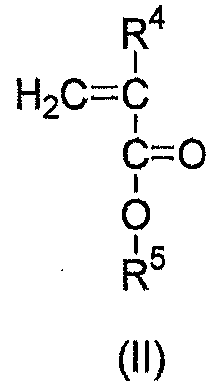
[2]前記共重合体(A)のSP値が7~10であることを特徴とする[1]に記載の焼成ペースト組成物。
[3]前記共重合体(A)と、
溶剤(B)と、
無機粉末(C)とを含むことを特徴とする[1]または[2]に記載の焼成ペースト組成物。
[4]前記共重合体(A)と前記溶剤(B)とが下記式(III)の関係を満たすことを特徴とする[3]に記載の焼成ペースト組成物。
|(共重合体(A)のSP値)-(溶剤(B)のSP値)|<2・・・(III)
[5]さらに分散剤(D)を含むことを特徴とする[3]または[4]に記載の焼成ペースト組成物。
[6]焼成ペースト組成物100質量%に対して、前記共重合体(A)を1~20質量%含み、前記溶剤(B)を20~70質量%含み、前記無機粉末(C)を20~70質量%含み、前記分散剤(D)を0.01~5質量%含むことを特徴とする[5]に記載の焼成ペースト組成物。
[7]スクリーン印刷用であることを特徴とする[1]~[6]のいずれかに記載の焼成ペースト組成物。
[8][3]~[6]のいずれかに記載の焼成ペースト組成物を含むグリーンシート。
[9][3]~[6]のいずれかに記載の焼成ペースト組成物とグリーンシートとの積層物。
[10][3]~[6]のいずれかに記載の焼成ペースト組成物を用いて製造された積層セラミックコンデンサー。
[11][1]~[6]のいずれかに記載の焼成ペースト組成物を基材に塗布する工程と、
塗布された前記焼成ペースト組成物を乾燥させる工程と、
乾燥させた前記焼成ペースト組成物と基材との積層物を焼成する工程とを含む、焼成体の製造方法。
[12][11]に記載の焼成体の製造方法によって得られる焼成体。
1.共重合体(A)
(1)単量体(a-1)
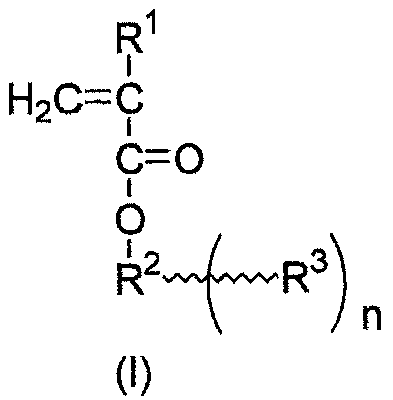
一般式(I)中、R1は水素原子またはメチル基である。
一般式(II)中、R4は水素原子またはメチル基である。
本発明の本発明の共重合体(A)は、上記単量体(a-1)および単量体(a-2)以外に単量体(a-3)を含む単量体混合物を共重合してもよい。
本発明の共重合体(A)の重合方法は、特に制限されるものではないが、通常は溶液重合を用いることが好ましい。溶液重合は、一般に、重合槽内に所定の有機溶媒、単量体、重合開始剤を仕込み、窒素等の不活性ガス気流中、適当な重合温度で、撹拌しながら数時間加熱反応させることにより行われる。この場合、有機溶媒、単量体、重合開始剤および/または連鎖移動剤の少なくとも一部を逐次添加してもよい。
前記共重合体(A)は、良好な塗工性を確保する観点から、重量平均分子量が2.01×10⁵~1.5×10⁶であり、2.1×10⁵~1.2×10⁶であることが好ましく、2.6×10⁵~1.0×10⁶であることがより好ましい。前記共重合体の重量平均分子量が上記範囲にあると、基材への塗工に適したペースト粘度とすることができる一方、糸曳きの問題も生じることがないので、塗工性が良好である。なお、本発明において、分子量を測定する方法は、後述する実施例に記載の方法を用いる。
前記共重合体(A)は、適度な粘性を有しつつ、幅広い溶剤への溶解性を担保する観点から、SP値が7~10であることが好ましく、SP値が8~10であることがより好ましい。前記共重合体のSP値は、重合体の極性を示す指標であり、焼成ペースト組成物において使用される溶剤への溶解性を確認するための目安である。本発明において、前記重合体のSP値および後述する溶剤のSP値は、OkitsuのΔFの定数(沖津俊直著、「接着」、第40巻8号、342頁(1996年))より算出することができる。
また、(メタ)アクリル系単量体の重合においては、反応性が100%であるため、単量体混合物中の各単量体の割合が、得られる共重合体中の各単量体由来の構成単位の割合と等しいと考えられる。
前記共重合体(A)における各単量体に由来する構成単位は以下のような相互関係により特性を発揮しているものと考えられる。
2.焼成ペースト組成物
本発明の焼成ペースト組成物は、上記共重合体(A)を含み、好ましくは溶剤(B)および無機粉末(C)を含み、さらに分散剤(D)を含むことがより好ましい。
本発明の焼成ペースト組成物は、焼成ペースト組成物100質量%に対して、共重合体(A)を好ましくは1~20質量%、より好ましくは4~10質量%含む。
溶剤(B)としては、焼成後に残渣が残らず、共重合体(A)を溶解することができる溶剤であれば制限なく用いることができるが、共重合体(A)と溶剤(B)とが下記式(III)の関係を満たす溶剤を用いると、共重合体(A)と溶剤(B)との相溶性が高まり、焼成ペースト組成物を作成した際の安定性が増すため好ましい。
溶剤(B)の例としては、例えば、ターピネオール、ジヒドロターピネオール、ジヒドロタピニルアセテート、ブチルカルビトールアセテート、ジプロピレングリコール、ジプロピレングリコールモノメチルエーテル、ブチルカルビトール、ジエチレングリコールアルキルエーテルアセテート(ここで、アルキルとしては、n-ブチル、プロピル、エチルなどが例示される。以下同じ。)、エチレングリコールアルキルエーテルアセテート、エチレングリコールジアセテート、ジエチレングリコールアルキルエーテル、エチレングリコールアルキルエーテル、ジプロピレングリコールアルキルエーテル、プロピレングリコールアルキルエーテルアセテート、2,2,4-トリメチルペンタン-1,3-ジオールモノイソブチレート、2,2,4-トリメチルペンタン-1,3-ジオールジイソブチレート、2,2,4-トリメチルペンタン-1,3-ジオールジイソブチレート等の有機溶剤が挙げられる。これらの溶剤はそれぞれ単独で、または、2種以上混合して用いることができる。溶剤の沸点、レベリング性の観点から、より好ましい溶剤は、ターピネオール、ジヒドロターピネオール、ジヒドロタピニルアセテート、ブチルカルビトールアセテートである。
無機粉末(C)としては、例えば、金属粉末、金属酸化物粉末、ガラス粉末、顔料粉末、蛍光体粉末、セラミック粉末、およびこれらに感光性を付与した粉末等が挙げられる。これらの無機粉末は用途に応じて選択されるが、それぞれ単独で、または、2種以上混合して用いることができる。金属粉末および金属酸化物粉末は、導電性粉末として用いられることが好ましく、ガラス粉末およびセラミック粉末は、誘電体粉末として用いられることが好ましい。
分散剤(D)としては、例えば、カチオン系分散剤、アニオン系分散剤、ノニオン系分散剤、両性界面活性剤、高分子系分散剤が挙げられる。これらの分散剤はそれぞれ単独で、または、2種以上混合して用いることができる。
本発明の焼成ペースト組成物には、上述した成分のほかに、本発明の目的を損なわない範囲で従来知られている可塑剤、湿潤剤、消泡剤等を含有してもよい。
本発明の焼成ペースト組成物は、後述のとおり粘性を有するため、上述した各成分を、ミキサー、ロール等を単独または適宜組み合わせて1段階または数段階に分けて混練することによって製造されることが好ましい。また、必要に応じて、30~150℃で加熱してもよい。
本発明の焼成ペースト組成物の25℃における粘度は、好ましくは20~400Pa・s、より好ましくは100~300Pa・sである。粘度が上記範囲にあると、塗工性に優れるとともに塗膜形成性も優れる。粘度の測定方法は、後述の実施例に記載の方法による。上記粘度は、焼成ペースト組成物を組成物が均一な状態になるまで混練してから測定した値である。
前記焼成ペースト組成物を用いた焼成体の製造方法は、
前記焼成ペースト組成物を基材に塗布する工程(以下「塗布工程」ともいう。)と、
塗布された前記焼成ペースト組成物を乾燥させる工程(以下「乾燥工程」ともいう。)と、
乾燥させた前記焼成ペースト組成物と基材との積層物を焼成する工程(以下「焼成工程」ともいう。)とを含む。
本発明の焼成ペースト組成物の具体的な用途としては、導電性ペースト、誘電体ペースト、蛍光体ペーストが挙げられる。これらは、ペーストの形態で使用される他、グリーンシートの形態としても使用される。ここで、グリーンシートとは、ペースト組成物を基材に塗布して得られた薄板状の未焼成体を意味する。
重量平均分子量は、ゲルパーミッションクロマトグラフィーによる分析を行い、ポリスチレン換算により算出した。
装置:GPC-8220(東ソー社製)
カラム:G7000HXL/7.8mmID×1本 + GMHXL/7.8mmID×2本 + G2500HXL/7.8mmID×1本
媒体:テトラヒドロフラン
流速:1.0mL/min
濃度:1.5mg/mL
注入量:300μL
カラム温度:40℃
<SP値>
SP値は、OkitsuのΔFの定数(沖津俊直著、「接着」、第40巻8号、342頁(1996年))より算出した。
焼成ペースト組成物をガラス板に640メッシュ、ギャップ0.1mm、速度30cm/秒でスクリーン塗工、乾燥したものの表面粗さ(Ra)を表面粗さ計で測定し、該表面粗さの値を指標として以下の基準にしたがって印刷性を評価した。
Raが0.15を超えかつ0.2以下である場合:BB
Raが0.2を超えかつ0.25以下である場合:CC
Raが0.25より大きい場合:DD
<粘度>
焼成ペースト組成物をE型粘度計によって25℃にて粘度の測定を行ない、以下の基準で評価した。
粘度が20Pa・s以上100Pa・s未満である場合:BB
粘度が5Pa・s以上20Pa・s未満である場合:CC
粘度が5Pa・s未満である場合:DD
<相溶安定性>
調製された焼成ペースト組成物が相分離するか否かを目視確認することにより以下の基準で評価した。
ペースト組成物が24時間超え72時間未満で分離した場合:BB
ペースト組成物が24時間以内で分離した場合:CC
<焼成性>
(共)重合体を窒素雰囲気中700℃で1時間の焼成(TG-DTA)を行った場合の残炭の有無を以下の基準にしたがって目視にて確認して、(共)重合体の焼成性を以下の基準で評価した。
残炭が微量有る場合:BB
残炭が無視できない量有る場合:CC
[製造例1]
攪拌装置、窒素ガス導入管、温度計および還流冷却管を備えたフラスコに、酢酸エチル30質量部、4-メタクリロイルオキシ-2,2,6,6-テトラメチルピペリジン30質量部、およびtert-ブチルメタクリレート70質量部からなる単量体混合物計100質量部を仕込み、フラスコ内に窒素ガスを導入しながら30分攪拌して窒素置換を行った後、フラスコの内容物を80℃まで昇温した。次いで、フラスコ内の内容物を80℃に維持しながら、アゾビスイソブチロニトリル0.02質量部を1時間おきに計5回添加した。80℃で8時間反応させた後、アゾビスイソブチロニトリル1質量部と酢酸エチル200質量部を4時間かけて滴下し、さらに80℃で4時間反応させた後、室温まで冷却した。得られた共重合体溶液を、n-ヘキサン2000質量部中へ30分かけて滴下を行い、共重合体析出物を生成させた。共重合体析出物については、200メッシュ金網で濾別し、105℃で8時間乾燥することで、共重合体1を調製した。得られた共重合体1の重量平均分子量は80万、SP値は計算値で8.3であった。
単量体混合物を、テトラヒドロフルフリルメタクリレート30質量部、およびtert-ブチルメタクリレート70質量部とした以外は、製造例1と同様にして共重合体2を調製した。得られた共重合体2の重量平均分子量は50万、SP値は計算値で8.4であった。
単量体混合物を、2-ヒドロキシイソブチルメタクリレート30質量部、およびiso-ブチルメタクリレート70質量部とした以外は、製造例1と同様にして共重合体3を調製した。得られた共重合体3の重量平均分子量は80万、SP値は計算値で8.9であった。
単量体混合物を、2,2-ジメチル-3-ヒドロキシプロピルメタクリレート30質量部、およびiso-ブチルメタクリレート70質量部とした以外は、製造例1と同様にして共重合体4を調製した。得られた共重合体4の重量平均分子量は70万、SP値は計算値で8.8であった。
単量体混合物を、2-メタクリロイロキシエチルヘキサヒドロフタル酸30質量部、およびイソボルニルメタクリレート70質量部とした以外は、製造例1と同様にして共重合体5を調製した。得られた共重合体5の重量平均分子量は60万、SP値は計算値で9.1であった。
単量体混合物を、メタクリル酸[(3,4-エポキシシクロヘキサン)-1-イル]メチル30質量部、およびiso-ブチルメタクリレート70質量部とした以外は、製造例1と同様にして共重合体6を調製した。得られた共重合体6の重量平均分子量は40万、SP値は計算値で8.8であった。
単量体混合物を、2,2-ジメチル-3-ヒドロキシプロピルメタクリレート5質量部、およびiso-ブチルメタクリレート95質量部とした以外は、製造例1と同様にして共重合体7を調製した。得られた共重合体7の重量平均分子量は80万、SP値は計算値で8.7であった。
攪拌装置、窒素ガス導入管、温度計および還流冷却管を備えたフラスコに、メチルエチルケトン100質量部を仕込み、フラスコ内に窒素ガスを導入しながら30分攪拌して窒素置換を行った後、フラスコの内容物を80℃まで昇温した。次いで、フラスコ内の内容物を80℃に維持しながら、2-ヒドロキシイソブチルメタクリレート30質量部、およびiso-ブチルメタクリレート70質量部からなる単量体混合物計100質量部を2時間かけて滴下し、滴下開始と同時にアゾビスイソブチロニトリル0.4質量部を1時間おきに計5回添加した。滴下開始から80℃で8時間反応させ、その後、室温まで冷却した。得られた共重合体溶液を、n-ヘキサン2000質量部中へ30分かけて滴下を行い、共重合体析出物を生成させた。共重合体析出物については、200メッシュ金網で濾別し、105℃で8時間乾燥することで、共重合体8を調製した。得られた共重合体8の重量平均分子量は15万、SP値は計算値で8.9であった。
単量体混合物を、2-ヒドロキシイソブチルメタクリレート30質量部、およびメチルメタクリレート70質量部とした以外は、製造例1と同様にして共重合体9を調製した。得られた共重合体9の重量平均分子量は50万、SP値は計算値で10.8であった。
共重合体1を4.5質量%、Niフィラー(平均粒径200nm)を56質量%およびジヒドロターピネオール(SP値:8.8、沸点:247℃)を39.5質量%含む組成物(組成物全体を100質量%とする)を自転・公転ミキサー(商品名「あわとり練太郎」、シンキー社製)で混練した後、さらに3本ロールで混練して、焼成ペースト組成物1を得た。焼成ペースト組成物1の各物性の測定結果を表2に示す。
共重合体1の代わりに共重合体2を用いた以外は、実施例1と同様にして、焼成ペースト組成物2を得た。焼成ペースト組成物2の各物性の測定結果を表2に示す。
共重合体1の代わりに共重合体3を用いた以外は、実施例1と同様にして、焼成ペースト組成物3を得た。焼成ペースト組成物3の各物性の測定結果を表2に示す。
共重合体1の代わりに共重合体4を用いた以外は、実施例1と同様にして、焼成ペースト組成物4を得た。焼成ペースト組成物4の各物性の測定結果を表2に示す。
共重合体1の代わりに共重合体5を用いた以外は、実施例1と同様にして、焼成ペースト組成物5を得た。焼成ペースト組成物5の各物性の測定結果を表2に示す。
共重合体1の代わりに共重合体6を用いた以外は、実施例1と同様にして、焼成ペースト組成物6を得た。焼成ペースト組成物6の各物性の測定結果を表2に示す。
共重合体1の代わりにエチルセルロース(日進化成社製、品名:エトセル グレード100;重量平均分子量14万、SP値8.8)を用いた以外は、実施例1と同様にして、焼成ペースト組成物7を得た。焼成ペースト組成物7の各物性の測定結果を表1に示す。
共重合体1の代わりに共重合体7を用いた以外は、実施例1と同様にして、焼成ペースト組成物8を得た。焼成ペースト組成物8の各物性の測定結果を表2に示す。
共重合体1の代わりに共重合体8を用いた以外は、実施例1と同様にして、焼成ペースト組成物9を得た。焼成ペースト組成物9の各物性の測定結果を表2に示す。
共重合体1の代わりに共重合体9を用いた以外は、実施例1と同様にして、焼成ペースト組成物10を得た。焼成ペースト組成物10の各物性の測定結果を表2に示す。


HO-HH:2-メタクリロイロキシエチルヘキサヒドロフタル酸
FA-712HM:4-メタクリロイルオキシ-2,2,6,6-テトラメチルピペリジン
DMHPMA:2,2-ジメチル-3-ヒドロキシプロピルメタクリレート
THFMA:テトラヒドロフルフリルメタクリレート
EPCMA:メタクリル酸[(3,4-エポキシシクロヘキサン)-1-イル]メチル
CHMA:シクロヘキシルメタクリレート
tBMA:tert-ブチルメタクリレート
iBMA:iso-ブチルメタクリレート
IBXMA:イソボルニルメタクリレート
MMA:メタクリル酸メチル
実施例で用いた化合物を、式(I)に即して表すと以下の通りである。

Claims (12)
- 下記一般式(I)で表わされる単量体(a-1)を10~80質量%と、下記一般式(II)で表わされる単量体(a-2)を20~90質量%とを含む単量体混合物(単量体混合物全体を100質量%とする。)を共重合させて得られ、かつ重量平均分子量が2.01×10⁵~1.5×10⁶である共重合体(A)を含むことを特徴とする焼成ペースト組成物。

- 前記共重合体(A)のSP値が7~10であることを特徴とする請求項1に記載の焼成ペースト組成物。
- 前記共重合体(A)と、
溶剤(B)と、
無機粉末(C)とを含むことを特徴とする請求項1または2に記載の焼成ペースト組成物。 - 前記共重合体(A)と前記溶剤(B)とが下記式(III)の関係を満たすことを特徴とする請求項3に記載の焼成ペースト組成物。
|(共重合体(A)のSP値)-(溶剤(B)のSP値)|<2・・・(III) - さらに分散剤(D)を含むことを特徴とする請求項3または4に記載の焼成ペースト組成物。
- 焼成ペースト組成物100質量%に対して、前記共重合体(A)を1~20質量%含み、前記溶剤(B)を20~70質量%含み、前記無機粉末(C)を20~70質量%含み、前記分散剤(D)を0.01~5質量%含むことを特徴とする請求項5に記載の焼成ペースト組成物。
- スクリーン印刷用であることを特徴とする請求項1~6のいずれか1項に記載の焼成ペースト組成物。
- 請求項3~6のいずれか1項に記載の焼成ペースト組成物を含むグリーンシート。
- 請求項3~6のいずれか1項に記載の焼成ペースト組成物とグリーンシートとの積層物。
- 請求項3~6のいずれか1項に記載の焼成ペースト組成物を用いて製造された積層セラミックコンデンサー。
- 請求項1~6のいずれか1項に記載の焼成ペースト組成物を基材に塗布する工程と、
塗布された前記焼成ペースト組成物を乾燥させる工程と、
乾燥させた前記焼成ペースト組成物と基材との積層物を焼成する工程とを含む、焼成体の製造方法。 - 請求項11に記載の焼成体の製造方法によって得られる焼成体。
Priority Applications (4)
| Application Number | Priority Date | Filing Date | Title |
|---|---|---|---|
| CN201580028480.5A CN106414598B (zh) | 2014-05-30 | 2015-05-11 | 烧成糊料组合物及其用途 |
| KR1020167027937A KR102006367B1 (ko) | 2014-05-30 | 2015-05-11 | 소성 페이스트 조성물 및 그 용도 |
| US15/314,665 US20170198115A1 (en) | 2014-05-30 | 2015-05-11 | Calcining Paste Composition and Uses Thereof |
| JP2016523404A JP6473447B2 (ja) | 2014-05-30 | 2015-05-11 | 焼成ペースト組成物およびその用途 |
Applications Claiming Priority (2)
| Application Number | Priority Date | Filing Date | Title |
|---|---|---|---|
| JP2014113186 | 2014-05-30 | ||
| JP2014-113186 | 2014-05-30 |
Publications (1)
| Publication Number | Publication Date |
|---|---|
| WO2015182353A1 true WO2015182353A1 (ja) | 2015-12-03 |
Family
ID=54698693
Family Applications (1)
| Application Number | Title | Priority Date | Filing Date |
|---|---|---|---|
| PCT/JP2015/063427 Ceased WO2015182353A1 (ja) | 2014-05-30 | 2015-05-11 | 焼成ペースト組成物およびその用途 |
Country Status (5)
| Country | Link |
|---|---|
| US (1) | US20170198115A1 (ja) |
| JP (1) | JP6473447B2 (ja) |
| KR (1) | KR102006367B1 (ja) |
| CN (1) | CN106414598B (ja) |
| WO (1) | WO2015182353A1 (ja) |
Cited By (2)
| Publication number | Priority date | Publication date | Assignee | Title |
|---|---|---|---|---|
| WO2021075208A1 (ja) * | 2019-10-18 | 2021-04-22 | Jsr株式会社 | グリーンシート成形用バインダー組成物、グリーンシート成形用スラリー、グリーンシート及びその製造方法、並びにデバイス及びその製造方法 |
| JP2024035379A (ja) * | 2022-09-02 | 2024-03-14 | 富士フイルム株式会社 | 分散液、積層体、セラミックグリーンシートの製造方法、セラミックコンデンサの製造方法 |
Families Citing this family (2)
| Publication number | Priority date | Publication date | Assignee | Title |
|---|---|---|---|---|
| CN112062895A (zh) * | 2020-08-06 | 2020-12-11 | 无锡亚星新材料科技有限公司 | 一种烧结浆液用树脂及其制备方法 |
| CN116313222A (zh) * | 2023-03-07 | 2023-06-23 | 成都宏科电子科技有限公司 | 一种通用型表面导电浆料及其制备方法和应用 |
Citations (6)
| Publication number | Priority date | Publication date | Assignee | Title |
|---|---|---|---|---|
| JP2003128730A (ja) * | 2001-10-18 | 2003-05-08 | Otsuka Chem Co Ltd | 紫外線吸収性重合体、積層材及びガラス代替部材 |
| JP2005216767A (ja) * | 2004-01-30 | 2005-08-11 | Jsr Corp | プラズマディスプレイパネル用無機粉体含有樹脂組成物、転写フィルムおよびプラズマディスプレイパネルの製造方法 |
| WO2008062860A1 (en) * | 2006-11-24 | 2008-05-29 | Mitsubishi Rayon Co., Ltd. | Stabilizer for polyolefin resin and stabilized polyolefin resin composition |
| JP2009182128A (ja) * | 2008-01-30 | 2009-08-13 | Sekisui Chem Co Ltd | 積層セラミックコンデンサ内部電極用導電ペースト |
| WO2014084273A1 (ja) * | 2012-11-30 | 2014-06-05 | 綜研化学株式会社 | ペースト組成物、ならびに焼成体およびその製造方法 |
| JP2015059196A (ja) * | 2013-09-20 | 2015-03-30 | 綜研化学株式会社 | 焼成ペースト用共重合体および焼成ペースト組成物 |
Family Cites Families (6)
| Publication number | Priority date | Publication date | Assignee | Title |
|---|---|---|---|---|
| JPH11286564A (ja) * | 1998-04-01 | 1999-10-19 | Nippon Shokubai Co Ltd | 樹脂組成物 |
| JP2001307548A (ja) * | 2000-04-19 | 2001-11-02 | Murata Mfg Co Ltd | 導電性ペーストおよびセラミック電子部品 |
| JP2002080675A (ja) * | 2000-09-08 | 2002-03-19 | Mitsubishi Rayon Co Ltd | 焼成型ペースト用アクリル系バインダー樹脂組成物 |
| JP2005011579A (ja) * | 2003-06-17 | 2005-01-13 | Jsr Corp | プラズマディスプレイパネル用転写フィルム並びにプラズマディスプレイパネルおよびその製造方法 |
| JP2006228777A (ja) * | 2005-02-15 | 2006-08-31 | Kyocera Corp | 導体ペースト及び配線基板の製造方法 |
| KR20120066942A (ko) | 2010-12-15 | 2012-06-25 | 삼성전기주식회사 | 내부전극용 도전성 페이스트 조성물, 이를 이용한 적층 세라믹 전자부품 및 이의 제조방법 |
-
2015
- 2015-05-11 US US15/314,665 patent/US20170198115A1/en not_active Abandoned
- 2015-05-11 WO PCT/JP2015/063427 patent/WO2015182353A1/ja not_active Ceased
- 2015-05-11 CN CN201580028480.5A patent/CN106414598B/zh active Active
- 2015-05-11 KR KR1020167027937A patent/KR102006367B1/ko active Active
- 2015-05-11 JP JP2016523404A patent/JP6473447B2/ja active Active
Patent Citations (6)
| Publication number | Priority date | Publication date | Assignee | Title |
|---|---|---|---|---|
| JP2003128730A (ja) * | 2001-10-18 | 2003-05-08 | Otsuka Chem Co Ltd | 紫外線吸収性重合体、積層材及びガラス代替部材 |
| JP2005216767A (ja) * | 2004-01-30 | 2005-08-11 | Jsr Corp | プラズマディスプレイパネル用無機粉体含有樹脂組成物、転写フィルムおよびプラズマディスプレイパネルの製造方法 |
| WO2008062860A1 (en) * | 2006-11-24 | 2008-05-29 | Mitsubishi Rayon Co., Ltd. | Stabilizer for polyolefin resin and stabilized polyolefin resin composition |
| JP2009182128A (ja) * | 2008-01-30 | 2009-08-13 | Sekisui Chem Co Ltd | 積層セラミックコンデンサ内部電極用導電ペースト |
| WO2014084273A1 (ja) * | 2012-11-30 | 2014-06-05 | 綜研化学株式会社 | ペースト組成物、ならびに焼成体およびその製造方法 |
| JP2015059196A (ja) * | 2013-09-20 | 2015-03-30 | 綜研化学株式会社 | 焼成ペースト用共重合体および焼成ペースト組成物 |
Cited By (3)
| Publication number | Priority date | Publication date | Assignee | Title |
|---|---|---|---|---|
| WO2021075208A1 (ja) * | 2019-10-18 | 2021-04-22 | Jsr株式会社 | グリーンシート成形用バインダー組成物、グリーンシート成形用スラリー、グリーンシート及びその製造方法、並びにデバイス及びその製造方法 |
| JPWO2021075208A1 (ja) * | 2019-10-18 | 2021-04-22 | ||
| JP2024035379A (ja) * | 2022-09-02 | 2024-03-14 | 富士フイルム株式会社 | 分散液、積層体、セラミックグリーンシートの製造方法、セラミックコンデンサの製造方法 |
Also Published As
| Publication number | Publication date |
|---|---|
| US20170198115A1 (en) | 2017-07-13 |
| CN106414598A (zh) | 2017-02-15 |
| CN106414598B (zh) | 2019-08-20 |
| JPWO2015182353A1 (ja) | 2017-04-20 |
| JP6473447B2 (ja) | 2019-02-20 |
| KR102006367B1 (ko) | 2019-08-01 |
| KR20170013203A (ko) | 2017-02-06 |
Similar Documents
| Publication | Publication Date | Title |
|---|---|---|
| JP6667560B2 (ja) | ペースト組成物、ならびに焼成体およびその製造方法 | |
| KR102824174B1 (ko) | 중합체, 도전성 페이스트 조성물, 세라믹스용 바인더 수지, 세라믹스 슬러리 조성물 및 도전 페이스트용 바인더 수지 | |
| KR20100090696A (ko) | 말단 변성 아크릴 중합체 및 말단 변성 아크릴 중합체의 제조 방법 | |
| JP6473447B2 (ja) | 焼成ペースト組成物およびその用途 | |
| JP2015059196A (ja) | 焼成ペースト用共重合体および焼成ペースト組成物 | |
| JP2016196606A (ja) | 焼成ペースト用樹脂組成物およびその用途 | |
| JP6667497B2 (ja) | 焼成ペースト用樹脂組成物および焼成ペースト | |
| KR102056557B1 (ko) | 공중합체 및 그 제조 방법, 및 공중합체 조성물 | |
| JP5126816B2 (ja) | 有機ビヒクルの製造方法およびその有機ビヒクルを含有したペースト | |
| KR102567588B1 (ko) | 중합체, 중합체를 함유하여 이루어지는 페이스트 조성물, 도전 페이스트용 바인더 수지, 도전 페이스트 조성물, 세라믹스용 바인더 수지 및 세라믹스 조성물 | |
| TWI809253B (zh) | 烘烤漿料組成物、生胚板材、生胚板材之製造方法、燒結產品之製造方法以及單石陶瓷電容之製造方法 | |
| JP2016155920A (ja) | 焼成ペースト用共重合体、および焼成ペースト用樹脂組成物 | |
| JP2017082184A (ja) | (メタ)アクリル系樹脂組成物 | |
| CN107849386A (zh) | 涂膜形成用组合物和电子部件 | |
| JP7180282B2 (ja) | 焼成用金属酸化物ナノ粒子分散体、及び焼結膜の製造方法 | |
| JP2020023635A (ja) | ペースト組成物 | |
| JP6195257B1 (ja) | 焼成用樹脂バインダー及び焼成用樹脂バインダー含有組成物 | |
| JP2009084498A (ja) | バインダー樹脂、及び、無機微粒子分散ペースト組成物 | |
| JP2017082153A (ja) | (メタ)アクリル系樹脂組成物 |
Legal Events
| Date | Code | Title | Description |
|---|---|---|---|
| 121 | Ep: the epo has been informed by wipo that ep was designated in this application |
Ref document number: 15798848 Country of ref document: EP Kind code of ref document: A1 |
|
| ENP | Entry into the national phase |
Ref document number: 20167027937 Country of ref document: KR Kind code of ref document: A |
|
| REEP | Request for entry into the european phase |
Ref document number: 2015798848 Country of ref document: EP |
|
| WWE | Wipo information: entry into national phase |
Ref document number: 2015798848 Country of ref document: EP |
|
| ENP | Entry into the national phase |
Ref document number: 2016523404 Country of ref document: JP Kind code of ref document: A |
|
| WWE | Wipo information: entry into national phase |
Ref document number: 15314665 Country of ref document: US |
|
| NENP | Non-entry into the national phase |
Ref country code: DE |