WO2015162906A1 - 液状の高純度多価アルコール誘導体変性シリコーン又はその組成物の製造方法 - Google Patents
液状の高純度多価アルコール誘導体変性シリコーン又はその組成物の製造方法 Download PDFInfo
- Publication number
- WO2015162906A1 WO2015162906A1 PCT/JP2015/002154 JP2015002154W WO2015162906A1 WO 2015162906 A1 WO2015162906 A1 WO 2015162906A1 JP 2015002154 W JP2015002154 W JP 2015002154W WO 2015162906 A1 WO2015162906 A1 WO 2015162906A1
- Authority
- WO
- WIPO (PCT)
- Prior art keywords
- group
- polyhydric alcohol
- alcohol derivative
- modified silicone
- hydrophilic
- Prior art date
- Legal status (The legal status is an assumption and is not a legal conclusion. Google has not performed a legal analysis and makes no representation as to the accuracy of the status listed.)
- Ceased
Links
- 0 *CCCCC(*)(*)N(C=C)*=C Chemical compound *CCCCC(*)(*)N(C=C)*=C 0.000 description 3
Classifications
-
- C—CHEMISTRY; METALLURGY
- C08—ORGANIC MACROMOLECULAR COMPOUNDS; THEIR PREPARATION OR CHEMICAL WORKING-UP; COMPOSITIONS BASED THEREON
- C08G—MACROMOLECULAR COMPOUNDS OBTAINED OTHERWISE THAN BY REACTIONS ONLY INVOLVING UNSATURATED CARBON-TO-CARBON BONDS
- C08G77/00—Macromolecular compounds obtained by reactions forming a linkage containing silicon with or without sulfur, nitrogen, oxygen or carbon in the main chain of the macromolecule
- C08G77/04—Polysiloxanes
- C08G77/32—Post-polymerisation treatment
- C08G77/34—Purification
-
- A—HUMAN NECESSITIES
- A61—MEDICAL OR VETERINARY SCIENCE; HYGIENE
- A61K—PREPARATIONS FOR MEDICAL, DENTAL OR TOILETRY PURPOSES
- A61K8/00—Cosmetics or similar toiletry preparations
- A61K8/18—Cosmetics or similar toiletry preparations characterised by the composition
- A61K8/72—Cosmetics or similar toiletry preparations characterised by the composition containing organic macromolecular compounds
- A61K8/84—Cosmetics or similar toiletry preparations characterised by the composition containing organic macromolecular compounds obtained by reactions otherwise than those involving only carbon-carbon unsaturated bonds
- A61K8/89—Polysiloxanes
- A61K8/891—Polysiloxanes saturated, e.g. dimethicone, phenyl trimethicone, C24-C28 methicone or stearyl dimethicone
- A61K8/892—Polysiloxanes saturated, e.g. dimethicone, phenyl trimethicone, C24-C28 methicone or stearyl dimethicone modified by a hydroxy group, e.g. dimethiconol
-
- A—HUMAN NECESSITIES
- A61—MEDICAL OR VETERINARY SCIENCE; HYGIENE
- A61Q—SPECIFIC USE OF COSMETICS OR SIMILAR TOILETRY PREPARATIONS
- A61Q1/00—Make-up preparations; Body powders; Preparations for removing make-up
- A61Q1/02—Preparations containing skin colorants, e.g. pigments
-
- A—HUMAN NECESSITIES
- A61—MEDICAL OR VETERINARY SCIENCE; HYGIENE
- A61Q—SPECIFIC USE OF COSMETICS OR SIMILAR TOILETRY PREPARATIONS
- A61Q17/00—Barrier preparations; Preparations brought into direct contact with the skin for affording protection against external influences, e.g. sunlight, X-rays or other harmful rays, corrosive materials, bacteria or insect stings
- A61Q17/04—Topical preparations for affording protection against sunlight or other radiation; Topical sun tanning preparations
-
- A—HUMAN NECESSITIES
- A61—MEDICAL OR VETERINARY SCIENCE; HYGIENE
- A61Q—SPECIFIC USE OF COSMETICS OR SIMILAR TOILETRY PREPARATIONS
- A61Q19/00—Preparations for care of the skin
-
- B—PERFORMING OPERATIONS; TRANSPORTING
- B01—PHYSICAL OR CHEMICAL PROCESSES OR APPARATUS IN GENERAL
- B01D—SEPARATION
- B01D15/00—Separating processes involving the treatment of liquids with solid sorbents; Apparatus therefor
-
- B—PERFORMING OPERATIONS; TRANSPORTING
- B01—PHYSICAL OR CHEMICAL PROCESSES OR APPARATUS IN GENERAL
- B01D—SEPARATION
- B01D29/00—Filters with filtering elements stationary during filtration, e.g. pressure or suction filters, not covered by groups B01D24/00 - B01D27/00; Filtering elements therefor
- B01D29/01—Filters with filtering elements stationary during filtration, e.g. pressure or suction filters, not covered by groups B01D24/00 - B01D27/00; Filtering elements therefor with flat filtering elements
- B01D29/016—Filters with filtering elements stationary during filtration, e.g. pressure or suction filters, not covered by groups B01D24/00 - B01D27/00; Filtering elements therefor with flat filtering elements with corrugated, folded or wound filtering elements
-
- B—PERFORMING OPERATIONS; TRANSPORTING
- B01—PHYSICAL OR CHEMICAL PROCESSES OR APPARATUS IN GENERAL
- B01J—CHEMICAL OR PHYSICAL PROCESSES, e.g. CATALYSIS OR COLLOID CHEMISTRY; THEIR RELEVANT APPARATUS
- B01J20/00—Solid sorbent compositions or filter aid compositions; Sorbents for chromatography; Processes for preparing, regenerating or reactivating thereof
- B01J20/02—Solid sorbent compositions or filter aid compositions; Sorbents for chromatography; Processes for preparing, regenerating or reactivating thereof comprising inorganic material
- B01J20/10—Solid sorbent compositions or filter aid compositions; Sorbents for chromatography; Processes for preparing, regenerating or reactivating thereof comprising inorganic material comprising silica or silicate
- B01J20/14—Diatomaceous earth
-
- C—CHEMISTRY; METALLURGY
- C08—ORGANIC MACROMOLECULAR COMPOUNDS; THEIR PREPARATION OR CHEMICAL WORKING-UP; COMPOSITIONS BASED THEREON
- C08G—MACROMOLECULAR COMPOUNDS OBTAINED OTHERWISE THAN BY REACTIONS ONLY INVOLVING UNSATURATED CARBON-TO-CARBON BONDS
- C08G77/00—Macromolecular compounds obtained by reactions forming a linkage containing silicon with or without sulfur, nitrogen, oxygen or carbon in the main chain of the macromolecule
- C08G77/04—Polysiloxanes
- C08G77/14—Polysiloxanes containing silicon bound to oxygen-containing groups
-
- C—CHEMISTRY; METALLURGY
- C08—ORGANIC MACROMOLECULAR COMPOUNDS; THEIR PREPARATION OR CHEMICAL WORKING-UP; COMPOSITIONS BASED THEREON
- C08G—MACROMOLECULAR COMPOUNDS OBTAINED OTHERWISE THAN BY REACTIONS ONLY INVOLVING UNSATURATED CARBON-TO-CARBON BONDS
- C08G77/00—Macromolecular compounds obtained by reactions forming a linkage containing silicon with or without sulfur, nitrogen, oxygen or carbon in the main chain of the macromolecule
- C08G77/04—Polysiloxanes
- C08G77/38—Polysiloxanes modified by chemical after-treatment
-
- A—HUMAN NECESSITIES
- A61—MEDICAL OR VETERINARY SCIENCE; HYGIENE
- A61K—PREPARATIONS FOR MEDICAL, DENTAL OR TOILETRY PURPOSES
- A61K2800/00—Properties of cosmetic compositions or active ingredients thereof or formulation aids used therein and process related aspects
- A61K2800/10—General cosmetic use
-
- A—HUMAN NECESSITIES
- A61—MEDICAL OR VETERINARY SCIENCE; HYGIENE
- A61Q—SPECIFIC USE OF COSMETICS OR SIMILAR TOILETRY PREPARATIONS
- A61Q19/00—Preparations for care of the skin
- A61Q19/08—Anti-ageing preparations
-
- C—CHEMISTRY; METALLURGY
- C08—ORGANIC MACROMOLECULAR COMPOUNDS; THEIR PREPARATION OR CHEMICAL WORKING-UP; COMPOSITIONS BASED THEREON
- C08G—MACROMOLECULAR COMPOUNDS OBTAINED OTHERWISE THAN BY REACTIONS ONLY INVOLVING UNSATURATED CARBON-TO-CARBON BONDS
- C08G77/00—Macromolecular compounds obtained by reactions forming a linkage containing silicon with or without sulfur, nitrogen, oxygen or carbon in the main chain of the macromolecule
- C08G77/70—Siloxanes defined by use of the MDTQ nomenclature
Definitions
- the present invention relates to a method for producing a liquid high-purity polyhydric alcohol derivative-modified silicone or a composition thereof. Furthermore, the present invention relates to the use of the liquid high-purity polyhydric alcohol derivative-modified silicone or a composition thereof for external preparations, cosmetics, and various industrial materials.
- This application claims priority based on Japanese Patent Application No. 2014-087712 for which it applied to Japan on April 21, 2014, and uses the content here.
- typical materials other than sugar derivative-modified silicones include glycerin derivative-modified silicones.
- an extraction (or precipitation / reprecipitation) separation method using the difference in solubility between the impurity and the main component Is mentioned.
- the organic modifier is a hydrophilic compound
- the extraction separation method first extracts and removes most of the impurities with a hydrophilic solvent (or conversely extracts the main component with a lipophilic solvent).
- glycerin derivative-modified silicone there are many cases where the entire system is emulsified and cannot be separated, and is not versatile.
- Patent Document 10 discloses a high-purity polypropylene glycol-modified organosiloxane polymer obtained by a precipitation / reprecipitation method. However, this method uses 10 times the amount of the organically modified silicone in total with the organic solvent and water per reprecipitation treatment, and by repeating this 3 times, high purity organically modified silicone free of impurities can be obtained. To get.
- the organic modifier is a polyethylene glycol derivative or a glycerin derivative
- the hydrophilicity and surface activity of the corresponding organic modified silicone are increased, and separation and purification are often difficult by this method.
- Patent Document 11 discloses an organosiloxane derivative having a sugar residue and containing no unreacted raw material, which is obtained by a membrane separation method using a dialysis tube.
- dialysis time of 3 days is required to obtain 10 g of high-purity organically modified silicone, and it cannot be said that it is suitable for mass production on a commercial scale in terms of efficiency.
- Patent Document 11 states that the organopolysiloxane derivative can be purified by column chromatography.
- Patent Document 4 discloses glyceryl ether-modified silicone purified by a silica gel column.
- column chromatography requires a large amount of solvent to circulate in order to obtain high purity organically modified silicone, such as device design, recovery of waste solvent, solvent removal from the collected solution, low productivity, etc. There are many challenges for production on a commercial scale.
- Patent Document 12 discloses a method for purifying an alkyl glyceryl polysiloxane derivative by ultrafiltration using a diafiltration method.
- ultrafiltration has a small pore size and the membrane is easily clogged in a short time, it is necessary to dilute an organically modified silicone containing an organic modifier with a volatile solvent such as hexane 10 times. Accordingly, there are problems in solvent removal from the filtrate, low productivity, worker safety, and the like.
- Patent Document 7 a silicone having one or more functional groups selected from the group consisting of a hydroxy group, a carboxy group, an amino group, an imino group, a mercapto group, and an epoxy group, in the presence of an acidic or basic catalyst, 2,
- a method for producing branched polyglycerol-modified silicone obtained by adding / grafting polymerization of 3-epoxy-1-propanol has been proposed.
- the siloxane main chain is cleaved during graft polymerization, and two or more kinds of components having different properties are easily produced as a copolymer, and there are many problems in terms of quality, purification process, etc. It is difficult to obtain a polyglycerol-modified silicone having high purity stably on a scale.
- Patent Document 13 discloses hydrogenation treatment of glycerin-modified polysiloxane and subsequent acid treatment in Example 5 as a method for purifying a modified silicone compound having a branch polymer composed of a hydrophilic group.
- this technique is a bromide-free technique that stabilizes the unsaturated group portion of the residual organic modifier, which is the cause of odor of the modified silicone composition, by hydrolysis and hydrogenation treatment, Silicone is not always obtained. In this technique, the surplus glycerin derivative continues to remain in the composition changing structure.
- Patent Document 8 a novel organopolysiloxane / glycerin derivative alternating copolymer has been proposed in Patent Document 8, and it is said that a high molecular weight polyglycerin-modified silicone can be obtained without problems such as cloudiness due to unreacted raw materials.
- this compound has a hydrophilic group incorporated in the main chain, as can be seen from its chemical structure. For this reason, the properties are completely different from conventionally used hydrophilic silicones such as polyether-modified silicones, and considerable technology is required to stably blend in delicate formulations such as cosmetics, and the field of use is limited. There is a problem.
- the present applicants have a hydrophilic group that is easy to manufacture, hardly undergoes phase separation or sedimentation of unreacted raw materials after the manufacture, and is chemically stable and excellent in practicality.
- a novel organopolysiloxane and a process for producing the same are disclosed in Patent Document 14, and it has been proposed to use the organopolysiloxane as a surfactant, a powder treatment agent, and a surface treatment agent that are preferably used particularly in the cosmetics field.
- the present applicants have disclosed a novel liquid organopolysiloxane having fluidity at least at 100 ° C., having a glycerin derivative group bonded to a silicon atom, and having a crosslinked structure containing a carbon-silicon bond in the crosslinked portion.
- Polyoxyethylene which discloses siloxane and its production method in Patent Document 15 and meets the global trend of improving the overall composition of final consumer products, such as cosmetics, into a PEG-FREE formulation.
- An external preparation or cosmetic material having excellent emulsification stability without including a compound containing a structure has been proposed.
- the present applicants have studied the use, structure, function, etc. of these new materials and disclosed the details in Patent Documents 16 to 23.
- Patent Documents 14 to 23 report not only glycerin derivative-modified silicones invented by the present applicants, but also, as comparative products, production examples of glycerin derivative-modified silicones by previous techniques.
- the composition containing the glycerin derivative-modified silicone at the time of completion of the reaction step had a milky white to grayish brown opaque appearance, aside from those subjected to hydrogenation treatment.
- attempts were made to reduce the residual glycerin derivative that caused turbidity by filtering this opaque composition but in some cases a translucent appearance could be obtained, on the contrary, turbidity was completely removed.
- no practical and clear glycerin derivative-modified silicone composition purification method effective for a wide range of design structures has been known.
- Patent Document 22 discloses that in Example 2-7, a low-viscosity and low HLB glycerin derivative co-modified organopolysiloxane is subjected to a filtration treatment after distilling off a low boiling point after the hydrosilylation reaction. It is reported that it was obtained as a liquid. Since these glycerin derivative-modified silicones have a very low HLB and low viscosity, the affinity between the residual glycerin derivative raw material in the reaction mixture and the product glycerin derivative-modified silicone is very poor. When left standing for several days, two-layer separation occurred and the remaining raw material was precipitated.
- Japanese Examined Patent Publication No. 62-34039 Japanese Patent Laid-Open No. Sho 62-195389 Japanese Patent No. 2583512
- Japanese Patent Publication No. 06-089147 Japanese Patent No. 2613124 Japanese Patent Laid-Open No. 4-188895
- Japanese Patent No. 2844453 Japanese Patent No. 2844453
- Japanese Patent No. 3976226 Japanese Patent Laid-Open No. 2002-179798
- Japanese Patent No. 4485134 Japanese Patent Laid-Open No. 2004-339244
- Japanese Patent No. 5037782 Japanese Patent Laid-Open No. 2005-042097
- Japanese Patent No. 4357909 Japanese Patent Laid-Open No.
- JP-A-63-202629 Japanese Patent No. 3172787 (Japanese Patent Laid-Open No. 05-186596) Japanese Patent Laid-Open No. 05-156019 International Publication No. 2002/055588 International Publication No. 2011/049248 JP 2013-151660 A International Publication No. 2011/049247 International Publication No. 2011/049246 JP 2011-126854 A JP 2012-046507 A JP 2013-151659 A JP 2013-151658 A JP 2013-151657 A JP 2013-151656 A JP 2011-246704 A JP 2011-246705 A JP 2011-246706 A JP 2012-246445 A JP 2012-246446 A JP 2012-046508 A
- the present invention has been made to solve the above problems, and its object is to provide a method for producing a liquid high-purity polyhydric alcohol derivative-modified silicone or a composition thereof useful for production on a commercial scale.
- the present invention can be applied regardless of the type of polyhydric alcohol modifier, and can be applied to a method for purifying a liquid polyhydric alcohol derivative-modified silicone that can be easily applied to production on a commercial scale. Its purpose is to provide.
- Another object of the present invention is to provide a liquid, high-purity polyhydric alcohol derivative-modified silicone or a composition thereof that is transparent or translucent in appearance because most of the hydrophilic impurities are removed.
- the present invention has high transparency, and transparency is maintained after a temperature history and after long-term storage, and it has a high purity with little fear of causing problems such as separation and precipitation while being liquid. It is an object of the present invention to provide a polyhydric alcohol derivative-modified silicone or a composition thereof.
- Another object of the present invention is to use such a liquid high-purity polyhydric alcohol derivative-modified silicone or a composition thereof for an external preparation, a cosmetic, or various industrial materials.
- the purpose of the present invention is to Impurities-containing compositions containing hydrophilic impurities derived from a liquid polyhydric alcohol derivative-modified silicone and a polyhydric alcohol derivative that is a hydrophilic modifier of the polyhydric alcohol derivative-modified silicone can capture the hydrophilic impurities
- a capturing step for contacting the solid particles with the solid particles to capture the hydrophilic impurities is achieved by a method for producing a liquid high-purity polyhydric alcohol derivative-modified silicone or a composition thereof comprising a separation step of separating the polyhydric alcohol derivative-modified silicone and the solid particles.
- the polyhydric alcohol derivative-modified silicone is preferably a polyhydric alcohol derivative-modified silicone other than a sugar derivative-modified silicone.
- the solid particles include a silicon atom-free low molecular organic compound, a silicon atom-free non-crosslinked hydrophilic polymer organic compound, a silicon atom-free crosslinked hydrophilic polymer organic compound, a salt, a mineral-derived material, and It is preferable to include one or more substances selected from activated carbon.
- the solid particles preferably contain a silicon atom-free crosslinked hydrophilic high molecular organic compound.
- the crosslinked hydrophilic high molecular organic compound is a crosslinked polyacrylate such as carboxyvinyl polymer (carbomer) or a salt thereof, a partially neutralized product, an alkyl-modified carboxyvinyl polymer (acrylate / C10-30 alkyl acrylate cloth).
- alkyl-modified cross-linked polyacrylates such as polymers), salts thereof, partially neutralized products, cross-linked polyacrylamides, cross-linked poly (2-acrylamido-2-methylpropanesulfonic acid) polymers, and the like.
- the solid particles are preferably porous.
- the solid particles preferably include silicon dioxide.
- the solid particles preferably include at least one hydrogen bond forming substance and / or at least one ion bond forming substance and / or a hydrate thereof.
- the separation step preferably includes a filtration step using a filter medium (filter).
- the impurity-containing composition is preferably brought into contact with the solid particles in the capturing step after being diluted with a solvent that is a good solvent for the polyhydric alcohol derivative-modified silicone and a poor solvent for the hydrophilic impurities.
- the production method of the present invention includes a step of removing the solvent by heating and / or depressurizing the composition after the separation step.
- h i represents a silylalkyl group having a siloxane dendron structure
- Q represents a polyhydric alcohol derivative group
- a, b, c, and d are in the ranges of 1.0 ⁇ a ⁇ 2.5, 0 ⁇ b ⁇ 1.5, 0 ⁇ c ⁇ 1.5, and 0.0001 ⁇ d ⁇ 1.5, respectively.
- It is preferably a polyhydric alcohol derivative-modified silicone represented by
- the polyhydric alcohol derivative group is preferably a glycerin derivative group.
- the polyhydric alcohol derivative group is bonded to a silicon atom via a divalent linking group and has the following structural formulas (4-1) to (4-3): (4-1) (Wherein W represents a hydrogen atom or an alkyl group having 1 to 20 carbon atoms) (4-2) (Wherein W represents the same group as described above) (4-3) It is preferably a glycerin derivative group containing at least one unit selected from the hydrophilic units represented by the formula in the range of 1 to 10 on average.
- the polyhydric alcohol derivative group does not have an oxyalkylene structure in which the average number of repeating oxyalkylene units is 2 or more as a hydrophilic group, and the average number of repeating glycerin units is in the range of 1 to 5. It is preferable to have only the glycerin derivative group in and no other hydrophilic group.
- the polyhydric alcohol derivative group has the following general formula (5-1): (5-1) (Wherein R 5 represents a divalent organic group having no oxyalkylene structure having an average number of repeating oxyalkylene units of 2 or more), or the following general formula (5-2): (5-2) (Wherein R 5 is as described above) and is preferably a diglycerin derivative group.
- the polyhydric alcohol derivative-modified silicone may be a polyhydric alcohol derivative-modified crosslinked silicone.
- the present invention also relates to a transparent or translucent liquid high-purity polyhydric alcohol derivative-modified silicone obtained by the production method of the present invention or a composition thereof.
- the object of the present invention is to provide an external preparation or cosmetic or industrial product containing a transparent or translucent liquid high-purity polyhydric alcohol derivative-modified silicone obtained by the production method of the present invention or a composition thereof. It is also achieved by the material used.
- the production method of the present invention is useful for producing a liquid high-purity polyhydric alcohol derivative-modified silicone or a composition containing the same on a commercial scale.
- the present invention can be applied regardless of the type of polyhydric alcohol modifier, and can easily cope with the production of a liquid high-purity polyhydric alcohol derivative-modified silicone or a composition containing the same on a commercial scale. It is.
- the boiling point of a polyhydric alcohol derivative modifying agent for example, glycerin derivative
- the polyhydric alcohol derivative modifying agent for example, glycerin derivative
- a liquid high-purity polyhydric alcohol derivative-modified silicone or a composition containing the same can be stably produced on a commercial scale.
- composition contains the polyhydric alcohol derivative-modified silicone solvent, it is possible to easily produce a high-purity polyhydric alcohol derivative-modified silicone solution, and the production of the solution increases the yield and productivity. It is excellent and suitable for commercial scale production.
- the production method of the present invention is a liquid high-purity polyhydric alcohol derivative-modified silicone or a composition containing the same, preferably having a transparent or translucent appearance, since most of the hydrophilic impurities have been removed. Can be provided.
- the high purity polyhydric alcohol derivative-modified silicone obtained by the production method of the present invention or a composition containing the same is free of impurities, particularly impurities derived from hydrophilic polyhydric alcohol derivative modifiers, Phase separation and sedimentation of unreacted raw materials are unlikely to occur after production. Therefore, it is chemically and physically stable.
- the production method of the present invention is highly transparent, and the transparency is maintained even after a temperature history and after long-term storage, and it is difficult to cause separation or precipitation while being liquid.
- a polyhydric alcohol derivative-modified silicone having a purity or a composition containing the same can be provided.
- the high-purity polyhydric alcohol derivative-modified silicone produced according to the present invention or a solution containing the same can be suitably used for external preparations or cosmetics, and can be used widely for various industrial materials. it can.
- the first aspect of the present invention is: Impurities-containing compositions containing hydrophilic impurities derived from liquid polyhydric alcohol derivative-modified silicone and polyhydric alcohol derivatives that are hydrophilic modifiers of the polyhydric alcohol derivative-modified silicone can capture the hydrophilic impurities A capturing step of contacting the solid particles with the solid particles to capture the hydrophilic impurities; and A method for producing a liquid high-purity polyhydric alcohol derivative-modified silicone or a composition thereof, comprising a separation step of separating the polyhydric alcohol derivative-modified silicone and the solid particles.
- the polyhydric alcohol derivative-modified silicone is preferably a polyhydric alcohol derivative-modified silicone other than a sugar derivative-modified silicone, and more preferably a glycerin derivative-modified silicone.
- a mixture containing a liquid polyhydric alcohol derivative-modified silicone and a hydrophilic impurity is used as the hydrophilic impurity.
- the hydrophilic impurity is selectively captured by the solid particles to separate the liquid polyhydric alcohol derivative-modified silicone and the hydrophilic impurities.
- One type of solid particles may be used, or two or more types of solid particles may be used in combination.
- solid means a solid in an environment in contact with the impurities, preferably within a range of 20 to 100 ° C., more preferably within a range of 20 to 80 ° C., and even more preferably room temperature. Solid at (25 ° C) to 60 ° C.
- the aspect of the “contact” is not limited, and the mixture may be brought into contact with the solid particles in some form.
- the mixture may pass through the layer of the solid particles.
- the solid particles may be mixed and stirred.
- the principle of the first aspect of the present invention is to treat the hydrophilic impurities in a mixture containing a liquid polyhydric alcohol derivative-modified silicone and hydrophilic impurities with solid particles capable of capturing the hydrophilic impurities.
- the hydrophilic impurities that cause turbidity of the mixture are effectively captured by the solid particles and taken up by the solid particles, or absorbed or retained by the solid particles, and the liquid main component (high It is solidified so that solid-liquid separation from (polyhydric alcohol derivative-modified silicone) is possible. That is, the solid particles selectively gel or solidify the hydrophilic impurities.
- the solidified hydrophilic impurities can be separated from the liquid polyhydric alcohol derivative-modified silicone by ordinary solid-liquid separation. Therefore, a highly pure liquid polyhydric alcohol derivative-modified silicone can be easily obtained.
- the term “trapping” means that hydrophilic impurities bind to the solid particles in some form.
- hydrophilic impurities adhere to the surface of the solid particles, and hydrophilic impurities inside the solid particles. Absorption, incorporation into the network formed by the group of solid particles, and the like.
- the bond may be a physical or chemical bond.
- the hydrophilic impurities may be physically bonded to the solid particles by intermolecular force such as van der Waals force, or may be chemically bonded by electrostatic interaction such as ionic bond or covalent bond. Alternatively, they may be bonded by intermolecular force based on polarization such as hydrogen bonding. That is, the solid particles can interact with the impurities.
- the hydrophilic impurities are dissolved in the liquid or mixture, the hydrophilic impurities themselves are solidified by gelation or the like by incorporation into the network formed by the group of solid particles. It is preferable to integrate with the solid particles.
- hydrophilic or ionic crystal particles as the solid particles in a mixture containing a polyhydric alcohol derivative-modified silicone and hydrophilic impurities, the hydrophilic impurities aggregate as a core and the crystals are aggregated.
- the hydrophilic impurities can be solidified and easily separated from the polyhydric alcohol derivative-modified silicone.
- the polymer has a three-dimensional network structure or this Impurities are absorbed and held in the network formed by the group of solid particles, so that the hydrophilic impurities can be fixed as a solid or gel and easily separated from the polyhydric alcohol derivative-modified silicone. it can.
- solid particles of a non-crosslinked hydrophilic polymer as the solid particles in the mixture containing the polyhydric alcohol derivative-modified silicone and hydrophilic impurities, for example, the impurities in the structure of the polymer Is dissolved or absorbed and held, or impurities are trapped in an agglomeration network due to the intermolecular interaction of this polymer, so that the hydrophilic impurities are solidified to form a polyhydric alcohol derivative-modified silicone.
- the pores or the like between the particles by capillary action or the like may be taken in and retained to facilitate solidification of the hydrophilic impurities and separation from the polyhydric alcohol derivative-modified silicone liquid.
- the solid particles can capture hydrophilic impurities, but do not capture liquid polyhydric alcohol derivative-modified silicone. Therefore, when the mixture is brought into contact with the solid particles, only the hydrophilic impurities are captured by the solid particles, so that the hydrophilic impurities can be separated from the liquid polyhydric alcohol derivative-modified silicone.
- the constituent material of the solid particles is not particularly limited as long as it can capture hydrophilic impurities, and can be composed of various inorganic substances, organic substances, or a mixture thereof. These solid particles may be subjected to surface treatment or may not be subjected to surface treatment, but hydrophilic treatment is preferable when surface treatment is performed.
- the constituent material of the solid particles preferably has a chemical structure and / or a physical shape that can be combined with hydrophilic impurities through intermolecular force or electrostatic interaction, or a covalent bond.
- a hydrophilic high molecular organic compound is particularly preferable, and a cross-linked hydrophilic high molecular organic compound is most preferable because of the effect of high purification.
- hydrophilic polymer organic compounds may contain a silicon atom, but preferably do not contain a silicon atom in the structure thereof.
- shape of the solid particles is not limited, and is spherical, cubic, rod-like, needle-like, plate-like, columnar, piece-like, granular, porous, indefinite, spindle-like, bowl-like, fibrous, massive, A dendritic shape, a spongy shape, a square shape, a kernel shape, a round shape, or a shape in which these particles are aggregated in a tuft shape or the like may be used.
- the inorganic substance examples include inorganic substances such as carbon and silicon, and metal oxides such as silicon dioxide, titanium oxide, zirconium oxide, magnesium oxide, calcium oxide, zinc oxide, and alumina.
- inorganic substances such as carbon and silicon
- metal oxides such as silicon dioxide, titanium oxide, zirconium oxide, magnesium oxide, calcium oxide, zinc oxide, and alumina.
- silicon dioxide is preferable and silicon dioxide is more preferable.
- the solid particles include a silicon atom-free low molecular organic compound, a silicon atom-free non-crosslinked hydrophilic polymer organic compound, a silicon atom-free crosslinked hydrophilic polymer organic compound, a salt, a mineral-derived material, and It is preferable to include one or more substances selected from activated carbon.
- silicon atom-free low molecular organic compounds include, for example, organic acids such as divalent or higher carboxylic acids and hydroxy acids, monosaccharides, disaccharides, oligosaccharides, low molecular weight polyphenols, flavonoids having a phenolic hydroxyl group, Examples thereof include gallic acid, its ester, nucleobase, and derivatives thereof.
- the silicon atom-free non-crosslinked hydrophilic polymer compound may have a chain structure or a branched chain structure.
- polysaccharides polyvinyl alcohol, polyethylene oxide, polyethylene glycol, polyacrylic acid
- examples thereof include water-soluble organic polymers such as acrylamide and derivatives thereof.
- the crosslinkable hydrophilic polymer compound containing no silicon atom include crosslinkable polyacrylates such as carboxyvinyl polymer (carbomer), salts thereof, partially neutralized products, and alkyl-modified carboxyvinyl polymers (acrylate / C10-30 alkyl).
- Alkyl-modified cross-linked polyacrylates such as acrylate cross-polymers) and salts thereof, partially neutralized products, cross-linked polyacrylamides, cross-linked poly (2-acrylamido-2-methylpropanesulfonic acid) polymers, and the like.
- the salts include inorganic salts such as sulfates, organic acid salts such as carboxylates, and various amine salts.
- the mineral-derived raw material include layered clay minerals, diatomaceous earth, pearlite, and the like.
- a crosslinked hydrophilic organic polymer such as carboxyvinyl polymer (carbomer) is preferable.
- the solid particles are preferably particulate at room temperature.
- Solid particles containing a low molecular weight organic compound can trap low molecular weight impurities well, and solid particles containing a high molecular weight organic compound can trap high molecular weight impurities well. Solid particles containing a high molecular weight organic compound can well capture low molecular weight impurities, but solid particles containing a low molecular weight organic compound are difficult to capture high molecular weight impurities.
- the solid particles are preferably porous.
- the porous inorganic substance include activated carbon, zeolite, diatomaceous earth, pearlite and the like.
- Porous organic substances include starch-acrylic acid grafts, polyacrylates, polyvinyl alcohols, vinyl acetate-acrylates, isobutylene-maleic acid, poly N-vinylacetamides, etc. Examples include masses.
- those containing a porous inorganic substance are preferable, and diatomaceous earth is particularly preferable.
- those containing a porous organic substance are preferable, and polyacrylate highly water-absorbing resins are particularly preferable.
- the solid particles preferably include at least one hydrogen bond forming substance and / or at least one ion bond forming substance and / or a hydrate thereof.
- Many of the hydrophilic impurities are hydrophilic and / or ionic bond-forming because they are hydrophilic. Therefore, when the solid particles contain a hydrogen bond-forming substance and / or an ionic bond-forming substance, Hydrophilic impurities can be effectively captured by hydrogen bonds and / or ionic bonds.
- hydrates can interact with hydrophilic impurities, and in particular, can trap moisture in the mixture or the environment, and the moisture can bind to hydrophilic impurities through hydrogen bonding. .
- the solid particles preferably contain at least one hydrogen bond-forming substance and / or at least one ion bond-forming substance.
- these hydrogen bond forming substances or ionic bond forming substances may be in the form of hydrates having one or more hydrated water molecules in the composition formula.
- the hydrogen bond-forming substance is not particularly limited as long as it is a solid capable of forming a hydrogen bond.
- the silicon atom-free hydrophilic low molecular organic compound, the silicon atom-free hydrophilic non-crosslinked polymer organic compound, Examples include silicon atom-free hydrophilic crosslinked polymer compounds.
- a hydrophilic hydrogen bond forming substance is preferable, and a hydrogen bond forming substance capable of forming two or more hydrogen bonds between molecules is preferable.
- the hydrogen bond forming substance preferably has a functional group capable of hydrogen bonding, such as a hydroxyl group, a carboxyl group, an aldehyde group, a carbonyl group, an amino group, an amide group, and an ether group.
- a functional group capable of hydrogen bonding such as a hydroxyl group, a carboxyl group, an aldehyde group, a carbonyl group, an amino group, an amide group, and an ether group.
- the hydrogen bond-forming substance include sugars, sugar alcohols, polysaccharides, hydroxyl group-containing polymers, phenols, aldehydes, ketones, carboxylic acids, esters, ethers, amino acids, amines, amides, or salts thereof, or these A mixture can be selected.
- the hydrogen bond-forming substance is preferably in the form of solid particles at room temperature (25 ° C.) to 60 ° C.
- sugar examples include monosaccharides such as glucose, fructose, galactose, mannose, talose, sorbose, xylose, lyxose, fucose, arabinose, rhamnose, ribose, ribulose, xylulose, or sorbitol; maltose, lactose, cellobiose, trehalose, sucrose Disaccharides such as maltotriose, galactooligosaccharides, fructooligosaccharides, mannan oligosaccharides, and the like.
- monosaccharides such as glucose, fructose, galactose, mannose, talose, sorbose, xylose, lyxose, fucose, arabinose, rhamnose, ribose, ribulose, xylulose, or sorbitol
- maltose lactose,
- sugar alcohol examples include erythritol, threitol, arabinitol, xylitol, mannitol and the like.
- polysaccharide examples include starch such as corn starch or derivatives thereof, alginic acid, cellulose, dextrin, glucan, inulin, chitosan, hyaluronic acid, chondroitin sulfate, and the like.
- starch such as corn starch or derivatives thereof
- alginic acid cellulose, dextrin, glucan, inulin, chitosan, hyaluronic acid, chondroitin sulfate, and the like.
- hydrophilic impurities are acidic
- a basic polysaccharide such as chitosan
- acidic polysaccharides such as alginic acid, hyaluronic acid, chondroitin sulfate are used. Is preferable from the viewpoint of effective purification.
- hydroxyl group-containing polymer examples include glycols such as polyethylene glycol, polyethylene oxide, polyethylene glycol / polypropylene glycol copolymer, polyethylene oxide / polypropylene oxide copolymer, and polymers or copolymers of polyvinyl alcohol and hydroxyethyl acrylate. It is done.
- phenols examples include phenol; catechol, resorcinol, hydroquinone; pyrogallol and the like. From the viewpoint of safety, it is preferable to use polyphenols such as gallic acid, catechin, flavonoid, quercetin, anthocyanin, and ellagic acid. These (poly) phenols are particularly excellent in purifying effects when the hydrophilic impurities are basic.
- aldehyde examples include glyceraldehyde.
- ketone examples include dihydroxyacetone and polyvinylpyrrolidone.
- carboxylic acids include saturated mono fatty acids such as capric acid, myristic acid, lauric acid, palmitic acid and stearic acid; unsaturated mono fatty acids such as trans-crotonic acid; lactic acid, malic acid, glycolic acid, tartaric acid and citric acid Hydroxy acids such as benzoic acid, phthalic acid, salicylic acid, gallic acid, etc .; dicarboxylic acids such as oxalic acid, malonic acid, succinic acid, glutaric acid, adipic acid, fumaric acid, maleic acid; poly (meta ) Acrylic acid, polyglutamic acid, polyaspartic acid, polycarboxylic acid such as non-crosslinked poly (meth) acrylic acid, cross-linked polyacrylate such as carbomer, alkyl-modified carboxyvinyl polymer (acrylate / C10-30 alkyl acrylate crosspolymer) Alkyl-modified cross-linked polyacrylates such as These anhydrides are mentioned.
- esters include hydrophilic or water-soluble polyester polymers, (meth) acrylic acid / (meth) acrylic acid ester copolymers, cross-linked (meth) acrylic acid / (meth) acrylic acid ester copolymers, Examples include glycolic acid polymers and copolymers.
- the ether examples include glycols such as epoxy resin, polyethylene glycol, polyethylene oxide, polyethylene glycol / polypropylene glycol copolymer, polyethylene oxide / polypropylene oxide copolymer, and the like.
- the epoxy resin powder has an effect of trapping impurities by an epoxy-amine reaction when the hydrophilic impurities have an amino group and by an epoxy-carboxylic acid reaction when the hydrophilic impurities have a carboxylic acid group. And is useful in the purification process of the present invention.
- Amino acids include alanine, arginine, asparagine, aspartic acid, cysteine, glutamine, glutamic acid, glycine, histidine, leucine, isoleucine, lysine, phenylalanine, proline, serine, threonine, tryptophan, tyrosine, valine, aspartame, pyrrolidone carboxylic acid, etc. Can be mentioned.
- hydrophilic impurities are acidic
- basic amino acids such as lysine, arginine, histidine, tryptophan, ornithine
- acidic amino acids such as glutamic acid and aspartic acid are used. It is preferable to use from the viewpoint of effective purification.
- Examples of the amine include purine bases such as adenine and guanine; pyrimidine bases such as cytosine, various amino resins and amino group-containing polymers. These are particularly excellent in purifying effect when the hydrophilic impurities are acidic.
- amide examples include polyamide, polyacrylamide, cross-linked polyacrylamide, polyoxazoline, and nylon powder.
- the hydrogen bond-forming substance is preferably in the form of crystals, but is not limited thereto. Further, as described above, the composition formula may be in the form of a hydrate having hydrated water molecules.
- the ionic bond-forming substance is not particularly limited as long as it is a solid capable of forming an ionic bond, but is not a silicon atom-free hydrophilic low molecular organic compound, a silicon atom-free hydrophilic non-crosslinked polymer organic compound, It is preferably selected from silicon atom-free hydrophilic crosslinked polymer compounds.
- the composition formula may be in the form of a hydrate having hydrated water molecules.
- the ionic bond-forming substance preferably has a functional group capable of ionic bonding, such as a carboxyl group, an amino group, a carboxylic acid anion group, a sulfonic acid anion group, and a quaternary ammonium cation group.
- Cation) and nonmetallic elements mainly anions
- nonmetallic polyatomic ions It may be a salt composed of a cation) and a nonmetallic element (anion).
- ionic bond forming substances examples include inorganic salts, organic acid salts, quaternary ammonium salts, betaine compounds, polyacrylate polymers, vinyl acetate-acrylate polymers, isobutylene-maleate polymers, acrylamides.
- the ionic bond-forming substance is preferably in the form of solid particles at room temperature.
- a hydrate of a hydrogen bond-forming substance or an ion bond-forming substance is a substance containing a water molecule in the structure, and can be suitably used as the solid particles of the present invention.
- the substance may be an organic compound or an inorganic compound, such as trehalose dihydrate, gallic acid monohydrate, citric acid 3Na dihydrate, catechin hydrate, ellagic acid dihydrate, etc. Is preferably exemplified.
- hydratable inorganic salts are also preferable.
- the hydratable inorganic salt is an inorganic salt having hydration ability and may be in the form of an anhydrous salt or a hydrated salt.
- hydratable inorganic salts include sulfates such as sodium sulfate, calcium sulfate and copper sulfate; carbonates such as sodium carbonate; nitrates such as nickel nitrate; phosphates such as calcium phosphate; calcium chloride and magnesium chloride Examples include chloride.
- the inorganic salt may be water-soluble or water-insoluble as long as it is solid in an environment in contact with hydrophilic impurities.
- the particle size of the solid particles is not particularly limited.
- the reason for this is that most particle shapes cannot be expressed simply and quantitatively, such as spheres and cubes, and are complex and irregular, so the particle size cannot be defined directly.
- the definition of the particle size that is, the scale itself as the measurement standard is different, so that the particle size distribution of the solid particles generally depends on the measurement principle.
- known methods such as image analysis method, Coulter method, centrifugal sedimentation method, laser diffraction / scattering method, etc. can be used.
- the intermediate particle size is in the range of 1 ⁇ m or more and 1 mm or less.
- the intermediate particle size of the solid particles is preferably in the range of 1 to 500 ⁇ m, more preferably 5 to 200 ⁇ m, and even more preferably 10 to 100 ⁇ m.
- the total surface area of the particles per unit mass is reduced, so that the ability to remove hydrophilic impurities is reduced.
- a fine particle group having an intermediate particle size of less than 1 ⁇ m the total surface area becomes very large, so that it is excellent in the ability to remove hydrophilic impurities but easily clogs.
- the intermediate particle size means the median diameter in the volume (weight) particle size distribution measured using a laser diffraction / scattering particle size distribution measuring apparatus.
- the solid particles As an example of the solid particles, a preferable particle diameter of diatomaceous earth, which is one of mineral-derived materials, will be described.
- diatomaceous earth dried products, calcined products, flux calcined products, or these acid-treated refined products can be preferably used, but those having a large intermediate particle size have almost no effect of the purification treatment of the present invention.
- the diatomaceous earth solid particle group having an intermediate particle size of more than 40 ⁇ m has little effect, whereas the diatomaceous earth solid particle group having an intermediate particle size of about 30 ⁇ m has the high purification effect of the present invention.
- the diatomaceous earth solid particles having an intermediate particle size of about 20 to about 10 ⁇ m have an excellent purification effect.
- the diatomaceous earth preferably has an intermediate particle size of 1 to 35 ⁇ m, more preferably an intermediate particle size of 5 to 30 ⁇ m, and most preferably an intermediate particle size of 10 to 20 ⁇ m.
- the solid particles are preferably finally in the form of a layer.
- the solid particle layer is formed, for example, by mixing and stirring a mixture containing a liquid polyhydric alcohol derivative-modified silicone and a hydrophilic impurity and the solid particles, leaving the solid particles for a predetermined time, and allowing the solid particles to settle. can do. Thereby, it becomes possible for the solid particles to effectively capture the hydrophilic impurities, and the hydrophilic impurities that cause turbidity of the mixture can be taken into the layer or absorbed and held in the layer. .
- the solid particles are filled in a casing provided with an inlet / outlet in advance, a filter is set at the inlet / outlet to prevent leakage, and the liquid polyhydric alcohol derivative-modified silicone and the mixture containing hydrophilic impurities are added to the casing.
- the hydrophilic impurities can be captured by the solid particles by a method of repeatedly passing through the body.
- the solid particle layer is formed in the casing in advance.
- the solid particles capturing the hydrophilic impurities are preferably separated from the liquid polyhydric alcohol derivative-modified silicone by an appropriate means. Since the solid particles are solid, while the polyhydric alcohol derivative-modified silicone is liquid, known solid-liquid separation means such as filtration and centrifugation can be used as the separation means. Filtration is preferred for commercial scale practice. Therefore, as the step of separating the polyhydric alcohol derivative-modified silicone and hydrophilic impurities in the present invention, a filtration step including a filtering material is preferable, and the solid particles are filtered by the filtering material to modify the liquid polyhydric alcohol derivative. More preferably, it is separated from the silicone.
- the liquid polyhydric alcohol derivative-modified silicone and the solid particles are separated by a filter medium capable of removing particles of 0.5 ⁇ m or more. be able to.
- the solid particles can be separated from the mixture by filtering the solid particles using the filter medium. Since the hydrophilic impurities are trapped in the solid particles, it is possible to separate the hydrophilic impurities from the mixture.
- the filter medium for separating the solid particles from the liquid polyhydric alcohol derivative-modified silicone is not particularly limited.
- natural fibers such as cellulose, nylon, polypropylene, polyethersulfone, cellulose acetate, PTFE , Filter paper, woven fabric, non-woven fabric, etc. composed of synthetic fibers such as polyethylene terephthalate, stainless steel, glass fiber, or a mixture thereof, or various types of porous inorganic materials or porous organic materials.
- the filter aid is preferably in the form of powder or fiber, and one or more selected from activated carbon, diatomaceous earth, perlite, glass (particles or fibers), cellulose (powder or fibers) and derivatives thereof are used. Is more preferable.
- the said solid particle can also be used as a filter aid.
- the intermediate particle size is preferably 5 ⁇ m or more.
- the intermediate particle size of the filter aid is preferably in the range of 5 to 100 ⁇ m, more preferably 10 to 60 ⁇ m, and even more preferably 20 to 50 ⁇ m.
- the intermediate particle size can be measured by a known measuring apparatus using an image analysis method, a Coulter method, a centrifugal sedimentation method, a laser diffraction / scattering method, or the like.
- the intermediate particle size means the median diameter in the volume (weight) particle size distribution measured using a laser diffraction / scattering particle size distribution measuring apparatus.
- the separation step is preferably performed within a range of 0 to 100 ° C, more preferably within a range of 15 to 80 ° C, and even more preferably within a range of 25 to 60 ° C.
- the liquid polyhydric alcohol derivative-modified silicone and the hydrophilic impurity mixture are mixed with a solvent that is a good solvent for the polyhydric alcohol derivative-modified silicone and a poor solvent for the hydrophilic impurities. After dilution, it is preferable to contact the solid particles in the capturing step.
- the solvent is selected from those that are good solvents for liquid polyhydric alcohol derivative-modified silicones and poor solvents for hydrophilic impurities, and may be hydrophobic solvents, for example.
- the hydrophilic impurities are aggregated to increase in size and are easily captured by the solid particles. This has the effect of being easily separated from the polyhydric alcohol derivative-modified silicone.
- the viscosity of the polyhydric alcohol derivative-modified silicone which is very viscous in an undiluted state, can be effectively reduced, so that solid-liquid separation Operation is also easy.
- the solvent that is a good solvent for the liquid polyhydric alcohol derivative-modified silicone and a poor solvent for the hydrophilic impurities is preferably a hydrophobic solvent, for example, an aliphatic hydrocarbon such as pentane or heptane; an aromatic carbon such as benzene or toluene. Hydrogen; Silicone such as dimethylpolysiloxane, methylphenylpolysiloxane, cyclic silicone, caprylylmethicone and the like.
- the solvent is preferably volatile.
- a high-purity polyhydric alcohol derivative-modified silicone solution When diluted with the solvent, a high-purity polyhydric alcohol derivative-modified silicone solution can be easily produced, which is suitable for commercial scale production of a high-purity polyhydric alcohol derivative-modified silicone composition. is there.
- the production method of the present invention may include a step of removing the solvent by heating and / or depressurizing the mixed solution after the separation step.
- the heating temperature is not particularly limited, and can be 40 to 120 ° C., for example.
- the degree of pressure reduction is not particularly limited, and can be, for example, 0.01 to 0.8 atm.
- the heating time and the reduced pressure time are not particularly limited, and can be, for example, 10 minutes to 24 hours.
- a high-purity polyhydric alcohol derivative-modified silicone can be easily produced, which is suitable for commercial scale production of a high-purity polyhydric alcohol derivative-modified silicone.
- a composition obtained by mixing the solid particles in an impurity-containing composition (mixture) containing a liquid polyhydric alcohol derivative-modified silicone and a hydrophilic impurity is filtered. This can be carried out by removing the solid particles from the composition, whereby the liquid polyhydric alcohol derivative-modified silicone and hydrophilic impurities can be separated.
- the hydrophilic impurity is not particularly limited as long as it is hydrophilic, but typically, a polyhydric alcohol derivative (polyhydric alcohol modifier) that is one of the raw materials for producing a polyhydric alcohol derivative-modified silicone. Or it is derived from this.
- the polyhydric alcohol derivative include a polyhydric alcohol derivative having one reactive unsaturated group in one molecule, such as a polyhydric alcohol derivative having a carbon-carbon double bond at the end of the molecular chain, which will be described later. Is a monounsaturated ether compound of a polyhydric alcohol.
- a polyhydric alcohol is mentioned as what originates in a polyhydric alcohol derivative.
- the polyhydric alcohol modifier is a monoallyl etherified polyhydric alcohol
- the polyhydric alcohol derivative-modified silicone after the synthesis reaction of the polyhydric alcohol derivative-modified silicone, most of the excess of the modifier is isomerized to the monopropenyl etherated polyhydric alcohol. Since this causes generation of odor, it is preferable to carry out an acid treatment step, which will be described later, following the synthesis step to hydrolyze the propenyl ether and convert it into a polyhydric alcohol. Therefore, after the acid treatment step, the hydrophilic impurities include the polyhydric alcohol itself.
- the polyhydric alcohol itself has a lower affinity for the polyhydric alcohol derivative-modified silicone than the monounsaturated ether compound of the polyhydric alcohol, it hardly dissolves in the modified silicone. Therefore, by carrying out the high-purification treatment with the solid particles of the present invention after the acid treatment step, it is possible to capture and remove hydrophilic impurities more effectively and achieve a higher purity.
- liquid polyhydric alcohol derivative-modified silicone which is an object of the present invention will be described.
- the polyhydric alcohol derivative-modified silicone to which the present invention can be applied is a silicone compound modified with a polyhydric alcohol derivative (preferably not a sugar derivative), which is in a liquid state, preferably at least at 100 ° C. . And if it satisfy
- liquid or “liquid” means that the liquid level of the organopolysiloxane in a predetermined container is leveled, the container is tilted, and after 1 hour, preferably after 30 minutes, more preferably Means that after 10 minutes the liquid level can become horizontal again.
- horizontal means forming a plane that intersects at right angles to the direction of action of gravity.
- the polyhydric alcohol derivative-modified silicone is preferably a liquid at least at 100 ° C., but more preferably exhibits a liquid state in the range of 100 ° C. or lower to room temperature.
- liquid at 80 ° C. is preferably liquid at 80 ° C., more preferably liquid at 40 ° C., and even more preferably liquid at room temperature (25 ° C.).
- it is liquid at 100 ° C. or higher, but it may be heated to 100 ° C., for example, even if it is a semi-gel or soft solid that does not exhibit fluidity at temperatures below room temperature (25 ° C.).
- the liquid-modified polyhydric alcohol derivative-modified silicone is included within the range of the liquid polyhydric alcohol derivative-modified silicone.
- the polyhydric alcohol derivative-modified silicone has the following general formula (1): ⁇ Wherein R 1 represents a monovalent organic group (excluding R 2 , L and Q), a hydrogen atom or a hydroxyl group, and R 2 represents a substituted or unsubstituted linear chain having 9 to 60 carbon atoms. Or branched monovalent hydrocarbon group, or the following general formula (2-1): Wherein R 11 is independently a substituted or unsubstituted monovalent hydrocarbon group having 1 to 30 carbon atoms, a hydroxyl group, or a hydrogen atom, and at least one of R 11 is the monovalent hydrocarbon group.
- T is a number in the range of 2 to 10
- r is a number in the range of 1 to 500
- L i + 1 is the silylalkyl group when i is less than k
- R 4 when i k
- h i represents a silylalkyl group having a siloxane dendron structure
- Q represents a polyhydric alcohol derivative group.
- a, b, c, and d are in the ranges of 1.0 ⁇ a ⁇ 2.5, 0 ⁇ b ⁇ 1.5, 0 ⁇ c ⁇ 1.5, and 0.0001 ⁇ d ⁇ 1.5, respectively. It is a polyhydric alcohol derivative-modified silicone represented by
- the polyhydric alcohol derivative-modified silicone represented by the general formula (1) has a long-chain type organic group or a chain-like organosiloxane group represented by R 2 , b is a number greater than 0. Yes, 0.0001 ⁇ b ⁇ 1.5 is preferable, and 0.001 ⁇ b ⁇ 1.5 is more preferable.
- the polyhydric alcohol derivative-modified silicone represented by the general formula (1) has a silylalkyl group having a siloxane dendron structure represented by L 1 above, c is a number greater than 0, and 0.0001 ⁇ c ⁇ 1.5 is preferable, and 0.001 ⁇ c ⁇ 1.5 is more preferable.
- preferable values of b and c are expressed as follows depending on the essential functional group.
- the monovalent organic group represented by R 1 in the general formula (1) may be the same as or different from each other, and is not particularly limited as long as it is not a functional group corresponding to R 2 , L 1, or Q.
- a substituted or unsubstituted, linear or branched monovalent hydrocarbon group of the formula 1 to 8, —R 5 ′ O (AO) n R 6 (wherein AO is an oxy of 2 to 4 carbon atoms) Represents an alkylene group, R 5 ′ represents a substituted or unsubstituted, straight or branched divalent hydrocarbon group having 3 to 5 carbon atoms, R 6 represents a hydrogen atom, 1 to 24 carbon atoms Represents a substituted or unsubstituted, straight-chain or branched monovalent hydrocarbon group, or a substituted or unsubstituted straight-chain or branched acyl group having 2 to 24 carbon atoms, n 1 to 100)) (poly) oxyalkylene group, alk
- Examples of the monovalent hydrocarbon group having 1 to 8 carbon atoms include, for example, alkyl groups such as methyl, ethyl, propyl, butyl, pentyl, hexyl, heptyl, and octyl; cyclopentyl, cyclohexyl Cycloalkyl groups such as vinyl groups, allyl groups, butenyl groups, etc .; aryl groups such as phenyl groups, tolyl groups; aralkyl groups such as benzyl groups; and hydrogen atoms bonded to carbon atoms of these groups At least partially a halogen atom such as fluorine, or a group substituted with an organic group including an epoxy group, glycidyl group, acyl group, carboxyl group, amino group, methacryl group, mercapto group, etc.
- alkyl groups such as methyl, ethyl, propyl, butyl, pentyl, hexy
- the monovalent hydrocarbon group is preferably a group other than an alkenyl group, and particularly preferably a methyl group, an ethyl group, or a phenyl group.
- the alkoxy group is a lower alkoxy group such as methoxy group, ethoxy group, isopropoxy group, butoxy group, lauryl alkoxy group, myristyl alkoxy group, palmityl alkoxy group, oleyl alkoxy group, stearyl alkoxy group, behenyl alkoxy group. Illustrative are higher alkoxy groups.
- R 1 is preferably a monovalent hydrocarbon group or monovalent fluorinated hydrocarbon group having 1 to 8 carbon atoms that does not have an aliphatic unsaturated bond.
- the monovalent hydrocarbon group having no aliphatic unsaturated bond belonging to R 1 include alkyl groups such as methyl group, ethyl group, propyl group, butyl group, pentyl group, hexyl group; phenyl group, tolyl group, xylyl group Aryl groups such as benzyl groups, etc., and monovalent fluorinated hydrocarbon groups include perfluoroalkyl groups such as trifluoropropyl groups and pentafluoroethyl groups.
- R 1 is preferably a methyl group, an ethyl group, or a phenyl group. Particularly, 90 mol% to 100 mol% of all R 1 are a methyl group, an ethyl group, or a phenyl group. Is preferably a group selected from:
- the polyhydric alcohol derivative-modified silicone introduces a modifying group other than the hydrophilic group (-Q), particularly a short chain or medium chain hydrocarbon-based group, as R 1 for the purpose of imparting further functionality, Alternatively, it can be designed. That is, when R 1 is a substituted monovalent hydrocarbon group, the substituent can be appropriately selected according to the characteristics to be imparted and the application. For example, when used as a raw material for cosmetics or fiber treatment agents, amino groups, amide groups, aminoethylaminopropyl groups, carboxyl groups, etc. are monovalent hydrocarbon groups for the purpose of improving the feeling of use, feel and durability. Can be introduced as a substituent.
- the substituted or unsubstituted, linear or branched monovalent hydrocarbon group of 9 to 60 carbon atoms of R 2 in the general formula (1) is a long chain hydrocarbon group or the above general formula (2-1 )
- Or (2-2) is a chain-like organosiloxane group, and is introduced into the main chain and / or side chain of polysiloxane, so that it can be incorporated into an external preparation or cosmetic.
- the affinity to various components such as the body, emulsification and dispersibility, and the feeling of use can be further improved.
- R 2 may be the monovalent long-chain hydrocarbon group or the chain-like organopolysiloxane group, or may be both functional groups.
- part or all of R 2 is preferably a monovalent long chain hydrocarbon group, and by having such a monovalent long chain hydrocarbon group in the molecule, The polyhydric alcohol derivative-modified silicone exhibits superior compatibility with not only silicone oils but also non-silicone oils having a high alkyl group content. For example, thermal stability and temporal stability comprising non-silicone oils Can be obtained.
- the substituted or unsubstituted, straight-chain or branched monovalent hydrocarbon groups having 9 to 60 carbon atoms and represented by R 2 in the general formula (1) may be the same as each other. Further, the structure may be selected from linear, branched, and partially branched. In the present invention, an unsubstituted and linear monovalent hydrocarbon group is particularly preferably used. Examples of the unsubstituted monovalent hydrocarbon group include an alkyl group, an aryl group, and an aralkyl group having 9 to 60 carbon atoms, preferably 9 to 30 carbon atoms, more preferably 10 to 25 carbon atoms.
- examples of the substituted monovalent hydrocarbon group include a perfluoroalkyl group having 9 to 30 carbon atoms, preferably 9 to 30 carbon atoms, more preferably 10 to 24 carbon atoms, an aminoalkyl group, and an amidoalkyl. Group and ester group. Moreover, a part of carbon atoms of the monovalent hydrocarbon group may be substituted with an alkoxy group, and examples of the alkoxy group include a methoxy group, an ethoxy group, and a propoxy group.
- Such a monovalent hydrocarbon group is particularly preferably an alkyl group having 9 to 30 carbon atoms, and is represented by the general formula: — (CH 2 ) v ′ —CH 3 (v ′ is in the range of 8 to 29).
- the group represented by the number) is exemplified.
- An alkyl group having 10 to 24 carbon atoms is particularly preferred.
- the chain organosiloxane group represented by the general formula (2-1) or (2-2) has a linear polysiloxane chain structure.
- each R 11 is independently a substituted or unsubstituted monovalent hydrocarbon group having 1 to 30 carbon atoms, a hydroxyl group, or a hydrogen atom.
- the substituted or unsubstituted monovalent hydrocarbon group having 1 to 30 carbon atoms is preferably an alkyl group having 1 to 30 carbon atoms, an aryl group having 6 to 30 carbon atoms, or an aralkyl having 6 to 30 carbon atoms.
- a cycloalkyl group such as a group; an aryl group such as a phenyl group and a tolyl group is exemplified, and a hydrogen atom bonded to a carbon atom of these groups is at least partially a halogen atom such as fluorine, an epoxy group, an acyl group, It may be substituted with an organic group including a carboxyl group, an amino group, a methacryl group, a mercapto group, and the like.
- R 11 is particularly preferably a methyl group, a phenyl group or a hydroxyl group, a form in which a part of R 11 is a methyl group and a part is a long-chain alkyl group having 8 to 30 carbon atoms. Is preferred.
- t is a number in the range of 2 to 10
- r is a number in the range of 1 to 500
- r is a number in the range of 2 to 500. It is preferable.
- Such a linear organosiloxane group is hydrophobic, and from the viewpoint of compatibility with various oils, r is preferably a number in the range of 1 to 100, and a number in the range of 2 to 30. Particularly preferred.
- the silylalkyl group having a siloxane dendron structure represented by the general formula (3) is a functional group exhibiting high water repellency, including a structure in which carbosiloxane units spread in a dendrimer shape, and is a combination of a hydrophilic group and a hydrophilic group.
- the silylalkyl group having a siloxane dendron structure is a functional group that imparts an advantageous property that it can be used in combination with a wide range of components because it is chemically stable.
- Examples of the substituted or unsubstituted, linear or branched monovalent hydrocarbon group represented by R 3 in the general formula (3) include, for example, a methyl group, an ethyl group, Alkyl groups such as propyl, butyl, pentyl, hexyl, heptyl and octyl; cycloalkyl such as cyclopentyl and cyclohexyl; alkenyl such as vinyl, allyl and butenyl; phenyl and tolyl Aryl groups such as aralkyl groups; aralkyl groups such as benzyl groups; and hydrogen atoms bonded to carbon atoms of these groups are at least partially halogen atoms such as fluorine, or epoxy groups, glycidyl groups, acyl groups, carboxyl groups , Groups substituted with an organic group including an amino group, a methacryl group, a mercapto group and the like (provided that the total number
- examples of the alkyl group having 1 to 6 carbon atoms include methyl, ethyl, n-propyl, i- Examples include linear, branched or cyclic alkyl groups such as propyl, n-butyl, i-butyl, s-butyl, pentyl, neopentyl, cyclopentyl, hexyl and the like.
- the number of hierarchies k is industrially preferably an integer of 1 to 3, more preferably 1 or 2.
- the group represented by L 1 is represented as follows.
- R 3 , R 4 and Z are the same groups as described above.
- L 1 is represented by the following general formula (3-1).
- L 1 is represented by the following general formula (3-2).
- L 1 is represented by the following general formula (3-3).
- h 1 , h 2 and h 3 are each independently a number in the range of 0 to 3. These h i are particularly preferably numbers in the range of 0 to 1, and h i is particularly preferably 0.
- each Z is independently a divalent organic group, specifically, a silicon-bonded hydrogen atom, an alkenyl group, an acryloxy group
- examples include divalent organic groups formed by addition reaction of a functional group having an unsaturated hydrocarbon group such as a methacryloxy group at the end.
- a functional group having an unsaturated hydrocarbon group such as a methacryloxy group at the end.
- the functional group is not limited to this, and can be selected as appropriate.
- each Z independently represents the following general formula: Is a group selected from divalent organic groups represented by the formula:
- Z in L 1 is preferably a divalent organic group represented by the general formula —R 7 — introduced by the reaction of a silicon-bonded hydrogen atom and an alkenyl group.
- Z is preferably a divalent organic group represented by —R 7 —COO—R 8 — introduced by reaction of a silicon-bonded hydrogen atom with an unsaturated carboxylic ester group.
- the hierarchical number k is 2 or more, the silylalkyl group represented by a L 2 ⁇ L k L i, Z is an alkylene group or -R 7 -COO-R 8 having 2 to 10 carbon atoms - in
- the divalent organic group is preferably a group selected from an ethylene group, a propylene group, a methylethylene group, a hexylene group, and —CH 2 C (CH 3 ) COO—C 3 H 6 —. Particularly preferred.
- each R 7 independently represents a substituted or unsubstituted, linear or branched alkylene group or alkenylene group having 2 to 22 carbon atoms, or 6 to 22 carbon atoms.
- R 8 is an ethylene group
- a propylene group is preferably a group selected from methyl ethylene group or a hexylene group.
- R 8 is preferably a group selected from divalent organic groups represented by the following formula.
- Q is a polyhydric alcohol derivative group and constitutes a hydrophilic portion of the polyhydric alcohol derivative-modified silicone.
- the structure of Q is not limited as long as it has a polyhydric alcohol derivative moiety, but it is preferable that the polyhydric alcohol derivative residue is bonded to a silicon atom via a divalent organic group.
- the polyhydric alcohol derivative group is preferably a group derived from one or more glycerin (glycerin derivative group).
- the polyhydric alcohol derivative-modified silicone according to the present invention is modified with one or more glycerol derivative units.
- the glycerin derivative group is a hydrophilic group having a (poly) glycerin structure, and is a hydrophilic group having a polyglycerin structure of monoglycerin, diglycerin, triglycerin, tetraglycerin and pentamer or higher. Moreover, a part of the terminal hydroxyl group may be blocked with an alkyl group. Furthermore, the (poly) glycerin structure may be linear or branched, or may be a structure branched in a dendritic manner.
- Such a glycerin derivative group (Q) is selected from hydrophilic units bonded to a silicon atom via a divalent or higher linking group and represented by the following structural formulas (4-1) to (4-3). It is preferable that the glycerin derivative group contains at least one or more kinds of hydrophilic units in the range of 1 to 10 on the average. (4-1) (4-2) (4-3)
- W represents a hydrogen atom or an alkyl group having 1 to 20 carbon atoms, and is preferably a hydrogen atom.
- W when W is a hydrogen atom, it is difficult to be oxidized in the air, and it is difficult to produce aldehydes such as formaldehyde and allergenic compounds such as formates over time during storage. There is.
- the hydrophilic units represented by the structural formulas (4-1) to (4-3) include polyhydric alcohols mainly containing glycerin, polyglycerins (also referred to as polyglycerols), polyglycidyl ethers, or terminals thereof. It is a hydrophilic unit contained in a hydrophilic group derived from a hydrophilic compound selected from a compound in which a hydroxyl group is partially blocked with a hydrocarbon group.
- the glycerin derivative group (Q) is further represented by the structural formula (4-4): —C r ′ H 2r ′ —O— (4-4) (r ′ is a number in the range of 1 to 6).
- hydrophilic group optionally containing a hydrophilic structure (polyether structure) composed of oxyalkylene units (for example, oxyethylene units and oxypropylene units).
- a hydrophilic structure polyether structure
- oxyalkylene units for example, oxyethylene units and oxypropylene units.
- PEG-FREE formulation a formulation that does not contain a compound having a polyoxyethylene (PEG) structure
- an oxyalkylene structure comprising two or more oxyalkylene units Is preferably not contained in the molecule.
- Q may be a hydrophilic group having no branched structure, such as a monoglycerin-modified group or a diglycerin-modified group, but a polyglycerol group or a polyglycidyl ether group, for example.
- a hydrophilic group having a branched structure in a part of the functional group may be used.
- Q is bonded to a silicon atom via a divalent or higher valent linking group, and is at least 1 selected from the hydrophilic units represented by the structural formulas (4-1) to (4-4). It may be a glycerin derivative group formed by linearly bonding more than one kind of hydrophilic unit (however, the hydrophilic unit constituting Q does not consist only of the structural formula (4-4)). Similarly, Q is bonded to a silicon atom via a divalent or higher linking group and is at least one selected from hydrophilic units represented by the structural formulas (4-1) to (4-4). It may be a glycerin derivative group having 2 or more hydrophilic units and having a branch unit selected from the groups represented by the following structural formulas (4-5) to (4-7).
- the two oxygen atoms in the structural formulas (4-5) to (4-7) are each independently selected from hydrophilic units represented by the general formulas (4-1) to (4-4). At least one or more hydrophilic units are bonded.
- the hydrophilic unit may be further bonded to a branch unit selected from the groups represented by structural formulas (4-5) to (4-7), and the hydrophilic unit is branched in multiple layers.
- a dendritic polyether structure, a polyglycerol structure, or a polyglycidyl ether structure may be formed.
- the structure of a hydrophilic group Q having one branch unit represented by the structural formula (4-5) and two branch units represented by the structural formula (4-7) and branched in a dendritic manner is shown below.
- the dendritic polyglycerol structure is not limited to this.
- n is a number in the range of 0 to 50, but not all m are 0.
- the divalent or higher valent linking group is a bonding site to a silicon atom contained in the hydrophilic group Q, and the structure thereof is not particularly limited, but an ethylene group, a propylene group, a butylene group, hexylene.
- Alkylene groups such as ethylene phenylene groups, alkylene phenylene groups such as propylene phenylene groups, alkylene aralkylene groups such as ethylene benzylene groups; alkylenoxy phenylene groups such as ethylenoxy phenylene groups and propyleneoxy phenylene groups; Examples include alkylenoxy benzylene groups such as a nonoxy benzylene group, an ethylenoxy benzylene group, a propylenoxy benzylene group, and the groups shown below.
- the number of ether bonds in the divalent or higher linking group is preferably 0 to 3, more preferably 0 or 1.
- Q is more preferably a hydrophilic group represented by the following structural formulas (4-8) to (4-11), and these are generally hydrophilic groups derived from polyglycerin compounds. .
- R 9 is a (p + 1) -valent organic group, and p is a number of 1 or more and 3 or less.
- Examples of R 9 include the same groups as the divalent or higher linking group.
- each R 12 is independently a linear or branched alkylene group having 2 to 22 carbon atoms, an alkenylene group, or an arylene group having 6 to 22 carbon atoms, which may have a substituent. .
- X 1 is each independently at least one hydrophilic unit selected from the hydrophilic units represented by the following general formulas (4-1-1) to (4-3), and the structural formula (4 In -8) to (4-11), m is a number in the range of 1 to 5, particularly preferably 1 to 4. (4-1-1) (4-2-1) (4-3)
- X 2 is any (poly) oxyethylene unit that Q may contain, and q is a number in the range of 0-100. q is preferably a number in the range of 0 to 50, and preferably 0 to 30. Incidentally, X 2 is (poly) can also together with oxyethylene units (poly) oxypropylene units and / or (poly) oxybutylene units.
- X 2 is a unit represented by the formula: — (C 2 H 4 O) t1 (C 3 H 6 O) t2 (C 4 H 8 O) t3 — (wherein t1, t2 and t3 are 0 ⁇ t1 ⁇ 100, 0 ⁇ t2 ⁇ 100, and 0 ⁇ t3 ⁇ 50, preferably 0 ⁇ t1 ⁇ 50, 0 ⁇ t2 ⁇ 50, and 0 ⁇ t3 ⁇ 30, and more Q is preferably included as a (poly) oxyalkylene unit represented by 0 ⁇ t1 ⁇ 30, 0 ⁇ t2 ⁇ 30, and 0 ⁇ t3 ⁇ 10.
- the PEG-FREE formulation is realized as the overall formulation of cosmetics or external preparations, it is preferable that the molecule does not have an oxyalkylene structure having an average number of repeating oxyalkylene units of 2 or more.
- the form of the bond between X 1 and X 2 may be block or random. That is, the hydrophilic group represented by Q is composed of a hydrophilic segment formed by binding the hydrophilic units represented by the general formulas (4-2-1) to (4-3) in a block form, and a polyoxyalkylene unit.
- bonds together may be sufficient, and the hydrophilic group which the unit which comprises these couple
- R 10 is a group selected from the group consisting of a hydrogen atom, an alkyl group having 1 to 20 carbon atoms, an acyl group, and a glycidyl group.
- a suitable hydrophilic group Q is represented by the following structural formula.
- R 9 ′ is a divalent organic group, and examples thereof are the same as those described above.
- X 1 and R 10 are the same groups as described above, and m is a number in the range of 1 to 5 in the formula (4-8-1).
- the thickening effect and gelling ability for the oil component use as a surfactant (emulsifier), a moisturizer, various treatment agents (powder dispersant or surface treatment agent),
- the hydrophilic group Q is a hydrophilic group derived from a (poly) glycerin compound, and is derived from (poly) glycerin. Most preferred is a hydrophilic group.
- (poly) glycerin monoallyl ether, (poly) glyceryl eugenol, a hydrophilic group derived from a (poly) glycerin compound having a monoglycerin, diglycerin, triglycerin or tetraglycerin structure Is preferred.
- the glycerin derivative group is a diglycerin derivative from the viewpoint of affinity to oils, excellent emulsification characteristics capable of realizing PEG-FREE formulation, and excellent powder dispersion characteristics. Particularly preferred is a group.
- Particularly preferred hydrophilic group Q has an average number of repeating units m of glycerin units in the structural formula (4-8-1) in the range of 1.1 to 2.9, preferably an average value of the number of repeating units. Is in the range of 1.5 to 2.4, more preferably in the range of 1.8 to 2.2, and most preferably an average of 2.
- R 9 ′ is a divalent organic group, and examples thereof are the same as those described above.
- X 1 and R 10 are the same groups as described above.
- the repeating number of the glycerin unit may be an average value, and the diglycerin derivative group having a repeating number of glycerin units of 2 may be an amount exceeding 25% by mass of the total of other glycerin derivative groups. Preferably, it is more preferably 50% by mass or more, and particularly preferably 80% by mass or more. Most preferred is a pure product having a diglycerin derivative group purity exceeding 98% by mass.
- PEG-FREE formulation it is necessary that the functional group does not have an oxyalkylene structure having an average number of repeating oxyalkylene units of 2 or more.
- the polyhydric alcohol derivative group is more preferably the following structural formula (5): —R 27 —O—X m —H (5)
- R 27 is a divalent organic group, and examples thereof include the same groups as the above divalent linking groups.
- R 27 is a divalent linking group containing no oxyalkylene structure having an average number of repeating oxyalkylene units of 2 or more.
- X is at least one glycerin unit selected from the hydrophilic units represented by the structural formulas (4-1-1), (4-2-1) and (4-3).
- m is the number of repeating glycerin units, and is on average in the range of 1 to 4, preferably in the range of 1.5 to 2.4.
- suitable range of the repeating number of each glycerol unit is the same as the above.
- the polyhydric alcohol derivative group has the following general formula (5-1): (5-1) (Wherein R 5 represents a divalent organic group having no oxyalkylene structure having an average number of repeating oxyalkylene units of 2 or more), or the following general formula (5-2): (5-2) (Wherein R 5 is as described above).
- the diglycerin derivative group is preferably a hydrophilic group derived from diglyceryl monoallyl ether or diglyceryl eugenol.
- the bonding position of the polyhydric alcohol derivative group (-Q) may be either a side chain or a terminal of polysiloxane as the main chain, and two or more polyhydric alcohols in one molecule of the polyhydric alcohol derivative-modified silicone.
- a structure having a derivative group may also be used.
- these two or more polyhydric alcohol derivative groups may be the same or different polyhydric alcohol derivative groups.
- These two or more polyhydric alcohol derivative groups may have a structure in which only the side chain of polysiloxane as a main chain, only the terminal, or the side chain and the terminal are bonded.
- the polyhydric alcohol derivative-modified silicone having a polyhydric alcohol derivative group (—Q) represented by the general formula (1) is preferably liquid at least at 100 ° C.
- the polysiloxane main chain may be any of linear, branched, and network (including micro-crosslinking and elastomer).
- (n1 + n2 + n3 + n4) is preferably a number in the range of 10 to 2,000, more preferably in the range of 25 to 1500, and particularly preferably in the range of 50 to 1000.
- n1 is preferably a number in the range of 10 to 2,000, more preferably in the range of 25 to 1500, and still more preferably in the range of 50 to 1000.
- n2 is preferably a number in the range of 0 to 250, and more preferably a number in the range of 0 to 150.
- n2> 1 from the viewpoint of compatibility with oils other than silicone and powder dispersion stability.
- n3 is preferably a number in the range of 0 to 250.
- n4 is a number in the range of 0 to 100, and preferably a number in the range of 0 to 50.
- at least one of Y needs to be Q.
- each Q is preferably independently a glycerin derivative group represented by any one of the general formulas (4-8) to (4-11).
- all Qs may be one glycerin derivative group represented by any one of the general formulas (4-8) to (4-11).
- a part thereof may be a glycerin derivative group represented by any one of the above general formulas (4-8) to (4-11), and the remaining Q may be another glycerin derivative group.
- the polyhydric alcohol derivative-modified silicone may be a mixture of one or more polyhydric alcohol derivative-modified silicones represented by the general formula (1). More specifically, it may be a mixture of two or more types of polyhydric alcohol derivative-modified silicones having different degrees of polymerization and modification rate of the siloxane main chain and different types of modifying groups.
- polyhydric alcohol derivative-modified silicone examples include the following structural formula (1-1-1): (Where R 2 , Q, Y, Z, n1, n2, n3 and n4 are as described above), or the following structural formula (1-1-2): (Where R 2 , Q, Y, Z, n1, n2, n3, and n4 are as described above), and a glycerin derivative-modified silicone represented by
- the modification rate of the organopolysiloxane with a polyhydric alcohol derivative group such as a glycerin derivative group is preferably in the range of 0.001 to 50 mol% of all functional groups bonded to the polysiloxane as the main chain.
- the range of 0.01 to 30 mol% is more preferable, and the range of 0.1 to 10 mol% is even more preferable.
- the non-crosslinked polyhydric alcohol derivative-modified silicone includes, for example, (a) a polyhydric alcohol derivative having one reactive unsaturated group in one molecule in the presence of a hydrosilylation reaction catalyst, and (b) a silicon atom bond.
- An organopolysiloxane having a hydrogen atom and (c) an organic compound having one reactive unsaturated group in one molecule, and (d) one reactive unsaturated group in one molecule as required. It can be obtained by reacting a siloxane dendron compound and / or a long chain hydrocarbon compound or a chain organopolysiloxane compound having (e) one reactive unsaturated group in one molecule.
- the reactive unsaturated group is preferably an alkenyl group or an unsaturated fatty acid ester group which is an unsaturated functional group having a carbon-carbon double bond.
- -R 1 is introduced by component (c)
- -L 1 is introduced by component (d)
- -R 2 is introduced by component (e).
- a polyhydric alcohol derivative having one reactive unsaturated group in one molecule is an organopolysiloxane modifier and can be a hydrophilic impurity in the present invention.
- polyhydric alcohol derivative-modified silicone can be obtained as follows, for example.
- the polyhydric alcohol derivative-modified silicone is different from organopolysiloxane having a silicon-hydrogen bond in that an unsaturated organic compound having a carbon-carbon double bond at one end of a molecular chain and a carbon-carbon double bond in the molecule. It can be obtained by addition reaction of an unsaturated ether compound of a polyhydric alcohol derivative having a heavy bond.
- a chain organopolysiloxane having a carbon-carbon double bond at the terminal may be further subjected to an addition reaction.
- the polyhydric alcohol derivative-modified silicone comprises the unsaturated organic compound, the unsaturated ether compound of the polyhydric alcohol derivative, and, optionally, the siloxane dendron compound and / or unsaturated long chain. It can be obtained as a hydrosilylation reaction product of a hydrocarbon compound or a chain organopolysiloxane having a carbon-carbon double bond at one end of the molecular chain and a SiH group-containing organopolysiloxane.
- an organic group and a polyhydric alcohol derivative group, and optionally, a silylalkyl group having a siloxane dendron structure and / or a long-chain hydrocarbon group or a chain organopolysiloxane group are introduced into the polysiloxane chain.
- This reaction can be carried out collectively or in the form of a sequential reaction, but the sequential reaction is preferred from the viewpoints of safety and quality control.
- the polyhydric alcohol derivative-modified silicone is represented by the following general formula (1 ′) in the presence of a hydrosilylation reaction catalyst: (Where R 1 , a, b, c and d are as described above) (b1) an organohydrogenpolysiloxane and (a) a polyhydric alcohol having one reactive unsaturated group in one molecule
- the derivative can be obtained by reacting at least. (D) a siloxane dendron compound having one reactive unsaturated group in one molecule, and / or (e) a hydrocarbon compound or reactive unsaturated group having one reactive unsaturated group in one molecule. It is preferable to further react the chain organopolysiloxane having one in one molecule.
- the polyhydric alcohol derivative-modified silicone includes (a) a polyhydric alcohol derivative having one reactive unsaturated group in one molecule, and optionally (d) one reactive unsaturated group in one molecule.
- the siloxane dendron compound and / or (e) the hydrocarbon compound having one reactive unsaturated group in one molecule or the chain organopolysiloxane having one reactive unsaturated group in one molecule coexist.
- the component (a), the component (d) and / or the component (e), and the component (b1) organohydrogenpolysiloxane are reacted together, or the component (b1) organohydrogen
- polysiloxane and optionally the component (d) and / or the component (e) are sequentially subjected to an addition reaction, and then the component (a) is further subjected to an addition reaction. It is possible to elephants.
- the polyhydric alcohol derivative-modified silicone is preferably obtained by hydrosilylation reaction of (a) a polyhydric alcohol derivative having a carbon-carbon double bond at the end of a molecular chain and (b2) an organohydrogenpolysiloxane.
- the organohydrogensiloxane as the component (b2) is obtained by reacting the component (d) and / or the component (e) with a sequential addition reaction.
- Hydrogen siloxane is preferred.
- the organohydrogensiloxane immediately before the reaction with the component (a) (after the sequential reaction with other components) is preferably represented by the following structural formula (1-1A).
- the polyhydric alcohol derivative having one reactive unsaturated group in one molecule used for the synthesis of the polyhydric alcohol derivative-modified silicone preferably has (a1) a carbon-carbon double bond at the end of the molecular chain.
- a glycerin derivative having a carbon-carbon double bond at the end of the molecular chain are (poly) glycerin derivatives having a reactive functional group such as an alkenyl group at the molecular chain end, such as allyl (poly) glycerol, allyl polyglycidyl ether, and (poly) glyceryl monoallyl ether, which are synthesized by known methods. can do.
- (A) a polyhydric alcohol derivative having one reactive unsaturated group in one molecule for example, (a1) a polyhydric alcohol derivative having a carbon-carbon double bond at the end of the molecular chain is a modification of organopolysiloxane. It can be a hydrophilic impurity in the present invention.
- the component (a) specifically has a monoglycerin such as (poly) glycerin monoallyl ether, (poly) glyceryl eugenol, diglycerin, triglycerin or tetraglycerin structure (poly). ) A glycerin compound is preferred.
- Examples of the component (a) include glycerin derivatives having a carbon-carbon double bond at the end of a molecular chain represented by the following structural formulas (4-8 ′) to (4-11 ′).
- X 1 , X 2 and R 10 are the same groups as described above, and m and q are the same numbers as described above.
- R ′ is an unsaturated organic group having a carbon-carbon double bond at the terminal, and is preferably a substituted or unsubstituted, linear or branched unsaturated hydrocarbon group having 3 to 5 carbon atoms.
- Examples of the unsaturated hydrocarbon group having 3 to 5 carbon atoms include alkenyl groups such as an allyl group, a butenyl group, and a methallyl group. Preferably, it is an allyl group.
- h j is one carbon molecular chain terminal represented by ⁇ represents a silylalkyl group represented by a number ranging from 0 to 3) - preferably a compound having a siloxane dendron structure having a carbon-carbon double bond .
- (E) A hydrocarbon compound having one reactive unsaturated group in one molecule or a chain having one reactive unsaturated group in one molecule, used for the synthesis of polyhydric alcohol derivative-modified silicone according to the present invention
- organopolysiloxane As organopolysiloxane, the following general formula (2 ′): (2 ') Wherein R ′ represents an unsaturated organic group, R 2 ′ represents a substituted or unsubstituted, linear or branched monovalent hydrocarbon group having 7 to 58 carbon atoms, or the following general formula (2′-1): (Where R D , Z ′, R 11 and r are as described above).
- the hydrocarbon compound having one reactive unsaturated group per molecule is preferably a monounsaturated hydrocarbon having 9 to 30 carbon atoms, more preferably 1-alkene.
- 1-alkene include 1-nonene, 1-decene, 1-undecene, 1-dodecene, 1-tridecene, 1-tetradecene, 1-hexadecene, 1-octadecene and the like.
- Examples of the chain organopolysiloxane having one reactive unsaturated group per molecule include one-end vinyl group-capped dimethylpolysiloxane and one-end vinyl group-capped methylphenyl polysiloxane.
- the hydrosilylation reaction for synthesizing the polyhydric alcohol derivative-modified silicone or the composition containing the same can be performed according to a known method in the presence or absence of a solvent.
- the reaction solvent includes alcohol solvents such as ethanol and isopropyl alcohol; aromatic hydrocarbon solvents such as toluene and xylene; ether solvents such as dioxane and THF; n-hexane, cyclohexane, n-heptane, cyclohexane Examples include aliphatic hydrocarbon solvents such as heptane and methylcyclohexane; chlorinated hydrocarbon organic solvents such as carbon tetrachloride, and various oil agents (silicone oil, hydrocarbon oil, ester oil, etc.) that can be used as oil agents described later. be able to.
- the hydrosilylation reaction may be performed in the absence of a catalyst, but is preferably performed in the presence of a catalyst because the reaction proceeds at a low temperature and in a short time.
- a catalyst include platinum, ruthenium, rhodium, palladium, osmium, iridium and other compounds, and platinum compounds are particularly effective because of their high catalytic activity.
- platinum compounds include: chloroplatinic acid; metal platinum; a metal platinum supported on a carrier such as alumina, silica, carbon black; platinum-vinylsiloxane complex, platinum-phosphine complex, platinum-phosphite complex And platinum complexes such as platinum alcoholate catalysts.
- the amount of the catalyst used is about 0.0001 to 0.1% by mass as metal platinum, and is preferably in the range of 0.0005 to 0.05% by mass, but is not limited thereto. .
- the reaction temperature of the hydrosilylation reaction is usually 30 to 120 ° C., and the reaction time is usually 10 minutes to 24 hours, preferably 1 to 10 hours.
- the ratio of the amount of silicon-bonded hydrogen atoms to be added to the double bond] is preferably in the range of 0.8 to 1.5, and more preferably in the range of 1.0 to 1.3. That is, when synthesizing the polyhydric alcohol derivative-modified silicone according to the present invention or a composition containing the same, it is more preferable to use the polyhydric alcohol derivative group-containing compound slightly in excess. Charges with the ratio above 1.5 are possible, but are uneconomical because the proportion of the remaining raw material increases.
- the above ratio is 0.8 to 1.0.
- the silicon-bonded hydrogen atoms consumed by the hydrosilylation reaction settle within a slightly smaller range than the theoretical range of 0.8 to 1.0, and therefore at a slightly higher ratio than 0 to 0.2. Silicon-bonded hydrogen atoms remain.
- the ratio is less than 0.8, unreacted organohydrogenpolysiloxane may remain.
- the remaining organohydrogenpolysiloxane reacts with other raw materials to cause hydrogen gas generation.
- it may cause undesirable effects such as alteration of the external preparation or cosmetic preparation, the cause of fire, and the expansion of the container.
- the above-mentioned ratio is less than 0.8 and an attempt is made to consume residual silicon-bonded hydrogen atoms due to the dehydrogenation reaction, the ratio of Si—O—C crosslinks increases, resulting in gelation during production. The danger increases. Therefore, it is preferable that the above ratio exceeds 0.8, that is, the polyhydric alcohol derivative group-containing compound is reacted under more than 0.8 equivalents so that the organohydrogenpolysiloxane can be completely consumed safely.
- the polyhydric alcohol derivative-modified silicone to which the present invention can be applied can be a liquid polyhydric alcohol derivative-modified crosslinked silicone.
- Liquid polyhydric alcohol derivative-modified crosslinked silicone is (A) organohydrogenpolysiloxane, (B) a polyhydric alcohol derivative group-containing organic compound having one or more reactive unsaturated groups in one molecule, and (C) (C1) an average number of reactive unsaturated groups greater than 1 in one molecule. And (C2) obtained by reacting one or more organic compounds selected from the group consisting of organic compounds having one or more reactive unsaturated groups and one or more epoxy groups in one molecule.
- the component (C) contains a polyhydric alcohol derivative group
- the use of the component (B) is optional ⁇ , has a polyhydric alcohol derivative group bonded to a silicon atom, and An organically modified silicone having a cross-linked structure containing a Si—C bond in the cross-linked portion is preferred.
- the (A) organohydrogenpolysiloxane is not particularly limited as long as it has a silicon-bonded hydrogen atom, but on average more than one, preferably 1.01 to 100, more preferably Are preferably those having silicon-bonded hydrogen atoms of 1.1 to 50, more preferably 1.2 to 25, particularly preferably 1.3 to 10, linear, branched or network organopolysiloxanes. Can be used. There is no restriction
- one type of organohydrogenpolysiloxane may be used, or two or more types of organohydrogenpolysiloxane may be used.
- component (A) examples include 1,1,3,3-tetramethyldisiloxane, 1,3,5,7-tetramethylcyclotetrasiloxane, trimethylsiloxy group-blocked methylhydrogenpolysiloxane at both ends, and both ends.
- Trimethylsiloxy-blocked dimethylsiloxane / methylhydrogensiloxane copolymer dimethylhydrogensiloxy-blocked dimethylsiloxane at both ends, dimethylhydrogensiloxy-blocked dimethylpolysiloxane at both ends, dimethylhydrogensiloxy-blocked dimethylsiloxane / methyl at both ends
- Hydrogensiloxane copolymer trimethylsiloxy group-capped methylhydrogensiloxane / diphenylsiloxane copolymer, both ends trimethylsiloxy group-capped methylhydrogensiloxane / diphenylsiloxane Hexane-dimethylsiloxane copolymer, (CH 3) a copolymer consisting of 2 HSiO 1/2 units and SiO 4/2 units, and (CH 3) 2 HSiO 1/2 units and SiO 4/2 units (C Examples are copolymers comprising 6 H 5 ) SiO
- the component (A) has an average composition formula (11): R 1 a H b SiO (4-ab) / 2 (11) (In the average composition formula (11), R 1 independently represents a monovalent organic group, and 1.0 ⁇ a ⁇ 3.0 and 0.001 ⁇ b ⁇ 1.5). Those represented are preferred.
- the molecular structure of the organohydrogenpolysiloxane is not limited, and examples thereof include linear, partially branched linear, branched, cyclic, and dendritic, and are preferably linear.
- the molecular weight is not specifically limited, From a low molecular weight body to a high molecular weight body can be used.
- the number average molecular weight is preferably in the range of 1 to 1,000,000, more preferably in the range of 300 to 500,000.
- organohydrogenpolysiloxane As such an organohydrogenpolysiloxane, the following structural formula (i) R 1 3 SiO (R 1 2 SiO) v (R 1 SiHO) w SiR 1 3 (Ii) HR 1 2 SiO (R 1 2 SiO) v (R 1 SiHO) z SiR 1 3 (Iii) HR 1 2 SiO (R 1 2 SiO) v (R 1 SiHO) z SiR 1 2 H (In structural formulas (i) to (iii), R 1 is as described above, v is 0 or a positive integer, w is a positive integer, and z is 0 or a positive integer).
- organohydrogenpolysiloxanes Illustrative are organohydrogenpolysiloxanes.
- Organohydrogenpolysiloxanes are (i) a side chain only, (ii) one end of a side chain or molecular chain, and (iii) a straight chain having silicon-bonded hydrogen atoms at both ends of the side chain or molecular chain.
- Organohydrogenpolysiloxane Organohydrogenpolysiloxane.
- the monovalent organic group is not particularly limited, but the following (D1) to (D10) (D1) a substituted or unsubstituted, linear or branched monovalent hydrocarbon group having 1 to 60 carbon atoms, (D2) -R 28 O (AO) z1 R 29 (wherein AO represents an oxyalkylene group having 2 to 4 carbon atoms, and R 28 is a substituted or unsubstituted straight chain having 3 to 5 carbon atoms.
- An ester group represented by the formula (1) represents a substituted or unsubstituted, linear or branched monovalent hydrocarbon group; (D6) —R 17 —OCOR 18 (wherein R 17 represents a substituted or un
- each R 14 independently represents a substituted or unsubstituted, linear or branched, monovalent hydrocarbon group having 1 to 30 carbon atoms, a hydroxyl group, or a hydrogen atom.
- R 14 is the monovalent hydrocarbon group, t is a number in the range of 2 to 10, and r is a number in the range of 1 to 500).
- An alkyl group substituted with a siloxane structure (D9) The following general formula (55): (In the general formula (55), R 15 represents a substituted or unsubstituted, linear or branched divalent hydrocarbon group having 2 to 20 carbon atoms), (D10) The following general formula (66): (In the general formula (66), R 16 represents a substituted or unsubstituted, straight-chain or branched divalent hydrocarbon group having 2 to 20 carbon atoms, and R 6 and R 7 are hydrogen atoms or It is preferably selected from alicyclic epoxy groups represented by (which is a methyl group).
- Examples of the substituted or unsubstituted linear or branched monovalent hydrocarbon group in (D1), (D2) and (D5) to (D8) include, for example, methyl group, ethyl group, propyl group, butyl Group, pentyl group, hexyl group, heptyl group, octyl group and other alkyl groups; cyclopentyl group, cyclohexyl group and other cycloalkyl groups; vinyl group, allyl group, butenyl group and other alkenyl groups; phenyl group, tolyl group and other aryl groups An aralkyl group such as a benzyl group; and a hydrogen atom bonded to a carbon atom of these groups is at least partially a halogen atom such as fluorine, or an epoxy group, a glycidyl group, an acyl group, a carboxyl group, an amino group, And a group substituted with an organic group
- the substituted or unsubstituted linear or branched divalent hydrocarbon group in (D2), (D5), (D6), (D9) and (D10) is as described above.
- Examples of the substituted or unsubstituted, linear or branched alkoxy group in (D3) include lower alkoxy groups such as methoxy group, ethoxy group, isopropoxy group, butoxy group, lauryl alkoxy group, myristyl alkoxy group, pal Examples include higher alkoxy groups such as a mitylalkoxy group, an oleylalkoxy group, a stearylalkoxy group, and a behenylalkoxy group.
- the alkyl group having 1 to 6 carbon atoms includes methyl, ethyl, n-propyl, i-propyl, n-butyl, i-butyl.
- Linear, branched or cyclic alkyl groups such as s-butyl, pentyl, neopentyl, cyclopentyl and hexyl.
- the number of hierarchies k is industrially preferably an integer of 1 to 3, more preferably 1 or 2.
- the group represented by L 1 is represented as follows.
- R 12 , R 13 and Z are the same groups as described above.
- L 1 is represented by the following general formula (33-1).
- L 1 is represented by the following general formula (33-2).
- L 1 is represented by the following general formula (33-3).
- h 1 , h 2 and h 3 are each independently a number in the range of 0 to 3. These h i are particularly preferably numbers in the range of 0 to 1, and h i is particularly preferably 0.
- each Z is independently a divalent organic group, specifically, a silicon-bonded hydrogen atom, an alkenyl group, an acryloxy group
- examples include divalent organic groups formed by addition reaction of a functional group having an unsaturated hydrocarbon group such as a methacryloxy group at the end.
- a functional group having an unsaturated hydrocarbon group such as a methacryloxy group at the end.
- the functional group is not limited to this, and can be selected as appropriate.
- each Z independently represents the following general formula: Is a group selected from divalent organic groups represented by the formula:
- Z in L 1 is preferably a divalent organic group represented by the general formula —R 19 — introduced by the reaction of a silicon-bonded hydrogen atom and an alkenyl group.
- Z is preferably a divalent organic group represented by —R 19 —COO—R 20 — introduced by reaction of a silicon-bonded hydrogen atom with an unsaturated carboxylic ester group.
- the silylalkyl group represented by L is a 2 ⁇ L k L i
- Z is preferably an alkylene group having 2 to 10 carbon atoms, an ethylene group, a propylene group , A group selected from a methylethylene group or a hexylene group is particularly preferable, and an ethylene group is most preferable.
- each R 19 independently represents a substituted or unsubstituted, linear or branched alkylene group or alkenylene group having 2 to 22 carbon atoms, or 6 to 22 carbon atoms.
- R 19 is a linear alkylene group such as ethylene group, propylene group, butylene group, hexylene group; methylmethylene group, methylethylene group, 1-methylpentylene group, 1,4-dimethylbutylene group.
- R 20 is an ethylene group
- a propylene group is preferably a group selected from methyl ethylene group or a hexylene group.
- R 20 is preferably a group selected from divalent organic groups represented by the following formula.
- the polyhydric alcohol derivative group-containing organic compound having a reactive unsaturated group is not particularly limited as long as it has one or more reactive unsaturated groups and polyhydric alcohol derivative groups in each molecule.
- a polyhydric alcohol derivative having a carbon-carbon double bond at the end of the molecular chain is preferred, a glycerin derivative having a carbon-carbon double bond at the end of the molecular chain is more preferred, and a carbon-carbon double bond at the end of the molecular chain. Even more preferred are mono- or di- or tri- or tetra-glycerin derivatives having a bond.
- allyl monoglycerol (monoglyceryl monoallyl ether), allyl diglycerol (diglycerin monoallyl ether), triglycerin monoallyl ether, triglyceryl diallyl ether, tetraglycerin monoallyl ether, etc.
- It is a glycerin derivative having a reactive functional group such as a group, and can be synthesized by a known method.
- the polyhydric alcohol derivative group-containing organic compound having a reactive unsaturated group can be a hydrophilic impurity in the present invention.
- the organic compound having an average number of unsaturated bonds larger than 1 in one molecule is preferably more than 1.0, preferably 1.01 to 10, on average. More preferably 1.2 to 8, even more preferably 1.5 to 6, particularly preferably 2.0 to 4.5, as long as it has an unsaturated bond, preferably a carbon-carbon double bond.
- a linear, branched or network organic compound can be used.
- organopolysiloxane or unsaturated aliphatic hydrocarbon is preferable.
- the position of the unsaturated bond on the organic compound preferably organopolysiloxane or unsaturated aliphatic hydrocarbon, and it may be located either on the main chain or at the end.
- it is preferable to use a high-purity compound having two unsaturated groups in one molecule for example, those positioned at both ends.
- the unsaturated bond is preferably present in the unsaturated aliphatic hydrocarbon group.
- the unsaturated aliphatic hydrocarbon group preferably has 2 to 30 carbon atoms, and more preferably has 2 to 20 carbon atoms.
- Examples of the monovalent unsaturated aliphatic hydrocarbon group having 2 to 30 carbon atoms include vinyl, 1-propenyl, allyl, isopropenyl, 1-butenyl, 2-butenyl, pentenyl, and hexenyl.
- a linear or branched alkenyl group such as a group; a cycloalkenyl group such as a cyclopentenyl group or a cyclohexenyl group; a cycloalkenylalkyl group such as a cyclopentenylethyl group, a cyclohexenylethyl group or a cyclohexenylpropyl group; and an ethynyl group And alkynyl groups such as propargyl group.
- Alkenyl groups are preferred, with vinyl and hexenyl groups being particularly preferred.
- the unsaturated aliphatic hydrocarbon group containing an unsaturated bond is preferably bonded to a silicon atom.
- the group bonded to the silicon atom other than the unsaturated aliphatic hydrocarbon has a substituted or unsubstituted monovalent hydrocarbon group or a reactive functional group. It can be a monovalent organic group.
- the substituted or unsubstituted monovalent hydrocarbon group is typically a substituted or unsubstituted, linear or branched, 1 to 30 carbon atoms, preferably 1 to 10 carbon atoms, more preferably A monovalent saturated hydrocarbon group having 1 to 4 carbon atoms and a monovalent aromatic hydrocarbon group having 6 to 30 carbon atoms, more preferably 6 to 12 carbon atoms.
- the component (C1) may have a C 1-12 alkoxy group such as a hydroxyl group, a methoxy group, an ethoxy group, a propoxy group, or a butoxy group as a monovalent organic group.
- Examples of the monovalent saturated hydrocarbon group having 1 to 30 carbon atoms include a methyl group, an ethyl group, an n-propyl group, an isopropyl group, an n-butyl group, an isobutyl group, a sec-butyl group, and a tert-butyl group.
- a linear or branched alkyl group such as a pentyl group, a hexyl group, a heptyl group, an octyl group, a nonyl group and a decyl group, and a cycloalkyl group such as a cyclopentyl group, a cyclohexyl group, a cycloheptyl group and a cyclooctyl group.
- a cycloalkyl group such as a cyclopentyl group, a cyclohexyl group, a cycloheptyl group and a cyclooctyl group.
- Examples of the monovalent aromatic hydrocarbon group having 6 to 30 carbon atoms include aryl groups such as phenyl, tolyl, xylyl, and mesityl groups.
- a phenyl group is preferred.
- the aromatic hydrocarbon group includes a group in which an aromatic hydrocarbon and an aliphatic saturated hydrocarbon are combined in addition to a group consisting of only an aromatic hydrocarbon.
- Examples of the group in which an aromatic hydrocarbon and a saturated hydrocarbon are combined include an aralkyl group such as a benzyl group or a phenethyl group.
- the hydrogen atom on the monovalent hydrocarbon group may be substituted with one or more substituents, and examples of the substituent include a halogen atom (a fluorine atom, a chlorine atom, a bromine atom and an iodine atom), a hydroxyl group , An amide group, an ester group, a carboxyl group, and an isocyanate group.
- a monovalent saturated or aromatic hydrocarbon group having at least one substituent is preferred.
- Examples of the monovalent organic group having a reactive functional group include a reactive functional group selected from the group consisting of a hydroxyl group, a mercapto group, an epoxy group, an amino group, an amide group, an ester group, a carboxyl group, and an isocyanate group. And monovalent saturated or aromatic hydrocarbon groups. There may be one or more reactive functional groups present in the monovalent organic group.
- Preferred R 1 is a monovalent saturated or aromatic hydrocarbon group having at least one reactive functional group as described above.
- the reactive functional group examples include a 3-hydroxypropyl group, a 3- (2-hydroxyethoxy) propyl group, a 3-mercaptopropyl group, a 2,3-epoxypropyl group, and a 3,4-epoxybutyl group.
- the linear component (C1) a linear, cyclic or branched polysiloxane is preferable.
- the linear component (C1) is preferably a polymer containing a diorganosiloxane unit and a triorganosiloxy unit.
- the branched (C1) component is particularly preferably a polymer containing a diorganosiloxane unit, an organosilsesquioxane unit, and a triorganosiloxy unit.
- silicon-bonded organic groups in these units include alkyl groups such as methyl, ethyl, and propyl; alkenyl groups such as vinyl, allyl, butenyl, and hexenyl; and aryls such as phenyl and tolyl.
- a monovalent hydrocarbon group such as a halogenated alkyl group such as a 3,3,3-trifluoropropyl group, and may have a very small amount of a hydroxyl group, and further an alkoxy group such as a methoxy group
- the at least two silicon-bonded organic groups in the polymer must be unsaturated aliphatic hydrocarbon groups, especially alkenyl groups.
- the ratio of these units is not limited, but in this polymer, the amount of diorganosiloxane units is in the range of 80.00 to 99.65 mol%, and the organosilsesquioxane units are 0.10 to Preferably the amount is in the range of 10.00 mol% and the remaining mol% is triorganosiloxy units.
- component (C1) that is a cyclic polysiloxane examples include methylvinylcyclosiloxane and methylhexenylcyclosiloxane.
- R 32 for example, the average composition formula (22): R 32 p R 33 q SiO (4-pq) / 2 (22)
- R 32 may be independent of each other but represents a monovalent organic group different from R 33, and R 33 is independently of each other a monovalent group having 2 to 30 carbon atoms.
- C1-5) an unsaturated group-containing silicone compound represented by a saturated aliphatic hydrocarbon group and 1.0 ⁇ p ⁇ 2.5 and 0.001 ⁇ q ⁇ 1.5. It is done.
- the monovalent unsaturated aliphatic hydrocarbon group having 2 to 30 carbon atoms is as described above.
- the monovalent organic group as R 32 is not particularly limited, but the following (E1) to (E6): (E1) A substituted or unsubstituted, straight-chain or branched monovalent hydrocarbon group having 1 to 60 carbon atoms (however, a monovalent hydrocarbon having 2 to 20 carbon atoms having an aliphatic unsaturated group) (Excluding groups) (E2) hydroxyl (E3) -R 30 -COOR 31 (wherein, R 30 and R 31 being as described above) ester group (E4) -R 17 -OCOR 18 (wherein represented by, R 17 And R 18 is as described above) (E5) —R 21 —NR 22 COR 23 (wherein R 21 is a substituted or unsubstituted, straight chain having 2 to 20 carbon atoms) Represents a linear or branched divalent hydrocarbon group, R 22 represents a hydrogen atom or a substituted or unsubstituted, linear or branched monovalent hydrocarbon group
- R 25 and R 26 each independently represents a hydrogen atom or a substituted or unsubstituted linear or branched group having 1 to 20 carbon atoms.
- the definition, type, etc. of the substituted or unsubstituted linear or branched monovalent hydrocarbon group or divalent hydrocarbon group are as described above.
- the component (C1) may be an unsaturated aliphatic hydrocarbon.
- the unsaturated aliphatic hydrocarbon include those having two or more unsaturated bonds such as diene, diyne, and enyne. Diene, diyne, and enyne are preferable in terms of crosslinking. Diene, diyne, and enyne are a group of compounds having a structure in which at least two unsaturated bonds are separated by one or more, preferably two or more single bonds in the molecule. These unsaturated aliphatic hydrocarbon groups may exist at the end of the molecular chain or may exist as a pendant group in the middle of the molecular chain.
- Examples of the unsaturated aliphatic hydrocarbon as the component (C1) include ⁇ , ⁇ -unsaturated alkenes and alkynes having 2 to 30 carbon atoms.
- the unsaturated aliphatic hydrocarbon as the component (C1) include 1,4-pentadiene, 1,5-hexadiene, 1,6-heptadiene, 1,7-octadiene, 1,8-nonadiene, Examples include 1,9-decadiene, 1,11-dodecadiene, 1,13-tetradecadiene, 1,19-eicosadiene, 1,3-butadiene, 1,5-hexadiyne, 1-hexene-5-in and the like.
- the component (C1) can be used alone, or two or more components having different structures can be used in combination. That is, the component (C1) may be a mixture of one or more types of organopolysiloxane and one or more types of unsaturated aliphatic hydrocarbons. Therefore, “having an average number of unsaturated bonds greater than 1” here means that when two or more organopolysiloxanes and / or unsaturated aliphatic hydrocarbons are used, the average is 1 It means having more than one unsaturated bond per molecule.
- (C2) Component (C2) As an organic compound having one or more unsaturated bonds and one or more epoxy groups in one molecule, a total of two or more, preferably 2 to 10, more preferably in one molecule There is no structural limitation as long as it has 2 to 7, more preferably 2 to 5, particularly preferably 2 to 4 unsaturated bonds and an epoxy group, and a linear, branched or network-like organic compound is used. Can be used.
- organopolysiloxane or unsaturated aliphatic hydrocarbon is preferable.
- the position of the unsaturated bond on the organic compound preferably organopolysiloxane or unsaturated aliphatic hydrocarbon, and it may be located either on the main chain or at the end.
- the unsaturated bond is preferably present in the unsaturated aliphatic hydrocarbon group.
- examples of the unsaturated aliphatic hydrocarbon group include those described above.
- component (C2) is an organopolysiloxane
- the unsaturated aliphatic hydrocarbon group and / or epoxy group containing an unsaturated bond are preferably bonded to a silicon atom.
- the group bonded to the silicon atom other than the unsaturated aliphatic hydrocarbon or epoxy group is the above-described substituted or unsubstituted monovalent hydrocarbon group, or , A monovalent organic group having a reactive functional group.
- an epoxy group-containing unsaturated aliphatic hydrocarbon having at least one epoxy group is preferable.
- the unsaturated aliphatic hydrocarbon include the compounds having an unsaturated aliphatic hydrocarbon group described above. A compound having a monounsaturated aliphatic hydrocarbon group is preferred.
- the component (C2) for example, the general formula (22-6): (In the general formula (22-6), R 4 has one unsaturated bond, and is a substituted or unsubstituted, linear or branched monovalent hydrocarbon having 2 to 20 carbon atoms.
- the definitions, types, and the like of the unsaturated bond and the substituted or unsubstituted linear or branched monovalent hydrocarbon group in the above general formula are as described above.
- epoxy group-containing unsaturated aliphatic hydrocarbon as the component (C2) include allyl glycidyl ether, methallyl glycidyl ether, 1-methyl-4-isopropenyl cyclohexene oxide, and 1,4-dimethylcyclohexene oxide.
- 4-vinylcyclohexene oxide, vinyl norbornene monoxide, dicyclopentadiene monooxide, butadiene monoxide, 1,2-epoxy-5-hexene, 1,2-epoxy-9-decene, 2,6-dimethyl-2, 3-epoxy-7-octene is exemplified.
- 4-vinylcyclohexene oxide is preferable.
- unsaturated aliphatic hydrocarbon having a cyclic structure include dicyclopentadiene, divinylbenzene, cyclohexadiene, cyclooctadiene, and cyclopentadiene.
- the component (C2) can be used alone, or two or more components having different structures can be used in combination.
- the reaction for producing the polyhydric alcohol derivative-modified crosslinked silicone can be performed according to a known method in the presence or absence of a reaction solvent.
- the reaction between the unsaturated group and the Si—H group is a hydrosilylation reaction.
- C2 When crosslinking is performed using an organic compound epoxide having one or more reactive unsaturated groups and one or more epoxy groups in one molecule, the reaction between the unsaturated group and the Si—H group. And the formation of an ether bond by self-ring-opening polymerization between epoxy groups (cationic polymerization reaction that occurs in the presence of a Si—H group and a platinum catalyst) occurs to form a bridge.
- irradiation with high energy rays such as ultraviolet rays or a general catalyst for cationic polymerization can be further added.
- the reaction solvent is not particularly limited as long as it is non-reactive, but alcohol solvents such as ethanol and isopropyl alcohol; aromatic hydrocarbon solvents such as toluene and xylene; ether solvents such as dioxane and THF An aliphatic hydrocarbon solvent such as n-hexane, cyclohexane, n-heptane, cycloheptane, and methylcyclohexane; and a chlorinated hydrocarbon organic solvent such as carbon tetrachloride. You may use the oil agent mentioned later as a reaction solvent.
- a liquid polyhydric alcohol derivative-modified silicone having a polyhydric alcohol derivative group bonded to a silicon atom after the crosslinking reaction and having a crosslinked structure containing a carbon-silicon bond in the crosslinked portion And a composition comprising an oil agent can be obtained directly.
- the hydrosilylation reaction can be performed as described above.
- the (A) component is crosslinked by the (C) component, and the polysiloxane chain derived from the (A) component includes a carbon-silicon bond derived from the (C) component.
- the component (A) includes a polyhydric alcohol derivative group derived from the component (B). In this way, a polyhydric alcohol derivative-modified crosslinked silicone having a crosslinked structure can be obtained.
- the polyhydric alcohol derivative-modified cross-linked silicone having a cross-linked structure essentially has a structure in which it is connected by a cross-linked portion containing a carbon-silicon bond derived from the component (C). It may have a cross-linked part due to —O—C bond.
- This structure can be formed between polysiloxane chains when the components (A) to (C) have functional groups capable of condensation reaction such as silanol groups and alkoxy groups, and when the crosslinking conditions are severe, This is because the hydroxyl group in the polyhydric alcohol derivative group derived from the component (B) can partially react with the Si—H group in (A) to be formed as a secondary.
- the component (C) may be further reacted with the component (A) after the reaction between the component (A) and the component (B).
- the component (B) may be further reacted with the component (A) after the reaction between the component (C) and the component (C).
- the average value of the number of silicon atom-bonded hydrogen atoms is preferably 1.0 or more. That is, the number of silicon atom-bonded hydrogen atoms per molecule in the component (A) that constitutes a crosslinked part and reacts with the reactive unsaturated group in the component (C) is 1.0 or more on average. It is preferably in the range of 0.2 to 1.5, particularly preferably in the range of 0.6 to 1.3.
- the component (A), the component (B) and the component (C) in addition to the component (A), the component (B) and the component (C), (Q) one reactive unsaturated group per molecule is added.
- the organic compound having (except for the component (C2)) may be further reacted.
- One type of (Q) component may be used, or two or more types of (Q) component may be used.
- the reaction can be carried out sequentially, preferably in the presence of a hydrosilylation reaction catalyst.
- the definition, kind, etc. of the reactive unsaturated group in the component (Q) are as described above.
- the (C) component when the (C) component is further reacted with the (A) component after the reaction between the (A) component and the (B) component, the (Q) component is added before the reaction between the (A) component and the (B) component.
- the (A) component reacts with (B) component after (A) component reacts with (A) component, or (C) after further reaction with (Q) component You may make it react with (A) component.
- the component (B) when the component (B) is further reacted with the component (A) after the reaction between the component (A) and the component (C), the component (Q) is added before the reaction between the component (A) and the component (C).
- the component (A) the component is reacted, the component (A) is reacted with the component (C), the component (Q) is reacted with the component (A), or the component (Q) is further reacted with the component (B). You may make it react with (A) component.
- (Q1) a siloxane dendron compound having one reactive unsaturated group in one molecule
- (Q2) a hydrocarbon compound having one reactive unsaturated group in one molecule
- a reaction Chain organopolysiloxane having one unsaturated group per molecule for example, (Q1) a siloxane dendron compound having one reactive unsaturated group in one molecule, (Q2) a hydrocarbon compound having one reactive unsaturated group in one molecule, or a reaction Chain organopolysiloxane having one unsaturated group per molecule.
- hydrocarbon compound having one reactive unsaturated group in one molecule examples include those similar to the above-mentioned (e) hydrocarbon compound having one reactive unsaturated group in one molecule. .
- a water addition step for the purpose of clarifying may be included as desired.
- the method for producing a liquid high-purity polyhydric alcohol derivative-modified silicone or a composition thereof according to the present invention includes the liquid state before and / or after the high-purification treatment step and / or simultaneously with the high-purification treatment step.
- the liquid oil agent addition process which adds a liquid oil agent to a polyhydric alcohol derivative modified silicone or its composition can further be included.
- liquid means as described above.
- the liquid oil agent preferably has an affinity for the liquid polyhydric alcohol derivative-modified silicone.
- the oil is one or more oils selected from silicone oil, nonpolar organic compound or low to high polarity organic compound that is liquid at 5 to 100 ° C., and nonpolar organic compound and low to high polarity organic compound
- hydrocarbon oil fatty acid ester oil and liquid fatty acid triglyceride are preferable. These are components that are widely used especially as base materials for cosmetics, but these oils include known vegetable oils, animal fats, higher alcohols, fatty acid triglycerides, artificial sebum, fluorine-based oils. You may use together 1 type or 2 types or more selected from oil.
- the composition containing the polyhydric alcohol derivative-modified silicone modified with the polyhydric alcohol derivative has excellent compatibility with non-silicone oils when the polyhydric alcohol derivative-modified silicone has a long-chain alkyl group. -Since dispersibility is shown, hydrocarbon oil, fatty acid ester oil, etc. can be mix
- hydrocarbon oil and / or fatty acid ester oil together with silicone oil, in addition to the refreshing feel unique to silicone oil, it retains moisture on the skin and moisturizes skin and hair in cosmetics.
- a moisturizing feeling also referred to as “moist feeling”
- a smooth feel can be imparted, and there is an advantage that the temporal stability of the cosmetic is not impaired.
- cosmetics containing hydrocarbon oils and / or fatty acid ester oils and silicone oils apply these moisturizing ingredients (hydrocarbon oils and / or fatty acid ester oils) on the skin or hair in a more stable and uniform state. Therefore, the moisturizing effect of the moisturizing component on the skin is improved.
- cosmetics containing silicone oil together with non-silicone oils can give a smoother and moist feel. There is an advantage that you can.
- the addition amount of the liquid oil agent in the liquid oil agent addition step is not particularly limited, but is 5 to 1000 parts by mass, preferably 10 to 100 parts by mass with respect to 100 parts by mass of the liquid polyhydric alcohol derivative-modified silicone or composition thereof. 500 parts by weight, more preferably 50 to 200 parts by weight of a liquid oil agent can be added.
- the liquid oil addition step it is preferable to mix and homogenize the liquid polyhydric alcohol derivative-modified silicone or a composition thereof and the liquid oil.
- Mixing and homogenization is preferably performed by mixing using mechanical force, and can be performed, for example, in a paddle mixer, a propeller stirrer, a reactor or a container equipped with stirring blades, and an emulsifier or kneader as necessary. Etc. can also be used.
- the mixing and homogenization is not necessarily performed at room temperature, and the temperature can be adjusted according to the composition, fluidity, and the like. Usually, it is preferably carried out within the range from 0 to around 70 ° C.
- the polyhydric alcohol derivative-modified silicone composition according to the present invention is essentially stable with little tendency to be oxidized and altered by oxygen in the air. Therefore, it is not essential to add an antioxidant such as phenols, hydroquinones, benzoquinones, aromatic amines, or vitamins to increase oxidative stability in order to prevent oxidative degradation.
- an antioxidant such as phenols, hydroquinones, benzoquinones, aromatic amines, or vitamins to increase oxidative stability in order to prevent oxidative degradation.
- BHT 2,6-di-t-butyl-p-cresol
- vitamin E vitamin E and the like further improves the stability.
- the addition amount of the antioxidant used is in the range of 10 to 1000 ppm, preferably 50 to 500 ppm, based on the weight (mass) of the polyhydric alcohol derivative-modified silicone.
- the visible light transmittance of the liquid high-purity polyhydric alcohol derivative-modified silicone composition after the liquid oil addition step is preferably 50% or more, more preferably 70% or more, and even more preferably 80% or more.
- visible light light having a wavelength of 360 to 830 nm is preferable, but light having a wavelength of 400 to 760 nm is more preferable.
- 750 nm wavelength light can be used.
- the transmittance measurement is preferably an optical path length of 1 to 30 mm, more preferably an optical path length of 5 to 20 mm.
- it can be performed with an optical path length of 10 mm.
- the light transmittance measured at an optical path length of 10 mm using light having a wavelength of 750 nm is 50% or more, more preferably 70% or more, and even more preferably 80% or more.
- the content of the polyhydric alcohol derivative-modified silicone in the liquid high-purity polyhydric alcohol derivative-modified silicone composition after the liquid oil addition step is not particularly limited, but based on the total weight of the composition, 10 to 99% by weight is preferable, 25 to 90% by weight is preferable, and 50 to 80% by weight is more preferable.
- the mixture, or the polyhydric alcohol derivative-modified silicone or a composition thereof (hereinafter simply referred to as “polyhydric alcohol derivative-modified silicone or a composition thereof”) is treated with an acidic substance, It is preferable to remove odorous substances and low-boiling components generated by the treatment of acidic substances by heating or reducing pressure. In this case, a higher quality polyhydric alcohol derivative-modified silicone or a composition thereof can be obtained.
- the treatment can be carried out in the presence of a nonpolar solvent and / or a polar solvent and / or water, but the acidic substance is preferably used by being dissolved or dispersed in a polar solvent such as water. More preferably, the treatment is performed in a form containing an aqueous solution.
- the acid treatment step is performed before the high-purification treatment of the present invention because a higher purity can be achieved. Taking into account the rationality and cost of the manufacturing process, and the effects obtained, etc., take the steps in the order of "Synthesis of polyhydric alcohol derivative-modified silicone" ⁇ "Acid treatment and odor reduction” ⁇ "High purity treatment” Is the best.
- the acid treatment step can be skipped.
- the “liquid oil addition process” described above may be performed at any timing before and after these three basic steps.
- the acidic substance contained in the acidic aqueous solution can be arbitrarily selected, but it is solid at 25 ° C. and water-soluble, and the pH at 25 ° C. of the aqueous solution when 50 g is dissolved in 1 L of ion-exchanged water. It is optimal to use one or more acidic inorganic salts characterized in that is 4 or less.
- the treatment with the acidic aqueous solution can be most preferably carried out when the liquid polyhydric alcohol derivative-modified silicone is synthesized by a hydrosilylation reaction, and the liquid polyhydric alcohol derivative-modified silicone is the liquid. Even a polyhydric alcohol derivative-modified crosslinked silicone can be preferably carried out.
- a method for acid treatment and odor reduction of polyhydric alcohol derivative-modified silicone or a mixture containing the same in the case of polyhydric alcohol derivative-modified silicone synthesized by hydrosilylation reaction and containing no crosslinked structure Will be described as an example.
- the acid treatment is (Ax) a polyhydric alcohol derivative having a carbon-carbon double bond at the end of the molecular chain, and (bx) a polyhydric alcohol derivative-modified silicone or a main component thereof by hydrosilylation reaction of organohydrogenpolysiloxane A step [V] for synthesizing a reaction mixture containing the reaction mixture and the synthesis step [V], or after the synthesis step [V], Polyhydric alcohol derivative-modified silicone or a reaction mixture containing it as a main component, (Cx) Presence of one or more kinds of acidic inorganic salts that are solid at 25 ° C., water-soluble, and have an aqueous solution having a pH of 4 or less at 25 ° C.
- the treatment step using the acidic inorganic salt involves generation of an odor-causing substance, it may include a step of removing the odor-causing substance by heating or decompressing after the step [W]. More preferable from the viewpoint of effectiveness.
- step [V] (ax) a polyhydric alcohol derivative such as polyhydric alcohol monoallyl ether, or (bx) a linear organohydrogenpolysiloxane represented by the structural formula (1-1A) is used.
- the polysilane represented by the structural formula (1-1) A polyhydric alcohol derivative-modified silicone is synthesized, and a crude product of the reaction mixture containing the polyhydric alcohol derivative-modified silicone and the unreacted component (ax) as a main component is obtained.
- the crude product is hydrolyzed using a specific acidic inorganic salt, so that the silicon-oxygen bond constituting the main chain of the polysiloxane and the carbon-oxygen bond in the side chain portion can be cleaved.
- This is a process for hardly inhibiting the generation of odor over time by causing the polyhydric alcohol derivative-modified silicone or its composition to be low bromide at a high level and hardly occurring.
- the step (W) is a step of removing odor-causing substances from a crude product of a reaction mixture containing a polyhydric alcohol derivative-modified silicone as a main component by hydrolysis, and (cx) at 25 ° C.
- the aqueous solution when it is solid, water-soluble and 50 g is dissolved in 1 L of ion-exchanged water has a pH of 25 or less at 25 ° C. It is characterized by performing processing.
- the pH value of the sample aqueous solution can be measured at room temperature (25 ° C.) using a pH meter using a glass electrode.
- “HM-10P” manufactured by Toa Denpa Kogyo Co., Ltd. Can be used.
- the acidic inorganic salt as the component (cx) is solid at 25 ° C., water-soluble, and the pH of the aqueous solution when 50 g is dissolved in 1 L of ion-exchanged water needs to be 4 or less. More preferably, the pH is preferably 3.5 or less, and particularly preferably 2.0 or less.
- a polyhydric alcohol derivative-modified silicone or a composition thereof can be obtained with almost no cleavage of C—O bonds or Si—O bonds. It is low bromide at a high level and can effectively suppress odor formation over time.
- an acidic inorganic salt for example, an acidic inorganic salt in which at least a monovalent hydrogen atom of a divalent or higher-valent inorganic acid is neutralized with a base can be used.
- the divalent or higher inorganic acid include sulfuric acid and sulfurous acid.
- the base include alkali metals and ammonia.
- the component (cx) is at least one acidic inorganic salt composed of hydrogen sulfate ion (HSO 4 ⁇ ) or hydrogen sulfite ion (HSO 3 ⁇ ) and a monovalent cation (M + ).
- the monovalent cation (M + ) include alkali metal ions and ammonium ions.
- one or more monovalent cations selected from the group consisting of sodium ion, potassium ion and ammonium ion are preferred.
- these acidic inorganic salts may be used individually by 1 type, and may be used in combination of 2 or more types.
- these acidic inorganic salts are solid at room temperature (25 ° C.), they can be easily removed by filtration after the treatment. Moreover, since it is water-soluble, it can be easily washed away with water even in a washing step after production.
- the polyhydric alcohol derivative-modified silicone or the composition after hydrolysis cannot be sufficiently brominated.
- the hydrolysis treatment with a strong acid such as hydrochloric acid or the hydrolysis treatment with a known solid acid such as zirconia sulfate can achieve a certain degree of low bromide. Si-O bond breakage is likely to occur.
- the acidic inorganic salt as the component (cx) include lithium hydrogen sulfate, sodium hydrogen sulfate, potassium hydrogen sulfate, rubidium hydrogen sulfate, cesium hydrogen sulfate, ammonium hydrogen sulfate, sodium hydrogen sulfite, and hydrates thereof. Illustrated.
- the pH of the aqueous solution when 50 g of the acidic inorganic salt is dissolved in 1 L of ion-exchanged water is as shown in the table below.
- one or more acidic inorganic salts selected from the group consisting of sodium hydrogen sulfate, potassium hydrogen sulfate and ammonium hydrogen sulfate are used as water-soluble acidic inorganic salts having a pH of 2.0 or less. Use is most preferred.
- the treatment in the presence of the acidic inorganic salt is performed, for example, in (1) a reaction system of a reaction mixture (for example, a reaction vessel such as a flask) containing a polyhydric alcohol derivative-modified silicone synthesized by a hydrosilylation reaction as a main component. It means a decomposition treatment in which the acidic inorganic salt is added and stirred, and (2) a hydrolysis treatment in which the acidic inorganic salt and water or the acidic inorganic salt and water and a hydrophilic solvent are added and stirred. It is preferable to perform the process using an acidic inorganic salt in the presence of water and / or a hydrophilic medium.
- a reaction system of a reaction mixture for example, a reaction vessel such as a flask
- a hydrolysis treatment in which the acidic inorganic salt and water or the acidic inorganic salt and water and a hydrophilic solvent are added and stirred. It is preferable to perform the process using an acidic inorganic salt
- At least an acidic inorganic salt and water are added to a reaction system including a crude product of a reaction mixture containing a polyhydric alcohol derivative-modified silicone as a main component.
- Hydrolytic treatment in which another hydrophilic solvent is added for the purpose of improving and increasing the treatment efficiency and stirring is further performed using mechanical force is preferred.
- the hydrolysis treatment can be carried out by selecting an arbitrary temperature and treatment time.
- the temperature is 0 to 200 ° C., more preferably 50 to 100 ° C., and 0.1 to 24 hours, more preferably 0.5 to
- the reaction time is preferably about 10 hours.
- the amount of the acidic inorganic salt used can be appropriately selected according to the treatment apparatus and treatment time, but is preferably in the range of 50 to 10,000 ppm with respect to the reaction mixture containing the polyhydric alcohol derivative-modified silicone as a main component. A range of ⁇ 5,000 ppm is more preferred.
- a stripping step for removing a low boiling point component (propionaldehyde or the like) which is a substance causing odor.
- a low boiling point component propionaldehyde or the like
- the acidic inorganic salt remains, there is no need to newly add an acidic inorganic salt, and there is an advantage that only a hydrophilic solvent represented by water needs to be added. That is, the above step [W] and the stripping step can be repeated twice or more for the purpose of increasing the degree of low bromide.
- the “low boiling point” distilled off in the stripping process includes propionaldehyde, which is the cause of odor, as well as the reaction solvent used in the hydrosilylation reaction (process [V]) and the low bromide treatment process. Used water and other hydrophilic solvents are included.
- the stripping step (low boiling point distillation) may be carried out on the crude product of the reaction mixture containing the polyhydric alcohol derivative-modified silicone as a main component as the previous step of the step [W].
- W As a subsequent step, the reaction mixture containing a polyhydric alcohol derivative-modified silicone as a main component may be carried out. Moreover, it can also implement as a pre-process and a post-process of process [W], respectively.
- the step [W] is preferably carried out for the purpose of removing propionaldehyde which is an odor-causing substance generated by the hydrolysis reaction.
- an example of the operation of distilling off low-boiling substances is as follows: a crude product of a reaction mixture containing a polyhydric alcohol derivative-modified silicone containing low-boiling substances as a main component, a reflux condenser, a nitrogen insertion port, etc. The inside is decompressed while the nitrogen gas is supplied, the temperature is raised and the temperature is raised, and the pressure and temperature are kept constant to distill off the light matter.
- the decompression condition is 0.1 to 10.0 KPa
- the heating temperature is 40 to 120 ° C.
- the treatment time is 10 minutes to 24 hours.
- a reaction mixture containing a polyhydric alcohol derivative-modified silicone as a main component may be neutralized with a basic substance.
- basic substances include inorganic bases such as sodium hydroxide, potassium hydroxide, calcium hydroxide, barium hydroxide, aqueous ammonia and sodium hydrogen carbonate, various amines, and organic bases such as basic amino acids.
- the amount of the basic substance is preferably an amount that neutralizes the reaction system containing the reaction mixture containing the polyhydric alcohol derivative-modified silicone as a main component, but the amount added is adjusted so as to be weakly acidic or weakly alkaline as necessary. You can also
- an alkaline buffering agent in an amount corresponding to 100 ppm to 50,000 ppm may be further added to the reaction mixture containing the polyhydric alcohol derivative-modified silicone obtained as a main component after the acid treatment step.
- a trace amount of acid may be locally dissolved even after a neutralization or filtration step.
- the useful alkaline buffer is not particularly limited as long as it is an alkaline buffer composed of a combination of a strong base and a weak acid, but alkaline such as trisodium phosphate, tripotassium phosphate, trisodium citrate, and sodium acetate.
- Buffering agents are exemplified. These alkaline buffering agents may be added to a cosmetic raw material made of a polyhydric alcohol derivative-modified silicone or a composition thereof, or a mixture containing it as a main component, and includes other cosmetic raw materials and water. A polyhydric alcohol derivative-modified silicone composition or cosmetic preparation step or a composition after blending may be added. Thereby, the odor in the prescription over time can be suppressed further effectively.
- the polyhydric alcohol derivative-modified silicone or a mixture containing it as a main component can be subjected to hydrogenation treatment as a pre-process or a post-process of the treatment in the presence of an acidic inorganic salt in the step [W].
- the treatment by the hydrogenation reaction may be performed after the treatment in the presence of the acidic inorganic salt according to the step [W], while the treatment by the hydrogenation reaction is performed. You may process in presence of the acidic inorganic salt concerning said process [W].
- the hydrogenation treatment may generally lead to an increase in cost during product manufacture.
- the second aspect of the present invention is an external preparation, cosmetic or industrial material containing a liquid high-purity polyhydric alcohol derivative-modified silicone obtained by the production method of the present invention or a composition thereof.
- the liquid high-purity polyhydric alcohol derivative-modified silicone obtained by the production method of the present invention or a composition thereof can be suitably blended in an external preparation or cosmetic, and constitutes the external preparation or cosmetic of the present invention. Can do.
- the raw material for external preparations and cosmetics containing the polyhydric alcohol derivative modified silicone obtained by the manufacturing method of this invention or its composition can also be manufactured, and it can also mix
- the liquid high-purity polyhydric alcohol derivative-modified silicone obtained by the production method of the present invention or a composition thereof has high transparency, and transparency is stable with respect to temperature history and after long-term storage. Since it exists, it can mix
- the polyhydric alcohol derivative-modified silicone or composition thereof obtained by the production method of the present invention has low odor, and there is almost no odor during formulation or over time.
- there is an advantage that the silicon-oxygen bond that can constitute the main chain of the polyhydric alcohol derivative-modified silicone and the carbon-oxygen bond that can constitute the side chain are hardly broken. Therefore, the polyhydric alcohol derivative-modified silicone obtained by the production method of the present invention or a composition thereof can be suitably used as a raw material for external preparations and cosmetics used in the human body.
- the proportion of the polyhydric alcohol derivative-modified silicone or the composition thereof in the raw material for external preparation or cosmetic is preferably 10 to 100% by weight (mass) based on the total weight (mass) of the raw material, It is more preferably 20 to 100% by weight (mass), and even more preferably 30 to 100% by weight (mass).
- the ratio of the raw material blended into the external preparation or cosmetic is not particularly limited, but for example, 0.1 to 40% by weight (mass)% based on the total weight (mass) of the external preparation or cosmetic. Preferably, it can be in the range of 1 to 30% by weight, more preferably 2 to 20% by weight, and even more preferably 3 to 10% by weight.
- Patent Document 25 Japanese Patent Application Laid-Open No. 2011-246705
- Novel organopolysiloxane described in Patent Document 26 JP 2011-246706 A
- low odor sugar alcohol-modified silicone described in Patent Document 27 JP 2012-246445 A
- Patent Document No. 28 Japanese Patent Laid-Open No. 2012-246446
- Patent Document 29 Japanese Patent Laid-Open No. 2012-046508
- liquid high-purity polyhydric alcohol derivative-modified silicone composition obtained by the production method of the present invention can be used in combination with any cosmetic raw material components, external preparations, especially cosmetic dosage forms, types and formulation examples.
- Patent Document 25 Novel Organopolysiloxane described in Patent Document 26, Low Odor Sugar Alcohol Modified Silicone described in Patent Document 27, Novel Organopolysiloxane described in Patent Document 28, or Patent It can be used in the same manner as the sugar alcohol-modified silicone described in Reference 29 and can be blended in various cosmetics.
- the cosmetics of the present invention include skin products such as skin cleanser products, skin care products, makeup products, antiperspirant products, UV protection products; hair cleanser products, hair styling products, Hair coloring products, hair nourishing products, hair rinse products, hair conditioner products, hair treatment products, etc .;
- Examples of the medicament of the present invention include, but are not limited to, hair growth agents, hair growth agents, analgesics, bactericides, anti-inflammatory agents, refreshing agents, and skin antiaging agents.
- the above skin cosmetics can be used for any part of the scalp, face (including lips, eyebrows, cheeks), fingers, nails, and whole body.
- the above-mentioned cosmetics for hair include detergents for hair such as shampoo and rinse-in shampoo; hair-styling products such as hair oil, hair wax, hair curl retention agent, set agent, hair cream, hair spray, hair liquid, etc .; Hair coloring products such as hair color sprays, hair color rinses and hair color sticks; hair tonic products such as hair tonics, hair treatment essences and hair packs; oil rinses, cream rinses, treatment rinses, hair conditioners, hair treatments, etc. Examples are hair rinses or hair conditioning products.
- the bath cosmetics are exemplified by bath oil, bath salt, and foam bath.
- the form of the external preparation composition according to the present invention is not particularly limited, and is liquid, W / O (water-in-oil) emulsion, O / W (oil-in-water) emulsion, W / O cream, O / W cream, solid (stick, etc.), polyol-in-oil emulsion, oil-in-polyol emulsion, multilayer emulsion such as W / O / W and O / W / O, two layers It can be preferably applied to a separated form (a shaking type before use), a paste form, a gel form, a powder form, a multilayer form, a mousse form, a mist form, a granule form, a flake form, and a meteorite form.
- Particularly preferred forms are W / O emulsion, W / O cream, solid, paste, gel, and powder.
- a cosmetic container is not particularly limited, but a jar, a pump, a tube, a bottle, a pressure can discharge container, a pressure-resistant aerosol container, a light shielding container, a compact container, a metal plate, An arbitrary container such as a stick container, a feeding container, a spray container, or a container with a partition provided with a mixed solution discharge port can be filled.
- a container tend to be easily separated in ordinary silicone preparations
- the preparation for external use according to the present invention, especially cosmetics is excellent in stability, so it should be stably stored even when filled in such tube containers. There is a merit that it is possible.
- the external preparation or cosmetics of the present invention are components, water, powders or colorants, hydroxy acids, waxes, fibers, alcohols, used in ordinary external preparations or cosmetics as long as the effects of the present invention are not hindered.
- the water that can be used in the cosmetics or external preparations according to the present invention does not contain components harmful to the human body and may be clean, and examples thereof include tap water, purified water, mineral water, and deep sea water. .
- the oil agent that can be used in the cosmetic or external preparation according to the present invention is preferably one or more selected from silicone oil, nonpolar organic compound, or low polarity to high polarity organic compound that is liquid at 5 to 100 ° C.
- non-polar organic compounds and low to high polar organic compounds hydrocarbon oils, fatty acid ester oils and liquid fatty acid triglycerides are preferable. These are components that are widely used especially as base materials for cosmetics, but these oils include known vegetable oils, animal fats, higher alcohols, fatty acid triglycerides, artificial sebum, fluorine-based oils. You may use together 1 type selected from oil, or 2 or more types.
- hydrocarbon oil and / or fatty acid ester oil together with silicone oil, in addition to the refreshing feel unique to silicone oil, it retains moisture on the skin and moisturizes skin and hair in cosmetics.
- a moisturizing feeling also referred to as “moist feeling”
- a smooth feel can be imparted, and there is an advantage that the temporal stability of the cosmetic is not impaired.
- cosmetics containing hydrocarbon oils and / or fatty acid ester oils and silicone oils apply these moisturizing ingredients (hydrocarbon oils and / or fatty acid ester oils) on the skin or hair in a more stable and uniform state. Therefore, the moisturizing effect of the moisturizing component on the skin is improved.
- cosmetics containing silicone oil together with non-silicone oils can give a smoother and moist feel. There is an advantage that you can.
- the powder or colorant that can be used in the cosmetic or external preparation according to the present invention is generally used as a component of cosmetics, and includes white and colored pigments and extender pigments.
- White and colored pigments are used for coloring cosmetics, while extender pigments are used for improving the feel of cosmetics.
- white and colored pigments usually used in cosmetics, and extender pigments can be used without particular limitation. In this invention, it is preferable to mix
- Powder shape (spherical, rod-like, needle-like, plate-like, irregular shape, spindle-like, bowl-like, etc.), particle size (fog-like, fine particles, pigment grade, etc.), and particle structure (porous, nonporous) Etc.) is not limited at all, but the average primary particle diameter is preferably in the range of 1 nm to 100 ⁇ m.
- these powders or colorants are blended as pigments, one or more kinds selected from inorganic pigment powders, organic pigment powders, and resin powders having an average particle diameter in the range of 1 nm to 20 ⁇ m. Is preferably blended.
- the powder examples include inorganic powders, organic powders, surfactant metal salt powders (metal soaps), colored pigments, pearl pigments, metal powder pigments, and the like, which are combined. be able to. Furthermore, what gave the water repellency process to these surfaces can be mentioned.
- the silicone elastomer powder is a crosslinked product of a linear diorganopolysiloxane mainly composed of diorganosiloxy units (D units), and an organohydrogenpolysiloxane having a silicon-bonded hydrogen atom at the side chain or terminal and a side chain or
- a diorganopolysiloxane having an unsaturated hydrocarbon group such as an alkenyl group at the terminal can be suitably obtained by a crosslinking reaction under a hydrosilylation reaction catalyst.
- Silicone elastomer powder is softer and more resilient than silicone resin powder consisting of T units and Q units, and also has excellent oil absorption, so that it absorbs fats and oils on the skin and prevents breakup of makeup. it can. And, when surface treatment is performed with the polyhydric alcohol derivative-modified silicone obtained by the production method of the present invention or a composition thereof, since the treatment efficiency is high and uniform treatment is possible, the silicone elastomer powder has a suede feel. Without reducing, it is possible to impart a specific effect and feel according to the type of the polyhydric alcohol derivative-modified silicone.
- the polyhydric alcohol derivative-modified silicone or the composition thereof is blended in a cosmetic together with the silicone elastomer powder, the dispersion stability of the powder in the entire cosmetic is improved, and a cosmetic that is stable over time can be obtained. Obtainable.
- the silicone elastomer powder can take various shapes such as a spherical shape, a flat shape, and an indefinite shape.
- the silicone elastomer powder may be in the form of an oil dispersion.
- the cosmetic of the present invention is a silicone elastomer powder having a particle shape, and has an average primary particle diameter measured by observation using an electron microscope and / or laser diffraction / scattering method of 0.1. Silicone elastomer powder that falls within a range of ⁇ 50 ⁇ m and has a spherical primary particle shape can be suitably blended.
- the silicone elastomer constituting the silicone elastomer powder preferably has a hardness of 80 or less, more preferably 65 or less according to the type A durometer of JIS K 6253 “Testing method for hardness of vulcanized rubber and thermoplastic rubber”. .
- silicone elastomer powders the specific example of the silicone elastomer spherical powder is the same as that disclosed in paragraph 0223 of Patent Document 28. As exemplified in the paragraphs 0224 to 0225, water repellency is achieved. Silicone elastomer powder that has been subjected to various surface treatments such as the above may be used.
- the cosmetic or external preparation of the present invention can further contain other surfactants.
- These surfactants are components that function as a skin or hair washing component or an oil emulsifier, and a desired one can be selected according to the type and function of the cosmetic.
- the other surfactant is selected from the group consisting of an anionic surfactant, a cationic surfactant, a nonionic surfactant, an amphoteric surfactant, and a semipolar surfactant.
- the polyhydric alcohol derivative-modified silicone according to the present invention has a polar group and a nonpolar group in the molecule, it has a function as a dispersant. For this reason, when used in combination with a nonionic surfactant, it may function as an auxiliary to improve the stability of the nonionic surfactant, and may improve the stability of the entire preparation.
- the liquid high-purity polyhydric alcohol derivative-modified silicone obtained by the production method of the present invention or a composition thereof has improved compatibility and affinity with various modified silicones.
- Modified silicone (poly) glycerin derivative-modified silicone, sugar derivative-modified silicone, etc.
- silicone-based nonionic surfactants include alkyl branches, linear silicone branches, siloxane dendrimer branches, etc. Can be suitably used as well as being provided with a hydrophilic group as needed.
- one or more polyhydric alcohols and / or lower monohydric alcohols can be used depending on the purpose. These alcohols are the same as those disclosed in paragraph 0227 of Patent Document 28.
- one or more inorganic salts and / or organic acid salts can be used depending on the purpose. These salts are the same as those disclosed by the applicants in paragraph 0248 of Patent Document 28.
- the cosmetic or external preparation of the present invention includes a crosslinkable organopolysiloxane, organopolysiloxane elastomer spherical powder, silicone resin, acrylic silicone dendrimer copolymer, silicone raw rubber, polyamide-modified silicone, alkyl-modified silicone wax depending on the purpose.
- silicone resin acrylic silicone dendrimer copolymer
- silicone raw rubber silicone raw rubber
- polyamide-modified silicone silicone raw rubber
- polyamide-modified silicone alkyl-modified silicone wax depending on the purpose.
- alkyl-modified silicone waxes can be used.
- one or more water-soluble polymers can be used depending on the purpose. These water-soluble polymers are the same as those disclosed in paragraphs 0228 to 0232 of Patent Document 28.
- UV protection components can be used depending on the purpose.
- These UV protection components are common with the organic and inorganic UV protection agents disclosed in paragraphs 0243 to 0247 of Patent Document 28.
- UV protection components that can be suitably used include fine-particle titanium oxide, Fine zinc oxide, 2-ethylhexyl paramethoxycinnamate, 4-tert-butyl-4'-methoxydibenzoylmethane, hexyl diethylaminohydroxybenzoylbenzoate, benzotriazole UV absorber and 2,4,6-tris [4 -(2-Ethylhexyloxycarbonyl) anilino] 1,3,5-triazine " ⁇ INCI: octyltriazone ⁇ , 2,4-bis ⁇ [4- (2-ethyl-hexyloxy) -2-hydroxy] phenyl ⁇ -6- (4-methoxyphenyl) -1,3,5-tria
- UV protection components are widely used, are easily available, and have a high UV protection effect, so that they can be suitably used.
- the UV protective component is applied while improving the overall feel and storage stability of the cosmetic by using the polyhydric alcohol derivative-modified silicone or the composition thereof in combination with the UV protective component. Since it can be stably dispersed in the cosmetic, an excellent UV protection function can be imparted to the cosmetic.
- the cosmetic or external preparation of the present invention includes, in addition to the above-mentioned components, hydroxy acid, wax, fiber, oil-soluble gelling agent, organically modified clay mineral, water-swelling clay mineral, antibacterial and antiseptic agent, physiological activity
- Various components such as a component, a skin beautifying component, a pH adjuster, an antioxidant, a solvent, a chelating agent, a moisturizing component, and a fragrance can be used as long as the object of the present invention is not impaired.
- These cosmetic optional ingredients are the same as those disclosed in Patent Document 28, paragraphs 0235, 0233, 0249 to 0260 and the like.
- an antiperspirant active ingredient and a deodorant agent can be mix
- antiperspirant components and deodorant components are the same as those disclosed in paragraphs 0254 to 0263 of Patent Document 27.
- the cosmetic or external preparation according to the present invention is an antiperspirant composition
- the preparation and usage of various antiperspirant compositions are disclosed in paragraphs 0264 to 0315 of Patent Document 27, etc. And in common.
- the method for producing the liquid high-purity polyhydric alcohol derivative-modified silicone or composition thereof of the present invention is inexpensive and simple, has little waste, is excellent in yield or productivity, and can be produced on a commercial scale. It can be handled without difficulty.
- the polyhydric alcohol derivative-modified silicone or composition thereof obtained by the production method of the present invention has a very low risk of phase separation after production, sedimentation of unreacted raw materials, and the like.
- the liquid polyhydric alcohol derivative-modified silicone obtained by the production method of the present invention or a composition thereof is opaque because it is stable against temperature history and maintains a stable and highly transparent appearance even after long-term storage.
- there is no inconvenience derived from the appearance and since it can be diluted with a liquid oil agent while maintaining transparency, it is excellent in handleability. Therefore, the present invention solves the fundamental problem that the conventional polyhydric alcohol-modified silicone has.
- liquid high-purity polyhydric alcohol derivative-modified silicone or composition thereof according to the present invention can be widely used not only for external preparations such as pharmaceuticals or cosmetics but also for general industrial applications.
- Derivative-modified silicone has inherent surface activity, emulsification / dispersion effect, surface treatment effect, adsorption effect, coating effect, moisture retention / moisture retention effect, softening effect, friction reduction effect, lubrication effect, penetrating ability, solubilization / compatibility Performance, protective effect, adhesive effect, thickening or viscosity adjusting effect, or the sustainability of these effects, etc. can be enjoyed in the various applications described above.
- the liquid high-purity polyhydric alcohol derivative-modified silicone obtained by the present invention or a composition thereof can be suitably used as a raw material for external preparations, pharmaceuticals or cosmetics.
- Me represents a methyl (—CH 3 ) group
- Me 3 SiO group (or Me 3 Si group) is “M”
- Me 2 SiO group is “D”
- MeHSiO group is “D H ”.
- M represents a methyl (—CH 3 ) group
- Me 3 SiO group or Me 3 Si group
- Me 2 SiO group is “D”
- MeHSiO group is “D H ”.
- M R is denoted as "M R" and "D R”.
- IPA shows isopropyl alcohol in a manufacture example.
- reaction solution reached the maximum temperature of 68 ° C. due to exotherm. Thereafter, the solution was allowed to cool to 40 ° C. or lower, 67.1 g of the above hexadecene and 0.13 mL of platinum catalyst were added, and the mixture was reacted at 40-70 ° C. for 2 hours. 2g of the reaction solution was collected and the reaction reached the target by the alkali decomposition gas generation method (decomposing the remaining Si-H groups with ethanol / water solution of KOH and calculating the reaction rate from the volume of generated hydrogen gas). It was confirmed.
- an aqueous solution consisting of 0.090 g of sodium hydrogensulfate monohydrate / 7.5 g of ion-exchanged water was added and the solution was added at 70 to 75 ° C. for 20 minutes.
- the treatment was performed, and further, the odorous component and water generated by reducing the pressure to 20 Torr were distilled off.
- 7.5 g of ion-exchanged water is added again, and the operation of reducing the pressure in the same manner and distilling off the odor component and water is repeated twice (in the final pressure reducing operation, at ⁇ 60 to 70 ° C. and 10 Torr or less). The pressure was restored for 1 hour.
- R * 11 , R * 22 and R * 32 are as follows.
- R * 11 -C 16 H 33
- R * 22 —C 3 H 6 O— ⁇ CH 2 —CH (OH) —CH 2 O ⁇ 2 —H
- R * 32 -C 2 H 4 Si (OSiMe 3) 3
- the average composition formula: MD 43.4 D R * 11 5 is obtained by removing low-boiling components under the same conditions as in Production Example 1, treating with an acidic substance / depressurizing dehydration / deodorizing, and neutralizing / dehydrating.
- R * 11 , R * 21 and R * 32 are as described above.
- the average composition formula MD 43.4 DR * 115 is obtained by removing low-boiling components under the same conditions as in Production Example 1, treating with an acidic substance / depressurizing dehydration / deodorization, and neutralizing / dehydrating .
- R * 11 , R * 22 and R * 32 are as described above.
- the mass ratio between the main component (polyhydric alcohol derivative-modified silicone No. 4) in the obtained composition and the impurity glycerin derivative causing turbidity was estimated.
- the reaction solution was cooled to 50 ° C., 2.1 g of 1,5-hexadiene was added thereto, and the reaction was performed at 50 to 75 ° C. for 4 hours.
- the Vi / H molar ratio at the time of crosslinking was 1.17. Sampling was performed and the reaction rate was calculated, and the reaction was almost complete. Subsequently, the low-boiling component was distilled off at 80 to 90 ° C. under reduced pressure to obtain 190 g of a light brown to grayish white viscous liquid.
- R * 11 -C 16 H 33
- R * 32 -C 2 H 4 Si (OSiMe 3) 3
- R * 22 is as follows.
- R * 22 —C 3 H 6 O— ⁇ CH 2 —CH (OH) —CH 2 O ⁇ 2 —H
- an aqueous solution consisting of 0.15 g of sodium hydrogensulfate monohydrate / 15 g of ion-exchanged water was added and treated at 65-85 ° C. for 25 minutes. Then, the odor component and water generated by reducing the pressure to 10 Torr or less were distilled off.
- the mass ratio between the main component (polyhydric alcohol derivative-modified silicone No. 8) in the obtained composition and the impurity glycerol derivative causing turbidity was estimated.
- the content of the reactor was an opaque liquid with strong cloudiness.
- ADVANTEC No. 110 having a diameter of 110 mm (slightly larger than the inner diameter of the pressure filter) is placed on the eye plate of the pressure filter. After the edges of 424 filter paper (retained particle diameter 4 ⁇ m) were folded evenly and spread tightly, the filter was set on a pedestal. At this time, the filter was standing vertically, and a receiver was installed under the filtrate outlet portion having a narrower diameter below the position of the eye plate. 100 g of the white turbid dispersion was taken in a cup, 10 g of diatomaceous earth powder having an intermediate particle size of 30.6 ⁇ m was added thereto, and the mixture was mixed well with a spatula to form a slurry.
- Comparative Example 5 ⁇ Polyhydric alcohol derivative-modified silicone No. Preparation of Comparative Composition RE-5 Containing 5> White opaque liquid obtained in Production Example 5 ⁇ polyhydric alcohol derivative-modified silicone No. The composition comprising 5 as a main component and a composition comprising caprylyl methicone (diluent) was used as a sample as it was.
- Comparative Example 6 ⁇ Polyhydric alcohol derivative-modified silicone No. Preparation of Comparative Composition RE-6 Containing 6> Milky white uniform gum-like fluid obtained in Production Example 6 ⁇ polyhydric alcohol derivative-modified silicone No. A composition comprising 6 as a main component and a composition composed of caprylyl methicone (diluent) was used as a sample as it was.
- Comparative Example 8 ⁇ Polyhydric alcohol derivative-modified silicone No. Preparation of Comparative Composition RE-8 Containing 8> The ash brown opaque viscous liquid (composition containing polyhydric alcohol derivative-modified silicone No. 8 as a main component) obtained in Production Example 8 was directly used as a sample.
- Comparative Example 8-2 ⁇ Polyhydric alcohol derivative-modified silicone No. Preparation of Comparative Composition RE-8 (-2) Containing No. 8> Set the glass fiber filter paper GC-90 (retained particle diameter 0.5 ⁇ m) with a diameter of 90mm to the stainless steel holder ADVANTEC KST-90 with a tank and the base plate (O-ring, filter paper, support screen) to prevent leakage. The part to be placed) was tightened and fixed with dedicated bolts, washers and nuts. As a result, the entire edge of the filter paper is tightened from above and below to prevent leakage.
- Comparative Example 9 ⁇ Polyhydric alcohol derivative-modified silicone No. Preparation of Comparative Composition RE-9 Containing 9> Shake and homogenize the slightly yellow liquid (composition containing polyhydric alcohol derivative-modified silicone No. 9 as the main component) obtained in Production Example 9 and containing a small amount of the cloudy haze portion, although the transparent portion is the majority. The sample was used as it was.
- Example 1 ⁇ Liquid high-purity polyhydric alcohol derivative-modified silicone No. Preparation of 1> 150 g of pale brown opaque viscous liquid (composition containing polyhydric alcohol derivative-modified silicone No. 1 as a main component) obtained in Production Example 1 in a reactor, 151 g of toluene, trehalose dihydrate (crystalline powder, white) 4.5 g was charged and stirred and mixed at 50-60 ° C. for 40 minutes to obtain a light brown to cloudy dispersion. This was allowed to cool to room temperature. ADVANTEC No. 110 having a diameter of 110 mm (slightly larger than the inner diameter of the pressure filter) is placed on the eye plate of the pressure filter.
- the filter was set on a pedestal. At this time, the filter was standing vertically, and a receiver was installed under the filtrate outlet portion having a narrower diameter below the position of the eye plate. 100 g of the white turbid dispersion was taken in a cup, 10 g of diatomaceous earth powder having an intermediate particle size of 30.6 ⁇ m was added thereto, and the mixture was mixed well with a spatula to form a slurry.
- the filter After pouring the slurry onto the filter paper set in a pressure filter, the filter is covered and a nitrogen pressure of 0.02 MPa is applied from the top, so that a filter mainly composed of diatomaceous earth powder having an intermediate particle size of 30.6 ⁇ m is applied. A layer was formed. Next, the remainder of the light brown to white turbid dispersion and the filtrate collected during the formation of the filter layer were poured again onto the filter layer, and the filter was capped and nitrogen pressure was applied from the top. Was a pale yellow translucent uniform liquid, and its weight was 228 g. This filtrate was charged into a clean flask, and toluene was distilled off under reduced pressure at 80 to 100 ° C.
- Example 1-2 ⁇ Liquid high-purity polyhydric alcohol derivative-modified silicone No. Preparation of 1> 150 g of light brown opaque viscous liquid (composition containing polyhydric alcohol derivative-modified silicone No. 1 as a main component) obtained in Production Example 1 in a reactor, 156 g of n-heptane, guanine (light yellowish white powder) When 5 g was charged and mixed with stirring, white yellow turbidity became liquid. The mixture was heated to 45-60 ° C. and stirred for 110 minutes, and then allowed to cool to room temperature with stirring. In the same manner as in Example 1, a pressure filter, a dish, a filter paper, and a receiver were set.
- Example 2 ⁇ Liquid high-purity polyhydric alcohol derivative-modified silicone No. Preparation of 2> 150 g of grayish brown opaque viscous liquid (composition containing polyhydric alcohol derivative-modified silicone No. 2 as a main component) obtained in Production Example 2 in a reactor, 152 g of toluene, trehalose dihydrate (crystalline powder, white ) When 4.5 g was charged and heated to 50-60 ° C. and stirred and mixed for 55 minutes, I noticed that the white crystal lump was rolling around in a light brown turbid liquid. ⁇ Surprisingly, the size of the solid particles had grown to the level of Japanese style breadcrumbs ⁇ After cooling to 40 ° C or lower with stirring, it stopped.
- Example 2 On the next day, it was separated into a translucent supernatant and a crystalline precipitate.
- a pressure filter, a dish, a filter paper, and a receiver were set. 100 g of the supernatant obtained by the above treatment was taken in a cup, 5 g of diatomaceous earth fine powder having an intermediate particle size of 10.9 ⁇ m was added thereto, and the mixture was stirred well with a spatula to form a slurry. After pouring this slurry onto a filter paper set in a pressure filter, the filter is covered and a nitrogen pressure of 0.2 MPa is applied from the top, so that a filter composed mainly of diatomaceous earth fine powder having an intermediate particle size of 10.9 ⁇ m is applied.
- R * 11 , R * 22 and R * 32 are as follows.
- R * 11 -C 16 H 33
- R * 22 —C 3 H 6 O— ⁇ CH 2 —CH (OH) —CH 2 O ⁇ 2 —H
- R * 32 -C 2 H 4 Si (OSiMe 3) 3
- Example 2-2 ⁇ Liquid high-purity polyhydric alcohol derivative-modified silicone No. Preparation of 2> 150 g of grey-brown opaque viscous liquid (composition containing polyhydric alcohol derivative-modified silicone No. 2 as a main component) obtained in Production Example 2 in the reactor, 151 g of n-heptane, gallic acid monohydrate (crystalline form) After charging 4.5 g of fine powder (white yellow), the mixture was heated to 50-60 ° C., stirred and mixed for 40 minutes, and allowed to cool to room temperature.
- Example 2 As in the case of Example 2, a pressure filter, a dish, a filter paper, and a receiver were set, and a filter layer mainly composed of 5 g of diatomaceous earth fine powder having an intermediate particle size of 10.9 ⁇ m was formed by the same method.
- the turbid liquid mixture obtained by the treatment was passed through this filter layer to obtain 269 g of a translucent uniform filtrate.
- n-heptane was distilled off from the filtrate in the same manner as in Example 2, and the filtrate was passed through a filter layer made of 5 g of diatomaceous earth fine powder having an intermediate particle size of 10.9 ⁇ m.
- Example 3 ⁇ Liquid high-purity polyhydric alcohol derivative-modified silicone No. Preparation of 3> The reactor was charged with 150 g of a light brown opaque viscous liquid (a composition containing polyhydric alcohol derivative-modified silicone No. 3 as a main component) obtained in Production Example 3, 150 g of toluene, and 4.5 g of glycine (white powdery crystals). The mixture was heated to 45-65 ° C., stirred and mixed for 50 minutes, and then allowed to cool to room temperature. In the same manner as in Example 1, a pressure filter, a dish, a filter paper, and a receiver were set.
- R * 11 , R * 21 and R * 32 are as follows.
- R * 11 -C 16 H 33
- R * 21 —C 3 H 6 O— (C 3 H 6 O 2 )
- n 1.7
- R * 32 -C 2 H 4 Si (OSiMe 3) 3
- Example 3-2 ⁇ Liquid high-purity polyhydric alcohol derivative-modified silicone No. Preparation of 3> 150 g of light brown opaque viscous liquid (composition containing polyhydric alcohol derivative-modified silicone No. 3 as a main component) obtained in Production Example 3 in a reactor, 150 g of toluene, 4.5 g of anhydrous sodium sulfate (white powder crystals) was heated to 45-60 ° C. and mixed with stirring for 40 minutes. Stirring was stopped and the mixture was allowed to cool to room temperature.
- Example 3 In the same manner as in Example 3, a pressure filter, eye plate, filter paper, and receptacle were set, and a filter layer mainly composed of 3 g of diatomaceous earth fine powder having an intermediate particle size of 10.9 ⁇ m was formed by the same method.
- the turbid liquid mixture obtained by the treatment was passed through this filter layer to obtain a light yellow transparent uniform filtrate.
- toluene is distilled off from the filtrate in the same manner as in Example 3, so that the average composition formula: MD 43.4 D R * 11 5.3 D R * 21 2 D R * 32 0.1 M
- a liquid high-purity polyhydric alcohol derivative-modified silicone No. 3 was obtained as a pale yellow, almost clear, homogeneous viscous liquid. (Yield 141 g)
- R * 11 , R * 21 and R * 32 are as described above.
- Example 3-3 ⁇ Liquid high-purity polyhydric alcohol derivative-modified silicone No. Preparation of 3> A reactor was charged with 134 g of a light brown opaque viscous liquid (composition containing polyhydric alcohol derivative-modified silicone No. 3 as a main component) obtained in Production Example 3, 134 g of toluene, and 4 g of diatomaceous earth fine powder having an intermediate particle size of 10.9 ⁇ m. The mixture was heated to 45-60 ° C., stirred and mixed for 40 minutes, and then allowed to cool to room temperature. In the same manner as in Example 1, a pressure filter, a dish, a filter paper, and a receiver were set.
- the filter After the entire amount of the turbid liquid obtained by the above-mentioned treatment was poured onto a filter paper set in a pressure filter, the filter was covered and a nitrogen pressure of 0.02 MPa was applied from the upper part to mainly obtain an intermediate particle size of 10. A filter layer made of 9 ⁇ m diatomaceous earth fine powder was formed. Next, the filtrate collected at the time of forming the filter layer was poured again onto the filter layer and passed through in the same manner. Surprisingly, the total amount of the obtained filtrate was a slightly yellow, almost transparent, uniform liquid.
- Example 4 ⁇ Liquid high-purity polyhydric alcohol derivative-modified silicone No. Preparation of 4> 150 g of grey-brown opaque viscous liquid (composition containing polyhydric alcohol derivative-modified silicone No. 4 as a main component) obtained in Production Example 4 in a reactor, 149 g of toluene, polyvinyl alcohol (degree of polymerization 1500, white powder) 4.5 g was charged, heated to 45-60 ° C., stirred and mixed for 55 minutes, and then allowed to cool to room temperature. In the same manner as in Example 1, a pressure filter, a dish, a filter paper, and a receiver were set.
- R * 11 , R * 22 and R * 32 are as follows.
- R * 11 -C 16 H 33
- R * 22 —C 3 H 6 O— ⁇ CH 2 —CH (OH) —CH 2 O ⁇ 2 —H
- R * 32 -C 2 H 4 Si (OSiMe 3) 3
- Example 4-2 ⁇ Liquid high-purity polyhydric alcohol derivative-modified silicone No. Preparation of 4> 150 g of the grayish brown opaque viscous liquid obtained in Production Example 4 (composition containing polyhydric alcohol derivative-modified silicone No. 4 as a main component), 165 g of toluene, and 4.5 g of malonic acid (white powder granular form) in the reactor. The mixture was heated to 50-70 ° C., stirred and mixed for 1 hour, and then allowed to cool to room temperature.
- Example 4 As in the case of Example 4, a pressure filter, a dish, a filter paper, and a receiver were set, and a filter layer mainly composed of 5.3 g of diatomaceous earth fine powder having an intermediate particle size of 10.9 ⁇ m was formed by the same method. And the turbid liquid mixture obtained by the said process was passed through this filter layer, and the slightly yellow transparent uniform filtrate was obtained. Then, toluene was distilled off from the filtrate in the same manner as in Example 4 to obtain an average composition formula: MD 43.4 D R * 11 5.3 D R * 22 2 D R * 32 0.1 M A liquid high-purity polyhydric alcohol derivative-modified silicone No. 4 was obtained as a pale yellow, almost transparent, uniform viscous liquid. (Yield 142 g) In the formula, R * 11 , R * 22 and R * 32 are as described above.
- Example 4-3 ⁇ Liquid high-purity polyhydric alcohol derivative-modified silicone No. Preparation of 4> 150 g of grey-brown opaque viscous liquid (composition containing polyhydric alcohol derivative-modified silicone No. 4 as a main component) obtained in Production Example 4 in a reactor, 150 g of toluene, 3Na citric acid dihydrate (colorless granular crystals) ) 4.5 g was charged, heated to 50-65 ° C., stirred and mixed for 40 minutes, and then allowed to cool to room temperature.
- Example 4 In the same manner as in Example 4, a pressure filter, eye plate, filter paper, and receiver were set, and a filter layer mainly composed of 5 g of diatomaceous earth fine powder having an intermediate particle size of 10.9 ⁇ m was formed by the same method, and The turbid liquid mixture obtained by the treatment was passed through this filter layer to obtain a light brown transparent uniform filtrate. Then, toluene was distilled off from the filtrate in the same manner as in Example 4 to obtain an average composition formula: MD 43.4 D R * 11 5.3 D R * 22 2 D R * 32 0.1 M A liquid high-purity polyhydric alcohol derivative-modified silicone No. 4 was obtained as a pale yellow, almost transparent, uniform viscous liquid.
- Example 5 ⁇ Liquid high-purity polyhydric alcohol derivative-modified silicone No. Preparation of a composition containing 5> White opaque liquid obtained in Production Example 5 ⁇ polyhydric alcohol derivative-modified silicone No. 126 g of a composition comprising 5 as a main component and capryryl methicone (diluent) ⁇ and 1.23 g of diatomaceous earth fine powder having an intermediate particle size of 10.9 ⁇ m are charged into a cup and stirred well with a spatula to form a slurry. It was.
- Example 1 As in the case of Example 1 (however, the pressure filter and the filter paper are changed to a small type whose inner diameter or diameter is 95 mm), and after setting the pressure filter, eye plate, filter paper and receiver , Pour the entire amount of the slurry onto a filter paper set in a pressure filter, cover the filter and apply a nitrogen pressure of 0.3 MPa from the top to filter mainly a diatomaceous earth fine powder with an intermediate particle size of 10.9 ⁇ m. A layer was formed. Next, the filtrate collected at the time of forming the filter layer is poured again onto the filter layer and passed through in the same manner, whereby “liquid high-purity polyhydric alcohol derivative-modified silicone represented by the following average structural formula (schematic diagram) No.
- Example 6 ⁇ Liquid high-purity polyhydric alcohol derivative-modified silicone No. Preparation of a composition containing 6> The milky white uniform gum-like fluid obtained in Production Example 6 ⁇ polyhydric alcohol derivative-modified silicone No. A composition comprising 6 as a main component and a composition composed of caprylyl methicone (diluent) ⁇ 130 g, 142 g of toluene, 2.0 g of carboxyvinyl polymer (also known as carbomer, white fine powder), 65-80 ° C. The mixture was stirred for 40 minutes and then allowed to cool to room temperature. In the same manner as in Example 5, a pressure filter, eye plate, filter paper, and receiver were set.
- R * 11 , R * 32 and R * 24 are as follows.
- R * 11 -C 16 H 33
- R * 32 -C 2 H 4 Si (OSiMe 3) 3
- Example 7 ⁇ Liquid high-purity polyhydric alcohol derivative-modified silicone No. Preparation of a composition containing 7> 150 g of milky white viscous liquid obtained in Production Example 7 (composition containing polyhydric alcohol derivative-modified silicone No. 7 as a main component) in a reactor, 120 g of toluene, polyvinyl alcohol (PVA: degree of polymerization 1500, white powder) 4.5 g was charged, heated to 70-80 ° C., stirred and mixed for 40 minutes, and then allowed to cool to room temperature.
- PVA degree of polymerization 1500, white powder
- Example 8 ⁇ Liquid high-purity polyhydric alcohol derivative-modified silicone No. Preparation of 8> 180 g of ash brown opaque liquid (composition containing polyhydric alcohol derivative-modified silicone No. 8 as a main component) obtained in Production Example 8 in a reactor, carboxyvinyl polymer (also called carbomer, white fine powder) 5.4 g was charged, heated to 60-85 ° C. and stirred for 1 hour. Thereafter, the mixture was allowed to cool to 35 ° C. with stirring to obtain an emulsion viscous liquid.
- carboxyvinyl polymer also called carbomer, white fine powder
- Example 8-2 ⁇ Liquid high-purity polyhydric alcohol derivative-modified silicone No. Preparation of 8> 180 g of ash brown opaque liquid (composition containing polyhydric alcohol derivative-modified silicone No. 8 as a main component) obtained in Production Example 8 in a reactor, carboxyvinyl polymer (also called carbomer, white fine powder) 5.4 g was charged, heated to 60-85 ° C. and stirred for 1 hour. Thereafter, the mixture was allowed to cool to 35 ° C. with stirring to obtain an emulsion viscous liquid.
- carboxyvinyl polymer also called carbomer, white fine powder
- glass fiber filter paper GC-90 (retained particle diameter 0.5 ⁇ m) having a diameter of 90 mm is set in the stainless steel holder ADVANTEC KST-90 with a tank, and the tank part and the base plate are prevented from leaking. (O-ring, filter paper, part where the support screen is placed) were tightened and fixed with special bolts, washers and nuts.
- 5 g of diatomaceous earth powder having an intermediate particle size of 46.5 ⁇ m was added to the emulsion viscous liquid obtained by the above-mentioned treatment, and the mixture was thoroughly mixed with a spatula to form a slurry.
- Example 8-3 ⁇ Liquid high-purity polyhydric alcohol derivative-modified silicone No. Preparation of 8> 157 g of ash brown opaque liquid (composition containing polyhydric alcohol derivative-modified silicone No. 8 as a main component) obtained in Production Example 8 in a reactor, 3.8 g of corn starch (white fine powder), carboxyvinyl 0.9 g of a polymer (also called carbomer, white fine powder) was charged, heated to 60-85 ° C., and stirred and mixed for 1 hour. Thereafter, the mixture was allowed to cool to 35 ° C. with stirring to obtain an emulsion viscous liquid.
- a polymer also called carbomer, white fine powder
- Example 9 ⁇ Liquid high-purity polyhydric alcohol derivative-modified silicone No. Preparation of 9> A reactor was charged with 180 g of the slightly yellow liquid obtained in Production Example 9 (a composition containing polyhydric alcohol derivative-modified silicone No. 9 as a main component) and 5.4 g of alginic acid (white yellow fine powder), and 60-80 The mixture was heated to 0 ° C. and mixed with stirring for 50 minutes. Thereafter, the mixture was allowed to cool to 50 ° C. or lower with stirring, stopped, and returned to room temperature. As a result, a yellowish white precipitate and a white yellow haze supernatant were separated.
- R * 25 is as follows.
- R * 25 —C 3 H 6 O—CH 2 (OH) —CH 2 —N ⁇ CH 2 CH (CH 3 ) OH ⁇ 2
- Example 9-2 ⁇ Liquid high-purity polyhydric alcohol derivative-modified silicone No. Preparation of 9> A reactor was charged with 180 g of the slightly yellow liquid obtained in Production Example 9 (a composition containing polyhydric alcohol derivative-modified silicone No. 9 as a main component) and 1.1 g of catechin hydrate (brown white powder), The mixture was heated to 70-80 ° C. and mixed with stirring for 55 minutes. Then, when it stood to cool to 40 degrees C or less with stirring and the content was confirmed, it was the situation where the vermilion powder disperse
- R * 25 is as follows.
- R * 25 —C 3 H 6 O—CH 2 (OH) —CH 2 —N ⁇ CH 2 CH (CH 3 ) OH ⁇ 2
- FZ-3196 Caprylyl Methicone (Toray Dow Corning) Note * 1) The chemical structure of the polyhydric alcohol derivative-modified silicone as the main component is shown by an average composition formula.
- FZ-3196 Caprylyl Methicone (Toray Dow Corning) Note * 1) The chemical structure of the polyhydric alcohol derivative-modified silicone as the main component is shown by an average composition formula.
- Example 1 Example 1, Example 2-2, Example 3-3, Example 4, Example 4-3, Example 6, Example 8-2, and Comparative Example 1-2, Comparative Example 2, and Comparative Example 3.
- T% wavelength 750 nm, cell thickness 10 mm
- the samples of the comparative examples are all opaque, but they contain a large amount of hydrophilic impurities that are incompatible with the main component polyhydric alcohol derivative-modified silicone, so that they appear turbid.
- all of the example samples subjected to the high-purification treatment of the present invention have greatly improved transparency and uniformity in appearance. This fact shows that most of the hydrophilic impurities that caused turbidity were effectively removed by the high-purification treatment of the present invention.
- the high purity according to the present invention can be achieved by treatment with solid particles, and depending on the method of carrying out the treatment by converting the solid particles into a solution, even if the solvent is removed thereafter, the achievement of the high purity can be achieved. It is extremely difficult.
- Example 9-2 and Comparative Example 9 may contain an active amino group (adsorbed on the GPC column), after the TMS blocking of the hydroxyl group, the amino group After performing ethoxycarbonylation blocking, it was subjected to GPC measurement.
- Preprocessing About 0.5 g of a sample (about 0.1 g of high-purity chain diglycerin monoallyl ether) was precisely weighed in a test tube and diluted with 1 mL of reagent-grade grade toluene. N, O-bis (trimethylsilyl) acetamide corresponding to 3 times the number of moles of hydroxyl groups contained in the sample was added, and lightly mixed by shaking. At this stage, the mixture was cloudy or heterogeneous. A cooling tube was attached to the test tube, and the treatment was performed under toluene reflux for 1 hour. When the appearance of this reaction liquid was confirmed, it was almost changed to a transparent and uniform liquid.
- a sample solution for GPC measurement having a calculated sample concentration of 1% by weight was obtained by accurately weighing the reaction solution in the test tube in a vial and adding and diluting reagent grade grade toluene.
- sample solutions corresponding to Example 9-9 and Comparative Example 9 diethyl pyrocarbonate corresponding to 6 times the number of moles of amino groups contained in the sample was added.
- the sample solution for GPC measurement was added, shaken and homogenized.
- the sample of Comparative Example 4 certainly contains hydrophilic impurities (according to the calculation from the preparation ratio, the impurities are more than 0.7% by mass of the main component). Equivalent). Furthermore, it can be seen that the hydrophilic impurities are effectively reduced in the sample of Example 4-3 obtained by applying the purification process of the present invention to the sample of Comparative Example 4. In other words, from the peak area ratio in Table 4, it can be seen that the hydrophilic impurities were reduced to “1/6” before the treatment by the high purification treatment of the present invention.
- the sample of Comparative Example 8-2 obtained by simply filtering the composition obtained in Production Example 8 using a filter paper contains a large amount of hydrophilic impurities (from the charging ratio). According to the calculation, the impurity corresponds to 3.1% by mass of the main component).
- the sample of Example 8-2, obtained by applying the high-purification treatment of the present invention to the composition obtained in Production Example 8 the content of hydrophilic impurities was greatly reduced. I understand. That is, when roughly estimated from the peak area ratio in Table 4, it can be seen that the hydrophilic impurities were reduced to “1/4” or less before the treatment (untreated product) by the purification treatment of the present invention.
- the sample of Comparative Example 9 is considered to contain 1.0% by mass of excess hydrophilic impurities when calculated from the charging ratio. From the comparison of the peak areas in the GPC measurement, the high purity of the present invention is obtained. It can be seen that in the samples of Example 9 and Example 9-2 where the treatment was performed, the content of hydrophilic impurities was reduced to “1/3 to 1 ⁇ 4” or less before the treatment (untreated product).
- the purification treatment of the present invention has a wide range of excellent effects in removing or reducing hydrophilic impurities derived from polyhydric alcohol derivatives that are hydrophilic modifiers of various polyhydric alcohol derivative-modified silicones, It was found that a high-purity polyhydric alcohol derivative-modified silicone in which the amount of the impurities was reduced by nearly 70% by one treatment can be produced. Therefore, it is considered possible to obtain an ultra-high-purity polyhydric alcohol derivative-modified silicone that does not contain the impurities by repeating the purification process twice.
- Example 1 Example 1, Example 1-2, Example 2, Example 2-2, Example 3, Example 3-2, Example 3-3, Example 4, and Example 4-2 in a 200 mL glass bottle
- the samples of Example 4-3 and Comparative Examples 1 to 4 were allowed to stand at room temperature (changes from around 30 ° C. in summer to around 15 ° C. in winter) for 1 year, and then changes in the appearance of each sample were observed. .
- the results are shown in Table 5.
- Example 3-3 Example 4, Example 2-2, Example 6, Example 8-2, Example in order to confirm the stability of the appearance against the more extreme temperature change (influence on transparency) 9.
- Samples of Example 9-2 and Comparative Example 9 were placed in a constant temperature bath at 50 ° C. and allowed to stand overnight.
- the samples of Example 2-2, Example 4-3, Example 6, Example 8-2, Example 9, Example 9-2, and Comparative Example 9 were placed in a refrigerator at 0 ° C. and allowed to stand overnight. I put it. The results are shown in Table 6.
- the sample of the example is much higher purity in terms of less hydrophilic impurities than the sample of the comparative example, and far superior in terms of transparency and homogeneity in appearance. It was confirmed that the advantages do not change even at high temperature, low temperature or long-term storage.
- the high-purity treatment method of the present invention is easy, low energy consumption, and high efficiency, and is an inefficient method such as a high-temperature stripping method or an irrational process that attempts to remove liquid impurities simply by repeated filtration. This is a solution to the traditional dilemma represented by a new viewpoint. Therefore, the contribution to economic and social development is extremely large.
- the liquid high-purity polyhydric alcohol derivative-modified silicone according to the present invention or a composition containing the same can be used for various external preparations and cosmetics.
- Specific examples of the prescription thereof include, for example, “silicone compound No. 1” in prescription examples of various cosmetics and external preparations disclosed in Examples and the like described in Patent Document 14 (International Patent Publication WO2011 / 049248).
- the components corresponding to “No. 1 to No. 16” were added to the above-described liquid high-purity polyhydric alcohol derivative-modified silicone No. 1 according to the present invention. 1-No. The one replaced with 9 is mentioned.
- Patent Document 15 Japanese Patent Laid-Open No. 2013-151660
- the high-purity polyhydric alcohol derivative-modified silicone of the present invention has a reduced amount of hydrophilic modifier that is significantly different in polarity from the modified silicone, so various raw materials are blended in designing cosmetics and external preparations.
- hydrophilic modifier that is significantly different in polarity from the modified silicone, so various raw materials are blended in designing cosmetics and external preparations.
- the problem of incompatibility at the time hardly occurs and the range of the formulation design is widened.
- concerns and risks related to the stability of the final product can be reduced.
- Compared to general polyhydric alcohol derivative-modified silicone compositions with a high impurity content due to high purity there are less deterioration phenomena such as feel improvement effect, moisturizing effect, aging odor, surface active effect, emulsification This is advantageous in terms of performance, powder dispersion stability, powder surface treatment effect, or sustainability of these effects.
- the medicinal ingredients and powders are conventionally used in cosmetics and external preparations due to the characteristics of the high purity polyhydric alcohol derivative-modified silicone obtained by the present invention.
- the properties of the high-purity polyhydric alcohol derivative-modified silicone obtained according to the present invention make it possible to easily obtain a stable product with excellent transparency and low viscosity. .
- a PEG-FREE formulation can also be designed by replacing the total amount of the following polyether-modified silicone with the liquid high-purity polyhydric alcohol derivative-modified silicone (for example, No. 1) according to the present invention.
- “part” represents (weight) mass part.
- Liquid foundation (W / O) mainly composed of a hydrocarbon-based cosmetic base material] (component) 1. Isododecane 20 parts2. Isohexadecane 10 parts3. 3. Isotridecyl isononanoate 3 parts 4. Capric glyceryl tricaprylate 2 parts 5. 5. Polyether-modified silicone (Note 1) 0.5 part High purity polyhydric alcohol derivative-modified silicone No. 5 1.5 parts Organic modified clay mineral (Benton 38V) 1.5 parts8. 8. Octyl methoxycinnamate 5 parts 9. Octylsilane-treated titanium oxide 8.5 parts10. Octylsilane-treated red iron oxide 0.4 parts11. Octylsilane-treated yellow iron oxide 1 part 12.
- Step 1 Components 1, 2, 5, 6, 7, 8, 13, 14, and 15 are mixed with stirring.
- Step 2 Components 3, 4, 9 to 12 are kneaded and mixed using three rolls.
- Step 3 The mixture of Step 2 is added to the mixture obtained in Step 1 under stirring, and the mixture is further stirred and mixed.
- Step 4 The aqueous phase in which the components 16 to 21 are uniformly dissolved is added to the mixture obtained in Step 3 with stirring to emulsify (using an emulsifier), and filled into a container to obtain a product.
- the obtained W / O type liquid foundation does not have an unpleasant odor, is excellent in emulsification stability, excellent in water resistance and makeup sustainability, and is not easily noticeable in texture and wrinkles. Despite being mainly composed of a hydrocarbon-based cosmetic base material, it has a moist moisturizing feeling and excellent adhesion.
- effect A thick and smooth application feeling like a unique velvet is obtained. It has a natural feel without stickiness or oiliness, and has excellent moisturizing effect, UV protection effect, and sweat resistance.
Landscapes
- Chemical & Material Sciences (AREA)
- Health & Medical Sciences (AREA)
- Life Sciences & Earth Sciences (AREA)
- Chemical Kinetics & Catalysis (AREA)
- Animal Behavior & Ethology (AREA)
- Veterinary Medicine (AREA)
- Public Health (AREA)
- General Health & Medical Sciences (AREA)
- Organic Chemistry (AREA)
- Polymers & Plastics (AREA)
- Medicinal Chemistry (AREA)
- Analytical Chemistry (AREA)
- Dermatology (AREA)
- Epidemiology (AREA)
- Birds (AREA)
- Geochemistry & Mineralogy (AREA)
- Inorganic Chemistry (AREA)
- General Chemical & Material Sciences (AREA)
- Cosmetics (AREA)
- Silicon Polymers (AREA)
Abstract
Description
液状の多価アルコール誘導体変性シリコーン及び該多価アルコール誘導体変性シリコーンの親水性変性剤である多価アルコール誘導体に由来する親水性不純物を含有する不純物含有組成物を、該親水性不純物を捕捉可能な固体粒子と接触させて該親水性不純物を該固体粒子に捕捉させる捕捉工程、及び、
前記多価アルコール誘導体変性シリコーン及び前記固体粒子を分離する分離工程
を含む、液状の高純度多価アルコール誘導体変性シリコーン又はその組成物の製造方法により達成される。

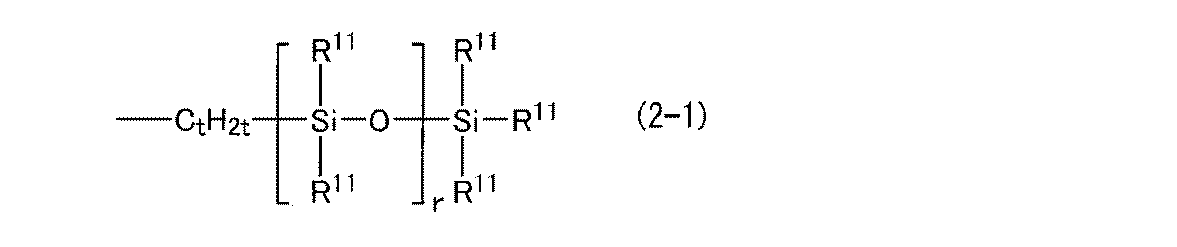


a 、b 、c及びdは、それぞれ、1.0≦a≦2.5、0≦b≦1.5、0≦c≦1.5、0.0001≦d≦1.5の範囲にある数である}で表される、多価アルコール誘導体変性シリコーンであることが好ましい。

(式中、Wは水素原子又は炭素原子数1~20のアルキル基を表す)
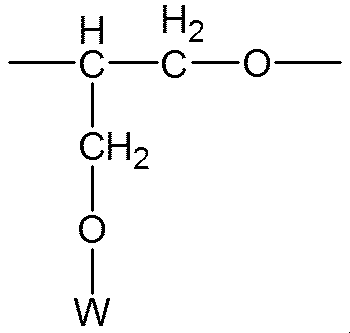
(式中、Wは前記と同様の基を表す)

で表される親水性単位から選択される少なくとも1種以上の単位を、その繰り返し数が平均して1~10の範囲で含有してなるグリセリン誘導体基であることが好ましい。
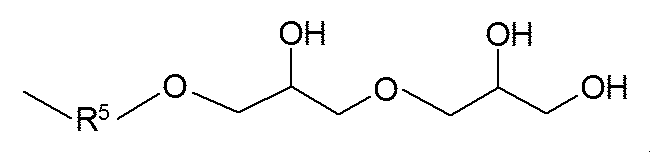
(式中、R5はオキシアルキレン単位の繰り返し数の平均値が2以上のオキシアルキレン構造を有しない二価有機基を表す)、又は、下記一般式(5-2):
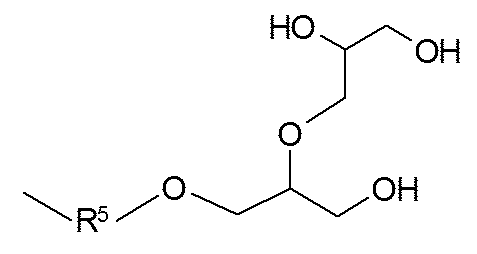
(式中、R5は上記のとおりである)で表わされるジグリセリン誘導体基であることが好ましい。
液状の多価アルコール誘導体変性シリコーン及び当該多価アルコール誘導体変性シリコーンの親水性変性剤である多価アルコール誘導体に由来する親水性不純物を含有する不純物含有組成物を、当該親水性不純物を捕捉可能な固体粒子と接触させて当該親水性不純物を当該固体粒子に捕捉させる捕捉工程、及び、
前記多価アルコール誘導体変性シリコーン及び前記固体粒子を分離する分離工程
を含む、液状の高純度多価アルコール誘導体変性シリコーン又はその組成物の製造方法である。
本発明を適用できる多価アルコール誘導体変性シリコーンは、多価アルコール誘導体(好ましくは糖誘導体ではない)で変性されたシリコーン化合物であって、液状のものであり、好ましくは少なくとも100℃で液体である。そして、この条件を満たすものであればその化学構造等に制限は無い。


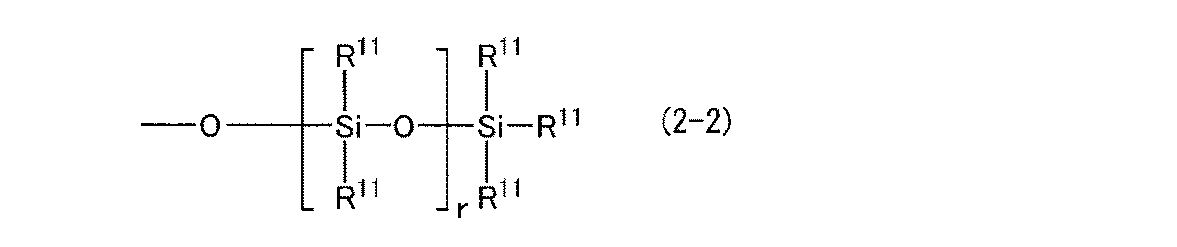

a 、b 、c及びdは、それぞれ、1.0≦a≦2.5、0≦b≦1.5、0≦c≦1.5、0.0001≦d≦1.5の範囲にある数である}で表される、多価アルコール誘導体変性シリコーンであることができる。
このとき、好適なb及びcの値は、必須とする官能基により以下のように表わされる。
(1)R2で表わされる基を有する場合:0.001≦b≦1.5であり、かつ0≦c≦1.5
(2)L1で表わされる基を有する場合:0≦b≦1.5であり、かつ0.001≦c≦1.5
(3)R2で表わされる基とL1で表わされる基を両方有する場合:0.001≦b≦1.5であり、かつ0.001≦c≦1.5

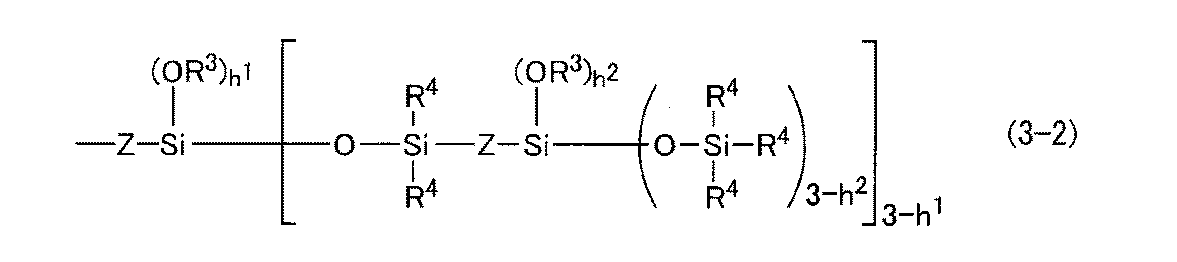


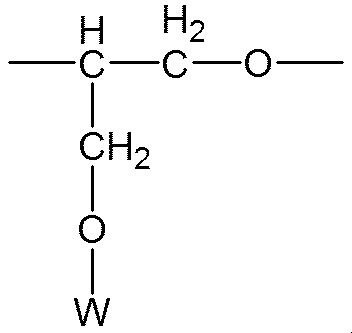
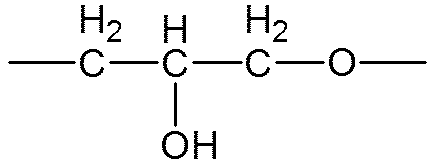
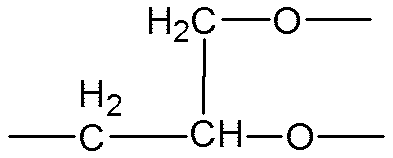


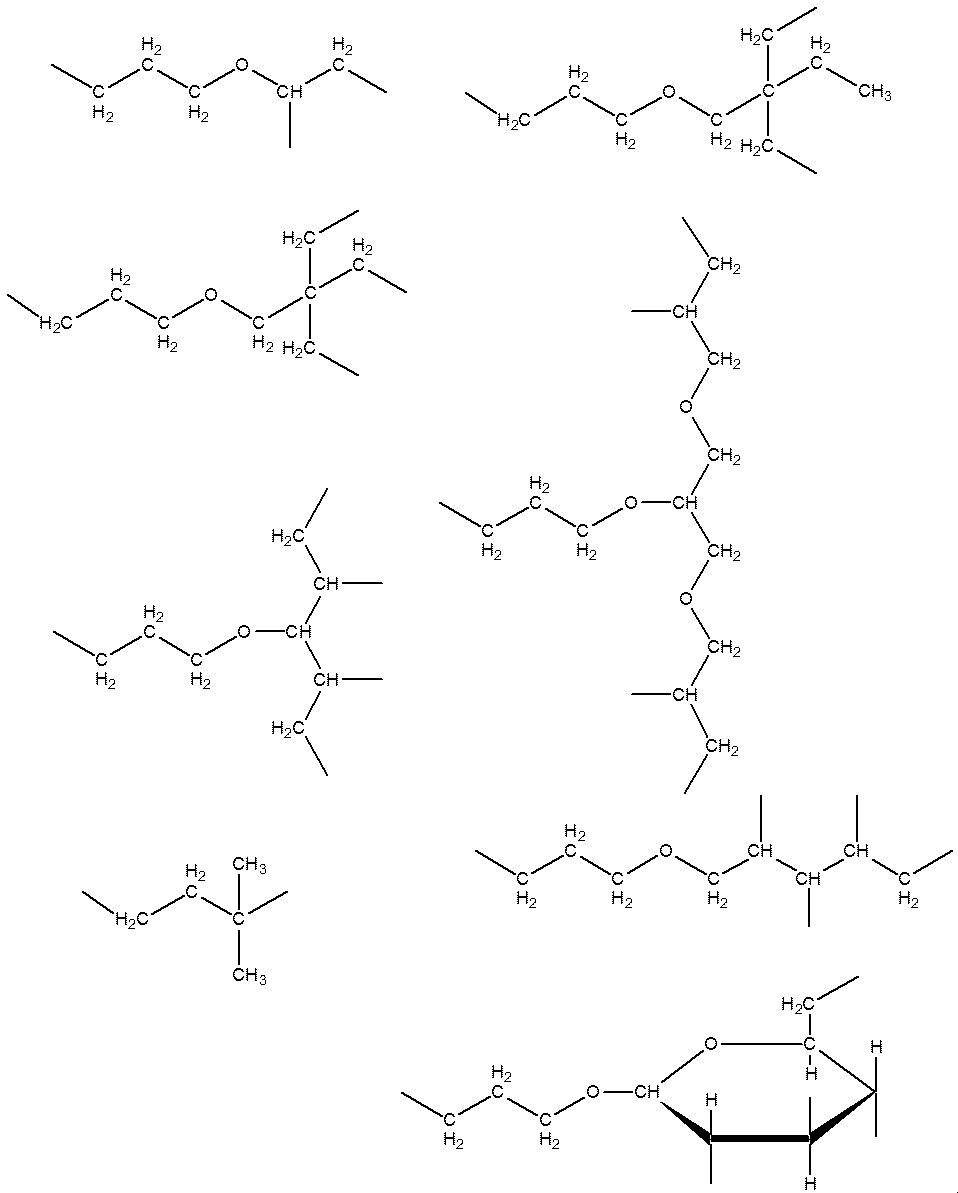
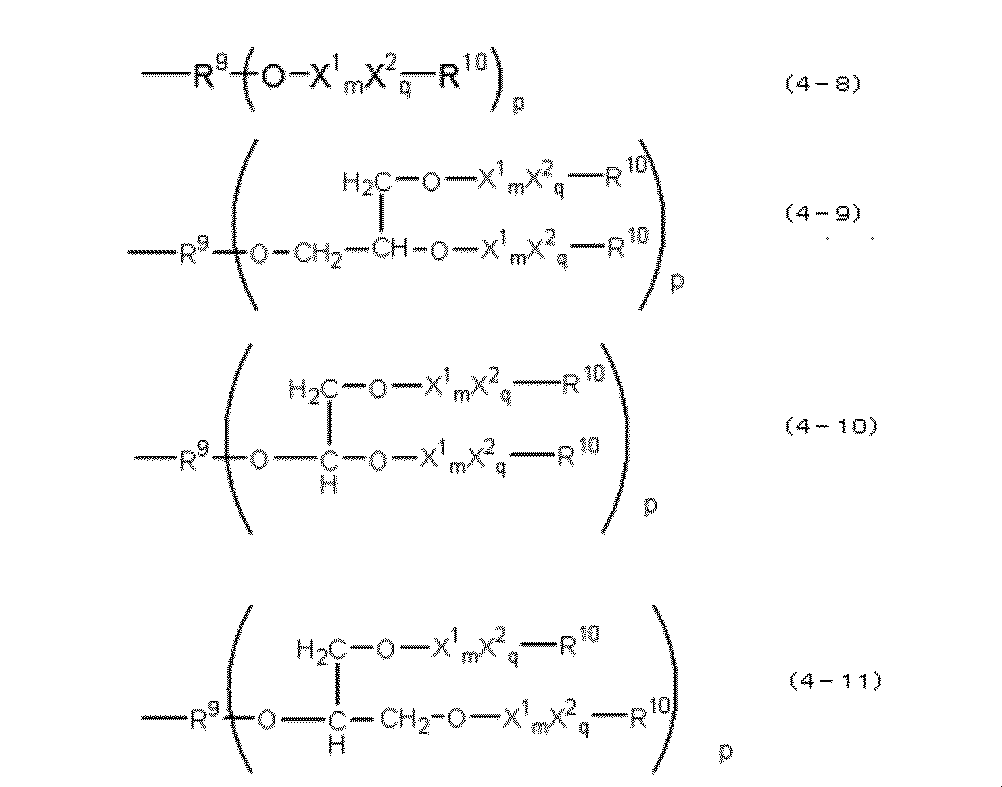
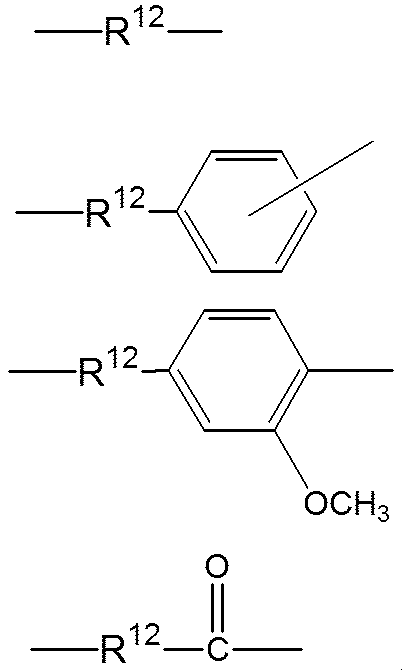

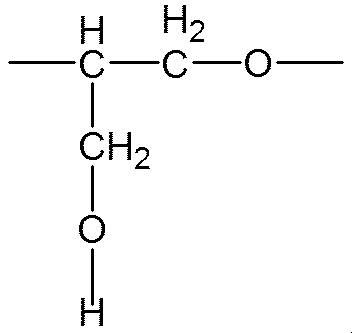
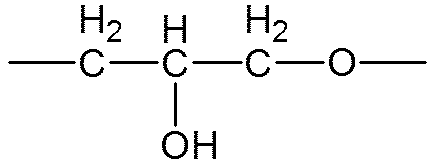

-R27-O-Xm-H (5)
で表わされるジグリセリン誘導体基である。式中、R27は二価有機基であり、上記の2価の連結基と同様の基が例示される。好適には、R27はオキシアルキレン単位の繰り返し数の平均値が2以上のオキシアルキレン構造を含有しない2価の連結基である。Xは前記の構造式(4-1―1)、(4-2-1)及び(4-3)で表される親水性単位から選択される少なくとも1種以上のグリセリン単位である。上記構造式(5)においてmはグリセリン単位の繰り返し数であり、平均して1~4の範囲内、好ましくは1.5~2.4の範囲内である。なお、各グリセリン単位の繰り返し数の好適範囲は、前記同様である。
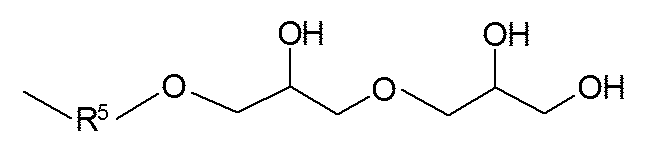
(式中、R5はオキシアルキレン単位の繰り返し数の平均値が2以上のオキシアルキレン構造を有しない二価有機基を表す)、又は、下記一般式(5-2):

(式中、R5は上記のとおりである)で表わされるジグリセリン誘導体基である。

R2、L1及びQは、各々独立に、上記のとおりであり、
Yはメチル基、R2、L1及びQからなる群から選択される基であり、
n1、n2、n3及びn4は、それぞれ独立して、0~2,000の範囲の数であり、n1+n2+n3+n4は0~2,000の範囲の数である。但し、n4=0のとき、Yの少なくとも一方はQである)で表される直鎖状のポリシロキサン構造を有する多価アルコール誘導体変性シリコーンであることが好ましい。
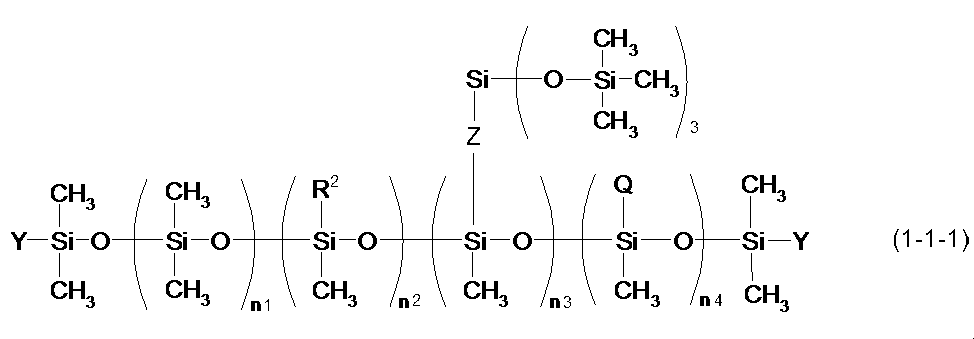
R2、Q、Y、Z、n1、n2、n3及びn4は上記のとおりである)、又は、下記構造式(1-1-2):
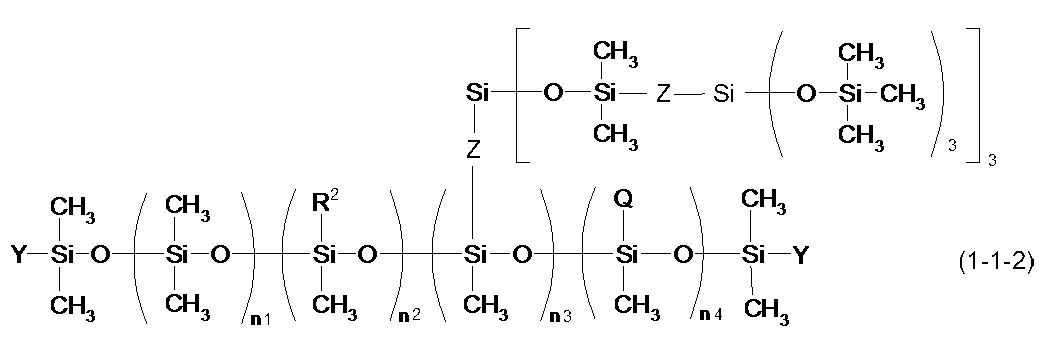
R2、Q、Y、Z、n1、n2、n3及びn4は上記のとおりである)で表されるグリセリン誘導体変性シリコーンがより好ましい。
変性率(モル%)=(1分子あたりの珪素原子に結合した多価アルコール誘導体基の数)/{6+2×(n1+n2+n3+n4)}×100
で示される。例えば、10個の多価アルコール誘導体基を有するドデシルシロキサンからなる多価アルコール誘導体変性シリコーンの場合には、26個の珪素原子結合官能基のうち、10個が多価アルコール誘導体基により変性されているから、グリセリン誘導体基による変性率は、38.5モル%である。

R1、a 、b、c及びdは上記のとおりである)で表される(b1)オルガノハイドロジェンポリシロキサンと、(a)反応性不飽和基を1分子中に1つ有する多価アルコール誘導体を少なくとも反応させて得ることができる。(d)反応性不飽和基を1分子中に1つ有するシロキサンデンドロン化合物、及び/又は、(e)反応性不飽和基を1分子中に1つ有する炭化水素化合物又は反応性不飽和基を1分子中に1つ有する鎖状オルガノポリシロキサンを更に反応させることが好ましい。

R1は、各々独立に、上記のとおりであり、
X’はR1又は水素原子から選択される基であり、
n1、n2、n3及びn4は上記のとおりである。但し、n2+n3+n4=0のとき、X’の少なくとも一方は水素原子である)で表される(b2)オルガノハイドロジェンポリシロキサンが好ましい。

R2及びL1は、各々独立に、上記のとおりであり、
Y’はメチル基、R2、L1及び水素原子(H)からなる群から選択される基であり、
n1、n2、n3及びn4は、それぞれ独立して、0~2,000の範囲の数であり、n1+n2+n3+n4は0~2,000の範囲の数である。但し、n4=0のとき、Y’の少なくとも一方は水素原子である。)
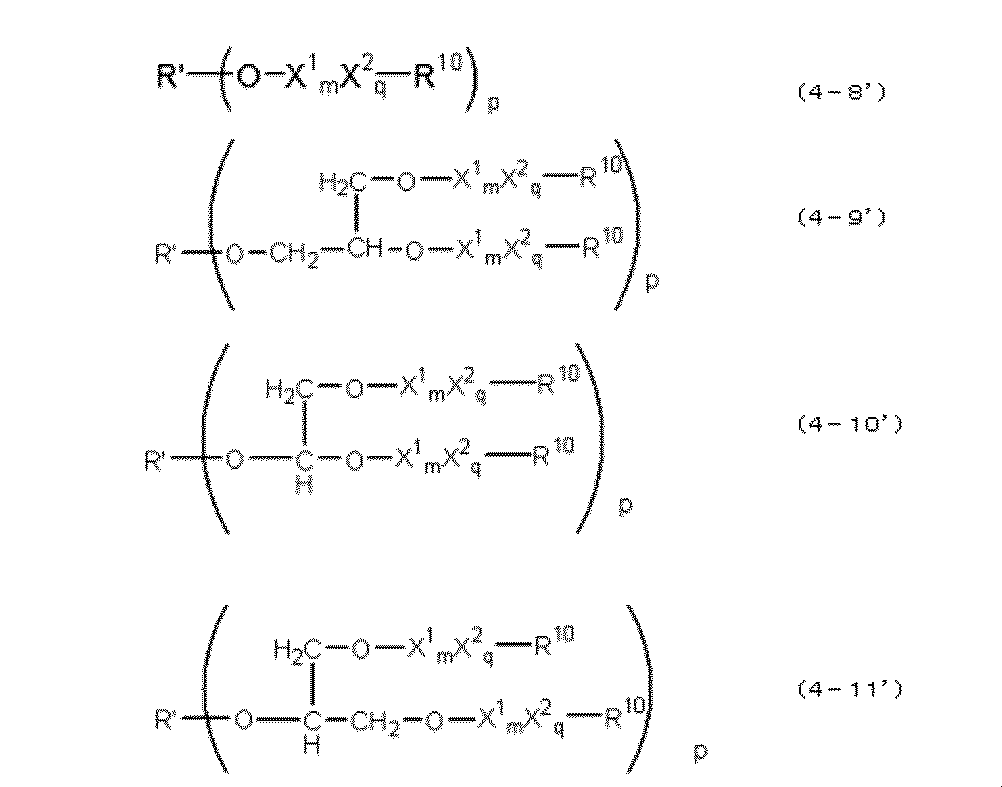

R3及びR4は上記のとおりであり、RDは水素原子又はメチル基であり、
Z´はZと同様の二価有機基を表し、
h1は0~3の範囲の数であり、
L´1は、R4、又は、j=1のときの下記一般式(3’’):

Zは二価有機基を表し、
jはLjで示されるシリルアルキル基の階層を表し、該シリルアルキル基の繰り返し数である階層数がk´のとき1~k´の整数であり、階層数k´は1~9の整数であり、Lj+1はjがk´未満のときは該シリルアルキル基であり、j=k´のときはR4である。
hjは0~3の範囲の数である)で表されるシリルアルキル基を表す}で表される分子鎖末端に1個の炭素-炭素二重結合を有するシロキサンデンドロン構造を有する化合物が好ましい。

(式中、R’は不飽和有機基を表し、
R2’は炭素原子数7~58の、置換若しくは非置換の、直鎖状又は分岐状の一価炭化水素基を表す)、又は、下記一般式(2’-1):

RD、Z´、R11及びrは上記のとおりである)で表されるモノ不飽和有機化合物が好ましい。
(A)オルガノハイドロジェンポリシロキサン、
(B)1分子中に1以上の反応性不飽和基を有する多価アルコール誘導体基含有有機化合物、並びに
(C)(C1)1分子中に平均で1より大きい数の反応性不飽和基を有する有機化合物、及び、(C2)1分子中に1以上の反応性不飽和基及び1以上のエポキシ基を有する有機化合物からなる群から選択される1種類以上の有機化合物を反応させることにより得られる{但し、前記(C)成分が多価アルコール誘導体基を含有する場合には前記(B)成分の使用は任意である}、ケイ素原子に結合した多価アルコール誘導体基を有し、且つ、架橋部にSi-C結合を含む架橋構造を有する有機変性シリコーンであることが好ましい。
(平均組成式(11)において、R1は、互いに独立して、一価有機基を表し、1.0≦a≦3.0、及び、0.001≦b≦1.5である)で表されるものが好ましい。
(i)R1 3SiO(R1 2SiO)v(R1SiHO)wSiR1 3
(ii)HR1 2SiO(R1 2SiO)v(R1SiHO)zSiR1 3
(iii)HR1 2SiO(R1 2SiO)v(R1SiHO)zSiR1 2H
(構造式(i)~(iii)において、R1は上記のとおりであり、vは0又は正の整数であり、wは正の整数であり、zは0又は正の整数である)で表されるオルガノハイドロジェンポリシロキサンが例示される。これらのオルガノハイドロジェンポリシロキサンは、(i)側鎖のみ、(ii)側鎖又は分子鎖の片末端、(iii)側鎖又は分子鎖の両末端にケイ素原子結合水素原子を有する直鎖状オルガノハイドロジェンポリシロキサンである。
(D1)炭素原子数1~60の、置換若しくは非置換の、直鎖状若しくは分岐状の一価炭化水素基、
(D2)-R28O(AO)z1R29 (式中、AOは炭素原子数2~4のオキシアルキレン基を表し、R28は炭素原子数3~5の、置換若しくは非置換の、直鎖状若しくは分岐状の二価炭化水素基を表し、R29は水素原子、炭素原子数1~24の、置換若しくは非置換の、直鎖状若しくは分岐状の一価炭化水素基、又は、炭素原子数2~24の、置換若しくは非置換の、直鎖状若しくは分岐状のアシル基を表し、z1=1~100である)で表されるポリオキシアルキレン基、
(D3)炭素原子数1~30の、置換若しくは非置換の、直鎖状若しくは分岐状のアルコキシ基、
(D4)水酸基、
(D5)-R30-COOR31 (式中、R30は炭素原子数2~20の、置換若しくは非置換の、直鎖状若しくは分岐状の二価炭化水素基を表し、R31は炭素原子数1~30の、置換若しくは非置換の、直鎖状若しくは分岐状の一価炭化水素基を表す)で表されるエステル基、
(D6)-R17-OCOR18 (式中、R17は炭素原子数2~20の、置換若しくは非置換の、直鎖状若しくは分岐状の二価炭化水素基を表し、R18は炭素原子数1~30の、置換若しくは非置換の、直鎖状若しくは分岐状の一価炭化水素基を表す)で表されるエステル基
(D7) L1
ここで、L1はi=1のときの下記一般式(33):

R12は、炭素原子数1~30の、置換若しくは非置換の、直鎖状若しくは分岐状の一価炭化水素基を表し、R13は、それぞれ独立して、炭素原子数1~6のアルキル基又はフェニル基を表し、Zは二価有機基を表し、iはLiで示されるシリルアルキル基の階層を表し、該シリルアルキル基の繰り返し数である階層数がkのとき1~kの整数であり、階層数kは1~10の整数であり、Li+1はiがk未満のときは該シリルアルキル基であり、i=kのときはR13であり、hiは0~3の範囲の数である)で表される、シロキサンデンドロン構造を有するシリルアルキル基、
(D8)下記一般式(44):

(D9)下記一般式(55):
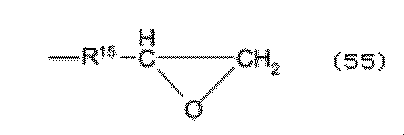
(D10)下記一般式(66):
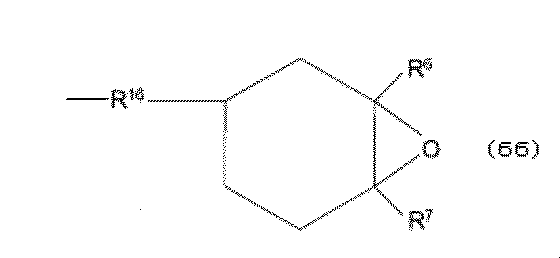
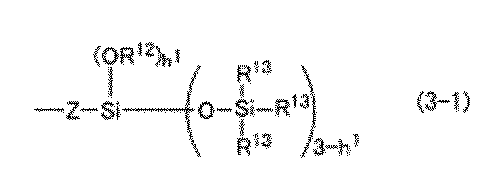
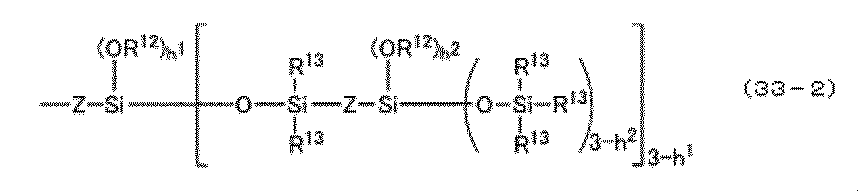


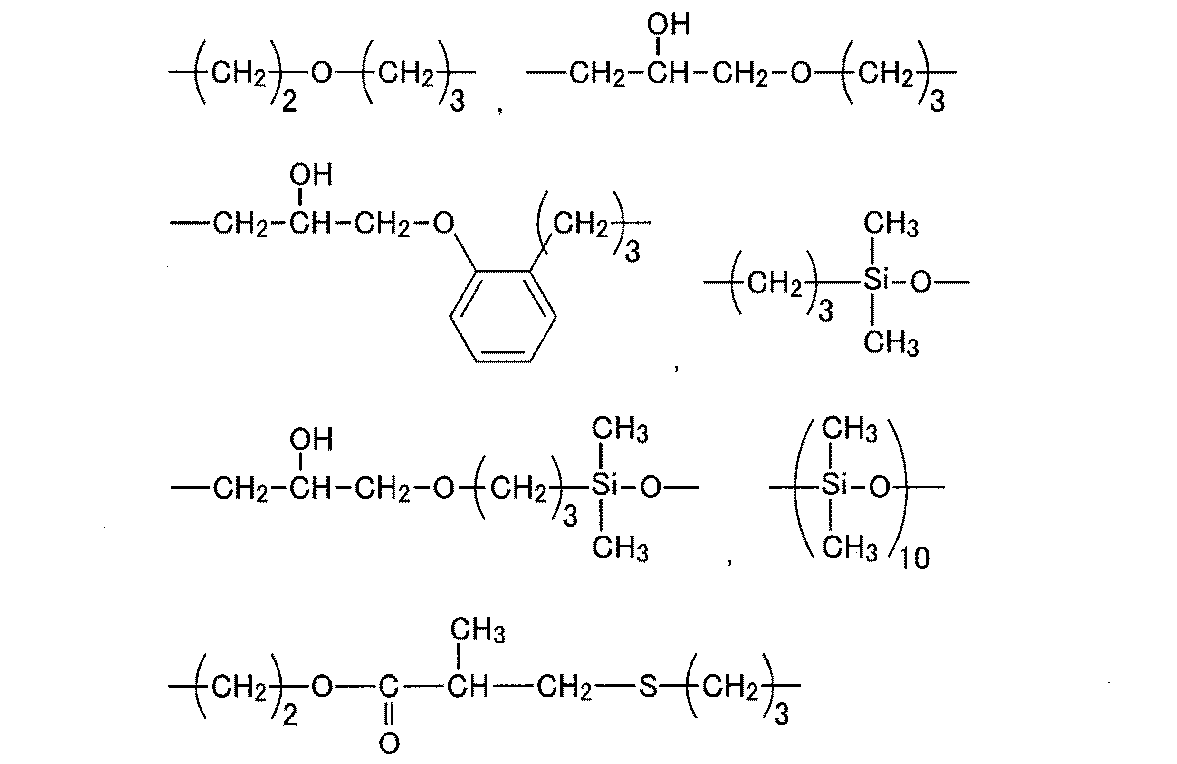
R32 pR33 qSiO(4-p-q)/2 (22)
(式(22)中、R32は、互いに独立してもよいがR33とは異なる一価有機基を表し、R33は、互いに独立して、炭素原子数2~30の一価の不飽和脂肪族炭化水素基を表し、1.0≦p≦2.5、及び、0.001≦q≦1.5である)で表される(C1-5)不飽和基含有シリコーン化合物が挙げられる。炭素原子数2~30の一価の不飽和脂肪族炭化水素基は既述のとおりである。
(E1)炭素原子数1~60の、置換若しくは非置換の、直鎖状若しくは分岐状の一価炭化水素基(但し、脂肪族不飽和基を有する炭素原子数2~20の一価炭化水素基を除く)
(E2)水酸基
(E3)-R30-COOR31 (式中、R30及びR31は上記の通りである)で表されるエステル基
(E4)-R17-OCOR18 (式中、R17及びR18は上記の通りである)で表されるエステル基
(E5)-R21-NR22COR23 (式中、R21は炭素原子数2~20の、置換若しくは非置換の、直鎖状若しくは分岐状の二価炭化水素基を表し、R22は水素原子又は炭素原子数1~20の置換若しくは非置換の、直鎖状若しくは分岐状の一価炭化水素基を表し、R23は炭素原子数1~30の置換若しくは非置換の、直鎖状若しくは分岐状の一価炭化水素基を表す)で表されるアミド基
(E6)-R24-CONR25R26 (式中、R24は炭素原子数2~20の、置換若しくは非置換の、直鎖状若しくは分岐状の二価炭化水素基を表し、R25及びR26は、各々独立に、水素原子又は炭素原子数1~20の置換若しくは非置換の、直鎖状若しくは分岐状の一価炭化水素基を表す)で表されるアミド基から選ばれるものが好ましい。置換若しくは非置換の、直鎖状若しくは分岐状の一価炭化水素基又は二価炭化水素基の定義、種類等は既述のとおりである。
CH2=CH(CH2)xCH=CH2 (22-1)
(一般式(22-1)中、1≦x≦20である)で表される(C1-1)α,ω-ジエン、一般式(22-2):
CH≡C(CH2)xC≡CH (22-2)
(一般式(22-2)中、1≦x≦20である)で表される(C1-2)α,ω-ジイン、一般式(22-3):
CH2=CH(CH2)xC≡CH (22-3)
(一般式(22-3)中、1≦x≦20である)で表される(C1-3) α,ω-エン-イン、一般式(22-4):
Cm’H2m’-1O(Cn’H2n’O)yCm’H2m’-1 (22-4)
(一般式(22-4)中、2≦m’≦20、2≦n’≦4、yはオキシエチレン単位、オキシプロピレン単位、オキシブチレン単位の繰返し数の合計値であり、1≦y≦180である)で表される(C1-4)ビスアルケニルポリエーテル化合物が挙げられる。
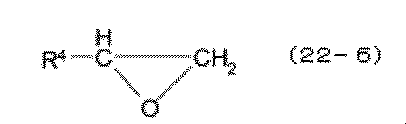
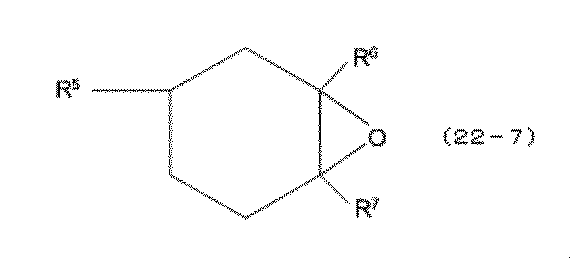
本発明に係る液状の高純度多価アルコール誘導体変性シリコーン又はその組成物の製造方法は、前記高純度化処理工程前及び/又は後に、及び/又は前記高純度化処理工程と同時に、前記液状の多価アルコール誘導体変性シリコーン又はその組成物に液状油剤を添加する液状油剤添加工程を更に含むことができる。ここで、「液状」とは既述のとおりの意味である。
本発明の製造方法において、前記混合物、或いは、前記多価アルコール誘導体変性シリコーン又はその組成物(以下、単に「多価アルコール誘導体変性シリコーン又はその組成物」という)は、酸性物質によって処理され、当該酸性物質の処理によって発生した臭気物質及び低沸点成分が加熱又は減圧により取り除かることが好ましい。この場合は、より高品質の多価アルコール誘導体変性シリコーン又はその組成物を得ることができる。前記処理は非極性溶媒及び/又は極性溶媒及び/又は水の存在下で実施することが可能であるが、酸性物質は、水等の極性溶媒に溶解あるいは分散させて使用することが好ましく、酸性水溶液を含む形態で前記処理に供するのがより好ましい。また、既述のとおり、酸処理工程は本発明の高純度化処理の前に行うと、より優れた高純度化が達成されるため、好ましい。製造プロセスの合理性とコスト、得られる効果等を総合的に考慮すると、「多価アルコール誘導体変性シリコーンの合成」→「酸処理と臭気低減」→「高純度化処理」の順でステップを踏むのが最善である。但し、合成工程がヒドロシリル化反応以外の場合など酸処理の必要性が低い場合には、酸処理工程をスキップすることができる。そして、前述した「液状油剤添加工程」は、この3つの基本ステップの前後どのタイミングで実施してもよい。
(ax)分子鎖の末端に炭素-炭素二重結合を有する多価アルコール誘導体、及び
(bx)オルガノハイドロジェンポリシロキサン
をヒドロシリル化反応させることにより、多価アルコール誘導体変性シリコーン又はそれを主成分として含む反応混合物を合成する工程〔V〕;及び
上記合成工程〔V〕と共に、又は、上記合成工程〔V〕の後に、
多価アルコール誘導体変性シリコーン又はそれを主成分として含む反応混合物を、
(cx)25℃で固体であり、水溶性であり、かつ、50gをイオン交換水1Lに溶解させたときの水溶液の25℃におけるpHが4以下である、1種類以上の酸性無機塩の存在下で処理する工程〔W〕
を含む。また、前記酸性無機塩を用いた処理工程は臭気原因物質の発生を伴うため、工程〔W〕の後に、加熱又は減圧することにより、臭気原因物質を除去する工程を含むことが、臭気低減の実効の観点からより好ましい。

本発明に係る化粧料又は外用剤に用いることのできる油剤は、好適には、5~100℃で液状であるシリコーンオイル、非極性有機化合物又は低極性~高極性有機化合物から選択される1以上の油剤であり、非極性有機化合物及び低極性~高極性有機化合物としては、炭化水素油及び脂肪酸エステル油及び液状脂肪酸トリグリセライドが好ましい。これらは、特に化粧料の基材として広く用いられている成分であるが、これらの油剤には、公知の植物性油脂類、動物性油脂類、高級アルコール類、脂肪酸トリグリセライド、人工皮脂、フッ素系油から選択される1種類又は2種類以上を併用しても良い。
本発明に係る化粧料又は外用剤に用いることのできる粉体又は着色剤は、化粧料の成分として一般に使用されるものであり、白色及び着色顔料、並びに、体質顔料を含む。白色及び着色顔料は化粧料の着色等に使用され、一方、体質顔料は、化粧料の感触改良等に使用される。本発明における「粉体」としては、化粧料に通常使用される白色及び着色顔料、並びに、体質顔料を特に制限なく使用することができる。本発明において、1種類又は2種類以上の粉体を配合することが好ましい。粉体の形状(球状、棒状、針状、板状、不定形状、紡錘状、繭状等)、粒子径(煙霧状、微粒子、顔料級等)、及び、粒子構造(多孔質、無孔質等)は何ら限定されるものではないが、平均一次粒子径が1nm~100μmの範囲にあることが好ましい。特に、これらの粉体又は着色剤を顔料として配合する場合、平均粒子径が1nm~20μmの範囲にある無機顔料粉体、有機顔料粉体、樹脂粉体から選択される1種類又は2種類以上を配合することが好ましい。
<多価アルコール誘導体変性シリコーンNo.1の合成>
反応器に平均組成式MD37DH 12.7Mで表されるメチルハイドロジェンポリシロキサン315.2g、平均組成式:CH2=CH-Si(OSi(CH3)3)3で表されるビニルトリストリメチルシロキシシラン 27.7g、ヘキサデセン(αオレフィン純度91.7%) 67.1gを仕込み、窒素流通下で攪拌しながら、白金-1,3-ジビニル-1,1,3,3-テトラメチルジシロキサン錯体のヘキサメチルジシロキサン溶液(Pt濃度4.5重量%)を0.27mL添加し、60℃のオイルバスで加熱を行なった。20分後に反応液は発熱により最高温度の68℃に到達した。
その後液温40℃以下まで放冷し、前記のヘキサデセン67.1g及び白金触媒0.13mLを追加し、40-70℃で2時間反応させた。反応液を2g採取し、アルカリ分解ガス発生法(残存したSi-H基をKOHのエタノール/水溶液によって分解し、発生した水素ガスの体積から反応率を計算する)により反応が目標に達したことを確認した。
次いで、反応混合物にジグリセリンモノアリルエーテル(グリセリン単位の繰り返し数の平均値=1.7) 55.9g、IPA 336g、ビタミンE 0.06gを仕込み、40-45℃で前記白金触媒溶液0.27mLを添加し、40-60℃で2.5時間反応を行なった後、同様の方法により反応率が目標に達したことを確認した。
最後に、前記のヘキサデセン67.1g及び白金触媒0.40mLを追加して45-60℃で5時間反応を行い、同様の方法により確認したところ反応は完結しており、平均組成式:MD37DR*11 8.7DR*21 3DR*32 1Mで表される多価アルコール誘導体変性シリコーンが生成していることが分かった。式中、R*11、R*21及びR*32は下記のとおりである。
R*11= -C16H33
R*21= -C3H6O-(C3H6O2)n-H, n=1.7
R*32= -C2H4Si(OSiMe3)3
別に、重曹0.06gをイオン交換水3gに溶解させたものを準備した。これを前記反応系に添加し、65-70℃で30分間攪拌混合して中和を行なった後、再度減圧脱水操作を行うことにより、平均組成式:MD37DR*11 8.7DR*21 3DR*32 1Mで表される多価アルコール誘導体変性シリコーンNo.1を含む組成物593gを、淡褐色不透明粘性液体として得た。ここで、R*11、R*21及びR*32は上述のとおりである。
<多価アルコール誘導体変性シリコーンNo.2の合成>
反応器に平均組成式MD37DH 12.7Mで表されるメチルハイドロジェンポリシロキサン313.8g、平均組成式:CH2=CH-Si(OSi(CH3)3)3で表されるビニルトリストリメチルシロキシシラン 27.6g、ヘキサデセン(αオレフィン純度91.7%) 66.8gを仕込み、窒素流通下で攪拌しながら、白金-1,3-ジビニル-1,1,3,3-テトラメチルジシロキサン錯体のヘキサメチルジシロキサン溶液(Pt濃度4.5wt%)を0.27mL添加し、60℃のオイルバスで加熱を行なった。20分後に反応液は発熱により最高温度の74℃に到達した。
その後液温40℃以下まで放冷し、前記のヘキサデセン66.7g及び白金触媒0.13mLを追加し、40-70℃で1.5時間反応させた。反応液を2g採取し、アルカリ分解ガス発生法により反応が目標に達したことを確認した。
次いで、反応混合物に高純度鎖状ジグリセリンモノアリルエーテル(グリセリン単位の繰り返し数=2) 58.3g、IPA 336g、ビタミンE 0.06gを仕込み、40-45℃で前記白金触媒溶液0.27mLを添加し、40-60℃で2.5時間反応を行なった後、同様の方法により反応率が目標に達したことを確認した。
最後に、前記のヘキサデセン66.9g及び白金触媒0.40mLを追加して45-60℃で5時間反応を行い、同様の方法により確認したところ反応は完結しており、平均組成式:MD37DR*11 8.7DR*22 3DR*32 1Mで表される多価アルコール誘導体変性シリコーンが生成していることが分かった。式中、R*11、R*22及びR*32は下記のとおりである。
R*11= -C16H33
R*22= -C3H6O-{CH2-CH(OH)-CH2O}2-H
R*32= -C2H4Si(OSiMe3)3
<多価アルコール誘導体変性シリコーンNo.3の合成>
反応器に平均組成式MD43。4DH 7。4Mで表されるメチルハイドロジェンポリシロキサン401.1g、平均組成式:CH2=CH-Si(OSi(CH3)3)3で表されるビニルトリストリメチルシロキシシラン 3.5g、ヘキサデセン(αオレフィン純度91.7%) 75.0gを仕込み、窒素流通下で攪拌しながら白金-1,3-ジビニル-1,1,3,3-テトラメチルジシロキサン錯体のヘキサメチルジシロキサン溶液(Pt濃度4.5wt%)を0.40mL添加した。30-75℃で1時間反応を行なった後、反応液を2g採取し、アルカリ分解ガス発生法により反応が目標に達したことを確認した。
次いで、反応混合物にジグリセリンモノアリルエーテル(グリセリン単位の繰り返し数の平均値=1.7) 45.7g、IPA 341g、ビタミンE 0.07gを仕込み、40-50℃で前記白金触媒溶液0.67mLを添加し、40-60℃で2.5時間反応を行なった後、同様の方法により反応率が目標に達したことを確認した。
最後に、前記のヘキサデセン75.1g及び白金触媒0.27mLを追加して45-60℃で1.5時間反応を行い、同様の方法により確認したところ反応は完結しており、平均組成式:MD43.4DR*11 5。3DR*21 2DR*32 0.1Mで表される多価アルコール誘導体変性シリコーンが生成していることが分かった。式中、R*11、R*21及びR*32は下記のとおりである。
R*11= -C16H33
R*21= -C3H6O-(C3H6O2)n-H, n=1.7
R*32= -C2H4Si(OSiMe3)3
<多価アルコール誘導体変性シリコーンNo.4の合成>
反応器に平均組成式MD43。4DH 7。4Mで表されるメチルハイドロジェンポリシロキサン399.7g、平均組成式:CH2=CH-Si(OSi(CH3)3)3で表されるビニルトリストリメチルシロキシシラン 3.4g、ヘキサデセン(αオレフィン純度91.7%) 74.7gを仕込み、窒素流通下で攪拌しながら白金-1,3-ジビニル-1,1,3,3-テトラメチルジシロキサン錯体のヘキサメチルジシロキサン溶液(Pt濃度4.5wt%)を0.40mL添加した。40-60℃で1時間反応を行なった後、反応液を2g採取し、アルカリ分解ガス発生法により反応が目標に達したことを確認した。
次いで、反応混合物に高純度鎖状ジグリセリンモノアリルエーテル(グリセリン単位の繰り返し数=2) 47.5g、IPA 341g、ビタミンE 0.06gを仕込み、45-50℃で前記白金触媒溶液0.27mLを添加し、45-60℃で1時間反応を行なった後、同様の方法により反応率が目標に達したことを確認した。
最後に、前記のヘキサデセン74.7g及び白金触媒0.40mLを追加して50-60℃で1時間反応を行い、同様の方法により確認したところ反応は完結しており、平均組成式:MD43.4DR*11 5。3DR*22 2DR*32 0.1Mで表される多価アルコール誘導体変性シリコーンが生成していることが分かった。式中、R*11、R*22及びR*32は下記のとおりである。
R*11= -C16H33
R*22= -C3H6O-{CH2-CH(OH)-CH2O}2-H
R*32= -C2H4Si(OSiMe3)3
<多価アルコール誘導体変性シリコーンNo.5の合成>
反応器に平均組成式:MD42.9DH 6.7Mで表されるメチルハイドロジェンポリシロキサン 137.7g、下記平均組成式:
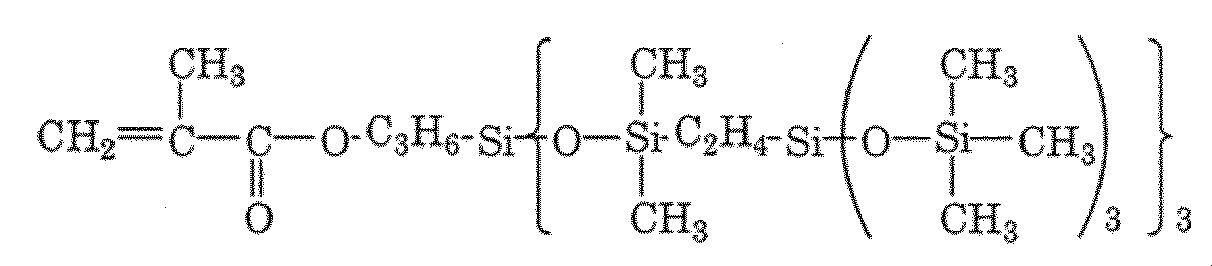
次いで、反応混合物にヘキサデセン(αオレフィン純度91.7%) 38.4gを添加し、85~105℃で1時間反応を行った後、同様の方法で反応率が目標に達したことを確認した。
次いで、反応混合物にジグリセリンモノアリルエーテル(グリセリン単位の繰り返し数の平均値=2.0) 9.3gとイソプロピルアルコール(IPA) 120gを添加して、上記の白金触媒を0.20ml投入した。70-85℃で1時間反応を行った後にサンプリングを行い、反応率を計算した結果、平均組成式:MD42.9DR*31 0.3DR*23 0.8DR*11 4.4DH 1.2Mで表される変性シリコーン中間体が生成していることが分かった。ここで、R*11及びR*23及びR*31は下記のとおりである。
R*11= -C16H33
R*23= -C3H6O-(C3H6O2)n-H, n=2.0
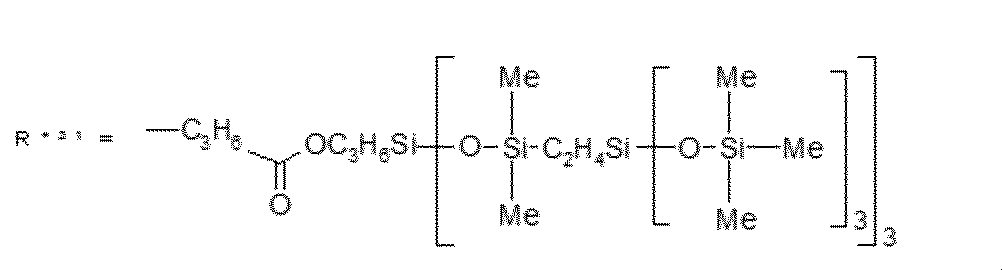
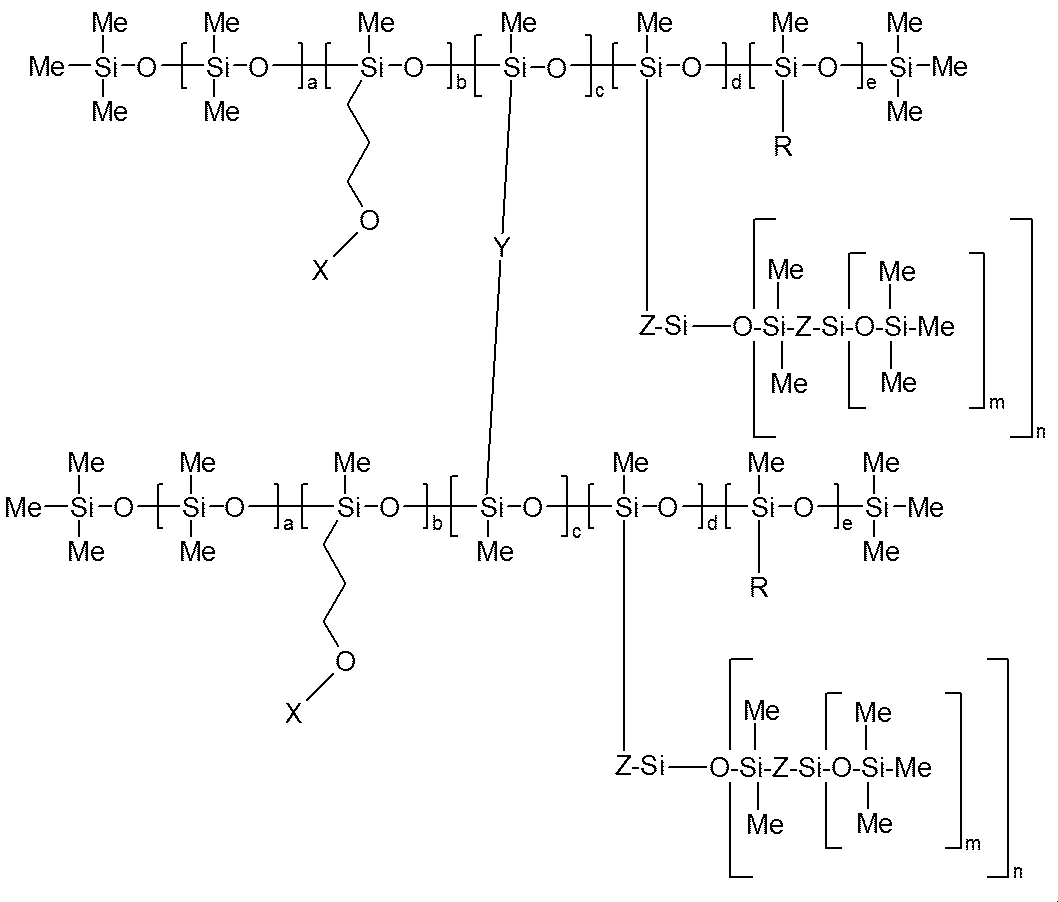
<多価アルコール誘導体変性シリコーンNo.6の合成>
反応器に平均組成式 MD330DH 80M で表されるメチルハイドロジェンポリシロキサン110.3g、平均組成式CH2=CH-Si(OSiMe3)3で表されるビニルトリストリメチルシロキシシラン12.1g を仕込み、窒素流通下で攪拌しながら35℃で白金-1,3-ジビニル-1,1,3,3-テトラメチルジシロキサン錯体のIPA溶液(Pt濃度0.4wt%)を0.25g添加した。発熱による温度上昇が収まったところで、ビニルトリストリメチルシロキシシラン(2回目)12.1g を添加して同様に反応させた。発熱による温度上昇が収まったところで、ビニルトリストリメチルシロキシシラン(3回目)12.1g を添加して同様に反応させた。反応液を2g採取し、アルカリ分解ガス発生法により反応率に問題がないことを確認した。
反応液にポリグリセリンモノアリルエーテル(グリセリン単位の繰り返し数の平均値=4.0) 8.0g、天然ビタミンEを0.02g、IPAを60g添加し、上記と同じ白金触媒溶液を0.25g追加投入した。発熱による温度上昇が収まった後、65~80℃で2時間反応を行ない、同様の方法で反応率に問題ないことを確認した。
約65℃の反応液にヘキサデセン(αオレフィン純度=91.7%)15.1gを添加した。発熱による温度上昇が収まったところで、ヘキサデセン(2回目)15.1g を添加して同様に反応させた。発熱による温度上昇が収まったところで、ヘキサデセン(3回目)15.2g及び白金触媒溶液0.25gを追加投入し、65~80℃で3時間反応を行なった。反応液を2g採取し、アルカリ分解ガス発生法により確認したところ、反応は完結していた。
希釈剤のカプリリルメチコン(SS-3408)を200g添加して混合し溶解させた後、減圧下で加熱してIPA及び低沸分を溜去することにより、平均組成式MD330DR*11 45DR*32 30DR*24 5M で表される多価アルコール誘導体変性シリコーンを含む組成物と、カプリリルメチコンとの50:50(wt比)混合物380gが得られた。この混合物は、室温では乳白色均一なガム状であった。
式中、R*11= -C16H33
R*32=-C2H4Si(OSiMe3)3
R*24=-C3H6O-(C3H6O2)n-H, n=4.0
<多価アルコール誘導体変性シリコーンNo.7の合成>
反応器に平均組成式 MD45DH 2M で表されるメチルハイドロジェンポリシロキサン124.1g、下記平均組成式:
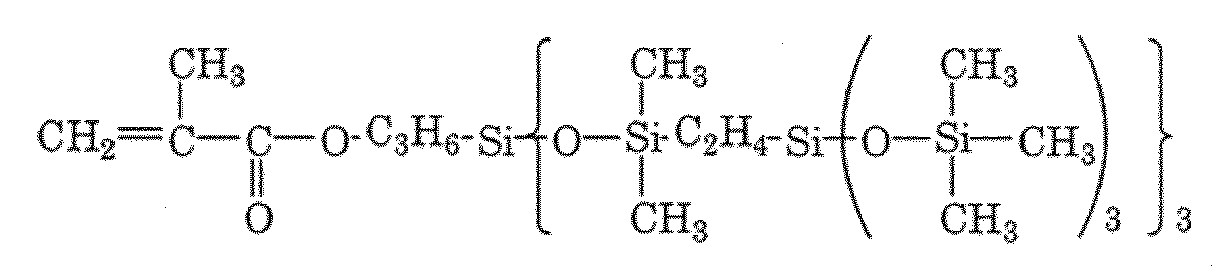
反応液を2g採取しアルカリ分解ガス発生法により確認した結果、反応が完結していたことから、平均組成式:MD45DR*31 1DR*24 1M で表される多価アルコール誘導体変性シリコーンが生成していることが分かった。更に反応液を減圧下で加熱して低沸分を溜去することによって、乳白色均一な粘稠液体195gを得た。式中、R*31及びR*24は下記のとおりである。
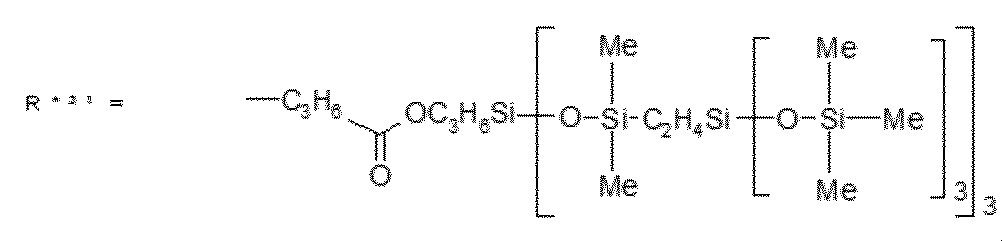
<多価アルコール誘導体変性シリコーンNo.8の合成>
反応器に平均組成式:MD44.7DH 2Mで表されるメチルハイドロジェンポリシロキサン 879.5g、高純度鎖状ジグリセリンモノアリルエーテル 131.0g、天然ビタミンE 0.10g、IPA 703gを仕込み、加温した。常法に従って、白金-1,3-ジビニル-1,1,3,3-テトラメチルジシロキサン錯体のIPA溶液(Pt濃度4.5%)を加え60~85℃で反応を行った。反応液を採取してアルカリ分解ガス発生法により確認したところ、反応がほぼ完結していたことから、平均組成式:MD44.7DR*22 2Mで表される多価アルコール誘導体変性シリコーンが生成していることが分かった。更に反応液を減圧下で加熱して低沸分を溜去することによって、濃褐色液体を得た。式中、R*22は下記のとおりである。
R*22= -C3H6O-{CH2-CH(OH)-CH2O}2-H
<多価アルコール誘導体変性シリコーンNo.9の合成>
反応器に平均組成式 HMD187MH で表されるメチルハイドロジェンポリシロキサン951.4g、アリルグリシジルエーテル19.8gを仕込み、窒素流通下で攪拌しながら65℃まで加温した。白金-1,3-ジビニル-1,1,3,3-テトラメチルジシロキサン錯体のIPA溶液(Pt濃度4.5wt%)を0.07ml添加し、65-85℃で3時間反応を行なった。
反応液を2g採取しアルカリ分解ガス発生法により確認した結果、反応が完結していたことから、分子鎖両末端にエポキシ基(グリシジルオキシプロピル基)を有する変性シリコーンが生成していることが分かった。更に反応液を減圧下で加熱して160℃として残余のアリルグリシジルエーテルを溜去することによって、淡黄色透明均一液体を得た。
R*25=-C3H6O-CH2(OH)-CH2-N{CH2CH(CH3)OH}2
<多価アルコール誘導体変性シリコーンNo.1を含む比較用組成物RE-1>
製造例1で得られた、淡褐色不透明粘性液体(多価アルコール誘導体変性シリコーンNo.1を主成分として含む組成物)を、そのまま試料として用いた。
<多価アルコール誘導体変性シリコーンNo.1を含む比較用組成物RE-1(-2)>
反応器に製造例1で得られた淡褐色不透明粘性液体(多価アルコール誘導体変性シリコーンNo.1を主成分として含む組成物)200gを仕込み、これに対してトレハロース二水和物(結晶状粉末、白色)6.0gを精製水12.0gに溶解させた水溶液18.0gを添加し、50℃で50分間攪拌混合を行なった。次いで、系内を10Torr以下まで減圧して40分間の脱水を行ったところ、系内の水滴が消失した。攪拌しながら40℃まで放冷したのち、復圧した。反応器の内容物は強い白濁を有する不透明液状であった。
加圧濾過器の目皿に、直径110mm(当該加圧濾過器の内径よりやや大きい)のADVANTEC No.424濾紙(保留粒子径4μm)の縁を均等に折り、緊密に敷き詰めた後、本濾過器を台座にセットした。この時、濾過器は垂直に立っており、目皿の位置より下部の口径の狭くなった濾液出口部の下には受け器を設置した。
前記白濁分散液100gをカップに取り、これに中間粒度30.6μmの珪藻土粉末10gを加え、ヘラでよくかき混ぜてスラリー状とした。このスラリーを、加圧濾過器にセットした前記濾紙上に注いだ後、濾過器に蓋をして上部より窒素圧をかけることにより、主として中間粒度30.6μmの珪藻土粉末からなる濾層を形成した。
次いで、前記白濁分散液の残部と濾層形成時に回収した濾液とを再度前記濾層上に注ぎ、濾過器に蓋をして上部より窒素圧をかけたところ、強い白濁を有する不透明液体177g が得られた。これは、処理前(即ち、比較例1の試料)と比べて外観の濁りが更に増大していた。これを、比較用組成物RE-1(-2)の試料として用いた。
<多価アルコール誘導体変性シリコーンNo.2を含む比較用組成物RE-2の調製>
製造例2で得られた、灰褐色不透明粘稠液体(多価アルコール誘導体変性シリコーンNo.2を主成分として含む組成物)を、そのまま試料として用いた。
<多価アルコール誘導体変性シリコーンNo.3を含む比較用組成物RE-3の調製>
製造例3で得られた、淡褐色不透明粘性液体(多価アルコール誘導体変性シリコーンNo.3を主成分として含む組成物)を、そのまま試料として用いた。
<多価アルコール誘導体変性シリコーンNo.4を含む比較用組成物RE-4の調製>
製造例4で得られた、灰褐色不透明粘稠液体(多価アルコール誘導体変性シリコーンNo.4を主成分として含む組成物)を、そのまま試料として用いた。
<多価アルコール誘導体変性シリコーンNo.5を含む比較用組成物RE-5の調製>
製造例5で得られた、白色の不透明液体{多価アルコール誘導体変性シリコーンNo.5を主成分として含む組成物と、カプリリルメチコン(希釈剤)とからなる組成物}を、そのまま試料として用いた。
<多価アルコール誘導体変性シリコーンNo.6を含む比較用組成物RE-6の調製>
製造例6で得られた、乳白色均一なガム状流体{多価アルコール誘導体変性シリコーンNo.6を主成分として含む組成物と、カプリリルメチコン(希釈剤)とからなる組成物}を、そのまま試料として用いた。
<多価アルコール誘導体変性シリコーンNo.7を含む比較用組成物RE-7の調製>
製造例7で得られた乳白色粘稠液体(多価アルコール誘導体変性シリコーンNo.7を主成分として含む組成物)を、そのまま試料として用いた。
<多価アルコール誘導体変性シリコーンNo.8を含む比較用組成物RE-8の調製>
製造例8で得られた、土灰褐色の不透明粘性液体(多価アルコール誘導体変性シリコーンNo.8を主成分として含む組成物)を、そのまま試料として用いた。
<多価アルコール誘導体変性シリコーンNo.8を含む比較用組成物RE-8(-2)の調製>
タンク付きステンレスホルダーADVANTEC KST-90に、直径90mmのガラス繊維濾紙GC-90(保留粒子径0.5μm)をセットし、漏れの起こらないようタンク部とベースプレート(O-リング、濾紙、サポートスクリーンを置く部分)とを専用のボルト、ワッシャー、ナットにより締め付けて固定した。これにより、濾紙の縁部全体が上下から締め付けられ、漏れを防ぐ構造となる。
タンク上部の開口部より、製造例8で得られた土灰褐色の不透明粘性液体(多価アルコール誘導体変性シリコーンNo.8を主成分として含む組成物)150gを投入したのち、開口部をタンクキャップで閉じ、窒素圧0.4MPaをかけて濾過を行った。この結果、灰土褐色の不透明粘稠液体144g が得られたが、濾過前と比べ外観の濁りは全く低減されていなかった。これを、比較用組成物RE-8(-2)の試料として用いた。
なお、濾過終了後にタンク付きステンレスホルダーを分解し、ベースプレート部の漏れの有無を確認したところ、漏れは全く無く、濾液の全量が濾紙中央部のみを通過したことが分かった。
<多価アルコール誘導体変性シリコーンNo.9を含む比較用組成物RE-9の調製>
製造例9で得られた、透明部分が大半であるが少量の白濁ヘイズ部分も含有する微黄色液体(多価アルコール誘導体変性シリコーンNo.9を主成分として含む組成物)を振り混ぜて均質化し、そのまま試料として用いた。
<液状の高純度多価アルコール誘導体変性シリコーンNo.1の調製>
反応器に製造例1で得られた淡褐色不透明粘性液体(多価アルコール誘導体変性シリコーンNo.1を主成分として含む組成物)150g、トルエン151g、トレハロース二水和物(結晶状粉末、白色)4.5gを仕込み、50-60℃で40分間攪拌混合を行なうことにより淡褐色~白濁分散液を得た。これを室温まで放冷した。
加圧濾過器の目皿に、直径110mm(当該加圧濾過器の内径よりやや大きい)のADVANTEC No.424濾紙(保留粒子径4μm)の縁を均等に折り、緊密に敷き詰めた後、本濾過器を台座にセットした。この時、濾過器は垂直に立っており、目皿の位置より下部の口径の狭くなった濾液出口部の下には受け器を設置した。
前記白濁分散液100gをカップに取り、これに中間粒度30.6μmの珪藻土粉末10gを加え、ヘラでよくかき混ぜてスラリー状とした。このスラリーを、加圧濾過器にセットした前記濾紙上に注いだ後、濾過器に蓋をして上部より窒素圧0.02MPaをかけることにより、主として中間粒度30.6μmの珪藻土粉末からなる濾層を形成した。
次いで、前記淡褐色~白濁分散液の残部と濾層形成時に回収した濾液とを再度前記濾層上に注ぎ、濾過器に蓋をして上部より窒素圧をかけたところ、驚いたことに濾液の全量が淡黄色半透明の均一液体であり、その重量は228gであった。
この濾液を清浄なフラスコに仕込み、窒素ガス流通下トルエンを80~100℃減圧下に留去することにより、平均組成式:MD37DR*11 8.7DR*21 3DR*32 1Mで表される液状の高純度多価アルコール誘導体変性シリコーンNo.1を淡黄褐色半透明粘性液体として得た。(収量132g) 式中、R*11、R*21及びR*32は下記のとおりである。
R*11= -C16H33
R*21= -C3H6O-(C3H6O2)n-H, n=1.7
R*32= -C2H4Si(OSiMe3)3
このものは、実施例1に示す処理を行う前の外観と比べると遥かに透明性が改善されていたが、以下の他の実施例で得られた試料と比べると、未だヘイズが大きいことが分かった。
<液状の高純度多価アルコール誘導体変性シリコーンNo.1の調製>
反応器に製造例1で得られた淡褐色不透明粘性液体(多価アルコール誘導体変性シリコーンNo.1を主成分として含む組成物)150g、n-へプタン 156g、グアニン(微黄白色粉末)4.5gを仕込み攪拌混合したところ、白黄色濁り液状となった。45-60℃に加温して110分間攪拌混合を行なったのち、攪拌下に室温まで放冷した。
前記実施例1の場合と同様に、加圧濾過器、目皿、濾紙、受け器をセットした。
前述の処理で得られた濁り液100gをカップに取り、これに中間粒度10.9μmの珪藻土微粉末5gを加え、ヘラでよくかき混ぜてスラリー状とした。このスラリーを、加圧濾過器にセットした濾紙上に注いだ後、濾過器に蓋をして上部より窒素圧0.1~0.2MPaをかけることにより、主として中間粒度10.9μmの珪藻土微粉末からなる濾層を形成した。
次いで、前記濁り液の残部(微黄白色粉末も含む)と濾層形成時に回収した濾液とを再度前記濾層上に注ぎ、濾過器に蓋をして上部より窒素圧0.2~0.3MPaをかけたところ、驚いたことに濾液の全量が微黄色かなり透明な液体であった。
この濾液を清浄なフラスコに仕込み、窒素ガス流通下n-へプタンを68~100℃減圧下に留去することにより、平均組成式:MD37DR*11 8.7DR*21 3DR*32 1Mで表される、液状の高純度多価アルコール誘導体変性シリコーンNo.1を微黄色半透明均一な粘性液体として得た。(収量140g)式中、R*11、R*21及びR*32は前記したとおりである。
<液状の高純度多価アルコール誘導体変性シリコーンNo.2の調製>
反応器に製造例2で得られた灰褐色不透明粘稠液体(多価アルコール誘導体変性シリコーンNo.2を主成分として含む組成物)150g、トルエン 152g、トレハロース二水和物(結晶状粉末、白色)4.5gを仕込み50-60℃に加温して55分間攪拌混合したところ、淡褐色濁り液中に白色結晶塊が転がるように回っている状況となっているのに気が付いた。{驚いたことに、固体粒子のサイズは日本スタイルのパン粉 (Japanese style breadcrumbs)並みまで成長していた} 攪拌しながら40℃以下まで放冷したのち、停止した。翌日見たところ、半透明な上澄み液と結晶状沈殿物とに分離していた。
前記実施例1の場合と同様に、加圧濾過器、目皿、濾紙、受け器をセットした。
前述の処理で得られた上澄み液100gをカップに取り、これに中間粒度10.9μmの珪藻土微粉末5gを加え、ヘラでよくかき混ぜてスラリー状とした。このスラリーを、加圧濾過器にセットした濾紙上に注いだ後、濾過器に蓋をして上部より窒素圧0.2MPaをかけることにより、主として中間粒度10.9μmの珪藻土微粉末からなる濾層を形成した。
次いで、前記上澄み液の残部と結晶状沈殿物、及び濾層形成時に回収した濾液とを再度前記濾層上に注ぎ、濾過器に蓋をして上部より窒素圧0.2MPaをかけたところ、驚いたことに濾液の全量が淡褐色透明均一液体であり、その重量は267gであった。
この濾液を清浄なフラスコに仕込み窒素ガス流通下にトルエンを80~100℃減圧下に留去することにより、平均組成式:MD37DR*11 8.7DR*22 3DR*32 1Mで表される、液状の高純度多価アルコール誘導体変性シリコーンNo.2を淡黄褐色の半透明~かなり透明な均一粘稠液体として得た。(収量138g) 式中、R*11、R*22及びR*32は下記のとおりである。
R*11= -C16H33
R*22= -C3H6O-{CH2-CH(OH)-CH2O}2-H
R*32= -C2H4Si(OSiMe3)3
<液状の高純度多価アルコール誘導体変性シリコーンNo.2の調製>
反応器に製造例2で得られた灰褐色不透明粘稠液体(多価アルコール誘導体変性シリコーンNo.2を主成分として含む組成物)150g、n-ヘプタン 151g、没食子酸一水和物(結晶状微粉末、白黄色)4.5gを仕込み50-60℃に加温して40分間攪拌混合した後、室温まで放冷した。
前記実施例2の場合と同様に、加圧濾過器、目皿、濾紙、受け器をセットし、同様の手法により主として中間粒度10.9μmの珪藻土微粉末5gからなる濾層を形成、及び前記処理で得られた濁液状混合物をこの濾層に通すことにより、半透明均一な濾液269gを得た。
次いで、前記実施例2と同様の手法でこの濾液からn-ヘプタンを留去し、再度形成した中間粒度10.9μmの珪藻土微粉末5gよりなる濾層に通すことによって、平均組成式:MD37DR*11 8.7DR*22 3DR*32 1Mで表される、液状の高純度多価アルコール誘導体変性シリコーンNo.2を淡黄褐色透明均一な粘稠液体として得た。(収量115g) 式中、R*11、R*22及びR*32は前記のとおりである。
<液状の高純度多価アルコール誘導体変性シリコーンNo.3の調製>
反応器に製造例3で得られた淡褐色不透明粘性液体(多価アルコール誘導体変性シリコーンNo.3を主成分として含む組成物)150g、トルエン 150g、グリシン(白色粉末状結晶)4.5gを仕込み、45-65℃に加温して50分間攪拌混合した後、室温まで放冷した。
前記実施例1の場合と同様に、加圧濾過器、目皿、濾紙、受け器をセットした。
前述の処理で得られた濁り液100gをカップに取り、これに中間粒度10.9μmの珪藻土微粉末3gを加え、ヘラでよくかき混ぜてスラリー状とした。このスラリーを、加圧濾過器にセットした濾紙上に注いだ後、濾過器に蓋をして上部より窒素圧0.06MPaをかけることにより、主として中間粒度10.9μmの珪藻土微粉末からなる濾層を形成した。
次いで、前記濁り液の残部(白色粉末も含む)と濾層形成時に回収した濾液とを再度前記濾層上に注ぎ、濾過器に蓋をして上部より窒素圧0.06MPaをかけたところ、驚いたことに、得られた濾液の全量が微~淡黄色透明均一液体であった。
この濾液を清浄なフラスコに仕込み、窒素ガス流通下トルエンを80~100℃減圧下に留去することにより、平均組成式:MD43.4DR*11 5。3DR*21 2DR*32 0.1Mで表される、液状の高純度多価アルコール誘導体変性シリコーンNo.3を淡黄色ほぼ透明均一な粘性液体として得た。(収量140g) 式中、R*11、R*21及びR*32は下記のとおりである。
R*11= -C16H33
R*21= -C3H6O-(C3H6O2)n-H, n=1.7
R*32= -C2H4Si(OSiMe3)3
<液状の高純度多価アルコール誘導体変性シリコーンNo.3の調製>
反応器に製造例3で得られた淡褐色不透明粘性液体(多価アルコール誘導体変性シリコーンNo.3を主成分として含む組成物)150g、トルエン 150g、無水硫酸ナトリウム(白色粉末状結晶)4.5gを仕込み、45-60℃に加温して40分間攪拌混合したところ、灰白褐色濁り液状となった。攪拌を止めて室温まで放冷した。
前記実施例3の場合と同様に、加圧濾過器、目皿、濾紙、受け器をセットし、同様の手法により主として中間粒度10.9μmの珪藻土微粉末3gからなる濾層を形成、及び前記処理で得られた濁液状混合物をこの濾層に通すことにより、淡黄色透明均一な濾液を得た。
次いで、前記実施例3と同様の手法でこの濾液からトルエンを留去することにより、平均組成式:MD43.4DR*11 5。3DR*21 2DR*32 0.1Mで表される、液状の高純度多価アルコール誘導体変性シリコーンNo.3を淡黄色ほぼ透明均一な粘性液体として得た。(収量141g) 式中、R*11、R*21及びR*32は前記のとおりである。
<液状の高純度多価アルコール誘導体変性シリコーンNo.3の調製>
反応器に製造例3で得られた淡褐色不透明粘性液体(多価アルコール誘導体変性シリコーンNo.3を主成分として含む組成物)134g、トルエン 134g、中間粒度10.9μmの珪藻土微粉末4gを仕込み、45-60℃に加温して40分間攪拌混合したのち、室温まで放冷した。
前記実施例1の場合と同様に、加圧濾過器、目皿、濾紙、受け器をセットした。
前述の処理で得られた濁り液全量を、加圧濾過器にセットした濾紙上に注いだ後、濾過器に蓋をして上部より窒素圧0.02MPaをかけることにより、主として中間粒度10.9μmの珪藻土微粉末からなる濾層を形成した。次いで、濾層形成時に回収した濾液を再度前記濾層上に注ぎ、同様にして通過させたところ、驚いたことに、得られた濾液の全量が微黄色ほぼ透明均一液体であった。
次いで、前記実施例3と同様の手法でこの濾液からトルエンを留去することにより、平均組成式:MD43.4DR*11 5。3DR*21 2DR*32 0.1Mで表される、液状の高純度多価アルコール誘導体変性シリコーンNo.3を微黄色かなり透明均一な粘性液体として得た。(収量123g) 式中、R*11、R*21及びR*32は前記のとおりである。
<液状の高純度多価アルコール誘導体変性シリコーンNo.4の調製>
反応器に製造例4で得られた灰褐色不透明粘稠液体(多価アルコール誘導体変性シリコーンNo.4を主成分として含む組成物)150g、トルエン 149g、ポリビニルアルコール(重合度1500、白色粉粒状)4.5gを仕込み、45-60℃に加温して55分間攪拌混合したのち、室温まで放冷した。
前記実施例1の場合と同様に、加圧濾過器、目皿、濾紙、受け器をセットした。
前述の処理で得られた濁り液100gをカップに取り、これに中間粒度10.9μmの珪藻土微粉末5.5gを加え、ヘラでよくかき混ぜてスラリー状とした。このスラリーを、加圧濾過器にセットした濾紙上に注いだ後、濾過器に蓋をして上部より窒素圧0.03~0.1MPaをかけることにより、主として中間粒度10.9μmの珪藻土微粉末からなる濾層を形成した。
次いで、前記濁り液の残部(白色沈殿も含む)と濾層形成時に回収した濾液とを再度前記濾層上に注ぎ、濾過器に蓋をして上部より窒素圧0.03~0.1MPaをかけたところ、驚いたことに、得られた濾液の全量が淡褐色透明均一液体であった。
この濾液を清浄なフラスコに仕込み、窒素ガス流通下トルエンを80~100℃減圧下に留去することにより、平均組成式:MD43.4DR*11 5。3DR*22 2DR*32 0.1Mで表される、液状の高純度多価アルコール誘導体変性シリコーンNo.4を微黄色ほぼ透明~半透明の均一粘稠液体として得た。(収量140g) 式中、R*11、R*22及びR*32は下記のとおりである。
R*11= -C16H33
R*22= -C3H6O-{CH2-CH(OH)-CH2O}2-H
R*32= -C2H4Si(OSiMe3)3
<液状の高純度多価アルコール誘導体変性シリコーンNo.4の調製>
反応器に製造例4で得られた灰褐色不透明粘稠液体(多価アルコール誘導体変性シリコーンNo.4を主成分として含む組成物)150g、トルエン 165g、マロン酸(白色粉粒状)4.5gを仕込み、50-70℃に加温して1時間攪拌混合したのち、室温まで放冷した。
前記実施例4の場合と同様に、加圧濾過器、目皿、濾紙、受け器をセットし、同様の手法により主として中間粒度10.9μmの珪藻土微粉末5.3gからなる濾層を形成、及び前記処理で得られた濁液状混合物をこの濾層に通すことにより、微黄色透明均一な濾液を得た。
次いで、前記実施例4と同様の手法でこの濾液からトルエンを留去することにより、平均組成式:MD43.4DR*11 5。3DR*22 2DR*32 0.1Mで表される、液状の高純度多価アルコール誘導体変性シリコーンNo.4を淡黄色ほぼ透明均一な粘稠液体として得た。(収量142g) 式中、R*11、R*22及びR*32は前記のとおりである。
<液状の高純度多価アルコール誘導体変性シリコーンNo.4の調製>
反応器に製造例4で得られた灰褐色不透明粘稠液体(多価アルコール誘導体変性シリコーンNo.4を主成分として含む組成物)150g、トルエン 150g、クエン酸3Na二水和物(無色粒状結晶)4.5gを仕込み、50-65℃に加温して40分間攪拌混合したのち、室温まで放冷した。
前記実施例4の場合と同様に、加圧濾過器、目皿、濾紙、受け器をセットし、同様の手法により主として中間粒度10.9μmの珪藻土微粉末5gからなる濾層を形成、及び前記処理で得られた濁液状混合物をこの濾層に通すことにより、淡褐色透明均一な濾液を得た。
次いで、前記実施例4と同様の手法でこの濾液からトルエンを留去することにより、平均組成式:MD43.4DR*11 5。3DR*22 2DR*32 0.1Mで表される、液状の高純度多価アルコール誘導体変性シリコーンNo.4を淡黄色ほぼ透明均一な粘稠液体として得た。(収量140g) 式中、R*11、R*22及びR*32は前記のとおりである。
この後、乾燥した珪藻土の濾層上を観察したところ、使用前にはおよそ0.5mm四方の結晶状であったクエン酸3Naが凝集して直径数mm程度の大きな塊状となり残っているのが分かった。このことから、濁り原因物質である親水性不純物(この場合は主としてジグリセリン)が、クエン酸3Naと一体化して分離されたものと思われる。
<液状の高純度多価アルコール誘導体変性シリコーンNo.5を含む組成物の調製>
製造例5で得られた白色の不透明液体{多価アルコール誘導体変性シリコーンNo.5を主成分として含む組成物と、カプリリルメチコン(希釈剤)とからなる組成物}を126g、中間粒度10.9μmの珪藻土微粉末1.23gをカップに仕込み、スパチュラでよくかき混ぜてスラリー状とした。
前記実施例1の場合と同様に(但し、ここでは加圧ろ過器と濾紙の内径あるいは直径が95mmの小型タイプに変更し)、加圧濾過器、目皿、濾紙、受け器をセットしたのち、前述のスラリー全量を加圧濾過器にセットした濾紙上に注ぎ、濾過器に蓋をして上部より窒素圧0.3MPaをかけることにより、主として中間粒度10.9μmの珪藻土微粉末からなる濾層を形成した。次いで、濾層形成時に回収した濾液を再度前記濾層上に注ぎ、同様にして通過させることにより、「以下の平均的構造式(模式図)に示される液状の高純度多価アルコール誘導体変性シリコーンNo.5と、カプリリルメチコン(希釈剤)とからなる組成物」{上記シリコーンNo.5:希釈剤の重量(質量)比は1:1}を、かなり透明~半透明な均一液体として得た。(収量112g)
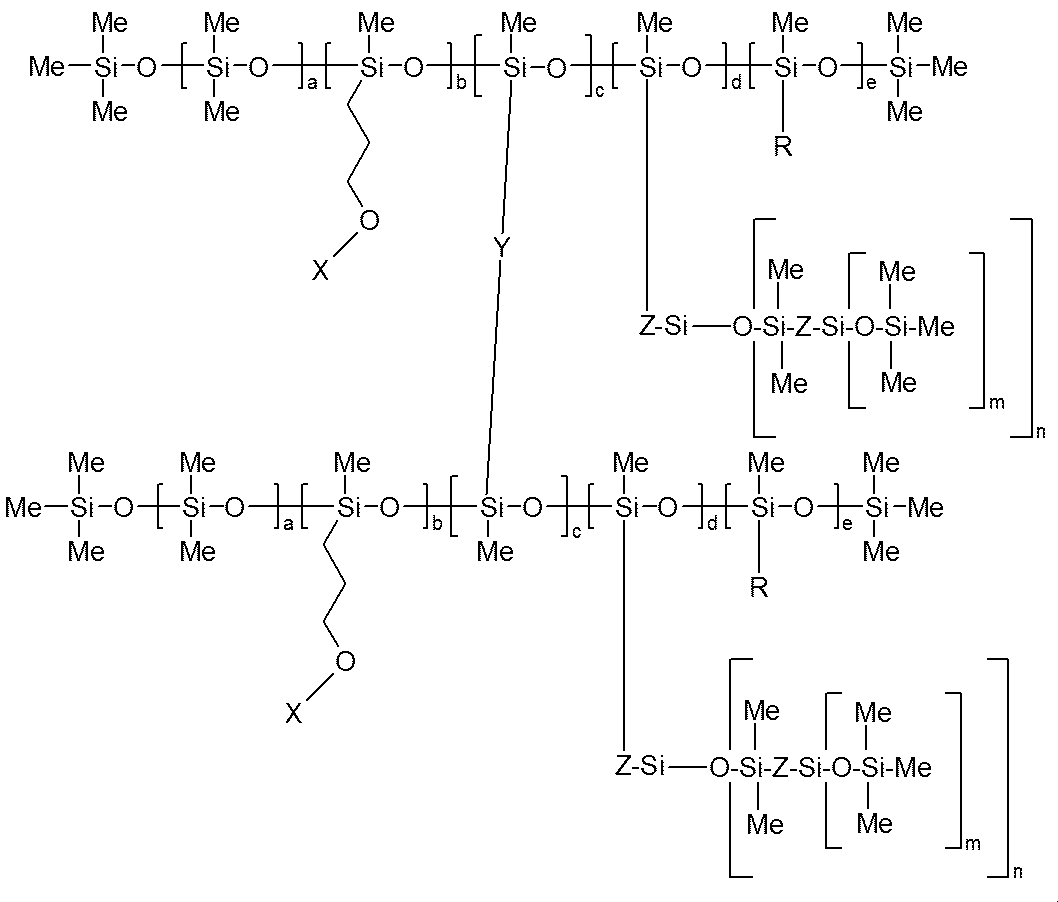
<液状の高純度多価アルコール誘導体変性シリコーンNo.6を含む組成物の調製>
反応器に製造例6で得られた乳白色均一なガム状流体{多価アルコール誘導体変性シリコーンNo.6を主成分として含む組成物と、カプリリルメチコン(希釈剤)とからなる組成物} 130g、トルエン 142g、カルボキシビニルポリマー(別名:カルボマー、白色微粉末) 2.0gを仕込み、65-80℃に加温して40分間攪拌混合したのち、室温まで放冷した。
前記実施例5の場合と同様に、加圧濾過器、目皿、濾紙、受け器をセットした。
前述の処理で得られた濁り液100gをカップに取り、これに中間粒度10.9μmの珪藻土微粉末3gを加え、ヘラでよくかき混ぜてスラリー状とした。このスラリーを、加圧濾過器にセットした濾紙上に注いだ後、濾過器に蓋をして上部より窒素圧0.1~0.2MPaをかけることにより、主として中間粒度10.9μmの珪藻土微粉末からなる濾層を形成した。
次いで、前記濁り液の残部(白色沈殿も含む)と濾層形成時に回収した濾液とを再度前記濾層上に注ぎ、濾過器に蓋をして上部より窒素圧0.05~0.1MPaをかけたところ、驚いたことに、得られた濾液は全量が微黄色ほぼ透明均一液体であり、その重量は248gであった。
次いで、前記実施例1と同様の手法でこの濾液からトルエンを留去することにより、平均組成式MD330DR*11 45DR*32 30DR*24 5M で表される液状の高純度多価アルコール誘導体変性シリコーンNo.6とカプリリルメチコンとからなる組成物を、白黄色半透明均一の非常に粘稠な液体として得た。(収量123g) 式中、R*11、R*32及びR*24は下記のとおりである。
R*11= -C16H33
R*32=-C2H4Si(OSiMe3)3
R*24=-C3H6O-(C3H6O2)n-H, n=4.0
<液状の高純度多価アルコール誘導体変性シリコーンNo.7を含む組成物の調製>
反応器に製造例7で得られた乳白色粘稠液体(多価アルコール誘導体変性シリコーンNo.7を主成分として含む組成物) 150g、トルエン 120g、ポリビニルアルコール(PVA:重合度1500、白色粉粒状)4.5gを仕込み、70-80℃に加温して40分間攪拌混合したのち室温まで放冷した。
前記実施例6の場合と同様に、加圧濾過器、目皿、濾紙、受け器をセットし、同様の手法により主として中間粒度10.9μmの珪藻土微粉末3gからなる濾層を形成、及び前記処理で得られた濁液状混合物をこの濾層に通すことにより、淡黄色半透明均一な濾液を得た。従って、このものは、平均組成式:MD45DR*31 1DR*24 1Mで表される液状の高純度多価アルコール誘導体変性シリコーンNo.7とトルエン(希釈剤)とからなる組成物と考えられ、上記変性シリコーンNo.7:希釈剤の重量(質量)比は5:4であり、前記式中、R*31及びR*24は下記のとおりである。
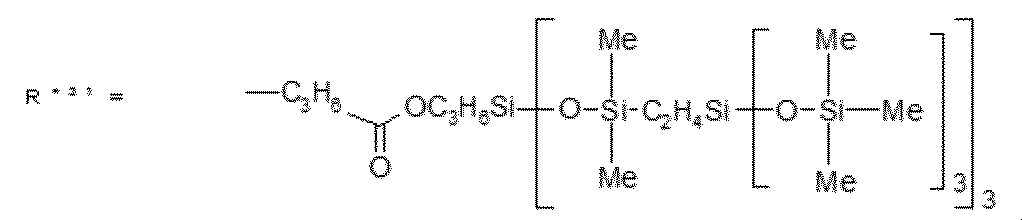
<液状の高純度多価アルコール誘導体変性シリコーンNo.8の調製>
反応器に製造例8で得られた土灰褐色の不透明粘性液体(多価アルコール誘導体変性シリコーンNo.8を主成分として含む組成物)を180g、カルボキシビニルポリマー(別名:カルボマー、白色微粉末)5.4gを仕込み、60-85℃に加温して1時間攪拌混合した。その後、攪拌下に35℃まで放冷し、乳濁粘性液状物を得た。
タンク付きステンレスホルダーADVANTEC KST-90に、直径90mmのガラス繊維濾紙GC-90(保留粒子径0.5μm)をセットし、漏れの起こらないようタンク部とベースプレート(O-リング、濾紙、サポートスクリーンを置く部分)とを専用のボルト、ワッシャー、ナットにより締め付けて固定した。これにより、濾紙の縁部全体が上下から締め付けられ、漏れを防ぐ構造となる。
タンク上部の開口部より、前述の処理で得られた濁り液を投入したのち、開口部をタンクキャップで閉じ、窒素圧0.4MPaをかけて濾過を行なった。比較例8-2のケースとは異なり褐色ほぼ透明な濾液が得られたが、およそ5g出たところで目詰まりが生じ、濾液の落下が止まっていた。この現象は、濁り成分である液状の親水性不純物が、本発明おける親水性不純物を捕捉可能な固体粒子(ここではカルボマー粉体)に取り込まれ固体化された結果、これらがフィルター上に密に堆積して目詰まりを起こしたと理解できる。そして、分離された主成分の液は、当初の濁りが大幅に低減されほぼ透明な外観であった。したがって、本発明の動作原理が証明されたと考えられる。これに対して比較例8-2は、本発明における親水性不純物を捕捉可能な固体粒子による処理を行っていない点を除き、実施例8と全く同じ条件で濾過を行なったものであるが、濾過の前後で濁りは全く低減できていなかった。このことは、濁り成分がフィルターの細孔(0.5μm未満)を全く目詰まり無く通過したことを意味し、組成物中の濁り成分が液として存在していることを示している。
<液状の高純度多価アルコール誘導体変性シリコーンNo.8の調製>
反応器に製造例8で得られた土灰褐色の不透明粘性液体(多価アルコール誘導体変性シリコーンNo.8を主成分として含む組成物)を180g、カルボキシビニルポリマー(別名:カルボマー、白色微粉末)5.4gを仕込み、60-85℃に加温して1時間攪拌混合した。その後、攪拌下に35℃まで放冷し、乳濁粘性液状物を得た。
前記実施例8の場合と同様に、タンク付きステンレスホルダーADVANTEC KST-90に、直径90mmのガラス繊維濾紙GC-90(保留粒子径0.5μm)をセットし、漏れの起こらないようタンク部とベースプレート(O-リング、濾紙、サポートスクリーンを置く部分)とを専用のボルト、ワッシャー、ナットにより締め付けて固定した。
前記処理で得られた乳濁粘性液状物に、濾過時の目詰まりを抑制する目的で中間粒度46.5μmの珪藻土粉末5gを加え、ヘラでよくかき混ぜてスラリー状とした。
タンク上部の開口部より前記スラリーを投入したのち、開口部をタンクキャップで閉じ、窒素圧0.4MPaをかけて濾過を行った。この結果、平均組成式:MD44.7DR*22 2Mで表される液状の高純度多価アルコール誘導体変性シリコーンNo.8を、濃褐色ほぼ透明均一粘性液体として得た。(収量149g ) ここで、前記式中、R*22は下記のとおりである。
R*22= -C3H6O-{CH2-CH(OH)-CH2O}2-H
<液状の高純度多価アルコール誘導体変性シリコーンNo.8の調製>
反応器に製造例8で得られた土灰褐色の不透明粘性液体(多価アルコール誘導体変性シリコーンNo.8を主成分として含む組成物)を157g、コーンスターチ(白色微粉末)3.8g、カルボキシビニルポリマー(別名:カルボマー、白色微粉末)0.9gを仕込み、60-85℃に加温して1時間攪拌混合した。その後、攪拌下に35℃まで放冷し、乳濁粘性液状物を得た。濾過時の目詰まりを防止する目的で、これに中間粒度46.5μmの珪藻土粉末5gを加え、ヘラでよくかき混ぜてスラリー状とした。
前記実施例8と同様にして、タンク付きステンレスホルダーに直径90mmのガラス繊維濾紙GC-90(保留粒子径0.5μm)をセットし、タンク部とベースプレートとを締め付けて固定した。タンク上部の開口部より前記スラリーを投入したのち、開口部をタンクキャップで閉じ、窒素圧0.4MPaをかけて濾過を行った。この結果、濃褐色でやや半透明感ある粘性液体139g が得られた。
<液状の高純度多価アルコール誘導体変性シリコーンNo.9の調製>
反応器に製造例9で得られた微黄色液体(多価アルコール誘導体変性シリコーンNo.9を主成分として含む組成物)を180g、アルギン酸(白黄色微粉末)5.4g を仕込み、60-80℃に加温して50分間攪拌混合した。その後、50℃以下まで攪拌下に放冷し、停止して室温に戻したところ黄白色の沈殿物と白黄色ヘイズ上澄み液とに分離していた。濾過時の目詰まりを防止する目的で、これに中間粒度30.6μmの珪藻土粉末5gを加え、ヘラでよくかき混ぜてスラリー状とした。
前記実施例8と同様にして、タンク付きステンレスホルダーに直径90mmのガラス繊維濾紙GC-90(保留粒子径0.5μm)をセットし、タンク部とベースプレートとを締め付けて固定した。タンク上部の開口部より前記スラリーを投入したのち、開口部をタンクキャップで閉じ、窒素圧0.4MPaをかけて濾過を行った。この結果、平均組成式:R*25MD187MR*25で表される多価アルコール誘導体変性シリコーンNo.9を、無色透明均一液体として得た。(収量161g) ここで、R*25は下記のとおりである。
R*25=-C3H6O-CH2(OH)-CH2-N{CH2CH(CH3)OH}2
<液状の高純度多価アルコール誘導体変性シリコーンNo.9の調製>
反応器に製造例9で得られた微黄色液体(多価アルコール誘導体変性シリコーンNo.9を主成分として含む組成物)を180g、カテキン水和物(茶白色粉末状)1.1g を仕込み、70-80℃に加温して55分間攪拌混合した。その後、40℃以下まで攪拌下に放冷し内容物を確認したところ、透明と思われる液中に朱色の粉末が分散した状況であった。濾過時の目詰まりを防止する目的で、これに中間粒度10.9μmの珪藻土微粉末3gを加え、ヘラでよくかき混ぜてスラリー状とした。
前記実施例8と同様にして、タンク付きステンレスホルダーに直径90mmのガラス繊維濾紙GC-90(保留粒子径0.5μm)をセットし、タンク部とベースプレートとを締め付けて固定した。タンク上部の開口部より前記スラリーを投入したのち、開口部をタンクキャップで閉じ、窒素圧0.4MPaをかけて濾過を行った。この結果、平均組成式:R*25MD187MR*25で表される多価アルコール誘導体変性シリコーンNo.9を、微黄色透明均一液体として得た。(収量166g) ここで、R*25は下記のとおりである。
R*25=-C3H6O-CH2(OH)-CH2-N{CH2CH(CH3)OH}2
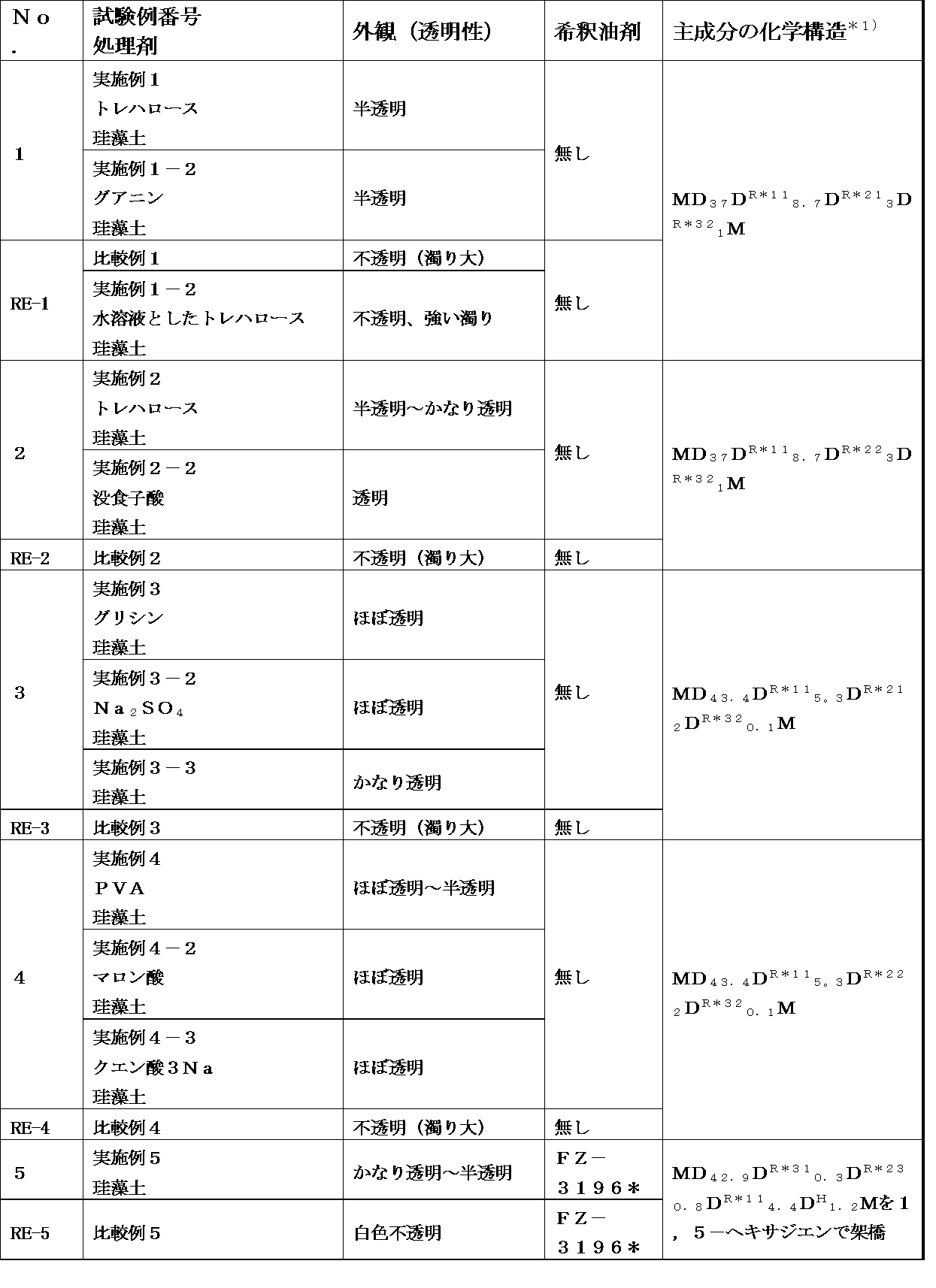
注*1)主成分である多価アルコール誘導体変性シリコーンの化学構造を平均組成式により示す。
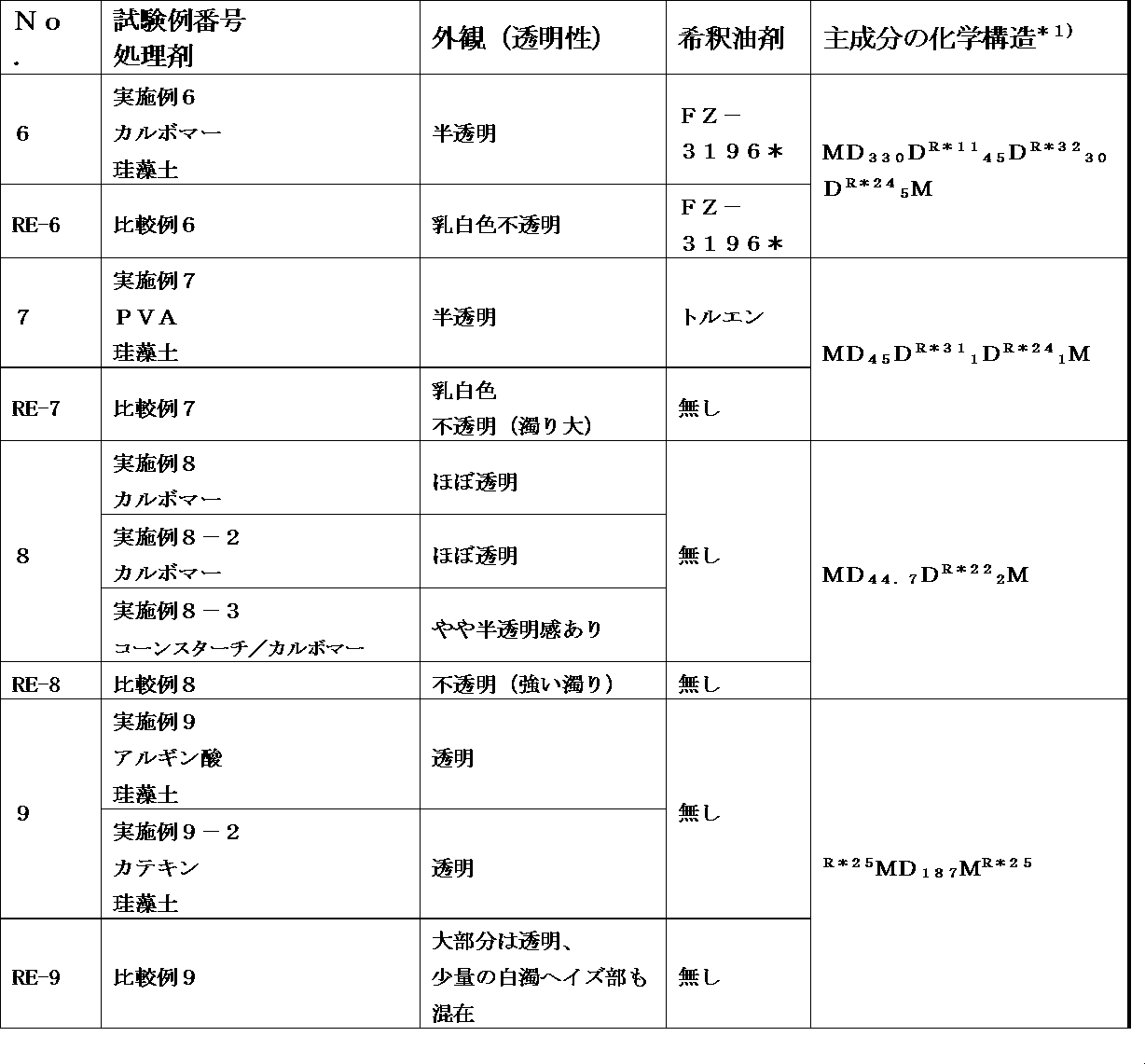
注*1)主成分である多価アルコール誘導体変性シリコーンの化学構造を平均組成式により示す。
<シロキサンデンドロン構造を有する基:R*3>

<多価アルコール誘導体基:R*2>
R*21= -C3H6O-(C3H6O2)n-H, n=1.7
R*22= -C3H6O-{CH2-CH(OH)-CH2O}2-H
R*23= -C3H6O-(C3H6O2)n-H, n=2.0
R*24= -C3H6O-(C3H6O2)n-H, n=4.0
R*25=-C3H6O-CH2(OH)-CH2-N{CH2CH(CH3)OH}2
<その他の有機基:R*1>
R*11= -C16H33
実施例1、実施例2-2、実施例3-3、実施例4、実施例4-3、実施例6、実施例8-2、及び、比較例1-2、比較例2、比較例3、比較例4、比較例6、比較例8-2の試料について、20~25℃における光透過率T%(波長750nm、セル厚10mm)を測定した。結果を表3に示す。
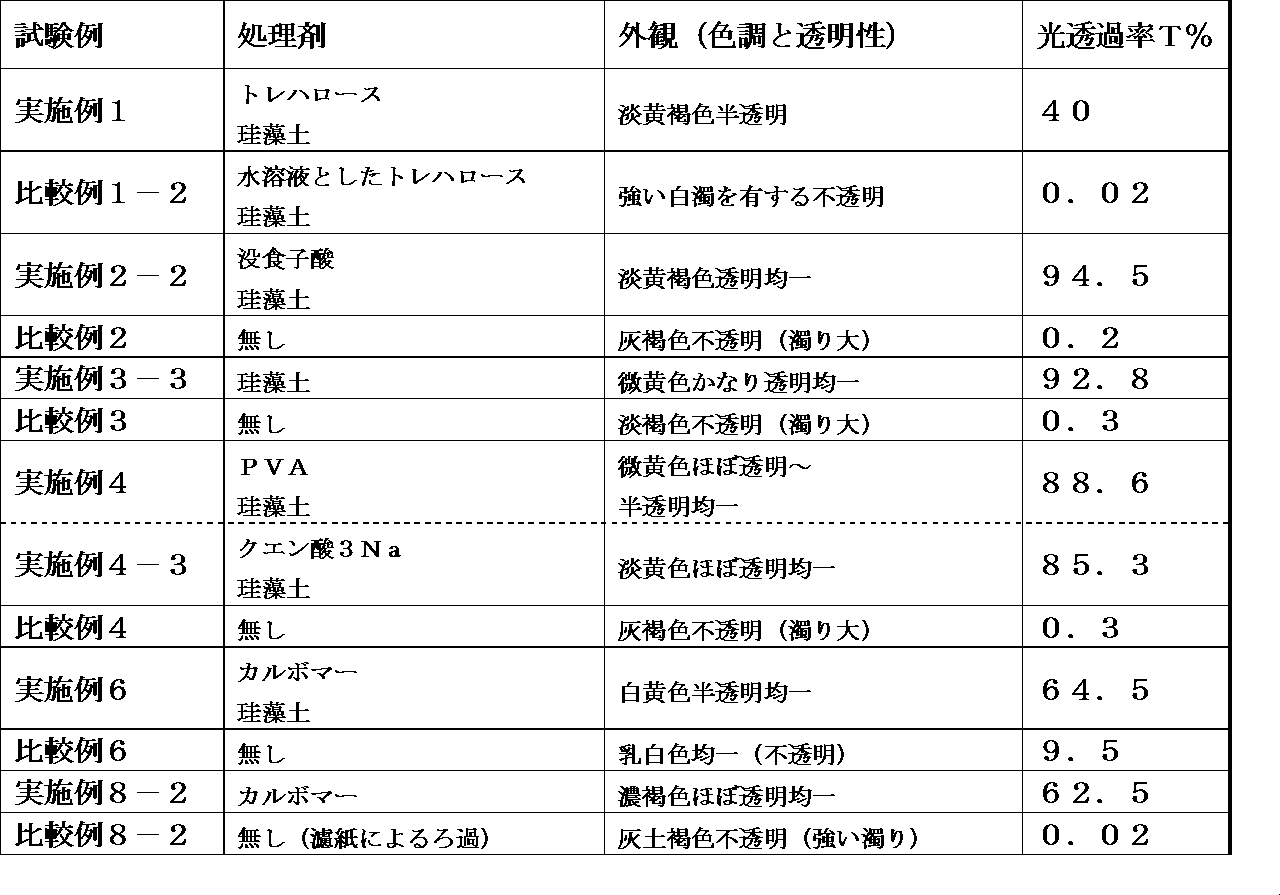
実施例4-3及び比較例4の試料、実施例8-2及び比較例8-2の試料、実施例9、実施例9-2及び比較例9の試料について、前処理により水酸基をトリメチルシリル化(TMS)封鎖したのち、トルエンを溶離液としてGPC測定を行なうことにより、主成分の多価アルコール誘導体変性シリコーンに由来するピークと残存親水性不純物に由来するピークとの面積比を求めた。
但し、実施例9、実施例9-2及び比較例9の試料については活性アミノ基(GPCカラムに吸着する)を含有する可能性があるため、前記水酸基のTMS封鎖の後、更にアミノ基のエトキシカルボニル化封鎖を行なってから、GPC測定に供した。
また、このとき親水性不純物に由来するピーク位置決定の参考とするため、原料である高純度鎖状ジグリセリンモノアリルエーテル(グリセリン単位の繰り返し数=2)についても同様に水酸基を封鎖して、同様にGPC測定を行なった。以下に前処理及びGPC測定の条件を示す。また、結果を表4に示す。
試料約0.5g(高純度鎖状ジグリセリンモノアリルエーテルは約0.1g)を試験管に精秤し、試薬特級グレードのトルエン1mLで希釈した。
試料中に含まれる水酸基のモル数の3倍モルに相当する、N,O-ビス(トリメチルシリル)アセトアミドを添加し、軽く振り混ぜ混合した。この段階では、混合液は白濁ないしは不均質であった。
試験管に冷却管を取り付けてトルエン還流下で1時間処理を行った。この反応液の外観を確認した所、ほとんど透明均一な液体に変化していた。
試験管内の反応液を適量バイアル瓶に精秤し、試薬特級グレードのトルエンを添加し希釈することによって、計算上の試料濃度1重量%であるGPC測定用サンプル溶液を得た。
実施例9、実施例9-2及び比較例9に対応する前記GPC測定用サンプル溶液に対しては、試料中に含まれるアミノ基のモル数の6倍モルに相当する、ジエチルピロカルボナートを添加し、振り混ぜ混合均一化したものをGPC測定用サンプル溶液とした。
溶離液: トルエン(試薬特級)
測定温度: 40℃
検出器: 屈折率計(マイナス側にピーク検出)
流速: 1.0mL/min
校正: 標準ポリスチレンにより実施
サンプル溶液の注入量: 15μL (試料濃度1重量%)
本発明に係る高純度化処理前後の試料(未処理:比較例4、比較例8-2、比較例9、処理後:実施例4-3、実施例8-2、実施例9及び実施例9-2)を前述のとおりGPC測定に供し、得られた分子量分布曲線の解析により、主成分たる多価アルコール誘導体変性シリコーン由来のピーク面積に対する残存親水性不純物由来のピーク面積の比率を求め、下表4にまとめた。
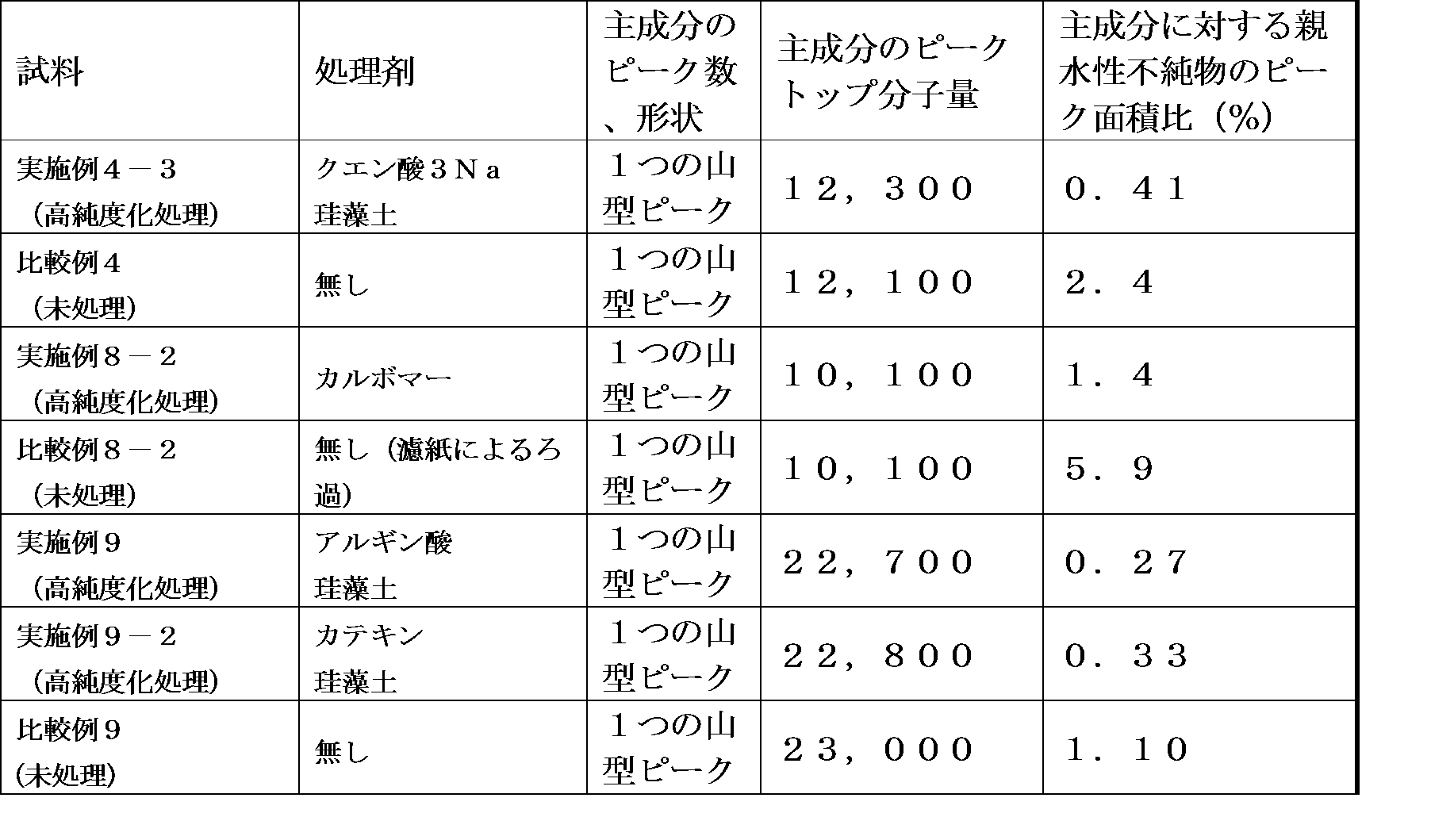
200mLガラス瓶に入れた実施例1、実施例1-2、実施例2、実施例2-2、実施例3、実施例3-2、実施例3-3、実施例4、実施例4-2、実施例4-3、及び、比較例1~4の試料を、室温(夏場は30℃付近~冬場は15℃付近まで変化)で1年間静置した後、各試料の外観変化を観察した。結果を表5に示す。
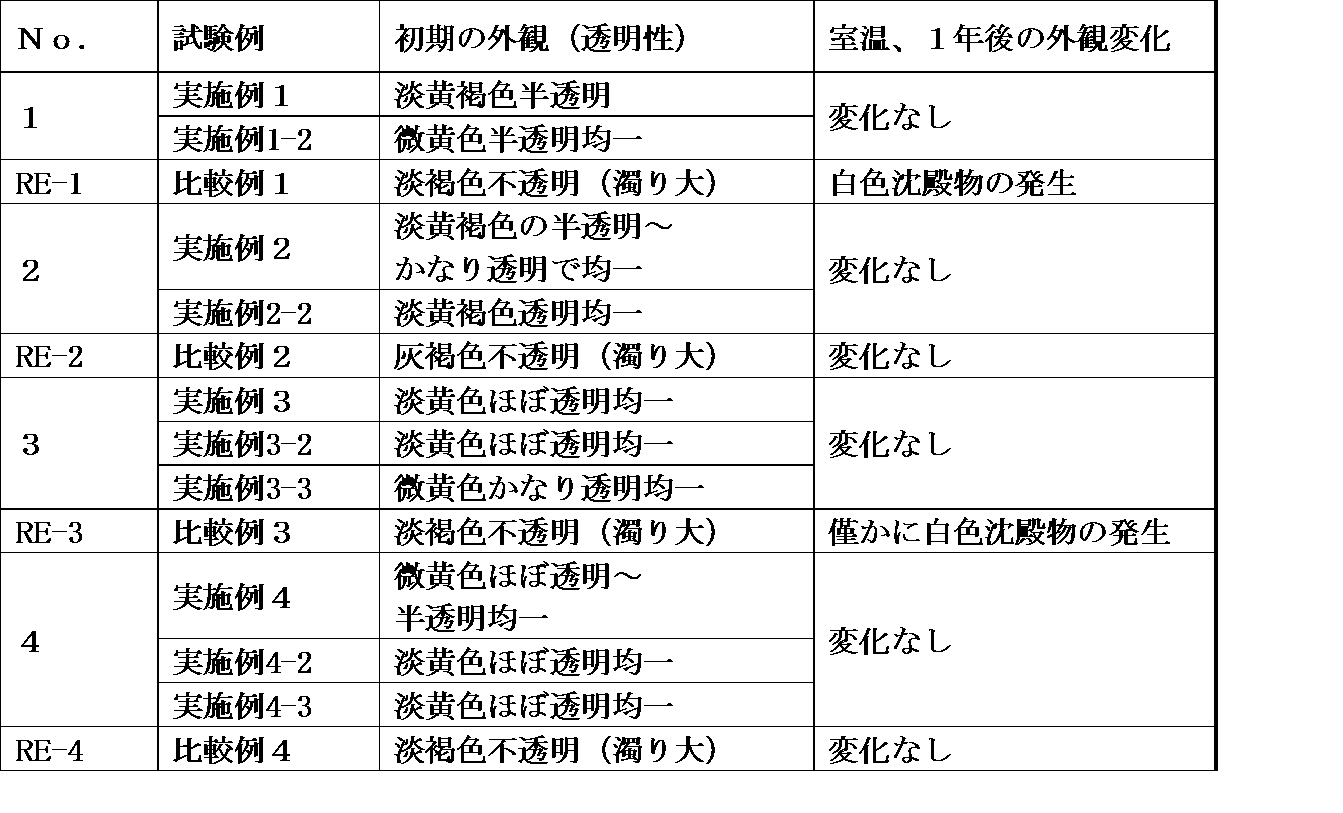
より極端な温度変化に対する外観の安定性(透明性への影響)を確認するため、実施例3-3、実施例4、実施例2-2、実施例6、実施例8-2、実施例9、実施例9-2、比較例9の試料を50℃恒温槽中に入れて1晩静置した。一方、実施例2-2、実施例4-3、実施例6、実施例8-2、実施例9、実施例9-2、比較例9の試料は0℃冷蔵庫中に入れて1晩静置した。結果を表6に示す。
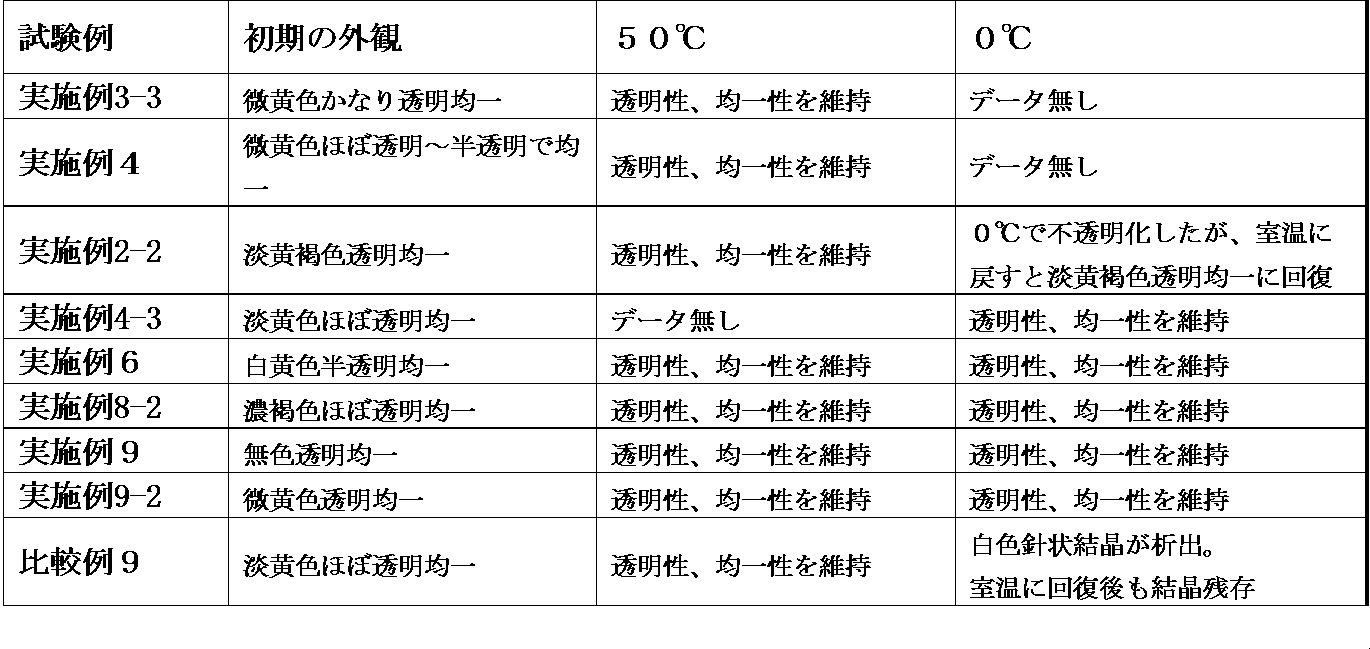
(成分)
1. イソドデカン 20部
2. イソヘキサデカン 10部
3. イソノナン酸イソトリデシル 3部
4. トリカプリルカプリン酸グリセリル 2部
5. ポリエーテル変性シリコーン(注1) 0.5部
6. 高純度多価アルコール誘導体変性シリコーンNo.5 1.5部
7. 有機変性粘土鉱物(ベントン38V) 1.5部
8. メトキシケイ皮酸オクチル 5部
9. オクチルシラン処理酸化チタン 8.5部
10.オクチルシラン処理赤酸化鉄 0.4部
11.オクチルシラン処理黄酸化鉄 1部
12.オクチルシラン処理黒酸化鉄 0.1部
13.ジメチコン、ジメチコンクロスポリマー(注2) 2部
14.イソドデカン/(アクリレーツ/メタクリル酸ポリトリメチルシロキシ)コポリマー(注3) 1部
15.トリメチルシロキシケイ酸 1部
16.1,3-ブチレングリコール 5部
17.グリセリン 3部
18.塩化ナトリウム 0.5部
19.防腐剤 適量
20.精製水 残量
21.香料 適量
注1)東レ・ダウコーニング社製ES-5300
注2)Dow Corning社製DC9045
注3)東レ・ダウコーニング社製FA-4002ID
工程1: 成分1、2、5、6、7、8、13、14、15を撹拌混合する。
工程2: 成分3、4、9~12を、3本ロールを用いて混練混合する。
工程3: 撹拌下、工程1で得られた混合物に工程2の混合物を加え、更に撹拌混合する。
工程4: 成分16~21を均一に溶解した水相を、工程3で得られた混合物に攪拌下に加えて乳化し(乳化機を使用)、容器に充填して製品を得る。
(成分)(重量%)
1.D5(デカメチルシクロペンタシロキサン) 26.6
2.カプリリルメチコン(注4) 5.0
3.BY 11-018(注5) 5.0
4.ミリスチン酸オクチルドデシル 10.0
5.トリイソステアリン酸PEG-20水添ヒマシ油 0.3
6.ポリエーテル変性シリコーン(注6) 1.2
7.本発明に係る高純度多価アルコール誘導体変性シリコーンNo.4 0.8
8.ジステアリルジモニウムヘクトライト 0.3
9.ジメチコン/メチコンポリマー処理酸化亜鉛 15.0
10.ステアリン酸アルミニウム処理酸化チタン 13.0
11.メチルパラベン 0.1
12.95%エタノール 5.0
13.硫酸マグネシウム 0.7
14.香料 適量
15.精製水 17.0
注4)東レ・ダウコーニング社製FZ-3196
注5)東レ・ダウコーニング社製、トリメチルシロキシケイ酸30%含有のD5希釈液
注6)東レ・ダウコーニング社製ES-5300
A:成分1~11をよく混合して均一な分散体とする。
B:成分12~15を混合し、均一な溶液とする。
C:Aを攪拌下、Bを徐々に添加して乳化する(乳化機を使用)。
べたつきやきしみがなく、非常に軽く良く伸び広がる。また、密着性に非常に優れながらも皮膚感覚の違和感は少なく、さらっとしたシリコーン的な肌触りが得られる。乳液の安定性に優れ、温度や経時に対しても増粘等の粘度変化が少ない。サンカット効果とその持続性にも優れる。
(成分)(重量%)
1.D5(デカメチルシクロペンタシロキサン) 23.6
2.カプリリルメチコン(注4) 7.5
3.DC 670 Fluid(注7) 5.0
4.流動パラフィン 3.0
5.メトキシ桂皮酸エチルヘキシル 7.5
6.ポリエーテル変性シリコーン(注6) 1.0
7.本発明に係る高純度多価アルコール誘導体変性シリコーンNo.3 1.0
8.有機変性ベントナイト(ベントン38) 0.2
9.メチルハイドロジェンポリシロキサン処理酸化亜鉛 22.5
10.95%エタノール 5.0
11.1,3-ブチレングリコール 3.0
12.クエン酸ナトリウム 0.2
13.塩化ナトリウム 0.5
14.香料 適量
15.精製水 20.0
注4)東レ・ダウコーニング社製FZ-3196
注6)東レ・ダウコーニング社製ES-5300
注7)ダウコーニング社製、ポリプロピルシルセスキオキサン50%含有のD5希釈液
A:成分1~9をよく混合して均一な分散体とする。
B:成分10~15を混合し、均一な溶液とする。
C:Aを攪拌下、Bを徐々に添加して乳化する(乳化機を使用)。
水のさわやかな感触が活きており非常に軽く良く伸び広がる。また、本発明品の優れた粉体分散効果によって微粒子酸化亜鉛を安定に微分散できるので、塗布後に肌が白っぽくなりにくい利点がある。更に、突っ張り感等の違和感もなく紫外線防御効果も優れている。
(成分)(重量%)
1.EL-8040 ID(注8) 5.0
2.MQ-1640 FLAKE RESIN(注9) 1.0
3.本発明に係る高純度多価アルコール誘導体変性シリコーンNo.2 1.0
4.イソノナン酸イソトリデシル 2.0
5.イソヘキサデカン 1.7
6.油中粉体分散物(本発明に係る高純度多価アルコール誘導体変性シリコーンNo.4/D5/微粒子酸化チタン=3/15/12の重量比の混合物) 22.5
7.油中粉体分散物(本発明に係る高純度多価アルコール誘導体変性シリコーンNo.4/D5/微粒子酸化亜鉛1.5/10.5/18の重量比の混合物) 31.5
8.1,3-ブチレングリコール 2.0
9.食塩 0.5
10. 精製水 32.8
注8)ダウコーニング社製、ジメチコンクロスポリマー16%含有のイソドデカン希釈物
注9)ダウコーニング社製、トリメチルシロキシケイ酸とポリプロピルシルセスキオキサンのブレンド物
A:成分2~5を混合して均一な溶液とした後、成分1を加えて良く混合し、均質な分散体とする。
B:成分8~10を混合し、均一な溶液とする。
C:Aを攪拌下、Bを徐々に添加して乳化(乳化機を使用)の後、成分6及び7を加えて混合し均質なクリームを得る。
独特のベルベットのような厚みのあるスムースな塗布感が得られる。べたつきや油っぽさのない自然な使用感で、保湿効果や紫外線防御効果、その耐汗性にも優れている。
(成分)(重量%)
1.D5(デカメチルシクロペンタシロキサン) 17.9
2.ジメチコン(5cst) 5.0
3.本発明に係る高純度多価アルコール誘導体変性シリコーンNo.8 4.0
4.9040 Silicone Elastomer Blend(注10) 10.0
5.プロピレングリコール 7.6
6.グリセリン 45.0
7.ビタミンC 10.5
注10)ダウコーニング社製、ジメチコンクロスポリマー12%含有のD5希釈物
A:成分1~4をよく混合して均一な分散体とする。
B:成分5~7を混合し、70℃で加熱と攪拌とを行い、均一な溶液とする。
C:Aを攪拌下、Bを徐々に添加して乳化し(乳化機を使用)、均質なクリームを得る。
非水系の安定な乳化物が得られるため、ビタミンC の安定性も良好に保持される結果、生理活性物質であるビタミンC 固有の効果が皮膚上又は皮内にて温和かつ持続的に発揮されると期待される。
(成分)(重量%)
1.カプリリルメチコン(注4) 3.0
2.ミネラルオイル 3.0
3.トリ(カプリル・カプリン酸)グリセリル 3.0
4.本発明に係る高純度多価アルコール誘導体変性シリコーンNo.5 1.0
5.ポリエーテル変性シリコーン(注6) 1.0
6.EL-8050 ID Silicone Organic Elastomer Blend(注11) 8.0
7.ジプロピレンングリコール 3.0
8.グリセリン 60.0
9.ビタミンC 15.0
注4)東レ・ダウコーニング社製FZ-3196
注6)東レ・ダウコーニング社製ES-5300
注11)ダウコーニング社製(ジメチコン/ビス-イソブチルPPG-20)クロスポリマー 15%含有のイソドデカン希釈物
A:成分1~6をよく混合して均一な分散体とする。
B:成分7~9を混合し、70℃で加熱と攪拌とを行い、均一な溶液とする。
C:Aを攪拌下、Bを徐々に添加して乳化し(乳化機を使用)、均質なクリームを得る。
非水系の安定な乳化物が得られるため、ビタミンC の安定性も良好に保持される結果、生理活性物質であるビタミンC 固有の効果が皮膚上又は皮内にて温和かつ持続的に発揮されると期待される。
Claims (18)
- 液状の多価アルコール誘導体変性シリコーン及び該多価アルコール誘導体変性シリコーンの親水性変性剤である多価アルコール誘導体に由来する親水性不純物を含有する不純物含有組成物を、該親水性不純物を捕捉可能な固体粒子と接触させて該親水性不純物を該固体粒子に捕捉させる捕捉工程、及び、
前記多価アルコール誘導体変性シリコーン及び前記固体粒子を分離する分離工程
を含む、液状の高純度多価アルコール誘導体変性シリコーン又はその組成物の製造方法。 - 前記多価アルコール誘導体変性シリコーンが、糖誘導体変性シリコーン以外の多価アルコール誘導体変性シリコーンである、請求項1記載の製造方法。
- 前記固体粒子が、ケイ素原子不含低分子有機化合物、ケイ素原子不含の非架橋型親水性高分子有機化合物、ケイ素原子不含の架橋型親水性高分子有機化合物、塩類、鉱物由来材料、及び、活性炭から選ばれる1以上の物質を含む、請求項1又は2記載の製造方法。
- 前記固体粒子がケイ素原子不含の架橋型親水性高分子有機化合物を含む、請求項1乃至3のいずれかに記載の製造方法。
- 前記固体粒子が多孔質である、請求項1乃至4のいずれかに記載の製造方法。
- 前記固体粒子が二酸化ケイ素を含む、請求項1乃至5のいずれかに記載の製造方法。
- 前記固体粒子が、少なくとも1種の水素結合形成性物質及び/又は少なくとも一種のイオン結合形成性物質及び/又はこれらの水和物を含む、請求項1乃至6のいずれかに記載の製造方法。
- 前記分離工程が、濾過材を用いる濾過工程を含む、請求項1乃至7のいずれかに記載の製造方法。
- 前記不純物含有組成物を、前記多価アルコール誘導体変性シリコーンの良溶媒且つ前記親水性不純物の貧溶媒である溶媒により希釈後に、前記捕捉工程において前記固体粒子と接触させる、請求項1乃至8のいずれかに記載の製造方法。
- 前記分離工程後の前記組成物を加熱及び/又は減圧して前記溶媒を除去する工程を含む、請求項9記載の製造方法。
- 前記多価アルコール誘導体変性シリコーンが、下記一般式(1):


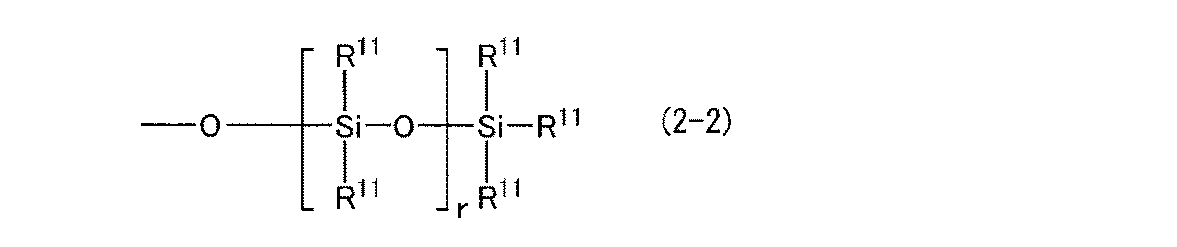

a 、b 、c及びdは、それぞれ、1.0≦a≦2.5、0≦b≦1.5、0≦c≦1.5、0.0001≦d≦1.5の範囲にある数である}で表される、多価アルコール誘導体変性シリコーンである、請求項1乃至10のいずれかに記載の製造方法。 - 前記多価アルコール誘導体基がグリセリン誘導体基である、請求項11記載の製造方法。
- 前記多価アルコール誘導体基が、二価の連結基を介してケイ素原子に結合し、かつ下記構造式(4―1)~(4-3):

(式中、Wは水素原子又は炭素原子数1~20のアルキル基を表す)
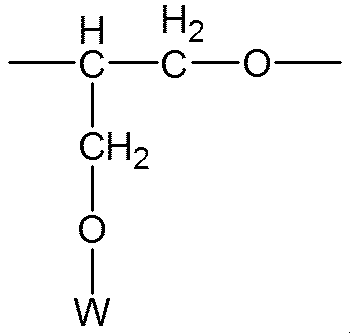
(式中、Wは前記と同様の基を表す)

で表される親水性単位から選択される少なくとも1種以上の単位を、その繰り返し数が平均して1~10の範囲で含有してなるグリセリン誘導体基である、請求項11又は12記載の製造方法。 - 前記多価アルコール誘導体基が、親水性基としてオキシアルキレン単位の繰り返し数の平均値が2以上のオキシアルキレン構造を有せず、且つ、グリセリン単位の繰り返し数の平均値が1~5の範囲内にあるグリセリン誘導体基のみを有し、その他の親水性基を有しない、請求項11乃至13のいずれかに記載の製造方法。
- 前記多価アルコール誘導体基が、下記一般式(5-1):
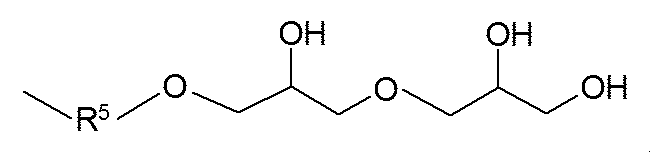
(式中、R5はオキシアルキレン単位の繰り返し数の平均値が2以上のオキシアルキレン構造を有しない二価有機基を表す)、又は、下記一般式(5-2):

(式中、R5は上記のとおりである)で表わされるジグリセリン誘導体基である、請求項11乃至14のいずれかに記載の製造方法。 - 前記多価アルコール誘導体変性シリコーンが、多価アルコール誘導体変性架橋シリコーンである、請求項1乃至15のいずれかに記載の製造方法。
- 請求項1乃至16のいずれかに記載の製造方法により得られた、透明乃至半透明の液状の高純度多価アルコール誘導体変性シリコーン又はその組成物。
- 請求項17記載の透明乃至半透明の液状の高純度多価アルコール誘導体変性シリコーン又はその組成物を含有する、外用剤若しくは化粧料、又は、工業用材料。
Priority Applications (4)
| Application Number | Priority Date | Filing Date | Title |
|---|---|---|---|
| US15/310,255 US10174170B2 (en) | 2014-04-21 | 2015-04-20 | Method for producing liquid high-purity polyhydric alcohol derivative-modified silicone or composition thereof |
| JP2016514715A JPWO2015162906A1 (ja) | 2014-04-21 | 2015-04-20 | 液状の高純度多価アルコール誘導体変性シリコーン又はその組成物の製造方法 |
| EP15782486.3A EP3147307A4 (en) | 2014-04-21 | 2015-04-20 | Method for producing liquid high-purity polyhydric alcohol derivative-modified silicone or composition thereof |
| CN201580033012.7A CN106414557A (zh) | 2014-04-21 | 2015-04-20 | 液态高纯度多元醇衍生物改性的有机硅或其组合物的制造方法 |
Applications Claiming Priority (2)
| Application Number | Priority Date | Filing Date | Title |
|---|---|---|---|
| JP2014-087712 | 2014-04-21 | ||
| JP2014087712 | 2014-04-21 |
Publications (1)
| Publication Number | Publication Date |
|---|---|
| WO2015162906A1 true WO2015162906A1 (ja) | 2015-10-29 |
Family
ID=54332084
Family Applications (1)
| Application Number | Title | Priority Date | Filing Date |
|---|---|---|---|
| PCT/JP2015/002154 Ceased WO2015162906A1 (ja) | 2014-04-21 | 2015-04-20 | 液状の高純度多価アルコール誘導体変性シリコーン又はその組成物の製造方法 |
Country Status (5)
| Country | Link |
|---|---|
| US (1) | US10174170B2 (ja) |
| EP (1) | EP3147307A4 (ja) |
| JP (1) | JPWO2015162906A1 (ja) |
| CN (1) | CN106414557A (ja) |
| WO (1) | WO2015162906A1 (ja) |
Cited By (3)
| Publication number | Priority date | Publication date | Assignee | Title |
|---|---|---|---|---|
| JP2016084429A (ja) * | 2014-10-27 | 2016-05-19 | 東レ・ダウコーニング株式会社 | 高純度有機ケイ素化合物の製造方法 |
| WO2017188309A1 (ja) * | 2016-04-27 | 2017-11-02 | ダウ コーニング コーポレーション | 新規オルガノポリシロキサン又はその酸中和塩、およびそれらの用途 |
| WO2021215825A1 (ko) * | 2020-04-21 | 2021-10-28 | 주식회사 케이씨씨실리콘 | 폴리실록산 조성물 및 이로부터 제조된 친수성 실리콘 |
Families Citing this family (5)
| Publication number | Priority date | Publication date | Assignee | Title |
|---|---|---|---|---|
| CN107722959B (zh) * | 2017-09-28 | 2020-07-21 | 河南大学 | 一种胍胶压裂液有机钛交联剂及其制备方法 |
| JP7158361B2 (ja) * | 2019-10-29 | 2022-10-21 | 信越化学工業株式会社 | 塗料添加剤、塗料組成物、及びコーティング層 |
| JP7158362B2 (ja) * | 2019-10-29 | 2022-10-21 | 信越化学工業株式会社 | 水系塗料用添加剤、水系塗料組成物、及びコーティング層 |
| JP7667643B2 (ja) * | 2020-09-25 | 2025-04-23 | ダウ・東レ株式会社 | 共変性オルガノポリシロキサンおよびその用途 |
| WO2022075372A1 (ja) * | 2020-10-09 | 2022-04-14 | ダウ・東レ株式会社 | カルボン酸共変性オルガノポリシロキサンおよびその用途 |
Citations (3)
| Publication number | Priority date | Publication date | Assignee | Title |
|---|---|---|---|---|
| JP2013010935A (ja) * | 2011-05-30 | 2013-01-17 | Dow Corning Toray Co Ltd | モノ−又はジ−グリセリン誘導体変性オルガノポリシロキサンエラストマー及びその利用 |
| JP2013151660A (ja) * | 2011-12-27 | 2013-08-08 | Dow Corning Toray Co Ltd | 新規液状オルガノポリシロキサン及びその利用 |
| JP2013151656A (ja) * | 2011-12-27 | 2013-08-08 | Dow Corning Toray Co Ltd | ジグリセリン誘導体変性シリコーン、それを含有してなる油中水型エマルション用乳化剤、外用剤および化粧料 |
Family Cites Families (41)
| Publication number | Priority date | Publication date | Assignee | Title |
|---|---|---|---|---|
| JPS57149290A (en) | 1981-03-13 | 1982-09-14 | Shin Etsu Chem Co Ltd | Production of glycerol-modified silicone |
| JP2583412B2 (ja) | 1986-02-24 | 1997-02-19 | チッソ株式会社 | ヒドロキシル基含有シロキサン化合物 |
| JPS63202629A (ja) | 1987-02-17 | 1988-08-22 | Nitto Electric Ind Co Ltd | ポリプロピレングライコ−ル変性オルガノシロキサン重合体の精製法 |
| US4963093A (en) | 1989-02-06 | 1990-10-16 | Dragan William B | Dental syringe tip and syringe holder therefor |
| DE69128321T2 (de) | 1990-08-30 | 1998-05-20 | Kao Corp | Polysiloxanderivat, dessen Verwendung als Emulgator und kosmetische Präparationen |
| JP2613124B2 (ja) | 1990-08-30 | 1997-05-21 | 花王株式会社 | 新規シロキサン誘導体、その製造方法及びこれを含有する化粧料 |
| JPH04188795A (ja) | 1990-11-22 | 1992-07-07 | Fujitsu Ltd | 電子回路部品の放熱構造 |
| JPH0525280A (ja) | 1991-07-19 | 1993-02-02 | Kao Corp | 新規シリコーン誘導体及びこれを含有する化粧料 |
| JPH05156019A (ja) | 1991-12-03 | 1993-06-22 | Kao Corp | アルキルグリセリルポリシロキサン誘導体の精製方法 |
| JP3172787B2 (ja) | 1992-01-14 | 2001-06-04 | 日本精化株式会社 | 糖残基を有するオルガノシロキサン誘導体およびその製造方法 |
| JPH0689147A (ja) | 1992-09-09 | 1994-03-29 | Kobe Nippon Denki Software Kk | ディスク型外部記憶装置の書き込み抑制方法 |
| JP2844453B2 (ja) | 1996-10-02 | 1999-01-06 | 花王株式会社 | 新規シロキサン誘導体 |
| US7001971B2 (en) | 2000-12-08 | 2006-02-21 | Shin-Etsu Chemical Co., Ltd. | Polyhydric alcohol-modified silicone and cosmetic material containing same |
| JP3976226B2 (ja) | 2000-12-08 | 2007-09-12 | 信越化学工業株式会社 | 多価アルコール変性シリコーン及びそれを含有する化粧料 |
| US6784271B2 (en) * | 2001-01-10 | 2004-08-31 | Shin-Etsu Chemical Co., Ltd. | Odorless modified silicone compound, cosmetic preparation containing the same, and method of purifying modified silicone compound having branch polymer comprising hydrophilic group |
| DE10213020A1 (de) | 2002-03-22 | 2003-10-02 | Ge Bayer Silicones Gmbh & Co | Organopolysiloxane-enthaltende Zusammensetzung, Verfahren zu ihrer Herstellung und deren Verwendung |
| JP4485134B2 (ja) | 2002-03-25 | 2010-06-16 | 花王株式会社 | 分岐ポリグリセロール変性シリコーン |
| US7655744B2 (en) | 2002-03-25 | 2010-02-02 | Kao Corporation | Branched polyglycerol-modified silicone |
| JP5037782B2 (ja) | 2003-07-07 | 2012-10-03 | 信越化学工業株式会社 | 新規なオルガノポリシロキサン・グリセリン誘導体交互共重合体およびそれを含有する化粧料 |
| JP4357909B2 (ja) | 2003-09-12 | 2009-11-04 | 花王株式会社 | 分岐ポリグリセロール変性シリコーンの製法 |
| CN1820840A (zh) * | 2005-10-20 | 2006-08-23 | 国家海洋局第一海洋研究所 | 改性硅油类吸附剂及其合成方法 |
| CN101641396B (zh) * | 2007-03-30 | 2012-08-22 | 日油株式会社 | 糖醇修饰的有机聚硅氧烷化合物及其制备方法 |
| JP2011049247A (ja) | 2009-08-25 | 2011-03-10 | Nec Lcd Technologies Ltd | 電子機器の接続構造体、及び当該接続構造体を用いた表示装置 |
| US8784787B2 (en) | 2009-10-23 | 2014-07-22 | Dow Corning Toray Co., Ltd. | Co-modified organopolysiloxane |
| WO2011049247A1 (ja) | 2009-10-23 | 2011-04-28 | 東レ・ダウコーニング株式会社 | 油性原料の増粘剤またはゲル化剤 |
| WO2011049246A1 (ja) | 2009-10-23 | 2011-04-28 | 東レ・ダウコーニング株式会社 | 新規オルガノポリシロキサン共重合体 |
| CN102079816B (zh) * | 2009-11-27 | 2012-09-19 | 威海华康生物芯片有限公司 | 高纯度硅油的制备方法 |
| JP5841311B2 (ja) | 2009-12-21 | 2016-01-13 | 東レ・ダウコーニング株式会社 | 油性原料の増粘剤またはゲル化剤、それを含有してなるゲル状組成物および化粧料もしくは外用剤の製造方法 |
| CN102906161B (zh) | 2010-04-30 | 2014-10-22 | 道康宁东丽株式会社 | 有机聚硅氧烷、包含有机聚硅氧烷的表面活性剂、乳液组合物、粉末处理剂、油基原料的增稠剂、胶凝剂、凝胶组合物和化妆品原料、以及包含它们的外用配制品和化妆品 |
| WO2011136394A1 (en) | 2010-04-30 | 2011-11-03 | Dow Corning Toray Co., Ltd. | Powder treatment agent comprising sugar alcohol -modified organopolysiloxane |
| EP2563844A1 (en) | 2010-04-30 | 2013-03-06 | Dow Corning Toray Co., Ltd. | Organopolysiloxane and use thereof as surfactant, powder treatment agent, thickening agent of oil -based raw material or gelling agent. gel and emulsion compositions, as well as, preparations for external use and cosmetics comprising the same |
| JP2012046508A (ja) | 2010-07-30 | 2012-03-08 | Dow Corning Toray Co Ltd | 糖アルコール変性シリコーンを含む毛髪化粧料 |
| EP2598113B1 (en) | 2010-07-30 | 2016-04-20 | Dow Corning Toray Co., Ltd. | Cosmetic for hair containing co-modified organopolysiloxane |
| JP5809849B2 (ja) | 2011-05-30 | 2015-11-11 | 東レ・ダウコーニング株式会社 | 低臭性糖アルコール変性シリコーンの製造方法 |
| JP5756344B2 (ja) | 2011-05-30 | 2015-07-29 | 東レ・ダウコーニング株式会社 | 新規液状オルガノポリシロキサン及びその利用 |
| JP6369887B2 (ja) | 2011-12-27 | 2018-08-08 | 東レ・ダウコーニング株式会社 | 新規な共変性オルガノポリシロキサン、それを含有してなる処理剤および外用剤 |
| JP6355224B2 (ja) | 2011-12-27 | 2018-07-11 | 東レ・ダウコーニング株式会社 | 低臭性グリセリン誘導体変性シリコーンまたはそれを含む組成物の製造方法 |
| JP6105920B2 (ja) | 2011-12-27 | 2017-03-29 | 東レ・ダウコーニング株式会社 | 共変性オルガノポリシロキサン、それを含有してなる油中水型エマルション用乳化剤、外用剤および化粧料 |
| KR101197617B1 (ko) | 2012-02-27 | 2012-11-07 | (주)코셈 | 증강 현실을 이용한 전자현미경 시스템 |
| CN103073722B (zh) * | 2012-12-19 | 2014-10-15 | 宜昌科林硅材料有限公司 | 一种高纯度低粘度二甲基硅油的连续化制备工艺 |
| WO2014104256A1 (ja) | 2012-12-28 | 2014-07-03 | 東レ・ダウコーニング株式会社 | 高純度グリセリン誘導体変性シリコーンの製造法 |
-
2015
- 2015-04-20 US US15/310,255 patent/US10174170B2/en not_active Expired - Fee Related
- 2015-04-20 JP JP2016514715A patent/JPWO2015162906A1/ja active Pending
- 2015-04-20 EP EP15782486.3A patent/EP3147307A4/en not_active Withdrawn
- 2015-04-20 CN CN201580033012.7A patent/CN106414557A/zh active Pending
- 2015-04-20 WO PCT/JP2015/002154 patent/WO2015162906A1/ja not_active Ceased
Patent Citations (3)
| Publication number | Priority date | Publication date | Assignee | Title |
|---|---|---|---|---|
| JP2013010935A (ja) * | 2011-05-30 | 2013-01-17 | Dow Corning Toray Co Ltd | モノ−又はジ−グリセリン誘導体変性オルガノポリシロキサンエラストマー及びその利用 |
| JP2013151660A (ja) * | 2011-12-27 | 2013-08-08 | Dow Corning Toray Co Ltd | 新規液状オルガノポリシロキサン及びその利用 |
| JP2013151656A (ja) * | 2011-12-27 | 2013-08-08 | Dow Corning Toray Co Ltd | ジグリセリン誘導体変性シリコーン、それを含有してなる油中水型エマルション用乳化剤、外用剤および化粧料 |
Non-Patent Citations (1)
| Title |
|---|
| See also references of EP3147307A4 * |
Cited By (10)
| Publication number | Priority date | Publication date | Assignee | Title |
|---|---|---|---|---|
| JP2016084429A (ja) * | 2014-10-27 | 2016-05-19 | 東レ・ダウコーニング株式会社 | 高純度有機ケイ素化合物の製造方法 |
| WO2017188309A1 (ja) * | 2016-04-27 | 2017-11-02 | ダウ コーニング コーポレーション | 新規オルガノポリシロキサン又はその酸中和塩、およびそれらの用途 |
| CN109153788A (zh) * | 2016-04-27 | 2019-01-04 | 美国陶氏有机硅公司 | 新型有机聚硅氧烷或其酸中和盐、以及它们的用途 |
| KR20190003601A (ko) * | 2016-04-27 | 2019-01-09 | 다우 실리콘즈 코포레이션 | 신규 오가노폴리실록산 또는 그의 산 중화 염, 및 그것들의 용도 |
| EP3450483A4 (en) * | 2016-04-27 | 2019-12-25 | Dow Silicones Corporation | NEW ORGANOPOLYSILOXANE OR ACID-NEUTRALIZATION SALT THEREOF AND USES THEREOF |
| US10806691B2 (en) | 2016-04-27 | 2020-10-20 | Dow Silicones Corporation | Organopolysiloxane, acid-neutralized salt thereof, and applications thereof |
| KR102287413B1 (ko) * | 2016-04-27 | 2021-08-10 | 다우 실리콘즈 코포레이션 | 신규 오가노폴리실록산 또는 그의 산 중화 염, 및 그것들의 용도 |
| WO2021215825A1 (ko) * | 2020-04-21 | 2021-10-28 | 주식회사 케이씨씨실리콘 | 폴리실록산 조성물 및 이로부터 제조된 친수성 실리콘 |
| KR20210130050A (ko) * | 2020-04-21 | 2021-10-29 | 주식회사 케이씨씨실리콘 | 폴리실록산 조성물 및 이로부터 제조된 친수성 실리콘 |
| KR102340546B1 (ko) * | 2020-04-21 | 2021-12-20 | 주식회사 케이씨씨실리콘 | 폴리실록산 조성물 및 이로부터 제조된 친수성 실리콘 |
Also Published As
| Publication number | Publication date |
|---|---|
| JPWO2015162906A1 (ja) | 2017-04-13 |
| US20170218130A1 (en) | 2017-08-03 |
| CN106414557A (zh) | 2017-02-15 |
| US10174170B2 (en) | 2019-01-08 |
| EP3147307A1 (en) | 2017-03-29 |
| EP3147307A4 (en) | 2018-02-28 |
Similar Documents
| Publication | Publication Date | Title |
|---|---|---|
| US10174170B2 (en) | Method for producing liquid high-purity polyhydric alcohol derivative-modified silicone or composition thereof | |
| CN102648264B (zh) | 用于基于油的原料的增稠剂或胶凝剂 | |
| JP6105920B2 (ja) | 共変性オルガノポリシロキサン、それを含有してなる油中水型エマルション用乳化剤、外用剤および化粧料 | |
| JP6486384B2 (ja) | 新規シリコーン界面活性剤、油中水型エマルジョン組成物、粉体組成物、及びそれらの化粧/医療用途 | |
| KR20140035431A (ko) | 신규한 액상 오르가노폴리실록산 및 그 이용 | |
| WO2012165237A1 (ja) | モノ-又はジ-グリセリン誘導体変性オルガノポリシロキサンエラストマー及びその利用 | |
| WO2007135771A1 (ja) | ポリエーテル変性オルガノポリシロキサン、ジオルガノポリシロキサン・ポリエーテルブロックコポリマー、それらの製造方法および化粧料 | |
| EP3009466B1 (en) | Silicone modified by long-chain hydrocarbon group-containing diglycerin derivative, and use thereof | |
| KR101292028B1 (ko) | 변형된 오가노폴리실록산을 포함하는 화장품 | |
| JP6436480B2 (ja) | 高純度有機ケイ素化合物の製造方法 | |
| US9988499B2 (en) | Method for producing liquid high-purity sugar derivative-modified silicone or composition thereof | |
| JP6392669B2 (ja) | 透明乃至半透明の液状のグリセリン誘導体変性シリコーン組成物の製造方法 | |
| CN105189430B (zh) | 高纯度含单烯基甘油衍生物及其制造方法 | |
| US10066060B2 (en) | Production method for high-purity organosilicon compound | |
| JP2012136588A (ja) | ポリシロキサン−n,n−ジヒドロカルビレン糖変性マルチブロックコポリマー及びその製造方法 | |
| WO2014104256A1 (ja) | 高純度グリセリン誘導体変性シリコーンの製造法 | |
| CN101227889A (zh) | 含改性有机基聚硅氧烷的化妆品 | |
| JP6189593B2 (ja) | 透明乃至半透明の液状のグリセリン誘導体変性架橋シリコーン組成物の製造方法 | |
| WO2015162907A1 (ja) | 透明乃至半透明の液状の糖誘導体変性シリコーン組成物の製造方法 |
Legal Events
| Date | Code | Title | Description |
|---|---|---|---|
| 121 | Ep: the epo has been informed by wipo that ep was designated in this application |
Ref document number: 15782486 Country of ref document: EP Kind code of ref document: A1 |
|
| NENP | Non-entry into the national phase |
Ref country code: DE |
|
| ENP | Entry into the national phase |
Ref document number: 2016514715 Country of ref document: JP Kind code of ref document: A |
|
| REEP | Request for entry into the european phase |
Ref document number: 2015782486 Country of ref document: EP |
|
| WWE | Wipo information: entry into national phase |
Ref document number: 2015782486 Country of ref document: EP |
|
| WWE | Wipo information: entry into national phase |
Ref document number: 15310255 Country of ref document: US |