WO2015152289A1 - ケイ素化合物、コーティング剤用樹脂組成物、成形体、画像表示装置 - Google Patents
ケイ素化合物、コーティング剤用樹脂組成物、成形体、画像表示装置 Download PDFInfo
- Publication number
- WO2015152289A1 WO2015152289A1 PCT/JP2015/060248 JP2015060248W WO2015152289A1 WO 2015152289 A1 WO2015152289 A1 WO 2015152289A1 JP 2015060248 W JP2015060248 W JP 2015060248W WO 2015152289 A1 WO2015152289 A1 WO 2015152289A1
- Authority
- WO
- WIPO (PCT)
- Prior art keywords
- silicon compound
- group
- meth
- coating
- manufactured
- Prior art date
- Legal status (The legal status is an assumption and is not a legal conclusion. Google has not performed a legal analysis and makes no representation as to the accuracy of the status listed.)
- Ceased
Links
- 0 C*NI(N*C)ON(N)N Chemical compound C*NI(N*C)ON(N)N 0.000 description 1
- JBSWZDYMHIDPMJ-UHFFFAOYSA-N CCC(COC)(COC)COCCC[N](C)(C)O[N](C)(C)CCCOCC(CC)(C[O](C)=C)C[O](C)=C Chemical compound CCC(COC)(COC)COCCC[N](C)(C)O[N](C)(C)CCCOCC(CC)(C[O](C)=C)C[O](C)=C JBSWZDYMHIDPMJ-UHFFFAOYSA-N 0.000 description 1
Images

Classifications
-
- C—CHEMISTRY; METALLURGY
- C08—ORGANIC MACROMOLECULAR COMPOUNDS; THEIR PREPARATION OR CHEMICAL WORKING-UP; COMPOSITIONS BASED THEREON
- C08J—WORKING-UP; GENERAL PROCESSES OF COMPOUNDING; AFTER-TREATMENT NOT COVERED BY SUBCLASSES C08B, C08C, C08F, C08G or C08H
- C08J7/00—Chemical treatment or coating of shaped articles made of macromolecular substances
- C08J7/04—Coating
- C08J7/048—Forming gas barrier coatings
-
- C—CHEMISTRY; METALLURGY
- C07—ORGANIC CHEMISTRY
- C07F—ACYCLIC, CARBOCYCLIC OR HETEROCYCLIC COMPOUNDS CONTAINING ELEMENTS OTHER THAN CARBON, HYDROGEN, HALOGEN, OXYGEN, NITROGEN, SULFUR, SELENIUM OR TELLURIUM
- C07F7/00—Compounds containing elements of Groups 4 or 14 of the Periodic Table
- C07F7/02—Silicon compounds
- C07F7/08—Compounds having one or more C—Si linkages
- C07F7/0834—Compounds having one or more O-Si linkage
- C07F7/0838—Compounds with one or more Si-O-Si sequences
-
- C—CHEMISTRY; METALLURGY
- C08—ORGANIC MACROMOLECULAR COMPOUNDS; THEIR PREPARATION OR CHEMICAL WORKING-UP; COMPOSITIONS BASED THEREON
- C08F—MACROMOLECULAR COMPOUNDS OBTAINED BY REACTIONS ONLY INVOLVING CARBON-TO-CARBON UNSATURATED BONDS
- C08F299/00—Macromolecular compounds obtained by interreacting polymers involving only carbon-to-carbon unsaturated bond reactions, in the absence of non-macromolecular monomers
- C08F299/02—Macromolecular compounds obtained by interreacting polymers involving only carbon-to-carbon unsaturated bond reactions, in the absence of non-macromolecular monomers from unsaturated polycondensates
- C08F299/06—Macromolecular compounds obtained by interreacting polymers involving only carbon-to-carbon unsaturated bond reactions, in the absence of non-macromolecular monomers from unsaturated polycondensates from polyurethanes
-
- C—CHEMISTRY; METALLURGY
- C08—ORGANIC MACROMOLECULAR COMPOUNDS; THEIR PREPARATION OR CHEMICAL WORKING-UP; COMPOSITIONS BASED THEREON
- C08F—MACROMOLECULAR COMPOUNDS OBTAINED BY REACTIONS ONLY INVOLVING CARBON-TO-CARBON UNSATURATED BONDS
- C08F299/00—Macromolecular compounds obtained by interreacting polymers involving only carbon-to-carbon unsaturated bond reactions, in the absence of non-macromolecular monomers
- C08F299/02—Macromolecular compounds obtained by interreacting polymers involving only carbon-to-carbon unsaturated bond reactions, in the absence of non-macromolecular monomers from unsaturated polycondensates
- C08F299/08—Macromolecular compounds obtained by interreacting polymers involving only carbon-to-carbon unsaturated bond reactions, in the absence of non-macromolecular monomers from unsaturated polycondensates from polysiloxanes
-
- C—CHEMISTRY; METALLURGY
- C08—ORGANIC MACROMOLECULAR COMPOUNDS; THEIR PREPARATION OR CHEMICAL WORKING-UP; COMPOSITIONS BASED THEREON
- C08F—MACROMOLECULAR COMPOUNDS OBTAINED BY REACTIONS ONLY INVOLVING CARBON-TO-CARBON UNSATURATED BONDS
- C08F30/00—Homopolymers or copolymers of compounds having one or more unsaturated aliphatic radicals, each having only one carbon-to-carbon double bond, and containing phosphorus, selenium, tellurium or a metal
- C08F30/04—Homopolymers or copolymers of compounds having one or more unsaturated aliphatic radicals, each having only one carbon-to-carbon double bond, and containing phosphorus, selenium, tellurium or a metal containing a metal
- C08F30/08—Homopolymers or copolymers of compounds having one or more unsaturated aliphatic radicals, each having only one carbon-to-carbon double bond, and containing phosphorus, selenium, tellurium or a metal containing a metal containing silicon
-
- C—CHEMISTRY; METALLURGY
- C08—ORGANIC MACROMOLECULAR COMPOUNDS; THEIR PREPARATION OR CHEMICAL WORKING-UP; COMPOSITIONS BASED THEREON
- C08G—MACROMOLECULAR COMPOUNDS OBTAINED OTHERWISE THAN BY REACTIONS ONLY INVOLVING UNSATURATED CARBON-TO-CARBON BONDS
- C08G18/00—Polymeric products of isocyanates or isothiocyanates
- C08G18/06—Polymeric products of isocyanates or isothiocyanates with compounds having active hydrogen
- C08G18/08—Processes
- C08G18/16—Catalysts
- C08G18/22—Catalysts containing metal compounds
- C08G18/24—Catalysts containing metal compounds of tin
- C08G18/244—Catalysts containing metal compounds of tin tin salts of carboxylic acids
- C08G18/246—Catalysts containing metal compounds of tin tin salts of carboxylic acids containing also tin-carbon bonds
-
- C—CHEMISTRY; METALLURGY
- C08—ORGANIC MACROMOLECULAR COMPOUNDS; THEIR PREPARATION OR CHEMICAL WORKING-UP; COMPOSITIONS BASED THEREON
- C08G—MACROMOLECULAR COMPOUNDS OBTAINED OTHERWISE THAN BY REACTIONS ONLY INVOLVING UNSATURATED CARBON-TO-CARBON BONDS
- C08G77/00—Macromolecular compounds obtained by reactions forming a linkage containing silicon with or without sulfur, nitrogen, oxygen or carbon in the main chain of the macromolecule
- C08G77/04—Polysiloxanes
- C08G77/38—Polysiloxanes modified by chemical after-treatment
-
- C—CHEMISTRY; METALLURGY
- C08—ORGANIC MACROMOLECULAR COMPOUNDS; THEIR PREPARATION OR CHEMICAL WORKING-UP; COMPOSITIONS BASED THEREON
- C08G—MACROMOLECULAR COMPOUNDS OBTAINED OTHERWISE THAN BY REACTIONS ONLY INVOLVING UNSATURATED CARBON-TO-CARBON BONDS
- C08G77/00—Macromolecular compounds obtained by reactions forming a linkage containing silicon with or without sulfur, nitrogen, oxygen or carbon in the main chain of the macromolecule
- C08G77/04—Polysiloxanes
- C08G77/38—Polysiloxanes modified by chemical after-treatment
- C08G77/382—Polysiloxanes modified by chemical after-treatment containing atoms other than carbon, hydrogen, oxygen or silicon
- C08G77/388—Polysiloxanes modified by chemical after-treatment containing atoms other than carbon, hydrogen, oxygen or silicon containing nitrogen
-
- C—CHEMISTRY; METALLURGY
- C08—ORGANIC MACROMOLECULAR COMPOUNDS; THEIR PREPARATION OR CHEMICAL WORKING-UP; COMPOSITIONS BASED THEREON
- C08J—WORKING-UP; GENERAL PROCESSES OF COMPOUNDING; AFTER-TREATMENT NOT COVERED BY SUBCLASSES C08B, C08C, C08F, C08G or C08H
- C08J7/00—Chemical treatment or coating of shaped articles made of macromolecular substances
- C08J7/04—Coating
- C08J7/0427—Coating with only one layer of a composition containing a polymer binder
-
- C—CHEMISTRY; METALLURGY
- C08—ORGANIC MACROMOLECULAR COMPOUNDS; THEIR PREPARATION OR CHEMICAL WORKING-UP; COMPOSITIONS BASED THEREON
- C08J—WORKING-UP; GENERAL PROCESSES OF COMPOUNDING; AFTER-TREATMENT NOT COVERED BY SUBCLASSES C08B, C08C, C08F, C08G or C08H
- C08J7/00—Chemical treatment or coating of shaped articles made of macromolecular substances
- C08J7/04—Coating
- C08J7/043—Improving the adhesiveness of the coatings per se, e.g. forming primers
-
- C—CHEMISTRY; METALLURGY
- C08—ORGANIC MACROMOLECULAR COMPOUNDS; THEIR PREPARATION OR CHEMICAL WORKING-UP; COMPOSITIONS BASED THEREON
- C08J—WORKING-UP; GENERAL PROCESSES OF COMPOUNDING; AFTER-TREATMENT NOT COVERED BY SUBCLASSES C08B, C08C, C08F, C08G or C08H
- C08J7/00—Chemical treatment or coating of shaped articles made of macromolecular substances
- C08J7/04—Coating
- C08J7/046—Forming abrasion-resistant coatings; Forming surface-hardening coatings
-
- C—CHEMISTRY; METALLURGY
- C08—ORGANIC MACROMOLECULAR COMPOUNDS; THEIR PREPARATION OR CHEMICAL WORKING-UP; COMPOSITIONS BASED THEREON
- C08K—Use of inorganic or non-macromolecular organic substances as compounding ingredients
- C08K5/00—Use of organic ingredients
- C08K5/54—Silicon-containing compounds
- C08K5/541—Silicon-containing compounds containing oxygen
- C08K5/5415—Silicon-containing compounds containing oxygen containing at least one Si—O bond
- C08K5/5419—Silicon-containing compounds containing oxygen containing at least one Si—O bond containing at least one Si—C bond
-
- C—CHEMISTRY; METALLURGY
- C08—ORGANIC MACROMOLECULAR COMPOUNDS; THEIR PREPARATION OR CHEMICAL WORKING-UP; COMPOSITIONS BASED THEREON
- C08K—Use of inorganic or non-macromolecular organic substances as compounding ingredients
- C08K5/00—Use of organic ingredients
- C08K5/54—Silicon-containing compounds
- C08K5/544—Silicon-containing compounds containing nitrogen
- C08K5/5455—Silicon-containing compounds containing nitrogen containing at least one group
-
- C—CHEMISTRY; METALLURGY
- C08—ORGANIC MACROMOLECULAR COMPOUNDS; THEIR PREPARATION OR CHEMICAL WORKING-UP; COMPOSITIONS BASED THEREON
- C08L—COMPOSITIONS OF MACROMOLECULAR COMPOUNDS
- C08L75/00—Compositions of polyureas or polyurethanes; Compositions of derivatives of such polymers
- C08L75/04—Polyurethanes
- C08L75/06—Polyurethanes from polyesters
-
- C—CHEMISTRY; METALLURGY
- C09—DYES; PAINTS; POLISHES; NATURAL RESINS; ADHESIVES; COMPOSITIONS NOT OTHERWISE PROVIDED FOR; APPLICATIONS OF MATERIALS NOT OTHERWISE PROVIDED FOR
- C09D—COATING COMPOSITIONS, e.g. PAINTS, VARNISHES OR LACQUERS; FILLING PASTES; CHEMICAL PAINT OR INK REMOVERS; INKS; CORRECTING FLUIDS; WOODSTAINS; PASTES OR SOLIDS FOR COLOURING OR PRINTING; USE OF MATERIALS THEREFOR
- C09D175/00—Coating compositions based on polyureas or polyurethanes; Coating compositions based on derivatives of such polymers
- C09D175/04—Polyurethanes
- C09D175/06—Polyurethanes from polyesters
-
- C—CHEMISTRY; METALLURGY
- C09—DYES; PAINTS; POLISHES; NATURAL RESINS; ADHESIVES; COMPOSITIONS NOT OTHERWISE PROVIDED FOR; APPLICATIONS OF MATERIALS NOT OTHERWISE PROVIDED FOR
- C09D—COATING COMPOSITIONS, e.g. PAINTS, VARNISHES OR LACQUERS; FILLING PASTES; CHEMICAL PAINT OR INK REMOVERS; INKS; CORRECTING FLUIDS; WOODSTAINS; PASTES OR SOLIDS FOR COLOURING OR PRINTING; USE OF MATERIALS THEREFOR
- C09D175/00—Coating compositions based on polyureas or polyurethanes; Coating compositions based on derivatives of such polymers
- C09D175/04—Polyurethanes
- C09D175/14—Polyurethanes having carbon-to-carbon unsaturated bonds
- C09D175/16—Polyurethanes having carbon-to-carbon unsaturated bonds having terminal carbon-to-carbon unsaturated bonds
-
- G—PHYSICS
- G02—OPTICS
- G02F—OPTICAL DEVICES OR ARRANGEMENTS FOR THE CONTROL OF LIGHT BY MODIFICATION OF THE OPTICAL PROPERTIES OF THE MEDIA OF THE ELEMENTS INVOLVED THEREIN; NON-LINEAR OPTICS; FREQUENCY-CHANGING OF LIGHT; OPTICAL LOGIC ELEMENTS; OPTICAL ANALOGUE/DIGITAL CONVERTERS
- G02F1/00—Devices or arrangements for the control of the intensity, colour, phase, polarisation or direction of light arriving from an independent light source, e.g. switching, gating or modulating; Non-linear optics
- G02F1/01—Devices or arrangements for the control of the intensity, colour, phase, polarisation or direction of light arriving from an independent light source, e.g. switching, gating or modulating; Non-linear optics for the control of the intensity, phase, polarisation or colour
- G02F1/13—Devices or arrangements for the control of the intensity, colour, phase, polarisation or direction of light arriving from an independent light source, e.g. switching, gating or modulating; Non-linear optics for the control of the intensity, phase, polarisation or colour based on liquid crystals, e.g. single liquid crystal display cells
- G02F1/133—Constructional arrangements; Operation of liquid crystal cells; Circuit arrangements
- G02F1/1333—Constructional arrangements; Manufacturing methods
-
- C—CHEMISTRY; METALLURGY
- C08—ORGANIC MACROMOLECULAR COMPOUNDS; THEIR PREPARATION OR CHEMICAL WORKING-UP; COMPOSITIONS BASED THEREON
- C08J—WORKING-UP; GENERAL PROCESSES OF COMPOUNDING; AFTER-TREATMENT NOT COVERED BY SUBCLASSES C08B, C08C, C08F, C08G or C08H
- C08J2375/00—Characterised by the use of polyureas or polyurethanes; Derivatives of such polymers
- C08J2375/04—Polyurethanes
- C08J2375/06—Polyurethanes from polyesters
-
- C—CHEMISTRY; METALLURGY
- C08—ORGANIC MACROMOLECULAR COMPOUNDS; THEIR PREPARATION OR CHEMICAL WORKING-UP; COMPOSITIONS BASED THEREON
- C08J—WORKING-UP; GENERAL PROCESSES OF COMPOUNDING; AFTER-TREATMENT NOT COVERED BY SUBCLASSES C08B, C08C, C08F, C08G or C08H
- C08J2483/00—Characterised by the use of macromolecular compounds obtained by reactions forming in the main chain of the macromolecule a linkage containing silicon with or without sulfur, nitrogen, oxygen, or carbon only; Derivatives of such polymers
- C08J2483/04—Polysiloxanes
- C08J2483/08—Polysiloxanes containing silicon bound to organic groups containing atoms other than carbon, hydrogen, and oxygen
-
- G—PHYSICS
- G02—OPTICS
- G02F—OPTICAL DEVICES OR ARRANGEMENTS FOR THE CONTROL OF LIGHT BY MODIFICATION OF THE OPTICAL PROPERTIES OF THE MEDIA OF THE ELEMENTS INVOLVED THEREIN; NON-LINEAR OPTICS; FREQUENCY-CHANGING OF LIGHT; OPTICAL LOGIC ELEMENTS; OPTICAL ANALOGUE/DIGITAL CONVERTERS
- G02F1/00—Devices or arrangements for the control of the intensity, colour, phase, polarisation or direction of light arriving from an independent light source, e.g. switching, gating or modulating; Non-linear optics
- G02F1/01—Devices or arrangements for the control of the intensity, colour, phase, polarisation or direction of light arriving from an independent light source, e.g. switching, gating or modulating; Non-linear optics for the control of the intensity, phase, polarisation or colour
- G02F1/13—Devices or arrangements for the control of the intensity, colour, phase, polarisation or direction of light arriving from an independent light source, e.g. switching, gating or modulating; Non-linear optics for the control of the intensity, phase, polarisation or colour based on liquid crystals, e.g. single liquid crystal display cells
- G02F1/133—Constructional arrangements; Operation of liquid crystal cells; Circuit arrangements
- G02F1/1333—Constructional arrangements; Manufacturing methods
- G02F1/133308—Support structures for LCD panels, e.g. frames or bezels
- G02F1/133331—Cover glasses
-
- G—PHYSICS
- G02—OPTICS
- G02F—OPTICAL DEVICES OR ARRANGEMENTS FOR THE CONTROL OF LIGHT BY MODIFICATION OF THE OPTICAL PROPERTIES OF THE MEDIA OF THE ELEMENTS INVOLVED THEREIN; NON-LINEAR OPTICS; FREQUENCY-CHANGING OF LIGHT; OPTICAL LOGIC ELEMENTS; OPTICAL ANALOGUE/DIGITAL CONVERTERS
- G02F2201/00—Constructional arrangements not provided for in groups G02F1/00 - G02F7/00
- G02F2201/50—Protective arrangements
Definitions
- the present invention relates to a silicon compound that can be used as a coating agent and a resin composition for a coating agent, and in particular, a silicon compound that significantly improves scratch resistance, and a resin composition that can be coated with significantly improved scratch resistance. About.
- LCD liquid crystal display
- smartphones smartphones
- mobile devices represented by PND personal navigation device
- wearable displays represented by Google Glass.
- plastics especially PET, PC, PMMA, cycloolefin, etc.
- features are lightweight and highly transparent, but have poor scratch resistance.
- a method of preventing scratches by surface treatment with a hard coat agent is widely used.
- Patent Document 1 discloses a coating agent having excellent scratch resistance for glass substrates, and having excellent adhesion to glass and scattering prevention ( Paragraph 0019).
- Patent Document 2 discloses a laminate having a self-healing layer that has a repair capability even for deep scratches and exhibits a repeated repair capability (paragraph 0004). Scratch repair is performed by applying a coating solution produced by mixing an active energy ray-curable resin to a thermoplastic resin on the base material layer, curing the active energy ray-curable resin, and forming a coating film. When the film is scratched, the coating film is heated to soften the thermoplastic resin contained in the coating film to fill the scratch (paragraph 0005).
- Patent Document 3 discloses a photocurable resin composition using a dimethyl silicone (meth) acrylate oligomer. However, it is intended to be used for a water-surrounding member and a functional panel, and transparency and a low haze value required for a display are not considered. Moreover, it aims at giving water repellency and slipperiness over a long period of time, and does not consider the scratch resistance of the coating film due to stress relaxation or the like (claim 1, paragraph 0008).
- this invention makes it a subject to provide the resin composition for coating agents containing the compound which can improve scratch resistance, such as a hard-coat agent, and the said compound.
- the inventors of the present invention have found that when a compound (silicon compound) in which both ends of a silicone compound are acrylic-modified is added to a hard coat agent or the like, the scratch resistance is remarkably improved, and the present invention has been completed.
- “Acrylic modification” refers to introducing a (meth) acryloyl group into a compound.
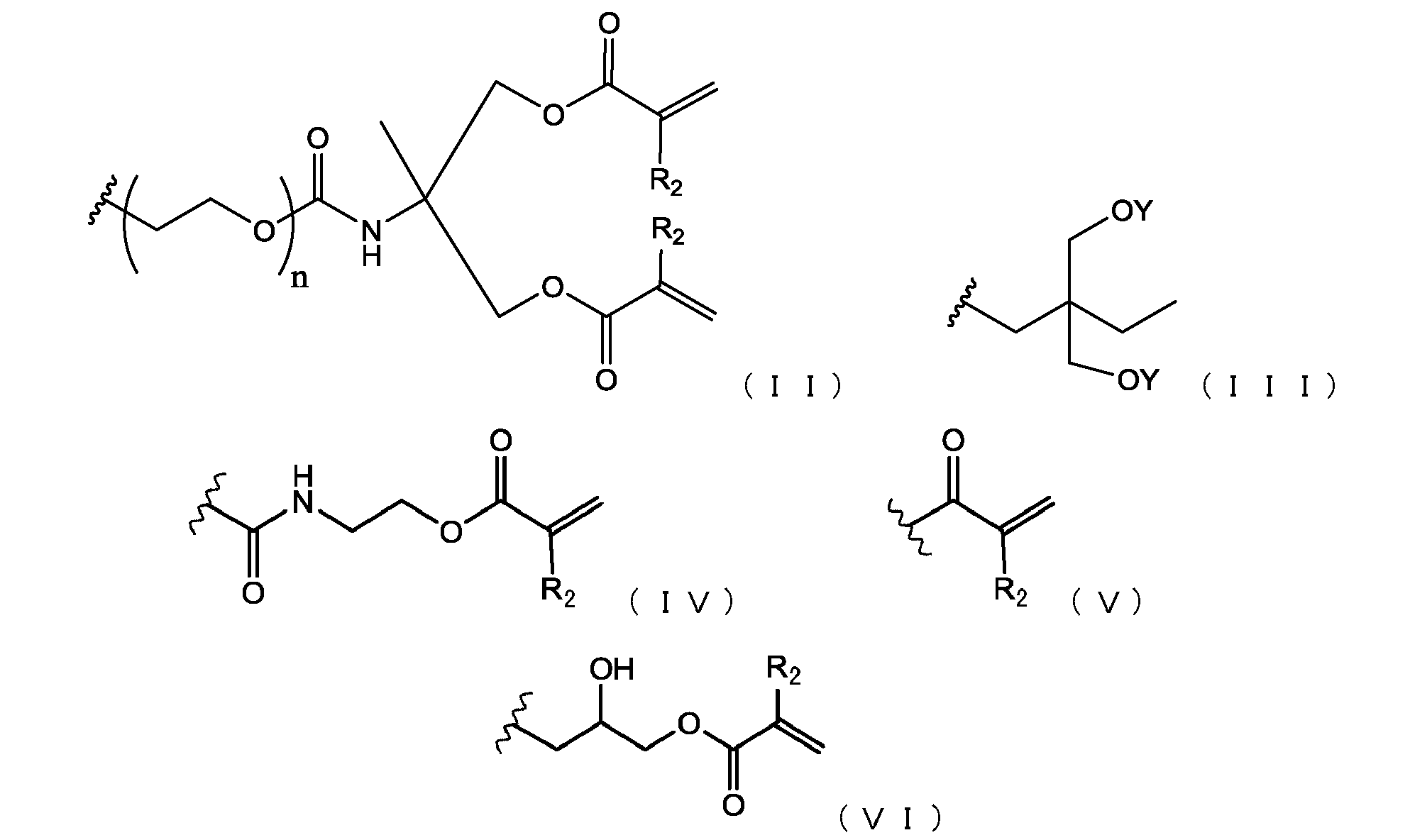
- the silicon compound according to the first aspect of the present invention is a silicon compound (a) represented by the following formula (I), wherein R 1 is alkylene having 3 or 4 carbon atoms, and X is represented by the following formula (II) ) To (III), n is an integer of 0 or 1, and Y is selected from the group consisting of the following formulas (IV) to (VI): ) A group having an acrylate group, and R 2 is hydrogen or a methyl group. If comprised in this way, the coating agent which improved the scratch resistance remarkably can be obtained by adding the silicon compound (a) with a short silicone chain
- the silicon compound (a) when used together with a curable resin, the silicon compound (a) has a short silicone skeleton, so that the silicon compound (a) can be uniformly dissolved in the base resin. It is thought to be due to remarkably improving the scratch resistance considered to be due to stress relaxation because of having slipperiness, releasability, and flexibility (flexibility).
- the resin composition for a coating agent according to the second aspect of the present invention contains the silicon compound according to the first aspect and a curable resin (b). If comprised in this way, the resin composition for coating agents which improved markedly the scratch resistance considered to be based on stress relaxation can be obtained.
- the resin composition for a coating agent according to the third aspect of the present invention is the resin composition for a coating agent according to the second aspect of the present invention, wherein the curable resin (b) has a (meth) acryloyl group. It is an ultraviolet curable resin having at least one. If comprised in this way, the coupling
- the molded body according to the fourth aspect of the present invention is a molded body, and is a cured product obtained by curing the resin composition for a coating agent according to the second aspect or the third aspect of the present invention; And a substrate covered with an object. If comprised in this way, the surface of a base material can be protected with the hardened
- the molded body according to the fifth aspect of the present invention is the molded body according to the fourth aspect of the present invention, wherein the difference in haze value between the molded body and the substrate is 1% or less. If comprised in this way, when a molded object is installed in the surface of image panels, such as an image display apparatus, the surface of an image panel can be protected without becoming difficult to see the display of an image panel.
- the image display apparatus which concerns on the 6th aspect of this invention is equipped with the molded object which concerns on the said 5th aspect of this invention, and the image panel which installed the said molded object on the screen. If comprised in this way, the image panel surface can be protected with the molded object which improved the damage resistance remarkably, and the damage resistance of an image display apparatus composition can be improved significantly.
- the silicon compound of the present invention is a silicon compound in which both ends of the silicone compound are acrylic-modified, and can significantly improve the scratch resistance of a hard coat agent or the like. Moreover, the resin composition for coating agents which markedly improved scratch resistance can be obtained by containing the said compound.
- FIG. 1 It is a figure which illustrates the image display apparatus which concerns on the 4th Embodiment of this invention.
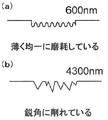
- A is an image figure of the abrasion trace of an Example
- (b) is an image figure of the abrasion trace of a comparative example.
- the silicon compound (a) as the silicon compound according to the first embodiment of the present application will be described.
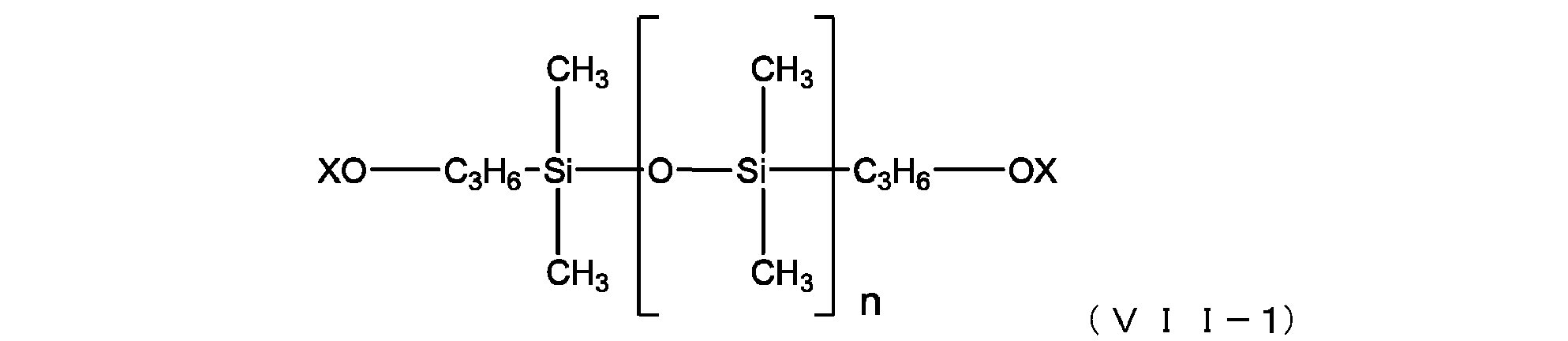
- the structure of the silicon compound (a) is as follows.
- the silicon compound (a) is a compound that includes a silicone chain (a siloxane bond serving as a main chain) and is acrylic-modified at both ends.
- Both ends include a (meth) acryloyl group as a functional group, and can be classified into a bifunctional acrylic modified silicon compound, a tetrafunctional acrylic modified silicon compound, an octafunctional acrylic modified silicon compound, and the like according to the number of functional groups.
- silicon compound (a) adjusts the compatibility with curable resin (b) by changing the number of (meth) acryloyl groups introduced with respect to silicon compound (a) and adjusting the acrylic equivalent. Can do. It is also preferable to adjust the acrylic equivalent by changing the silicone chain without changing the number of (meth) acryloyl groups, since the compatibility of the silicon compound (a) with the curable resin (b) can be adjusted. .
- n is an integer of 1 to 20.
- Alkylene (—C 3 H 6 —) is exemplary and may be other alkylene.
- X is a group having a (meth) acryloyl group.
- R 2 is hydrogen or a methyl group. It is preferable to set n of the silicone chain to 1 to 20 because the compatibility of the silicon compound (a) can be improved and the haze value can be maintained below the appropriate value.
- the silicon compound (a) can be mixed with the curable resin with good compatibility.
- R 1 is alkylene having 3 or 4 carbon atoms.
- X is a group having a urethane skeleton and a (meth) acryloyl group at the terminal.
- R 2 is hydrogen or a methyl group, and n is an integer of 0 or 1.
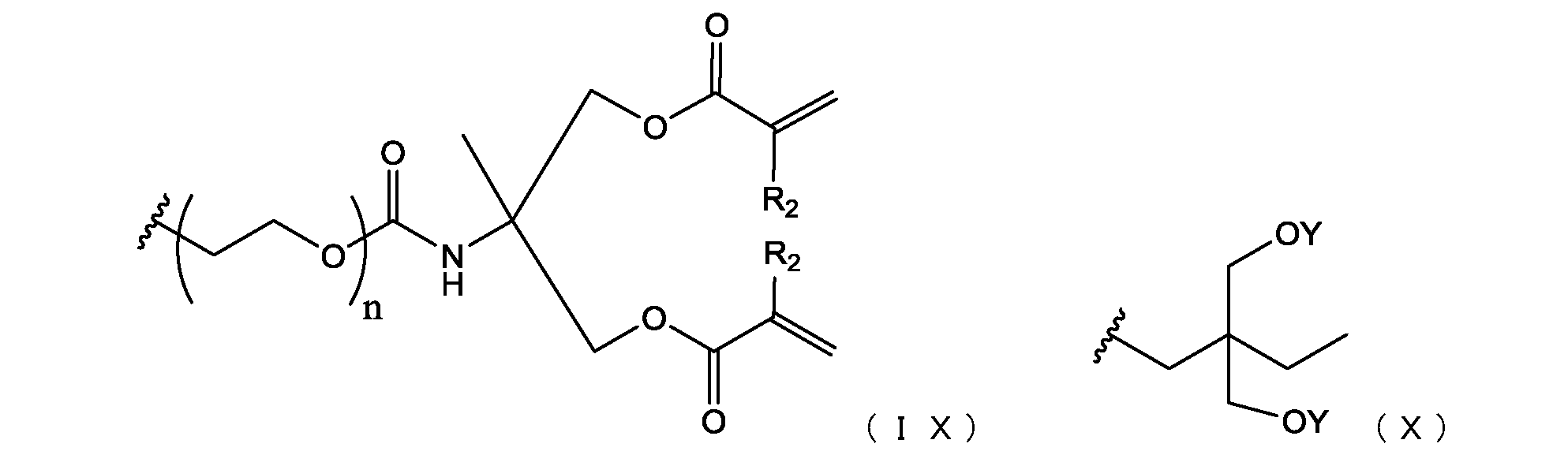
- -Tetrafunctional acrylic modified silicon compound X is a group of the following formula (IX) or formula (X).
- Y is a group of the following formula (XI), formula (XII), or formula (XIII).
- a bifunctional acrylic modified silicon compound is shown as an example.
- R 1 is alkylene having 3 carbon atoms
- X is Formula (VIII)
- R 2 is hydrogen
- n is 1.
- a tetrafunctional acrylic modified silicon compound is shown.
- R 1 is alkylene having 3 carbon atoms
- X is the formula (IX)
- R 2 is hydrogen
- n is 1.
- the silicon compound (a) is a hydroxyl group-containing siloxane compound (for example, Silaplane FM4401 manufactured by JNC Corporation) in the presence of a tin catalyst (for example, dibutyltin dilaurate), and acryloyloxyethyl isocyanate (for example, Showa Denko Corporation).
- a tin catalyst for example, dibutyltin dilaurate
- acryloyloxyethyl isocyanate for example, Showa Denko Corporation
- a hydroxyl group-containing siloxane compound for example, Silaplane FM4401 manufactured by JNC Corporation
- a tin catalyst for example, dibutyltin dilaurate
- 1,1 ′-(bisacryloyloxymethyl) ethyl isocyanate for example, Showa
- a tetrafunctional acryl-modified silicon compound can be obtained by reacting with an isocyanate having a (meth) acryloyl group such as Karenz BEI (trade name) manufactured by Denko Co., Ltd.
- 1,1,3,3-tetramethyldisiloxane is reacted with trimethylolpropane allyl ether or the like in the presence of a platinum catalyst to obtain a dihydroxyl-modified silicon compound having both ends.
- the dihydroxyl-modified silicon compound at both ends is subjected to 1,1 ′-(bisacryloyloxymethyl) ethyl isocyanate (eg, Karenz BEI manufactured by Showa Denko KK) in the presence of a tin catalyst (eg, dibutyltin dilaurate), etc.
- An octafunctional acrylic-modified silicon compound can be obtained by reacting with an isocyanate having a (meth) acryloyl group.
- patent 3661807 can be referred.
- a catalyst used for reaction with the isocyanate which has a hydroxyl-modified silicon compound of both terminal and (meth) acryloyl group an amine catalyst (for example, triethylenediamine), a carboxylate catalyst (for example, lead naphthenate, potassium acetate), Trialkylphosphine catalysts (for example, triethylphosphine), titanium-based catalysts (for example, titanium normal butoxide), and the like can also be used.
- the resin composition for a coating agent according to the second embodiment of the present application is a resin composition containing the above-mentioned acrylic-modified silicon compound (a).
- the resin composition for a coating agent of the present application can be easily prepared by adding the silicon compound (a) to the coating liquid containing the curable resin (b).
- a coating liquid prepared by the method described in Japanese Patent No. 5375100, a silicon compound (a), if necessary, a polymerization initiator suitable for the curable resin (b), a solvent for promoting mixing Etc. can be added to obtain the resin composition for a coating agent of the present application.
- solvent examples include ether solvents (diethyl ether, tetrahydrofuran, diphenyl ether, anisole, dimethoxybenzene, propylene glycol monomethyl ether, etc.), halogenated hydrocarbon solvents (methylene chloride, chloroform, chlorobenzene, etc.), ketone solvents (acetone).
- ether solvents diethyl ether, tetrahydrofuran, diphenyl ether, anisole, dimethoxybenzene, propylene glycol monomethyl ether, etc.
- halogenated hydrocarbon solvents methylene chloride, chloroform, chlorobenzene, etc.
- ketone solvents acetone
- Methyl ethyl ketone, methyl isobutyl ketone, etc. alcohol solvents (methanol, ethanol, propanol, isopropanol, butyl alcohol, t-butyl alcohol, etc.), nitrile solvents (acetonitrile, propionitrile, benzonitrile, etc.), ester solvents ( Ethyl acetate, butyl acetate, etc.), carbonate solvents (ethylene carbonate, propylene carbonate, etc.), amide solvents (N, N-dimethyl) (Lumamide, N, N-dimethylacetamide), hydrochlorofluorocarbon solvents (HCFC-141b, HCFC-225), hydrofluorocarbon (HFCs) solvents (HFCs having 2 to 4, 5 and 6 or more carbon atoms), perfluorocarbon Solvents (perfluoropentane, perfluorohexane), alicyclic hydrofluorocarbon solvents (
- the silicon compound (a) is preferably contained in an amount of 0.5 to 40 wt% when the total amount of the silicon compound (a) and the curable resin (b) is 100 wt%.
- the bifunctional acrylic-modified silicon compound is preferably 0.5 wt% or more and less than 20 wt%, particularly preferably 5 to 10 wt%. In the case of a tetrafunctional acrylic-modified silicon compound, 0.5 to 30 wt% is particularly preferable, and in the case of an octafunctional acrylic-modified silicon compound, 0.5 to 40 wt% is particularly preferable. When the number of functional groups increases, the solubility increases, so that the amount added can be increased.
- the curable resin (b) examples include an active energy ray curable resin and a thermosetting resin.
- An active energy ray curable resin is more preferable due to the ease of the curing method, and an ultraviolet curable resin is particularly preferable.
- the active energy ray means an energy ray that can generate an active species by decomposing a compound that generates an active species.
- Examples of such active energy rays include optical energy rays such as visible light, ultraviolet rays, and infrared rays, and radiation such as X-rays, ⁇ rays, ⁇ rays, ⁇ rays, and electron beams. Among these, ultraviolet rays are particularly preferable.
- Active energy ray curable resins include radicals such as urethane (meth) acrylate resins, polyester (meth) acrylate resins, (meth) acrylate monomers, unsaturated polyester resins, and epoxy (meth) acrylate resins.
- a resin having an unsaturated bond that can be polymerized can be mentioned. These resins may be used alone, or a plurality of resins may be used in combination. Of these, urethane (meth) acrylate resins and polyester (meth) acrylate resins are preferred.
- the urethane (meth) acrylate resin is easy to obtain a tough coating film due to the urethane structure, and at the same time has flexibility.
- urethane (meth) acrylate resin for example, after reacting a polyisocyanate with a polyhydroxy compound or a polyhydric alcohol, further reacting a hydroxyl group-containing (meth) acryl compound and, if necessary, a hydroxyl group-containing allyl ether compound. And a radical-polymerizable unsaturated group-containing oligomer that can be obtained.
- the polyisocyanate include 2,4-tolylene diisocyanate and its isomers, diphenylmethane diisocyanate, hexamethylene diisocyanate, hydrogenated xylylene diisocyanate, isophorone diisocyanate, xylylene diisocyanate.
- polyhydroxy compound examples include polyether polyol, polyester polyol, polycarbonate polyol, polycaprolactone polyol, and the like.
- polyhydric alcohols include ethylene glycol, diethylene glycol, triethylene glycol, polyethylene glycol, propylene glycol, dipropylene glycol, polypropylene glycol, 2-methyl-1,3-propanediol, 1,3- Butanediol, adduct of bisphenol A and propylene oxide or ethylene oxide, 1,2,3,4-tetrahydroxybutane, glycerin, trimethylolpropane, 1,2-cyclohexane glycol, 1,3-cyclohexane glycol, 1,4 -Cyclohexane glycol, para-xylene glycol, bicyclohexyl-4,4-diol, 2,6-decalin glycol, 2,7-decalin glycol and the like.
- the hydroxyl group-containing (meth) acrylic compound is not particularly limited, but is preferably a hydroxyl group-containing (meth) acrylic acid ester, specifically, for example, 2-hydroxyethyl (meth) acrylate, 2-hydroxy Propyl (meth) acrylate, 3-hydroxybutyl (meth) acrylate, polyethylene glycol mono (meth) acrylate, polypropylene glycol mono (meth) acrylate, tris (hydroxyethyl) isocyanuric acid di (meth) acrylate, pentaerythritol tri (meth) An acrylate etc. are mentioned.
- the polyester (meth) acrylate resin includes (1) a terminal carboxyl group polyester obtained from a saturated polybasic acid and / or an unsaturated polybasic acid and a polyhydric alcohol, and an ⁇ , ⁇ -unsaturated carboxylic ester group.
- (Meth) acrylate obtained by reacting an epoxy compound, (2) obtained by reacting a hydroxyl group-containing acrylate with a polyester having a terminal carboxyl group obtained from a saturated polybasic acid and / or unsaturated polybasic acid and a polyhydric alcohol (Meth) acrylate, (3) saturated polybasic acid and / or (meth) acrylate obtained by reacting polyester of terminal hydroxyl group obtained from unsaturated polybasic acid and polyhydric alcohol with (meth) acrylic acid. .
- saturated polybasic acid used as a raw material for polyester (meth) acrylate examples include polybasic compounds having no polymerizable unsaturated bond such as phthalic acid, isophthalic acid, terephthalic acid, tetrahydrophthalic acid, adipic acid, and sebacic acid.
- examples thereof include acids or anhydrides thereof and polymerizable unsaturated polybasic acids such as fumaric acid, maleic acid and itaconic acid or anhydrides thereof.
- polyhydric alcohol components include ethylene glycol, propylene glycol, diethylene glycol, dipropylene glycol, 1,2-butanediol, 1,3-butanediol, 1,5-pentanediol, 1,6-hexanediol, 2- Examples include methyl-1,3-propanediol, 2,2-dimethyl-1,3-propanediol, cyclohexane-1,4-dimethanol, ethylene oxide adduct of bisphenol A, propylene oxide adduct of bisphenol A, and the like. .
- (Meth) acrylate monomers include compounds obtained by reacting polyhydric alcohols with ⁇ , ⁇ -unsaturated carboxylic acids.
- Unsaturated polyester resin is a product obtained by dissolving a condensation product (unsaturated polyester) in an esterification reaction of polyhydric alcohol and unsaturated polybasic acid (and saturated polybasic acid as required) in a polymerizable monomer. Is mentioned.
- the unsaturated polyester can be produced by polycondensation of an unsaturated acid such as maleic anhydride and a diol such as ethylene glycol.
- a polybasic acid having a polymerizable unsaturated bond such as fumaric acid, maleic acid, and itaconic acid or its anhydride is used as an acid component, and ethylene glycol, propylene glycol, diethylene glycol, dipropylene glycol, 1, 2 -Butanediol, 1,3-butanediol, 1,5-pentanediol, 1,6-hexanediol, 2-methyl-1,3-propanediol, 2,2-dimethyl-1,3-propanediol, cyclohexane
- Polyhydric alcohols such as 1,4-dimethanol, ethylene oxide adduct of bisphenol A and propylene oxide adduct of bisphenol A are reacted as alcohol components, and phthalic acid, isophthalic acid, terephthalic acid, Such as tetrahydrophthalic acid, adipic acid, sebacic acid Polymerizable not have an unsaturated bond
- an epoxy (meth) acrylate resin there is a polymerizable unsaturated bond generated by a ring-opening reaction between a compound having a glycidyl group (epoxy group) and a carboxyl group of a carboxyl compound having a polymerizable unsaturated bond such as acrylic acid. What dissolved the compound (vinyl ester) which it had in the polymerizable monomer is mentioned.
- the vinyl ester is produced by a known method, and examples thereof include epoxy (meth) acrylate obtained by reacting an epoxy resin with an unsaturated monobasic acid such as acrylic acid or methacrylic acid.
- epoxy resins are reacted with bisphenol (for example, A type) or dibasic acid such as adipic acid, sebacic acid, dimer acid (Haridimer 270S (trade name): Harima Kasei Co., Ltd.) to impart flexibility. May be.
- bisphenol for example, A type
- dibasic acid such as adipic acid, sebacic acid, dimer acid (Haridimer 270S (trade name): Harima Kasei Co., Ltd.)
- Harima Kasei Co., Ltd. dimer acid
- a curing agent When using an active energy ray-curable resin, a curing agent may be added as necessary.
- the content of the curing agent is preferably from 0.1 to 10 wt%, more preferably from 0.1 to 5 wt%, particularly preferably from 0.1 to 4 wt%, based on the total amount of the active energy ray curable resin.
- An active energy ray polymerization initiator can be used as the curing agent.
- the active energy ray polymerization initiator is not particularly limited as long as it is a compound that generates radicals upon irradiation with active energy rays such as ultraviolet rays and visible rays.
- Examples of the compound used as the active energy ray polymerization initiator include benzophenone, Michler's ketone, 4,4′-bis (diethylamino) benzophenone, xanthone, thioxanthone, isopropyl xanthone, 2,4-diethylthioxanthone, 2-ethylanthraquinone, acetophenone, 2 -Hydroxy-2-methylpropiophenone, 2-hydroxy-2-methyl-4'-isopropylpropiophenone, 1-hydroxycyclohexyl phenyl ketone, isopropyl benzoin ether, isobutyl benzoin ether, 2,2-diethoxyacetophenone, 2 , 2-dimethoxy-2-phenylacetophenone, camphorquinone, benzanthrone, 2-methyl-1- [4- (methylthio) phenyl] -2-morpholinopropa -1-one, 2-benzyl-2
- the active energy ray-curable resin can be cured by irradiating ultraviolet rays (UV) or electron beams with an active energy ray source.
- UV ultraviolet rays
- the active energy ray-curable resin is preferably one that is cured by being irradiated with ultraviolet rays in the presence of a photopolymerization initiator.
- photopolymerization initiators examples include various benzoin derivatives, benzophenone derivatives, phenyl ketone derivatives, onium salt photoinitiators, organometallic photoinitiators, metal salt cationic photoinitiators, photodegradable organosilanes, and latent sulfonic acids. And phosphine oxide.
- the addition amount of the photopolymerization initiator is preferably 1 to 5 parts by weight with respect to 100 parts by weight of the active energy ray-curable resin.
- thermosetting resins examples include phenolic resins, alkyd resins, melamine resins, epoxy resins, urea resins, unsaturated polyester resins, urethane resins, thermosetting polyimides, and silicone resins. It is done. These resins may be used alone, or a plurality of resins may be used in combination. Specifically, bisphenol A type epoxy resin, bisphenol F type epoxy resin, polyfunctional epoxy resin, flexible epoxy resin, brominated epoxy resin, glycidyl ester type epoxy resin, polymer type epoxy resin, biphenyl type epoxy resin, etc.
- Epoxy resins are heat-resistant, adhesive and chemical resistant, melamine-based resins are heat-resistant, hard and transparent, and urethane-based resins are excellent in adhesion and low-temperature curability, and can be selected and used as appropriate. .
- thermosetting resin needs to be rapidly cured at a desired curing temperature (80 to 160 ° C.) and time (30 to 180 seconds).
- a curing reaction initiator or a curing reaction accelerator may be used.
- epoxy resins aliphatic amines and amines of aromatic amines, polyamide resins, tertiary amines and secondary amines, imidazoles, polymercaptans, acid anhydrides, Lewis acid complexes, melamine resins
- an organometallic urethanization catalyst and a tertiary amine urethanization catalyst can be exemplified.
- the curing reaction initiator and the curing reaction accelerator may be any compound that can release a substance that initiates cationic polymerization by irradiation with active energy rays or thermal energy.
- Examples of such curing reaction initiators include carboxylic acids, amines, acid anhydride compounds and acid generators, and preferably double salts or derivatives thereof which are onium salts that release Lewis acids.
- Typical examples of the curing reaction initiator include cation and anion salts represented by the following formula (1). [A] m + [B] m ⁇ (1)
- the cation [A] m + is preferably an onium ion, for example, represented by the following formula (2).
- [( ⁇ ) a Q] m + (2)
- ⁇ is an organic group having 1 to 60 carbon atoms and any number of atoms other than carbon atoms.
- a is an integer of 1 to 5.
- the a ⁇ 's are independent and may be the same or different.
- at least one ⁇ is preferably an organic group having an aromatic ring.
- valence of Q in the cation [A] m + is q
- the anion [B] m- is preferably a halide complex, for example, represented by the following formula (3).
- [LX b ] m- (3) L is a metal or metalloid which is a central atom of a halide complex, and B, P, As, Sb, Fe, Sn, Bi, Al, Ca, In, Ti, Zn , Sc, V, Cr, Mn, Co and the like.
- X is a halogen atom.
- b is an integer of 3 to 7.
- anion [LX b ] m- represented by the above formula (3) examples include tetrafluoroborate (BF 4 ), hexafluorophosphate (PF 6 ), hexafluoroantimonate (SbF 6 ), hexafluoro Arsenate (AsF 6 ), hexachloroantimonate (SbCl 6 ) and the like are included.
- anion [B] m- further include perchlorate ion (ClO 4 ) ⁇ , trifluoromethylsulfite ion (CF 3 SO 3 ) ⁇ , fluorosulfonate ion (FSO 3 ) ⁇ , toluenesulfonate anion Ions, trinitrobenzenesulfonic acid anions, and the like are also included.
- the curing reaction initiator in the present invention is more preferably an aromatic onium salt exemplified in the following (a) to (c).
- one of them can be used alone, or two or more of them can be mixed and used.
- Aryldiazonium salts such as phenyldiazonium hexafluorophosphate, 4-methoxyphenyldiazonium hexafluoroantimonate, 4-methylphenyldiazonium hexafluorophosphate, and (b) diphenyliodonium hexafluoroantimonate, di (4-methylphenyl) iodonium Diaryl iodonium salts such as hexafluorophosphate and di (4-t-butylphenyl) iodonium hexafluorophosphate (c) Triphenylsulfonium hexafluoroantimonate, tris (4-methoxyphenyl) sulfonium hexafluorophosphate, diphenyl-4-thio Phenoxyphenylsulfonium hexafluoroantimonate, diphenyl-4-thiophenoxypheny Sulfon
- the curing reaction initiator in the present invention may be a mixture of an iron arene complex or an aluminum complex and silanols such as triphenylsilanol.
- iron arene complexes include ( ⁇ 5 -2,4-cyclopentadien-1-yl) [(1,2,3,4,5,6- ⁇ )-(1-methylethyl) benzene] -iron Hexafluorophosphate and the like
- examples of aluminum complexes include tris (acetylacetonato) aluminum, tris (ethylacetoacetate) aluminum, tris (salicylaldehyde) aluminum and the like.
- the curing reaction initiator in the embodiment of the present invention is preferably an aromatic iodonium salt, an aromatic sulfonium salt, or an iron-arene complex.
- the content of the curing reaction initiator (preferably an acid generator) is preferably 1 mol per 10 to 300 mol of the epoxy group contained in the epoxy resin.
- the cured resin layer preferably has weather resistance, low refractive index characteristics, high refractive index characteristics, antifouling characteristics, low wear characteristics, gas barrier characteristics, and scratch resistance as appropriate depending on the application.
- weather resistance low refractive index characteristics
- high refractive index characteristics high refractive index characteristics
- antifouling characteristics low wear characteristics
- gas barrier characteristics low wear characteristics
- scratch resistance scratch resistance
- ultraviolet absorbers examples include benzotriazoles, hydroxyphenyltriazines, benzophenones, salicylates, cyanoacrylates, triazines, and dibenzoylresorcinols. These ultraviolet absorbers may be used alone, or a plurality of ultraviolet absorbers may be used in combination. It is preferable to appropriately select the type and combination of ultraviolet absorbers based on the wavelength of ultraviolet rays to be absorbed.
- Antioxidants include monophenols (2,6-di-t-butyl-p-cresol, butylated hydroxyanisole, 2,6-di-t-butyl-p-ethylphenol, stearyl- ⁇ - (3 , 5-di-t-butyl-4-hydroxyphenyl) propionate), bisphenols (2,2′-methylenebis (4-methyl-6-tert-butylphenol), 2,2′-methylenebis (4-ethyl- 6-t-butylphenol), 4,4'-thiobis (3-methyl-6-t-butylphenol), 4,4'-butylidenebis (3-methyl-6-t-butylphenol), 3,9-bis [1 , 1-Dimethyl-2- ⁇ - (3-tert-butyl-4-hydroxy-5-methylphenyl) propionyloxy ⁇ ethyl] 2,4,8,10-tetraoxy Saspiro [5,5] undecane, etc.), high-molecular phenols (1,1,3
- antioxidants can be used alone, but it is particularly preferable to use them in combination with phenolic / sulfuric or phenolic / phosphorous.
- phenolic antioxidants IRGANOX 1010 (trade name) and IRGAFOS 168 (trade name) manufactured by BASF can be used alone or in combination. .
- TINUVIN As the light stabilizer (HALS), TINUVIN (registered trademark) 5100 (neutral type general-purpose HALS), TINUVIN 292 (compound name: bis (1,2,2,6,6-pentamethyl-4-piperidinyl)) manufactured by BASF Sebacate, methyl (1,2,2,6,6-pentamethyl-4-piperidinyl) sebacate), TINUVIN152 (compound name: 2,4-bis [N-butyl-N- (1-cyclohexyloxy-2,2, 6,6-tetramethylpiperidin-4-yl) amino] -6- (2-hydroxyethylamine) -1,3,5-triazine), TINUVIN 144 (compound name: bis (1,2,2,6,6-) Pentamethyl-4-piperidinyl)-[[3,5-bis (1,1-dimethylethyl) -4-hydroxyphenyl] methyl] buty Malonate), TINUVIN 123 (compound name:
- Examples of a method for imparting a low refractive index characteristic include inorganic fine particles such as magnesium fluoride in a cured resin layer, fluorosilsesquioxane, and fluorosilsesquioxane polymers described in WO2008 / 072766 and WO2008 / 072765. It is preferable to mix one or more compounds selected from the group consisting of acrylate compounds containing fluorine atoms.
- Techniques for imparting high refractive index characteristics include metal fine particles such as zirconia, titania and zinc sulfide in the cured resin layer, acrylate compounds and epoxy compounds having a fluorene skeleton, acrylate compounds and epoxy compounds containing sulfur atoms, etc.
- the conductive pattern of a transparent electrode material such as ITO or silver nanowire can be made invisible.
- the 1st cured resin layer which has an antireflection characteristic can be obtained by laminating
- Examples of methods for imparting antifouling properties and low friction properties include silicone compounds, fluorine compounds, fluorosilsesquioxanes, and fluorosilsesquioxane polymers described in WO2008 / 072766 and WO2008 / 072765 in a cured resin layer.
- silicone compounds include BYK-UV3500, BYK-UV-3570 (both trade names: manufactured by Big Chemie), TEGO Rad2100, 2200N, 2250, 2500, 2600, 2700 (both trade names: manufactured by Degussa), X- 22-2445, X-22-2455, X-22-2457, X-22-2458, X-22-2459, X-22-1602, X-22-1603, X-22-1615, X-22 1616, X-22-1618, X-22-1619, X-22-2404, X-22-2474, X-22-174DX, X-22-8201, X-22-2426, X-22-164A, X-22-164C (all trade names: manufactured by Shin-Etsu Chemical Co., Ltd.) and the like.
- fluorine compounds examples include OPTOOL DAC, OPTOOL DAC-HP, R-1110, R-1210, R-1240, R-1620, R-1820, R-2020, R-5210, and R-5410 manufactured by Daikin Industries, Ltd. , R-5610, R-5810, R-7210, R-7310, Megafuck RS-75, Megafuck RS-72-K, Megafuck RS-76-E, Megafuck RS-76-NS, Megafuck RS -77, Megafuck RS-903-3, Megafuck RS-914-2, Megafuck RS-761-3 (all are trade names), and the like.
- inorganic components such as layered clay represented by graphene, silica, alumina, and porous glass in the cured resin layer.
- inorganic fine particles may be added to improve the surface hardness and scratch resistance of a cured film obtained by curing the resin composition for a coating agent of the present application.
- specific examples of inorganic fine particles include aluminum oxide, silicon oxide, rutile type titanium oxide, tin oxide, zirconium oxide, cerium oxide, magnesium fluoride, iron oxide, zinc oxide, copper oxide, antimony oxide, cryolite, firefly Stone), apatite, calcite, gypsum and talc.
- the amount of the inorganic oxide used is preferably less than 60 wt% with respect to the curable resin (b) in the resin composition of the present application.
- the average particle size of the inorganic fine particles is preferably 5 nm to 2 ⁇ m, and is preferably 5 nm to 500 nm, more preferably 5 nm to 50 nm, considering the transparency of the coating film. When it is 5 nm or more, the surface hardness and scratch resistance of the cured film can be improved, and when it is 2 ⁇ m or less, the transparency of the cured film is not adversely affected.
- the average particle diameter of the inorganic fine particles is measured by a dynamic light scattering method using Nikkiso Co., Ltd. MICROTRAC UPA.
- active energy ray sensitizer polymerization inhibitor, wax, plasticizer, leveling agent, surfactant, dispersant, antifoaming agent, wettability improver, antistatic agent, curing aid, etc.
- leveling agent surfactant, dispersant, antifoaming agent, wettability improver, antistatic agent, curing aid, etc.
- thermoplastic resins include polyethylene, polypropylene, polyvinyl chloride, polyvinylidene chloride, polystyrene, acrylonitrile-styrene resin, acrylonitrile-butadiene-styrene resin, poly (meth) acrylate resin, ultrahigh molecular weight polyethylene, poly-4- Methylpentene, Syndiotactic polystyrene, Polyamide (Nylon 6: DuPont brand name, Nylon 6,6: DuPont brand name, Nylon 6,10: DuPont brand name, Nylon 6, T: DuPont brand name, Nylon MXD6 : DuPont brand name), polyester (polyethylene terephthalate, polybutylene terephthalate, polyethylene 2,6-na
- a molded body according to the third embodiment of the present invention will be described.
- a molded object is provided with the hardened
- the wet coating method which coats a composition uniformly for the coating of the resin composition for coating agents of this application.
- a gravure coating method a die coating method, or the like can be used.
- the resin composition for a coating agent is preferably in a state suitable for coating, and may not contain a solvent or may be a mixture with a solvent.
- a gravure roll with an uneven engraving process on the surface is dipped in the coating liquid, and the coating liquid adhering to the convex part on the surface of the gravure roll is scraped off with a doctor blade, and the liquid is stored accurately in the concave part. And transferring to the base material.
- a low viscosity liquid can be thinly coated by the gravure coating method.
- the die coating method is a method in which coating is performed while pressurizing and extruding a liquid from a coating head called a die.
- the die coating method enables highly accurate coating. Further, since the liquid is not exposed to the outside air during application, the concentration of the application liquid is hardly changed by drying.
- wet coating methods include spin coating, bar coating, reverse coating, roll coating, slit coating, dipping, spray coating, kiss coating, reverse kiss coating, air knife coating, and curtain coating. Method, rod coating method and the like. The coating method can be appropriately selected according to the required film thickness from these methods.
- plastics and glass which have transparency can be used for a base material.
- plastic materials having transparency include polyester resins, acetate resins, polyethersulfone resins, polycarbonate resins, polyamide resins, polyimide resins, polyolefin resins, (meth) acrylic resins, and polyresins.
- the resin include vinyl chloride resin, polyvinylidene chloride resin, polystyrene resin, polyvinyl alcohol resin, polyarylate resin, polyphenylene sulfide resin, norbornene resin, cycloolefin resin, and polyurethane resin.
- polyethylene terephthalate PET
- polyethylene naphthalate triacetyl cellulose
- polyether sulfone polycarbonate
- polyarylate polyether ether ketone
- Cycloolefin resins are ZEONOR (registered trademark), ZEONEX (registered trademark): manufactured by Zeon Japan, Arton (registered trademark): manufactured by JSR, Apel (registered trademark): manufactured by Mitsui Chemicals, and TOPAS (registered trademark): manufactured by Polyplastics. Is preferred.
- Polyethylene terephthalate and polyethylene naphthalate are more preferred because they are excellent in mechanical strength, dimensional stability, heat resistance, chemical resistance, optical properties, etc., and smoothness and handling properties of the film surface.
- Polycarbonate is more preferred because it is excellent in transparency, impact resistance, heat resistance, dimensional stability, and flammability. In consideration of price and availability, polyethylene terephthalate is particularly preferable.
- the material of the glass having transparency is not limited as long as the glass is excellent in dimensional stability and optical characteristics used for LCD displays and touch panels.
- Examples include soda lime glass, alkali-free glass, alkali barium glass, borosilicate glass, alkali borosilicate glass, aluminoborosilicate glass, barium borosilicate glass, aluminosilicate glass, borate glass, silica glass, lead glass, and the like.
- the base material may be a base film used in an optical protective film made of the above material, and is a base used in a display unit or touch panel unit of an electronic device such as a PC, a portable terminal, a car navigation system, or a liquid crystal display. It may be a material, or a lens such as a camera, glasses or goggles. Moreover, the base material to be coated may not be transparent, and may be a housing such as an electronic device, an electric device, or an IT-related device. Thus, the substrate may be any material that requires a hard coating regardless of whether it is transparent or opaque.
- the thickness of the base material is not particularly limited, and varies depending on the article exemplified above.
- the thickness of the substrate is preferably 50 to 300 ⁇ m, more preferably 80 to 200 ⁇ m.
- the thickness of the substrate is 50 ⁇ m or more, the mechanical strength of the substrate is sufficient, and a coating can be formed on the substrate.
- the thickness is 300 ⁇ m or less, the thickness of the optical protective film does not become too thick, and a product (for example, an image display device described later) using the film is compact.
- the thickness of the cured product of the resin composition for a coating agent formed on the surface of the substrate is not particularly limited, and can be appropriately changed from the article exemplified above.
- a molded body for example, an optical protective film
- the difference between the haze value of the base material and the haze value of the base material alone is preferably 1% or less. That is, the relationship of the following formula (5) is established. If it is 1% or less, the display on the image panel can be recognized without being aware of the presence of the cured product.
- Haze value of molded body -Haze value of substrate
- the haze is an index related to the transparency of the film and represents turbidity (cloudiness). It can obtain
- require from the ratio with respect to the total light transmitted light of diffuse transmitted light using following formula (6). (Td: diffuse transmittance Tt: total light transmittance) Haze (%) Td / Tt ⁇ 100 (6)
- the image display device includes a molded body (for example, an optical protective film 11) according to the second embodiment, and an image panel 12 that displays an image projected by mechanical processing.
- the image panel 12 include a flat panel display such as a CRT, PDP, or LCD.
- the optical protective film 11 is placed on the image panel 12 such that the base material of the optical protective film 11 is on the lower side.
- reaction solution is ice-cooled and methanol (17.0 g) is added dropwise. Stir at the same temperature for 30 minutes to obtain a methanol solution of tetrafunctional acrylic-modified silicon compound A (153.3 g, solid content concentration 79 wt%).
- methanol solution of tetrafunctional acrylic-modified silicon compound A (153.3 g, solid content concentration 79 wt%).
- the silicon compound A is shown below.
- dimethylsilylpolydimethylsiloxane at both ends (trade name: Silaplane FM1105, weight average molecular weight of about 500, manufactured by JNC Corporation) is added dropwise so that the inside of the reaction system does not exceed 100 ° C. Stir at 80 degrees for 1 hour and then cool to room temperature. Thereafter, unreacted 2-allyloxyethanol is distilled off under reduced pressure to obtain 130.4 g (yield 93%) of both terminal hydroxyl-modified silicon compounds B.
- the silicon compound B is shown below.
- reaction solution is ice-cooled, and methanol (14.0 g) is added dropwise. Stir at the same temperature for 30 minutes to obtain a methanol solution of tetrafunctional acrylic-modified silicon compound C (145.5 g, solid content concentration 81.6 wt%).
- the silicon compound C is shown below.
- reaction solution is ice-cooled, and methanol (0.95 g) is added dropwise.
- methanol (0.95 g) is added dropwise.
- the mixture is stirred at the same temperature for 30 minutes to obtain a methyl ethyl ketone solution (24.8 g, solid content concentration 55 wt%) of the tetrafunctional acrylic modified silicon compound D.
- the silicon compound D is shown below.
- the mixture was stirred at 40 ° C. to 50 ° C. for 2 hours, and a solution obtained by dissolving 0.076 g of dibutyltin dilaurate (manufactured by Tokyo Chemical Industry Co., Ltd.) in 0.81 g of methyl ethyl ketone (manufactured by Wako Pure Chemical Industries, Ltd.) was added dropwise.
- the mixture is further stirred at 40 ° C. to 50 ° C. for 2 hours. Thereafter, the reaction solution is ice-cooled, and methanol (27.6 g) is added dropwise. Stir at the same temperature for 30 minutes to obtain a methanol solution (211 g, solid content concentration 79 wt%) of tetrafunctional acrylic-modified silicon compound F.
- the silicon compound F is shown below.
- a coating liquid having a solid content concentration of 40 wt% was prepared and used as coating liquid 1.
- the coating liquid 1 had a solid content concentration of 40 wt%, and the composition in the solid content was 76 wt% polyfunctional urethane acrylate, 19 wt% inorganic filler, and 5 wt% UV curing agent. Further, the coating liquid 1 contains 0.2 wt% of an antifouling additive (in liquid) and PGM / IPA as a diluent solvent.
- Preparation Example 2 ⁇ Preparation of coating solution 2> To 450.0 g of coating liquid 1 (solid content concentration 40 wt%) prepared in the same manner as in Preparation Example 1, 25.3 g of a methanol solution of tetrafunctional acrylic-modified silicon compound A (solid content concentration 79 wt%) was added, The tetrafunctional acrylic-modified silicon compound A was 10 wt% in the solid content. Furthermore, 1.0 g of Irgacure 127 (manufactured by BASF Corp.) and 24.7 g of methyl isobutyl ketone (manufactured by Wako Pure Chemical Industries, Ltd.) were added so that the solid content concentration was 40 wt%. After stirring and mixing, it was confirmed that a transparent solution was obtained, and the coating solution 2 was obtained.
- Irgacure 127 manufactured by BASF Corp.
- 24.7 g of methyl isobutyl ketone manufactured by Wako Pure Chemical Industries, Ltd.
- the tetrafunctional acrylic-modified silicon compound C was 10 wt% in the solid content.
- 1.0 g of Irgacure 127 (manufactured by BASF Corporation) and 25.5 g of methyl isobutyl ketone (manufactured by Wako Pure Chemical Industries, Ltd.) were added so that the solid content concentration became 40 wt%. After stirring and mixing, it was confirmed that a transparent solution was obtained, and coating solution 3 was obtained.
- Example 1 ⁇ Formation of cured resin layer 1> Polycarbonate (product name: Iupilon NF2000VU, size: 1.5 ⁇ 70 ⁇ 150 mm, manufactured by Mitsubishi Gas Chemical Co., Ltd.) was used as the substrate.
- the coating liquid 2 prepared in Preparation Example 2 was used to dip coat a polycarbonate substrate. First, the polycarbonate base material is vertically submerged in the coating liquid 2 and dipped for 1 minute, and then pulled up. The polycarbonate base material is pulled up vertically at a speed of 1 mm / sec so that the dry film thickness becomes 5 ⁇ m, and at 80 ° C. for 1 minute. After drying, the coating film was photocured using a high pressure mercury lamp under light irradiation conditions of 1000 mJ / cm 2 , respectively, to form a cured resin layer 1.
- Example 2 ⁇ Formation of cured resin layer 3> The cured resin layer 3 was formed by the same method as that used in Example 1. A cured resin layer 3 was formed in the same manner as in Example 1 except that the coating liquid 3 prepared in Preparation Example 3 was used instead of the coating liquid 2.
- ⁇ Film test> (1) Total light transmittance The cured resin layer was measured using a haze meter (NDH5000, manufactured by Nippon Denshoku Industries Co., Ltd.). The test was conducted in accordance with the standard of JIS-K-7361. (2) Haze The cured resin layer was measured using a haze meter (NDH5000, manufactured by Nippon Denshoku Industries Co., Ltd.). The test was carried out in accordance with the standard of JIS K 7136. (3) Pencil hardness The cured resin layer was measured according to JIS K 5600.
- SFE Surface free energy
Landscapes
- Chemical & Material Sciences (AREA)
- Organic Chemistry (AREA)
- Chemical Kinetics & Catalysis (AREA)
- Medicinal Chemistry (AREA)
- Polymers & Plastics (AREA)
- Health & Medical Sciences (AREA)
- Physics & Mathematics (AREA)
- Nonlinear Science (AREA)
- General Chemical & Material Sciences (AREA)
- Materials Engineering (AREA)
- Life Sciences & Earth Sciences (AREA)
- Engineering & Computer Science (AREA)
- Wood Science & Technology (AREA)
- General Physics & Mathematics (AREA)
- Optics & Photonics (AREA)
- Crystallography & Structural Chemistry (AREA)
- Mathematical Physics (AREA)
- Paints Or Removers (AREA)
- Macromonomer-Based Addition Polymer (AREA)
- Coating Of Shaped Articles Made Of Macromolecular Substances (AREA)
- Addition Polymer Or Copolymer, Post-Treatments, Or Chemical Modifications (AREA)
Abstract
Description
これら製品は携帯して使用するため、軽量化する必要があり、部材の一部をガラスからプラスチックへ切り替える方法がとられている。しかし、プラスチック(特にPET、PC、PMMA、シクロオレフィン等)は、軽量かつ透明性の高い特徴を持っているが、耐傷付き性が乏しい。その解決手段として、ハードコート剤による表面処理により、傷付きを防止する方法が広く用いられている。
そこで、本発明は、ハードコート剤等の耐傷付き性を向上させることができる化合物、および当該化合物を含むコーティング剤用樹脂組成物を提供することを課題とする。

このように構成すると、応力緩和によると考えられる耐傷付き性を著しく向上させたコーティング剤用樹脂組成物を得ることができる。
このように構成すると、紫外線照射により、ケイ素化合物(a)が有する(メタ)アクリロイル基と、硬化性樹脂(b)が有する(メタ)アクリロイル基との結合が可能になり、ケイ素化合物(a)が硬化性樹脂(b)に固定化することができる。
このように構成すると、基材の表面を、コーティング剤用樹脂組成物を硬化させた硬化物で保護することができ、成形体の耐傷付き性を著しく向上させることができる。
このように構成すると、成形体を画像表示装置等の画像パネルの表面に設置した場合、画像パネルの表示が見づらくなることなく、画像パネルの表面を保護できる。
このように構成すると、画像パネル表面を、耐傷付き性を著しく向上させた成形体で保護することができ、画像表示装置成の耐傷付き性を著しく向上させることができる。
本願の第1の実施の形態に係るケイ素化合物としてのケイ素化合物(a)について説明する。ケイ素化合物(a)の構造は、以下のとおりである。
ケイ素化合物(a)は、シリコーン鎖(主鎖となるシロキサン結合)を含み、その両末端がアクリル変性された化合物である。特に下記式(VII-2)においてn=1のシロキサン結合を含むケイ素化合物(a)が好ましい。両末端は、官能基としての(メタ)アクリロイル基を含み、官能基の数により、2官能アクリル変性ケイ素化合物、4官能アクリル変性ケイ素化合物、8官能アクリル変性ケイ素化合物等に分類することができる。
なお、ケイ素化合物(a)は、ケイ素化合物(a)に対して導入する(メタ)アクリロイル基の数を変えてアクリル当量を調整することで、硬化性樹脂(b)に対する相溶性を調節することができる。また、(メタ)アクリロイル基の数を変更せずに、シリコーン鎖を変えてアクリル当量を調整することでも硬化性樹脂(b)に対するケイ素化合物(a)の相溶性を調節することができるため好ましい。
なお、シリコーン鎖のnを1~20にすることで、ケイ素化合物(a)の相溶性を向上させることができ、ヘイズ値を適性値以下に維持できるため好ましい。

Xは、下記式(VIII)の基である。

Xは、下記式(IX)または式(X)の基である。
式(X)においてYは、下記式(XI)、式(XII)、または式(XIII)の基である。

Xは、下記式(XIV)の基である。
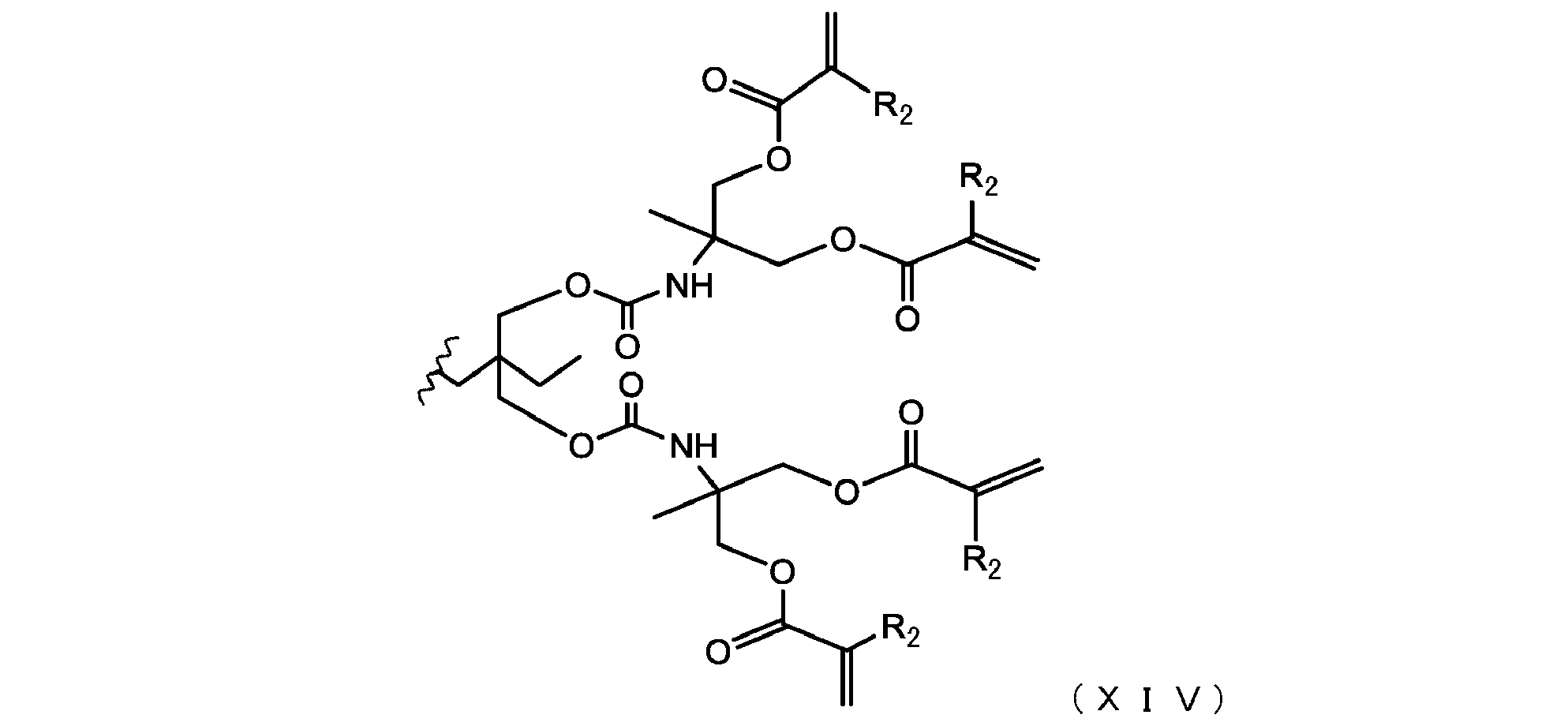

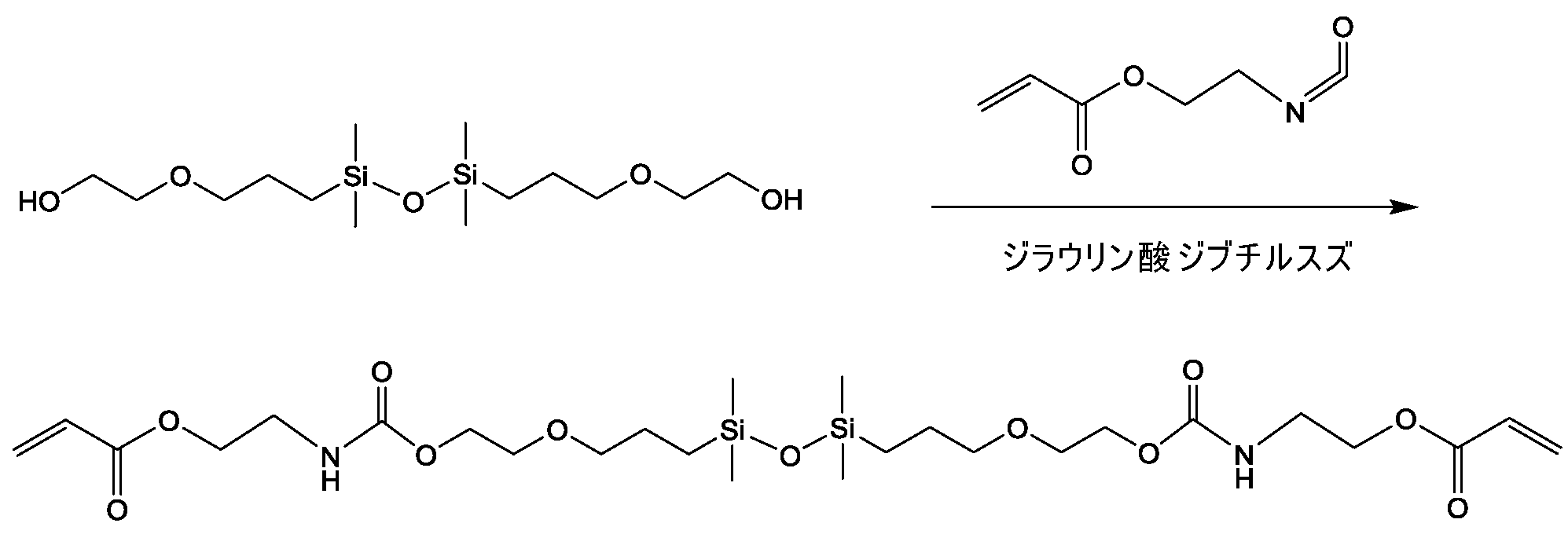
ケイ素化合物(a)は、ヒドロキシル基含有シロキサン化合物(例えばJNC(株)製サイラプレーンFM4401)を、スズ触媒(例えばジラウリン酸ジブチルスズ)の存在下で、アクリロイルオキシエチルイソシアナート(例えば昭和電工(株)製カレンズAOI)等の(メタ)アクリロイル基を有するイソシアナートと反応させることによって、2官能アクリル変性ケイ素化合物を得ることができる。

次に、両末端ジヒドロキシル変性ケイ素化合物をスズ触媒(例えばジラウリン酸ジブチルスズ)の存在下で、1,1’-(ビスアクリロイルオキシメチル)エチルイソシアナート(例えば昭和電工(株)製カレンズBEI)等の(メタ)アクリロイル基を有するイソシアナートと反応させることによって8官能アクリル変性ケイ素化合物を得ることができる。
また、両末端ヒドロキシル変性ケイ素化合物と(メタ)アクリロイル基を有するイソシアナートとの反応に使用する触媒としては、アミン系触媒(例えばトリエチレンジアミン)、カルボキシレート触媒(例えばナフテン酸鉛、酢酸カリウム)、トリアルキルホスフィン触媒(例えばトリエチルホスフィン)、チタン系触媒(例えばチタンノルマルブトキシド)なども使用することができる。
本願の第2の実施の形態に係るコーティング剤用樹脂組成物は、上記のアクリル変性したケイ素化合物(a)を含有する樹脂組成物である。本願のコーティング剤用樹脂組成物は、硬化性樹脂(b)を含有するコーティング液にケイ素化合物(a)を加えることにより、容易に調製することができる。例えば、特許第5375100号公報に記載の方法により調製されたコーティング液に、ケイ素化合物(a)、必要に応じて、硬化性樹脂(b)に適した重合開始剤、混合を促進するための溶媒等を加えることにより本願のコーティング剤用樹脂組成物を得ることができる。
硬化性樹脂(b)としては、活性エネルギー線硬化性樹脂または熱硬化性樹脂を挙げることができる。硬化方法の容易性から活性エネルギー線硬化性樹脂がより好ましく、紫外線硬化性樹脂が特に好ましい。
なお、本明細書において、活性エネルギー線とは、活性種を発生する化合物を分解して活性種を発生させることのできるエネルギー線をいう。このような活性エネルギー線としては、可視光、紫外線、赤外線などの光エネルギー線や、X線、α線、β線、γ線、電子線などの放射線が挙げられる。中でも、特に紫外線が好ましい。
活性エネルギー線硬化性樹脂としては、ウレタン(メタ)アクリレート樹脂、ポリエステル(メタ)アクリレート樹脂、(メタ)アクリレートモノマー、不飽和ポリエステル樹脂、エポキシ(メタ)アクリレート樹脂などのラジカル重合が可能な不飽和結合を有する樹脂を挙げることができる。これらの樹脂を単独で用いてもよいし、複数の樹脂を組み合わせて用いてもよい。中でも、ウレタン(メタ)アクリレート樹脂、ポリエステル(メタ)アクリレート樹脂が好ましい。ウレタン(メタ)アクリレート樹脂は、ウレタン構造により強靭な塗膜が得られやすく、同時に柔軟性を備える。
前記ポリイソシアナートとしては、具体的には2,4-トリレンジイソシアナートおよびその異性体、ジフェニルメタンジイソシアナート、ヘキサメチレンジイソシアナート、水添キシリレンジイソシアナート、イソホロンジイソシアナート、キシリレンジイソシアナート、ジシクロヘキシルメタンジイソシアナート、ナフタリンジイソシアナート、トリフェニルメタントリイソシアナート、バーノックD-750、クリスボンNK(商品名:大日本インキ化学工業(株)製)、デスモジュールL(商品名:住友バイエルウレタン(株)製)、コロネートL(商品名:日本ポリウレタン工業(株)製)、タケネートD102(商品名:三井武田ケミカル(株)製)、イソネート143L(商品名:三菱化学(株)製)などが挙げられる。
前記ポリヒドロキシ化合物としては、ポリエーテルポリオール、ポリエステルポリオール、ポリカーボネートポリオール、ポリカプロラクトンポリオールなどが挙げられ、具体的にはグリセリン-エチレンオキシド付加物、グリセリン-プロピレンオキシド付加物、グリセリン-テトラヒドロフラン付加物、グリセリン-エチレンオキシド-プロピレンオキシド付加物、トリメチロールプロパン-エチレンオキシド付加物、トリメチロールプロパン-プロピレンオキシド付加物、トリメチロールプロパン-テトラヒドロフラン付加物、トリメチロールプロパン-エチレンオキシド-プロピレンオキシド付加物、ジペンタエリスリトール-エチレンオキシド付加物、ジペンタエリスリトール-プロピレンオキシド付加物、ジペンタエリスリトール-テトラヒドロフラン付加物、ジペンタエリスリトール-エチレンオキシド-プロピレンオキシド付加物などが挙げられる。
前記多価アルコール類としては、具体的には、エチレングリコール、ジエチレングリコール、トリエチレングリコール、ポリエチレングリコール、プロピレングリコール、ジプロピレングリコール、ポリプロピレングリコール、2-メチル-1,3-プロパンジオール、1,3-ブタンジオール、ビスフェノールAとプロピレンオキシドまたはエチレンオキシドとの付加物、1,2,3,4-テトラヒドロキシブタン、グリセリン、トリメチロールプロパン、1,2-シクロヘキサングリコール、1,3-シクロヘキサングリコール、1,4-シクロヘキサングリコール、パラキシレングリコール、ビシクロヘキシル-4,4-ジオール、2,6-デカリングリコール、2,7-デカリングリコールなどが挙げられる。
前記水酸基含有(メタ)アクリル化合物としては、特に限定されるものではないが、水酸基含有(メタ)アクリル酸エステルが好ましく、具体的には、例えば、2-ヒドロキシエチル(メタ)アクリレート、2-ヒドロキシプロピル(メタ)アクリレート、3-ヒドロキシブチル(メタ)アクリレート、ポリエチレングリコールモノ(メタ)アクリレート、ポリプロピレングリコールモノ(メタ)アクリレート、トリス(ヒドロキシエチル)イソシアヌル酸ジ(メタ)アクリレート、ペンタエリスリトールトリ(メタ)アクリレートなどが挙げられる。
ポリエステル(メタ)アクリレートの原料として用いられる飽和多塩基酸としては、例えばフタル酸、イソフタル酸、テレフタル酸、テトラヒドロフタル酸、アジピン酸、セバチン酸などの重合性不飽和結合を有していない多塩基酸またはその無水物と、フマル酸、マレイン酸、イタコン酸などの重合性不飽和多塩基酸またはその無水物が挙げられる。さらに多価アルコール成分としては、エチレングリコール、プロピレングリコール、ジエチレングリコール、ジプロピレングリコール、1,2-ブタンジオール、1,3-ブタンジオール、1,5-ペンタンジオール、1,6-ヘキサンジオール、2-メチル-1,3-プロパンジオール、2,2-ジメチル-1,3-プロパンジオール、シクロヘキサン-1,4-ジメタノール、ビスフェノールAのエチレンオキサイド付加物、ビスフェノールAのプロピレンオキサイド付加物などが挙げられる。
前記不飽和ポリエステルとしては、無水マレイン酸などの不飽和酸とエチレングリコールなどのジオールとを重縮合させて製造できる。具体的にはフマル酸、マレイン酸、イタコン酸などの重合性不飽和結合を有する多塩基酸またはその無水物を酸成分とし、これとエチレングリコール、プロピレングリコール、ジエチレングリコール、ジプロピレングリコール、1,2-ブタンジオール、1,3-ブタンジオール、1,5-ペンタンジオール、1,6-ヘキサンジオール、2-メチル-1,3-プロパンジオール、2,2-ジメチル-1,3-プロパンジオール、シクロヘキサン-1,4-ジメタノール、ビスフェノールAのエチレンオキサイド付加物、ビスフェノールAのプロピレンオキサイド付加物などの多価アルコールをアルコール成分として反応させ、また、必要に応じてフタル酸、イソフタル酸、テレフタル酸、テトラヒドロフタル酸、アジピン酸、セバシン酸などの重合性不飽和結合を有していない多塩基酸またはその無水物も酸成分として加えて製造されるものが挙げられる。
前記ビニルエステルとしては、公知の方法により製造されるものであり、エポキシ樹脂に不飽和一塩基酸、例えばアクリル酸またはメタクリル酸を反応させて得られるエポキシ(メタ)アクリレートが挙げられる。
また、各種エポキシ樹脂をビスフェノール(例えばA型)またはアジピン酸、セバシン酸、ダイマー酸(ハリダイマー270S(商品名):ハリマ化成(株))などの二塩基酸で反応させ、可撓性を付与してもよい。
原料としてのエポキシ樹脂としては、ビスフェノールAジグリシジルエーテルおよびその高分子量同族体、ノボラック型グリシジルエーテル類などが挙げられる。
一例として、活性エネルギー線硬化性樹脂に紫外線を照射させて用いる場合を説明する。活性エネルギー線硬化性樹脂は、光重合開始剤の存在下で紫外線を照射して重合させることにより硬化するものが好ましい。光重合開始剤としては、例えば、各種のベンゾイン誘導体、ベンゾフェノン誘導体、フェニルケトン誘導体、オニウム塩光開始剤、有機金属光開始剤、金属塩カチオン光開始剤、光分解性オルガノシラン、潜在性スルホン酸、酸化ホスフィンなどが挙げられる。光重合開始剤の添加量は、活性エネルギー線硬化性樹脂100重量部に対して、1~5重量部とすることが好ましい。
熱硬化性樹脂としては、例えば、フェノール樹脂、アルキド樹脂、メラミン系樹脂、エポキシ系樹脂、尿素樹脂、不飽和ポリエステル樹脂、ウレタン系樹脂、熱硬化性ポリイミドおよびシリコーン樹脂などが挙げられる。これらの樹脂を単独で用いてもよいし、複数の樹脂を組み合わせて用いてもよい。
具体的には、ビスフェノールA型エポキシ樹脂、ビスフェノールF型エポキシ樹脂、多官能エポキシ樹脂、可撓性エポキシ樹脂、臭素化エポキシ樹脂、グリシジルエステル型エポキシ樹脂、高分子型エポキシ樹脂、ビフェニル型エポキシ樹脂等のエポキシ系樹脂、メチル化メラミン樹脂、ブチル化メラミン樹脂、メチルエーテル化メラミン樹脂、ブチルエーテル化メラミン樹脂、メチルブチル混合エーテル化メラミン樹脂等のメラミン系樹脂、イソシアナート基を2個以上持ったポリイソシアナート化合物(O=C=N-R-N=C=O)と、水酸基を2個以上持ったポリオール化合物(HO-R'-OH)、ポリアミン(H2N-R"-NH2)、または水などの活性水素(-NH2,-NH,-CONH-など)を持った化合物などとの反応により得ることができるウレタン系樹脂等が加工適性上好ましい。
エポキシ系樹脂は耐熱性、接着性、耐薬品性、メラミン系樹脂は耐熱性、硬度、透明性、ウレタン系樹脂は接着性、低温硬化性に優れており、適宜選択して使用することができる。
[A]m+[B]m- (1)
[(α)aQ]m+ (2)
上記式(2)において、αは炭素数が1~60であり、炭素原子以外の原子をいくつ含んでもよい有機基である。aは1~5の整数である。a個のαは各々独立で、同一でも異なっていてもよい。また、少なくとも1つのαは、芳香環を有する有機基であることが好ましい。
Qは、S、N、Se、Te、P、As、Sb、Bi、O、I、Br、Cl、F、N=Nからなる群から選ばれる原子あるいは原子団である。また、陽イオン[A]m+中のQの原子価をqとしたとき、m=a-qである(但し、N=Nは原子価0として扱う)。
[LXb]m- (3)
上記式(3)において、Lはハロゲン化物錯体の中心原子である金属または半金属(Metalloid)であり、B、P、As、Sb、Fe、Sn、Bi、Al、Ca、In、Ti、Zn、Sc、V、Cr、Mn、Coなどである。Xはハロゲン原子である。bは3~7なる整数である。また、陰イオン[LXb]m-中のLの原子価をpとしたとき、m=b-pである。
上記式(3)で示される陰イオン[LXb]m-の具体例には、テトラフルオロボレート(BF4)、ヘキサフルオロフォスフェート(PF6)、ヘキサフルオロアンチモネート(SbF6)、ヘキサフルオロアルセネート(AsF6)、ヘキサクロロアンチモネート(SbCl6)などが含まれる。
[LXb-1(OH)]m- (4)
(イ)フェニルジアゾニウムヘキサフルオロホスフェート、4-メトキシフェニルジアゾニウムヘキサフルオロアンチモネート、4-メチルフェニルジアゾニウムヘキサフルオロホスフェートなどのアリールジアゾニウム塩
(ロ)ジフェニルヨードニウムヘキサフルオロアンチモネート、ジ(4-メチルフェニル)ヨードニウムヘキサフルオロホスフェート、ジ(4-t-ブチルフェニル)ヨードニウムヘキサフルオロホスフェートなどのジアリールヨードニウム塩
(ハ)トリフェニルスルホニウムヘキサフルオロアンチモネート、トリス(4-メトキシフェニル)スルホニウムヘキサフルオロホスフェート、ジフェニル-4-チオフェノキシフェニルスルホニウムヘキサフルオロアンチモネート、ジフェニル-4-チオフェノキシフェニルスルホニウムヘキサフルオロホスフェート、4,4’-ビス(ジフェニルスルフォニオ)フェニルスルフィド-ビス-ヘキサフルオロアンチモネート、4,4’-ビス(ジフェニルスルフォニオ)フェニルスルフィド-ビス-ヘキサフルオロホスフェート、4,4’-ビス[ジ(β-ヒドロキシエトキシ)フェニルスルホニオ]フェニルスルフィド-ビス-ヘキサフルオロアンチモネート、4,4’-ビス[ジ(β-ヒドロキシエトキシ)フェニルスルホニオ]フェニルスルフィド-ビス-ヘキサフルオロホスフェート、4-[4’-(ベンゾイル)フェニルチオ]フェニル-ジ-(4-フルオロフェニル)スルホニウムヘキサフルオロアンチモネート、4-[4'-(ベンゾイル)フェニルチオ]フェニル-ジ-(4-フルオロフェニル)スルホニウムヘキサフルオロホスフェートなどのトリアリールスルホニウム塩
鉄アレーン錯体の例には、(η5-2,4-シクロペンタジエン-1-イル)〔(1,2,3,4,5,6-η)-(1-メチルエチル)ベンゼン〕-アイアン-ヘキサフルオロホスフェートなどが含まれ、アルミニウム錯体の例には、トリス(アセチルアセトナト)アルミニウム、トリス(エチルアセトアセタト)アルミニウム、トリス(サリチルアルデヒダト)アルミニウムなどが含まれる。
高屈折率特性を付与する手法としては、硬化樹脂層中にジルコニア、チタニア、硫化亜鉛などの金属微粒子や、フルオレン骨格を有するアクリレート化合物およびエポキシ化合物や、硫黄原子を含有するアクリレート化合物およびエポキシ化合物などを1種以上混合させることが好ましい。
高屈折率特性を付与された硬化樹脂層上にITOや銀ナノワイヤーに代表される透明電極材料を塗布し、エッチングによりパターニングすることによって、静電容量方式のタッチパネルに組み込まれる透明電極フィルムに使用することができる。高屈折率特性を付与された硬化樹脂層を用いることで、ITOや銀ナノワイヤーなど透明電極材料の導電パターンを見えにくくすることができる。
また、高屈折率特性を付与された硬化樹脂層に前記低屈折率特性を有する層を積層することにより、反射防止特性を有する第1の硬化樹脂層を得ることができる。
シリコーン化合物としては、BYK-UV3500、BYK-UV-3570(いずれも商品名:ビックケミー社製)、TEGO Rad2100、2200N、2250、2500、2600、2700(何れも商品名:デグサ社製)、X-22-2445、X-22-2455、X-22-2457、X-22-2458、X-22-2459、X-22-1602、X-22-1603、X-22-1615、X-22-1616、X-22-1618、X-22-1619、X-22-2404、X-22-2474、X-22-174DX、X-22-8201、X-22-2426、X-22-164A、X-22-164C(いずれも商品名:信越化学工業株式会社製)等を挙げることができる。
フッ素化合物としては、ダイキン工業株式会社製のオプツールDAC、オプツールDAC-HP、R-1110、R-1210、R-1240、R-1620、R-1820、R-2020、R-5210、R-5410、R-5610、R-5810、R-7210、R-7310、メガファックRS-75、メガファックRS-72-K、メガファックRS-76-E、メガファックRS-76-NS、メガファックRS-77、メガファックRS-903-3、メガファックRS-914-2、メガファックRS-761-3(いずれも商品名)等を挙げることができる。
また、無機微粒子の平均粒子径は、5nm~2μmが好ましく、塗膜の透明性を考慮すると、5nm~500nmが好ましく、より好ましくは、5nm~50nmである。5nm以上であると、硬化膜の表面硬度および耐傷つき性を向上させることができ、2μm以下であると、硬化膜の透明性に悪影響を及ぼさない。なお、無機微粒子の平均粒子径は、日機装(株)MICROTRAC UPAを使用し、動的光散乱法にて測定する。
熱可塑性樹脂の例には、ポリエチレン、ポリプロピレン、ポリ塩化ビニル、ポリ塩化ビニリデン、ポリスチレン、アクリロニトリル-スチレン樹脂、アクリロニトリル-ブタジエン-スチレン樹脂、ポリ(メタ)アクリレート樹脂、超高分子量ポリエチレン、ポリ-4-メチルペンテン、シンジオタクチックポリスチレン、ポリアミド(ナイロン6:デュポン社商品名、ナイロン6,6:デュポン社商品名、ナイロン6,10:デュポン社商品名、ナイロン6,T:デュポン社商品名、ナイロンMXD6:デュポン社商品名など)、ポリエステル(ポリエチレンテレフタレート、ポリブチレンテレフタレート、ポリエチレン2,6-ナフタレンジカルボキシラート、など)、ポリアセタール、ポリカーボネート、ポリフェニレンオキサイド、フッ素樹脂(ポリテトラフロロエチレン、ポリフッ化ビニリデン、など)、ポリフェニレンスルフィド、ポリスルホン、ポリエーテルスルホン、ポリエーテルエーテルケトン、ポリアリラート(Uポリマー:ユニチカ(株)商品名、ベクトラ:ポリプラスチックス(株)商品名、など)、ポリイミド(カプトン:東レ(株)商品名、AURUM:三井化学(株)商品名、など)、ポリエーテルイミドおよびポリアミドイミドなどが含まれる。
本発明の第3の実施の形態に係る成形体について説明する。成形体は、上記第2の実施の形態に係るコーティング剤用樹脂組成物を硬化させて得られた硬化物と、その硬化物に覆われた基材とを備える。よって、基材表面のハードコーティングが可能となり、基材表面の耐傷付き性を著しく向上させることができ、基材表面をキズや汚れから守ることができる。
本願のコーティング剤用樹脂組成物のコーティングには、組成物を均一にコーティングするウェットコーティング法を用いることが好ましい。ウェットコーティング法としては、グラビアコート法やダイコート法等を用いることができる。なお、コーティング剤用樹脂組成物は、コーティングに適した状態であることが好ましく、溶媒を含まず、または溶媒との混合物であってもよい。
グラビアコート法は、表面に凸凹の彫刻加工が施されたグラビアロールを塗布液に浸し、グラビアロール表面の凸部に付着した塗布液をドクターブレードで掻き落とし凹部に液を貯めることで正確に計量し、基材に転移させる方式である。グラビアコート法により、低粘度の液を薄くコーティングすることができる。
ダイコート法は、ダイと呼ばれる塗布用ヘッドから液を加圧して押出しながらコーティングする方式である。ダイコート法により、高精度なコーティングが可能となる。さらに、塗布時に液が外気にさらされないため、乾きによる塗布液の濃度変化などが起こりにくい。
基材には、透明性を有する各種のプラスチックやガラスを用いることができる。透明性を有するプラスチックの材料としては、例えば、ポリエステル系樹脂、アセテート系樹脂、ポリエーテルスルホン系樹脂、ポリカーボネート系樹脂、ポリアミド系樹脂、ポリイミド系樹脂、ポリオレフィン系樹脂、(メタ)アクリル系樹脂、ポリ塩化ビニル系樹脂、ポリ塩化ビニリデン系樹脂、ポリスチレン系樹脂、ポリビニルアルコール系樹脂、ポリアリレート系樹脂、ポリフェニレンサルファイド系樹脂、ノルボルネン系樹脂、シクロオレフィン系樹脂、ポリウレタン樹脂等の樹脂が挙げられる。具体的には、ポリエチレンテレフタレート(PET)、ポリエチレンナフタレート、トリアセチルセルロース、ポリエーテルスルホン、ポリカーボネート、ポリアリレート、ポリエーテルエーテルケトン等が好ましい。シクロオレフィン系樹脂はゼオノア(登録商標)、ゼオネックス(登録商標):日本ゼオン製、アートン(登録商標):JSR製、アペル(登録商標):三井化学製、トパス(登録商標):ポリプラスチックス製が好ましい。なお、ポリエチレンテレフタレートおよびポリエチレンナフタレートは、機械的強度、寸法安定性、耐熱性、耐薬品性、光学特性等、およびフィルム表面の平滑性やハンドリング性に優れているためより好ましい。ポリカーボネートは、透明性、耐衝撃性、耐熱性、寸法安定性、燃焼性に優れているためより好ましい。価格・入手の容易さをも考慮すると、ポリエチレンテレフタレートが特に好ましい。透明性を有するガラスの材料としては、LCDディスプレイやタッチパネルなどに使用される寸法安定性、光学特性に優れるガラスであれば制限されない。たとえばソーダ石灰ガラス、無アルカリガラス、アルカリバリウムガラス、ホウケイ酸ガラス、アルカリホウケイ酸ガラス、アルミノホウケイ酸ガラス、バリウムホウケイ酸ガラス、アルミノケイ酸ガラス、ホウ酸塩ガラス、シリカガラス、鉛ガラス等が挙げられる。
また、コーティングされる基材は、透明でなくてもよく、電子機器、電気機器、IT関連機器などの筐体であってもよい。このように、基材は、透明、不透明に関わらず、ハードコーティングを必要とするものであればよい。
基材の厚みは特に制限するものではなく、上記に例示された物品により異なるものである。例えば、光学用保護フィルムの場合は、基材の厚みは好ましくは50~300μmであり、より好ましくは80~200μmである。基材の厚みが50μm以上であると基材の機械的強度が充分となり、基材上にコーティングを形成することが可能になる。また、厚みが300μm以下であると、光学用保護フィルムの厚みが厚くなりすぎず、当該フィルムを用いた製品(例えば後述の画像表示装置)がコンパクトである。
基材表面に製膜されたコーティング剤用樹脂組成物の硬化物の厚みも特に制限するものではなく、上記に例示された物品より適宜変更することができる。
コーティング剤用樹脂組成物を硬化させて得られた硬化物を、画像表示装置の画像パネル表面等に使用する場合は、基材と硬化物を備える成形体(例えば光学用保護フィルム)のヘイズ値と、基材のみのヘイズ値との差が1%以下であることが好ましい。すなわち、下記式(5)の関係となる。1%以下であると、硬化物の存在を全く意識することなく、画像パネルの表示を認識することができる。
|成形体のヘイズ値-基材のヘイズ値|≦1% (5)
なお、ヘイズとは、フィルムの透明性に関する指標で、濁度(曇度)を表す。下記式(6)を用いて、拡散透過光の全光線透過光に対する割合から求めることができる。(Td:拡散透過率 Tt:全光線透過率)
ヘイズ(%)=Td/Tt×100 (6)
本発明の第3の実施の形態に係る画像表示装置について説明する。画像表示装置は、図1に示すように、第2の実施の形態に係る成形体(例えば光学用保護フィルム11)と、機械的処理により映し出された像を表示する画像パネル12とを備える。画像パネル12には、例えば、CRT、PDPまたはLCD等のフラットパネルディスプレイを挙げることができる。図1に示すように、画像パネル12上に、光学用保護フィルム11の備える基材が下側になるように、光学用保護フィルム11が載置される。
<4官能アクリル変性ケイ素化合物Aの合成例>
両末端ヒドロキシル変性ケイ素化合物(商品名:サイラプレーンFM4401、水酸基当量:173g/mol、JNC(株)製)50gに、1,1’-(ビスアクリロイルオキシメチル)エチルイソシアナート(商品名:カレンズBEI、昭和電工(株)製)85.1gを添加し、窒素雰囲気下45℃まで加熱する。ジラウリン酸ジブチルスズ(東京化成(株)製)0.09gをメチルエチルケトン(和光純薬(株)製)1.0gに溶かした溶液を滴下し、45℃~50℃で2時間攪拌する。さらに、ジラウリン酸ジブチルスズ(東京化成(株)製)0.05gをメチルエチルケトン(和光純薬(株)製)0.5gに溶かした溶液を添加し同温度で2時間攪拌する。その後、反応液を氷冷しメタノール(17.0g)を滴下する。同温度で30分攪拌し、4官能アクリル変性ケイ素化合物Aのメタノール溶液(153.3g、固形分濃度79wt%)を得る。ケイ素化合物Aを以下に示す。

<両末端ヒドロキシル変性ケイ素化合物Bの合成例>
両末端ジメチルシリルポリジメチルシロキサン(商品名:サイラプレーンFM1105、重量平均分子量約500、JNC(株)製)250gに、2-アリロキシエタノール(シグマ-アルドリッチ(株)製)81.6gを添加し、窒素雰囲気下70度に加熱する。白金触媒キシレン溶液(商品名:PT-VTSC-3.0X、ユミコアジャパン(株)製、Pt含有量3wt%)4μlを滴下する。両末端ジメチルシリルポリジメチルシロキサン(商品名:サイラプレーンFM1105、重量平均分子量約500、JNC(株)製)80.1gを反応系内が100℃を超えないように滴下する。80度で1時間攪拌した後に室温まで冷却する。その後未反応の2-アリロキシエタノールを減圧下留去し、両末端ヒドロキシル変性ケイ素化合物B130.4g(収率93%)を得る。ケイ素化合物Bを以下に示す。

<4官能アクリル変性ケイ素化合物Cの合成例>
両末端ヒドロキシル変性ケイ素化合物B(60.6g)に、1,1’-(ビスアクリロイルオキシメチル)エチルイソシアナート(商品名:カレンズBEI、昭和電工(株)製)69.7gを添加し、窒素雰囲気下45℃まで加熱する。ジラウリン酸ジブチルスズ(東京化成(株)製)0.078gをメチルエチルケトン(和光純薬(株)製)0.53gに溶かした溶液を滴下し、45℃~50℃で2時間攪拌する。さらに、ジラウリン酸ジブチルスズ(東京化成(株)製)0.041gをメチルエチルケトン(和光純薬(株)製)0.52gに溶かした溶液を添加し、同温度で2時間攪拌する。その後、反応液を氷冷し、メタノール(14.0g)を滴下する。同温度で30分攪拌し、4官能アクリル変性ケイ素化合物Cのメタノール溶液(145.5g、固形分濃度81.6wt%)を得る。ケイ素化合物Cを以下に示す。

<4官能アクリル変性ケイ素化合物Dの合成例>
両末端ヒドロキシル変性ケイ素化合物(商品名:サイラプレーンFM4411、水酸基当量:564g/mol、JNC(株)製)9.5gに、1,1’-(ビスアクリロイルオキシメチル)エチルイソシアナート(商品名:カレンズBEI、昭和電工(株)製)4.85gおよびメチルエチルケトン(和光純薬(株)製)8.0gを添加し、窒素雰囲気下45℃まで加熱する。ジラウリン酸ジブチルスズ(東京化成(株)製)0.006gをメチルエチルケトン(和光純薬(株)製)1.03gに溶かした溶液を滴下し、45℃~50℃で2時間攪拌する。さらに、ジラウリン酸ジブチルスズ(東京化成(株)製)0.003gをメチルエチルケトン(和光純薬(株)製)0.51gに溶かした溶液を添加し、同温度で2時間攪拌する。その後、反応液を氷冷し、メタノール(0.95g)を滴下する。同温度で30分攪拌し、4官能アクリル変性ケイ素化合物Dのメチルエチルケトン溶液(24.8g、固形分濃度55wt%)を得る。ケイ素化合物Dを以下に示す。

<両末端ジヒドロキシル変性ケイ素化合物Eの合成例>
両末端ジメチルシリルポリジメチルシロキサン(商品名:サイラプレーンFM1105、重量平均分子量約500、JNC(株)製)20.0gにトリメチロールプロパンアリルエーテル(シグマ-アルドリッチ(株)製)139.5gを添加し、窒素雰囲気下オイルバスを用いて、70℃まで加熱する。さらに、白金触媒キシレン溶液(商品名:PT-VTSC-3.0X、ユミコアジャパン(株)製、Pt含有量3wt%)4μlを添加する。両末端ジメチルシリルポリジメチルシロキサン(商品名:サイラプレーンFM1105、JNC(株)製)80.1gを反応系内が100℃を超えないように滴下する。滴下後1時間攪拌し、さらに白金触媒キシレン溶液(4μl)を添加し、1時間攪拌した後に室温まで冷却し、目的物を得る。その後、未反応のトリメチロールプロパンアリルエーテルをキャピラリー蒸留(18mmHg、130℃)にて留去し、両末端ジヒドロキシル変性ケイ素化合物E162.5g(収率96%)を得る。ケイ素化合物Eを以下に示す。

<4官能アクリル変性ケイ素化合物Fの合成例>
合成例5で合成した両末端ジヒドロキシル変性ケイ素化合物E(100g)に、ジラウリン酸ジブチルスズ(東京化成(株)製)0.15gをメチルエチルケトン(和光純薬(株)製)1.54gに溶かした溶液を添加し、窒素雰囲気下オイルバスを用いて、40℃まで加熱する。イソシアナート(カレンズAOI、昭和電工(株)製)81.2gを反応系内が50℃を超えないように滴下する。滴下後40度~50℃にて2時間攪拌し、さらにジラウリン酸ジブチルスズ(東京化成(株)製)0.076gをメチルエチルケトン(和光純薬(株)製)0.81gに溶かした溶液を滴下し、さらに40℃~50℃で2時間攪拌する。その後反応液を氷冷し、メタノール(27.6g)を滴下する。同温度で30分攪拌し、4官能アクリル変性ケイ素化合物Fのメタノール溶液(211g、固形分濃度79wt%)を得る。ケイ素化合物Fを以下に示す。
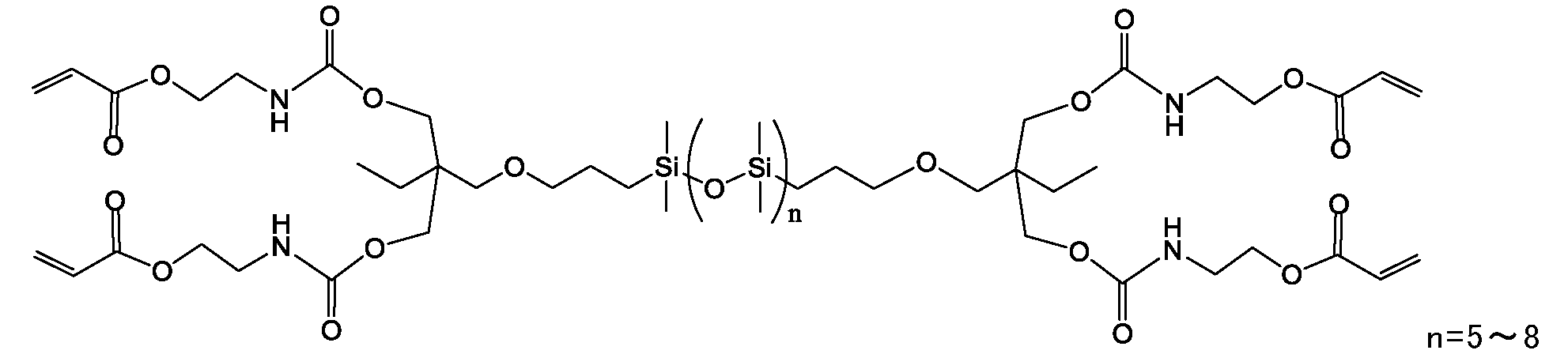
<両末端ジヒドロキシル変性ケイ素化合物Gの合成例>
1,1,3,3-テトラメチルジシロキサン20gにトリメチロールプロパンアリルエーテル(シグマ-アルドリッチ(株)製)519gを添加し、窒素雰囲気下オイルバスを用いて、70℃まで加熱する。さらに、白金触媒キシレン溶液(商品名:PT-VTSC-3.0X、ユミコアジャパン(株)製、Pt含有量3wt%)4μlを添加する。1,1,3,3-テトラメチルジシロキサン80gを反応系内が100℃を超えないように滴下する。滴下後1時間攪拌し、さらに白金触媒キシレン溶液(4μl)を添加し、1時間攪拌した後に室温まで冷却し、目的物を得る。その後、未反応のトリメチロールプロパンアリルエーテルをキャピラリー蒸留(18mmHg、130℃)にて留去し、両末端ジヒドロキシル変性ケイ素化合物G359gを得る。ケイ素化合物Gを以下に示す。

<4官能アクリル変性ケイ素化合物Hの合成例>
合成例7で合成した両末端ジヒドロキシル変性ケイ素化合物G(100g)に、ジラウリン酸ジブチルスズ(東京化成(株)製)0.26gをメチルエチルケトン(和光純薬(株)製)2.6gに溶かした溶液を添加し、窒素雰囲気下オイルバスを用いて、40℃まで加熱する。イソシアナート(カレンズAOI、昭和電工(株)製)140.3gを反応系内が50℃を超えないように滴下する。滴下後40度~50℃にて2時間攪拌し、さらにジラウリン酸ジブチルスズ(東京化成(株)製)0.13gをメチルエチルケトン(和光純薬(株)製)1.3gに溶かした溶液を滴下し、さらに40℃~50℃で2時間攪拌する。その後反応液を氷冷し、メタノール(47.7g)を滴下する。同温度で30分攪拌し、4官能アクリル変性ケイ素化合物Hのメタノール溶液(292g、固形分濃度74wt%)を得る。ケイ素化合物Hを以下に示す。
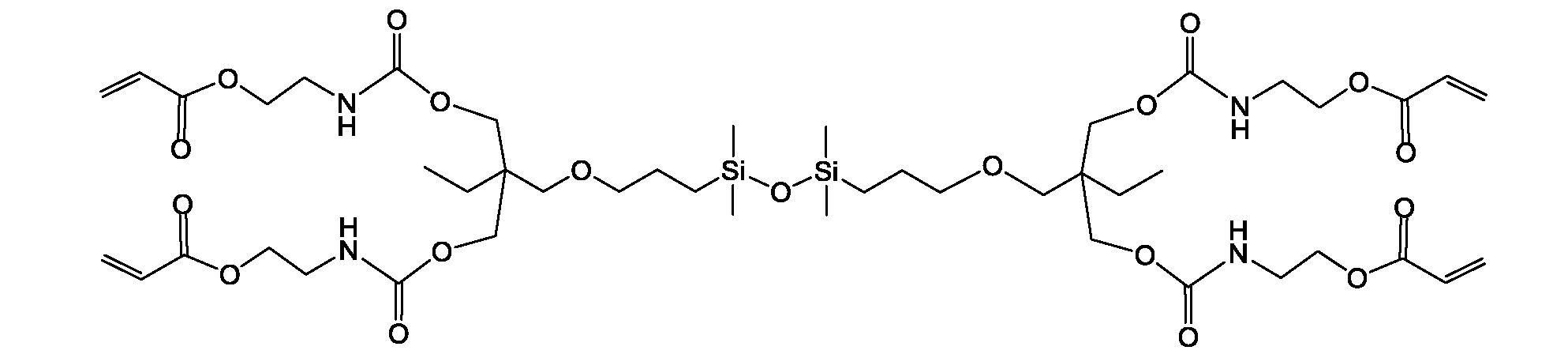
<コーティング液1の調製>
特許第5375100号公報に記載の方法により、固形分濃度40wt%のコーティング液を調製しこれをコーティング液1とした。コーティング液1は、固形分濃度が40wt%であり、固形分中の組成は、多官能ウレタンアクリレート76wt%、無機フィラー19wt%、UV硬化剤5wt%であった。さらに、コーティング液1中に0.2wt%の防汚添加剤(in liquid)と希釈溶剤としてのPGM/IPAを含む。
<コーティング液2の調製>
調製例1と同様の方法にて調製したコーティング液1(固型分濃度40wt%)450.0gに4官能アクリル変性ケイ素化合物Aのメタノール溶液(固形分濃度79wt%)25.3gを添加し、固形分中に4官能アクリル変性ケイ素化合物Aが10wt%になるようにした。さらにイルガキュア127(BASF(株)製)1.0g、メチルイソブチルケトン(和光純薬(株)製)24.7gを添加し、固形分濃度が40wt%になるようにした。攪拌・混合して透明な溶液になったのを確認し、コーティング液2とした。
調製例1と同様の方法にて調製したコーティング液1(固型分濃度40wt%)450.0gに4官能アクリル変性ケイ素化合物Cのメタノール溶液(固形分濃度81.6wt%)24.5gを添加し、固形分中に4官能アクリル変性ケイ素化合物Cが10wt%になるようにした。さらにイルガキュア127(BASF(株)製)1.0g、メチルイソブチルケトン(和光純薬(株)製)25.5gを添加し、固形分濃度が40wt%になるようにした。攪拌・混合して透明な溶液になったのを確認し、コーティング液3とした。
<硬化樹脂層1の形成>
基材としてポリカーボネート(製品名:ユーピロンNF2000VU、サイズ:1.5×70×150mm、三菱ガス化学(株)製)を用いた。調製例2で調製したコーティング液2を用いて、ポリカーボネート基材へディップコートした。初めにポリカーボネート基材をコーティング液2へ垂直に沈め、1分間浸漬させた後に引き上げ、速度1mm/secでポリカーボネート基材を垂直に引き上げ、乾燥膜厚が5μmになるようにし、80℃で1分間乾燥した後、高圧水銀灯を用いて両面をそれぞれ1000mJ/cm2の光照射条件で塗膜を光硬化させ、硬化樹脂層1を形成した。
<硬化樹脂層2の形成>
実施例1で用いた方法と同様の方法で硬化樹脂層2を形成した。
コーティング液2の代わりに調製例1で調製したコーティング液1を用いた事以外は実施例1と同様の方法にて硬化樹脂層2を形成した。
<硬化樹脂層3の形成>
実施例1で用いた方法と同様の方法で硬化樹脂層3を形成した。
コーティング液2の代わりに調製例3で調製したコーティング液3を用いた事以外は実施例1と同様の方法にて硬化樹脂層3を形成した。
(1)全光線透過率
硬化樹脂層をヘイズメーター(NDH5000、日本電色工業(株)製)を用いて測定した。JIS-K-7361の規格に準拠し実施した。
(2)ヘイズ
硬化樹脂層をヘイズメーター(NDH5000、日本電色工業(株)製)を用いて測定した。JIS K 7136の規格に準拠し実施した。
(3)鉛筆硬度
硬化樹脂層をJIS K 5600に準拠し、測定を行なった。
(4)基材密着性試験
塗膜に1mm間隔で縦横それぞれ11本の切れ目を付け、100個のマス目を作り、市販のセロハンテープ(セロテープ(登録商標)、CT24、ニチバン(株)製)をよく密着させ、90度手前方向に急激に剥がした際の、皮膜が剥離せずに残存した碁盤目の個数を表した。なお、この方法はJIS K5400に準拠している。
(5)接触角および表面自由エネルギー(SFE)測定
プローブ液体として、蒸留水(窒素・りん測定用、関東化学(株)製)、およびリン酸トリクレジル(99%(GC)、東京化成工業(株)製)を用いて接触角を測定し、かつKaelble-Uyの理論に従って表面自由エネルギーを算出した。
(6)スチールウール耐磨耗性試験
(株)井元製作所製耐磨耗試験機「IMC-1557型」を使用した。測定条件は垂直荷重1kg、往復速度30回/分、往復距離100mm、往復回数1000回、5000回、10000回、磨耗布取付部形状は直径10mm。磨耗布としてスチールウール(#0000)を使用した。1000回、5000回、10000回往復後の皮膜の磨耗痕の深さを測定した。ケーエルエーテンコール(株)製の接触式段差計「Alpha-step-IQ」を用いて、磨耗布接触部分と未接触部分の差を磨耗痕深さとして測定した。
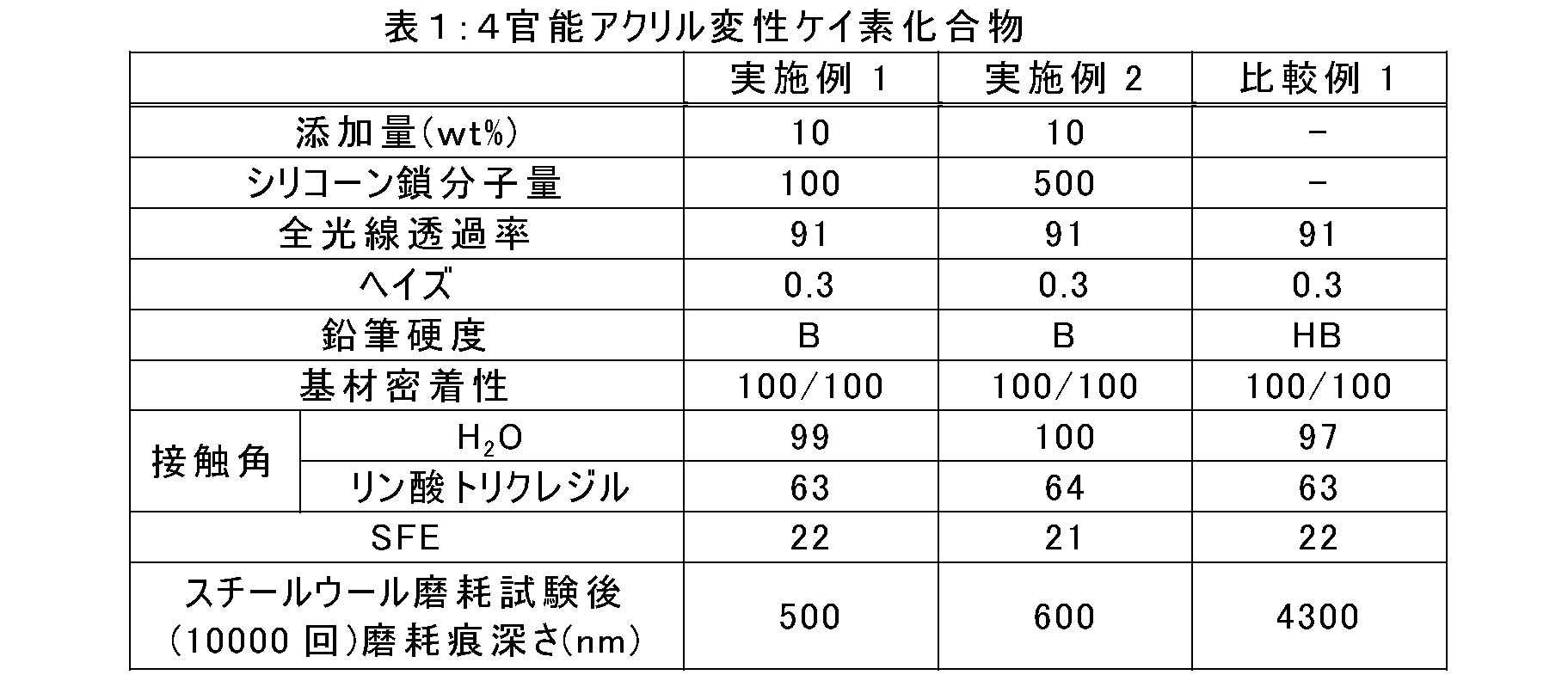
11 光学用保護フィルム
12 画像パネル
Claims (6)
- 下記式(I)で示されるケイ素化合物(a)であって、
R1が炭素数3もしくは4のアルキレンであり、
Xが、下記式(II)~(III)からなる群から選択された一の基であり、
nが0もしくは1の整数であり、
Yが、下記式(IV)~(VI)からなる群から選択された、(メタ)アクリレート基を有する一の基であり、
R2が、水素またはメチル基である、
ケイ素化合物。


- 請求項1に記載のケイ素化合物と;
硬化性樹脂(b)とを含有する;
コーティング剤用樹脂組成物。 - 前記硬化性樹脂(b)が、(メタ)アクリロイル基を少なくとも一つ有する紫外線硬化性樹脂である、
請求項2に記載のコーティング剤用樹脂組成物。 - 成形体であって、
請求項2または請求項3に記載のコーティング剤用樹脂組成物を硬化させた硬化物と;
前記硬化物に覆われた基材とを備える;
成形体。 - 前記成形体と前記基材とのヘイズ値の差が1%以下である、
請求項4に記載の成形体。 - 請求項5に記載の成型体と;
前記成形体を画面上に設置した画像パネルとを備える;
画像表示装置。
Priority Applications (3)
| Application Number | Priority Date | Filing Date | Title |
|---|---|---|---|
| US15/300,794 US20170015817A1 (en) | 2014-03-31 | 2015-03-31 | Silicon compound, resin composition for coating agent, molded article, and image display device |
| CN201580018042.0A CN106164080B (zh) | 2014-03-31 | 2015-03-31 | 硅化合物、涂剂用树脂组合物、成形体、图像显示装置 |
| JP2016511958A JP6638646B2 (ja) | 2014-03-31 | 2015-03-31 | ケイ素化合物、コーティング剤用樹脂組成物、成形体、画像表示装置 |
Applications Claiming Priority (2)
| Application Number | Priority Date | Filing Date | Title |
|---|---|---|---|
| JP2014-074666 | 2014-03-31 | ||
| JP2014074666 | 2014-03-31 |
Publications (1)
| Publication Number | Publication Date |
|---|---|
| WO2015152289A1 true WO2015152289A1 (ja) | 2015-10-08 |
Family
ID=54240607
Family Applications (1)
| Application Number | Title | Priority Date | Filing Date |
|---|---|---|---|
| PCT/JP2015/060248 Ceased WO2015152289A1 (ja) | 2014-03-31 | 2015-03-31 | ケイ素化合物、コーティング剤用樹脂組成物、成形体、画像表示装置 |
Country Status (4)
| Country | Link |
|---|---|
| US (1) | US20170015817A1 (ja) |
| JP (1) | JP6638646B2 (ja) |
| CN (1) | CN106164080B (ja) |
| WO (1) | WO2015152289A1 (ja) |
Cited By (6)
| Publication number | Priority date | Publication date | Assignee | Title |
|---|---|---|---|---|
| KR20170131248A (ko) * | 2016-05-19 | 2017-11-29 | 신에쓰 가가꾸 고교 가부시끼가이샤 | 신축성 막 및 그 형성 방법, 배선 피복 기판의 제조 방법, 그리고 신축성 배선막 및 그 제조 방법 |
| WO2019003563A1 (ja) * | 2017-06-29 | 2019-01-03 | 信越化学工業株式会社 | ポリ(メタ)アクリレート並びにそれを含むコーティング組成物および被覆物品 |
| KR20190096293A (ko) * | 2018-02-08 | 2019-08-19 | 신에쓰 가가꾸 고교 가부시끼가이샤 | 신축성 막 재료 조성물, 신축성 막 및 그 형성 방법 |
| JP2020070358A (ja) * | 2018-10-31 | 2020-05-07 | 信越化学工業株式会社 | 放射線硬化性有機ケイ素樹脂組成物 |
| KR20210038395A (ko) | 2019-09-30 | 2021-04-07 | 닛테츠 케미컬 앤드 머티리얼 가부시키가이샤 | 케이싱용 코팅막 및 케이싱용 광 경화성 코팅 수지 조성물 |
| KR20220154664A (ko) | 2020-03-19 | 2022-11-22 | 닛테츠 케미컬 앤드 머티리얼 가부시키가이샤 | 하우징용 적층체 |
Families Citing this family (4)
| Publication number | Priority date | Publication date | Assignee | Title |
|---|---|---|---|---|
| EP3662026B9 (de) * | 2017-12-15 | 2021-08-11 | Wacker Chemie AG | Beschichtungszusammensetzung zum abdichten von oberflächen |
| JP7377636B2 (ja) * | 2019-06-28 | 2023-11-10 | ホヤ レンズ タイランド リミテッド | 硬化性組成物およびその製造方法、眼鏡レンズ、眼鏡ならびに眼鏡レンズの製造方法 |
| CN111471154B (zh) * | 2020-05-11 | 2022-05-10 | 中国科学院深圳先进技术研究院 | 一种光或热引发的自修复弹性体及其制备方法和应用 |
| CN119684508B (zh) * | 2024-12-19 | 2025-12-26 | 苏州毫邦新材料有限公司 | 燃料电池柔性石墨双极板微孔堵漏剂 |
Citations (3)
| Publication number | Priority date | Publication date | Assignee | Title |
|---|---|---|---|---|
| CN101096474A (zh) * | 2006-06-30 | 2008-01-02 | 戈尔德施米特股份公司 | 新的有机硅氧烷多元醇的(甲基)丙烯酸酯的用途 |
| JP2008019402A (ja) * | 2006-07-14 | 2008-01-31 | Jsr Corp | 硬化性樹脂組成物及び反射防止膜 |
| JP2013112776A (ja) * | 2011-11-30 | 2013-06-10 | Shin-Etsu Chemical Co Ltd | (メタ)アクリル基含オルガノポリシロキサン及びその製造方法、並びに重合物 |
Family Cites Families (1)
| Publication number | Priority date | Publication date | Assignee | Title |
|---|---|---|---|---|
| JP5163119B2 (ja) * | 2005-04-06 | 2013-03-13 | Jsr株式会社 | 放射線硬化性樹脂組成物及び反射防止膜 |
-
2015
- 2015-03-31 JP JP2016511958A patent/JP6638646B2/ja not_active Expired - Fee Related
- 2015-03-31 CN CN201580018042.0A patent/CN106164080B/zh not_active Expired - Fee Related
- 2015-03-31 US US15/300,794 patent/US20170015817A1/en not_active Abandoned
- 2015-03-31 WO PCT/JP2015/060248 patent/WO2015152289A1/ja not_active Ceased
Patent Citations (3)
| Publication number | Priority date | Publication date | Assignee | Title |
|---|---|---|---|---|
| CN101096474A (zh) * | 2006-06-30 | 2008-01-02 | 戈尔德施米特股份公司 | 新的有机硅氧烷多元醇的(甲基)丙烯酸酯的用途 |
| JP2008019402A (ja) * | 2006-07-14 | 2008-01-31 | Jsr Corp | 硬化性樹脂組成物及び反射防止膜 |
| JP2013112776A (ja) * | 2011-11-30 | 2013-06-10 | Shin-Etsu Chemical Co Ltd | (メタ)アクリル基含オルガノポリシロキサン及びその製造方法、並びに重合物 |
Cited By (12)
| Publication number | Priority date | Publication date | Assignee | Title |
|---|---|---|---|---|
| KR20170131248A (ko) * | 2016-05-19 | 2017-11-29 | 신에쓰 가가꾸 고교 가부시끼가이샤 | 신축성 막 및 그 형성 방법, 배선 피복 기판의 제조 방법, 그리고 신축성 배선막 및 그 제조 방법 |
| KR101989223B1 (ko) * | 2016-05-19 | 2019-06-13 | 신에쓰 가가꾸 고교 가부시끼가이샤 | 신축성 막 및 그 형성 방법, 배선 피복 기판의 제조 방법, 그리고 신축성 배선막 및 그 제조 방법 |
| US10544272B2 (en) | 2016-05-19 | 2020-01-28 | Shin-Etsu Chemical Co., Ltd. | Stretchable film and method for forming the same, method for manufacturing coated wiring substrate, and stretchable wiring film and method for manufacturing the same |
| WO2019003563A1 (ja) * | 2017-06-29 | 2019-01-03 | 信越化学工業株式会社 | ポリ(メタ)アクリレート並びにそれを含むコーティング組成物および被覆物品 |
| JP2019011390A (ja) * | 2017-06-29 | 2019-01-24 | 信越化学工業株式会社 | ポリ(メタ)アクリレート並びにそれを含むコーティング組成物および被覆物品 |
| US11485805B2 (en) | 2017-06-29 | 2022-11-01 | Shin-Etsu Chemical Co., Ltd. | Poly(meth)acrylate, and coating composition and coated article containing same |
| KR20190096293A (ko) * | 2018-02-08 | 2019-08-19 | 신에쓰 가가꾸 고교 가부시끼가이샤 | 신축성 막 재료 조성물, 신축성 막 및 그 형성 방법 |
| KR102126148B1 (ko) | 2018-02-08 | 2020-06-23 | 신에쓰 가가꾸 고교 가부시끼가이샤 | 신축성 막 재료 조성물, 신축성 막 및 그 형성 방법 |
| JP2020070358A (ja) * | 2018-10-31 | 2020-05-07 | 信越化学工業株式会社 | 放射線硬化性有機ケイ素樹脂組成物 |
| JP7026602B2 (ja) | 2018-10-31 | 2022-02-28 | 信越化学工業株式会社 | 放射線硬化性有機ケイ素樹脂組成物 |
| KR20210038395A (ko) | 2019-09-30 | 2021-04-07 | 닛테츠 케미컬 앤드 머티리얼 가부시키가이샤 | 케이싱용 코팅막 및 케이싱용 광 경화성 코팅 수지 조성물 |
| KR20220154664A (ko) | 2020-03-19 | 2022-11-22 | 닛테츠 케미컬 앤드 머티리얼 가부시키가이샤 | 하우징용 적층체 |
Also Published As
| Publication number | Publication date |
|---|---|
| JPWO2015152289A1 (ja) | 2017-04-13 |
| CN106164080B (zh) | 2020-11-10 |
| CN106164080A (zh) | 2016-11-23 |
| US20170015817A1 (en) | 2017-01-19 |
| JP6638646B2 (ja) | 2020-01-29 |
Similar Documents
| Publication | Publication Date | Title |
|---|---|---|
| JP6638646B2 (ja) | ケイ素化合物、コーティング剤用樹脂組成物、成形体、画像表示装置 | |
| JP6519584B2 (ja) | コーティング剤用樹脂組成物、成形体、画像表示装置 | |
| JP6011529B2 (ja) | インモールド成形用転写フィルムおよびその製造方法 | |
| JP5975032B2 (ja) | 耐候性積層フィルム | |
| JP6481619B2 (ja) | 樹脂組成物および積層体 | |
| TWI736530B (zh) | 耐擦傷性塗佈用硬化性組成物 | |
| JP2017008125A (ja) | ケイ素化合物を含む組成物とその硬化膜 | |
| JP6330433B2 (ja) | ケイ素化合物、コーティング剤用樹脂組成物、成形体、画像表示装置 | |
| JPWO2015178391A1 (ja) | 樹脂シート、粘着剤層付き樹脂シート、及びそれらを用いてなる用途 | |
| JP6720639B2 (ja) | ハードコートフィルム | |
| WO2012053414A1 (ja) | 積層体およびその製造方法 | |
| WO2014097876A1 (ja) | インモールド成形用転写フィルム、インモールド成形体の製造方法および成形体 | |
| WO2015133517A1 (ja) | コーティング剤、硬化膜、積層体、成形物 | |
| KR102580704B1 (ko) | 플렉서블 하드코트용 경화성 조성물 | |
| JP2016124294A (ja) | 積層体及び表示体カバー | |
| WO2015186717A1 (ja) | ハードコート剤、硬化膜、成形物 | |
| WO2020162323A1 (ja) | フレキシブルハードコート用硬化性組成物 | |
| WO2016104770A1 (ja) | 積層体及び表示体カバー | |
| KR101825295B1 (ko) | 광경화성 수지 조성물, 이를 이용하여 제조된 디스플레이용 고경도 투명 플라스틱 기판 | |
| KR102584186B1 (ko) | 내광성 하드코트용 경화성 조성물 | |
| WO2019044786A1 (ja) | 樹脂シート及びこれを製造するための硬化型組成物 | |
| JP6060522B2 (ja) | コーティング材およびそれにより表面改質された成形品 |
Legal Events
| Date | Code | Title | Description |
|---|---|---|---|
| 121 | Ep: the epo has been informed by wipo that ep was designated in this application |
Ref document number: 15773142 Country of ref document: EP Kind code of ref document: A1 |
|
| ENP | Entry into the national phase |
Ref document number: 2016511958 Country of ref document: JP Kind code of ref document: A |
|
| NENP | Non-entry into the national phase | ||
| WWE | Wipo information: entry into national phase |
Ref document number: 15300794 Country of ref document: US |
|
| 122 | Ep: pct application non-entry in european phase |
Ref document number: 15773142 Country of ref document: EP Kind code of ref document: A1 |