WO2015129100A1 - 透明ポリアミド樹脂組成物、透明ポリアミド樹脂架橋成形体 - Google Patents
透明ポリアミド樹脂組成物、透明ポリアミド樹脂架橋成形体 Download PDFInfo
- Publication number
- WO2015129100A1 WO2015129100A1 PCT/JP2014/078550 JP2014078550W WO2015129100A1 WO 2015129100 A1 WO2015129100 A1 WO 2015129100A1 JP 2014078550 W JP2014078550 W JP 2014078550W WO 2015129100 A1 WO2015129100 A1 WO 2015129100A1
- Authority
- WO
- WIPO (PCT)
- Prior art keywords
- polyamide resin
- transparent polyamide
- transparent
- crosslinking aid
- resin composition
- Prior art date
- Legal status (The legal status is an assumption and is not a legal conclusion. Google has not performed a legal analysis and makes no representation as to the accuracy of the status listed.)
- Ceased
Links
Classifications
-
- C—CHEMISTRY; METALLURGY
- C08—ORGANIC MACROMOLECULAR COMPOUNDS; THEIR PREPARATION OR CHEMICAL WORKING-UP; COMPOSITIONS BASED THEREON
- C08K—Use of inorganic or non-macromolecular organic substances as compounding ingredients
- C08K5/00—Use of organic ingredients
- C08K5/16—Nitrogen-containing compounds
- C08K5/34—Heterocyclic compounds having nitrogen in the ring
- C08K5/3467—Heterocyclic compounds having nitrogen in the ring having more than two nitrogen atoms in the ring
- C08K5/3477—Six-membered rings
- C08K5/3492—Triazines
- C08K5/34924—Triazines containing cyanurate groups; Tautomers thereof
-
- C—CHEMISTRY; METALLURGY
- C08—ORGANIC MACROMOLECULAR COMPOUNDS; THEIR PREPARATION OR CHEMICAL WORKING-UP; COMPOSITIONS BASED THEREON
- C08J—WORKING-UP; GENERAL PROCESSES OF COMPOUNDING; AFTER-TREATMENT NOT COVERED BY SUBCLASSES C08B, C08C, C08F, C08G or C08H
- C08J5/00—Manufacture of articles or shaped materials containing macromolecular substances
-
- C—CHEMISTRY; METALLURGY
- C08—ORGANIC MACROMOLECULAR COMPOUNDS; THEIR PREPARATION OR CHEMICAL WORKING-UP; COMPOSITIONS BASED THEREON
- C08L—COMPOSITIONS OF MACROMOLECULAR COMPOUNDS
- C08L77/00—Compositions of polyamides obtained by reactions forming a carboxylic amide link in the main chain; Compositions of derivatives of such polymers
- C08L77/06—Polyamides derived from polyamines and polycarboxylic acids
-
- G—PHYSICS
- G02—OPTICS
- G02B—OPTICAL ELEMENTS, SYSTEMS OR APPARATUS
- G02B1/00—Optical elements characterised by the material of which they are made; Optical coatings for optical elements
- G02B1/04—Optical elements characterised by the material of which they are made; Optical coatings for optical elements made of organic materials, e.g. plastics
- G02B1/041—Lenses
-
- C—CHEMISTRY; METALLURGY
- C08—ORGANIC MACROMOLECULAR COMPOUNDS; THEIR PREPARATION OR CHEMICAL WORKING-UP; COMPOSITIONS BASED THEREON
- C08J—WORKING-UP; GENERAL PROCESSES OF COMPOUNDING; AFTER-TREATMENT NOT COVERED BY SUBCLASSES C08B, C08C, C08F, C08G or C08H
- C08J2377/00—Characterised by the use of polyamides obtained by reactions forming a carboxylic amide link in the main chain; Derivatives of such polymers
- C08J2377/06—Polyamides derived from polyamines and polycarboxylic acids
Definitions
- the present invention relates to a transparent polyamide resin composition used as a raw material for producing a resin optical lens and the like, and a transparent polyamide resin crosslinked molded article obtained from the transparent polyamide resin composition and used as a fine resin optical lens or the like About.
- An optical lens using a transparent resin is lighter than an optical lens made of inorganic glass, is not easily damaged, and is easy to mold.
- the transparent resin is a transparent polyamide resin, rigidity and reflow heat resistance can be imparted by crosslinking. Therefore, an optical lens using a transparent polyamide resin crosslinked by electron beam irradiation or the like is widely used in various optical devices.
- Patent Document 1 discloses an optical lens made of a molding material (resin composition) containing a transparent polyamide and a stabilizer, and formed by irradiation crosslinking of the transparent polyamide.
- An optical lens that has a total light transmittance of 60% or more when the thickness is 2 mm, has a satisfactory rigidity from room temperature to high temperature, has high reflow heat resistance, and is less likely to cause thermal deformation even when the usage environment is high. Is disclosed.
- Patent Document 2 discloses a transparent polyamide comprising a resin composition containing a transparent polyamide resin, a crosslinking aid and an antioxidant, obtained by crosslinking the transparent polyamide resin and having a storage elastic modulus at 270 ° C. of 10 MPa or more.
- a resin molded body and an optical lens made of the resin molded body are disclosed.
- Such resin-made optical lens molded bodies are desired to suppress deformation (thermal deformation) due to heating, but in recent years, with the miniaturization and complex shape of optical lens molded bodies, Suppression of change, for example, suppression of warp or the like, is increasingly required.
- Suppression of change for example, suppression of warp or the like
- the molded body is thin, deformation due to heating during solder reflow or the like is large, so that suppression is more demanded, and it is difficult to satisfy these requirements depending on the conventional resin molded body as described above. It has become.
- thermal deformation that is, deformation of the molded body caused by heating
- residual stress remaining in the molded body during molding can be considered.
- the viscosity of the molding material (resin composition) is high, and it is necessary to fill the resin by applying an injection pressure, and residual stress tends to remain in the molded body. Therefore, it is difficult to obtain a molded body in which thermal deformation is suppressed so as to satisfy recent requirements.
- the temperature of the molding material (resin composition) is raised to lower the viscosity, the injection pressure can be reduced, but there are concerns about coloring into the resin and decomposition / volatilization of the additive.
- Japanese Patent Application Laid-Open No. 2010-260889 describes the use of a molding material to which anisotropic cross-section glass fibers are added in order to improve warp deformation or the like of a molded product made of a polyamide resin.
- this method cannot be applied to the production of an optical lens molded body.
- JP 2013-108097 A discloses a method of using a polysilane compound as a modifier for improving the melt moldability of a polyamide resin.
- improvement of the fluidity of the polyamide resin molding material by adding a modifier can be considered, but this method also works in the direction of decreasing the transparency of the transparent polyamide resin, so that it is difficult to apply to the optical lens molding. It is. Accordingly, there is provided a transparent polyamide resin molded body having high transparency in which thermal deformation is suppressed to satisfy recent demands, and a molding material (resin composition) capable of producing such a resin molded body. Development was desired.
- the present invention also provides a transparent polyamide resin crosslinked molded article in which thermal deformation is suppressed so as to satisfy recent requirements, high transparency, and high storage elastic modulus even at high temperatures (about 270 ° C.). The issue is to provide.
- the present inventor has a specific transparent polyamide resin and a transparent crosslinking aid having a refractive index close to that of the transparent polyamide resin, and the blending amount of the crosslinking aid is within a predetermined range.
- the present invention consisting of the following configurations was completed.
- a first aspect of the present invention is a copolymer of an alicyclic diamine and a dicarboxylic acid having a refractive index of 1.500 to 1.550 and a refractive index of 1.500 to 1.550.
- Containing a certain transparent crosslinking aid the blending amount of the crosslinking aid is 13 to 26 parts by mass with respect to 100 parts by mass of the transparent polyamide resin, and the crosslinking aid has a diameter of 350 nm in the transparent polyamide resin.
- the second aspect of the present invention is a copolymer of an alicyclic diamine and a dicarboxylic acid having a refractive index of 1.500 to 1.550 and a refractive index of 1.500 to 1.550.
- Containing a certain transparent crosslinking aid the blending amount of the crosslinking aid is 13 to 26 parts by mass with respect to 100 parts by mass of the transparent polyamide resin, and the crosslinking aid has a diameter of 350 nm in the transparent polyamide resin.
- This is a transparent polyamide resin crosslinked molded article obtained by molding a transparent polyamide resin composition dispersed as the following phase and crosslinking the transparent polyamide resin.
- the transparent polyamide resin composition of the first aspect as a molding material, it is possible to produce a transparent polyamide resin molded body having high transparency while suppressing thermal deformation to meet recent demands.
- the transparent polyamide resin cross-linked molded article of the second aspect is suppressed so that thermal deformation satisfies recent requirements, has high transparency, has high rigidity (storage modulus) at high temperature, and is fine. It is a molded article suitably used as an optical lens or the like.
- a first aspect of the present invention is a copolymer of an alicyclic diamine and a dicarboxylic acid having a refractive index of 1.500 to 1.550 and a refractive index of 1.500 to 1.550.
- Containing a certain transparent crosslinking aid the blending amount of the crosslinking aid is 13 to 26 parts by mass with respect to 100 parts by mass of the transparent polyamide resin, and the crosslinking aid has a diameter of 350 nm in the transparent polyamide resin.
- the transparent polyamide resin composition of this embodiment contains a transparent polyamide resin and a transparent crosslinking aid
- the transparent polyamide resin is a copolymer of an alicyclic diamine and a dicarboxylic acid.
- the refractive index of the transparent polyamide resin and the crosslinking aid is close to each other, both of which are 1.500 to 1.550.
- Within the range of -13 to 26 parts by mass of the crosslinking aid is blended with respect to 100 parts by mass of the transparent polyamide resin,
- the crosslinking aid is characterized by being dispersed as a phase having a diameter of 350 nm or less in the transparent polyamide resin.
- the resin composition having these characteristics as a molding material, even if it is a fine shape or thin film, deformation such as warping due to heating is suppressed to meet recent demands, and optical lenses, etc. It is possible to produce a transparent polyamide resin crosslinked molded body having high transparency that can be used as
- the refractive index of the transparent polyamide resin is 1.500 to 1.550, and the crosslinking aid mixed with the transparent polyamide resin is also transparent, and its refractive index is close to that of the transparent polyamide resin. Within the range of 550. Accordingly, the transparency of the resin composition and the crosslinked resin molded product obtained from the resin composition is not significantly lowered by the addition of the crosslinking aid, and high transparency can be obtained unless the amount added is too large.
- a crosslinking aid having a refractive index outside the range of 1.500 to 1.550 that is, a refractive index significantly different from the refractive index of the transparent polyamide resin, is obtained from this resin composition.
- the resulting molded article has low transmittance, and high transparency cannot be obtained. In this case, thermal deformation of the obtained molded body tends to increase.
- liquidity of a resin composition can be improved by mix
- the crosslinking aid is dispersed in the transparent polyamide resin as fine particles (phase) of droplets having a diameter of 350 nm or less.
- the diameter of the droplets (phase) of the crosslinking aid dispersed in the transparent polyamide resin finer, the viscosity of the molding material (resin composition) can be further reduced and the fluidity can be further improved. As a result, the residual stress during molding can be further reduced, and thermal deformation of the molded body can be further reduced.
- the curing phase of the crosslinking aid dispersed in the molded article after crosslinking of the resin by electron beam irradiation or the like also has a diameter of 350 nm. It becomes the following hardening phase, maintains transparency even after crosslinking, and improves the transparency of the crosslinked molded article.
- the cross-linking aid and transparent polyamide resin have the same refractive index, but in actual use, the droplet part of the cross-linking aid causes self-polymerization, which may cause a slight difference in the refractive index. is there.
- the wavelength of visible light is 380 nm to 780 nm, if the diameter of the crosslinking aid phase (droplet) is 350 nm or less, even if a slight difference occurs in the refractive index, the transparency is not impaired.
- the diameter of the dispersed phase of the crosslinking aid is larger than zero.
- the crosslinking aid in the transparent polyamide resin as fine particles (phase) of droplets having a diameter of 350 nm or less, the crosslinking efficiency when the transparent polyamide resin is crosslinked after molding is increased.
- the effect that the glass transition point of resin goes up is also acquired.
- the time when the temperature exceeds the glass transition point that is, the time to undergo deformation is shortened when heated by reflow of lead-free solder (treatment at 270 ° C. or higher in a reflow furnace).
- Deformation during heating can be kept very small.
- the storage elastic modulus higher than the glass transition point is increased by raising the glass transition point, deformation during heating can be suppressed to a very small level.
- the effect of improving the storage elastic modulus of the crosslinked molded article can also be obtained by dispersing the crosslinking aid as fine particles (phase) of droplets having a diameter of 350 nm or less.
- dispersing the crosslinking aid as fine particles (phase) of droplets having a diameter of 350 nm or less.
- the resulting molded product is greatly deformed by heat, and a transparent polyamide resin crosslinked molded product that satisfies recent requirements cannot be obtained. Further, the transparency of the molded product tends to be low.
- the diameters of the crosslinking aid phase and the curing phase of the crosslinking aid are values evaluated by STEM and AFM described in Examples. According to these methods, when the resin is in an uncrosslinked state, the crosslinking aid overflows from the observation cut surface and can be observed as pores. After crosslinking, the curing phase of the crosslinking aid can be observed as a difference in contrast on the observation surface. The presence or absence of a phase (liquid phase or cured phase) exceeding 350 nm was observed five times by randomly selecting a 5 ⁇ m ⁇ 5 ⁇ m visual field with AFM or STEM, and even one phase with a diameter exceeding 350 nm was observed.
- the case is “when a phase having a diameter of more than 350 nm is included (present)”, and the case where no phase having a diameter of more than 350 nm is found is “the case where a phase having a diameter of 350 nm or less is dispersed ( No) ”.
- the transparent polyamide resin is a polyamide resin that is a copolymer of diamine and dicarboxylic acid, and is transparent.
- the transparent resin that can be used for optical lenses include polymethyl methacrylate, polycarbonate, and cyclic polyolefin, but a transparent polyamide resin is selected for the reason that rigidity and reflow heat resistance can be imparted by crosslinking.
- An alicyclic diamine is used as the diamine. By using the alicyclic diamine, a transparent polyamide resin having a refractive index in the range of 1.500 to 1.550 can be obtained.
- the alicyclic diamine 4,4'-methylenebis (2-methylcyclohexylamine) or 4,4'-methylenebis (cyclohexylamine) is preferable. Since these have high molecular chains and inhibit crystallization of the resin, the resin is easily amorphous and becomes transparent. Therefore, as a preferred embodiment, in the first embodiment, the alicyclic diamine is selected from the group consisting of 4,4′-methylenebis (2-methylcyclohexylamine) and 4,4′-methylenebis (cyclohexylamine).
- a transparent polyamide resin composition that is an alicyclic diamine is provided. One type of alicyclic diamine may be selected and used, or two or more types of alicyclic diamines may be mixed and used.
- dicarboxylic acid constituting the transparent polyamide resin decanedioic acid, undecanedioic acid, dodecanedioic acid and the like are preferable because they have a long carbon chain and are easily crosslinked. Of these, dodecanedioic acid is preferable. Therefore, as a preferred embodiment, there is provided a transparent polyamide resin composition in which the dicarboxylic acid is dodecanedioic acid in the first embodiment.
- the crosslinking aid is liquid at room temperature and can be dispersed in the transparent polyamide resin.
- a transparent one having a refractive index in the range of 1.500 to 1.550 is used.
- triallyl isocyanurate (TAIC) diallyl monoglycidyl isocyanurate.
- isocyanurates such as (DA-MGIC).
- TAIC triallyl isocyanurate
- DA-MGIC isocyanurates
- a crosslinking aid having TAIC as a basic structure is preferable because it is liquid at normal temperature, is transparent, has a refractive index close to that of a transparent polyamide resin, and has a molecular polarity that is easy to disperse in the transparent polyamide resin. Therefore, as a preferred embodiment, there is provided a transparent polyamide resin composition in which, in the first embodiment, the crosslinking assistant has TAIC as a basic structure.
- the transparent polyamide resin composition of the first aspect has high fluidity and can be injection-molded at a low injection pressure even at a low temperature that does not cause coloring or volatilization of the resin, which can reduce residual stress during molding. It is preferable because thermal deformation of the molded body can be reduced. Therefore, as a preferred embodiment, there is provided a transparent polyamide resin composition having a melt flow rate of 35 g / 10 min or more at 250 ° C. and a 5 kg load in the first embodiment.
- This transparent polyamide resin composition can be obtained by using TAIC as a cross-linking aid, blending it in an amount of 13 to 26 parts by mass with respect to 100 parts by mass of the transparent polyamide resin, and dispersing as a phase having a diameter of 350 nm or less. it can. More preferably, it is a transparent polyamide resin composition having a melt flow rate of at least 45 g / 10 min at 250 ° C. under a 5 kg load.
- the second aspect of the present invention is a copolymer of an alicyclic diamine and a dicarboxylic acid having a refractive index of 1.500 to 1.550 and a refractive index of 1.500 to 1.550.
- Containing a certain transparent crosslinking aid the blending amount of the crosslinking aid is 13 to 26 parts by mass with respect to 100 parts by mass of the transparent polyamide resin, and the crosslinking aid has a diameter of 350 nm in the transparent polyamide resin.
- This is a transparent polyamide resin crosslinked molded article obtained by molding a transparent polyamide resin composition dispersed as the following phase and crosslinking the transparent polyamide resin.
- the transparent polyamide resin crosslinked molded article of the second aspect is formed by molding the resin composition of the first aspect and crosslinking the transparent polyamide resin. Molding and crosslinking can be performed under the same conditions and methods as in the case of production of a conventional transparent polyamide resin crosslinked molded body.
- Crosslinking can be carried out by chemical crosslinking or the like, but for reasons such as ease of control, crosslinking by irradiation with ionizing radiation is preferably employed.
- ionizing radiation include particle beams such as an electron beam and electromagnetic waves such as a gamma ray, but an electron beam is preferable from the viewpoints of productivity, device price, ease of control, and the like.
- the transparent polyamide resin cross-linked molded article of the second aspect has a high transparency and a high glass transition point (Tg) of about 270 ° C. in a solder reflow furnace, in which thermal deformation such as warping is suppressed. It has excellent properties such as a high storage elastic modulus at high temperatures and is suitably used as an optical lens or the like. And since a high glass transition point can suppress a thermal deformation further, it is preferable that a glass transition point is high, and specifically, 175 degreeC or more is preferable.
- the glass transition point of the uncrosslinked transparent polyamide resin molding obtained from the resin composition of the first aspect is about 150 to 160 ° C., but it can be increased to 175 ° C. or more by crosslinking.
- the glass transition point is 175 ° C. or higher
- the transmittance of light having a wavelength of 850 nm when the thickness is 0.5 mm is 90% or higher
- the rate is 15 MPa or more
- the sheet shape is 50 mm ⁇ 50 mm ⁇ 0.5 mm, maintained for 90 seconds after being put into the tank set at 180 ° C., and the set temperature of the tank is raised from 180 ° C. to 270 ° C. over 30 seconds
- the transparent polyamide resin crosslinked molded article of this preferred embodiment can be produced by molding the resin composition of the first embodiment and then crosslinking the resin.
- the shape change amount is a sheet shape sample of 50 mm ⁇ 50 mm ⁇ 0.5 mm, which is maintained for 90 seconds after being placed in a bath set at 180 ° C., and the set temperature of the bath is increased from 180 ° C. to 270 ° C. over 30 seconds.
- the above materials are mixed using a twin-screw mixer under high flow conditions with a mixing temperature of 250 ° C. or higher, and the screw torque during mixing is suppressed to 30% or less of the limit value. And then dried at 80 ° C. for 24 hours to obtain a compound.
- the materials are mixed at a temperature higher by 10 ° C. to 20 ° C. than the glass transition point of the transparent polyamide resin, and the screw torque at the time of mixing is preferably set to a limit value from the viewpoint of improving productivity.
- the above mixing method it is possible to disperse well so that the diameter of the droplet phase of the crosslinking aid is 350 nm or less.
- Comparative Example 3 mixing was performed under normal mixing conditions (equipment set temperature 170 to 200 ° C., screw torque 70%). As a result, as shown in Table 3, a dispersed phase of a crosslinking aid having a diameter exceeding 350 nm was included. After storing this compound in a low-humidity storage (atmosphere humidity around 50%), the melt flow index (MI), 350 ° C. loss on ignition, and the size of the crosslinking aid phase (diameter exceeds 350 nm) are as follows. The presence or absence of droplets) was measured. The results are shown in Tables 1-3.
- MI Melt Flow Index
- injection molding The compound dried at 80 ° C. for 24 hours was subjected to the conditions of cylinder temperature 260 ° C., mold temperature 30 ° C., injection speed 200 mm / s, holding pressure 1000 kgf / cm 2 using an injection molding machine (SE-185, manufactured by Sumitomo Heavy Industries). Was used to produce an evaluation sample of a square plate having a length and width of 50 mm and a thickness of 0.5 mm square. Tables 1 to 3 show the injection pressure at the time of injection molding. The injection pressure is an average value of the injection pressure for each sample when 20 evaluation samples were prepared (unit: kgf / cm 2 ).
- the evaluation sample obtained above was irradiated with an electron beam at a dose of 300 kGy or 600 kGy to obtain a crosslinked resin molded product.
- the amount of warp after heat treatment, the storage elastic modulus at 270 ° C., the transmittance of light having a wavelength of 850 nm, and the glass transition point were measured by the following methods.
- the results are shown in Tables 1-3.
- the size of the crosslinking aid curing phase (the presence or absence of a curing phase having a diameter exceeding 350 nm) was measured by the method described below.
- the results are also shown in Tables 1 to 3.
- ⁇ Measurement method> [The amount of warpage after heat treatment (shape change)]
- the sample is maintained for 90 seconds after being placed in a bath set at 180 ° C. Thereafter, the set temperature of the tank is raised from 180 ° C. to 270 ° C. over 30 seconds, and then maintained at 270 ° C. for 30 seconds. Thereafter, the temperature is lowered from 270 ° C. to 180 ° C. over 90 seconds, and the sample is collected.
- the thickness of the sample before and after the heat treatment was measured, and (thickness after heat treatment ⁇ thickness before heat treatment) was taken as the amount of warpage (shape change) after the heat treatment.
- Acceleration voltage 30 kV CP (Cross-section Polisher) cross-section ⁇ acceleration voltage 1kV, tilt: 0 °, no deposition
- CP Cross-section Polisher
- a transparent polyamide resin having a refractive index in the range of 1.500 to 1.550 and a copolymer of an alicyclic diamine and a dicarboxylic acid is used, and the refractive index is from 1.500 to
- the blending amount of the crosslinking aid is within the range of 13 to 26 parts by mass with respect to 100 parts by mass of the transparent polyamide resin.
- the compound MI 250 ° C., 5 kg
- the transparent polyamide resin crosslinked molded body 50 mm ⁇ 50 mm ⁇ 0.5 mm sheet shape obtained by molding this transparent polyamide resin composition and crosslinking the resin by electron beam irradiation has a glass transition point of 175.
- the transmittance of light having a wavelength of 850 nm is 90% or more and excellent transparency.
- the shape change amount by heat treatment is 50 ⁇ m or less, and the thermal deformation is suppressed to the extent that the recent request is satisfied. That is, both excellent transparency and suppression of thermal deformation are compatible. Furthermore, a curing phase in which the diameter of the crosslinking aid exceeds 350 nm is not observed.
- Comparative Examples 1 and 2 in which the blending amount of the crosslinking aid is less than 13 parts by mass with respect to 100 parts by mass of the transparent polyamide resin, and Comparative Example 3 in which a dispersed phase of the crosslinking aid having a diameter exceeding 350 nm is included.
- the MI (250 ° C., 5 kg) of the compound of the resin composition is smaller than 35 g / 10 minutes, and the injection pressure is large.
- the transparent polyamide resin crosslinked molded body (50 mm ⁇ 50 mm ⁇ 0.5 mm sheet shape) obtained from these resin compositions has a shape change amount of more than 50 ⁇ m due to heat treatment, and thermal deformation is sufficiently suppressed.
- the MI 250 ° C., 5 kg
- the glass transition point is also lower than 175 ° C., and the storage elastic modulus at 270 ° C. is also lower than 15 MPa. Furthermore, in Comparative Example 3 in which the dispersed phase of the crosslinking aid having a diameter exceeding 350 nm is included, the transmittance of light having a wavelength of 850 nm is lower than 90%, and the transparency is insufficient.
- Comparative Example 4 in which the amount of the crosslinking aid exceeds 26 parts by mass with respect to 100 parts by mass of the transparent polyamide resin, the transmittance of light having a wavelength of 850 nm is lower than 90%, and the transparency is insufficient.
- Comparative Examples 5 to 6 using a crosslinking aid having a refractive index outside the range of 1.500 to 1.550 A-TMPT or TMPT
- the transmittance of light having a wavelength of 850 nm is more than 90%. Low and satisfactory transparency cannot be obtained.
- the fluidity of the compound is low (MI (250 ° C., 5 kg) is smaller than 35 g / 10 min)
- the thermal deformation of the transparent polyamide resin crosslinked molded body is large, and the glass transition point is 175 ° C. Lower, the storage modulus at 270 ° C. is also small.
- the transparent polyamide resin composition of the first aspect is used as a molding material for producing a transparent polyamide resin crosslinked molded body having high transparency and suppressed thermal deformation.
- the transparent polyamide resin crosslinked molded article of the second aspect has high transparency and suppressed thermal deformation, and has a high glass transition point and a large storage elastic modulus at a high temperature such as during solder reflow, It is suitably used as an optical lens.
Landscapes
- Chemical & Material Sciences (AREA)
- Medicinal Chemistry (AREA)
- Organic Chemistry (AREA)
- Polymers & Plastics (AREA)
- Health & Medical Sciences (AREA)
- Chemical Kinetics & Catalysis (AREA)
- Physics & Mathematics (AREA)
- General Physics & Mathematics (AREA)
- Optics & Photonics (AREA)
- Materials Engineering (AREA)
- Manufacturing & Machinery (AREA)
- Engineering & Computer Science (AREA)
- Compositions Of Macromolecular Compounds (AREA)
- Polyamides (AREA)
- Manufacture Of Macromolecular Shaped Articles (AREA)
Abstract
Description
しかし、異方断面ガラス繊維を添加すれば成形体の透明性を維持できないので、この方法は光学レンズ成形体の製造には適用はできない。
・前記透明ポリアミド樹脂は、脂環式ジアミンとジカルボン酸との共重合体であること、・前記透明ポリアミド樹脂と前記架橋助剤は、屈折率が互いに近く、いずれも1.500~1.550の範囲内であること、
・前記架橋助剤を、前記透明ポリアミド樹脂の100質量部に対し13~26質量部配合していること、
・前記架橋助剤は、前記透明ポリアミド樹脂中に直径が350nm以下の相として分散していること、を特徴とする。
このような架橋助剤としては、屈折率が1.500~1.550の範囲内の透明なものが使用されるが、具体的には、トリアリルイソシアヌレート(TAIC)、ジアリルモノグリシジルイソシアヌレート(DA-MGIC)等のイソシアヌレート類を挙げることができる。中でも、TAICを基本構造とする架橋助剤は、常温で液状であり、また透明で屈折率が透明ポリアミド樹脂に近く、分子の極性も近いため透明ポリアミド樹脂中に分散しやすいので好ましい。そこで、好ましい態様として、前記の第1の態様において、前記架橋助剤が、TAICを基本構造とする透明ポリアミド樹脂組成物が提供される。
[透明ポリアミド樹脂]
・TR90:EMSケミー社製
(ガラス転移点Tg155℃、MI=12、屈折率1.51-1.52)
・トロガミドCX7323:ダイセル・エボニック社製
(ガラス転移点Tg155℃、MI=10、屈折率1.51-1.52)
・リルサンクリアG850:アルケマ社製
(ガラス転移点Tg147℃、MI=14、屈折率1.50-1.52)
・TAIC(日本化成社製、屈折率1.51)
・DA-MGIC(四国化成社製、屈折率1.52)
・A-TMPT(トリメチロールプロパントリアクリレート:新中村化学社製、屈折率1.48)
・TMPT(トリメチロールプロパントリメタクリレート:新中村化学社製、屈折率1.47)
表1~3に示す組成により上記の材料を、二軸混合機を用い、混合温度を250℃以上の高流動条件で混合し、混合時のスクリュートルクを限界値の30%以下に抑えて混合した後、80℃で24時間乾燥してコンパウンドを得た。通常、材料の混合は透明ポリアミド樹脂のガラス転移点よりも10℃~20℃高い温度で行い、混合時のスクリュートルクを限界値にした条件とする方が生産性向上の点で好ましい。しかし上記のような混合方法を採ることで架橋助剤の液滴相の直径が350nm以下となるように良好に分散可能となる。なお、比較例3では、通常の混合条件(設備設定温度170~200℃、スクリュートルク70%)で混合を行った。その結果、表3に示すように、直径が350nmを超える架橋助剤の分散相が含まれていた。このコンパウンドを低湿保管庫(雰囲気湿度50%前後)にて保管した後、以下に示す方法で、メルトフローインデックス(MI)、350℃強熱減量、架橋助剤相のサイズ(直径が350nmを超える液滴の有無)を測定した。それらの結果を表1~3に示す。
[メルトフローインデックス(MI)]
東洋精機社製のメルトインデクサーを用いて、250℃に加熱、荷重5kgの条件で測定した結果である。単位:g/10分。
島津製作所社製TGA-50を用い、30℃での重量(30℃時重量)と350℃での重量(350℃時重量)を測定し、[(30℃時重量-350℃時重量)/30℃時重量]×100にて算出した値を350℃強熱減量とした(%)。これは、架橋助剤の揮発分に対応する。
得られたコンパウンドを、クライオミクロトームにより断面加工し、走査型プローブ顕微鏡(原子間力顕微鏡:AFM)により、下記の条件で観察し、直径が350nmを超える液滴(相)の有無を調べた。
装置:Dimmension Icon(ブルカーAXS社製)
カンチレバー:NCHV-10V
5μm×5μmの視野をランダムに選択して5回観察し、直径が350nmを超える相が1つでも見られた場合を「有」とし、直径が350nmを超える相が1つも見られなかった場合を「無」とした。
80℃で24時間乾燥したコンパウンドを、射出成形機(SE-185,住友重機社製)により、シリンダー温度260℃、金型温度30℃、射出速度200mm/s、保圧1000kgf/cm2の条件で射出成形し、縦横50mm、厚さ0.5mm角の正方形プレートの評価サンプルを作製した。射出成形時の射出圧力を表1~3に示した。なお、射出圧力は、評価サンプルを20点作製したときの、各サンプルでの射出圧力の平均値を算出したものである(単位:kgf/cm2)。
上記で得られた評価サンプルに電子線を300kGy、または600kGyの照射量で照射して架橋樹脂成形体を得た。得られた架橋樹脂成形体について、下記に示す方法にて、熱処理後のソリ量、270℃での貯蔵弾性率、波長850nmの光線の透過率及びガラス転移点を測定した。それらの結果を表1~3に示す。また、照射量600kGyの場合は、下記に示す方法にて、架橋助剤硬化相のサイズ(直径が350nmを超える硬化相の有無)を測定した。その結果も表1~3に示す。
[熱処理後のソリ量(形状変化量)]
サンプルを180℃に設定の槽に投入後90秒間維持する。その後、槽の設定温度を180℃から270℃に30秒間で昇温した後、270℃で30秒間維持する。さらにその後、270℃から180℃まで90秒間で降温してサンプルを回収する。前記熱処理前後のサンプルの厚みを測定して、(熱処理後の厚み-熱処理前の厚み)を熱処理後のソリ量(形状変化量)とした。
IT計測制御社製DVA-200を用い、10℃/分の昇温速度にて測定し、270℃での貯蔵弾性率を確認した。また、tanδのピーク温度をガラス転移点とした。
島津製作所社製UV2450により、850nmにおける光線透過率を測定した。
照射後のサンプルを、クライオミクロトームにより断面加工し、低加速SEM(Ultra55)により、下記の条件でSTEM(Scanning Transmission Electron Microscope)観察し、直径が350nmを超える硬化相の有無を調べた。
加速電圧:30kV
CP(Cross-section Polisher)断面→加速電圧1kV、tilt:0°、蒸着なし
5μm×5μmの視野をランダムに選択して5回観察し、直径が350nmを超える相が1つでも見られた場合を「有」とし、直径が350nmを超える相が1つも見られなかった場合を「無」とした。

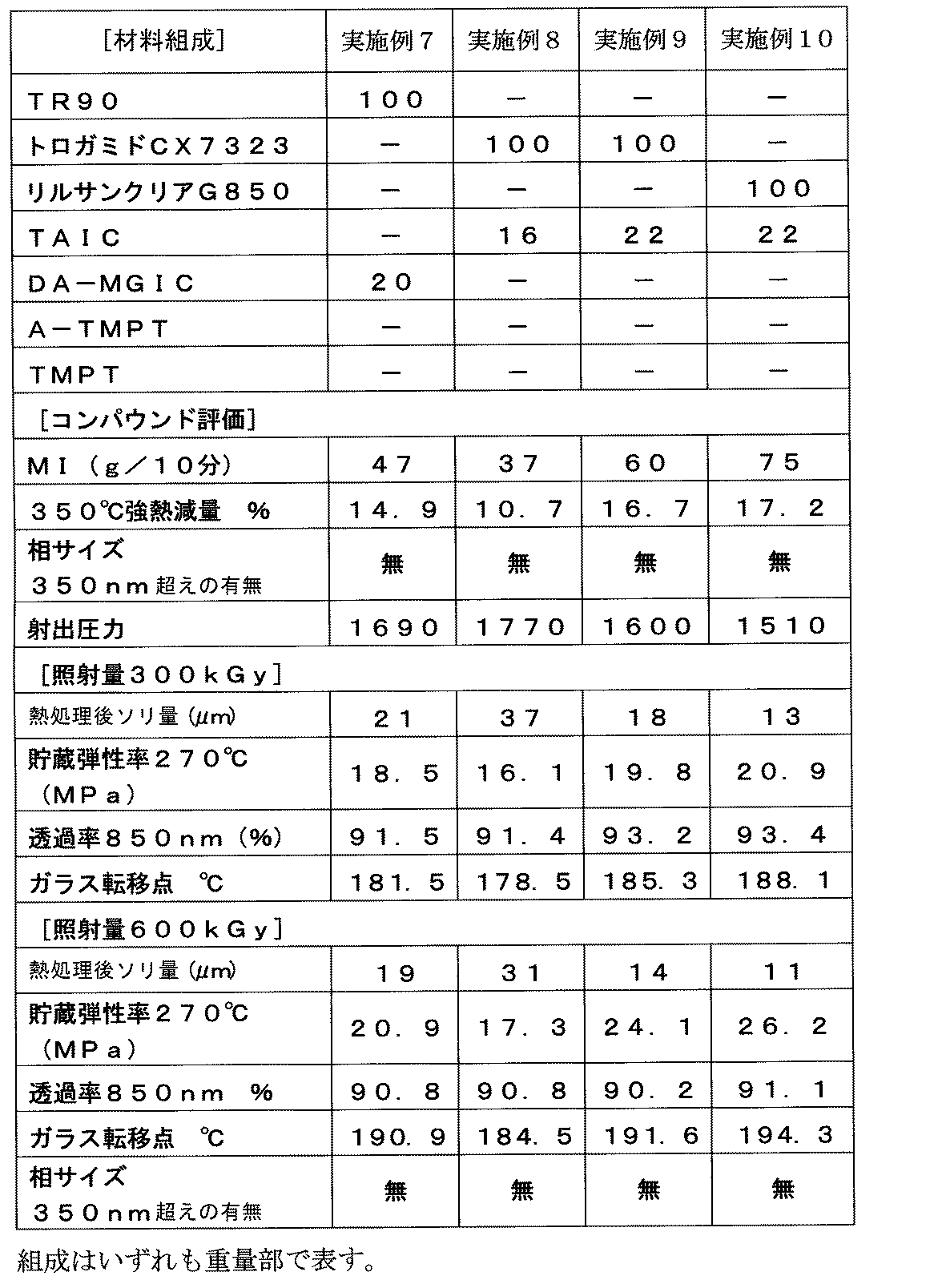
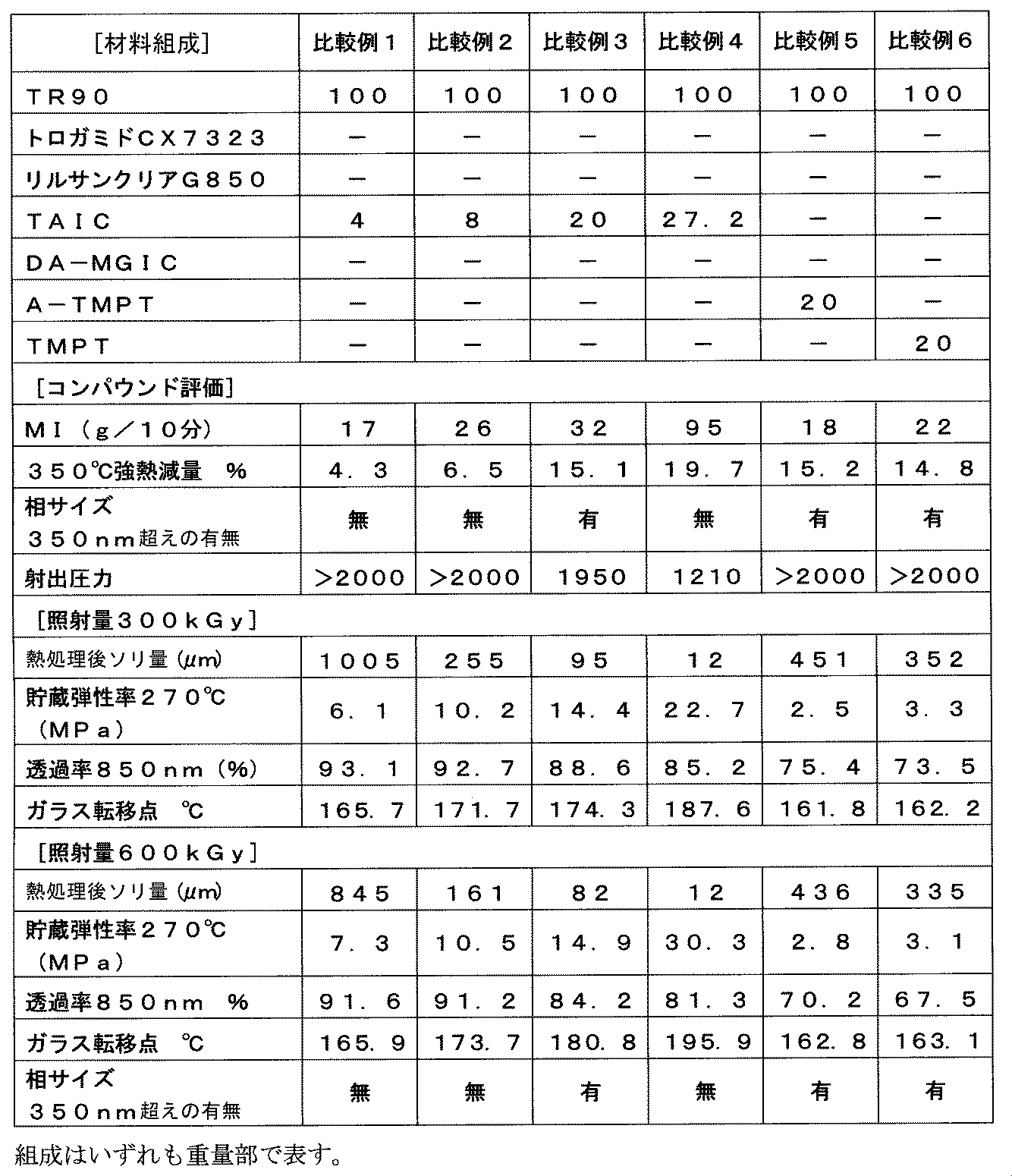
透明ポリアミド樹脂として、屈折率が1.500~1.550範囲内にあり、脂環式ジアミンとジカルボン酸との共重合体であるものを用い、架橋助剤として、屈折率が1.500~1.550範囲内にあるもの(TAICまたはDA-MGIC)を用い、架橋助剤の配合量が、透明ポリアミド樹脂の100質量部に対し13~26質量部の範囲内であり、透明ポリアミド樹脂中に分散されている架橋助剤の相として直径が350nmを超えるものを含まない実施例1~10の透明ポリアミド樹脂組成物は、いずれも、コンパウンドのMI(250℃・5kg)が35g/10分以上であり、優れた流動性を有しており、その結果、射出圧力も比較的低く抑えられている。また、この透明ポリアミド樹脂組成物を成形し、電子線照射して樹脂を架橋して得られた透明ポリアミド樹脂架橋成形体(50mm×50mm×0.5mmのシート形状)は、ガラス転移点が175℃以上であり、波長850nmの光線の透過率が90%以上であり優れた透明性を有する。また、270℃での貯蔵弾性率が15MPa以上であり、熱処理による形状変化量が50μm以下であり、熱変形も近年の要請を充たす程度に抑制されている。すなわち、優れた透明性と熱変形の抑制が両立している。さらに、架橋助剤の直径が350nmを超える硬化相も観測されない。
Claims (7)
- 脂環式ジアミンとジカルボン酸との共重合体であって屈折率が1.500~1.550の透明ポリアミド樹脂及び屈折率が1.500~1.550である透明な架橋助剤を含有し、前記架橋助剤の配合量が前記透明ポリアミド樹脂の100質量部に対し13~26質量部であり、前記架橋助剤が前記透明ポリアミド樹脂中に直径が350nm以下の相として分散している透明ポリアミド樹脂組成物。
- 前記脂環式ジアミンが、4,4’-メチレンビス(2-メチルシクロヘキシルアミン)及び4,4’-メチレンビス(シクロヘキシルアミン)からなる群より選ばれる脂環式ジアミンである請求項1に記載の透明ポリアミド樹脂組成物。
- 前記ジカルボン酸が、ドデカンジ酸である請求項1または請求項2に記載の透明ポリアミド樹脂組成物。
- 前記架橋助剤が、トリアリルイソシアヌレートを基本構造とする請求項1ないし請求項3のいずれか1項に記載の透明ポリアミド樹脂組成物。
- メルトフローレートが250℃、5kg荷重にて35g/10分以上である請求項1ないし請求項4のいずれか1項に記載の透明ポリアミド樹脂組成物。
- 脂環式ジアミンとジカルボン酸との共重合体であって屈折率が1.500~1.550の透明ポリアミド樹脂及び屈折率が1.500~1.550である透明な架橋助剤を含有し、前記架橋助剤の配合量が前記透明ポリアミド樹脂の100質量部に対し13~26質量部であり、前記架橋助剤が前記透明ポリアミド樹脂中に直径が350nm以下の相として分散されている透明ポリアミド樹脂組成物を成形し、前記透明ポリアミド樹脂を架橋してなる透明ポリアミド樹脂架橋成形体。
- ガラス転移点が175℃以上であり、厚さが0.5mmのときの波長850nmの光線の透過率が90%以上であり、270℃での貯蔵弾性率が15MPa以上であり、50mm×50mm×0.5mmのシート形状とし、180℃に設定の槽に投入後90秒間維持、槽の設定温度を180℃から270℃に30秒間で昇温した後、270℃で30秒間維持、及び270℃から180℃まで90秒間で降温するとの操作をこの順序で行ったときの熱処理前後の厚みの差が、50μm以下である透明ポリアミド樹脂架橋成形体。
Priority Applications (3)
| Application Number | Priority Date | Filing Date | Title |
|---|---|---|---|
| JP2015512820A JP5897772B2 (ja) | 2014-02-25 | 2014-10-28 | 透明ポリアミド樹脂組成物、透明ポリアミド樹脂架橋成形体 |
| US14/784,825 US9562147B2 (en) | 2014-02-25 | 2014-10-28 | Transparent polyamide resin composition and crosslinked transparent polyamide resin molded body |
| CN201480023390.2A CN105143352B (zh) | 2014-02-25 | 2014-10-28 | 透明聚酰胺树脂组合物和交联的透明聚酰胺树脂成型体 |
Applications Claiming Priority (2)
| Application Number | Priority Date | Filing Date | Title |
|---|---|---|---|
| JP2014-034013 | 2014-02-25 | ||
| JP2014034013 | 2014-02-25 |
Publications (1)
| Publication Number | Publication Date |
|---|---|
| WO2015129100A1 true WO2015129100A1 (ja) | 2015-09-03 |
Family
ID=54008445
Family Applications (1)
| Application Number | Title | Priority Date | Filing Date |
|---|---|---|---|
| PCT/JP2014/078550 Ceased WO2015129100A1 (ja) | 2014-02-25 | 2014-10-28 | 透明ポリアミド樹脂組成物、透明ポリアミド樹脂架橋成形体 |
Country Status (4)
| Country | Link |
|---|---|
| US (1) | US9562147B2 (ja) |
| JP (1) | JP5897772B2 (ja) |
| CN (1) | CN105143352B (ja) |
| WO (1) | WO2015129100A1 (ja) |
Cited By (1)
| Publication number | Priority date | Publication date | Assignee | Title |
|---|---|---|---|---|
| WO2017130972A1 (ja) * | 2016-01-28 | 2017-08-03 | 三菱樹脂株式会社 | 電気音響変換器用振動板エッジ材、電気音響変換器用振動板、および、マイクロスピーカー振動板 |
Families Citing this family (2)
| Publication number | Priority date | Publication date | Assignee | Title |
|---|---|---|---|---|
| JP6889639B2 (ja) * | 2017-09-12 | 2021-06-18 | 株式会社ダイセル | プラスチックレンズ |
| EP3743475A1 (en) | 2018-01-23 | 2020-12-02 | Eastman Chemical Company | Novel polyesteramides, processes for the preparation thereof, and polyesteramide compositions |
Citations (7)
| Publication number | Priority date | Publication date | Assignee | Title |
|---|---|---|---|---|
| WO2009084690A1 (ja) * | 2007-12-28 | 2009-07-09 | Sumitomo Electric Fine Polymer, Inc. | 光学レンズ |
| WO2010084845A1 (ja) * | 2009-01-20 | 2010-07-29 | ユニチカ株式会社 | 樹脂組成物およびそれからなる成形体 |
| JP2010243659A (ja) * | 2009-04-02 | 2010-10-28 | Sumitomo Electric Fine Polymer Inc | 光学レンズ−ホルダー複合体の製造方法、及び光学レンズ−ホルダー複合体 |
| JP2012229293A (ja) * | 2011-04-25 | 2012-11-22 | Sumitomo Electric Ind Ltd | 透明ポリアミド樹脂成形体及びその製造方法 |
| WO2013005632A1 (ja) * | 2011-07-04 | 2013-01-10 | 住友電工ファインポリマー株式会社 | 光学レンズ及びその製造方法 |
| JP2013028661A (ja) * | 2011-07-27 | 2013-02-07 | Unitika Ltd | 樹脂組成物およびそれからなる成形体 |
| WO2013038926A1 (ja) * | 2011-09-12 | 2013-03-21 | 住友電工ファインポリマー株式会社 | 樹脂系複合材料の製造方法及び架橋樹脂成形体の製造方法 |
Family Cites Families (4)
| Publication number | Priority date | Publication date | Assignee | Title |
|---|---|---|---|---|
| EP1966280B1 (de) | 2005-12-23 | 2018-10-31 | Ems-Chemie Ag | Vernetzte transparente polyamidformteile |
| JP5407530B2 (ja) | 2009-04-30 | 2014-02-05 | 東洋紡株式会社 | ポリアミド樹脂組成物及びそれを用いた成形品 |
| JP5529466B2 (ja) | 2009-08-31 | 2014-06-25 | 住友電気工業株式会社 | 透明樹脂成形体及びその製造方法 |
| JP5603963B2 (ja) | 2013-03-11 | 2014-10-08 | 大阪瓦斯株式会社 | 樹脂用改質剤およびこの改質剤を含む樹脂組成物 |
-
2014
- 2014-10-28 JP JP2015512820A patent/JP5897772B2/ja active Active
- 2014-10-28 WO PCT/JP2014/078550 patent/WO2015129100A1/ja not_active Ceased
- 2014-10-28 US US14/784,825 patent/US9562147B2/en active Active
- 2014-10-28 CN CN201480023390.2A patent/CN105143352B/zh active Active
Patent Citations (7)
| Publication number | Priority date | Publication date | Assignee | Title |
|---|---|---|---|---|
| WO2009084690A1 (ja) * | 2007-12-28 | 2009-07-09 | Sumitomo Electric Fine Polymer, Inc. | 光学レンズ |
| WO2010084845A1 (ja) * | 2009-01-20 | 2010-07-29 | ユニチカ株式会社 | 樹脂組成物およびそれからなる成形体 |
| JP2010243659A (ja) * | 2009-04-02 | 2010-10-28 | Sumitomo Electric Fine Polymer Inc | 光学レンズ−ホルダー複合体の製造方法、及び光学レンズ−ホルダー複合体 |
| JP2012229293A (ja) * | 2011-04-25 | 2012-11-22 | Sumitomo Electric Ind Ltd | 透明ポリアミド樹脂成形体及びその製造方法 |
| WO2013005632A1 (ja) * | 2011-07-04 | 2013-01-10 | 住友電工ファインポリマー株式会社 | 光学レンズ及びその製造方法 |
| JP2013028661A (ja) * | 2011-07-27 | 2013-02-07 | Unitika Ltd | 樹脂組成物およびそれからなる成形体 |
| WO2013038926A1 (ja) * | 2011-09-12 | 2013-03-21 | 住友電工ファインポリマー株式会社 | 樹脂系複合材料の製造方法及び架橋樹脂成形体の製造方法 |
Cited By (3)
| Publication number | Priority date | Publication date | Assignee | Title |
|---|---|---|---|---|
| WO2017130972A1 (ja) * | 2016-01-28 | 2017-08-03 | 三菱樹脂株式会社 | 電気音響変換器用振動板エッジ材、電気音響変換器用振動板、および、マイクロスピーカー振動板 |
| JPWO2017130972A1 (ja) * | 2016-01-28 | 2018-11-22 | 三菱ケミカル株式会社 | 電気音響変換器用振動板エッジ材、電気音響変換器用振動板、および、マイクロスピーカー振動板 |
| JP2020005324A (ja) * | 2016-01-28 | 2020-01-09 | 三菱ケミカル株式会社 | 電気音響変換器用振動板エッジ材、電気音響変換器用振動板、および、マイクロスピーカー振動板 |
Also Published As
| Publication number | Publication date |
|---|---|
| CN105143352A (zh) | 2015-12-09 |
| JP5897772B2 (ja) | 2016-03-30 |
| US20160083559A1 (en) | 2016-03-24 |
| CN105143352B (zh) | 2017-09-26 |
| US9562147B2 (en) | 2017-02-07 |
| JPWO2015129100A1 (ja) | 2017-03-30 |
Similar Documents
| Publication | Publication Date | Title |
|---|---|---|
| CN114787285B (zh) | 液晶聚合物组合物、液晶聚合物成型体和相机模块 | |
| KR101267187B1 (ko) | 광학 재료 및 광학 소자 | |
| JP5909534B2 (ja) | ポリエステル樹脂組成物およびそれを含むカメラモジュール | |
| JP5587869B2 (ja) | 硬化性組成物及びその硬化物 | |
| JP7043159B1 (ja) | 液晶ポリマー組成物、液晶ポリマー成形体、および電気電子機器 | |
| KR101791766B1 (ko) | 코팅 조성물 | |
| JP7147774B2 (ja) | 硬化性組成物及び硬化物 | |
| JP5897772B2 (ja) | 透明ポリアミド樹脂組成物、透明ポリアミド樹脂架橋成形体 | |
| WO2012114986A1 (ja) | 硬化性組成物及びその硬化物 | |
| JP2004307845A (ja) | 透明複合体組成物 | |
| KR20150123911A (ko) | 코팅 조성물 | |
| KR101659129B1 (ko) | 수지막, 수지막의 제조 방법 및 도공액 | |
| JP6382677B2 (ja) | 透明ポリアミド樹脂組成物及び透明ポリアミド樹脂架橋成型体 | |
| JP2007270114A (ja) | 透明複合シート | |
| JP4356395B2 (ja) | プラスチック複合透明シート及びそれを使用した表示素子 | |
| JP2011225779A (ja) | 透明樹脂組成物および光半導体装置 | |
| JP2011074328A (ja) | 酸化チタン分散液 | |
| JP2016199665A (ja) | 摺動部材用樹脂組成物、摺動部材及び摺動部材の製造方法 | |
| JP2015227425A (ja) | 透明ポリアミド樹脂架橋成形体及びその製造方法 | |
| JP2005239802A (ja) | プラスチック複合透明シート及びそれを使用した表示素子 | |
| JP5601627B2 (ja) | 透明複合シート、およびそれを用いた透明複合基板 | |
| JP2025035302A (ja) | 透明熱伝導性樹脂組成物及び透明熱伝導部材 | |
| KR20160071724A (ko) | 입체 조형용 광경화성 수지 조성물 | |
| WO2013125192A1 (ja) | レンズ、ハイブリッドレンズ、交換レンズおよび撮像装置 | |
| WO2014129207A1 (ja) | 光学素子、複合光学素子、交換レンズ及び撮像装置 |
Legal Events
| Date | Code | Title | Description |
|---|---|---|---|
| WWE | Wipo information: entry into national phase |
Ref document number: 201480023390.2 Country of ref document: CN |
|
| ENP | Entry into the national phase |
Ref document number: 2015512820 Country of ref document: JP Kind code of ref document: A |
|
| WWE | Wipo information: entry into national phase |
Ref document number: 14784825 Country of ref document: US |
|
| 121 | Ep: the epo has been informed by wipo that ep was designated in this application |
Ref document number: 14883568 Country of ref document: EP Kind code of ref document: A1 |
|
| NENP | Non-entry into the national phase |
Ref country code: DE |
|
| 122 | Ep: pct application non-entry in european phase |
Ref document number: 14883568 Country of ref document: EP Kind code of ref document: A1 |