WO2015076171A1 - 有機トランジスタ製造用溶剤 - Google Patents
有機トランジスタ製造用溶剤 Download PDFInfo
- Publication number
- WO2015076171A1 WO2015076171A1 PCT/JP2014/080031 JP2014080031W WO2015076171A1 WO 2015076171 A1 WO2015076171 A1 WO 2015076171A1 JP 2014080031 W JP2014080031 W JP 2014080031W WO 2015076171 A1 WO2015076171 A1 WO 2015076171A1
- Authority
- WO
- WIPO (PCT)
- Prior art keywords
- group
- solvent
- ring
- organic transistor
- different
- Prior art date
- Legal status (The legal status is an assumption and is not a legal conclusion. Google has not performed a legal analysis and makes no representation as to the accuracy of the status listed.)
- Ceased
Links
- 0 C*(CC1)C=Cc2c1c(C=C*(C)C=C1)c1[n]2* Chemical compound C*(CC1)C=Cc2c1c(C=C*(C)C=C1)c1[n]2* 0.000 description 6
- CLDRUXVAJKWMBY-UHFFFAOYSA-N CC1=NC2SC(C)=NC2S1 Chemical compound CC1=NC2SC(C)=NC2S1 CLDRUXVAJKWMBY-UHFFFAOYSA-N 0.000 description 1
- XUQGDEPUDBOCDZ-UHFFFAOYSA-N CC1c2n[s]nc2C(C)=CC1 Chemical compound CC1c2n[s]nc2C(C)=CC1 XUQGDEPUDBOCDZ-UHFFFAOYSA-N 0.000 description 1
Classifications
-
- H—ELECTRICITY
- H10—SEMICONDUCTOR DEVICES; ELECTRIC SOLID-STATE DEVICES NOT OTHERWISE PROVIDED FOR
- H10K—ORGANIC ELECTRIC SOLID-STATE DEVICES
- H10K85/00—Organic materials used in the body or electrodes of devices covered by this subclass
- H10K85/60—Organic compounds having low molecular weight
- H10K85/649—Aromatic compounds comprising a hetero atom
- H10K85/655—Aromatic compounds comprising a hetero atom comprising only sulfur as heteroatom
-
- H—ELECTRICITY
- H10—SEMICONDUCTOR DEVICES; ELECTRIC SOLID-STATE DEVICES NOT OTHERWISE PROVIDED FOR
- H10K—ORGANIC ELECTRIC SOLID-STATE DEVICES
- H10K71/00—Manufacture or treatment specially adapted for the organic devices covered by this subclass
- H10K71/10—Deposition of organic active material
- H10K71/12—Deposition of organic active material using liquid deposition, e.g. spin coating
- H10K71/15—Deposition of organic active material using liquid deposition, e.g. spin coating characterised by the solvent used
-
- C—CHEMISTRY; METALLURGY
- C07—ORGANIC CHEMISTRY
- C07C—ACYCLIC OR CARBOCYCLIC COMPOUNDS
- C07C211/00—Compounds containing amino groups bound to a carbon skeleton
- C07C211/33—Compounds containing amino groups bound to a carbon skeleton having amino groups bound to carbon atoms of rings other than six-membered aromatic rings
- C07C211/34—Compounds containing amino groups bound to a carbon skeleton having amino groups bound to carbon atoms of rings other than six-membered aromatic rings of a saturated carbon skeleton
- C07C211/35—Compounds containing amino groups bound to a carbon skeleton having amino groups bound to carbon atoms of rings other than six-membered aromatic rings of a saturated carbon skeleton containing only non-condensed rings
-
- C—CHEMISTRY; METALLURGY
- C07—ORGANIC CHEMISTRY
- C07C—ACYCLIC OR CARBOCYCLIC COMPOUNDS
- C07C43/00—Ethers; Compounds having groups, groups or groups
- C07C43/02—Ethers
- C07C43/18—Ethers having an ether-oxygen atom bound to a carbon atom of a ring other than a six-membered aromatic ring
- C07C43/184—Ethers having an ether-oxygen atom bound to a carbon atom of a ring other than a six-membered aromatic ring to a carbon atom of a non-condensed ring
-
- C—CHEMISTRY; METALLURGY
- C07—ORGANIC CHEMISTRY
- C07C—ACYCLIC OR CARBOCYCLIC COMPOUNDS
- C07C43/00—Ethers; Compounds having groups, groups or groups
- C07C43/02—Ethers
- C07C43/20—Ethers having an ether-oxygen atom bound to a carbon atom of a six-membered aromatic ring
- C07C43/205—Ethers having an ether-oxygen atom bound to a carbon atom of a six-membered aromatic ring the aromatic ring being a non-condensed ring
-
- C—CHEMISTRY; METALLURGY
- C07—ORGANIC CHEMISTRY
- C07C—ACYCLIC OR CARBOCYCLIC COMPOUNDS
- C07C43/00—Ethers; Compounds having groups, groups or groups
- C07C43/02—Ethers
- C07C43/20—Ethers having an ether-oxygen atom bound to a carbon atom of a six-membered aromatic ring
- C07C43/205—Ethers having an ether-oxygen atom bound to a carbon atom of a six-membered aromatic ring the aromatic ring being a non-condensed ring
- C07C43/2055—Ethers having an ether-oxygen atom bound to a carbon atom of a six-membered aromatic ring the aromatic ring being a non-condensed ring containing more than one ether bond
-
- C—CHEMISTRY; METALLURGY
- C07—ORGANIC CHEMISTRY
- C07C—ACYCLIC OR CARBOCYCLIC COMPOUNDS
- C07C49/00—Ketones; Ketenes; Dimeric ketenes; Ketonic chelates
- C07C49/385—Saturated compounds containing a keto group being part of a ring
- C07C49/395—Saturated compounds containing a keto group being part of a ring of a five-membered ring
-
- C—CHEMISTRY; METALLURGY
- C07—ORGANIC CHEMISTRY
- C07C—ACYCLIC OR CARBOCYCLIC COMPOUNDS
- C07C49/00—Ketones; Ketenes; Dimeric ketenes; Ketonic chelates
- C07C49/385—Saturated compounds containing a keto group being part of a ring
- C07C49/403—Saturated compounds containing a keto group being part of a ring of a six-membered ring
-
- C—CHEMISTRY; METALLURGY
- C07—ORGANIC CHEMISTRY
- C07D—HETEROCYCLIC COMPOUNDS
- C07D307/00—Heterocyclic compounds containing five-membered rings having one oxygen atom as the only ring hetero atom
- C07D307/77—Heterocyclic compounds containing five-membered rings having one oxygen atom as the only ring hetero atom ortho- or peri-condensed with carbocyclic rings or ring systems
- C07D307/78—Benzo [b] furans; Hydrogenated benzo [b] furans
- C07D307/79—Benzo [b] furans; Hydrogenated benzo [b] furans with only hydrogen atoms, hydrocarbon or substituted hydrocarbon radicals, directly attached to carbon atoms of the hetero ring
-
- C—CHEMISTRY; METALLURGY
- C07—ORGANIC CHEMISTRY
- C07D—HETEROCYCLIC COMPOUNDS
- C07D487/00—Heterocyclic compounds containing nitrogen atoms as the only ring hetero atoms in the condensed system, not provided for by groups C07D451/00 - C07D477/00
- C07D487/02—Heterocyclic compounds containing nitrogen atoms as the only ring hetero atoms in the condensed system, not provided for by groups C07D451/00 - C07D477/00 in which the condensed system contains two hetero rings
- C07D487/04—Ortho-condensed systems
-
- C—CHEMISTRY; METALLURGY
- C08—ORGANIC MACROMOLECULAR COMPOUNDS; THEIR PREPARATION OR CHEMICAL WORKING-UP; COMPOSITIONS BASED THEREON
- C08G—MACROMOLECULAR COMPOUNDS OBTAINED OTHERWISE THAN BY REACTIONS ONLY INVOLVING UNSATURATED CARBON-TO-CARBON BONDS
- C08G61/00—Macromolecular compounds obtained by reactions forming a carbon-to-carbon link in the main chain of the macromolecule
- C08G61/12—Macromolecular compounds containing atoms other than carbon in the main chain of the macromolecule
- C08G61/122—Macromolecular compounds containing atoms other than carbon in the main chain of the macromolecule derived from five- or six-membered heterocyclic compounds, other than imides
- C08G61/123—Macromolecular compounds containing atoms other than carbon in the main chain of the macromolecule derived from five- or six-membered heterocyclic compounds, other than imides derived from five-membered heterocyclic compounds
- C08G61/124—Macromolecular compounds containing atoms other than carbon in the main chain of the macromolecule derived from five- or six-membered heterocyclic compounds, other than imides derived from five-membered heterocyclic compounds with a five-membered ring containing one nitrogen atom in the ring
-
- C—CHEMISTRY; METALLURGY
- C08—ORGANIC MACROMOLECULAR COMPOUNDS; THEIR PREPARATION OR CHEMICAL WORKING-UP; COMPOSITIONS BASED THEREON
- C08G—MACROMOLECULAR COMPOUNDS OBTAINED OTHERWISE THAN BY REACTIONS ONLY INVOLVING UNSATURATED CARBON-TO-CARBON BONDS
- C08G61/00—Macromolecular compounds obtained by reactions forming a carbon-to-carbon link in the main chain of the macromolecule
- C08G61/12—Macromolecular compounds containing atoms other than carbon in the main chain of the macromolecule
- C08G61/122—Macromolecular compounds containing atoms other than carbon in the main chain of the macromolecule derived from five- or six-membered heterocyclic compounds, other than imides
- C08G61/123—Macromolecular compounds containing atoms other than carbon in the main chain of the macromolecule derived from five- or six-membered heterocyclic compounds, other than imides derived from five-membered heterocyclic compounds
- C08G61/126—Macromolecular compounds containing atoms other than carbon in the main chain of the macromolecule derived from five- or six-membered heterocyclic compounds, other than imides derived from five-membered heterocyclic compounds with a five-membered ring containing one sulfur atom in the ring
-
- C—CHEMISTRY; METALLURGY
- C09—DYES; PAINTS; POLISHES; NATURAL RESINS; ADHESIVES; COMPOSITIONS NOT OTHERWISE PROVIDED FOR; APPLICATIONS OF MATERIALS NOT OTHERWISE PROVIDED FOR
- C09D—COATING COMPOSITIONS, e.g. PAINTS, VARNISHES OR LACQUERS; FILLING PASTES; CHEMICAL PAINT OR INK REMOVERS; INKS; CORRECTING FLUIDS; WOODSTAINS; PASTES OR SOLIDS FOR COLOURING OR PRINTING; USE OF MATERIALS THEREFOR
- C09D165/00—Coating compositions based on macromolecular compounds obtained by reactions forming a carbon-to-carbon link in the main chain; Coating compositions based on derivatives of such polymers
-
- H—ELECTRICITY
- H10—SEMICONDUCTOR DEVICES; ELECTRIC SOLID-STATE DEVICES NOT OTHERWISE PROVIDED FOR
- H10K—ORGANIC ELECTRIC SOLID-STATE DEVICES
- H10K10/00—Organic devices specially adapted for rectifying, amplifying, oscillating or switching; Organic capacitors or resistors having potential barriers
- H10K10/40—Organic transistors
- H10K10/46—Field-effect transistors, e.g. organic thin-film transistors [OTFT]
- H10K10/462—Insulated gate field-effect transistors [IGFETs]
- H10K10/484—Insulated gate field-effect transistors [IGFETs] characterised by the channel regions
-
- H—ELECTRICITY
- H10—SEMICONDUCTOR DEVICES; ELECTRIC SOLID-STATE DEVICES NOT OTHERWISE PROVIDED FOR
- H10K—ORGANIC ELECTRIC SOLID-STATE DEVICES
- H10K85/00—Organic materials used in the body or electrodes of devices covered by this subclass
- H10K85/60—Organic compounds having low molecular weight
- H10K85/649—Aromatic compounds comprising a hetero atom
- H10K85/657—Polycyclic condensed heteroaromatic hydrocarbons
- H10K85/6572—Polycyclic condensed heteroaromatic hydrocarbons comprising only nitrogen in the heteroaromatic polycondensed ring system, e.g. phenanthroline or carbazole
-
- C—CHEMISTRY; METALLURGY
- C07—ORGANIC CHEMISTRY
- C07C—ACYCLIC OR CARBOCYCLIC COMPOUNDS
- C07C2601/00—Systems containing only non-condensed rings
- C07C2601/12—Systems containing only non-condensed rings with a six-membered ring
- C07C2601/14—The ring being saturated
-
- C—CHEMISTRY; METALLURGY
- C08—ORGANIC MACROMOLECULAR COMPOUNDS; THEIR PREPARATION OR CHEMICAL WORKING-UP; COMPOSITIONS BASED THEREON
- C08G—MACROMOLECULAR COMPOUNDS OBTAINED OTHERWISE THAN BY REACTIONS ONLY INVOLVING UNSATURATED CARBON-TO-CARBON BONDS
- C08G2261/00—Macromolecular compounds obtained by reactions forming a carbon-to-carbon link in the main chain of the macromolecule
- C08G2261/10—Definition of the polymer structure
- C08G2261/14—Side-groups
- C08G2261/141—Side-chains having aliphatic units
- C08G2261/1412—Saturated aliphatic units
-
- C—CHEMISTRY; METALLURGY
- C08—ORGANIC MACROMOLECULAR COMPOUNDS; THEIR PREPARATION OR CHEMICAL WORKING-UP; COMPOSITIONS BASED THEREON
- C08G—MACROMOLECULAR COMPOUNDS OBTAINED OTHERWISE THAN BY REACTIONS ONLY INVOLVING UNSATURATED CARBON-TO-CARBON BONDS
- C08G2261/00—Macromolecular compounds obtained by reactions forming a carbon-to-carbon link in the main chain of the macromolecule
- C08G2261/30—Monomer units or repeat units incorporating structural elements in the main chain
- C08G2261/32—Monomer units or repeat units incorporating structural elements in the main chain incorporating heteroaromatic structural elements in the main chain
- C08G2261/322—Monomer units or repeat units incorporating structural elements in the main chain incorporating heteroaromatic structural elements in the main chain non-condensed
- C08G2261/3223—Monomer units or repeat units incorporating structural elements in the main chain incorporating heteroaromatic structural elements in the main chain non-condensed containing one or more sulfur atoms as the only heteroatom, e.g. thiophene
-
- C—CHEMISTRY; METALLURGY
- C08—ORGANIC MACROMOLECULAR COMPOUNDS; THEIR PREPARATION OR CHEMICAL WORKING-UP; COMPOSITIONS BASED THEREON
- C08G—MACROMOLECULAR COMPOUNDS OBTAINED OTHERWISE THAN BY REACTIONS ONLY INVOLVING UNSATURATED CARBON-TO-CARBON BONDS
- C08G2261/00—Macromolecular compounds obtained by reactions forming a carbon-to-carbon link in the main chain of the macromolecule
- C08G2261/30—Monomer units or repeat units incorporating structural elements in the main chain
- C08G2261/33—Monomer units or repeat units incorporating structural elements in the main chain incorporating non-aromatic structural elements in the main chain
- C08G2261/332—Monomer units or repeat units incorporating structural elements in the main chain incorporating non-aromatic structural elements in the main chain containing only carbon atoms
- C08G2261/3327—Monomer units or repeat units incorporating structural elements in the main chain incorporating non-aromatic structural elements in the main chain containing only carbon atoms alkene-based
-
- C—CHEMISTRY; METALLURGY
- C08—ORGANIC MACROMOLECULAR COMPOUNDS; THEIR PREPARATION OR CHEMICAL WORKING-UP; COMPOSITIONS BASED THEREON
- C08G—MACROMOLECULAR COMPOUNDS OBTAINED OTHERWISE THAN BY REACTIONS ONLY INVOLVING UNSATURATED CARBON-TO-CARBON BONDS
- C08G2261/00—Macromolecular compounds obtained by reactions forming a carbon-to-carbon link in the main chain of the macromolecule
- C08G2261/30—Monomer units or repeat units incorporating structural elements in the main chain
- C08G2261/34—Monomer units or repeat units incorporating structural elements in the main chain incorporating partially-aromatic structural elements in the main chain
- C08G2261/344—Monomer units or repeat units incorporating structural elements in the main chain incorporating partially-aromatic structural elements in the main chain containing heteroatoms
-
- C—CHEMISTRY; METALLURGY
- C08—ORGANIC MACROMOLECULAR COMPOUNDS; THEIR PREPARATION OR CHEMICAL WORKING-UP; COMPOSITIONS BASED THEREON
- C08G—MACROMOLECULAR COMPOUNDS OBTAINED OTHERWISE THAN BY REACTIONS ONLY INVOLVING UNSATURATED CARBON-TO-CARBON BONDS
- C08G2261/00—Macromolecular compounds obtained by reactions forming a carbon-to-carbon link in the main chain of the macromolecule
- C08G2261/90—Applications
- C08G2261/92—TFT applications
Definitions
- the present invention relates to a solvent for producing an organic transistor excellent in solubility of an organic semiconductor material, and a composition for producing an organic transistor comprising the solvent for producing an organic transistor and an organic semiconductor material.
- Organic transistors are widely used as important semiconductor electronic devices constituting displays and computer equipment, and are currently manufactured using inorganic materials such as polysilicon and amorphous silicon as semiconductor materials.
- inorganic materials such as polysilicon and amorphous silicon as semiconductor materials.
- a vacuum process or a high temperature process is required, and the manufacturing cost is high.
- substrate which can be used has a restriction
- the glass substrate has high heat resistance, but is weak against impact and difficult to reduce in weight, and it is difficult to form a flexible organic transistor because of its low flexibility.
- Organic semiconductor materials can be easily formed into thin films by a simple process using a wet process such as a printing method, spin coating method, etc., and the manufacturing process temperature can be lowered compared to conventional organic transistors using inorganic semiconductor materials.
- a wet process such as a printing method, spin coating method, etc.
- the manufacturing process temperature can be lowered compared to conventional organic transistors using inorganic semiconductor materials.
- an organic semiconductor material As an organic semiconductor material, it is known that high semiconductor device performance is exhibited by using a low-molecular semiconductor material such as pentacene.
- a low-molecular semiconductor material such as pentacene.
- many unsubstituted acene compounds typified by pentacene have poor solubility in solvents due to strong intermolecular interactions due to ⁇ -conjugated systems. Therefore, a composition for manufacturing an organic transistor having a high concentration cannot be prepared, and an organic semiconductor formed by a printing method has a small crystal grain size and does not pass current unless a high voltage is applied. There was a problem such as peeling of the insulating film.
- Non-Patent Documents 1 and 2 describe the use of a donor-acceptor type copolymer compound having a thiophene skeleton as an organic semiconductor material.
- the compound exhibits high mobility due to strong ⁇ -electron overlap due to strong ⁇ - ⁇ stacking.
- the problem is that the crystallinity is high due to the strong ⁇ - ⁇ stacking and the solubility in a solvent is poor.
- the dissolution by heating using a halogenated solvent represented by 1,2-dichlorobenzene is described.
- 1,2-dichlorobenzene when it is dissolved in 1,2-dichlorobenzene or the like, it often gels at room temperature and is not suitable for forming a thin film by a printing method.
- halogenated solvents have ecological toxicity concerns, and there have been problems in work safety.
- an object of the present invention is to provide a solvent for producing an organic transistor capable of forming an organic transistor having excellent solubility of an organic semiconductor material and high crystallinity.
- Another object of the present invention is to provide a composition for producing an organic transistor comprising the solvent for producing an organic transistor.
- the present invention is a solvent for dissolving an organic semiconductor material, which has the following formula (a):
- ring Z represents a ring selected from an aromatic carbocyclic ring, a 5- to 7-membered alicyclic carbocyclic ring, and a 5- to 7-membered heterocyclic ring.
- R 1 represents an oxo group ( ⁇ O), a thioxy group ( ⁇ S), a —OR a group, a —SR a group, a —O (C ⁇ O) R a group, a —R b O (C ⁇ O) R a group.
- R a represents a C 1-7 alkyl group, an aryl group, or a group in which the group is bonded via a single bond or a linking group
- R b represents a C 1-7 alkylene group, an arylene group, or the group described above.
- R 2 represents a hydrogen atom, a C 1-7 alkyl group, an aryl group, and —OR A group selected from a group (R a is as defined above).
- R 1 and R 2 may be bonded to each other to form a ring together with the carbon atoms constituting ring Z]
- the solvent for organic transistor manufacture containing the 1 type (s) or 2 or more types of solvent A represented by these is provided.
- the present invention also provides that the solvent A is 2-methylcyclopentanone, 2-methylcyclohexanone, cyclohexyl methyl ether, cyclohexylamine, methoxybenzene, 1,2-dimethoxybenzene, 2,3-dihydrobenzofuran, and 2,3- There is provided the above-mentioned solvent for producing an organic transistor, which is at least one selected from dihydro-3-methylbenzofuran.
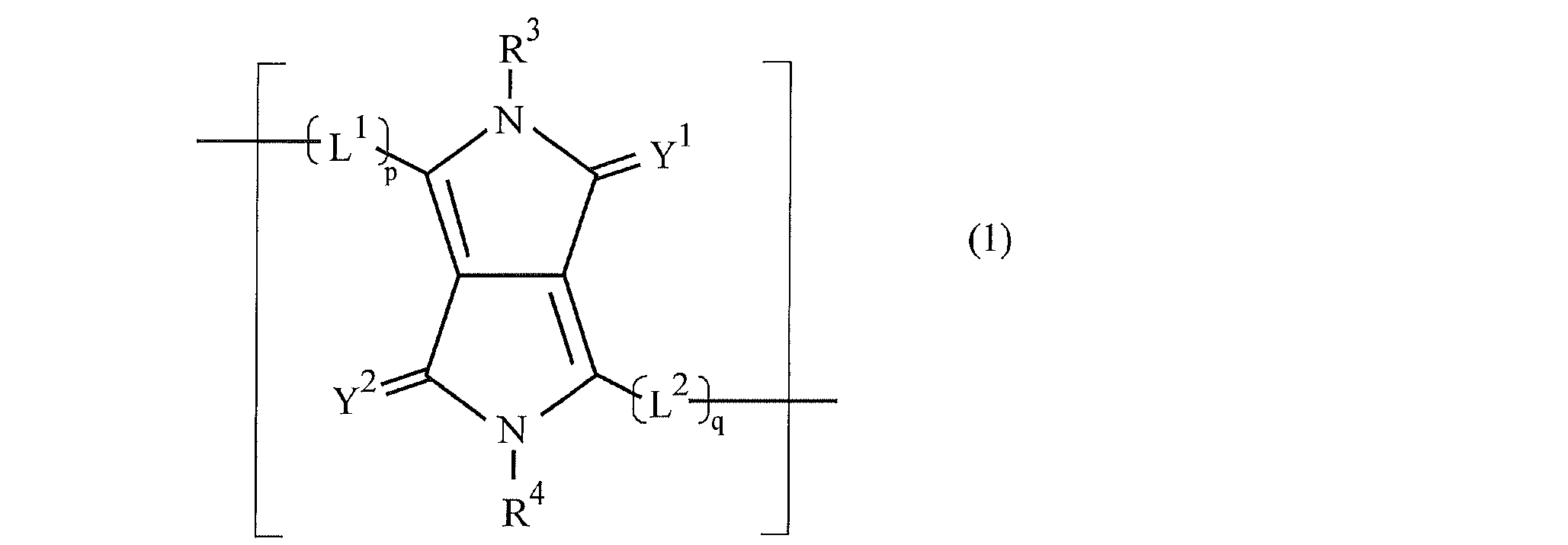
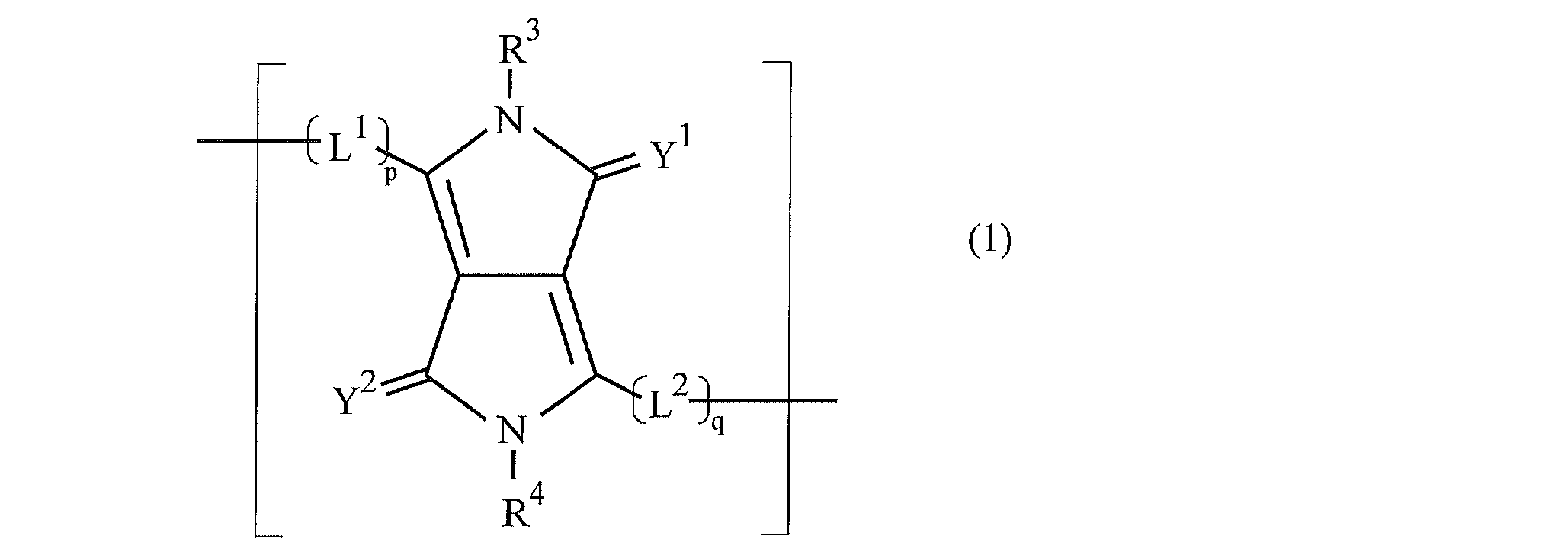
- the present invention also provides the organic transistor-producing solvent, wherein the organic semiconductor material is a compound having a structural unit represented by the following formula (1).
- the organic semiconductor material is a compound having a structural unit represented by the following formula (1).
- L 1 and L 2 are the same or different, and a group obtained by removing two hydrogen atoms from an aromatic carbocyclic ring or heteroaromatic carbocyclic ring, a vinylene group, an ethynylene group, and two or more of the above groups are combined.
- R 3 and R 4 are the same or different and each represents a hydrogen atom, an optionally substituted C 1-24 alkyl group, an aryl group, or a heteroaryl group.
- Y 1 and Y 2 are the same or different and represent an oxygen atom or a sulfur atom
- p and q are the same or different and represent an integer of 0 or more
- (p + q) is 1 or more
- p L 1 may be the same or different
- q L 2 may be the same or different.
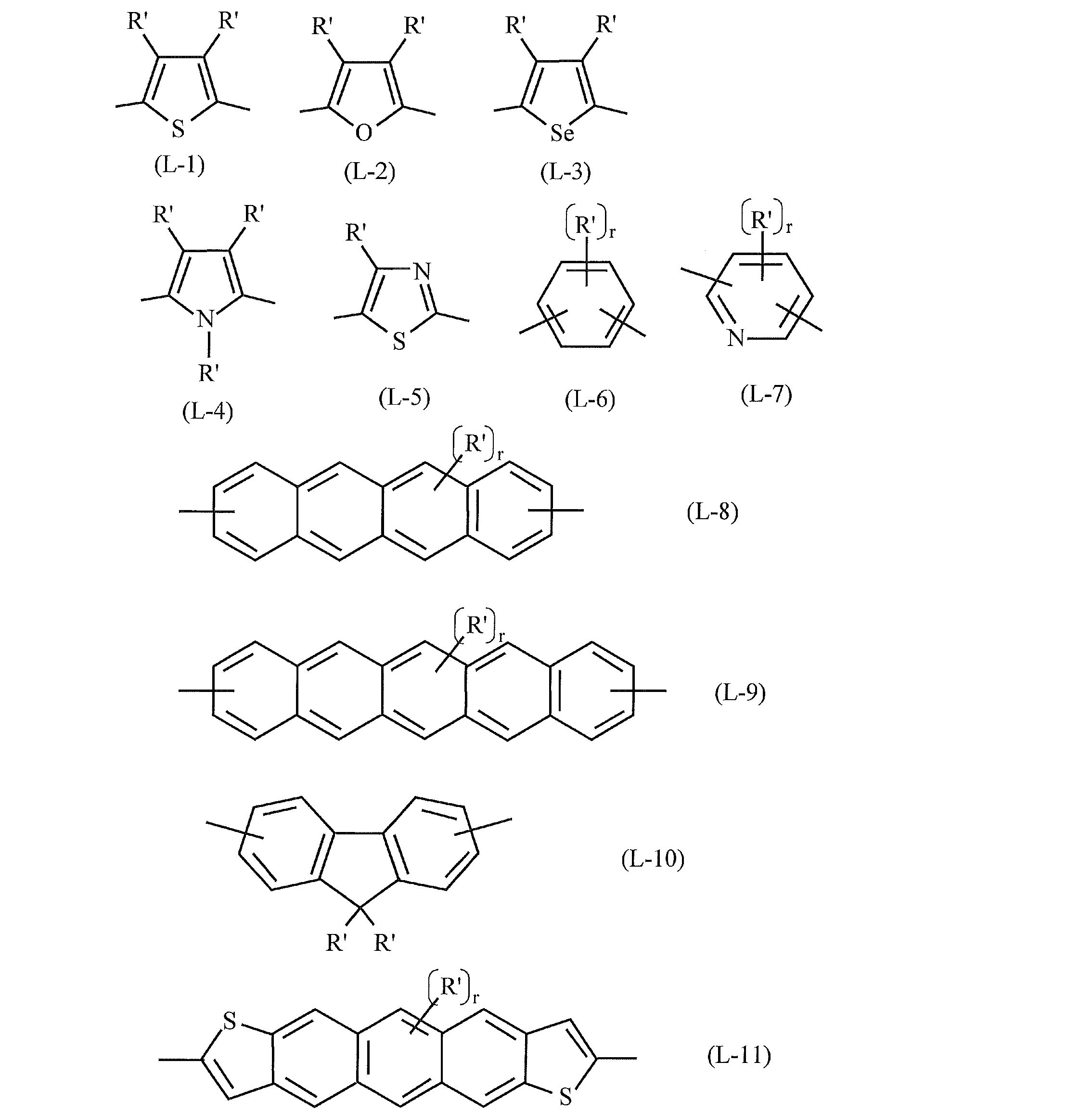
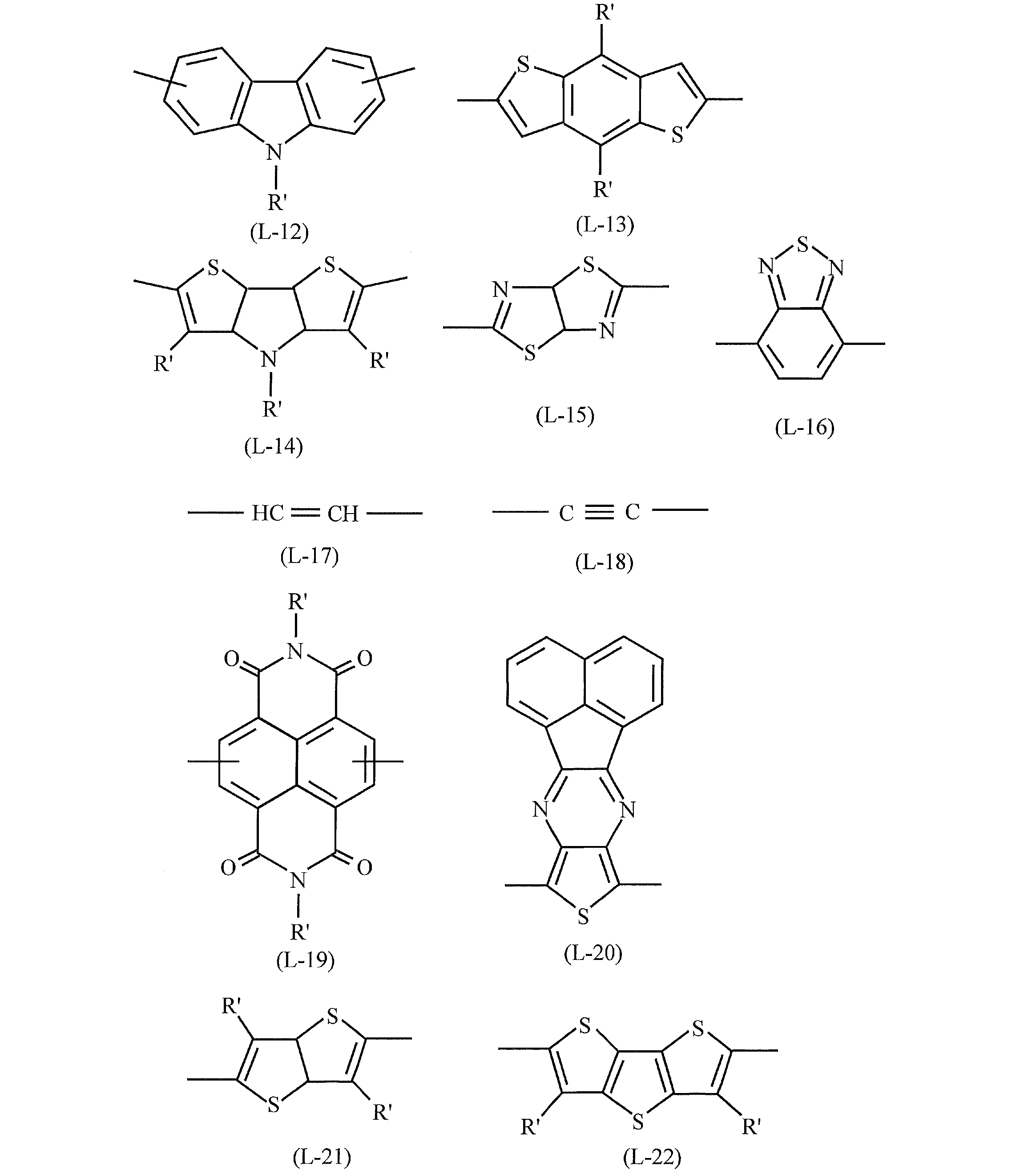
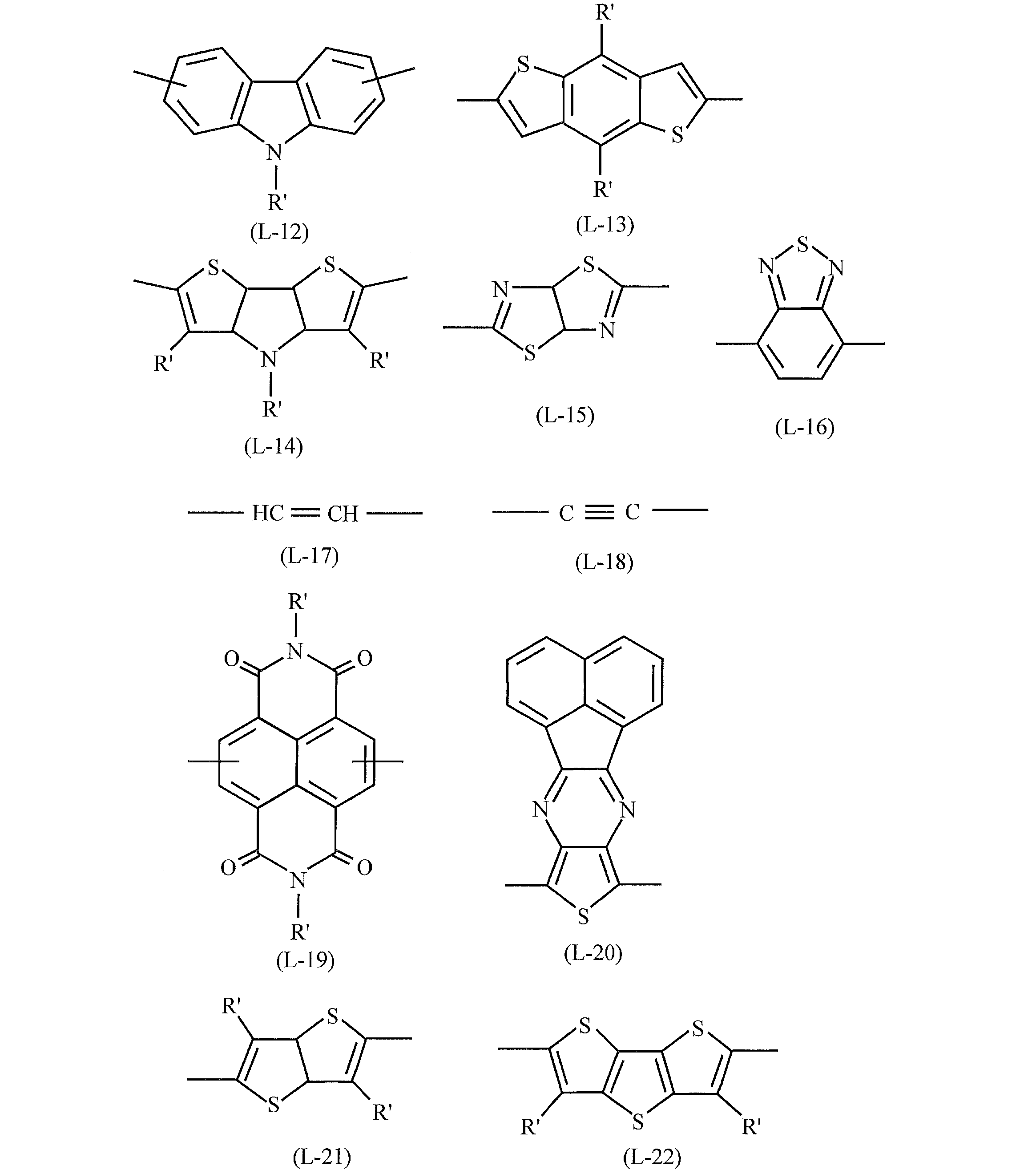
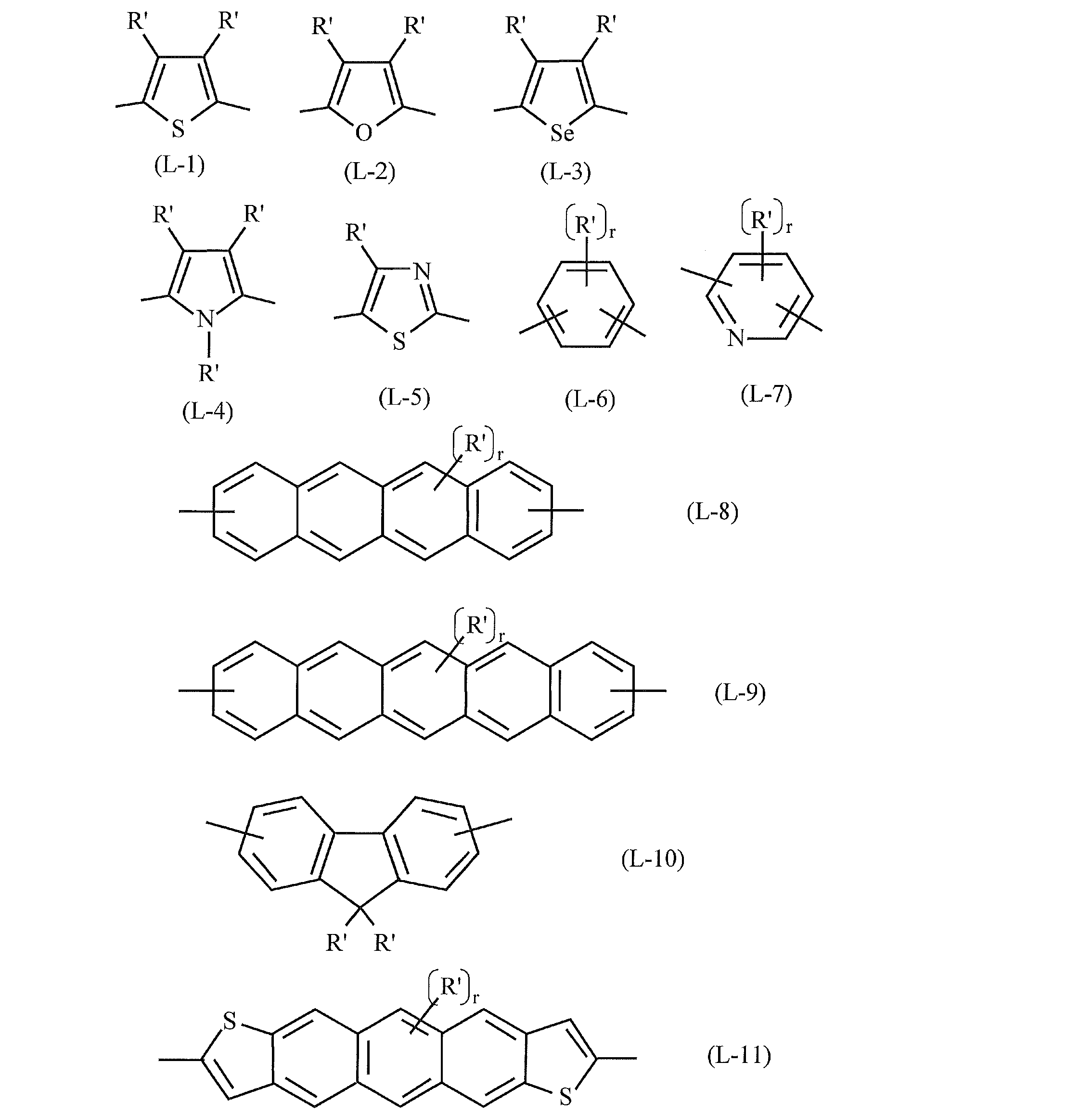
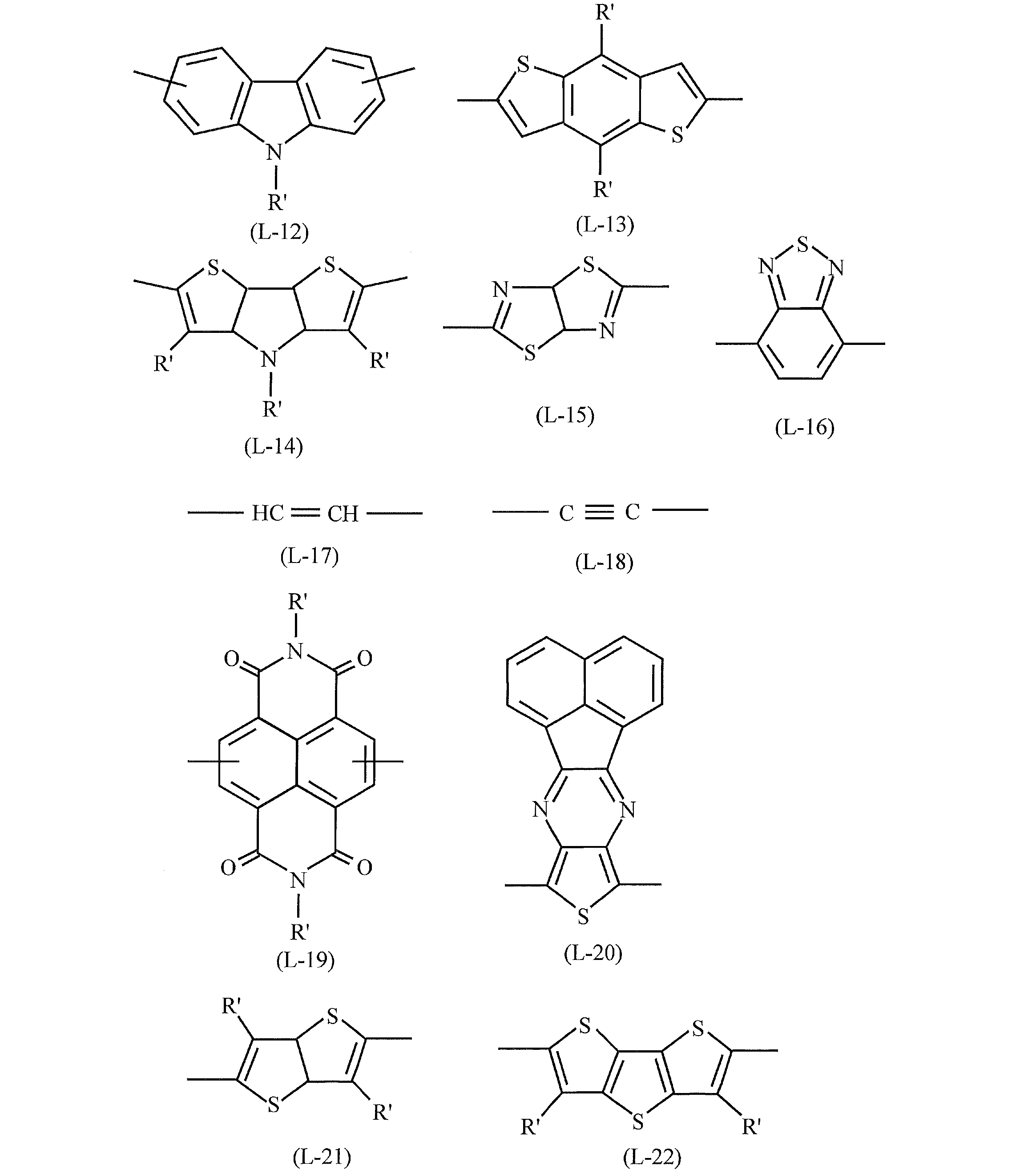
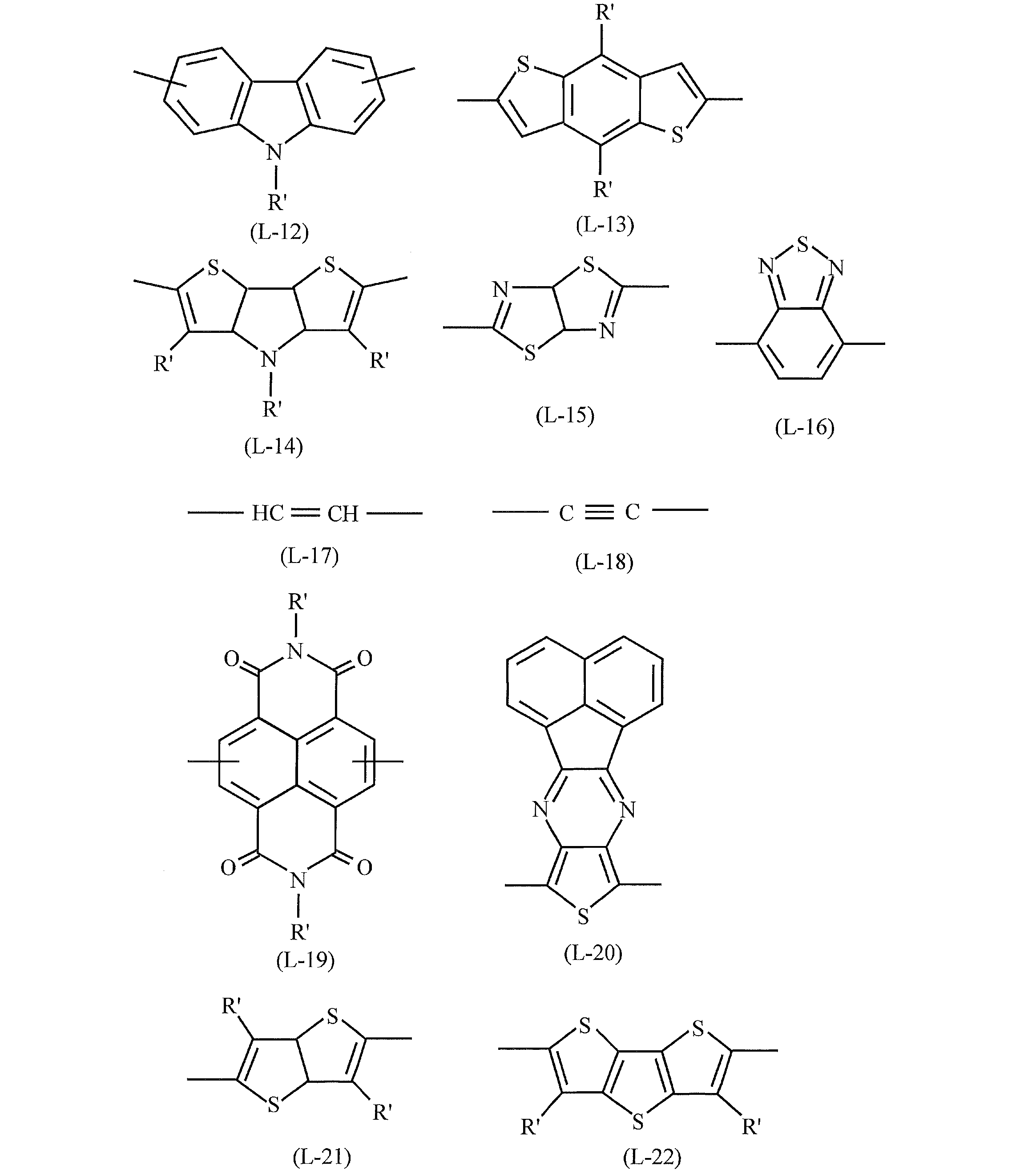
- L 1 and L 2 in the formula (1) are the same or different and are groups selected from the following formulas (L-1) to (L-22) Provide solvent.
- R ′ is the same or different and is a hydrogen atom, an alkyl group optionally having a substituent, an aryl group, a heteroaryl group, an alkoxy group, a thioalkyl group, a trialkylsilyl group, a halogen atom, a cyano group.
- a group selected from a nitro group when L 1 and L 2 contain two or more R ′, two or more R ′ are bonded to each other together with the carbon atoms constituting L 1 and L 2.
- a ring may be formed
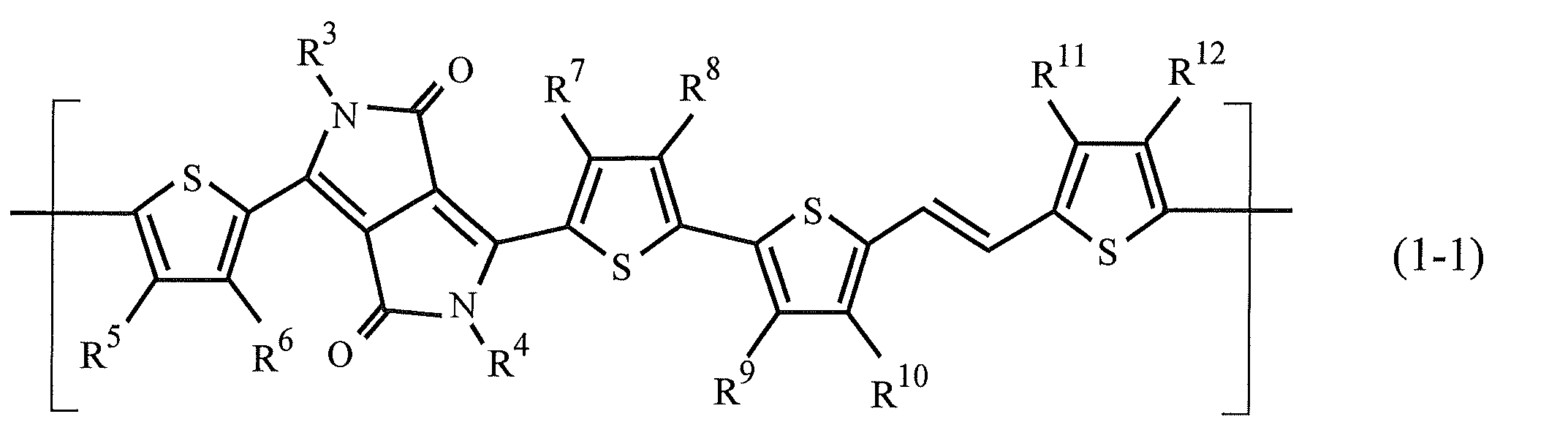
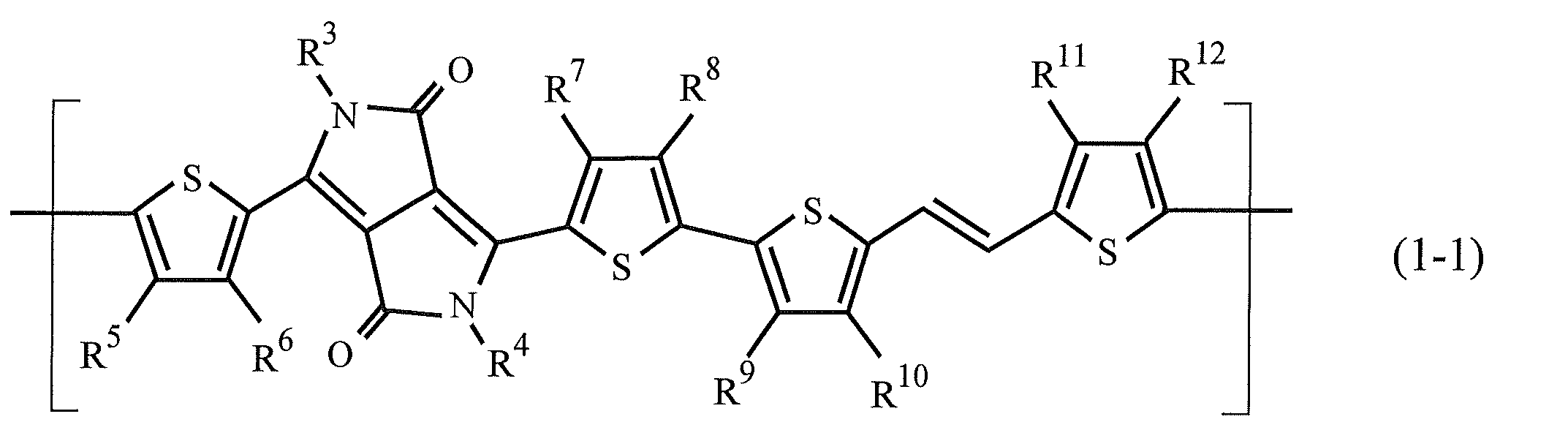
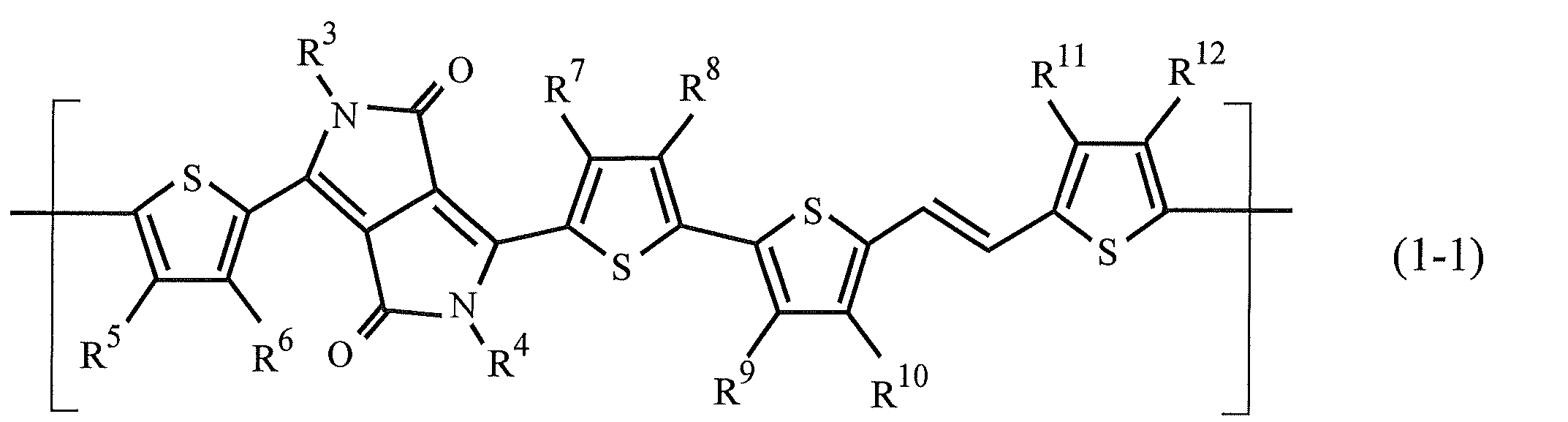
- the present invention also provides the organic transistor-producing solvent, wherein the organic semiconductor material is a compound having a structural unit represented by the following formula (1-1).
- the organic semiconductor material is a compound having a structural unit represented by the following formula (1-1).
- R 3 to R 12 are the same or different and each represents a group selected from a hydrogen atom, an optionally substituted C 1-24 alkyl group, an aryl group, and a heteroaryl group.
- R 5 and R 6 , R 7 and R 8 , R 9 and R 10 , R 11 and R 12 may be bonded to each other to form a ring together with the carbon atoms constituting the thiophene ring)
- the present invention also provides an organic transistor manufacturing composition comprising an organic semiconductor material and the organic transistor manufacturing solvent.
- the present invention also provides the above-mentioned composition for producing an organic transistor, wherein the organic semiconductor material is a compound having a structural unit represented by the following formula (1).
- L 1 and L 2 are the same or different, and a group obtained by removing two hydrogen atoms from an aromatic carbocyclic ring or heteroaromatic carbocyclic ring, a vinylene group, an ethynylene group, and two or more of the above groups are combined.
- R 3 and R 4 are the same or different and each represents a hydrogen atom, an optionally substituted C 1-24 alkyl group, an aryl group, or a heteroaryl group.
- Y 1 and Y 2 are the same or different and represent an oxygen atom or a sulfur atom
- p and q are the same or different and represent an integer of 0 or more
- (p + q) is 1 or more. Integer)
- the present invention also provides the above organic transistor production wherein L 1 and L 2 in the formula (1) are the same or different and are groups selected from the following formulas (L-1) to (L-22)
- a composition is provided.
- R ′ is the same or different and is a hydrogen atom, an alkyl group optionally having a substituent, an aryl group, a heteroaryl group, an alkoxy group, a thioalkyl group, a trialkylsilyl group, a halogen atom, a cyano group.
- a ring may be formed
- the present invention also provides the above-mentioned composition for producing an organic transistor, wherein the organic semiconductor material is a compound having a structural unit represented by the following formula (1-1).
- the organic semiconductor material is a compound having a structural unit represented by the following formula (1-1).
- R 3 to R 12 are the same or different and each represents a group selected from a hydrogen atom, an optionally substituted C 1-24 alkyl group, an aryl group, and a heteroaryl group.
- R 5 and R 6 , R 7 and R 8 , R 9 and R 10 , R 11 and R 12 may be bonded to each other to form a ring together with the carbon atoms constituting the thiophene ring
- R 3 to R 12 are the same or different and each represents a group selected from a hydrogen atom, an optionally substituted C 1-24 alkyl group, an aryl group, and a heteroaryl group.
- a solvent for producing an organic transistor which is a solvent for dissolving an organic semiconductor material and contains one or more kinds of the solvent A represented by the formula (a).
- Solvent A is cyclopentanone, C 1-7 (cyclo) alkylcyclopentanone, cyclohexanone, C 1-7 (cyclo) alkylcyclohexanone, cyclohexyl methyl ether, cyclohexylamine, anisole, 1-methoxy-2-methyl Benzene, benzofuran, 2,3-dihydrobenzofuran, dihydromethylbenzofuran, cyclohexyl acetate, dihydroterpinyl acetate, tetrahydrobenzyl acetate, benzyl acetate, tetrahydrofurfuryl acetate, dimethoxybenzene, ethoxybenzene, dipropylene glycol cyclopentyl
- Solvent A is 2-methylcyclopentanone, 2-methylcyclohexanone, cyclohexylmethyl ether, cyclohexylamine, methoxybenzene, 1,2-dimethoxybenzene, 2,3-dihydrobenzofuran, and 2,3-dihydro-3
- the solvent for producing an organic transistor according to [1] which is at least one selected from methylbenzofuran.
- composition for producing an organic transistor according to [8], wherein the organic semiconductor material is a compound having a structural unit represented by the formula (1).
- the organic transistor production according to [9], wherein L 1 and L 2 in the formula (1) are the same or different and are groups selected from the formulas (L-1) to (L-22) Composition.
- the composition for producing an organic transistor according to [8], wherein the organic semiconductor material is a compound having a structural unit represented by the formula (1-1).
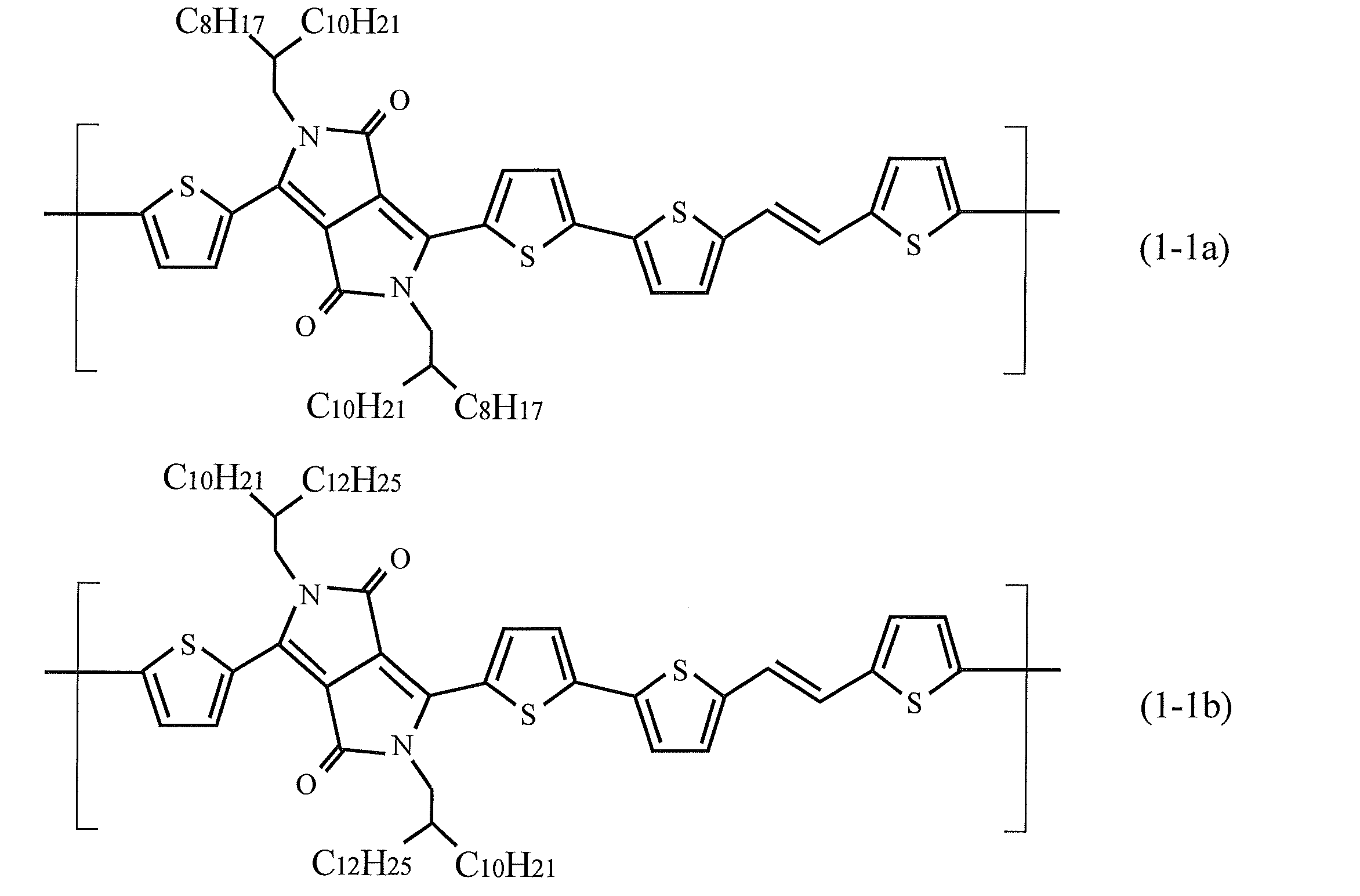
- the organic semiconductor material according to [8], wherein the organic semiconductor material is a compound having a structural unit represented by formula (1-1a) and / or a compound having a structural unit represented by formula (1-1b).
- a composition for producing a transistor is a composition for producing a transistor.
- the composition for producing an organic transistor according to any one of [8] to [13] which contains 0.01 to 10 parts by weight of the compound having the above-mentioned compound.
- composition for producing an organic transistor according to any one of [8] to [14] wherein the solvent for producing an organic transistor is contained in an amount of 90.00 to 99.99% by weight of the total amount of the composition for producing an organic transistor. .
- the solvent for producing an organic transistor of the present invention has high organic semiconductor material solubility even at a relatively low temperature. Therefore, although it has lower heat resistance than glass substrates, it can withstand impacts and can directly form organic transistors on lightweight and flexible plastic substrates, etc., forming impact-resistant, lightweight and flexible displays and computer equipment. can do. Further, an organic transistor can be easily manufactured by a simple method using a wet process such as a printing method or a spin coating method, and the cost can be significantly reduced. And since the organic-semiconductor material will crystallize by the self-organization effect
- the solvent for producing an organic transistor of the present invention is a solvent for dissolving an organic semiconductor material, and is characterized by containing one or more kinds of solvents A represented by the following formula (a).
- ring Z represents a ring selected from an aromatic carbocyclic ring, a 5- to 7-membered alicyclic carbocyclic ring, and a 5- to 7-membered heterocyclic ring.
- R 1 represents an oxo group ( ⁇ O), a thioxy group ( ⁇ S), a —OR a group, a —SR a group, a —O (C ⁇ O) R a group, a —R b O (C ⁇ O) R a group.
- R a represents a C 1-7 alkyl group, an aryl group, or a group in which the group is bonded via a single bond or a linking group
- R b represents a C 1-7 alkylene group, an arylene group, or the group described above.
- R 2 represents a hydrogen atom, a C 1-7 alkyl group, an aryl group, and —OR A group selected from a group (R a is as defined above).
- R 1 and R 2 may be bonded to each other to form a ring together with the carbon atoms constituting ring Z]
- the solvent A of the present invention is a compound containing at least one heteroatom represented by the above formula (a).
- ring Z represents a ring selected from an aromatic carbocyclic ring, a 5- to 7-membered alicyclic carbocyclic ring, and a 5- to 7-membered heterocyclic ring.
- the ring examples include an aromatic carbocyclic ring having 6 to 14 carbon atoms such as a benzene ring; a 5- to 7-membered alicyclic carbocyclic ring such as a cyclopentane ring, a cyclohexane ring, and a cycloheptane ring (particularly 5 to 7 A 5- to 7-membered heterocyclic ring such as a pyrrolidine ring, an oxolane ring, and a thiolane ring.
- an aromatic carbocyclic ring having 6 to 14 carbon atoms such as a benzene ring
- a 5- to 7-membered alicyclic carbocyclic ring such as a cyclopentane ring, a cyclohexane ring, and a cycloheptane ring
- 5 to 7 A 5- to 7-membered heterocyclic ring such as a pyrrolidine ring, an o
- R 1 represents an oxo group ( ⁇ O), a thioxy group ( ⁇ S), a —OR a group, a —SR a group, a —O (C ⁇ O) R a group, a —R b O (C ⁇ O) R a group
- R a represents a C 1-7 alkyl group, or an aryl group, or a group in which the group is bonded via a single bond or a linking group
- R b represents a C 1-7 alkylene group, or An arylene group or a group in which the group is bonded via a single bond or a linking group
- R 2 represents a group selected from a hydrogen atom, a C 1-7 alkyl group, an aryl group, and an —OR a group (R a is the same as described above).
- Examples of the C 1-7 alkyl group include linear or branched alkyl groups such as methyl, ethyl, propyl, butyl, pentyl, hexyl, and heptyl groups, and C 3-7 carbon atoms such as cyclopentyl groups.
- a cycloalkyl group can be mentioned.
- Examples of the C 1-7 alkylene group include linear or branched alkylene groups such as methylene, methylmethylene, dimethylmethylene, ethylene, propylene, and trimethylene groups.
- C6-14 aryl groups such as a phenyl group, can be mentioned, for example.
- arylene group examples include a C 6-14 arylene group such as a phenylene group.
- linking group examples include an alkylene group, a carbonyl group (—CO—), an ether bond (—O—), an ester bond (—COO—), an amide bond (—CONH—), and a carbonate bond (—OCOO—). And a group in which a plurality of these are linked.
- the alkylene group preferably has 1 to 18 carbon atoms, and is a linear or branched alkylene group such as methylene, methylmethylene, dimethylmethylene, ethylene, propylene, trimethylene group, 1,2-cyclopentylene, , 3-cyclopentylene, cyclopentylidene, 1,2-cyclohexylene, 1,3-cyclohexylene, 1,4-cyclohexylene, cyclohexylidene, and other divalent alicyclic hydrocarbon groups (Especially, a cycloalkylene group).
- Examples of the substituted or unsubstituted amino group include an amino group; a mono- or di (C 1-3 ) alkylamino group such as a methylamino group, an ethylamino group, an isopropylamino group, a dimethylamino group, and a diethylamino group. be able to.
- Examples of the ring that R 1 and R 2 may be bonded together to form a carbon atom that forms ring Z include, for example, cyclopentane, cyclohexane, cycloheptane, benzene, methylbenzene, thiophene, methylthiophene, furan, Mention may be made of methylfuran, dihydrofuran, methyldihydrofuran and the like.
- the weight average molecular weight of the solvent A represented by the formula (a) is, for example, about 350 or less, preferably 70 to 250, particularly preferably 80 to 200.
- Examples of the solvent A of the present invention include cyclopentanone, C 1-7 (cyclo) alkylcyclopentanone (for example, 2-methylcyclopentanone, 2-ethylcyclopentanone, 2-propylcyclopentanone, 2 -Butylcyclopentanone, 2-pentylcyclopentanone, 2-cyclopentylcyclopentanone, 2-hexylcyclopentanone, 2-heptylcyclopentanone), cyclohexanone, C 1-7 (cyclo) alkylcyclohexanone (for example, 2 -Methylcyclohexanone, 2-ethylcyclohexanone, 2-propylcyclohexanone, 2-butylcyclohexanone, 2-pentylcyclohexanone, 2-hexylcyclohexanone, 2-heptylcyclohexanone, 4-pentylcyclohexanone), cyclohexylmethyl
- the content of the solvent A in the organic transistor production solvent (100% by weight) (the total amount when two or more types are combined) is preferably 50% by weight or more (for example, 50 to 100% by weight), and 70% by weight. % Or more (for example, 70 to 100% by weight) is particularly preferable.
- the content of the solvent A is below the above range, the solubility of the organic semiconductor material tends to decrease.
- solvent B examples include (mono, di) trialkylene glycol monoalkyl ether, (mono, di) alkylene glycol dialkyl ether, (mono, di) alkylene glycol alkyl ether acetate, (mono, di) alkylene glycol diacetate.
- examples thereof include carboxylic acid esters, hydroxycarboxylic acid diesters, alkoxycarboxylic acid esters, cyclic ketones, lactones, cyclic ethers, amides, pyridines, aromatic acetates and amines. These can be used alone or in combination of two or more.
- Examples of the (mono, di, tri) alkylene glycol monoalkyl ether include ethylene glycol monomethyl ether, ethylene glycol monoethyl ether, ethylene glycol n-propyl ether, ethylene glycol n-butyl ether, diethylene glycol monomethyl ether, diethylene glycol monoethyl ether.
- Examples of the (mono, di) alkylene glycol dialkyl ether include ethylene glycol dimethyl ether, ethylene glycol diethyl ether, diethylene glycol dimethyl ether, diethylene glycol diethyl ether, diethylene glycol dipropyl ether, diethylene glycol dibutyl ether, propylene glycol dimethyl ether, propylene glycol diethyl ether, Propylene glycol dimethyl ether, dipropylene glycol diethyl ether, propylene glycol methyl ethyl ether, propylene glycol methyl n-propyl ether, propylene glycol methyl n-butyl ether, dipropylene glycol methyl ethyl ether, dipropylene glycol methyl n Propyl ether, and dipropylene glycol methyl n- butyl ether.
- Examples of the (mono, di) alkylene glycol alkyl ether acetate include ethylene glycol monomethyl ether acetate, ethylene glycol monoethyl ether acetate, ethylene glycol monopropyl ether acetate, ethylene glycol monobutyl ether acetate, diethylene glycol monomethyl ether acetate, diethylene glycol monoethyl Ether acetate, diethylene glycol monopropyl ether acetate, diethylene glycol monobutyl ether acetate, propylene glycol monomethyl ether acetate, propylene glycol monoethyl ether acetate, propylene glycol monopropyl ether acetate, propylene glycol monobutyl ether Acetate, dipropylene glycol monomethyl ether acetate, dipropylene glycol monomethyl ether acetate, dipropylene glycol monopropyl ether acetate, and dipropylene glycol monobutyl ether acetate and the like
- Examples of the (mono, di) alkylene glycol diacetate include ethylene glycol diacetate, diethylene glycol diacetate, propylene glycol diacetate, and dipropylene glycol diacetate.
- alkyl acetate examples include methyl acetate, ethyl acetate, n-propyl acetate, isopropyl acetate, butyl acetate and the like.
- Examples of the C 3-6 alcohol include n-propyl alcohol, isopropyl alcohol, n-butyl alcohol, sec-butyl alcohol, tert-butyl alcohol, n-pentyl alcohol, n-hexyl alcohol, and 2-hexyl alcohol. Can be mentioned.
- Examples of the C 3-6 alkanediol include 1,3-butylene glycol, 1,4-butanediol, 1,6-hexanediol, and the like.
- Examples of the C 3-6 alkanediol monoalkyl ether include 3-methoxybutanol.
- Examples of the C 3-6 alkanediol alkyl ether acetate include 3-methoxybutanol acetate.
- Examples of the C 3-6 alkanediol diacetate include 1,3-butylene glycol diacetate, 1,4-butanediol diacetate, and 1,6-hexanediol diacetate.
- hydroxycarboxylic acid ester examples include methyl lactate and ethyl lactate.
- hydroxycarboxylic acid diester examples include methyl lactate acetate and ethyl lactate acetate.
- alkoxycarboxylic acid ester examples include methyl methoxypropionate and ethyl ethoxypropionate.
- Examples of the cyclic ketone include 4-ketoisophorone.
- lactones examples include ⁇ -butyrolactone, ⁇ -butyrolactone, ⁇ -caprolactone, ⁇ -valerolactone, ⁇ -valerolactone, ⁇ -acetyl- ⁇ -butyrolactone, and the like.
- Examples of the cyclic ether include tetrahydrofuran and tetrahydrofurfuryl alcohol.
- amides examples include dimethylformamide.
- pyridines examples include pyridine and methylpyridine.
- aromatic acetate examples include phenyl acetate.
- amines examples include diethylamine and triethylamine.
- the composition for producing an organic transistor contains an organic semiconductor material at a high concentration and is excellent in coating property, drying property, safety property, dispersibility, solubility and the like. Things can be formed.
- one or two solvents selected from mono C 3-6 alkylene glycol alkyl ether acetates such as propylene glycol monomethyl ether acetate and C 3-6 alkanediol alkyl ether acetates are used. The combined use is effective.
- mono C 3-6 alkylene glycol monoalkyl ethers such as propylene glycol monomethyl ether
- mono-C 3-6 alkylene glycol alkyl ether acetates such as propylene glycol monomethyl ether acetate
- C 3-6 One or two solvents selected from alkanediol monoalkyl ether, C 3-6 alkanediol alkyl ether acetate, hydroxycarboxylic acid ester, hydroxycarboxylic acid diester, C 3-6 alcohol, and C 3-6 alkanediol The combined use is effective.
- (mono, di) C 3 such as propylene glycol methyl n-propyl ether, propylene glycol methyl n-butyl ether, dipropylene glycol methyl n-propyl ether, dipropylene glycol methyl n-butyl ether, etc. It is effective to use one or more solvents selected from -6 alkylene glycol C 1-2 alkyl C 3-4 alkyl ether and alkyl acetate together.
- the mixing ratio (the former / the latter (weight ratio)) is, for example, 95/5 to 50/50, and preferably 95/5 to 70/30.
- the ratio of the solvent B increases compared to the solvent A, the solubility of the organic semiconductor material tends to decrease.
- it is the total amount. The same applies to the solvent B.
- the solvent for producing an organic transistor of the present invention contains the solvent A, it has a high solubility in organic semiconductor materials even at a relatively low temperature.
- the solubility of the compound having the structural unit represented by the formula (1) at 100 ° C. is, for example, 0.02 parts by weight or more, preferably 0.03 parts by weight with respect to 100 parts by weight of the organic transistor manufacturing solvent. Above, especially preferably 0.04 parts by weight or more.
- the upper limit of solubility is, for example, 5 parts by weight, preferably 3 parts by weight, particularly preferably 2 parts by weight.
- the solvent for manufacturing an organic transistor of the present invention is a solvent for dissolving an organic semiconductor material.
- the compound having a structural unit containing a diketopyrrolopyrrole group which may have a substituent represented by the following formula (1) the compound having a structural unit containing a diketopyrrolopyrrole group which may have a substituent represented by the following formula (1),
- the structural unit functions as an acceptor group, and is preferable in that an ordered and aligned structure can be obtained by strong ⁇ -stacking due to an intermolecular electronic interaction between the donor and acceptor with respect to the donor group.
- the number of repeating structural units represented by the following formula (1) is, for example, about 2 to 5000.
- L 1 and L 2 are the same or different, and a group obtained by removing two hydrogen atoms from an aromatic carbocyclic ring or heteroaromatic carbocyclic ring, a vinylene group, an ethynylene group, and two or more of the above groups are combined.
- R 3 and R 4 are the same or different and each represents a hydrogen atom, an optionally substituted C 1-24 alkyl group, an aryl group, or a heteroaryl group.
- Y 1 and Y 2 are the same or different and represent an oxygen atom or a sulfur atom
- p and q are the same or different and represent an integer of 0 or more
- (p + q) is 1 or more.
- p L 1 may be the same or different
- q L 2 may be the same or different.
- R 3 and R 4 are the same or different and each represents a group selected from a hydrogen atom, an optionally substituted C 1-24 alkyl group, an aryl group, and a heteroaryl group.
- the C 1-24 alkyl group include a methyl group, an ethyl group, a propyl group, a butyl group, a pentyl group, a hexyl group, a heptyl group, a decyl group, a dodecyl group, an octadecyl group, and an icosyl group.
- C6-14 aryl groups such as a phenyl group
- the heteroaryl group include 2-furyl group, 3-furyl group, 2-thienyl group, 3-thienyl group, 2-pyrrolyl group, 3-pyrrolyl group, 2-oxazolyl group, 2-thiazolyl group, 2 -Imidazolyl group, 2-pyridyl group, 3-pyridyl group, 4-pyridyl group, 2-benzofuryl group, 2-benzothienyl group, 2-thienothienyl group and the like.
- the substituent that the group may have include a hydroxyl group and a carboxyl group.
- L 1 and L 2 are the same or different and are a divalent group in which two hydrogen atoms are removed from an aromatic carbocyclic or heteroaromatic carbocyclic ring, a vinylene group, an ethynylene group, or a combination of two or more of the above groups.
- aromatic carbocycle examples include benzene, naphthalene, anthracene, phenanthrene, tetracene, chrysene, pyrene, triphenylene, and pentacene.
- heteroaromatic carbocycle examples include pyrrole, pyridine, furan, thiophene, selenophene, imidazole, pyrazole, oxazole, 1,3-thiazole, imidazoline, pyrazine, morpholine, thiazine, 1,3,4-thiadiazole and the like. Can be mentioned.
- L 1 and L 2 are preferably groups selected from the following formulas (L-1) to (L-22).
- R ′ is the same or different and is a hydrogen atom, an optionally substituted alkyl group, aryl group, heteroaryl group, alkoxy group, thioalkyl group, trialkylsilyl group, halogen atom, cyano group. And a group selected from a nitro group.
- R ′ is the same or different and is a hydrogen atom, an optionally substituted alkyl group, aryl group, heteroaryl group, alkoxy group, thioalkyl group, trialkylsilyl group, halogen atom, cyano group. And a group selected from a nitro group.
- the group represented by the above formula contains two or more R ′, two or more R ′ may be bonded to each other to form a ring together with the carbon atoms constituting the group.
- alkyl group examples include linear or branched alkyl groups having 1 to 24 carbon atoms such as a methyl group, an ethyl group, a propyl group, a butyl group, a pentyl group, and a hexyl group.
- C6-14 aryl groups such as a phenyl group, can be mentioned, for example.
- heteroaryl group examples include 2-furyl group, 3-furyl group, 2-thienyl group, 3-thienyl group, 2-pyrrolyl group, 3-pyrrolyl group, 2-oxazolyl group, 2-thiazolyl group, 2 -Imidazolyl group, 2-pyridyl group, 3-pyridyl group, 4-pyridyl group, 2-benzofuryl group, 2-benzothienyl group, 2-thienothienyl group and the like.
- alkoxy group examples include C 1-24 alkoxy groups such as methoxy, ethoxy, propoxy, isopropoxy, butoxy, isobutoxy, t-butoxy, pentyloxy, and hexyloxy groups.
- thioalkyl group examples include thioC groups such as thiomethyl group, thioethyl group, thiopropyl group, thioisopropyl group, thiobutyl group, thioisobutyl group, thiosec-butyl group, thio-tert-butyl group, thiopentyl group, and thiohexyl group. Mention may be made of 1-24 alkyl groups.
- trialkylsilyl group examples include tri (C 1-24 ) alkyl and / or arylsilyl groups such as trimethylsilyl, tert-butyldimethylsilyl, tribenzylsilyl, and triphenylsilyl groups.
- halogen atom examples include a fluorine atom, a chlorine atom, a bromine atom, and an iodine atom.
- substituents that the group may have include, for example, a hydroxyl group that may be protected with a protecting group, a hydroxymethyl group that may be protected with a protecting group, and a group that may be protected with a protecting group.
- the protecting group a protecting group commonly used in the field of organic synthesis can be used.
- Examples of the ring that may be formed by combining two or more R ′ together with the carbon atoms constituting L 1 and L 2 include cyclopentane, cyclohexane, cycloheptane, benzene, methylbenzene, thiophene, Mention may be made of methylthiophene, furan, methylfuran, dihydrofuran, methyldihydrofuran and the like.
- r represents an integer of 1 to 3, for example.
- Examples of the compound having the structural unit represented by the formula (1) include a diketopyrrolopyrrole group optionally having a substituent, a group in which two hydrogen atoms have been removed from thiophene, and vinylene.
- the organic semiconductor material having a group is preferable in that it has an ordered and aligned structure by strong ⁇ -stacking due to the intermolecular electronic interaction between the donor and acceptor.
- R 3 to R 12 are the same or different and each represents a group selected from a hydrogen atom, an optionally substituted C 1-24 alkyl group, an aryl group, and a heteroaryl group.
- R 5 and R 6 , R 7 and R 8 , R 9 and R 10 , R 11 and R 12 may be bonded to each other to form a ring together with carbon atoms constituting the thiophene ring.
- the ring which may be formed together with the carbon atom constituting the C 1-24 alkyl group, aryl group, heteroaryl group, and thiophene ring which may have a substituent in R 3 to R 12 includes the above R Examples similar to those in 'can be given.
- R 5 to R 12 in the above formula (1-1) are preferably hydrogen atoms, and in particular, the following formula (1-1a) and / or the following formula (1-1b It is preferable to use a compound having a structural unit represented by () in that a highly oriented organic transistor can be obtained.
- the weight average molecular weight of the compound having the structural unit represented by the formula (1) is, for example, about 5 million or less, preferably 1000 to 1 million, and particularly preferably 5000 to 500,000.
- composition for manufacturing an organic transistor according to the present invention includes the organic semiconductor material and a solvent for manufacturing an organic transistor.
- the composition for producing an organic transistor of the present invention is, for example, a mixture of the organic semiconductor material and the solvent for producing an organic transistor, and heated in the atmosphere at a temperature of about 70 to 150 ° C. for about 0.1 to 2 hours. Can be prepared.
- the content of the organic semiconductor material in the composition for producing an organic transistor of the present invention is, for example, a solvent for producing an organic transistor when a compound having a structural unit represented by the formula (1) is used as the organic semiconductor material.
- a solvent for producing an organic transistor when a compound having a structural unit represented by the formula (1) is used as the organic semiconductor material is, for example, 0.02 parts by weight or more, preferably 0.03 parts by weight or more, and particularly preferably 0.04 parts by weight or more with respect to 100 parts by weight.
- the upper limit is, for example, 5 parts by weight, preferably 3 parts by weight, particularly preferably 2 parts by weight.
- the organic semiconductor material when using a compound having a structural unit represented by the above formula (1-1a) and / or (1-1b) as the organic semiconductor material (when using a mixture of two or more, the total amount), For example, 0.01 parts by weight or more, preferably 0.05 parts by weight or more, more preferably 0.1 parts by weight or more, and particularly preferably 0.2 parts by weight or more with respect to 100 parts by weight of the solvent for producing an organic transistor. .
- the upper limit is, for example, 10 parts by weight, preferably 7 parts by weight, particularly preferably 5 parts by weight.
- the content of the solvent for producing an organic transistor in the composition for producing an organic transistor of the present invention is, for example, 99.99% by weight or less.
- the lower limit is, for example, 90.00% by weight, preferably 93.00% by weight, particularly preferably 95.00% by weight, and the upper limit is preferably 99.95% by weight, particularly preferably 99.90% by weight. is there.
- the content of the solvent for producing an organic transistor contained in the composition for producing an organic transistor of the present invention can promote crystallization by the self-organizing action of the organic semiconductor material.
- it is preferably 10 times (weight) or more, more preferably 13 times (weight) or more, and particularly preferably 20 times (weight) or more with respect to the compound having the structural unit represented by 1).
- the upper limit is, for example, 10,000 times (weight), preferably 2000 times (weight), more preferably 1000 times (weight), and particularly preferably 500 times (weight).
- composition for producing an organic transistor of the present invention in addition to the organic semiconductor material and the solvent for producing an organic transistor, components contained in a general composition for producing an organic transistor (for example, epoxy resin, acrylic resin, cellulose) Resin, butyral resin, etc.) can be blended as needed.
- a general composition for producing an organic transistor for example, epoxy resin, acrylic resin, cellulose) Resin, butyral resin, etc.
- the composition for producing an organic transistor of the present invention can dissolve an organic semiconductor material at a high concentration even at a relatively low temperature. Therefore, the heat resistance is lower than that of a glass substrate, but an organic transistor can be directly formed on a plastic substrate that is resistant to impact and lightweight and flexible, and forms a display and computer equipment that is resistant to impact and lightweight and flexible. be able to. Moreover, since the composition for manufacturing an organic transistor of the present invention contains the solvent for manufacturing an organic transistor of the present invention, the organic semiconductor material is crystallized by a self-organizing action when applied on a substrate, and thus has high crystallinity. An organic transistor is obtained. Furthermore, an organic transistor can be easily formed by a simple method using a wet process such as a printing method or a spin coating method, and the cost can be greatly reduced.
- Example 1 A compound having a structural unit represented by the formula (1-1a) as an organic semiconductor material (trade name “PDVT-8”, manufactured by 1-Material Co., Ltd.) is used, and a solvent for manufacturing an organic transistor in an environment of 20 ° C. 2,3-dihydrobenzofuran (DHBF) was used to prepare a composition for producing an organic transistor having an organic semiconductor material concentration of 0.05 to 0.40% by weight.
- DHBF 2,3-dihydrobenzofuran
- the obtained composition for producing an organic transistor was heated at 120 ° C. for about 2 hours under a nitrogen atmosphere and a light-shielding condition, and visually confirmed whether or not it could be dissolved.
- solubility when the insoluble matter was not visually confirmed, “ ⁇ : dissolved” was designated, and when the insoluble matter was confirmed, “x: insoluble” was designated. The same applies to the following. Moreover, about the completely melt
- Example 2-7 Comparative Example 1 A composition for producing an organic transistor was prepared in the same manner as in Example 1 except that the solvent shown in Table 1 was used instead of 2,3-dihydrobenzofuran (DHBF), and the solubility of the organic semiconductor material was evaluated. .
- DHBF 2,3-dihydrobenzofuran
- O-DCB 1,2-dichlorobenzene (manufactured by Tokyo Chemical Industry Co., Ltd.)
- DHBF 2,3-dihydrobenzofuran (manufactured by Tokyo Chemical Industry Co., Ltd., molecular weight: 120.15)
- CHXME cyclohexyl methyl ether (manufactured by Wako Pure Chemical Industries, Ltd., molecular weight: 114.19)
- MANON 2-methylcyclohexanone (manufactured by Wako Pure Chemical Industries, Ltd., molecular weight: 112.17)
- MOB Methoxybenzene (manufactured by Tokyo Chemical Industry Co., Ltd., molecular weight: 108.14)
- DHMDF 2,3-dihydro-3-methylbenzofuran (manufactured by Tokyo Chemical Industry Co., Ltd., molecular weight: 134.18)
- DMOB 1,2-dimethoxybenzene (manufactured by Tokyo Chemical Industry Co., Ltd
- Example 8 Comparative Example 2 A compound having a structural unit represented by the formula (1-1b) (trade name “PDVT-10”, manufactured by 1-Material Co., Ltd.) was used as an organic semiconductor material, and the results are shown in Table 2 under a 20 ° C. environment.
- a composition for producing an organic transistor having an organic semiconductor material concentration of 0.10% by weight was prepared using a solvent.
- the obtained composition for producing an organic transistor was heated at 120 ° C. for about 2 hours under a nitrogen atmosphere and a light-shielding condition, and visually confirmed whether or not it could be dissolved. Moreover, about the completely melt
- O-DCB 1,2-dichlorobenzene (manufactured by Tokyo Chemical Industry Co., Ltd.)
- DHBF 2,3-dihydrobenzofuran (manufactured by Tokyo Chemical Industry Co., Ltd., molecular weight: 120.15)
- the solvent for producing an organic transistor of the present invention has high organic semiconductor material solubility even at a relatively low temperature. Therefore, although it has lower heat resistance than glass substrates, it can withstand impacts and can directly form organic transistors on lightweight and flexible plastic substrates, etc., forming impact-resistant, lightweight and flexible displays and computer equipment. can do. Further, an organic transistor can be easily manufactured by a simple method using a wet process such as a printing method or a spin coating method, and the cost can be significantly reduced. And since the organic-semiconductor material will crystallize by the self-organization effect
Landscapes
- Chemical & Material Sciences (AREA)
- Organic Chemistry (AREA)
- Engineering & Computer Science (AREA)
- Chemical Kinetics & Catalysis (AREA)
- Medicinal Chemistry (AREA)
- Health & Medical Sciences (AREA)
- Polymers & Plastics (AREA)
- Materials Engineering (AREA)
- Manufacturing & Machinery (AREA)
- Wood Science & Technology (AREA)
- Life Sciences & Earth Sciences (AREA)
- Physics & Mathematics (AREA)
- Spectroscopy & Molecular Physics (AREA)
- Thin Film Transistor (AREA)
- Organic Low-Molecular-Weight Compounds And Preparation Thereof (AREA)
- Heterocyclic Carbon Compounds Containing A Hetero Ring Having Oxygen Or Sulfur (AREA)
Abstract
Description
本発明の他の目的は、前記有機トランジスタ製造用溶剤を含む有機トランジスタ製造用組成物を提供することにある。

で表される溶剤Aを1種又は2種以上含む有機トランジスタ製造用溶剤を提供する。

[1]有機半導体材料溶解用の溶剤であって、式(a)で表される溶剤Aを1種又は2種以上含む有機トランジスタ製造用溶剤。
[2] 溶剤Aがシクロペンタノン、C1-7(シクロ)アルキルシクロペンタノン、シクロヘキサノン、C1-7(シクロ)アルキルシクロヘキサノン、シクロヘキシルメチルエーテル、シクロヘキシルアミン、アニソール、1-メトキシ-2-メチルベンゼン、ベンゾフラン、2,3-ジヒドロベンゾフラン、ジヒドロメチルベンゾフラン、シクロヘキシルアセテート、ジヒドロターピニルアセテート、テトラヒドロベンジルアセテート、ベンジルアセテート、テトラヒドロフルフリルアセテート、ジメトキシベンゼン、エトキシベンゼン、ジプロピレングリコールシクロペンチルメチルエーテル、及びN-メチルピロリドンから選択される少なくとも1種である[1]に記載の有機トランジスタ製造用溶剤。
[3] 溶剤Aが2-メチルシクロペンタノン、2-メチルシクロヘキサノン、シクロヘキシルメチルエーテル、シクロヘキシルアミン、メトキシベンゼン、1,2-ジメトキシベンゼン、2,3-ジヒドロベンゾフラン、及び2,3-ジヒドロ-3-メチルベンゾフランから選択される少なくとも1種である[1]に記載の有機トランジスタ製造用溶剤。
[4] 有機トランジスタ製造用溶剤全量における溶剤(A)の含有量が50重量%以上である、[1]~[3]の何れか1つに記載の有機トランジスタ製造用溶剤。
[5] 有機半導体材料が、式(1)で表される構成単位を有する化合物である[1]~[4]の何れか1つに記載の有機トランジスタ製造用溶剤。
[6] 式(1)中のL1、L2が、同一又は異なって、式(L-1)~(L-22)から選択される基である[5]に記載の有機トランジスタ製造用溶剤。
[7] 有機半導体材料が、式(1-1)で表される構成単位を有する化合物である[1]~[4]の何れか1つに記載の有機トランジスタ製造用溶剤。
[8] 有機半導体材料と、[1]~[7]の何れか1つに記載の有機トランジスタ製造用溶剤とを含む有機トランジスタ製造用組成物。
[9] 有機半導体材料が、式(1)で表される構成単位を有する化合物である[8]に記載の有機トランジスタ製造用組成物。
[10] 式(1)中のL1、L2が、同一又は異なって、式(L-1)~(L-22)から選択される基である[9]に記載の有機トランジスタ製造用組成物。
[11] 有機半導体材料が、式(1-1)で表される構成単位を有する化合物である[8]に記載の有機トランジスタ製造用組成物。
[12] 有機半導体材料が、式(1-1a)で表される構成単位を有する化合物及び/又は式(1-1b)で表される構成単位を有する化合物である[8]に記載の有機トランジスタ製造用組成物。
[13] 有機トランジスタ製造用溶剤100重量部に対して、有機半導体材料を0.01~10重量部含有する[8]~[12]の何れか1つに記載の有機トランジスタ製造用組成物。
[14] 有機トランジスタ製造用溶剤100重量部に対して、有機半導体材料として式(1-1a)で表される構成単位を有する化合物及び/又は式(1-1b)で表される構成単位を有する化合物を0.01~10重量部含有する[8]~[13]の何れか1つに記載の有機トランジスタ製造用組成物。
[15] 有機トランジスタ製造用溶剤を、有機トランジスタ製造用組成物全量の90.00~99.99重量%含有する[8]~[14]の何れか1つに記載の有機トランジスタ製造用組成物。
そして、本発明の有機トランジスタ製造用組成物は基板上に塗布されると有機半導体材料が自己組織化作用により結晶化するため、高い結晶性を有する有機トランジスタが得られる。
本発明の有機トランジスタ製造用溶剤は、有機半導体材料を溶解するための溶剤であって、下記式(a)で表される溶剤Aを1種又は2種以上含むことを特徴とする。

本発明の溶剤Aは、上記式(a)で表される、ヘテロ原子を少なくとも1個含む化合物である。式(a)中、環Zは芳香族炭素環、5~7員の脂環式炭素環、及び5~7員の複素環から選択される環を示す。前記環としては、例えば、ベンゼン環等の炭素数6~14の芳香族炭素環;シクロペンタン環、シクロヘキサン環、シクロヘプタン環等の5~7員の脂環式炭素環(特に、5~7員のアルカン環);ピロリジン環、オキソラン環、チオラン環等の5~7員の複素環を挙げることができる。
本発明の有機トランジスタ製造用溶剤は、上記溶剤A以外にも、一般的に電子材料用途に使用される溶剤であって、上記溶剤Aと相溶する溶剤(=溶剤B)を併用してもよい。
本発明の有機トランジスタ製造用溶剤は、有機半導体材料溶解用の溶剤である。前記有機半導体材料としては特に限定されないが、本発明においては、下記式(1)で表される、置換基を有していてもよいジケトピロロピロール基を含む構成単位を有する化合物が、前記構成単位がアクセプター基として働き、ドナー基に対しドナーアクセプター間の分子間電子的相互作用による強いπ-スタッキングにより、秩序よく配列・配向した構造をとることができる点で好ましい。下記式(1)で表される構成単位の繰り返し数としては、例えば2~5000程度である。


本発明の有機トランジスタ製造用組成物は、上記有機半導体材料と有機トランジスタ製造用溶剤とを含むことを特徴とする。
有機半導体材料として式(1-1a)で表される構成単位を有する化合物(商品名「PDVT-8」、1-Material(株)製)を使用し、20℃環境下、有機トランジスタ製造用溶剤として2,3-ジヒドロベンゾフラン(DHBF)を使用して、有機半導体材料濃度が0.05~0.40重量%の有機トランジスタ製造用組成物を調製した。
得られた有機トランジスタ製造用組成物を窒素雰囲気、遮光条件下、120℃で2時間程度加熱し、溶解の可否を目視で確認した。尚、溶解性は、目視にて不溶物が確認されなかった場合を「○:溶解」とし、不溶物が確認された場合を「×:不溶解」とした。以下も同様である。
また、完全に溶解した有機トランジスタ製造用組成物について、20℃、窒素雰囲気、遮光条件下で静置して、析出物が出現するまでの時間を測定した。
2,3-ジヒドロベンゾフラン(DHBF)に代えて、表1に示した溶剤を使用した以外は実施例1と同様にして有機トランジスタ製造用組成物を調製し、有機半導体材料の溶解性を評価した。

DHBF:2,3-ジヒドロベンゾフラン(東京化成工業(株)製、分子量:120.15)
CHXME:シクロヘキシルメチルエーテル(和光純薬工業(株)製、分子量:114.19)
MANON:2-メチルシクロヘキサノン(和光純薬工業(株)製、分子量:112.17)
MOB:メトキシベンゼン(東京化成工業(株)製、分子量:108.14)
DHMDF:2,3-ジヒドロ-3-メチルベンゾフラン(東京化成工業(株)製、分子量:134.18)
DMOB:1,2-ジメトキシベンゼン(東京化成工業(株)製、分子量:138.16)
CHA:シクロヘキシルアミン(和光純薬工業(株)製、分子量:99.17)
有機半導体材料として式(1-1b)で表される構成単位を有する化合物(商品名「PDVT-10」、1-Material(株)製)を使用し、20℃環境下、表2に示した溶剤を使用して、有機半導体材料濃度が0.10重量%の有機トランジスタ製造用組成物を調製した。得られた有機トランジスタ製造用組成物を窒素雰囲気、遮光条件下、120℃で2時間程度加熱し、溶解の可否を目視で確認した。
また、完全に溶解した有機トランジスタ製造用組成物について、20℃、窒素雰囲気、遮光条件下で静置して、析出物が出現するまでの時間を測定した。

DHBF:2,3-ジヒドロベンゾフラン(東京化成工業(株)製、分子量:120.15)
そして、本発明の有機トランジスタ製造用組成物は基板上に塗布されると有機半導体材料が自己組織化作用により結晶化するため、高い結晶性を有する有機トランジスタが得られる。
Claims (9)
- 有機半導体材料溶解用の溶剤であって、下記式(a)

で表される溶剤Aを1種又は2種以上含む有機トランジスタ製造用溶剤。 - 溶剤Aが2-メチルシクロペンタノン、2-メチルシクロヘキサノン、シクロヘキシルメチルエーテル、シクロヘキシルアミン、メトキシベンゼン、1,2-ジメトキシベンゼン、2,3-ジヒドロベンゾフラン、及び2,3-ジヒドロ-3-メチルベンゾフランから選択される少なくとも1種である請求項1に記載の有機トランジスタ製造用溶剤。
- 有機半導体材料が、下記式(1)で表される構成単位を有する化合物である請求項1又は2に記載の有機トランジスタ製造用溶剤。
- 式(1)中のL1、L2が、同一又は異なって、下記式(L-1)~(L-22)から選択される基である請求項3に記載の有機トランジスタ製造用溶剤。
- 有機半導体材料が、下記式(1-1)で表される構成単位を有する化合物である請求項1~3の何れか1項に記載の有機トランジスタ製造用溶剤。

- 有機半導体材料と、請求項1~5の何れか1項に記載の有機トランジスタ製造用溶剤とを含む有機トランジスタ製造用組成物。
- 有機半導体材料が、下記式(1)で表される構成単位を有する化合物である請求項6に記載の有機トランジスタ製造用組成物。

- 式(1)中のL1、L2が、同一又は異なって、下記式(L-1)~(L-22)から選択される基である請求項7に記載の有機トランジスタ製造用組成物。

- 有機半導体材料が、下記式(1-1)で表される構成単位を有する化合物である請求項6に記載の有機トランジスタ製造用組成物。
Priority Applications (5)
| Application Number | Priority Date | Filing Date | Title |
|---|---|---|---|
| JP2015549092A JP6568800B2 (ja) | 2013-11-21 | 2014-11-13 | 有機トランジスタ製造用溶剤 |
| KR1020167014744A KR102237757B1 (ko) | 2013-11-21 | 2014-11-13 | 유기 트랜지스터 제조용 용제 |
| DE112014005330.9T DE112014005330T5 (de) | 2013-11-21 | 2014-11-13 | Lösungsmittel zum Herstellen eines organischen Transistors |
| US15/033,787 US10693080B2 (en) | 2013-11-21 | 2014-11-13 | Solvent for producing organic transistor |
| CN201480057473.3A CN105659404B (zh) | 2013-11-21 | 2014-11-13 | 有机晶体管制造用溶剂 |
Applications Claiming Priority (2)
| Application Number | Priority Date | Filing Date | Title |
|---|---|---|---|
| JP2013241096 | 2013-11-21 | ||
| JP2013-241096 | 2013-11-21 |
Publications (1)
| Publication Number | Publication Date |
|---|---|
| WO2015076171A1 true WO2015076171A1 (ja) | 2015-05-28 |
Family
ID=53179438
Family Applications (1)
| Application Number | Title | Priority Date | Filing Date |
|---|---|---|---|
| PCT/JP2014/080031 Ceased WO2015076171A1 (ja) | 2013-11-21 | 2014-11-13 | 有機トランジスタ製造用溶剤 |
Country Status (7)
| Country | Link |
|---|---|
| US (1) | US10693080B2 (ja) |
| JP (1) | JP6568800B2 (ja) |
| KR (1) | KR102237757B1 (ja) |
| CN (1) | CN105659404B (ja) |
| DE (1) | DE112014005330T5 (ja) |
| TW (1) | TWI650373B (ja) |
| WO (1) | WO2015076171A1 (ja) |
Cited By (4)
| Publication number | Priority date | Publication date | Assignee | Title |
|---|---|---|---|---|
| WO2017006765A1 (ja) * | 2015-07-07 | 2017-01-12 | 富士フイルム株式会社 | 有機半導体素子、化合物、有機半導体組成物、および、有機半導体膜の製造方法 |
| WO2017110584A1 (ja) * | 2015-12-22 | 2017-06-29 | 株式会社ダイセル | 有機半導体デバイス製造用組成物 |
| WO2017175665A1 (ja) * | 2016-04-07 | 2017-10-12 | 富士フイルム株式会社 | 有機薄膜トランジスタ素子、有機半導体膜形成用組成物、有機半導体膜の製造方法及び有機半導体膜 |
| WO2017212882A1 (ja) * | 2016-06-09 | 2017-12-14 | 株式会社ダイセル | 有機半導体デバイス製造用組成物 |
Citations (4)
| Publication number | Priority date | Publication date | Assignee | Title |
|---|---|---|---|---|
| JP2004088094A (ja) * | 2002-07-01 | 2004-03-18 | Seiko Epson Corp | 組成物、成膜方法及び成膜装置、電気光学装置及びその製造方法、有機エレクトロルミネッセンス装置及びその製造方法、デバイス及びその製造方法、電子機器 |
| JP2011508967A (ja) * | 2007-12-17 | 2011-03-17 | スリーエム イノベイティブ プロパティズ カンパニー | アントラセンを主成分とする溶液加工性有機半導体 |
| JP2012028180A (ja) * | 2010-07-23 | 2012-02-09 | Panasonic Corp | 表示装置の製造方法および表示装置の製造装置 |
| WO2014136436A1 (ja) * | 2013-03-04 | 2014-09-12 | 出光興産株式会社 | 有機薄膜トランジスタ及びその製造方法 |
Family Cites Families (14)
| Publication number | Priority date | Publication date | Assignee | Title |
|---|---|---|---|---|
| US6808749B2 (en) | 2001-10-10 | 2004-10-26 | Seiko Epson Corporation | Thin film forming method, solution and apparatus for use in the method, and electronic device fabricating method |
| JP4141787B2 (ja) * | 2001-10-10 | 2008-08-27 | セイコーエプソン株式会社 | 薄膜の形成方法、この方法に用いる溶液、電子デバイスの形成方法 |
| JP4616596B2 (ja) * | 2004-08-27 | 2011-01-19 | 株式会社 日立ディスプレイズ | 電子装置の製造方法 |
| CA2655076A1 (en) | 2006-06-30 | 2008-01-03 | Ciba Holding Inc. | Diketopyrrolopyrrole polymers as organic semiconductors |
| CN101479272B (zh) * | 2006-06-30 | 2014-11-19 | 西巴控股有限公司 | 作为有机半导体的二酮基吡咯并吡咯聚合物 |
| US7910684B2 (en) * | 2007-09-06 | 2011-03-22 | Xerox Corporation | Diketopyrrolopyrrole-based derivatives for thin film transistors |
| JP5635070B2 (ja) | 2009-03-23 | 2014-12-03 | ビーエーエスエフ ソシエタス・ヨーロピアBasf Se | 有機半導体デバイスでの使用のためのジケトピロロピロールポリマー |
| EP2621927B1 (en) | 2010-09-29 | 2020-02-12 | Basf Se | Semiconductors based on diketopyrrolopyrroles |
| JP6005057B2 (ja) * | 2010-12-22 | 2016-10-12 | ビーエーエスエフ ソシエタス・ヨーロピアBasf Se | 半導体構造およびその製造方法 |
| JP6265897B2 (ja) * | 2011-08-26 | 2018-01-24 | メルク パテント ゲゼルシャフト ミット ベシュレンクテル ハフツングMerck Patent Gesellschaft mit beschraenkter Haftung | 有機半導体配合物 |
| CN103304780B (zh) | 2012-03-16 | 2015-07-01 | 中国科学院化学研究所 | 基于乙烯-DPP的大π共聚物及其制备方法与应用 |
| US8558109B2 (en) * | 2012-03-19 | 2013-10-15 | Xerox Corporation | Semiconductor composition for high performance organic devices |
| JP6395702B2 (ja) | 2012-04-04 | 2018-09-26 | ビーエーエスエフ ソシエタス・ヨーロピアBasf Se | ジケトピロロピロールポリマーおよび小分子 |
| KR102173448B1 (ko) * | 2013-05-06 | 2020-11-04 | 주식회사 클랩 | 유기 전자 응용품 내의 유전체로서의 가용성 시클릭 이미드 함유 중합체 |
-
2014
- 2014-11-13 DE DE112014005330.9T patent/DE112014005330T5/de not_active Withdrawn
- 2014-11-13 CN CN201480057473.3A patent/CN105659404B/zh not_active Expired - Fee Related
- 2014-11-13 WO PCT/JP2014/080031 patent/WO2015076171A1/ja not_active Ceased
- 2014-11-13 KR KR1020167014744A patent/KR102237757B1/ko not_active Expired - Fee Related
- 2014-11-13 US US15/033,787 patent/US10693080B2/en not_active Expired - Fee Related
- 2014-11-13 JP JP2015549092A patent/JP6568800B2/ja not_active Expired - Fee Related
- 2014-11-20 TW TW103140168A patent/TWI650373B/zh not_active IP Right Cessation
Patent Citations (4)
| Publication number | Priority date | Publication date | Assignee | Title |
|---|---|---|---|---|
| JP2004088094A (ja) * | 2002-07-01 | 2004-03-18 | Seiko Epson Corp | 組成物、成膜方法及び成膜装置、電気光学装置及びその製造方法、有機エレクトロルミネッセンス装置及びその製造方法、デバイス及びその製造方法、電子機器 |
| JP2011508967A (ja) * | 2007-12-17 | 2011-03-17 | スリーエム イノベイティブ プロパティズ カンパニー | アントラセンを主成分とする溶液加工性有機半導体 |
| JP2012028180A (ja) * | 2010-07-23 | 2012-02-09 | Panasonic Corp | 表示装置の製造方法および表示装置の製造装置 |
| WO2014136436A1 (ja) * | 2013-03-04 | 2014-09-12 | 出光興産株式会社 | 有機薄膜トランジスタ及びその製造方法 |
Cited By (14)
| Publication number | Priority date | Publication date | Assignee | Title |
|---|---|---|---|---|
| JPWO2017006765A1 (ja) * | 2015-07-07 | 2018-04-12 | 富士フイルム株式会社 | 有機半導体素子、化合物、有機半導体組成物、および、有機半導体膜の製造方法 |
| US10636975B2 (en) | 2015-07-07 | 2020-04-28 | Fujifilm Corporation | Organic semiconductor element, compound, organic semiconductor composition, and method of manufacturing organic semiconductor film |
| WO2017006765A1 (ja) * | 2015-07-07 | 2017-01-12 | 富士フイルム株式会社 | 有機半導体素子、化合物、有機半導体組成物、および、有機半導体膜の製造方法 |
| EP3396727A4 (en) * | 2015-12-22 | 2019-08-07 | Daicel Corporation | COMPOSITION FOR PREPARING AN ORGANIC SEMICONDUCTOR COMPONENT |
| CN108475728A (zh) * | 2015-12-22 | 2018-08-31 | 株式会社大赛璐 | 有机半导体器件制造用组合物 |
| JPWO2017110584A1 (ja) * | 2015-12-22 | 2018-12-13 | 株式会社ダイセル | 有機半導体デバイス製造用組成物 |
| WO2017110584A1 (ja) * | 2015-12-22 | 2017-06-29 | 株式会社ダイセル | 有機半導体デバイス製造用組成物 |
| CN108475728B (zh) * | 2015-12-22 | 2023-04-18 | 株式会社大赛璐 | 有机半导体器件制造用组合物 |
| WO2017175665A1 (ja) * | 2016-04-07 | 2017-10-12 | 富士フイルム株式会社 | 有機薄膜トランジスタ素子、有機半導体膜形成用組成物、有機半導体膜の製造方法及び有機半導体膜 |
| WO2017212882A1 (ja) * | 2016-06-09 | 2017-12-14 | 株式会社ダイセル | 有機半導体デバイス製造用組成物 |
| KR20190016964A (ko) * | 2016-06-09 | 2019-02-19 | 주식회사 다이셀 | 유기 반도체 디바이스 제조용 조성물 |
| US20190214580A1 (en) * | 2016-06-09 | 2019-07-11 | Daicel Corporation | Composition for manufacturing organic semiconductor device |
| US10892424B2 (en) | 2016-06-09 | 2021-01-12 | Daicel Corporation | Composition for manufacturing organic semiconductor device |
| KR102345789B1 (ko) * | 2016-06-09 | 2022-01-03 | 주식회사 다이셀 | 유기 반도체 디바이스 제조용 조성물 |
Also Published As
| Publication number | Publication date |
|---|---|
| US20160293849A1 (en) | 2016-10-06 |
| US10693080B2 (en) | 2020-06-23 |
| DE112014005330T5 (de) | 2016-08-04 |
| TWI650373B (zh) | 2019-02-11 |
| CN105659404B (zh) | 2020-02-07 |
| KR102237757B1 (ko) | 2021-04-09 |
| JP6568800B2 (ja) | 2019-08-28 |
| KR20160088328A (ko) | 2016-07-25 |
| TW201527428A (zh) | 2015-07-16 |
| CN105659404A (zh) | 2016-06-08 |
| JPWO2015076171A1 (ja) | 2017-03-16 |
Similar Documents
| Publication | Publication Date | Title |
|---|---|---|
| JP6453894B2 (ja) | 有機半導体膜形成用組成物、有機半導体膜、及び有機半導体素子 | |
| JP6568800B2 (ja) | 有機トランジスタ製造用溶剤 | |
| JP6263118B2 (ja) | 有機トランジスタ製造用溶剤又は溶剤組成物 | |
| JP6561123B2 (ja) | 有機薄膜トランジスタ、有機薄膜トランジスタの製造方法、有機薄膜トランジスタ用材料、有機薄膜トランジスタ用組成物、有機半導体膜、化合物 | |
| JP6228129B2 (ja) | 有機トランジスタ製造用溶剤又は溶剤組成物 | |
| TWI775735B (zh) | 有機半導體裝置製造用組成物 | |
| WO2015194429A1 (ja) | 有機el素子製造用溶剤 | |
| JP6399956B2 (ja) | ヘテロアセン誘導体、その製造方法、有機半導体層、及び有機薄膜トランジスタ | |
| WO2017057747A1 (ja) | 有機半導体膜形成用組成物、化合物、有機半導体膜、有機半導体素子 |
Legal Events
| Date | Code | Title | Description |
|---|---|---|---|
| 121 | Ep: the epo has been informed by wipo that ep was designated in this application |
Ref document number: 14863953 Country of ref document: EP Kind code of ref document: A1 |
|
| ENP | Entry into the national phase |
Ref document number: 2015549092 Country of ref document: JP Kind code of ref document: A |
|
| WWE | Wipo information: entry into national phase |
Ref document number: 15033787 Country of ref document: US |
|
| WWE | Wipo information: entry into national phase |
Ref document number: 112014005330 Country of ref document: DE |
|
| ENP | Entry into the national phase |
Ref document number: 20167014744 Country of ref document: KR Kind code of ref document: A |
|
| 122 | Ep: pct application non-entry in european phase |
Ref document number: 14863953 Country of ref document: EP Kind code of ref document: A1 |