WO2015046487A1 - 無機粒子分散液、無機粒子含有組成物、塗膜、塗膜付きプラスチック基材、表示装置 - Google Patents
無機粒子分散液、無機粒子含有組成物、塗膜、塗膜付きプラスチック基材、表示装置 Download PDFInfo
- Publication number
- WO2015046487A1 WO2015046487A1 PCT/JP2014/075813 JP2014075813W WO2015046487A1 WO 2015046487 A1 WO2015046487 A1 WO 2015046487A1 JP 2014075813 W JP2014075813 W JP 2014075813W WO 2015046487 A1 WO2015046487 A1 WO 2015046487A1
- Authority
- WO
- WIPO (PCT)
- Prior art keywords
- coating film
- inorganic particle
- inorganic
- mass
- plastic substrate
- Prior art date
- Legal status (The legal status is an assumption and is not a legal conclusion. Google has not performed a legal analysis and makes no representation as to the accuracy of the status listed.)
- Ceased
Links
Images
Classifications
-
- C—CHEMISTRY; METALLURGY
- C09—DYES; PAINTS; POLISHES; NATURAL RESINS; ADHESIVES; COMPOSITIONS NOT OTHERWISE PROVIDED FOR; APPLICATIONS OF MATERIALS NOT OTHERWISE PROVIDED FOR
- C09D—COATING COMPOSITIONS, e.g. PAINTS, VARNISHES OR LACQUERS; FILLING PASTES; CHEMICAL PAINT OR INK REMOVERS; INKS; CORRECTING FLUIDS; WOODSTAINS; PASTES OR SOLIDS FOR COLOURING OR PRINTING; USE OF MATERIALS THEREFOR
- C09D7/00—Features of coating compositions, not provided for in group C09D5/00; Processes for incorporating ingredients in coating compositions
- C09D7/40—Additives
- C09D7/60—Additives non-macromolecular
- C09D7/61—Additives non-macromolecular inorganic
-
- C—CHEMISTRY; METALLURGY
- C01—INORGANIC CHEMISTRY
- C01G—COMPOUNDS CONTAINING METALS NOT COVERED BY SUBCLASSES C01D OR C01F
- C01G25/00—Compounds of zirconium
- C01G25/02—Oxides
-
- C—CHEMISTRY; METALLURGY
- C01—INORGANIC CHEMISTRY
- C01G—COMPOUNDS CONTAINING METALS NOT COVERED BY SUBCLASSES C01D OR C01F
- C01G9/00—Compounds of zinc
- C01G9/02—Oxides; Hydroxides
-
- C—CHEMISTRY; METALLURGY
- C08—ORGANIC MACROMOLECULAR COMPOUNDS; THEIR PREPARATION OR CHEMICAL WORKING-UP; COMPOSITIONS BASED THEREON
- C08J—WORKING-UP; GENERAL PROCESSES OF COMPOUNDING; AFTER-TREATMENT NOT COVERED BY SUBCLASSES C08B, C08C, C08F, C08G or C08H
- C08J7/00—Chemical treatment or coating of shaped articles made of macromolecular substances
- C08J7/04—Coating
- C08J7/0427—Coating with only one layer of a composition containing a polymer binder
-
- C—CHEMISTRY; METALLURGY
- C08—ORGANIC MACROMOLECULAR COMPOUNDS; THEIR PREPARATION OR CHEMICAL WORKING-UP; COMPOSITIONS BASED THEREON
- C08J—WORKING-UP; GENERAL PROCESSES OF COMPOUNDING; AFTER-TREATMENT NOT COVERED BY SUBCLASSES C08B, C08C, C08F, C08G or C08H
- C08J7/00—Chemical treatment or coating of shaped articles made of macromolecular substances
- C08J7/04—Coating
- C08J7/046—Forming abrasion-resistant coatings; Forming surface-hardening coatings
-
- C—CHEMISTRY; METALLURGY
- C08—ORGANIC MACROMOLECULAR COMPOUNDS; THEIR PREPARATION OR CHEMICAL WORKING-UP; COMPOSITIONS BASED THEREON
- C08K—Use of inorganic or non-macromolecular organic substances as compounding ingredients
- C08K9/00—Use of pretreated ingredients
- C08K9/04—Ingredients treated with organic substances
- C08K9/06—Ingredients treated with organic substances with silicon-containing compounds
-
- C—CHEMISTRY; METALLURGY
- C09—DYES; PAINTS; POLISHES; NATURAL RESINS; ADHESIVES; COMPOSITIONS NOT OTHERWISE PROVIDED FOR; APPLICATIONS OF MATERIALS NOT OTHERWISE PROVIDED FOR
- C09D—COATING COMPOSITIONS, e.g. PAINTS, VARNISHES OR LACQUERS; FILLING PASTES; CHEMICAL PAINT OR INK REMOVERS; INKS; CORRECTING FLUIDS; WOODSTAINS; PASTES OR SOLIDS FOR COLOURING OR PRINTING; USE OF MATERIALS THEREFOR
- C09D17/00—Pigment pastes, e.g. for mixing in paints
-
- C—CHEMISTRY; METALLURGY
- C09—DYES; PAINTS; POLISHES; NATURAL RESINS; ADHESIVES; COMPOSITIONS NOT OTHERWISE PROVIDED FOR; APPLICATIONS OF MATERIALS NOT OTHERWISE PROVIDED FOR
- C09D—COATING COMPOSITIONS, e.g. PAINTS, VARNISHES OR LACQUERS; FILLING PASTES; CHEMICAL PAINT OR INK REMOVERS; INKS; CORRECTING FLUIDS; WOODSTAINS; PASTES OR SOLIDS FOR COLOURING OR PRINTING; USE OF MATERIALS THEREFOR
- C09D201/00—Coating compositions based on unspecified macromolecular compounds
-
- C—CHEMISTRY; METALLURGY
- C09—DYES; PAINTS; POLISHES; NATURAL RESINS; ADHESIVES; COMPOSITIONS NOT OTHERWISE PROVIDED FOR; APPLICATIONS OF MATERIALS NOT OTHERWISE PROVIDED FOR
- C09D—COATING COMPOSITIONS, e.g. PAINTS, VARNISHES OR LACQUERS; FILLING PASTES; CHEMICAL PAINT OR INK REMOVERS; INKS; CORRECTING FLUIDS; WOODSTAINS; PASTES OR SOLIDS FOR COLOURING OR PRINTING; USE OF MATERIALS THEREFOR
- C09D7/00—Features of coating compositions, not provided for in group C09D5/00; Processes for incorporating ingredients in coating compositions
- C09D7/40—Additives
-
- C—CHEMISTRY; METALLURGY
- C08—ORGANIC MACROMOLECULAR COMPOUNDS; THEIR PREPARATION OR CHEMICAL WORKING-UP; COMPOSITIONS BASED THEREON
- C08J—WORKING-UP; GENERAL PROCESSES OF COMPOUNDING; AFTER-TREATMENT NOT COVERED BY SUBCLASSES C08B, C08C, C08F, C08G or C08H
- C08J2367/00—Characterised by the use of polyesters obtained by reactions forming a carboxylic ester link in the main chain; Derivatives of such polymers
- C08J2367/02—Polyesters derived from dicarboxylic acids and dihydroxy compounds
-
- C—CHEMISTRY; METALLURGY
- C08—ORGANIC MACROMOLECULAR COMPOUNDS; THEIR PREPARATION OR CHEMICAL WORKING-UP; COMPOSITIONS BASED THEREON
- C08J—WORKING-UP; GENERAL PROCESSES OF COMPOUNDING; AFTER-TREATMENT NOT COVERED BY SUBCLASSES C08B, C08C, C08F, C08G or C08H
- C08J2433/00—Characterised by the use of homopolymers or copolymers of compounds having one or more unsaturated aliphatic radicals, each having only one carbon-to-carbon double bond, and only one being terminated by only one carboxyl radical, or of salts, anhydrides, esters, amides, imides, or nitriles thereof; Derivatives of such polymers
- C08J2433/04—Characterised by the use of homopolymers or copolymers of compounds having one or more unsaturated aliphatic radicals, each having only one carbon-to-carbon double bond, and only one being terminated by only one carboxyl radical, or of salts, anhydrides, esters, amides, imides, or nitriles thereof; Derivatives of such polymers esters
- C08J2433/06—Characterised by the use of homopolymers or copolymers of compounds having one or more unsaturated aliphatic radicals, each having only one carbon-to-carbon double bond, and only one being terminated by only one carboxyl radical, or of salts, anhydrides, esters, amides, imides, or nitriles thereof; Derivatives of such polymers esters of esters containing only carbon, hydrogen, and oxygen, the oxygen atom being present only as part of the carboxyl radical
Definitions
- the present invention relates to an inorganic particle dispersion, an inorganic particle-containing composition, a coating film, a plastic substrate with a coating film, and a display device.
- Inorganic particles such as zirconia, titania, and silica are used by being dispersed in a binder such as a resin.
- a plastic substrate used in a display device such as a liquid crystal display (LCD), a plasma display (PDP), or an electroluminescence display (EL) is required to have transparency, refractive index, mechanical properties, and the like.
- a functional film is formed by applying a composition obtained by mixing inorganic fine particles having a high refractive index and a resin to a plastic substrate.
- a dispersion in which inorganic particles whose surface is modified with a dispersant having a hydrolyzable group such as an alkoxide in the presence of water is dispersed in a solvent, and a binder is used.
- the method of mixing is common.
- Hydrolyzable groups such as alkoxides have the property that hydroxyl groups hydrolyzed by the coexistence of water under acidic or basic conditions adsorb and dehydrate and condense on inorganic particles.
- the surface of the inorganic particles is usually hydrophilic, in order to maintain high transparency by combining with the binder, the surface of the inorganic particles is hydrophobized with a dispersant or the like, and the dispersibility of the inorganic particles in the organic solvent is increased. It is important to increase.
- an inorganic particle dispersion obtained by adding a hydrolysis catalyst and surface-treating metal oxide particles with a silane coupling agent has been proposed (for example, see Patent Document 1).
- the metal oxide fine particles are made organic by a silane coupling agent during the bead mill treatment, and the metal oxide fine particles are reacted with an isocyanate compound having a polymerizable functional group during the ultrasonic treatment, thereby forming the metal oxide fine particles.
- Dispersed dispersions have been proposed (see, for example, Patent Document 2).
- Patent Document 2 has a low water content because it has not undergone the hydrolysis process, but the desired dispersibility cannot be obtained by the first stage dispersion treatment. Processing was necessary and the process was complicated. In addition, since the isocyanate compound reacts with a hydroxyl group, there is a problem that a usable solvent is limited.
- the present invention has been made to solve the above problems, and has an inorganic particle dispersion, an inorganic particle-containing composition, a coating film, and a coating film having a sharp particle size distribution and a low water content.
- An object is to provide a plastic substrate and a display device.
- the present inventors have carried out surface treatment and dispersion of inorganic particles using a basic substance in the dispersion treatment of inorganic particles, thereby adsorbing inorganic particles. Since surface treatment can be performed with a minimum amount of water such as water, an inorganic particle dispersion having a sharp particle size distribution and a low water content can be obtained, and the number of steps in the dispersion treatment is also reduced. As a result, the present invention has been completed.
- the inorganic particle dispersion liquid of the present invention is a dispersion liquid in which inorganic particles are a dispersant having a hydrolyzable group and dispersed in a dispersion medium, which contains a basic substance and has a water content.
- the inorganic particle-containing composition of the present invention is an inorganic particle-containing composition comprising the inorganic particle dispersion of the present invention and a binder component.
- the coating film of the present invention is a coating film formed using the inorganic particle-containing composition of the present invention.
- the plastic substrate with a coating film of the present invention is a plastic substrate with a coating film, wherein the coating film of the present invention is provided on at least one surface of the plastic substrate.
- the display device of the present invention is a display device comprising at least one of the coating film of the present invention and the substrate with a coating film of the present invention.
- an inorganic particle dispersion having a sharp particle size distribution, excellent dispersion stability of inorganic particles, and excellent long-term storage stability of the dispersion, and an inorganic particle-containing composition containing the inorganic particle dispersion
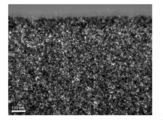
- Example 4 is a scanning ion microscope image of the upper side of the cross section of the coating film of Example 4.
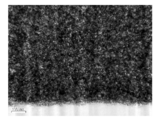
- FIG. 6 is a scanning ion microscope image of the lower side of the cross section of the coating film of Example 4.
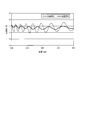
- FIG. It is a reflection spectrum of Example 4 and Comparative Example 4.
- the inorganic particle dispersion liquid of this embodiment is a dispersion liquid in which inorganic particles are a dispersant having a hydrolyzable group and are dispersed in a dispersion medium, which contains a basic substance and has a water content of 1 mass. % Or less.
- the content of water in the inorganic particle dispersion of this embodiment is 1% by mass or less, preferably 0.7% by mass or less, more preferably 0.5% by mass or less, and More preferably, it is 4 mass% or less.
- the water content is preferably as small as possible.
- the water content in this embodiment means a value titrated with a Karl Fischer moisture meter (model number: AQL-22320, manufactured by Hiranuma Sangyo Co., Ltd.).
- the value obtained by dividing the particle size (D90) when the cumulative volume percentage of the particle size distribution is 90% by the particle size (D50) when the cumulative volume percentage of the particle size distribution is 50%. Is preferably 1 or more and 4 or less, more preferably 1 or more and 3 or less, and still more preferably 1 or more and 2 or less.
- the particle size distribution is a particle size distribution of the inorganic particles contained in the inorganic particle dispersion.
- the inorganic particles can be uniformly dispersed in the resin, and the refractive index distribution in the film can be made uniform. As a result, color unevenness such as interference fringes can be reduced. Moreover, since coarse particles are reduced, there is also an effect that generation of foreign matters during coating can be suppressed.
- D50 and D90 in this embodiment mean values measured by a particle size distribution meter (trade name: Microtrac UPA150, manufactured by Nikkiso Co., Ltd.) using the dynamic light scattering method as a measurement principle.
- D50 in the inorganic particle dispersion liquid of the present embodiment is preferably 1 nm or more and 45 nm or less, and more preferably 1 nm or more and 20 nm or less from the viewpoint of improving the transparency of the inorganic particle dispersion liquid.
- an inorganic particle dispersion liquid containing inorganic particles, a dispersant having a hydrolyzable group, a basic substance, and a dispersion medium will be described.
- inorganic particles The inorganic particles in the present embodiment are not particularly limited, and inorganic particles having desired characteristics are appropriately selected and used. For example, when high refractive index performance is imparted to the inorganic particle dispersion, inorganic particles having a refractive index of 1.9 or more are used.
- inorganic particles examples include zirconium oxide, zinc oxide, iron oxide, copper oxide, titanium oxide, tin oxide, cerium oxide, tantalum oxide, niobium oxide, tungsten oxide, europium oxide, hafnium oxide, potassium titanate, Metal oxides such as barium titanate, strontium titanate, potassium niobate, lithium niobate, calcium tungstate, antimony-containing tin oxide (ATO), and tin-containing indium oxide (ITO) are preferably used.
- zirconium oxide and titanium oxide are particularly preferable from the viewpoint of high refractive index and little influence by coloring.
- inorganic particles having ultraviolet shielding properties are appropriately selected and used.
- examples of such inorganic particles include zinc oxide, titanium oxide, iron oxide, cerium oxide, and the like.
- the metal oxide which has electroconductivity is used. Examples of such metal oxides include antimony-containing tin oxide (ATO) and tin-containing indium oxide (ITO).
- the average primary particle diameter of the inorganic particles may be appropriately selected depending on the use, but in order to obtain an inorganic particle dispersion excellent in transparency, it is preferably 1 nm or more and 30 nm or less, preferably 5 nm or more and 25 nm. The following is more preferable.
- the “average primary particle size” means the particle size of each particle itself.
- the major axis of each metal oxide particle for example, 100 or more metal oxide particles, preferably using a scanning electron microscope (SEM), a transmission electron microscope (TEM), etc. Includes a method of measuring the major axis of each of the 500 metal oxide particles and calculating the arithmetic average value thereof.
- the content of the inorganic particles in the inorganic particle dispersion may be appropriately adjusted according to the use, but is preferably 5% by mass or more and 50% by mass or less, and more preferably 10% by mass or more and 40% by mass or less. By setting the content of the inorganic particles in the inorganic particle dispersion to the above range, good dispersion stability of the inorganic particles in the inorganic particle dispersion can be obtained.
- the dispersant having a hydrolyzable group in the present embodiment has a hydrolyzable group, and the surface of the inorganic particles is modified to make the particle surface hydrophobic, thereby improving the dispersibility of the inorganic particles in a solvent or a resin.
- a dispersant having an alkoxy group is preferably used.
- examples of such a dispersant having an alkoxy group include metal alkoxides, silane coupling agents, silicone compounds, and the like.
- an alkoxy group a methoxy group and an ethoxy group are preferable.
- alkoxysilane is preferable.
- tetraalkoxysilane is preferable.
- Tetraalkoxysilanes include tetramethoxysilane, tetraethoxysilane, tetra n-propoxysilane, tetraisopropoxysilane, tetra n-butoxysilane, tetraisobutoxysilane, tetrasec-butoxysilane, tetrat-butoxysilane, tetraphenoxy Examples thereof include silane, monoethoxytrimethoxysilane, monobutoxytrimethoxysilane, monopentoxytrimethoxysilane, monohexoxytrimethoxysilane, dimethoxydiethoxysilane, dimethoxydibutoxysilane and the like.
- tetramethoxysilane and tetraethoxysilane are preferably used because they have a high silicon (Si) content and are easy to adjust the concentration when dispersed in a solvent, and have high hydrolysis / condensation reactivity. be able to.
- These tetraalkoxysilanes may be used alone or in combination of two or more.
- the silane coupling agent is not particularly limited as long as it has an alkoxy group.
- Silane coupling agents include allyltrimethoxysilane, allyltriethoxysilane, vinylethyldimethoxysilane, vinylethyldiethoxysilane, 3-glycidoxypropylethyldimethoxysilane, 3-glycidoxypropyltriethyldiethoxysilane.
- silane coupling agents vinyldiethylmethoxysilane, vinyldiethylethoxysilane, 3-glycidoxypropyldiethylmethoxysilane, 3-glycidoxypropyldiethylethoxysilane, p-styryldiethylmethoxysilane, p-styryldiethyl Ethoxysilane, 3-acryloxypropyldiethylmethoxysilane, 3-acryloxypropyldiethylethoxysilane, 3-methacryloxypropyldiethylmethoxysilane, 3-methacryloxypropyldiethylethoxysilane, allyldiethylmethoxysilane, allyldiethylethoxysilane, etc. Can be mentioned.
- These silane coupling agents may be used alone or in combination of two or more.
- the silicone compound is not particularly limited as long as it has an alkoxy group, and a silicone resin having a methoxy group or an ethoxy group is used.
- the addition amount of the dispersant having an alkoxy group is appropriately adjusted to such an extent that good dispersibility is obtained.
- the addition amount of the dispersant having an alkoxy group is, for example, preferably 5% by mass or more and 120% by mass or less, and preferably 10% by mass or more and 110% by mass or less with respect to the total mass of the inorganic particles. More preferably, it is 15 mass% or more and 100 mass% or less.
- the basic substance in the present embodiment is a substance having a hydrogen ion index (pH) greater than 7 when mixed with water, and the water content of the inorganic particle dispersion is 1% by mass or less.
- pH hydrogen ion index
- examples of such basic substances include alkali metal or alkaline earth metal hydroxides, amines, and the like, and amines are preferable in terms of easy handling.
- alkali metal or alkaline earth metal hydroxide examples include inorganic basic substances such as calcium hydroxide, magnesium hydroxide, manganese hydroxide, aluminum hydroxide, iron hydroxide, potassium hydroxide, and sodium hydroxide. Is mentioned.
- amines examples include amines, amides, amine dispersants, amine surfactants, amide type monomers, amine solvents, amide solvents, and the like.
- amine any of primary amine, secondary amine, and tertiary amine may be used, and these may be mixed and used, but it is more preferable to use a tertiary amine.
- amide type monomer for example, an acrylamide type monomer or a methacrylamide type monomer is preferably used.
- amide type monomers examples include hydroxyethyl acrylamide, hydroxyethyl methacrylamide, dimethylaminopropyl acrylamide, dimethylaminopropyl methacrylamide, N- [3- (dimethylamino) propyl] acrylamide, N- [3- ( Dimethylamino) propyl] methacrylamide and the like.
- the added amount of the basic substance is a value obtained by dividing the particle size (D90) when the cumulative volume percentage of the particle size distribution is 90% by the particle size (D50) when the cumulative volume percentage of the particle size distribution is 50%. Although it may be appropriately adjusted so as to be 1 or more and 4 or less, it is preferable that the basic substance is contained in the inorganic particle dispersion liquid by 0.01% by mass or more and 1% by mass or less.
- the inorganic particle dispersion liquid By containing the basic substance in the inorganic particle dispersion liquid, hydrolysis of the dispersant having an alkoxy group such as a silane coupling agent is promoted even when the water content is 1% by mass or less, and the particles Inorganic particles can be dispersed in a dispersion medium in a state where the diameters are uniform.
- the dispersion medium is not particularly limited as long as the inorganic particles are easily dispersed and other than water.
- examples of the dispersion medium include aliphatic hydrocarbons such as hexane, heptane, and cyclohexane, aromatic hydrocarbons such as toluene and xylene, alcohols such as methanol, ethanol, and propanol, and halogenation such as methylene chloride and ethylene chloride.
- Hydrocarbons acetone, methyl ethyl ketone, methyl isobutyl ketone, ketones such as 2-pentanone and isophorone, esters such as ethyl acetate and butyl acetate, cellosolves such as ethyl cellosolve, propylene glycol monomethyl ether, propylene glycol monoethyl ether, etc. Ethers, amide solvents, ether ester solvents, resin monomers, resin oligomers, and the like.
- Examples of the method for producing the inorganic particle dispersion of the present embodiment include a method of mechanically mixing the above-described materials as constituents of the inorganic particle dispersion and dispersing the inorganic particles in a solvent.
- Examples of the dispersing device include a stirrer, a self-revolving mixer, a homogenizer, and an ultrasonic homogenizer.
- the inorganic particles are dispersed in a dispersion medium with a dispersant having a hydrolyzable group, contain a basic substance, and have a water content of 1% by mass or less. Therefore, since it has a sharp particle size distribution, it is excellent in the dispersion stability of the inorganic particles and in the stability of long-term storage of the dispersion.
- the value obtained by dividing the particle size (D90) when the cumulative volume percentage of the particle size distribution is 90% by the particle size (D50) when the cumulative volume percentage of the particle size distribution is 50%.
- it is 1 or more and 4 or less, it is more excellent in the dispersion stability of inorganic particles, and it is excellent in the stability of long-term storage of the dispersion.
- an inorganic particle dispersion excellent in transparency can be obtained.
- the inorganic particles are particles having a refractive index of 1.9 or more, an inorganic particle dispersion having a high refractive index can be obtained.
- the inorganic particles are particles having ultraviolet shielding properties, an inorganic particle dispersion having excellent weather resistance can be obtained.
- the inorganic particle containing composition of this embodiment contains the inorganic particle dispersion liquid of this embodiment and a binder component.
- Binder component Although a binder component is not specifically limited, for example, a resin monomer, a resin oligomer, a resin polymer, an organosilicon compound, its polymer, etc. can be used conveniently.
- the binder component in applications such as a display device is not particularly limited as long as it is a monomer or oligomer of a curable resin used for a general hard coat film, and a monomer or oligomer of a photocurable resin may be used. Alternatively, a monomer or oligomer of a thermosetting resin may be used. It is preferable to use a monomer of a photocurable resin because it is easy to obtain a film having high transparency and a strong hard coat property. Among the monomers of the photocurable resin, one or more acryloyl groups and It is preferable to use a crosslinkable compound having either one or both of methacryloyl groups.
- polyfunctional means having three or more functional groups. All of the three or more functional groups may be the same functional group or different functional groups. Examples of the functional group other than the acryloyl group and methacryloyl group possessed by the crosslinkable compound include a vinyl group, an allyl group, an allyl ether group, a styryl group, and a hydroxyl group.
- polyfunctional acrylate examples include, for example, (meth) trimethylolpropane triacrylate, (meth) ditrimethylolpropane tetraacrylate, (meth) pentaerythritol triacrylate, (meth) pentaerythritol tetraacrylate, (meth) dipenta
- polyol polyacrylates such as erythritol hexaacrylate, epoxy (meth) acrylates, polyester (meth) acrylates, urethane acrylates, and polysiloxane acrylates. These polyfunctional acrylates may be used alone or in combination of two or more.
- the inorganic particle-containing composition of the present embodiment has one or two functional groups within a range that does not inhibit the effects of the invention, and is not included in the above-mentioned monomers.
- dispersant examples include anionic surfactants such as sulfate esters, carboxylic acids, and polycarboxylic acids, cationic surfactants such as quaternary salts of higher aliphatic amines, higher fatty acid polyethylene glycol esters, and the like.
- anionic surfactants such as sulfate esters, carboxylic acids, and polycarboxylic acids
- cationic surfactants such as quaternary salts of higher aliphatic amines, higher fatty acid polyethylene glycol esters, and the like.
- Nonionic surfactants silicon surfactants, fluorine surfactants, polymer surfactants having an amide ester bond, and the like.
- a polymerization initiator is suitably selected according to the kind of monomer to be used.
- a photopolymerization initiator is used.
- the kind and amount of the photopolymerization initiator are appropriately selected according to the monomer of the photocurable resin to be used.
- the photopolymerization initiator for example, benzophenone, diketone, acetophenone, benzoin, thioxanthone, quinone, benzyldimethyl ketal, alkylphenone, acylphosphine oxide, phenylphosphine oxide, and the like are known. The photoinitiator of this is mentioned.
- the viscosity is 0.2 mPa ⁇ s or more and 500 mPa ⁇ s or less in order to facilitate coating. Preferably, it is 0.5 mPa ⁇ s or more and 200 mPa ⁇ s or less. If the viscosity of the inorganic particle-containing composition is 0.2 mPa ⁇ s or more, it is preferable because the film thickness when formed into a coating film does not become too thin and the film thickness can be easily controlled. On the other hand, if the viscosity of the inorganic particle-containing composition is 500 mPa ⁇ s or less, the viscosity is not too high, and the inorganic particle-containing composition is preferably handled at the time of coating.
- the viscosity of the inorganic particle-containing composition is preferably adjusted to the above range by appropriately adding an organic solvent to the inorganic particle-containing composition.
- the organic solvent is not particularly limited as long as it is compatible with the inorganic particle-containing composition.
- aliphatic hydrocarbons such as hexane, heptane, and cyclohexane
- aromatic hydrocarbons such as toluene and xylene.
- Alcohols such as methanol, ethanol and propanol, halogenated hydrocarbons such as methylene chloride and ethylene chloride, ketones such as acetone, methyl ethyl ketone, methyl isobutyl ketone, 2-pentanone and isophorone, esters such as ethyl acetate and butyl acetate , Cellosolves such as ethyl cellosolve, ethers such as propylene glycol monomethyl ether and propylene glycol monoethyl ether, amide solvents, and ether ester solvents. These solvents may be used alone or in combination of two or more.
- the inorganic particle-containing composition of the present embodiment since the inorganic particle of the present embodiment contains an inorganic particle dispersion having a sharp particle size distribution, the dispersion stability of the inorganic particles is excellent, and the composition can be stored for a long time. Excellent stability.
- Method for producing inorganic particle-containing composition As a manufacturing method of the inorganic particle containing composition of this embodiment, the method of mixing each material mentioned above as a component of an inorganic particle containing composition mechanically is mentioned.
- the mixing device include a stirrer, a self-revolving mixer, a homogenizer, and an ultrasonic homogenizer.
- the coating film of this embodiment is formed using the inorganic particle containing composition of this embodiment.
- the film thickness of this coating film is suitably adjusted according to a use, it is preferable that they are 0.01 micrometer or more and 20 micrometers or less normally, and it is more preferable that they are 1 micrometer or more and 10 micrometers or less.
- the manufacturing method of the coating film of this embodiment has the process of forming a coating film by apply
- the coating method for forming a coating film include a bar coating method, a flow coating method, a dip coating method, a spin coating method, a roll coating method, a spray coating method, a meniscus coating method, a gravure coating method, a suction coating method, A normal wet coating method such as a brush coating method is used.
- the energy ray used for photocuring is not particularly limited as long as the coating is cured.
- energy such as ultraviolet rays, far infrared rays, near ultraviolet rays, infrared rays, X rays, ⁇ rays, electron beams, proton rays, neutron rays, etc.
- a line is used.
- ultraviolet rays it is preferable to use ultraviolet rays because the curing speed is fast and the device is easily available and handled.
- a high pressure mercury lamp that generates ultraviolet light in the wavelength band of 200 nm ⁇ 500 nm, a metal halide lamp, xenon lamp, using a chemical lamp or the like, at the 100 ⁇ 3,000mJ / cm 2 energy, ultraviolet The method of irradiating etc. is mentioned.
- the inorganic particles having a sharp particle size distribution in the present embodiment in other words, in the inorganic particle-containing composition, the size of the inorganic particles is almost uniform.
- the particles are easily filled uniformly without gaps. Therefore, the film-forming property of the coating film is excellent, and the performance at all locations in the film surface is uniform. Therefore, for example, since the refractive index in the film surface becomes almost uniform, the occurrence of uneven color in the coating film is suppressed, and the visibility can be improved when applied to a display device or the like.
- the inorganic particles are uniformly filled in the film, and there are few voids in the film. Therefore, for example, when it is desired to improve the refractive index using inorganic particles having a refractive index of 1.9 or more, the amount of inorganic particles required to improve the refractive index can be reduced as compared with the conventional case. Accordingly, even in a thin film of 10 nm to 200 nm, the entire coating film is uniformly filled with inorganic particles, and the voids in the film can be reduced uniformly, so that the refractive index of the coating film can be improved. it can.
- the coating film of this embodiment since the performance in all the places in a film surface becomes uniform, even if it is a thick film with a film thickness of 1 micrometer or more, generation
- the coating film of this embodiment since it is formed using the inorganic particle containing composition of this embodiment, the coating film excellent in film formability can be obtained.
- the plastic substrate with a coating film of this embodiment has a base body (plastic base material) formed using a resin material, and the coating film of this embodiment provided on at least one surface of the base body.
- the plastic substrate with a coating film is obtained by coating the inorganic particle-containing composition of the present embodiment on the substrate body using a known coating method to form a coating film and curing the coating film. It is done.
- the substrate body is not particularly limited as long as it is a plastic substrate.
- a plastic substrate For example, polyethylene terephthalate, triacetyl cellulose, acrylic, acrylic-styryl copolymer, acrylonitrile-butadiene-styrene copolymer, polystyrene, polyethylene, polypropylene, polycarbonate Those formed from plastic such as vinyl chloride are used.
- a plastic substrate having optical transparency as the substrate body.
- the substrate body may be in the form of a sheet or film, but is preferably in the form of a film.
- the plastic substrate with a coating film of the present embodiment has a haze value of preferably 1.4% or less, more preferably 1.0% or less, when measured on the basis of air.
- the “haze value” is a ratio (%) of diffuse transmitted light to total light transmitted light, and a haze meter NDH-2000 (manufactured by Nippon Denshoku Co., Ltd.) is used on the basis of air. It means a value measured based on the standard JIS-K-7136.
- the difference between the maximum value and the minimum value of reflectance within a range of 500 nm or more and 750 nm or less is preferably 1% or less, and preferably 0.8% or less. More preferred is 0.7% or less.
- the coated plastic substrate of this embodiment has optical interference. This is preferable because the occurrence of ripples due to the above is suppressed, and a coating film in which color unevenness is suppressed is obtained.
- a hard coat film may be provided between the plastic substrate and the coating film, or a film having a different performance such as a refractive index from the coating film may be laminated.
- the coating film of this embodiment since the coating film of this embodiment is formed, a plastic substrate with a coating film having excellent film forming properties can be obtained.
- the display device of the present embodiment includes at least one of the coating film of the present embodiment and the plastic substrate with a coating film of the present embodiment, that is, the coating film of the present embodiment and the plastic substrate with a coating film of the present embodiment. Either one or both.
- the display device is not particularly limited, but in this embodiment, a liquid crystal display device for a touch panel will be described.
- the touch panel In the touch panel, when the refractive index difference between the ITO electrode and the transparent base material (plastic base material such as polyethylene terephthalate) is large, a so-called bone appearance phenomenon occurs in which the ITO electrode portion is easily visible. Therefore, the difference in the refractive index between the transparent substrate and the ITO electrode is mitigated by providing the coating film of the present embodiment in which inorganic particles having a refractive index of 1.9 or more are selected as a layer between the transparent substrate and the ITO electrode. Thus, the bone appearance phenomenon can be suppressed.
- the method of providing either one or both of the coating film of this embodiment and the plastic substrate with a coating film of this embodiment on the touch panel is not particularly limited, and may be implemented by a known method. For example, the structure etc. which patterned the ITO electrode on the coating-film surface of the plastic base material with a coating film of this embodiment, and laminated
- the display device of the present embodiment since it includes at least one of the coating film of the present embodiment and the plastic substrate with a coating film of the present embodiment, which is excellent in film formability, optical in the coating film surface is provided. Since there is almost no variation in characteristics, a display device with excellent visibility can be obtained.
- Example 1 "Inorganic particle dispersion" Zirconium oxide (average primary particle size 12 nm, manufactured by Sumitomo Osaka Cement Co., Ltd.) 30% by mass, 3-methacryloxypropyltrimethoxysilane 6.0% by mass, alkyldimethylamine 0.4% by mass, propylene glycol monomethyl ether After mixing 63.6% by mass, dispersion treatment was performed using a bead mill to obtain an inorganic particle dispersion of Example 1.
- Inorganic particle-containing composition The obtained inorganic particle dispersion was 5.4% by mass, dipentaerythritol hexaacrylate was 0.19% by mass, 2-hydroxy-1- ⁇ 4- [4- (2-hydroxy-2-methyl-propionyl)- [Benzyl] phenyl ⁇ -2-methyl-propan-1-one and 0.02% by mass of propylene glycol monomethyl ether were mixed to obtain an inorganic particle-containing composition of Example 1.
- Poly substrate with coating film 40% by mass of dipentaerythritol hexaacrylate, 2 of 2-hydroxy-1- ⁇ 4- [4- (2-hydroxy-2-methyl-propionyl) -benzyl] phenyl ⁇ -2-methyl-propan-1-one
- a composition for forming a hard coat film was obtained by mixing 58% by mass of mass% and methyl isobutyl ketone.
- This composition for forming a hard coat film was applied to a 100 ⁇ m thick polyethylene terephthalate film by a bar coating method so that the dry film thickness was 1 ⁇ m, and dried by heating at 90 ° C. to form a coating film.
- a high-pressure mercury lamp 120 W / cm
- the coating film was exposed to ultraviolet rays with an energy of 250 mJ / cm 2 to cure the coating film, thereby obtaining a substrate with a hard coat film.
- the inorganic particle-containing composition of Example 1 was applied on the hard coat film of the substrate with the hard coat film by a bar coating method so that the dry film thickness was 100 nm, and heated at 90 ° C. to dry. To form a coating film.
- the coating film was exposed to ultraviolet rays so as to have an energy of 250 mJ / cm 2 , and the coating film was cured to obtain a plastic substrate with a coating film of Example 1. .
- refractive index of coating film The refractive index of the coating film was measured using a prism coupler model 2010 (Mericon).
- Color unevenness of plastic substrate with coating film The color unevenness of the plastic substrate with a coating film was evaluated by visually observing with a gap of 30 cm between the substrate and the eyes, and when there was no color unevenness or almost inconspicuous, and x when there was color unevenness. The evaluation results are shown in Table 1.
- Example 2 "Inorganic particle dispersion" Zirconium oxide (average primary particle size 12 nm, manufactured by Sumitomo Osaka Cement Co., Ltd.) 30% by mass, 3-methacryloxypropyltrimethoxysilane 4.5% by mass, amine-based dispersant 0.4% by mass, methyl isobutyl ketone After mixing 65.1% by mass, dispersion treatment was performed using a bead mill to obtain an inorganic particle dispersion of Example 2.
- Example 2 “Inorganic particle-containing composition, plastic substrate with coating” Except having used the inorganic particle dispersion liquid of Example 2, the inorganic particle containing composition of Example 2 and the plastic substrate with a coating film of Example 2 were obtained in the same manner as Example 1.
- Example 3 Zinc oxide (trade name: ZnO650, average primary particle size 25 nm, manufactured by Sumitomo Osaka Cement Co., Ltd.) 10% by mass, tetramethoxysilane 10% by mass, dimethylaminopropylacrylamide 0.4% by mass, isopropyl alcohol 77.6%. After mixing by mass%, a dispersion treatment was performed using a bead mill to obtain an inorganic particle dispersion of Example 3.
- ZnO650 average primary particle size 25 nm, manufactured by Sumitomo Osaka Cement Co., Ltd.
- Example 4 "Inorganic particle-containing composition" 58% by mass of the inorganic particle dispersion of Example 2, 11% by mass of dipentaerythritol hexaacrylate, 2-hydroxy-1- ⁇ 4- [2- (2-hydroxy-2-methyl-propionyl) -benzyl] phenyl ⁇ 0.5% by mass of 2-methyl-propan-1-one and 30.5% by mass of propylene glycol monomethyl ether were mixed to obtain an inorganic particle-containing composition of Example 4.
- the inorganic particle-containing composition of Example 4 was applied to a 100 ⁇ m thick polyethylene terephthalate film by a bar coating method so as to have a dry film thickness of 1.5 ⁇ m, dried by heating at 90 ° C. Formed. Next, using a high-pressure mercury lamp (120 W / cm), the coating film was exposed to ultraviolet rays so as to have an energy of 250 mJ / cm 2 , and the coating film was cured to obtain a plastic substrate with a coating film of Example 4. It was.
- Example 4 About the plastic base material with a coating film of Example 4, the total light transmittance, haze value, and the color nonuniformity of the plastic base material with a coating film were evaluated similarly to Example 1.
- the refractive index of the coating film was measured using an Abbe refractometer (model number: DR-M2, manufactured by Atago Co., Ltd.). The evaluation results are shown in Table 1.
- Comparative Example 1 instead of using 6.0% by mass of 3-methacryloxypropyltrimethoxysilane, 0.4% by mass of alkyldimethylamine, and 63.6% by mass of propylene glycol monomethyl ether, 4 of 3-methacryloxypropyltrimethoxysilane was used. An attempt was made to prepare an inorganic particle dispersion of Comparative Example 1 containing no basic substance in the same manner as in Example 1 except that 5% by mass and 65.5% by mass of methyl ethyl ketone were used. Inorganic particles settled and no dispersion was obtained.
- Comparative Example 2 instead of using 6.0% by mass of 3-methacryloxypropyltrimethoxysilane, 0.4% by mass of alkyldimethylamine, and 63.6% by mass of propylene glycol monomethyl ether, 4 of 3-methacryloxypropyltrimethoxysilane was used.
- An inorganic particle dispersion of Comparative Example 2 containing a large amount of water was obtained in the same manner as in Example 1 except that 3% by mass of 5% by mass, 1% by mass of sodium hydroxide aqueous solution and 62.5% by mass of methyl ethyl ketone were used. It was.
- the inorganic particle-containing composition of Comparative Example 4 was applied to a 100 ⁇ m-thick polyethylene terephthalate film by a bar coating method so as to have a dry film thickness of 1.5 ⁇ m, dried by heating at 90 ° C. Formed. Next, using a high-pressure mercury lamp (120 W / cm), the coating film was exposed to ultraviolet rays with an energy of 250 mJ / cm 2 to cure the coating film, and a plastic substrate with a coating film of Comparative Example 4 was obtained. It was.
- the total light transmittance, the haze value, and the color nonuniformity of the plastic base material with a coating film were evaluated similarly to Example 1.
- the refractive index of the coating film was measured using an Abbe refractometer (model number: DR-M2, manufactured by Atago Co., Ltd.). The evaluation results are shown in Table 1.
- Example 4 when the reflection spectrum of Example 4 and the reflection spectrum of Comparative Example 4 are compared, even when the film thickness is as thick as 1.5 ⁇ m, the plastic substrate with a coating film of Example 4 It was confirmed that the amplitude of ripple caused by light interference was small, and color unevenness was suppressed visually. Further, in order to adjust the refractive index of Comparative Example 4 to the same refractive index as that of Example 4, it is necessary to increase the content of zirconium oxide of Comparative Example 4, and Example 4 has less zirconium oxide than the conventional film. It was confirmed that the refractive index could be improved by the amount.
- the inorganic particle dispersion of the present invention can be applied to all industrial uses in which the inorganic particle dispersion is conventionally used. For example, it can be applied to optical film use, house exterior use, heat ray shielding use, and the like. it can.
Landscapes
- Chemical & Material Sciences (AREA)
- Organic Chemistry (AREA)
- Health & Medical Sciences (AREA)
- Polymers & Plastics (AREA)
- Medicinal Chemistry (AREA)
- Chemical Kinetics & Catalysis (AREA)
- Materials Engineering (AREA)
- Wood Science & Technology (AREA)
- Life Sciences & Earth Sciences (AREA)
- Engineering & Computer Science (AREA)
- Inorganic Chemistry (AREA)
- Paints Or Removers (AREA)
- Pigments, Carbon Blacks, Or Wood Stains (AREA)
- Colloid Chemistry (AREA)
Abstract
Description
本願は、2013年9月30日に、日本に出願された特願2013-202984号に基づき優先権を主張し、その内容をここに援用する。
例えば、液晶ディスプレイ(LCD)、プラズマディスプレイ(PDP)、エレクトロルミネッセンスディスプレイ(EL)等の表示装置で用いられるプラスチック基材には、透明性、屈折率、機械的特性等が求められる。そこで、プラスチック基材に、屈折率が高い無機微粒子と樹脂を混合した組成物を塗布して、機能性膜を設けること等が行われている。
アルコキシド等の加水分解性基は、酸性または塩基性下で水を共存させることによって加水分解された水酸基が、無機粒子に吸着・脱水縮合する性質がある。
無機粒子の表面は、通常、親水性であるため、バインダーと複合化して高い透明性を維持するためには、無機粒子の表面を分散剤等で疎水化し、無機粒子の有機溶媒に対する分散性を高めることが重要である。
また、金属酸化物微粒子をビーズミル処理時にシランカップリング剤で有機化し、超音波処理時に、その金属酸化物微粒子と、重合性官能基を有するイソシアネート化合物とを反応させることにより、金属酸化物微粒子を分散化させた分散体が提案されている(例えば、特許文献2参照)。
また、水が多く含まれるため、樹脂等のバインダー成分と混合して塗膜化した場合に、塗膜外観に異物等が発生しやすく、成膜性に優れないという問題があった。
[1]本発明の無機粒子分散液は、無機粒子が、加水分解性基を有する分散剤で、分散媒に分散されてなる分散液であって、塩基性物質を含み、水の含有量が1質量%以下であることを特徴とする無機粒子分散液である。
本実施形態の無機粒子分散液は、無機粒子が、加水分解性基を有する分散剤で、分散媒に分散されてなる分散液であって、塩基性物質を含み、水の含有量が1質量%以下である。
無機粒子分散液が、水を、1質量%を超えた量を含有すると、シャープな粒度分布を有する分散液が得られないばかりでなく、長期保管の安定性が悪くなるため、無機粒子分散液の水の含有量は出来る限り少ないことが好ましい。
なお、本実施形態における水の含有量は、カールフィッシャー水分計(型番:AQL-22320、平沼産業社製)で滴定された値を意味する。
粒度分布の累積体積百分率が90%のときの粒径(D90)を、粒度分布の累積体積百分率が50%のときの粒径(D50)で除した値を、上記の範囲内とすることにより、樹脂中に均一に無機粒子を分散させることが可能となり、膜内の屈折率分布を均一にすることができる。これにより、干渉縞といった色ムラを低減することが可能となる。また、粗大粒子が低減されるため、塗工時の異物発生を抑制できるといった効果もある。
本実施形態における無機粒子は、特に限定されず、所望の特性を有する無機粒子が適宜選択されて用いられる。
例えば、無機粒子分散液に高屈折率性能を付与する場合には、屈折率が1.9以上の無機粒子が用いられる。このような無機粒子としては、例えば、酸化ジルコニウム、酸化亜鉛、酸化鉄、酸化銅、酸化チタン、酸化錫、酸化セリウム、酸化タンタル、酸化ニオブ、酸化タングステン、酸化ユーロピウム、酸化ハフニウム、チタン酸カリウム、チタン酸バリウム、チタン酸ストロンチウム、ニオブ酸カリウム、ニオブ酸リチウム、タングステン酸カルシウム、アンチモン含有酸化スズ(ATO)、スズ含有酸化インジウム(ITO)等の金属酸化物が好適に用いられる。これらの中でも、屈折率の高さ、着色による影響の少なさの点から、酸化ジルコニウム、酸化チタンが特に好ましい。
また、無機粒子分散液に導電性を付与する場合には、導電性を有する金属酸化物が用いられる。このような金属酸化物としては、例えば、アンチモン含有酸化スズ(ATO)、スズ含有酸化インジウム(ITO)等が挙げられる。
無機粒子分散液中における無機粒子の含有量を、上記の範囲とすることにより、無機粒子分散液中における無機粒子の良好な分散安定性を得ることができる。
本実施形態における加水分解性基を有する分散剤としては、加水分解性基を有し、無機粒子の表面に表面修飾されて粒子表面を疎水化し、無機粒子の溶媒や樹脂への分散性を向上させるものであれば特に限定されず、例えば、アルコキシ基を有する分散剤が好適に用いられる。
このようなアルコキシ基を有する分散剤としては、例えば、金属アルコキシド、シランカップリング剤、シリコーン化合物等が挙げられる。
アルコキシ基としては、メトキシ基、エトキシ基が好ましい。
アルコキシシランとしては、テトラアルコキシシランが好ましい。
テトラアルコキシシランとしては、テトラメトキシシラン、テトラエトキシシラン、テトラn-プロポキシシラン、テトライソプロポキシシラン、テトラn-ブトキシシラン、テトライソブトキシシラン、テトラsec-ブトキシシラン、テトラt-ブトキシシラン、テトラフェノキシシラン、モノエトキシトリメトキシシラン、モノブトキシトリメトキシシラン、モノペントキシトリメトキシシラン、モノヘトキシトリメトキシシラン、ジメトキシジエトキシシラン、ジメトキシジブトキシシラン等が挙げられる。
これらの中でも、テトラメトキシシラン、テトラエトキシシランは、ケイ素(Si)の含有量が多く、溶媒に分散した場合に濃度を調整し易いこと、加水分解・縮合反応性が高いことから、好適に用いることができる。
これらのテトラアルコキシシランは、1種単独で用いてもよく、2種以上を同時に用いてもよい。
これらのシランカップリング剤は、1種単独で用いてもよく、2種以上を同時に用いてもよい。
本実施形態における塩基性物質としては、水と混合した場合に水素イオン指数(pH)が7より大となる物質であり、かつ、無機粒子分散液の水の含有量が1質量%以下であっても、均一に混合できる物質であれば、特に限定されない。
このような塩基性物質としては、アルカリ金属またはアルカリ土類金属の水酸化物、アミン類等が挙げられ、取り扱いが容易な点で、アミン類が好ましい。
アミンとしては、一級アミン、二級アミン、三級アミンのいずれを用いてもよく、これらを混合して用いてもよいが、三級アミンを用いることがより好ましい。
アミド型モノマーとしては、例えば、アクリルアミド型モノマーやメタクリルアミド型モノマーが好適に用いられる。このようなアミド型モノマーとしては、例えば、ヒドロキシエチルアクリルアミド、ヒドロキシエチルメタクリルアミド、ジメチルアミノプロピルアクリルアミド、ジメチルアミノプロピルメタクリルアミド、N-[3-(ジメチルアミノ)プロピル]アクリルアミド、N-[3-(ジメチルアミノ)プロピル]メタクリルアミド等が挙げられる。
無機粒子分散液が塩基性物質を含有することにより、水の含有量が1質量%以下と少量であっても、シランカップリング剤等のアルコキシ基を有する分散剤の加水分解が促進され、粒径が揃った状態で無機粒子を分散媒に分散させることができる。
分散媒は、無機粒子が分散されやすく、かつ、水以外であれば特に限定されない。分散媒としては、例えば、ヘキサン、ヘプタン、シクロヘキサン等の脂肪族炭化水素類、トルエン、キシレン等の芳香族炭化水素類、メタノール、エタノール、プロパノール等のアルコール類、塩化メチレン、塩化エチレン等のハロゲン化炭化水素類、アセトン、メチルエチルケトン、メチルイソブチルケトン、2-ペンタノン、イソホロン等のケトン類、酢酸エチル、酢酸ブチル等のエステル類、エチルセロソルブ等のセロソルブ類、プロピレングリコールモノメチルエーテル、プロピレングリコールモノエチルエーテル等のエーテル類、アミド系溶媒、エーテルエステル系溶媒、樹脂モノマー、樹脂オリゴマー等が挙げられる。
分散装置としては、例えば、撹拌機、自公転式ミキサー、ホモジナイザー、超音波ホモジナイザー等が挙げられる。
また、無機粒子が、屈折率が1.9以上の粒子である場合には、屈折率が高い無機粒子分散液が得られる。
さらに、無機粒子が紫外線遮蔽性を有する粒子である場合には、耐候性に優れた無機粒子分散液が得られる。
本実施形態の無機粒子含有組成物は、本実施形態の無機粒子分散液と、バインダー成分とを含有してなる。
バインダー成分は、特に限定されないが、例えば、樹脂モノマー、樹脂オリゴマー、樹脂ポリマー、有機ケイ素化合物またはその重合体等を好適に用いることができる。
透明性が高く、ハードコート性が強い膜が得られやすい点で、光硬化性樹脂のモノマーを用いることが好ましく、光硬化性樹脂のモノマーの中でもさらに、分子中に1個以上のアクリロイル基およびメタクリロイル基のいずれか一方または両方を有する架橋性化合物を用いることが好ましい。
上記の架橋性化合物が有するアクリロイル基、メタクリロイル基以外の官能基としては、例えば、ビニル基、アリル基、アリルエーテル基、スチリル基、水酸基等が挙げられる。
無機粒子含有組成物の粘度が0.2mPa・s以上であれば、塗膜にした時の膜厚が薄くなりすぎず、膜厚の制御が容易であるため好ましい。一方、無機粒子含有組成物の粘度が500mPa・s以下であれば、粘度が高すぎず塗工時における無機粒子含有組成物の取扱いが容易となるため好ましい。
有機溶媒としては、上記無機粒子含有組成物と相溶性がよいものであれば特に限定されず、例えば、ヘキサン、ヘプタン、シクロヘキサン等の脂肪族炭化水素類、トルエン、キシレン等の芳香族炭化水素類、メタノール、エタノール、プロパノール等のアルコール類、塩化メチレン、塩化エチレン等のハロゲン化炭化水素類、アセトン、メチルエチルケトン、メチルイソブチルケトン、2-ペンタノン、イソホロン等のケトン類、酢酸エチル、酢酸ブチル等のエステル類、エチルセロソルブ等のセロソルブ類、プロピレングリコールモノメチルエーテル、プロピレングリコールモノエチルエーテル等のエーテル類、アミド系溶媒、エーテルエステル系溶媒が挙げられる。これらの溶媒は、1種単独で用いてもよく、2種以上を混合して用いてもよい。
本実施形態の無機粒子含有組成物の製造方法としては、無機粒子含有組成物の構成要素として上述した各材料を、機械的に混合する方法が挙げられる。
混合装置としては、例えば、撹拌機、自公転式ミキサー、ホモジナイザー、超音波ホモジナイザー等が挙げられる。
本実施形態の塗膜は、本実施形態の無機粒子含有組成物を用いて形成されてなる。
この塗膜の膜厚は、用途に応じて適宜調整されるが、通常0.01μm以上かつ20μm以下であることが好ましく、1μm以上かつ10μm以下であることがより好ましい。
塗膜を形成する塗工方法としては、例えば、バーコート法、フローコート法、ディップコート法、スピンコート法、ロールコート法、スプレーコート法、メニスカスコート法、グラビアコート法、吸上げ塗工法、はけ塗り法等、通常のウェットコート法が用いられる。
光硬化に用いるエネルギー線としては、塗膜が硬化すれば、特に限定されないが、例えば、紫外線、遠赤外線、近紫外線、赤外線、X線、γ線、電子線、プロトン線、中性子線等のエネルギー線が用いられる。これらのエネルギー線の中でも、硬化速度が速く、装置の入手および取り扱いが容易である点から、紫外線を用いることが好ましい。
また、本実施形態の塗膜では、膜面内の全ての箇所での性能が均一となるため、膜厚が1μm以上の厚膜にしても、光学ムラの発生を抑制することができる。
すなわち、本実施形態の塗膜は、屈折率を調整するための薄膜であってもよく、屈折率を調整でき、かつ、ハードコート性も有する厚膜であっても、用途に応じて適宜選択して用いることができる。
本実施形態の塗膜付きプラスチック基材は、樹脂材料を用いて形成された基体本体(プラスチック基材)と、基体本体の少なくとも一面に設けられた本実施形態の塗膜と、を有する。
表示装置用途で用いる場合には、基材本体としては、光透過性を有するプラスチック基材を用いることが好ましい。
500nm以上かつ750nm以下の範囲内における、塗膜付きプラスチック基材の反射率の最大値と最小値の差が1%以下であることにより、本実施形態の塗膜付きプラスチック基材は、光干渉によるリップルの発生が抑制され、色ムラが抑制された塗膜が得られるため好ましい。
本実施形態の表示装置は、本実施形態の塗膜および本実施形態の塗膜付きプラスチック基材の少なくともいずれか一方、すなわち、本実施形態の塗膜および本実施形態の塗膜付きプラスチック基材のいずれか一方または両方を備えてなる。
表示装置は、特に限定されないが、本実施形態ではタッチパネル用の液晶表示装置について説明する。
タッチパネルはITO電極と透明基材(ポリエチレンテレフタレート等のプラスチック基材)との屈折率差が大きい場合には、ITO電極部分が見え易くなる、いわゆる骨見え現象が起こる。
そのため、屈折率が1.9以上の無機粒子を選択した本実施形態の塗膜を、透明基材とITO電極の間の層として設けることにより、透明基材とITO電極の屈折率差を緩和して、骨見え現象を抑制することができる。
本実施形態の塗膜および本実施形態の塗膜付きプラスチック基材のいずれか一方または両方をタッチパネルに設ける方法は、特に限定されず、公知の方法により実装すればよい。例えば、本実施形態の塗膜付きプラスチック基材の塗膜面に、ITO電極をパターニングし、配向膜、液晶層を積層した構造等が挙げられる。
「無機粒子分散液」
酸化ジルコニウム(平均一次粒子径12nm、住友大阪セメント社製)を30質量%、3-メタクリロキシプロピルトリメトキシシランを6.0質量%、アルキルジメチルアミンを0.4質量%、プロピレングリコールモノメチルエーテルを63.6質量%混合した後、ビーズミルを用いて、分散処理を行って、実施例1の無機粒子分散液を得た。
得られた無機粒子分散液の水分率を、カールフィッシャー水分計(型番:AQL-22320、平沼産業社製)で測定した結果、水の含有量は0.3質量%であった。
また、得られた無機粒子分散液の粒度分布を、粒度分布計(商品名:マイクロトラックUPA150、日機装社製)で測定した結果、D50は25nm、D90は35nmで、D90/D50は1.4であった。
この無機粒子分散液は、6か月経過時の粒度分布特性が同等であり、長期保管の安定性に優れていることが確認された。評価結果を表1に示す。
得られた無機粒子分散液を5.4質量%、ジペンタエリスリトールヘキサアクリレートを0.19質量%、2-ヒロドキシ-1-{4-[4-(2-ヒドロキシ-2-メチル-プロピオニル)-ベンジル]フェニル}-2-メチル-プロパン-1-オンを0.02質量%、プロピレングリコールモノメチルエーテルを94.39質量%混合し、実施例1の無機粒子含有組成物を得た。
ジペンタエリスリトールヘキサアクリレートを40質量%、2-ヒロドキシ-1-{4-[4-(2-ヒドロキシ-2-メチル-プロピオニル)-ベンジル]フェニル}-2-メチル-プロパン-1-オンを2質量%、メチルイソブチルケトンを58質量%混合し、ハードコート膜形成用組成物を得た。
次いで、高圧水銀灯(120W/cm)を用い、塗膜に紫外線を250mJ/cm2のエネルギーとなるように露光して、塗膜を硬化させて、ハードコート膜付き基材を得た。
次いで、このハードコート膜付き基材のハードコート膜上に、実施例1の無機粒子含有組成物を、乾燥膜厚が100nmとなるようにバーコーティング法で塗布し、90℃で加熱して乾燥させ、塗膜を形成した。
次いで、高圧水銀灯(120W/cm)を用い、塗膜に紫外線を250mJ/cm2のエネルギーとなるように露光し、塗膜を硬化させて、実施例1の塗膜付きプラスチック基材を得た。
「塗膜付きプラスチック基材の全光線透過率、ヘーズ値」
塗膜付きプラスチック基材の全光線透過率とヘーズ値を、空気を基準として、ヘイズメーターNDH-2000(日本電色社製)を用い、日本工業規格JIS-K-7136に基づいて測定した。
全光線透過率とヘーズ値の測定には、作製した塗膜付きプラスチック基材から100mm×100mmの試験片を作製し、その試験片を用いた。
評価結果を表1に示す。
プリズムカプラ モデル2010(メリコン社製)を用い、塗膜の屈折率を測定した。
塗膜付きプラスチック基材の色ムラを、基材と目の間隔を30cmとし、目視により観察し、色ムラがない、または、ほとんど目立たなければ○、色ムラがあれば×として評価した。
評価結果を表1に示す。
実施例1の塗膜付きプラスチック基材について、分光光度計(商品名:V-570、日本分光社製)を用いて、500nm~750nmの範囲内における反射スペクトルを測定した。
その結果、500nm~750nmの範囲内における、塗膜付きプラスチック基材の反射率の最大値と最小値の差は1%以下であった。
「無機粒子分散液」
酸化ジルコニウム(平均一次粒子径12nm、住友大阪セメント社製)を30質量%、3-メタクリロキシプロピルトリメトキシシランを4.5質量%、アミン系分散剤を0.4質量%、メチルイソブチルケトンを65.1質量%混合した後、ビーズミルを用いて、分散処理を行って、実施例2の無機粒子分散液を得た。
実施例1と同様に評価した結果、水の含有量は0.3質量%であった。
また、D50は18nm、D90は25nmで、D90/D50は1.4であった。
この無機粒子分散液は、6か月経過時の粒度分布特性が同等であり、長期保管の安定性に優れていることが確認された。評価結果を表1に示す。
実施例2の無機粒子分散液を用いた以外は実施例1と全く同様にして、実施例2の無機粒子含有組成物、実施例2の塗膜付きプラスチック基材を得た。
実施例2の塗膜付きプラスチック基材について、全光線透過率、ヘーズ値、塗膜の屈折率、塗膜付きプラスチック基材の色ムラを、実施例1と同様に評価した。
評価結果を表1に示す。
また、実施例1と同様にして、500nm~750nmの範囲内における、塗膜付きプラスチック基材の反射スペクトルを測定したところ、塗膜付きプラスチック基材の反射率の最大値と最小値の差は1%以下であった。
酸化亜鉛(商品名:ZnO650、平均一次粒子径25nm、住友大阪セメント社製)を10質量%、テトラメトキシシランを10質量%、ジメチルアミノプロピルアクリルアミドを0.4質量%、イソプロピルアルコールを77.6質量%混合した後、ビーズミルを用いて、分散処理を行って、実施例3の無機粒子分散液を得た。
実施例1と同様に評価した結果、水の含有量は0.3質量%であった。
また、D50は30nm、D90は90nmで、D90/D50は3.0であった。
この無機粒子分散液は、6か月経過時の粒度分布特性が同等であり、長期保管の安定性に優れていることが確認された。評価結果を表1に示す。
「無機粒子含有組成物」
実施例2の無機粒子分散液を58質量%、ジペンタエリスリトールヘキサアクリレートを11質量%、2-ヒドロキシ-1-{4-[4-(2-ヒドロキシ-2-メチル-プロピオニル)-ベンジル]フェニル}-2-メチル-プロパン-1-オンを0.5質量%、プロピレングリコールモノメチルエーテルを30.5質量%混合し、実施例4の無機粒子含有組成物を得た。
この実施例4の無機粒子含有組成物を、100μm厚のポリエチレンテレフタレートフィルムに、乾燥膜厚が1.5μmとなるようにバーコーティング法で塗布し、90℃で加熱して乾燥させ、塗膜を形成した。
次いで、高圧水銀灯(120W/cm)を用い、塗膜に紫外線を250mJ/cm2のエネルギーとなるように露光して、塗膜を硬化させて、実施例4の塗膜付きプラスチック基材を得た。
評価結果を表1に示す。
塗膜内における無機粒子の充填状態を確認するために、集束イオンビーム加工観察装置を用いて、膜断面を観察した。塗膜断面の上部側の走査イオン顕微鏡像を図1に、塗膜断面の下部側の走査イオン顕微鏡像を図2に示す。
図1および図2に示す走査イオン顕微鏡像から、塗膜内に無機粒子が隙間なく充填されていることが確認された。
実施例4の塗膜付きプラスチック基材について、分光光度計(商品名:V-570、日本分光社製)を用いて、500nm~750nmの範囲内における反射スペクトルを測定した。
結果を図3に示す。
その結果、500nm~750nmの範囲内における、塗膜付きプラスチック基材の反射率の最大値と最小値の差は0.5%であった。
3-メタクリロキシプロピルトリメトキシシランを6.0質量%、アルキルジメチルアミンを0.4質量%、プロピレングリコールモノメチルエーテルを63.6質量%用いる替わりに、3-メタクリロキシプロピルトリメトキシシランを4.5質量%、メチルエチルケトンを65.5質量%用いた以外は実施例1と同様にして、塩基性物質を含有しない比較例1の無機粒子分散液を調製しようとしたが、ビーズミルで分散させても、無機粒子が沈降し、分散液が得られなかった。
3-メタクリロキシプロピルトリメトキシシランを6.0質量%、アルキルジメチルアミンを0.4質量%、プロピレングリコールモノメチルエーテルを63.6質量%用いる替わりに、3-メタクリロキシプロピルトリメトキシシランを4.5質量%、1質量%水酸化ナトリウム水溶液を3質量%、メチルエチルケトンを62.5質量%用いた以外は実施例1と同様にして、水を多く含む、比較例2の無機粒子分散液を得た。
実施例1と同様に評価した結果、水の含有量は3.3質量%であった。
また、D50は30nm、D90は135nmで、D90/D50は4.5であった。
この無機粒子分散液は、2か月経過時に無機粒子が沈降し、長期の分散安定性に優れないことが確認された。評価結果を表1に示す。
比較例2の無機粒子分散液を用いた以外は実施例1と全く同様にして、比較例2の無機粒子組成物、比較例2の塗膜付きプラスチック基材を得た。
比較例2の塗膜付きプラスチック基材について、全光線透過率、ヘーズ値、塗膜の屈折率、塗膜付きプラスチック基材の色ムラを評価した。
評価結果を表1に示す。
また、実施例1と同様にして、500nm~750nmの範囲内における、塗膜付きプラスチック基材の反射スペクトルを測定したところ、塗膜付きプラスチック基材の反射率の最大値と最小値の差は1%を超えていた。
3-メタクリロキシプロピルトリメトキシシランを6.0質量%、アルキルジメチルアミンを0.4質量%、プロピレングリコールモノメチルエーテルを63.6質量%用いる替わりに、3-メタクリロキシプロピルトリメトキシシランを4.5質量%、1質量%酢酸水溶液を3質量%、メチルエチルケトンを62.5質量%用いた以外は実施例1と同様にして、水を多く含み、かつ、塩基性物質を含有しない比較例3の無機粒子分散液を調製しようとしたが、ビーズミルで分散させても、無機粒子が沈降し、分散液が得られなかった。
「無機粒子含有組成物」
比較例2の無機粒子分散液を60質量%、ジペンタエリスリトールヘキサアクリレートを11質量%、2-ヒドロキシ-1-{4-[4-(2-ヒドロキシ-2-メチル-プロピオニル)-ベンジル]フェニル}-2-メチル-プロパン-1-オンを0.5質量%、プロピレングリコールモノメチルエーテルを28.5質量%混合し、比較例4の無機粒子含有組成物を得た。
この比較例4の無機粒子含有組成物を、100μm厚のポリエチレンテレフタレートフィルムに、乾燥膜厚が1.5μmとなるようにバーコーティング法で塗布し、90℃で加熱して乾燥させ、塗膜を形成した。
次いで、高圧水銀灯(120W/cm)を用い、塗膜に紫外線を250mJ/cm2のエネルギーとなるように露光して、塗膜を硬化させて、比較例4の塗膜付きプラスチック基材を得た。
評価結果を表1に示す。
比較例4の塗膜付きプラスチック基材について、分光光度計(商品名:V-570、日本分光社製)を用いて、500nm~750nmの範囲内における反射スペクトルを測定した。
結果を図3に示す。
その結果、500nm~750nmの範囲内における、塗膜付きプラスチック基材の反射率の最大値と最小値の差は1.7%であった。

表1の結果から、実施例1および実施例2と、比較例2とを比較すると、実施例1および2では、全光線透過率、ヘーズ値、塗膜の屈折率、および、塗膜付きプラスチック基材の色ムラが、比較例2よりも向上していることが確認できた。
また、実施例4の反射スペクトルと、比較例4の反射スペクトルとを比較すると、膜厚を1.5μmのような厚膜としたときであっても、実施例4の塗膜付きプラスチック基材は、光の干渉に起因するリップルの振幅が小さく、目視でも色ムラが抑制されていることが確認できた。
また、比較例4を実施例4と同じ屈折率に調整するためには、比較例4の酸化ジルコニウムの含有量を多くする必要があり、実施例4は、従来の膜よりも少ない酸化ジルコニウムの量で屈折率を向上できることが確認できた。
Claims (7)
- 無機粒子が、加水分解性基を有する分散剤で、分散媒に分散されてなる分散液であって、
塩基性物質を含み、
水の含有量が1質量%以下であることを特徴とする無機粒子分散液。 - 粒度分布の累積体積百分率が90%のときの粒径(D90)を、粒度分布の累積体積百分率が50%のときの粒径(D50)で除した値が、1以上かつ4以下であることを特徴とする請求項1に記載の無機粒子分散液。
- 請求項1または2に記載の無機粒子分散液と、バインダー成分とを含有してなることを特徴とする無機粒子含有組成物。
- 請求項3に記載の無機粒子含有組成物を用いて形成されたことを特徴とする塗膜。
- プラスチック基材の少なくとも一方の面に、請求項4に記載の塗膜が設けられたことを特徴とする塗膜付きプラスチック基材。
- 500nm以上かつ750nm以下の範囲内における反射率の最大値と最小値の差が1%以下であることを特徴とする請求項5に記載の塗膜付きプラスチック基材。
- 請求項4に記載の塗膜および請求項5または6に記載の塗膜付きプラスチック基材の少なくともいずれか一方を備えたことを特徴とする表示装置。
Priority Applications (3)
| Application Number | Priority Date | Filing Date | Title |
|---|---|---|---|
| KR1020167008018A KR20160063334A (ko) | 2013-09-30 | 2014-09-29 | 무기 입자 분산액, 무기 입자 함유 조성물, 도막, 도막 부착 플라스틱 기재, 표시 장치 |
| CN201480053448.8A CN105579123B (zh) | 2013-09-30 | 2014-09-29 | 无机粒子分散液、含无机粒子的组合物、涂膜、带涂膜的塑料基材、显示装置 |
| JP2014559976A JP5846322B2 (ja) | 2013-09-30 | 2014-09-29 | 無機粒子分散液、無機粒子含有組成物、塗膜、塗膜付きプラスチック基材、表示装置 |
Applications Claiming Priority (2)
| Application Number | Priority Date | Filing Date | Title |
|---|---|---|---|
| JP2013202984 | 2013-09-30 | ||
| JP2013-202984 | 2013-09-30 |
Publications (1)
| Publication Number | Publication Date |
|---|---|
| WO2015046487A1 true WO2015046487A1 (ja) | 2015-04-02 |
Family
ID=52743611
Family Applications (1)
| Application Number | Title | Priority Date | Filing Date |
|---|---|---|---|
| PCT/JP2014/075813 Ceased WO2015046487A1 (ja) | 2013-09-30 | 2014-09-29 | 無機粒子分散液、無機粒子含有組成物、塗膜、塗膜付きプラスチック基材、表示装置 |
Country Status (5)
| Country | Link |
|---|---|
| JP (3) | JP5846322B2 (ja) |
| KR (1) | KR20160063334A (ja) |
| CN (1) | CN105579123B (ja) |
| TW (1) | TWI609935B (ja) |
| WO (1) | WO2015046487A1 (ja) |
Cited By (5)
| Publication number | Priority date | Publication date | Assignee | Title |
|---|---|---|---|---|
| JP2017014479A (ja) * | 2015-07-03 | 2017-01-19 | 住友大阪セメント株式会社 | 無機粒子含有組成物、塗膜、塗膜付きプラスチック基材、および表示装置 |
| JP2018053098A (ja) * | 2016-09-29 | 2018-04-05 | 住友大阪セメント株式会社 | 無機粒子含有組成物、塗膜、塗膜付きプラスチック基材、および表示装置 |
| WO2019240154A1 (ja) * | 2018-06-15 | 2019-12-19 | ナガセケムテックス株式会社 | 無機酸化物微粒子分散液 |
| EP3664169A4 (en) * | 2017-08-04 | 2021-05-05 | Sumitomo Osaka Cement Co., Ltd. | DISPERSION LIQUID, COMPOSITION, SEALING ELEMENT, ELECTROLUMINESCENT DEVICE, LIGHTING TOOL, DISPLAY DEVICE AND PRODUCTION PROCESS OF ELECTROLUMINESCENT DEVICE |
| WO2025121222A1 (ja) * | 2023-12-07 | 2025-06-12 | ナガセケムテックス株式会社 | 無機微粒子分散液 |
Families Citing this family (9)
| Publication number | Priority date | Publication date | Assignee | Title |
|---|---|---|---|---|
| GB201518996D0 (en) * | 2015-10-27 | 2015-12-09 | Magnesium Elektron Ltd | Zirconia-based compositions for use as three-way catalysts |
| CN105759530B (zh) * | 2016-05-18 | 2019-08-20 | 南京富特莱数码科技实业有限公司 | 电控调光玻璃 |
| EP3747966A4 (en) * | 2018-01-30 | 2021-12-15 | Tokuyama Corporation | COATING COMPOSITION AND OPTICAL ARTICLE INCLUDING A HARD COATING FILM |
| JP7215198B2 (ja) * | 2019-02-06 | 2023-01-31 | 住友大阪セメント株式会社 | 分散液、組成物、封止部材、発光装置、照明器具および表示装置ならびに分散液の製造方法 |
| US20220195202A1 (en) * | 2019-03-29 | 2022-06-23 | Sumitomo Osaka Cement Co., Ltd. | Surface modification method for inorganic particles, method for producing dispersion liquid, and dispersion liquid |
| KR20210146334A (ko) * | 2019-03-29 | 2021-12-03 | 스미토모 오사카 세멘토 가부시키가이샤 | 분산액, 조성물, 밀봉 부재, 발광 장치, 조명 기구, 표시 장치 및 분산액의 제조 방법 |
| KR102284512B1 (ko) * | 2019-11-25 | 2021-08-02 | 주식회사 케이씨텍 | 수분량이 제어된 무기 산화물 분산액 및 이의 제조방법 |
| KR102429282B1 (ko) * | 2020-10-20 | 2022-08-05 | 주식회사 비앤비 | 나노 티탄산칼륨의 표면처리 방법 |
| JP7593792B2 (ja) * | 2020-11-19 | 2024-12-03 | Dowaエレクトロニクス株式会社 | リチウムとニオブとを含有する溶液およびその製造方法、並びに、リチウム二次電池用活物質の製造方法 |
Citations (3)
| Publication number | Priority date | Publication date | Assignee | Title |
|---|---|---|---|---|
| JP2005255913A (ja) * | 2004-03-12 | 2005-09-22 | Dainippon Printing Co Ltd | コーティング組成物、その塗膜、反射防止膜、及び画像表示装置 |
| JP2012530671A (ja) * | 2009-06-24 | 2012-12-06 | ビーエーエスエフ ソシエタス・ヨーロピア | 変性ZnOナノ粒子 |
| WO2013031799A1 (ja) * | 2011-08-31 | 2013-03-07 | 住友大阪セメント株式会社 | 無機酸化物透明分散液と透明複合体形成用樹脂組成物及び透明複合体並びに光学部材 |
Family Cites Families (18)
| Publication number | Priority date | Publication date | Assignee | Title |
|---|---|---|---|---|
| US4914143A (en) * | 1988-04-25 | 1990-04-03 | General Electric Company | Flexible silicone coatings for plastic substrates and methods for making thermoformable, abrasion-resistant thermoplastic articles |
| JPH09124319A (ja) * | 1995-10-27 | 1997-05-13 | Tohkem Prod:Kk | 高隠蔽力を有する二酸化チタン粉末およびその製造方法 |
| EP0999231B1 (en) * | 1997-07-16 | 2006-01-18 | Maruo Calcium Company Limited | Glycoldispersion of anorganic powder, process for producing the same, and polyester composition containing the dispersion |
| DE69827166T2 (de) * | 1998-07-30 | 2006-02-23 | Minnesota Mining & Manufacturing Company, St. Paul | Metalloxid teilchen im nano-bereich für die herstellung von metalloxidkolloiden und ceramers |
| JP4103270B2 (ja) * | 1999-11-01 | 2008-06-18 | Jsr株式会社 | 導電性ペースト組成物、その使用方法、および回路基板 |
| JP4273942B2 (ja) * | 2003-11-28 | 2009-06-03 | Jsr株式会社 | ジルコニア粒子分散液、その製造方法及び光硬化性組成物 |
| JP2007103231A (ja) * | 2005-10-06 | 2007-04-19 | Pioneer Electronic Corp | プラズマディスプレイパネルの製造方法 |
| JP5167582B2 (ja) * | 2005-10-28 | 2013-03-21 | 住友大阪セメント株式会社 | ジルコニア透明分散液及び透明複合体並びに透明複合体の製造方法 |
| DE102005056622A1 (de) * | 2005-11-25 | 2007-05-31 | Merck Patent Gmbh | Nanopartikel |
| JP4925758B2 (ja) * | 2006-07-28 | 2012-05-09 | 株式会社トクヤマデンタル | 表面処理された無機フィラーの製造方法 |
| DE602006008489D1 (de) * | 2006-11-30 | 2009-09-24 | Sony Deutschland Gmbh | Verfahren zur Herstellung eines polymer-dispergierten Flüssigkristalls |
| KR100885520B1 (ko) * | 2007-09-05 | 2009-02-26 | 제일모직주식회사 | 고체 미립자의 제조방법 및 이를 이용하여 제조된 고체미립자 |
| JP2009108123A (ja) | 2007-10-26 | 2009-05-21 | Jgc Catalysts & Chemicals Ltd | 表面処理金属酸化物粒子の製造方法、該微粒子を含む透明被膜形成用塗布液および透明被膜付基材 |
| JP2010254889A (ja) | 2009-04-28 | 2010-11-11 | Solar:Kk | 金属酸化物微粒子分散体及びその製造方法 |
| JP5661327B2 (ja) * | 2010-04-27 | 2015-01-28 | 旭化成ケミカルズ株式会社 | 金属顔料組成物 |
| JP5838036B2 (ja) * | 2011-03-31 | 2015-12-24 | 大日本印刷株式会社 | 無機ナノ粒子分散液 |
| WO2013007711A1 (en) * | 2011-07-12 | 2013-01-17 | Total Petrochemicals Research Feluy | Device comprising polymer layer |
| CN103146262B (zh) * | 2012-12-12 | 2016-08-03 | 京东方科技集团股份有限公司 | 量子点在颜料分散液中的用途以及一种颜料分散液和其制备方法 |
-
2014
- 2014-09-29 TW TW103133706A patent/TWI609935B/zh active
- 2014-09-29 CN CN201480053448.8A patent/CN105579123B/zh active Active
- 2014-09-29 JP JP2014559976A patent/JP5846322B2/ja active Active
- 2014-09-29 KR KR1020167008018A patent/KR20160063334A/ko not_active Ceased
- 2014-09-29 WO PCT/JP2014/075813 patent/WO2015046487A1/ja not_active Ceased
- 2014-12-26 JP JP2014265515A patent/JP6648360B2/ja active Active
-
2019
- 2019-09-27 JP JP2019177425A patent/JP2020019958A/ja not_active Withdrawn
Patent Citations (3)
| Publication number | Priority date | Publication date | Assignee | Title |
|---|---|---|---|---|
| JP2005255913A (ja) * | 2004-03-12 | 2005-09-22 | Dainippon Printing Co Ltd | コーティング組成物、その塗膜、反射防止膜、及び画像表示装置 |
| JP2012530671A (ja) * | 2009-06-24 | 2012-12-06 | ビーエーエスエフ ソシエタス・ヨーロピア | 変性ZnOナノ粒子 |
| WO2013031799A1 (ja) * | 2011-08-31 | 2013-03-07 | 住友大阪セメント株式会社 | 無機酸化物透明分散液と透明複合体形成用樹脂組成物及び透明複合体並びに光学部材 |
Cited By (7)
| Publication number | Priority date | Publication date | Assignee | Title |
|---|---|---|---|---|
| JP2017014479A (ja) * | 2015-07-03 | 2017-01-19 | 住友大阪セメント株式会社 | 無機粒子含有組成物、塗膜、塗膜付きプラスチック基材、および表示装置 |
| JP2018053098A (ja) * | 2016-09-29 | 2018-04-05 | 住友大阪セメント株式会社 | 無機粒子含有組成物、塗膜、塗膜付きプラスチック基材、および表示装置 |
| EP3664169A4 (en) * | 2017-08-04 | 2021-05-05 | Sumitomo Osaka Cement Co., Ltd. | DISPERSION LIQUID, COMPOSITION, SEALING ELEMENT, ELECTROLUMINESCENT DEVICE, LIGHTING TOOL, DISPLAY DEVICE AND PRODUCTION PROCESS OF ELECTROLUMINESCENT DEVICE |
| US11359072B2 (en) | 2017-08-04 | 2022-06-14 | Sumitomo Osaka Cement Co., Ltd. | Dispersion liquid, composition, sealing member, light-emitting device, illumination tool, display device, and method for producing light-emitting device |
| WO2019240154A1 (ja) * | 2018-06-15 | 2019-12-19 | ナガセケムテックス株式会社 | 無機酸化物微粒子分散液 |
| US12152159B2 (en) | 2018-06-15 | 2024-11-26 | Nagase Chemtex Corporation | Inorganic oxide microparticle dispersion |
| WO2025121222A1 (ja) * | 2023-12-07 | 2025-06-12 | ナガセケムテックス株式会社 | 無機微粒子分散液 |
Also Published As
| Publication number | Publication date |
|---|---|
| JP2015091985A (ja) | 2015-05-14 |
| JP2020019958A (ja) | 2020-02-06 |
| TWI609935B (zh) | 2018-01-01 |
| CN105579123B (zh) | 2020-03-13 |
| JPWO2015046487A1 (ja) | 2017-03-09 |
| JP5846322B2 (ja) | 2016-01-20 |
| TW201522546A (zh) | 2015-06-16 |
| KR20160063334A (ko) | 2016-06-03 |
| JP6648360B2 (ja) | 2020-02-14 |
| CN105579123A (zh) | 2016-05-11 |
Similar Documents
| Publication | Publication Date | Title |
|---|---|---|
| JP5846322B2 (ja) | 無機粒子分散液、無機粒子含有組成物、塗膜、塗膜付きプラスチック基材、表示装置 | |
| JP6354409B2 (ja) | 金属酸化物粒子分散液、金属酸化物粒子含有組成物、塗膜、表示装置 | |
| CN107001067B (zh) | 无机微粒分散液的制造方法、包含该分散液的固化性组合物及其固化物 | |
| TWI654238B (zh) | 抗反射膜及其製備方法 | |
| JP4187454B2 (ja) | 反射防止フィルム | |
| JP5546239B2 (ja) | ハードコート膜付基材およびハードコート膜形成用塗布液 | |
| JP4857496B2 (ja) | 複合体、コーティング組成物、その塗膜、反射防止膜、反射防止フィルム、及び、画像表示装置 | |
| JP6547749B2 (ja) | 酸化ジルコニウム、酸化ジルコニウム分散液、酸化ジルコニウム含有組成物、塗膜、および表示装置 | |
| JP2017019938A (ja) | 無機粒子含有組成物、塗膜、塗膜付きプラスチック基材、および表示装置 | |
| WO2016031931A1 (ja) | 樹脂組成物、塗膜、塗膜付きプラスチックフィルム、及び表示装置 | |
| JP2016071157A (ja) | 低屈折率膜形成用組成物、低屈折率膜および低屈折率膜付きフィルム並びにタッチパネル | |
| JP6489049B2 (ja) | 無機粒子含有組成物、塗膜、塗膜付きプラスチック基材、および表示装置 | |
| US12441870B2 (en) | ZrO2 dispersion liquid | |
| JP2015067681A (ja) | ハードコート膜、プラスチック基材、ハードコート膜形成用組成物、タッチパネル | |
| JP2015067682A (ja) | ハードコート膜、プラスチック基材、ハードコート膜形成用組成物、タッチパネル | |
| JP2014189604A (ja) | ハードコート膜形成用塗料、ハードコート膜形成用塗料の製造方法、ハードコート膜及びそれを備えたプラスチック基材、並びにタッチパネル | |
| JP2018053098A (ja) | 無機粒子含有組成物、塗膜、塗膜付きプラスチック基材、および表示装置 | |
| JP6455473B2 (ja) | 無機粒子分散液、無機粒子含有組成物、塗膜、塗膜付きプラスチック基材、および表示装置 | |
| JP2012058506A (ja) | 光学材料と酸化スズ微粒子分散液及び酸化スズ微粒子分散塗料並びに光学材料の製造方法、高屈折率膜、帯電防止膜 | |
| JP2016190940A (ja) | 金属酸化物粒子含有組成物、塗膜、塗膜付きプラスチックフィルム、表示装置 | |
| JP2015535094A (ja) | 防眩層形成用組成物、防眩フィルム、偏光板及び表示装置 | |
| JP2016194000A (ja) | 無機粒子含有組成物、塗膜、塗膜付きプラスチック基材、表示装置 | |
| JP2016169343A (ja) | 無機粒子含有組成物、塗膜、塗膜付きプラスチック基材、表示装置 |
Legal Events
| Date | Code | Title | Description |
|---|---|---|---|
| WWE | Wipo information: entry into national phase |
Ref document number: 201480053448.8 Country of ref document: CN |
|
| ENP | Entry into the national phase |
Ref document number: 2014559976 Country of ref document: JP Kind code of ref document: A |
|
| 121 | Ep: the epo has been informed by wipo that ep was designated in this application |
Ref document number: 14849582 Country of ref document: EP Kind code of ref document: A1 |
|
| ENP | Entry into the national phase |
Ref document number: 20167008018 Country of ref document: KR Kind code of ref document: A |
|
| NENP | Non-entry into the national phase |
Ref country code: DE |
|
| 122 | Ep: pct application non-entry in european phase |
Ref document number: 14849582 Country of ref document: EP Kind code of ref document: A1 |