WO2015040663A1 - ポリビニルアセタールを含有するシート - Google Patents
ポリビニルアセタールを含有するシート Download PDFInfo
- Publication number
- WO2015040663A1 WO2015040663A1 PCT/JP2013/074971 JP2013074971W WO2015040663A1 WO 2015040663 A1 WO2015040663 A1 WO 2015040663A1 JP 2013074971 W JP2013074971 W JP 2013074971W WO 2015040663 A1 WO2015040663 A1 WO 2015040663A1
- Authority
- WO
- WIPO (PCT)
- Prior art keywords
- sheet
- silicon
- plasticizer
- polyvinyl acetal
- layer
- Prior art date
- Legal status (The legal status is an assumption and is not a legal conclusion. Google has not performed a legal analysis and makes no representation as to the accuracy of the status listed.)
- Ceased
Links
Images

Classifications
-
- C—CHEMISTRY; METALLURGY
- C08—ORGANIC MACROMOLECULAR COMPOUNDS; THEIR PREPARATION OR CHEMICAL WORKING-UP; COMPOSITIONS BASED THEREON
- C08K—Use of inorganic or non-macromolecular organic substances as compounding ingredients
- C08K5/00—Use of organic ingredients
- C08K5/54—Silicon-containing compounds
-
- B—PERFORMING OPERATIONS; TRANSPORTING
- B32—LAYERED PRODUCTS
- B32B—LAYERED PRODUCTS, i.e. PRODUCTS BUILT-UP OF STRATA OF FLAT OR NON-FLAT, e.g. CELLULAR OR HONEYCOMB, FORM
- B32B17/00—Layered products essentially comprising sheet glass, or glass, slag, or like fibres
- B32B17/06—Layered products essentially comprising sheet glass, or glass, slag, or like fibres comprising glass as the main or only constituent of a layer, next to another layer of a specific material
- B32B17/10—Layered products essentially comprising sheet glass, or glass, slag, or like fibres comprising glass as the main or only constituent of a layer, next to another layer of a specific material of synthetic resin
- B32B17/10005—Layered products essentially comprising sheet glass, or glass, slag, or like fibres comprising glass as the main or only constituent of a layer, next to another layer of a specific material of synthetic resin laminated safety glass or glazing
- B32B17/1055—Layered products essentially comprising sheet glass, or glass, slag, or like fibres comprising glass as the main or only constituent of a layer, next to another layer of a specific material of synthetic resin laminated safety glass or glazing characterized by the resin layer, i.e. interlayer
- B32B17/10761—Layered products essentially comprising sheet glass, or glass, slag, or like fibres comprising glass as the main or only constituent of a layer, next to another layer of a specific material of synthetic resin laminated safety glass or glazing characterized by the resin layer, i.e. interlayer containing vinyl acetal
-
- C—CHEMISTRY; METALLURGY
- C08—ORGANIC MACROMOLECULAR COMPOUNDS; THEIR PREPARATION OR CHEMICAL WORKING-UP; COMPOSITIONS BASED THEREON
- C08J—WORKING-UP; GENERAL PROCESSES OF COMPOUNDING; AFTER-TREATMENT NOT COVERED BY SUBCLASSES C08B, C08C, C08F, C08G or C08H
- C08J5/00—Manufacture of articles or shaped materials containing macromolecular substances
- C08J5/18—Manufacture of films or sheets
-
- C—CHEMISTRY; METALLURGY
- C08—ORGANIC MACROMOLECULAR COMPOUNDS; THEIR PREPARATION OR CHEMICAL WORKING-UP; COMPOSITIONS BASED THEREON
- C08K—Use of inorganic or non-macromolecular organic substances as compounding ingredients
- C08K5/00—Use of organic ingredients
- C08K5/0008—Organic ingredients according to more than one of the "one dot" groups of C08K5/01 - C08K5/59
- C08K5/0016—Plasticisers
-
- C—CHEMISTRY; METALLURGY
- C08—ORGANIC MACROMOLECULAR COMPOUNDS; THEIR PREPARATION OR CHEMICAL WORKING-UP; COMPOSITIONS BASED THEREON
- C08K—Use of inorganic or non-macromolecular organic substances as compounding ingredients
- C08K5/00—Use of organic ingredients
- C08K5/04—Oxygen-containing compounds
- C08K5/09—Carboxylic acids; Metal salts thereof; Anhydrides thereof
- C08K5/098—Metal salts of carboxylic acids
-
- C—CHEMISTRY; METALLURGY
- C08—ORGANIC MACROMOLECULAR COMPOUNDS; THEIR PREPARATION OR CHEMICAL WORKING-UP; COMPOSITIONS BASED THEREON
- C08K—Use of inorganic or non-macromolecular organic substances as compounding ingredients
- C08K5/00—Use of organic ingredients
- C08K5/04—Oxygen-containing compounds
- C08K5/10—Esters; Ether-esters
- C08K5/101—Esters; Ether-esters of monocarboxylic acids
- C08K5/103—Esters; Ether-esters of monocarboxylic acids with polyalcohols
-
- C—CHEMISTRY; METALLURGY
- C08—ORGANIC MACROMOLECULAR COMPOUNDS; THEIR PREPARATION OR CHEMICAL WORKING-UP; COMPOSITIONS BASED THEREON
- C08J—WORKING-UP; GENERAL PROCESSES OF COMPOUNDING; AFTER-TREATMENT NOT COVERED BY SUBCLASSES C08B, C08C, C08F, C08G or C08H
- C08J2329/00—Characterised by the use of homopolymers or copolymers of compounds having one or more unsaturated aliphatic radicals, each having only one carbon-to-carbon double bond, and at least one being terminated by an alcohol, ether, aldehydo, ketonic, acetal, or ketal radical; Hydrolysed polymers of esters of unsaturated alcohols with saturated carboxylic acids; Derivatives of such polymer
- C08J2329/14—Homopolymers or copolymers of acetals or ketals obtained by polymerisation of unsaturated acetals or ketals or by after-treatment of polymers of unsaturated alcohols
Definitions
- the present invention relates to a sheet containing polyvinyl acetal and its use.
- a sheet made of polyvinyl acetal and a plasticizer is widely used as an interlayer film for laminated glass because of its excellent adhesion and transparency to glass and mechanical strength.
- a high-boiling plasticizer is preferable from the viewpoint of suppressing the volatilization of the plasticizer when used over a long period of time or at a high temperature.
- a high-boiling plasticizer is preferable from the viewpoint of suppressing the volatilization of the plasticizer when used over a long period of time or at a high temperature.
- triethylene glycol di-2-ethylhexanoate (3GO) is widely used in recent years because it has a high boiling point, is compatible with polyvinyl acetal, and is excellent in the plasticizing effect of polyvinyl acetal.
- 3GO is a low polarity compound, and a sheet containing polyvinyl acetal and 3GO tends to be easily charged.
- a sheet containing polyvinyl acetal and 3GO may be adjusted to a relatively high water content, for example, about 0.5 to 0.9%, and stored in a state that is difficult to be charged. .
- the adhesion between the interlayer film for laminated glass and the glass must be appropriately adjusted according to the purpose.
- a method of adjusting the adhesion between the interlayer film for laminated glass and the glass a method of adding an alkali metal salt of carboxylic acid, an alkaline earth metal salt of carboxylic acid or the like to the interlayer film for laminated glass is known (for example, see Patent Documents 1 to 3.)
- the carboxylate is a salt of a carboxylic acid having a small carbon number
- Water absorption may cause the edge of the laminated glass to whiten.
- Patent Documents 1 to 3 disclose an interlayer film for laminated glass in which a carboxylic acid and a metal salt of a carboxylic acid are used in combination. When such an interlayer film is used, the problem of the change in adhesiveness with time is described. On the other hand, hydrolysis of polyvinyl acetal occurred using carboxylic acid, which is an essential component, as a catalyst, and odor problems sometimes occurred due to the generated aldehyde. Such an odor problem is particularly noticeable when the interlayer film is stored at a relatively high water content.
- silicon-containing compounds such as silicone oil (see, for example, Patent Documents 4 to 7) and silane coupling agents (see, for example, Reference Documents 8 to 10)
- silicone oil see, for example, Patent Documents 4 to 7
- silane coupling agents see, for example, Reference Documents 8 to 10.
- the silicon-containing compound such as silicone oil or a silane coupling agent
- the silicon-containing compound is applied to the surface of the interlayer film or kneaded into the interlayer film.
- these interlayer films are stored for a long time under high humidity, for example, in the case of an interlayer film for laminated glass coated with a silicon-containing compound, the silicon-containing compound moves into the interlayer film over time. Therefore, the interlayer film for laminated glass stored for a long time may not exhibit the same adhesion to glass as the interlayer film before storage.
- the silicon-containing compound when the silicon-containing compound is kneaded and used in the intermediate film, when such an intermediate film is stored for a long period of time, the silicon-containing compound is gelled in the intermediate film, and the appearance of the laminated glass obtained using this, In particular, the appearance when intense light such as an automobile headlight is irradiated may be impaired.
- JP 05-186250 A Japanese Patent Application Laid-Open No. 07-041340 Japanese Patent Laid-Open No. 08-119687 JP 50-121311 A Japanese Patent Laid-Open No. 10-139499 JP 2000-007386 A JP 2000-203899 A Japanese Patent Application Laid-Open No. 07-068054 JP 07-237942 A Japanese Patent Laid-Open No. 08-026786
- This invention provides the sheet
- the object includes a polyvinyl acetal, a plasticizer having a molecular weight of 380 or more, and a silicon-containing compound, and the plasticizer having a molecular weight of 380 or more is 30 to 70 parts by weight with respect to 100 parts by weight of the polyvinyl acetal.
- the sheet is 0.2 to 2 mm and 0.10 to 30 ppm of silicon is detected when the sheet is analyzed by ICP emission spectrometry, and TOF-SIMS measurement is performed in a cross section parallel to the thickness direction of the sheet
- the total number of silicon secondary ions detected from a region having a thickness of 0 to 60 ⁇ m and a width of W ⁇ m from at least one surface of the sheet is N (0 to 60), and 10 to 10 from the surface in the thickness direction.
- the total number of silicon secondary ions detected from the region of 60 ⁇ m and width W ⁇ m is N (10 to 60), and 60 to 110 ⁇ m in the thickness direction from the surface and width W ⁇ m.
- the sheet preferably contains an alkali metal salt and / or an alkaline earth metal salt.
- the alkali metal salt and / or alkaline earth metal salt is preferably an alkali metal salt of carboxylic acid or an alkaline earth metal salt of carboxylic acid.
- the carboxylic acid is preferably a carboxylic acid having 1 to 8 carbon atoms.
- the content of the alkali metal salt and / or alkaline earth metal salt is preferably 0.001 to 0.1 parts by mass with respect to 100 parts by mass of the polyvinyl acetal.
- the silicon-containing compound is preferably a compound containing a silicon-oxygen bond.
- the silicon-containing compound is preferably a silane coupling agent.
- the silicon-containing compound is preferably silicone oil.
- the plasticizer having a molecular weight of 380 or more is preferably triethylene glycol di-2-ethylhexanoate.
- the total storage time at a temperature exceeding 30 ° C. is preferably less than 3000 hours.
- the difference is preferably 0 to 500.
- Silicon contained in sheet A obtained by laminating sheet A containing polyvinyl acetal, a plasticizer having a molecular weight of 380 or more and a silicon-containing compound, and sheet B containing polyvinyl acetal, a plasticizer having a molecular weight of 380 or more and a silicon-containing compound
- concentration of the contained compound is higher than the concentration of the silicon-containing compound contained in the sheet B, and the difference between the degree of acetalization of the polyvinyl acetal contained in the sheet A and the degree of acetalization of the polyvinyl acetal contained in the sheet B is 0 to 3 mol%. It is preferable that
- Silicon contained in sheet A obtained by laminating sheet A containing polyvinyl acetal, a plasticizer having a molecular weight of 380 or more and a silicon-containing compound, and sheet B containing polyvinyl acetal, a plasticizer having a molecular weight of 380 or more and a silicon-containing compound
- concentration of the contained compound is higher than the concentration of the silicon-containing compound contained in the sheet B, and the difference between the average residual hydroxyl group amount of the polyvinyl acetal contained in the sheet A and the average residual hydroxyl group amount of the polyvinyl acetal contained in the sheet B is 0-3. It is preferable that it is mol%.
- Silicon contained in sheet A obtained by laminating sheet A containing polyvinyl acetal, a plasticizer having a molecular weight of 380 or more and a silicon-containing compound, and sheet B containing polyvinyl acetal, a plasticizer having a molecular weight of 380 or more and a silicon-containing compound the concentration of the containing compound is higher than the concentration of the silicon-containing compound contained in the sheet B, and highest plasticizer content of the plasticizer contained in the sheet a and the plasticizer a 1, often a second content plasticizer agent and plasticizer a 2, the content of the plasticizer a 1 with respect to 100 parts by mass of the polyvinyl acetal contained in the sheet a and (a 1) part by weight, the content of the plasticizer a 2 for the polyvinyl acetal 100 parts by (a 2) as a mass parts, further, the highest plasticizer content of the plasticizer contained in the sheet B and a plasticizer B 1, the content of two More plasticizer to the eye as a plasticizer B 2, the content of
- the object includes a polyvinyl acetal, a plasticizer having a molecular weight of 380 or more, and a silicon-containing compound, and the plasticizer having a molecular weight of 380 or more is 30 to 70 parts by weight with respect to 100 parts by weight of the polyvinyl acetal.
- the sheet is 0.2 to 2 mm and 0.10 to 30 ppm of silicon is detected when the sheet is analyzed by ICP emission spectrometry, and TOF-SIMS measurement is performed in a cross section parallel to the thickness direction of the sheet
- the total number of silicon secondary ions detected from a region having a thickness of 0 to X ⁇ m and a width of W ⁇ m from at least one surface of the sheet is N (0 to X), and X /
- the total number of silicon secondary ions detected from the region of 6 to X ⁇ m and width W ⁇ m is N (X / 6 to X), and X to 11X / 6 ⁇ m and width W ⁇ m in the thickness direction from the surface.
- 5/6 ⁇ N (0 to X) / N (X to 11X / 6) is 1.2 or more when the total number of silicon secondary ions detected from the region is N (X to 11X / 6) 5/6 ⁇ N (0 to X) / N (X / 6 to X) is 0.8 to 2, and X is 20 to 90 ⁇ m, and can be suitably achieved by providing a sheet .
- the above object is suitably achieved by providing a laminated glass including the sheet.
- the silicon 2 when TOF-SIMS measurement is performed in a cross section parallel to the thickness direction of the sheet, the silicon 2 detected from a region having a thickness of 0 to 60 ⁇ m and a width of W ⁇ m from at least one surface of the sheet.
- the total number of secondary ions is N (0 to 60), the total number of silicon secondary ions detected from the surface in the thickness direction of 10 to 60 ⁇ m and the width W ⁇ m is N (10 to 60),
- N the total number of silicon secondary ions detected from the region having a thickness of 60 to 110 ⁇ m and a width of W ⁇ m from the surface
- 5/6 ⁇ N (0 to 60) / N ( 60 to 110) is 1.2 or more, which is 0 to 60 ⁇ m in the thickness direction from the surface of the sheet as compared to the inside of the sheet represented by the region of 60 to 110 ⁇ m in the thickness direction from the surface of the sheet.
- Sheet surface represented by area In the vicinity, the silicon-containing compound at a high concentration represents a be distributed.
- the adhesiveness to the glass is appropriately achieved by the action of the silicon-containing compound present at a high concentration in the vicinity of the sheet surface.
- the problem of appearance due to the gelation of the silicon-containing compound can be suppressed while adjusting to the above.
- 5/6 ⁇ N (0 to 60) / N (10 to 60) is 0.8 to 2. This is in the vicinity of the sheet surface in the thickness direction from the surface.
- the concentration of the silicon-containing compound existing in the region of 0 to 60 ⁇ m and the portion excluding the region of 0 to 10 ⁇ m out of the region of 0 to 60 ⁇ m in the thickness direction from the surface, that is, 10 to 60 ⁇ m in the thickness direction from the surface indicates that the concentration of the silicon-containing compound existing in the region does not change significantly.
- the adhesive force changes even when the sheet of the present invention is stored for a long period of time. Is unlikely to occur.
- the polyvinyl acetal used in the present invention is not particularly limited, and the degree of polymerization, the degree of acetalization, the average residual hydroxyl group amount, and the vinyl ester residue amount are not particularly limited.
- the viscosity average polymerization degree is preferably 200 to 3000, more preferably 500 to 2400, and more preferably 1000 to 2000. More preferably.
- the processability of the sheet of the present invention may be reduced, and when the viscosity average degree of polymerization is less than 200, the mechanical strength of the obtained sheet may be reduced, or silicon content may be reduced. Compound migration tends to occur.
- the degree of acetalization of polyvinyl acetal is not particularly limited, but is preferably 40 to 85 mol%, more preferably 60 to 80 mol%, and further preferably 67 to 75 mol%. If the degree of acetalization is less than 40 mol%, the flexibility of the resulting sheet will be insufficient, and the compatibility with plasticizers and silicon-containing compounds having a molecular weight of 380 or more contained in the sheet will be reduced, resulting in transparency. May decrease.
- the average residual hydroxyl group content of polyvinyl acetal is preferably 10 to 50 mol%, more preferably 19 to 39 mol%, and further preferably 24 to 32 mol%.
- the compatibility with a plasticizer having a molecular weight of 380 or more may be lowered, and when it is less than 10 mol%, the mechanical strength of the resulting sheet may be lowered.
- the amount of vinyl ester residue of polyvinyl acetal is preferably 0.01 to 20 mol%, more preferably 0.1 to 10 mol%, and further preferably 0.2 to 3 mol%. Those having a vinyl ester residue content of less than 0.01 mol% are difficult to produce industrially at low cost, and those having a vinyl ester residue content of more than 20 mol% are those having a vinyl ester residue during long-term storage.
- the group may be hydrolyzed to generate, for example, carboxylic acid such as acetic acid, and the carboxylic acid may be used as a catalyst to hydrolyze the polyvinyl acetal to generate an aldehyde that causes odor.
- the polyvinyl acetal used in the present invention is produced using, for example, a polyvinyl alcohol that can be obtained by a conventionally known method or a conventionally known modified polyvinyl alcohol as a raw material.
- the polyvinyl acetal used in the present invention is produced by a conventionally known method. For example, first, an aqueous solution of polyvinyl alcohol having a concentration of 3 to 40% by mass is maintained in a temperature range of 80 to 100 ° C., and then the aqueous solution is gradually cooled over 10 to 60 minutes. When the temperature drops to ⁇ 10 to 30 ° C., an aldehyde and an acid catalyst are added, and an acetalization reaction is performed for 30 to 300 minutes while keeping the temperature constant. At that time, polyvinyl alcohol having a certain degree of acetalization is deposited. Thereafter, the reaction solution is heated to a temperature of 30 to 80 ° C. over 30 to 300 minutes, and the temperature is maintained for 10 to 500 minutes. Next, a basic compound is added to the reaction solution, the acid catalyst is neutralized, washed with water, and dried to obtain polyvinyl acetal.
- the acid catalyst used in the acetalization reaction is not particularly limited, and any of organic acids and inorganic acids can be used. Examples thereof include acetic acid, paratoluenesulfonic acid, nitric acid, sulfuric acid, hydrochloric acid and the like. Of these, hydrochloric acid, sulfuric acid, and nitric acid are preferably used.
- the aldehyde used in the acetalization reaction is not particularly limited, but acetalization with a conventionally known aldehyde having 1 to 8 carbon atoms is preferable, and an aldehyde having 4 to 6 carbon atoms is preferable, and n-butyraldehyde is particularly preferable. Is preferably used.
- the polyvinyl acetal obtained by using together 2 or more types of aldehydes can also be used, and 2 or more types of polyvinyl acetals obtained using different aldehydes can also be mixed and used.
- the plasticizer having a molecular weight of 380 or more used in the present invention is not particularly limited.
- triethylene glycol di-2-ethylhexanoate (3GO, molecular weight 402)
- tetraethylene glycol di-2-ethylhexanoate (4GO, molecular weight 446).
- Aliphatic ester compounds such as dinonyl adipate (molecular weight 398), dioctyl sebacate (molecular weight 426), aromatic ester compounds such as dioctyl phthalate (molecular weight 396), adipic acid and 3-methyl-1
- a conventionally known polyester compound having a molecular weight of 380 or more such as a polyester compound obtained by copolymerization with 5-pentanediol, can be used.
- those having a molecular weight of 380 to 2000 are preferred, those having a molecular weight of 390 to 1000 are more preferred, and those having a molecular weight of 400 to 600 are more preferred.
- the silicon-containing compound contained as an essential component in the present invention quickly shifts to the inside of the sheet (in the sheet thickness direction, the same applies hereinafter), thereby achieving the object of the present invention. I can't.
- the molecular weight of the plasticizer exceeds 2000, the compatibility with the polyvinyl acetal is poor, the transparency of the resulting sheet may be impaired, and the plasticizing effect on the polyvinyl acetal is not sufficiently exhibited. There is.
- the chemical structure of the plasticizer of the present invention is not particularly limited, but from the viewpoint of appropriately adjusting the adhesion between the sheet of the present invention and glass, at least one functional group selected from a hydrocarbon group, an ether bond and an ester bond.
- a plasticizer containing only groups is preferred.
- the plasticizer used in the present invention is triethylene glycol di-2-ethylhexanoate because it is difficult for the silicon-containing compound to move into the sheet and is excellent in compatibility with polyvinyl acetal and plasticizing effect on polyvinyl acetal. It is best to be an eate.
- the plasticizer content is preferably 30 to 70 parts by weight, more preferably 31 to 60 parts by weight, and more preferably 32 to 50 parts by weight with respect to 100 parts by weight of polyvinyl acetal. More preferably it is. If the plasticizer content is less than 30 parts by mass, the flexibility of the sheet may not be sufficient, and if the plasticizer content is more than 70 parts by mass, the strength and transparency of the sheet may be reduced. There is a tendency that the silicon-containing compound contained in is easily transferred into the sheet.
- the sheet A and the sheet B are laminated to obtain the sheet of the present invention, the same is applied to the entire sheet with respect to 100 parts by mass of the polyvinyl acetal included in the entire sheet composed of the sheet A and the sheet B.
- the plasticizer content is preferably 30 to 70 parts by mass.
- the silicon-containing compound used in the present invention is not particularly limited as long as it does not contradict the gist of the present invention, but a compound containing a silicon-oxygen bond is preferable from the viewpoint of adjusting the adhesion to glass, and in particular, a silane coupling agent. Silicone oil or the like is preferably used.
- the silane coupling agent is not particularly limited, but methyltrimethoxysilane, hexyltrimethoxysilane, phenyltrimethoxysilane, 3-aminopropyltrimethoxysilane, 3-aminopropyltriethoxysilane, 3-glycidyloxypropyltrimethoxysilane
- conventionally known silane coupling agents such as 3-glycidyloxypropyltriethoxysilane, vinyltrimethoxysilane, and 3-methacryloxypropyltrimethoxysilane.
- those having an epoxy group or an amino group are particularly preferable from the viewpoint of adjusting the adhesive force with glass.
- silicone oil examples include conventionally known silicone oils such as dimethyl silicone, methylphenyl silicone, amino group-modified silicone, alkyl group-modified silicone, polyether group-modified silicone, and carboxyl group-modified silicone. Amino group-modified silicone, polyether group-modified silicone, and carboxyl group-modified silicone are preferred from the viewpoint of adjusting the adhesion to glass.
- the silicon content in the sheet of the present invention is 0.10 to 30 ppm, preferably 0.20 to 25 ppm, preferably 0.30 to 20 ppm, when analyzed by ICP emission spectrometry. More preferred.
- the silicon content is less than 0.10 ppm as the silicon detection amount when the sheet is analyzed by ICP emission spectrometry, the effect of adjusting the adhesive force is insufficient, and when the silicon detection amount exceeds 30 ppm,
- the silicon-containing compound may gel and the appearance of the resulting laminated glass may be impaired.
- the content of silicon in the sheet of the present invention was determined by cutting a sheet sample in a plane parallel to the cross section in the thickness direction, adding sulfuric acid and nitric acid, thermally decomposing, and then using a solution with a constant volume of hydrochloric acid. And it can carry out by measuring with an ICP emission spectrometer (Optima4300DV by Perkin Elmer).
- the TOF-SIMS measurement of the sheet can be performed by the method described in the examples using, for example, the apparatus described in the examples.
- the sheet of the present invention when TOF-SIMS measurement is performed on a cross section parallel to the thickness direction of the sheet, silicon 2 detected from a region having a thickness of 0 to X ⁇ m and a width of W ⁇ m from at least one surface of the sheet.
- the total number of secondary ions is N (0 to X)
- the total number of silicon secondary ions detected from the region of X / 6 to X ⁇ m and width W ⁇ m in the thickness direction from the surface is N (X / 6 to X).
- N (X to 11X / 6)
- 5/6 ⁇ N (0 to X) / N (X to 11X / 6) is 1.2 or more
- 5/6 ⁇ N (0 to X) / N (X / 6 to X) is 0.8 to 2.
- X can be appropriately designed according to the thickness of the sheet, and is 20 to 90 ⁇ m, preferably 20 to 80 ⁇ m.
- a region formed of a W ⁇ m rectangle is a region to be measured by TOF-SIMS measurement.
- the sheet of the present invention is detected from a region to be measured (hereinafter referred to as a measurement target region) 2a (refer to FIG. 1A) having a thickness of 0 to 60 ⁇ m and a width W ⁇ m from at least one surface of the sheet 1.
- the total number of silicon secondary ions to be detected is N (0 to 60), and is detected from the measurement target region 2b (see FIG.
- N 10 to 60
- silicon secondary ions detected from the measurement target region 2c (see FIG. 1C) having a thickness of 60 to 110 ⁇ m and a width of W ⁇ m from the surface.
- 5/6 ⁇ N (0-60) / N (60-110) is 1.2 or more, where N is the total number of N (60-110).
- 5/6 ⁇ N (0 to 60) / N (60 to 110) is preferably 1.3 to 20, more preferably 1.4 to 10, and more preferably 1.5 to 8. Further preferred.
- the area of the measurement target region 2c of N (60 to 110) is 5/6 times the area of the measurement target region 2a of N (0 to 60), and is 5/6 ⁇ N (0 to 60) / N
- the value “5/6” in (60 to 110) is a coefficient for correcting the difference in area between the two regions.
- 5/6 ⁇ N (0 to 60) / N (10 to 60) is 0.8 to 2, but preferably 0.83 to 1.7, and 0.85 to 1.5. More preferably, it is most preferably 0.9 to 1.3.
- 5/6 ⁇ N (0 to 60) / N (10 to 60) is less than 0.8 or more than 2, when the obtained sheet is stored for a long period of time, the adhesion to glass is It may change and is not preferable.
- the area of the measurement target region 2b of N (10 to 60) is 5/6 times the area of the measurement target region 2a of N (0 to 60), and is 5/6 ⁇ N (0 to 60) / N
- the value “5/6” in (10 to 60) is a coefficient for correcting the difference in area between the two regions.
- W is an arbitrary positive number and is preferably 10 to 1000 ⁇ m.
- N 10 to 60
- N 60 to 110
- TOF-SIMS measurement is performed with a uniform width W ⁇ m.
- the sheet of the present invention may contain an alkali metal salt and / or an alkaline earth metal salt from the viewpoint of optimizing the adhesiveness with glass, as long as it does not contradict the gist of the present invention.
- the alkali metal salt and alkaline earth metal salt are not particularly limited, and a cation selected from alkali metal ions such as sodium ion and potassium ion, or alkaline earth metal ions such as magnesium ion and calcium ion, acetate ion and propane Acid ion, butanoic acid ion, 2-ethylhexylic acid ion, 2-ethyl-2-hexenoic acid ion, nonanoic acid ion, decanoic acid ion, stearic acid ion, oleic acid ion, carboxylate ion such as adipic acid ion, chlorine ion
- an alkali metal salt of a carboxylic acid or an alkaline earth metal salt of a carboxylic acid is particularly preferable from the viewpoint of appropriately adjusting the adhesiveness between the sheet of the present invention and glass.
- an alkali metal salt of a carboxylic acid having 1 to 8 carbon atoms, preferably 1 to 4 carbon atoms, more preferably 2 to 3 carbon atoms, or 1 to 8 carbon atoms, preferably 1 to 4 carbon atoms, more preferably Alkaline earth metal salts of carboxylic acids having 2 to 3 carbon atoms are preferred from the viewpoint that the adhesion between the sheet and the glass hardly changes even when the sheet of the present invention is used for a long time.
- an alkaline earth metal salt having 2 to 3 carbon atoms is particularly preferable in that it has an excellent whitening suppression effect upon water absorption.
- the content of the alkali metal salt and / or alkaline earth metal salt in the sheet of the present invention is not particularly limited, but is 100 parts by weight of polyvinyl acetal.
- the amount is preferably 0.001 to 0.1 parts by mass, more preferably 0.001 to 0.07 parts by mass, and still more preferably 0.001 to 0.05 parts by mass.
- the content of the alkali metal salt and / or alkaline earth metal salt is less than 0.001 part by mass, the effect of adjusting the adhesiveness between the sheet of the present invention and the glass may not be sufficiently exhibited.
- the content of the salt and / or alkaline earth metal salt exceeds 0.1 parts by mass, the sheet of the present invention is likely to be whitened by water absorption, which is not preferable.
- the sheet of the present invention may contain an antioxidant, an ultraviolet absorber, and other additives as long as it is not contrary to the gist of the present invention.
- an antioxidant for example, a conventionally known sheet can be used.
- the amount added can also be appropriately selected according to the purpose.
- the method for producing the sheet of the present invention is not particularly limited, for example, a method of laminating layers A and B having different concentrations of the silicon-containing compound may be mentioned. More preferably, the method of laminating
- the concentration of the silicon-containing compound contained in the layer A is preferably 1.2 times or more, more preferably 1.3 to 20 times the concentration of the silicon-containing compound contained in the layer B. It is more preferable to set it to ⁇ 10 times, and it is optimal to set it to 1.5 to 8 times.
- the thickness of the layer A is preferably 20 to 90 ⁇ m, more preferably 40 to 70 ⁇ m, further preferably 55 to 70 ⁇ m, and most preferably 57 to 65 ⁇ m.
- the thickness of the layer B is preferably 50 to 1900 ⁇ m, more preferably 300 to 1200 ⁇ m, and even more preferably 500 to 1000 ⁇ m.
- the contained compound is distributed at a high concentration, and the silicon-containing compound has a region of 0 to 60 ⁇ m in the thickness direction from the sheet surface on the layer A side and a region of 10 to 60 ⁇ m in the thickness direction from the sheet surface on the layer A side. It is possible to obtain a sheet whose density does not change greatly, that is, a sheet defined in the present invention.
- a sheet defined in the present invention When layer A / layer B / layer A are stacked in this order, the requirements specified in the present invention can be satisfied in any region specified from any surface.
- the content of the plasticizer having a molecular weight of 380 or more in the layer A is preferably 30 to 70 parts by mass, and more preferably 31 to 60 parts by mass with respect to 100 parts by mass of the polyvinyl acetal. Further, the content of the silicon-containing compound in the layer A is preferably 0.002 to 0.3 parts by mass, and preferably 0.003 to 0.25 parts by mass with respect to 100 parts by mass of the polyvinyl acetal. More preferred.
- the adhesive strength with the glass cannot be adjusted appropriately, and the content of the silicon-containing compound in the layer A Is more than 0.3 parts by mass, when the obtained sheet is stored for a long period of time, the silicon-containing compound is transferred to the inside of the sheet, the adhesiveness with the glass is likely to change, the silicon-containing compound Gelation tends to impair the appearance.
- the content of the plasticizer having a molecular weight of 380 or more in the layer B is preferably 30 to 70 parts by mass, and more preferably 31 to 60 parts by mass with respect to 100 parts by mass of the polyvinyl acetal.
- the content of the silicon-containing compound in the layer B is preferably 0.0001 to 0.02 parts by mass, and preferably 0.0005 to 0.01 parts by mass with respect to 100 parts by mass of the polyvinyl acetal. More preferred.
- the silicon-containing compound in the layer B is less than 0.0001 parts by mass with respect to 100 parts by mass of the polyvinyl acetal, the silicon-containing compound moves into the sheet when the obtained sheet is stored for a long period of time. The adhesiveness to glass tends to change, and if it exceeds 0.02 parts by mass, the silicon-containing compound gels and the appearance tends to be impaired.
- the concentration of the silicon-containing compound contained in the layer D is preferably 1.2 times or more the concentration of the silicon-containing compound contained in the layer C, more preferably 1.3 to 20 times, More preferably, it is 1.4 to 10 times, and most preferably 1.5 to 8 times.
- the thickness of the layer C is preferably 50 to 1900 ⁇ m, preferably 300 to 1200 ⁇ m, and more preferably 500 to 1000 ⁇ m.
- the thickness of the layer D is preferably 20 to 90 ⁇ m, more preferably 40 to 70 ⁇ m, still more preferably 55 to 70 ⁇ m, and most preferably 57 to 65 ⁇ m.
- concentration and thickness of the silicon-containing compound in layers C and D are not limited to these.
- the layer D may be formed on one surface of the layer C, or the layer D may be formed on both surfaces of the layer C. By forming the layer D on one surface of the layer C, in the region of 0 to 60 ⁇ m in the thickness direction from the surface on the layer D side, compared to the region of 60 to 110 ⁇ m in the thickness direction from the surface on the layer D side.
- the silicon-containing compound is distributed at a high concentration, and the concentration of the silicon-containing compound in the region of 0 to 60 ⁇ m in the thickness direction from the surface on the layer D side and in the region of 10 to 60 ⁇ m in the thickness direction from the surface on the layer D side Can be obtained, that is, a sheet defined by the present invention.
- the layer D is formed on both surfaces of the layer C, the requirements defined in the present invention can be satisfied in the region specified from any surface.
- the content of the plasticizer having a molecular weight of 380 or more in the layer C is preferably 30 to 70 parts by mass, and more preferably 31 to 60 parts by mass with respect to 100 parts by mass of the polyvinyl acetal. Further, the content of the silicon-containing compound in the layer C is preferably 0.0001 to 0.02 parts by mass, and preferably 0.0005 to 0.01 parts by mass with respect to 100 parts by mass of the polyvinyl acetal. More preferred. When the content of the silicon-containing compound in the layer C is less than 0.0001 parts by mass with respect to 100 parts by mass of the polyvinyl acetal, the silicon-containing compound moves into the sheet when the obtained sheet is stored for a long period of time. The adhesiveness to glass tends to change, and if it exceeds 0.02 parts by mass, the silicon-containing compound gels and the appearance tends to be impaired.
- Examples of the coating solution used for forming the layer D include 30 to 70 parts by mass of a plasticizer having a molecular weight of 380 or more, 0.002 to 0.3 parts by mass of a silicon-containing compound, and 1000 parts by mass based on 100 parts by mass of polyvinyl acetal. It is preferable that it contains ⁇ 5000 parts by mass of solvent.
- the content of the silicon-containing compound in the layer D is more preferably 0.005 to 0.25 parts by mass with respect to 100 parts by mass of the polyvinyl acetal.
- the silicon-containing compound in the layer D When the content of the silicon-containing compound in the layer D is more than 0.3 parts by mass with respect to 100 parts by mass of the polyvinyl acetal, the silicon-containing compound moves into the sheet when the resulting sheet is stored for a long period of time. As a result, the adhesiveness to glass tends to change, and the silicon-containing compound tends to gel and the appearance tends to be impaired.
- the solvent used in the coating solution for forming the layer D is not particularly limited as long as it can dissolve polyvinyl acetal, and examples thereof include tetrahydrofuran, chloroform, ethanol, propanol, butanol, and the like. Of these, ethanol and propanol are preferred.
- the coating solution for forming layer D is preferably applied so that the thickness of layer D when dried is 20 to 90 ⁇ m, more preferably 40 to 70 ⁇ m, and 55 It is more preferable to apply so as to have a thickness of 70 ⁇ m.
- the sheet of the present invention is a laminate of layer A and layer B or a laminate of layer C and layer D
- the polyvinyl acetal, plasticizer, and silicon-containing compound are defined in the present invention. Needless to say, it meets the requirements.
- the sheet of the present invention is preferably produced by the former method. Further, even in the former method, when the layers A and B are laminated, if the temperature is heated to 120 ° C. or higher, the silicon-containing compound may move in the sheet thickness direction. It is preferable that the temperature be less than 120 ° C.
- the difference between the viscosity average polymerization degree of the polyvinyl acetal contained in the portion of 0 to 60 ⁇ m from the surface of the sheet and the viscosity average polymerization degree of the polyvinyl acetal contained in the portion of 60 to 110 ⁇ m is 0 to 500. It is preferably 0, more preferably 0 to 300, still more preferably 0 to 200, and most preferably 0 to 100. It is preferable that the difference in the viscosity average polymerization degree satisfies such a range because when the sheet of the present invention is stored for a long period of time, the silicon-containing compound does not easily move into the sheet.
- the difference between the degree of acetalization of the polyvinyl acetal contained in the layer A and the degree of acetalization of the polyvinyl acetal contained in the layer B is preferably 0 to 3 mol%, and preferably 0 to 2 mol%. More preferably, it is 0 to 1 mol%. Further, the difference between the average residual hydroxyl group content of polyvinyl acetal contained in layer A and the average residual hydroxyl group content of polyvinyl acetal contained in layer B is preferably 0-3 mol%, and 0-2 mol%. More preferred is 0 to 1 mol%.
- the polyvinyl acetal contained in the sheet of the present invention satisfies such a range, when the sheet of the present invention is stored for a long period of time, it is difficult for the silicon-containing compound contained as an essential component to move into the sheet. Is preferred.
- the highest content of high plasticizer and plasticizer A 1 also to more plasticizer Second plasticizer A 2
- the content of plasticizer A 1 with respect to 100 parts by mass of polyvinyl acetal in layer A is (a 1 ) parts by mass
- the content of plasticizer A 2 with respect to 100 parts by mass of polyvinyl acetal in layer A is (a 2 ) parts by mass.
- plasticizers for polyvinyl acetal 100 parts by weight of the layer B the content of B 1 and (b 1) part by weight, when the content of the plasticizer B 2 with respect to the polyvinyl acetal 100 parts by weight of the layer B and (b 2) parts by weight, (a 2) / a 1) and (b 2) / (preferably b 1) are both 0 and 0.1, more preferably 0 to 0.07 and more preferably 0 to 0.05.
- the thickness of the sheet of the present invention is 200 to 2000 ⁇ m (0.2 to 2 mm), preferably 500 to 1500 ⁇ m, and more preferably 700 to 1300 ⁇ m.
- the adhesiveness to glass is the same as when using a sheet before long-term storage, although it is suitable because it exhibits an appearance, in order to better exhibit the effects of the present invention, a temperature exceeding 30 ° C., preferably a temperature exceeding 25 ° C., more preferably a temperature exceeding 20 ° C. after the production of the sheet. Those stored at a low temperature such that the total storage time at is less than 3000 hours are more preferred.
- the storage time at a temperature exceeding 30 ° C. is preferably less than 2000 hours, and more preferably less than 1000 hours. When the storage time at a temperature exceeding 30 ° C. is 3000 hours or more, the silicon-containing compound contained as an essential component in the sheet of the present invention may migrate, and the intended characteristics of the present invention may not be exhibited.
- the glass laminated with the sheet is not particularly limited.
- inorganic glass such as float plate glass, polished plate glass, mold plate glass, mesh plate glass, heat ray absorbing plate glass
- organic glasses such as methyl methacrylate and polycarbonate can be used, and these may be colorless, colored, transparent or non-transparent, but inorganic glass is more preferable. These may be used alone or in combination of two or more.
- the thickness of the glass is not particularly limited, but is preferably 20 mm or less, more preferably 10 mm or less, and even more preferably 5 mm or less. Further, a part or all of the organic glass or inorganic glass used in the laminated glass may be replaced with a polyester sheet or the like.
- the shape of the outermost surface of the sheet is not particularly limited, and it may be smooth or may have a concavo-convex structure.
- the method for producing laminated glass is not particularly limited, and can be produced by a conventionally known method.
- a method using a vacuum laminator device, a vacuum Examples include a method using a bag, a method using a vacuum ring, a method using a nip roll, and the like.
- lamination is performed at a temperature of 100 to 200 ° C., preferably 130 to 160 ° C. under a reduced pressure of 1 ⁇ 10 ⁇ 6 to 3 ⁇ 10 ⁇ 2 MPa.
- a method using a vacuum bag or a vacuum ring is described in, for example, European Patent No. 1235683, and is laminated at 130 to 145 ° C. under a pressure of about 2 ⁇ 10 ⁇ 2 MPa, for example.
- an example of the operating condition is as follows: a method of first press-bonding at a temperature not higher than the flow start temperature of polyvinyl acetal plasticized with a plasticizer, and then temporarily pressing at a temperature close to the flow start temperature Is mentioned.
- a method of heating to 30 to 70 ° C. with an infrared heater and the like, degassing with a roll, further heating to 50 to 120 ° C., and then pressing with a roll to bond or temporarily bond may be mentioned.
- the operating conditions of the autoclave process that is additionally performed after the temporary pressure bonding are appropriately selected according to the thickness and configuration of the module and the laminated glass.
- the operating conditions are 130 to 130 at a pressure of 1.0 to 1.5 MPa (gauge pressure).
- the treatment is carried out at a temperature of ⁇ 145 ° C. for 0.5 to 3 hours.
- the reaction solution was heated to 66 ° C., held at 66 ° C. for 100 minutes, and then cooled to room temperature.
- the acid catalyst was neutralized with an aqueous sodium hydroxide solution, further washed with ion-exchanged water, dehydrated and dried to obtain polyvinyl butyral (PVB-1).
- the resulting PVB-1 had a butyralization degree (average acetalization degree) of 70.1 mol%, a residual vinyl acetate group content of 0.9 mol%, and an average residual hydroxyl group content of 29 mol%. .
- the degree of butyralization of PVB-1 and the content of the remaining vinyl acetate groups were measured according to JIS K6728. The measurement results are shown in Table 1.
- PVB-2 Polyvinyl butyral (PVB-2) was obtained in the same manner as in the preparation of PVB-1, except that the amount of butyraldehyde used was changed to 195 g and the holding time at 66 ° C. was changed to 190 minutes.
- the degree of butyralization (average degree of acetalization) of PVB-2 was 74.5 mol%, the content of residual vinyl acetate groups was 0.9 mol%, and the average amount of residual hydroxyl groups was 24.6 mol%.
- the degree of butyralization of PVB-2 and the content of residual vinyl acetate groups were measured according to JIS K6728. The measurement results are shown in Table 1.
- PVB-3 Polyvinyl butyral (PVB-3) was obtained in the same manner as in the preparation of PVB-1, except that the amount of butyraldehyde used was changed to 175 g and the holding time at 66 ° C. was changed to 90 minutes.
- the degree of butyralization (average degree of acetalization) of PVB-3 was 68.0 mol%, the content of residual vinyl acetate groups was 0.9 mol%, and the average amount of residual hydroxyl groups was 31.1 mol%.
- the degree of butyralization of PVB-3 and the content of residual vinyl acetate groups were measured according to JIS K6728. The measurement results are shown in Table 1.
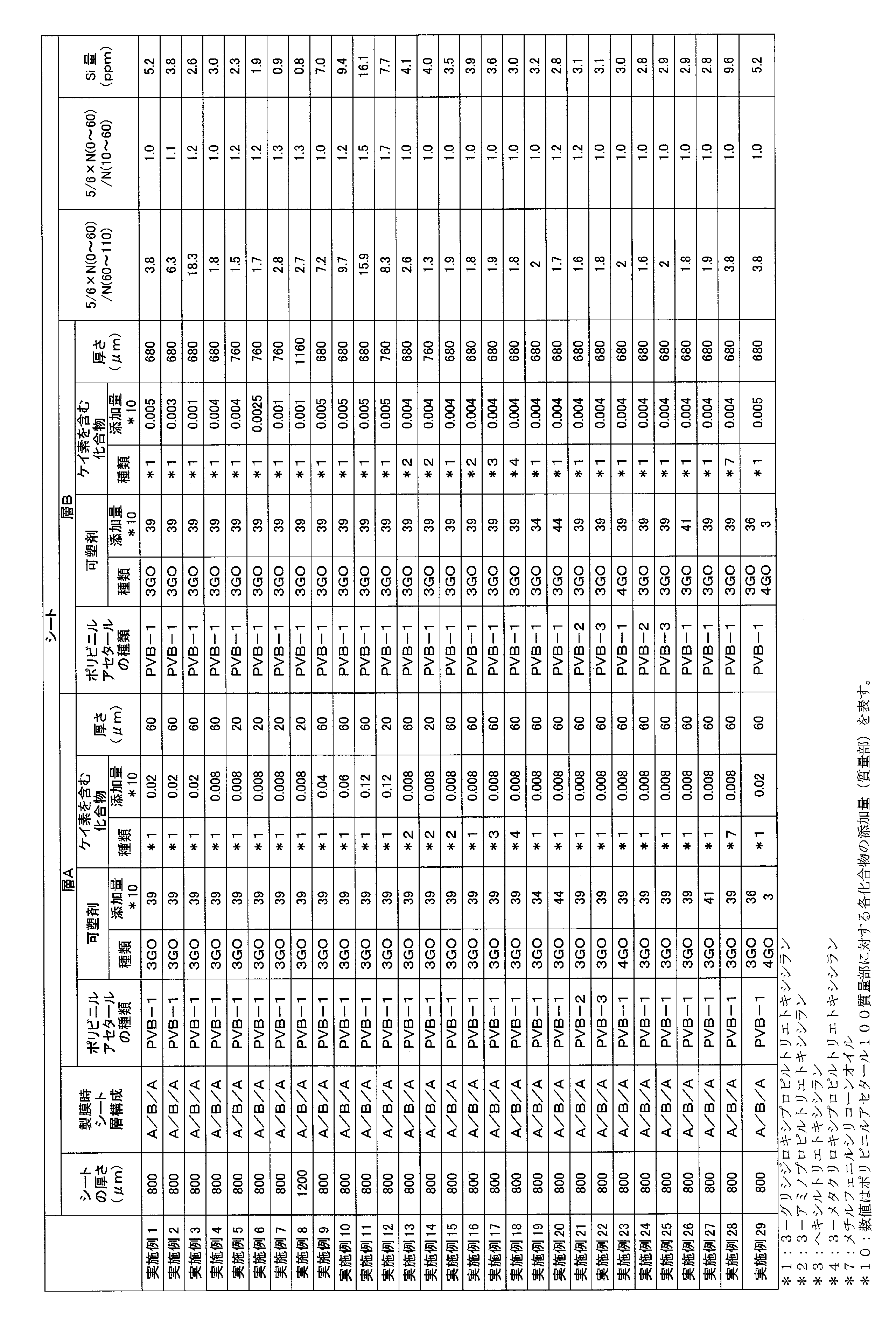
- Example 1 100 parts by weight of PVB-1, 39 parts by weight of triethylene glycol di-2-ethylhexanoate, 0.03 parts by weight of magnesium acetate tetrahydrate, BHT (3,5-t-butyl-4-hydroxytoluene) 0.1 part by mass, 0.03 part by mass of benzotriazole-based ultraviolet absorber (manufactured by BASF, TINUVIN 328) and 0.02 part by mass of 3-glycidyloxypropyltrimethoxysilane were melt-kneaded at 150 ° C. Composition-1A was obtained.
- Composition-1B was obtained in the same manner as Composition-1A, except that the amount of 3-glycidyloxypropyltrimethoxysilane added was 0.005 parts by mass.
- a layer-1A having a thickness of 60 ⁇ m is prepared as a sheet A by hot pressing composition-1A at 150 ° C.
- a layer having a thickness of 680 ⁇ m is formed as sheet B by hot pressing composition-1B at 150 ° C.
- -1B was laminated in the order of layer-1A / layer-1B / layer-1A, and hot-pressed at 100 ° C. under a pressure of 40 kg / cm 2 for 5 minutes to obtain a sheet-1 having a thickness of 800 ⁇ m.
- the silicon contained in Sheet-1 was measured by ICP emission analysis and found to be 5.2 ppm.
- the ICP emission analysis of the silicon amount was conducted by adding sulfuric acid and nitric acid to the PVB-1 sample and thermally decomposing it, and then using a solution with a constant volume of hydrochloric acid and using an ICP emission analyzer (Optima 4300 DV manufactured by Perkin Elmer). This was done by measuring (hereinafter the same). The results are shown in Table 3.
- the obtained sheet-1 was cut with a microtome in a direction parallel to the thickness direction of the cross section.
- the cross section in the thickness direction of the obtained sheet-1 is 0 from the surface to the thickness direction.
- the total number N (0-60) of silicon secondary ions detected from the region of 0 to 60 ⁇ m in the thickness direction and 128 ⁇ m in the width direction, detected from the region of 10 to 60 ⁇ m in the thickness direction and 128 ⁇ m in the width direction The total number of silicon secondary ions N (10 to 60) and the total number N (60 to 110) of silicon secondary ions detected from the region having a thickness of 60 to 110 ⁇ m and a width of 128 ⁇ m are obtained. 5/6 ⁇ N (0 to 60) / N (60 to 110) and 5/6 ⁇ N (0 to 60) / N (10 to 60) were obtained, respectively.
- the results are shown in Table 3.
- Sheet-1 was stored at 23 ° C. and 50% RH. After 0 hours from the start of storage (that is, before storage immediately after obtaining a sheet by hot pressing), after 300 hours, after 500 hours, and after 3000 hours, the sheet-1 is adhered to glass by the method described later. And the transparency was evaluated.
- Sheet-1 was conditioned at 23 ° C. and 28% RH for 24 hours to adjust the moisture content to 0.5%.
- 2 mm thick float glass is stacked so as to be float glass / sheet-1 / float glass, put into a vacuum bag, treated at 100 ° C. and ⁇ 0.09 MPa (gauge pressure), and temporarily adhered,
- Laminated glass 1-1 was obtained by processing at 140 ° C. and 1.2 MPa (gauge pressure) in an autoclave.
- the laminated glass 1-1 was allowed to stand at a temperature of ⁇ 18 ° C. for 24 hours, and then smashed with a hammer having a head weight of 0.45 kg until the particle diameter of the glass became 6 mm or less.
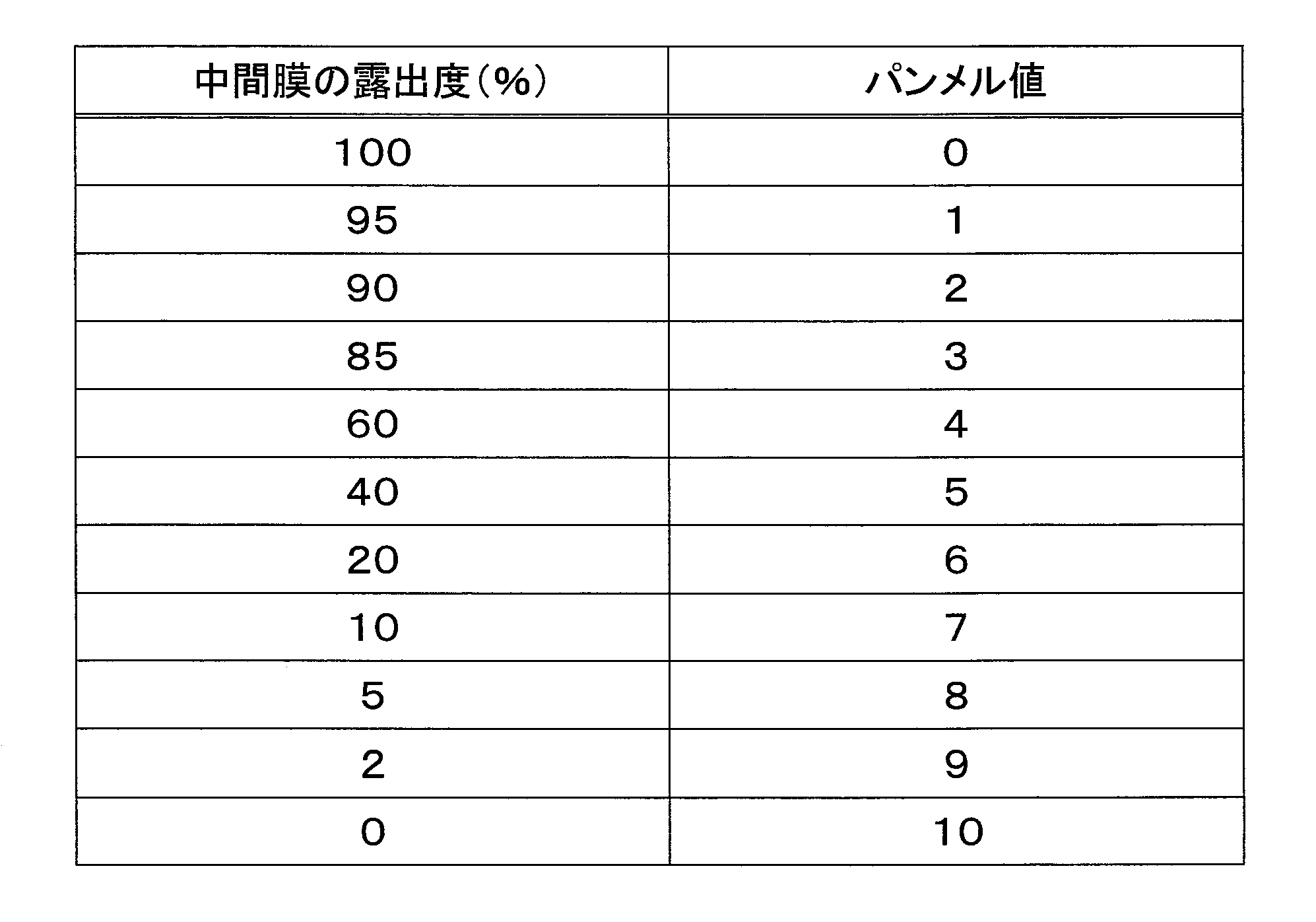
- the glass piece peeled off from the interlayer film (sheet-1) was shaken off, and the Pummel value was determined according to the criteria shown in Table 2 based on the exposure degree (%) of the interlayer film. It shows that the adhesiveness with respect to the glass plate of a plasticization film is so high that a Pummel value is large.
- the degree of exposure is the ratio of the area of the portion where the glass piece is peeled and the intermediate film is exposed to the entire area of the intermediate film. The results are shown in Table 4.
- Sheet-1 was conditioned at 23 ° C. and 28% RH for 24 hours to adjust the moisture content to 0.5%.
- 2 mm thick float glass is stacked so as to be float glass / sheet-1 / float glass, put into a vacuum bag, treated at 100 ° C. and ⁇ 0.09 MPa (gauge pressure), and temporarily adhered,
- Laminated glass 1-2 was obtained by an autoclave treatment at 140 ° C. and 1.2 MPa (gauge pressure). The appearance of the obtained laminated glass 1-2 was visually confirmed under an illuminance of 500 lux.
- the laminated glass 1-2 was irradiated with 2000 candela light from a distance of 30 cm, and the state was visually confirmed. A case where no foreign matter was found in both cases was designated as A, a case where foreign matter was seen only when 2000 candela light was irradiated, and a case where foreign matter was seen in both cases was designated as C.
- the results are shown in Table 4.
- Example 2 to 29 Sheets 2 to -29 were prepared in the same manner as in Example 1 except that the composition was changed to the composition shown in Table 3, and evaluated in the same manner as in Example 1. The results are shown in Tables 3 and 4.
- Comparative Example Sheets 3 to 7 and Comparative Example Sheet-10 were respectively prepared in the same manner as in Example 1 except that the compositions shown in Table 5 were changed, and the same evaluation as in Example 1 was performed. The results are shown in Tables 5 and 6.
Landscapes
- Chemical & Material Sciences (AREA)
- Health & Medical Sciences (AREA)
- Chemical Kinetics & Catalysis (AREA)
- Medicinal Chemistry (AREA)
- Polymers & Plastics (AREA)
- Organic Chemistry (AREA)
- Engineering & Computer Science (AREA)
- Manufacturing & Machinery (AREA)
- Materials Engineering (AREA)
- Laminated Bodies (AREA)
- Manufacture Of Macromolecular Shaped Articles (AREA)
- Joining Of Glass To Other Materials (AREA)
- Compositions Of Macromolecular Compounds (AREA)
Abstract
高沸点で、低極性の可塑剤を使用し、比較的高い含水率で長期間保管したものを合わせガラス用中間膜として使用した場合であっても、保管する前のものを使用した場合と同等のガラスへの接着性、外観を発現するシートを得ることを目的とする。 ポリビニルアセタール、分子量380以上の可塑剤及びケイ素含有化合物を含み、ポリビニルアセタール100質量部に対して分子量380以上の可塑剤が30~70質量部であり、厚さ0.2~2mmのシートであって、シートをICP発光分析法により分析した際に0.10~30ppmのケイ素が検出され、シートの厚さ方向に平行な断面におけるTOF-SIMS測定をした場合に、検出されるケイ素二次イオンの数が特定の条件を満たす、シートを提供する。
Description
本発明はポリビニルアセタールを含有するシート、およびその用途に関する。
ポリビニルアセタール及び可塑剤からなるシートは、ガラスとの接着性や透明性、また力学強度に優れることから合わせガラス用中間膜として広範に利用されている。
ポリビニルアセタール及び可塑剤からなるシートを合わせガラス用中間膜として使用する場合、長期間にわたって使用した際、又は高温で処理する際の可塑剤の揮発を抑制する観点から、高沸点の可塑剤が好ましく用いられる。とりわけトリエチレングリコールジ2-エチルヘキサノエート(3GO)は、高沸点であり、ポリビニルアセタールとの相溶性、ポリビニルアセタールの可塑化効果に優れるので、近年、広く使用されている。しかしながら、3GOは低極性の化合物であり、ポリビニルアセタール及び3GOを含むシートは帯電しやすい傾向がある。帯電したシートは保管環境に存在するほこりを吸着しやすいため、このようなシートを長期間保管した後に合わせガラス用中間膜として使用した場合、外観の問題を有する合わせガラスが得られることがあった。このような問題を起こさないようにするため、ポリビニルアセタール及び3GOを含むシートを比較的高い含水率、例えば0.5~0.9%程度に調整し、帯電しにくい状態として保管することがある。
ところで、合わせガラスにおいては、その目的に応じて合わせガラス用中間膜とガラスとの接着性を適切に調整しなければならない。合わせガラス用中間膜とガラスとの接着性を調整する方法としては、合わせガラス用中間膜にカルボン酸のアルカリ金属塩、カルボン酸のアルカリ土類金属塩などを添加する方法が知られている(例えば特許文献1~3参照)。しかしながら、このようなカルボン酸塩を添加した合わせガラス用中間膜を含む合わせガラスを高湿下で使用した場合、カルボン酸塩が炭素数の小さいカルボン酸の塩であると、これらカルボン酸塩が吸水し、合わせガラスの端部が白化することがある。また、カルボン酸塩が炭素数の大きいカルボン酸の塩である場合には、前記白化の問題は抑制されるものの十分でなく、さらに、合わせガラス用中間膜とガラスとの接着性が経時的に変化することがあった。特許文献1~3には、カルボン酸とカルボン酸金属塩とを併用した合わせガラス用中間膜が開示されており、このような中間膜を使用した場合には前記接着性の経時変化の問題は抑制される一方、必須成分であるカルボン酸を触媒としてポリビニルアセタールの加水分解が発生し、発生するアルデヒドによって臭気の問題が発生することがあった。そのような臭気の問題は、中間膜を比較的高い含水率で保管する場合に特に顕著に発生する。
一方、合わせガラス用中間膜吸湿時の白化を抑制する方法として、シリコーンオイル(例えば特許文献4~7参照)、またシランカップリング剤(例えば参考文献8~10参照)など、ケイ素を含有する化合物を添加することで合わせガラス用中間膜とガラスの接着性を調整する方法が知られている。このような合わせガラス用中間膜を含む合わせガラスは、高湿下におかれた場合でも合わせガラス用中間膜の吸湿による白化が起こりにくい。
ところで、シリコーンオイル、シランカップリング剤などのケイ素含有化合物を合わせガラス用中間膜に使用する場合、ケイ素含有化合物は中間膜の表面に塗布するか、中間膜に混練して使用される。しかしながら、これらの中間膜を高湿度下で長期間保管する場合、例えばケイ素含有化合物を表面に塗布した合わせガラス用中間膜の場合には、ケイ素含有化合物は経時的に中間膜の内部に移行してしまうため、長期間保管した合わせガラス用中間膜は、保管前の中間膜と同等のガラスへの接着性を発現しない場合がある。一方、ケイ素含有化合物を中間膜に混練して使用する場合、そのような中間膜を長期間保管すると中間膜中でケイ素含有化合物がゲル化して、これを使用して得られる合わせガラスの外観、とりわけ自動車ヘッドライトのような強い光が照射された場合の外観が損なわれることがあった。
本発明は、上記の課題を解決するシートを提供するものであり、3GOのような高沸点で、低極性の可塑剤を使用し、比較的高い含水率で長期間保管したものを合わせガラス用中間膜として使用した場合であっても、保管する前のものを使用した場合と同等のガラスへの接着性、外観を発現するシートを得ることを目的とする。
本発明によると、上記目的は、ポリビニルアセタール、分子量380以上の可塑剤及びケイ素含有化合物を含み、ポリビニルアセタール100質量部に対して分子量380以上の可塑剤が30~70質量部であり、厚さ0.2~2mmのシートであって、シートをICP発光分析法により分析した際に0.10~30ppmのケイ素が検出され、シートの厚さ方向に平行な断面におけるTOF-SIMS測定をした場合に、シートの少なくとも一方の表面から厚さ方向に0~60μm、幅Wμmの領域から検出されるケイ素二次イオンの合計数をN(0~60)とし、該表面から厚さ方向に10~60μm、幅Wμmの領域から検出されるケイ素二次イオンの合計数をN(10~60)とし、該表面から厚さ方向に60~110μm、幅Wμmの領域から検出されるケイ素二次イオンの合計数をN(60~110)としたときに、5/6×N(0~60)/N(60~110)が1.2以上であり、5/6×N(0~60)/N(10~60)が0.8~2であるシートを提供することで達成される。
前記シートはアルカリ金属塩及び/又はアルカリ土類金属塩を含むことが好ましい。
アルカリ金属塩及び/又はアルカリ土類金属塩は、カルボン酸のアルカリ金属塩又はカルボン酸のアルカリ土類金属塩であることが好ましい。
前記カルボン酸は、炭素数1~8のカルボン酸であることが好ましい。
アルカリ金属塩及び/又はアルカリ土類金属塩の含有量は、ポリビニルアセタール100質量部に対して0.001~0.1質量部であることが好ましい。
ケイ素含有化合物は、ケイ素-酸素結合を含む化合物であることが好ましい。
ケイ素含有化合物は、シランカップリング剤であることが好ましい。
ケイ素含有化合物は、シリコーンオイルであることが好ましい。
分子量380以上の可塑剤は、トリエチレングリコールジ2-エチルヘキサノエートであることが好ましい。
シートを作製した後、30℃を越える温度での合計保管時間が3000時間未満であることが好ましい。
シートの前記表面から厚さ方向に0~60μmの領域に存在するポリビニルアセタールの粘度平均重合度と、該表面から厚さ方向に60~110μmの領域に存在するポリビニルアセタールの粘度平均重合度との差は0~500であることが好ましい。
ポリビニルアセタール、分子量380以上の可塑剤及びケイ素含有化合物を含むシートAと、ポリビニルアセタール、分子量380以上の可塑剤及びケイ素含有化合物を含むシートBとを積層して得られ、シートAに含まれるケイ素含有化合物の濃度は、シートBに含まれるケイ素含有化合物の濃度より高く、シートAに含まれるポリビニルアセタールのアセタール化度とシートBに含まれるポリビニルアセタールのアセタール化度の差は0~3モル%であることが好ましい。
ポリビニルアセタール、分子量380以上の可塑剤及びケイ素含有化合物を含むシートAと、ポリビニルアセタール、分子量380以上の可塑剤及びケイ素含有化合物を含むシートBとを積層して得られ、シートAに含まれるケイ素含有化合物の濃度は、シートBに含まれるケイ素含有化合物の濃度より高く、シートAに含まれるポリビニルアセタールの平均残存水酸基量とシートBに含まれるポリビニルアセタールの平均残存水酸基量の差は0~3モル%であることが好ましい。
ポリビニルアセタール、分子量380以上の可塑剤及びケイ素含有化合物を含むシートAと、ポリビニルアセタール、分子量380以上の可塑剤及びケイ素含有化合物を含むシートBとを積層して得られ、シートAに含まれるケイ素含有化合物の濃度は、シートBに含まれるケイ素含有化合物の濃度より高く、シートAに含まれる可塑剤のうち含有量の最も多い可塑剤を可塑剤A1とし、含有量の二番目に多い可塑剤を可塑剤A2とし、シートAに含まれるポリビニルアセタール100質量部に対する可塑剤A1の含有量を(a1)質量部とし、該ポリビニルアセタール100質量部に対する可塑剤A2の含有量を(a2)質量部とし、さらに、シートBに含まれる可塑剤のうち含有量の最も多い可塑剤を可塑剤B1とし、含有量の二番目に多い可塑剤を可塑剤B2とし、シートBに含まれるポリビニルアセタール100質量部に対する可塑剤B1の含有量を(b1)質量部とし、該ポリビニルアセタール100質量部に対する可塑剤B2の含有量を(b2)質量部とした場合に、(a2)/(a1)および(b2)/(b1)が0~0.1であり、|[(a1)+(a2)]-[(b1)+(b2)]|≦10であることが好ましい。
本発明によると、上記目的は、ポリビニルアセタール、分子量380以上の可塑剤及びケイ素含有化合物を含み、ポリビニルアセタール100質量部に対して分子量380以上の可塑剤が30~70質量部であり、厚さ0.2~2mmのシートであって、シートをICP発光分析法により分析した際に0.10~30ppmのケイ素が検出され、シートの厚さ方向に平行な断面におけるTOF-SIMS測定をした場合に、シートの少なくとも一方の表面から厚さ方向に0~Xμm、幅Wμmの領域から検出されるケイ素二次イオンの合計数をN(0~X)とし、該表面から厚さ方向にX/6~Xμm、幅Wμmの領域から検出されるケイ素二次イオンの合計数をN(X/6~X)とし、該表面から厚さ方向にX~11X/6μm、幅Wμmの領域から検出されるケイ素二次イオンの合計数をN(X~11X/6)としたときに、5/6×N(0~X)/N(X~11X/6)が1.2以上であり、5/6×N(0~X)/N(X/6~X)が0.8~2であり、Xが20~90μmである、シートを提供することで好適に達成される。
本発明によると、上記目的は、前記シートを含む合わせガラスを提供することで好適に達成される。
本発明のシートは、シートの厚さ方向に平行な断面におけるTOF-SIMS測定をした場合に、シートの少なくとも一方の表面から厚さ方向に0~60μm、幅Wμmの領域から検出されるケイ素二次イオンの合計数をN(0~60)とし、該表面から厚さ方向に10~60μm、幅Wμmの領域から検出されるケイ素二次イオンの合計数をN(10~60)とし、該表面から厚さ方向に60~110μm、幅Wμmの領域から検出されるケイ素二次イオンの合計数をN(60~110)としたときに、5/6×N(0~60)/N(60~110)は1.2以上であるが、これはシートの表面から厚さ方向に60~110μmの領域に代表されるシート内部に比べて、シートの表面から厚さ方向に0~60μmの領域に代表されるシート表面の近傍に、高濃度でケイ素含有化合物が分布していることを表している。5/6×N(0~60)/N(60~110)を1.2以上とすることにより、シート表面の近傍に高濃度で存在するケイ素含有化合物の作用でガラスとの接着性を適切に調整しつつ、ケイ素含有化合物のゲル化による外観の問題を抑制することができる。
また、本発明のシートは、5/6×N(0~60)/N(10~60)が0.8~2であるが、これはシート表面の近傍のうち、表面から厚さ方向に0~60μmの領域に存在するケイ素含有化合物の濃度と、表面から厚さ方向に0~60μmの領域のうち、0~10μmの領域を除いた部分、すなわち表面から厚さ方向に10~60μmの領域に存在するケイ素含有化合物の濃度が大きく変わらないことを表している。従って、本発明のシートでは、シートの厚さ方向のごく浅い領域に存在するケイ素含有化合物のシート内部への移行が起こりにくいため、本発明のシートを長期間保管する場合にも接着力の変化が起こりにくい。
まず、本発明で使用するポリビニルアセタールについて説明する。本発明で使用するポリビニルアセタールは特に限定されず、その重合度やアセタール化度、平均残存水酸基量、ビニルエステル残基量は特に限定されない。例えば重合度を原料であるポリビニルアルコールの粘度平均重合度を指標にして表す場合、粘度平均重合度は200~3000であることが好ましく、500~2400であることがより好ましく、1000~2000であることがさらに好ましい。粘度平均重合度が3000を超えると、本発明のシートの加工性が低下することがあり、また、粘度平均重合度が200未満であると、得られるシートの力学強度が低下したり、ケイ素含有化合物の移行が起こりやすくなる傾向にある。
また、ポリビニルアセタールのアセタール化度は特に限定されないが40~85モル%であることが好ましく、60~80モル%であることがより好ましく、67~75モル%であることがさらに好ましい。アセタール化度が40モル%未満であると、得られるシートの柔軟性が不十分となり、また、シートに含まれる分子量380以上の可塑剤やケイ素含有化合物との相溶性が低下して透明性が低下することがある。一方、アセタール化度が85モル%を超えると、得られるシートの力学強度が低下したり、シートを長期間保管した場合にポリビニルアセタールの加水分解によって脱アルデヒドが起こり、臭気の問題が発生しやすくなる傾向にある。
ポリビニルアセタールの平均残存水酸基量は10~50モル%であることが好ましく、19~39モル%であることがより好ましく、24~32モル%であることがさらに好ましい。平均残存水酸基量が50モル%を超えると、分子量380以上の可塑剤との相溶性が低下することがあり、10モル%未満であると、得られるシートの力学強度が低下することがある。
ポリビニルアセタールのビニルエステル残基量は0.01~20モル%であることが好ましく、0.1~10モル%であることがより好ましく、0.2~3モル%であることがさらに好ましい。ビニルエステル残基量が0.01モル%未満のものは工業的に安価に製造することが困難であり、また、ビニルエステル残基量が20モル%を超えるものは、長期保管時にビニルエステル残基が加水分解して、例えば酢酸などのカルボン酸が発生し、そのカルボン酸が触媒となってポリビニルアセタールが加水分解し、臭気の原因となるアルデヒドが発生することがある。
本発明で使用するポリビニルアセタールは、例えば従来から公知の方法で入手可能なポリビニルアルコールまたは従来から公知の変性ポリビニルアルコールを原料として製造される。
本発明に用いられるポリビニルアセタールは従来から公知の方法で製造される。例えばまず、濃度3~40質量%のポリビニルアルコールの水溶液を、80~100℃の温度範囲で保持した後、水溶液を10~60分かけて徐々に冷却する。温度が-10~30℃まで低下したところで、アルデヒドおよび酸触媒を添加し、温度を一定に保ちながら、30~300分間アセタール化反応を行う。その際、アセタール化度が一定水準に達したポリビニルアルコールが析出する。その後、反応液を30~300分かけて30~80℃の温度まで昇温し、その温度を10~500分間保持する。次に、反応溶液に塩基性の化合物を添加して酸触媒を中和して水洗し、乾燥することにより、ポリビニルアセタールが得られる。
アセタール化反応に用いる酸触媒としては特に限定されず、有機酸および無機酸のいずれでも使用可能であり、例えば酢酸、パラトルエンスルホン酸、硝酸、硫酸、塩酸等が挙げられる。これらの中でも塩酸、硫酸、硝酸が好ましく用いられる。また、アセタール化反応に用いるアルデヒドは特に限定されないが、従来から公知の炭素数1~8のアルデヒドでアセタール化することが好ましく、中でも炭素数4~6のアルデヒドが好ましく、とりわけ、n-ブチルアルデヒドが好ましく用いられる。本発明においては、アルデヒドを2種類以上併用して得られるポリビニルアセタールを使用することもできるし、また、異なるアルデヒドを使用して得られるポリビニルアセタールを2種類以上混合して用いることもできる。
次に、本発明で使用する可塑剤について、説明する。本発明で使用する分子量380以上の可塑剤は特に限定されず、例えばトリエチレングリコールジ2-エチルヘキサノエート(3GO、分子量402)、テトラエチレングリコールジ2-エチルヘキサノエート(4GO、分子量446)、アジピン酸ジノニル(分子量398)、セバシン酸ジオクチル(分子量426)などの脂肪族エステル化合物、フタル酸ジオクチル(分子量396)などの芳香族エステル化合物などのほか、アジピン酸と3-メチル-1,5-ペンタンジオールとの共重合で得られるポリエステル化合物など、従来から公知のポリエステル化合物であって分子量が380以上のものが使用可能である。このような化合物の中でも特に分子量380~2000のものが好ましく、分子量390~1000のものがより好ましく、分子量400~600のものがさらに好ましい。可塑剤の分子量が380未満の場合、本発明に必須成分として含まれるケイ素含有化合物のシート内部(シート厚み方向の内側。以下同様。)への移行が速やかに起こり、本発明の目的を達成することができない。また、可塑剤の分子量が2000を超えるものは、ポリビニルアセタールとの相溶性が悪く、得られるシートの透明性が損なわれることがあり、また、ポリビニルアセタールへの可塑化効果が十分に発現しないことがある。また、本発明の可塑剤の化学構造は特に限定されないが、本発明のシートとガラスとの接着性を適切に調整する観点から炭化水素基並びにエーテル結合及びエステル結合から選ばれる少なくとも1種の官能基のみを含む可塑剤が好適である。ケイ素含有化合物のシート内部への移行が起こりにくく、ポリビニルアセタールとの相溶性及びポリビニルアセタールへの可塑化効果に優れる点から、本発明で使用する可塑剤は、トリエチレングリコールジ2-エチルヘキサノエートであることが最適である。
本発明のシートでは、可塑剤の含有量は、ポリビニルアセタール100質量部に対して30~70質量部であることが好ましく、31~60質量部であることがより好ましく、32~50質量部であることがさらに好ましい。可塑剤の含有量が30質量部より少ないとシートの柔軟性が十分でないことがあり、可塑剤の含有量が70質量部より多いと、シートの強度や透明性が低下したり、また、シートに含まれるケイ素含有化合物がシート内部へ移行しやすくなる傾向にある。なお、後述するように、シートAとシートBを積層して本発明のシートを得る場合は、シートAとシートBからなるシート全体に含まれるポリビニルアセタール100質量部に対して、同じくシート全体に含まれる可塑剤の含有量を30~70質量部とすることが好ましい。
次に、本発明で使用するケイ素含有化合物について説明する。本発明で使用するケイ素含有化合物は、本発明の主旨に反しない限り特に限定されないが、ガラスとの接着性を調整する観点ではケイ素-酸素結合を含む化合物が好適であり、特にシランカップリング剤、シリコーンオイルなどが好適に使用される。シランカップリング剤は特に限定されないが、メチルトリメトキシシラン、ヘキシルトリメトキシシラン、フェニルトリメトキシシラン、3-アミノプロピルトリメトキシシラン、3-アミノプロピルトリエトキシシラン、3-グリシジロキシプロピルトリメトキシシラン、3-グリシジロキシプロピルトリエトキシシラン、ビニルトリメトキシシラン、3-メタクリロキシプロピルトリメトキシシランなど、従来から公知のシランカップリング剤が挙げられる。中でも、特にエポキシ基、アミノ基を有するものが、ガラスとの接着力を調整する観点から特に好ましい。
また、シリコーンオイルとしてはジメチルシリコーン、メチルフェニルシリコーン、アミノ基変性シリコーン、アルキル基変性シリコーン、ポリエーテル基変性シリコーン、カルボキシル基変性シリコーンなど従来から公知のシリコーンオイルが挙げられるが、これらの中でも、特に、アミノ基変性シリコーン、ポリエーテル基変性シリコーン、カルボキシル基変性シリコーンが、ガラスとの接着性を調整する観点から好適である。
本発明のシート中のケイ素の含有量は、ICP発光分析法により分析した際に、0.10~30ppmであり、0.20~25ppmであることが好ましく、0.30~20ppmであることがより好ましい。ケイ素の含有量が、シートをICP発光分析法により分析した際のケイ素検出量として0.10ppm未満であると、接着力を調整する効果が不十分であり、ケイ素検出量として30ppmを越えると、シートを長期間保管した場合にケイ素含有化合物がゲル化し、得られる合わせガラスの外観が損なわれることがある。なお、本発明のシート中のケイ素の含有量は、シートサンプルを厚さ方向の断面に平行な面で切り出し、硫酸、硝酸を添加して加熱分解した後、塩酸水で定容した溶液を使用し、ICP発光分析装置(Perkin Elmer社製Optima4300DV)で測定することにより行うことができる。
本発明において、シートのTOF-SIMS測定は、例えば実施例に記載の装置を使用し、実施例に記載の方法で実施することができる。
本発明のシートは、シートの厚さ方向に平行な断面におけるTOF-SIMS測定をした場合に、シートの少なくとも一方の表面から厚さ方向に0~Xμm、幅Wμmの領域から検出されるケイ素二次イオンの合計数をN(0~X)とし、該表面から厚さ方向にX/6~Xμm、幅Wμmの領域から検出されるケイ素二次イオンの合計数をN(X/6~X)とし、該表面から厚さ方向にX~11X/6μm、幅Wμmの領域から検出されるケイ素二次イオンの合計数をN(X~11X/6)としたときに、5/6×N(0~X)/N(X~11X/6)が1.2以上であり、5/6×N(0~X)/N(X/6~X)が0.8~2である。ここで、Xは、シートの厚さに応じて適宜設計することができ、20~90μmであり、20~80μmであることが好ましい。
より具体的には、例えば図1に示すように、シート1の厚さ方向に平行な断面において、シート1の表面から厚さ方向に0~110μm、及び、シート1の表面と平行な方向にWμmの長方形からなる領域が、TOF-SIMS測定の測定対象となる領域である。本発明のシートは、シート1の少なくとも一方の表面から厚さ方向に0~60μm及び幅Wμmからなる測定対象となる領域(以下、測定対象領域という)2a(図1(a)参照)から検出されるケイ素二次イオンの合計数をN(0~60)とし、該表面から厚さ方向に10~60μm及び幅Wμmからなる測定対象領域2b(図1(b)参照)から検出されるケイ素二次イオンの合計数をN(10~60)とし、該表面から厚さ方向に60~110μm及び幅Wμmからなる測定対象領域2c(図1(c)参照)から検出されるケイ素二次イオンの合計数をN(60~110)としたときに、5/6×N(0~60)/N(60~110)は1.2以上である。5/6×N(0~60)/N(60~110)は1.3~20であることが好ましく、1.4~10であることがより好ましく、1.5~8であることがさらに好ましい。5/6×N(0~60)/N(60~110)を1.2以上とすることで、ガラスとの接着力を適切に調整しつつ、ケイ素含有化合物のゲル化による、外観の低下を抑制できる。なお、5/6×N(0~60)/N(60~110)には上限はないが、5/6×N(0~60)/N(60~110)が20を超えると、シートを長期間保管した時にケイ素含有化合物がシートの内部に移行して、ガラスとの接着性が変化しやすい傾向にある。なお、N(60~110)の測定対象領域2cの面積は、N(0~60)の測定対象領域2aの面積の5/6倍であり、5/6×N(0~60)/N(60~110)における「5/6」という値は、この2つの領域の面積の違いを補正するための係数である。
また、5/6×N(0~60)/N(10~60)は0.8~2であるが、0.83~1.7であることが好ましく、0.85~1.5であることがより好ましく、0.9~1.3であることが最適である。5/6×N(0~60)/N(10~60)が0.8未満である場合、或いは2を超える場合は、得られるシートを長期間保管した場合に、ガラスとの接着性が変化することがあり好ましくない。なお、N(10~60)の測定対象領域2bの面積は、N(0~60)の測定対象領域2aの面積の5/6倍であり、5/6×N(0~60)/N(10~60)における「5/6」という値は、この2つの領域の面積の違いを補正するための係数である。
Wは任意の正の数であり、10~1000μmであることが好ましい。本発明において、N(0~60)、N(10~60)及びN(60~110)を測定する際は、統一した幅WμmでTOF-SIMS測定が行われる。
本発明のシートはガラスとの接着性を最適化する観点から、本発明の主旨に反しない限り、アルカリ金属塩及び/又はアルカリ土類金属塩を含んでいても良い。アルカリ金属塩、アルカリ土類金属塩は特に限定されず、ナトリウムイオン、カリウムイオンなどのアルカリ金属イオン、又はマグネシウムイオン、カルシウムイオンなどのアルカリ土類金属イオンから選ばれる陽イオンと、酢酸イオン、プロパン酸イオン、ブタン酸イオン、2-エチルヘキシル酸イオン、2-エチル-2-ヘキセン酸イオン、ノナン酸イオン、デカン酸イオン、ステアリン酸イオン、オレイン酸イオン、アジピン酸イオンなどのカルボン酸イオン、塩素イオン、水酸化物イオンなどの無機陰イオンとを含む、従来から公知のアルカリ金属塩、アルカリ土類金属塩が用いられる。これらの中でも特に、カルボン酸のアルカリ金属塩又はカルボン酸のアルカリ土類金属塩が、本発明のシートとガラスとの接着性を適切に調整する観点から好ましい。とりわけ、炭素数1~8、好ましくは炭素数1~4、より好ましくは炭素数2~3のカルボン酸のアルカリ金属塩、又は炭素数1~8、好ましくは炭素数1~4、より好ましくは炭素数2~3のカルボン酸のアルカリ土類金属塩が、本発明のシートを長期間使用した場合であっても、シートとガラスとの接着性が変化しにくいという観点で好ましい。中でも、炭素数2~3のアルカリ土類金属塩が吸水時の白化の抑制効果に優れる点で特に好ましい。
本発明のシートにおけるアルカリ金属塩及び/又はアルカリ土類金属塩の含有量(アルカリ金属塩とアルカリ土類金属塩を併用する場合は、)は、特に限定されないが、ポリビニルアセタール100質量部に対して0.001~0.1質量部であることが好ましく、0.001~0.07質量部であることがより好ましく、0.001~0.05質量部であることがさらに好ましい。アルカリ金属塩及び/又はアルカリ土類金属塩の含有量が0.001質量部未満であると、本発明のシートとガラスとの接着性を調整する効果が十分に発現しないことがあり、アルカリ金属塩及び/又はアルカリ土類金属塩の含有量が0.1質量部を越えると、本発明のシートが吸水により白化しやすくなるため、好ましくない。
本発明のシートは、本発明の主旨に反しない限り酸化防止剤、紫外線吸収剤、その他添加剤を含んでいても良く、例えば従来から公知のものを使用できる。その添加量も目的に応じて適宜選択可能である。
本発明のシートを製造する方法は特に限定されないが、例えばケイ素含有化合物の濃度が異なる層Aと層Bを重ねて積層する方法が挙げられる。より好ましくは層A/層B/層Aの順に重ねて積層する方法が挙げられる。この場合、層A及び層Bは、いずれもポリビニルアセタール及び分子量380以上の可塑剤を含むものである。層Aに含まれるケイ素含有化合物の濃度は、層Bに含まれるケイ素含有化合物の濃度の1.2倍以上とすることが好ましく、1.3~20倍とすることがより好ましく、1.4~10倍とすることがさらに好ましく、1.5~8倍とすることが最適である。さらに、層Aの厚さは20~90μmであることが好ましく、40~70μmであることがより好ましく、55~70μmであることがさらに好ましく、57~65μmであることが最適である。層Bの厚さは50~1900μmであることが好ましく、300~1200μmであることがより好ましく、500~1000μmであることがさらに好ましい。層Aと層Bを重ねて積層した場合、層A側のシート表面から厚さ方向に60~110μmの領域に比べて、層A側のシート表面から厚さ方向に0~60μmの領域においてケイ素含有化合物が高濃度で分布し、且つ、層A側のシート表面から厚さ方向に0~60μmの領域と、層A側のシート表面から厚さ方向に10~60μmの領域のケイ素含有化合物の濃度が大きく変わらないシート、すなわち、本発明で規定するシートを得ることができる。層A/層B/層Aの順に重ねて積層した場合は、いずれの表面から特定される領域においても、本発明で規定する要件を満たすことができる。
層Aにおける分子量380以上の可塑剤の含有量は、ポリビニルアセタール100質量部に対して、30~70質量部であることが好ましく、31~60質量部であることがより好ましい。また、層Aにおけるケイ素含有化合物の含有量は、ポリビニルアセタール100質量部に対して、0.002~0.3質量部であることが好ましく、0.003~0.25質量部であることがより好ましい。層Aにおけるケイ素含有化合物の含有量が、ポリビニルアセタール100質量部に対して0.002質量部よりも少なくなると、ガラスとの接着力を適切に調整できなくなり、層Aにおけるケイ素含有化合物の含有量が0.3質量部よりも多くなると、得られるシートを長期間保管した場合に、ケイ素含有化合物がシートの内部に移行して、ガラスとの接着性が変化しやすくなり、またケイ素含有化合物がゲル化して、外観が損なわれる傾向にある。
一方、層Bにおける分子量380以上の可塑剤の含有量は、ポリビニルアセタール100質量部に対して、30~70質量部であることが好ましく、31~60質量部であることがより好ましい。また、層Bにおけるケイ素含有化合物の含有量は、ポリビニルアセタール100質量部に対して、0.0001~0.02質量部であることが好ましく、0.0005~0.01質量部であることがより好ましい。層Bにおけるケイ素含有化合物の含有量が、ポリビニルアセタール100質量部に対して0.0001質量部よりも少なくなると、得られるシートを長期間保管した場合にケイ素含有化合物がシートの内部に移行して、ガラスとの接着性が変化しやすくなる傾向にあり、0.02質量部よりも多くなると、ケイ素含有化合物がゲル化して、外観が損なわれる傾向にある。
また、これとは異なる本発明のシートを製造する方法としては、ポリビニルアセタール、可塑剤及びケイ素含有化合物を含む層Cの表面に、キャスト法によって層Dを形成する方法があげられる。この場合、層Dに含まれるケイ素含有化合物の濃度は、層Cに含まれるケイ素含有化合物の濃度の1.2倍以上とすることが好ましく、1.3~20倍とすることがより好ましく、1.4~10倍とすることがさらに好ましく、1.5~8倍とすることが最適である。層Cの厚さは50~1900μmであることが好ましく、300~1200μmであることが好ましく、500~1000μmであることがより好ましい。層Dの厚さは20~90μmであることが好ましく、40~70μmであることがより好ましく、55~70μmであることがさらに好ましく、57~65μmであることが最適である。ただし、層Cと層Dのケイ素含有化合物の濃度、厚さはこれらに限定されない。また、層Cの一方の面に層Dを形成してもよく、層Cの両方の面に層Dを形成することもできる。層Cの一方の面に層Dを形成することで、層D側の表面から厚さ方向に60~110μmの領域に比べて、層D側の表面から厚さ方向に0~60μmの領域においてケイ素含有化合物が高濃度で分布し、且つ、層D側の表面から厚さ方向に0~60μmの領域と、層D側の表面から厚さ方向に10~60μmの領域のケイ素含有化合物の濃度が大きく変わらないシート、すなわち、本発明で規定するシートを得ることができる。層Cの両方の面に層Dを形成した場合は、いずれの表面から特定される領域においても、本発明で規定する要件を満たすことができる。
層Cにおける分子量380以上の可塑剤の含有量は、ポリビニルアセタール100質量部に対して、30~70質量部であることが好ましく、31~60質量部であることがより好ましい。また、層Cにおけるケイ素含有化合物の含有量は、ポリビニルアセタール100質量部に対して、0.0001~0.02質量部であることが好ましく、0.0005~0.01質量部であることがより好ましい。層Cにおけるケイ素含有化合物の含有量が、ポリビニルアセタール100質量部に対して0.0001質量部よりも少なくなると、得られるシートを長期間保管した場合にケイ素含有化合物がシートの内部に移行して、ガラスとの接着性が変化しやすくなる傾向にあり、0.02質量部よりも多くなると、ケイ素含有化合物がゲル化して、外観が損なわれる傾向にある。
層Dを形成するために用いられる塗布液としては、ポリビニルアセタール100質量部に対して30~70質量部の分子量380以上の可塑剤、0.002~0.3質量部のケイ素含有化合物及び1000~5000質量部の溶剤を含むものであることが好ましい。層Dにおけるケイ素含有化合物の含有量は、ポリビニルアセタール100質量部に対して、0.005~0.25質量部であることがより好ましい。層Dにおけるケイ素含有化合物の含有量が、ポリビニルアセタール100質量部に対して0.3質量部よりも多くなると、得られるシートを長期間保管した場合に、ケイ素含有化合物がシートの内部に移行して、ガラスとの接着性が変化しやすくなり、またケイ素含有化合物がゲル化して、外観が損なわれる傾向にある。層Dを形成するための塗布液に用いられる溶剤としては、ポリビニルアセタールを溶解できるものであれば特に限定されず、例えばテトラヒドロフラン、クロロホルム、エタノール、プロパノール、ブタノールなどがあげられ、中でも安全性の点で、エタノール、プロパノールが好ましい。また、層Dを形成するための塗布液は、層Dの乾燥時の膜厚が20~90μmとなるように塗布するのが好ましく、40~70μmとなるように塗布するのがより好ましく、55~70μmとなるように塗布することがさらに好ましい。
本発明のシートが層Aと層Bの積層体、又は層Cと層Dの積層体のいずれの場合であっても、ポリビニルアセタール、可塑剤、及びケイ素含有化合物については、本発明で規定する要件を満たすものであることはいうまでもない。なお、後者の方法においてはキャスト時に使用する溶剤の影響でシートの厚さ方向でのケイ素含有化合物の移行が起こる場合があるので、本発明のシートは、前者の方法で作製することが好ましい。さらに前者の方法においても、層Aと層Bを積層する際、温度を120℃以上に加熱すると、シート厚さ方向でのケイ素含有化合物の移行が起こることがあるので、積層する際の温度を120℃未満とすることが好ましい。
本発明のシートにおいて、シートの表面から0~60μmの部分に含まれるポリビニルアセタールの粘度平均重合度と60~110μmの部分に含まれるポリビニルアセタールの粘度平均重合度は、それらの差が0~500であることが好ましく、0~300であることがより好ましく、0~200であることがさらに好ましく、0~100であることが最適である。粘度平均重合度の差がこのような範囲を満たすことで、本発明のシートを長期間保管した場合に、ケイ素含有化合物のシート内部への移行が起こりにくくなるので好適である。
また、層Aに含まれるポリビニルアセタールのアセタール化度と層Bに含まれるポリビニルアセタールのアセタール化度はそれらの差が0~3モル%であることが好ましく、0~2モル%であることがより好ましく、0~1モル%であることがさらに好ましい。さらに、層Aに含まれるポリビニルアセタールの平均残存水酸基量と層Bに含まれるポリビニルアセタールの平均残存水酸基量はそれらの差が0~3モル%であることが好ましく、0~2モル%であることがより好ましく、0~1モル%であることがさらに好ましい。本発明のシートに含まれるポリビニルアセタールがこのような範囲を満たすことで、本発明のシートを長期間保管した場合に、必須成分として含まれるケイ素含有化合物のシート内部への移行が起こりにくくなるので好適である。
また、本発明のシートを作製する際に用いられる層Aに含まれる可塑剤において、最も含有量の多い可塑剤を可塑剤A1とし、また二番目に多い可塑剤を可塑剤A2とし、層Aにおけるポリビニルアセタール100質量部に対する可塑剤A1の含有量を(a1)質量部とし、層Aにおけるポリビニルアセタール100質量部に対する可塑剤A2の含有量を(a2)質量部とし、また、層Bに含まれる可塑剤において、最も含有量の多い可塑剤を可塑剤B1とし、また二番目に多い可塑剤を可塑剤B2とし、層Bにおけるポリビニルアセタール100質量部に対する可塑剤B1の含有量を(b1)質量部とし、層Bにおけるポリビニルアセタール100質量部に対する可塑剤B2の含有量を(b2)質量部とした場合、(a2)/(a1)および(b2)/(b1)が共に0~0.1であることが好ましく、0~0.07であることがより好ましく、0~0.05であることがさらに好ましい。また、|[(a1)+(a2)]-[(b1)+(b2)]|≦10であることが好ましく、|[(a1)+(a2)]-[(b1)+(b2)]|≦7であることがより好ましく、|[(a1)+(a2)]-[(b1)+(b2)]|≦5であることがさらに好ましい。(a1)、(a2)、(b1)及び(b2)が上記範囲を満たすことで、本発明のシートを長期間保管した場合に、シートの厚さ方向でのケイ素含有化合物のシート内部への移行が起こりにくくなるので好適である。
本発明のシートの厚さは、200~2000μm(0.2~2mm)であり、500~1500μmであることが好ましく、700~1300μmであることがより好ましい。
本発明のシートは、比較的高い含水率で長期間保管したものを合わせガラス用中間膜として使用した場合であっても、長期保管前のものを使用した場合と同等のガラスへの接着性、外観を発現するので好適であるが、本発明の効果をより良く発現させるためには、シートの作製後、30℃を越える温度、好ましくは25℃を超える温度、より好ましくは20℃を越える温度での合計保管時間が3000時間未満となるように低温下で保管したものが、より好ましい。30℃を超える温度での保管時間が2000時間未満であることが好ましく、1000時間未満であることがより好ましい。30℃を超える温度での保管時間が3000時間以上となると、本発明のシートに必須成分として含まれるケイ素含有化合物が移行し、本発明の目的の特性を発現しないことがある。
本発明のシートを合わせガラス用中間膜として使用する場合、シートと積層するガラスは特に限定されず、フロート板ガラス、磨き板ガラス、型板ガラス、網入り板ガラス、熱線吸収板ガラスなどの無機ガラスのほか、ポリメタクリル酸メチル、ポリカーボネートなどの従来から公知の有機ガラス等が使用でき、これらは無色、有色、あるいは透明、非透明のいずれであってもよいが、無機ガラスであることがより好ましい。これらは単独で使用してもよく、2種以上を併用してもよい。またガラスの厚さは特に限定されないが、20mm以下であることが好ましく、10mm以下であることがより好ましく、5mm以下であることがさらに好ましい。また合わせガラスにおいて使用する有機ガラス、無機ガラスの一部、又は全てをポリエステルシートなどに置き換えたものでも良い。
本発明のシートを合わせガラス用中間膜として使用する場合、シートの最表面の形状は特に限定されず、平滑なものでもよく凹凸構造をつけたものでも良い。
本発明のシートを合わせガラス用中間膜として使用する場合、合わせガラスを生産する方法は特に限定されず、従来から公知の方法で製造することが可能であり、例えば真空ラミネーター装置を用いる方法、真空バッグを用いる方法、真空リングを用いる方法、ニップロールを用いる方法等が挙げられる。またこれらの方法で仮接着後に、得られた仮接着体をオートクレーブで処理しても良い。
真空ラミネーター装置を用いる場合、その作製条件の一例を示すと、1×10⁻⁶~3×10⁻²MPaの減圧下、100~200℃、好ましくは130~160℃の温度でラミネートされる。真空バッグまたは真空リングを用いる方法は、例えば欧州特許第1235683号明細書に記載されており、例えば約2×10⁻²MPaの圧力下、130~145℃でラミネートされる。
ニップロールを用いる場合、その運転条件の一例を示すと、可塑剤により可塑化したポリビニルアセタールの流動開始温度以下の温度で1回目の仮圧着した後、さらに流動開始温度に近い温度で仮圧着する方法が挙げられる。具体的には、例えば赤外線ヒーターなどで30~70℃に加熱した後、ロールで脱気し、さらに50~120℃に加熱した後ロールで圧着して接着または仮接着させる方法が挙げられる。
仮圧着した後に付加的に行なわれるオートクレーブ工程の運転条件は、モジュールや合わせガラスの厚さや構成に応じて適宜選択されるが、例えば1.0~1.5MPa(ゲージ圧)の圧力下、130~145℃の温度で0.5~3時間の処理が実施される。
以下に、実施例を挙げて本発明をさらに詳しく説明するが、本発明はこれらの実施例によって何ら限定されるものではない。
(PVB-1の調製)
還流冷却器、温度計、イカリ型攪拌翼を備えた5L(リットル)のガラス製容器に、イオン交換水3690g、ポリビニルアルコール(PVA-1)(粘度平均重合度1700、けん化度99.0モル%)310gを仕込み、溶液を撹拌しながら、加熱昇温してポリビニルアルコールを完全に溶解させた。次に、溶液を8℃まで約30分程度で冷却した後、ブチルアルデヒド180gと20%塩酸158gを添加し、ブチラール化反応を60分間行った。その後、反応溶液を66℃まで昇温し、66℃にて100分間保持した後、室温まで冷却した。ポリビニルアセタール樹脂をイオン交換水で洗浄した後、水酸化ナトリウム水溶液で酸触媒を中和し、さらにイオン交換水で洗浄、脱水、乾燥して、ポリビニルブチラール(PVB-1)を得た。得られたPVB-1のブチラール化度(平均アセタール化度)は70.1モル%、残存酢酸ビニル基の含有量は0.9モル%であり、平均残存水酸基量は29モル%であった。PVB-1のブチラール化度、残存する酢酸ビニル基の含有量はJIS K6728にしたがって測定した。測定結果を表1に示す。
還流冷却器、温度計、イカリ型攪拌翼を備えた5L(リットル)のガラス製容器に、イオン交換水3690g、ポリビニルアルコール(PVA-1)(粘度平均重合度1700、けん化度99.0モル%)310gを仕込み、溶液を撹拌しながら、加熱昇温してポリビニルアルコールを完全に溶解させた。次に、溶液を8℃まで約30分程度で冷却した後、ブチルアルデヒド180gと20%塩酸158gを添加し、ブチラール化反応を60分間行った。その後、反応溶液を66℃まで昇温し、66℃にて100分間保持した後、室温まで冷却した。ポリビニルアセタール樹脂をイオン交換水で洗浄した後、水酸化ナトリウム水溶液で酸触媒を中和し、さらにイオン交換水で洗浄、脱水、乾燥して、ポリビニルブチラール(PVB-1)を得た。得られたPVB-1のブチラール化度(平均アセタール化度)は70.1モル%、残存酢酸ビニル基の含有量は0.9モル%であり、平均残存水酸基量は29モル%であった。PVB-1のブチラール化度、残存する酢酸ビニル基の含有量はJIS K6728にしたがって測定した。測定結果を表1に示す。
(PVB-2の調製)
ブチルアルデヒドの使用量を195gに変更し、66℃での保持時間を190分に変更した以外は、PVB-1の調製と同様にして、ポリビニルブチラール(PVB-2)を得た。PVB-2のブチラール化度(平均アセタール化度)は74.5モル%、残存酢酸ビニル基の含有量は0.9モル%であり、平均残存水酸基量は24.6モル%であった。PVB-2のブチラール化度、残存酢酸ビニル基の含有量はJIS K6728にしたがって測定した。測定結果を表1に示す。
ブチルアルデヒドの使用量を195gに変更し、66℃での保持時間を190分に変更した以外は、PVB-1の調製と同様にして、ポリビニルブチラール(PVB-2)を得た。PVB-2のブチラール化度(平均アセタール化度)は74.5モル%、残存酢酸ビニル基の含有量は0.9モル%であり、平均残存水酸基量は24.6モル%であった。PVB-2のブチラール化度、残存酢酸ビニル基の含有量はJIS K6728にしたがって測定した。測定結果を表1に示す。
(PVB-3の調製)
ブチルアルデヒドの使用量を175gに変更し、66℃での保持時間を90分に変更した以外は、PVB-1の調製と同様にして、ポリビニルブチラール(PVB-3)を得た。PVB-3のブチラール化度(平均アセタール化度)は68.0モル%、残存酢酸ビニル基の含有量は0.9モル%であり、平均残存水酸基量は31.1モル%であった。PVB-3のブチラール化度、残存酢酸ビニル基の含有量はJIS K6728にしたがって測定した。測定結果を表1に示す。
ブチルアルデヒドの使用量を175gに変更し、66℃での保持時間を90分に変更した以外は、PVB-1の調製と同様にして、ポリビニルブチラール(PVB-3)を得た。PVB-3のブチラール化度(平均アセタール化度)は68.0モル%、残存酢酸ビニル基の含有量は0.9モル%であり、平均残存水酸基量は31.1モル%であった。PVB-3のブチラール化度、残存酢酸ビニル基の含有量はJIS K6728にしたがって測定した。測定結果を表1に示す。

(実施例1)
100質量部のPVB-1、39質量部のトリエチレングリコールジ2-エチルヘキサノエート、酢酸マグネシウム4水和物0.03質量部、BHT(3,5-t-ブチル-4-ヒドロキシトルエン)0.1質量部、ベンゾトリアゾール系紫外線吸収剤(BASF社製、TINUVIN 328)0.03質量部、0.02質量部の3-グリシジロキシプロピルトリメトキシシランを、150℃で溶融混練して組成物-1Aを得た。また、3-グリシジロキシプロピルトリメトキシシランの添加量を0.005質量部にしたこと以外は組成物-1Aと同様にして組成物-1Bを得た。組成物-1Aを150℃で熱プレスすることで、シートAとして厚さ60μmの層-1Aを調製し、組成物-1Bを150℃で熱プレスすることで、シートBとして厚さ680μmの層-1Bを調製し、これらを層-1A/層-1B/層-1Aの順番に重ねて、100℃、40kg/cm2の圧力で5分間熱プレスすることで、厚さ800μmのシート-1を得た。シート-1に含まれるケイ素をICP発光分析で測定したところ、5.2ppmであった。なお、ケイ素量のICP発光分析は、PVB-1サンプルに硫酸、硝酸を添加して加熱分解した後、塩酸水で定容した溶液を使用し、ICP発光分析装置(Perkin Elmer社製Optima4300DV)で測定することにより行った(以下、同様)。結果を表3に示す。
100質量部のPVB-1、39質量部のトリエチレングリコールジ2-エチルヘキサノエート、酢酸マグネシウム4水和物0.03質量部、BHT(3,5-t-ブチル-4-ヒドロキシトルエン)0.1質量部、ベンゾトリアゾール系紫外線吸収剤(BASF社製、TINUVIN 328)0.03質量部、0.02質量部の3-グリシジロキシプロピルトリメトキシシランを、150℃で溶融混練して組成物-1Aを得た。また、3-グリシジロキシプロピルトリメトキシシランの添加量を0.005質量部にしたこと以外は組成物-1Aと同様にして組成物-1Bを得た。組成物-1Aを150℃で熱プレスすることで、シートAとして厚さ60μmの層-1Aを調製し、組成物-1Bを150℃で熱プレスすることで、シートBとして厚さ680μmの層-1Bを調製し、これらを層-1A/層-1B/層-1Aの順番に重ねて、100℃、40kg/cm2の圧力で5分間熱プレスすることで、厚さ800μmのシート-1を得た。シート-1に含まれるケイ素をICP発光分析で測定したところ、5.2ppmであった。なお、ケイ素量のICP発光分析は、PVB-1サンプルに硫酸、硝酸を添加して加熱分解した後、塩酸水で定容した溶液を使用し、ICP発光分析装置(Perkin Elmer社製Optima4300DV)で測定することにより行った(以下、同様)。結果を表3に示す。
(飛行時間型二次イオン質量分析(TOF-SIMS)の測定、解析)
得られたシート-1について、断面が厚さ方向に平行な方向で、ミクロトームを用いてカットした。ION-TOF社製、TOF-SIMS5を用いて、Bi3 ++イオンガンを一次イオン源とする走査モードを用いて、得られたシート-1の厚さ方向の断面について、表面から厚さ方向に0~128μm、幅128μmの領域を、縦横128×128=16384ピクセル(すなわち、測定を行った全ピクセル数が16384ピクセル)に分割し、各ピクセルについて分析を行った。得られたデータから、厚さ方向に0~60μm、幅128μmの領域から検出されたケイ素二次イオンの合計数N(0~60)、厚さ方向に10~60μm、幅128μmの領域から検出されたケイ素二次イオンの合計数N(10~60)、及び、厚さ方向に60~110μm、幅128μmの領域から検出されたケイ素二次イオンの合計数N(60~110)をそれぞれ求め、5/6×N(0~60)/N(60~110)、5/6×N(0~60)/N(10~60)をそれぞれ求めた。結果を表3に示す。
得られたシート-1について、断面が厚さ方向に平行な方向で、ミクロトームを用いてカットした。ION-TOF社製、TOF-SIMS5を用いて、Bi3 ++イオンガンを一次イオン源とする走査モードを用いて、得られたシート-1の厚さ方向の断面について、表面から厚さ方向に0~128μm、幅128μmの領域を、縦横128×128=16384ピクセル(すなわち、測定を行った全ピクセル数が16384ピクセル)に分割し、各ピクセルについて分析を行った。得られたデータから、厚さ方向に0~60μm、幅128μmの領域から検出されたケイ素二次イオンの合計数N(0~60)、厚さ方向に10~60μm、幅128μmの領域から検出されたケイ素二次イオンの合計数N(10~60)、及び、厚さ方向に60~110μm、幅128μmの領域から検出されたケイ素二次イオンの合計数N(60~110)をそれぞれ求め、5/6×N(0~60)/N(60~110)、5/6×N(0~60)/N(10~60)をそれぞれ求めた。結果を表3に示す。
(シートの調湿、保管、評価)
シート-1を23℃、50%RHで保管した。保管開始から0時間後(すなわち熱プレスしてシートを得た直後の保管前の時点)、300時間後、500時間後、3000時間後のシート-1について、後述する方法でガラスとの接着性及び透明性の評価を行った。
シート-1を23℃、50%RHで保管した。保管開始から0時間後(すなわち熱プレスしてシートを得た直後の保管前の時点)、300時間後、500時間後、3000時間後のシート-1について、後述する方法でガラスとの接着性及び透明性の評価を行った。
(ガラスとの接着性評価)
シート-1を23℃、28%RHで24時間調湿して、含水率を0.5%に調整した。次いで、厚さ2mmのフロートガラスを、フロートガラス/シート-1/フロートガラスとなるように重ね、バキュームバックに投入して100℃、-0.09MPa(ゲージ圧)で処理して仮接着し、オートクレーブで140℃、1.2MPa(ゲージ圧)で処理して、合わせガラス1-1を得た。合わせガラス1-1を-18℃の温度で24時間放置した後、頭部の重さが0.45kgのハンマーで打って、ガラスの粒子径が6mm以下になるまで粉砕した。中間膜(シート-1)から剥離したガラス片を振り落とし、中間膜の露出度(%)をもとに、表2に示す基準にしたがってパンメル値を求めた。パンメル値が大きいほど可塑化フィルムのガラス板に対する接着性が高いことを示す。ここで、露出度は、中間膜の全体の面積に対する、ガラス片が剥がれて中間膜が露出した部分の面積の割合である。結果を表4に示す。
シート-1を23℃、28%RHで24時間調湿して、含水率を0.5%に調整した。次いで、厚さ2mmのフロートガラスを、フロートガラス/シート-1/フロートガラスとなるように重ね、バキュームバックに投入して100℃、-0.09MPa(ゲージ圧)で処理して仮接着し、オートクレーブで140℃、1.2MPa(ゲージ圧)で処理して、合わせガラス1-1を得た。合わせガラス1-1を-18℃の温度で24時間放置した後、頭部の重さが0.45kgのハンマーで打って、ガラスの粒子径が6mm以下になるまで粉砕した。中間膜(シート-1)から剥離したガラス片を振り落とし、中間膜の露出度(%)をもとに、表2に示す基準にしたがってパンメル値を求めた。パンメル値が大きいほど可塑化フィルムのガラス板に対する接着性が高いことを示す。ここで、露出度は、中間膜の全体の面積に対する、ガラス片が剥がれて中間膜が露出した部分の面積の割合である。結果を表4に示す。
(透明性の評価)
シート-1を23℃、28%RHで24時間調湿して、含水率を0.5%に調整した。次いで、厚さ2mmのフロートガラスを、フロートガラス/シート-1/フロートガラスとなるように重ね、バキュームバックに投入して100℃、-0.09MPa(ゲージ圧)で処理して仮接着し、オートクレーブで140℃、1.2MPa(ゲージ圧)で処理して、合わせガラス1-2を得た。得られた合わせガラス1-2の様子を、照度500ルクス下で目視により確認した。また、合わせガラス1-2に2000カンデラのライトを30cmの距離から照射し、その様子を目視により確認した。両方の場合で異物が見られなかった場合をAとし、2000カンデラのライトを照射した場合にのみ、異物が見られる場合をBとし、両方の場合で異物が見られる場合をCとした。結果を表4に示す。
シート-1を23℃、28%RHで24時間調湿して、含水率を0.5%に調整した。次いで、厚さ2mmのフロートガラスを、フロートガラス/シート-1/フロートガラスとなるように重ね、バキュームバックに投入して100℃、-0.09MPa(ゲージ圧)で処理して仮接着し、オートクレーブで140℃、1.2MPa(ゲージ圧)で処理して、合わせガラス1-2を得た。得られた合わせガラス1-2の様子を、照度500ルクス下で目視により確認した。また、合わせガラス1-2に2000カンデラのライトを30cmの距離から照射し、その様子を目視により確認した。両方の場合で異物が見られなかった場合をAとし、2000カンデラのライトを照射した場合にのみ、異物が見られる場合をBとし、両方の場合で異物が見られる場合をCとした。結果を表4に示す。
(実施例2~29)
表3に示す組成に変更した以外は実施例1と同様にして、シート-2~-29をそれぞれ作製し、実施例1と同様の評価を行った。結果を表3及び表4に示す。
表3に示す組成に変更した以外は実施例1と同様にして、シート-2~-29をそれぞれ作製し、実施例1と同様の評価を行った。結果を表3及び表4に示す。

(比較例1、2及び11)
表5に示す組成に変更したA層を実施例1と同様の方法で作製し、それらをそれぞれ比較例シート-1、比較例シート-2、比較例シート-11として、実施例1と同様の方法で評価した。結果を表5及び表6に示す。
表5に示す組成に変更したA層を実施例1と同様の方法で作製し、それらをそれぞれ比較例シート-1、比較例シート-2、比較例シート-11として、実施例1と同様の方法で評価した。結果を表5及び表6に示す。
(比較例8及び9)
表5に示す組成に変更したA層を実施例1と同様の方法で作製し、それらの両面に、比較例8では3-グリシジロキシプロピルトリエトキシシランの1%テトラヒドロフラン(THF)溶液を、バーコーターを使用して厚さ50μmで塗布し、また、比較例9では3-グリシジロキシプロピルトリエトキシシランの0.1%THF溶液を、バーコーターを使用して厚さ50μmで塗布し、THFを自然乾燥させ、得られたシートを、それぞれ比較例シート-8、比較例シート-9とした。これらを実施例1と同様の方法で評価した。結果を表5及び表6に示す。
表5に示す組成に変更したA層を実施例1と同様の方法で作製し、それらの両面に、比較例8では3-グリシジロキシプロピルトリエトキシシランの1%テトラヒドロフラン(THF)溶液を、バーコーターを使用して厚さ50μmで塗布し、また、比較例9では3-グリシジロキシプロピルトリエトキシシランの0.1%THF溶液を、バーコーターを使用して厚さ50μmで塗布し、THFを自然乾燥させ、得られたシートを、それぞれ比較例シート-8、比較例シート-9とした。これらを実施例1と同様の方法で評価した。結果を表5及び表6に示す。
(比較例3~7及び10)
表5に示す組成に変更した以外は実施例1と同様にして、比較例シート-3~7及び比較例シート-10をそれぞれ作製し、実施例1と同様の評価を行った。結果を表5及び表6に示す。
表5に示す組成に変更した以外は実施例1と同様にして、比較例シート-3~7及び比較例シート-10をそれぞれ作製し、実施例1と同様の評価を行った。結果を表5及び表6に示す。
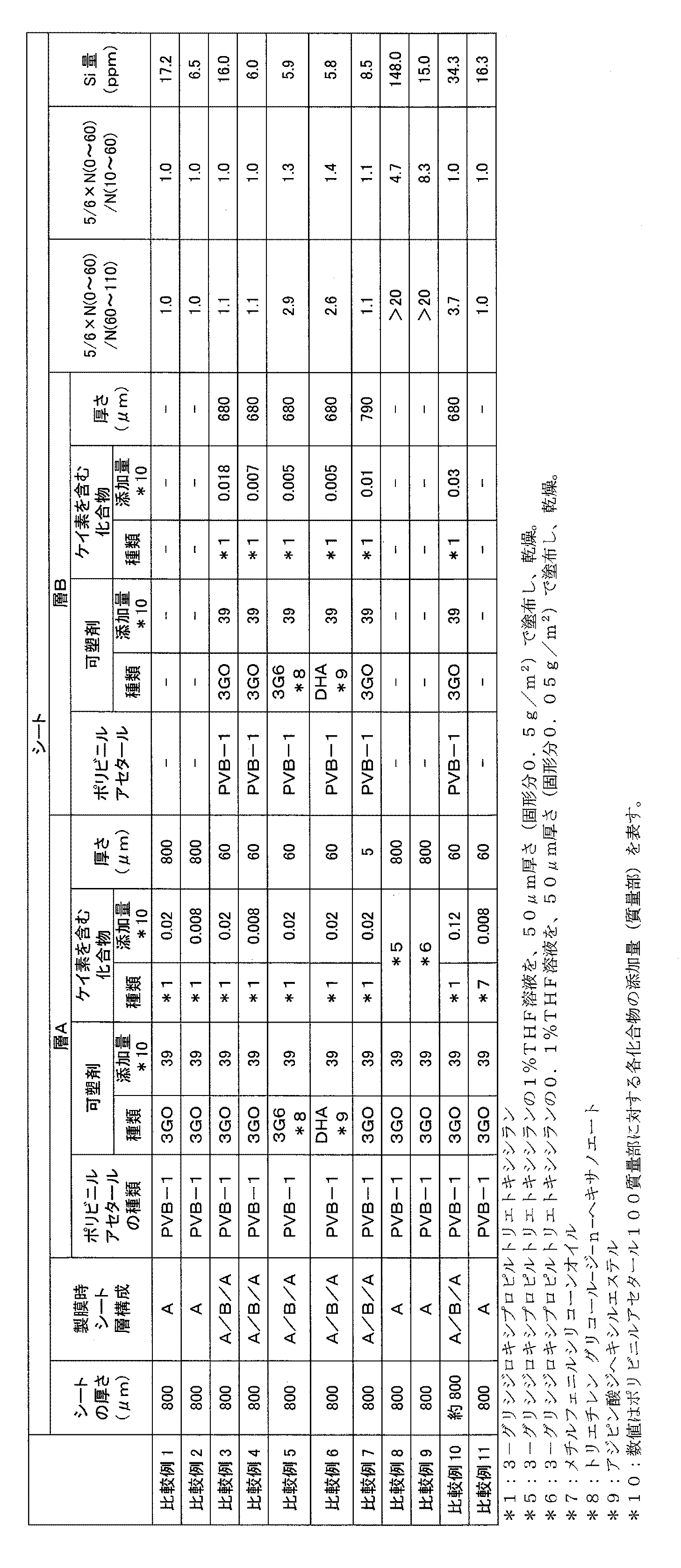

1 シート
2 測定対象領域
2 測定対象領域
Claims (16)
- ポリビニルアセタール、分子量380以上の可塑剤及びケイ素含有化合物を含み、ポリビニルアセタール100質量部に対して分子量380以上の可塑剤が30~70質量部であり、厚さ0.2~2mmのシートであって、シートをICP発光分析法により分析した際に0.10~30ppmのケイ素が検出され、
シートの厚さ方向に平行な断面におけるTOF-SIMS測定をした場合に、シートの少なくとも一方の表面から厚さ方向に0~60μm、幅Wμmの領域から検出されるケイ素二次イオンの合計数をN(0~60)とし、該表面から厚さ方向に10~60μm、幅Wμmの領域から検出されるケイ素二次イオンの合計数をN(10~60)とし、該表面から厚さ方向に60~110μm、幅Wμmの領域から検出されるケイ素二次イオンの合計数をN(60~110)としたときに、5/6×N(0~60)/N(60~110)が1.2以上であり、5/6×N(0~60)/N(10~60)が0.8~2であるシート。 - アルカリ金属塩及び/又はアルカリ土類金属塩を含む、請求項1記載のシート。
- アルカリ金属塩及び/又はアルカリ土類金属塩が、カルボン酸のアルカリ金属塩又はカルボン酸のアルカリ土類金属塩である、請求項2記載のシート。
- 前記カルボン酸が、炭素数1~8のカルボン酸である、請求項3記載のシート。
- アルカリ金属塩及び/又はアルカリ土類金属塩の含有量が、ポリビニルアセタール100質量部に対して0.001~0.1質量部である、請求項2~4のいずれかに記載のシート。
- ケイ素含有化合物がケイ素-酸素結合を含む化合物である、請求項1~5のいずれかに記載のシート。
- ケイ素含有化合物がシランカップリング剤である、請求項1~6のいずれかに記載のシート。
- ケイ素含有化合物がシリコーンオイルである、請求項1~6のいずれかに記載のシート。
- 分子量380以上の可塑剤がトリエチレングリコールジ2-エチルヘキサノエートである、請求項1~8のいずれかに記載のシート。
- シートを作製した後、30℃を越える温度での合計保管時間が3000時間未満である、請求項1~9のいずれかに記載のシート。
- シートの前記表面から厚さ方向に0~60μmの領域に存在するポリビニルアセタールの粘度平均重合度と、該表面から厚さ方向に60~110μmの領域に存在するポリビニルアセタールの粘度平均重合度との差が0~500である、請求項1~10のいずれかに記載のシート。
- ポリビニルアセタール、分子量380以上の可塑剤及びケイ素含有化合物を含む層Aと、ポリビニルアセタール、分子量380以上の可塑剤及びケイ素含有化合物を含む層Bとを積層して得られ、
層Aに含まれるケイ素含有化合物の濃度は、層Bに含まれるケイ素含有化合物の濃度より高く、
層Aに含まれるポリビニルアセタールのアセタール化度と層Bに含まれるポリビニルアセタールのアセタール化度の差が0~3モル%である、請求項1~11のいずれかに記載のシート。 - ポリビニルアセタール、分子量380以上の可塑剤及びケイ素含有化合物を含む層Aと、ポリビニルアセタール、分子量380以上の可塑剤及びケイ素含有化合物を含む層Bとを積層して得られ、
層Aに含まれるケイ素含有化合物の濃度は、層Bに含まれるケイ素含有化合物の濃度より高く、
層Aに含まれるポリビニルアセタールの平均残存水酸基量と層Bに含まれるポリビニルアセタールの平均残存水酸基量の差が0~3モル%である、請求項1~12のいずれかに記載のシート。 - ポリビニルアセタール、分子量380以上の可塑剤及びケイ素含有化合物を含む層Aと、ポリビニルアセタール、分子量380以上の可塑剤及びケイ素含有化合物を含む層Bとを積層して得られ、
層Aに含まれるケイ素含有化合物の濃度は、層Bに含まれるケイ素含有化合物の濃度より高く、
層Aに含まれる可塑剤のうち含有量の最も多い可塑剤を可塑剤A1とし、含有量の二番目に多い可塑剤を可塑剤A2とし、層Aに含まれるポリビニルアセタール100質量部に対する可塑剤A1の含有量を(a1)質量部とし、該ポリビニルアセタール100質量部に対する可塑剤A2の含有量を(a2)質量部とし、さらに、層Bに含まれる可塑剤のうち含有量の最も多い可塑剤を可塑剤B1とし、含有量の二番目に多い可塑剤を可塑剤B2とし、層Bに含まれるポリビニルアセタール100質量部に対する可塑剤B1の含有量を(b1)質量部とし、該ポリビニルアセタール100質量部に対する可塑剤B2の含有量を(b2)質量部とした場合に、
(a2)/(a1)および(b2)/(b1)が0~0.1であり、
|[(a1)+(a2)]-[(b1)+(b2)]|≦10である、請求項1~13のいずれかに記載のシート。 - ポリビニルアセタール、分子量380以上の可塑剤及びケイ素含有化合物を含み、ポリビニルアセタール100質量部に対して分子量380以上の可塑剤が30~70質量部であり、厚さ0.2~2mmのシートであって、シートをICP発光分析法により分析した際に0.10~30ppmのケイ素が検出され、
シートの厚さ方向に平行な断面におけるTOF-SIMS測定をした場合に、シートの少なくとも一方の表面から厚さ方向に0~Xμm、幅Wμmの領域から検出されるケイ素二次イオンの合計数をN(0~X)とし、該表面から厚さ方向にX/6~Xμm、幅Wμmの領域から検出されるケイ素二次イオンの合計数をN(X/6~X)とし、該表面から厚さ方向にX~11X/6μm、幅Wμmの領域から検出されるケイ素二次イオンの合計数をN(X~11X/6)としたときに、5/6×N(0~X)/N(X~11X/6)が1.2以上であり、5/6×N(0~X)/N(X/6~X)が0.8~2であり、Xが20~90μmである、シート。 - 請求項1~15のいずれかに記載のシートを含む合わせガラス。
Priority Applications (2)
| Application Number | Priority Date | Filing Date | Title |
|---|---|---|---|
| PCT/JP2013/074971 WO2015040663A1 (ja) | 2013-09-17 | 2013-09-17 | ポリビニルアセタールを含有するシート |
| JP2013544918A JP5503088B1 (ja) | 2013-09-17 | 2013-09-17 | ポリビニルアセタールを含有するシート |
Applications Claiming Priority (1)
| Application Number | Priority Date | Filing Date | Title |
|---|---|---|---|
| PCT/JP2013/074971 WO2015040663A1 (ja) | 2013-09-17 | 2013-09-17 | ポリビニルアセタールを含有するシート |
Publications (1)
| Publication Number | Publication Date |
|---|---|
| WO2015040663A1 true WO2015040663A1 (ja) | 2015-03-26 |
Family
ID=50941814
Family Applications (1)
| Application Number | Title | Priority Date | Filing Date |
|---|---|---|---|
| PCT/JP2013/074971 Ceased WO2015040663A1 (ja) | 2013-09-17 | 2013-09-17 | ポリビニルアセタールを含有するシート |
Country Status (2)
| Country | Link |
|---|---|
| JP (1) | JP5503088B1 (ja) |
| WO (1) | WO2015040663A1 (ja) |
Cited By (2)
| Publication number | Priority date | Publication date | Assignee | Title |
|---|---|---|---|---|
| WO2016159028A1 (ja) * | 2015-03-30 | 2016-10-06 | 積水化学工業株式会社 | 合わせガラス用中間膜及び合わせガラス |
| WO2017170472A1 (ja) * | 2016-03-28 | 2017-10-05 | 積水化学工業株式会社 | 熱可塑性樹脂膜及びガラス板含有積層体 |
Families Citing this family (1)
| Publication number | Priority date | Publication date | Assignee | Title |
|---|---|---|---|---|
| CN114787098B (zh) * | 2019-12-09 | 2025-06-20 | 积水化学工业株式会社 | 夹层玻璃用中间膜和夹层玻璃 |
Citations (5)
| Publication number | Priority date | Publication date | Assignee | Title |
|---|---|---|---|---|
| JPH06127982A (ja) * | 1992-10-16 | 1994-05-10 | Sekisui Chem Co Ltd | 合わせガラス用中間膜 |
| JP2001192245A (ja) * | 1995-01-23 | 2001-07-17 | Central Glass Co Ltd | 合せガラスの製造方法 |
| JP2002505210A (ja) * | 1998-03-04 | 2002-02-19 | イー・アイ・デュポン・ドウ・ヌムール・アンド・カンパニー | 耐層剥離性積層ガラス構造体 |
| JP2010523449A (ja) * | 2007-04-05 | 2010-07-15 | 株式会社クラレ | 特定の屈折率を有するシリカを含む合わせガラス用中間膜 |
| JP2012025645A (ja) * | 2010-07-28 | 2012-02-09 | Kuraray Co Ltd | 合わせガラス用中間膜、その製造方法およびそれを用いた合わせガラス |
-
2013
- 2013-09-17 WO PCT/JP2013/074971 patent/WO2015040663A1/ja not_active Ceased
- 2013-09-17 JP JP2013544918A patent/JP5503088B1/ja not_active Expired - Fee Related
Patent Citations (5)
| Publication number | Priority date | Publication date | Assignee | Title |
|---|---|---|---|---|
| JPH06127982A (ja) * | 1992-10-16 | 1994-05-10 | Sekisui Chem Co Ltd | 合わせガラス用中間膜 |
| JP2001192245A (ja) * | 1995-01-23 | 2001-07-17 | Central Glass Co Ltd | 合せガラスの製造方法 |
| JP2002505210A (ja) * | 1998-03-04 | 2002-02-19 | イー・アイ・デュポン・ドウ・ヌムール・アンド・カンパニー | 耐層剥離性積層ガラス構造体 |
| JP2010523449A (ja) * | 2007-04-05 | 2010-07-15 | 株式会社クラレ | 特定の屈折率を有するシリカを含む合わせガラス用中間膜 |
| JP2012025645A (ja) * | 2010-07-28 | 2012-02-09 | Kuraray Co Ltd | 合わせガラス用中間膜、その製造方法およびそれを用いた合わせガラス |
Cited By (12)
| Publication number | Priority date | Publication date | Assignee | Title |
|---|---|---|---|---|
| WO2016159028A1 (ja) * | 2015-03-30 | 2016-10-06 | 積水化学工業株式会社 | 合わせガラス用中間膜及び合わせガラス |
| WO2016159029A1 (ja) * | 2015-03-30 | 2016-10-06 | 積水化学工業株式会社 | 合わせガラス用中間膜及び合わせガラス |
| CN107406315A (zh) * | 2015-03-30 | 2017-11-28 | 积水化学工业株式会社 | 夹层玻璃用中间膜及夹层玻璃 |
| US10414127B2 (en) | 2015-03-30 | 2019-09-17 | Sekisui Chemical Co., Ltd. | Interlayer for laminated glass and laminated glass |
| US10414128B2 (en) | 2015-03-30 | 2019-09-17 | Sekisui Chemical Co., Ltd. | Interlayer for laminated glass and laminated glass |
| US10464293B2 (en) | 2015-03-30 | 2019-11-05 | Sekisui Chemical Co., Ltd. | Interlayer for laminated glass and laminated glass |
| CN107406315B (zh) * | 2015-03-30 | 2020-12-08 | 积水化学工业株式会社 | 夹层玻璃用中间膜及夹层玻璃 |
| WO2017170472A1 (ja) * | 2016-03-28 | 2017-10-05 | 積水化学工業株式会社 | 熱可塑性樹脂膜及びガラス板含有積層体 |
| CN108884326A (zh) * | 2016-03-28 | 2018-11-23 | 积水化学工业株式会社 | 热塑性树脂膜以及含有玻璃板的叠层体 |
| JPWO2017170472A1 (ja) * | 2016-03-28 | 2019-01-31 | 積水化学工業株式会社 | 熱可塑性樹脂膜及びガラス板含有積層体 |
| US10982085B2 (en) | 2016-03-28 | 2021-04-20 | Sekisui Chemical Co., Ltd. | Thermoplastic resin film and glass plate-including laminate |
| CN108884326B (zh) * | 2016-03-28 | 2021-06-01 | 积水化学工业株式会社 | 热塑性树脂膜以及含有玻璃板的叠层体 |
Also Published As
| Publication number | Publication date |
|---|---|
| JPWO2015040663A1 (ja) | 2017-03-02 |
| JP5503088B1 (ja) | 2014-05-28 |
Similar Documents
| Publication | Publication Date | Title |
|---|---|---|
| AU2017200859B2 (en) | Intermediate film for laminated glass and laminated glass | |
| ES2773976T3 (es) | Capas intercaladas poliméricas con propiedades ópticas mejoradas | |
| JP6698427B2 (ja) | 接着性が低減され、かつ可塑剤含分が低い中間フィルム層を用いて作製された、耐貫通性合わせガラス | |
| JP5050137B2 (ja) | 合わせガラス用中間膜、その製造方法およびそれを用いた合わせガラス | |
| TWI440659B (zh) | 由聚乙烯縮醛與塑化劑環己烷-1,2-二羧酸酯製成之含塑化劑薄膜 | |
| TWI694923B (zh) | 多層膜,包含該多層膜之中間膜及包含該中間膜之夾層玻璃及隔音玻璃層壓板 | |
| CN105358502B (zh) | 夹层玻璃用中间膜和夹层玻璃 | |
| CN104661979A (zh) | 夹层玻璃用中间膜及夹层玻璃 | |
| JP2018052809A (ja) | 可塑剤を含まないポリビニルアセタールからなる薄いシートをベースとする、熱線遮蔽特性を有する合わせガラス積層体 | |
| TWI691541B (zh) | 層合玻璃用中間膜及層合玻璃 | |
| TW201708365A (zh) | 觸控面板用層間填充材料及積層體 | |
| JP5503088B1 (ja) | ポリビニルアセタールを含有するシート | |
| JP5072858B2 (ja) | 安定化された赤外線吸収剤を含む中間層 | |
| EP2142368A1 (en) | Interlayer films for laminated glazing with improved mechanical properties | |
| JP2015059218A (ja) | ポリビニルアセタールを含有するシート | |
| JPWO2015037142A1 (ja) | 帯電防止性に優れる組成物 | |
| JP6247047B2 (ja) | 合わせガラス用中間膜及び合わせガラス | |
| JP2018008847A (ja) | 合わせガラス用中間膜及び合わせガラス | |
| JP2015117141A (ja) | 遮音性に優れる積層体 | |
| JP6113640B2 (ja) | 積層体 | |
| JP2015117142A (ja) | 遮音性に優れる積層体 | |
| WO2008122610A1 (en) | Interlayer films for laminated glazing containing modified silica | |
| JP2015117140A (ja) | 遮音性に優れる積層体 |
Legal Events
| Date | Code | Title | Description |
|---|---|---|---|
| ENP | Entry into the national phase |
Ref document number: 2013544918 Country of ref document: JP Kind code of ref document: A |
|
| 121 | Ep: the epo has been informed by wipo that ep was designated in this application |
Ref document number: 13893977 Country of ref document: EP Kind code of ref document: A1 |
|
| NENP | Non-entry into the national phase |
Ref country code: DE |
|
| 122 | Ep: pct application non-entry in european phase |
Ref document number: 13893977 Country of ref document: EP Kind code of ref document: A1 |