WO2015016255A1 - メラミン化粧板およびメラミン化粧板の製造方法 - Google Patents
メラミン化粧板およびメラミン化粧板の製造方法 Download PDFInfo
- Publication number
- WO2015016255A1 WO2015016255A1 PCT/JP2014/070044 JP2014070044W WO2015016255A1 WO 2015016255 A1 WO2015016255 A1 WO 2015016255A1 JP 2014070044 W JP2014070044 W JP 2014070044W WO 2015016255 A1 WO2015016255 A1 WO 2015016255A1
- Authority
- WO
- WIPO (PCT)
- Prior art keywords
- layer
- resin
- decorative board
- melamine decorative
- melamine
- Prior art date
- Legal status (The legal status is an assumption and is not a legal conclusion. Google has not performed a legal analysis and makes no representation as to the accuracy of the status listed.)
- Ceased
Links
Images


Classifications
-
- B—PERFORMING OPERATIONS; TRANSPORTING
- B32—LAYERED PRODUCTS
- B32B—LAYERED PRODUCTS, i.e. PRODUCTS BUILT-UP OF STRATA OF FLAT OR NON-FLAT, e.g. CELLULAR OR HONEYCOMB, FORM
- B32B17/00—Layered products essentially comprising sheet glass, or glass, slag, or like fibres
- B32B17/02—Layered products essentially comprising sheet glass, or glass, slag, or like fibres in the form of fibres or filaments
- B32B17/04—Layered products essentially comprising sheet glass, or glass, slag, or like fibres in the form of fibres or filaments bonded with or embedded in a plastic substance
-
- B—PERFORMING OPERATIONS; TRANSPORTING
- B32—LAYERED PRODUCTS
- B32B—LAYERED PRODUCTS, i.e. PRODUCTS BUILT-UP OF STRATA OF FLAT OR NON-FLAT, e.g. CELLULAR OR HONEYCOMB, FORM
- B32B27/00—Layered products comprising a layer of synthetic resin
- B32B27/12—Layered products comprising a layer of synthetic resin next to a fibrous or filamentary layer
-
- B—PERFORMING OPERATIONS; TRANSPORTING
- B32—LAYERED PRODUCTS
- B32B—LAYERED PRODUCTS, i.e. PRODUCTS BUILT-UP OF STRATA OF FLAT OR NON-FLAT, e.g. CELLULAR OR HONEYCOMB, FORM
- B32B27/00—Layered products comprising a layer of synthetic resin
- B32B27/42—Layered products comprising a layer of synthetic resin comprising condensation resins of aldehydes, e.g. with phenols, ureas or melamines
-
- B—PERFORMING OPERATIONS; TRANSPORTING
- B32—LAYERED PRODUCTS
- B32B—LAYERED PRODUCTS, i.e. PRODUCTS BUILT-UP OF STRATA OF FLAT OR NON-FLAT, e.g. CELLULAR OR HONEYCOMB, FORM
- B32B33/00—Layered products characterised by particular properties or particular surface features, e.g. particular surface coatings; Layered products designed for particular purposes not covered by another single class
-
- B—PERFORMING OPERATIONS; TRANSPORTING
- B32—LAYERED PRODUCTS
- B32B—LAYERED PRODUCTS, i.e. PRODUCTS BUILT-UP OF STRATA OF FLAT OR NON-FLAT, e.g. CELLULAR OR HONEYCOMB, FORM
- B32B2260/00—Layered product comprising an impregnated, embedded, or bonded layer wherein the layer comprises an impregnation, embedding, or binder material
- B32B2260/02—Composition of the impregnated, bonded or embedded layer
- B32B2260/021—Fibrous or filamentary layer
-
- B—PERFORMING OPERATIONS; TRANSPORTING
- B32—LAYERED PRODUCTS
- B32B—LAYERED PRODUCTS, i.e. PRODUCTS BUILT-UP OF STRATA OF FLAT OR NON-FLAT, e.g. CELLULAR OR HONEYCOMB, FORM
- B32B2260/00—Layered product comprising an impregnated, embedded, or bonded layer wherein the layer comprises an impregnation, embedding, or binder material
- B32B2260/04—Impregnation, embedding, or binder material
- B32B2260/046—Synthetic resin
-
- B—PERFORMING OPERATIONS; TRANSPORTING
- B32—LAYERED PRODUCTS
- B32B—LAYERED PRODUCTS, i.e. PRODUCTS BUILT-UP OF STRATA OF FLAT OR NON-FLAT, e.g. CELLULAR OR HONEYCOMB, FORM
- B32B2262/00—Composition or structural features of fibres which form a fibrous or filamentary layer or are present as additives
- B32B2262/10—Inorganic fibres
- B32B2262/101—Glass fibres
-
- B—PERFORMING OPERATIONS; TRANSPORTING
- B32—LAYERED PRODUCTS
- B32B—LAYERED PRODUCTS, i.e. PRODUCTS BUILT-UP OF STRATA OF FLAT OR NON-FLAT, e.g. CELLULAR OR HONEYCOMB, FORM
- B32B2307/00—Properties of the layers or laminate
- B32B2307/50—Properties of the layers or laminate having particular mechanical properties
- B32B2307/538—Roughness
-
- B—PERFORMING OPERATIONS; TRANSPORTING
- B32—LAYERED PRODUCTS
- B32B—LAYERED PRODUCTS, i.e. PRODUCTS BUILT-UP OF STRATA OF FLAT OR NON-FLAT, e.g. CELLULAR OR HONEYCOMB, FORM
- B32B2309/00—Parameters for the laminating or treatment process; Apparatus details
- B32B2309/08—Dimensions, e.g. volume
- B32B2309/10—Dimensions, e.g. volume linear, e.g. length, distance, width
- B32B2309/105—Thickness
-
- B—PERFORMING OPERATIONS; TRANSPORTING
- B32—LAYERED PRODUCTS
- B32B—LAYERED PRODUCTS, i.e. PRODUCTS BUILT-UP OF STRATA OF FLAT OR NON-FLAT, e.g. CELLULAR OR HONEYCOMB, FORM
- B32B2451/00—Decorative or ornamental articles
-
- E—FIXED CONSTRUCTIONS
- E04—BUILDING
- E04F—FINISHING WORK ON BUILDINGS, e.g. STAIRS, FLOORS
- E04F13/00—Coverings or linings, e.g. for walls or ceilings
- E04F13/07—Coverings or linings, e.g. for walls or ceilings composed of covering or lining elements; Sub-structures therefor; Fastening means therefor
- E04F13/08—Coverings or linings, e.g. for walls or ceilings composed of covering or lining elements; Sub-structures therefor; Fastening means therefor composed of a plurality of similar covering or lining elements
- E04F13/0866—Coverings or linings, e.g. for walls or ceilings composed of covering or lining elements; Sub-structures therefor; Fastening means therefor composed of a plurality of similar covering or lining elements composed of several layers, e.g. sandwich panels or layered panels
Definitions
- the present invention relates to a melamine decorative board and a method for producing a melamine decorative board.
- a melamine decorative board is a decorative board that uses melamine resin for the surface layer, and has a design such as a grain pattern on the wall surface of a building, the inner wall surface of an elevator or a train vehicle, the furniture surface such as a desk or a bookshelf. It is used when applying.
- incombustible melamine decorative boards composed of a surface layer using a melamine resin and a glass fiber substrate have become mainstream.
- the melamine decorative board described in Patent Document 1 is configured so that the thickness can be reduced and bending can be easily performed.
- the design surface of the melamine decorative board may be mirror-finished to give a high-class feeling.
- the melamine decorative board described in Patent Document 1 has a thin surface layer, the surface layer is affected by the surface shape of the glass fiber base material even if it is mirror-finished. It is difficult to make a specular surface.
- An object of the present invention is to provide a melamine decorative board having a non-flammability and bending workability, and having a mirror-finished design surface, and a melamine decorative board capable of easily producing such a melamine decorative board. It is to provide a manufacturing method.
- the present inventions (1) to (12) below is composed of a laminate in which a surface layer, an intermediate layer, and a core material layer are laminated in order,
- the surface layer comprises a surface layer base material carrying a resin containing a melamine resin on the first surface side which is a design surface and carrying a thermoplastic resin on the second surface side in contact with the intermediate layer.
- the first surface of the surface layer is a mirror surface
- the core material layer is made of a core material made of a glass cloth or a prepreg based on glass cloth
- middle layer is comprised with resin for intermediate
- the average thickness is larger than arithmetic mean roughness Ra1 of the surface by the side of the said intermediate
- the melamine decorative board characterized by the above-mentioned.
- the melamine decorative board is 1 Arranging a base film of ⁇ 50 GPa so as to face the second substrate;
- the melamine decorative board is obtained by thermocompression bonding the first substrate and the second substrate by bringing the abutment plate and the base film close together while heating at least the first substrate.
- Process The manufacturing method of the melamine decorative board characterized by including the process of removing the said board and the said base film from the said melamine decorative board.
- the first layer supplies a resin varnish containing a resin containing the melamine resin to the first surface side of the surface layer base material, and the second layer of the surface layer base material.
- the melamine makeup according to (6) above which is formed by supplying a resin varnish having particles having an average particle size smaller than the arithmetic average roughness Ra1 and including the thermoplastic resin on the surface side. A manufacturing method of a board.
- the second layer has an average particle size larger than the average particle size of the particles composed of the thermoplastic resin and smaller than the arithmetic average roughness Ra1, and the intermediate layer forming resin.
- a melamine decorative board that is excellent in nonflammability and bending workability, and has a design surface that is mirror-finished.
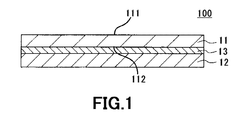
- FIG. 1 is a cross-sectional view showing an embodiment of the melamine decorative board of the present invention.
- FIG. 2 is a process diagram showing an example of a method for producing a melamine decorative board according to the present invention.
- FIG. 3 is a conceptual diagram showing another example of the configuration of the decorative melamine board of the present invention.
- FIG. 4 is a conceptual diagram showing another example of the configuration of the melamine decorative board of the present invention.
- the melamine decorative board of the present invention can give aesthetics and a high-class feeling by being attached to the wall surface of a building, the inner wall surface of an elevator or a train vehicle, the surface of furniture such as a desk or a bookshelf. Moreover, the melamine decorative board of this invention has nonflammability.
- FIG. 1 is a cross-sectional view showing an embodiment of the melamine decorative board of the present invention.
- the upper side in FIG. 1 is referred to as “upper”, and the lower side in FIG. 1 is referred to as “lower”.
- the melamine decorative board 100 is comprised by the laminated body on which the surface layer 11, the intermediate
- the surface layer 11 includes a first surface 111 (upper surface) serving as a design surface, and a second surface 112 (lower surface) in contact with the intermediate layer 13 on the side opposite to the first surface 111.
- the surface layer 11 was supported on the surface layer base material, a resin containing a melamine resin supported on the first surface 111 side of the surface layer base material, and the second surface 112 side of the surface layer base material. It is comprised with the surface layer material which consists of a thermoplastic resin. Further, the surface layer 11 has a design surface (first surface 111) as a mirror surface.
- the surface layer base material carrying the resin means that the resin adheres to the surface of the surface layer base material (carrier) or is impregnated in the voids inside the surface layer base material. means. In this state, after molding the surface layer material, the resin carried on the surface layer base material exhibits its performance. The resin may not be uniformly distributed on the surface of the surface layer base material and the inside of the surface layer base material.
- the surface layer base material is a sheet-like base material, and a design surface is formed on the first surface 111 of the surface layer 11 by supporting a resin containing a melamine resin on the first surface 111 side.
- the material of the surface layer base material is not particularly limited.
- As the surface layer base material for example, various fiber base materials such as pulp, linter, synthetic fiber, and glass fiber can be used. Further, as the surface layer base material, a titanium oxide-containing decorative paper containing a pigment such as titanium oxide can be used as necessary.
- the basis weight of the surface layer base material is not particularly limited, but is preferably 40 to 150 g / m 2 . If the basis weight is less than the lower limit value, the resin impregnation step may cause the resin to break or the surface layer material (surface layer 11) to be obtained is likely to be wrinkled. Therefore, impregnation treatment (for example, coating treatment) ) May be difficult. Furthermore, it may be difficult to adjust the amount of resin carried on each of the first surface 111 side and the second surface 112 side of the surface layer base material. On the other hand, when the basis weight exceeds the upper limit, unevenness occurs in the amount of the resin carried by the surface layer base material, and the flexibility of the melamine decorative board 100 is lowered, and the productivity is lowered and the cost is increased. It may be a cause.
- the surface layer material is formed by supporting a resin containing a melamine resin on the upper surface side (first surface 111 side) of the surface layer base material. Thereby, suitable surface hardness can be provided to the upper surface of the surface layer 11, that is, the first surface 111 (design surface) of the surface layer 11.
- the melamine resin is not particularly limited, and for example, a polymer obtained by reacting melamine and formaldehyde in a neutral or weak alkali can be used.
- reaction molar ratio of formaldehyde to melamine is a value of (molar amount of formaldehyde) / (molar amount of melamine).
- the reaction molar ratio is not particularly limited, but is preferably 1.0 to 4.0, more preferably 1.0 to 2.0, and further preferably 1.1 to 1.8. preferable.
- a melamine resin obtained by reacting melamine and formaldehyde at such a reaction molar ratio can be suitably used.
- the reaction molar ratio is less than the lower limit, unreacted melamine increases, the storage stability of the resin decreases, and the cost may increase.
- the resin carried on the upper surface side of the surface layer base material can be a resin containing one kind of melamine resin alone, or two or more kinds of melamine resins having different reaction molar ratios, weight average molecular weights, and the like. A resin containing can also be used.
- melamine resin commercially available products such as melamine resin manufactured by Sumitomo Chemical Co., Ltd. can be used.
- the weight average molecular weight of the melamine resin is not particularly limited, but is preferably 200 to 500, and more preferably 250 to 350.
- the weight average molecular weight of a melamine resin is smaller than the said lower limit, the unreacted melamine contained in resin increases, and the preservability of resin may fall.
- the impregnation property to the base material of resin may fall.
- the weight average molecular weight can be measured, for example, by GPC (gel permeation chromatography, standard substance: converted to polystyrene).
- the amount of the melamine resin contained in the resin supported on the upper surface (first surface 111) side of the surface layer base material is not particularly limited, but is preferably 80 to 100% by mass, and 95 to 100% by mass. % Is more preferred.
- the amount of the melamine resin contained in the resin carried on the upper surface side of the surface layer base material is less than the lower limit value, the hardness of the surface of the surface layer 11 (first surface 111) decreases, Contamination resistance may be reduced.
- the method for supporting the resin containing the melamine resin on the upper surface side (first surface 111 side) of the surface layer base material is not particularly limited.
- a resin varnish obtained by dissolving the resin in a solvent is applied to a surface layer substrate using a known device such as a spray device, a shower device, a kiss coater, a comma coater, A method of heating and drying at about 80 to 130 ° C. can be used.
- a surface layer base material hereinafter, also referred to as “resin-supporting base material” carrying a resin on the upper surface side is obtained.
- the resin-supported substrate for example, resin-impregnated paper
- the resin-supported substrate contains 2 to 6% by mass of a volatile component (solvent) when the total weight of the resin-supported substrate is 100% by mass. It is preferable to remain. This facilitates handling of the resin-carrying substrate.
- a volatile component solvent
- the upper surface side first surface 111 side
- the resin flow of the resin containing the melamine resin supported on is improved. Therefore, the design appearance and surface glossiness of the surface layer 11 are improved.
- the volatile component is less than 2% by mass, the resin is easily broken, and thus handling becomes difficult.
- the appearance of the surface layer 11 is hindered.
- the curvature (sheet curl) of the melamine decorative board 100 tends to increase.
- the volatile component is 7.5% or more, the volatile component affects the gloss transfer property of the appearance of the melamine decorative board 100.
- the solvent for dissolving the resin containing the melamine resin (adjusting the resin varnish) is not particularly limited, and examples thereof include water and methanol. As such a solvent, water is particularly preferable. In addition, a poor solvent can be used in combination as long as it does not adversely affect the coatability of the resin varnish.
- the amount of solid content (all components excluding the solvent) contained in the resin varnish is not particularly limited, but is preferably 30 to 70% by mass, and 45 to 60% by mass of the entire resin varnish. More preferred. Thereby, the impregnation property to the surface layer base material of the resin varnish can be improved.
- the surface layer material is formed by supporting a thermoplastic resin on the second surface 112 side opposite to the first surface 111 (design surface) side of the surface layer base material.
- the thermoplastic resin supported on the surface layer base material may be in the form of particles, bulk, or a combination thereof, but is preferably included in the form of particles.
- particulate thermoplastic resin thermoplastic resin particles
- thermoplastic resin particles can be easily obtained by using a thermoplastic emulsion resin (resin varnish) in which the thermoplastic resin is dispersed in a solvent to form an emulsion and drying it. And it can be obtained reliably.
- Thermoplastic resin particles have excellent adhesive properties with metals and various materials. For this reason, the thermoplastic resin particles are supported on the surface layer base material with high adhesive strength. In particular, even if the surface layer base material is deformed by applying a stress such as bending, the high adhesive strength makes it difficult for the thermoplastic resin to peel from the surface layer base material. Furthermore, since the thermoplastic resin particles carried on the surface layer base material are in point contact with each other, they reliably follow the deformation of the surface layer base material. Therefore, flexibility is imparted to the melamine decorative board 100. As a result, the bending workability of the melamine decorative board 100 can be improved.
- thermoplastic resin is not particularly limited, and examples thereof include various thermoplastic resins such as acrylic resin, urethane resin, vinyl acetate copolymer, urethane acrylic composite resin, styrene butadiene rubber (SBR), and nitrile rubber (NBR). Can be mentioned. Among these, as the thermoplastic resin, a thermoplastic resin containing urethane acrylic composite particles is preferable.
- thermoplastic resins are particularly excellent in toughness, elasticity and flexibility, and acrylic resins are particularly excellent in transparency, durability, weather resistance, chemical resistance and film-forming properties. Therefore, when a urethane acrylic composite resin is used as the thermoplastic resin, the thermoplastic resin carried on the surface layer base material can have both the characteristics of the urethane resin and the acrylic resin described above. From the above, it is preferable that the thermoplastic resin supported on the second surface 112 side of the surface layer base material includes particles made of urethane acrylic composite resin, that is, urethane acrylic composite particles. .
- a urethane acrylic composite particle means the particle
- the “heterophasic structure” means a structure in which a plurality of phases composed of different types of resins are present in one particle. Examples of such a structure include a core-shell structure, a localized structure, and a sea-island structure.
- Such urethane acrylic composite particles preferably have a core-shell structure in which each particle has an acrylic resin as a core and a urethane resin as a shell.
- the surface outline becomes urethane resin. Therefore, the characteristics of the urethane resin can be imparted to the outer shell while giving the characteristics of both the urethane resin and the acrylic resin to the second surface 112 side of the surface layer base material.
- the arrangement state of the particles when the urethane acrylic composite particles are supported on the second surface 112 side of the surface layer base material is not particularly limited.
- Such particles for example, can be arranged in a straight line to form a straight chain structure or take other various arrangement states.
- the structure of the particles and the arrangement state of the particles can be confirmed by, for example, a scanning electron microscope (SEM).
- thermoplastic resin 1 type in the thermoplastic resin mentioned above may be included independently, and 2 or more types of different thermoplastic resins may be mixed and included.
- thermoplastic resin may contain a small amount of a thickener, a penetration accelerator, an antifoaming agent, and the like as necessary, in addition to the resin particles of the thermoplastic resin.
- the average particle diameter of the thermoplastic resin particles is not particularly limited, but is preferably smaller than the arithmetic average roughness Ra1 of the surface (upper surface) of the core layer 12 described later on the intermediate layer 13 side. Further, the average particle diameter of the thermoplastic resin particles is preferably 30 to 100 nm, and more preferably 60 to 90 nm.
- the average particle diameter of the thermoplastic resin particles satisfies the above conditions, the impregnation property of the thermoplastic resin particles between the fibers of the surface layer base material is improved, and the thermoplastic resin particles are further impregnated inside the surface layer base material. Can be made. For this reason, the surface layer 11 can be given good flexibility. Further, if the average particle diameter of the thermoplastic resin particles is within the above range, the design of the design surface of the surface layer 11 is sufficiently smaller than the arithmetic average roughness Ra1 of the surface of the core layer 12 on the intermediate layer 13 side. Appearance and surface gloss are further improved.
- the thermoplastic resin is preferably water-insoluble. Thereby, it can prevent that a thermoplastic resin transfers to the 1st surface 111 side of a surface layer base material, and mixes with the melamine resin currently carry
- the method for supporting the thermoplastic resin on the second surface 112 side of the surface layer base material is not particularly limited, and the above-described method for supporting the resin containing the melamine resin on the first surface 111 side of the surface layer base material Similar methods can be used.
- a thermoplastic emulsion resin resin varnish
- a method in which a thermoplastic emulsion resin is applied to a surface layer substrate using a known method and heated and dried can be used.
- the thermoplastic emulsion resin in which the urethane acrylic composite resin is dispersed in a solvent to become an emulsion is particularly preferably an aqueous clear type.
- the water-based clear thermoplastic emulsion resin is water-soluble, its solid content (coating film) after water removal is water-insoluble, and transparent enough to clearly identify the underlying pattern have. Therefore, in this specification, the aqueous clear type thermoplastic emulsion resin means an aqueous resin solution having such characteristics.
- the resin-supported substrate for example, resin-impregnated paper
- 2 to 6% by mass of a volatile component remains when the total weight of the resin-supported substrate is 100% by mass. It is preferable. This facilitates handling of the resin-carrying substrate.
- the upper surface side first surface 111 side
- the resin flow of the resin containing the melamine resin supported on is improved. Therefore, the design appearance and surface glossiness of the melamine decorative board 100 are improved.
- the solvent for dissolving the thermoplastic resin is not particularly limited, and examples thereof include water.
- the solvent may be used in combination with a poor solvent as long as the coating property and the like are not adversely affected.
- the amount of the solid content (all components excluding the solvent) contained in the resin is not particularly limited, but is preferably 25 to 60% by mass, more preferably 30 to 45% by mass of the entire resin. . Thereby, the impregnation property to the surface layer base material of resin can be improved.
- the design surface (first surface 111) of the surface layer 11 is a mirror surface, and the arithmetic average roughness Ra2 is preferably 300 nm or less, more preferably 150 nm or less. preferable. Thereby, the 1st surface 111 of the surface layer 11 becomes smoother, and the high-class feeling of the melamine decorative board 100 can be made higher.
- Core material layer The core material layer 12 is bonded to the lower surface (second surface 112) side of the surface layer 11 via the intermediate layer 13.
- the core material layer 12 is composed of a core material made of glass cloth or a prepreg containing glass cloth as a base material. Thereby, heat resistance, nonflammability, rigidity, etc. can be provided to the melamine decorative board 100. Further, irregularities are formed on the upper surface of the core material layer 12. Since the irregularities of the core material layer 12 are embedded in the intermediate layer 13, the core material layer 12 and the intermediate layer 13 are firmly bonded (adhered) by the anchor effect. That is, the interlayer adhesive strength between the core material layer 12 and the intermediate layer 13 can be increased. Thereby, when bending the melamine decorative board 100, it can prevent reliably that the core material layer 12 and the intermediate
- the arithmetic average roughness Ra1 of the upper surface (surface on the intermediate layer 13 side) of the core material layer 12 is not particularly limited, but is preferably 0.1 to 10 ⁇ m, and more preferably 1 to 7 ⁇ m. Thereby, the interlayer adhesive strength of the core material layer 12 and the intermediate
- examples of the glass constituting the glass cloth include E glass, C glass, A glass, S glass, D glass, NE glass, T glass, and H glass.
- T glass is preferable. Since T glass is a material having a relatively small thermal expansion coefficient, the thermal expansion coefficient of the glass cloth can be reduced by using it as a constituent material of the glass cloth.
- the weight of the glass cloth is not particularly limited, but if it is necessary to satisfy the “non-combustible crack / penetration after combustion” requirement of Article 2-9 of the Building Standards Act, the basis weight It is preferable to be 100 g / m 2 or more.
- the upper limit of the weight is not particularly limited, but a basis weight of 250 g / m 2 or less is preferable in consideration of material cost and workability.
- the prepreg is not particularly limited, and for example, the above glass cloth can be impregnated with a resin composition containing a thermoplastic resin, a thermosetting resin, or the like.
- the amount of the resin composition contained in the prepreg is not particularly limited as long as the interlayer adhesive strength with the intermediate layer 13 is sufficient for forming the melamine decorative board 100.
- the amount of the thermoplastic resin (solid content) contained in the prepreg is preferably 1% by mass or more and 20% by mass or less, and preferably 1% by mass or more and 10% by mass. % Or less is more preferable. Thereby, the interlayer adhesive strength of the intermediate
- thermosetting resin as a resin composition
- the quantity of the thermosetting resin (solid content) contained in a prepreg is 1 mass% or more and 20 mass% or less, and 2 mass%. More preferably, it is 10 mass% or less.
- middle layer 13 and the core material layer 12 can be improved more.
- thermoplastic resin is not particularly limited, and examples thereof include acrylic resin, urethane resin, ethylene vinyl acetate resin, and styrene butadiene rubber (SBR). Among these, it is preferable to use an acrylic resin and / or a urethane resin as the thermoplastic resin.
- thermosetting resin is not particularly limited, and examples thereof include phenol resin, epoxy resin, oxetane resin, (meth) acrylate resin, unsaturated polyester resin, diallyl phthalate resin, urea resin, and maleimide resin. Especially, it is preferable to use a phenol resin as a thermosetting resin from a nonflammability, heat resistance, and adhesive viewpoint. These resins can be used alone or in combination.
- the prepreg can be manufactured by a conventionally known method. For example, it can be obtained by impregnating the above-described glass cloth with a resin varnish obtained by dissolving a resin composition in a solvent and then drying the resin varnish.
- the core material layer 12 may further carry a thermoplastic resin on the upper surface side in contact with the intermediate layer 13.
- a thermoplastic resin a thermoplastic resin similar to the thermoplastic resin carried on the second surface 112 side of the surface layer base material can be used.
- this thermoplastic resin contains a thermoplastic resin particle, the adhesive strength of the core material layer 12 and the intermediate
- the average particle diameter of the thermoplastic resin particles is not particularly limited. Such thermoplastic resin particles may be water-soluble or water-insoluble.
- the thermoplastic resin carried on the side of the core material layer 12 in contact with the intermediate layer 13 is not particularly limited as long as it imparts flexibility to the core material layer 12 and does not affect the calorific value and gas toxicity during combustion.
- the thickness of the core material layer 12 is preferably 100 ⁇ m or more. Thereby, sufficient heat resistance and nonflammability can be imparted to the melamine decorative board 100. Further, the upper limit of the thickness is not particularly limited. However, as the thickness increases, the thickness and weight of the melamine decorative board 100 increase and the cost also increases. For this reason, it is preferable to set the thickness of the core material layer 12 in an allowable range in the design of the final product (melamine decorative board 100), and more preferably 350 ⁇ m or less.
- the intermediate layer 13 is a resin layer disposed between the surface layer 11 and the core material layer 12, and the upper surface thereof is in contact with the surface layer 11, and the lower surface thereof is in contact with the core material layer 12 to join them. To do.
- the intermediate layer 13 is a layer having a function of reducing the influence of the surface shape (unevenness) of the upper surface of the core material layer 12 on the surface layer 11.
- the present invention is characterized in that the intermediate layer 13 is provided between the surface layer 11 and the core material layer 12.
- the influence of the surface shape (unevenness) of the upper surface of the core material layer 12 derived from the glass cloth on the design surface (first surface 111) of the surface layer 11 can be reduced.
- the smoothness of the design surface of the surface layer 11 can be improved.
- middle layer 13 is larger than the arithmetic mean roughness Ra1 of the upper surface of the core material layer 12.
- the intermediate layer 13 when the average thickness of the intermediate layer 13 satisfies the above conditions, the intermediate layer 13 exhibits a function as a cushion layer and absorbs stress applied to the melamine decorative board 100. For this reason, when bending the melamine decorative board 100, it can prevent reliably that the core material layer 12 and the intermediate
- the intermediate layer 13 is made of an intermediate layer forming resin. Although it does not specifically limit as resin for intermediate
- the intermediate layer forming resin contains resin particles, the resin particles are embedded in the concave and convex recesses of the core material layer 12. Thereby, the smoothness of the upper surface of the intermediate layer 13 is further improved. Thereby, the influence of the surface shape of the core material layer 12 derived from the glass cloth on the design surface (first surface 111) of the surface layer 11 can be further reduced.
- the resin particles are not particularly limited.
- particles of thermoplastic resin such as acrylic resin, urethane resin, vinyl acetate copolymer, urethane acrylic composite resin, styrene butadiene rubber (SBR), and nitrile rubber (NBR) are used.
- SBR styrene butadiene rubber
- NBR nitrile rubber
- acrylic resin particles it is preferable to use acrylic resin particles as the resin particles.
- the average particle diameter of such resin particles is not particularly limited.
- the thermoplastic resin carried on the lower surface side of the surface layer 11 includes thermoplastic resin particles, it is preferably larger than the average particle diameter of the thermoplastic resin particles and smaller than the arithmetic average roughness Ra1 described above.
- the resin particles having such a size can be embedded in the concave and convex portions of the core material layer 12 to smooth the upper surface of the intermediate layer 13. Further, even if minute irregularities are formed on the surface (upper surface) of the intermediate layer 13 on the surface layer 11 side, the thermoplastic resin particles of a thermoplastic resin having an average particle size smaller than the resin particles in the irregularities of the irregularities. Is embedded.
- the first surface 111 (design surface) of the surface layer 11 can be made smoother, and the design appearance and surface glossiness of the design surface of the surface layer 11 are further improved.
- the average particle size of the resin particles is preferably 150 nm or more and 0.75 ⁇ Ra1 or less, and more preferably 200 nm or more and 0.50 ⁇ Ra1 or less.
- the first surface 111 (design surface) of the surface layer 11 can be made smoother due to the above-described effects. Further, the design appearance and surface glossiness of the design surface of the surface layer 11 are further improved.
- the penetration of the resin particles into the surface layer 11 and the core material layer 12 can be more reliably prevented, and the function as the intermediate layer 13 as described above can be more reliably exhibited.
- the average particle size of the resin particles is less than the lower limit, depending on the type of the surface layer base material constituting the surface layer 11 and the type of glass cloth constituting the core material layer 12, the melamine decorative board When 100 is manufactured, resin particles are absorbed by the surface layer 11 and the core material layer 12, and it may be difficult to form the intermediate layer 13.
- a film made of an intermediate layer forming resin can also be used.
- a film can be composed of a thermoplastic resin such as an acrylic resin, a urethane resin, a polyolefin resin, or a polyester resin. Even when such a film is used as the intermediate layer 13, the influence of the surface shape of the core material layer 12 derived from the glass cloth on the design surface (first surface 111) of the surface layer 11 can be further reduced. . Further, when such a film is used as the intermediate layer 13, it is possible to save materials (solvents and the like) for forming the intermediate layer 13 and time, thereby reducing the cost for manufacturing the melamine decorative board 100. can do.
- the average thickness of the intermediate layer 13 is not particularly limited as long as it is larger than the arithmetic average roughness Ra1 of the upper surface of the core material layer 12, but it is preferably 6 ⁇ m or more, more preferably 10 to 50 ⁇ m. Thereby, the influence of the surface shape of the core material layer 12 derived from the glass cloth on the design surface (first surface 111) of the surface layer 11 can be reduced more effectively.
- the average thickness of the intermediate layer 13 is less than the lower limit, depending on the value of the arithmetic average roughness Ra1, the design surface (first surface 111) of the surface layer 11 is derived from the glass cloth. The influence of the surface shape of the core material layer 12 may increase.
- the average thickness of the intermediate layer 13 exceeds the upper limit, the calorific value when the intermediate layer 13 burns increases, and the melamine decorative board 100 having the intermediate layer 13 may not be incombustible.
- the melamine decorative board 100 as described above can be bent so that the minimum bending radius at room temperature (usually about 20-30 ° C.) is 10 mmR or less, but the degree of bending (value of the minimum bending radius). Is not limited to this.
- the minimum bend radius R is the minimum that can be obtained 100% non-defective product without causing defects such as cracking even if the room temperature bending process is repeatedly performed in one direction along a mold having a curved portion with a radius R. Means the radius R of the mold.
- the whole thickness of the melamine decorative board 100 is 0.4 mm or less.
- the thermoplastic resin carried on the second surface 112 side of the surface layer base material has been described as being in the form of particles, but may not be in the form of particles. That is, for example, when a thermoplastic emulsion resin (resin varnish) is used and supported on the second surface 112 side of the surface layer base material, the thermoplastic resin is in a particulate form after the resin varnish is dried. May not be held.
- the intermediate layer forming resin constituting the intermediate layer 13 has been described as being in the form of particles, but may not be in the form of particles. That is, for example, when the intermediate layer 13 is formed using an emulsion resin (resin varnish), the intermediate layer forming resin does not have to maintain a particulate form after the resin varnish is dried.
- emulsion resin resin varnish
- FIG. 2 is a process diagram showing an example of a method for producing a melamine decorative board according to the present invention.
- the upper side in FIG. 2 is referred to as “upper”, and the lower side in FIG. 2 is referred to as “lower”.
- a first layer 11 ′ composed of the surface layer material is formed.
- the first layer 11 ′ is a layer that becomes the surface layer 11 described above.
- the first layer 11 ′ carries a resin containing a melamine resin on one surface (first surface 111 serving as a design surface) side (upper surface side) of the surface layer base material, and the other surface (second surface). It is formed by supporting a thermoplastic resin on the surface 112) side (lower surface side). More specifically, a resin varnish containing a resin containing a melamine resin is supplied to the first surface 111 side of the surface layer base material, and a thermoplastic resin is supplied to the second surface 112 side of the surface layer base material.
- thermoplastic resin particles composed of In the resin varnish used when the thermoplastic resin is carried on the second surface 112 side of the surface layer base material, the average particle size of the thermoplastic resin particles contained in the resin varnish is 30 to 100 nm. It is preferably 60 to 90 nm.
- the average particle diameter of the thermoplastic resin particles satisfies the above conditions, the impregnation property of the thermoplastic resin particles between the fibers of the surface layer base material is improved, and the thermoplastic resin particles are further impregnated inside the surface layer base material. Can be made. For this reason, the surface layer 11 can be given good flexibility.
- the design of the design surface of the surface layer 11 is sufficiently smaller than the arithmetic average roughness Ra1 of the surface of the core layer 12 on the intermediate layer 13 side. Appearance and surface gloss are further improved.
- an intermediate layer forming resin is applied to the lower surface (the other surface) of the first layer 11 ′ to form a second layer 13 ′ made of the intermediate layer forming resin.
- the second layer 13 ′ is formed by supplying a resin varnish containing particles (resin particles) made of an intermediate layer forming resin to the lower surface of the first layer 11 ′.
- the second layer 13 ′ is a layer that becomes the intermediate layer 13 described above.
- the average particle diameter of the resin particles contained in the resin varnish is preferably 150 nm or more, and more preferably 200 nm or more. .
- the first surface 111 (design surface) of the surface layer 11 can be made smoother due to the above-described effects. Further, the design appearance and surface glossiness of the design surface of the surface layer 11 are further improved. Furthermore, the penetration of the resin particles into the surface layer 11 and the core material layer 12 can be more reliably prevented, and the function as the intermediate layer 13 as described above can be more reliably exhibited.
- the first base body 10 having the first layer 11 ′ made of the surface layer material and the second layer 13 ′ made of the intermediate layer forming resin is obtained (see FIG. 2A). ).
- the formation of the second layer 13 ′ may be performed at the same time as supporting the thermoplastic resin on the lower surface (the other surface) side of the first layer 11 ′.
- the resin particles of the intermediate layer forming resin have a larger particle diameter than the resin particles of the thermoplastic resin constituting the surface layer 11 and are less likely to enter the surface layer 11. In other words, the resin particles of the intermediate layer forming resin are not easily supported on the surface layer base material. For this reason, it is possible to simultaneously carry the thermoplastic resin on the lower surface (second surface 112) side of the surface layer base material and to form the intermediate layer. Thereby, a drying process can be implemented at once, and a simplification of a production process and also a cost reduction can be aimed at.
- the second base 12 ′ is a layer that becomes the core material layer 12 described above.
- the second substrate 12 ′ is disposed so as to face the lower surface of the first substrate 10 (the surface on the second layer 13 ′ side) (see FIG. 2B).
- a base film 20 having an elastic modulus at 140 ° C. of 1 to 50 GPa is prepared.
- two contact plates (mirror finish contact plates) 30 having a contact surface subjected to mirror finishing are prepared.
- two sets of laminated bodies of the first base body 10 and the second base body 12 ′ arranged to face each other are prepared, and between the second base bodies 12 ′ of the laminated body. It arrange
- the two mirror finish finishing plates 30 are arranged so that the respective contact surfaces face the first substrate 10 (first layer 11 ′) of each laminate. .
- the mirror finishing touch plates 30 are brought close to each other while heating the first base 10 (first layer 11 ′) with the mirror finishing touch plate 30. Thereby, when the mirror finish plate 30 and the base film 20 come close to each other, each laminate is pressed and the first base 10 and the second base 12 ′ are thermocompression bonded. Thereby, two melamine decorative boards 100 are obtained.
- the melamine decorative board 100 having a non-flammability and bending workability and having a design surface subjected to mirror finishing can be easily produced.
- the base film 20 on the second base 12 ′ side, the force with which the second base 12 ′ presses the first base 10 against the mirror finish abutting plate 30 when thermocompression bonding is eased. can do.
- substrate 10 can be made smaller.
- the design surface of the melamine decorative board 100 can be a smoother mirror surface.
- the elastic modulus of the base film 20 at 140 ° C. is 1 to 50 GPa, preferably 15 to 40 GPa.
- the material constituting the base film 20 is not particularly limited as long as the above characteristics are satisfied.
- the material is preferably composed of a thermoplastic resin, and is composed of a thermoplastic resin having a softening temperature of 120 to 160 ° C. More preferably.
- the average thickness of the substrate film 20 is preferably 0.1 to 1.0 mm, more preferably 0.1 to 0.5 mm. Thereby, the influence of the surface shape of the glass cloth which comprises 2nd base
- a plurality of base film 20 may be used as necessary.
- the conditions for heat-press molding (thermocompression bonding) of the melamine decorative board 100 are not particularly limited, but it is preferably performed at a heating temperature of 130 to 150 ° C. and a pressure of 2 to 8 MPa.
- the time for thermocompression bonding is preferably 10 to 60 minutes. Thereby, the influence of the surface shape of the glass cloth which comprises 2nd base
- the following method can be used for the thermocompression bonding of the melamine decorative board 100.
- the melamine decorative board 100 can be obtained by pressing each laminated body with the mirror finish plate 30 while blowing hot air on each laminated body or performing laser irradiation.
- a release film may be sandwiched between the base film 20 and the second substrate 12 'as necessary.
- a known release film can be used as the release film.
- the melamine decorative board of the present invention is not limited to the form of the melamine decorative board 100 shown in FIG.
- another core material layer made of another core material layer material is laminated below the core material layer. May be. That is, it is good also as a four-layer structure of the surface layer 11, the intermediate
- the protective layer 15 is formed in the outermost layer of the design surface side (upper side in FIG. 4).
- the support layer 16 may be provided in the outermost layer on the core layer side (lower side in FIG. 4).
- the protective layer 15 is not particularly limited, and for example, an inorganic material selected from a paper base having a basis weight of 10 to 50 g / m 2 , a melamine resin alone, or a melamine resin selected from aluminum hydroxide, magnesium hydroxide, or silica. It can be obtained by impregnating a resin composition containing a filler and drying it.
- the support layer 16 is not particularly limited.
- the support layer 16 is supported on the same substrate as the above-described surface layer substrate on the upper side (first surface side) or the lower side (second surface side) of the surface layer.
- a prepreg obtained by impregnating a glass cloth or the like with a resin that can be used, a metal foil or the like can be used.
- the method of manufacturing two melamine decorative boards at the same time has been described as a manufacturing method.
- the present invention is not limited to this, and a method of manufacturing one by one may be used.
- Example 1 Production of melamine decorative board (Example 1) Titanium oxide-containing decorative paper (Dai Nippon Printing Co., Ltd.) having a basis weight of 80 g / m 2 was prepared as a surface layer base material. Next, on one surface side (second surface side) of the titanium oxide-containing decorative paper, an urethane acrylic composite resin emulsion (manufactured by Chuo Rika Kogyo Co., Ltd., trade name “SU-100”, average particle diameter: 84 nm, dispersion medium: water) was applied so that the solid content was 40 g / m 2 .
- urethane acrylic composite resin emulsion manufactured by Chuo Rika Kogyo Co., Ltd., trade name “SU-100”, average particle diameter: 84 nm, dispersion medium: water
- melamine resin (reaction molar ratio: 1.4, resin solid content: 50% by mass) is 50 g / m 2 on the other surface side (first surface side (design surface side)) of the titanium oxide-containing decorative paper. It was coated so that After that, they were dried for 90 seconds with a 120 ° C. hot air dryer. In this way, the urethane acrylic composite particles are supported on the second surface side of the titanium oxide-containing decorative paper, and the melamine resin is supported on the first surface side (design surface side) of the titanium oxide-containing decorative paper. A first layer having a resin ratio of 53% and a volatile content ratio of 3% was obtained.
- the melamine resin was prepared by blending raw melamine and formalin in a reaction kettle in a predetermined blending ratio (prepared), and after adding the catalyst, the temperature was raised to the boiling point to cause a reflux reaction. Then, after confirming that melamine dissolution was completed, when the reaction end point was reached, the resin solid content was adjusted by dehydration and synthesized by a method of cooling.
- an acrylic resin emulsion (trade name “Nipol LX-851E”, manufactured by Nippon Zeon Co., Ltd., average particle size: 200 nm, dispersion medium: water) was added to the above-mentioned solution so that the solid content was 20 g / m 2 .
- the coating was performed on the second surface side of the first layer. Then, it dried for 90 seconds with a 120 degreeC hot-air dryer, and formed the 2nd layer (intermediate layer). As a result, a first substrate having a first layer and a second layer and having a resin ratio of 58% and a volatile content of 4% was obtained.
- a glass cloth having a grammage of 104 g / m 2 (made by Nanya Taiwan Co., Ltd., trade name “Nanya-2116”) is superimposed on the second surface side of the obtained first substrate as a second substrate (core material layer).
- a laminate of the first substrate and the second substrate was produced. Furthermore, the above procedure was repeated to create another laminate in which the first substrate and the second substrate were superposed, and two sets of laminates were prepared.
- two base films manufactured by Sumitomo Bakelite Co., Ltd., trade name “CEL E911B”, thickness: 0.12 mm, softening temperature: 140 ° C.
- two release films manufactured by Toray Industries, Inc., The product name “Trephan SRP”
- the release films and the base films were disposed between the second bases of the laminate.
- two mirror-finished abutting plates mirror-finished stainless steel plates having a glossiness meter measurement value of 300 or more as stainless steel plates
- each provided with a mirror-finished contact surface are provided for each contact surface.
- Example 2 In the formation of the second layer, the acrylic resin emulsion was applied to the second surface side of the first layer so that the solid content was 10 g / m 2 . Moreover, the prepreg formed as follows was used as a 2nd base material (core material layer). First, a glass cloth having a basis weight of 104 g / m 2 (Taiwan Nanya Co., Ltd., trade name “Nanya-2116”) and urethane acrylic composite resin emulsion (Chuo Rika Kogyo Co., Ltd., trade name “SU-100”), average Particle size: 84 nm, dispersion medium: water) was applied so that the solid content was 2 g / m 2 .
- a glass cloth having a basis weight of 104 g / m 2 (Taiwan Nanya Co., Ltd., trade name “Nanya-2116”) and urethane acrylic composite resin emulsion (Chuo Rika Kogyo Co., Ltd
- Example 3 In the formation of the second layer, the acrylic resin emulsion was applied to the second surface side of the first layer so that the solid content was 5 g / m 2 . Except for the above, a melamine decorative board having a thickness of 0.3 mm was obtained in the same manner as in Example 1.
- Example 4 A first substrate having a first layer and a second layer was formed as follows. On one surface side (second surface side) of a titanium oxide-containing decorative paper (Dai Nippon Printing Co., Ltd.) having a basis weight of 80 g / m 2 , an urethane acrylic composite resin emulsion (Chuo Rika Kogyo Co., Ltd., Product name “SU-100”, average particle size: 84 nm, dispersion medium: water, and acrylic resin emulsion (manufactured by Nippon Zeon Co., Ltd., product name “Nipol LX-851E”, average particle size: 200 nm, dispersion medium : Water) was mixed so that the solid content weight ratio was 100: 30, and the solid content was 50 g / m 2 .
- melamine resin (reaction molar ratio: 1.4, resin solid content: 50% by mass) is 50 g / m 2 on the other surface side (first surface side (design surface side)) of the titanium oxide-containing decorative paper. It was coated so that After that, they were dried for 90 seconds with a 120 ° C. hot air dryer. In this way, the urethane acrylic composite particles are supported on the second surface side of the titanium oxide-containing decorative paper, and the melamine resin is supported on the first surface side (design surface side) of the titanium oxide-containing decorative paper. The first layer thus formed and an intermediate layer made of acrylic resin particles on the second surface side of the first layer were simultaneously formed to obtain a first substrate. The first substrate had a resin ratio of 58% and a volatile content ratio of 4%. Except for the above, a melamine decorative board having a thickness of 0.3 mm was obtained in the same manner as in Example 1.
- Example 5 an acrylic film (manufactured by Kaneka Co., Ltd., “SANDUREN SD001NAT”) was prepared. Next, in the formation of the first substrate, a first substrate was obtained in the same manner as in Example 1 except that the intermediate layer was not formed. A second substrate was obtained in the same manner as in Example 1. The acrylic film and the obtained second substrate are stacked in this order on the second surface side of the obtained first substrate, and the acrylic film is placed between the first substrate and the second substrate. It was set as the laminated body inserted. A melamine decorative board having a thickness of 0.35 mm was obtained in the same manner as in Example 1 except that such a laminate was used.
- Titanium oxide-containing decorative paper (Dai Nippon Printing Co., Ltd.) having a basis weight of 80 g / m 2 was prepared as a surface layer base material.
- an emulsion of urethane acrylic composite particles (manufactured by Chuo Rika Kogyo Co., Ltd., trade name “SU-100”, average particle size: 84 nm, dispersion medium: water) was applied so that the solid content was 40 g / m 2 .
- melamine resin (reaction molar ratio: 1.4, resin solid content: 50% by mass) is 50 g / m 2 on the other surface side (first surface side (design surface side)) of the titanium oxide-containing decorative paper. It was coated so that Thereafter, they were dried for 90 seconds with a hot air dryer at 120 ° C. to obtain a surface layer material (first layer) having a resin ratio of 53% and a volatile content of 3%.
- the melamine resin was prepared by mixing raw materials melamine and formalin in a reaction kettle at a predetermined mixing ratio (preparation), and after adding the catalyst, the temperature was raised to the boiling point to cause a reflux reaction. Then, after confirming that melamine dissolution was completed, when the reaction end point was reached, the resin solid content was adjusted by dehydration and synthesized by a method of cooling.
- a glass cloth having a basis weight of 104 g / m 2 (made by Taiwan Nanya Co., Ltd., trade name “Nanya-2116”) is superimposed as a core material layer to obtain a laminate. It was. This laminate was heat-press molded for 40 minutes under the conditions of 140 ° C. and 8 MPa to obtain a melamine decorative board having a thickness of 0.3 mm.
- Table 1 shows the constituent materials of each layer of the melamine decorative board of each example and comparative example.
- Test method The following evaluation was performed about the melamine decorative board obtained by each said Example and comparative example.
- (1) Nonflammability test "Standard (2) ii) 4.10.2 exothermic test” in the work standard "Fireproof and Fireproof Performance Test / Evaluation Business Method” 4.10 Nonflammable Performance Test / Evaluation Method -Evaluation method and 4.13 Gas hazard test / evaluation method ".
- the item of the above-mentioned business standard “Fireproofing Performance Test / Evaluation Business Method” describes the performance evaluation method related to the certification based on the provisions of Article 2, Item 9 (non-combustible material) of the Building Standard Law.
- Boiling resistance test It processed by the method based on the boiling resistance test of JISK6902, and the presence or absence of the swelling of the test piece after 2-hour immersion in boiling water and the delamination was confirmed.
- the “arithmetic mean roughness Ra1 of the surface on the intermediate layer side” of the core material layer in each example and comparative example is the surface on the first surface side of the core material layer (second substrate) ( This means the arithmetic average roughness Ra1 of the surface on the intermediate layer side, and was measured using the apparatus used in (6) above.
- the decorative melamine board of the present invention exhibited good bending workability and nonflammability, and had a good mirror surface.
- a good mirror surface could not be formed.
- the present invention it is possible to provide a melamine decorative board that is excellent in nonflammability and bending workability, and has a design surface that is mirror-finished. Moreover, the manufacturing method of the melamine decorative board which can manufacture such a melamine decorative board easily can be provided. Therefore, the present invention has industrial applicability.
Landscapes
- Laminated Bodies (AREA)
- Finishing Walls (AREA)
- Finished Plywoods (AREA)
- Chemical And Physical Treatments For Wood And The Like (AREA)
Abstract
メラミン化粧板100は、第1の面111が鏡面となる表面層11と、中間層13と、芯材層12とが順に積層された積層体で構成されている。表面層11は、表面層基材と、表面層基材の第1の面111側に担持されたメラミン樹脂と、表面層基材の第2の面112側に担持された熱可塑性樹脂とからなる表面層材料で構成され、芯材層12は、ガラスクロスまたはガラスクロスを基材として含むプリプレグからなる芯材層材料で構成され、中間層13は、その平均厚さが、芯材層12の中間層13側の面の算術平均粗さRa1より大きくなるように構成されている。
Description
本発明は、メラミン化粧板およびメラミン化粧板の製造方法に関する。
メラミン化粧板は、表面層にメラミン樹脂を用いた化粧板であり、建築物の壁面、エレベーターや電車の車両等の内壁面、机や本棚等の家具の表面等に、木目模様等の意匠を施す際に用いられている。
また、近年、メラミン樹脂を用いた表面層とガラス繊維基材とで構成された不燃性のメラミン化粧板が主流となっている。
このような不燃性のメラミン化粧板として、曲げ加工を容易に行うことができる化粧板が知られている(例えば、特許文献1参照)。
特許文献1に記載のメラミン化粧板は、厚みを薄くでき、曲げ加工を容易に行うことができるよう構成されている。
ところで、メラミン化粧板の意匠面は、高級感を出すために、鏡面加工が施される場合がある。しかしながら、特許文献1に記載のメラミン化粧板は、表面層の厚さが薄いため、鏡面加工を施しても、表面層がガラス繊維基材の表面形状の影響を受けてしまい、意匠面を十分な鏡面とすることが困難である。
本発明の目的は、不燃性および曲げ加工性に優れるとともに、鏡面加工が施された意匠面を備えたメラミン化粧板およびこのようなメラミン化粧板を容易に製造することが可能なメラミン化粧板の製造方法を提供することにある。
このような目的は、下記(1)~(12)の本発明により達成される。
(1) 表面層と、中間層と、芯材層とが順に積層された積層体で構成され、
前記表面層は、意匠面となる第1の面側にメラミン樹脂を含有する樹脂を担持し、前記中間層と接する第2の面側に熱可塑性樹脂を担持する表面層基材からなる表面層材料で構成され、前記表面層の前記第1の面が鏡面となっており、
前記芯材層は、ガラスクロスまたはガラスクロスを基材とするプリプレグからなる芯材層材料で構成され、
前記中間層は、中間層形成用樹脂で構成され、その平均厚さが前記芯材層の前記中間層側の面の算術平均粗さRa1より大きいことを特徴とするメラミン化粧板。
(1) 表面層と、中間層と、芯材層とが順に積層された積層体で構成され、
前記表面層は、意匠面となる第1の面側にメラミン樹脂を含有する樹脂を担持し、前記中間層と接する第2の面側に熱可塑性樹脂を担持する表面層基材からなる表面層材料で構成され、前記表面層の前記第1の面が鏡面となっており、
前記芯材層は、ガラスクロスまたはガラスクロスを基材とするプリプレグからなる芯材層材料で構成され、
前記中間層は、中間層形成用樹脂で構成され、その平均厚さが前記芯材層の前記中間層側の面の算術平均粗さRa1より大きいことを特徴とするメラミン化粧板。
(2) 前記表面層の前記第1の面の算術平均粗さRa2は、300nm以下である上記(1)に記載のメラミン化粧板。
(3) 前記中間層の平均厚さは、5μm以上である上記(1)または(2)に記載のメラミン化粧板。
(4) 前記算術平均粗さRa1は、0.1~10μmである上記(1)ないし(3)のいずれかに記載のメラミン化粧板。
(5) 当該メラミン化粧板の平均厚さは、0.4mm以下である上記(1)ないし(4)のいずれかに記載のメラミン化粧板。
(6) 上記(1)ないし(5)のいずれか1項に記載のメラミン化粧板の製造方法であって、
前記表面層材料で構成された第1の層と、前記中間層形成用樹脂で構成された第2の層とを有する第1の基体と、前記芯材層材料で構成された第2の基体とを用意する工程と、
前記第2の基体を、前記第1の基体の前記第2の層側の面と対向するように配置する工程と、
鏡面加工が施された当接面を備える当板を、前記当接面が前記第1の基体の前記第1の層側の面と対向するように配置するとともに、140℃における弾性率が1~50GPaの基材フィルムを、前記第2の基体と対向するように配置する工程と、
少なくとも前記第1の基体を加熱しつつ、前記当板と前記基材フィルムとを接近させることにより、前記第1の基体と前記第2の基体とを熱圧着して、前記メラミン化粧板を得る工程と、
前記メラミン化粧板から、前記当板と前記基材フィルムとを除去する工程とを有することを特徴とするメラミン化粧板の製造方法。
前記表面層材料で構成された第1の層と、前記中間層形成用樹脂で構成された第2の層とを有する第1の基体と、前記芯材層材料で構成された第2の基体とを用意する工程と、
前記第2の基体を、前記第1の基体の前記第2の層側の面と対向するように配置する工程と、
鏡面加工が施された当接面を備える当板を、前記当接面が前記第1の基体の前記第1の層側の面と対向するように配置するとともに、140℃における弾性率が1~50GPaの基材フィルムを、前記第2の基体と対向するように配置する工程と、
少なくとも前記第1の基体を加熱しつつ、前記当板と前記基材フィルムとを接近させることにより、前記第1の基体と前記第2の基体とを熱圧着して、前記メラミン化粧板を得る工程と、
前記メラミン化粧板から、前記当板と前記基材フィルムとを除去する工程とを有することを特徴とするメラミン化粧板の製造方法。
(7) 前記第1の層は、前記表面層基材の前記第1の面側に、前記メラミン樹脂を含有する樹脂を含む樹脂ワニスを供給するとともに、前記表面層基材の前記第2の面側に、前記算術平均粗さRa1よりも小さい平均粒径を有し、前記熱可塑性樹脂で構成される粒子を含む樹脂ワニスを供給することにより形成される上記(6)に記載のメラミン化粧板の製造方法。
(8) 前記第2の層は、前記熱可塑性樹脂で構成される粒子の前記平均粒径よりも大きく、前記算術平均粗さRa1よりも小さい平均粒径を有し、前記中間層形成用樹脂で構成されている粒子を含む樹脂ワニスを用いて形成される上記(7)に記載のメラミン化粧板の製造方法。
(9) 前記第2の層は、150nm以上の平均粒径を有し、前記中間層形成用樹脂で構成されている粒子を含む樹脂ワニスを用いて形成される上記(6)ないし(8)のいずれかに記載のメラミン化粧板の製造方法。
(10) 前記基材フィルムの平均厚さは、0.1~1.0mmである上記(6)ないし(9)のいずれかに記載のメラミン化粧板の製造方法。
(11) 前記基材フィルムは、軟化温度が120~160℃の熱可塑性樹脂で構成されている上記(6)ないし(10)のいずれかに記載のメラミン化粧板の製造方法。
(12) 前記熱圧着の際の加熱温度は、130~150℃であり、圧力は、2~8MPaである上記(6)ないし(11)のいずれかに記載のメラミン化粧板の製造方法。
本発明によれば、不燃性および曲げ加工性に優れるとともに、鏡面加工が施された意匠面を備えたメラミン化粧板を提供することができる。
また、そのようなメラミン化粧板を容易に製造することが可能なメラミン化粧板の製造方法を提供することができる。
以下、本発明について、添付図面に示す好適実施形態に基づいて詳細に説明する。
《メラミン化粧板》
まず、本発明のメラミン化粧板の好適な実施形態について説明する。
《メラミン化粧板》
まず、本発明のメラミン化粧板の好適な実施形態について説明する。
本発明のメラミン化粧板は、建築物の壁面、エレベーターや電車の車両等の内壁面、机や本棚等の家具の表面等に貼り付けることで、審美性や高級感を付与することができる。また、本発明のメラミン化粧板は、不燃性を有する。
図1は、本発明のメラミン化粧板の実施形態を示す断面図である。
なお、以下の説明では、図1中の上側を「上」と言い、図1中の下側を「下」と言う。
図1に示すように、メラミン化粧板100は、表面層11と、中間層13と、芯材層12とが積層した積層体で構成されている。すなわち、メラミン化粧板100は、表面層11と芯材層12とが、中間層13を介して接合した構成となっている。
なお、以下の説明では、図1中の上側を「上」と言い、図1中の下側を「下」と言う。
図1に示すように、メラミン化粧板100は、表面層11と、中間層13と、芯材層12とが積層した積層体で構成されている。すなわち、メラミン化粧板100は、表面層11と芯材層12とが、中間層13を介して接合した構成となっている。
以下、各層について詳細に説明する。
<1.表面層>
表面層11は、意匠面となる第1の面111(上面)と、第1の面111と反対側に中間層13と接する第2の面112(下面)とを備える。この表面層11は、表面層基材と、表面層基材の第1の面111側に担持されたメラミン樹脂を含有する樹脂と、表面層基材の第2の面112側に担持された熱可塑性樹脂とからなる表面層材料で構成されている。また、表面層11は、意匠面(第1の面111)が鏡面となっている。
<1.表面層>
表面層11は、意匠面となる第1の面111(上面)と、第1の面111と反対側に中間層13と接する第2の面112(下面)とを備える。この表面層11は、表面層基材と、表面層基材の第1の面111側に担持されたメラミン樹脂を含有する樹脂と、表面層基材の第2の面112側に担持された熱可塑性樹脂とからなる表面層材料で構成されている。また、表面層11は、意匠面(第1の面111)が鏡面となっている。
なお、本明細書中において、表面層基材が樹脂を担持するとは、樹脂が表面層基材(担体)の表面に付着し、または、表面層基材の内部の空隙に含浸された状態を意味する。この状態で、表面層材料の成形後に、表面層基材に担持された樹脂は、その性能を発現する。なお、樹脂は、表面層基材の表面および表面層基材の内部に均一に分布していなくてもよい。
表面層基材は、シート状の基材であり、第1の面111側にメラミン樹脂を含有する樹脂が担持されることにより、表面層11の第1の面111に意匠面が形成される。表面層基材の材質は、特に限定されない。表面層基材には、例えば、パルプ、リンター、合成繊維、ガラス繊維等の各種繊維基材を用いることができる。また、表面層基材には、必要に応じて、酸化チタンなどの顔料を含有する酸化チタン含有化粧紙などを用いることもできる。
表面層基材の坪量は、特に限定されないが、40~150g/m2であることが好ましい。坪量が前記下限値未満であると、樹脂含浸工程で、樹脂の切れが生じたり、得られる表面層材料(表面層11)にしわが形成され易くなることから、含浸処理(例えば、塗工処理)が困難となる場合がある。さらに、表面層基材の第1の面111側と第2の面112側とのそれぞれに担持させる樹脂の量を調整することも困難となるおそれがある。一方、坪量が前記上限値を超えると、表面層基材が担持する樹脂の量にムラが生じ、メラミン化粧板100の柔軟性を低下させると共に、その生産性が低下し、コストが高くなる原因となる場合がある。
表面層材料は、表面層基材の上面側(第1の面111側)に、メラミン樹脂を含有する樹脂を担持してなる。これにより、表面層11の上面、すなわち、表面層11の第1の面111(意匠面)に、好適な表面硬度を付与することができる。
メラミン樹脂としては、特に限定されず、例えば、メラミンとホルムアルデヒドとを中性または弱アルカリ下において反応させて得られたポリマーを用いることができる。
メラミンに対するホルムアルデヒドの反応モル比(以下、単に「反応モル比」ともいう)は、(ホルムアルデヒドのモル量)/(メラミンのモル量)の値である。この反応モル比は、特に限定されないが、1.0~4.0であるのが好ましく、1.0~2.0であるのがより好ましく、1.1~1.8であるのがさらに好ましい。かかる反応モル比で、メラミンとホルムアルデヒドとを反応させて得られたメラミン樹脂を好適に用いることができる。反応モル比が前記下限値未満であると、未反応のメラミンが増加し、樹脂の保存性が低下するとともに、コストが高くなる場合がある。また、前記上限値を超えると、硬化後の樹脂の柔軟性の低下が著しくなる場合がある。なお、表面層基材の上面側に担持させる樹脂には、1種類のメラミン樹脂が単独で含まれる樹脂を用いることもできるし、反応モル比や重量平均分子量等が異なる2種類以上のメラミン樹脂を含む樹脂を用いることもできる。
また、かかるメラミン樹脂としては、住友化学(株)製のメラミン樹脂等の市販品を用いることもできる。
メラミン樹脂の重量平均分子量は、特に限定されないが、200~500であるのが好ましく、250~350であるのがより好ましい。メラミン樹脂の重量平均分子量が前記下限値よりも小さいと、樹脂中に含まれる未反応のメラミンが多くなり、樹脂の保存性が低下する場合がある。また、前記上限値よりも大きいと、樹脂の基材への含浸性が低下する場合がある。なお、前記重量平均分子量は、例えば、GPC(ゲルパーミエーションクロマトグラフィー、標準物質:ポリスチレン換算)で測定することができる。
表面層基材の上面(第1の面111)側に担持される樹脂中に含まれる上記メラミン樹脂の量は、特に限定されないが、80~100質量%であるのが好ましく、95~100質量%であるのがより好ましい。表面層基材の上面側に担持される樹脂中に含まれるメラミン樹脂の量が前記下限値未満であると、表面層11の表面(第1の面111)の硬度が低下したり、表面の耐汚染性が低下する場合がある。
メラミン樹脂を含有する樹脂を表面層基材の上面側(第1の面111側)に担持させる方法は、特に限定されない。かかる方法としては、例えば、前記樹脂を溶剤に溶解して得られた樹脂ワニスを、スプレー装置、シャワー装置、キスコーター、コンマコーター等の公知の装置を用いて表面層基材に塗工した後、80~130℃程度で加熱乾燥する方法等を用いることができる。これにより、上面側に樹脂を担持した表面層基材(以下、「樹脂担持基材」ということがある。)が得られる。
なお、加熱乾燥後の樹脂担持基材(例えば、樹脂含浸紙)には、当該樹脂担持基材全体の重さを100質量%としたときに、2~6質量%の揮発成分(溶剤)が残存する事が好ましい。これにより、樹脂担持基材の取り扱いが容易になる。また、このような樹脂担持基材を用いてメラミン化粧板100を製造する場合には、加熱、加圧処理(加熱成形)する時に、表面層基材の上面側(第1の面111側)に担持されたメラミン樹脂を含有する樹脂の樹脂フローが向上する。そのため、表面層11の意匠外観・表面光沢度が良好となる。一方、揮発成分が2質量%未満である場合、樹脂が割れ易くなるため、取り扱いが困難となる。また、樹脂フローが低下するため、表面層11の外観形成に支障が生じる。また、揮発成分が6%を超えた樹脂を用いてメラミン化粧板100を製造する場合には、成形後の乾燥環境によっては、メラミン化粧板100の反り(シートカール)が増大しやすくなる。さらに、揮発成分が7.5%以上の場合には、メラミン化粧板100の外観での光沢転写性に揮発成分の影響が生じる。
メラミン樹脂を含有する樹脂を溶解する(樹脂ワニスを調整する)ための溶剤としては、特に限定されず、例えば、水、メタノール等が挙げられる。このような溶剤としては、特に、水が好ましい。また、樹脂ワニスの塗工性等に悪影響を及ぼさない範囲で貧溶媒を組み合わせて使用することもできる。前記樹脂ワニス中に含まれる固形分(溶剤を除く全成分)の量は、特に限定されないが、前記樹脂ワニス全体の30~70質量%であるのが好ましく、45~60質量%であるのがより好ましい。これにより、樹脂ワニスの表面層基材への含浸性を向上させることができる。
表面層材料は、表面層基材の第1の面111(意匠面)側と反対の第2の面112側に、熱可塑性樹脂を担持してなる。
表面層基材に担持される熱可塑性樹脂は、粒子状、バルク状、またはこれらを組み合わせた形態であってもよいが、粒子状の形態で含まれているのが好ましい。なお、粒子状の熱可塑性樹脂(熱可塑性樹脂粒子)は、熱可塑性樹脂が溶剤に分散してエマルジョン状態となった熱可塑性エマルジョン樹脂(樹脂ワニス)を原料として用い、これを乾燥させることにより容易かつ確実に得ることができる。
表面層基材に担持される熱可塑性樹脂は、粒子状、バルク状、またはこれらを組み合わせた形態であってもよいが、粒子状の形態で含まれているのが好ましい。なお、粒子状の熱可塑性樹脂(熱可塑性樹脂粒子)は、熱可塑性樹脂が溶剤に分散してエマルジョン状態となった熱可塑性エマルジョン樹脂(樹脂ワニス)を原料として用い、これを乾燥させることにより容易かつ確実に得ることができる。
熱可塑性樹脂粒子は、金属や各種素材との優れた接着特性を有している。このため、熱可塑性樹脂粒子は、表面層基材に高い接着強度で担持される。特に、表面層基材に曲げ等の応力が付与されて変形したとしても、この高い接着強度により、熱可塑性樹脂は表面層基材から剥離しづらい。さらに、表面層基材に担持された熱可塑性樹脂粒子同士は、互いに点接触するため、表面層基材の変形に確実に追従する。そのため、メラミン化粧板100に柔軟性を付与する。その結果、メラミン化粧板100の曲げ加工性を向上させることができる。
熱可塑性樹脂としては、特に限定されず、例えば、アクリル樹脂、ウレタン樹脂、酢酸ビニル系共重合体、ウレタンアクリル複合樹脂、スチレンブタジエンゴム(SBR)、ニトリルゴム(NBR)等の各種熱可塑性樹脂が挙げられる。これらの中でも、熱可塑性樹脂としては、ウレタンアクリル複合粒子が含まれた熱可塑性樹脂が好ましい。
ウレタン樹脂は、特に強靭性、弾性、柔軟性に優れており、アクリル樹脂は、特に透明性、耐久性、耐候性、耐薬品性、造膜性に優れる。そのため、熱可塑性樹脂として、ウレタンアクリル複合樹脂を用いる場合には、表面層基材に担持される熱可塑性樹脂に上述したウレタン樹脂およびアクリル樹脂の双方の特性を持たせることができる。
以上のようなことから、表面層基材の第2の面112側に担持される熱可塑性樹脂は、ウレタンアクリル複合樹脂で構成された粒子、すなわち、ウレタンアクリル複合粒子を含んでいることが好ましい。
以上のようなことから、表面層基材の第2の面112側に担持される熱可塑性樹脂は、ウレタンアクリル複合樹脂で構成された粒子、すなわち、ウレタンアクリル複合粒子を含んでいることが好ましい。
なお、本明細書中において、ウレタンアクリル複合粒子とは、単一粒子内にアクリル樹脂とウレタン樹脂との異相構造を有する粒子を意味する。また、本明細書中において「異相構造」とは、1個の粒子内に異なる種類の樹脂からなる複数の相が存在する構造を意味する。かかる構造としては、例えば、コアシェル構造、局在構造、海島構造等が挙げられる。
このようなウレタンアクリル複合粒子は、各粒子が、アクリル樹脂をコアとし、ウレタン樹脂をシェルとするコアシェル構造を有しているのが好ましい。表面層基材に上記コアシェル構造を有するウレタンアクリル複合粒子を担持させたときに、表面外郭がウレタン樹脂となる。そのため、表面層基材の第2の面112側に、ウレタン樹脂およびアクリル樹脂の両方の特性を持たせつつ、外郭にウレタン樹脂の特性を付与することができる。
このようなウレタンアクリル複合粒子は、各粒子が、アクリル樹脂をコアとし、ウレタン樹脂をシェルとするコアシェル構造を有しているのが好ましい。表面層基材に上記コアシェル構造を有するウレタンアクリル複合粒子を担持させたときに、表面外郭がウレタン樹脂となる。そのため、表面層基材の第2の面112側に、ウレタン樹脂およびアクリル樹脂の両方の特性を持たせつつ、外郭にウレタン樹脂の特性を付与することができる。
また、前記ウレタンアクリル複合粒子が、表面層基材の第2の面112側に担持された時の粒子の配列状態は、特に限定されない。このような粒子は、例えば、直鎖状に配列して、直鎖構造を形成したり、その他の各種配列状態を取り得る。粒子の構造および粒子の配列状態は、例えば走査型電子顕微鏡(SEM)により確認することができる。
なお、熱可塑性樹脂としては、上述した熱可塑性樹脂の中の1種類を単独で含んでいてもよいし、異なる2種類以上の熱可塑性樹脂を混合して含んでいてもよい。
また、熱可塑性樹脂は、上記熱可塑性樹脂の樹脂粒子以外にも、必要に応じて少量の増粘剤、浸透促進剤、消泡剤等を含んでいてもよい。
熱可塑性樹脂粒子の平均粒径は、特に限定されないが、後述する芯材層12の中間層13側の面(上面)の算術平均粗さRa1よりも小さいのが好ましい。さらに、熱可塑性樹脂粒子の平均粒径は、30~100nmであることが好ましく、60~90nmであることがより好ましい。
熱可塑性樹脂粒子の平均粒径が上記条件を満たすことにより、熱可塑性樹脂粒子の表面層基材の繊維間への含浸性が向上し、熱可塑性樹脂粒子をより表面層基材の内部に含浸させることができる。このため、表面層11に良好な柔軟性を付与することができる。また、熱可塑性樹脂粒子の平均粒径が上記範囲内であれば、芯材層12の中間層13側の面の算術平均粗さRa1よりも十分に小さいため、表面層11の意匠面の意匠外観・表面光沢度がさらに向上する。
また、熱可塑性樹脂は、非水溶性であることが好ましい。これにより、熱可塑性樹脂が表面層基材の第1の面111側へと移行して、第1の面111側に担持されているメラミン樹脂と混合するのを防止することができる。そのため、第1の面111側のメラミン樹脂による表面性能を損なうことを防止することができる。
熱可塑性樹脂を表面層基材の第2の面112側に担持させる方法としては、特に限定されず、メラミン樹脂を含有する樹脂を表面層基材の第1の面111側に担持させる上記と同様の方法を用いることができる。
特に、熱可塑性エマルジョン樹脂(樹脂ワニス)を原料として用いる場合には、熱可塑性エマルジョン樹脂を公知の方法を用いて表面層基材に塗工、加熱乾燥する方法等を用いることができる。
なお、ウレタンアクリル複合樹脂が溶剤に分散してエマルジョン状態となった熱可塑性エマルジョン樹脂は、水性クリヤータイプであることが特に好ましい。
なお、水性クリヤータイプの熱可塑性エマルジョン樹脂は、水溶性であり、水分を飛ばした後の固形分(塗膜)が非水溶性であり、かつ下地の色柄が明らかに識別できる程の透明性を持つ。したがって、本明細書において、水性クリヤータイプの熱可塑性エマルジョン樹脂とは、このような特性を有する樹脂水溶液を意味する。表面層基材の第2の面112側に担持される熱可塑性樹脂の原料として、このような水性クリヤータイプの熱可塑性エマルジョン樹脂を用いることにより、表面層が有する意匠面の色調に及ぼす影響を抑制することができる。
特に、熱可塑性エマルジョン樹脂(樹脂ワニス)を原料として用いる場合には、熱可塑性エマルジョン樹脂を公知の方法を用いて表面層基材に塗工、加熱乾燥する方法等を用いることができる。
なお、ウレタンアクリル複合樹脂が溶剤に分散してエマルジョン状態となった熱可塑性エマルジョン樹脂は、水性クリヤータイプであることが特に好ましい。
なお、水性クリヤータイプの熱可塑性エマルジョン樹脂は、水溶性であり、水分を飛ばした後の固形分(塗膜)が非水溶性であり、かつ下地の色柄が明らかに識別できる程の透明性を持つ。したがって、本明細書において、水性クリヤータイプの熱可塑性エマルジョン樹脂とは、このような特性を有する樹脂水溶液を意味する。表面層基材の第2の面112側に担持される熱可塑性樹脂の原料として、このような水性クリヤータイプの熱可塑性エマルジョン樹脂を用いることにより、表面層が有する意匠面の色調に及ぼす影響を抑制することができる。
なお、前記加熱乾燥後の樹脂担持基材(例えば、樹脂含浸紙)には、当該樹脂担持基材全体の重さを100質量%としたときに、2~6質量%の揮発成分が残存することが好ましい。これにより、樹脂担持基材の取り扱いが容易になる。また、このような樹脂担持基材を用いてメラミン化粧板100を製造する場合には、加熱、加圧処理(加熱成形)する時に、表面層基材の上面側(第1の面111側)に担持されたメラミン樹脂を含有する樹脂の樹脂フローが向上する。そのため、メラミン化粧板100の意匠外観・表面光沢度が良好となる。
熱可塑性樹脂を溶解する(熱可塑性エマルジョン樹脂を調整する)ための溶剤としては、特に限定されず、例えば、水等が挙げられる。また、溶剤には、塗工性等に悪影響を及ぼさない範囲で貧溶媒を組み合わせて使用することもできる。前記樹脂中に含まれる固形分(溶剤を除く全成分)の量は、特に限定されないが、前記樹脂全体の25~60質量%であるのが好ましく、30~45質量%であるのがより好ましい。これにより、樹脂の表面層基材への含浸性を向上させることができる。
なお、上述したように表面層11の意匠面(第1の面111)は、鏡面となっており、その算術平均粗さRa2は、300nm以下であるのが好ましく、150nm以下であるのがより好ましい。これにより、表面層11の第1の面111がより滑らかとなり、メラミン化粧板100の高級感をより高くすることができる。
<2.芯材層>
芯材層12は、表面層11の下面(第2の面112)側に、中間層13を介して接合されている。
芯材層12は、表面層11の下面(第2の面112)側に、中間層13を介して接合されている。
芯材層12は、ガラスクロスまたはガラスクロスを基材として含むプリプレグからなる芯材層材料で構成される。これにより、メラミン化粧板100に、耐熱性、不燃性、剛性などを付与することができる。
また、芯材層12の上面には、凹凸が形成されている。芯材層12の凹凸が中間層13に埋め込まれることにより、芯材層12と中間層13とが、アンカー効果により、強固に接合(接着)される。すなわち、芯材層12と中間層13との層間接着強度を高くすることができる。これにより、メラミン化粧板100を曲げ加工した際に、芯材層12と中間層13とが剥離するのを確実に防止することができる。
芯材層12の上面(中間層13側の面)の算術平均粗さRa1は、特に限定されないが、0.1~10μmであるのが好ましく、1~7μmであるのがより好ましい。これにより、芯材層12と中間層13との層間接着強度をより高くすることができる。
また、芯材層12の上面には、凹凸が形成されている。芯材層12の凹凸が中間層13に埋め込まれることにより、芯材層12と中間層13とが、アンカー効果により、強固に接合(接着)される。すなわち、芯材層12と中間層13との層間接着強度を高くすることができる。これにより、メラミン化粧板100を曲げ加工した際に、芯材層12と中間層13とが剥離するのを確実に防止することができる。
芯材層12の上面(中間層13側の面)の算術平均粗さRa1は、特に限定されないが、0.1~10μmであるのが好ましく、1~7μmであるのがより好ましい。これにより、芯材層12と中間層13との層間接着強度をより高くすることができる。
また、ガラスクロスを構成するガラスとしては、例えば、Eガラス、Cガラス、Aガラス、Sガラス、Dガラス、NEガラス、Tガラス、Hガラス等が挙げられる。これらの中でも、Tガラスが好ましい。Tガラスは、熱膨張係数が比較的小さい材料であるため、ガラスクロスの構成材料として用いることにより、ガラスクロスの熱膨張係数を小さくすることができる。
ガラスクロスの重量は、特に限定されないが、建築基準法第2条第9号の不燃性適合要件である「燃焼後の亀裂・貫通があってはならない」を満たす必要がある場合は、坪量100g/m2以上とする事が好ましい。また、重量の上限は、特に制約されないが、材料コストと加工性を考慮すると、坪量250g/m2以下が好ましい。
プリプレグは、特に限定されず、例えば、熱可塑性樹脂、熱硬化性樹脂等を含有する樹脂組成物を上述のガラスクロスに含浸させることができる。
プリプレグ中に含まれる樹脂組成物の量は、中間層13との層間接着強度が、メラミン化粧板100を形成するために十分であれば、特に限定されない。樹脂組成物として熱可塑性樹脂を用いる場合は、プリプレグ中に含まれる熱可塑性樹脂(固形分)の量が、1質量%以上、20質量%以下であることが好ましく、1質量%以上、10質量%以下であることがより好ましい。これにより、中間層13と芯材層12との層間接着強度をより向上させることができる。
また、樹脂組成物として熱硬化性樹脂を用いる場合は、プリプレグ中に含まれる熱硬化性樹脂(固形分)の量が、1質量%以上、20質量%以下であることが好ましく、2質量%以上、10質量%以下であることがより好ましい。これにより、中間層13と芯材層12との層間接着強度をより向上させることができる。
また、樹脂組成物として熱硬化性樹脂を用いる場合は、プリプレグ中に含まれる熱硬化性樹脂(固形分)の量が、1質量%以上、20質量%以下であることが好ましく、2質量%以上、10質量%以下であることがより好ましい。これにより、中間層13と芯材層12との層間接着強度をより向上させることができる。
熱可塑性樹脂としては、特に限定されず、例えば、アクリル樹脂、ウレタン樹脂、エチレン酢酸ビニル樹脂、スチレンブタジエンゴム(SBR)等が挙げられる。中でも、熱可塑性樹脂として、アクリル樹脂および/またはウレタン樹脂を用いるのが好ましい。
熱硬化性樹脂としては、特に限定されず、例えば、フェノール樹脂、エポキシ樹脂、オキセタン樹脂、(メタ)アクリレート樹脂、不飽和ポリエステル樹脂、ジアリルフタレート樹脂、ユリア樹脂、マレイミド樹脂などが挙げられる。中でも、熱硬化性樹脂として、不燃性、耐熱性、密着性の観点からフェノール樹脂を用いるのが好ましい。これらの樹脂は、単独または混合して用いることができる。
プリプレグは、従来公知の方法により製造することができる。例えば、上述したガラスクロスに、樹脂組成物を溶剤に溶解させた樹脂ワニスを含浸させ、その後、乾燥させることにより得られる。
また、芯材層12は、中間層13と接する上面側に、さらに、熱可塑性樹脂を担持してもよい。このような熱可塑性樹脂としては、表面層基材の第2の面112側に担持させる熱可塑性樹脂と同様の熱可塑性樹脂を用いることができる。また、かかる熱可塑性樹脂が、熱可塑性樹脂粒子を含む場合には、芯材層12と中間層13との接着強度をさらに向上させ、メラミン化粧板100の常温での高い曲げ加工性を達成することができる。当該熱可塑性樹脂粒子の平均粒径は、特に限定されない。また、かかる熱可塑性樹脂粒子は、水溶性でも、非水溶性でもよい。
なお、芯材層12の中間層13と接する面側に担持させる熱可塑性樹脂は、芯材層12に柔軟性を付与し、燃焼時の発熱量、ガス有害性に支障なければ特に限定されない。
なお、芯材層12の中間層13と接する面側に担持させる熱可塑性樹脂は、芯材層12に柔軟性を付与し、燃焼時の発熱量、ガス有害性に支障なければ特に限定されない。
芯材層12の厚みは、100μm以上であることが好ましい。これにより、メラミン化粧板100に充分な耐熱性、不燃性を付与することができる。また、厚みの上限については、特に限定されない。ただし、厚みが大きいほどメラミン化粧板100の厚みと重量とが増大し、コストも嵩む。このため、芯材層12の厚みは、最終的な製品(メラミン化粧板100)における設計上、許容される範囲で設定することが好ましく、350μm以下にすることがより好ましい。
<3.中間層>
中間層13は、表面層11と芯材層12との間に配された樹脂層であり、その上面が表面層11と接触し、その下面が芯材層12と接触して、これらを接合する。中間層13は、芯材層12の上面の表面形状(凹凸)の表面層11に対する影響を緩和する機能を有した層である。
中間層13は、表面層11と芯材層12との間に配された樹脂層であり、その上面が表面層11と接触し、その下面が芯材層12と接触して、これらを接合する。中間層13は、芯材層12の上面の表面形状(凹凸)の表面層11に対する影響を緩和する機能を有した層である。
このように、本発明では、表面層11と芯材層12との間に中間層13を有している点に特徴を有している。
このような特徴を有することにより、表面層11の意匠面(第1の面111)に対する、ガラスクロスに由来する芯材層12の上面の表面形状(凹凸)の影響を小さくすることができる。これにより、表面層11の意匠面の平滑性を高めることができる。その結果、不燃性および曲げ加工性に優れるとともに、鏡面加工による高級感を備えたメラミン化粧板100を提供することができる。
また、かかるメラミン化粧板100では、中間層13の平均厚さが、芯材層12の上面の算術平均粗さRa1よりも大きい。これにより、芯材層12の上面の凹凸によって、中間層13の上面に凹凸が生じるのを抑制することができ、その平滑性が向上する。その結果、表面層11の意匠面の意匠外観・表面光沢度を向上させることができる。また、中間層13の平均厚さが上記条件を満たすことにより、中間層13がクッション層としての機能を発揮し、メラミン化粧板100に付与された応力を吸収する。このため、メラミン化粧板100を曲げ加工した際に、芯材層12と中間層13とが剥離するのを確実に防止することができる。
また、かかるメラミン化粧板100では、中間層13の平均厚さが、芯材層12の上面の算術平均粗さRa1よりも大きい。これにより、芯材層12の上面の凹凸によって、中間層13の上面に凹凸が生じるのを抑制することができ、その平滑性が向上する。その結果、表面層11の意匠面の意匠外観・表面光沢度を向上させることができる。また、中間層13の平均厚さが上記条件を満たすことにより、中間層13がクッション層としての機能を発揮し、メラミン化粧板100に付与された応力を吸収する。このため、メラミン化粧板100を曲げ加工した際に、芯材層12と中間層13とが剥離するのを確実に防止することができる。
中間層13は、中間層形成用樹脂で構成されている。
中間層形成用樹脂としては、特に限定されないが、樹脂粒子を含んでいるのが好ましい。なお、かかる樹脂粒子は、樹脂が溶剤に分散してエマルジョン状態となったエマルジョン樹脂(樹脂ワニス)を原料として用い、これを乾燥させることにより容易かつ確実に得ることができる。中間層形成用樹脂が樹脂粒子を含んでいる場合には、樹脂粒子が、芯材層12の凹凸の凹部に埋め込まれる。これにより、中間層13の上面の平滑性がさらに向上する。これにより、表面層11の意匠面(第1の面111)に対する、ガラスクロスに由来する芯材層12の表面形状の影響をより小さくすることができる。
中間層形成用樹脂としては、特に限定されないが、樹脂粒子を含んでいるのが好ましい。なお、かかる樹脂粒子は、樹脂が溶剤に分散してエマルジョン状態となったエマルジョン樹脂(樹脂ワニス)を原料として用い、これを乾燥させることにより容易かつ確実に得ることができる。中間層形成用樹脂が樹脂粒子を含んでいる場合には、樹脂粒子が、芯材層12の凹凸の凹部に埋め込まれる。これにより、中間層13の上面の平滑性がさらに向上する。これにより、表面層11の意匠面(第1の面111)に対する、ガラスクロスに由来する芯材層12の表面形状の影響をより小さくすることができる。
樹脂粒子としては、特に限定されず、例えば、アクリル樹脂、ウレタン樹脂、酢酸ビニル系共重合体、ウレタンアクリル複合樹脂、スチレンブタジエンゴム(SBR)、ニトリルゴム(NBR)等の熱可塑性樹脂の粒子が挙げられる。これらの中でも、樹脂粒子としては、アクリル樹脂の粒子を用いるのが好ましい。これにより、表面層11と芯材層12とをより強固に接合することができるともに、表面層11の意匠面(第1の面111)に対する、ガラスクロスに由来する芯材層12の表面形状の影響をさらに小さくすることができる。
かかる樹脂粒子の平均粒径は、特に限定されない。表面層11の下面側に担持された熱可塑性樹脂が熱可塑性樹脂粒子を含む場合には、熱可塑性樹脂粒子の平均粒径よりも大きく、上述した算術平均粗さRa1よりも小さいのが好ましい。このようなサイズの樹脂粒子は、芯材層12の凹凸の凹部に埋め込まれて、中間層13の上面を平滑にすることができる。また、中間層13の表面層11側の面(上面)に微小な凹凸が形成されたとしても、この凹凸の凹部に、かかる樹脂粒子よりも平均粒径が小さい熱可塑性樹脂の熱可塑性樹脂粒子が埋め込まれる。その結果、表面層11の第1の面111(意匠面)をより平滑にすることができ、表面層11の意匠面の意匠外観・表面光沢度がより向上する。
具体的には、樹脂粒子の平均粒径は、150nm以上、0.75×Ra1以下であるのが好ましく、200nm以上、0.50×Ra1以下であるのがより好ましい。中間層形成用樹脂に含まれる樹脂粒子の平均粒径が上記範囲内であると、上記の作用・効果により、表面層11の第1の面111(意匠面)をより平滑にすることができ、表面層11の意匠面の意匠外観・表面光沢度がより向上する。
さらに、表面層11や芯材層12中への当該樹脂粒子の浸入をより確実に防止することができ、上述したような中間層13としての機能をより確実に発揮させることができる。これに対して、樹脂粒子の平均粒径が前記下限値未満であると、表面層11を構成する表面層基材の種類や芯材層12を構成するガラスクロスの種類によっては、メラミン化粧板100を製造する際に、樹脂粒子が表面層11や芯材層12に吸収されてしまい、中間層13を形成するのが困難となる場合がある。
具体的には、樹脂粒子の平均粒径は、150nm以上、0.75×Ra1以下であるのが好ましく、200nm以上、0.50×Ra1以下であるのがより好ましい。中間層形成用樹脂に含まれる樹脂粒子の平均粒径が上記範囲内であると、上記の作用・効果により、表面層11の第1の面111(意匠面)をより平滑にすることができ、表面層11の意匠面の意匠外観・表面光沢度がより向上する。
さらに、表面層11や芯材層12中への当該樹脂粒子の浸入をより確実に防止することができ、上述したような中間層13としての機能をより確実に発揮させることができる。これに対して、樹脂粒子の平均粒径が前記下限値未満であると、表面層11を構成する表面層基材の種類や芯材層12を構成するガラスクロスの種類によっては、メラミン化粧板100を製造する際に、樹脂粒子が表面層11や芯材層12に吸収されてしまい、中間層13を形成するのが困難となる場合がある。
なお、中間層13としては、中間層形成用樹脂で構成されたフィルムを用いることもできる。
このようなフィルムは、アクリル樹脂、ウレタン樹脂、ポリオレフィン樹脂、ポリエステル樹脂等の熱可塑性樹脂で構成することができる。このようなフィルムを中間層13として用いた場合でも、表面層11の意匠面(第1の面111)に対する、ガラスクロスに由来する芯材層12の表面形状の影響をより小さくすることができる。また、このようなフィルムを中間層13として用いる場合には、中間層13を形成するための材料(溶剤等)や、時間を省くことができるため、メラミン化粧板100の製造にかかるコストを削減することができる。
このようなフィルムは、アクリル樹脂、ウレタン樹脂、ポリオレフィン樹脂、ポリエステル樹脂等の熱可塑性樹脂で構成することができる。このようなフィルムを中間層13として用いた場合でも、表面層11の意匠面(第1の面111)に対する、ガラスクロスに由来する芯材層12の表面形状の影響をより小さくすることができる。また、このようなフィルムを中間層13として用いる場合には、中間層13を形成するための材料(溶剤等)や、時間を省くことができるため、メラミン化粧板100の製造にかかるコストを削減することができる。
中間層13の平均厚さは、芯材層12の上面の算術平均粗さRa1よりも大きければ特に限定されないが、6μm以上であるのが好ましく、10~50μmであるのがより好ましい。これにより、表面層11の意匠面(第1の面111)に対する、ガラスクロスに由来する芯材層12の表面形状の影響をより効果的に小さくすることができる。これに対して、中間層13の平均厚さが前記下限値未満であると、算術平均粗さRa1の値によっては、表面層11の意匠面(第1の面111)にガラスクロスに由来する芯材層12の表面形状の影響が大きくなる場合がある。また、中間層13の平均厚さが前記上限値を超えると、中間層13が燃焼した際の発熱量が増大し、前記中間層13を有するメラミン化粧板100が不燃性とならない場合がある。
上述したようなメラミン化粧板100は、常温(通常20~30℃程度)での最小曲げ半径が10mmR以下となるような曲げ加工が可能であるが、曲げ加工の程度(最小曲げ半径の値)はこれに限定されない。最小曲げ半径Rは、半径Rの湾曲部を有する型に沿わせて、一方方向に行う常温曲げ加工を繰り返し実施しても、割れ等の不具合を生じず、100%の良品が得られる最小の型の半径Rを意味する。
また、メラミン化粧板100は、全体の厚みが0.4mm以下であるのが好ましい。これにより、メラミン化粧板100に対して、より容易に曲げ加工を行うことができるようになる。
なお、本実施形態では、好適な例として、表面層基材の第2の面112側に担持される熱可塑性樹脂が粒子状であると説明したが、粒子状でなくてもよい。すなわち、例えば、熱可塑性エマルジョン樹脂(樹脂ワニス)を用いて、表面層基材の第2の面112側に担持させた場合には、樹脂ワニスの乾燥後に、熱可塑性樹脂が、粒子状の形態を保持していなくてもよい。
また、本実施形態では、好適な例として、中間層13を構成する中間層形成用樹脂が粒子状であると説明したが、粒子状でなくてもよい。すなわち、例えば、エマルジョン樹脂(樹脂ワニス)を用いて、中間層13を形成する場合には、樹脂ワニスの乾燥後に、中間層形成用樹脂が、粒子状の形態を保持していなくてもよい。
なお、本実施形態では、好適な例として、表面層基材の第2の面112側に担持される熱可塑性樹脂が粒子状であると説明したが、粒子状でなくてもよい。すなわち、例えば、熱可塑性エマルジョン樹脂(樹脂ワニス)を用いて、表面層基材の第2の面112側に担持させた場合には、樹脂ワニスの乾燥後に、熱可塑性樹脂が、粒子状の形態を保持していなくてもよい。
また、本実施形態では、好適な例として、中間層13を構成する中間層形成用樹脂が粒子状であると説明したが、粒子状でなくてもよい。すなわち、例えば、エマルジョン樹脂(樹脂ワニス)を用いて、中間層13を形成する場合には、樹脂ワニスの乾燥後に、中間層形成用樹脂が、粒子状の形態を保持していなくてもよい。
《メラミン化粧板の製造方法》
次に、上述したメラミン化粧板の製造方法について説明する。
次に、上述したメラミン化粧板の製造方法について説明する。
図2は、本発明のメラミン化粧板の製造方法の一例を示した工程図である。
なお、以下の説明では、図2中の上側を「上」と言い、図2中の下側を「下」と言う。
まず、上記表面層材料で構成された第1の層11’を形成する。なお、第1の層11’は、前述した表面層11となる層である。
なお、以下の説明では、図2中の上側を「上」と言い、図2中の下側を「下」と言う。
まず、上記表面層材料で構成された第1の層11’を形成する。なお、第1の層11’は、前述した表面層11となる層である。
第1の層11’は、表面層基材の一方の面(意匠面となる第1の面111)側(上面側)にメラミン樹脂を含有する樹脂を担持させ、他方の面(第2の面112)側(下面側)に熱可塑性樹脂を担持させることにより形成される。より具体的には、表面層基材の第1の面111側に、メラミン樹脂を含有する樹脂を含む樹脂ワニスを供給するとともに、表面層基材の第2の面112側に、熱可塑性樹脂で構成される粒子(熱可塑性樹脂粒子)を含む樹脂ワニスを供給することにより形成される。
なお、表面層基材の第2の面112側に熱可塑性樹脂を担持させる際に用いられる樹脂ワニスにおいて、その樹脂ワニス中に含まれる熱可塑性樹脂粒子の平均粒径は、30~100nmであることが好ましく、60~90nmであることがより好ましい。熱可塑性樹脂粒子の平均粒径が上記条件を満たすことにより、熱可塑性樹脂粒子の表面層基材の繊維間への含浸性が向上し、熱可塑性樹脂粒子をより表面層基材の内部に含浸させることができる。このため、表面層11に良好な柔軟性を付与することができる。また、熱可塑性樹脂粒子の平均粒径が上記範囲内であれば、芯材層12の中間層13側の面の算術平均粗さRa1よりも十分に小さいため、表面層11の意匠面の意匠外観・表面光沢度がさらに向上する。
なお、表面層基材の第2の面112側に熱可塑性樹脂を担持させる際に用いられる樹脂ワニスにおいて、その樹脂ワニス中に含まれる熱可塑性樹脂粒子の平均粒径は、30~100nmであることが好ましく、60~90nmであることがより好ましい。熱可塑性樹脂粒子の平均粒径が上記条件を満たすことにより、熱可塑性樹脂粒子の表面層基材の繊維間への含浸性が向上し、熱可塑性樹脂粒子をより表面層基材の内部に含浸させることができる。このため、表面層11に良好な柔軟性を付与することができる。また、熱可塑性樹脂粒子の平均粒径が上記範囲内であれば、芯材層12の中間層13側の面の算術平均粗さRa1よりも十分に小さいため、表面層11の意匠面の意匠外観・表面光沢度がさらに向上する。
次に、第1の層11’の下面(他方の面)に、中間層形成用樹脂を付与し、上記中間層形成用樹脂で構成された第2の層13’を形成する。より具体的には、第1の層11’の下面に、中間層形成用樹脂で構成される粒子(樹脂粒子)を含む樹脂ワニスを供給することにより第2の層13’を形成する。第2の層13’は、前述した中間層13となる層である。
なお、第2の層13’を形成する際に用いられる樹脂ワニスにおいて、その樹脂ワニス中に含まれる樹脂粒子の平均粒径は、150nm以上であるのが好ましく、200nm以上であるのがより好ましい。中間層形成用樹脂に含まれる樹脂粒子の平均粒径が上記範囲内であると、上記の作用・効果により、表面層11の第1の面111(意匠面)をより平滑にすることができ、表面層11の意匠面の意匠外観・表面光沢度がより向上する。さらに、表面層11や芯材層12中への当該樹脂粒子の浸入をより確実に防止することができ、上述したような中間層13としての機能をより確実に発揮させることができる。
なお、第2の層13’を形成する際に用いられる樹脂ワニスにおいて、その樹脂ワニス中に含まれる樹脂粒子の平均粒径は、150nm以上であるのが好ましく、200nm以上であるのがより好ましい。中間層形成用樹脂に含まれる樹脂粒子の平均粒径が上記範囲内であると、上記の作用・効果により、表面層11の第1の面111(意匠面)をより平滑にすることができ、表面層11の意匠面の意匠外観・表面光沢度がより向上する。さらに、表面層11や芯材層12中への当該樹脂粒子の浸入をより確実に防止することができ、上述したような中間層13としての機能をより確実に発揮させることができる。
以上により、表面層材料で構成された第1の層11’と、中間層形成用樹脂で構成された第2の層13’とを有する第1の基体10を得る(図2(a)参照)。
なお、第2の層13’の形成は、第1の層11’の下面(他方の面)側に熱可塑性樹脂を担持させる際に同時に行ってもよい。中間層形成用樹脂の樹脂粒子は、表面層11を構成する熱可塑性樹脂の樹脂粒子より粒子径が大きく、表面層11に侵入しにくい。言い換えれば、中間層形成用樹脂の樹脂粒子は、表面層基材に担持されにくい。このため、表面層基材の下面(第2の面112)側に熱可塑性樹脂を担持させることと、中間層の形成とを同時に行うことができる。これにより、乾燥工程を1度に実施することができ、生産工程の簡略化、ひいてはコストダウンを図ることができる。
次に、芯材層材料で構成された第2の基体12’を用意する。第2の基体12’は、前述した芯材層12となる層である。
次に、第2の基体12’を、第1の基体10の下面(第2の層13’側の面)と対向するように配置する(図2(b)参照)。
次に、140℃における弾性率が1~50GPaの基材フィルム20を用意する。
また、鏡面加工が施された当接面を備える当板(鏡面仕上げ当板)30を2つ用意する。
また、鏡面加工が施された当接面を備える当板(鏡面仕上げ当板)30を2つ用意する。
次に、図2(c)に示すように、対向配置した第1の基体10および第2の基体12’の積層体を2セット準備し、積層体の第2の基体12’同士の間に基材フィルム20を挟むように配置する。すなわち、基材フィルム20側に各積層体の第2の基体12’が位置するように配置する。
さらに、図2(c)に示すように、2つの鏡面仕上げ当板30を、各当接面が各積層体の第1の基体10(第1の層11’)と対向するように配置する。
その後、鏡面仕上げ当板30で、第1の基体10(第1の層11’)を加熱しつつ、鏡面仕上げ当板30同士を接近させる。これにより、鏡面仕上げ当板30と基材フィルム20とが接近することにより、各積層体を押圧して、第1の基体10と第2の基体12’とを熱圧着する。これにより、2つのメラミン化粧板100を得る。
以上のような製造方法によれば、不燃性および曲げ加工性に優れるとともに、鏡面加工が施された意匠面を備えたメラミン化粧板100を容易に製造することができる。
また、基材フィルム20を第2の基体12’側に配することにより、熱圧着する際に、第2の基体12’が第1の基体10を鏡面仕上げ当板30に押圧する力を緩和することができる。これにより、第1の基体10の表面(表面層11の意匠面)に対する、第2の基体12’を構成するガラスクロスの表面形状の影響をより小さくすることができる。その結果、メラミン化粧板100の意匠面をより平滑な鏡面とすることができる。
なお、基材フィルム20の140℃における弾性率が1~50GPaであるが、15~40GPaであるのが好ましい。これにより、第1の基体10の表面(表面層11の意匠面)に対する、第2の基体12’を構成するガラスクロスの表面形状の影響をさらに小さくすることができる。
基材フィルム20を構成する材料としては、上記特性を満足すれば、特に限定されないが、熱可塑性樹脂で構成されているのが好ましく、軟化温度が120~160℃の熱可塑性樹脂で構成されているのがより好ましい。これにより、熱圧着する際に、第1の基体10の表面(表面層11の意匠面)に対する、第2の基体12’を構成するガラスクロスの表面形状の影響をさらに小さくすることができる。
また、基材フィルム20の平均厚さは、0.1~1.0mmであるのが好ましく、0.1~0.5mmであるのがより好ましい。これにより、第1の基体10の表面(表面層11の意匠面)に対する、第2の基体12’を構成するガラスクロスの表面形状の影響をより小さくすることができる。
なお、基材フィルム20は、必要に応じて、複数枚用いてもよい。
なお、基材フィルム20は、必要に応じて、複数枚用いてもよい。
また、メラミン化粧板100を加熱加圧成形(熱圧着)する条件としては、特に限定されないが、加熱温度130~150℃、圧力2~8MPaで行うのが好ましい。また、熱圧着する時間は、10~60分間であるのが好ましい。これにより、第1の基体10の表面(表面層11の意匠面)に対する、第2の基体12’を構成するガラスクロスの表面形状の影響をさらに小さくすることができる。
なお、メラミン化粧板100の熱圧着は、鏡面仕上げ当板30で第1の基体10を加熱、加圧する方法以外にも、以下のような方法を用いることができる。例えば、各積層体に熱風を吹き付けたり、レーザー照射を行ったりしながら、鏡面仕上げ当板30により各積層体を押圧することにより、メラミン化粧板100を得ることができる。
なお、メラミン化粧板100の熱圧着は、鏡面仕上げ当板30で第1の基体10を加熱、加圧する方法以外にも、以下のような方法を用いることができる。例えば、各積層体に熱風を吹き付けたり、レーザー照射を行ったりしながら、鏡面仕上げ当板30により各積層体を押圧することにより、メラミン化粧板100を得ることができる。
なお、基材フィルム20と第2の基体12’との間に、必要に応じて、離型フィルムを挟んでもよい。離型フィルムとしては、公知の離型フィルムを用いることができる。
以上、本発明のメラミン化粧板の好適な実施形態について説明したが、本発明は、これに限定されない。
例えば、本発明のメラミン化粧板は、図1に示したメラミン化粧板100の形態に限定されない。例えば、メラミン化粧板の機械的強度等を向上させたい場合には、図3に示すように、芯材層の下側にさらに別の芯材層材料で構成された別の芯材層を積層してもよい。すなわち、芯材層を2層積層させて、表面層11、中間層13、芯材層12、芯材層14の四層構成としてもよい。また、表面層、中間層および芯材層以外の別の層を有していてもよく、例えば、図4に示すように、意匠面側(図4中、上側)の最外層に保護層15を有していたり、芯材層側(図4中、下側)の最外層に支持層16を有していてもよい。
保護層15は、特に限定されず、例えば、坪量10~50g/m2の紙基材に、メラミン樹脂単独、あるいは、メラミン樹脂に、水酸化アルミニウム、水酸化マグネシウム、あるいはシリカから選ばれる無機充填材を含有させた樹脂組成物を含浸させ、これを乾燥することにより得ることができる。
支持層16は、特に限定されず、例えば、上述した表面層基材と同様の基材に、表面層の上側(第1の面側)または下側(第2の面側)に担持させることができる樹脂をガラスクロス等に含浸させてなるプリプレグや、金属箔等を用いることができる。
なお、前述した実施形態では、製造方法として、メラミン化粧板を2つ同時に製造する方法について説明したが、これに限定されず、1つずつ製造する方法であってもよい。
以下、本発明を実施例及び比較例に基づいて詳細に説明するが、本発明はこれに限定されない。
1.メラミン化粧板の製造
(実施例1)
表面層基材として坪量80g/m2の酸化チタン含有化粧紙(大日本印刷(株)製)を用意した。
次に、前記酸化チタン含有化粧紙の一方の面側(第2の面側)に、ウレタンアクリル複合樹脂のエマルジョン(中央理化工業(株)製、商品名「SU-100」、平均粒径:84nm、分散媒:水)を固形分で40g/m2となるように塗工した。
続いて、前記酸化チタン含有化粧紙の他方の面側(第1の面側(意匠面側))に、メラミン樹脂(反応モル比1.4、樹脂固形分50質量%)を50g/m2となる様に塗工した。
その後、これらを120℃の熱風乾燥機にて90秒乾燥した。このようにして、酸化チタン含有化粧紙の第2の面側に、ウレタンアクリル複合粒子を担持させるとともに、酸化チタン含有化粧紙の第1の面側(意匠面側)に、メラミン樹脂が担持され、樹脂比率が53%、揮発分率3%の第1の層を得た。
(実施例1)
表面層基材として坪量80g/m2の酸化チタン含有化粧紙(大日本印刷(株)製)を用意した。
次に、前記酸化チタン含有化粧紙の一方の面側(第2の面側)に、ウレタンアクリル複合樹脂のエマルジョン(中央理化工業(株)製、商品名「SU-100」、平均粒径:84nm、分散媒:水)を固形分で40g/m2となるように塗工した。
続いて、前記酸化チタン含有化粧紙の他方の面側(第1の面側(意匠面側))に、メラミン樹脂(反応モル比1.4、樹脂固形分50質量%)を50g/m2となる様に塗工した。
その後、これらを120℃の熱風乾燥機にて90秒乾燥した。このようにして、酸化チタン含有化粧紙の第2の面側に、ウレタンアクリル複合粒子を担持させるとともに、酸化チタン含有化粧紙の第1の面側(意匠面側)に、メラミン樹脂が担持され、樹脂比率が53%、揮発分率3%の第1の層を得た。
なお、前記メラミン樹脂は、反応釜に原料メラミンとホルマリンを所定配合比率で配合し(仕込み)、触媒添加後、沸点まで昇温して還流反応させた。その後、メラミン溶解が完了した事を確認した上で、反応終点に達した時に、脱水処理にて樹脂固形分を調整し、冷却する方法により合成した。
次に、アクリル樹脂のエマルジョン(日本ゼオン(株)製、商品名「Nipol LX-851E」、平均粒径:200nm、分散媒:水)を固形分で20g/m2となるように、上記第1の層の第2の面側に塗工した。
その後、120℃の熱風乾燥機にて90秒乾燥し、第2の層(中間層)を形成した。これにより、第1の層と第2の層とを有し、樹脂比率が58%、揮発分率4%の第1の基体を得た。
その後、120℃の熱風乾燥機にて90秒乾燥し、第2の層(中間層)を形成した。これにより、第1の層と第2の層とを有し、樹脂比率が58%、揮発分率4%の第1の基体を得た。
得られた第1の基体の第2の面側に、第2の基体(芯材層)として坪量104g/m2のガラスクロス(台湾ナンヤ社製、商品名「ナンヤ-2116」)を重ね合わせて、第1の基体と第2の基体との積層体を作成した。さらに、上記手順を繰り返して、第1の基体と第2の基体とを重ね合わせた別の積層体を作成し、を2セットの積層体を用意した。
次に、2枚の基材フィルム(住友ベークライト(株)製、商品名「CEL E911B」、厚み:0.12mm、軟化温度:140℃)および2枚の離型フィルム(東レ(株)製、商品名「トレファン SRP」)を用意した。
2枚の離型フィルムを2枚の基材フィルムを挟むように配した後に、上記積層体の第2の基体同士の間に離型フィルムおよび基材フィルムを挟むように配置した。次に、鏡面加工が施された当接面を備える2つの鏡面仕上げ当板(ステンレス板として光沢度計での測定値が300以上である鏡面仕上げのステンレス鋼板)を、各当接面が各積層体の第1の基体と対向するように配置し、積層体と基材フィルムとを挟んだ。
この状態で、鏡面仕上げ当板同士を接近させて(鏡面仕上げ当板と基材フィルムとを接近させて)、140℃、8MPaの条件で40分間加熱加圧成形(熱圧着)して、厚さ0.3mmのメラミン化粧板を得た。
2枚の離型フィルムを2枚の基材フィルムを挟むように配した後に、上記積層体の第2の基体同士の間に離型フィルムおよび基材フィルムを挟むように配置した。次に、鏡面加工が施された当接面を備える2つの鏡面仕上げ当板(ステンレス板として光沢度計での測定値が300以上である鏡面仕上げのステンレス鋼板)を、各当接面が各積層体の第1の基体と対向するように配置し、積層体と基材フィルムとを挟んだ。
この状態で、鏡面仕上げ当板同士を接近させて(鏡面仕上げ当板と基材フィルムとを接近させて)、140℃、8MPaの条件で40分間加熱加圧成形(熱圧着)して、厚さ0.3mmのメラミン化粧板を得た。
(実施例2)
第2の層の形成において、アクリル樹脂のエマルジョンを固形分で10g/m2となるように、第1の層の第2の面側に塗工した。
また、第2の基材(芯材層)として、以下のようにして形成されたプリプレグを用いた。まず、坪量104g/m2のガラスクロス(台湾ナンヤ社製、商品名「ナンヤ-2116」)にウレタンアクリル複合樹脂のエマルジョン(中央理化工業(株)製、商品名「SU-100」、平均粒径:84nm、分散媒:水)を固形分で2g/m2となるように塗工した。その後、120℃の熱風乾燥機にて150秒乾燥し、樹脂比率が2%、揮発分率3%のプリプレグ(第2の基材)を作製した。
上記以外は、前記実施例1と同様にして厚さ0.3mmのメラミン化粧板を得た。
第2の層の形成において、アクリル樹脂のエマルジョンを固形分で10g/m2となるように、第1の層の第2の面側に塗工した。
また、第2の基材(芯材層)として、以下のようにして形成されたプリプレグを用いた。まず、坪量104g/m2のガラスクロス(台湾ナンヤ社製、商品名「ナンヤ-2116」)にウレタンアクリル複合樹脂のエマルジョン(中央理化工業(株)製、商品名「SU-100」、平均粒径:84nm、分散媒:水)を固形分で2g/m2となるように塗工した。その後、120℃の熱風乾燥機にて150秒乾燥し、樹脂比率が2%、揮発分率3%のプリプレグ(第2の基材)を作製した。
上記以外は、前記実施例1と同様にして厚さ0.3mmのメラミン化粧板を得た。
(実施例3)
第2の層の形成において、アクリル樹脂のエマルジョンを固形分で5g/m2となるように、第1の層の第2の面側に塗工した。
上記以外は、前記実施例1と同様にして厚さ0.3mmのメラミン化粧板を得た。
第2の層の形成において、アクリル樹脂のエマルジョンを固形分で5g/m2となるように、第1の層の第2の面側に塗工した。
上記以外は、前記実施例1と同様にして厚さ0.3mmのメラミン化粧板を得た。
(実施例4)
第1の層と第2の層とを有する第1の基体を以下のようにして形成した。
坪量80g/m2の酸化チタン含有化粧紙(大日本印刷(株)製)の一方の面側(第2の面側)に、ウレタンアクリル複合樹脂のエマルジョン(中央理化工業(株)製、商品名「SU-100」、平均粒径:84nm、分散媒:水)と、アクリル樹脂のエマルジョン(日本ゼオン(株)製、商品名「Nipol LX-851E」、平均粒径:200nm、分散媒:水)とを、固形分重量比で100:30となるように混合した混合液を、固形分で50g/m2となるように塗工した。
続いて、前記酸化チタン含有化粧紙の他方の面側(第1の面側(意匠面側))に、メラミン樹脂(反応モル比1.4、樹脂固形分50質量%)を50g/m2となる様に塗工した。
その後、これらを120℃の熱風乾燥機にて90秒乾燥した。このようにして、酸化チタン含有化粧紙の第2の面側に、ウレタンアクリル複合粒子が担持されるとともに、酸化チタン含有化粧紙の第1の面側(意匠面側)に、メラミン樹脂が担持された第1の層と、第1の層の第2の面側にアクリル樹脂の粒子からなる中間層とを同時に形成して、第1の基体を得た。なお、この第1の基体は、樹脂比率が58%、揮発分率4%であった。
上記以外は、前記実施例1と同様にして厚さ0.3mmのメラミン化粧板を得た。
第1の層と第2の層とを有する第1の基体を以下のようにして形成した。
坪量80g/m2の酸化チタン含有化粧紙(大日本印刷(株)製)の一方の面側(第2の面側)に、ウレタンアクリル複合樹脂のエマルジョン(中央理化工業(株)製、商品名「SU-100」、平均粒径:84nm、分散媒:水)と、アクリル樹脂のエマルジョン(日本ゼオン(株)製、商品名「Nipol LX-851E」、平均粒径:200nm、分散媒:水)とを、固形分重量比で100:30となるように混合した混合液を、固形分で50g/m2となるように塗工した。
続いて、前記酸化チタン含有化粧紙の他方の面側(第1の面側(意匠面側))に、メラミン樹脂(反応モル比1.4、樹脂固形分50質量%)を50g/m2となる様に塗工した。
その後、これらを120℃の熱風乾燥機にて90秒乾燥した。このようにして、酸化チタン含有化粧紙の第2の面側に、ウレタンアクリル複合粒子が担持されるとともに、酸化チタン含有化粧紙の第1の面側(意匠面側)に、メラミン樹脂が担持された第1の層と、第1の層の第2の面側にアクリル樹脂の粒子からなる中間層とを同時に形成して、第1の基体を得た。なお、この第1の基体は、樹脂比率が58%、揮発分率4%であった。
上記以外は、前記実施例1と同様にして厚さ0.3mmのメラミン化粧板を得た。
(実施例5)
まず、アクリルフィルム((株)カネカ製、商品明「SANDUREN SD001NAT」)を用意した。
次に、第1の基体の形成において、中間層を形成しなかった以外は、前記実施例1と同様にして第1の基体を得た。また、前記実施例1と同様にして第2の基体を得た。
得られた第1の基体の第2の面側に、上記アクリルフィルム、得られた第2の基体を、この順に重ね合わせて、アクリルフィルムが第1の基体と第2の基体との間に介挿された積層体とした。このような積層体を用いた以外は、前記実施例1と同様にして厚さ0.35mmのメラミン化粧板を得た。
まず、アクリルフィルム((株)カネカ製、商品明「SANDUREN SD001NAT」)を用意した。
次に、第1の基体の形成において、中間層を形成しなかった以外は、前記実施例1と同様にして第1の基体を得た。また、前記実施例1と同様にして第2の基体を得た。
得られた第1の基体の第2の面側に、上記アクリルフィルム、得られた第2の基体を、この順に重ね合わせて、アクリルフィルムが第1の基体と第2の基体との間に介挿された積層体とした。このような積層体を用いた以外は、前記実施例1と同様にして厚さ0.35mmのメラミン化粧板を得た。
(比較例)
表面層基材として坪量80g/m2の酸化チタン含有化粧紙(大日本印刷(株)製)を用意した。
次に、前記酸化チタン含有化粧紙の一方の面側(第2の面側)に、ウレタンアクリル複合粒子のエマルジョン(中央理化工業(株)製、商品名「SU-100」、平均粒径:84nm、分散媒:水)を固形分で40g/m2となるように塗工した。
続いて、前記酸化チタン含有化粧紙の他方の面側(第1の面側(意匠面側))に、メラミン樹脂(反応モル比1.4、樹脂固形分50質量%)を50g/m2となる様に塗工した。
その後、これらを120℃の熱風乾燥機にて90秒乾燥し、樹脂比率が53%、揮発分率3%の表面層材料(第1の層)を得た。
表面層基材として坪量80g/m2の酸化チタン含有化粧紙(大日本印刷(株)製)を用意した。
次に、前記酸化チタン含有化粧紙の一方の面側(第2の面側)に、ウレタンアクリル複合粒子のエマルジョン(中央理化工業(株)製、商品名「SU-100」、平均粒径:84nm、分散媒:水)を固形分で40g/m2となるように塗工した。
続いて、前記酸化チタン含有化粧紙の他方の面側(第1の面側(意匠面側))に、メラミン樹脂(反応モル比1.4、樹脂固形分50質量%)を50g/m2となる様に塗工した。
その後、これらを120℃の熱風乾燥機にて90秒乾燥し、樹脂比率が53%、揮発分率3%の表面層材料(第1の層)を得た。
なお、前記メラミン樹脂は反応釜に原料メラミンとホルマリンを所定配合比率で配合し(仕込み)、触媒添加後、沸点まで昇温して還流反応させた。その後、メラミン溶解が完了した事を確認した上で、反応終点に達した時に、脱水処理にて樹脂固形分を調整し、冷却する方法により合成した。
得られた第1の層の第2の面側に、芯材層として坪量104g/m2のガラスクロス(台湾ナンヤ社製、商品名「ナンヤ-2116」)を重ね合わせて積層体を得た。この積層体を140℃、8MPaの条件で40分間加熱加圧成形して、厚さ0.3mmのメラミン化粧板を得た。
各実施例および比較例のメラミン化粧板の各層の構成材料等を表1に示した。
各実施例および比較例のメラミン化粧板の各層の構成材料等を表1に示した。

2.試験方法
上記各実施例および比較例で得られたメラミン化粧板について、以下の評価を行った。
(1)不燃性試験
日本建築総合試験場の業務標準「防耐火性能試験・評価業務方法書」4.10不燃性能試験・評価方法における、「(2)ii)4.10.2の発熱性試験・評価方法および4.10.3のガス有害性試験・評価方法」により実施した。
上記業務標準「防耐火性能試験・評価業務方法書」の上記項目には、建築基準法第2条第9号(不燃材料)の規定に基づく認定に係わる性能評価方法について記載されている。
上記各実施例および比較例で得られたメラミン化粧板について、以下の評価を行った。
(1)不燃性試験
日本建築総合試験場の業務標準「防耐火性能試験・評価業務方法書」4.10不燃性能試験・評価方法における、「(2)ii)4.10.2の発熱性試験・評価方法および4.10.3のガス有害性試験・評価方法」により実施した。
上記業務標準「防耐火性能試験・評価業務方法書」の上記項目には、建築基準法第2条第9号(不燃材料)の規定に基づく認定に係わる性能評価方法について記載されている。
(2)耐煮沸性試験
JIS K6902の耐煮沸性試験に準拠した方法で処理を行い、沸騰水中に2時間浸漬後の試験片の膨れ、層間はく離の有無を確認した。
JIS K6902の耐煮沸性試験に準拠した方法で処理を行い、沸騰水中に2時間浸漬後の試験片の膨れ、層間はく離の有無を確認した。
(3)耐汚染性試験
JIS K6902の耐汚染性試験に準拠した方法で処理を行い、試料表面の汚染材料残りの有無を確認した。
JIS K6902の耐汚染性試験に準拠した方法で処理を行い、試料表面の汚染材料残りの有無を確認した。
(4)曲げ成形性試験
JIS K6902の曲げ成形性試験(A法)に準拠し、室温、10mmRにて外曲げ及び内曲げ成形を行い、化粧シート表面の割れの有無を確認した。
JIS K6902の曲げ成形性試験(A法)に準拠し、室温、10mmRにて外曲げ及び内曲げ成形を行い、化粧シート表面の割れの有無を確認した。
(5)表面硬度(鉛筆硬度)試験
JIS K5600に準拠した鉛筆硬度試験により評価を行った。
JIS K5600に準拠した鉛筆硬度試験により評価を行った。
(6)算術平均粗さ
光干渉型表面形状粗さ測定装置(Veeco社製、商品名「Wyko NT1100」)を用いて、各実施例および比較例のメラミン化粧板の意匠面の算術平均粗さRa2を測定した。
光干渉型表面形状粗さ測定装置(Veeco社製、商品名「Wyko NT1100」)を用いて、各実施例および比較例のメラミン化粧板の意匠面の算術平均粗さRa2を測定した。
これらの結果を表1に合わせて示した。なお、表1中、各実施例および比較例における芯材層の「中間層側の面の算術平均粗さRa1」は、芯材層(第2の基体)の第1の面側の面(中間層側の面)の算術平均粗さRa1を意味し、上記(6)で用いた装置を用いて測定した。
表1から解るように、本発明のメラミン化粧板は、良好な曲げ加工性および不燃性を示すとともに、良好な鏡面を有していた。これに対して、比較例では、良好な鏡面を形成することができなかった。
表1から解るように、本発明のメラミン化粧板は、良好な曲げ加工性および不燃性を示すとともに、良好な鏡面を有していた。これに対して、比較例では、良好な鏡面を形成することができなかった。
本発明によれば、不燃性および曲げ加工性に優れるとともに、鏡面加工が施された意匠面を備えたメラミン化粧板を提供することができる。また、そのようなメラミン化粧板を容易に製造することが可能なメラミン化粧板の製造方法を提供することができる。したがって、本発明は、産業上の利用可能性を有する。
Claims (12)
- 表面層と、中間層と、芯材層とが順に積層された積層体で構成され、
前記表面層は、意匠面となる第1の面であって、鏡面となっている第1の面と、該第1の面と反対側の第2の面であって、前記中間層と接する第2の面とを備え、前記表面層は、表面層基材と、該表面層基材の前記第1の面側に担持されたメラミン樹脂を含有する樹脂と、前記表面層基材の前記第2の面側に担持された熱可塑性樹脂とからなる表面層材料で構成され、
前記芯材層は、ガラスクロスまたはガラスクロスを基材として含むプリプレグからなる芯材層材料で構成され、
前記中間層は、中間層形成用樹脂で構成され、前記中間層の平均厚さが、前記芯材層の前記中間層側の面の前記算術平均粗さRa1より大きいことを特徴とするメラミン化粧板。 - 前記表面層の前記第1の面の算術平均粗さRa2は、300nm以下である請求項1に記載のメラミン化粧板。
- 前記中間層の平均厚さは、5μm以上である請求項1または2に記載のメラミン化粧板。
- 前記算術平均粗さRa1は、0.1~10μmである請求項1ないし3のいずれか1項に記載のメラミン化粧板。
- 当該メラミン化粧板の平均厚さは、0.4mm以下である請求項1ないし4のいずれか1項に記載のメラミン化粧板。
- 請求項1ないし5のいずれか1項に記載のメラミン化粧板の製造方法であって、
前記表面層材料で構成された第1の層と、前記中間層形成用樹脂で構成された第2の層とを有する第1の基体と、前記芯材層材料で構成された第2の基体とを用意する工程と、
前記第2の基体を、前記第1の基体の前記第2の層側の面と対向するように配置する工程と、
鏡面加工が施された当接面を備える当板を、前記当接面が前記第1の基体の前記第1の層側の面と対向するように配置するとともに、140℃における弾性率が1~50GPaの基材フィルムを、前記第2の基体と対向するように配置する工程と、
少なくとも前記第1の基体を加熱しつつ、前記当板と前記基材フィルムとを接近させることにより、前記第1の基体と前記第2の基体とを熱圧着して、前記メラミン化粧板を得る工程と、
前記メラミン化粧板から、前記当板と前記基材フィルムとを除去する工程とを有することを特徴とするメラミン化粧板の製造方法。 - 前記第1の層は、前記表面層基材の前記第1の面側に、前記メラミン樹脂を含有する樹脂を含む樹脂ワニスを供給するとともに、前記表面層基材の前記第2の面側に、前記算術平均粗さRa1よりも小さい平均粒径を有し、前記熱可塑性樹脂で構成される粒子を含む樹脂ワニスを供給することにより形成される請求項6に記載のメラミン化粧板の製造方法。
- 前記第2の層は、前記熱可塑性樹脂で構成される粒子の前記平均粒径よりも大きく、前記算術平均粗さRa1よりも小さい平均粒径を有し、前記中間層形成用樹脂で構成されている粒子を含む樹脂ワニスを用いて形成される請求項7に記載のメラミン化粧板の製造方法。
- 前記第2の層は、150nm以上の平均粒径を有し、前記中間層形成用樹脂で構成されている粒子を含む樹脂ワニスを用いて形成される請求項6ないし8のいずれか1項に記載のメラミン化粧板の製造方法。
- 前記基材フィルムの平均厚さは、0.1~1.0mmである請求項6ないし9のいずれか1項に記載のメラミン化粧板の製造方法。
- 前記基材フィルムは、軟化温度が120~160℃の熱可塑性樹脂で構成されている請求項6ないし10のいずれか1項に記載のメラミン化粧板の製造方法。
- 前記熱圧着の際の加熱温度は、130~150℃であり、圧力は、2~8MPaである請求項6ないし11のいずれか1項に記載のメラミン化粧板の製造方法。
Applications Claiming Priority (2)
| Application Number | Priority Date | Filing Date | Title |
|---|---|---|---|
| JP2013-159035 | 2013-07-31 | ||
| JP2013159035 | 2013-07-31 |
Publications (1)
| Publication Number | Publication Date |
|---|---|
| WO2015016255A1 true WO2015016255A1 (ja) | 2015-02-05 |
Family
ID=52431785
Family Applications (1)
| Application Number | Title | Priority Date | Filing Date |
|---|---|---|---|
| PCT/JP2014/070044 Ceased WO2015016255A1 (ja) | 2013-07-31 | 2014-07-30 | メラミン化粧板およびメラミン化粧板の製造方法 |
Country Status (3)
| Country | Link |
|---|---|
| JP (1) | JP6484946B2 (ja) |
| TW (1) | TW201504049A (ja) |
| WO (1) | WO2015016255A1 (ja) |
Cited By (2)
| Publication number | Priority date | Publication date | Assignee | Title |
|---|---|---|---|---|
| CN109383408A (zh) * | 2017-08-11 | 2019-02-26 | 保时捷股份公司 | 用于机动车辆的构件和用于制造由镁质材料构成的涂层构件的方法 |
| JP2019171833A (ja) * | 2018-03-29 | 2019-10-10 | 住友ベークライト株式会社 | 化粧板および化粧板の製造方法 |
Families Citing this family (1)
| Publication number | Priority date | Publication date | Assignee | Title |
|---|---|---|---|---|
| JP7406996B2 (ja) * | 2020-01-15 | 2023-12-28 | ニッタ株式会社 | 伝動ベルト |
Citations (8)
| Publication number | Priority date | Publication date | Assignee | Title |
|---|---|---|---|---|
| JPS61290610A (ja) * | 1985-06-17 | 1986-12-20 | 日立化成工業株式会社 | プリプレグシ−トの製造法 |
| JP2004338270A (ja) * | 2003-05-16 | 2004-12-02 | Mitsubishi Rayon Co Ltd | 繊維強化樹脂複合材料の製造方法および繊維強化樹脂複合材料 |
| JP2005246892A (ja) * | 2004-03-08 | 2005-09-15 | Sumitomo Bakelite Co Ltd | 仕上げ表面の改修方法及び化粧板 |
| JP2005305877A (ja) * | 2004-04-22 | 2005-11-04 | Sumitomo Bakelite Co Ltd | 複合シート、及びそれを用いた表示素子 |
| JP2011079297A (ja) * | 2009-09-14 | 2011-04-21 | Sumitomo Bakelite Co Ltd | 表面層材料及びメラミン化粧板 |
| WO2012073812A1 (ja) * | 2010-11-30 | 2012-06-07 | 住友ベークライト株式会社 | メラミン化粧板 |
| JP2012135935A (ja) * | 2010-12-27 | 2012-07-19 | Sumitomo Bakelite Co Ltd | 離型フィルム |
| JP2013180414A (ja) * | 2012-02-29 | 2013-09-12 | Sumitomo Bakelite Co Ltd | 化粧パネルの製造方法 |
Family Cites Families (2)
| Publication number | Priority date | Publication date | Assignee | Title |
|---|---|---|---|---|
| JP4344055B2 (ja) * | 1999-12-24 | 2009-10-14 | 株式会社エーアンドエーマテリアル | 鏡面性化粧版の製造方法 |
| JP5222684B2 (ja) * | 2008-10-02 | 2013-06-26 | シーアイ化成株式会社 | 不燃性鏡面化粧板 |
-
2014
- 2014-07-24 JP JP2014151040A patent/JP6484946B2/ja not_active Expired - Fee Related
- 2014-07-30 WO PCT/JP2014/070044 patent/WO2015016255A1/ja not_active Ceased
- 2014-07-31 TW TW103126169A patent/TW201504049A/zh unknown
Patent Citations (8)
| Publication number | Priority date | Publication date | Assignee | Title |
|---|---|---|---|---|
| JPS61290610A (ja) * | 1985-06-17 | 1986-12-20 | 日立化成工業株式会社 | プリプレグシ−トの製造法 |
| JP2004338270A (ja) * | 2003-05-16 | 2004-12-02 | Mitsubishi Rayon Co Ltd | 繊維強化樹脂複合材料の製造方法および繊維強化樹脂複合材料 |
| JP2005246892A (ja) * | 2004-03-08 | 2005-09-15 | Sumitomo Bakelite Co Ltd | 仕上げ表面の改修方法及び化粧板 |
| JP2005305877A (ja) * | 2004-04-22 | 2005-11-04 | Sumitomo Bakelite Co Ltd | 複合シート、及びそれを用いた表示素子 |
| JP2011079297A (ja) * | 2009-09-14 | 2011-04-21 | Sumitomo Bakelite Co Ltd | 表面層材料及びメラミン化粧板 |
| WO2012073812A1 (ja) * | 2010-11-30 | 2012-06-07 | 住友ベークライト株式会社 | メラミン化粧板 |
| JP2012135935A (ja) * | 2010-12-27 | 2012-07-19 | Sumitomo Bakelite Co Ltd | 離型フィルム |
| JP2013180414A (ja) * | 2012-02-29 | 2013-09-12 | Sumitomo Bakelite Co Ltd | 化粧パネルの製造方法 |
Cited By (4)
| Publication number | Priority date | Publication date | Assignee | Title |
|---|---|---|---|---|
| CN109383408A (zh) * | 2017-08-11 | 2019-02-26 | 保时捷股份公司 | 用于机动车辆的构件和用于制造由镁质材料构成的涂层构件的方法 |
| CN109383408B (zh) * | 2017-08-11 | 2022-06-21 | 保时捷股份公司 | 用于机动车辆的构件和用于制造由镁质材料构成的涂层构件的方法 |
| JP2019171833A (ja) * | 2018-03-29 | 2019-10-10 | 住友ベークライト株式会社 | 化粧板および化粧板の製造方法 |
| JP7091774B2 (ja) | 2018-03-29 | 2022-06-28 | 住友ベークライト株式会社 | 化粧板および化粧板の製造方法 |
Also Published As
| Publication number | Publication date |
|---|---|
| JP6484946B2 (ja) | 2019-03-20 |
| JP2015044407A (ja) | 2015-03-12 |
| TW201504049A (zh) | 2015-02-01 |
Similar Documents
| Publication | Publication Date | Title |
|---|---|---|
| CN103228449B (zh) | 三聚氰胺装饰板 | |
| JP6500330B2 (ja) | メラミン樹脂金属化粧板の製造方法 | |
| JP5201173B2 (ja) | 表面層材料及びメラミン化粧板 | |
| JP5487853B2 (ja) | 不燃性化粧板 | |
| JP6484946B2 (ja) | メラミン化粧板およびメラミン化粧板の製造方法 | |
| WO2012086032A1 (ja) | 表面層材料及びメラミン化粧板 | |
| TW201936417A (zh) | 裝飾板 | |
| JP6179632B2 (ja) | 不燃性化粧パネル | |
| JP5625884B2 (ja) | 不燃性化粧パネル | |
| JP5990966B2 (ja) | 不燃性化粧パネル | |
| JP5842673B2 (ja) | 化粧パネルの製造方法 | |
| JP6331806B2 (ja) | 化粧板 | |
| JP2022131555A (ja) | 化粧板 | |
| JP6720597B2 (ja) | メラミン樹脂化粧板 | |
| JP6969621B2 (ja) | メラミン樹脂化粧板 | |
| JP5488440B2 (ja) | 表面層材料及びメラミン化粧板 | |
| JP6627925B2 (ja) | メラミン化粧材およびメラミン化粧材の製造方法 | |
| JP6413237B2 (ja) | メラミン化粧材およびメラミン化粧材の製造方法 | |
| JP2016164242A (ja) | メラミン化粧材およびメラミン化粧材の製造方法 | |
| TWI474922B (zh) | 表面層材料及三聚氰胺裝飾薄板 | |
| JP6263852B2 (ja) | 化粧板の製造方法 | |
| JP2015199259A (ja) | 治具、化粧ボードの製造方法および化粧ボード |
Legal Events
| Date | Code | Title | Description |
|---|---|---|---|
| 121 | Ep: the epo has been informed by wipo that ep was designated in this application |
Ref document number: 14833088 Country of ref document: EP Kind code of ref document: A1 |
|
| NENP | Non-entry into the national phase |
Ref country code: DE |
|
| 122 | Ep: pct application non-entry in european phase |
Ref document number: 14833088 Country of ref document: EP Kind code of ref document: A1 |