WO2014189002A1 - ポリイミド前駆体溶液 - Google Patents
ポリイミド前駆体溶液 Download PDFInfo
- Publication number
- WO2014189002A1 WO2014189002A1 PCT/JP2014/063215 JP2014063215W WO2014189002A1 WO 2014189002 A1 WO2014189002 A1 WO 2014189002A1 JP 2014063215 W JP2014063215 W JP 2014063215W WO 2014189002 A1 WO2014189002 A1 WO 2014189002A1
- Authority
- WO
- WIPO (PCT)
- Prior art keywords
- polyimide precursor
- precursor solution
- polyamic acid
- solvent
- polyimide
- Prior art date
- Legal status (The legal status is an assumption and is not a legal conclusion. Google has not performed a legal analysis and makes no representation as to the accuracy of the status listed.)
- Ceased
Links
Classifications
-
- C—CHEMISTRY; METALLURGY
- C08—ORGANIC MACROMOLECULAR COMPOUNDS; THEIR PREPARATION OR CHEMICAL WORKING-UP; COMPOSITIONS BASED THEREON
- C08G—MACROMOLECULAR COMPOUNDS OBTAINED OTHERWISE THAN BY REACTIONS ONLY INVOLVING UNSATURATED CARBON-TO-CARBON BONDS
- C08G73/00—Macromolecular compounds obtained by reactions forming a linkage containing nitrogen with or without oxygen or carbon in the main chain of the macromolecule, not provided for in groups C08G12/00 - C08G71/00
- C08G73/06—Polycondensates having nitrogen-containing heterocyclic rings in the main chain of the macromolecule
- C08G73/10—Polyimides; Polyester-imides; Polyamide-imides; Polyamide acids or similar polyimide precursors
- C08G73/1067—Wholly aromatic polyimides, i.e. having both tetracarboxylic and diamino moieties aromatically bound
- C08G73/1071—Wholly aromatic polyimides containing oxygen in the form of ether bonds in the main chain
-
- C—CHEMISTRY; METALLURGY
- C08—ORGANIC MACROMOLECULAR COMPOUNDS; THEIR PREPARATION OR CHEMICAL WORKING-UP; COMPOSITIONS BASED THEREON
- C08G—MACROMOLECULAR COMPOUNDS OBTAINED OTHERWISE THAN BY REACTIONS ONLY INVOLVING UNSATURATED CARBON-TO-CARBON BONDS
- C08G73/00—Macromolecular compounds obtained by reactions forming a linkage containing nitrogen with or without oxygen or carbon in the main chain of the macromolecule, not provided for in groups C08G12/00 - C08G71/00
- C08G73/06—Polycondensates having nitrogen-containing heterocyclic rings in the main chain of the macromolecule
- C08G73/10—Polyimides; Polyester-imides; Polyamide-imides; Polyamide acids or similar polyimide precursors
- C08G73/1046—Polyimides containing oxygen in the form of ether bonds in the main chain
- C08G73/105—Polyimides containing oxygen in the form of ether bonds in the main chain with oxygen only in the diamino moiety
-
- C—CHEMISTRY; METALLURGY
- C08—ORGANIC MACROMOLECULAR COMPOUNDS; THEIR PREPARATION OR CHEMICAL WORKING-UP; COMPOSITIONS BASED THEREON
- C08G—MACROMOLECULAR COMPOUNDS OBTAINED OTHERWISE THAN BY REACTIONS ONLY INVOLVING UNSATURATED CARBON-TO-CARBON BONDS
- C08G73/00—Macromolecular compounds obtained by reactions forming a linkage containing nitrogen with or without oxygen or carbon in the main chain of the macromolecule, not provided for in groups C08G12/00 - C08G71/00
- C08G73/06—Polycondensates having nitrogen-containing heterocyclic rings in the main chain of the macromolecule
- C08G73/10—Polyimides; Polyester-imides; Polyamide-imides; Polyamide acids or similar polyimide precursors
- C08G73/1067—Wholly aromatic polyimides, i.e. having both tetracarboxylic and diamino moieties aromatically bound
-
- C—CHEMISTRY; METALLURGY
- C09—DYES; PAINTS; POLISHES; NATURAL RESINS; ADHESIVES; COMPOSITIONS NOT OTHERWISE PROVIDED FOR; APPLICATIONS OF MATERIALS NOT OTHERWISE PROVIDED FOR
- C09D—COATING COMPOSITIONS, e.g. PAINTS, VARNISHES OR LACQUERS; FILLING PASTES; CHEMICAL PAINT OR INK REMOVERS; INKS; CORRECTING FLUIDS; WOODSTAINS; PASTES OR SOLIDS FOR COLOURING OR PRINTING; USE OF MATERIALS THEREFOR
- C09D179/00—Coating compositions based on macromolecular compounds obtained by reactions forming in the main chain of the macromolecule a linkage containing nitrogen, with or without oxygen, or carbon only, not provided for in groups C09D161/00 - C09D177/00
- C09D179/04—Polycondensates having nitrogen-containing heterocyclic rings in the main chain; Polyhydrazides; Polyamide acids or similar polyimide precursors
- C09D179/08—Polyimides; Polyester-imides; Polyamide-imides; Polyamide acids or similar polyimide precursors
-
- C—CHEMISTRY; METALLURGY
- C08—ORGANIC MACROMOLECULAR COMPOUNDS; THEIR PREPARATION OR CHEMICAL WORKING-UP; COMPOSITIONS BASED THEREON
- C08K—Use of inorganic or non-macromolecular organic substances as compounding ingredients
- C08K5/00—Use of organic ingredients
- C08K5/16—Nitrogen-containing compounds
- C08K5/34—Heterocyclic compounds having nitrogen in the ring
- C08K5/3412—Heterocyclic compounds having nitrogen in the ring having one nitrogen atom in the ring
- C08K5/3432—Six-membered rings
-
- C—CHEMISTRY; METALLURGY
- C08—ORGANIC MACROMOLECULAR COMPOUNDS; THEIR PREPARATION OR CHEMICAL WORKING-UP; COMPOSITIONS BASED THEREON
- C08K—Use of inorganic or non-macromolecular organic substances as compounding ingredients
- C08K5/00—Use of organic ingredients
- C08K5/16—Nitrogen-containing compounds
- C08K5/34—Heterocyclic compounds having nitrogen in the ring
- C08K5/3442—Heterocyclic compounds having nitrogen in the ring having two nitrogen atoms in the ring
- C08K5/3445—Five-membered rings
Definitions
- the present invention relates to a polyimide precursor solution.
- the polyimide molded body obtained from this polyimide precursor solution has excellent mechanical strength and high heat resistance.
- Molded products made of aromatic polyimide obtained from aromatic tetracarboxylic dianhydride and aromatic diamine are excellent in heat resistance, mechanical strength, electrical properties, solvent resistance, etc. Widely used in aircraft and aircraft fields. Since this aromatic polyimide has poor solubility, the polyamic acid that is a polyimide precursor is usually NMP (N-methyl-2-pyrrolidone), DMF (N, N-dimethylformamide), DMAc (N, N-dimethyl).
- a solution dissolved in an amide solvent such as acetamide) is applied onto the surface of the base material and then cured (imidized) at a high temperature to obtain a polyimide molded body such as a film or a belt.
- the amide solvent is used as a solvent for the polyamic acid solution, the amide solvent is released into the atmosphere during the molding of the polyimide, so there is a point that should be improved from the viewpoint of environmental compatibility.
- Patent Documents 1 to 6 propose polyimide precursor solutions obtained by dissolving a salt of a polyamic acid and a basic compound in water that does not substantially contain an organic solvent.
- Patent Documents 1 to 6 a polyimide precursor solution containing a high concentration of water has a high surface tension inherent to water, and therefore has a leveling property when applied to a substrate surface and molded. This is not sufficient, and there has been a problem that a film repelling phenomenon occurs and thickness unevenness is likely to occur. There was also a problem with storage stability.
- Patent Documents 7 and 8 are obtained by reacting a tetracarboxylic acid component and a diamine component in the presence of a strongly basic compound such as triethylamine or triethylenediamine using a solvent containing a specific alcohol as a reaction solvent.
- a polyimide precursor solution is proposed.
- an alcohol mixed with a strongly basic compound such as triethylamine or triethylenediamine is used as a polymerization solvent, it is difficult to obtain a polyimide precursor having a high polymerization degree, and there is also a problem in storage stability.
- JP-A-8-59832 JP 2002-226582 A International Publication No. 2012/8543 International Publication No. 2013/35806 International Publication No. 2013/105610 JP 2013-144750 A JP 2013-144751 A JP 2014-31445 A
- the present invention solves the above-described problems, and can produce a polyimide molded body having excellent mechanical strength, is excellent in environmental compatibility, and has good storage stability and leveling properties.
- the purpose is to provide.
- the present invention has the following purpose. 1) A polyimide precursor solution obtained by dissolving a salt of a polyamic acid and a weakly basic compound having an acid dissociation constant (pKa) of 8.5 or less and 4.5 or more in a solvent containing a polyhydric alcohol. 2) The said polyimide precursor solution whose solvent containing a polyhydric alcohol is a mixed solvent of a polyhydric alcohol and water. 3) The said polyimide precursor solution whose mixed solvent shows water content of less than 70 mass%. 4) The polyimide precursor solution using an isolated solid polyamic acid as the polyamic acid.
- pKa acid dissociation constant
- the polyimide precursor solution of the present invention does not use an amide solvent, it is excellent in environmental compatibility, has excellent storage stability and coating leveling, and uses a relatively high boiling point solvent such as a polyhydric alcohol. Therefore, process control during molding becomes easy, and a coating film having a uniform thickness can be obtained. Therefore, the polyimide precursor solution of the present invention can be suitably used as a polyimide precursor solution, and a polyimide molded body having excellent characteristics can be obtained from this solution.
- the polyimide precursor in the present invention is an aromatic polyimide precursor and is a homopolymer or copolymer of polyamic acid having a structural unit represented by the general formula (1).
- the polyimide obtained from this polyimide precursor is preferably a non-thermoplastic polyimide, and its glass transition temperature is preferably 250 ° C. or higher.
- R represents a tetravalent aromatic residue containing at least one carbon 6-membered ring, and each of the tetravalent divalent groups forms a pair, and each pair of divalent groups is adjacent to the carbon 6-membered ring. Provided by carbon atoms.
- R ′ represents a divalent aromatic residue having 1 to 4 carbon 6-membered rings.
- the polyamic acid can be obtained by reacting a tetracarboxylic acid component with a diamine component.
- the tetracarboxylic acid component is a tetracarboxylic acid having an aromatic ring (tetracarboxylic acid, dianhydride or esterified product thereof), specifically, for example, pyromellitic acid, 3, 3 ′, 4 , 4′-biphenyltetracarboxylic acids, 2,3,3 ′, 4′-biphenyltetracarboxylic acids, 2,2 ′, 3,3′-biphenyltetracarboxylic acids, 4,4′-oxydiphthalic acids, 3,3 ', 4,4'-benzophenonetetracarboxylic acids, 3,3', 4,4'-diphenylsulfonetetracarboxylic acids, p-terphenyltetracarboxylic acids, m-terphenyltetracarboxylic acids, etc., and mixtures thereof Can be mentioned.
- pyromellitic acid 3, 3 ′, 4 , 4′-
- pyromellitic acids 3,3 ′, 4,4′-biphenyltetracarboxylic acids, 3,3 ′, 4,4′-benzophenone tetracarboxylic acids, 4,4′-oxydiphthalic acids, and their Mixtures are preferred.
- the diamine component is an aromatic diamine.
- p-phenylenediamine p-phenylenediamine, m-phenylenediamine, 4,4'-diaminodiphenyl ether, 3,4'-diaminodiphenyl ether, and mixtures thereof are preferred.
- an isolated solid polyamic acid as the polyamic acid.
- the use of an isolated solid polyamic acid means that a solid polyamic acid polymerized in advance in another system is used in the production of the polyimide precursor solution of the present invention.
- the solid polyamic acid for example, polyamic acid powder obtained by suspension polymerization of a tetracarboxylic acid component and a diamine component can be preferably used.
- the polyamic acid obtained by the suspension polymerization method can be obtained, for example, by a method described in Japanese Patent Nos. 2951484 and 3386856.
- the tetracarboxylic acid component and the diamine component can be obtained by reacting in a poor solvent that does not dissolve the polyamic acid.
- the reaction temperature is preferably ⁇ 20 to 60 ° C., particularly preferably 0 to 30 ° C.
- the reaction product polyamic acid is not dissolved in the poor solvent but is suspended in the solvent.
- the solvent can be removed to obtain a powdery polyamic acid.
- the poor solvent means a solvent having a polyamic acid solubility of less than 1 g at 25 ° C. with respect to 100 g of the solvent.
- solvents such as ethers and ketones can be used.
- THF tetrahydrofuran
- acetone acetone
- mixtures thereof are preferably used.
- a solid polyamic acid having a high polymerization degree can be obtained, and a polyimide precursor solution having a high polymerization degree can be obtained using this.
- the content of the poor solvent in the obtained powdery polyamic acid is preferably less than 1% by mass with respect to the total mass of the powder.
- the polyimide precursor solution of the present invention has a polyamic acid and acid dissociation constant (pKa) of 8.5 or less, 4.5 or more, preferably 8.5 or less, 5.5 or more, more preferably 8.5 or less, A salt composed of 7.0 or more weakly basic compound is used as a polyimide precursor.
- the pKa of the basic compound is one of the indexes for quantitatively expressing the strength of the base, and is the value of the acid dissociation constant of the conjugate acid of the base. That is, it is represented by the negative common logarithm of the equilibrium constant (Ka) of the dissociation reaction in which protons are released from the acid, and is obtained by performing acid-base titration at a measurement temperature of 25 ° C.
- Typical examples of weakly basic compounds having a pKa of 8.5 or less and 4.5 or more include nitrogen-containing heterocyclic compounds.
- pyridine derivatives such as pyridine, 2-methylpyridine, 3-methylpyridine, 4-methylpyridine, 1,2-dimethylimidazole, 2-ethyl-4-methylimidazole, 4-ethyl-2-methylimidazole Imidazole derivatives such as 1-methyl-4-ethylimidazole, quinoline derivatives such as quinoline and isoquinoline, and the like.
- 1,2-dimethylimidazole and 2-ethyl-4-methylimidazole are preferably used.
- the maximum value be the pKa value of the basic compound.
- the blending amount of the weakly basic compound with respect to the polyamic acid is preferably 1 to 4 mol, more preferably 1.5 to 3 mol, relative to 1 mol of the polyamic acid constituent unit. Two or more weakly basic compounds may be blended, and in that case, the total blending amount thereof may be within the above range.
- the polyimide precursor solution of the present invention can be obtained by adding a solvent containing a weak basic compound and a polyhydric alcohol to the polyamic acid and dissolving it.
- the polyhydric alcohol refers to an organic compound having two or more alcoholic hydroxyl groups in one molecule.
- polyhydric alcohol examples include ethylene glycol, 1,2-propanediol, 1,3-propanediol, 1,3-butanediol, 1,4-butanediol, 2,3-butanediol, 1,5 -Pentanediol, 2-butene-1,4-diol, 2-methyl-2,4-pentanediol, glycerin, 2-ethyl-2-hydroxymethyl-1,3-propanediol, 1,2,6-hexane
- examples include triol, diethylene glycol, dipropylene glycol, triethylene glycol, and tetraethylene glycol. Of these, ethylene glycol and diethylene glycol are preferably used.
- a solvent composed only of polyhydric alcohol can be used, or a mixed solvent of polyhydric alcohol and water can be used.
- polyhydric alcohols may be used alone or in combination.
- a mixed solvent of polyhydric alcohol and water is preferably used.
- the water content in the mixed solvent of polyhydric alcohol and water is preferably less than 70% by mass with respect to the total mass of the solvent, from the viewpoint of storage stability, coating leveling properties and film strength, and is 60% by mass. More preferably, it is less than.
- the solvent containing the polyhydric alcohol preferably does not contain a solvent other than the polyhydric alcohol and water.
- the content of the amide solvent is less than 2% by mass with respect to the total mass of the solvent from the viewpoint of environmental compatibility. It is preferable that it is less than 1% by mass.
- the amide solvent is an organic solvent having an amide bond in which a hydrogen atom may be substituted with an alkyl group.
- N-methyl-2-pyrrolidone, N, N-dimethylformamide, N, N— Examples include dimethylacetamide.
- the concentration of the polyimide precursor is preferably 0.1 to 60% by mass, more preferably 1 to 40% by mass, and still more preferably 10 to 30% by mass.
- the concentration of the polyimide precursor is calculated as a ratio of the total mass of the polyamic acid and the weak basic compound to the total mass of the polyimide precursor solution.
- the intrinsic viscosity [ ⁇ ] of the polyimide precursor is preferably 0.7 or more, more preferably 1.0 or more, and further preferably 1.2 or more.
- [ ⁇ ] is a value directly related to the molecular weight of the polymer, and is measured in a N, N-dimethylacetamide solvent at a polyimide precursor concentration of 0.5 mass% and 25 ° C.
- the polyimide precursor solution of the present invention can also be obtained by directly reacting a tetracarboxylic acid component and a diamine component in a solvent containing a polyhydric alcohol in which a weakly basic compound coexists.
- a tetracarboxylic acid component which is a monomer
- the polyimide precursor solution contains a polyhydric alcohol or water, the molecular weight of the polyamic acid may decrease due to long-term storage. Therefore, it is preferable to use a powdered polyamic acid as a solution immediately before polyimide molding. Further, the obtained polyamic acid solution preferably has a storage temperature of 10 ° C. or lower, more preferably 0 ° C. or lower.
- the polyimide precursor solution of the present invention can be processed into a film or belt by a usual method, or a film can be formed.
- a polyimide precursor solution is obtained by casting a solution of a polyimide precursor to a desired thickness on a substrate such as a glass plate by a film applicator, removing the solvent, and then imidizing by heating. .
- the solution is applied onto the target substrate, dried and heated, the substrate can be coated with polyimide.
- the polyimide precursor solution of the present invention is, for example, a known material such as a pigment, conductive carbon black and metal particles, a lithium secondary battery active material, an abrasive, a dielectric, a lubricant, and the like.
- the filler can be blended.
- other polymers and solvents such as ethers, monohydric alcohols, ketones, esters, halogenated hydrocarbons, hydrocarbons and the like can be added as long as the effects of the present invention are not impaired.
- Films and coatings produced from the polyimide precursor solution of the present invention include, for example, various electrical insulating films (heat-resistant insulating tape, heat-resistant adhesive tape, high-density magnetic recording base, capacitor, FPC, etc.), intermediate transfer belts for copying machines , Fixing belts for copying machines, electrodes for lithium secondary batteries, sliding members filled with fluororesin or graphite, structural members reinforced with glass fibers or carbon fibers, various spacers (insulating spacers for power transistors, magnetic head spacers, Power relay spacers, transformer spacers, etc.), wire / cable insulation coatings, enamel coating materials (solar cells, low temperature storage tanks, space insulation, integrated circuits, slot liners, etc.), ultrafiltration membranes, gas separation membranes, etc. It is suitably used for production.
- various electrical insulating films heat-resistant insulating tape, heat-resistant adhesive tape, high-density magnetic recording base, capacitor, FPC, etc.
- intermediate transfer belts for copying machines Fixing belts
- polyamic acid powder A was obtained from pyromellitic dianhydride (PMDA) and 4,4′-oxydianiline (ODA). That is, 21.9 g of PMDA was dissolved in 500 ml of THF and kept at 0 ° C. To this, 500 ml of THF solution of 20.0 g of ODA was gradually added and reacted at 0 ° C. for 2 hours to obtain a suspension containing polyamic acid. A polyamic acid was isolated from the suspension to obtain a polyamic acid powder. [ ⁇ ] of the polyamic acid at this time was 1.50. This is designated as polyamic acid powder A.
- PMDA pyromellitic dianhydride
- ODA 4,4′-oxydianiline
- a polyamic acid powder is formed from 3,3 ′, 4,4′-biphenyltetracarboxylic dianhydride (BPDA) and 4,4′-oxydianiline (ODA). Obtained. That is, 2.96 g of BPDA was suspended in 50 ml of THF and kept at 0 ° C. A solution prepared by dissolving 2.00 g of ODA in 50 ml of THF was gradually added thereto and reacted at 0 ° C. for 2 hours to obtain a suspension of polyamic acid. A polyamic acid was isolated from the suspension to obtain a polyamic acid powder. [ ⁇ ] of the polyamic acid at this time was 2.19. This is designated as polyamic acid powder B.
- BPDA 4,4′-biphenyltetracarboxylic dianhydride
- ODA 4,4′-oxydianiline
- a polyamic acid powder was obtained from 3,3 ′, 4,4′-biphenyltetracarboxylic dianhydride (BPDA) and p-phenylenediamine (PDA). Specifically, 8.06 g of BPDA was suspended in 60 ml of acetone and kept at room temperature (20 ° C.). A solution obtained by dissolving 2.91 g of PDA in 129 ml of acetone was gradually added thereto and reacted at room temperature for 1 hour to obtain a polyamic acid suspension. A polyamic acid was isolated from the suspension to obtain a polyamic acid powder. [ ⁇ ] of the polyamic acid at this time was 1.85. This is designated as polyamic acid powder C.
- BPDA 4,4′-biphenyltetracarboxylic dianhydride
- PDA p-phenylenediamine
- ⁇ Storage stability> When the intrinsic viscosity of the polyamic acid after the polyimide precursor solution is allowed to stand at 25 ° C. for 100 hours is measured and the rate of change is less than 10%, the storage stability is “good” and the rate of change is 10% or more. In some cases, the storage stability was determined to be “bad”.
- the polyimide precursor solution was applied on a glass plate as a base material using a film applicator, and the coating film was applied at 50 ° C. for 10 minutes, 80 ° C. for 30 minutes, 120 ° C. for 30 minutes, 200 ° C. under a nitrogen gas atmosphere.
- Heat treatment was performed at 20 ° C. for 20 minutes, 300 ° C. for 20 minutes, and then 350 ° C. for 10 minutes to form a polyimide film coating having a thickness of about 20 ⁇ m.
- the thickness of arbitrary nine places was measured. When the fluctuation range of the thickness was less than ⁇ 10% with respect to the average value, the leveling property was judged as “good”, and when the fluctuation range was ⁇ 10% or more, the leveling property was judged as “bad”.
- Example 1 25 A mixture of polyamic acid powder A and 1,2-dimethylimidazole (pKa 7.7) (1,2-dimethylimidazole is used in an amount of 2.5 moles per mole of the polyamic acid constituent unit)
- a polyimide precursor solution A-1 having a concentration of 15% by mass as a polyimide precursor was obtained by dissolving in ethylene glycol at 0 ° C. Table 1 shows the results of characterization of this precursor solution.
- Example 2 25 A mixture of polyamic acid powder B and 1,2-dimethylimidazole (pKa 7.7) (1,2-dimethylimidazole is used in an amount of 2.5 moles per mole of polyamic acid constituent unit)
- a polyimide precursor solution B-1 having a concentration of 15% by mass as a polyimide precursor was obtained by dissolving in ethylene glycol at 0 ° C. Table 1 shows the results of characterization of this precursor solution.
- Example 3 A polyimide precursor solution B-2 was obtained in the same manner as in Example 2 except that 2-ethyl-4-methylimidazole (pKa 8.3) was used as the basic compound. Table 1 shows the results of characterization of this precursor solution.
- Example 4 A polyimide precursor solution A-2 was obtained in the same manner as in Example 1 except that diethylene glycol was used as the solvent. Table 1 shows the results of characterization of this precursor solution.
- Example 5 A polyimide precursor solution B-3 was obtained in the same manner as in Example 2 except that diethylene glycol was used as the solvent. Table 1 shows the results of characterization of this precursor solution.
- a polyimide precursor solution A-5 was obtained in the same manner as in Example 1 except that triethylamine (pKa 11.8), which is a strongly basic compound, was used as the basic compound. Table 1 shows the results of characterization of these precursor solutions.
- a polyimide precursor solution A-6 was obtained in the same manner as in Example 1 except that triethylenediamine (pKa 8.8), which is a strongly basic compound, was used as the basic compound. Table 1 shows the results of characterization of these precursor solutions.
- a polyimide precursor solution B-8 was obtained in the same manner as in Example 2 except that the solvent was water. Table 1 shows the results of characterization of these precursor solutions.
- a polyimide precursor solution B-9 was obtained in the same manner as in Example 2, except that the solvent was water and the basic compound was triethylamine (pKa 11.8), which is a strongly basic compound. Table 1 shows the results of characterization of these precursor solutions.
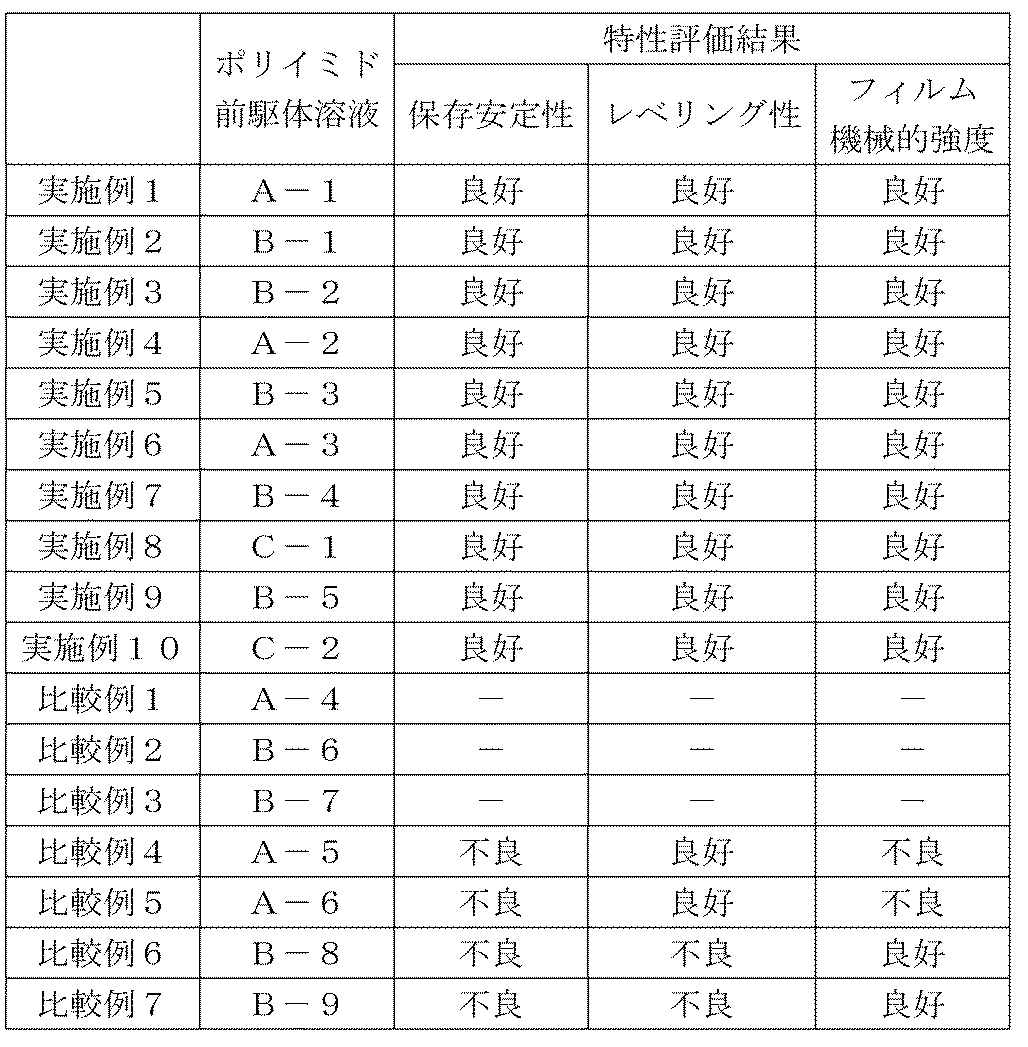
- the polyimide precursor solution of the present invention is excellent in storage stability and leveling properties. Furthermore, it can be seen that the polyimide film obtained from this polyimide precursor solution has excellent mechanical strength. In addition, since no amide solvent is used, it is excellent in environmental compatibility.
- the polyimide precursor solution of the present invention can be suitably used for the production of an electric insulating film such as FPC, a belt for a copying machine, an electrode for a lithium secondary battery, an electric wire / cable insulating coating, and a film separation.
- an electric insulating film such as FPC
- a belt for a copying machine an electrode for a lithium secondary battery
- an electric wire / cable insulating coating an electric wire / cable insulating coating
Landscapes
- Chemical & Material Sciences (AREA)
- Organic Chemistry (AREA)
- Chemical Kinetics & Catalysis (AREA)
- Polymers & Plastics (AREA)
- Health & Medical Sciences (AREA)
- Medicinal Chemistry (AREA)
- Materials Engineering (AREA)
- Wood Science & Technology (AREA)
- Engineering & Computer Science (AREA)
- Life Sciences & Earth Sciences (AREA)
- Macromolecular Compounds Obtained By Forming Nitrogen-Containing Linkages In General (AREA)
- Processes Of Treating Macromolecular Substances (AREA)
- Compositions Of Macromolecular Compounds (AREA)
Abstract
Description
即ち、本発明は下記を趣旨とするものである。
1) ポリアミック酸と酸解離定数(pKa)が8.5以下、4.5以上の弱塩基性化合物との塩が、多価アルコールを含む溶媒に溶解してなるポリイミド前駆体溶液。
2) 多価アルコールを含む溶媒が多価アルコールと水との混合溶媒である前記ポリイミド前駆体溶液。
3) 混合溶媒が70質量%未満の水含有量を示す前記ポリイミド前駆体溶液。
4) ポリアミック酸として、単離された固体状ポリアミック酸を用いた前記ポリイミド前駆体溶液。

実施例及び比較例で使用したポリアミック酸粉体を以下のようにして調製した。
特許第2951484号実施例1記載の方法により、ピロメリット酸二無水物(PMDA)と4,4’-オキシジアニリン(ODA)からポリアミック酸粉体を得た。すなわち、PMDA21.9gをTHF500mlに溶解し、0℃に保った。これにODA20.0gのTHF溶液500mlを徐々に加え、0℃で2時間反応させポリアミック酸を含有する懸濁液を得た。懸濁液からポリアミック酸を単離してポリアミック酸の粉体を得た。このときのポリアミック酸の[η]は、1.50であった。これをポリアミック酸粉体Aとする。
特許第2951484号実施例3記載の方法により、3,3’,4,4’-ビフェニルテトラカルボン酸二無水物(BPDA)と4,4’-オキシジアニリン(ODA)からポリアミック酸粉体を得た。すなわち、BPDA2.96gをTHF50mlに懸濁し、0℃に保った。これにODA2.00gをTHF50mlに溶解した溶液を徐々に加え、0℃で2時間反応させポリアミック酸の懸濁液を得た。懸濁液からポリアミック酸を単離してポリアミック酸の粉体を得た。このときのポリアミック酸の[η]は、2.19であった。これをポリアミック酸粉体Bとする。
3,3’,4,4’-ビフェニルテトラカルボン酸二無水物(BPDA)とp-フェニレンジアミン(PDA)からポリアミック酸粉体を得た。すなわち、BPDA8.06gをアセトン60mlに懸濁し、室温(20℃)に保った。これにPDA2.91gをアセトン129mlに溶解した溶液を徐々に加え、室温で1時間反応させポリアミック酸の懸濁液を得た。懸濁液からポリアミック酸を単離してポリアミック酸の粉体を得た。このときのポリアミック酸の[η]は、1.85であった。これをポリアミック酸粉体Cとする。
ポリイミド前駆体溶液を25℃で100時間放置した後のポリアミック酸の固有粘度を測定し、その変化率が10%未満である場合、保存安定性が「良好」、その変化率が10%以上である場合、保存安定性が「不良」と判定した。
ポリイミド前駆体溶液を基材であるガラス板上にフィルムアプリケーターを用いて塗布し、その塗膜を、窒素ガス雰囲気下、50℃で10分間、80℃で30分間、120℃で30分間、200℃で20分間、300℃で20分間、次いで350℃で10分間加熱処理して、厚みが約20μmのポリイミドフィルム塗膜を形成した。 その後、ポリイミドフィルムをガラス板から剥離して10平方cm角に切り出した後、任意の9か所の厚みを測定した。その厚みの変動幅が平均値に対し±10%未満である場合、レベリング性が「良好」、その変動幅が±10%以上である場合、レベリング性が「不良」と判定した。
前記ポリイミドフィルムの引張強度をASTM D882に基づいて測定し、ポリイミドフィルムの引張強度が12kg/mm2以上である場合、機械的強度が「良好」、ポリイミドフィルムの引張強度が12kg/mm2未満である場合、機械的強度が「不良」と判定した。
ポリアミック酸粉体Aと1,2-ジメチルイミダゾ-ル (pKa 7.7)との混合物(1,2-ジメチルイミダゾ-ルはポリアミック酸の構成ユニット1モルに対し2.5モル使用)を25℃でエチレングリコールに溶解し、ポリイミド前駆体として15質量%の濃度を有するポリイミド前駆体溶液A-1を得た。 この前駆体溶液の特性評価結果を表1に示す。
ポリアミック酸粉体Bと1,2-ジメチルイミダゾ-ル (pKa 7.7)との混合物(1,2-ジメチルイミダゾ-ルはポリアミック酸の構成ユニット1モルに対し2.5モル使用)を25℃でエチレングリコールに溶解し、ポリイミド前駆体として15質量%の濃度を有するポリイミド前駆体溶液B-1を得た。 この前駆体溶液の特性評価結果を表1に示す。
塩基性化合物として、2ーエチル-4-メチルイミダゾール(pKa 8.3)を用いたこと以外は、実施例2と同様にしてポリイミド前駆体溶液B-2を得た。この前駆体溶液の特性評価結果を表1に示す。
溶媒として、ジエチレングリコールを用いたこと以外は、実施例1と同様にしてポリイミド前駆体溶液A-2を得た。この前駆体溶液の特性評価結果を表1に示す。
溶媒として、ジエチレングリコールを用いたこと以外は、実施例2と同様にしてポリイミド前駆体溶液B-3を得た。この前駆体溶液の特性評価結果を表1に示す。
溶媒として、エチレングリコールと水の混合溶媒(混合質量比 エチレングリコール:水=80:20)を用いたこと以外は、実施例1と同様にしてポリイミド前駆体溶液A-3を得た。この前駆体溶液の特性評価結果を表1に示す。
溶媒として、エチレングリコールと水の混合溶媒(混合質量比 エチレングリコール:水=80:20)を用いたこと以外は、実施例2と同様にしてポリイミド前駆体溶液B-4を得た。この前駆体溶液の特性評価結果を表1に示す。
ポリアミック酸粉体Cと1,2-ジメチルイミダゾ-ル (pKa 7.7)との混合物(1,2-ジメチルイミダゾ-ルはポリアミック酸の構成ユニット1モルに対し2.5モル使用)を25℃でエチレングリコールと水の混合溶媒(混合質量比 エチレングリコール:水=80:20)に溶解し、ポリイミド前駆体として15質量%の濃度を有するポリイミド前駆体溶液C-1を得た。 この前駆体溶液の特性評価結果を表1に示す。
溶媒として、エチレングリコールと水の混合溶媒(混合質量比 エチレングリコール:水=50:50)を用いたこと以外は、実施例2と同様にしてポリイミド前駆体溶液B-5を得た。この前駆体溶液の特性評価結果を表1に示す。
溶媒として、ジエチレングリコールと水の混合溶媒(混合質量比 ジエチレングリコール:水=60:40)を用いたこと以外は、実施例8と同様にしてポリイミド前駆体溶液C-2を得た。この前駆体溶液の特性評価結果を表1に示す。
溶媒として、メタノールを用いたこと以外は、実施例1と同様にしてポリイミド前駆体溶液A-4を得ようとしたが、ポリアミック酸粉体Aが完全に溶解せず均一な溶液を得ることができなかった。
溶媒として、エタノールを用いたこと以外は、実施例2と同様にしてポリイミド前駆体溶液B-6を得ようとしたが、ポリアミック酸粉体Bが完全に溶解せず均一な溶液を得ることができなかった。
溶媒をn-ブタノールとしたこと以外は、実施例2と同様にしてポリイミド前駆体溶液B-7を得ようとしたが、ポリアミック酸粉体Bが完全に溶解せず均一な溶液を得ることができなかった。
塩基性化合物として、強塩基性化合物であるトリエチルアミン(pKa 11.8)としたこと以外は、実施例1と同様にしてポリイミド前駆体溶液A-5を得た。これらの前駆体溶液の特性評価結果を表1に示す。
塩基性化合物として、強塩基性化合物であるトリエチレンジアミン(pKa 8.8)としたこと以外は、実施例1と同様にしてポリイミド前駆体溶液A-6を得た。これらの前駆体溶液の特性評価結果を表1に示す。
溶媒を水としたこと以外は、実施例2と同様にしてポリイミド前駆体溶液B-8を得た。これらの前駆体溶液の特性評価結果を表1に示す。
溶媒を水、塩基性化合物を強塩基性化合物であるトリエチルアミン(pKa 11.8)としたこと以外は、実施例2と同様にしてポリイミド前駆体溶液B-9を得た。これらの前駆体溶液の特性評価結果を表1に示す。
Claims (4)
- ポリアミック酸と酸解離定数(pKa)が8.5以下、4.5以上の弱塩基性化合物との塩が、多価アルコールを含む溶媒に溶解してなるポリイミド前駆体溶液。
- 多価アルコールを含む溶媒が多価アルコールと水との混合溶媒である請求項1に記載のポリイミド前駆体溶液。
- 混合溶媒が70質量%未満の水含有量を示す請求項2に記載のポリイミド前駆体溶液。
- ポリアミック酸として、単離された固体状ポリアミック酸を用いた請求項1~3のいずれかに記載のポリイミド前駆体溶液。
Priority Applications (3)
| Application Number | Priority Date | Filing Date | Title |
|---|---|---|---|
| CN201480028910.9A CN105229083B (zh) | 2013-05-20 | 2014-05-19 | 聚酰亚胺前体溶液 |
| KR1020157032267A KR20160012132A (ko) | 2013-05-20 | 2014-05-19 | 폴리이미드 전구체 용액 |
| JP2015518234A JP6433890B2 (ja) | 2013-05-20 | 2014-05-19 | ポリイミド前駆体溶液 |
Applications Claiming Priority (2)
| Application Number | Priority Date | Filing Date | Title |
|---|---|---|---|
| JP2013106450 | 2013-05-20 | ||
| JP2013-106450 | 2013-05-20 |
Publications (1)
| Publication Number | Publication Date |
|---|---|
| WO2014189002A1 true WO2014189002A1 (ja) | 2014-11-27 |
Family
ID=51933555
Family Applications (1)
| Application Number | Title | Priority Date | Filing Date |
|---|---|---|---|
| PCT/JP2014/063215 Ceased WO2014189002A1 (ja) | 2013-05-20 | 2014-05-19 | ポリイミド前駆体溶液 |
Country Status (5)
| Country | Link |
|---|---|
| JP (1) | JP6433890B2 (ja) |
| KR (1) | KR20160012132A (ja) |
| CN (1) | CN105229083B (ja) |
| TW (1) | TWI642695B (ja) |
| WO (1) | WO2014189002A1 (ja) |
Cited By (3)
| Publication number | Priority date | Publication date | Assignee | Title |
|---|---|---|---|---|
| JP2016017145A (ja) * | 2014-07-09 | 2016-02-01 | 宇部興産株式会社 | ポリイミド前駆体組成物、及びそれを用いた絶縁被覆層の製造方法 |
| JP2016030760A (ja) * | 2014-07-25 | 2016-03-07 | 富士ゼロックス株式会社 | ポリイミド前駆体組成物、ポリイミド前駆体の製造方法、ポリイミド成形体、及びポリイミド成形体の製造方法 |
| CN105733258A (zh) * | 2014-12-26 | 2016-07-06 | 富士施乐株式会社 | 聚酰胺酰亚胺前体组合物、聚酰胺酰亚胺成形体和聚酰胺酰亚胺成形体的制备方法 |
Citations (6)
| Publication number | Priority date | Publication date | Assignee | Title |
|---|---|---|---|---|
| JPS52108497A (en) * | 1976-03-09 | 1977-09-10 | Showa Electric Wire & Cable Co Ltd | Preparation of polyimide resins |
| JPS5390338A (en) * | 1977-01-20 | 1978-08-09 | Beck & Co Ag Dr | Waterrbase enamel paint for electric insulation |
| JPH08157599A (ja) * | 1994-10-07 | 1996-06-18 | Unitika Ltd | ポリアミド酸溶液及びそれから得られるポリイミドフィルム又はポリイミド被覆物 |
| JP2008050611A (ja) * | 2007-09-25 | 2008-03-06 | Ube Ind Ltd | バインダー樹脂 |
| JP2013163800A (ja) * | 2012-01-13 | 2013-08-22 | Ube Industries Ltd | ポリイミドパウダーとポリイミド前駆体とを含む凝集体とその製造方法、並びにこれを用いたポリイミド成形体 |
| JP2014031445A (ja) * | 2012-08-03 | 2014-02-20 | Ube Ind Ltd | ポリイミド被膜の製造方法 |
Family Cites Families (2)
| Publication number | Priority date | Publication date | Assignee | Title |
|---|---|---|---|---|
| US5719253A (en) * | 1994-10-07 | 1998-02-17 | Unitika Ltd. | Poly(amic acid) solution and polyimide film or polymide-coated material obtained therefrom |
| EP2594609B1 (en) * | 2010-07-14 | 2017-01-11 | Ube Industries, Ltd. | Aqueous polyimide precursor solution composition and method for producing aqueous polyimide precursor solution composition |
-
2014
- 2014-05-19 CN CN201480028910.9A patent/CN105229083B/zh not_active Expired - Fee Related
- 2014-05-19 WO PCT/JP2014/063215 patent/WO2014189002A1/ja not_active Ceased
- 2014-05-19 JP JP2015518234A patent/JP6433890B2/ja active Active
- 2014-05-19 KR KR1020157032267A patent/KR20160012132A/ko not_active Withdrawn
- 2014-05-20 TW TW103117592A patent/TWI642695B/zh not_active IP Right Cessation
Patent Citations (6)
| Publication number | Priority date | Publication date | Assignee | Title |
|---|---|---|---|---|
| JPS52108497A (en) * | 1976-03-09 | 1977-09-10 | Showa Electric Wire & Cable Co Ltd | Preparation of polyimide resins |
| JPS5390338A (en) * | 1977-01-20 | 1978-08-09 | Beck & Co Ag Dr | Waterrbase enamel paint for electric insulation |
| JPH08157599A (ja) * | 1994-10-07 | 1996-06-18 | Unitika Ltd | ポリアミド酸溶液及びそれから得られるポリイミドフィルム又はポリイミド被覆物 |
| JP2008050611A (ja) * | 2007-09-25 | 2008-03-06 | Ube Ind Ltd | バインダー樹脂 |
| JP2013163800A (ja) * | 2012-01-13 | 2013-08-22 | Ube Industries Ltd | ポリイミドパウダーとポリイミド前駆体とを含む凝集体とその製造方法、並びにこれを用いたポリイミド成形体 |
| JP2014031445A (ja) * | 2012-08-03 | 2014-02-20 | Ube Ind Ltd | ポリイミド被膜の製造方法 |
Cited By (4)
| Publication number | Priority date | Publication date | Assignee | Title |
|---|---|---|---|---|
| JP2016017145A (ja) * | 2014-07-09 | 2016-02-01 | 宇部興産株式会社 | ポリイミド前駆体組成物、及びそれを用いた絶縁被覆層の製造方法 |
| JP2016030760A (ja) * | 2014-07-25 | 2016-03-07 | 富士ゼロックス株式会社 | ポリイミド前駆体組成物、ポリイミド前駆体の製造方法、ポリイミド成形体、及びポリイミド成形体の製造方法 |
| CN105733258A (zh) * | 2014-12-26 | 2016-07-06 | 富士施乐株式会社 | 聚酰胺酰亚胺前体组合物、聚酰胺酰亚胺成形体和聚酰胺酰亚胺成形体的制备方法 |
| CN105733258B (zh) * | 2014-12-26 | 2018-04-13 | 富士施乐株式会社 | 聚酰胺酰亚胺前体组合物、聚酰胺酰亚胺成形体和聚酰胺酰亚胺成形体的制备方法 |
Also Published As
| Publication number | Publication date |
|---|---|
| JP6433890B2 (ja) | 2018-12-05 |
| CN105229083B (zh) | 2020-08-07 |
| KR20160012132A (ko) | 2016-02-02 |
| TW201502169A (zh) | 2015-01-16 |
| CN105229083A (zh) | 2016-01-06 |
| TWI642695B (zh) | 2018-12-01 |
| JPWO2014189002A1 (ja) | 2017-02-23 |
Similar Documents
| Publication | Publication Date | Title |
|---|---|---|
| US9650550B2 (en) | Polyimide precursor composition, method of producing polyimide precursor composition, method of producing polyimide molded article, polyimide molded article, liquid crystal alignment film, passivation film, wire coating material, and adhesive film | |
| JP5846136B2 (ja) | ポリイミド前駆体組成物、及びポリイミド前駆体組成物の製造方法 | |
| CN104169330B (zh) | 黑色聚酰亚胺膜 | |
| CN101827882B (zh) | 具有改良的热稳定性的聚酰亚胺膜 | |
| JP6413434B2 (ja) | ポリイミド前駆体組成物、ポリイミド前駆体の製造方法、ポリイミド成形体、及びポリイミド成形体の製造方法 | |
| JP6476469B2 (ja) | ポリアミド酸組成物およびポリイミド組成物 | |
| JP2016121295A (ja) | ポリイミド前駆体組成物、ポリイミド成形体、及びポリイミド成形体の製造方法 | |
| Bong et al. | Synthesis and characterization of colorless polyimides derived from 4-(4-aminophenoxy)-2, 6-dimethylaniline | |
| JP6056512B2 (ja) | ポリイミド成形体の製造方法、液晶配向膜の製造方法、パッシベーション膜の製造方法、電線被覆材の製造方法、及び接着膜の製造方法 | |
| JP2951484B2 (ja) | ポリイミド前駆体の粉粒体、その混合物及びその製造方法 | |
| JP6433890B2 (ja) | ポリイミド前駆体溶液 | |
| JP5833783B1 (ja) | ポリイミド粉体およびその製造方法 | |
| JP6007809B2 (ja) | ポリイミド成形体の製造方法、ポリイミド成形体、液晶配向膜、パッシベーション膜、電線被覆材、及び接着膜 | |
| JP5768926B2 (ja) | ポリイミド前駆体組成物、ポリイミド前駆体組成物の製造方法、ポリイミド成形体の製造方法、ポリイミド成形体、液晶配向膜、パッシベーション膜、電線被覆材、及び接着膜 | |
| JP2015178542A (ja) | ポリイミド前駆体組成物、ポリイミド成形体の製造方法、及びポリイミド成形体 | |
| JPH047333A (ja) | 新規ポリイミド | |
| JP2014210889A (ja) | ポリイミド共重合体、およびその製造方法 | |
| JPH07324163A (ja) | ポリアミド酸溶液及びその製造方法 | |
| JP6426440B2 (ja) | ポリイミド被膜 | |
| CN104558603B (zh) | 一种合成芳香酰亚胺的方法 | |
| TW202315907A (zh) | 聚醯亞胺膜、其製造方法、包括其的多層膜及電子部件 | |
| JP6215016B2 (ja) | 電極用バインダ樹脂溶液、電極用塗液、および電極 | |
| KR102727806B1 (ko) | 폴리이미드 필름 및 이의 제조방법 | |
| KR102436497B1 (ko) | 폴리이미드 공중합체 및 이를 포함하는 폴리이미드 필름 | |
| JPS6317092B2 (ja) |
Legal Events
| Date | Code | Title | Description |
|---|---|---|---|
| WWE | Wipo information: entry into national phase |
Ref document number: 201480028910.9 Country of ref document: CN |
|
| 121 | Ep: the epo has been informed by wipo that ep was designated in this application |
Ref document number: 14800291 Country of ref document: EP Kind code of ref document: A1 |
|
| ENP | Entry into the national phase |
Ref document number: 2015518234 Country of ref document: JP Kind code of ref document: A |
|
| ENP | Entry into the national phase |
Ref document number: 20157032267 Country of ref document: KR Kind code of ref document: A |
|
| NENP | Non-entry into the national phase |
Ref country code: DE |
|
| 122 | Ep: pct application non-entry in european phase |
Ref document number: 14800291 Country of ref document: EP Kind code of ref document: A1 |