WO2014162876A1 - 積層フィルム、太陽電池モジュール用バックシート及び太陽電池モジュール - Google Patents
積層フィルム、太陽電池モジュール用バックシート及び太陽電池モジュール Download PDFInfo
- Publication number
- WO2014162876A1 WO2014162876A1 PCT/JP2014/057530 JP2014057530W WO2014162876A1 WO 2014162876 A1 WO2014162876 A1 WO 2014162876A1 JP 2014057530 W JP2014057530 W JP 2014057530W WO 2014162876 A1 WO2014162876 A1 WO 2014162876A1
- Authority
- WO
- WIPO (PCT)
- Prior art keywords
- adhesive layer
- meth
- solar cell
- laminated film
- polyester
- Prior art date
- Legal status (The legal status is an assumption and is not a legal conclusion. Google has not performed a legal analysis and makes no representation as to the accuracy of the status listed.)
- Ceased
Links
Images
Classifications
-
- H—ELECTRICITY
- H10—SEMICONDUCTOR DEVICES; ELECTRIC SOLID-STATE DEVICES NOT OTHERWISE PROVIDED FOR
- H10F—INORGANIC SEMICONDUCTOR DEVICES SENSITIVE TO INFRARED RADIATION, LIGHT, ELECTROMAGNETIC RADIATION OF SHORTER WAVELENGTH OR CORPUSCULAR RADIATION
- H10F19/00—Integrated devices, or assemblies of multiple devices, comprising at least one photovoltaic cell covered by group H10F10/00, e.g. photovoltaic modules
- H10F19/80—Encapsulations or containers for integrated devices, or assemblies of multiple devices, having photovoltaic cells
- H10F19/85—Protective back sheets
-
- H—ELECTRICITY
- H10—SEMICONDUCTOR DEVICES; ELECTRIC SOLID-STATE DEVICES NOT OTHERWISE PROVIDED FOR
- H10F—INORGANIC SEMICONDUCTOR DEVICES SENSITIVE TO INFRARED RADIATION, LIGHT, ELECTROMAGNETIC RADIATION OF SHORTER WAVELENGTH OR CORPUSCULAR RADIATION
- H10F19/00—Integrated devices, or assemblies of multiple devices, comprising at least one photovoltaic cell covered by group H10F10/00, e.g. photovoltaic modules
- H10F19/80—Encapsulations or containers for integrated devices, or assemblies of multiple devices, having photovoltaic cells
- H10F19/804—Materials of encapsulations
-
- Y—GENERAL TAGGING OF NEW TECHNOLOGICAL DEVELOPMENTS; GENERAL TAGGING OF CROSS-SECTIONAL TECHNOLOGIES SPANNING OVER SEVERAL SECTIONS OF THE IPC; TECHNICAL SUBJECTS COVERED BY FORMER USPC CROSS-REFERENCE ART COLLECTIONS [XRACs] AND DIGESTS
- Y02—TECHNOLOGIES OR APPLICATIONS FOR MITIGATION OR ADAPTATION AGAINST CLIMATE CHANGE
- Y02E—REDUCTION OF GREENHOUSE GAS [GHG] EMISSIONS, RELATED TO ENERGY GENERATION, TRANSMISSION OR DISTRIBUTION
- Y02E10/00—Energy generation through renewable energy sources
- Y02E10/50—Photovoltaic [PV] energy
Definitions
- the present invention relates to a laminated film, a back sheet for a solar cell module, and a solar cell module.
- the present invention is a laminated film used for a back sheet for a solar cell module, which is excellent in adhesiveness of an adhesive layer to a sealing material and a polyester support, and in which blocking and curling are suppressed.
- a laminated film used for a back sheet for a solar cell module which is excellent in adhesiveness of an adhesive layer to a sealing material and a polyester support, and in which blocking and curling are suppressed.
- a solar cell module is formed by laminating glass or a front sheet / transparent filling material (sealing material) / solar cell element / sealing material / back sheet (BS) in this order from the light-receiving surface side on which sunlight is incident. It has a structure. Specifically, the solar cell element is generally embedded in a resin (sealing material) such as EVA (ethylene-vinyl acetate copolymer), and a solar cell module back sheet is further adhered thereon. Composed. The back sheet for a solar cell module is provided in the outermost layer of the solar cell module and functions to protect the solar cell element.
- a resin such as EVA (ethylene-vinyl acetate copolymer
- polyester is often applied from the viewpoint of cost reduction and the like.
- a back sheet for a solar cell module using polyester a sheet formed by a method in which polyethylene terephthalate (PET) is used as a support and another adhesive layer (polymer sheet) is bonded thereto is used.
- the solar electronic device and its sealing material are protected from wind, rain, moisture, dust, etc., and the inside of the solar cell module is shielded from the outside air and sealed. It is important to keep on. For this reason, high adhesiveness is calculated
- the polyester support and EVA are composed of different components, it is difficult to directly bond them together. For this reason, the adhesive layer which connects a polyester support body and EVA is provided on a polyester support body, and both are joined through this adhesive layer.
- Patent Document 1 discloses a laminated film in which an adhesive layer containing a maleic anhydride-modified polyolefin resin is laminated on a polyester support.
- Patent Document 2 discloses a first adhesive layer mainly composed of a copolymer of ethylene and ester or ethylene and acrylic acid on a polyester support, and a second layer mainly composed of an olefin resin.
- a laminated film having an adhesive layer is disclosed.
- the total film thickness of the first adhesive layer and the second adhesive layer is several tens to 100 ⁇ m.
- the adhesive layer used in the conventional solar cell module backsheet does not have both the adhesion to EVA as a sealing material and the adhesion to a polyester support, It became clear by examination of the present inventors that adhesiveness is not enough.
- the back sheet for the solar cell module itself curls and deforms, which is a cause of lowering the adhesion between the sealing material and the polyester support. It was.
- the solar cell module backsheet with the curl adhered thereto is bonded to the sealing material, there is a risk that the solar cell module itself may be damaged as well as causing problems in the adhesion. It was.
- the present inventors provide a laminated film excellent in adhesiveness to EVA and having good adhesion between the polyester support and the adhesive layer in order to solve such problems of the prior art. We proceeded with a study for this purpose. Furthermore, the present inventors have studied for the purpose of providing a laminated film in which curling of the laminated film itself is suppressed and blocking is suppressed.
- the present inventors have found that the polyester support, the first adhesive layer laminated on at least one surface of the polyester support, and the first adhesive layer In the laminated film having the second adhesive layer laminated on the side opposite to the polyester support through the first, the binder resin contained in each adhesive layer is specified, and the first adhesive layer with respect to the average film thickness of the polyester support And the ratio of the average film thickness of the second adhesive layer to within a certain range, it has been found that the adhesion to EVA and the adhesion to the polyester support are enhanced. Furthermore, the present inventors have found that blocking and curling are suppressed in the laminated film having the above configuration, and have completed the present invention. Specifically, the present invention has the following configuration.
- a polyester support a first adhesive layer laminated on at least one surface of the polyester support, and a first laminate laminated on the opposite side of the polyester support via the first adhesive layer.
- the polyester support has an average film thickness of 50 to 300 ⁇ m
- the first adhesive layer is a copolymer of ethylene, (meth) acrylic acid ester, and acid anhydride.
- a modified polyolefin resin is included, the second adhesive layer includes an olefin resin, and the total average film thickness of the first adhesive layer and the second adhesive layer is 0 of the average film thickness of the polyester support.
- a laminated film characterized by being 0.001 to 0.3 times.
- the olefin resin contained in the second adhesive layer is composed of ethylene, (meth) acrylic acid ester, (meth) acrylic acid, unsaturated dicarboxylic acid anhydride, glycidyl (meth) acrylate, and vinyl acetate.
- a solar cell module backsheet comprising the laminated film according to any one of [1] to [9], wherein the second adhesive layer is adhered to a sealing material.
- the present invention it is possible to obtain a laminated film having excellent adhesion to EVA and having good adhesion between the polyester support and the adhesive layer. Since the laminated film of the present invention has good adhesiveness with EVA as a sealing material, the inside of the solar cell module can be shielded from outside air and kept sealed.
- a laminated film in which curling of the laminated film itself is suppressed can be obtained. For this reason, the adhesiveness of a laminated film and a solar cell module can be improved more. Moreover, in the laminated
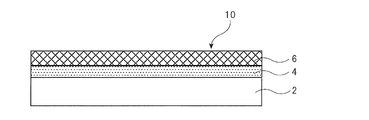
- FIG. 1 is a schematic cross-sectional view of the laminated film of the present invention.
- a numerical range expressed using “to” means a range including numerical values described before and after “to” as a lower limit value and an upper limit value.
- the present invention relates to a laminated film having a polyester support, a first adhesive layer, and a second adhesive layer.
- the first adhesive layer is laminated on at least one surface of the polyester support
- the second adhesive layer is laminated on the opposite side of the polyester support via the first adhesive layer.
- other layers may be provided between the polyester support, the first adhesive layer, and the second adhesive layer, but the polyester support, the first adhesive layer, and the second adhesive layer are It is preferable to laminate adjacently in this order.
- FIG. 1 shows a schematic cross-sectional view of a laminated film 10 of the present invention.
- a laminated film 10 of the present invention includes a polyester support 2, a first adhesive layer 4 laminated on the polyester support 2, and a first adhesive layer 4.
- the second adhesive layer 6 is further laminated.
- the laminated film 10 may include other layers in addition to these three layers, but the first adhesive layer 4 and the support 2 are preferably adjacent to each other, such as the second adhesive layer 6 and EVA. It is preferable that the adherend is configured so that it can be directly bonded.
- the polyester support has an average film thickness of 50 to 300 ⁇ m
- the first adhesive layer contains a modified polyolefin resin that is a copolymer of ethylene, (meth) acrylic acid ester, and acid anhydride
- the adhesive layer 2 includes an olefin resin.
- the total average film thickness of the first adhesive layer and the second adhesive layer is 0.001 to 0.3 times the average film thickness of the polyester support.
- the laminated film by forming the laminated film as described above, it is possible to obtain a laminated film having excellent adhesion to EVA and having good adhesion between the polyester support and the adhesive layer. Moreover, it can suppress that laminated film itself curls by setting a laminated film as the above structures.
- the modified polyolefin resin which is a copolymer of ethylene, (meth) acrylic acid ester, and acid anhydride contained in the first adhesive layer can enhance the adhesion to the polyester support.
- the olefin resin contained in the second adhesive layer can improve the adhesion with EVA.
- the shrinkage stress caused by heat shrinkage can be alleviated. That is, in the present invention, by specifying the resin contained in each adhesive layer and keeping the total film thickness of the two adhesive layers within a certain range, the adhesive layer is directed inward by heat shrinkage while increasing the adhesive force. Thus, the curling force can be suppressed.
- the shrinking (curling) force is measured by measuring the vertical distance (mm) from the table surface at the four corners to the top of the curl as the curl amount when the laminated film is cut into a 300 mm ⁇ 300 mm square and placed on a horizontal plane. Can be obtained.
- the amount of curling after the laminated film is allowed to stand for 24 hours at 25 ° C. and 60% relative humidity is preferably 20 mm or less, more preferably 15 mm or less, and even more preferably 10 mm or less.
- the sum of the average film thicknesses of the first adhesive layer and the second adhesive layer may be 0.001 times or more, preferably 0.003 times or more of the average film thickness of the polyester support. More preferably, it is 005 times or more. Moreover, what is necessary is just 0.3 times or less, it is preferable that it is 0.25 times or less, and it is more preferable that it is 0.2 times or less.
- the total average film thickness of the first adhesive layer and the second adhesive layer may be 0.001 to 0.3 times the average film thickness of the polyester support.
- the total average film thickness of the two adhesive layers is preferably 0.05 to 15 ⁇ m.
- the total average film thickness of the first adhesive layer and the second adhesive layer is preferably 0.05 ⁇ m or more, more preferably 0.1 ⁇ m or more, and further preferably 0.5 ⁇ m or more. 1 ⁇ m or more is particularly preferable.
- the total average film thickness of the first adhesive layer and the second adhesive layer is preferably 15 ⁇ m or less, more preferably 12 ⁇ m or less, and even more preferably 10 ⁇ m or less.
- the heat of fusion of the modified polyolefin contained in the first adhesive layer is preferably 60 J / g or less, more preferably 50 J / g or less, and even more preferably 40 J / g or less. .
- the heat of fusion of the modified polyolefin contained in the first adhesive layer is preferably 30 J / g or more, more preferably 40 J / g or more, and further preferably 50 J / g or more.
- multilayer film in roll shape can be suppressed by making the heat of fusion of the olefin resin contained in a 2nd contact bonding layer into the said range.
- the adhesion between the first adhesive layer and the polyester support can be enhanced.
- the ester part and acid anhydride part constituting the modified polyolefin can be easily oriented toward the polyester support, and the ester part and acid anhydride part are polyester. It is considered that this is because good adhesion to the support can be exhibited.
- EVA contains a large amount of ethylene and the second adhesive layer contains ethylene constituting the olefin resin, the adhesion between the second adhesive layer and EVA can be improved. it can.
- the laminated film of the present invention includes a polyester support.
- the polyester support is preferably a polyester film, and the polyester film is excellent in terms of cost and mechanical strength, and is preferably used as a support for a laminated film.
- the polyester constituting the polyester film is preferably a saturated polyester.
- a saturated polyester a polyester film that is superior in terms of mechanical strength as compared with a film using an unsaturated polyester can be obtained.
- Polyester has a —COO— bond or —OCO— bond in the middle of the polymer.
- the terminal group of the polyester is an OH group, a COOH group, or a group in which these are protected (OR X group, COOR X group (R X is an arbitrary substituent such as an alkyl group)), and an aromatic dibasic acid
- OR X group, COOR X group (R X is an arbitrary substituent such as an alkyl group) an aromatic dibasic acid
- a linear saturated polyester synthesized from an ester-forming derivative thereof and a diol or an ester-forming derivative thereof is preferable, and examples of the linear saturated polyester include JP2009-155479A and JP2010-. No. 235824 can be used as appropriate.
- linear saturated polyester examples include polyethylene terephthalate (PET), polyethylene isophthalate, polybutylene terephthalate, poly (1,4-cyclohexylenedimethylene terephthalate), and polyethylene-2,6-naphthalate.
- PET polyethylene terephthalate
- polyethylene isophthalate polyethylene isophthalate
- polybutylene terephthalate poly (1,4-cyclohexylenedimethylene terephthalate
- polyethylene-2,6-naphthalate polyethylene-2,6-naphthalate
- polyethylene terephthalate or polyethylene-2,6-naphthalate is particularly preferable from the viewpoint of the balance between mechanical properties and cost, and polyethylene terephthalate is more particularly preferable.
- the polyester may be a homopolymer or a copolymer. Further, polyester may be blended with a small amount of other types of resins such as polyimide. Moreover, as polyester, you may use crystalline polyester which can form anisotropy at the time of a fusion
- the average carboxylic acid value (AV) of the polyester film is preferably 22 eq / ton or less.
- the average carboxylic acid value (AV) of the polyester film is preferably 22 eq / ton or less, more preferably 18 eq / ton or less, and still more preferably 16 eq / ton or less.
- a lower limit is not specifically limited, It is preferable that it is 1 eq / ton or more.
- the carboxylic acid value (AV) of the polyester film can be adjusted by the solid phase polymerization time described later. When the solid phase polymerization time is lengthened, the carboxylic acid value decreases, and when the solid phase polymerization time is shortened, the carboxylic acid value increases.
- the polyester film may contain a terminal sealing agent.
- the terminal blocking agent include carbodiimide compounds and ketenimine compounds.
- the carbodiimide compound or the ketene imine compound functions as a terminal sealing agent that reacts with the terminal carboxyl group of the polyester and suppresses hydrolysis of the polyester.
- a cyclic carbodiimide compound and a ketenimine compound are preferably used because they can not only suppress hydrolysis but also suppress generation of volatilized gas in the production process.
- the molecular weight of the polyester is preferably 5000 to 30000, more preferably 8000 to 26000, and particularly preferably 12000 to 24000 from the viewpoint of heat resistance and viscosity.
- a value in terms of polymethyl methacrylate (PMMA) measured by gel permeation chromatography (GPC) using hexafluoroisopropanol as a solvent can be used.
- the polyester film preferably has a refractive index of 1.63 to 1.71 and more preferably 1.62 to 1.68 from the viewpoint of transparency. Further, the polyester film may contain other additives without departing from the gist of the present invention, and examples thereof include antioxidants and ultraviolet inhibitors.
- Polyester can be synthesized by a known method.
- polyester can be synthesized by a known polycondensation method or ring-opening polymerization method, and any of transesterification and direct polymerization can be applied.
- the polyester used in the present invention is a polymer or copolymer obtained by a condensation reaction mainly comprising an aromatic dibasic acid or an ester-forming derivative thereof and a diol or an ester-forming derivative thereof.
- An aromatic dibasic acid or an ester-forming derivative thereof and a diol or an ester-forming derivative thereof can be produced by an esterification reaction or an ester exchange reaction and then a polycondensation reaction.
- the carboxylic acid value and intrinsic viscosity of the polyester can be controlled by selecting the raw material and reaction conditions.
- Examples of the synthesis of polyester using a Ti compound include Japanese Patent Publication No. 8-301198, Japanese Patent No. 2543624, Japanese Patent No. 3335683, Japanese Patent No. 3717380, Japanese Patent No. 3897756, Japanese Patent No. 396226, and Japanese Patent No. 39786666.
- No. 3, Patent No. 3,996,871, Patent No. 40000867, Patent No. 4053837, Patent No. 4,127,119, Patent No. 4,134,710, Patent No. 4,159,154, Patent No. 4,269,704, Patent No. 4,313,538 and the like can be applied.
- the polyester is preferably solid-phase polymerized after polymerization.
- Solid-phase polymerization may be a continuous method (a method in which a tower is filled with a resin, which is slowly heated for a predetermined time and then sent out), or a batch method (a resin is charged into a container). , A method of heating for a predetermined time).
- solid phase polymerization is described in Japanese Patent No. 2621563, Japanese Patent No. 3121876, Japanese Patent No. 3136774, Japanese Patent No. 3603585, Japanese Patent No. 3616522, Japanese Patent No. 3617340, Japanese Patent No. 3680523, Japanese Patent No. 3717392, Japanese Patent No. 4167159, etc. The method can be applied.
- the temperature of the solid phase polymerization is preferably 170 to 240 ° C, more preferably 180 to 230 ° C, and further preferably 190 to 220 ° C.
- the solid phase polymerization time is preferably 5 to 100 hours, more preferably 10 to 75 hours, and further preferably 15 to 50 hours.
- the solid phase polymerization is preferably performed in a vacuum or in a nitrogen atmosphere.
- the average film thickness of the polyester support is 50 to 300 ⁇ m.
- the thickness of the polyester support may be 50 ⁇ m, preferably 75 ⁇ m or more, and more preferably 100 ⁇ m or more.
- the thickness of a polyester support body should just be 300 micrometers or less, and it is preferable that it is 250 micrometers or less.
- the polyester support is preferably 300 ⁇ m or less because hydrolysis resistance deteriorates as the thickness increases, and it tends to be difficult to withstand long-term use.
- the support of the present invention it is preferable to subject the support of the present invention to a surface treatment before applying a first adhesive layer described later.
- the surface treatment include corona treatment, flame treatment, low pressure plasma treatment, atmospheric pressure plasma treatment, UV treatment, sand blast treatment, and chromium mixed acid treatment.
- the flame treatment there can be used a method in which a silane compound described in Japanese Patent No. 3893394 and Japanese Patent Application Laid-Open No. 2007-39508 is added.
- corona treatment, flame treatment, atmospheric pressure plasma treatment, and UV treatment are preferable from the viewpoint of simplicity and environmental load.
- the first adhesive layer includes a modified polyolefin resin that is a copolymer of ethylene, (meth) acrylic acid ester, and acid anhydride.
- the modified polyolefin resin is a resin that has been acid-modified with an acid anhydride.
- Ethylene is used as the olefin component constituting the modified polyolefin resin.
- ethylene, propylene, butene, or the like may be mixed and used for the olefin component.
- carboxylic acid components include maleic anhydride, itaconic anhydride, citraconic anhydride, and the like. Of these, maleic anhydride is preferably used. These may be used alone or in combination of a plurality of types.
- the acid anhydride component may be copolymerized in the acid-modified polyolefin resin, and its form is not limited. Examples of the copolymerization state include random copolymerization, block copolymerization, graft copolymerization (graft modification). ) And the like.
- Examples of the (meth) acrylic acid ester component include esterified products of (meth) acrylic acid and alcohols having 1 to 30 carbon atoms. Among them, (meth) acrylic acid and carbon atoms of 1 are easy to obtain. Esterified products with ⁇ 20 alcohols are preferred.
- the (meth) acrylic acid ester component examples include methyl (meth) acrylate, ethyl (meth) acrylate, propyl (meth) acrylate, butyl (meth) acrylate, hexyl (meth) acrylate, (meth ) Octyl acrylate, decyl (meth) acrylate, lauryl (meth) acrylate, octyl (meth) acrylate, dodecyl (meth) acrylate, stearyl (meth) acrylate, and the like. Mixtures of these may be used.
- methyl (meth) acrylate, ethyl (meth) acrylate, butyl (meth) acrylate, hexyl (meth) acrylate, and octyl (meth) acrylate are more preferred.
- methyl (meth) acrylate, ethyl (meth) acrylate, and butyl (meth) acrylate are more preferable, and ethyl acrylate is particularly preferable.
- “(meth) acrylic acid” means “acrylic acid or methacrylic acid”.
- the (meth) acrylic acid ester component only needs to be copolymerized in the acid-modified polyolefin resin, and the form thereof is not limited.
- Examples of the copolymerization state include random copolymerization, block copolymerization, and graft copolymerization. (Graft modification) and the like.
- the content of acid anhydride in the modified polyolefin resin is 0.1 to 10% by mass, preferably 0.5 to 8% by mass, more preferably 1 to 5% by mass, and further preferably 2 to 4% by mass.
- the content is less than 0.1% by mass, it is difficult to obtain an aqueous dispersion, and when it exceeds 10% by mass, the weather resistance tends to decrease.
- the content of the (meth) acrylic acid ester component in the modified polyolefin resin is preferably 0.1 to 35% by mass, more preferably 1 to 30% by mass, and 2 to 28% by mass. More preferably, the content is 3 to 25% by mass.
- the content of the (meth) acrylic acid ester component is less than 0.1% by mass, the adhesion tends to decrease, and when it exceeds 35% by mass, the weather resistance and acid resistance tend to decrease.
- modified polyolefin resin examples include ethylene- (meth) acrylic acid ester-maleic anhydride copolymer, ethylene-propylene- (meth) acrylic acid ester-maleic anhydride copolymer, ethylene-butene- (meth).
- examples include acrylic acid ester-maleic anhydride copolymer and ethylene-propylene-butene- (meth) acrylic acid ester-maleic anhydride copolymer.
- the form of the copolymer may be any of a random copolymer, a block copolymer, a graft copolymer, etc., but a random copolymer and a graft copolymer are preferred from the viewpoint of easy availability.
- the heat of fusion of the modified polyolefin resin as described above is preferably 60 J / g or less, more preferably 55 J / g or less, and further preferably 50 J / g or less.
- the modified polyolefin resin used in the present invention is amorphous (non-crystalline) at room temperature and has elasticity. For this reason, it can suppress that 1st contact bonding layer itself curls, and even if the 2nd contact bonding layer mentioned later curls, the contraction stress can be relieved. Thereby, the curl amount of the laminated film can be reduced.
- the modified polyolefin resin is preferably contained in an amount of 10 to 90% by mass, more preferably 15 to 85% by mass, and more preferably 20 to 80% by mass with respect to the total mass of the binder resin contained in the first adhesive layer. More preferably it is included.
- the modified polyolefin resin within the above range, the adhesion between the first adhesive layer and the polyester support can be enhanced.
- the modified polyolefin resin is preferably an aqueous dispersion from the viewpoint of environmental protection and the ease of forming an adhesive layer.
- the number average particle diameter of the modified polyolefin resin in the aqueous dispersion is preferably 1 ⁇ m or less, and preferably 0.5 ⁇ m or less, for various performance aspects and for the purpose of making the thickness when coating easy. Is more preferably 0.2 ⁇ m or less, and particularly preferably 0.1 ⁇ m or less.
- a commercially available resin may be used as the polyolefin resin as described above.
- Examples of commercially available modified polyolefin resins include Arrow Base SE-1013N, SD-1010, and SB-1010 (both manufactured by Unitika Ltd.). Among them, in the present invention, it is preferable to use Arrow Base SE-1013N or SB-1010 Unitika Co., Ltd.
- commercially available modified polyolefin resins include Bondine TX8030, HX8290, HX8140, AX8390, LX4110, rotada 3210, 3410 (both Arkema Co., Ltd. ) Made). Among them, in the present invention, it is preferable to use Bondine TX8030, HX8290, or Rotada 3410 Arkema Co., Ltd.
- the second adhesive layer contains an olefin resin.
- the olefin-based resin that can be used in the present invention is a resin having a main chain skeleton such as polyethylene and polypropylene. Among these, polyethylene is preferably used as the olefin resin used for the second adhesive layer.
- the olefin resin used for the second adhesive layer is polyethylene resin or ethylene and (meth) acrylic acid ester, (meth) acrylic acid, unsaturated dicarboxylic acid anhydride, (meth) acrylic acid glycidyl, acetic acid A copolymer with at least one selected from the vinyl group is preferred.
- olefin resins include, for example, polyethylene resins such as high density polyethylene (HDPE), low density polyethylene (LDPE), and linear low density polyethylene (LLDPE), and ethylene- (meth) acrylic acid copolymer.
- HDPE high density polyethylene
- LDPE low density polyethylene
- LLDPE linear low density polyethylene
- acrylic acid copolymer ethylene- (meth) acrylic acid copolymer
- Polymer ethylene- (meth) acrylic ester- (meth) acrylic acid copolymer, ethylene-vinyl acetate copolymer, ethylene-vinyl acetate- (meth) acrylic acid copolymer, ethylene-propylene- (meth) acrylic Acid copolymer, ethylene-propylene- (meth) acrylic acid ester- (meth) acrylic acid copolymer, ethylene-maleic anhydride copolymer, ethylene- (meth) acrylic acid ester-maleic anhydride copolymer, Ethylene-butene-maleic anhydride and / or-(meth) acrylic acid copolymer, ethylene Down - vinyl chloride copolymer, ethylene - vinyl chloride copolymers, ethylene - (meth) acrylic acid ester copolymer.
- ethylene- (meth) acrylic acid copolymers ethylene- (meth) acrylic acid ester copolymers, and ethylene- (meth) acrylic acid ester-maleic anhydride copolymers are preferable, and ethylene- (meth) acrylic is particularly preferable.
- An acid ester-maleic anhydride copolymer is preferably used.
- the first modified adhesive layer and the second adhesive layer may contain the same modified polyolefin.
- both the first adhesive layer and the second adhesive layer contain a modified polyolefin resin that is a copolymer of ethylene, (meth) acrylic acid ester, and acid anhydride.
- the shape and usage of the olefin resin that can be used in the present invention are not particularly limited as long as an adhesive layer can be formed.
- a water-dispersible olefin resin or a meltable olefin resin may be used. Further, it may be a crystalline olefin resin or a non-crystalline olefin resin.
- a commercially available resin may be used as the polyolefin resin as described above.
- Commercially available modified polyolefin resins include, as aqueous dispersions, Arrow Base SE-1013N, SD-1010, SB-1010, TC-4010, TD-4010 (both manufactured by Unitika Ltd.), Hitech S3148, S3121. S8512 (both manufactured by Toho Chemical Co., Ltd.), Chemipearl S-120, S-75N, V100, EV210H (both manufactured by Mitsui Chemicals, Inc.) and the like. Among them, it is preferable to use Arrow Base SE-1013N and SD-1010 Unitika Co., Ltd. in the present invention.
- Resins that can be used for co-extrusion include Bondine TX8030, HX8290, HX8140, AX8390, LX4110, Rotada 3210, 3410 (both manufactured by Arkema Co., Ltd.), Nucrel N1108C, N1525 (Mitsui DuPont Polychemical Co., Ltd.) Rotoril 17BA07N, 30BA02, 18MA02 (manufactured by Arkema), Binnel 4288, 4033 (manufactured by DuPont), LumiTac 43-1, 22-6 (manufactured by Tosoh Corp.), and the like. .
- the ratio of the average film thickness of the first adhesive layer and the second adhesive layer is preferably 1: 100 to 10: 1, more preferably 1:70 to 2: 1, and 1:50 to More preferably, it is 1: 1.
- the first adhesive layer and the second adhesive layer are each composed of a crosslinking agent, a surfactant, a color pigment, an ultraviolet absorber, an ultraviolet stabilizer, a flame retardant, as necessary, in addition to the resin as the main component.
- various additives such as a plasticizer, an antistatic agent, a lubricant and an antiblocking agent may be contained.
- the adhesive layer is formed by coating, it is preferable to include at least a crosslinking agent and a surfactant.
- Crosslinking agent examples include epoxy-based, isocyanate-based, melamine-based, carbodiimide-based, and oxazoline-based crosslinking agents.
- an oxazoline-based cross-linking agent compound having an oxazoline group is particularly preferable from the viewpoint of enhancing the cohesive strength of the binder and ensuring the adhesion with the sealing material of the solar cell module after wet heat.
- the oxazoline-based crosslinking agent has two or more oxazoline groups in the molecule and may be a low molecular compound or a polymer, but the polymer has better adhesion. preferable.
- oxazoline-based crosslinking agent examples include low molecular weight oxazoline-based crosslinking agents such as 2-vinyl-2-oxazoline, 2-vinyl-4-methyl-2-oxazoline, and 2-vinyl-5-methyl.
- the polymer oxazoline-based crosslinking agent can be obtained by polymerizing a monomer component containing an addition-polymerizable oxazoline as a constituent component and a monomer copolymerizable with the addition-polymerizable oxazoline.
- the addition polymerizable oxazolines include 2-vinyl-2-oxazoline, 2-vinyl-4-methyl-2-oxazoline, 2-vinyl-5-methyl-2-oxazoline, 2-isopropenyl-2-oxazoline, 2- Preferred examples include isopropenyl-4-methyl-2-oxazoline, 2-isopropenyl-5-methyl-2-oxazoline and 2-isopropenyl-5-ethyl-2-oxazoline. You may use together. Among these, 2-isopropenyl-2-oxazoline is preferable for easy availability and good adhesion.
- the amount of these addition polymerizable oxazolines used is not particularly limited, but is preferably 5% by mass or more in the monomer component, more preferably 5 to 90% by mass, further preferably 10 to 60% by mass, and 30 to 60% by mass. % Is particularly preferred.
- the monomer copolymerizable with the addition-polymerizable oxazoline is preferably selected from those that do not react with the oxazoline group.
- the oxazoline-based crosslinking agent is preferably water-soluble and / or water-dispersible from the viewpoint of excellent mixing stability with the aqueous dispersion of the modified polyolefin resin, and more preferably water-soluble.
- the polymerization method of the polymer oxazoline-based crosslinking agent is not particularly limited, and a known method can be employed. For example, a solution polymerization method, an emulsion polymerization method, a suspension polymerization method, a bulk polymerization method, or the like in an aqueous medium can be used. By these methods, an aqueous solution or an aqueous dispersion can be obtained. It is preferable that the oxazoline-based cross-linking agent of these polymers does not substantially contain a non-volatile aqueous additive to improve adhesion and weather resistance.
- the molecular weight of the polymer oxazoline-based crosslinking agent is preferably 1,000 to 80,000, more preferably 3,000 to 60,000, still more preferably 5,000 to 40,000, particularly preferably 8,000 to 30,000, and most preferably 10,000 to 20,000. preferable.
- the number average molecular weight is less than 1000, the adhesiveness and weather resistance tend to decrease.
- the number average molecular weight exceeds 80000, it is difficult to produce a polymer.
- oxazoline-based crosslinking agent commercially available products may be used.
- aqueous dispersion type Epocross K-1010E, K-1020E, K-1030E, K2010E, K2020E, K2030E, aqueous solution type WS500, WS700 any In addition, EPOCROSS series manufactured by Nippon Shokubai Co., Ltd.] can be used.
- the content of the crosslinking agent with respect to the total solid mass of the modified olefin resin is preferably 5% by mass to 75% by mass, more preferably 10% by mass to 60% by mass, and 15% by mass to 50% by mass. % Range is particularly preferred.
- the content of the cross-linking agent is 5% by mass or more, a sufficient cross-linking effect can be obtained, and a decrease in strength of the adhesive layer and poor adhesion can be suppressed.
- the pot life reduction of the aqueous dispersion of modified olefin resin can be prevented by being 50 mass% or less.
- surfactant for example, known surfactants such as anionic, cationic, and nonionic surfactants can be used. Specifically, Demole EP (manufactured by Kao Corporation), Naroacty CL95 [Sanyo] Kasei Kogyo Co., Ltd.]. As the surfactant, a single species or a plurality of species may be used.
- Inclusion of a colored pigment in the adhesive layer increases the power generation efficiency of the solar cell module by reflecting the incident light that reaches the back sheet without being used for power generation by the solar cell and returning it to the solar cell. be able to. Furthermore, the decorativeness of the appearance when the solar cell module is viewed from the front surface side can be improved. In general, when a solar cell module is viewed from the surface side, a back sheet can be seen around the solar cell, and by providing a colored layer on the back sheet, the decorativeness can be improved and the appearance can be improved.
- the color pigment used for the adhesive layer is not particularly limited, and may be selected according to required reflectivity, design properties, and the like.
- titanium oxide which is a white pigment can be preferably used.
- the colored pigments at least one selected from titanium oxide, carbon black, titanium black, black composite metal oxides, perylene color pigments, cyanine color pigments and quinacrine color pigments is preferable. Titanium oxide or carbon black Is more preferable, and titanium oxide is preferable from the viewpoints of reflectivity and cost.
- a composite metal oxide containing at least one of iron, manganese, cobalt, chromium, copper, and nickel is preferable, and among cobalt, chromium, iron, manganese, copper, and nickel It is more preferable to include two or more types, and at least one pigment selected from PBk26, PBk27, PBk28, and PBr34 is more particularly preferable.
- the PBk26 pigment is a complex oxide of iron, manganese and copper
- the PBk-27 pigment is a complex oxide of iron, cobalt and chromium
- the PBk-28 is a complex oxide of copper, chromium and manganese.
- PBr34 is a composite oxide of nickel and iron.
- Examples of the cyanine color and quinacdrine color include cyanine green, cyanine blue, quinacdrine red, phthalocyanine blue, and phthalocyanine green.
- Examples of perylene color pigments include perylene green and perylene black.
- the adhesive layer has a function of increasing power generation efficiency by irregularly reflecting light that has passed through the cell out of sunlight incident from the front surface of the solar cell module and returning it to the cell. .
- the volume average particle diameter of the color pigment is preferably 0.03 ⁇ m to 0.9 ⁇ m, more preferably 0.2 ⁇ m to 0.7 ⁇ m. By setting the volume average particle diameter of the color pigment within this range, it is possible to suppress a decrease in light reflection efficiency.
- the volume average particle diameter of the color pigment is a value (solvent: water, particle shape: non-spherical, particle refractive index: 2.7, ultrasonic treatment: none) measured by Nikkiso Co., Ltd., Microtrac MT3300EX2.
- the method for producing a laminated film of the present invention comprises a step of forming a first adhesive layer on at least one surface of a polyester support, and a second adhesive layer on the opposite side of the support via the first adhesive layer. Forming a step.
- the process of surface-treating to the surface of the polyester support body and the side which forms a 1st contact bonding layer is carried out. It is preferable to be provided.
- the polyester support used in the present invention can be formed by a known method.
- the polyester support can be obtained by melt-extruding polyester into a film and then cooling and solidifying it with a casting drum to form an unstretched film, and stretching the unstretched film.
- the polyester support is preferably a biaxially stretched film, and the magnification is 1 to 2 times or more in the longitudinal direction at Tg to (Tg + 60) ° C. (the total magnification in the case of 2 or more times) is 3 to 6 times.
- the film is preferably stretched and then stretched at Tg to (Tg + 60) ° C. so that the magnification is 3 to 5 times in the width direction. Further, if necessary, heat treatment may be performed at 180 to 230 ° C. for 1 to 60 seconds.
- the adhesive layer of the present invention can be formed by a known method such as coating, coextrusion, or bonding. Among these, it is preferable to form an adhesive layer on the support by coating.
- a coating method for example, a known coating method such as a gravure coater or a bar coater can be used.
- the coating solution may be an aqueous system using water as an application solvent, or a solvent system using an organic solvent such as toluene or methyl ethyl ketone. Among these, from the viewpoint of environmental burden, it is preferable to use water as a solvent.
- One type of coating solvent may be used alone, or a water-miscible organic solvent may be mixed with water.
- polyester support is a biaxially stretched film
- a coating solution for forming a modified polyolefin resin layer is applied to the polyester support after biaxial stretching, and the coating film is dried to form a first adhesive.
- a layer may be formed, or may be formed by applying a coating solution to a polyester support after uniaxial stretching and drying the coating film, and then stretching in a direction different from the initial stretching. Furthermore, you may extend
- the 2nd contact bonding layer of this invention can be formed by well-known methods, such as application
- a coating method for example, a known coating method such as a gravure coater or a bar coater can be used.
- the coating method and the coating solution those described above can be used.
- a step of performing a surface treatment Before the step of forming the adhesive layer on the support, it is preferable that a step of performing a surface treatment is provided.
- the surface treatment include corona treatment, ultraviolet treatment (UV treatment), flame treatment, low pressure plasma treatment, atmospheric pressure plasma treatment, sand blast treatment, and chromium mixed acid treatment.
- UV treatment ultraviolet treatment
- flame treatment a method of adding a silane compound described in Japanese Patent No. 3893394 and Japanese Patent Application Laid-Open No. 2007-39508 can be used.
- corona treatment, flame treatment, atmospheric pressure plasma treatment, and ultraviolet treatment (UV treatment) are preferable from the viewpoint of simplicity and environmental load.
- the laminated film of this invention is used suitably as a solar cell module backsheet (protective sheet of a solar cell module). Since the laminated film of the present invention is excellent in weather resistance and light resistance, it is preferably used as a back sheet for a solar cell module used in a humid heat environment such as outdoors. Moreover, since the adhesiveness between laminated films is high, delamination or the like does not occur even when used over a long period of time.
- the laminated film of the present invention When using the laminated film of the present invention as a back sheet for a solar cell module, the following functional layers may be laminated. When laminating such a functional layer, it is preferable to provide an easy adhesion layer therebetween.
- the laminated film of the present invention further contains at least one of a fluorine-based resin and a silicone-acrylic composite resin on one surface of the polyester support and on the surface opposite to the surface on which the adhesive layer is disposed. It is preferable to have a weather-resistant layer.
- the silicone-based composite polymer (hereinafter sometimes referred to as “composite polymer”) that can be used in the present invention has a — (Si (R 1 ) (R 2 ) —O) n — moiety in the molecule and It is a polymer containing a polymer structure part to be polymerized.
- R 1 and R 2 may be the same or different and can be covalently bonded to the Si atom. Represents a monovalent organic group.
- Examples of the “monovalent organic group that can be covalently bonded to the Si atom” represented by R 1 and R 2 include, for example, a substituted or unsubstituted alkyl group (eg, methyl group, ethyl group, etc.), substituted or unsubstituted Aryl groups (eg, phenyl group, etc.), substituted or unsubstituted aralkyl groups (eg, benzyl group, phenylethyl etc.), substituted or unsubstituted alkoxy groups (eg: methoxy group, ethoxy group, propoxy group, etc.), Substituted or unsubstituted aryloxy group (eg, phenoxy group), substituted or unsubstituted amino group (eg, amino group, diethylamino group, etc.), mercapto group, amide group, hydrogen atom, halogen atom (eg: chlorine atom) Etc.).
- R 1 and R 2 are each independently an unsubstituted or substituted alkyl group having 1 to 4 carbon atoms (particularly a methyl group or an ethyl group), an unsubstituted or substituted phenyl group, a mercapto group, An unsubstituted amino group and an amide group are preferable.
- — (Si (R 1 ) (R 2 ) —O) n — moiety (polysiloxane moiety) of the composite polymer include a hydrolysis condensate of dimethyldimethoxysilane, dimethyldimethoxysilane / ⁇ -methacryloxytrimethoxysilane.
- Hydrolysis condensate hydrolysis condensate of dimethyldimethoxysilane / vinyltrimethoxysilane, hydrolysis condensate of dimethyldimethoxysilane / 2-hydroxyethyltrimethoxysilane, dimethyldimethoxysilane / 3-glycidoxypropyltriethoxysilane Hydrolysis condensate of dimethyldimethoxysilane / diphenyl / dimethoxysilane / ⁇ -methacryloxytrimethoxysilane.
- the — (Si (R 1 ) (R 2 ) —O) n — moiety (polysiloxane moiety) of the composite polymer may have a linear structure or a branched structure. Furthermore, a part of the molecular chain may form a ring.
- the ratio of the — (Si (R 1 ) (R 2 ) —O) n — moiety (polysiloxane moiety) of the composite polymer is preferably 15 to 85% by mass with respect to the total mass of the composite polymer. A mass% range is particularly preferred.
- the molecular weight of the — (Si (R 1 ) (R 2 ) —O) n — moiety (polysiloxane moiety) of the composite polymer is about 30,000 to 1,000,000 in terms of polystyrene-converted weight average molecular weight, but more preferably about 50,000 to 300,000. preferable.
- — (Si (R 1 ) (R 2 ) —O) n — moiety (polysiloxane moiety) of the composite polymer there is no particular limitation on the method for producing the — (Si (R 1 ) (R 2 ) —O) n — moiety (polysiloxane moiety) of the composite polymer, and a known synthesis method can be used. Specifically, there is a method of adding an acid to an aqueous solution of an alkoxysilane compound such as dimethylmethoxysilane or dimethylethoxysilane, followed by hydrolysis and condensation.
- the polymer structure portion copolymerized with the polysiloxane portion is not particularly limited, and acrylic polymers, polyurethane polymers, polyester polymers, rubber polymers, and the like can be used. Among these, acrylic polymers are particularly preferable from the viewpoint of durability.
- Acrylic acid esters eg, ethyl acrylate, butyl acrylate, hydroxyethyl acrylate, 2-ethylhexyl acrylate, etc.
- methacrylic acid esters eg, methyl methacrylate, butyl methacrylate, hydroxyethyl acrylate, glycidyl
- examples of the monomer include carboxylic acids such as acrylic acid, methacrylic acid, and itaconic acid, styrene, acrylonitrile, vinyl acetate, acrylamide, and divinylbenzene.
- the acrylic polymer is a polymer obtained by polymerizing one or more of these monomers, and may be a homopolymer or a copolymer.
- Specific examples of the acrylic polymer include methyl methacrylate / ethyl acrylate / acrylic acid copolymer, methyl methacrylate / ethyl acrylate / 2-bidoxyethyl methacrylate / methacrylic acid copolymer, methyl methacrylate / butyl acrylate / 2-bidoxy
- Examples include ethyl methacrylate / methacrylic acid / ⁇ -methacryloxytrimethoxysilane copolymer, methyl methacrylate / ethyl acrylate / glycidyl methacrylate / acrylic acid copolymer, and the like.
- a polyurethane polymer comprising a polyisocyanate such as toluene diisocyanate, hexamethylene diisocyanate, isophorone diisocyanate, and a polyol such as diethylene glycol, triethylene glycol, or neopentyl glycol can be preferably used.
- a polyisocyanate such as toluene diisocyanate, hexamethylene diisocyanate, isophorone diisocyanate
- a polyol such as diethylene glycol, triethylene glycol, or neopentyl glycol
- polyurethane-based polymer examples include urethane obtained from toluene diisocyanate and diethylene glycol, urethane obtained from toluene diisocyanate and diethylene glycol / neopentyl glycol, and urethane obtained from hexamethylene diisocyanate and diethylene glycol.
- polyester polymer a polyester polymer comprising a polycarboxylic acid such as terephthalic acid, isophthalic acid, adipic acid or sulfoisophthalic acid and the polyol described in the polyurethane can be preferably used.
- a polycarboxylic acid such as terephthalic acid, isophthalic acid, adipic acid or sulfoisophthalic acid and the polyol described in the polyurethane
- a well-known synthesis method can be used.
- polyester polymers include polyesters obtained from terephthalic acid / isophthalic acid and diethylene glycol, polyesters obtained from terephthalic acid / isophthalic acid / sulfoisophthalic acid and diethylene glycol, and adipic acid / isophthalic acid / sulfoisophthalic acid and diethylene glycol. There are polyester etc.
- a copolymer of a diene monomer such as butadiene, isoprene or chloroprene and a copolymer of these diene monomer and a monomer such as styrene copolymerizable therewith can be preferably used.
- a well-known synthesis method can be used.
- the rubber-based polymer examples include a rubber-based polymer composed of butadiene / styrene / methacrylic acid, a rubber-based polymer composed of butadiene / methyl methacrylate / methacrylic acid, a rubber-based polymer composed of isoprene / methyl methacrylate / methacrylic acid, and chloroprene / acrylonitrile.
- rubber-based polymers made of methacrylic acid.
- the polymer constituting the polymer structure portion that is copolymerized with the polysiloxane portion may be used alone or in combination of two or more. Furthermore, the individual polymers may be homopolymers or copolymers.
- the molecular weight of the polymer structure portion copolymerized with the polysiloxane portion is about 3000 to 1000000 in terms of polystyrene-equivalent weight average molecular weight, more preferably about 5000 to 300000.
- a method of copolymerizing an acrylic polymer with a polysiloxane portion there is a method in which a polysiloxane portion obtained by copolymerizing ⁇ -methacryloxytrimethylsilane or the like is prepared, and this and an acrylic monomer are radically polymerized.
- a method of copolymerizing polysiloxane with an acrylic polymer portion there is a method of causing hydrolysis and polycondensation by adding an alkoxysilane compound to an aqueous dispersion of an acrylic polymer containing ⁇ -methacryloxytrimethylsilane.
- the polymer structure portion copolymerized with the polysiloxane portion is an acrylic polymer
- a known polymerization method such as emulsion polymerization or bulk polymerization can be used, but ease of synthesis and aqueous polymer dispersion can be obtained. From the viewpoint, emulsion polymerization is particularly preferable.
- Well-known polymerization initiators such as potassium persulfate, ammonium persulfate, and azobisisobutyronitrile, can be used.
- silicone-based composite polymer as a binder for the weathering layer, it becomes possible to make the adhesion between the weathering layer and the polyester support particularly good, and the adhesiveness can be maintained even over a long period of time. It is possible to keep the drop small.
- the silicone composite polymer is preferably in the form of an aqueous polymer dispersion (so-called latex).
- the preferred particle size of the latex of the silicone composite polymer is about 50 to 500 nm, and the preferred concentration is about 15 to 50% by mass.
- the silicone composite polymer preferably has a water-affinity functional group such as a carboxyl group, a sulfonic acid group, a hydroxyl group or an amide group when the aqueous polymer is in the form of latex.
- a water-affinity functional group such as a carboxyl group, a sulfonic acid group, a hydroxyl group or an amide group
- the silicone-based composite polymer of the present invention has a carboxyl group
- the carboxyl group may be neutralized with sodium, ammonium, amine or the like.
- an emulsion stabilizer such as a surfactant (eg, anionic or nonionic surfactant) or a polymer (eg: polyvinyl alcohol) may be added to improve the stability. Good.
- a pH adjuster eg, ammonia, triethylamine, sodium bicarbonate, etc.
- preservative eg: 1,3,5-hexahydro- (2-hydroxyethyl) -s-triazine, 2- (4 -Thiazolyl) benzimidazole
- thickeners eg, sodium polyacrylate, methylcellulose, etc.
- film-forming aids eg: butyl carbitol acetate, etc.
- silicone-based composite polymers that can be used in the present invention are commercially available. Specific examples of commercially available products include Ceranate WSA 1060, 1070 (manufactured by DIC Corporation), Polydurex H7620, H7630, H7650 (manufactured by Asahi Kasei Chemicals Corporation) and the like.
- Examples of the fluorine resin contained in the composition for forming a weather resistant layer for forming a weather resistant layer include chlorotrifluoroethylene, tetrafluoroethylene, hexafluoropropylene, vinylidene fluoride, trifluoroethylene, Examples thereof include a fluoroethylene / ethylene copolymer and a tetrafluoroethylene / perfluoroalkyl vinyl ether copolymer. Among these, from the viewpoints of solubility and weather resistance, a chlorotrifluoroethylene / vinyl ether copolymer copolymerized with a vinyl compound is preferable.
- the fluororesin contained in the composition for forming a weather-resistant layer examples include Obligato SW0011F (manufactured by AGC Co-Tech), Lumiflon LF200 (manufactured by Asahi Glass Co., Ltd.), Zaffle GK570 (manufactured by Daikin Industries, Ltd.), and the like. It is done.
- the content of the fluorine-based resin with respect to the total solid mass of the composition for forming a weather-resistant layer is preferably 40% by mass to 90% by mass, and 50% by mass to 80% by mass. It is more preferable that
- silicone-acrylic composite resin contained in the composition for forming a weather-resistant layer examples include Ceranate WSA1060 and WSA1070 (both manufactured by DIC Corporation) and H7620, H7630 and H7650 (both manufactured by Asahi Kasei Chemicals Corporation). From the viewpoint of weather resistance and film strength, the content of the silicone-acrylic composite resin relative to the total solid mass of the composition for forming a weather resistant layer is preferably 40% by mass to 90% by mass, and 50% by mass to 80% by mass. % Is more preferable.
- the coating amount of the weather-resistant layer forming composition from adhesion standpoint of weatherability and the base film it is preferable that the 0.5g / m 2 ⁇ 20g / m 2, 3g / m 2 ⁇ 15g / and more preferably to m 2.
- a coating method for example, a gravure coater or a bar coater can be used.
- Water is preferably used as a coating solvent for the weathering layer forming composition, and it is preferable that 60% by mass or more of the solvent contained in the weathering layer forming composition is water.
- the aqueous composition is preferable in that it is difficult to load the environment, and the ratio of water is 60% by mass or more, which is advantageous in terms of explosion-proof property and safety.
- the proportion of water in the composition for forming a weather-resistant layer is preferably larger from the viewpoint of environmental load, and more preferably 70% by mass or more of water in the total solvent.
- a white pigment may be added to the weather resistant layer.
- a pigment when a pigment is not included in the first adhesive layer and the second adhesive layer described above, it is necessary to add a pigment to the weather resistant layer.
- the white pigment described in the adhesive layer can be preferably used.
- the addition amount of the white pigment in the weather resistant layer is 0.3 to 10 g / m 2 , more preferably 4 to 9 g / m 2 . When the addition amount is 0.3 to 10 g / m 2 , both good adhesion and improved reflectance can be achieved.
- a titanium oxide when using a white pigment, it can serve as a pigment and a ultraviolet absorber.
- the weather-resistant layer may contain various additives such as fine particles other than the color pigment, an ultraviolet absorber, an antioxidant, and a surfactant in addition to the color pigment.
- the layer thickness of the weather resistant layer is preferably 0.5 ⁇ m to 15 ⁇ m, more preferably 3 ⁇ m to 10 ⁇ m.
- the weather-resistant layer may be a single layer or a structure in which two or more layers are laminated.
- the solar cell module backsheet of the present invention preferably has a structure in which two weathering layers are laminated.
- the solar cell module of the present invention includes the laminated film of the present invention or the back sheet for the solar cell module of the present invention.
- the solar cell module of the present invention comprises a solar cell element that converts light energy of sunlight into electric energy, a transparent substrate on which sunlight is incident, and the polyester film (back sheet for solar cell) of the present invention described above. It is arranged and arranged between.
- the substrate and the polyester film can be formed by sealing with a resin (so-called sealing agent) such as an ethylene-vinyl acetate copolymer.
- the transparent substrate only needs to have a light-transmitting property through which sunlight can be transmitted, and can be appropriately selected from base materials that transmit light. From the viewpoint of power generation efficiency, a higher light transmittance is preferable, and as such a substrate, for example, a transparent resin such as a glass substrate or an acrylic resin can be suitably used.
- Solar cell elements include silicon-based materials such as single crystal silicon, polycrystalline silicon, and amorphous silicon, III-V groups such as copper-indium-gallium-selenium, copper-indium-selenium, cadmium-tellurium, gallium-arsenic, and II Various known solar cell elements such as -VI group compound semiconductor systems can be applied.
- Example 1 ⁇ Preparation of laminated film> -Synthesis of polyester support-
- a slurry of 100 kg of high-purity terephthalic acid (manufactured by Mitsui Chemicals) and 45 kg of ethylene glycol (manufactured by Nippon Shokubai Co., Ltd.) is charged with about 123 kg of bis (hydroxyethyl) terephthalate in advance, at a temperature of 250 ° C. and a pressure of 1.2
- the esterification reaction tank maintained at ⁇ 10 5 Pa was sequentially supplied over 4 hours, and the esterification reaction was further performed over 1 hour after the completion of the supply. Thereafter, 123 kg of the obtained esterification reaction product was transferred to a polycondensation reaction tank.
- PET polyethylene terephthalate
- a corona discharge treatment (730 J / m 2 ) was applied to one surface of the PET film (thickness: 188 ⁇ m) produced as described above.
- a T-die film forming machine cylinder temperature: 230 to 280 ° C., T-die temperature: 300 ° C.
- ethylene-ethyl acrylate-maleic anhydride copolymer manufactured by Arkema, trade name: Bondine HX8290, hereinafter “resin A”
- ethylene-ethyl acrylate-maleic anhydride copolymer manufactured by Arkema, trade name: Bondine TX8030, hereinafter referred to as “resin B” so that the thickness is 1 ⁇ m and 5 ⁇ m, respectively.
- Example 2 Preparation of First Adhesive Layer Forming Coating Solution
- ⁇ Composition of coating solution> Polyolefin binder: 20.3 parts by mass (Arrow Base SB-1010, manufactured by Unitika Ltd., concentration 25% by mass)
- Distilled water 75.4 parts by mass
- first adhesive layer The obtained coating liquid for forming the first adhesive layer was subjected to corona discharge on one surface of the biaxially stretched polyester support obtained above under the condition of 730 J / m 2. After the treatment, coating was performed by a bar coating method so that the coating weight became 1.0 g / m 2 and dried at 170 ° C. for 2 minutes to form a first adhesive layer having a dry thickness of about 1 ⁇ m.
- Second Adhesive Layer Forming Coating Solution Each component in the following composition was mixed to prepare a second adhesive layer forming coating solution.
- the obtained coating solution for forming the second adhesive layer is formed on the first adhesive layer provided on one side of the biaxially stretched polyester support at 730 J / m. After performing the corona discharge treatment under the condition 2 , the coating was applied so that the coating weight was 5 g / m 2 and dried at 170 ° C. for 2 minutes to form a second adhesive layer having a dry thickness of about 5 ⁇ m. As described above, a laminated film in which the first adhesive layer and the second adhesive layer were sequentially laminated on the biaxially stretched polyester support (PET substrate) was produced.
- Examples 3 to 9 As shown in Table 1, a laminated film was produced and evaluated in the same manner as in Example 1 except that the kind of the binder constituting the second adhesive layer was changed.
- Example 2 As shown in Table 1, a laminated film was produced and evaluated in the same manner as in Example 1 except that the thicknesses of the first adhesive layer and the second adhesive layer were changed.
- Example 10 As shown in Table 1, a laminated film was prepared and evaluated in the same manner as in Example 1 except that the thickness of PET, the thickness of the first adhesive layer, and the thickness of the second adhesive layer were changed.
- Example 15 Comparative Example 4
- Table 1 a laminated film was produced and evaluated in the same manner as in Example 2 except that the thicknesses of the first adhesive layer and the second adhesive layer were changed.
- Example 17 to 20 As shown in Table 1, a laminated film was produced and evaluated in the same manner as in Example 1 except that the kind of binder constituting the first adhesive layer and the heat of fusion were changed.
- Example sheets The laminated films (sample sheets) obtained in the examples and comparative examples were cut into 100 mm width ⁇ 150 mm length to prepare one sample piece. This sample piece was placed on the PEN film so that the adhesive layer side was on the inside, and an EVA sheet (EVA sheet manufactured by Hangzhou First PV Material Co., Ltd: F806) cut into 100 mm width ⁇ 150 mm length was sandwiched therebetween, It was made to adhere to EVA by hot pressing using a vacuum laminator (vacuum laminator PVL0505S manufactured by Nisshinbo Co., Ltd.). The bonding conditions at this time were as follows. Using a vacuum laminator, vacuuming was performed at 145 ° C.
- Example sheets The laminated films (sample sheets) obtained in the examples and comparative examples were cut into 20 mm width ⁇ 150 mm length to prepare one sample piece. This sample piece is placed on the glass so that the adhesive layer side is on the inside, and an EVA sheet (EVA sheet manufactured by Hangzhou First PV Material Co., Ltd .: F806) cut into 20 mm width ⁇ 100 mm length is sandwiched between the sample pieces. It was made to adhere to EVA by hot pressing using a laminator (vacuum laminator PVL0505S manufactured by Nisshinbo Co., Ltd.). The bonding conditions at this time were as follows. Using a vacuum laminator, vacuuming was performed at 145 ° C.
- Peeling force is 8 N / mm or more 3: Peeling force is 5 N / mm or more and less than 8 N / mm 2: Peeling force is 1 N / mm or more and less than 5 N / mm 1: Peeling force is less than 1 N / mm
- the kind of resin used by each Example and the comparative example is as follows.
- each contact bonding layer is as follows.
- E ethylene AA: acrylic acid
- EA ethyl acrylate
- BA butyl acrylate
- MAH maleic anhydride
- HDPE high density polyethylene
- LDPE low density polyethylene
- Examples 1 to 20 have both the adhesion to EVA and the adhesion to the polyester support. Further, it can be seen that the occurrence of blocking is suppressed and the curl amount is also suppressed. Further, Examples 14 to 16 show that the occurrence of blocking is suppressed when the thickness of the adhesive layer is thin. Furthermore, Examples 17 to 20 show that the lower the heat of fusion of the first adhesive layer, the better the adhesion to the polyester support. On the other hand, in Comparative Example 1, since the olefin-based resin is not included in the second adhesive layer, adhesiveness with EVA is not obtained. In Comparative Example 2, the total average film thickness of the first adhesive layer and the second adhesive layer exceeds 0.3 times the average film thickness of the polyester support.
- the polyester support Since the average film thickness is less than 50 ⁇ m, it can be seen that the occurrence of blocking is large and the curl amount is increased. Moreover, in the comparative example 4, the sum total of the average film thickness of a 1st contact bonding layer and a 2nd contact bonding layer is less than 0.001 times the average film thickness of a polyester support body, and adhesiveness with EVA is obtained. Not. On the other hand, in Comparative Examples 5 to 7, since the first adhesive layer does not contain a modified polyolefin resin that is a copolymer of ethylene, (meth) acrylic acid ester, and acid anhydride, the adhesion to the polyester support is low. Not obtained. Moreover, in the comparative example 8, since the 2nd contact bonding layer is not provided, blocking has generate
- the weather resistant layer was formed in the laminated
- first layer of weathering layer The surface of the white PET film opposite to the surface coated with the white colored layer was transported at a transport speed of 80 m / min, and a corona discharge treatment was performed under the condition of 730 J / m 2 . Then, on the surface on the side subjected to the corona discharge treatment, the above-mentioned coating solution for forming the weathering layer first layer was applied so that the amount of titanium oxide was 10.5 g / m 2 in the coating amount, It was made to dry at 170 degreeC for 2 minute (s), and the weather resistant layer 1st layer was formed.
- composition of coating solution for forming weather resistant layer second layer ⁇ 43 parts by mass of fluorine-based binder [Obligato SW0011F, manufactured by AGC Co-Tech, solid content: 36% diluted with water] Water-soluble oxazoline compound 12 parts by mass [Epocross WS-700, manufactured by Nippon Shokubai Co., Ltd., solid content: 25% by mass] -Nonionic surfactant 1.5 parts by mass [Naroacty CL95, Sanyo Chemical Industries, Ltd., solid content: 1% aqueous solution] -1.3 parts by weight of dimmonium phosphate (dimmonium phosphate for food use, manufactured by Nippon Chemical Industry Co., Ltd., 35% aqueous solution) -Lubricant 25.7 parts by mass [Chemical Pearl W950, manufactured by Mitsui Chemicals, solid content: 5% water dilution] -Matting agent 5 parts by weight [Snowtex UP, Nissan Chemical Co., Ltd.,
- the obtained coating solution for forming a weather resistant layer second layer was applied on the first layer of the weather resistant layer so that the amount of the fluorine-based resin was 1.5 g / m 2 in terms of the coating amount, at 170 ° C. It was dried for 2 minutes to form a weather resistant layer second layer having a dry thickness of 1.5 ⁇ m.
- a solar cell module in which the first adhesive layer and the second adhesive layer are provided on one side of the polyester support, and the weather resistant layer first layer and the weather resistant layer second layer are provided on the opposite side of the polyester support.
- a backsheet was created. With respect to Examples 1 to 20, the solar cell module backsheet provided with the above weather resistant layer was designated as Examples 101 to 120, respectively. Evaluation of the solar cell module backsheets of Examples 101 to 120 showed good performance.
- a crystalline solar cell module was produced.
- the power generation operation was performed using the obtained solar cell module, all showed good power generation performance as a solar cell, and stable operation was performed over a long period of time.
- multilayer film having excellent adhesion to EVA and having good adhesion between the polyester support and the adhesive layer.
- multilayer film itself was suppressed can be obtained.
- multilayer film of this invention can be utilized effectively as a solar cell module backsheet, and its industrial applicability is high.
Landscapes
- Laminated Bodies (AREA)
- Photovoltaic Devices (AREA)
Abstract
ポリエステル支持体と、ポリエステル支持体の少なくとも一方の面に積層される第1の接着層と、第1の接着層を介して前記ポリエステル支持体とは反対側に積層される第2の接着層とを有し、ポリエステル支持体の平均膜厚は50~300μmであり、第1の接着層は、エチレンと(メタ)アクリル酸エステルと酸無水物の共重合体である変性ポリオレフィン樹脂を含み、第2の接着層は、オレフィン系樹脂を含み、第1の接着層と第2の接着層の平均膜厚の合計がポリエステル支持体の平均膜厚の0.001~0.3倍であることを特徴とする積層フィルムは、EVAに対する接着性とポリエステル支持体に対する接着性の両方を兼ね備えた接着層を含む積層フィルムであって、積層フィルム自体のカールが抑制され、かつ、ブロッキングが抑制される。
Description
本発明は、積層フィルム、太陽電池モジュール用バックシート及び太陽電池モジュールに関する。具体的には、本発明は、太陽電池モジュール用バックシートに用いる積層フィルムであって、封止材及びポリエステル支持体に対する接着層の接着性に優れ、かつ、ブロッキングとカールが抑制された積層フィルムに関する。
太陽電池モジュールは、一般に、太陽光が入射する受光面側からガラス又はフロントシート/透明な充填材料(封止材)/太陽電池素子/封止材/バックシート(BS)がこの順に積層された構造を有している。具体的には、太陽電池素子は一般にEVA(エチレン-酢酸ビニル共重合体)等の樹脂(封止材)で包埋され、さらにこの上に太陽電池モジュール用バックシートが貼り付けられた構造に構成される。太陽電池モジュール用バックシートは、太陽電池モジュールの最外層に設けられ、太陽電池素子を保護する働きをする。
従来は、太陽電池モジュール用バックシートには、ガラスやフッ素樹脂等が用いられていたが、近年ではコスト抑制等の観点からポリエステルが適用されることが多い。ポリエステルを用いた太陽電池モジュール用バックシートとしては、ポリエチレンテレフタレート(PET)を支持体として用い、これに他の接着層(ポリマーシート)を貼合する方法で形成されたものが用いられている。
太陽電池モジュールを屋外等で長期間使用できるようにするためには、太陽電子素子及びその封止材を風雨、湿気、砂埃などから守り、太陽電池モジュールの内部を外気から遮断して密閉した状態に保つことが重要である。このため、太陽電池モジュール用バックシートのポリエステル支持体と封止材であるEVAの間には高い接着性が求められる。一般的に、ポリエステル支持体とEVAは異なる成分から構成されるため、両者を直接接着することは難しい。このため、ポリエステル支持体とEVAをつなぐ接着層がポリエステル支持体上に設けられ、この接着層を介して両者は接合される。
例えば、特許文献1には、ポリエステル支持体の上に無水マレイン酸変性ポリオレフィン樹脂を含む接着層を積層した積層フィルムが開示されている。ここでは、接着層は1層のみ設けられており、このような接着層を設けることにより、封止材と太陽電池モジュール用バックシートの接着性を高めることが提案されている。
また、特許文献2には、ポリエステル支持体の上にエチレンとエステルや、エチレンとアクリル酸の共重合体を主成分とする第1の接着層と、オレフィン系樹脂を主成分とする第2の接着層を有する積層フィルムが開示されている。ここでは、第1の接着層と第2の接着層の合計膜厚が数十~100μmであり、このような2層の接着層を設けることにより、封止材と太陽電池モジュール用バックシートの接着性を高めることが提案されている。
また、特許文献2には、ポリエステル支持体の上にエチレンとエステルや、エチレンとアクリル酸の共重合体を主成分とする第1の接着層と、オレフィン系樹脂を主成分とする第2の接着層を有する積層フィルムが開示されている。ここでは、第1の接着層と第2の接着層の合計膜厚が数十~100μmであり、このような2層の接着層を設けることにより、封止材と太陽電池モジュール用バックシートの接着性を高めることが提案されている。
しかしながら、従来の太陽電池モジュール用バックシートに用いられる接着層は、封止材であるEVAに対する接着性とポリエステル支持体に対する接着性の両方を兼ね備えておらず、封止材やポリエステル支持体への接着性が十分ではないことが本発明者らの検討により明らかとなった。
また、ポリエステル支持体の上に数十~100μmの接着層を積層した場合、太陽電池モジュール用バックシート自体がカールし、変形するため、封止材とポリエステル支持体の接着性を低下させる原因となっていた。このようにカールが生じた太陽電池モジュール用バックシートを封止材に接着した場合、接着に不具合を生じさせるばかりでなく、太陽電池モジュール自体を破損させてしまう恐れがあるため改善が求められていた。
さらに、従来の太陽電池モジュール用バックシートは、接着層を有する積層フィルムをロール状に巻き取った際にブロッキングを引き起こすことが本発明者らの検討により明らかとなった。このため、積層フィルムをロール状に巻き取った場合であっても、ブロッキングが起こらないようさらなる改善が求められていた。
そこで本発明者らは、このような従来技術の課題を解決するために、EVAに対する接着性に優れた積層フィルムであって、ポリエステル支持体と接着層の接着性が良好な積層フィルムを提供することを目的として検討を進めた。さらに、本発明者らは、積層フィルム自体のカールが抑制され、かつ、ブロッキングが抑制された積層フィルムを提供することを目的として検討を進めた。
上記の課題を解決するために鋭意検討を行った結果、本発明者らは、ポリエステル支持体と、ポリエステル支持体の少なくとも一方の面に積層される第1の接着層と、第1の接着層を介してポリエステル支持体とは反対側に積層される第2の接着層を有する積層フィルムにおいて、各接着層に含まれるバインダー樹脂を特定し、ポリエステル支持体の平均膜厚に対する第1の接着層と第2の接着層の平均膜厚が占める割合を一定の範囲内とすることにより、EVAに対する接着性とポリエステル支持体に対する接着性を高めることを見出した。さらに、本発明者らは、上記構成の積層フィルムにおいては、ブロッキングとカールが抑制されることを見出し、本発明を完成するに至った。
具体的に、本発明は、以下の構成を有する。
具体的に、本発明は、以下の構成を有する。
[1]ポリエステル支持体と、前記ポリエステル支持体の少なくとも一方の面に積層される第1の接着層と、前記第1の接着層を介して前記ポリエステル支持体とは反対側に積層される第2の接着層とを有し、前記ポリエステル支持体の平均膜厚は50~300μmであり、前記第1の接着層は、エチレンと(メタ)アクリル酸エステルと酸無水物の共重合体である変性ポリオレフィン樹脂を含み、前記第2の接着層は、オレフィン系樹脂を含み、前記第1の接着層と前記第2の接着層の平均膜厚の合計が前記ポリエステル支持体の平均膜厚の0.001~0.3倍であることを特徴とする積層フィルム。
[2]前記第1の接着層に含まれる変性ポリオレフィンの融解熱が、60J/g以下であることを特徴とする[1]に記載の積層フィルム。
[3]前記第1の接着層と前記第2の接着層の平均膜厚の合計が、0.05~15μmであることを特徴とする[1]又は[2]に記載の積層フィルム。
[4]前記(メタ)アクリル酸エステルが、(メタ)アクリル酸メチル、(メタ)アクリル酸エチル又は(メタ)アクリル酸ブチルであることを特徴とする[1]~[3]のいずれかに記載の積層フィルム。
[5]前記第2の接着層に含まれるオレフィン系樹脂が、ポリエチレンであることを特徴とする[1]~[4]のいずれかに記載の積層フィルム。
[6]前記第2の接着層に含まれるオレフィン系樹脂が、エチレンと、(メタ)アクリル酸エステル、(メタ)アクリル酸、不飽和ジカルボン酸無水物、(メタ)アクリル酸グリシジル及び酢酸ビニルからなる群から選ばれた1種以上との共重合体であることを特徴とする[1]~[4]のいずれかに記載の積層フィルム。
[7]前記第2の接着層に含まれるオレフィン系樹脂の融解熱が、30J/g以上であることを特徴とする[1]~[6]のいずれかに記載の積層フィルム。
[8]前記第1の接着層と前記第2の接着層が塗布により形成されることを特徴とする[1]~[7]のいずれかに記載の積層フィルム。
[9]前記ポリエステル支持体の少なくとも一方の表面には、表面処理が施されていることを特徴とする[1]~[8]のいずれかに記載の積層フィルム。
[10][1]~[9]のいずれかに記載の積層フィルムを含み、前記第2の接着層が封止材と接着されることを特徴とする太陽電池モジュール用バックシート。
[11][10]に記載の太陽電池モジュール用バックシートを用いた太陽電池モジュール。
[2]前記第1の接着層に含まれる変性ポリオレフィンの融解熱が、60J/g以下であることを特徴とする[1]に記載の積層フィルム。
[3]前記第1の接着層と前記第2の接着層の平均膜厚の合計が、0.05~15μmであることを特徴とする[1]又は[2]に記載の積層フィルム。
[4]前記(メタ)アクリル酸エステルが、(メタ)アクリル酸メチル、(メタ)アクリル酸エチル又は(メタ)アクリル酸ブチルであることを特徴とする[1]~[3]のいずれかに記載の積層フィルム。
[5]前記第2の接着層に含まれるオレフィン系樹脂が、ポリエチレンであることを特徴とする[1]~[4]のいずれかに記載の積層フィルム。
[6]前記第2の接着層に含まれるオレフィン系樹脂が、エチレンと、(メタ)アクリル酸エステル、(メタ)アクリル酸、不飽和ジカルボン酸無水物、(メタ)アクリル酸グリシジル及び酢酸ビニルからなる群から選ばれた1種以上との共重合体であることを特徴とする[1]~[4]のいずれかに記載の積層フィルム。
[7]前記第2の接着層に含まれるオレフィン系樹脂の融解熱が、30J/g以上であることを特徴とする[1]~[6]のいずれかに記載の積層フィルム。
[8]前記第1の接着層と前記第2の接着層が塗布により形成されることを特徴とする[1]~[7]のいずれかに記載の積層フィルム。
[9]前記ポリエステル支持体の少なくとも一方の表面には、表面処理が施されていることを特徴とする[1]~[8]のいずれかに記載の積層フィルム。
[10][1]~[9]のいずれかに記載の積層フィルムを含み、前記第2の接着層が封止材と接着されることを特徴とする太陽電池モジュール用バックシート。
[11][10]に記載の太陽電池モジュール用バックシートを用いた太陽電池モジュール。
本発明によれば、EVAに対する接着性に優れた積層フィルムであって、ポリエステル支持体と接着層の接着性が良好な積層フィルムを得ることができる。本発明の積層フィルムは封止材であるEVAとの接着性が良好であるため、太陽電池モジュールの内部を外気から遮断して密閉した状態に保つことができる。
さらに、本発明によれば、積層フィルム自体のカールが抑制された積層フィルムを得ることができる。このため、積層フィルムと太陽電池モジュールとの接着性をより高めることができる。また、本発明の積層フィルムにおいては、ブロッキングが抑制されるため、太陽電池モジュール用バックシートを使用する際のハンドリング性を高めることができる。
以下において、本発明について詳細に説明する。以下に記載する構成要件の説明は、代表的な実施形態や具体例に基づいてなされることがあるが、本発明はそのような実施形態に限定されるものではない。なお、本明細書において「~」を用いて表される数値範囲は「~」前後に記載される数値を下限値および上限値として含む範囲を意味する。
(1.積層フィルム)
本発明は、ポリエステル支持体と、第1の接着層と、第2の接着層を有する積層フィルムに関する。第1の接着層は、ポリエステル支持体の少なくとも一方の面に積層され、第2の接着層は、第1の接着層を介してポリエステル支持体とは反対側に積層される。本発明では、ポリエステル支持体、第1の接着層、第2の接着層の各層間に他の層を設けることとしてもよいが、ポリエステル支持体、第1の接着層、第2の接着層はこの順に隣接して積層されることが好ましい。
本発明は、ポリエステル支持体と、第1の接着層と、第2の接着層を有する積層フィルムに関する。第1の接着層は、ポリエステル支持体の少なくとも一方の面に積層され、第2の接着層は、第1の接着層を介してポリエステル支持体とは反対側に積層される。本発明では、ポリエステル支持体、第1の接着層、第2の接着層の各層間に他の層を設けることとしてもよいが、ポリエステル支持体、第1の接着層、第2の接着層はこの順に隣接して積層されることが好ましい。
図1は、本発明の積層フィルム10の概略断面図を示している。図1に示されているように、本発明の積層フィルム10は、ポリエステル支持体2と、ポリエステル支持体2の上に積層される第1の接着層4と、第1の接着層4の上にさらに積層される第2の接着層6を有する。なお、積層フィルム10は、これら3つの層以外に他の層を含んでもよいが、第1の接着層4と支持体2は隣接していることが好ましく、第2の接着層6とEVA等の被着物は直接接着できるような構成であることが好ましい。
本発明では、ポリエステル支持体の平均膜厚は50~300μmであり、第1の接着層は、エチレンと(メタ)アクリル酸エステルと酸無水物の共重合体である変性ポリオレフィン樹脂を含み、第2の接着層は、オレフィン系樹脂を含む。また、第1の接着層と第2の接着層の平均膜厚の合計がポリエステル支持体の平均膜厚の0.001~0.3倍である。
本発明では、積層フィルムを上記のような構成とすることにより、EVAに対する接着性に優れた積層フィルムであって、ポリエステル支持体と接着層の接着性が良好な積層フィルムを得ることができる。また、積層フィルムを上記のような構成とすることにより、積層フィルム自体がカールすることを抑制できる。
第1の接着層に含まれるエチレンと(メタ)アクリル酸エステルと酸無水物の共重合体である変性ポリオレフィン樹脂は、ポリエステル支持体との密着性を高めることができる。また、第2の接着層に含まれるオレフィン系樹脂は、EVAとの密着性を高めることができる。これらに加えて、2つの接着層の合計膜厚をポリエステル支持体の平均膜厚の0.001~0.3倍とすることにより、熱収縮により生じる収縮応力を緩和することができる。すなわち、本発明では、各接着層に含まれる樹脂を特定し、2つの接着層の合計膜厚を一定範囲内とすることにより、接着力を高めつつも、熱収縮により接着層が内側に向かって収縮する(カールする)力を抑えることができる。
なお、収縮する(カールする)力は、積層フィルムを300mm×300mmの正方形に切り出して、水平面に載置した際、四隅のテーブル面からカール頂部までの垂直距離(mm)をカール量として測定することにより求めることができる。積層フィルムを25℃、相対湿度60%の条件下に24時間静置した後のカール量は20mm以下であることが好ましく、15mm以下であることがより好ましく、10mm以下であることがさらに好ましい。
なお、収縮する(カールする)力は、積層フィルムを300mm×300mmの正方形に切り出して、水平面に載置した際、四隅のテーブル面からカール頂部までの垂直距離(mm)をカール量として測定することにより求めることができる。積層フィルムを25℃、相対湿度60%の条件下に24時間静置した後のカール量は20mm以下であることが好ましく、15mm以下であることがより好ましく、10mm以下であることがさらに好ましい。
第1の接着層と第2の接着層の平均膜厚の合計は、ポリエステル支持体の平均膜厚の0.001倍以上であればよく、0.003倍以上であることが好ましく、0.005倍以上であることがより好ましい。また、0.3倍以下であればよく、0.25倍以下であることが好ましく、0.2倍以下であることがより好ましい。
また、第1の接着層と第2の接着層の平均膜厚の合計は、ポリエステル支持体の平均膜厚の0.001~0.3倍であればよいが、第1の接着層と第2の接着層の平均膜厚の合計は、0.05~15μmであることが好ましい。第1の接着層と第2の接着層の平均膜厚の合計は、0.05μm以上であることが好ましく、0.1μm以上であることがより好ましく、0.5μm以上であることがさらに好ましく、1μm以上であることが特に好ましい。また、第1の接着層と第2の接着層の平均膜厚の合計は、15μm以下であることが好ましく、12μm以下であることがより好ましく、10μm以下であることがさらに好ましい。このように、第1の接着層と第2の接着層の平均膜厚の合計を上記範囲内とすることにより、積層フィルムのブロッキング性を改善すると共に、カールが生じることを抑制することができる。
本発明では、第1の接着層に含まれる変性ポリオレフィンの融解熱は、60J/g以下であることが好ましく、50J/g以下であることがより好ましく、40J/g以下であることがさらに好ましい。第1の接着層に含まれる変性ポリオレフィンの融解熱を上記範囲内とすることにより、第1の接着層をポリエステル支持体の接着力を高めることができる。
また、第2の接着層に含まれるオレフィン系樹脂の融解熱は、30J/g以上であることが好ましく、40J/g以上であることがより好ましく、50J/g以上であることがさらに好ましい。このように、第2の接着層に含まれるオレフィン系樹脂の融解熱を上記範囲とすることにより、積層フィルムをロール状に巻き取った際に生じるブロッキングを抑制することができる。なお、ポリエステル支持体との接着を確保しながら、ブロッキングをより効果的に抑制するためには、第2の接着層に含まれるオレフィン系樹脂の融解熱が第1の接着層に含まれる変性ポリオレフィンの融解熱よりも高いことが好ましい。
また、第2の接着層に含まれるオレフィン系樹脂の融解熱は、30J/g以上であることが好ましく、40J/g以上であることがより好ましく、50J/g以上であることがさらに好ましい。このように、第2の接着層に含まれるオレフィン系樹脂の融解熱を上記範囲とすることにより、積層フィルムをロール状に巻き取った際に生じるブロッキングを抑制することができる。なお、ポリエステル支持体との接着を確保しながら、ブロッキングをより効果的に抑制するためには、第2の接着層に含まれるオレフィン系樹脂の融解熱が第1の接着層に含まれる変性ポリオレフィンの融解熱よりも高いことが好ましい。
上述したように、第1の接着層に含まれる変性ポリオレフィンの融解熱を上記範囲内とすることにより、第1の接着層とポリエステル支持体の接着性を高めることができる。これは、変性ポリオレフィンの融解熱を上記範囲内とすることにより、変性ポリオレフィンを構成するエステル部分と酸無水物部分がポリエステル支持体の側に配向されやすくなり、エステル部分と酸無水物部分がポリエステル支持体と良好な密着性を発揮することができるためであると考えられる。
一方、EVAには、エチレンが多く含まれており、第2の接着層には、オレフィン系樹脂を構成するエチレンが含まれていれば、第2の接着層とEVAの密着性を高めることができる。
一方、EVAには、エチレンが多く含まれており、第2の接着層には、オレフィン系樹脂を構成するエチレンが含まれていれば、第2の接着層とEVAの密着性を高めることができる。
(2.ポリエステル支持体)
本発明の積層フィルムはポリエステル支持体を含む。ポリエステル支持体は、ポリエステルフィルムであることが好ましく、ポリエステルフィルムは、コストや機械強度の点において優れており、積層フィルムの支持体として好ましく用いられる。
本発明の積層フィルムはポリエステル支持体を含む。ポリエステル支持体は、ポリエステルフィルムであることが好ましく、ポリエステルフィルムは、コストや機械強度の点において優れており、積層フィルムの支持体として好ましく用いられる。
ポリエステルフィルムを構成するポリエステルは、飽和ポリエステルであることが好ましい。このように飽和ポリエステルを用いることで、不飽和のポリエステルを用いたフィルムと比べて力学強度の観点で優れるポリエステルフィルムを得ることができる。
ポリエステルは、高分子の途中に、-COO-結合、又は、-OCO-結合を有する。また、ポリエステルの末端基は、OH基、COOH基又はこれらが保護された基(ORX基、COORX基(RXは、アルキル基等任意の置換基)であって、芳香族二塩基酸又はそのエステル形成性誘導体と、ジオール又はそのエステル形成性誘導体から合成される線状飽和ポリエステルであることが好ましい。線状飽和ポリエステルとしては、例えば、特開2009-155479号公報や特開2010-235824号公報に記載のものを適宜用いることができる。
線状飽和ポリエステルの具体例として、ポリエチレンテレフタレート(PET)、ポリエチレンイソフタレート、ポリブチレンテレフタレート、ポリ(1,4-シクロヘキシレンジメチレンテレフタレート)、ポリエチレン-2,6-ナフタレートを挙げることができる。このうち、ポリエチレンテレフタレート又はポリエチレン-2,6-ナフタレートが、力学的物性及びコストのバランスの点で特に好ましく、ポリエチレンテレフタレートがより特に好ましい。
ポリエステルは、単独重合体であってもよいし、共重合体であってもよい。更に、ポリエステルに他の種類の樹脂、例えばポリイミド等を少量ブレンドしたものであってもよい。また、ポリエステルとして、溶融時に異方性を形成することができる結晶性のポリエステルを用いてもよい。
ポリエステルフィルムのカルボン酸価(AV)の平均は、22eq/ton以下であることが好ましい。ポリエステルフィルムのカルボン酸価(AV)の平均は、22eq/ton以下であることが好ましく、18eq/ton以下であることがより好ましく、16eq/ton以下であることがさらに好ましい。また、下限値は特に限定されないが1eq/ton以上であることが好ましい。ポリエステルフィルムのカルボン酸価(AV)を上記範囲内とすることにより、ポリエステルの結晶性や耐熱性を保つことができ、積層フィルムの層間の密着性を高めることができる。
なお、ポリエステルフィルムのカルボン酸価(AV)は、後述する固相重合時間により調節することができる。固相重合時間を長くするとカルボン酸価は低下し、固相重合時間を短くするとカルボン酸価は増加する。
なお、ポリエステルフィルムのカルボン酸価(AV)は、後述する固相重合時間により調節することができる。固相重合時間を長くするとカルボン酸価は低下し、固相重合時間を短くするとカルボン酸価は増加する。
また、ポリエステルフィルムは、末端封止剤を含有してもよい。末端封止剤としては、カルボジイミド化合物やケテンイミン化合物を例示することができる。ポリエステルフィルム中において、カルボジイミド化合物またはケテンイミン化合物は、ポリエステルの末端カルボキシル基と反応し、ポリエステルの加水分解を抑制する末端封止剤として機能する。特に、環状カルボジイミド化合物や、ケテンイミン化合物は、加水分解を抑制するだけではなく、製造工程における揮散ガスの発生を抑制することができるため好ましく用いられる。
ポリエステルの分子量は、耐熱性や粘度の観点から、重量平均分子量(Mw)は、5000~30000であることが好ましく、8000~26000であることがさらに好ましく、12000~24000であることが特に好ましい。ポリエステルの重量平均分子量は、ヘキサフルオロイソプロパノールを溶媒として用いたゲルパーミエーションクロマトグラフィー(GPC)によって測定したポリメチルメタクリレート(PMMA)換算の値を用いることができる。
ポリエステルフィルムは、透明性の観点から、屈折率は、1.63~1.71であることが好ましく、1.62~1.68であることがより好ましい。
また、ポリエステルフィルムは、本発明の趣旨を逸脱しない範囲で他の添加剤を含んでいてもよく、酸化防止剤や紫外線防止剤が例示される。
また、ポリエステルフィルムは、本発明の趣旨を逸脱しない範囲で他の添加剤を含んでいてもよく、酸化防止剤や紫外線防止剤が例示される。
ポリエステルは公知の方法によって合成することができる。例えば、公知の重縮合法や開環重合法などによってポリエステルを合成することができ、エステル交換反応及び直接重合による反応のいずれでも適用することができる。
本発明で用いるポリエステルが、芳香族二塩基酸又はそのエステル形成性誘導体と、ジオール又はそのエステル形成性誘導体とを主成分とする縮合反応により得られる重合体ないしは共重合体である場合には、芳香族二塩基酸又はそのエステル形成性誘導体とジオール又はそのエステル形成性誘導体とを、エステル化反応又はエステル交換反応させ、次いで重縮合反応させることによって製造することができる。また、原料物質や反応条件を選択することにより、ポリエステルのカルボン酸価や固有粘度を制御することができる。なお、エステル化反応又はエステル交換反応及び重縮合反応を効果的に進めるために、これらの反応時に重合触媒を添加することが好ましい。
本発明で用いるポリエステルが、芳香族二塩基酸又はそのエステル形成性誘導体と、ジオール又はそのエステル形成性誘導体とを主成分とする縮合反応により得られる重合体ないしは共重合体である場合には、芳香族二塩基酸又はそのエステル形成性誘導体とジオール又はそのエステル形成性誘導体とを、エステル化反応又はエステル交換反応させ、次いで重縮合反応させることによって製造することができる。また、原料物質や反応条件を選択することにより、ポリエステルのカルボン酸価や固有粘度を制御することができる。なお、エステル化反応又はエステル交換反応及び重縮合反応を効果的に進めるために、これらの反応時に重合触媒を添加することが好ましい。
ポリエステルを重合する際には、カルボキシル基含量を所定の範囲以下に抑える観点から、Sb系、Ge系、Ti系の化合物を触媒として用いることが好ましく、中でも特にTi系化合物が好ましい。Ti系化合物を用いる場合、Ti系化合物をTi元素換算値が1~30ppm、より好ましくは3~15ppmの範囲となるように触媒として用いることにより重合する態様が好ましい。Ti系化合物の使用量がTi元素換算で上記範囲内であると、末端カルボキシル基を下記範囲に調整することが可能であり、ポリエステル支持体の耐加水分解性を低く保つことができる。
Ti系化合物を用いたポリエステルの合成には、例えば、特公平8-301198号公報、特許第2543624号、特許第3335683号、特許第3717380号、特許第3897756号、特許第3962226号、特許第3979866号、特許第3996871号、特許第4000867号、特許第4053837号、特許第4127119号、特許第4134710号、特許第4159154号、特許第4269704号、特許第4313538号等に記載の方法を適用できる。
ポリエステルは、重合後に固相重合されていることが好ましい。これにより、好ましいカルボン酸価を達成することができる。固相重合は、連続法(タワーの中に樹脂を充満させ、これを加熱しながらゆっくり所定の時間滞流させた後、送り出す方法)でもよいし、バッチ法(容器の中に樹脂を投入し、所定の時間加熱する方法)でもよい。具体的には、固層重合には、特許第2621563、特許第3121876、特許第3136774、特許第3603585、特許第3616522、特許第3617340、特許第3680523、特許第3717392、特許第4167159等に記載の方法を適用することができる。
固相重合の温度は、170~240℃が好ましく、より好ましくは180~230℃であり、さらに好ましくは190~220℃である。また、固相重合時間は、5~100時間が好ましく、より好ましくは10~75時間であり、さらに好ましくは15~50時間である。固相重合は、真空中あるいは窒素雰囲気下で行なうことが好ましい。
ポリエステル支持体の平均膜厚は、50~300μmである。ポリエステル支持体の厚みは50μmであればよく、75μm以上であることが好ましく、100μm以上であることがより好ましい。また、ポリエステル支持体の厚みは300μm以下であればよく、250μm以下であることが好ましい。ポリエステル支持体の平均膜厚を上記範囲内とすることにより、支持体の力学強度を良好な状態にすることができ、かつ、コスト的にもメリットを得ることができる。特にポリエステル支持体は、厚みが増すに伴って耐加水分解性が悪化し、長期使用に耐え難くなる傾向にあるため、300μm以下であることが好ましい。
本発明の支持体には、後で述べる第1の接着層を塗布する前に表面処理を施すことが好ましい。表面処理としては、コロナ処理、火炎処理、低圧プラズマ処理、大気圧プラズマ処理、UV処理、サンドブラスト処理、クロム混酸処理などがある。また火炎処理としては、特許第3893394号明細書、特開2007-39508号明細書に記載されているシラン化合物を添加しながら行う方法も用いることができる。これらの中では簡便性や環境負荷の観点からコロナ処理、火炎処理、大気圧プラズマ処理、UV処理が好ましい。これらの表面処理を施すことで、第1の接着層を塗布する際のハジキを防止し、湿熱環境下に曝された場合の接着性をさらに高めることができる。
(3.第1の接着層)
本発明では、第1の接着層は、エチレンと(メタ)アクリル酸エステルと酸無水物の共重合体である変性ポリオレフィン樹脂を含む。変性ポリオレフィン樹脂は、酸無水物により酸変性された樹脂である。
本発明では、第1の接着層は、エチレンと(メタ)アクリル酸エステルと酸無水物の共重合体である変性ポリオレフィン樹脂を含む。変性ポリオレフィン樹脂は、酸無水物により酸変性された樹脂である。
変性ポリオレフィン樹脂を構成するオレフィン成分としては、エチレンが用いられる。オレフィン成分には、エチレンの他に、プロピレンやブテン等を混合して用いてもよい。
カルボン酸成分としては、酸無水物のマレイン酸無水物、イタコン酸無水物、シトラコン酸無水物等を挙げることができる。中でも無水マレイン酸を用いることが好ましい。これらは単独で用いてもよいし、複数の種類を混合して用いてもよい。
酸無水物成分は、酸変性ポリオレフィン樹脂中に共重合されていればよく、その形態は限定されず、共重合の状態としては、例えば、ランダム共重合、ブロック共重合、グラフト共重合(グラフト変性)などが挙げられる。
酸無水物成分は、酸変性ポリオレフィン樹脂中に共重合されていればよく、その形態は限定されず、共重合の状態としては、例えば、ランダム共重合、ブロック共重合、グラフト共重合(グラフト変性)などが挙げられる。
(メタ)アクリル酸エステル成分としては、(メタ)アクリル酸と炭素数1~30のアルコールとのエステル化物が挙げられ、中でも入手のし易さの点から、(メタ)アクリル酸と炭素数1~20のアルコールとのエステル化物が好ましい。
(メタ)アクリル酸エステル成分の具体例としては、(メタ)アクリル酸メチル、(メタ)アクリル酸エチル、(メタ)アクリル酸プロピル、(メタ)アクリル酸ブチル、(メタ)アクリル酸ヘキシル、(メタ)アクリル酸オクチル、(メタ)アクリル酸デシル、(メタ)アクリル酸ラウリル、(メタ)アクリル酸オクチル、(メタ)アクリル酸ドデシル、(メタ)アクリル酸ステアリル等が挙げられる。これらの混合物を用いてもよい。この中で、入手の容易さと接着性の点から、(メタ)アクリル酸メチル、(メタ)アクリル酸エチル、(メタ)アクリル酸ブチル、(メタ)アクリル酸ヘキシル、(メタ)アクリル酸オクチルがより好ましく、(メタ)アクリル酸メチル、(メタ)アクリル酸エチル、(メタ)アクリル酸ブチルがより好ましく、アクリル酸エチルが特に好ましい。なお、「(メタ)アクリル酸~」とは、「アクリル酸~またはメタクリル酸~」を意味する。
(メタ)アクリル酸エステル成分は、酸変性ポリオレフィン樹脂中に共重合されていればよく、その形態は限定されず、共重合の状態としては、例えば、ランダム共重合、ブロック共重合、グラフト共重合(グラフト変性)等が挙げられる。
(メタ)アクリル酸エステル成分の具体例としては、(メタ)アクリル酸メチル、(メタ)アクリル酸エチル、(メタ)アクリル酸プロピル、(メタ)アクリル酸ブチル、(メタ)アクリル酸ヘキシル、(メタ)アクリル酸オクチル、(メタ)アクリル酸デシル、(メタ)アクリル酸ラウリル、(メタ)アクリル酸オクチル、(メタ)アクリル酸ドデシル、(メタ)アクリル酸ステアリル等が挙げられる。これらの混合物を用いてもよい。この中で、入手の容易さと接着性の点から、(メタ)アクリル酸メチル、(メタ)アクリル酸エチル、(メタ)アクリル酸ブチル、(メタ)アクリル酸ヘキシル、(メタ)アクリル酸オクチルがより好ましく、(メタ)アクリル酸メチル、(メタ)アクリル酸エチル、(メタ)アクリル酸ブチルがより好ましく、アクリル酸エチルが特に好ましい。なお、「(メタ)アクリル酸~」とは、「アクリル酸~またはメタクリル酸~」を意味する。
(メタ)アクリル酸エステル成分は、酸変性ポリオレフィン樹脂中に共重合されていればよく、その形態は限定されず、共重合の状態としては、例えば、ランダム共重合、ブロック共重合、グラフト共重合(グラフト変性)等が挙げられる。
変性ポリオレフィン樹脂における酸無水物の含有率は、0.1~10質量%であり、0.5~8質量%が好ましく、1~5質量%がより好ましく、2~4質量%がさらに好ましい。含有量が0.1質量未満の場合は水性分散体とすることが困難であり、10質量%を超える場合は耐候性が低下する傾向にある。
また、変性ポリオレフィン樹脂における(メタ)アクリル酸エステル成分の含有量は、0.1~35質量%であることが好ましく、1~30質量%であることがより好ましく、2~28質量%であることがさらに好ましく、3~25質量%であることが特に好ましい。(メタ)アクリル酸エステル成分の含有量が0.1質量%未満の場合は接着性が低下する傾向にあり、35質量%を超える場合は耐候性や耐酸性が低下してしまう傾向にある。
変性ポリオレフィン樹脂の具体例としては、エチレン-(メタ)アクリル酸エステル-無水マレイン酸共重合体、エチレン-プロピレン-(メタ)アクリル酸エステル-無水マレイン酸共重合体、エチレン-ブテン-(メタ)アクリル酸エステル-無水マレイン酸共重合体、エチレン-プロピレン-ブテン-(メタ)アクリル酸エステル-無水マレイン酸共重合体などが挙げられ、中でもエチレン-(メタ)アクリル酸エステル-無水マレイン酸共重合体が最も好ましい。共重合体の形態はランダム共重合体、ブロック共重合体、グラフト共重合体等のいずれでもよいが、入手が容易という点でランダム共重合体、グラフト共重合体が好ましい。
上記のような変性ポリオレフィン樹脂の融解熱は、60J/g以下であることが好ましく、55J/g以下であることがより好ましく、50J/g以下であることがさらに好ましい。本発明で用いる変性ポリオレフィン樹脂は、常温でアモルファス(非結晶)であり、弾性を有するものである。このため、第1の接着層自体がカールすることを抑制することができ、また、後述する第2の接着層がカールしたとしてもその収縮応力を緩和することができる。これにより、積層フィルムのカール量を小さくすることができる。
変性ポリオレフィン樹脂は、第1の接着層に含まれるバインダー樹脂の総質量に対して、10~90質量%含まれることが好ましく、15~85質量%含まれることがより好ましく、20~80質量%含まれることがさらに好ましい。変性ポリオレフィン樹脂を上記範囲内となるように含有することにより、第1の接着層とポリエステル支持体の接着性を高めることができる。
本発明において、変性ポリオレフィン樹脂は、環境保全の観点や、接着層の形成容易性の観点から、水性分散体とすることが好ましい。
また、各種性能面やコーティングする際の厚みを均一にしやすいなどの理由から、水性分散体中の変性ポリオレフィン樹脂の数平均粒子径は、1μm以下であることが好ましく、0.5μm以下であることがより好ましく、0.2μm以下であることがさらに好ましく、0.1μm以下であることが特に好ましい。
また、各種性能面やコーティングする際の厚みを均一にしやすいなどの理由から、水性分散体中の変性ポリオレフィン樹脂の数平均粒子径は、1μm以下であることが好ましく、0.5μm以下であることがより好ましく、0.2μm以下であることがさらに好ましく、0.1μm以下であることが特に好ましい。
上述したようなポリオレフィン樹脂としては、商業的に入手できるものを用いてもよい。商業的に入手できる変性ポリオレフィン樹脂としては、アローベースSE-1013N、SD-1010、SB-1010(ともにユニチカ(株)製)などを挙げることができる。その中でも、本発明ではアローベースSE-1013N、または、SB-1010ユニチカ(株)製を用いることが好ましい。
なお、本発明の第1の接着層を、共押出によって形成する場合、商業的に入手できる変性ポリオレフィン樹脂としては、ボンダインTX8030、HX8290、HX8140、AX8390、LX4110、ロタダー3210、3410(ともにアルケマ(株)製)などを挙げることができる。その中でも、本発明ではボンダインTX8030、HX8290、または、ロタダー3410アルケマ(株)製を用いることが好ましい。
なお、本発明の第1の接着層を、共押出によって形成する場合、商業的に入手できる変性ポリオレフィン樹脂としては、ボンダインTX8030、HX8290、HX8140、AX8390、LX4110、ロタダー3210、3410(ともにアルケマ(株)製)などを挙げることができる。その中でも、本発明ではボンダインTX8030、HX8290、または、ロタダー3410アルケマ(株)製を用いることが好ましい。
(4.第2の接着層)
本発明では、第2の接着層は、オレフィン系樹脂を含む。本発明に用いることができるオレフィン系樹脂はポリエチレン、ポリプロピレンなどのポリオレフィンを主鎖骨格に持つ樹脂である。中でも、第2の接着層に用いるオレフィン系樹脂としては、ポリエチレンを用いることが好ましい。
本発明では、第2の接着層は、オレフィン系樹脂を含む。本発明に用いることができるオレフィン系樹脂はポリエチレン、ポリプロピレンなどのポリオレフィンを主鎖骨格に持つ樹脂である。中でも、第2の接着層に用いるオレフィン系樹脂としては、ポリエチレンを用いることが好ましい。
また、第2の接着層に用いるオレフィン系樹脂は、ポリエチレン樹脂、または、エチレンと、(メタ)アクリル酸エステル、(メタ)アクリル酸、不飽和ジカルボン酸無水物、(メタ)アクリル酸グリシジル、酢酸ビニル群から選ばれた1種以上との共重合体であることが好ましい。
このようなオレフィン系樹脂の具体例としては、例えば、高密度ポリエチレン(HDPE)、低密度ポリエチレン(LDPE)、線状低密度ポリエチレン(LLDPE)などのポリエチレン樹脂、エチレン-(メタ)アクリル酸共重合体、エチレン-(メタ)アクリル酸エステル-(メタ)アクリル酸共重合体、エチレン-酢酸ビニル共重合体、エチレン-酢酸ビニル-(メタ)アクリル酸共重合体、エチレン-プロピレン-(メタ)アクリル酸共重合体、エチレン-プロピレン-(メタ)アクリル酸エステル-(メタ)アクリル酸共重合体、エチレン-無水マレイン酸共重合体、エチレン-(メタ)アクリル酸エステル-無水マレイン酸共重合体、エチレン-ブテン-無水マレイン酸および/または-(メタ)アクリル酸共重合体、エチレン-塩化ビニル共重合体、エチレン-塩化ビニル共重合体、エチレン-(メタ)アクリル酸エステル共重合体などが挙げられる。中でも、エチレン-(メタ)アクリル酸共重合体、エチレン-(メタ)アクリル酸エステル共重合体、エチレン-(メタ)アクリル酸エステル-無水マレイン酸共重合体が好ましく、特にエチレン-(メタ)アクリル酸エステル-無水マレイン酸共重合体が好ましく用いられる。
なお、第1の接着層と第2の接着層には、同じ変性ポリオレフィンが含まれていてもよい。この場合、第1の接着層と第2の接着層の両方に、エチレンと(メタ)アクリル酸エステルと酸無水物の共重合体である変性ポリオレフィン樹脂が含まれることとなる。この場合、第1の接着層と第2の接着層に含まれる変性ポリオレフィン樹脂の融解熱を変えることが好ましい。
本発明で用いることができるオレフィン系樹脂の形状や使用態様については、接着層を形成できれば特に制限はない。例えば、水分散可能なオレフィン系樹脂であっても、溶融可能なオレフィン系樹脂であってもよい。また、結晶性のオレフィン系樹脂であっても、非結晶性のオレフィン系樹脂であってもよい。
上述したようなポリオレフィン樹脂としては、商業的に入手できるものを用いてもよい。商業的に入手できる変性ポリオレフィン樹脂としては、水性分散体では、アローベースSE-1013N、SD-1010、SB-1010、TC-4010、TD-4010(ともにユニチカ(株)製)、ハイテックS3148、S3121、S8512(ともに東邦化学(株)製)、ケミパールS-120、S-75N、V100、EV210H(ともに三井化学(株)製)などを挙げることができる。その中でも、本発明ではアローベースSE-1013N、SD-1010ユニチカ(株)製を用いることが好ましい。
また、共押出に用いることができる樹脂としては、ボンダインTX8030、HX8290、HX8140、AX8390、LX4110、ロタダー3210、3410(ともにアルケマ(株)製)、ニュクレルN1108C、N1525(三井・デュポンポリケミカル(株)製)、ロトリル17BA07N、30BA02、18MA02(アルケマ(株)製)、バイネル4288、4033(デュポン(株)製)、ルミタック43-1、22-6(東ソー(株)製)などを挙げることができる。その中でも、本発明ではボンダインTX8030、LX4110、または、ロタダー3210アルケマ(株)製を用いることが好ましい。
また、共押出に用いることができる樹脂としては、ボンダインTX8030、HX8290、HX8140、AX8390、LX4110、ロタダー3210、3410(ともにアルケマ(株)製)、ニュクレルN1108C、N1525(三井・デュポンポリケミカル(株)製)、ロトリル17BA07N、30BA02、18MA02(アルケマ(株)製)、バイネル4288、4033(デュポン(株)製)、ルミタック43-1、22-6(東ソー(株)製)などを挙げることができる。その中でも、本発明ではボンダインTX8030、LX4110、または、ロタダー3210アルケマ(株)製を用いることが好ましい。
第1の接着層と第2の接着層の平均膜厚の比は、1:100~10:1であることが好ましく、1:70~2:1であることがより好ましく、1:50~1:1であることがさらに好ましい。第1の接着層と第2の接着層の平均膜厚の比を上記範囲内とすることにより、積層フィルムのカールをより効果的に抑制することができる。
(5.その他の成分)
第1の接着層と第2の接着層は、それぞれ、上記主成分とする樹脂以外にも、必要に応じて、架橋剤、界面活性剤、着色顔料、紫外線吸収剤、紫外線安定剤、難燃剤、可塑剤、帯電防止剤、滑剤、ブロッキング防止剤などの各種添加剤を含んでいても良い。特に、接着層を塗布によって形成する場合、少なくとも架橋剤、界面活性剤を含むことが好ましい。
第1の接着層と第2の接着層は、それぞれ、上記主成分とする樹脂以外にも、必要に応じて、架橋剤、界面活性剤、着色顔料、紫外線吸収剤、紫外線安定剤、難燃剤、可塑剤、帯電防止剤、滑剤、ブロッキング防止剤などの各種添加剤を含んでいても良い。特に、接着層を塗布によって形成する場合、少なくとも架橋剤、界面活性剤を含むことが好ましい。
〔架橋剤〕
架橋剤としては、エポキシ系、イソシアネート系、メラミン系、カルボジイミド系、オキサゾリン系等の架橋剤を挙げることができる。バインダーの凝集力を高め、太陽電池モジュールの封止材との湿熱経時後の密着性を確保する観点から、このなかで特にオキサゾリン系架橋剤(オキサゾリン基をもつ化合物)が好ましい。
架橋剤としては、エポキシ系、イソシアネート系、メラミン系、カルボジイミド系、オキサゾリン系等の架橋剤を挙げることができる。バインダーの凝集力を高め、太陽電池モジュールの封止材との湿熱経時後の密着性を確保する観点から、このなかで特にオキサゾリン系架橋剤(オキサゾリン基をもつ化合物)が好ましい。
オキサゾリン系架橋剤としては、分子中に2個以上のオキサゾリン基を有するものであり低分子化合物であっても重合体であってもよいが、重合体の方が、接着性が良好であるため好ましい。
オキサゾリン系架橋剤の具体例としては、低分子化合物のオキサゾリン系架橋剤としては、例えば、2-ビニル-2-オキサゾリン、2-ビニル-4-メチル-2-オキサゾリン、2-ビニル-5-メチル-2-オキサゾリン、2-イソプロペニル-2-オキサゾリン、2-イソプロペニル-4-メチル-2-オキサゾリン、2-イソプロペニル-5-エチル-2-オキサゾリン、2,2’-ビス-(2-オキサゾリン)、2,2’-メチレン-ビス-(2-オキサゾリン)、2,2’-エチレン-ビス-(2-オキサゾリン)、2,2’-トリメチレン-ビス-(2-オキサゾリン)、2,2’-テトラメチレン-ビス-(2-オキサゾリン)、2、2’-ヘキサメチレン-ビス-(2-オキサゾリン)、2,2’-オクタメチレン-ビス-(2-オキサゾリン)、2,2’-エチレン-ビス-(4,4’-ジメチル-2-オキサゾリン)、2,2’-p-フェニレン-ビス-(2-オキサゾリン)、2,2’-m-フェニレン-ビス-(2-オキサゾリン)、2,2’-m-フェニレン-ビス-(4,4’-ジメチル-2-オキサゾリン)、2,2′-(1,3-フェニレン)-ビス-(2-オキサゾリン)、ビス-(2-オキサゾリニルシクロヘキサン)スルフィド、ビス-(2-オキサゾリニルノルボルナン)スルフィド等がある。さらに、これらの化合物の(共)重合体も好ましく利用することができる。これらは単独でも2種類以上を併用してもよい。
重合体のオキサゾリン系架橋剤は、その構成成分として付加重合性オキサゾリンを必須とし、付加重合性オキサゾリンと共重合可能な単量体をも含むモノマー成分を重合させることにより得ることができる。
付加重合性オキサゾリンとしては、2-ビニル-2-オキサゾリン、2-ビニル-4-メチル-2-オキサゾリン、2-ビニル-5-メチル-2-オキサゾリン、2-イソプロペニル-2-オキサゾリン、2-イソプロペニル-4-メチル-2-オキサゾリン、2-イソプロペニル-5-メチル-2-オキサゾリンおよび2-イソプロペニル-5-エチル-2-オキサゾリンなどが好ましく挙げられ、これらは単独でも2種類以上を併用して使用してもよい。これらの中でも、2-イソプロペニル-2-オキサゾリンが入手の容易さや接着性を良好にするために好ましい。これら付加重合性オキサゾリンの使用量は、特に限定されないが、モノマー成分中5質量%以上とすることが好ましく、5~90質量%がより好ましく、10~60質量%がさらに好ましく、30~60質量%が特に好ましい。
付加重合性オキサゾリンと共重合可能な単量体としては、オキサゾリン基と反応しないものから選ぶことが好ましく、例えば、(メタ)アクリル酸メチル、(メタ)アクリル酸エチル、(メタ)アクリル酸n-ブチル、(メタ)アクリル酸イソブチル、(メタ)アクリル酸t-ブチル、(メタ)アクリル酸シクロヘキシル、(メタ)アクリル酸-2-エチルヘキシル、(メタ)アクリル酸メトキシポリエチレングリコール、(メタ)アクリル酸ラウリル、(メタ)アクリル酸ステアリル、(メタ)アクリル酸-2-ヒドロキシエチル、(メタ)アクリル酸-2-ヒドロキシプロピル、(メタ)アクリル酸とポリエチレングリコールとのモノエステル化物、(メタ)アクリル酸-2-アミノエチルおよびその塩、(メタ)アクリル酸のカプロラクトン変性物、(メタ)アクリル酸-2,2,6,6-テトラメチルピペリジンおよび(メタ)アクリル酸-1,2,2,6,6-ペンタメチルピペリジン等の(メタ)アクリル酸エステル;(メタ)アクリル酸ナトリウム、(メタ)アクリル酸カリウムおよび(メタ)アクリル酸アンモニウム等の(メタ)アクリル酸塩;アクリロニトリルおよびメタクリロニトリル等の不飽和ニトリル;(メタ)アクリルアミド、N-メチロール(メタ)アクリルアミドおよびN-(2-ヒドロキシエチル)(メタ)アクリルアミド等の不飽和アミド;酢酸ビニルおよびプロピオン酸ビニル等のビニルエステル;メチルビニルエーテルおよびエチルビニルエーテル等のビニルエーテル;エチレンおよびプロピレン等のα-オレフィン;塩化ビニル、塩化ビニリデンおよびフッ化ビニル等のハロゲン含有・α,β-不飽和脂肪族炭化水素;スチレン、α-メチルスチレンおよびスチレンスルホン酸ナトリウム等のα,β-不飽和芳香族炭化水素などが挙げられ、これらは単独でも2種類以上を併用して使用してもよい。
オキサゾリン系架橋剤は、水溶性および/または水分散性などの水性であることが、変性ポリオレフィン樹脂の水性分散体との混合安定性が優れる点から好ましく、水溶性であることがより好ましい。重合体のオキサゾリン系架橋剤の重合方法は特に限定されず、公知の方法を採用することができる。例えば水性媒体中で溶液重合、乳化重合、懸濁重合または塊状重合させる方法などが挙げられ、これらの方法などで水溶液または水分散体などを得ることができる。これら重合体のオキサゾリン系架橋剤は、接着性や耐候性を良好にするために、不揮発性水性化助剤を実質的に含有していないことが好ましい。
重合体のオキサゾリン系架橋剤の分子量は、数平均分子量で1000~80000であることが好ましく、3000~60000がより好ましく、5000~40000がさらに好ましく、8000~30000が特に好ましく、10000~20000が最も好ましい。数平均分子量が1000未満の場合は、接着性や耐候性が低下する傾向にあり、80000を超えた場合は、重合体の製造が困難となる。
また、オキサゾリン系架橋剤は、市販品を用いてもよく、例えば、水性分散体タイプのエポクロスK-1010E、K-1020E、K-1030E、K2010E、K2020E、K2030E、水溶液タイプのWS500、WS700〔いずれも(株)日本触媒製エポクロスシリーズ〕等を用いることができる。
変性オレフィン樹脂の固形分質量の合計に対する架橋剤の含有量は、5質量%~75質量%であることが好ましく、10質量%~60質量%であることがより好ましく、15質量%~50質量%の範囲であることが特に好ましい。架橋剤含有量が5質量%以上であることで、充分な架橋効果が得られ、接着層の強度低下や接着不良を抑制することができる。一方、50質量%以下であることで、変性オレフィン樹脂の水性分散体のポットライフ低下を防止することができる。
[界面活性剤]
界面活性剤としては、例えば、アニオン系、カチオン系、ノニオン系等の公知の界面活性剤を利用することができ、具体的には、デモールEP〔花王(株)製〕、ナロアクティーCL95〔三洋化成工業(株)製〕等を挙げることができる。界面活性剤は、単独種を用いても複数種を用いてもよい。
界面活性剤としては、例えば、アニオン系、カチオン系、ノニオン系等の公知の界面活性剤を利用することができ、具体的には、デモールEP〔花王(株)製〕、ナロアクティーCL95〔三洋化成工業(株)製〕等を挙げることができる。界面活性剤は、単独種を用いても複数種を用いてもよい。
[着色顔料]
接着層中に着色顔料を含むことで、入射光のうち太陽電池セルで発電に使われずにバックシートに到達した光を反射させて太陽電池セルに戻すことにより、太陽電池モジュールの発電効率を上げることができる。さらに、太陽電池モジュールを表面側から見た場合の外観の装飾性を向上することができる。一般に太陽電池モジュールを表面側から見ると、太陽電池セルの周囲にバックシートが見えており、バックシートに着色層を設けることにより装飾性を向上させて見栄えを改善することができる。
接着層中に着色顔料を含むことで、入射光のうち太陽電池セルで発電に使われずにバックシートに到達した光を反射させて太陽電池セルに戻すことにより、太陽電池モジュールの発電効率を上げることができる。さらに、太陽電池モジュールを表面側から見た場合の外観の装飾性を向上することができる。一般に太陽電池モジュールを表面側から見ると、太陽電池セルの周囲にバックシートが見えており、バックシートに着色層を設けることにより装飾性を向上させて見栄えを改善することができる。
接着層に用いられる着色顔料は特に限定されず、要求される反射性、意匠性等に応じて選択すればよい。例えば、白色顔料である酸化チタンを好ましく用いることができる。
着色顔料の中でも、酸化チタン、カーボンブラック、チタンブラック、黒色の複合金属酸化物、ペリレン系カラー顔料、シアニン系カラー顔料およびキナクドリン系カラー顔料から選択される少なくとも1種が好ましく、酸化チタンまたはカーボンブラックがより好ましく、反射性、コスト等の観点から酸化チタンが好ましい。
ここで、黒色の複合金属酸化物としては、鉄、マンガン、コバルト、クロム、銅、ニッケルのうち少なくとも1種を含む複合金属酸化物が好ましく、コバルト、クロム、鉄、マンガンおよび銅、ニッケルのうち2種以上を含むことがより好ましく、カラーインデックスがPBk26、PBk27およびPBk28、PBr34から選ばれる少なくとも1つ以上の顔料がより特に好ましい。
なお、PBk26の顔料は、鉄、マンガン、銅の複合酸化物であり、PBk-27の顔料は鉄、コバルト、クロムの複合酸化物であり、PBk-28は銅、クロム、マンガンの複合酸化物であり、PBr34はニッケル、鉄の複合酸化物である。
シアニン系カラーおよびキナクドリン系カラーとしては、シアニングリーン、シアニンブルー、キナクドリンレッド、フタロシアニンブルー、フタロシアニングリーン等が挙げられる。
ペリレン系カラー顔料としては、ペリレングリーン、ペリレンブラックなどが挙げられる。
着色顔料の中でも、酸化チタン、カーボンブラック、チタンブラック、黒色の複合金属酸化物、ペリレン系カラー顔料、シアニン系カラー顔料およびキナクドリン系カラー顔料から選択される少なくとも1種が好ましく、酸化チタンまたはカーボンブラックがより好ましく、反射性、コスト等の観点から酸化チタンが好ましい。
ここで、黒色の複合金属酸化物としては、鉄、マンガン、コバルト、クロム、銅、ニッケルのうち少なくとも1種を含む複合金属酸化物が好ましく、コバルト、クロム、鉄、マンガンおよび銅、ニッケルのうち2種以上を含むことがより好ましく、カラーインデックスがPBk26、PBk27およびPBk28、PBr34から選ばれる少なくとも1つ以上の顔料がより特に好ましい。
なお、PBk26の顔料は、鉄、マンガン、銅の複合酸化物であり、PBk-27の顔料は鉄、コバルト、クロムの複合酸化物であり、PBk-28は銅、クロム、マンガンの複合酸化物であり、PBr34はニッケル、鉄の複合酸化物である。
シアニン系カラーおよびキナクドリン系カラーとしては、シアニングリーン、シアニンブルー、キナクドリンレッド、フタロシアニンブルー、フタロシアニングリーン等が挙げられる。
ペリレン系カラー顔料としては、ペリレングリーン、ペリレンブラックなどが挙げられる。
接着層は、着色顔料として例えば白色顔料を用いれば、太陽電池モジュールのオモテ面から入射した太陽光のうち、セルを素通りした光を乱反射して、セルに戻すことで発電効率を上げる機能を有する。
着色顔料の体積平均粒径としては0.03μm~0.9μmが好ましく、より好ましくは0.2μm~0.7μmである。着色顔料の体積平均粒径をこの範囲とすることで、光の反射効率低下を抑制することができる。
着色顔料の体積平均粒径は、日機装社製、マイクロトラックMT3300EX2により測定される値(溶媒:水、粒子形状:非球形、粒子屈折率:2.7、超音波処理:無)である。
着色顔料の体積平均粒径は、日機装社製、マイクロトラックMT3300EX2により測定される値(溶媒:水、粒子形状:非球形、粒子屈折率:2.7、超音波処理:無)である。
(6.積層フィルムの製造方法)
本発明の積層フィルムの製造方法は、ポリエステル支持体の少なくとも一方の面に第1の接着層を形成する工程と、第1の接着層を介して支持体とは反対側に第2の接着層を形成する工程を有する。なお、ポリエステル支持体の上に第1の接着層を形成する工程の前には、ポリエステル支持体の表面であって、第1の接着層を形成する側の表面に、表面処理を施す工程が設けられることが好ましい。
本発明の積層フィルムの製造方法は、ポリエステル支持体の少なくとも一方の面に第1の接着層を形成する工程と、第1の接着層を介して支持体とは反対側に第2の接着層を形成する工程を有する。なお、ポリエステル支持体の上に第1の接着層を形成する工程の前には、ポリエステル支持体の表面であって、第1の接着層を形成する側の表面に、表面処理を施す工程が設けられることが好ましい。
(6-1.ポリエステル支持体の形成方法)
本発明に用いるポリエステル支持体は、公知の方法で形成することができる。例えば、ポリエステル支持体は、ポリエステルをフィルム状に溶融押出を行なった後、キャスティングドラムで冷却固化させて未延伸フィルムとし、この未延伸フィルムを延伸することにより得ることができる。ポリエステル支持体は、2軸延伸フィルムであることが好ましく、Tg~(Tg+60)℃で長手方向に1回もしくは2回以上倍率(2回以上のときは合計倍率)が3~6倍になるよう延伸し、その後Tg~(Tg+60)℃で幅方向に倍率が3~5倍になるように延伸することが好ましい。さらに、必要に応じて180~230℃で1~60秒間の熱処理を行なってもよい。
本発明に用いるポリエステル支持体は、公知の方法で形成することができる。例えば、ポリエステル支持体は、ポリエステルをフィルム状に溶融押出を行なった後、キャスティングドラムで冷却固化させて未延伸フィルムとし、この未延伸フィルムを延伸することにより得ることができる。ポリエステル支持体は、2軸延伸フィルムであることが好ましく、Tg~(Tg+60)℃で長手方向に1回もしくは2回以上倍率(2回以上のときは合計倍率)が3~6倍になるよう延伸し、その後Tg~(Tg+60)℃で幅方向に倍率が3~5倍になるように延伸することが好ましい。さらに、必要に応じて180~230℃で1~60秒間の熱処理を行なってもよい。
(6-2.第1の接着層の形成方法)
本発明の接着層は塗布や共押出、貼合などの公知の方法で形成することができる。中でも、塗布により、支持体上に接着層を形成することが好ましい。
塗布方法としては、例えば、グラビアコーター、バーコーターなどの公知の塗布方法を利用することができる。
塗布液は、塗布溶媒として水を用いた水系でもよいし、トルエンやメチルエチルケトン等の有機溶媒を用いた溶剤系でもよい。中でも、環境負荷の観点から、水を溶媒とすることが好ましい。塗布溶媒は、1種類を単独で用いてもよいし、水に水混和性有機溶剤を混合して用いてもよい。好ましい塗布溶媒の例として、水、水/エチルアルコール=95/5(質量比)、水/メチルセルソルブ=97/3(質量比)等がある。
また、ポリエステル支持体が2軸延伸フィルムである場合は、2軸延伸した後のポリエステル支持体に変性ポリオレフィン樹脂層を形成するための塗布液を塗布し、塗膜を乾燥させて第1の接着層を形成してもよいし、1軸延伸後のポリエステル支持体に塗布液を塗布して塗膜を乾燥させた後に、初めの延伸と異なる方向に延伸する方法で形成してもよい。さらに、延伸前のポリエステル支持体に塗布液を塗布して塗膜を乾燥させた後に2方向に延伸してもよい。
本発明の接着層は塗布や共押出、貼合などの公知の方法で形成することができる。中でも、塗布により、支持体上に接着層を形成することが好ましい。
塗布方法としては、例えば、グラビアコーター、バーコーターなどの公知の塗布方法を利用することができる。
塗布液は、塗布溶媒として水を用いた水系でもよいし、トルエンやメチルエチルケトン等の有機溶媒を用いた溶剤系でもよい。中でも、環境負荷の観点から、水を溶媒とすることが好ましい。塗布溶媒は、1種類を単独で用いてもよいし、水に水混和性有機溶剤を混合して用いてもよい。好ましい塗布溶媒の例として、水、水/エチルアルコール=95/5(質量比)、水/メチルセルソルブ=97/3(質量比)等がある。
また、ポリエステル支持体が2軸延伸フィルムである場合は、2軸延伸した後のポリエステル支持体に変性ポリオレフィン樹脂層を形成するための塗布液を塗布し、塗膜を乾燥させて第1の接着層を形成してもよいし、1軸延伸後のポリエステル支持体に塗布液を塗布して塗膜を乾燥させた後に、初めの延伸と異なる方向に延伸する方法で形成してもよい。さらに、延伸前のポリエステル支持体に塗布液を塗布して塗膜を乾燥させた後に2方向に延伸してもよい。
(6-3.第2の接着層の形成方法)
本発明の第2の接着層は塗布や共押出、貼合などの公知の方法で形成することができるが、塗布による方法が好ましい。
塗布方法としては、例えば、グラビアコーター、バーコーターなどの公知の塗布方法を利用することができる。塗布方法や塗布液については、上述したものを用いることができる。
本発明の第2の接着層は塗布や共押出、貼合などの公知の方法で形成することができるが、塗布による方法が好ましい。
塗布方法としては、例えば、グラビアコーター、バーコーターなどの公知の塗布方法を利用することができる。塗布方法や塗布液については、上述したものを用いることができる。
(6-4.表面処理)
支持体の上に接着層を形成する工程の前には、表面処理を施す工程が設けられることが好ましい。
表面処理としては、コロナ処理、紫外線処理(UV処理)、火炎処理、低圧プラズマ処理、大気圧プラズマ処理、サンドブラスト処理、クロム混酸処理などがある。また火炎処理としては、特許第3893394号公報、特開2007-39508号公報に記載されているシラン化合物を添加しながら行う方法も用いることができる。これらの中では簡便性や環境負荷の観点からコロナ処理、火炎処理、大気圧プラズマ処理、紫外線処理(UV処理)が好ましい。
支持体の上に接着層を形成する工程の前には、表面処理を施す工程が設けられることが好ましい。
表面処理としては、コロナ処理、紫外線処理(UV処理)、火炎処理、低圧プラズマ処理、大気圧プラズマ処理、サンドブラスト処理、クロム混酸処理などがある。また火炎処理としては、特許第3893394号公報、特開2007-39508号公報に記載されているシラン化合物を添加しながら行う方法も用いることができる。これらの中では簡便性や環境負荷の観点からコロナ処理、火炎処理、大気圧プラズマ処理、紫外線処理(UV処理)が好ましい。
(7.太陽電池モジュール用バックシート)
本発明の積層フィルムは、様々な用途に用いられるが、太陽電池モジュール用バックシート(太陽電池モジュールの保護シート)として好適に用いられる。本発明の積層フィルムは、耐候性と耐光性に優れるため、屋外等の湿熱環境下で使用される太陽電池モジュール用バックシートとして好ましく用いられる。また、積層フィルム間の密着性が高いため、長期間に亘って使用した場合であっても、層間剥離等が生じることがない。
本発明の積層フィルムは、様々な用途に用いられるが、太陽電池モジュール用バックシート(太陽電池モジュールの保護シート)として好適に用いられる。本発明の積層フィルムは、耐候性と耐光性に優れるため、屋外等の湿熱環境下で使用される太陽電池モジュール用バックシートとして好ましく用いられる。また、積層フィルム間の密着性が高いため、長期間に亘って使用した場合であっても、層間剥離等が生じることがない。
本発明の積層フィルムを太陽電池モジュール用バックシートとして用いる場合、下記のような機能性層を積層してもよい。このような機能性層を積層する際には、易接着層を間に設けることが好ましい。
-耐候性層-
本発明の積層フィルムは、ポリエステル支持体の一方の面であって、接着層が配置されている面とは反対側の面に、さらに、フッ素系樹脂およびシリコーン-アクリル複合樹脂の少なくとも一方を含有する耐候性層を有することが好ましい。本発明で用いることができるシリコーン系複合ポリマー(以降「複合ポリマー」と言う場合がある)は、分子中に-(Si(R1)(R2)-O)n-部分と該部分に共重合するポリマー構造部分を含むポリマーである。
本発明の積層フィルムは、ポリエステル支持体の一方の面であって、接着層が配置されている面とは反対側の面に、さらに、フッ素系樹脂およびシリコーン-アクリル複合樹脂の少なくとも一方を含有する耐候性層を有することが好ましい。本発明で用いることができるシリコーン系複合ポリマー(以降「複合ポリマー」と言う場合がある)は、分子中に-(Si(R1)(R2)-O)n-部分と該部分に共重合するポリマー構造部分を含むポリマーである。
複合ポリマー中のポリシロキサンセグメントである「-(Si(R1)(R2)-O)n-」の部分において、R1及びR2は同一でも異なってもよく、Si原子と共有結合可能な1価の有機基を表す。
R1及びR2で表される「Si原子と共有結合可能な1価の有機基」としては、例えば、置換又は無置換のアルキル基(例:メチル基、エチル基など)、置換又は無置換のアリール基(例:フェニル基など)、置換又は無置換のアラルキル基(例:ベンジル基、フェニルエチルなど)、置換又は無置換のアルコキシ基(例:メトキシ基、エトキシ基、プロポキシ基など)、置換又は無置換のアリールオキシ基(例:フェノキシ基など)、置換又は無置換のアミノ基(例:アミノ基、ジエチルアミノ基など)、メルカプト基、アミド基、水素原子、ハロゲン原子(例:塩素原子など)等が挙げられる。
中でも、R1、R2としては各々独立に、無置換の又は置換された炭素数1~4のアルキル基(特にメチル基、エチル基)、無置換の又は置換されたフェニル基、メルカプト基、無置換のアミノ基、アミド基が好ましい。
R1及びR2で表される「Si原子と共有結合可能な1価の有機基」としては、例えば、置換又は無置換のアルキル基(例:メチル基、エチル基など)、置換又は無置換のアリール基(例:フェニル基など)、置換又は無置換のアラルキル基(例:ベンジル基、フェニルエチルなど)、置換又は無置換のアルコキシ基(例:メトキシ基、エトキシ基、プロポキシ基など)、置換又は無置換のアリールオキシ基(例:フェノキシ基など)、置換又は無置換のアミノ基(例:アミノ基、ジエチルアミノ基など)、メルカプト基、アミド基、水素原子、ハロゲン原子(例:塩素原子など)等が挙げられる。
中でも、R1、R2としては各々独立に、無置換の又は置換された炭素数1~4のアルキル基(特にメチル基、エチル基)、無置換の又は置換されたフェニル基、メルカプト基、無置換のアミノ基、アミド基が好ましい。
複合ポリマーの-(Si(R1)(R2)-O)n-部分(ポリシロキサン部分)の具体例としてはジメチルジメトキシシランの加水分解縮合物、ジメチルジメトキシシラン/γ-メタクリロキシトリメトキシシランの加水分解縮合物、ジメチルジメトキシシラン/ビニルトリメトキシシランの加水分解縮合物、ジメチルジメトキシシラン/2-ヒドロキシエチルトリメトキシシランの加水分解縮合物、ジメチルジメトキシシラン/3-グリシドキシプロピルトリエトキシシランの加水分解縮合物、ジメチルジメトキシシラン/ジフェニル/ジメトキシシラン/γ-メタクリロキシトリメトキシシランの加水分解縮合物等がある。
複合ポリマーの-(Si(R1)(R2)-O)n-部分(ポリシロキサン部分)は線状構造であってもよいし、分岐構造でもよい。さらに分子鎖の一部が環を形成してもよい。
複合ポリマーの-(Si(R1)(R2)-O)n-部分(ポリシロキサン部分)の比率は、複合ポリマーの全質量に対して15~85質量%が好ましく、その中でも20~80質量%の範囲が特に好ましい。ポリシロキサン部位の比率は、15質量%未満であると湿熱環境下に曝された際の接着性が劣る場合があり、85質量%を超えると液が不安定になる場合がある。
なお、複合ポリマーの-(Si(R1)(R2)-O)n-部分(ポリシロキサン部分)の分子量はポリスチレン換算重量平均分子量で30000~1000000程度であるが、50000~300000程度がより好ましい。
複合ポリマーの-(Si(R1)(R2)-O)n-部分(ポリシロキサン部分)の比率は、複合ポリマーの全質量に対して15~85質量%が好ましく、その中でも20~80質量%の範囲が特に好ましい。ポリシロキサン部位の比率は、15質量%未満であると湿熱環境下に曝された際の接着性が劣る場合があり、85質量%を超えると液が不安定になる場合がある。
なお、複合ポリマーの-(Si(R1)(R2)-O)n-部分(ポリシロキサン部分)の分子量はポリスチレン換算重量平均分子量で30000~1000000程度であるが、50000~300000程度がより好ましい。
複合ポリマーの-(Si(R1)(R2)-O)n-部分(ポリシロキサン部分)の作成方法には特に制限はなく公知の合成方法を用いることができる。具体的にはジメチルメトキシシラン、ジメチルエトキシシランのようなアルコキシシラン化合物の水溶液に酸を加えて加水分解した後に縮合させる等の方法がある。
ポリシロキサン部分と共重合するポリマー構造部分としては、特に制限されるものではなく、アクリル系ポリマー、ポリウレタン系ポリマー、ポリエステル系ポリマー、ゴム系ポリマーなどを用いることができる。このうち、耐久性の観点からアクリル系ポリマーは特に好ましい。
ポリシロキサン部分と共重合するポリマー構造部分としては、特に制限されるものではなく、アクリル系ポリマー、ポリウレタン系ポリマー、ポリエステル系ポリマー、ゴム系ポリマーなどを用いることができる。このうち、耐久性の観点からアクリル系ポリマーは特に好ましい。
アクリル系ポリマーを構成するモノマーとしてアクリル酸のエステル(例:エチルアクリレート、ブチルアクリレート、ヒドロキシエチルアクリレート、2-エチルヘキシルアクリレート等)又はメタクリル酸のエステル(例:メチルメタクリレート、ブチルメタクリレート、ヒドロキシエチルアクリレート、グリシジルメタクリレート、ジメチルアミノエチルメタクリレート等)から成るポリマーを挙げることができる。さらに、モノマーとしてアクリル酸、メタクリル酸、イタコン酸などのカルボン酸、スチレン、アクリロニトリル、酢酸ビニル、アクリルアミド、ジビニルベンゼン等を挙げることができる。
アクリル系ポリマーはこれらのモノマーの1種以上を重合したポリマーでホモポリマーでもコポリマーでもよい。
アクリルポリマーの具体例としては、メチルメタクリレート/エチルアクリレート/アクリル酸共重合体、メチルメタクリレート/エチルアクリレート/2-ビドロキシエチルメタアクリレート/メタクリル酸共重合体、メチルメタクリレート/ブチルアクリレート/2-ビドロキシエチルメタアクリレート/メタクリル酸/γ-メタクリロキシトリメトキシシラン共重合体、メチルメタクリレート/エチルアクリレート/グリシジルメタクリレート/アクリル酸共重合体等がある。
アクリル系ポリマーはこれらのモノマーの1種以上を重合したポリマーでホモポリマーでもコポリマーでもよい。
アクリルポリマーの具体例としては、メチルメタクリレート/エチルアクリレート/アクリル酸共重合体、メチルメタクリレート/エチルアクリレート/2-ビドロキシエチルメタアクリレート/メタクリル酸共重合体、メチルメタクリレート/ブチルアクリレート/2-ビドロキシエチルメタアクリレート/メタクリル酸/γ-メタクリロキシトリメトキシシラン共重合体、メチルメタクリレート/エチルアクリレート/グリシジルメタクリレート/アクリル酸共重合体等がある。
ポリウレタン系ポリマーとしてはトルエンジイソシアネート、ヘキサメチレンジイソシアネート、イソホロンジイソシアネートなどのポリイソシアネートとジエチレングリコール、トリエチレングリコール、ネオペンチルグリコールなどのポリオールからなるポリウレタン系ポリマーを好ましく使用することができる。ポリウレタン系ポリマーの作成方法には特に制限はなく公知の合成方法を用いることができる。
ポリウレタン系ポリマーの具体例としては、トルエンジイソシアネートとジエチレングリコールから得られるウレタン、トルエンジイソシアネートとジエチレングリコール/ネオペンチルグリコールから得られるウレタン、ヘキサメチレンジイソシアネートとジエチレングリコールから得られるウレタン等がある。
ポリウレタン系ポリマーの具体例としては、トルエンジイソシアネートとジエチレングリコールから得られるウレタン、トルエンジイソシアネートとジエチレングリコール/ネオペンチルグリコールから得られるウレタン、ヘキサメチレンジイソシアネートとジエチレングリコールから得られるウレタン等がある。
ポリエステル系ポリマーとしてはテレフタル酸、イソフタル酸、アジピン酸、スルホイソフタル酸などのポリカルボン酸とポリウレタンのところで述べたポリオールからなるポリエステル系ポリマーを好ましく使用することができる。ポリエステル系ポリマーの作成方法には特に制限はなく公知の合成方法を用いることができる。
ポリエステル系ポリマーの具体例としては、テレフタル酸/イソフタル酸とジエチレングリコールから得られるポリエステル、テレフタル酸/イソフタル酸/スルホイソフタル酸とジエチレングリコールから得られるポリエステル、アジピン酸/イソフタル酸/スルホイソフタル酸とジエチレングリコールから得られるポリエステル等がある。
ポリエステル系ポリマーの具体例としては、テレフタル酸/イソフタル酸とジエチレングリコールから得られるポリエステル、テレフタル酸/イソフタル酸/スルホイソフタル酸とジエチレングリコールから得られるポリエステル、アジピン酸/イソフタル酸/スルホイソフタル酸とジエチレングリコールから得られるポリエステル等がある。
ゴム系ポリマーとしてはブタジエン、イソプレン、クロロプレンなどのジエン系モノマーからなるポリマーと、これらのジエン系モノマーとこれと共重合可能なスチレンなどのモノマーのコポリマーを好ましく使用することができる。ゴム系ポリマーの作成方法にも特に制限はなく公知の合成方法を用いることができる。
ゴム系ポリマーの具体例としては、ブタジエン/スチレン/メタクリル酸からなるゴム系ポリマー、ブタジエン/メチルメタクリレート/メタクリル酸からなるゴム系ポリマー、イソプレン/メチルメタクリレート/メタクリル酸からなるゴム系ポリマー、クロロプレン/アクリロニトリル/メタクリル酸からなるゴム系ポリマー等がある。
ゴム系ポリマーの具体例としては、ブタジエン/スチレン/メタクリル酸からなるゴム系ポリマー、ブタジエン/メチルメタクリレート/メタクリル酸からなるゴム系ポリマー、イソプレン/メチルメタクリレート/メタクリル酸からなるゴム系ポリマー、クロロプレン/アクリロニトリル/メタクリル酸からなるゴム系ポリマー等がある。
ポリシロキサン部分と共重合するポリマー構造部分を構成するポリマーは、一種単独でもよいし、2種以上の併用であってもよい。さらに個々のポリマーはホモポリマーであってもコポリマーであってもよい。
ポリシロキサン部分と共重合するポリマー構造部分の分子量はポリスチレン換算重量平均分子量で3000~1000000程度であるが、5000~300000程度がより好ましい。
-(Si(R1)(R2)-O)n-部分(ポリシロキサン部分)とこの部分に共重合するポリマー構造部分を化学的に結合させる方法には特に制限はなく、例えばポリシロキサン部分とこの部分に共重合するポリマー構造部分を別々に重合し、各々のポリマーを化学結合させる方法、ポリシロキサン部分を予め重合しておきこれにグラフト重合する方法、共重合ポリマー部分を予め重合しておきこれにポリシロキサン部分をグラフト重合する方法等がある。後者の2方法は作成が容易で好ましい。たとえば、ポリシロキサン部分にアクリルポリマーを共重合する方法として、γ-メタクリロキシトリメチルシラン等を共重合したポリシロキサン部分を作成し、これとアクリルモノマーをラジカル重合する方法がある。また、アクリルポリマー部分にポリシロキサンを共重合させる方法としてγ-メタクリロキシトリメチルシランを含むアクリルポリマーの水分散物にアルコキシシラン化合物を加えて加水分解と縮重合を起こさせる方法がある。
ポリシロキサン部分と共重合するポリマー構造部分がアクリル系ポリマーの場合には、乳化重合、塊状重合などの公知の重合方法を用いることができるが、合成のしやすさや水系のポリマー分散物が得られる点から乳化重合は特に好ましい。
また、グラフト重合に用いる重合開始剤には特に制限はなく、過硫酸カリ、過硫酸アンモニウム、アゾビスイソブチロニトリルなどの公知の重合開始剤を用いることができる。
また、グラフト重合に用いる重合開始剤には特に制限はなく、過硫酸カリ、過硫酸アンモニウム、アゾビスイソブチロニトリルなどの公知の重合開始剤を用いることができる。
耐候性層のバインダーとして以上述べたシリコーン系複合ポリマーを用いることにより、耐候性層とポリエステル支持体の間の接着性を特に良好にすることが可能になり、長期間経時させても接着性の低下を小さく保つことが可能になる。
シリコーン系複合ポリマーは水系のポリマー分散物(いわゆるラテックス)の形とすることが好ましい。シリコーン系複合ポリマーのラテックスの好ましい粒径は50~500nm程度であり、好ましい濃度は15~50質量%程度である。
シリコーン系複合ポリマーは水系のポリマーをラテックスの形態とする場合、カルボキシル基、スルホン酸基、水酸基、アミド基などの水親和性の官能基を持つものであることが好ましい。本発明のシリコーン系複合ポリマーがカルボキシル基を持つ場合、カルボキシル基はナトリウム、アンモニウム、アミンなどで中和されていてもよい。
また、ラテックスの形態で使用する場合、安定性を向上させるために界面活性剤(例:アニオン系やノニオン系界面活性剤)、ポリマー(例:ポリビニルアルコール)等の乳化安定剤を含有させてもよい。さらに、必要に応じてpH調整剤(例:アンモニア、トリエチルアミン、炭酸水素ナトリウム等)、防腐剤(例:1、3、5-ヘキサヒドロ-(2-ヒドロキシエチル)-s-トリアジン、2-(4-チアゾリル)ベンズイミダゾール等)、増粘剤(例:ポリアクリル酸ナトリウム、メチルセルロース等)、造膜助剤(例:ブチルカルビトールアセテート等)等のラテックスの添加剤として公知の化合物を添加してもよい。
また、ラテックスの形態で使用する場合、安定性を向上させるために界面活性剤(例:アニオン系やノニオン系界面活性剤)、ポリマー(例:ポリビニルアルコール)等の乳化安定剤を含有させてもよい。さらに、必要に応じてpH調整剤(例:アンモニア、トリエチルアミン、炭酸水素ナトリウム等)、防腐剤(例:1、3、5-ヘキサヒドロ-(2-ヒドロキシエチル)-s-トリアジン、2-(4-チアゾリル)ベンズイミダゾール等)、増粘剤(例:ポリアクリル酸ナトリウム、メチルセルロース等)、造膜助剤(例:ブチルカルビトールアセテート等)等のラテックスの添加剤として公知の化合物を添加してもよい。
本発明で使用できるシリコーン系複合ポリマーは市販されているものもある。市販品の具体例としては例えば、セラネートWSA1060、1070(以上DIC(株)製)、ポリデュレックスH7620、H7630、H7650(以上、旭化成ケミカルズ(株)製)等がある。
耐候性層を形成するための、耐候性層形成用組成物が含有するフッ素系樹脂としては、例えば、クロロトリフルオロエチレン、テトラフルオロエチレン、ヘキサフルオロプロピレン、フッ化ビニリデン、トリフルオロエチレン、クロロトリフルオロエチレン・エチレン共重合体、テトラフルオロエチレン・パーフルオロアルキルビニルエーテル共重合体が挙げられる。中でも、溶解性、および耐候性の観点から、ビニル系化合物と共重合させたクロロトリフルオロエチレン・ビニルエーテル共重合体が好ましい。
耐候性層形成用組成物が含有するフッ素系樹脂としては、オブリガートSW0011F〔AGCコーテック(株)製〕、ルミフロンLF200(旭硝子(株)製)、ゼッフルGK570(ダイキン工業(株)製)等が挙げられる。
耐候性層形成用組成物の全固形分質量に対するフッ素系樹脂の含有量は、耐候性と膜強度の観点から、40質量%~90質量%であることが好ましく、50質量%~80質量%であることがより好ましい。
耐候性層形成用組成物の全固形分質量に対するフッ素系樹脂の含有量は、耐候性と膜強度の観点から、40質量%~90質量%であることが好ましく、50質量%~80質量%であることがより好ましい。
耐候性層形成用組成物が含有するシリコーン-アクリル複合樹脂としては、セラネートWSA1060、WSA1070〔共にDIC(株)製〕とH7620、H7630、H7650〔共に旭化成ケミカルズ(株)製〕が挙げられる。
耐候性層形成用組成物全固形分質量に対するシリコーン-アクリル複合樹脂の含有量は、耐候性と膜強度の観点から、40質量%~90質量%であることが好ましく、50質量%~80質量%であることがより好ましい。
耐候性層形成用組成物全固形分質量に対するシリコーン-アクリル複合樹脂の含有量は、耐候性と膜強度の観点から、40質量%~90質量%であることが好ましく、50質量%~80質量%であることがより好ましい。
耐候性層形成用組成物の塗布量は、耐候性および基材フィルムとの密着性の観点から、0.5g/m2~20g/m2とすることが好ましく、3g/m2~15g/m2とすることがより好ましい。
耐候性層形成用組成物を形成するための方法は、特に制限はないが、塗布により形成することが好ましい。塗布方法としては、たとえばグラビアコーターやバーコーターを利用することができる。
耐候性層形成用組成物の塗布溶媒としては好ましくは水が用いられ、耐候性層形成用組成物に含まれる溶媒中の60質量%以上が水であることが好ましい。水系組成物は、環境に負荷かけにくい点で好ましく、また水の割合が60質量%以上であることにより、防爆性、および安全性の点で有利である。耐候性層形成用組成物中の水の割合は、環境負荷の観点からは、さらに多い方が望ましく、水が全溶媒の70質量%以上含まれる場合がより好ましい。
耐候性層形成用組成物の塗布溶媒としては好ましくは水が用いられ、耐候性層形成用組成物に含まれる溶媒中の60質量%以上が水であることが好ましい。水系組成物は、環境に負荷かけにくい点で好ましく、また水の割合が60質量%以上であることにより、防爆性、および安全性の点で有利である。耐候性層形成用組成物中の水の割合は、環境負荷の観点からは、さらに多い方が望ましく、水が全溶媒の70質量%以上含まれる場合がより好ましい。
耐候性層には白色顔料を添加してもよい。なお、上述した第1の接着層と第2の接着層に顔料を含まない場合は、耐候性層に顔料を添加することが必要である。白色顔料の種類については接着層のところで述べた白色顔料を好ましく使用することができる。
耐候性層の白色顔料の添加量は0.3~10g/m2、より好ましくは4~9g/m2である。添加量を0.3~10g/m2とすることで良好な接着性と反射率向上を両立できる。なお、白色顔料として酸化チタンを用いる場合は顔料と紫外線吸収剤を兼ねることができる。
耐候性層の白色顔料の添加量は0.3~10g/m2、より好ましくは4~9g/m2である。添加量を0.3~10g/m2とすることで良好な接着性と反射率向上を両立できる。なお、白色顔料として酸化チタンを用いる場合は顔料と紫外線吸収剤を兼ねることができる。
耐候性層は、着色顔料の他にも、着色顔料以外の微粒子、紫外線吸収剤、酸化防止剤、界面活性剤等の種々の添加剤を含有していてもよい。
耐候性層の層厚は、0.5μm~15μmであることが好ましく、3μm~10μmであることがより好ましい。膜厚を0.5μm以上とすることで、耐候性を十分に発現することができ、15μm以下とすることで面状悪化を抑制することができる。
なお、耐候性層は、単層でもよいし、2層以上を積層した構成としてもよい。本発明の太陽電池モジュール用バックシートは、耐候性層を2層積層した構成であることが好ましい。
なお、耐候性層は、単層でもよいし、2層以上を積層した構成としてもよい。本発明の太陽電池モジュール用バックシートは、耐候性層を2層積層した構成であることが好ましい。
(8.太陽電池モジュール)
本発明の太陽電池モジュールは、本発明の積層フィルムまたは本発明の太陽電池モジュール用バックシートを含むことを特徴とする。
本発明の太陽電池モジュールは、太陽光の光エネルギーを電気エネルギーに変換する太陽電池素子を、太陽光が入射する透明性の基板と既述の本発明のポリエステルフィルム(太陽電池用バックシート)との間に配置して構成されている。基板とポリエステルフィルムとの間は、例えばエチレン-酢酸ビニル共重合体等の樹脂(いわゆる封止剤)で封止して構成することができる。
本発明の太陽電池モジュールは、本発明の積層フィルムまたは本発明の太陽電池モジュール用バックシートを含むことを特徴とする。
本発明の太陽電池モジュールは、太陽光の光エネルギーを電気エネルギーに変換する太陽電池素子を、太陽光が入射する透明性の基板と既述の本発明のポリエステルフィルム(太陽電池用バックシート)との間に配置して構成されている。基板とポリエステルフィルムとの間は、例えばエチレン-酢酸ビニル共重合体等の樹脂(いわゆる封止剤)で封止して構成することができる。
太陽電池モジュール、太陽電池セル、バックシート以外の部材については、例えば、「太陽光発電システム構成材料」(杉本栄一監修、(株)工業調査会、2008年発行)に詳細に記載されている。
透明性の基板は、太陽光が透過し得る光透過性を有していればよく、光を透過する基材から適宜選択することができる。発電効率の観点からは、光の透過率が高いものほど好ましく、このような基板として、例えば、ガラス基板、アクリル系樹脂などの透明樹脂などを好適に用いることができる。
太陽電池素子としては、単結晶シリコン、多結晶シリコン、アモルファスシリコンなどのシリコン系、銅-インジウム-ガリウム-セレン、銅-インジウム-セレン、カドミウム-テルル、ガリウム-砒素などのIII-V族やII-VI族化合物半導体系など、各種公知の太陽電池素子を適用することができる。
以下に実施例と比較例を挙げて本発明の特徴をさらに具体的に説明する。以下の実施例に示す材料、使用量、割合、処理内容、処理手順等は、本発明の趣旨を逸脱しない限り適宜変更することができる。したがって、本発明の範囲は以下に示す具体例により限定的に解釈されるべきものではない。
(実施例1)
<積層フィルムの作製>
-ポリエステル支持体の合成-
高純度テレフタル酸(三井化学(株)製)100kgとエチレングリコール(日本触媒(株)製)45kgのスラリーを、予めビス(ヒドロキシエチル)テレフタレート約123kgが仕込まれ、温度250℃、圧力1.2×10⁵Paに保持されたエステル化反応槽に、4時間かけて順次供給し、供給終了後もさらに1時間かけてエステル化反応を行なった。その後、得られたエステル化反応生成物123kgを重縮合反応槽に移送した。
引き続いて、エステル化反応生成物が移送された重縮合反応槽に、エチレングリコールを、得られるポリマーに対して0.3質量%添加した。添加後5分間撹拌した後、酢酸コバルト及び酢酸マンガンのエチレングリコール溶液を、得られるポリマーに対してコバルト元素換算値が30ppm、マンガン元素換算が15ppmとなるように加えた。更に5分間撹拌した後、チタンアルコキシド化合物の2質量%エチレングリコール溶液を、得られるポリマーに対してチタン元素換算値が5ppmとなるように添加した。チタンアルコキシド化合物には、特開2005-340616号公報の段落番号[0083]に記載の実施例1で合成しているチタンアルコキシド化合物(Ti含有量=4.44質量%)を用いた。その5分後、ジエチルホスホノ酢酸エチルの10質量%エチレングリコール溶液を、得られるポリマーに対して5ppmとなるように添加した。
その後、低重合体を30rpmで攪拌しながら、反応系を250℃から285℃まで徐々に昇温するとともに、圧力を40Paまで下げた。最終温度、最終圧力に到達するまでの時間はともに60分とした。そのまま3時間反応を続け、その後反応系を窒素パージし、常圧に戻し、重縮合反応を停止した。そして、得られたポリマー溶融物を冷水にストランド状に吐出し、直ちにカッティングしてポリエチレンテレフタレート(PET)のペレット(直径約3mm、長さ約7mm)を得た。
<積層フィルムの作製>
-ポリエステル支持体の合成-
高純度テレフタル酸(三井化学(株)製)100kgとエチレングリコール(日本触媒(株)製)45kgのスラリーを、予めビス(ヒドロキシエチル)テレフタレート約123kgが仕込まれ、温度250℃、圧力1.2×10⁵Paに保持されたエステル化反応槽に、4時間かけて順次供給し、供給終了後もさらに1時間かけてエステル化反応を行なった。その後、得られたエステル化反応生成物123kgを重縮合反応槽に移送した。
引き続いて、エステル化反応生成物が移送された重縮合反応槽に、エチレングリコールを、得られるポリマーに対して0.3質量%添加した。添加後5分間撹拌した後、酢酸コバルト及び酢酸マンガンのエチレングリコール溶液を、得られるポリマーに対してコバルト元素換算値が30ppm、マンガン元素換算が15ppmとなるように加えた。更に5分間撹拌した後、チタンアルコキシド化合物の2質量%エチレングリコール溶液を、得られるポリマーに対してチタン元素換算値が5ppmとなるように添加した。チタンアルコキシド化合物には、特開2005-340616号公報の段落番号[0083]に記載の実施例1で合成しているチタンアルコキシド化合物(Ti含有量=4.44質量%)を用いた。その5分後、ジエチルホスホノ酢酸エチルの10質量%エチレングリコール溶液を、得られるポリマーに対して5ppmとなるように添加した。
その後、低重合体を30rpmで攪拌しながら、反応系を250℃から285℃まで徐々に昇温するとともに、圧力を40Paまで下げた。最終温度、最終圧力に到達するまでの時間はともに60分とした。そのまま3時間反応を続け、その後反応系を窒素パージし、常圧に戻し、重縮合反応を停止した。そして、得られたポリマー溶融物を冷水にストランド状に吐出し、直ちにカッティングしてポリエチレンテレフタレート(PET)のペレット(直径約3mm、長さ約7mm)を得た。
-固相重合-
上記で得られたペレットを、40Paに保たれた真空容器中、220℃の温度で30時間保持して、固相重合を行なった。
上記で得られたペレットを、40Paに保たれた真空容器中、220℃の温度で30時間保持して、固相重合を行なった。
-支持体の作製-
上記のように固相重合を経た後のペレットを、285℃で溶融して金属ドラムの上にキャストし、厚さ約2.5mmの未延伸ベースを作製した。その後、縦方向、横方向に適宜延伸し、目的の厚みの2軸延伸ポリエチレンテレフタレート基材(PET)を得た。
上記のように固相重合を経た後のペレットを、285℃で溶融して金属ドラムの上にキャストし、厚さ約2.5mmの未延伸ベースを作製した。その後、縦方向、横方向に適宜延伸し、目的の厚みの2軸延伸ポリエチレンテレフタレート基材(PET)を得た。
上記により作製したPETフィルム(厚さ188μm)の一方の面に、コロナ放電処理(730J/m2)を施した。Tダイ製膜機(シリンダー温度:230~280℃、Tダイ温度:300℃)により、エチレン-アクリル酸エチルー無水マレイン酸共重合体(アルケマ社製、商品名:ボンダインHX8290、以下「樹脂A」という。)と、エチレン-アクリル酸エチルー無水マレイン酸共重合体(アルケマ社製,商品名:ボンダインTX8030、以下「樹脂B」という。)とを、それぞれ厚さが1μmおよび5μmになるように、そして樹脂Aが基材側となるように、上記PETフィルムのコロナ処理面に対して直接共押出コーティングした。以上のようにして、2軸延伸ポリエチレンテレフタレート基材(PET基材)上に第1の接着層と第2の接着層が順次積層されてなる積層フィルムを作製した。なお、各層の厚みや融解熱等は表1に示した通りであった。
(実施例2)
-第1の接着層の形成-
(1)第1の接着層形成用塗布液の調製
下記組成中の各成分を混合し、第1の接着層形成用の塗布液を調製した。
<塗布液の組成>
・ポリオレフィンバインダー … 20.3質量部
(アローベースSB-1010、ユニチカ(株)製、濃度25質量%)
・オキサゾリン系架橋剤 … 4.1質量部
(エポクロスWS-700、日本触媒(株)製、濃度25質量%)
・フッ素系界面活性剤 … 0.2質量部
(ナトリウム=ビス(3、3、4、4、5、5、6、6-ノナフルオロ)=2-スルホナイトオキシスクシナート、三協化学(株)製、濃度1質量%)
・蒸留水 … 75.4質量部
-第1の接着層の形成-
(1)第1の接着層形成用塗布液の調製
下記組成中の各成分を混合し、第1の接着層形成用の塗布液を調製した。
<塗布液の組成>
・ポリオレフィンバインダー … 20.3質量部
(アローベースSB-1010、ユニチカ(株)製、濃度25質量%)
・オキサゾリン系架橋剤 … 4.1質量部
(エポクロスWS-700、日本触媒(株)製、濃度25質量%)
・フッ素系界面活性剤 … 0.2質量部
(ナトリウム=ビス(3、3、4、4、5、5、6、6-ノナフルオロ)=2-スルホナイトオキシスクシナート、三協化学(株)製、濃度1質量%)
・蒸留水 … 75.4質量部
(2)第1の接着層の形成
得られた第1の接着層形成用の塗布液を、上記で得た2軸延伸ポリエステル支持体の一方の面に、730J/m2の条件でコロナ放電処理を行った後、塗布重量が1.0g/m2になるようにバーコート法で塗布し、170℃で2分間乾燥させて、乾燥厚みが約1μmの第1の接着層を形成した。
得られた第1の接着層形成用の塗布液を、上記で得た2軸延伸ポリエステル支持体の一方の面に、730J/m2の条件でコロナ放電処理を行った後、塗布重量が1.0g/m2になるようにバーコート法で塗布し、170℃で2分間乾燥させて、乾燥厚みが約1μmの第1の接着層を形成した。
-第2の接着層-
(1)第2の接着層形成用塗布液の調製
下記組成中の各成分を混合し、第2の接着層形成用の塗布液を調製した。
<塗布液の組成>
・ポリオレフィンバインダー … 78.8質量部
(アローベースSE-1013N、ユニチカ(株)製、濃度20質量%)
・オキサゾリン系架橋剤 … 16.2質量部
(エポクロスWS-700、日本触媒(株)製、濃度25質量%)
・フッ素系界面活性剤 … 1.8質量部
(ナトリウム=ビス(3、3、4、4、5、5、6、6-ノナフルオロ)=2-スルホナイトオキシスクシナート、三協化学(株)製、濃度1質量%)
・蒸留水 … 3.2質量部
(1)第2の接着層形成用塗布液の調製
下記組成中の各成分を混合し、第2の接着層形成用の塗布液を調製した。
<塗布液の組成>
・ポリオレフィンバインダー … 78.8質量部
(アローベースSE-1013N、ユニチカ(株)製、濃度20質量%)
・オキサゾリン系架橋剤 … 16.2質量部
(エポクロスWS-700、日本触媒(株)製、濃度25質量%)
・フッ素系界面活性剤 … 1.8質量部
(ナトリウム=ビス(3、3、4、4、5、5、6、6-ノナフルオロ)=2-スルホナイトオキシスクシナート、三協化学(株)製、濃度1質量%)
・蒸留水 … 3.2質量部
(2)第2の接着層の形成
得られた第2の接着層形成用の塗布液を、2軸延伸ポリエステル支持体の片面に設けられている第1の接着層の上に、730J/m2の条件でコロナ放電処理を行った後、塗布重量が5g/m2になるように塗布し、170℃で2分間乾燥させて、乾燥厚み約5μmの第2の接着層を形成した。
以上のようにして、2軸延伸ポリエステル支持体(PET基材)上に第1の接着層と第2の接着層が順次積層されてなる積層フィルムを作製した。
得られた第2の接着層形成用の塗布液を、2軸延伸ポリエステル支持体の片面に設けられている第1の接着層の上に、730J/m2の条件でコロナ放電処理を行った後、塗布重量が5g/m2になるように塗布し、170℃で2分間乾燥させて、乾燥厚み約5μmの第2の接着層を形成した。
以上のようにして、2軸延伸ポリエステル支持体(PET基材)上に第1の接着層と第2の接着層が順次積層されてなる積層フィルムを作製した。
(実施例3~9)
表1のように、第2の接着層を構成するバインダーの種類を変えた以外は、実施例1と同様にして、積層フィルムを作製し、評価を行なった。
表1のように、第2の接着層を構成するバインダーの種類を変えた以外は、実施例1と同様にして、積層フィルムを作製し、評価を行なった。
(比較例1)
表1のように、第2の接着層を構成するバインダーの種類を変えた以外は、実施例2と同様にして、積層フィルムを作製し、評価を行なった。
表1のように、第2の接着層を構成するバインダーの種類を変えた以外は、実施例2と同様にして、積層フィルムを作製し、評価を行なった。
(比較例2)
表1のように、第1の接着層及び第2の接着層の厚みを変えた以外は、実施例1と同様にして、積層フィルムを作製し、評価を行なった。
表1のように、第1の接着層及び第2の接着層の厚みを変えた以外は、実施例1と同様にして、積層フィルムを作製し、評価を行なった。
(比較例3)
表1のように、PETの厚みを変えた以外は、実施例1と同様にして、積層フィルムを作製し、評価を行なった。
表1のように、PETの厚みを変えた以外は、実施例1と同様にして、積層フィルムを作製し、評価を行なった。
(実施例10~14、16)
表1のように、PETの厚み、第1の接着層、第2の接着層の厚みを変えた以外は、実施例1と同様にして、積層フィルムを作製し、評価を行なった。
表1のように、PETの厚み、第1の接着層、第2の接着層の厚みを変えた以外は、実施例1と同様にして、積層フィルムを作製し、評価を行なった。
(実施例15、比較例4)
表1のように、第1の接着層、第2の接着層の厚みを変えた以外は、実施例2と同様にして、積層フィルムを作製し、評価を行なった。
表1のように、第1の接着層、第2の接着層の厚みを変えた以外は、実施例2と同様にして、積層フィルムを作製し、評価を行なった。
(比較例5~7)
表1のように、第1の接着層を構成するバインダーの種類を変えた以外は、実施例1と同様にして、積層フィルムを作製し、評価を行なった。
表1のように、第1の接着層を構成するバインダーの種類を変えた以外は、実施例1と同様にして、積層フィルムを作製し、評価を行なった。
(実施例17~20)
表1のように、第1の接着層を構成するバインダーの種類や融解熱を変えた以外は、実施例1と同様にして、積層フィルムを作製し、評価を行なった。
表1のように、第1の接着層を構成するバインダーの種類や融解熱を変えた以外は、実施例1と同様にして、積層フィルムを作製し、評価を行なった。
(比較例8)
表1のように、第1の接着層のみを形成し、第2の接着層を形成しないこと以外は、実施例1と同様にして、積層フィルムを作製し、評価を行なった。
表1のように、第1の接着層のみを形成し、第2の接着層を形成しないこと以外は、実施例1と同様にして、積層フィルムを作製し、評価を行なった。
-評価-
上記のようにして得られた積層フィルムについて、下記の評価を実施した。評価結果は、下記表1に示す。
上記のようにして得られた積層フィルムについて、下記の評価を実施した。評価結果は、下記表1に示す。
<PETとの接着性>
実施例及び比較例で得られた積層フィルム(サンプルシート)を100mm巾×150mm長にカットして、サンプル片を1枚準備した。このサンプル片を、接着層側が内側になるようにPENフィルムに配置し、この間に100mm巾×150mm長にカットしたEVAシート(Hangzhou First PV Material Co., Ltd製のEVAシート:F806)を挟み、真空ラミネータ(日清紡(株)製の真空ラミネート機PVL0505S)を用いてホットプレスすることにより、EVAと接着させた。このときの接着条件は、以下の通りとした。
真空ラミネータを用いて、145℃で5分間の真空引き後、10分間加圧して接着した。このようにして接着したサンプル片の一端から100mmの部分はEVAシートと未接着で、残りの50mmの部分にEVAシートが接着された接着評価用試料を得た。
得られた接着評価用試料を巾15mmにカットした後、PENフィルム側のEVA未接着部分を180度に曲げ、テンシロン(ORIENTEC製 RTC-1210A)の上クリップに、接着層を含むPETフィルム側を下クリップに挟み、剥離角度180°、引っ張り速度30mm/分で引っ張り試験を行ない、接着力を測定した。EVAシートと接着層界面で剥離する等して、PETフィルムと接着層間の剥離力が測定できない場合は、接着層にカッターで切れ込みを入れることにより、PETフィルムと接着層界面で剥離が起こるようにした。なお、下記評価においては、2以上が実用可能なレベルである。結果を表1に示す。
4:剥離力は6N/mm以上
3:剥離力は4N/mm以上6N/mm未満
2:剥離力は1N/mm以上4N/mm未満
1:剥離力は1N/mm未満
実施例及び比較例で得られた積層フィルム(サンプルシート)を100mm巾×150mm長にカットして、サンプル片を1枚準備した。このサンプル片を、接着層側が内側になるようにPENフィルムに配置し、この間に100mm巾×150mm長にカットしたEVAシート(Hangzhou First PV Material Co., Ltd製のEVAシート:F806)を挟み、真空ラミネータ(日清紡(株)製の真空ラミネート機PVL0505S)を用いてホットプレスすることにより、EVAと接着させた。このときの接着条件は、以下の通りとした。
真空ラミネータを用いて、145℃で5分間の真空引き後、10分間加圧して接着した。このようにして接着したサンプル片の一端から100mmの部分はEVAシートと未接着で、残りの50mmの部分にEVAシートが接着された接着評価用試料を得た。
得られた接着評価用試料を巾15mmにカットした後、PENフィルム側のEVA未接着部分を180度に曲げ、テンシロン(ORIENTEC製 RTC-1210A)の上クリップに、接着層を含むPETフィルム側を下クリップに挟み、剥離角度180°、引っ張り速度30mm/分で引っ張り試験を行ない、接着力を測定した。EVAシートと接着層界面で剥離する等して、PETフィルムと接着層間の剥離力が測定できない場合は、接着層にカッターで切れ込みを入れることにより、PETフィルムと接着層界面で剥離が起こるようにした。なお、下記評価においては、2以上が実用可能なレベルである。結果を表1に示す。
4:剥離力は6N/mm以上
3:剥離力は4N/mm以上6N/mm未満
2:剥離力は1N/mm以上4N/mm未満
1:剥離力は1N/mm未満
<EVAとの接着性>
実施例及び比較例で得られた積層フィルム(サンプルシート)を20mm巾×150mm長にカットして、サンプル片を1枚準備した。このサンプル片を、接着層側が内側になるようにガラスに配置し、この間に20mm巾×100mm長にカットしたEVAシート(Hangzhou First PV Material Co., Ltd製のEVAシート:F806)を挟み、真空ラミネータ(日清紡(株)製の真空ラミネート機PVL0505S)を用いてホットプレスすることにより、EVAと接着させた。このときの接着条件は、以下の通りとした。
真空ラミネータを用いて、145℃で5分間の真空引き後、10分間加圧して接着した。このようにして接着したサンプル片の一端から20mmの部分はEVAと未接着で、残りの100mmの部分にEVAシートが接着された接着評価用試料を得た。得られた接着評価用試料のEVA未接着部分を、テンシロン(ORIENTEC製 RTC-1210A)にて上下クリップに挟み、剥離角度180°、引っ張り速度30mm/分で引っ張り試験を行ない、接着力を測定した。なお、下記評価においては、2以上が実用可能なレベルである。結果を表1に示す。
4:剥離力は8N/mm以上
3:剥離力は5N/mm以上8N/mm未満
2:剥離力は1N/mm以上5N/mm未満
1:剥離力は1N/mm未満
実施例及び比較例で得られた積層フィルム(サンプルシート)を20mm巾×150mm長にカットして、サンプル片を1枚準備した。このサンプル片を、接着層側が内側になるようにガラスに配置し、この間に20mm巾×100mm長にカットしたEVAシート(Hangzhou First PV Material Co., Ltd製のEVAシート:F806)を挟み、真空ラミネータ(日清紡(株)製の真空ラミネート機PVL0505S)を用いてホットプレスすることにより、EVAと接着させた。このときの接着条件は、以下の通りとした。
真空ラミネータを用いて、145℃で5分間の真空引き後、10分間加圧して接着した。このようにして接着したサンプル片の一端から20mmの部分はEVAと未接着で、残りの100mmの部分にEVAシートが接着された接着評価用試料を得た。得られた接着評価用試料のEVA未接着部分を、テンシロン(ORIENTEC製 RTC-1210A)にて上下クリップに挟み、剥離角度180°、引っ張り速度30mm/分で引っ張り試験を行ない、接着力を測定した。なお、下記評価においては、2以上が実用可能なレベルである。結果を表1に示す。
4:剥離力は8N/mm以上
3:剥離力は5N/mm以上8N/mm未満
2:剥離力は1N/mm以上5N/mm未満
1:剥離力は1N/mm未満
<ブロッキング評価>
実施例及び比較例で得られた積層フィルムを、直径3インチ、幅350mmの紙管に100m巻、評価サンプルを作製した。この評価サンプルを40℃の雰囲気下に1週間保管した後、再度繰り出しを行ったときの状況を下記の基準で評価した。評価において2以上が実用可能なレベルである。結果は表1に示す。
4:抵抗なく繰り出すことができる。
3:繰り出せるが、ヘリ部分にのみわずかにブロッキング跡が残る。
2:繰り出せるが、ヘリ部分加えシート内部にもブロッキング跡が残る。
1:ブロッキングが生じ、繰り出すことができない。
実施例及び比較例で得られた積層フィルムを、直径3インチ、幅350mmの紙管に100m巻、評価サンプルを作製した。この評価サンプルを40℃の雰囲気下に1週間保管した後、再度繰り出しを行ったときの状況を下記の基準で評価した。評価において2以上が実用可能なレベルである。結果は表1に示す。
4:抵抗なく繰り出すことができる。
3:繰り出せるが、ヘリ部分にのみわずかにブロッキング跡が残る。
2:繰り出せるが、ヘリ部分加えシート内部にもブロッキング跡が残る。
1:ブロッキングが生じ、繰り出すことができない。
<カール量測定>
実施例及び比較例で得られた積層フィルムを300mm×300mmの正方形に切り出し、水平なテーブルに置き、四隅のテーブル面からカール頂部までの垂直距離(mm)を測定した。得られた4箇所の各距離の平均値を算出し、これをカール量(mm)とした。評価において2以上が実用可能なレベルである。結果を表1に示す。
3:カール量が2mm未満
2:カール量が2mm以上4mm未満
1:カール量が4mm以上
実施例及び比較例で得られた積層フィルムを300mm×300mmの正方形に切り出し、水平なテーブルに置き、四隅のテーブル面からカール頂部までの垂直距離(mm)を測定した。得られた4箇所の各距離の平均値を算出し、これをカール量(mm)とした。評価において2以上が実用可能なレベルである。結果を表1に示す。
3:カール量が2mm未満
2:カール量が2mm以上4mm未満
1:カール量が4mm以上
なお、各実施例及び比較例で用いた樹脂の種類は下記の通りである。
A:ボンダインHX8290 (アルケマ(株)社製)
B:ボンダインTX8030 (アルケマ(株)社製)
C:アローベースSB-1010 (ユニチカ(株)社製)
D:アローベース SE-1013N (ユニチカ(株)社製)
E:ハイゼックス 1700J (プライムポリマー(株)社製)
F:バイネル 40E529 (デュポン(株)社製)
G:スミカセン L405 (住友化学(株)社製)
H:ロタダー 3210 (アルケマ(株)社製)
I:ニュクレルN1108C (三井・デュポンケミカル(株)社製)
J:ロトリル17BA07N (アルケマ(株)社製)
K:ボンダインHX8140 (アルケマ(株)社製)
L:ジョンクリル PDX-7341 (BASF(株)社製)
M:ハイテックS3121 (東邦化学(株)社製)
N:バイネル 4288 (デュポン(株)社製)
O:ロタダー 3410 (アルケマ(株)社製)
A:ボンダインHX8290 (アルケマ(株)社製)
B:ボンダインTX8030 (アルケマ(株)社製)
C:アローベースSB-1010 (ユニチカ(株)社製)
D:アローベース SE-1013N (ユニチカ(株)社製)
E:ハイゼックス 1700J (プライムポリマー(株)社製)
F:バイネル 40E529 (デュポン(株)社製)
G:スミカセン L405 (住友化学(株)社製)
H:ロタダー 3210 (アルケマ(株)社製)
I:ニュクレルN1108C (三井・デュポンケミカル(株)社製)
J:ロトリル17BA07N (アルケマ(株)社製)
K:ボンダインHX8140 (アルケマ(株)社製)
L:ジョンクリル PDX-7341 (BASF(株)社製)
M:ハイテックS3121 (東邦化学(株)社製)
N:バイネル 4288 (デュポン(株)社製)
O:ロタダー 3410 (アルケマ(株)社製)
また、各接着層で用いた樹脂の成分は下記の通りである。
E:エチレン
AA:アクリル酸
EA:アクリル酸エチル
BA:アクリル酸ブチル
MAH:無水マレイン酸
HDPE:高密度ポリエチレン
LDPE:低密度ポリエチレン
E:エチレン
AA:アクリル酸
EA:アクリル酸エチル
BA:アクリル酸ブチル
MAH:無水マレイン酸
HDPE:高密度ポリエチレン
LDPE:低密度ポリエチレン

表1からわかるように、実施例1~20は、EVAに対する接着性とポリエステル支持体に対する接着性が両立されている。さらに、ブロッキングの発生が抑制されており、カール量も抑えられていることがわかる。
また、実施例14~16から、接着層の厚みが薄いことで、ブロッキングの発生が抑制されることが分かる。さらに、実施例17~20から、第1の接着層の融解熱が低いほど、ポリエステル支持体との接着が優れることがわかる。
一方、比較例1では、第2の接着層にオレフィン系樹脂を含んでいないため、EVAとの接着性が得られていない。また、比較例2では、第1の接着層と第2の接着層の平均膜厚の合計がポリエステル支持体の平均膜厚の0.3倍を超えており、比較例3では、ポリエステル支持体の平均膜厚が50μmを下回っているため、ブロッキングの発生が多く、かつ、カール量が増大していることがわかる。
また、比較例4では、第1の接着層と第2の接着層の平均膜厚の合計がポリエステル支持体の平均膜厚の0.001倍を下回っており、EVAとの接着性が得られていない。一方、比較例5~7では、第1の接着層にエチレンと(メタ)アクリル酸エステルと酸無水物の共重合体である変性ポリオレフィン樹脂を含んでいないため、ポリエステル支持体との接着性が得られていない。
また、比較例8では、第2の接着層が設けられていないため、ブロッキングが発生している。
また、実施例14~16から、接着層の厚みが薄いことで、ブロッキングの発生が抑制されることが分かる。さらに、実施例17~20から、第1の接着層の融解熱が低いほど、ポリエステル支持体との接着が優れることがわかる。
一方、比較例1では、第2の接着層にオレフィン系樹脂を含んでいないため、EVAとの接着性が得られていない。また、比較例2では、第1の接着層と第2の接着層の平均膜厚の合計がポリエステル支持体の平均膜厚の0.3倍を超えており、比較例3では、ポリエステル支持体の平均膜厚が50μmを下回っているため、ブロッキングの発生が多く、かつ、カール量が増大していることがわかる。
また、比較例4では、第1の接着層と第2の接着層の平均膜厚の合計がポリエステル支持体の平均膜厚の0.001倍を下回っており、EVAとの接着性が得られていない。一方、比較例5~7では、第1の接着層にエチレンと(メタ)アクリル酸エステルと酸無水物の共重合体である変性ポリオレフィン樹脂を含んでいないため、ポリエステル支持体との接着性が得られていない。
また、比較例8では、第2の接着層が設けられていないため、ブロッキングが発生している。
[実施例101~120]
さらに、本発明では、積層フィルムに耐候性層を形成し、太陽電池モジュール用バックシートを作製した。また、この太陽電池モジュール用バックシートを含む太陽電池モジュールを作製し評価を行った。
さらに、本発明では、積層フィルムに耐候性層を形成し、太陽電池モジュール用バックシートを作製した。また、この太陽電池モジュール用バックシートを含む太陽電池モジュールを作製し評価を行った。
<耐候性層の形成>
ポリエステル支持体の接着層が塗布された面とは反対面に、下記耐候性層第1層および下記耐候性層第2層をこの順で形成した。
ポリエステル支持体の接着層が塗布された面とは反対面に、下記耐候性層第1層および下記耐候性層第2層をこの順で形成した。
-耐候性層第1層形成用塗布液の調製-
下記耐候性層第1層形成用塗布液の組成に示す各成分を混合し、耐候性層第1層形成用塗布液を調製した。
下記耐候性層第1層形成用塗布液の組成に示す各成分を混合し、耐候性層第1層形成用塗布液を調製した。
(耐候性層第1層形成用塗布液の組成)
・アクリル/シリコーン系バインダー(シリコーン系樹脂) 188質量部
〔セラネートWSA-1070、DIC社製、固形分:40%〕
・水溶性オキサゾリン化合物 58質量部
〔エポクロスWS-700、日本触媒(株)製、固形分:25質量%〕
・フッ素系界面活性剤 9.4質量部
(ナトリウム=ビス(3、3、4、4、5、5、6、6-ノナフルオロ)=2-スルホナイトオキシスクシナート、富士フイルムファインケミカル(株)製、濃度1質量%)
・上記白色無機微粒子分散物1 254質量部
・第2リン酸アンモン 6.2質量部
〔食添用第2リン酸アンモン、日本化学工業(株)製、35%水溶液〕
・アクリル/シリコーン系バインダー(シリコーン系樹脂) 188質量部
〔セラネートWSA-1070、DIC社製、固形分:40%〕
・水溶性オキサゾリン化合物 58質量部
〔エポクロスWS-700、日本触媒(株)製、固形分:25質量%〕
・フッ素系界面活性剤 9.4質量部
(ナトリウム=ビス(3、3、4、4、5、5、6、6-ノナフルオロ)=2-スルホナイトオキシスクシナート、富士フイルムファインケミカル(株)製、濃度1質量%)
・上記白色無機微粒子分散物1 254質量部
・第2リン酸アンモン 6.2質量部
〔食添用第2リン酸アンモン、日本化学工業(株)製、35%水溶液〕
-耐候性層第1層の形成-
上記白色PETフィルムの白色の着色層が塗布された面とは反対面を、搬送速度80m/分で搬送し、730J/m2の条件でコロナ放電処理を行った。このコロナ放電処理を行った側の表面に対して、その後、上記耐候性層第1層形成用塗布液を、酸化チタンの量が塗布量で10.5g/m2になるように塗布し、170℃で2分間乾燥させて、耐候性層第1層を形成した。
上記白色PETフィルムの白色の着色層が塗布された面とは反対面を、搬送速度80m/分で搬送し、730J/m2の条件でコロナ放電処理を行った。このコロナ放電処理を行った側の表面に対して、その後、上記耐候性層第1層形成用塗布液を、酸化チタンの量が塗布量で10.5g/m2になるように塗布し、170℃で2分間乾燥させて、耐候性層第1層を形成した。
-耐候性層第2層形成用塗布液の調製-
下記耐候性層第2層形成用塗布液の組成に示す各成分を混合し、耐候性層第2層形成用塗布液を調製した。
下記耐候性層第2層形成用塗布液の組成に示す各成分を混合し、耐候性層第2層形成用塗布液を調製した。
(耐候性層第2層形成用塗布液の組成)
・フッ素系バインダー 43質量部
〔オブリガートSW0011F、AGCコーテック社製、固形分:36%に水希釈〕
・水溶性オキサゾリン化合物 12質量部
〔エポクロスWS-700、日本触媒(株)製、固形分:25質量%〕
・ノニオン系界面活性剤 1.5質量部
〔ナロアクティーCL95、三洋化成工業(株)、固形分:1%水溶液〕
・第2リン酸アンモン 1.3質量部
〔食添用第2リン酸アンモン、日本化学工業(株)製、35%水溶液〕
・滑剤 25.7質量部
〔ケミパールW950、三井化学(株)製、固形分:5%水希釈〕
・マット剤 5質量部
〔スノーテックスUP、日産化学(株)、固形分2%水希釈〕
・シランカップリング剤 5質量部
〔TSL8340、モメンティブパフォーマンスジャパン、固形分2%加水分解液〕
・蒸留水 114質量部
・フッ素系バインダー 43質量部
〔オブリガートSW0011F、AGCコーテック社製、固形分:36%に水希釈〕
・水溶性オキサゾリン化合物 12質量部
〔エポクロスWS-700、日本触媒(株)製、固形分:25質量%〕
・ノニオン系界面活性剤 1.5質量部
〔ナロアクティーCL95、三洋化成工業(株)、固形分:1%水溶液〕
・第2リン酸アンモン 1.3質量部
〔食添用第2リン酸アンモン、日本化学工業(株)製、35%水溶液〕
・滑剤 25.7質量部
〔ケミパールW950、三井化学(株)製、固形分:5%水希釈〕
・マット剤 5質量部
〔スノーテックスUP、日産化学(株)、固形分2%水希釈〕
・シランカップリング剤 5質量部
〔TSL8340、モメンティブパフォーマンスジャパン、固形分2%加水分解液〕
・蒸留水 114質量部
-耐候性層第2層の形成-
得られた耐候性層第2層形成用塗布液を、耐候性層第1層の上に、フッ素系樹脂の量が塗布量で1.5g/m2になるように塗布し、170℃で2分間乾燥させて、乾燥厚み1.5μmの耐候性層第2層を形成した。
得られた耐候性層第2層形成用塗布液を、耐候性層第1層の上に、フッ素系樹脂の量が塗布量で1.5g/m2になるように塗布し、170℃で2分間乾燥させて、乾燥厚み1.5μmの耐候性層第2層を形成した。
こうして、ポリエステル支持体の片面に、第1の接着層と第2の接着層を設け、ポリエステル支持体のその反対面に耐候性層第1層、耐候性層第2層を設けた太陽電池モジュール用バックシートを作成した。実施例1~20について、上記耐候性層を設けた太陽電池モジュール用バックシートを、それぞれ実施例101~120とした。
実施例101~120の太陽電池モジュール用バックシートを評価したところ、良好な性能を示した。
実施例101~120の太陽電池モジュール用バックシートを評価したところ、良好な性能を示した。
[実施例201~220]
<太陽電池モジュールの作製と評価>
厚さ3mmの強化ガラスと、EVAシート(Hangzhou First PV Material Co., Ltd製のEVAシート:F806)と、結晶系太陽電池セルと、EVAシート(Hangzhou First PV Material Co., Ltd製のEVAシート:F806)と、各実施例で作製した太陽電池モジュール用バックシートとをこの順に重ね合わせ、真空ラミネータ(日清紡(株)製、真空ラミネート機)を用いてホットプレスすることにより、EVAと各部材を接着させた。このとき、各実施例の太陽電池モジュール用バックシートは第2の接着層がEVAと接触するように配置した。第2の接着層とEVAは、真空ラミネータを用いて、150℃で3分間の真空引き後、10分間加圧して接着した。
<太陽電池モジュールの作製と評価>
厚さ3mmの強化ガラスと、EVAシート(Hangzhou First PV Material Co., Ltd製のEVAシート:F806)と、結晶系太陽電池セルと、EVAシート(Hangzhou First PV Material Co., Ltd製のEVAシート:F806)と、各実施例で作製した太陽電池モジュール用バックシートとをこの順に重ね合わせ、真空ラミネータ(日清紡(株)製、真空ラミネート機)を用いてホットプレスすることにより、EVAと各部材を接着させた。このとき、各実施例の太陽電池モジュール用バックシートは第2の接着層がEVAと接触するように配置した。第2の接着層とEVAは、真空ラミネータを用いて、150℃で3分間の真空引き後、10分間加圧して接着した。
このようにして、結晶系の太陽電池モジュールを作製した。得られた太陽電池モジュールを用いて発電運転したところ、いずれも太陽電池として良好な発電性能を示し、長期間に亘って安定運転した。
本発明によれば、EVAに対する接着性に優れた積層フィルムであって、ポリエステル支持体と接着層の接着性が良好な積層フィルムを得ることができる。また、本発明によれば、積層フィルム自体のカールが抑制された積層フィルムを得ることができる。このため、本発明の積層フィルムは、太陽電池モジュール用バックシートとして有効に利用することができ、産業上の利用可能性が高い。
2 ポリエステル支持体
4 第1の接着層
6 第2の接着層
10 積層フィルム
4 第1の接着層
6 第2の接着層
10 積層フィルム
Claims (11)
- ポリエステル支持体と、前記ポリエステル支持体の少なくとも一方の面に積層される第1の接着層と、前記第1の接着層を介して前記ポリエステル支持体とは反対側に積層される第2の接着層とを有し、
前記ポリエステル支持体の平均膜厚は50~300μmであり、
前記第1の接着層は、エチレンと(メタ)アクリル酸エステルと酸無水物の共重合体である変性ポリオレフィン樹脂を含み、
前記第2の接着層は、オレフィン系樹脂を含み、
前記第1の接着層と前記第2の接着層の平均膜厚の合計が前記ポリエステル支持体の平均膜厚の0.001~0.3倍であることを特徴とする積層フィルム。 - 前記第1の接着層に含まれる変性ポリオレフィンの融解熱が、60J/g以下であることを特徴とする請求項1に記載の積層フィルム。
- 前記第1の接着層と前記第2の接着層の平均膜厚の合計が、0.05~15μmであることを特徴とする請求項1又は2に記載の積層フィルム。
- 前記(メタ)アクリル酸エステルが、(メタ)アクリル酸メチル、(メタ)アクリル酸エチル又は(メタ)アクリル酸ブチルであることを特徴とする請求項1~3のいずれか1項に記載の積層フィルム。
- 前記第2の接着層に含まれるオレフィン系樹脂が、ポリエチレンであることを特徴とする請求項1~4のいずれか1項に記載の積層フィルム。
- 前記第2の接着層に含まれるオレフィン系樹脂が、エチレンと、(メタ)アクリル酸エステル、(メタ)アクリル酸、不飽和ジカルボン酸無水物、(メタ)アクリル酸グリシジル及び酢酸ビニルからなる群から選ばれた1種以上との共重合体であることを特徴とする請求項1~4のいずれか1項に記載の積層フィルム。
- 前記第2の接着層に含まれるオレフィン系樹脂の融解熱が、30J/g以上であることを特徴とする請求項1~6のいずれか1項に記載の積層フィルム。
- 前記第1の接着層と前記第2の接着層が塗布により形成されることを特徴とする請求項1~7のいずれか1項に記載の積層フィルム。
- 前記ポリエステル支持体の少なくとも一方の表面には、表面処理が施されていることを特徴とする請求項1~8のいずれか1項に記載の積層フィルム。
- 請求項1~9のいずれか1項に記載の積層フィルムを含み、前記第2の接着層が封止材と接着されることを特徴とする太陽電池モジュール用バックシート。
- 請求項10に記載の太陽電池モジュール用バックシートを用いた太陽電池モジュール。
Priority Applications (2)
| Application Number | Priority Date | Filing Date | Title |
|---|---|---|---|
| CN201480018067.6A CN105102228A (zh) | 2013-04-02 | 2014-03-19 | 层叠膜、太阳电池模块用背板及太阳电池模块 |
| US14/872,163 US20160027941A1 (en) | 2013-04-02 | 2015-10-01 | Multilayer film, back sheet for solar cell module, and solar cell module |
Applications Claiming Priority (2)
| Application Number | Priority Date | Filing Date | Title |
|---|---|---|---|
| JP2013076755A JP6068236B2 (ja) | 2013-04-02 | 2013-04-02 | 積層フィルム、太陽電池モジュール用バックシート及び太陽電池モジュール |
| JP2013-076755 | 2013-04-02 |
Related Child Applications (1)
| Application Number | Title | Priority Date | Filing Date |
|---|---|---|---|
| US14/872,163 Continuation US20160027941A1 (en) | 2013-04-02 | 2015-10-01 | Multilayer film, back sheet for solar cell module, and solar cell module |
Publications (1)
| Publication Number | Publication Date |
|---|---|
| WO2014162876A1 true WO2014162876A1 (ja) | 2014-10-09 |
Family
ID=51658176
Family Applications (1)
| Application Number | Title | Priority Date | Filing Date |
|---|---|---|---|
| PCT/JP2014/057530 Ceased WO2014162876A1 (ja) | 2013-04-02 | 2014-03-19 | 積層フィルム、太陽電池モジュール用バックシート及び太陽電池モジュール |
Country Status (5)
| Country | Link |
|---|---|
| US (1) | US20160027941A1 (ja) |
| JP (1) | JP6068236B2 (ja) |
| CN (1) | CN105102228A (ja) |
| TW (1) | TW201448247A (ja) |
| WO (1) | WO2014162876A1 (ja) |
Cited By (3)
| Publication number | Priority date | Publication date | Assignee | Title |
|---|---|---|---|---|
| WO2016099994A1 (en) * | 2014-12-18 | 2016-06-23 | Dow Global Technologies Llc | Photovoltaic devices with direct bonded connector bodies |
| CN109749004A (zh) * | 2018-12-29 | 2019-05-14 | 常州华科聚合物股份有限公司 | 一种光伏用丙烯酸树脂、丙烯酸涂料及其制备方法 |
| CN110023437A (zh) * | 2015-03-13 | 2019-07-16 | 杜邦帝人薄膜美国有限公司 | Pv电池及背板聚酯膜 |
Families Citing this family (7)
| Publication number | Priority date | Publication date | Assignee | Title |
|---|---|---|---|---|
| FR3022545B1 (fr) * | 2014-06-18 | 2016-06-24 | Arkema France | Encapsulant d'un module photovoltaique |
| KR101658184B1 (ko) * | 2015-04-23 | 2016-09-30 | 에스케이씨 주식회사 | 폴리머 필름, 태양 전지 패널 보호 필름 및 이를 포함하는 태양광 발전 장치 |
| JP7058073B2 (ja) * | 2017-02-16 | 2022-04-21 | 藤森工業株式会社 | 積層体及び積層体の製造方法 |
| JP7283989B2 (ja) * | 2019-06-19 | 2023-05-30 | 藤森工業株式会社 | 接着性樹脂積層体、積層体、接着性樹脂積層体の製造方法および積層体の製造方法 |
| EP4037042A4 (en) * | 2019-09-26 | 2023-10-11 | Toyobo Co., Ltd. | Assembly for fuel cell, and laminate |
| KR102698797B1 (ko) * | 2021-12-14 | 2024-08-26 | (주)이녹스첨단소재 | 스페이서용 필름 및 이를 이용한 스페이서 형성 방법 |
| CN114559725B (zh) * | 2022-02-24 | 2024-02-13 | 江苏睿捷新材料科技有限公司 | 一种高成型性金塑复合膜、层叠体及电池 |
Citations (5)
| Publication number | Priority date | Publication date | Assignee | Title |
|---|---|---|---|---|
| JP2011252067A (ja) * | 2010-06-01 | 2011-12-15 | Unitika Ltd | アンカーコート剤、包装材料及びその製造方法 |
| WO2012121276A1 (ja) * | 2011-03-07 | 2012-09-13 | 富士フイルム株式会社 | 易接着シート及び太陽電池用保護シート |
| JP2012222227A (ja) * | 2011-04-12 | 2012-11-12 | Fujifilm Corp | 太陽電池用バックシート、太陽電池用積層体及び太陽電池モジュール並びにそれらの製造方法 |
| WO2013008917A1 (ja) * | 2011-07-14 | 2013-01-17 | 富士フイルム株式会社 | 太陽電池用保護シートとその製造方法、太陽電池用バックシート、太陽電池モジュール |
| JP2013021273A (ja) * | 2011-07-14 | 2013-01-31 | Fujifilm Corp | 太陽電池用バックシート及び太陽電池モジュール |
Family Cites Families (18)
| Publication number | Priority date | Publication date | Assignee | Title |
|---|---|---|---|---|
| CA2101629A1 (en) * | 1991-02-12 | 1992-08-13 | Edward E. Schmitt | Temperature zone specific pressure-sensitive adhesive compositions, and adhesive assemblies and methods of use associated therewith |
| JPH04320440A (ja) * | 1991-04-19 | 1992-11-11 | Sumitomo Chem Co Ltd | 接着性樹脂組成物 |
| US6335479B1 (en) * | 1998-10-13 | 2002-01-01 | Dai Nippon Printing Co., Ltd. | Protective sheet for solar battery module, method of fabricating the same and solar battery module |
| US6329468B1 (en) * | 2000-01-21 | 2001-12-11 | Bostik Findley, Inc. | Hot melt adhesive based on semicrystalline flexible polyolefins |
| US7112624B2 (en) * | 2001-01-19 | 2006-09-26 | Exxonmobil Chemical Patents, Inc. | Ethylene alkyl acrylate copolymers with improved heat resistance |
| TWI263666B (en) * | 2002-02-07 | 2006-10-11 | Sumitomo Chemical Co | Adhesive resin composition and the use thereof |
| DE102006044143A1 (de) * | 2006-09-15 | 2008-03-27 | Evonik Degussa Gmbh | Silangruppenhaltige, chlorfreie Zusammensetzung |
| US20090151773A1 (en) * | 2007-12-14 | 2009-06-18 | E. I. Du Pont De Nemours And Company | Acid Terpolymer Films or Sheets and Articles Comprising the Same |
| FR2927332B1 (fr) * | 2008-02-13 | 2010-04-30 | Arkema France | Liant a base de copolymere ethylene-ester vinylique d'acide carboxylique et de polyolefine contenant un monomere fonctionnel |
| JP5389531B2 (ja) * | 2009-03-23 | 2014-01-15 | ユニチカ株式会社 | 封止用保護シートおよび太陽電池モジュール |
| MY162462A (en) * | 2009-06-01 | 2017-06-15 | Mitsui Chemicals Tohcello Inc | Encapsulant material for solar cells comprising an ethylene resin composition |
| CN102448707B (zh) * | 2009-06-04 | 2015-02-25 | 斯泰拉化工公司 | 层叠膜的制造方法 |
| US20110146758A1 (en) * | 2009-06-29 | 2011-06-23 | E. I. Du Pont De Nemours And Company | Reflecting multilayer encapsulant |
| CN102039664B (zh) * | 2009-10-10 | 2013-11-27 | E.I.内穆尔杜邦公司 | 多层膜的叠合方法和用该方法制成的太阳能电池背板 |
| JP5593215B2 (ja) * | 2010-12-24 | 2014-09-17 | 三菱樹脂株式会社 | 太陽電池用多層体及びそれを用いて作製された太陽電池モジュール |
| WO2012053475A1 (ja) * | 2010-10-18 | 2012-04-26 | リンテック株式会社 | 太陽電池用保護シートおよびその製造方法、ならびに太陽電池モジュール |
| JP2012214760A (ja) * | 2011-03-28 | 2012-11-08 | Fujifilm Corp | ポリエステルフィルムおよびこれを用いた太陽電池用バックシートならびにポリエステルフィルムの製造方法 |
| JP5623325B2 (ja) * | 2011-03-30 | 2014-11-12 | リンテック株式会社 | 太陽電池用保護シートおよびその製造方法、ならびに太陽電池モジュール |
-
2013
- 2013-04-02 JP JP2013076755A patent/JP6068236B2/ja active Active
-
2014
- 2014-03-19 WO PCT/JP2014/057530 patent/WO2014162876A1/ja not_active Ceased
- 2014-03-19 CN CN201480018067.6A patent/CN105102228A/zh active Pending
- 2014-03-31 TW TW103111884A patent/TW201448247A/zh unknown
-
2015
- 2015-10-01 US US14/872,163 patent/US20160027941A1/en not_active Abandoned
Patent Citations (5)
| Publication number | Priority date | Publication date | Assignee | Title |
|---|---|---|---|---|
| JP2011252067A (ja) * | 2010-06-01 | 2011-12-15 | Unitika Ltd | アンカーコート剤、包装材料及びその製造方法 |
| WO2012121276A1 (ja) * | 2011-03-07 | 2012-09-13 | 富士フイルム株式会社 | 易接着シート及び太陽電池用保護シート |
| JP2012222227A (ja) * | 2011-04-12 | 2012-11-12 | Fujifilm Corp | 太陽電池用バックシート、太陽電池用積層体及び太陽電池モジュール並びにそれらの製造方法 |
| WO2013008917A1 (ja) * | 2011-07-14 | 2013-01-17 | 富士フイルム株式会社 | 太陽電池用保護シートとその製造方法、太陽電池用バックシート、太陽電池モジュール |
| JP2013021273A (ja) * | 2011-07-14 | 2013-01-31 | Fujifilm Corp | 太陽電池用バックシート及び太陽電池モジュール |
Cited By (3)
| Publication number | Priority date | Publication date | Assignee | Title |
|---|---|---|---|---|
| WO2016099994A1 (en) * | 2014-12-18 | 2016-06-23 | Dow Global Technologies Llc | Photovoltaic devices with direct bonded connector bodies |
| CN110023437A (zh) * | 2015-03-13 | 2019-07-16 | 杜邦帝人薄膜美国有限公司 | Pv电池及背板聚酯膜 |
| CN109749004A (zh) * | 2018-12-29 | 2019-05-14 | 常州华科聚合物股份有限公司 | 一种光伏用丙烯酸树脂、丙烯酸涂料及其制备方法 |
Also Published As
| Publication number | Publication date |
|---|---|
| TW201448247A (zh) | 2014-12-16 |
| US20160027941A1 (en) | 2016-01-28 |
| JP6068236B2 (ja) | 2017-01-25 |
| CN105102228A (zh) | 2015-11-25 |
| JP2014200945A (ja) | 2014-10-27 |
Similar Documents
| Publication | Publication Date | Title |
|---|---|---|
| JP6068236B2 (ja) | 積層フィルム、太陽電池モジュール用バックシート及び太陽電池モジュール | |
| JP5896787B2 (ja) | 易接着シート、太陽電池用保護シート、太陽電池用バックシート部材、太陽電池用バックシート及び太陽電池モジュール | |
| JP5705643B2 (ja) | 太陽電池用バックシート用ポリマーシート、及び太陽電池モジュール | |
| JP5734569B2 (ja) | 太陽電池用バックシート及びその製造方法、並びに太陽電池モジュール | |
| JP5914224B2 (ja) | 太陽電池用保護シートとその製造方法、太陽電池用バックシート、太陽電池モジュール | |
| CN105459541A (zh) | 太阳能电池背板膜及其生产方法 | |
| WO2012063946A1 (ja) | 太陽電池用バックシート及びその製造方法、並びに、太陽電池モジュール | |
| CN107011530B (zh) | 太阳能电池用背板及其制造方法、以及太阳能电池组件 | |
| CN103443932B (zh) | 太阳能电池用保护板,其制造方法,太阳能电池用背板部件,太阳能电池用背板和太阳能电池模块 | |
| JP6200131B2 (ja) | ポリマーシート、太陽電池用裏面保護シートおよび太陽電池モジュール | |
| CN103210503A (zh) | 太阳能电池用背板及太阳能电池组件 | |
| JP5735462B2 (ja) | ポリマーシートとその製造方法、太陽電池用バックシートおよび太陽電池モジュール | |
| JP6305082B2 (ja) | 太陽電池用保護シート、太陽電池用バックシート、太陽電池モジュール及太陽電池モジュールの再加工方法 | |
| JP2013042016A (ja) | 太陽電池用ポリマーシート、太陽電池用バックシート、及び太陽電池モジュール | |
| JP5611136B2 (ja) | 太陽電池用バックシート及びその製造方法、並びに太陽電池モジュール | |
| JP5869793B2 (ja) | 太陽電池用基材フィルム、太陽電池用バックシートおよび太陽電池モジュール | |
| JP6050652B2 (ja) | 太陽電池用ポリマーシートおよび太陽電池モジュール | |
| JP2012231029A (ja) | 太陽電池用保護シート及びその製造方法並びに太陽電池モジュール | |
| JP6157892B2 (ja) | 太陽電池用バックシートのポリマー層形成用組成物、太陽電池用バックシート及び太陽電池モジュール | |
| JP5694881B2 (ja) | 太陽電池用ポリマーシート、太陽電池用バックシート、及び太陽電池モジュール | |
| JP2013055079A (ja) | 太陽電池用ポリマーシート及びその製造方法、並びに太陽電池モジュール | |
| JP2015037171A (ja) | 太陽電池用保護シート、太陽電池用バックシート及び太陽電池モジュール |
Legal Events
| Date | Code | Title | Description |
|---|---|---|---|
| WWE | Wipo information: entry into national phase |
Ref document number: 201480018067.6 Country of ref document: CN |
|
| 121 | Ep: the epo has been informed by wipo that ep was designated in this application |
Ref document number: 14780283 Country of ref document: EP Kind code of ref document: A1 |
|
| NENP | Non-entry into the national phase |
Ref country code: DE |
|
| 122 | Ep: pct application non-entry in european phase |
Ref document number: 14780283 Country of ref document: EP Kind code of ref document: A1 |