WO2014157624A1 - 重合体及びその製造方法、並びに該重合体を含有する樹脂組成物 - Google Patents
重合体及びその製造方法、並びに該重合体を含有する樹脂組成物 Download PDFInfo
- Publication number
- WO2014157624A1 WO2014157624A1 PCT/JP2014/059135 JP2014059135W WO2014157624A1 WO 2014157624 A1 WO2014157624 A1 WO 2014157624A1 JP 2014059135 W JP2014059135 W JP 2014059135W WO 2014157624 A1 WO2014157624 A1 WO 2014157624A1
- Authority
- WO
- WIPO (PCT)
- Prior art keywords
- polymer
- resin composition
- monomer
- group
- monomer unit
- Prior art date
- Legal status (The legal status is an assumption and is not a legal conclusion. Google has not performed a legal analysis and makes no representation as to the accuracy of the status listed.)
- Ceased
Links
Classifications
-
- C—CHEMISTRY; METALLURGY
- C08—ORGANIC MACROMOLECULAR COMPOUNDS; THEIR PREPARATION OR CHEMICAL WORKING-UP; COMPOSITIONS BASED THEREON
- C08F—MACROMOLECULAR COMPOUNDS OBTAINED BY REACTIONS ONLY INVOLVING CARBON-TO-CARBON UNSATURATED BONDS
- C08F236/00—Copolymers of compounds having one or more unsaturated aliphatic radicals, at least one having two or more carbon-to-carbon double bonds
- C08F236/22—Copolymers of compounds having one or more unsaturated aliphatic radicals, at least one having two or more carbon-to-carbon double bonds the radical having three or more carbon-to-carbon double bonds
Definitions
- the present invention relates to a polymer containing a monomer unit derived from farnesene and a method for producing the same. Moreover, this invention relates to the resin composition containing the polymer containing the monomer unit derived from farnesene, the hardened
- Patent Document 1 discloses a composition comprising polyisoprene having a (meth) acryloyl group in the molecule, a monofunctional (meth) acrylate monomer and a radical polymerization initiator, and further having a secondary amino group in the molecule.
- a curable resin composition containing a hindered amine compound that does not have is described.
- Patent Document 2 describes an epoxy resin, a curing agent, and a thermosetting resin composition containing a specific amount of an epoxy group in the molecule and an epoxidized polybutadiene having a specific number average molecular weight.
- Patent Documents 3 and 4 describe polymers of ⁇ -farnesene. However, practical applications have not been sufficiently studied, and ⁇ -farnesene having a polymerizable functional group has not been studied. There are no studies on polymers.
- the present invention has been made in view of the above circumstances, and provides a cured product having a low viscosity, a high curing speed, excellent curing shrinkage, and excellent strength, flexibility, low moisture permeability and transparency.
- the polymer which can be manufactured, and its manufacturing method are provided.
- the present invention also provides a resin composition having a low viscosity, a high curing rate, excellent curing shrinkage, and capable of giving a cured product having excellent strength, flexibility, low moisture permeability and transparency, and curing the resin composition.
- a polymer having a polymerizable functional group introduced into a polymer having a monomer unit derived from farnesene has strength, flexibility, low moisture permeability and transparency. It was found that a cured product excellent in the properties of the polymer can be obtained, and that the polymer has a low viscosity, a high curing rate, and excellent curing shrinkage, and the first aspect of the present invention has been completed.
- the present inventors have obtained a cured product in which a polymer having a polymerizable functional group introduced into a polymer having a monomer unit derived from farnesene is excellent in strength, flexibility, low moisture permeability and transparency. Further, it was found that the resin composition containing this polymer has a low viscosity, a high curing speed, and excellent curing shrinkage, and completed the second and fourth embodiments of the present invention.
- the present inventors provide a polymer having a polymerizable functional group containing a monomer unit derived from farnesene and a polymerizable functional group containing a monomer unit derived from a conjugated diene compound having 12 or less carbon atoms. It has been found that a resin composition containing a polymer that does not have a specific ratio has a low viscosity and can give a cured product having excellent strength, flexibility, hardness and transparency. Four aspects were completed.
- the gist of the present invention is the following [1] to [9].
- [1] A polymer having a polymerizable functional group containing the monomer unit (a1) derived from farnesene as the monomer unit constituting the polymer.
- the method for producing a polymer according to [1] comprising a step (2) of introducing a group.
- the polymer (A) according to [1], the monomer (D), and the polymerization initiator (C) are contained, and the mass ratio of the polymer (A) to the monomer (D) [( A) / (D)] is 0.01 to 99, and 0.1 to 20 parts by mass of the polymerization initiator (C) with respect to 100 parts by mass in total of the polymer (A) and the monomer (D).
- a resin composition to contain to contain.
- the polymer (F) contains a monomer unit derived from a conjugated diene compound (f1) having 12 or less carbon atoms and has a polymerizable functional group, and the polymer (A) and the polymer (F The resin composition according to any one of [3] to [5], wherein a mass ratio [(A) / (F)] to 0.01) is 0.01 to 100.
- a cured product obtained by curing the resin composition according to any one of [3] to [6].
- a polymer capable of giving a cured product having a low viscosity, a high curing speed, excellent curing shrinkage, and excellent strength, flexibility, low moisture permeability and transparency And a manufacturing method thereof.
- the second and fourth aspects of the present invention it is possible to provide a cured product having a low viscosity, a high curing rate, excellent curing shrinkage, and excellent strength, flexibility, low moisture permeability and transparency.
- the resin composition which can be provided can be provided.
- cured material or the said resin composition can be provided.
- a resin composition that can give a cured product having a low viscosity and excellent in strength, flexibility and transparency, a cured product obtained by curing the resin composition, and the cured product.
- an optical pressure-sensitive adhesive containing the resin composition can be provided.
- the polymer of the present invention includes a monomer unit (a1) derived from farnesene as a monomer unit constituting the polymer and has a polymerizable functional group.
- the farnesene-derived monomer unit (a1) may be an ⁇ -farnesene-derived monomer unit or a ⁇ -farnesene-derived monomer unit represented by the following formula (I).
- a monomer unit derived from ⁇ -farnesene is preferable. Note that ⁇ -farnesene and ⁇ -farnesene may be used in combination.
- Examples of the polymerizable functional group include (meth) acryloyl group, epoxy group, oxetanyl group, vinyl ether group, alkoxysilyl group, (meth) acrylamide group, styrene group, maleimide group, lactone group, lactam group, sulfide group. , A thietane group, an acetonide group, and a thiourea group. Among these, at least one selected from a (meth) acryloyl group, an epoxy group, an oxetanyl group, a vinyl ether group, and an alkoxysilyl group is preferable, and a (meth) acryloyl group Groups are more preferred. These functional groups may have a substituent.
- “(meth) acryloyl” means “acryloyl or methacryloyl”. In the present specification, “(meth) acryl” means “acryl or methacryl”.
- the monomer unit constituting the polymer (A) may be composed only of the farnesene-derived monomer unit (a1) or derived from a monomer other than the farnesene-derived monomer unit (a1) and farnesene. It may consist of the monomer unit (a2). That is, the polymer (A) may be obtained by polymerizing only farnesene, or may be a copolymer of farnesene and a monomer other than farnesene.
- examples of the monomer unit (a2) derived from a monomer other than farnesene include a monomer unit derived from a conjugated diene compound and an aromatic vinyl compound. Can do.
- the conjugated diene compound is preferably a conjugated diene compound having 12 or less carbon atoms.
- the conjugated diene compound having 12 or less carbon atoms include butadiene, isoprene, 2,3-dimethyl-butadiene, 2-phenyl-butadiene, 1,3 -Pentadiene, 2-methyl-1,3-pentadiene, 1,3-hexadiene, 1,3-octadiene, 1,3-cyclohexadiene, 2-methyl-1,3-octadiene, 1,3,7-octatriene , Myrcene, chloroprene and the like. Of these, isoprene and butadiene are more preferred.
- These conjugated diene compounds may be used individually by 1 type, and may use 2 or more types together.
- aromatic vinyl compound examples include styrene, ⁇ -methylstyrene, 2-methylstyrene, 3-methylstyrene, 4-methylstyrene, 4-propylstyrene, 4-tert-butylstyrene, 4-cyclohexylstyrene, 4- Dodecylstyrene, 2,4-dimethylstyrene, 2,4-diisopropylstyrene, 2,4,6-trimethylstyrene, 2-ethyl-4-benzylstyrene, 4- (phenylbutyl) styrene, 1-vinylnaphthalene, 2- Aromatic vinyl compounds such as vinyl naphthalene, vinyl anthracene, N, N-diethyl-4-aminoethyl styrene, vinyl pyridine, 4-methoxy styrene, monochlorostyrene, dichlorostyrene,
- a monomer unit (a2) derived from a monomer other than farnesene a monomer derived from a monomer other than farnesene in the copolymer (a1) and a monomer other than farnesene
- the proportion of the monomer unit (a2) derived from a monomer other than farnesene relative to the total of the units (a2) is the viewpoint of reducing the viscosity of the polymer, the viewpoint of improving the curing rate, and the good elongation of the cured product. From the viewpoint of maintaining characteristics and flexibility, it is preferably 1 to 99% by mass, more preferably 1 to 80% by mass, still more preferably 1 to 70% by mass, and even more preferably 1 to 50% by mass.
- the number average molecular weight (Mn) of the polymer (A) of the present invention is preferably 1,000 to 1,000,000, more preferably 2,000 to 500,000, more preferably 8,000 to 500,000, and 15,000 to 45. Is more preferable, 15,000 to 300,000 is still more preferable, and 20,000 to 200,000 is still more preferable.
- Mn of a polymer (A) is the value calculated
- the number average molecular weight (Mn) in this specification is a number average molecular weight in terms of polystyrene measured by gel permeation chromatography (GPC).
- the melt viscosity at 38 ° C. of the polymer (A) of the present invention is preferably from 0.1 to 3000 Pa ⁇ s, more preferably from 0.6 to 3000 Pa ⁇ s, more preferably from 0.6 to 2800 Pa ⁇ s. 5 to 2600 Pa ⁇ s is more preferable, and 1.5 to 800 Pa ⁇ s is still more preferable.
- the melt viscosity (38 ° C.) of the polymer is within the above range, the polymer can be uniformly applied to the surface to be coated, so that the coating property is improved.
- the melt viscosity (38 ° C.) of the polymer is a value determined by the method described in Examples described later.
- the molecular weight distribution (Mw / Mn) of the polymer (A) of the present invention is preferably 1.0 to 8.0, more preferably 1.0 to 5.0, and still more preferably 1.0 to 3.0. When Mw / Mn is within the above range, the resulting polymer (A) has less variation in viscosity.
- the glass transition temperature of the polymer (A) of the present invention varies depending on the bonding mode (microstructure), other farnesene-derived monomers, and the amount of monomers other than farnesene used as necessary. -90 to 0 ° C is preferable, and -90 to -10 ° C is more preferable. Within the above range, a flexible cured product can be obtained, and the step following ability and the impact absorbing ability can be improved in an adhesive used for a laminated structure such as a liquid crystal screen.
- the number of polymerizable functional groups per molecular chain of the polymer (A) of the present invention is preferably 1 to 150, more preferably 1.5 to 75, and still more preferably 1.5 to 30.
- the number of polymerizable functional groups per molecular chain is within the above range, the viscosity of the polymer (A) can be reduced, the curing rate can be improved, and further curing can be achieved. Shrinkage can be kept low.
- the number of polymerizable functional groups per molecular chain is expressed by the following formula from the number average molecular weight (Mn) of the polymer (A) and the functional group equivalent (g / eq) of the polymer (A). Calculated.
- the functional group equivalent is “molecular weight of polymer per functional group”.
- the functional group equivalent when the polymerizable functional group is a methacryloyl group is referred to as “methacryloyl equivalent”, which means “molecular weight of polymer per methacryloyl group”.
- the functional group equivalent can be calculated based on the reaction rate of the modifier, or can be determined using various analytical instruments such as infrared spectroscopy and nuclear magnetic resonance spectroscopy.
- the polymer (A) used in the present invention may be used alone or in combination of two or more kinds of the polymers (A) having different monomer units, molecular weights and functional groups. Also good.
- Ratio of common logarithm of melt viscosity (Pa ⁇ s) at 38 ° C. and number average molecular weight (Mn) of polymer (A) of the present invention [ordinary logarithm of melt viscosity at 38 ° C./number average molecular weight (Mn) ] Is preferably 0.000060 or less, preferably 0.000055 or less, and more preferably 0.000050 or less.
- the ratio of the common logarithm value of the melt viscosity at 38 ° C. and the number average molecular weight is within the above range, it becomes possible to uniformly apply the polymer to the surface to be coated. Will be better.
- the step (1) for preparing the unmodified polymer will be described later, and here, the step (2) for mainly introducing a polymerizable functional group into the unmodified polymer will be described.
- an unmodified polymer is prepared by polymerizing farnesene and, if necessary, monomers other than farnesene, and maleic anhydride is added to the unmodified polymer.
- a method of reacting a compound for grafting such as 2-hydroxyethyl methacrylate, and then reacting a compound having a polymerizable functional group such as 2-hydroxyethyl methacrylate is preferable.
- Examples of the compound for grafting the unmodified polymer include unsaturated carboxylic acid anhydrides such as maleic anhydride, citraconic anhydride, 2,3-dimethylmaleic anhydride, itaconic anhydride; maleic acid, fumaric acid Unsaturated carboxylic acid such as acid, citraconic acid and itaconic acid; unsaturated carboxylic acid ester such as maleic acid ester, fumaric acid ester, citraconic acid ester and itaconic acid ester; maleic acid amide, fumaric acid amide, citraconic acid amide and itaconic acid Unsaturated carboxylic acid amides such as acid amides; unsaturated carboxylic acid imides such as maleic acid imides, fumaric acid imides, citraconic acid imides, itaconic acid imides; maleimides, vinyltrimethoxysilane, ⁇ -methacryloxypropyltrimethoxysilane, etc.
- Examples of the compound having a polymerizable functional group include (meth) acrylic acid; 2-hydroxyethyl acrylate, 2-hydroxyethyl methacrylate, 2-hydroxypropyl acrylate, pentaerythritol triacrylate, pentaerythritol trimethacrylate, (Meth) acrylates such as dipentaerythritol monohydroxyacrylate; 2-hydroxyethyl vinyl ether, N- (2-hydroxyethyl) acrylamide, N- (2-hydroxyethyl) methacrylamide, N- (2-hydroxyethyl) maleimide, 4-ethenylphenol and the like can be mentioned.
- the position at which the polymerizable functional group is introduced may be the polymerization terminal or the side chain of the polymer.
- the said functional group may combine 1 type (s) or 2 or more types.
- a hydroxyl group, a carboxyl group, and a hydroxyl group are added to the unmodified polymer by an addition reaction with the living end of the unmodified polymer obtained by living anionic polymerization of farnesene.
- Living anionic polymerization initiators for living anionic polymerization of farnesene include, for example, methyl lithium, ethyl lithium, n-butyl lithium, sec-butyl lithium, t-butyl lithium, hexyl lithium, phenyl lithium, stilbene lithium and the like.
- a compound such as diisopropenylbenzene or dibenzyltoluene that reacts with an organic alkali metal reagent to give a polyfunctional organic alkali metal reagent may be used in combination.
- the compound for introducing an atomic group having at least one functional group at the living terminal include cyclic ethers such as epoxide and oxetane; cyclic amines such as pyrrolidine; cyclic sulfides such as ethylene sulfide.
- the said functional group may combine 1 type (s) or 2 or more types.
- an unmodified polymer was prepared by polymerizing farnesene and, if necessary, monomers other than farnesene, and this unmodified polymer was epoxidized. Thereafter, a method of reacting the above-described compound having a polymerizable functional group may be mentioned.
- Examples of the compound for epoxidizing the unmodified polymer include peracids such as peracetic acid and perbenzoic acid.
- Examples of the compound having a polymerizable functional group include carboxylic acids such as acrylic acid and methacrylic acid.
- the position at which the polymerizable functional group is introduced may be the polymerization terminal or the side chain of the polymer.
- the said functional group may combine 1 type (s) or 2 or more types.
- an antiaging agent suitable for the unmodified polymer or the modified polymer is used for the purpose of suppressing molecular weight reduction, discoloration and gelation due to deterioration. You may combine.
- the said anti-aging agent may use together 1 type, or 2 or more types.
- the addition amount of the antioxidant is preferably 0.01 to 10 parts by mass, more preferably 0.1 to 3 parts by mass with respect to 100 parts by mass of the unmodified polymer or modified polymer.
- the unmodified polymer which is a raw material of the polymer (A) of the present invention can be produced by an emulsion polymerization method or a method described in International Publication No. 2010/027463 and International Publication No. 2010/027464. Among these, an emulsion polymerization method or a solution polymerization method is preferable, and a solution polymerization method is more preferable.
- an emulsion polymerization method for obtaining an unmodified polymer a known method can be applied. For example, a predetermined amount of farnesene is emulsified and dispersed in the presence of an emulsifier, and emulsion polymerization is performed using a radical polymerization initiator.
- a radical polymerization initiator for example, a long chain fatty acid salt or rosin acid salt having 10 or more carbon atoms is used. Specific examples include potassium salts or sodium salts of fatty acids such as capric acid, lauric acid, myristic acid, palmitic acid, oleic acid and stearic acid.
- water is usually used, and it may contain a water-soluble organic solvent such as methanol and ethanol as long as the stability during polymerization is not inhibited.
- a water-soluble organic solvent such as methanol and ethanol
- the radical polymerization initiator include persulfates such as ammonium persulfate and potassium persulfate, organic peroxides, and hydrogen peroxide.
- a chain transfer agent can also be used to adjust the molecular weight of the unmodified polymer.
- chain transfer agent examples include mercaptans such as t-dodecyl mercaptan and n-dodecyl mercaptan; carbon tetrachloride, thioglycolic acid, diterpene, terpinolene, ⁇ -terpinene, ⁇ -methylstyrene dimer, and the like.
- the emulsion polymerization temperature can be appropriately selected depending on the type of radical polymerization initiator to be used, but is usually preferably 0 to 100 ° C, more preferably 0 to 60 ° C.
- the polymerization mode may be either continuous polymerization or batch polymerization. The polymerization reaction can be stopped by adding a polymerization terminator.
- polymerization terminator examples include amine compounds such as isopropylhydroxylamine, diethylhydroxylamine, and hydroxylamine, quinone compounds such as hydroquinone and benzoquinone, and sodium nitrite.
- an antioxidant may be added as necessary.
- unreacted monomers are removed from the obtained latex as necessary, and then a salt such as sodium chloride, calcium chloride, potassium chloride is used as a coagulant, and nitric acid, sulfuric acid, etc.
- the unmodified polymer is coagulated while adjusting the pH of the coagulation system to a predetermined value by adding an acid, and then the unmodified polymer is recovered by separating the dispersion solvent. Next, after washing with water and dehydration, drying is performed to obtain an unmodified polymer.
- latex and an extending oil that has been made into an emulsified dispersion may be mixed and recovered as an oil-modified unmodified polymer.
- the monomer is polymerized in the presence of a polar compound as desired using a Ziegler catalyst, a metallocene catalyst, or an anionically polymerizable active metal in a solvent.
- a polar compound as desired using a Ziegler catalyst, a metallocene catalyst, or an anionically polymerizable active metal in a solvent.
- the anion-polymerizable active metal include alkali metals such as lithium, sodium and potassium; alkaline earth metals such as beryllium, magnesium, calcium, strontium and barium; lanthanoid rare earth metals such as lanthanum and neodymium . Of these, alkali metals and alkaline earth metals are preferable, and alkali metals are particularly preferable.
- alkali metals organic alkali metal compounds are more preferably used.
- the solvent include aliphatic hydrocarbons such as n-butane, n-pentane, isopentane, n-hexane, n-heptane and isooctane; alicyclic hydrocarbons such as cyclopentane, cyclohexane and methylcyclopentane; benzene, Aromatic hydrocarbons such as toluene and xylene are exemplified.
- organic alkali metal compound examples include organic monolithium compounds such as methyllithium, ethyllithium, n-butyllithium, sec-butyllithium, t-butyllithium, hexyllithium, phenyllithium and stilbenelithium; dilithiomethane, dilithionaphthalene Polyfunctional organolithium compounds such as 1,4-dilithiobutane, 1,4-dilithio-2-ethylcyclohexane, 1,3,5-trilithiobenzene; sodium naphthalene, potassium naphthalene and the like. Among these, an organic lithium compound is preferable, and an organic monolithium compound is more preferable.
- the amount of the organic alkali metal compound used is appropriately determined depending on the required molecular weight of the unmodified polymer, but is 0.01 to 7 masses with respect to 100 mass parts of the total amount of farnesene and monomers other than farnesene as necessary. Part is preferred.
- the organic alkali metal compound can also be used as an organic alkali metal amide by reacting with a secondary amine such as dibutylamine, dihexylamine, dibenzylamine and the like.
- the polar compound is used to adjust the microstructure of the farnesene moiety in anionic polymerization without deactivating the reaction.
- ether compounds such as dibutyl ether, tetrahydrofuran, ethylene glycol diethyl ether; tetramethylethylenediamine, trimethylamine, etc. Tertiary amines; alkali metal alkoxides, phosphine compounds and the like.
- the polar compound is preferably used in an amount of 0.01 to 1000 molar equivalents relative to the organoalkali metal compound.
- the temperature of the polymerization reaction is usually in the range of ⁇ 80 to 150 ° C., preferably 0 to 100 ° C., more preferably 10 to 90 ° C.
- the polymerization mode may be either batch or continuous.
- the polymerization reaction can be stopped by adding an alcohol such as methanol or isopropanol as a polymerization terminator.
- the unmodified polymer can be isolated by pouring the obtained polymerization reaction solution into a poor solvent such as methanol to precipitate the unmodified polymer, or washing the polymerization reaction solution with water, separating, and drying.
- the resin composition according to the second aspect of the present invention is a polymer comprising the monomer unit (a1) derived from farnesene as a monomer unit constituting the polymer according to the first aspect of the present invention, that is, a polymer. It is a resin composition containing the polymer (A) having a group.
- the polymer (A) in the first aspect of the present invention has a low viscosity, a high curing rate, and an excellent curing shrinkage.
- the resin composition using the polymer (A) has strength, flexibility, low moisture permeability and A cured product having excellent transparency can be provided.
- the resin composition in the second aspect of the present invention includes a polymer (A) having a polymerizable functional group containing a monomer unit (a1) derived from farnesene as a monomer unit constituting the polymer,
- the monomer (D) and the polymerization initiator (C) are contained, and the mass ratio [(A) / (D)] of the polymer (A) and the monomer (D) is 0.01 to 99.
- a resin composition containing 0.1 to 20 parts by mass of the polymerization initiator (C) with respect to 100 parts by mass in total of the polymer (A) and the monomer (D) is preferable.
- the polymer (A) used in the second embodiment of the present invention contains a monomer unit (a1) derived from farnesene as a monomer unit constituting the polymer and has a polymerizable functional group.
- This polymer (A) is the same as the polymer in the first aspect of the present invention, has a low viscosity, a high curing rate, and is excellent in curing shrinkage.
- the content of the polymer (A) in the resin composition in the second embodiment of the present invention is preferably 1 to 99% by mass, more preferably 2 to 98% by mass, further preferably 5 to 95% by mass. 90% by mass is even more preferable, and 15 to 85% by mass is even more preferable.
- a cured product excellent in strength, flexibility, low moisture permeability and transparency can be provided.
- the monomer (D) used in the present invention is not particularly limited as long as it can be polymerized by a radical polymerization initiator, a cationic polymerization initiator, and an anionic polymerization initiator, but a polymer for obtaining a uniformly cured product.
- a monomer copolymerizable with the functional group (A) is preferred.
- Examples of the monomer (D) include compounds having a (meth) acryloyl group, an epoxy group, an oxetanyl group, a vinyl ether group, and an alkoxysilyl group in the molecule.
- Specific compounds include methyl (meth) acrylate, ethyl (meth) acrylate, propyl (meth) acrylate, butyl (meth) acrylate, butyl ethoxy (meth) acrylate, butyl ethyl (meth) acrylate, and 2-ethylhexyl (meth).
- dicyclopentanyloxyethyl (meth) acrylate dicyclopentenyloxyethyl (meth) acrylate, 1,9-nonanediol diacrylate, n-Butyl acrylate, 2-ethylhexyl (meth) acrylate, dicyclopentanyl (meth) acrylate, dicyclopentenyl (meth) acrylate, and phenoxyethyl (meth) acrylate are preferred. These may be used alone or in combination of two or more.
- the mass ratio [(A) / (D)] of the polymer (A) and the monomer (D) is 0.01 to 99, preferably 0.1 to 99, more preferably 0.2 to 99. Preferably, 0.2 to 10 is more preferable, and 0.2 to 5 is still more preferable. When the mass ratio [(A) / (D)] is within the above range, a cured product excellent in flexibility and low cure shrinkage is obtained reflecting the physical properties of the polymer (A).
- Examples of the polymerization initiator (C) used in the present invention include a photopolymerization initiator that initiates a polymerization reaction by irradiation with active energy rays such as ultraviolet rays, and a thermal polymerization initiator that initiates a polymerization reaction by heat. From the viewpoint that the resin is cured by irradiation with time and a cured product can be obtained without altering the base material, a photopolymerization initiator is preferable, and a photopolymerization initiator that initiates a polymerization reaction by ultraviolet irradiation is more preferable. preferable.
- Examples of the photopolymerization initiator include a cationic photopolymerization initiator and a radical polymerization initiator.
- Examples of the cationic photopolymerization initiator include aromatic diazonium salts, aromatic iodonium salts, aromatic sulfonium salts, metallocene compounds, and the like.
- a cationic photopolymerization initiator of an aromatic diazonium salt “P-33 (trade name)” (manufactured by ADEKA Corporation) and the like are known.
- Known examples of cationic photopolymerization initiators of aromatic iodonium salts include “Rhodorsil Photo Initiator 2074 (trade name)” (manufactured by Rhodia Co., Ltd.), “Irgacure 250 (trade name)” (manufactured by BASF Corporation), and the like. Yes.
- radical photopolymerization initiators include acetophenone, benzophenone, alkylphenone, acylphosphine oxide, benzoin, ketal, anthraquinone, disulfide, thioxanthone, thiuram, and fluoroamine. It is done. Of these, alkylphenone or acylphosphine oxide radical photopolymerization initiators are preferred. Examples of the alkylphenone radical photopolymerization initiators include hydroxyalkylphenone and aminoalkylphenone.
- Hydroxylphenone radical photopolymerization initiators include “DAROCUR 1173 (trade name)” (2-hydroxy-2-methyl-1-phenylpropan-1-one), “Irgacure 184 (trade name)” (1 -Hydroxycyclohexyl phenyl ketone), “Irgacure 2959 (trade name)” (1- [4- (2-hydroxyethoxy) -phenyl] -2-hydroxy-2-methyl-1-propan-1-one) and the like It is done.
- aminoalkylphenone radical photopolymerization initiators examples include “Irgacure 907 (trade name)” (2-methyl-1- (4-methylthiophenyl) -2-morpholinopropan-1-one), “Irgacure 369”. (Trade name) ”(2-benzyl-2-dimethylamino-1- (4-morpholinophenyl) -1-butanone) and the like.
- Acylphosphine oxide radical photopolymerization initiators include “LUCIRIN TPO (trade name)” (2,4,6-trimethylbenzoyldiphenylphosphine oxide), “Irgacure 819 (trade name)” (bis (2,4 , 6-trimethylbenzoyl) -phenylphosphine oxide) (all manufactured by BASF Corporation). Of these, hydroxyalkylphenone-based radical photopolymerization initiators are preferred, and 2-hydroxy-2-methyl-1-phenylpropan-1-one is more preferred. These may be used alone or in combination of two or more.
- the content of the polymerization initiator (C) is 0.1 to 20 parts by mass, and 0.5 to 15 parts by mass with respect to 100 parts by mass in total of the polymer (A) and the monomer (D).
- the amount is preferably 1 to 10 parts by mass, and more preferably 1.5 to 6 parts by mass.
- the content of the polymerization initiator (C) is within the above range, it is preferable in terms of curing speed and mechanical properties.
- the resin composition in the second aspect of the present invention contains a hindered amine compound (E) as necessary in order to further improve the heat resistance and weather resistance of the resin composition and the cured product obtained therefrom. Also good.
- a hindered amine type compound (E) it is preferable to use the hindered amine type compound which does not have a secondary amino group in a molecule
- Examples of the hindered amine compound (E) having no secondary amino group in the molecule include bis (1,2,2,6,6-pentamethyl-4-piperidyl) sebacate, bis (2,2,6, 6-tetramethyl-4-piperidyl) sebacate, bis (1,2,2,6,6-pentamethyl-4-piperidyl) [[3,5-bis (1,1-dimethylethyl) -4-hydroxyphenyl] Methyl] butyl malonate, decanedioic acid bis (2,2,6,6-tetramethyl-1- (octyloxy) -4-piperidinyl) ester, methyl 1,2,2,6,6-pentamethyl-4- Piperidyl sebacate, tetrakis 1,2,3,4-butanetetracarboxylate (1,2,2,6,6-pentamethyl-4-piperidinyl), 1,2,2,6,6-pentamethyl-4 Piperidyl methacrylate and the like.
- the content of the hindered amine compound (E) is preferably 0.01 to 10 parts by mass, preferably 0.5 to 7 parts by mass with respect to 100 parts by mass in total of the polymer (A) and the monomer (D). 1 to 4 parts by mass is more preferable.
- the content of the hindered amine compound (E) is within the above range, it is preferable in terms of improving the heat resistance and improving the mechanical properties of the cured product.
- the method for producing the resin composition in the second aspect of the present invention is not particularly limited.
- the resin composition in the second aspect of the present invention has a melt viscosity at 38 ° C. of preferably 15 Pa ⁇ s or less, more preferably 12 Pa ⁇ s or less, and still more preferably 10 Pa ⁇ s or less.
- the melt viscosity of the resin composition is within the above range, it is possible to uniformly apply the resin composition to the surface to be coated, and it is easy to prevent air bubbles from being mixed. Become.
- the melt viscosity of the resin composition is a value determined by the method described in Examples described later.
- the cured product according to the second aspect of the present invention is obtained by curing the resin composition according to the second aspect of the present invention.
- the resin composition according to the second aspect of the present invention is irradiated with energy rays.
- energy rays for curing ultraviolet rays are preferable.
- the ultraviolet ray source include a xenon lamp, a low pressure mercury lamp, a high pressure mercury lamp, a metal halide lamp, a microwave excimer lamp, and the like.
- an inert gas atmosphere such as nitrogen gas or carbon dioxide gas or an atmosphere in which the oxygen concentration is lowered is preferable.
- the irradiation atmosphere temperature is preferably 10 to 200 ° C.
- the UV irradiation amount is preferably 200 to 10,000 mJ / cm 2 .
- optical pressure sensitive adhesive contains the cured product or resin composition according to the second aspect of the present invention, and is suitable for electronic devices such as smartphones, liquid crystal displays, and organic EL displays. Can be used.
- additives can be appropriately added as necessary without departing from the object of the present invention.
- the additive include a tackifier, a plasticizer, a pigment, a colorant, an anti-aging agent, and an ultraviolet absorber.
- the resin composition according to the third aspect of the present invention is a polymer comprising the monomer unit (a1) derived from farnesene as the monomer unit constituting the polymer of the first aspect of the present invention, that is, the polymer.
- the resin composition has a mass ratio [(A) / (B)] of the polymer (A) to the polymer (B) of 0.01 to 100.
- the polymer (A) used in the third aspect of the present invention includes a monomer unit (a1) derived from farnesene as a monomer unit constituting the polymer and has a polymerizable functional group.
- This polymer (A) is the same as the polymer in the first aspect of the present invention, has a low viscosity, a high curing rate, and is excellent in curing shrinkage.
- the content of the polymer (A) in the resin composition in the third embodiment of the present invention is preferably 1 to 99% by mass, more preferably 2 to 98% by mass, still more preferably 5 to 95% by mass. 90% by mass is even more preferable, and 15 to 85% by mass is even more preferable.
- a cured product excellent in strength, flexibility, low moisture permeability and transparency can be provided.
- the polymer (B) contains a monomer unit (b1) derived from a conjugated diene compound having 12 or less carbon atoms and does not have a polymerizable functional group.
- the conjugated diene compound having 12 or less carbon atoms as the monomer unit (b1) include butadiene, isoprene, 2,3-dimethylbutadiene, 2-phenylbutadiene, 1,3-pentadiene, 2-methyl-1,3- Examples include pentadiene, 1,3-hexadiene, 1,3-octadiene, 1,3-cyclohexadiene, 2-methyl-1,3-octadiene, 1,3,7-octatriene, myrcene, and chloroprene. Of these, isoprene and butadiene are more preferred.
- These conjugated diene compounds may be used individually by 1 type, and may use 2 or more types together.
- the monomer unit constituting the polymer (B) may consist only of the monomer unit (b1) derived from the conjugated diene compound, and the monomer unit (b1) and conjugated diene derived from the conjugated diene compound. It may consist of a monomer unit (b2) derived from a monomer other than the compound. That is, the polymer (B) may be obtained by polymerizing only the conjugated diene compound or may be a copolymer of the conjugated diene compound and a monomer other than the conjugated diene compound.
- Examples of the monomer unit (b2) derived from a monomer other than the conjugated diene compound include monomer units derived from an aromatic vinyl compound.
- Examples of the aromatic vinyl compound as the monomer unit (b2) include styrene, ⁇ -methylstyrene, 2-methylstyrene, 3-methylstyrene, 4-methylstyrene, 4-propylstyrene, and 4-t-butylstyrene.
- Aromatic vinyl compounds such as 1-vinylnaphthalene, 2-vinylnaphthalene, vinylanthracene, N, N-diethyl-4-aminoethylstyrene, vinylpyridine, 4-methoxystyrene, monochlorostyrene, dichlorostyrene and divinylbenzene Can be mentioned. Of these, styrene, ⁇ -methylstyrene and 4-methylstyrene are preferred.
- the monomer unit (b2) derived from a monomer other than the conjugated diene the monomer unit (b1) derived from the conjugated diene and the monomer derived from a monomer other than the conjugated diene in the copolymer.
- the ratio of the monomer unit (b2) derived from the monomer other than the conjugated diene to the total of the monomer units (b2) is a viewpoint of lowering the viscosity of the resin composition, good elongation characteristics and flexibility of the cured product. 1 to 99% by mass is preferable, 1 to 80% by mass is more preferable, 1 to 70% by mass is further preferable, and 1 to 50% by mass is even more preferable.
- the number average molecular weight (Mn) of the polymer (B) used in the present invention is preferably 1,000 to 200,000, more preferably 2,000 to 180,000, still more preferably 3,000 to 160,000, and 4,000. ⁇ 140,000 is still more preferred, and 5,000 to 120,000 is even more preferred.
- Mn of the polymer (B) is within the above range, the flexibility and mechanical strength of the cured product are improved, and the resin composition has a low viscosity.
- the melt viscosity at 38 ° C. of the polymer (B) used in the present invention is preferably 0.1 to 3,000 Pa ⁇ s, more preferably 0.3 to 3,000 Pa ⁇ s, and 0.3 to 2,800 Pa ⁇ s. s is more preferable, 0.5 to 2,600 Pa ⁇ s is still more preferable, and 0.5 to 800 Pa ⁇ s is still more preferable.
- the melt viscosity of the polymer (B) is within the above range, the resin composition can be uniformly applied to the surface to be coated without unevenness, so that the coating property is improved.
- the polymer (B) can be obtained by living anion polymerization of a conjugated diene compound and, if necessary, a monomer other than the conjugated diene compound.
- Living anionic polymerization initiators for living anion polymerization of conjugated diene compounds include, for example, methyl lithium, ethyl lithium, n-butyl lithium, sec-butyl lithium, t-butyl lithium, hexyl lithium, phenyl lithium, stilbene lithium, etc.
- Organic monolithium compounds such as dilithiomethane, dilithionaphthalene, 1,4-dilithiobutane, 1,4-dilithio-2-ethylcyclohexane, 1,3,5-trilithiobenzene; sodium naphthalene, potassium And naphthalene.
- compounds such as diisopropenyl benzene and dibenzyl toluene which react with an organic alkali metal compound and give a polyfunctional organic alkali metal compound.
- the polymer (B) used for this invention may be used individually by 1 type, you may use together 2 or more types of said polymers (B) from which a monomer unit and molecular weight each differ.
- the mass ratio [(A) / (B)] of the polymer (A) and the polymer (B) is 0.01 to 100, preferably 0.05 to 100, more preferably. It is 0.1 to 50, more preferably 0.1 to 25, and still more preferably 0.1 to 10.
- the mass ratio [(A) / (B)] is within the above range, a resin composition having a sufficiently low viscosity and a good elongation at break after curing can be obtained.
- at least one of the polymer (A) and the polymer (B) preferably has a melt viscosity at 38 ° C. of 0.1 to 3,000 Pa ⁇ s, but the polymer (A) and the polymer More preferably, the melt viscosity of both (B) is in the range of 0.1 to 3,000 Pa ⁇ s.
- the content of the polymerization initiator (C) in the resin composition in the third aspect of the present invention is preferably 0.1 to 20% by mass, more preferably 0.5 to 20% by mass, based on the total amount of the resin composition. 1.0 to 20% by mass is more preferable, 1.0 to 15% by mass is still more preferable, and 1.0 to 10% by mass is most preferable.
- the content of the polymerization initiator (C) is within the above range, it is preferable in terms of curing speed and mechanical properties.
- the resin composition in the third aspect of the present invention may contain a monomer (D) as necessary in order to further improve the viscosity, handleability and strength after curing of the resin composition.
- the monomer (D) preferably has a functional group capable of reacting with the polymer (A).
- the monomer (D) has a (meth) acryloyl group, an epoxy group, an oxetanyl group, a vinyl ether group, or an alkoxysilyl group in the molecule.
- the monomer (D) mentioned in the second aspect of the present invention can be preferably used.
- the monomer (D) includes a monofunctional (meth) acrylate, a bifunctional (meth) acrylate, and a polyfunctional monomer from the viewpoint of good compatibility with the polymer (A). It is preferably at least one selected from functional (meth) acrylates, and more preferably at least one selected from monofunctional (meth) acrylates and bifunctional (meth) acrylates.
- dicyclopentenyloxyethyl (meth) acrylate dicyclopentanyloxyethyl (meth) acrylate, 1,9-nonanediol di (meth) acrylate, butyl (meth) acrylate, 2-ethylhexyl (meth) acrylate, di Cyclopentenyl (meth) acrylate, dicyclopentanyl (meth) acrylate, phenoxyethyl (meth) acrylate and the like are particularly preferable. These may be used alone or in combination of two or more.
- the monomer (D) can react with the polymerizable functional group of the polymer (A) with a polymerization initiator such as a radical polymerization initiator, a cationic polymerization initiator, and an anionic polymerization initiator.
- the content of the monomer (D) is preferably 0.01 to 1,000 parts by mass, preferably 0.1 to 800 parts by mass with respect to 100 parts by mass in total of the polymer (A) and the polymer (B). Is more preferable, 1.0 to 600 parts by mass is still more preferable, and 1.0 to 400 parts by mass is even more preferable.
- the content of the monomer (D) is within the above range, the viscosity is lowered and handling properties are improved. Moreover, since the breaking strength and tensile elongation of the cured product are improved when the resin composition in the third aspect of the present invention is cured, a cured product having excellent flexibility can be obtained.
- the resin composition in the third aspect of the present invention contains a hindered amine compound (E) as necessary in order to further improve the heat resistance and weather resistance of the resin composition and the cured product obtained therefrom. Also good.
- a hindered amine type compound (E) it is preferable to use the hindered amine type compound which does not have a secondary amino group in a molecule
- the hindered amine compound (E) having no secondary amino group in the molecule the physical properties of the resin composition and the cured product obtained therefrom are deteriorated and the color tone is changed after being exposed to heat. Can be remarkably improved.
- the hindered amine compounds (E) mentioned in the second embodiment of the present invention can be suitably used.
- the content of the hindered amine compound (E) in the resin composition in the third aspect of the present invention is preferably 0.01 to 10% by mass, more preferably 0.5 to 7% by mass, based on the total amount of the resin composition. 1 to 4% by mass is more preferable.
- the content of the hindered amine compound (E) is within the above range, it is preferable in terms of improving the heat resistance and improving the mechanical properties of the cured product.
- the resin composition according to the third aspect of the present invention can be polymerized by polymerizing a conjugated diene other than farnesene, in addition to the polymer (A) and the polymer (B), within a range not inhibiting the effects of the present invention.
- Conjugated dienes other than farnesene include butadiene, isoprene, 2,3-dimethylbutadiene, 2-phenylbutadiene, 1,3-pentadiene, 2-methyl-1,3-pentadiene, 1,3-hexadiene, 1,3- Examples include octadiene, 1,3-cyclohexadiene, 2-methyl-1,3-octadiene, 1,3,7-octatriene, myrcene and chloroprene.
- the resin composition according to the third aspect of the present invention contains, in addition to the polymer (A) and the polymer (B), a conjugated diene other than farnesene and an aromatic vinyl compound, as long as the effects of the present invention are not impaired.
- a modified conjugated diene-aromatic vinyl compound copolymer having a polymerizable functional group obtained by copolymerization may be contained. Examples of the conjugated diene are the same as those described above.
- aromatic vinyl compound examples include styrene, ⁇ -methyl styrene, 2-methyl styrene, 3-methyl styrene, 4-methyl styrene, 4-propyl styrene, 4-tert-butyl styrene, 4-cyclohexyl styrene, 4-dodecyl.
- Styrene 2,4-dimethylstyrene, 2,4-diisopropylstyrene, 2,4,6-trimethylstyrene, 2-ethyl-4-benzylstyrene, 4- (phenylbutyl) styrene, 1-vinylnaphthalene, 2-vinyl Naphthalene, vinyl anthracene, N, N-diethyl-4-aminoethylstyrene, vinylpyridine, 4-methoxystyrene, monochlorostyrene, dichlorostyrene, divinylbenzene and the like can be mentioned.
- Examples of the polymerizable functional group include (meth) acryloyl group, epoxy group, oxetanyl group, vinyl ether group, alkoxysilyl group, (meth) acrylamide group, styrene group, maleimide group, lactone group, lactam group, sulfide group, A thietane group, an acetonide group, a thiourea group, etc. are mentioned.
- the modified conjugated diene polymer having a polymerizable functional group and the modified conjugated diene-aromatic vinyl compound copolymer having a polymerizable functional group are the polymers according to the fourth embodiment of the present invention described later. It is included in the concept of (F). Therefore, these polymers will be described in detail in the polymer (F) in the fourth embodiment.
- the contents of the modified conjugated diene polymer and the modified conjugated diene-aromatic vinyl compound copolymer that may be contained in addition to the polymer (A) and the polymer (B) are not particularly limited.
- the total amount of the resin composition is preferably 50% by mass or less, more preferably 30% by mass or less, and still more preferably 10% by mass or less.
- the method for producing the resin composition in the third aspect of the present invention is not particularly limited, and for example, the polymer (A), the polymer (B), the polymerization initiator (C), and used as necessary.
- the other components to be produced can be produced by mixing them at room temperature using ordinary mixing means such as a stirrer or a kneader.
- the resin composition in the third aspect of the present invention has a melt viscosity at 38 ° C. of preferably 15 Pa ⁇ s or less, more preferably 12 Pa ⁇ s or less, and still more preferably 10 Pa ⁇ s or less.
- the melt viscosity of the resin composition is within the above range, it is possible to uniformly apply the resin composition to the surface to be coated, and it is easy to prevent air bubbles from being mixed. Become.
- the melt viscosity of the resin composition is a value determined by the method described in Examples described later.
- the resin composition according to the third aspect of the present invention has a low melt viscosity, excellent curability, and further provides a cured product excellent in strength, flexibility and transparency.
- Adhesives can be suitably used.
- the cured product in the third aspect of the present invention is obtained by curing the resin composition of the present invention in the third aspect.
- the resin composition in the third aspect of the present invention is irradiated with energy rays.
- it can be hardened by making the said polymer (A) and a polymerization initiator (C) react by adding heat.
- energy rays for curing ultraviolet rays are preferable.
- the ultraviolet light source include a xenon lamp, a low-pressure mercury lamp, a high-pressure mercury lamp, a metal halide lamp, and a microwave excimer lamp.
- an inert gas atmosphere such as nitrogen gas or carbon dioxide gas or an atmosphere in which the oxygen concentration is lowered is preferable.
- the irradiation atmosphere temperature is preferably 10 to 200 ° C.
- the UV irradiation amount is preferably 200 to 10,000 mJ / cm 2 .
- optical pressure sensitive adhesive contains the cured product or resin composition according to the third aspect of the present invention, and is suitable for electronic devices such as smartphones, liquid crystal displays, and organic EL displays. Can be used.
- additives can be appropriately added as necessary without departing from the object of the present invention.
- the additive include a tackifier, a plasticizer, a pigment, a colorant, an anti-aging agent, and an ultraviolet absorber.
- the resin composition according to the fourth aspect of the present invention is the monomer unit (f1) derived from a conjugated diene compound having 12 or less carbon atoms in the resin composition according to the second aspect or the third aspect of the present invention. And a polymer (F) having a polymerizable functional group, and the mass ratio [(A) / (F)] of the polymer (A) to the polymer (F) is 0.01 to 100 It is a resin composition.
- the polymer (F) used for the resin composition in the fourth aspect of the present invention is a polymer having a polymerizable functional group containing a monomer unit (f1) derived from a conjugated diene compound having 12 or less carbon atoms.
- Conjugated diene compounds having 12 or less carbon atoms as monomer units (f1) are butadiene, isoprene, 2,3-dimethylbutadiene, 2-phenylbutadiene, 1,3-pentadiene, 2-methyl-1,3-pentadiene.
- 1,3-hexadiene, 1,3-octadiene, 1,3-cyclohexadiene, 2-methyl-1,3-octadiene, 1,3,7-octatriene, myrcene, chloroprene and the like are preferable.
- the monomer unit constituting the polymer (F) may be composed only of the monomer unit (f1) derived from the conjugated diene compound having 12 or less carbon atoms, and the monomer unit derived from the conjugated diene compound ( f1) and a monomer unit (f2) derived from a monomer other than the conjugated diene compound having 12 or less carbon atoms (excluding farnesene). That is, the polymer (F) may be obtained by polymerizing only the conjugated diene compound having 12 or less carbon atoms, and a monomer other than the conjugated diene compound having 12 or less carbon atoms and the conjugated diene compound having 12 or less carbon atoms. And a copolymer thereof.
- Examples of the monomer as the monomer unit (f2) include aromatic vinyl compounds.
- Examples of the aromatic vinyl compound include styrene, ⁇ -methylstyrene, 2-methylstyrene, 3-methylstyrene, 4-methylstyrene, 4-propylstyrene, 4-tert-butylstyrene, 4-cyclohexylstyrene, 4- Dodecylstyrene, 2,4-dimethylstyrene, 2,4-diisopropylstyrene, 2,4,6-trimethylstyrene, 2-ethyl-4-benzylstyrene, 4- (phenylbutyl) styrene, 1-vinylnaphthalene, 2- Vinyl naphthalene, vinyl anthracene, N, N-diethyl-4-aminoethylstyrene, vinylpyridine, 4-methoxystyrene, monochlor
- a monomer unit (f2) derived from a monomer other than a conjugated diene having 12 or less carbon atoms a monomer unit (f1) derived from a conjugated diene compound having 12 or less carbon atoms in the copolymer, And the ratio of the monomer unit (f2) derived from the monomer other than the conjugated diene having 12 or less carbon atoms to the total of the monomer units (f2) derived from the monomer other than the conjugated diene having 12 or less carbon atoms Is preferably 1 to 99% by mass, more preferably 1 to 80% by mass, and more preferably 1 to 70% by mass from the viewpoint of reducing the viscosity of the resin composition and maintaining good elongation characteristics and flexibility of the cured product. More preferred is 1 to 50% by mass.
- the same functional groups as those exemplified as the polymerizable functional group possessed by the polymer (A) can be used.
- These functional groups may have a substituent.
- the number average molecular weight (Mn) of the polymer (F) used in the present invention is preferably 1,000 to 200,000, more preferably 5,000 to 200,000, still more preferably 8,000 to 100,000, and 11,000. Even more preferred is ⁇ 60,000.
- Mn of the polymer (F) is within the above range, the flexibility and mechanical strength of the cured product are improved and the resin composition has a low viscosity.
- the melt viscosity at 38 ° C. of the polymer (F) used in the present invention is preferably 0.1 to 3,000 Pa ⁇ s, more preferably 0.3 to 3,000 Pa ⁇ s, and more preferably 0.3 to 2,800 Pa ⁇ s. s is more preferable, 0.5 to 2,600 Pa ⁇ s is still more preferable, and 0.5 to 800 Pa ⁇ s is still more preferable.
- the melt viscosity of the polymer (F) is within the above range, the resin composition can be uniformly applied to the surface to be coated, so that the coating property is improved.
- the said polymer (F) can be manufactured by the method similar to the said polymer (A). Specifically, a functional group that can be polymerized by first polymerizing a conjugated diene compound having 12 or less carbon atoms and, if necessary, a monomer other than the conjugated diene compound having 12 or less carbon atoms by an emulsion polymerization method or a solution polymerization method. An unmodified polymer having no groups is produced. Subsequently, it can obtain by introduce
- the polymer (F) may be a commercially available product.
- the total content of the polymer (A) and the polymer (F) in the resin composition is preferably 1 to 99% by mass, more preferably 2 to 98% by mass, still more preferably 5 to 95% by mass. 90% by mass is even more preferable, and 15 to 85% by mass is even more preferable.
- a cured product excellent in strength, flexibility, low moisture permeability and transparency can be provided.
- the mass ratio [(A) / (F)] of the polymer (A) and the polymer (F) is 0.01 to 100, preferably 0.05 to 100, more preferably. It is 0.1 to 50, more preferably 0.1 to 25, and still more preferably 0.1 to 10.
- the mass ratio [(A) / (F)] is within the above range, a resin composition having a sufficiently low viscosity and a good elongation at break after curing can be obtained.
- Example of the first aspect of the present invention Each component used in the example and comparative example of the first aspect is as follows. ⁇ Polymer (A) having polymerizable functional group> -Polyfarnesene (A-1) to (A-5) having a methacryloyl group in the molecule obtained in Production Examples 1 to 5 described later
- ⁇ Radical polymerization initiator> 2-hydroxy-2-methyl-1-phenylpropan-1-one manufactured by BASF Corporation, trade name “DAROCUR 1173”
- ⁇ Anti-aging agent> ⁇ 2,6-Di-t-butyl-4-methylphenol (BHT) Made by Honshu Chemical Industry Co., Ltd.
- Production Example 1 Polyfarnesene (A-1) having a methacryloyl group in the molecule Charge 1520 g of cyclohexane and 7.8 g of 10.5 wt% cyclohexane solution of sec-butyllithium into a 5 liter autoclave that has been purged with nitrogen, then warm to 50 ° C and add 1510 g of ⁇ -farnesene Then, polymerization was performed for 2 hours. The obtained polymerization solution was poured into methanol to reprecipitate the unmodified polymer, and was filtered off, followed by vacuum drying at 80 ° C.
- Polymer (A-1) Polymer (A-1) ” may be obtained.
- Production Examples 2 and 3 Polyfarnesene having a methacryloyl group in the molecule (A-2), (A-3) An unmodified polymer was produced in the same manner as in Production Example 1, except that the amounts of ⁇ -farnesene, sec-butyllithium, and cyclohexane were changed to the amounts shown in Table 1, respectively.
- Table 1 shows the number average molecular weight and molecular weight distribution of the unmodified polymer.
- polyfarnesene (A-2) and (A-3) each having a methacryloyl group in the molecule was produced by reacting each unmodified polymer in the same manner as in Example 1 (hereinafter, methacryloyl group was added in the molecule).
- polyfarnesene (A-2) having a methacryloyl group in the molecule may be referred to as “polymer (A-2)”.
- the obtained polymerization solution was poured into methanol, the unmodified polymer was reprecipitated and filtered, and vacuum dried at 80 ° C. for 10 hours to obtain 1200 g of farnesene-isoprene copolymer (unmodified polymer). It was.
- the number average molecular weight (Mn) of standard polystyrene conversion was 25,300, and the molecular weight distribution (Mw / Mn) was 1.09.
- 300 g of the unmodified polymer obtained in a 1 liter autoclave subjected to nitrogen substitution was charged, 4.5 g of maleic anhydride and 3.0 g of BHT were added, and reacted at 160 ° C.
- Production Example 5 Farnesene-isoprene copolymer having a methacryloyl group in the molecule (A-5) An unmodified polymer was produced in the same manner as in Production Example 4 except that the amounts of ⁇ -farnesene, sec-butyllithium and cyclohexane were changed to the amounts shown in Table 1, respectively. Table 1 shows the number average molecular weight and molecular weight distribution of the unmodified polymer. Next, the unmodified polymer is reacted in the same manner as in Example 4 to obtain a farnesene-isoprene copolymer having a methacryloyl group in the molecule (hereinafter sometimes referred to as “polymer (A-5)”). Manufactured.
- Comparative Production Example 1 Polyisoprene having a methacryloyl group in the molecule (IX-1) Into an autoclave having a capacity of 5 liters subjected to nitrogen substitution, 1420 g of cyclohexane and 70.9 g of a 10.5 mass% cyclohexane solution of sec-butyllithium were charged, the temperature was raised to 50 ° C., and 1490 g of isoprene was added, Polymerization was performed for 2 hours. The obtained polymerization solution was poured into methanol to reprecipitate polyisoprene, followed by filtration, and vacuum drying at 80 ° C. for 10 hours to obtain 1200 g of polyisoprene.
- Example 1 For the polymer (A-1), the number average molecular weight, methacryloyl equivalent, number of functional groups per molecular chain and melt viscosity were measured by the methods described later. The results are shown in Table 2. Further, 3 parts by mass of a radical polymerization initiator was added to 100 parts by mass of the polymer (A-1) to prepare a curable resin composition. With respect to the obtained curable resin composition, the curing rate, transparency, curing shrinkage rate, breaking strength, breaking elongation, moisture permeability and hardness were evaluated by the methods described later. The results are shown in Table 2.
- Example 2-5 Various evaluations were performed in the same manner as in Example 1 except that the polymer (A-1) was changed to the polymers (A-2) to (A-5). The results are shown in Table 2.
- GPC device GPC device “GPC8020” manufactured by Tosoh Corporation Separation column: “TSKgel G4000HXL” manufactured by Tosoh Corporation ⁇ Detector: “RI-8020” manufactured by Tosoh Corporation ⁇ Eluent: Tetrahydrofuran ⁇ Eluent flow rate: 1.0 ml / min ⁇ Sample concentration: 5 mg / 10 ml -Column temperature: 40 ° C
- UV irradiation device manufactured by GS Yuasa Corporation, using HAK125L-F as a mercury lamp
- setting illuminance 30mW / cm 2 and conveyor speed 2m / min. was irradiated with 150 mJ / cm 2 of UV. This was repeated 1, 2, 4, 6, 8, and 16 times to obtain 500 mg of cured products having a total UV irradiation amount of 150, 300, 600, 900, 1200, and 2400 mJ / cm 2 , respectively.
- the cured product was immersed in toluene at room temperature for 24 hours, the insoluble part was filtered off with a 200 mesh wire net, washed, and then vacuum dried at 80 ° C. for 12 hours. After drying, each sample was weighed, and the polymer gel fraction at each UV irradiation dose was calculated according to the following formula.
- (I-6) Curing Shrinkage Ratio The density of the cured product obtained in the above (I-5) was measured based on the method described in JIS K 6911, and this was used as the density of the composition after curing. The density of the composition before curing was measured using a specific gravity bottle method described in JIS K0061. After measuring the density before and after curing, the curing shrinkage was determined based on the following formula and evaluated according to the following criteria.
- Curing shrinkage (%) [1 ⁇ (density of composition before curing) / (density of composition after curing)] ⁇ 100 ⁇ Evaluation criteria> 5: Curing shrinkage rate is less than 1% 4: Curing shrinkage rate is 1% or more and less than 3% 3: Curing shrinkage rate is 3% or more and less than 5% 2: Curing shrinkage rate is 5% or more and less than 10% 1: Curing shrinkage is 10% or more
- Moisture permeability is less than 25 g / m 2 ⁇ 24 h 4: Moisture permeability is 25 g / m 2 ⁇ 24 h or more, less than 50 g / m 2 ⁇ 24 h 3: Moisture permeability is 50 g / m 2 ⁇ 24 h or more, 100 g / m 2 ⁇ Less than 24 h 2: Moisture permeability is 100 g / m 2 ⁇ 24 h or more, less than 200 g / m 2 ⁇ 24 h 1: Moisture permeability is 200 g / m 2 ⁇ 24 h or more
- the polymers (A-3) to (A-5) of the present invention have a lower melt viscosity at the same molecular weight than the polyisoprene (IX-1). Further, the polymers (A-1) to (A-5) of the present invention have a faster curing rate than the polyisoprene (IX-1), and in particular, polymers having a high molecular weight as in Examples 1 and 2. (A-1) and (A-2) are excellent in curing rate. Further, the polymers (A-1) to (A-5) of the present invention have good transparency, low curing shrinkage, low moisture permeability, and flexibility, like the polyisoprene (IX-1). You can see that it has.
- the curable resin (IX-2) of Comparative Example 2 gels in the process of producing a polyfarnesene 2-hydroxyethyl methacrylate modified product and becomes insoluble in a solvent, so the number average molecular weight and methacryloyl equivalent are measured. I could't.
- Comparative Example 3 using urethane acrylate (IX-3) is excellent in the curing rate as in Examples 1 to 5, but the polymer (A--) of the present invention is excellent in terms of shrinkage ratio and moisture permeability during curing. 1) to (A-5) were superior.
- Example of the second aspect of the present invention Each component used in the Example of the 2nd mode and a comparative example is as follows.
- Polymer (A) having polymerizable functional group Polymers (A-1) to (A-5) used in Examples 1 to 5 of the first aspect Table 3 shows the number average molecular weight, molecular weight distribution, melt viscosity, methacryloyl equivalent and the number of polymerizable functional groups per molecular chain of the polymers (A-1) to (A-5).
- Hindered amine compounds (E-1) A mixture of bis (1,2,2,6,6-pentamethyl-4-piperidyl) sebacate and methyl-1,2,2,6,6-pentamethyl-4-piperidyl sebacate, manufactured by BASF Corporation, trade name "TINUVIN 765"
- ⁇ Anti-aging agent > ⁇ 2,6-Di-tert-butyl-4-methylphenol (BHT) manufactured by Honshu Chemical Industry Co., Ltd.
- TEA-1000 2-hydroxyethyl methacrylate
- Table 5 shows polymers (A-1) to (A-5), monomers (D-1) to (D-3), a polymerization initiator (C-1), and a hindered amine compound (E-1).
- a resin composition was prepared and evaluated in the same manner as in Example 6 except that it was blended in the ratio shown. The results are shown in Table 5.
- Moisture permeability test The cured product obtained in (II-5) above was tested in the same manner as (I-8) in the first embodiment, and evaluated according to the following criteria.
- Examples 6 to 10 use polymers (A-1) to (A-5) containing monomer units derived from farnesene, and polymers containing no monomers derived from farnesene (II-X— Compared to Comparative Example 8 using 5), the viscosity is low and the curability is excellent, and the obtained cured product has a high elongation at break and low hardness, and is excellent in flexibility. Further, the resin compositions according to Examples 11 to 14 using the polymer (A-3) have a lower viscosity than that of Comparative Example 8, but the curing rate is equal to or higher than that.
- Examples 6 to 14 are superior in curing shrinkage and moisture permeability compared to Comparative Example 4 in which urethane acrylate (II-X-1) is used instead of the polymer containing the farnesene monomer.
- the polymer (II-X-2) used in Comparative Example 5 gelled in the course of producing the polyfarnesene-modified 2-hydroxyethyl methacrylate, and a uniform polymer could not be obtained. As a result, the number average molecular weight and methacryloyl equivalent could not be measured. Moreover, evaluation as another resin composition could not be performed.
- Example of the third aspect of the present invention The components used in the examples and comparative examples of the third aspect are as follows. ⁇ Polymer (A) having polymerizable functional group> -Polymers (A-1), (A-3) and (A-5) used in Examples 1, 3 and 5 of the first aspect
- Hindered amine compounds (E-1) A mixture of bis (1,2,2,6,6-pentamethyl-4-piperidyl) sebacate and methyl-1,2,2,6,6-pentamethyl-4-piperidyl sebacate, manufactured by BASF Corporation, trade name "TINUVIN 765"
- Production Example 6 Liquid polybutadiene (B-1) By subjecting butadiene to anionic polymerization in n-hexane using n-butyllithium as an initiator, a liquid polybutadiene having a number average molecular weight of 9,000 (hereinafter also referred to as “polymer (B-1)”) was synthesized. Table 7 shows the physical properties of the polymer (B-1).
- Production Example 7 Liquid polyisoprene (B-2) Isoprene was anionically polymerized in n-hexane using n-butyllithium as an initiator to obtain liquid polyisoprene having a number average molecular weight of 9,000. (Hereinafter also referred to as “polymer (B-2)”) was synthesized. Table 7 shows the physical properties of the polymer (B-2).
- Production Example 8 Liquid polyisoprene (B-3) Liquid polyisoprene having a number average molecular weight of 20,000 (hereinafter also referred to as “polymer (B-3)”) was synthesized by anionic polymerization of isoprene in n-hexane using n-butyllithium as an initiator. . Table 7 shows the physical properties of the polymer (B-3).
- the evaluation method in the Example of the third aspect is as follows.
- (III-1) Measurement of number average molecular weight and molecular weight distribution
- the number average molecular weight and molecular weight distribution were measured by the same method as in (I-1) of the first embodiment.
- Table 7 the first decimal place is rounded off to the nearest whole number.
- Example 24 When Examples 24, 25, 26, 29, and 30 were compared with Example 2 of Example 6, Example 27 and Example 8 of Example 2, and Example 28 and Example 10 of Example 2 were compared, respectively, (A) A resin composition containing a modified liquid polyfarnesene having a methacryloyl group which is a functional group polymerizable in the molecule as a component, and a liquid diene rubber as a component (B) has an appearance and breaking elongation by active energy ray curing. It turns out that the hardened
- Example of the fourth aspect of the present invention The components used in the examples and comparative examples of the fourth aspect are as follows. ⁇ Polymer (A) having polymerizable functional group> -Polymers (A-1) and (A-3) used in Examples 1 and 3 of the first aspect
- Hindered amine compounds (E-1) A mixture of bis (1,2,2,6,6-pentamethyl-4-piperidyl) sebacate and methyl-1,2,2,6,6-pentamethyl-4-piperidyl sebacate, manufactured by BASF Corporation, trade name "TINUVIN 765"
- the evaluation method in the Example of the fourth aspect is as follows.
- (IV-1) Melt Viscosity
- the resin compositions obtained in the examples were measured by the same method as (I-3) in the first aspect.
- Example 35 and the first aspect Example 3, Example 36 and the second aspect Example 8, Example 37 and the third aspect Example 27, and Example 38 and the third aspect Example 31 are respectively compared. It can be seen that the composition obtained by mixing the polymer (F) in addition to the polymer (A) also gives a cured product comparable to other embodiments by active energy ray curing.
Landscapes
- Chemical & Material Sciences (AREA)
- Organic Chemistry (AREA)
- Health & Medical Sciences (AREA)
- Chemical Kinetics & Catalysis (AREA)
- Medicinal Chemistry (AREA)
- Polymers & Plastics (AREA)
- Addition Polymer Or Copolymer, Post-Treatments, Or Chemical Modifications (AREA)
- Macromonomer-Based Addition Polymer (AREA)
- Adhesives Or Adhesive Processes (AREA)
Abstract
Description
また、本発明は、ファルネセン由来の単量体単位を含む重合体を含有する樹脂組成物、これを硬化させた硬化物、及びこの硬化物又は前記樹脂組成物を含有する光学用粘着剤に関する。
例えば、特許文献1には、分子内に(メタ)アクリロイル基を有するポリイソプレン、単官能の(メタ)アクリレートモノマー及びラジカル重合開始剤からなる組成物に、更に分子内に第二級アミノ基を有しないヒンダードアミン系化合物を配合した硬化性樹脂組成物が記載されている。
また、特許文献2には、エポキシ樹脂、硬化剤、及び分子内にエポキシ基を特定量含有し、かつ特定の数平均分子量を有するエポキシ化ポリブタジエンを含有する熱硬化性樹脂組成物が記載されている。
なお、特許文献3,4には、β-ファルネセンの重合体が記載されているが、実用的な用途については十分に検討されておらず、また、重合可能な官能基を有するβ-ファルネセンの重合体に関しても検討はなされていない。
また、本発明は、粘度が低く、硬化速度が速く、更に硬化収縮性に優れ、かつ強度、柔軟性、低透湿性及び透明性に優れる硬化物を与えることができる樹脂組成物、これを硬化させた硬化物、及びこの硬化物又は前記樹脂組成物を含有する光学用粘着剤を提供する。
[1]重合体を構成する単量体単位としてファルネセン由来の単量体単位(a1)を含み重合可能な官能基を有する重合体。
[2]ファルネセン由来の単量体単位(a1)を含み、かつ重合可能な官能基を有しない未変性重合体を調製する工程(1)と、該未変性重合体に対して重合可能な官能基を導入する工程(2)とを有する、[1]に記載の重合体の製造方法。
[3][1]に記載の重合体(A)を含有する樹脂組成物。
[5][1]に記載の重合体(A)、炭素数12以下の共役ジエン化合物(b1)由来の単量体単位を含み重合可能な官能基を有しない重合体(B)及び重合開始剤(C)を含有し、重合体(A)と重合体(B)との質量比[(A)/(B)]が0.01~100である樹脂組成物。
[7][3]~[6]のいずれかに記載の樹脂組成物を硬化させた硬化物。
[8][7]に記載の硬化物を含有する光学用粘着剤。
[9][3]~[6]のいずれかに記載の樹脂組成物を含有する光学用粘着剤。
本発明の重合体(以下、重合体(A)と称する)は、重合体を構成する単量体単位としてファルネセン由来の単量体単位(a1)を含み重合可能な官能基を有するものである。
前記ファルネセン由来の単量体単位(a1)は、α-ファルネセン由来の単量体単位であってもよく、また、下記式(I)で表されるβ-ファルネセン由来の単量体単位であってもよいが、製造容易性の観点から、β-ファルネセン由来の単量体単位であることが好ましい。なお、α-ファルネセンとβ-ファルネセンとは混合して用いてもよい。

本明細書において「(メタ)アクリロイル」とは、「アクリロイル又はメタクリロイル」を意味する。また、本明細書において「(メタ)アクリル」とは、「アクリル又はメタクリル」を意味する。
重合体(A)が共重合体である場合、ファルネセン以外の単量体に由来する単量体単位(a2)としては、共役ジエン化合物及び芳香族ビニル化合物に由来する単量体単位を挙げることができる。
共役ジエン化合物としては炭素数12以下の共役ジエン化合物が好ましく、炭素数12以下の共役ジエン化合物としては、例えば、ブタジエン、イソプレン、2,3-ジメチル-ブタジエン、2-フェニル-ブタジエン、1,3-ペンタジエン、2-メチル-1,3-ペンタジエン、1,3-ヘキサジエン、1,3-オクタジエン、1,3-シクロヘキサジエン、2-メチル-1,3-オクタジエン、1,3,7-オクタトリエン、ミルセン、クロロプレン等が挙げられる。これらの中ではイソプレン、ブタジエンがより好ましい。これらの共役ジエン化合物は、1種を単独で用いてもよく、2種以上を併用してもよい。
なお、本明細書における数平均分子量(Mn)とは、ゲルパーミエーションクロマトグラフィー(GPC)で測定したポリスチレン換算の数平均分子量である。
なお、分子鎖1本あたりの重合可能な官能基の数は、重合体(A)の数平均分子量(Mn)と重合体(A)の官能基当量(g/eq)から次式のように算出される。
(分子鎖1本あたりの重合可能な官能基の数)=(Mn)/(官能基当量)
官能基当量とは、「官能基1個あたりの重合体の分子量」である。例えば、重合可能な官能基がメタクリロイル基であるときの官能基当量を「メタクリロイル当量」といい、「メタクリロイル基1個あたりの重合体の分子量」を意味する。官能基当量は、変性剤の反応率を基に算出することもできるし、赤外分光法、核磁気共鳴分光法等の各種分析機器を用いて求めることもできる。
本発明に用いる重合体(A)は、1種を単独で用いてもよいが、単量体単位や分子量及び官能基の種類がそれぞれ異なる2種以上の前記重合体(A)を併用してもよい。
本発明の重合体(A)を製造する方法として、ファルネセン及び必要に応じて更にファルネセン以外の単量体を重合することにより重合可能な官能基を有しない未変性重合体を調製する工程(1)と、該未変性重合体に対して重合可能な官能基を導入する工程(2)とを有する製造方法が挙げられる。
未変性重合体を調製する工程(1)については後述し、ここでは主に該未変性重合体に対して重合可能な官能基を導入する工程(2)について説明する。本発明の重合体を製造する第1の方法としては、ファルネセン及び必要に応じて更にファルネセン以外の単量体を重合することにより未変性重合体を調製し、この未変性重合体に無水マレイン酸等のグラフト化するための化合物を反応させ、次いで、2-ヒドロキシエチルメタクリレート等の重合可能な官能基を有する化合物を反応させる方法が好ましい。
また、前記重合可能な官能基を有する化合物としては、例えば、(メタ)アクリル酸;2-ヒドロキシエチルアクリレート、2-ヒドロキシエチルメタクリレート、2-ヒドロキシプロピルアクリレート、ペンタエリスリトールトリアクリレート、ペンタエリスリトールトリメタクリレート、ジペンタエリスリトールモノヒドロキシアクリレート等の(メタ)アクリレート;2-ヒドロキシエチルビニルエーテル、N-(2-ヒドロキシエチル)アクリルアミド、N-(2-ヒドロキシエチル)メタクリルアミド、N-(2-ヒドロキシエチル)マレイミド、4-エテニルフェノール等が挙げられる。なお、重合可能な官能基が導入される位置は、重合体の重合末端でも、側鎖でもよい。また上記官能基は1種又は2種以上を組み合わせてもよい。
また、リビング末端に官能基を少なくとも1個有する原子団を導入するための化合物としては、エポキシド、オキセタン等の環状エーテル;ピロリジン等の環状アミン;エチレンスルフィド等の環状スルフィド等が挙げられる。なお、上記官能基は1種又は2種以上を組み合わせてもよい。
また、前記重合可能な官能基を有する化合物としては、例えば、アクリル酸、メタクリル酸等のカルボン酸が挙げられる。なお、重合可能な官能基が導入される位置は、重合体の重合末端でも、側鎖でもよい。また上記官能基は1種又は2種以上を組み合わせてもよい。
老化防止剤の添加量は、未変性重合体又は変性重合体100質量部に対して0.01~10質量部が好ましく、0.1~3質量部がより好ましい。
乳化剤としては、例えば炭素数10以上の長鎖脂肪酸塩又はロジン酸塩が用いられる。具体例としては、カプリン酸、ラウリン酸、ミリスチン酸、パルミチン酸、オレイン酸、ステアリン酸等の脂肪酸のカリウム塩又はナトリウム塩が挙げられる。
分散剤としては通常、水が使用され、重合時の安定性が阻害されない範囲で、メタノール、エタノール等の水溶性有機溶媒を含んでいてもよい。
ラジカル重合開始剤としては、例えば、過硫酸アンモニウムや過硫酸カリウムのような過硫酸塩、有機過酸化物、過酸化水素等が挙げられる。
未変性重合体の分子量を調整するため、連鎖移動剤を使用することもできる。連鎖移動剤としては、例えば、t-ドデシルメルカプタン、n-ドデシルメルカプタン等のメルカプタン類;四塩化炭素、チオグリコール酸、ジテルペン、ターピノーレン、γ-テルピネン、α-メチルスチレンダイマー等が挙げられる。
乳化重合温度は、使用するラジカル重合開始剤の種類によって適宜選択できるが、通常、0~100℃が好ましく、0~60℃がより好ましい。重合様式は、連続重合、回分重合のいずれでもよい。重合反応は、重合停止剤の添加により停止できる。
重合停止剤としては、例えば、イソプロピルヒドロキシルアミン、ジエチルヒドロキシルアミン、ヒドロキシルアミン等のアミン化合物、ヒドロキノンやベンゾキノン等のキノン系化合物、亜硝酸ナトリウム等が挙げられる。
重合反応停止後、必要に応じて老化防止剤を添加してもよい。重合反応停止後、得られたラテックスから必要に応じて未反応単量体を除去し、次いで、塩化ナトリウム、塩化カルシウム、塩化カリウム等の塩を凝固剤とし、必要に応じて硝酸、硫酸等の酸を添加して凝固系のpHを所定の値に調整しながら、未変性重合体を凝固させた後、分散溶媒を分離することによって未変性重合体を回収する。次いで水洗、及び脱水後、乾燥することで、未変性重合体が得られる。なお、凝固の際に、必要に応じて予めラテックスと乳化分散液にした伸展油とを混合し、油展の未変性重合体として回収してもよい。
アニオン重合可能な活性金属としては、例えば、リチウム、ナトリウム、カリウム等のアルカリ金属;ベリリウム、マグネシウム、カルシウム、ストロンチウム、バリウム等のアルカリ土類金属;ランタン、ネオジム等のランタノイド系希土類金属等が挙げられる。中でもアルカリ金属及びアルカリ土類金属が好ましく、アルカリ金属が特に好ましい。更にアルカリ金属の中でも、有機アルカリ金属化合物がより好ましく用いられる。
溶媒としては、例えば、n-ブタン、n-ペンタン、イソペンタン、n-ヘキサン、n-ヘプタン、イソオクタン等の脂肪族炭化水素;シクロペンタン、シクロヘキサン、メチルシクロペンタン等の脂環式炭化水素;ベンゼン、トルエン、キシレン等の芳香族炭化水素等が挙げられる。
有機アルカリ金属化合物としては、例えば、メチルリチウム、エチルリチウム、n-ブチルリチウム、sec-ブチルリチウム、t-ブチルリチウム、ヘキシルリチウム、フェニルリチウム、スチルベンリチウム等の有機モノリチウム化合物;ジリチオメタン、ジリチオナフタレン、1,4-ジリチオブタン、1,4-ジリチオ-2-エチルシクロヘキサン、1,3,5-トリリチオベンゼン等の多官能性有機リチウム化合物;ナトリウムナフタレン、カリウムナフタレン等が挙げられる。中でも有機リチウム化合物が好ましく、有機モノリチウム化合物がより好ましい。有機アルカリ金属化合物の使用量は要求される未変性重合体の分子量によって適宜決められるが、ファルネセン及び必要に応じ用いるファルネセン以外の単量体の合計量100質量部に対して0.01~7質量部が好ましい。
有機アルカリ金属化合物はまた、ジブチルアミン、ジヘキシルアミン、ジベンジルアミン等の第2級アミンと反応させて、有機アルカリ金属アミドとして使用することもできる。
極性化合物は、アニオン重合において、反応を失活させず、ファルネセン部位のミクロ構造を調整するため用いられ、例えば、ジブチルエーテル、テトラヒドロフラン、エチレングリコールジエチルエーテル等のエーテル化合物;テトラメチルエチレンジアミン、トリメチルアミン等の3級アミン;アルカリ金属アルコキシド、ホスフィン化合物等が挙げられる。極性化合物は、有機アルカリ金属化合物に対して好ましくは0.01~1000モル等量の範囲で使用される。
重合反応は、重合停止剤としてメタノール、イソプロパノール等のアルコールを添加して、反応を停止できる。得られた重合反応液をメタノール等の貧溶媒に注いで未変性重合体を析出させるか、重合反応液を水で洗浄し、分離後、乾燥することにより未変性重合体を単離できる。
本発明の第2態様における樹脂組成物は、本発明の第1態様の重合体、すなわち、重合体を構成する単量体単位としてファルネセン由来の単量体単位(a1)を含み重合可能な官能基を有する重合体(A)を含有する樹脂組成物である。
本発明の第1態様における重合体(A)は、粘度が低く、硬化速度が速く、更に硬化収縮性に優れており、これを用いた樹脂組成物は、強度、柔軟性、低透湿性及び透明性に優れる硬化物を与えることができる。
本発明の第2態様においては、前述の硬化物を与える観点から、後述の重合開始剤(C)を含有していることが好ましい。
本発明の第2態様に用いる重合体(A)は、重合体を構成する単量体単位としてファルネセン由来の単量体単位(a1)を含み重合可能な官能基を有するものである。この重合体(A)は、前記本発明の第1態様における重合体と同じであり、粘度が低く、硬化速度が速く、更に硬化収縮性に優れている。
本発明で用いる単量体(D)としては、ラジカル重合開始剤、カチオン重合開始剤及びアニオン重合開始剤により重合可能であれば特に制限はないが、均一に硬化した硬化物を得るため重合体(A)の官能基と共重合可能な単量体であることが好ましい。単量体(D)としては、例えば、分子内に(メタ)アクリロイル基、エポキシ基、オキセタニル基、ビニルエーテル基、アルコキシシリル基を有する化合物が挙げられる。
トリメチロールプロパントリ(メタ)アクリレート、エチレンオキサイド変性トリメチロールプロパントリ(メタ)アクリレート、ジトリメチロールプロパンテトラ(メタ)アクリレート、ペンタエリスリトールトリ(メタ)アクリレート、ペンタエリスリトールテトラ(メタ)アクリレート、ジペンタエリスリトールヘキサ(メタ)アクリレート、ジトリメチロールプロパンテトラ(メタ)アクリレート等の多官能(メタ)アクリレート;
3,4-エポキシシクロヘキセニルメチル-3’,4’-エポキシシクロヘヘキセンカルボキシレート、1,2-エポキシ-4-ビニルシクロヘキサン、1,2:8,9-ジエポキシリモネン、2,6,6-トリメチル-2,3-エポキシビシクロ[3.1.1]ヘプタン等のエポキシ化合物;
2-ヒドロキシエチルビニルエーテル、4-ヒドロキシブチルビニルエーテル、ジエチレングリコールモノビニルエーテル等のビニルエーテル化合物;
メルカプトメチルトリメトキシシラン、グリシドキシメチルトリメトキシシラン、ビニルメチルトリメトキシシラン等の化合物が挙げられる。
これらの中では、重合体(A)との相溶性が良好な観点から、ジシクロペンタニルオキシエチル(メタ)アクリレート、ジシクロペンテニルオキシエチル(メタ)アクリレート、1,9-ノナンジオールジアクリレート、n-ブチルアクリレート、2-エチルヘキシル(メタ)アクリレート、ジシクロペンタニル(メタ)アクリレート、ジシクロペンテニル(メタ)アクリレート、フェノキシエチル(メタ)アクリレートが好ましい。これらは、1種を単独で用いてもよく、2種以上を併用してもよい。
本発明で用いる重合開始剤(C)としては、紫外線等の活性エネルギー線の照射等により重合反応が開始する光重合開始剤や熱により重合反応が開始する熱重合開始剤が挙げられるが、短時間の照射で樹脂が硬化し、また基材を変質させることなく硬化物を得ることができるという観点から、光重合開始剤が好ましく、紫外線の照射により重合反応が開始する光重合開始剤がより好ましい。光重合開始剤としては、例えば、カチオン系光重合開始剤やラジカル系重合開始剤が挙げられる。
芳香族ジアゾニウム塩のカチオン系光重合開始剤としては、「P-33(商品名)」(株式会社ADEKA製)等が知られている。
芳香族ヨードニウム塩のカチオン系光重合開始剤としては、「Rhodorsil Photo Initiator 2074(商品名)」(ローディア株式会社製)、「イルガキュア250(商品名)」(BASF株式会社製)等が知られている。
芳香族スルフォニウム塩のカチオン系光重合開始剤としては、「FC-509(商品名)」(住友スリーエム株式会社製)、「イルガキュア270(商品名)」(BASF株式会社製)等が知られている。
ラジカル系光重合開始剤としては、例えば、アセトフェノン系、ベンゾフェノン系、アルキルフェノン系、アシルホスフィンオキサイド系、ベンゾイン系、ケタール系、アントラキノン系、ジスルフィド系、チオキサントン系、チウラム系、フルオロアミン系等が挙げられる。これらの中では、アルキルフェノン系又はアシルホスフィンオキサイド系のラジカル系光重合開始剤が好ましい。
アルキルフェノン系のラジカル系光重合開始剤としては、ヒドロキシアルキルフェノン系、アミノアルキルフェノン系等が挙げられる。ヒドロキシアルキルフェノン系のラジカル系光重合開始剤としては、「DAROCUR1173(商品名)」(2-ヒドロキシ-2-メチル-1-フェニルプロパン-1-オン)、「イルガキュア184(商品名)」(1-ヒドロキシシクロヘキシルフェニルケトン)、「イルガキュア2959(商品名)」(1-[4-(2-ヒドロキシエトキシ)-フェニル]-2-ヒドロキシ-2-メチル-1-プロパン-1-オン)等が挙げられる。
アシルホスフィンオキサイド系のラジカル系光重合開始剤としては、「LUCIRIN TPO(商品名)」(2,4,6-トリメチルベンゾイルジフェニルホスフィンオキサイド)、「イルガキュア819(商品名)」(ビス(2,4,6-トリメチルベンゾイル)-フェニルホスフィンオキサイド)(いずれもBASF株式会社製)等が挙げられる。
これらの中では、ヒドロキシアルキルフェノン系のラジカル系光重合開始剤が好ましく、2-ヒドロキシ-2-メチル-1-フェニルプロパン-1-オンがより好ましい。これらは、1種を単独で用いてもよく、2種以上を併用してもよい。
本発明の第2態様における樹脂組成物は、当該樹脂組成物及びそれから得られる硬化物の耐熱性、耐候性をより向上させるために、必要に応じてヒンダードアミン系化合物(E)を含有していてもよい。なお、ヒンダードアミン系化合物(E)としては、分子内に第二級アミノ基を有しないヒンダードアミン系化合物を用いることが好ましい。
かかる分子内に第二級アミノ基を有しないヒンダードアミン系化合物(E)を用いることにより、当該樹脂組成物及びこれらから得られる硬化物の熱に晒した後の力学物性の低下や、色調の変化を顕著に改善できる。
分子内に第二級アミノ基を有しないヒンダードアミン系化合物(E)としては、例えば、ビス(1,2,2,6,6-ペンタメチル-4-ピペリジル)セバケート、ビス(2,2,6,6-テトラメチル-4-ピペリジル)セバケート、ビス(1,2,2,6,6-ペンタメチル-4-ピペリジル)[[3,5-ビス(1,1-ジメチルエチル)-4-ヒドロキシフェニル]メチル]ブチルマロネート、デカン二酸ビス(2,2,6,6-テトラメチル-1-(オクチルオキシ)-4-ピペリジニル)エステル、メチル1,2,2,6,6-ペンタメチル-4-ピペリジルセバケート、1,2,3,4-ブタンテトラカルボン酸テトラキス(1,2,2,6,6-ペンタメチル-4-ピペリジニル)、1,2,2,6,6-ペンタメチル-4-ピペリジルメタクリラート等が挙げられる。
これらの中では、ビス(1,2,2,6,6-ペンタメチル-4-ピペリジル)セバケート、メチル1,2,2,6,6-ペンタメチル-4-ピペリジルセバケート、1,2,3,4-ブタンテトラカルボン酸テトラキス(1,2,2,6,6-ペンタメチル-4-ピペリジニル)が好ましい。これらは、1種を単独で用いてもよく、2種以上を併用してもよい。
本発明の第2態様における樹脂組成物の製造方法としては、特に制限はないが、例えば、前記重合体(A)、前記単量体(D)、重合開始剤(C)及び必要に応じて使用されるその他の成分を室温下、撹拌機やニーダー等の通常の混合手段を用いて混合することで製造できる。
本発明の第2態様における樹脂組成物の38℃における溶融粘度は、15Pa・s以下が好ましく、12Pa・s以下がより好ましく、10Pa・s以下が更に好ましい。樹脂組成物の溶融粘度が前記範囲内であると、被塗布面に均一に樹脂組成物を塗布することが可能であり、気泡の混入を防ぐことも容易となるため、塗工性が良好になる。なお、本明細書において樹脂組成物の溶融粘度は、後述する実施例に記載した方法で求めた値である。
本発明の第2態様における硬化物は、前記本発明の第2態様における樹脂組成物を硬化させたものであり、例えば、本発明の第2態様における樹脂組成物に対して、エネルギー線を照射することにより硬化させることができる。
硬化させるためのエネルギー線としては、紫外線が好ましい。紫外線源としては、例えば、キセノンランプ、低圧水銀ランプ、高圧水銀ランプ、メタルハライドランプ、マイクロ波方式エキシマランプ等が挙げられる。紫外線を照射する雰囲気としては、窒素ガス、炭酸ガス等の不活性ガス雰囲気或いは酸素濃度を低下させた雰囲気が好ましい。
照射雰囲気温度は、10~200℃が好ましく、UV照射量は200~10,000mJ/cm2が好ましい。
本発明の第2態様における光学用粘着剤は、前記本発明の第2態様における硬化物又は樹脂組成物を含有するものであり、スマートフォン、液晶ディスプレイ、有機ELディスプレイ等の電子機器等に好適に使用することができる。
本発明の第3態様における樹脂組成物は、本発明の第1態様の重合体、すなわち、重合体を構成する単量体単位としてファルネセン由来の単量体単位(a1)を含み重合可能な官能基を有する重合体(A)、炭素数12以下の共役ジエン化合物由来の単量体単位(b1)を含み重合可能な官能基を有しない重合体(B)及び重合開始剤(C)を含有し、重合体(A)と重合体(B)との質量比[(A)/(B)]が0.01~100の樹脂組成物である。
本発明の第3態様に用いる重合体(A)は、重合体を構成する単量体単位としてファルネセン由来の単量体単位(a1)を含み重合可能な官能基を有するものである。この重合体(A)は、前記本発明の第1態様における重合体と同じであり、粘度が低く、硬化速度が速く、更に硬化収縮性に優れている。
重合体(B)は、炭素数12以下の共役ジエン化合物由来の単量体単位(b1)を含み重合可能な官能基を有しないものである。
単量体単位(b1)としての炭素数12以下の共役ジエン化合物は、例えばブタジエン、イソプレン、2,3-ジメチルブタジエン、2-フェニルブタジエン、1,3-ペンタジエン、2-メチル-1,3-ペンタジエン、1,3-ヘキサジエン、1,3-オクタジエン、1,3-シクロヘキサジエン、2-メチル-1,3-オクタジエン、1,3,7-オクタトリエン、ミルセン及びクロロプレン等が挙げられる。
これらの中では、イソプレン及びブタジエンがより好ましい。これらの共役ジエン化合物は、1種を単独で用いてもよく、2種以上を併用してもよい。
単量体単位(b2)としての芳香族ビニル化合物としては、例えばスチレン、α-メチルスチレン、2-メチルスチレン、3-メチルスチレン、4-メチルスチレン、4-プロピルスチレン、4-t-ブチルスチレン、4-シクロヘキシルスチレン、4-ドデシルスチレン、2,4-ジメチルスチレン、2,4-ジイソプロピルスチレン、2,4,6-トリメチルスチレン、2-エチル-4-ベンジルスチレン、4-(フェニルブチル)スチレン、1-ビニルナフタレン、2-ビニルナフタレン、ビニルアントラセン、N,N-ジエチル-4-アミノエチルスチレン、ビニルピリジン、4-メトキシスチレン、モノクロロスチレン、ジクロロスチレン及びジビニルベンゼン等の芳香族ビニル化合物等が挙げられる。これらの中では、スチレン、α-メチルスチレン及び4-メチルスチレンが好ましい。
本発明に用いる重合体(B)は、1種を単独で用いてもよいが、単量体単位や分子量がそれぞれ異なる2種以上の前記重合体(B)を併用してもよい。
本発明においては、重合体(A)及び重合体(B)の少なくとも一方の38℃における溶融粘度が0.1~3,000Pa・sであることが好ましいが、重合体(A)及び重合体(B)の両方の溶融粘度が0.1~3,000Pa・sの範囲であることがより好ましい。
本発明で用いる重合開始剤(C)としては、本発明の第2態様において挙げた重合開始剤(C)を好適に用いることができる。
本発明の第3態様における樹脂組成物中の重合開始剤(C)の含有量は、樹脂組成物の全量中、0.1~20質量%が好ましく、0.5~20質量%がより好ましく、1.0~20質量%が更に好ましく、1.0~15質量%がより更に好ましく、1.0~10質量%が最も好ましい。重合開始剤(C)の含有量が前記範囲内であると、硬化速度と力学物性の点で好ましい。
本発明の第3態様における樹脂組成物は、当該樹脂組成物の粘度、取り扱い性及び硬化後の強度をより向上させるために、必要に応じて単量体(D)を含有してもよい。
単量体(D)としては、重合体(A)と反応し得る官能基を有するものが好ましく、例えば分子内に(メタ)アクリロイル基、エポキシ基、オキセタニル基、ビニルエーテル基、アルコキシシリル基を有する化合物が挙げられる。
前述の単量体(D)の中でも、単量体(D)としては、重合体(A)との相溶性が良好な観点から、単官能(メタ)アクリレート、二官能(メタ)アクリレート及び多官能(メタ)アクリレートから選ばれる少なくとも1種であることが好ましく、単官能(メタ)アクリレート及び二官能(メタ)アクリレートから選ばれる少なくとも1種であることがより好ましい。
中でも、ジシクロペンテニルオキシエチル(メタ)アクリレート、ジシクロペンタニルオキシエチル(メタ)アクリレート、1,9-ノナンジオールジ(メタ)アクリレート、ブチル(メタ)アクリレート、2-エチルヘキシル(メタ)アクリレート、ジシクロペンテニル(メタ)アクリレート、ジシクロペンタニル(メタ)アクリレート、フェノキシエチル(メタ)アクリレート等が特に好ましい。これらは、1種を単独で用いてもよく、2種以上を併用してもよい。
本発明の第3態様における樹脂組成物は、当該樹脂組成物及びそれから得られる硬化物の耐熱性、耐候性をより向上させるために、必要に応じてヒンダードアミン系化合物(E)を含有していてもよい。なお、ヒンダードアミン系化合物(E)としては、分子内に第二級アミノ基を有しないヒンダードアミン系化合物を用いることが好ましい。かかる分子内に第二級アミノ基を有しないヒンダードアミン系化合物(E)を用いることにより、当該樹脂組成物及びこれらから得られる硬化物の熱に晒した後の力学物性の低下や、色調の変化を顕著に改善できる。
具体的な化合物としては、本発明の第2態様において挙げたヒンダードアミン系化合物(E)を好適に用いることができる。
芳香族ビニル化合物としては、例えばスチレン、α-メチルスチレン、2-メチルスチレン、3-メチルスチレン、4-メチルスチレン、4-プロピルスチレン、4-t-ブチルスチレン、4-シクロヘキシルスチレン、4-ドデシルスチレン、2,4-ジメチルスチレン、2,4-ジイソプロピルスチレン、2,4,6-トリメチルスチレン、2-エチル-4-ベンジルスチレン、4-(フェニルブチル)スチレン、1-ビニルナフタレン、2-ビニルナフタレン、ビニルアントラセン、N,N-ジエチル-4-アミノエチルスチレン、ビニルピリジン、4-メトキシスチレン、モノクロロスチレン、ジクロロスチレン、ジビニルベンゼン等が挙げられる。
なお、前記重合可能な官能基を有する変性共役ジエン系重合体、及び重合可能な官能基を有する変性共役ジエン-芳香族ビニル化合物系共重合体は、後述する本発明の第4態様における重合体(F)の概念に含まれるものである。したがって、これらの重合体については、第4態様における重合体(F)において詳細に説明する。
本発明の第3態様における樹脂組成物の製造方法としては、特に制限はないが、例えば、前記重合体(A)、前記重合体(B)、重合開始剤(C)及び必要に応じて使用されるその他の成分を室温下、撹拌機やニーダー等の通常の混合手段を用いて混合することで製造できる。
本発明の第3態様における樹脂組成物の38℃における溶融粘度は、15Pa・s以下が好ましく、12Pa・s以下がより好ましく、10Pa・s以下が更に好ましい。樹脂組成物の溶融粘度が前記範囲内であると、被塗布面に均一に樹脂組成物を塗布することが可能であり、気泡の混入を防ぐことも容易となるため、塗工性が良好になる。なお、本明細書において樹脂組成物の溶融粘度は、後述する実施例に記載した方法で求めた値である。
本発明の第3態様における硬化物は、前記第3態様における本発明の樹脂組成物を硬化させたものであり、例えば、本発明の第3態様における樹脂組成物に対してエネルギー線を照射する或いは熱を加えることで、前記重合体(A)及び重合開始剤(C)を反応させることにより硬化させることができる。
硬化させるためのエネルギー線としては、紫外線が好ましい。紫外線源としては、例えばキセノンランプ、低圧水銀ランプ、高圧水銀ランプ、メタルハライドランプ、マイクロ波方式エキシマランプ等が挙げられる。紫外線を照射する雰囲気としては、窒素ガス、炭酸ガス等の不活性ガス雰囲気或いは酸素濃度を低下させた雰囲気が好ましい。
照射雰囲気温度は、10~200℃が好ましく、UV照射量は200~10,000mJ/cm2が好ましい。
本発明の第3態様における光学用粘着剤は、前記本発明の第3態様における硬化物又は樹脂組成物を含有するものであり、スマートフォン、液晶ディスプレイ、有機ELディスプレイ等の電子機器等に好適に使用することができる。
本発明の第4態様における樹脂組成物は、本発明の第2態様の樹脂組成物又は第3態様の樹脂組成物において、更に炭素数12以下の共役ジエン化合物由来の単量体単位(f1)を含み重合可能な官能基を有する重合体(F)を含有し、重合体(A)と重合体(F)との質量比[(A)/(F)]が0.01~100である樹脂組成物である。
本発明の第4態様における樹脂組成物に用いる重合体(F)は、炭素数12以下の共役ジエン化合物由来の単量体単位(f1)を含み重合可能な官能基を有する重合体である。
単量体単位(f1)としての炭素数12以下の共役ジエン化合物は、ブタジエン、イソプレン、2,3-ジメチルブタジエン、2-フェニルブタジエン、1,3-ペンタジエン、2-メチル-1,3-ペンタジエン、1,3-ヘキサジエン、1,3-オクタジエン、1,3-シクロヘキサジエン、2-メチル-1,3-オクタジエン、1,3,7-オクタトリエン、ミルセン及びクロロプレン等が好ましい。
例えば、前記未変性重合体に無水マレイン酸等のグラフト化するための化合物を反応させ、次いで、2-ヒドロキシエチルメタクリレート等の重合可能な官能基を有する化合物を反応させる方法が挙げられる。なお、前記重合体(F)は市販品を用いてもよい。
[本発明の第1態様の実施例]
第1態様の実施例及び比較例において使用した各成分は以下のとおりである。
<重合可能な官能基を有する重合体(A)>
・後述する製造例1~5により得られた分子内にメタクリロイル基を有するポリファルネセン(A-1)~(A-5)
・ポリイソプレン(I-X-1)
比較製造例1で得られた分子内にメタクリロイル基を有するポリイソプレン
・硬化性樹脂(I-X-2)
国際公開第2012/018682号の実施例7の記載にしたがって合成した、2-ヒドロキシエチルメタクリレートで変性したポリファルネセン
・ウレタンアクリレート(I-X-3)
デュポン株式会社製ウレタンアクリレート「DBA2210」
・2-ヒドロキシ-2-メチル-1-フェニルプロパン-1-オン
BASF株式会社製、商品名「DAROCUR 1173」
・2,6-ジ-t-ブチル-4-メチルフェノール(BHT)
本州化学工業株式会社製
製造例1:分子内にメタクリロイル基を有するポリファルネセン(A-1)
窒素置換を行った容量5リットルのオートクレーブ中に、シクロへキサン1520g及びsec-ブチルリチウム10.5質量%シクロヘキサン溶液7.8gを仕込んだ後、50℃まで昇温し、β-ファルネセン1510gを添加し、2時間重合を行った。得られた重合溶液をメタノール中に注いで未変性重合体を再沈させて濾別し、80℃で10時間真空乾燥することにより1200gのポリファルネセン(未変性重合体)を得た。
未変性重合体の一部をGPCで分析したところ、標準ポリスチレン換算の数平均分子量(Mn)=113,300、分子量分布(Mw/Mn)=1.18であった。
窒素置換を行った容量1リットルのオートクレーブ中に得られた未変性重合体300gを仕込み、無水マレイン酸4.5gとBHT3.0gを添加し、160℃で20時間反応させて未変性重合体に無水マレイン酸を付加させた。次に、2-ヒドロキシエチルメタクリレート6.3g、ヒドロキノン0.15g、N,N-ジメチルベンジルアミン0.9gを加え、80℃で6時間反応させ、分子内にメタクリロイル基を有するポリファルネセン(以下、「重合体(A-1)」と称する場合がある)を得た。
β-ファルネセン、sec-ブチルリチウム、シクロヘキサンの使用量をそれぞれ表1に記載の量に変更したこと以外は、製造例1と同様に未変性重合体を製造した。未変性重合体の数平均分子量及び分子量分布を表1に示す。
次いで、各未変性重合体について実施例1と同様に反応を行うことにより分子内にメタクリロイル基を有するポリファルネセン(A-2)及び(A-3)を製造した(以下、分子内にメタクリロイル基を有するポリファルネセン(A-2)を「重合体(A-2)」、分子内にメタクリロイル基を有するポリファルネセン(A-3)を「重合体(A-3)」と称する場合がある)。
窒素置換を行った容量5リットルのオートクレーブ中に、シクロへキサン1500g及びsec-ブチルリチウム10.5質量%シクロヘキサン溶液38.5gを仕込んだ後、50℃まで昇温し、β-ファルネセンとイソプレンとの混合モノマー(β-ファルネセン/イソプレン=6/4(質量比))1540gを添加し、2時間重合を行った。得られた重合溶液をメタノール中に注いで未変性重合体を再沈させて濾別し、80℃で10時間真空乾燥することにより1200gのファルネセン-イソプレン共重合体(未変性重合体)を得た。
未変性重合体の一部をGPCで分析したところ、標準ポリスチレン換算の数平均分子量(Mn)=25,300、分子量分布(Mw/Mn)=1.09であった。
窒素置換を行った容量1リットルのオートクレーブ中に得られた未変性重合体300gを仕込み、無水マレイン酸4.5gとBHT3.0gを添加し、160℃で20時間反応させて未変性重合体に無水マレイン酸を付加させた。次に、2-ヒドロキシエチルメタクリレート6.3g、ヒドロキノン0.15g、N,N-ジメチルベンジルアミン0.9gを加え、80℃で6時間反応させ、分子内にメタクリロイル基を有するファルネセン-イソプレン共重合体(以下、「重合体(A-4)」と称する場合がある)を得た。
β-ファルネセン、sec-ブチルリチウム、シクロヘキサンの使用量をそれぞれ表1に記載の量に変更したこと以外は、製造例4と同様にして未変性重合体を製造した。未変性重合体の数平均分子量及び分子量分布を表1に示す。
次いで、未変性重合体について実施例4と同様に反応を行うことにより分子内にメタクリロイル基を有するファルネセン-イソプレン共重合体(以下、「重合体(A-5)」と称する場合がある)を製造した。
窒素置換を行った容量5リットルのオートクレーブ中に、シクロへキサン1420g及びsec-ブチルリチウム10.5質量%シクロヘキサン溶液70.9gを仕込んだ後、50℃まで昇温し、イソプレン1490gを添加し、2時間重合を行った。得られた重合溶液をメタノール中に注いでポリイソプレンを再沈させて濾別し、80℃で10時間真空乾燥することにより1200gのポリイソプレンを得た。
ポリイソプレンの一部をGPCで分析したところ、標準ポリスチレン換算の数平均分子量(Mn)=19,400、分子量分布(Mw/Mn)=1.03であった。
窒素置換を行った容量1リットルのオートクレーブ中に得られたポリイソプレン300gを仕込み、無水マレイン酸4.5gを添加し、160℃で20時間反応させてポリイソプレンに無水マレイン酸を付加させた。次に、2-ヒドロキシエチルメタクリレート6.3g、ヒドロキノン0.15g、N,N-ジメチルベンジルアミン0.9gを加え、80℃で6時間反応させ、分子内にメタクリロイル基を有するポリイソプレン(以下、「ポリイソプレン(I-X-1)」と称する場合がある)を得た。

実施例1
重合体(A-1)について後述の方法により数平均分子量、メタクリロイル当量、分子鎖1本あたりの官能基数及び溶融粘度の測定を行った。結果を表2に示す。
また、重合体(A-1)100質量部に対してラジカル重合開始剤を3質量部添加して硬化性樹脂組成物を作製した。
得られた硬化性樹脂組成物について後述の方法により、硬化速度、透明性、硬化収縮率、破断強度、破断伸度、透湿性及び硬度を評価した。結果を表2に示す。
重合体(A-1)を重合体(A-2)~(A-5)にそれぞれ変更したこと以外は、実施例1と同様にして各種評価を行った。結果を表2に示す。
重合体(A-1)をポリイソプレン(I-X-1)に変更したこと以外は、実施例1と同様にして各種評価を行った。結果を表2に示す。
重合体(A-1)を、硬化性樹脂(I-X-2)に変更したこと以外は、実施例1と同様にして各種評価を行った。結果を表2に示す。
重合体(A-1)をウレタンアクリレート(I-X-3)に変更したこと以外は、実施例1と同様にして各種評価を行った。結果を表2に示す。
(I-1)数平均分子量及び分子量分布の測定
東ソー株式会社製「GPC-8020」を使用し、サンプル/テトラヒドロフラン=5mg/10mLの濃度で調整し、測定した。なお、展開溶液としては和光純薬株工業式会社製テトラヒドロフランを使用した。
数平均分子量(Mn)及び分子量分布(Mw/Mn)はGPC(ゲルパーミエーションクロマトグラフィー)により標準ポリスチレン換算分子量で求めた。測定装置及び条件は、以下の通りである。
・装置 :東ソー株式会社製GPC装置「GPC8020」
・分離カラム :東ソー株式会社製「TSKgelG4000HXL」
・検出器 :東ソー株式会社製「RI-8020」
・溶離液 :テトラヒドロフラン
・溶離液流量 :1.0ml/分
・サンプル濃度:5mg/10ml
・カラム温度 :40℃
日本電子株式会社製1H-NMR(500MHz)を使用し、サンプル/重クロロホルム=100mg/1mLの濃度、積算回数512回、測定温度50℃で測定した。得られたスペクトルの(メタ)アクリロイル基の二重結合に由来するピークと、重合体主鎖に由来するピークとの面積比から、メタクリロイル基の重合体質量に対する当量を算出した。
また、分子鎖1本あたりの重合可能な官能基数については、重合体の数平均分子量と上述の方法で求めた重合体質量に対する官能基当量から算出した。
重合体の38℃における溶融粘度(Pa・s)をブルックフィールド型粘度計(BROOKFIELD ENGINEERING LABS. INC.製)により測定した。
(I-4)硬化速度
実施例及び比較例で得られた各硬化性樹脂組成物を、縦70mm、横70mm、厚さ0.5mmの型枠に注入し、組成物表面を厚さ50μmのPETフィルムで覆った後、UV照射装置(株式会社ジーエス・ユアサコーポレーション製、水銀ランプとしてHAK125L-Fを使用)を用い、照度30mW/cm2、コンベアー速度2m/minに設定し、1回の作業で150mJ/cm2のUVを照射した。
これを1,2,4,6,8,16回繰り返して、UV照射量の合計がそれぞれ150、300、600、900、1200、2400mJ/cm2である硬化物を、各500mg得た。硬化物はPETフィルムを剥がした後、トルエン中に室温で24時間浸漬させ、200メッシュの金網で不溶部をろ別し、洗浄した後80℃で12時間真空乾燥した。乾燥後、それぞれの試料を秤量することで、下記の式に従って各UV照射量における重合体のゲル分率を算出した。
<評価基準>
5:500mJ/cm2未満
4:500mJ/cm2以上、1000mJ/cm2未満
3:1000mJ/cm2以上、2000mJ/cm2未満
2:2000mJ/cm2以上、3000mJ/cm2未満
1:3000mJ/cm2以上
実施例及び比較例で得られた硬化性樹脂組成物を、縦70mm、横70mm、厚さ0.5mmの型枠に注入し、組成物表面を厚さ50μmのPETフィルムで覆った後、UV照射装置(株式会社ジーエス・ユアサコーポレーション製、水銀ランプとしてHAK125L-Fを使用)を用い、照度45mW/cm2、コンベアー速度0.25m/minに設定し、1回の作業で1000mJ/cm2のUVを照射した。これを3回繰り返して硬化物を得た。硬化物よりPETフィルムを剥がした後、目視により観察して透明性を評価した。
<評価基準>
5:無色透明
4:極僅かな着色が認められるが透明
3:やや着色が認められるが透明
2:明らかな着色が認められるが透明
1:不透明
上記(I-5)において得られた硬化物の密度をJIS K 6911に記載の方法に基づいて測定し、これを硬化後の組成物の密度とした。硬化前の組成物の密度はJIS K 0061に記載の比重瓶法を用いて測定した。硬化前後の密度を測定した後、次式にもとづいて硬化収縮率を求め、下記基準にしたがって評価した。
硬化収縮率(%)=[1-(硬化前の組成物の密度)/(硬化後の組成物の密度)]×100
<評価基準>
5:硬化収縮率が1%未満
4:硬化収縮率が1%以上、3%未満
3:硬化収縮率が3%以上、5%未満
2:硬化収縮率が5%以上、10%未満
1:硬化収縮率が10%以上
上記(I-5)において得られた硬化物から幅6mm、長さ70mmの短冊状のサンプルを打ち抜き、10mm/minの引張り速度で引張り試験を行った際の破断強度、破断伸度をインストロン社製引張試験機により測定した。
上記(I-5)において得られた硬化物を用いて、JIS Z 0208条件Bに基づき透湿性試験を行い、下記基準にしたがって評価した。
<評価基準>
5:透湿度が25g/m2・24h未満
4:透湿度が25g/m2・24h以上、50g/m2・24h未満
3:透湿度が50g/m2・24h以上、100g/m2・24h未満
2:透湿度が100g/m2・24h以上、200g/m2・24h未満
1:透湿度が200g/m2・24h以上
実施例及び比較例で得られた硬化性樹脂組成物を、縦70mm、横35mm、厚さ2.0mmの型枠に注入し、組成物表面を厚さ50μmのPETフィルムで覆った後、UV照射装置(株式会社ジーエス・ユアサコーポレーション製、水銀ランプとしてHAK125L-Fを使用)を用い、照度45mW/cm2、コンベアー速度0.25m/minに設定し、1回の作業で1000mJ/cm2のUVを照射した。これを3回繰り返して硬化物を得た。得られた厚さ2.0mmの硬化物を3枚重ねて6.0mmの試料とし、JIS K 6253に準拠して硬度(JIS A)を測定した。
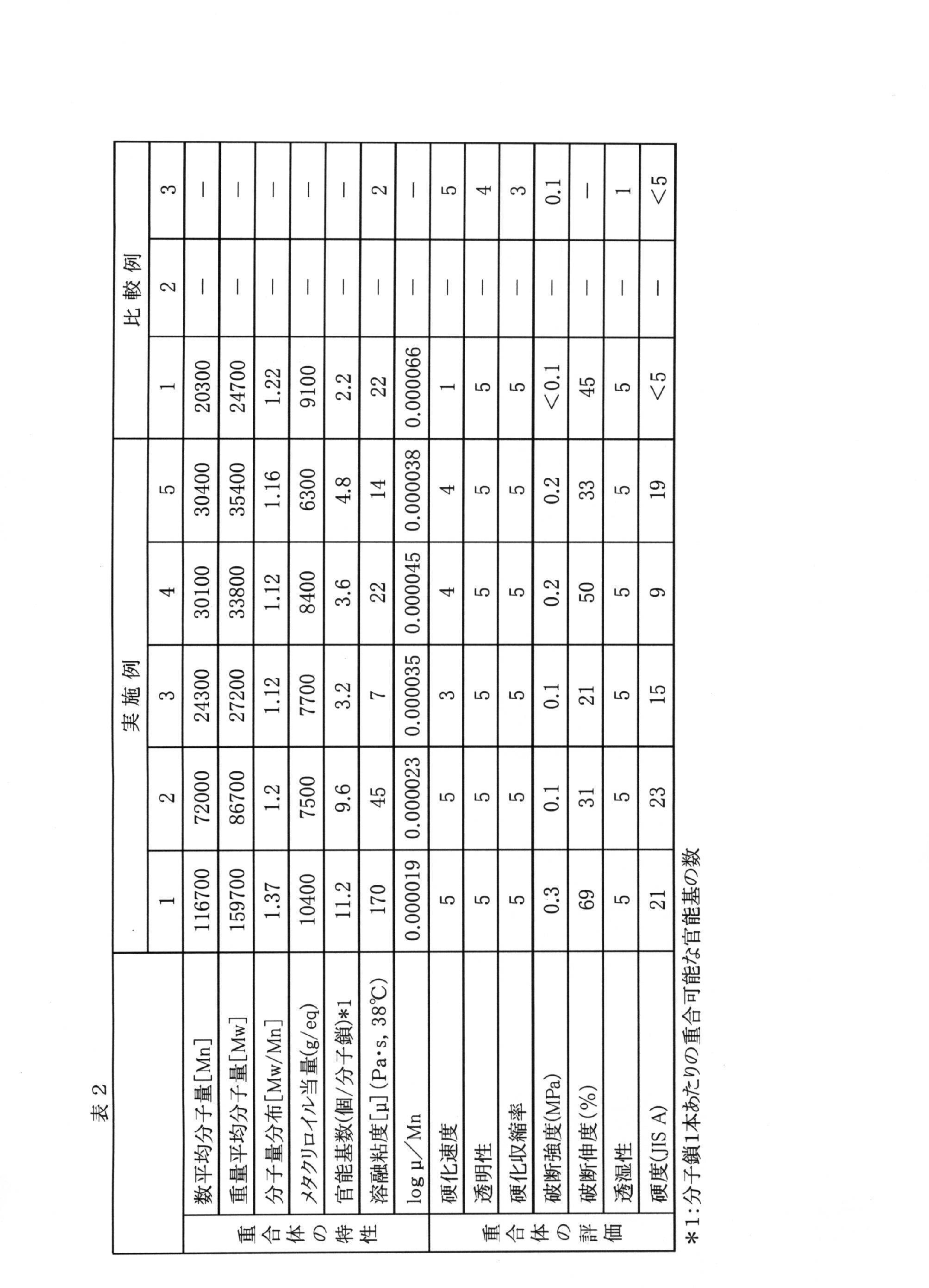
また、本発明の重合体(A-1)~(A-5)はポリイソプレン(I-X-1)に比べて硬化速度が速く、特に実施例1,2のように分子量が高い重合体(A-1)及び(A-2)は、硬化速度に優れる。
更に、本発明の重合体(A-1)~(A-5)は、ポリイソプレン(I-X-1)と同様に、良好な透明性、低硬化収縮率、低透湿性、柔軟性を有していることがわかる。
なお、比較例2の硬化性樹脂(I-X-2)は、ポリファルネセンの2-ヒドロキシエチルメタクリレート変性体を製造する過程でゲル化し、溶媒に不溶となるため数平均分子量やメタクリロイル当量の測定は行えなかった。
ウレタンアクリレート(I-X-3)を用いた比較例3は、実施例1~5と同様に硬化速度に優れるが、硬化時の収縮率や透湿性の面で本発明の重合体(A-1)~(A-5)の方が優れていた。
第2態様の実施例及び比較例において使用した各成分は以下のとおりである。
<重合可能な官能基を有する重合体(A)>
・第1態様の実施例1~5で用いた重合体(A-1)~(A-5)
なお、重合体(A-1)~(A―5)の数平均分子量、分子量分布、溶融粘度、メタクリロイル当量及び分子鎖1本あたりの重合可能な官能基の数を表3に示す。
・重合開始剤(C-1)
2-ヒドロキシ-2-メチル-1-フェニルプロパン-1-オン
BASF株式会社製、商品名「DAROCUR 1173」
・単量体(D-1):ジシクロペンテニルオキシエチルメタクリレート
日立化成工業株式会社製、商品名「ファンクリルFA-512M」
・単量体(D-2):1,9-ノナンジオールジアクリレート
大阪有機化学工業株式会社製、商品名「ビスコート#260」
・単量体(D-3):n-ブチルアクリレート
東京化成工業株式会社製、商品名「Butyl Acrylate」
・ヒンダードアミン系化合物(E-1)
ビス(1,2,2,6,6-ペンタメチル-4-ピペリジル)セバケートと、メチル-1,2,2,6,6-ペンタメチル-4-ピペリジルセバケートとの混合物
BASF株式会社製、商品名「TINUVIN 765」
・2,6-ジ-t-ブチル-4-メチルフェノール(BHT)本州化学工業株式会社製
・重合体(II-X-1):デュポン株式会社製ウレタンアクリレート「DBA2210」
・重合体(II-X-2):国際公開第2012/018682号の実施例7の記載にしたがって合成した2-ヒドロキシエチルメタクリレートで変性したポリファルネセン
・重合体(II-X-3):第1態様における製造例3においてポリファルネセンを重合後、無水マレイン酸を添加前に取り出した未変性の重合体
・重合体(II-X-4):第1態様における製造例3において無水マレイン酸と反応後、2-ヒドロキシエチルメタクリレートを添加前に取り出した重合体
・重合体(II-X-5):日本曹達株式会社製「TEA-1000」(アクリロイル基含有ポリブタジエン)
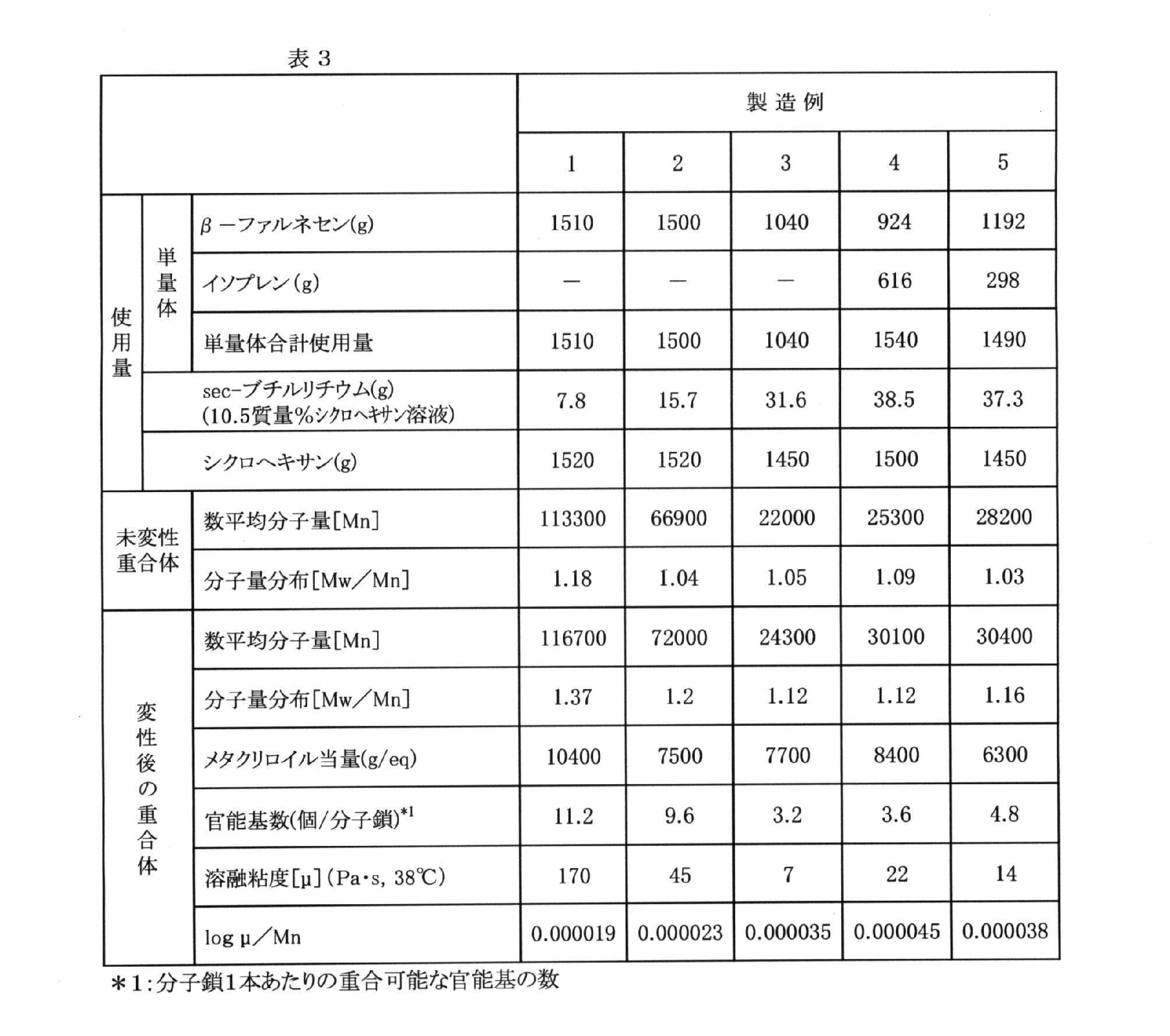
重合体(A-1)~(A-5)、単量体(D-1)~(D-3)、重合開始剤(C-1)を、表4に示す割合でステンレス製300mL容器に投入し、室温下、撹拌翼を用いて20分混合することにより樹脂組成物を調製した。得られた樹脂組成物を下記方法により評価した。結果を表4に示す。
重合体(A-1)~(A-5)、単量体(D-1)~(D-3)、重合開始剤(C-1)、ヒンダードアミン系化合物(E-1)を表5に示す割合で配合したこと以外は実施例6と同様にして樹脂組成物を調製し、評価を行った。結果を表5に示す。
その他の硬化性樹脂(II-X-1)~(II-X-5)、単量体(D-1)、重合開始剤(C-1)を表6に示す割合で配合したこと以外は実施例6と同様にして樹脂組成物を調製し、評価を行った。結果を表6に示す。
(II-1)数平均分子量及び分子量分布の測定
第1態様の(I-1)と同じ方法で測定した。
第1態様の(I-2)と同じ方法で測定した。
製造例1~5で得られた重合体(A-1)~(A-5)、並びに実施例及び比較例で得られた樹脂組成物について、第1態様の(I-3)と同じ方法で測定した。
実施例及び比較例で得られた樹脂組成物について、第1態様の(I-4)と同じ方法で試験し、ゲル分率を求めた。
当試験によって得られたデータから、ゲル分率が80%に到達したときのUV照射量を概算し、下記基準にしたがって評価した。
<評価基準>
○:1,000mJ/cm2未満
△:1,000mJ/cm2以上、2,000mJ/cm2未満
×:2,000mJ/cm2以上
第1態様の(I-5)と同じ方法で硬化物を作製した。得られた硬化物よりPETフィルムを剥がした後、目視により観察し、下記基準にしたがって透明性を評価した。
<評価基準>
○:無色透明
△:若干の着色が認められるが透明
×:明らかな着色又は濁りが見られる
上記(II-5)において得られた硬化物について、第1態様の(I-6)と同じ方法で硬化収縮率を求め、下記基準にしたがって評価した。
<評価基準>
◎:硬化収縮率が3%未満
○:硬化収縮率が3%以上、5%未満
△:硬化収縮率が5%以上、10%未満
×:硬化収縮率が10%以上
上記(II-5)において得られた硬化物から幅6mm、長さ70mmの短冊状のサンプルを打ち抜き、50mm/minの引っ張り速度で引っ張り試験を行った際の破断強度及び破断伸度をインストロン社製引張試験機により測定した。
上記(II-5)において得られた硬化物について、第1態様の(I-8)と同じ方法で試験を行い、下記基準にしたがって評価した。
<評価基準>
5:透湿度が25g/m2・24h未満
4:透湿度が25g/m2・24h以上、50g/m2・24h未満
3:透湿度が50g/m2・24h以上、100g/m2・24h未満
2:透湿度が100g/m2・24h以上、200g/m2・24h未満
1:透湿度が200g/m2・24h以上
実施例及び比較例で得られた樹脂組成物について、第1態様の(I-9)と同じ方法で測定した。
上記(II-5)においてPETフィルムを剥がして得られた硬化物を、25℃雰囲気で24時間放置後、縦60mm×横6mm×厚さ0.5mmの短冊状試験片を作製した。次に、作製した試験片を100℃のギアオーブン内に72時間、144時間、240時間、それぞれ静置し、それぞれの試験片における色相変化を熱処理前の試験片(0時間で表示)と共に目視で確認し、下記基準で評価した。なお、本試験は実施例15~23及び比較例4~8の樹脂組成物から得られた硬化物について行った。
<評価基準>
◎:無色
○:淡黄色
△:黄色
×:茶色
上記(II-5)において作製した試験片を100℃で72時間、144時間、240時間、それぞれ静置した後、50mm/minの引張り速度で引張り試験を行い、各時間毎の引張り弾性率をインストロン社製引張試験機により測定した。なお、引張弾性率は低いほうが柔軟であることから良好であり、時間経過後の変化割合が小さいほうが良好である。なお、本試験は実施例15~23及び比較例4~8の樹脂組成物から得られた硬化物について行った。


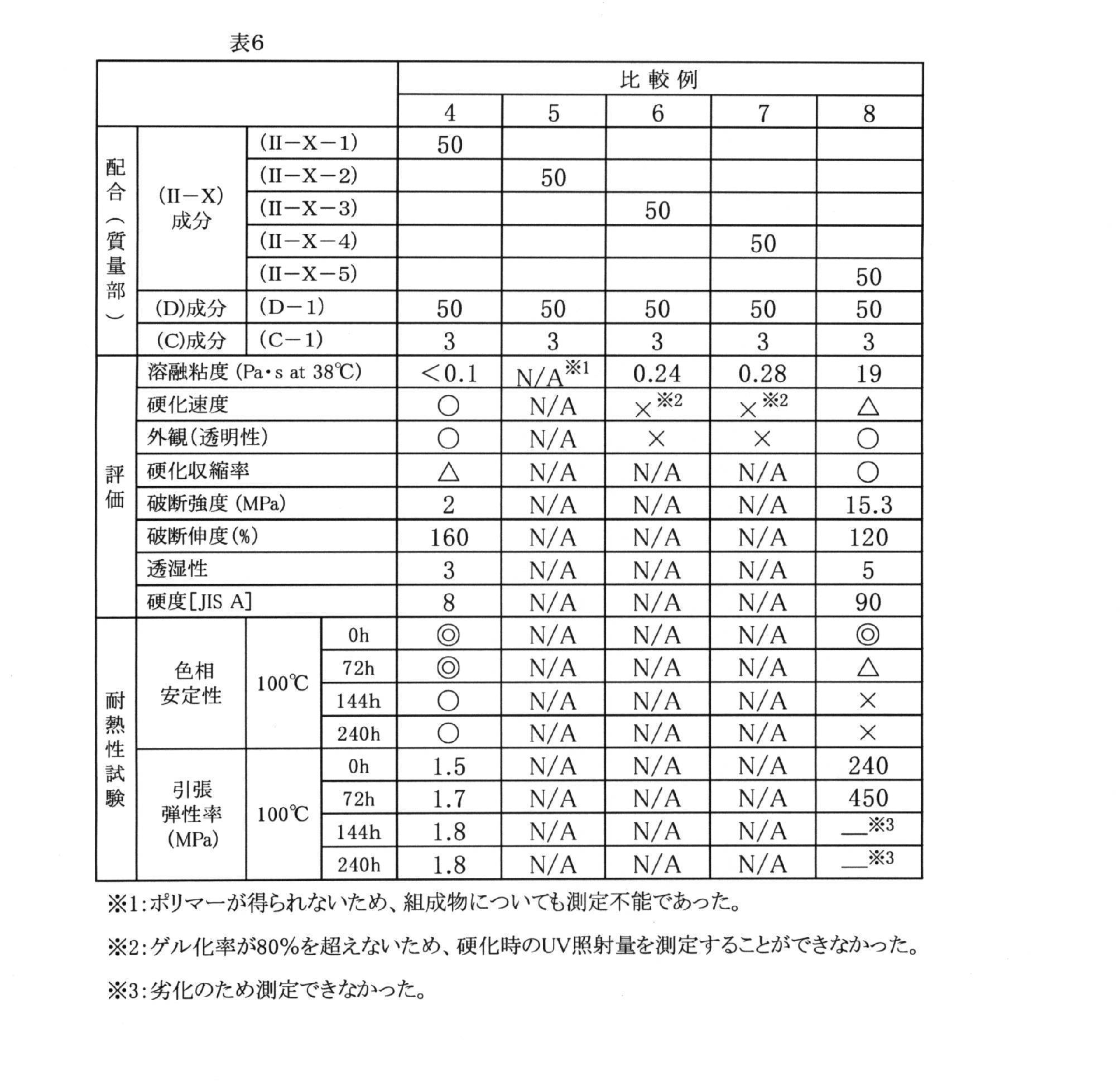
実施例6~14は、ファルネセン単量体を含む重合体の代わりにウレタンアクリレート(II-X-1)を用いた比較例4に比べて、硬化収縮率及び透湿性に優れる。
なお、比較例5で用いた重合体(II-X-2)は、ポリファルネセンの2-ヒドロキシエチルメタクリレート変性体を製造する過程でゲル化してしまい、均一な重合体を得ることができず、溶媒に不溶となるため数平均分子量やメタクリロイル当量の測定は行えなかった。また、その他の樹脂組成物としての評価も行うことができなかった。
第3態様の実施例及び比較例において使用した各成分は以下のとおりである。
<重合可能な官能基を有する重合体(A)>
・第1態様の実施例1、3及び5で用いた重合体(A-1),(A-3)及び(A-5)
・後述する製造例6~8により得られた重合体(B-1)~(B-3)
<重合開始剤(C)>
・重合開始剤(C-1)
2-ヒドロキシ-2-メチル-1-フェニルプロパン-1-オン
BASF株式会社製、商品名「DAROCUR 1173」
・アクリルモノマー(D-1)
ジシクロペンテニルオキシエチルメタクリレート
日立化成工業株式会社製、商品名「ファンクリルFA-512M」
・ヒンダードアミン系化合物(E-1)
ビス(1,2,2,6,6-ペンタメチル-4-ピペリジル)セバケートと、メチル-1,2,2,6,6-ペンタメチル-4-ピペリジルセバケートとの混合物
BASF株式会社製、商品名「TINUVIN 765」
製造例6:液状ポリブタジエン(B-1)
ブタジエンを、n-ブチルリチウムを開始剤としてn-ヘキサン中でアニオン重合させることにより、数平均分子量9,000の液状ポリブタジエン(以下、「重合体(B-1)」ともいう)を合成した。重合体(B-1)の物性を表7に示す。
製造例7:液状ポリイソプレン(B-2)
イソプレンを、n-ブチルリチウムを開始剤としてn-ヘキサン中でアニオン重合させることにより、数平均分子量9,000の液状ポリイソプレンを得た。(以下、「重合体(B-2)」ともいう)を合成した。重合体(B-2)の物性を表7に示す。
イソプレンを、n-ブチルリチウムを開始剤としてn-ヘキサン中でアニオン重合させることにより、数平均分子量20,000の液状ポリイソプレン(以下、「重合体(B-3)」ともいう)を合成した。重合体(B-3)の物性を表7に示す。
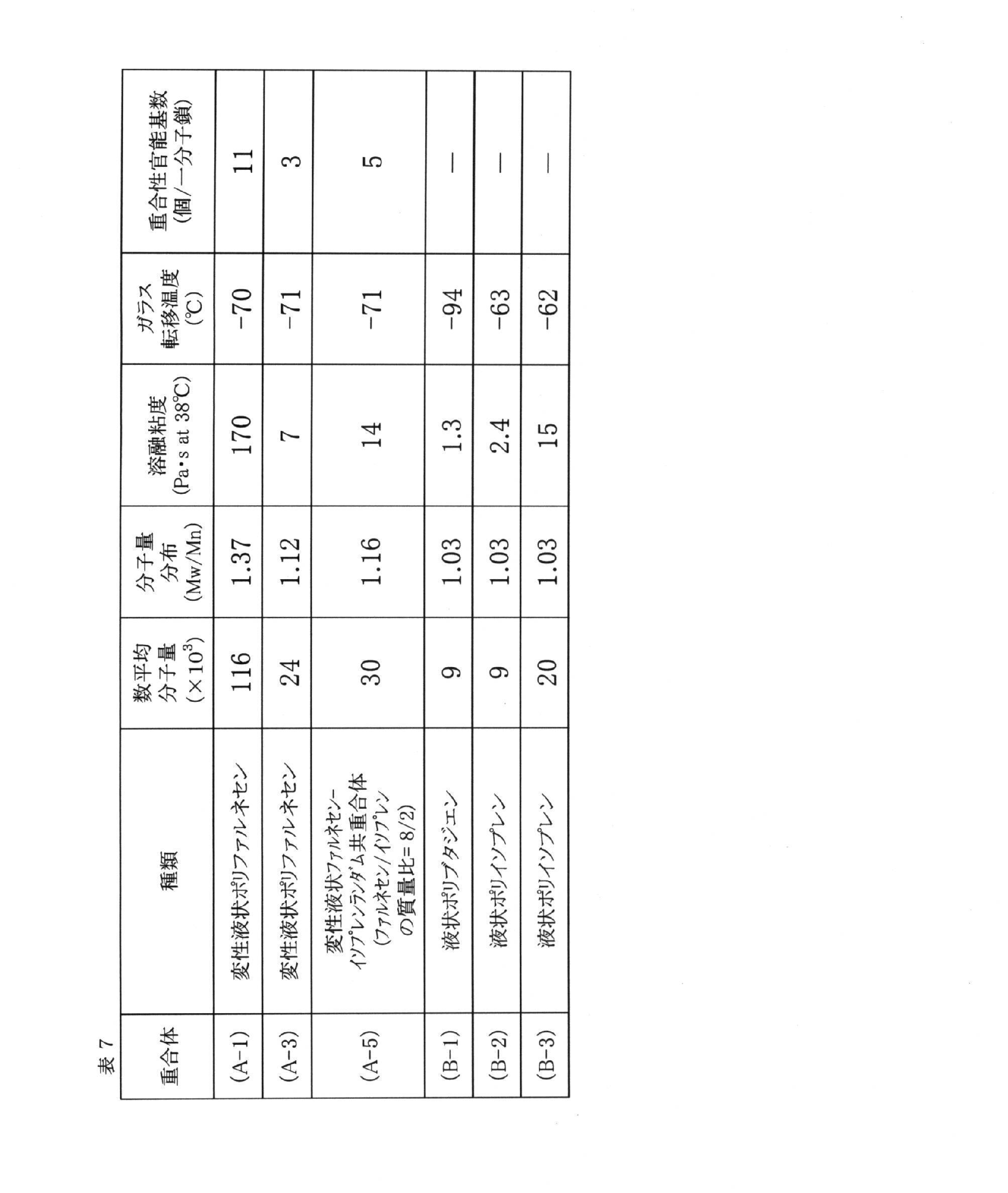
重合体(A-1),(A-3)及び(A-5)、重合体(B-1)~(B-3)、重合開始剤(C)、単量体(D-1)及びヒンダードアミン系化合物(E-1)を、表8及び表9に示す割合でステンレス製300mL容器に投入し、室温下、撹拌翼を用いて20分混合することにより200gの樹脂組成物を調製した。得られた樹脂組成物を下記方法により評価した。結果を表8及び表9に示す。
(III-1)数平均分子量及び分子量分布の測定
第1態様の(I-1)と同じ方法で測定した。なお、表7には小数第一位を四捨五入して整数で記載した。
製造例1,3,5~8で得られた重合体及び実施例で得られた樹脂組成物について、第1態様の(I-3)と同じ方法で測定した。
製造例1,3,5~8で得られた各重合体10mgをアルミパンに採取し、示差走査熱量測定(DSC)により10℃/分の昇温速度条件においてサーモグラムを測定し、DDSCのピークトップの値をガラス転移温度とした。
重合体(A-1),(A-3)及び(A-5)について、第1態様の(I-2)と同じ方法で測定した。なお、表7には小数第一位を四捨五入して整数で記載した。
実施例で得られた樹脂組成物について、第1態様の(I-5)と同じ方法で硬化物を作製した。得られた硬化物よりPETフィルムを剥がした後、目視により観察し、下記基準にしたがって透明性を評価した。
<評価基準>
5:無色透明
4:極僅かな着色が認められるが透明
3:やや着色が認められるが透明
2:明らかな着色が認められるが透明
1:不透明
上記(III-5)において得られた硬化物について、第2態様の(II-7)と同じ方法で測定した。

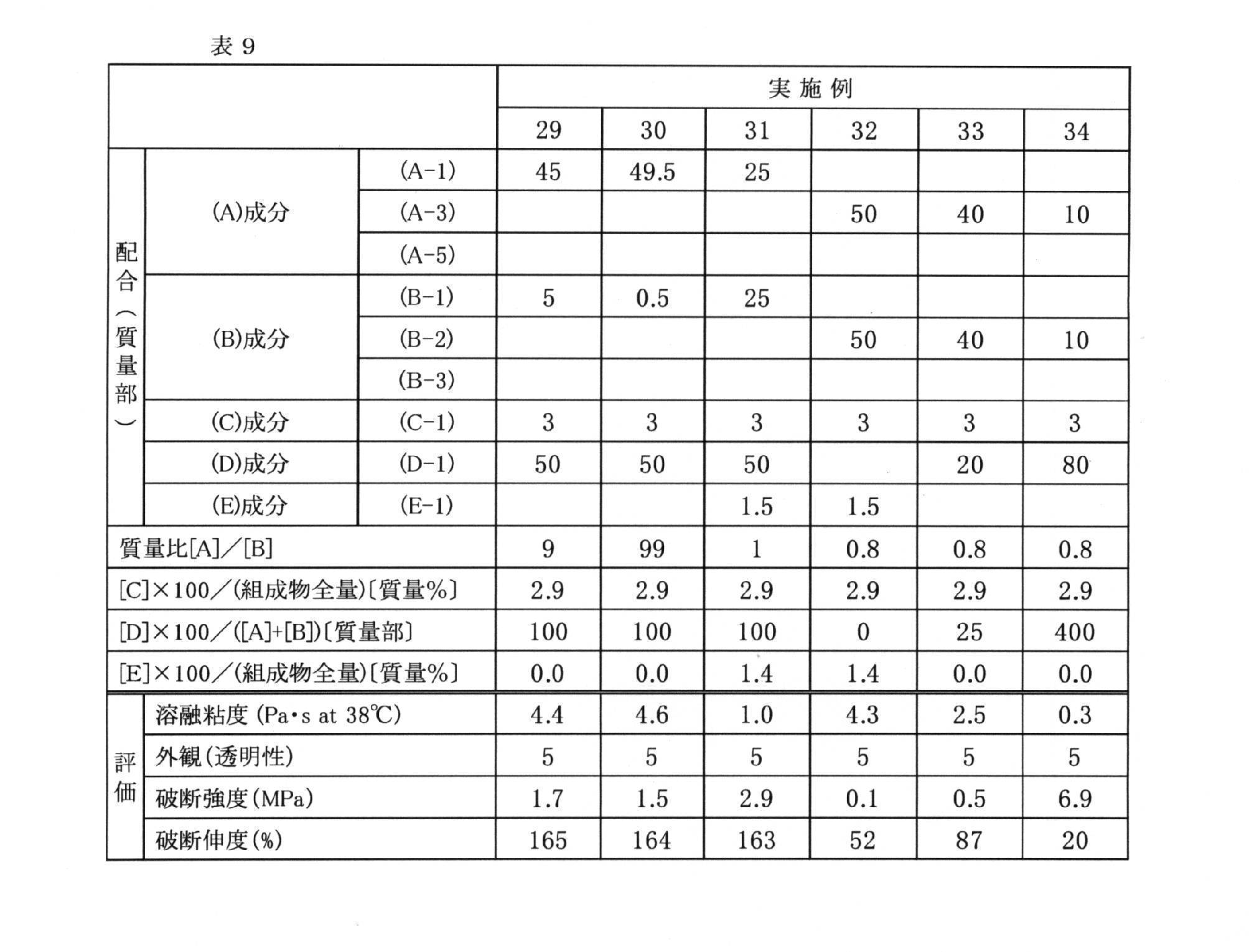
第4態様の実施例及び比較例において使用した各成分は以下のとおりである。
<重合可能な官能基を有する重合体(A)>
・第1態様の実施例1及び3で用いた重合体(A-1)及び(A-3)
・第3態様の製造例6及び7により得られた重合体(B-1)及び(B-2)
<重合開始剤(C)>
・重合開始剤(C-1)
2-ヒドロキシ-2-メチル-1-フェニルプロパン-1-オン
BASF株式会社製、商品名「DAROCUR 1173」
・アクリルモノマー(D-1)
ジシクロペンテニルオキシエチルメタクリレート
日立化成工業株式会社製、商品名「ファンクリルFA-512M」
・ヒンダードアミン系化合物(E-1)
ビス(1,2,2,6,6-ペンタメチル-4-ピペリジル)セバケートと、メチル-1,2,2,6,6-ペンタメチル-4-ピペリジルセバケートとの混合物
BASF株式会社製、商品名「TINUVIN 765」
・下記製造例9により得られた重合体(F-1)
製造例9:分子内にメタクリロイル基を有する変性液状ポリイソプレン(F-1)
イソプレンを、n-ブチルリチウムを開始剤としてn-ヘキサン中でアニオン重合させることにより、数平均分子量36,000のポリイソプレンを得た。
次いで、前記未変性重合体について第1態様の製造例1と同様に反応を行うことにより分子内にメタクリロイル基を有する変性液状ポリイソプレン(以下、「重合体(F-1)」ともいう)を合成した。重合体(F-1)について、第3態様における(III-1)~(III-6)と同様に物性を評価した。結果を表10に示す。
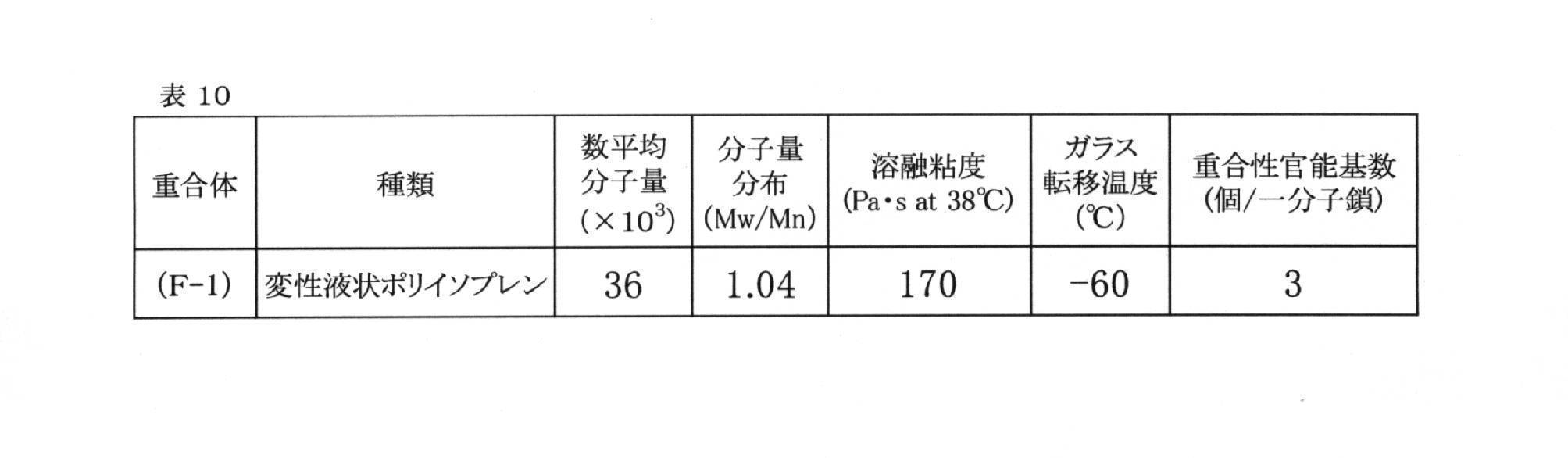
重合体(A-1)又は(A-3)、重合体(F)、重合体(B-1)又は(B-2)、重合開始剤(C-1)、単量体(D-1)及びヒンダートアミン系化合物(E-1)を、表11に示す割合でステンレス製300mL容器に投入し、室温下、撹拌翼を用いて20分混合することにより200gの樹脂組成物を調製した。得られた樹脂組成物を下記方法により評価した。結果を表11に示す。
(IV-1)溶融粘度
実施例で得られた樹脂組成物について、第1態様の(I-3)と同じ方法で測定した。
実施例で得られた樹脂組成物について、第1態様の(I-5)と同じ方法で硬化物を作製した。得られた硬化物よりPETフィルムを剥がした後、目視により観察し、下記基準にしたがって透明性を評価した。
<評価基準>
5:無色透明
4:極僅かな着色が認められるが透明
3:やや着色が認められるが透明
2:明らかな着色が認められるが透明
1:不透明
上記(IV-2)において得られた硬化物について、第2態様の(II-7)と同じ方法で測定した。

Claims (25)
- 重合体を構成する単量体単位としてファルネセン由来の単量体単位(a1)を含み重合可能な官能基を有する重合体。
- 重合可能な官能基が、置換基を有していてもよい、(メタ)アクリロイル基、エポキシ基、オキセタニル基、ビニルエーテル基、及びアルコキシシリル基から選ばれる少なくとも1種である、請求項1に記載の重合体。
- 38℃における溶融粘度が0.1~3000Pa・sである、請求項1又は2に記載の重合体。
- 数平均分子量が1000~100万である、請求項1~3のいずれかに記載の重合体。
- 重合体を構成する単量体単位が、ファルネセン由来の単量体単位(a1)のみからなる、請求項1~4のいずれかに記載の重合体。
- 重合体を構成する単量体単位が、ファルネセン由来の単量体単位(a1)及びファルネセン以外の単量体に由来する単量体単位(a2)を含有する、請求項1~4のいずれかに記載の重合体。
- 単量体単位(a2)がファルネセン以外の共役ジエン化合物由来の単量体単位である、請求項6に記載の重合体。
- 単量体単位(a2)が芳香族ビニル化合物由来の単量体単位である、請求項6に記載の重合体。
- 芳香族ビニル化合物が、スチレン、α-メチルスチレン及び4-メチルスチレンから選ばれる少なくとも1種である、請求項8に記載の重合体。
- 38℃における溶融粘度の常用対数値と数平均分子量(Mn)との比[38℃における溶融粘度の常用対数値/数平均分子量(Mn)]が0.000060以下である、請求項1~9のいずれかに記載の重合体。
- ファルネセン由来の単量体単位(a1)を含み、かつ重合可能な官能基を有しない未変性重合体を調製する工程(1)と、該未変性重合体に対して重合可能な官能基を導入する工程(2)とを有する、請求項1~10のいずれかに記載の重合体の製造方法。
- 工程(2)が、未変性重合体に対してグラフト化するための化合物を反応させた後、重合可能な官能基を有する化合物を反応させる工程である、請求項11に記載の重合体の製造方法。
- 請求項1~10のいずれかに記載の重合体(A)を含有する樹脂組成物。
- 更に、重合開始剤(C)を含有する、請求項13に記載の樹脂組成物。
- 請求項1~10のいずれかに記載の重合体(A)、単量体(D)及び重合開始剤(C)を含有し、重合体(A)と単量体(D)との質量比[(A)/(D)]が0.01~99であり、重合体(A)及び単量体(D)の合計100質量部に対して重合開始剤(C)を0.1~20質量部含有する樹脂組成物。
- 更に、重合体(A)及び単量体(D)の合計100質量部に対して、ヒンダードアミン系化合物(E)を0.01~10質量部含有する、請求項15に記載の樹脂組成物。
- 請求項1~10のいずれかに記載の重合体(A)、炭素数12以下の共役ジエン化合物(b1)由来の単量体単位を含み重合可能な官能基を有しない重合体(B)及び重合開始剤(C)を含有し、重合体(A)と重合体(B)との質量比[(A)/(B)]が0.01~100である樹脂組成物。
- 重合開始剤(C)の含有量が、樹脂組成物の全量中0.1~20質量%である、請求項17に記載の樹脂組成物。
- 炭素数12以下の共役ジエン化合物(b1)がイソプレン及びブタジエンから選ばれる少なくとも1種である、請求項17又は18に記載の樹脂組成物。
- 更に、重合体(A)及び重合体(B)の合計100質量部に対して、単量体(D)を0.01~1,000質量部含有する、請求項17~19のいずれかに記載の樹脂組成物。
- 更に、ヒンダードアミン系化合物(E)を樹脂組成物の全量中0.01~10質量%含有する、請求項17~20のいずれかに記載の樹脂組成物。
- 更に、炭素数12以下の共役ジエン化合物(f1)由来の単量体単位を含み重合可能な官能基を有する重合体(F)を含有し、重合体(A)と重合体(F)との質量比[(A)/(F)]が0.01~100である、請求項13~21のいずれかに記載の樹脂組成物。
- 請求項13~22のいずれかに記載の樹脂組成物を硬化させた硬化物。
- 請求項23に記載の硬化物を含有する光学用粘着剤。
- 請求項13~22のいずれかに記載の樹脂組成物を含有する光学用粘着剤。
Priority Applications (3)
| Application Number | Priority Date | Filing Date | Title |
|---|---|---|---|
| KR1020157026353A KR102167198B1 (ko) | 2013-03-29 | 2014-03-28 | 중합체 및 그 제조 방법, 그리고 그 중합체를 함유하는 수지 조성물 |
| CN201480017895.8A CN105121482A (zh) | 2013-03-29 | 2014-03-28 | 聚合物及其制造方法、以及含有该聚合物的树脂组合物 |
| JP2015508763A JPWO2014157624A1 (ja) | 2013-03-29 | 2014-03-28 | 重合体及びその製造方法、並びに該重合体を含有する樹脂組成物 |
Applications Claiming Priority (6)
| Application Number | Priority Date | Filing Date | Title |
|---|---|---|---|
| JP2013075239 | 2013-03-29 | ||
| JP2013-075239 | 2013-03-29 | ||
| JP2013-075242 | 2013-03-29 | ||
| JP2013075242 | 2013-03-29 | ||
| JP2013205543 | 2013-09-30 | ||
| JP2013-205543 | 2013-09-30 |
Publications (1)
| Publication Number | Publication Date |
|---|---|
| WO2014157624A1 true WO2014157624A1 (ja) | 2014-10-02 |
Family
ID=51624580
Family Applications (1)
| Application Number | Title | Priority Date | Filing Date |
|---|---|---|---|
| PCT/JP2014/059135 Ceased WO2014157624A1 (ja) | 2013-03-29 | 2014-03-28 | 重合体及びその製造方法、並びに該重合体を含有する樹脂組成物 |
Country Status (5)
| Country | Link |
|---|---|
| JP (1) | JPWO2014157624A1 (ja) |
| KR (1) | KR102167198B1 (ja) |
| CN (1) | CN105121482A (ja) |
| TW (1) | TWI627218B (ja) |
| WO (1) | WO2014157624A1 (ja) |
Cited By (11)
| Publication number | Priority date | Publication date | Assignee | Title |
|---|---|---|---|---|
| US9334394B1 (en) | 2015-06-03 | 2016-05-10 | Fina Technology, Inc. | Farnesene resins, rubber compositions, and tire compositions |
| JP2016210909A (ja) * | 2015-05-11 | 2016-12-15 | 日立化成株式会社 | 光硬化性樹脂組成物及び硬化物 |
| WO2017002651A1 (ja) * | 2015-06-30 | 2017-01-05 | 株式会社クラレ | ファルネセン重合体及びその製造方法 |
| US20180072831A1 (en) * | 2015-06-29 | 2018-03-15 | Fina Technology, Inc. | Farnesene-Based Polymers and Liquid Optically Clear Adhesive Compositions Incorporating the Same |
| JP2019501265A (ja) * | 2016-01-06 | 2019-01-17 | フィナ テクノロジー,インコーポレイティド | 硬化可能なポリファルネセンベース組成物 |
| US20190055336A1 (en) * | 2017-08-18 | 2019-02-21 | Fina Technology, Inc. | Epoxidized polyfarnesene and methods for producing the same |
| JP2019532142A (ja) * | 2016-09-15 | 2019-11-07 | フィナ テクノロジー,インコーポレイティド | ファルネセン系マクロモノマー並びにその製造及び使用方法 |
| JP2020041101A (ja) * | 2018-09-13 | 2020-03-19 | ダイセル・オルネクス株式会社 | ウレタン(メタ)アクリレート、これを含む活性エネルギー線硬化性組成物、及びその硬化物 |
| JP2020523441A (ja) * | 2017-06-07 | 2020-08-06 | フィナ テクノロジー,インコーポレイティド | シラン官能化ポリ(ファルネセン)及びそれを含むゴムコンパウンド |
| WO2020212492A1 (en) | 2019-04-16 | 2020-10-22 | University Of Durham | Method of epoxidation |
| US11466118B2 (en) | 2019-11-22 | 2022-10-11 | Fina Technology, Inc. | Chain end hydroxyl functionalized branched polyfarnesenes obtained by radical polymerization |
Families Citing this family (1)
| Publication number | Priority date | Publication date | Assignee | Title |
|---|---|---|---|---|
| US10370523B2 (en) | 2017-04-03 | 2019-08-06 | Fina Technology, Inc. | Insulating glass sealants based on polyurethanes and organically-modified nanoclays |
Citations (4)
| Publication number | Priority date | Publication date | Assignee | Title |
|---|---|---|---|---|
| WO2012018682A1 (en) * | 2010-08-02 | 2012-02-09 | Amyris, Inc. | Graft copolymers of polyfarnesenes with condensation polymers |
| WO2013047347A1 (ja) * | 2011-09-30 | 2013-04-04 | 株式会社クラレ | ゴム組成物及びタイヤ |
| WO2013047348A1 (ja) * | 2011-09-30 | 2013-04-04 | 株式会社クラレ | ゴム組成物及びタイヤ |
| WO2013151067A1 (ja) * | 2012-04-04 | 2013-10-10 | 株式会社クラレ | 共重合体、それを用いたゴム組成物及びタイヤ |
Family Cites Families (6)
| Publication number | Priority date | Publication date | Assignee | Title |
|---|---|---|---|---|
| JP4098107B2 (ja) | 2003-02-10 | 2008-06-11 | 株式会社クラレ | 熱硬化性樹脂組成物 |
| JP5073400B2 (ja) * | 2007-07-30 | 2012-11-14 | 株式会社クラレ | 耐熱安定性に優れた硬化性樹脂組成物 |
| US8048976B2 (en) | 2008-09-04 | 2011-11-01 | Amyris, Inc. | Polyfarnesenes |
| ATE543841T1 (de) | 2008-09-04 | 2012-02-15 | Amyris Inc | Klebstoffzusammensetzungen, die ein polyfarnesen umfassen |
| WO2011040407A1 (ja) * | 2009-09-29 | 2011-04-07 | 電気化学工業株式会社 | 硬化性樹脂組成物 |
| WO2011046120A1 (ja) * | 2009-10-14 | 2011-04-21 | 電気化学工業株式会社 | 樹脂組成物及び接着剤 |
-
2014
- 2014-03-28 TW TW103111713A patent/TWI627218B/zh active
- 2014-03-28 KR KR1020157026353A patent/KR102167198B1/ko active Active
- 2014-03-28 JP JP2015508763A patent/JPWO2014157624A1/ja active Pending
- 2014-03-28 WO PCT/JP2014/059135 patent/WO2014157624A1/ja not_active Ceased
- 2014-03-28 CN CN201480017895.8A patent/CN105121482A/zh active Pending
Patent Citations (4)
| Publication number | Priority date | Publication date | Assignee | Title |
|---|---|---|---|---|
| WO2012018682A1 (en) * | 2010-08-02 | 2012-02-09 | Amyris, Inc. | Graft copolymers of polyfarnesenes with condensation polymers |
| WO2013047347A1 (ja) * | 2011-09-30 | 2013-04-04 | 株式会社クラレ | ゴム組成物及びタイヤ |
| WO2013047348A1 (ja) * | 2011-09-30 | 2013-04-04 | 株式会社クラレ | ゴム組成物及びタイヤ |
| WO2013151067A1 (ja) * | 2012-04-04 | 2013-10-10 | 株式会社クラレ | 共重合体、それを用いたゴム組成物及びタイヤ |
Cited By (31)
| Publication number | Priority date | Publication date | Assignee | Title |
|---|---|---|---|---|
| JP2016210909A (ja) * | 2015-05-11 | 2016-12-15 | 日立化成株式会社 | 光硬化性樹脂組成物及び硬化物 |
| US9334394B1 (en) | 2015-06-03 | 2016-05-10 | Fina Technology, Inc. | Farnesene resins, rubber compositions, and tire compositions |
| US10239973B2 (en) | 2015-06-29 | 2019-03-26 | Fina Technology, Inc. | Farnesene-based polymers and liquid optically clear adhesive compositions incorporating the same |
| US20180072831A1 (en) * | 2015-06-29 | 2018-03-15 | Fina Technology, Inc. | Farnesene-Based Polymers and Liquid Optically Clear Adhesive Compositions Incorporating the Same |
| US10336839B2 (en) | 2015-06-29 | 2019-07-02 | Fina Technology, Inc. | Farnesene-based polymers and liquid optically clear adhesive compositions incorporating the same |
| CN108026215A (zh) * | 2015-06-29 | 2018-05-11 | 飞纳技术有限公司 | 基于法呢烯的聚合物和包含其的液体光学清晰粘合剂组合物 |
| JP2018527424A (ja) * | 2015-06-29 | 2018-09-20 | フィナ テクノロジー,インコーポレイティド | ファルネセン系ポリマー及びそれを組み入れた液状の光学的に透明な接着剤組成物 |
| CN108026215B (zh) * | 2015-06-29 | 2019-06-07 | 飞纳技术有限公司 | 基于法呢烯的聚合物和包含其的液体光学清晰粘合剂组合物 |
| JPWO2017002651A1 (ja) * | 2015-06-30 | 2018-04-12 | 株式会社クラレ | ファルネセン重合体及びその製造方法 |
| JP2020143297A (ja) * | 2015-06-30 | 2020-09-10 | 株式会社クラレ | ファルネセン重合体 |
| WO2017002651A1 (ja) * | 2015-06-30 | 2017-01-05 | 株式会社クラレ | ファルネセン重合体及びその製造方法 |
| US11634531B2 (en) | 2016-01-06 | 2023-04-25 | Fina Technology, Inc. | Curable polyfarnesene-based compositions |
| JP7391813B2 (ja) | 2016-01-06 | 2023-12-05 | フィナ テクノロジー,インコーポレイティド | 硬化可能なポリファルネセンベース組成物 |
| JP2019501265A (ja) * | 2016-01-06 | 2019-01-17 | フィナ テクノロジー,インコーポレイティド | 硬化可能なポリファルネセンベース組成物 |
| JP7007275B2 (ja) | 2016-01-06 | 2022-01-24 | フィナ テクノロジー,インコーポレイティド | 硬化可能なポリファルネセンベース組成物 |
| JP2021008630A (ja) * | 2016-01-06 | 2021-01-28 | フィナ テクノロジー,インコーポレイティド | 硬化可能なポリファルネセンベース組成物 |
| US10544241B2 (en) | 2016-09-15 | 2020-01-28 | Fina Technology, Inc. | Farnesene-based macromonomers and methods of making and using the same |
| US11117988B2 (en) | 2016-09-15 | 2021-09-14 | Fina Technology, Inc. | Farnesene-based macromonomers and methods of making and using the same |
| JP2019532142A (ja) * | 2016-09-15 | 2019-11-07 | フィナ テクノロジー,インコーポレイティド | ファルネセン系マクロモノマー並びにその製造及び使用方法 |
| JP7185645B2 (ja) | 2017-06-07 | 2022-12-07 | フィナ テクノロジー,インコーポレイティド | シラン官能化ポリ(ファルネセン)及びそれを含むゴムコンパウンド |
| JP2020523441A (ja) * | 2017-06-07 | 2020-08-06 | フィナ テクノロジー,インコーポレイティド | シラン官能化ポリ(ファルネセン)及びそれを含むゴムコンパウンド |
| JP2020531631A (ja) * | 2017-08-18 | 2020-11-05 | フィナ テクノロジー,インコーポレイティド | エポキシ化ポリファルネセン及びその製造方法 |
| US10745503B2 (en) | 2017-08-18 | 2020-08-18 | Fina Technology, Inc. | Epoxidized polyfarnesene and methods for producing the same |
| JP7189936B2 (ja) | 2017-08-18 | 2022-12-14 | フィナ テクノロジー,インコーポレイティド | エポキシ化ポリファルネセン及びその製造方法 |
| WO2019036636A1 (en) * | 2017-08-18 | 2019-02-21 | Fina Technology, Inc. | EPOXYDENATED POLYFARNESENE AND PROCESSES FOR PRODUCING THE SAME |
| US20190055336A1 (en) * | 2017-08-18 | 2019-02-21 | Fina Technology, Inc. | Epoxidized polyfarnesene and methods for producing the same |
| JP2020041101A (ja) * | 2018-09-13 | 2020-03-19 | ダイセル・オルネクス株式会社 | ウレタン(メタ)アクリレート、これを含む活性エネルギー線硬化性組成物、及びその硬化物 |
| WO2020054582A1 (ja) * | 2018-09-13 | 2020-03-19 | ダイセル・オルネクス株式会社 | ウレタン(メタ)アクリレート、これを含む活性エネルギー線硬化性組成物、及びその硬化物 |
| JP7213042B2 (ja) | 2018-09-13 | 2023-01-26 | ダイセル・オルネクス株式会社 | ウレタン(メタ)アクリレート、これを含む活性エネルギー線硬化性組成物、及びその硬化物 |
| WO2020212492A1 (en) | 2019-04-16 | 2020-10-22 | University Of Durham | Method of epoxidation |
| US11466118B2 (en) | 2019-11-22 | 2022-10-11 | Fina Technology, Inc. | Chain end hydroxyl functionalized branched polyfarnesenes obtained by radical polymerization |
Also Published As
| Publication number | Publication date |
|---|---|
| JPWO2014157624A1 (ja) | 2017-02-16 |
| TWI627218B (zh) | 2018-06-21 |
| KR102167198B1 (ko) | 2020-10-20 |
| TW201500440A (zh) | 2015-01-01 |
| KR20150135305A (ko) | 2015-12-02 |
| CN105121482A (zh) | 2015-12-02 |
Similar Documents
| Publication | Publication Date | Title |
|---|---|---|
| KR102167198B1 (ko) | 중합체 및 그 제조 방법, 그리고 그 중합체를 함유하는 수지 조성물 | |
| CN105829372B (zh) | 树脂组合物、将该树脂组合物固化而成的固化物和含有该树脂组合物的光学用粘合剂 | |
| KR102365812B1 (ko) | 변성 액상 디엔계 고무 및 그 변성 액상 디엔계 고무를 함유하는 수지 조성물 | |
| CA2920993C (en) | Modified liquid diene-based rubber and production process for the same | |
| JP6199682B2 (ja) | 樹脂組成物、これを硬化させた硬化物及びこの樹脂組成物を含む光学用粘着剤 | |
| CN101605830A (zh) | 光固化性液状橡胶组合物 | |
| WO2019098153A1 (ja) | (メタ)アクリル系ブロック共重合体およびそれを含有する活性エネルギー線硬化性組成物 | |
| JP6368476B2 (ja) | 硬化性樹脂組成物 | |
| JP2015105279A (ja) | 硬化性樹脂組成物 | |
| JP5209387B2 (ja) | 変性液状ゴム組成物の製造方法 | |
| WO2011129077A1 (ja) | ブロック共重合体の製造方法及び共重合体前駆体 | |
| TW201609825A (zh) | 聚合物、製造聚合物之方法及聚合物之用途 | |
| JP2018115346A (ja) | 硬化性樹脂組成物 |
Legal Events
| Date | Code | Title | Description |
|---|---|---|---|
| 121 | Ep: the epo has been informed by wipo that ep was designated in this application |
Ref document number: 14776489 Country of ref document: EP Kind code of ref document: A1 |
|
| ENP | Entry into the national phase |
Ref document number: 2015508763 Country of ref document: JP Kind code of ref document: A |
|
| ENP | Entry into the national phase |
Ref document number: 20157026353 Country of ref document: KR Kind code of ref document: A |
|
| NENP | Non-entry into the national phase |
Ref country code: DE |
|
| 122 | Ep: pct application non-entry in european phase |
Ref document number: 14776489 Country of ref document: EP Kind code of ref document: A1 |