WO2014129370A1 - 変調装置、復調装置、音響伝送システム、プログラム及び復調方法 - Google Patents
変調装置、復調装置、音響伝送システム、プログラム及び復調方法 Download PDFInfo
- Publication number
- WO2014129370A1 WO2014129370A1 PCT/JP2014/053266 JP2014053266W WO2014129370A1 WO 2014129370 A1 WO2014129370 A1 WO 2014129370A1 JP 2014053266 W JP2014053266 W JP 2014053266W WO 2014129370 A1 WO2014129370 A1 WO 2014129370A1
- Authority
- WO
- WIPO (PCT)
- Prior art keywords
- frame
- signal
- sound
- frequency band
- unit
- Prior art date
- Legal status (The legal status is an assumption and is not a legal conclusion. Google has not performed a legal analysis and makes no representation as to the accuracy of the status listed.)
- Ceased
Links
Images








Classifications
-
- H—ELECTRICITY
- H04—ELECTRIC COMMUNICATION TECHNIQUE
- H04B—TRANSMISSION
- H04B11/00—Transmission systems employing ultrasonic, sonic or infrasonic waves
Definitions
- the present invention relates to a technique for transmitting data using sound (sound wave) as a transmission medium.
- Patent Documents 1 and 2 there are techniques described in Patent Documents 1 and 2 as techniques for transmitting data using an acoustic signal or sound (sound wave) as a transmission medium.
- the modulation device on the sound emitting side modulates a spread code with a data code, differentially encodes the modulated spread code, and then multiplies the carrier signal. The frequency is shifted and output as a modulation signal.
- the demodulator on the sound collecting side delay-detects the input modulated signal with a delay time corresponding to one chip of differential encoding, and detects the synchronization between the delayed-detected signal waveform and the spread code.
- the data code is demodulated based on the detected peak polarity of the synchronization point.
- a digital watermark is embedded in an acoustic signal using amplitude modulation, and the digital watermark is extracted from the acoustic signal based on temporal and intensity characteristics of amplitude fluctuation. Yes.
- an object of the present invention is to increase the possibility of extracting data from sound in a mechanism for transmitting data using sound as a transmission medium.
- a modulation apparatus delays transmission start timing of a frame corresponding to one unit of transmission data by a predetermined period, and the transmission start timing is delayed by the delay means.
- a modulated signal generating means for generating a modulated signal obtained by modulating a carrier wave of a different frequency band according to the transmission start timing using the frame.
- the modulation apparatus may further include sound emission means for emitting sound according to the modulation signal generated by the modulation signal generation means.
- the demodulation device corresponds to one unit of transmission data, and modulates a carrier wave in a different frequency band according to the transmission start timing using a frame in which the transmission start timing is delayed by a predetermined period.
- Separation means for separating the sound signal of the sound emitted in accordance with the modulated signal into signal components belonging to the respective frequency bands, and for each predetermined period based on each signal component separated by the separation means
- a frame generating means for demodulating a block corresponding to a part of the frame and connecting the blocks selected from the demodulated block group according to a predetermined selection method to generate the frame.
- the frequency band of the carrier wave modulated by the modulation signal generating unit is n (n is a positive integer) frequency band, and the frame generating unit is one of the n frequency bands.
- the block may be demodulated on the basis of each signal component every 1 / n period of the period superimposed in FIG.
- Each of the frequency bands includes a plurality of narrowband frequencies having a narrower bandwidth than the frequency band, and the modulation signal generating unit 2 corresponds to the frame according to the value of each bit constituting the frame.
- Each of the outputs of the signals belonging to the narrowband frequency is inverted with respect to each other to generate the modulated signal, and the separating means converts the acoustic signal into the two narrowband frequencies included in each of the frequency bands.
- the frame generation means demodulates the block by comparing the difference between the signals belonging to the two narrowband frequencies with a threshold value and decoding the bit value. Also good.
- the frame generation unit calculates an upper envelope and a lower envelope of each signal component separated by the separation unit, and uses the calculated temporally varying value between the upper envelope and the lower envelope as the threshold value. You may do it.
- an acoustic transmission system includes a transmission device that emits an acoustic signal superimposed with transmission data to be transmitted as sound, and a reception device that extracts the transmission data from the sound emitted from the transmission device.
- the transmission apparatus includes: delay means for delaying transmission start timing of a frame corresponding to one unit of transmission data by a predetermined period; and delaying the transmission start timing by the delay means.
- a modulated signal generating means for generating a modulated signal obtained by modulating a carrier wave of a different frequency band according to the transmission start timing, and a sound corresponding to the modulated signal generated by the modulated signal generating means.
- Sound collecting means for emitting sound
- the receiving device picks up the sound emitted from the sound emitting means and outputs an acoustic signal. Separating the sound signal output by the sound collecting means into signal components belonging to each of the frequency bands, and based on the signal components separated by the separating means, Frame generating means for demodulating a block corresponding to a part and connecting the blocks selected from the demodulated block group according to a predetermined selection method to generate the frame.
- the program according to the present invention uses a frame corresponding to a unit of transmission data and delayed in transmission start timing by a predetermined period, and uses a frame having a different frequency band according to the transmission start timing.
- a separation step of separating the sound signal of the sound emitted according to the modulation signal obtained by modulating the signal into signal components belonging to each of the frequency bands, and a predetermined signal based on each signal component separated by the separation step A program for performing a frame generation step of demodulating a block corresponding to a part of the frame for each period and generating a frame by connecting blocks selected according to a predetermined selection method from the demodulated block group is there.
- the demodulation method corresponds to a unit of transmission data, and uses a frame in which the transmission start timing is delayed by a predetermined period, and modulates a carrier wave in a different frequency band according to the transmission start timing.
- a separation step of separating the sound signal of the sound emitted according to the modulated signal into signal components belonging to each of the frequency bands, and for each predetermined period based on each signal component separated in the separation step A frame generation step of demodulating a block corresponding to a part of the frame and generating the frame by concatenating blocks selected from the demodulated block group according to a predetermined selection method.
- the block diagram which shows the structural example of the modulation part of a transmitter (A) A diagram showing an example of a frame structure of data, (b) a diagram conceptually showing a relationship between a frame and a block.
- An acoustic transmission system is a system that transmits and receives information to be transmitted using sound (sound wave) as a transmission medium.
- the acoustic transmission system includes at least a transmission device that emits sound by superimposing information on an acoustic signal and a reception device that collects the sound and extracts information.
- the transmission device transmits information as necessary.
- the receiving device receives the information as necessary.
- This acoustic transmission system is used, for example, in the following scenes (1) to (3), but is not necessarily limited to these examples.
- a transmission device installed in a place where there are a plurality of users such as a road or a store, information for advertising a product / service is superimposed on a sound to a reception device such as a smartphone possessed by the user.
- a television device in the house functions as a transmission device, and for example, information related to a television program is superimposed on sound from the television device to a receiving device such as a smartphone or a personal computer used by the user.
- One of portable devices such as smart phones possessed by each of a plurality of users functions as a transmission device and the other functions as a reception device.
- the information to be transmitted is repeatedly transmitted in time series. It will be done.
- the same information for advertising a product / service is repeatedly transmitted from the transmitting device to the receiving device.
- the receiving device performs processing such as displaying the information when the information is normally received.
- the information to be transmitted may be transmitted only once, not repeatedly.
- the music and sound in the audible range may not exist, and the information to be transmitted may be superimposed only on the sound in the non-audible range.
- FIG. 1 is a block diagram illustrating a configuration example of an acoustic transmission system.
- the minimum configuration of the transmission device 1 and the reception device 2 is illustrated, but the transmission device 1 and the reception device 2 may each have a configuration other than that illustrated. Good.
- the transmission device 1 includes a modulation unit 10, an output unit 11, and a speaker 12.
- the modulation unit 10 is an example of a modulation device according to the present invention, and is a unit that modulates a carrier wave having a high frequency band with transmission data D to be transmitted and superimposes it on the acoustic data S.
- the high band here is a frequency band higher than the upper limit (about 10 to 20 kHz) of the frequency band of sound that can be heard by humans.
- the acoustic data S is music or voice such as background music flowing on a road or a store
- the transmission data D is information for advertising a product / service.
- the acoustic data S and the transmission data D may be stored in a storage medium in the transmission device 1 or may be supplied to the transmission device 1 from the outside of the transmission device 1.
- the output unit 11 includes a D / A converter that converts the digital signal output from the modulation unit 10 into an analog signal, and an amplifier that amplifies the analog signal output from the D / A converter and supplies the analog signal to the speaker 12.
- the speaker 12 is a sound emitting unit that emits a sound corresponding to the analog signal input from the output unit 11. The emitted sound propagates through space (atmosphere) and is collected by the microphone 20 of the receiving device 2.
- the receiving device 2 includes a microphone 20, an input unit 21, and a demodulation unit 22.
- the microphone 20 is a sound collection unit that collects sound emitted from the speaker 12 and outputs an acoustic signal corresponding to the sound.
- the input unit 21 includes an amplifier that amplifies an acoustic signal output from the microphone 20 and an A / D converter that converts an analog acoustic signal output from the amplifier into a digital signal.
- the demodulator 22 is an example of a demodulator according to the present invention, and demodulates the transmission data D from the digital signal output from the A / D converter.
- the transmission data D is a bit string composed of “1” or “0”, and is supplied to a display device (not shown) connected to the reception device 2 and displayed as information on the display device, or received. It is used for a predetermined purpose such as being supplied to a communication device (not shown) connected to the device 2 and transmitted from the communication device to the outside.
- alteration part 10 of the transmitter 1 and the demodulation part 22 of the receiver 2 may be implement
- the hardware of the modulation unit 10 is configured as a computer, for example, as shown in FIG.
- the modulation unit 10 includes at least a control unit 1000 including a microprocessor and a RAM, and a storage unit 1001 that is a large-capacity storage such as a hard disk.
- the microprocessor of the control unit 1000 reads out the program stored in the storage unit 1001 to the RAM, and executes the read program, whereby each configuration of the modulation unit 10 (delay unit, LPF, VCO, adder, etc. described later) ) Is realized.
- the hardware of the demodulating unit 22 when the configuration of the demodulating unit 22 is realized by the cooperation of hardware and software is also configured as shown in FIG.
- the microprocessor of the control unit 1000 reads out the program stored in the storage unit 1001 to the RAM, and executes the read program, so that each component of the demodulation unit 22 (HPF, STFT unit, subtractor described later) , LPF, DC cut unit, binarization unit, data detection unit, data detection trigger generation unit, etc.).
- the modulation unit 10 and the demodulation unit 22 may include a configuration (for example, an operation unit, a display unit, a communication unit, etc.) other than the configuration illustrated in FIG.
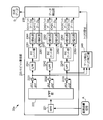
- FIG. 2 is a diagram illustrating a configuration example of the modulation unit 10 of the transmission device 1.
- the modulation unit 10 includes an LPF 101 as a processing system for the acoustic data S, LPFs 1021 to 1023, VCOs (Voltage-controlled oscillators) 1031 to 1033, delay units 1041 and 1042 as additions, Device 105.
- the LPF 101 is connected to the adder 105.
- LPFs 1021 to 1023 are connected to adder 105 via VCOs 1031 to 1033, respectively.
- the LPF 1021 and the LPF 1022 are connected to each other through a delay unit 1041, and the LPF 1022 and the LPF 1023 are connected to each other through a delay unit 1042. Details of these parts will be described later.
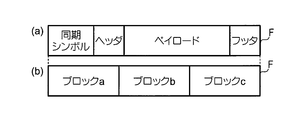
- FIG. 3A shows an example of the structure of this frame.
- One frame F in order from the head, corresponds to a synchronization symbol for finding the head of the frame, a header including information on frame attributes such as a frame length, a payload including actual data, and a rear end of the frame. It consists of a footer.
- the data length of the synchronization symbol and the data length of the header are each a predetermined number of bits, for example, about several bits.
- FIG. 3B is a diagram conceptually showing the relationship between frames and blocks.
- One frame is composed of three blocks a, b, and c having the same data length.
- the block a which is the head of the frame always includes a synchronization symbol and a header.
- the frame c which is the tail of the frame always includes a footer. That is, the data length of the synchronization symbol and header and the data length of the footer are each shorter than the data length of one block.
- FIG. 4 is a conceptual diagram for explaining frame transmission start timing.
- the notation “a” means block a
- the notation “b” means block b
- the notation “c” means block c.
- F1, F2, and F3 mean frequency bands of carrier waves of transmission data.
- the transmitting apparatus 1 has a predetermined period, that is, a period required to transmit one frame (one frame is superimposed in a certain frequency band) in each of different frequency bands F1, F2, and F3.
- the transmission of each frame is started while being delayed by a period corresponding to 1 / n (1/3 in the present embodiment). For example, in frequency band F1, transmission of block a at the beginning of the frame is started at time t1, transmission of block a is started at time t2 in frequency band F2, and transmission of block a is started at time t3 in frequency band F3. Has started.
- the transmission start timing of the next frame after the above frame is always the transmission period of one frame, such as time t4 in the frequency band F1, time t5 in the frequency band F2, and time t6 in the frequency band F3.
- Each of the LPFs 1021 to 1023 is a filter for removing a frequency component corresponding to a high band in order to limit the band of the baseband signal, and is called a Nyquist filter.
- the Nyquist filter is generally composed of an FIR filter called a cosine roll-off filter. The order of the filter, the roll-off rate, and the like are determined according to application conditions.
- the receiving device 2 also performs filtering by the LPF on the received signal, so that the LPFs 1021 to 1023 and the LPFs 2241 to 2243 of the receiving device 2 (see FIG. 6 described later) form a complete Nyquist filter.
- Each consists of a root raised cosine roll-off filter.
- Transmission data D is input to the VCO 1031 after being filtered by the LPF 1021.
- VCOs 1031 to 1033 are transmitters whose frequencies change according to control signals (here, bit values constituting transmission data input to the VCO).
- the VCO 1031 outputs a signal of the frequency band f1 to the adder 105 when the bit value of the transmission data is 1, and outputs a signal of the frequency band f1 ′ to the adder 105 when the bit value of the transmission data is 0. Therefore, the frequency band f1 and the frequency band f1 ′ are used as one pair.
- a difference between values of signals belonging to two frequency bands constituting a pair is referred to as a differential signal.
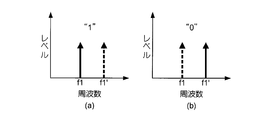
- FIG. 5 is a conceptual diagram for explaining a differential signal.
- the bit value of the transmission data is 1, the signal in the frequency band f1 is output, and when the bit value is 0, the signal in the frequency band f1 ′ is output.
- the bit value of the transmission data is 1, as shown in FIG. 5A, the signal in the frequency band f1 is output as a predetermined value (represented by a solid line), and the signal in the frequency band f1 ′ is not output (dotted line). Expressed in).
- the bit value of the transmission data is 0, as shown in FIG. 5B, the signal of the frequency band f1 ′ is output at a predetermined value without being output (expressed by a dotted line) as shown in FIG.
- the signal in the frequency band f1 and the signal in the frequency band f1 ′ are outputs in which the magnitude relations of the values of the signals are opposite, that is, inverted from each other, according to the bit value.
- the bit value is 1, and the difference between the signal f1 and the signal f1 ′ (f1 ⁇ If f1 ′) is less than or equal to the threshold, it is determined that the bit value is zero.
- the method of determining the threshold value will be described in detail in the description of the receiving device 2, but it is not a fixed value determined in advance, but dynamically varies according to the influence of multipath fading and the like. Note that the frequency band F1 described in FIG.
- the frequency band F1 includes narrower frequency bands f1 and f1 ′
- the frequency band F2 includes narrower frequency bands f2 and f2 ′
- the frequency band F3 is more The frequency bands f3 and f3 ′ having a narrow bandwidth are included.
- the frequency bands f1, f1 ′, f2, f2 ′, f3, and f3 ′ have narrower bandwidths than the frequency bands F1, F2, and F3, and are therefore referred to as narrowband frequencies.
- the time-varying waveform of the signal component belonging to the lower frequency band f1, f2, f3 of one pair is called a positive signal
- the signal component belonging to the higher frequency band f1 ′, f2 ′, f3 ′ is called a positive signal.
- the time-varying waveform is called an inverted signal.
- each of the delay units 1041 and 1042 transmits a period corresponding to 1/3 of one frame transmission period, that is, one block transmission.
- the output is delayed by a required period (hereinafter referred to as a 1/3 frame transmission period). Therefore, the delay unit 1041 outputs frame data delayed by 1/3 frame transmission period to the LPF 1022 from the timing when the frame data is input to the LPF 1021.
- the VCO 1032 outputs the signal of the frequency band f2 to the adder 105 when the bit value of the frame data output from the LPF 1022 is 1, and the signal of the frequency band f2 ′ when the bit value of the frame data is 0. Output to.
- the delay unit 1042 outputs to the LPF 1023 the frame data delayed by 1/3 frame transmission period from the timing at which the frame data is input to the LPF 1022, and the bit value of the frame data output by the LPF 1023 is 1
- the signal of the frequency band f3 is output to the adder 105, and when the bit value of the frame data is 0, the signal of the frequency band f3 ′ is output to the adder 105.
- the LPF 101 removes high-band frequency components from the acoustic data S.
- the cut-off frequency of the LPF 101 is, for example, an upper limit value of an audible frequency band (about 10 to 20 kHz) so as to ensure sound quality of the acoustic data S by the listener and to secure a band used for modulation (referred to as a modulation band). ) Is set to a degree. This cutoff frequency becomes the lower limit frequency of the modulation band.
- the cut-off frequency of the LPF 101 is made too low, the sound quality of the sound data S at the time of sound emission is deteriorated, and if the frequency of the modulation band is lowered in accordance with the low cut-off frequency, it belongs to this modulation band. This is because the sound when the modulated signal is emitted is likely to be attached to the listener's ear. Conversely, if the cut-off frequency of the LPF 101 is too high, the modulation band cannot be widened, and the transmission speed of transmission data decreases.
- the signal output from the LPF 101 is input to the adder 105.
- the modulation signal based on the transmission data D is added to the acoustic signal based on the acoustic data S.
- the acoustic signal to which the modulation signal is added is supplied to the output unit 11, and sound based on the modulation signal and the acoustic signal is emitted from the speaker 12.
- a case where an acoustic signal based on the acoustic data S is not supplied to the adder 105 is also conceivable. In that case, only the modulation signal is supplied to the output unit 11, and a sound (acoustic signal) based only on this modulation signal is emitted from the speaker 12.
- the delay units 1041 and 1042 function as a delay unit that delays the transmission start timing of a frame corresponding to one unit of transmission data by a predetermined period.
- the LPFs 1021 to 1023, the VCOs 1031 to 1033, and the adder 105 use a frame whose transmission start timing is delayed, and generate a modulation signal that generates a modulation signal obtained by modulating a carrier wave of a different frequency band according to the transmission start timing. It functions as a generation means.
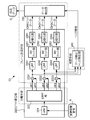
- FIG. 6 is a block diagram illustrating a configuration example of the demodulation unit 22 of the reception device 2.
- the demodulator 22 includes a bit decoder 220, a data detector 230, and a data detection trigger generator 240.
- the bit decoding unit 220 receives an acoustic signal collected by the microphone 20 and A / D converted by the input unit 21. Since the acoustic signal input at this time includes an acoustic signal corresponding to the transmission data D modulated by the transmission apparatus 1, the acoustic signal input to the bit decoding unit 220 is referred to as a modulated acoustic signal A. .
- the bit decoding unit 220 converts the acoustic signal corresponding to the transmission data D out of the input modulated acoustic signal A into binary data “1” or “0”, decodes the bit value, and the data detection unit 230. To output.
- the data detection unit 230 extracts transmission data D from the binary data output from the bit decoding unit 220 at the timing when the trigger signal is supplied from the data detection trigger generation unit 240.
- the bit decoding unit 220 includes an HPF 221, an STFT unit 222, subtracters 2231 to 2233, DC cut units 2251 to 2253, and binarization units 2261 to 2263.
- the HPF 221 removes a low-band signal component corresponding to the acoustic data S from the input modulated acoustic signal A, and extracts a high-band signal component corresponding to the transmission data D. That is, the cutoff frequency of the HPF 221 is set to the lower limit frequency of the modulation band.
- the STFT unit 222 is a separation unit that separates the signal output from the HPF 221 into signal components belonging to the frequency bands f1, f1 ′, f2, f2 ′, f3, and f3 ′ used at the time of transmission. Specifically, the STFT unit 222 performs a short-time Fourier transform (STFT) on the signal output from the HPF 221 and the frequency bands f1, f1 ′, f2, f2 ′, f3 described above. , F3 ′ are separated into signal components respectively belonging to f3 ′, and a time-varying waveform of each signal component is output.
- STFT short-time Fourier transform
- the overlap rate in the short-time Fourier transform is 50%, that is, the STFT unit 222 performs STFT with half overlap.
- the FFT length is 1024 samples
- the 1-symbol sample length is 1536 samples
- the sampling frequency after STFT is 86.1328125 Hz.
- One symbol sample length is, for example, 1 time, 1.5 times, 2 times the FFT length, but is 1.5 times in this embodiment.
- the sampling frequency after STFT is calculated from the FFT length and the overlap rate.
- Each subtracter 2231 to 2233 is provided corresponding to each pair of frequency bands f1, f1 ′, f2, f2 ′, f3, and f3 ′, and calculates the difference between the positive signal and the inverted signal of the corresponding frequency band. To do.
- the subtracter 2231 subtracts the signal value ch1 ′ of the inverted signal belonging to the frequency band f1 ′ from the signal value ch1 of the positive signal belonging to the frequency band f1, and the subtractor 2232 is a signal of the positive signal belonging to the frequency band f2.
- the value ch2 ′ of the inverted signal belonging to the frequency band f2 ′ is subtracted from the value ch2, and the subtractor 2233 obtains the signal value of the inverted signal belonging to the frequency band f3 ′ from the signal value ch3 of the positive signal belonging to the frequency band f3.
- Subtract ch3 ' thereby, differential signals ch1-ch1 ′, ch2-ch2 ′, ch3-ch3 ′ corresponding to each pair of frequency bands f1, f1 ′, f2, f2 ′, f3, f3 ′ are obtained.
- LPFs 2241 to 2243 are provided corresponding to the respective pairs of frequency bands f1, f1 ′, f2, f2 ′, f3, and f3 ′. From the differential signals input from the subtracters 2231 to 2233, the LPFs 2241 to 2243 The corresponding signal component is removed, and the signal component in the frequency band to which the baseband signal belongs is extracted. As described above, the LPFs 1021 to 1023 of the transmission apparatus 1 and the LPFs 2241 to 2243 of the reception apparatus 2 are configured to be complete Nyquist filters.
- DC cut part DC cut units 2251 to 2253 are provided corresponding to the respective pairs of frequency bands f1, f1 ′, f2, f2 ′, f3, and f3 ′, and baseband signals are obtained from the signals output from the LPFs 2241 to 2243. Extract. Specifically, the DC cut units 2251 to 2253 perform processing (envelope processing) for correcting envelopes on the signals output from the LPFs 2241 to 2243, thereby removing DC offset and extracting baseband signals. .
- processing envelope processing
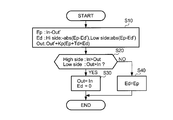
- FIG. 7 is a flowchart showing the procedure of the envelope process.
- Input signal input from the LPF 2241 to the DC cut unit 2251 Out: Output signal output from the DC cut unit 2251 Kp: P control coefficient (for example, 0.1) in envelope processing Td: D control coefficient in envelope processing (for example, 1.0) Out ′, Ed ′: values of the previous processing (initial values are both 0.0).
- the DC cut unit 2251 uses an envelope that follows the input signal In when the input signal In rises, and attenuates the envelope in the minus direction when the input signal In falls. By performing such processing, the change in the volume of the collected sound and the followability to burst noise are improved.
- the DC cut unit 2251 performs processing reverse to the above, that is, an envelope that follows the input signal In at the fall of the input signal In, and attenuates the envelope in the plus direction at the rise.
- the DC cut units 2252 and 2253 also perform envelope processing using the input signals input from the LPFs 2242 and 2243 according to the same procedure as described above.
- the threshold th may be a value between the upper envelope env p and the lower envelope env m , but typically a value intermediate between the two is used.
- the threshold value th with the time variation of the upper envelope env p and the lower envelope env m, becomes temporally varying values between the upper envelope env p and the lower envelope env m.
- the binarization units 2261 to 2263 binarize the baseband signal (here, the above-described differential signal) using the threshold value th that varies with time as described above, decode the bit value, and the data detection unit 230. Specifically, if the signal value of the differential signal is larger than the threshold value th at that time, the binarizing units 2261 to 2263 output a bit value “1”, and the signal value of the differential signal is When the threshold value is equal to or less than the threshold value th, the bit value “0” is output. As described above, the threshold th varies with time changes of the upper envelope env p and the lower envelope env m .
- the upper and lower envelopes Since the threshold value th is adjusted with time variation as an intermediate value, errors in bit determination are less likely to occur. This improves the resistance to multipath fading and noise mixing, and increases the accuracy of bit determination.
- the transmission data D is superimposed on the acoustic data S.
- the transmission data D is the acoustic data. It may not be superimposed on S.
- the data detection trigger generation unit 240 notifies the data detection unit 230 of the timing for starting data detection.
- FIG. 9 is a block diagram illustrating a configuration of the data detection trigger generation unit 240.
- the data detection trigger generation unit 240 includes FFT units 2411 to 2413, normalization units 2421 to 2423, a multiplier 243, and a signal level calculation unit 244.
- the FFT units 2411 to 2413 are provided corresponding to the respective pairs of the frequency bands f1, f1 ′, f2, f2 ′, f3, and f3 ′, and the differential signal ch1 ⁇ input from the subtracters 2231 to 2233 is provided.
- FFT Fast Fourier Transform
- the overlap rate in the FFT at this time is, for example, either 25%, 50%, 75%, or no overlap. Therefore, if the FFT length is, for example, 512 samples and the overlap rate is 25%, FFT is performed at 128 sample intervals.
- the normalization units 2421 to 2423 normalize the spectra output from the FFT units 2411 to 2413, respectively.
- the multiplier 243 calculates a product for each element of the spectrum obtained from the normalization units 2421 to 2423. Thereby, a so-called running spectrum is obtained.
- the differential signals ch1-ch1 ′, ch2-ch2 ′, and ch3-ch3 ′ input from the subtracters 2231 to 2233 correspond to baseband signals.
- the signal input from each of the subtracters 2231 to 2233 corresponds to noise, so that the transmission data D is superimposed on the acoustic data S in the spectrum. It is distributed in a wider frequency band than if it is.
- the signal level calculation unit 244 outputs a trigger signal that instructs the data detection unit 230 to start data detection.
- the signal level calculation unit 244 measures the running spectrum of the differential signal of each frequency band f1, f1 ′, f2, f2 ′, f3, f3 ′ before applying the LPFs 2241 to 2243, thereby transmitting the transmission data D Is superimposed on the acoustic data S, and data detection is performed only when it is determined that the sound is superimposed.
- the data detection unit 230 extracts transmission data from the bit data output from the binarization units 2261 to 2263.
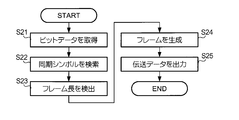
- FIG. 10 is a flowchart showing the operation of the data detection unit 230. In FIG. 10, first, the data detection unit 230 acquires bit data output from the binarization units 2261 to 2263 (step S21).
- the data detection unit 230 searches for a synchronization symbol (step S22).
- the data detection unit 230 acquires a bit string every two bits with the first bit in the CH1 bit data of the frequency band F1 as a start position (hereinafter referred to as a search start bit) (FIG. 11A )reference).
- a search start bit a start position
- FIG. 11A search start bit
- the data detecting unit 230 obtains a predetermined bit number of bit strings from the search start bit, and this bit string is determined in advance as a predetermined synchronization symbol bit string. Determine whether they match. If the acquired bit string matches the synchronization symbol, the data detection unit 230 proceeds to the next process. On the other hand, if they do not match, the data detection unit 230 matches the bit string of a predetermined number of bits from the search start bit with the bit string of the synchronization symbol with respect to CH2 bit data of the frequency band F2 different from the previous one. Is determined (see FIG. 11B).
- the data detection unit 230 If no synchronization symbol is found in any of the CH1 bit data, the CH2 bit data, and the CH3 bit data, the data detection unit 230 returns to the CH1 bit data of the first frequency band (F1), and sets the search start bit. The position is shifted by 1 bit from the previous time, and it is determined whether or not a bit string of a predetermined number of bits matches the bit string of the synchronization symbol from the search start bit, thereby re-searching for the synchronization symbol (see FIG. 11C). ). The data detection unit 230 repeats these processes until a synchronization symbol is found.
- the data detection unit 230 acquires a bit string having a predetermined number of bits every two bits from the bit position corresponding to the rear end of the synchronization symbol in the bit data where the synchronization symbol is found. This bit string corresponds to the header of the frame. Since the frame length is described in the header, the data detection unit 230 performs decoding and error detection only on the header and detects the frame length (step S23).
- the data detection unit 230 divides the frame length by the number of blocks in one frame (here, 3) to obtain the data length of one block. Then, the data detection unit 230 extracts blocks a, b, and c from the bit data output from the binarization units 2261 to 2263 according to the conditions described below, and generates a frame by combining them (step S1). S24).
- FIG. 12 is a conceptual diagram for explaining conditions when a frame is generated by extracting a block.
- a1, b1, b2, c1, and c2 are the same blocks as a, b, and c respectively represented by the same alphabet, but 1 or 2 is used for easy understanding of the description of the block to be selected. It was distinguished by appending the number.
- the time interval between t1 and t7 is a period required for reception of one block (1/3 of the period required for transmission of one frame described above, hereinafter referred to as one block transmission period).
- the current time is t7, and the blocks received by the receiving device 2 in each frequency band F1, F2, F3 up to time t7 are stored in a storage unit (not shown) of the receiving device 2 (demodulation unit 22).
- a storage unit not shown
- the data detection unit 230 starts from the block a that has been received at time t7, that is, the first block (block a1 in the figure) of one frame, and the remaining blocks b and c necessary to form the frame. Are selected according to a predetermined selection method.
- the predetermined selection method includes four procedures described below. If the data detection unit 230 attempts to decode the frame and detect an error in the order of the procedure 1 to the procedure 4 and can correctly demodulate the transmission data for one frame in a certain procedure, the data detection unit 230 processes the subsequent procedures. Do not do.
- Procedure 1 At the current time t7 when the reception of the block a1 is completed, the block b1 and the block c1 that have been received in the frequency bands F2 and F1 different from the block a1 are selected (block a1, surrounded by a solid line in the figure, Block b1, block c1). That is, in this procedure 1, each block is selected one by one from all frequency bands in the 11-block transmission period. Therefore, the period required for the reception device 2 to collect the sound with the transmission data for one frame superimposed is only one block transmission period.
- Procedure 2 At the time of the current time t7 when the reception of the block a1 is completed, at the time of the block b1 that has been received in the frequency band F2 different from the block a1 and at the time of t6 one block before the current time t7, The block c2 that has been received in the same frequency band F3 as the block a1 is selected. That is, in this procedure 2, each block is selected from a plurality of frequency bands in an arbitrary combination in a period longer than one block transmission period and shorter than a period required for transmission of one frame.
- Step 3 At time t5 two blocks before the current time t7, at time t5, the reception of the block b2 completed in the same frequency band F3 as the block a1, and at time t6 one block before the current time t7
- the block c2 that has been received in the same frequency band F3 as the block a1 is selected (block a1, block b2, and block c2 surrounded by dotted lines in the figure). That is, in this procedure 3, each block is selected from one frequency band in a period required for transmission of one frame.
- Step 4 At time t5 two blocks before the current time t7, the block b2 that has been received in the same frequency band F3 as the block a1 and the block that has been received at the current time t7 when reception of the block a1 is completed A block c1 that has been received in a frequency band F1 different from a1 is selected. That is, in this procedure 4, each block is selected from an arbitrary combination from a plurality of frequency bands in a period required for transmission of one frame. Procedure 4 is adopted when the influence of multipath fading and noise mixing on one of the frequency bands is greater than that of Procedure 3.
- the substantial time required for data detection in the procedure 1 is t7-t6 (that is, one frame 1/3) of the period required for transmission. Therefore, when all the blocks constituting one frame are successfully detected in the procedure 1, the substantial transmission rate is the highest among the procedures 1 to 4. That is, the period required for the microphone 20 to collect the sound in which these blocks are superimposed is the shortest.
- step 2 when data detection is successful in step 2, the substantial time required for data detection is t7-t5 (that is, 2/3 of the period required for transmission of one frame). Therefore, the procedure 2 has a substantial transmission rate after the procedure 1.
- the time required to transmit one frame in this embodiment is as short as possible without transmitting one frame in the frequency band. One-third of the time required will be sufficient. Even if transmission quality is expected to deteriorate due to such an adverse effect, in the present embodiment, if a period required to transmit one frame without dividing it in the frequency band is long, There is a high possibility that one frame can be transmitted.
- Trying to decode a frame and detect an error by selecting a block in the order from step 1 to step 4 means that the period required for the microphone 20 to pick up the sound on which the block to be selected is superimposed is more important. It means that priority is given to shortening. That is, the data detection unit 230 selects a block according to an algorithm that shortens the period required to collect the sound on which the selected block is superimposed.
- the data detection unit 230 outputs a frame generated through decoding and error detection as transmission data (step S25). If an error occurs during the above process, the data detection unit 230 returns to the process of the first step S21 and tries to detect data again from the next bit.
- the STFT unit 222 functions as a separating unit that separates the acoustic signal output from the microphone 20 into signal components belonging to each frequency band.
- the subtracters 2231 to 2233, the DC cut units 2251 to 2253, the binarization unit 2261, and the data detection unit 230 are configured to generate a frame for each predetermined period based on each signal component separated by the STFT unit 222. It functions as a frame generation means for demodulating a block corresponding to a block and connecting the blocks selected from the demodulated block group to generate the frame.
- the frame generation means is configured to select blocks according to a method selected according to a predetermined selection method, for example, a selection method such that the period required for the microphone 20 to collect the sound on which the selected block is superimposed is shorter. It comes to choose.
- the data detection trigger generation unit 240 functions as a determination unit that determines whether or not the transmission data D is superimposed on the sound collected by the microphone 20.
- the SN ratio is improved as compared with a case where this is not used.
- the threshold for binarizing the baseband signal based on this differential signal is dynamically controlled according to the sound collection status of each sound belonging to these frequency bands, thereby improving the accuracy of bit determination. Will improve.
- the resistance to multipath fading and noise mixing can be obtained.
- the frequency band affected by such an event such as multipath fading or noise mixing may fluctuate in time, according to the above embodiment, the transmission timings of the frames between the plurality of frequency bands are mutually different.
- the modulator 10 shown in FIG. 2 may be configured as shown in FIG.
- the modulation unit 10a according to the first modification includes the LPF 101 as a processing system for the acoustic data S as in FIG. 2, and the delay units 1041 and 1042 and six transmitters as the processing system for the transmission data D as in FIG. 1061 to 1063, 1061 ′ to 1063 ′, variable resistors 1071 to 1073, and an adder. That is, the modulator 10a is different from the above embodiment in that the modulator 10a includes transmitters 1061 to 1063, 1061 ′ to 1063 ′, variable resistors 1071 to 1073, and an adder 108.
- the variable resistor 1071 has one end connected to the transmitter 1061 and the other end connected to the transmitter 1061 ′, and a movable terminal that is an output terminal that moves between the terminals at both ends is connected to the adder 108.
- the variable resistor 1072 has one end connected to the transmitter 1062 and the other end connected to the transmitter 1062 ′, and a movable terminal that is an output terminal that moves between the terminals at both ends is connected to the adder 108.
- the variable resistor 1073 has one end connected to the transmitter 1063 and the other end connected to the transmitter 1063 ′, and a movable terminal that is an output terminal that moves between the terminals at both ends is connected to the adder 108.
- alteration part 10a may be implement
- the transmitter 1061 outputs a signal in the frequency band f1, and the transmitter 1061 ′ outputs a signal in the frequency band f1 ′.
- the transmitter 1062 outputs a signal in the frequency band f2, and the transmitter 1062 ′ outputs a signal in the frequency band f2 ′.
- the transmitter 1063 outputs a signal in the frequency band f3, and the transmitter 1063 ′ outputs a signal in the frequency band f3 ′.
- the intensity of the signal in the frequency band f1 output from the transmitter 1061 gradually increases, and the intensity of the signal in the frequency band f1 ′ output from the transmitter 1061 ′ gradually increases. Get smaller.
- the variable resistor 1071 has a small resistance value from the transmitter 1061 ′ to the adder 108 and also from the transmitter 1061 to the adder 108.
- the movable terminal is moved so as to increase the resistance value. Therefore, as the movable terminal moves, the intensity of the signal in the frequency band f1 ′ output from the transmitter 1061 ′ gradually increases, and the intensity of the signal in the frequency band f1 output from the transmitter 1061 gradually increases. Get smaller.
- variable resistor 1072 has a small resistance value from the transmitter 1062 to the adder 108 and from the transmitter 1062 ′ to the adder 108. If the bit value of the transmission data is “0”, the resistance value from the transmitter 1062 ′ to the adder 108 decreases, and the transmitter The movable terminal is moved so that the resistance value from 1062 to the adder 108 increases. When the bit value of the transmission data is “1”, the variable resistor 1073 has a small resistance value from the transmitter 1063 to the adder 108 and from the transmitter 1063 ′ to the adder 108.
- the movable terminal When the movable terminal is moved so as to increase the resistance value of the transmission data and the bit value of the transmission data is “0”, the resistance value from the transmitter 1063 ′ to the adder 108 decreases and the transmitter 1063 The movable terminal is moved so that the resistance value from to the adder 108 increases.
- the signal in the frequency band f1 ′ is instantaneously generated almost simultaneously with the instantaneous disappearance of the signal in the frequency band f1.
- the differential signal is switched from the frequency band f1 to the frequency band f1 ′ in this modification, over a period longer than the period required for instantaneous switching from the frequency band f1 to the frequency band f1 ′ in the embodiment.
- the intensity of the signal in the frequency band f1 gradually decreases, and the intensity of the signal in the frequency band f1 ′ gradually increases.
- variable resistors 1071 to 1073 described above may be realized with a mechanical configuration or an electrical configuration.
- the threshold value for binarization is dynamically changed, but in order to further improve the accuracy of bit determination, the demodulator 22 in the receiving device 2 is configured as shown in FIG. A fixed threshold may be used together.
- the demodulator 22a according to the second modification is different from the demodulator 22 shown in FIG. 6 in that each output from the LPFs 2241 to 2243 is directly input without passing through the DC cut units 2251 to 2253, respectively. This is the point that the conversion units 2261-1 to 2263-1 are provided.
- the subtracters 2231 to 2233, the DC cut units 2251 to 2253, the binarization unit 2261, the binarization units 2261-1 to 2263-1, and the data detection unit 230 function as a frame generation unit.
- Each configuration of the demodulation unit 22a may be realized by hardware, or may be realized by cooperation of hardware and software.
- bit data (CH1 bit data d, CH2 bit data d, CH3 bit data d) passed through the DC cut units 2251 to 2253 is input to the data detection unit 230, and the DC cut units 2251 to 2253 are input to the data detection unit 230.
- Non-passing bit data (CH1 bit data z, CH2 bit data z, CH3 bit data z) is input.
- the data detection unit 230 binarizes the CH1 bit data d, the CH2 bit data d, and the CH3 bit data d by dynamically changing the threshold th similarly to the embodiment, but the CH1 bit data z, CH2 Bit data z and CH3 bit data z are binarized using a fixed threshold value (here, 0). Then, the data detection unit 230 generates a frame using a block having a better result (a result of which an error or the like has not occurred in the demodulation process) among the blocks demodulated using the two types of thresholds. To do.
- Modification 4 Number of blocks and number of frequency bands
- the number of blocks constituting the frame is 3, but the number is not necessarily limited thereto.
- the number of frequency bands F1, F2, and F3 used for modulation is three, it is not necessarily limited thereto.
- the number of blocks is larger than the number of frequency bands, the substantial transmission rate of transmission data decreases.
- the number of frequency bands is larger than the number of blocks, the frequency bands are left over, resulting in a redundant configuration.
- the number of blocks and the number of frequency bands do not have to be the same as long as such a decrease in transmission rate and a redundant configuration are allowed.
- the number of blocks constituting one frame may be six, and the number of frequency bands used for modulation may be three. It is arbitrary how the number of blocks constituting one frame and the number of frequency bands used for modulation are determined. Note that the number of blocks constituting the frame is such that the number of blocks constituting the frame is n (n is a positive integer, the same shall apply hereinafter) and the number of frequency bands F1, F2, and F3 used for modulation is n. When the number of frequency bands used for modulation is n in common, the demodulator 22 separates the acoustic signal output from the microphone 20 into signal components belonging to n frequency bands, and outputs one frame.
- the demodulator 22 Is demodulated on the basis of each of the above signal components every 1 / n of the period required to pick up sounds belonging to any one of the n frequency bands.
- the demodulator 22 generates a frame by concatenating the blocks selected from the demodulated block group, but one frame is superimposed during the period required to collect the sound on which the selected block is superimposed.
- the block is selected so as to approach the period 1 / n of the period required to collect the collected sound.
- the transmission device 1 repeatedly transmits in units of frames without dividing into units of blocks, and the reception device 2 cuts out the received modulated acoustic signals in units of the above-described blocks, and connects these blocks.
- the transmission apparatus 1 transmits data corresponding to the frame in units of blocks, and the reception apparatus 2 generates a frame by concatenating the blocks. You may make it do.
- the receiving apparatus 2 can easily identify each block by referring to this identifier.
- Modification 5 Data detection procedure
- a predetermined block selection method including four procedures from procedure 1 to procedure 4 is assumed. However, the period required to collect the sound in which the selected block is superimposed is determined. As long as the condition of selecting a block so as to be shorter is met, a block selection method other than the above four methods can be considered. For example, in an environment where multipath fading occurs and a signal in each frequency band used for modulation is likely to contain noise, it takes a longer time to transmit one frame than the time required to transmit one frame. Sometimes.
- the block selection method including the above-described four procedures adopts the transmission quality at the same time or the same frequency band as a certain block a (corresponding to block a1 in FIG. 12) that has successfully extracted the synchronization symbol. This is because the calculation load of the data detection unit 230 increases or the number of false detections increases.
- the frequency band relatively close to that frequency is also affected.
- an improvement in the resistance to the above-described event can be expected.
- two narrow frequency bands for example, when sending a bit “1”, a signal belonging to the frequency band f1 is output at a predetermined value, and a signal belonging to the frequency band f1 ′ is not output, When “0” is transmitted, a signal belonging to the frequency band f1 ′ is output with a predetermined value without outputting a signal belonging to the frequency band f1.
- a signal belonging to the frequency band f01 is output at a predetermined value, and a signal belonging to the frequency band f01 ′ is not output.
- the outputs of the signals belonging to the two narrowband frequencies corresponding to the frame are inverted with each other according to the value of each bit constituting the frame.
- a modulated signal is generated.
- the frequency band of the carrier wave to be modulated is higher than the frequency band that can be heard by humans.
- the frequency band is not necessarily limited to this.
- the atmosphere is assumed as a medium through which sound propagates.
- solids such as buildings, structures, and furniture, and liquids such as water may be used.
- the transmission device 1 includes a vibration unit that generates vibration according to the signal output from the output unit 11 instead of the speaker 12, while the reception device 2 is connected to the microphone 20.
- vibration detection means such as an acceleration sensor for detecting solid vibration is provided.
- the reception device 2 only needs to include the microphone 20 as in the embodiment.
- the “transmission start timing” includes a timing at which the sound signal on which the transmission data is superimposed is supplied from the output unit 11 to the speaker 12 and the sound emission itself is started.
- the timing at which frame transmission is substantially started such as the timing at which processing for supplying data to the modulation unit 10 is started and the timing at which transmission data is superimposed on acoustic data at the modulation unit 10 are started. Including the timing that can be considered.
- Mode 9 Threshold value used for bit determination
- a threshold when performing bit determination based on a differential signal a fixed threshold may be used instead of the threshold th that varies with time as in the embodiment.
- the present invention can also be specified as a program for causing a computer to realize functions equivalent to those of the transmission device 1 and the reception device 2 and a recording medium such as an optical disk storing such a program.
- the program according to the present invention can be provided in the form of being downloaded to a computer via a network such as the Internet, and being made available after being installed.
- the present invention is useful in that it is highly possible to extract data from sound in a mechanism for transmitting data using sound as a transmission medium.
Landscapes
- Engineering & Computer Science (AREA)
- Computer Networks & Wireless Communication (AREA)
- Signal Processing (AREA)
- Transmitters (AREA)
- Digital Transmission Methods That Use Modulated Carrier Waves (AREA)
- Compression, Expansion, Code Conversion, And Decoders (AREA)
- Noise Elimination (AREA)
- Mobile Radio Communication Systems (AREA)
Priority Applications (4)
| Application Number | Priority Date | Filing Date | Title |
|---|---|---|---|
| CN201480000472.5A CN104126279B (zh) | 2013-02-21 | 2014-02-13 | 调制设备、解调设备、音频传输系统和解调方法 |
| US14/361,611 US9473252B2 (en) | 2013-02-21 | 2014-02-13 | Modulation apparatus, demodulation apparatus, audio transmission system, program, and demodulation method |
| KR1020147014727A KR101572552B1 (ko) | 2013-02-21 | 2014-02-13 | 변조 장치, 복조 장치, 음향 전송 시스템, 프로그램, 및 복조 방법 |
| EP14725906.3A EP2849365B1 (en) | 2013-02-21 | 2014-02-13 | Modulation device, demodulation device, sound transmission system and demodulation method |
Applications Claiming Priority (4)
| Application Number | Priority Date | Filing Date | Title |
|---|---|---|---|
| JP2013032506 | 2013-02-21 | ||
| JP2013-032506 | 2013-02-21 | ||
| JP2013246685A JP6255946B2 (ja) | 2013-02-21 | 2013-11-28 | 復調装置、音響伝送システム、プログラム及び復調方法 |
| JP2013-246685 | 2013-11-28 |
Publications (1)
| Publication Number | Publication Date |
|---|---|
| WO2014129370A1 true WO2014129370A1 (ja) | 2014-08-28 |
Family
ID=51391165
Family Applications (1)
| Application Number | Title | Priority Date | Filing Date |
|---|---|---|---|
| PCT/JP2014/053266 Ceased WO2014129370A1 (ja) | 2013-02-21 | 2014-02-13 | 変調装置、復調装置、音響伝送システム、プログラム及び復調方法 |
Country Status (7)
| Country | Link |
|---|---|
| US (1) | US9473252B2 (https=) |
| EP (1) | EP2849365B1 (https=) |
| JP (1) | JP6255946B2 (https=) |
| KR (1) | KR101572552B1 (https=) |
| CN (1) | CN104126279B (https=) |
| TW (1) | TWI555007B (https=) |
| WO (1) | WO2014129370A1 (https=) |
Cited By (7)
| Publication number | Priority date | Publication date | Assignee | Title |
|---|---|---|---|---|
| US20150036464A1 (en) * | 2013-02-21 | 2015-02-05 | Yamaha Corporation | Modulation apparatus, demodulation apparatus, audio transmission system, program, and demodulation method |
| CN105790852A (zh) * | 2014-12-19 | 2016-07-20 | 北京奇虎科技有限公司 | 基于多频声波的数据传输方法及系统 |
| CN105790853A (zh) * | 2014-12-26 | 2016-07-20 | 北京奇虎科技有限公司 | 一种声波传输字符数据的方法及装置 |
| CN107769860A (zh) * | 2016-08-22 | 2018-03-06 | 美的集团股份有限公司 | 编码方法、解码方法、编码装置、解码装置和家用电器 |
| US20180098164A1 (en) | 2014-08-26 | 2018-04-05 | Yamaha Corporation | Reproduction system, terminal device, method thereof, and non-transitory storage medium, for providing information |
| US10691400B2 (en) | 2014-07-29 | 2020-06-23 | Yamaha Corporation | Information management system and information management method |
| US10733386B2 (en) | 2014-07-29 | 2020-08-04 | Yamaha Corporation | Terminal device, information providing system, information presentation method, and information providing method |
Families Citing this family (14)
| Publication number | Priority date | Publication date | Assignee | Title |
|---|---|---|---|---|
| US8805312B2 (en) | 2011-04-06 | 2014-08-12 | Texas Instruments Incorporated | Methods, circuits, systems and apparatus providing audio sensitivity enhancement in a wireless receiver, power management and other performances |
| KR101447501B1 (ko) * | 2014-06-12 | 2014-10-08 | 휴텍 주식회사 | 고주파 사운드 신호 기반의 매장연계 정보 제공 방법 및 이를 위한 컴퓨터로 판독가능한 기록매체 |
| JP6631005B2 (ja) * | 2014-12-12 | 2020-01-15 | ヤマハ株式会社 | 情報送信装置、音響通信システムおよび音響透かし重畳方法 |
| KR101568314B1 (ko) * | 2015-05-26 | 2015-11-12 | 주식회사 단솔플러스 | 음파 통신 장치 및 방법 |
| JP6891942B2 (ja) * | 2015-12-25 | 2021-06-18 | 株式会社リコー | 出力装置、出力方法、及び出力システム |
| JP6809319B2 (ja) * | 2017-03-16 | 2021-01-06 | ヤマハ株式会社 | 音響通信のための装置および方法 |
| JP6963290B2 (ja) * | 2017-05-24 | 2021-11-05 | 株式会社スマート・ソリューション・テクノロジー | 通信システム、通信装置、通信方法、及びプログラム |
| JP7052348B2 (ja) * | 2017-12-27 | 2022-04-12 | 株式会社リコー | 情報端末、プログラム、及び情報端末の制御方法 |
| CN110569812B (zh) * | 2019-09-12 | 2022-11-01 | 天津工业大学 | 一种故障信号的包络解调方法及包络解调系统 |
| US11146836B1 (en) | 2020-05-20 | 2021-10-12 | Lisnr | Detection and synchronization of audio transmissions using complex audio signals |
| JP7564674B2 (ja) * | 2020-10-07 | 2024-10-09 | 株式会社Nttドコモ | 伝送装置 |
| JP7604921B2 (ja) * | 2021-02-02 | 2024-12-24 | ヤマハ株式会社 | 通信方法、プログラムおよび通信システム |
| US12119020B2 (en) * | 2021-06-03 | 2024-10-15 | International Business Machines Corporation | Audiometric receiver system to detect and process audio signals |
| CN114079899B (zh) * | 2021-07-22 | 2024-04-09 | 珠海市杰理科技股份有限公司 | 蓝牙通信数据处理电路、丢包处理方法、设备及系统 |
Citations (9)
| Publication number | Priority date | Publication date | Assignee | Title |
|---|---|---|---|---|
| JPH03229523A (ja) * | 1990-02-02 | 1991-10-11 | Iwatsu Electric Co Ltd | 2局同時送信ダイバーシチ方法及びその装置 |
| JPH06164555A (ja) * | 1992-11-20 | 1994-06-10 | Sekisui Chem Co Ltd | 周波数ダイバーシティ通信装置 |
| US6205127B1 (en) * | 1998-04-21 | 2001-03-20 | Lucent Technologies, Inc. | Wireless telecommunications system that mitigates the effect of multipath fading |
| US20010006535A1 (en) * | 1999-12-30 | 2001-07-05 | Itis Corporation | Transmission system with spatial, temporal, and frequential diversity |
| JP2002300097A (ja) * | 2001-03-30 | 2002-10-11 | Mitsubishi Electric Corp | 基地局、移動局および移動通信システム |
| JP2004297142A (ja) * | 2003-03-25 | 2004-10-21 | Nippon Hoso Kyokai <Nhk> | ダイバーシティ送信装置、ダイバーシティ受信装置及びダイバーシティ伝送方式 |
| JP2006251676A (ja) | 2005-03-14 | 2006-09-21 | Akira Nishimura | 振幅変調を用いた音響信号への電子透かしデータの埋め込み・検出装置 |
| US20090067292A1 (en) * | 2006-02-22 | 2009-03-12 | Ntt Docomo, Inc. | Acoustic signal transmission system, modulation device, demodulation device, and acoustic signal transmission method |
| JP2010288246A (ja) | 2009-05-12 | 2010-12-24 | Yamaha Corp | 音響変調方法、音響復調方法、変調装置、復調装置および通信システム |
Family Cites Families (6)
| Publication number | Priority date | Publication date | Assignee | Title |
|---|---|---|---|---|
| US5335359A (en) | 1990-05-31 | 1994-08-02 | Nec Corporation | Diversity receiver using matched filter and decision feedback equalizer |
| JPH09116475A (ja) | 1995-10-23 | 1997-05-02 | Nec Corp | 時間ダイバーシチ送受信システム |
| CN101405956B (zh) | 2006-03-17 | 2012-09-26 | 松下电器产业株式会社 | 无线传送系统及无线传送方法、和用在其中的无线电台及发射台 |
| US8942388B2 (en) | 2008-08-08 | 2015-01-27 | Yamaha Corporation | Modulation device and demodulation device |
| JP5664419B2 (ja) | 2011-04-05 | 2015-02-04 | ヤマハ株式会社 | 音響通信システム |
| JP6255946B2 (ja) * | 2013-02-21 | 2018-01-10 | ヤマハ株式会社 | 復調装置、音響伝送システム、プログラム及び復調方法 |
-
2013
- 2013-11-28 JP JP2013246685A patent/JP6255946B2/ja active Active
-
2014
- 2014-02-10 TW TW103104313A patent/TWI555007B/zh not_active IP Right Cessation
- 2014-02-13 EP EP14725906.3A patent/EP2849365B1/en active Active
- 2014-02-13 US US14/361,611 patent/US9473252B2/en active Active
- 2014-02-13 CN CN201480000472.5A patent/CN104126279B/zh active Active
- 2014-02-13 KR KR1020147014727A patent/KR101572552B1/ko not_active Expired - Fee Related
- 2014-02-13 WO PCT/JP2014/053266 patent/WO2014129370A1/ja not_active Ceased
Patent Citations (9)
| Publication number | Priority date | Publication date | Assignee | Title |
|---|---|---|---|---|
| JPH03229523A (ja) * | 1990-02-02 | 1991-10-11 | Iwatsu Electric Co Ltd | 2局同時送信ダイバーシチ方法及びその装置 |
| JPH06164555A (ja) * | 1992-11-20 | 1994-06-10 | Sekisui Chem Co Ltd | 周波数ダイバーシティ通信装置 |
| US6205127B1 (en) * | 1998-04-21 | 2001-03-20 | Lucent Technologies, Inc. | Wireless telecommunications system that mitigates the effect of multipath fading |
| US20010006535A1 (en) * | 1999-12-30 | 2001-07-05 | Itis Corporation | Transmission system with spatial, temporal, and frequential diversity |
| JP2002300097A (ja) * | 2001-03-30 | 2002-10-11 | Mitsubishi Electric Corp | 基地局、移動局および移動通信システム |
| JP2004297142A (ja) * | 2003-03-25 | 2004-10-21 | Nippon Hoso Kyokai <Nhk> | ダイバーシティ送信装置、ダイバーシティ受信装置及びダイバーシティ伝送方式 |
| JP2006251676A (ja) | 2005-03-14 | 2006-09-21 | Akira Nishimura | 振幅変調を用いた音響信号への電子透かしデータの埋め込み・検出装置 |
| US20090067292A1 (en) * | 2006-02-22 | 2009-03-12 | Ntt Docomo, Inc. | Acoustic signal transmission system, modulation device, demodulation device, and acoustic signal transmission method |
| JP2010288246A (ja) | 2009-05-12 | 2010-12-24 | Yamaha Corp | 音響変調方法、音響復調方法、変調装置、復調装置および通信システム |
Cited By (12)
| Publication number | Priority date | Publication date | Assignee | Title |
|---|---|---|---|---|
| US20150036464A1 (en) * | 2013-02-21 | 2015-02-05 | Yamaha Corporation | Modulation apparatus, demodulation apparatus, audio transmission system, program, and demodulation method |
| US9473252B2 (en) * | 2013-02-21 | 2016-10-18 | Yamaha Corporation | Modulation apparatus, demodulation apparatus, audio transmission system, program, and demodulation method |
| US10691400B2 (en) | 2014-07-29 | 2020-06-23 | Yamaha Corporation | Information management system and information management method |
| US10733386B2 (en) | 2014-07-29 | 2020-08-04 | Yamaha Corporation | Terminal device, information providing system, information presentation method, and information providing method |
| US20180098164A1 (en) | 2014-08-26 | 2018-04-05 | Yamaha Corporation | Reproduction system, terminal device, method thereof, and non-transitory storage medium, for providing information |
| US10433083B2 (en) | 2014-08-26 | 2019-10-01 | Yamaha Corporation | Audio processing device and method of providing information |
| US10542360B2 (en) | 2014-08-26 | 2020-01-21 | Yamaha Corporation | Reproduction system, terminal device, method thereof, and non-transitory storage medium, for providing information |
| CN105790852A (zh) * | 2014-12-19 | 2016-07-20 | 北京奇虎科技有限公司 | 基于多频声波的数据传输方法及系统 |
| CN105790852B (zh) * | 2014-12-19 | 2019-02-22 | 北京奇虎科技有限公司 | 基于多频声波的数据传输方法及系统 |
| CN105790853A (zh) * | 2014-12-26 | 2016-07-20 | 北京奇虎科技有限公司 | 一种声波传输字符数据的方法及装置 |
| CN107769860A (zh) * | 2016-08-22 | 2018-03-06 | 美的集团股份有限公司 | 编码方法、解码方法、编码装置、解码装置和家用电器 |
| CN107769860B (zh) * | 2016-08-22 | 2020-05-19 | 美的集团股份有限公司 | 编码方法、解码方法、编码装置、解码装置和家用电器 |
Also Published As
| Publication number | Publication date |
|---|---|
| TWI555007B (zh) | 2016-10-21 |
| CN104126279A (zh) | 2014-10-29 |
| JP2014187686A (ja) | 2014-10-02 |
| TW201440038A (zh) | 2014-10-16 |
| US9473252B2 (en) | 2016-10-18 |
| EP2849365A1 (en) | 2015-03-18 |
| JP6255946B2 (ja) | 2018-01-10 |
| EP2849365B1 (en) | 2019-09-04 |
| KR101572552B1 (ko) | 2015-12-11 |
| KR20140128942A (ko) | 2014-11-06 |
| US20150036464A1 (en) | 2015-02-05 |
| EP2849365A4 (en) | 2015-11-11 |
| CN104126279B (zh) | 2018-02-02 |
Similar Documents
| Publication | Publication Date | Title |
|---|---|---|
| JP6255946B2 (ja) | 復調装置、音響伝送システム、プログラム及び復調方法 | |
| JP2014187686A5 (https=) | ||
| CN101933242A (zh) | 调制装置以及解调装置 | |
| KR102033603B1 (ko) | 오디오 신호를 복원하는 방법 및 장치 | |
| JP2007104598A (ja) | 変調装置、変調方法、復調装置、及び復調方法 | |
| JP2008306477A (ja) | 変調装置、復調装置、および音響信号伝送方法 | |
| CN105376189A (zh) | 声波通信方法和系统 | |
| US10615884B2 (en) | Low frequency ultrasonic communication system, low frequency ultrasonic communication method, low frequency ultrasonic transmitting apparatus, and low frequency ultrasonic receiving apparatus | |
| JP2015106753A (ja) | 復調装置、音響伝送システム、プログラム及び復調方法 | |
| KR20160020170A (ko) | 초음파 신호 송수신 방법 | |
| CN100364366C (zh) | 发送/接收装置和发送/接收方法 | |
| JP2010016625A (ja) | 変調装置、復調装置、情報伝達システム、変調方法および復調方法 | |
| JP2011205359A (ja) | エコーキャンセラおよび音声処理システム | |
| KR101728968B1 (ko) | 가청주파수를 이용한 근거리 음파 통신 시스템에서의 송신 신호 검출 방법 및 송신 신호 검출 장치 | |
| KR101084550B1 (ko) | 첨두대평균 전력비 감소 방법, 첨두대평균 전력비 감소 장치, 송신기, 및 수신기 | |
| JP5169913B2 (ja) | データ重畳装置、通信システムおよび音響通信方法 | |
| JP4180593B2 (ja) | Vsb方式の受信機のための搬送波再生装置及びその再生方法 | |
| JP2015231055A (ja) | 送信装置及び受信装置 | |
| JP2014179741A (ja) | 送信装置及び帯域幅調整方法 | |
| JP2009246788A (ja) | 変調装置、復調装置、情報伝達システム、変調方法および復調方法 | |
| JP4312126B2 (ja) | 受信機用シンボル処理装置及び受信機用シンボル処理方法 | |
| JP6003467B2 (ja) | 無線通信装置、無線通信方法、及び無線通信プログラム | |
| JP2009288442A (ja) | 変調装置、復調装置、情報伝達システム、変調方法および復調方法 | |
| JP3605530B2 (ja) | Fsk復調方法および装置 | |
| JP2010081248A (ja) | 変調装置、復調装置、通信システムおよび通信方法 |
Legal Events
| Date | Code | Title | Description |
|---|---|---|---|
| WWE | Wipo information: entry into national phase |
Ref document number: 14361611 Country of ref document: US |
|
| ENP | Entry into the national phase |
Ref document number: 20147014727 Country of ref document: KR Kind code of ref document: A |
|
| WWE | Wipo information: entry into national phase |
Ref document number: 2014725906 Country of ref document: EP |
|
| 121 | Ep: the epo has been informed by wipo that ep was designated in this application |
Ref document number: 14725906 Country of ref document: EP Kind code of ref document: A1 |
|
| NENP | Non-entry into the national phase |
Ref country code: DE |