WO2014129294A1 - ポリ乳酸樹脂組成物、成形体およびポリ乳酸樹脂組成物の製造方法 - Google Patents
ポリ乳酸樹脂組成物、成形体およびポリ乳酸樹脂組成物の製造方法 Download PDFInfo
- Publication number
- WO2014129294A1 WO2014129294A1 PCT/JP2014/052385 JP2014052385W WO2014129294A1 WO 2014129294 A1 WO2014129294 A1 WO 2014129294A1 JP 2014052385 W JP2014052385 W JP 2014052385W WO 2014129294 A1 WO2014129294 A1 WO 2014129294A1
- Authority
- WO
- WIPO (PCT)
- Prior art keywords
- poly
- lactic acid
- acid
- polylactic acid
- resin composition
- Prior art date
- Legal status (The legal status is an assumption and is not a legal conclusion. Google has not performed a legal analysis and makes no representation as to the accuracy of the status listed.)
- Ceased
Links
Classifications
-
- C—CHEMISTRY; METALLURGY
- C08—ORGANIC MACROMOLECULAR COMPOUNDS; THEIR PREPARATION OR CHEMICAL WORKING-UP; COMPOSITIONS BASED THEREON
- C08L—COMPOSITIONS OF MACROMOLECULAR COMPOUNDS
- C08L67/00—Compositions of polyesters obtained by reactions forming a carboxylic ester link in the main chain; Compositions of derivatives of such polymers
- C08L67/04—Polyesters derived from hydroxycarboxylic acids, e.g. lactones
-
- C—CHEMISTRY; METALLURGY
- C08—ORGANIC MACROMOLECULAR COMPOUNDS; THEIR PREPARATION OR CHEMICAL WORKING-UP; COMPOSITIONS BASED THEREON
- C08G—MACROMOLECULAR COMPOUNDS OBTAINED OTHERWISE THAN BY REACTIONS ONLY INVOLVING UNSATURATED CARBON-TO-CARBON BONDS
- C08G63/00—Macromolecular compounds obtained by reactions forming a carboxylic ester link in the main chain of the macromolecule
- C08G63/91—Polymers modified by chemical after-treatment
- C08G63/912—Polymers modified by chemical after-treatment derived from hydroxycarboxylic acids
-
- C—CHEMISTRY; METALLURGY
- C08—ORGANIC MACROMOLECULAR COMPOUNDS; THEIR PREPARATION OR CHEMICAL WORKING-UP; COMPOSITIONS BASED THEREON
- C08G—MACROMOLECULAR COMPOUNDS OBTAINED OTHERWISE THAN BY REACTIONS ONLY INVOLVING UNSATURATED CARBON-TO-CARBON BONDS
- C08G63/00—Macromolecular compounds obtained by reactions forming a carboxylic ester link in the main chain of the macromolecule
- C08G63/02—Polyesters derived from hydroxycarboxylic acids or from polycarboxylic acids and polyhydroxy compounds
- C08G63/06—Polyesters derived from hydroxycarboxylic acids or from polycarboxylic acids and polyhydroxy compounds derived from hydroxycarboxylic acids
- C08G63/08—Lactones or lactides
-
- C—CHEMISTRY; METALLURGY
- C08—ORGANIC MACROMOLECULAR COMPOUNDS; THEIR PREPARATION OR CHEMICAL WORKING-UP; COMPOSITIONS BASED THEREON
- C08K—Use of inorganic or non-macromolecular organic substances as compounding ingredients
- C08K5/00—Use of organic ingredients
- C08K5/04—Oxygen-containing compounds
- C08K5/15—Heterocyclic compounds having oxygen in the ring
- C08K5/151—Heterocyclic compounds having oxygen in the ring having one oxygen atom in the ring
- C08K5/1515—Three-membered rings
-
- C—CHEMISTRY; METALLURGY
- C08—ORGANIC MACROMOLECULAR COMPOUNDS; THEIR PREPARATION OR CHEMICAL WORKING-UP; COMPOSITIONS BASED THEREON
- C08K—Use of inorganic or non-macromolecular organic substances as compounding ingredients
- C08K5/00—Use of organic ingredients
- C08K5/04—Oxygen-containing compounds
- C08K5/15—Heterocyclic compounds having oxygen in the ring
- C08K5/151—Heterocyclic compounds having oxygen in the ring having one oxygen atom in the ring
- C08K5/1535—Five-membered rings
- C08K5/1539—Cyclic anhydrides
-
- C—CHEMISTRY; METALLURGY
- C08—ORGANIC MACROMOLECULAR COMPOUNDS; THEIR PREPARATION OR CHEMICAL WORKING-UP; COMPOSITIONS BASED THEREON
- C08K—Use of inorganic or non-macromolecular organic substances as compounding ingredients
- C08K5/00—Use of organic ingredients
- C08K5/16—Nitrogen-containing compounds
- C08K5/34—Heterocyclic compounds having nitrogen in the ring
- C08K5/3467—Heterocyclic compounds having nitrogen in the ring having more than two nitrogen atoms in the ring
- C08K5/3477—Six-membered rings
- C08K5/3492—Triazines
- C08K5/34924—Triazines containing cyanurate groups; Tautomers thereof
-
- C—CHEMISTRY; METALLURGY
- C08—ORGANIC MACROMOLECULAR COMPOUNDS; THEIR PREPARATION OR CHEMICAL WORKING-UP; COMPOSITIONS BASED THEREON
- C08K—Use of inorganic or non-macromolecular organic substances as compounding ingredients
- C08K5/00—Use of organic ingredients
- C08K5/16—Nitrogen-containing compounds
- C08K5/34—Heterocyclic compounds having nitrogen in the ring
- C08K5/3467—Heterocyclic compounds having nitrogen in the ring having more than two nitrogen atoms in the ring
- C08K5/3477—Six-membered rings
- C08K5/3492—Triazines
- C08K5/34926—Triazines also containing heterocyclic groups other than triazine groups
-
- C—CHEMISTRY; METALLURGY
- C08—ORGANIC MACROMOLECULAR COMPOUNDS; THEIR PREPARATION OR CHEMICAL WORKING-UP; COMPOSITIONS BASED THEREON
- C08L—COMPOSITIONS OF MACROMOLECULAR COMPOUNDS
- C08L63/00—Compositions of epoxy resins; Compositions of derivatives of epoxy resins
-
- C—CHEMISTRY; METALLURGY
- C08—ORGANIC MACROMOLECULAR COMPOUNDS; THEIR PREPARATION OR CHEMICAL WORKING-UP; COMPOSITIONS BASED THEREON
- C08L—COMPOSITIONS OF MACROMOLECULAR COMPOUNDS
- C08L101/00—Compositions of unspecified macromolecular compounds
- C08L101/16—Compositions of unspecified macromolecular compounds the macromolecular compounds being biodegradable
Definitions
- the present invention improves the mechanical properties, durability, and heat resistance by the end-capping effect of the polylactic acid resin composition with a cyclic compound containing a glycidyl group or an acid anhydride, and also has excellent wet heat characteristics and dry heat characteristics.
- the present invention relates to a polylactic acid resin composition, a molded article, and a method for producing a polylactic acid resin composition.
- Polylactic acid is a polymer that can be melt-molded practically and has characteristics of biodegradability, so it is developed as a biodegradable plastic that is decomposed in the natural environment and released as carbon dioxide or water after use. Has been promoted.
- polylactic acid itself is made from renewable resources (biomass) originating from carbon dioxide and water, so carbon that does not increase or decrease in the global environment even if carbon dioxide is released after use. Neutral properties have attracted attention and are expected to be used as environmentally friendly materials.
- lactic acid which is a monomer of polylactic acid, is being produced at low cost by fermentation using microorganisms, and has been studied as an alternative material for general-purpose polymers made of petroleum-based plastics.
- Patent Document 1 by adding an isocyanurate compound containing a glycidyl group to polylactic acid, the carboxyl group at the end of polylactic acid is blocked to reduce the carboxyl group terminal concentration.
- the fiber obtained from this end-capped polylactic acid had a high strength retention after the hydrolysis resistance test, and was also excellent in color tone as compared with the fiber end-capped with polycarbodiimide.
- Patent Document 2 as in Patent Document 1, an isocyanurate compound is added to polylactic acid to endblock the polylactic acid, and a leather-like sheet is formed by combining a nonwoven fabric made from polylactic acid and a polymer elastic body.
- This technology also confirms that the hydrolysis resistance of polylactic acid is improved, and the generation of irritating odors during production is low, indicating that the production environment is good.
- Patent Document 3 a polylactic acid stereocomplex composed of poly-L-lactic acid and poly-D-lactic acid is prepared as a polylactic acid resin, and a carbodiimide compound is added to the polylactic acid stereocomplex to thereby provide heat resistance and water resistance.
- Patent Document 4 an isocyanurate compound is added to a polylactic acid stereocomplex prepared by melt-mixing poly-L-lactic acid and poly-D-lactic acid to produce a fiber having excellent heat resistance and hydrolysis resistance. It is carried out. Polylactic acid stereocomplexes prepared by melt-mixing poly-L-lactic acid and poly-D-lactic acid improve the formation of stereocomplex crystals by molecular orientation by stretching the fibers, resulting in heat resistance and hydrolysis resistance. An excellent polylactic acid fiber can be produced.
- polylactic acid currently has low heat resistance and durability compared to petroleum-based plastics.
- polylactic acid fibers are applied to clothing, there is a problem that the surface of the fabric is melted by applying a cloth made of polylactic acid to a domestic iron at an intermediate temperature or higher, and application to industrial materials. In this case, there is a drawback that it is difficult to use repeatedly because of low hydrolysis resistance.
- polylactic acid stereocomplex has been attracting attention as a means for improving the heat resistance of polylactic acid.
- a polycomplex stereocomplex is formed by mixing optically active poly-L-lactic acid and poly-D-lactic acid.
- the melting point derived from the stereocomplex crystal of polylactic acid reaches 220 ° C., which is 50 ° C. higher than the melting point of 170 ° C. derived from the homocrystal of polylactic acid, so that improvement in heat resistance can be expected.
- the use of polylactide end-capping technology and stereocomplex formation technology has been attempted not only for conventional biodegradable applications but also for garments and industrial materials (see, for example, Patent Documents 1 to 4). reference).
- Patent Document 4 it is difficult to sufficiently improve the heat resistance because the homocomplex remains in the stereocomplex usually obtained by melt mixing. Moreover, although it can adapt to a fiber, the present condition is that the expansion
- polylactic acid block copolymers are attracting attention as a new method for forming stereocomplexes.
- This polylactic acid block copolymer is obtained by covalently bonding a poly-L-lactic acid segment containing L-lactic acid as a main component and a poly-D-lactic acid segment containing D-lactic acid as a main component.
- the stereocomplex crystal formability is excellent and the melting point derived from the stereocomplex crystal is observed, it is possible to obtain a material having excellent thermal properties such as heat resistance and crystallization characteristics. For this reason, the application as a high melting point and highly crystalline fiber, film, and resin molded article is tried. Even in this technique, although heat resistance and crystallization characteristics are excellent, it is necessary to improve hydrolysis resistance and wet heat stability.
- the present invention has been made in view of the above, and is a polylactic acid resin composition that forms a polylactic acid stereocomplex with improved mechanical properties, durability, and heat resistance, and also excellent wet heat characteristics and dry heat characteristics. It is in providing the manufacturing method of a molded object and a polylactic acid resin composition.
- the polylactic acid resin composition of the present invention has the following configuration. That is, (A) 100 parts by weight of a polylactic acid block copolymer composed of a poly-L-lactic acid segment containing L-lactic acid as a main component and a poly-D-lactic acid segment containing D-lactic acid as a main component (B ) A polylactic acid resin composition obtained by blending 0.05 to 2 parts by weight of a cyclic compound having a molecular weight of 800 or less and having a glycidyl group or an acid anhydride, and having a stereocomplex formation rate (Sc) of A polylactic acid resin composition satisfying the formula (1).
- ⁇ Hh Amount of heat (J / g) based on the stereocomplex crystal when the polylactic acid resin composition is heated at a rate of temperature increase of 20 ° C./min in the DSC measurement.
- the cyclic compound having the (B) glycidyl group or acid anhydride is preferably an isocyanurate compound represented by the following general formula.
- the polylactic acid resin composition of the present invention is one or more compounds wherein the compound represented by the general formula is selected from diallyl monoglycidyl isocyanurate, monoallyl glycidyl isocyanurate, monoallyl glycidyl isocyanurate, and triglycidyl isocyanurate. A compound is preferred.
- the cyclic compound having the glycidyl group (B) is selected from diglycidyl phthalate, diglycidyl terephthalate, diglycidyl tetrahydrophthalate, diglycidyl hexahydrophthalate, and cyclohexanedimethanol diglycidyl ether. It is preferable that it is 1 or more types of compounds.
- the cyclic compound having a glycidyl group or an acid anhydride is phthalic anhydride, maleic anhydride, pyromellitic anhydride, trimellitic anhydride, 1,2-cyclohexanedicarboxylic acid anhydride and 1,8-naphthalenedicarboxylic acid anhydride are preferable.
- the carboxyl group terminal concentration in the polylactic acid resin composition is preferably 10 eq / ton or less.
- the polylactic acid resin composition of the present invention has a weight average molecular weight of 80% relative to the weight average molecular weight before wet heat treatment after the polylactic acid resin composition is wet heat treated for 100 hours at 60 ° C. and 95% RH. It is preferable to hold the above.
- the polylactic acid resin composition of the present invention preferably has a crystal melting enthalpy at 190 ° C. or higher when the polylactic acid resin composition is heated to 250 ° C. in DSC measurement at 30 J / g or higher.
- the (A) polylactic acid block copolymer is prepared by mixing poly-L-lactic acid or poly-D-lactic acid under the conditions of the following combination 1 and / or the following combination 2.
- a mixture satisfying the following formula (2) having a weight average molecular weight of 90,000 or more and a stereocomplex formation rate (Sc) is obtained, and then obtained by solid phase polymerization at a temperature lower than the melting point of the mixture. It is preferable.
- the weight average molecular weight of either poly-L-lactic acid or poly-D-lactic acid is 60,000 or more and 300,000 or less, and the other weight average molecular weight is 10,000 or more and 100,000 or less.
- the (A) polylactic acid block copolymer is prepared by mixing poly-L-lactic acid or poly-D-lactic acid under
- a mixture satisfying the following formula (2) having a weight average molecular weight of 90,000 or more and a stereocomplex formation rate (Sc) is obtained, and then obtained by solid phase polymerization at a temperature lower than the melting point of the mixture. It is preferable.
- the polylactic acid resin composition of the present invention preferably has a weight average molecular weight of 100,000 to 500,000.
- the polylactic acid resin composition of the present invention preferably further contains (b) poly-L-lactic acid and / or (c) poly-D-lactic acid, in addition to the polylactic acid resin composition.
- the molded object of this invention has the following structure. That is, It is the molded object which consists of the said polylactic acid resin composition.
- the method for producing a polylactic acid resin composition of the present invention has any one of the following configurations (I) to (III). That is, (I) Poly-L-lactic acid in which the weight average molecular weight of either poly-L-lactic acid or poly-D-lactic acid is 60,000 to 300,000 and the other weight average molecular weight is 10,000 to 100,000 And poly-D-lactic acid, or poly-L-lactic acid and poly-D-lactic acid in which the ratio of the weight average molecular weight of poly-L-lactic acid to the weight average molecular weight of poly-D-lactic acid is 2 or more and less than 30 And after solid phase polymerization at a temperature lower than the melting point of the mixture, (B) a method for producing a polylactic acid resin composition comprising a cyclic compound having a glycidyl group or an acid anhydride, Or (II) Poly-L-lactic acid in which the weight average molecular weight of either poly-L-lactic acid or poly-D-lactic acid is 60,000 to 300,000 and the
- this polylactic acid resin has a polylactic acid block copolymer as a constituent component, it not only improves the molding processability of the polylactic acid resin composition and the retention stability during heating, but also has excellent wet heat characteristics and dry heat characteristics.
- the product can be developed not only in the conventional textile field but also in a wide range of fields such as films and resin molded products.
- the polylactic acid block copolymer is a polylactic acid block copolymer composed of a poly-L-lactic acid segment containing L-lactic acid as a main component and a poly-D-lactic acid segment containing D-lactic acid as a main component.
- the polymer is a polylactic acid block copolymer in which a segment composed of L-lactic acid units and a segment composed of D-lactic acid units are covalently bonded.
- the segment composed of L-lactic acid units is a polymer containing L-lactic acid as a main component, and means a polymer containing 70 mol% or more of L-lactic acid units.
- the content is more preferably 80 mol% or more, further preferably 90 mol% or more, particularly preferably 95 mol% or more, and most preferably 98 mol% or more.
- the segment composed of D-lactic acid units is a polymer containing D-lactic acid as a main component, and means a polymer containing 70 mol% or more of D-lactic acid units.
- the content is more preferably 80 mol% or more, further preferably 90 mol% or more, particularly preferably 95 mol% or more, and most preferably 98 mol% or more.
- the segment composed of L-lactic acid or D-lactic acid unit contains other components as long as the performance of the polylactic acid block copolymer and the polylactic acid resin composition containing the polylactic acid block copolymer is not impaired. Units may be included. Examples of component units other than L-lactic acid or D-lactic acid units include polycarboxylic acids, polyhydric alcohols, hydroxycarboxylic acids, and lactones.
- succinic acid adipic acid, sebacic acid
- Polycarboxylic acids such as fumaric acid, terephthalic acid, isophthalic acid, 2,6-naphthalenedicarboxylic acid, 5-sodium sulfoisophthalic acid, 5-tetrabutylphosphonium sulfoisophthalic acid or their derivatives, ethylene glycol, propylene glycol, butane Ethylene oxide or propylene oxide was added to diol, pentanediol, hexanediol, octanediol, neopentyl glycol, glycerin, trimethylolpropane, pentaerythritol, trimethylolpropane or pentaerythritol
- Polyhydric alcohols aromatic polyhydric alcohols obtained by addition reaction of ethylene oxide with bisphenol, polyhydric alcohols such as diethylene glycol, triethylene glycol, polyethylene glycol
- the polylactic acid block copolymer has a melting point based on a stereocomplex crystal in the range of 190 to 230 ° C. due to the formation of a stereocomplex, and therefore has excellent heat resistance as compared with a polylactic acid homopolymer.
- a preferable range of the melting point derived from the stereocomplex crystal is 200 ° C. to 230 ° C., a temperature range of 205 ° C. to 230 ° C. is more preferable, and a temperature range of 210 ° C. to 230 ° C. is particularly preferable. Further, it may have a small melting peak based on a poly-L-lactic acid single crystal and / or a poly-D-lactic acid single crystal in the range of 150 ° C. to 185 ° C.
- the polylactic acid block copolymer obtained in the present invention preferably has a stereocomplex formation rate (Sc) in the range of 80 to 100% from the viewpoint of heat resistance. More preferably, it is in the range of 85 to 100%, and particularly preferably 90 to 100%.
- the stereocomplex formation rate is the ratio of the stereocomplex crystals in all the crystals in polylactic acid. Specifically, the crystal melting of poly-L-lactic acid single crystal and poly-D-lactic acid single crystal when the temperature is increased from 30 ° C. to 250 ° C. at a temperature rising rate of 20 ° C./min with a differential scanning calorimeter (DSC). It is possible to calculate by the following formula (4), where ⁇ H1 is the amount of heat based on and ⁇ Hh is the amount of heat based on crystal melting of the stereocomplex crystal.
- the polylactic acid block copolymer preferably further satisfies the following formula (5).
- Tm is a melting point when a polylactic acid block copolymer is heated from 30 ° C. to 250 ° C. at a temperature rising rate of 40 ° C./min by a differential scanning calorimeter (DSC)
- Tms is a polylactic acid block
- Tme is the differential scanning calorimeter of the polylactic acid block copolymer (DSC) shows the melting end temperature when the temperature is raised from 30 ° C.
- a preferable range is 1 ⁇ (Tm ⁇ Tms) / (Tme ⁇ Tm) ⁇ 1.6, and a range of 1 ⁇ (Tm ⁇ Tms) / (Tme ⁇ Tm) ⁇ 1.4 is more preferable.
- the polylactic acid block copolymer preferably has a temperature-falling crystallization temperature (Tc) of 130 ° C. or higher in terms of excellent moldability and heat resistance.
- Tc temperature drop crystallization temperature
- the temperature drop crystallization temperature (Tc) of the compact is a constant temperature state at 250 ° C. for 3 minutes after being heated from 30 ° C. to 250 ° C. at a temperature rising rate of 20 ° C./min by a differential scanning calorimeter (DSC). Is a crystallization temperature derived from polylactic acid crystals measured when the temperature is lowered at a cooling rate of 20 ° C./min.
- the crystallization temperature (Tc) is not particularly limited, but is preferably 130 ° C. or higher, more preferably 132 ° C. or higher, and particularly preferably 135 ° C. or higher from the viewpoint of heat resistance and transparency.
- the weight average molecular weight of the polylactic acid block copolymer of the present invention is preferably 100,000 or more and less than 300,000 from the viewpoint of mechanical properties. More preferably, it is 120,000 or more and less than 280,000, more preferably 130,000 or more and less than 270,000, particularly preferably 140,000 or more and less than 260,000 from the viewpoint of moldability and mechanical properties.
- the dispersion degree of the polylactic acid block copolymer is preferably in the range of 1.5 to 3.0 from the viewpoint of mechanical properties.
- the range of the degree of dispersion is more preferably 1.8 to 2.7, and 2.0 to 2.4 is particularly preferable in terms of moldability and mechanical properties.
- the weight average molecular weight and dispersity are values in terms of standard polymethyl methacrylate as measured by gel permeation chromatography (GPC) using hexafluoroisopropanol or chloroform as a solvent.
- the average chain length of the polylactic acid block copolymer is preferably 20 or more. More preferably, it is 25 or more, and 30 or more is particularly preferable from the viewpoint of mechanical properties of the molded article.
- the average chain length of the polylactic acid block copolymer was determined by 13 C-NMR measurement, and the integrated value of the peak existing in the vicinity of 170.1 to 170.3 ppm of the carbon peak attributed to carbonyl carbon is (a). , 169.8 to 170.0 ppm, where (b) is the integrated value of the peak, it can be calculated by the following equation (6).
- the total number of segments consisting of L-lactic acid units and segments consisting of D-lactic acid units contained in one molecule of the polylactic acid block copolymer is 3 or more. It is preferable in that a polylactic acid block copolymer that easily forms can be obtained. More preferably, it is 5 or more, and it is especially preferable that it is 7 or more.
- the total weight ratio of the segment composed of L-lactic acid units and the segment composed of D-lactic acid units is preferably 90:10 to 10:90. More preferably, it is 80:20 to 20:80, and particularly preferably 75:25 to 60:40 or 40:60 to 25:75.
- the total weight ratio of the segment consisting of L-lactic acid units and the segment consisting of D-lactic acid units is within the above preferred range, a polylactic acid stereocomplex can be easily formed. As a result, the melting point of the polylactic acid block copolymer The rise of is sufficiently large.
- the method for preparing the polylactic acid block copolymer is not particularly limited, and a general method for preparing polylactic acid can be used. Specifically, ring-opening polymerization is performed in the presence of a catalyst on either a cyclic dimer L-lactide or D-lactide produced from lactic acid as a raw material, and lactide which is an optical isomer of the polylactic acid is further obtained.
- a lactide method in which a polylactic acid block copolymer is obtained by addition and ring-opening polymerization (preparation method 1 of a polylactic acid block copolymer), and the raw material is polymerized directly or by ring-opening polymerization via lactide.
- the segment of the L-lactic acid unit is obtained by subjecting poly-L-lactic acid and poly-D-lactic acid to melt-kneading for a long time at a temperature higher than the melting end temperature of the component having the higher melting point.
- D-lactic acid unit A method of obtaining a polylactic acid block copolymer obtained by transesterification with a polymentine (preparation method 3 of a polylactic acid block copolymer), and mixing a polyfunctional compound with poly-L-lactic acid and poly-D-lactic acid.
- Any method may be used as a preparation method, but a method of solid-phase polymerization after mixing poly-L-lactic acid and poly-D-lactic acid is included in one molecule of polylactic acid block copolymer.
- the total number of segments consisting of lactic acid units and segments consisting of D-lactic acid units is 3 or more, which is preferable in that a polylactic acid block copolymer having heat resistance, crystallinity and mechanical properties can be obtained.
- poly-L-lactic acid is a polymer containing L-lactic acid as a main component, and means a polymer containing 70 mol% or more of L-lactic acid units. It is preferable to contain 80 mol% or more, more preferably 90 mol% or more, more preferably 95 mol% or more, and particularly preferably 98 mol% or more.
- Poly-D-lactic acid is a polymer containing D-lactic acid as a main component, and means a polymer containing 70 mol% or more of D-lactic acid units. It is preferable to contain 80 mol% or more, more preferably 90 mol% or more, more preferably 95 mol% or more, and particularly preferably 98 mol% or more.
- Preparation Method 1 As a method for preparing a polylactic acid block copolymer by ring-opening polymerization (Preparation Method 1), for example, either L-lactide or D-lactide is subjected to ring-opening polymerization in the presence of a catalyst, and then the other optical An example is a method of obtaining a polylactic acid block copolymer by carrying out ring-opening polymerization by adding lactide which is an isomer.
- the ratio of the weight average molecular weight of the segment consisting of L-lactic acid units and the weight average molecular weight of the segment consisting of D-lactic acid units contained in one molecule of the polylactic acid block copolymer obtained by ring-opening polymerization is as follows. From the viewpoint of transparency, it is preferably 2 or more and less than 30. More preferably, it is 3 or more and less than 20, and particularly preferably 5 or more and less than 15.
- the ratio of the weight average molecular weight of the segment consisting of L-lactic acid units to the weight average molecular weight of the segments consisting of D-lactic acid units is such that L-lactide and D-lactide used for polymerizing the polylactic acid block copolymer The weight ratio can be controlled.
- the total number of segments composed of L-lactic acid units and segments composed of D-lactic acid units contained in one molecule of the polylactic acid block copolymer obtained by ring-opening polymerization is 3 or more, and the heat resistance and crystallinity are It is preferable in terms of improvement. More preferably, it is 5 or more, and it is especially preferable that it is 7 or more.
- the weight average molecular weight per segment is preferably 2,000 to 50,000. More preferably, it is 4,000 to 45,000, and particularly preferably 5,000 to 40,000.
- the optical purity of L-lactide and D-lactide used in the ring-opening polymerization method is preferably 90% ee or more from the viewpoint of improving the crystallinity and melting point of the polylactic acid block copolymer. More preferably, it is 95% ee or more, and it is especially preferable that it is 98% ee or more.
- the water content in the reaction system is 4 mol% or less with respect to the total amount of L-lactide and D-lactide from the viewpoint of obtaining a high molecular weight product.
- the water content is a value measured by a coulometric titration method using the Karl Fischer method.
- Examples of the polymerization catalyst for preparing the polylactic acid block copolymer by the ring-opening polymerization method include a metal catalyst and an acid catalyst.
- Examples of the metal catalyst include tin catalysts, titanium compounds, lead compounds, zinc compounds, cobalt compounds, iron compounds, lithium compounds, and rare earth compounds.
- As the kind of the compound metal alkoxide, metal halogen compound, organic carboxylate, carbonate, sulfate, oxide and the like are preferable.
- tin powder tin (II) chloride, tin (IV) chloride, tin (II) bromide, tin (IV) bromide, ethoxy tin (II), t-butoxy tin (IV), isopropoxy Tin (IV), tin (II) acetate, tin (IV) acetate, tin (II) octylate, tin (II) laurate, tin (II) myristate, tin (II) palmitate, tin stearate (II) ), Tin (II) oleate, tin (II) linoleate, tin (II) acetylacetone, tin (II) oxalate, tin (II) lactate, tin (II) tartrate, tin (II) pyrophosphate, p- Phenol sulfon
- the acid catalyst may be a Bronsted acid as a proton donor, a Lewis acid as an electron pair acceptor, or an organic acid or an inorganic acid.
- monocarboxylic acid compounds such as formic acid, acetic acid, propionic acid, heptanoic acid, octanoic acid, octylic acid, nonanoic acid, isononanoic acid, trifluoroacetic acid and trichloroacetic acid, oxalic acid, succinic acid, maleic acid, tartaric acid
- dicarboxylic acid compounds such as malonic acid, tricarboxylic acid compounds such as citric acid and tricarivallic acid, benzenesulfonic acid, n-butylbenzenesulfonic acid, n-octylbenzenesulfonic acid, n-dodecylbenzenesulfonic acid, pentadecylbenzenesulfonic acid 2,5
- the shape of the acid catalyst is not particularly limited, and any of a solid acid catalyst and a liquid acid catalyst may be used.
- the solid acid catalyst acidic clay, kaolinite, bentonite, montmorillonite, talc, zirconium silicate and Natural minerals such as zeolite, oxides such as silica, alumina, titania and zirconia or oxide composites such as silica alumina, silica magnesia, silica boria, alumina boria, silica titania and silica zirconia, chlorinated alumina, fluorinated alumina, positive Examples thereof include ion exchange resins.
- a metal catalyst is preferable as the polymerization catalyst of the ring-opening polymerization method, among which a tin compound, a titanium compound, an antimony compound, and a rare earth compound are more preferable.
- tin compounds and titanium compounds are more preferable.
- a tin-based organic carboxylate or a tin-based halogen compound is preferable, and in particular, tin (II) acetate, tin (II) octylate, And tin (II) chloride is more preferred.
- the addition amount of the polymerization catalyst in the ring-opening polymerization method is preferably 0.001 part by weight or more and 2 parts by weight or less with respect to 100 parts by weight of the raw material to be used (L-lactic acid, D-lactic acid, etc.). More preferred is 1 part by weight or more.
- the catalyst amount is within the above preferred range, the effect of shortening the polymerization time can be obtained, while the molecular weight of the finally obtained polylactic acid block copolymer tends to increase.
- the addition timing of the polymerization catalyst in the ring-opening polymerization method is not particularly limited, but it is preferable to add the catalyst after heating and dissolving the lactide in terms of uniformly dispersing the catalyst in the system and increasing the polymerization activity.
- Preparation Method 2 a method for preparing a polylactic acid block copolymer by solid phase polymerization after mixing poly-L-lactic acid and poly-D-lactic acid (Preparation Method 2) will be described.
- Preparation Method 2 any of a ring-opening polymerization method and a direct polymerization method can be used.
- poly-L-lactic acid and poly-D-lactic acid has a weight average molecular weight of 60,000 to 300,000 or less, and the other has a weight average molecular weight of 10,000 to 100,000 or less. It is preferable. More preferably, one weight average molecular weight is 100,000 to 270,000 and the other weight average molecular weight is 15,000 to 80,000. Particularly preferably, one weight average molecular weight is 150,000 to 240,000 and the other weight average molecular weight is 20,000 to 50,000.
- the weight average molecular weight of the poly-L-lactic acid component and the poly-D-lactic acid component is such that the weight average molecular weight of either one of poly-L-lactic acid or poly-D-lactic acid is 120,000 or more. It is also a preferred embodiment that the weight average molecular weight is 300,000 or less and the other weight average molecular weight is 30,000 or more and 100,000 or less. More preferably, one weight average molecular weight is 100,000 or more and 270,000 or less, and the other weight average molecular weight is 35,000 or more and 80,000 or less. More preferably, it is 125,000 or more and 255,000 or less, and the other weight average molecular weight is 25,000 or more and 50,000 or less.
- the combination of the weight average molecular weights of poly-L-lactic acid and poly-D-lactic acid is preferably selected as appropriate so that the weight average molecular weight after mixing is 90,000 or more.
- the ratio of the higher weight average molecular weight to the lower weight average molecular weight is preferably 2 or more and less than 30. More preferably, it is 3 or more and less than 20, and most preferably 5 or more and less than 15.
- the combination of the weight average molecular weights of poly-L-lactic acid and poly-D-lactic acid is preferably selected as appropriate so that the weight average molecular weight after mixing is 90,000 or more.
- the poly-L-lactic acid and poly-D-lactic acid used in the present invention have a weight average molecular weight of each of the poly-L-lactic acid component and the poly-D-lactic acid component within the above range, It is preferable that both the ratio of the weight average molecular weight of the L-lactic acid component and the poly-D-lactic acid component is 2 or more and less than 30.
- the weight average molecular weight is a value in terms of standard polymethyl methacrylate as measured by gel permeation chromatography (GPC) using hexafluoroisopropanol or chloroform as a solvent.
- the amount of lactide and oligomer contained in poly-L-lactic acid or poly-D-lactic acid is preferably 5% or less, respectively. More preferably, it is 3% or less, and particularly preferably 1% or less.
- the amount of lactic acid contained in poly-L-lactic acid or poly-D-lactic acid is preferably 2% or less. More preferably, it is 1% or less, and particularly preferably 0.5% or less.
- the acid value of poly-L-lactic acid or poly-D-lactic acid to be mixed is preferably 100 eq / ton or less for either one of poly-L-lactic acid or poly-D-lactic acid. More preferably, it is 50 eq / ton or less, More preferably, it is 30 eq / ton or less, Most preferably, it is 15 eq / ton or less.
- the other acid value of the poly-L-lactic acid or poly-D-lactic acid to be mixed is preferably 600 eq / ton or less. More preferably, it is 300 eq / ton or less, More preferably, it is 150 eq / ton or less, Especially preferably, it is 100 eq / ton or less.
- the water content in the reaction system is the sum of L-lactide and D-lactide from the viewpoint of obtaining a high molecular weight product. It is preferable that it is 4 mol% or less with respect to quantity. More preferably, it is 2 mol% or less, and 0.5 mol% or less is particularly preferable.
- the water content is a value measured by a coulometric titration method using the Karl Fischer method.
- the same metal catalyst and acid catalyst as in Preparation Method 1 can be mentioned.
- the addition amount of the polymerization catalyst in the ring-opening polymerization method is preferably 0.001 part by weight or more and 2 parts by weight or less with respect to 100 parts by weight of the raw material used (L-lactic acid, D-lactic acid, etc.). More preferred is 0.001 part by weight or more and 1 part by weight or less.
- the catalyst amount is within the above preferred range, the effect of shortening the polymerization time can be obtained, while the molecular weight of the finally obtained polylactic acid block copolymer tends to increase.
- the addition timing of the polymerization catalyst in the ring-opening polymerization method is not particularly limited, but it is preferable to add the catalyst after heating and dissolving the lactide in terms of uniformly dispersing the catalyst in the system and increasing the polymerization activity.
- examples of the polymerization catalyst for producing poly-L-lactic acid or poly-D-lactic acid by using a direct polymerization method include a metal catalyst and an acid catalyst.
- the metal catalyst include tin catalysts, titanium compounds, lead compounds, zinc compounds, cobalt compounds, iron compounds, lithium compounds, and rare earth compounds.
- the kind of the compound metal alkoxide, metal halogen compound, organic carboxylate, carbonate, sulfate, oxide and the like are preferable.
- the metal compound described in the preparation method 1 as a metal catalyst, and the acid compound described in the preparation method 1 as an acid catalyst are mentioned.
- tin compounds, titanium compounds, antimony compounds, rare earth compounds, and acid catalysts are preferred, and when considering the melting point of the produced polylactic acid, Tin compounds, titanium compounds, and sulfonic acid compounds are more preferred.
- a tin-based organic carboxylate or a tin-based halogen compound is preferable, and in particular, tin (II) acetate, tin octylate (II ), And tin (II) chloride, and in the case of acid catalysts, mono and disulfonic acid compounds are preferred, methanesulfonic acid, ethanesulfonic acid, propanesulfonic acid, propanedisulfonic acid, naphthalene disulfonic acid, and 2-amino More preferred is ethanesulfonic acid.
- one type of catalyst may be used, or two or more types may be used in combination. However, in view of increasing the polymerization activity, it is preferable to use two or more types in combination, and it is possible to suppress coloring. In addition, it is preferable to use one or more selected from tin compounds and / or one or more selected from sulfonic acid compounds. Further, in terms of excellent productivity, tin (II) acetate and / or tin octylate ( II) and methanesulfonic acid, ethanesulfonic acid, propanedisulfonic acid, naphthalene disulfonic acid and 2-aminoethanesulfonic acid are more preferably used in combination.
- the addition amount of the polymerization catalyst is preferably 0.001 part by weight or more and 2 parts by weight or less with respect to 100 parts by weight of the raw material to be used (L-lactic acid, D-lactic acid, etc.). More preferred are parts by weight or less.
- the catalyst amount is within this preferred range, the polymerization time can be shortened, while the molecular weight of the finally obtained polylactic acid block copolymer can be increased.
- the total addition amount is preferably within the above range, and one or more types selected from tin compounds and / or one or more types selected from sulfonic acid compounds are used in combination.
- the weight ratio of the tin compound and the sulfonic acid compound is 1: 1 to 1:30 in that the high polymerization activity can be maintained and coloring can be suppressed. It is more preferable that the ratio is 1: 2 to 1:15.
- the acid catalyst is added before the raw material or the raw material is dehydrated in terms of excellent productivity.
- the addition of the raw material after dehydration is preferable from the viewpoint of increasing the polymerization activity.
- the stereocomplex formation rate (Sc) is preferably in the range exceeding 60% immediately before the solid phase polymerization. More preferably, it is in the range of 70 to 99%, and particularly preferably in the range of 80 to 95%. That is, based on the above formula (4), the stereo complex formation rate (Sc) preferably satisfies the following formula (2).
- ⁇ Hh calorific value (J / g) based on stereocomplex crystals when the temperature is raised at a rate of temperature rise of 20 ° C./min in DSC measurement of a mixture of poly-L-lactic acid and poly-D-lactic acid
- ⁇ Hl Crystal melting of poly-L-lactic acid single crystal and poly-D-lactic acid single crystal when heated at a rate of temperature increase of 20 ° C./min in DSC measurement of a mixture of poly-L-lactic acid and poly-D-lactic acid Heat quantity based on (J / g)
- the presence or absence of crystallization of poly-L-lactic acid and poly-D-lactic acid used for mixing is not particularly limited, and the crystallized poly-L-lactic acid and poly-D-lactic acid may be mixed.
- molten poly-L-lactic acid and poly-D-lactic acid can be mixed.
- a method of holding at a crystallization temperature in a gas phase or a liquid phase and a poly-L in a molten state A method of retaining lactic acid and poly-D-lactic acid in a melting machine having a melting point of ⁇ 50 ° C. to a melting point of + 20 ° C. while applying shear, and melting poly-L-lactic acid and poly-D-lactic acid with a melting point of ⁇ 50 ° C. For example, a method of staying while applying pressure in a melting point + 20 ° C. melting machine may be used.
- the crystallization treatment temperature here is higher than the glass transition temperature and is lower than the melting point of polylactic acid having a low melting point among the poly-L-lactic acid or poly-D-lactic acid mixed above. Although it is good, it is more preferably within the range of the temperature rising crystallization temperature and the temperature falling crystallization temperature measured in advance by a differential scanning calorimeter (DSC).
- DSC differential scanning calorimeter
- any condition of reduced pressure, normal pressure or increased pressure may be used.
- the time for crystallization in the gas phase or liquid phase is sufficiently crystallized within 3 hours, and preferably within 2 hours.
- the melting machine is not limited as long as it can apply shear or pressure, and the polymerization can ,
- a kneader, a Banbury mixer, a single screw extruder, a twin screw extruder, an injection molding machine, etc. can be used, and a single screw extruder and a twin screw extruder are preferred.
- the crystallization temperature is from ⁇ 50 ° C. to melting point + 20 ° C. relative to the melting point of poly-L-lactic acid and poly-D-lactic acid to be mixed.
- a range is preferred.
- a more preferable range of the crystallization temperature is a melting point of ⁇ 40 ° C. to a melting point, and a particularly preferable temperature range is a melting point of ⁇ 30 ° C. to a melting point of ⁇ 5 ° C.
- the temperature of the melting machine is usually set to a melting point + 20 ° C. or higher so that the resin melts and exhibits good fluidity. If the temperature of the melting machine is within the above preferred range, the crystallizing while maintaining appropriate fluidity.
- the generated crystals are difficult to remelt.
- the melting point is the crystal melting temperature when the temperature is raised from 30 ° C. to 250 ° C. at a rate of temperature rise of 20 ° C./min using differential thermal scanning measurement.
- the crystallization treatment time is preferably 0.1 to 10 minutes, more preferably 0.3 to 5 minutes, and particularly preferably 0.5 to 3 minutes.
- crystallization treatment time is within the above preferred range, crystallization occurs sufficiently, while thermal decomposition hardly occurs.
- the shear rate at this time is preferably in the range of 10 to 400 (/ second). When the shear rate is within the above preferred range, the crystallization rate becomes sufficiently high, while thermal decomposition due to shear heat generation hardly occurs.
- the mixing method of poly-L-lactic acid and poly-D-lactic acid is not particularly limited, and for example, the melting end temperature of the component having the higher melting point among poly-L-lactic acid and poly-D-lactic acid.
- the method of melt kneading, the method of removing the solvent after mixing in the solvent, or at least one of the molten poly-L-lactic acid and poly-D-lactic acid is a temperature range from -50 ° C to 20 ° C in advance.
- a method of mixing so that crystals of a mixture composed of poly-L-lactic acid and poly-D-lactic acid remain after being retained while applying shear in a melting machine.
- the melting point refers to the temperature at the peak top of the polylactic acid single crystal melting peak measured by (DSC) with a differential scanning calorimeter, and the melting end temperature is determined with a differential scanning calorimeter (DSC). It means the peak end temperature in the polylactic acid single crystal melting peak measured by the above.
- Examples of the method of melt-kneading at a temperature higher than the melting end temperature include a method of mixing poly-L-lactic acid and poly-D-lactic acid by a batch method or a continuous method.
- Examples thereof include a single screw extruder, a twin screw extruder, a plast mill, a kneader, and a stirred tank reactor equipped with a decompression device.
- a single screw extruder or a twin screw extruder may be used. preferable.
- the temperature condition at the time of melting and kneading at a temperature higher than the melting end temperature it is preferable to carry out at a temperature higher than the melting end temperature of the higher melting point component of poly-L-lactic acid and poly-D-lactic acid.
- the range is preferably 140 ° C to 250 ° C, more preferably 160 ° C to 230 ° C, and particularly preferably 180 ° C to 210 ° C.
- mixing temperature is within the above-mentioned preferable range, mixing can be performed in a molten state, and the molecular weight of the mixture is hardly lowered during mixing. Furthermore, the fluidity of the mixture can be kept constant, and a significant decrease in fluidity hardly occurs.
- the mixing time condition is preferably in the range of 0.1 minute to 10 minutes, more preferably in the range of 0.3 minute to 5 minutes, and particularly preferably in the range of 0.5 minute to 3 minutes.
- the mixing time is in the above preferred range, poly-L-lactic acid and poly-D-lactic acid can be uniformly mixed, while thermal decomposition due to mixing hardly occurs.
- the pressure condition for mixing at the melting end temperature or higher is not particularly limited, and may be any condition under an air atmosphere or an inert gas atmosphere such as nitrogen.
- a specific method for mixing poly-L-lactic acid and poly-D-lactic acid crystallized by applying shear or pressure in a melting machine includes a batch method or a continuous method.
- the melted poly-L-lactic acid and poly-D-lactic acid may be mixed into the melting point of polylactic acid having a lower melting point of poly-L-lactic acid and poly-D-lactic acid.
- a method of staying while applying shear in a melting machine of ⁇ 50 ° C. to melting point + 20 ° C., or a poly-L-lactic acid and poly-D-lactic acid in a molten state are mixed with poly-L-lactic acid and poly-D-lactic acid.
- the mixture of poly-L-lactic acid and poly-D-lactic acid is mixed by a method of staying while applying pressure in a melting machine having a melting point of ⁇ 50 ° C. to melting point + 20 ° C.
- Stereo complex formation rate (Sc) It can be controlled.
- the stereo complex formation rate (Sc) can be calculated by the above formula (4).
- the mixing temperature condition is preferably in the range of -50 ° C. to melting point + 20 ° C. with respect to the melting point of the mixture of poly-L-lactic acid and poly-D-lactic acid.
- a more preferable range of the mixing temperature is a melting point of ⁇ 40 ° C. to a melting point, and a particularly preferable range is a melting point of ⁇ 30 ° C. to a melting point of ⁇ 5 ° C.
- the temperature of the melting machine is preferably set to a melting point + 20 ° C. or higher so that the resin melts and exhibits good fluidity. With such a preferable mixing temperature, the fluidity does not decrease too much, while the generated crystals are difficult to remelt.
- the melting point refers to the crystal melting temperature when the temperature is raised from 30 ° C. to 250 ° C. at a rate of temperature rise of 20 ° C./min using a differential scanning calorimeter (DSC).
- DSC differential scanning calorimeter
- the shear rate when mixing poly-L-lactic acid and poly-D-lactic acid crystallized by applying shear or pressure in the melting machine is preferably in the range of 10 to 400 (/ sec).
- shear rate is in the above preferred range, poly-L-lactic acid and poly-D-lactic acid can be uniformly mixed while maintaining fluidity and crystallinity, while heat is generated by shearing heat generated during mixing. It is difficult to cause decomposition.
- the pressure applied during mixing is preferably in the range of 0.05 to 10 (MPa).
- MPa 0.05 to 10
- the method of supplying polylactic acid is not particularly limited, and a method of supplying poly-L-lactic acid and poly-D-lactic acid from a resin supply port in a lump or side supply as required.
- a method of supplying poly-L-lactic acid and poly-D-lactic acid separately to the resin supply port and the side supply port by using the mouth is possible.
- the supply of polylactic acid to the kneader can also be performed in a molten state directly from the polylactic acid production process.
- the screw element in the extruder is preferably provided with a kneading element in the mixing part so that poly-L-lactic acid and poly-D-lactic acid can be uniformly mixed to form a stereo complex.
- the mixing weight ratio of poly-L-lactic acid composed of L-lactic acid units and poly-D-lactic acid composed of D-lactic acid units is preferably 90:10 to 10:90. More preferably, it is 80:20 to 20:80, and particularly preferably 75:25 to 60:40 or 40:60 to 25:75.
- a polylactic acid stereocomplex can be easily formed.
- a polylactic acid block copolymer is formed. The rise in the melting point of is sufficiently large.
- the mixing weight ratio of poly-L-lactic acid and poly-D-lactic acid is other than 50:50, a larger amount of poly-L-lactic acid or poly-D-lactic acid having a larger weight average molecular weight may be blended. preferable.
- the catalyst may be a residual amount of the catalyst in producing poly-L-lactic acid and / or poly-D-lactic acid, or one or more selected from the above catalysts may be added in the mixing step. it can.
- the content of the catalyst for efficiently proceeding with the solid-phase polymerization is preferably 0.001 part by weight or more and 1 part by weight or less with respect to 100 parts by weight of the mixture of poly-L-lactic acid and poly-D-lactic acid. More preferred is 0.001 part by weight or more and 0.5 part by weight or less.
- the catalyst amount is within the above preferred range, the effect of shortening the reaction time of solid phase polymerization can be obtained, while the molecular weight of the finally obtained polylactic acid block copolymer tends to increase.
- the weight average molecular weight (Mw) of the mixture of poly-L-lactic acid and poly-D-lactic acid after mixing is preferably 90,000 or more and less than 300,000 from the viewpoint of mechanical properties of the mixture. More preferably, it is 120,000 or more and less than 300,000, and it is especially preferable that it is 140,000 or more and less than 300,000.
- the degree of dispersion of the mixture of poly-L-lactic acid and poly-D-lactic acid after mixing is preferably in the range of 1.5 to 4.0. A more preferred range is 2.0 to 3.7, and a particularly preferred range is 2.5 to 3.5.
- the degree of dispersion means the ratio of the weight average molecular weight to the number average molecular weight of the mixture.
- the standard polydispersity by gel permeation chromatography (GPC) measurement using hexafluoroisopropanol or chloroform as a solvent It is a value in terms of methyl methacrylate.
- the amount of lactide and oligomer contained in poly-L-lactic acid or poly-D-lactic acid is preferably 5% or less, respectively. More preferably, it is 3% or less, and particularly preferably 1% or less.
- the amount of lactic acid contained in poly-L-lactic acid or poly-D-lactic acid is preferably 2% or less. More preferably, it is 1% or less, and particularly preferably 0.5% or less.
- the shape of the mixture of poly-L-lactic acid and poly-D-lactic acid is not particularly limited and may be any of agglomerates, films, pellets, and powders. From the viewpoint of efficiently proceeding the polymerization, it is preferable to use pellets or powder.
- the method of pelletizing a mixture of poly-L-lactic acid and poly-D-lactic acid include a method of extruding the mixture into a strand and pelletizing, and a method of extruding the mixture into water and pelletizing with an underwater cutter. It is done.
- examples of a method for making a mixture of poly-L-lactic acid and poly-D-lactic acid into powder include a method of pulverizing using a pulverizer such as a mixer, blender, ball mill, and hammer mill.
- the method for carrying out this solid phase polymerization step is not particularly limited, and may be a batch method or a continuous method.
- the reaction vessel may be a stirred tank reactor, a mixer reactor, a tower reactor, or the like. These reactors can be used in combination of two or more.
- a mixture of poly-L-lactic acid and poly-D-lactic acid is crystallized.
- the poly-L-lactic acid and poly-D are used in the solid phase polymerization step. -Crystallization of the mixture of lactic acid is not necessarily required, but the efficiency of solid phase polymerization can be further increased by crystallization.
- a known method can be used for the crystallization method. For example, a method of holding at a crystallization treatment temperature in a gas phase or a liquid phase, or a method of cooling and solidifying a molten mixture of poly-L-lactic acid and poly-D-lactic acid while performing stretching or shearing operations. From the viewpoint that the operation is simple, a method of holding at the crystallization temperature in the gas phase or in the liquid phase is preferable.
- the crystallization treatment temperature here is particularly limited as long as it is higher than the glass transition temperature and lower than the melting point of polylactic acid having a low melting point among the mixed poly-L-lactic acid and poly-D-lactic acid. Although it is not performed, it is more preferable that the temperature is within the range of the temperature-rise crystallization temperature and the temperature-fall crystallization temperature measured in advance by a differential scanning calorimeter (DSC).
- DSC differential scanning calorimeter
- any of reduced pressure, normal pressure, and increased pressure may be used.
- the time for crystallization is sufficiently within 3 hours, and is preferably within 2 hours.
- the temperature condition for carrying out this solid phase polymerization step is preferably a temperature not higher than the melting point of the mixture of poly-L-lactic acid and poly-D-lactic acid.
- the mixture of poly-L-lactic acid and poly-D-lactic acid has a melting point based on stereocomplex crystals in the range of 190 ° C. to 230 ° C. due to stereocomplex formation, and also has a poly-L in the range of 150 ° C. to 185 ° C. Since it has melting points based on -lactic acid single crystals and poly-D-lactic acid single crystals, it is preferable to carry out solid phase polymerization below these melting points. Specifically, it is preferably 100 ° C. or higher and 220 ° C.
- the temperature conditions when the temperature is raised stepwise during the solid phase polymerization are as follows.
- the first stage is 120 ° C. to 145 ° C. for 1 to 15 hours
- the second stage is 135 ° C. to 160 ° C. for 1 to 15 hours
- the third stage It is preferable that the temperature is raised from 150 ° C. to 175 ° C. for 10 to 30 hours, further, the first stage is from 130 ° C. to 145 ° C. for 2 to 12 hours, and the second stage is from 140 ° C. to 160 ° C. for 2 to 12 hours.
- the temperature condition for continuous temperature increase during solid-phase polymerization is that the temperature is continuously increased from 150 ° C. to 175 ° C. at a rate of 1 to 5 (° C./min) from the initial temperature of 130 ° C. to 150 ° C. Is preferred. Further, combining stepwise temperature rise and continuous temperature rise is also preferable from the viewpoint of efficiently proceeding with solid phase polymerization.
- this solid phase polymerization step is preferably carried out under a vacuum or an inert gas stream such as dry nitrogen.
- the degree of vacuum when performing solid-phase polymerization under vacuum is preferably 150 Pa or less, more preferably 75 Pa or less, and particularly preferably 20 Pa or less.
- the flow rate when solid-phase polymerization is performed under an inert gas stream is preferably in the range of 0.1 to 2,000 (mL / min), and 0.5 to 1,000 (mL / min) with respect to 1 g of the mixture. Is more preferable, and a range of 1.0 to 500 (mL / min) is particularly preferable.
- the yield (Y) of the polymer after solid phase polymerization is preferably 90% or more. More preferably, it is 93% or more, and particularly preferably 95% or more.
- the polymer yield (Y) here is the ratio of the weight of the polylactic acid block copolymer after solid phase polymerization to the weight of the mixture before solid phase polymerization. Specifically, when the weight of the mixture before solid phase polymerization is Wp and the weight of the polymer after solid phase polymerization is Ws, the yield (Y) of the polymer can be calculated by the following formula (7).
- the degree of dispersion of the mixture is small.
- the dispersion degree of the mixture before the solid phase polymerization is in the range of 1.5 to 4.0, and the dispersion degree of the polylactic acid block copolymer is in the range of 1.5 to 2.7 after the solid phase polymerization. It is preferable to become. More preferably, the dispersion degree of the mixture before the solid phase polymerization is in the range of 2.0 to 3.7, and the dispersion degree of the polylactic acid block copolymer is reduced to the range of 1.8 to 2.6 after the solid phase polymerization. Particularly preferably, the dispersion degree of the polylactic acid block copolymer is 2.0 to 2.5 after the solid phase polymerization from the range of the dispersion degree of the mixture 2.5 to 3.5 before the solid phase polymerization. It is to be in the range.
- poly-L-lactic acid and poly-D-lactic acid are melt kneaded for a long time at a temperature equal to or higher than the melting end temperature of the component having the higher melting point, so that the L-lactic acid unit segment and the D-lactic acid unit segment
- a method (Preparation Method 3) for obtaining a polylactic acid block copolymer obtained by transesterifying the lactic acid block copolymer will be described. Also in this preparation method, for the polymerization of poly-L-lactic acid and poly-D-lactic acid, any of the above-described ring-opening polymerization method and direct polymerization method can be used.
- the weight average molecular weight of either one of poly-L-lactic acid and poly-D-lactic acid is high in that the stereocomplex formation rate becomes high after melt-kneading.
- the weight average molecular weight is 60,000 to 300,000 or less, and the other weight average molecular weight is 10,000 to 100,000 or less. More preferably, one weight average molecular weight is 100,000 to 270,000 and the other weight average molecular weight is 15,000 to 80,000. Particularly preferably, one weight average molecular weight is 150,000 to 240,000 and the other weight average molecular weight is 20,000 to 50,000.
- the combination of the weight average molecular weights of poly-L-lactic acid and poly-D-lactic acid is preferably selected as appropriate so that the weight average molecular weight after mixing is 90,000 or more.
- the weight average molecular weight of either poly-L-lactic acid or poly-D-lactic acid is 60,000 or more and 300,000 or less.
- the other weight average molecular weight is 30,000 or more and 100,000 or less. More preferably, one weight average molecular weight is 100,000 or more and 270,000 or less, and the other weight average molecular weight is 20,000 or more and 80,000 or less. More preferably, it is 125,000 or more and 255,000 or less, and the other weight average molecular weight is 25,000 or more and 50,000 or less.
- a method of melt kneading for a long time at a temperature higher than the melting end temperature a method of mixing poly-L-lactic acid and poly-D-lactic acid by a batch method or a continuous method may be mentioned, and any method may be used.
- the kneading apparatus include a single screw extruder, a twin screw extruder, a plast mill, a kneader, and a stirred tank reactor equipped with a pressure reducing device. From the viewpoint of uniform and sufficient kneading, a single screw extruder and a twin screw extruder are used. It is preferable to use it.
- the mixing temperature condition it is important that the mixing is performed at a temperature higher than the melting end temperature of the component having a higher melting point among poly-L-lactic acid and poly-D-lactic acid.
- the range is preferably 140 ° C to 250 ° C, more preferably 160 ° C to 230 ° C, and particularly preferably 180 ° C to 210 ° C.
- the mixing temperature is within the above preferred range, the fluidity does not decrease excessively, while the molecular weight of the mixture does not easily decrease.
- the mixing time condition is preferably in the range of 0.1 to 30 minutes, more preferably in the range of 0.3 to 20 minutes, and particularly preferably in the range of 0.5 to 10 minutes.
- the mixing time is within the above preferable range, the mixing of poly-L-lactic acid and poly-D-lactic acid becomes uniform, while thermal decomposition is hardly caused by mixing.
- the pressure condition for mixing is not particularly limited, and may be any condition under an air atmosphere or an inert gas atmosphere such as nitrogen.
- the mixing weight ratio of poly-L-lactic acid composed of L-lactic acid units and poly-D-lactic acid composed of D-lactic acid units is preferably from 80:20 to 20:80, and from 75:25 to The ratio is more preferably 25:75, further preferably 70:30 to 30:70, and particularly preferably 60:40 to 40:60.
- the weight ratio of poly-L-lactic acid composed of L-lactic acid units is within the above preferred range, a polylactic acid stereocomplex is easily formed, and as a result, the resulting polylactic acid block copolymer has a sufficient melting point. growing.
- the mixing step it is preferable to contain a catalyst in the mixture in order to promote transesterification of the L-lactic acid unit segment and the D-lactic acid unit segment efficiently.
- the catalyst may be a residual amount of the catalyst when producing poly-L-lactic acid and / or poly-D-lactic acid, or a catalyst may be further added in the mixing step.
- the catalyst content is preferably 0.001 part by weight or more and 1 part by weight or less with respect to 100 parts by weight of the mixture of poly-L-lactic acid and poly-D-lactic acid. More preferred are parts by weight or less.
- the catalyst amount is in the above preferred range, the frequency of transesterification of the mixture is sufficiently high, while the molecular weight of the finally obtained polylactic acid block copolymer tends to increase.
- the weight-average molecular weight of poly-L-lactic acid and poly-D-lactic acid used to obtain a polylactic acid block copolymer by this method is such that the formation rate of stereocomplexes is high. It is preferable that the weight average molecular weight of any one of -D-lactic acid is 30,000 to 100,000 or less and the other weight average molecular weight is 10,000 to 30,000 or less. More preferably, one weight average molecular weight is 35,000 to 90,000 and the other weight average molecular weight is 10,000 to 25,000. Particularly preferably, one weight average molecular weight is 40,000 to 80,000, and the other weight average molecular weight is 10,000 to 20,000.
- the weight average molecular weight of either poly-L-lactic acid or poly-D-lactic acid is 60,000 or more and 300,000 or less in that the mechanical properties of the polylactic acid resin composition after melt-kneading are enhanced. It is also a preferred embodiment that the other weight average molecular weight is 30,000 or more and 100,000 or less. More preferably, one weight average molecular weight is 100,000 or more and 270,000 or less, and the other weight average molecular weight is 20,000 or more and 80,000 or less. More preferably, it is 125,000 or more and 255,000 or less, and the other weight average molecular weight is 25,000 or more and 50,000 or less.
- the ratio of the weight average molecular weight of poly-L-lactic acid used in the above mixing to the weight average molecular weight of poly-D-lactic acid is 2 or more and less than 10 from the viewpoint of increasing the stereocomplex formation rate. Is preferred. More preferably, it is 3 or more and less than 10, and particularly preferably 4 or more and less than 10.
- polyfunctional compound used here examples include a polyvalent carboxylic acid halide, a polyvalent carboxylic acid, a polyvalent isocyanate, a polyvalent amine, a polyhydric alcohol, and a polyvalent epoxy compound.
- Polyvalent carboxylic acid halides such as acid chloride, terephthalic acid chloride, 2,6-naphthalenedicarboxylic acid chloride, succinic acid, adipic acid, sebacic acid, fumaric acid, terephthalic acid, isophthalic acid, 2,6-naphthalenedicarboxylic acid, etc.
- Polyvalent carboxylic acids such as hexamethylene diisocyanate, 4,4'-diphenylmethane diisocyanate, polyvalent isocyanates such as toluene-2,4-diisocyanate, polyvalent amines such as ethylenediamine, hexanediamine, diethylenetriamine, ethylene glycol, propylene glycol Polyol, butanediol, hexanediol, glycerin, trimethylolpropane, pentaerythritol and other polyhydric alcohols, terephthalic acid diglycidyl ester, naphthalenedicarboxylic acid diglycidyl ester, trimellitic acid triglycidyl ester, pyromellitic acid tetraglycidyl ester And polyvalent epoxy compounds such as ethylene glycol diglycidyl ether, propylene glycol diglycidyl ether, cyclohexane dimethanol dig
- polyvalent carboxylic acid anhydrides polyvalent isocyanates, polyhydric alcohols and polyvalent epoxy compounds are preferred, and polyvalent carboxylic acid anhydrides, polyvalent isocyanates and polyvalent epoxy compounds are particularly preferred.
- these can be used combining 1 type (s) or 2 or more types.
- the mixing amount of the polyfunctional compound is preferably 0.01 parts by weight or more and 20 parts by weight or less, more preferably 0.1 parts by weight, with respect to 100 parts by weight of the total of poly-L-lactic acid and poly-D-lactic acid. More preferably, it is 10 parts by weight or less.
- the addition amount of the polyfunctional compound is within the above preferable range, the effect of causing a covalent bond can be sufficiently exhibited.
- a reaction catalyst may be added in order to promote the reaction between poly-L-lactic acid and poly-D-lactic acid and the polyfunctional compound.
- the reaction catalyst include sodium hydroxide, potassium hydroxide, lithium hydroxide, cesium hydroxide, sodium hydrogen carbonate, potassium hydrogen carbonate, sodium carbonate, potassium carbonate, lithium carbonate, sodium acetate, potassium acetate, lithium acetate, stearin.
- Organic acids and Lewis acids such as boron trifluoride, aluminum tetrachloride, titanium tetrachloride, tin tetrachloride Etc. are exemplified, and these may be used in combination of one or two or more.
- the amount of the catalyst added is preferably 0.001 part by weight or more and 1 part by weight or less with respect to 100 parts by weight of the total of poly-L-lactic acid and poly-D-lactic acid.
- the catalyst amount is in the above preferred range, the reaction promoting effect is sufficient, while the molecular weight of the finally obtained polylactic acid block copolymer tends to increase.
- the method for reacting poly-L-lactic acid or poly-D-lactic acid with a polyfunctional compound is not particularly limited.
- poly-L-lactic acid and poly-D-lactic acid the one having the higher melting point.
- the method include melt kneading at a temperature higher than the melting end temperature of the components.
- Examples of the method of melt-kneading at a temperature higher than the melting end temperature include a method of mixing poly-L-lactic acid and poly-D-lactic acid by a batch method or a continuous method.
- Examples include a single-screw extruder, a twin-screw extruder, a plastmill, a kneader, and a stirred tank reactor equipped with a decompression device.
- a single-screw extruder or a twin-screw extruder should be used. Is preferred.
- the temperature condition for melting and kneading it is preferable to carry out at a temperature higher than the melting end temperature of the component having a higher melting point among poly-L-lactic acid and poly-D-lactic acid.
- the range is preferably 140 ° C to 250 ° C, more preferably 160 ° C to 230 ° C, and particularly preferably 180 ° C to 210 ° C.
- the mixing temperature is within the above preferred range, the fluidity does not decrease excessively, while the molecular weight of the mixture does not easily decrease.
- the time condition for melt kneading is preferably in the range of 0.1 to 30 minutes, more preferably in the range of 0.3 to 20 minutes, and particularly preferably in the range of 0.5 to 10 minutes.
- the mixing time is within the above preferable range, the mixing of poly-L-lactic acid and poly-D-lactic acid becomes uniform, while thermal decomposition is hardly caused by mixing.
- the pressure condition for melt kneading is not particularly limited, and may be any condition under an air atmosphere or an inert gas atmosphere such as nitrogen.
- the mixing weight ratio of poly-L-lactic acid composed of L-lactic acid units and poly-D-lactic acid composed of D-lactic acid units is preferably from 90:10 to 10:90, and from 80:20 to More preferably, it is 20:80. Particularly preferred is 75:25 to 60:40 or 40:60 to 25:75.
- the weight ratio of poly-L-lactic acid composed of L-lactic acid units is within the above preferred range, a polylactic acid stereocomplex is easily formed, and as a result, the melting point of the polylactic acid block copolymer finally obtained is increased. Become big enough.
- a polylactic acid block copolymer obtained by mixing a polyfunctional compound with poly-L-lactic acid and poly-D-lactic acid is a polyfunctional compound in which poly-L-lactic acid and poly-D-lactic acid are covalently bonded. Therefore, it is possible to carry out solid phase polymerization by the method described above after mixing.
- the carboxyl group or hydroxyl group terminal of the polylactic acid block copolymer is blocked to improve the heat resistance and wet heat stability, and the polylactic acid resin composition is excellent in that no irritating odor such as chlorine compound is generated.
- the cyclic compound having a glycidyl group or an acid anhydride may be included in preparing the polylactic acid block copolymer in addition to the polylactic acid resin composition.
- a cyclic compound having a glycidyl group or an acid anhydride in the process of producing a polylactic acid block copolymer, and it is added when, for example, poly-L-lactic acid and poly-D-lactic acid are mixed.
- poly-L-lactic acid and poly-D-lactic acid may be added after mixing.
- a poly-L-lactic acid or poly-D-lactic acid to be mixed may contain a cyclic compound having a glycidyl group or an acid anhydride in advance.
- the content of the cyclic compound having a glycidyl group or an acid anhydride in the polylactic acid resin composition of the present invention will be described later.
- the molecular weight of the cyclic compound having a glycidyl group or an acid anhydride is 800 or less from the reactivity with the terminal of the polylactic acid block copolymer. If the molecular weight of the cyclic compound is 600 or less, it is possible to further increase the reactivity with the end group of the polylactic acid block copolymer. When the lower limit of the molecular weight is 100 or more, there is little volatilization during the reaction.
- examples of the cyclic compound having a glycidyl group contained in the polylactic acid resin composition include a glycidyl-modified compound having 1 to 3 functional groups having an isocyanurate compound represented by the following general formula as a basic skeleton.
- R 1 to R 3 may be the same or different, and at least one is a glycidyl group.
- R 1 to R 3 hydrogen or an alkyl group, a hydroxyl group, or an allyl group having 1 to 10 carbon atoms is selected as the functional group other than the glycidyl group.
- it is preferable that the number of carbon atoms in the alkyl group is smaller.
- diallyl monoglycidyl isocyanurate, monoallyl glycidyl isocyanurate, and triglycidyl isocyanurate are preferably used because of their high melting points and excellent heat resistance. It is done.
- examples of the cyclic compound having a glycidyl group contained in the polylactic acid resin composition include diglycidyl phthalate, diglycidyl terephthalate, diglycidyl tetrahydrophthalate, diglycidyl hexahydrophthalate, and cyclohexanedimethanol diglycidyl ether.
- One or more compounds selected from are preferably used.
- the cyclic compound having an acid anhydride contained in the polylactic acid resin composition for example, phthalic acid anhydride, maleic acid anhydride, pyromellitic acid anhydride, trimellitic acid anhydride, 1, One or more compounds selected from 2-cyclohexanedicarboxylic acid anhydride and 1,8-naphthalenedicarboxylic acid anhydride are preferably used.
- a reaction catalyst may be added to promote the reaction between the polylactic acid block copolymer and these compounds.
- the reaction catalyst include sodium hydroxide, potassium hydroxide, lithium hydroxide, cesium hydroxide, sodium hydrogen carbonate, potassium hydrogen carbonate, sodium carbonate, potassium carbonate, lithium carbonate, sodium acetate, potassium acetate, lithium acetate, stearin.
- the addition amount of the reaction catalyst is preferably 0.001 part by weight or more and 0.5 part by weight or less with respect to 100 parts by weight of the polylactic acid block copolymer.
- the catalyst amount is in the above preferred range, the effect of shortening the polymerization time can be obtained, while the molecular weight of the finally obtained polylactic acid resin composition can be increased.
- the polylactic acid resin composition of the present invention comprises a polylactic acid block copolymer 100 comprising a poly-L-lactic acid segment containing L-lactic acid as a main component and a poly-D-lactic acid segment containing D-lactic acid as a main component.
- a cyclic compound having a glycidyl group or an acid anhydride is contained with respect to parts by weight.
- the amount is preferably 0.3 to 1.5 parts by weight, more preferably 0.6 to 1.2 parts by weight.
- the polylactic acid resin composition obtained in the present invention preferably has a stereocomplex formation rate (Sc) in the range of 80 to 100% from the viewpoint of heat resistance. More preferably, it is in the range of 85 to 100%, and particularly preferably 90 to 100%.
- the stereocomplex formation rate is the ratio of the stereocomplex crystals in all the crystals in polylactic acid. Specifically, the crystal melting of poly-L-lactic acid single crystal and poly-D-lactic acid single crystal when the temperature is increased from 30 ° C. to 250 ° C. at a temperature rising rate of 20 ° C./min with a differential scanning calorimeter (DSC). It is possible to calculate by the following formula (8), where ⁇ H1 is the amount of heat based on and ⁇ Hh is the amount of heat based on crystal melting of the stereocomplex crystal.
- concentration is 10 eq / ton or less at the point that a polylactic acid resin composition is excellent in hydrolysis resistance and wet heat stability. More preferably, it is 7 eq / ton or less, More preferably, it is 5 eq / ton or less.
- the polylactic acid resin composition of the present invention has a weight average molecular weight of 80% or more after wet heat treatment at 60 ° C. and 95% RH for 100 hours with respect to the weight average molecular weight before wet heat treatment. Is preferred. More preferably, it is 85% or more, More preferably, it is 90% or more.
- the higher the weight average molecular weight retention after wet heat treatment the better the wet heat stability.For example, when ironing fibers made of a polylactic acid resin composition, the mechanical properties are less likely to deteriorate, and the texture It is preferable because quality such as the above is also maintained.
- the polylactic acid resin composition of the present invention preferably has a crystal melting enthalpy at 190 ° C. of 30 J / g or more when the polylactic acid resin composition is heated to 250 ° C. in DSC measurement. More preferably, it is 35 J / g or more, More preferably, it is 40 J / g or more.
- a high crystal melting enthalpy is preferable because the heat resistance of the molded product is increased and the residence stability and durability during heating are excellent.
- the weight average molecular weight of the polylactic acid resin composition of the present invention is preferably 100,000 or more and 500,000 or less from the viewpoint of mechanical properties. More preferably, it is 120,000 or more and 450,000 or less, and 130,000 or more and 400,000 or less is particularly preferable in terms of moldability, mechanical properties, and retention stability during heating.
- the dispersity of the polylactic acid resin composition is preferably in the range of 1.5 to 2.5 from the viewpoint of mechanical properties.
- the range of the degree of dispersion is more preferably 1.6 to 2.3, and 1.7 to 2.0 is particularly preferable from the viewpoint of moldability and mechanical properties.
- the weight average molecular weight and dispersity are values in terms of standard polymethyl methacrylate as measured by gel permeation chromatography (GPC) using hexafluoroisopropanol or chloroform as a solvent.
- the method for producing the polylactic acid resin composition of the present invention is not particularly limited, and preferably, by using a heated melt kneading apparatus such as an extruder or a kneader, the following three methods (I) to (III) are used. Either can be manufactured.
- Examples of the method (I) for producing a polylactic acid resin composition include a method of melt-kneading a polylactic acid block copolymer and a cyclic compound having a glycidyl group or an acid anhydride.
- a method of melt kneading either a batch method or a continuous method may be used.
- the kneading apparatus include a single screw extruder, a twin screw extruder, a plast mill, a kneader, and a stirred tank reactor equipped with a pressure reducing device. From the viewpoint of uniform and sufficient kneading, a single screw extruder and a twin screw extruder are used. It is preferable to use it.
- the temperature condition for melt kneading it is preferable to carry out at 180 ° C to 250 ° C.
- the range is more preferably 200 ° C. to 240 ° C., and further preferably 205 ° C. to 235 ° C.
- the mixing temperature is within the above preferred range, the fluidity does not decrease excessively, while the molecular weight of the mixture does not easily decrease.
- the time condition for melt kneading is preferably in the range of 0.1 to 30 minutes, more preferably in the range of 0.3 to 20 minutes, and particularly preferably in the range of 0.5 to 10 minutes.
- the mixing time is within the above preferable range, the polylactic acid block copolymer and the cyclic compound having a glycidyl group or an acid anhydride are uniformly mixed, while thermal decomposition is hardly caused by mixing.
- the pressure condition for melt kneading is not particularly limited, and may be any condition under an air atmosphere or an inert gas atmosphere such as nitrogen.
- a production method (II) of the polylactic acid resin composition after mixing poly-L-lactic acid and poly-D-lactic acid in advance, a cyclic compound having a glycidyl group or an acid anhydride is blended and blended. And a method of subjecting the obtained mixture to solid phase polymerization at a temperature lower than the melting point of the mixture.
- the method of melt kneading in this method may be a mixing method applied in the above-described method for producing a polylactic acid resin composition, and the above-mentioned polylactic acid resin composition is also used for the kneading apparatus, temperature conditions, time conditions, and pressure conditions during mixing. This is the same as described in the manufacturing method.
- poly-L-lactic acid, poly-D-lactic acid and a cyclic compound having a glycidyl group or an acid anhydride are mixed together, and then the mixture is mixed.
- a technique of solid-phase polymerization at a temperature lower than the melting point can be mentioned.
- the method of melt kneading in this method may be a mixing method applied in the above-described method for producing a polylactic acid resin composition, and the above-mentioned polylactic acid resin composition is also used for the kneading apparatus, temperature conditions, time conditions, and pressure conditions during mixing. This is the same as described in the manufacturing method.
- the polylactic acid resin composition of the present invention comprises a poly-L-lactic acid (segment consisting of L-lactic acid units) comprising L-lactic acid units of a polylactic acid resin finally obtained within a range not impairing the effects of the present invention,
- a polyfunctional compound may be mixed.
- polyfunctional compound used here examples include a polyvalent carboxylic acid halide, a polyvalent carboxylic acid, a polyvalent isocyanate, a polyvalent amine, a polyhydric alcohol, and a polyvalent epoxy compound.
- Polyvalent carboxylic acid halides such as acid chloride, terephthalic acid chloride, 2,6-naphthalenedicarboxylic acid chloride, succinic acid, adipic acid, sebacic acid, fumaric acid, terephthalic acid, isophthalic acid, 2,6-naphthalenedicarboxylic acid, etc.
- Polyvalent carboxylic acids such as hexamethylene diisocyanate, 4,4'-diphenylmethane diisocyanate, polyvalent isocyanates such as toluene-2,4-diisocyanate, polyvalent amines such as ethylenediamine, hexanediamine, diethylenetriamine, ethylene glycol, propylene glycol Polyol, butanediol, hexanediol, glycerin, trimethylolpropane, pentaerythritol and other polyhydric alcohols, terephthalic acid diglycidyl ester, naphthalenedicarboxylic acid diglycidyl ester, trimellitic acid triglycidyl ester, pyromellitic acid tetraglycidyl ester And polyvalent epoxy compounds such as ethylene glycol diglycidyl ether, propylene glycol diglycidyl ether, cyclohexane dimethanol dig
- polyvalent carboxylic acid anhydrides polyvalent isocyanates, polyhydric alcohols and polyvalent epoxy compounds are preferred, and polyvalent carboxylic acid anhydrides, polyvalent isocyanates and polyvalent epoxy compounds are particularly preferred. These may be used alone or in combination of two or more.
- the mixing amount of the polyfunctional compound is preferably 0.01 parts by weight or more and 20 parts by weight or less, more preferably 0.1 parts by weight, with respect to 100 parts by weight of the total of poly-L-lactic acid and poly-D-lactic acid. More preferably, it is 10 parts by weight or less.
- the effect which uses a polyfunctional compound can be exhibited as the addition amount of a polyfunctional compound is the said preferable range.
- a reaction catalyst may be added in order to promote the reaction between poly-L-lactic acid and poly-D-lactic acid and the polyfunctional compound.
- the reaction catalyst include sodium hydroxide, potassium hydroxide, lithium hydroxide, cesium hydroxide, sodium hydrogen carbonate, potassium hydrogen carbonate, sodium carbonate, potassium carbonate, lithium carbonate, sodium acetate, potassium acetate, lithium acetate, stearin.
- the amount of the reaction catalyst added is preferably 0.001 part by weight or more and 0.5 part by weight or less with respect to 100 parts by weight of the total of poly-L-lactic acid and poly-D-lactic acid.
- the catalyst amount is in the above preferred range, an effect of shortening the polymerization time can be obtained, while the molecular weight of the finally obtained polylactic acid resin can be increased.
- polylactic acid resin composition of the present invention conventional additives such as a catalyst deactivator (hindered phenol compound, thioether compound, vitamin compound, triazole compound) are used as long as the object of the present invention is not impaired.
- a catalyst deactivator hindered phenol compound, thioether compound, vitamin compound, triazole compound
- Polyamine-based compounds, hydrazine derivative-based compounds, phosphorus-based compounds, etc. which may be used in combination, including at least one phosphorous-based compound, phosphate-based compound, phosphite-based More preferably, it is a compound or a metal phosphate inorganic compound.
- catalyst deactivator composed of a phosphorus compound examples include “ADEKA STAB” (registered trademark) AX-71 (dioftademil phosphate), PEP-8 (distearyl pentaerythritol diphosphite), PEP- manufactured by ADEKA Corporation.
- Phosphite compounds such as 36 (cyclic neopentatetraylbis (2,6-t-butyl-4-methylphenyl) phosphite), or sodium dihydrogen phosphate, potassium dihydrogen phosphate, diphosphoric acid phosphate Lithium hydrogen, calcium dihydrogen phosphate, disodium hydrogen phosphate, dipotassium hydrogen phosphate, calcium hydrogen phosphate, sodium hydrogen phosphite, potassium phosphite, calcium hydrogen phosphite, sodium hypophosphite, next At least one phosphoric acid selected from potassium phosphite and calcium hypophosphite Shokushio inorganic compounds. Among these, sodium dihydrogen phosphate and potassium dihydrogen phosphate are more preferable.
- plasticizer for example, polyalkylene glycol plasticizer, polyester plasticizer, polycarboxylic acid ester plasticizer, glycerin plasticizer, phosphate ester plasticizer, epoxy
- plasticizers include plasticizers, fatty acid amides such as stearic acid amide and ethylenebisstearic acid amide, pentaerythritol, various sorbitols, polyacrylic acid esters, silicone oils and paraffins.
- polyethylene glycol Polypropylene glycol, poly (ethylene oxide / propylene oxide) block and / or random copolymer, polytetramethylene glycol, ethylene oxide addition polymer of bisphenols, propylene of bisphenols
- Polyalkylene glycols such as xoxide addition polymers, tetrahydrofuran addition polymers of bisphenols, or terminal end-capping compounds such as terminal epoxy-modified compounds, terminal ester-modified compounds, and terminal ether-modified compounds
- polyalkylene glycol plasticizers bis ( Butyl diglycol) adipate, methyl diglycol butyl diglycol adipate, benzyl methyl diglycol adipate, acetyl tributyl citrate, methoxycarbonylmethyl dibutyl citrate, ethoxycarbonylmethyl dibutyl citrate, etc.
- Butadiene or acrylic core-shell elastomers include “Metablene” manufactured by Mitsubishi Rayon, “Kaneace” (registered trademark) manufactured by Kaneka, “Paraloid” (registered trademark) manufactured by Rohm & Haas, etc.), filler (fibrous, plate-shaped) Any filler such as powder, granule, etc.
- glass fiber PAN-based or pitch-based carbon fiber, stainless steel fiber, metal fiber such as aluminum fiber or brass fiber, aromatic Organic fiber such as polyamide fiber, gypsum fiber, ceramic fiber, asbestos fiber, zirconia fiber, alumina fiber, silica fiber, titanium oxide fiber, silicon carbide fiber, rock wool, potassium titanate whisker, barium titanate whisker, aluminum borate whisker , Fiber shape such as silicon nitride whisker, whisker shape Filler, kaolin, silica, calcium carbonate, glass beads, glass flake, glass microballoon, molybdenum disulfide, wollastonite, montmorillonite, titanium oxide, zinc oxide, calcium polyphosphate, graphite, barium sulfate, etc.), flame retardant (red phosphorus) , Brominated polystyrene, brominated polyphenylene ether, brominated polycarbonate, magnesium hydroxide, melamine and cyanuric acid or salts thereof, silicon compounds
- the polylactic acid resin composition used in the present invention contains poly-L-lactic acid and / or poly-D-lactic acid in addition to the above-mentioned polylactic acid block copolymer as long as the object of the present invention is not impaired. Can do.
- poly-L-lactic acid is a polymer containing L-lactic acid as a main component, preferably containing 70 mol% or more of L-lactic acid units, and containing 90 mol% or more. Is more preferably 95 mol% or more, and particularly preferably 98 mol% or more.
- Poly-D-lactic acid is a polymer containing D-lactic acid as a main component, and preferably contains 70 mol% or more of D-lactic acid units, more preferably 90 mol% or more. More preferably, it is more preferably 95 mol% or more, and particularly preferably 98 mol% or more.
- poly-L-lactic acid and poly-D-lactic acid may contain other component units as long as the performance of the resulting polylactic acid resin composition is not impaired.
- Component units other than the L-lactic acid or D-lactic acid unit are included for the segment containing L-lactic acid as the main component or the segment containing D-lactic acid as the main component that constitutes the polylactic acid block copolymer.
- Examples of other component units that may be used include polycarboxylic acids, polyhydric alcohols, hydroxycarboxylic acids, and lactones.
- the weight average molecular weight of poly-L-lactic acid or poly-D-lactic acid used in the present invention is not particularly limited, but is preferably 100,000 or more from the viewpoint of mechanical properties. 120,000 or more is more preferable, and 140,000 or more is particularly preferable in terms of moldability and mechanical properties.
- the weight average molecular weight and dispersity are values in terms of standard polymethyl methacrylate as measured by gel permeation chromatography (GPC) using hexafluoroisopropanol or chloroform as a solvent.
- the order of mixing poly-L-lactic acid and / or poly-D-lactic acid with respect to the polylactic acid resin composition is not particularly limited, and poly-L-lactic acid and / or poly with respect to the polylactic acid resin composition is not limited.
- -D-lactic acid may be mixed, or poly-L-lactic acid and / or poly-D-lactic acid is mixed in advance, and a polylactic acid block copolymer and a cyclic compound having a glycidyl group or an acid anhydride are mixed. It doesn't matter.
- the amount of poly-L-lactic acid and / or poly-D-lactic acid contained in the polylactic acid resin composition is preferably 10 parts by weight or more and 900 parts by weight or less with respect to 100 parts by weight of the polylactic acid resin composition. 30 to 400 parts by weight is preferable.
- the poly-L-lactic acid and / or poly-D-lactic acid in the polylactic acid resin composition is in the above preferred range, the stereocomplex forming property can be improved, which is preferable.
- the polylactic acid resin composition of the present invention includes other thermoplastic resins (for example, polyethylene, polypropylene, polystyrene, acrylic resin, acrylonitrile-butadiene-styrene copolymer, polyamide, polycarbonate, as long as the object of the present invention is not impaired).
- thermoplastic resins for example, polyethylene, polypropylene, polystyrene, acrylic resin, acrylonitrile-butadiene-styrene copolymer, polyamide, polycarbonate, as long as the object of the present invention is not impaired).
- thermosetting resin for example, phenol resin, melamine resin, polyester resin, silicone resin, Epoxy resins
- soft thermoplastic resins eg ethylene / glycidyl methacrylate copolymers, polyester elastomers, polyamide elastomers, ethylene / propylene Terpolymers, ethylene / butene-1 copoly
- an acrylic resin having an alkyl (meth) acrylate unit having an alkyl group having 1 to 4 carbon atoms as a main component is preferably mentioned.
- an alkyl (meth) acrylate having an alkyl group having 1 to 4 carbon atoms may be copolymerized with another alkyl acrylate having an alkyl group having 1 to 4 carbon atoms or an aromatic vinyl compound such as styrene. Good.
- alkyl (meth) acrylate having the above alkyl group examples include methyl acrylate, methyl methacrylate, ethyl acrylate, ethyl methacrylate, butyl acrylate, butyl methacrylate, cyclohexyl acrylate and cyclohexyl methacrylate. Can be mentioned.
- polymethyl methacrylate composed of methyl methacrylate is particularly preferable.
- the polylactic acid resin composition of the present invention has a characteristic that, when it is processed into a molded product as a molded body, it is easy to form a high melting point polylactic acid stereocomplex even after it is once melted by heat and solidified.
- the molded product obtained by the present invention is excellent in heat resistance and hydrolysis resistance, for example, processing into a fiber / cloth, nonwoven fabric, sheet, film or foam is particularly effective.
- the form thereof can be used as multifilaments, monofilaments, staple fibers, tows, spunbonds, and the like.
- a multifilament is particularly preferably used because of excellent mechanical properties such as spinnability, color tone and strength in high speed spinning.
- a conventionally known melt spinning method can be used as a production method when the polylactic acid resin composition of the present invention is formed into fibers, but a stereocomplex crystal is efficiently formed and the degree of fiber orientation is increased.
- a fiber made of a polylactic acid resin composition is fully oriented by stretching the fiber, and mechanical properties are improved.
- a fiber that has been sufficiently crystallized by simultaneous heat treatment and has excellent shrinkage characteristics. can be obtained.
- the spinning speed at the time of spinning the polylactic acid resin composition of the present invention at 500 to 10,000 m / min is preferable because molecular orientation occurs and process passability in the subsequent stretching process can be improved.
- the spinning speed refers to the peripheral speed of the first godet roll for taking up the yarn.
- the spinning speed is more preferably 2,000 m / min or more, and still more preferably 3,000 m / min or more. Especially preferably, it is 4,000 m / min or more.
- the spinning speed is preferably 7,000 m / min or less.
- the undrawn yarn obtained in this high-speed spinning process has a high degree of orientation, becomes a precursor that can form a stereocomplex crystal efficiently, and also has excellent mechanical strength, so it has excellent processability in the drawing process. Show properties.
- the drawing process of the undrawn yarn comprising the polylactic acid resin composition obtained above may be, for example, a preheating / drawing / heating set process between a hot roller / heating roller, or a cold roller / hot plate / heating.
- polylactic acid has a weak interaction between molecular chains due to its molecular structure and is often inferior in wear resistance.
- the preheating temperature for example, the temperature of the first hot roller or hot plate
- the drawing step can be appropriately selected at a temperature of 80 to 140 ° C.
- the heat setting temperature is not less than the preheating temperature and in the range of 130 to 200 ° C.
- a conventionally known drawing false twisting process such as an outdrawing process or an indolow process can be appropriately selected.
- the indolo process is preferable in that the production equipment can be simplified and the fiber can be produced at low cost.
- pins, belts, disks, etc. can be used as the twisted body in the drawing false twisting process, but if belts or disks are used, high-speed drawing false twisting is possible. It is preferable because the fiber can be manufactured at low cost as a result.
- the heater of the drawing false twisting machine can adopt either a contact type or a non-contact type, but the non-contact type is preferable because it can reduce wear of fibers made of the polylactic acid resin composition.
- the temperature of the heater is preferably selected as appropriate in the range of 100 to 200 ° C. from the viewpoint of imparting mechanical strength, dimensional stability, and heat resistance of the false twisted yarn. If it is within this temperature range, the fiber obtained in the drawing false twisting process can be manufactured stably without yarn breakage, and it has excellent mechanical strength, dimensional stability, and heat resistance sufficiently oriented and crystallized. Can be a thing.
- the fibers made of the polylactic acid resin composition obtained by the above method are not only excellent in mechanical properties and dimensional stability, but also have sufficient stereocomplex crystals, so that the iron heat resistance and durability are also improved. Excellent and high temperature dyeing is possible.
- Fibers comprising the polylactic acid resin composition of the present invention include clothing that requires hydrolysis resistance, such as sportswear such as outdoor wear, golf wear, athletic wear, ski wear, snowboard wear, and pants thereof. Women's and men's outerwear such as casual wear such as blousons, coats, winter clothes and rainwear.
- applications that require excellent durability and moisture aging characteristics over a long period of use include uniforms, comforters and mattresses, skin comforters, kotatsu comforters, cushions, baby comforters, blankets, etc., pillows, cushions, etc.
- bedding materials such as side covers and covers, mattresses and bed pads, hospital sheets, medical sheets, hotel sheets and baby sheets, as well as covers for sleeping bags, cradle and strollers, etc. be able to.
- a herbicidal sheet for agriculture a waterproof sheet for building materials, fishing line, fishing net, laver net, non-woven fabric for vegetation protection, civil engineering net, sandbag, seedling pot, agriculture Materials, draining bags, etc.
- the strength is preferably 3.0 cN / dtex or more from a practical viewpoint. More preferably, it is 3.5 cN / dtex or more, More preferably, it is 4.0 N / dtex or more.
- the upper limit of the strength is preferably 9.0 N / dtex or less from the viewpoint of industrially stable production.
- the strength retention as an index of hydrolysis resistance is preferably 60 to 99%. More preferred is 70 to 99%, still more preferred is 80 to 99%, and particularly preferred is 85 to 99%.
- the strength retention is a value calculated from the strength ratio before and after the heat treatment when the multifilament made of the polylactic acid resin composition is immersed in water and sealed, and the sealed container is heated at 130 ° C. for 40 minutes. .
- the mold temperature is a temperature range above the glass transition temperature and below the melting point of the polylactic acid resin composition, preferably 60 ° C. or higher.
- it is preferably formed by injection molding in 60 seconds or less, more preferably in 50 seconds or less.
- blow molding is performed as a method for producing a molded article of the present invention, for example, a polylactic acid resin composition is molded into a bottomed tubular product (parison) by injection molding using the above method, and then a polylactic acid resin is formed.
- a polylactic acid resin composition is molded into a bottomed tubular product (parison) by injection molding using the above method, and then a polylactic acid resin is formed.
- For blow molding set to a temperature range of not less than the glass transition point of the composition and a glass transition point of + 80 ° C. or less, preferably 60 ° C. or more and 140 ° C. or less, more preferably 70 ° C. or more and 130 ° C. or less.
- There is a method of obtaining a molded body by moving to the mold and supplying compressed air from an air nozzle while stretching with a stretching rod.
- the polylactic acid resin composition is heated at 60 to 150 ° C., preferably 65 to 120 ° C. with a heater such as a hot plate or hot air, in terms of heat resistance.
- a heater such as a hot plate or hot air
- heating is performed at 70 to 90 ° C.
- the sheet is brought into close contact with a mold set at a mold temperature of 30 to 150 ° C., preferably 40 to 100 ° C., more preferably 50 to 90 ° C., and at the same time,
- molding by decompressing is mentioned.
- the polylactic acid resin composition is heated at 60 to 150 ° C., preferably 65 to 120 ° C. with a heater such as a hot plate or hot air.
- a heater such as a hot plate or hot air.
- the sheet is heated at 70 to 90 ° C., and the sheet is adhered to a mold composed of a male mold and a female mold set at a mold temperature of 30 to 150 ° C., preferably 40 to 100 ° C., more preferably 50 to 90 ° C. And pressurizing and clamping the mold.
- the heat resistance of the molded product can be evaluated by the deformation amount of the heat sag test.
- the deformation amount is preferably 20 mm or less in terms of heat resistance. More preferably, it is 15 mm or less, More preferably, it is 10 mm or less, It is especially preferable that it is 5 mm or less.
- the lower limit is not particularly limited.
- the strength retention that is an index of the dry heat characteristics of the molded product is preferably 50% or more. More preferably, it is 55% or more, still more preferably 60% or more, and particularly preferably 65% or more.
- the upper limit is not particularly limited.
- the molded body comprising the polylactic acid resin composition of the present invention is used as a composite of a film, a sheet, an injection molded product, an extrusion molded product, a vacuum / pressure molded product, a blow molded product, and other materials, It is useful for building materials, stationery, medical supplies, automotive parts, electrical / electronic parts, optical films or other uses.
- mobile terminals such as relay cases, coil bobbins, optical pickup chassis, motor cases, notebook computer housings or internal parts, CRT display housings or internal parts, printer housings or internal parts, mobile phones, mobile PCs, handheld mobiles, etc.
- VTR parts TV parts, irons, hair dryers, rice cooker parts, microwave oven parts, acoustic parts, video cameras, video equipment parts such as projectors, "Laser Disk (registered trademark)", Compact Disc (CD), CD -ROM, CD-R, CD-RW, DVD-ROM, DVD-R, DVD-RW, DVD-RAM, Blu-ray disc and other optical recording media substrates, lighting parts, refrigerator parts, air conditioner parts, typewriter parts, Home and office electrical product parts represented by word processor parts can be listed.
- projectors "Laser Disk (registered trademark)", Compact Disc (CD), CD -ROM, CD-R, CD-RW, DVD-ROM, DVD-R, DVD-RW, DVD-RAM, Blu-ray disc and other optical recording media substrates
- lighting parts refrigerator parts, air conditioner parts, typewriter parts, Home and office electrical product parts represented by word processor parts
- typewriter parts home and office electrical product parts represented by word processor parts
- the weight average molecular weight and dispersity of a polylactic acid resin composition are the values of standard polymethylmethacrylate conversion measured by gel permeation chromatography (GPC).
- GPC gel permeation chromatography
- a differential refractometer WATERS410 manufactured by Nippon Waters Co., Ltd. is used as a detector
- MODEL510 manufactured by Nippon Waters Co., Ltd. is used as a pump
- “Shodex” registered trademark
- GPC HFIP-806M and “Shodex” (registered trademark) GPC HFIP-LG were used in series.
- the measurement conditions were a flow rate of 0.5 mL / min, and in the measurement, hexafluoroisopropanol was used as a solvent, and 0.1 mL of a solution having a sample concentration of 1 mg / mL was injected.
- (2) Thermal characteristics The melting point and heat of fusion of the polylactic acid resin composition were measured with a differential scanning calorimeter (DSC) manufactured by PerkinElmer Japan. Measurement conditions are a sample of 5 mg, a nitrogen atmosphere, and a heating rate of 20 ° C./min.
- the melting point refers to the peak top temperature in the crystal melting peak
- the melting end temperature refers to the peak end temperature in the crystal melting peak.
- the parameter value represented by the following formula (9) was calculated as the thermal characteristics of the polylactic acid resin composition.
- Tm-Tms melting point derived from the stereocomplex crystal of the polylactic acid resin composition (peak top temperature at the crystal melting peak)
- Tms stereocomplex crystal melting start temperature of the polylactic acid resin composition
- Tme poly The melting point end temperature of the lactic acid resin composition is shown, and each value is a measured value of 5 mg of sample and nitrogen atmosphere using a Perkin Elmer Japan differential scanning calorimeter (DSC). The measured value was raised from 30 ° C. to 250 ° C. at a rate of temperature rise of 40 ° C./min at the first temperature rise, then cooled to 30 ° C.
- DSC Perkin Elmer Japan differential scanning calorimeter
- Stereo complex formation rate (Sc) The stereocomplex formation rate (Sc) of the polylactic acid resin composition was calculated from the following formula (4).
- ⁇ Hl indicates the amount of heat based on crystal melting of poly-L-lactic acid single crystal and poly-D-lactic acid single crystal appearing at 150 ° C. or more and less than 190 ° C.
- ⁇ Hh is a stereocomplex crystal appearing at 190 ° C. or more and less than 250 ° C. The amount of heat based on the crystal melting of is shown.
- the stereocomplex formation rate (Sc) of the polylactic acid resin composition in this example is calculated from the crystal melting peak measured at the second temperature rise of the differential scanning calorimeter (DSC).
- DSC differential scanning calorimeter
- (4) Carboxyl group terminal concentration The carboxyl group terminal concentration of the polylactic acid resin composition was determined by dissolving the pellet of the polylactic acid resin composition in an o-cresol / chloroform mixed solution, and then adding 0.02 N ethanolic potassium hydroxide solution. And calculated by titration.
- (5) Molecular weight retention The molecular weight retention of the polylactic acid resin composition was determined by subjecting the pellets of the polylactic acid resin composition to wet heat treatment for 100 hours at 60 ° C. and 95% RH, and weight average molecular weight (Mw1) before wet heat treatment. ) And the weight average molecular weight (Mw2) after the wet heat treatment was calculated according to the following formula (10).
- 1 g of a drawn yarn made of a polylactic acid resin composition is wound around a bobbin so as not to shrink and placed in a sealable container together with 300 ml of water so that the water temperature in the container becomes 130 ° C. at a rate of temperature increase of 4 ° C./min. And maintained at a constant temperature of 130 ° C. for 40 minutes, and then cooled at a rate of temperature decrease of 4 ° C./min.
- the water temperature in the container became 50 ° C. or less, the sample was taken out and washed, and the strength retention was calculated from the tensile strength (T1) before heat treatment and the tensile strength (T2) after heat treatment according to the following formula (11). .
- Cloth iron heat resistance A fabric iron made of the polylactic acid resin composition obtained in the following examples was pressed against a household iron set at a medium temperature (surface temperature 170 ° C) for 10 seconds, and changes were observed. The iron heat resistance is evaluated in four stages, with no good as good, hard as slightly recognized as bad, hard as clearly recognized as bad, and markedly cured or melted as worst. Was passed. (9) Molded product heat resistance: Heat sag test The amount of deformation was measured when held at 60 ° C for 30 minutes in a state where a square plate molded product of 80 mm x 80 mm made of a polylactic acid resin composition was cantilevered.
- PLA1 had a weight average molecular weight of 50,000, a dispersity of 1.5, and a melting point of 157 ° C.
- PLA2 had a weight average molecular weight of 140,000, a dispersity of 1.6, and a melting point of 165 ° C.
- Reference Example 3 In a reaction vessel equipped with a stirrer and a reflux device, 50 parts of a 90% L-lactic acid aqueous solution was placed, the temperature was raised to 150 ° C., and the mixture was reacted for 3.5 hours while gradually reducing the pressure to distill off water.
- PLA3 had a weight average molecular weight of 200,000, a dispersity of 1.7, and a melting point of 170 ° C.
- PDA1 poly-D-lactic acid
- PDA1 had a weight average molecular weight of 40,000, a dispersity of 1.5, and a melting point of 156 ° C.
- Reference Example 5 In a reaction vessel equipped with a stirrer and a reflux apparatus, 50 parts of a 90% D-lactic acid aqueous solution was placed, the temperature was raised to 150 ° C., and the mixture was reacted for 3.5 hours while gradually reducing the pressure to distill off water.
- poly-D-lactic acid was crystallized at 110 ° C. for 1 hour in a nitrogen atmosphere, and then at a pressure of 60 Pa, 140 ° C. for 3 hours, 150 ° C. for 3 hours, and 160 ° C. for 9 hours.
- Solid phase polymerization was carried out to obtain poly-D-lactic acid (PDA2).
- PDA2 had a weight average molecular weight of 7 million, a dispersity of 1.5, and a melting point of 161 ° C.
- PDA3 poly-D-lactic acid
- PDA3 had a weight average molecular weight of 130,000, a dispersity of 1.6, and a melting point of 164 ° C.
- Reference Example 7 In a reaction vessel equipped with a stirrer and a reflux device, 50 parts of a 90% D-lactic acid aqueous solution was placed, the temperature was adjusted to 150 ° C., and the mixture was reacted for 3.5 hours while gradually reducing the pressure to distill off water.
- poly-D-lactic acid was subjected to crystallization treatment at 110 ° C. for 1 hour in a nitrogen atmosphere, and then at a pressure of 60 Pa for 3 hours at 140 ° C., 3 hours at 150 ° C., and 18 hours at 160 ° C. Solid phase polymerization was carried out to obtain poly-D-lactic acid (PDA4).
- A) Polylactic acid resin A-1: Polylactic acid stereocomplex obtained in Reference Example 8 (mixture of poly-L-lactic acid and poly-D-lactic acid) (Mw 110,000, dispersity 2.7)
- A-2: Polylactic acid block copolymer obtained in Reference Example 9 (Mw 130,000, dispersity 2.4)
- A-3: Polylactic acid stereocomplex obtained in Reference Example 10 (mixture of poly-L-lactic acid and poly-D-lactic acid) (Mw 130,000, dispersity 2.6)
- A-4: Polylactic acid block copolymer obtained in Reference Example 11 (Mw 160,000, dispersity 2.3)
- A-5: Polylactic acid stereocomplex obtained in Reference Example 12 (mixture of poly-L-lactic acid and poly-D-lactic acid) (Mw 40,000, dispersity 1.8)
- polylactic acid stereocomplex (A-1) was melt-kneaded at a kneading temperature of 210 ° C. under reduced pressure to obtain polylactic acid stereocomplex (A-1).
- the polylactic acid stereocomplex (A-1) had a weight average molecular weight of 110,000, a dispersity of 2.7, a melting point of 211 ° C., and a stereocomplex formation rate of 100%.
- Reference Example 9 The polylactic acid stereocomplex (A-1) obtained in Reference Example 8 was subjected to crystallization treatment at 110 ° C. for 1 hour in a nitrogen atmosphere, and then at a pressure of 60 Pa at 140 ° C. for 3 hours and at 150 ° C. for 3 hours.
- Solid state polymerization was carried out at 160 ° C. for 18 hours, and a polylactic acid block copolymer (A-2) having 3 or more segments was obtained.
- the polylactic acid block copolymer (A-2) had a weight average molecular weight of 130,000, a dispersity of 2.4, a melting point of 211 ° C., and a stereocomplex formation rate of 100%.
- a polylactic acid stereocomplex (A-3) was obtained by melt kneading in the same manner as in Reference Example 8 except that 70 parts by weight of PLA3 and 30 parts by weight of PDA1 supplied to the twin screw extruder were used.
- the polylactic acid stereocomplex (A-3) had a weight average molecular weight of 130,000, a dispersity of 2.6, melting points of 214 ° C and 151 ° C double peaks, and a stereocomplex formation rate of 95%.
- the polylactic acid stereocomplex (A-3) obtained in Reference Example 10 was subjected to solid phase polymerization in the same manner as in Reference Example 9 to obtain a polylactic acid block copolymer (A-4) having 3 or more segments. .
- the polylactic acid block copolymer (A-4) had a weight average molecular weight of 160,000, a dispersity of 2.3, melting points of double peaks of 215 ° C.
- a polylactic acid stereocomplex (A-5) is obtained by melt-kneading in the same manner as in Reference Example 10 except that PLA-1 is the poly-L-lactic acid to be melt-kneaded by a twin screw extruder and PDA1 is the poly-D-lactic acid. Got.
- the polylactic acid stereocomplex (A-5) had a weight average molecular weight of 40,000, a dispersity of 1.8, a melting point of 215 ° C., and a stereocomplex formation rate of 100%.
- the polylactic acid stereocomplex (A-5) obtained in Reference Example 12 was subjected to solid phase polymerization in the same manner as in Reference Example 9 to obtain a polylactic acid block copolymer (A-6).
- the polylactic acid block copolymer (A-6) had a weight average molecular weight of 60,000, a dispersity of 1.6, a melting point of 215 ° C., and a stereocomplex formation rate of 100%.
- a polylactic acid stereocomplex (A-7) was prepared by melt kneading in the same manner as in Reference Example 10 except that PLA-2 was used as the poly-L-lactic acid to be melt-kneaded by a twin screw extruder and PDA1 was used as the poly-D-lactic acid. Got.
- the polylactic acid stereocomplex (A-7) had a weight average molecular weight of 100,000, a degree of dispersion of 2.2, melting points of 213 ° C. and 152 ° C. double peaks, and a stereo complex formation rate of 96%.
- the polylactic acid stereocomplex (A-7) obtained in Reference Example 14 was subjected to solid phase polymerization in the same manner as in Reference Example 9 to obtain a polylactic acid block copolymer (A-8).
- the polylactic acid block copolymer (A-8) had a weight average molecular weight of 120,000, a dispersity of 2.0, melting points of 212 ° C. and 170 ° C. double peaks, and a stereocomplex formation rate of 98%.
- a polylactic acid stereocomplex (A-9) was prepared by melt kneading in the same manner as in Reference Example 10 except that PLA-2 was used as the poly-L-lactic acid to be melt-kneaded by a twin screw extruder and PDA2 was used as the poly-D-lactic acid.
- the polylactic acid stereocomplex (A-9) had a weight average molecular weight of 120,000, a dispersity of 2.4, melting points of 212 ° C and 160 ° C double peaks, and a stereocomplex formation rate of 93%.
- the polylactic acid stereocomplex (A-9) obtained in Reference Example 16 was subjected to solid phase polymerization in the same manner as in Reference Example 9 to obtain a polylactic acid block copolymer (A-10).
- the polylactic acid block copolymer (A-10) had a weight average molecular weight of 140,000, a degree of dispersion of 2.2, melting points of 212 ° C. and 171 ° C. double peaks, and a stereocomplex formation rate of 95%.
- a polylactic acid stereocomplex (A-11) is obtained by melt-kneading in the same manner as in Reference Example 10 except that PLA-2 is used as the poly-L-lactic acid to be melt-kneaded by a twin screw extruder and PDA3 is used as the poly-D-lactic acid.
- the polylactic acid stereocomplex (A-11) had a weight average molecular weight of 130,000, a dispersity of 2.5, melting points of 210 ° C and 165 ° C double peaks, and a stereocomplex formation rate of 55%.
- a polylactic acid stereocomplex (A-13) is obtained by melt-kneading in the same manner as in Reference Example 10 except that PLA3 is the poly-L-lactic acid that is melt-kneaded by a twin screw extruder and PDA2 is the poly-D-lactic acid. Got.
- the polylactic acid stereocomplex (A-13) had a weight average molecular weight of 150,000, a dispersity of 2.6, melting points of 211 ° C. and 161 ° C. double peaks, and a stereocomplex formation rate of 90%.
- the polylactic acid stereocomplex (A-13) obtained in Reference Example 20 was subjected to solid phase polymerization in the same manner as in Reference Example 9 to obtain a polylactic acid block copolymer (A-14).
- the polylactic acid block copolymer (A-14) had a weight average molecular weight of 170,000, a degree of dispersion of 2.4, melting points of 212 ° C. and 171 ° C. double peaks, and a stereocomplex formation rate of 95%.
- a polylactic acid stereocomplex (A-15) was prepared by melt kneading in the same manner as in Reference Example 10 except that PLA3 was used as the poly-L-lactic acid to be melt-kneaded by a twin screw extruder and PDA3 was used as the poly-D-lactic acid.
- the polylactic acid stereocomplex (A-15) had a weight average molecular weight of 170,000, a dispersity of 2.4, melting points of 212 ° C. and 168 ° C. double peaks, and a stereocomplex formation rate of 60%.
- PLA4 had a weight average molecular weight of 80,000, a dispersity of 1.6, and a melting point of 168 ° C.
- the ratio of the weight average molecular weight of the segment consisting of L-lactic acid units constituting the polylactic acid block copolymer A-17 to the weight average molecular weight of the segment consisting of D-lactic acid units was 2.7.
- A-18 had a molecular weight of 110,000, a dispersity of 1.7, a melting point of 211 ° C., and a stereocomplex formation rate of 100%.
- PLA 3 obtained in Reference Example 3 and PDA 4 obtained in Reference Example 7 were melt kneaded in the same manner as in Reference Example 8 to obtain a polylactic acid stereocomplex (A-19).
- the polylactic acid stereocomplex (A-19) had a weight average molecular weight of 170,000, a dispersity of 1.7, melting points of 220 ° C. and 169 ° C. double peaks, and a stereocomplex formation rate of 55%.
- B Cyclic compound having a glycidyl group or an acid anhydride
- B-1 Triglycidyl isocyanurate (“TEPIC-S” (registered trademark), manufactured by Nissan Chemical Industries, Ltd., epoxy equivalent 100 g / mol, molecular weight 297)
- B-2 Monoallyl diglycidyl isocyanurate (“MA-DGIC” (trade name), molecular weight 281 manufactured by Shikoku Kasei Kogyo Co., Ltd.)
- B-3 diallyl monoglycidyl isocyanurate (“DA-MGIC” (trade name), molecular weight 253, manufactured by Shikoku Kasei Kogyo Co., Ltd.)
- B-4 Diglycidyl tetrahydrophthalate (manufactured by Tianjin Synthetic Materials Industry Laboratory, molecular weight 284)
- B-5 1,2,4,5-benzenetetracarboxylic dianhydride (trimellitic anhydride) (manufactured by
- the pellets of the polylactic acid resin composition were dried in a vacuum dryer at 140 ° C. for 24 hours, and then charged into a melt spinning machine, where the melting temperature was 220 ° C. and the spinning temperature was 230.
- An undrawn yarn having a variety of 100 dtex-24 filaments was obtained under the conditions of °C, a base of 0.3 mm ⁇ , and a spinning speed of 5000 m / min.
- the undrawn yarn was drawn at a draw ratio of 1.4 times at a preheating temperature of 100 ° C. and a heat setting temperature of 130 ° C. to obtain a drawn yarn of 70 dtex-24 filament.
- a fabric comprising 40 warps / cm and 40 wefts / cm was produced using this drawn yarn.
- pellets of the polylactic acid resin composition obtained by melt-kneading were injected into an injection molding machine (SG75H-MIV manufactured by Sumitomo Heavy Industries, Ltd.). ), Injection molding is performed at a cylinder temperature of 230 ° C. and a mold temperature of 110 ° C., so that a 1 mm thick square plate molded product is obtained as a heat resistance test sample, and a tensile strength retention rate measurement sample is 3 mm thick.
- Each ASTM No. 1 dumbbell molded product was produced.
- Tables 1 and 2 show the polylactic acid resin composition, fiber properties, and injection-molded product properties obtained by melt-kneading.
- the polylactic acid block copolymer (A-2) was used as the polylactic acid resin, and in Examples 5 to 8, the polylactic acid block copolymer A-4 was used.
- Melt kneading was performed using different amounts of triglycidyl isocyanurate (B-1) to obtain a polylactic acid resin composition.
- B-1 triglycidyl isocyanurate
- the amount of triglycidyl isocyanurate (B-1) added increased, and the weight average molecular weight of the polylactic acid resin composition increased, resulting in dispersion. The degree tended to be smaller.
- the carboxyl group terminal concentration of the polylactic acid resin composition is lowered, and the molecular weight retention after the wet heat treatment tends to be high, so that the wet heat stability is excellent. all right.
- the drawn yarn strength is 3.0 cN / dtex or higher, the drawn yarn strength retention is 80% or higher, and the fabric has excellent iron heat resistance.
- the drawn yarn made of the polylactic acid resin composition of the present invention was excellent in mechanical properties, heat resistance, and hydrolysis resistance.
- the deformation amount was as small as 10 mm or less, and the strength retention rate was 59% or more. Therefore, it was found that both heat resistance and dry heat characteristics were excellent.
- the polylactic acid resin (A) was changed to (A-6, 8, 10, 14) shown in Table 1, and triglycidyl isocyanurate (B-1) was used for these polylactic acid resins. 1 part by weight of polylactic acid resin was added to obtain a polylactic acid resin composition.
- the weight average molecular weight increased by reaction with the isocyanurate compound, and the carboxyl group terminal concentration decreased to 10 eq / ton. It was found that the molecular weight retention rate was as high as 86% or more and wet heat stability.
- the drawn yarn made of the polylactic acid resin composition has a weight average molecular weight of 3.0 cN / dtex or more except for Example 9 having a weight average molecular weight of 70,000, and the drawn yarn has a strength retention of 90% or more. Since heat resistance was also good, it was found that the drawn yarn made of the polylactic acid resin composition of the present invention was excellent in mechanical properties, heat resistance, and hydrolysis resistance. Also, the heat sag test of the injection-molded product was as good as in Examples 1 to 8, indicating that it was excellent in both heat resistance and dry heat characteristics.
- triglycidyl isocyanurate (B-1) is a cyclic compound of other isocyanurate compounds (B-2, B-3), diglycidyl tetrahydrophthalate (B-4) and an acid anhydride.
- a polylactic acid resin composition was prepared by changing to 1,2,4,5-benzenetetracarboxylic dianhydride (trimellitic anhydride) (B-5). In any of the polylactic acid resin compositions, the molecular weight increased and the degree of dispersion tended to decrease as in Examples 1-12.
- thermophysical properties the formation rate of the stereocomplex was 90% or more, and the melting enthalpy ( ⁇ Hmsc) of the stereocomplex crystal was 30 J / g or more. Further, the physical properties of the drawn yarn were excellent in mechanical properties, hydrolysis resistance, and heat resistance, as in Examples 1 to 12. The deformation amount was 10 mm or less in the heat sag test of the injection molded product, and the strength retention was 65%. From the above, it was found that both heat resistance and dry heat characteristics were excellent.
- the polylactic acid resin (A) was changed to (A-5) and (A-6) to produce a polylactic acid resin composition.
- the molecular weight increased and the degree of dispersion tended to decrease.
- the thermophysical properties, carboxyl group terminal concentration, and molecular weight retention obtained from DSC measurement were the same as those in Examples 1 to 16, indicating that the heat resistance and wet heat stability were excellent.
- both the drawn yarn strength is 4.0 cN / dtex or more, and the strength retention is 80% or more, so that the heat resistance and hydrolysis resistance are excellent.
- the iron heat resistance was good.
- the results of the heat sag test and strength retention of the injection-molded product were the same as in Examples 1 to 16, and were excellent in heat resistance and dry heat characteristics.
- triglycidyl isocyanurate (B-1) and crystal nucleating agents (D-1) to (D-3) were added to polylactic acid resin A-4, respectively.
- the molecular weight increased and the degree of dispersion decreased due to the reaction with the isocyanurate compound.
- the stereocomplex formation rate (Sc) was as high as 95% or more, and the melting enthalpy ( ⁇ Hmsc) of the stereocomplex crystal was 36 J / g or more, indicating that it was excellent in heat resistance.
- polylactic acid resin composition was melt-spun by the same method as in the Examples, and drawn yarns and fabrics and various evaluation molded products by injection molding were produced.
- Tables 3 and 4 show the polylactic acid resin composition, fiber properties, and injection-molded product properties obtained by melt kneading.
- triglycidyl isocyanurate (B-1) was added in 0.03 parts by weight and 2.5 parts by weight, respectively, with respect to 100 parts by weight of the polylactic acid resin (A-2) or (A-4). It is what was added.
- the carboxyl group terminal concentration was as high as 30 eq / ton or higher even after the reaction with the isocyanurate compound, so that the molecular weight retention was lower than in Examples 1 to 15.
- the strength retention of the drawn yarns obtained from the polylactic acid resin compositions of Comparative Examples 1 and 3 was less than 50%, it was found that the hydrolysis resistance was poor.
- Comparative Examples 5 and 6 a polylactic acid stereocomplex (A-1, 3) was used as a polylactic acid resin, and a polylactic acid resin composition was prepared by melt kneading with an isocyanurate compound.
- the polylactic acid resin composition obtained in this comparative example has a carboxyl group terminal concentration as high as 10 eq / ton or higher compared to Examples 3 and 7 using a polylactic acid block copolymer as the polylactic acid resin.
- the molecular weight retention during wet heat as the lactic acid resin composition was lower than that of the examples and was inferior in heat resistance.
- polylactic acid resin compositions were prepared by melt kneading with an isocyanurate compound using the polylactic acid stereocomplex or polylactic acid block copolymer described in Tables 3 and 4 as the polylactic acid resin.
- the polylactic acid resin composition has a high stereo complex formation rate of 90% or more and a low carboxyl group terminal concentration of 10 eq / ton or less, so that it has excellent wet heat stability. Since the weight average molecular weight of the composition was as low as 140,000, the drawn yarn strength was lower than in the examples.
- the ratio of poly-L-lactic acid and poly-D-lactic acid constituting the polylactic acid resin is less than 2, and the stereocomplex formation rate of the polylactic acid resin composition is 70 It was low with less than%.
- the carboxyl group terminal concentration of the polylactic acid resin composition is 1 eq / ton, and the wet heat stability of the polylactic acid resin composition is excellent, but the iron heat resistance of the fabric and the heat resistance of the molded product are the same as those of the polylactic acid resin composition. It was inferior to the Examples due to the influence of the stereo complex formation rate.
- Comparative Example 12 the heat resistance and the wet molecular weight retention rate of the polylactic acid resin composition were excellent as in the Examples, but the drawn yarn strength was co-polymerized with the polylactic acid block as polylactic acid resin (A). It was low compared with Example 12 using a polymer.
- a polylactic acid resin composition was prepared using PLA3 which is homopolylactic acid as a polylactic acid resin.
- PLA3 which is homopolylactic acid as a polylactic acid resin.
- the formation of the stereocomplex was 0 J / g, and the heat resistance and crystallization characteristics were inferior to those of the examples.
- the fabric is melted by ironing the fabric, the heat resistance of the iron is poor.
- the deformation amount of the injection molded product in the heat sag test is 20 mm or more, and the tensile strength retention is low. It was found that the physical properties were inferior in the dry heat characteristics.
- polylactic acid resin compositions were prepared by adding polyfunctional compounds (C-1) to (C-3) to the polylactic acid block copolymer (A-4).
- C-1 polyfunctional compounds
- C-3 polylactic acid block copolymer
- concentration is 20 eq / ton or more and the molecular weight retention rate is also 60% or less, compared with the Example, wet heat stability was low.
- the stretched yarn properties were low in strength retention and lower in hydrolysis resistance than the examples, and the fabric obtained from the stretched yarn was cured by iron heating.
- the deformation amount of the injection molded product by the heat sag test is 20 mm or more and the strength retention is less than 50%, even if the polylactic acid resin composition contains a polylactic acid block copolymer, glycidyl It was found that when a polyfunctional compound other than a cyclic compound having a group or an acid anhydride was used, the heat resistance and dry heat characteristics were low.
- polylactic acid stereocomplex (A-19) was used for polylactic acid resin (A), and triglycidyl isocyanurate (B-1) and crystal nucleating agents (D-1) to (D- 3) was added to prepare a polylactic acid resin composition.
- the stereocomplex formation rate (Sc) of these polylactic acid resin compositions was as low as less than 70%, and the heat resistance was inferior to that of the Examples.
- the heat resistance of the molded product the deformation amount in the heat sag test was 20 mm or more, and the strength retention was also 0%. Therefore, it was found that the heat resistance and dry heat characteristics were lower than in the examples.
- Example 22 and 23 The PLA 3 obtained in Reference Example 3 and the PDA 1 obtained in Reference Example 4 were subjected to crystallization treatment at 110 ° C. for 2 hours in a nitrogen atmosphere before mixing. Subsequently, PLA3 and triglycidyl isocyanurate (B-1) crystallized in the addition amounts shown in Table 5 were added from the resin supply port of the twin-screw extruder, while the crystallized PDA1 was subjected to L / D described later.
- Melt kneading was performed by adding from the side supply port provided in the portion of 30.
- the twin-screw extruder has a plasticized portion set at a temperature of 190 ° C.
- the kneaded material kneaded as described above was subjected to crystallization treatment at 110 ° C. for 1 hour in a nitrogen atmosphere, followed by solid phase polymerization at 150 ° C. for 24 hours under a pressure of 60 Pa to obtain a polylactic acid resin composition. Obtained.
- the obtained polylactic acid resin composition was melt-spun by the same method as in the Examples, and drawn yarns and fabrics and molded products for various evaluations were produced by injection molding. *
- Table 5 shows the properties of the polylactic acid resin composition, the fiber properties, and the injection molded product.
- Example 24 The polylactic acid stereocomplex (A-3) obtained in Reference Example 10 and triglycidyl isocyanurate (B-1) were added from the resin supply port of the twin-screw extruder, and melt kneading was performed.
- the element configuration and temperature setting of the extruder are as described in Examples 22 and 23.
- the kneaded product after melt kneading was subjected to solid phase polymerization by the method described in Examples 22 and 23. Further, drawn yarns and fabrics were produced in the same manner as in Examples 1 to 21, and molded products for various evaluations were produced by injection molding.
- Table 5 shows the properties of the polylactic acid resin composition, fiber properties, and injection molded products.
- the polylactic acid block copolymer (A-4) and triglycidyl isocyanurate (B-1) were previously added from the resin supply port of the twin screw extruder in the addition amounts shown in Table 3. Then, a mixture was obtained by melt-kneading. Then, the polylactic acid resin composition was produced by adding the said mixture and PLA3 and PDA4 with the addition amount shown in Table 5 with respect to the resin supply port of a twin-screw extruder, and melt-kneading. In Examples 25 to 27, solid phase polymerization was not performed after kneading the polylactic acid resin composition.
- the polylactic acid resin composition was also melt-spun by the same method as in Examples 1 to 21 to produce drawn yarns and fabrics, and to produce molded articles for various evaluations by injection molding.
- Table 5 shows the properties of the obtained polylactic acid resin composition, fiber properties, and injection molded products.
- a polylactic acid resin composition was prepared by preparing a kneaded product with a twin screw extruder in the same manner as in Examples 22 and 23. In Comparative Examples 23 and 24, solid phase polymerization of the kneaded material was not performed. The obtained polylactic acid resin composition was melt-spun by the same method as in the examples, and drawn yarn and fabric were produced. In addition, injection molded products were also produced by the same method as in Examples, and various evaluation samples were obtained. The physical properties of the polylactic acid resin composition and the injection molded product are as shown in Table 5.
- PLA3, PDA1 and triglycidyl isocyanurate (B-1) were collectively melt kneaded without preparing a polylactic acid block copolymer in advance as a polylactic acid resin (A), and then solid phase
- the polylactic acid resin composition slightly increased in weight average molecular weight due to the reaction with the isocyanurate compound, and the degree of dispersion also tended to decrease.
- the carboxyl group terminal concentration was less than 10 eq / ton, and the high molecular weight retention showed that it was excellent in wet heat stability.
- the properties of the drawn yarn were similar to those in Examples 1 to 21, and it was found that the mechanical properties, hydrolysis resistance, and iron heat resistance were excellent. Moreover, since the deformation of the molded product in the heat sag test was 10 mm or less and the tensile strength retention was 60% or more, it was found that heat resistance and dry heat characteristics were excellent.
- Example 24 unlike in Examples 1 to 21, when triglycidyl isocyanurate (B-1) was added before solid phase polymerization, the polylactic acid resin composition was an isocyanurate compound as in Examples 1 to 21. As a result, the weight average molecular weight increased and the degree of dispersion tended to decrease. Also for the polylactic acid resin composition obtained by this method, the carboxyl group terminal concentration was as low as 1 eq / ton, and the molecular weight retention was as high as 90%, as in the examples. Further, it was found that the properties of the drawn yarn, the physical properties of the molded product, and the heat resistance were excellent as in the examples.
- the physical properties of the obtained polylactic acid resin compositions were slightly increased in weight average molecular weight by reaction with triglycidyl isocyanurate (B-1), and the degree of dispersion was also the same as in Examples. There was a downward trend. Also in the polylactic acid resin composition produced by this method, the carboxyl group terminal concentration was less than 10 eq / ton, and the high molecular weight retention showed that it was excellent in wet heat stability. In addition, the characteristics of the drawn yarn were the same as those in Examples 1 to 21, and it was found that the mechanical properties, hydrolysis resistance, and iron heat resistance were excellent. Further, the deformation amount of the injection-molded product by the heat sag test is 10 mm or less, and the tensile strength retention rate is also 58% or more. Therefore, it was found that the heat resistance and dry heat characteristics are excellent.
- PLA3, PDA1 and triglycidyl isocyanurate (B-1) were collectively melt-kneaded in the same manner as in Examples 22 and 23, but no solid-phase polymerization was performed thereafter.
- the melting enthalpy of the stereocomplex crystal was low and the heat resistance was low.
- the strength retention was high and the hydrolysis resistance was excellent, but the drawn yarn strength was lower than those of Examples 22 and 23.
- the amount of deformation was large compared to Examples 22 and 23, and the dry heat strength retention was less than 50%, which was inferior in heat resistance and dry heat characteristics.
- the polylactic acid resin composition of the present invention is improved in mechanical properties, durability, and heat resistance by the end-capping effect of a cyclic compound having a glycidyl group or an acid anhydride, and further has wet heat characteristics and dry heat characteristics. Therefore, it can be suitably used in fields requiring heat resistance, wet heat characteristics, and dry heat characteristics.
Landscapes
- Chemical & Material Sciences (AREA)
- Health & Medical Sciences (AREA)
- Chemical Kinetics & Catalysis (AREA)
- Medicinal Chemistry (AREA)
- Polymers & Plastics (AREA)
- Organic Chemistry (AREA)
- General Chemical & Material Sciences (AREA)
- Biological Depolymerization Polymers (AREA)
- Compositions Of Macromolecular Compounds (AREA)
Abstract
Description
(A)L-乳酸を主成分とするポリ-L-乳酸セグメントとD-乳酸を主成分とするポリ-D-乳酸セグメントから構成されるポリ乳酸ブロック共重合体100重量部に対して(B)分子量800以下であり、かつグリシジル基もしくは酸無水物を有する環状化合物を0.05~2重量部を配合してなるポリ乳酸樹脂組成物であって、ステレオコンプレックス形成率(Sc)が、下記式(1)を満たすポリ乳酸樹脂組成物、である。
ここで、
ΔHh:ポリ乳酸樹脂組成物のDSC測定において昇温速度20℃/minで昇温した際のステレオコンプレックス結晶に基づく熱量(J/g)
ΔHl:ポリ乳酸樹脂組成物のDSC測定において昇温速度20℃/minで昇温した際のポリ-L-乳酸単独結晶およびポリ-D-乳酸単独結晶の結晶融解に基づく熱量(J/g)
また、本発明のポリ乳酸樹脂組成物は、前記(B)グリシジル基もしくは酸無水物を有する環状化合物が下記一般式で表されるイソシアヌレート化合物であることが好ましい。
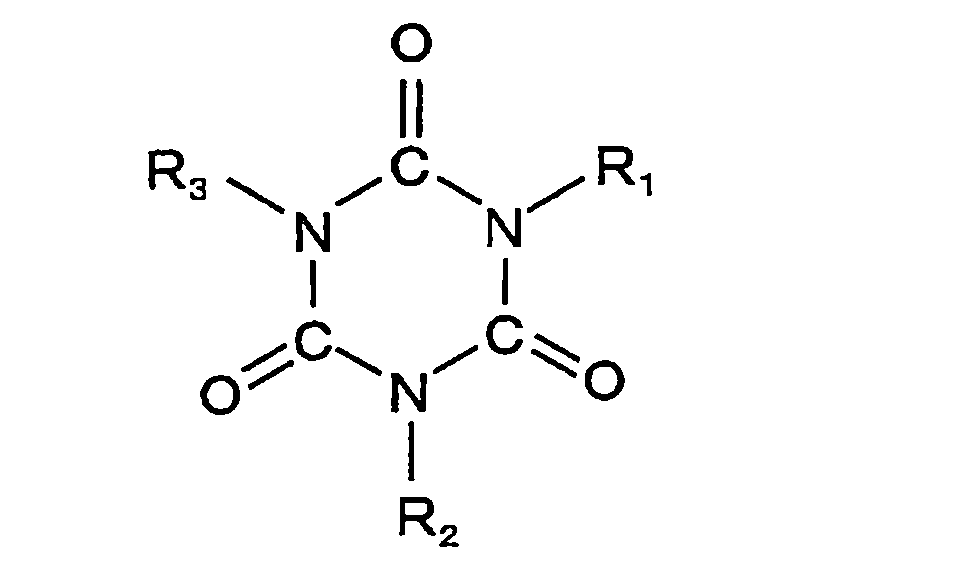
また、本発明のポリ乳酸樹脂組成物は、前記一般式で示される化合物がジアリルモノグリシジルイソシアヌレート、モノアリルグリシジルイソシアヌレート、モノアリルグリシジルイソシアヌレート、トリグリシジルイソシアヌレートから選択される1種以上の化合物であることが好ましい。
(組合せ1)ポリ-L-乳酸もしくはポリ-D-乳酸のいずれか一方の重量平均分子量が60,000以上300,000以下であり、もう一方の重量平均分子量が10,000以上100,000以下である
(組合せ2)ポリ-L-乳酸の重量平均分子量とポリ-D-乳酸の重量平均分子量との比が2以上30未満である
Sc=ΔHh/(ΔHl+ΔHh)×100>60 (2)
ここで、
ΔHh:ポリ-L-乳酸とポリ-D-乳酸の混合物のDSC測定において昇温速度20℃/minで昇温した際のステレオコンプレックス結晶に基づく熱量(J/g)
ΔHl:ポリ-L-乳酸とポリ-D-乳酸の混合物のDSC測定において昇温速度20℃/minで昇温した際のポリ-L-乳酸単独結晶およびポリ-D-乳酸単独結晶の結晶融解に基づく熱量(J/g)
また、本発明のポリ乳酸樹脂組成物は、前記(A)ポリ乳酸ブロック共重合体が、ポリ-L-乳酸もしくはポリ-D-乳酸を下記組合せ3および/または下記組合せ4の条件で混合し、重量平均分子量90,000以上、かつステレオコンプレックス形成率(Sc)が下記式(2)を満たす混合物を得た後、該混合物の融点より低い温度で固相重合することにより得られるものであることが好ましい。
(組合せ3)ポリ-L-乳酸もしくはポリ-D-乳酸のいずれか一方の重量平均分子量が120,000以上300,000以下であり、もう一方の重量平均分子量が30,000以上100,000以下である
(組合せ4)ポリ-L-乳酸の重量平均分子量とポリ-D-乳酸の重量平均分子量との比が2以上30未満である
Sc=ΔHh/(ΔHl+ΔHh)×100>60 (2)
ここで、
ΔHh:ポリ-L-乳酸とポリ-D-乳酸の混合物のDSC測定において昇温速度20℃/minで昇温した際のステレオコンプレックス結晶に基づく熱量(J/g)
ΔHl:ポリ-L-乳酸とポリ-D-乳酸の混合物のDSC測定において昇温速度20℃/minで昇温した際のポリ-L-乳酸単独結晶およびポリ-D-乳酸単独結晶の結晶融解に基づく熱量(J/g)
また、本発明のポリ乳酸樹脂組成物は、前記ポリ乳酸樹脂組成物の重量平均分子量と数平均分子量の比で示される分散度が2.5以下であることが好ましい。
上記ポリ乳酸樹脂組成物からなる成形体、である。
(I)ポリ-L-乳酸もしくはポリ-D-乳酸のいずれか一方の重量平均分子量が6万~30万であり、もう一方の重量平均分子量が1万~10万であるポリ-L-乳酸とポリ-D-乳酸、または、ポリ-L-乳酸の重量平均分子量とポリ-D-乳酸の重量平均分子量の比が2以上30未満であるポリ-L-乳酸とポリ-D-乳酸を混合し、該混合物の融点より低い温度で固相重合をした後、
前記(B)グリシジル基もしくは酸無水物を有する環状化合物を配合するポリ乳酸樹脂組成物の製造方法、
または、
(II)ポリ-L-乳酸もしくはポリ-D-乳酸のいずれか一方の重量平均分子量が6万~30万であり、もう一方の重量平均分子量が1万~10万であるポリ-L-乳酸とポリ-D-乳酸、または、ポリ-L-乳酸の重量平均分子量とポリ-D-乳酸の重量平均分子量の比が2以上30未満であるポリ-L-乳酸とポリ-D-乳酸を混合した後、
前記(B)グリシジル基または酸無水物を有する環状化合物を配合し、
該混合物の融点より低い温度で固相重合するポリ乳酸樹脂組成物の製造方法、
または、
(III)ポリ-L-乳酸もしくはポリ-D-乳酸のいずれか一方の重量平均分子量が6万~30万であり、もう一方の重量平均分子量が1万~10万であるポリ-L-乳酸とポリ-D-乳酸ならびに前記(B)グリシジル基もしくは酸無水物を有する環状化合物を混合し、または、ポリ-L-乳酸の重量平均分子量とポリ-D-乳酸の重量平均分子量の比が2以上30未満であるポリ-L-乳酸とポリ-D-乳酸ならびに前記(B)グリシジル基もしくは酸無水物を有する環状化合物を混合し、
該混合物の融点より低い温度で固相重合するポリ乳酸樹脂組成物の製造方法、である。
<ポリ乳酸ブロック共重合体>
本発明において、ポリ乳酸ブロック共重合体とは、L-乳酸を主成分とするポリ-L-乳酸セグメントとD-乳酸を主成分とするポリ-D-乳酸セグメントから構成されるポリ乳酸ブロック共重合体とは、L-乳酸単位からなるセグメントとD-乳酸単位からなるセグメントが共有結合したポリ乳酸ブロック共重合体である。
また、本発明において、ポリ乳酸ブロック共重合体はさらに下記式(5)を満たすことが好ましい。
ここで、Tmとは、ポリ乳酸ブロック共重合体を示差走査熱量計(DSC)により昇温速度40℃/minで30℃から250℃まで昇温した際の融点、Tmsとは、ポリ乳酸ブロック共重合体を示差走査熱量計(DSC)により昇温速度40℃/minで30℃から250℃まで昇温した際の融解開始温度、Tmeとは、ポリ乳酸ブロック共重合体を示差走査熱量計(DSC)により昇温速度40℃/minで30℃から250℃まで昇温した際の融解終了温度を示す。好ましい範囲は1<(Tm-Tms)/(Tme-Tm)<1.6であり、1<(Tm-Tms)/(Tme-Tm)<1.4の範囲がさらに好ましい。
本発明においては、ポリ乳酸ブロック共重合体一分子あたりに含まれるL-乳酸単位からなるセグメントおよびD-乳酸単位からなるセグメントの合計数が3以上であることが、高融点のポリ乳酸ステレオコンプレックスを形成しやすいポリ乳酸ブロック共重合体が得られる点で好ましい。さらに好ましくは5以上であり、7以上であることが特に好ましい。
<ポリ乳酸ブロック共重合体の調製法>
ポリ乳酸ブロック共重合体の調製法については、特に限定されるものではなく、一般のポリ乳酸調製法を利用することができる。具体的には、原料の乳酸から生成した環状2量体のL-ラクチドまたはD-ラクチドのいずれか一方を触媒存在下で開環重合を行い、さらに該ポリ乳酸の光学異性体であるラクチドを添加して開環重合することでポリ乳酸ブロック共重合体を得るラクチド法(ポリ乳酸ブロック共重合体の調製法1)、当該原料を直接重合またはラクチドを経由した開環重合によりポリ-L-乳酸とポリ-D-乳酸とをそれぞれ重合し、次いで、得られたポリ-L-乳酸およびポリ-D-乳酸を混合後、固相重合によりポリ乳酸ブロック共重合体を得る方法(ポリ乳酸ブロック共重合体の調製法2)、ポリ-L-乳酸とポリ-D-乳酸とを、融点の高い方の成分の融解終了温度以上で長時間溶融混練を行うことで、L-乳酸単位のセグメントとD-乳酸単位のセグメントとをエステル交換反応させたポリ乳酸ブロック共重合体を得る方法(ポリ乳酸ブロック共重合体の調製法3)、多官能性化合物をポリ-L-乳酸およびポリ-D-乳酸に混合して反応することで、ポリ-L-乳酸とポリ-D-乳酸とを多官能性化合物で共有結合させポリ乳酸ブロック共重合体を得る方法(ポリ乳酸ブロック共重合体の調製法4)などがある。調製法についてはいずれの方法を利用してもよいが、ポリ-L-乳酸およびポリ-D-乳酸を混合後、固相重合する方法が、ポリ乳酸ブロック共重合体一分子あたりに含まれるL-乳酸単位からなるセグメントおよびD-乳酸単位からなるセグメントの合計数が3以上となり、結果的に耐熱性、結晶性および機械物性を兼ね備えたポリ乳酸ブロック共重合体を得られるという点において好ましい。
さらに、本発明でポリ-L-乳酸成分とポリ-D-乳酸成分との重量平均分子量は、ポリ-L-乳酸またはポリ-D-乳酸のうちいずれか一方の重量平均分子量が120,000以上300,000以下であり、もう一方の重量平均分子量が30,000以上100,000以下であることも好ましい態様である。より好ましくは、一方の重量平均分子量が100,000以上270,000以下、もう一方の重量平均分子量が35,000以上80,000以下である。さらに好ましくは、125,000以上255,000以下、もう一方の重量平均分子量が25,000以上50,000以下である。
また、ポリ-L-乳酸とポリ-D-乳酸の重量平均分子量の組み合わせとしては混合後の重量平均分子量が90,000以上となるよう、適宜選択することが好ましい。
ここで、
ΔHh:ポリ-L-乳酸とポリ-D-乳酸の混合物のDSC測定において昇温速度20℃/minで昇温した際のステレオコンプレックス結晶に基づく熱量(J/g)
ΔHl:ポリ-L-乳酸とポリ-D-乳酸の混合物のDSC測定において昇温速度20℃/minで昇温した際のポリ-L-乳酸単独結晶およびポリ-D-乳酸単独結晶の結晶融解に基づく熱量(J/g)
また、混合に用いるポリ-L-乳酸とポリ-D-乳酸との結晶化の有無については、特に限定されず、結晶化したポリ-L-乳酸とポリ-D-乳酸とを混合してもよいし、溶融状態のポリ-L-乳酸とポリ-D-乳酸とを混合することもできる。混合に用いるポリ-L-乳酸とポリ-D-乳酸との結晶化を行う場合、具体的な方法として気相中または液相中において結晶化処理温度で保持する方法および溶融状態のポリ-L-乳酸とポリ-D-乳酸を融点-50℃~融点+20℃の溶融機内でせん断を付与しながら滞留する方法および溶融状態のポリ-L-乳酸とポリ-D-乳酸を融点-50℃~融点+20℃の溶融機内で圧力を付与しながら滞留する方法などが挙げられる。
固相重合工程においては、混合物の分散度が小さくなることが好ましい。具体的には、固相重合前における混合物の分散度が1.5~4.0の範囲から、固相重合後にはポリ乳酸ブロック共重合体の分散度が1.5~2.7の範囲になることが好ましい。さらに好ましくは固相重合前における混合物の分散度が2.0~3.7の範囲が固相重合後にはポリ乳酸ブロック共重合体の分散度が1.8~2.6の範囲に小さくなることであり、特に好ましくは、固相重合前における混合物の分散度が2.5~3.5の範囲から固相重合後にはポリ乳酸ブロック共重合体の分散度が2.0~2.5の範囲になることである。
さらに、溶融混練後のポリ乳酸樹脂組成物の機械物性が高くなるという点では、ポリ-L-乳酸またはポリ-D-乳酸のうちいずれか一方の重量平均分子量が60,000以上300,000以下であり、もう一方の重量平均分子量が30,000以上100,000以下であることも好ましい態様である。より好ましくは、一方の重量平均分子量が100,000以上270,000以下、もう一方の重量平均分子量が20,000以上80,000以下である。さらに好ましくは、125,000以上255,000以下、もう一方の重量平均分子量が25,000以上50,000以下である。
さらに、溶融混練後のポリ乳酸樹脂組成物の機械物性が高くなるという点で、ポリ-L-乳酸またはポリ-D-乳酸のうちいずれか一方の重量平均分子量が60,000以上300,000以下であり、もう一方の重量平均分子量が30,000以上100,000以下であることも好ましい態様である。より好ましくは、一方の重量平均分子量が100,000以上270,000以下、もう一方の重量平均分子量が20,000以上80,000以下である。さらに好ましくは、125,000以上255,000以下、もう一方の重量平均分子量が25,000以上50,000以下である。
<グリシジル基もしくは酸無水物を有する環状化合物>
本発明において、ポリ乳酸ブロック共重合体のカルボキシル基あるいはヒドロキシル基末端を封鎖して耐熱性および湿熱安定性を向上させ、さらにはポリ乳酸樹脂組成物を塩素化合物等の刺激臭が発生しない良好な製造環境にて製造するためには、ポリ乳酸樹脂組成物中にグリシジル基もしくは酸無水物を有する環状化合物を含むことが必要である。
本発明において、ポリ乳酸樹脂組成物中に含有するグリシジル基を有する環状化合物としては下記一般式で表されるイソシアヌレート化合物を基本骨格に有する1~3官能基のグリシジル変性化合物が挙げられる。
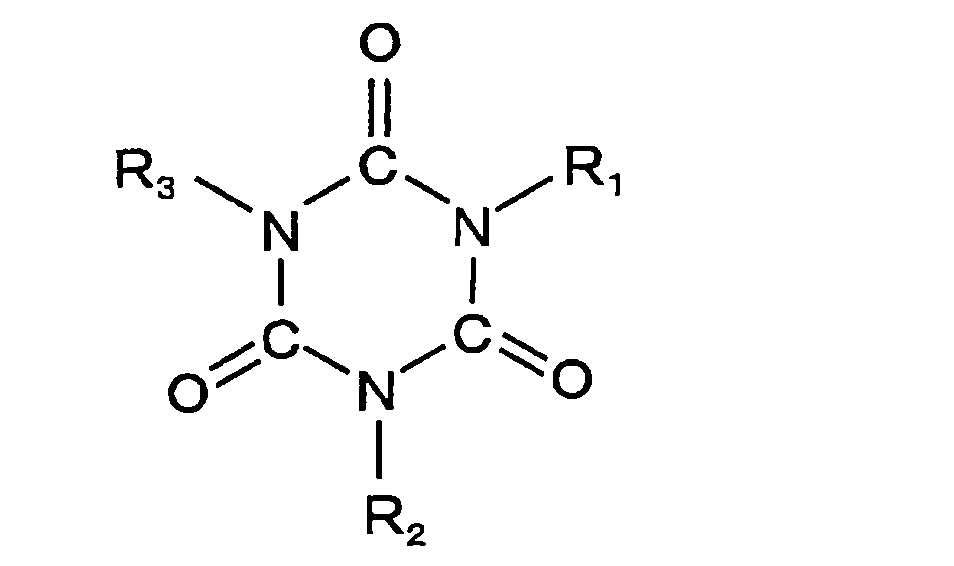
<ポリ乳酸樹脂組成物>
本発明のポリ乳酸樹脂組成物は、L-乳酸を主成分とするポリ-L-乳酸セグメントとD-乳酸を主成分とするポリ-D-乳酸セグメントから構成されるポリ乳酸ブロック共重合体100重量部に対して、グリシジル基または酸無水物を有する環状化合物を0.05~2重量部を含む。好ましくは0.3~1.5重量部であり、より好ましくは0.6~1.2重量部である。グリシジル基もしくは酸無水物を有する環状化合物を好ましい範囲内でポリ乳酸樹脂中に配向することで、ポリ乳酸樹脂組成物のカルボキシル末端あるいはヒドロキシル末端が封鎖されて、その結果、成形加工性、機械物性、耐熱性、さらには湿熱特性や乾熱特性が向上する。また、ポリ乳酸樹脂組成物の製糸において糸切れが発生しにくい。
本発明において、ポリ乳酸樹脂組成物は耐加水分解性および湿熱安定性に優れるという点で、末端カルボキシル基濃度が10eq/ton以下であることが好ましい。より好ましくは7eq/ton以下であり、さらに好ましくは5eq/ton以下である。
さらに、ポリ乳酸樹脂組成物の製造方法(III)としては、ポリ-L-乳酸、ポリ-D-乳酸およびグリシジル基もしくは酸無水物を有する環状化合物の3種を一括で混合した後、混合物の融点より低い温度で固相重合する手法が挙げられる。この方法における溶融混練の手法は上述のポリ乳酸樹脂組成物の製造方法で適用される混合方法でよく、混練装置、混合時の温度条件、時間条件および圧力条件についても上述のポリ乳酸樹脂組成物の製造方法記載と同様である。
(1)分子量
ポリ乳酸樹脂組成物の重量平均分子量および分散度は、ゲルパーミエーションクロマトグラフィー(GPC)により測定した標準ポリメチルメタクリレート換算の値である。GPC測定は、検出器に日本ウォーターズ(株)製の示差屈折計WATERS410を用い、ポンプに日本ウォーターズ(株)製のMODEL510を用い、カラムに昭和電工(株)製の“Shodex”(登録商標)GPC HFIP-806Mと“Shodex”(登録商標)GPC HFIP-LGとを直列に接続したものを用いて行った。測定条件は、流速0.5mL/minとし、測定では溶媒にヘキサフルオロイソプロパノールを用い、試料濃度1mg/mLの溶液を0.1mL注入した。
(2)熱的特性
ポリ乳酸樹脂組成物の融点および融解熱量は、(株)パーキンエルマー・ジャパン製の示差走査型熱量計(DSC)により測定した。測定条件は、試料5mg、窒素雰囲気下、昇温速度が20℃/minである。
式(9)のパラメータにおいて、Tm:ポリ乳酸樹脂組成物のステレオコンプレックス結晶由来の融点(結晶融解ピークにおけるピークトップ温度)、Tms:ポリ乳酸樹脂組成物のステレオコンプレックス結晶融解開始温度、Tme:ポリ乳酸樹脂組成物の融点終了温度を示しており、それぞれの値は(株)パーキンエルマー・ジャパン示差走査型熱量計(DSC)を用いて試料5mg、窒素雰囲気下での測定値である。なお、測定値は、第1昇温時に昇温速度40℃/minで30℃から250℃まで昇温した後、降温速度40℃/minで30℃まで冷却し、さらに第2昇温時に昇温速度40℃/minで30℃から250℃まで昇温したときの値を用いている。
(3)ステレオコンプレックス形成率(Sc)
ポリ乳酸樹脂組成物のステレオコンプレックス形成率(Sc)は、下記式(4)から算出した。
ここで、ΔHlは150℃以上190℃未満に現れるポリ-L-乳酸単独結晶およびポリ-D-乳酸単独結晶の結晶融解に基づく熱量を示し、ΔHhは190℃以上250℃未満に現れるステレオコンプレックス結晶の結晶融解に基づく熱量を示す。
(4)カルボキシル基末端濃度
ポリ乳酸樹脂組成物のカルボキシル基末端濃度は、ポリ乳酸樹脂組成物のペレットをo-クレゾール/クロロホルム混合溶液に溶解後、0.02規定のエタノール性水酸化カリウム溶液にて滴定することにより算出した。
(5)分子量保持率
ポリ乳酸樹脂組成物の分子量保持率は、ポリ乳酸樹脂組成物のペレットを60℃、95%RH条件下で100時間湿熱処理を行い、湿熱処理前の重量平均分子量(Mw1)と湿熱処理後の重量平均分子量(Mw2)から下記式(10)に従い算出した。
(6)延伸糸強度
本発明のポリ乳酸樹脂組成物からなる延伸糸の強度は、(株)オリエンテック製テンシロン(TENSILON)UCT-100を用いて、JIS L 1013(化学繊維フィラメント糸試験方法、1998年)に従い,定速伸張条件(つかみ間隔:20cm、伸張速度20cm/分)で測定した。
(7)延伸糸強度保持率
本発明のポリ乳酸樹脂組成物からなる延伸糸の強度は、以下の手順で測定を行った。
ポリ乳酸樹脂組成物からなる延伸糸1gを収縮しないようにボビンに巻き付け、水300mlとともに密閉可能な容器に入れた後、昇温速度4℃/分にて容器内の水温が130℃となるように加熱して130℃にて40分間定温保持した後、降温速度4℃/分にて冷却させた。容器内の水温が50℃以下になったところで試料をとりだして水洗を行い、熱処理前の引張強度(T1)、熱処理後の引張強度(T2)から下記式(11)に従い強度保持率を算出した。
(8)布帛アイロン耐熱性
下記実施例で得られたポリ乳酸樹脂組成物からなる布帛に対して、中温(表面温度170℃)に設定した家庭用アイロンを10秒間押しあてて、変化が認められないものをgood、硬化がわずかに認められるものをfair、硬化が明確に認められるものをbad、硬化が顕著もしくは溶融してしまったものをworseとして4段階でアイロン耐熱性評価を行い、fair以上を合格とした。
(9)成形品耐熱性:ヒートサグ試験
ポリ乳酸樹脂組成物からなる80mm×80mmの角板成形品を片持ち支持した状態で、60℃、30分保持したときの変形量を測定した。変形量が小さいほど耐熱性に優れるといえる。
(10)成形品強度保持率
ポリ乳酸樹脂組成物からなるASTM1号ダンベル成形品を用いて、熱処理前の引張強度(T1)と150℃、100時間乾熱処理後の引張強度(T2)を測定して下記式(12)に従い成形品の乾熱強度保持率を算出した。
本実施例(実施例1~20および比較例1~16)で使用したポリ-L-乳酸およびポリ-D-乳酸は以下の通りである。
PLA2:参考例2で得られたポリ-L-乳酸(Mw=14万、分散度1.6)
PLA3:参考例3で得られたポリ-L-乳酸(Mw=20万、分散度1.7)
PDA1:参考例4で得られたポリ-D-乳酸(Mw=4万、分散度1.5)
PDA2:参考例5で得られたポリ-D-乳酸(Mw=7万、分散度1.5)
PDA3:参考例6で得られたポリ-D-乳酸(Mw=13万、分散度1.6)
PDA4:参考例7で得られたポリ-D-乳酸(Mw=18万、分散度1.6)
[参考例1]
撹拌装置および還流装置を備えた反応容器中に、90%L-乳酸水溶液を50部入れ、温度を150℃にした後、徐々に減圧して水を留去しながら3.5時間反応した。その後、窒素雰囲気下で常圧にし、酢酸錫(II)0.02部を添加した後、170℃にて13Paになるまで徐々に減圧しながら7時間重合反応を行った。続いて、得られたポリ-L-乳酸を窒素雰囲気下で110℃、1時間結晶化処理を行った後、60Paの圧力下、140℃で3時間、150℃で3時間、160℃で5時間固相重合を行い、ポリ-L-乳酸(PLA1)を得た。PLA1の重量平均分子量は5万、分散度は1.5、融点は157℃であった。
[参考例2]
撹拌装置および還流装置を備えた反応容器中に、90%L-乳酸水溶液を50部入れ、温度を150℃にした後、徐々に減圧して水を留去しながら3.5時間反応した。その後、窒素雰囲気下で常圧にし、酢酸錫(II)0.02部を添加した後、170℃にて13Paになるまで徐々に減圧しながら7時間重合反応を行った。続いて、得られたポリ-L-乳酸を窒素雰囲気下で110℃、1時間結晶化処理を行った後、60Paの圧力下、140℃で3時間、150℃で3時間、160℃で12時間固相重合を行い、ポリ-L-乳酸(PLA2)を得た。PLA2の重量平均分子量は14万、分散度は1.6、融点は165℃であった。
[参考例3]
撹拌装置および還流装置を備えた反応容器中に、90%L-乳酸水溶液を50部入れ、温度を150℃にした後、徐々に減圧して水を留去しながら3.5時間反応した。その後、窒素雰囲気下で常圧にし、酢酸錫(II)0.02部を添加した後、170℃にて13Paになるまで徐々に減圧しながら7時間重合反応を行った。続いて、得られたポリ-L-乳酸を窒素雰囲気下で110℃、1時間結晶化処理を行った後、60Paの圧力下、140℃で3時間、150℃で3時間、160℃で18時間固相重合を行い、ポリ-L-乳酸(PLA3)を得た。PLA3の重量平均分子量は20万、分散度は1.7、融点は170℃であった。
[参考例4]
撹拌装置と還流装置を備えた反応容器中に、90%D-乳酸水溶液を50部入れ、温度を150℃にした後、徐々に減圧して水を留去しながら3.5時間反応した。その後、窒素雰囲気下で常圧にし、酢酸錫(II)0.02部を添加した後、170℃にて13Paになるまで徐々に減圧しながら7時間重合反応を行った。続いて、得られたポリ-D-乳酸を窒素雰囲気下で110℃、1時間結晶化処理を行った後、60Paの圧力下、140℃で3時間、150℃で3時間、160℃で5時間固相重合を行い、ポリ-D-乳酸(PDA1)を得た。PDA1の重量平均分子量は4.0万、分散度は1.5、融点は156℃であった。
[参考例5]
撹拌装置と還流装置を備えた反応容器中に、90%D-乳酸水溶液を50部入れ、温度を150℃にした後、徐々に減圧して水を留去しながら3.5時間反応した。その後、窒素雰囲気下で常圧にし、酢酸錫(II)0.02部を添加した後、170℃にて13Paになるまで徐々に減圧しながら7時間重合反応を行った。続いて、得られたポリ-D-乳酸を窒素雰囲気下で110℃、1時間結晶化処理を行った後、60Paの圧力下、140℃で3時間、150℃で3時間、160℃で9時間固相重合を行い、ポリ-D-乳酸(PDA2)を得た。PDA2の重量平均分子量は7.0万、分散度は1.5、融点は161℃であった。
[参考例6]
撹拌装置と還流装置を備えた反応容器中に、90%D-乳酸水溶液を50部入れ、温度を150℃にした後、徐々に減圧して水を留去しながら3.5時間反応した。その後、窒素雰囲気下で常圧にし、酢酸錫(II)0.02部を添加した後、170℃にて13Paになるまで徐々に減圧しながら7時間重合反応を行った。続いて、得られたポリ-D-乳酸を窒素雰囲気下で110℃、1時間結晶化処理を行った後、60Paの圧力下、140℃で3時間、150℃で3時間、160℃で12時間固相重合を行い、ポリ-D-乳酸(PDA3)を得た。PDA3の重量平均分子量は13万、分散度は1.6、融点は164℃であった。
[参考例7]
撹拌装置および還流装置を備えた反応容器中に、90%D-乳酸水溶液を50部入れ、温度を150℃にした後、徐々に減圧して水を留去しながら3.5時間反応した。その後、窒素雰囲気下で常圧にし、酢酸錫(II)0.02部を添加した後、170℃にて13Paになるまで徐々に減圧しながら7時間重合反応を行った。続いて、得られたポリ-D-乳酸を窒素雰囲気下で110℃、1時間結晶化処理を行った後、60Paの圧力下、140℃で3時間、150℃で3時間、160℃で18時間固相重合を行い、ポリ-D-乳酸(PDA4)を得た。PDA4の重量平均分子量は18万、分散度は1.6、融点は168℃であった。
(A)ポリ乳酸樹脂
A-1:参考例8で得られたポリ乳酸ステレオコンプレックス(ポリ-L-乳酸とポリ-D-乳酸との混合物)(Mw=11万、分散度2.7)
A-2:参考例9で得られたポリ乳酸ブロック共重合体(Mw=13万、分散度2.4)
A-3:参考例10で得られたポリ乳酸ステレオコンプレックス(ポリ-L-乳酸とポリ-D-乳酸との混合物)(Mw=13万、分散度2.6)
A-4:参考例11で得られたポリ乳酸ブロック共重合体(Mw=16万、分散度2.3)
A-5:参考例12で得られたポリ乳酸ステレオコンプレックス(ポリ-L-乳酸とポリ-D-乳酸との混合物)(Mw=4万、分散度1.8)
A-6:参考例13で得られたポリ乳酸ブロック共重合体(Mw=6万、分散度1.6)
A-7:参考例14で得られたポリ乳酸ステレオコンプレックス(ポリ-L-乳酸とポリ-D-乳酸との混合物)(Mw=10万、分散度2.2)
A-8:参考例15で得られたポリ乳酸ブロック共重合体(Mw=13万、分散度2.0)
A-9:参考例16で得られたポリ乳酸ステレオコンプレックス(ポリ-L-乳酸とポリ-D-乳酸との混合物)(Mw=12万、分散度2.4)
A-10:参考例17で得られたポリ乳酸ブロック共重合体(Mw=14万、分散度2.2)
A-11:参考例18で得られたポリ乳酸ステレオコンプレックス(ポリ-L-乳酸とポリ-D-乳酸との混合物)(Mw=13万、分散度2.5)
A-12:参考例19で得られたポリ乳酸ブロック共重合体(Mw=15万、分散度2.3)
A-13:参考例20で得られたポリ乳酸ステレオコンプレックス(ポリ-L-乳酸とポリ-D-乳酸との混合物)(Mw=15万、分散度2.6)
A-14:参考例21で得られたポリ乳酸ブロック共重合体(Mw=17万、分散度2.4)
A-15:参考例22で得られたポリ乳酸ステレオコンプレックス(ポリ-L-乳酸とポリ-D-乳酸との混合物)(Mw=17万、分散度2.4)
A-16:参考例23で得られたポリ乳酸ブロック共重合体(Mw=19万、分散度2.2)
A-17:参考例24で得られたポリ乳酸ブロック共重合体(Mw=15万、分散度1.8)
A-18:参考例25で得られたポリ乳酸ブロック共重合体(Mw=11万、分散度1.7)
A-19:参考例26で得られたポリ乳酸ステレオコンプレックス(ポリ-L-乳酸とポリ-D-乳酸との混合物)(Mw=17万、分散度1.7)
PLA3:参考例3で得られたポリ-L-乳酸(Mw=20万、分散度1.7)
[参考例8]
参考例3で得られたPLA3と参考例4で得られたPDA1を混合前にあらかじめ窒素雰囲気下で温度110℃、2時間結晶化処理を行った。続いて、結晶化した50重量部のPLA3を二軸押出機の樹脂供給口より添加し、50重量部のPDA1を後述するL/D=30の部分に設けたサイド供給口より添加することで溶融混練を行った。ここで、二軸押出機は、樹脂供給口よりL/D=10の部分に温度190℃に設定した可塑化部分を有するとともに、L/D=30の部分にニーディングディスクを備えてせん断付与できるスクリューとしてせん断付与下で混合できる構造を有している。二軸押出機によって、減圧下、混練温度210℃でPLA1およびPDA1の溶融混練を行い、ポリ乳酸ステレオコンプレックス(A-1)を得た。ポリ乳酸ステレオコンプレックス(A-1)の重量平均分子量は11万、分散度は2.7、融点は211℃で、ステレオコンプレックス形成率は100%であった。
[参考例9]
参考例8で得られたポリ乳酸ステレオコンプレックス(A-1)を、窒素雰囲気下で110℃、1時間結晶化処理を行った後、60Paの圧力下、140℃で3時間、150℃で3時間、160℃で18時間固相重合を行い、セグメント数3以上のポリ乳酸ブロック共重合体(A-2)を得た。ポリ乳酸ブロック共重合体(A-2)の重量平均分子量は13万、分散度は2.4、融点は211℃で、ステレオコンプレックス形成率は100%であった。
[参考例10]
二軸押出機に供給するPLA3を70重量部、PDA1を30重量部とする以外は参考例8と同様の方法で溶融混練を行い、ポリ乳酸ステレオコンプレックス(A-3)を得た。ポリ乳酸ステレオコンプレックス(A-3)の重量平均分子量は13万、分散度は2.6、融点は214℃と151℃のダブルピークで、ステレオコンプレックス形成率は95%であった。
[参考例11]
参考例10で得られたポリ乳酸ステレオコンプレックス(A-3)を参考例9と同様の方法で固相重合を行い、セグメント数3以上のポリ乳酸ブロック共重合体(A-4)を得た。ポリ乳酸ブロック共重合体(A-4)の重量平均分子量は16万、分散度は2.3、融点は215℃と171℃のダブルピークで、ステレオコンプレックス形成率は97%であった。
[参考例12]
二軸押出機で溶融混練するポリ-L-乳酸をPLA1、ポリ-D-乳酸をPDA1とする以外は参考例10と同様の方法にて溶融混練を行い、ポリ乳酸ステレオコンプレックス(A-5)を得た。ポリ乳酸ステレオコンプレックス(A-5)の重量平均分子量は4万、分散度は1.8、融点は215℃で、ステレオコンプレックス形成率は100%であった。
[参考例13]
参考例12で得られたポリ乳酸ステレオコンプレックス(A-5)を参考例9と同様の方法で固相重合を行い、ポリ乳酸ブロック共重合体(A-6)を得た。ポリ乳酸ブロック共重合体(A-6)の重量平均分子量は6万、分散度は1.6、融点は215℃で、ステレオコンプレックス形成率は100%であった。
[参考例14]
二軸押出機で溶融混練するポリ-L-乳酸をPLA2、ポリ-D-乳酸をPDA1とする以外は参考例10と同様の方法にて溶融混練を行い、ポリ乳酸ステレオコンプレックス(A-7)を得た。ポリ乳酸ステレオコンプレックス(A-7)の重量平均分子量は10万、分散度は2.2、融点は213℃と152℃のダブルピークで、ステレオコンプレックス形成率は96%であった。
[参考例15]
参考例14で得られたポリ乳酸ステレオコンプレックス(A-7)を参考例9と同様の方法で固相重合を行い、ポリ乳酸ブロック共重合体(A-8)を得た。ポリ乳酸ブロック共重合体(A-8)の重量平均分子量は12万、分散度は2.0、融点は212℃と170℃のダブルピークで、ステレオコンプレックス形成率は98%であった。
[参考例16]
二軸押出機で溶融混練するポリ-L-乳酸をPLA2、ポリ-D-乳酸をPDA2とする以外は参考例10と同様の方法にて溶融混練を行い、ポリ乳酸ステレオコンプレックス(A-9)を得た。ポリ乳酸ステレオコンプレックス(A-9)の重量平均分子量は12万、分散度は2.4、融点は212℃と160℃のダブルピークで、ステレオコンプレックス形成率は93%であった。
[参考例17]
参考例16で得られたポリ乳酸ステレオコンプレックス(A-9)を参考例9と同様の方法で固相重合を行い、ポリ乳酸ブロック共重合体(A-10)を得た。ポリ乳酸ブロック共重合体(A-10)の重量平均分子量は14万、分散度は2.2、融点は212℃と171℃のダブルピークで、ステレオコンプレックス形成率は95%であった。
[参考例18]
二軸押出機で溶融混練するポリ-L-乳酸をPLA2、ポリ-D-乳酸をPDA3とする以外は参考例10と同様の方法にて溶融混練を行い、ポリ乳酸ステレオコンプレックス(A-11)を得た。ポリ乳酸ステレオコンプレックス(A-11)の重量平均分子量は13万、分散度は2.5、融点は210℃と165℃のダブルピークで、ステレオコンプレックス形成率は55%であった。
[参考例19]
参考例18で得られたポリ乳酸ステレオコンプレックス(A-11)を参考例9と同様の方法で固相重合を行い、ポリ乳酸ブロック共重合体(A-12)を得た。ポリ乳酸ブロック共重合体(A-12)の重量平均分子量は15万、分散度は2.3、融点は211℃と170℃のダブルピークで、ステレオコンプレックス形成率は63%であった。
[参考例20]
二軸押出機で溶融混練するポリ-L-乳酸をPLA3、ポリ-D-乳酸をPDA2とする以外は参考例10と同様の方法にて溶融混練を行い、ポリ乳酸ステレオコンプレックス(A-13)を得た。ポリ乳酸ステレオコンプレックス(A-13)の重量平均分子量は15万、分散度は2.6、融点は211℃と161℃のダブルピークで、ステレオコンプレックス形成率は90%であった。
[参考例21]
参考例20で得られたポリ乳酸ステレオコンプレックス(A-13)を参考例9と同様の方法で固相重合を行い、ポリ乳酸ブロック共重合体(A-14)を得た。ポリ乳酸ブロック共重合体(A-14)の重量平均分子量は17万、分散度は2.4、融点は212℃と171℃のダブルピークで、ステレオコンプレックス形成率は95%であった。
[参考例22]
二軸押出機で溶融混練するポリ-L-乳酸をPLA3、ポリ-D-乳酸をPDA3とする以外は参考例10と同様の方法にて溶融混練を行い、ポリ乳酸ステレオコンプレックス(A-15)を得た。ポリ乳酸ステレオコンプレックス(A-15)の重量平均分子量は17万、分散度は2.4、融点は212℃と168℃のダブルピークで、ステレオコンプレックス形成率は60%であった。
[参考例23]
参考例20で得られたポリ乳酸ステレオコンプレックス(A-15)を参考例9と同様の方法で固相重合を行い、ポリ乳酸ブロック共重合体(A-16)を得た。ポリ乳酸ブロック共重合体(A-16)の重量平均分子量は19万、分散度は2.2、融点は212℃と171℃のダブルピークで、ステレオコンプレックス形成率は67%であった。
[参考例24]
L-ラクチド100部、エチレングリコール0.15部を撹拌装置のついた反応容器中で、窒素雰囲気下、160℃で均一に溶解させた後、オクチル酸錫0.01部を加え、2時間開環重合反応を行った。重合反応終了後、反応物をクロロホルムに溶解させ、メタノール(クロロホルム溶液の5倍量)中で撹拌しながら再沈殿させ、未反応のモノマーを除去してポリ-L-乳酸(PLA4)を得た。PLA4の重量平均分子量は8万、分散度は1.6、融点は168℃であった。
[参考例25]
参考例3で得られたPLA3(50重量部)と参考例7で得られたPDA4(50重量部)を(株)東洋精機製作所製バッチ式二軸混練機(ラボプラストミル)にて混練温度270℃、混練回転数120rpm、混練時間10分にて混練を行い、PLA3のL-乳酸単位からなるセグメントとPDA4のD-乳酸単位からなるセグメントがエステル交換したセグメント数3以上のポリ乳酸ブロック共重合体(A-18)を得た。A-18の分子量は11万、分散度は1.7、融点は211℃で、ステレオコンプレックス形成率は100%であった。
[参考例26]
参考例3で得られたPLA3と参考例7で得られたPDA4を、参考例8と同様の方法にて溶融混練を行い、ポリ乳酸ステレオコンプレックス(A-19)を得た。ポリ乳酸ステレオコンプレックス(A-19)の重量平均分子量は17万、分散度は1.7、融点は220℃と169℃のダブルピークで、ステレオコンプレックス形成率は55%であった。
(B)グリシジル基もしくは酸無水物を有する環状化合物
B-1:トリグリシジルイソシアヌレート(日産化学工業(株)製“TEPIC-S”(登録商標)、エポキシ当量100g/mol、分子量297)
B-2:モノアリルジグリシジルイソシアヌレート(四国化成工業(株)製「MA-DGIC」(商品名)、分子量281)
B-3:ジアリルモノグリシジルイソシアヌレート(四国化成工業(株)製「DA-MGIC」(商品名)、分子量253)
B-4:テトラヒドロフタル酸ジグリシジル(天津市合成材料工業研究所製、分子量284)
B-5:1,2,4,5-ベンゼンテトラカルボン酸二無水物(無水トリメリット酸)(和光純薬工業(株)製、分子量218)
(C)多官能性化合物
C-1:N,N´-ジ-2,6-ジイソプロピルフェニルカルボジイミド(ラインケミージャパン(株)製“スタバクゾール”(登録商標)、分子量363)
C-2:ヘキサメチレンジイソシアネート(日本ポリウレタン工業(株)製、分子量168)
C-3:2,2’-(1,3-フェニレン)ビス(2-オキサゾリン)(三國製薬工業(株)製、分子量216)
(D)結晶核剤
D-1:タルク(日本タルク(株)製“ミクロエース”(登録商標)P-6)
D-2:リン酸エステルナトリウム塩(株)ADEKA製“アデカスタブ”(登録商標)NA-11)
D-3:リン酸エステルアルミニウム塩(株)ADEKA製“アデカスタブ”(登録商標)NA-21)
(実施例1~21)
表1および表2に示す種々の割合で、ポリ乳酸樹脂(A)、グリシジル基または酸無水物を有する環状化合物(B)および結晶核剤(D)をあらかじめドライブレンドした後、ベントを有する二軸押出機にて溶融混練を行った。二軸押出機は、上述したように、樹脂供給口よりL/D=10の部分に温度225℃に設定した可塑化部分と、L/D=30の部分にニーディングディスクを備えてせん断付与できるスクリューとしてせん断付与下で混合できる構造とを有しており、この二軸押出機を用いて減圧下、混練温度220℃で溶融混練を行って、ペレット化されたポリ乳酸樹脂組成物を得た。
溶融混練により得られたポリ乳酸樹脂組成物、繊維物性ならびに射出成形品の物性は表1および表2に示す通りである。
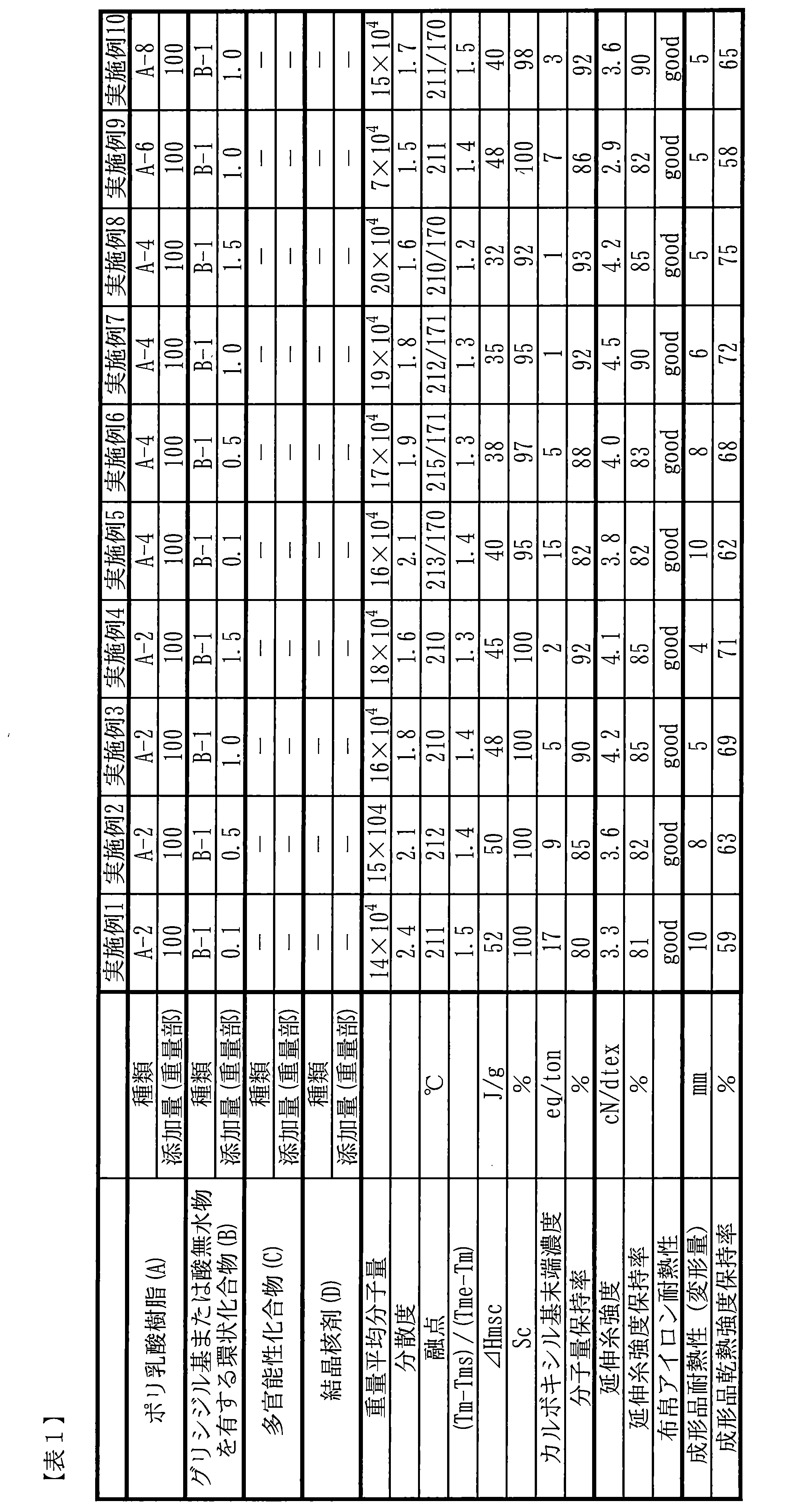
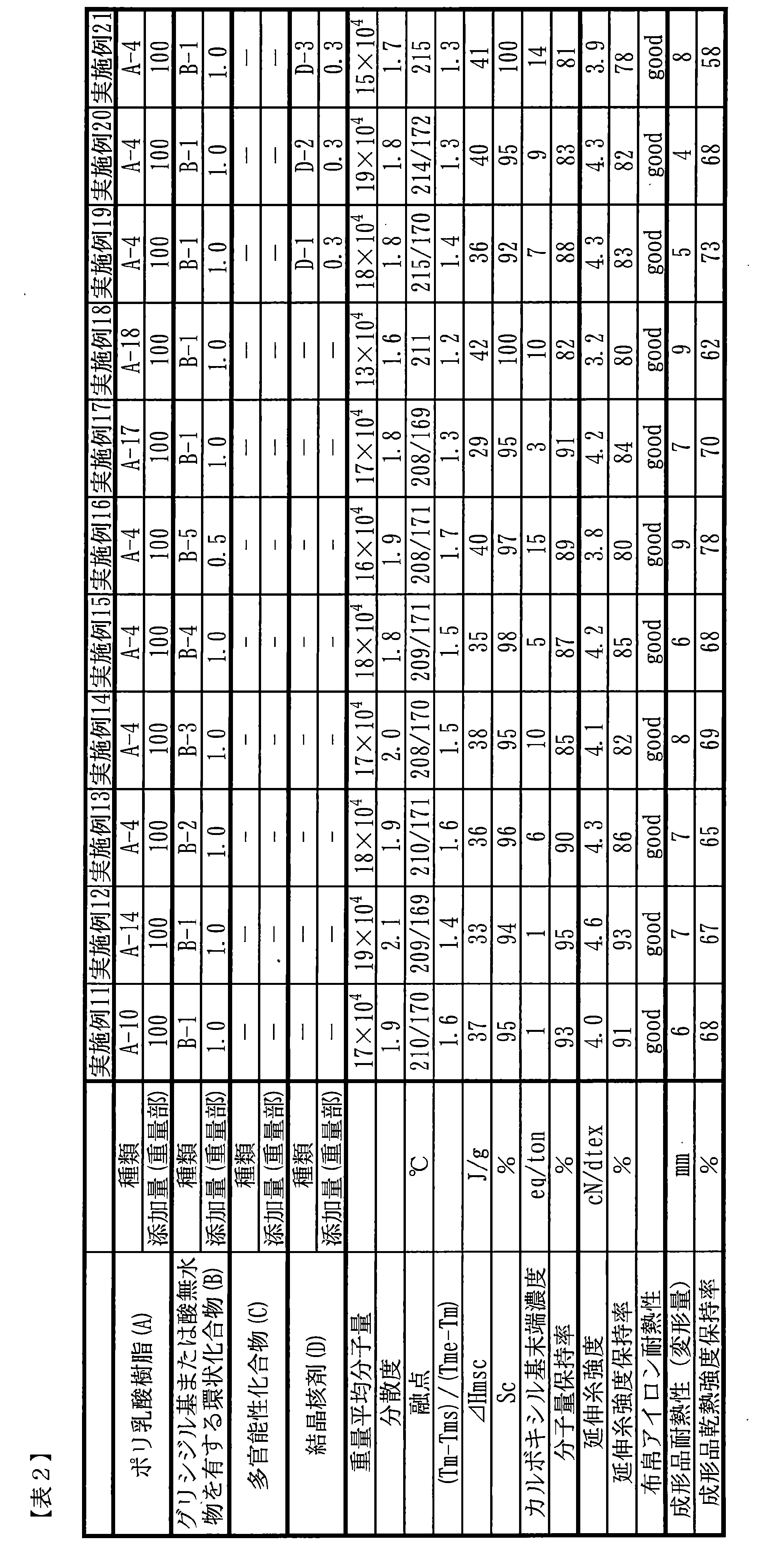
(比較例1~22)
表3および表4に示す種々の割合で、ポリ乳酸樹脂(A)、グリシジル基または酸無水物を有する環状化合物(B)、多官能性化合物(C)および結晶核剤(D)をあらかじめドライブレンドした後、実施例と同様の方法にて溶融混練を行い、ポリ乳酸樹脂組成物を得た。また、ポリ乳酸樹脂組成物については実施例と同様の方法にて溶融紡糸を行い、延伸糸と布帛の作製ならびに射出成形による各種評価用成形品の作製を行った。溶融混練により得られたポリ乳酸樹脂組成物、繊維物性ならびに射出成形品の物性は表3および表4に示す通りである。
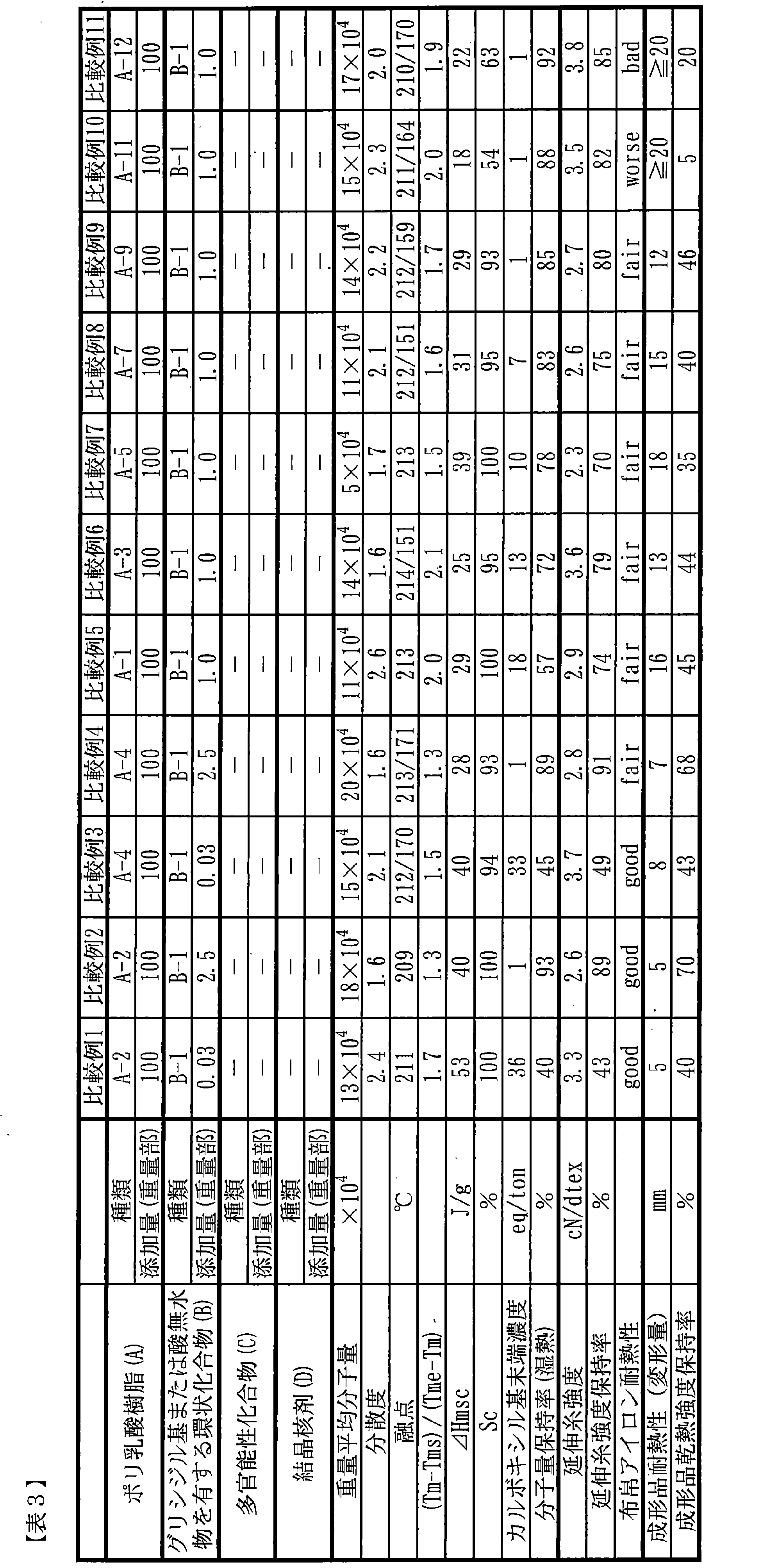
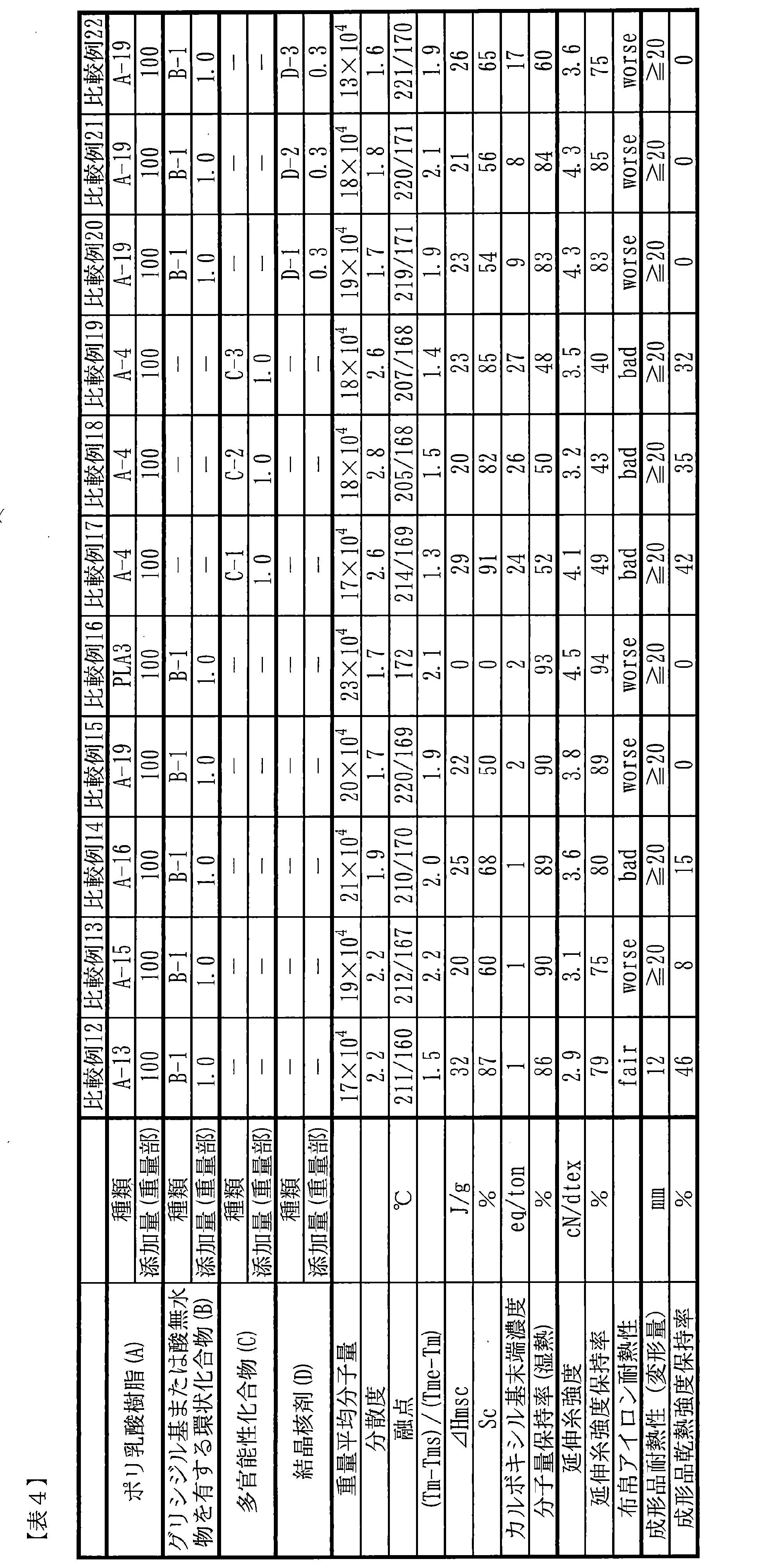
参考例3で得られたPLA3と参考例4で得られたPDA1を混合前にあらかじめ窒素雰囲気下で温度110℃、2時間結晶化処理を行った。続いて、表5に示す添加量にて結晶化したPLA3およびトリグリシジルイソシアヌレート(B-1)を二軸押出機の樹脂供給口より添加し、一方、結晶化したPDA1を後述するL/D=30の部分に設けたサイド供給口より添加することで溶融混練を行った。ここで、二軸押出機は、樹脂供給口よりL/D=10の部分に温度190℃に設定した可塑化部分を有するとともに、L/D=30の部分にニーディングディスクを備えてせん断付与できるスクリューとしてせん断付与下で混合できる構造を有している。
ポリ乳酸樹脂組成物、繊維物性ならびに射出成形品の物性は表5に示す通りである。
参考例10で得られたポリ乳酸ステレオコンプレックス(A-3)とトリグリシジルイソシアヌレート(B-1)を二軸押出機の樹脂供給口より添加することで溶融混練を行った。押出機のエレメント構成および温度設定については実施例22、23に記載の通りである。続いて、溶融混練後の混練物を実施例22、23に記載した方法で固相重合を行った。また、実施例1~21と同様の方法にて延伸糸、布帛の作製ならびに射出成形による各種評価用の成形品の作製を行った。
参考例3で得られたPLA3、参考例7で得られたPDA4および参考例11で得られた(A-4)を混合前にあらかじめ窒素雰囲気下で温度110℃、2時間結晶化処理を行った。
実施例22、23と同様の方法にて二軸押出機にて混練物を作製することでポリ乳酸樹脂組成物を作製した。なお、比較例23、24については混練物の固相重合は実施しなかった。得られたポリ乳酸樹脂組成物については実施例と同様の方法にて溶融紡糸を行い、延伸糸と布帛の作製を行った。また、射出成形品についても実施例と同様の方法にて作製を行い、各種評価用サンプルを得た。ポリ乳酸樹脂組成物および射出成形品の物性は表5に示す通りである。
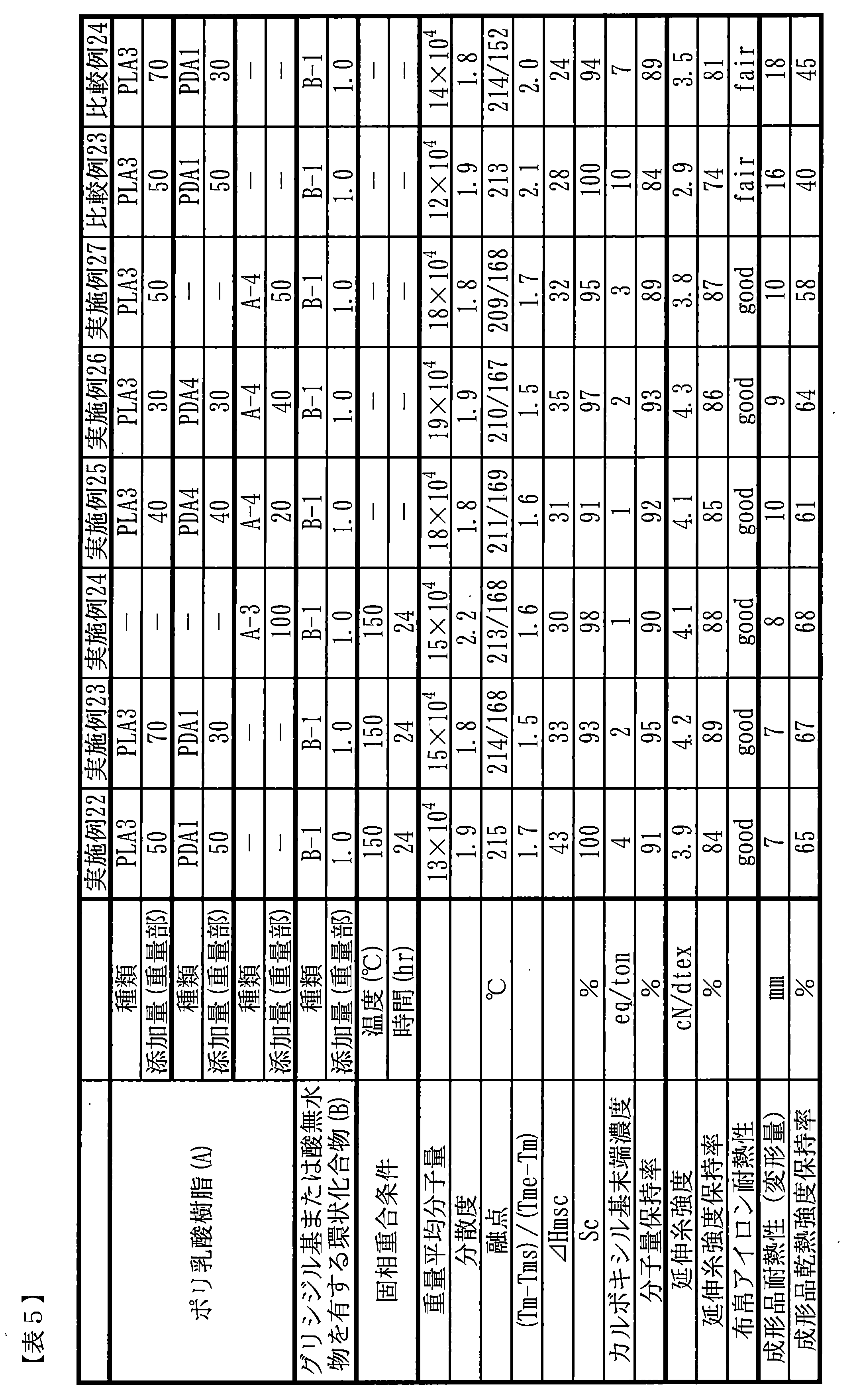
Claims (16)
- (A)L-乳酸を主成分とするポリ-L-乳酸セグメントとD-乳酸を主成分とするポリ-D-乳酸セグメントから構成されるポリ乳酸ブロック共重合体100重量部に対して(B)分子量800以下であり、かつグリシジル基もしくは酸無水物を有する環状化合物を0.05~2重量部を配合してなるポリ乳酸樹脂組成物であって、
ステレオコンプレックス形成率(Sc)が、下記式(1)を満たすポリ乳酸樹脂組成物。
Sc=ΔHh/(ΔHl+ΔHh)×100≧80 (1)
ここで、
ΔHh:ポリ乳酸樹脂組成物のDSC測定において昇温速度20℃/minで昇温した際のステレオコンプレックス結晶に基づく熱量(J/g)
ΔHl:ポリ乳酸樹脂組成物のDSC測定において昇温速度20℃/minで昇温した際のポリ-L-乳酸単独結晶およびポリ-D-乳酸単独結晶の結晶融解に基づく熱量(J/g) - 前記(B)グリシジル基もしくは酸無水物を有する環状化合物が下記一般式で表されるイソシアヌレート化合物である請求項1に記載のポリ乳酸樹脂組成物。

(ここで、R1~R3は同一であっても異なっていてもよく、少なくとも1つはグリシジル基であり、残りは水素、炭素原子数1~10のアルキル基、水酸基、アリル基から選ばれる官能基を表す) - 前記一般式で示される化合物がジアリルモノグリシジルイソシアヌレート、モノアリルグリシジルイソシアヌレート、モノアリルグリシジルイソシアヌレート、トリグリシジルイソシアヌレートから選択される1種以上の化合物である請求項2に記載のポリ乳酸樹脂組成物。
- 前記(B)グリシジル基もしくは酸無水物を有する環状化合物がフタル酸ジグリシジル、テレフタル酸ジグリシジル、テトラヒドロフタル酸ジグリシジル、ヘキサヒドロフタル酸ジグリシジル、シクロヘキサンジメタノールジグリシジルエーテル、フタル酸無水物、マレイン酸無水物、ピロメリット酸無水物、トリメリット酸無水物、1,2-シクロヘキサンジカルボン酸無水物、1,8-ナフタレンジカルボン酸無水物から選択される1種以上の化合物である請求項1に記載のポリ乳酸樹脂組成物。
- ポリ乳酸樹脂組成物のカルボキシル基末端濃度が10eq/ton以下である請求項1~4いずれかに記載のポリ乳酸樹脂組成物。
- ポリ乳酸樹脂組成物を60℃、95%RH条件下で100時間湿熱処理した後の重量平均分子量が湿熱処理前の重量平均分子量に対して80%以上保持している請求項1~5いずれかに記載のポリ乳酸樹脂組成物。
- DSC測定において、ポリ乳酸樹脂組成物を250℃まで昇温した際の190℃以上における結晶融解エンタルピーが30J/g以上である請求項1~6いずれかに記載のポリ乳酸樹脂組成物。
- 前記(A)ポリ乳酸ブロック共重合体が、ポリ-L-乳酸もしくはポリ-D-乳酸を下記組合せ1および/または下記組合せ2の条件で混合し、重量平均分子量90,000以上かつステレオコンプレックス形成率(Sc)が下記式(2)を満たす混合物を得た後、該混合物の融点より低い温度で固相重合することにより得られるものである請求項1~7いずれかに記載のポリ乳酸樹脂組成物。
(組合せ1)ポリ-L-乳酸もしくはポリ-D-乳酸のいずれか一方の重量平均分子量が60,000以上300,000以下であり、もう一方の重量平均分子量が10,000以上100,000以下である
(組合せ2)ポリ-L-乳酸の重量平均分子量とポリ-D-乳酸の重量平均分子量との比が2以上30未満である
Sc=ΔHh/(ΔHl+ΔHh)×100>60 (2)
ここで、
ΔHh:DSC測定において昇温速度20℃/minで昇温した際のステレオコンプレックス結晶に基づく熱量(J/g)
ΔHl:DSC測定において昇温速度20℃/minで昇温した際のポリ-L-乳酸単独結晶およびポリ-D-乳酸単独結晶の結晶融解に基づく熱量(J/g) - 前記(A)ポリ乳酸ブロック共重合体が、ポリ-L-乳酸もしくはポリ-D-乳酸を下記組合せ3および/または下記組合せ4の条件で混合し、重量平均分子量90,000以上、かつステレオコンプレックス形成率(Sc)が下記式(2)を満たす混合物を得た後、該混合物の融点より低い温度で固相重合することにより得られるものである請求項1~7いずれかに記載のポリ乳酸樹脂組成物。
(組合せ3)ポリ-L-乳酸もしくはポリ-D-乳酸のいずれか一方の重量平均分子量が120,000以上300,000以下であり、もう一方の重量平均分子量が30,000以上100,000以下である
(組合せ4)ポリ-L-乳酸の重量平均分子量とポリ-D-乳酸の重量平均分子量との比が2以上30未満である
Sc=ΔHh/(ΔHl+ΔHh)×100>60 (2)
ここで、
ΔHh:ポリ-L-乳酸とポリ-D-乳酸の混合物のDSC測定において昇温速度20℃/minで昇温した際のステレオコンプレックス結晶に基づく熱量(J/g)
ΔHl:ポリ-L-乳酸とポリ-D-乳酸の混合物のDSC測定において昇温速度20℃/minで昇温した際のポリ-L-乳酸単独結晶およびポリ-D-乳酸単独結晶の結晶融解に基づく熱量(J/g) - 重量平均分子量と数平均分子量の比で示される分散度が2.5以下である請求項1~9いずれかに記載のポリ乳酸樹脂組成物。
- 重量平均分子量が100,000~500,000である請求項1~10いずれかに記載のポリ乳酸樹脂組成物。
- 請求項1~11に記載するポリ乳酸樹脂組成物に対してさらに、(b)ポリ-L-乳酸および/または(c)ポリ-D-乳酸を含むポリ乳酸樹脂組成物。
- 請求項1~12いずれかに記載のポリ乳酸樹脂組成物からなる成形体。
- ポリ-L-乳酸もしくはポリ-D-乳酸のいずれか一方の重量平均分子量が6万~30万であり、もう一方の重量平均分子量が1万~10万であるポリ-L-乳酸とポリ-D-乳酸、または、ポリ-L-乳酸の重量平均分子量とポリ-D-乳酸の重量平均分子量の比が2以上30未満であるポリ-L-乳酸とポリ-D-乳酸を混合し、該混合物の融点より低い温度で固相重合をした後、
前記(B)グリシジル基もしくは酸無水物を有する環状化合物を配合する請求項1~12いずれかに記載のポリ乳酸樹脂組成物の製造方法。 - ポリ-L-乳酸もしくはポリ-D-乳酸のいずれか一方の重量平均分子量が6万~30万であり、もう一方の重量平均分子量が1万~10万であるポリ-L-乳酸とポリ-D-乳酸、または、ポリ-L-乳酸の重量平均分子量とポリ-D-乳酸の重量平均分子量の比が2以上30未満であるポリ-L-乳酸とポリ-D-乳酸を混合した後、
前記(B)グリシジル基もしくは酸無水物を有する環状化合物を配合し、
該混合物の融点より低い温度で固相重合する請求項1~12いずれかに記載のポリ乳酸樹脂組成物の製造方法。 - ポリ-L-乳酸もしくはポリ-D-乳酸のいずれか一方の重量平均分子量が6万~30万であり、もう一方の重量平均分子量が1万~10万であるポリ-L-乳酸とポリ-D-乳酸ならびに前記(B)グリシジル基もしくは酸無水物を有する環状化合物を混合し、または、ポリ-L-乳酸の重量平均分子量とポリ-D-乳酸の重量平均分子量の比が2以上30未満であるポリ-L-乳酸とポリ-D-乳酸ならびに前記(B)グリシジル基もしくは酸無水物を有する環状化合物を混合し、
該混合物の融点より低い温度で固相重合する請求項1~12いずれかに記載のポリ乳酸樹脂組成物の製造方法。
Priority Applications (4)
| Application Number | Priority Date | Filing Date | Title |
|---|---|---|---|
| CN201480009410.0A CN105008459B (zh) | 2013-02-19 | 2014-02-03 | 聚乳酸树脂组合物、成形体和聚乳酸树脂组合物的制造方法 |
| CA2895274A CA2895274A1 (en) | 2013-02-19 | 2014-02-03 | Polylactic resin composition, molded product, and method for producing polylactic resin composition |
| JP2015501383A JP6341194B2 (ja) | 2013-02-19 | 2014-02-03 | ポリ乳酸樹脂からなる繊維およびその製造方法 |
| US14/763,647 US20150361212A1 (en) | 2013-02-19 | 2014-02-03 | Polylactic resin composition, molded product, and method of producing polylactic resin composition |
Applications Claiming Priority (2)
| Application Number | Priority Date | Filing Date | Title |
|---|---|---|---|
| JP2013029655 | 2013-02-19 | ||
| JP2013-029655 | 2013-02-19 |
Publications (1)
| Publication Number | Publication Date |
|---|---|
| WO2014129294A1 true WO2014129294A1 (ja) | 2014-08-28 |
Family
ID=51391091
Family Applications (1)
| Application Number | Title | Priority Date | Filing Date |
|---|---|---|---|
| PCT/JP2014/052385 Ceased WO2014129294A1 (ja) | 2013-02-19 | 2014-02-03 | ポリ乳酸樹脂組成物、成形体およびポリ乳酸樹脂組成物の製造方法 |
Country Status (5)
| Country | Link |
|---|---|
| US (1) | US20150361212A1 (ja) |
| JP (1) | JP6341194B2 (ja) |
| CN (1) | CN105008459B (ja) |
| CA (1) | CA2895274A1 (ja) |
| WO (1) | WO2014129294A1 (ja) |
Cited By (2)
| Publication number | Priority date | Publication date | Assignee | Title |
|---|---|---|---|---|
| JP2024531163A (ja) * | 2022-04-26 | 2024-08-29 | エルジー・ケム・リミテッド | 高度に分枝化されたポリラクチド樹脂、およびその製造方法 |
| JP2025513190A (ja) * | 2023-01-20 | 2025-04-24 | エルジー・ケム・リミテッド | 反応押出組成物、pla/p(3hp)ブレンドの機械的物性改善のための方法およびそれから製造されたpla/p(3hp)ブレンド |
Families Citing this family (13)
| Publication number | Priority date | Publication date | Assignee | Title |
|---|---|---|---|---|
| US20180355523A1 (en) * | 2015-01-09 | 2018-12-13 | Mill Direct, Inc. | Renewably Sourced Yarn and Method of Manufacturing Same |
| US20160201231A1 (en) * | 2015-01-09 | 2016-07-14 | Dennis Lenz | Renewably sourced yarn and method of manufacturing same |
| WO2018169704A1 (en) * | 2017-03-15 | 2018-09-20 | 3M Innovative Properties Company | Glass ionomer compositions and methods including inorganic fibers |
| CN107955353B (zh) * | 2017-12-21 | 2021-03-16 | 河南工业大学 | 一种微波法制备高性能聚乳酸基复合材料的方法 |
| CN109651778B (zh) * | 2018-11-19 | 2021-04-13 | 江苏科技大学 | 一种高立构复合晶含量高分子量聚乳酸材料的制备方法 |
| US11414617B2 (en) * | 2021-01-13 | 2022-08-16 | Western Digital Technologies, Inc. | Lubricants and methods to determine dewetting thickness thereof |
| US11572520B2 (en) | 2021-03-05 | 2023-02-07 | Western Digital Technologies, Inc. | Low profile lubricants for data storage devices |
| US11572519B2 (en) | 2021-03-05 | 2023-02-07 | Western Digital Technologies, Inc. | High temperature lubricants for magnetic media |
| CN112920583B (zh) * | 2021-04-14 | 2022-05-06 | 中国科学院长春应用化学研究所 | 一种具有快速结晶能力的聚l-乳酸发泡材料及其制备方法 |
| US11827780B2 (en) * | 2021-12-08 | 2023-11-28 | Cnpc Usa Corporation | Modified polyglycolic acid and molded articles for degradable downhole tools application |
| US12703835B2 (en) | 2022-10-07 | 2026-08-11 | Western Digital Technologies, Inc. | Aromatic and aromatic-like containing media lubricants for data storage devices |
| US12649888B2 (en) | 2023-01-04 | 2026-06-09 | Western Digital Technologies, Inc. | Fluorinated media lubricants with reduced hydrocarbon fraction for data storage devices |
| CN119874368B (zh) * | 2025-03-25 | 2025-08-08 | 自贡东新电碳股份有限公司 | 一种多孔天然石墨电刷材料及其制备方法和应用 |
Citations (6)
| Publication number | Priority date | Publication date | Assignee | Title |
|---|---|---|---|---|
| JP2005255806A (ja) * | 2004-03-10 | 2005-09-22 | Toyota Central Res & Dev Lab Inc | ポリ乳酸樹脂組成物及びその成形体 |
| JP2007023445A (ja) * | 2005-07-20 | 2007-02-01 | Toray Ind Inc | 皮革様シート |
| JP2008248022A (ja) * | 2007-03-29 | 2008-10-16 | Teijin Ltd | ポリ乳酸組成物 |
| JP2009235198A (ja) * | 2008-03-26 | 2009-10-15 | Teijin Ltd | ポリ乳酸組成物 |
| JP2012177011A (ja) * | 2011-02-25 | 2012-09-13 | Toray Ind Inc | ポリ乳酸組成物 |
| WO2013021772A1 (ja) * | 2011-08-08 | 2013-02-14 | 東レ株式会社 | 生分解性フィルム |
Family Cites Families (12)
| Publication number | Priority date | Publication date | Assignee | Title |
|---|---|---|---|---|
| JP4655342B2 (ja) * | 2000-07-14 | 2011-03-23 | 東レ株式会社 | ポリ乳酸樹脂組成物および成形品 |
| JP4788171B2 (ja) * | 2005-03-29 | 2011-10-05 | 東レ株式会社 | 衛生用品用布帛 |
| JP5686396B2 (ja) * | 2005-03-29 | 2015-03-18 | 東レ株式会社 | 繊維および製造方法 |
| CN101397394B (zh) * | 2007-09-27 | 2012-05-02 | 东丽纤维研究所(中国)有限公司 | 耐水解柔性聚乳酸取向制品及生产方法 |
| WO2009045881A1 (en) * | 2007-09-28 | 2009-04-09 | Nature Works Llc | Method for making polyactic acid ( pla) stereocomplexes |
| CN102164993A (zh) * | 2008-09-29 | 2011-08-24 | 帝人株式会社 | 聚乳酸薄膜 |
| CN101759970A (zh) * | 2008-12-15 | 2010-06-30 | 东丽纤维研究所(中国)有限公司 | 耐水解增塑聚乳酸组合物及其薄膜 |
| JP5290872B2 (ja) * | 2009-06-02 | 2013-09-18 | 帝人株式会社 | 立毛布帛 |
| JP5728851B2 (ja) * | 2009-08-31 | 2015-06-03 | 東レ株式会社 | ポリ乳酸ブロック共重合体の製造方法 |
| JP5794498B2 (ja) * | 2009-09-10 | 2015-10-14 | 国立研究開発法人産業技術総合研究所 | ポリ乳酸樹脂組成物 |
| EP2612878B1 (en) * | 2010-08-31 | 2018-07-18 | Toray Industries, Inc. | Polylactic acid block copolymer |
| CN102850538A (zh) * | 2011-07-01 | 2013-01-02 | 东丽纤维研究所(中国)有限公司 | 一种末端基为非乳酸羟基的聚乳酸及其制备方法 |
-
2014
- 2014-02-03 US US14/763,647 patent/US20150361212A1/en not_active Abandoned
- 2014-02-03 CA CA2895274A patent/CA2895274A1/en not_active Abandoned
- 2014-02-03 JP JP2015501383A patent/JP6341194B2/ja not_active Expired - Fee Related
- 2014-02-03 CN CN201480009410.0A patent/CN105008459B/zh not_active Expired - Fee Related
- 2014-02-03 WO PCT/JP2014/052385 patent/WO2014129294A1/ja not_active Ceased
Patent Citations (6)
| Publication number | Priority date | Publication date | Assignee | Title |
|---|---|---|---|---|
| JP2005255806A (ja) * | 2004-03-10 | 2005-09-22 | Toyota Central Res & Dev Lab Inc | ポリ乳酸樹脂組成物及びその成形体 |
| JP2007023445A (ja) * | 2005-07-20 | 2007-02-01 | Toray Ind Inc | 皮革様シート |
| JP2008248022A (ja) * | 2007-03-29 | 2008-10-16 | Teijin Ltd | ポリ乳酸組成物 |
| JP2009235198A (ja) * | 2008-03-26 | 2009-10-15 | Teijin Ltd | ポリ乳酸組成物 |
| JP2012177011A (ja) * | 2011-02-25 | 2012-09-13 | Toray Ind Inc | ポリ乳酸組成物 |
| WO2013021772A1 (ja) * | 2011-08-08 | 2013-02-14 | 東レ株式会社 | 生分解性フィルム |
Cited By (4)
| Publication number | Priority date | Publication date | Assignee | Title |
|---|---|---|---|---|
| JP2024531163A (ja) * | 2022-04-26 | 2024-08-29 | エルジー・ケム・リミテッド | 高度に分枝化されたポリラクチド樹脂、およびその製造方法 |
| JP7722780B2 (ja) | 2022-04-26 | 2025-08-13 | エルジー・ケム・リミテッド | 高度に分枝化されたポリラクチド樹脂、およびその製造方法 |
| JP2025513190A (ja) * | 2023-01-20 | 2025-04-24 | エルジー・ケム・リミテッド | 反応押出組成物、pla/p(3hp)ブレンドの機械的物性改善のための方法およびそれから製造されたpla/p(3hp)ブレンド |
| JP7818100B2 (ja) | 2023-01-20 | 2026-02-19 | エルジー・ケム・リミテッド | 反応押出組成物、pla/p(3hp)ブレンドの機械的物性改善のための方法およびそれから製造されたpla/p(3hp)ブレンド |
Also Published As
| Publication number | Publication date |
|---|---|
| CN105008459A (zh) | 2015-10-28 |
| JP6341194B2 (ja) | 2018-06-13 |
| US20150361212A1 (en) | 2015-12-17 |
| JPWO2014129294A1 (ja) | 2017-02-02 |
| CA2895274A1 (en) | 2014-08-28 |
| CN105008459B (zh) | 2017-03-08 |
Similar Documents
| Publication | Publication Date | Title |
|---|---|---|
| JP6341194B2 (ja) | ポリ乳酸樹脂からなる繊維およびその製造方法 | |
| JP6191460B2 (ja) | ポリ乳酸樹脂組成物、成形体およびポリ乳酸樹脂組成物の製造方法 | |
| JP5957885B2 (ja) | ポリ乳酸ブロック共重合体 | |
| CN101171301B (zh) | 树脂组合物,成型体及其的制造方法 | |
| WO2008102919A1 (ja) | ポリ乳酸組成物 | |
| US11578185B2 (en) | Polyester resin composition, molded article, and composite molded article | |
| JP5527489B1 (ja) | 熱可塑性樹脂組成物および成形品 | |
| JP5290587B2 (ja) | ポリ乳酸組成物の製造方法 | |
| JP2009249518A (ja) | 色相および耐熱性に優れたステレオコンプレックスポリ乳酸組成物 | |
| WO2014129293A1 (ja) | ポリ乳酸樹脂組成物、成形体およびポリ乳酸樹脂組成物の製造方法 | |
| JP2007231051A (ja) | 樹脂組成物およびそれからなる成形品 | |
| JP7714867B2 (ja) | ポリエステル樹脂組成物、成形品、および複合成形品 | |
| JP2015105302A (ja) | 樹脂組成物およびそれからなる成形品 | |
| JP2015044927A (ja) | ポリ乳酸樹脂組成物およびそれからなる成形品 | |
| JP2012136561A (ja) | 樹脂組成物およびそれからなる成形品 | |
| JP2015007298A (ja) | フィラメント |
Legal Events
| Date | Code | Title | Description |
|---|---|---|---|
| 121 | Ep: the epo has been informed by wipo that ep was designated in this application |
Ref document number: 14753516 Country of ref document: EP Kind code of ref document: A1 |
|
| ENP | Entry into the national phase |
Ref document number: 2015501383 Country of ref document: JP Kind code of ref document: A |
|
| ENP | Entry into the national phase |
Ref document number: 2895274 Country of ref document: CA |
|
| WWE | Wipo information: entry into national phase |
Ref document number: 14763647 Country of ref document: US |
|
| NENP | Non-entry into the national phase |
Ref country code: DE |
|
| 122 | Ep: pct application non-entry in european phase |
Ref document number: 14753516 Country of ref document: EP Kind code of ref document: A1 |