WO2014119618A1 - 近赤外線吸収剤の製造方法、近赤外線吸収剤およびその用途 - Google Patents
近赤外線吸収剤の製造方法、近赤外線吸収剤およびその用途 Download PDFInfo
- Publication number
- WO2014119618A1 WO2014119618A1 PCT/JP2014/051969 JP2014051969W WO2014119618A1 WO 2014119618 A1 WO2014119618 A1 WO 2014119618A1 JP 2014051969 W JP2014051969 W JP 2014051969W WO 2014119618 A1 WO2014119618 A1 WO 2014119618A1
- Authority
- WO
- WIPO (PCT)
- Prior art keywords
- resin
- solvent
- copper
- infrared absorber
- complex
- Prior art date
- Legal status (The legal status is an assumption and is not a legal conclusion. Google has not performed a legal analysis and makes no representation as to the accuracy of the status listed.)
- Ceased
Links
Classifications
-
- C—CHEMISTRY; METALLURGY
- C07—ORGANIC CHEMISTRY
- C07F—ACYCLIC, CARBOCYCLIC OR HETEROCYCLIC COMPOUNDS CONTAINING ELEMENTS OTHER THAN CARBON, HYDROGEN, HALOGEN, OXYGEN, NITROGEN, SULFUR, SELENIUM OR TELLURIUM
- C07F9/00—Compounds containing elements of Groups 5 or 15 of the Periodic Table
- C07F9/02—Phosphorus compounds
- C07F9/28—Phosphorus compounds with one or more P—C bonds
- C07F9/38—Phosphonic acids [RP(=O)(OH)2]; Thiophosphonic acids ; [RP(=X1)(X2H)2(X1, X2 are each independently O, S or Se)]
- C07F9/3804—Phosphonic acids [RP(=O)(OH)2]; Thiophosphonic acids ; [RP(=X1)(X2H)2(X1, X2 are each independently O, S or Se)] not used, see subgroups
- C07F9/3808—Acyclic saturated acids which can have further substituents on alkyl
-
- C—CHEMISTRY; METALLURGY
- C08—ORGANIC MACROMOLECULAR COMPOUNDS; THEIR PREPARATION OR CHEMICAL WORKING-UP; COMPOSITIONS BASED THEREON
- C08K—Use of inorganic or non-macromolecular organic substances as compounding ingredients
- C08K5/00—Use of organic ingredients
- C08K5/0091—Complexes with metal-heteroatom-bonds
-
- C—CHEMISTRY; METALLURGY
- C08—ORGANIC MACROMOLECULAR COMPOUNDS; THEIR PREPARATION OR CHEMICAL WORKING-UP; COMPOSITIONS BASED THEREON
- C08K—Use of inorganic or non-macromolecular organic substances as compounding ingredients
- C08K5/00—Use of organic ingredients
- C08K5/49—Phosphorus-containing compounds
- C08K5/51—Phosphorus bound to oxygen
- C08K5/52—Phosphorus bound to oxygen only
- C08K5/521—Esters of phosphoric acids, e.g. of H3PO4
-
- C—CHEMISTRY; METALLURGY
- C08—ORGANIC MACROMOLECULAR COMPOUNDS; THEIR PREPARATION OR CHEMICAL WORKING-UP; COMPOSITIONS BASED THEREON
- C08K—Use of inorganic or non-macromolecular organic substances as compounding ingredients
- C08K5/00—Use of organic ingredients
- C08K5/49—Phosphorus-containing compounds
- C08K5/51—Phosphorus bound to oxygen
- C08K5/53—Phosphorus bound to oxygen bound to oxygen and to carbon only
- C08K5/5317—Phosphonic compounds, e.g. R—P(:O)(OR')2
Definitions
- the present invention relates to a method for producing a near-infrared absorber, a near-infrared absorber obtained by the production method, and uses thereof.
- Metal ions are known to have unique spectral characteristics, such as exhibiting absorption characteristics with respect to light of a specific wavelength, and are applied to optical materials using these characteristics.
- an optical material that can sufficiently exhibit the spectral characteristics peculiar to metal ions at least one of a predetermined phosphonic acid monoester compound, a predetermined phosphinic acid compound, a predetermined phosphoric acid diester compound, and a predetermined phosphoric acid monoester compound
- An optical material comprising a compound, a predetermined phosphonic acid compound, and a metal ion such as a copper ion is known (for example, see Patent Document 1).
- near-infrared In general, copper ions among metal ions are known to have excellent absorption characteristics of light in the near-infrared region (hereinafter also referred to as “near-infrared”), and optical materials containing copper ions are near-infrared absorbers. It was used as.
- the near-infrared absorber together with a resin and apply it to a window material or the like.
- the visible light transmittance hereinafter also referred to as transparency
- the near-infrared absorber disclosed in Patent Document 2 has a small particle size, it is disclosed that an optical material using the near-infrared absorber is excellent in transparency and that the optical material is also excellent in heat resistance. Yes.
- Patent Literature 2 a step of reacting a mixture containing a specific phosphonic acid compound and a specific phosphate ester compound with a copper salt in a first solvent to obtain a reaction mixture, and at least a first mixture from the reaction mixture.
- the near-infrared absorber is manufactured by the manufacturing method which has the process of removing a solvent, and the mixing process of mixing the reaction mixture from which the 1st solvent was removed with the 2nd solvent.
- Patent Document 2 in the step of obtaining the reaction mixture, by reacting the specific phosphonic acid compound with a copper salt in the presence of the specific phosphate ester compound, fine particulate copper phosphonate. Manufactures salt.
- the present invention gradually The particle size of the resulting particulate phosphonic acid copper salt increases, and when the phosphonic acid copper salt having an increased particle size is used together with a resin, the transparency tends to deteriorate or the haze tends to increase. I found out.
- the present inventors have reused the solvent used in reacting the phosphonic acid compound and the copper salt under specific conditions, together with the resin. It has been found that a near-infrared absorber having excellent transparency when used can be stably produced, and the present invention has been completed.
- the method for producing a near-infrared absorber of the present invention comprises mixing a phosphonic acid compound represented by the following general formula (1), a phosphoric ester compound dispersant, and a copper salt in a solvent, Step A for obtaining a reaction mixture containing an infrared absorber, Step B for recovering a solvent from the reaction mixture, and Step C using the solvent recovered in Step B as a solvent for Step A,
- the solvent used in is an organic solvent having a water content of 0 to 8.0% by mass.
- R 1 is a monovalent group represented by —CH 2 CH 2 —R 11
- R 11 is a hydrogen atom, an alkyl group having 1 to 20 carbon atoms, or fluorine having 1 to 20 carbon atoms. Represents an alkyl group.
- the organic solvent includes at least one organic solvent selected from methanol, ethanol, isopropyl alcohol, n-butanol, N, N-dimethylformamide, and tetrahydrofuran, and at least selected from methanol and ethanol. More preferably, it contains one organic solvent.
- the step B is preferably a step of recovering the solvent as a fraction by distilling the reaction mixture under reduced pressure.
- the near-infrared absorber of this invention is obtained by the said manufacturing method.
- the resin composition of this invention contains the said near-infrared absorber and resin.
- the resin is at least one selected from polyvinyl acetal resin, ethylene-vinyl acetate copolymer, (meth) acrylic acid resin, polyester resin, polyurethane resin, vinyl chloride resin, polyolefin resin, polycarbonate resin, and norbornene resin.
- a resin is preferable, and a polyvinyl acetal resin or an ethylene-vinyl acetate copolymer is more preferable.
- the interlayer film for laminated glass of the present invention is formed from the resin composition.
- the laminated glass of the present invention has the interlayer film for laminated glass.
- the manufacturing method of the near-infrared absorber of the present invention includes reusing a solvent used when reacting a phosphonic acid compound and a copper salt, and a solvent used when reacting a phosphonic acid compound and a copper salt.
- a solvent used when reacting a phosphonic acid compound and a copper salt By setting the water content within a specific range, it is possible to stably produce a near infrared absorber that is excellent in transparency when used together with a resin.
- the manufacturing method of the near-infrared absorber of this invention mixes the phosphonic acid compound represented by following General formula (1), a phosphate ester compound dispersing agent, and a copper salt in a solvent, and absorbs near-infrared rays.
- Used in Step A including Step A for obtaining a reaction mixture containing an agent, Step B for recovering a solvent from the reaction mixture, and Step C using the solvent recovered in Step B as a solvent for Step A
- the solvent to be used is an organic solvent having a water content of 0 to 8.0% by mass.
- R 1 is a monovalent group represented by —CH 2 CH 2 —R 11
- R 11 is a hydrogen atom, an alkyl group having 1 to 20 carbon atoms, or fluorine having 1 to 20 carbon atoms. Represents an alkyl group.
- Step A In the method for producing a near-infrared absorber of the present invention, first, a phosphonic acid compound represented by the general formula (1), a phosphate ester compound dispersant, and a copper salt are mixed in a solvent, The process A which obtains the reaction mixture containing an infrared absorber is performed.
- the “phosphonic acid compound represented by the general formula (1)” is also referred to as “specific phosphonic acid compound”.
- the near-infrared absorber obtained in step A is considered to have near-infrared absorption characteristics mainly due to the copper ions of the phosphonic acid copper salt obtained by the reaction between the specific phosphonic acid compound and the copper salt.
- the phosphonic acid copper salt is considered to be maintained in a very fine state by the phosphate ester compound dispersant.
- the copper phosphonate is represented by the following general formula (3).
- the near-infrared absorber obtained in Step A is mainly coordinated with the specific phosphonic acid compound with respect to copper ions, and further the phosphate compound dispersant is present therearound.
- the phosphate ester compound dispersant is coordinated with a part of the copper ions.
- the copper ion in the near-infrared absorber is excellent in stability to heat or the like.
- the resin composition containing the near-infrared absorber and the resin is thermoformed. Even when the resin is used, the resin is not affected by copper ions, and is less colored and excellent in transparency.
- R 1 is a monovalent group represented by —CH 2 CH 2 —R 11
- R 11 is a hydrogen atom, an alkyl group having 1 to 20 carbon atoms, or fluorine having 1 to 20 carbon atoms. Represents an alkyl group.
- R 11 in the general formulas (1) and (3) is hydrogen atom, methyl group, ethyl group, propyl group, butyl group, pentyl group, hexyl group, heptyl group, octyl group, nonyl group, decyl group, undecyl.
- dodecyl group dodecyl group, tridecyl group, tetradecyl group, pentadecyl group, hexadecyl group, heptadecyl group, octadecyl group, perfluoroethyl group, perfluoropropyl group, perfluoro-n-butyl group, perfluorohexyl group, perfluorooctyl Group, perfluorodecyl group and the like.
- the R 11 in the general formulas (1) and (3) is a group having a large number of carbon atoms or a group having a long molecular chain. Since dispersibility tends to decrease, R 11 is preferably a hydrogen atom or an alkyl group having 1 to 10 carbon atoms, and more preferably an alkyl group having 2 to 8 carbon atoms.
- the phosphate ester compound dispersant used in the present invention is not particularly limited as long as it is a phosphate ester compound used as a dispersant.
- at least 1 sort (s) of phosphate ester compound selected from the phosphate ester compound represented by the following general formula (2b) is used.
- R 21 , R 22 and R 23 are monovalent groups represented by — (CH 2 CH 2 O) n R 5 ; n is an integer of 2 to 65, and R 5 represents an alkyl group having 6 to 25 carbon atoms or an alkylphenyl group having 6 to 25 carbon atoms. However, R 21 , R 22 and R 23 may be the same or different. ]
- R 21 , R 22 and R 23 is a monovalent group (polyoxyalkyl group) represented by — (CH 2 CH 2 O) n R 5 .
- n is an integer of 2 to 65, preferably an integer of 4 to 65, more preferably 4 to 45, and particularly preferably an integer of 6 to 45.
- n is less than 2
- the molded product is produced using the near-infrared absorbent of the present invention together with a resin, the transparency of the molded product becomes insufficient.
- n exceeds 65 the amount of the phosphoric acid ester compound necessary for obtaining a molded article having sufficient transparency increases, resulting in high costs.
- R 5 is an alkyl group having 6 to 25 carbon atoms or an alkylphenyl group having 6 to 25 carbon atoms, preferably an alkyl group having 6 to 25 carbon atoms, and preferably an alkyl group having 8 to 20 carbon atoms. Is more preferable, and 12 to 20 alkyl groups are particularly preferable.
- R 5 is a group having less than 6 carbon atoms, the transparency of the molded article becomes insufficient. Further, if R 5 is a group having more than 25 carbon atoms, the amount of the phosphoric acid ester compound necessary for obtaining a molded article having sufficient transparency increases, resulting in high costs.
- a phosphate ester compound represented by the general formula (2a) When obtaining a near-infrared absorber in the step A, it is preferable to use at least one of a phosphate ester compound represented by the general formula (2a) and a phosphate ester compound represented by the general formula (2b). However, it is more preferable to use both the phosphate compound represented by the general formula (2a) and the phosphate compound represented by the general formula (2b).
- the phosphoric acid ester compound represented by the general formula (2a) and the phosphoric acid ester compound represented by the general formula (2b) because the molded article tends to be excellent in transparency and heat resistance.
- the phosphate compound represented by the general formula (2a) is used, the phosphate compound represented by the general formula (2a)
- the ratio of the phosphoric acid ester compound represented by the general formula (2b) is not particularly limited, but is usually 10:90 to 90:10 in molar ratio ((2a) :( 2b)).
- a phosphate ester compound represented by the said General formula (2a) it may be used individually by 1 type, or 2 or more types may be used, As a phosphate ester compound represented by the said General formula (2b) May be used alone or in combination of two or more.
- phosphate esters can be used as the phosphate ester compound dispersant.
- examples of other phosphate esters include phosphate triesters, and these phosphate triesters may be used alone or together with the specific phosphate ester compound.
- phosphate ester compound selected from the phosphate ester compound represented by the general formula (2a) and the phosphate ester compound represented by the general formula (2b), commercially available phosphoric acid An ester compound can also be used.
- the copper salt a copper salt capable of supplying divalent copper ions is usually used.
- the copper salt what is necessary is just copper salts other than the phosphonic acid copper salt represented by the said General formula (3).
- the copper salt include copper of organic acids such as anhydrous copper acetate, anhydrous copper formate, anhydrous copper stearate, anhydrous copper benzoate, anhydrous ethyl acetoacetate copper, anhydrous pyrophosphate, anhydrous naphthenic acid copper, and anhydrous copper citrate.
- Salt, hydrate or hydrate of copper salt of organic acid copper salt of inorganic acid such as copper oxide, copper chloride, copper sulfate, copper nitrate, basic copper carbonate, hydrate of copper salt of inorganic acid Or a hydrate; copper hydroxide is mentioned.
- copper salt you may use individually by 1 type, or may use 2 or more types.
- the copper salt anhydrous copper acetate and copper acetate monohydrate are preferably used from the viewpoint of solubility and removal of by-products.
- the near-infrared absorber obtained in the step A it is considered that the phosphonic acid copper salt obtained by reacting the specific phosphonic acid compound and the copper salt is present, and further, the phosphate ester compound dispersant is present therearound. It is also considered that there is a phosphonic acid copper salt in which a part of the specific phosphonic acid compound constituting the phosphonic acid copper salt is replaced with the phosphoric acid ester compound dispersant.
- the amount of each component used in step A is as follows.
- the specific phosphonic acid compound is preferably used in an amount of 5 mol or more, more preferably 8 to 100 mol, and particularly preferably 10 to 80 mol, per mol of the phosphate ester compound dispersant. If it is less than 5 mol, the near-infrared absorption characteristics of the molded article may deteriorate, or the heat resistance may decrease.
- the specific phosphonic acid compound is preferably 0.4 mol or more, more preferably 0.5 to 1.5 mol, and more preferably 0.7 to 1 mol per mol of copper in the copper salt. Particularly preferred is 2 moles. Within the said range, since the transparency and heat resistance of a molded object are especially excellent, it is preferable.
- step A as described above, the specific phosphonic acid compound, the phosphate ester compound dispersant, and the copper salt are mixed in a solvent to obtain a reaction mixture containing a near-infrared absorber.
- the following reactions are considered to occur.
- the specific phosphonic acid compound reacts with the copper salt mainly in the presence of the phosphate ester compound dispersant, and by the reaction, particulate copper phosphonate that does not dissolve in the solvent. A salt is formed. Since the phosphate ester compound dispersant can act as a good dispersant during the reaction, the phosphonic acid copper salt can maintain high dispersibility and suppress aggregation.
- step A not only the reaction between the specific phosphonic acid compound and the copper salt, but also, for example, the phosphate ester compound dispersant and the copper salt may react.
- the specific phosphonic acid compound, the specific phosphate ester compound, and a part of the copper salt may remain without reacting.
- an organic solvent having a water content of 0 to 8.0% by mass is used as the solvent used in Step A.
- the particle diameter of the obtained near-infrared absorber can be controlled to 10 to 150 nm, and a resin composition containing near-infrared fine particles and a resin is used. Even when a molded body is obtained, it is possible to produce a near-infrared absorber having low haze and excellent transparency.
- the water content is preferably 0 to 4.0% by mass and preferably 0 to 2.5% by mass when the organic solvent is ethanol or modified ethanol from the viewpoint of preventing aggregation of near-infrared absorber particles.
- the organic solvent is methanol, it is preferably 0 to 8.0% by mass, and more preferably 0 to 5.0% by mass.
- the organic solvent preferably contains at least one organic solvent selected from methanol, ethanol, isopropyl alcohol, n-butanol, N, N-dimethylformamide (DMF), and tetrahydrofuran (THF). Further, from the viewpoint of reactivity, it preferably contains at least one organic solvent selected from methanol, ethanol, THF, and DMF, and more preferably contains at least one organic solvent selected from methanol and ethanol. preferable. As said organic solvent, only these organic solvents may be contained and the other organic solvent may be included.
- the organic solvent is at least one organic solvent selected from methanol, ethanol, isopropyl alcohol, n-butanol, DMF, and THF (preferably at least one selected from methanol, ethanol, THF, and DMF).
- the organic solvent is usually 0 to 50 parts by mass, preferably 0 to 30 parts by mass with respect to 100 parts by mass of the organic solvent (more preferably at least one organic solvent selected from methanol and ethanol). May be included.
- specific examples thereof include denatured ethanol containing ethanol and a small amount of other organic solvents.
- the denatured ethanol contains 3 to 50 parts by mass, preferably 3 to 30 parts by mass of other organic solvents with respect to 100 parts by mass of ethanol.
- Examples of the modified ethanol include methanol-modified ethanol, isopropyl alcohol-modified ethanol, and toluene-modified ethanol.
- Step A is usually 0 to 80 ° C., preferably 10 to 60 ° C., more preferably room temperature to 60 ° C., particularly preferably 20 to 40 ° C., usually 0.5 to 60 hours, preferably Is carried out for 0.5 to 30 hours, more preferably 0.5 to 20 hours, particularly preferably 1 to 15 hours.
- a reaction mixture containing a near infrared absorber is obtained.
- the reaction mixture may contain a solvent, a by-product depending on the raw material used, an unreacted raw material, and the like.
- Step B In the manufacturing method of the near-infrared absorber of this invention, the process B which collect
- step A As a method for recovering the solvent from the reaction mixture obtained in step A, for example, a method in which the solid content in the reaction mixture is precipitated and the solvent is recovered as a supernatant, and the solvent is recovered as a fraction by distillation of the reaction mixture. The method of doing is mentioned.
- Examples of the method for precipitating the solid content include a method for precipitating the solid content by allowing the reaction mixture to stand, and a method for precipitating the solid content by centrifuging the reaction mixture.
- a method of recovering the solvent a method of recovering the solvent as a fraction by distilling the reaction mixture is preferable from the viewpoint that a general apparatus can be used.
- step B is preferably a step of recovering the solvent as a fraction by distilling the reaction mixture under reduced pressure.
- the vacuum distillation is usually performed at a pressure of 0.01 to 15 kPa.
- the outflow temperature of the fraction varies depending on the type and pressure of the organic solvent, but is usually 30 to 150 ° C.
- Step C In the manufacturing method of the near-infrared absorber of this invention, the process C which uses the solvent collect
- the solvent recovered in step B is not particularly limited as a specific method for use in step A.
- the recovered solvent may be reused in the next batch production, or in continuous production. You may reuse as a solvent.
- the manufacturing method of the near-infrared absorber of the present invention is an excellent manufacturing method from the viewpoint of resource reduction and cost reduction because the solvent can be used repeatedly.
- a solvent is repeatedly used, there exists a tendency for the water content of the solvent collect
- the water content of the solvent recovered in step B exceeds the above range, or when it is desired to reduce the water content of the solvent, replace part or all of the recovered solvent with a new organic solvent having a low water content.
- a treatment such as distillation or addition of a dehydrating agent may be performed before use in the step A.
- a near-infrared absorber can be manufactured by the above-mentioned method.
- Step B for recovering the solvent from the reaction mixture obtained in Step A is performed, and the reaction mixture from which the solvent obtained in Step B is recovered is the aforementioned. It is a near-infrared absorber containing the phosphonic acid copper salt.
- the reaction mixture from which the solvent has been recovered may be used as it is as a near-infrared absorber, or may be used as a near-infrared absorber after further steps.
- a step of dispersing the reaction mixture from which the solvent has been recovered in a dispersion medium and removing the dispersion medium may be performed.
- the reaction mixture from which the solvent has been recovered may be dispersed in a dispersion medium and used as a near-infrared absorber dispersion for each application.
- dispersion medium examples include toluene, xylene, methanol, tetrahydrofuran (THF), dimethylformamide (DMF), methylene chloride, chloroform, triethylene glycol bis (2-ethylhexanoate), and the like. May be used singly or in combination of two or more.
- the near-infrared absorber of this invention is obtained by the manufacturing method of the above-mentioned near-infrared absorber. Since the near-infrared absorber of the present invention is obtained by the above production method and is excellent in transparency when used together with a resin, the resin composition comprising the near-infrared absorber and the resin can be used for various kinds of interlayer films for laminated glass, etc. It is possible to manufacture a molded object suitably.
- the average particle size of the near infrared absorber of the present invention is preferably 10 to 150 nm, more preferably 20 to 140 nm.
- the resin composition of this invention contains the above-mentioned near-infrared absorber and resin.
- Examples of the method for producing the resin composition include a method of obtaining a resin composition by mixing a near-infrared absorber powder and a resin, and dispersing the obtained near-infrared absorber in the aforementioned dispersion medium. The liquid and the resin are mixed, and the dispersion medium is removed from the obtained mixture, thereby obtaining a resin composition, the dispersion liquid and the resin solution are mixed, and the dispersion medium and The method of obtaining a resin composition by removing a solvent is mentioned.
- the removal method is not particularly limited, but is usually performed by drying such as drying under normal pressure or vacuum drying.
- the molded object which consists of this resin composition
- a molded body may be obtained by molding into a shape of, and after obtaining the resin composition as a master batch such as pellets, the master batch and the resin are used to perform various processes such as extrusion molding, cast molding, injection molding, etc.
- a molded body such as an interlayer film for laminated glass may be obtained by a molding method.
- the resin is not particularly limited as long as it can disperse the above-described near-infrared absorber.
- the resin used in the present invention is selected from polyvinyl acetal resin, ethylene-vinyl acetate copolymer, (meth) acrylic acid resin, polyester resin, polyurethane resin, vinyl chloride resin, polyolefin resin, polycarbonate resin, and norbornene resin. It is preferable that at least one type of resin can disperse the near-infrared absorber well and is excellent in visible light transmittance.
- the resin used in the present invention is more preferably at least one resin selected from polyvinyl acetal resin or ethylene-vinyl acetate copolymer, polyvinyl butyral resin (PVB), or ethylene-vinyl acetate copolymer. Particularly preferred is at least one resin selected from coalescence.
- polyvinyl acetal resin it is excellent in dispersibility of the above-mentioned near-infrared absorber, and, for example, when an interlayer film for laminated glass is produced using the resin composition of the present invention, it has excellent adhesion to glass or the like.
- the resin composition is preferable because it is flexible and hardly deforms the near-infrared absorber due to a temperature change.
- polyvinyl acetal resin it is preferable to use polyvinyl butyral resin (PVB) from the viewpoints of glass adhesion, dispersibility, transparency, heat resistance, light resistance, and the like.
- the polyvinyl acetal resin may be a blend of two or more kinds depending on the required physical properties, or may be a polyvinyl acetal resin obtained by acetalizing a combination of aldehydes during acetalization.
- the molecular weight, molecular weight distribution, and degree of acetalization of the polyvinyl acetal resin are not particularly limited, but the degree of acetalization is generally 40 to 85%, with a preferred lower limit being 60% and an upper limit being 75%.
- the polyvinyl acetal resin can be obtained by acetalizing a polyvinyl alcohol resin with an aldehyde.
- the polyvinyl alcohol resin is generally obtained by saponifying polyvinyl acetate, and a polyvinyl alcohol resin having a saponification degree of 80 to 99.8 mol% is generally used.
- the preferable lower limit of the viscosity average polymerization degree of the polyvinyl alcohol resin is 200, and the upper limit is 3000. If it is less than 200, the penetration resistance of the resulting laminated glass may be lowered. When it exceeds 3000, the moldability of the resin composition may be deteriorated, and the rigidity of the resin composition is excessively increased, resulting in poor processability.
- a more preferred lower limit is 500 and an upper limit is 2200.
- the viscosity average degree of polymerization and the degree of saponification of the polyvinyl alcohol resin can be measured based on, for example, JISK 6726 “Polyvinyl alcohol test method”.
- the aldehyde is not particularly limited, and examples thereof include aldehydes having 1 to 10 carbon atoms, and more specifically, for example, n-butyraldehyde, isobutyraldehyde, n-valeraldehyde, 2-ethylbutylartaldehyde. N-hexylaldehyde, n-octylaldehyde, n-nonylaldehyde, n-decylaldehyde, formaldehyde, acetaldehyde, benzaldehyde and the like. Of these, n-butyraldehyde, n-hexylaldehyde, n-valeraldehyde and the like are preferable. More preferred is butyraldehyde having 4 carbon atoms.
- the resin solution can be obtained by dissolving the aforementioned resin in a solvent.
- the solvent is not particularly limited as long as it can dissolve the resin, and examples thereof include toluene, ethanol, methanol, methylene chloride, chloroform and the like.
- the solvent one kind may be used alone, or two or more kinds may be used.
- the resin composition of the present invention may contain a plasticizer.
- the plasticizer is not particularly limited.
- examples include tetraethylene glycol diheptanoate, dihexyl adipate, tributoxyethyl phosphate, and isodecylphenyl phosphate.
- the resin composition of the present invention preferably contains 0.5 to 30 parts by mass, more preferably 1 to 25 parts by mass of a near infrared absorber per 100 parts by mass of the resin. If the amount is less than 0.5 parts by mass, sufficient near-infrared absorption characteristics may not be obtained. If the amount is more than 30 parts by mass, the heat resistance, light resistance, transparency, and adhesion to glass of the resin are greatly reduced. There is a risk.
- the plasticizer is preferably contained in an amount of 10 to 60 parts by mass, more preferably 20 to 50 parts by mass, per 100 parts by mass of the resin.
- the near-infrared absorber contained in the resin composition of the present invention is excellent in transparency when used with a resin, and is an intermediate for structural materials such as laminated glass because coloring during heating, that is, yellowing is suppressed. It can be suitably used as a membrane.
- additives may be contained in the resin composition of the present invention.
- the additive include a dispersant, an antioxidant, an ultraviolet absorber, and a light stabilizer. These additives may be added when manufacturing the resin composition of the present invention, or may be added when manufacturing the near-infrared absorber and the resin, respectively.
- the resin composition of the present invention is usually used for applications where it is desired to absorb near infrared rays.
- the resin film formed from the resin composition of the present invention has excellent near-infrared absorptivity and is suitable as an intermediate film for structural materials such as an interlayer film for laminated glass because coloring during heating, that is, yellowing is suppressed. Can be used.
- the laminated glass of the present invention has the interlayer film for laminated glass.
- glass which comprises the laminated glass of this invention A conventionally well-known thing can be used.
- solution B a solution prepared by dissolving 0.789 g of n-butylphosphonic acid in 20 g of the ethanol (water content 0.07% by mass).
- the water content in ethanol was measured using a trace moisture measuring device AQ-2200 (manufactured by Hiranuma Sangyo).
- a phosphonate copper complex toluene dispersion (1) 30 g was added to the blue-green solid, and ultrasonic irradiation was performed for 3 hours to prepare a phosphonate copper complex toluene dispersion (1).
- the average particle size of the toluene dispersion (1) was measured and found to be 52 nm.
- the particle size of the copper complex was measured using a particle size measuring device ELS-Z2 (manufactured by Otsuka Electronics Co., Ltd.), a quartz cell having a cell length of 10 mm as a cell, and toluene as a solvent for concentration adjustment, at a temperature of 25 ° C. The measurement was performed at 1 to 0.6 mol / L.
- the laminated glass (1) is heated in an autoclave in a nitrogen atmosphere at a pressure of 1.5 MPa and 130 ° C. for 0.5 hours to obtain a haze measurement sample (1) in which slide glasses are arranged on both surfaces of the resin sheet. It was.
- the haze of the haze measurement sample (1) was measured using Nippon Denshoku Industries NDH-2000 (D65 light source, single beam), the haze was 1.2.
- the water content in methanol was measured using a trace moisture measuring device AQ-2200 (manufactured by Hiranuma Sangyo). Liquid B was added dropwise to liquid A in about 1.5 hours. This reaction solution was stirred at 20 ° C. for 12 hours to obtain a reaction mixture containing a phosphonic acid copper complex (6) which is a near infrared absorber.
- the solvent was distilled off from the reaction mixture by performing the following solvent recovery operation.
- 30 g of toluene was added to the reaction mixture from which the solvent had been distilled off (remainder), and the mixture was distilled off with an evaporator until a constant weight was obtained, whereby a 1.45 g (100% yield) pale pale white solid (copper phosphonate complex ( 6)) was obtained.
- This dispersion was spread on a Teflon (registered trademark) vat and air-dried at 20 ° C. for 12 hours. Furthermore, it vacuum-dried at 40 degreeC for 5 hours, and 70 degreeC for 4 hours, the solvent was removed completely, and the PVB resin (6) in which the copper complex fine particle disperse
- Teflon registered trademark
- the haze of the haze measurement sample (c1) was 22.5.
- the synthesis of the copper phosphonate complex (c1) corresponds to a comparative example because the methanol used has a high water content.
Landscapes
- Chemical & Material Sciences (AREA)
- Organic Chemistry (AREA)
- Health & Medical Sciences (AREA)
- Chemical Kinetics & Catalysis (AREA)
- Medicinal Chemistry (AREA)
- Polymers & Plastics (AREA)
- Life Sciences & Earth Sciences (AREA)
- Biochemistry (AREA)
- General Health & Medical Sciences (AREA)
- Molecular Biology (AREA)
- Compositions Of Macromolecular Compounds (AREA)
Abstract
本発明は、樹脂と共に用いた場合の透明性に優れる近赤外線吸収剤を安定的に製造することができる近赤外線吸収剤の製造方法を提供することを目的とする。発明の近赤外線吸収剤の製造方法は、下記一般式(1)で表されるホスホン酸化合物と、リン酸エステル化合物分散剤と、銅塩とを、溶媒中で混合して、近赤外線吸収剤を含む反応混合物を得る工程A、前記反応混合物から溶媒を回収する工程B、および前記工程Bで回収された溶媒を、工程Aの溶媒として使用する工程Cとを含み、前記工程Aで使用される溶媒が、含水率0~8.0質量%の有機溶媒である。式中、R1は、-CH2CH2-R11で表される1価の基であり、R11は水素原子、炭素数1~20のアルキル基、または炭素数1~20のフッ素化アルキル基を示す。
Description
本発明は、近赤外線吸収剤の製造方法、該製造方法で得られる近赤外線吸収剤およびその用途に関する。
金属イオンは、特定波長光に対する吸収特性を示すなど、特有な分光特性を有することが知られており、その特性を利用して光学材料に応用されている。
金属イオンに特有な分光特性を充分に発現できる光学材料として、所定のホスホン酸モノエステル化合物、所定のホスフィン酸化合物、所定のリン酸ジエステル化合物、所定のリン酸モノエステル化合物のうちの少なくとも一種の化合物と、所定のホスホン酸化合物と、銅イオン等の金属イオンとを含有して成る光学材料が知られている(例えば、特許文献1参照)。
金属イオンに特有な分光特性を充分に発現できる光学材料として、所定のホスホン酸モノエステル化合物、所定のホスフィン酸化合物、所定のリン酸ジエステル化合物、所定のリン酸モノエステル化合物のうちの少なくとも一種の化合物と、所定のホスホン酸化合物と、銅イオン等の金属イオンとを含有して成る光学材料が知られている(例えば、特許文献1参照)。
一般に金属イオンの中でも銅イオンは、近赤外領域の光(以下、「近赤外線」ともいう)の吸収特性に優れていることが知られおり、銅イオンを含む光学材料は、近赤外線吸収剤として利用されていた。
例えば前記近赤外線吸収剤を樹脂と共に用い、窓材等に適用することが提案されていた。このような場合には近赤外線を充分に吸収しながらも、室温の充分な明るさを確保するために、可視光に対する透過性(以下、透明性とも記す)が高いことが望まれる。
しかしながら、従来は、前記近赤外線吸収剤を樹脂と共に用いた場合の透明性についての検討は充分ではなかった。
近赤外線吸収剤を、樹脂と共に用いた場合であっても、優れた透明性を発現することが可能な近赤外線吸収剤として、特定のホスホン酸化合物と、特定のリン酸エステル化合物と、銅イオンとを含有する近赤外線吸収剤が知られている(例えば、特許文献2参照)。
近赤外線吸収剤を、樹脂と共に用いた場合であっても、優れた透明性を発現することが可能な近赤外線吸収剤として、特定のホスホン酸化合物と、特定のリン酸エステル化合物と、銅イオンとを含有する近赤外線吸収剤が知られている(例えば、特許文献2参照)。
特許文献2に開示された近赤外線吸収剤は粒径が小さいため、該近赤外線吸収剤を用いた光学材料は、透明性に優れ、さらに該光学材料は耐熱性にも優れることが開示されている。
特許文献2では、特定のホスホン酸化合物および、特定のリン酸エステル化合物を含む混合物と、銅塩とを第1の溶媒中で反応させて反応混合物を得る工程と、反応混合物から少なくとも第1の溶媒を除去する工程と、第1の溶媒が除去された反応混合物を第2の溶媒と混合する混合工程とを有する製造方法により、近赤外線吸収剤を製造している。
特許文献2では、前記反応混合物を得る工程において、前記特定のリン酸エステル化合物の存在下で、前記特定のホスホン酸化合物と、銅塩とを反応させることにより、微細な粒子状のホスホン酸銅塩を製造している。
本発明者らは、前記第1の溶媒を回収し、バッチ生産を行う際に再利用したり、連続生産する場合に、回収した溶媒を第1の溶媒として循環させた場合には、徐々に生成する粒子状のホスホン酸銅塩の粒子径が増大し、粒子径の増大したホスホン酸銅塩を、樹脂と共に用いた場合には透明性が悪化したり、ヘイズ(Haze)が増大する傾向があることを見出した。
本発明者らは、前記課題を解決するために鋭意検討を行った結果、ホスホン酸化合物と、銅塩とを反応させる際に用いた溶媒を、特定の条件で再利用することにより、樹脂と共に用いた場合の透明性に優れる近赤外線吸収剤を安定的に製造することが可能であることを見出し、本発明を完成させた。
すなわち、本発明の近赤外線吸収剤の製造方法は、下記一般式(1)で表されるホスホン酸化合物と、リン酸エステル化合物分散剤と、銅塩とを、溶媒中で混合して、近赤外線吸収剤を含む反応混合物を得る工程A、前記反応混合物から溶媒を回収する工程B、および前記工程Bで回収された溶媒を、工程Aの溶媒として使用する工程Cとを含み、前記工程Aで使用される溶媒が、含水率0~8.0質量%の有機溶媒である。

前記有機溶媒が、メタノール、エタノール、イソプロピルアルコール、n-ブタノール、N,N-ジメチルホルムアミド、およびテトラヒドロフランから選択される少なくとも1種の有機溶媒を含むことが好ましく、メタノール、およびエタノールから選択される少なくとも1種の有機溶媒を含むことがより好ましい。
前記工程Bが、反応混合物を減圧蒸留することにより、留分として溶媒を回収する工程であることが好ましい。
本発明の近赤外線吸収剤は、前記製造方法により得られる。
本発明の樹脂組成物は、前記近赤外線吸収剤および樹脂を含む。
本発明の近赤外線吸収剤は、前記製造方法により得られる。
本発明の樹脂組成物は、前記近赤外線吸収剤および樹脂を含む。
前記樹脂が、ポリビニルアセタール樹脂、エチレン‐酢酸ビニル共重合体、(メタ)アクリル酸樹脂、ポリエステル樹脂、ポリウレタン樹脂、塩化ビニル樹脂、ポリオレフィン樹脂、ポリカーボネート樹脂、およびノルボルネン樹脂から選択される少なくとも1種の樹脂であることが好ましく、ポリビニルアセタール樹脂、またはエチレン‐酢酸ビニル共重合体であることがより好ましい。
本発明の合わせガラス用中間膜は、前記樹脂組成物から形成される。
本発明の合わせガラスは、前記合わせガラス用中間膜を有する。
本発明の合わせガラスは、前記合わせガラス用中間膜を有する。
本発明の近赤外線吸収剤の製造方法は、ホスホン酸化合物と、銅塩とを反応させる際に用いた溶媒を再利用すること、ホスホン酸化合物と、銅塩とを反応させる際に用いる溶媒の水分含量を特定範囲とすることにより、樹脂と共に用いた場合の透明性に優れる近赤外線吸収剤を安定的に製造することが可能である。
次に本発明について具体的に説明する。
本発明の近赤外線吸収剤の製造方法は、下記一般式(1)で表されるホスホン酸化合物と、リン酸エステル化合物分散剤と、銅塩とを、溶媒中で混合して、近赤外線吸収剤を含む反応混合物を得る工程A、前記反応混合物から溶媒を回収する工程B、および前記工程Bで回収された溶媒を、工程Aの溶媒として使用する工程Cとを含み、前記工程Aで使用される溶媒が、含水率0~8.0質量%の有機溶媒であることを特徴とする。
本発明の近赤外線吸収剤の製造方法は、下記一般式(1)で表されるホスホン酸化合物と、リン酸エステル化合物分散剤と、銅塩とを、溶媒中で混合して、近赤外線吸収剤を含む反応混合物を得る工程A、前記反応混合物から溶媒を回収する工程B、および前記工程Bで回収された溶媒を、工程Aの溶媒として使用する工程Cとを含み、前記工程Aで使用される溶媒が、含水率0~8.0質量%の有機溶媒であることを特徴とする。

以下、本発明の近赤外線吸収剤の製造方法の各工程について説明する。
[工程A]
本発明の近赤外線吸収剤の製造方法では、まず、前記一般式(1)で表されるホスホン酸化合物と、リン酸エステル化合物分散剤と、銅塩とを、溶媒中で混合して、近赤外線吸収剤を含む反応混合物を得る工程Aを行う。
本発明の近赤外線吸収剤の製造方法では、まず、前記一般式(1)で表されるホスホン酸化合物と、リン酸エステル化合物分散剤と、銅塩とを、溶媒中で混合して、近赤外線吸収剤を含む反応混合物を得る工程Aを行う。
なお、本発明において、「一般式(1)で表されるホスホン酸化合物」を、「特定のホスホン酸化合物」とも記す。
工程Aで得られる近赤外線吸収剤は、主として前記特定のホスホン酸化合物と銅塩とが反応することにより得られるホスホン酸銅塩が有する銅イオンによって近赤外線吸収特性を有すると考えられる。前記ホスホン酸銅塩は、リン酸エステル化合物分散剤によって、極めて微細な状態で維持されると考えられる。なお、該ホスホン酸銅塩は、下記一般式(3)で表わされる。
工程Aで得られる近赤外線吸収剤は、主として前記特定のホスホン酸化合物と銅塩とが反応することにより得られるホスホン酸銅塩が有する銅イオンによって近赤外線吸収特性を有すると考えられる。前記ホスホン酸銅塩は、リン酸エステル化合物分散剤によって、極めて微細な状態で維持されると考えられる。なお、該ホスホン酸銅塩は、下記一般式(3)で表わされる。
また、工程Aで得られる近赤外線吸収剤は、銅イオンに対して主として前記特定のホスホン酸化合物が配位し、さらにその周りに前記リン酸エステル化合物分散剤が存在すると考えられる。また、銅イオンの一部には、前記リン酸エステル化合物分散剤が配位していると考えられる。このため、近赤外線吸収剤中の銅イオンは、熱等に対する安定性に優れ、例えば該近赤外線吸収剤を、樹脂と共に用いた場合、近赤外線吸収剤および樹脂を含む樹脂組成物は、熱成形を行った場合でも樹脂が銅イオンの影響を受けず、着色が少なく透明性に優れる。
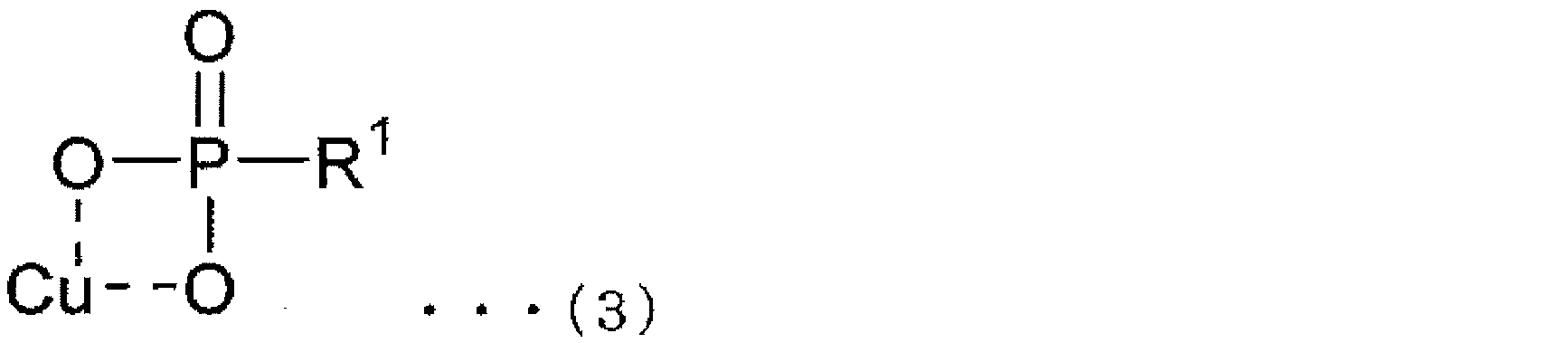
前記一般式(1)および(3)におけるR11としては、水素原子、メチル基、エチル基、プロピル基、ブチル基、ペンチル基、ヘキシル基、ヘプチル基、オクチル基、ノニル基、デシル基、ウンデシル基、ドデシル基、トリデシル基、テトラデシル基、ペンタデシル基、ヘキサデシル基、ヘプタデシル基、オクタデシル基、パーフルオロエチル基、パーフルオロプロピル基、パーフルオロ-n-ブチル基、パーフルオロへキシル基、パーフルオロオクチル基、パーフルオロデシル基等が挙げられる。
また、工程Aにより近赤外線吸収剤を含む反応混合物を製造する際には、前記一般式(1)および(3)における前記R11が炭素数の大きな基、分子鎖の長い基であると、分散性が低下する傾向があるため、R11としては、水素原子または炭素数が1~10のアルキル基であることが好ましく、炭素数が2~8のアルキル基であることがより好ましい。
本発明に用いられるリン酸エステル化合物分散剤としては、分散剤として用いられるリン酸エステル化合物であればよく、特に限定はないが、好ましくは下記一般式(2a)で表されるリン酸エステル化合物および下記一般式(2b)で表されるリン酸エステル化合物から選択される少なくとも1種のリン酸エステル化合物が用いられる。
なお、本発明において、「一般式(2a)で表されるリン酸エステル化合物および一般式(2b)で表されるリン酸エステル化合物から選択される少なくとも1種のリン酸エステル化合物」を、「特定のリン酸エステル化合物」とも記す。

nは2~65の整数であり、R5は、炭素数6~25のアルキル基又は炭素数6~25のアルキルフェニル基を示す。ただし、R21、R22およびR23は、それぞれ同一でも異なっていてもよい。]
前記一般式(2a)で表されるリン酸エステル化合物および前記一般式(2b)で表されるリン酸エステル化合物から選択される少なくとも1種のリン酸エステル化合物において、R21、R22およびR23は、-(CH2CH2O)nR5で表される1価の基(ポリオキシアルキル基)である。nは2~65の整数であり、好ましくは4~65の整数であり、より好ましくは4~45であり、特に好ましくは6~45の整数である。nが2未満である場合には、本発明の近赤外線吸収剤を樹脂と共に用いて、成形体を製造した際に、該成形体の透明性が不充分となる。また、nが65を超えると、充分な透明性を有する成形体を得るために必要な、リン酸エステル化合物の量が増え、コスト高の原因となる。
また、R5は、炭素数6~25のアルキル基または炭素数6~25のアルキルフェニル基であり、炭素数6~25のアルキル基であることが好ましく、8~20のアルキル基であることがより好ましく、12~20のアルキル基であることが特に好ましい。R5が、炭素数6未満の基であると、成形体の透明性が不充分となる。また、R5が、炭素数25を超える基であると、充分な透明性を有する成形体を得るために必要な、リン酸エステル化合物の量が増え、コスト高の原因となる。
工程Aにおいて近赤外線吸収剤を得る際には、前記一般式(2a)で表されるリン酸エステル化合物、前記一般式(2b)で表されるリン酸エステル化合物の少なくとも一方を用いることが好ましいが、前記一般式(2a)で表されるリン酸エステル化合物、前記一般式(2b)で表されるリン酸エステル化合物の両方を用いることがより好ましい。
前記一般式(2a)で表されるリン酸エステル化合物および前記一般式(2b)で表されるリン酸エステル化合物を用いると、成形体の透明性、耐熱性に優れる傾向があり好ましい。前記一般式(2a)で表されるリン酸エステル化合物、前記一般式(2b)で表されるリン酸エステル化合物の両方を用いる場合には、一般式(2a)で表されるリン酸エステル化合物と、一般式(2b)で表されるリン酸エステル化合物との割合は、特に限定されないが、通常はモル比((2a):(2b))で10:90~90:10である。
また、前記一般式(2a)で表されるリン酸エステル化合物としては、一種単独で用いても、二種以上を用いてもよく、前記一般式(2b)で表されるリン酸エステル化合物としては、一種単独で用いても、二種以上を用いてもよい。
また、リン酸エステル化合物分散剤としては、他のリン酸エステルを用いることも可能である。他のリン酸エステルとしては、例えばリン酸トリエステルが挙げられ、該リン酸トリエステルは、単独で用いても、前記特定のリン酸エステル化合物と共に用いてもよい。
前記一般式(2a)で表されるリン酸エステル化合物および前記一般式(2b)で表されるリン酸エステル化合物から選択される少なくとも1種のリン酸エステル化合物としては、市販されているリン酸エステル化合物を用いることもできる。
前記銅塩としては、2価の銅イオンを供給することが可能な銅塩が通常用いられる。前記銅塩としては、前記一般式(3)で表わされるホスホン酸銅塩以外の銅塩であればよい。前記銅塩としては例えば、無水酢酸銅、無水蟻酸銅、無水ステアリン酸銅、無水安息香酸銅、無水エチルアセト酢酸銅、無水ピロリン酸銅、無水ナフテン酸銅、無水クエン酸銅等の有機酸の銅塩、該有機酸の銅塩の水和物もしくは水化物;酸化銅、塩化銅、硫酸銅、硝酸銅、塩基性炭酸銅等の無機酸の銅塩、該無機酸の銅塩の水和物もしくは水化物;水酸化銅が挙げられる。なお、銅塩としては、一種単独で用いても、二種以上を用いてもよい。
銅塩としては、無水酢酸銅、酢酸銅1水和物が、溶解性や副生成物の除去の点から好ましく用いられる。
工程Aで得られる近赤外線吸収剤としては、前記特定のホスホン酸化合物と銅塩とが反応したホスホン酸銅塩が存在し、さらにその周りに前記リン酸エステル化合物分散剤が存在すると考えられる。また、前記ホスホン酸銅塩を構成する前記特定のホスホン酸化合物の一部が、前記リン酸エステル化合物分散剤で置き換わったホスホン酸銅塩も存在すると考えられる。
工程Aで得られる近赤外線吸収剤としては、前記特定のホスホン酸化合物と銅塩とが反応したホスホン酸銅塩が存在し、さらにその周りに前記リン酸エステル化合物分散剤が存在すると考えられる。また、前記ホスホン酸銅塩を構成する前記特定のホスホン酸化合物の一部が、前記リン酸エステル化合物分散剤で置き換わったホスホン酸銅塩も存在すると考えられる。
また、工程Aで用いる前記各成分の量は以下のとおりである。前記特定のホスホン酸化合物は、前記リン酸エステル化合物分散剤1モルあたり、5モル以上用いることが好ましく、8~100モル用いることがより好ましく、10~80モル用いることが特に好ましい。5モルを下回ると、成形体の、近赤外線の吸収特性が悪化する場合や、耐熱性が低下する場合がある。
また、前記特定のホスホン酸化合物は、銅塩中の銅1モルあたり、0.4モル以上であることが好ましく、0.5~1.5モルであることがより好ましく、0.7~1.2モルであることが特に好ましい。前記範囲内では、成形体の透明性、耐熱性が特に優れるため好ましい。
工程Aでは前述のように、前記特定のホスホン酸化合物と、前記リン酸エステル化合物分散剤と、銅塩とを、溶媒中で混合して近赤外線吸収剤を含む反応混合物を得るが、具体的には以下の反応が起きていると考えられる。
前記工程Aでは、主に前記リン酸エステル化合物分散剤の存在下で、前記特定のホスホン酸化合物と、前記銅塩とが反応し、該反応によって、前記溶媒に溶解しない粒子状のホスホン酸銅塩が生成する。前記リン酸エステル化合物分散剤は、反応時に良好な分散剤として作用することができるため、前記ホスホン酸銅塩は分散性が高く保たれ、凝集を抑制することができる。
なお、前記工程Aでは、前記特定のホスホン酸化合物と銅塩との反応のみではなく、例えば前記リン酸エステル化合物分散剤と銅塩とが反応してもよい。また、前記特定のホスホン酸化合物、特定のリン酸エステル化合物、銅塩の一部が反応せずに残存していてもよい。
なお、本発明の近赤外線吸収剤の製造方法では、工程Aで使用する溶媒として、含水率0~8.0質量%の有機溶媒を用いる。含水率が前記範囲内の有機溶媒を用いることにより、得られる近赤外線吸収剤の粒子径を、10~150nmに制御することが可能であり、近赤外線微粒子および樹脂を含む樹脂組成物を用い、成形体を得た場合であっても、ヘイズが低く、透明性に優れる近赤外線吸収剤を製造することが可能である。
前記含水率は、近赤外線吸収剤粒子の凝集を防止する観点から、前記有機溶媒がエタノールあるいは変性エタノールである場合には0~4.0質量%であることが好ましく、0~2.5質量%であることがより好ましく、前記有機溶媒がメタノールである場合には、0~8.0質量%であることが好ましく、0~5.0質量%であることがより好ましい。
前記有機溶媒としては、メタノール、エタノール、イソプロピルアルコール、n-ブタノール、N,N-ジメチルホルムアミド(DMF)、およびテトラヒドロフラン(THF)から選択される少なくとも1種の有機溶媒を含むことが好ましい。また、反応性の観点からメタノール、エタノール、THF、およびDMFから選択される少なくとも1種の有機溶媒を含むことが好ましく、メタノール、およびエタノールから選択される少なくとも1種の有機溶媒を含むことがより好ましい。前記有機溶媒としては、これらの有機溶媒のみでもよく、それ以外の有機溶媒を含んでいてもよい。前記有機溶媒としては、メタノール、エタノール、イソプロピルアルコール、n-ブタノール、DMF、およびTHFから選択される少なくとも1種の有機溶媒(好ましくは、メタノール、エタノール、THF、およびDMFから選択される少なくとも1種の有機溶媒、より好ましくはメタノール、およびエタノールから選択される少なくとも1種の有機溶媒)100質量部に対して、それ以外の有機溶媒が、通常は0~50質量部、好ましくは0~30質量部含まれていてもよい。有機溶媒として、二種以上の有機溶媒を用いる場合に、その具体例としては、エタノールと、少量のその他の有機溶媒とを含む、変性エタノールが挙げられる。変性エタノールは、エタノール100質量部に対してその他の有機溶媒を、通常は3~50質量部、好ましくは3~30質量部含んでいる。変性エタノールとしては、メタノール変性エタノール、イソプロピルアルコール変性エタノール、トルエン変性エタノールが挙げられる。
また、工程Aは、通常は0~80℃、好ましくは10~60℃、より好ましくは室温~60℃、特に好ましくは20~40℃の温度条件で、通常は0.5~60時間、好ましくは0.5~30時間、より好ましくは0.5~20時間、特に好ましくは1~15時間行われる。
該反応によって、近赤外線吸収剤を含む反応混合物が得られる。反応混合物には、近赤外線吸収剤以外に、溶媒、用いる原料に依存する副生成物、未反応の原料等が含まれ得る。
該反応によって、近赤外線吸収剤を含む反応混合物が得られる。反応混合物には、近赤外線吸収剤以外に、溶媒、用いる原料に依存する副生成物、未反応の原料等が含まれ得る。
[工程B]
本発明の近赤外線吸収剤の製造方法では、前述の工程Aで得られた反応混合物から溶媒を回収する工程Bを行う。
本発明の近赤外線吸収剤の製造方法では、前述の工程Aで得られた反応混合物から溶媒を回収する工程Bを行う。
工程Aで得られた反応混合物から溶媒を回収する方法としては、例えば反応混合物中の固形分を沈降させ、溶媒を上澄み液として回収する方法、反応混合物を蒸留することにより溶媒を留分として回収する方法が挙げられる。
固形分を沈降させる方法としては、例えば反応混合物を静置することにより固形分を沈降させる方法や、反応混合物を遠心分離し、固形分を沈降させる方法が挙げられる。
溶媒を回収する方法としては、一般的な装置を使用できる観点から、反応混合物を蒸留することにより溶媒を留分として回収する方法が好ましい。
溶媒を回収する方法としては、一般的な装置を使用できる観点から、反応混合物を蒸留することにより溶媒を留分として回収する方法が好ましい。
蒸留は、反応混合物の熱劣化を防止する観点から減圧下で行われることが好ましい。すなわち、工程Bは、反応混合物を減圧蒸留することにより、留分として溶媒を回収する工程であることが好ましい。
減圧蒸留を行う場合には、有機溶媒の種類によっても異なるが、減圧蒸留の条件としては通常は圧力0.01~15kPaで行われる。なお留分の流出温度は、有機溶媒の種類、圧力によって異なるが通常は30~150℃である。
[工程C]
本発明の近赤外線吸収剤の製造方法では、前述の工程Bで回収された溶媒を、工程Aの溶媒として使用する工程Cを行う。
本発明の近赤外線吸収剤の製造方法では、前述の工程Bで回収された溶媒を、工程Aの溶媒として使用する工程Cを行う。
工程Bで回収された溶媒を、工程Aで使用する具体的な方法としては特に限定はなく、回収した溶媒を、次にバッチ生産を行う際に再利用してもよく、連続生産する際の溶媒として再利用してもよい。
本発明の近赤外線吸収剤の製造方法は、溶媒を繰り返し利用することができるため、資源の削減、コスト削減の観点からも優れた製法である。
なお、溶媒を繰り返し使用すると、工程Bで回収される溶媒の含水率が徐々に高くなる傾向がある。工程Bで回収された溶媒の含水率が前記範囲を上回る場合や、溶媒の含水率を下げたい場合には、回収された溶媒の一部または全部を、含水率の低い新たな有機溶媒と交換してもよく、工程Bで回収された溶媒の含水率を低減させるために、工程Aで使用する前に蒸留、脱水剤添加等の処理を行ってもよい。
なお、溶媒を繰り返し使用すると、工程Bで回収される溶媒の含水率が徐々に高くなる傾向がある。工程Bで回収された溶媒の含水率が前記範囲を上回る場合や、溶媒の含水率を下げたい場合には、回収された溶媒の一部または全部を、含水率の低い新たな有機溶媒と交換してもよく、工程Bで回収された溶媒の含水率を低減させるために、工程Aで使用する前に蒸留、脱水剤添加等の処理を行ってもよい。
上述の方法により、近赤外線吸収剤を製造することができる。本発明の製造方法では、工程Aを行った後に、該工程Aで得られた反応混合物から溶媒を回収する工程Bを行うが、該工程Bによって得られる溶媒が回収された反応混合物が、前述のホスホン酸銅塩を含む近赤外線吸収剤である。該溶媒が回収された反応混合物をそのまま近赤外線吸収剤として用いてもよいが、さらに他の工程を行った後に近赤外線吸収剤として使用してもよい。
他の工程としては例えば、近赤外線吸収剤を精製する目的で、溶媒が回収された反応混合物を、分散媒に分散し、該分散媒を除去する工程を行ってもよい。
また、溶媒が回収された反応混合物を、分散媒に分散し、近赤外線吸収剤の分散液として、各用途に用いてもよい。
また、溶媒が回収された反応混合物を、分散媒に分散し、近赤外線吸収剤の分散液として、各用途に用いてもよい。
なお、前記分散媒としては、トルエン、キシレン、メタノール、テトラヒドロフラン(THF)、ジメチルホルムアミド(DMF)、塩化メチレン、クロロホルム、トリエチレングリコールビス(2-エチルヘキサノエート)等が挙げられ、分散媒としては、一種単独で用いても、二種以上を混合して用いてもよい。
[近赤外線吸収剤]
本発明の近赤外線吸収剤は、前述の近赤外線吸収剤の製造方法によって得られる。
本発明の近赤外線吸収剤は、前記製造方法により得られ、樹脂と共に用いた場合の透明性に優れるため、前記近赤外線吸収剤および樹脂からなる樹脂組成物は、合わせガラス用中間膜等の各種成形体を好適に製造することが可能である。
また、本発明の近赤外線吸収剤の平均粒子径は、好ましくは10~150nmであり、より好ましくは20~140nmである。
本発明の近赤外線吸収剤は、前述の近赤外線吸収剤の製造方法によって得られる。
本発明の近赤外線吸収剤は、前記製造方法により得られ、樹脂と共に用いた場合の透明性に優れるため、前記近赤外線吸収剤および樹脂からなる樹脂組成物は、合わせガラス用中間膜等の各種成形体を好適に製造することが可能である。
また、本発明の近赤外線吸収剤の平均粒子径は、好ましくは10~150nmであり、より好ましくは20~140nmである。
[樹脂組成物]
本発明の樹脂組成物は、前述の近赤外線吸収剤および樹脂を含む。
該樹脂組成物の製造方法としては例えば、近赤外線吸収剤粉末と、樹脂とを混合することにより樹脂組成物を得る方法、前記近赤外線吸収剤を前述の分散媒に分散させ、得られた分散液と、樹脂とを混合し、得られた混合物から分散媒を除去することにより、樹脂組成物を得る方法、前記分散液と、樹脂の溶液とを混合し、得られた混合物から分散媒および溶媒を除去することにより、樹脂組成物を得る方法が挙げられる。
本発明の樹脂組成物は、前述の近赤外線吸収剤および樹脂を含む。
該樹脂組成物の製造方法としては例えば、近赤外線吸収剤粉末と、樹脂とを混合することにより樹脂組成物を得る方法、前記近赤外線吸収剤を前述の分散媒に分散させ、得られた分散液と、樹脂とを混合し、得られた混合物から分散媒を除去することにより、樹脂組成物を得る方法、前記分散液と、樹脂の溶液とを混合し、得られた混合物から分散媒および溶媒を除去することにより、樹脂組成物を得る方法が挙げられる。
前記分散媒の除去や、分散媒および溶媒の除去を行う際には、その除去方法としては特に限定はないが、通常は常圧下での乾燥、真空乾燥等の乾燥により行われる。
なお、該樹脂組成物からなる成形体を得る場合には、該樹脂組成物の製造と成形を同時に行うことにより成形体を得てもよく、該樹脂組成物をペレット等として製造した後に、所望の形状に成形することにより、成形体を得てもよく、樹脂組成物をペレット等のマスターバッチとして得た後に、該マスターバッチおよび樹脂を用い、押出成形、キャスト成形、射出成形等の様々な成形法により、合わせガラス用中間膜等の成形体を得てもよい。
なお、該樹脂組成物からなる成形体を得る場合には、該樹脂組成物の製造と成形を同時に行うことにより成形体を得てもよく、該樹脂組成物をペレット等として製造した後に、所望の形状に成形することにより、成形体を得てもよく、樹脂組成物をペレット等のマスターバッチとして得た後に、該マスターバッチおよび樹脂を用い、押出成形、キャスト成形、射出成形等の様々な成形法により、合わせガラス用中間膜等の成形体を得てもよい。
なお、前記樹脂としては、前述の近赤外線吸収剤を分散することが可能であればよく特に限定はないが、例えば以下の樹脂を用いることができる。
本発明に用いる樹脂としては、ポリビニルアセタール樹脂、エチレン‐酢酸ビニル共重合体、(メタ)アクリル酸樹脂、ポリエステル樹脂、ポリウレタン樹脂、塩化ビニル樹脂、ポリオレフィン樹脂、ポリカーボネート樹脂、およびノルボルネン樹脂から選択される少なくとも1種の樹脂が、近赤外線吸収剤を良好に分散することが可能であり、かつ可視光の透過性に優れることが好ましい。
本発明に用いる樹脂としては、ポリビニルアセタール樹脂、エチレン‐酢酸ビニル共重合体、(メタ)アクリル酸樹脂、ポリエステル樹脂、ポリウレタン樹脂、塩化ビニル樹脂、ポリオレフィン樹脂、ポリカーボネート樹脂、およびノルボルネン樹脂から選択される少なくとも1種の樹脂が、近赤外線吸収剤を良好に分散することが可能であり、かつ可視光の透過性に優れることが好ましい。
本発明に用いる樹脂としては、ポリビニルアセタール樹脂、またはエチレン‐酢酸ビニル共重合体から選択される少なくとも1種の樹脂であることがより好ましく、ポリビニルブチラール樹脂(PVB)、またはエチレン‐酢酸ビニル共重合体から選択される少なくとも1種の樹脂であることが特に好ましい。ポリビニルアセタール樹脂を用いると、前述の近赤外線吸収剤の分散性に優れ、本発明の樹脂組成物を用いて、例えば合わせガラス用中間膜を製造した場合には、ガラス等への密着性に優れ、また、樹脂組成物が柔軟であり、かつ温度変化に伴う近赤外線吸収剤の変形が起こり難いため好ましい。また、ポリビニルアセタール樹脂としては、ポリビニルブチラール樹脂(PVB)を用いることが、ガラス密着性、分散性、透明性、耐熱性、耐光性などの観点から好ましい。
ポリビニルアセタール樹脂は、必要な物性に応じて、二種以上を組み合わせたブレンド物であってもよく、アセタール化時にアルデヒドを組み合わせてアセタール化することにより得られるポリビニルアセタール樹脂であってもよい。上記ポリビニルアセタール樹脂の分子量、分子量分布およびアセタール化度は特に限定されないが、アセタール化度は、一般に40~85%であり、好ましい下限は60%、上限は75%である。
ポリビニルアセタール樹脂は、ポリビニルアルコール樹脂をアルデヒドによりアセタール化することにより得ることができる。上記ポリビニルアルコール樹脂は、一般にポリ酢酸ビニルを鹸化することにより得られるものであり、鹸化度80~99.8モル%のポリビニルアルコール樹脂が一般的に用いられる。上記ポリビニルアルコール樹脂の粘度平均重合度は好ましい下限は200、上限は3000である。200未満であると、得られる合わせガラスの耐貫通性が低下する場合がある。3000を超えると、樹脂組成物の成形性が悪くなる場合があり、しかも樹脂組成物の剛性が大きくなり過ぎ、加工性が悪くなる。より好ましい下限は500、上限は2200である。なお、ポリビニルアルコール樹脂の粘度平均重合度、および鹸化度は、例えば、JISK 6726「ポリビニルアルコール試験方法」に基づいて測定することができる。
アルデヒドとしては特に限定されず、例えば、炭素数が1~10のアルデヒド等が挙げられ、より具体的には、例えば、n-ブチルアルデヒド、イソブチルアルデヒド、n-バレルアルデヒド、2-エチルブチルアルテヒド、n-へキシルアルデヒド、n-オクチルアルデヒド、n-ノニルアルデヒド、n-デシルアルデヒド、ホルムアルデヒド、アセトアルデヒド、ベンズアルデヒド等が挙げられる。なかでも、n-ブチルアルデヒド、n-へキシルアルデヒド、n-バレルアルデヒド等が好ましい。より好ましくは、炭素数が4のブチルアルデヒドである。
また、エチレン‐酢酸ビニル共重合体を用いると、前述の近赤外線吸収剤の分散性に優れ、ガラス密着性、分散性、透明性、耐熱性、耐光性などの観点から好ましい。
なお、前記樹脂の溶液は、前述の樹脂を溶媒に溶解することにより得ることができる。溶媒としては樹脂を溶解できればよく、特に限定はないが例えばトルエン、エタノール、メタノール、塩化メチレン、クロロホルム等が挙げられる。溶媒としては一種単独でも、二種以上を用いてもよい。
なお、前記樹脂の溶液は、前述の樹脂を溶媒に溶解することにより得ることができる。溶媒としては樹脂を溶解できればよく、特に限定はないが例えばトルエン、エタノール、メタノール、塩化メチレン、クロロホルム等が挙げられる。溶媒としては一種単独でも、二種以上を用いてもよい。
また、本発明の樹脂組成物は、可塑剤を含有してもよい。前記可塑剤としては特に限定はないが、例えばトリエチレングリコールビス(2-エチルヘキサノエート)、トリエチレングリコールビス(2-エチルブチラート)、テトラエチレングリコールビス(2-エチルヘキサノエート)、テトラエチレングリコールジヘプタノエート、ジヘキシルアジペート、トリブトキシエチルホスフェート、イソデシルフェニルホスフェート等が挙げられる。
本発明の樹脂組成物は、前記樹脂100質量部あたり、近赤外線吸収剤を0.5~30質量部含有することが好ましく、1~25質量部含有することがより好ましい。0.5質量部より少ないと充分な近赤外線吸収特性が得られない可能性があり、30質量部より多すぎると樹脂の耐熱性、耐光性、透明性やガラスとの接着性が大幅に低下するおそれがある。
本発明の樹脂組成物が前記可塑剤を含有する場合には、前記樹脂100質量部あたり、可塑剤を10~60質量部含有することが好ましく、20~50質量部含有することがより好ましい。
本発明の樹脂組成物に含有される近赤外線吸収剤は、樹脂と共に用いた場合の透明性に優れ、加熱時の着色、すなわち黄変が抑制されているため合わせガラス等の構造材料用の中間膜として好適に使用することが可能である。
また、本発明の樹脂組成物には、各種添加剤が含有されていてもよい。添加剤としては、例えば分散剤、酸化防止剤、紫外線吸収剤、光安定剤等が挙げられる。これらの添加剤は、本発明の樹脂組成物を製造する際に、添加されてもよく、近赤外線吸収剤、樹脂それぞれを製造する際に添加されてもよい。
〔樹脂組成物の用途〕
本発明の樹脂組成物は、近赤外線を吸収することが望まれる用途に通常は用いられる。
本発明の樹脂組成物から形成される樹脂膜は、近赤外線吸収能に優れ、加熱時の着色、すなわち黄変が抑制されているため、合わせガラス用中間膜等の構造材料用中間膜として好適に用いることが可能である。
本発明の樹脂組成物は、近赤外線を吸収することが望まれる用途に通常は用いられる。
本発明の樹脂組成物から形成される樹脂膜は、近赤外線吸収能に優れ、加熱時の着色、すなわち黄変が抑制されているため、合わせガラス用中間膜等の構造材料用中間膜として好適に用いることが可能である。
また、本発明の合わせガラスは、前記合わせガラス用中間膜を有している。本発明の合わせガラスを構成するガラスとしては特に限定はなく、従来公知のものを用いることができる。
次に本発明について実施例を示してさらに詳細に説明するが、本発明はこれらによって限定されるものではない。
〔試験例1〕
(ホスホン酸銅錯体(1)の合成)
200mlナスフラスコに、酢酸銅一水和物1.164g(5.83mmol)、エタノール(水分含有量0.07質量%)35g、リン酸エステル化合物であるプライサーフA219B(第一工業製薬製)0.50gを加えた(A液)。
〔試験例1〕
(ホスホン酸銅錯体(1)の合成)
200mlナスフラスコに、酢酸銅一水和物1.164g(5.83mmol)、エタノール(水分含有量0.07質量%)35g、リン酸エステル化合物であるプライサーフA219B(第一工業製薬製)0.50gを加えた(A液)。
別の容器に、n-ブチルホスホン酸0.789gを前記エタノール(水分含有量0.07質量%)20gに溶解した溶液(B液)を作成した。
なお、エタノール中の水分含有量は、微量水分測定装置AQ-2200(平沼産業製)を用いて測定した。
なお、エタノール中の水分含有量は、微量水分測定装置AQ-2200(平沼産業製)を用いて測定した。
B液を、A液に対して約5分で滴下した。この反応液を20℃で14時間撹拌し、近赤外線吸収剤であるホスホン酸銅錯体(1)を含む反応混合物を得た。
次いで、下記溶媒回収操作を行うことにより前記反応混合物から溶媒を留去した。
次いで、下記溶媒回収操作を行うことにより前記反応混合物から溶媒を留去した。
溶媒が留去された反応混合物(残部)にトルエン30gを加え、恒量になるまでエバポレーターで留去することにより、収量1.66g(収率100%)の青緑色固体(ホスホン酸銅錯体(1))が得られた。
前記青緑色固体にトルエン30gを加え、超音波照射を3時間行い、ホスホン酸銅錯体トルエン分散液(1)を作成した。トルエン分散液(1)の平均粒径を測定したところ、52nmであった。なお、前記銅錯体の粒径測定は、粒径測定装置ELS-Z2(大塚電子製)、セルとしてセル長10mmの石英セル、濃度調整用の溶媒としてトルエンを用い、温度25℃、濃度0.1~0.6mol/Lの条件で行った。
<溶媒回収操作>
前記反応混合物を、減圧単蒸留(圧力1~4kPa、温度50~70℃)することにより、溶媒を回収した。
前記反応混合物を、減圧単蒸留(圧力1~4kPa、温度50~70℃)することにより、溶媒を回収した。
(銅塩微粒子分散樹脂(1)の調製)
500mlビーカーに、トリエチレングリコールビス(2-エチルヘキサノエート)2.43g、塩化メチレン300ml、ポリビニルブチラール(PVB)6.38gを加えた。これに前記ホスホン酸銅錯体トルエン分散液(1)4.05g(銅錯体を0.746mmol含む)を添加し、20℃で14時間撹拌し、PVBを均一に溶解させた。この分散液をテフロン(登録商標)製バットに広げ、12時間20℃で風乾した。さらに70℃で4時間真空乾燥を行って溶媒を完全に除去し、銅錯体微粒子が分散したPVB樹脂(1)を得た。
500mlビーカーに、トリエチレングリコールビス(2-エチルヘキサノエート)2.43g、塩化メチレン300ml、ポリビニルブチラール(PVB)6.38gを加えた。これに前記ホスホン酸銅錯体トルエン分散液(1)4.05g(銅錯体を0.746mmol含む)を添加し、20℃で14時間撹拌し、PVBを均一に溶解させた。この分散液をテフロン(登録商標)製バットに広げ、12時間20℃で風乾した。さらに70℃で4時間真空乾燥を行って溶媒を完全に除去し、銅錯体微粒子が分散したPVB樹脂(1)を得た。
(樹脂シート(1)の調製)
前記銅錯体微粒子が分散したPVB樹脂(1)を、厚さ0.8mmの型枠および(株)神藤金属工業所製の圧縮成形機を用い、120℃、3MPaで予熱1分間を行った後、15MPaで3分間プレスし、樹脂シート(1)を得た。
前記銅錯体微粒子が分散したPVB樹脂(1)を、厚さ0.8mmの型枠および(株)神藤金属工業所製の圧縮成形機を用い、120℃、3MPaで予熱1分間を行った後、15MPaで3分間プレスし、樹脂シート(1)を得た。
(ヘイズ測定サンプル(1)の調製)
前記樹脂シート(1)の両面を、スライドガラス(厚み1.2~1.5mm)で挟み、70℃のプレート上で合わせガラス(1)とした。
前記樹脂シート(1)の両面を、スライドガラス(厚み1.2~1.5mm)で挟み、70℃のプレート上で合わせガラス(1)とした。
該合わせガラス(1)をオートクレーブ内で、窒素雰囲気下、圧力1.5MPa、130℃で0.5時間加熱し、樹脂シートの両面にスライドガラスが配設されたヘイズ測定サンプル(1)を得た。
前記ヘイズ測定サンプル(1)のヘイズを、日本電色工業 NDH-2000(D65光源, シングルビーム)を使用して測定したところ、ヘイズは1.2であった。
前記ヘイズ測定サンプル(1)のヘイズを、日本電色工業 NDH-2000(D65光源, シングルビーム)を使用して測定したところ、ヘイズは1.2であった。
(ホスホン酸銅錯体(2)の合成)
銅錯体合成時の溶媒を、前記ホスホン酸銅錯体(1)の合成における溶媒回収操作により回収したエタノール(水分含有量0.6質量%)(ホスホン酸銅錯体の合成に使用後回収する操作を1回行ったエタノール)に代えた以外は、前記ホスホン酸銅錯体(1)の合成と同様に行い、ホスホン酸銅錯体トルエン分散液(2)を作成した。トルエン分散液(2)の平均粒径を測定したところ、60nmであった。
銅錯体合成時の溶媒を、前記ホスホン酸銅錯体(1)の合成における溶媒回収操作により回収したエタノール(水分含有量0.6質量%)(ホスホン酸銅錯体の合成に使用後回収する操作を1回行ったエタノール)に代えた以外は、前記ホスホン酸銅錯体(1)の合成と同様に行い、ホスホン酸銅錯体トルエン分散液(2)を作成した。トルエン分散液(2)の平均粒径を測定したところ、60nmであった。
(銅塩微粒子分散樹脂(2)、樹脂シート(2)、ヘイズ測定サンプル(2)の調製)
ホスホン酸銅錯体トルエン分散液(1)を、ホスホン酸銅錯体トルエン分散液(2)に代えた以外は、銅塩微粒子分散樹脂(1)の調製、樹脂シート(1)の調製、ヘイズ測定サンプル(1)の調製と同様に行い、銅塩微粒子分散樹脂(2)、樹脂シート(2)、ヘイズ測定サンプル(2)を得た。
ヘイズ測定サンプル(2)のヘイズは、1.2であった。
ホスホン酸銅錯体トルエン分散液(1)を、ホスホン酸銅錯体トルエン分散液(2)に代えた以外は、銅塩微粒子分散樹脂(1)の調製、樹脂シート(1)の調製、ヘイズ測定サンプル(1)の調製と同様に行い、銅塩微粒子分散樹脂(2)、樹脂シート(2)、ヘイズ測定サンプル(2)を得た。
ヘイズ測定サンプル(2)のヘイズは、1.2であった。
(ホスホン酸銅錯体(3)の合成)
銅錯体合成時の溶媒を、前記ホスホン酸銅錯体(2)の合成における溶媒回収操作により回収したエタノール(水分含有量1.1質量%)(ホスホン酸銅錯体の合成に使用後回収する操作を2回行ったエタノール)に代えた以外は、前記ホスホン酸銅錯体(1)の合成と同様に行い、ホスホン酸銅錯体トルエン分散液(3)を作成した。トルエン分散液(3)の平均粒径を測定したところ、65nmであった。
銅錯体合成時の溶媒を、前記ホスホン酸銅錯体(2)の合成における溶媒回収操作により回収したエタノール(水分含有量1.1質量%)(ホスホン酸銅錯体の合成に使用後回収する操作を2回行ったエタノール)に代えた以外は、前記ホスホン酸銅錯体(1)の合成と同様に行い、ホスホン酸銅錯体トルエン分散液(3)を作成した。トルエン分散液(3)の平均粒径を測定したところ、65nmであった。
(銅塩微粒子分散樹脂(3)、樹脂シート(3)、ヘイズ測定サンプル(3)の調製)
ホスホン酸銅錯体トルエン分散液(1)を、ホスホン酸銅錯体トルエン分散液(3)に代えた以外は、銅塩微粒子分散樹脂(1)の調製、樹脂シート(1)の調製、ヘイズ測定サンプル(1)の調製と同様に行い、銅塩微粒子分散樹脂(3)、樹脂シート(3)、ヘイズ測定サンプル(3)を得た。
ヘイズ測定サンプル(3)のヘイズは、1.1であった。
ホスホン酸銅錯体トルエン分散液(1)を、ホスホン酸銅錯体トルエン分散液(3)に代えた以外は、銅塩微粒子分散樹脂(1)の調製、樹脂シート(1)の調製、ヘイズ測定サンプル(1)の調製と同様に行い、銅塩微粒子分散樹脂(3)、樹脂シート(3)、ヘイズ測定サンプル(3)を得た。
ヘイズ測定サンプル(3)のヘイズは、1.1であった。
(ホスホン酸銅錯体(4)の合成)
銅錯体合成時の溶媒を、前記ホスホン酸銅錯体(3)の合成における溶媒回収操作により回収したエタノールを、さらにホスホン酸銅塩錯体の合成に使用し、溶媒回収操作により回収したエタノール(水分含有量2.1質量%)(ホスホン酸銅錯体の合成に使用後回収する操作を4回行ったエタノール)に代えた以外は、前記ホスホン酸銅錯体(1)の合成と同様に行い、ホスホン酸銅錯体トルエン分散液(4)を作成した。トルエン分散液(4)の平均粒径を測定したところ、68nmであった。
銅錯体合成時の溶媒を、前記ホスホン酸銅錯体(3)の合成における溶媒回収操作により回収したエタノールを、さらにホスホン酸銅塩錯体の合成に使用し、溶媒回収操作により回収したエタノール(水分含有量2.1質量%)(ホスホン酸銅錯体の合成に使用後回収する操作を4回行ったエタノール)に代えた以外は、前記ホスホン酸銅錯体(1)の合成と同様に行い、ホスホン酸銅錯体トルエン分散液(4)を作成した。トルエン分散液(4)の平均粒径を測定したところ、68nmであった。
(銅塩微粒子分散樹脂(4)、樹脂シート(4)、ヘイズ測定サンプル(4)の調製)
ホスホン酸銅錯体トルエン分散液(1)を、ホスホン酸銅錯体トルエン分散液(4)に代えた以外は、銅塩微粒子分散樹脂(1)の調製、樹脂シート(1)の調製、ヘイズ測定サンプル(1)の調製と同様に行い、銅塩微粒子分散樹脂(4)、樹脂シート(4)、ヘイズ測定サンプル(4)を得た。
ヘイズ測定サンプル(4)のヘイズは、0.9であった。
ホスホン酸銅錯体トルエン分散液(1)を、ホスホン酸銅錯体トルエン分散液(4)に代えた以外は、銅塩微粒子分散樹脂(1)の調製、樹脂シート(1)の調製、ヘイズ測定サンプル(1)の調製と同様に行い、銅塩微粒子分散樹脂(4)、樹脂シート(4)、ヘイズ測定サンプル(4)を得た。
ヘイズ測定サンプル(4)のヘイズは、0.9であった。
(ホスホン酸銅錯体(5)の合成)
銅錯体合成時の溶媒を、前記ホスホン酸銅錯体(4)の合成における溶媒回収操作により回収したエタノールを、さらにホスホン酸銅塩錯体の合成に使用し、溶媒回収操作により回収したエタノール(水分含有量3.1質量%)(ホスホン酸銅錯体の合成に使用後回収する操作を6回行ったエタノール)に代えた以外は、前記ホスホン酸銅錯体(1)の合成と同様に行い、ホスホン酸銅錯体トルエン分散液(5)を作成した。トルエン分散液(5)の平均粒径を測定したところ、131nmであった。
銅錯体合成時の溶媒を、前記ホスホン酸銅錯体(4)の合成における溶媒回収操作により回収したエタノールを、さらにホスホン酸銅塩錯体の合成に使用し、溶媒回収操作により回収したエタノール(水分含有量3.1質量%)(ホスホン酸銅錯体の合成に使用後回収する操作を6回行ったエタノール)に代えた以外は、前記ホスホン酸銅錯体(1)の合成と同様に行い、ホスホン酸銅錯体トルエン分散液(5)を作成した。トルエン分散液(5)の平均粒径を測定したところ、131nmであった。
(銅塩微粒子分散樹脂(5)、樹脂シート(5)、ヘイズ測定サンプル(5)の調製)
ホスホン酸銅錯体トルエン分散液(1)を、ホスホン酸銅錯体トルエン分散液(5)に代えた以外は、銅塩微粒子分散樹脂(1)の調製、樹脂シート(1)の調製、ヘイズ測定サンプル(1)の調製と同様に行い、銅塩微粒子分散樹脂(5)、樹脂シート(5)、ヘイズ測定サンプル(5)を得た。
ヘイズ測定サンプル(5)のヘイズは、2.8であった。
ホスホン酸銅錯体トルエン分散液(1)を、ホスホン酸銅錯体トルエン分散液(5)に代えた以外は、銅塩微粒子分散樹脂(1)の調製、樹脂シート(1)の調製、ヘイズ測定サンプル(1)の調製と同様に行い、銅塩微粒子分散樹脂(5)、樹脂シート(5)、ヘイズ測定サンプル(5)を得た。
ヘイズ測定サンプル(5)のヘイズは、2.8であった。
〔試験例2〕
(ホスホン酸銅錯体(6)の合成)
200mlナスフラスコに、酢酸銅一水和物1.164g(5.83mmol)、メタノール(水分含有量0.007質量%)35gを加えた(A液)。
(ホスホン酸銅錯体(6)の合成)
200mlナスフラスコに、酢酸銅一水和物1.164g(5.83mmol)、メタノール(水分含有量0.007質量%)35gを加えた(A液)。
別の容器に、リン酸エステル化合物であるプライサーフA219B(第一工業製薬製)を0.291g、n-ブチルホスホン酸0.801gを前記メタノール(水分含有量0.007質量%)30gに溶解した溶液(B液)を作成した。
なお、メタノール中の水分含有量は、微量水分測定装置AQ-2200(平沼産業製)を用いて測定した。
B液を、A液に対して約1.5時間で滴下した。この反応液を20℃で12時間撹拌し、近赤外線吸収剤であるホスホン酸銅錯体(6)を含む反応混合物を得た。
B液を、A液に対して約1.5時間で滴下した。この反応液を20℃で12時間撹拌し、近赤外線吸収剤であるホスホン酸銅錯体(6)を含む反応混合物を得た。
次いで、下記溶媒回収操作を行うことにより前記反応混合物から溶媒を留去した。
溶媒が留去された反応混合物(残部)にトルエン30gを加え、恒量になるまでエバポレーターで留去することにより、収量1.45g(収率100%)の薄い青白色固体(ホスホン酸銅錯体(6))が得られた。
溶媒が留去された反応混合物(残部)にトルエン30gを加え、恒量になるまでエバポレーターで留去することにより、収量1.45g(収率100%)の薄い青白色固体(ホスホン酸銅錯体(6))が得られた。
前記青白色固体にトルエン30gを加え、超音波照射を5時間行い、ホスホン酸銅錯体トルエン分散液(6)を作成した。トルエン分散液(6)の平均粒径を測定したところ、55nmであった。
<溶媒回収操作>
前記反応混合物を、減圧単蒸留(圧力1~4kPa、温度40~60℃)することにより、溶媒を回収した。
前記反応混合物を、減圧単蒸留(圧力1~4kPa、温度40~60℃)することにより、溶媒を回収した。
(銅塩微粒子分散樹脂(6)の調製)
300ml三角フラスコに、トリエチレングリコールビス(2-エチルヘキサノエート)1.90g、トルエン250ml、ポリビニルブチラール(PVB)5.00gを加えた。これに前記ホスホン酸銅錯体トルエン分散液(6)3.15g(銅錯体を0.583mmol含む)を添加し、20℃で12時間撹拌、超音波照射を2時間行い、PVBを均一に溶解させた。この分散液をテフロン(登録商標)製バットに広げ、12時間20℃で風乾した。さらに40℃で5時間、70℃で4時間真空乾燥を行って溶媒を完全に除去し、銅錯体微粒子が分散したPVB樹脂(6)を得た。
300ml三角フラスコに、トリエチレングリコールビス(2-エチルヘキサノエート)1.90g、トルエン250ml、ポリビニルブチラール(PVB)5.00gを加えた。これに前記ホスホン酸銅錯体トルエン分散液(6)3.15g(銅錯体を0.583mmol含む)を添加し、20℃で12時間撹拌、超音波照射を2時間行い、PVBを均一に溶解させた。この分散液をテフロン(登録商標)製バットに広げ、12時間20℃で風乾した。さらに40℃で5時間、70℃で4時間真空乾燥を行って溶媒を完全に除去し、銅錯体微粒子が分散したPVB樹脂(6)を得た。
(樹脂シート(6)、ヘイズ測定サンプル(6)の調製)
樹脂シート(1)を、樹脂シート(6)に代えた以外は、樹脂シート(1)の調製、ヘイズ測定サンプル(1)の調製と同様に行い、樹脂シート(6)、ヘイズ測定サンプル(6)を得た。
ヘイズ測定サンプル(6)のヘイズは、0.9であった。
樹脂シート(1)を、樹脂シート(6)に代えた以外は、樹脂シート(1)の調製、ヘイズ測定サンプル(1)の調製と同様に行い、樹脂シート(6)、ヘイズ測定サンプル(6)を得た。
ヘイズ測定サンプル(6)のヘイズは、0.9であった。
(ホスホン酸銅錯体(7)の合成)
銅錯体合成時の溶媒を、前記ホスホン酸銅錯体(6)の合成における溶媒回収操作により回収したメタノール(水分含有量0.08質量%)(ホスホン酸銅錯体の合成に使用後回収する操作を1回行ったメタノール)に代えた以外は、前記ホスホン酸銅錯体(6)の合成と同様に行い、ホスホン酸銅錯体トルエン分散液(7)を作成した。トルエン分散液(7)の平均粒径を測定したところ、62nmであった。
銅錯体合成時の溶媒を、前記ホスホン酸銅錯体(6)の合成における溶媒回収操作により回収したメタノール(水分含有量0.08質量%)(ホスホン酸銅錯体の合成に使用後回収する操作を1回行ったメタノール)に代えた以外は、前記ホスホン酸銅錯体(6)の合成と同様に行い、ホスホン酸銅錯体トルエン分散液(7)を作成した。トルエン分散液(7)の平均粒径を測定したところ、62nmであった。
(銅塩微粒子分散樹脂(7)、樹脂シート(7)、ヘイズ測定サンプル(7)の調製)
ホスホン酸銅錯体トルエン分散液(6)を、ホスホン酸銅錯体トルエン分散液(7)に代えた以外は、銅塩微粒子分散樹脂(6)の調製、樹脂シート(6)の調製、ヘイズ測定サンプル(6)の調製と同様に行い、銅塩微粒子分散樹脂(7)、樹脂シート(7)、ヘイズ測定サンプル(7)を得た。
ヘイズ測定サンプル(7)のヘイズは、1.2であった。
ホスホン酸銅錯体トルエン分散液(6)を、ホスホン酸銅錯体トルエン分散液(7)に代えた以外は、銅塩微粒子分散樹脂(6)の調製、樹脂シート(6)の調製、ヘイズ測定サンプル(6)の調製と同様に行い、銅塩微粒子分散樹脂(7)、樹脂シート(7)、ヘイズ測定サンプル(7)を得た。
ヘイズ測定サンプル(7)のヘイズは、1.2であった。
(ホスホン酸銅錯体(8)の合成)
銅錯体合成時の溶媒を、前記ホスホン酸銅錯体(7)の合成における溶媒回収操作により回収したメタノール(水分含有量0.19質量%)(ホスホン酸銅錯体の合成に使用後回収する操作を2回行ったメタノール)に代えた以外は、前記ホスホン酸銅錯体(6)の合成と同様に行い、ホスホン酸銅錯体トルエン分散液(8)を作成した。トルエン分散液(8)の平均粒径を測定したところ、68nmであった。
銅錯体合成時の溶媒を、前記ホスホン酸銅錯体(7)の合成における溶媒回収操作により回収したメタノール(水分含有量0.19質量%)(ホスホン酸銅錯体の合成に使用後回収する操作を2回行ったメタノール)に代えた以外は、前記ホスホン酸銅錯体(6)の合成と同様に行い、ホスホン酸銅錯体トルエン分散液(8)を作成した。トルエン分散液(8)の平均粒径を測定したところ、68nmであった。
(銅塩微粒子分散樹脂(8)、樹脂シート(8)、ヘイズ測定サンプル(8)の調製)
ホスホン酸銅錯体トルエン分散液(6)を、ホスホン酸銅錯体トルエン分散液(8)に代えた以外は、銅塩微粒子分散樹脂(6)の調製、樹脂シート(6)の調製、ヘイズ測定サンプル(6)の調製と同様に行い、銅塩微粒子分散樹脂(8)、樹脂シート(8)、ヘイズ測定サンプル(8)を得た。
ヘイズ測定サンプル(8)のヘイズは、1.1であった。
ホスホン酸銅錯体トルエン分散液(6)を、ホスホン酸銅錯体トルエン分散液(8)に代えた以外は、銅塩微粒子分散樹脂(6)の調製、樹脂シート(6)の調製、ヘイズ測定サンプル(6)の調製と同様に行い、銅塩微粒子分散樹脂(8)、樹脂シート(8)、ヘイズ測定サンプル(8)を得た。
ヘイズ測定サンプル(8)のヘイズは、1.1であった。
(ホスホン酸銅錯体(9)の合成)
銅錯体合成時の溶媒を、前記ホスホン酸銅錯体(8)の合成における溶媒回収操作により回収したメタノールを、さらにホスホン酸銅塩錯体の合成に使用し、溶媒回収操作により回収したメタノール(水分含有量0.5質量%)(ホスホン酸銅錯体の合成に使用後回収する操作を4回行ったメタノール)に代えた以外は、前記ホスホン酸銅錯体(6)の合成と同様に行い、ホスホン酸銅錯体トルエン分散液(9)を作成した。トルエン分散液(9)の平均粒径を測定したところ、72nmであった。
銅錯体合成時の溶媒を、前記ホスホン酸銅錯体(8)の合成における溶媒回収操作により回収したメタノールを、さらにホスホン酸銅塩錯体の合成に使用し、溶媒回収操作により回収したメタノール(水分含有量0.5質量%)(ホスホン酸銅錯体の合成に使用後回収する操作を4回行ったメタノール)に代えた以外は、前記ホスホン酸銅錯体(6)の合成と同様に行い、ホスホン酸銅錯体トルエン分散液(9)を作成した。トルエン分散液(9)の平均粒径を測定したところ、72nmであった。
(銅塩微粒子分散樹脂(9)、樹脂シート(9)、ヘイズ測定サンプル(9)の調製)
ホスホン酸銅錯体トルエン分散液(6)を、ホスホン酸銅錯体トルエン分散液(9)に代えた以外は、銅塩微粒子分散樹脂(6)の調製、樹脂シート(6)の調製、ヘイズ測定サンプル(6)の調製と同様に行い、銅塩微粒子分散樹脂(9)、樹脂シート(9)、ヘイズ測定サンプル(9)を得た。
ヘイズ測定サンプル(9)のヘイズは、1.4であった。
ホスホン酸銅錯体トルエン分散液(6)を、ホスホン酸銅錯体トルエン分散液(9)に代えた以外は、銅塩微粒子分散樹脂(6)の調製、樹脂シート(6)の調製、ヘイズ測定サンプル(6)の調製と同様に行い、銅塩微粒子分散樹脂(9)、樹脂シート(9)、ヘイズ測定サンプル(9)を得た。
ヘイズ測定サンプル(9)のヘイズは、1.4であった。
(ホスホン酸銅錯体(10)の合成)
銅錯体合成時の溶媒を、前記ホスホン酸銅錯体(9)の合成における溶媒回収操作により回収したメタノールを、さらに5回ホスホン酸銅塩錯体の合成に使用し、溶媒回収操作により回収したメタノール(水分含有量3.1質量%)(ホスホン酸銅錯体の合成に使用後回収する操作を10回行ったメタノール)に代えた以外は、前記ホスホン酸銅錯体(6)の合成と同様に行い、ホスホン酸銅錯体トルエン分散液(10)を作成した。トルエン分散液(10)の平均粒径を測定したところ、88nmであった。
銅錯体合成時の溶媒を、前記ホスホン酸銅錯体(9)の合成における溶媒回収操作により回収したメタノールを、さらに5回ホスホン酸銅塩錯体の合成に使用し、溶媒回収操作により回収したメタノール(水分含有量3.1質量%)(ホスホン酸銅錯体の合成に使用後回収する操作を10回行ったメタノール)に代えた以外は、前記ホスホン酸銅錯体(6)の合成と同様に行い、ホスホン酸銅錯体トルエン分散液(10)を作成した。トルエン分散液(10)の平均粒径を測定したところ、88nmであった。
(銅塩微粒子分散樹脂(10)、樹脂シート(10)、ヘイズ測定サンプル(10)の調製)
ホスホン酸銅錯体トルエン分散液(6)を、ホスホン酸銅錯体トルエン分散液(10)に代えた以外は、銅塩微粒子分散樹脂(6)の調製、樹脂シート(6)の調製、ヘイズ測定サンプル(6)の調製と同様に行い、銅塩微粒子分散樹脂(10)、樹脂シート(10)、ヘイズ測定サンプル(10)を得た。
ヘイズ測定サンプル(10)のヘイズは、2.8であった。
ホスホン酸銅錯体トルエン分散液(6)を、ホスホン酸銅錯体トルエン分散液(10)に代えた以外は、銅塩微粒子分散樹脂(6)の調製、樹脂シート(6)の調製、ヘイズ測定サンプル(6)の調製と同様に行い、銅塩微粒子分散樹脂(10)、樹脂シート(10)、ヘイズ測定サンプル(10)を得た。
ヘイズ測定サンプル(10)のヘイズは、2.8であった。
(ホスホン酸銅錯体(11)の合成)
銅錯体合成時の溶媒を、前記ホスホン酸銅錯体(10)の合成における溶媒回収操作により回収したメタノールを、さらに4回ホスホン酸銅塩錯体の合成に使用し、溶媒回収操作により回収したメタノール(水分含有量5.1質量%)(ホスホン酸銅錯体の合成に使用後回収する操作を15回行ったメタノール)に代えた以外は、前記ホスホン酸銅錯体(6)の合成と同様に行い、ホスホン酸銅錯体トルエン分散液(11)を作成した。トルエン分散液(11)の平均粒径を測定したところ、111nmであった。
銅錯体合成時の溶媒を、前記ホスホン酸銅錯体(10)の合成における溶媒回収操作により回収したメタノールを、さらに4回ホスホン酸銅塩錯体の合成に使用し、溶媒回収操作により回収したメタノール(水分含有量5.1質量%)(ホスホン酸銅錯体の合成に使用後回収する操作を15回行ったメタノール)に代えた以外は、前記ホスホン酸銅錯体(6)の合成と同様に行い、ホスホン酸銅錯体トルエン分散液(11)を作成した。トルエン分散液(11)の平均粒径を測定したところ、111nmであった。
(銅塩微粒子分散樹脂(11)、樹脂シート(11)、ヘイズ測定サンプル(11)の調製)
ホスホン酸銅錯体トルエン分散液(6)を、ホスホン酸銅錯体トルエン分散液(11)に代えた以外は、銅塩微粒子分散樹脂(6)の調製、樹脂シート(6)の調製、ヘイズ測定サンプル(6)の調製と同様に行い、銅塩微粒子分散樹脂(11)、樹脂シート(11)、ヘイズ測定サンプル(11)を得た。
ヘイズ測定サンプル(11)のヘイズは、3.8であった。
ホスホン酸銅錯体トルエン分散液(6)を、ホスホン酸銅錯体トルエン分散液(11)に代えた以外は、銅塩微粒子分散樹脂(6)の調製、樹脂シート(6)の調製、ヘイズ測定サンプル(6)の調製と同様に行い、銅塩微粒子分散樹脂(11)、樹脂シート(11)、ヘイズ測定サンプル(11)を得た。
ヘイズ測定サンプル(11)のヘイズは、3.8であった。
(ホスホン酸銅錯体(12)の合成)
銅錯体合成時の溶媒を、前記ホスホン酸銅錯体(11)の合成における溶媒回収操作により回収したメタノールを、さらに4回ホスホン酸銅塩錯体の合成に使用し、溶媒回収操作により回収したメタノール(水分含有量7.1質量%)(ホスホン酸銅錯体の合成に使用後回収する操作を20回行ったメタノール)に代えた以外は、前記ホスホン酸銅錯体(6)の合成と同様に行い、ホスホン酸銅錯体トルエン分散液(12)を作成した。トルエン分散液(12)の平均粒径を測定したところ、113nmであった。
銅錯体合成時の溶媒を、前記ホスホン酸銅錯体(11)の合成における溶媒回収操作により回収したメタノールを、さらに4回ホスホン酸銅塩錯体の合成に使用し、溶媒回収操作により回収したメタノール(水分含有量7.1質量%)(ホスホン酸銅錯体の合成に使用後回収する操作を20回行ったメタノール)に代えた以外は、前記ホスホン酸銅錯体(6)の合成と同様に行い、ホスホン酸銅錯体トルエン分散液(12)を作成した。トルエン分散液(12)の平均粒径を測定したところ、113nmであった。
(銅塩微粒子分散樹脂(12)、樹脂シート(12)、ヘイズ測定サンプル(12)の調製)
ホスホン酸銅錯体トルエン分散液(6)を、ホスホン酸銅錯体トルエン分散液(12)に代えた以外は、銅塩微粒子分散樹脂(6)の調製、樹脂シート(6)の調製、ヘイズ測定サンプル(6)の調製と同様に行い、銅塩微粒子分散樹脂(12)、樹脂シート(12)、ヘイズ測定サンプル(12)を得た。
ヘイズ測定サンプル(12)のヘイズは、3.6であった。
ホスホン酸銅錯体トルエン分散液(6)を、ホスホン酸銅錯体トルエン分散液(12)に代えた以外は、銅塩微粒子分散樹脂(6)の調製、樹脂シート(6)の調製、ヘイズ測定サンプル(6)の調製と同様に行い、銅塩微粒子分散樹脂(12)、樹脂シート(12)、ヘイズ測定サンプル(12)を得た。
ヘイズ測定サンプル(12)のヘイズは、3.6であった。
(ホスホン酸銅錯体(c1)の合成)
銅錯体合成時の溶媒を、前記ホスホン酸銅錯体(12)の合成における溶媒回収操作により回収したメタノールを、さらに4回ホスホン酸銅塩錯体の合成に使用し、溶媒回収操作により回収したメタノール(水分含有量10.1質量%)(ホスホン酸銅錯体の合成に使用後回収する操作を25回行ったメタノール)に代えた以外は、前記ホスホン酸銅錯体(6)の合成と同様に行い、ホスホン酸銅錯体トルエン分散液(c1)を作成した。トルエン分散液(c1)の平均粒径を測定したところ、236nmであった。
銅錯体合成時の溶媒を、前記ホスホン酸銅錯体(12)の合成における溶媒回収操作により回収したメタノールを、さらに4回ホスホン酸銅塩錯体の合成に使用し、溶媒回収操作により回収したメタノール(水分含有量10.1質量%)(ホスホン酸銅錯体の合成に使用後回収する操作を25回行ったメタノール)に代えた以外は、前記ホスホン酸銅錯体(6)の合成と同様に行い、ホスホン酸銅錯体トルエン分散液(c1)を作成した。トルエン分散液(c1)の平均粒径を測定したところ、236nmであった。
(銅塩微粒子分散樹脂(c1)、樹脂シート(c1)、ヘイズ測定サンプル(c1)の調製)
ホスホン酸銅錯体トルエン分散液(6)を、ホスホン酸銅錯体トルエン分散液(c1)に代えた以外は、銅塩微粒子分散樹脂(6)の調製、樹脂シート(6)の調製、ヘイズ測定サンプル(6)の調製と同様に行い、銅塩微粒子分散樹脂(c1)、樹脂シート(c1)、ヘイズ測定サンプル(c1)を得た。
ホスホン酸銅錯体トルエン分散液(6)を、ホスホン酸銅錯体トルエン分散液(c1)に代えた以外は、銅塩微粒子分散樹脂(6)の調製、樹脂シート(6)の調製、ヘイズ測定サンプル(6)の調製と同様に行い、銅塩微粒子分散樹脂(c1)、樹脂シート(c1)、ヘイズ測定サンプル(c1)を得た。
ヘイズ測定サンプル(c1)のヘイズは、22.5であった。
なお、ホスホン酸銅錯体(c1)の合成は、使用したメタノールの水分含量が高いため、比較例に相当する。
なお、ホスホン酸銅錯体(c1)の合成は、使用したメタノールの水分含量が高いため、比較例に相当する。
Claims (10)
- 下記一般式(1)で表されるホスホン酸化合物と、リン酸エステル化合物分散剤と、銅塩とを、溶媒中で混合して、近赤外線吸収剤を含む反応混合物を得る工程A、
前記反応混合物から溶媒を回収する工程B、および
前記工程Bで回収された溶媒を、工程Aの溶媒として使用する工程Cとを含み、
前記工程Aで使用される溶媒が、含水率0~8.0質量%の有機溶媒である、近赤外線吸収剤の製造方法。

- 前記有機溶媒が、メタノール、エタノール、イソプロピルアルコール、n-ブタノール、N,N-ジメチルホルムアミド、およびテトラヒドロフランから選択される少なくとも1種の有機溶媒を含むことを特徴とする、請求項1記載の近赤外線吸収剤の製造方法。
- 前記有機溶媒が、メタノール、およびエタノールから選択される少なくとも1種の有機溶媒を含むことを特徴とする、請求項1記載の近赤外線吸収剤の製造方法。
- 前記工程Bが、反応混合物を減圧蒸留することにより、留分として溶媒を回収する工程である、請求項1~3のいずれか一項に記載の近赤外線吸収剤の製造方法。
- 請求項1~4のいずれか一項に記載の製造方法により得られる近赤外線吸収剤。
- 請求項5に記載の近赤外線吸収剤および樹脂を含む樹脂組成物。
- 前記樹脂が、ポリビニルアセタール樹脂、エチレン‐酢酸ビニル共重合体、(メタ)アクリル酸樹脂、ポリエステル樹脂、ポリウレタン樹脂、塩化ビニル樹脂、ポリオレフィン樹脂、ポリカーボネート樹脂、およびノルボルネン樹脂から選択される少なくとも1種の樹脂であるである請求項6に記載の樹脂組成物。
- 前記樹脂が、ポリビニルアセタール樹脂、またはエチレン‐酢酸ビニル共重合体である請求項6に記載の樹脂組成物。
- 前記請求項6~8のいずれか一項に記載の樹脂組成物から形成される合わせガラス用中間膜。
- 前記請求項9に記載の合わせガラス用中間膜を有する合わせガラス。
Priority Applications (1)
| Application Number | Priority Date | Filing Date | Title |
|---|---|---|---|
| JP2014559718A JPWO2014119618A1 (ja) | 2013-01-31 | 2014-01-29 | 近赤外線吸収剤の製造方法、近赤外線吸収剤およびその用途 |
Applications Claiming Priority (2)
| Application Number | Priority Date | Filing Date | Title |
|---|---|---|---|
| JP2013-017318 | 2013-01-31 | ||
| JP2013017318 | 2013-01-31 |
Publications (1)
| Publication Number | Publication Date |
|---|---|
| WO2014119618A1 true WO2014119618A1 (ja) | 2014-08-07 |
Family
ID=51262330
Family Applications (1)
| Application Number | Title | Priority Date | Filing Date |
|---|---|---|---|
| PCT/JP2014/051969 Ceased WO2014119618A1 (ja) | 2013-01-31 | 2014-01-29 | 近赤外線吸収剤の製造方法、近赤外線吸収剤およびその用途 |
Country Status (2)
| Country | Link |
|---|---|
| JP (1) | JPWO2014119618A1 (ja) |
| WO (1) | WO2014119618A1 (ja) |
Cited By (4)
| Publication number | Priority date | Publication date | Assignee | Title |
|---|---|---|---|---|
| WO2015080184A1 (ja) * | 2013-11-29 | 2015-06-04 | 株式会社クレハ | 樹脂組成物およびその用途 |
| JP2019081896A (ja) * | 2017-10-31 | 2019-05-30 | コニカミノルタ株式会社 | 近赤外線吸収性組成物、近赤外線吸収性膜及び固体撮像素子用イメージセンサー |
| WO2022206714A1 (zh) * | 2021-03-30 | 2022-10-06 | 浙江华帅特新材料科技有限公司 | 红外线吸收剂分散液、透明隔热有机玻璃及其制造方法 |
| WO2024237015A1 (ja) * | 2023-05-18 | 2024-11-21 | コニカミノルタ株式会社 | 近赤外線吸収性組成物、及び光学部材 |
Citations (4)
| Publication number | Priority date | Publication date | Assignee | Title |
|---|---|---|---|---|
| JP2011099038A (ja) * | 2009-11-05 | 2011-05-19 | Kureha Corp | 近赤外線吸収剤及びその製造方法、並びに光学材料 |
| JP2012087243A (ja) * | 2010-10-21 | 2012-05-10 | Kureha Corp | 銅塩微粒子分散樹脂の製造方法、銅塩微粒子分散樹脂およびマスターバッチ |
| JP2012185385A (ja) * | 2011-03-07 | 2012-09-27 | Kureha Corp | 近赤外線吸収剤分散液の製造方法 |
| JP2012201865A (ja) * | 2011-03-28 | 2012-10-22 | Kureha Corp | 銅塩微粒子分散樹脂の製造方法、および銅塩微粒子分散樹脂 |
-
2014
- 2014-01-29 JP JP2014559718A patent/JPWO2014119618A1/ja active Pending
- 2014-01-29 WO PCT/JP2014/051969 patent/WO2014119618A1/ja not_active Ceased
Patent Citations (4)
| Publication number | Priority date | Publication date | Assignee | Title |
|---|---|---|---|---|
| JP2011099038A (ja) * | 2009-11-05 | 2011-05-19 | Kureha Corp | 近赤外線吸収剤及びその製造方法、並びに光学材料 |
| JP2012087243A (ja) * | 2010-10-21 | 2012-05-10 | Kureha Corp | 銅塩微粒子分散樹脂の製造方法、銅塩微粒子分散樹脂およびマスターバッチ |
| JP2012185385A (ja) * | 2011-03-07 | 2012-09-27 | Kureha Corp | 近赤外線吸収剤分散液の製造方法 |
| JP2012201865A (ja) * | 2011-03-28 | 2012-10-22 | Kureha Corp | 銅塩微粒子分散樹脂の製造方法、および銅塩微粒子分散樹脂 |
Cited By (6)
| Publication number | Priority date | Publication date | Assignee | Title |
|---|---|---|---|---|
| WO2015080184A1 (ja) * | 2013-11-29 | 2015-06-04 | 株式会社クレハ | 樹脂組成物およびその用途 |
| JP2019081896A (ja) * | 2017-10-31 | 2019-05-30 | コニカミノルタ株式会社 | 近赤外線吸収性組成物、近赤外線吸収性膜及び固体撮像素子用イメージセンサー |
| JP7099251B2 (ja) | 2017-10-31 | 2022-07-12 | コニカミノルタ株式会社 | 近赤外線吸収性組成物、近赤外線吸収性膜及び固体撮像素子用イメージセンサー |
| WO2022206714A1 (zh) * | 2021-03-30 | 2022-10-06 | 浙江华帅特新材料科技有限公司 | 红外线吸收剂分散液、透明隔热有机玻璃及其制造方法 |
| WO2024237015A1 (ja) * | 2023-05-18 | 2024-11-21 | コニカミノルタ株式会社 | 近赤外線吸収性組成物、及び光学部材 |
| TWI888118B (zh) * | 2023-05-18 | 2025-06-21 | 日商柯尼卡美能達股份有限公司 | 近紅外線吸收性組成物及光學構件 |
Also Published As
| Publication number | Publication date |
|---|---|
| JPWO2014119618A1 (ja) | 2017-01-26 |
Similar Documents
| Publication | Publication Date | Title |
|---|---|---|
| JP5738031B2 (ja) | 銅塩微粒子分散樹脂の製造方法、および銅塩微粒子分散樹脂 | |
| JP5919401B2 (ja) | 合わせガラス用中間膜及び合わせガラス | |
| JP5611631B2 (ja) | 近赤外線吸収フィルターおよびその製造方法 | |
| JP5551590B2 (ja) | Pvc用共安定化剤としてのポリビニルアルコール | |
| JP5050137B2 (ja) | 合わせガラス用中間膜、その製造方法およびそれを用いた合わせガラス | |
| WO2014147841A1 (ja) | 透明性に優れる組成物 | |
| JP6846895B2 (ja) | 接着制御剤残留物のプレートアウトを減少させて可塑化pvbフィルムを押し出すための方法 | |
| WO2014119618A1 (ja) | 近赤外線吸収剤の製造方法、近赤外線吸収剤およびその用途 | |
| EP2498989A1 (de) | Verbundverglasungen mit weichmacherhaltigen folien geringer kriechneigung | |
| EP2813543B1 (de) | PVB-Folie mit UV-Schutz und geringem Gelbwert für Verbundsicherheitsglas | |
| JP5766218B2 (ja) | 樹脂組成物およびその用途 | |
| JP4912591B2 (ja) | ローカラーpvbシートおよびその製造方法 | |
| JP2016124903A (ja) | 近赤外線吸収剤微粒子分散液の製造方法、近赤外線吸収剤微粒子分散液およびその用途 | |
| JP2022000409A (ja) | 合わせガラス | |
| JP2015134893A (ja) | 近赤外線吸収剤分散液の製造方法、近赤外線吸収剤分散液およびその用途 | |
| JP2012087243A (ja) | 銅塩微粒子分散樹脂の製造方法、銅塩微粒子分散樹脂およびマスターバッチ | |
| WO2014027639A1 (ja) | 樹脂組成物およびその用途 | |
| WO2014175231A1 (ja) | 樹脂組成物およびその用途 | |
| JP2016060903A (ja) | 近赤外線吸収剤微粒子分散液の製造方法、近赤外線吸収剤微粒子分散液およびその用途 | |
| WO2015080184A1 (ja) | 樹脂組成物およびその用途 | |
| JP2014218597A (ja) | 樹脂組成物およびその用途 | |
| WO2014171215A1 (ja) | 樹脂組成物およびその用途 | |
| JPWO2014038035A1 (ja) | 近赤外線吸収剤分散液の製造方法および近赤外線吸収剤分散液の用途 | |
| JP2016094512A (ja) | 近赤外線吸収剤分散液の製造方法および近赤外線吸収剤分散液並びにその用途 | |
| JP6947540B2 (ja) | ポリビニルアセタール樹脂、ポリビニルアセタール樹脂の製造方法及び合わせガラス用中間膜 |
Legal Events
| Date | Code | Title | Description |
|---|---|---|---|
| 121 | Ep: the epo has been informed by wipo that ep was designated in this application |
Ref document number: 14745873 Country of ref document: EP Kind code of ref document: A1 |
|
| ENP | Entry into the national phase |
Ref document number: 2014559718 Country of ref document: JP Kind code of ref document: A |
|
| NENP | Non-entry into the national phase |
Ref country code: DE |
|
| 122 | Ep: pct application non-entry in european phase |
Ref document number: 14745873 Country of ref document: EP Kind code of ref document: A1 |