WO2014054593A1 - 複層塗膜形成方法 - Google Patents
複層塗膜形成方法 Download PDFInfo
- Publication number
- WO2014054593A1 WO2014054593A1 PCT/JP2013/076586 JP2013076586W WO2014054593A1 WO 2014054593 A1 WO2014054593 A1 WO 2014054593A1 JP 2013076586 W JP2013076586 W JP 2013076586W WO 2014054593 A1 WO2014054593 A1 WO 2014054593A1
- Authority
- WO
- WIPO (PCT)
- Prior art keywords
- coating film
- acid
- group
- meth
- parts
- Prior art date
- Legal status (The legal status is an assumption and is not a legal conclusion. Google has not performed a legal analysis and makes no representation as to the accuracy of the status listed.)
- Ceased
Links
- 0 CN(*)C(C(C(OC(*)*)=O)C(OC(*)*)=O)=O Chemical compound CN(*)C(C(C(OC(*)*)=O)C(OC(*)*)=O)=O 0.000 description 1
Classifications
-
- C—CHEMISTRY; METALLURGY
- C09—DYES; PAINTS; POLISHES; NATURAL RESINS; ADHESIVES; COMPOSITIONS NOT OTHERWISE PROVIDED FOR; APPLICATIONS OF MATERIALS NOT OTHERWISE PROVIDED FOR
- C09D—COATING COMPOSITIONS, e.g. PAINTS, VARNISHES OR LACQUERS; FILLING PASTES; CHEMICAL PAINT OR INK REMOVERS; INKS; CORRECTING FLUIDS; WOODSTAINS; PASTES OR SOLIDS FOR COLOURING OR PRINTING; USE OF MATERIALS THEREFOR
- C09D175/00—Coating compositions based on polyureas or polyurethanes; Coating compositions based on derivatives of such polymers
- C09D175/04—Polyurethanes
-
- B—PERFORMING OPERATIONS; TRANSPORTING
- B05—SPRAYING OR ATOMISING IN GENERAL; APPLYING FLUENT MATERIALS TO SURFACES, IN GENERAL
- B05D—PROCESSES FOR APPLYING FLUENT MATERIALS TO SURFACES, IN GENERAL
- B05D7/00—Processes, other than flocking, specially adapted for applying liquids or other fluent materials to particular surfaces or for applying particular liquids or other fluent materials
- B05D7/50—Multilayers
- B05D7/56—Three layers or more
- B05D7/57—Three layers or more the last layer being a clear coat
- B05D7/572—Three layers or more the last layer being a clear coat all layers being cured or baked together
-
- C—CHEMISTRY; METALLURGY
- C08—ORGANIC MACROMOLECULAR COMPOUNDS; THEIR PREPARATION OR CHEMICAL WORKING-UP; COMPOSITIONS BASED THEREON
- C08G—MACROMOLECULAR COMPOUNDS OBTAINED OTHERWISE THAN BY REACTIONS ONLY INVOLVING UNSATURATED CARBON-TO-CARBON BONDS
- C08G18/00—Polymeric products of isocyanates or isothiocyanates
- C08G18/06—Polymeric products of isocyanates or isothiocyanates with compounds having active hydrogen
- C08G18/08—Processes
- C08G18/10—Prepolymer processes involving reaction of isocyanates or isothiocyanates with compounds having active hydrogen in a first reaction step
-
- C—CHEMISTRY; METALLURGY
- C08—ORGANIC MACROMOLECULAR COMPOUNDS; THEIR PREPARATION OR CHEMICAL WORKING-UP; COMPOSITIONS BASED THEREON
- C08G—MACROMOLECULAR COMPOUNDS OBTAINED OTHERWISE THAN BY REACTIONS ONLY INVOLVING UNSATURATED CARBON-TO-CARBON BONDS
- C08G18/00—Polymeric products of isocyanates or isothiocyanates
- C08G18/06—Polymeric products of isocyanates or isothiocyanates with compounds having active hydrogen
- C08G18/28—Polymeric products of isocyanates or isothiocyanates with compounds having active hydrogen characterised by the compounds used containing active hydrogen
- C08G18/40—High-molecular-weight compounds
- C08G18/42—Polycondensates having carboxylic or carbonic ester groups in the main chain
- C08G18/4205—Polycondensates having carboxylic or carbonic ester groups in the main chain containing cyclic groups
- C08G18/4208—Polycondensates having carboxylic or carbonic ester groups in the main chain containing cyclic groups containing aromatic groups
- C08G18/4211—Polycondensates having carboxylic or carbonic ester groups in the main chain containing cyclic groups containing aromatic groups derived from aromatic dicarboxylic acids and dialcohols
- C08G18/4219—Polycondensates having carboxylic or carbonic ester groups in the main chain containing cyclic groups containing aromatic groups derived from aromatic dicarboxylic acids and dialcohols from aromatic dicarboxylic acids and dialcohols in combination with polycarboxylic acids and/or polyhydroxy compounds which are at least trifunctional
-
- C—CHEMISTRY; METALLURGY
- C08—ORGANIC MACROMOLECULAR COMPOUNDS; THEIR PREPARATION OR CHEMICAL WORKING-UP; COMPOSITIONS BASED THEREON
- C08G—MACROMOLECULAR COMPOUNDS OBTAINED OTHERWISE THAN BY REACTIONS ONLY INVOLVING UNSATURATED CARBON-TO-CARBON BONDS
- C08G18/00—Polymeric products of isocyanates or isothiocyanates
- C08G18/06—Polymeric products of isocyanates or isothiocyanates with compounds having active hydrogen
- C08G18/28—Polymeric products of isocyanates or isothiocyanates with compounds having active hydrogen characterised by the compounds used containing active hydrogen
- C08G18/40—High-molecular-weight compounds
- C08G18/42—Polycondensates having carboxylic or carbonic ester groups in the main chain
- C08G18/4266—Polycondensates having carboxylic or carbonic ester groups in the main chain prepared from hydroxycarboxylic acids and/or lactones
- C08G18/4283—Hydroxycarboxylic acid or ester
-
- C—CHEMISTRY; METALLURGY
- C08—ORGANIC MACROMOLECULAR COMPOUNDS; THEIR PREPARATION OR CHEMICAL WORKING-UP; COMPOSITIONS BASED THEREON
- C08G—MACROMOLECULAR COMPOUNDS OBTAINED OTHERWISE THAN BY REACTIONS ONLY INVOLVING UNSATURATED CARBON-TO-CARBON BONDS
- C08G18/00—Polymeric products of isocyanates or isothiocyanates
- C08G18/06—Polymeric products of isocyanates or isothiocyanates with compounds having active hydrogen
- C08G18/28—Polymeric products of isocyanates or isothiocyanates with compounds having active hydrogen characterised by the compounds used containing active hydrogen
- C08G18/40—High-molecular-weight compounds
- C08G18/48—Polyethers
- C08G18/4833—Polyethers containing oxyethylene units
-
- C—CHEMISTRY; METALLURGY
- C08—ORGANIC MACROMOLECULAR COMPOUNDS; THEIR PREPARATION OR CHEMICAL WORKING-UP; COMPOSITIONS BASED THEREON
- C08G—MACROMOLECULAR COMPOUNDS OBTAINED OTHERWISE THAN BY REACTIONS ONLY INVOLVING UNSATURATED CARBON-TO-CARBON BONDS
- C08G18/00—Polymeric products of isocyanates or isothiocyanates
- C08G18/06—Polymeric products of isocyanates or isothiocyanates with compounds having active hydrogen
- C08G18/28—Polymeric products of isocyanates or isothiocyanates with compounds having active hydrogen characterised by the compounds used containing active hydrogen
- C08G18/40—High-molecular-weight compounds
- C08G18/62—Polymers of compounds having carbon-to-carbon double bonds
- C08G18/6216—Polymers of alpha-beta ethylenically unsaturated carboxylic acids or of derivatives thereof
-
- C—CHEMISTRY; METALLURGY
- C08—ORGANIC MACROMOLECULAR COMPOUNDS; THEIR PREPARATION OR CHEMICAL WORKING-UP; COMPOSITIONS BASED THEREON
- C08G—MACROMOLECULAR COMPOUNDS OBTAINED OTHERWISE THAN BY REACTIONS ONLY INVOLVING UNSATURATED CARBON-TO-CARBON BONDS
- C08G18/00—Polymeric products of isocyanates or isothiocyanates
- C08G18/06—Polymeric products of isocyanates or isothiocyanates with compounds having active hydrogen
- C08G18/28—Polymeric products of isocyanates or isothiocyanates with compounds having active hydrogen characterised by the compounds used containing active hydrogen
- C08G18/40—High-molecular-weight compounds
- C08G18/62—Polymers of compounds having carbon-to-carbon double bonds
- C08G18/6216—Polymers of alpha-beta ethylenically unsaturated carboxylic acids or of derivatives thereof
- C08G18/622—Polymers of esters of alpha-beta ethylenically unsaturated carboxylic acids
- C08G18/6225—Polymers of esters of acrylic or methacrylic acid
- C08G18/6229—Polymers of hydroxy groups containing esters of acrylic or methacrylic acid with aliphatic polyalcohols
-
- C—CHEMISTRY; METALLURGY
- C08—ORGANIC MACROMOLECULAR COMPOUNDS; THEIR PREPARATION OR CHEMICAL WORKING-UP; COMPOSITIONS BASED THEREON
- C08G—MACROMOLECULAR COMPOUNDS OBTAINED OTHERWISE THAN BY REACTIONS ONLY INVOLVING UNSATURATED CARBON-TO-CARBON BONDS
- C08G18/00—Polymeric products of isocyanates or isothiocyanates
- C08G18/06—Polymeric products of isocyanates or isothiocyanates with compounds having active hydrogen
- C08G18/28—Polymeric products of isocyanates or isothiocyanates with compounds having active hydrogen characterised by the compounds used containing active hydrogen
- C08G18/40—High-molecular-weight compounds
- C08G18/62—Polymers of compounds having carbon-to-carbon double bonds
- C08G18/6216—Polymers of alpha-beta ethylenically unsaturated carboxylic acids or of derivatives thereof
- C08G18/625—Polymers of alpha-beta ethylenically unsaturated carboxylic acids; hydrolyzed polymers of esters of these acids
- C08G18/6254—Polymers of alpha-beta ethylenically unsaturated carboxylic acids and of esters of these acids containing hydroxy groups
-
- C—CHEMISTRY; METALLURGY
- C08—ORGANIC MACROMOLECULAR COMPOUNDS; THEIR PREPARATION OR CHEMICAL WORKING-UP; COMPOSITIONS BASED THEREON
- C08G—MACROMOLECULAR COMPOUNDS OBTAINED OTHERWISE THAN BY REACTIONS ONLY INVOLVING UNSATURATED CARBON-TO-CARBON BONDS
- C08G18/00—Polymeric products of isocyanates or isothiocyanates
- C08G18/06—Polymeric products of isocyanates or isothiocyanates with compounds having active hydrogen
- C08G18/70—Polymeric products of isocyanates or isothiocyanates with compounds having active hydrogen characterised by the isocyanates or isothiocyanates used
- C08G18/72—Polyisocyanates or polyisothiocyanates
- C08G18/80—Masked polyisocyanates
- C08G18/8061—Masked polyisocyanates masked with compounds having only one group containing active hydrogen
- C08G18/8064—Masked polyisocyanates masked with compounds having only one group containing active hydrogen with monohydroxy compounds
-
- C—CHEMISTRY; METALLURGY
- C08—ORGANIC MACROMOLECULAR COMPOUNDS; THEIR PREPARATION OR CHEMICAL WORKING-UP; COMPOSITIONS BASED THEREON
- C08G—MACROMOLECULAR COMPOUNDS OBTAINED OTHERWISE THAN BY REACTIONS ONLY INVOLVING UNSATURATED CARBON-TO-CARBON BONDS
- C08G18/00—Polymeric products of isocyanates or isothiocyanates
- C08G18/06—Polymeric products of isocyanates or isothiocyanates with compounds having active hydrogen
- C08G18/70—Polymeric products of isocyanates or isothiocyanates with compounds having active hydrogen characterised by the isocyanates or isothiocyanates used
- C08G18/72—Polyisocyanates or polyisothiocyanates
- C08G18/80—Masked polyisocyanates
- C08G18/8061—Masked polyisocyanates masked with compounds having only one group containing active hydrogen
- C08G18/8093—Compounds containing active methylene groups
-
- C—CHEMISTRY; METALLURGY
- C09—DYES; PAINTS; POLISHES; NATURAL RESINS; ADHESIVES; COMPOSITIONS NOT OTHERWISE PROVIDED FOR; APPLICATIONS OF MATERIALS NOT OTHERWISE PROVIDED FOR
- C09D—COATING COMPOSITIONS, e.g. PAINTS, VARNISHES OR LACQUERS; FILLING PASTES; CHEMICAL PAINT OR INK REMOVERS; INKS; CORRECTING FLUIDS; WOODSTAINS; PASTES OR SOLIDS FOR COLOURING OR PRINTING; USE OF MATERIALS THEREFOR
- C09D125/00—Coating compositions based on homopolymers or copolymers of compounds having one or more unsaturated aliphatic radicals, each having only one carbon-to-carbon double bond, and at least one being terminated by an aromatic carbocyclic ring; Coating compositions based on derivatives of such polymers
- C09D125/02—Homopolymers or copolymers of hydrocarbons
- C09D125/04—Homopolymers or copolymers of styrene
- C09D125/08—Copolymers of styrene
- C09D125/14—Copolymers of styrene with unsaturated esters
-
- C—CHEMISTRY; METALLURGY
- C09—DYES; PAINTS; POLISHES; NATURAL RESINS; ADHESIVES; COMPOSITIONS NOT OTHERWISE PROVIDED FOR; APPLICATIONS OF MATERIALS NOT OTHERWISE PROVIDED FOR
- C09D—COATING COMPOSITIONS, e.g. PAINTS, VARNISHES OR LACQUERS; FILLING PASTES; CHEMICAL PAINT OR INK REMOVERS; INKS; CORRECTING FLUIDS; WOODSTAINS; PASTES OR SOLIDS FOR COLOURING OR PRINTING; USE OF MATERIALS THEREFOR
- C09D167/00—Coating compositions based on polyesters obtained by reactions forming a carboxylic ester link in the main chain; Coating compositions based on derivatives of such polymers
- C09D167/02—Polyesters derived from dicarboxylic acids and dihydroxy compounds
-
- B—PERFORMING OPERATIONS; TRANSPORTING
- B05—SPRAYING OR ATOMISING IN GENERAL; APPLYING FLUENT MATERIALS TO SURFACES, IN GENERAL
- B05D—PROCESSES FOR APPLYING FLUENT MATERIALS TO SURFACES, IN GENERAL
- B05D7/00—Processes, other than flocking, specially adapted for applying liquids or other fluent materials to particular surfaces or for applying particular liquids or other fluent materials
- B05D7/50—Multilayers
- B05D7/52—Two layers
- B05D7/54—No clear coat specified
- B05D7/542—No clear coat specified the two layers being cured or baked together
-
- C—CHEMISTRY; METALLURGY
- C09—DYES; PAINTS; POLISHES; NATURAL RESINS; ADHESIVES; COMPOSITIONS NOT OTHERWISE PROVIDED FOR; APPLICATIONS OF MATERIALS NOT OTHERWISE PROVIDED FOR
- C09D—COATING COMPOSITIONS, e.g. PAINTS, VARNISHES OR LACQUERS; FILLING PASTES; CHEMICAL PAINT OR INK REMOVERS; INKS; CORRECTING FLUIDS; WOODSTAINS; PASTES OR SOLIDS FOR COLOURING OR PRINTING; USE OF MATERIALS THEREFOR
- C09D133/00—Coating compositions based on homopolymers or copolymers of compounds having one or more unsaturated aliphatic radicals, each having only one carbon-to-carbon double bond, and at least one being terminated by only one carboxyl radical, or of salts, anhydrides, esters, amides, imides, or nitriles thereof; Coating compositions based on derivatives of such polymers
- C09D133/04—Homopolymers or copolymers of esters
- C09D133/06—Homopolymers or copolymers of esters of esters containing only carbon, hydrogen and oxygen, the oxygen atom being present only as part of the carboxyl radical
- C09D133/062—Copolymers with monomers not covered by C09D133/06
- C09D133/066—Copolymers with monomers not covered by C09D133/06 containing -OH groups
-
- Y—GENERAL TAGGING OF NEW TECHNOLOGICAL DEVELOPMENTS; GENERAL TAGGING OF CROSS-SECTIONAL TECHNOLOGIES SPANNING OVER SEVERAL SECTIONS OF THE IPC; TECHNICAL SUBJECTS COVERED BY FORMER USPC CROSS-REFERENCE ART COLLECTIONS [XRACs] AND DIGESTS
- Y10—TECHNICAL SUBJECTS COVERED BY FORMER USPC
- Y10T—TECHNICAL SUBJECTS COVERED BY FORMER US CLASSIFICATION
- Y10T428/00—Stock material or miscellaneous articles
- Y10T428/31504—Composite [nonstructural laminate]
- Y10T428/31551—Of polyamidoester [polyurethane, polyisocyanate, polycarbamate, etc.]
Definitions
- the present invention relates to a method for forming a multilayer coating film having excellent appearance and coating film performance by recoating a water-based paint.
- an electrodeposition coating is applied to an object to be coated, followed by heat-curing, and then coating with an intermediate coating ⁇ heating curing ⁇ base coating coating ⁇ preheating (preheating) ⁇ clear coating
- an intermediate coating ⁇ heating curing ⁇ base coating coating
- preheating (preheating) ⁇ clear coating
- the 3-coat 2-bake method is employed when a so-called metallic-colored coating film is formed using a base coat paint containing a bright pigment, and the 2-coat 2-bake method contains a color pigment. It is used when a top coating is used to form a so-called solid color coating such as white or black.
- a water-soluble or water-dispersible resin is used in the coating material.
- Reduced water resistance of the formed coating film due to the use of, and smoothness and sharpness of the formed coating film due to a mixed layer between the aqueous intermediate coating and the aqueous base coating or between the aqueous intermediate coating and the aqueous top coating It may be a problem because it may cause a decrease in sex.
- the above-mentioned heat-curable coating material causes a phenomenon called “waki” in the formed cured coating film when the temperature suddenly rises during the heat-curing process.
- Waki is a bubble-like film defect on the surface of the paint film, and the solvent remaining inside the paint film rapidly evaporates during heat curing, creating bubbles in the paint film, and at the same time, the paint film.
- the resin component in the inside is solidified, a portion where bubbles are generated appears as a bubble defect.
- the armpit is sometimes called a pinhole.
- Waxy is generated when the solvent in the coating film rapidly evaporates during heat curing, so in general, an organic solvent with a relatively high boiling point is used as the solvent in the coating, and the evaporation rate of the solvent is slowed. To improve.
- the water-based paint has water as a main component and the amount of the organic solvent having a relatively high boiling point is limited.
- the three-coat one-bake method using the water-based intermediate coating material and the water-based base coating material and the two-coat one-bake method using the water-based intermediate coating material and the water-based top coating material omit the heat curing step after the intermediate coating material is applied. Since a relatively thick coating film is cured by heating at one time, it is easy to generate cracks, which is also a problem.
- Patent Document 1 discloses an intermediate coating composition for forming an intermediate coating film in a coating film forming method in which an intermediate coating film, a base coating film, and a clear coating film are sequentially formed on a substrate by wet-on-wet.
- the base coating for forming the base coating film contains an amide group-containing acrylic resin and a curing agent, and the curing agent contained in the intermediate coating is an aliphatic methylene block-based active methylene block isocyanate.
- the amide group-containing acrylic resin exhibits a viscosity control effect, and 3 coats
- the familiarity and reversal at the interface between each coating layer when controlled by the one-bake method is controlled, and as a curing agent, excellent low-temperature curability.
- the curing of the intermediate coating film starts before the base coating film and the clear coating film, and sufficient flowability is ensured. Therefore, it is described that it is possible to obtain a multi-layer coating film with excellent finished appearance and excellent coating film properties, particularly chipping resistance, because it has excellent base concealing property against rough skin of the electrodeposition coating film. ing.
- Patent Document 2 discloses a three-coat one-bake coating film forming method in which a water-based intermediate coating, a water-based base coating, and a clear coating are sequentially applied, and the resulting three-layered multilayer coating is simultaneously heat-cured.
- the aqueous intermediate coating material contains a specific hydroxyl group and carboxyl group-containing polyester resin, a specific melamine resin, and (C) a polycarbodiimide compound as a resin component
- the crosslinking density is high and the crosslinking points are compared. It is described that since a network structure that exists uniformly is formed, sagging is unlikely to occur, and a coating film excellent in smoothness, water-resistant adhesion and chipping resistance is formed.
- the crosslinking density can be increased, but on the other hand, distortion due to volume shrinkage at the time of curing increases, adhesion to the object to be coated and coating film There may be a problem with the finished appearance.
- the coating material of patent document 2 was inferior to the adhesiveness at the time of forming a multilayer coating film after storing for a fixed period.
- the present invention is excellent in smoothness, sharpness, resistance, water resistance and adhesion when a multilayer coating film is formed by recoating the aqueous coating composition, and further, stored for a certain period of time. It is an object of the present invention to provide a method capable of forming a multilayer coating film having excellent water resistance and adhesion even when a paint is applied, and an article coated by the multilayer coating film forming method.
- an aqueous coating composition containing an acrylic-modified polyester resin and a block polyisocyanate compound having a specific structure as the aqueous coating composition that is first applied and located in the lower layer is obtained.
- the multilayer coating film forming method of the present invention is a multilayer coating film forming method shown in the following item 1: Item 1.
- Step (1) A step of coating a water-based first colored paint (X) on an object to form a first colored coating film
- Step (2) A step of applying a water-based second colored paint (Y) on the uncured first colored coating film formed in the step (1) to form a second colored coating film
- Step (3) a step of applying a clear paint (Z) on the uncured second colored coating film formed in step (2) to form a clear coating film
- To (3) is a multilayer coating film forming method in which the uncured first colored coating film, the uncured second colored coating film, and the uncured clear coating film are simultaneously heated and cured.
- the aqueous first colored paint (X) comprises (A) an acrylic-modified polyester resin, and (B) a blocked isocyanate group represented by the following general formula (I)
- R 1 , R 2 , R 4 and R 5 independently represent a hydrocarbon group having 1 to 12 carbon atoms, and R 3 is a straight chain having 1 to 12 carbon atoms or Represents a branched alkylene group.
- Blocked isocyanate group represented by the following general formula (II)
- a method for forming a multilayer coating film comprising a block polyisocyanate compound having at least one block isocyanate group selected from the group consisting of:
- the present invention also provides the following items: Item 2.
- Item 2. The method for forming a multilayer coating film according to Item 1, wherein, in the general formula (I), R 1 is an isopropyl group.
- Item 3. The method for forming a multilayer coating film according to Item 1 or 2, wherein in the general formula (III), R 6 is an isopropyl group.
- the block polyisocyanate compound (B) is represented by the following general formula (IV)
- R ⁇ 1 > is the same as the above, and may be the same as or different from each other.
- Item 3 The method for forming a multilayer coating film according to Item 1 or 2, obtained by reacting.
- the block polyisocyanate compound (B) is represented by the following general formula (V)
- Item 4 The method for forming a multilayer coating film according to Item 1 or 3, obtained by reacting the blocked polyisocyanate compound (b3-2) having a blocked isocyanate group represented by the above and the secondary alcohol (b4).
- Item 6. The method for forming a multilayer coating film according to any one of Items 1 to 5, wherein the block polyisocyanate compound (B) is a block polyisocyanate compound (B ′) having a hydrophilic group.
- Item 7. The method for forming a multilayer coating film according to any one of Items 1 to 6, wherein the aqueous first colored paint (X) further contains a hydroxyl group-containing acrylic resin (C).
- Item 8 The blending amount of the acrylic modified polyester resin (A), the block polyisocyanate compound (B) and the hydroxyl group-containing acrylic resin (C) is based on 100 parts by mass of the total resin solid content in the aqueous first colored paint (X) ( Item 8.
- Item 9 An article comprising a multilayer coating film formed by the multilayer coating film forming method according to any one of items 1 to 8.
- the multilayer coating film forming method of the present invention uses an aqueous coating composition containing an acrylic-modified polyester resin (A) and a block polyisocyanate compound (B) having a specific structure as the aqueous first colored coating (X).
- A acrylic-modified polyester resin
- B block polyisocyanate compound
- X aqueous first colored coating
- R 1 , R 2 , R 4 and R 5 independently represent a hydrocarbon group having 1 to 12 carbon atoms, and R 3 is a straight chain having 1 to 12 carbon atoms or Represents a branched alkylene group.
- Blocked isocyanate group represented by the following general formula (II)
- R 2 , R 3 , R 4 and R 5 are the same as described above, and R 6 represents a hydrocarbon group having 1 to 12 carbon atoms.
- An aqueous first colored paint (X) containing a block polyisocyanate compound (B) having at least one type of blocked isocyanate group selected from is applied.
- the article to be coated that can be used in the present method is not particularly limited.
- the outer plate of an automobile body such as a passenger car, a truck, a motorcycle, or a bus; an automobile part such as a bumper; And an outer plate of a household electric product such as an audio device.
- the outer plate portion of the automobile body and the automobile parts are preferable.
- the material of these objects to be coated is not particularly limited.
- Metal materials such as plated steel; polyethylene resin, polypropylene resin, acrylonitrile-butadiene-styrene (ABS) resin, polyamide resin, acrylic resin, vinylidene chloride resin, polycarbonate resin, polyurethane resin, epoxy resin, etc.
- Plastic materials such as FRP; inorganic materials such as glass, cement and concrete; wood; fiber materials such as paper and cloth. Of these, metal materials and plastic materials are preferred.
- the object to be coated may be a metal surface of the metal material or a vehicle body formed from the metal material, and may be subjected to surface treatment such as phosphate treatment, chromate treatment, complex oxide treatment, A coating film may be formed thereon.
- Examples of the article on which the coating film is formed include those in which a surface treatment is applied to the substrate as necessary and an undercoat coating film is formed thereon.
- a vehicle body in which an undercoat film is formed by an electrodeposition paint is preferable, and a vehicle body in which an undercoat film is formed by a cationic electrodeposition paint is more preferable.
- the above-mentioned object to be coated may be obtained by performing surface treatment, primer coating, or the like on the plastic surface of the plastic material or automobile parts molded from the plastic material, if necessary. Further, a combination of the plastic material and the metal material may be used.
- Acrylic modified polyester resin (A) As acrylic modified polyester resin (A), the acrylic modified polyester resin obtained by the well-known method which is not specifically limited can be used. Examples of the known method include a method of polymerizing a mixture of a radically polymerizable unsaturated group-containing polyester resin and a polymerizable unsaturated monomer, or a method of esterification reaction between a polyester resin and an acrylic resin. Can do.
- the method of obtaining the acrylic-modified polyester resin (A) by polymerizing a mixture of a radically polymerizable unsaturated group-containing polyester resin and a polymerizable unsaturated monomer is a method of grafting the radically polymerizable unsaturated group in the polyester resin to a graft point.
- the polyester resin is subjected to acrylic modification by polymerizing a polymerizable unsaturated monomer.
- the method for obtaining the radical polymerizable unsaturated group-containing polyester resin is not particularly limited.
- the polyester resin is obtained by reacting a terminal hydroxyl group with an acid anhydride-containing unsaturated monomer after obtaining the polyester resin by a known method.
- a graft point at the end of the polymer it is also possible to have a graft point at the end of the polymer, or alternatively, it can be produced by an esterification reaction or transesterification reaction between an acid component containing a polybasic acid having a polymerizable unsaturated group and an alcohol component.
- the latter method that is, an esterification reaction between an acid component containing a polybasic acid having a polymerizable unsaturated group and an alcohol component Or it is more preferable to manufacture by transesterification.
- the smoothness, sharpness, and adhesion of a multilayer coating film obtained by using an acid component containing an acid anhydride group-containing unsaturated monomer as a polybasic acid having a polymerizable unsaturated group From the viewpoint of water resistance and water resistance.
- the unsaturated monomer means a monomer having one or more (for example, 1 to 4, for example, 1) polymerizable unsaturated groups.
- the polymerizable unsaturated group means an unsaturated group capable of radical polymerization.
- Examples of the polymerizable unsaturated group include monovalent groups such as a vinyl group, a (meth) acryloyl group, a (meth) acrylamide group, a vinyl ether group, and an allyl group,
- the double bond which comprises an aromatic ring is not contained in a polymerizable unsaturated group.
- examples of the polybasic acid having a polymerizable unsaturated group include compounds having two or more (preferably two) acid groups in one molecule and one radical polymerizable unsaturated group. It is done.
- examples of the polybasic acid having a polymerizable unsaturated group include maleic acid, itaconic acid, fumaric acid, citraconic acid, mesaconic acid, tetrahydrophthalic acid, 2-pentenedioic acid, methylene succinic acid, allyl malonic acid, and isopropylidene succinic acid.
- Examples thereof include unsaturated dicarboxylic acids such as acids, 2,4-hexadiene diacid, acetylenedicarboxylic acid, 4-cyclohexene-1,2-dicarboxylic acid, and anhydrides of these acids.
- unsaturated dicarboxylic acids such as acids, 2,4-hexadiene diacid, acetylenedicarboxylic acid, 4-cyclohexene-1,2-dicarboxylic acid, and anhydrides of these acids.
- the acid anhydride group-containing unsaturated monomer is a compound having one acid anhydride group and one radical polymerizable unsaturated group in one molecule.
- unsaturated dicarboxylic anhydrides such as anhydrides, acetylenedicarboxylic anhydride, and 4-cyclohexene-1,2-dicarboxylic anhydride.
- maleic anhydride is preferred from the viewpoints of smoothness, sharpness, adhesion and water resistance.
- Examples of the acid component other than the acid anhydride group-containing unsaturated monomer include an aliphatic polybasic acid, an alicyclic polybasic acid, and an aromatic polybasic acid.
- the aliphatic polybasic acid is generally an aliphatic compound having two or more carboxyl groups in one molecule, an acid anhydride of the aliphatic compound, and an esterified product of the aliphatic compound.
- Examples of the aliphatic polybasic acid include succinic acid, glutaric acid, adipic acid, pimelic acid, suberic acid, azelaic acid, sebacic acid, undecanedioic acid, dodecanedioic acid, brassic acid, octadecanedioic acid, citric acid, butane.
- Examples thereof include aliphatic polycarboxylic acids such as tetracarboxylic acids; anhydrides of the aliphatic polyvalent carboxylic acids; and esterified products of lower alkyls having about 1 to 4 carbon atoms of the aliphatic polyvalent carboxylic acids.
- the said aliphatic polybasic acid can be used individually or in combination of 2 or more types.
- aliphatic polybasic acid it is particularly preferable to use adipic acid and / or adipic anhydride from the viewpoint of the smoothness of the resulting coating film.
- the alicyclic polybasic acid is generally a compound having one or more alicyclic structures and two or more carboxyl groups in one molecule, an acid anhydride of the compound, and an esterified product of the compound.
- the alicyclic structure is mainly a 4-6 membered ring structure.
- Examples of the alicyclic polybasic acid include 1,2-cyclohexanedicarboxylic acid, 1,3-cyclohexanedicarboxylic acid, 1,4-cyclohexanedicarboxylic acid, 4-cyclohexene-1,2-dicarboxylic acid, 3-methyl- Alicyclic polycarboxylic acids such as 1,2-cyclohexanedicarboxylic acid, 4-methyl-1,2-cyclohexanedicarboxylic acid, 1,2,4-cyclohexanetricarboxylic acid, 1,3,5-cyclohexanetricarboxylic acid; An anhydride of an alicyclic polyvalent carboxylic acid; an esterified product of a lower alkyl having about 1 to 4 carbon atoms of the alicyclic polyvalent carboxylic acid.
- the said alicyclic polybasic acid can be used individually or in combination of 2 or more types.
- Examples of the alicyclic polybasic acid include 1,2-cyclohexanedicarboxylic acid, 1,2-cyclohexanedicarboxylic anhydride, 1,3-cyclohexanedicarboxylic acid, 1,4 from the viewpoint of smoothness of the resulting coating film.
- -Cyclohexanedicarboxylic acid and 4-cyclohexene-1,2-dicarboxylic acid are preferably used, and 1,2-cyclohexanedicarboxylic acid and / or 1,2-cyclohexanedicarboxylic acid anhydride is more preferably used. .
- the aromatic polybasic acid is generally an aromatic compound having two or more carboxyl groups in one molecule and an esterified product of the aromatic compound, such as phthalic acid, isophthalic acid, terephthalic acid, naphthalene.
- Aromatic polycarboxylic acids such as dicarboxylic acid, 4,4'-biphenyldicarboxylic acid, trimellitic acid and pyromellitic acid; esterified products of lower alkyl having about 1 to 4 carbon atoms of the aromatic polycarboxylic acid, etc. Can be mentioned.
- the said aromatic polybasic acid can be used individually or in combination of 2 or more types.
- phthalic acid isophthalic acid, or trimellitic acid as the aromatic polybasic acid.
- acid components other than the above-mentioned aliphatic polybasic acid, alicyclic polybasic acid and aromatic polybasic acid can also be used.
- Such acid component is not particularly limited, for example, coconut oil fatty acid, cottonseed oil fatty acid, hemp seed oil fatty acid, rice bran oil fatty acid, fish oil fatty acid, tall oil fatty acid, soybean oil fatty acid, linseed oil fatty acid, tung oil fatty acid, rapeseed oil fatty acid, Fatty acids such as castor oil fatty acid, dehydrated castor oil fatty acid, safflower oil fatty acid; lauric acid, myristic acid, palmitic acid, stearic acid, oleic acid, linoleic acid, linolenic acid, benzoic acid, p-tert-butylbenzoic acid, cyclohexane Acid, monocarboxylic acids such as 10-phenyloctadecanoic acid; and hydroxycarboxy
- a polyhydric alcohol having two or more hydroxyl groups in one molecule can be preferably used.
- the polyhydric alcohol include ethylene glycol, propylene glycol, diethylene glycol, trimethylene glycol, tetraethylene glycol, triethylene glycol, dipropylene glycol, 1,4-butanediol, 1,3-butanediol, 2,3 -Butanediol, 1,2-butanediol, 2-methyl-1,3-propanediol, 3-methyl-1,2-butanediol, 2-butyl-2-ethyl-1,3-propanediol, 1, 2-pentanediol, 1,5-pentanediol, 1,4-pentanediol, 2,4-pentanediol, 2,3-dimethyltrimethylene glycol, tetramethylene glycol, 3-methyl-4,3-pentanediol, 3-methyl
- alcohol components other than the above polyhydric alcohols can be used.
- the alcohol component is not particularly limited, and examples thereof include monoalcohols such as methanol, ethanol, propyl alcohol, butyl alcohol, stearyl alcohol, and 2-phenoxyethanol; propylene oxide, butylene oxide, “Cardura E10” (trade name, HEXION Specialty) Examples include alcohol compounds obtained by reacting monoepoxy compounds such as Chemicals, Inc. (glycidyl esters of synthetic highly branched saturated fatty acids) and acids.
- Another method for obtaining a radically polymerizable unsaturated group-containing polyester resin includes a method using an unsaturated fatty acid such as oleic acid and myristic acid as a part of the acid component.
- an unsaturated fatty acid such as oleic acid and myristic acid
- a radically polymerizable unsaturated group of an unsaturated fatty acid is used as a graft point.
- the content of the alicyclic polybasic acid in the acid component of the raw material of the polyester portion is the acid component. Based on the total amount of the above, it is preferably 20 to 100 mol%, more preferably 25 to 95 mol%, still more preferably 30 to 90 mol%.
- the alicyclic polybasic acid is preferably 1,2-cyclohexanedicarboxylic acid and / or 1,2-cyclohexanedicarboxylic anhydride from the viewpoint of excellent smoothness of the resulting coating film.
- the method for producing the radical-polymerizable unsaturated group-containing polyester resin is not particularly limited, and can be performed according to a usual method.
- the acid component and the alcohol component are heated in a stream of nitrogen at 150 to 250 ° C. for 5 to 10 hours, and the acid component and the alcohol component are subjected to esterification reaction or transesterification reaction.
- An unsaturated group-containing polyester resin can be produced.
- the esterification reaction or transesterification reaction of the acid component and alcohol component may be added to the reaction vessel at one time, or one or both of them may be added several times or continuously. May be.
- the resulting radically polymerizable unsaturated group-containing polyester resin is reacted and half-esterified to form a radically polymerizable unsaturated group, a carboxyl group, and a hydroxyl group. It is good also as a containing polyester resin.
- the above alcohol component may be added to obtain a radically polymerizable unsaturated group, carboxyl group and hydroxyl group-containing polyester resin.
- dibutyltin oxide, antimony trioxide, zinc acetate, manganese acetate, cobalt acetate, calcium acetate, lead acetate, tetrabutyl titanate, tetraisopropyl as a catalyst for promoting the reaction, dibutyltin oxide, antimony trioxide, zinc acetate, manganese acetate, cobalt acetate, calcium acetate, lead acetate, tetrabutyl titanate, tetraisopropyl
- a catalyst known per se, such as titanate can be used.
- the radical-polymerizable unsaturated group-containing polyester resin can be modified with a fatty acid, oil, a monoepoxy compound, a polyisocyanate compound or the like during or after preparation of the resin.
- fatty acid examples include coconut oil fatty acid, cottonseed oil fatty acid, hemp seed oil fatty acid, rice bran oil fatty acid, fish oil fatty acid, tall oil fatty acid, soybean oil fatty acid, linseed oil fatty acid, tung oil fatty acid, rapeseed oil fatty acid, castor oil fatty acid, dehydrated castor An oil fatty acid, safflower oil fatty acid, etc. are mentioned.
- the fats and oils include fatty acid oils of these fatty acids.
- the monoepoxy compound for example, “Cardura E10” (trade name, manufactured by HEXION Specialty Chemicals, glycidyl ester of a synthetic highly branched saturated fatty acid) can be suitably used.
- polyisocyanate compound examples include aliphatic diisocyanate compounds such as lysine diisocyanate, hexamethylene diisocyanate, and trimethylhexane diisocyanate; hydrogenated xylylene diisocyanate, isophorone diisocyanate, methylcyclohexane-2,4-diisocyanate, and methylcyclohexane-2.
- 6-diisocyanate 4,4'-methylenebis (cyclohexylisocyanate), 1,3- (isocyanatomethyl) cyclohexane and other alicyclic diisocyanate compounds
- tolylene diisocyanate xylylene diisocyanate, diphenylmethane diisocyanate and other aromatic diisocyanate compounds
- Organic polyisocyanates such as triisocyanate and higher polyisocyanates such as lysine triisocyanate Nate itself; adducts of these organic polyisocyanates with polyhydric alcohols, low molecular weight polyester resins, water, etc .
- cyclized polymers of these organic polyisocyanates for example, isocyanurates), biuret type adducts Etc.
- These polyisocyanate compounds can be used alone or in admixture of two or more.
- the polymerizable unsaturated monomer to be polymerized by mixing with the radical polymerizable unsaturated group-containing polyester resin obtained as described above for example, the following monomers (i) to (xx) can be used. These polymerizable unsaturated monomers can be used alone or in combination of two or more.
- (I) alkyl or cycloalkyl (meth) acrylate for example, methyl (meth) acrylate, ethyl (meth) acrylate, n-propyl (meth) acrylate, isopropyl (meth) acrylate, n-butyl (meth) acrylate, isobutyl ( (Meth) acrylate, tert-butyl (meth) acrylate, n-hexyl (meth) acrylate, n-octyl (meth) acrylate, 2-ethylhexyl (meth) acrylate, nonyl (meth) acrylate, tridecyl (meth) acrylate, lauryl ( (Meth) acrylate, stearyl (meth) acrylate, isostearyl (meth) acrylate, cyclohexyl (meth) acrylate, methylcyclohexyl (meth) acryl
- (Vii) Polymerizable unsaturated monomer having a fluorinated alkyl group: perfluoroalkyl (meth) acrylate such as perfluorobutylethyl (meth) acrylate and perfluorooctylethyl (meth) acrylate; fluoroolefin and the like.
- (Viii) A polymerizable unsaturated monomer having a photopolymerizable functional group such as a maleimide group.
- (Ix) Vinyl compounds: N-vinyl pyrrolidone, ethylene, butadiene, chloroprene, vinyl propionate, vinyl acetate and the like.
- (X) Carboxyl group-containing polymerizable unsaturated monomer (meth) acrylic acid, maleic acid, crotonic acid, ⁇ -carboxyethyl acrylate and the like.
- Nitrogen-containing polymerizable unsaturated monomers (meth) acrylonitrile, (meth) acrylamide, N, N-dimethylaminoethyl (meth) acrylate, N, N-diethylaminoethyl (meth) acrylate, N, N-dimethylamino Propyl (meth) acrylamide, methylene bis (meth) acrylamide, ethylene bis (meth) acrylamide, an adduct of glycidyl (meth) acrylate and an amine compound, and the like.
- (Xiii) Polymerizable unsaturated monomers having two or more polymerizable unsaturated groups in one molecule: ethylene glycol dimethacrylate, allyl (meth) acrylate, 1,6-hexanediol di (meth) acrylate and the like.
- Epoxy group-containing polymerizable unsaturated monomer glycidyl (meth) acrylate, ⁇ -methylglycidyl (meth) acrylate, 3,4-epoxycyclohexylmethyl (meth) acrylate, 3,4-epoxycyclohexylethyl (meth) acrylate 3,4-epoxycyclohexylpropyl (meth) acrylate, allyl glycidyl ether and the like.
- polymerizable unsaturated monomer having a sulfonic acid group 2-acrylamido-2-methylpropanesulfonic acid, 2-sulfoethyl (meth) acrylate, allylsulfonic acid, 4-styrenesulfonic acid, etc .; sodium salt of these sulfonic acids And ammonium salts.
- UV-stable polymerizable unsaturated monomer 4- (meth) acryloyloxy-1,2,2,6,6-pentamethylpiperidine, 4- (meth) acryloyloxy-2,2,6,6- Tetramethylpiperidine, 4-cyano-4- (meth) acryloylamino-2,2,6,6-tetramethylpiperidine, 1- (meth) acryloyl-4- (meth) acryloylamino-2,2,6,6 -Tetramethylpiperidine, 1- (meth) acryloyl-4-cyano-4- (meth) acryloylamino-2,2,6,6-tetramethylpiperidine, 4-crotonoyloxy-2,2,6,6- Tetramethylpiperidine, 4-crotonoylamino-2,2,6,6-tetramethylpiperidine, 1-crotonoyl-4-crotonoyloxy-2,2,6 - tetramethylpiperidine and the like.
- a monomer corresponding to the polymerizable unsaturated monomer having an ultraviolet-absorbing functional group should be defined separately from the above (xi) hydroxyl group-containing polymerizable unsaturated monomer, Excluded from hydroxyl-containing polymerizable unsaturated monomers.
- (meth) acrylate means acrylate or methacrylate.
- (Meth) acrylic acid means acrylic acid or methacrylic acid.
- (Meth) acryloyl means acryloyl or methacryloyl.
- (Meth) acrylamide means acrylamide or methacrylamide.
- the polymerizable unsaturated monomer at least a part thereof is at least one of (x) a carboxyl group-containing polymerizable unsaturated monomer and (v) an aromatic ring-containing polymerizable unsaturated monomer (for example, (x) a carboxyl group-containing Polymerizable unsaturated monomer), more preferably (x) carboxyl group-containing polymerizable unsaturated monomer, and (v) aromatic ring-containing polymerizable unsaturated monomer can be used for easy grafting with a polyester resin.
- the use ratio of the (x) carboxyl group-containing polymerizable unsaturated monomer and (v) the aromatic ring-containing polymerizable unsaturated monomer is based on the total mass of the polymerizable unsaturated monomer, (X) 5 to 50% by weight, preferably 10 to 45% by weight, particularly preferably 15 to 40% by weight, of the carboxyl group-containing polymerizable unsaturated monomer, (V) 10 to 60% by mass of the polymerizable unsaturated monomer containing an aromatic ring, preferably 15 to 55% by mass, particularly preferably 20 to 50% by mass, It is preferable that
- alkyl or cycloalkyl (meth) acrylate it is preferable to use (i) alkyl or cycloalkyl (meth) acrylate.
- the proportion thereof is 5 to 60% by mass, preferably 10 to 55% by mass, particularly preferably 15%, based on the total mass of the polymerizable unsaturated monomers. It is preferably ⁇ 50% by mass.
- the acrylic-modified polyester resin can be obtained, for example, by copolymerizing the radical polymerizable unsaturated group-containing polyester resin and the polymerizable unsaturated monomer by a method known per se.
- a radically polymerizable unsaturated group-containing polyester resin, a polymerizable unsaturated monomer, a radical initiator and, if necessary, a chain transfer agent are added to a reaction vessel, and 1 to 5 at 90 to 160 ° C. It can be obtained by heating for a period of time.
- the heat generation is large and the temperature is difficult to control, only the radical polymerizable unsaturated group-containing polyester resin is charged in the reaction vessel first, and other raw materials may be added over time.
- organic peroxide type, azo type and the like can be used as the polymerization initiator.
- organic peroxide polymerization initiator include benzoyl peroxide, t-butylperoxy-2-ethylhexanoate, di-t-butyl peroxide, t-butylperoxybenzoate, and t-amylperoxy.
- examples include -2-ethylhexanoate
- examples of the azo polymerization initiator include azobisisobutyronitrile and azobisdimethylvaleronitrile.
- chain transfer agent include ⁇ -methylstyrene dimer and mercaptans.
- the addition amount of the polymerizable unsaturated monomer is 5 to 80 parts by weight based on the total of 100 parts by weight of the radically polymerizable unsaturated group-containing polyester resin and the polymerizable unsaturated monomer from the viewpoint of the production stability of the graft polymerization. It is preferably 10 to 70 parts by weight, more preferably 10 to 50 parts by weight.
- the method of obtaining the acrylic-modified polyester resin (A) by an esterification reaction between a polyester resin and an acrylic resin is a method in which a part of the polyester is grafted to the acrylic resin by an ester exchange reaction.
- the acrylic-modified polyester resin (A) preferably has a hydroxyl value of 40 to 200 mgKOH / g and 50 to 180 mgKOH / g from the viewpoint of smoothness, sharpness, water resistance and adhesion of the resulting coating film. More preferably, it is 60 to 150 mgKOH / g.
- the acid value thereof is 55 mgKOH / g or less from the viewpoint of smoothness, sharpness, water resistance, and adhesion of the resulting coating film.
- the acid value thereof is 55 mgKOH / g or less from the viewpoint of smoothness, sharpness, water resistance, and adhesion of the resulting coating film.
- 10 to 50 mgKOH / g more preferably 15 to 40 mgKOH / g.
- the number average molecular weight of the acrylic-modified polyester resin (A) is preferably 1,000 to 10,000 from the viewpoint of smoothness, sharpness, water resistance and adhesion of the resulting coating film. , 200 to 7,000, more preferably 1,500 to 5,000.
- the number average molecular weight and the weight average molecular weight are the retention time (retention capacity) measured using a gel permeation chromatograph (GPC) and the retention time of a standard polystyrene with a known molecular weight measured under the same conditions.
- (Retention capacity) is a value obtained by converting to the molecular weight of polystyrene.
- HEC-8120GPC trade name, manufactured by Tosoh Corporation
- TSKgel G4000HXL “TSKgel G3000HXL”, “TSKgel G2500HXL” and “TSKgel” are used as columns.
- G2000HXL (trade name, all manufactured by Tosoh Corporation), using a differential refractometer as the detector, mobile phase: tetrahydrofuran, measurement temperature: 40 ° C, flow rate: 1 mL / min Can be measured below.
- the acrylic-modified polyester resin synthesized as described above can be neutralized and dispersed in water to obtain an aqueous resin dispersion.
- amines and ammonia are preferably used as the neutralizing agent used for neutralization.
- Representative examples of the amines include triethylamine, triethanolamine, dimethylethanolamine, diethylethanolamine, morpholine and the like. Of these, triethylamine and dimethylethanolamine are particularly preferred.
- the degree of neutralization of the acrylic-modified polyester resin is not particularly limited, but it is preferably in the range of usually 0.3 to 1.0 equivalent neutralization with respect to the carboxyl group in the resin.
- the acrylic-modified polyester resin (A) is preferably an aqueous dispersion of an acrylic-modified polyester resin from the viewpoint of storage stability of the aqueous first colored paint (X).
- the aqueous medium in which the acrylic-modified polyester resin is dispersed may be only water or a mixture of water and an organic solvent.
- the organic solvent any conventionally known organic solvent can be used as long as it does not hinder the stability of the acrylic-modified polyester resin in an aqueous medium.
- organic solvent examples include alcohol solvents such as n-butanol; ether solvents such as ethylene glycol monobutyl ether, ethylene glycol monoisopropyl ether, ethylene glycol monomethyl ether, propylene glycol monomethyl ether, and diethylene glycol monoethyl ether. Can do. Further, as the organic solvent, an inert organic solvent that is not mixed with water other than the above can also be used as long as it does not hinder the stability of the acrylic-modified polyester resin in the aqueous medium.
- the amount of the organic solvent in the aqueous resin dispersion of the present invention is preferably in the range of 50% by weight or less in the aqueous medium from the viewpoint of environmental protection.
- a conventional method may be used. For example, a method of gradually adding the acrylic-modified polyester resin to the aqueous medium containing the neutralizing agent while stirring, acrylic Examples of the method include neutralizing the modified polyester resin with a neutralizing agent and then adding an aqueous medium to the neutralized product under stirring or adding the neutralized product to the aqueous medium.
- Block polyisocyanate compound (B) The blocked polyisocyanate compound (B) is a blocked isocyanate group represented by the following general formula (I)
- R 1 , R 2 , R 4 and R 5 independently represent a hydrocarbon group having 1 to 12 carbon atoms, and R 3 is a straight chain having 1 to 12 carbon atoms or Represents a branched alkylene group.
- Blocked isocyanate group represented by the following general formula (II)
- R 2 , R 3 , R 4 and R 5 are the same as described above, and R 6 represents a hydrocarbon group having 1 to 12 carbon atoms.
- R 6 represents a hydrocarbon group having 1 to 12 carbon atoms.
- It is a block polyisocyanate compound having at least one block isocyanate group selected from:
- the hydrocarbon group having 1 to 12 carbon atoms represented by R 1 , R 2 , R 4 , R 5 and R 6 includes methyl, ethyl, n-propyl, isopropyl, Linear chain such as n-butyl, isobutyl, sec-butyl, t-butyl, n-pentyl, n-hexyl, 2-ethylhexyl, n-heptyl, n-octylnonyl, n-decyl, n-undecyl, n-dodecyl, etc.
- R 1 examples include methyl, ethyl, propyl, isopropyl, n-butyl, isobutyl, sec-butyl, t-butyl, n-pentyl, n-hexyl, 2-ethylhexyl, phenyl and benzyl.
- alkyl groups having 1 to 3 carbon atoms such as methyl, ethyl and isopropyl are preferable, and ethyl and isopropyl are particularly preferable.
- R 2 , R 4 and R 5 are each preferably an alkyl group having 1 to 3 carbon atoms such as methyl, ethyl or isopropyl, and more preferably methyl.
- R 3 is exemplified by a linear or branched alkylene group having 1 to 12 carbon atoms represented by —C p H 2p — (p represents an integer of 1 to 12), particularly preferably carbon.
- An alkylene group of 1 to 3 (methylene, ethylene, propylene, trimethylene);
- R 6 include alkyl groups having 1 to 3 carbon atoms such as methyl, ethyl and isopropyl, more preferably methyl and isopropyl.
- the blocked isocyanate group is substantially at least of the blocked isocyanate group represented by the general formula (I) and the blocked isocyanate group represented by the general formula (II). One consisting of one is more preferable.
- the block polyisocyanate compound (B) is obtained, for example, by reacting an active methylene compound (b2) with an isocyanate group in a polyisocyanate compound (b1) having two or more isocyanate groups in one molecule. After obtaining (b3), it can be obtained by reacting the resulting block polyisocyanate compound (b3) with a secondary alcohol (b4).
- Polyisocyanate compound (b1) is a compound having at least two isocyanate groups in one molecule, and examples thereof include aliphatic polyisocyanates, alicyclic polyisocyanates, araliphatic polyisocyanates, aromatic polyisocyanates, And polyisocyanate derivatives.
- aliphatic polyisocyanate examples include trimethylene diisocyanate, tetramethylene diisocyanate, hexamethylene diisocyanate, pentamethylene diisocyanate, 1,2-propylene diisocyanate, 1,2-butylene diisocyanate, 2,3-butylene diisocyanate, 1,3.
- Aliphatic diisocyanates such as butylene diisocyanate, 2,4,4- or 2,2,4-trimethylhexamethylene diisocyanate, dimer diisocyanate, methyl 2,6-diisocyanatohexanoate (common name: lysine diisocyanate); 2 , 6-Diisocyanatohexanoic acid 2-isocyanatoethyl, 1,6-diisocyanato-3-isocyanatomethylhexane, 1,4,8-triisocyanatooctane, 1,6 11-triisocyanatoundecane, 1,8-diisocyanato-4-isocyanatomethyloctane, 1,3,6-triisocyanatohexane, 2,5,7-trimethyl-1,8-diisocyanato-5-isocyanatomethyl Examples thereof include aliphatic triisocyanates such as octane.
- alicyclic polyisocyanate examples include 1,3-cyclopentene diisocyanate, 1,4-cyclohexane diisocyanate, 1,3-cyclohexane diisocyanate, 3-isocyanatomethyl-3,5,5-trimethylcyclohexyl isocyanate (common name) : Isophorone diisocyanate), 4-methyl-1,3-cyclohexylene diisocyanate (common name: hydrogenated TDI), 2-methyl-1,3-cyclohexylene diisocyanate, 1,3- or 1,4-bis (isocyanato) Methyl) cyclohexane (common name: hydrogenated xylylene diisocyanate) or a mixture thereof, alicyclic diisols such as methylenebis (4,1-cyclohexanediyl) diisocyanate (common name: hydrogenated MDI), norbornane diisocyanate 1,3,5-triiso
- araliphatic polyisocyanate examples include methylene bis (4,1-phenylene) diisocyanate (common name: MDI), 1,3- or 1,4-xylylene diisocyanate, or a mixture thereof, ⁇ , ⁇ ′-diisocyanato- Aromatic aliphatic diisocyanates such as 1,4-diethylbenzene, 1,3- or 1,4-bis (1-isocyanato-1-methylethyl) benzene (common name: tetramethylxylylene diisocyanate) or mixtures thereof; 1,3 And araliphatic triisocyanates such as 5-triisocyanatomethylbenzene.
- MDI methylene bis (4,1-phenylene) diisocyanate
- 1,3- or 1,4-xylylene diisocyanate or a mixture thereof
- ⁇ , ⁇ ′-diisocyanato- Aromatic aliphatic diisocyanates such as 1,4
- aromatic polyisocyanate examples include m-phenylene diisocyanate, p-phenylene diisocyanate, 4,4′-diphenyl diisocyanate, 1,5-naphthalene diisocyanate, 2,4-tolylene diisocyanate (common name: 2,4- TDI) or 2,6-tolylene diisocyanate (common name: 2,6-TDI) or a mixture thereof, aromatic diisocyanates such as 4,4′-toluidine diisocyanate, 4,4′-diphenyl ether diisocyanate; , 4 ′, 4 ′′ -triisocyanate, 1,3,5-triisocyanatobenzene, 2,4,6-triisocyanatotoluene and the like; 4,4′-diphenylmethane-2,2 ′ Fragrance such as 5,5'-tetraisocyanate Mention may be made of tetra-isocyanate, and the like.
- polyisocyanate derivatives examples include dimer, trimer, biuret, allophanate, uretdione, uretoimine, isocyanurate, oxadiazine trione, polymethylene polyphenyl polyisocyanate (crude MDI, polymeric MDI). , Crude TDI and the like, and preferable examples include the cyclized polymer of the polyisocyanate (for example, isocyanurate).
- polyisocyanates and derivatives thereof may be used alone or in combination of two or more.
- the polyisocyanate compound (b1) is less susceptible to yellowing during heating of the resulting block polyisocyanate compound (B), so that aliphatic diisocyanates, alicyclic diisocyanates, and these The derivatives of are preferred.
- aliphatic diisocyanates and derivatives thereof are more preferable from the viewpoint of improving the flexibility of the formed coating film.
- polyisocyanate compound (b1) a prepolymer obtained by reacting the polyisocyanate and a derivative thereof with a compound capable of reacting with the polyisocyanate under an excessive isocyanate group condition may be used.
- the compound capable of reacting with the polyisocyanate include compounds having an active hydrogen group such as a hydroxyl group and an amino group.
- polyhydric alcohol, low molecular weight polyester resin, amine, water, etc. Can be used.
- the polyisocyanate compound (b1) is a polymer of an isocyanate group-containing polymerizable unsaturated monomer, or a polymerizable unsaturated monomer other than the isocyanate group-containing polymerizable unsaturated monomer and the isocyanate group-containing polymerizable unsaturated monomer.
- a copolymer with a monomer may be used.
- the polyisocyanate compound (b1) has a number average molecular weight of 300 to 20 from the viewpoint of the reactivity of the resulting block polyisocyanate compound (B) and the compatibility between the block polyisocyanate compound (B) and other coating components. , Preferably in the range of 400 to 8,000, more preferably in the range of 500 to 2,000.
- the said polyisocyanate compound (b1) is the average in 1 molecule from a reactive viewpoint of the block polyisocyanate compound (B) obtained, and compatibility with this block polyisocyanate compound (B) and another coating material component.
- the number of isocyanate functional groups is preferably in the range of 2 to 100. As a minimum, 3 is more preferable from a viewpoint of improving the reactivity of the block polyisocyanate compound (B) obtained. As an upper limit, 20 is more preferable from a viewpoint of preventing gelation at the time of manufacture of a block polyisocyanate compound (B).
- Active methylene compound (b2) examples include, for example, dimethyl malonate, diethyl malonate, di-n-propyl malonate, diisopropyl malonate, di-n-malonate.
- ethyl isopropyl methyl n-butyl malonate, ethyl n-butyl malonate, methyl isobutyl malonate, ethyl isobutyl malonate, methyl sec-butyl malonate, ethyl sec-butyl malonate, diphenyl malonate and dibenzyl malonate
- Malonic acid diester aceto vinegar Methyl, ethyl acetoacetate, n-propyl acetoacetate, isopropyl acetoacetate, n-butyl acetoacetate
- the active methylene compound (b2) is dimethyl malonate, diethyl malonate, diisopropyl malonate, methyl acetoacetate, ethyl acetoacetate, isobutyryl. It is preferably at least one compound selected from the group consisting of methyl acetate and ethyl isobutyryl acetate, and more preferably at least one compound selected from the group consisting of diisopropyl malonate, methyl isobutyryl acetate and ethyl isobutyryl acetate. preferable.
- diisopropyl malonate from the viewpoints of smoothness and sharpness of the formed multilayer coating film, reactivity of the resulting block polyisocyanate compound (B) and storage stability of the aqueous first colored paint (X). More preferably.
- a reaction catalyst can be used as necessary.
- the reaction catalyst include metal hydroxide, metal alkoxide, metal carboxylate, metal acetyl acetylate, hydroxide of onium salt, onium carboxylate, metal salt of active methylene compound, onium salt of active methylene compound, aminosilanes Basic compounds such as amines and phosphines are preferred. Of these, ammonium salts, phosphonium salts, and sulfonium salts are preferred as onium salts.
- the amount of the reaction catalyst used is preferably in the range of 10 to 10,000 ppm, based on the total solid mass of the polyisocyanate compound (b1) and the active methylene compound (b2). More preferably, it is in the range of 000 ppm.
- the isocyanate group blocking reaction with the active methylene compound (b2) can be performed at 0 to 150 ° C., and a solvent may be used.
- a solvent may be used.
- an aprotic solvent is preferable as the solvent, and esters, ethers, N-alkylamides, ketones and the like are particularly preferable.
- an acid component may be added to neutralize the basic compound as a catalyst and stop the reaction.
- the amount of the active methylene compound (b2) used is not particularly limited, but is 0.1% with respect to 1 mol of the isocyanate group in the polyisocyanate compound (b1). It is suitable to use ⁇ 3 mol, preferably 0.2 to 2 mol. Further, the active methylene compound that has not reacted with the isocyanate group in the polyisocyanate compound (b1) can be removed after the blocking reaction is completed.
- active methylene compound (b2) for example, alcohol-based, phenol-based, oxime-based, amine-based, acid amide-based, imidazole-based, pyridine-based, mercaptan-based blocking agents may be used in combination.
- some of the isocyanate groups in the polyisocyanate compound (b1) may be reacted with an active hydrogen-containing compound.
- an active hydrogen-containing compound for example, the storage stability of the resulting block polyisocyanate compound (B) is improved, and the block polyisocyanate compound ( It is possible to adjust the compatibility between B) and other coating components and to improve the flexibility of the formed coating film.
- the polyisocyanate compound (b1) A method in which an active hydrogen-containing compound is reacted with a part of the isocyanate group therein, and then the remaining isocyanate group is blocked with the active methylene compound (b2), and an active methylene compound (b2) is added to the isocyanate group in the polyisocyanate compound (b1). ) And an active hydrogen-containing compound are reacted at the same time.
- Examples of the active hydrogen-containing compound include a hydroxyl group-containing compound and an amino group-containing compound.
- Examples of the hydroxyl group-containing compound include propanol, butanol, pentanol, hexanol, heptanol, 2-ethyl-1-hexanol, octanol, nonanol, decanol, tridecanol, stearyl alcohol, ethylene glycol, propylene glycol, polyethylene glycol, polypropylene glycol , Polyethylene glycol (propylene glycol), polyethylene glycol monoalkyl ether, polypropylene glycol monoalkyl ether, polyethylene glycol (propylene glycol) monoalkyl ether, trimethylolpropane and the like. These may be used alone or in combination of two or more. be able to.
- polyethylene glycol (propylene glycol) means a copolymer of ethylene glycol and propylene glycol, and includes both a block copolymer and a random copolymer.
- the hydroxyl group-containing compound is preferably a monovalent alcohol.
- the monohydric alcohol include propanol, butanol, pentanol, hexanol, heptanol, 2-ethyl-1-hexanol, octanol, nonanol, decanol, tridecanol, stearyl alcohol, polyethylene glycol monoalkyl ether, polypropylene glycol monoalkyl. Examples include ether, polyethylene glycol (propylene glycol) monoalkyl ether, and the like. These can be used alone or in combination of two or more.
- amino group-containing compound examples include butylamine, octylamine, stearylamine, dibutylamine, dioctylamine, dicyclohexylamine, dilaurylamine, ⁇ - (aminoalkyl) - ⁇ -alkoxypolyoxyethylene (oxypropylene).
- Hexamethylenediamine, diethylenetriamine, polyoxypropylene- ⁇ , ⁇ -diamine commercially available products include, for example, “Jeffamine D-400” manufactured by Huntsman) and the like. Two or more types can be used in combination.
- the amino group-containing compound is preferably a monovalent amine.
- the monovalent amine include butylamine, octylamine, stearylamine, dibutylamine, dioctylamine, dicyclohexylamine, dilaurylamine, ⁇ - (aminoalkyl) - ⁇ -alkoxypolyoxyethylene (oxypropylene) and the like. These may be used alone or in combination of two or more.
- the reaction ratio of the polyisocyanate compound (b1) and the active hydrogen-containing compound is based on 1 mole of isocyanate groups in the polyisocyanate compound (b1).
- the number of moles of active hydrogen in the active hydrogen-containing compound is preferably in the range of 0.03 to 0.6 mole.
- 0.4 is more preferable and 0.3 is more preferable from the viewpoint of curability of the water-based first colored paint (X) and water resistance of the formed multilayer coating film.
- 0.04 is more preferable from the viewpoint of the storage stability of the water-based first colored paint (X) and the smoothness, sharpness, and resistance of the multilayer coating film to be formed, and 0.05 is more preferable. Further preferred.
- block polyisocyanate compound (B) is from the viewpoint of the storage stability and curability of the aqueous first colored paint (X) and the smoothness, sharpness and resistance of the multilayer coating film to be formed.
- a block polyisocyanate compound (B ′) having a hydrophilic group is preferred.
- the block polyisocyanate compound (B ′) having a hydrophilic group can be obtained, for example, by using an active hydrogen-containing compound having a hydrophilic group as the active hydrogen-containing compound.
- the active hydrogen-containing compound having a hydrophilic group examples include an active hydrogen-containing compound having a nonionic hydrophilic group, an active hydrogen-containing compound having an anionic hydrophilic group, and an active hydrogen-containing compound having a cationic hydrophilic group. These can be used alone or in combination of two or more. Especially, since the reaction which blocks the isocyanate group in the said polyisocyanate compound (b1) by the said active methylene compound (b2) is hard to be inhibited, it is preferable to use the active hydrogen containing compound which has a nonionic hydrophilic group. .
- an active hydrogen-containing compound having a nonionic hydrophilic group for example, an active hydrogen-containing compound having a polyoxyalkylene group can be preferably used.
- a polyoxyalkylene group a polyoxyethylene group, a polyoxypropylene group, a polyoxyethylene (oxypropylene) group etc. are mentioned, for example, These can be used individually or in combination of 2 or more types.
- the active hydrogen containing compound which has a polyoxyethylene group is preferable from a viewpoint of the storage stability of water-based 1st colored coating material (X).
- the active hydrogen-containing compound having a polyoxyethylene group is 3 or more, preferably 5 to 100, from the viewpoints of storage stability of the aqueous first colored paint (X) and water resistance of the formed multilayer coating film. It is preferred to have one, more preferably 8 to 45 consecutive oxyethylene groups.
- the active hydrogen-containing compound having a polyoxyethylene group may contain an oxyalkylene group other than the oxyethylene group in addition to the continuous oxyethylene group.
- the oxyalkylene group other than the oxyethylene group include an oxypropylene group, an oxybutylene group, and an oxystyrene group.
- the molar ratio of the oxyethylene group in the oxyalkylene group is within the range of 20 to 100 mol% from the viewpoint of the storage stability of the aqueous first colored paint (X). Preferably, it is in the range of 50 to 100 mol%.
- the molar ratio of the oxyethylene group in the oxyalkylene group is less than 20 mol%, hydrophilicity may not be sufficiently imparted, and the storage stability of the aqueous first colored paint (X) may be lowered.
- the active hydrogen-containing compound having a nonionic hydrophilic group has a number average molecular weight of 200 to 2 from the viewpoint of storage stability of the aqueous first colored paint (X) and water resistance of the formed multilayer coating film. Within the range of 1,000. As a minimum of a number average molecular weight, 300 is more preferable from a viewpoint of the storage stability of water-based 1st coloring paint (X), and 400 is still more preferable. As an upper limit, 1,500 is more preferable from the viewpoint of water resistance of the multilayer coating film to be formed, and 1,200 is more preferable.
- Examples of the active hydrogen-containing compound having a nonionic hydrophilic group include polyethylene glycol monoalkyl ethers (also known as ⁇ -alkoxypolyoxyethylene) such as polyethylene glycol monomethyl ether and polyethylene glycol monoethyl ether, polypropylene glycol monomethyl ether, and Polypropylene glycol monoalkyl ethers such as polypropylene glycol monoethyl ether (also known as ⁇ -alkoxy polyoxypropylene), ⁇ -methoxy polyoxyethylene (oxypropylene), ⁇ -alkoxy polyoxyethylene (oxypropylene), etc.
- polyethylene glycol monoalkyl ethers also known as ⁇ -alkoxypolyoxyethylene
- polypropylene glycol monoethyl ether also known as ⁇ -alkoxy polyoxypropylene
- ⁇ -methoxy polyoxyethylene oxypropylene
- ⁇ -alkoxy polyoxyethylene oxypropylene
- Polyethylene glycol (propylene glycol) monoalkyl ethers such as polyol (propylene glycol) monoethyl ether, polyethylene glycol, polypropylene glycol, polyethylene glycol (propylene glycol), ⁇ - (aminoalkyl) - ⁇ -alkoxypolyoxyethylene, ⁇ - (Aminoalkyl) - ⁇ -alkoxypolyoxypropylene, ⁇ - (aminoalkyl) - ⁇ -alkoxypolyoxyethylene (oxypropylene) and the like can be mentioned, and these can be used alone or in combination of two or more.
- polyethylene glycol monomethyl ether, polyethylene glycol monoethyl ether and polyethylene glycol are preferable, and polyethylene glycol monomethyl ether is more preferable.
- Examples of the commercially available polyethylene glycol monomethyl ether include “Uniox M-400”, “Uniox M-550”, “Uniox M-1000”, “Uniox M-” manufactured by NOF Corporation. 2000 "and the like.
- Examples of the commercially available polyethylene glycol include “PEG # 200”, “PEG # 300”, “PEG # 400”, “PEG # 600”, “PEG # 1000”, “ PEG # 1500 ",” PEG # 1540 ",” PEG # 2000 "and the like.
- the active hydrogen-containing compound having an anionic hydrophilic group examples include an active hydrogen-containing compound having a carboxyl group, an active hydrogen-containing compound having a sulfonic acid group, an active hydrogen-containing compound having a phosphate group, and neutralization thereof. A salt etc. are mentioned, These can be used individually or in combination of 2 or more types. Especially, the active hydrogen containing compound which has a carboxyl group can be used suitably from a compatible viewpoint with the block polyisocyanate compound (B) obtained and other coating-material components.
- a part or all of the acid groups in the active hydrogen-containing compound having an anionic hydrophilic group are inhibited from blocking the isocyanate group in the polyisocyanate compound (b1) with the active methylene compound (b2). Since it becomes difficult, it is preferable to be neutralized with a basic compound.
- the neutralization of the acid group in the active hydrogen-containing compound having an anionic group may be performed before the reaction between the active hydrogen-containing compound having the anionic group and the polyisocyanate compound (b1) or after the reaction. May be.
- Examples of the basic compound include hydroxides of alkali metals or alkaline earth metals such as sodium hydroxide, potassium hydroxide, lithium hydroxide, calcium hydroxide, and barium hydroxide; metal alkoxides; ammonia; ethylamine, propyl 1st amine, butylamine, benzylamine, monoethanolamine, 2,2-dimethyl-3-amino-1-propanol, 2-aminopropanol, 2-amino-2-methyl-1-propanol, 3-aminopropanol, etc.
- alkali metals or alkaline earth metals such as sodium hydroxide, potassium hydroxide, lithium hydroxide, calcium hydroxide, and barium hydroxide
- metal alkoxides such as sodium hydroxide, potassium hydroxide, lithium hydroxide, calcium hydroxide, and barium hydroxide
- metal alkoxides such as sodium hydroxide, potassium hydroxide, lithium hydroxide, calcium hydroxide, and bar
- Secondary monoamines such as diethylamine, diethanolamine, di-n-propanolamine, di-isopropanolamine, N-methylethanolamine, N-ethylethanolamine; dimethylethanolamine, trimethylamine, triethylamine, Tertiary monoamines such as riisopropylamine, methyldiethanolamine, 2- (dimethylamino) ethanol; polyamines such as diethylenetriamine, hydroxyethylaminoethylamine, ethylaminoethylamine, methylaminopropylamine, and the like. Two or more types can be used in combination.
- the amount of the basic compound used is usually within the range of 0.1 to 1.5 equivalents, preferably 0.2 to 1.2 equivalents relative to the anionic group in the active hydrogen-containing compound having an anionic group. can do.
- Examples of the active hydrogen-containing compound having a carboxyl group include monohydroxycarboxylic acids such as glycolic acid, lactic acid, hydroxypivalic acid, malic acid and citric acid, 2,2-dimethylolacetic acid, 2,2-dimethylollactic acid, 1,2-dimethylolpropionic acid, 2,2-dimethylolbutanoic acid, dimethylolheptanoic acid, dimethylolnonanoic acid, 2,2-dimethylolbutyric acid and 2,2-dimethylolvaleric acid, and the like, glycine, -Carboxy-1,5-pentylenediamine, dihydroxybenzoic acid, 3,5-diaminobenzoic acid, lysine, arginine and the like.
- monohydroxycarboxylic acids such as glycolic acid, lactic acid, hydroxypivalic acid, malic acid and citric acid
- 2,2-dimethylolacetic acid 2,2-dimethylollactic acid, 1,2-d
- Examples of the active hydrogen-containing compound having a sulfonic acid group include 2-amino-1-ethanesulfonic acid, N, N-bis (2-hydroxyethyl) -2-aminoethanesulfonic acid, and 1,3-phenylenediamine. -4,6-disulfonic acid, diaminobutanesulfonic acid, 3,6-diamino-2-toluenesulfonic acid, 2,4-diamino-5-toluenesulfonic acid, 2- (cyclohexylamino) -ethanesulfonic acid, 3- (Cyclohexylamino) -propanesulfonic acid and the like.
- Examples of the active hydrogen-containing compound having a phosphoric acid group include 2,3-dihydroxypropylphenyl phosphate, hydroxyalkylphosphonic acid, aminoalkylphosphonic acid and the like.
- the reaction ratio between the polyisocyanate compound (b1) and the active hydrogen-containing compound having a hydrophilic group is the same as that in the polyisocyanate compound (b1).
- the number of moles of active hydrogen in the active hydrogen-containing compound is preferably in the range of 0.03 to 0.6 mole based on 1 mole of isocyanate group.
- 0.4 is more preferable and 0.3 is more preferable from the viewpoint of curability of the water-based first colored paint (X) and water resistance of the formed multilayer coating film.
- 0.04 is more preferable from the viewpoint of the storage stability of the water-based first colored paint (X) and the smoothness, sharpness, and resistance of the multilayer coating film to be formed, and 0.05 is more preferable. Further preferred.
- the block polyisocyanate compound (B) can be imparted with water dispersibility by mixing with a surfactant in advance.
- the surfactant is preferably a nonionic surfactant and / or an anionic surfactant.
- Block polyisocyanate compound (b3) The blocked polyisocyanate compound (b3) is obtained by reacting the polyisocyanate compound (b1) having two or more isocyanate groups in one molecule and the active methylene compound (b2) to react with the isocyanate in the polyisocyanate compound (b1). A part or all of the group is a compound blocked with an active methylene compound (b2).
- block polyisocyanate compound (b3) is represented by the following general formula (IV).
- R 1 independently represents a hydrocarbon group having 1 to 12 carbon atoms, and may be the same or different.
- R 6 and R 7 independently represent a hydrocarbon group having 1 to 12 carbon atoms. It is preferable that at least one of the blocked polyisocyanate compounds (b3-2) having a blocked isocyanate group represented by
- Block polyisocyanate compound (b3-1) The blocked polyisocyanate compound (b3-1) is a blocked polyisocyanate compound having a blocked isocyanate group represented by the general formula (IV).
- the active methylene compound (b2) which is one of the raw materials of the block polyisocyanate compound
- R 1 is an alkyl having 1 to 3 carbon atoms. It is preferably a group.
- R 1 is an alkyl having 2 or 3 carbon atoms, and storage of the aqueous first colored paint (X). From the viewpoints of stability, smoothness of the formed multilayer coating film and sharpness, an isopropyl group is more preferable.
- the block polyisocyanate compound (b3-1) can be obtained, for example, by reacting the polyisocyanate compound (b1) with a dialkyl malonate having a hydrocarbon group having 1 to 12 carbon atoms.
- dialkyl malonate examples include, for example, dimethyl malonate, diethyl malonate, di-n-propyl malonate, diisopropyl malonate, di-n-butyl malonate, diisobutyl malonate, disec-butyl malonate, and di-t malonate.
- dimethyl malonate diethyl malonate, di-n-propyl malonate, diisopropyl malonate, di-n-butyl malonate, diisobutyl malonate, di-sec-butyl malonate, and di-t-butyl malonate are preferred.
- Diethyl acid, di-n-propyl malonate, and diisopropyl malonate are more preferable, and diisopropyl malonate is more preferable.
- Block polyisocyanate compound (b3-2) is a blocked polyisocyanate compound having a blocked isocyanate group represented by the general formula (V).
- R 6 and R 7 are C 1 - 3 alkyl groups are preferred.
- R 6 and R 7 are C 1 - 3 alkyl groups are preferred.
- it is preferably an alkyl group having 2 or 3 carbon atoms, and storage of the aqueous first colored paint (X).
- an isopropyl group is more preferable.
- the block polyisocyanate compound (b3-2) can be obtained by, for example, reacting the polyisocyanate compound (b1) with an acetoacetic acid ester having a hydrocarbon group having 1 to 12 carbon atoms, or by reacting the polyisocyanate compound (b1) with carbon. It can be obtained by reacting with an isobutyryl acetate having a hydrocarbon group of 1 to 12. Among these, it is preferable to obtain the polyisocyanate compound (b1) by reacting with an isobutyryl acetate having a hydrocarbon group having 1 to 12 carbon atoms.
- isobutyryl acetate examples include, for example, methyl isobutyryl acetate, ethyl isobutyryl acetate, n-propyl isobutyryl acetate, isopropyl isobutyryl acetate, n-butyl isobutylyl acetate, isobutyl isobutylyl acetate, sec-butyl isobutyryl acetate, t-butyl isobutyryl acetate, isobutyryl Examples thereof include n-pentyl acetate, n-hexyl isobutyryl acetate, 2-ethylhexyl isobutyryl acetate, phenyl isobutyryl acetate, benzyl isobutyryl acetate and the like, and these can be used alone or in combination of two or more. Of these, methyl isobutyryl acetate, ethyl isobutyryl acetate and iso
- acetoacetate ester examples include methyl acetoacetate, ethyl acetoacetate, n-propyl acetoacetate, isopropyl acetoacetate, n-butyl acetoacetate, isobutyl acetoacetate, sec-butyl acetoacetate, and t-butyl acetoacetate.
- the block polyisocyanate compound (b3) is a compound obtained by reacting a polyisocyanate compound (b1) having two or more isocyanate groups in one molecule, an active methylene compound (b2) and the active hydrogen-containing compound. It may be. Specifically, for example, by using an active hydrogen-containing compound having the polyoxyalkylene group as the active hydrogen-containing compound, a part of the isocyanate group in the polyisocyanate compound (b1) is converted into an active methylene compound (b2 ) And a blocked polyisocyanate compound in which a part or all of the other isocyanate groups are reacted with an active hydrogen-containing compound having a polyoxyalkylene group.
- the block polyisocyanate compound (B) includes, for example, the block polyisocyanate compound (b3) and a secondary alcohol (b4) represented by the following general formula (VI)
- R 2 , R 4 and R 5 independently represent a hydrocarbon group having 1 to 12 carbon atoms, and R 3 represents a linear or branched group having 1 to 12 carbon atoms. Represents an alkylene group. ] Can be obtained by reacting.
- the secondary alcohol (b4) is a compound represented by the general formula (VI).
- R 2 is preferably a methyl group.
- R 3 , R 4 and R 5 each have a large number of carbon atoms, the polarity of the resulting block polyisocyanate compound (B) may be reduced, and the compatibility with other paint components may be reduced.
- R 3 is preferably an alkylene group having 1 to 3 carbon atoms, and R 4 and R 5 are preferably methyl groups.
- Examples of the secondary alcohol (b4) include 4-methyl-2-pentanol, 5-methyl-2-hexanol, 6-methyl-2-heptanol, 7-methyl-2-octanol, and the like. Can be used alone or in combination of two or more. Among these, when part or all of the unreacted secondary alcohol (b4) is distilled off after the reaction of the block polyisocyanate compound (b3) and the secondary alcohol (b4), the secondary alcohol (b4 ) Is relatively easy, 4-methyl-2-pentanol having a relatively low boiling point is more preferable.
- the block polyisocyanate compound (B) specifically includes, for example, the following general formula (IV) described in the description of the block polyisocyanate compound (b3).
- R 1 independently represents a hydrocarbon group having 1 to 12 carbon atoms, and may be the same or different.
- R 1 can be obtained by reacting the blocked polyisocyanate compound (b3-1) having a blocked isocyanate group represented by the above and the secondary alcohol (b4).
- R 1 in the blocked isocyanate group in the blocked polyisocyanate compound (b3-1) is represented by the following general formula (VII)
- R 2 , R 4 and R 5 independently represent a hydrocarbon group having 1 to 12 carbon atoms, and R 3 represents a linear or branched group having 1 to 12 carbon atoms. Represents an alkylene group. ] It is substituted with a group represented by
- the obtained blocked polyisocyanate compound (B) is a blocked isocyanate group represented by the following general formula (I).
- R 1 , R 2 , R 4 and R 5 independently represent a hydrocarbon group having 1 to 12 carbon atoms, and R 3 is a straight chain having 1 to 12 carbon atoms or Represents a branched alkylene group.
- R 3 is a straight chain having 1 to 12 carbon atoms or Represents a branched alkylene group.
- a blocked isocyanate group represented by the following general formula (II)
- the reaction of the block polyisocyanate compound (b3-1) and the secondary alcohol (b4) may be carried out, for example, by converting at least one of R 1 in the block isocyanate group in the block polyisocyanate compound (b3-1) to the general formula (VII).
- the method is not particularly limited as long as it can be substituted with a group represented by Among them, by heating and decompression, etc., part or all of the alcohol derived from at least one of R 1 in the block polyisocyanate compound (b3-1) is distilled out of the system to promote the reaction.
- a method for obtaining a blocked polyisocyanate compound (B) having a blocked isocyanate group represented by the formula (I) or (II) is preferred.
- the pressure is reduced as necessary at a temperature of 20 to 150 ° C., preferably 75 to 95 ° C. for 5 minutes to 20 hours, preferably 10 minutes to 10 hours. It is appropriate to remove some or all of the alcohol. If the temperature is too low, the exchange reaction of alkoxy groups in the block polyisocyanate compound (b3-1) is slowed and the production efficiency is lowered. On the other hand, if the temperature is too high, the resulting block polyisocyanate compound (B) is degraded and deteriorated. This is not desirable because it becomes severe and the curability may be lowered.
- the block polyisocyanate compound (B) is represented by the following general formula (V) described in the description of the block polyisocyanate compound (b3).
- R 6 and R 7 independently represent a hydrocarbon group having 1 to 12 carbon atoms.
- It can be obtained by reacting the blocked polyisocyanate compound (b3-2) having a blocked isocyanate group represented by the above and the secondary alcohol (b4).
- R 7 in the blocked isocyanate group in the blocked polyisocyanate compound (b3-2) is represented by the following general formula (VII)
- R 2 , R 4 and R 5 independently represent a hydrocarbon group having 1 to 12 carbon atoms, and R 3 represents a linear or branched group having 1 to 12 carbon atoms. Represents an alkylene group. ] It is substituted with a group represented by
- the obtained blocked polyisocyanate compound (B) is a blocked isocyanate group represented by the following general formula (III)
- R 2 , R 3 , R 4 and R 5 are the same as described above, and R 6 represents a hydrocarbon group having 1 to 12 carbon atoms. ]
- R 7 in the blocked isocyanate group in the blocked polyisocyanate compound (b3-2) is represented by the general formula (VII).
- the general formula (VII) There is no particular limitation as long as it can be substituted with a group. Among them, part or all of the alcohol derived from R 7 in the block polyisocyanate compound (b3-2) is distilled out of the system by heating and decompression, etc., and the reaction is promoted to promote the above general formula (III
- the method of obtaining the block polyisocyanate compound (B) which has the block isocyanate group shown by this is preferable.
- the pressure is reduced as necessary at a temperature of 20 to 150 ° C., preferably 75 to 95 ° C. for 5 minutes to 20 hours, preferably 10 minutes to 10 hours. It is appropriate to remove some or all of the alcohol. If the temperature is too low, the exchange reaction of alkoxy groups in the block polyisocyanate compound (b3-2) is slowed and the production efficiency is reduced. On the other hand, if the temperature is too high, the resulting block polyisocyanate compound (B) is degraded and deteriorated. This is not desirable because it may become violent and the curability may decrease.
- the blending ratio of the block polyisocyanate compound (b3) and the secondary alcohol (b4) is the viewpoint of the reactivity and production efficiency of the resulting block polyisocyanate compound (B).
- the secondary alcohol (b4) is preferably in the range of 5 to 500 parts by mass, based on 100 parts by mass of the solid content of the block polyisocyanate compound (b3), and in the range of 10 to 200 parts by mass. More preferably. If it is less than 5 mass parts, the reaction rate of block polyisocyanate compound (b3) and secondary alcohol (b4) may be too slow. Moreover, when it exceeds 500 mass parts, the density
- the block polyisocyanate compound (b3) and the secondary alcohol (b4) in order to adjust the molecular weight of the block polyisocyanate compound (B), the block polyisocyanate compound (b3) and the secondary alcohol (b)
- the removal operation may be performed after adding the polyfunctional hydroxyl group-containing compound to b4).
- the number average molecular weight of the block polyisocyanate compound (B) is 600 from the viewpoints of compatibility with other paint components, smoothness of the formed multilayer coating film, sharpness, water resistance, chipping resistance, and the like. It is preferably in the range of ⁇ 30,000.
- the upper limit of the number average molecular weight is more preferably 10,000, and even more preferably 5,000, from the viewpoints of compatibility with other coating components and the smoothness and sharpness of the formed multilayer coating film.
- the lower limit is more preferably 900 and more preferably 1,000 from the viewpoint of water resistance and chipping resistance of the multilayer coating film to be formed.
- the aqueous first colored paint (X) used in this method is an aqueous paint composition containing the acrylic modified polyester resin (A) and the block polyisocyanate compound (B) described above.
- the aqueous first colored paint (X) can be prepared, for example, by mixing the acrylic-modified polyester resin (A) and the block polyisocyanate compound (B) according to a conventional method and appropriately diluting with an aqueous medium such as deionized water. .
- the blending ratio of the acrylic modified polyester resin (A) and the block polyisocyanate compound (B) in the aqueous first colored paint (X) is the smoothness, sharpness, water resistance, adhesion, etc. of the formed multilayer coating film.
- the aqueous first colored paint (X) preferably further contains a hydroxyl group-containing acrylic resin (C) from the viewpoint of smoothness and sharpness of the resulting multilayer coating film.
- Hydroxyl group-containing acrylic resin examples include a hydroxyl group-containing water-soluble acrylic resin (C-1) and a hydroxyl group-containing acrylic resin aqueous dispersion (C-2). These can be used alone or in combination.
- the hydroxyl group-containing water-soluble acrylic resin (C-1) can be produced by (co) polymerizing a polymerizable unsaturated monomer component containing a hydroxyl group-containing polymerizable unsaturated monomer under normal conditions, and the resulting coating film
- the acid value is 10 to 100 mgKOH / g, preferably 15 to 80 mgKOH / g, more preferably 15 to 70 mgKOH / g
- the weight average molecular weight is 1,000 to 100,000, preferably 3 5,000 to 80,000, more preferably 5,000 to 60,000.
- the hydroxyl value is 20 to 200 mgKOH / g, preferably 30 to 180 mgKOH / g, and more preferably 40 to 165 mgKOH / g.
- the hydroxyl group-containing water-soluble acrylic resin (C-1) includes N-substituted (meth) acrylamide, polyoxyalkylene chain-containing (meth) acrylate, hydroxyl group-containing (meth) acrylate, and / or acid group-containing (meth) acrylate, etc.
- the hydroxyl group-containing polymerizable unsaturated monomer is a compound having at least one hydroxyl group and one polymerizable unsaturated bond in one molecule, such as 2-hydroxyethyl (meth) acrylate, 2-hydroxypropyl (methacrylate).
- a monomer corresponding to a polymerizable unsaturated monomer having an ultraviolet-absorbing functional group described later is defined as another polymerizable unsaturated monomer copolymerizable with the hydroxyl group-containing polymerizable unsaturated monomer. And should be excluded from hydroxyl-containing polymerizable unsaturated monomers.
- polymerizable unsaturated monomers copolymerizable with the hydroxyl group-containing polymerizable unsaturated monomer include, for example, methyl (meth) acrylate, ethyl (meth) acrylate, n-propyl (meth) acrylate, i-propyl.
- Nitrogen-containing polymerizable unsaturated monomer (meth) acrylate having a polyoxyethylene chain whose molecular terminal is an alkoxy group; 2-acrylamido-2-methylpropanesulfonic acid, allylsulfonic acid, styrenesulfonic acid sodium salt, sulfoethyl methacrylate And polymerizable unsaturated monomers having a sulfonic acid group such as sodium salt and ammonium salt thereof; 2-acryloyloxyethyl acid phosphate, 2-methacryloyloxyethyl acid phosphate, 2-acryloyloxypropyl acid phosphate, 2-methacryloyloxypropyl acid Polymerizable unsaturated monomers having a phosphate group such as phosphate; 2-hydroxy-4- (3-methacryloyloxy-2-hydroxypropoxy) benzophenone, 2-hydroxy -4- (3-acryloyloxy-2-hydroxypropoxy) benzophenone, 2,2 ′
- hydroxyl group-containing water-soluble acrylic resin (C-1) those using alkyl or cycloalkyl (meth) acrylate as part of the raw material monomer are preferable.
- the proportion of the alkyl or cycloalkyl (meth) acrylate used is preferably about 40 to 90% by mass, more preferably about 45 to 85% by mass, and further about 50 to 80% by mass based on the total amount of the monomer components. preferable.
- the acid value can be adjusted by, for example, (meth) acrylic acid, maleic acid, crotonic acid, ⁇ -carboxyl as a polymerizable unsaturated monomer component.
- Carboxyl group-containing polymerizable unsaturated monomers such as ethyl acrylate and / or other acid group-containing polymerizable unsaturated monomers can be used, and the blending amount thereof can be adjusted.
- the use ratio is preferably about 2 to 30% by mass based on the total amount of the monomer components. About 25% by mass is more preferable, and about 4-20% by mass is more preferable.
- the acid group can be neutralized with a neutralizing agent as necessary.
- the neutralizing agent is not particularly limited as long as it can neutralize an acid group.
- sodium hydroxide, potassium hydroxide, trimethylamine, 2- (dimethylamino) ethanol, 2-amino-2-methyl- Examples include 1-propanol, triethylamine, and aqueous ammonia. These can be used alone or in combination of two or more.
- Hydroxyl group-containing acrylic resin aqueous dispersion (C-2) As the hydroxyl group-containing acrylic resin aqueous dispersion (A1), for example, it is produced by copolymerizing the polymerizable unsaturated monomer (m) by a method known per se, for example, a method such as emulsion polymerization in water. can do.
- the polymerizable unsaturated monomer (m) constituting the hydroxyl group-containing acrylic resin aqueous dispersion (C-2) is not particularly limited, and examples thereof include (m-1) to (m-) described below.
- the compound which has a polymerizable unsaturated group of 5) can be mentioned.
- polymerizable unsaturated monomer (m-1) having two or more polymerizable unsaturated groups in one molecule include, for example, allyl (meth) acrylate, ethylene glycol di (meth) acrylate, and triethylene glycol diester.
- two or more polymerizable unsaturated monomers having functional groups that react with each other are blended and reacted with each other before, during and / or after the copolymerization of the acrylic resin emulsion, thereby substantially preventing the polymerization. It can be used as a monomer equivalent to the polymerizable unsaturated monomer (m-1) having two or more saturated groups in one molecule.
- the combination of functional groups any combination of functional groups that react with each other can be suitably used, but a combination of an acid group and a glycidyl group, an amino group and a glycidyl group, or a hydroxyl group and an isocyanate group is more preferable.
- polymerizable unsaturated monomers include, for example, (meth) acrylic acid and glycidyl (meth) acrylate, (meth) acryloyloxyalkyl acid phosphate and glycidyl (meth) acrylate, (di) alkylaminoethyl (meth) ) Acrylate and glycidyl (meth) acrylate, hydroxyalkyl (meth) acrylate and (meth) acryloyloxyalkyl isocyanate, and the like can be used singly or in combination of two or more.
- a reaction product of a polymerizable unsaturated monomer having a reactive functional group and a compound having two or more functional groups capable of reacting with the reactive functional group is synthesized, and the polymerizable unsaturated group is contained in one molecule. It can be suitably used as a polymerizable unsaturated monomer (m-1) having two or more. Examples thereof include a reaction product of a glycidyl group-containing polymerizable unsaturated monomer and a polybasic acid component, a hydroxyl group-containing polymerizable unsaturated monomer and a polyfunctional isocyanate compound.
- reaction product of glycidyl (meth) acrylate and adipic acid a reaction product of hydroxyalkyl (meth) acrylate and hexamethylene diisocyanate, etc., these may be used alone or in combination of two kinds. The above can be used in combination.
- hydroxyl group-containing polymerizable unsaturated monomer (m-2) include, for example, 2-hydroxyethyl (meth) acrylate, 2-hydroxypropyl (meth) acrylate, 3-hydroxypropyl (meth) acrylate, 4-hydroxy Monoesterified product of (meth) acrylic acid such as butyl (meth) acrylate and a dihydric alcohol having 2 to 8 carbon atoms, monoesterified product of the (meth) acrylic acid and a dihydric alcohol having 2 to 8 carbon atoms Examples include modified ⁇ -caprolactone, N-hydroxymethyl (meth) acrylamide, allyl alcohol, and (meth) acrylate having a polyoxyalkylene chain whose molecular terminal is a hydroxyl group.
- the polymerizable unsaturated monomer (m-3) having a hydrocarbon group having 4 or more carbon atoms is a polymerizable unsaturated monomer having a linear, branched or cyclic saturated or unsaturated hydrocarbon group having 4 or more carbon atoms.
- Monomers that are saturated monomers and have a hydrophilic group such as a hydroxyl group-containing polymerizable unsaturated monomer are excluded.
- the monomer include, for example, n-butyl (meth) acrylate, i-butyl (meth) acrylate, t-butyl (meth) acrylate, n-hexyl (meth) acrylate, octyl (meth) acrylate, 2- Ethylhexyl (meth) acrylate, nonyl (meth) acrylate, tridecyl (meth) acrylate, lauryl (meth) acrylate, stearyl (meth) acrylate, isostearyl (meth) acrylate, cyclohexyl (meth) acrylate, methylcyclohexyl (meth) acrylate, alkyl or cycloalkyl (meth) acrylates such as t-butylcyclohexyl (meth) acrylate, cyclododecyl (meth) acrylate, tricyclodecanyl (me)
- carboxyl group-containing polymerizable unsaturated monomer (m-4) examples include (meth) acrylic acid, maleic acid, crotonic acid, ⁇ -carboxyethyl acrylate, and the like.
- Examples of the polymerizable unsaturated monomer (m-5) other than (m-1) to (m-4) include methyl (meth) acrylate, ethyl (meth) acrylate, n-propyl (meth) acrylate, isopropyl ( Alkyl (meth) acrylates having 3 or less carbon atoms such as (meth) acrylate; (meth) acrylonitrile, (meth) acrylamide, N, N-dimethylaminoethyl (meth) acrylate, N, N-diethylaminoethyl (meth) acrylate, N , N-dimethylaminopropyl (meth) acrylamide, nitrogen-containing polymerizable unsaturated monomer containing no urethane bond, such as an adduct of glycidyl (meth) acrylate and amines; polymerizable unsaturated monomer having a urethane bond; glycidyl
- the hydroxyl group-containing acrylic resin aqueous dispersion (C-2) has a core / shell type multilayer structure from the viewpoint of obtaining a coating film excellent in water resistance, adhesion and finished appearance by controlling the structure of the resin particles.
- a hydroxyl group-containing acrylic resin aqueous dispersion (hereinafter referred to as “core-shell type hydroxyl group-containing acrylic resin aqueous dispersion (C-2-1)”) is preferred.
- “shell” means the polymer layer present in the outermost layer of the resin particles
- core means the polymer layer of the resin particle inner layer excluding the shell portion
- “core / shell type multilayer structure” "Means a structure having the core part and the shell part.
- the core / shell type multilayer structure is generally a layer structure in which the core part is completely covered with the shell part.
- the amount of monomer in the shell part may be It may be insufficient to form a layer structure.
- the polymerizable unsaturated monomer may be graft polymerized.
- the concept of the multilayer structure in the core / shell structure is similarly applied when a multilayer structure is formed in the core portion.
- the core-shell type hydroxyl group-containing acrylic resin aqueous dispersion (C-2-1) has a core-shell structure produced by two-stage polymerization in an aqueous medium, and the copolymer (I) and shell constituting the core part.
- the ratio of the copolymer (II) constituting the part is preferably in the range of about 10/90 to 90/10 in terms of solid content mass ratio.
- the core copolymer (I) of the core-shell type hydroxyl group-containing acrylic resin aqueous dispersion (C-2-1) is composed of the polymerizable unsaturated groups (m-1) to (m-5) as constituent monomer components.
- a polymerizable unsaturated group is 1 as a part of the constituent monomer component.
- a copolymer containing two or more polymerizable unsaturated monomers and hydroxyl group-containing polymerizable unsaturated monomers in the molecule is preferred.
- the polymerizable unsaturated monomer having two or more polymerizable unsaturated groups in one molecule has a function of imparting a crosslinked structure to the core copolymer (I).
- the polymerizable unsaturated monomers exemplified as the polymerizable unsaturated monomer (m-1) having two or more polymerizable unsaturated groups in one molecule one type is used alone, or two or more types are combined.
- methylene bis (meth) acrylamide, allyl (meth) acrylate, and ethylene glycol di (meth) acrylate are preferably used from the viscosity and coating film performance of the resulting coating.
- the proportion of the polymerizable unsaturated monomer (m-1) having two or more polymerizable unsaturated groups per molecule can be appropriately determined according to the degree of crosslinking of the core copolymer (I). Usually, it is preferably about 0.1 to 10% by mass, more preferably about 0.5 to 8% by mass, based on the total mass of the monomers constituting the core copolymer (I). More preferably, it is about 1 to 6% by mass.
- the hydroxyl group-containing polymerizable unsaturated monomer is introduced into the core copolymer (I) by introducing a hydroxyl group that undergoes a crosslinking reaction with a curing agent component reactive with a hydroxyl group among the curing agent components described later. It has a function of improving chipping resistance and water resistance.
- the polymerizable unsaturated monomers exemplified as the hydroxyl group-containing polymerizable unsaturated monomer (m-2) one kind can be preferably used alone, or two or more kinds can be suitably used.
- the hydroxyl value of the core copolymer (I) is preferably about 0 to 200 mgKOH / g from the viewpoint of excellent stability of the acrylic resin emulsion in an aqueous medium and excellent water resistance of the resulting coating film. It is more preferably about 150 mgKOH / g, and further preferably about 50-100 mgKOH / g.
- the core copolymer (I) comprises a polymerizable unsaturated monomer (m-1) having two or more polymerizable unsaturated groups in one molecule and the hydroxyl group-containing polymerizable unsaturated monomer (m-2).
- a polymerizable unsaturated monomer having a hydrocarbon group having 4 or more carbon atoms can be suitably used as necessary.
- the monomer is a polymerizable unsaturated monomer having a linear, branched or cyclic saturated or unsaturated hydrocarbon group having 4 or more carbon atoms, and is a hydrophilic group such as a hydroxyl group-containing polymerizable unsaturated monomer.
- the monomer can be suitably used alone or in combination of two or more of the polymerizable unsaturated monomers (m-3) having a hydrocarbon group having 4 or more carbon atoms. It is preferable to use butyl (meth) acrylate, i-butyl (meth) acrylate, 2-ethylhexyl (meth) acrylate, or styrene.
- the acrylic resin emulsion copolymerized with the polymerizable unsaturated monomer (m-3) having a hydrocarbon group having 4 or more carbon atoms into the aqueous first colored paint, the first colored coating film having a lower polarity can be obtained.
- the aqueous second colored paint is applied onto the uncured first colored coating film, the mixed layer is suppressed, and a multilayer coating film with good smoothness and sharpness is obtained.
- the proportion of the polymerizable unsaturated monomer (m-3) having a hydrocarbon group having 4 or more carbon atoms is selected from the viewpoints of smoothness and sharpness of the resulting multilayer coating film (I). ) Is preferably 30 to 90% by mass, more preferably about 35 to 85% by mass, and still more preferably about 40 to 80% by mass.
- the polymerizable unsaturated monomer used as the monomer for the core copolymer (I) is not particularly limited except that the polymerizable unsaturated monomers (m-1) and (m-2) are essential components.
- m-3 having, for example, methyl (meth) acrylate, ethyl (meth) acrylate, n-propyl (meth) acrylate, i-propyl (meth) acrylate and the like can be mentioned. .
- These monomers can be used individually by 1 type or in combination of 2 or more types.
- Shell copolymer (II) of the core-shell type hydroxyl group-containing acrylic resin aqueous dispersion (C-2-1) contains a hydroxyl group-containing polymerizable unsaturated monomer and a carboxyl group-containing polymerizable unsaturated monomer as constituent monomer components. It is preferable that it is a copolymer.
- the hydroxyl group-containing polymerizable unsaturated monomer introduces, into the resulting hydroxyl group-containing acrylic resin aqueous dispersion (C-2), a hydroxyl group that undergoes a crosslinking reaction with a curing agent component reactive with a hydroxyl group among the curing agent components described later.
- a hydroxyl group that undergoes a crosslinking reaction with a curing agent component reactive with a hydroxyl group among the curing agent components described later As a result, the water resistance of the coating film is improved, and the stability of the acrylic resin emulsion in an aqueous medium is improved.
- the polymerizable unsaturated monomers exemplified as the hydroxyl group-containing polymerizable unsaturated monomer (m-2) one kind can be preferably used alone, or two or more kinds can be suitably used.
- the hydroxyl value of the shell copolymer (II) is preferably about 50 to 200 mgKOH / g, from the viewpoint of excellent stability of the acrylic resin in an aqueous medium and excellent water resistance of the resulting coating film. More preferably, it is about 150 mgKOH / g, more preferably about 50-100 mgKOH / g.
- the carboxyl group-containing polymerizable unsaturated monomer has a function of improving the stability of the obtained acrylic resin emulsion in an aqueous medium.
- the polymerizable unsaturated monomers exemplified as the carboxyl group-containing polymerizable unsaturated monomer (m-4) one kind can be suitably used alone, or two or more kinds can be suitably used. Is preferably used.
- the polymerizable unsaturated monomer used as the monomer for the shell copolymer (II) has at least two polymerizable unsaturated groups in one molecule from the viewpoint of smoothness and sharpness of the resulting coating film. It is preferable not to use the polymerizable unsaturated monomer (m-1) and to make the copolymer (II) uncrosslinked.
- the polymerizable unsaturated monomer other than the hydroxyl group-containing polymerizable unsaturated monomer and the carboxyl group-containing polymerizable unsaturated monomer used as the monomer for the shell part copolymer (II) is not particularly limited. Among those exemplified for the polymerizable unsaturated monomer (m) constituting the acrylic resin aqueous dispersion (C-2), it can be suitably used as necessary.
- hydroxyl group-containing polymerizable unsaturated monomer (m-2) and the carboxyl group-containing polymerizable unsaturated monomer (m-4) for example, methyl (meth) acrylate, ethyl (meth) acrylate, n-propyl (meth) ) Acrylate, isopropyl (meth) acrylate, n-butyl (meth) acrylate, and the like.
- These monomers can be used individually by 1 type or in combination of 2 or more types.
- the ratio of the core part copolymer (I) / shell part copolymer (II) is solid from the viewpoint of improving the glitter of the coating film.
- the mass ratio is preferably about 10/90 to 90/10, more preferably about 50/50 to 85/15, and still more preferably about 65/35 to 80/20.
- the hydroxyl group-containing acrylic resin aqueous dispersion (C-2) has an acid value from the viewpoints of storage stability of the aqueous first colored paint (X), smoothness of the obtained coating film, sharpness, water resistance, and the like. It is preferably about 5 to 25 mg KOH / g, more preferably about 8 to 20 mg KOH / g, and still more preferably about 10 to 15 mg KOH / g.
- the hydroxyl group-containing acrylic resin aqueous dispersion (C-2) preferably has a glass transition temperature (Tg) of 20 ° C. or higher, and is about 21 to 100 ° C. in view of the smoothness and sharpness of the multilayer coating film. More preferably, the temperature is about 22 to 60 ° C.
- Tg glass transition temperature
- DSC differential scanning calorimetry
- the emulsion polymerization for preparing an emulsion of the core copolymer (I) can be performed by a conventionally known method. For example, it can be carried out by emulsion polymerization of the monomer mixture using a polymerization initiator in the presence of an emulsifier.
- an anionic emulsifier and a nonionic emulsifier are suitable.
- the anionic emulsifier include sodium salts and ammonium salts such as alkylsulfonic acid, alkylbenzenesulfonic acid, and alkylphosphoric acid.
- Nonionic emulsifiers include, for example, polyoxyethylene oleyl ether, polyoxyethylene stearyl ether, polyoxyethylene lauryl ether, polyoxyethylene tridecyl ether, polyoxyethylene phenyl ether, polyoxyethylene nonylphenyl ether, polyoxyethylene Examples include ethylene octyl phenyl ether, polyoxyethylene monolaurate, polyoxyethylene monostearate, polyoxyethylene monooleate, sorbitan monolaurate, sorbitan monostearate, sorbitan trioleate, and polyoxyethylene sorbitan monolaurate. It is done.
- reactive anionic emulsifiers having groups it is preferable to use a reactive anionic emulsifier.
- Examples of the reactive anionic emulsifier include sodium salts of sulfonic acid compounds having radically polymerizable unsaturated groups such as allyl groups, methallyl groups, (meth) acryloyl groups, propenyl groups, butenyl groups, and ammonium salts of the sulfonic acid compounds. Etc. Among these, an ammonium salt of a sulfonic acid compound having a radically polymerizable unsaturated group is preferable because the resulting coating film has excellent water resistance. Examples of the commercially available ammonium salt of the sulfonic acid compound include “Latemul S-180A” (trade name, manufactured by Kao Corporation).
- ammonium salts of sulfonic acid compounds having radically polymerizable unsaturated groups ammonium salts of sulfonic acid compounds having radically polymerizable unsaturated groups and polyoxyalkylene groups are more preferred.
- examples of commercially available ammonium salts of sulfonic acid compounds having a radical polymerizable unsaturated group and a polyoxyalkylene group include “AQUALON KH-10” (trade name, manufactured by Daiichi Kogyo Seiyaku Co., Ltd.), “SR”. -1025A "(trade name, manufactured by ADEKA Corporation).
- the amount of the emulsifier used is preferably about 0.1 to 15% by mass, more preferably about 0.5 to 10% by mass, and about 1 to 5% by mass based on the total amount of all monomers used. Further preferred.
- polymerization initiator examples include benzoyl peroxide, octanoyl peroxide, lauroyl peroxide, stearoyl peroxide, cumene hydroperoxide, tert-butyl peroxide, tert-butyl peroxylaurate, and tert-butyl peroxy.
- Organic peroxides such as isopropyl carbonate, tert-butyl peroxyacetate, diisopropylbenzene hydroperoxide; azobisisobutyronitrile, azobis (2,4-dimethylvaleronitrile), azobis (2-methylpropiononitrile), azobis (2-methylbutyronitrile), 4,4′-azobis (4-cyanobutanoic acid), dimethylazobis (2-methylpropionate), azobis [2-methyl-N- (2-hydride) Azo compounds such as xyethyl) -propionamide], azobis ⁇ 2-methyl-N- [2- (1-hydroxybutyl)]-propionamide ⁇ ; persulfates such as potassium persulfate, ammonium persulfate, sodium persulfate, etc.
- persulfates such as potassium persulfate, ammonium persulfate, sodium persulfate, etc.
- polymerization initiators can be used singly or in combination of two or more. Moreover, it is good also as a redox initiator by using together with reducing agents, such as saccharide
- reducing agents such as saccharide
- the amount of the polymerization initiator used is generally preferably about 0.1 to 5% by mass, more preferably about 0.2 to 3% by mass based on the total mass of all monomers used.
- the method for adding the polymerization initiator is not particularly limited, and can be appropriately selected according to the type and amount thereof. For example, it may be previously contained in the monomer mixture or the aqueous medium, or may be added all at once during the polymerization, or may be added dropwise.
- the core-shell type hydroxyl group-containing acrylic resin aqueous dispersion (C-2-1) is further polymerized by adding the polymerizable unsaturated monomer mixture of the shell part to the emulsion of the core part copolymer (I) obtained above. Can be obtained by forming the shell copolymer (II).
- the monomer mixture forming the shell part copolymer (II) can appropriately contain components such as the polymerization initiator, chain transfer agent, reducing agent, and emulsifier, if necessary.
- the monomer mixture can be dropped as it is, but it is desirable to drop the monomer mixture as a monomer emulsion obtained by dispersing the monomer mixture in an aqueous medium.
- the particle size of the monomer emulsion is not particularly limited.
- the monomer mixture or an emulsion thereof is dripped in a batch or gradually, and an emulsion of the core copolymer (I) is obtained. And a method of heating to an appropriate temperature while stirring.
- the hydroxyl group-containing acrylic resin aqueous dispersion (C-2) thus obtained is an aqueous dispersion having a core-shell type multilayer structure, and is generally about 10 to 1,000 nm, preferably about 40 to 500 nm, and particularly preferably 70 to 200 nm. It can have an average particle size in the range of about.
- the average particle size of the hydroxyl group-containing acrylic resin aqueous dispersion (C-2) is a value measured at 20 ° C. after diluting with deionized water by a conventional method using a submicron particle size distribution analyzer. It is.
- the submicron particle size distribution measuring apparatus for example, “COULTERTEN4 type” (trade name, manufactured by Beckman Coulter, Inc.) can be used.
- a neutralizing agent is not particularly limited as long as it can neutralize an acid group.
- sodium hydroxide, potassium hydroxide, trimethylamine, 2- (dimethylamino) ethanol, 2-amino-2-methyl- Examples include 1-propanol, triethylamine, and aqueous ammonia. These neutralizing agents are desirably used in such an amount that the pH of the aqueous dispersion of the acrylic resin emulsion after neutralization becomes about 6.5 to 9.0.
- acrylic modified polyester resin (A) block polyisocyanate compound (B)
- the compounding amount of the hydroxyl group-containing acrylic resin (C) is based on 100 parts by mass of the total resin solid content in the aqueous first colored paint (X).
- Component (A) is 10 to 60 parts by weight, preferably 15 to 57 parts by weight, more preferably 15 to 50 parts by weight
- the component (B) is 5 to 40 parts by weight, preferably 5 to 38 parts by weight, more preferably 5 to 35 parts by weight
- Component (C) is 0 to 50 parts by weight, preferably 5 to 40 parts by weight, more preferably 10 to 30 parts by weight, It is.
- the aqueous first colored paint (X) can contain a resin other than the hydroxyl group-containing acrylic resin (C).
- polyester resin examples include polyester resin, polyurethane resin, epoxy resin, alkyd resin, and the like, among others, smoothness, sharpness, water resistance, adhesion, and the like of the multilayer coating film to be formed. From the viewpoint, a polyester resin and a polyurethane resin are preferable.
- Polyester resin (D) The polyester resin (D) can be usually produced by an esterification reaction or an ester exchange reaction between an acid component and an alcohol component.
- the polyester resin (D) is preferably a hydroxyl group-containing polyester resin.
- the acid component compounds usually used as an acid component in the production of a polyester resin can be used.
- the acid component include an aliphatic polybasic acid, an alicyclic polybasic acid, an aromatic polybasic acid, and the like.
- the aliphatic polybasic acid is generally an aliphatic compound having two or more carboxyl groups in one molecule, an acid anhydride of the aliphatic compound, and an esterified product of the aliphatic compound.
- Examples of the aliphatic polybasic acid include succinic acid, glutaric acid, adipic acid, pimelic acid, suberic acid, azelaic acid, sebacic acid, undecanedioic acid, dodecanedioic acid, brassic acid, octadecanedioic acid, citric acid, butane.
- Examples thereof include aliphatic polycarboxylic acids such as tetracarboxylic acids; anhydrides of the aliphatic polyvalent carboxylic acids; and esterified products of lower alkyls having about 1 to 4 carbon atoms of the aliphatic polyvalent carboxylic acids.
- the said aliphatic polybasic acid can be used individually or in combination of 2 or more types.
- aliphatic polybasic acid it is particularly preferable to use adipic acid and / or adipic anhydride from the viewpoint of the smoothness of the resulting coating film.
- the alicyclic polybasic acid is generally a compound having one or more alicyclic structures and two or more carboxyl groups in one molecule, an acid anhydride of the compound, and an esterified product of the compound.
- the alicyclic structure is mainly a 4-6 membered ring structure.
- Examples of the alicyclic polybasic acid include 1,2-cyclohexanedicarboxylic acid, 1,3-cyclohexanedicarboxylic acid, 1,4-cyclohexanedicarboxylic acid, 4-cyclohexene-1,2-dicarboxylic acid, 3-methyl- Alicyclic polycarboxylic acids such as 1,2-cyclohexanedicarboxylic acid, 4-methyl-1,2-cyclohexanedicarboxylic acid, 1,2,4-cyclohexanetricarboxylic acid, 1,3,5-cyclohexanetricarboxylic acid; An anhydride of an alicyclic polyvalent carboxylic acid; an esterified product of a lower alkyl having about 1 to 4 carbon atoms of the alicyclic polyvalent carboxylic acid.
- the said alicyclic polybasic acid can be used individually or in combination of 2 or more types.
- Examples of the alicyclic polybasic acid include 1,2-cyclohexanedicarboxylic acid, 1,2-cyclohexanedicarboxylic anhydride, 1,3-cyclohexanedicarboxylic acid, 1,4 from the viewpoint of smoothness of the resulting coating film.
- -Cyclohexanedicarboxylic acid, 4-cyclohexene-1,2-dicarboxylic acid, 4-cyclohexene-1,2-dicarboxylic acid anhydride are preferably used, among which 1,2-cyclohexanedicarboxylic acid and / or 1,2 It is more preferred to use cyclohexanedicarboxylic anhydride.
- the aromatic polybasic acid is generally an aromatic compound having two or more carboxyl groups in one molecule, an acid anhydride of the aromatic compound, and an esterified product of the aromatic compound, for example, phthalic acid , Isophthalic acid, terephthalic acid, naphthalenedicarboxylic acid, 4,4′-biphenyldicarboxylic acid, trimellitic acid, pyromellitic acid, and other aromatic polycarboxylic acids; anhydrides of the aromatic polycarboxylic acids; Examples include esterified products of lower alkyl having about 1 to 4 carbon atoms of polyvalent carboxylic acids.
- the said aromatic polybasic acid can be used individually or in combination of 2 or more types.
- aromatic polybasic acid it is preferable to use phthalic acid, phthalic anhydride, isophthalic acid, trimellitic acid, or trimellitic anhydride.
- acid components other than the above-mentioned aliphatic polybasic acid, alicyclic polybasic acid and aromatic polybasic acid can also be used.
- Such acid component is not particularly limited, for example, coconut oil fatty acid, cottonseed oil fatty acid, hemp seed oil fatty acid, rice bran oil fatty acid, fish oil fatty acid, tall oil fatty acid, soybean oil fatty acid, linseed oil fatty acid, tung oil fatty acid, rapeseed oil fatty acid, Fatty acids such as castor oil fatty acid, dehydrated castor oil fatty acid, safflower oil fatty acid; lauric acid, myristic acid, palmitic acid, stearic acid, oleic acid, linoleic acid, linolenic acid, benzoic acid, p-tert-butylbenzoic acid, cyclohexane Acid, monocarboxylic acids such as 10-phenyloctadecanoic acid; and hydroxycarboxy
- a polyhydric alcohol having two or more hydroxyl groups in one molecule can be preferably used.
- the polyhydric alcohol include ethylene glycol, propylene glycol, diethylene glycol, trimethylene glycol, tetraethylene glycol, triethylene glycol, dipropylene glycol, 1,4-butanediol, 1,3-butanediol, 2,3 -Butanediol, 1,2-butanediol, 2-methyl-1,3-propanediol, 3-methyl-1,2-butanediol, 2-butyl-2-ethyl-1,3-propanediol, 1, 2-pentanediol, 1,5-pentanediol, 1,4-pentanediol, 2,4-pentanediol, 2,3-dimethyltrimethylene glycol, tetramethylene glycol, 3-methyl-4,3-pentanediol, 3-methyl
- alcohol components other than the above polyhydric alcohols can be used.
- the alcohol component is not particularly limited, and examples thereof include monoalcohols such as methanol, ethanol, propyl alcohol, butyl alcohol, stearyl alcohol, and 2-phenoxyethanol; propylene oxide, butylene oxide, “Cardura E10” (trade name, HEXION Specialty) Examples include alcohol compounds obtained by reacting monoepoxy compounds such as Chemicals, Inc. (glycidyl esters of synthetic highly branched saturated fatty acids) and acids.
- the method for producing the polyester resin (D) is not particularly limited, and can be performed according to a usual method.
- the acid component and the alcohol component are heated in a stream of nitrogen at 150 to 250 ° C. for 5 to 10 hours, and the polyester resin ( D) can be produced.
- the acid component and the alcohol component When the acid component and the alcohol component are esterified or transesterified, they may be added to the reaction vessel at one time, or one or both may be added in several portions. . Moreover, after synthesizing a hydroxyl group-containing polyester resin, the resulting hydroxyl group-containing polyester resin may be reacted with an acid anhydride to be half-esterified to obtain a carboxyl group- and hydroxyl group-containing polyester resin. Moreover, after synthesizing a carboxyl group-containing polyester resin, the above alcohol component may be added to obtain a hydroxyl group-containing polyester resin.
- dibutyltin oxide, antimony trioxide, zinc acetate, manganese acetate, cobalt acetate, calcium acetate, lead acetate, tetrabutyl titanate, tetraisopropyl as a catalyst for promoting the reaction, dibutyltin oxide, antimony trioxide, zinc acetate, manganese acetate, cobalt acetate, calcium acetate, lead acetate, tetrabutyl titanate, tetraisopropyl
- a catalyst known per se, such as titanate can be used.
- the polyester resin (D) can be modified with a fatty acid, a monoepoxy compound, a polyisocyanate compound or the like during or after preparation of the resin.
- fatty acid examples include coconut oil fatty acid, cottonseed oil fatty acid, hemp seed oil fatty acid, rice bran oil fatty acid, fish oil fatty acid, tall oil fatty acid, soybean oil fatty acid, linseed oil fatty acid, tung oil fatty acid, rapeseed oil fatty acid, castor oil fatty acid, dehydrated castor Oil fatty acid, safflower oil fatty acid and the like can be mentioned.
- “Cardura E10” (trade name, manufactured by HEXION Specialty Chemicals, glycidyl ester of synthetic highly branched saturated fatty acid) is preferably used. it can.
- polyisocyanate compound examples include aliphatic diisocyanate compounds such as lysine diisocyanate, hexamethylene diisocyanate, and trimethylhexane diisocyanate; hydrogenated xylylene diisocyanate, isophorone diisocyanate, methylcyclohexane-2,4-diisocyanate, and methylcyclohexane-2.
- 6-diisocyanate 4,4'-methylenebis (cyclohexylisocyanate), 1,3- (isocyanatomethyl) cyclohexane and other alicyclic diisocyanate compounds
- tolylene diisocyanate xylylene diisocyanate, diphenylmethane diisocyanate and other aromatic diisocyanate compounds
- Organic polyisocyanates such as triisocyanate and higher polyisocyanates such as lysine triisocyanate Nate itself; adducts of these organic polyisocyanates with polyhydric alcohols, low molecular weight polyester resins, water, etc .
- cyclized polymers of these organic polyisocyanates for example, isocyanurates), biuret type adducts Etc.
- These polyisocyanate compounds can be used alone or in admixture of two or more.
- the content of the alicyclic polybasic acid in the raw acid component is based on the total amount of the acid component. Is preferably from 40 to 100 mol%, more preferably from 60 to 100 mol%, still more preferably from 75 to 100 mol%.
- the alicyclic polybasic acid is preferably 1,2-cyclohexanedicarboxylic acid and / or 1,2-cyclohexanedicarboxylic anhydride from the viewpoint of excellent smoothness of the resulting coating film.
- the polyester resin (D) preferably has a hydroxyl value of 10 to 200 mgKOH / g, more preferably 50 to 180 mgKOH / g, and even more preferably 70 to 170 mgKOH / g.
- the acid value is preferably 5 to 100 mgKOH / g, more preferably 10 to 80 mgKOH / g, and 10 to 60 mgKOH / g. More preferably.
- the number average molecular weight of the polyester resin (D) is preferably 500 to 50,000, more preferably 1,000 to 30,000, and further preferably 1,200 to 10,000. preferable.
- the measuring method of the said number average molecular weight is based on the method described in description of the said acrylic modified polyester (A).
- the blending amount of the polyester resin (D) is based on 100 parts by mass of the total resin solid content in the aqueous first colored paint (X). 1 to 50% by mass, preferably 2 to 40% by mass, more preferably 3 to 30% by mass.
- Polyurethane resin examples include at least one diisocyanate compound selected from an aliphatic diisocyanate compound, an alicyclic diisocyanate compound, and an aromatic diisocyanate compound, and at least one selected from a polyether polyol, a polyester polyol, and a polycarbonate polyol. The thing formed by making it react with the seed
- species polyol compound can be mentioned.
- a urethane prepolymer is produced by reacting an alkanoic acid, neutralized with a tertiary amine, emulsified and dispersed in water, and if necessary, contains a chain extender such as polyamine, a crosslinking agent, a terminator, etc. Examples thereof include a mixture obtained by mixing with an aqueous medium and reacting until the isocyanate group is substantially eliminated.
- a self-emulsifying type polyurethane resin having an average particle diameter of 0.001 to 3 ⁇ m can be usually obtained.
- the blending amount of the polyurethane resin is 2 to 50 masses based on 100 parts by mass of the total resin solid content in the aqueous first colored paint (X). %, Preferably 5 to 40% by mass, more preferably 8 to 30% by mass.
- the water-based first colored paint (X) preferably further contains a curing agent (E) other than the block polyisocyanate compound (B) from the viewpoints of water resistance, adhesion, hardness and the like of the obtained coating film.
- the curing agent (E) other than the block polyisocyanate compound (B) (hereinafter sometimes abbreviated as “curing agent (E)”) is an acrylic modified polyester resin (A) and a hydroxyl group used as necessary. It reacts with a crosslinkable functional group such as a hydroxyl group, a carboxyl group or an epoxy group in the hydroxyl group-containing resin other than the acrylic resin (C) and the hydroxyl group-containing acrylic resin (C) to cure the aqueous first colored paint (X). The resulting compound.
- a crosslinkable functional group such as a hydroxyl group, a carboxyl group or an epoxy group in the hydroxyl group-containing resin other than the acrylic resin (C) and the hydroxyl group-containing acrylic resin (C)
- curing agent can be used, for example, amino resin, a polyisocyanate compound, block polyisocyanate compounds other than the said (B) component, an epoxy group containing compound, a carboxyl group containing compound, a carbodiimide group.
- examples thereof include compounds.
- an amino resin capable of reacting with a hydroxyl group and a block polyisocyanate other than the component (B) and a carbodiimide group-containing compound capable of reacting with a carboxyl group are preferred. preferable.
- curing agent (E) can be used individually by 1 type or in combination of 2 or more types.
- amino resin a partially methylolated amino resin or a completely methylolated amino resin obtained by a reaction between an amino component and an aldehyde component
- amino component examples include melamine, urea, benzoguanamine, acetoguanamine, steroguanamine, spiroguanamine, dicyandiamide and the like.
- aldehyde component examples include formaldehyde, paraformaldehyde, acetaldehyde, and benzaldehyde.
- etherification examples include methyl alcohol, ethyl alcohol, n-propyl alcohol, i-propyl alcohol, n-butyl alcohol, i-butyl alcohol, 2-ethyl-1-butanol, 2-ethyl-1 -Hexanol and the like.
- Melamine resin is preferred as the amino resin.
- methyl ether melamine resins in which methylol groups of partially or fully methylolated melamine resins are partially or completely etherified with methyl alcohol
- methylol groups of partially or fully methylolated melamine resins are partially or completely with butyl alcohol.
- Preferred is a methyl-butyl mixed etherified melamine resin in which the methylol group of a partially or fully methylolated melamine resin is partially or completely etherified with methyl alcohol and butyl alcohol.
- Etherified melamine resins are more preferred.
- imino group containing melamine resin may be sufficient.
- the melamine resin preferably has a weight average molecular weight of 400 to 6,000, more preferably 500 to 4,000, and even more preferably 600 to 3,000.
- a sulfonic acid such as paratoluenesulfonic acid, dodecylbenzenesulfonic acid, dinonylnaphthalenesulfonic acid; a salt of these sulfonic acids with an amine compound; Can be used.
- the blocked polyisocyanate compound other than the component (B) is a compound obtained by blocking the isocyanate group of a polyisocyanate compound having at least two isocyanate groups in one molecule with a blocking agent, and other than the component (B) Block polyisocyanate compound.
- polyisocyanate compound having at least two isocyanate groups in one molecule examples include aliphatic diisocyanates such as hexamethylene diisocyanate, trimethylhexamethylene diisocyanate, dimer acid diisocyanate, and lysine diisocyanate; hydrogenated xylylene diisocyanate, cyclohexylene Cycloaliphatic diisocyanates such as diisocyanate and isophorone diisocyanate; Aromatic diisocyanates such as tolylene diisocyanate, phenylene diisocyanate, 4,4′-diphenylmethane diisocyanate, xylylene diisocyanate, tetramethylxylylene diisocyanate, naphthalene diisocyanate; 2-isocyanato Ethyl-2,6-diisocyanatocaproate, 3- Trivalent or higher organic polyisocyanate compounds such as soocyanatomethyl-1,
- the blocking agent examples include phenols such as phenol, cresol, xylenol, nitrophenol, ethylphenol, hydroxydiphenyl, butylphenol, isopropylphenol, nonylphenol, octylphenol, methyl hydroxybenzoate; ⁇ -caprolactam, ⁇ -valero Lactams such as lactam, ⁇ -butyrolactam, ⁇ -propiolactam; aliphatic alcohols such as methanol, ethanol, propyl alcohol, butyl alcohol, amyl alcohol, lauryl alcohol; ethylene glycol monomethyl ether, ethylene glycol monoethyl ether, ethylene Glycol monobutyl ether, diethylene glycol monomethyl ether, diethylene glycol monoethyl ether Ether, propylene glycol monomethyl ether, methoxymethanol, etc .; benzyl alcohol, glycolic acid, methyl glycolate, ethyl glycolate, butyl
- azole compounds examples include pyrazole, 3,5-dimethylpyrazole, 3-methylpyrazole, 4-benzyl-3,5-dimethylpyrazole, 4-nitro-3,5-dimethylpyrazole, 4-bromo-3, Pyrazole or pyrazole derivatives such as 5-dimethylpyrazole and 3-methyl-5-phenylpyrazole; Imidazole or imidazole derivatives such as imidazole, benzimidazole, 2-methylimidazole, 2-ethylimidazole and 2-phenylimidazole; 2-methylimidazoline And imidazoline derivatives such as 2-phenylimidazoline.
- preferable blocking agents include oxime blocking agents, active methylene blocking agents other than the component (B), pyrazole or pyrazole derivatives.
- hydroxycarboxylic acids having one or more hydroxyl groups and one or more carboxyl groups such as hydroxypivalic acid and dimethylolpropionic acid
- a blocked polyisocyanate compound in which an isocyanate group is blocked using the hydroxycarboxylic acid and then the carboxyl group of the hydroxycarboxylic acid is neutralized to impart water dispersibility can be preferably used.
- carbodiimide group-containing compound for example, a compound obtained by decarbonizing the isocyanate groups of the polyisocyanate compound can be used.
- a commercial item can be used as this carbodiimide group containing compound.
- Commercially available product names include, for example, “Carbodilite V-02”, “Carbodilite V-02-L2”, “Carbodilite V-04”, “Carbodilite E-01”, “Carbodilite E-02” (all Nisshinbo) And product names).
- the blending ratio of the curing agent (E) is selected from the viewpoint of improving the water resistance, adhesion, and finished appearance of the coating film.
- the amount is preferably 1 to 40 parts by weight, more preferably 3 to 35 parts by weight, and more preferably 5 to 30 parts by weight based on 100 parts by weight of the total resin solid content in the colored paint (X). Further preferred.
- the block polyisocyanate compound (B) and the curing agent (E) may be collectively referred to as a “curing agent component”.
- the pigment aqueous first colored paint (X) further contains a pigment.
- the pigment include a color pigment, an extender pigment, and a glitter pigment, and these can be used alone or in combination of two or more.
- the content of the pigment is generally 1 to 500 parts by weight based on 100 parts by weight of the total resin solid content in the aqueous first colored paint (X). , Preferably 3 to 400 parts by weight, more preferably 5 to 300 parts by weight.
- the aqueous first colored paint (X) contains a colored pigment and / or extender pigment, and the total content of the colored pigment and extender pigment is 100 in total resin solid content in the aqueous first colored paint (X). In general, it is preferably in the range of 1 to 500 parts by weight, particularly 3 to 400 parts by weight, and more particularly 5 to 300 parts by weight, based on parts by weight.
- the color pigment examples include titanium oxide, zinc white, carbon black, molybdenum red, Prussian blue, cobalt blue, azo pigments, phthalocyanine pigments, quinacridone pigments, isoindoline pigments, selenium pigments, and perylene pigments. , Dioxazine pigments, diketopyrrolopyrrole pigments and the like. Among these, titanium oxide and carbon black can be preferably used.
- the content of the colored pigment is usually 1 to 300, based on 100 parts by mass of the total resin solid content in the aqueous first colored paint (X). It can be in the range of 3 parts by weight, preferably 3 to 250 parts by weight, more preferably 5 to 200 parts by weight.
- examples of the extender pigment include clay, kaolin, barium sulfate, barium carbonate, calcium carbonate, talc, silica, alumina white and the like. Among these, it is preferable to use barium sulfate and / or talc.
- barium sulfate having an average primary particle diameter of 1 ⁇ m or less, particularly an average primary particle diameter in the range of 0.01 to 0.8 ⁇ m. It is preferable to contain barium sulfate which is within.
- the average primary particle diameter of barium sulfate in the present invention was obtained by observing barium sulfate with a scanning electron microscope and averaging the maximum diameter of 20 barium sulfate particles on a straight line drawn randomly on an electron micrograph. Value.
- the content of the extender pigment is usually 1 to 300 based on 100 parts by mass of the total resin solid content in the aqueous first colored paint (X). It can be in the range of parts by weight, preferably 5 to 250 parts by weight, more preferably 10 to 200 parts by weight.
- the bright pigment examples include aluminum (including vapor-deposited aluminum), copper, zinc, brass, nickel, aluminum oxide, mica, aluminum oxide coated with titanium oxide and iron oxide, titanium oxide and iron oxide. Examples thereof include coated mica, glass flakes, hologram pigments, and the like. These bright pigments can be used alone or in combination of two or more.
- the aluminum pigment includes non-leafing aluminum and leafing aluminum, and any of them can be used.
- the content of the glittering pigment is usually 1 on the basis of 100 parts by mass of the total resin solid content in the aqueous first colored paint (X). It can be in the range of ⁇ 50 parts by weight, preferably 2 to 30 parts by weight, more preferably 3 to 20 parts by weight.
- the water-based first colored paint (X) preferably further contains a hydrophobic solvent from the viewpoint of improving the smoothness and sharpness of the formed coating film.
- the hydrophobic solvent is desirably an organic solvent having a mass dissolved in 100 g of water at 20 ° C. of 10 g or less, preferably 5 g or less, more preferably 1 g or less.
- alcohol-based hydrophobic solvent As the hydrophobic solvent, it is preferable to use an alcohol-based hydrophobic solvent as the hydrophobic solvent.
- alcohol-based hydrophobic solvents having 7 to 14 carbon atoms are preferable, such as 1-octanol, 2-octanol, 2-ethyl-1-hexanol, ethylene glycol mono-2-ethylhexyl ether, propylene glycol mono-n-butyl ether, More preferred is at least one alcohol-based hydrophobic solvent selected from the group consisting of dipropylene glycol mono-n-butyl ether.
- the content thereof is generally 2 to 100 parts by mass based on 100 parts by mass of the total resin solid content in the aqueous first colored paint (X).
- the content is preferably in the range of 5 to 80 parts by mass, more preferably 8 to 60 parts by mass.
- the water-based first colored paint (X) may be a thickener, a curing catalyst, an ultraviolet absorber, a light stabilizer, an antifoaming agent, a plasticizer, an organic solvent other than the hydrophobic solvent, or a surface adjustment, if necessary.
- Additives for paints such as agents and anti-settling agents can be contained.
- the content of the thickener is usually based on 100 parts by mass of the total resin solid content in the aqueous first colored paint (X).
- the content is preferably in the range of 0.01 to 15 parts by mass, particularly 0.05 to 10 parts by mass, and more particularly 0.1 to 5 parts by mass.
- the water-based first colored paint (X) comprises an acrylic-modified polyester resin (A) and a blocked polyisocyanate compound (B), and, if necessary, other resin components, pigments, hydrophobic solvents, and other paint additives.
- As the aqueous medium deionized water or a mixture of deionized water and a hydrophilic organic solvent can be used.
- the hydrophilic organic solvent include ethylene glycol monobutyl ether and propylene glycol monomethyl ether.
- the aqueous first colored paint (X) can generally have a solid content concentration in the range of 30 to 80% by mass, preferably 35 to 70% by mass, more preferably 40 to 60% by mass.
- solid content of paints, resins, and the like means non-volatile components remaining after drying at 110 ° C. for 1 hour.
- the solid content of the coating means a non-volatile component such as a base resin, a curing agent, or a pigment contained in the coating that remains after drying at 110 ° C. for 1 hour. Therefore, the solid content concentration of the paint is determined by weighing the uncured paint into a heat-resistant container such as an aluminum foil cup, spreading the paint on the bottom of the container, drying at 110 ° C. for 1 hour, and remaining after drying It can be calculated by weighing the mass of the component and determining the ratio of the mass of the paint component remaining after drying to the total mass of the paint before drying.
- the water-based first colored paint (X) can be applied on the substrate by a method known per se, for example, air spray coating, airless spray coating, rotary atomization coating, curtain coat coating, etc. Alternatively, electrostatic application may be performed. Of these, methods such as air spray coating and rotary atomization coating are preferred.
- the block polyisocyanate compound (B) in the aqueous first colored paint (X) has a branched structure. Since it has a hydrocarbon group, mixing between the two coatings when the aqueous second colored paint is applied on the first colored coating is suppressed, and smoothness, sharpness, water resistance and adhesion are improved.
- the affinity between the block polyisocyanate compound (B) and water as the solvent of the aqueous first colored paint (X) is reduced, and the aqueous first colored paint (X) in the aqueous first colored paint (X) is heated when the coating film is heated. Since water tends to evaporate, the occurrence of armpits is suppressed. There is inferred.
- Step (2) Next, on the coating film of the aqueous first colored paint (X) formed in the step (1) described above (hereinafter sometimes referred to as “first colored paint film”), the aqueous second colored paint ( Y) is painted.
- the first colored coating film can be subjected to preheating (preheating), air blowing, etc. under heating conditions in which the coating film is not substantially cured before the aqueous second colored paint (Y) is applied.
- the cured coating film is a cured and dried state specified in JIS K 5600-1-1, that is, the center of the coating surface is strongly sandwiched between the thumb and index finger, and the coating surface has a dent due to fingerprints.
- the coating film does not stick, the movement of the coating film is not felt, and the center of the coating surface is rapidly and repeatedly rubbed with a fingertip so that the coating surface is not rubbed.
- the uncured coating film is a state in which the coating film has not reached the above-mentioned cured and dried state, and includes a dry-to-touch state and a semi-cured and dried state defined in JIS K 5600-1-1.
- the preheating temperature is preferably 40 to 100 ° C, more preferably 50 to 90 ° C, and still more preferably 60 to 80 ° C.
- the preheating time is preferably 30 seconds to 15 minutes, more preferably 1 to 10 minutes, and even more preferably 2 to 5 minutes.
- the air blowing can be usually performed by blowing air heated to a room temperature or a temperature of 25 to 80 ° C. for 30 seconds to 15 minutes on the surface to be coated.
- the present invention it is also possible to perform the top coating of the next process without preheating after the application of the water-based first colored paint (X).
- room temperature about 20 to about 35 ° C.
- the solid content of the coating material after the application of the aqueous first colored coating material (X) can be quickly increased, and mixing with the upper coating film can be prevented without preheating.
- the solid content of the coating material after coating is, for example, preferably 45% by mass or more, and more preferably 50% by mass or more, after 1 minute of coating.
- the solid content of the coating film can be measured by the following method: First, the water-based first colored paint (X) is applied on the object to be coated, and at the same time, the water-based first colored paint (X) is also applied on the aluminum foil whose mass (W 1 ) has been measured in advance. Subsequently, the aluminum foil that has been preheated after coating is collected immediately before the aqueous second colored paint (Y) is applied, and the mass (W 2 ) is measured. Next, the recovered aluminum foil is dried at 110 ° C. for 60 minutes, and allowed to cool to room temperature in a desiccator. Then, the mass (W 3 ) of the aluminum foil is measured, and the solid content is determined according to the following formula.
- the water-based second colored paint (Y) applied on the first colored coating film is generally intended to give an excellent appearance to the article to be coated, and includes, for example, a carboxyl group, a hydroxyl group and the like.
- Resin component comprising a base resin such as an acrylic resin, a polyester resin, an alkyd resin, a urethane resin or an epoxy resin having a crosslinkable functional group, and a curing agent such as a polyisocyanate compound, a melamine resin or a urea resin which may be blocked.
- thermosetting water-based paint which uses the said acrylic modified polyester resin (A) as a base resin and uses a melamine resin as a hardening
- curing agent can be used suitably.
- water-based 2nd colored paint (Y) contains at least one of the said color pigment and a luster pigment.
- color pigment examples include titanium oxide, zinc white, carbon black, molybdenum red, Prussian blue, cobalt blue, azo pigments, phthalocyanine pigments, and quinacridone types exemplified in the description of the aqueous first colored paint (X).
- examples thereof include pigments, isoindoline pigments, selenium pigments, perylene pigments, dioxazine pigments, and diketopyrrolopyrrole pigments.
- the content of the colored pigment is usually 1 to 150 masses based on 100 parts by mass of the resin solid content in the aqueous second colored paint (Y). Part, particularly 3 to 130 parts by weight, more particularly 5 to 110 parts by weight.
- the glitter pigment examples include aluminum (including vapor-deposited aluminum), copper, zinc, brass, nickel, aluminum oxide, mica, titanium oxide, and iron oxide exemplified in the description of the aqueous first colored paint (X). And mica coated with aluminum oxide, titanium oxide and iron oxide, glass flakes, hologram pigments and the like.
- aluminum, aluminum oxide, mica, aluminum oxide coated with titanium oxide or iron oxide, mica coated with titanium oxide or iron oxide are preferably used, and aluminum is particularly preferably used.
- the above luster pigments can be used alone or in combination of two or more.
- the glitter pigment is preferably in the form of flakes. Further, the glitter pigment has a longitudinal dimension of usually 1 to 100 ⁇ m, particularly 5 to 40 ⁇ m, and a thickness of usually 0.001 to 5 ⁇ m, particularly 0.01 to 2 ⁇ m. Is suitable.
- the content of the glittering pigment is usually from 1 to 4 on the basis of 100 parts by mass of the resin solid content in the aqueous second colored paint (Y). It is preferable to be in the range of 50 parts by weight, particularly 2 to 30 parts by weight, more particularly 3 to 20 parts by weight.
- the aqueous second colored paint (Y) preferably contains a hydrophobic solvent described in the explanation of the aqueous first colored paint (X).
- a hydrophobic solvent an alcohol-based hydrophobic solvent is preferably used from the viewpoint of excellent glitter of the formed coating film.
- alcoholic hydrophobic solvents having 7 to 14 carbon atoms such as 1-octanol, 2-octanol, 2-ethyl-1-hexanol, ethylene glycol mono-2-ethylhexyl ether, propylene glycol mono-n-butyl ether, More preferred is at least one alcohol-based hydrophobic solvent selected from the group consisting of dipropylene glycol mono-n-butyl ether.
- the content thereof is 100 masses of the resin solid content in the aqueous second colored paint (Y) from the viewpoint of excellent glitter of the resulting coating film.
- the amount is usually within the range of 2 to 70 parts by weight, particularly 11 to 60 parts by weight, more particularly 16 to 50 parts by weight, based on the parts.
- the aqueous second colored paint (Y) may further include a curing catalyst, a thickener, an ultraviolet absorber, a light stabilizer, an antifoaming agent, a plasticizer, an organic solvent, a surface conditioner, and an anti-settling agent as necessary.
- a curing catalyst e.g., a curing catalyst, a thickener, an ultraviolet absorber, a light stabilizer, an antifoaming agent, a plasticizer, an organic solvent, a surface conditioner, and an anti-settling agent as necessary.
- Ordinary paint additives such as these can be used alone or in combination of two or more.
- Water-based second colored paint (Y) can be applied by a method known per se, for example, air spray, airless spray, rotary atomizer, etc., and electrostatic application may be performed at the time of painting.
- the second colored coating film is preheated (preheated) and air blown under heating conditions in which the coating film is not substantially cured before the clear paint (Z) is applied.
- Etc. are preferably performed.
- the preheating temperature is preferably 40 to 100 ° C, more preferably 50 to 90 ° C, and still more preferably 60 to 80 ° C.
- the preheating time is preferably 30 seconds to 15 minutes, more preferably 1 to 10 minutes, and even more preferably 2 to 5 minutes.
- the air blowing can be usually performed by blowing air heated to a room temperature or a temperature of 25 to 80 ° C. for 30 seconds to 15 minutes on the surface to be coated.
- the second colored coating film is usually subjected to the above preheating, air blowing, etc. before applying the clear paint (Z), so that the solid content of the coating film is usually 70 to 100% by mass, particularly 80%. It is preferable to adjust so as to be in the range of ⁇ 100 mass%, more particularly in the range of 90 ⁇ 100 mass%.
- thermosetting clear coating composition any thermosetting clear coating composition known per se for coating automobile bodies can be used.
- examples thereof include an organic solvent-type thermosetting coating composition, a water-based thermosetting coating composition, and a powder thermosetting coating composition containing a base resin having a crosslinkable functional group and a crosslinking agent.
- Examples of the crosslinkable functional group possessed by the base resin include a carboxyl group, a hydroxyl group, an epoxy group, and a silanol group.
- Examples of the base resin include acrylic resin, polyester resin, alkyd resin, urethane resin, epoxy resin, and fluorine resin.
- Examples of the crosslinking agent include polyisocyanate compounds, block polyisocyanate compounds, melamine resins, urea resins, carboxyl group-containing compounds, carboxyl group-containing resins, epoxy group-containing resins, and epoxy group-containing compounds.
- Examples of the base resin / crosslinking agent combination in the clear coating (Z) include carboxyl group-containing resin / epoxy group-containing resin, hydroxyl group-containing resin / polyisocyanate compound, hydroxyl group-containing resin / block polyisocyanate compound, hydroxyl group-containing resin / melamine resin, etc. Is preferred.
- the clear paint (Z) may be a one-component paint or a multi-component paint such as a two-component urethane resin paint.
- the clear paint (Z) can contain coloring pigments, bright pigments, dyes, and the like as long as they do not impair the transparency, as well as extender pigments, ultraviolet absorbers, and light stabilizers.
- An agent, an antifoaming agent, a thickener, a rust preventive agent, a surface conditioner and the like can be appropriately contained.
- the clear paint (Z) can be applied to the coating surface of the aqueous second colored paint (Y) by a method known per se, for example, air spray coating, airless spray coating, rotary atomization coating, or the like. Electrostatic application may be performed during coating.
- the clear paint (Z) can be applied so as to have a cured film thickness of usually 10 to 80 ⁇ m, preferably 15 to 60 ⁇ m, more preferably 20 to 50 ⁇ m.
- an interval of about 1 to 60 minutes can be provided at room temperature, or preheating can be performed at a temperature of 40 to 80 ° C. for 1 to 60 minutes as necessary.
- the curing of the first colored coating film, the second colored coating film, and the clear coat coating film can be performed by a normal coating film baking means, for example, hot air heating, infrared heating, high-frequency heating, or the like.
- the heating temperature is preferably 80 to 180 ° C, more preferably 100 to 170 ° C, and further preferably 120 to 160 ° C.
- the heating time is preferably 10 to 60 minutes, more preferably 15 to 40 minutes.
- the first method for forming a multi-layer coating film of the present invention comprising the steps (1) to (4) described above is to apply an intermediate coating film, a base coating film and a clear coating to an article to be coated such as an automobile body. It can be suitably used when a multi-layer coating film comprising a film is formed by a 3-coat 1-bake method. In this case, the multilayer coating film can be formed according to the following method I.
- Method I The following steps (1) to (4): (1) A step of applying an aqueous first colored paint (X) to an article to form an intermediate coating film, (2) A step of applying a water-based second colored paint (Y) on the uncured intermediate coating film to form a base coat film, (3) A step of applying a clear paint (Z) on the uncured base coat film to form a clear film; and (4) the uncured intermediate coat film and the uncured base coat film.
- a multilayer coating film forming method comprising a step of simultaneously heating and curing a film and an uncured clear coating film.
- an automobile body or the like in which an undercoat film is formed by a cationic electrodeposition paint is preferable.
- the coating thickness of the water-based first colored paint (X) is preferably 5 to 40 ⁇ m, particularly 5 to 35 ⁇ m, more preferably 7 to 35 ⁇ m in terms of the cured film thickness.
- the coating thickness of the aqueous second colored paint (Y) is preferably in the range of usually 2 to 25 ⁇ m, particularly 3 to 22 ⁇ m, more particularly 5 to 20 ⁇ m as the cured film thickness.
- the coating film thickness of the clear coating (Z) is preferably in the range of 10 to 80 ⁇ m, particularly 5 to 60 ⁇ m, more particularly 20 to 50 ⁇ m in terms of the cured film thickness.
- step 2) can be performed without preheating the first colored coating film.
- room temperature about 20 to about 35 ° C.
- room temperature about 20 to about 35 ° C.
- the solid content of the coating material after coating is, for example, preferably 45% by mass or more, and more preferably 50% by mass or more, after 1 minute of coating. Further, in the step 3) of the above method I, the preheating, the air blowing, etc. can be performed under the heating conditions in which the second colored coating film obtained in the step 2) is not substantially cured.
- Step (5) In the second multilayer coating film forming method of the present invention, the steps (3) and (4) in the first multilayer coating film forming method are omitted, and following the steps (1) and (2), It is a multilayer coating-film formation method which performs a process (5).
- the step (5) is a step of simultaneously heating and curing the first colored coating film and the second colored coating film formed in the steps (1) and (2).
- the curing of the first colored coating film and the second colored coating film can be performed by an ordinary coating film baking means, for example, hot air heating, infrared heating, high-frequency heating, or the like.
- the heating temperature is preferably 80 to 180 ° C, more preferably 100 to 170 ° C, and further preferably 120 to 160 ° C.
- the heating time is preferably 10 to 60 minutes, more preferably 15 to 40 minutes.
- the second method of forming a multilayer coating film of the present invention comprising the steps (1), (2) and (5) described above is applied to an article to be coated such as an automobile body and an intermediate coating film and top coating. It can be suitably used when a multi-layer coating film comprising a film is formed by a 2-coat 1-bake method. In this case, the multilayer coating film can be formed according to the following method II.
- a method for forming a multilayer coating film comprising a step of simultaneously heating and curing a top coating film.
- the object to be coated in the above method II is preferably an automobile body or the like on which an undercoat film is formed by a cationic electrodeposition paint.
- the coating thickness of the first colored paint (X) is preferably in the range of 2 to 40 ⁇ m, preferably 3 to 30 ⁇ m, more preferably 5 to 25 ⁇ m as the cured film thickness.
- the coating thickness of the second colored paint (Y) is preferably 2 to 40 ⁇ m, preferably 3 to 30 ⁇ m, and more preferably 5 to 20 ⁇ m as a cured film thickness.
- step 2) of the above method II the preheating, air blowing and the like can be performed on the intermediate coating film obtained in step 1). Further, in step 3) of the above method II, the above preheating, air blowing, etc. can be performed on the top coat film obtained in step 2).
- Part and % are based on mass.
- film thickness of a coating film is based on a cured coating film.
- Production and production example 1 of acrylic modified polyester resin (A) In a reactor equipped with a thermometer, thermostat, stirrer, heating device and rectifying tower, 85 parts of hexahydrophthalic anhydride, 51.6 parts of adipic acid, 39.1 parts of 1,6-hexanediol, neopentyl glycol 34. 8 parts, 35.3 parts of 2-butyl-2-ethyl-1,3-propanediol, 2.16 parts of maleic anhydride and 30.1 parts of trimethylolpropane were charged and the temperature was raised to 160 ° C. with stirring. Subsequently, the content was gradually heated from 160 ° C. to 240 ° C.
- the mixture was cooled to 85 ° C., neutralized with dimethylethanolamine, deionized water was added, and the mixture was dispersed in water to obtain an aqueous dispersion (A-1) of an acrylic-modified polyester resin having a solid content of 35%.
- the resulting acrylic-modified polyester resin had an acid value of 35 mgKOH / g, a hydroxyl value of 110 mgKOH / g, and a number average molecular weight of 2300.
- Production Examples 2 to 10 Acrylic-modified polyester resin aqueous dispersions (A-2) to (A-10) were obtained in the same manner as in Production Example 6 except that the composition shown in Table 1 was used.
- Production and production example 11 of block polyisocyanate compound (B) In a reaction vessel equipped with a thermometer, thermostat, stirrer, reflux condenser, nitrogen inlet tube, dripping device and removal solvent simple trap, 360 parts of “Sumidule N-3300”, “UNIOX M-550” (NOF) 60 parts of polyethylene glycol monomethyl ether, average molecular weight of about 550) and 0.2 part of 2,6-di-tert-butyl-4-methylphenol were mixed and mixed well at 130 ° C. under a nitrogen stream. Heated for hours.
- the amount of isocyanate in the obtained resin solution was 0.07 mol / Kg.
- the removal solvent simple trap contained 183 parts of isopropanol.
- the solid content concentration of the obtained block polyisocyanate compound solution (B-3) was about 60%.
- Production and production example 22 of hydroxyl group-containing acrylic resin aqueous dispersion (C-2) A reaction vessel equipped with a thermometer, thermostat, stirring device, reflux condenser, nitrogen inlet tube and dropping device, 130 parts of deionized water, “AQUALON KH-10” (trade name, manufactured by Daiichi Kogyo Seiyaku Co., Ltd., polyoxyethylene 0.52 part of alkyl ether sulfate ester ammonium salt (97% active ingredient) was charged, stirred and mixed in a nitrogen stream, and heated to 80 ° C.
- AQUALON KH-10 trade name, manufactured by Daiichi Kogyo Seiyaku Co., Ltd.
- the resulting acrylic resin emulsion has a hydroxyl value of 65 mgKOH / g (hydroxyl value of core copolymer 65 mgKOH / g, hydroxyl value of shell copolymer 65 mgKOH / g), acid value of 13 mgKOH / g, and glass transition temperature of 37. ° C.
- Monomer emulsion (1) 46.2 parts of deionized water, 0.79 part of “AQUALON KH-10”, 7.7 parts of styrene, 16.94 parts of methyl methacrylate, 7.7 parts of n-butyl acrylate, n- 30.8 parts of butyl methacrylate, 11.55 parts of 2-hydroxyethyl methacrylate and 2.31 parts of ethylene glycol dimethacrylate were mixed and stirred to obtain a monomer emulsion (1).
- Monomer emulsion (2) 13.8 parts of deionized water, 0.24 part of "Aqualon KH-10", 0.03 part of ammonium persulfate, 2.3 parts of styrene, 6.9 parts of methyl methacrylate, ethyl acrylate 4. 6 parts, 3.68 parts of n-butyl acrylate, 3.45 parts of 2-hydroxyethyl methacrylate and 2.07 parts of methacrylic acid were mixed and stirred to obtain a monomer emulsion (2). (Total amount of monomer of shell copolymer: 23 parts)
- Production and production example 25 of pigment dispersion In the stirring and mixing container, 10 parts by weight of the acrylic dispersion-modified polyester resin aqueous dispersion (A-1) obtained in Production Example 1 and the polyester resin solution (D-1) obtained in Production Example 23 were obtained.
- the obtained mixed liquid is put into a wide-mouth glass bottle, glass beads having a diameter of about 1.3 mm ⁇ are added as a dispersion medium and sealed, and dispersed with a paint shaker for 4 hours to obtain a pigment dispersion (P-1). Obtained.
- Production Example 26 In an agitation and mixing container, 20 parts of solid dispersion mass (A-1) of the acrylic modified polyester resin obtained in Production Example 1, 60 parts of “JR-806”, “BLANC FIX micro” (30 parts, “ 0.6 parts of Mitsubishi Carbon Black MA-100 "and 30 parts of deionized water were added, mixed uniformly, and further adjusted to pH 8.0 by adding 2- (dimethylamino) ethanol. The mixed solution was put in a wide-mouth glass bottle, sealed with glass beads having a diameter of about 1.3 mm ⁇ as a dispersion medium, and dispersed for 4 hours with a paint shaker to obtain a pigment dispersion (P-2).
- A-1 solid dispersion mass of the acrylic modified polyester resin obtained in Production Example 1
- 60 parts of “JR-806”, “BLANC FIX micro” (30 parts, “ 0.6 parts of Mitsubishi Carbon Black MA-100 "and 30 parts of deionized water were added, mixed uniformly, and further adjusted to pH 8.0 by adding 2- (dimethylamino)
- the hydroxyl group-containing water-soluble acrylic resin solution (C-1) obtained in Production Example 21 is 10 parts by mass in solid content
- the polyester resin solution (D-1) obtained in Production Example 23 is in solid mass.
- Dimethylamino) ethanol was added to adjust the pH to 8.0.
- the obtained mixed liquid is put in a wide-mouth glass bottle, sealed with glass beads having a diameter of about 1.3 mm ⁇ as a dispersion medium, dispersed with a paint shaker for 4 hours, and a pigment dispersion (P-3) is obtained. Obtained.
- Production and production example 28 of water-based first colored paint (X) 110.6 parts by weight of the pigment dispersion paste (P-1) obtained in Production Example 25 and 10 parts by weight of the aqueous dispersion (A-1) of the acrylic-modified polyester resin obtained in Production Example 1 were produced. 15 parts by weight of the hydroxyl group-containing acrylic resin aqueous dispersion (C-2) obtained in Example 22 and “U-coat UX-310” (trade name, polycarbonate-based aqueous polyurethane resin, manufactured by Sanyo Chemical Industries, Ltd.) in solids.
- Production Examples 29-57 Aqueous first colored paints (X-2) to (X-30) were obtained in the same manner as in Production Example 28 except that the composition was as shown in Table 2 below.
- Example 1 Electrostatic coating of the water-based first colored paint (X-1) obtained in Production Example 28 on the above test object using a rotary atomizing type electrostatic coating machine so that the cured film thickness is 20 ⁇ m.
- the first colored coating film was formed.
- “WBC-713 Silver Metallic Base” (trade name, acrylic / melamine resin water-based silver metallic base coat paint, manufactured by Kansai Paint Co., Ltd., hereinafter “water-based second colored paint” Paint (Y-1) ”) was electrostatically applied to a cured film thickness of 15 ⁇ m using a rotary atomizing type electrostatic coating machine to form a second colored coating film. After standing for 3 minutes and preheating at 80 ° C.
- “Magiclon KINO-1210” (trade name, manufactured by Kansai Paint Co., Ltd., acid-epoxy cross-linked organic solvent type overcoat clear is applied on the uncured base coat film.
- a coating hereinafter referred to as “clear coating (Z-1)”) was electrostatically applied to a cured film thickness of 35 ⁇ m to form a clear coating film. After leaving it for 7 minutes, it heated at 140 degreeC for 30 minutes, the said 1st colored coating film, the 2nd colored coating film, and the clear coating film were hardened simultaneously, and the test board was produced.
- Example 2 Comparative Examples 1 to 5
- the water-based first colored paint (X-1) was changed to any one of the water-based first colored paints (X-2) to (X-30) shown in Table 3 below.
- a test plate was prepared in the same manner as described above.
- Test plate was evaluated using the Wc value measured by “Wave Scan DOI” (trade name, manufactured by BYK Gardner). It shows that the smoothness of a coating surface is so high that Wc value is small. The smaller the Wc value, the better, but at least the condition of less than 20 must be satisfied.
- the test plate was evaluated using a Wa value measured by “Wave Scan DOI” (trade name, manufactured by BYK Gardner). The smaller the Wa value, the higher the clearness of the paint surface. The smaller the Wa value, the better, but at least the condition of less than 20 must be satisfied.
- Waki resistance The test plate was observed with the naked eye, and the number of arms generated on the test plate measuring 300 mm in length and 450 mm in width was counted. The smaller the number of arms, the better.
- Aqueous first colored paint (X) was stored at a temperature of 40 ° C. for 1 month, and a test plate having a multilayer coating film formed using the aqueous colored paint.
- the test plate is immersed in warm water of 40 ° C. for 240 hours, pulled up, dried at 20 ° C. for 12 hours, and then the multi-layer coating film of the test plate is cut into a grid shape with a cutter so as to reach the substrate, and the size is 2 mm ⁇ 2 mm Make 100 gobang eyes. Then, the adhesive cellophane tape was stuck on the surface, and the remaining state of the goby eye coating after the tape was rapidly peeled off at 20 ° C. was examined.
Landscapes
- Chemical & Material Sciences (AREA)
- Organic Chemistry (AREA)
- Chemical Kinetics & Catalysis (AREA)
- Health & Medical Sciences (AREA)
- Medicinal Chemistry (AREA)
- Polymers & Plastics (AREA)
- Life Sciences & Earth Sciences (AREA)
- Engineering & Computer Science (AREA)
- Wood Science & Technology (AREA)
- Materials Engineering (AREA)
- Application Of Or Painting With Fluid Materials (AREA)
- Paints Or Removers (AREA)
Description
本出願は、2012年10月1日に出願された、日本国特許出願第2012-219561号明細書(その開示全体が参照により本明細書中に援用される)に基づく優先権を主張する。
これに対し、特許文献2には、水性中塗り塗料、水性ベース塗料及びクリヤー塗料を順次塗装し、得られる3層の複層塗膜を同時に加熱硬化する3コート1ベーク方式の塗膜形成方法において、水性中塗り塗料が、樹脂成分として、特定の水酸基及びカルボキシル基含有ポリエステル樹脂、特定のメラミン樹脂、ならびに(C)ポリカルボジイミド化合物を含有する場合に、架橋密度が高く、かつ架橋点が比較的均一に存在する網目構造が形成されるため、タレが発生しにくく、平滑性、耐水密着性及び耐チッピング性に優れた塗膜が形成されることが記載されている。
項1.下記の工程(1)~(4)、
工程(1):被塗物上に、水性第1着色塗料(X)を塗装して第1着色塗膜を形成せしめる工程、
工程(2):工程(1)で形成される未硬化の第1着色塗膜上に、水性第2着色塗料(Y)を塗装して第2着色塗膜を形成せしめる工程、
工程(3):工程(2)で形成される未硬化の第2着色塗膜上に、クリヤー塗料(Z)を塗装してクリヤー塗膜を形成せしめる工程、及び
工程(4):工程(1)~(3)で形成される未硬化の第1着色塗膜、未硬化の第2着色塗膜及び未硬化のクリヤー塗膜を同時に加熱硬化させる工程
を順次行う複層塗膜形成方法であって、
水性第1着色塗料(X)が、(A)アクリル変性ポリエステル樹脂、ならびに(B)下記一般式(I)で示されるブロックイソシアネート基
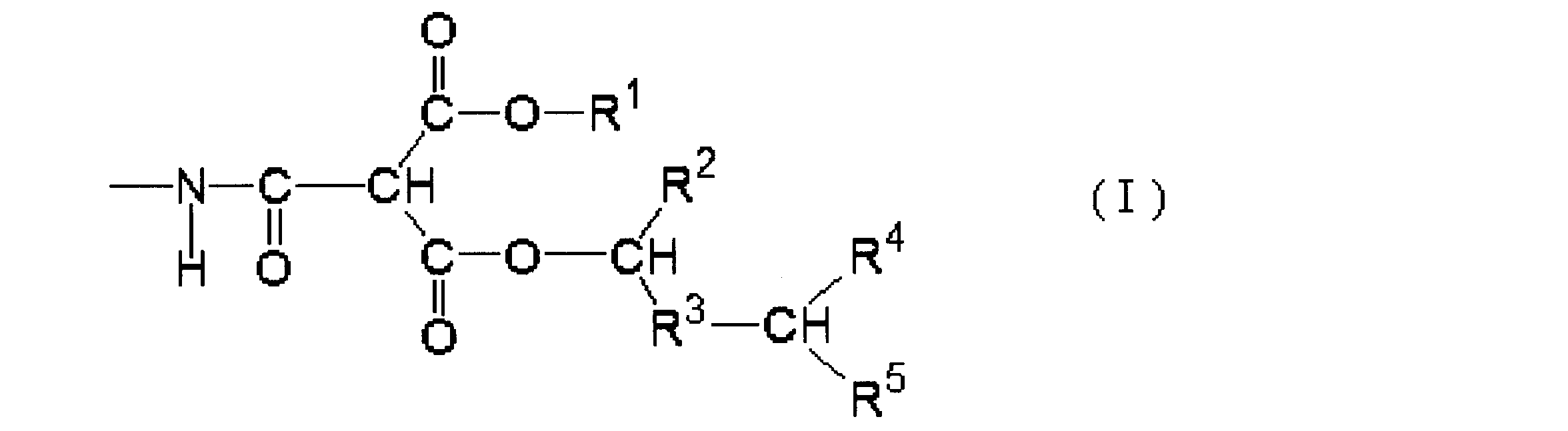
下記一般式(II)で示されるブロックイソシアネート基
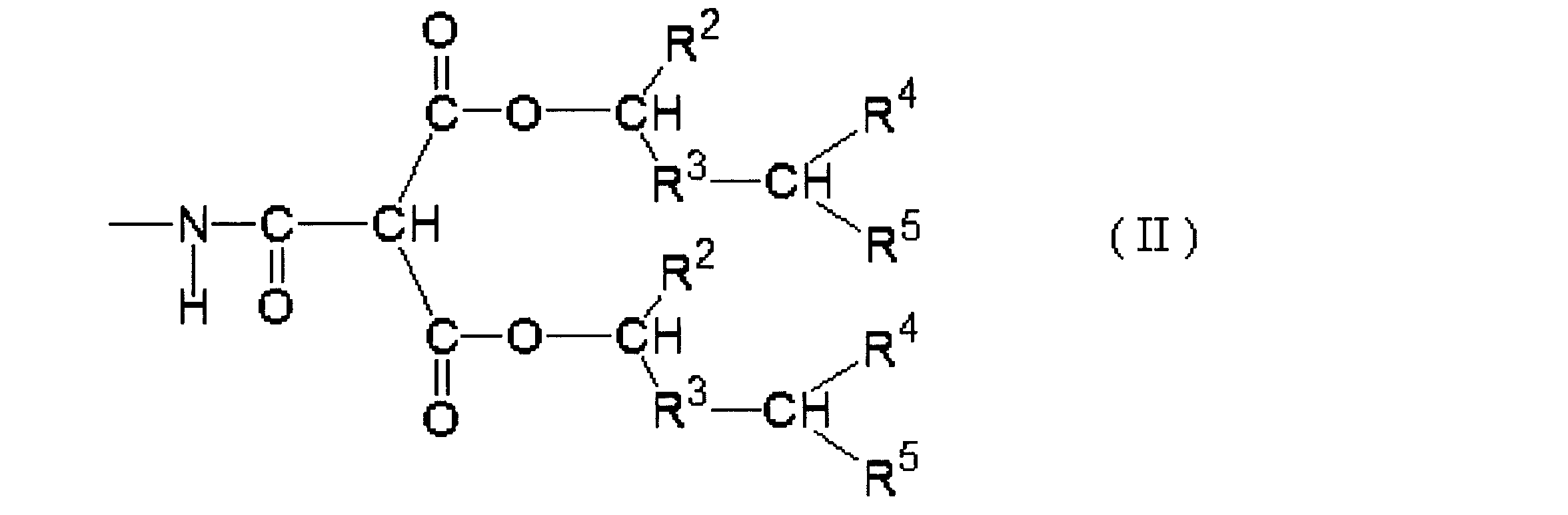
及び下記一般式(III)で示されるブロックイソシアネート基

から選ばれる少なくとも一種のブロックイソシアネート基を有するブロックポリイソシアネート化合物を含有することを特徴とする複層塗膜形成方法。
項2.前記一般式(I)において、R1がイソプロピル基である項1に記載の複層塗膜形成方法。

で示されるブロックイソシアネート基を有するブロックポリイソシアネート化合物(b3-1)及び下記一般式(VI)で示される2級アルコール(b4)

を反応させて得られる項1又は2に記載の複層塗膜形成方法。

で示されるブロックイソシアネート基を有するブロックポリイソシアネート化合物(b3-2)及び前記2級アルコール(b4)を反応させて得られる項1又は3に記載の複層塗膜形成方法。
本発明の複層塗膜形成方法(以下、「本方法」と略記することがある)によれば、まず、被塗物上に、アクリル変性ポリエステル樹脂(A)、ならびに下記一般式(I)で示されるブロックイソシアネート基

下記一般式(II)で示されるブロックイソシアネート基
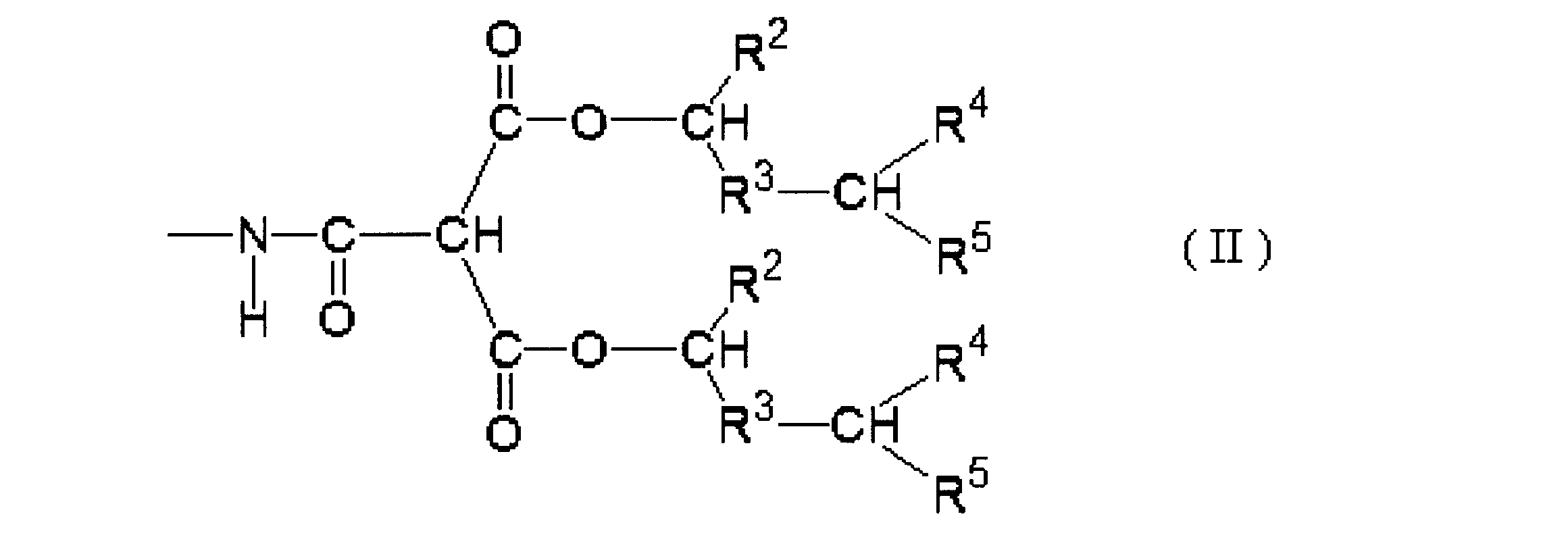
及び下記一般式(III)で示されるブロックイソシアネート基

から選ばれる少なくとも一種のブロックイソシアネート基を有するブロックポリイソシアネート化合物(B)を含有する水性第1着色塗料(X)が塗装される。
本方法において使用することができる被塗物は、特に限定されるものではなく、例えば、乗用車、トラック、オートバイ、バス等の自動車車体の外板部;バンパー等の自動車部品;携帯電話、オーディオ機器等の家庭電気製品の外板部等を挙げることができる。これらのうち、自動車車体の外板部及び自動車部品が好ましい。
アクリル変性ポリエステル樹脂(A)としては、特に限定されることのない既知の方法で得られたアクリル変性ポリエステル樹脂を用いることができる。該既知の方法としては、例えばラジカル重合性不飽和基含有ポリエステル樹脂及び重合性不飽和モノマーとの混合物を重合させる方法、あるいはポリエステル樹脂とアクリル樹脂の樹脂同士のエステル化反応による方法等を挙げることができる。
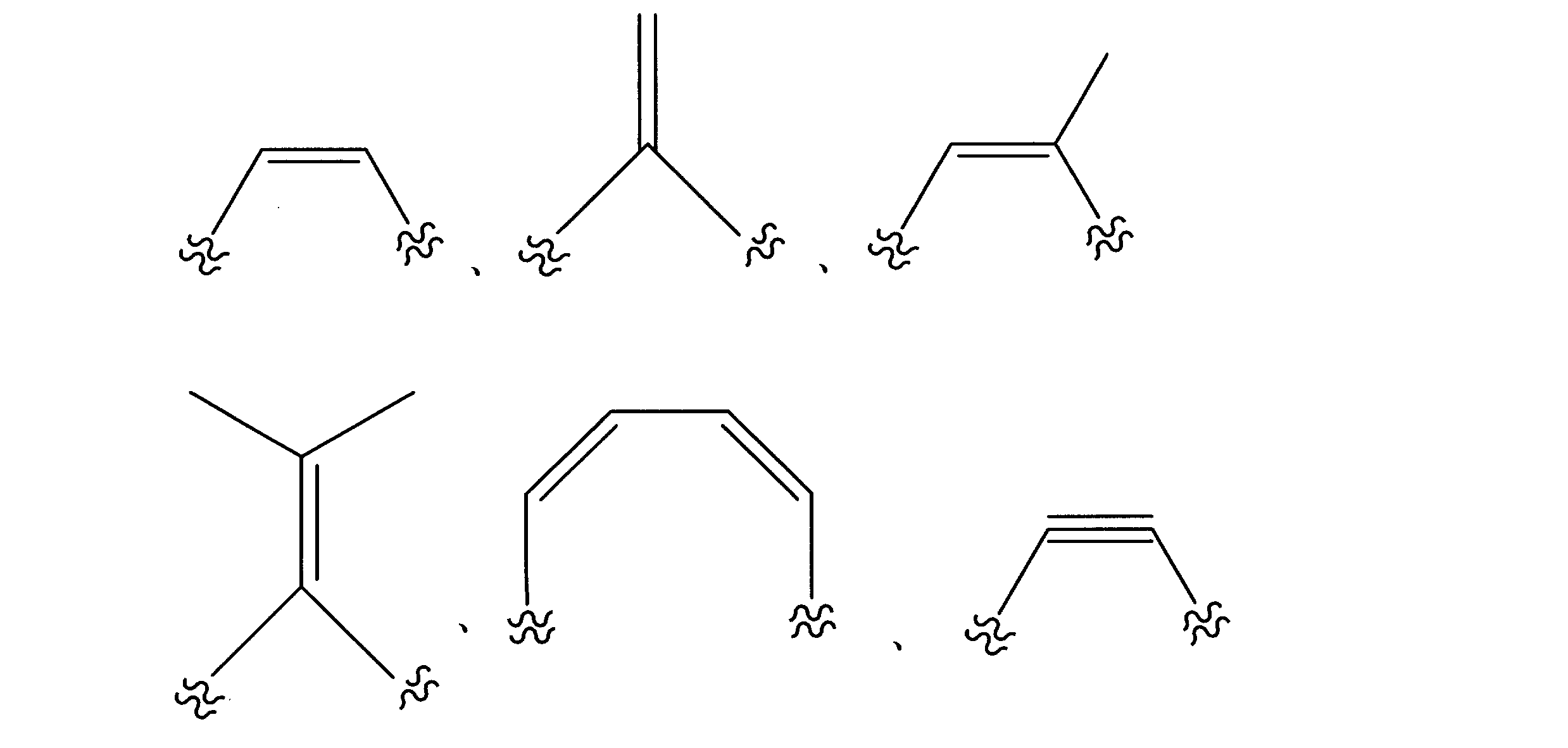
(i)アルキル又はシクロアルキル(メタ)アクリレート:例えば、メチル(メタ)アクリレート、エチル(メタ)アクリレート、n-プロピル(メタ)アクリレート、イソプロピル(メタ)アクリレート、n-ブチル(メタ)アクリレート、イソブチル(メタ)アクリレート、tert-ブチル(メタ)アクリレート、n-ヘキシル(メタ)アクリレート、n-オクチル(メタ)アクリレート、2-エチルヘキシル(メタ)アクリレート、ノニル(メタ)アクリレート、トリデシル(メタ)アクリレート、ラウリル(メタ)アクリレート、ステアリル(メタ)アクリレート、イソステアリル(メタ)アクリレート、シクロヘキシル(メタ)アクリレート、メチルシクロヘキシル(メタ)アクリレート、t-ブチルシクロヘキシル(メタ)アクリレート、シクロドデシル(メタ)アクリレート、トリシクロデカニル(メタ)アクリレート等の炭素数1~18のアルコール又は炭素数3~12のシクロアルコールと(メタ)アクリル酸とのエステル化物等。
(ii)イソボルニル基を有する重合性不飽和モノマー:イソボルニル(メタ)アクリレート等。
(iii)アダマンチル基を有する重合性不飽和モノマー:アダマンチル(メタ)アクリレート等。
(iv)トリシクロデセニル基を有する重合性不飽和モノマー:トリシクロデセニル(メタ)アクリレート等。
(v)芳香環含有重合性不飽和モノマー:ベンジル(メタ)アクリレート、スチレン、α-メチルスチレン、ビニルトルエン等。
(vi)アルコキシシリル基を有する重合性不飽和モノマー:ビニルトリメトキシシラン、ビニルトリエトキシシラン、ビニルトリス(2-メトキシエトキシ)シラン、γ-(メタ)アクリロイルオキシプロピルトリメトキシシラン、γ-(メタ)アクリロイルオキシプロピルトリエトキシシラン等。
(vii)フッ素化アルキル基を有する重合性不飽和モノマー:パーフルオロブチルエチル(メタ)アクリレート、パーフルオロオクチルエチル(メタ)アクリレート等のパーフルオロアルキル(メタ)アクリレート;フルオロオレフィン等。
(viii)マレイミド基等の光重合性官能基を有する重合性不飽和モノマー。
(ix)ビニル化合物:N-ビニルピロリドン、エチレン、ブタジエン、クロロプレン、プロピオン酸ビニル、酢酸ビニル等。
(x)カルボキシル基含有重合性不飽和モノマー:(メタ)アクリル酸、マレイン酸、クロトン酸、β-カルボキシエチルアクリレート等。
(xi)水酸基含有重合性不飽和モノマー:2-ヒドロキシエチル(メタ)アクリレート、2-ヒドロキシプロピル(メタ)アクリレート、3-ヒドロキシプロピル(メタ)アクリレート、4-ヒドロキシブチル(メタ)アクリレート等の(メタ)アクリル酸と炭素数2~8の2価アルコールとのモノエステル化物;(メタ)アクリル酸と炭素数2~8の2価アルコールとのモノエステル化物のε-カプロラクトン変性体;N-ヒドロキシメチル(メタ)アクリルアミド;アリルアルコール、さらに、分子末端が水酸基であるポリオキシエチレン鎖を有する(メタ)アクリレート等。
(xii)含窒素重合性不飽和モノマー:(メタ)アクリロニトリル、(メタ)アクリルアミド、N,N-ジメチルアミノエチル(メタ)アクリレート、N,N-ジエチルアミノエチル(メタ)アクリレート、N,N-ジメチルアミノプロピル(メタ)アクリルアミド、メチレンビス(メタ)アクリルアミド、エチレンビス(メタ)アクリルアミド、グリシジル(メタ)アクリレートとアミン化合物との付加物等。
(xiii)重合性不飽和基を1分子中に2個以上有する重合性不飽和モノマー:エチレングリコールジメタクリレート、アリル(メタ)アクリレート、1,6-ヘキサンジオールジ(メタ)アクリレート等。
(xiv)エポキシ基含有重合性不飽和モノマー:グリシジル(メタ)アクリレート、β-メチルグリシジル(メタ)アクリレート、3,4-エポキシシクロヘキシルメチル(メタ)アクリレート、3,4-エポキシシクロヘキシルエチル(メタ)アクリレート、3,4-エポキシシクロヘキシルプロピル(メタ)アクリレート、アリルグリシジルエーテル等。
(xv)分子末端がアルコキシ基であるポリオキシエチレン鎖を有する(メタ)アクリレート。
(xvi)スルホン酸基を有する重合性不飽和モノマー:2-アクリルアミド-2-メチルプロパンスルホン酸、2-スルホエチル(メタ)アクリレート、アリルスルホン酸、4-スチレンスルホン酸等;これらスルホン酸のナトリウム塩及びアンモニウム塩等。
(xvii)リン酸基を有する重合性不飽和モノマー:アシッドホスホオキシエチル(メタ)アクリレート、アシッドホスホオキシプロピル(メタ)アクリレート、アシッドホスホオキシポリ(オキシエチレン)グリコール(メタ)アクリレート、アシッドホスホオキシポリ(オキシプロピレン)グリコール(メタ)アクリレート等。
(xviii)紫外線吸収性官能基を有する重合性不飽和モノマー:2-ヒドロキシ-4-(3-メタクリロイルオキシ-2-ヒドロキシプロポキシ)ベンゾフェノン、2-ヒドロキシ-4-(3-アクリロイルオキシ-2-ヒドロキシプロポキシ)ベンゾフェノン、2,2' -ジヒドロキシ-4-(3-メタクリロイルオキシ-2-ヒドロキシプロポキシ)ベンゾフェノン、2,2' -ジヒドロキシ-4-(3-アクリロイルオキシ-2-ヒドロキシプロポキシ)ベンゾフェノン、2-(2' -ヒドロキシ-5' -メタクリロイルオキシエチルフェニル)-2H-ベンゾトリアゾール等。
(xix)紫外線安定性重合性不飽和モノマー:4-(メタ)アクリロイルオキシ-1,2,2,6,6-ペンタメチルピペリジン、4-(メタ)アクリロイルオキシ-2,2,6,6-テトラメチルピペリジン、4-シアノ-4-(メタ)アクリロイルアミノ-2,2,6,6-テトラメチルピペリジン、1-(メタ)アクリロイル-4-(メタ)アクリロイルアミノ-2,2,6,6-テトラメチルピペリジン、1-(メタ)アクリロイル-4-シアノ-4-(メタ)アクリロイルアミノ-2,2,6,6-テトラメチルピペリジン、4-クロトノイルオキシ-2,2,6,6-テトラメチルピペリジン、4-クロトノイルアミノ-2,2,6,6-テトラメチルピペリジン、1-クロトノイル-4-クロトノイルオキシ-2,2,6,6-テトラメチルピペリジン等。
(xx)カルボニル基を有する重合性不飽和モノマー:アクロレイン、ダイアセトンアクリルアミド、ダイアセトンメタクリルアミド、アセトアセトキシエチルメタクリレート、ホルミルスチロール、4~7個の炭素原子を有するビニルアルキルケトン(例えば、ビニルメチルケトン、ビニルエチルケトン、ビニルブチルケトン)等。
(x)カルボキシル基含有重合性不飽和モノマーを5~50質量%、好ましくは10~45質量%、特に好ましくは15~40質量%、
(v)芳香環含有重合性不飽和モノマーを10~60質量%、好ましくは15~55質量%、特に好ましくは20~50質量%、
であることが好ましい。
ブロックポリイソシアネート化合物(B)は、下記一般式(I)で示されるブロックイソシアネート基

下記一般式(II)で示されるブロックイソシアネート基

及び下記一般式(III)で示されるブロックイソシアネート基

から選ばれる少なくとも1種のブロックイソシアネート基を有するブロックポリイソシアネート化合物である。
ポリイソシアネート化合物(b1)は、1分子中に少なくとも2個のイソシアネート基を有する化合物であって、例えば、脂肪族ポリイソシアネート、脂環族ポリイソシアネート、芳香脂肪族ポリイソシアネート、芳香族ポリイソシアネート、該ポリイソシアネートの誘導体等を挙げることができる。
上記ポリイソシアネート化合物(b1)中のイソシアネート基をブロック化する活性メチレン化合物(b2)としては、例えば、マロン酸ジメチル、マロン酸ジエチル、マロン酸ジn-プロピル、マロン酸ジイソプロピル、マロン酸ジn-ブチル、マロン酸ジイソブチル、マロン酸ジsec-ブチル、マロン酸ジt-ブチル、マロン酸ジn-ペンチル、マロン酸ジn-ヘキシル、マロン酸ジ(2-エチルヘキシル)、マロン酸メチルイソプロピル、マロン酸エチルイソプロピル、マロン酸メチルn-ブチル、マロン酸エチルn-ブチル、マロン酸メチルイソブチル、マロン酸エチルイソブチル、マロン酸メチルsec-ブチル、マロン酸エチルsec-ブチル、マロン酸ジフェニル及びマロン酸ジベンジル等のマロン酸ジエステル、アセト酢酸メチル、アセト酢酸エチル、アセト酢酸n-プロピル、アセト酢酸イソプロピル、アセト酢酸n-ブチル、アセト酢酸イソブチル、アセト酢酸sec-ブチル、アセト酢酸t-ブチル、アセト酢酸n-ペンチル、アセト酢酸n-ヘキシル、アセト酢酸2-エチルヘキシル、アセト酢酸フェニル及びアセト酢酸ベンジル等のアセト酢酸エステル、イソブチリル酢酸メチル、イソブチリル酢酸エチル、イソブチリル酢酸n-プロピル、イソブチリル酢酸イソプロピル、イソブチリル酢酸n-ブチル、イソブチリル酢酸イソブチル、イソブチリル酢酸sec-ブチル、イソブチリル酢酸t-ブチル、イソブチリル酢酸n-ペンチル、イソブチリル酢酸n-ヘキシル、イソブチリル酢酸2-エチルヘキシル、イソブチリル酢酸フェニル及びイソブチリル酢酸ベンジル等のイソブチリル酢酸エステル等が挙げられ、これらは単独で又は2種以上併用して使用することができる。
ブロックポリイソシアネート化合物(b3)は、前記1分子中に2個以上のイソシアネート基を有するポリイソシアネート化合物(b1)及び活性メチレン化合物(b2)を反応させることにより、ポリイソシアネート化合物(b1)中のイソシアネート基の一部又は全部が、活性メチレン化合物(b2)でブロック化された化合物である。
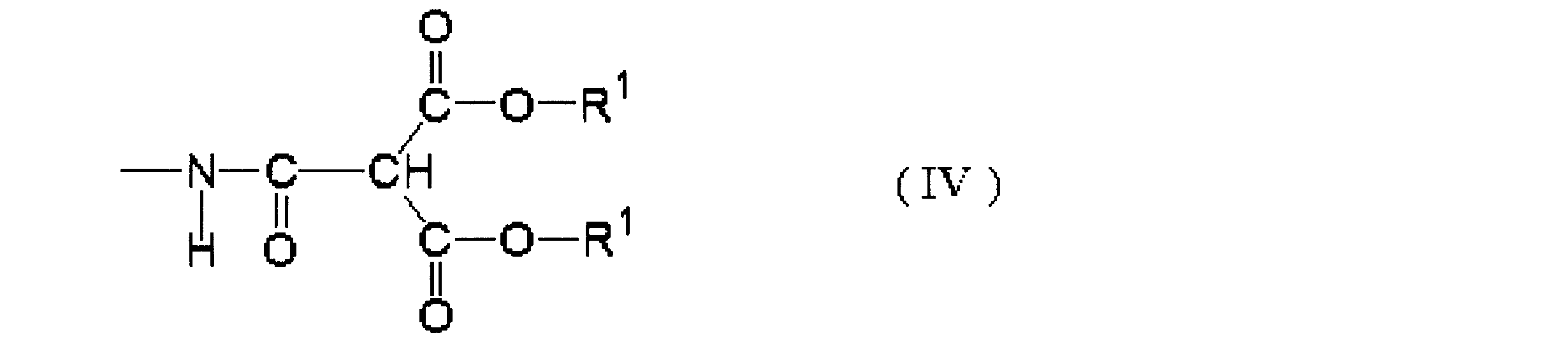
で示されるブロックイソシアネート基を有するブロックポリイソシアネート化合物(b3-1)及び下記一般式(V)
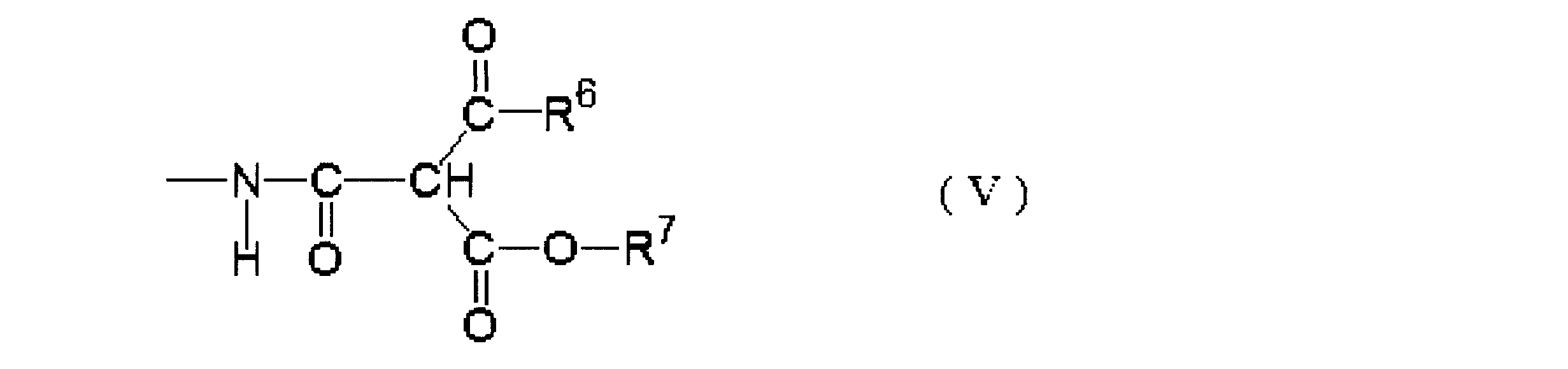
で示されるブロックイソシアネート基を有するブロックポリイソシアネート化合物(b3-2)の少なくとも一方であることが好ましい。
ブロックポリイソシアネート化合物(b3-1)は、前記一般式(IV)で示されるブロックイソシアネート基を有するブロックポリイソシアネート化合物である。
ブロックポリイソシアネート化合物(b3-2)は、前記一般式(V)で示されるブロックイソシアネート基を有するブロックポリイソシアネート化合物である。

とを反応させることによって、得ることができる。
2級アルコール(b4)は、前記一般式(VI)で示される化合物である。なかでも、前記ブロックポリイソシアネート化合物(b3)と上記2級アルコール(b4)との反応性を高める観点から、R2はメチル基であることが好ましい。また、R3、R4及びR5は、それぞれ炭素数が多いと、得られるブロックポリイソシアネート化合物(B)の極性が低下し、他の塗料成分との相溶性が低下する場合があるため、R3は炭素数1~3のアルキレン基であることが好ましく、R4及びR5はメチル基であることが好ましい。
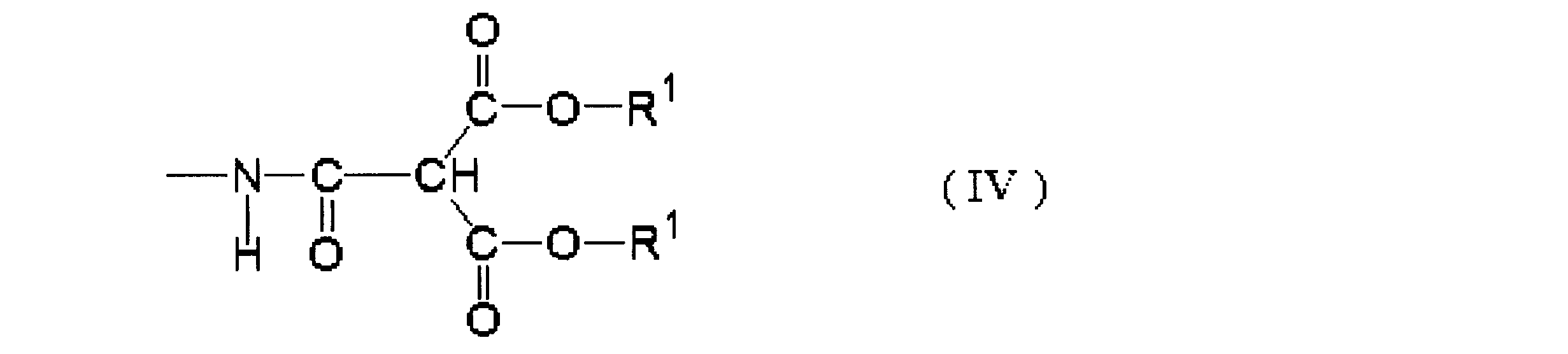
で示されるブロックイソシアネート基を有するブロックポリイソシアネート化合物(b3-1)及び上記2級アルコール(b4)を反応させることによって得ることができる。

で示される基に置換される。
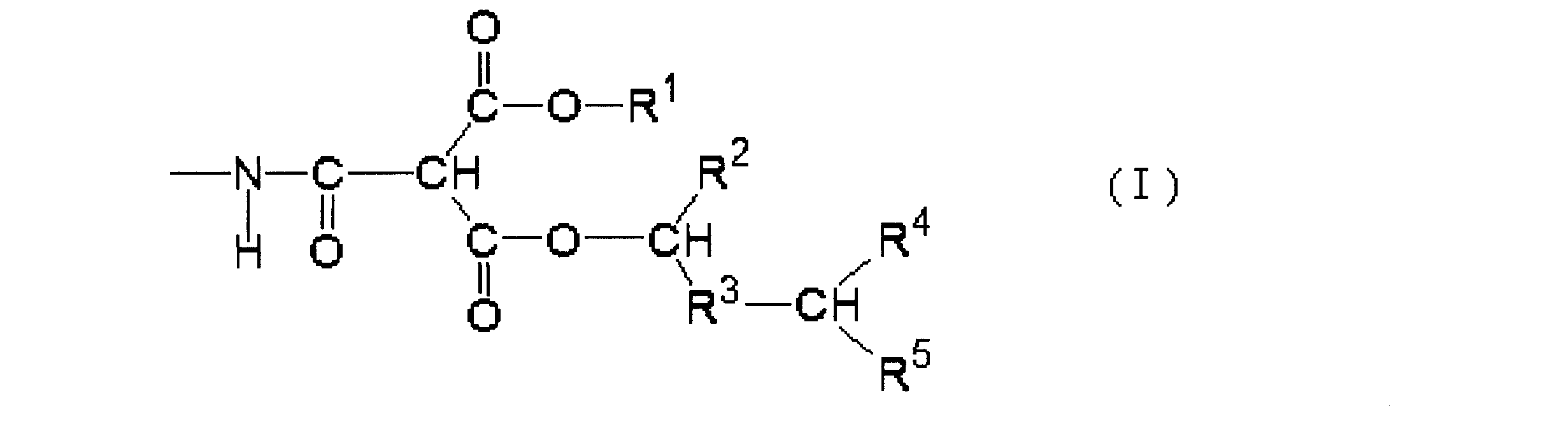
又は下記一般式(II)で示されるブロックイソシアネート基
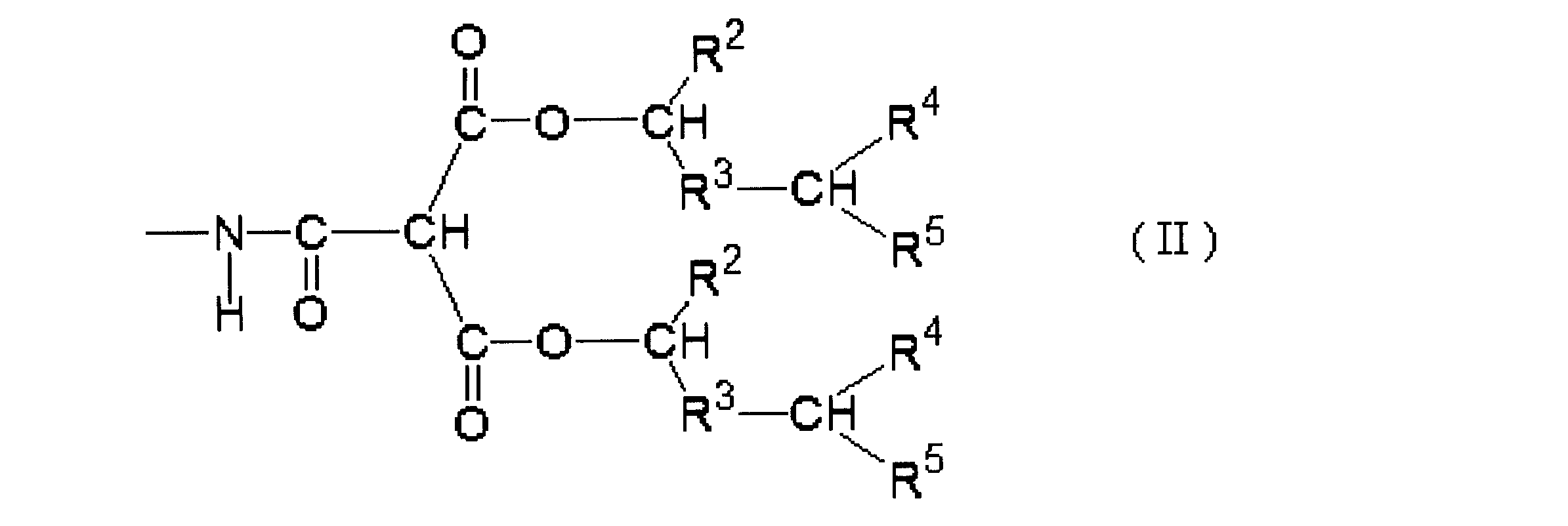
を有する。
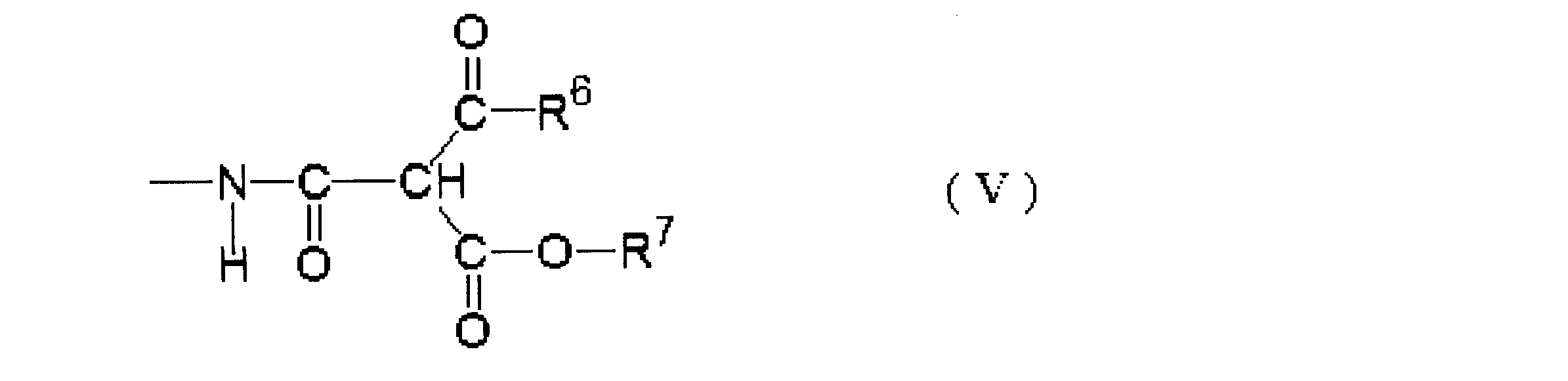
で示されるブロックイソシアネート基を有するブロックポリイソシアネート化合物(b3-2)と、前記2級アルコール(b4)とを反応させることによって得ることができる。

で示される基に置換される。

を有する。
本方法において使用される水性第1着色塗料(X)は、以上に述べたアクリル変性ポリエステル樹脂(A)及びブロックポリイソシアネート化合物(B)を含有する水性塗料組成物である。水性第1着色塗料(X)は、例えばアクリル変性ポリエステル樹脂(A)及びブロックポリイソシアネート化合物(B)を定法に従い混合し、適宜水性媒体、例えば脱イオン水で希釈することにより調製することができる。
水酸基含有アクリル樹脂としては、水酸基含有水溶性アクリル樹脂(C-1)及び水酸基含有アクリル樹脂水分散体(C-2)を挙げることができる。これらは単独で又は併用して用いることができる。
水酸基含有水溶性アクリル樹脂(C-1)は、水酸基含有重合性不飽和モノマーを含む重合性不飽和モノマー成分を通常の条件で(共)重合せしめることによって製造することができ、得られる塗膜の平滑性の観点から、酸価が10~100mgKOH/g、好ましくは15~80mgKOH/g、更に好ましくは15~70mgKOH/gであり、重量平均分子量が1,000~100,000、好ましくは3,000~80,000、更に好ましくは5,000~60,000の範囲内であることが好適である。また、硬化性の観点から、水酸基価が20~200mgKOH/g、好ましくは30~180mgKOH/gであり、さらに好ましくは40~165mgKOH/gの範囲内であることが好適である。
水酸基含有アクリル樹脂水分散体(A1)としては、例えば、重合性不飽和モノマー(m)を、それ自体既知の方法、例えば、水中でのエマルション重合法などの方法により、共重合せしめることによって製造することができる。
基の組み合わせであればいずれも好適に使用できるが、酸基とグリシジル基、アミノ基とグリシジル基、水酸基とイソシアネート基の組み合わせがより好ましい。具体的な重合性不飽和モノマーの組み合わせとしては、例えば、(メタ)アクリル酸とグリシジル(メタ)アクリレート、(メタ)アクリロイルオキシアルキルアシッドホスフェートとグリシジル(メタ)アクリレート、(ジ)アルキルアミノエチル(メタ)アクリレートとグリシジル(メタ)アクリレート、ヒドロキシアルキル(メタ)アクリレートと(メタ)アクリロイルオキシアルキルイソシアネートなどが挙げられ、これらは1種を単独で、又は2種以上を組み合わせて使用できる。
コアシェル型水酸基含有アクリル樹脂水分散体(C-2-1)のコア部共重合体(I)は、構成モノマー成分として、前記(m-1)~(m-5)の重合性不飽和基を有する化合物を任意に使用することができるが、平滑性、鮮映性、耐水性及び付着性に優れる複層塗膜を得る観点から、構成モノマー成分の一部として
重合性不飽和基を1分子中に2個以上有する重合性不飽和モノマー及び水酸基含有重合性不飽和モノマーを含有する共重合体であることが好ましい。
上記炭素数4以上の炭化水素基を有する重合性不飽和モノマー(m-3)の使用割合は、得られる複層塗膜の平滑性及び鮮映性の観点から、コア部共重合体(I)を構成するモノマーの合計質量を基準として、30~90質量%であるのが好ましく、35~85質量%程度であるのがより好ましく、40~80質量%程度であるのが更に好ましい。
コアシェル型水酸基含有アクリル樹脂水分散体(C-2-1)のシェル部共重合体(II)は、構成モノマー成分として、水酸基含有重合性不飽和モノマー及びカルボキシル基含有重合性不飽和モノマーを含有する共重合体であることが好適である。
ここで、ガラス転移温度(Tg)はJIS K 7121(プラスチックの転移温度測定方法)に準じて、示差走査熱量測定方法(DSC)により求められる。
上記乳化剤の使用量は、使用される全モノマーの合計量を基準にして、0.1~15質量%程度が好ましく、0.5~10質量%程度がより好ましく、1~5質量%程度が更に好ましい。
(A)成分が10~60質量部、好ましくは15~57質量部、更に好ましくは15~50質量部、
(B)成分が5~40質量部、好ましくは5~38質量部、更に好ましくは5~35質量部、
(C)成分が0~50質量部、好ましくは5~40質量部、更に好ましくは10~30質量部、
である。
ポリエステル樹脂(D)は、通常、酸成分とアルコール成分とのエステル化反応又はエステル交換反応によって製造することができる。上記ポリエステル樹脂(D)は、水酸基含有ポリエステル樹脂であることが好ましい。
前記ポリウレタン樹脂としては、例えば、脂肪族ジイソシアネート化合物、脂環族ジイソシアネート化合物及び芳香族ジイソシアネート化合物から選ばれる少なくとも1種のジイソシアネート化合物と、ポリエーテルポリオール、ポリエステルポリオール及びポリカーボネートポリオールから選ばれる少なくとも1種のポリオール化合物とを反応させてなるものを挙げることができる。
ブロックポリイソシアネート化合物(B)以外の硬化剤(E)(以下、「硬化剤(E)」と略記することがある)は、アクリル変性ポリエステル樹脂(A)ならびに必要に応じて使用される水酸基含有アクリル樹脂(C)及び該水酸基含有アクリル樹脂(C)以外の水酸基含有樹脂中の水酸基、カルボキシル基、エポキシ基等の架橋性官能基と反応して、水性第1着色塗料(X)を硬化し得る化合物である。上記硬化剤(E)としては、公知の硬化剤が使用でき、例えば、アミノ樹脂、ポリイソシアネート化合物、前記(B)成分以外のブロックポリイソシアネート化合物、エポキシ基含有化合物、カルボキシル基含有化合物、カルボジイミド基含有化合物などが挙げられる。なかでも、得られる塗膜の耐水性の観点から、水酸基と反応し得るアミノ樹脂及び前記(B)成分以外のブロックポリイソシアネート、カルボキシル基と反応し得るカルボジイミド基含有化合物が好ましく、アミノ樹脂が更に好ましい。
水性第1着色塗料(X)は、さらに、顔料を含有することが好ましい。該顔料としては、例えば、着色顔料、体質顔料、光輝性顔料等を挙げることができ、これらはそれぞれ単独で又は2種以上組み合わせて使用することができる。
以上に述べた工程(1)で形成される水性第1着色塗料(X)の塗膜(以下、「第1着色塗膜」という場合がある)上には、次いで、水性第2着色塗料(Y)が塗装される。
まず、被塗物上に水性第1着色塗料(X)を塗装すると同時に、予め質量(W1)を測定しておいたアルミホイル上にも水性第1着色塗料(X)を塗装する。続いて、塗装後、プレヒート等がされた該アルミホイルを水性第2着色塗料(Y)が塗装される直前に回収し、その質量(W2)を測定する。次に、回収したアルミホイルを110℃で60分間乾燥し、デシケーター内で室温まで放冷した後、該アルミホイルの質量(W3)を測定し、以下の式に従って固形分含有率を求める。
固形分含有率(質量%)={(W3-W1)/(W2-W1)}×100
第1着色塗膜上に塗装される水性第2着色塗料(Y)は、一般に、被塗物に優れた外観を付与することを目的とするものであって、例えば、カルボキシル基、水酸基等の架橋性官能基を有する、アクリル樹脂、ポリエステル樹脂、アルキド樹脂、ウレタン樹脂、エポキシ樹脂等の基体樹脂と、ブロックされていてもよいポリイソシアネート化合物、メラミン樹脂、尿素樹脂等の硬化剤からなる樹脂成分を、顔料、その他の添加剤と共に水に溶解ないし分散させて塗料化したものを使用することができる。なかでも、基体樹脂として、前記のアクリル変性ポリエステル樹脂(A)を使用し、硬化剤としてメラミン樹脂を使用する熱硬化型水性塗料を好適に用いることができる。
本発明の第一の複層塗膜形成方法においては、上記工程(2)で形成される水性第2着色塗料(Y)の塗膜(以下、「第2着色塗膜」という場合がある)上に、クリヤー塗料(Z)が塗装される。
本発明の第一の複層塗膜形成方法においては、以上に述べた工程(1)~(3)で形成される未硬化の第1着色塗膜、未硬化の第2着色塗膜及び未硬化のクリヤー塗膜が同時に加熱硬化せしめられる。
下記の工程(1)~(4):
(1)被塗物に、水性第1着色塗料(X)を塗装して中塗り塗膜を形成せしめる工程、
(2)上記の未硬化の中塗り塗膜上に、水性第2着色塗料(Y)を塗装してベースコート塗膜を形成せしめる工程、
(3)上記の未硬化のベースコート塗膜上に、クリヤー塗料(Z)を塗装してクリヤー塗膜を形成せしめる工程、ならびに
(4)上記の未硬化の中塗り塗膜、未硬化のベースコート塗膜及び未硬化のクリヤー塗膜を同時に加熱硬化させる工程
を含む複層塗膜形成方法。
また、上記方法Iの工程3)において、工程2)で得られた第2着色塗膜が実質的に硬化しない加熱条件で、上記プレヒート、エアブロー等を行うことができる。
本発明の第二の複層塗膜形成方法は、上記第一の複層塗膜形成方法における工程(3)及び(4)を省略し、前記工程(1)及び(2)に続いて、工程(5)を行なう複層塗膜形成方法である。
下記の工程1)~3):
1)被塗物に、水性第1着色塗料(X)を塗装して中塗り塗膜を形成せしめる工程、
2)上記の未硬化の中塗り塗膜上に、水性第2着色塗料(Y)を塗装して上塗り塗膜を形成せしめる工程、ならびに
3)上記の未硬化の中塗り塗膜及び未硬化の上塗り塗膜を同時に加熱硬化させる工程
を含む複層塗膜形成方法。
製造例1
温度計、サーモスタット、攪拌機、加熱装置及び精留塔を具備した反応装置に、ヘキサヒドロ無水フタル酸85部、アジピン酸51.6部、1,6-ヘキサンジオール39.1部、ネオペンチルグリコール34.8部、2-ブチル-2-エチル-1,3-プロパンジオール35.3部、無水マレイン酸2.16部、トリメチロールプロパン30.1部を仕込み、攪拌しながら160℃まで昇温した。次いで、内容物を160℃から240℃まで4時間かけて徐々に昇温し、精留塔を通して生成した縮合水を留去した。240℃で90分間反応を続けた後、精留塔を水分離器と置換し、内容物にトルエン約15部を加え、水とトルエンを共沸させて縮合水を除去した。トルエン添加の1時間後から酸価の測定を開始し、酸価が3.5未満になったことを確認して加熱を停止し、トルエンを減圧除去した後、冷却し、ジプロピレングリコールモノメチルエーテル58部を加えた。
130℃まで冷却し、スチレン9部、アクリル酸12.6部、アクリル酸-2-エチルヘキシル23.4部及びt-ブチルパーオキシ-2-エチルヘキサノエート2.2部の混合物を2時間で滴下した。その後、30分間130℃を保った後、追加触媒として、t-ブチルパーオキシ-2-エチルヘキサノエート0.44部を加え1時間熟成した。
その後、85℃まで冷却し、ジメチルエタノールアミンで中和し、脱イオン水を加え、水分散を行い、固形分35%のアクリル変性ポリエステル樹脂の水分散体(A-1)を得た。得られたアクリル変性ポリエステル樹脂は、酸価35mgKOH/g、水酸基価110mgKOH/g、数平均分子量2300であった。
下記表1に示す配合とする以外、製造例6と同様にして合成しアクリル変性ポリエステル樹脂の水分散体(A-2)~(A-10)を得た。

製造例11
温度計、サーモスタット、撹拌装置、還流冷却器、窒素導入管、滴下装置及び除去溶媒簡易トラップを備えた反応容器に、「スミジュールN-3300」360部、「ユニオックスM-550」(日油社製、ポリエチレングリコールモノメチルエーテル、平均分子量 約550)60部及び2,6-ジ-tert-ブチル-4-メチルフェノール0.2部を仕込み、よく混合して、窒素気流下で130℃で3時間加熱した。次いで、酢酸エチル110部及びマロン酸ジイソプロピル252部を仕込み、窒素気流下で攪拌しながら、ナトリウムメトキシドの28%メタノール溶液3部を加え、65℃で8時間攪拌した。得られた樹脂溶液中のイソシアネート量は0.12モル/Kgであった。これに4-メチルー2-ペンタノール683部を加え、系の温度を80~85℃に保ちながら減圧条件下で3時間かけて溶剤を留去し、ブロックポリイソシアネート化合物溶液(B-1)1010部を得た。除去溶媒簡易トラップには、イソプロパノールが95部含まれていた。得られたブロックポリイソシアネート化合物溶液(B-1)の固形分濃度は約60%であった。
温度計、サーモスタット、撹拌装置、還流冷却器、窒素導入管、滴下装置及び除去溶媒簡易トラップを備えた反応容器に、「スミジュールN-3300」360部、「ユニオックスM-400」(日油社製、ポリエチレングリコールモノメチルエーテル、平均分子量 約400)50部、「PEG#600」(日油社製、ポリエチレングリコール、平均分子量 約600)5部及び2,6-ジ-tert-ブチル-4-メチルフェノール0.2部を仕込み、よく混合して、窒素気流下で130℃で3時間加熱した。次いで、酢酸エチル110部及びマロン酸ジイソプロピル247部を仕込み、窒素気流下で攪拌しながら、ナトリウムメトキシドの28%メタノール溶液3部を加え、65℃で8時間攪拌した。得られた樹脂溶液中のイソシアネート量は0.11モル/Kgであった。これに4-メチルー2-ペンタノール670部を加え、系の温度を80~85℃に保ちながら減圧条件下で3時間かけて溶剤を留去し、ブロックポリイソシアネート化合物溶液(B-2)1010部を得た。除去溶媒簡易トラップには、イソプロパノールが92部含まれていた。得られたブロックポリイソシアネート化合物溶液(B-2)の固形分濃度は約60%であった。
温度計、サーモスタット、撹拌装置、還流冷却器、窒素導入管、滴下装置及び除去溶媒簡易トラップを備えた反応容器に、「スミジュールN-3300」(商品名、住化バイエルウレタン社製、ヘキサメチレンジイソシアネート由来のイソシアヌレート構造含有ポリイソシアネート、固形分約100%、イソシアネート基含有率21.8%)480部、酢酸エチル150部及びマロン酸ジイソプロピル365部を仕込み、窒素気流下で攪拌しながら、ナトリウムメトキシドの28%メタノール溶液4部を加え、65℃で8時間攪拌した。得られた樹脂溶液中のイソシアネート量は0.07モル/Kgであった。これに4-メチルー2-ペンタノール870部を加え、系の温度を90~95℃に保ちながら減圧条件下で3時間かけて溶剤を留去し、さらに、4-メチルー2-ペンタノール120部を加えて、ブロックポリイソシアネート化合物溶液(B-3)1400部を得た。除去溶媒簡易トラップには、イソプロパノールが183部含まれていた。得られたブロックポリイソシアネート化合物溶液(B-3)の固形分濃度は約60%であった。
温度計、サーモスタット、撹拌装置、還流冷却器、窒素導入管、滴下装置及び除去溶媒簡易トラップを備えた反応容器に、「スミジュールN-3300」480部、酢酸エチル150部、マロン酸ジイソプロピル330部及びアセト酢酸イソプロピル27部を仕込み、窒素気流下で攪拌しながら、ナトリウムメトキシドの28%メタノール溶液4部を加え、65℃で8時間攪拌した。得られた樹脂溶液中のイソシアネート量は0.08モル/Kgであった。これに4-メチルー2-ペンタノール870部を加え、系の温度を90~95℃に保ちながら減圧条件下で3時間かけて溶剤を留去し、さらに、4-メチルー2-ペンタノール120部を加えて、ブロックポリイソシアネート化合物溶液(B-4)1390部を得た。除去溶媒簡易トラップには、イソプロパノールが173部含まれていた。得られたブロックポリイソシアネート化合物溶液(B-4)の固形分濃度は約60%であった。
温度計、サーモスタット、撹拌装置、還流冷却器、窒素導入管、滴下装置及び除去溶媒簡易トラップを備えた反応容器に、「スミジュールN-3300」480部、酢酸エチル150部、マロン酸ジエチル280部及びイソブチリル酢酸エチル30部を仕込み、窒素気流下で攪拌しながら、ナトリウムメトキシドの28%メタノール溶液4部を加え、65℃で8時間攪拌した。得られた樹脂溶液中のイソシアネート量は0.08モル/Kgであった。これに4-メチルー2-ペンタノール870部を加え、系の温度を90~95℃に保ちながら減圧条件下で3時間かけて溶剤を留去し、さらに、4-メチルー2-ペンタノール120部を加えて、ブロックポリイソシアネート化合物溶液(B-5)1350部を得た。除去溶媒簡易トラップには、エタノールが133部含まれていた。得られたブロックポリイソシアネート化合物溶液(B-5)の固形分濃度は約60%であった。
温度計、サーモスタット、撹拌装置、還流冷却器、窒素導入管、滴下装置及び除去溶媒簡易トラップを備えた反応容器に、「スミジュールN-3300」480部、酢酸エチル150部及びマロン酸ジイソプロピル360部を仕込み、窒素気流下で攪拌しながら、ナトリウムメトキシドの28%メタノール溶液4部を加え、65℃で8時間攪拌した。得られた樹脂溶液中のイソシアネート量は0.07モル/Kgであった。これに5-メチル-2-ヘキサノール990部を加え、系の温度を90~95℃に保ちながら減圧条件下で3時間かけて溶剤を留去し、さらに、5-メチル-2-ヘキサノール120部を加えて、ブロックポリイソシアネート化合物溶液(B-6)1400部を得た。除去溶媒簡易トラップには、イソプロパノールが180部含まれていた。得られたブロックポリイソシアネート化合物溶液(B-6)の固形分濃度は約60%であった。
温度計、サーモスタット、撹拌装置、還流冷却器、窒素導入管、滴下装置及び除去溶媒簡易トラップを備えた反応容器に、「デュラネートTPA-100」450部、酢酸エチル150部及びマロン酸ジイソプロピル360部を仕込み、窒素気流下で攪拌しながら、ナトリウムメトキシドの28%メタノール溶液4部を加え、65℃で8時間攪拌した。得られた樹脂溶液中のイソシアネート量は0.07モル/Kgであった。これに6-メチルー2-ヘプタノール1110部を加え、系の温度を80~85℃に保ちながら減圧条件下で6時間かけて溶剤を留去し、さらに、6-メチル-2-ヘプタノール120部を加えて、ブロックポリイソシアネート化合物溶液(B-7)1430部を得た。除去溶媒簡易トラップには、イソプロパノールが170部含まれていた。得られたブロックポリイソシアネート化合物溶液(B-7)の固形分濃度は約60%であった。
温度計、サーモスタット、撹拌装置、還流冷却器、窒素導入管、滴下装置及び除去溶媒簡易トラップを備えた反応容器に、「スミジュールN-3300」480部、酢酸エチル150部及びマロン酸ジエチル310部を仕込み、窒素気流下で攪拌しながら、ナトリウムメトキシドの28%メタノール溶液4部を加え、65℃で8時間攪拌した。得られた樹脂溶液中のイソシアネート量は0.06モル/Kgであった。これにn-ブタノールを630部を加え、系の温度を90~95℃に保ちながら減圧条件下で3時間かけて溶剤を留去し、さらに、n-ブタノールを90部を加えて、ブロックポリイソシアネート化合物溶液(B-8)1270部を得た。除去溶媒簡易トラップには、エタノールが100部含まれていた。得られたブロックポリイソシアネート化合物溶液(B-8)の固形分濃度は約60%であった。
温度計、サーモスタット、撹拌装置、還流冷却器、窒素導入管、滴下装置及び除去溶媒簡易トラップを備えた反応容器に、「スミジュールN-3300」480部、酢酸エチル150部及びマロン酸ジエチル310部を仕込み、窒素気流下で攪拌しながら、ナトリウムメトキシドの28%メタノール溶液4部を加え、65℃で8時間攪拌した。得られた樹脂溶液中のイソシアネート量は0.06モル/Kgであった。これに2-エチルヘキサノールを1110部を加え、系の温度を80~85℃に保ちながら減圧条件下で6時間かけて溶剤を留去し、さらに、2-エチルヘキサノールを120部を加えて、ブロックポリイソシアネート化合物溶液(B-9)1410部を得た。除去溶媒簡易トラップには、エタノールが130部含まれていた。得られたブロックポリイソシアネート化合物溶液(B-9)の固形分濃度は約60%であった。
温度計、サーモスタット、撹拌装置、還流冷却器、窒素導入管、滴下装置及び除去溶媒簡易トラップを備えた反応容器に、「スミジュールN-3300」480部、酢酸エチル150部及びマロン酸ジエチル310部を仕込み、窒素気流下で攪拌しながら、ナトリウムメトキシドの28%メタノール溶液4部を加え、65℃で8時間攪拌した。得られた樹脂溶液中のイソシアネート量は0.06モル/Kgであった。これにプロピレングリコールモノプロピルエーテルを1000部を加え、系の温度を90~95℃に保ちながら減圧条件下で3時間かけて溶剤を留去し、さらに、プロピレングリコールモノプロピルエーテルを120部を加えて、ブロックポリイソシアネート化合物溶液(B-10)1380部を得た。除去溶媒簡易トラップには、エタノールが125部含まれていた。得られたブロックポリイソシアネート化合物溶液(B-10)の固形分濃度は約60%であった。
水酸基含有水溶性アクリル樹脂(C-1)の製造
製造例21
温度計、サーモスタット、撹拌装置、還流冷却器、窒素導入管及び滴下装置を備えた反応容器にプロピレングリコールモノプロピルエーテル35部を仕込み85℃に昇温後、メチルメタクリレート30部、2-エチルヘキシルアクリレート20部、n-ブチルアクリレート29部、2-ヒドロキシエチルアクリレート15部、アクリル酸6部、プロピレングリコールモノプロピルエーテル15部及び2,2'-アゾビス(2,4-ジメチルバレロニトリル)2.3部の混合物を4時間かけて滴下し、滴下終了後1時間熟成した。その後さらにプロピレングリコールモノプロピルエーテル10部及び2,2'-アゾビス(2,4-ジメチルバレロニトリル)1部の混合物を1時間かけて滴下し、滴下終了後1時間熟成した。さらにジエタノールアミン7.4部を加え、固形分55%の水酸基含有水溶性アクリル樹脂溶液(C-1)を得た。得られた水酸基含有アクリル樹脂は酸価が47mgKOH/g、水酸基価が72mgKOH/gであった。
製造例22
温度計、サーモスタット、撹拌装置、還流冷却器、窒素導入管及び滴下装置を備えた反応容器に脱イオン水130部、「アクアロンKH-10」(商品名、第一工業製薬社製、ポリオキシエチレンアルキルエーテル硫酸塩エステルアンモニウム塩、有効成分97%)0.52部を仕込み、窒素気流中で撹拌混合し、80℃に昇温した。次いで下記のモノマー乳化物(1)のうちの全量の1%量及び6%過硫酸アンモニウム水溶液5.3部を反応容器内に導入し80℃で15分間保持した。
その後、残りのモノマー乳化物(1)を3時間かけて、同温度に保持した反応容器内に滴下し、滴下終了後1時間熟成を行なった。
その後、下記のモノマー乳化物(2)を1時間かけて滴下し、1時間熟成した後、5%2-(ジメチルアミノ)エタノール水溶液40部を反応容器に徐々に加えながら30℃まで冷却し、100メッシュのナイロンクロスで濾過しながら排出し、平均粒子径118nm(サブミクロン粒度分布測定装置「COULTER N4型」(ベックマン・コールター社製)を用いて、脱イオン水で希釈し20℃で測定した。)、固形分濃度30%の水酸基含有アクリル樹脂水分散体液(C-2)を得た。得られたアクリル樹脂エマルションは、水酸基価が65mgKOH/g(コア共重合体の水酸基価65mgKOH/g、シェル共重合体の水酸基価65mgKOH/g)、酸価が13mgKOH/g、ガラス転移温度が37℃であった。
モノマー乳化物(2):脱イオン水13.8部、「アクアロンKH-10」0.24部、過硫酸アンモニウム0.03部、スチレン2.3部、メチルメタクリレート6.9部、エチルアクリレート4.6部、n-ブチルアクリレート3.68部、2-ヒドロキシエチルメタクリレート3.45部及びメタクリル酸2.07部を混合攪拌して、モノマー乳化物(2)を得た。(シェル共重合体のモノマー合計量:23部)
製造例23
温度計、サーモスタット、攪拌装置、還流冷却器、精留塔及び水分離器を備えた反応容器に、無水フタル酸48.9部、ヘキサヒドロ無水フタル酸46.2部、アジピン酸29.2部、ネオペンチルグリコール78.8部、トリメチロールプロパン34.1部、を仕込み、160℃まで昇温させた。160℃から230℃まで4時間かけて徐々に昇温し、精留塔を通して生成した縮合水を留去した。90分間230℃で反応を続けた後、内容物にトルエンを加えて水とトルエンを共沸させ、縮合水を水分離器により留去させながら230℃で4時間縮合反応し、トルエンを減圧除去した。次いで、得られた縮合反応生成物に無水トリメリット酸を加え、170℃で30分間反応させた後、ジメチルエタノールアミンで中和を行い、脱イオン水を攪拌しながら添加して、固形分濃度45%であるポリエステル樹脂溶液(D-1)を得た。得られたポリエステル樹脂は、酸価が23mgKOH/g、水酸基価が140mgKOH/g、数平均分子量が1,300であった。
温度計、サーモスタット、攪拌装置、還流冷却器、精留塔及び水分離器を備えた反応容器に、ヘキサヒドロ無水フタル酸77.0部、アジピン酸46.7部、2-ブチル-2-エチル-1,3-プロパンジオール64.0部,トリメチロールプロパン47.8部、ネオペンチルグリコール21部、ジメチロールプロピオン酸6.7部を仕込み、160℃まで昇温させた。160℃から230℃まで4時間かけて徐々に昇温し、精留塔を通して生成した縮合水を留去した。90分間230℃で反応を続けた後、内容物にトルエンを加えて水とトルエンを共沸させ、縮合水を水分離器により留去させながら230℃で4時間縮合反応し、トルエンを減圧除去した。次いで、得られた縮合反応生成物に無水トリメリット酸を加え、170℃で30分間反応させた後、ジメチルエタノールアミンで中和を行い、脱イオン水を攪拌しながら添加して、固形分濃度45%であるポリエステル樹脂溶液(D-2)を得た。得られたポリエステル樹脂は、酸価が35mgKOH/g、水酸基価が140mgKOH/g、数平均分子量が1,500であった。
製造例25
撹拌混合容器に、製造例1で得たアクリル変性ポリエステル樹脂の水分散体(A-1)を固形分質量で10部、製造例23で得たポリエステル樹脂溶液(D-1)を固形分質量で10部、「JR-806」(商品名、テイカ社製、ルチル型二酸化チタン)60部、「BLANC FIXE micro」(商品名、Sachtleben chemie社製、硫酸バリウム、粒径0.7μm)30部、「三菱カーボンブラックMA-100」(商品名、三菱化学社製、カーボンブラック)0.6部及び脱イオン水30部を入れ、均一に混合し、更に、2-(ジメチルアミノ)エタノールを添加して、pH8.0に調整した。次いで、得られた混合液を広口ガラスビン中に入れ、分散メジアとして直径約1.3mmφのガラスビーズを加えて密封し、ペイントシェイカーにて4時間分散して、顔料分散液(P-1)を得た。
撹拌混合容器に、製造例1で得たアクリル変性ポリエステル樹脂の水分散体(A-1)を固形分質量で20部、「JR-806」60部、「BLANC FIXE micro」(30部、「三菱カーボンブラックMA-100」0.6部及び脱イオン水30部を入れ、均一に混合し、更に、2-(ジメチルアミノ)エタノールを添加して、pH8.0に調整した。次いで、得られた混合液を広口ガラスビン中に入れ、分散メジアとして直径約1.3mmφのガラスビーズを加えて密封し、ペイントシェイカーにて4時間分散して、顔料分散液(P-2)を得た。
撹拌混合容器に、製造例21で得た水酸基含有水溶性アクリル樹脂溶液(C-1)を固形分質量で10部、製造例23で得たポリエステル樹脂溶液(D-1)を固形分質量で10部、「JR-806」60部、「BLANC FIXE micro」30部、「三菱カーボンブラックMA-100」0.6部及び脱イオン水30部を入れ、均一に混合し、更に、2-(ジメチルアミノ)エタノールを添加して、pH8.0に調整した。次いで、得られた混合液を広口ガラスビン中に入れ、分散メジアとして直径約1.3mmφのガラスビーズを加えて密封し、ペイントシェイカーにて4時間分散して、顔料分散液(P-3)を得た。
製造例28
製造例25で得た顔料分散ペースト(P-1)を固形分で110.6部、製造例1で得たアクリル変性ポリエステル樹脂の水分散体(A-1)を固形分で10部、製造例22で得た水酸基含有アクリル樹脂水分散体(C-2)を固形分で15部、「ユーコートUX-310」(商品名、三洋化成工業社製、ポリカーボネート系水性ポリウレタン樹脂)を固形分で20部、製造例11で得たブロックポリイソシアネート化合物(B-1)を固形分で10部、「サイメル325」(商品名、日本サイテックインダストリーズ社製、メラミン樹脂、固形分80%)を固形分で25部、を均一に混合し、更に、2-(ジメチルアミノ)エタノール及び脱イオン水を加えてpH8.0、固形分濃度45%、20℃におけるフォードカップNo.4による粘度40秒の水性着色塗料(X-1)を得た。
配合組成を下記表2に示す通りとする以外は、製造例28と同様にして、水性第1着色塗料(X-2)~(X-30)を得た。

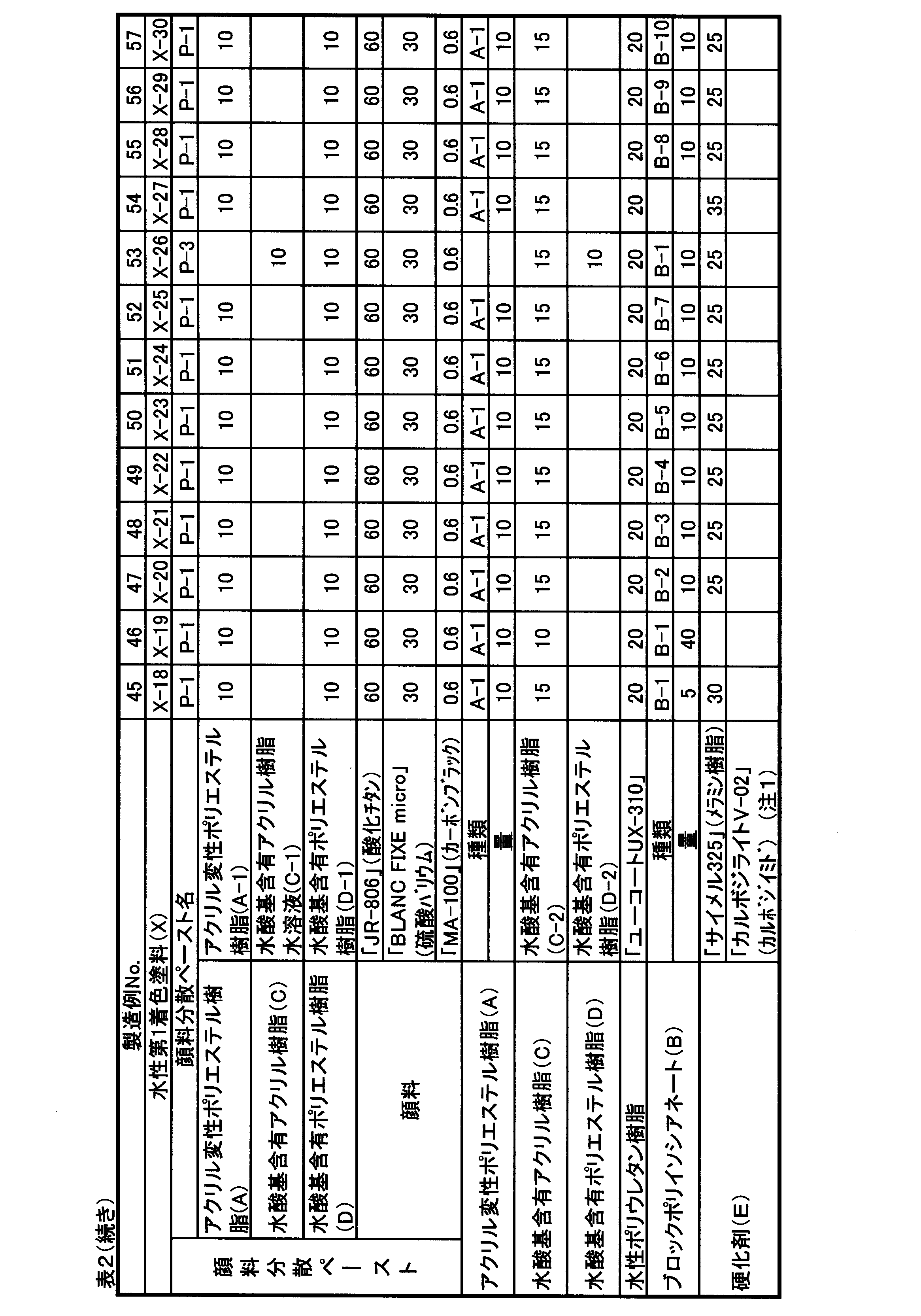
試験板の作製
製造例28~57で得た水性第1着色塗料(X-1)~(X-30)を用いて、以下のようにしてそれぞれ試験板を作製し、評価試験を行なった。
縦300mm×横450mm×厚さ0.8mmのリン酸亜鉛処理された冷延鋼板に、「エレクロンGT-10」(商品名、関西ペイント社製、カチオン電着塗料)を硬化膜厚20μmとなるように電着塗装し、170℃で30分間加熱して硬化させて試験用被塗物とした。
上記試験用被塗物に、製造例28で得た水性第1着色塗料(X-1)を、回転霧化型の静電塗装機を用いて、硬化膜厚20μmとなるように静電塗装し、第1着色塗膜を形成した。6分間放置後、該未硬化の第1着色塗膜上に「WBC-713シルバーメタリックベース」(関西ペイント社製、商品名、アクリル・メラミン樹脂系水性シルバーメタリック色ベースコート塗料、以下「水性第2着色塗料塗料(Y-1)」ということがある)を、回転霧化型の静電塗装機を用いて、硬化膜厚15μmとなるように静電塗装し、第2着色塗膜を形成した。3分間放置後、80℃で5分間プレヒートを行なった後、該未硬化のベースコート塗膜上に、「マジクロンKINO-1210」(商品名、関西ペイント社製、酸エポキシ架橋系有機溶剤型上塗りクリヤー塗料、以下「クリヤー塗料(Z-1)」ということがある)を硬化膜厚が35μmとなるように静電塗装し、クリヤー塗膜を形成した。7分間放置した後、140℃で30分間加熱して、上記第1着色塗膜、第2着色塗膜及びクリヤー塗膜を同時に硬化させ、試験板を作製した。
実施例1において、水性第1着色塗料(X-1)を、下記表3に示す水性第1着色塗料(X-2)~(X-30)のいずれかに変更する以外は、実施例1と同様にして試験板を作製した。
上記実施例1~25及び比較例1~5で得られた各試験板を用いて、下記の試験方法により評価を行なった。評価結果を下記表3に示す。
平滑性:試験板について、「Wave Scan DOI」(商品名、BYK Gardner社製)によって測定されるWc値を用いて評価した。Wc値が小さいほど塗面の平滑性が高いことを示す。Wc値は小さいほどよいが、少なくとも、20未満という条件を満たす必要がある。
S:ゴバン目塗膜が100個残存し、カッターの切り込みの縁において塗膜の小さなフチカケが生じていない。
A:ゴバン目塗膜が100個残存するが、カッターの切り込みの縁において塗膜の小さなフチカケが生じている。
B:ゴバン目塗膜の残存数が99個以下である。
S:ゴバン目塗膜が100個残存し、カッターの切り込みの縁において塗膜の小さなフチカケが生じていない。
A:ゴバン目塗膜が100個残存するが、カッターの切り込みの縁において塗膜の小さなフチカケが生じている。
B:ゴバン目塗膜の残存数が99個以下である。

Claims (9)
- 下記の工程(1)~(4)、
工程(1):被塗物上に、水性第1着色塗料(X)を塗装して第1着色塗膜を形成せしめる工程、
工程(2):工程(1)で形成される未硬化の第1着色塗膜上に、水性第2着色塗料(Y)を塗装して第2着色塗膜を形成せしめる工程、
工程(3):工程(2)で形成される未硬化の第2着色塗膜上に、クリヤー塗料(Z)を塗装してクリヤー塗膜を形成せしめる工程、及び
工程(4):工程(1)~(3)で形成される未硬化の第1着色塗膜、未硬化の第2着色塗膜及び未硬化のクリヤー塗膜を同時に加熱硬化させる工程
を順次行う複層塗膜形成方法であって、
水性第1着色塗料(X)が、(A)アクリル変性ポリエステル樹脂、ならびに(B)下記一般式(I)で示されるブロックイソシアネート基
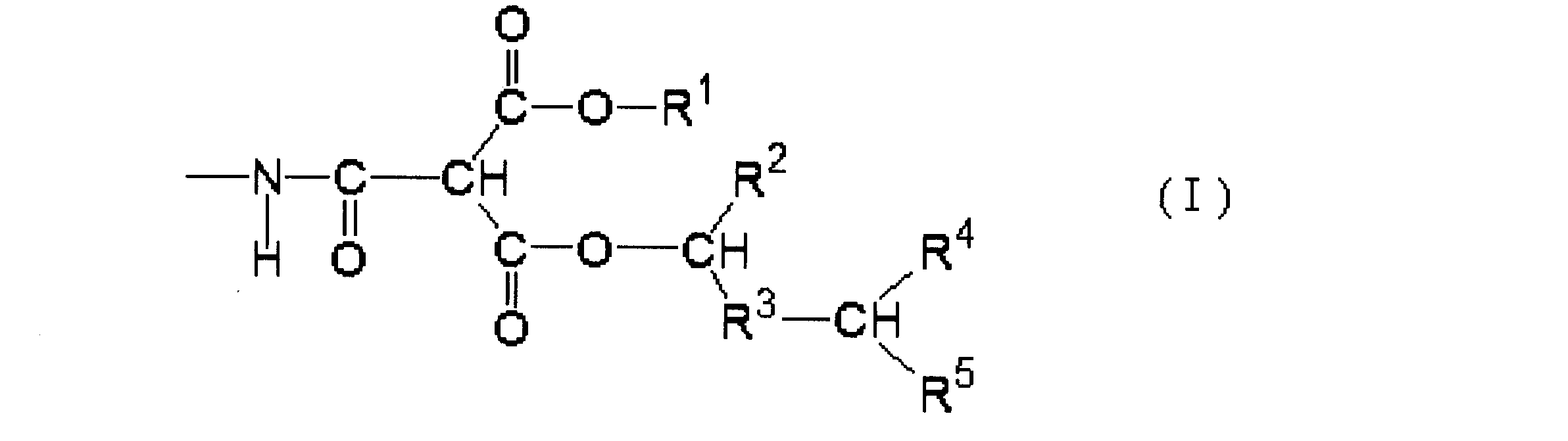
下記一般式(II)で示されるブロックイソシアネート基
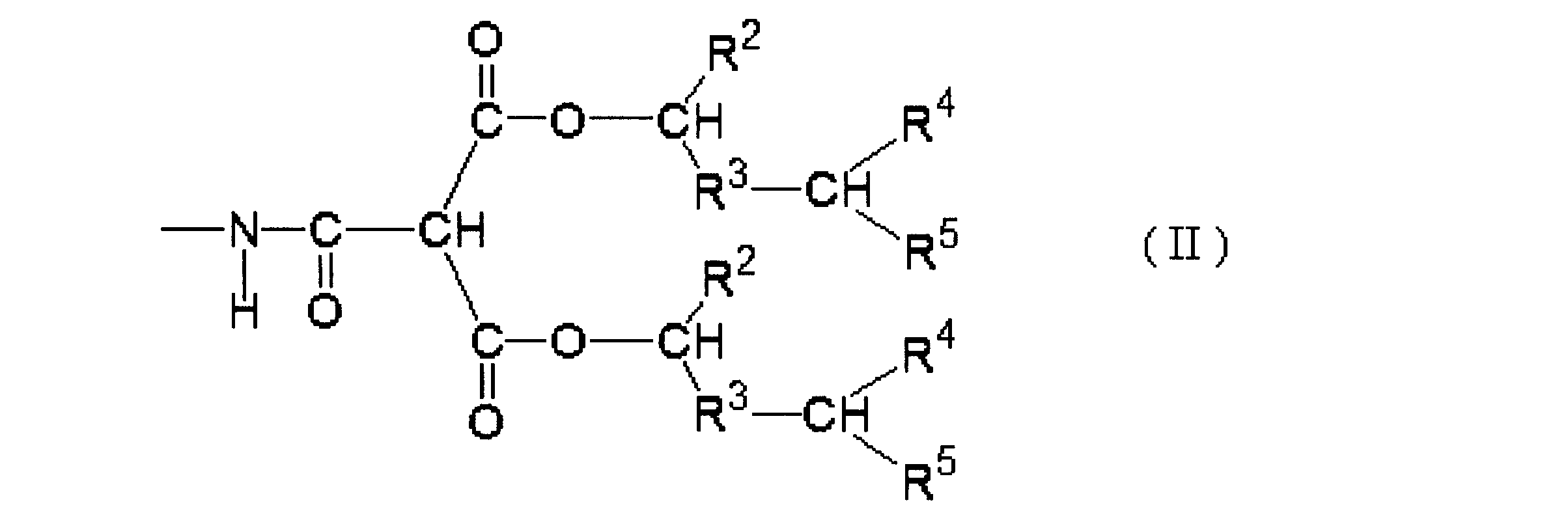
及び下記一般式(III)で示されるブロックイソシアネート基

から選ばれる少なくとも一種のブロックイソシアネート基を有するブロックポリイソシアネート化合物を含有することを特徴とする複層塗膜形成方法。 - 前記一般式(I)において、R1がイソプロピル基である請求項1に記載の複層塗膜形成方法。
- 前記一般式(III)において、R6がイソプロピル基である請求項1に記載の複層塗膜形成方法。
- ブロックポリイソシアネート化合物(B)が、下記一般式(IV)
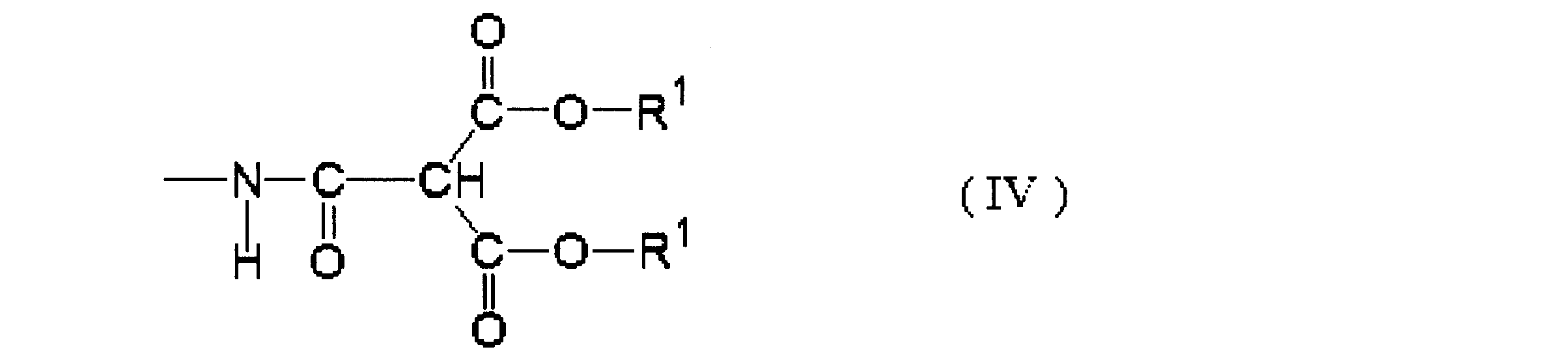
で示されるブロックイソシアネート基を有するブロックポリイソシアネート化合物(b3-1)及び下記一般式(VI)で示される2級アルコール(b4)

を反応させて得られる請求項1に記載の複層塗膜形成方法。 - ブロックポリイソシアネート化合物(B)が、下記一般式(V)
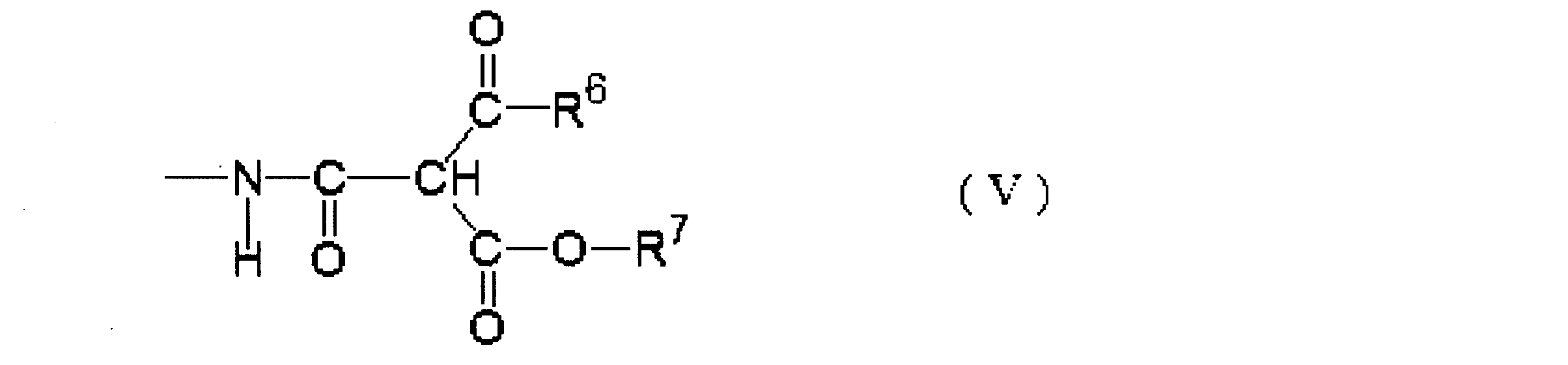
で示されるブロックイソシアネート基を有するブロックポリイソシアネート化合物(b3-2)及び前記2級アルコール(b4)を反応させて得られる請求項1に記載の複層塗膜形成方法。 - ブロックポリイソシアネート化合物(B)が、親水基を有するブロックポリイソシアネート化合物(B’)である請求項1に記載の複層塗膜形成方法。
- 水性第1着色塗料(X)がさらに水酸基含有アクリル樹脂(C)を含有する請求項1に記載の複層塗膜形成方法。
- アクリル変性ポリエステル樹脂(A)、ブロックポリイソシアネート化合物(B)及び水酸基含有アクリル樹脂(C)の配合量が、水性第1着色塗料(X)中の合計樹脂固形分100質量部を基準として、(A)が10~60質量部、(B)が5~40質量部、(C)が0~50質量部である請求項1~7のいずれか1項に記載の複層塗膜形成方法。
- 請求項1~8のいずれか1項に記載の複層塗膜形成方法により形成された複層塗膜を含む物品。
Priority Applications (4)
| Application Number | Priority Date | Filing Date | Title |
|---|---|---|---|
| US14/429,424 US20150232693A1 (en) | 2012-10-01 | 2013-09-30 | Process for forming multilayer coating film |
| JP2014539738A JP6049747B2 (ja) | 2012-10-01 | 2013-09-30 | 複層塗膜形成方法 |
| EP13844296.7A EP2905084B1 (en) | 2012-10-01 | 2013-09-30 | Process for forming multilayer coating film |
| CN201380059621.0A CN104797350B (zh) | 2012-10-01 | 2013-09-30 | 形成多层涂膜的方法 |
Applications Claiming Priority (2)
| Application Number | Priority Date | Filing Date | Title |
|---|---|---|---|
| JP2012-219561 | 2012-10-01 | ||
| JP2012219561 | 2012-10-01 |
Publications (1)
| Publication Number | Publication Date |
|---|---|
| WO2014054593A1 true WO2014054593A1 (ja) | 2014-04-10 |
Family
ID=50434920
Family Applications (1)
| Application Number | Title | Priority Date | Filing Date |
|---|---|---|---|
| PCT/JP2013/076586 Ceased WO2014054593A1 (ja) | 2012-10-01 | 2013-09-30 | 複層塗膜形成方法 |
Country Status (5)
| Country | Link |
|---|---|
| US (1) | US20150232693A1 (ja) |
| EP (1) | EP2905084B1 (ja) |
| JP (1) | JP6049747B2 (ja) |
| CN (1) | CN104797350B (ja) |
| WO (1) | WO2014054593A1 (ja) |
Cited By (4)
| Publication number | Priority date | Publication date | Assignee | Title |
|---|---|---|---|---|
| WO2018008221A1 (ja) * | 2016-07-08 | 2018-01-11 | 関西ペイント株式会社 | 複層塗膜形成方法 |
| WO2019064958A1 (ja) * | 2017-09-26 | 2019-04-04 | 関西ペイント株式会社 | 複層塗膜形成方法 |
| WO2020203601A1 (ja) | 2019-03-29 | 2020-10-08 | 三井化学株式会社 | ブロックイソシアネート、複層膜の製造方法、および、複層膜 |
| JPWO2022138183A1 (ja) * | 2020-12-22 | 2022-06-30 |
Families Citing this family (16)
| Publication number | Priority date | Publication date | Assignee | Title |
|---|---|---|---|---|
| JP6851329B2 (ja) * | 2016-02-02 | 2021-03-31 | 関西ペイント株式会社 | 光輝性顔料含有水性ベースコート塗料、及びこれを用いた複層塗膜形成方法 |
| CN108713046B (zh) * | 2016-03-09 | 2020-05-22 | 关西涂料株式会社 | 水性涂料组合物 |
| JP6781015B2 (ja) * | 2016-11-11 | 2020-11-04 | 関西ペイント株式会社 | 複層塗膜形成方法 |
| JP6656427B2 (ja) * | 2017-01-17 | 2020-03-04 | 関西ペイント株式会社 | 水性塗料組成物及び複層塗膜形成方法 |
| CN111886082A (zh) * | 2018-03-21 | 2020-11-03 | 关西涂料株式会社 | 多层涂膜的形成方法 |
| JP2019214719A (ja) * | 2018-06-12 | 2019-12-19 | Agc株式会社 | 粉体塗料及び粉体塗料の製造方法 |
| CN109593182B (zh) * | 2018-11-08 | 2021-06-01 | 湖南湘江关西涂料有限公司 | 非离子型水性封闭多异氰酸酯固化剂及其制备方法、水性涂料 |
| CN109608617A (zh) * | 2018-12-14 | 2019-04-12 | 湖南湘江关西涂料有限公司 | 水性抗石击封闭多异氰酸酯固化剂及其制备方法、水性涂料 |
| JP6826095B2 (ja) * | 2018-12-21 | 2021-02-03 | 日本ペイント・オートモーティブコーティングス株式会社 | 複層塗膜形成方法 |
| WO2020203397A1 (ja) * | 2019-03-29 | 2020-10-08 | 関西ペイント株式会社 | 水性塗料組成物及び複層塗膜形成方法 |
| CN110240436A (zh) * | 2019-06-10 | 2019-09-17 | 东莞市浩展高分子材料有限公司 | 一种透水环保胶筑材料及施工工艺 |
| CN110655857B (zh) * | 2019-11-05 | 2022-03-18 | 立邦涂料(中国)有限公司 | 一种适用于湿喷湿工艺的水性色漆及其应用 |
| TWI712624B (zh) * | 2019-11-05 | 2020-12-11 | 長興材料工業股份有限公司 | 丙烯酸改性聚酯樹脂及其製備方法 |
| CN112831745B (zh) * | 2020-12-30 | 2023-04-18 | 王炯 | 金属涂层在铝及铝合金餐饮器具上的应用 |
| CN117178038A (zh) * | 2021-05-18 | 2023-12-05 | 关西涂料株式会社 | 高固体成分涂料组合物和多层涂膜形成方法 |
| CN114574075B (zh) * | 2022-04-12 | 2023-01-20 | 江苏中基复合材料有限公司 | 一种涂树脂铝箔盖板用铝箔及其制备方法 |
Citations (8)
| Publication number | Priority date | Publication date | Assignee | Title |
|---|---|---|---|---|
| JP2001521956A (ja) * | 1997-11-04 | 2001-11-13 | ビーエーエスエフ コーティングス アクチェンゲゼルシャフト | 二層塗料系の製法及びこの方法に好適な塗料 |
| JP2002153806A (ja) | 2000-11-20 | 2002-05-28 | Nippon Paint Co Ltd | 塗膜形成方法及び積層塗膜 |
| JP2004025046A (ja) * | 2002-06-26 | 2004-01-29 | Kansai Paint Co Ltd | 上塗り塗膜形成方法 |
| JP2004043524A (ja) * | 2002-07-08 | 2004-02-12 | Nippon Paint Co Ltd | 水性中塗り塗料組成物及び複層塗膜の形成方法 |
| WO2010047352A1 (ja) | 2008-10-21 | 2010-04-29 | 関西ペイント株式会社 | 複層塗膜形成方法 |
| JP2011530393A (ja) * | 2008-08-12 | 2011-12-22 | 関西ペイント株式会社 | 複層塗膜形成方法 |
| WO2012137884A1 (ja) * | 2011-04-08 | 2012-10-11 | 関西ペイント株式会社 | 複層塗膜形成方法、及び塗装物品 |
| WO2013151143A1 (ja) * | 2012-04-04 | 2013-10-10 | 関西ペイント株式会社 | 水性塗料組成物、及び塗装物品の製造方法 |
Family Cites Families (7)
| Publication number | Priority date | Publication date | Assignee | Title |
|---|---|---|---|---|
| WO2004024444A1 (ja) * | 2002-09-12 | 2004-03-25 | Nippon Sheet Glass Company, Limited | 発光膜被覆物品 |
| US20060089481A1 (en) * | 2004-10-21 | 2006-04-27 | Roesler Richard R | Blocked biuretized isocyanates |
| JP2008144063A (ja) * | 2006-12-12 | 2008-06-26 | Nippon Paint Co Ltd | 水性硬化性樹脂組成物および水性塗料組成物 |
| JP5081608B2 (ja) * | 2006-12-28 | 2012-11-28 | 関西ペイント株式会社 | 複層塗膜形成方法 |
| JP5060202B2 (ja) * | 2007-08-09 | 2012-10-31 | 本田技研工業株式会社 | 光輝性塗膜形成方法 |
| CN102010648B (zh) * | 2010-11-29 | 2013-04-17 | 常州市武进晨光金属涂料有限公司 | 用于金属件的免中涂闪光底色漆及其制备方法 |
| ES2803502T3 (es) * | 2012-02-24 | 2021-01-27 | Kansai Paint Co Ltd | Procedimiento de formación de película multicapa y artículo revestido |
-
2013
- 2013-09-30 WO PCT/JP2013/076586 patent/WO2014054593A1/ja not_active Ceased
- 2013-09-30 EP EP13844296.7A patent/EP2905084B1/en active Active
- 2013-09-30 JP JP2014539738A patent/JP6049747B2/ja active Active
- 2013-09-30 US US14/429,424 patent/US20150232693A1/en not_active Abandoned
- 2013-09-30 CN CN201380059621.0A patent/CN104797350B/zh active Active
Patent Citations (8)
| Publication number | Priority date | Publication date | Assignee | Title |
|---|---|---|---|---|
| JP2001521956A (ja) * | 1997-11-04 | 2001-11-13 | ビーエーエスエフ コーティングス アクチェンゲゼルシャフト | 二層塗料系の製法及びこの方法に好適な塗料 |
| JP2002153806A (ja) | 2000-11-20 | 2002-05-28 | Nippon Paint Co Ltd | 塗膜形成方法及び積層塗膜 |
| JP2004025046A (ja) * | 2002-06-26 | 2004-01-29 | Kansai Paint Co Ltd | 上塗り塗膜形成方法 |
| JP2004043524A (ja) * | 2002-07-08 | 2004-02-12 | Nippon Paint Co Ltd | 水性中塗り塗料組成物及び複層塗膜の形成方法 |
| JP2011530393A (ja) * | 2008-08-12 | 2011-12-22 | 関西ペイント株式会社 | 複層塗膜形成方法 |
| WO2010047352A1 (ja) | 2008-10-21 | 2010-04-29 | 関西ペイント株式会社 | 複層塗膜形成方法 |
| WO2012137884A1 (ja) * | 2011-04-08 | 2012-10-11 | 関西ペイント株式会社 | 複層塗膜形成方法、及び塗装物品 |
| WO2013151143A1 (ja) * | 2012-04-04 | 2013-10-10 | 関西ペイント株式会社 | 水性塗料組成物、及び塗装物品の製造方法 |
Non-Patent Citations (1)
| Title |
|---|
| See also references of EP2905084A4 |
Cited By (8)
| Publication number | Priority date | Publication date | Assignee | Title |
|---|---|---|---|---|
| WO2018008221A1 (ja) * | 2016-07-08 | 2018-01-11 | 関西ペイント株式会社 | 複層塗膜形成方法 |
| JP2018012096A (ja) * | 2016-07-08 | 2018-01-25 | 関西ペイント株式会社 | 複層塗膜形成方法 |
| US11420226B2 (en) | 2016-07-08 | 2022-08-23 | Kansai Paint Co., Ltd. | Method for forming multilayer coating film |
| WO2019064958A1 (ja) * | 2017-09-26 | 2019-04-04 | 関西ペイント株式会社 | 複層塗膜形成方法 |
| JPWO2019064958A1 (ja) * | 2017-09-26 | 2020-09-10 | 関西ペイント株式会社 | 複層塗膜形成方法 |
| JP7106558B2 (ja) | 2017-09-26 | 2022-07-26 | 関西ペイント株式会社 | 複層塗膜形成方法 |
| WO2020203601A1 (ja) | 2019-03-29 | 2020-10-08 | 三井化学株式会社 | ブロックイソシアネート、複層膜の製造方法、および、複層膜 |
| JPWO2022138183A1 (ja) * | 2020-12-22 | 2022-06-30 |
Also Published As
| Publication number | Publication date |
|---|---|
| EP2905084A1 (en) | 2015-08-12 |
| JPWO2014054593A1 (ja) | 2016-08-25 |
| CN104797350B (zh) | 2017-09-15 |
| EP2905084B1 (en) | 2017-08-30 |
| EP2905084A4 (en) | 2016-06-22 |
| CN104797350A (zh) | 2015-07-22 |
| US20150232693A1 (en) | 2015-08-20 |
| JP6049747B2 (ja) | 2016-12-21 |
Similar Documents
| Publication | Publication Date | Title |
|---|---|---|
| JP6049747B2 (ja) | 複層塗膜形成方法 | |
| JP5885828B2 (ja) | 複層塗膜形成方法、及び塗装物品 | |
| JP5837054B2 (ja) | 複層塗膜形成方法、及び塗装物品 | |
| JP5751614B2 (ja) | 水性塗料組成物 | |
| JP5653224B2 (ja) | 複層塗膜形成方法 | |
| JP5818736B2 (ja) | 水性塗料組成物及び塗膜形成方法 | |
| JP6041740B2 (ja) | 水性塗料組成物及び塗膜形成方法 | |
| JP6073291B2 (ja) | 水性塗料組成物、及び塗装物品の製造方法 | |
| JP5759892B2 (ja) | ベースコート塗料組成物 | |
| US10047189B2 (en) | Block polyisocyanate compound | |
| CN104321395A (zh) | 水性涂料组合物和形成涂膜的方法 | |
| JPWO2012137884A6 (ja) | 複層塗膜形成方法、及び塗装物品 | |
| WO2011010539A1 (ja) | 水性塗料組成物及び複層塗膜形成方法 | |
| JP5692890B2 (ja) | 水性塗料組成物 | |
| JP5804661B2 (ja) | 水性塗料組成物 | |
| WO2020162126A1 (ja) | 水性塗料組成物 | |
| JP5757662B2 (ja) | 共重合体、該共重合体を含有する水性塗料組成物及び複層塗膜形成方法 | |
| JP5603177B2 (ja) | 共重合体、該共重合体を含有する水性塗料組成物及び複層塗膜形成方法 | |
| JP5476260B2 (ja) | 樹脂組成物、該樹脂組成物を含有する水性塗料組成物及び複層塗膜形成方法 | |
| JP7324386B1 (ja) | 複層塗膜形成方法 | |
| WO2023149261A1 (ja) | 複層塗膜形成方法 |
Legal Events
| Date | Code | Title | Description |
|---|---|---|---|
| 121 | Ep: the epo has been informed by wipo that ep was designated in this application |
Ref document number: 13844296 Country of ref document: EP Kind code of ref document: A1 |
|
| ENP | Entry into the national phase |
Ref document number: 2014539738 Country of ref document: JP Kind code of ref document: A |
|
| WWE | Wipo information: entry into national phase |
Ref document number: 14429424 Country of ref document: US |
|
| NENP | Non-entry into the national phase |
Ref country code: DE |
|
| REEP | Request for entry into the european phase |
Ref document number: 2013844296 Country of ref document: EP |
|
| WWE | Wipo information: entry into national phase |
Ref document number: 2013844296 Country of ref document: EP |