WO2013190722A1 - 電子機器 - Google Patents
電子機器 Download PDFInfo
- Publication number
- WO2013190722A1 WO2013190722A1 PCT/JP2012/079332 JP2012079332W WO2013190722A1 WO 2013190722 A1 WO2013190722 A1 WO 2013190722A1 JP 2012079332 W JP2012079332 W JP 2012079332W WO 2013190722 A1 WO2013190722 A1 WO 2013190722A1
- Authority
- WO
- WIPO (PCT)
- Prior art keywords
- unit
- user
- information
- communication
- storage unit
- Prior art date
- Legal status (The legal status is an assumption and is not a legal conclusion. Google has not performed a legal analysis and makes no representation as to the accuracy of the status listed.)
- Ceased
Links
Images




Classifications
-
- H—ELECTRICITY
- H04—ELECTRIC COMMUNICATION TECHNIQUE
- H04W—WIRELESS COMMUNICATION NETWORKS
- H04W4/00—Services specially adapted for wireless communication networks; Facilities therefor
- H04W4/02—Services making use of location information
- H04W4/029—Location-based management or tracking services
-
- G—PHYSICS
- G07—CHECKING-DEVICES
- G07F—COIN-FREED OR LIKE APPARATUS
- G07F17/00—Coin-freed apparatus for hiring articles; Coin-freed facilities or services
- G07F17/32—Coin-freed apparatus for hiring articles; Coin-freed facilities or services for games, toys, sports, or amusements
- G07F17/3202—Hardware aspects of a gaming system, e.g. components, construction, architecture thereof
- G07F17/3204—Player-machine interfaces
-
- H—ELECTRICITY
- H04—ELECTRIC COMMUNICATION TECHNIQUE
- H04W—WIRELESS COMMUNICATION NETWORKS
- H04W4/00—Services specially adapted for wireless communication networks; Facilities therefor
- H04W4/02—Services making use of location information
Definitions
- the present invention relates to an electronic device.
- the athletes themselves record the competition results.
- a golf player records the number of hits of each hole on a score card during play and records a play score.
- information such as where the nth shot was struck and where the missed shot was made, and information such as the posture and wind direction at the time of hitting had to be traced.
- an information recording system using a golf ball having a wireless IC tag and an information reading device embedded in the ground of the golf course has been proposed (for example, see Patent Document 1).
- the present invention has been made in view of the above-described problems, and an object thereof is to provide an electronic device that can easily record play information.
- the electronic device of the present invention includes a communication unit that communicates with the first device through human body communication or short-range communication via a user, a position acquisition unit that acquires the user's position information, and the communication unit.
- a storage unit that stores information related to the use of the first device based on a communication history with one device and the location information of the user.
- the storage unit may store information related to the use of the first device in association with a moving distance of the user based on the position information of the user.
- the communication unit can perform human body communication or short-range communication with a second device different from the first device, and can communicate with the second device of the communication unit. Accordingly, a determination unit that determines the moving distance of the user may be provided.
- the electronic device of the present invention includes a first input unit that inputs information generated when the first device is used, and the storage unit is information regarding use of the first device according to the generated information. May be stored.
- the information generated when the first device is used may be information regarding sound generated when the first device is used.
- the electronic device of the present invention includes a second input unit that inputs information regarding an environment of a place where the first device is used, and the storage unit uses the first device to store information regarding the use of the first device. It may be stored in association with information on the environment of the place to be. Furthermore, the electronic device according to the present invention further includes a third input unit that inputs information related to the posture of the user, and the storage unit stores information related to the posture of the user in association with information related to use of the first device. May be.
- the communication unit can perform human body communication or short-range communication with a second device different from the first device, and the user can perform the first device and the second device.
- the storage unit uses information on the use of the device using the information on the device not used, and It may be stored in association.
- the electronic device of this invention may be provided with the display part which displays the information which the said memory
- the electronic device of the present invention may include a transmission unit that transmits information stored in the storage unit to an external device.
- the electronic device of the present invention may include a notification unit that notifies the user of information stored in the storage unit in accordance with the position information acquired by the position acquisition unit.
- the electronic device is based on the communication unit that communicates with the first device through human body communication or near field communication via the user, and how to hold and swing the first device.
- a storage unit that stores information regarding use.
- the electronic device of the present invention has an effect that play information can be recorded easily.
- FIG. 5A and 5B are diagrams illustrating an example of play information displayed on the display unit of the mobile terminal. It is a figure which shows an example of the hardware constitutions of the control part of a portable terminal. It is a functional block diagram which shows an example of the function with which the control part of a portable terminal is provided.
- FIG. 5A and 5B are diagrams illustrating an example of play information displayed on the display unit of the mobile terminal. It is a figure which shows an example of the hardware constitutions of the control part of a portable terminal. It is a functional block diagram which shows an example of the function with which the control part of a portable terminal is provided.
- FIG. 8A is a flowchart illustrating an example of processing executed by the control unit of the communication apparatus
- FIG. 8B is a flowchart illustrating an example of processing executed by the control unit of the mobile terminal. It is a figure which shows an example of a golf course.
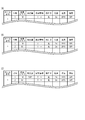
- FIGS. 10A to 10C are diagrams for explaining the data registration process of FIG. 8B.
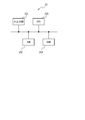
- FIG. 1 is a block diagram showing a configuration of an electronic device system 500 according to an embodiment.
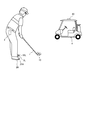
- FIG. 2 shows a situation where the electronic device system 500 is used.
- the electronic device system 500 is a system used when a user performs sports or the like. In the present embodiment, as illustrated in FIG. 2, the description will be made assuming that the user uses golf.
- the electronic device system 500 includes a club device 10 provided in the golf club 1, a portable terminal 2, shoe devices 30 ⁇ / b> R and 30 ⁇ / b> L provided in the shoes 3, and a cart 4. And a cart device 40 provided in the vehicle.
- the club device 10 includes an acceleration sensor 11, a gyro sensor 12, a microphone 13, a control unit 14, a storage unit 15, and a communication unit 16.
- the golf club 1 includes a driver, an iron, a putter (P), the driver is 1 W, 3 W, 5 W, the iron is 3I to 9 I, PW (pitching wedge), AW (approach wedge), SW (sand) Wedge).
- a club device 10 is provided for each club.
- the configuration of the club device 10 described above is not always necessary, and a part of the configuration may be omitted or provided in the mobile terminal 2.
- the acceleration sensor 11 is provided in the head portion of the golf club 1 and detects the acceleration of the head portion of the golf club 1.
- a piezoelectric element, a strain gauge, or the like can be used for the acceleration sensor 11.
- any one of 1 to 3 axes may be selected as appropriate, and the number can be arbitrarily set.
- the gyro sensor 12 detects, for example, a Coriolis force generated by the influence of the angular velocity by a piezoelectric element.
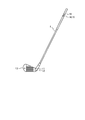
- the gyro sensor 12 is provided at the head portion of the golf club 1 (see FIG. 3). The angular velocity is detected.
- any one of 1 to 3 axes may be appropriately selected, and the number can be arbitrarily set.
- the acceleration sensor 11 and the gyro sensor 12 are provided in the golf club 1, the swing of the golf club 1 by the user can be detected by each sensor.
- the microphone 13 is provided in the head portion of the golf club 1 and collects sound according to the swing of the golf club 1.
- the microphone 13 is preferably a microphone with good directivity.
- a microphone with a built-in preamplifier can be used.
- the output of the microphone 13 is amplified by an amplifier and recorded as acoustic data in the storage unit 15 (see, for example, JP-A-10-267744). .
- the control unit 14 controls the entire club device 10 and includes a CPU (Central Processing Unit), a RAM (Random Access Memory), a ROM (Read Only Memory), and the like. In the present embodiment, the control unit 14 controls data transmission to the portable terminal 2, sound collection by the microphone 13, and recording of collected sound data to the storage unit 15.
- the storage unit 15 stores acoustic data collected by the microphone 13 and count information (1W, 3W, 5W, 3I to 9I, PW, AW, SW, P, etc.) of the golf club 1.
- the control unit 14 and the storage unit 15 may be provided at any position of the golf club 1, but in the present embodiment, as shown in FIG. 3, the control unit 14 and the storage unit 15 are provided at the grip portion of the golf club 1. And
- the communication unit 16 communicates with other devices, and a wireless communication unit 161 that performs wireless communication with a human body communication unit 162 that performs human body communication using electrodes provided on a grip portion of the golf club 1.
- the communication unit 16 communicates with the mobile terminal 2 and transmits the golf club 1 count information stored in the storage unit 15 and the acoustic data collected by the microphone 13 to the mobile terminal 2.
- Human body communication includes a current system in which a weak current is passed through the human body and the current is modulated to transmit information, and an electric field system in which information is transmitted by modulating an electric field induced on the surface of the human body. . In this embodiment, it is possible to use either the current method or the electric field method.
- the communication unit 16 is illustrated with a small square, but the electrodes of the human body communication unit 162 are provided so that human body communication with the right hand or the left hand is possible regardless of which part of the grip portion the user touches. ing. Further, for example, a plurality of electrodes of the human body communication unit 162 are discretely provided on the grip portion so that the user can grasp the golf club 1 longer or shorter, that is, the position of the hand with respect to the grip portion can be determined. It may be provided.
- the flight distance when a ball is hit differs between the case where the golf club 1 is held longer and the case where the golf club 1 is held shorter.
- the flight distance is recorded in a table shown in FIG. 4 to be described later, how to hold the golf club 1 is recorded, and data such as an average flight distance according to how the golf club 1 is held is recorded. Good.
- the shoe device 30R is provided on the right shoe 3R, and the shoe device 30L is provided on the left shoe 3L.
- the shoe device 30R includes a load sensor 31R and a human body communication unit 32R.
- the shoe device 30L includes a load sensor 31L and a human body communication unit 32L.
- the load sensors 31R and 31L detect where the load is applied in each of the shoes 3R and 3L. If the detection results of the load sensors 31R and 31L are used, the posture of the user can be detected.
- the human body communication unit 32R performs human body communication with the human body communication unit 212 of the mobile terminal 2 using the electrodes provided on the right shoe 3R, and transmits the detection result by the load sensor 31R to the human body communication unit 212.
- the human body communication unit 32L performs human body communication with the human body communication unit 212 of the mobile terminal 2 using an electrode provided on the left shoe 3L, and transmits a detection result by the load sensor 31L to the human body communication unit 212.
- the electrode for human body communication is provided in the position which touches a user's foot (inside shoes 3R and 3L). Note that human body communication is possible not only when the user is bare feet (that is, when the electrode is in contact with the foot) but also when wearing socks (that is, when the electrode is opposed to the foot). is there.
- the cart device 40 is provided, for example, on the ceiling of the cart 4 (see FIG. 2), and has an anemometer 41, a temperature / humidity meter 42, a clock 43, and a wireless communication unit 44 as shown in FIG. is doing.
- the anemometer 41 detects the wind direction and wind speed during play.
- the thermohygrometer 42 detects the temperature and humidity during play.
- the clock 43 acquires date and time information at the time of play.
- the wireless communication unit 44 performs wireless communication with the wireless communication unit 211 of the mobile terminal 2.
- the wireless communication unit 44 transmits the outputs of the anemometer 41, the temperature / humidity meter 42, and the clock 43 to the wireless communication unit 211 by wireless communication.
- the portable terminal 2 is an information device that is used while being carried by a user.
- a mobile phone, a smartphone, a PHS (Personal Handy-phone System), a PDA (Personal Digital Assistant), or the like can be used.
- the mobile terminal 2 is a smartphone.
- the mobile terminal 2 has a telephone function, a communication function for connecting to the Internet, etc., a data processing function for executing a program, and the like.
- the necessary configuration of the portable terminal 2 may be provided as a portable terminal by providing a wristwatch, glasses, hearing aid, hat, shoes 3R, 3L, a remote control for remotely operating the cart 4, and the like.
- the mobile terminal 2 includes a communication unit 21, a GPS (Global Positioning System) module 22, a storage unit 24, a display unit 26, and a control unit 23.
- GPS Global Positioning System
- the communication unit 21 communicates with other devices, and communicates with the human body communication unit 212 that performs human body communication using electrodes attached to the user or provided on the mobile terminal 2 by wireless communication.
- a wireless communication unit 211 In the present embodiment, the human body communication unit 212 performs human body communication with the club device 10 while the user holds the golf club 1 and receives club number information and acoustic data. In addition, the human body communication unit 212 performs human body communication with the shoe devices 30R and 30L using the electrodes provided in the shoes 3R and 3L, and receives information related to the posture of the user.
- the wireless communication unit 211 communicates with the cart device 40 and receives information such as wind direction, wind speed, temperature, humidity, and time.
- the wireless communication unit 211 may receive club number information and acoustic data from the club device 10. Note that human body communication is possible not only when the user and the mobile terminal 2 are in direct contact but also when the user and the mobile terminal 2 are in contact via a shirt or pants.
- the GPS module 22 is a sensor that detects the position (for example, latitude and longitude) of the mobile terminal 2. In the present embodiment, since the user holds the mobile terminal 2 (see FIG. 3), the GPS module 22 detects the user's position.
- the storage unit 24 is, for example, a nonvolatile memory or a hard disk, and stores user play information.
- the information stored in the storage unit 24 will be described with reference to FIG.
- the storage unit 24 includes “hole number”, “number of hits”, “club used”, “flying distance”, “posture information”, “wind direction”, “wind speed”, “temperature” as play information. ”And“ humidity ”.
- “Hole number” is the number of each hole in the golf course. “Number of bats” represents how many hits each bat of the user has in each hall.
- the “used club” stores the number information of the club used by the user at the nth shot.
- the “flying distance” stores the flying distance of the nth ball.
- Posture information stores the posture of the user when the nth shot is hit. In the present embodiment, as an example, it is assumed that the left arrow represents the inclination of the user in the front-rear direction.
- the left arrow is an upward arrow, it means that the toes are raised, if it is a downward arrow, it means that the toes are lowered, and "-" means that it is flat in the front-rear direction. .
- the arrow on the right side represents the inclination in the left-right direction of the user. Therefore, if the right arrow is a right arrow, it means that the user's posture is leaning to the right (the right foot is lower than the left foot), and if the left arrow is, the user is leaning to the left (the left foot is the right foot).
- "-" Means flat in the left-right direction. For example, in the second shot with the hole number “1”, the left arrow is an upward arrow and the right arrow is a right arrow, so the user's posture is “left toe up”.
- Wind direction and Windd speed store the wind direction and wind speed of the wind that was blowing when the nth shot was hit, respectively.
- temperature and “humidity” store the temperature and humidity when the nth shot is hit, respectively.
- information such as flight distance, posture information, wind direction, wind speed, temperature, and humidity is stored in association with the information on the club used for the nth shot.
- the display unit 26 is, for example, a device using a liquid crystal display element, and displays play information stored in the storage unit 24 based on the control of the control unit 23.
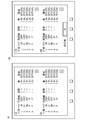
- FIG. 5A and FIG. 5B show an example of play information displayed on the display unit 26.
- the display unit 26 displays the play information of FIG. 4 in a layout and display manner that is easy for the user to see.
- the display unit 26 also displays the total number of hits of the hole and the total number of hits of the game.
- 5A and 5B as an example, an upward arrow means a tailwind, and a downward arrow means a headwind.
- the control unit 23 controls the entire mobile terminal 2.
- the control unit 23 performs control for performing various recordings in the storage unit 24, control for displaying play information on the display unit 26, and the like.
- FIG. 6 shows an example of the hardware configuration of the control unit 23.
- the control unit 23 includes an input / output unit 201, a ROM 202, a CPU 203, and a RAM 204.
- the input / output unit 201 transmits / receives data to / from the communication unit 21, the GPS module 22, the storage unit 24, and the display unit 26.
- the ROM 202 stores a program for calculating the flight distance of the ball hit by the user.
- the CPU 203 reads and executes a program stored in the ROM 202.
- the RAM 204 stores temporary data used when executing the program.
- the control unit 23 includes a position acquisition unit 231, a determination unit 232, a first input unit 233, a second input unit 234, a third input unit 235, a data registration unit 236, It has a notification unit 237, a display control unit 238, and a transmission unit 239.
- the location acquisition unit 231 acquires the location information (user location information) of the mobile terminal 2 from the GPS module 22 and inputs the user location information to the data registration unit 236 and the notification unit 237.
- the determination unit 232 determines whether or not the user's bat is a tee shot (first hit of each hole). In the present embodiment, the determination unit 232 acquires club count information from the club device 10 via the communication unit 21, determines whether or not the user's at-bat is a tee shot, and determines the determination result. Input to the data registration unit 236. Instead of this, the determination unit 232 may detect the tee ground position information of each hole by the GPS module 22 and determine whether or not it is a tee shot.
- the first input unit 233 obtains the count information of the golf club 1 from the club device 10 via the communication unit 21 and inputs it to the data registration unit 236. Further, the first input unit 233 acquires acoustic data when the user swings the golf club 1 from the club device 10 and inputs the acoustic data to the data registration unit 236.
- the second input unit 234 acquires information about the environment (wind direction, wind speed, temperature, humidity, etc.) when the user uses the golf club 1 from the cart device 40 via the communication unit 21, and the data registration unit 236.
- the third input unit 235 acquires information about the posture when the user uses the golf club 1 from the shoe devices 30R and 30L via the communication unit 21, and inputs the information to the data registration unit 236.
- the data registration unit 236 stores information related to the use of the golf club 1 in the storage unit 24. Specifically, when the user uses the golf club 1, the data registration unit 236 associates information on the club used by the user, information on the environment, and information on the user's posture based on the received data. 24.
- the data registration unit 236 receives the n-th shot number received from the position acquisition unit 231 and (n ⁇ 1) Based on the position information of the user at the number of hits, (n-1) the flight distance of the ball at the hit is calculated and stored in the storage unit 24. The calculation of the flight distance of the ball will be described later with reference to FIG.
- the notification unit 237 When the user has played in the past on the golf course currently being played, the notification unit 237 notifies the user of past play information. For example, the notification unit 237 displays the display control unit when the position information of the user input from the position acquisition unit 231 is included in the play information (past play information) stored in the storage unit 24. An instruction is issued to 238 and the play information is displayed on the display unit 26. Thereby, the user can confirm the data when the same golf course was played in the past on the display unit 26. In this case, for example, the selected club and the unselected club among the plurality of clubs obtained by the user are displayed, or the result of using the selected club (for example, the flight distance) is displayed. Also good. Further, whether the current shot is a nice shot or a miss shot may be displayed based on a comparison between the average flying distance of the user when using the selected club and the flying distance at that time.
- the display control unit 238 displays the play information stored in the storage unit 24 on the display unit 26 based on an instruction from the notification unit 237. Further, the display control unit 238 displays the play information stored in the storage unit 24 on the display unit 26 based on the operation of the user's portable terminal 2.
- the transmission unit 239 transmits the play information stored in the storage unit 24 to the external device.
- the external device include a personal computer that can be connected to the Internet and a mobile terminal owned by another user. Thereby, play information can be shared with others. In addition, it is possible to share information such as how others fail and which route can be used to hole out with a good score. It is also possible to feed back your previous failure.
- FIG. 8A is a flowchart illustrating an example of processing executed by the control unit 14 of the club device 10.
- FIG. 8B is a flowchart illustrating an example of processing executed by the control unit 23 of the mobile terminal 2.
- step S10 the control unit 14 determines whether or not human body communication with the mobile terminal 2 is established. When determination here is denied, ie, when human body communication with the portable terminal 2 is not materialized, the control part 14 repeats the process of step S10 until determination of step S10 is affirmed.
- the flowchart may be started by detecting that the user holds or holds the golf club 1 using the electrode portion of the human body communication unit 162.
- step S10 determines whether or not the golf club 1 has been swung by the user by determining whether or not there are predetermined outputs from the acceleration sensor 11 and the gyro sensor 12.
- step S12 When the determination in step S12 is negative, that is, when there is no predetermined output from the acceleration sensor 11 and the gyro sensor 12, the control unit 14 performs step S12 until there is a predetermined output from the acceleration sensor 11 and the gyro sensor 12. Execute the process. Then, when there is a predetermined output from the acceleration sensor 11 and the gyro sensor 12, the determination in step S12 is affirmed, and the process proceeds to step S14.
- step S ⁇ b> 14 the control unit 14 collects sound using the microphone 13. In this case, when the user hits the ball, the hitting sound is collected by the microphone 13. In the present embodiment, the hitting sound is collected by the microphone 13 in order to determine whether or not it is a swing.
- step S16 the control unit 14 transmits the acoustic data collected in step S14 to the portable terminal 2 via the communication unit 16, and the entire process of FIG.
- the mobile terminal 2 can determine whether the user has performed a full swing or a half swing based on the output of at least one of the acceleration sensor 11 and the gyro sensor 12.
- step S30 the first input unit 233 determines whether or not human body communication with the golf club 1 is established.
- determination here is denied, ie, when the human body communication with the golf club 1 is not materialized, the 1st input part 233 repeats the process of step S30.
- the determination in step S30 is affirmed, and the process proceeds to step S32.
- the first input unit 233 acquires the club number information from the golf club 1 and inputs it to the data registration unit.
- step S ⁇ b> 34 the first input unit 233 acquires the acoustic data collected by the microphone 13 (step S ⁇ b> 14 in FIG. 8A) from the golf club 1 and inputs it to the data registration unit 236.
- the count information of clubs that are not selected (used) may be input to the data registration unit 236.
- step S36 the data registration unit 236 performs frequency analysis on the acoustic data, for example, and determines whether or not the acquired sound is a hitting sound.
- determination of this step S36 is determining whether the user used the golf club which acquired count information at step S32. If the determination in step S36 is negative, that is, if it is not a hitting sound, the process returns to step S34. On the other hand, if the determination in step S36 is affirmative, that is, if it is a hitting sound, the process proceeds to step S38. Instead of the hitting sound, the user's voice “A” (voice when a miss shot is made) or another user's voice “Nice shot” may be used.
- step S38 the position acquisition unit 231 acquires the user's position information using the GPS module 22 and inputs it to the data registration unit 236.
- step S40 the second and third input units 234 and 235 obtain the outputs of the sensors and input them to the data registration unit 236.
- the second input unit 234 acquires the wind direction, temperature, humidity, and time information from the cart device 40 and inputs them to the data registration unit 236.
- the third input unit 235 acquires information regarding the posture of the user from the shoe devices 30 ⁇ / b> R and 30 ⁇ / b> L and inputs the information to the data registration unit 236.
- step S44 the determination unit 232 determines whether or not the bat where the user used the golf club was a tee shot. For example, the determination unit 232 uses the club count information, and when a relatively long club (driver or 3 to 9 iron) is used after the putter is used, or when it is the first at-bat at the day Can be determined as a tee shot. Further, as described above, the position of each tee ground may be detected by the GPS module 22.
- step S44 determines whether the determination in step S44 is affirmative, that is, if it is a tee shot. If the determination in step S44 is affirmative, that is, if it is a tee shot, the process proceeds to step S50, and the data registration unit 236 registers the acquired data in the storage unit 24. In this case, the data registration unit 236 stores the club number information, the user position information, the wind direction, the temperature, the humidity, the time, and the user posture information in the storage unit 24 in association with each other.
- step S44 determines whether the determination in step S44 is negative, that is, if it is not a tee shot.
- the process proceeds to step S46, and the data registration unit 236 registers the acquired data in the storage unit 24.
- the data registration unit 236 stores the club number information, the user position information, the wind direction, the temperature, the humidity, the time, and the user posture information in the storage unit 24 in association with each other.
- step S48 the data registration unit 236 calculates the flight distance of the ball and stores the calculated flight distance in the storage unit 24 as (n-1) hit data.
- the data registration unit 236 obtains the flight distance by obtaining the distance between the position when the (n-1) strike is made and the position when the n strike is made.
- FIG. 10 (A) to FIG. 10 (C) the processing of FIG. 8 (B) will be specifically described.
- FIG. 9 is a diagram showing an example of a golf course. Assume that the user hits a tee shot at position P1 in FIG. In this case, as shown in FIG. 10A, data for the first shot (other than flight distance data) is registered (S50).
- the data moves to positions P3, P4 and P5 and data is stored every time the ball is hit.
- the flight distance data is stored for each used golf club 1 and how the user grips the golf club 1 (long or short), and each time the user's force is adjusted by the acceleration sensor 11 or the gyro sensor 12, so that The average flying distance of the user according to the situation can be acquired, and the control unit 23 determines whether or not it is a miss shot based on the average flying distance according to this scene and the flying distance when playing. May be.
- parameters of posture information and environmental conditions may be added.
- the pre-shot routine (number of swings, time, how to move the body, etc.) before the user hits the golf ball may be acquired by the various sensors described above and stored in the storage unit 24.
- the mobile terminal 2 is connected by human body communication or near field communication (for example, Bluetooth (registered trademark) or RFID (Radio Frequency) Identification)) via a user.
- the position acquisition unit 231 that acquires the position information of the user, the communication history of the communication unit 21 with the golf club 1, and the position information of the user.
- a storage unit 24 that stores information related to use.
- play information information related to use of the golf club 1 is recorded in the mobile terminal 2. . This makes it possible to easily record play information without forcing the user to perform special operations.
- the user can confirm information such as when and where the golf club 1 was used after playing without having to record it by himself / herself.
- storage part 24 is linked
- the communication unit 21 can perform human body communication or short-range communication with a golf club different from the golf club 1 (for example, with a different count), and the communication unit 21 communicates with the golf club. Accordingly, since the determination unit 232 for determining the moving distance of the user is provided, it is possible to record the flying distance of the ball by each club.
- the mobile terminal 2 includes a first input unit 233 that inputs acoustic data generated when the golf club 1 is used, and the storage unit 24 has a sound of hitting sound as the sound of the acoustic data.
- the storage unit 24 has a sound of hitting sound as the sound of the acoustic data.
- information regarding the use of the golf club 1 is stored.
- data such as swinging can be prevented from being stored in the storage unit 24, so that accurate score recording is possible.
- the mobile terminal 2 includes a second input unit 234 that inputs information about the environment such as the wind direction, wind speed, temperature, and humidity of the place where the golf club 1 is used, and the storage unit 24 includes the golf club.
- the information regarding the use of 1 is stored in association with the information regarding the environment of the place where the golf club 1 is used.
- the information regarding the environment at the time of using the golf club 1 is memorize
- a user can confirm the wind direction, wind speed, temperature, humidity, etc. when using the golf club 1 after a play. it can.
- the mobile terminal 2 includes a third input unit 235 that inputs information related to the user's posture, and the storage unit 24 stores information related to the user's posture in association with each at-bat, so that the user The posture when the nth shot is hit can be confirmed after play.
- the portable terminal 2 since the portable terminal 2 is provided with the display part 26 which displays the information which the memory
- the portable terminal 2 since the portable terminal 2 is provided with the transmission part 239 which transmits the information which the memory
- the portable terminal 2 is provided with the alerting
- the determination unit 232 determines whether or not the previous swing was a tee shot based on the golf club count information.
- the determination unit 232 may determine whether or not the user's bat is a tee shot based on the club number information and the user position information.
- the flying distance may be calculated if the user's position differs to some extent (for example, a predetermined distance (10 yards or the like)). It can. Thereby, the play information of the beginner who often uses the same club can be recorded appropriately.
- the determination unit 232 since the position of the tee shot is determined in advance in each hall, the determination unit 232 may determine whether or not the previous swing was a tee shot based on the position information of the user. .
- the club device 10 provided in the golf club 1 includes the acceleration sensor 11 and the gyro sensor 12.
- the mobile terminal 2 includes the acceleration sensor 11 and the gyro sensor 12, and swings the user. You may make it detect with the portable terminal 2.
- FIG. in the above embodiment the club device 10 includes the microphone 13, but the mobile terminal 2 may include the microphone 13 and collect acoustic data when the golf club 1 is used.
- the control unit 23 of the mobile terminal 2 may perform the process executed by the control unit 14 of the club device 10 described with reference to FIG.
- a microphone may be provided in the shoe 3, and in this case, a microphone may be provided in both the shoe devices 30R and 30L, or a microphone may be provided in only one of them. If you are right-handed, there is a ball near the left foot, so a shoe is provided on the shoe device 30L. If you are left-handed, a microphone is provided on the shoe device 30R, because there is a ball near the right foot.
- the present invention is not limited to this, and the first input unit 233 may input information other than the acoustic data generated when the golf club 1 is used. Even in such a case, the data registration unit 236 can register the play information in the storage unit 24 based on the information input by the first input unit 233.
- the first input unit 233 displays the output value of the pressure sensor. You may input with respect to the 1st input part 233.
- the data registration unit 236 determines that the user has hit the ball and can register the play information in the storage unit 24. Also, it is considered that the acceleration and angular velocity of the golf club 1 change at the moment of hitting the ball (for example, the acceleration and angular velocity are reduced by the weight of the ball at the moment of hitting the ball). Therefore, the data registration unit 236 may determine whether or not the user has hit the ball based on the output values of the acceleration sensor 11, the gyro sensor 12, or both of the club device 10.
- a pressure sensor is provided on the wrist / arm of the user, the grip of the golf club 1, etc., and the first input unit 233 outputs the output of the pressure sensor.
- a value may be input.
- the data registration unit 236 may determine that the user has hit the ball and register the play information in the storage unit 24.
- the first input unit 233 inputs information about ON / OFF of the mechanical switch. Also good. Specifically, a mechanical switch is provided at the tip of the grip of the golf club 1 and the user presses the mechanical switch after or before hitting the ball. In this way, the data registration unit 236 can determine that the user has hit the ball when the mechanical switch is pressed, and can register the play information in the storage unit 24.
- the first input unit 233 may input information of operations performed on the mobile terminal 2 by the user when the user hits the ball. For example, the user performs a predetermined operation (for example, pressing a “registration button”) on the mobile terminal 2 after or before hitting the ball. In this case, when a predetermined operation is performed on the mobile terminal 2, the data registration unit 236 can determine that the user has hit the ball and register play information in the storage unit 24.
- a predetermined operation for example, pressing a “registration button”
- the GPS module 22 is provided in the mobile terminal 2 .
- the present invention is not limited to this.
- it is good also as providing a GPS module in the golf club 1, shoes 3R, 3L, cart 4, etc.
- the storage unit 15 of the club device 10 provided in the golf club 1 stores the count information as information regarding the golf club 1, but in addition to the count,
- the type of shaft iron shaft or carbon shaft
- the user can confirm later the influence which the difference in a club has on play.
- the load 3 is provided with the load sensor and the user's posture is detected.
- the user's posture may be detected using a level instead of the load sensor.
- the cart device 40 has a function for acquiring information related to the environment such as the wind direction, temperature, and humidity. All or part of the functions may be provided in, for example, a user's golf bag, a wear worn by the user, a hat, or the like.
- a portable terminal (smart phone) having a one-hand size with a telephone function has been described as an example.
- the above embodiment can also be applied to a portable terminal such as a tablet computer.
- golf has been described as an example, but the present invention can be applied to sports other than golf.
- data such as whether the user is holding the bat longer, shorter, full swing, or half swing can be automatically acquired.
- kendo it is possible to automatically acquire data on how to swing a bamboo sword.
Landscapes
- Engineering & Computer Science (AREA)
- Computer Networks & Wireless Communication (AREA)
- Signal Processing (AREA)
- Physics & Mathematics (AREA)
- General Physics & Mathematics (AREA)
- Golf Clubs (AREA)
- Telephone Function (AREA)
- Arrangements For Transmission Of Measured Signals (AREA)
- Recording Measured Values (AREA)
Abstract
Description
クラブ用機器10は、図1に示すように、加速度センサ11と、ジャイロセンサ12と、マイク13と、制御部14と、記憶部15と、通信部16と、を有する。なお、ゴルフクラブ1にはドライバ、アイアン、パター(P)などがあり、ドライバには1W、3W、5W、アイアンには3I~9I、PW(ピッチングウェッジ)、AW(アプローチウェッジ)、SW(サンドウェッジ)などがある。本実施形態においては、それぞれのクラブにクラブ用機器10が設けられている。また、上述したクラブ用機器10の構成は、必ずしも全て必要ではなく、その一部を省略したり、携帯端末2に設けるようにしてもよい。
靴用機器30Rは、右側の靴3Rに設けられ、靴用機器30Lは左側の靴3Lに設けられている。靴用機器30Rは、荷重センサ31R及び人体通信部32Rを有する。また、靴用機器30Lも同様に、荷重センサ31L及び人体通信部32Lを有する。荷重センサ31R、31Lは、各靴3R,3Lにおいて、どこに荷重がかかっているかを検出する。この荷重センサ31R、31Lの検出結果を用いれば、ユーザの姿勢を検出することができる。
カート用機器40は、例えば、カート4の天井部に設けられており(図2参照)、図1に示すように、風向計41、温湿度計42、時計43、及び無線通信部44を有している。
携帯端末2は、ユーザにより携帯された状態で利用される情報機器である。携帯端末2としては、携帯電話、スマートフォン、PHS(Personal Handy-phone System)、PDA(Personal Digital Assistant)等を採用することができるが、本実施形態では、携帯端末2は、スマートフォンであるものとする。携帯端末2は、電話機能やインターネット等に接続するための通信機能、及び、プログラムを実行するためのデータ処理機能等を有する。なお、携帯端末2の必要な構成を腕時計、メガネ、補聴器、帽子、靴3R、3L、カート4をリモート操作するリモコンなどに設けて携帯端末としてもよい。
まず、クラブ用機器10の制御部14が実行する処理の一例について、図8(A)のフローチャートに沿って説明する。図8(A)の処理では、まず、ステップS10において、制御部14が、携帯端末2との人体通信が成立しているか否か判断する。ここでの判断が否定された場合、すなわち、携帯端末2との人体通信が成立していない場合には、制御部14は、ステップS10の判断が肯定されるまで、ステップS10の処理を繰り返す。もしくは、人体通信部162の電極部を利用してユーザがゴルフクラブ1を握ったり、持ったりしたことを検出して、本フローチャートを開始するようにしてもよい。そして、ステップS10の判断が肯定された段階、すなわち、携帯端末2との人体通信が成立した段階で、制御部14は、ステップS12に移行し、加速度センサ11及びジャイロセンサ12から所定の出力があったか否かを判断する。このステップS12では、制御部14は、加速度センサ11及びジャイロセンサ12から所定の出力があったか否かを判断することで、ゴルフクラブ1がユーザによってスイングされたか否かを判断している。
次に、携帯端末2の制御部23(図7の各部)が実行する処理の一例について、図8(B)のフローチャートに沿って説明する。
21 通信部
24 記憶部
26 表示部
231 位置取得部
232 判定部
233 第1入力部
234 第2入力部
235 第3入力部
237 報知部
239 送信部
Claims (12)
- ユーザを介した人体通信、又は、近距離通信によって第1機器と通信を行う通信部と、
前記ユーザの位置情報を取得する位置取得部と、
前記通信部の前記第1機器との通信履歴と前記ユーザの位置情報とに基づいて、前記第1機器の使用に関する情報を記憶する記憶部と、
を備えたことを特徴とする電子機器。 - 前記記憶部は、前記第1機器の使用に関する情報を前記ユーザの位置情報に基づくユーザの移動距離と関連付けて記憶することを特徴とする請求項1記載の電子機器。
- 前記通信部は、前記第1機器とは異なる第2機器と人体通信、又は、近距離通信が可能であり、
前記通信部の前記第2機器との通信に応じて、前記ユーザの移動距離を判定する判定部を備えたことを特徴とする請求項2記載の電子機器。 - 前記第1機器を使用した場合に発生する情報を入力する第1入力部を備え、
前記記憶部は、前記発生する情報に応じて、前記第1機器の使用に関する情報を記憶することを特徴とする請求項1から3のいずれか一項記載の電子機器。 - 前記第1機器を使用した場合に発生する情報は、前記第1機器を使用した場合に発生する音に関する情報であることを特徴とする請求項4記載の電子機器。
- 前記第1機器を使用する場所の環境に関する情報を入力する第2入力部を備え、
前記記憶部は、前記第1機器の使用に関する情報を、前記第1機器を使用する場所の環境に関する情報と関連付けて記憶することを特徴とする請求項1から5のいずれか一項記載の電子機器。 - 前記ユーザの姿勢に関する情報を入力する第3入力部を備え、
前記記憶部は、前記ユーザの姿勢に関する情報を前記第1機器の使用に関する情報と関連付けて記憶することを特徴とする請求項1から6のいずれか一項記載の電子機器。 - 前記通信部は、前記第1機器とは異なる第2機器と人体通信、又は、近距離通信が可能であり、
前記ユーザが前記第1機器及び前記第2機器を保持し、前記第1機器及び前記第2機器のいずれか一方を使用し、他方を使用しなかった場合に、前記記憶部は使用しなかった機器に関する情報を使用した機器の使用に関する情報と関連付けて記憶することを特徴とする請求項1または2に記載の電子機器。 - 前記記憶部が記憶している情報を表示する表示部を備えたことを特徴とする請求項1から8のいずれか一項記載の電子機器。
- 前記記憶部が記憶している情報を外部機器に送信する送信部を備えたことを特徴とする請求項1から9のいずれか一項記載の電子機器。
- 前記位置取得部が取得した位置情報に応じて、前記記憶部に記憶されている情報を前記ユーザに報知する報知部を備えたことを特徴とする請求項1から10のいずれか一項記載の電子機器。
- ユーザを介した人体通信、又は、近距離通信によって第1機器と通信を行う通信部と、
前記第1機器の持ち方および振り方に基づいて、前記第1機器の使用に関する情報を記憶する記憶部と、を備えたことを特徴とする電子機器。
Priority Applications (3)
| Application Number | Priority Date | Filing Date | Title |
|---|---|---|---|
| JP2014521191A JPWO2013190722A1 (ja) | 2012-06-20 | 2012-11-13 | 電子機器 |
| CN201280074083.8A CN104394946A (zh) | 2012-06-20 | 2012-11-13 | 电子设备 |
| US14/409,123 US20150358770A1 (en) | 2012-06-20 | 2012-11-13 | Electronic device and computer-readable computer program product |
Applications Claiming Priority (2)
| Application Number | Priority Date | Filing Date | Title |
|---|---|---|---|
| JP2012-138970 | 2012-06-20 | ||
| JP2012138970 | 2012-06-20 |
Publications (1)
| Publication Number | Publication Date |
|---|---|
| WO2013190722A1 true WO2013190722A1 (ja) | 2013-12-27 |
Family
ID=49768339
Family Applications (1)
| Application Number | Title | Priority Date | Filing Date |
|---|---|---|---|
| PCT/JP2012/079332 Ceased WO2013190722A1 (ja) | 2012-06-20 | 2012-11-13 | 電子機器 |
Country Status (4)
| Country | Link |
|---|---|
| US (1) | US20150358770A1 (ja) |
| JP (2) | JPWO2013190722A1 (ja) |
| CN (2) | CN104394946A (ja) |
| WO (1) | WO2013190722A1 (ja) |
Cited By (10)
| Publication number | Priority date | Publication date | Assignee | Title |
|---|---|---|---|---|
| JP2016116611A (ja) * | 2014-12-19 | 2016-06-30 | セイコーエプソン株式会社 | 打球判定装置、打球判定システム、打球判定方法、およびプログラム |
| JP2016116612A (ja) * | 2014-12-19 | 2016-06-30 | セイコーエプソン株式会社 | 飛距離計測装置、打球方向計測装置、飛距離計測システム、飛距離計測方法、およびプログラム |
| JP2016221130A (ja) * | 2015-06-03 | 2016-12-28 | 株式会社ユピテル | 装置およびプログラム |
| JP2017525398A (ja) * | 2014-04-24 | 2017-09-07 | ショット スコープ テクノロジーズ リミテッド | ゴルフスイングモニタリングシステム |
| JP2019103611A (ja) * | 2017-12-12 | 2019-06-27 | 楽天株式会社 | 情報処理システム、情報処理方法及び情報処理プログラム |
| US10509953B2 (en) | 2014-12-19 | 2019-12-17 | Seiko Epson Corporation | Carry measuring device, hit-ball-direction measuring device, carry measuring system, carry measuring method, hit-ball determining device, hit-ball determining system, hit-ball determining method, and recording medium |
| JP2020044405A (ja) * | 2019-12-24 | 2020-03-26 | 株式会社ユピテル | 装置およびプログラム |
| JP2020065831A (ja) * | 2018-10-26 | 2020-04-30 | 株式会社テクノクラフト | 飛距離補正システム及び飛距離補正プログラム |
| JP2021058760A (ja) * | 2021-01-19 | 2021-04-15 | 株式会社ユピテル | 装置およびプログラム |
| JP2021094373A (ja) * | 2019-12-16 | 2021-06-24 | 株式会社アニモ | 靴及び当該靴と連携する情報処理システム |
Families Citing this family (5)
| Publication number | Priority date | Publication date | Assignee | Title |
|---|---|---|---|---|
| CN106161576B (zh) | 2015-04-28 | 2020-01-14 | 腾讯科技(深圳)有限公司 | 一种活动信息共享方法和装置 |
| CN105915254A (zh) * | 2016-06-22 | 2016-08-31 | 北京沃欧科技有限公司 | 信息收集与处理设备、信息处理设备以及信息处理系统 |
| JP7234531B2 (ja) * | 2018-08-10 | 2023-03-08 | 住友ゴム工業株式会社 | センサ装置付きゴルフシューズ |
| KR102980118B1 (ko) * | 2024-10-10 | 2026-06-23 | 주식회사 메이트모빌리티 | 인공지능 캐디 서비스 제공 시스템 및 그 동작 방법 |
| KR102806181B1 (ko) * | 2024-10-10 | 2025-05-14 | 주식회사 메이트모빌리티 | 퍼팅 보조 시스템 및 그 동작 방법 |
Citations (5)
| Publication number | Priority date | Publication date | Assignee | Title |
|---|---|---|---|---|
| JPH0355077A (ja) * | 1989-07-21 | 1991-03-08 | Kubota Corp | 足底圧検出装置 |
| JPH11206945A (ja) * | 1998-01-23 | 1999-08-03 | Fujitsu Ltd | ゴルフ情報利用装置及びゴルフ情報利用方法並びにゴルフ情報利用プログラムを記録した記録媒体 |
| JP2005102902A (ja) * | 2003-09-30 | 2005-04-21 | Nec Corp | ゴルフプレー情報記録システム |
| JP2006081696A (ja) * | 2004-09-15 | 2006-03-30 | Nec Corp | 競技者支援システム、競技情報管理装置、移動端末及び競技者支援方法 |
| JP2009226216A (ja) * | 2008-03-19 | 2009-10-08 | Karsten Manufacturing Corp | ゴルフクラブのカスタムフィッティングのための方法、装置、及びシステム |
Family Cites Families (35)
| Publication number | Priority date | Publication date | Assignee | Title |
|---|---|---|---|---|
| US5246232A (en) * | 1992-01-22 | 1993-09-21 | Colorado Time Systems | Method and apparatus for determining parameters of the motion of an object |
| JPH05285248A (ja) * | 1992-04-07 | 1993-11-02 | Ikeda Assoc:Kk | ゴルフ用距離計 |
| JPH0796044B2 (ja) * | 1992-04-22 | 1995-10-18 | 光雄 浦 | 打球練習装置 |
| US7086954B2 (en) * | 2001-02-14 | 2006-08-08 | Acushnet Company | Performance measurement system with fluorescent markers for golf equipment |
| JP3061640B2 (ja) * | 1994-10-17 | 2000-07-10 | 美津濃株式会社 | ゴルファに最適なフレックスのシャフト選定装置 |
| US5672115A (en) * | 1996-08-23 | 1997-09-30 | Richard D. Sanchez | Golf swing training device and method |
| US6179720B1 (en) * | 1997-05-21 | 2001-01-30 | Accu-Sport International, Inc. | Correlation method and apparatus for target-oriented sports activities |
| JP2004003058A (ja) * | 2002-05-31 | 2004-01-08 | Casio Comput Co Ltd | 電子機器、適合管理処理プログラム |
| US7881499B2 (en) * | 2003-09-23 | 2011-02-01 | Acushnet Company | Golf club and ball performance monitor with automatic pattern recognition |
| JP2005161036A (ja) * | 2003-11-12 | 2005-06-23 | Yokohama Rubber Co Ltd:The | ゴルフクラブ及びゴルフクラブの価格決定方法 |
| KR100631035B1 (ko) * | 2004-06-03 | 2006-10-02 | 이기영 | 구기 스포츠의 스윙 폼 교정장치 |
| US7978081B2 (en) * | 2006-01-09 | 2011-07-12 | Applied Technology Holdings, Inc. | Apparatus, systems, and methods for communicating biometric and biomechanical information |
| US20090017944A1 (en) * | 2007-07-12 | 2009-01-15 | Chris Savarese | Apparatuses, methods and systems relating to automatic golf data collecting and recording |
| WO2009020886A1 (en) * | 2007-08-03 | 2009-02-12 | Pro Tee Systems, Inc. | Golf gaming systems and methods |
| US8070628B2 (en) * | 2007-09-18 | 2011-12-06 | Callaway Golf Company | Golf GPS device |
| JP2010284177A (ja) * | 2007-10-05 | 2010-12-24 | Akinari Ichiie | シャフト部に画像センサを有するゴルフクラブ |
| US9005047B2 (en) * | 2007-10-25 | 2015-04-14 | Tag Golf, Llc | Apparatuses, methods and systems relating to semi-automatic golf data collecting and recording |
| US20090326688A1 (en) * | 2008-02-01 | 2009-12-31 | Nike, Inc. | Systems and Methods for Fitting Golfers with Golf Clubs |
| US20110230986A1 (en) * | 2008-02-20 | 2011-09-22 | Nike, Inc. | Systems and Methods for Storing and Analyzing Golf Data, Including Community and Individual Golf Data Collection and Storage at a Central Hub |
| US9393478B2 (en) * | 2008-02-20 | 2016-07-19 | Nike, Inc. | System and method for tracking one or more rounds of golf |
| US20120139729A1 (en) * | 2008-03-17 | 2012-06-07 | Chris Savarese | Golf club apparatuses and methods |
| JP5030876B2 (ja) * | 2008-06-30 | 2012-09-19 | 株式会社ユピテル | ゴルフ支援装置 |
| JP5604779B2 (ja) * | 2008-09-17 | 2014-10-15 | 富士通株式会社 | 携帯端末装置、スイングの測定方法及び測定プログラム |
| US8137208B2 (en) * | 2008-10-10 | 2012-03-20 | Innoventions Partners, LLC | Automatic real-time game scoring device and golf club swing analyzer |
| JP6146943B2 (ja) * | 2010-06-08 | 2017-06-14 | ダンロップスポーツ株式会社 | ゴルフクラブのフィッティング方法、その装置及び解析方法 |
| US8617005B2 (en) * | 2010-08-05 | 2013-12-31 | Active Mind Technologies R&D Limited | Golf data collection |
| US8903521B2 (en) * | 2010-08-26 | 2014-12-02 | Blast Motion Inc. | Motion capture element |
| US8446255B2 (en) * | 2010-11-19 | 2013-05-21 | Callaway Golf Company | Circuit for transmitting a RFID signal |
| US8641547B2 (en) * | 2012-01-13 | 2014-02-04 | Nike, Inc. | Automatic club setting and ball flight optimization |
| US9186546B2 (en) * | 2011-04-28 | 2015-11-17 | Nike, Inc. | Golf clubs and golf club heads |
| US9409076B2 (en) * | 2011-04-28 | 2016-08-09 | Nike, Inc. | Golf clubs and golf club heads |
| WO2012177077A2 (en) * | 2011-06-22 | 2012-12-27 | Golfzon Co., Ltd. | Virtual golf simulation apparatus for providing user-customized practice environment, server connected with the same through network, and user-customized practice environment provision method using virtual golf simulation |
| US9005322B2 (en) * | 2011-07-12 | 2015-04-14 | National Institute Of Clean And Low-Carbon Energy (Nice) | Upgrading coal and other carbonaceous fuels using a lean fuel gas stream from a pyrolysis step |
| US20130196792A1 (en) * | 2012-01-30 | 2013-08-01 | Bridgestone Sports Co., Ltd | System for providing information on playing golf |
| US9322920B2 (en) * | 2012-07-05 | 2016-04-26 | Deca System Co., Ltd. | Golf GPS device with a clip and changing user interface of the device based on clipping |
-
2012
- 2012-11-13 WO PCT/JP2012/079332 patent/WO2013190722A1/ja not_active Ceased
- 2012-11-13 CN CN201280074083.8A patent/CN104394946A/zh active Pending
- 2012-11-13 CN CN201811553827.XA patent/CN109806567A/zh not_active Withdrawn
- 2012-11-13 JP JP2014521191A patent/JPWO2013190722A1/ja active Pending
- 2012-11-13 US US14/409,123 patent/US20150358770A1/en not_active Abandoned
-
2018
- 2018-06-13 JP JP2018112952A patent/JP2018155771A/ja active Pending
Patent Citations (5)
| Publication number | Priority date | Publication date | Assignee | Title |
|---|---|---|---|---|
| JPH0355077A (ja) * | 1989-07-21 | 1991-03-08 | Kubota Corp | 足底圧検出装置 |
| JPH11206945A (ja) * | 1998-01-23 | 1999-08-03 | Fujitsu Ltd | ゴルフ情報利用装置及びゴルフ情報利用方法並びにゴルフ情報利用プログラムを記録した記録媒体 |
| JP2005102902A (ja) * | 2003-09-30 | 2005-04-21 | Nec Corp | ゴルフプレー情報記録システム |
| JP2006081696A (ja) * | 2004-09-15 | 2006-03-30 | Nec Corp | 競技者支援システム、競技情報管理装置、移動端末及び競技者支援方法 |
| JP2009226216A (ja) * | 2008-03-19 | 2009-10-08 | Karsten Manufacturing Corp | ゴルフクラブのカスタムフィッティングのための方法、装置、及びシステム |
Cited By (14)
| Publication number | Priority date | Publication date | Assignee | Title |
|---|---|---|---|---|
| JP2017525398A (ja) * | 2014-04-24 | 2017-09-07 | ショット スコープ テクノロジーズ リミテッド | ゴルフスイングモニタリングシステム |
| JP2016116612A (ja) * | 2014-12-19 | 2016-06-30 | セイコーエプソン株式会社 | 飛距離計測装置、打球方向計測装置、飛距離計測システム、飛距離計測方法、およびプログラム |
| US10509953B2 (en) | 2014-12-19 | 2019-12-17 | Seiko Epson Corporation | Carry measuring device, hit-ball-direction measuring device, carry measuring system, carry measuring method, hit-ball determining device, hit-ball determining system, hit-ball determining method, and recording medium |
| JP2016116611A (ja) * | 2014-12-19 | 2016-06-30 | セイコーエプソン株式会社 | 打球判定装置、打球判定システム、打球判定方法、およびプログラム |
| JP2016221130A (ja) * | 2015-06-03 | 2016-12-28 | 株式会社ユピテル | 装置およびプログラム |
| JP2019103611A (ja) * | 2017-12-12 | 2019-06-27 | 楽天株式会社 | 情報処理システム、情報処理方法及び情報処理プログラム |
| JP2020065831A (ja) * | 2018-10-26 | 2020-04-30 | 株式会社テクノクラフト | 飛距離補正システム及び飛距離補正プログラム |
| JP2021094373A (ja) * | 2019-12-16 | 2021-06-24 | 株式会社アニモ | 靴及び当該靴と連携する情報処理システム |
| JP7008365B2 (ja) | 2019-12-16 | 2022-01-25 | 株式会社アニモ | 靴及び当該靴と連携する情報処理システム |
| JP2020044405A (ja) * | 2019-12-24 | 2020-03-26 | 株式会社ユピテル | 装置およびプログラム |
| JP2021058760A (ja) * | 2021-01-19 | 2021-04-15 | 株式会社ユピテル | 装置およびプログラム |
| JP7034514B2 (ja) | 2021-01-19 | 2022-03-14 | 株式会社ユピテル | 装置およびプログラム |
| JP2022065144A (ja) * | 2021-01-19 | 2022-04-26 | 株式会社ユピテル | 装置およびプログラム |
| JP7340883B2 (ja) | 2021-01-19 | 2023-09-08 | 株式会社ユピテル | 装置およびプログラム |
Also Published As
| Publication number | Publication date |
|---|---|
| JPWO2013190722A1 (ja) | 2016-02-08 |
| CN104394946A (zh) | 2015-03-04 |
| CN109806567A (zh) | 2019-05-28 |
| US20150358770A1 (en) | 2015-12-10 |
| JP2018155771A (ja) | 2018-10-04 |
Similar Documents
| Publication | Publication Date | Title |
|---|---|---|
| JP2018155771A (ja) | 電子機器 | |
| CN103228323B (zh) | 数据收集系统 | |
| JP6539272B2 (ja) | コンピュータにより実現される方法、非一時的かつコンピュータが読み取り可能な媒体、および単一装置 | |
| JP6504746B2 (ja) | 個人およびスポーツ対象物に関するパフォーマンス情報を決定する方法 | |
| CA2946453C (en) | Golf-swing monitoring system | |
| US10789855B2 (en) | Fitness device configured to provide goal motivation | |
| US10195511B2 (en) | System for collecting data for golf | |
| CN103958011B (zh) | 电子设备 | |
| KR20140040130A (ko) | 골프 클럽들 및 골프 클럽 헤드들을 위한 시스템 | |
| CN105288987A (zh) | 一种球类运动智能辅助训练系统 | |
| JP6097386B2 (ja) | ゴルフクラブおよびゴルフクラブヘッド | |
| US20250090918A1 (en) | Golf Measuring System | |
| JP2018068669A (ja) | 運動アドバイザシステム | |
| US20220305335A1 (en) | Golf Swing Analysis System | |
| WO2019046269A1 (en) | OREILLETTE PROVIDING GOLF ADVICE DATA | |
| KR20140010933A (ko) | 소비자가 이용 가능한 시험 키트 | |
| JP2014176414A (ja) | 電子機器及びプログラム | |
| US20240408477A1 (en) | Glove and system for tracking striking of ball | |
| US9936269B2 (en) | Method for collecting and transmitted data of an object impacted by another impacted object, apparatus, or device | |
| US20160089567A1 (en) | Form analyzing device, form analyzing system, form analyzing method, and form analyzing program | |
| JP2016198195A (ja) | 情報処理装置、情報処理方法、情報処理システム、および情報処理プログラム | |
| TW201524561A (zh) | 高爾夫球之擊球系統及其方法 |
Legal Events
| Date | Code | Title | Description |
|---|---|---|---|
| 121 | Ep: the epo has been informed by wipo that ep was designated in this application |
Ref document number: 12879326 Country of ref document: EP Kind code of ref document: A1 |
|
| ENP | Entry into the national phase |
Ref document number: 2014521191 Country of ref document: JP Kind code of ref document: A |
|
| NENP | Non-entry into the national phase |
Ref country code: DE |
|
| WWE | Wipo information: entry into national phase |
Ref document number: 14409123 Country of ref document: US |
|
| 122 | Ep: pct application non-entry in european phase |
Ref document number: 12879326 Country of ref document: EP Kind code of ref document: A1 |