WO2013150834A1 - 粒状物およびその製造方法、ならびにこれを用いた食品、飼料および食肉製品 - Google Patents
粒状物およびその製造方法、ならびにこれを用いた食品、飼料および食肉製品 Download PDFInfo
- Publication number
- WO2013150834A1 WO2013150834A1 PCT/JP2013/054858 JP2013054858W WO2013150834A1 WO 2013150834 A1 WO2013150834 A1 WO 2013150834A1 JP 2013054858 W JP2013054858 W JP 2013054858W WO 2013150834 A1 WO2013150834 A1 WO 2013150834A1
- Authority
- WO
- WIPO (PCT)
- Prior art keywords
- starch
- granular material
- weight
- water
- less
- Prior art date
- Legal status (The legal status is an assumption and is not a legal conclusion. Google has not performed a legal analysis and makes no representation as to the accuracy of the status listed.)
- Ceased
Links
Classifications
-
- A—HUMAN NECESSITIES
- A23—FOODS OR FOODSTUFFS; TREATMENT THEREOF, NOT COVERED BY OTHER CLASSES
- A23L—FOODS, FOODSTUFFS OR NON-ALCOHOLIC BEVERAGES, NOT OTHERWISE PROVIDED FOR; PREPARATION OR TREATMENT THEREOF
- A23L29/00—Foods or foodstuffs containing additives; Preparation or treatment thereof
- A23L29/20—Foods or foodstuffs containing additives; Preparation or treatment thereof containing gelling or thickening agents
- A23L29/206—Foods or foodstuffs containing additives; Preparation or treatment thereof containing gelling or thickening agents of vegetable origin
- A23L29/212—Starch; Modified starch; Starch derivatives, e.g. esters or ethers
-
- A—HUMAN NECESSITIES
- A23—FOODS OR FOODSTUFFS; TREATMENT THEREOF, NOT COVERED BY OTHER CLASSES
- A23K—FODDER
- A23K50/00—Feeding-stuffs specially adapted for particular animals
- A23K50/10—Feeding-stuffs specially adapted for particular animals for ruminants
-
- A—HUMAN NECESSITIES
- A23—FOODS OR FOODSTUFFS; TREATMENT THEREOF, NOT COVERED BY OTHER CLASSES
- A23K—FODDER
- A23K50/00—Feeding-stuffs specially adapted for particular animals
- A23K50/30—Feeding-stuffs specially adapted for particular animals for swines
-
- A—HUMAN NECESSITIES
- A23—FOODS OR FOODSTUFFS; TREATMENT THEREOF, NOT COVERED BY OTHER CLASSES
- A23K—FODDER
- A23K50/00—Feeding-stuffs specially adapted for particular animals
- A23K50/70—Feeding-stuffs specially adapted for particular animals for birds
- A23K50/75—Feeding-stuffs specially adapted for particular animals for birds for poultry
-
- A—HUMAN NECESSITIES
- A23—FOODS OR FOODSTUFFS; TREATMENT THEREOF, NOT COVERED BY OTHER CLASSES
- A23L—FOODS, FOODSTUFFS OR NON-ALCOHOLIC BEVERAGES, NOT OTHERWISE PROVIDED FOR; PREPARATION OR TREATMENT THEREOF
- A23L13/00—Meat products; Meat meal; Preparation or treatment thereof
- A23L13/40—Meat products; Meat meal; Preparation or treatment thereof containing additives
- A23L13/42—Additives other than enzymes or microorganisms in meat products or meat meals
- A23L13/426—Addition of proteins, carbohydrates or fibrous material from vegetable origin other than sugars or sugar alcohols
-
- A—HUMAN NECESSITIES
- A23—FOODS OR FOODSTUFFS; TREATMENT THEREOF, NOT COVERED BY OTHER CLASSES
- A23V—INDEXING SCHEME RELATING TO FOODS, FOODSTUFFS OR NON-ALCOHOLIC BEVERAGES AND LACTIC OR PROPIONIC ACID BACTERIA USED IN FOODSTUFFS OR FOOD PREPARATION
- A23V2002/00—Food compositions, function of food ingredients or processes for food or foodstuffs
Definitions
- the present invention relates to a granular material, a method for producing the same, and food, feed and meat products using the same.
- Bread crumb has a high water absorption capacity and is effective in preventing drip. However, when the amount added is large, the texture of the meat processed product becomes moist and uniform, and the texture and texture of the meat are impaired. On the other hand, granular protein processed from soybeans and wheat protein does not impair the original grain feeling and fiber feeling, but it has a unique flavor and shrinkage in the heating process, as well as problems of allergens derived from the ingredients. May be shunned from its use. There is a need for a water-absorbing agent for processed meat products that solves these problems and has a good texture and low flavor.
- Patent Document 1 Japanese Patent Application Laid-Open No. 8-9907 describes a food material obtained by subjecting high amylose corn starch to an alpha treatment with an extruder. Moreover, it describes that the obtained food material was used for the production of hamburger and fried chicken.
- Patent Document 2 Japanese Unexamined Patent Application Publication No. 2006-265490 describes unmodified pregelatinized starch obtained by heat-treating unmodified starch such as high amylose corn starch with a drum dryer or the like. It is said that a fiber feeling or a pulp feeling can be obtained by converting the unmodified starch into ⁇ .
- Patent Document 3 Japanese Patent Application Laid-Open No. 5-292934 describes a dry extruded food obtained by extruding a solubilized high amylose starch. In this document, jet heating and spray drying are used for starch gelatinization prior to extrusion.
- Patent Document 4 Japanese Patent Application Laid-Open No. 3-292866 describes a dry mashed potato material comprising a ground corn ground and a high amylose corn ground or a high amylose and corn starch.
- JP-A-8-9907 JP 2006-265490 A Japanese Patent Laid-Open No. 5-292934 JP-A-3-292866
- a granular material containing 45% by weight or more of starch As said starch, the starch which consists of 1 type, or 2 or more types of partially decomposed starch which processed any 1 type or 2 types or more of acid processing, oxidation processing, or enzyme processing of starch whose amylose content is 5 weight% or more is said granular Contains 7% by weight or more in the product,
- the water absorption after adding 40 g of water to 5 g of the granular material and absorbing water at 30 ° C. for 1 hour is 250 wt% or more and 700 wt% or less, 40 g of water is added to 5 g of the granular material, and the water-absorbing dough absorbed at 30 ° C.
- a granular material in which the content of particles on a sieve having an aperture of 0.5 mm in the granular material is 40% by weight or more and 100% by weight or less is provided.
- the method for producing a granular material in the present invention includes a step of granulating a raw material containing the starch composed of one or more kinds of the partially decomposed starch by heating and pressurizing with an extruder.
- a food, feed or meat product in which the granular material according to the present invention is blended.
- any combination of these components, or a conversion of the expression of the present invention between a method, an apparatus, and the like is also effective as an aspect of the present invention.
- blending the granular material in the said this invention is provided.
- the meat improvement preparation containing the granular material in the said this invention is provided.
- the granular material in the present embodiment has a particle content of 40% by weight or more and 100% by weight or less according to JIS-Z8801-1 standard, and the shape is not limited.
- the content of the granular material on the sieve having an opening of 0.5 mm is 40% by weight or more, preferably 50% by weight or more, more preferably 70% by weight. That's it.
- the upper limit of the particle size of the granular material may be appropriately adjusted in consideration of the size of the processed meat product to which the granular material is blended, etc., for example, a 9.16 mm sieve according to JIS-Z8801-1 standard
- the upper limit is 50% by weight or less, preferably 30% by weight or less, and more preferably 10% by weight or less.
- the granular material in the present embodiment contains starch as an essential component. Specifically, from the viewpoint of suppressing the crunchiness or flavor deterioration when blended in foods or the like, the granular material in the present embodiment contains 45% by weight or more of starch, and is mainly composed of starch, ie, the starch content. It is preferably 50% by weight or more, and more preferably 65% by weight or more. Moreover, there is no restriction
- the granular material in the present embodiment is a starch obtained by decomposing a starch having an amylose content of 5% by weight or more by any one or two or more of acid treatment, oxidation treatment and enzyme treatment (hereinafter, “ It is also called “partially decomposed starch”.)
- Partially decomposed starch is a mixture of one or more kinds.
- the term “decomposition” as used herein refers to decomposition accompanied by a reduction in the molecular weight of starch. Examples of typical decomposition methods include decomposition by one or more of acid treatment, oxidation treatment, and enzyme treatment. Among these, acid treatment is the best from the viewpoint of decomposition rate, cost, and reproducibility of the decomposition reaction.
- the content of the partially decomposed starch in the granular material is 7% by weight or more and 12% by weight or more from the viewpoint of suppressing the pasteiness when blended in foods and the like and imparting a natural texture. It is preferable to be 17% by weight or more.
- limiting in particular in the upper limit of content of the said partially decomposed starch in a granular material Although it is 100 weight% or less, it sets suitably according to the amylose content etc. in the raw material starch of partially decomposed starch.
- the amylose content in the raw starch of the partially decomposed starch is 5% by weight or more, preferably 12% by weight or more, and more preferably 18% by weight or more.
- limiting in particular in the upper limit of the amylose content in the raw material starch of partially decomposed starch and it is 100 weight% or less.
- the peak molecular weight of the starch after decomposition is in the range of 5 ⁇ 10 3 or more and 8 ⁇ 10 4 or less, preferably 6 ⁇ 10 3 or more and 6 ⁇ 10 4 or less, More preferably, it is 6 ⁇ 10 3 or more and 4 ⁇ 10 4 or less. If the degree of decomposition is too low, the starchy peculiarity cannot be suppressed, and the texture may be adversely affected. On the other hand, if the degree of decomposition is too high, the water absorption rate may be too low, or the drip suppression effect may not be sufficiently obtained. In addition, about the measuring method of the peak molecular weight of the starch after a decomposition
- the product of the amylose content (% by weight) in the raw starch of the partially decomposed starch and the blending amount (% by weight) of the above partially decomposed starch with respect to the granular material is compounded in foods and the like.
- it is 5 ⁇ 10 2 or more, preferably 1 ⁇ 10 3 or more, more preferably It is 1.2 ⁇ 10 3 or more.
- the product is, for example, 3 ⁇ 10 3 or less, preferably 2.5 ⁇ 10 3 or less.
- the granular material in this embodiment has a configuration in which the water absorption rate and the compression water separation rate satisfy specific conditions. That is, after adding 40 g of water to 5 g of the granular material and absorbing water at 30 ° C. for 1 hour, the water absorption is 250% by weight or more, preferably 350% by weight or more, more preferably 400% by weight or more. is there. If the water absorption is too low, the drip suppression effect may not be sufficiently obtained. On the other hand, if the water absorption rate is too high, the texture may be too soft. Therefore, after adding 40 g of water to 5 g of the granular material and absorbing water for 1 hour at 30 ° C., the water absorption rate is 700% by weight. Or less, preferably 660% by weight or less, more preferably 600% by weight or less.
- the compressed water separation rate of the water-absorbing fabric absorbed for a period of time is 7% by weight or more, preferably 10% by weight or more, and more preferably 15% by weight or more.
- the upper limit of the compression water separation rate of the granular material is, for example, 70% by weight or less, preferably 50% by weight or less, and more preferably 30% by weight or less, from the viewpoint of suppressing the crunchiness of the granular material during cooking.
- the degree of gelatinization of the starch in the granular material measured by the ⁇ -amylase pullulanase (BAP) method is, for example, 20% or more from the viewpoint of appropriately increasing the water absorption rate. Preferably it is 40% or more.
- BAP ⁇ -amylase pullulanase
- starches can be used as starch components other than the above partially decomposed starch in the granular material.
- starches such as corn starch, potato starch, tapioca starch, and wheat starch may be used as long as they are starches that are generally marketed according to their use, for example, starch for food or feed;
- One or more kinds can be selected as appropriate from a modified starch obtained by chemically, physically or biologically processing the starch.
- it contains one or more starches selected from the group consisting of corn starch, wheat starch, potato starch, tapioca starch and cross-linked starch.
- components other than starch can also be mix
- components other than starch include pigments such as cacao pigments; emulsifiers; and insoluble salts such as calcium carbonate.
- pigments such as cacao pigments
- emulsifiers included in the granular material in this embodiment.
- insoluble salts such as calcium carbonate.
- the appearance of the granule can be made closer to the color of the meat, so that the granule can be more dissolved in the meat product and the discomfort on the appearance can be reduced.
- the emulsifier the hardness of the granular material can be adjusted, so that the texture can be changed according to the food to be blended.
- an insoluble salt such as calcium carbonate, the cell structure of the granular material can be stabilized and the production stability can be improved.
- the method for producing a granular material in the present invention includes, for example, a step of granulating a raw material containing starch that has been subjected to acid treatment, oxidation treatment, or enzyme treatment by heating and pressurizing with an extruder.
- the granular material in the present embodiment is specifically granulated from a raw material containing starch so that the size is a granular material having a mesh size of 40% by weight or more and 100% by weight or less on a 0.5 mm sieve. It is preferably obtained and gelatinized by heating at the time of granulation.
- a heat gelatinization method using a machine such as a drum dryer, a jet cooker, or an extruder is known.
- the water absorption rate and compression are used.
- heat gelatinization by an extruder is most suitable.
- a method using an extrusion granulator such as a twin screw extruder is preferable from the viewpoint of more reliably obtaining a granular material satisfying specific conditions for water absorption and compression water separation.
- the water content is usually adjusted to about 8 to 50% by weight by adding it to a raw material containing starch, and then, for example, barrel temperature 30 to 200 ° C., outlet temperature 80 to 200 ° C., screw rotation speed 100 to Heat expansion is performed under conditions of 1,000 rpm and a heat treatment time of 5 to 60 seconds.
- the product of the amylose content (wt%) in the raw starch of the partially decomposed starch and the blending amount (wt%) of the partially decomposed starch with respect to the granular material is described above.
- the partially decomposed starch and other raw materials are blended so as to be in a specific range. And it is good to grind
- the granular material obtained in the present embodiment contains the above partially decomposed starch, and the size, starch content, partially decomposed starch content, water absorption rate and compression water separation rate of the granular material are all configured to satisfy specific conditions. Therefore, the water absorption rate is moderately high, the drip suppression effect is excellent, and the compression water separation rate is moderately high, and the starchy peculiar paste is effectively suppressed. It can be effectively used as a water-absorbing material to be blended. Moreover, since it becomes possible to give preferable texture to meat products by mix
- the foodstuff and feed in this embodiment contain the obtained granular material.
- the food include processed meat products such as hamburger, meat dumplings, sweet potatoes, gyoza and sausage, processed fish foods such as fish sausage and tsumelet, salads such as potato salad and okara, cereal foods and the like.
- side dishes such as a seasoning thing, boiled food, cooking bread, including these livestock meat processed food, fish meat processed food, and salads are mentioned.
- feed include pet food for cats and dogs, and mixed feed for livestock and poultry.
- Example of this invention is shown below, the meaning of this invention is not limited to these.
- the unit of blending is “wt%”.
- part is “part by weight”.
- High amylose corn starch (manufactured by J-Oil Mills, amylose content 70%) Corn starch (manufactured by J-Oil Mills, amylose content 25%) Waxy corn starch (manufactured by J-Oil Mills, amylose content 0%) Tapioca starch (manufactured by J-Oil Mills, amylose content 16%) Cross-linked tapioca starch (manufactured by J-Oil Mills) Wheat starch (manufactured by J-Oil Mills) Potato starch (manufactured by J-Oil Mills) Calcium carbonate (Shiroishi Calcium Co., Corocarso Ex) Defatted soy flour (Nilka Yushi Co., Ltd., Milky S) Emulsifier (Emalgie MS, manufactured by Riken Vitamin Co., Ltd.)
- the starch was suspended in water to prepare a 32% (w / w) slurry. Thereto, a hydrochloric acid aqueous solution prepared to 7.0 N with stirring was added in an amount of 1/14 times the slurry weight ratio, and adjusted to 50 ° C. The reaction was started when the temperature reached 50 ° C., and after 16 hours of reaction, neutralized with 3% NaOH, washed with water, dehydrated and dried to obtain acid-treated starch. The acid treatment was performed with various starches such as high amylose corn starch, corn starch, waxy corn starch, and tapioca starch.
- the peak molecular weights of the obtained acid-treated high amylose corn starch, acid-treated corn starch, acid-treated waxy corn starch and acid-treated tapioca starch were 1.2 ⁇ 10 4 (12204), 1.9 ⁇ 10 4 and 2.3 ⁇ , respectively. 10 4 and 2.1 ⁇ 10 4 .
- acid-treated high amylose corn starch having a different degree of decomposition was used by adjusting the reaction time of acid treatment to 2 to 30 hours.
- the water absorption rate, the compression water separation rate, the peak molecular weight, the degree of alpha conversion and the like were measured by the following methods.
- the peak molecular weight was measured using an HPLC unit manufactured by Tosoh Corporation (pump DP-8020, RI detector RS-8021, deaerator SD-8022).
- the sample was pulverized and prepared to have an opening of 0.15 mm or less in the JIS-Z8801-1 standard. This sample was suspended in the mobile phase to 1 mg / mL, and the suspension was heated at 100 ° C. for 3 minutes to completely dissolve. Filtration was performed using a 0.45 ⁇ m filtration filter (manufactured by ADVANTEC, DISMIC-25HP PTFE 0.45 ⁇ m), and the filtrate was used as an analysis sample.
- the degree of gelatinization of starch in the granular material was measured by the ⁇ -amylase-pullulanase (BAP) method.
- BAP ⁇ -amylase-pullulanase
- sensory evaluation methods and evaluation criteria are as follows.
- the sensory evaluation was carried out by 10 panelists on the “stickiness reduction effect”, “no stickiness”, “flavor” and “sensory synthesis” of the obtained sensory evaluation sample. Evaluation was performed in four stages, and an average value of sensory evaluation results of all panelists was obtained. In each evaluation, an average value of “ ⁇ ” is 3.5 points or more, “ ⁇ ” is 2.5 points or more and less than 3.5 points, “ ⁇ ” is 1.5 points or more and less than 2.5 points, 1.5 Less than was represented by “x”.
- the evaluation criteria are shown below.
- Stickiness reduction effect 1 Sticky 2: Slightly sticky 3: Not sticky 4: Sticky without stickiness 1: Sticky 2: Slightly sticky 3: Not sticky 4: Flavor not sticky 1: Meat There is a odor that hinders the original flavor) 2: A slightly strange odor is felt 3: There is no very bad odor 4: Sensory synthesis without a odor 1: Not good 2: Not very good 3: Somewhat good 4: Good
- Examples 1 to 10, Comparative Examples 1 to 4 The raw materials were blended in the proportions shown in Table 1 and mixed in the bag until they were sufficiently uniform.
- the obtained mixture was heated under pressure using a biaxial extruder (KEI-45, manufactured by Kowa Kogyo Co., Ltd.).
- the processing conditions are as follows.
- Raw material supply 340 g / min, Water: 12% Barrel temperature: 60 ° C, 100 ° C and 130 ° C from the raw material inlet to the outlet, Outlet temperature: 120 to 130 ° C Screw rotation speed 250 rpm.
- the granulated product obtained by the extruder treatment was dried at 110 ° C. to adjust the water content to 8 to 12%.
- the dried granulated product was pulverized with a flour mill (Flux Machine Hikari No. A1-V, manufactured by Kokumi Co., Ltd.).
- the particle size distribution at that time varies depending on the granulated product, but the opening of the JIS-Z8801-1 standard 9.10% by weight on 5.6mm sieve under 9.16mm sieve, 30-50% by weight on 2.36mm sieve under 5.6mm sieve, 10-30% on 0.5mm sieve under 2.36mm sieve And 10 to 40% by weight under a 0.5 mm sieve).
- the pulverized product was sieved with a sieve having an opening of 0.5 mm, and the fraction on the sieve was used as a sample.
- Table 2 shows the measurement results and sensory evaluation results of the water absorption rate and compression water separation rate of the granular materials obtained as described above.
- Examples 11 to 13, Comparative Examples 5 and 6 The raw materials were blended according to Formulation 5 described in Table 1, and granules were produced and ground according to the method described in Example 1. In the subsequent sieving step, the particles are classified into particle sizes on a 0.5 mm sieve and under a 0.5 mm sieve, and the two fractions are mixed at the blending ratio shown in Table 3 to obtain different particle sizes. Granules were obtained. Table 3 shows the evaluation results of the granular materials having different particle sizes obtained as described above.
- Example 14 to 18, Comparative Examples 7 to 9 Raw materials were blended in the proportions shown in Table 4, and granules were produced according to the method described in Example 1. Table 5 shows the evaluation results of the obtained granular materials.
- Examples 19 and 20 The raw materials were blended in the proportions shown in Table 6, and granules were produced according to the method described in Example 1. Table 7 shows the evaluation results of the obtained granular material.
- Examples 21 to 27, Comparative Example 10 The raw materials were blended in the proportions shown in Table 8, and granules were produced according to the method described in Example 1. Table 9 shows the evaluation results of the obtained granular material.
- high amylose corn starch not subjected to acid treatment was used instead of acid-treated high amylose corn starch.
- Example 28 to 31 Raw materials were blended in the proportions shown in Table 10, and granular materials were produced according to the method described in Example 1. Table 11 shows the evaluation results of the obtained granular material.
- Examples 32 and 33 The raw materials were blended in the proportions shown in Table 12, and granules were produced according to the method described in Example 1. Table 13 shows the evaluation results of the obtained granular material.
- the hardness of the granular material can be adjusted, and the texture can be changed according to the food to be blended.
- Examples 34 and 35 Raw materials were blended according to Formulation 5 described in Table 1, and granules were produced according to the method described in Example 1 except for the conditions shown in Table 14. The evaluation results of the obtained granular material are shown in Table 14 together. From Table 14, it was possible to obtain a sufficient effect when the degree of gelatinization of the starch in the granular material was 25% to 60%.
- Tattered meat was prepared according to the recipe shown in Table 15. First, 3 times the weight of water was added to the granular material of Example 3 and immersed for 1 hour at room temperature. Mix 25 parts of the water-absorbed granular material with 75 parts of commercially available beef pork minced meat, add 0.7 part of salt and 0.3 part of pepper, and stir moderately so that the meat does not bind during heating and become lumpy. Then, the mixture was cooked at 200 ° C. for 2 minutes. The sour meat obtained in this way had a good texture without drip of the meat juice and without losing the original texture of the meat.
- Example 37 (Preparation of beef pork hamburger) A beef pork hamburger was prepared according to the recipe shown in Table 16. First, 4 times the weight of beef extract seasoning (beef extract powder Beefex 4% solution manufactured by Fuji Foods Co., Ltd.) was added to the granular material of Example 3, and immersed for 1 hour at room temperature. 25 parts of the water-absorbed granular material was added to another material well mixed beforehand and kneaded again. Next, 50 g of the kneaded dough was die-cut and molded into a flat plate shape, and the surface of the dough was baked in a frying pan at 230 ° C. for 1 minute each, and then steamed in a steam oven at 250 ° C. for 5 minutes. The beef pork hamburg produced in this way was a hamburger with good taste, with no dripping in the gravy, plump and no off-flavor.
- beef extract seasoning beef extract powder Beefex 4% solution manufactured by Fuji Foods Co., Ltd.
- Meat Shumai was prepared with the formulation shown in Table 17.
- Meat Shumai was prepared with the formulation shown in Table 17.
- 4 times the weight of pork extract seasoning (1% solution of Bouillon Mex Premium manufactured by OCI) was added to the granular material of Example 3, and immersed for 30 minutes at room temperature (about 30 ° C.).
- 20 parts of the water-absorbed granular material was added to another material well mixed beforehand and kneaded again.
- 12 g of the kneaded dough was wrapped in gyoza skin and steamed at 90 ° C. for 10 minutes in a steam oven.
- the meat shumai produced in this way was fluffy, had no unusual flavor, and had a soft texture even when cooled.
- Example 39 (Preparation of Wiener sausage) Sausages were prepared with the formulation shown in Table 18. First, 4 times the weight of pork extract seasoning (1% solution of Bouillon Mex Premium manufactured by OCI) was added to the granular material of Example 3, and immersed for 30 minutes at room temperature (about 30 ° C.). In the meantime, the raw materials excluding the granular materials of Example 3 were mixed well and mixed with a hand mixer while cooling with ice until a uniform emulsified dough was obtained. The mixed dough was mixed with 8 parts of the granulated material of Example 3 which had been absorbed, and kneaded again well. Next, it was placed in a sheep intestine, dried in an oven at 50 ° C. for 30 minutes, and then boiled in a warm bath at 70 ° C. for 30 minutes. The Wiener sausage produced in this way had a good texture without losing the original elasticity of meat.
Landscapes
- Life Sciences & Earth Sciences (AREA)
- Chemical & Material Sciences (AREA)
- Polymers & Plastics (AREA)
- Engineering & Computer Science (AREA)
- Food Science & Technology (AREA)
- Birds (AREA)
- Animal Husbandry (AREA)
- Zoology (AREA)
- Health & Medical Sciences (AREA)
- Nutrition Science (AREA)
- Molecular Biology (AREA)
- Dispersion Chemistry (AREA)
- Meat, Egg Or Seafood Products (AREA)
- Grain Derivatives (AREA)
- Feed For Specific Animals (AREA)
- Fodder In General (AREA)
- Cereal-Derived Products (AREA)
- Seeds, Soups, And Other Foods (AREA)
- Jellies, Jams, And Syrups (AREA)
- General Preparation And Processing Of Foods (AREA)
Description
特許文献1(特開平8-9907号公報)には、ハイアミロースコーンスターチをエクストルーダーでα化処理して得られる食品用素材が記載されている。また、得られた食品用素材をハンバーグやから揚げの製造に用いたことが記載されている。
特許文献2(特開2006-265490号公報)には、ハイアミロースコーンスターチ等の未化工澱粉をドラムドライヤー等で加熱処理してα化することにより得られる未化工α化澱粉が記載されている。未化工の澱粉をα化することにより、繊維感またはパルプ感が得られるとされている。
特許文献3(特開平5-292934号公報)には、可溶化高アミロースデンプンを押出し成形して得られる乾燥押出し食品が記載されている。同文献では、押出し加工に先立つデンプンの糊化処理に、ジェット加熱およびスプレー乾燥が用いられている。
特許文献4(特開平3-292866号公報)には、普通とうもろこしの粉砕α化物とハイアミローストウモロコシの粉砕α化物もしくはハイアミロースとうもろこし澱粉のα化物とからなる乾燥マッシュポテト用素材が記載されている。
また、特許文献2に記載の技術は、食品に繊維感またはパルプ感を付与するものであり、吸水率の高いものではなかった。
また、特許文献3に記載の技術においては、ジェット加熱およびスプレー乾燥により可溶化したハイアミロースコーンスターチおよび65%以上のアミロースを含む酵素的に枝きりした糊化澱粉をエクストルーダー処理して吸水しにくい食品素材を供給する技術であり、吸水率が低くドリップを防止するものではなかった。
以上、肉加工品を例に説明したが、食品や飼料に配合された際に吸水率が適度に高く、吸水後もドリップや澱粉特有の糊っぽさが抑制される素材の開発が望まれる。
澱粉を45重量%以上含む粒状物であって、
前記澱粉として、アミロース含量5重量%以上の澱粉を酸処理、酸化処理または酵素処理のいずれか1種または2種以上の処理をした1種または2種以上の部分分解澱粉からなる澱粉を当該粒状物中7重量%以上含み、
当該粒状物5gに対して40gの水を添加し、30℃1時間吸水させた後の吸水率が、250重量%以上700重量%以下であり、
当該粒状物5gに対して40gの水を添加し、30℃1時間吸水させた吸水生地を、141.5g/cm2の圧力で30℃10分間圧縮したときの圧縮離水率が7重量%以上であり、
当該粒状物中の目開き0.5mm篩上の粒子の含有量が40重量%以上100重量%以下である、粒状物が提供される。
前記本発明における粒状物の製造方法であって、
1種または2種以上の前記部分分解澱粉からなる前記澱粉を含む原料を、エクストルーダーにより加熱および加圧処理して造粒する工程を含む、粒状物の製造方法が提供される。
たとえば、本発明によれば、前記本発明における粒状物を配合する工程を含む、食品または飼料の製造方法が提供される。
また、本発明によれば、前記本発明における粒状物を含む食肉改良製剤が提供される。
食品等に配合された際のベタつきを低減する観点から、目開き0.5mmの篩上の粒状物の含有量は40重量%以上であり、好ましくは50重量%以上、さらに好ましくは70重量%以上である。また、目開き0.5mmの篩上の粒状物の含有量の上限に特に制限はなく、100重量%以下であるが、食感のさらなる向上等のため、たとえば99.5重量%以下、95重量%以下、85重量%以下等としてもよい。
具体的には、食品等に配合された際のぱさつきまたは風味の劣化を抑制する観点から、本実施形態における粒状物は澱粉を45重量%以上含み、澱粉から主として構成される、すなわち澱粉含量を50重量%以上とすることが好ましく、65重量%以上とすることがさらに好ましい。
また、粒状物中の澱粉含量の上限に特に制限はなく、100重量%以下であるが、配合される食品等の食感等に応じてたとえば99.5重量%以下、95重量%以下、85重量%以下等としてもよい。
ここでいう分解とは、澱粉の低分子化を伴う分解をいい、代表的な分解方法として酸処理や酸化処理、酵素処理のいずれか1種または2種以上の処理による分解が挙げられる。この中でも、分解速度やコスト、分解反応の再現性の観点から、酸処理がもっとも良い。
一方、粒状物中の上記部分分解澱粉の含有量の上限に特に制限はなく、100重量%以下であるが、部分分解澱粉の原料澱粉中のアミロース含量等に応じて適宜設定される。部分分解澱粉の原料澱粉中のアミロース含量としては、5重量%以上であり、好ましくは12重量%以上、更に好ましくは18重量%以上である。なお、部分分解澱粉の原料澱粉中のアミロース含量の上限に特に制限はなく、100重量%以下である。
すなわち、粒状物5gに対して40gの水を添加し、30℃にて1時間吸水させた後の吸水率が、250重量%以上、好ましくは350重量%以上、さらに好ましくは400重量%以上である。吸水率が低すぎると、ドリップ抑制効果を充分に得られない場合がある。
一方、吸水率が高すぎると食感が柔らかくなりすぎる場合があるため、粒状物5gに対して40gの水を添加し、30℃にて1時間吸水させた後の吸水率は、700重量%以下であり、好ましくは660重量%以下、さらに好ましくは600重量%以下である。
粒状物の圧縮離水率の上限については、加熱調理時における粒状物のぱさつきを抑制する観点から、たとえば70重量%以下、好ましくは50重量%以下、さらに好ましくは30重量%以下である。
澱粉以外の成分の具体例としては、カカオ色素等の色素;乳化剤;及び炭酸カルシウムなどの不溶性塩が挙げられる。
たとえば粒状物に色素を配合して着色することにより、粒状物の外観をより肉の色に近づけることができるため、粒状物をより食肉製品に溶け込ませて外観上の違和感を減らすことができる。
乳化剤を配合することにより、粒状物の硬さを調整することができるため、配合される食品等に応じて食感を変化させることができる。
また、炭酸カルシウムなどの不溶性塩を添加することにより、粒状物の気泡構造を安定化し、製造安定性を改善することができる。
また、本実施形態における粒状物は、具体的には、澱粉を含む原料を、大きさが目開き0.5mm篩上40重量%以上100重量%以下の粒状物になるように造粒して得られ、造粒時に加熱糊化することが好ましい。澱粉の加熱糊化に使用されている一般的な方法として、ドラムドライ、ジェットクッカー、エクストルーダーなどの機械を使用した加熱糊化法が知られているが、本実施形態において、吸水率および圧縮離水率が上述した特定の条件を満たす粒状物を効率よく得る観点から、エクストルーダーによる加熱糊化が最も適している。その中でも、吸水率および圧縮離水率が特定の条件を満たす粒状物をより確実に得る観点から、二軸エクストルーダーなどによる押出造粒機を用いる方法が好ましい。この方法によれば、粒状物の少なくとも表面近傍を糊化させるとともに、密度が適度に低い粒状物が得られるため、吸水率が適度に高く離水の抑制効果に優れた粒状物をさらに安定的に得ることができる。エクストルーダー処理する場合は通常、澱粉を含む原料に加水して水分含量を8~50重量%程度に調製した後、例えばバレル温度30~200℃、出口温度80~200℃、スクリュー回転数100~1,000rpm、熱処理時間5~60秒の条件で、加熱膨化させる。
食品の具体例として、ハンバーグ、肉団子、しゅうまい、ぎょうざ、ソーセージ等の畜肉加工食品、および魚肉ソーセージやつみれ等の魚肉加工食品、ポテトサラダやおから等のサラダ類、シリアル食品等が挙げられる。また、これらの畜肉加工食品や魚肉加工食品やサラダ類を含めた、和え物や煮物、調理パン等の惣菜類が挙げられる。
また、飼料の具体例として、猫用・犬用のペットフードや、家畜・家禽用の配合飼料が挙げられる。
以下の例において、特に断りのない場合、配合の単位は「重量%」である。また、特に断りのない場合、「部」とは、「重量部」である。
ハイアミロースコーンスターチ(J-オイルミルズ社製、アミロース含量70%)
コーンスターチ(J-オイルミルズ社製、アミロース含量25%)
ワキシーコーンスターチ(J-オイルミルズ社製、アミロース含量0%)
タピオカ澱粉(J-オイルミルズ社製、アミロース含量16%)
架橋タピオカ澱粉(J-オイルミルズ社製)
小麦澱粉(J-オイルミルズ社製)
馬鈴薯澱粉(J-オイルミルズ社製)
炭酸カルシウム(白石カルシウム社製、コロカルソーEx)
脱脂大豆粉(日華油脂社製、ミルキーS)
乳化剤(理研ビタミン社製、エマルジーMS)
澱粉を水に懸濁し、32%(w/w)スラリーを調製した。そこへ、攪拌しながら7.0Nに調製した塩酸水溶液をスラリー重量比1/14倍量加え、50℃に調整した。50℃に達した時点を反応開始として、その時点から16時間反応後、3%NaOHで中和し、水洗、脱水、乾燥し、酸処理澱粉を得た。酸処理は、ハイアミロースコーンスターチ、コーンスターチ、ワキシーコーンスターチ、タピオカ澱粉の各種澱粉で行なった。得られた酸処理ハイアミロースコーンスターチ、酸処理コーンスターチ、酸処理ワキシーコーンスターチ、酸処理タピオカ澱粉のピーク分子量は、それぞれ、1.2×104(12204)、1.9×104、2.3×104、2.1×104であった。
また、後述する実施例(表8)では、酸処理の反応時間を2時間~30時間とすることで、分解程度の異なる酸処理ハイアミロースコーンスターチを調整したものを使用した。
ハイアミロースコーンスターチ150gに水199gを加えて懸濁スラリーとした。これに有効塩素13%次亜塩素酸ナトリウムを79g攪拌しながら加えてpH8、40℃、4時間攪拌しながら反応させた。反応後、3%塩酸溶液で中和した後、水洗、脱水、乾燥し、酸化ハイアミロースコーンスターチを得た。
ハイアミロースコーンスターチ300gと水400gを混合し、更に沸騰水2600gを加えてよく攪拌した後、121℃、7時間オートクレーブをした(レトルト食品用オートクレーブ機SR-240 トミー精工社製)。これを24℃、24時間、次いで48℃、48時間静置した後、水を加えてスラリー濃度(w/w)を10%に調製した。さらに、450IU/mLに調製した枯草菌由来αアミラーゼ(和光純薬工業社製)溶液300mLを加え、24℃、24時間の酵素処理を行なった。反応後、水洗、70%エタノール洗浄、脱水、乾燥し、酵素処理ハイアミロースコーンスターチを得た。
(吸水率の測定方法)
(1)試料5gを50mL容ファルコンチューブに秤量した。
(2)(1)の試料に8倍重量の蒸留水を添加し、30℃にて1時間浸漬した。
(3)浸漬した生地を目開き0.5mm篩の上に載せて、よく水切りをした。具体的には、篩を30°程度傾倒した状態で3分間静置した。
(4)以下の式に基づき、水切り後の生地の吸水率を求めた。
吸水率(重量%)=(吸水後生地重量-吸水前生地重量)/吸水前生地重量×100
(1)50mLシリンジ(テルモ社製「テルモシリンジSS-50ES」)を用意した。その先端にキムワイプを詰め、テープを巻いて、先端を塞いだ。
(2)上記「吸水率の測定方法」における(1)~(3)の手順に従い吸水させた生地全量を、ピストンを取り外したシリンジ中に詰めた。
(3)ピストン先端付属のゴムを取りはずし、シリンジにセットした。その際、シリンジを垂直に立てておいた。
(4)ピストンの上から重り(1kg)を載せて生地を圧縮し、5分間静置した。これは、シリンジの生地圧縮面積7.065cm2(半径1.5cm)、単位面積当たり141.5g/cm2荷重の条件である。
(5)圧縮離水を除去後、以下の式に基づき、生地の重量を測定した。なお、圧縮生地と離水液が分離できないものについては、測定不能(N.D)とした。
圧縮離水率(重量%)=(1-離水後生地重量(g)/シリンジ充填生地重量(g))×100
ピーク分子量の測定は、東ソー社製HPLCユニットを使用しておこなった(ポンプDP-8020、RI検出器RS-8021、脱気装置SD-8022)。
(1)試料を粉砕し、JIS-Z8801-1規格における目開き0.15mm以下に調製した。この試料を移動相に1mg/mLとなるように懸濁し、懸濁液を100℃3分間加熱して完全に溶解した。0.45μmろ過フィルター(ADVANTEC社製、DISMIC-25HP PTFE 0.45μm)を用いてろ過を行い、ろ液を分析試料とした。
(2)以下の分析条件で分子量を測定した。
カラム:TSKgel α-M(7.8mmφ、30cm)(東ソー社製)2本
流速:0.5mL/min
移動相:5mM NaNO3含有90%(v/v)ジメチルスルホキシド溶液
カラム温度:40℃
分析量:0.2mL
(3)検出器データを、ソフトウェア(マルチステーションGPC-8020modelIIデータ収集ver5.70)東ソー社製にて収集し、分子量ピークを計算した。
検量線には、分子量既知のプルラン(昭和電工社製、Shodex Standard P-82)を使用した。
粒状物中の澱粉のα化度測定は、β-アミラーゼ-プルラナーゼ(BAP)法により行なった。
(1)事前に粒状物を粉砕し、目開き0.15mm以下に粒度を調整したものを測定試料として用いた。
(2)澱粉科学第28巻第4号第235~240頁(1981年)の「β-アミラーゼ-プルラナーゼ(BAP)系を用いた澱粉の糊化度、老化度の新測定法」に記載される方法に準じて、粒状物中の澱粉のα化度を測定した。
(官能評価方法)
(1)試料20gを500mL容量のビーカーに秤量した。
(2)上記(1)の試料に4倍重量の蒸留水を添加し、室温(約30℃)にて1時間浸漬した後、浸漬生地を目開き0.5mm篩の上に載せて、よく水切りをした。
(3)市販鶏ミンチ肉40.0部、玉葱17.0部、パン粉14.0部、食用油12.0部、コーンスターチ8.0部、水6.8部、砂糖1.0部、食塩0.7部、グルタミン酸ナトリウム0.3部、胡椒0.2部の原材料を混練した生地へ、上記(2)で調製した試料を25部添加し、再度よく混練した。
(4)試料が練り込まれた生地を50gずつ平板状に型抜き成型し、スチームオーブンで250℃5分間蒸煮した後、室温で1時間放冷したものを官能評価用試料として用いた。
得られた官能評価用試料の「ベタつき低減効果」、「ぱさつきのないこと」、「風味」および「官能総合」について、10名のパネラーにより官能評価を行った。評価は4段階で行い、パネラー全員の官能評価結果の平均値を出した。各評価とも、平均値が3.5点以上を「◎」、2.5点以上3.5点未満を「○」、1.5点以上2.5点未満を「△」、1.5未満を「×」で表した。評価基準を以下に示す。
ベタつき低減効果
1:ベタつく
2:ややベタつく
3:あまりベタつかない
4:ベタつきがない
ぱさつきのないこと
1:ぱさつく
2:ややぱさつく
3:あまりぱさつかない
4:ぱさつかない
風味
1:異臭(肉本来の風味を妨げる臭い)あり
2:やや異臭が感じられる
3:あまり異臭がない
4:臭いがない
官能総合
1:良好でない
2:あまり良好でない
3:やや良好
4:良好
表1に示す割合で原材料を配合し、充分に均一になるまで袋内で混合した。2軸エクストルーダー(幸和工業社製KEI-45)を用いて、得られた混合物を加圧加熱処理した。処理条件は、以下の通りである。
原料供給:340g/分、
加水:12%、
バレル温度:原料入口から出口に向かって60℃、100℃および130℃、
出口温度:120~130℃、
スクリューの回転数250rpm。
エクストルーダー処理により得られた造粒物を110℃にて乾燥し、水分含量を8~12%に調製した。
次いで、乾燥した造粒物を、製粉機(国光社製 製粉機ひかり号A1-V)で粉砕した(そのときの粒度分布は、造粒物により異なるが、JIS-Z8801-1規格の目開き9.16mm篩下5.6mm篩上 10~20重量%、目開き5.6mm篩下2.36mm篩上 30~50重量%、目開き2.36mm篩下0.5mm篩上 10~30重量%、目開き0.5mm篩下 10~40重量% であった)。
この粉砕物を、目開き0.5mmの篩にて篩分けし、篩上の画分を試料として用いた。以上により得られた粒状物の吸水率、圧縮離水率の測定結果および官能評価結果を表2に示す。


表1に記載の配合5に従い原料を配合し、実施例1に記載の方法に準じて粒状物を製造、粉砕した。続く篩分け工程にて、目開き0.5mm篩上、及び、目開き0.5mm篩下の粒度に分級し、この2つの画分を表3に示した配合率で混合し、粒度の異なる粒状物を得た。このようにして得られた、粒度の異なる粒状物の評価結果を表3に示す。

表4に示す割合で原料を配合し、実施例1に記載の方法に準じて粒状物を製造した。得られた粒状物の評価結果を表5に示す。


表6に示す割合で原料を配合し、実施例1に記載の方法に準じて粒状物を製造した。得られた粒状物の評価結果を表7に示す。
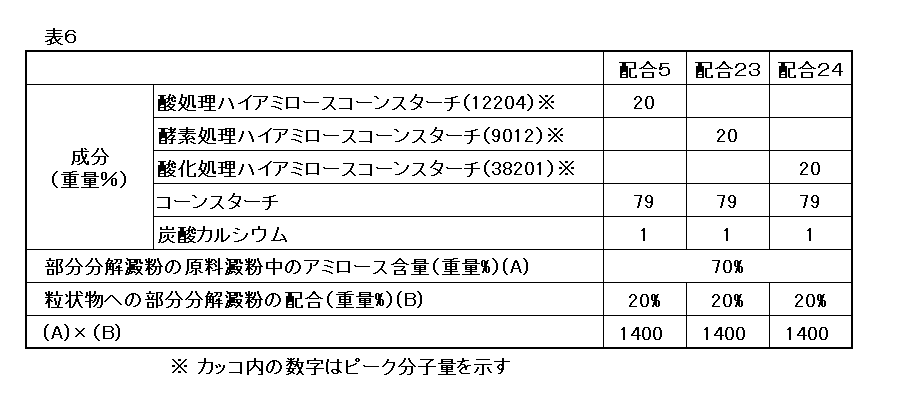
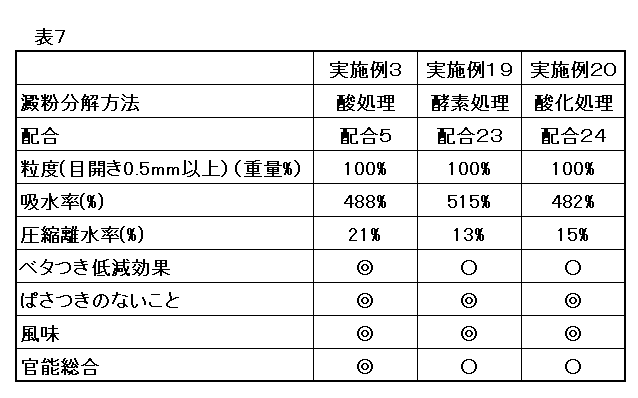
表8に示す割合で原料を配合し、実施例1に記載の方法に準じて粒状物を製造した。得られた粒状物の評価結果を表9に示す。なお、表8中の配合25においては、酸処理ハイアミロースコーンスターチにかえて、酸処理をおこなっていないハイアミロースコーンスターチを用いた。
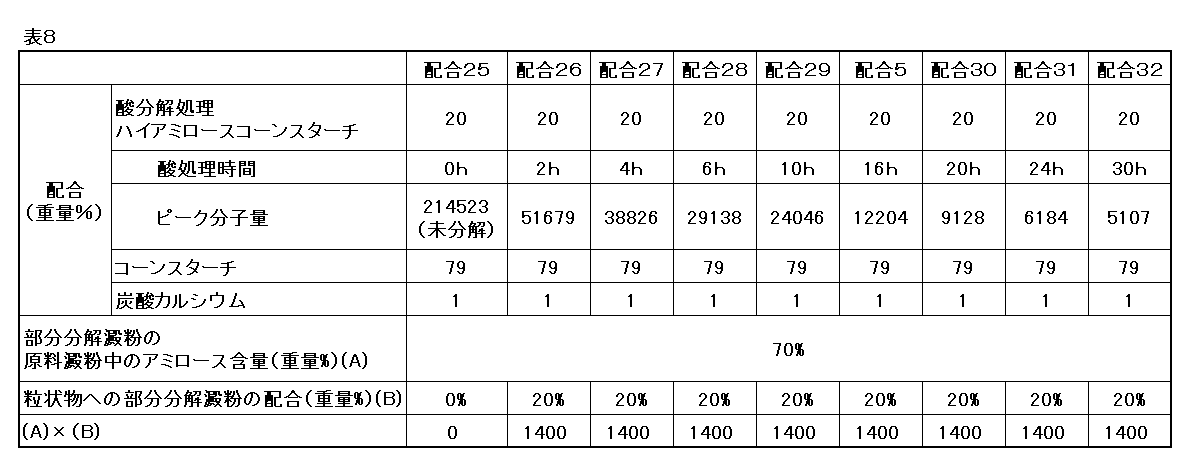
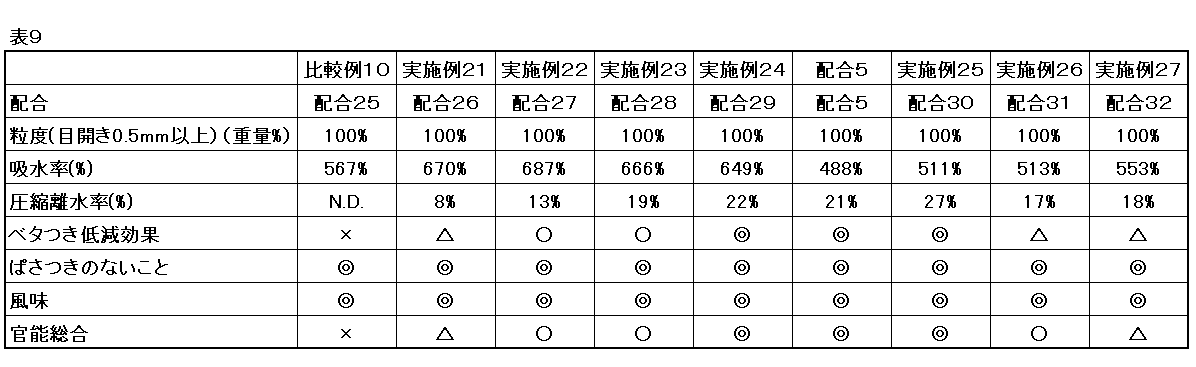
表10に示す割合で原料を配合し、実施例1に記載の方法に準じて粒状物を製造した。得られた粒状物の評価結果を表11に示す。
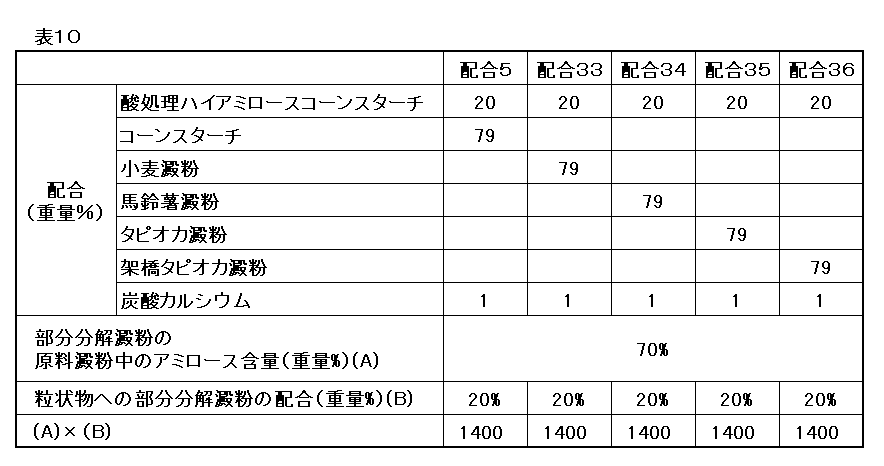

表12に示す割合で原料を配合し、実施例1に記載の方法に準じて粒状物を製造した。得られた粒状物の評価結果を表13に示す。
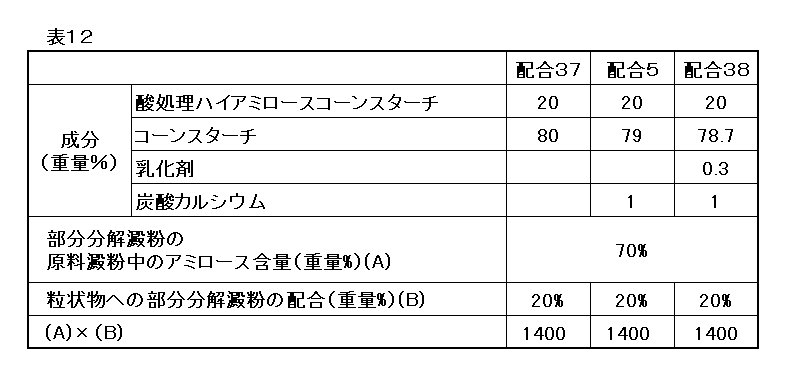

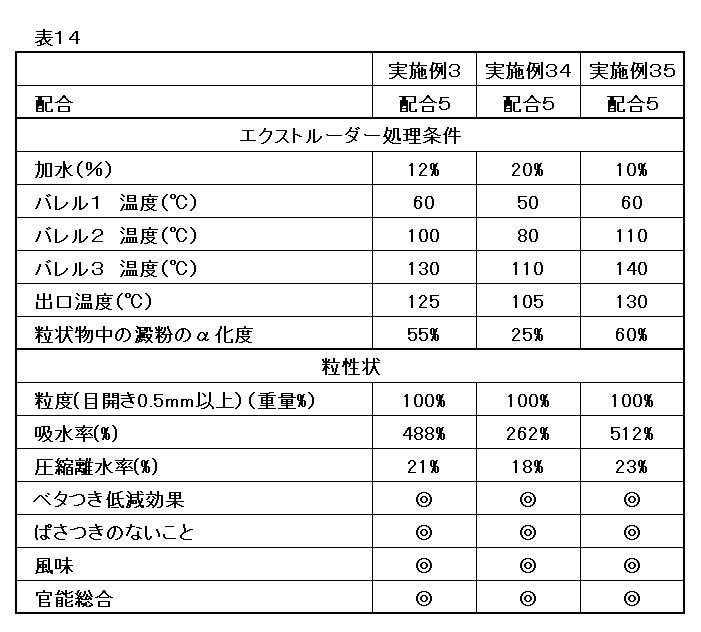
表1に記載の配合5に従い原料を配合し、表14で示す条件以外は実施例1に記載の方法に従って粒状物を製造した。得られた粒状物の評価結果を表14にあわせて示す。
表14より、粒状物中の澱粉のα化度が25%~60%のいずれにおいても充分な効果を得ることができた。
(そぼろ肉の作製)
表15に示すレシピにてそぼろ肉を作製した。まず、実施例3の粒状物に3倍重量の水を添加し、室温にて1時間浸漬した。吸水させた粒状物25部を市販牛豚ミンチ肉75部と混合し、塩0.7部、胡椒0.3部を加え、肉が加熱中に結着してダマにならないように適度に攪拌しながら、200℃で2分間加熱調理した。こうして得られたそぼろ肉は、肉汁のドリップが抑制され、肉本来の食感が損なわれず、良好な食感であった。

(牛豚ハンバーグの作製)
表16に示すレシピにて牛豚ハンバーグを作製した。まず、実施例3の粒状物に4倍重量のビーフエキス調味料(富士食品社製ビーフエキスパウダーBeefex4%溶液)を添加し、室温にて1時間浸漬した。吸水させた粒状物25部を、事前によく混合した他の材料に添加し、再度よく混練した。次いで、混錬生地を50gずつ平板状に型抜き成型し、生地表面をフライパンで、230℃、裏表1分間ずつ焼成した後、スチームオーブンで250℃、5分間蒸煮した。このようにして作製した牛豚ハンバーグは、肉汁のドリップが抑制され、ふっくらとして、異風味のない、食味良好なハンバーグであった。

(肉シュウマイの作製)
表17に示す配合で肉シュウマイを作製した。まず、実施例3の粒状物に4倍重量のポークエキス調味料(OCI社製ブイヨンメックスプレミアム 1%溶液)を添加し、室温(約30℃)にて30分間浸漬した。吸水させた粒状物20部を、事前によく混合した他の材料に添加し、再度よく混練した。次いで、混錬生地を12gずつ餃子の皮に包皮し、スチームオーブンで90℃にて10分間蒸煮した。このようにして作製した肉シュウマイは、ふっくらとして、異風味がなく、冷めてもやわらかな食感であった。

(ウインナーソーセージの作製)
表18に示す配合でソーセージを作製した。まず、実施例3の粒状物に4倍重量のポークエキス調味料(OCI社製ブイヨンメックスプレミアム 1%溶液)を添加し、室温(約30℃)にて30分間浸漬した。その間に、実施例3の粒状物を除く原材料をよく混合し、氷冷しながら、ハンドミキサーで均一な乳化生地となるまでミキシングした。ミキシングした生地に、吸水させた実施例3の粒状物を8部配合し、再度よく混練した。次いで、羊腸にケーシングし、オーブンにて50℃で30分間乾燥後、70℃の温浴中で30分間ボイル調理した。このようにして作製したウインナーソーセージは、肉本来の弾力感が損なわれず、良好な食感であった。

Claims (9)
- 澱粉を45重量%以上含む粒状物であって、
前記澱粉として、アミロース含量5重量%以上の澱粉を酸処理、酸化処理または酵素処理のいずれか1種または2種以上の処理をした1種または2種以上の部分分解澱粉からなる澱粉を当該粒状物中7重量%以上含み、
当該粒状物5gに対して40gの水を添加し、30℃1時間吸水させた後の吸水率が、250重量%以上700重量%以下であり、
当該粒状物5gに対して40gの水を添加し、30℃1時間吸水させた吸水生地を、141.5g/cm2の圧力で30℃10分間圧縮したときの圧縮離水率が7重量%以上であり、
当該粒状物中の目開き0.5mm篩上の粒子の含有量が40重量%以上100重量%以下である、粒状物。 - 1種または2種以上の前記部分分解澱粉からなる前記澱粉の原料澱粉中のアミロース含量(重量%)と、当該粒状物に対する1種または2種以上の前記部分分解澱粉からなる前記澱粉の配合量(重量%)との積が、5×10²以上3×10³以下である、請求項1に記載の粒状物。
- 1種または2種以上の前記部分分解澱粉からなる前記澱粉のピーク分子量が、5×10³以上8×10⁴以下である、請求項1または2に記載の粒状物。
- 1種または2種以上の前記部分分解澱粉からなる前記澱粉以外の澱粉として、コーンスターチ、小麦澱粉、馬鈴薯澱粉、タピオカ澱粉および架橋澱粉からなる群から選択される1種または2種以上を含有する、請求項1乃至3いずれか一項に記載の粒状物。
- β-アミラーゼ・プルラナーゼ(BAP)法により測定される当該粒状物中の前記澱粉のα化度が20%以上である、請求項1乃至4いずれか一項に記載の粒状物。
- 請求項1乃至5いずれか一項に記載の粒状物の製造方法であって、
1種または2種以上の前記部分分解澱粉からなる前記澱粉を含む原料を、エクストルーダーにより加熱および加圧処理して造粒する工程を含む、粒状物の製造方法。 - 請求項1乃至5いずれか一項に記載の粒状物を含む食品。
- 請求項1乃至5いずれか一項に記載の粒状物を含む飼料。
- 請求項1乃至5いずれか一項に記載の粒状物を含む食肉製品。
Priority Applications (3)
| Application Number | Priority Date | Filing Date | Title |
|---|---|---|---|
| US14/390,080 US20150064336A1 (en) | 2012-04-03 | 2013-02-26 | Granular material and method for producing same, and food, forage and edible meat product employing same |
| KR1020147020486A KR102093756B1 (ko) | 2012-04-03 | 2013-02-26 | 입상물 및 그의 제조방법, 및 이를 사용한 식품, 사료 및 식육제품 |
| US15/922,586 US20180199607A1 (en) | 2012-04-03 | 2018-03-15 | Granular material and method for producing same, and food, forage and edible meat product employing same |
Applications Claiming Priority (2)
| Application Number | Priority Date | Filing Date | Title |
|---|---|---|---|
| JP2012-084533 | 2012-04-03 | ||
| JP2012084533A JP5160690B1 (ja) | 2012-04-03 | 2012-04-03 | 粒状物およびその製造方法、ならびにこれを用いた食品、飼料および食肉製品 |
Related Child Applications (2)
| Application Number | Title | Priority Date | Filing Date |
|---|---|---|---|
| US14/390,080 A-371-Of-International US20150064336A1 (en) | 2012-04-03 | 2013-02-26 | Granular material and method for producing same, and food, forage and edible meat product employing same |
| US15/922,586 Division US20180199607A1 (en) | 2012-04-03 | 2018-03-15 | Granular material and method for producing same, and food, forage and edible meat product employing same |
Publications (1)
| Publication Number | Publication Date |
|---|---|
| WO2013150834A1 true WO2013150834A1 (ja) | 2013-10-10 |
Family
ID=48013582
Family Applications (1)
| Application Number | Title | Priority Date | Filing Date |
|---|---|---|---|
| PCT/JP2013/054858 Ceased WO2013150834A1 (ja) | 2012-04-03 | 2013-02-26 | 粒状物およびその製造方法、ならびにこれを用いた食品、飼料および食肉製品 |
Country Status (5)
| Country | Link |
|---|---|
| US (2) | US20150064336A1 (ja) |
| JP (1) | JP5160690B1 (ja) |
| KR (1) | KR102093756B1 (ja) |
| TW (1) | TWI584743B (ja) |
| WO (1) | WO2013150834A1 (ja) |
Cited By (3)
| Publication number | Priority date | Publication date | Assignee | Title |
|---|---|---|---|---|
| JP2018174924A (ja) * | 2017-04-19 | 2018-11-15 | 株式会社J−オイルミルズ | 食品およびその製造方法 |
| JP2021073991A (ja) * | 2019-11-01 | 2021-05-20 | 味の素株式会社 | ケーシング詰め食肉加工食品の製造方法 |
| WO2023008416A1 (ja) * | 2021-07-29 | 2023-02-02 | 株式会社J-オイルミルズ | 化粧品用組成物 |
Families Citing this family (6)
| Publication number | Priority date | Publication date | Assignee | Title |
|---|---|---|---|---|
| US10212950B2 (en) | 2013-02-26 | 2019-02-26 | J-Oil Mills, Inc. | Composition, batter material using same, food or drink and feed, and method of producing composition |
| JP5551846B1 (ja) * | 2013-02-26 | 2014-07-16 | 株式会社J−オイルミルズ | 組成物、これを用いた衣材、飲食品および飼料、ならびに組成物の製造方法 |
| DE102016109669A1 (de) * | 2016-05-25 | 2017-11-30 | Tiernahrung Deuerer Gmbh | Verfahren zum Herstellen eines Tiernahrungsproduktes |
| US20210289825A1 (en) * | 2018-08-10 | 2021-09-23 | J-Oil Mills, Inc. | Blowout suppressing agent for deep fried food, method for suppressing blowout and deep fried food |
| KR20210019284A (ko) | 2019-08-12 | 2021-02-22 | 오동선 | 어플리케이션을 활용한 대기고객 진동벨 시스템 |
| WO2021195087A1 (en) | 2020-03-23 | 2021-09-30 | Bay State Milling Company | Rapid high amylose wheat seed purity test |
Citations (6)
| Publication number | Priority date | Publication date | Assignee | Title |
|---|---|---|---|---|
| JPH0367555A (ja) * | 1989-08-07 | 1991-03-22 | Kurimoto Ltd | α化澱粉の連続製造方法およびその装置 |
| JPH05292934A (ja) * | 1991-05-03 | 1993-11-09 | Natl Starch & Chem Investment Holding Corp | 高アミロースデンプンを含む押出し食品 |
| JP2001061436A (ja) * | 1999-08-27 | 2001-03-13 | Nihon Shokken Co Ltd | 食品用照りだし粉およびこれで処理した食品 |
| JP2003219813A (ja) * | 2002-01-25 | 2003-08-05 | Nippon Starch Chemical Co Ltd | 粉末化基材およびそれを用いた調味用粉末 |
| JP2006265490A (ja) * | 2005-03-25 | 2006-10-05 | Matsutani Chem Ind Ltd | 新規食感を有する未化工α化澱粉 |
| JP2011505828A (ja) * | 2007-12-10 | 2011-03-03 | コオペラティー アヴェベ ユー.エー. | デンプンの凝集 |
Family Cites Families (4)
| Publication number | Priority date | Publication date | Assignee | Title |
|---|---|---|---|---|
| JP2759838B2 (ja) | 1990-04-10 | 1998-05-28 | 株式会社ホーネンコーポレーション | 乾燥マッシュポテト様素材およびその製造法 |
| JP4555178B2 (ja) | 2004-08-05 | 2010-09-29 | 日本食品化工株式会社 | 肉類加工品用改良剤、該改良剤を用いた肉類加工品の改質方法及び肉類加工品 |
| JP4137982B2 (ja) | 2006-09-13 | 2008-08-20 | 株式会社J−オイルミルズ | 米飯改質剤、それを用いた米飯食品およびその製造方法 |
| EP3702377A4 (en) | 2017-10-26 | 2021-08-25 | Mitsui Chemicals, Inc. | HARDENABLE COMPOSITION |
-
2012
- 2012-04-03 JP JP2012084533A patent/JP5160690B1/ja active Active
-
2013
- 2013-02-26 TW TW102106668A patent/TWI584743B/zh active
- 2013-02-26 KR KR1020147020486A patent/KR102093756B1/ko active Active
- 2013-02-26 US US14/390,080 patent/US20150064336A1/en not_active Abandoned
- 2013-02-26 WO PCT/JP2013/054858 patent/WO2013150834A1/ja not_active Ceased
-
2018
- 2018-03-15 US US15/922,586 patent/US20180199607A1/en not_active Abandoned
Patent Citations (6)
| Publication number | Priority date | Publication date | Assignee | Title |
|---|---|---|---|---|
| JPH0367555A (ja) * | 1989-08-07 | 1991-03-22 | Kurimoto Ltd | α化澱粉の連続製造方法およびその装置 |
| JPH05292934A (ja) * | 1991-05-03 | 1993-11-09 | Natl Starch & Chem Investment Holding Corp | 高アミロースデンプンを含む押出し食品 |
| JP2001061436A (ja) * | 1999-08-27 | 2001-03-13 | Nihon Shokken Co Ltd | 食品用照りだし粉およびこれで処理した食品 |
| JP2003219813A (ja) * | 2002-01-25 | 2003-08-05 | Nippon Starch Chemical Co Ltd | 粉末化基材およびそれを用いた調味用粉末 |
| JP2006265490A (ja) * | 2005-03-25 | 2006-10-05 | Matsutani Chem Ind Ltd | 新規食感を有する未化工α化澱粉 |
| JP2011505828A (ja) * | 2007-12-10 | 2011-03-03 | コオペラティー アヴェベ ユー.エー. | デンプンの凝集 |
Cited By (5)
| Publication number | Priority date | Publication date | Assignee | Title |
|---|---|---|---|---|
| JP2018174924A (ja) * | 2017-04-19 | 2018-11-15 | 株式会社J−オイルミルズ | 食品およびその製造方法 |
| JP7099858B2 (ja) | 2017-04-19 | 2022-07-12 | 株式会社J-オイルミルズ | 食品およびその製造方法 |
| JP2021073991A (ja) * | 2019-11-01 | 2021-05-20 | 味の素株式会社 | ケーシング詰め食肉加工食品の製造方法 |
| JP7786035B2 (ja) | 2019-11-01 | 2025-12-16 | 味の素株式会社 | ケーシング詰め食肉加工食品の製造方法 |
| WO2023008416A1 (ja) * | 2021-07-29 | 2023-02-02 | 株式会社J-オイルミルズ | 化粧品用組成物 |
Also Published As
| Publication number | Publication date |
|---|---|
| TWI584743B (zh) | 2017-06-01 |
| US20180199607A1 (en) | 2018-07-19 |
| US20150064336A1 (en) | 2015-03-05 |
| TW201343087A (zh) | 2013-11-01 |
| JP2014121272A (ja) | 2014-07-03 |
| KR20150002583A (ko) | 2015-01-07 |
| JP5160690B1 (ja) | 2013-03-13 |
| KR102093756B1 (ko) | 2020-03-26 |
Similar Documents
| Publication | Publication Date | Title |
|---|---|---|
| JP5160690B1 (ja) | 粒状物およびその製造方法、ならびにこれを用いた食品、飼料および食肉製品 | |
| JP6941602B2 (ja) | ブレッダー粉、これを用いたブレッダーミックス、衣材およびフライ(様)食品ならびにこれらの製造方法 | |
| KR102168623B1 (ko) | 조성물, 이것을 사용한 튀김옷 재료, 음식품과 사료 및 조성물의 제조방법 | |
| JP7099661B1 (ja) | 畜肉様加工食品の製造方法 | |
| JP7153636B2 (ja) | 食肉用呈味改善剤および食肉加工食品の製造方法 | |
| CN113631051B (zh) | 水产畜产肉制品改良剂及水产畜产肉制品 | |
| JP5551846B1 (ja) | 組成物、これを用いた衣材、飲食品および飼料、ならびに組成物の製造方法 | |
| JP5054076B2 (ja) | 食物繊維含有食品及びその製造方法 | |
| WO2020026998A1 (ja) | 食品の製造方法 | |
| JP7318152B1 (ja) | 凝固卵様食品、加工食品、凝固卵様食品の製造方法、および加工食品の製造方法 | |
| JP7768217B2 (ja) | 畜肉様加工食品の製造方法 | |
| WO2020170880A1 (ja) | ブレッダー粉 | |
| JP4806050B2 (ja) | 食品素材、その製造方法およびその用途 | |
| JPH0923835A (ja) | フライバッター用粉 | |
| JPWO2016136581A1 (ja) | 穀類加工食品用ほぐれ改良剤 | |
| JP2019115273A (ja) | 麺類の製造方法 | |
| JP7312744B2 (ja) | 食品用組成物 | |
| JP6811481B2 (ja) | 調理用加工大麦及びその組成物並びに焼成調理用生地 | |
| TW202135668A (zh) | 類家畜肉加工食品的製造方法 | |
| JP6847602B2 (ja) | ノンフライ食品用の衣用組成物 | |
| TWI917523B (zh) | 畜肉樣加工食品及其製造方法 | |
| JP4529003B2 (ja) | 肉含量の高いスナック風食品 | |
| JP7239909B1 (ja) | 畜肉様加工食品の製造方法 | |
| JP2024180322A (ja) | 水油捕持材、該水油捕持材の製造方法、前記水油捕持材を用いた食品、並びに該食品の製造方法、及びジューシー感向上方法 | |
| WO2023048011A1 (ja) | 畜肉様加工食品の製造方法 |
Legal Events
| Date | Code | Title | Description |
|---|---|---|---|
| 121 | Ep: the epo has been informed by wipo that ep was designated in this application |
Ref document number: 13772012 Country of ref document: EP Kind code of ref document: A1 |
|
| ENP | Entry into the national phase |
Ref document number: 20147020486 Country of ref document: KR Kind code of ref document: A |
|
| WWE | Wipo information: entry into national phase |
Ref document number: 14390080 Country of ref document: US |
|
| NENP | Non-entry into the national phase |
Ref country code: DE |
|
| 122 | Ep: pct application non-entry in european phase |
Ref document number: 13772012 Country of ref document: EP Kind code of ref document: A1 |
|
| NENP | Non-entry into the national phase |
Ref country code: JP |