WO2013147151A1 - 活性エネルギー線硬化性樹脂組成物、積層体およびロール状積層体 - Google Patents
活性エネルギー線硬化性樹脂組成物、積層体およびロール状積層体 Download PDFInfo
- Publication number
- WO2013147151A1 WO2013147151A1 PCT/JP2013/059509 JP2013059509W WO2013147151A1 WO 2013147151 A1 WO2013147151 A1 WO 2013147151A1 JP 2013059509 W JP2013059509 W JP 2013059509W WO 2013147151 A1 WO2013147151 A1 WO 2013147151A1
- Authority
- WO
- WIPO (PCT)
- Prior art keywords
- meth
- active energy
- energy ray
- resin composition
- curable resin
- Prior art date
- Legal status (The legal status is an assumption and is not a legal conclusion. Google has not performed a legal analysis and makes no representation as to the accuracy of the status listed.)
- Ceased
Links
Classifications
-
- C—CHEMISTRY; METALLURGY
- C08—ORGANIC MACROMOLECULAR COMPOUNDS; THEIR PREPARATION OR CHEMICAL WORKING-UP; COMPOSITIONS BASED THEREON
- C08F—MACROMOLECULAR COMPOUNDS OBTAINED BY REACTIONS ONLY INVOLVING CARBON-TO-CARBON UNSATURATED BONDS
- C08F290/00—Macromolecular compounds obtained by polymerising monomers on to polymers modified by introduction of aliphatic unsaturated end or side groups
- C08F290/08—Macromolecular compounds obtained by polymerising monomers on to polymers modified by introduction of aliphatic unsaturated end or side groups on to polymers modified by introduction of unsaturated side groups
- C08F290/12—Polymers provided for in subclasses C08C or C08F
-
- B—PERFORMING OPERATIONS; TRANSPORTING
- B32—LAYERED PRODUCTS
- B32B—LAYERED PRODUCTS, i.e. PRODUCTS BUILT-UP OF STRATA OF FLAT OR NON-FLAT, e.g. CELLULAR OR HONEYCOMB, FORM
- B32B27/00—Layered products comprising a layer of synthetic resin
- B32B27/30—Layered products comprising a layer of synthetic resin comprising vinyl (co)polymers; comprising acrylic (co)polymers
- B32B27/308—Layered products comprising a layer of synthetic resin comprising vinyl (co)polymers; comprising acrylic (co)polymers comprising acrylic (co)polymers
-
- C—CHEMISTRY; METALLURGY
- C08—ORGANIC MACROMOLECULAR COMPOUNDS; THEIR PREPARATION OR CHEMICAL WORKING-UP; COMPOSITIONS BASED THEREON
- C08F—MACROMOLECULAR COMPOUNDS OBTAINED BY REACTIONS ONLY INVOLVING CARBON-TO-CARBON UNSATURATED BONDS
- C08F265/00—Macromolecular compounds obtained by polymerising monomers on to polymers of unsaturated monocarboxylic acids or derivatives thereof as defined in group C08F20/00
- C08F265/04—Macromolecular compounds obtained by polymerising monomers on to polymers of unsaturated monocarboxylic acids or derivatives thereof as defined in group C08F20/00 on to polymers of esters
- C08F265/06—Polymerisation of acrylate or methacrylate esters on to polymers thereof
-
- C—CHEMISTRY; METALLURGY
- C08—ORGANIC MACROMOLECULAR COMPOUNDS; THEIR PREPARATION OR CHEMICAL WORKING-UP; COMPOSITIONS BASED THEREON
- C08J—WORKING-UP; GENERAL PROCESSES OF COMPOUNDING; AFTER-TREATMENT NOT COVERED BY SUBCLASSES C08B, C08C, C08F, C08G or C08H
- C08J7/00—Chemical treatment or coating of shaped articles made of macromolecular substances
- C08J7/04—Coating
- C08J7/0427—Coating with only one layer of a composition containing a polymer binder
-
- C—CHEMISTRY; METALLURGY
- C08—ORGANIC MACROMOLECULAR COMPOUNDS; THEIR PREPARATION OR CHEMICAL WORKING-UP; COMPOSITIONS BASED THEREON
- C08J—WORKING-UP; GENERAL PROCESSES OF COMPOUNDING; AFTER-TREATMENT NOT COVERED BY SUBCLASSES C08B, C08C, C08F, C08G or C08H
- C08J7/00—Chemical treatment or coating of shaped articles made of macromolecular substances
- C08J7/04—Coating
- C08J7/046—Forming abrasion-resistant coatings; Forming surface-hardening coatings
-
- C—CHEMISTRY; METALLURGY
- C08—ORGANIC MACROMOLECULAR COMPOUNDS; THEIR PREPARATION OR CHEMICAL WORKING-UP; COMPOSITIONS BASED THEREON
- C08J—WORKING-UP; GENERAL PROCESSES OF COMPOUNDING; AFTER-TREATMENT NOT COVERED BY SUBCLASSES C08B, C08C, C08F, C08G or C08H
- C08J2433/00—Characterised by the use of homopolymers or copolymers of compounds having one or more unsaturated aliphatic radicals, each having only one carbon-to-carbon double bond, and only one being terminated by only one carboxyl radical, or of salts, anhydrides, esters, amides, imides, or nitriles thereof; Derivatives of such polymers
- C08J2433/04—Characterised by the use of homopolymers or copolymers of compounds having one or more unsaturated aliphatic radicals, each having only one carbon-to-carbon double bond, and only one being terminated by only one carboxyl radical, or of salts, anhydrides, esters, amides, imides, or nitriles thereof; Derivatives of such polymers esters
Definitions
- the present invention relates to an active energy ray-curable resin composition that can provide a cured product having good antiblocking properties.
- the present invention also relates to a hard coat film obtained by curing the active energy ray-curable resin composition, and a film laminate obtained by laminating the hard coat film. Furthermore, it is related with the laminated body which has favorable antiblocking property, and transparency is favorable, and the roll-shaped laminated body formed by winding it.
- a hard coating excellent in hardness and slipperiness is applied to the surface of a thermoplastic film typified by a PET film.
- the film after such hard coating is performed may be wound into a roll and stored.
- Such a storage method is used because it is advantageous in terms of storage location by winding in a roll.
- the PET film after hard coating is wound in a roll shape in this way, the hard coating surfaces will contact each other or the hard coating surface and another film surface, and this contact may cause unexpected blocking There is.
- Patent Document 1 As a method for preventing such blocking, a method is disclosed in which inorganic fine particles are mixed into the hard coat layer to make the layer surface have a specific roughness, thereby preventing blocking (see Patent Document 1). Further, by containing a resin and a specific unsaturated double bond group-containing monomer containing an alkylene oxide unit having 2 to 4 carbon atoms in the composition, the resin contained in the composition is precipitated by phase separation after coating. A method for preventing blocking by forming irregularities on the surface is disclosed (see Patent Document 2). Further, as an invention focused on an SP value which is one of the features of the present invention described later, there is an invention disclosed in Patent Document 3. Patent Document 3 describes a method of improving affinity (adhesiveness) with olefins and the like by segregating a polymer having a low SP value on the surface of a hard coat layer (see Patent Document 3).
- the SP value of the resin separately contained is set lower than the SP value of the specific unsaturated double bond group-containing monomer containing an alkylene oxide unit having 2 to 4 carbon atoms. By doing so, the resin is deposited by phase separation after coating.
- the technique disclosed in Patent Document 2 includes an alkylene oxide unit in the unsaturated double bond group-containing monomer, so that the hardness of the hard coat layer when cured is low, and antiblocking It has been found that the resistance and scratch resistance tend to be low. Furthermore, the technique disclosed in Patent Document 3 is a technique relating to an undercoat layer, and no description relating to anti-blocking properties is made. In fact, in the invention described in Patent Document 3, since the phase separation component is non-crosslinkable, it has been found that the anti-blocking property is insufficient due to insufficient hardness of the convex portion.
- the present invention solves such problems of the prior art and provides a curable composition capable of forming a hard coat layer having sufficient anti-blocking performance and high hardness.
- the present invention is as follows.
- the active energy ray-curable resin composition according to (1) or (2) further containing inorganic particles having an average primary particle diameter of 1 ⁇ m or less.
- (4) 1 to 20 parts by weight of the (meth) acryloyl copolymer and 75 to 98.5 parts by weight of the polyfunctional (meth) acrylate, based on 100 parts by weight of the active energy ray-curable resin composition,
- the active energy ray-curable resin composition according to (3) comprising 0.5 to 5 parts by weight of the inorganic particles.
- a first component composed of at least one or more resins, a second component selected from the group consisting of monomers or oligomers containing at least one or more (meth) acryloyl groups, and at least one or more polyether-modified silicone oils
- An active energy ray-curable resin composition comprising a third component comprising: (6) The active energy ray-curable resin composition according to (5), wherein the first component is a (meth) acrylic resin. (7) The active energy ray-curable resin composition according to (5), wherein the first component is a (meth) acryloyl copolymer having a hydrogen bonding group and an unsaturated double bond in the side chain.
- the origin of the hydroxyl group of the (meth) acryloyl copolymer is due to the ring-opening / addition reaction of a monomer having an oxirane skeleton, and among the total amount of monomers constituting the (meth) acryloyl copolymer,
- the polyfunctional (meth) acrylate includes polyfunctional (meth) acrylates having three or more (meth) acryloyl groups in one molecule, (1) to (4), (8) to (15 ) The active energy ray-curable resin composition according to any one of the above.
- a cured product of the active energy ray-curable resin composition containing (meth) acrylate is contained, the content of particles having a diameter of 100 nm or more in the hard coat layer is 1% by weight or less, and the thickness of the hard coat layer is 1 to 10 ⁇ m.
- the hard coat and laminate obtained by curing the composition of the present invention are designed to form irregularities on the surface, and do not cause blocking even when the hard coats are in close contact with each other, and have high hardness. . Moreover, the roll-shaped laminated body using the laminated body of this invention can prevent being damaged by blocking at the time of winding. According to the present invention, an active energy ray-curable resin composition capable of forming such a hard coat can be provided.
- (meth) acrylic acid is a generic term for acrylic acid and methacrylic acid, meaning either one or both
- (meth) acryloyl group is a generic term for acryloyl group and methacryloyl group, Means either or both.
- the active energy ray-curable resin composition which is one embodiment of the present invention (hereinafter sometimes abbreviated as “active energy ray-curable resin composition (1) according to the present invention)” is a hydrogen bond in the side chain.
- the (meth) acryloyl copolymer used in the active energy ray-curable resin composition (1) according to the present invention has a hydrogen bonding group and an unsaturated double bond in the side chain.
- the hydrogen bonding group means a functional group containing an element capable of hydrogen bonding with an element present in another functional group, specifically, a hydroxyl group, an amino group, a thiol group, a carboxyl group, a sulfonic acid group, an amide group. And a phosphate group, and a hydroxyl group is preferred.
- the amount of the hydrogen bonding group is not particularly limited, but is preferably 3.0 mmol / g or more.
- the (meth) acryloyl copolymer has a hydrogen bonding group, so that the SP value of the (meth) acryloyl copolymer can be easily made higher than that of the polyfunctional (meth) acrylate.
- the (meth) acryloyl copolymer used in the active energy ray-curable resin composition (1) according to the present invention has an unsaturated double bond.
- a (meth) acryloyl copolymer includes, for example, a resin copolymerized with a (meth) acryloyl monomer, a resin copolymerized with a (meth) acryloyl monomer and another monomer having an ethylenically unsaturated double bond, ( A resin obtained by reacting a (meth) acryloyl monomer with another monomer having an ethylenically unsaturated double bond and an epoxy group, a (meth) acryloyl monomer and another monomer having an ethylenically unsaturated double bond and an isocyanate group And reacted resin.
- the origin of the hydroxyl group is due to the ring-opening / addition reaction of a monomer having an oxirane skeleton. It is preferable from the viewpoint of improving or preventing bleeding out of the cyclic oligomer contained in the PET film.
- the monomer having an oxirane skeleton include an aromatic epoxide having an epoxy group, an alicyclic epoxide, and an aliphatic epoxide.
- aromatic epoxide examples include di- or polyglycidyl ethers and novolac-type epoxy resins produced by the reaction of a polyhydric phenol having at least one aromatic nucleus or an alkylene oxide adduct thereof and epichlorohydrin.
- alicyclic epoxide cyclohexene oxide obtained by epoxidizing a compound having at least one cycloalkane ring such as cyclohexene or cyclopentene ring with a suitable oxidizing agent such as hydrogen peroxide or peracid.
- a cyclopentene oxide containing compound is mentioned.
- Preferred examples of the aliphatic epoxide include di- or polyglycidyl ethers of aliphatic polyhydric alcohols or alkylene oxide adducts thereof.
- diglycidyl ether of ethylene glycol, diglycidyl ether of propylene glycol or 1,6 -Diglycidyl ether of alkylene glycol such as diglycidyl ether of hexanediol
- polyglycidyl ether of polyhydric alcohol such as di- or triglycidyl ether of glycerin or its alkylene oxide adduct
- diglycidyl of polyethylene glycol or its alkylene oxide adduct Diglycerides of polyalkylene glycols such as ether, polypropylene glycol or diglycidyl ethers of alkylene oxide adducts thereof Jill ether, and the like.
- the monomer having an oxirane skeleton is preferably 80% by weight or more, more preferably 90% by weight or more, and more preferably 95% by weight or more, based on the total amount of monomers constituting the (meth) acryloyl copolymer. Is more preferable.
- the monomer composition ratio having an oxirane skeleton is large, the amount of hydroxyl groups that can be introduced and the amount of unsaturated double bonds are preferably increased.
- the ring opening / addition reaction of the monomer having an oxirane skeleton is preferably an addition reaction of acrylic acid.
- acrylic acid By making the reaction of acrylic acid, unsaturated double bonds can be introduced while achieving a high SP value by introducing a hydroxyl group, which is preferable because photocurability can be improved.
- the (meth) acryloyl copolymer used in the active energy ray-curable resin composition (1) according to the present invention preferably has a weight average molecular weight (Mw) of 1,000 or more, and is 5,000 or more. More preferably, it is more preferably 10,000 or more. Moreover, it is preferable that it is 100,000 or less, It is more preferable that it is 70,000 or less, It is still more preferable that it is 50,000 or less. Within this range, gelation based on the (meth) acryloyl copolymer is unlikely to occur.
- the weight average molecular weight (Mw) of a (meth) acryloyl copolymer can be determined as a conversion value by a polystyrene standard using GPC.
- the (meth) acryloyl copolymer used in the active energy ray-curable resin composition (1) according to the present invention is preferably contained in an amount of 1 part by weight or more with respect to 100 parts by weight of the active energy ray-curable resin composition.
- the amount is more preferably 3 parts by weight or more, and still more preferably 5 parts by weight or more. Further, it is preferably 20 parts by weight or less, more preferably 15 parts by weight or less, and still more preferably 10 parts by weight or less.
- these (meth) acryloyl copolymers may be contained singly or in combination of two or more.
- the polyfunctional (meth) acrylate used in the active energy ray-curable resin composition (1) according to the present invention is a polyfunctional (meth) acrylate having two or more unsaturated double bond groups in one molecule.
- polyfunctional (meth) acrylate for example, polyfunctional (having two or more unsaturated double bond groups in one molecule, which is a dealcoholization reaction product of polyhydric alcohol and (meth) acrylate) And (meth) acrylate.
- polyfunctional (meth) acrylates polyfunctional (meth) acrylates having 3 or more (meth) acryloyl groups in one molecule are preferable.
- pentaerythritol tri (meth) acrylate pentaerythritol Tetra (meth) acrylate, dipentaerythritol hexa (meth) acrylate, dipentaerythritol penta (meth) acrylate, trimethylolpropane tri (meth) acrylate, tripropylene glycol di (meth) acrylate, nanoethylene glycol di (meth) acrylate , Ditrimethylolpropane tetra (meth) acrylate, neopentyl glycol di (meth) acrylate, and the like.
- These polyfunctional (meth) acrylates may be used alone or in combination of two or more.
- the polyfunctional (meth) acrylate used in the active energy ray-curable resin composition (1) according to the present invention is preferably contained in an amount of 75 parts by weight or more with respect to 100 parts by weight of the active energy ray-curable resin composition.
- the amount is more preferably 85 parts by weight or more, and still more preferably 90 parts by weight or more.
- it is preferable that it is 98.5 weight part or less, It is more preferable that it is 97 weight part or less, It is still more preferable that it is 95 weight part or less.
- these polyfunctional (meth) acrylates may be contained singly or in combination of two or more.
- the polyfunctional (meth) acrylate used in the active energy ray-curable resin composition (1) according to the present invention preferably contains substantially no monomer containing an ethylene oxide (EO) unit in the molecule. More preferably not. By not containing a monomer containing an ethylene oxide (EO) unit in the molecule, sufficient hardness can be ensured when a hard coat is formed.
- substantially used herein means less than 3 parts by weight based on 100 parts by weight of the entire polyfunctional (meth) acrylate.
- the SP value of the (meth) acryloyl copolymer is not less than the SP value of the polyfunctional (meth) acrylate.
- the SP value of the (meth) acryloyl copolymer is 0.5 or more higher and 1.0 or more higher than the SP value of the polyfunctional (meth) acrylate.
- the SP value of the (meth) acryloyl copolymer used in the present invention is preferably 14.0 or more, more preferably 16.0 or more, and preferably 20.0 or less, 18 More preferably, it is 0.0 or less.
- the SP value of the polyfunctional (meth) acrylate used in the present invention is preferably 8.0 or more, more preferably 10.0 or more, and preferably 14.0 or less. More preferably, it is 0 or less.
- the SP value is an abbreviation for solubility parameter (solubility parameter) and is a measure of solubility.
- solubility parameter solubility parameter
- the SP value indicates that the polarity is higher as the numerical value is larger, and the polarity is lower as the numerical value is smaller.
- the SP value can be measured by the following method [references: SUH, CLARKE, J. et al. P. S. A-1, 5, 1671-1681 (1967)].
- the SP value of the (meth) acryloyl copolymer is greater than or equal to the SP value of the polyfunctional (meth) acrylate, so that phase separation is likely to occur. It has become.
- the side chain of the (meth) acryloyl copolymer includes a large number of highly polar groups.
- the method of preparing a copolymer by ring-opening the monomer which has an oxirane skeleton by addition of (meth) acrylic acid etc. are mentioned.
- the polyfunctional (meth) acrylate may be designed to have a low SP value.
- a method of adding a bifunctional or higher acrylate having an alicyclic skeleton may be used.
- the (meth) acryloyl copolymer and polyfunctional (meth) acrylate contained in the active energy ray-curable resin composition (1) according to the present invention preferably each have a functional group that reacts with each other. By reacting such functional groups with each other, the resistance of the layer obtained by curing the active energy ray-curable resin composition (1) according to the present invention can be increased.
- a functional group having active hydrogen hydroxyl group, amino group, thiol group, carboxyl group, etc.
- an epoxy group a functional group having active hydrogen and an isocyanate group, and an ethylenically unsaturated group Ethylenically unsaturated group (polymerization of ethylenically unsaturated group occurs), silanol group and silanol group (condensation polymerization of silanol group occurs), silanol group and epoxy group, functional group having active hydrogen and functional group having active hydrogen Groups, active methylene and acryloyl groups, oxazoline groups and carboxyl groups.
- reaction does not proceed only by mixing the (meth) acryloyl copolymer and the polyfunctional (meth) acrylate, but the polymerization initiator is mixed together. Also included are those that react with each other.
- the polymerization initiator that can be used here is a photopolymerization initiator, and details will be described later.
- the active energy ray-curable resin composition (1) according to the present invention preferably contains inorganic particles having an average primary particle size of 1 ⁇ m or less. Curability capable of forming a hard coat having good anti-blocking property while maintaining high hardness by containing inorganic particles having an average primary particle size of 1 ⁇ m or less and a highly polar (meth) acryloyl copolymer.
- a composition can be provided.
- the present invention in addition to being able to phase-separate the copolymer by adding a highly polar (meth) acryloyl copolymer together with the polyfunctional (meth) acrylate, it is cured by adding inorganic particles together.
- inorganic particles are also present in the vicinity of the surface together with the phase-separated copolymer. And, due to the presence of this copolymer and inorganic particles, when the composition is used as a hard coat layer, moderate irregularities are formed on the surface, and it has excellent antiblocking properties, so it is preferable to contain inorganic particles. .
- inorganic particles examples include silica (including organosilica sol), alumina, titania, zeolite, mica, synthetic mica, calcium oxide, zirconium oxide, zinc oxide, magnesium fluoride, smectite, synthetic smectite, vermiculite, ITO (indium oxide) / Tin oxide), ATO (antimony oxide / tin oxide), tin oxide, indium oxide, antimony oxide and the like. These inorganic particles may be contained alone or in combination of two or more.
- the average primary particle diameter of the inorganic particles is 1 ⁇ m or less, preferably 200 nm or less, and more preferably 100 nm or less. Although a lower limit is not specifically limited, Usually, 5 nm or more, Preferably it is 10 nm or more. Use of inorganic particles having a particle size of 1 ⁇ m or more is not preferable because sedimentation occurs due to the weight of the particles, and the storage stability of the hard coat liquid tends to decrease.
- the average primary particle diameter of the inorganic particles in the present invention refers to a diameter obtained by averaging the particle sizes observed with an electron microscope such as TEM.
- the inorganic particles used in the active energy ray-curable resin composition (1) according to the present invention are preferably contained in an amount of 0.5 parts by weight or more based on 100 parts by weight of the active energy ray-curable resin composition.
- the amount is more preferably 7 parts by weight or more, and still more preferably 1 part by weight or more. Further, it is preferably 5 parts by weight or less, more preferably 3 parts by weight or less, and further preferably 2 parts by weight or less.
- the active energy ray-curable resin composition (1) according to the present invention preferably contains a polymerization initiator in order to be cured by active energy.
- the polymerization initiator is usually 0.01 parts by weight or more, preferably 0.1 parts by weight or more, more preferably 1 part by weight or more, and usually 20 parts by weight or less, preferably 100 parts by weight or more based on the curable composition. 10 parts by weight or less can be added.
- the polymerization initiator may be a photopolymerization initiator such as 2-hydroxy-2methyl-1-phenyl-propan-1-one, 1-hydroxy-cyclohexyl-phenyl-ketone, 2-methyl-1- [4- (Methylthio) phenyl] -2-morpholinopropan-1-one, 2,2-dimethoxy-1,2-diphenylethane-1-one, 2-benzyl-2-dimethylamino-1- (4- Morpholinophenyl) -butanone-1 and the like.
- a photopolymerization initiator such as 2-hydroxy-2methyl-1-phenyl-propan-1-one, 1-hydroxy-cyclohexyl-phenyl-ketone, 2-methyl-1- [4- (Methylthio) phenyl] -2-morpholinopropan-1-one, 2,2-dimethoxy-1,2-diphenylethane-1-one, 2-benzyl-2-dimethylamino-1- (4- Morphol
- the method for preparing the active energy ray-curable resin composition (1) according to the present invention is not particularly limited.
- a (meth) acryloyl copolymer and a polyfunctional (meth) acrylate are optionally mixed with a solvent or a polymer. It can prepare by mixing together with an initiator, an additive, etc.
- the solvent used in the preparation of the active energy ray-curable resin composition (1) according to the present invention is not particularly limited, and includes a (meth) acryloyl copolymer, a polyfunctional (meth) acrylate, a coating base,
- the material is appropriately selected in consideration of the material of the base material to be formed and the coating method of the composition.
- Specific examples of the solvent that can be used include aromatic solvents such as toluene and xylene; ketone solvents such as methyl ethyl ketone, acetone, methyl isobutyl ketone, and cyclohexanone; diethyl ether, isopropyl ether, tetrahydrofuran, dioxane, and ethylene glycol.
- Ether solvents such as dimethyl ether, ethylene glycol diethyl ether, diethylene glycol dimethyl ether, diethylene glycol diethyl ether, propylene glycol monomethyl ether, anisole and phenetol; ester solvents such as ethyl acetate, butyl acetate, isopropyl acetate and ethylene glycol diacetate; dimethylformamide, Amide solvents such as diethylformamide and N-methylpyrrolidone; methyl Cellosolve, ethyl cellosolve, cellosolve solvents such as butyl cellosolve; methanol, ethanol, propanol, isopropanol, alcohol solvents such as butanol; and the like; dichloromethane, halogenated solvents such as chloroform. These solvents may be used alone or in combination of two or more. Of these solvents, ester solvents, ether solvents, alcohol solvents and ketone solvents are preferably used
- the active energy ray-curable resin composition (1) according to the present invention may contain various additives as necessary.
- additives include conventional additives such as antistatic agents, plasticizers, surfactants, antioxidants and ultraviolet absorbers.
- active energy ray-curable resin composition (2) An active energy ray-curable resin composition that is another embodiment of the present invention (hereinafter sometimes abbreviated as “active energy ray-curable resin composition (2) according to the present invention)” may be used.
- a first component comprising at least one resin
- a second component selected from the group consisting of monomers or oligomers containing at least one (meth) acryloyl group
- a third component comprising at least one or more polyether-modified silicone oils.
- first component resin of the active energy ray-curable resin composition (2) according to the present invention examples include (meth) acrylic resin, olefin resin, polyether resin, polyester resin, polyurethane resin, polysiloxane resin, and polysilane. It is preferable to use a resin, a polyimide resin, a fluorine resin, or the like. These resins may be so-called oligomers having a low molecular weight.
- a resin including a (meth) acrylic resin, a polyether resin, a polyester resin, a polyurethane resin, and a polyimide resin in a skeleton structure is preferable, and the SP value can be controlled and polymerized easily.
- a resin containing a possible (meth) acrylic resin in the skeleton structure is particularly preferable.
- a resin containing a (meth) acrylic resin in its skeleton structure a resin obtained by polymerizing or copolymerizing a (meth) acrylic monomer, a resin obtained by copolymerizing a (meth) acrylic monomer and another monomer having an ethylenically unsaturated double bond Etc.
- the resin containing an olefin resin in the skeleton structure include polyethylene, polypropylene, ethylene / propylene copolymer, ethylene / vinyl acetate copolymer, ionomer, ethylene / vinyl alcohol copolymer, and ethylene / vinyl chloride copolymer.
- the resin containing a polyether resin in the skeleton structure is a resin containing an ether bond in the molecular chain, and examples thereof include polyethylene glycol, polypropylene glycol, and polytetramethylene glycol.
- the resin containing a polyester resin in the skeleton structure is a resin containing an ester bond in the molecular chain, and examples thereof include an unsaturated polyester resin, an alkyd resin, and polyethylene terephthalate.
- a resin including a polyurethane resin in a skeleton structure is a resin including a urethane bond in a molecular chain.
- the resin containing a polysiloxane resin in the skeleton structure is a resin containing a siloxane bond in the molecular chain.
- a resin containing a polysilane resin in a skeleton structure is a resin containing a silane bond in a molecular chain.
- a resin including a polyimide resin in a skeleton structure is a resin including an imide bond in a molecular chain.
- the resin containing a fluorinated resin in the skeleton structure is a resin containing a structure in which part or all of hydrogen of polyethylene is replaced with fluorine.
- the resin may be a copolymer composed of two or more of the above skeleton structures, or may be a copolymer composed of the above skeleton structures and other monomers.
- a (meth) acryloyl copolymer is preferable because it has a high SP value, can be controlled and can be easily polymerized, and further has a hydrogen bonding group in the side chain. It is more preferable that the (meth) acryloyl copolymer has a higher SP value than the polyfunctional (meth) acrylate.
- the hydrogen bonding group means a functional group containing an element capable of hydrogen bonding with an element present in another functional group, specifically, a hydroxyl group, an amino group, a thiol group, a carboxyl group, a sulfonic acid group, an amide group.
- a phosphate group and the like, and a hydroxyl group, an amino group, an amide group, and a carboxyl group are preferable, and a hydroxyl group is particularly preferable from the viewpoint that phase separation is easy (anti-blocking property is easily expressed).
- the amount of the hydrogen bonding group is not particularly limited, but is preferably 3.0 mmol / g or more.
- the (meth) acryloyl copolymer has an unsaturated double bond because the hardness increases.
- a (meth) acryloyl copolymer includes, for example, a resin copolymerized with a (meth) acryloyl monomer, a resin copolymerized with a (meth) acryloyl monomer and another monomer having an ethylenically unsaturated double bond, ( A resin obtained by reacting a (meth) acryloyl monomer with another monomer having an ethylenically unsaturated double bond and an epoxy group, a (meth) acryloyl monomer and another monomer having an ethylenically unsaturated double bond and an isocyanate group And reacted resin.
- the origin of the hydroxyl group can be attributed to a ring-opening / addition reaction of a monomer having an oxirane skeleton. It is preferable from the viewpoint of improving or preventing bleeding out.
- the monomer having an oxirane skeleton include aromatic epoxides having an epoxy group, alicyclic epoxides, and aliphatic epoxides as in the case of the active energy ray-curable resin composition (1) according to the present invention. .
- aromatic epoxides alicyclic epoxides, aliphatic epoxides, and amounts of monomers having an oxirane skeleton are the same as those described in the active energy ray-curable resin composition (1) according to the present invention. It is.
- the resin used as the first component of the active energy ray-curable resin composition (2) according to the present invention preferably has a weight average molecular weight (Mw) of 1,000 or more, and preferably 5,000 or more. More preferably, it is 10,000 or more. Moreover, it is preferable that it is 100,000 or less, It is more preferable that it is 70,000 or less, It is still more preferable that it is 50,000 or less. When it exists in this range, antiblocking property will become favorable.
- the weight average molecular weight (Mw) of resin can be determined as a conversion value by a polystyrene standard using GPC.
- the resin used as the first component of the active energy ray-curable resin composition (2) according to the present invention preferably has an acryloyl equivalent (amount of introduced acryloyl group) of 1 mmol / g or more from the viewpoint of improving scratch resistance. 2 mmol / g or more is more preferable, and 3 mmol / g or more is particularly preferable. Moreover, 10 mmol / g or less is preferable from the point of gelation prevention, 8 mmol / g or less is more preferable, and 6 mmol / g or less is especially preferable.
- the resin used as the first component of the active energy ray-curable resin composition (2) according to the present invention preferably has a secondary hydroxyl group equivalent of 1 mmol / g or more, preferably 2 mmol / g or more from the viewpoint of improving antiblocking properties. Is more preferable, and 3 mmol / g or more is particularly preferable. Moreover, from the point of compatibility with polyfunctional acrylate, 10 mmol / g or less is preferable, 8 mmol / g or less is more preferable, and 6 mmol / g or less is especially preferable.
- the first component of the active energy ray-curable resin composition (2) according to the present invention is preferably contained in an amount of 1 part by weight or more with respect to 100 parts by weight of the active energy ray-curable resin composition. More preferably, it is more than 5 parts by weight. Further, it is preferably 20 parts by weight or less, more preferably 15 parts by weight or less, and still more preferably 10 parts by weight or less. In the active energy ray-curable resin composition of the present invention, these resins may be contained singly or in combination of two or more.
- ⁇ Second component monomer or oligomer containing (meth) acryloyl group>
- the monomer or oligomer containing the (meth) acryloyl group as the second component of the active energy ray-curable resin composition (2) according to the present invention include polyfunctional monomers such as polyhydric alcohols and (meth) acrylates. And a dealcoholization reaction product can be used.
- the oligomer include urethane (meth) acrylate oligomers, polyester (meth) acrylate oligomers, and low molecular weight products of the resins mentioned in the first component.
- a polyfunctional monomer, a urethane (meth) acrylate oligomer, and a polyester (meth) acrylate oligomer are preferable from the viewpoint of high hardness or good curability. Furthermore, it is preferable that the weight average molecular weight is less than 8000, more preferably less than 5000, from the viewpoint of good handling properties and coating properties.
- polyfunctional (meth) acrylates are preferred from the viewpoint of high hardness or good curability.
- the polyfunctional (meth) acrylate is a polyfunctional (meth) acrylate having two or more unsaturated double bond groups in one molecule.
- the polyfunctional (meth) acrylate having two or more unsaturated double bond groups in one molecule is the same as that described in the active energy ray-curable resin composition (1) according to the present invention. Is mentioned.
- pentaerythritol tetra (meth) acrylate, dipentaerythritol hexa (meth) acrylate, and dipentaerythritol penta (meth) acrylate are preferred because of their high hardness or good curability, and dipentaerythritol hexa (Meth) acrylate is particularly preferred.
- These monomers or oligomers containing a (meth) acryloyl group may be used alone or in combination of two or more.
- the monomer or oligomer containing a (meth) acryloyl group used in the active energy ray-curable resin composition (2) according to the present invention contains 75 parts by weight or more with respect to 100 parts by weight of the active energy ray-curable resin composition.
- the amount is 85 parts by weight or more, more preferably 90 parts by weight or more.
- it is preferable that it is 98.5 weight part or less, It is more preferable that it is 97 weight part or less, It is still more preferable that it is 95 weight part or less.
- these polyfunctional (meth) acrylates may be included singly or in combination of two or more.
- the monomer or oligomer containing the (meth) acryloyl group used in the active energy ray-curable resin composition (2) according to the present invention does not substantially contain a monomer containing an ethylene oxide (EO) unit in the molecule. It is preferable that it is not contained. By not containing a monomer containing an ethylene oxide (EO) unit in the molecule, sufficient hardness can be ensured when a hard coat is formed.
- substantially used herein means less than 3 parts by weight based on 100 parts by weight of the entire polyfunctional (meth) acrylate.
- the SP value of the first component is preferably greater than or equal to the SP value of the second component.
- the SP value of the first component is higher by 0.5 or more and higher by 1.0 or more than the SP value of the second component.
- the SP value of the first component is preferably 14.0 or more, more preferably 16.0 or more, preferably 20.0 or less, and more preferably 18.0 or less. preferable.
- the SP value of the second component is preferably 8.0 or more, more preferably 10.0 or more, preferably 14.0 or less, and more preferably 13.0 or less. .
- the SP value is an abbreviation for solubility parameter (solubility parameter) and is a measure of solubility.
- the SP value indicates that the polarity is higher as the numerical value is larger, and the polarity is lower as the numerical value is smaller.
- the SP value can be measured by the following method [references: SUH, CLARKE, J. et al. P. S. A-1, 5, 1671-1681 (1967)].
- the SP value of the first component is preferably equal to or greater than the SP value of the second component, which is preferable because phase separation is easily generated.
- the side chain of the resin of the first component may be designed to include many highly polar groups. Examples thereof include a method of preparing a copolymer by opening a monomer having an oxirane skeleton by addition of acrylic acid. Others may be designed such that the SP value of the monomer or oligomer containing a (meth) acryloyl group is low, and examples thereof include a method of adding a bifunctional or higher acrylate having an alicyclic skeleton.
- the first component resin and the second component (meth) acryloyl group-containing monomer or oligomer each have a functional group that reacts with each other. It is preferable. By causing these functional groups to react with each other, the resistance of the layer obtained by curing the active energy ray-curable resin composition can be increased.
- a functional group having active hydrogen hydroxyl group, amino group, thiol group, carboxyl group, etc.
- an epoxy group a functional group having active hydrogen and an isocyanate group, and an ethylenically unsaturated group Ethylenically unsaturated group (polymerization of ethylenically unsaturated group occurs), silanol group and silanol group (condensation polymerization of silanol group occurs), silanol group and epoxy group, functional group having active hydrogen and functional group having active hydrogen Groups, active methylene and acryloyl groups, oxazoline groups and carboxyl groups.
- reaction does not proceed only by mixing a resin and a monomer or oligomer containing a (meth) acryloyl group, but by mixing together a polymerization initiator. Also included are those that react with each other.
- the polymerization initiator that can be used here is a photopolymerization initiator, and details will be described later.
- the polyether-modified silicone oil as the third component of the active energy ray-curable resin composition (2) according to the present invention is composed of a linear polymer composed of siloxane bonds.
- the linear polymer composed of siloxane bonds include those in which a part of the side chain is a methyl group, those in which all of the side chain and both ends or one end are methyl groups, and a part of the side chain is a phenyl group.
- Some, some of the side chains are hydrogen bonding groups, and some of the side chains are hydrogen atoms.
- An organic group may be further introduced into the polyether-modified silicone oil, and examples thereof include an alkyl group, an aralkyl group, a hydroxyl group, an acryloyl group, a carboxyl group, a carbonyl group, a fluoro group, an amino group, and an epoxy group.
- an alkyl group, an aralkyl group, a hydroxyl group, an acryloyl group, a carboxyl group, a carbonyl group, and an epoxy group are preferable, and an alkyl group, an aralkyl group, a hydroxyl group, and an acryloyl group are particularly preferable.
- the third component polyether-modified silicone oil examples include BYK-300, BYK-302, BYK-306, BYK-307, BYK-320, BYK-325, BYK-330, BYK-331, BYK-333, BYK-337, BYK-342, BYK-345, BYK-347, BYK-348, BYK-349, BYK-375, BYK-377, BYK-378, BYK-3455, BYK-3500, BYK-3510, BYK- 3530, Silface SAG001, Silface SAG005 (and above, Nissin Chemical Industry Co., Ltd.) FZ-2191, FZ-2166, FZ-2154, FZ-2120, L-720, SH 8700, L-7002, L-7001, SF 8410, FZ-2123, SH 8400 , FZ-2164, FZ-77, FZ-2105, FZ-2208 (product names manufactured by Dow Corning Toray Co
- BYK306, BYK307, BYK325, BYK331, BYK333, BYK342, BYK375, BYK377, BYK378, BYK-UV3500, BYK-UV3510, and Sylface® SAG001 are more preferable.
- BYK325, BYK331, BYK-UV3500, BYK-UV3510, and Silface® SAG001 are particularly preferable.
- the third component silicone oils may be used alone or in combination of two or more.
- the third component silicon resin used in the present invention is preferably contained in an amount of 0.001 part by weight or more, based on 100 parts by weight of the active energy ray-curable resin composition of the present invention, and 0.05 part by weight or more. More preferably, it is more preferably 0.1 parts by weight or more. Moreover, it is preferable that it is 10.0 weight part or less, It is more preferable that it is 5.0 weight part or less, It is still more preferable that it is 1.0 weight part or less. If it is this range, since antiblocking property and surface property are favorable, it is preferable.
- the active energy ray-curable resin composition (2) according to the present invention contains inorganic particles having an average primary particle diameter of 1 ⁇ m or less, as in the case of the active energy ray-curable resin composition (1) according to the present invention. It is preferable to do.
- inorganic particles having an average primary particle diameter of 1 ⁇ m or less and a highly polar resin it is possible to provide a curable composition capable of forming a hard coat having good antiblocking properties while maintaining high hardness.
- the kind of specific inorganic particle, the preferable average primary particle diameter of an inorganic particle, and content of the inorganic particle in an active energy ray-curable resin composition are the active energy ray-curable resin composition (1 ).
- the active energy ray-curable resin composition (2) according to the present invention contains a polymerization initiator in order to be cured by active energy. It is preferable to contain.
- the kind of specific polymerization initiator and content of the polymerization initiator in the active energy ray-curable resin composition are the same as those described in the active energy ray-curable resin composition (1) according to the present invention. It is.
- the method for preparing the active energy ray-curable resin composition (2) according to the present invention is not particularly limited.
- the first component and the second component are combined with a solvent, a polymerization initiator, an additive, and the like as necessary. Can be prepared by mixing.
- the solvent used in the preparation of the active energy ray-curable resin composition (2) according to the present invention is not particularly limited, and is described in the active energy ray-curable resin composition (1) according to the present invention. The thing similar to what was done can be used suitably.
- the active energy ray-curable resin composition (2) according to the present invention is added with various additives as necessary, as in the case of the active energy ray-curable resin composition (1) according to the present invention. can do. Examples of such additives include conventional additives such as antistatic agents, plasticizers, surfactants, antioxidants and ultraviolet absorbers.
- a laminate which is another embodiment of the present invention is a laminate in which a hard coat is formed on the surface of a substrate such as a film.
- the hard coat layer cures the resin composition by irradiation with active energy rays.
- a laminate having a hard coat layer on at least the resin layer includes a cured product of an active energy ray-curable resin composition containing a (meth) acryloyl copolymer having a hydrogen bonding group equivalent of 1.25 mmol / g or more and a polyfunctional (meth) acrylate,
- the content of particles having a diameter of 100 nm or more in the hard coat layer is 1% or less
- the thickness of the hard coat layer is 1 to 10 ⁇ m
- the hard coat layer has a surface roughness Ra of 5 nm or more.
- the (meth) acryloyl copolymer used for the hard coat layer of the laminate (1) according to the present invention has a hydrogen bonding group.
- the hydrogen bonding group means a functional group containing an element capable of hydrogen bonding with an element present in another functional group, specifically, a hydroxyl group, an amino group, a thiol group, a carboxyl group, a sulfonic acid group, an amide group.
- a phosphoric acid group, and a hydroxyl group is preferable because an addition reaction to an unsaturated double bond-containing monomer and oligomer does not occur and compatibility is good.
- the quantity of the hydrogen bonding group of the (meth) acryloyl copolymer in the hard-coat layer of the laminated body (1) which concerns on this invention is 1.25 mmol / g or more.
- the amount of the hydrogen bonding group is preferably 2.50 mmol / g or more, more preferably 3.00 mmol / g or more, and further preferably 3.50 mmol / g or more.
- the (meth) acryloyl copolymer has a hydrogen-bonding group, so that the SP value of the (meth) acryloyl copolymer is more than the polyfunctional (meth) acrylate. It is preferable because it is easy to increase the height.
- the (meth) acryloyl copolymer used for the hard coat layer of the laminate (1) according to the present invention preferably has an unsaturated double bond.
- a (meth) acryloyl copolymer includes, for example, a resin copolymerized with a (meth) acryloyl monomer, a resin copolymerized with a (meth) acryloyl monomer and another monomer having an ethylenically unsaturated double bond, ( A resin obtained by reacting a (meth) acryloyl monomer with another monomer having an ethylenically unsaturated double bond and an epoxy group, a (meth) acryloyl monomer and another monomer having an ethylenically unsaturated double bond and an isocyanate group And reacted resin.
- the origin of the hydroxyl group of the (meth) acryloyl copolymer used in the hard coat layer of the laminate (1) according to the present invention is due to the ring-opening / addition reaction of a monomer having an oxirane skeleton. It is preferable in that it can be imparted and the hardness can be improved and bleeding out can be prevented.
- the monomer having an oxirane skeleton include aromatic epoxides having an epoxy group, alicyclic epoxides, and aliphatic epoxides as in the case of the active energy ray-curable resin composition (1) according to the present invention. .
- aromatic epoxides alicyclic epoxides, aliphatic epoxides, and amounts of monomers having an oxirane skeleton are the same as those described in the active energy ray-curable resin composition (1) according to the present invention. It is.
- the (meth) acryloyl copolymer used for the hard coat layer of the laminate (1) according to the present invention preferably has a weight average molecular weight (Mw) of 1,000 or more, preferably 5,000 or more. More preferably, it is 10,000 or more. Moreover, it is preferable that it is 100,000 or less, It is more preferable that it is 70,000 or less, It is still more preferable that it is 50,000 or less. Within this range, gelation based on the (meth) acryloyl copolymer is unlikely to occur.
- the weight average molecular weight (Mw) of a (meth) acryloyl copolymer can be determined as a conversion value by a polystyrene standard using GPC.
- the (meth) acryloyl copolymer used in the hard coat layer of the laminate (1) according to the present invention is preferably contained in an amount of 1 part by weight or more based on 100 parts by weight of the active energy ray-curable resin composition.
- the amount is more preferably at least 5 parts by weight, and still more preferably at least 5 parts by weight. Further, it is preferably 20 parts by weight or less, more preferably 15 parts by weight or less, and still more preferably 10 parts by weight or less.
- these (meth) acryloyl copolymers may be contained singly or in combination of two or more.
- the polyfunctional (meth) acrylate used in the hard coat layer of the laminate (1) according to the present invention is a polyfunctional (meth) acrylate having two or more unsaturated double bond groups in one molecule.
- a polyfunctional (meth) acrylate as in the case of the active energy ray-curable resin composition (1) according to the present invention, it is a dealcoholization reaction product of a polyhydric alcohol and (meth) acrylate.
- the polyfunctional (meth) acrylate which has two or more unsaturated double bond groups in 1 molecule is mentioned.
- polyfunctional (meth) acrylate the thing similar to what was demonstrated in the active energy ray-curable resin composition (1) based on this invention is mentioned. Only one type of polyfunctional (meth) acrylate may be used alone, or two or more types may be used in combination.
- the polyfunctional (meth) acrylate used in the hard coat layer of the laminate (1) according to the present invention is preferably contained in an amount of 75 parts by weight or more, based on 100 parts by weight of the active energy ray-curable resin composition, and 85% by weight. More preferably, it is more than 90 parts by weight. Moreover, it is preferable that it is 98.5 weight part or less, It is more preferable that it is 97 weight part or less, It is still more preferable that it is 95 weight part or less.
- the active energy ray-curable resin composition used for the hard coat layer of the laminate (1) according to the present invention may contain one of these polyfunctional (meth) acrylates alone, or two or more thereof. May be included. Moreover, it is preferable that polyfunctional (meth) acrylate does not contain the monomer which contains an ethylene oxide (EO) unit in a molecule
- substantially used herein means less than 3 parts by weight based on 100 parts by weight of the entire polyfunctional (meth) acrylate.
- the SP value of the (meth) acryloyl copolymer is not less than the SP value of the polyfunctional (meth) acrylate. It is preferable.
- the SP value of the (meth) acryloyl copolymer is more preferably 0.5 or more, more preferably 1.0 or more higher than the SP value of the polyfunctional (meth) acrylate.
- the SP value of the (meth) acryloyl copolymer used in the hard coat layer of the laminate (1) according to the present invention is preferably 14.0 or more, more preferably 16.0 or more. It is preferably 20.0 or less, and more preferably 18.0 or less.
- the SP value of the polyfunctional (meth) acrylate used for the hard coat layer of the laminate (1) according to the present invention is preferably 8.0 or more, more preferably 10.0 or more. It is preferably 14.0 or less, and more preferably 13.0 or less.
- the SP value is an abbreviation for solubility parameter (solubility parameter) and is a measure of solubility.
- solubility parameter solubility parameter
- the SP value indicates that the polarity is higher as the numerical value is larger, and the polarity is lower as the numerical value is smaller.
- the SP value can be measured by the following method [references: SUH, CLARKE, J. et al. P. S. A-1, 5, 1671-1681 (1967)].
- the SP value of the (meth) acryloyl copolymer is preferably equal to or higher than the SP value of the polyfunctional (meth) acrylate, which is preferable because phase separation is easily generated.
- the side chain of the (meth) acryloyl copolymer includes a large number of highly polar groups.
- the method of preparing a copolymer by ring-opening the monomer which has an oxirane skeleton by addition of (meth) acrylic acid etc. are mentioned.
- the polyfunctional (meth) acrylate may be designed to have a low SP value.
- a method of adding a bifunctional or higher acrylate having an alicyclic skeleton may be used.
- the (meth) acryloyl copolymer and polyfunctional (meth) acrylate contained in the hard coat layer of the laminate (1) according to the present invention preferably each have a functional group that reacts with each other. By causing these functional groups to react with each other, the resistance of the layer obtained by curing the active energy ray-curable resin composition can be increased.
- a functional group having active hydrogen hydroxyl group, amino group, thiol group, carboxyl group, etc.
- an epoxy group a functional group having active hydrogen and an isocyanate group, and an ethylenically unsaturated group Ethylenically unsaturated group (polymerization of ethylenically unsaturated group occurs), silanol group and silanol group (condensation polymerization of silanol group occurs), silanol group and epoxy group, functional group having active hydrogen and functional group having active hydrogen Groups, active methylene and acryloyl groups, oxazoline groups and carboxyl groups.
- reaction does not proceed only by mixing the (meth) acryloyl copolymer and the polyfunctional (meth) acrylate, but the polymerization initiator is mixed together. Also included are those that react with each other.
- the polymerization initiator that can be used here is a photopolymerization initiator, and details will be described later.
- the hard coat layer of the laminate (1) according to the present invention is characterized in that the content of particles having a diameter of 100 nm or more is 1% by weight or less. From the viewpoint of preventing haze increase and preventing secondary agglomerated particles from being visually observed, 0.5 wt% or less is more preferable, and 0.1 wt% or less is particularly preferable.
- the content of particles having a diameter of 100 nm or more in the hard coat layer can be measured, for example, by a transmission electron microscope (TEM) when measuring the hard coat layer. When the measurement is performed by dissolving the hard coat in a solvent, the measurement can be performed by a dynamic light scattering method.
- TEM transmission electron microscope
- the active energy ray-curable resin composition in the laminate (1) according to the present invention preferably contains inorganic particles having an average primary particle size of less than 100 nm, more preferably contains inorganic fine particles of 90 nm or less, More preferably, inorganic fine particles of 80 nm or less are contained.
- inorganic particles having an average primary particle size of 100 ⁇ m or less and a highly polar resin it is possible to provide a curable composition capable of forming a hard coat having good antiblocking properties while maintaining high hardness.
- the kind of specific inorganic particle, the preferable average primary particle diameter of an inorganic particle, and content of the inorganic particle in an active energy ray-curable resin composition are the active energy ray-curable resin composition (1 ).
- the active energy ray-curable resin composition in the laminate (1) according to the present invention is polymerized in order to be cured by active energy. It is preferable to contain an initiator.
- the kind of specific polymerization initiator and content of the polymerization initiator in the active energy ray-curable resin composition are the same as those described in the active energy ray-curable resin composition (1) according to the present invention. It is.
- the method for preparing the active energy ray-curable resin composition in the laminate (1) according to the present invention is not particularly limited.
- a (meth) acryloyl copolymer and a polyfunctional (meth) acrylate are optionally used, It can prepare by mixing together with a solvent, a polymerization initiator, an additive, etc.
- the solvent used by preparation of the active energy ray curable resin composition in the laminated body (1) which concerns on this invention is not specifically limited, either, The active energy ray curable resin composition (1) which concerns on this invention The thing similar to what was demonstrated in) can be used suitably.
- the active energy ray-curable resin composition in the laminate (1) according to the present invention may be added in various ways as necessary, as in the case of the active energy ray-curable resin composition (1) according to the present invention.
- An agent can be added.
- additives include conventional additives such as antistatic agents, plasticizers, surfactants, antioxidants and ultraviolet absorbers.
- the laminate (1) according to the present invention is characterized in that the hard coat layer has a thickness of 1 to 10 ⁇ m, and an oligomer is formed from a PET film or the like by imparting scratch resistance and overheating in the ITO crystallization process.
- the thickness is preferably 0.5 ⁇ m or more, more preferably 1 ⁇ m or more, and particularly preferably 1.5 ⁇ m or more.
- 10 micrometers or less are preferable, 7 micrometers or less are more preferable, and 5 micrometers or less are especially preferable.
- the laminate (1) according to the present invention is characterized in that the surface roughness Ra of the hard coat layer is 5 nm or more, and the higher Ra is, the more effective it is to prevent blocking of the films, so that 5 nm or more is preferable. 7 nm or more is more preferable, and 10 nm or more is particularly preferable. Further, if the unevenness is large, the scratch resistance may be deteriorated. Therefore, the thickness is preferably 100 nm or less, more preferably 50 nm or less, and particularly preferably 30 nm or less. In order to increase Ra, the following method is given as an example. -Increase the thickness of the hard coat layer.
- the difference of both SP value is enlarged by using polyfunctional (meth) acrylate with low SP value, or using (meth) acryloyl copolymer with high SP value.
- -Increasing the content of (meth) acryloyl copolymer in the active energy ray-curable resin composition. Reduce the content of the polymerization initiator in the active energy ray-curable resin composition. -Lower the UV intensity when curing.
- the surface roughness Ra means arithmetic average roughness (Ra) and is a parameter defined in JIS B 0601-2001. For example, a high-precision fine shape measuring instrument manufactured by Kosaka Laboratory Ltd. ) It can be measured according to JIS B 0601-2001 using a Keyence color 3D laser microscope or the like.
- the hard coat layer preferably has a haze value of 3% or less from the viewpoint of ensuring good transparency, and the haze value is more preferably 2.5% or less. 2% or less is particularly preferable. Moreover, from the relationship with a detection limit, 0.01% or more is practically preferable and 0.1% or more is particularly preferable. In addition, in order to make a haze value low, the following methods are mentioned as an example. ⁇ Reduce the thickness of the hard coat layer. -To reduce the difference between the two SP values by using a polyfunctional (meth) acrylate containing a hydroxyl group and having a high SP value or using a (meth) acryloyl copolymer having a low SP value.
- plastic films As the base material for forming the hard coat layer, various plastic films and plastic plates can be used.
- plastic films include triacetyl cellulose (TAC) film, polyethylene terephthalate (PET) film, diacetylene cellulose film, acetate butyrate cellulose film, polyethersulfone film, polyacrylic resin film, polyurethane resin film, polyester film
- PET polyethylene terephthalate
- PET diacetylene cellulose
- acetate butyrate cellulose film polyethersulfone film
- polyacrylic resin film polyurethane resin film
- polyester film Polycarbonate film, polysulfone film, polyether film, polymethylpentene film, polyether ketone film, (meth) acrylonitrile film, cycloolefin polymer (COP) film and the like can be used.
- COP cycloolefin polymer
- plastic plates include acrylic plates, triacetyl cellulose plates, polyethylene terephthalate plates, diacetylene cellulose plates, acetate butyrate cellulose plates, polyethersulfone plates, polyurethane plates, polyester plates, polycarbonate plates, polysulfone plates, polyethers.
- plastic plates include acrylic plates, triacetyl cellulose plates, polyethylene terephthalate plates, diacetylene cellulose plates, acetate butyrate cellulose plates, polyethersulfone plates, polyurethane plates, polyester plates, polycarbonate plates, polysulfone plates, polyethers.
- Examples include a plate, a polymethylpentene plate, a polyetherketone plate, and a (meth) acrylonitrile plate.
- the thickness of the substrate can be appropriately selected according to the use, but is generally about 25 to 1000 ⁇ m.
- the application method of the active energy ray-curable resin composition in the laminate (1) according to the present invention is not particularly limited, and examples thereof include a dip coating method, an air knife coating method, a curtain coating method, a spin coating method, a roller coating method,
- the coating can be performed by a bar coating method, a wire bar coating method, a gravure coating method, an extrusion coating method (US Pat. No. 2,681,294).
- the hard coat layer formed on the substrate may be phase-separated at room temperature, or phase-separated beforehand by drying the composition before curing. May be.
- the applied composition is dried or heated before curing, it is dried at 30 to 200 ° C., more preferably 40 to 150 ° C., for 0.01 to 30 minutes, more preferably 0.1 to 10 minutes.
- Phase separation can be performed in advance. Drying before curing and phase separation in advance is preferable because the solvent in the coating film having fine irregularities can be effectively removed and irregularities of a desired size can be provided on the hard coat.
- heat curing may be performed before photocuring.
- the active energy ray-curable resin composition of the present invention may be thermally cured after photocuring.
- a coating film having fine irregularities is formed by curing a coating film obtained by applying the antiblocking curable resin composition or a dried coating film.
- Curing can be performed by irradiating light using a light source that emits light having a wavelength as required.
- the light irradiation for curing it is preferred that the cumulative amount of light is irradiated so as to be 100 mJ / cm 2 or more 20,000mJ / cm 2 or less.
- the light source a high-pressure mercury lamp, an ultrahigh-pressure mercury lamp, a metal, a ride, a xenon flash, an ultraviolet LED, an electron beam, or the like can be used.
- the hard coat layer thus formed has a good blocking property.
- the good blocking property in the laminate (1) according to the present invention is that the (meth) acryloyl copolymer is phase-separated in the hard coat layer, and the inorganic particles contained are present in the vicinity of the surface. This is caused by imparting good irregularities to the surface.
- the active energy ray-curable resin composition in the laminate (1) according to the present invention has a surface roughness Ra of 5 nm or more when a cured product is obtained with a film thickness of 2 ⁇ m by the following steps. preferable.
- Ra surface roughness
- the thickness is preferably 100 nm or less, more preferably 50 nm or less, and particularly preferably 30 nm or less.
- the surface roughness Ra means arithmetic average roughness (Ra), and is a parameter defined in JIS B 0601-2001.
- a high-precision fine shape measuring instrument manufactured by Kosaka Laboratory Co., Ltd., or It can be measured according to JIS B 0601-2001 using a Keyence color 3D laser microscope or the like.
- the active energy ray-curable resin composition is applied to a transparent biaxially stretched polyethylene terephthalate film having a thickness of 188 ⁇ m (haze value: 0.8%; manufactured by Mitsubishi Chemical Polyester Co., Ltd., trade name: Diafoil O321E).
- the active energy ray-curable resin composition in the laminate (1) according to the present invention preferably has an Sm of 0.001 ⁇ m or more and 10 ⁇ m or less when a cured product is obtained with a film thickness of 3 ⁇ m. It is more preferably 0.005 ⁇ m or more and 5 ⁇ m or less, and particularly preferably 0.01 ⁇ m or more and 3 ⁇ m or less.
- Sm is the average length of the roughness curve element of the surface, and is generally called the average interval between the peaks and valleys of the roughness curve or the average interval of the unevenness. Sm can be measured in accordance with JIS B0633 using, for example, a high-precision fine shape measuring instrument manufactured by Kosaka Laboratories or a color 3D laser microscope manufactured by Keyence Corporation.
- the hard coat layer in the laminate (1) according to the present invention preferably has a pencil hardness measured according to JIS-K5600 when a cured product having a film thickness of 3 ⁇ m is obtained, of H or higher. It is more preferable that
- the hard coat layer in the laminate (1) according to the present invention has a total light transmittance of 85% or more, preferably 90% or more when the cured product is obtained with a film thickness of 3 ⁇ m.
- the haze is 2.0% or less, preferably 1.8% or less, more preferably 1.5% or less, and still more preferably less than 1.0%.
- the total light transmittance can be measured using, for example, a turbidimeter (manufactured by Nippon Denshoku Industries Co., Ltd.).
- the anti-blocking layer obtained by applying, drying and curing the active energy ray-curable resin composition on the substrate was measured for haze (hereinafter referred to as haze HA ), and the anti-blocking layer was subjected to anti-blocking.
- haze HA haze
- the coating layer is cured by irradiating ultraviolet rays at a dose of 500 mJ / cm 2 using a high-pressure mercury lamp.
- the coating film haze (hereinafter referred to as the haze H T.) Is measured.
- a coating film obtained by coating, drying and curing (A ′) so as to have the same thickness as the above-described anti-blocking layer is formed, and haze (hereinafter referred to as haze H 1 ) is measured.
- haze H 2 a coating film that has been applied, dried, and cured so as to have the same thickness as the layer having no surface unevenness.
- the value calculated by the following formula is the external haze generated when the anti-blocking layer is provided.
- External haze Haze H A- ⁇ Haze H T- (Haze H 2 -Haze H 1 ) ⁇
- the laminate (1) according to the present invention maintains a homogeneous system in the state of the coating liquid because the high SP value acryloyl copolymer, the low SP value acrylic oligomer and the acrylic monomer are solvated respectively.
- the solvent is distilled off in the coating and drying process of the coating liquid, and the system changes to a heterogeneous system.
- a submicron-order sea-island structure and fine irregularities are formed on the dried coating film, and by applying a curing treatment with active energy rays, the fine irregularities acquire a high elastic modulus and are thermodynamic. Therefore, it is presumed that the blocking between the films can be sufficiently prevented.
- the active energy ray curable resin composition (1) according to the present invention or the active energy ray curable resin composition (2) according to the present invention is applied onto a substrate or the like, and cured into a film shape.
- the hard coat film of the invention (hereinafter sometimes abbreviated as “hard coat film according to the present invention”) is obtained.
- the thickness of a base material is also the laminated body (1) which concerns on this invention. As in the case of), generally, it is used at a thickness of about 25 to 1000 ⁇ m.
- the application method of the active energy ray-curable resin composition (1) according to the present invention or the active energy ray curable resin composition (2) according to the present invention is not particularly limited, and the laminate (1) according to the present invention is not limited.
- dip coating method, air knife coating method, curtain coating method, spin coating method, roller coating method, bar coating method, wire bar coating method, gravure coating method, extrusion coating method, etc. Can do.
- the thickness of the hard coat film is not particularly limited, and can be set in a timely manner in consideration of various factors.
- the active energy ray-curable resin composition is usually set to a thickness of 0.01 to 20 ⁇ m. Can be applied.
- the hard coat film formed on the substrate may be phase-separated at room temperature, or may be phase-separated beforehand by drying the composition before curing.
- the applied composition is dried or heated before curing, it is 30 to 200 ° C., more preferably 40 to 150 ° C., and 0.01 to 30 as in the case of the laminate (1) according to the present invention.
- the phase separation can be carried out in advance by drying for a minute, more preferably for 0.1 to 10 minutes. Drying before curing and phase separation in advance is preferable because the solvent in the coating film having fine irregularities can be effectively removed and irregularities of a desired size can be provided on the hard coat.
- a method of irradiating the coating film with light and causing phase separation can also be used.
- the light to be irradiated as in the case of the laminate (1) according to the present invention, for example, light with an exposure amount of 0.1 to 3.5 J / cm 2 , preferably light with 0.5 to 1.5 J / cm 2 . Can be used.
- the wavelength of the irradiation light is not particularly limited, but for example, irradiation light having a wavelength of 360 nm or less can be used as in the case of the laminate (1) according to the present invention.
- the irradiation light may be irradiated with light having a wavelength near 310 nm. Further, it is more preferable to irradiate light having a wavelength near 360 nm. Such light can be obtained using a high-pressure mercury lamp, an ultra-high pressure mercury lamp, or the like. By irradiating light in this way, phase separation and curing will occur. By irradiating light to cause phase separation, unevenness of the surface shape due to drying unevenness of the solvent contained in the curable composition can be avoided, which is preferable.
- a coating film having fine irregularities is formed by curing a coating film obtained by applying the antiblocking curable resin composition or a dried coating film.
- Curing can be performed by irradiating light using a light source that emits light having a wavelength as required.
- the light irradiation for curing it is preferred that the cumulative amount of light is irradiated so as to be 100 mJ / cm 2 or more 20,000mJ / cm 2 or less.
- the light source a high-pressure mercury lamp, an ultra-high pressure mercury lamp, or the like can be used.
- the hard coat film according to the present invention thus formed has a good blocking property.
- the good blocking property of the hard coat film according to the present invention is good on the hard coat layer surface because the (meth) acryloyl copolymer is phase-separated in the hard coat layer and the contained inorganic particles are in the vicinity of the surface. This is due to the provision of unevenness.
- the active energy ray-curable resin composition (1) according to the present invention or the active energy ray-curable resin composition (2) according to the present invention has a surface roughness when a cured product is obtained with a film thickness of 3 ⁇ m.
- Ra is preferably 1 nm or more, and more preferably 3 nm or more. Although an upper limit is not specifically limited, Usually, it is 200 nm or less.
- the surface roughness Ra means arithmetic average roughness (Ra), and is a parameter defined in JIS B 0601-2001. For example, a high-precision fine shape measuring instrument manufactured by Kosaka Laboratory Co., Ltd., or It can be measured according to JIS B 0601-2001 using a Keyence color 3D laser microscope or the like.
- the active energy ray-curable resin composition (1) according to the present invention or the active energy ray-curable resin composition (2) according to the present invention has an Sm of 0 when a cured product is obtained with a film thickness of 3 ⁇ m. It is preferably 0.001 ⁇ m or more and 10 ⁇ m or less, more preferably 0.005 ⁇ m or more and 5 ⁇ m or less, and particularly preferably 0.01 ⁇ m or more and 3 ⁇ m or less.
- Sm is the average length of the roughness curve elements on the surface, and is generally referred to as the average interval between the peaks and valleys of the roughness curve or the average interval between the irregularities.
- Sm can be measured in accordance with JIS B0633 using, for example, a high-precision fine shape measuring instrument manufactured by Kosaka Laboratories or a color 3D laser microscope manufactured by Keyence Corporation.
- the hard coat according to the present invention has a good hardness.
- the active energy ray-curable resin composition (1) according to the present invention or the active energy ray-curable resin composition (2) according to the present invention is measured according to JIS-K5600 when a cured product is obtained with a film thickness of 3 ⁇ m.
- the pencil hardness thus obtained is preferably H or higher, more preferably 2H or higher.
- the hard coat obtained by curing the active energy ray-curable resin composition (1) according to the present invention or the active energy ray-curable resin composition (2) according to the present invention has good transparency.
- the active energy ray-curable resin composition of the present invention has a total light transmittance of 85% or more, preferably 90% or more when the cured product is obtained with a film thickness of 3 ⁇ m.
- the haze is 2.0% or less, preferably 1.8% or less, more preferably 1.5% or less, and still more preferably less than 1.0%.
- the total light transmittance (Tt (%)) and haze can be measured and calculated by the same method as described in the laminate (1) according to the present invention.
- the film laminated body which concerns on this invention for the display apparatus containing a light source.
- the substrate included in the film laminate is preferably a light-transmitting substrate.
- a light source is arrange
- a translucent plastic film and a plastic plate are preferable among the above base materials, and glass or the like may be used as necessary.
- translucent plastic films triacetyl cellulose (TAC) film, polyethylene terephthalate (PET) film, diacetylene cellulose film, acetate butyrate cellulose film, polyethersulfone film, polyacrylic resin film, polyurethane resin Film, polyester film, polycarbonate film, polysulfone film, polyether film, polymethylpentene film, polyetherketone film, (meth) acrylonitrile film, and cycloolefin polymer (COP) film are preferred.
- TAC triacetyl cellulose
- PET polyethylene terephthalate
- diacetylene cellulose film diacetylene cellulose film
- acetate butyrate cellulose film polyethersulfone film
- polyacrylic resin film polyurethane resin Film
- polyester film polycarbonate film
- polysulfone film polyether film
- acrylic plates, triacetyl cellulose plates, polyethylene terephthalate plates, diacetylene cellulose plates, acetate plates Rate cellulose plates, polyether sulfone plate, polyurethane plate, polyester plate, polycarbonate plate, polysulfone plates, polyether board, polymethyl pentene plate, polyetherketone plate, (meth) acrylonitrile plate preferable.
- a PET film as the translucent substrate from the viewpoint of strength.
- the thickness of the translucent substrate can be selected as appropriate depending on the application, but is generally about 25 to 1000 ⁇ m.
- the light source that can be combined with the film laminate according to the present invention is not particularly limited as long as it can emit light.
- the light source includes a light emitting diode, a cold cathode tube, a hot cathode tube, and an EL.
- Etc. The display device of the present invention may further include a retardation plate, a brightness enhancement film, a light guide plate, a light diffusing plate, a light diffusing sheet, a light collecting sheet, a reflecting plate, and the like. Further, a liquid crystal module, a backlight unit, or the like may be used as the light source.
- the light transmissive member various light transmissive plates, light transmissive films, and the like can be used.
- tempered glass acrylic plate, triacetyl cellulose plate, polyethylene terephthalate plate, diacetylene cellulose plate, acetate butyrate cellulose plate, polyethersulfone plate, polyurethane plate, polyester plate, polycarbonate plate, polysulfone plate , Polyether plate, polymethylpentene plate, polyether ketone plate, (meth) acrylonitrile plate and the like.
- Examples of light transmissive films include triacetyl cellulose (TAC) film, polyethylene terephthalate (PET) film, diacetylene cellulose film, acetate butyrate cellulose film, polyether sulfone film, polyacrylic resin film, polyurethane resin film, Examples include a polyester film, a polycarbonate film, a polysulfone film, a polyether film, a polymethylpentene film, a polyether ketone film, a (meth) acrylonitrile film, and a cycloolefin polymer (COP) film.
- TAC triacetyl cellulose
- PET polyethylene terephthalate
- PET diacetylene cellulose film
- acetate butyrate cellulose film polyether sulfone film
- polyacrylic resin film polyurethane resin film
- Examples include a polyester film, a polycarbonate film, a polysulfone film, a polyether film, a polymethylpentene
- an acrylic plate an acrylic plate, a polyethylene terephthalate (PET) film, a triacetyl cellulose (TAC) film, a cycloolefin polymer (COP) film, and tempered glass are more preferably used.
- the thickness of the light transmissive member can be appropriately selected according to the application, but is generally about 25 to 1000 ⁇ m.
- the liquid crystal cell is not particularly limited as long as it is generally used in a liquid crystal display device.
- a TN (Twisted Nematic) type liquid crystal cell an STN (Super Twisted Nematic) type liquid crystal cell, a HAN (Hybrid Alignment Nematic) type liquid crystal cell, an IPS (In Plane Switching) type liquid crystal cell, and a VA (vertical type) liquid crystal cell.
- An MVA (Multiple-Vertical-Alignment-type Bend) liquid crystal cell, an OCB (Optical-Compensated-Bend) -type liquid crystal cell, and the like can be given.
- the film laminate according to the present invention is a flat panel display such as a liquid crystal display (liquid crystal display), LED (light emitting diode display), ELD (electroluminescence display), VFD (fluorescent display), PDP (plasma display panel), etc. Can be applied to.
- a liquid crystal display liquid crystal display
- LED light emitting diode display
- ELD electroluminescence display
- VFD fluorescent display
- PDP plasma display panel
- the active energy ray-curable resin composition according to the present invention that can be used for the production of display devices has weather resistance in addition to anti-blocking properties, the use of these display devices outdoors is also possible. It becomes possible. For example, it can be installed outdoors or semi-outdoors as a panel display for the purpose of posting information such as advertisements.
- examples of the outdoor or semi-outdoor use of the display device include a touch panel, which has a mechanism for operating a device by holding down a display on a screen.
- a touch panel which has a mechanism for operating a device by holding down a display on a screen.
- a bank ATM a vending machine, a mobile phone, etc.
- Example 1-1 In a four-necked flask, 1 part by weight of colloidal silica surface-modified with (A-2) (meth) acryloyl copolymer A-1, then (O-1) dipentaerythritol hexaacrylate (SP value of 12. 1) 19.0 parts by weight of (AD-1) as an additive and 0.1 part by weight of (AD-2) as an additive in 99.0 parts by weight, and then 1-hydroxy-cyclohexyl-phenyl- as a polymerization initiator An active energy ray-curable resin composition was obtained by adding 5 parts by weight of ketone (Irgacure 184) and 157.5 parts by weight of methyl ethyl ketone.
- Irgacure 184 an active energy ray-curable resin composition
- Example 1-1 Experimental Example 1-1 except that (A-2) 3 parts by weight of colloidal silica surface-modified with (meth) acryloyl copolymer A-1 and 97 parts by weight of (O-1) dipentaerythritol hexaacrylate were used. In the same manner as above, an active energy ray-curable resin composition was obtained.
- Example 1-1 Example 1-1 except that (A-2) 5 parts by weight of colloidal silica surface-modified with (meth) acryloyl copolymer A-1 and 95 parts by weight of (O-1) dipentaerythritol hexaacrylate were used. In the same manner as above, an active energy ray-curable resin composition was obtained.
- Example 1-1 Example 1-1 except that (A-2) 20 parts by weight of colloidal silica surface-modified with (meth) acryloyl copolymer A-1 and 80 parts by weight of (O-1) dipentaerythritol hexaacrylate were used. In the same manner as above, an active energy ray-curable resin composition was obtained.
- Example 1-6 Experimental Example 1-5 except that (A-2) 3 parts by weight of colloidal silica surface-modified with (meth) acryloyl copolymer A-1 and 92 parts by weight of (O-1) dipentaerythritol hexaacrylate were used. In the same manner as above, an active energy ray-curable resin composition was obtained.
- Example 1-7 Experimental Example 1-5 except that (A-2) 5 parts by weight of colloidal silica surface-modified with (meth) acryloyl copolymer A-1 and 90 parts by weight of (O-1) dipentaerythritol hexaacrylate were used. In the same manner as above, an active energy ray-curable resin composition was obtained.
- Example 1-8 Experimental Example 1-5 except that (A-2) 20 parts by weight of colloidal silica surface-modified with (meth) acryloyl copolymer A-1 and 75 parts by weight of (O-1) dipentaerythritol hexaacrylate were used. In the same manner as above, an active energy ray-curable resin composition was obtained.
- Example 1-9 In place of colloidal silica surface-modified with (meth) acryloyl copolymer A-1, (A-1) 0.75 parts by weight of (meth) acryloyl copolymer, (C-1) An active energy ray-curable resin composition was obtained in the same manner as in Example 1-1, except that colloidal silica (Nissan Chemical: MEK-ST, average primary particle size: 10 to 15 nm) was changed to 0.25 parts by weight.
- colloidal silica Nisan Chemical: MEK-ST, average primary particle size: 10 to 15 nm
- Example 1-12 Experimental Example 1 except that (A-1) (meth) acryloyl copolymer was 15 parts by weight, (C-1) colloidal silica was 5 parts by weight, and (O-1) dipentaerythritol hexaacrylate was 80 parts by weight. In the same manner as in Example 1, an active energy ray-curable resin composition was obtained.
- Example 1-14 (A-1) 3.75 parts by weight of (meth) acryloyl copolymer, 95 parts by weight of (O-1) dipentaerythritol hexaacrylate, and (C-1) instead of colloidal silica, (C-2 )
- An active energy ray-curable resin composition was obtained in the same manner as in Experimental Example 1-1 except that 1.25 parts by weight of acrylic fine particles (manufactured by Soken Chemical Co., Ltd .: Chemisnow 8H3WT, average primary particle size 0.8 ⁇ m) were blended.
- Example 1-15 (O-1) 100 parts by weight of dipentaerythritol hexaacrylate, 1 part by weight of (AD-1) and 0.1 part by weight of (AD-2) as additives, and then 1 as a polymerization initiator
- An active energy ray curable resin composition was obtained by adding 5 parts by weight of -hydroxy-cyclohexyl-phenyl-ketone (Irgacure 184) and 157.5 parts by weight of methyl ethyl ketone.
- the active energy ray-curable resin compositions obtained in Experimental Examples 1-1 to 1-15 were subjected to the following coating process and curing process to obtain molded articles.
- ⁇ Application process> Using a bar coater, the active energy ray-curable resin composition was applied to a transparent biaxially stretched polyethylene terephthalate film having a thickness of 188 ⁇ m (haze value 0.8%; trade name: Diafoil T300E manufactured by Mitsubishi Chemical Polyester). It was applied so that the coating thickness after drying was 2 to 3 ⁇ m, and dried by heating at 80 ° C. for 1 minute.
- EYE UV METER UVPF-A1 PD365 made by Eye Graphic Co., Ltd. is used at a position of 15 cm under the light source of a PET film coated with the active energy ray-curable resin composition, using a high-pressure mercury lamp with an output density of 120 W / cm as a light source. Then, UV was irradiated so that the integrated light amount was 200 mJ / cm 2 to obtain a cured film.
- the evaluation test was performed on the obtained cured film.
- the results are shown in Table 2.
- the evaluation method is as follows. ⁇ Total light transmittance> The obtained cured film was allowed to stand in a temperature-controlled room at 23 ° C. and 60% relative humidity for 12 hours, and then the transparency of the cured film was evaluated with a haze meter according to JIS K-7105.
- ⁇ Transparency (haze value)> The obtained cured film was allowed to stand in a temperature-controlled room at 23 ° C. and a relative humidity of 60% for 12 hours, and then the transparency of the cured film was evaluated by the haze value (H%) according to JIS K-7105. By subtracting (H%), the haze value (H%) of the cured film was obtained and evaluated according to the following criteria. In addition, it can be said that the smaller the haze value is, the better the evaluation is, and the evaluation is best. Less than 0.5: ⁇ 0.5 to less than 1.0: ⁇ 1.0 or more: ⁇
- ⁇ Blocking resistance> After preparing two substrates coated with the active energy ray-curable resin composition after curing, the coated surfaces are overlapped at 23 ° C. and a relative humidity of 60%, and a load of about 1 kg is applied with finger pressure. Then, it was confirmed whether the coated surfaces had slipperiness, and blocking resistance was evaluated according to the following criteria. Easy to shift: ⁇ Can be shifted, but it sounds: ⁇ When the coated surfaces are in close contact with each other and cannot be shifted: ⁇
- Example 2-1 In a four-necked flask, 5.0 parts by weight of colloidal silica surface-modified with (A-2) (meth) acryloyl copolymer A-1 as a first component, and then dipentadiene as a second component. After blending 0.5 part by weight of BYK300 as a third component with 95.0 parts by weight of erythritol hexaacrylate (SP value 12.1), 1-hydroxy-cyclohexyl-phenyl-ketone (Irgacure 184) is used as a polymerization initiator. An active energy ray-curable resin composition was obtained by adding 5 parts by weight and 157.5 parts by weight of methyl ethyl ketone.
- Example 2-2 An active energy ray-curable resin composition was obtained in the same manner as in Experimental Example 2-1, except that 0.5 part by weight of BYK302 was used as the third component.
- Example 2-3 An active energy ray-curable resin composition was obtained in the same manner as in Experimental Example 2-1, except that 0.5 part by weight of BYK306 was used as the third component.
- Example 2-4 An active energy ray-curable resin composition was obtained in the same manner as in Experimental Example 2-1, except that 0.5 part by weight of BYK307 was used as the third component.
- Example 2-5 An active energy ray-curable resin composition was obtained in the same manner as in Experimental Example 2-1, except that 0.5 part by weight of BYK331 was used as the third component.
- Example 2-7 An active energy ray-curable resin composition was obtained in the same manner as in Experimental Example 2-1, except that 0.5 part by weight of BYK337 was used as the third component.
- Example 2-9 An active energy ray-curable resin composition was obtained in the same manner as in Experimental Example 2-1, except that 0.5 part by weight of BYK378 was used as the third component.
- Example 2-11> An active energy ray-curable resin composition was obtained in the same manner as in Experimental Example 2-1, except that 0.5 part by weight of BYK325 was used as the third component.
- Example 2-12 An active energy ray-curable resin composition was obtained in the same manner as in Experimental Example 2-1, except that 0.5 part by weight of BYK377 was used as the third component.
- Example 2-13> An active energy ray-curable resin composition was obtained in the same manner as in Experimental Example 2-1, except that 0.5 part by weight of BYK-UV3500 was used as the third component.
- Example 2-14> An active energy ray-curable resin composition was obtained in the same manner as in Experimental Example 2-1, except that 0.5 part by weight of BYK345 was used as the third component.
- Example 2-15 An active energy ray-curable resin composition was obtained in the same manner as in Experimental Example 2-1, except that 0.5 part by weight of BYK349 was used as the third component.
- Example 2-18 An active energy ray-curable resin composition was obtained in the same manner as in Experimental Example 2-1, except that 0.5 part by weight of Silface SAG001 was used as the third component.
- Example 2-19 An active energy ray-curable resin composition was obtained in the same manner as in Experimental Example 2-1, except that 0.5 part by weight of Silface SAG005 was used as the third component.
- Example 2-21 An active energy ray-curable resin composition was obtained in the same manner as in Experimental Example 2-1, except that 0.5 part by weight of BYK310 was used as the third component.
- Example 2-23 An active energy ray-curable resin composition was obtained in the same manner as in Experimental Example 2-1, except that 0.5 part by weight of BYK315 was used as the third component.
- Example 2-26> An active energy ray-curable resin composition was obtained in the same manner as in Experimental Example 2-1, except that 0.5 part by weight of BYK371 was used as the third component.
- Example 2-27 An active energy ray-curable resin composition was obtained in the same manner as in Experimental Example 2-1, except that 0.5 part by weight of BYK-UV3570 was used as the third component.
- the active energy ray-curable resin compositions obtained in Experimental Examples 2-1 to 2-28 were subjected to the following coating process and curing process to obtain molded articles.
- ⁇ Application process> Using a bar coater, the active energy ray-curable resin composition was applied to a transparent biaxially stretched polyethylene terephthalate film having a thickness of 188 ⁇ m (haze value 0.8%; trade name: Diafoil T300E manufactured by Mitsubishi Chemical Polyester). It was applied so that the coating thickness after drying was 2 to 3 ⁇ m, and dried by heating at 80 ° C. for 1 minute.
- EYE UV METER UVPF-A1 PD365 made by Eye Graphic Co., Ltd. is used at a position of 15 cm under the light source of a PET film coated with the active energy ray-curable resin composition, using a high-pressure mercury lamp with an output density of 120 W / cm as a light source. Then, UV was irradiated so as to obtain an integrated light amount of 200 mJ / cm 2 to obtain a cured film. An evaluation test was performed on the obtained cured film. The results are shown in Table 3. The evaluation method is as follows.
- the coating film appearance of the obtained cured film was visually observed and evaluated according to the following criteria. There are 100 defects / 500 cm 2 or more or large defects on the coating film surface: 1 defects on the coating film surface are less than 100/500 cm 2 : 2 50 defects / 500 cm 2 or less on coating film surface: 3 30 defects / 500 cm 2 or less on the surface of the coating film: 4 There are 20 defects on the surface of the coating film / 500 cm 2 or less: 5 There are 10 defects on the coating film surface / 500 cm 2 or less: 6 * In the present invention, the larger the numerical value of the evaluation result, the more effective.
- ⁇ Transparency (haze value)> The obtained cured film was allowed to stand in a temperature-controlled room at 23 ° C. and a relative humidity of 60% for 12 hours, and then the transparency of the cured film was evaluated by the haze value (H%) according to JIS K-7105. By subtracting (H%), the haze value (H%) of the cured film was obtained and evaluated according to the following criteria. In addition, it can be said that the smaller the haze value is, the better the evaluation is, and the evaluation is best. Less than 0.5: ⁇ 0.5 to less than 1.0: ⁇ 1.0 or more: ⁇
- ⁇ Blocking resistance> After preparing two substrates coated with the active energy ray-curable resin composition after curing, the coated surfaces are overlapped at 23 ° C. and a relative humidity of 60%, and a load of about 1 kg is applied with finger pressure. Then, it was confirmed whether the coated surfaces had slipperiness, and blocking resistance was evaluated according to the following criteria. Easy to shift: ⁇ Can be shifted, but it sounds: ⁇ When the coated surfaces are in close contact with each other and cannot be shifted: ⁇
- Synthesis Example 12 Colloidal silica surface-modified with (meth) acryloyl copolymer (AP-9) The same procedure as in Synthesis Example 1 was performed except that 60.5 g of methacrylic acid was used instead of acrylic acid.
- Example 3-2 The same procedure as in Experimental Example 3-1 was conducted except that the colloidal silica surface-modified with (AP-2) (meth) acryloyl copolymer was changed to (AP-1) (meth) acryloyl copolymer.
- Example 3-3 Experimental Example 3-1 except that the colloidal silica surface-modified with (AP-2) (meth) acryloyl copolymer was changed to colloidal silica surface-modified with (AP-3) (meth) acryloyl copolymer. As well.
- Example 3-4 Experimental Example 3-1 except that the colloidal silica surface-modified with (AP-2) (meth) acryloyl copolymer was changed to colloidal silica surface-modified with (AP-4) (meth) acryloyl copolymer As well.
- Example 3-5 Experimental Example 3-1 except that the colloidal silica surface-modified with (AP-2) (meth) acryloyl copolymer was changed to colloidal silica surface-modified with (AP-5) (meth) acryloyl copolymer. As well.
- Example 3-1 Experimental Example 3-1 except that the colloidal silica surface-modified with (AP-2) (meth) acryloyl copolymer was changed to colloidal silica surface-modified with (AP-6) (meth) acryloyl copolymer. As well.
- Example 3-7 Experimental Example 3-1 except that the colloidal silica surface-modified with (AP-2) (meth) acryloyl copolymer was changed to colloidal silica surface-modified with (AP-7) (meth) acryloyl copolymer. As well.
- Example 3-8 Experimental Example 3-1 except that the colloidal silica surface-modified with (AP-2) (meth) acryloyl copolymer was changed to colloidal silica surface-modified with (AP-8) (meth) acryloyl copolymer. As well.
- Example 3-9 Experimental Example 3-1 except that the colloidal silica surface-modified with (AP-2) (meth) acryloyl copolymer was changed to colloidal silica surface-modified with (AP-9) (meth) acryloyl copolymer. As well.
- ⁇ Measurement of SP value> It measured by the method based on a turbidity method. More specifically, the conditions are as follows. At a measurement temperature of 20 ° C., 0.5 g of acryloyl copolymer was weighed into a 100 ml beaker, 10 g of a good solvent (propylene glycol monomethyl ether) was added using a pipette, and dissolved with a magnetic stirrer. Next, a low SP poor solvent (n-hexane) was gradually added dropwise to this diluted solution using a 50 ml dropping funnel, and the point at which the resin solution became cloudy was defined as the amount of low SP poor solvent added.
- a good solvent propylene glycol monomethyl ether
- a high SP poor solvent (ion exchange water) was gradually added dropwise to the diluted solution, and the point at which the resin solution became turbid was defined as the amount of the high SP poor solvent added.
- the SP value of the resin can be calculated from the amount of dripping up to the turbid point of each poor solvent.
- the active energy ray-curable resin composition obtained in the above experimental example was subjected to the following coating process and curing process to obtain a molded body.
- ⁇ Application process> Using a bar coater, the active energy ray-curable resin composition is applied to a transparent biaxially stretched polyethylene terephthalate film having a thickness of 188 ⁇ m (haze value: 0.8%; manufactured by Mitsubishi Chemical Polyester Co., Ltd., trade name: Diafoil O321E). It was applied so that the coating thickness after drying was 2 to 3 ⁇ m, and dried by heating at 80 ° C. for 1 minute.
- the film thickness was measured using a Mitutoyo contact-type film thickness measuring device.
- ⁇ Transparency (haze value)> The obtained cured film was allowed to stand in a temperature-controlled room at 23 ° C. and a relative humidity of 60% for 12 hours, and then the transparency of the cured film was evaluated by the haze value (H%) according to JIS K-7105. By subtracting (H%), the haze value (H%) of the cured film was obtained and evaluated according to the following criteria. In addition, evaluation can be said that transparency is so favorable that haze value is small. Less than 0.5: ⁇ 0.5 to less than 1.0: ⁇ 1.0 or more: ⁇
- ⁇ Pencil hardness> The pencil hardness of the resulting cured film was measured according to JIS-K5600. ⁇ Surface roughness Ra> The obtained cured film was left in a temperature-controlled room at 23 ° C. and a relative humidity of 60% for 12 hours, and then the surface roughness Ra of the cured film was measured by AFM.
- ⁇ Blocking resistance> After preparing two substrates coated with the active energy ray-curable resin composition after curing, the coated surfaces are overlapped at 23 ° C. and a relative humidity of 60%, and a load of about 1 kg is applied with finger pressure. Then, it was confirmed whether the coated surfaces had slipperiness, and blocking resistance was evaluated according to the following criteria. Easy to shift: ⁇ Can be shifted, but it sounds: ⁇ When the coated surfaces are in close contact with each other and cannot be shifted: ⁇
- the coating film haze H T. (hereinafter referred to as the haze H T.) was measured.
- the film coated with the active energy ray-curable resin composition of the present invention can suppress the occurrence of blocking that occurs when the films contact each other. For this reason, damage to the film due to unexpected blocking can be avoided, which is advantageous when storing with a winding roll.
Landscapes
- Chemical & Material Sciences (AREA)
- Health & Medical Sciences (AREA)
- Chemical Kinetics & Catalysis (AREA)
- Medicinal Chemistry (AREA)
- Polymers & Plastics (AREA)
- Organic Chemistry (AREA)
- Laminated Bodies (AREA)
- Macromonomer-Based Addition Polymer (AREA)
- Paints Or Removers (AREA)
Description
本発明は、良好なアンチブロッキング性を有する硬化物を提供することができる活性エネルギー線硬化性樹脂組成物に関する。また、該活性エネルギー線硬化性樹脂組成物を硬化させてなるハードコートフィルム、及び該ハードコートフィルムを積層させてなるフィルム積層体に関する。さらに、良好なアンチブロッキング性を有し、透明性が良好な積層体およびそれを捲回してなるロール状積層体に関する。
PETフィルムに代表される熱可塑性フィルム表面には、硬度や滑り性に優れたハードコーティングが施されている。このようなハードコーティングが行われた後のフィルムは、ロール状に巻回され保存することがある。ロール状に巻回することで保存場所の点で有利になることから、このような保存方法が用いられている。
しかしながら、このようにハードコーティング後のPETフィルムをロール状に巻回することで、ハードコーティング面同士やハードコーティング面と他のフィルム面が接触することとなり、この接触により予期せずブロッキングが生じる場合がある。
しかしながら、このようにハードコーティング後のPETフィルムをロール状に巻回することで、ハードコーティング面同士やハードコーティング面と他のフィルム面が接触することとなり、この接触により予期せずブロッキングが生じる場合がある。
このようなブロッキングを防ぐ方法としては、ハードコート層に無機微粒子を混入することで層表面を特定の粗さとし、ブロッキングを防ぐ方法が開示されている(特許文献1参照)。
また、樹脂及び炭素数2~4のアルキレンオキシド単位を含む特定の不飽和二重結合基含有モノマーを組成物中に含有させることにより、組成物に含有される樹脂を塗布後に相分離により析出させ、表面に凹凸を形成することでブロッキングを防ぐ方法が開示されている(特許文献2参照)。
また、後述する本願発明の特徴の一つであるSP値に着目した発明としては、特許文献3が開示する発明がある。特許文献3には、低SP値のポリマーをハードコート層の表面に偏析することで、オレフィンなどとの親和性(接着性)を向上する方法が記載されている(特許文献3参照)。
また、樹脂及び炭素数2~4のアルキレンオキシド単位を含む特定の不飽和二重結合基含有モノマーを組成物中に含有させることにより、組成物に含有される樹脂を塗布後に相分離により析出させ、表面に凹凸を形成することでブロッキングを防ぐ方法が開示されている(特許文献2参照)。
また、後述する本願発明の特徴の一つであるSP値に着目した発明としては、特許文献3が開示する発明がある。特許文献3には、低SP値のポリマーをハードコート層の表面に偏析することで、オレフィンなどとの親和性(接着性)を向上する方法が記載されている(特許文献3参照)。
上記特許文献1に開示の技術では、粒子を混入するため、表面の凹凸形成のために膜厚を薄くする必要があり、膜硬度が低下し耐擦傷性が十分ではない傾向にある。また、粒子を含有したことにより、内部ヘイズが大きくなるという傾向でもある。
一方、上記特許文献2に開示の技術では、炭素数2~4のアルキレンオキシド単位を含む特定の不飽和二重結合基含有モノマーのSP値に対して、別に含有させる樹脂のSP値を低く設定することで塗布後に樹脂を相分離により析出させている。しかしながら本発明者らが検討したところ、上記特許文献2に開示の技術では不飽和二重結合基含有モノマーにアルキレンオキシド単位を含むため、硬化させた際のハードコート層の硬度が低く、アンチブロッキング性と耐擦傷性が低くなる傾向があることが判明した。
さらに、特許文献3に開示の技術は、アンダーコート層に関する技術であり、アンチブロッキング性に関する記載はされていない。また、実際に特許文献3に記載の発明では、相分離成分が非架橋性であるため、凸部の硬度不足につながりアンチブロッキング性は不十分であることが判明した。
一方、上記特許文献2に開示の技術では、炭素数2~4のアルキレンオキシド単位を含む特定の不飽和二重結合基含有モノマーのSP値に対して、別に含有させる樹脂のSP値を低く設定することで塗布後に樹脂を相分離により析出させている。しかしながら本発明者らが検討したところ、上記特許文献2に開示の技術では不飽和二重結合基含有モノマーにアルキレンオキシド単位を含むため、硬化させた際のハードコート層の硬度が低く、アンチブロッキング性と耐擦傷性が低くなる傾向があることが判明した。
さらに、特許文献3に開示の技術は、アンダーコート層に関する技術であり、アンチブロッキング性に関する記載はされていない。また、実際に特許文献3に記載の発明では、相分離成分が非架橋性であるため、凸部の硬度不足につながりアンチブロッキング性は不十分であることが判明した。
本発明は、このような従来技術が有する問題を解決するものであり、十分なアンチブロッキング性能を有し、且つ高い硬度を有するハードコート層を形成し得る硬化性組成物を提供することを課題とする。
本発明者らは、上記課題を解決すべく鋭意検討を行った結果、硬化性組成物中に特定の共重合体を添加することで、上記課題を解決できることを見出した。本発明は以下に示すとおりである。
(1) 側鎖に水素結合性基と不飽和二重結合を有する(メタ)アクリロイル共重合体と、一分子中に二つ以上の不飽和二重結合基を有する多官能(メタ)アクリレートと、を含有する活性エネルギー線硬化性樹脂組成物であって、該(メタ)アクリロイル共重合体のSP値が、該多官能(メタ)アクリレートのSP値以上である、活性エネルギー線硬化性樹脂組成物。
(2) 3μmの膜厚で硬化物を得たときの表面粗さRaが1nm以上である、(1)に記載の活性エネルギー線硬化性樹脂組成物。
(3) さらに平均一次粒子径1μm以下の無機粒子を含有する、(1)または(2)に記載の活性エネルギー線硬化性樹脂組成物。
(4) 活性エネルギー線硬化性樹脂組成物100重量部に対し、前記(メタ)アクリロイル共重合体を1~20重量部含み、前記多官能(メタ)アクリレートを75~98.5重量部含み、前記無機粒子を0.5~5重量部含む、(3)に記載の活性エネルギー線硬化性樹脂組成物。
(5) 少なくとも一種以上の樹脂からなる第一成分、少なくとも一種以上の(メタ)アクリロイル基を含有するモノマー若しくはオリゴマーからなる群から選択される第二成分、および少なくとも一種以上のポリエーテル変性シリコーンオイルからなる第三成分を含有することを特徴とする、活性エネルギー線硬化性樹脂組成物。
(6) 前記第一成分が(メタ)アクリル樹脂である、(5)に記載の活性エネルギー線硬化性樹脂組成物。
(7) 前記第一成分が、側鎖に水素結合性基と不飽和二重結合を有する(メタ)アクリロイル共重合体である、(5)に記載の活性エネルギー線硬化性樹脂組成物。
(8) 前記第二成分が、一分子中に二つ以上の不飽和二重結合基を有する多官能(メタ)アクリレートである、(5)~(7)のいずれかに記載の活性エネルギー線硬化性樹脂組成物。
(9) 前記第一成分のSP値が、前記第二成分のSP値以上である、(5)~(8)のいずれかに記載の活性エネルギー線硬化性樹脂組成物。
(10) さらに平均一次粒子径1μm以下の無機粒子を含有する、(5)~(9)のいずれかに記載の活性エネルギー線硬化性樹脂組成物。
(11) 活性エネルギー線硬化性樹脂組成物100重量部に対し、前記(メタ)アクリロイル共重合体を1~20重量部含み、前記多官能(メタ)アクリレートを75~98.5重量部含み、前記無機粒子を0.5~5重量部含む、(10)に記載の活性エネルギー線硬化性樹脂組成物。
(12) 前記(メタ)アクリロイル共重合体の重量平均分子量が、1,000以上100,000以下である、(1)~(4)、(7)~(11)のいずれかに記載の活性エネルギー線硬化性樹脂組成物。
(13) 前記(メタ)アクリロイル共重合体の水素結合性基が水酸基である、(1)~(4)、(7)~(12)のいずれかに記載の活性エネルギー線硬化性樹脂組成物。
(14) 前記(メタ)アクリロイル共重合体の水酸基の由来が、オキシラン骨格を持つモノマーの開環・付加反応によるもので、且つ、前記(メタ)アクリロイル共重合体を構成するモノマー全量のうち、オキシラン骨格を持つモノマーが80重量%以上である、(13)に記載の活性エネルギー線硬化性樹脂組成物。
(15) 前記オキシラン骨格を持つモノマーの開環・付加反応が(メタ)アクリル酸の付加反応である、(14)に記載の活性エネルギー線硬化性樹脂組成物。
(16) 前記多官能(メタ)アクリレートが、1分子中に3つ以上の(メタ)アクリロイル基を有する多官能(メタ)アクリレートを含む、(1)~(4)、(8)~(15)のいずれかに記載の活性エネルギー線硬化性樹脂組成物。
(17) 少なくとも樹脂層の上に、ハードコート層を有する積層体であって、ハードコート層に、水素結合性基の当量が1.25mmol/g以上の(メタ)アクリロイル共重合体および多官能(メタ)アクリレートを含む活性エネルギー線硬化性樹脂組成物の硬化物を含み、ハードコート層中の直径100nm以上の粒子の含有量が1重量%以下であり、ハードコート層の厚みが1~10μmであり、ハードコート層の表面粗さRaが5nm以上であることを特徴とする、積層体。
(18) 前記ハードコート層のヘイズ値が3%以下である、(17)に記載の積層体。
(19) 前記(メタ)アクリロイル共重合体のSP値が、前記多官能(メタ)アクリレートのSP値より高い、(17)または(18)に記載の積層体。
(20) 前記活性エネルギー線硬化性樹脂組成物が、平均一次粒子径100nm未満の無機粒子を含有するものである、(17)~(19)のいずれかに記載の積層体。
(21) (1)~(16)のいずれかに記載の活性エネルギー線硬化組成物を硬化させてなるハードコートフィルム。
(22) (21)に記載のハードコートフィルムを他の樹脂フィルムと積層させてなるフィルム積層体。
(23) (22)に記載のフィルム積層体をロール状に巻回してなるロール状フィルム積層体。
(2) 3μmの膜厚で硬化物を得たときの表面粗さRaが1nm以上である、(1)に記載の活性エネルギー線硬化性樹脂組成物。
(3) さらに平均一次粒子径1μm以下の無機粒子を含有する、(1)または(2)に記載の活性エネルギー線硬化性樹脂組成物。
(4) 活性エネルギー線硬化性樹脂組成物100重量部に対し、前記(メタ)アクリロイル共重合体を1~20重量部含み、前記多官能(メタ)アクリレートを75~98.5重量部含み、前記無機粒子を0.5~5重量部含む、(3)に記載の活性エネルギー線硬化性樹脂組成物。
(5) 少なくとも一種以上の樹脂からなる第一成分、少なくとも一種以上の(メタ)アクリロイル基を含有するモノマー若しくはオリゴマーからなる群から選択される第二成分、および少なくとも一種以上のポリエーテル変性シリコーンオイルからなる第三成分を含有することを特徴とする、活性エネルギー線硬化性樹脂組成物。
(6) 前記第一成分が(メタ)アクリル樹脂である、(5)に記載の活性エネルギー線硬化性樹脂組成物。
(7) 前記第一成分が、側鎖に水素結合性基と不飽和二重結合を有する(メタ)アクリロイル共重合体である、(5)に記載の活性エネルギー線硬化性樹脂組成物。
(8) 前記第二成分が、一分子中に二つ以上の不飽和二重結合基を有する多官能(メタ)アクリレートである、(5)~(7)のいずれかに記載の活性エネルギー線硬化性樹脂組成物。
(9) 前記第一成分のSP値が、前記第二成分のSP値以上である、(5)~(8)のいずれかに記載の活性エネルギー線硬化性樹脂組成物。
(10) さらに平均一次粒子径1μm以下の無機粒子を含有する、(5)~(9)のいずれかに記載の活性エネルギー線硬化性樹脂組成物。
(11) 活性エネルギー線硬化性樹脂組成物100重量部に対し、前記(メタ)アクリロイル共重合体を1~20重量部含み、前記多官能(メタ)アクリレートを75~98.5重量部含み、前記無機粒子を0.5~5重量部含む、(10)に記載の活性エネルギー線硬化性樹脂組成物。
(12) 前記(メタ)アクリロイル共重合体の重量平均分子量が、1,000以上100,000以下である、(1)~(4)、(7)~(11)のいずれかに記載の活性エネルギー線硬化性樹脂組成物。
(13) 前記(メタ)アクリロイル共重合体の水素結合性基が水酸基である、(1)~(4)、(7)~(12)のいずれかに記載の活性エネルギー線硬化性樹脂組成物。
(14) 前記(メタ)アクリロイル共重合体の水酸基の由来が、オキシラン骨格を持つモノマーの開環・付加反応によるもので、且つ、前記(メタ)アクリロイル共重合体を構成するモノマー全量のうち、オキシラン骨格を持つモノマーが80重量%以上である、(13)に記載の活性エネルギー線硬化性樹脂組成物。
(15) 前記オキシラン骨格を持つモノマーの開環・付加反応が(メタ)アクリル酸の付加反応である、(14)に記載の活性エネルギー線硬化性樹脂組成物。
(16) 前記多官能(メタ)アクリレートが、1分子中に3つ以上の(メタ)アクリロイル基を有する多官能(メタ)アクリレートを含む、(1)~(4)、(8)~(15)のいずれかに記載の活性エネルギー線硬化性樹脂組成物。
(17) 少なくとも樹脂層の上に、ハードコート層を有する積層体であって、ハードコート層に、水素結合性基の当量が1.25mmol/g以上の(メタ)アクリロイル共重合体および多官能(メタ)アクリレートを含む活性エネルギー線硬化性樹脂組成物の硬化物を含み、ハードコート層中の直径100nm以上の粒子の含有量が1重量%以下であり、ハードコート層の厚みが1~10μmであり、ハードコート層の表面粗さRaが5nm以上であることを特徴とする、積層体。
(18) 前記ハードコート層のヘイズ値が3%以下である、(17)に記載の積層体。
(19) 前記(メタ)アクリロイル共重合体のSP値が、前記多官能(メタ)アクリレートのSP値より高い、(17)または(18)に記載の積層体。
(20) 前記活性エネルギー線硬化性樹脂組成物が、平均一次粒子径100nm未満の無機粒子を含有するものである、(17)~(19)のいずれかに記載の積層体。
(21) (1)~(16)のいずれかに記載の活性エネルギー線硬化組成物を硬化させてなるハードコートフィルム。
(22) (21)に記載のハードコートフィルムを他の樹脂フィルムと積層させてなるフィルム積層体。
(23) (22)に記載のフィルム積層体をロール状に巻回してなるロール状フィルム積層体。
本発明の組成物を硬化させてなるハードコートおよび積層体は、表面に凹凸を形成するように設計されており、ハードコート同士が密着してもブロッキングを生じることがなく、且つ高い硬度を有する。また、本発明の積層体を用いたロール状積層体は、捲回時にブロッキングにより損傷することを予防することができる。本発明によれば、このようなハードコートを形成し得る活性エネルギー線硬化性樹脂組成物を提供することができる。
以下において、本発明の実施の形態について詳細に説明するが、以下に記載する構成要件の説明は本発明の実施態様の代表例であり、本発明はこれらの内容に限定されるものではなく、その要旨の範囲内で種々変形して実施することができる。以下に、本発明の実施の形態について詳細に説明する。
なお、本願明細書において「~」とはその前後に記載される数値を下限値及び上限値として含む意味で使用される。
また、本発明において、「(メタ)アクリレート」は、アクリレート及びメタクリレートの総称であり、いずれか一方又は両方を意味する。同様に「(メタ)アクリル酸」は、アクリル酸及びメタクリル酸の総称であり、いずれか一方又は両方を意味し、「(メタ)アクリロイル基」は、アクリロイル基及びメタクリロイル基の総称であり、いずれか一方又は両方を意味する。
なお、本願明細書において「~」とはその前後に記載される数値を下限値及び上限値として含む意味で使用される。
また、本発明において、「(メタ)アクリレート」は、アクリレート及びメタクリレートの総称であり、いずれか一方又は両方を意味する。同様に「(メタ)アクリル酸」は、アクリル酸及びメタクリル酸の総称であり、いずれか一方又は両方を意味し、「(メタ)アクリロイル基」は、アクリロイル基及びメタクリロイル基の総称であり、いずれか一方又は両方を意味する。
[活性エネルギー線硬化性樹脂組成物(1)]
本発明の一態様である活性エネルギー線硬化性樹脂組成物(以下、「本発明に係る活性エネルギー線硬化性樹脂組成物(1)」と略す場合がある。)は、側鎖に水素結合性基と不飽和二重結合を有する(メタ)アクリロイル共重合体と、一分子中に二つ以上の不飽和二重結合基を有する多官能(メタ)アクリレートと、を含有する活性エネルギー線硬化性樹脂組成物であって、該(メタ)アクリロイル共重合体のSP値が、該多官能(メタ)アクリレートのSP値以上であることを特徴とする。
本発明の一態様である活性エネルギー線硬化性樹脂組成物(以下、「本発明に係る活性エネルギー線硬化性樹脂組成物(1)」と略す場合がある。)は、側鎖に水素結合性基と不飽和二重結合を有する(メタ)アクリロイル共重合体と、一分子中に二つ以上の不飽和二重結合基を有する多官能(メタ)アクリレートと、を含有する活性エネルギー線硬化性樹脂組成物であって、該(メタ)アクリロイル共重合体のSP値が、該多官能(メタ)アクリレートのSP値以上であることを特徴とする。
<(メタ)アクリロイル共重合体>
本発明に係る活性エネルギー線硬化性樹脂組成物(1)に用いられる(メタ)アクリロイル共重合体は、側鎖に水素結合性基と不飽和二重結合を有する。水素結合性基とは、他の官能基に存在する元素と水素結合し得る元素を含む官能基を意味し、具体的には水酸基、アミノ基、チオール基、カルボキシル基、スルホン酸基、アミド基、リン酸基などが挙げられ、好ましくは水酸基である。また、水素結合性基の量は特段限定されないが、3.0mmol/g以上であることが好ましい。本発明において、(メタ)アクリロイル共重合体が水素結合性基を有することで、(メタ)アクリロイル共重合体のSP値を多官能(メタ)アクリレートより高くすることが容易となり好ましい。
本発明に係る活性エネルギー線硬化性樹脂組成物(1)に用いられる(メタ)アクリロイル共重合体は、側鎖に水素結合性基と不飽和二重結合を有する。水素結合性基とは、他の官能基に存在する元素と水素結合し得る元素を含む官能基を意味し、具体的には水酸基、アミノ基、チオール基、カルボキシル基、スルホン酸基、アミド基、リン酸基などが挙げられ、好ましくは水酸基である。また、水素結合性基の量は特段限定されないが、3.0mmol/g以上であることが好ましい。本発明において、(メタ)アクリロイル共重合体が水素結合性基を有することで、(メタ)アクリロイル共重合体のSP値を多官能(メタ)アクリレートより高くすることが容易となり好ましい。
本発明に係る活性エネルギー線硬化性樹脂組成物(1)に用いられる(メタ)アクリロイル共重合体は、不飽和二重結合を有する。このような(メタ)アクリロイル共重合体は、例えば(メタ)アクリロイルモノマーを共重合した樹脂、(メタ)アクリロイルモノマーと他のエチレン性不飽和二重結合を有するモノマーとを共重合した樹脂、(メタ)アクリロイルモノマーと他のエチレン性不飽和二重結合およびエポキシ基を有するモノマーとを反応させた樹脂、(メタ)アクリロイルモノマーと他のエチレン性不飽和二重結合およびイソシアネート基を有するモノマーとを反応させた樹脂、などが挙げられる。
(メタ)アクリロイル共重合体が水素結合性基として水酸基を有する場合、該水酸基の由来が、オキシラン骨格を持つモノマーの開環・付加反応によるものであることが、結合基を付与でき、硬度を向上させたり、PETフィルムに含まれる環状オリゴマーのブリードアウトを防止できる点から好ましい。オキシラン骨格を持つモノマーとしては、エポキシ基を有する芳香族エポキシド、脂環族エポキシド及び脂肪族エポキシドが挙げられる。
芳香族エポキシドとしては、少なくとも1個の芳香族核を有する多価フェノールあるいはそのアルキレンオキサイド付加体とエピクロルヒドリンとの反応によって製造されるジまたはポリグリシジルエーテル、ノボラック型エポキシ樹脂等が挙げられる。
脂環式エポキシドとしては、少なくとも1個のシクロへキセンまたはシクロペンテン環等のシクロアルカン環を有する化合物を、過酸化水素、過酸等の適当な酸化剤でエポキシ化することによって得られる、シクロヘキセンオキサイドまたはシクロペンテンオキサイド含有化合物が挙げられる。
芳香族エポキシドとしては、少なくとも1個の芳香族核を有する多価フェノールあるいはそのアルキレンオキサイド付加体とエピクロルヒドリンとの反応によって製造されるジまたはポリグリシジルエーテル、ノボラック型エポキシ樹脂等が挙げられる。
脂環式エポキシドとしては、少なくとも1個のシクロへキセンまたはシクロペンテン環等のシクロアルカン環を有する化合物を、過酸化水素、過酸等の適当な酸化剤でエポキシ化することによって得られる、シクロヘキセンオキサイドまたはシクロペンテンオキサイド含有化合物が挙げられる。
脂肪族エポキシドの好ましいものとしては、脂肪族多価アルコールあるいはそのアルキレンオキサイド付加体のジまたはポリグリシジルエーテル等が挙げられ、例えば、エチレングリコールのジグリシジルエーテル、プロピレングリコールのジグリシジルエーテルまたは1,6-ヘキサンジオールのジグリシジルエーテル等のアルキレングリコールのジグリシジルエーテル、グリセリンあるいはそのアルキレンオキサイド付加体のジまたはトリグリシジルエーテル等の多価アルコールのポリグリシジルエーテル、ポリエチレングリコールあるいはそのアルキレンオキサイド付加体のジグリシジルエーテル、ポリプロピレングリコールあるいはそのアルキレンオキサイド付加体のジグリシジルエーテル等のポリアルキレングリコールのジグリシジルエーテル等が挙げられる。
オキシラン骨格を持つモノマーは、(メタ)アクリロイル共重合体を構成するモノマー全量のうち、80重量%以上であることが好ましく、90重量%以上であることがより好ましく、95重量%以上であることが更に好ましい。オキシラン骨格を持つモノマー構成比率が大きいと、導入可能な水酸基量と不飽和二重結合量が多くなり好ましい。
また、オキシラン骨格を持つモノマーの開環・付加反応は、アクリル酸の付加反応であることが好ましい。アクリル酸の反応とすることにより、水酸基の導入による高SP値化を達成しつつ、不飽和二重結合の導入ができるため、光硬化性も向上可能となり好ましい。
本発明に係る活性エネルギー線硬化性樹脂組成物(1)に用いられる(メタ)アクリロイル共重合体は、重量平均分子量(Mw)が1,000以上であることが好ましく、5,000以上であることがより好ましく、10,000以上であることが更に好ましい。また、100,000以下であることが好ましく、70,000以下であることがより好ましく、50,000以下であることが更に好ましい。この範囲にあると、(メタ)アクリロイル共重合体に基づくゲル化が生じにくい。
なお、(メタ)アクリロイル共重合体の重量平均分子量(Mw)は、GPCを用いて、ポリスチレン標準による換算値として決定することができる。
なお、(メタ)アクリロイル共重合体の重量平均分子量(Mw)は、GPCを用いて、ポリスチレン標準による換算値として決定することができる。
本発明に係る活性エネルギー線硬化性樹脂組成物(1)に用いられる(メタ)アクリロイル共重合体は、活性エネルギー線硬化性樹脂組成物100重量部に対し、1重量部以上含有させることが好ましく、3重量部以上であることがより好ましく、5重量部以上であることが更に好ましい。また、20重量部以下であることが好ましく、15重量部以下であることがより好ましく、10重量部以下であることが更に好ましい。
本発明に係る活性エネルギー線硬化性樹脂組成物(1)では、これらの(メタ)アクリロイル共重合体を1種単独で含んでいてもよく、また2種以上を含んでいてもよい。
本発明に係る活性エネルギー線硬化性樹脂組成物(1)では、これらの(メタ)アクリロイル共重合体を1種単独で含んでいてもよく、また2種以上を含んでいてもよい。
<多官能(メタ)アクリレート>
本発明に係る活性エネルギー線硬化性樹脂組成物(1)に用いられる多官能(メタ)アクリレートは、一分子中に二つ以上の不飽和二重結合基を有する多官能(メタ)アクリレートである。このような多官能(メタ)アクリレートとしては、例えば、多価アルコールと(メタ)アクリレートとの脱アルコール反応物である、一分子中に二つ以上の不飽和二重結合基を有する多官能(メタ)アクリレートが挙げられる。多官能(メタ)アクリレートのうち好ましくは、1分子中に3つ以上の(メタ)アクリロイル基を有する多官能(メタ)アクリレートであり、具体的には、ペンタエリスリトールトリ(メタ)アクリレート、ペンタエリスリトールテトラ(メタ)アクリレート、ジペンタエリスリトールヘキサ(メタ)アクリレート、ジペンタエリスリトールペンタ(メタ)アクリレート、トリメチロールプロパントリ(メタ)アクリレート、トリプロピレングリコールジ(メタ)アクリレート、ナノエチレングリコールジ(メタ)アクリレート、ジトリメチロールプロパンテトラ(メタ)アクリレート、ネオペンチルグリコールジ(メタ)アクリレートなどが挙げられる。
これらの多官能(メタ)アクリレートは1種のみを単独で用いてもよく、また、2種以上を組み合わせて用いてもよい。
本発明に係る活性エネルギー線硬化性樹脂組成物(1)に用いられる多官能(メタ)アクリレートは、一分子中に二つ以上の不飽和二重結合基を有する多官能(メタ)アクリレートである。このような多官能(メタ)アクリレートとしては、例えば、多価アルコールと(メタ)アクリレートとの脱アルコール反応物である、一分子中に二つ以上の不飽和二重結合基を有する多官能(メタ)アクリレートが挙げられる。多官能(メタ)アクリレートのうち好ましくは、1分子中に3つ以上の(メタ)アクリロイル基を有する多官能(メタ)アクリレートであり、具体的には、ペンタエリスリトールトリ(メタ)アクリレート、ペンタエリスリトールテトラ(メタ)アクリレート、ジペンタエリスリトールヘキサ(メタ)アクリレート、ジペンタエリスリトールペンタ(メタ)アクリレート、トリメチロールプロパントリ(メタ)アクリレート、トリプロピレングリコールジ(メタ)アクリレート、ナノエチレングリコールジ(メタ)アクリレート、ジトリメチロールプロパンテトラ(メタ)アクリレート、ネオペンチルグリコールジ(メタ)アクリレートなどが挙げられる。
これらの多官能(メタ)アクリレートは1種のみを単独で用いてもよく、また、2種以上を組み合わせて用いてもよい。
本発明に係る活性エネルギー線硬化性樹脂組成物(1)に用いられる多官能(メタ)アクリレートは、活性エネルギー線硬化性樹脂組成物100重量部に対し、75重量部以上含有させることが好ましく、85重量部以上であることがより好ましく、90重量部以上であることが更に好ましい。また、98.5重量部以下であることが好ましく、97重量部以下であることがより好ましく、95重量部以下であることが更に好ましい。
本発明の活性エネルギー線硬化性樹脂組成物では、これらの多官能(メタ)アクリレートを1種単独で含んでいてもよく、また2種以上を含んでいてもよい。
また、本発明に係る活性エネルギー線硬化性樹脂組成物(1)に用いられる多官能(メタ)アクリレートは、エチレンオキシド(EO)単位を分子中に含むモノマーを実質的に含有しないことが好ましく、含有しないことがより好ましい。エチレンオキシド(EO)単位を分子中に含むモノマーを含有しないことで、ハードコートとした際の十分な硬度を確保できる。なお、ここでいう実質的とは多官能(メタ)アクリレート全体100重量部に対し3重量部未満であることをいう。
本発明の活性エネルギー線硬化性樹脂組成物では、これらの多官能(メタ)アクリレートを1種単独で含んでいてもよく、また2種以上を含んでいてもよい。
また、本発明に係る活性エネルギー線硬化性樹脂組成物(1)に用いられる多官能(メタ)アクリレートは、エチレンオキシド(EO)単位を分子中に含むモノマーを実質的に含有しないことが好ましく、含有しないことがより好ましい。エチレンオキシド(EO)単位を分子中に含むモノマーを含有しないことで、ハードコートとした際の十分な硬度を確保できる。なお、ここでいう実質的とは多官能(メタ)アクリレート全体100重量部に対し3重量部未満であることをいう。
本発明に係る活性エネルギー線硬化性樹脂組成物(1)は、(メタ)アクリロイル共重合体のSP値が、多官能(メタ)アクリレートのSP値以上である。好ましくは(メタ)アクリロイル共重合体のSP値が、多官能(メタ)アクリレートのSP値よりも0.5以上高く、1.0以上高いことがより好ましい。
また、本発明に用いられる(メタ)アクリロイル共重合体のSP値は14.0以上であることが好ましく、16.0以上であることがより好ましく、20.0以下であることが好ましく、18.0以下であることがより好ましい。
一方、本発明に用いられる多官能(メタ)アクリレートのSP値は8.0以上であることが好ましく、10.0以上であることがより好ましく、14.0以下であることが好ましく、13.0以下であることがより好ましい。
SP値とは、Solubility Parameter(溶解性パラメーター)の略であり、溶解性の尺度となるものである。SP値は数値が大きいほど極性が高く、逆に数値が小さいほど極性が低いことを示す。
例えば、SP値は次の方法によって実測することができる[参考文献:SUH、CLARKE、J.P.S.A-1、5、1671~1681(1967)]。
また、本発明に用いられる(メタ)アクリロイル共重合体のSP値は14.0以上であることが好ましく、16.0以上であることがより好ましく、20.0以下であることが好ましく、18.0以下であることがより好ましい。
一方、本発明に用いられる多官能(メタ)アクリレートのSP値は8.0以上であることが好ましく、10.0以上であることがより好ましく、14.0以下であることが好ましく、13.0以下であることがより好ましい。
SP値とは、Solubility Parameter(溶解性パラメーター)の略であり、溶解性の尺度となるものである。SP値は数値が大きいほど極性が高く、逆に数値が小さいほど極性が低いことを示す。
例えば、SP値は次の方法によって実測することができる[参考文献:SUH、CLARKE、J.P.S.A-1、5、1671~1681(1967)]。
本発明に係る活性エネルギー線硬化性樹脂組成物(1)では、(メタ)アクリロイル共重合体のSP値が、多官能(メタ)アクリレートのSP値以上であることで、相分離を発生させ易くなっている。
なお、(メタ)アクリロイル共重合体のSP値を多官能(メタ)アクリレートのSP値以上とするためには、例えば(メタ)アクリロイル共重合体の側鎖に極性が高い基を多く含むように設計すればよく、例えば(メタ)アクリル酸の付加によりオキシラン骨格を持つモノマーを開環することで共重合体を調製する方法などが挙げられる。その他多官能(メタ)アクリレートのSP値が低くなるように設計すればよく、例えば脂環骨格を有する二官能以上のアクリレートを添加する方法などが挙げられる。
なお、(メタ)アクリロイル共重合体のSP値を多官能(メタ)アクリレートのSP値以上とするためには、例えば(メタ)アクリロイル共重合体の側鎖に極性が高い基を多く含むように設計すればよく、例えば(メタ)アクリル酸の付加によりオキシラン骨格を持つモノマーを開環することで共重合体を調製する方法などが挙げられる。その他多官能(メタ)アクリレートのSP値が低くなるように設計すればよく、例えば脂環骨格を有する二官能以上のアクリレートを添加する方法などが挙げられる。
本発明に係る活性エネルギー線硬化性樹脂組成物(1)に含まれる(メタ)アクリロイル共重合体と、多官能(メタ)アクリレートはそれぞれ、互いに反応する官能基を有しているのが好ましい。このような官能基を互いに反応させることによって、本発明に係る活性エネルギー線硬化性樹脂組成物(1)を硬化させて得られる層の耐性を高めることができる。このような官能基の組合せとして、例えば、活性水素を有する官能基(水酸基、アミノ基、チオール基、カルボキシル基など)とエポキシ基、活性水素を有する官能基とイソシアネート基、エチレン性不飽和基とエチレン性不飽和基(エチレン性不飽和基の重合が生じる)、シラノール基とシラノール基(シラノール基の縮重合が生じる)、シラノール基とエポキシ基、活性水素を有する官能基と活性水素を有する官能基、活性メチレンとアクリロイル基、オキサゾリン基とカルボキシル基などが挙げられる。
また、ここにいう「互いに反応する官能基」としては、(メタ)アクリロイル共重合体と多官能(メタ)アクリレートのみを混合しただけでは反応は進行しないが、重合開始剤を併せて混合することによって互いに反応するものも含まれる。ここで使用できる重合開始剤としては、光重合開始剤であり、詳細は後述する。
<無機粒子>
本発明に係る活性エネルギー線硬化性樹脂組成物(1)は、平均一次粒子径が1μm以下の無機粒子を含有することが好ましい。平均一次粒子径が1μm以下である無機粒子と極性の高い(メタ)アクリロイル共重合体とを含有させることで、高い硬度を維持したまま良好なアンチブロッキング性を有するハードコートを形成し得る硬化性組成物を提供できる。
本発明においては、極性の高い(メタ)アクリロイル共重合体を多官能(メタ)アクリレートとともに含有させることで共重合体を相分離させることができることに加え、無機粒子を併せて加えることで、硬化させた際に、相分離した共重合体とともに無機粒子も表面付近に存在することとなる。そして、この共重合体及び無機粒子の存在により、組成物をハードコート層とした際に表面に適度な凹凸が形成し、優れたアンチブロッキング性を有することから、無機粒子を含有することが好ましい。
本発明に係る活性エネルギー線硬化性樹脂組成物(1)は、平均一次粒子径が1μm以下の無機粒子を含有することが好ましい。平均一次粒子径が1μm以下である無機粒子と極性の高い(メタ)アクリロイル共重合体とを含有させることで、高い硬度を維持したまま良好なアンチブロッキング性を有するハードコートを形成し得る硬化性組成物を提供できる。
本発明においては、極性の高い(メタ)アクリロイル共重合体を多官能(メタ)アクリレートとともに含有させることで共重合体を相分離させることができることに加え、無機粒子を併せて加えることで、硬化させた際に、相分離した共重合体とともに無機粒子も表面付近に存在することとなる。そして、この共重合体及び無機粒子の存在により、組成物をハードコート層とした際に表面に適度な凹凸が形成し、優れたアンチブロッキング性を有することから、無機粒子を含有することが好ましい。
無機粒子の例としては、シリカ(オルガノシリカゾルを含む)、アルミナ、チタニア、ゼオライト、雲母、合成雲母、酸化カルシウム、酸化ジルコニウム、酸化亜鉛、フッ化マグネシウム、スメクタイト、合成スメクタイト、バーミキュライト、ITO(酸化インジウム/酸化錫)、ATO(酸化アンチモン/酸化錫)、酸化錫、酸化インジウム、酸化アンチモンなどが挙げられ、これらの無機粒子は1種のみ含有させることでもよく、2種以上を組み合わせてもよい。
無機粒子の平均一次粒子径は1μm以下であるが、200nm以下であることが好ましく、100nm以下であることがより好ましい。下限値は特段限定されないが、通常5nm以上、好ましくは10nm以上である。1μm以上の粒径の無機粒子を使用すると、粒子の自重により沈降が生じ、ハードコート液の貯蔵安定性が低下しやすくなり、好ましくない。
一方、上記範囲の無機粒子の運動は、重力による沈降よりも熱拡散が支配するため、ハードコート液中に安定に粒子を分散可能となり、さらにハードコート膜を形成した際に効果的に表面に無機粒子を存在させることができる。また、無機粒子の平均一次粒子径が小さいほど、光学特性が良好になる傾向がある。
本発明における無機粒子の平均一次粒子径は、例えば、TEMなどの電子顕微鏡により観察される粒子の大きさを平均した径をいう。
本発明における無機粒子の平均一次粒子径は、例えば、TEMなどの電子顕微鏡により観察される粒子の大きさを平均した径をいう。
本発明に係る活性エネルギー線硬化性樹脂組成物(1)に用いられる無機粒子は、活性エネルギー線硬化性樹脂組成物100重量部に対し、0.5重量部以上含有させることが好ましく、0.7重量部以上であることがより好ましく、1重量部以上であることが更に好ましい。また、5重量部以下であることが好ましく、3重量部以下であることがより好ましく、2重量部以下であることが更に好ましい。
<重合開始剤>
本発明に係る活性エネルギー線硬化性樹脂組成物(1)は、活性エネルギーにより硬化させるために、重合開始剤を含有することが好ましい。重合開始剤は、硬化性組成物100重量部に対して、通常0.01重量部以上、好ましくは0.1重量部以上、より好ましくは1重量部以上、また、通常20重量部以下、好ましくは10重量部以下加えることができる。
重合開始剤としては、光重合開始剤であればよく、例えば、2-ヒドロキシ-2メチル-1-フェニル-プロパン-1-オン、1-ヒドロキシ-シクロヘキシル-フェニル-ケトン、2-メチル-1-[4-(メチルチオ)フェニル]-2-モルフォリノプロパン-1-オン、2,2-ジメトキシ-1,2-ジフェニルエタン-1-オン、2-ベンジル-2-ジメチルアミノ-1-(4-モルフォリノフェニル)-ブタンノン-1などが挙げられる。
本発明に係る活性エネルギー線硬化性樹脂組成物(1)は、活性エネルギーにより硬化させるために、重合開始剤を含有することが好ましい。重合開始剤は、硬化性組成物100重量部に対して、通常0.01重量部以上、好ましくは0.1重量部以上、より好ましくは1重量部以上、また、通常20重量部以下、好ましくは10重量部以下加えることができる。
重合開始剤としては、光重合開始剤であればよく、例えば、2-ヒドロキシ-2メチル-1-フェニル-プロパン-1-オン、1-ヒドロキシ-シクロヘキシル-フェニル-ケトン、2-メチル-1-[4-(メチルチオ)フェニル]-2-モルフォリノプロパン-1-オン、2,2-ジメトキシ-1,2-ジフェニルエタン-1-オン、2-ベンジル-2-ジメチルアミノ-1-(4-モルフォリノフェニル)-ブタンノン-1などが挙げられる。
本発明に係る活性エネルギー線硬化性樹脂組成物(1)の調製方法は特段限定されず、例えば、(メタ)アクリロイル共重合体と多官能(メタ)アクリレートを、必要に応じて、溶媒、重合開始剤、添加剤などと併せて混合することにより調製することができる。
本発明に係る活性エネルギー線硬化性樹脂組成物(1)の調製で用いられる溶媒は、特に限定されるものではなく、(メタ)アクリロイル共重合体、多官能(メタ)アクリレート、塗布の下地となる基材の材質、および組成物の塗布方法などを考慮して適宜選択される。用いることができる溶媒の具体例としては、例えば、トルエン、キシレンなどの芳香族系溶媒;メチルエチルケトン、アセトン、メチルイソブチルケトン、シクロヘキサノンなどのケトン系溶媒;ジエチルエーテル、イソプロピルエーテル、テトラヒドロフラン、ジオキサン、エチレングリコールジメチルエーテル、エチレングリコールジエチルエーテル、ジエチレングリコールジメチルエーテル、ジエチレングリコールジエチルエーテル、プロピレングリコールモノメチルエーテル、アニソール、フェネトールなどのエーテル系溶媒;酢酸エチル、酢酸ブチル、酢酸イソプロピル、エチレングリコールジアセテートなどのエステル系溶媒;ジメチルホルムアミド、ジエチルホルムアミド、N-メチルピロリドンなどのアミド系溶媒;メチルセロソルブ、エチルセロソルブ、ブチルセロソルブなどのセロソルブ系溶媒;メタノール、エタノール、プロパノール、イソプロパノール、ブタノールなどのアルコール系溶媒;ジクロロメタン、クロロホルムなどのハロゲン系溶媒;などが挙げられる。
これらの溶媒を単独で使用してもよく、また2種以上を併用して使用してもよい。これらの溶媒のうち、エステル系溶媒、エーテル系溶媒、アルコール系溶媒およびケトン系溶媒が好ましく使用される。
これらの溶媒を単独で使用してもよく、また2種以上を併用して使用してもよい。これらの溶媒のうち、エステル系溶媒、エーテル系溶媒、アルコール系溶媒およびケトン系溶媒が好ましく使用される。
本発明に係る活性エネルギー線硬化性樹脂組成物(1)は、必要に応じて、種々の添加剤を添加することができる。このような添加剤として、帯電防止剤、可塑剤、界面活性剤、酸化防止剤および紫外線吸収剤などの常用の添加剤が挙げられる。
<本発明が効果を奏する理由>
本発明が効果を奏する理由としては、未だ明らかではないが、以下のとおり推察される。
すなわち、本発明に係る活性エネルギー線硬化性樹脂組成物(1)は、塗液の状態では、高SP値のアクリロイル共重合体と低SP値のアクリルオリゴマーおよびアクリルモノマーがそれぞれ溶媒和しているため、均一系を保っているが、塗液の塗工と乾燥工程において溶媒は留去され、不均一系に変化する。
これによりサブミクロンオーダーの海島構造と微細な凹凸が乾燥塗膜に形成されることとなり、さらに活性エネルギー線により硬化処理を施すことによって、この微細凹凸は高い弾性率を獲得し、また熱力学的にも安定化されるため、フィルム同士のブロッキングを十分に防止可能となるものと推察される。
本発明が効果を奏する理由としては、未だ明らかではないが、以下のとおり推察される。
すなわち、本発明に係る活性エネルギー線硬化性樹脂組成物(1)は、塗液の状態では、高SP値のアクリロイル共重合体と低SP値のアクリルオリゴマーおよびアクリルモノマーがそれぞれ溶媒和しているため、均一系を保っているが、塗液の塗工と乾燥工程において溶媒は留去され、不均一系に変化する。
これによりサブミクロンオーダーの海島構造と微細な凹凸が乾燥塗膜に形成されることとなり、さらに活性エネルギー線により硬化処理を施すことによって、この微細凹凸は高い弾性率を獲得し、また熱力学的にも安定化されるため、フィルム同士のブロッキングを十分に防止可能となるものと推察される。
[活性エネルギー線硬化性樹脂組成物(2)]
本発明の別態様である活性エネルギー線硬化性樹脂組成物(以下、「本発明に係る活性エネルギー線硬化性樹脂組成物(2)」と略す場合がある。)は、
少なくとも一種以上の樹脂からなる第一成分、
少なくとも一種以上の(メタ)アクリロイル基を含有するモノマー若しくはオリゴマーからなる群から選択される第二成分、
および少なくとも一種以上のポリエーテル変性シリコーンオイルからなる第三成分を含有することを特徴とする。
本発明の別態様である活性エネルギー線硬化性樹脂組成物(以下、「本発明に係る活性エネルギー線硬化性樹脂組成物(2)」と略す場合がある。)は、
少なくとも一種以上の樹脂からなる第一成分、
少なくとも一種以上の(メタ)アクリロイル基を含有するモノマー若しくはオリゴマーからなる群から選択される第二成分、
および少なくとも一種以上のポリエーテル変性シリコーンオイルからなる第三成分を含有することを特徴とする。
<第一成分:樹脂>
本発明に係る活性エネルギー線硬化性樹脂組成物(2)の第一成分の樹脂としては、例えば、(メタ)アクリル樹脂、オレフィン樹脂、ポリエーテル樹脂、ポリエステル樹脂、ポリウレタン樹脂、ポリシロキサン樹脂、ポリシラン樹脂、ポリイミド樹脂またはフッ素樹脂などを用いることが好ましい。これらの樹脂は、低分子量であるいわゆるオリゴマーであってもよい。これらのなかでも、SP値が高い点から、(メタ)アクリル樹脂、ポリエーテル樹脂、ポリエステル樹脂、ポリウレタン樹脂、ポリイミド樹脂を骨格構造に含む樹脂が好ましく、SP値の制御が可能でかつ容易に重合可能な(メタ)アクリル樹脂を骨格構造に含む樹脂が特に好ましい。
本発明に係る活性エネルギー線硬化性樹脂組成物(2)の第一成分の樹脂としては、例えば、(メタ)アクリル樹脂、オレフィン樹脂、ポリエーテル樹脂、ポリエステル樹脂、ポリウレタン樹脂、ポリシロキサン樹脂、ポリシラン樹脂、ポリイミド樹脂またはフッ素樹脂などを用いることが好ましい。これらの樹脂は、低分子量であるいわゆるオリゴマーであってもよい。これらのなかでも、SP値が高い点から、(メタ)アクリル樹脂、ポリエーテル樹脂、ポリエステル樹脂、ポリウレタン樹脂、ポリイミド樹脂を骨格構造に含む樹脂が好ましく、SP値の制御が可能でかつ容易に重合可能な(メタ)アクリル樹脂を骨格構造に含む樹脂が特に好ましい。
(メタ)アクリル樹脂を骨格構造に含む樹脂として、(メタ)アクリルモノマーを重合または共重合した樹脂、(メタ)アクリルモノマーと他のエチレン性不飽和二重結合を有するモノマーとを共重合した樹脂などが挙げられる。オレフィン樹脂を骨格構造に含む樹脂として、ポリエチレン、ポリプロピレン、エチレン・プロピレン共重合体、エチレン・酢酸ビニル共重合体、アイオノマー、エチレン・ビニルアルコール共重合体、エチレン・塩化ビニル共重合体などが挙げられる。ポリエーテル樹脂を骨格構造に含む樹脂は、分子鎖中にエーテル結合を含む樹脂であり、例えば、ポリエチレングリコール、ポリプロピレングリコール、ポリテトラメチレングリコールなどが挙げられる。ポリエステル樹脂を骨格構造に含む樹脂は、分子鎖中にエステル結合を含む樹脂であり、例えば不飽和ポリエステル樹脂、アルキド樹脂、ポリエチレンテレフタレートなどが挙げられる。ポリウレタン樹脂を骨格構造に含む樹脂は、分子鎖中にウレタン結合を含む樹脂である。ポリシロキサン樹脂を骨格構造に含む樹脂は、分子鎖中にシロキサン結合を含む樹脂である。ポリシラン樹脂を骨格構造に含む樹脂は、分子鎖中にシラン結合を含む樹脂である。ポリイミド樹脂を骨格構造に含む樹脂は、分子鎖中にイミド結合を含む樹脂である。フッ素樹脂を骨格構造に含む樹脂は、ポリエチレンの水素の一部または全部をフッ素で置きかえられた構造を含む樹脂である。樹脂として、上記骨格構造の2種以上からなる共重合体であってもよく、上記骨格構造とそれ以外のモノマーとからなる共重合体であってもよい。
また、上述の樹脂のうち、(メタ)アクリロイル共重合体が、SP値が高く、SP値の制御が可能でかつ容易に重合可能な点から好ましく、更には側鎖に水素結合性基を有するものが、(メタ)アクリロイル共重合体のSP値を多官能(メタ)アクリレートより高くすることが容易となり更に好ましい。水素結合性基とは、他の官能基に存在する元素と水素結合し得る元素を含む官能基を意味し、具体的には水酸基、アミノ基、チオール基、カルボキシル基、スルホン酸基、アミド基、リン酸基などが挙げられ、相分離しやすい(アンチブロッキング性が発現しやすい)点から好ましくは水酸基、アミノ基、アミド基、カルボキシル基であり、特に好ましくは水酸基である。また、水素結合性基の量は特段限定されないが、3.0mmol/g以上であることが好ましい。
(メタ)アクリロイル共重合体は、不飽和二重結合を有することが硬度が高くなるため、好ましい。このような(メタ)アクリロイル共重合体は、例えば(メタ)アクリロイルモノマーを共重合した樹脂、(メタ)アクリロイルモノマーと他のエチレン性不飽和二重結合を有するモノマーとを共重合した樹脂、(メタ)アクリロイルモノマーと他のエチレン性不飽和二重結合およびエポキシ基を有するモノマーとを反応させた樹脂、(メタ)アクリロイルモノマーと他のエチレン性不飽和二重結合およびイソシアネート基を有するモノマーとを反応させた樹脂、などが挙げられる。
(メタ)アクリロイル共重合体が水素結合性基として水酸基を有する場合、該水酸基の由来は、オキシラン骨格を持つモノマーの開環・付加反応によるものであることが、結合基を付与でき、硬度を向上させたり、ブリードアウトを防止できる点から好ましい。なお、オキシラン骨格を持つモノマーとしては、本発明に係る活性エネルギー線硬化性樹脂組成物(1)の場合と同様に、エポキシ基を有する芳香族エポキシド、脂環族エポキシド及び脂肪族エポキシドが挙げられる。具体的な芳香族エポキシド、脂環式エポキシド、脂肪族エポキシドの種類、またオキシラン骨格を持つモノマーの使用量は、本発明に係る活性エネルギー線硬化性樹脂組成物(1)において説明したものと同様である。
本発明に係る活性エネルギー線硬化性樹脂組成物(2)の第一成分として用いられる樹脂は、重量平均分子量(Mw)が1,000以上であることが好ましく、5,000以上であることがより好ましく、10,000以上であることが更に好ましい。また、100,000以下であることが好ましく、70,000以下であることがより好ましく、50,000以下であることが更に好ましい。この範囲にあると、アンチブロッキング性が良好になる。
なお、樹脂の重量平均分子量(Mw)は、GPCを用いて、ポリスチレン標準による換算値として決定することができる。
なお、樹脂の重量平均分子量(Mw)は、GPCを用いて、ポリスチレン標準による換算値として決定することができる。
本発明に係る活性エネルギー線硬化性樹脂組成物(2)の第一成分として用いられる樹脂は、耐傷つき性向上の点から、アクリロイル当量(アクリロイル基の導入量)が、1mmol/g以上が好ましく、2mmol/g以上がより好ましく、3mmol/g以上が特に好ましい。また、ゲル化防止の点から、10mmol/g以下が好ましく、8mmol/g以下がより好ましく、6mmol/g以下が特に好ましい。
本発明に係る活性エネルギー線硬化性樹脂組成物(2)の第一成分として用いられる樹脂は、アンチブロッキング性向上の点から、2級水酸基当量が、1mmol/g以上が好ましく、2mmol/g以上がより好ましく、3mmol/g以上が特に好ましい。また、多官能アクリレートとの相溶性の点から、10mmol/g以下が好ましく、8mmol/g以下がより好ましく、6mmol/g以下が特に好ましい。
本発明に係る活性エネルギー線硬化性樹脂組成物(2)の第一成分として用いられるは、活性エネルギー線硬化性樹脂組成物100重量部に対し、1重量部以上含有させることが好ましく、3重量部以上であることがより好ましく、5重量部以上であることが更に好ましい。また、20重量部以下であることが好ましく、15重量部以下であることがより好ましく、10重量部以下であることが更に好ましい。
本発明の活性エネルギー線硬化性樹脂組成物では、これらの樹脂を1種単独で含んでいてもよく、また2種以上を含んでいてもよい。
本発明の活性エネルギー線硬化性樹脂組成物では、これらの樹脂を1種単独で含んでいてもよく、また2種以上を含んでいてもよい。
<第二成分:(メタ)アクリロイル基を含有するモノマー若しくはオリゴマー>
本発明に係る活性エネルギー線硬化性樹脂組成物(2)の第二成分の(メタ)アクリロイル基を含有するモノマーあるいはオリゴマーとしては、例えば、多官能性モノマー、例えば多価アルコールと(メタ)アクリレートとの脱アルコール反応物などを用いることができる。オリゴマーとしては、ウレタン(メタ)アクリレートオリゴマー、ポリエステル(メタ)アクリレートオリゴマーや上記第一成分であげられた樹脂の低分子量物などが挙げられる。これらの中でも硬度が高い又は硬化性が良好な点から、多官能性モノマー、ウレタン(メタ)アクリレートオリゴマー、ポリエステル(メタ)アクリレートオリゴマーが好ましい。さらに、ハンドリング性・塗工性が良好な点から、重量平均分子量8000未満のものであることが好ましく、5000未満であることがさらに好ましい。
本発明に係る活性エネルギー線硬化性樹脂組成物(2)の第二成分の(メタ)アクリロイル基を含有するモノマーあるいはオリゴマーとしては、例えば、多官能性モノマー、例えば多価アルコールと(メタ)アクリレートとの脱アルコール反応物などを用いることができる。オリゴマーとしては、ウレタン(メタ)アクリレートオリゴマー、ポリエステル(メタ)アクリレートオリゴマーや上記第一成分であげられた樹脂の低分子量物などが挙げられる。これらの中でも硬度が高い又は硬化性が良好な点から、多官能性モノマー、ウレタン(メタ)アクリレートオリゴマー、ポリエステル(メタ)アクリレートオリゴマーが好ましい。さらに、ハンドリング性・塗工性が良好な点から、重量平均分子量8000未満のものであることが好ましく、5000未満であることがさらに好ましい。
また、上述の(メタ)アクリロイル基を含有するモノマー若しくはオリゴマーのうち、硬度が高い又は硬化性が良好な点から多官能(メタ)アクリレートが好ましい。多官能(メタ)アクリレートとは、一分子中に二つ以上の不飽和二重結合基を有する多官能(メタ)アクリレートである。なお、一分子中に二つ以上の不飽和二重結合基を有する多官能(メタ)アクリレートとしては、本発明に係る活性エネルギー線硬化性樹脂組成物(1)において説明したものと同様のものが挙げられる。挙げられたもの中でも、硬度が高い又は硬化性が良好であるため、ペンタエリスリトールテトラ(メタ)アクリレート、ジペンタエリスリトールヘキサ(メタ)アクリレート、ジペンタエリスリトールペンタ(メタ)アクリレートが好ましく、ジペンタエリスリトールヘキサ(メタ)アクリレートが特に好ましい。
これらの(メタ)アクリロイル基を含有するモノマー若しくはオリゴマーは1種のみを単独で用いてもよく、また、2種以上を組み合わせて用いてもよい。
これらの(メタ)アクリロイル基を含有するモノマー若しくはオリゴマーは1種のみを単独で用いてもよく、また、2種以上を組み合わせて用いてもよい。
本発明に係る活性エネルギー線硬化性樹脂組成物(2)に用いられる(メタ)アクリロイル基を含有するモノマー若しくはオリゴマーは、活性エネルギー線硬化性樹脂組成物100重量部に対し、75重量部以上含有させることが好ましく、85重量部以上であることがより好ましく、90重量部以上であることが更に好ましい。また、98.5重量部以下であることが好ましく、97重量部以下であることがより好ましく、95重量部以下であることが更に好ましい。
本発明に係る活性エネルギー線硬化性樹脂組成物(2)では、これらの多官能(メタ)アクリレートを1種単独で含んでいてもよく、また2種以上を含んでいてもよい。
また、本発明に係る活性エネルギー線硬化性樹脂組成物(2)に用いられる(メタ)アクリロイル基を含有するモノマー若しくはオリゴマーは、エチレンオキシド(EO)単位を分子中に含むモノマーを実質的に含有しないことが好ましく、含有しないことがより好ましい。エチレンオキシド(EO)単位を分子中に含むモノマーを含有しないことで、ハードコートとした際の十分な硬度を確保できる。なお、ここでいう実質的とは多官能(メタ)アクリレート全体100重量部に対し3重量部未満であることをいう。
本発明に係る活性エネルギー線硬化性樹脂組成物(2)では、これらの多官能(メタ)アクリレートを1種単独で含んでいてもよく、また2種以上を含んでいてもよい。
また、本発明に係る活性エネルギー線硬化性樹脂組成物(2)に用いられる(メタ)アクリロイル基を含有するモノマー若しくはオリゴマーは、エチレンオキシド(EO)単位を分子中に含むモノマーを実質的に含有しないことが好ましく、含有しないことがより好ましい。エチレンオキシド(EO)単位を分子中に含むモノマーを含有しないことで、ハードコートとした際の十分な硬度を確保できる。なお、ここでいう実質的とは多官能(メタ)アクリレート全体100重量部に対し3重量部未満であることをいう。
本発明に係る活性エネルギー線硬化性樹脂組成物(2)は、第一成分のSP値が、第二成分のSP値以上である方が好ましい。好ましくは第一成分のSP値が、第二成分のSP値よりも0.5以上高く、1.0以上高いことがより好ましい。
また、第一成分のSP値は、14.0以上であることが好ましく、16.0以上であることがより好ましく、20.0以下であることが好ましく、18.0以下であることがより好ましい。
一方、第二成分のSP値は8.0以上であることが好ましく、10.0以上であることがより好ましく、14.0以下であることが好ましく、13.0以下であることがより好ましい。
SP値とは、Solubility Parameter(溶解性パラメーター)の略であり、溶解性の尺度となるものである。SP値は数値が大きいほど極性が高く、逆に数値が小さいほど極性が低いことを示す。
例えば、SP値は次の方法によって実測することができる[参考文献:SUH、CLARKE、J.P.S.A-1、5、1671~1681(1967)]。
また、第一成分のSP値は、14.0以上であることが好ましく、16.0以上であることがより好ましく、20.0以下であることが好ましく、18.0以下であることがより好ましい。
一方、第二成分のSP値は8.0以上であることが好ましく、10.0以上であることがより好ましく、14.0以下であることが好ましく、13.0以下であることがより好ましい。
SP値とは、Solubility Parameter(溶解性パラメーター)の略であり、溶解性の尺度となるものである。SP値は数値が大きいほど極性が高く、逆に数値が小さいほど極性が低いことを示す。
例えば、SP値は次の方法によって実測することができる[参考文献:SUH、CLARKE、J.P.S.A-1、5、1671~1681(1967)]。
本発明に係る活性エネルギー線硬化性樹脂組成物(2)では、第一成分のSP値が、第二成分のSP値以上であることで、相分離を発生させ易くなり好ましい。
なお第一成分のSP値を第二成分のSP値以上とするためには、例えば、第一成分の樹脂の側鎖に極性が高い基を多く含むように設計すればよく、例えば(メタ)アクリル酸の付加によりオキシラン骨格を持つモノマーを開環することで共重合体を調製する方法などが挙げられる。その他(メタ)アクリロイル基を含有するモノマー若しくはオリゴマーのSP値が低くなるように設計すればよく、例えば脂環骨格を有する二官能以上のアクリレートを添加する方法などが挙げられる。
なお第一成分のSP値を第二成分のSP値以上とするためには、例えば、第一成分の樹脂の側鎖に極性が高い基を多く含むように設計すればよく、例えば(メタ)アクリル酸の付加によりオキシラン骨格を持つモノマーを開環することで共重合体を調製する方法などが挙げられる。その他(メタ)アクリロイル基を含有するモノマー若しくはオリゴマーのSP値が低くなるように設計すればよく、例えば脂環骨格を有する二官能以上のアクリレートを添加する方法などが挙げられる。
本発明に係る活性エネルギー線硬化性樹脂組成物(2)において、第一成分の樹脂と、第二成分の(メタ)アクリロイル基を含有するモノマー若しくはオリゴマーはそれぞれ、互いに反応する官能基を有しているのが好ましい。このような官能基を互いに反応させることによって、活性エネルギー線硬化性樹脂組成物を硬化させて得られる層の耐性を高めることができる。このような官能基の組合せとして、例えば、活性水素を有する官能基(水酸基、アミノ基、チオール基、カルボキシル基など)とエポキシ基、活性水素を有する官能基とイソシアネート基、エチレン性不飽和基とエチレン性不飽和基(エチレン性不飽和基の重合が生じる)、シラノール基とシラノール基(シラノール基の縮重合が生じる)、シラノール基とエポキシ基、活性水素を有する官能基と活性水素を有する官能基、活性メチレンとアクリロイル基、オキサゾリン基とカルボキシル基などが挙げられる。
また、ここにいう「互いに反応する官能基」としては、樹脂と(メタ)アクリロイル基を含有するモノマー若しくはオリゴマーのみを混合しただけでは反応は進行しないが、重合開始剤を併せて混合することによって互いに反応するものも含まれる。ここで使用できる重合開始剤としては、光重合開始剤であり、詳細は後述する。
<第三成分:ポリエーテル変性シリコーンオイル>
本発明に係る活性エネルギー線硬化性樹脂組成物(2)の第三成分のポリエーテル変性シリコーンオイルは、シロキサン結合からなる直鎖状ポリマーによって構成される。シロキサン結合からなる直鎖状ポリマーとしては、側鎖の一部がメチル基であるもの、側鎖の全てと両末端又は片末端とがメチル基であるもの、側鎖の一部がフェニル基であるもの、側鎖の一部が水素結合基であるもの、及び側鎖の一部が水素原子であるものが挙げられる。これらの中でも、側鎖の全てと両末端又は片末端とがメチル基であるもの、側鎖の一部が水素結合基であるもの、及び側鎖の一部が水素原子であるものが、アンチブロッキング性が良好でかつ光学特性が良好な点から好ましく、側鎖の全てと両末端又は片末端とがメチル基であるものが表面偏析しやすい点から特に好ましい。また、シリコーンオイルは、さまざまな有機基を導入することでき、有機基の種類により性質が異なる。ポリエーテル変性シリコーンオイルには、さらに有機基を導入してもよく、アルキル基、アラルキル基、水酸基、アクリロイル基、カルボキシル基、カルボニル基、フルオロ基、アミノ基、エポキシ基などが挙げられる。これらの中でも、アンチブロッキング性が良好であるため、アルキル基、アラルキル基、水酸基、アクリロイル基、カルボキシル基、カルボニル基、エポキシ基が好ましく、アルキル基、アラルキル基、水酸基、アクリロイル基が特に好ましい。
本発明に係る活性エネルギー線硬化性樹脂組成物(2)の第三成分のポリエーテル変性シリコーンオイルは、シロキサン結合からなる直鎖状ポリマーによって構成される。シロキサン結合からなる直鎖状ポリマーとしては、側鎖の一部がメチル基であるもの、側鎖の全てと両末端又は片末端とがメチル基であるもの、側鎖の一部がフェニル基であるもの、側鎖の一部が水素結合基であるもの、及び側鎖の一部が水素原子であるものが挙げられる。これらの中でも、側鎖の全てと両末端又は片末端とがメチル基であるもの、側鎖の一部が水素結合基であるもの、及び側鎖の一部が水素原子であるものが、アンチブロッキング性が良好でかつ光学特性が良好な点から好ましく、側鎖の全てと両末端又は片末端とがメチル基であるものが表面偏析しやすい点から特に好ましい。また、シリコーンオイルは、さまざまな有機基を導入することでき、有機基の種類により性質が異なる。ポリエーテル変性シリコーンオイルには、さらに有機基を導入してもよく、アルキル基、アラルキル基、水酸基、アクリロイル基、カルボキシル基、カルボニル基、フルオロ基、アミノ基、エポキシ基などが挙げられる。これらの中でも、アンチブロッキング性が良好であるため、アルキル基、アラルキル基、水酸基、アクリロイル基、カルボキシル基、カルボニル基、エポキシ基が好ましく、アルキル基、アラルキル基、水酸基、アクリロイル基が特に好ましい。
第三成分のポリエーテル変性シリコーンオイルの具体例として、BYK-300、BYK-302、BYK-306、BYK-307、BYK-320、BYK-325、BYK-330、BYK-331、BYK-333、BYK-337、BYK-342、BYK-345、BYK-347、BYK-348、BYK-349、BYK-375、BYK-377、BYK-378、BYK-3455、BYK-3500、BYK-3510、BYK-3530、シルフェイス SAG001、シルフェイス SAG005(以上、日信化学工業株式会社)FZ-2191、FZ-2166、FZ-2154、FZ-2120、L-720、SH 8700、L-7002、L-7001、SF 8410、FZ-2123、SH 8400、FZ-2164、FZ-77、FZ-2105、FZ-2208(以上、東レダウコーニング社(Dow Corning Toray Co., Ltd.)製商品名)、SILWET L-8500、SILWET L-8610、SILWET L-8620、SILWET L-77、SILWET L-7280、SILWET L-7608、SILWET L-7001、SILWET L-7002、SILWET L-7087、SILWET L-7210、SILWET L-7220、SILWET L-7230、SILWET L-7500、SILWETL-7510、SILWET L-7602、SILWET L-7622、SILWET L-7650、SILWET L-720(以上、モメンティブ・パフォーマンス・マテリアルズ・ジャパン社製商品名)が挙げられる。これらの中でも、アンチブロッキング性が良好である点から、BYK306、BYK307、BYK325、BYK331、BYK333、BYK342、BYK375、BYK377、BYK378、BYK-UV3500、BYK-UV3510、シルフェイス SAG001が好ましく、更に相溶性が良好である点からBYK325、BYK331、BYK-UV3500、BYK-UV3510、シルフェイス SAG001が特に好ましい。
これらの第三成分のシリコーンオイルは1種のみを単独で用いてもよく、また、2種以上を組み合わせて用いてもよい。
本発明に用いられる第三成分のシリコン系樹脂は、本発明の活性エネルギー線硬化性樹脂組成物100重量部に対し、0.001重量部以上含有させることが好ましく、0.05重量部以上であることがより好ましく、0.1重量部以上であることが更に好ましい。また、10.0重量部以下であることが好ましく、5.0重量部以下であることがより好ましく、1.0重量部以下であることが更に好ましい。この範囲であれば、アンチブロッキング性と面性が良好であるため好ましい。
本発明に用いられる第三成分のシリコン系樹脂は、本発明の活性エネルギー線硬化性樹脂組成物100重量部に対し、0.001重量部以上含有させることが好ましく、0.05重量部以上であることがより好ましく、0.1重量部以上であることが更に好ましい。また、10.0重量部以下であることが好ましく、5.0重量部以下であることがより好ましく、1.0重量部以下であることが更に好ましい。この範囲であれば、アンチブロッキング性と面性が良好であるため好ましい。
<無機粒子>
本発明に係る活性エネルギー線硬化性樹脂組成物(2)は、本発明に係る活性エネルギー線硬化性樹脂組成物(1)の場合と同様に、平均一次粒子径が1μm以下の無機粒子を含有することが好ましい。平均一次粒子径が1μm以下である無機粒子と極性の高い樹脂とを含有させることで、高い硬度を維持したまま良好なアンチブロッキング性を有するハードコートを形成し得る硬化性組成物を提供できる。なお、具体的な無機粒子の種類、無機粒子の好ましい平均一次粒子径、及び活性エネルギー線硬化性樹脂組成物における無機粒子の含有量は、本発明に係る活性エネルギー線硬化性樹脂組成物(1)において説明したものと同様である。
本発明に係る活性エネルギー線硬化性樹脂組成物(2)は、本発明に係る活性エネルギー線硬化性樹脂組成物(1)の場合と同様に、平均一次粒子径が1μm以下の無機粒子を含有することが好ましい。平均一次粒子径が1μm以下である無機粒子と極性の高い樹脂とを含有させることで、高い硬度を維持したまま良好なアンチブロッキング性を有するハードコートを形成し得る硬化性組成物を提供できる。なお、具体的な無機粒子の種類、無機粒子の好ましい平均一次粒子径、及び活性エネルギー線硬化性樹脂組成物における無機粒子の含有量は、本発明に係る活性エネルギー線硬化性樹脂組成物(1)において説明したものと同様である。
<重合開始剤>
本発明に係る活性エネルギー線硬化性樹脂組成物(2)は、本発明に係る活性エネルギー線硬化性樹脂組成物(1)の場合と同様に、活性エネルギーにより硬化させるために、重合開始剤を含有することが好ましい。なお、具体的な重合開始剤の種類、及び活性エネルギー線硬化性樹脂組成物における重合開始剤の含有量は、本発明に係る活性エネルギー線硬化性樹脂組成物(1)において説明したものと同様である。
本発明に係る活性エネルギー線硬化性樹脂組成物(2)は、本発明に係る活性エネルギー線硬化性樹脂組成物(1)の場合と同様に、活性エネルギーにより硬化させるために、重合開始剤を含有することが好ましい。なお、具体的な重合開始剤の種類、及び活性エネルギー線硬化性樹脂組成物における重合開始剤の含有量は、本発明に係る活性エネルギー線硬化性樹脂組成物(1)において説明したものと同様である。
本発明に係る活性エネルギー線硬化性樹脂組成物(2)の調製方法は特段限定されず、例えば、第一成分と第二成分を必要に応じて、溶媒、重合開始剤、添加剤などと併せて混合することにより調製することができる。また、本本発明に係る活性エネルギー線硬化性樹脂組成物(2)の調製で用いられる溶媒も、特に限定されるものではなく、本発明に係る活性エネルギー線硬化性樹脂組成物(1)において説明したものと同様のものを適宜使用することができる。さらに本発明に係る活性エネルギー線硬化性樹脂組成物(2)は、本発明に係る活性エネルギー線硬化性樹脂組成物(1)の場合と同様に、必要に応じて、種々の添加剤を添加することができる。このような添加剤として、帯電防止剤、可塑剤、界面活性剤、酸化防止剤および紫外線吸収剤などの常用の添加剤が挙げられる。
<本発明の効果を奏する理由>
本発明が効果を奏する理由は、未だ明らかではないが、以下のように推察される。
すなわち、本発明の構成をもつことで、本発明の活性エネルギー線硬化性樹脂組成物を塗布し、乾燥させた際に、第一成分、例えば、側鎖に水素結合性基を有する(メタ)アクリロイル共重合体などのアクリル樹脂が相分離により塗布表面に析出する。これにより、第一成分が塗布表面に微細な凹凸を形成する際、例えば、水素結合性基と同様に親水性であるポリエーテル変性シリコーンオイルが第一成分の相分離を阻害することなく塗布表面に偏析する。これにより、塗膜の表面エネルギーを低下し、表面凹凸に加えて滑り性を付与できるため、アンチブロッキング性がより向上しているものと推察される。
本発明が効果を奏する理由は、未だ明らかではないが、以下のように推察される。
すなわち、本発明の構成をもつことで、本発明の活性エネルギー線硬化性樹脂組成物を塗布し、乾燥させた際に、第一成分、例えば、側鎖に水素結合性基を有する(メタ)アクリロイル共重合体などのアクリル樹脂が相分離により塗布表面に析出する。これにより、第一成分が塗布表面に微細な凹凸を形成する際、例えば、水素結合性基と同様に親水性であるポリエーテル変性シリコーンオイルが第一成分の相分離を阻害することなく塗布表面に偏析する。これにより、塗膜の表面エネルギーを低下し、表面凹凸に加えて滑り性を付与できるため、アンチブロッキング性がより向上しているものと推察される。
[積層体] 本発明の別態様である積層体(以下、「本発明に係る積層体(1)」と略す場合がある。)は、フィルムなどの基材表面にハードコートを形成した積層体であり、ハードコート層は、樹脂組成物を活性エネルギー線照射によって硬化するものである。より具体的には、
少なくとも樹脂層の上に、ハードコート層を有する積層体であって、
ハードコート層に、水素結合性基の当量が1.25mmol/g以上の(メタ)アクリロイル共重合体および多官能(メタ)アクリレートを含む活性エネルギー線硬化性樹脂組成物の硬化物を含み、
ハードコート層中の直径100nm以上の粒子の含有量が1%以下であり、
ハードコート層の厚みが1~10μmであり、
ハードコート層の表面粗さRaが5nm以上であることを特徴とする。
少なくとも樹脂層の上に、ハードコート層を有する積層体であって、
ハードコート層に、水素結合性基の当量が1.25mmol/g以上の(メタ)アクリロイル共重合体および多官能(メタ)アクリレートを含む活性エネルギー線硬化性樹脂組成物の硬化物を含み、
ハードコート層中の直径100nm以上の粒子の含有量が1%以下であり、
ハードコート層の厚みが1~10μmであり、
ハードコート層の表面粗さRaが5nm以上であることを特徴とする。
本発明に係る積層体(1)のハードコート層に用いられる(メタ)アクリロイル共重合体は、水素結合性基を有する。水素結合性基とは、他の官能基に存在する元素と水素結合し得る元素を含む官能基を意味し、具体的には水酸基、アミノ基、チオール基、カルボキシル基、スルホン酸基、アミド基、リン酸基などが挙げられるが、不飽和二重結合含有モノマーおよびオリゴマーへの付加反応が起きないことと、相溶性が良好であるため、好ましくは水酸基である。また、本発明に係る積層体(1)のハードコート層における(メタ)アクリロイル共重合体の水素結合性基の量は、1.25mmol/g以上である。水素結合性基の量は、好ましくは2.50mmol/g以上、より好ましくは3.00mmol/g以上、さらに好ましくは3.50mmol/g以上である。また、9.0mmol/g以下であることが、活性エネルギー線硬化性樹脂組成物の塗液状態での均一性を確保するにあたり、好ましい。より好ましくは、8.50mmol/g以下、さらに好ましくは、8.00mmol/g以下、特に好ましくは7.00mmol/g以下である。本発明に係る積層体(1)のハードコート層において、(メタ)アクリロイル共重合体が水素結合性基を有することで、(メタ)アクリロイル共重合体のSP値を多官能(メタ)アクリレートより高くすることが容易となり好ましい。
本発明に係る積層体(1)のハードコート層に用いられる(メタ)アクリロイル共重合体は、不飽和二重結合を有することが好ましい。このような(メタ)アクリロイル共重合体は、例えば(メタ)アクリロイルモノマーを共重合した樹脂、(メタ)アクリロイルモノマーと他のエチレン性不飽和二重結合を有するモノマーとを共重合した樹脂、(メタ)アクリロイルモノマーと他のエチレン性不飽和二重結合およびエポキシ基を有するモノマーとを反応させた樹脂、(メタ)アクリロイルモノマーと他のエチレン性不飽和二重結合およびイソシアネート基を有するモノマーとを反応させた樹脂、などが挙げられる。
本発明に係る積層体(1)のハードコート層に用いられる(メタ)アクリロイル共重合体の水酸基の由来は、オキシラン骨格を持つモノマーの開環・付加反応によるものであることが、結合基を付与でき、硬度を向上させたり、ブリードアウトを防止できる点から好ましい。なお、オキシラン骨格を持つモノマーとしては、本発明に係る活性エネルギー線硬化性樹脂組成物(1)の場合と同様に、エポキシ基を有する芳香族エポキシド、脂環族エポキシド及び脂肪族エポキシドが挙げられる。具体的な芳香族エポキシド、脂環式エポキシド、脂肪族エポキシドの種類、またオキシラン骨格を持つモノマーの使用量は、本発明に係る活性エネルギー線硬化性樹脂組成物(1)において説明したものと同様である。
本発明に係る積層体(1)のハードコート層に用いられる(メタ)アクリロイル共重合体は、重量平均分子量(Mw)が1,000以上であることが好ましく、5,000以上であることがより好ましく、10,000以上であることが更に好ましい。また、100,000以下であることが好ましく、70,000以下であることがより好ましく、50,000以下であることが更に好ましい。この範囲にあると、(メタ)アクリロイル共重合体に基づくゲル化が生じにくい。
なお、(メタ)アクリロイル共重合体の重量平均分子量(Mw)は、GPCを用いて、ポリスチレン標準による換算値として決定することができる。
なお、(メタ)アクリロイル共重合体の重量平均分子量(Mw)は、GPCを用いて、ポリスチレン標準による換算値として決定することができる。
本発明に係る積層体(1)のハードコート層に用いられる(メタ)アクリロイル共重合体は、活性エネルギー線硬化性樹脂組成物100重量部に対し、1重量部以上含有させることが好ましく、3重量部以上であることがより好ましく、5重量部以上であることが更に好ましい。また、20重量部以下であることが好ましく、15重量部以下であることがより好ましく、10重量部以下であることが更に好ましい。
本発明に係る積層体(1)のハードコート層では、これらの(メタ)アクリロイル共重合体を1種単独で含んでいてもよく、また2種以上を含んでいてもよい。
本発明に係る積層体(1)のハードコート層では、これらの(メタ)アクリロイル共重合体を1種単独で含んでいてもよく、また2種以上を含んでいてもよい。
<多官能(メタ)アクリレート>
本発明に係る積層体(1)のハードコート層に用いられる多官能(メタ)アクリレートは、一分子中に二つ以上の不飽和二重結合基を有する多官能(メタ)アクリレートであることが好ましい。このような多官能(メタ)アクリレートとしては、本発明に係る活性エネルギー線硬化性樹脂組成物(1)の場合と同様に、多価アルコールと(メタ)アクリレートとの脱アルコール反応物である、一分子中に二つ以上の不飽和二重結合基を有する多官能(メタ)アクリレートが挙げられる。なお、多官能(メタ)アクリレートとしては、本発明に係る活性エネルギー線硬化性樹脂組成物(1)において説明したものと同様のものが挙げられる。
多官能(メタ)アクリレートは1種のみを単独で用いてもよく、また、2種以上を組み合わせて用いてもよい。
本発明に係る積層体(1)のハードコート層に用いられる多官能(メタ)アクリレートは、一分子中に二つ以上の不飽和二重結合基を有する多官能(メタ)アクリレートであることが好ましい。このような多官能(メタ)アクリレートとしては、本発明に係る活性エネルギー線硬化性樹脂組成物(1)の場合と同様に、多価アルコールと(メタ)アクリレートとの脱アルコール反応物である、一分子中に二つ以上の不飽和二重結合基を有する多官能(メタ)アクリレートが挙げられる。なお、多官能(メタ)アクリレートとしては、本発明に係る活性エネルギー線硬化性樹脂組成物(1)において説明したものと同様のものが挙げられる。
多官能(メタ)アクリレートは1種のみを単独で用いてもよく、また、2種以上を組み合わせて用いてもよい。
本発明に係る積層体(1)のハードコート層に用いられる多官能(メタ)アクリレートは、活性エネルギー線硬化性樹脂組成物100重量部に対し、75重量部以上含有させることが好ましく、85重量部以上であることがより好ましく、90重量部以上であることが更に好ましい。また、98.5重量部以下であることが好ましく、97重量部以下であることがより好ましく、95重量部以下であることが更に好ましい。
本発明に係る積層体(1)のハードコート層に用いられる活性エネルギー線硬化性樹脂組成物は、これらの多官能(メタ)アクリレートを1種単独で含んでいてもよく、また2種以上を含んでいてもよい。
また、多官能(メタ)アクリレートは、エチレンオキシド(EO)単位を分子中に含むモノマーを実質的に含有しないことが好ましく、含有しないことがより好ましい。エチレンオキシド(EO)単位を分子中に含むモノマーを含有しないことで、ハードコートとした際の十分な硬度を確保できる。なお、ここでいう実質的とは多官能(メタ)アクリレート全体100重量部に対し3重量部未満であることをいう。
また、多官能(メタ)アクリレートは、エチレンオキシド(EO)単位を分子中に含むモノマーを実質的に含有しないことが好ましく、含有しないことがより好ましい。エチレンオキシド(EO)単位を分子中に含むモノマーを含有しないことで、ハードコートとした際の十分な硬度を確保できる。なお、ここでいう実質的とは多官能(メタ)アクリレート全体100重量部に対し3重量部未満であることをいう。
本発明に係る積層体(1)のハードコート層に用いられる活性エネルギー線硬化性樹脂組成物は、(メタ)アクリロイル共重合体のSP値が、多官能(メタ)アクリレートのSP値以上であることが好ましい。(メタ)アクリロイル共重合体のSP値が、多官能(メタ)アクリレートのSP値よりも0.5以上高いことがより好ましく、1.0以上高いことがさらに好ましい。
また、本発明に係る積層体(1)のハードコート層に用いられる(メタ)アクリロイル共重合体のSP値は、14.0以上であることが好ましく、16.0以上であることがより好ましく、20.0以下であることが好ましく、18.0以下であることがより好ましい。
一方、本発明に係る積層体(1)のハードコート層に用いられる多官能(メタ)アクリレートのSP値は、8.0以上であることが好ましく、10.0以上であることがより好ましく、14.0以下であることが好ましく、13.0以下であることがより好ましい。
SP値とは、Solubility Parameter(溶解性パラメーター)の略であり、溶解性の尺度となるものである。SP値は数値が大きいほど極性が高く、逆に数値が小さいほど極性が低いことを示す。
例えば、SP値は次の方法によって実測することができる[参考文献:SUH、CLARKE、J.P.S.A-1、5、1671~1681(1967)]。
また、本発明に係る積層体(1)のハードコート層に用いられる(メタ)アクリロイル共重合体のSP値は、14.0以上であることが好ましく、16.0以上であることがより好ましく、20.0以下であることが好ましく、18.0以下であることがより好ましい。
一方、本発明に係る積層体(1)のハードコート層に用いられる多官能(メタ)アクリレートのSP値は、8.0以上であることが好ましく、10.0以上であることがより好ましく、14.0以下であることが好ましく、13.0以下であることがより好ましい。
SP値とは、Solubility Parameter(溶解性パラメーター)の略であり、溶解性の尺度となるものである。SP値は数値が大きいほど極性が高く、逆に数値が小さいほど極性が低いことを示す。
例えば、SP値は次の方法によって実測することができる[参考文献:SUH、CLARKE、J.P.S.A-1、5、1671~1681(1967)]。
本発明に係る積層体(1)のハードコート層では、(メタ)アクリロイル共重合体のSP値が、多官能(メタ)アクリレートのSP値以上であることで、相分離を発生させやすくなり好ましい。
なお、(メタ)アクリロイル共重合体のSP値を多官能(メタ)アクリレートのSP値以上とするためには、例えば(メタ)アクリロイル共重合体の側鎖に極性が高い基を多く含むように設計すればよく、例えば(メタ)アクリル酸の付加によりオキシラン骨格を持つモノマーを開環することで共重合体を調製する方法などが挙げられる。その他多官能(メタ)アクリレートのSP値が低くなるように設計すればよく、例えば脂環骨格を有する二官能以上のアクリレートを添加する方法などが挙げられる。
なお、(メタ)アクリロイル共重合体のSP値を多官能(メタ)アクリレートのSP値以上とするためには、例えば(メタ)アクリロイル共重合体の側鎖に極性が高い基を多く含むように設計すればよく、例えば(メタ)アクリル酸の付加によりオキシラン骨格を持つモノマーを開環することで共重合体を調製する方法などが挙げられる。その他多官能(メタ)アクリレートのSP値が低くなるように設計すればよく、例えば脂環骨格を有する二官能以上のアクリレートを添加する方法などが挙げられる。
本発明に係る積層体(1)のハードコート層に含まれる(メタ)アクリロイル共重合体と、多官能(メタ)アクリレートはそれぞれ、互いに反応する官能基を有しているのが好ましい。このような官能基を互いに反応させることによって、活性エネルギー線硬化性樹脂組成物を硬化させて得られる層の耐性を高めることができる。このような官能基の組合せとして、例えば、活性水素を有する官能基(水酸基、アミノ基、チオール基、カルボキシル基など)とエポキシ基、活性水素を有する官能基とイソシアネート基、エチレン性不飽和基とエチレン性不飽和基(エチレン性不飽和基の重合が生じる)、シラノール基とシラノール基(シラノール基の縮重合が生じる)、シラノール基とエポキシ基、活性水素を有する官能基と活性水素を有する官能基、活性メチレンとアクリロイル基、オキサゾリン基とカルボキシル基などが挙げられる。
また、ここにいう「互いに反応する官能基」としては、(メタ)アクリロイル共重合体と多官能(メタ)アクリレートのみを混合しただけでは反応は進行しないが、重合開始剤を併せて混合することによって互いに反応するものも含まれる。ここで使用できる重合開始剤としては、光重合開始剤であり、詳細は後述する。
<直径100nm以上の粒子>
本発明に係る積層体(1)のハードコート層は、直径100nm以上の粒子の含有量が1重量%以下であることを特徴としている。ヘイズの上昇防止ならびに二次凝集した粒子が目視されることを防止する観点から、0.5重量%以下がより好ましく、0.1重量%以下が特に好ましい。なお、ハードコート層中の直径100nm以上の粒子の含有量は、例えば、ハードコート層を測定する際には、透過電子顕微鏡(TEM)によって測定することができ、硬化させる前の樹脂組成物や溶剤にハードコートを溶解させて測定する際には、動的光散乱法により測定できる。
本発明に係る積層体(1)のハードコート層は、直径100nm以上の粒子の含有量が1重量%以下であることを特徴としている。ヘイズの上昇防止ならびに二次凝集した粒子が目視されることを防止する観点から、0.5重量%以下がより好ましく、0.1重量%以下が特に好ましい。なお、ハードコート層中の直径100nm以上の粒子の含有量は、例えば、ハードコート層を測定する際には、透過電子顕微鏡(TEM)によって測定することができ、硬化させる前の樹脂組成物や溶剤にハードコートを溶解させて測定する際には、動的光散乱法により測定できる。
<無機粒子>
本発明に係る積層体(1)における活性エネルギー線硬化性樹脂組成物は、平均一次粒子径が100nm未満の無機粒子を含有することが好ましく、90nm以下の無機微粒子を含有することがより好ましく、80nm以下の無機微粒子を含有することがさらに好ましい。平均一次粒子径が100μm以下である無機粒子と極性の高い樹脂とを含有させることで、高い硬度を維持したまま良好なアンチブロッキング性を有するハードコートを形成し得る硬化性組成物を提供できる。なお、具体的な無機粒子の種類、無機粒子の好ましい平均一次粒子径、及び活性エネルギー線硬化性樹脂組成物における無機粒子の含有量は、本発明に係る活性エネルギー線硬化性樹脂組成物(1)において説明したものと同様である。
本発明に係る積層体(1)における活性エネルギー線硬化性樹脂組成物は、平均一次粒子径が100nm未満の無機粒子を含有することが好ましく、90nm以下の無機微粒子を含有することがより好ましく、80nm以下の無機微粒子を含有することがさらに好ましい。平均一次粒子径が100μm以下である無機粒子と極性の高い樹脂とを含有させることで、高い硬度を維持したまま良好なアンチブロッキング性を有するハードコートを形成し得る硬化性組成物を提供できる。なお、具体的な無機粒子の種類、無機粒子の好ましい平均一次粒子径、及び活性エネルギー線硬化性樹脂組成物における無機粒子の含有量は、本発明に係る活性エネルギー線硬化性樹脂組成物(1)において説明したものと同様である。
<重合開始剤>
本発明に係る積層体(1)における活性エネルギー線硬化性樹脂組成物は、本発明に係る活性エネルギー線硬化性樹脂組成物(1)の場合と同様に、活性エネルギーにより硬化させるために、重合開始剤を含有することが好ましい。なお、具体的な重合開始剤の種類、及び活性エネルギー線硬化性樹脂組成物における重合開始剤の含有量は、本発明に係る活性エネルギー線硬化性樹脂組成物(1)において説明したものと同様である。
本発明に係る積層体(1)における活性エネルギー線硬化性樹脂組成物は、本発明に係る活性エネルギー線硬化性樹脂組成物(1)の場合と同様に、活性エネルギーにより硬化させるために、重合開始剤を含有することが好ましい。なお、具体的な重合開始剤の種類、及び活性エネルギー線硬化性樹脂組成物における重合開始剤の含有量は、本発明に係る活性エネルギー線硬化性樹脂組成物(1)において説明したものと同様である。
本発明に係る積層体(1)における活性エネルギー線硬化性樹脂組成物の調製方法は特段限定されず、例えば、(メタ)アクリロイル共重合体と多官能(メタ)アクリレートを、必要に応じて、溶媒、重合開始剤、添加剤などと併せて混合することにより調製することができる。また、本発明に係る積層体(1)における活性エネルギー線硬化性樹脂組成物の調製で用いられる溶媒も、特に限定されるものではなく、本発明に係る活性エネルギー線硬化性樹脂組成物(1)において説明したものと同様のものを適宜使用することができる。さらに本発明に係る積層体(1)における活性エネルギー線硬化性樹脂組成物は、本発明に係る活性エネルギー線硬化性樹脂組成物(1)の場合と同様に、必要に応じて、種々の添加剤を添加することができる。このような添加剤として、帯電防止剤、可塑剤、界面活性剤、酸化防止剤および紫外線吸収剤などの常用の添加剤が挙げられる。
<ハードコート層>
本発明に係る積層体(1)は、ハードコート層の厚みが1~10μmであることを特徴としており、耐傷付性の付与とITOの結晶化工程における過熱処理にてPETフィルムなどからオリゴマーが析出すること防ぐため、0.5μm以上が好ましく、1μm以上がより好ましく、1.5μm以上が特に好ましい。また、加熱処理におけるハードコート熱収縮が引き起こす反りを防止するため、10μm以下が好ましく、7μm以下がより好ましく、5μm以下が特に好ましい。
本発明に係る積層体(1)は、ハードコート層の厚みが1~10μmであることを特徴としており、耐傷付性の付与とITOの結晶化工程における過熱処理にてPETフィルムなどからオリゴマーが析出すること防ぐため、0.5μm以上が好ましく、1μm以上がより好ましく、1.5μm以上が特に好ましい。また、加熱処理におけるハードコート熱収縮が引き起こす反りを防止するため、10μm以下が好ましく、7μm以下がより好ましく、5μm以下が特に好ましい。
本発明に係る積層体(1)は、ハードコート層の表面粗さRaが5nm以上であることを特徴としており、Raが高いほどフィルム同士のブロッキングを防止する効果があるため、5nm以上が好ましく、7nm以上がより好ましく、10nm以上が特に好ましい。また、凹凸が大きいと耐傷付性悪化することがあるため、100nm以下が好ましく、50nm以下がより好ましく、30nm以下が特に好ましい。
なお、Raを高くするためには、以下の方法が一例として挙げられる。
・ハードコート層の膜厚を厚くすること。
・SP値が低い多官能(メタ)アクリレートを用いたり、SP値が高い(メタ)アクリロイル共重合体を用いることで両者のSP値の差を大きくすること。
・活性エネルギー線硬化性樹脂組成物中の(メタ)アクリロイル共重合体の含有量を増やすこと。
・活性エネルギー線硬化性樹脂組成物中の重合開始剤の含有量を減らすこと。
・硬化させる際のUV強度を下げること。
なお、上記表面粗さRaは、算術平均粗さ(Ra)を意味し、JIS B 0601-2001において規定されるパラメーターであり、例えば小坂研究所社製の高精度微細形状測定器、または(株)キーエンス製のカラー3Dレーザー顕微鏡などを用いて、JIS B 0601-2001に準拠して測定することができる。
なお、Raを高くするためには、以下の方法が一例として挙げられる。
・ハードコート層の膜厚を厚くすること。
・SP値が低い多官能(メタ)アクリレートを用いたり、SP値が高い(メタ)アクリロイル共重合体を用いることで両者のSP値の差を大きくすること。
・活性エネルギー線硬化性樹脂組成物中の(メタ)アクリロイル共重合体の含有量を増やすこと。
・活性エネルギー線硬化性樹脂組成物中の重合開始剤の含有量を減らすこと。
・硬化させる際のUV強度を下げること。
なお、上記表面粗さRaは、算術平均粗さ(Ra)を意味し、JIS B 0601-2001において規定されるパラメーターであり、例えば小坂研究所社製の高精度微細形状測定器、または(株)キーエンス製のカラー3Dレーザー顕微鏡などを用いて、JIS B 0601-2001に準拠して測定することができる。
本発明に係る積層体(1)は、ハードコート層のヘイズ値が3%以下であることが、良好な透明性を確保する観点から好ましく、ヘイズ値としては、2.5%下がより好ましく、2%以下が特に好ましい。また、検出限界との関係から現実的には、0.01%以上が好ましく、0.1%以上が特に好ましい。
なお、ヘイズ値を低くするためには、以下の方法が一例として挙げられる。
・ハードコート層の膜厚を薄くすること。
・水酸基を含むSP値が高い多官能(メタ)アクリレートを用いたり、SP値が低い(メタ)アクリロイル共重合体を用いることで両者のSP値の差を小さくすること。
・活性エネルギー線硬化性樹脂組成物中の(メタ)アクリロイル共重合体の含有量を減らすこと。
・活性エネルギー線硬化性樹脂組成物中の重合開始剤の含有量を増やすこと。
・硬化させる際のUV強度を上げること。
なお、ヘイズ値を低くするためには、以下の方法が一例として挙げられる。
・ハードコート層の膜厚を薄くすること。
・水酸基を含むSP値が高い多官能(メタ)アクリレートを用いたり、SP値が低い(メタ)アクリロイル共重合体を用いることで両者のSP値の差を小さくすること。
・活性エネルギー線硬化性樹脂組成物中の(メタ)アクリロイル共重合体の含有量を減らすこと。
・活性エネルギー線硬化性樹脂組成物中の重合開始剤の含有量を増やすこと。
・硬化させる際のUV強度を上げること。
ハードコート層を成形する基材としては、各種プラスチックフィルムおよびプラスチック板などを使用することができる。プラスチックフィルムとして、例えば、トリアセチルセルロース(TAC)フィルム、ポリエチレンテレフタレート(PET)フィルム、ジアセチレンセルロースフィルム、アセテートブチレートセルロースフィルム、ポリエーテルスルホンフィルム、ポリアクリル系樹脂フィルム、ポリウレタン系樹脂フィルム、ポリエステルフィルム、ポリカーボネートフィルム、ポリスルホンフィルム、ポリエーテルフィルム、ポリメチルペンテンフィルム、ポリエーテルケトンフィルム、(メタ)アクリルニトリルフィルム、シクロオレフィンポリマー(COP)フィルム等が使用できる。また、プラスチック板として、例えばアクリル板、トリアセチルセルロース板、ポリエチレンテレフタレート板、ジアセチレンセルロース板、アセテートブチレートセルロース板、ポリエーテルサルホン板、ポリウレタン板、ポリエステル板、ポリカーボネート板、ポリスルホン板、ポリエーテル板、ポリメチルペンテン板、ポリエーテルケトン板、(メタ)アクリルニトリル板などが挙げられる。なお、基材の厚さは、用途に応じて適時選択することができるが、一般に25~1000μm程で用いられる。
本発明に係る積層体(1)における活性エネルギー線硬化性樹脂組成物の塗布方法は特段限定されず、例えば、ディップコート法、エアーナイフコート法、カーテンコート法、スピンコート法、ローラーコート法、バーコート法、ワイヤーバーコート法、グラビアコート法やエクストルージョンコート法(米国特許2681294号明細書)などにより塗布することができる。
本発明に係る積層体(1)において、基材上に成形されたハードコート層は室温にて相分離させてもよく、また硬化させる前に組成物を乾燥させることで予め相分離させておいてもよい。塗布された組成物を硬化させる前に乾燥又は加熱させる場合は、30~200℃、より好ましくは40~150℃で、0.01~30分間、より好ましくは0.1~10分間乾燥させて、予め相分離させることができる。硬化前に乾燥させて予め相分離させておくことは、微細凹凸を有する塗布膜中の溶媒を効果的に除去でき、かつハードコートに所望の大きさの凹凸を設けることができ、好ましい。
硬化させる前に相分離させる他の方法として、光硬化前に熱硬化させても良い。また、本願発明の活性エネルギー線硬化性樹脂組成物は、光硬化させた後に、熱硬化させてもよい。
アンチブロッキング性硬化性樹脂組成物の塗布により得られた塗膜を、または乾燥させた塗膜を、硬化させることによって、微細凹凸を有する被膜が形成される。硬化には、必要に応じた波長の光を発する光源を用いて光を照射することによって、硬化させることができる。なお、硬化のための光照射は、積算光量が100mJ/cm2以上20,000mJ/cm2以下となるよう照射することが好ましい。光源としては、高圧水銀灯、超高圧水銀灯、メタルはライド、キセノンフラッシュ、紫外線LED、電子線などを用いることができる。
こうして形成されるハードコート層は、良好なブロッキング性を有する。本発明に係る積層体(1)における良好なブロッキング性は、ハードコート層において(メタ)アクリロイル共重合体が相分離し、含有される無機粒子が表面近傍に存在することで、ハードコート層表面に良好な凹凸を付与することに起因するものである。
そのため、本発明に係る積層体(1)における活性エネルギー線硬化性樹脂組成物は、以下の工程によって2μmの膜厚で硬化物を得たときの表面粗さRaが、5nm以上となるものが好ましい。また、Raが高いほどフィルム同士のブロッキングを防止する効果があるため、5nm以上となるものが好ましく、7nm以上となるものがより好ましく、10nm以上となるものが特に好ましい。また、凹凸が大きいと耐傷付性悪化することがあるため、100nm以下となるものが好ましく、50nm以下となるものがより好ましく、30nm以下となるものが特に好ましい。なお、表面粗さRaは、算術平均粗さ(Ra)を意味し、JIS B 0601-2001において規定されるパラメーターであり、例えば小坂研究所社製の高精度微細形状測定器、または(株)キーエンス製のカラー3Dレーザー顕微鏡などを用いて、JIS B 0601-2001に準拠して測定することができる。
<塗布工程>
活性エネルギー線硬化性樹脂組成物を、厚さ188μmの透明な二軸延伸ポリエチレンテレフタレートフィルム(ヘイズ値 0.8%;三菱化学ポリエステル社製 商品名:ダイアホイルO321E)に、バーコーターを用いて、乾燥後の塗膜厚が2~3μmとなるように塗布し、80で1分間加熱乾燥する。
<硬化工程>
活性エネルギー線硬化性樹脂組成物の塗布されたポリエチレンテレフタレートフィルムを、出力密度120W/cmの高圧水銀灯を光源として、光源下15cmの位置で、アイグラフィック社製EYE UV METER UVPF-A1、PD365を使用して積算光量500mJ/cm2となるようにUVを照射して、硬化膜を得る。
<塗布工程>
活性エネルギー線硬化性樹脂組成物を、厚さ188μmの透明な二軸延伸ポリエチレンテレフタレートフィルム(ヘイズ値 0.8%;三菱化学ポリエステル社製 商品名:ダイアホイルO321E)に、バーコーターを用いて、乾燥後の塗膜厚が2~3μmとなるように塗布し、80で1分間加熱乾燥する。
<硬化工程>
活性エネルギー線硬化性樹脂組成物の塗布されたポリエチレンテレフタレートフィルムを、出力密度120W/cmの高圧水銀灯を光源として、光源下15cmの位置で、アイグラフィック社製EYE UV METER UVPF-A1、PD365を使用して積算光量500mJ/cm2となるようにUVを照射して、硬化膜を得る。
また、本発明に係る積層体(1)における活性エネルギー線硬化性樹脂組成物は、3μmの膜厚で硬化物を得たときのSmが0.001μm以上、10μm以下であることが好ましく、0.005μm以上、5μm以下であることがより好ましく、0.01μm以上、3μm以下であることが特に好ましい。なお、Smとは、表面の粗さ曲線要素の平均長さであり、一般に粗さ曲線の山谷平均間隔または凹凸の平均間隔と言われるものである。Smは、例えば小坂研究所社製の高精度微細形状測定器、または(株)キーエンス製のカラー3Dレーザー顕微鏡などを用いて、JIS B0633に準拠して測定することができる。
また、本発明に係る積層体(1)におけるハードコート層は、3μmの膜厚で硬化物を得たときのJIS-K5600に従い測定された鉛筆硬度が、H以上であることが好ましく、2H以上であることがより好ましい。
本発明に係る積層体(1)におけるハードコート層は、3μmの膜厚で硬化物を得たときの全光線透過率とヘイズは、全光線透過率が85%以上、好ましくは90%以上であり、ヘイズは2.0%以下、好ましくは1.8%以下、より好ましくは1.5%以下、更に好ましくは1.0%未満である。
全光線透過率(Tt(%))は、硬化物に対する入射光強度(T0)と硬化物を透過した全透過光強度(T1)とを測定し、下記式により算出される。
Tt(%)=(T1/T0)×100
なお、全光線透過率の測定は、例えば濁度計(日本電色工業株式会社製)を用いて測定することができる。
全光線透過率(Tt(%))は、硬化物に対する入射光強度(T0)と硬化物を透過した全透過光強度(T1)とを測定し、下記式により算出される。
Tt(%)=(T1/T0)×100
なお、全光線透過率の測定は、例えば濁度計(日本電色工業株式会社製)を用いて測定することができる。
ヘイズは、JIS K7136に準拠して、下記式より算出することができる。
H(%)=(Td/Tt)×100
H:ヘイズ(曇価)(%)
Td:拡散透光率(%)
Tt:全光線透過率(%)
なお、ヘイズの測定は、例えば濁度計(日本電色工業株式会社製)を用いて測定することができる。
H(%)=(Td/Tt)×100
H:ヘイズ(曇価)(%)
Td:拡散透光率(%)
Tt:全光線透過率(%)
なお、ヘイズの測定は、例えば濁度計(日本電色工業株式会社製)を用いて測定することができる。
<外部ヘイズの測定方法>
基材上に活性エネルギー線硬化性樹脂組成物を塗布・乾燥・硬化して得たアンチブロッキング層のヘイズ(以下、ヘイズHAと記載する。)を測定し、そのアンチブロッキング層上に、アンチブロッキング層に用いた活性エネルギー線硬化性樹脂組成物の構成のうち、(メタ)アクリロイル共重合体を含まない活性エネルギー線硬化性樹脂組成物(以下、(A’)と記載する。)を調製し、乾燥後2μm程度の塗膜厚みとなるようバーコーターで塗布し、80の電気オーブン中で1分間乾燥させる。その後、高圧水銀ランプを用いて紫外線を照射量500mJ/cm2で照射して塗布層を硬化させる。このように、アンチブロッキング層上に表面凸凹の無い層を設けた塗膜を作成し、その塗膜のヘイズ(以下、ヘイズHTと記載する。)を測定する。同様に、上述のアンチブロッキング層と同じ厚みとなるように(A’)を塗布・乾燥・硬化した塗膜を形成しヘイズ(以下、ヘイズH1と記載する。)を測定する。さらに、表面凸凹の無い層と同じ厚みとなるように塗布・乾燥・硬化した塗膜を作成し、ヘイズ(以下、ヘイズH2と記載する。)を測定する。以下の式で算出される値をアンチブロッキング層を設けたときに発生する外部ヘイズとする。
外部ヘイズ=ヘイズHA-{ヘイズHT-(ヘイズH2-ヘイズH1)}
基材上に活性エネルギー線硬化性樹脂組成物を塗布・乾燥・硬化して得たアンチブロッキング層のヘイズ(以下、ヘイズHAと記載する。)を測定し、そのアンチブロッキング層上に、アンチブロッキング層に用いた活性エネルギー線硬化性樹脂組成物の構成のうち、(メタ)アクリロイル共重合体を含まない活性エネルギー線硬化性樹脂組成物(以下、(A’)と記載する。)を調製し、乾燥後2μm程度の塗膜厚みとなるようバーコーターで塗布し、80の電気オーブン中で1分間乾燥させる。その後、高圧水銀ランプを用いて紫外線を照射量500mJ/cm2で照射して塗布層を硬化させる。このように、アンチブロッキング層上に表面凸凹の無い層を設けた塗膜を作成し、その塗膜のヘイズ(以下、ヘイズHTと記載する。)を測定する。同様に、上述のアンチブロッキング層と同じ厚みとなるように(A’)を塗布・乾燥・硬化した塗膜を形成しヘイズ(以下、ヘイズH1と記載する。)を測定する。さらに、表面凸凹の無い層と同じ厚みとなるように塗布・乾燥・硬化した塗膜を作成し、ヘイズ(以下、ヘイズH2と記載する。)を測定する。以下の式で算出される値をアンチブロッキング層を設けたときに発生する外部ヘイズとする。
外部ヘイズ=ヘイズHA-{ヘイズHT-(ヘイズH2-ヘイズH1)}
<内部へイズの測定方法>
また、以下の式で算出される値を内部ヘイズとする。
内部ヘイズ=ヘイズHT-(ヘイズH2-ヘイズH1)
また、以下の式で算出される値を内部ヘイズとする。
内部ヘイズ=ヘイズHT-(ヘイズH2-ヘイズH1)
<本発明が効果を奏する理由>
本発明が効果を奏する理由としては、未だ明らかではないが、以下のとおり推察される。
すなわち、本発明に係る積層体(1)は、塗液の状態では、高SP値のアクリロイル共重合体と低SP値のアクリルオリゴマーおよびアクリルモノマーがそれぞれ溶媒和しているため、均一系を保っているが、塗液の塗工と乾燥工程において溶媒は留去され、不均一系に変化する。
これによりサブミクロンオーダーの海島構造と微細な凹凸が乾燥塗膜に形成されることとなり、さらに活性エネルギー線により硬化処理を施すことによって、この微細凹凸は高い弾性率を獲得し、また熱力学的にも安定化されるため、フィルム同士のブロッキングを十分に防止可能となるものと推察される。
本発明が効果を奏する理由としては、未だ明らかではないが、以下のとおり推察される。
すなわち、本発明に係る積層体(1)は、塗液の状態では、高SP値のアクリロイル共重合体と低SP値のアクリルオリゴマーおよびアクリルモノマーがそれぞれ溶媒和しているため、均一系を保っているが、塗液の塗工と乾燥工程において溶媒は留去され、不均一系に変化する。
これによりサブミクロンオーダーの海島構造と微細な凹凸が乾燥塗膜に形成されることとなり、さらに活性エネルギー線により硬化処理を施すことによって、この微細凹凸は高い弾性率を獲得し、また熱力学的にも安定化されるため、フィルム同士のブロッキングを十分に防止可能となるものと推察される。
[ハードコートフィルム]
本発明に係る活性エネルギー線硬化性樹脂組成物(1)又は本発明に係る活性エネルギー線硬化性樹脂組成物(2)を基材の上などに塗布し、フィルム状に硬化させることで、本発明のハードコートフィルム(以下、「本発明に係るハードコートフィルム」と略す場合がある。)が得られる。
本発明に係る活性エネルギー線硬化性樹脂組成物(1)又は本発明に係る活性エネルギー線硬化性樹脂組成物(2)を基材の上などに塗布し、フィルム状に硬化させることで、本発明のハードコートフィルム(以下、「本発明に係るハードコートフィルム」と略す場合がある。)が得られる。
本発明に係るハードコートフィルムを成形する基材としては、本発明に係る積層体(1)において説明したものと同様のものが挙げられ、基材の厚さも、本発明に係る積層体(1)の場合と同様に、一般に25~1000μm程で用いられる。
本発明に係る活性エネルギー線硬化性樹脂組成物(1)又は本発明に係る活性エネルギー線硬化性樹脂組成物(2)の塗布方法は特段限定されず、本発明に係る積層体(1)の場合と同様に、例えば、ディップコート法、エアーナイフコート法、カーテンコート法、スピンコート法、ローラーコート法、バーコート法、ワイヤーバーコート法、グラビアコート法やエクストルージョンコート法などにより塗布することができる。
ハードコートフィルムの厚みは、特に制限されるものではなく、種々の要因を考慮して適時設定することができ、通常膜厚が0.01~20μmとなるように活性エネルギー線硬化性樹脂組成物を塗布することができる。
基材上に成形されたハードコートフィルムは室温にて相分離させてもよく、また硬化させる前に組成物を乾燥させることで予め相分離させておいてもよい。塗布された組成物を硬化させる前に乾燥又は加熱させる場合、本発明に係る積層体(1)の場合と同様に、30~200℃、より好ましくは40~150℃で、0.01~30分間、より好ましくは0.1~10分間乾燥させて、予め相分離させることができる。硬化前に乾燥させて予め相分離させておくことは、微細凹凸を有する塗布膜中の溶媒を効果的に除去でき、かつハードコートに所望の大きさの凹凸を設けることができ、好ましい。
硬化させる前に相分離させる他の方法として、塗膜に光を照射して相分離させる方法を用いることもできる。照射する光として、本発明に係る積層体(1)の場合と同様に、例えば露光量0.1~3.5J/cm2の光、好ましくは0.5~1.5J/cm2の光を用いることができる。またこの照射光の波長は特に限定されるものではないが、本発明に係る積層体(1)の場合と同様に、例えば360nm以下の波長を有する照射光などを用いることができる。例えば重合開始剤として2-メチル-1-[4-(メチルチオ)フェニル]-2-モルフォリノプロパン-1-オンなどを用いる場合は、照射光は310nm付近の波長を有する光を照射するのが好ましく、そしてさらに360nm付近の波長を有する光を照射するのがより好ましい。このような光は、高圧水銀灯、超高圧水銀灯などを用いて得ることができる。このように光を照射することによって、相分離および硬化が生じることとなる。光を照射して相分離させることによって、硬化性組成物に含まれる溶媒の乾燥ムラに起因する表面形状のムラを回避でき、好ましい。
アンチブロッキング性硬化性樹脂組成物の塗布により得られた塗膜を、または乾燥させた塗膜を、硬化させることによって、微細凹凸を有する被膜が形成される。硬化には、必要に応じた波長の光を発する光源を用いて光を照射することによって、硬化させることができる。なお、硬化のための光照射は、積算光量が100mJ/cm2以上20,000mJ/cm2以下となるよう照射することが好ましい。光源としては、高圧水銀灯、超高圧水銀灯などを用いることができる。
こうして形成される本発明に係るハードコートフィルムは、良好なブロッキング性を有する。本発明に係るハードコートフィルムの良好なブロッキング性は、ハードコート層において(メタ)アクリロイル共重合体が相分離し、含有される無機粒子が表面近傍に存在することで、ハードコート層表面に良好な凹凸を付与することに起因するものである。
そのため、本発明に係る活性エネルギー線硬化性樹脂組成物(1)又は本発明に係る活性エネルギー線硬化性樹脂組成物(2)は、3μmの膜厚で硬化物を得たときの表面粗さRaが1nm以上であることが好ましく、3nm以上であることがより好ましい。上限は特段限定されないが、通常200nm以下である。
なお、表面粗さRaは、算術平均粗さ(Ra)を意味し、JIS B 0601-2001において規定されるパラメーターであり、例えば小坂研究所社製の高精度微細形状測定器、または(株)キーエンス製のカラー3Dレーザー顕微鏡などを用いて、JIS B 0601-2001に準拠して測定することができる。
なお、表面粗さRaは、算術平均粗さ(Ra)を意味し、JIS B 0601-2001において規定されるパラメーターであり、例えば小坂研究所社製の高精度微細形状測定器、または(株)キーエンス製のカラー3Dレーザー顕微鏡などを用いて、JIS B 0601-2001に準拠して測定することができる。
また、本発明に係る活性エネルギー線硬化性樹脂組成物(1)又は本発明に係る活性エネルギー線硬化性樹脂組成物(2)は、3μmの膜厚で硬化物を得たときのSmが0.001μm以上、10μm以下であることが好ましく、0.005μm以上、5μm以下であることがより好ましく、0.01μm以上、3μm以下であることが特に好ましい。ここでSmとは、表面の粗さ曲線要素の平均長さであり、一般に粗さ曲線の山谷平均間隔または凹凸の平均間隔と言われるものである。
Smは、例えば小坂研究所社製の高精度微細形状測定器、または(株)キーエンス製のカラー3Dレーザー顕微鏡などを用いて、JIS B0633に準拠して測定することができる。
Smは、例えば小坂研究所社製の高精度微細形状測定器、または(株)キーエンス製のカラー3Dレーザー顕微鏡などを用いて、JIS B0633に準拠して測定することができる。
また、本発明に係るハードコートは、良好な硬度を有する。本発明に係る活性エネルギー線硬化性樹脂組成物(1)又は本発明に係る活性エネルギー線硬化性樹脂組成物(2)は、3μmの膜厚で硬化物を得たときのJIS-K5600に従い測定された鉛筆硬度が、H以上であることが好ましく、2H以上であることがより好ましい。
加えて、本発明に係る活性エネルギー線硬化性樹脂組成物(1)又は本発明に係る活性エネルギー線硬化性樹脂組成物(2)を硬化させたハードコートは、良好な透明性を有する。本発明の活性エネルギー線硬化性樹脂組成物は、3μmの膜厚で硬化物を得たときの全光線透過率とヘイズは、全光線透過率が85%以上、好ましくは90%以上であり、ヘイズは2.0%以下、好ましくは1.8%以下、より好ましくは1.5%以下、更に好ましくは1.0%未満である。
なお、全光線透過率(Tt(%))およびヘイズは、本発明に係る積層体(1)において説明したものと同様の方法で測定・算出することができる。
なお、全光線透過率(Tt(%))およびヘイズは、本発明に係る積層体(1)において説明したものと同様の方法で測定・算出することができる。
[フィルム積層体・ロール状フィルム積層体]
本発明に係る活性エネルギー線硬化性樹脂組成物(1)又は本発明に係る活性エネルギー線硬化性樹脂組成物(2)を基材の上などに塗布、硬化させ、ハードコートフィルムを成形することで、ハードコート層を有するフィルム積層体(以下、「本発明に係るフィルム積層体」と略す場合がある。)が得られる。 また、フィルム積層体を巻回してロール状にした場合に、良好なアンチブロッキング性が発揮され、このような態様に好ましく適用される。
このようなロール状フィルム積層体は、基材フィルム上にハードコートを形成し、ロール状に巻き付けていくことにより製造される。
本発明に係る活性エネルギー線硬化性樹脂組成物(1)又は本発明に係る活性エネルギー線硬化性樹脂組成物(2)を基材の上などに塗布、硬化させ、ハードコートフィルムを成形することで、ハードコート層を有するフィルム積層体(以下、「本発明に係るフィルム積層体」と略す場合がある。)が得られる。 また、フィルム積層体を巻回してロール状にした場合に、良好なアンチブロッキング性が発揮され、このような態様に好ましく適用される。
このようなロール状フィルム積層体は、基材フィルム上にハードコートを形成し、ロール状に巻き付けていくことにより製造される。
<表示装置>
本発明に係るフィルム積層体は、光源を含む表示装置に使用してもよい。表示装置に使用する場合、フィルム積層体に含まれる基材は透光性基材であることが望ましい。また、光源は、基材の背面、すなわち基材の微細凹凸層とは反対側の面に配置され、そこから基材に向けて光を照射することが好ましい。
本発明に係るフィルム積層体は、光源を含む表示装置に使用してもよい。表示装置に使用する場合、フィルム積層体に含まれる基材は透光性基材であることが望ましい。また、光源は、基材の背面、すなわち基材の微細凹凸層とは反対側の面に配置され、そこから基材に向けて光を照射することが好ましい。
透光性基材としては、上記基材のなかでも、透光性のプラスチックフィルムおよびプラスチック板が好ましく、また必要に応じて、ガラスなどを使用してもよい。透光性プラスチックフィルムとしては、特に、トリアセチルセルロース(TAC)フィルム、ポリエチレンテレフタレート(PET)フィルム、ジアセチレンセルロースフィルム、アセテートブチレートセルロースフィルム、ポリエーテルスルホンフィルム、ポリアクリル系樹脂フィルム、ポリウレタン系樹脂フィルム、ポリエステルフィルム、ポリカーボネートフィルム、ポリスルホンフィルム、ポリエーテルフィルム、ポリメチルペンテンフィルム、ポリエーテルケトンフィルム、(メタ)アクリルニトリルフィルム、シクロオレフィンポリマー(COP)フィルムが好ましく、透光性プラスチック板としては、特に、アクリル板、トリアセチルセルロース板、ポリエチレンテレフタレート板、ジアセチレンセルロース板、アセテートブチレートセルロース板、ポリエーテルサルホン板、ポリウレタン板、ポリエステル板、ポリカーボネート板、ポリスルホン板、ポリエーテル板、ポリメチルペンテン板、ポリエーテルケトン板、(メタ)アクリルニトリル板が好ましい。透光性基材として、PETフィルムを使用するのが強度などの点から好ましい。なお、透光性基材の厚さは、用途に応じて適時選択することができるが、一般に25~1000μm程で用いられる。
本発明に係るフィルム積層体と組み合わせることのできる光源としては、光を発することのできるものであれば特に限定はないが、例えば、光源としては、発光ダイオード、冷陰極管、熱陰極管、ELなどが挙げられる。本発明の表示装置には、さらに、位相差板、輝度向上フィルム、導光板、光拡散板、光拡散シート、集光シート、反射板などを備えていてもよい。また、光源として、液晶モジュール、バックライトユニットなどを使用してもよい。
光透過性部材として、各種の光透過性板、光透過性フィルムなどを使用することができる。光透過性板として、例えば強化ガラス、アクリル板、トリアセチルセルロース板、ポリエチレンテレフタレート板、ジアセチレンセルロース板、アセテートブチレートセルロース板、ポリエーテルサルホン板、ポリウレタン板、ポリエステル板、ポリカーボネート板、ポリスルホン板、ポリエーテル板、ポリメチルペンテン板、ポリエーテルケトン板、(メタ)アクリルニトリル板などが挙げられる。光透過性フィルムとして、例えばトリアセチルセルロース(TAC)フィルム、ポリエチレンテレフタレート(PET)フィルム、ジアセチレンセルロースフィルム、アセテートブチレートセルロースフィルム、ポリエーテルサルホンフィルム、ポリアクリル系樹脂フィルム、ポリウレタン系樹脂フィルム、ポリエステルフィルム、ポリカーボネートフィルム、ポリスルホンフィルム、ポリエーテルフィルム、ポリメチルペンテンフィルム、ポリエーテルケトンフィルム、(メタ)アクリルニトリルフィルム、シクロオレフィンポリマー(COP)フィルムなどが挙げられる。光透過性部材として、アクリル板、ポリエチレンテレフタレート(PET)フィルム、トリアセチルセルロース(TAC)フィルム、シクロオレフィンポリマー(COP)フィルム、強化ガラスを用いるのがより好ましい。なお、光透過性部材の厚さは、用途に応じて適時選択することができるが、一般に25~1000μm程で用いられる。
表示装置を液晶モジュールとする場合には、上記光源のほか、その上に偏光板/液晶セル/偏光板がこの順に配置された構成を有するものである。液晶セルは、一般に液晶表示装置に用いられているものならば特に制限されない。例えば、TN(Twisted Nematic)型液晶セル、STN(Super Twisted Nematic)型液晶セル、HAN(Hybrid Alignment Nematic)型液晶セル、IPS(In Plane Switching)型液晶セル、VA(Vertical Alignment)型液晶セル、MVA(Multiple Vertical Alignment型液晶セル、OCB(Optical Compensated Bend)型液晶セルなどを挙げることができる。
本発明に係るフィルム積層体は、液晶表示装置(液晶ディスプレイ)、LED(発光ダイオードディスプレイ)、ELD(エレクトロルミネセンスディスプレイ)、VFD(蛍光ディスプレイ)、PDP(プラズマディスプレイパネル)などといった、フラットパネルディスプレイに適用することができる。また、表示装置の作製に使用することのできる本発明に係る活性エネルギー線硬化性樹脂組成物は、アンチブロッキング性に加えて、耐候性をも有するので、これらの表示装置の屋外での使用が可能となる。例えば、広告などの情報掲示を目的としたパネルディスプレイとして屋外または半屋外に設置することが可能となる。
また、表示装置の屋外または半屋外での用途としては、タッチパネルが挙げられ、これは、画面上の表示を押さえることによって機器を操作する機構を有し、例えば、銀行ATM、自動販売機、携帯情報端末(PDA)、複写機、ファクシミリ、ゲーム機、博物館およびデパートなどの施設に設置される案内表示装置、カーナビゲーション、マルチメディアステーション(コンビニエンスストアに設置される多機能端末機)、携帯電話、鉄道車両のモニタ装置などにおいて有用である。
以下、実施例による具体的な態様により本発明を詳細に説明するが、本発明が実施例の態様のみに限定されないことは言うまでもない。
<合成例1>
(A-1)(メタ)アクリロイル共重合体Aの合成方法
温度計、攪拌機及び還流冷却管を備えたフラスコに、プロピレングリコールモノメチルエーテル157.3g、グリシジルメタクリレート98.0g、メチルメタクリレート1.0g、エチルアクリレート1.0g、メルカプトプロピルトリメトキシシラン1.9g、及び2,2’-アゾビス(2,4-ジメチルバレロニトリル)1.0gを入れ、65℃で3時間反応させた。
<合成例1>
(A-1)(メタ)アクリロイル共重合体Aの合成方法
温度計、攪拌機及び還流冷却管を備えたフラスコに、プロピレングリコールモノメチルエーテル157.3g、グリシジルメタクリレート98.0g、メチルメタクリレート1.0g、エチルアクリレート1.0g、メルカプトプロピルトリメトキシシラン1.9g、及び2,2’-アゾビス(2,4-ジメチルバレロニトリル)1.0gを入れ、65℃で3時間反応させた。
その後、さらに2,2’-アゾビス(2,4-ジメチルバレロニトリル)0.5gを加え3時間反応させた後、プロピレングリコールモノメチルエーテル138.1g、p-メトキシフェノール0.45gを加え100℃まで加熱した。
次に、アクリル酸50.7g、及びトリフェニルホスフィン3.08gを添加して、110℃で6時間反応させることで、アクリロイル基とメトキシシリル基を有する、重量平均分子量20,000でアクリロイル当量(アクリロイル基の導入量)4.47mmol/g、2級水酸基を4.47mmol/g含む(メタ)アクリロイル共重合体(A-1)を得た。なお、(メタ)アクリロイル共重合体(A-1)のSP値は17.8であった。
次に、アクリル酸50.7g、及びトリフェニルホスフィン3.08gを添加して、110℃で6時間反応させることで、アクリロイル基とメトキシシリル基を有する、重量平均分子量20,000でアクリロイル当量(アクリロイル基の導入量)4.47mmol/g、2級水酸基を4.47mmol/g含む(メタ)アクリロイル共重合体(A-1)を得た。なお、(メタ)アクリロイル共重合体(A-1)のSP値は17.8であった。
<合成例2>
(A-2)(メタ)アクリロイル共重合体A-1で表面修飾されたコロイダルシリカの合成方法
四つ口のフラスコに、合成例1で得た(メタ)アクリロイル共重合体(A-1)3.75重量部に(C-1)コロイダルシリカ(日産化学製:MEK-ST(平均一次粒子径10~15nm))1.25重量部を投入し、シランカップリング反応の触媒としてアセチルアセトンアルミニウムを0.005重量部加え、70℃で4時間反応を行い、(メタ)アクリロイル共重合体(A-1)で表面修飾されたコロイダルシリカを調製した。
(A-2)(メタ)アクリロイル共重合体A-1で表面修飾されたコロイダルシリカの合成方法
四つ口のフラスコに、合成例1で得た(メタ)アクリロイル共重合体(A-1)3.75重量部に(C-1)コロイダルシリカ(日産化学製:MEK-ST(平均一次粒子径10~15nm))1.25重量部を投入し、シランカップリング反応の触媒としてアセチルアセトンアルミニウムを0.005重量部加え、70℃で4時間反応を行い、(メタ)アクリロイル共重合体(A-1)で表面修飾されたコロイダルシリカを調製した。
<合成例3>
(AD-1)添加材としての(メタ)アクリロイル共重合体の合成方法
四つ口のフラスコに、メチルメタクリレート50g、ステアリルメタアクリレート33g、PEO変性メタアクリレート17g、およびメチルエチルケトン233.3g投入し、さらに2,2’-アゾビス(2,4-ジメチルバレロニトリル)1.0gを投入し、65℃で3時間反応させ、(メタ)アクリロイル共重合体(AD-1)を得た。
また、(AD-2)添加剤として、楠本化成製PEO変性シリコーンのLC-915を準備した。
(AD-1)添加材としての(メタ)アクリロイル共重合体の合成方法
四つ口のフラスコに、メチルメタクリレート50g、ステアリルメタアクリレート33g、PEO変性メタアクリレート17g、およびメチルエチルケトン233.3g投入し、さらに2,2’-アゾビス(2,4-ジメチルバレロニトリル)1.0gを投入し、65℃で3時間反応させ、(メタ)アクリロイル共重合体(AD-1)を得た。
また、(AD-2)添加剤として、楠本化成製PEO変性シリコーンのLC-915を準備した。
<実験例1-1>
四つ口のフラスコに、(A-2)(メタ)アクリロイル共重合体A-1で表面修飾されたコロイダルシリカを1重量部、次いで(O-1)ジペンタエリスリトールヘキサアクリレート(SP値12.1)99.0重量部に、添加剤として(AD-1)を1重量部、及び(AD-2)を0.1重量部配合したのち、重合開始剤として1-ヒドロキシ-シクロヘキシル-フェニル-ケトン(イルガキュア184)を5重量部加え、メチルエチルケトン157.5重量部加えることで、活性エネルギー線硬化性樹脂組成物を得た。
四つ口のフラスコに、(A-2)(メタ)アクリロイル共重合体A-1で表面修飾されたコロイダルシリカを1重量部、次いで(O-1)ジペンタエリスリトールヘキサアクリレート(SP値12.1)99.0重量部に、添加剤として(AD-1)を1重量部、及び(AD-2)を0.1重量部配合したのち、重合開始剤として1-ヒドロキシ-シクロヘキシル-フェニル-ケトン(イルガキュア184)を5重量部加え、メチルエチルケトン157.5重量部加えることで、活性エネルギー線硬化性樹脂組成物を得た。
<実験例1-2>
(A-2)(メタ)アクリロイル共重合体A-1で表面修飾されたコロイダルシリカを3重量部、(O-1)ジペンタエリスリトールヘキサアクリレートを97重量部とした以外は実験例1-1と同様にして活性エネルギー線硬化性樹脂組成物を得た。
(A-2)(メタ)アクリロイル共重合体A-1で表面修飾されたコロイダルシリカを3重量部、(O-1)ジペンタエリスリトールヘキサアクリレートを97重量部とした以外は実験例1-1と同様にして活性エネルギー線硬化性樹脂組成物を得た。
<実験例1-3>
(A-2)(メタ)アクリロイル共重合体A-1で表面修飾されたコロイダルシリカを5重量部、(O-1)ジペンタエリスリトールヘキサアクリレートを95重量部とした以外は実験例1-1と同様にして活性エネルギー線硬化性樹脂組成物を得た。
(A-2)(メタ)アクリロイル共重合体A-1で表面修飾されたコロイダルシリカを5重量部、(O-1)ジペンタエリスリトールヘキサアクリレートを95重量部とした以外は実験例1-1と同様にして活性エネルギー線硬化性樹脂組成物を得た。
<実験例1-4>
(A-2)(メタ)アクリロイル共重合体A-1で表面修飾されたコロイダルシリカを20重量部、(O-1)ジペンタエリスリトールヘキサアクリレートを80重量部とした以外は実験例1-1と同様にして活性エネルギー線硬化性樹脂組成物を得た。
(A-2)(メタ)アクリロイル共重合体A-1で表面修飾されたコロイダルシリカを20重量部、(O-1)ジペンタエリスリトールヘキサアクリレートを80重量部とした以外は実験例1-1と同様にして活性エネルギー線硬化性樹脂組成物を得た。
<実験例1-5>
(O-1)ジペンタエリスリトールヘキサアクリレートを94重量部とし、新たに(O-2)イソシアヌル酸EO変性ジ及びトリアクリレート5重量部を加えた以外は実験例1-1と同様にして活性エネルギー線硬化性樹脂組成物を得た。
(O-1)ジペンタエリスリトールヘキサアクリレートを94重量部とし、新たに(O-2)イソシアヌル酸EO変性ジ及びトリアクリレート5重量部を加えた以外は実験例1-1と同様にして活性エネルギー線硬化性樹脂組成物を得た。
<実験例1-6>
(A-2)(メタ)アクリロイル共重合体A-1で表面修飾されたコロイダルシリカを3重量部、(O-1)ジペンタエリスリトールヘキサアクリレートを92重量部とした以外は実験例1-5と同様にして活性エネルギー線硬化性樹脂組成物を得た。
(A-2)(メタ)アクリロイル共重合体A-1で表面修飾されたコロイダルシリカを3重量部、(O-1)ジペンタエリスリトールヘキサアクリレートを92重量部とした以外は実験例1-5と同様にして活性エネルギー線硬化性樹脂組成物を得た。
<実験例1-7>
(A-2)(メタ)アクリロイル共重合体A-1で表面修飾されたコロイダルシリカを5重量部、(O-1)ジペンタエリスリトールヘキサアクリレートを90重量部とした以外は実験例1-5と同様にして活性エネルギー線硬化性樹脂組成物を得た。
(A-2)(メタ)アクリロイル共重合体A-1で表面修飾されたコロイダルシリカを5重量部、(O-1)ジペンタエリスリトールヘキサアクリレートを90重量部とした以外は実験例1-5と同様にして活性エネルギー線硬化性樹脂組成物を得た。
<実験例1-8>
(A-2)(メタ)アクリロイル共重合体A-1で表面修飾されたコロイダルシリカを20重量部、(O-1)ジペンタエリスリトールヘキサアクリレートを75重量部とした以外は実験例1-5と同様にして活性エネルギー線硬化性樹脂組成物を得た。
(A-2)(メタ)アクリロイル共重合体A-1で表面修飾されたコロイダルシリカを20重量部、(O-1)ジペンタエリスリトールヘキサアクリレートを75重量部とした以外は実験例1-5と同様にして活性エネルギー線硬化性樹脂組成物を得た。
<実験例1-9>
(A-2)(メタ)アクリロイル共重合体A-1で表面修飾されたコロイダルシリカに変えて、(A-1) (メタ)アクリロイル共重合体を0.75重量部、(C-1)コロイダルシリカ(日産化学性:MEK-ST、平均一次粒子径10~15nm)を0.25重量部とした以外は実験例1-1と同様にして活性エネルギー線硬化性樹脂組成物を得た。
(A-2)(メタ)アクリロイル共重合体A-1で表面修飾されたコロイダルシリカに変えて、(A-1) (メタ)アクリロイル共重合体を0.75重量部、(C-1)コロイダルシリカ(日産化学性:MEK-ST、平均一次粒子径10~15nm)を0.25重量部とした以外は実験例1-1と同様にして活性エネルギー線硬化性樹脂組成物を得た。
<実験例1-10>
(A-1)(メタ)アクリロイル共重合体を2.25重量部、(C-1)コロイダルシリカを0.75重量部、(O-1)ジペンタエリスリトールヘキサアクリレートを97重量部とした以外は実験例1-1と同様にして活性エネルギー線硬化性樹脂組成物を得た。
(A-1)(メタ)アクリロイル共重合体を2.25重量部、(C-1)コロイダルシリカを0.75重量部、(O-1)ジペンタエリスリトールヘキサアクリレートを97重量部とした以外は実験例1-1と同様にして活性エネルギー線硬化性樹脂組成物を得た。
<実験例1-11>
(A-1)(メタ)アクリロイル共重合体を3.75重量部、(C-1)コロイダルシリカを1.25重量部、(O-1)ジペンタエリスリトールヘキサアクリレートを95重量部とした以外は実験例1-1と同様にして活性エネルギー線硬化性樹脂組成物を得た。
(A-1)(メタ)アクリロイル共重合体を3.75重量部、(C-1)コロイダルシリカを1.25重量部、(O-1)ジペンタエリスリトールヘキサアクリレートを95重量部とした以外は実験例1-1と同様にして活性エネルギー線硬化性樹脂組成物を得た。
<実験例1-12>
(A-1)(メタ)アクリロイル共重合体を15重量部、(C-1)コロイダルシリカを5重量部、(O-1)ジペンタエリスリトールヘキサアクリレートを80重量部とした以外は実験例1-1と同様にして活性エネルギー線硬化性樹脂組成物を得た。
(A-1)(メタ)アクリロイル共重合体を15重量部、(C-1)コロイダルシリカを5重量部、(O-1)ジペンタエリスリトールヘキサアクリレートを80重量部とした以外は実験例1-1と同様にして活性エネルギー線硬化性樹脂組成物を得た。
<実験例1-13>
(A-1)(メタ)アクリロイル共重合体を3.75重量部、(O-1)ジペンタエリスリトールヘキサアクリレートを96.25重量部とし、(C-1)コロイダルシリカを配合しなかった以外は実験例1-1と同様にして活性エネルギー線硬化性樹脂組成物を得た。
(A-1)(メタ)アクリロイル共重合体を3.75重量部、(O-1)ジペンタエリスリトールヘキサアクリレートを96.25重量部とし、(C-1)コロイダルシリカを配合しなかった以外は実験例1-1と同様にして活性エネルギー線硬化性樹脂組成物を得た。
<実験例1-14>
(A-1)(メタ)アクリロイル共重合体を3.75重量部、(O-1)ジペンタエリスリトールヘキサアクリレートを95重量部とし、(C-1)コロイダルシリカに代えて、(C-2)アクリル微粒子(綜研化学製:ケミスノー8H3WT、平均一次粒子径0.8μm)を1.25重量部配合した以外は実験例1-1と同様にして活性エネルギー線硬化性樹脂組成物を得た。
(A-1)(メタ)アクリロイル共重合体を3.75重量部、(O-1)ジペンタエリスリトールヘキサアクリレートを95重量部とし、(C-1)コロイダルシリカに代えて、(C-2)アクリル微粒子(綜研化学製:ケミスノー8H3WT、平均一次粒子径0.8μm)を1.25重量部配合した以外は実験例1-1と同様にして活性エネルギー線硬化性樹脂組成物を得た。
<実験例1-15>
(O-1)ジペンタエリスリトールヘキサアクリレートを100重量部とし、添加剤として(AD-1)を1重量部、及び(AD-2)を0.1重量部配合したのち、重合開始剤として1-ヒドロキシ-シクロヘキシル-フェニル-ケトン(イルガキュア184)を5重量部加え、メチルエチルケトン157.5重量部加えることで、活性エネルギー線硬化性樹脂組成物を得た。
(O-1)ジペンタエリスリトールヘキサアクリレートを100重量部とし、添加剤として(AD-1)を1重量部、及び(AD-2)を0.1重量部配合したのち、重合開始剤として1-ヒドロキシ-シクロヘキシル-フェニル-ケトン(イルガキュア184)を5重量部加え、メチルエチルケトン157.5重量部加えることで、活性エネルギー線硬化性樹脂組成物を得た。

次に、上記実験例1-1~1-15で得られた活性エネルギー線硬化性樹脂組成物に対し、以下の塗布工程、硬化工程を経ることで、成形体を得た。
<塗布工程>
活性エネルギー線硬化性樹脂組成物を、厚さ188μmの透明な二軸延伸ポリエチレンテレフタレートフィルム(ヘイズ値 0.8%;三菱化学ポリエステル社製 商品名:ダイアホイルT300E)に、バーコーターを用いて、乾燥後の塗膜厚が2~3μmとなるように塗布し、80℃で1分間加熱乾燥した。
<塗布工程>
活性エネルギー線硬化性樹脂組成物を、厚さ188μmの透明な二軸延伸ポリエチレンテレフタレートフィルム(ヘイズ値 0.8%;三菱化学ポリエステル社製 商品名:ダイアホイルT300E)に、バーコーターを用いて、乾燥後の塗膜厚が2~3μmとなるように塗布し、80℃で1分間加熱乾燥した。
<硬化工程>
活性エネルギー線硬化性樹脂組成物の塗布されたPETフィルムを、出力密度120W/cmの高圧水銀灯を光源として、光源下15cmの位置で、アイグラフィック社製EYE UV METER UVPF-A1、PD365を使用して積算光量200mJ/cm2となるようにUVを照射して、硬化膜を得た。
活性エネルギー線硬化性樹脂組成物の塗布されたPETフィルムを、出力密度120W/cmの高圧水銀灯を光源として、光源下15cmの位置で、アイグラフィック社製EYE UV METER UVPF-A1、PD365を使用して積算光量200mJ/cm2となるようにUVを照射して、硬化膜を得た。
得られた硬化膜に対し、評価試験を行った。その結果を表2に示す。なお、評価方法は以下のとおりである。
<全光線透過率>
得られた硬化膜を23℃、相対湿度60%の恒温室に12時間放置した後、硬化膜の透明性をJIS K-7105に従い、ヘイズメーターにて評価した。
<全光線透過率>
得られた硬化膜を23℃、相対湿度60%の恒温室に12時間放置した後、硬化膜の透明性をJIS K-7105に従い、ヘイズメーターにて評価した。
<透明性(ヘイズ値)>
得られた硬化膜を23℃、相対湿度60%の恒温室に12時間放置した後、硬化膜の透明性をJIS K-7105に従ってヘイズ値(H%)で評価し、PETフィルムのヘイズ値(H%)を差し引くことで、硬化膜のヘイズ値(H%)を求め、以下の基準で評価を行った。なお、評価は、ヘイズ値が小さいほど透明性が良好といえ、○であることが最良である。
0.5未満:○
0.5~1.0未満:△
1.0以上:×
得られた硬化膜を23℃、相対湿度60%の恒温室に12時間放置した後、硬化膜の透明性をJIS K-7105に従ってヘイズ値(H%)で評価し、PETフィルムのヘイズ値(H%)を差し引くことで、硬化膜のヘイズ値(H%)を求め、以下の基準で評価を行った。なお、評価は、ヘイズ値が小さいほど透明性が良好といえ、○であることが最良である。
0.5未満:○
0.5~1.0未満:△
1.0以上:×
<鉛筆硬度>
得られた硬化膜に対し、JIS-K5600に従い鉛筆硬度を測定した。
得られた硬化膜に対し、JIS-K5600に従い鉛筆硬度を測定した。
<表面粗さRa>
得られた硬化膜を23℃、相対湿度60%の恒温室に12時間放置した後、硬化膜の表面粗さRaをAFMにて測定した。なお、実験例1-3および1-15のみ測定を行った。
得られた硬化膜を23℃、相対湿度60%の恒温室に12時間放置した後、硬化膜の表面粗さRaをAFMにて測定した。なお、実験例1-3および1-15のみ測定を行った。
<耐摩耗性>
得られた硬化膜の表面に対して、ボンスター製スチールウール(#0000)を荷重500gで20往復させたときの傷を目視で観察し、以下の基準で耐摩耗性を評価した。この傷の入る本数が少ないほど、耐摩耗性に優れる。
傷の無いもの:◎
数本の傷が入るもの:○
無数の傷が入るもの:△
傷が酷くフィルムが白化するもの:×
得られた硬化膜の表面に対して、ボンスター製スチールウール(#0000)を荷重500gで20往復させたときの傷を目視で観察し、以下の基準で耐摩耗性を評価した。この傷の入る本数が少ないほど、耐摩耗性に優れる。
傷の無いもの:◎
数本の傷が入るもの:○
無数の傷が入るもの:△
傷が酷くフィルムが白化するもの:×
<耐ブロッキング性>
硬化後の活性エネルギー線硬化性樹脂組成物によりコートされた基材を2枚用意し、23℃、相対湿度60%下で塗工面同士を重ね合わせ、指圧にて約1kgの荷重を負荷した後、塗工面同士が易滑性を有しているかを確認し、以下の基準で耐ブロッキング性の評価をした。容易にずらすことができるもの:○
ずらすことは可能であるが音が鳴るもの:△
塗工面同士が密着して塗工面同士をずらすことが出来ない場合:×
硬化後の活性エネルギー線硬化性樹脂組成物によりコートされた基材を2枚用意し、23℃、相対湿度60%下で塗工面同士を重ね合わせ、指圧にて約1kgの荷重を負荷した後、塗工面同士が易滑性を有しているかを確認し、以下の基準で耐ブロッキング性の評価をした。容易にずらすことができるもの:○
ずらすことは可能であるが音が鳴るもの:△
塗工面同士が密着して塗工面同士をずらすことが出来ない場合:×
<総合評価>
上記の評価結果のうち、一つも×がないものが良好な効果を有するものである。
上記の評価結果のうち、一つも×がないものが良好な効果を有するものである。
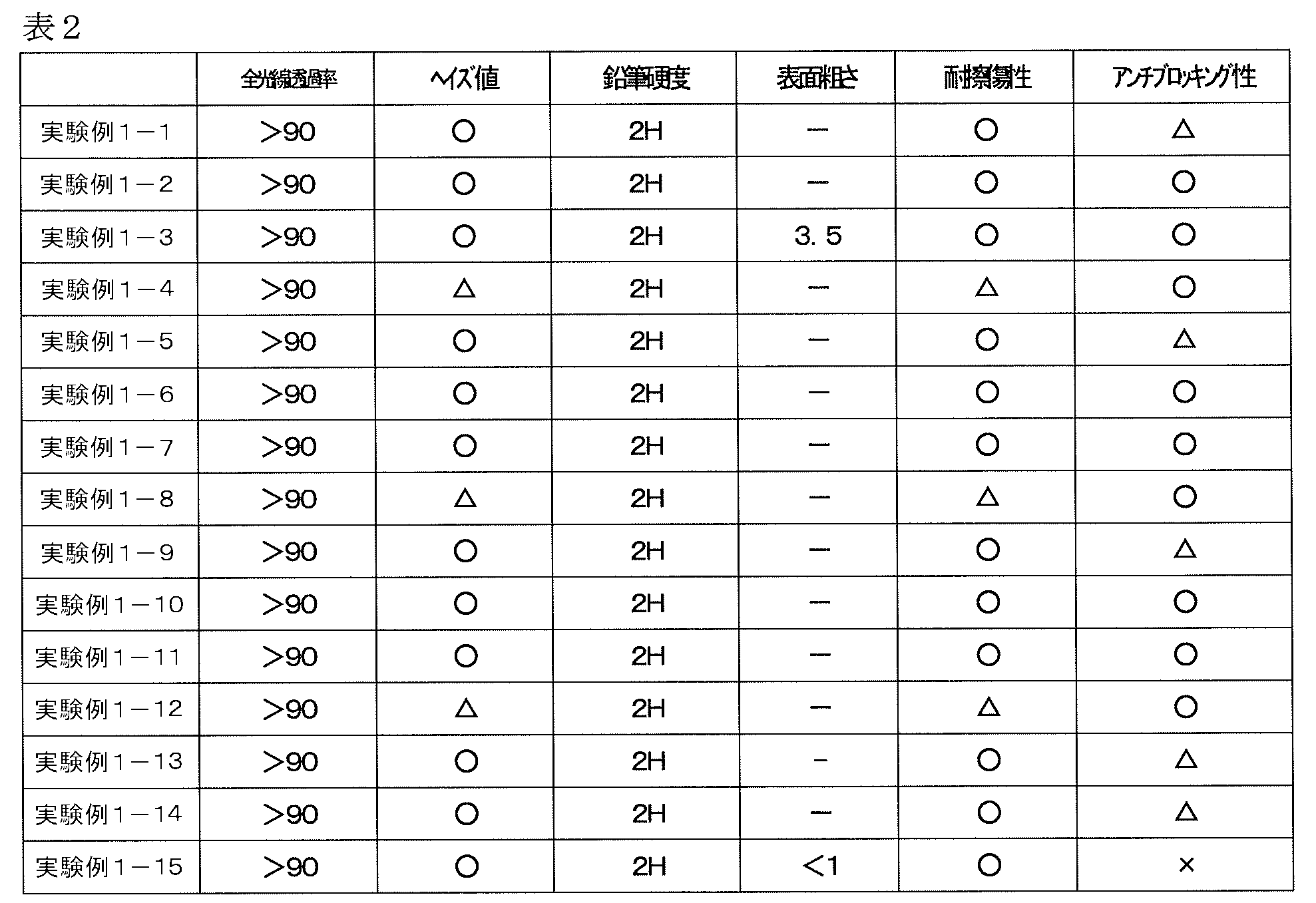
<実験例2-1>
四つ口のフラスコに、第一成分として、(A-2)(メタ)アクリロイル共重合体A-1で表面修飾されたコロイダルシリカを5.0重量部、次いで、第二成分として、ジペンタエリスリトールヘキサアクリレート(SP値12.1)95.0重量部に、第三成分としてBYK300を0.5重量部配合したのち、重合開始剤として1-ヒドロキシ-シクロヘキシル-フェニル-ケトン(イルガキュア184)を5重量部加え、メチルエチルケトン157.5重量部加えることで、活性エネルギー線硬化性樹脂組成物を得た。
四つ口のフラスコに、第一成分として、(A-2)(メタ)アクリロイル共重合体A-1で表面修飾されたコロイダルシリカを5.0重量部、次いで、第二成分として、ジペンタエリスリトールヘキサアクリレート(SP値12.1)95.0重量部に、第三成分としてBYK300を0.5重量部配合したのち、重合開始剤として1-ヒドロキシ-シクロヘキシル-フェニル-ケトン(イルガキュア184)を5重量部加え、メチルエチルケトン157.5重量部加えることで、活性エネルギー線硬化性樹脂組成物を得た。
<実験例2-2>
第三成分としてBYK302を0.5重量部とした以外は実験例2-1と同様にして活性エネルギー線硬化性樹脂組成物を得た。
第三成分としてBYK302を0.5重量部とした以外は実験例2-1と同様にして活性エネルギー線硬化性樹脂組成物を得た。
<実験例2-3>
第三成分としてBYK306を0.5重量部とした以外は実験例2-1と同様にして活性エネルギー線硬化性樹脂組成物を得た。
第三成分としてBYK306を0.5重量部とした以外は実験例2-1と同様にして活性エネルギー線硬化性樹脂組成物を得た。
<実験例2-4>
第三成分としてBYK307を0.5重量部とした以外は実験例2-1と同様にして活性エネルギー線硬化性樹脂組成物を得た。
第三成分としてBYK307を0.5重量部とした以外は実験例2-1と同様にして活性エネルギー線硬化性樹脂組成物を得た。
<実験例2-5>
第三成分としてBYK331を0.5重量部とした以外は実験例2-1と同様にして活性エネルギー線硬化性樹脂組成物を得た。
第三成分としてBYK331を0.5重量部とした以外は実験例2-1と同様にして活性エネルギー線硬化性樹脂組成物を得た。
<実験例2-6>
第三成分としてBYK333を0.5重量部とした以外は実験例2-1と同様にして活性エネルギー線硬化性樹脂組成物を得た。
第三成分としてBYK333を0.5重量部とした以外は実験例2-1と同様にして活性エネルギー線硬化性樹脂組成物を得た。
<実験例2-7>
第三成分としてBYK337を0.5重量部とした以外は実験例2-1と同様にして活性エネルギー線硬化性樹脂組成物を得た。
第三成分としてBYK337を0.5重量部とした以外は実験例2-1と同様にして活性エネルギー線硬化性樹脂組成物を得た。
<実験例2-8>
第三成分としてBYK342を0.5重量部とした以外は実験例2-1と同様にして活性エネルギー線硬化性樹脂組成物を得た。
第三成分としてBYK342を0.5重量部とした以外は実験例2-1と同様にして活性エネルギー線硬化性樹脂組成物を得た。
<実験例2-9>
第三成分としてBYK378を0.5重量部とした以外は実験例2-1と同様にして活性エネルギー線硬化性樹脂組成物を得た。
第三成分としてBYK378を0.5重量部とした以外は実験例2-1と同様にして活性エネルギー線硬化性樹脂組成物を得た。
<実験例2-10>
第三成分としてBYK-UV3510を0.5重量部とした以外は実験例2-1と同様にして活性エネルギー線硬化性樹脂組成物を得た。
第三成分としてBYK-UV3510を0.5重量部とした以外は実験例2-1と同様にして活性エネルギー線硬化性樹脂組成物を得た。
<実験例2-11>
第三成分としてBYK325を0.5重量部とした以外は実験例2-1と同様にして活性エネルギー線硬化性樹脂組成物を得た。
第三成分としてBYK325を0.5重量部とした以外は実験例2-1と同様にして活性エネルギー線硬化性樹脂組成物を得た。
<実験例2-12>
第三成分としてBYK377を0.5重量部とした以外は実験例2-1と同様にして活性エネルギー線硬化性樹脂組成物を得た。
第三成分としてBYK377を0.5重量部とした以外は実験例2-1と同様にして活性エネルギー線硬化性樹脂組成物を得た。
<実験例2-13>
第三成分としてBYK-UV3500を0.5重量部とした以外は実験例2-1と同様にして活性エネルギー線硬化性樹脂組成物を得た。
第三成分としてBYK-UV3500を0.5重量部とした以外は実験例2-1と同様にして活性エネルギー線硬化性樹脂組成物を得た。
<実験例2-14>
第三成分としてBYK345を0.5重量部とした以外は実験例2-1と同様にして活性エネルギー線硬化性樹脂組成物を得た。
第三成分としてBYK345を0.5重量部とした以外は実験例2-1と同様にして活性エネルギー線硬化性樹脂組成物を得た。
<実験例2-15>
第三成分としてBYK349を0.5重量部とした以外は実験例2-1と同様にして活性エネルギー線硬化性樹脂組成物を得た。
第三成分としてBYK349を0.5重量部とした以外は実験例2-1と同様にして活性エネルギー線硬化性樹脂組成物を得た。
<実験例2-16>
第三成分としてBYK3455を0.5重量部とした以外は実験例2-1と同様にして活性エネルギー線硬化性樹脂組成物を得た。
第三成分としてBYK3455を0.5重量部とした以外は実験例2-1と同様にして活性エネルギー線硬化性樹脂組成物を得た。
<実験例2-17>
第三成分としてBYK3530を0.5重量部とした以外は実験例2-1と同様にして活性エネルギー線硬化性樹脂組成物を得た。
第三成分としてBYK3530を0.5重量部とした以外は実験例2-1と同様にして活性エネルギー線硬化性樹脂組成物を得た。
<実験例2-18>
第三成分としてシルフェイス SAG001を0.5重量部とした以外は実験例2-1と同様にして活性エネルギー線硬化性樹脂組成物を得た。
第三成分としてシルフェイス SAG001を0.5重量部とした以外は実験例2-1と同様にして活性エネルギー線硬化性樹脂組成物を得た。
<実験例2-19>
第三成分としてシルフェイス SAG005を0.5重量部とした以外は実験例2-1と同様にして活性エネルギー線硬化性樹脂組成物を得た。
第三成分としてシルフェイス SAG005を0.5重量部とした以外は実験例2-1と同様にして活性エネルギー線硬化性樹脂組成物を得た。
<実験例2-20>
第一成分として、(A-1)(メタ)アクリロイル共重合体を5.0重量部とした以外は実験例2-6と同様にして活性エネルギー線硬化性樹脂組成物を得た。
第一成分として、(A-1)(メタ)アクリロイル共重合体を5.0重量部とした以外は実験例2-6と同様にして活性エネルギー線硬化性樹脂組成物を得た。
<実験例2-21>
第三成分としてBYK310を0.5重量部とした以外は実験例2-1と同様にして活性エネルギー線硬化性樹脂組成物を得た。
第三成分としてBYK310を0.5重量部とした以外は実験例2-1と同様にして活性エネルギー線硬化性樹脂組成物を得た。
<実験例2-22>
第三成分としてBYK313を0.5重量部とした以外は実験例2-1と同様にして活性エネルギー線硬化性樹脂組成物を得た。
第三成分としてBYK313を0.5重量部とした以外は実験例2-1と同様にして活性エネルギー線硬化性樹脂組成物を得た。
<実験例2-23>
第三成分としてBYK315を0.5重量部とした以外は実験例2-1と同様にして活性エネルギー線硬化性樹脂組成物を得た。
第三成分としてBYK315を0.5重量部とした以外は実験例2-1と同様にして活性エネルギー線硬化性樹脂組成物を得た。
<実験例2-24>
第三成分としてBYK322を0.5重量部とした以外は実験例2-1と同様にして活性エネルギー線硬化性樹脂組成物を得た。
第三成分としてBYK322を0.5重量部とした以外は実験例2-1と同様にして活性エネルギー線硬化性樹脂組成物を得た。
<実験例2-25>
第三成分としてBYK323を0.5重量部とした以外は実験例2-1と同様にして活性エネルギー線硬化性樹脂組成物を得た。
第三成分としてBYK323を0.5重量部とした以外は実験例2-1と同様にして活性エネルギー線硬化性樹脂組成物を得た。
<実験例2-26>
第三成分としてBYK371を0.5重量部とした以外は実験例2-1と同様にして活性エネルギー線硬化性樹脂組成物を得た。
第三成分としてBYK371を0.5重量部とした以外は実験例2-1と同様にして活性エネルギー線硬化性樹脂組成物を得た。
<実験例2-27>
第三成分としてBYK-UV3570を0.5重量部とした以外は実験例2-1と同様にして活性エネルギー線硬化性樹脂組成物を得た。
第三成分としてBYK-UV3570を0.5重量部とした以外は実験例2-1と同様にして活性エネルギー線硬化性樹脂組成物を得た。
<実験例2-28>
第三成分を配合しない以外は実験例2-1と同様にして活性エネルギー線硬化性樹脂組成物を得た。
第三成分を配合しない以外は実験例2-1と同様にして活性エネルギー線硬化性樹脂組成物を得た。
次に、上記実験例2-1~2-28で得られた活性エネルギー線硬化性樹脂組成物に対し、以下の塗布工程、硬化工程を経ることで、成形体を得た。
<塗布工程>
活性エネルギー線硬化性樹脂組成物を、厚さ188μmの透明な二軸延伸ポリエチレンテレフタレートフィルム(ヘイズ値 0.8%;三菱化学ポリエステル社製 商品名:ダイアホイルT300E)に、バーコーターを用いて、乾燥後の塗膜厚が2~3μmとなるように塗布し、80℃で1分間加熱乾燥した。
<塗布工程>
活性エネルギー線硬化性樹脂組成物を、厚さ188μmの透明な二軸延伸ポリエチレンテレフタレートフィルム(ヘイズ値 0.8%;三菱化学ポリエステル社製 商品名:ダイアホイルT300E)に、バーコーターを用いて、乾燥後の塗膜厚が2~3μmとなるように塗布し、80℃で1分間加熱乾燥した。
<硬化工程>
活性エネルギー線硬化性樹脂組成物の塗布されたPETフィルムを、出力密度120W/cmの高圧水銀灯を光源として、光源下15cmの位置で、アイグラフィック社製EYE UV METER UVPF-A1、PD365を使用して積算光量200mJ/cm2となるようにUVを照射して、硬化膜を得た。
得られた硬化膜に対し、評価試験を行った。その結果を表3に示す。なお、評価方法は以下のとおりである。
活性エネルギー線硬化性樹脂組成物の塗布されたPETフィルムを、出力密度120W/cmの高圧水銀灯を光源として、光源下15cmの位置で、アイグラフィック社製EYE UV METER UVPF-A1、PD365を使用して積算光量200mJ/cm2となるようにUVを照射して、硬化膜を得た。
得られた硬化膜に対し、評価試験を行った。その結果を表3に示す。なお、評価方法は以下のとおりである。
<塗膜外観>
得られた硬化膜の塗膜外観を目視で観察し、以下の基準で評価を行った。
塗膜表面に欠陥が100個/500cm2以上又は大きな欠陥あり:1塗膜表面に欠陥が100個/500cm2未満:2
塗膜表面に欠陥が50個/500cm2以下:3
塗膜表面に欠陥が30個/500cm2以下:4
塗膜表面に欠陥が20個/500cm2以下:5
塗膜表面に欠陥が10個/500cm2以下:6
※本発明では、評価結果の数値が大きいものほど効果があるものである。
得られた硬化膜の塗膜外観を目視で観察し、以下の基準で評価を行った。
塗膜表面に欠陥が100個/500cm2以上又は大きな欠陥あり:1塗膜表面に欠陥が100個/500cm2未満:2
塗膜表面に欠陥が50個/500cm2以下:3
塗膜表面に欠陥が30個/500cm2以下:4
塗膜表面に欠陥が20個/500cm2以下:5
塗膜表面に欠陥が10個/500cm2以下:6
※本発明では、評価結果の数値が大きいものほど効果があるものである。
<液外観>
得られた塗液を目視で観察し、以下の基準で評価を行った。
塗液が濁る:×
塗液が透明:○
得られた塗液を目視で観察し、以下の基準で評価を行った。
塗液が濁る:×
塗液が透明:○
<透明性(ヘイズ値)>
得られた硬化膜を23℃、相対湿度60%の恒温室に12時間放置した後、硬化膜の透明性をJIS K-7105に従ってヘイズ値(H%)で評価し、PETフィルムのヘイズ値(H%)を差し引くことで、硬化膜のヘイズ値(H%)を求め、以下の基準で評価を行った。なお、評価は、ヘイズ値が小さいほど透明性が良好といえ、○であることが最良である。
0.5未満:○
0.5~1.0未満:△
1.0以上:×
得られた硬化膜を23℃、相対湿度60%の恒温室に12時間放置した後、硬化膜の透明性をJIS K-7105に従ってヘイズ値(H%)で評価し、PETフィルムのヘイズ値(H%)を差し引くことで、硬化膜のヘイズ値(H%)を求め、以下の基準で評価を行った。なお、評価は、ヘイズ値が小さいほど透明性が良好といえ、○であることが最良である。
0.5未満:○
0.5~1.0未満:△
1.0以上:×
<耐ブロッキング性>
硬化後の活性エネルギー線硬化性樹脂組成物によりコートされた基材を2枚用意し、23℃、相対湿度60%下で塗工面同士を重ね合わせ、指圧にて約1kgの荷重を負荷した後、塗工面同士が易滑性を有しているかを確認し、以下の基準で耐ブロッキング性の評価をした。
容易にずらすことができるもの:○
ずらすことは可能であるが音が鳴るもの:△
塗工面同士が密着して塗工面同士をずらすことが出来ない場合:×
硬化後の活性エネルギー線硬化性樹脂組成物によりコートされた基材を2枚用意し、23℃、相対湿度60%下で塗工面同士を重ね合わせ、指圧にて約1kgの荷重を負荷した後、塗工面同士が易滑性を有しているかを確認し、以下の基準で耐ブロッキング性の評価をした。
容易にずらすことができるもの:○
ずらすことは可能であるが音が鳴るもの:△
塗工面同士が密着して塗工面同士をずらすことが出来ない場合:×
<総合評価>
上記の評価結果のうち、一つも×がないものが良好な効果を有するものである。
上記の評価結果のうち、一つも×がないものが良好な効果を有するものである。

<合成例4>
(メタ)アクリロイル共重合体で表面修飾されたコロイダルシリカ(AP-1)
合成例2で得た(メタ)アクリロイル共重合体(A-1)で表面修飾されたコロイダルシリカ(A-2)をそのまま用いた。
(メタ)アクリロイル共重合体で表面修飾されたコロイダルシリカ(AP-1)
合成例2で得た(メタ)アクリロイル共重合体(A-1)で表面修飾されたコロイダルシリカ(A-2)をそのまま用いた。
<合成例5>
(メタ)アクリロイル共重合体(AP-2)
合成例1で得た(メタ)アクリロイル共重合体(A-1)をそのまま用いた。
(メタ)アクリロイル共重合体(AP-2)
合成例1で得た(メタ)アクリロイル共重合体(A-1)をそのまま用いた。
<合成例6>
(メタ)アクリロイル共重合体で表面修飾されたコロイダルシリカ(AP-3)
グリシジルメタクリレートを79.0g、メチルメタクリレートを20.0gとし、アクリル酸を40.8gに変更した以外は合成例1と同様にして行った。
(メタ)アクリロイル共重合体で表面修飾されたコロイダルシリカ(AP-3)
グリシジルメタクリレートを79.0g、メチルメタクリレートを20.0gとし、アクリル酸を40.8gに変更した以外は合成例1と同様にして行った。
<合成例7>
(メタ)アクリロイル共重合体で表面修飾されたコロイダルシリカ(AP-4)
アクリル酸の代わりに、酢酸42.2gを用いた以外は合成例1と同様にして行った。
(メタ)アクリロイル共重合体で表面修飾されたコロイダルシリカ(AP-4)
アクリル酸の代わりに、酢酸42.2gを用いた以外は合成例1と同様にして行った。
<合成例8>
(メタ)アクリロイル共重合体で表面修飾されたコロイダルシリカ(AP-5)
アクリル酸の代わりに、乳酸12.7g、アクリル酸40.5gを用いた以外は合成例1と同様にして行った。
(メタ)アクリロイル共重合体で表面修飾されたコロイダルシリカ(AP-5)
アクリル酸の代わりに、乳酸12.7g、アクリル酸40.5gを用いた以外は合成例1と同様にして行った。
<合成例9>
(メタ)アクリロイル共重合体で表面修飾されたコロイダルシリカ(AP-6)
アクリル酸の代わりに、乳酸31.7g、アクリル酸25.3gに変更したを用いた以外は合成例1と同様にして行った。
(メタ)アクリロイル共重合体で表面修飾されたコロイダルシリカ(AP-6)
アクリル酸の代わりに、乳酸31.7g、アクリル酸25.3gに変更したを用いた以外は合成例1と同様にして行った。
<合成例10>
(メタ)アクリロイル共重合体で表面修飾されたコロイダルシリカ(AP-7)
グリシジルメタクリレートを69.0g、メチルメタクリレートを30.0gとし、アクリル酸を35.7gに変更した以外は合成例1と同様にして行った。
(メタ)アクリロイル共重合体で表面修飾されたコロイダルシリカ(AP-7)
グリシジルメタクリレートを69.0g、メチルメタクリレートを30.0gとし、アクリル酸を35.7gに変更した以外は合成例1と同様にして行った。
<合成例11>
(メタ)アクリロイル共重合体で表面修飾されたコロイダルシリカ(AP-8)
アクリル酸の代わりに、乳酸63.3gを用いた以外は合成例1と同様にして行った。
(メタ)アクリロイル共重合体で表面修飾されたコロイダルシリカ(AP-8)
アクリル酸の代わりに、乳酸63.3gを用いた以外は合成例1と同様にして行った。
<合成例12>
(メタ)アクリロイル共重合体で表面修飾されたコロイダルシリカ(AP-9)
アクリル酸の代わりに、メタクリル酸60.5gを用いた以外は合成例1と同様にして行った。
(メタ)アクリロイル共重合体で表面修飾されたコロイダルシリカ(AP-9)
アクリル酸の代わりに、メタクリル酸60.5gを用いた以外は合成例1と同様にして行った。
<実験例3-1>
四つ口のフラスコに、(AP-2)(メタ)アクリロイル共重合体で表面修飾されたコロイダルシリカを5重量部、次いで(O-1)ジペンタエリスリトールヘキサアクリレート(SP値12.1)95重量部に、添加剤としてアクリルポリマー(共栄社化学製:ポリフローNo.77)を1重量部配合したのち、重合開始剤として1-ヒドロキシ-シクロヘキシル-フェニル-ケトン(チバスペシャリティケミカルズ製:イルガキュア184)を5重量部加え、メチルエチルケトン157.5重量部加えることで、活性エネルギー線硬化性樹脂組成物を得た。
四つ口のフラスコに、(AP-2)(メタ)アクリロイル共重合体で表面修飾されたコロイダルシリカを5重量部、次いで(O-1)ジペンタエリスリトールヘキサアクリレート(SP値12.1)95重量部に、添加剤としてアクリルポリマー(共栄社化学製:ポリフローNo.77)を1重量部配合したのち、重合開始剤として1-ヒドロキシ-シクロヘキシル-フェニル-ケトン(チバスペシャリティケミカルズ製:イルガキュア184)を5重量部加え、メチルエチルケトン157.5重量部加えることで、活性エネルギー線硬化性樹脂組成物を得た。
<実験例3-2>
(AP-2)(メタ)アクリロイル共重合体で表面修飾されたコロイダルシリカを(AP-1)(メタ)アクリロイル共重合体に変更した以外は、実験例3-1と同様に行った。
(AP-2)(メタ)アクリロイル共重合体で表面修飾されたコロイダルシリカを(AP-1)(メタ)アクリロイル共重合体に変更した以外は、実験例3-1と同様に行った。
<実験例3-3>
(AP-2)(メタ)アクリロイル共重合体で表面修飾されたコロイダルシリカを(AP-3)(メタ)アクリロイル共重合体で表面修飾されたコロイダルシリカに変更した以外は、実験例3-1と同様に行った。
(AP-2)(メタ)アクリロイル共重合体で表面修飾されたコロイダルシリカを(AP-3)(メタ)アクリロイル共重合体で表面修飾されたコロイダルシリカに変更した以外は、実験例3-1と同様に行った。
<実験例3-4>
(AP-2)(メタ)アクリロイル共重合体で表面修飾されたコロイダルシリカを(AP-4)(メタ)アクリロイル共重合体で表面修飾されたコロイダルシリカに変更した以外は、実験例3-1と同様に行った。
(AP-2)(メタ)アクリロイル共重合体で表面修飾されたコロイダルシリカを(AP-4)(メタ)アクリロイル共重合体で表面修飾されたコロイダルシリカに変更した以外は、実験例3-1と同様に行った。
<実験例3-5>
(AP-2)(メタ)アクリロイル共重合体で表面修飾されたコロイダルシリカを(AP-5)(メタ)アクリロイル共重合体で表面修飾されたコロイダルシリカに変更した以外は、実験例3-1と同様に行った。
(AP-2)(メタ)アクリロイル共重合体で表面修飾されたコロイダルシリカを(AP-5)(メタ)アクリロイル共重合体で表面修飾されたコロイダルシリカに変更した以外は、実験例3-1と同様に行った。
<実験例3-6>
(AP-2)(メタ)アクリロイル共重合体で表面修飾されたコロイダルシリカを(AP-6)(メタ)アクリロイル共重合体で表面修飾されたコロイダルシリカに変更した以外は、実験例3-1と同様に行った。
(AP-2)(メタ)アクリロイル共重合体で表面修飾されたコロイダルシリカを(AP-6)(メタ)アクリロイル共重合体で表面修飾されたコロイダルシリカに変更した以外は、実験例3-1と同様に行った。
<実験例3-7>
(AP-2)(メタ)アクリロイル共重合体で表面修飾されたコロイダルシリカを(AP-7)(メタ)アクリロイル共重合体で表面修飾されたコロイダルシリカに変更した以外は、実験例3-1と同様に行った。
(AP-2)(メタ)アクリロイル共重合体で表面修飾されたコロイダルシリカを(AP-7)(メタ)アクリロイル共重合体で表面修飾されたコロイダルシリカに変更した以外は、実験例3-1と同様に行った。
<実験例3-8>
(AP-2)(メタ)アクリロイル共重合体で表面修飾されたコロイダルシリカを(AP-8)(メタ)アクリロイル共重合体で表面修飾されたコロイダルシリカに変更した以外は、実験例3-1と同様に行った。
(AP-2)(メタ)アクリロイル共重合体で表面修飾されたコロイダルシリカを(AP-8)(メタ)アクリロイル共重合体で表面修飾されたコロイダルシリカに変更した以外は、実験例3-1と同様に行った。
<実験例3-9>
(AP-2)(メタ)アクリロイル共重合体で表面修飾されたコロイダルシリカを(AP-9)(メタ)アクリロイル共重合体で表面修飾されたコロイダルシリカに変更した以外は、実験例3-1と同様に行った。
(AP-2)(メタ)アクリロイル共重合体で表面修飾されたコロイダルシリカを(AP-9)(メタ)アクリロイル共重合体で表面修飾されたコロイダルシリカに変更した以外は、実験例3-1と同様に行った。
<実験例3-10>
(AP-2)(メタ)アクリロイル共重合体で表面修飾されたコロイダルシリカを、平均一次粒子径1μm以下のアクリル微粒子(綜研化学株式会社製:ケミスノー8H3WT)に変更した以外は、実験例3-1と同様に行った。
(AP-2)(メタ)アクリロイル共重合体で表面修飾されたコロイダルシリカを、平均一次粒子径1μm以下のアクリル微粒子(綜研化学株式会社製:ケミスノー8H3WT)に変更した以外は、実験例3-1と同様に行った。
<実験例3-11>
(AP-2)(メタ)アクリロイル共重合体で表面修飾されたコロイダルシリカを使用せず、(O-1)ジペンタエリスリトールヘキサアクリレート(SP値12.1)100重量部と変更した以外は、実験例3-1と同様に行った。
それぞれの実験例に用いた(メタ)アクリロイル共重合体の各種物性については、以下の方法で測定した。結果を表5に示す。
(AP-2)(メタ)アクリロイル共重合体で表面修飾されたコロイダルシリカを使用せず、(O-1)ジペンタエリスリトールヘキサアクリレート(SP値12.1)100重量部と変更した以外は、実験例3-1と同様に行った。
それぞれの実験例に用いた(メタ)アクリロイル共重合体の各種物性については、以下の方法で測定した。結果を表5に示す。
<SP値の測定>
濁度法に準拠する方法にて測定した。より具体的には、以下の条件である。
測定温度20℃で、アクリロイル共重合体を0.5gを100mlビーカーに秤量し、良溶媒(プロピレングリコールモノメチルエーテル)10gをピペットを用いて加え、マグネティックスターラーにより溶解した。次に、この希釈溶液に50ml滴下ロートを用いて低SP貧溶媒(n-ヘキサン)を徐々に滴下し、樹脂溶液に濁りが生じた点を低SP貧溶媒の滴下量とした。また、別途、上記希釈溶液に高SP貧溶媒(イオン交換水)を徐々に滴下し、樹脂溶液に濁りが生じた点を高SP貧溶媒の滴下量とした。樹脂のSP値は、上記各貧溶媒の濁点に至るまでの滴下量から算出することができる。
濁度法に準拠する方法にて測定した。より具体的には、以下の条件である。
測定温度20℃で、アクリロイル共重合体を0.5gを100mlビーカーに秤量し、良溶媒(プロピレングリコールモノメチルエーテル)10gをピペットを用いて加え、マグネティックスターラーにより溶解した。次に、この希釈溶液に50ml滴下ロートを用いて低SP貧溶媒(n-ヘキサン)を徐々に滴下し、樹脂溶液に濁りが生じた点を低SP貧溶媒の滴下量とした。また、別途、上記希釈溶液に高SP貧溶媒(イオン交換水)を徐々に滴下し、樹脂溶液に濁りが生じた点を高SP貧溶媒の滴下量とした。樹脂のSP値は、上記各貧溶媒の濁点に至るまでの滴下量から算出することができる。
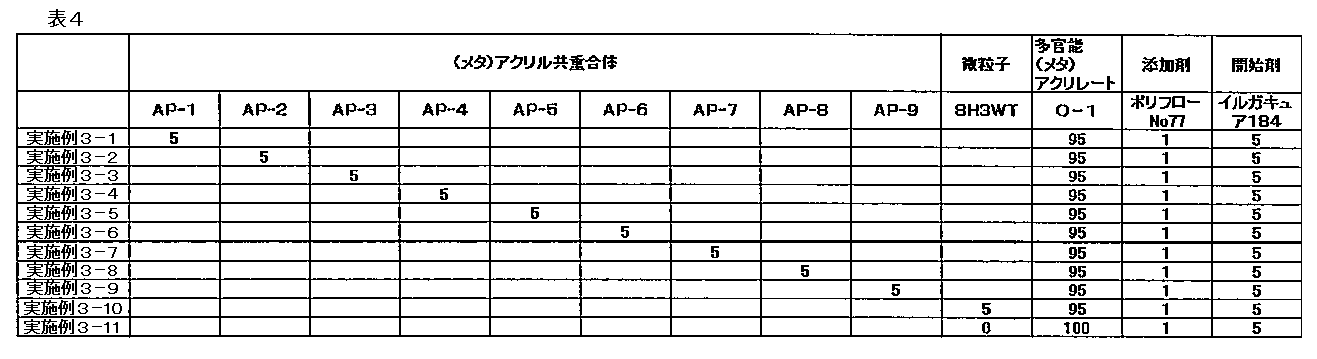
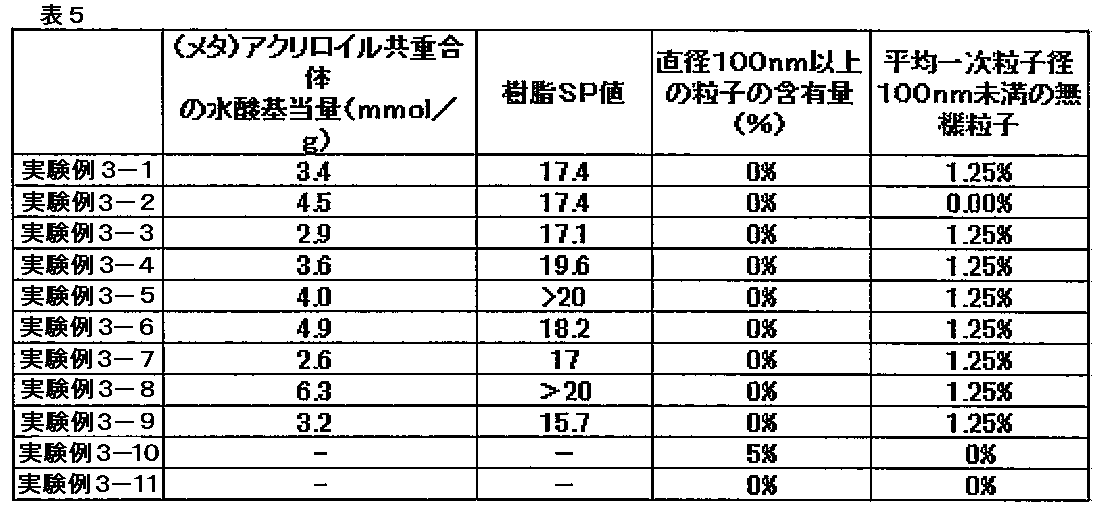
次に、上記実験例で得られた活性エネルギー線硬化性樹脂組成物に対し、以下の塗布工程、硬化工程を経ることで、成形体を得た。
<塗布工程>
活性エネルギー線硬化性樹脂組成物を、厚さ188μmの透明な二軸延伸ポリエチレンテレフタレートフィルム(ヘイズ値 0.8%;三菱化学ポリエステル社製 商品名:ダイアホイルO321E)に、バーコーターを用いて、乾燥後の塗膜厚が2~3μmとなるように塗布し、80℃で1分間加熱乾燥した。
<塗布工程>
活性エネルギー線硬化性樹脂組成物を、厚さ188μmの透明な二軸延伸ポリエチレンテレフタレートフィルム(ヘイズ値 0.8%;三菱化学ポリエステル社製 商品名:ダイアホイルO321E)に、バーコーターを用いて、乾燥後の塗膜厚が2~3μmとなるように塗布し、80℃で1分間加熱乾燥した。
<硬化工程>
活性エネルギー線硬化性樹脂組成物の塗布されたポリエチレンテレフタレートフィルムを、出力密度120W/cmの高圧水銀灯を光源として、光源下15cmの位置で、アイグラフィック社製EYE UV METER UVPF-A1、PD365を使用して積算光量500mJ/cm2となるようにUVを照射して、硬化膜を得た。
得られた硬化膜に対し、評価試験を行った。その結果を表6に示す。なお、評価方法は以下のとおりである。
活性エネルギー線硬化性樹脂組成物の塗布されたポリエチレンテレフタレートフィルムを、出力密度120W/cmの高圧水銀灯を光源として、光源下15cmの位置で、アイグラフィック社製EYE UV METER UVPF-A1、PD365を使用して積算光量500mJ/cm2となるようにUVを照射して、硬化膜を得た。
得られた硬化膜に対し、評価試験を行った。その結果を表6に示す。なお、評価方法は以下のとおりである。
<ハードコート層の厚み>
ミツトヨ製の接触式の膜厚測定装置を用いて膜厚を測定した。
ミツトヨ製の接触式の膜厚測定装置を用いて膜厚を測定した。
<全光線透過率>
得られた硬化膜を23℃、相対湿度60%の恒温室に12時間放置した後、硬化膜の透明性をJIS K-7105に従い、ヘイズメーターにて評価した。
得られた硬化膜を23℃、相対湿度60%の恒温室に12時間放置した後、硬化膜の透明性をJIS K-7105に従い、ヘイズメーターにて評価した。
<透明性(ヘイズ値)>
得られた硬化膜を23℃、相対湿度60%の恒温室に12時間放置した後、硬化膜の透明性をJIS K-7105に従ってヘイズ値(H%)で評価し、PETフィルムのヘイズ値(H%)を差し引くことで、硬化膜のヘイズ値(H%)を求め、以下の基準で評価を行った。なお、評価は、ヘイズ値が小さいほど透明性が良好といえる。
0.5未満:○
0.5~1.0未満:△
1.0以上:×
得られた硬化膜を23℃、相対湿度60%の恒温室に12時間放置した後、硬化膜の透明性をJIS K-7105に従ってヘイズ値(H%)で評価し、PETフィルムのヘイズ値(H%)を差し引くことで、硬化膜のヘイズ値(H%)を求め、以下の基準で評価を行った。なお、評価は、ヘイズ値が小さいほど透明性が良好といえる。
0.5未満:○
0.5~1.0未満:△
1.0以上:×
<鉛筆硬度>
得られた硬化膜に対し、JIS-K5600に従い鉛筆硬度を測定した。
<表面粗さRa>
得られた硬化膜を23℃、相対湿度60%の恒温室に12時間放置した後、硬化膜の表面粗さRaをAFMにて測定した。
得られた硬化膜に対し、JIS-K5600に従い鉛筆硬度を測定した。
<表面粗さRa>
得られた硬化膜を23℃、相対湿度60%の恒温室に12時間放置した後、硬化膜の表面粗さRaをAFMにて測定した。
<耐摩耗性>
得られた硬化膜の表面に対して、ボンスター製スチールウール(#0000)を荷重500gで20往復させたときの傷を目視で観察し、以下の基準で耐摩耗性を評価した。この傷の入る本数が少ないほど、耐摩耗性に優れる。
傷の無いもの:◎
数本の傷が入るもの:○
無数の傷が入るもの:△
傷が酷くフィルムが白化するもの:×
得られた硬化膜の表面に対して、ボンスター製スチールウール(#0000)を荷重500gで20往復させたときの傷を目視で観察し、以下の基準で耐摩耗性を評価した。この傷の入る本数が少ないほど、耐摩耗性に優れる。
傷の無いもの:◎
数本の傷が入るもの:○
無数の傷が入るもの:△
傷が酷くフィルムが白化するもの:×
<耐ブロッキング性>
硬化後の活性エネルギー線硬化性樹脂組成物によりコートされた基材を2枚用意し、23℃、相対湿度60%下で塗工面同士を重ね合わせ、指圧にて約1kgの荷重を負荷した後、塗工面同士が易滑性を有しているかを確認し、以下の基準で耐ブロッキング性の評価をした。
容易にずらすことができるもの:○
ずらすことは可能であるが音が鳴るもの:△
塗工面同士が密着して塗工面同士をずらすことが出来ない場合:×
硬化後の活性エネルギー線硬化性樹脂組成物によりコートされた基材を2枚用意し、23℃、相対湿度60%下で塗工面同士を重ね合わせ、指圧にて約1kgの荷重を負荷した後、塗工面同士が易滑性を有しているかを確認し、以下の基準で耐ブロッキング性の評価をした。
容易にずらすことができるもの:○
ずらすことは可能であるが音が鳴るもの:△
塗工面同士が密着して塗工面同士をずらすことが出来ない場合:×
外部ヘイズおよび内部ヘイズの測定:
<外部ヘイズの測定方法>
基材上に活性エネルギー線硬化性樹脂組成物を塗布・乾燥・硬化して得たアンチブロッキング層のヘイズ(以下、ヘイズHAと記載する。)を測定し、そのアンチブロッキング層上に、アンチブロッキング層に用いた活性エネルギー線硬化性樹脂組成物の構成のうち、(メタ)アクリロイル共重合体を含まない活性エネルギー線硬化性樹脂組成物(以下、(A’)と記載する。)を調製し、乾燥後2μm程度の塗膜厚みとなるようバーコーターで塗布し、80の電気オーブン中で1分間乾燥させた。その後、高圧水銀ランプを用いて紫外線を照射量500mJ/cm2で照射して塗布層を硬化させた。このように、アンチブロッキング層上に表面凸凹の無い層を設けた塗膜を作成し、その塗膜のヘイズ(以下、ヘイズHTと記載する。)を測定した。同様に、上述のアンチブロッキング層と同じ厚みとなるように(A’)を塗布・乾燥・硬化した塗膜を形成しヘイズ(以下、ヘイズH1と記載する。)を測定した。さらに、表面凸凹の無い層と同じ厚みとなるように塗布・乾燥・硬化した塗膜を作成し、ヘイズ(以下、ヘイズH2と記載する。)を測定した。以下の式で算出される値をアンチブロッキング層を設けたときに発生する外部ヘイズとした。なお、評価は、外部ヘイズ値が小さいほど透明性が良好といえる。
外部ヘイズ=ヘイズHA-{ヘイズHT-(ヘイズH2-ヘイズH1)}
<外部ヘイズの測定方法>
基材上に活性エネルギー線硬化性樹脂組成物を塗布・乾燥・硬化して得たアンチブロッキング層のヘイズ(以下、ヘイズHAと記載する。)を測定し、そのアンチブロッキング層上に、アンチブロッキング層に用いた活性エネルギー線硬化性樹脂組成物の構成のうち、(メタ)アクリロイル共重合体を含まない活性エネルギー線硬化性樹脂組成物(以下、(A’)と記載する。)を調製し、乾燥後2μm程度の塗膜厚みとなるようバーコーターで塗布し、80の電気オーブン中で1分間乾燥させた。その後、高圧水銀ランプを用いて紫外線を照射量500mJ/cm2で照射して塗布層を硬化させた。このように、アンチブロッキング層上に表面凸凹の無い層を設けた塗膜を作成し、その塗膜のヘイズ(以下、ヘイズHTと記載する。)を測定した。同様に、上述のアンチブロッキング層と同じ厚みとなるように(A’)を塗布・乾燥・硬化した塗膜を形成しヘイズ(以下、ヘイズH1と記載する。)を測定した。さらに、表面凸凹の無い層と同じ厚みとなるように塗布・乾燥・硬化した塗膜を作成し、ヘイズ(以下、ヘイズH2と記載する。)を測定した。以下の式で算出される値をアンチブロッキング層を設けたときに発生する外部ヘイズとした。なお、評価は、外部ヘイズ値が小さいほど透明性が良好といえる。
外部ヘイズ=ヘイズHA-{ヘイズHT-(ヘイズH2-ヘイズH1)}
<内部へイズの測定方法>
また、以下の式で算出される値を内部ヘイズとした。なお、評価は、ヘイズ値が小さいほど透明性が良好といえる。
内部ヘイズ=ヘイズHT-(ヘイズH2-ヘイズH1)
また、以下の式で算出される値を内部ヘイズとした。なお、評価は、ヘイズ値が小さいほど透明性が良好といえる。
内部ヘイズ=ヘイズHT-(ヘイズH2-ヘイズH1)
<表面粗さ(Ra)の測定方法>
光干渉型表面形状測定装置(Veeco社製 Wyko NT9100)を用いて、作製した塗膜の表面粗さを測定した。
光干渉型表面形状測定装置(Veeco社製 Wyko NT9100)を用いて、作製した塗膜の表面粗さを測定した。
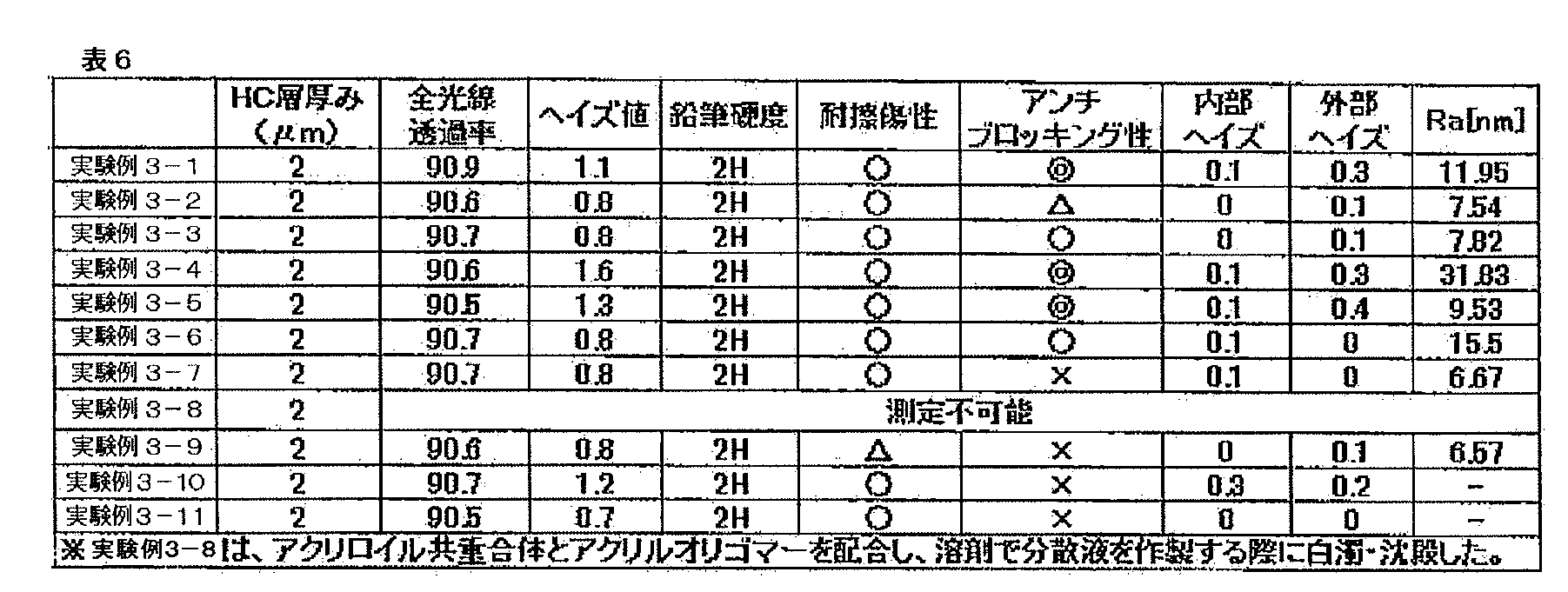
本発明の活性エネルギー線硬化性樹脂組成物によりコートされたフィルムは、フィルム同士が接触した際に生じるブロッキングの発生を抑制することができる。このため、予期せぬブロッキングによるフィルムの損傷などを回避することができ、巻回ロールによる保管などをする際に有利である。
Claims (23)
- 側鎖に水素結合性基と不飽和二重結合を有する(メタ)アクリロイル共重合体と、一分子中に二つ以上の不飽和二重結合基を有する多官能(メタ)アクリレートと、を含有する活性エネルギー線硬化性樹脂組成物であって、
該(メタ)アクリロイル共重合体のSP値が、該多官能(メタ)アクリレートのSP値以上である、活性エネルギー線硬化性樹脂組成物。 - 3μmの膜厚で硬化物を得たときの表面粗さRaが1nm以上である、請求項1に記載の活性エネルギー線硬化性樹脂組成物。
- さらに平均一次粒子径1μm以下の無機粒子を含有する、請求項1または2に記載の活性エネルギー線硬化性樹脂組成物。
- 活性エネルギー線硬化性樹脂組成物100重量部に対し、前記(メタ)アクリロイル共重合体を1~20重量部含み、前記多官能(メタ)アクリレートを75~98.5重量部含み、前記無機粒子を0.5~5重量部含む、請求項3に記載の活性エネルギー線硬化性樹脂組成物。
- 少なくとも一種以上の樹脂からなる第一成分、
少なくとも一種以上の(メタ)アクリロイル基を含有するモノマー若しくはオリゴマーからなる群から選択される第二成分、
および少なくとも一種以上のポリエーテル変性シリコーンオイルからなる第三成分を含有することを特徴とする、
活性エネルギー線硬化性樹脂組成物。 - 前記第一成分が(メタ)アクリル樹脂である、請求項5に記載の活性エネルギー線硬化性樹脂組成物。
- 前記第一成分が、側鎖に水素結合性基と不飽和二重結合を有する(メタ)アクリロイル共重合体である、請求項5に記載の活性エネルギー線硬化性樹脂組成物。
- 前記第二成分が、一分子中に二つ以上の不飽和二重結合基を有する多官能(メタ)アクリレートである、請求項5~7のいずれか1項に記載の活性エネルギー線硬化性樹脂組成物。
- 前記第一成分のSP値が、前記第二成分のSP値以上である、請求項5~8のいずれか1項に記載の活性エネルギー線硬化性樹脂組成物。
- さらに平均一次粒子径1μm以下の無機粒子を含有する、請求項5~9のいずれか1項に記載の活性エネルギー線硬化性樹脂組成物。
- 活性エネルギー線硬化性樹脂組成物100重量部に対し、前記(メタ)アクリロイル共重合体を1~20重量部含み、前記多官能(メタ)アクリレートを75~98.5重量部含み、前記無機粒子を0.5~5重量部含む、請求項10に記載の活性エネルギー線硬化性樹脂組成物。
- 前記(メタ)アクリロイル共重合体の重量平均分子量が、1,000以上100,000以下である、請求項1~4、7~11のいずれか1項に記載の活性エネルギー線硬化性樹脂組成物。
- 前記(メタ)アクリロイル共重合体の水素結合性基が水酸基である、請求項1~4、7~12のいずれか1項に記載の活性エネルギー線硬化性樹脂組成物。
- 前記(メタ)アクリロイル共重合体の水酸基の由来が、オキシラン骨格を持つモノマーの開環・付加反応によるもので、且つ、前記(メタ)アクリロイル共重合体を構成するモノマー全量のうち、オキシラン骨格を持つモノマーが80重量%以上である、請求項13に記載の活性エネルギー線硬化性樹脂組成物。
- 前記オキシラン骨格を持つモノマーの開環・付加反応が(メタ)アクリル酸の付加反応である、請求項14に記載の活性エネルギー線硬化性樹脂組成物。
- 前記多官能(メタ)アクリレートが、1分子中に3つ以上の(メタ)アクリロイル基を有する多官能(メタ)アクリレートを含む、請求項1~4、8~15のいずれか1項に記載の活性エネルギー線硬化性樹脂組成物。
- 少なくとも樹脂層の上に、ハードコート層を有する積層体であって、
ハードコート層に、水素結合性基の当量が1.25mmol/g以上の(メタ)アクリロイル共重合体および多官能(メタ)アクリレートを含む活性エネルギー線硬化性樹脂組成物の硬化物を含み、
ハードコート層中の直径100nm以上の粒子の含有量が1重量%以下であり、
ハードコート層の厚みが1~10μmであり、
ハードコート層の表面粗さRaが5nm以上であることを特徴とする、積層体。 - 前記ハードコート層のヘイズ値が3%以下である、請求項17に記載の積層体。
- 前記(メタ)アクリロイル共重合体のSP値が、前記多官能(メタ)アクリレートのSP値より高い、請求項17または18に記載の積層体。
- 前記活性エネルギー線硬化性樹脂組成物が、平均一次粒子径100nm未満の無機粒子を含有するものである、請求項17~19のいずれか1項に記載の積層体。
- 請求項1~16のいずれか1項に記載の活性エネルギー線硬化組成物を硬化させてなるハードコートフィルム。
- 請求項21に記載のハードコートフィルムを他の樹脂フィルムと積層させてなるフィルム積層体。
- 請求項22に記載のフィルム積層体をロール状に巻回してなるロール状フィルム積層体。
Priority Applications (2)
| Application Number | Priority Date | Filing Date | Title |
|---|---|---|---|
| CN201380018517.7A CN104204013B (zh) | 2012-03-30 | 2013-03-29 | 活性能量射线固化性树脂组合物、层积体和卷状层积体 |
| KR1020147028056A KR102088640B1 (ko) | 2012-03-30 | 2013-03-29 | 활성 에너지 선 경화성 수지 조성물, 적층체 및 롤상 적층체 |
Applications Claiming Priority (6)
| Application Number | Priority Date | Filing Date | Title |
|---|---|---|---|
| JP2012-080552 | 2012-03-30 | ||
| JP2012080552A JP6317873B2 (ja) | 2012-03-30 | 2012-03-30 | 活性エネルギー線硬化性組成物 |
| JP2013-012206 | 2013-01-25 | ||
| JP2013012206A JP6065608B2 (ja) | 2013-01-25 | 2013-01-25 | 活性エネルギー線硬化性組成物 |
| JP2013-036356 | 2013-02-26 | ||
| JP2013036356A JP6098225B2 (ja) | 2013-02-26 | 2013-02-26 | 積層体およびロール状積層体 |
Publications (1)
| Publication Number | Publication Date |
|---|---|
| WO2013147151A1 true WO2013147151A1 (ja) | 2013-10-03 |
Family
ID=49260393
Family Applications (1)
| Application Number | Title | Priority Date | Filing Date |
|---|---|---|---|
| PCT/JP2013/059509 Ceased WO2013147151A1 (ja) | 2012-03-30 | 2013-03-29 | 活性エネルギー線硬化性樹脂組成物、積層体およびロール状積層体 |
Country Status (4)
| Country | Link |
|---|---|
| KR (1) | KR102088640B1 (ja) |
| CN (1) | CN104204013B (ja) |
| TW (1) | TWI510542B (ja) |
| WO (1) | WO2013147151A1 (ja) |
Cited By (1)
| Publication number | Priority date | Publication date | Assignee | Title |
|---|---|---|---|---|
| WO2015079866A1 (ja) * | 2013-11-27 | 2015-06-04 | 東レフィルム加工株式会社 | ハードコートフィルムおよび透明導電性フィルム |
Families Citing this family (7)
| Publication number | Priority date | Publication date | Assignee | Title |
|---|---|---|---|---|
| JP6247649B2 (ja) * | 2015-02-02 | 2017-12-13 | 富士フイルム株式会社 | 機能性複合フィルムおよび波長変換フィルム |
| WO2017068762A1 (en) * | 2015-10-19 | 2017-04-27 | Dow Corning Toray Co., Ltd. | Active energy ray curable hot melt silicone composition, cured product thereof, and method of producing film |
| CN108431641B (zh) * | 2015-10-30 | 2020-10-09 | 大日本印刷株式会社 | 光学膜、偏振膜、偏振膜的制造方法以及图像显示装置 |
| JP6695369B2 (ja) * | 2017-02-16 | 2020-05-20 | 住友化学株式会社 | 硬化性樹脂組成物、硬化膜及び表示装置 |
| KR102350325B1 (ko) * | 2017-03-23 | 2022-01-11 | 아라까와 가가꾸 고교 가부시끼가이샤 | 활성에너지선 경화형 하드코팅제, 경화도포막, 적층필름 |
| TWI758597B (zh) * | 2018-09-07 | 2022-03-21 | 日商荒川化學工業股份有限公司 | 活性能量線硬化型樹脂組成物、硬化物及積層體 |
| CN117120389A (zh) * | 2021-03-31 | 2023-11-24 | 富士胶片株式会社 | 保护层及可折叠设备 |
Citations (5)
| Publication number | Priority date | Publication date | Assignee | Title |
|---|---|---|---|---|
| JP2004182914A (ja) * | 2002-12-05 | 2004-07-02 | Ge Toshiba Silicones Co Ltd | 光硬化型防曇剤組成物および防曇性被覆物品の製造方法 |
| JP2007316598A (ja) * | 2006-03-13 | 2007-12-06 | Fujifilm Corp | 平版印刷版原版および平版印刷版の作製方法 |
| JP2011026561A (ja) * | 2009-06-23 | 2011-02-10 | Dic Corp | シリカ分散体の製造方法、エネルギー線硬化型樹脂組成物及びフィルム |
| JP2011225679A (ja) * | 2010-04-16 | 2011-11-10 | Toagosei Co Ltd | 光硬化型加飾積層フィルム用組成物 |
| JP2012053180A (ja) * | 2010-08-31 | 2012-03-15 | Kyocera Chemical Corp | 透明絶縁保護膜形成用感光性樹脂組成物および透明絶縁膜 |
Family Cites Families (11)
| Publication number | Priority date | Publication date | Assignee | Title |
|---|---|---|---|---|
| JP4462675B2 (ja) * | 1999-10-01 | 2010-05-12 | 日本ペイント株式会社 | 球形熱硬化性粉体クリア塗料粒子、球形熱硬化性粉体クリア塗料粒子の製造方法、複層塗膜形成方法およびそれから得られる複層塗膜 |
| JP2002348498A (ja) | 2001-05-25 | 2002-12-04 | Nippon Paint Co Ltd | 金属蒸着用活性エネルギー線硬化型アンダーコート組成物 |
| JP2004042653A (ja) | 2002-07-12 | 2004-02-12 | Nitto Denko Corp | ハードコートフィルム |
| JP4363077B2 (ja) * | 2002-07-12 | 2009-11-11 | 三菱化学株式会社 | 活性エネルギー線硬化性組成物及びハードコートフィルム |
| JP2007182519A (ja) * | 2006-01-10 | 2007-07-19 | Nippon Paint Co Ltd | アンチブロッキング性光硬化性樹脂組成物、それを基材上に被覆硬化したアンチブロッキング性構造体およびその製法 |
| JP5409994B2 (ja) * | 2006-10-20 | 2014-02-05 | 電気化学工業株式会社 | 硬化性組成物 |
| JP5023769B2 (ja) * | 2007-03-30 | 2012-09-12 | 大日本印刷株式会社 | 光学フィルム |
| JP2009013384A (ja) * | 2007-07-09 | 2009-01-22 | Nippon Paint Co Ltd | 易滑性アンチブロッキング光硬化性樹脂組成物、それを基材上に被覆硬化したアンチブロッキング性構造体およびその製法 |
| JP2010163535A (ja) | 2009-01-15 | 2010-07-29 | Nippon Paint Co Ltd | アンチブロッキング性硬化性樹脂組成物、アンチブロッキング性ハードコートフィルム、アンチブロッキング性層状構造体、アンチブロッキング性層状構造体を含む表示装置およびそれらの製造方法 |
| WO2012035939A1 (ja) * | 2010-09-14 | 2012-03-22 | コニカミノルタオプト株式会社 | 樹脂フィルム、樹脂フィルムの製造方法、偏光板、及び液晶表示装置 |
| JP2012140478A (ja) * | 2010-12-28 | 2012-07-26 | Sumitomo Chemical Co Ltd | 硬化性樹脂組成物 |
-
2013
- 2013-03-29 WO PCT/JP2013/059509 patent/WO2013147151A1/ja not_active Ceased
- 2013-03-29 CN CN201380018517.7A patent/CN104204013B/zh active Active
- 2013-03-29 KR KR1020147028056A patent/KR102088640B1/ko active Active
- 2013-03-29 TW TW102111658A patent/TWI510542B/zh active
Patent Citations (5)
| Publication number | Priority date | Publication date | Assignee | Title |
|---|---|---|---|---|
| JP2004182914A (ja) * | 2002-12-05 | 2004-07-02 | Ge Toshiba Silicones Co Ltd | 光硬化型防曇剤組成物および防曇性被覆物品の製造方法 |
| JP2007316598A (ja) * | 2006-03-13 | 2007-12-06 | Fujifilm Corp | 平版印刷版原版および平版印刷版の作製方法 |
| JP2011026561A (ja) * | 2009-06-23 | 2011-02-10 | Dic Corp | シリカ分散体の製造方法、エネルギー線硬化型樹脂組成物及びフィルム |
| JP2011225679A (ja) * | 2010-04-16 | 2011-11-10 | Toagosei Co Ltd | 光硬化型加飾積層フィルム用組成物 |
| JP2012053180A (ja) * | 2010-08-31 | 2012-03-15 | Kyocera Chemical Corp | 透明絶縁保護膜形成用感光性樹脂組成物および透明絶縁膜 |
Cited By (3)
| Publication number | Priority date | Publication date | Assignee | Title |
|---|---|---|---|---|
| WO2015079866A1 (ja) * | 2013-11-27 | 2015-06-04 | 東レフィルム加工株式会社 | ハードコートフィルムおよび透明導電性フィルム |
| CN105764690A (zh) * | 2013-11-27 | 2016-07-13 | 东丽薄膜先端加工股份有限公司 | 硬涂膜及透明导电性膜 |
| CN105764690B (zh) * | 2013-11-27 | 2018-05-18 | 东丽薄膜先端加工股份有限公司 | 硬涂膜及透明导电性膜 |
Also Published As
| Publication number | Publication date |
|---|---|
| TW201343766A (zh) | 2013-11-01 |
| CN104204013A (zh) | 2014-12-10 |
| CN104204013B (zh) | 2017-06-30 |
| TWI510542B (zh) | 2015-12-01 |
| KR102088640B1 (ko) | 2020-03-13 |
| KR20140143388A (ko) | 2014-12-16 |
Similar Documents
| Publication | Publication Date | Title |
|---|---|---|
| KR102088640B1 (ko) | 활성 에너지 선 경화성 수지 조성물, 적층체 및 롤상 적층체 | |
| TWI409306B (zh) | Hard coating | |
| TWI530707B (zh) | 抗反射薄膜之製造方法、抗反射薄膜、偏光板及影像顯示裝置 | |
| JP6331725B2 (ja) | 積層体 | |
| JP6088484B2 (ja) | コーティング組成物及びその製造方法、並びに、プラスチックレンズ及びその製造方法 | |
| JP6331726B2 (ja) | 積層体 | |
| JP2010163535A (ja) | アンチブロッキング性硬化性樹脂組成物、アンチブロッキング性ハードコートフィルム、アンチブロッキング性層状構造体、アンチブロッキング性層状構造体を含む表示装置およびそれらの製造方法 | |
| JP2015531021A (ja) | ハードコーティング組成物 | |
| TW201634597A (zh) | 硬塗覆組合物及使用其之硬塗膜 | |
| JP2009013384A (ja) | 易滑性アンチブロッキング光硬化性樹脂組成物、それを基材上に被覆硬化したアンチブロッキング性構造体およびその製法 | |
| JP6065608B2 (ja) | 活性エネルギー線硬化性組成物 | |
| TW201400561A (zh) | 硬塗層組成物及高折射率抗結塊層形成組成物 | |
| JP6317873B2 (ja) | 活性エネルギー線硬化性組成物 | |
| JP2007182519A (ja) | アンチブロッキング性光硬化性樹脂組成物、それを基材上に被覆硬化したアンチブロッキング性構造体およびその製法 | |
| WO2008146935A1 (ja) | 防眩性光透過性ハードコートフィルム | |
| JP6098225B2 (ja) | 積層体およびロール状積層体 | |
| JP2023155347A (ja) | ハードコートフィルム及び硬化性組成物 | |
| JP5925012B2 (ja) | 高屈折率アンチブロッキング層形成組成物 | |
| JP6364719B2 (ja) | 硬化性樹脂組成物、硬化物、積層体、ハードコートフィルム及びフィルム積層体 | |
| JP2014193943A (ja) | 活性エネルギー線硬化性樹脂組成物、コート剤およびそれを硬化して得られる層を含むフィルム、シートおよび成形品 | |
| TWI389798B (zh) | 抗反射薄膜 | |
| JPWO2014208748A1 (ja) | 紫外線硬化型ハードコート樹脂組成物 | |
| JP6187099B2 (ja) | 硬化性樹脂組成物、硬化物、積層体、ハードコートフィルム及びフィルム積層体 | |
| JP6051341B2 (ja) | ハードコートフィルム及びディスプレイ装置用光学フィルム | |
| JP6255860B2 (ja) | 硬化性樹脂組成物、硬化物、積層体、ハードコートフィルム及びフィルム積層体 |
Legal Events
| Date | Code | Title | Description |
|---|---|---|---|
| 121 | Ep: the epo has been informed by wipo that ep was designated in this application |
Ref document number: 13769237 Country of ref document: EP Kind code of ref document: A1 |
|
| NENP | Non-entry into the national phase |
Ref country code: DE |
|
| ENP | Entry into the national phase |
Ref document number: 20147028056 Country of ref document: KR Kind code of ref document: A |
|
| 122 | Ep: pct application non-entry in european phase |
Ref document number: 13769237 Country of ref document: EP Kind code of ref document: A1 |