WO2013080979A1 - 粘着シート及び粘着シートを用いた電子部品の製造方法 - Google Patents
粘着シート及び粘着シートを用いた電子部品の製造方法 Download PDFInfo
- Publication number
- WO2013080979A1 WO2013080979A1 PCT/JP2012/080642 JP2012080642W WO2013080979A1 WO 2013080979 A1 WO2013080979 A1 WO 2013080979A1 JP 2012080642 W JP2012080642 W JP 2012080642W WO 2013080979 A1 WO2013080979 A1 WO 2013080979A1
- Authority
- WO
- WIPO (PCT)
- Prior art keywords
- mass
- meth
- pressure
- sensitive adhesive
- adhesive sheet
- Prior art date
- Legal status (The legal status is an assumption and is not a legal conclusion. Google has not performed a legal analysis and makes no representation as to the accuracy of the status listed.)
- Ceased
Links
Classifications
-
- C—CHEMISTRY; METALLURGY
- C08—ORGANIC MACROMOLECULAR COMPOUNDS; THEIR PREPARATION OR CHEMICAL WORKING-UP; COMPOSITIONS BASED THEREON
- C08L—COMPOSITIONS OF MACROMOLECULAR COMPOUNDS
- C08L75/00—Compositions of polyureas or polyurethanes; Compositions of derivatives of such polymers
- C08L75/04—Polyurethanes
-
- C—CHEMISTRY; METALLURGY
- C09—DYES; PAINTS; POLISHES; NATURAL RESINS; ADHESIVES; COMPOSITIONS NOT OTHERWISE PROVIDED FOR; APPLICATIONS OF MATERIALS NOT OTHERWISE PROVIDED FOR
- C09J—ADHESIVES; NON-MECHANICAL ASPECTS OF ADHESIVE PROCESSES IN GENERAL; ADHESIVE PROCESSES NOT PROVIDED FOR ELSEWHERE; USE OF MATERIALS AS ADHESIVES
- C09J133/00—Adhesives based on homopolymers or copolymers of compounds having one or more unsaturated aliphatic radicals, each having only one carbon-to-carbon double bond, and at least one being terminated by only one carboxyl radical, or of salts, anhydrides, esters, amides, imides, or nitriles thereof; Adhesives based on derivatives of such polymers
- C09J133/04—Homopolymers or copolymers of esters
-
- C—CHEMISTRY; METALLURGY
- C09—DYES; PAINTS; POLISHES; NATURAL RESINS; ADHESIVES; COMPOSITIONS NOT OTHERWISE PROVIDED FOR; APPLICATIONS OF MATERIALS NOT OTHERWISE PROVIDED FOR
- C09J—ADHESIVES; NON-MECHANICAL ASPECTS OF ADHESIVE PROCESSES IN GENERAL; ADHESIVE PROCESSES NOT PROVIDED FOR ELSEWHERE; USE OF MATERIALS AS ADHESIVES
- C09J175/00—Adhesives based on polyureas or polyurethanes; Adhesives based on derivatives of such polymers
- C09J175/04—Polyurethanes
-
- C—CHEMISTRY; METALLURGY
- C09—DYES; PAINTS; POLISHES; NATURAL RESINS; ADHESIVES; COMPOSITIONS NOT OTHERWISE PROVIDED FOR; APPLICATIONS OF MATERIALS NOT OTHERWISE PROVIDED FOR
- C09J—ADHESIVES; NON-MECHANICAL ASPECTS OF ADHESIVE PROCESSES IN GENERAL; ADHESIVE PROCESSES NOT PROVIDED FOR ELSEWHERE; USE OF MATERIALS AS ADHESIVES
- C09J7/00—Adhesives in the form of films or foils
- C09J7/20—Adhesives in the form of films or foils characterised by their carriers
- C09J7/22—Plastics; Metallised plastics
-
- C—CHEMISTRY; METALLURGY
- C09—DYES; PAINTS; POLISHES; NATURAL RESINS; ADHESIVES; COMPOSITIONS NOT OTHERWISE PROVIDED FOR; APPLICATIONS OF MATERIALS NOT OTHERWISE PROVIDED FOR
- C09J—ADHESIVES; NON-MECHANICAL ASPECTS OF ADHESIVE PROCESSES IN GENERAL; ADHESIVE PROCESSES NOT PROVIDED FOR ELSEWHERE; USE OF MATERIALS AS ADHESIVES
- C09J7/00—Adhesives in the form of films or foils
- C09J7/20—Adhesives in the form of films or foils characterised by their carriers
- C09J7/22—Plastics; Metallised plastics
- C09J7/24—Plastics; Metallised plastics based on macromolecular compounds obtained by reactions involving only carbon-to-carbon unsaturated bonds
- C09J7/245—Vinyl resins, e.g. polyvinyl chloride [PVC]
-
- C—CHEMISTRY; METALLURGY
- C09—DYES; PAINTS; POLISHES; NATURAL RESINS; ADHESIVES; COMPOSITIONS NOT OTHERWISE PROVIDED FOR; APPLICATIONS OF MATERIALS NOT OTHERWISE PROVIDED FOR
- C09J—ADHESIVES; NON-MECHANICAL ASPECTS OF ADHESIVE PROCESSES IN GENERAL; ADHESIVE PROCESSES NOT PROVIDED FOR ELSEWHERE; USE OF MATERIALS AS ADHESIVES
- C09J7/00—Adhesives in the form of films or foils
- C09J7/30—Adhesives in the form of films or foils characterised by the adhesive composition
- C09J7/38—Pressure-sensitive adhesives [PSA]
-
- H—ELECTRICITY
- H10—SEMICONDUCTOR DEVICES; ELECTRIC SOLID-STATE DEVICES NOT OTHERWISE PROVIDED FOR
- H10P—GENERIC PROCESSES OR APPARATUS FOR THE MANUFACTURE OR TREATMENT OF DEVICES COVERED BY CLASS H10
- H10P72/00—Handling or holding of wafers, substrates or devices during manufacture or treatment thereof
- H10P72/70—Handling or holding of wafers, substrates or devices during manufacture or treatment thereof for supporting or gripping
- H10P72/74—Handling or holding of wafers, substrates or devices during manufacture or treatment thereof for supporting or gripping using temporarily an auxiliary support
- H10P72/7402—Wafer tapes, e.g. grinding or dicing support tapes
-
- C—CHEMISTRY; METALLURGY
- C08—ORGANIC MACROMOLECULAR COMPOUNDS; THEIR PREPARATION OR CHEMICAL WORKING-UP; COMPOSITIONS BASED THEREON
- C08K—Use of inorganic or non-macromolecular organic substances as compounding ingredients
- C08K5/00—Use of organic ingredients
- C08K5/0008—Organic ingredients according to more than one of the "one dot" groups of C08K5/01 - C08K5/59
- C08K5/0016—Plasticisers
-
- C—CHEMISTRY; METALLURGY
- C08—ORGANIC MACROMOLECULAR COMPOUNDS; THEIR PREPARATION OR CHEMICAL WORKING-UP; COMPOSITIONS BASED THEREON
- C08K—Use of inorganic or non-macromolecular organic substances as compounding ingredients
- C08K5/00—Use of organic ingredients
- C08K5/04—Oxygen-containing compounds
- C08K5/10—Esters; Ether-esters
-
- C—CHEMISTRY; METALLURGY
- C09—DYES; PAINTS; POLISHES; NATURAL RESINS; ADHESIVES; COMPOSITIONS NOT OTHERWISE PROVIDED FOR; APPLICATIONS OF MATERIALS NOT OTHERWISE PROVIDED FOR
- C09J—ADHESIVES; NON-MECHANICAL ASPECTS OF ADHESIVE PROCESSES IN GENERAL; ADHESIVE PROCESSES NOT PROVIDED FOR ELSEWHERE; USE OF MATERIALS AS ADHESIVES
- C09J2203/00—Applications of adhesives in processes or use of adhesives in the form of films or foils
- C09J2203/326—Applications of adhesives in processes or use of adhesives in the form of films or foils for bonding electronic components such as wafers, chips or semiconductors
-
- C—CHEMISTRY; METALLURGY
- C09—DYES; PAINTS; POLISHES; NATURAL RESINS; ADHESIVES; COMPOSITIONS NOT OTHERWISE PROVIDED FOR; APPLICATIONS OF MATERIALS NOT OTHERWISE PROVIDED FOR
- C09J—ADHESIVES; NON-MECHANICAL ASPECTS OF ADHESIVE PROCESSES IN GENERAL; ADHESIVE PROCESSES NOT PROVIDED FOR ELSEWHERE; USE OF MATERIALS AS ADHESIVES
- C09J2301/00—Additional features of adhesives in the form of films or foils
- C09J2301/30—Additional features of adhesives in the form of films or foils characterized by the chemical, physicochemical or physical properties of the adhesive or the carrier
- C09J2301/302—Additional features of adhesives in the form of films or foils characterized by the chemical, physicochemical or physical properties of the adhesive or the carrier the adhesive being pressure-sensitive, i.e. tacky at temperatures inferior to 30°C
-
- C—CHEMISTRY; METALLURGY
- C09—DYES; PAINTS; POLISHES; NATURAL RESINS; ADHESIVES; COMPOSITIONS NOT OTHERWISE PROVIDED FOR; APPLICATIONS OF MATERIALS NOT OTHERWISE PROVIDED FOR
- C09J—ADHESIVES; NON-MECHANICAL ASPECTS OF ADHESIVE PROCESSES IN GENERAL; ADHESIVE PROCESSES NOT PROVIDED FOR ELSEWHERE; USE OF MATERIALS AS ADHESIVES
- C09J2301/00—Additional features of adhesives in the form of films or foils
- C09J2301/40—Additional features of adhesives in the form of films or foils characterized by the presence of essential components
- C09J2301/41—Additional features of adhesives in the form of films or foils characterized by the presence of essential components additives as essential feature of the carrier layer
-
- C—CHEMISTRY; METALLURGY
- C09—DYES; PAINTS; POLISHES; NATURAL RESINS; ADHESIVES; COMPOSITIONS NOT OTHERWISE PROVIDED FOR; APPLICATIONS OF MATERIALS NOT OTHERWISE PROVIDED FOR
- C09J—ADHESIVES; NON-MECHANICAL ASPECTS OF ADHESIVE PROCESSES IN GENERAL; ADHESIVE PROCESSES NOT PROVIDED FOR ELSEWHERE; USE OF MATERIALS AS ADHESIVES
- C09J2427/00—Presence of halogenated polymer
- C09J2427/006—Presence of halogenated polymer in the substrate
-
- C—CHEMISTRY; METALLURGY
- C09—DYES; PAINTS; POLISHES; NATURAL RESINS; ADHESIVES; COMPOSITIONS NOT OTHERWISE PROVIDED FOR; APPLICATIONS OF MATERIALS NOT OTHERWISE PROVIDED FOR
- C09J—ADHESIVES; NON-MECHANICAL ASPECTS OF ADHESIVE PROCESSES IN GENERAL; ADHESIVE PROCESSES NOT PROVIDED FOR ELSEWHERE; USE OF MATERIALS AS ADHESIVES
- C09J2433/00—Presence of (meth)acrylic polymer
-
- H—ELECTRICITY
- H10—SEMICONDUCTOR DEVICES; ELECTRIC SOLID-STATE DEVICES NOT OTHERWISE PROVIDED FOR
- H10P—GENERIC PROCESSES OR APPARATUS FOR THE MANUFACTURE OR TREATMENT OF DEVICES COVERED BY CLASS H10
- H10P72/00—Handling or holding of wafers, substrates or devices during manufacture or treatment thereof
- H10P72/70—Handling or holding of wafers, substrates or devices during manufacture or treatment thereof for supporting or gripping
- H10P72/74—Handling or holding of wafers, substrates or devices during manufacture or treatment thereof for supporting or gripping using temporarily an auxiliary support
- H10P72/7416—Handling or holding of wafers, substrates or devices during manufacture or treatment thereof for supporting or gripping using temporarily an auxiliary support used during dicing or grinding
Definitions
- the present invention relates to an adhesive sheet and a method for manufacturing an electronic component using the adhesive sheet.
- the adhesive sheet is usually bonded after the circuit is formed, and then cut into element pieces (dicing), washed, dried, stretched (expanded) the adhesive sheet, and peeled off the element pieces from the adhesive sheet. (Pickup), mounting and other processes.
- dicing and / or conveying pressure-sensitive adhesive sheet used in these steps Patent Document 1 describes an example in which polyvinyl chloride is used as a base material.
- Patent Document 2 discloses a composition using a (meth) acrylic acid ester copolymer as the pressure-sensitive adhesive composition.
- Patent Document 3 discloses an adhesive sheet using an ionomer resin as a base material layer.
- the plasticizer migrates from the base material to the pressure-sensitive adhesive layer over time, which causes a problem in chip pickup performance in the pickup process.
- the adhesive sheet is heated to about 75 ° C. after being attached to the adherend, and then dicing is performed. Dicing may be performed. Heating is performed to improve adhesion between the adherend and the pressure-sensitive adhesive sheet and prevent chip jumping when the adherence between the adherend and the pressure-sensitive adhesive sheet is not good. The pick-up property of later chips may deteriorate.
- the composition of the pressure-sensitive adhesive is adjusted so that the pick-up property of the chip after dicing is not deteriorated even if the heating is performed, the adhesiveness when the heating is not performed may be deteriorated. Because of these circumstances, it has been difficult to use the same adhesive sheet in a production line without heating and a production line with heating, and separate adhesive sheets designed with and without heating. There was no choice but to use.
- the present invention has been made in view of such circumstances, and does not cause deterioration of the pick-up property of the chip in the pick-up process with time, and can be used in both a heating line with and without heating before dicing.
- An adhesive sheet and an electronic component manufacturing method using the adhesive sheet are provided.
- the said adhesive composition is (meth) acrylic acid. It contains 100 parts by mass of an ester copolymer and 0.1 to 7 parts by mass of an isocyanate curing agent.
- the (meth) acrylic acid ester copolymer contains 35 to 85% by mass of methyl (meth) acrylate units, 2-
- the pressure-sensitive adhesive comprises 10 to 60% by mass of ethylhexyl acrylate units, 0.5 to 10% by mass of monomer units having a carboxyl group, and 0.01 to 5% by mass of monomer units having a hydroxyl group.
- the composition is provided with a pressure-sensitive adhesive sheet in which the content of the epoxy curing agent is 0 to 0.25 parts by mass with respect to 100 parts by mass of the (meth) acrylic acid ester copolymer component. .
- an adhesive composition is formed on a base film made of an ionomer resin obtained by crosslinking a copolymer having an ethylene unit, a methacrylic acid unit, and a (meth) acrylic acid alkyl ester unit with a metal ion.
- the pressure-sensitive adhesive sheet having the pressure-sensitive adhesive layer contains 100 parts by weight of a (meth) acrylic acid ester copolymer and 0.1 to 7 parts by weight of an isocyanate-based curing agent.
- the acid ester copolymer has a methyl (meth) acrylate unit of 35 to 85% by mass, a 2-ethylhexyl acrylate unit of 10 to 60% by mass, and a monomer unit having a carboxyl group of 0.5 to 10% by mass. And 0.01 to 5% by mass of a monomer unit having a hydroxyl group, and the pressure-sensitive adhesive composition has an epoxy-based curing agent content of (meth) 0 to 0.25 mass parts relative to acrylic acid ester copolymer 100 parts by weight of the component, the adhesive sheet is provided.
- the inventors of the present invention conducted intensive research to solve the problem of deterioration of pick-up property of the chip over time, and used a pressure-sensitive adhesive composition based on a (meth) acrylate copolymer as a base resin, and It has been found that by using a polyester plasticizer as the plasticizer, deterioration of the chip pick-up property over time can be prevented.
- the (meth) acrylic acid ester copolymer of the above composition was used as the base resin,
- the isocyanate curing agent of the above content is included and the content of the epoxy curing agent is limited to the above range, both chip retention and pick-up properties are improved regardless of the presence or absence of heating. As a result, the present invention has been completed.
- a particularly important point in the present invention is that only a combination of a (meth) acrylic acid ester copolymer of a specific composition and a curing agent of a specific composition is good for both chip retention and pick-up properties regardless of whether there is heating or not.
- a pressure-sensitive adhesive sheet having excellent properties can be obtained.
- the present inventors conducted experiments with combinations of (meth) acrylic acid ester copolymers of various compositions and curing agents of various compositions, and the composition of either copolymer or curing agent is within the above range. When it came off, since the chip holding property and / or pick-up property when there was no heating and / or heating was deteriorated, a desired pressure-sensitive adhesive sheet could not be obtained.
- the methyl (meth) acrylate unit is 35 to 62.5% by mass, and the 2-ethylhexyl acrylate unit is 20 to 60% by mass.
- the content of the epoxy curing agent is 0 to 0.1 parts by mass with respect to 100 parts by mass of the (meth) acrylic acid ester copolymer component.
- the monomer having a carboxyl group is acrylic acid.
- the monomer having a hydroxyl group is 2-hydroxyethyl acrylate.
- the base film contains 25 to 45 parts by mass of the polyester plasticizer with respect to 100 parts by mass of the polyvinyl chloride.
- the polyester plasticizer is an adipic acid polyester.
- the method includes an attaching step for attaching the adhesive sheet to an adherend and a ring frame, a dicing step for dicing the adherend into a chip, and a pickup step for picking up the chip from the adhesive sheet.
- An electronic component manufacturing method is provided.
- the method further includes a heating step of heating the adherend to which the pressure-sensitive adhesive sheet has been bonded to 60 to 100 ° C. after the sticking step and before the dicing step.
- the monomer unit means a structural unit derived from a monomer. Unless otherwise indicated, parts and% in this specification are based on mass.
- (meth) acrylate is a general term for acrylate and methacrylate.
- a compound containing (meth) such as (meth) acrylic acid is a general term for a compound having “meth” and a compound not having it.
- the pressure-sensitive adhesive sheet of one embodiment of the present invention is a pressure-sensitive adhesive sheet having a pressure-sensitive adhesive layer made of a pressure-sensitive adhesive composition on a base film containing polyvinyl chloride and a polyester-based plasticizer. It contains 100 parts by weight of a (meth) acrylic acid ester copolymer and 0.1 to 7 parts by weight of an isocyanate curing agent. The (meth) acrylic acid ester copolymer contains 35 to 85 parts by weight of methyl (meth) acrylate units.
- the pressure-sensitive adhesive composition has an epoxy curing agent content of 0 to 0.25 parts by mass with respect to 100 parts of the (meth) acrylic acid ester copolymer component.
- Base Film> a base film containing polyvinyl chloride and a polyester plasticizer as a plasticizer for polyvinyl chloride, or an ethylene unit, a methacrylic acid unit, and a (meth) acrylic acid alkyl ester unit are used.
- a base film made of an ionomer resin obtained by crosslinking a copolymer having a metal ion is used.
- polyester plasticizer examples include dicarboxylic acids such as aliphatic dicarboxylic acids having 2 to 10 carbon atoms such as adipic acid, azelaic acid, sebacic acid, phthalic acid, isophthalic acid, terephthalic acid, and / or aromatic dicarboxylic acids.
- dicarboxylic acids such as aliphatic dicarboxylic acids having 2 to 10 carbon atoms such as adipic acid, azelaic acid, sebacic acid, phthalic acid, isophthalic acid, terephthalic acid, and / or aromatic dicarboxylic acids.
- polyesters obtained by polycondensation of an acid and a glycol having 2 to 10 carbon atoms such as ethylene glycol, propylene glycol, butylene glycol, neopentyl glycol, hexanediol and the like.
- dicarboxylic acid aliphatic dicarboxylic acids such as adipic acid and sebacic acid are preferable, and adipic acid is particularly preferable in terms of versatility, cost, and stability over time.
- glycol either a straight chain or a side chain can be used and is appropriately selected as necessary.
- the glycol preferably has 2 to 6 carbon atoms.
- the number average molecular weight of the polyester plasticizer is not particularly limited, but usually about 500 to 4000 is used.
- the polyester plasticizer is preferably 25 to 45 parts, more preferably 30 to 40 parts, relative to 100 parts of polyvinyl chloride.
- the ionomer resin is a general term for metal salts of multi-component copolymer resins having a vinyl compound unit having a carboxyl group.
- the ionomer resin is, for example, an ethylene-methacrylic acid copolymer, and an ethylene-methacrylic acid polymerized with an acrylic acid alkyl ester or an acrylic acid alkyl ester as a third component, and these are lithium, sodium ion, potassium Cross-linked with metal ions such as ions and / or zinc ions.
- metal ions that crosslink the carboxyl group of the ionomer resin include sodium ions, potassium ions, and zinc ions. Of these metal ions, ionomer resins containing zinc ions that have a small effect on the defective rate of electronic components are preferred.
- Examples of the ionomer resin having an ethylene unit, a methacrylic acid unit, and a (meth) acrylic acid alkyl ester unit include, for example, ethylene-methacrylic acid- (meth) propyl propyl ionomer resin, ethylene-methacrylic acid- (meta ) Acrylic acid butyl ionomer resin, ethylene-methacrylic acid- (meth) acrylic acid hexyl ionomer resin, ethylene-methacrylic acid- (meth) acrylic acid 2-methylpropyl ionomer resin, ethylene-methacrylic acid- ( (Meth) acrylic acid 2-ethylpropyl ionomer resin, ethylene-methacrylic acid- (meth) acrylic acid 2-ethylbutyl ionomer resin, ethylene-methacrylic acid- (meth) acrylic acid 2-methylhexyl ionomer resin, Ethylene-methacrylic acid- (meth)
- additives such as antioxidants, ultraviolet absorbers, light stabilizers, antistatic agents, flame retardants, and coloring agents such as dyes and pigments can be added to the base film as necessary. These additives are used in normal amounts depending on the type.
- the antioxidant is not particularly limited as long as it is known as an antioxidant in conventional resins or resin compositions.
- Typical antioxidants include those generally used in the past, such as phenolic (monophenolic, bisphenolic, polymeric phenolic), sulfur, and phosphorus.
- the ultraviolet absorber examples include salicylate-based, benzophenone-based, benzotriazole-based, and cyanoacrylate-based, and benzophenone-based ultraviolet absorbers and benzotriazole-based ultraviolet absorbers are particularly preferable from the viewpoint of ultraviolet absorption effect.
- a benzotriazole-based ultraviolet absorber is preferred.
- a light stabilizer such as a hindered amine or hindered phenol can be used.
- the addition amount of the light stabilizer is not particularly limited, and may be a commonly used amount.
- the antistatic agent is not particularly limited, and examples thereof include a quaternary amine salt monomer.
- the quaternary amine salt monomer include dimethylaminoethyl (meth) acrylate quaternary chloride, diethylaminoethyl (meth) acrylate quaternary chloride, methylethylaminoethyl (meth) acrylate quaternary chloride, p- Examples thereof include dimethylaminostyrene quaternary chloride and p-diethylaminostyrene quaternary chloride, and dimethylaminoethyl methacrylate quaternary chloride is preferably used.
- the flame retardant is not particularly limited, for example, brominated flame retardants, inorganic flame retardants such as aluminum hydroxide, magnesium hydroxide, antimony trioxide, triazine ring-containing compounds including melamine cyanurate, urea, melamine derivatives, etc.
- Organic flame retardants such as phosphate esters, such as aromatic polyphosphate, are mentioned.
- any of known or well-known colorants such as organic pigments, inorganic pigments, dyes, and carbon black can be used.
- the color is arbitrary, and can be, for example, white, ivory, black, red, blue, yellow, green, and the like.
- a colorant may be added to all layers, or a colorant may be added to only a part of the layers.
- pigments include, for example, phthalocyanine, azo, condensed azo, azo lake, anthraquinone, perylene / perinone, indigo / thioindigo, isoindolinone, azomethine azo, dioxazine, quinacridone, Organic pigments such as aniline black, triphenylmethane, carbon black, titanium oxide, iron oxide, iron hydroxide, chromium oxide, spinel firing, chromic acid, chromium vermilion, bitumen , Aluminum powder system, bronze powder system and the like. These pigments may be in any form, and these pigments may be subjected to various dispersion treatments by various known methods.
- the thickness of the base film is not particularly limited and can be appropriately determined.
- the thickness is 40 to 250 ⁇ m, preferably 50 to 200 ⁇ m, and more preferably 60 to 150 ⁇ m.
- Examples of the base film forming method include a calendar forming method, a T-die extrusion method, an inflation method, and a casting method.
- the base film may be subjected to an antistatic treatment on the pressure-sensitive adhesive contact surface and / or non-contact of the base film in order to prevent charging when the release film is peeled off.
- the antistatic agent may be kneaded into the resin.
- an antistatic agent such as a quaternary amine salt monomer can be used.
- Examples of the quaternary amine salt monomer include dimethylaminoethyl (meth) acrylate quaternary chloride, diethylaminoethyl (meth) acrylate quaternary chloride, methylethylaminoethyl (meth) acrylate quaternary chloride, p- There are dimethylaminostyrene quaternary chloride and p-diethylaminostyrene quaternary chloride, and dimethylaminoethyl methacrylate quaternary chloride is preferred.
- the adhesive may be applied to one side of the base film, and the slip agent and / or the antistatic agent may be applied to the back side thereof.
- an antistatic agent may be kneaded into the resin of the base film to form a sheet.
- a slipping agent can be applied to the adhesive non-contact surface of the base film, or a slipping agent can be kneaded into the base film.
- the slip agent is not particularly limited as long as it is a substance that reduces the friction coefficient of the adhesive sheet and the expanding device.
- silicone compounds such as silicone resins and (modified) silicone oils, fluororesins, hexagonal boron nitride, carbon black, And molybdenum disulfide. These friction reducing agents may mix a plurality of components. Since manufacture of an electronic component is performed in a clean room, it is preferable to use a silicone compound or a fluororesin.
- a copolymer having a silicone macromonomer unit is particularly preferred because it has good compatibility with the antistatic layer and can achieve a balance between antistatic properties and expandability.
- the pressure-sensitive adhesive composition constituting the pressure-sensitive adhesive layer includes 100 parts by weight of a (meth) acrylic acid ester copolymer and 0.1 to 7 parts by weight of an isocyanate-based curing agent. The content is 0 to 0.25 parts by mass with respect to 100 parts by mass of the (meth) acrylic acid ester copolymer component.
- the (meth) acrylic acid ester copolymer has a methyl (meth) acrylate unit of 35 to 85% by mass, a 2-ethylhexyl acrylate unit of 10 to 60% by mass, and a monomer unit having a carboxyl group of 0.5 to 0.5%. It is a copolymer containing ⁇ 10% by mass and 0.01 to 5% by mass of monomer units having a hydroxyl group.
- the methyl (meth) acrylate unit is 35 to 85% by mass. If it falls below this range, the pick-up property deteriorates, and if it exceeds this range, the chip retainability deteriorates. Further, it is more preferably 35 to 62.5% by mass. Within this range, excellent performance can be exhibited in terms of both chip retention and pickup properties. Specifically, for example, 35 mass%, 40 mass%, 45 mass%, 47.5 mass%, 50 mass%, 52.5 mass%, 55 mass%, 57.5 mass%, 60 mass%, 62.5 They are mass%, 65 mass%, 70 mass%, 75 mass%, and 80 mass%, and may be in the range between any two of the numerical values exemplified here.
- the 2-ethylhexyl acrylate unit is 10 to 60% by mass. If it falls below this range, the chip retainability deteriorates, and if it exceeds this range, the pick-up property falls. Further, it is more preferably 20 to 60% by mass. Within this range, excellent performance can be exhibited in terms of both chip retention and pickup properties. Specifically, for example, 10% by mass, 20% by mass, 30% by mass, 35% by mass, 40% by mass, 45% by mass, 50% by mass, 60% by mass, and any two of the numerical values exemplified here It may be within the range between.
- Examples of the monomer having a carboxyl group include (meth) acrylic acid, crotonic acid, maleic acid, maleic anhydride, itaconic acid, fumaric acid, acrylamide N-glycolic acid, and cinnamic acid.
- the monomer unit having a carboxyl group is 0.5 mass% to 10 mass%. If it falls below this range, the chip retainability deteriorates, and if it exceeds this range, the pick-up property falls. Further, it is more preferably 2% by mass to 10% by mass. Within this range, excellent performance can be exhibited in terms of both chip retention and pickup properties.
- 0.5 mass%, 1 mass%, 2 mass%, 3 mass%, 4 mass%, 5 mass%, 6 mass%, 7 mass%, 8 mass%, 9 mass%, 10 mass% It may be within the range between any two of the numerical values exemplified here.
- Examples of the monomer having a hydroxyl group include 2-hydroxyethyl (meth) acrylate, 2-hydroxypropyl (meth) acrylate, 2-hydroxybutyl (meth) acrylate, and 2-hydroxyvinyl ether.
- the monomer unit having a hydroxyl group is 0.01 to 5% by mass. If it falls below this range, the pick-up property deteriorates, and if it exceeds this range, the chip retainability deteriorates. More preferably, the content is 0.1 to 2% by mass. Within this range, excellent performance can be exhibited in terms of both chip retention and pickup properties.
- 0.01% by mass, 0.05% by mass, 0.1% by mass, 0.25% by mass, 0.5% by mass, 0.75% by mass, 1% by mass, 2% by mass, 3% by mass, 4% by mass, and 5% by mass may be within a range between any two of the numerical values exemplified here.
- Methods for producing a (meth) acrylic acid ester polymer include emulsion polymerization and solution polymerization).
- the isocyanate-based curing agent is 0.1 to 7 parts by mass with respect to 100 parts by mass of the (meth) acrylic acid ester copolymer. If it falls below this range, the pick-up property decreases, and if it exceeds this range, the chip retainability deteriorates. More preferably, it is 0.5 to 2 parts by mass. Within this range, excellent performance can be exhibited in terms of both chip retention and pickup properties. Specifically, for example, 0.1 part by weight, 0.5 part by weight, 1 part by weight, 1.5 parts by weight, 2 parts by weight, 3 parts by weight, 4 parts by weight, 5 parts by weight, 6 parts by weight, and 7 parts by weight. It may be within a range between any two of the numerical values exemplified here.
- the isocyanate curing agent a compound having a plurality of isocyanate groups is used.
- the compound having a plurality of isocyanate groups include aromatic isocyanates, alicyclic isocyanates, and aliphatic isocyanates.
- aromatic isocyanate examples include tolylene diisocyanate, 4,4-diphenylmethane diisocyanate, and xylylene diisocyanate.
- alicyclic isocyanate examples include isophorone diisocyanate and methylene bis (4-cyclohexyl isocyanate).
- aliphatic isocyanate examples include hexamethylene diisocyanate and trimethylhexamethylene diisocyanate.
- isocyanate compounds may be dimers or trimers, or may be adducts obtained by reacting with polyol compounds.
- Epoxy curing agent> The epoxy curing agent is 0 to 0.25 parts by mass with respect to 100 parts by mass of the (meth) acrylic acid ester copolymer. If this range is exceeded, the chip retention will be reduced. More preferably, it is 0 to 0.1 parts by mass. Within this range, excellent performance can be exhibited in terms of both chip retention and pickup properties. More preferably, it is 0 mass part. If it is 0 mass part, productivity can be improved and cost can be reduced. Specifically, for example, 0 part by mass, 0.05 part by mass, 0.1 part by mass, 0.15 part by mass, 0.2 part by mass, 0.25 part by mass, and any of the numerical values exemplified here It may be within a range between the two.
- epoxy curing agent examples include bisphenol A type epoxy compound, bisphenol F type epoxy compound, N, N-diglycidylaniline, N, N-diglycidyltoluidine, mN, N-diglycidylaminophenylglycidyl ether, p —N, N-diglycidylaminophenyl glycidyl ether, triglycidyl isocyanurate, N, N, N ′, N′-tetraglycidyldiaminodiphenylmethane, N, N, N ′, N′-tetraglycidyl-m-xylylenediamine N, N, N ′, N ′, N ′′ -pentaglycidyldiethylenetriamine.
- a tackifying resin may be added to adjust the pressure-sensitive adhesive strength.
- the tackifying resin is not particularly limited.
- rosin resin, rosin ester resin, terpene resin, terpene phenol resin, phenol resin, xylene resin, coumarone resin, coumarone indene resin, styrene resin aliphatic petroleum resin, aromatic petroleum resin , Aliphatic aromatic copolymer petroleum resins, alicyclic hydrocarbon resins, and modified products, derivatives, hydrogenated products, and the like thereof.
- the compounding amount of the tackifying resin is not particularly limited, and is preferably 200 parts by mass or less, and preferably 30 parts by mass or less with respect to 100 parts by mass of the (meth) acrylic acid ester copolymer.
- additives such as a curing agent, a polymerization initiator, a softening agent, an anti-aging agent, a filler, an ultraviolet absorber, a light stabilizer, a photopolymerizable compound, and a photoinitiator are added to the pressure-sensitive adhesive composition. May be.
- Manufacture of adhesive sheet> As a method of forming a pressure-sensitive adhesive layer on a base film and forming a pressure-sensitive adhesive sheet, for example, a method of directly applying a pressure-sensitive adhesive on a base film with a coater such as a gravure coater, comma coater, bar coater, knife coater or roll coater Alternatively, there is a method in which a pressure-sensitive adhesive is applied to a release film and bonded to a base film after drying.
- the pressure-sensitive adhesive composition may be printed on the substrate film by convex plate printing, concave plate printing, flat plate printing, flexographic printing, offset printing, screen printing, or the like.
- the thickness of the pressure-sensitive adhesive layer is preferably 1 to 100 ⁇ m, and more preferably 5 to 40 ⁇ m. If the pressure-sensitive adhesive layer is thin, the adhesive strength is reduced, and chip retention during dicing and peeling from the ring frame may occur. If the pressure-sensitive adhesive layer is thick, the adhesive strength is high, and pickup failure may occur.
- an adhesive sheet is affixed on a to-be-adhered body and a ring frame.
- the adherend include a semiconductor wafer and a package substrate.
- the heating step can be performed by heating the adherend to 60 to 100 ° C.
- the adherend is diced into a chip with the adherend attached to the adhesive sheet.
- Each chip formed by dicing becomes an electronic component. Dicing can be performed using a dicing blade. Since the pressure-sensitive adhesive sheet is excellent in chip retention before irradiation with ultraviolet rays and / or radiation, it is possible to prevent the chips from peeling off (chip jumping) during dicing.
- the chip is picked up from the adhesive sheet after the dicing step.
- this step can be performed, for example, by the following method.
- Ultraviolet rays and / or radiation (not shown) are irradiated from the base film side of the pressure-sensitive adhesive sheet, and then the pressure-sensitive adhesive sheet is radially expanded to widen the chip interval, and then the chip is pushed up with a needle or the like (not shown). Then, the chip is picked up by a vacuum collet or air tweezers (not shown) and picked up.
- a well-known thing can be used for the light source of an ultraviolet-ray and / or a radiation.
- As the radiation electron beams, ⁇ rays, ⁇ rays, and ⁇ rays are preferably used.
- the vinyl group in the pressure-sensitive adhesive composition can be three-dimensionally reticulated to reduce the pressure-sensitive adhesive strength of the pressure-sensitive adhesive composition.
- the pressure-sensitive adhesive composition has an initial high adhesive force, it can exhibit excellent chip retention, and after being irradiated with ultraviolet rays and / or radiation. Since the adhesive strength of the pressure-sensitive adhesive composition is reduced, the pick-up property of the chip can be improved.
- the chip picked up in the pick-up process can be mounted on a lead frame or a circuit board.
- the numerical values for the compositions in Tables 1 to 4 represent parts by mass.
- the numerical value about a plasticizer represents the mass part of a plasticizer when a polyvinyl chloride resin is 100 parts.
- the numerical value about a crosslinking agent represents the mass part of a crosslinking agent when a (meth) acrylic acid ester copolymer is 100 parts. Details of the plasticizer, the resin film, and the curing agent are as follows.
- Adipic acid polyester manufactured by Dainippon Ink & Chemicals, Inc., trade name: Polycizer W2310, number average molecular weight 2300 ⁇
- Terephthalic acid polyester Commercial product (polyethylene terephthalate)
- Resin film A mainly made of ionomer resin film, Zn salt of ethylene-methacrylic acid-acrylic acid 2-methylpropyl copolymer. MFR 2.8 g / 10 min (JIS K7210 method, 210 ° C.), manufactured by Mitsui DuPont Polychemical Co., Ltd., a commercial product. In Table 3, this is represented as “Ionoma A”.
- Resin film B Film made of ionomer resin, mainly composed of ethylene-methacrylic acid copolymer Zn salt, MFR 2.8 g / 10 min (JIS K7210 method, 210 ° C.), manufactured by Mitsui DuPont Polychemical Co., Ltd.
- Isocyanate-based curing agent Trimethylolpropane adduct of 2,4-tolylene diisocyanate, commercially available product. In Table 4, this is represented as “Ionoma B”.
- Epoxy curing agents TETRAD-X, Mitsubishi Gas Chemical
- the “base film” in Tables 1 and 2 is a film containing polyvinyl chloride (PVC) and the plasticizer shown in Tables 1 and 2.
- Adipic acid-based polyester and terephthalic acid-based polyester are both examples of polyester-based plasticizers.
- Methyl acrylate, methyl methacrylate, and butyl acrylate are all examples of (meth) acrylate units.
- Acrylic acid is an example of a monomer unit having a carboxyl group.
- 2-hydroxyethyl acrylate and 2-hydroxyethyl methacrylate are examples of monomer units having a hydroxyl group.
- a polyvinyl chloride resin, a plasticizer shown in Tables 1 to 4, and other stabilizers, pigments and fillers were blended. This resin mixture was kneaded with a Banbury mixer and then formed into a thickness of 70 ⁇ m by calendering to obtain a base film.
- the pressure-sensitive adhesive composition having the composition shown in Tables 1 to 4 was coated on a PET release film so that the thickness of the pressure-sensitive adhesive layer after drying was 15 ⁇ m, and the pressure-sensitive adhesive sheet was laminated on the base film. Obtained. The following evaluation was performed about the obtained adhesive sheet.
- the conditions for the dicing process were as follows.
- Dicing machine DAD341 manufactured by DISCO Dicing blade: NBC-ZH205O-27HEEE made by DISCO Dicing blade shape: outer diameter 55.56 mm, blade width 35 ⁇ m, inner diameter 19.05 mm
- Dicing blade rotation speed 40,000 rpm
- Dicing blade feed rate 50 mm / sec.
- Dicing size 1.5 mm square.
- Cutting depth into adhesive sheet 15 ⁇ m
- Cutting water temperature 25 ° C
- Cutting water volume 1.0 l / min
- Chip skipping is less than 5% ⁇ (Good): Chip skipping is 5% or more and less than 10% ⁇ (Not possible): Chip skipping is 10% or more
- Chip pickup success rate is 95% or more
- Chip pickup success rate is 80% or more and less than 95%
- Chip pickup success rate is less than 80%
- Comparative Examples 2 to 7 the types of monomer units constituting the (meth) acrylic acid ester copolymer are the same as those in Examples, but the ratio was not appropriate, so that good results were obtained. There wasn't. In Comparative Examples 8 to 12, the types of monomer units constituting the (meth) acrylic acid ester copolymer were different from those in Examples, and good results were not obtained. In Comparative Example 13, since a non-polyester plasticizer was used, the increase in adhesive strength with time was large.
- Example 15 to 29 As is apparent from Tables 3 to 4, in all Examples (Examples 15 to 29), excellent results were obtained in both chip holding property and pick-up property regardless of whether or not heating was performed. Comparing Example 15 to Example 17, it was found that when the content of the epoxy curing agent was 0.1 parts by mass or less, the chip retention was particularly good. In Comparative Example 14, since the content of the epoxy curing agent was too much, the chip retention was not good when there was no heating. In Comparative Examples 15 to 20, the types of monomer units constituting the (meth) acrylic acid ester copolymer were the same as those in the Examples, but the ratio was not appropriate, so good results could not be obtained. .
- Comparative Examples 21 to 25 the types of monomer units constituting the (meth) acrylic acid ester copolymer were different from those in Examples, and good results were not obtained.
- Comparative Example 26 since the ionomer resin was a binary system of ethylene-methacrylic acid copolymer Zn salt, good results were not obtained.
Landscapes
- Chemical & Material Sciences (AREA)
- Organic Chemistry (AREA)
- Chemical Kinetics & Catalysis (AREA)
- Health & Medical Sciences (AREA)
- Medicinal Chemistry (AREA)
- Polymers & Plastics (AREA)
- Adhesive Tapes (AREA)
- Adhesives Or Adhesive Processes (AREA)
- Dicing (AREA)
- Die Bonding (AREA)
Abstract
ピックアップ工程におけるチップのピックアップ性の経時劣化が生じず、且つダイシング前の加温あり及び加温なしの両方の製造ラインで使用可能な粘着シートを提供する。 粘着シートは、ポリ塩化ビニル、または、アイオノマ樹脂を含む基材フィルム上に、粘着剤組成物からなる粘着剤層を有する粘着シートにおいて、粘着剤組成物が、(メタ)アクリル酸エステル共重合体100質量部と、イソシアネート系硬化剤0.1~7質量部を含み、(メタ)アクリル酸エステル共重合体は、メチル(メタ)アクリレート単位を35~85質量%、2-エチルへキシルアクリレート単位を10~60質量%、カルボキシル基を有する単量体単位を0.5~10質量%、ヒドロキシル基を有する単量体単位を0.01~5質量%を含み、粘着剤組成物は、エポキシ系硬化剤の含有量が、(メタ)アクリル酸エステル共重合体成分100質量部に対して0~0.25質量部である。
Description
本発明は、粘着シート及び粘着シートを用いた電子部品の製造方法に関する。
半導体ウエハは、通常、回路を形成した後に粘着シートを貼合してから、素子小片への切断(ダイシング)、洗浄、乾燥、粘着シートの延伸(エキスパンディング)、粘着シートからの素子小片の剥離(ピックアップ)、マウンティングなどの各工程へ配される。これらの工程で使用されるダイシング用及び/又は搬送用粘着シートとして、特許文献1には、基材にポリ塩化ビニルを使用する例が記載されている。
また、特許文献2には、粘着剤組成物として、(メタ)アクリル酸エステル共重合体を用いた組成物が開示されている。特許文献3にはアイオノマ樹脂を基材層に用いた粘着シートが開示されている。
従来のポリ塩化ビニルを基材とした粘着シートは、経時的に基材から粘着剤層への可塑剤の移行が生じ、ピックアップ工程におけるチップのピックアップ性に問題が生じていた。
また、粘着シートをウエハやパッケージ基板の被着体のダイシングに使用する場合、粘着シートを被着体の貼り合わせた後に75℃程度に加温してからダイシングを行う場合と、加温せずにダイシングを行う場合がある。加温は、被着体と粘着シートの密着性が良好でない場合に、被着体と粘着シートの密着性を高めてチップ飛びを防ぐために行うものであるが、加温を行った場合、ダイシング後のチップのピックアップ性が悪化する場合がある。また、加温を行なってもダイシング後のチップのピックアップ性が悪化しないように粘着剤の組成を調整した場合、加温を行わない場合の密着性が悪化する場合がある。このような事情により、加温なしの製造ラインと加温ありの製造ラインで同じ粘着シートを使用することは従来困難であり、加温なし・ありを想定してそれぞれ設計された別々の粘着シートを用いるしかなかった。
また、粘着シートをウエハやパッケージ基板の被着体のダイシングに使用する場合、粘着シートを被着体の貼り合わせた後に75℃程度に加温してからダイシングを行う場合と、加温せずにダイシングを行う場合がある。加温は、被着体と粘着シートの密着性が良好でない場合に、被着体と粘着シートの密着性を高めてチップ飛びを防ぐために行うものであるが、加温を行った場合、ダイシング後のチップのピックアップ性が悪化する場合がある。また、加温を行なってもダイシング後のチップのピックアップ性が悪化しないように粘着剤の組成を調整した場合、加温を行わない場合の密着性が悪化する場合がある。このような事情により、加温なしの製造ラインと加温ありの製造ラインで同じ粘着シートを使用することは従来困難であり、加温なし・ありを想定してそれぞれ設計された別々の粘着シートを用いるしかなかった。
本発明はこのような事情に鑑みてなされたものであり、ピックアップ工程におけるチップのピックアップ性の経時劣化が生じず、且つダイシング前の加温あり及び加温なしの両方の製造ラインで使用可能な粘着シート、及び、この粘着シートを用いた電子部品の製造方法を提供するものである。
本発明によれば、ポリ塩化ビニルと、ポリエステル系可塑剤とを含む基材フィルム上に粘着剤組成物からなる粘着剤層を有する粘着シートにおいて、前記粘着剤組成物が、(メタ)アクリル酸エステル共重合体100質量部と、イソシアネート系硬化剤0.1~7質量部を含み、前記(メタ)アクリル酸エステル共重合体は、メチル(メタ)アクリレート単位を35~85質量%、2-エチルへキシルアクリレート単位を10~60質量%、カルボキシル基を有する単量体単位を0.5~10質量%、ヒドロキシル基を有する単量体単位を0.01~5質量%含み、前記粘着剤組成物は、エポキシ系硬化剤の含有量が、前記(メタ)アクリル酸エステル共重合体成分100質量部に対して0~0.25質量部である、粘着シートが提供される。
また、本発明によれば、エチレン単位、メタアクリル酸単位、及び(メタ)アクリル酸アルキルエステル単位を有する共重合体を金属イオンで架橋したアイオノマ樹脂からなる基材フィルム上に粘着剤組成物からなる粘着剤層を有する粘着シートにおいて、前記粘着剤組成物が、(メタ)アクリル酸エステル共重合体100質量部と、イソシアネート系硬化剤0.1~7質量部を含み、前記(メタ)アクリル酸エステル共重合体は、メチル(メタ)アクリレート単位を35~85質量%、2-エチルへキシルアクリレート単位を10~60質量%、カルボキシル基を有する単量体単位を0.5~10質量%、ヒドロキシル基を有する単量体単位を0.01~5質量%含み、前記粘着剤組成物は、エポキシ系硬化剤の含有量が、前記(メタ)アクリル酸エステル共重合体成分100質量部に対して0~0.25質量部である、粘着シートが提供される。
本発明者らは、チップのピックアップ性の経時劣化の問題を解決すべく鋭意研究を行ったところ、粘着剤組成物として(メタ)アクリル酸エステル共重合体をベース樹脂とするものを用い、且つ可塑剤としてポリエステル系可塑剤を用いることによって、チップのピックアップ性の経時劣化を防ぐことができることを見出した。
さらに、加温なしの製造ラインと加温ありの製造ラインの両方で使用可能な粘着シートを開発すべく検討を行ったところ、上記組成の(メタ)アクリル酸エステル共重合体をベース樹脂とし、上記含有量のイソシアネート系硬化剤を含有させ、かつエポキシ系硬化剤の含有量を上記範囲内に制限した場合、加温の有無に関わらず、チップ保持性及びピックアップ性の両方が良好となることが分かり、本発明の完成に到った。
さらに、加温なしの製造ラインと加温ありの製造ラインの両方で使用可能な粘着シートを開発すべく検討を行ったところ、上記組成の(メタ)アクリル酸エステル共重合体をベース樹脂とし、上記含有量のイソシアネート系硬化剤を含有させ、かつエポキシ系硬化剤の含有量を上記範囲内に制限した場合、加温の有無に関わらず、チップ保持性及びピックアップ性の両方が良好となることが分かり、本発明の完成に到った。
本発明において特に重要なポイントは、特定組成の(メタ)アクリル酸エステル共重合体と特定組成の硬化剤の組み合わせによって初めて、加温の有無に関わらずチップ保持性及びピックアップ性の両方が良好であるという優れた特性を有する粘着シートが得られるという点である。本発明者らは、種々の組成の(メタ)アクリル酸エステル共重合体と種々の組成の硬化剤の組み合わせで実験を行ったが、共重合体と硬化剤のどちらかの組成が上記範囲から外れた場合には、加温なし及び/又は加温ありの際のチップ保持性及び/又はピックアップ性が悪化したため、所望の粘着シートを得ることが出来なかった。特に、エポキシ系硬化剤を全く含有させないか、含有させるとしても上記範囲内に抑えることが重要であることが分かった。エポキシ系硬化剤が上記範囲を超えて含有されている場合、チップ保持性が著しく悪化することが分かったからである。
以下、本発明の種々の実施形態を例示する。以下の実施形態は互いに組み合わせ可能である。
好ましくは、前記(メタ)アクリル酸エステル共重合体において、前記メチル(メタ)アクリレート単位は、35~62.5質量%、前記2-エチルへキシルアクリレート単位は、20~60質量%である。
好ましくは、前記粘着剤組成物は、前記エポキシ系硬化剤の含有量が、前記(メタ)アクリル酸エステル共重合体成分100質量部に対して0~0.1質量部である。
好ましくは、前記カルボキシル基を有する単量体が、アクリル酸である。
好ましくは、前記ヒドロキシル基を有する単量体が、2-ヒドロキシエチルアクリレートである。
好ましくは、前記基材フィルムは、前記ポリ塩化ビニル100質量部に対して、前記ポリエステル系可塑剤を25~45質量部含む。
好ましくは、前記ポリエステル系可塑剤がアジピン酸系ポリエステルである。
好ましくは、上記粘着シートを被着体とリングフレームに貼り付ける貼付工程と、前記被着体をダイシングしてチップにするダイシング工程と、前記粘着シートから前記チップをピックアップするピックアップ工程と、を含む、電子部品の製造方法が提供される。
好ましくは、前記貼付工程の後であって前記ダイシング工程の前に、前記粘着シートが貼り付けられた前記被着体を、60~100℃に加温する加温工程をさらに備える。
好ましくは、前記(メタ)アクリル酸エステル共重合体において、前記メチル(メタ)アクリレート単位は、35~62.5質量%、前記2-エチルへキシルアクリレート単位は、20~60質量%である。
好ましくは、前記粘着剤組成物は、前記エポキシ系硬化剤の含有量が、前記(メタ)アクリル酸エステル共重合体成分100質量部に対して0~0.1質量部である。
好ましくは、前記カルボキシル基を有する単量体が、アクリル酸である。
好ましくは、前記ヒドロキシル基を有する単量体が、2-ヒドロキシエチルアクリレートである。
好ましくは、前記基材フィルムは、前記ポリ塩化ビニル100質量部に対して、前記ポリエステル系可塑剤を25~45質量部含む。
好ましくは、前記ポリエステル系可塑剤がアジピン酸系ポリエステルである。
好ましくは、上記粘着シートを被着体とリングフレームに貼り付ける貼付工程と、前記被着体をダイシングしてチップにするダイシング工程と、前記粘着シートから前記チップをピックアップするピックアップ工程と、を含む、電子部品の製造方法が提供される。
好ましくは、前記貼付工程の後であって前記ダイシング工程の前に、前記粘着シートが貼り付けられた前記被着体を、60~100℃に加温する加温工程をさらに備える。
本明細書において、単量体単位とは単量体に由来する構造単位を意味する。本明細書の部及び%は、特に記載がない限り質量基準とする。本明細書において(メタ)アクリレートとはアクリレート及びメタアクリレートの総称である。同様に(メタ)アクリル酸等の(メタ)を含む化合物も「メタ」を有する化合物と、有しない化合物の総称である。
本発明の一実施形態の粘着シートは、ポリ塩化ビニルと、ポリエステル系可塑剤とを含む基材フィルム上に粘着剤組成物からなる粘着剤層を有する粘着シートにおいて、粘着剤組成物が、(メタ)アクリル酸エステル共重合体100質量部と、イソシアネート系硬化剤0.1~7質量部を含み、前記(メタ)アクリル酸エステル共重合体は、メチル(メタ)アクリレート単位を35~85質量%、2-エチルへキシルアクリレート単位を10~60質量%、カルボキシル基を有する単量体単位を0.5~10質量%、ヒドロキシル基を有する単量体単位を0.01~5質量%含み、前記粘着剤組成物は、エポキシ系硬化剤の含有量が、前記(メタ)アクリル酸エステル共重合体成分100部に対して0~0.25質量部である。
<1.基材フィルム>
基材フィルムとしては、ポリ塩化ビニルと、ポリ塩化ビニルに対する可塑剤としてのポリエステル系可塑剤とを含む基材フィルム、または、エチレン単位、メタアクリル酸単位、及び(メタ)アクリル酸アルキルエステル単位を有する共重合体を金属イオンで架橋したアイオノマ樹脂からなる基材フィルムを用いる。
基材フィルムとしては、ポリ塩化ビニルと、ポリ塩化ビニルに対する可塑剤としてのポリエステル系可塑剤とを含む基材フィルム、または、エチレン単位、メタアクリル酸単位、及び(メタ)アクリル酸アルキルエステル単位を有する共重合体を金属イオンで架橋したアイオノマ樹脂からなる基材フィルムを用いる。
ポリエステル系可塑剤としては、例えば、アジピン酸、アゼライン酸、セバシン酸、フタル酸、イソフタル酸、テレフタル酸等のような炭素数2~10の脂肪族ジカルボン酸および/または芳香族ジカルボン酸等のジカルボン酸と、エチレングリコール、プロピレングリコール、ブチレングリコール、ネオペンチルグリコール、ヘキサンジオール等のような炭素数2~10のグリコールとの重縮合によるポリエステルが挙げられる。前記ジカルボン酸としては、アジピン酸、セバチン酸等の脂肪族ジカルボン酸が好ましく、特に汎用性、価格、経時安定性の点でアジピン酸が望ましい。グリコールとしては、直鎖状または側鎖状のいずれも使用でき必要に応じて適宜に選択される。前記グリコールは炭素数2~6のものが好ましい。ポリエステル系可塑剤の数平均分子量は特に制限されないが、通常、500~4000程度のものを用いる。ポリエステル系可塑剤は、ポリ塩化ビニル100部に対して25~45部が好ましく、更に、30~40部がより好ましい。
アイオノマ樹脂とは、カルボキシル基を有するビニル化合物単位を有する多元共重合体樹脂の金属塩の総称である。アイオノマ樹脂とは、例えば、エチレン-メタアクリル酸共重合体、及びエチレン-メタアクリル酸に第3成分としてアクリル酸アルキルエステルやメタアクリル酸アルキルエステル等を重合し、これらをリチウム、ナトリウムイオン、カリウムイオン、及び/又は亜鉛イオン等の金属イオンで架橋したものである。アイオノマ樹脂のカルボキシル基を架橋する金属イオンとしては、ナトリウムイオン、カリウムイオン、亜鉛イオン等が挙げられる。これらの金属イオンのうち、電子部品の不良率への影響が小さい亜鉛イオンを含有するアイオノマ樹脂が好ましい。
エチレン単位、メタアクリル酸単位、及び(メタ)アクリル酸アルキルエステル単位を有するアイオノマ樹脂としては、例えば、エチレン-メタアクリル酸-(メタ)アクリル酸プロピルアイオノマ樹脂、エチレン-メタアクリル酸-(メタ)アクリル酸ブチルアイオノマ樹脂、エチレン-メタアクリル酸-(メタ)アクリル酸ヘキシルアイオノマ樹脂、エチレン-メタアクリル酸-(メタ)アクリル酸2-メチルプロピルアイオノマ樹脂、エチレン-メタアクリル酸-(メタ)アクリル酸2-エチルプロピルアイオノマ樹脂、エチレン-メタアクリル酸-(メタ)アクリル酸2-エチルブチルアイオノマ樹脂、エチレン-メタアクリル酸-(メタ)アクリル酸2-メチルヘキシルアイオノマ樹脂、エチレン-メタアクリル酸-(メタ)アクリル酸3-メチルヘキシルアイオノマ樹脂、エチレン-メタアクリル酸-(メタ)アクリル酸2-エチルヘキシルアイオノマ樹脂、及びエチレン-メタアクリル酸-(メタ)アクリル酸1,2-ジメチルブチルアイオノマ樹脂等が挙げられる。これらのアイオノマ樹脂のうち、入手が容易で切削屑の発生が特に少ないエチレン-メタアクリル酸-アクリル酸2-メチルプロピルアイオノマ樹脂が好適に用いられる。
また、基材フィルムには、必要に応じて、酸化防止剤、紫外線吸収剤、光安定剤、帯電防止剤、難燃剤、染料や顔料などの着色剤などの各種添加剤を加えることができる。これらの添加剤は、その種類に応じて通常の量で用いられる。
さらに、これら添加剤について説明すると、酸化防止剤としては従来樹脂あるいは樹脂組成物において酸化防止剤として知られたものであればいずれのものであってもよく、特に限定されない。代表的な酸化防止剤としては、フェノール系(モノフェノール系、ビスフェノール系、高分子型フェノール系)、硫黄系、リン系等、従来一般的に使用されているものが挙げられる。
また、紫外線吸収剤としては、サリチレート系、ベンゾフェノン系、ベンゾトリアゾール系、シアノアクリレート系が挙げられるが、特に紫外線吸収効果の点から、ベンゾフェノン系紫外線吸収剤およびベンゾトリアゾール系紫外線吸収剤が好ましく、特にベンゾトリアゾール系紫外線吸収剤が好適である。
光安定剤としては、例えば、ヒンダードアミン系、ヒンダードフェノール系等の光安定剤を使用することができる。光安定剤の添加量は、特に限定されるものではなく、通常使用される量とすればよい。
帯電防止剤は特に限定されないが、四級アミン塩単量体等が挙げられる。四級アミン塩単量体としては、例えば、ジメチルアミノエチル(メタ)アクリレート四級塩化物、ジエチルアミノエチル(メタ)アクリレート四級塩化物、メチルエチルアミノエチル(メタ)アクリレート四級塩化物、p-ジメチルアミノスチレン四級塩化物、およびp-ジエチルアミノスチレン四級塩化物等が挙げられ、ジメチルアミノエチルメタクリレート四級塩化物が好適に用いられる。
難燃剤としては特に限定されず、例えば、臭素系難燃剤、水酸化アルミニウム、水酸化マグネシウム、三酸化アンチモン等の無機系難燃剤、メラミンシアヌレート、尿素、メラミン誘導体等を含むトリアジン環含有化合物、芳香族ポリフォスフェート等のリン酸エステル等の有機系難燃剤が挙げられる。
着色剤としては、有機系顔料、無機系顔料、染料、カーボンブラック等、公知あるいは周知の着色剤のいずれをも使用することができる。色は任意であり、例えば、白、アイボリー、黒、赤、青、黄、緑等とすることができる。フィルム基材を多層構造とした場合には、全ての層に着色剤を入れてもよく、又は一部の層のみ着色剤を入れてもよい。顔料の例を挙げると、例えば、フタロシアニン系、アゾ系、縮合アゾ系、アゾレーキ系、アンスラキノン系、ペリレン・ペリノン系、インジゴ・チオインジゴ系、イソインドリノン系、アゾメチンアゾ系、ジオキサジン系、キナクリドン系、アニリンブラック系、トリフェニルメタン系、カーボンブラック系等の有機顔料、酸化チタン系、酸化鉄系、水酸化鉄系、酸化クロム系、スピネル型焼成系、クロム酸系、クロムバーミリオン系、紺青系、アルミニウム粉末系、ブロンズ粉末系等が挙げられる。これらの顔料はいずれの形態でもよく、又、これらの顔料は種々公知の方法によって各種の分散処理が施されたものであってもよい。
基材フィルムの厚さとしては、特に制限されず適宜決定することができるが、例えば、40~250μmであり、好ましくは50~200μm、さらに好ましくは60~150μmである。
基材フィルムの成型方法としては、例えばカレンダー成形法、Tダイ押出し法、インフレーション法、及びキャスティング法がある。
基材フィルムには、剥離フィルム剥離時における帯電を防止するために、基材フィルムの粘着剤接触面及び/又は非接触に帯電防止処理を施してもよい。帯電防止剤は樹脂中に練り込んでもよい。帯電防止処理には、四級アミン塩単量体等の帯電防止剤を用いることができる。
四級アミン塩単量体としては、例えば、ジメチルアミノエチル(メタ)アクリレート四級塩化物、ジエチルアミノエチル(メタ)アクリレート四級塩化物、メチルエチルアミノエチル(メタ)アクリレート四級塩化物、p-ジメチルアミノスチレン四級塩化物、及びp-ジエチルアミノスチレン四級塩化物がありジメチルアミノエチルメタクリレート四級塩化物が好ましい。
滑り剤及び帯電防止剤の使用方法は特に限定されないが、例えば基材フィルムの片面に粘着剤を塗布し、その裏面に滑り剤及び/又は帯電防止剤を塗布してもよく、滑り剤及び/又は帯電防止剤を基材フィルムの樹脂に練り込んでシート化しても良い。
基材フィルムの片面に粘着剤を積層し、他方の面は平均表面粗さ(Ra)が0.3~1.5μmのエンボス面とすることが可能である。エキスパンド装置の機械テーブル側にエンボス面を設置することにより、ダイシング後のエキスパンド工程で基材フィルムを容易に拡張することができる。
ダイシング後のエキスパンド性を向上させるために、基材フィルムの粘着剤非接触面に滑り剤を施したり、基材フィルムに滑り剤を練り込むことができる。
滑り剤は、粘着シートとエキスパンド装置の摩擦係数を低下させる物質であれば特に限定されず、例えばシリコーン樹脂や(変性)シリコーン油等のシリコーン化合物、フッ素樹脂、六方晶ボロンナイトライド、カーボンブラック、及び二硫化モリブデン等が挙げられる。これらの摩擦低減剤は複数の成分を混合してもよい。電子部品の製造はクリーンルームで行われるため、シリコーン化合物又はフッ素樹脂を用いることが好ましい。シリコーン化合物の中でも特にシリコーンマクロモノマ単位を有する共重合体は帯電防止層との相溶性が良く、帯電防止性とエキスパンド性のバランスが図れるため、好適に用いられる。
<2.粘着剤層>
本実施形態において、粘着剤層を構成する粘着剤組成物は、(メタ)アクリル酸エステル共重合体100質量部と、イソシアネート系硬化剤0.1~7質量部を含み、エポキシ系硬化剤の含有量が、前記(メタ)アクリル酸エステル共重合体成分100質量部に対して0~0.25質量部である。
本実施形態において、粘着剤層を構成する粘着剤組成物は、(メタ)アクリル酸エステル共重合体100質量部と、イソシアネート系硬化剤0.1~7質量部を含み、エポキシ系硬化剤の含有量が、前記(メタ)アクリル酸エステル共重合体成分100質量部に対して0~0.25質量部である。
<2-1.(メタ)アクリル酸エステル共重合体>
(メタ)アクリル酸エステル共重合体は、メチル(メタ)アクリレート単位を35~85質量%、2-エチルへキシルアクリレート単位を10~60質量%、カルボキシル基を有する単量体単位を0.5~10質量%、ヒドロキシル基を有する単量体単位を0.01~5質量%を含む共重合体である。
(メタ)アクリル酸エステル共重合体は、メチル(メタ)アクリレート単位を35~85質量%、2-エチルへキシルアクリレート単位を10~60質量%、カルボキシル基を有する単量体単位を0.5~10質量%、ヒドロキシル基を有する単量体単位を0.01~5質量%を含む共重合体である。
メチル(メタ)アクリレート単位は、35~85質量%である。この範囲を下回るとピックアップ性が低下し、この範囲を上回るとチップ保持性が低下してしまう。また、より好ましくは35~62.5質量%である。この範囲内であれば、チップ保持性とピックアップ性の両方に関して優れた性能を示すことができる。具体的には例えば35質量%、40質量%、45質量%、47.5質量%、50質量%、52.5質量%、55質量%、57.5質量%、60質量%、62.5質量%、65質量%、70質量%、75質量%、80質量%であり、ここで例示した数値の何れか2つの間の範囲内であってもよい。
2-エチルへキシルアクリレート単位は、10~60質量%%である。この範囲を下回るとチップ保持性が低下し、この範囲を上回るとピックアップ性が低下してしまう。また、より好ましくは20~60質量%%である。この範囲内であれば、チップ保持性とピックアップ性の両方に関して優れた性能を示すことができる。具体的には例えば、10質量%、20質量%、30質量%、35質量%、40質量%、45質量%、50質量%、60質量%であり、ここで例示した数値の何れか2つの間の範囲内であってもよい。
カルボキシル基を有する単量体としては、例えば(メタ)アクリル酸、クロトン酸、マレイン酸、無水マレイン酸、イタコン酸、フマール酸、アクリルアミドN-グリコール酸、及びケイ皮酸がある。カルボキシル基を有する単量体単位は、0.5質量%~10質量%である。この範囲を下回るとチップ保持性が低下し、この範囲を上回るとピックアップ性が低下してしまう。また、より好ましくは2質量%~10質量%である。この範囲内であれば、チップ保持性とピックアップ性の両方に関して優れた性能を示すことができる。具体的には例えば0.5質量%、1質量%、2質量%、3質量%、4質量%、5質量%、6質量%、7質量%、8質量%、9質量%、10質量%であり、ここで例示した数値の何れか2つの間の範囲内であってもよい。
ヒドロキシル基を有する単量体としては、例えば2-ヒドロキシエチル(メタ)アクリレート、2-ヒドロキシプロピル(メタ)アクリレート、及び2-ヒドロキシブチル(メタ)アクリレート、2-ヒドロキシビニルエーテルがある。ヒドロキシル基を有する単量体単位は、0.01~5質量%である。この範囲を下回るとピックアップ性が低下し、この範囲を上回るとチップ保持性が低下してしまう。また、より好ましくは0.1~2質量%%である。この範囲内であれば、チップ保持性とピックアップ性の両方に関して優れた性能を示すことができる。具体的には例えば、0.01質量%、0.05質量%、0.1質量%、0.25質量%、0.5質量%、0.75質量%、1質量%、2質量%、3質量%、4質量%、5質量%であり、ここで例示した数値の何れか2つの間の範囲内であってもよい。
(メタ)アクリル酸エステル重合体の製造方法としては、乳化重合、溶液重合等がある。
<2-2.イソシアネート系硬化剤>
イソシアネート系硬化剤は、(メタ)アクリル酸エステル共重合体100質量部に対して、0.1~7質量部である。この範囲を下回るとピックアップ性が低下し、この範囲を上回るとチップ保持性が低下する。また、より好ましくは0.5質量部~2質量部である。この範囲内であれば、チップ保持性とピックアップ性の両方に関して優れた性能を示すことができる。具体的には例えば、0.1質量部、0.5質量部、1質量部、1.5質量部、2質量部、3質量部、4質量部、5質量部、6質量部、7質量部であり、ここで例示した数値の何れか2つの間の範囲内であってもよい。
イソシアネート系硬化剤は、(メタ)アクリル酸エステル共重合体100質量部に対して、0.1~7質量部である。この範囲を下回るとピックアップ性が低下し、この範囲を上回るとチップ保持性が低下する。また、より好ましくは0.5質量部~2質量部である。この範囲内であれば、チップ保持性とピックアップ性の両方に関して優れた性能を示すことができる。具体的には例えば、0.1質量部、0.5質量部、1質量部、1.5質量部、2質量部、3質量部、4質量部、5質量部、6質量部、7質量部であり、ここで例示した数値の何れか2つの間の範囲内であってもよい。
イソシアネート系硬化剤としては複数のイソシアネート基を有する化合物が使用される。複数のイソシアネート基を有する化合物としては、例えば芳香族系イソシアネート、脂環族系イソシアネート、及び脂肪族系イソシアネートがある。
芳香族系イソシアネートとしては、例えば、トリレンジイソシアネート、4,4-ジフェニルメタンジイソシアネート、キシリレンジイソシアネートがある。
脂環族系イソシアネートとしては、例えばイソホロンジイソシアネート、メチレンビス(4-シクロヘキシルイソシアネート)がある。
脂肪族イソシアネートとしては、例えばヘキサメチレンジイソシアネート、トリメチルヘキサメチレンジイソシアネートがある。
これらのイソシアネート化合物は二量体や三量体であってもよく、またポリオール化合物とを反応させて得られるアダクト体であってもよい。
<2-3.エポキシ系硬化剤>
エポキシ系硬化剤は、(メタ)アクリル酸エステル共重合体100質量部に対して、0~0.25質量部である。この範囲を上回るとチップ保持性が低下する。また、より好ましくは0~0.1質量部である。この範囲内であれば、チップ保持性とピックアップ性の両方に関して優れた性能を示すことができる。さらに好ましくは0質量部である。0質量部であれば生産性の向上とコストの削減を行うことができる。具体的には例えば、0質量部、0.05質量部、0.1質量部、0.15質量部、0.2質量部、0.25質量部であり、ここで例示した数値の何れか2つの間の範囲内であってもよい。
エポキシ系硬化剤は、(メタ)アクリル酸エステル共重合体100質量部に対して、0~0.25質量部である。この範囲を上回るとチップ保持性が低下する。また、より好ましくは0~0.1質量部である。この範囲内であれば、チップ保持性とピックアップ性の両方に関して優れた性能を示すことができる。さらに好ましくは0質量部である。0質量部であれば生産性の向上とコストの削減を行うことができる。具体的には例えば、0質量部、0.05質量部、0.1質量部、0.15質量部、0.2質量部、0.25質量部であり、ここで例示した数値の何れか2つの間の範囲内であってもよい。
エポキシ系硬化剤としては、例えばビスフェノールA型エポキシ化合物、ビスフェノールF型エポキシ化合物、N,N-ジグリシジルアニリン、N,N-ジグリシジルトルイジン、m-N,N-ジグリシジルアミノフェニルグリシジルエーテル、p-N,N-ジグリシジルアミノフェニルグリシジルエーテル、トリグリシジルイソシアヌレート、N,N,N’ ,N’-テトラグリシジルジアミノジフェニルメタン、N,N,N’,N’-テトラグリシジル-m-キシリレンジアミン、N,N,N’,N’,N’’-ペンタグリシジルジエチレントリアミンがある。
これらの化合物は単独で用いてもよく、二種以上を組み合わせて用いてもよい。
粘着剤組成物には、粘着強度を調整するために粘着付与樹脂を添加してもよい。粘着付与樹脂は特に限定されず、例えばロジン樹脂、ロジンエステル樹脂、テルペン樹脂、テルペンフェノール樹脂、フェノール樹脂、キシレン樹脂、クマロン樹脂、クマロンインデン樹脂、スチレン樹脂、脂肪族石油樹脂、芳香族石油樹脂、脂肪族芳香族共重合石油樹脂、脂環族炭化水素樹脂、及びこれらの変性品、誘導体、水素添加品等が挙げられる。
粘着付与樹脂の配合量は特に限定されず、(メタ)アクリル酸エステル共重合体100質量部に対して200質量部以下、好ましくは30質量部以下とすることが好ましい。
<2-4.添加剤等>
粘着剤組成物には、例えば、硬化剤、重合開始剤、軟化剤、老化防止剤、充填剤、紫外線吸収剤、及び光安定剤、光重合性化合物、光開始剤等の各種添加剤を添加してもよい。
粘着剤組成物には、例えば、硬化剤、重合開始剤、軟化剤、老化防止剤、充填剤、紫外線吸収剤、及び光安定剤、光重合性化合物、光開始剤等の各種添加剤を添加してもよい。
<3.粘着シートの製造>
基材フィルム上に粘着剤層を形成して粘着シートとする方法としては、例えばグラビアコーター、コンマコーター、バーコーター、ナイフコーター又はロールコーターといったコーターで基材フィルム上に粘着剤を直接塗布する方法や、剥離フィルムに粘着剤を塗布/乾燥後に基材フィルムに貼り合わせる方法がある。凸板印刷、凹板印刷、平板印刷、フレキソ印刷、オフセット印刷、又はスクリーン印刷等で基材フィルム上に粘着剤組成物を印刷してよい。
基材フィルム上に粘着剤層を形成して粘着シートとする方法としては、例えばグラビアコーター、コンマコーター、バーコーター、ナイフコーター又はロールコーターといったコーターで基材フィルム上に粘着剤を直接塗布する方法や、剥離フィルムに粘着剤を塗布/乾燥後に基材フィルムに貼り合わせる方法がある。凸板印刷、凹板印刷、平板印刷、フレキソ印刷、オフセット印刷、又はスクリーン印刷等で基材フィルム上に粘着剤組成物を印刷してよい。
粘着剤層の厚さは1~100μmが好ましく、5~40μmがより好ましい。粘着剤層が薄いと粘着力が低下し、ダイシング時のチップ保持性、及びリングフレームからの剥がれが生じる場合がある。粘着剤層が厚いと粘着力が高く、ピックアップ不良が発生する場合がある。
<4.電子部品の製造>
以下、上記の粘着シートを用いて電子部品を製造する方法を説明する。この方法は、以下に説明するように、貼付工程、ダイシング工程、及びピックアップ工程を含んでいる。また、前記貼付工程の後であって前記ダイシング工程の前に加温工程を任意的に備える。
以下、各工程について説明する。
以下、上記の粘着シートを用いて電子部品を製造する方法を説明する。この方法は、以下に説明するように、貼付工程、ダイシング工程、及びピックアップ工程を含んでいる。また、前記貼付工程の後であって前記ダイシング工程の前に加温工程を任意的に備える。
以下、各工程について説明する。
(1)貼付工程
最初に、貼付工程では、粘着シートを被着体とリングフレームに貼り付ける。被着体としては、半導体ウエハや、パッケージ基板が挙げられる。
最初に、貼付工程では、粘着シートを被着体とリングフレームに貼り付ける。被着体としては、半導体ウエハや、パッケージ基板が挙げられる。
(2)加温工程
次に、被着体と粘着シートの間の密着性が良好でない場合には、両者の密着性を向上させるために、加温工程を行う。加温工程は、前記被着体を、60~100℃に加温することによって行うことができる。
次に、被着体と粘着シートの間の密着性が良好でない場合には、両者の密着性を向上させるために、加温工程を行う。加温工程は、前記被着体を、60~100℃に加温することによって行うことができる。
(3)ダイシング工程
次に、ダイシング工程では、被着体が粘着シートに貼り付けられた状態で、被着体のダイシングを行ってチップにする。ダイシングによって形成される個々のチップが電子部品となる。ダイシングは、ダイシングブレードを用いて行うことができる。粘着シートは、紫外線及び/又は放射線照射前のチップ保持性に優れているため、ダイシング時に、チップが剥離してしまうこと(チップ飛び)を抑制できる。
次に、ダイシング工程では、被着体が粘着シートに貼り付けられた状態で、被着体のダイシングを行ってチップにする。ダイシングによって形成される個々のチップが電子部品となる。ダイシングは、ダイシングブレードを用いて行うことができる。粘着シートは、紫外線及び/又は放射線照射前のチップ保持性に優れているため、ダイシング時に、チップが剥離してしまうこと(チップ飛び)を抑制できる。
(4)ピックアップ工程
次に、ピックアップ工程では、ダイシング工程後に、粘着シートから前記チップをピックアップする。この工程は、具体的には、例えば、以下の方法で行うことができる。粘着シートの基材フィルム側から紫外線及び/又は放射線(不図示)を照射し、次いで、粘着シートを放射状に拡大してチップ間隔を広げた後、チップをニードル等(不図示)で突き上げる。そして、真空コレット又はエアピンセット等(不図示)でチップを吸着し、チップをピックアップする。紫外線及び/又は放射線の光源は、公知のものが使用できる。紫外線源として、低圧水銀灯、高圧水銀灯、超高圧水銀灯、メタルハライドランプがある。放射線は電子線、α線、β線、γ線が好適に用いられる。
次に、ピックアップ工程では、ダイシング工程後に、粘着シートから前記チップをピックアップする。この工程は、具体的には、例えば、以下の方法で行うことができる。粘着シートの基材フィルム側から紫外線及び/又は放射線(不図示)を照射し、次いで、粘着シートを放射状に拡大してチップ間隔を広げた後、チップをニードル等(不図示)で突き上げる。そして、真空コレット又はエアピンセット等(不図示)でチップを吸着し、チップをピックアップする。紫外線及び/又は放射線の光源は、公知のものが使用できる。紫外線源として、低圧水銀灯、高圧水銀灯、超高圧水銀灯、メタルハライドランプがある。放射線は電子線、α線、β線、γ線が好適に用いられる。
紫外線及び/又は放射線を照射することにより、粘着剤組成物内のビニル基を三次元網状化させて、粘着剤組成物の粘着力を低下させることができる。これにより、紫外線及び/又は放射線を照射する前においては、粘着剤組成物が初期の高い粘着力を有するため、優れたチップ保持性を示すことができ、紫外線及び/又は放射線を照射した後は、粘着剤組成物の粘着力が低下するため、チップのピックアップ性を向上させることができる。
ピックアップ工程でピックアップしたチップは、リードフレームや回路基板上にマウントすることができる。
実施例・比較例に係る粘着剤組成物及び粘着シートを次の処方で製造した。主な配合と、各実験例の結果を表1~表4に示す。
表1~表4中の組成についての数値は、質量部を表す。可塑剤についての数値は、ポリ塩化ビニル樹脂を100部としたときの可塑剤の質量部を表す。架橋剤についての数値は、(メタ)アクリル酸エステル共重合体を100部としたときの架橋剤の質量部を表す。可塑剤、樹脂フィルム及び硬化剤の詳細は、以下の通りである。
・アジピン酸系ポリエステル:大日本インキ化学工業株式会社製、商品名ポリサイザーW2310、数平均分子量2300
・テレフタル酸系ポリエステル:市販品(ポリエチレンテレフタラート)
・樹脂フィルムA:アイオノマ樹脂製フィルム、エチレン-メタアクリル酸-アクリル酸2-メチルプロピル共重合体のZn塩を主体。MFR 2.8g/10min(JIS K7210法、210℃)、三井・デュポンポリケミカル株式会社製、市販品。表3では、これを「アイオノマA」と表す。
・樹脂フィルムB:アイオノマ樹脂製フィルム、エチレン-メタアクリル酸共重合体Zn塩を主体、MFR 2.8g/10min(JIS K7210法、210℃)、三井・デュポンポリケミカル株式会社製。
・イソシアネート系硬化剤:2,4-トリレンジイソシアネートのトリメチロールプロパンアダクト体、市販品。表4では、これを「アイオノマB」と表す。
・エポキシ系硬化剤:TETRAD-X、三菱ガス化学品
・アジピン酸系ポリエステル:大日本インキ化学工業株式会社製、商品名ポリサイザーW2310、数平均分子量2300
・テレフタル酸系ポリエステル:市販品(ポリエチレンテレフタラート)
・樹脂フィルムA:アイオノマ樹脂製フィルム、エチレン-メタアクリル酸-アクリル酸2-メチルプロピル共重合体のZn塩を主体。MFR 2.8g/10min(JIS K7210法、210℃)、三井・デュポンポリケミカル株式会社製、市販品。表3では、これを「アイオノマA」と表す。
・樹脂フィルムB:アイオノマ樹脂製フィルム、エチレン-メタアクリル酸共重合体Zn塩を主体、MFR 2.8g/10min(JIS K7210法、210℃)、三井・デュポンポリケミカル株式会社製。
・イソシアネート系硬化剤:2,4-トリレンジイソシアネートのトリメチロールプロパンアダクト体、市販品。表4では、これを「アイオノマB」と表す。
・エポキシ系硬化剤:TETRAD-X、三菱ガス化学品

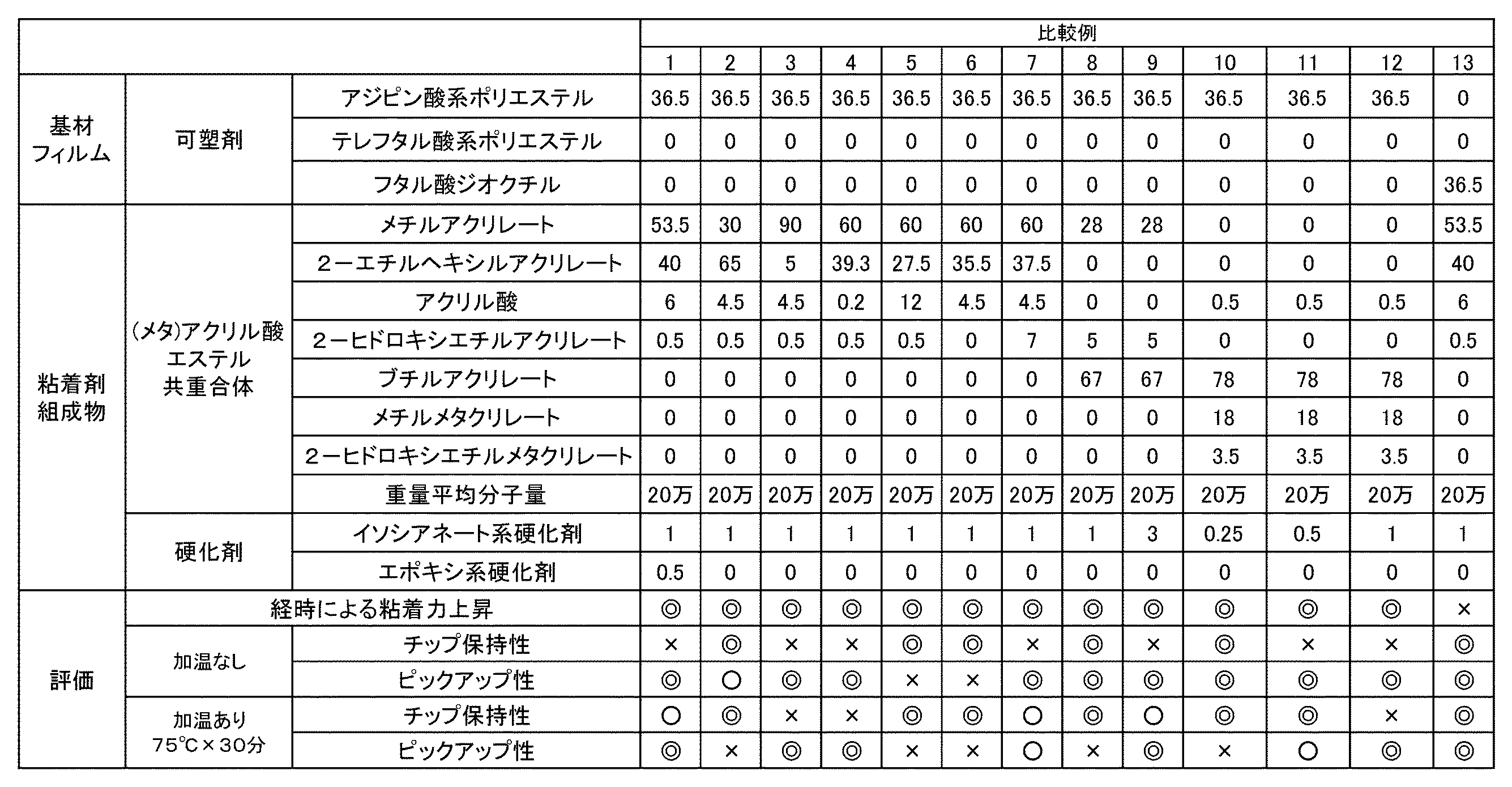

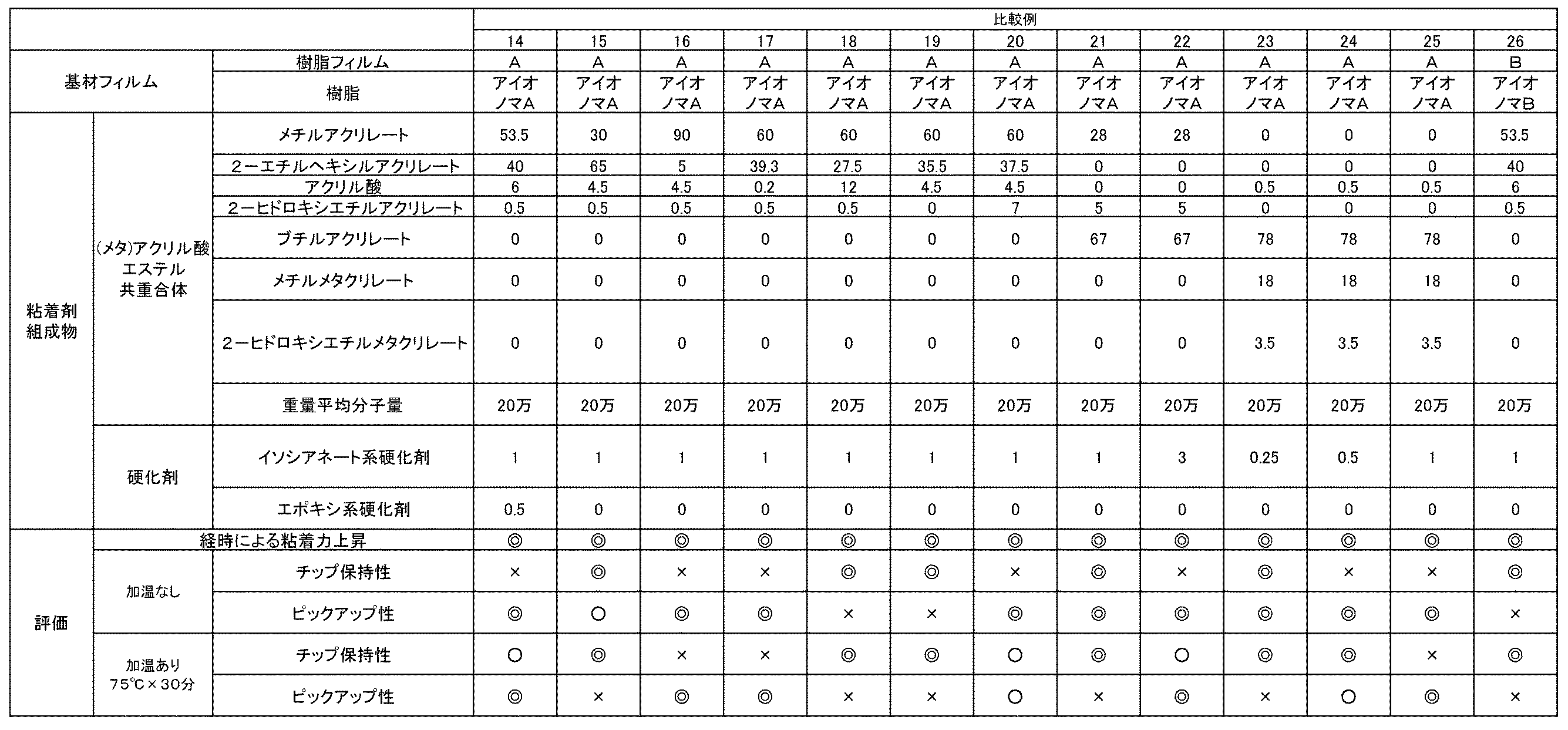
表1及び表2における「基材フィルム」は、ポリ塩化ビニル(PVC)と、表1及び表2に示す可塑剤を含有するフィルムである。
アジピン酸系ポリエステル、テレフタル酸系ポリエステルは、何れもポリエステル系可塑剤の例である。
メチルアクリレート、メチルメタクリレート、ブチルアクリレートは、何れも(メタ)アクリレート単位の例である。
アクリル酸は、カルボキシル基を有する単量体単位の例である。
2-ヒドロキシエチルアクリレート、2-ヒドロキシエチルメタクリレートは、ヒドロキシル基を有する単量体単位の例である。
アジピン酸系ポリエステル、テレフタル酸系ポリエステルは、何れもポリエステル系可塑剤の例である。
メチルアクリレート、メチルメタクリレート、ブチルアクリレートは、何れも(メタ)アクリレート単位の例である。
アクリル酸は、カルボキシル基を有する単量体単位の例である。
2-ヒドロキシエチルアクリレート、2-ヒドロキシエチルメタクリレートは、ヒドロキシル基を有する単量体単位の例である。
まず、ポリ塩化ビニル樹脂と、表1~表4に示す可塑剤と、その他安定剤、顔料、充填剤を配合した。この樹脂混和物をバンバリーミキサーで混練したのち、カレンダー加工にて70μmの厚さに形成して、基材フィルムを得た。
次に、表1~表4に示す組成の粘着剤組成物をPET製剥離フィルム上に乾燥後の粘着剤層の厚みが15μmとなるように塗工し、基材フィルムに積層し粘着シートを得た。得られた粘着シートについて以下の評価を行った。
(1)経時による粘着力上昇の評価
シリコンウエハ鏡面に粘着シートを貼り合わせ、2kgロ-ラの1往復で圧着し20分放置後に、180°ピ-ル、引張り速度300mm/分の条件で粘着力を測定した。シリコンウエハには、725μm厚のウエハ(6インチ)を用いた。
また、上記条件で圧着した後に7日放置した試験体を作成し、この試験体についても同様の方法で粘着力を測定した。20分放置の試験体の粘着力(X)および7日放置の試験体の粘着力(Y)から次の式に従って上昇率を求めた。
上昇率=(100×(Y-X))/X
シリコンウエハ鏡面に粘着シートを貼り合わせ、2kgロ-ラの1往復で圧着し20分放置後に、180°ピ-ル、引張り速度300mm/分の条件で粘着力を測定した。シリコンウエハには、725μm厚のウエハ(6インチ)を用いた。
また、上記条件で圧着した後に7日放置した試験体を作成し、この試験体についても同様の方法で粘着力を測定した。20分放置の試験体の粘着力(X)および7日放置の試験体の粘着力(Y)から次の式に従って上昇率を求めた。
上昇率=(100×(Y-X))/X
算出された上昇率から以下の基準により、経時による粘着力上昇を評価した。
◎(優):上昇率が5%未満。
○(良) :上昇率が5%以上10%未満。
×(不可):上昇率が10%以上。
◎(優):上昇率が5%未満。
○(良) :上昇率が5%以上10%未満。
×(不可):上昇率が10%以上。
(2)チップ保持性及びピックアップ性の評価
得られた粘着シートをダミーの回路パターンを形成した直径8インチ×厚さ0.1mmのシリコンウエハとリングフレームに貼り合わせた。その後、加温する場合は75℃で30分間、オーブンで加温した。その後、ダイシング、ピックアップの各工程を行った。
得られた粘着シートをダミーの回路パターンを形成した直径8インチ×厚さ0.1mmのシリコンウエハとリングフレームに貼り合わせた。その後、加温する場合は75℃で30分間、オーブンで加温した。その後、ダイシング、ピックアップの各工程を行った。
ダイシング工程の条件は以下の通りとした。
ダイシング装置:DISCO社製DAD341
ダイシングブレード:DISCO社製NBC-ZH205O-27HEEE
ダイシングブレード形状:外径55.56mm、刃幅35μm、内径19.05mm
ダイシングブレード回転数:40、000rpm
ダイシングブレード送り速度:50mm/秒
ダイシングサイズ:1.5mm角
粘着シートへの切り込み量:15μm
切削水温度:25℃
切削水量:1.0リットル/分
ダイシング装置:DISCO社製DAD341
ダイシングブレード:DISCO社製NBC-ZH205O-27HEEE
ダイシングブレード形状:外径55.56mm、刃幅35μm、内径19.05mm
ダイシングブレード回転数:40、000rpm
ダイシングブレード送り速度:50mm/秒
ダイシングサイズ:1.5mm角
粘着シートへの切り込み量:15μm
切削水温度:25℃
切削水量:1.0リットル/分
ピックアップ工程の条件は以下の通りとした。
ピックアップ装置:キヤノンマシナリー社製CAP-300II
エキスパンド量:8mm
ニードルピン形状:70μmR
ニードルピン数:1本
ニードルピン突き上げ高さ:1.5mm
ピックアップ装置:キヤノンマシナリー社製CAP-300II
エキスパンド量:8mm
ニードルピン形状:70μmR
ニードルピン数:1本
ニードルピン突き上げ高さ:1.5mm
ダイシング工程およびピックアップ工程において、以下の評価を行った。
(2-1)チップ保持性
チップ保持性は、ダイシング工程後において、半導体チップが粘着シートに保持されている半導体チップの残存率に基づき、以下の基準により評価した。
◎(優) :チップ飛びが5%未満
○(良) :チップ飛びが5%以上10%未満
×(不可):チップ飛びが10%以上
チップ保持性は、ダイシング工程後において、半導体チップが粘着シートに保持されている半導体チップの残存率に基づき、以下の基準により評価した。
◎(優) :チップ飛びが5%未満
○(良) :チップ飛びが5%以上10%未満
×(不可):チップ飛びが10%以上
(2-2)ピックアップ性
ピックアップ性は、ピックアップ工程において、半導体チップがピックアップできた率に基づき、以下の基準により評価した。
◎(優):チップのピックアップ成功率が95%以上
○(良):チップのピックアップ成功率が80%以上95%未満
×(不可):チップのピックアップ成功率が80%未満
ピックアップ性は、ピックアップ工程において、半導体チップがピックアップできた率に基づき、以下の基準により評価した。
◎(優):チップのピックアップ成功率が95%以上
○(良):チップのピックアップ成功率が80%以上95%未満
×(不可):チップのピックアップ成功率が80%未満
表1、表2から明らかなように、全ての実施例(実施例1~実施例14)において、経時による粘着力上昇が小さく、且つ加温の有無に関わらずチップ保持性とピックアップ性の両方において優れた結果が得られた。
実施例1~実施例3を比較すると、エポキシ系硬化剤の含有量を0.1質量部以下にすると、チップ保持性が特に良好になることが分かった。
実施例1~実施例14を比較すると、アジピン酸系ポリエステルを用いた場合には、経時による粘着力上昇が特に小さくなることが分かった。
比較例1では、エポキシ系硬化剤の含有量が多すぎたため、加温なしの場合にチップ保持性が良好でなかった。
比較例2~比較例7では、(メタ)アクリル酸エステル共重合体を構成する単量体単位の種類は実施例と同じであるが、その割合が適切でなかったため、良好な結果が得られなかった。
比較例8~比較例12では、(メタ)アクリル酸エステル共重合体を構成する単量体単位の種類が実施例と異なっており、良好な結果が得られなかった。
比較例13では、ポリエステル系ではない可塑剤が使用されたため、経時による粘着力上昇が大きかった。
実施例1~実施例3を比較すると、エポキシ系硬化剤の含有量を0.1質量部以下にすると、チップ保持性が特に良好になることが分かった。
実施例1~実施例14を比較すると、アジピン酸系ポリエステルを用いた場合には、経時による粘着力上昇が特に小さくなることが分かった。
比較例1では、エポキシ系硬化剤の含有量が多すぎたため、加温なしの場合にチップ保持性が良好でなかった。
比較例2~比較例7では、(メタ)アクリル酸エステル共重合体を構成する単量体単位の種類は実施例と同じであるが、その割合が適切でなかったため、良好な結果が得られなかった。
比較例8~比較例12では、(メタ)アクリル酸エステル共重合体を構成する単量体単位の種類が実施例と異なっており、良好な結果が得られなかった。
比較例13では、ポリエステル系ではない可塑剤が使用されたため、経時による粘着力上昇が大きかった。
表3~表4から明らかなように、全ての実施例(実施例15~実施例29)において、加温の有無に関わらずチップ保持性とピックアップ性の両方において優れた結果が得られた。
実施例15~実施例17を比較すると、エポキシ系硬化剤の含有量を0.1質量部以下にすると、チップ保持性が特に良好になることが分かった。
比較例14では、エポキシ系硬化剤の含有量が多すぎたため、加温なしの場合にチップ保持性が良好でなかった。
比較例15~20では、(メタ)アクリル酸エステル共重合体を構成する単量体単位の種類は実施例と同じであるが、その割合が適切でなかったため、良好な結果が得られなかった。
比較例21~25では、(メタ)アクリル酸エステル共重合体を構成する単量体単位の種類が実施例と異なっており、良好な結果が得られなかった。
比較例26では、アイオノマ樹脂がエチレン-メタアクリル酸共重合体Zn塩の2元系であるため、良好な結果が得られなかった。
実施例15~実施例17を比較すると、エポキシ系硬化剤の含有量を0.1質量部以下にすると、チップ保持性が特に良好になることが分かった。
比較例14では、エポキシ系硬化剤の含有量が多すぎたため、加温なしの場合にチップ保持性が良好でなかった。
比較例15~20では、(メタ)アクリル酸エステル共重合体を構成する単量体単位の種類は実施例と同じであるが、その割合が適切でなかったため、良好な結果が得られなかった。
比較例21~25では、(メタ)アクリル酸エステル共重合体を構成する単量体単位の種類が実施例と異なっており、良好な結果が得られなかった。
比較例26では、アイオノマ樹脂がエチレン-メタアクリル酸共重合体Zn塩の2元系であるため、良好な結果が得られなかった。
Claims (10)
- ポリ塩化ビニルと、ポリエステル系可塑剤とを含む基材フィルム上に粘着剤組成物からなる粘着剤層を有する粘着シートにおいて、
前記粘着剤組成物が、(メタ)アクリル酸エステル共重合体100質量部と、イソシアネート系硬化剤0.1~7質量部を含み、
前記(メタ)アクリル酸エステル共重合体は、メチル(メタ)アクリレート単位を35~85質量%、2-エチルへキシルアクリレート単位を10~60質量%、カルボキシル基を有する単量体単位を0.5~10質量%、ヒドロキシル基を有する単量体単位を0.01~5質量%含み、
前記粘着剤組成物は、エポキシ系硬化剤の含有量が、前記(メタ)アクリル酸エステル共重合体成分100質量部に対して0~0.25質量部である、粘着シート。 - エチレン単位、メタアクリル酸単位、及び(メタ)アクリル酸アルキルエステル単位を有する共重合体を金属イオンで架橋したアイオノマ樹脂からなる基材フィルム上に粘着剤組成物からなる粘着剤層を有する粘着シートにおいて、
前記粘着剤組成物が、(メタ)アクリル酸エステル共重合体100質量部と、イソシアネート系硬化剤0.1~7質量部を含み、
前記(メタ)アクリル酸エステル共重合体は、メチル(メタ)アクリレート単位を35~85質量%、2-エチルへキシルアクリレート単位を10~60質量%、カルボキシル基を有する単量体単位を0.5~10質量%、ヒドロキシル基を有する単量体単位を0.01~5質量%含み、
前記粘着剤組成物は、エポキシ系硬化剤の含有量が、前記(メタ)アクリル酸エステル共重合体成分100質量部に対して0~0.25質量部である、粘着シート。 - 前記(メタ)アクリル酸エステル共重合体において、前記メチル(メタ)アクリレート単位は、35~62.5質量%、前記2-エチルへキシルアクリレート単位は、20~60質量%である、請求項1または請求項2に記載の粘着シート。
- 前記粘着剤組成物は、前記エポキシ系硬化剤の含有量が、前記(メタ)アクリル酸エステル共重合体成分100質量部に対して0~0.1質量部である、請求項1乃至請求項3の何れか1項に記載の粘着シート。
- 前記カルボキシル基を有する単量体が、アクリル酸である、請求項1乃至請求項4の何れか1項に記載の粘着シート。
- 前記ヒドロキシル基を有する単量体が、2-ヒドロキシエチルアクリレートである、請求項1乃至請求項5の何れか1項に記載の粘着シート。
- 前記基材フィルムは、前記ポリ塩化ビニル100質量部に対して、前記ポリエステル系可塑剤を25~45質量部含む、請求項1、請求項3乃至請求項6の何れか1項に記載の粘着シート。
- 前記ポリエステル系可塑剤がアジピン酸系ポリエステルである、請求項1、請求項3乃至請求項7の何れか1項に記載の粘着シート。
- 請求項1乃至請求項8の何れか1項に記載の粘着シートを被着体とリングフレームに貼り付ける貼付工程と、
前記被着体をダイシングしてチップにするダイシング工程と、
前記粘着シートから前記チップをピックアップするピックアップ工程と、
を含む、電子部品の製造方法。 - 前記貼付工程の後であって前記ダイシング工程の前に、前記粘着シートが貼り付けられた前被着体を、60~100℃に加温する加温工程をさらに備える、請求項9に記載の電子部品の製造方法。
Priority Applications (2)
| Application Number | Priority Date | Filing Date | Title |
|---|---|---|---|
| CN201280058909.1A CN103959444B (zh) | 2011-12-02 | 2012-11-27 | 粘合片及使用粘合片的电子元件的制造方法 |
| JP2013547172A JP5947313B2 (ja) | 2011-12-02 | 2012-11-27 | 粘着シート及び粘着シートを用いた電子部品の製造方法 |
Applications Claiming Priority (2)
| Application Number | Priority Date | Filing Date | Title |
|---|---|---|---|
| JP2011-264440 | 2011-12-02 | ||
| JP2011264440 | 2011-12-02 |
Publications (1)
| Publication Number | Publication Date |
|---|---|
| WO2013080979A1 true WO2013080979A1 (ja) | 2013-06-06 |
Family
ID=48535430
Family Applications (1)
| Application Number | Title | Priority Date | Filing Date |
|---|---|---|---|
| PCT/JP2012/080642 Ceased WO2013080979A1 (ja) | 2011-12-02 | 2012-11-27 | 粘着シート及び粘着シートを用いた電子部品の製造方法 |
Country Status (4)
| Country | Link |
|---|---|
| JP (1) | JP5947313B2 (ja) |
| MY (1) | MY168337A (ja) |
| TW (1) | TWI541314B (ja) |
| WO (1) | WO2013080979A1 (ja) |
Cited By (5)
| Publication number | Priority date | Publication date | Assignee | Title |
|---|---|---|---|---|
| KR20160018505A (ko) * | 2013-06-11 | 2016-02-17 | 덴카 주식회사 | 점착 시트 및 점착 시트를 사용한 전자 부품의 제조 방법 |
| WO2017150017A1 (ja) * | 2016-02-29 | 2017-09-08 | リンテック株式会社 | 半導体加工シート用基材フィルムおよび半導体加工シート |
| WO2017150018A1 (ja) * | 2016-02-29 | 2017-09-08 | リンテック株式会社 | 半導体加工シート |
| JP2020007568A (ja) * | 2014-09-25 | 2020-01-16 | 日東電工株式会社 | 熱剥離型粘着シート |
| CN114901768A (zh) * | 2020-03-30 | 2022-08-12 | 琳得科株式会社 | 粘着片 |
Citations (3)
| Publication number | Priority date | Publication date | Assignee | Title |
|---|---|---|---|---|
| JP2011187571A (ja) * | 2010-03-05 | 2011-09-22 | Nitto Denko Corp | ダイシング・ダイボンドフィルム |
| JP2011228446A (ja) * | 2010-04-19 | 2011-11-10 | Nitto Denko Corp | フリップチップ型半導体裏面用フィルム |
| JP2011236261A (ja) * | 2010-05-06 | 2011-11-24 | Furukawa Electric Co Ltd:The | 半導体用接着フィルム及び半導体装置の製造方法 |
Family Cites Families (6)
| Publication number | Priority date | Publication date | Assignee | Title |
|---|---|---|---|---|
| JPH07105368B2 (ja) * | 1992-08-05 | 1995-11-13 | 日本加工製紙株式会社 | 半導体ウエハダイシング用粘着シート |
| JP2001089731A (ja) * | 1999-09-20 | 2001-04-03 | Lintec Corp | 粘着剤組成物及びそれを用いた接着性光学機能部材 |
| JP4593068B2 (ja) * | 2002-11-29 | 2010-12-08 | 古河電気工業株式会社 | 半導体ウエハー固定用粘着テープ |
| JP2007031535A (ja) * | 2005-07-26 | 2007-02-08 | Denki Kagaku Kogyo Kk | 粘着シートおよびそれを用いた電子部品の製造方法。 |
| CN102959688B (zh) * | 2010-06-18 | 2016-04-06 | 日立化成株式会社 | 粘接片 |
| WO2012165551A1 (ja) * | 2011-06-02 | 2012-12-06 | 電気化学工業株式会社 | 粘着テープおよび半導体ウエハ加工方法 |
-
2012
- 2012-11-27 WO PCT/JP2012/080642 patent/WO2013080979A1/ja not_active Ceased
- 2012-11-27 MY MYPI2014701391A patent/MY168337A/en unknown
- 2012-11-27 JP JP2013547172A patent/JP5947313B2/ja active Active
- 2012-11-30 TW TW101145006A patent/TWI541314B/zh active
Patent Citations (3)
| Publication number | Priority date | Publication date | Assignee | Title |
|---|---|---|---|---|
| JP2011187571A (ja) * | 2010-03-05 | 2011-09-22 | Nitto Denko Corp | ダイシング・ダイボンドフィルム |
| JP2011228446A (ja) * | 2010-04-19 | 2011-11-10 | Nitto Denko Corp | フリップチップ型半導体裏面用フィルム |
| JP2011236261A (ja) * | 2010-05-06 | 2011-11-24 | Furukawa Electric Co Ltd:The | 半導体用接着フィルム及び半導体装置の製造方法 |
Cited By (15)
| Publication number | Priority date | Publication date | Assignee | Title |
|---|---|---|---|---|
| JPWO2014199992A1 (ja) * | 2013-06-11 | 2017-02-23 | デンカ株式会社 | 粘着シート及び粘着シートを用いた電子部品の製造方法 |
| KR102215979B1 (ko) | 2013-06-11 | 2021-02-16 | 덴카 주식회사 | 점착 시트 및 점착 시트를 사용한 전자 부품의 제조 방법 |
| KR20160018505A (ko) * | 2013-06-11 | 2016-02-17 | 덴카 주식회사 | 점착 시트 및 점착 시트를 사용한 전자 부품의 제조 방법 |
| JP2020007568A (ja) * | 2014-09-25 | 2020-01-16 | 日東電工株式会社 | 熱剥離型粘着シート |
| WO2017150018A1 (ja) * | 2016-02-29 | 2017-09-08 | リンテック株式会社 | 半導体加工シート |
| JPWO2017150018A1 (ja) * | 2016-02-29 | 2018-05-24 | リンテック株式会社 | 半導体加工シート |
| CN108701598A (zh) * | 2016-02-29 | 2018-10-23 | 琳得科株式会社 | 半导体加工片用基材膜以及半导体加工片 |
| KR20180118599A (ko) * | 2016-02-29 | 2018-10-31 | 린텍 가부시키가이샤 | 반도체 가공 시트 |
| KR20180118598A (ko) * | 2016-02-29 | 2018-10-31 | 린텍 가부시키가이샤 | 반도체 가공 시트용 기재 필름 및 반도체 가공 시트 |
| JPWO2017150017A1 (ja) * | 2016-02-29 | 2018-05-24 | リンテック株式会社 | 半導体加工シート用基材フィルムおよび半導体加工シート |
| WO2017150017A1 (ja) * | 2016-02-29 | 2017-09-08 | リンテック株式会社 | 半導体加工シート用基材フィルムおよび半導体加工シート |
| CN108701598B (zh) * | 2016-02-29 | 2022-10-28 | 琳得科株式会社 | 半导体加工片用基材膜以及半导体加工片 |
| KR102594219B1 (ko) | 2016-02-29 | 2023-10-25 | 린텍 가부시키가이샤 | 반도체 가공 시트용 기재 필름 및 반도체 가공 시트 |
| KR102594220B1 (ko) | 2016-02-29 | 2023-10-25 | 린텍 가부시키가이샤 | 반도체 가공 시트 |
| CN114901768A (zh) * | 2020-03-30 | 2022-08-12 | 琳得科株式会社 | 粘着片 |
Also Published As
| Publication number | Publication date |
|---|---|
| JPWO2013080979A1 (ja) | 2015-04-27 |
| MY168337A (en) | 2018-10-31 |
| CN103959444A (zh) | 2014-07-30 |
| JP5947313B2 (ja) | 2016-07-06 |
| TW201326351A (zh) | 2013-07-01 |
| TWI541314B (zh) | 2016-07-11 |
Similar Documents
| Publication | Publication Date | Title |
|---|---|---|
| JP6429397B2 (ja) | 粘着シート | |
| TWI565591B (zh) | A sheet having a subsequent resin layer, and a method for manufacturing the semiconductor device | |
| JP6562172B2 (ja) | 樹脂膜形成用シート、及び樹脂膜形成用複合シート | |
| JP6000949B2 (ja) | 粘着シート | |
| TWI689412B (zh) | 樹脂膜形成用複合薄片、及附樹脂膜之晶片之製造方法 | |
| JP5947313B2 (ja) | 粘着シート及び粘着シートを用いた電子部品の製造方法 | |
| TWI715652B (zh) | 保護膜形成用膜以及保護膜形成用複合片 | |
| JP6464196B2 (ja) | 樹脂膜形成用シート、樹脂膜形成用複合シート、及びシリコンウエハの再生方法 | |
| CN112111236A (zh) | 保护膜形成用复合片、及带保护膜的半导体芯片的制造方法 | |
| CN111602229A (zh) | 支撑片及保护膜形成用复合片 | |
| CN111373509A (zh) | 支撑片及保护膜形成用复合片 | |
| CN103959444B (zh) | 粘合片及使用粘合片的电子元件的制造方法 | |
| CN118027840A (zh) | 保护膜形成用复合片 | |
| JP6129546B2 (ja) | 半導体ウエハ加工用シートおよび半導体装置の製造方法 | |
| CN111542912A (zh) | 保护膜形成用复合片及其制造方法 | |
| TW202348756A (zh) | 保護膜形成膜、保護膜形成用複合片、半導體裝置之製造方法、以及保護膜形成膜之使用 | |
| TW202339960A (zh) | 保護膜形成膜、保護膜形成用複合片、套件、以及保護膜形成膜之使用 | |
| TW202239904A (zh) | 支撐片、樹脂膜形成用複合片、套件、以及具樹脂膜之晶片的製造方法 | |
| CN111466014A (zh) | 保护膜形成用复合片及其制造方法 | |
| CN111630631A (zh) | 支撑片及保护膜形成用复合片 | |
| CN111587472A (zh) | 支撑片及保护膜形成用复合片 | |
| CN111527588A (zh) | 支撑片及其制造方法、以及保护膜形成用复合片及其制造方法 |
Legal Events
| Date | Code | Title | Description |
|---|---|---|---|
| 121 | Ep: the epo has been informed by wipo that ep was designated in this application |
Ref document number: 12853161 Country of ref document: EP Kind code of ref document: A1 |
|
| ENP | Entry into the national phase |
Ref document number: 2013547172 Country of ref document: JP Kind code of ref document: A |
|
| NENP | Non-entry into the national phase |
Ref country code: DE |
|
| 122 | Ep: pct application non-entry in european phase |
Ref document number: 12853161 Country of ref document: EP Kind code of ref document: A1 |