WO2012176718A1 - ポジ型レジスト組成物 - Google Patents
ポジ型レジスト組成物 Download PDFInfo
- Publication number
- WO2012176718A1 WO2012176718A1 PCT/JP2012/065460 JP2012065460W WO2012176718A1 WO 2012176718 A1 WO2012176718 A1 WO 2012176718A1 JP 2012065460 W JP2012065460 W JP 2012065460W WO 2012176718 A1 WO2012176718 A1 WO 2012176718A1
- Authority
- WO
- WIPO (PCT)
- Prior art keywords
- group
- carbon atoms
- atom
- atoms
- substituted
- Prior art date
- Legal status (The legal status is an assumption and is not a legal conclusion. Google has not performed a legal analysis and makes no representation as to the accuracy of the status listed.)
- Ceased
Links
Classifications
-
- G—PHYSICS
- G03—PHOTOGRAPHY; CINEMATOGRAPHY; ANALOGOUS TECHNIQUES USING WAVES OTHER THAN OPTICAL WAVES; ELECTROGRAPHY; HOLOGRAPHY
- G03F—PHOTOMECHANICAL PRODUCTION OF TEXTURED OR PATTERNED SURFACES, e.g. FOR PRINTING, FOR PROCESSING OF SEMICONDUCTOR DEVICES; MATERIALS THEREFOR; ORIGINALS THEREFOR; APPARATUS SPECIALLY ADAPTED THEREFOR
- G03F7/00—Photomechanical, e.g. photolithographic, production of textured or patterned surfaces, e.g. printing surfaces; Materials therefor, e.g. comprising photoresists; Apparatus specially adapted therefor
- G03F7/004—Photosensitive materials
- G03F7/039—Macromolecular compounds which are photodegradable, e.g. positive electron resists
-
- G—PHYSICS
- G03—PHOTOGRAPHY; CINEMATOGRAPHY; ANALOGOUS TECHNIQUES USING WAVES OTHER THAN OPTICAL WAVES; ELECTROGRAPHY; HOLOGRAPHY
- G03F—PHOTOMECHANICAL PRODUCTION OF TEXTURED OR PATTERNED SURFACES, e.g. FOR PRINTING, FOR PROCESSING OF SEMICONDUCTOR DEVICES; MATERIALS THEREFOR; ORIGINALS THEREFOR; APPARATUS SPECIALLY ADAPTED THEREFOR
- G03F7/00—Photomechanical, e.g. photolithographic, production of textured or patterned surfaces, e.g. printing surfaces; Materials therefor, e.g. comprising photoresists; Apparatus specially adapted therefor
- G03F7/004—Photosensitive materials
- G03F7/039—Macromolecular compounds which are photodegradable, e.g. positive electron resists
- G03F7/0392—Macromolecular compounds which are photodegradable, e.g. positive electron resists the macromolecular compound being present in a chemically amplified positive photoresist composition
-
- C—CHEMISTRY; METALLURGY
- C08—ORGANIC MACROMOLECULAR COMPOUNDS; THEIR PREPARATION OR CHEMICAL WORKING-UP; COMPOSITIONS BASED THEREON
- C08F—MACROMOLECULAR COMPOUNDS OBTAINED BY REACTIONS ONLY INVOLVING CARBON-TO-CARBON UNSATURATED BONDS
- C08F2/00—Processes of polymerisation
- C08F2/44—Polymerisation in the presence of compounding ingredients, e.g. plasticisers, dyestuffs, fillers
-
- G—PHYSICS
- G03—PHOTOGRAPHY; CINEMATOGRAPHY; ANALOGOUS TECHNIQUES USING WAVES OTHER THAN OPTICAL WAVES; ELECTROGRAPHY; HOLOGRAPHY
- G03F—PHOTOMECHANICAL PRODUCTION OF TEXTURED OR PATTERNED SURFACES, e.g. FOR PRINTING, FOR PROCESSING OF SEMICONDUCTOR DEVICES; MATERIALS THEREFOR; ORIGINALS THEREFOR; APPARATUS SPECIALLY ADAPTED THEREFOR
- G03F7/00—Photomechanical, e.g. photolithographic, production of textured or patterned surfaces, e.g. printing surfaces; Materials therefor, e.g. comprising photoresists; Apparatus specially adapted therefor
- G03F7/004—Photosensitive materials
-
- G—PHYSICS
- G03—PHOTOGRAPHY; CINEMATOGRAPHY; ANALOGOUS TECHNIQUES USING WAVES OTHER THAN OPTICAL WAVES; ELECTROGRAPHY; HOLOGRAPHY
- G03F—PHOTOMECHANICAL PRODUCTION OF TEXTURED OR PATTERNED SURFACES, e.g. FOR PRINTING, FOR PROCESSING OF SEMICONDUCTOR DEVICES; MATERIALS THEREFOR; ORIGINALS THEREFOR; APPARATUS SPECIALLY ADAPTED THEREFOR
- G03F7/00—Photomechanical, e.g. photolithographic, production of textured or patterned surfaces, e.g. printing surfaces; Materials therefor, e.g. comprising photoresists; Apparatus specially adapted therefor
- G03F7/004—Photosensitive materials
- G03F7/0045—Photosensitive materials with organic non-macromolecular light-sensitive compounds not otherwise provided for, e.g. dissolution inhibitors
-
- G—PHYSICS
- G03—PHOTOGRAPHY; CINEMATOGRAPHY; ANALOGOUS TECHNIQUES USING WAVES OTHER THAN OPTICAL WAVES; ELECTROGRAPHY; HOLOGRAPHY
- G03F—PHOTOMECHANICAL PRODUCTION OF TEXTURED OR PATTERNED SURFACES, e.g. FOR PRINTING, FOR PROCESSING OF SEMICONDUCTOR DEVICES; MATERIALS THEREFOR; ORIGINALS THEREFOR; APPARATUS SPECIALLY ADAPTED THEREFOR
- G03F7/00—Photomechanical, e.g. photolithographic, production of textured or patterned surfaces, e.g. printing surfaces; Materials therefor, e.g. comprising photoresists; Apparatus specially adapted therefor
- G03F7/004—Photosensitive materials
- G03F7/0046—Photosensitive materials with perfluoro compounds, e.g. for dry lithography
-
- G—PHYSICS
- G03—PHOTOGRAPHY; CINEMATOGRAPHY; ANALOGOUS TECHNIQUES USING WAVES OTHER THAN OPTICAL WAVES; ELECTROGRAPHY; HOLOGRAPHY
- G03F—PHOTOMECHANICAL PRODUCTION OF TEXTURED OR PATTERNED SURFACES, e.g. FOR PRINTING, FOR PROCESSING OF SEMICONDUCTOR DEVICES; MATERIALS THEREFOR; ORIGINALS THEREFOR; APPARATUS SPECIALLY ADAPTED THEREFOR
- G03F7/00—Photomechanical, e.g. photolithographic, production of textured or patterned surfaces, e.g. printing surfaces; Materials therefor, e.g. comprising photoresists; Apparatus specially adapted therefor
- G03F7/004—Photosensitive materials
- G03F7/0048—Photosensitive materials characterised by the solvents or agents facilitating spreading, e.g. tensio-active agents
-
- G—PHYSICS
- G03—PHOTOGRAPHY; CINEMATOGRAPHY; ANALOGOUS TECHNIQUES USING WAVES OTHER THAN OPTICAL WAVES; ELECTROGRAPHY; HOLOGRAPHY
- G03F—PHOTOMECHANICAL PRODUCTION OF TEXTURED OR PATTERNED SURFACES, e.g. FOR PRINTING, FOR PROCESSING OF SEMICONDUCTOR DEVICES; MATERIALS THEREFOR; ORIGINALS THEREFOR; APPARATUS SPECIALLY ADAPTED THEREFOR
- G03F7/00—Photomechanical, e.g. photolithographic, production of textured or patterned surfaces, e.g. printing surfaces; Materials therefor, e.g. comprising photoresists; Apparatus specially adapted therefor
- G03F7/16—Coating processes; Apparatus therefor
-
- H—ELECTRICITY
- H10—SEMICONDUCTOR DEVICES; ELECTRIC SOLID-STATE DEVICES NOT OTHERWISE PROVIDED FOR
- H10P—GENERIC PROCESSES OR APPARATUS FOR THE MANUFACTURE OR TREATMENT OF DEVICES COVERED BY CLASS H10
- H10P76/00—Manufacture or treatment of masks on semiconductor bodies, e.g. by lithography or photolithography
Definitions
- the present invention relates to a positive resist composition used for resist pattern processing by photolithography in the manufacture of semiconductor elements and the like.
- the present invention relates to a positive resist composition suitable for resist pattern processing on an organic polymer substrate or a substrate provided with an organic thin film.
- Lithography refers to irradiating a substrate surface on which a photosensitive material (photoresist, hereinafter simply referred to as a resist) is formed and forming a resist film with high-energy light through a photomask having a pattern to form a desired resist film. The pattern is exposed to light and the shape of the pattern is transferred to the surface of the substrate.
- the resist development technique in lithography is based on the difference in solubility between the exposed portion of the resist and the unexposed portion due to the developer. This is a technique for forming a fine resist pattern on a substrate.
- the organic polymer substrate refers to a substrate made of a compound (polymer) formed by polymerizing organic compound molecules, and a typical one is polyethylene terephthalate (hereinafter referred to as PET).
- PET polyethylene terephthalate
- examples of the pattern forming method on the substrate include a method using a photosensitive resist film, and an ink jet method.
- a method using a photosensitive resist film is a method in which a photosensitive resist film (hereinafter sometimes referred to as a dry film resist) is attached to a substrate and then exposed to ultraviolet rays to form a resist pattern.
- the dry film resist is commercially available from Asahi Kasei E-Materials, Inc., trade name, Sunfort, or Nichigo Morton, trade name, ALPH.
- it is recommended to roughen the substrate surface by processing using sandblasting etc. to improve the adhesion between the dry film resist and the substrate before applying the dry film resist to the substrate. Is done. However, if the surface is rough, it may cause a decrease in pattern accuracy when repeating microfabrication with multiple layers of resist.
- the dry film resist when the dry film resist is applied, the dry film resist is usually heated.
- the difference in coefficient of thermal expansion between the dry film resist and the substrate there is a problem that when using an organic polymer substrate, the difference in dimensional change from the substrate is large, and accurate alignment is difficult.
- the ink jet method is a method of directly drawing a pattern shape by discharging droplets of ink or the like on a substrate.
- the inkjet method is useful when the display is small, but there is a problem in that it is difficult to draw a pattern over a large area with high accuracy compared to lithography in manufacturing a large display.
- Patent Documents 1 to 3 disclose resist compositions using ethers, long-chain alcohols or fluorinated alcohols as solvents for resists, which are solvents that hardly swell or dissolve in organic materials with poor solvent resistance. Has been. However, in Patent Documents 1 to 3, the solvent resistance of the resist pattern has not been studied, and there has been a problem that the solvent resistance is not sufficient.
- double exposure may be performed. After processing the resist pattern on the substrate once by photolithography, the resist pattern is processed after applying the resist solution again on the resist pattern to form the resist film. In double exposure, the solvent resistance of the resist pattern is Of particular importance.
- Patent Document 4 once forms a cross-linked structure on the resin film, and then irradiates with high energy rays such as ultraviolet light and electron beam to form a cross-linked structure of the exposed portion. Is disclosed in which an exposed portion is dissolved in a developer and developed to obtain a pattern having excellent solvent resistance.
- the solvent used is a general solvent used for inorganic substrates, and does not wet the organic material.
- the organic material When a resist pattern or the like is formed on an organic material by photolithography, the organic material is inferior in solvent resistance to an organic solvent. For example, the transparency is lost due to swelling or dissolution of the organic polymer substrate in the organic solvent. There is a problem that the surface shape of the organic polymer substrate changes, such as the shrinkage of the substrate or the surface being eroded.
- the present invention uses, as a solvent, a fluorine-containing aliphatic alcohol that has very little influence on dissolution or swelling with respect to an organic material, and a specific combination of a specific polymer soluble in the fluorine-containing aliphatic alcohol.
- a positive resist composition in which a vinyl compound and a photoacid generator are dissolved.
- a solvent having a small influence on an organic material generally has a low dissolving power for resist materials such as a polymer and a vinyl compound, and is difficult to use as a resist composition (resist liquid).
- the present inventors have found that a specific polymer is soluble in a fluorine-containing aliphatic alcohol having a small influence on an organic material, and combined a specific vinyl compound, and further added a photoacid generator.
- a resist composition it is possible to form a resist film by wet coating on an organic polymer substrate with little influence on organic materials, and the formed resist film and resist pattern have excellent solvent resistance. The compound was completed.
- the positive resist composition of the present invention after a thermosetting reaction for bonding a specific polymer with a specific vinyl compound is performed to form a resist film, irradiation with high energy rays causes a photoacid generator to be applied to the irradiated portion. Only the resist film in the irradiated area is developed by cleaving the bond contained in the crosslinked structure generated during thermal curing of the polymer and vinyl compound by the acid generated only in the resist film in the irradiated area. A so-called positive resist is dissolved in the solution to form a fine resist pattern on the organic polymer substrate.
- the fluorine-containing aliphatic alcohol as a solvent has low solubility in many organic materials, so that an organic polymer film, an organic polymer substrate, and an organic thin film are formed on the surface. Does not invade organic materials such as substrates. Further, it is possible to dissolve a photoacid generator in an amount sufficient for photosensitivity as a resist.
- the present invention comprises the following invention 1 to invention 8.
- [Invention 1] A monovalent fluorine-containing aliphatic alcohol having 2 to 8 carbon atoms, the number of hydrogen atoms being equal to or less than the number of fluorine atoms, the repeating unit A represented by the following general formula (1), and the following general formula (2
- a positive resist composition comprising a polymer containing a repeating unit B represented by formula (I), a vinyl compound, and a photoacid generator.
- R 1 is a hydrogen atom, a fluorine atom or an alkyl group having 1 to 3 carbon atoms, and a part or all of the alkyl groups are substituted with a fluorine atom or a chlorine atom.
- R 2 is a straight-chain hydrocarbon group having 1 to 15 carbon atoms or a branched hydrocarbon group having 3 to 15 carbon atoms, and some of the carbon atoms of the hydrocarbon group are substituted with oxygen atoms. Even if well, some or all of the hydrogen atoms of the hydrocarbon group may be substituted with a fluorine atom or a chlorine atom, charcoal L 1 represents a single bond, an oxygen atom, -CH 2 -O -, - C ( ⁇ O) —, —C ( ⁇ O) —O— or —O—C ( ⁇ O) —.)
- R 3 is a hydrogen atom, a fluorine atom or an alkyl group having 1 to 3 carbon atoms, and a part or all of the alkyl groups are substituted with a fluorine atom or a chlorine atom.
- D is a group represented by the following general formula (3), or It is group represented by following General formula (4).
- L 2 represents a single bond, an oxygen atom, —CH 2 —O—, —C ( ⁇ O) —, —C ( ⁇ O) —O—, or —O—C ( ⁇ O L 3 is a single bond, a straight chain having 1 to 15 carbon atoms or a branched divalent hydrocarbon group having 3 to 15 carbon atoms, and a part of carbons of the hydrocarbon group
- An atom may be substituted with an oxygen atom, a part or all of the hydrogen atoms of the hydrocarbon group may be substituted with a fluorine atom or a chlorine atom, and the carboxyl group may be protected with a protecting group.
- R 4 is an alkyl group having 1 to 8 carbon atoms, may be a part or all of the hydrogen atoms of the alkyl group substituted with a fluorine atom or a chlorine atom
- L 2 is , A single bond, an oxygen atom, —CH 2 —O—, —C ( ⁇ O) —, —C ( ⁇ O) —O—, or —O—C ( ⁇ O) —
- L 3 represents a single atom A bond, a straight-chain divalent hydrocarbon group having 1 to 15 carbon atoms or a branched chain group having 3 to 15 carbon atoms, and even if some of the carbon atoms of the hydrocarbon group are substituted with oxygen atoms
- some or all of the hydrogen atoms of the hydrocarbon group may be substituted with fluorine atoms or chlorine atoms, and the alkylsulfonamido group may be protected with a protecting group.
- R 5 is a linear hydrocarbon group having 1 to 15 carbon atoms, a branched chain group having 3 to 15 carbon atoms, or a cyclic hydrocarbon group having 6 to 15 carbon atoms.
- R 6 is a hydrogen atom, a straight chain having 1 to 15 carbon atoms, a branched chain having 3 to 15 carbon atoms, or the number of carbon atoms 6 to 15 cyclic hydrocarbon groups, part or all of the hydrogen atoms of which may be substituted with fluorine atoms or chlorine atoms, and R 5 and R 6 combine to form a cyclic structure
- L 2 represents a single bond, an oxygen atom, —CH 2 —O—, —C ( ⁇ O) —, —C ( ⁇ O) —O— or —O—C ( ⁇ O) —.
- L 3 represents a single bond, a divalent hydrocarbon radical straight, or having a carbon number of 3 to 15 branched chain having 1 to 15 carbon atoms
- the hydrocarbon group May be carbon atoms parts is substituted by an oxygen atom, a part or all of the hydrogen atoms of the hydrocarbon group may be substituted with a fluorine atom or a chlorine atom.
- R 4 is an alkyl group having 1 to 8 carbon atoms, may be a part or all of the hydrogen atoms of the alkyl group substituted with a fluorine atom or a chlorine atom
- R 7 is carbon A linear hydrocarbon group having 1 to 15 carbon atoms, a branched chain having 3 to 15 carbon atoms, or a cyclic hydrocarbon group having 6 to 15 carbon atoms, and a part or all of the hydrogen atoms of the hydrocarbon group are fluorine atoms or R 8 may be substituted with a chlorine atom, and R 8 is a hydrogen atom or a
- R 7 and R 8 combine to form Optionally form a Jo structure .
- L 3 is a single bond, a divalent hydrocarbon group having a straight-chain carbon atoms 1 to 15 or having 3 to 15 branched chain carbon atoms, the hydrocarbon
- Some or all of the hydrogen atoms in the group may be substituted with oxygen atoms, and some or all of the hydrogen atoms in the hydrocarbon group may be substituted with fluorine or chlorine atoms.
- invention 4 The positive resist composition according to any one of inventions 1 to 3, wherein the vinyl compound includes a vinyl compound containing at least two vinyl ether groups.
- invention 5 The positive resist composition according to any one of Inventions 1 to 4, wherein the photoacid generator is an N-sulfonyloxyimide compound or an oxime-O-sulfonate compound containing a divalent group represented by the general formula (7) object.
- the photoacid generator is an N-sulfonyloxyimide compound or an oxime-O-sulfonate compound containing a divalent group represented by the general formula (7) object.
- R 9 is an alkyl group having 1 to 12 carbon atoms in which some or all of the hydrogen atoms may be substituted with fluorine atoms, or a phenyl group, a naphthyl group or a biphenyl group.
- a part or all of the hydrogen atoms of the aromatic ring of the group may be substituted with a fluorine atom, a chlorine atom, a methyl group, or a trifluoromethyl group, and the two bonds that the nitrogen atom has are separate atoms and Each may form a single bond or may form a double bond with one atom.
- R 10 is an alkyl group having 1 to 12 carbon atoms, and part or all of the hydrogen atoms of the alkyl group may be substituted with a fluorine atom, and a phenyl group, a naphthyl group or It is a biphenyl group, and some or all of the hydrogen atoms of the aromatic ring of these groups may be substituted with a fluorine atom, chlorine atom, methyl group, trifluoromethyl group, methoxy group, phenoxy group or thiophenyl group
- R 11 to R 13 are each independently a phenyl group, a naphthyl group or a biphenyl group, and a part or all of the hydrogen atoms bonded to the aromatic ring of these groups are a methyl group, a trifluoromethyl group, a
- invention 7 Expressed as a mass ratio where the mass of the fluorinated aliphatic alcohol is 100, the polymer is 0.5 or more and 30 or less, the vinyl compound is 0.05 or more and 20 or less, and the polymer and the vinyl compound are added together.
- the repeating unit A is contained in an amount of 25 mol% or more and 80 mol% or less and the repeating unit B is contained in an amount of 20 mol% or more and 75 mol% or less. Any positive resist composition.
- a resist film is formed on an organic material such as an organic polymer substrate or a substrate with an organic thin film in lithography by using a fluorine-containing aliphatic alcohol that does not attack the organic material as a solvent. Therefore, even if the resist solution (resist composition) is wet-applied, the resist solvent is not adversely affected such as being dissolved or swollen in the organic material, and the fine processing of the resist pattern is facilitated.
- the positive resist composition of the present invention When the positive resist composition of the present invention is wet-coated on the surface of an organic material such as an organic polymer substrate or an organic thin film to form a resist film, a heat-curing is carried out, and then a bonding reaction between a polymer and a vinyl compound in the resist film. As a result, the resist film or resist pattern is imparted with durability that does not dissolve and swell in the developer and does not dissolve and swell in the organic solvent.
- an organic material such as an organic polymer substrate or an organic thin film
- the resist film after heat curing has photosensitivity, and in the exposed part irradiated with light in photolithography, the acid generated by light irradiation is a polymer in the resist film.
- the bond between the vinyl compound and the vinyl compound is broken, so that the developer becomes soluble and a resist pattern can be obtained, and sufficient solubility in the developer can be obtained.
- the unexposed portion does not dissolve and swell in the developer and the organic solvent by heat curing, the pattern is maintained even when the developer or the organic solvent is applied or immersed.
- the positive resist composition of the present invention uses a specific fluorine-containing aliphatic alcohol that does not affect the organic material such as dissolution and swelling, and contains a polymer, a vinyl compound, and a photoacid generator that dissolve in the specific fluorine-containing aliphatic alcohol. It was made to contain.
- the resist solvent is a monovalent fluorine-containing aliphatic alcohol having 2 to 8 carbon atoms, wherein the number of hydrogen atoms is not more than the number of fluorine atoms. used.
- Fluorine-containing aliphatic alcohol having a valence of 2 or more has a high boiling point, and it is difficult to evaporate and remove the solvent from the resist film after applying the resist composition by heating, so that a resist film having a uniform thickness cannot be obtained.
- Alcohols having 1 carbon atom it is difficult to form a uniform resist film by coating with a low boiling point.
- Alcohols having 9 or more carbon atoms have low fluidity at room temperature (20 ° C.) or are in a solid state, so that it is difficult to form a uniform resist film by coating.
- alcohol having more hydrogen atoms than fluorine atoms has a strong property of dissolving organic substances, it tends to wet the organic film or organic polymer substrate which is the lower layer of the resist film.
- the resist composition it is preferable that no fluorine atom is bonded to the carbon atom adjacent to the hydroxyl group in the fluorinated aliphatic alcohol.
- the fluorine-containing aliphatic alcohol used preferably has a boiling point higher than the substrate temperature when the resist composition is applied, more preferably 20 ° C. or higher, more preferably 50 ° C. or higher, higher than the coating temperature. is there.
- the fluorinated aliphatic alcohol When the boiling point of the fluorinated aliphatic alcohol is lower than the substrate temperature when the resist composition is applied, the fluorinated aliphatic alcohol rapidly volatilizes during the coating operation, and sufficient flatness cannot be obtained in the resist film. It is difficult to obtain a fine resist pattern by lithography.
- the fluorine-containing aliphatic alcohol used preferably has a boiling point of 200 ° C. or lower, more preferably 180 ° C. or lower. If the boiling point of the fluorinated aliphatic alcohol is higher than 200 ° C., it is difficult to evaporate and remove the solvent by heating from the resist film after applying the resist composition, and a resist film having a uniform thickness cannot be obtained.
- the fluorine-containing aliphatic alcohol to be contained in the positive resist composition of the present invention is preferably 2,2,2-trifluoroethanol, 2,2,3,3-tetrafluoropropanol, 2,2,3,3, 3-pentafluoropropanol, 2,2,3,4,4,4-hexafluorobutanol, 2,2,3,3,4,4,4-heptafluorobutanol, 2,2,3,3,4, 4,5,5-octafluoropentanol, 2,2,3,3,4,4,5,5,5-nonafluoropentanol, 3,3,4,4,5,5,6,6 6-nonafluorohexanol, 2,2,3,3,4,4,5,5,6,6,7,7-dodecafluoroheptanol, 2,2,3,3,4,4,5,5 , 6,6,7,7,7-tridecafluoroheptanol, 3,3, , 4,5,5,6,6,7,7,8,8,8-tridecafluorooctano
- 2,2,2-trifluoroethanol, 2,2,3,3-tetrafluoropropanol, 2,2,3,4,4,4-hexafluorobutanol or 2,2,3,3,4,4, 5,5-octafluoropentanol is a particularly preferred fluorine-containing aliphatic alcohol in the positive resist composition of the present invention.
- the polymer contained in the positive resist composition of the present invention contains the repeating unit A represented by the general formula (1), so that the polymer is soluble in the fluorinated aliphatic alcohol.
- the polymer containing the repeating unit has sufficient solubility in the fluorinated aliphatic alcohol.
- a polymer composed of a repeating unit having a cyclic alkyl group in the side chain does not have sufficient solubility in a fluorinated aliphatic alcohol. This is presumably because the cyclic alkyl group lacks flexibility.
- a polymer comprising a repeating unit having a trialkylamino group in the side chain does not have sufficient solubility in a fluorinated aliphatic alcohol. This is presumably because the polarity of the trialkylamino group is high.
- R 1 is preferably a hydrogen atom, a fluorine atom, a methyl group or a trifluoromethyl group because it is easy to obtain a monomer.
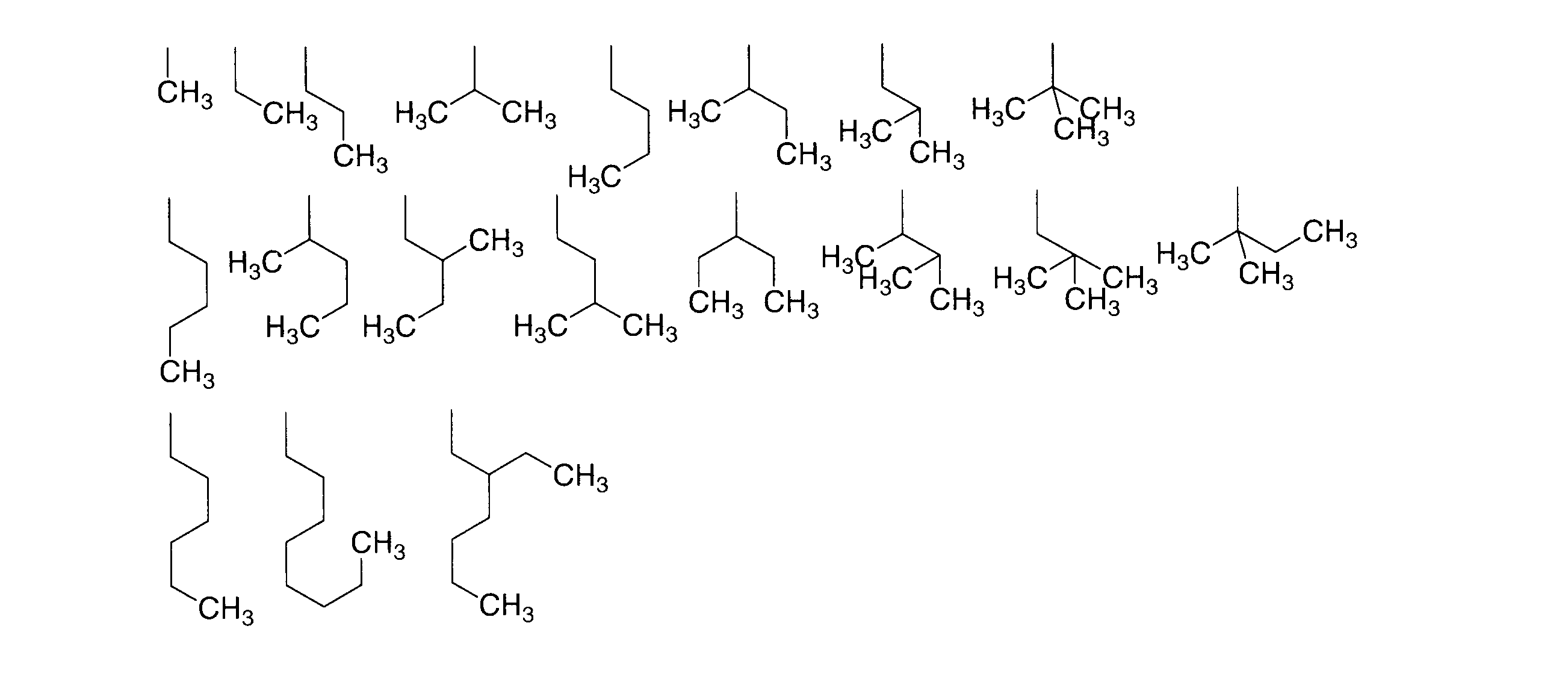
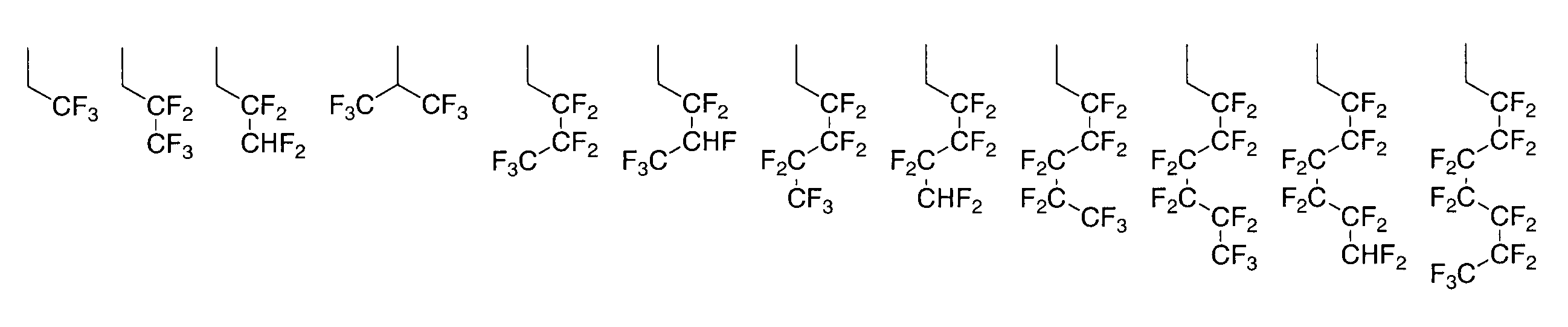
- R 2 is specifically a linear alkyl group having 1 to 8 carbon atoms or a branched alkyl group having 3 to 8 carbon atoms shown below.
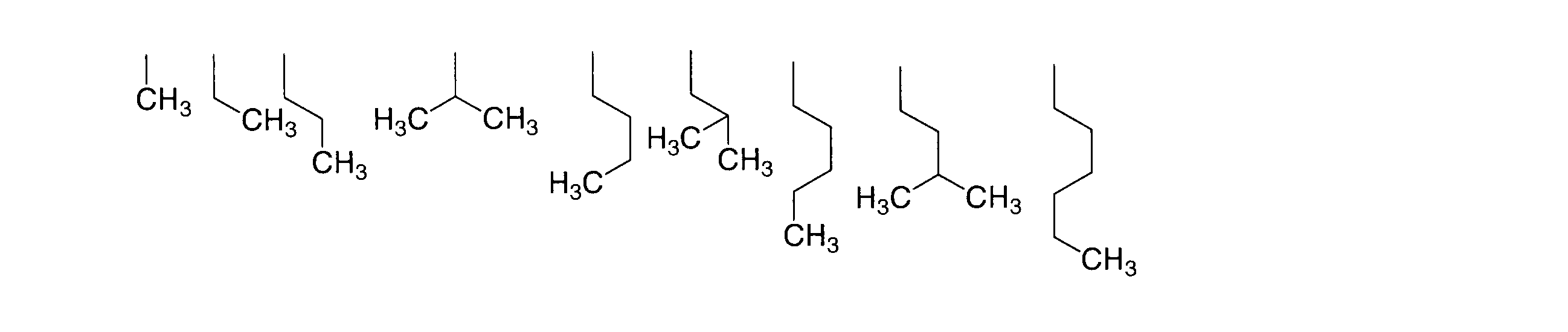
- R 2 is an alkyl having 1 to 6 carbon atoms. It is particularly preferable to use a polymer containing a group. Specific examples of preferred alkyl groups having 1 to 6 carbon atoms are shown below as R 2 .
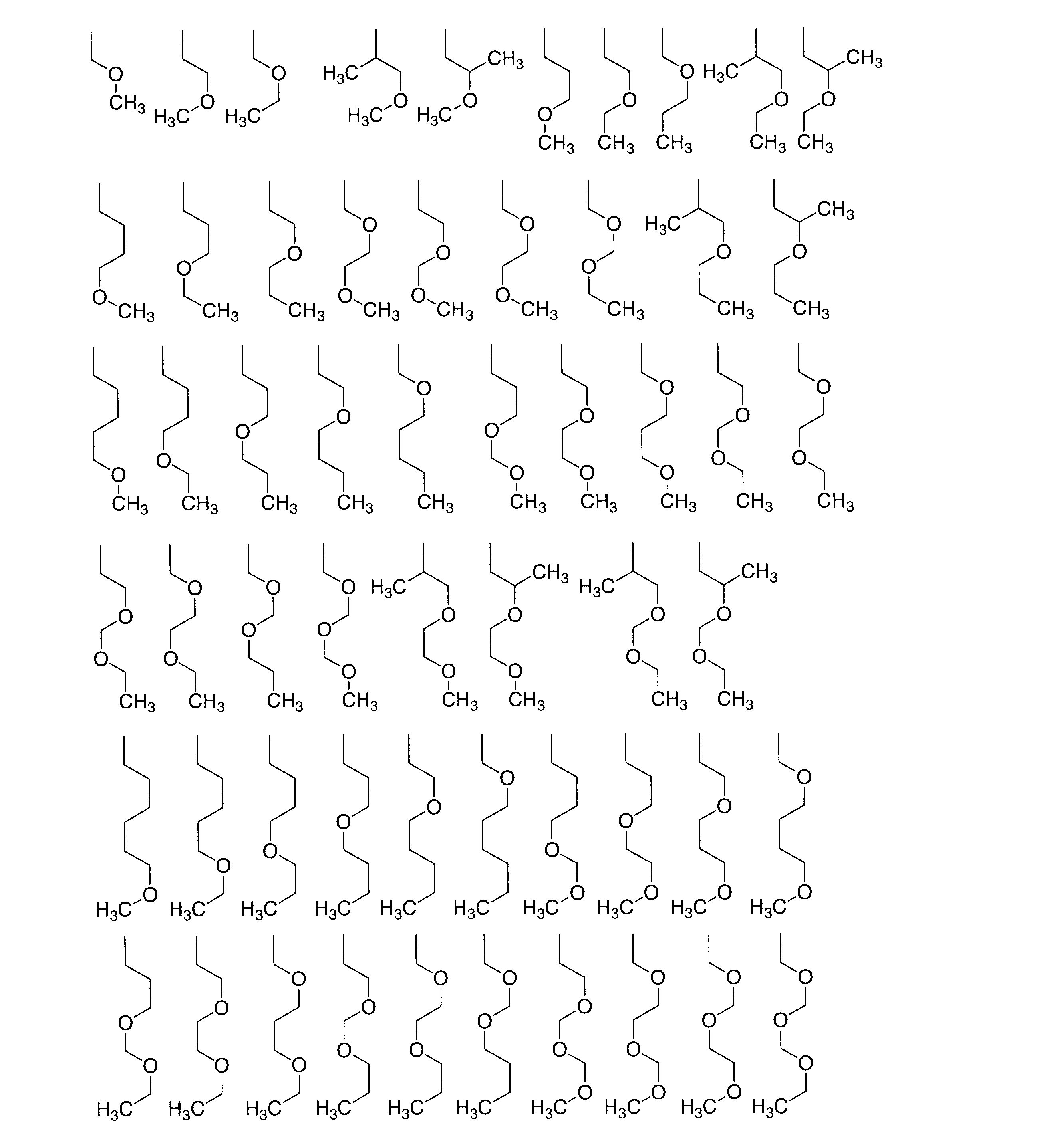
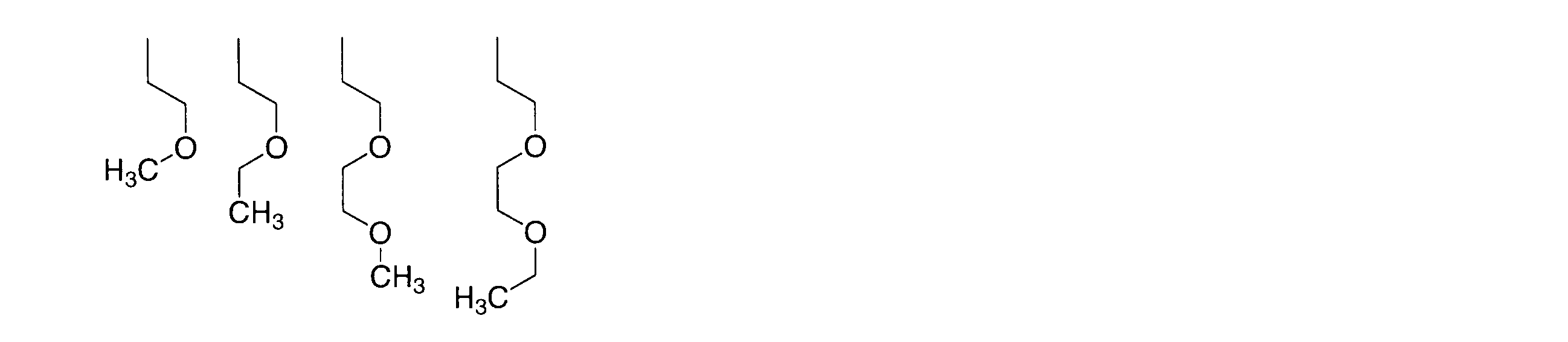
- R 2 is a linear alkyl group having 1 to 8 carbon atoms or a branched chain group having 3 to 8 carbon atoms shown below, and a part of the carbon atoms of the alkyl group is substituted with an oxygen atom. It may be a thing.
- Synthesis is easy, because the polymer is easily soluble to the fluorine-containing aliphatic alcohol, in the positive resist composition of the present invention, the R 2 which polymer comprises, specifically an alkyl group Is preferably used.
- R 2 may be a linear alkyl group having 1 to 8 carbon atoms or a branched alkyl group having 3 to 8 carbon atoms, in which some hydrogen atoms are substituted with fluorine atoms, as shown below. . Since the synthesis is easy and the polymer is easily soluble in the fluorinated aliphatic alcohol, the following alkyl groups are preferred.
- R 2 is a straight chain having 1 to 8 carbon atoms or 3 to 8 carbon atoms in which some carbon atoms shown below are substituted with oxygen atoms and some hydrogen atoms are substituted with fluorine atoms.
- a branched alkyl group may be used, the synthesis is easy, and the polymer is easily soluble in the fluorinated aliphatic alcohol, and the alkyl groups shown below are preferred.
- the polymer contained in the positive resist composition of the present invention needs to have a functional group serving as a bonding site for chemically bonding with the vinyl compound in order to heat cure the resist film.
- the polymer preferably has a carboxyl group or an alkylsulfonamide group in the side chain. These acidic groups react with and bind to the vinyl compound by heating.
- the reaction rate is slow and sufficient storage stability is obtained.
- the polymer contained in the composition of the present invention contains the repeating unit B represented by the general formula (2).
- R 3 is more preferably a hydrogen atom, a fluorine atom, a methyl group, or a trifluoromethyl group because the monomer can be easily synthesized.
- repeating unit B examples include a repeating unit B1 having the following carboxyl group or alkylsulfonamide group, and a repeating unit B2 in which the carboxyl group or alkylsulfonamide group is protected by a protecting group.
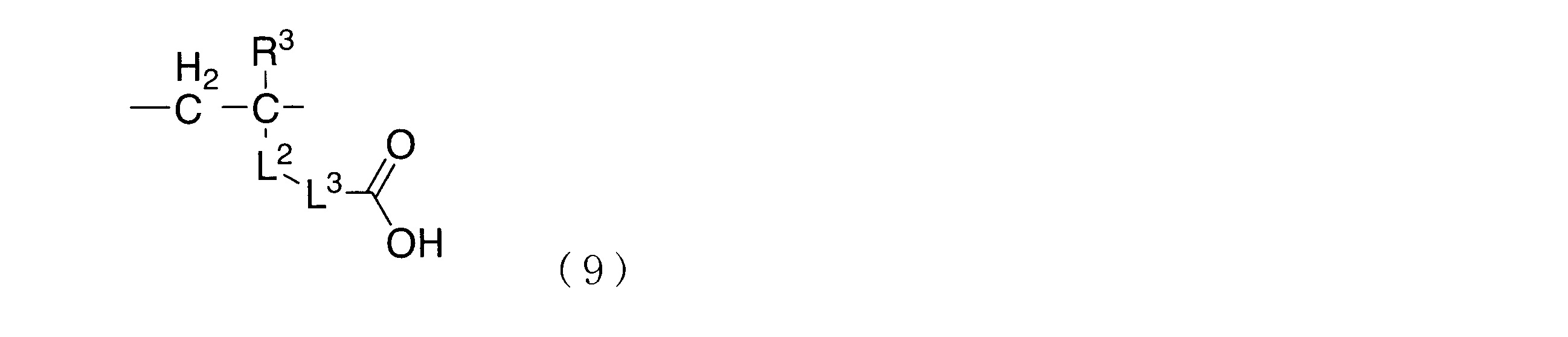
- Repeating unit B1 having a carboxyl group or an alkylsulfonamide group is a repeating unit represented by the following general formula (9).
- R 3 is a hydrogen atom, a fluorine atom or an alkyl group having 1 to 3 carbon atoms, and a part or all of the alkyl group is substituted with a fluorine atom or a chlorine atom.
- L 3 is a single bond, a linear divalent hydrocarbon group having 1 to 15 carbon atoms or a branched chain group having 3 to 15 carbon atoms, and some of the carbon atoms of the hydrocarbon group are oxygen An atom may be substituted, and a part or all of the hydrogen atoms of the hydrocarbon group may be substituted with a fluorine atom or a chlorine atom.
- R 3 is more preferably a hydrogen atom, a fluorine atom, a methyl group, or a trifluoromethyl group because the synthesis of the monomer is easy.
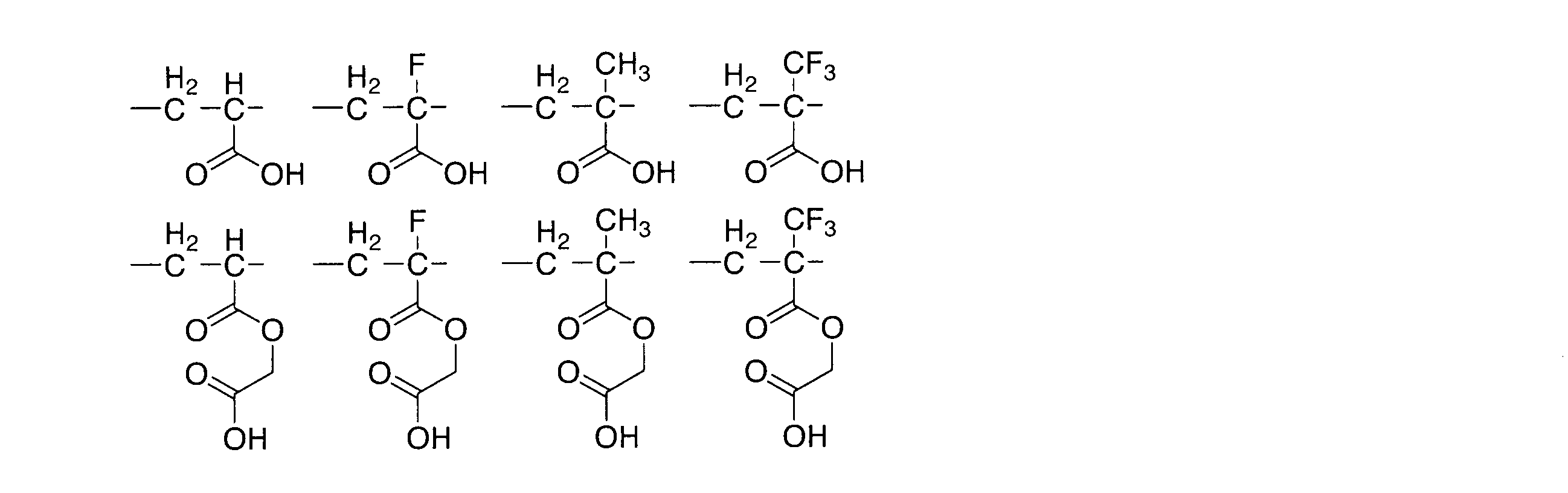
- repeating units B1 having a carboxyl group the structure shown below is particularly preferred because synthesis is easy and the polymer is easily soluble in the fluorinated aliphatic alcohol.
- the repeating unit B1 having an alkylsulfonamide group is a repeating unit B1 represented by the following general formula (10).
- R 3 is a hydrogen atom, a fluorine atom or an alkyl group having 1 to 3 carbon atoms, and a part or all of the alkyl groups are substituted with a fluorine atom or a chlorine atom.
- R 4 is an alkyl group, and part or all of the hydrogen atoms of the alkyl group may be substituted with a fluorine atom or a chlorine atom
- L 2 is a single bond, an oxygen atom, —CH 2 —O—, —C ( ⁇ O) —, —C ( ⁇ O) —O—, or —O—C ( ⁇ O) —
- L 3 represents a single bond, a linear carbon number of 1 to 15 or a branched divalent hydrocarbon group having 3 to 15 carbon atoms, in which some carbon atoms of the hydrocarbon group may be substituted with oxygen atoms, and a part of the hydrocarbon group Alternatively, all hydrogen atoms may be substituted with fluorine atoms or chlorine atoms.
- R 3 is more preferably a hydrogen atom, a fluorine atom, a methyl group, or a trifluoromethyl group because the synthesis of the monomer is easy.
- R 4 is more preferably a perfluoroalkyl group because of its high reactivity with vinyl compounds.
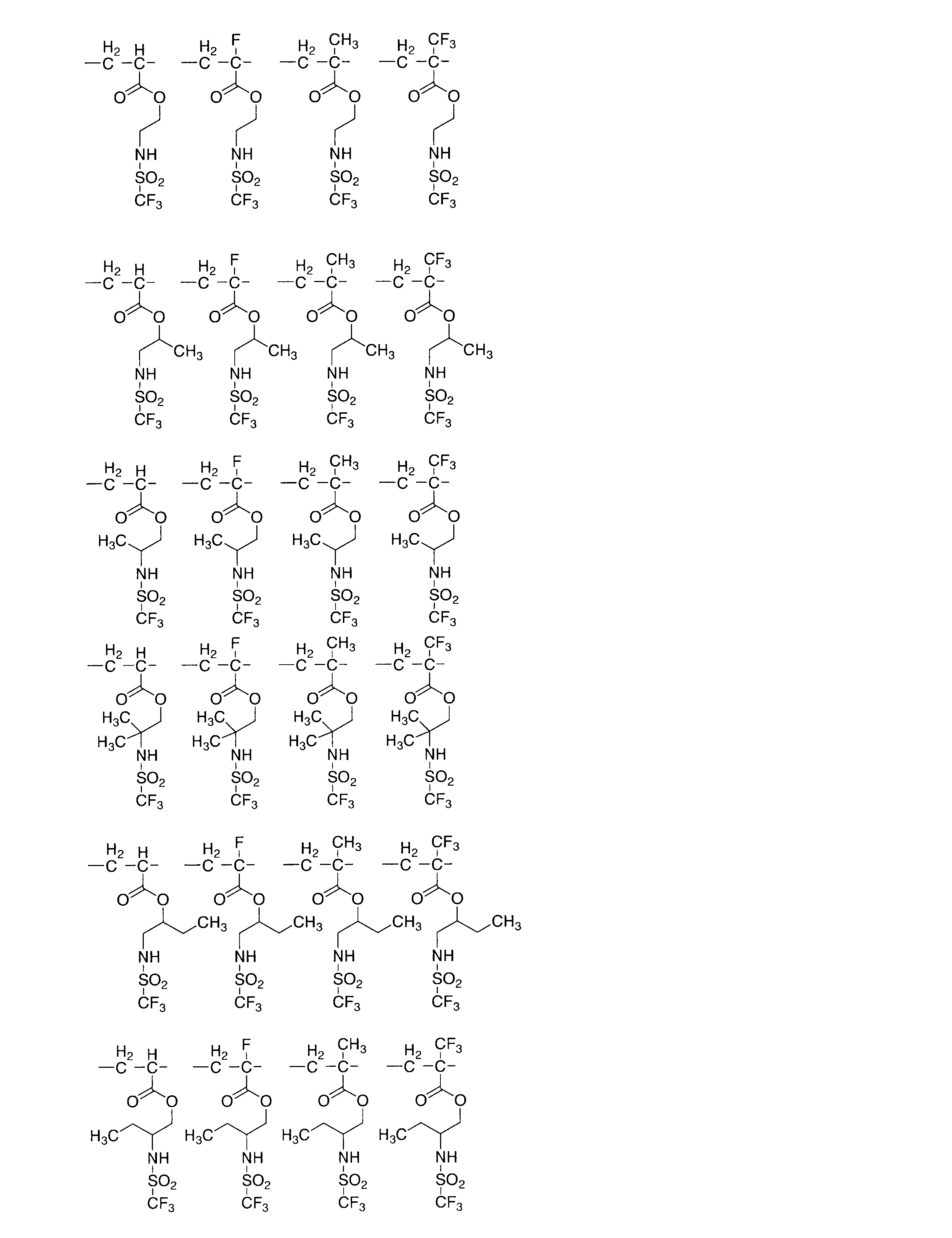
- repeating units B1 having a perfluoroalkylsulfonamide group the synthesis is easy, and the polymer is easily soluble in the fluorinated aliphatic alcohol. Therefore, the repeating unit B1 shown below can be exemplified. .
- repeating unit B2 in which carboxyl group or alkylsulfonamide group is protected by a protecting group
- the repeating unit B2 can be contained as a repeating unit having a functional group that becomes a bonding site for bonding with a vinyl compound.
- the repeating unit B2 has an acetal structure in which a carboxyl group or an alkylsulfonic acid group is protected in the side chain, and can generate a carboxyl group or an alkylsulfonamide group by heating, so that it is the same as the repeating unit B1.
- it reacts with and binds to the vinyl compound by heating.
- it since it does not have a group that binds to the vinyl compound before heating, if it is stored in a cool and dark place or stored in a cold room, the binding reaction does not occur and sufficient storage stability is obtained.
- the polymer contained in the composition of the present invention may contain the repeating unit B1 and the repeating unit B2 at the same time. Also, the polymer containing the repeating unit B1 and the polymer containing the repeating unit B2 may be mixed. May be used.
- the method for synthesizing the polymer containing the repeating unit B2 is not particularly limited, and a known method can be often used.
- a method for synthesizing a polymer containing the repeating unit B2 a monomer having an acetal structure is first synthesized by reacting a monomer having a carboxyl group or an alkylsulfonamide group in the side chain with vinyl ether, A method of performing a polymerization reaction using this monomer (hereinafter referred to as a monomer acetalization method) or a polymer containing the repeating unit B1 is first synthesized, and this polymer is reacted with vinyl ether.
- Examples thereof include a method for obtaining a polymer having an acetal structure (hereinafter referred to as a polymer acetalization method).
- a polymer acetalization method a method for obtaining a polymer having an acetal structure
- the reaction of the monomer or polymer having a carboxyl group or an alkylsulfonamide group with vinyl ether is performed by mixing the monomer or polymer and vinyl ether.
- the acid catalyst include sulfuric acid, methanesulfonic acid, camphorsulfonic acid, paratoluenesulfonic acid, and trifluoromethanesulfonic acid.
- a solvent may be used for the purpose of removing reaction heat or reducing the viscosity of the reaction solution.
- the solvent those which do not interfere with the reaction of the carboxyl group or alkylsulfonamide group with vinyl ether are preferable.
- ketones such as acetone, 2-butanone or 4-methyl-2-pentanone, ethyl acetate, propyl acetate, n-acetate -Esters such as butyl, isobutyl acetate or propylene glycol monomethyl ether acetate, aromatic compounds such as toluene or xylene, and ethers such as ethyl ether, isopropyl ether, n-butyl ether or ethylene glycol diethyl ether.
- the solvent may be used alone or in combination.
- vinyl ether used in the reaction for forming the acetal structure well-known ones can be often used. Specifically, methyl vinyl ether, ethyl vinyl ether, n-propyl vinyl ether, isopropyl vinyl ether, n-butyl vinyl ether, isobutyl vinyl ether, tertiary butyl vinyl ether, cyclohexyl vinyl ether, cyclohexyl methyl vinyl ether, 2-hydroxyethyl vinyl ether, 3-hydroxypropyl vinyl ether 4-hydroxybutyl vinyl ether, 4-hydroxycyclohexyl vinyl ether, 4- (hydroxymethyl) cyclohexyl vinyl ether, 2,3-dihydrofuran, 3,4-dihydro-2H-pyran, 2,2,2-trifluoroethyl vinyl ether, 2,2,3,3-tetrafluoropropyl vinyl ether, 2,2,3,3,3-pentafluoropro Ru vinyl ether, 2,2,3,4,4,4--
- R 3 is more preferably a hydrogen atom, a fluorine atom, a methyl group, or a trifluoromethyl group because the synthesis of the monomer is easy.
- repeating unit B2 in which a carboxyl group is protected with a protecting group to generate a carboxyl group and repeating unit B2 in which an alkylsulfonamide group is protected with a protecting group are given. It is done.
- R 3 is a hydrogen atom, a fluorine atom or an alkyl group having 1 to 3 carbon atoms, and a part or all of the alkyl groups are substituted with a fluorine atom or a chlorine atom.
- R 5 is a linear, branched or cyclic hydrocarbon group having 1 to 15 carbon atoms, and part or all of the hydrogen atoms of the hydrocarbon group are substituted with fluorine atoms or chlorine atoms.
- R 6 is a hydrogen atom or a linear, branched, or cyclic hydrocarbon group having 1 to 15 carbon atoms, and a part or all of the hydrogen atoms of the hydrocarbon group are fluorine atoms. It may be substituted by atom or a chlorine atom, and R 5 and R 6 may form a ring structure by a chemical bond, L 2 is a single bond, an oxygen atom, -CH 2 -O -, - C ( ⁇ O) —, —C ( ⁇ O) —O—, or —O—C ( ⁇ O - and, L 3 represents a single bond, a straight-chain having a carbon number of 1 to 15 or a divalent hydrocarbon group of branched C 3 to C 15, a portion of the hydrocarbon group having a carbon An atom may be substituted with an oxygen atom, and a part or all of the hydrogen atoms of the hydrocarbon group may be substituted with a fluorine atom or a chlorine atom.
- R 5 is a linear hydrocarbon group having 1 to 15 carbon atoms, a branched chain group having 3 to 15 carbon atoms, or a cyclic hydrocarbon group having 6 to 15 carbon atoms, and a part or all of the hydrogen atoms of the hydrocarbon group
- the atom may be substituted with a fluorine atom or a chlorine atom
- R 6 is a hydrogen atom, a straight chain having 1 to 15 carbon atoms, a branched chain having 3 to 15 carbon atoms, or a cyclic group having 6 to 15 carbon atoms
- a part or all of the hydrogen atoms of the hydrocarbon group may be substituted with a fluorine atom or a chlorine atom, and R 5 and R 6 may be bonded to form a cyclic structure. .
- R 3 is more preferably a hydrogen atom, a fluorine atom, a methyl group, or a trifluoromethyl group because the synthesis of the monomer is easy.
- R 5 is a linear, branched, or cyclic hydrocarbon group having 1 to 15 carbon atoms, and a part or all of the hydrogen atoms of the hydrocarbon group are substituted with fluorine atoms or chlorine atoms.
- R 6 is a hydrogen atom or a linear, branched, or cyclic hydrocarbon group having 1 to 15 carbon atoms, and a part or all of the hydrogen atoms of the hydrocarbon group are fluorine atoms or chlorine atoms. It may be substituted with an atom, and R 5 and R 6 may form a cyclic structure by a chemical bond.
- R 5 represents methyl group, ethyl group, n-propyl group, isopropyl group, n-butyl group, isobutyl group, tertiary butyl group, cyclohexyl group.
- Group, cyclohexylmethyl group, 2-hydroxyethyl group, 3-hydroxypropyl group, 4-hydroxybutyl group, 4-hydroxycyclohexyl group and 4- (hydroxymethyl) cyclohexyl group are preferred
- R 6 is a hydrogen atom or a methyl group. preferable.
- R 5 and R 6 may form a cyclic structure by a chemical bond.
- R 3 is more preferably a hydrogen atom, a fluorine atom, a methyl group, or a trifluoromethyl group because the synthesis of the monomer is easy.
- repeating unit B2 that generates a carboxyl group
- specific examples of the repeating unit B2 that generates a carboxyl group include the repeating unit B2 shown in the figure below.
- R 3 is a hydrogen atom, a fluorine atom or an alkyl group having 1 to 3 carbon atoms, and a part or all of the alkyl groups are substituted with a fluorine atom or a chlorine atom.
- R 4 is an alkyl group having 1 to 8 carbon atoms, and part or all of the hydrogen atoms of the alkyl group may be substituted with a fluorine atom or a chlorine atom, and R 7 is an alkyl group having 1 carbon atom.
- R 8 is a hydrogen atom or a linear hydrocarbon group having 1 to 15 carbon atoms, a branched chain group having 3 to 15 carbon atoms, or a cyclic hydrocarbon group having 6 to 15 carbon atoms, Some or all of the hydrogen atoms of the hydrocarbon group are fluorine atoms.
- R 7 and R 8 may form a ring structure by a chemical bond
- L 2 is a single bond, an oxygen atom, -CH 2 -O -, - C ( ⁇ O) —, —C ( ⁇ O) —O—, or —O—C ( ⁇ O) —
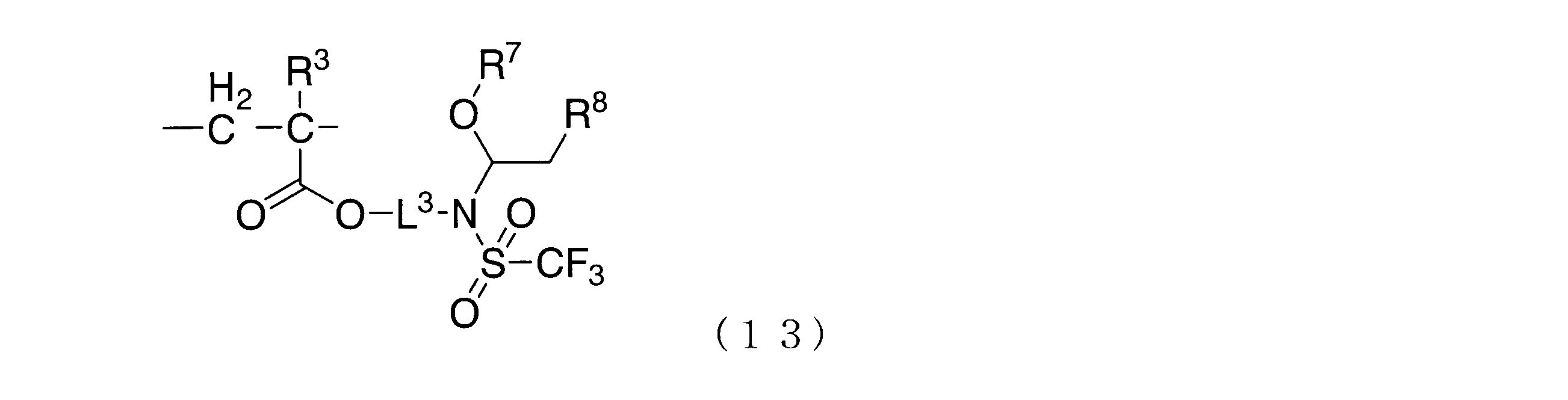
- L 3 represents a single bond, a linear carbon number of 1 to 15, or a carbon number of 3 to 15 branched chain divalent hydrocarbon groups, wherein some of the carbon atoms of the hydrocarbon group may be substituted with oxygen atoms, and some or all of the hydrogen atoms of the hydrocarbon group may be fluorine. It may be substituted with an atom or a chlorine atom.
- R 3 is more preferably a hydrogen atom, a fluorine atom, a methyl group, or a trifluoromethyl group because the synthesis of the monomer is easy.
- the protecting group for the alkylsulfonamide group is specifically the following group.
- R 7 is C 1 -C 15 straight, having from 3 to 15 branched chain carbon atoms, or a cyclic hydrocarbon group having 6 to 15 carbon atoms, some or all of the hydrogen of the hydrocarbon group The atom may be substituted with a fluorine atom or a chlorine atom
- R 8 is a hydrogen atom, a straight chain having 1 to 15 carbon atoms, a branched chain having 3 to 15 carbon atoms, or a cyclic group having 6 to 15 carbon atoms
- a part or all of the hydrogen atoms of the hydrocarbon group may be substituted with a fluorine atom or a chlorine atom, and R 7 and R 8 may form a cyclic structure by a chemical bond Good.
- R 3 is a hydrogen atom, a fluorine atom or a trifluoromethyl group.
- R 7 is C 1 -C 15 straight, having from 3 to 15 branched chain carbon atoms, or a cyclic hydrocarbon group having 6 to 15 carbon atoms, some or all of the hydrogen of the hydrocarbon group
- the atom may be substituted with a fluorine atom or a chlorine atom
- R 8 is a hydrogen atom or a straight chain having 1 to 15 carbon atoms, a branched chain having 3 to 15 carbon atoms, or a cyclic group having 6 to 15 carbon atoms. It is a hydrocarbon group, and part or all of the hydrogen atoms of the hydrocarbon group may be substituted with a fluorine atom or a chlorine atom, and R 7 and R 8 may form a cyclic structure by a chemical bond.
- L 3 is a divalent hydrocarbon group having 2 to 4 carbon atoms.
- R 7 is a methyl group, an ethyl group, an n-propyl group, an isopropyl group, an n-butyl group, an isobutyl group, from the viewpoint of ease of monomer synthesis and availability of a raw material vinyl ether.
- a tertiary butyl group, a cyclohexyl group, a cyclohexylmethyl group, a 2-hydroxyethyl group, a 3-hydroxypropyl group, a 4-hydroxybutyl group, a 4-hydroxycyclohexyl group, and a 4- (hydroxymethyl) cyclohexyl group are preferred, and R 8 is A hydrogen atom or a methyl group is preferred.
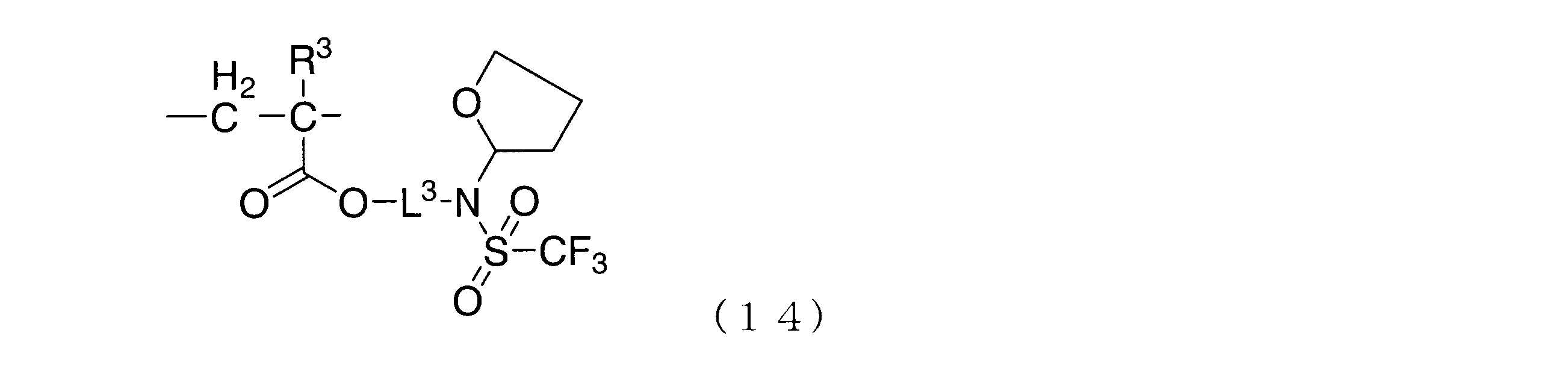
- R 7 and R 8 may form a cyclic structure by a chemical bond, and specific examples of the preferred repeating unit B2 include the following general formula (14) or the following general formula (15).
- R 3 is a hydrogen atom, a fluorine atom or a trifluoromethyl group.
- L 3 is a divalent hydrocarbon group having 2 to 4 carbon atoms.
- R 3 is a hydrogen atom, a fluorine atom or a trifluoromethyl group.
- L 3 is a divalent hydrocarbon group having 2 to 4 carbon atoms.
- the ratio of the repeating unit A represented by the general formula (1) to the entire polymer is: Expressed in mol%, it is 25% or more and 80% or less. More preferably, it is 50% or more and 75% or less. If the content is less than 25%, it may become insoluble in the fluorine-containing aliphatic alcohol as a solvent, or may not be applied to a uniform thickness when applied to a resist substrate. When the content is more than 80%, the resist pattern may have insufficient contrast (poor resolution) due to insufficient solubility in the developer.
- the ratio of the repeating unit B1 represented by the general formula (2) and the repeating unit B2 represented by the general formula (5) to the entire polymer is mol%.
- the total of the repeating unit B1 and the repeating unit B2 is 20% or more and 75% or less. More preferably, the total of the repeating unit B1 and the repeating unit B2 is 25% or more and 50% or less. If the total content of the repeating unit B1 and the repeating unit B2 is less than 20%, there are few binding sites with the vinyl compound, so that the resist pattern has insufficient contrast due to insufficient solubility in the developer, There is a risk of peeling.
- the ratio between the repeating unit B1 and the repeating unit B2 is not particularly limited, but the storage stability of the positive resist composition improves as the ratio of the repeating unit B2 increases.
- the repeating unit B2 is contained for the purpose of improving the storage stability, the repeating unit B2 is preferably contained in the same or more amount as the repeating unit B1 in terms of mol% of the entire polymer.
- the ratio of the repeating unit B2 is lower than the ratio of the repeating unit B1, the effect of improving the storage stability by using the repeating unit B2 may not be sufficiently exhibited.
- the repeating unit B1 and the repeating unit B2 in addition to the repeating unit A, the repeating unit B1 and the repeating unit B2, other repeating units are contained as the balance. May be.
- the proportion of the polymer in the positive resist composition of the present invention is 0.5 parts by mass or more and 30 parts by mass or less, more preferably 1 part by mass, with 100 parts by mass of the fluorine-containing aliphatic alcohol as a solvent. Part or more and 15 parts by mass or less, more preferably 3 parts by mass or more and 15 parts by mass or less.
- the content of the polymer is less than 0.5 parts by mass, it is difficult to obtain a desired thickness as a resist film when the positive resist composition is wet-coated on the substrate.
- the amount is more than 30 parts by mass, the viscosity of the positive resist composition becomes high and it is difficult to obtain a resist film having a uniform thickness.
- the positive resist composition in the present invention contains a polyfunctional vinyl compound, specifically, a vinyl compound containing two or more vinyl ether groups. Due to the bonding between the vinyl ether group and the bonding site in the polymer, solvent resistance is imparted to the resist film of the positive resist composition in the present invention.
- a vinyl compound having a trifunctional or higher functionality as the vinyl ether group is particularly preferable.
- another monofunctional or polyfunctional vinyl compound may be further used for adjusting the number of binding sites.
- the boiling point of the vinyl compound is preferably the same as or higher than the heat curing temperature of the resist film, and more preferably 30 ° C. higher than the heat curing temperature.
- the boiling point of the vinyl compound is lower than the heat-curing temperature, part or all of it volatilizes from the resist film during the curing, so that the curing may be insufficient.
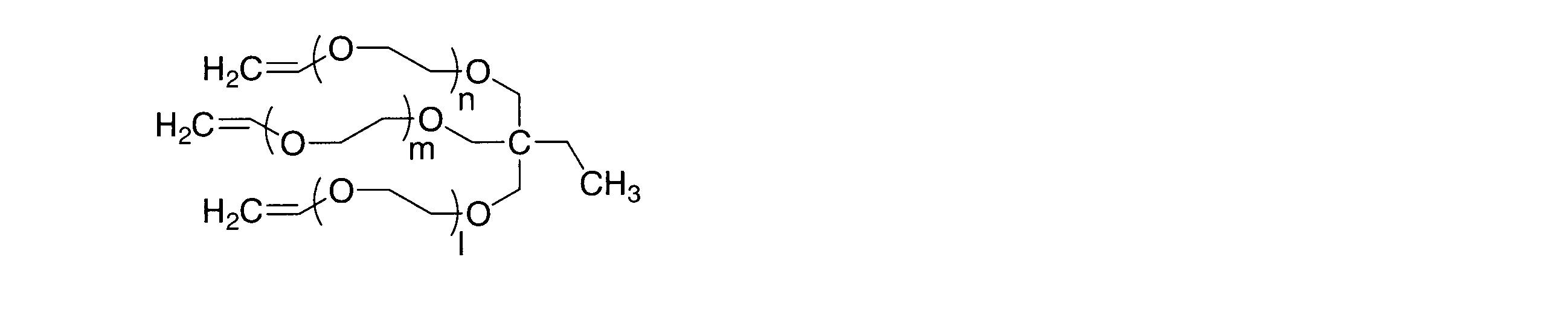
- a compound represented by the general formula (16) can be given.
- l, m, and n are integers of 0 or more and 25 or less, respectively.
- l, m, and n are integers of 0 or more and 18 or less, respectively.
- the average value of l + m + n is 3 or more and 6 or less.
- TMPEOTVE TMPEOTVE-30
- TMPEOTVE-60 TMPEOTVE-60
- the content of the vinyl compound in the positive resist composition of the present invention is preferably 0.05 parts by mass or more and 20 parts by mass or less, based on 100 parts by mass of the fluorine-containing aliphatic alcohol as a solvent. More preferably, it is 0.1 to 10 parts by mass, and more preferably 0.3 to 10 parts by mass.
- the content ratio of the vinyl compound is smaller than 0.05 parts by mass, curing due to bonding is insufficient, sufficient solvent resistance cannot be imparted, and dissolution or peeling tends to occur during development. More preferably, it is 0.1 mass part or more, More preferably, it is 0.3 mass part or more.
- the proportion of the vinyl compound is larger than 20 parts by mass, an unreacted vinyl compound is generated and may be eluted during development to adversely affect pattern formation. More preferably, it is 10 parts by mass or less.
- the positive resist composition according to the present invention contains a compound that generates an acid upon exposure, that is, a photoacid generator, in order to obtain a resist pattern after development.
- a photoacid generator it is preferable to select a photoacid generator that exhibits remarkable solubility in a developing solution in an exposed area after development and imparts sufficient contrast to a resist pattern after development.
- the photoacid generator contained in the positive resist composition of the present invention is preferably dissolved in a fluorine-containing aliphatic alcohol as a solvent.
- the content is 0.01 parts by mass or more and 15 parts by mass or less when the total mass of the polymer and the vinyl compound in the positive resist composition is defined as 100. More preferably, they are 0.1 mass part or more and 10 mass parts or less, More preferably, they are 0.5 mass part or more and 10 mass parts or less. If the content of the photoacid generator is less than 0.01 parts by mass, it is difficult to impart sufficient contrast to the resist pattern after development.
- it is 0.1 mass part or more, More preferably, it is 0.5 mass part or more.
- it is 10 parts by mass or less.
- the photoacid generator preferably has a thermal decomposition temperature higher than the heat curing temperature.
- the decomposition start temperature is higher than the heat curing temperature, more preferably higher than the heat curing temperature by 10 ° C., more preferably higher than the heat curing temperature by 20 ° C.
- the decomposition start temperature is low, an acid is generated even in an unexposed portion, which may cause a lack of solubility contrast.
- this is not an essential condition.
- the component of the photoacid generator contained in the positive resist composition of the present invention may be any compound that generates an acid upon irradiation with high energy rays and can be dissolved in a fluorine-containing aliphatic alcohol as a solvent.
- iodonium salts, sulfonyldiazomethane, N-sulfonyloxyimide or oxime-O-sulfonate may be used alone or in combination of two or more, and are preferably N-sulfonyloxyimide or oxime-O-sulfonate.
- N-sulfonyloxyimide having a structure represented by the following general formula (7) from the viewpoint of solubility in a fluorine-containing aliphatic alcohol as a solvent Or oxime-O-sulfonate is particularly preferred.
- R 9 is an alkyl group having 1 to 12 carbon atoms, and part or all of the hydrogen atoms of the alkyl group may be substituted with a fluorine atom, and may be a phenyl group, a naphthyl group or a biphenyl group.
- a part or all of the hydrogen atoms of the aromatic ring of these groups may be substituted with a fluorine atom, a chlorine atom, a methyl group, or a trifluoromethyl group, and the two bonds of the nitrogen atom are A single atom may be formed with each individual atom, or a double bond may be formed with one atom.
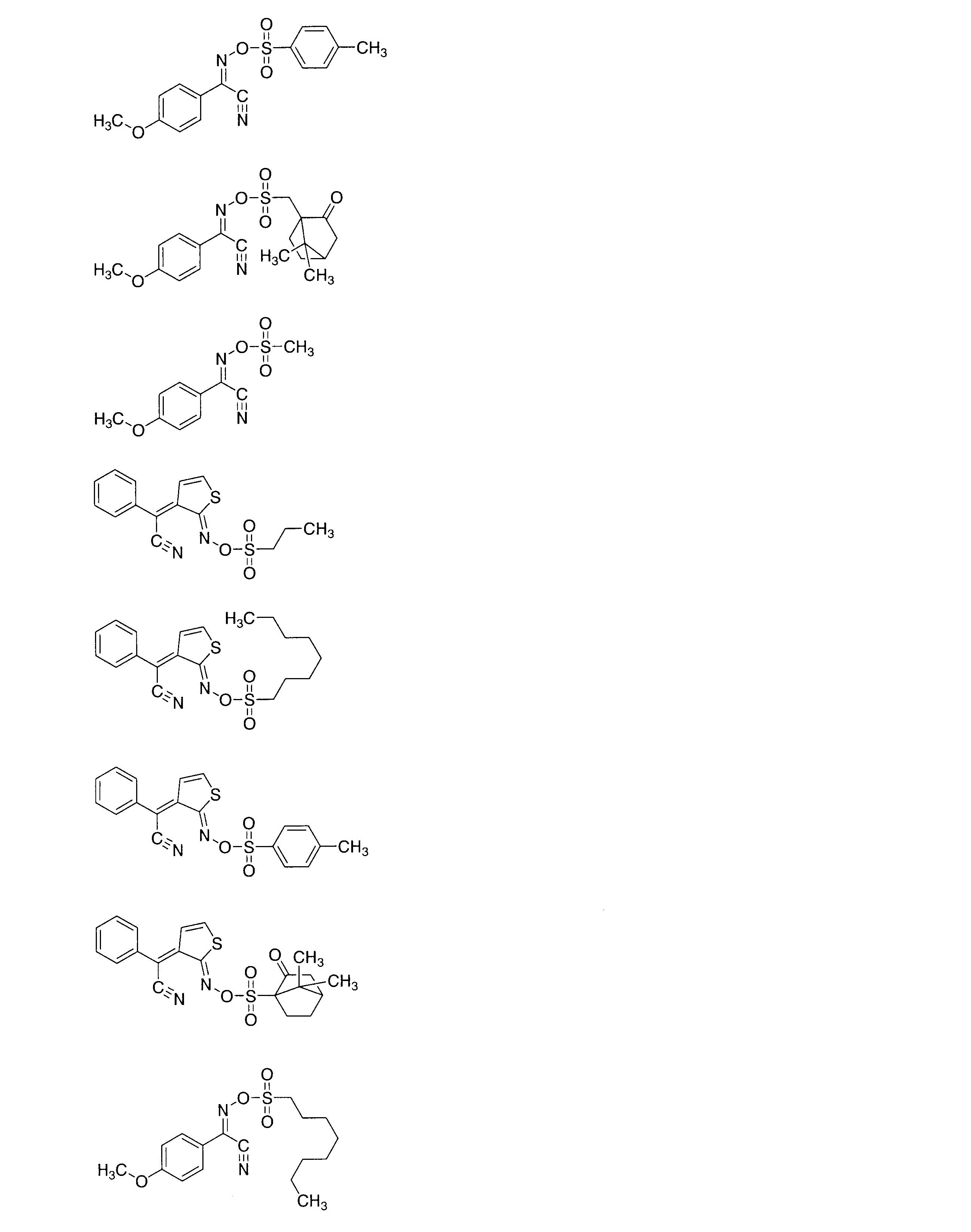
- Examples of the photoacid generator in which the two bonds of the nitrogen atom in formula (7) form a single bond with separate atoms include the following N-sulfonyloxyimide compounds.
- NAI-105 NAI-101
- NAI-106 NAI-106
- examples of the photoacid generator in which two bonds of the nitrogen atom in the formula (7) form a double bond with one atom include the following oxime-O-sulfonate compounds.
- the photoacid generator is sensitive to wavelengths of ultraviolet light such as g-line (wavelength, 436 nm), h-line (wavelength, 405 nm), and i-line (wavelength, 365 nm). Acid is generated by light irradiation, and the resist film in the irradiated portion is made soluble in the developer.
- the resist film containing the positive resist composition of the present invention is such that an irradiated portion having an acid generated by irradiation with ultraviolet light becomes soluble in a developer, and a resist pattern can be formed. It becomes possible.
- R 10 is an alkyl group having 1 to 12 carbon atoms, and part or all of the hydrogen atoms of the alkyl group may be substituted with a fluorine atom, and may be a phenyl group, a naphthyl group or a biphenyl group.
- a part or all of the hydrogen atoms of the aromatic ring of these groups may be substituted with a fluorine atom, a chlorine atom, a methyl group, a trifluoromethyl group, a methoxy group, a phenoxy group or a thiophenyl group
- R 11 to R 13 are a phenyl group, a naphthyl group or a biphenyl group
- some or all of the hydrogen atoms bonded to the aromatic ring of these groups are a methyl group, a trifluoromethyl group, a methoxy group, a phenoxy group, a thiophenyl group It may be substituted with a group, a fluorine atom or a chlorine atom.
- the photoacid generator is sensitive to ultraviolet wavelengths of g-line, h-line and i-line, and ultraviolet light from KrF excimer laser (wavelength, 248 nm) or ArF excimer laser (wavelength, 193 nm) depending on its molecular structure.
- the acid is generated by the irradiation of the ultraviolet light, and the resist film in the irradiated portion is made soluble in the developer.
- the resist film containing the positive resist composition of the present invention has an irradiation part having an acid generated by the irradiation of ultraviolet light so that it can be dissolved in a developer, and a resist pattern can be formed. It becomes possible.
- the positive resist composition of the present invention can contain other additives as required in addition to the polymer, vinyl compound and photoacid generator.
- a surfactant or a base can be added. Can be mentioned. These can be used for the purpose of improving the film formability or storage stability of the positive resist composition of the present invention.
- a commercially available surfactant can be blended for the purpose of improving coating properties, antifoaming properties, leveling properties and the like.
- the compounding quantity of these surfactant is normally 5 mass parts or less with respect to 100 mass parts of resin in a resin composition.
- the positive resist composition of the present invention can contain a nitrogen-containing organic compound as a basic compound. Mixing nitrogen-containing organic compounds suppresses acid diffusion when exposed as a resist film, improves resolution, improves exposure margins and pattern profiles, and improves the stability of vinyl compounds. Can be made.
- nitrogen-containing organic compounds examples include primary, secondary, and tertiary aliphatic amines, nitrogen-containing compounds having a hydroxyl group, amides, imides, and carbamates.
- the primary aliphatic amines include methylamine, ethylamine, propylamine, isopropylamine, butylamine, isobutylamine, tertiary butylamine, pentylamine, isopentylamine, tertiary pentylamine, hexylamine. Cyclohexylamine, octylamine, methylenediamine or ethylenediamine.
- Secondary aliphatic amines include dimethylamine, diethylamine, dipropylamine, diisopropylamine, dibutylamine, diisobutylamine, dipentylamine, dihexylamine, dicyclohexylamine, dioctylamine, N, N'-dimethylmethylene. Examples include diamine or N, N′-dimethylethylenediamine.
- Tertiary aliphatic amines include trimethylamine, triethylamine, tripropylamine, triisopropylamine, tributylamine, triisobutylamine, tripentylamine, trihexylamine, tricyclohexylamine, butyldimethylamine, diisopropylethylamine.
- nitrogen-containing compound having a hydroxyl group examples include monoethanolamine, diethanolamine, triethanolamine, N-ethyldiethanolamine, N, N-diethylethanolamine, triisopropanolamine, 2,2′-iminodiethanol, 2-aminoethanol- 3-amino-1-propanol, 4-amino-1-butanol, 4- (2-hydroxyethyl) morpholine, 1- [2- (2-hydroxyethoxy) ethyl] piperazine, piperidine ethanol, 1- (2 -Hydroxyethyl) pyrrolidine, 1- (2-hydroxyethyl) -2-pyrrolidinone, 3-piperidino-1,2-propanediol, 3-pyrrolidino-1,2-propanediol, 8-hydroxyeurolidine, Inuclidinol, 3-tropanol, 1 Methyl-2-pyrrolidine ethanol, 1-aziridine ethanol, N- (2- hydroxy
- amides include formamide, N-methylformamide, N, N-dimethylformamide, acetamide, N-methylacetamide, N, N-dimethylacetamide, and propionamide.
- imides include phthalimide and succinimide.
- Carbamates include N-tertiary butoxycarbonyl-N, N-dicyclohexylamine.
- the positive resist composition of the present invention is obtained by applying a resist solution on a target substrate, heat-drying and heat-curing to form a resist film, and then exposing and developing with a developer. By processing, a resist pattern can be formed on the substrate.
- the positive resist composition of the present invention can be applied onto a substrate by a wet coating method using a bar coater, a spin coater or a roll coater.
- heating is performed to remove the solvent in the positive resist composition and promote the binding reaction between the polymer and the vinyl compound to sufficiently cure the resist film.
- a heating method a known method such as heating with a hot plate can be used.
- the heating temperature is usually 60 ° C. or higher and 150 ° C. or lower, preferably 80 ° C. or higher and 140 ° C. or lower.
- the heating temperature is lower than 60 ° C. or higher than 150 ° C., the resist film is not sufficiently cured, and the dissolution contrast is insufficient due to the difference in the presence or absence of dissolution in the developer between the exposed and unexposed areas, or development.
- a resist pattern obtained later may be wetted with an organic solvent.
- the heating time is usually 30 seconds or longer, preferably 1 minute or longer.
- the heating time is shorter than 30 seconds, the resist film is not sufficiently cured, and there is insufficient dissolution contrast due to the difference in the presence or absence of dissolution in the light portion of the exposed portion, the unexposed portion and the unexposed portion, or after development.
- the resulting resist pattern may be wetted or swollen with respect to the organic solvent.
- a well-known method can be used well for exposure of the resist film obtained by the positive resist composition of the present invention. That is, the resist film is exposed with a photomask pattern using a light source such as a low-pressure mercury lamp, a high-pressure mercury lamp, an ultrahigh-pressure mercury lamp, a KrF excimer laser (wavelength 248 nm), or an ArF excimer laser (wavelength 193 nm).
- a light source such as a low-pressure mercury lamp, a high-pressure mercury lamp, an ultrahigh-pressure mercury lamp, a KrF excimer laser (wavelength 248 nm), or an ArF excimer laser (wavelength 193 nm).
- the exposure amount 1 ⁇ 10000mJ / cm 2 approximately in the exposure, preferably exposed such that 10 ⁇ 5000mJ / cm 2 approximately.
- the resist film after exposure may be developed as it is, but may be subjected to heat treatment before development in order to promote the decomposition reaction of the polymer by the acid generated from the photoacid generator in the exposed portion,
- a heating method a known method such as heating by a hot plate can be used.
- the heating temperature is usually 140 ° C. or lower, preferably 130 ° C. or lower.
- the heating temperature is higher than 140 ° C., the polymer constituting the resist composition is deteriorated by heat, the contrast due to the difference in solubility in the developer is insufficient, or the resist pattern obtained after development is wet with respect to the organic solvent. It can happen that it swells.
- Development of the exposed resist film is performed by a dipping method using a developing solution of an alkaline aqueous solution such as 0.1 to 5% by mass, preferably 2 to 3% by mass of tetramethylammonium hydroxide (TMAH).
- TMAH tetramethylammonium hydroxide
- the development time is preferably 0.1 minutes or more and 3 minutes or less, preferably 0.5 minutes or more and 2 minutes or less by a known method such as a spray method, and the desired resist pattern is formed on the substrate.
- a PET substrate was used as the organic polymer substrate. Specifically, a 100- ⁇ m-thick PET (manufactured by Toray Industries, Inc., trade name, Lumirror T60) cut into a size of 5 cm ⁇ 5 cm with a cutter knife was used.
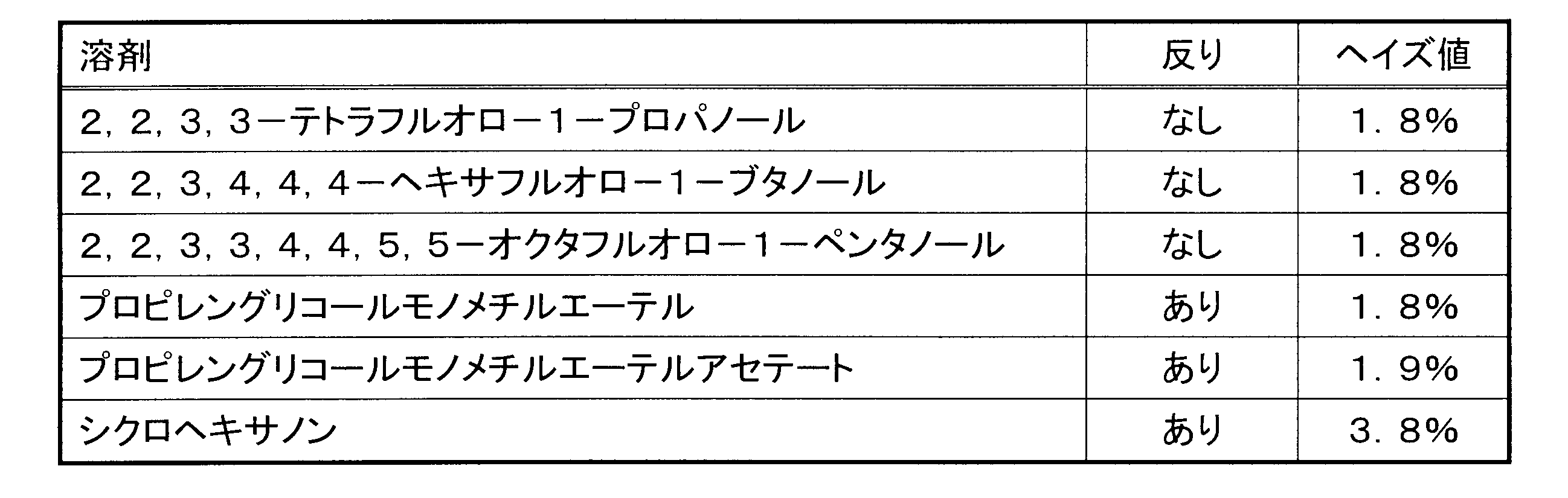
- the solvent is a monovalent alcohol having 2 to 8 carbon atoms and 2,2,3,3-tetrafluoro-1 as a fluorinated aliphatic alcohol having a number of hydrogen atoms equal to or less than the number of fluorine atoms.
- -Propanol, 2,2,3,4,4,4-hexafluoro-1-butanol and 2,2,3,3,4,4,5,5-octafluoro-1-pentanol were used.
- propylene glycol monomethyl ether, propylene glycol monomethyl ether acetate and cyclohexanone were used, respectively.
- the PET substrate was completely immersed for 120 seconds in a petri dish filled with various solvents, then dried on a hot plate heated to 100 ° C., and the presence or absence of warpage due to swelling of the solvent of the PET substrate, The haze value was measured and evaluated with a haze meter (manufactured by Nippon Denshoku Industries Co., Ltd., model name, NDH2000). The haze value was measured according to JIS K7136. The PET substrate before the test was not warped and the haze value was 2.0%.
- the PET substrate is not warped and the haze value is hardly changed compared to the PET substrate before the immersion test.
- the substrate warps due to swelling of the solvent.
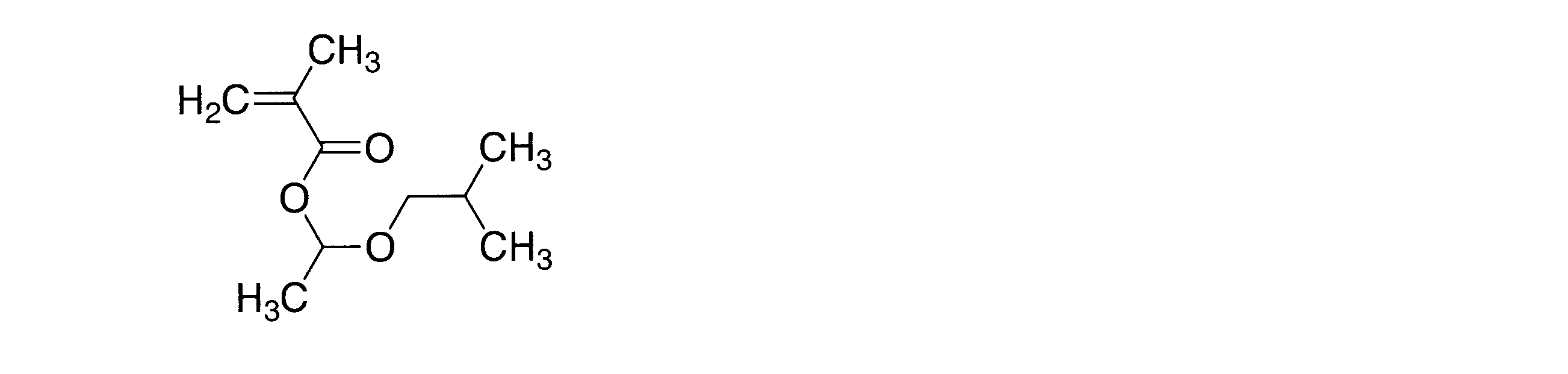
- the total amount of the separated organic layer was mixed with 20 mL of a saturated aqueous sodium chloride solution and allowed to stand to separate the organic layer. After removing water contained in the separated organic layer with sodium sulfate, a liquid was obtained by filtration. The resulting liquid is concentrated on a rotary evaporator at a temperature of 40 ° C. and a pressure of 30 hPa, and the carboxyl group is protected by a protecting group to give the repeating unit B2 to the polymer shown below as 12.32 g of a pale yellow liquid. As a result, 1- (2-methylpropoxy) ethyl methacrylate was obtained.
- the raw material monomers used for the synthesis of the polymer are shown in Table 2 for the monomer that contains the repeating unit A in the polymer, and in Table 3 for the monomer that contains the repeating unit B1 in the polymer.
- Table 4 shows monomers that contain the repeating unit B2 in the product, and
- Table 5 shows monomers that give repeating units that do not correspond to the repeating units A, B1, and B2 in the polymer.
- the raw material monomers are indicated by abbreviations in Table 2, Table 3, Table 4, and Table 5.
- polymerization initiator a commercially available product of dimethyl 2,2′-azobis (2-methylpropionate) (manufactured by Wako Pure Chemical Industries, Ltd., product number, V-601) was used. (Abbreviated as 601) 2-butanone was used as the reaction solvent.
- Examples of polymer synthesis are shown in Examples 1 to 14 which are in the category of the polymer of the present invention, and Comparative Examples 1 to 4 which are not in the category of the polymer of the present invention.
- the polymer is denoted by P (raw material monomer abbreviation / raw material monomer abbreviation), using P as the meaning of the polymer, using the abbreviation of the raw material monomer in parentheses.
- P raw material monomer abbreviation / raw material monomer abbreviation
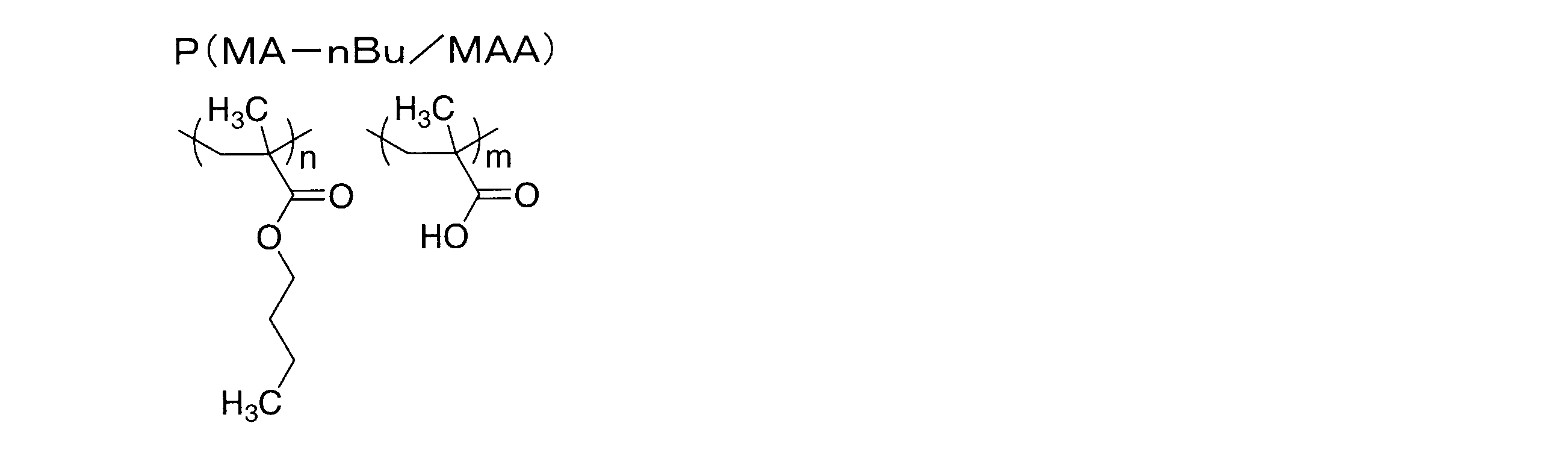
- P MA-nBu / MAA
- a repeating unit in which an MAA-derived repeating unit and 3,4-dihydro-2H-pyran form an acetal bond is represented by MA-DHP.
- the target polymer P (MA-nBu / MAA) was synthesized by the same procedure as in 1.
- MA-iBu 1.588 g (11.2 mmol)
- MAA 0.412 g (4.79 mmol)
- 2-butanone 4.00 g
- V-601 0.184 g (0.798 mmol) described above
- P (MA-iBu / MAA) shown below, which is the target product was synthesized in the same procedure as in Example 1.
- Example 10 [Synthesis of P (MA-MIB-HFA / MA-EATf) 70/30 (molar ratio)]
- MA-EATf 0.500 g (1.91 mmol)
- MA-MIB-HFA 1.500 g (4.46 mmol)
- 2-butanone 4.00 g and V-601, 0.073 g (0.32 mmol) were used.
- Example 11 [Synthesis of P (MA-MIB-HFA / MA-EATf) 60/40 (molar ratio)]
- MA-MIB-HFA 1.318 g (3.92 mmol)
- MA-EATf 0.682 g (2.61 mmol)
- 2-butanone 4.00 g
- V-601 0.075 g (0.33 mmol
- the target product P (MA-MIB-HFA / MA-EATf) was synthesized in the same procedure as in Example 1.
- Example 14 [Synthesis of P (MA-nBu / MAA / MA-iBuVE) 70/10/20 (molar ratio)]
- Fluorine-containing aliphatic alcohol solvents include (A): 2,2,3,3-tetrafluoro-1-propanol, (B): 2,2,3,4,4,4-hexafluoro-1-butanol , (C): Three types of 2,2,3,3,4,4,5,5-octafluoro-1-pentanol were used. The results are shown in Table 7. The polymer of Examples 1 to 14 containing the repeating unit A and the repeating unit B1 or the repeating unit B2 and the polymer of Comparative Example 1 containing only the repeating unit A are soluble in the fluorinated aliphatic alcohol.
- the composition was applied to a spin coater (manufactured by Mikasa Co., Ltd., product number) on a silicon substrate having a natural oxide film having a thickness of 0.1 nm, which was cut so that the [001] crystal plane was the substrate surface. 1H-360S) and the composition was applied while adjusting the rotation speed so that the film thickness was in the range of 400 nm to 800 nm.
- the substrate after coating was heated by a hot plate in the air under the heat treatment conditions described in Table 8 to thermally cure the coating film.
- the film thickness after thermosetting was measured using a light interference film thickness meter (manufactured by Sentech, Germany, product name, FTP500), and the rotation speed was adjusted.
- the film was immersed in a tetramethylammonium hydroxide aqueous solution adjusted to a liquid temperature of 23 ° C. for a period of 1.38% by mass for 1 minute, washed with ion-exchanged water, and then again the film thickness.
- the composition film remains at 80% or more of the film thickness after thermosetting.
- propylene glycol monomethyl ether ((D) in Table 8) or propylene glycol monomethyl ether acetate ((E) in Table 8) is used as the solvent, and the above-mentioned developer is used.
- the film composition after 2 ml of solvent was spin-coated on the film composition film after being immersed under conditions, and then dried at 110 ° C. for 1 minute, and the film thickness was measured.
- the application conditions with the spin coater were a rotation speed of 1200 rpm, a rotation holding time of 2 minutes.
- the film was left as 80% or more with respect to the film thickness after thermosetting, ⁇ for 60% or more and 80% or less, and x for 60% or less.
- the polymers of Examples 1 to 14 containing the repeating unit A and the repeating unit B are excellent in developer resistance and solvent resistance, but the polymer of Comparative Example 1 containing only the repeating unit A ( P (MA-HE / MA-BTHB-OH)) was inferior in developer resistance and solvent resistance.
- Pattern formation test 2,2,3,3,4,4,5,5-octafluoro-1 which is a fluorine-containing aliphatic alcohol as a solvent in the polymers of Examples 1, 2, 4 to 6 and 10 to 14 -Using pentanol, using TMPEOTVE-30 as a vinyl compound, and a compound having the structure shown below as a photoacid generator (trade name, IRGACURE PAG103 (manufactured by BASF Japan Ltd., (G) in Table 9)) Or, a product name, CP-100TF (in Table 9, (H)) manufactured by San Apro Co., Ltd., was prepared at a ratio shown in Table 9 to obtain a positive resist composition.
- the mass of the solvent was represented by 100 parts by mass, and the photoacid generator was used in an amount of 3 parts by mass, with the total mass of the polymer and vinyl compound being 100 parts by mass.
- This positive resist composition was applied to a spin coater (manufactured by Mikasa Corporation) on a silicon substrate having a natural oxide film with a thickness of 0.1 nm on the surface that was cut so that the [001] crystal plane was the substrate surface. No. 1H-360S), and coating was performed while adjusting the rotation speed so that the thickness of the composition film was in the range of 400 nm to 800 nm.
- the substrate after coating was heated by a hot plate in the air under the heat treatment conditions shown in Table 9 to thermally cure the composition film.
- the thickness of the composition film of the silicon substrate with the composition film after thermosetting was measured using an optical interference film thickness meter (manufactured by Sentech, Germany, product name, FTP500).
- each substrate with a positive resist composition film was prepared, and each was subjected to 3 seconds, 5 seconds, 10 seconds, 20 seconds with a g / h / i line exposure machine (manufactured by German Seuss Microtech Co., Ltd.). Exposed for 60 seconds. The intensity of ultraviolet rays was 70 mW.
- FINELINE TESTPARTTERN-I manufactured by Dai Nippon Printing Co., Ltd. was used.
- the substrate with the positive resist composition film after the exposure was heated for 1 minute on a hot plate adjusted to 90 ° C. and then adjusted to a temperature of 23 ° C. (developer tetramethylammonium hydroxide aqueous solution, concentration 2.38% by mass).
- a PET substrate coated with each positive resist composition was prepared, and the entire coated surface was exposed for 10 seconds with a g / h / i-line exposure machine.
- the intensity of ultraviolet rays was 70 mW.
- the exposed PET substrate with a film of each positive resist composition was heated in a hot plate shape heated to 90 ° C. for 1 minute, and then a developer adjusted to a temperature of 23 ° C. (tetramethylammonium hydroxide aqueous solution, concentration 2.). (38 mass%) for 1 minute to dissolve the coating film.
- evaluation was performed by determining whether or not the substrate was visually warped due to swelling of the solvent and measuring the haze value with a haze meter.
- the positive resist compositions using the polymers obtained in Examples 1 to 14 did not warp in all the substrates, and had a haze as compared with the organic polymer substrate before the coating test. The value hardly changed. In this way, even when the positive resist composition of the present invention is applied to a PET substrate, there are problems such as loss of transparency due to swelling or dissolution of the PET substrate by the solvent, shrinkage of the substrate, or erosion of the surface. I knew it didn't happen.
- the positive resist composition of the present invention has little influence on organic materials such as dissolution or swelling, and can form a resist film by wet coating of an organic polymer substrate. Excellent solvent resistance.
Landscapes
- Physics & Mathematics (AREA)
- General Physics & Mathematics (AREA)
- Spectroscopy & Molecular Physics (AREA)
- Chemical & Material Sciences (AREA)
- Medicinal Chemistry (AREA)
- Chemical Kinetics & Catalysis (AREA)
- Health & Medical Sciences (AREA)
- Polymers & Plastics (AREA)
- Organic Chemistry (AREA)
- Materials For Photolithography (AREA)
- Addition Polymer Or Copolymer, Post-Treatments, Or Chemical Modifications (AREA)
- Exposure And Positioning Against Photoresist Photosensitive Materials (AREA)
- Polymerisation Methods In General (AREA)
Abstract
Description
水素原子の個数がフッ素原子の個数以下であり、炭素数が2~8である1価の含フッ素脂肪族アルコールと、下記一般式(1)で表される繰り返し単位Aと下記一般式(2)で表される繰り返し単位Bを含む重合物と、ビニル化合物と、光酸発生剤と、を含むポジ型レジスト組成物。


下記一般式(4)で表わされる基である。)


上記一般式(2)中、Dが、下記一般式(5)で表される基である、発明1のポジ型レジスト組成物。

上記一般式(2)中、Dが、下記一般式(6)で表される基である、発明1のポジ型レジスト組成物。

前記ビニル化合物として、少なくとも2個のビニルエーテル基を含有しているビニル化合物を含むことを特徴とする、発明1~3のいずれかのポジ型レジスト組成物。
前記光酸発生剤が、一般式(7)で表される2価の基を含むN-スルホニルオキシイミド化合物またはオキシム-O-スルホネート化合物である、発明1~4のいずれかのポジ型レジスト組成物。

光酸発生剤が、一般式(8)で表される化合物である、発明1~5のいずれかのポジ型レジスト組成物。

含フッ素脂肪族アルコールの質量を100とする質量比で表して、重合物が0.5以上、30以下、ビニル化合物が0.05以上、20以下であり、さらに重合物とビニル化合物を合計した質量を100とする質量比で表して、光酸発生剤が0.01以上、15以下含まれる、発明1~6のいずれかのポジ型レジスト組成物。
重合物を基準とするモル%で表して、重合物に繰り返し単位Aが25モル%以上、80モル%以下、繰り返し単位Bが20モル%以上、75モル%以下含まれる、発明1~7のいずれかのポジ型レジスト組成物。
本発明のポジ型レジスト組成物において、レジスト溶剤としては、炭素数が2~8である1価の含フッ素脂肪族アルコールであって、水素原子の個数がフッ素原子数の個数以下であるものが使用される。
2.1.繰り返し単位A
本発明のポジ型レジスト組成物が含む重合物は、上記一般式(1)で表される繰り返し単位Aを含有することにより、重合物が前記含フッ素脂肪族アルコールに可溶となる。

本発明のポジ型レジスト組成物が含有する重合物は、レジスト膜を加熱硬化させるために、ビニル化合物と化学結合するための結合部位となる官能基を有する必要がある。具体的には、重合物は、側鎖にカルボキシル基またはアルキルスルホンアミド基を有することが好ましい。これらの酸性基は、加熱によりビニル化合物と反応し結合する。しかしながら、冷暗所保管、冷蔵室保管すればビニル化合物との結合が生じにくく、生じたとしても反応速度が遅く、十分な貯蔵安定性が得られる。
[カルボキシル基を有する繰り返し単位B1]
カルボキシル基を有する繰り返し単位B1は、下記一般式(9)で表わされる繰り返し単位である。
アルキルスルホンアミド基を有する繰り返し単位B1は、下記一般式(10)で表わされる繰り返し単位B1である。

本発明のポジ型レジスト組成物が含有する重合物において、ビニル化合物と結合するための結合部位となる官能基を有する繰り返し単位として、前記繰り返し単位B2を含有させることも可能である。繰り返し単位B2は、側鎖にカルボキシル基またはアルキルスルホン酸基が保護されたアセタール構造を有しており、加熱によってカルボキシル基またはアルキルスルホンアミド基を生じさせることができるので、前記繰り返し単位B1と同様に、加熱によりビニル化合物と反応し結合する。しかしながら、加熱を行う前にはビニル化合物と結合する基を有さないため、冷暗所保管、冷蔵室保管すれば結合反応をせず、十分な貯蔵安定性が得られる。
カルボキシル基を生じさせる繰り返し単位B2は、下記一般式(11)で表わされる。
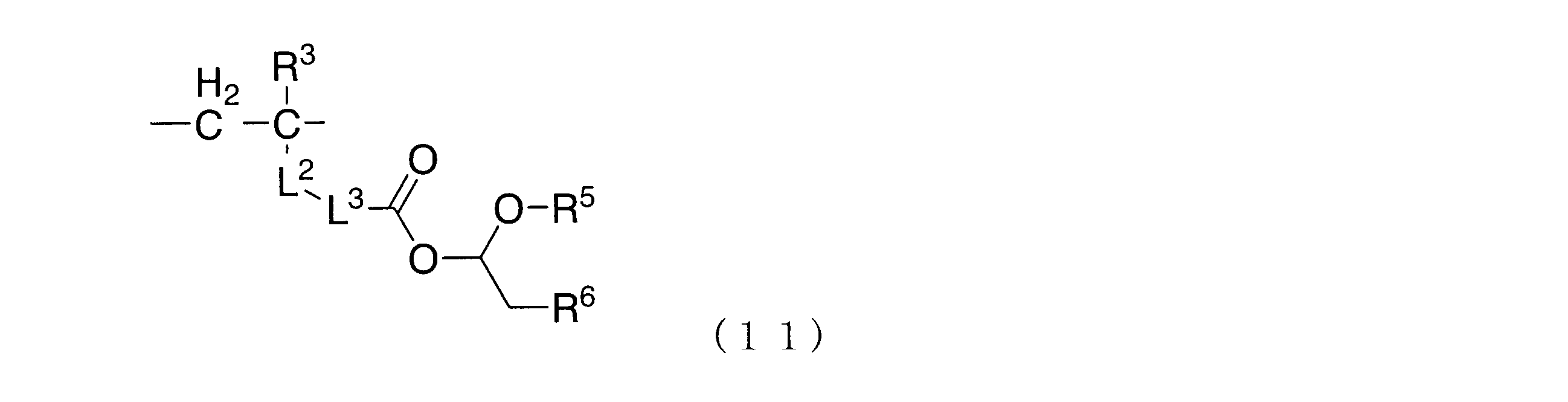

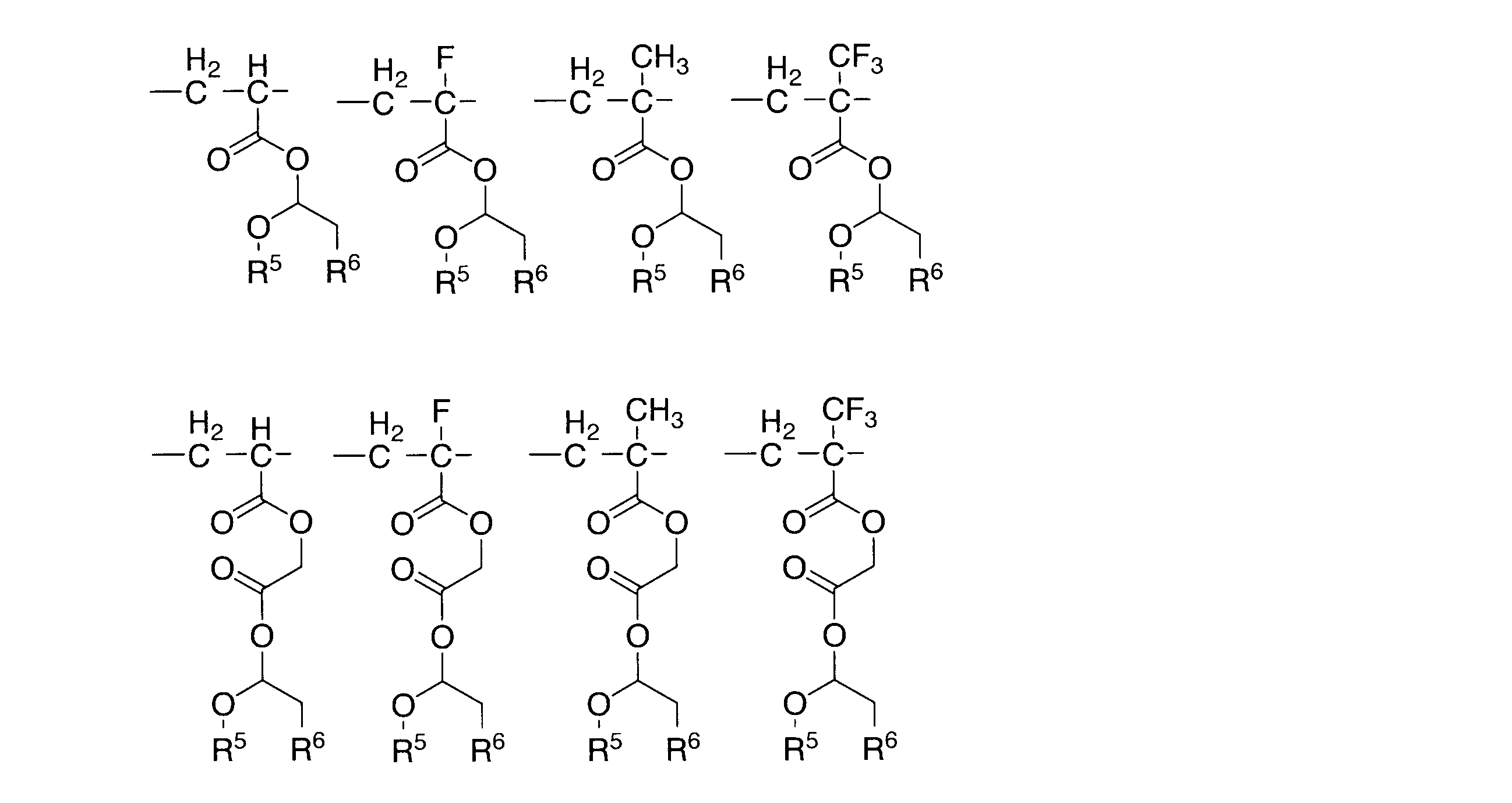
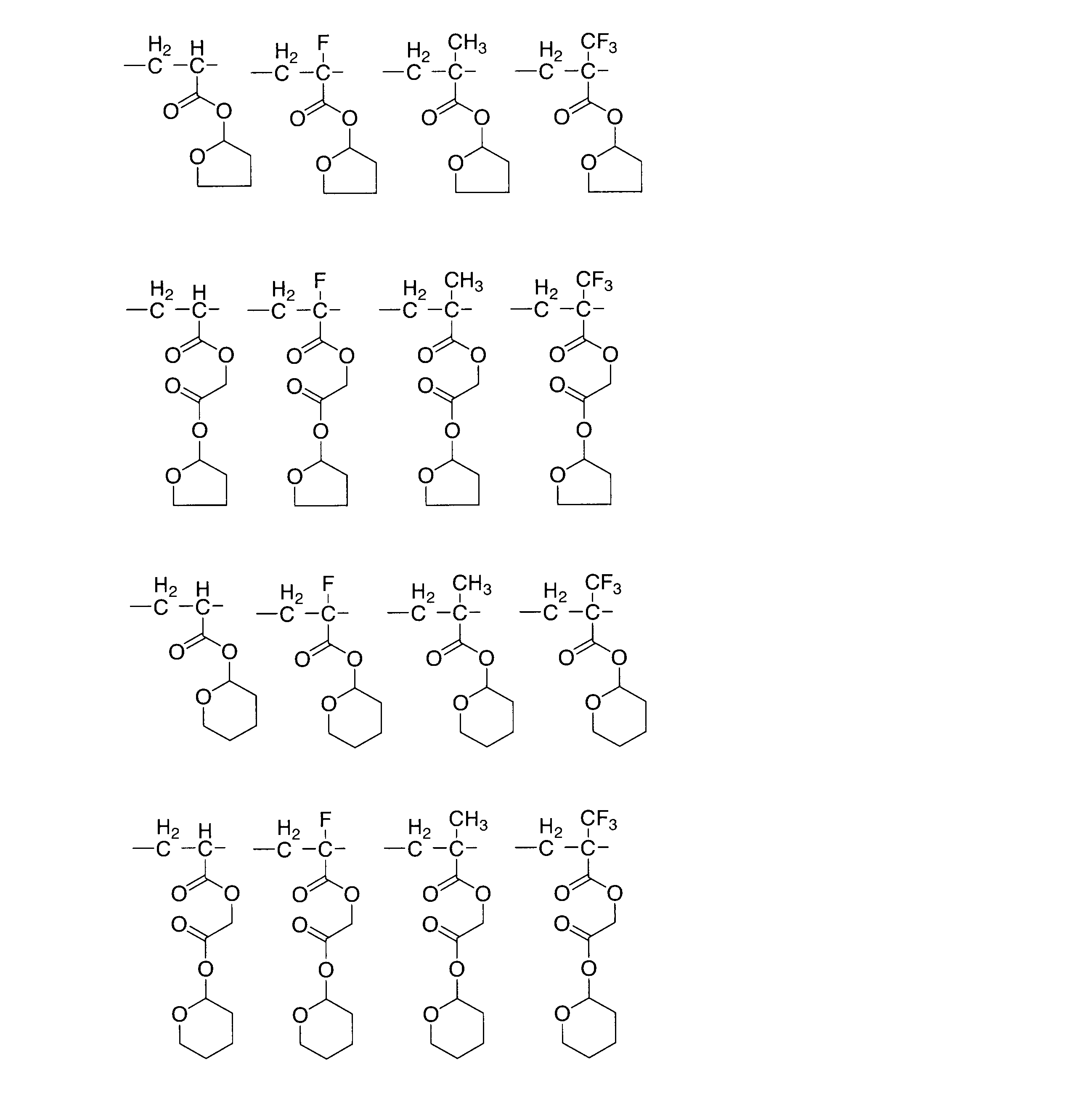
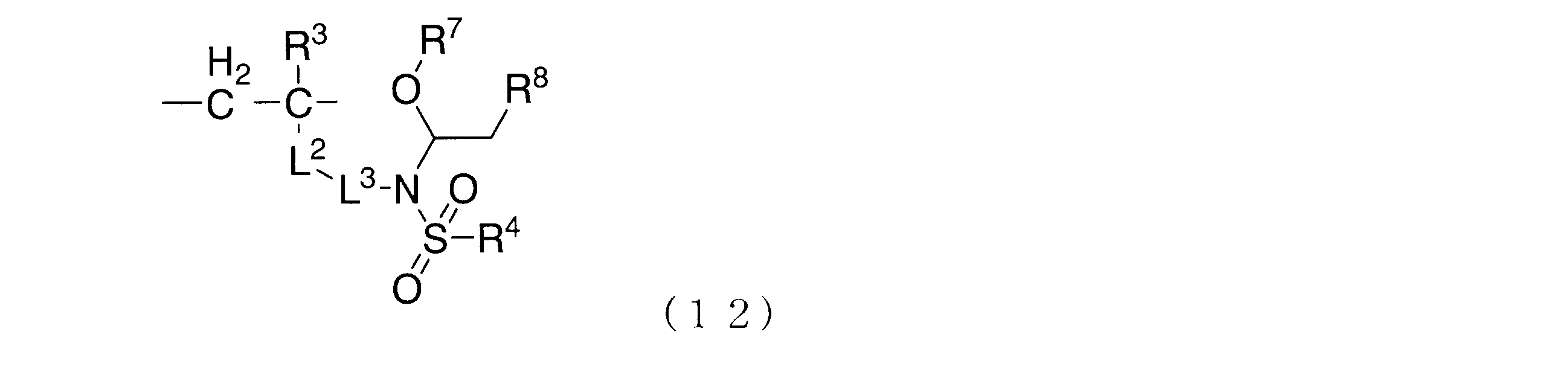
アルキルスルホンアミド基を生じさせる繰り返し単位B2は、下記一般式(12)で表わされる。


本発明のポジ型レジスト組成物の重合物において、一般式(1)で表される繰り返し単位Aの、重合物全体に占める割合は、モル%で表して、25%以上、80%以下である。より好ましくは50%以上、75%以下である。含量が25%未満では、溶剤である含フッ素脂肪族アルコールへ不溶となる、あるいはレジスト基板に塗布する際、均一な厚みに塗布できない虞がある。含量が80%より多いと、現像液への溶解性不足によりレジストパターンのコントラスト不足(解像性不良)をもたらす虞がある。
本発明のポジ型レジスト組成物に用いる重合物の好ましい分子量は、粘度、および現像液への溶解性から、ポリスチレン換算による重量平均分子量Mwで表して、Mw=1,000~500,000、好ましくは2,000~200,000、より好ましくは3,000~100,000である。
本発明におけるポジ型レジスト組成物は、多官能のビニル化合物、具体的には2基以上のビニルエーテル基を含有するビニル化合物を含有する。ビニルエーテル基と重合物中の結合部位の結合により、本発明におけるポジ型レジスト組成物によるレジスト膜には耐溶剤性が付与される。


本発明によるポジ型レジスト組成物は、現像後のレジストパターンを得るために、露光により酸を発生する化合物、すなわち光酸発生剤を含有する。光酸発生剤は、現像後に露光部の現像液に対する溶解性が顕著であり、現像後のレジストパターンに十分なコントラストを付与するものを選択することが好ましい。



本発明のポジ型レジスト組成物は、上記の重合物、ビニル化合物および光酸発生剤以外に、必要に応じてその他添加物を含有させることができ、例えば、界面活性剤または塩基が挙げられる。これらは、本発明のポジ型レジスト組成物の成膜性または保存安定性を向上させる目的で使用することができる。
本発明のポジ型レジスト組成物は、対象の基板上にレジスト液を塗布して加熱乾燥および加熱硬化してレジスト膜とし、その後に露光し、次いで現像液により現像処理することで、基板上にレジストパターンを形成できる。
有機ポリマー基板としての各種溶剤に対する浸漬試験を行った。
合成例
[メタクリル酸1-(2-メチルプロポキシ)エチルの合成]
メタクリル酸8.61g(100mmol)とイソブチルビニルエーテル20.0g(200mmol)を50mLナスフラスコに測り取り、フッ素樹脂でコートされた攪拌子を投入した。これをマグネチックスターラーにて攪拌しながら、60℃に温度調整された油浴で6時間加熱した。加熱後に全量を炭酸水素ナトリウム水溶液(濃度5重量%)20mLと混合し、静置して有機層を分取した。分取した有機層全量を飽和塩化ナトリウム水溶液20mLと混合し、静置して有機層を分取した。分取した有機層に含まれる水分を硫酸ナトリウムで除去した後に、ろ過により液体を得た。得られた液体をロータリーエバポレーターにて温度40℃、圧力30hPaで濃縮し、12.32gの淡黄色液体として以下に示す、重合物に繰り返し単位B2を与えるための、カルボキシル基が保護基により保護された単量体である、メタクリル酸1-(2-メチルプロポキシ)エチルを得た。
続いて、本発明のポジ型レジスト組成物に使用する重合物を合成し、分子量を測定した。次いで、溶剤である含フッ素脂肪族アルコールへの溶解性の評価試験を実施した。




[P(MA-nBu/MAA) 80/20(モル比)の合成]
繰り返し単位の存在比が繰り返し単位A/繰り返し単位B1=80/20(モル比)となるように、重合物であるP(MA-nBu/MAA)=80/20(モル比)を合成した。MA-nBu、1.737g(12.2mmol)、MAA、0.263g(3.05mmol)、2-ブタノン、4.00g、およびV-601、0.176g(0.763mmol)を、30mlセプタム栓つきバイアルに測り取り、フッ素樹脂でコートされた攪拌子を投入し、窒素を吹き込んだ後に密栓した。これをマグネチックスターラーにて攪拌しながら、80℃に温度調整された油浴で5時間加熱した。加熱後に全量をn-ヘプタン40gと混合し、得られた沈殿を吸引ろ過により分取した。得られた固体を75℃の減圧乾燥機で8時間乾燥し、以下に示す目的物であるP(MA-nBu/MAA)が、MA-nBu/MAA=80/20(モル比)の白色固体として、収量1.66g、原料単量体に対して収率83%で得られた。
[P(MA-nBu/MAA) 70/30(モル比)の合成]
繰り返し単位の存在比が繰り返し単位A/繰り返し単位B1=70/30(モル比)となるように、重合物であるP(MA-nBu/MAA)=70/30(モル比)を合成した。MA-nBu、1.588g(11.2mmol)、MAA、0.412g(4.79mmol)、2-ブタノン、4.00g、およびV-601、0.184g(0.798mmol)を用い、実施例1と同様の手順で目的の重合物であるP(MA-nBu/MAA)を合成した。P(MA-nBu/MAA)は、MA-nBu/MAA=70/30(モル比)の白色固体として、収量1.79g、原料単量体に対して収率90%で得られた。
[P(MA-iBu/MAA) 70/30(モル比)の合成]
繰り返し単位の存在比が繰り返し単位A/繰り返し単位B1=70/30(モル比)となるように、重合物であるP(MA-iBu/MAA)=70/30(モル比)を合成した。MA-iBu、1.588g(11.2mmol)、MAA、0.412g(4.79mmol)、2-ブタノン、4.00g、および上述のV-601、0.184g(0.798mmol)を用い、実施例1と同様の手順で目的物である以下に示すP(MA-iBu/MAA)を合成した。P(MA-iBu/MAA)は、MA-iBu/MAA=70/30(モル比)の白色固体として、収量1.95g、原料単量体に対して収率98%で得られた。

[P(MA-EOE/MAA) 70/30(モル比)の合成]
繰り返し単位の存在比が繰り返し単位A/繰り返し単位B1=70/30(モル比)となるように、重合物であるP(MA-EOE/MAA)=70/30(モル比)を合成した。MA-EOE、1.622g(10.3mmol)、MAA、0.378g(4.39mmol)、2-ブタノン、4.00g、およびV-601、0.169g(0.732mmol)を用い、実施例1と同様の手順で目的物である以下に示すP(MA-EOE/MAA)を合成した。P(MA-EOE/MAA)は、MA-EOE/MAA=70/30(モル比)の白色固体として、収量1.90g、原料単量体に対して収率95%で得られた。

[P(MA-EOE/MAA) 50/50(モル比)の合成]
繰り返し単位の存在比が繰り返し単位A/繰り返し単位B1=50/50(モル比)となるように、重合物であるP(MA-EOE/MAA)=50/50(モル比)を合成した。MA-EOE、1.295g(8.19mmol)、MAA、0.705g(8.19mmol)、2-ブタノン、4.00g、およびV-601、0.189g(0.819mmol)を用い、実施例1と同様の手順でP(MA-EOE/MAA)を合成した。P(MA-EOE/MAA)は、MA-EOE/MAA=50/50(モル比)の白色固体として、収量1.96g、原料単量体に対して収率98%で得られた。
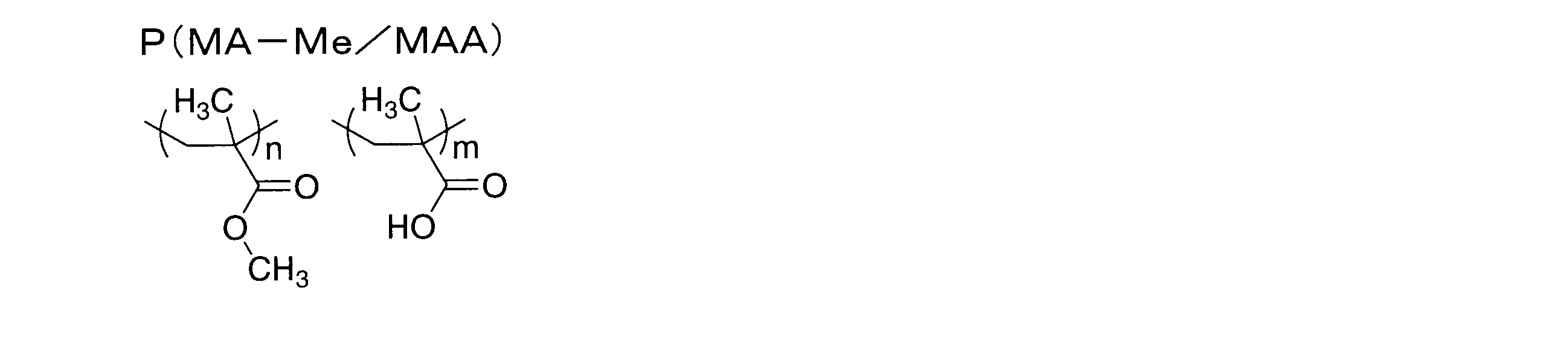
[P(MA-Me/MAA) 70/30(モル比)の合成]
繰り返し単位の存在比が繰り返し単位A/繰り返し単位B1=70/30(モル比)となるように、重合物であるP(MA-Me/MAA)=70/30(モル比)を合成した。MAA、0.539g(6.26mmol)、MA-Me、1.461g(14.6mmol)、2-ブタノン、4.00g、およびV-601、0.240g(1.04mmol)を用い、実施例1と同様の手順で目的物である以下に示すP(MA-Me/MAA)を合成した。P(MA-Me/MAA)は、MA-Me/MAA=70/30(モル比)の白色固体として、収量1.96g、原料単量体に対して収率98%で得られた。
[P(TFOL-M/MAA) モル比(70/30)の合成]
繰り返し単位の存在比が繰り返し単位A/繰り返し単位B1=70/30(モル比)となるように、重合物である、P(TFOL-M/MAA)=70/30(モル比)を合成した。TFOL-M、1.640g(9.76mmol)、MAA、0.360g(4.18mmol)、2-ブタノン、4.00g、およびV-601、0.160g(0.697mmol)を用い、実施例1と同様の手順で目的物である以下に示すP(TFOL-M/MAA)を合成した。P(TFOL-M/MAA)は、TFOL-M/MAA=70/30(モル比)の白色固体として、収量1.96g、原料単量体に対して収率98%で得られた。
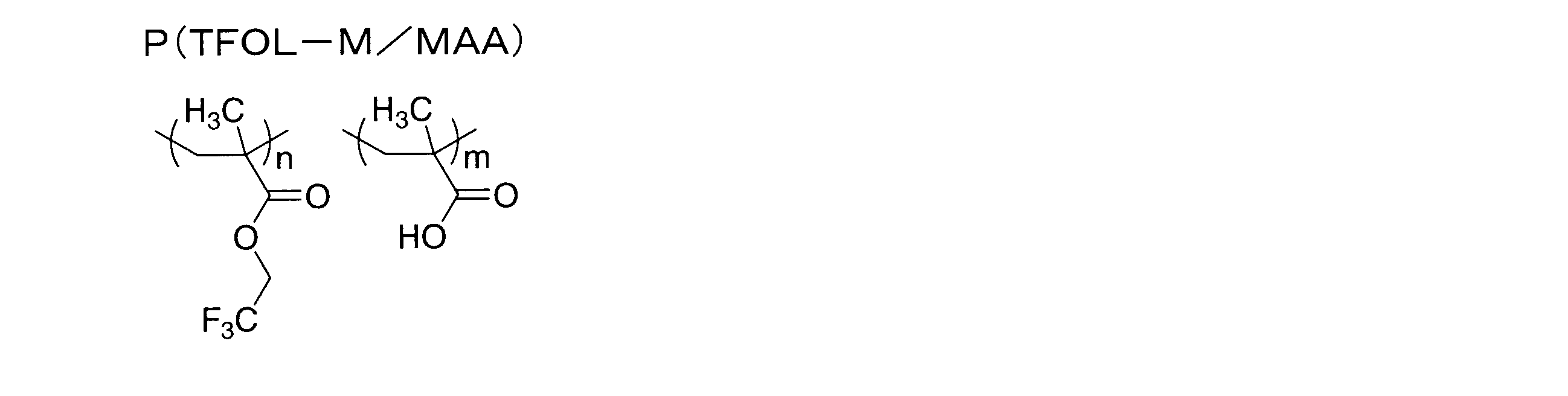
[P(MA-nBu/MA-EATf) 70/30(モル比)の合成]
繰り返し単位の存在比が繰り返し単位A/繰り返し単位B1=70/30(モル比)となるように、重合物であるP(MA-nBu/MA-EATf)=70/30(モル比)を合成した。MA-nBu、1.119g(7.87mmol)、MA-EATf、0.881g(3.37mmol)、2-ブタノン、4.00g、およびV-601、0.129g(0.562mmol)を用い、実施例1と同様の手順で目的物である以下に示すP(MA-nBu/MA-EATf)を合成した。P(MA-nBu/MA-EATf)は、MA-nBu/MA-EATf=70/30(モル比)の白色固体として、収量1.50g、原料単量体に対して収率75%で得られた。

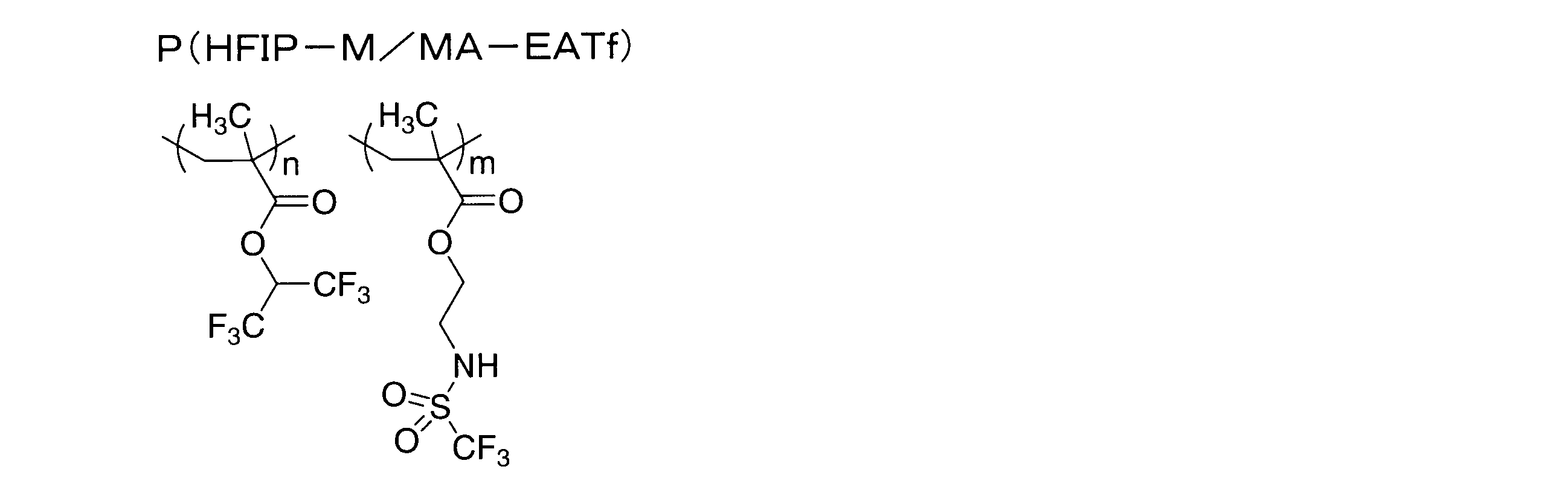
[P(HFIP-M/MA-EATf) 60/40(モル比)の合成]
繰り返し単位の存在比が繰り返し単位A/繰り返し単位B1=60/40(モル比)となるように、重合物であるP(HFIP-M/MA-EATf)=60/40(モル比)を合成した。MA-EATf、0.849g(3.25mmol)、HFIP-M、1.151g(4.87mmol)、2-ブタノン4.00g、およびV-601、0.094g(0.41mmol)を用い、実施例1と同様の手順で目的物である以下に示すP(HFIP-M/MA-EATf)を合成した。P(HFIP-M/MA-EATf)は、HFIP-M/MA-EATf=60/40(モル比)の白色固体として、収量1.64g(原料単量体に対する収率82%)で得られた。
[P(MA-MIB-HFA/MA-EATf) 70/30(モル比)の合成]
繰り返し単位の存在比が繰り返し単位A/繰り返し単位B1=70/30(モル比)となるように、重合物であるP(MA-MIB-HFA/MA-EATf)=70/30(モル比)を合成した。MA-EATf、0.500g(1.91mmol)、MA-MIB-HFA、1.500g(4.46mmol)、2-ブタノン4.00g、およびV-601、0.073g(0.32mmol)を用い、実施例1と同様の手順で目的物である以下に示すP(MA-MIB-HFA/MA-EATf)を合成した。P(MA-MIB-HFA/MA-EATf)は、MA-MIB-HFA/MA-EATf=70/30(モル比)の白色固体として収量0.90g、原料単量体に対して収率45%で得られた。

[P(MA-MIB-HFA/MA-EATf) 60/40(モル比)の合成]
繰り返し単位の存在比が繰り返し単位A/繰り返し単位B1=60/40(モル比)となるように、重合物であるP(MA-MIB-HFA/MA-EATf)=60/40(モル比)を合成した。MA-MIB-HFA、1.318g(3.92mmol)、MA-EATf、0.682g(2.61mmol)、2-ブタノン、4.00g、およびV-601、0.075g(0.33mmol)を用い、実施例1と同様の手順で目的物であるP(MA-MIB-HFA/MA-EATf)を合成した。P(MA-MIB-HFA/MA-EATf)は、MA-MIB-HFA/MA-EATf=60/40(モル比)の白色固体として収量1.64g(原料単量体に対して収率82%)で得られた。
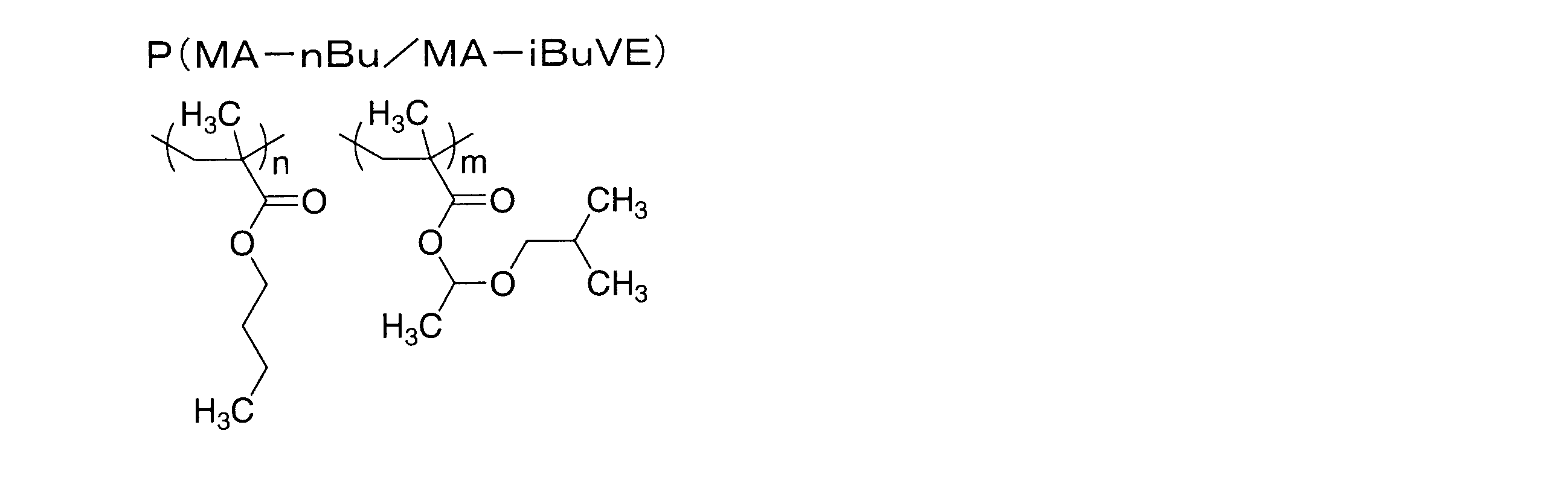
[P(MA-nBu/MA-iBuVE) 70/30(モル比)の合成]
繰り返し単位の存在比が繰り返し単位A/繰り返し単位B2=70/30(モル比)となるように、重合物であるP(MA-nBu/MA-iBuVE)=70/30(モル比)を合成した。MA-nBu、3.203 g(22.5mmol)、MA-iBuVE、1.797g(9.65mmol)、2-ブタノン、10.0g、およびV-601、0.370g(1.61mmol)を、50mlナスフラスコに量り取り、フッ素樹脂でコートされた攪拌子を投入し、窒素を吹き込んだ後に密栓した。これをマグネチックスターラーにて攪拌しながら、80℃に温度調整された油浴で5時間加熱した後に、全量をロータリーエバポレーターにて温度40℃、圧力30hPaで濃縮してから、メタノール200gと混合した。生じた沈殿物をデカンテーションにより分取した後に、40℃の減圧乾燥機で6時間乾燥して、以下に示す目的物である以下に示すP(MA-nBu/MA-iBuVE)を合成した。P(MA-nBu/MA-iBuVE)は、MA-nBu/MA-iBuVE=70/30(モル比)の白色固体として収量3.78g、原料単量体に対して収率76%で得られた。
[重合物アセタール化法によるP(MA-nBu/MA-DHP) 70/30(モル比)の合成]
繰り返し単位の存在比が繰り返し単位A/繰り返し単位B2=70/30(モル比)となるように、重合物であるP(MA-nBu/MA-DHP)=70/30(モル比)を合成した。実施例2と同様の手順で得たP(MA-nBu/MAA)=70/30(モル比)、1.00g、3,4-ジヒドロ-2H-ピラン、0.30g、および2-ブタノン5.00gを50mLナスフラスコに測り取り、フッ素樹脂でコートされた攪拌子を投入した。これをマグネチックスターラーにて攪拌しながら、氷水浴で溶液の温度が3℃以下になるまで冷却した。この溶液にメタンスルホン酸3mgを2-ブタノン0.50gへ溶解させた溶液を15分かけて滴下してから、氷水浴による冷却を続けたまま6時間攪拌した。その後、溶液にMEK10gを加えてから炭酸水素ナトリウム水溶液(濃度5質量%)10mLと混合し、静置して有機層を分取した。分取した有機層全量を塩化ナトリウム水溶液(濃度10質量%)10mLと混合し、静置して有機層を分取した。分取した有機層に含まれる水分を硫酸ナトリウムで除去した後に、ろ過により液体を得た。得られた液体を全量をn‐ヘプタン70gと混合し、得られた沈殿を吸引ろ過により分取した。得られた固体を40℃の減圧乾燥機で8時間乾燥し、目的物である以下に示す重合物であるP(MA-nBu/MA-DHP)を、MA-nBu/MA-DHP=70/30(モル比)の白色固体として収量0.64gで得た。

[P(MA-nBu/MAA/MA-iBuVE) 70/10/20(モル比)の合成]
繰り返し単位の存在比が繰り返し単位A/繰り返し単位B1/繰り返し単位B2=70/10/20(モル比)となるように、重合物であるP(MA-nBu/NAA/MA-iBuVE)=70/10/20(モル比)を合成した。MA-nBu、1.369g(9.63mmol)、MAA、0.118g(1.38mmol)、MA-iBuVE、0.512g(2.75mmol)、2-ブタノン、4.00g、およびV-601、0.253g(0.357mmol)を用い、実施例1と同様の手順で以下に示す目的物であるP(MA-nBu/MAA/MA-iBuVE)を合成した。P(MA-nBu/MAA/MA-iBuVE)は、MA-nBu/MAA/MA-iBuVE=70/10/20(モル比)の白色固体として収量1.58g(原料単量体に対して収率76%)で得られた。
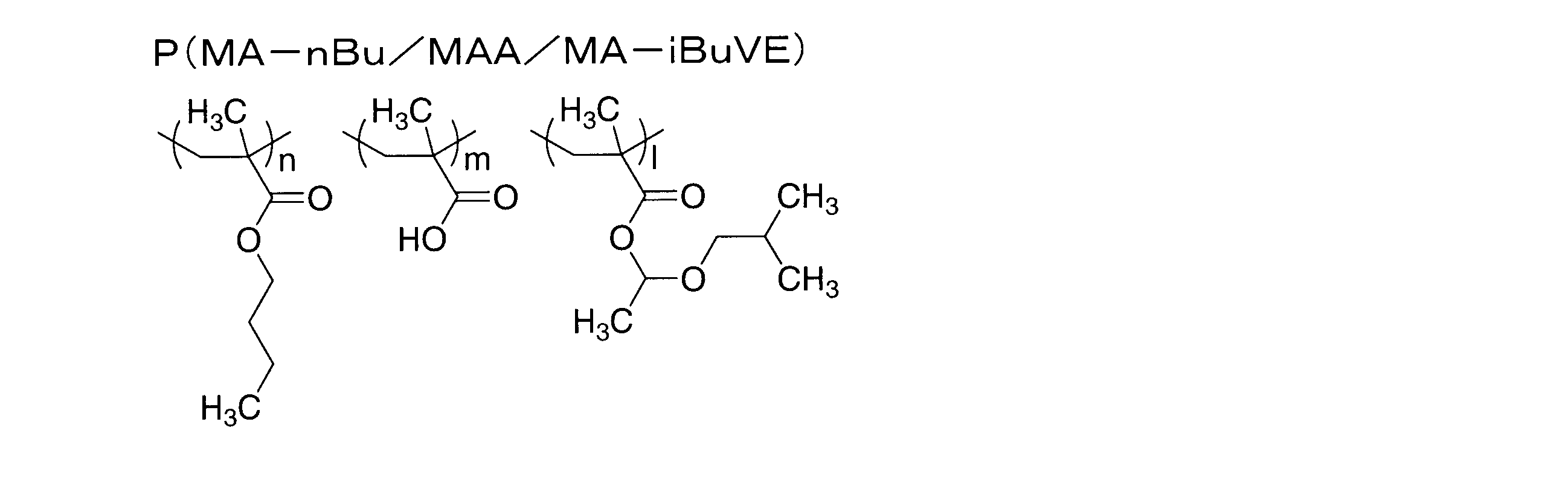
[P(MA-HE/MA-BTHB-OH) 30/70(モル比)の合成]
繰り返し単位Aのみからなる重合物である、P(MA-HE/MA-BTHB-OH)=30/70(モル比)を合成した。MA-HE、0.319g(2.45mmol)、MA-BTHB-OH、1.681g(5.71mmol)、2-ブタノン、4.00g、およびV-601、0.094g(0.41mmol)を用い、実施例1と同様の手順で目的物である以下に示すP(MA-HE/MA-BTHB-OH)を合成した。P(MA-HE/MA-BTHB-OH)は、MA-HE/MA-BTHB-OH=30/70(モル比)の白色固体として収量1.76g、原料単量体に対して収率88%で得られた。
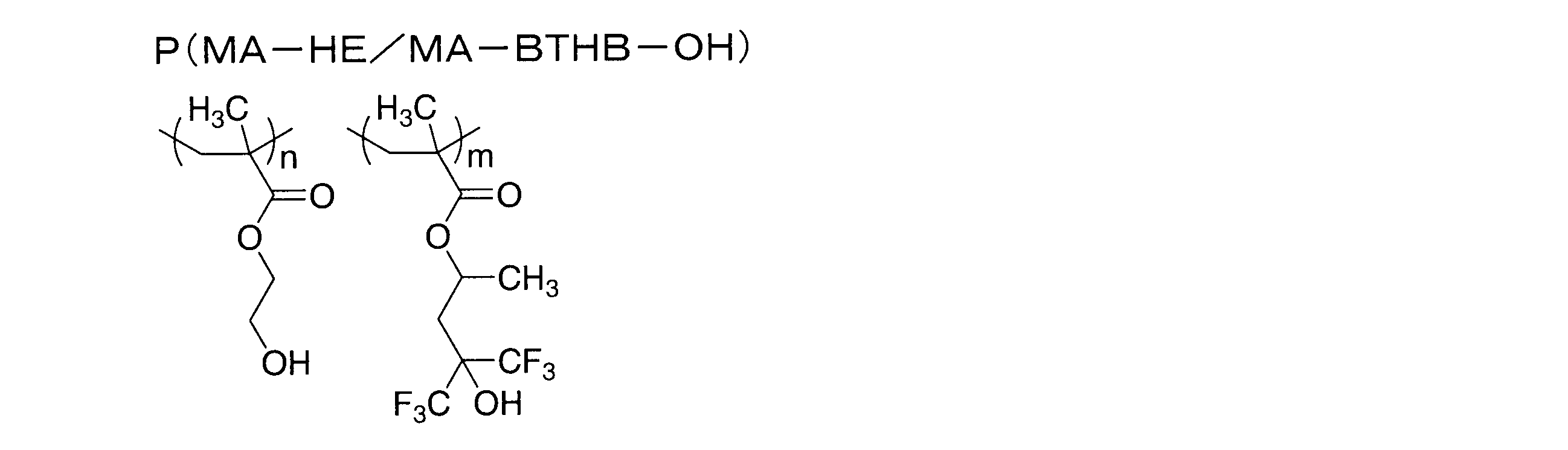
[P(MAA)の合成]
繰り返し単位B1のみからなる重合物である、P(MMA)を合成した。
MAA、2.000g(23.2mmol)、2-ブタノン、4.00g、およびV-601、0.267g(1.16mmol)を用い、実施例1と同様の手順で目的物である以下に示すP(MAA)を合成した。P(MAA)が白色固体として収量1.95g、原料単量体に対して収率98%で得られた。

[P(MA-CH/MAA) 70/30(モル比)の合成]
繰り返し単位Aを含有せず、かつ繰り返し単位B1を含有する重合物である、P(MA-CH/MAA)=70/30(モル比)を合成した。MA-CH、1.640g(9.75mmol)、MAA、0.360g(4.18mmol)、2-ブタノン、4.00g、およびV-601、0.160g(0.70mmol)を用い、実施例1と同様の手順で目的物である以下に示すP(MA-CH/MAA)を合成した。P(MA-CH/MAA)は、MA-CH/MAA=70/30(モル比)の白色固体として収量1.54g、原料単量体に対して収率77%で得られた。
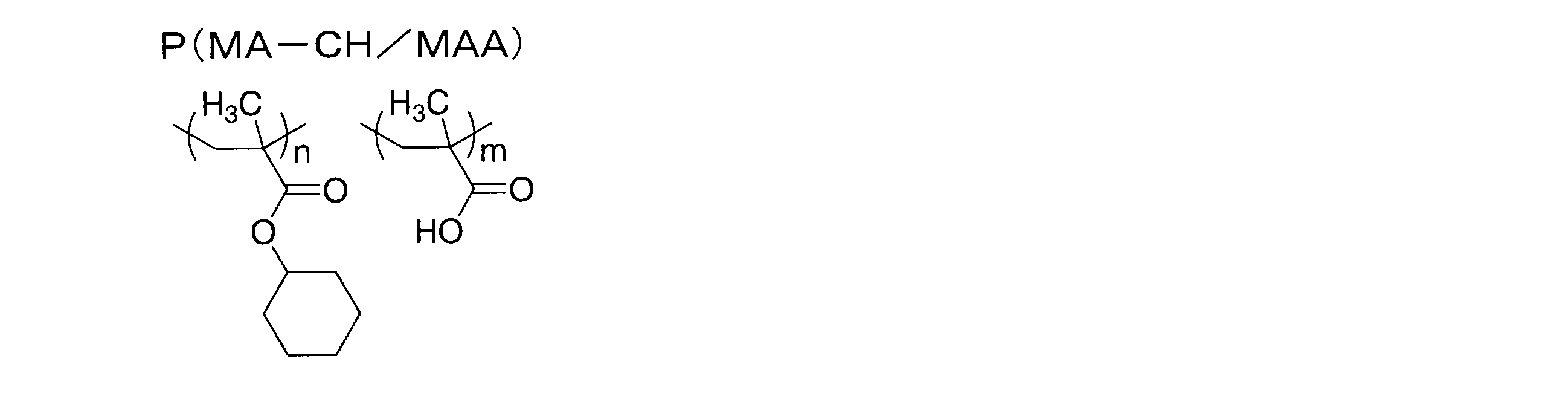
[P(MA-DEAE/MAA) 70/30(モル比)の合成]
繰り返し単位Aを含有せず、かつ繰り返し単位B1を含有する重合物である、P(MA-DEAE/MAA)=70/30(モル比)を合成した。MA-DEAE、1.668g(9.00mmol)、MAA、0.332g(3.86mmol)、2-ブタノン、4.00g、およびV-601、0.148g(0.64mmol)を用い、実施例1と同様の手順で目的物である以下に示すP(MA-DEAE/MAA)を合成した。P(MA-DEAE/MAA)は、MA-DEAE/MAA=70/30(モル比)の白色固体として収量1.98g、原料単量体に対して収率99%で得られた。

次いで、以上の実施例1~14、比較例1~4で得られた各重合物について、ゲルパーミエーションクロマトグラフィー(GPC)を測定し、重量平均分子量Mwと分子量分散Mw/Mn(重量平均分子量Mwを数平均分子量Mnで除算したもの)を算出した。GPCには、東ソー株式会社製、品名 HLC-8320を用い、同じく、東ソー株式会社製カラム(品名、ALPHA-MカラムおよびALPHA-2500)を各1本ずつ直列に繋ぎ、展開溶媒としてジメチルホルムアミドに臭化リチウムを0.03モル/L、リン酸を0.01モル/Lの濃度で溶解させた溶液を用い、検出器に屈折率差検出器を用い測定した。結果を表6に示す。
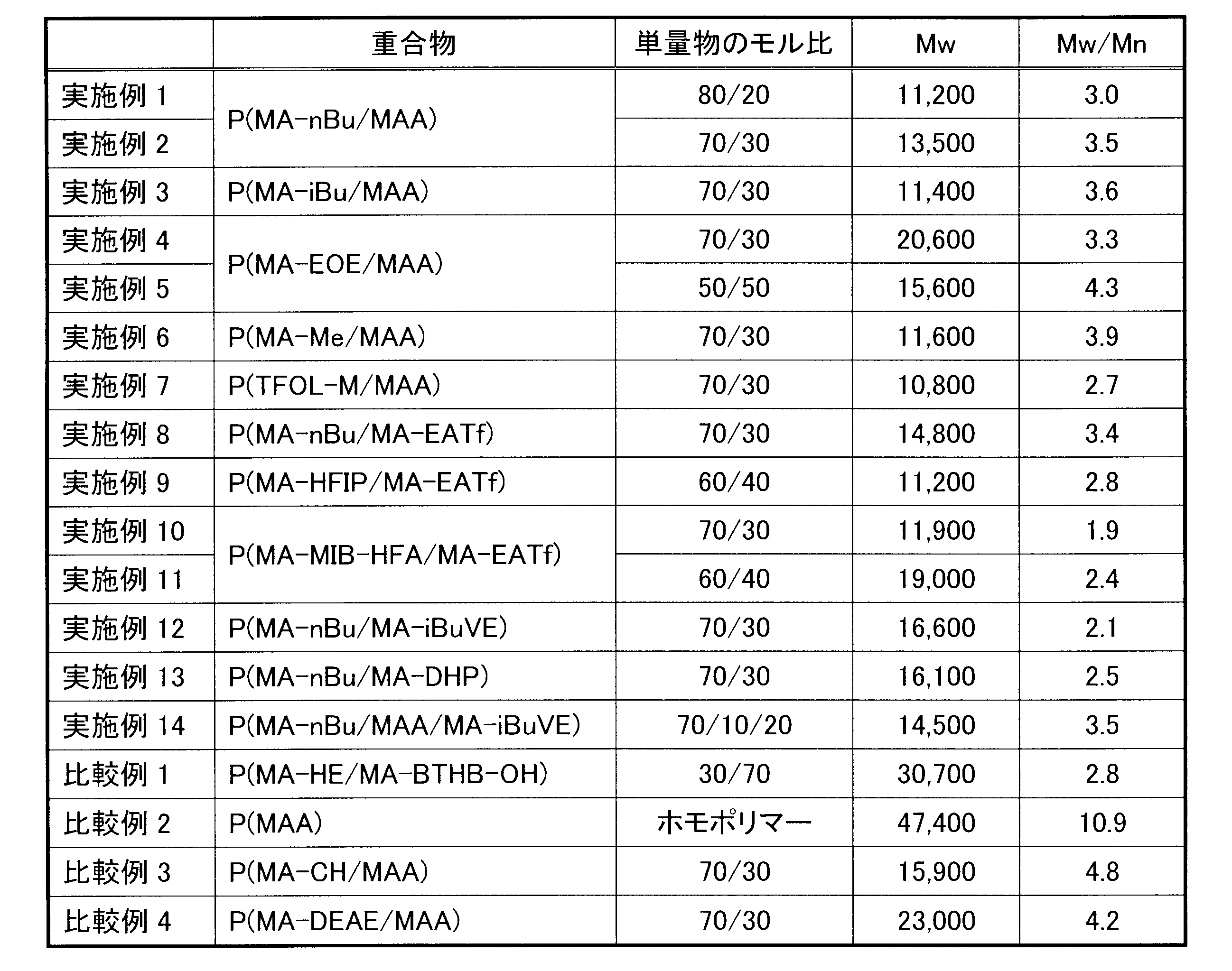
上記実施例1~14、比較例1および比較例1~4により得られた重合物について、含フッ素脂肪族アルコール溶剤中に重合物の濃度が10質量%になるように浸漬し、80℃に加熱して、30分間保持した。これを5℃の冷蔵庫内で20時間保管した後に、析出物および不溶分の有無を目視で確認した。含フッ素脂肪族アルコール溶剤としては、(A):2,2,3,3-テトラフルオロ-1-プロパノール、(B):2,2,3,4,4,4-ヘキサフルオロ-1-ブタノール、(C):2,2,3,3,4,4,5,5-オクタフルオロ-1-ペンタノールの3種類を使用した。結果を表7に示した。前記繰り返し単位Aと、繰り返し単位B1または繰り返し単位B2を含む実施例1~14および前記繰り返し単位Aのみを含む比較例1の重合物は、含フッ素脂肪族アルコールに可溶であるが、繰り返し単位B1のみからなる比較例2の重合物(P(MAA))および、繰り返し単位Aを含有せず繰り返し単位B1を含有する比較例3および4の重合物は、含フッ素脂肪族アルコールに不溶であった。
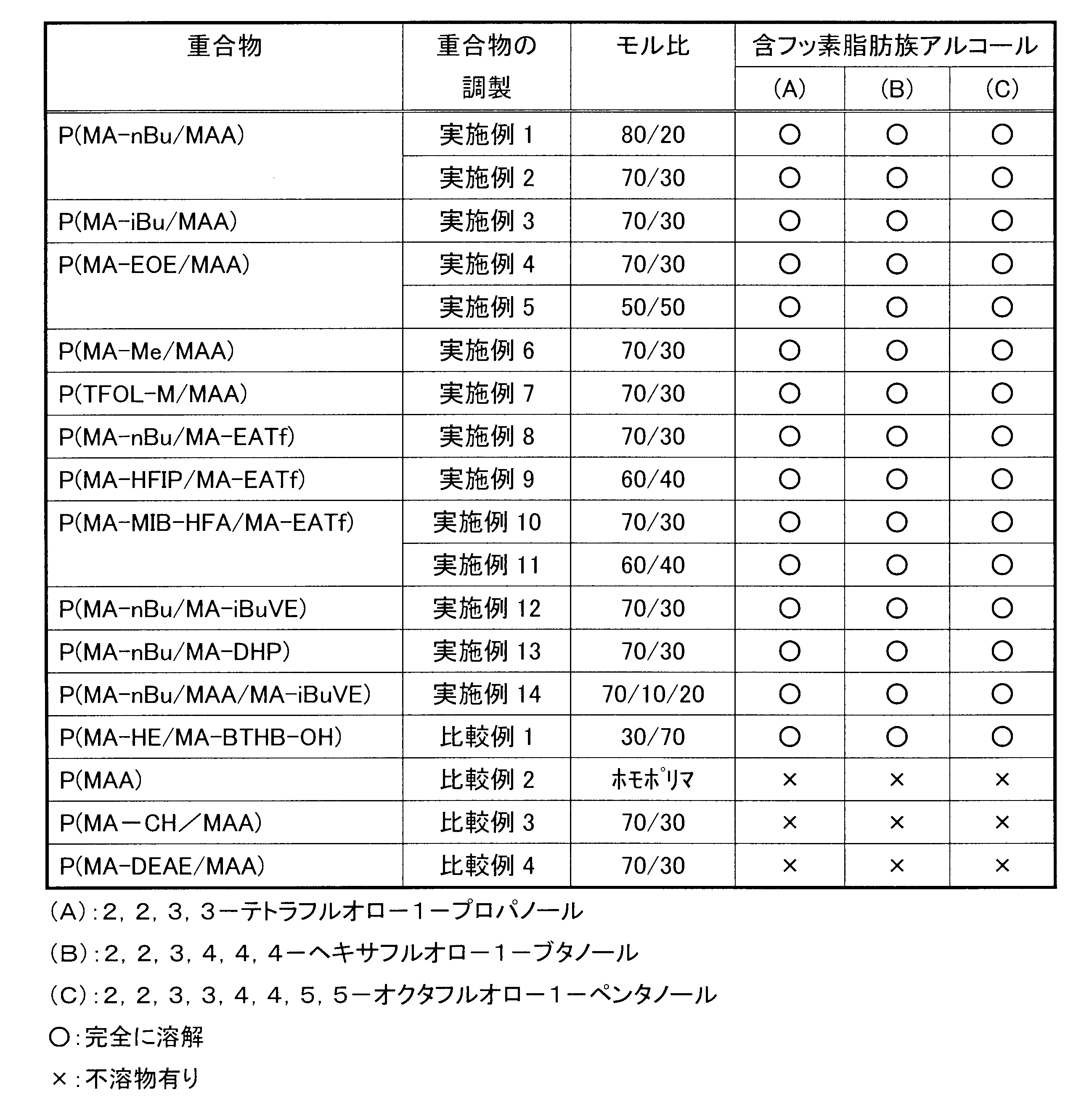
実施例1~14および比較例1で得られた重合物に、表8に示すように、溶剤として含フッ素脂肪族アルコールである2,2,3,3,4,4,5,5-オクタフルオロ-1-ペンタノールを用い、全ての例においてさらに以下に示す構造の3官能ビニル化合物(日本カーバイド工業株式会社製、商品名、TMPEOTVE-30)を加え組成物とした。尚、重合物の濃度およびビニル化合物の濃度は、溶剤の質量を100質量部とする質量部で表した。

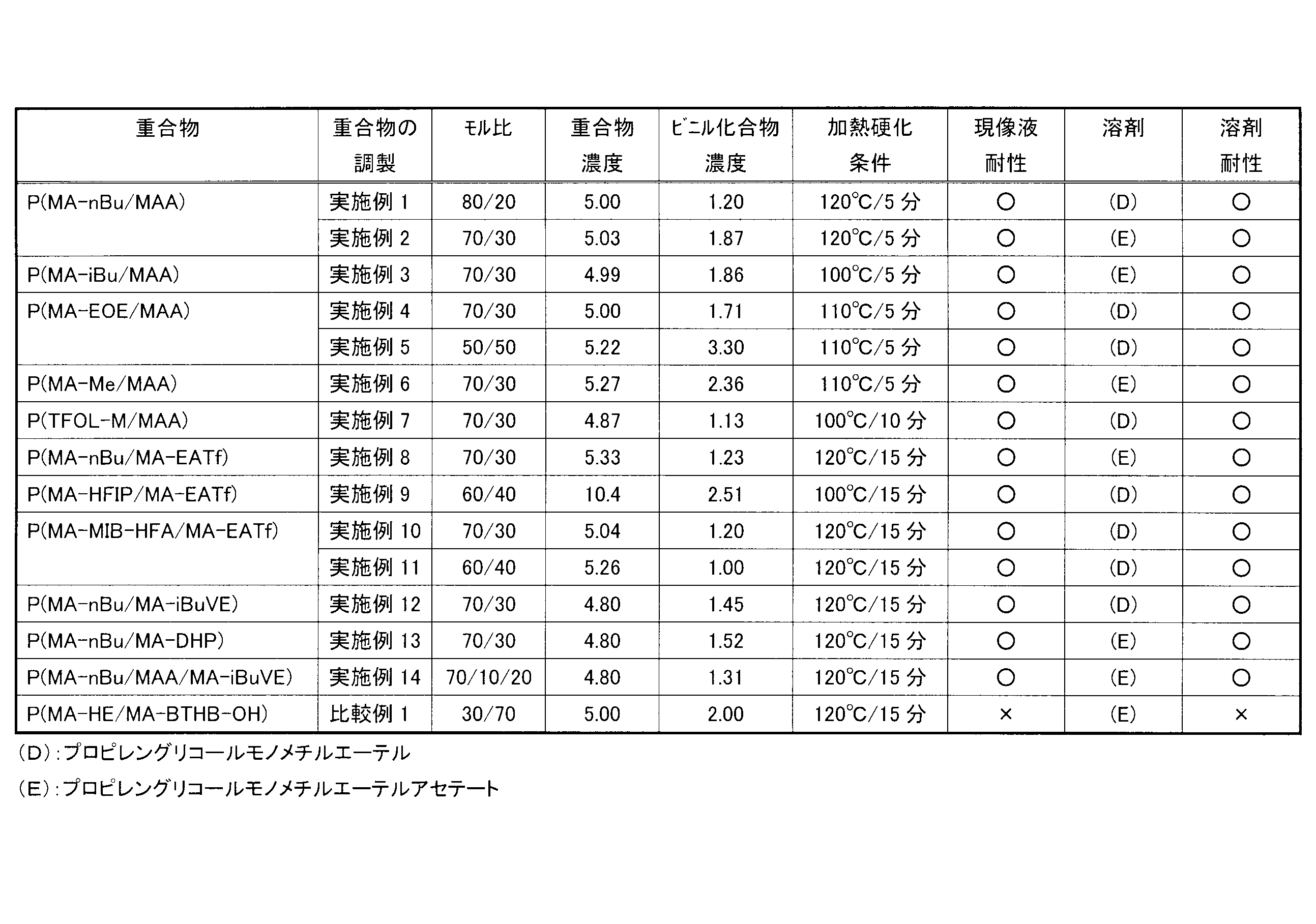
実施例1、2、4~6および10~14の重合物に、溶剤として含フッ素脂肪族アルコールである2,2,3,3,4,4,5,5-オクタフルオロ-1-ペンタノールを使用し、ビニル化合物として前記TMPEOTVE-30を使用し、光酸発生剤として以下に示す構造の化合物(BASFジャパン株式会社製、商品名、IRGACURE PAG103(表9中、(G))、またはサンアプロ株式会社製、商品名、CP-100TF(表9中、(H))を使用し、表9に示す比で調合し、ポジ型レジスト組成物とした。表9において、調合比は溶剤の質量を100質量部とする質量部で表した。光酸発生剤は重合物とビニル化合物を合計した質量を100質量部として3質量部使用した。

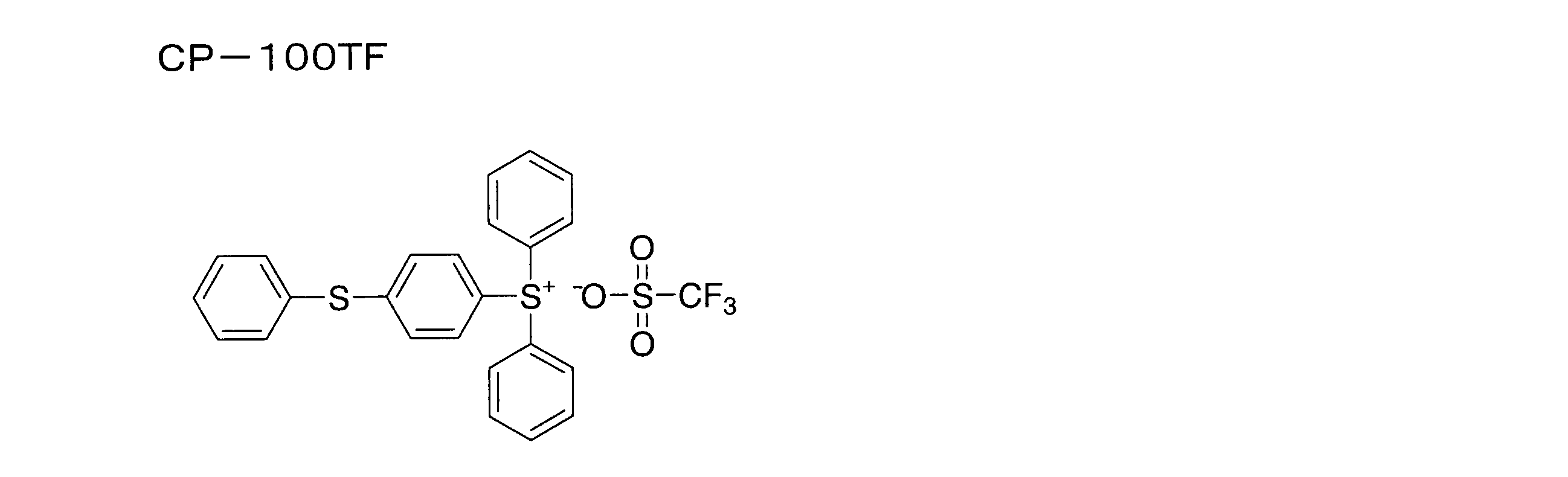

表9に示した実施例1、2、4~6、10~14で得られた重合物を用いたポジ型レジスト組成物について、有機ポリマー基板への塗布試験を行った。シリコン基板の代わりに有機ポリマー基板としてのPET基板を使用し、上記パターン形成試験と同じ方法で、ポジ型レジスト組成物をPET基板へ塗布し加熱硬化を行った。加熱は表9に記載の各々の実施例における加熱処理条件と同様に行った。PET基板は、厚さ100μmの前記PET基板(東レ株式会社製、商品名ルミラーT60)を、カッターナイフにて、直径12cmの円形に切り出して用いた。
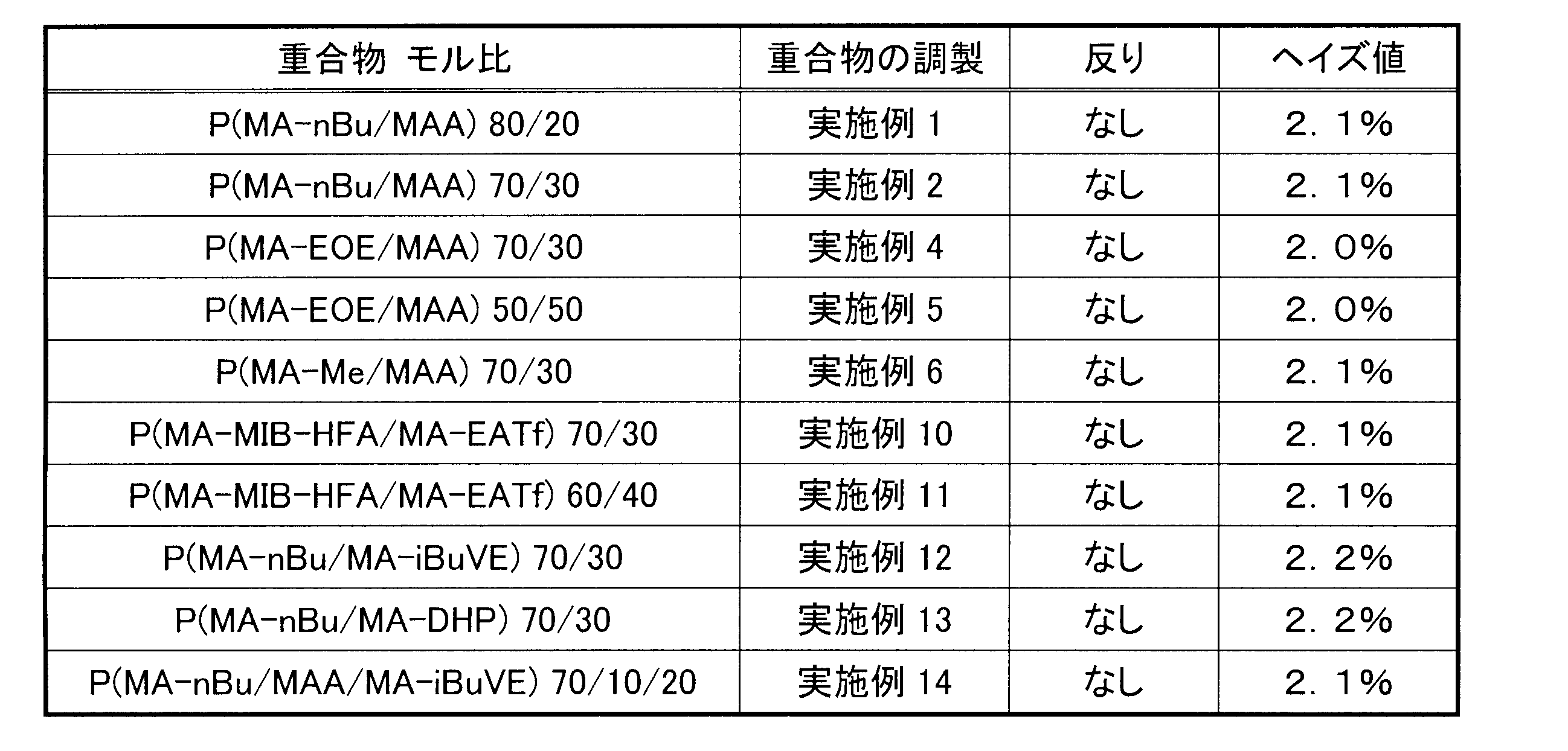
Claims (8)
- 水素原子の個数がフッ素原子の個数以下であり、炭素数が2~8である1価の含フッ素脂肪族アルコールと、下記一般式(1)で表される繰り返し単位Aと下記一般式(2)で表される繰り返し単位Bを含む重合物と、ビニル化合物と、光酸発生剤と、を含むポジ型レジスト組成物。




- 一般式(2)中、Dが、下記一般式(5)で表される基である、請求項1に記載のポジ型レジスト組成物。

- 上記一般式(2)中、Dが、下記一般式(6)で表される基である、請求項1に記載のポジ型レジスト組成物。

- 前記ビニル化合物として、少なくとも2個のビニルエーテル基を含有しているビニル化合物を含むことを特徴とする、請求項1乃至請求項3のいずれか1項に記載のポジ型レジスト組成物。
- 光酸発生剤が、一般式(7)で表される2価の基を含むN-スルホニルオキシイミド化合物またはオキシム-O-スルホネート化合物である、請求項1乃至請求項4のいずれか1項に記載のポジ型レジスト組成物。

- 光酸発生剤が、一般式(8)で表される化合物である、請求項1乃至請求項5のいずれか1項に記載のポジ型レジスト組成物。

- 含フッ素脂肪族アルコールの質量を100とする質量比で表して、重合物が0.5以上、30以下、ビニル化合物が0.05以上、20以下であり、さらに重合物とビニル化合物を合計した質量を100とする質量比で表して、光酸発生剤が0.01以上、15以下含まれる、請求項1乃至請求項6のいずれか1項に記載のポジ型レジスト組成物。
- 重合物を基準とするモル%で表して、重合物に繰り返し単位Aが25モル%以上、80モル%以下、繰り返し単位Bが20モル%以上、75モル%以下含まれる、請求項1乃至請求項7のいずれか1項に記載のポジ型レジスト組成物。
Priority Applications (3)
| Application Number | Priority Date | Filing Date | Title |
|---|---|---|---|
| CN201280030770.XA CN103620499B (zh) | 2011-06-21 | 2012-06-18 | 正型抗蚀剂组合物 |
| KR1020147001387A KR20140027478A (ko) | 2011-06-21 | 2012-06-18 | 포지티브형 레지스트 조성물 |
| US14/127,392 US9310682B2 (en) | 2011-06-21 | 2012-06-18 | Positive-type resist composition |
Applications Claiming Priority (4)
| Application Number | Priority Date | Filing Date | Title |
|---|---|---|---|
| JP2011137111 | 2011-06-21 | ||
| JP2011-137111 | 2011-06-21 | ||
| JP2012-133697 | 2012-06-13 | ||
| JP2012133697A JP6035887B2 (ja) | 2011-06-21 | 2012-06-13 | ポジ型レジスト組成物 |
Publications (1)
| Publication Number | Publication Date |
|---|---|
| WO2012176718A1 true WO2012176718A1 (ja) | 2012-12-27 |
Family
ID=47422555
Family Applications (1)
| Application Number | Title | Priority Date | Filing Date |
|---|---|---|---|
| PCT/JP2012/065460 Ceased WO2012176718A1 (ja) | 2011-06-21 | 2012-06-18 | ポジ型レジスト組成物 |
Country Status (5)
| Country | Link |
|---|---|
| US (1) | US9310682B2 (ja) |
| JP (1) | JP6035887B2 (ja) |
| KR (1) | KR20140027478A (ja) |
| CN (1) | CN103620499B (ja) |
| WO (1) | WO2012176718A1 (ja) |
Cited By (1)
| Publication number | Priority date | Publication date | Assignee | Title |
|---|---|---|---|---|
| WO2018079449A1 (ja) * | 2016-10-27 | 2018-05-03 | 富士フイルム株式会社 | 感活性光線性又は感放射線性樹脂組成物、レジスト膜、パターン形成方法、電子デバイスの製造方法 |
Families Citing this family (3)
| Publication number | Priority date | Publication date | Assignee | Title |
|---|---|---|---|---|
| WO2015012264A1 (ja) * | 2013-07-23 | 2015-01-29 | 旭化成株式会社 | 銅及び/又は銅酸化物分散体、並びに該分散体を用いて形成された導電膜 |
| JPWO2020158316A1 (ja) * | 2019-01-29 | 2021-12-09 | 富士フイルム株式会社 | 感光性転写材料、樹脂パターンの製造方法、回路配線の製造方法、タッチパネルの製造方法、並びに、フィルム及びその製造方法 |
| KR102809121B1 (ko) * | 2023-07-05 | 2025-05-19 | 주식회사 에스티머티리얼즈 | 광산발생제 및 이를 포함하는 포토레지스트 조성물 |
Citations (3)
| Publication number | Priority date | Publication date | Assignee | Title |
|---|---|---|---|---|
| JPH04229250A (ja) * | 1990-05-14 | 1992-08-18 | Imperial Chem Ind Plc <Ici> | 多層フィルム |
| JP2007256525A (ja) * | 2006-03-22 | 2007-10-04 | Hitachi Chemical Dupont Microsystems Ltd | ネガ型感光性樹脂組成物、パターンの製造方法及び電子部品 |
| JP2011080032A (ja) * | 2009-09-08 | 2011-04-21 | Tokyo Univ Of Science | 新規な化合物、塩基発生剤及び当該塩基発生剤を含有する感光性樹脂組成物 |
Family Cites Families (18)
| Publication number | Priority date | Publication date | Assignee | Title |
|---|---|---|---|---|
| JPH1195431A (ja) * | 1997-09-18 | 1999-04-09 | Hitachi Chem Co Ltd | 感光性樹脂組成物、それを用いた樹脂膜の製造法及び物品 |
| JP3755571B2 (ja) * | 1999-11-12 | 2006-03-15 | 信越化学工業株式会社 | 化学増幅ポジ型レジスト材料及びパターン形成方法 |
| JP4132510B2 (ja) * | 1999-12-17 | 2008-08-13 | 信越化学工業株式会社 | 化学増幅型レジスト材料及びパターン形成方法 |
| US6835524B2 (en) * | 2000-02-16 | 2004-12-28 | Shin-Etsu Chemical Co., Ltd. | Polymers, chemical amplification resist compositions and patterning process |
| JP3861966B2 (ja) | 2000-02-16 | 2006-12-27 | 信越化学工業株式会社 | 高分子化合物、化学増幅レジスト材料及びパターン形成方法 |
| JP3787271B2 (ja) | 2000-11-20 | 2006-06-21 | 東京応化工業株式会社 | 微細レジストホールパターン形成方法 |
| JP3835523B2 (ja) | 2000-12-18 | 2006-10-18 | 信越化学工業株式会社 | 化学増幅ポジ型レジスト材料及びパターン形成方法 |
| JP2003140345A (ja) * | 2001-11-02 | 2003-05-14 | Fuji Photo Film Co Ltd | ポジ型レジスト組成物 |
| JP3907165B2 (ja) * | 2001-11-05 | 2007-04-18 | 富士フイルム株式会社 | ポジ型レジスト組成物 |
| JP2003344994A (ja) * | 2002-05-28 | 2003-12-03 | Fuji Photo Film Co Ltd | 感光性樹脂組成物 |
| JP2005031564A (ja) * | 2003-07-11 | 2005-02-03 | Jsr Corp | 感放射線性樹脂組成物 |
| US8945808B2 (en) | 2006-04-28 | 2015-02-03 | International Business Machines Corporation | Self-topcoating resist for photolithography |
| JP5077526B2 (ja) * | 2006-09-21 | 2012-11-21 | 日産化学工業株式会社 | 末端に不飽和基を有する化合物を含有するポジ型感光性樹脂組成物 |
| WO2008099869A1 (ja) * | 2007-02-15 | 2008-08-21 | Central Glass Company, Limited | 光酸発生剤用化合物及びそれを用いたレジスト組成物、パターン形成方法 |
| JP4918162B2 (ja) | 2008-02-22 | 2012-04-18 | ブルーワー サイエンス アイ エヌ シー. | 193nmリソグラフィー用の二重層の感光性で現像液に可溶な底面反射防止塗膜 |
| EP2189846B1 (en) * | 2008-11-19 | 2015-04-22 | Rohm and Haas Electronic Materials LLC | Process for photolithography applying a photoresist composition comprising a block copolymer |
| JP5469920B2 (ja) | 2009-05-29 | 2014-04-16 | 東京応化工業株式会社 | レジスト組成物及びレジストパターン形成方法 |
| JP5282781B2 (ja) * | 2010-12-14 | 2013-09-04 | 信越化学工業株式会社 | レジスト材料及びパターン形成方法 |
-
2012
- 2012-06-13 JP JP2012133697A patent/JP6035887B2/ja active Active
- 2012-06-18 US US14/127,392 patent/US9310682B2/en active Active
- 2012-06-18 WO PCT/JP2012/065460 patent/WO2012176718A1/ja not_active Ceased
- 2012-06-18 KR KR1020147001387A patent/KR20140027478A/ko not_active Ceased
- 2012-06-18 CN CN201280030770.XA patent/CN103620499B/zh active Active
Patent Citations (3)
| Publication number | Priority date | Publication date | Assignee | Title |
|---|---|---|---|---|
| JPH04229250A (ja) * | 1990-05-14 | 1992-08-18 | Imperial Chem Ind Plc <Ici> | 多層フィルム |
| JP2007256525A (ja) * | 2006-03-22 | 2007-10-04 | Hitachi Chemical Dupont Microsystems Ltd | ネガ型感光性樹脂組成物、パターンの製造方法及び電子部品 |
| JP2011080032A (ja) * | 2009-09-08 | 2011-04-21 | Tokyo Univ Of Science | 新規な化合物、塩基発生剤及び当該塩基発生剤を含有する感光性樹脂組成物 |
Cited By (2)
| Publication number | Priority date | Publication date | Assignee | Title |
|---|---|---|---|---|
| WO2018079449A1 (ja) * | 2016-10-27 | 2018-05-03 | 富士フイルム株式会社 | 感活性光線性又は感放射線性樹脂組成物、レジスト膜、パターン形成方法、電子デバイスの製造方法 |
| JPWO2018079449A1 (ja) * | 2016-10-27 | 2019-09-19 | 富士フイルム株式会社 | 感活性光線性又は感放射線性樹脂組成物、レジスト膜、パターン形成方法、電子デバイスの製造方法 |
Also Published As
| Publication number | Publication date |
|---|---|
| US20140134542A1 (en) | 2014-05-15 |
| CN103620499B (zh) | 2016-08-17 |
| US9310682B2 (en) | 2016-04-12 |
| KR20140027478A (ko) | 2014-03-06 |
| JP6035887B2 (ja) | 2016-11-30 |
| JP2013029822A (ja) | 2013-02-07 |
| CN103620499A (zh) | 2014-03-05 |
Similar Documents
| Publication | Publication Date | Title |
|---|---|---|
| CN101164014B (zh) | 用于形成光交联固化的抗蚀剂下层膜的抗蚀剂下层膜形成组合物 | |
| JP6072107B2 (ja) | 上塗りフォトレジストと共に使用するためのコーティング組成物 | |
| JP5840352B2 (ja) | 上塗りフォトレジストと共に使用するためのコーティング組成物 | |
| JP7171601B2 (ja) | 光酸発生剤、レジスト組成物及び、該レジスト組成物を用いたデバイスの製造方法 | |
| JP5708938B2 (ja) | 感光性レジスト下層膜形成組成物及びレジストパターンの形成方法 | |
| WO2004076535A1 (ja) | シルセスキオキサン樹脂、ポジ型レジスト組成物、レジスト積層体及びレジストパターン形成方法 | |
| WO2005103098A1 (ja) | 液浸露光プロセス用レジスト保護膜形成用材料、および該保護膜を用いたレジストパターン形成方法 | |
| TW200424802A (en) | Immersion liquid for immersion exposure process and resist pattern forming method using such immersion liquid | |
| JP2006227632A (ja) | 液浸露光プロセス用レジスト保護膜形成用材料、複合膜、およびレジストパターン形成方法 | |
| JP4322205B2 (ja) | レジスト保護膜形成用材料およびこれを用いたレジストパターン形成方法 | |
| TWI863906B (zh) | Euv微影用正型光阻組成物及光阻圖案形成方法 | |
| JP6035887B2 (ja) | ポジ型レジスト組成物 | |
| KR102929030B1 (ko) | 감광성 수지 조성물, 함불소 수지 경화물의 제조 방법, 함불소 수지, 함불소 수지막, 뱅크 및 표시 소자 | |
| KR101137812B1 (ko) | 유기 반사방지막 형성용 유기 중합체 및 이를 포함하는유기 조성물 | |
| WO2010104074A1 (ja) | 側鎖にアセタール構造を有するポリマーを含むレジスト下層膜形成組成物及びレジストパターンの形成方法 | |
| JP2012022191A (ja) | イオン性重合体を含むレジスト下層膜形成組成物及びそれを用いたレジストパターンの形成方法 | |
| JP5520440B2 (ja) | 有機反射防止膜形成用単量体、重合体及びこれを含む有機組成物 | |
| TW200836014A (en) | Composition for formation of resist protection film, and method for formation of resist pattern using the same | |
| JP2005250511A (ja) | 液浸露光プロセス用レジスト保護膜形成用材料、該保護膜形成材料による保護膜を有するレジスト膜、および該保護膜を用いたレジストパターン形成方法 | |
| WO2007029822A1 (ja) | 保護膜形成用材料およびこれを用いたホトレジストパターン形成方法 | |
| JP7121943B2 (ja) | レジストパターン形成方法 | |
| JP5986748B2 (ja) | 上塗りフォトレジストと共に使用するためのコーティング組成物 | |
| JP5637024B2 (ja) | 感光性樹脂組成物およびその用途 | |
| JP2007249161A (ja) | 保護膜形成用材料およびこれを用いたホトレジストパターン形成方法 | |
| CN101019075A (zh) | 光刻胶保护膜形成用材料以及使用该材料的光刻胶图案形成方法 |
Legal Events
| Date | Code | Title | Description |
|---|---|---|---|
| 121 | Ep: the epo has been informed by wipo that ep was designated in this application |
Ref document number: 12803123 Country of ref document: EP Kind code of ref document: A1 |
|
| WWE | Wipo information: entry into national phase |
Ref document number: 14127392 Country of ref document: US |
|
| NENP | Non-entry into the national phase |
Ref country code: DE |
|
| ENP | Entry into the national phase |
Ref document number: 20147001387 Country of ref document: KR Kind code of ref document: A |
|
| 122 | Ep: pct application non-entry in european phase |
Ref document number: 12803123 Country of ref document: EP Kind code of ref document: A1 |